
INTERSPIRE MARKETER
|
|
|
- Angel Flynn
- 10 years ago
- Views:
Transcription
1 INTERSPIRE MARKETER Interspire Pty. Ltd. User s Guide Edition 1.3 April 2009

2

3 3 About This User s Guide How to Use This User s Guide This user s guide describes Interspire Marketer s Graphical User Interface (GUI). It shows you how to use each screen in the GUI. Use the Introduction to get a basic overview of Interspire Marketer. See page 23. Use the Getting Started chapter to start sending s right away. See page 27. Use the Table of Contents (page 5), List of Figures (page 11) and List of Tables (page 19) to find information about a particular screen in the GUI. Use the Index to find information on a specific keyword. See page 271. Use the Troubleshooting chapter to diagnose and solve specific problems. See page 267. Use the rest of the user s guide to see in depth descriptions of Interspire Marketer s features. The chapters are roughly arranged in order of the frequency with which you are likely to use them when configuring Interspire Marketer. Customer Support If you have a problem with Interspire Marketer that is not covered in this User's Guide or the online knowledge base (click the Help link in the toolbar), please visit the Interspire online support center:

4 4 ABOUT THIS USER S GUIDE Written by Rick Carlile. Copyright 2009 Interspire Pty. Ltd. (ACN ) All rights reserved. DISCLAIMER: The information in this user s guide is accurate at the time of writing. This user s guide is provided as is without express or implied warranty of any kind. Neither Interspire Pty. Ltd. nor its agents assume any liability for inaccuracies in this user s guide, or losses incurred by use or misuse of the information in this user s guide.

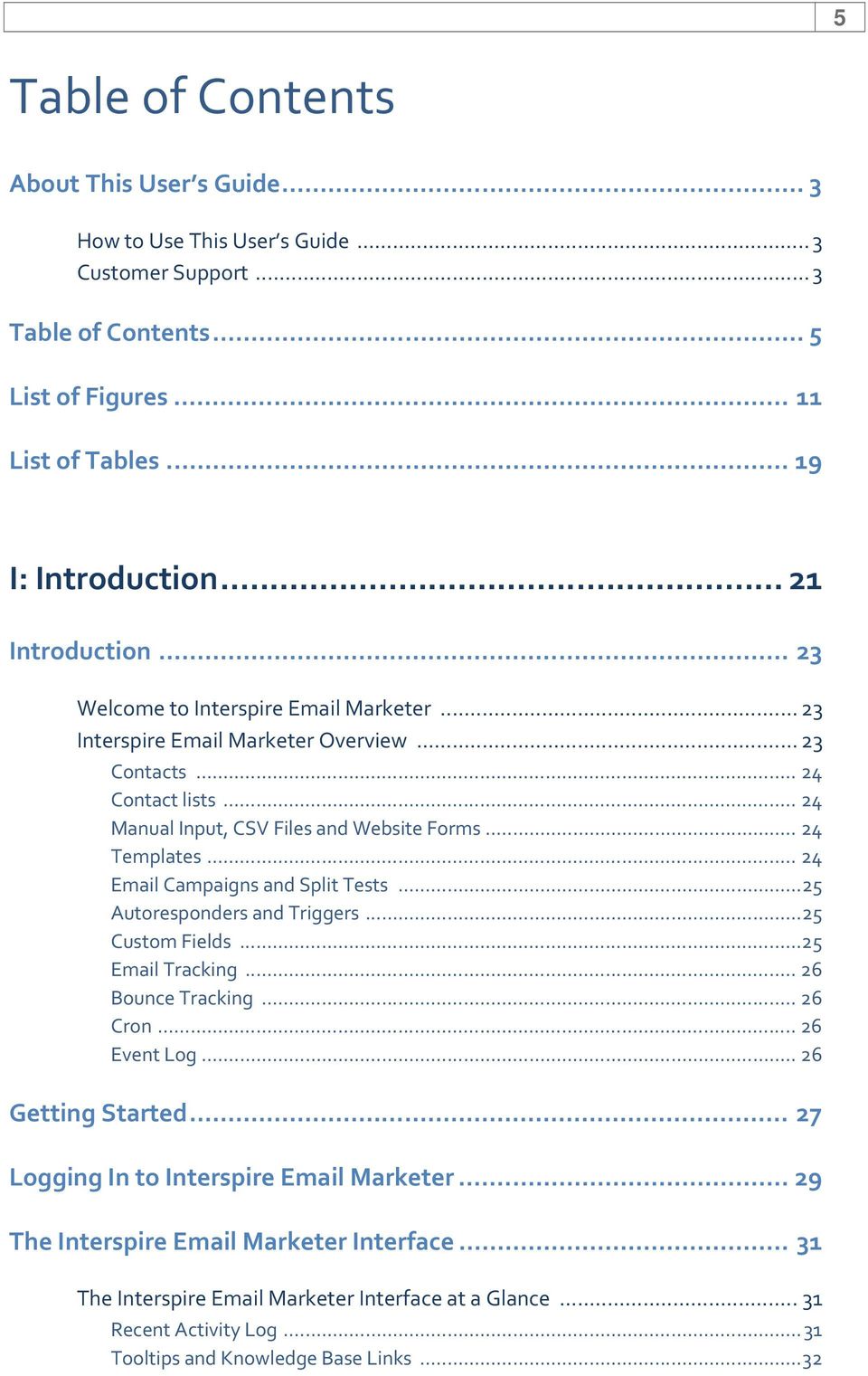
5 5 Table of Contents About This User s Guide... 3 How to Use This User s Guide...3 Customer Support...3 Table of Contents... 5 List of Figures List of Tables I: Introduction Introduction Welcome to Interspire Marketer Interspire Marketer Overview Contacts Contact lists Manual Input, CSV Files and Website Forms Templates Campaigns and Split Tests...25 Autoresponders and Triggers...25 Custom Fields Tracking Bounce Tracking Cron Event Log Getting Started Logging In to Interspire Marketer The Interspire Marketer Interface The Interspire Marketer Interface at a Glance Recent Activity Log...31 Tooltips and Knowledge Base Links...32
6 6 TABLE OF CONTENTS Sorting Lists Navigating Lists The Toolbar...33 The Navigation Bar...33 II: The Navigation Bar Using Contact Lists...37 Contact List Overview...37 Contact List Information Bounced s Contact List Segments Contact List Groups Viewing and Managing Contact Lists Managing Contact List Group Folders Viewing Contact List Contacts...42 Creating and Editing Contact Lists Processing Bounced s...47 Creating, Editing and Viewing Segments Creating a Segment...50 Viewing a Segment s Contacts...52 Using Contacts...55 Contacts Overview Event Logging Overview...56 Viewing and Managing Contacts Viewing A Contact Manual Event Logging Searching Your Contacts Adding or Editing a Contact Creating Google Calendar Follow Up Reminders...66 Importing Contacts From a File Exporting Contacts To a File...70 Removing Contacts...74 Viewing Suppressed Addresses Suppressing an Address or Domain...77 Using Campaigns...81

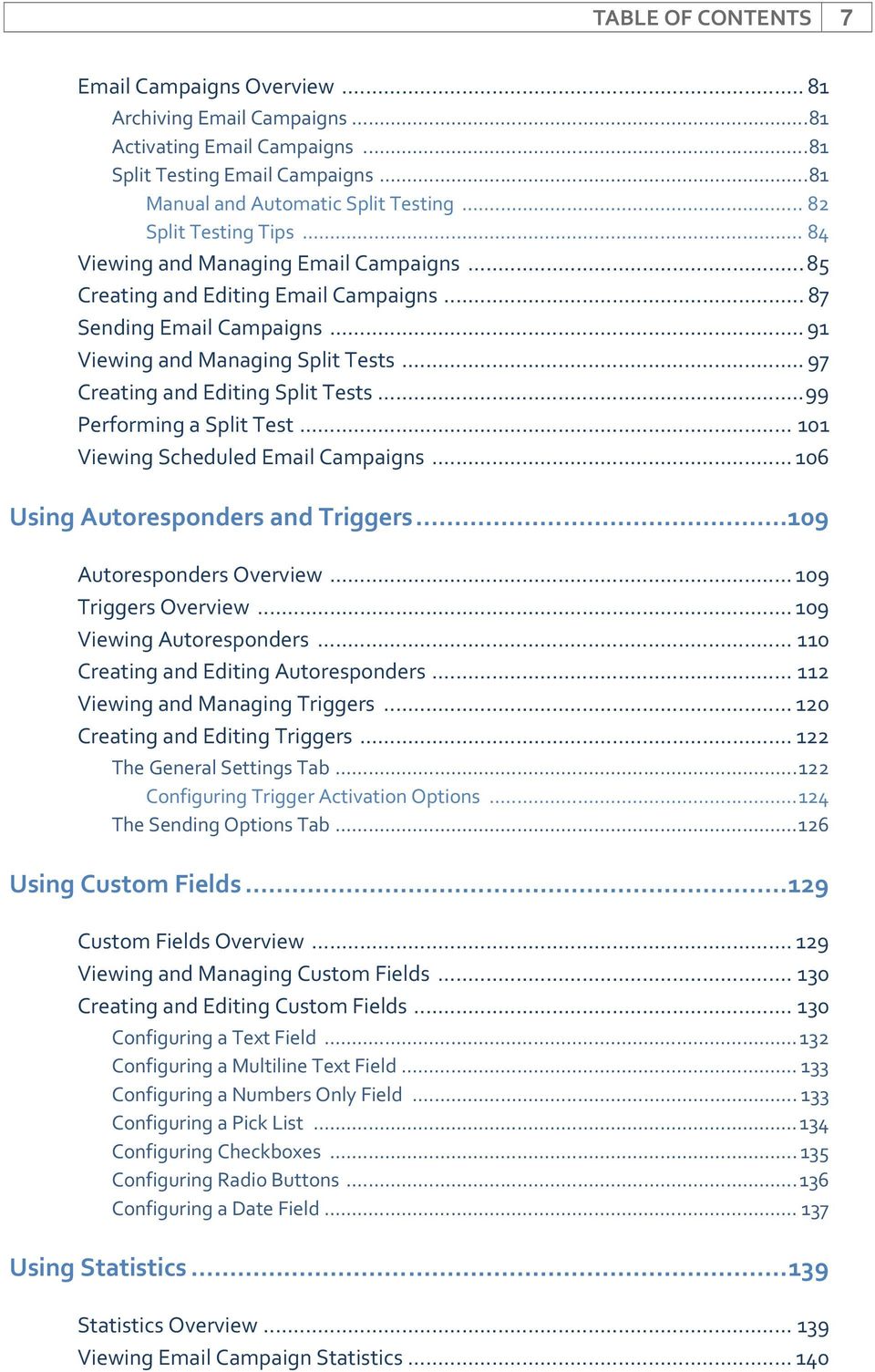
7 TABLE OF CONTENTS 7 Campaigns Overview Archiving Campaigns...81 Activating Campaigns...81 Split Testing Campaigns...81 Manual and Automatic Split Testing Split Testing Tips Viewing and Managing Campaigns...85 Creating and Editing Campaigns Sending Campaigns Viewing and Managing Split Tests Creating and Editing Split Tests...99 Performing a Split Test Viewing Scheduled Campaigns Using Autoresponders and Triggers Autoresponders Overview Triggers Overview Viewing Autoresponders Creating and Editing Autoresponders Viewing and Managing Triggers Creating and Editing Triggers The General Settings Tab Configuring Trigger Activation Options The Sending Options Tab Using Custom Fields Custom Fields Overview Viewing and Managing Custom Fields Creating and Editing Custom Fields Configuring a Text Field Configuring a Multiline Text Field Configuring a Numbers Only Field Configuring a Pick List Configuring Checkboxes Configuring Radio Buttons Configuring a Date Field Using Statistics Statistics Overview Viewing Campaign Statistics
8 8 TABLE OF CONTENTS Viewing Detailed Campaign Statistics Viewing Split Test Statistics Viewing Detailed Split Test Statistics Viewing Autoresponder Statistics Viewing Detailed Autoresponder Statistics Viewing Trigger Statistics Viewing Detailed Trigger Statistics Viewing Contact List Statistics Viewing Detailed Contact List Statistics Viewing User Account Statistics Viewing Detailed User Account Statistics Managing Statistics Exporting Statistics Printing Statistics Using the Detailed Statistics Screens Editing HTML and Text Using the HTML Editor HTML Source Options HTML Editor Overview Using Design Tools Creating and Editing Hyperlinks Uploading Files and Images to the Interspire Marketer Server Creating and Editing Links Inserting and Editing Images Creating and Editing Tables Inserting and Editing Forms Modifying Page Properties Inserting Custom Fields Using the Editing Window Adding and Deleting Text Blocks Composing and Editing Text Manipulating Images Manipulating Text and Image Containers Composing and Editing HTML Previewing Your Using Tags and Tabs Custom Fields Simple and Complete Modes Using HTML Tags Using Tabs Using the Text Editor Creating a Plain Text

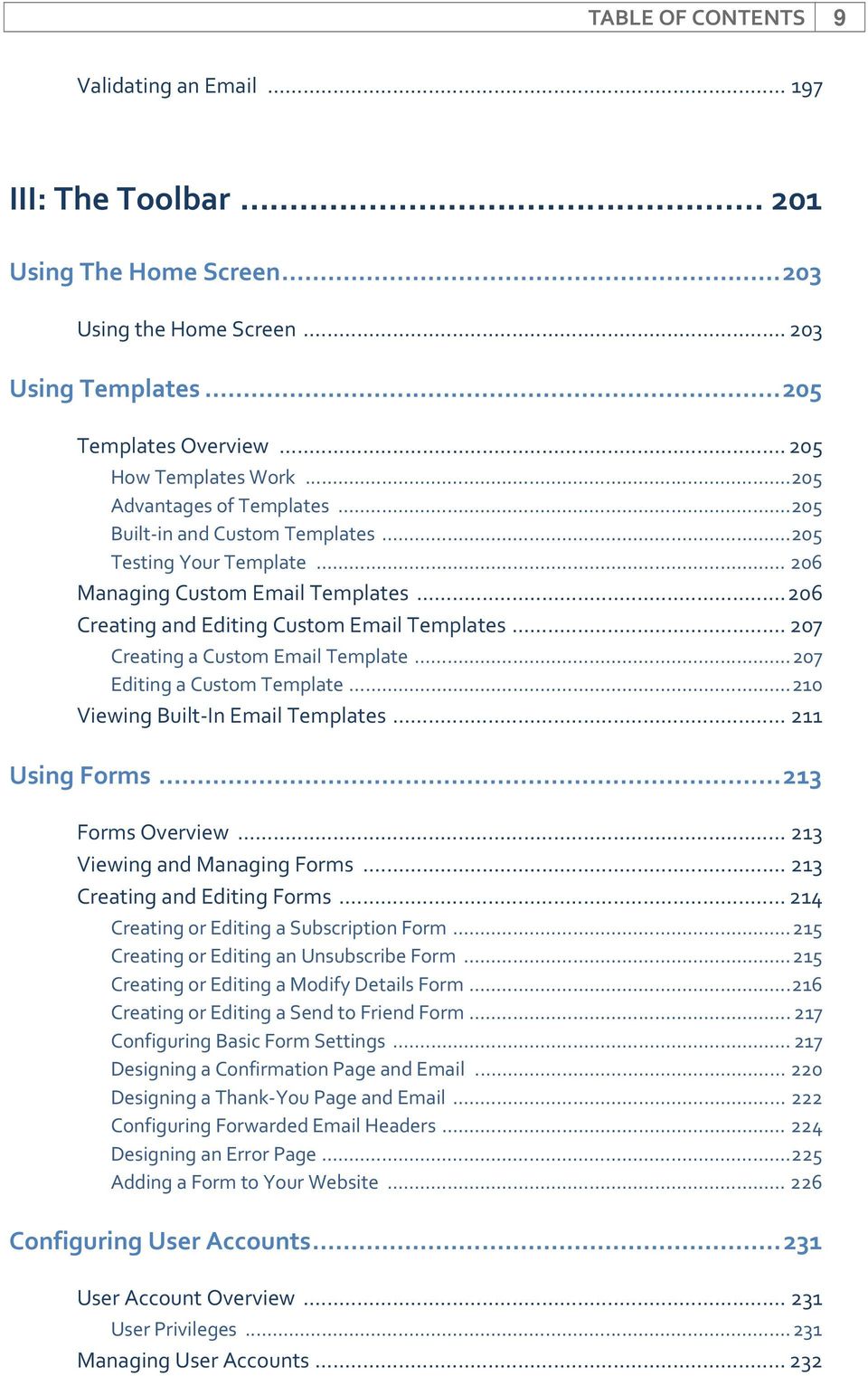
9 TABLE OF CONTENTS 9 Validating an III: The Toolbar Using The Home Screen Using the Home Screen Using Templates Templates Overview How Templates Work Advantages of Templates Built in and Custom Templates Testing Your Template Managing Custom Templates Creating and Editing Custom Templates Creating a Custom Template Editing a Custom Template Viewing Built In Templates Using Forms Forms Overview Viewing and Managing Forms Creating and Editing Forms Creating or Editing a Subscription Form Creating or Editing an Unsubscribe Form Creating or Editing a Modify Details Form Creating or Editing a Send to Friend Form Configuring Basic Form Settings Designing a Confirmation Page and Designing a Thank You Page and Configuring Forwarded Headers Designing an Error Page Adding a Form to Your Website Configuring User Accounts User Account Overview User Privileges Managing User Accounts
10 10 TABLE OF CONTENTS Creating and Editing User Accounts Deleting User Accounts Configuring User Settings Configuring User Restrictions Configuring User Permissions Configuring Settings Configuring Google Calendar Settings Using Interspire Marketer Settings Interspire Marketer Settings Overview Managing Application Settings Managing Settings Managing Global SMTP Settings Managing Cron Jobs Configuring Cron Jobs in Interspire Marketer Configuring Cron Support on Your Server Configuring Cron Via Commands Configuring Cron Via a Graphical Interface Managing Security Settings Managing Addon Settings Using Tools Interspire Marketer Tools Overview Viewing System Information Checking For Updates Viewing Error Logs Checking Permissions IV: Troubleshooting and Index Troubleshooting Index

11 11 List of Figures Figure 1 Interspire Marketer Overview Figure 2 Login Screen...29 Figure 3 The Interspire Marketer Interface at a Glance Figure 4 Recent Activity Log Figure 5 Tooltips Figure 6 Knowledge Base Links Figure 7 Navigating Lists Figure 8 The Toolbar Figure 9 The Navigation Bar Figure 10 The Contact Lists Menu Figure 11 Viewing Contact Lists...40 Figure 12 Contact List Group Folders Figure 13 Create New Folder...42 Figure 14 Rename Folder...42 Figure 15 Viewing Contact List Members Figure 16 Contact List and Segment Menu Figure 17 Create or Edit a Contact List...45 Figure 18 Processing Bounced s Figure 19 Processing Bounced s: Enter Server Details...48 Figure 20 Processing Bounced s: Start Processing...49 Figure 21 Processing Bounced s: Progress...49 Figure 22 Processing Bounced s: Summary...49 Figure 23 Viewing Segments...50 Figure 24 Creating a Segment Figure 25 Creating a Segment: Configure Segment Figure 26 Viewing a Segment s Contacts Figure 27 Contact List and Segment Menu Figure 28 The Contact Lists Menu Figure 29 Viewing Contacts Figure 30 Contact List and Segment Menu...58 Figure 31 Contact Event Log...58 Figure 32 View Contact...59 Figure 33 Manual Event Logging: Step Figure 34 Manual Event Logging: Select Date and Time Figure 35 Searching Contacts: Choose List or Segment...62 Figure 36 Searching Contacts: Filter and Show Fields Figure 37 Searching Contacts: Filter By Date Subscribed Figure 38 Searching Contacts: Filter By Link...64

12 12 LIST OF FIGURES Figure 39 Searching Contacts: Filter By Opened Figure 40 Add a Contact: Select Contact List Figure 41 Add a Contact: Add Contact Details Figure 42 Google Calendar: Configure Reminder Figure 43 Google Calendar: View Reminder Figure 44 Import Contacts From a File Figure 45 Define File Parameters Figure 46 Define Field Mapping Figure 47 Start Importing Contacts Figure 48 Import In Progress...70 Figure 49 Contact Import Report...70 Figure 50 Export Contacts To a File...71 Figure 51 Specify Contact File Details...72 Figure 52 Start Exporting...72 Figure 53 Exporting Contacts...73 Figure 54 Download Contacts File...73 Figure 55 View Exported Contacts File...73 Figure 56 Save Exported Contacts File...74 Figure 57 Remove a Contact: Choose Contact List...74 Figure 58 Remove a Contact: Define Contacts...75 Figure 59 Enter Contact Addresses Manually...75 Figure 60 Upload List of Contacts to Remove...75 Figure 61 Removed Contact Report Figure 62 Suppression List: Choose Contact List Figure 63 Suppression List: View Suppressed Addresses Figure 64 Edit Suppressed Address...77 Figure 65 Suppress an or Domain: Select Contact List...78 Figure 66 Enter Addresses or Domains for Suppression Manually...78 Figure 67 Upload List of Addresses or Domains for Suppression...78 Figure 68 Suppressed Address or Domain Report Figure 69 The Campaigns Menu Figure 70 Manual Split Testing Figure 71 Multi Level Split Testing Example Figure 72 Automatic Split Testing Figure 73 Viewing Campaigns Figure 74 Create an Campaign...87 Figure 75 The Campaign Editor Figure 76 Check Your for Spam Figure 77 Send an Campaign Figure 78 Send an Campaign: Search Contacts Figure 79 Send an Campaign: Campaign Settings... 94
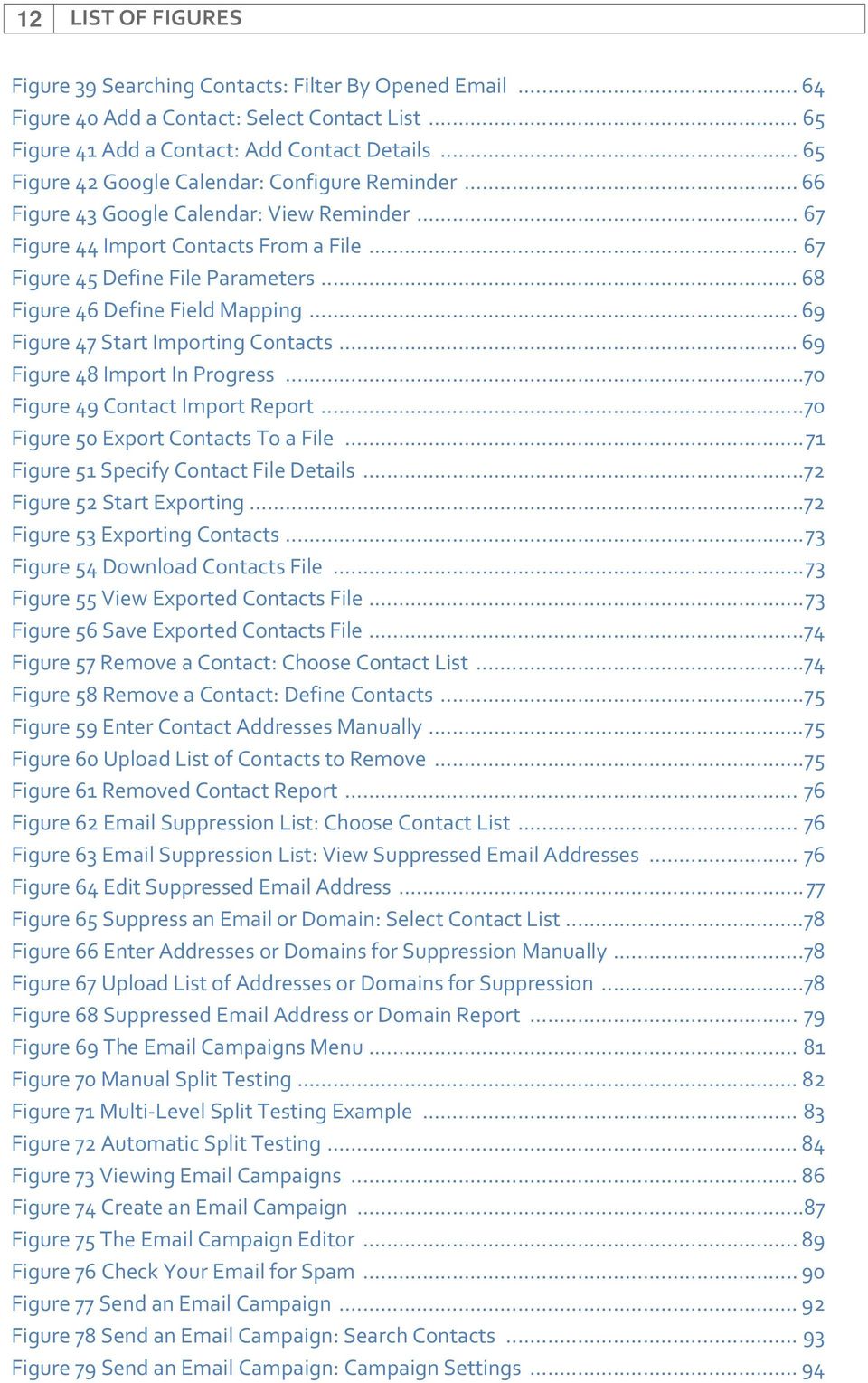
13 LIST OF FIGURES 13 Figure 80 Schedule Campaign...95 Figure 82 Send an Campaign: Report...96 Figure 81 Use Google Analytics...96 Figure 83 Sending an Campaign: Warning Figure 84 Sending an Campaign: Sending in Progress Figure 85 Sending an Campaign: Completed Figure 86 Viewing Split Tests Figure 87 Creating a Split Test Figure 88 Sending a Split Test Figure 89 Sending a Split Test: Test Settings Figure 90 Schedule Split Test Figure 91 Sending a Split Test: Review Test Figure 92 Sending a Split Test: Warning Figure 93 Sending a Split Test: Sending in Progress Figure 94 Sending a Split Test: Completed Figure 95 View Scheduled Campaigns Figure 96 The Autoresponders Menu Figure 97 Triggers Overview Figure 98 View Autoresponders: Choose Contact List Figure 99 View Autoresponders: Manage Autoresponders Figure 100 Create an Autoresponder: Select a Contact List Figure 101 Create an Autoresponder: Name and Search Figure 102 Autoresponder Filter Options Figure 103 Autoresponder: Filter By Link Figure 104 Autoresponder: Filter By Opened Figure 105 Autoresponder: Sending Options Figure 106 Autoresponder: Select a Template Figure 107 The Autoresponder Editor Figure 108 Check Your for Spam Figure 109 Viewing Triggers Figure 110 Create a New Trigger: General Settings Figure 111 Date Based Trigger Options Figure 112 Based Trigger Options Figure 113 When Triggered: Send Campaign Figure 114 When Triggered: Send Campaign Figure 115 Activate Trigger Based on Custom Date Figure 116 Activate Trigger Based on Specific Date Figure 117 Activate Trigger Based on Link Being Clicked Figure 118 Activate Trigger Based on Being Opened Figure 119 Create a New Trigger: Sending Options Figure 120 The Custom Fields Menu
14 14 LIST OF FIGURES Figure 121 Viewing Custom Fields Figure 122 Create a Custom Field: Type and Name Figure 123 Create a Custom Field: Select Contact List Figure 124 Configuring a Text Field Figure 125 Configuring a Multiline Text Field Figure 126 Configuring a Numbers Only Field Figure 127 Configuring a Pick List Figure 128 Configuring Checkboxes Figure 129 Configuring Radio Buttons Figure 130 Configuring a Date Field Figure 131 The Statistics Menu Figure 132 Viewing Campaign Statistics Figure 133 Detailed Campaign Statistics Figure 134 Viewing Split Test Statistics Figure 135 Detailed Split Test Statistics Figure 136 Viewing Autoresponder Statistics Figure 137 Detailed Autoresponder Statistics Figure 138 Viewing Trigger Statistics Figure 139 Detailed Trigger Statistics Figure 140 Viewing Contact List Statistics Figure 141 Detailed Contact List Statistics Figure 142 Viewing User Account Statistics Figure 143 Detailed User Account Statistics Figure 144 Exporting Statistics Figure 145 Printing Statistics Figure 146 Printing Statistics: Preview Figure 147 Printing Statistics: Print Dialog Figure 148 Detailed Statistics: Detailed List Figure 149 Detailed Statistics: Pie Chart Figure 150 Detailed Statistics: Timeline Figure 151 Detailed Statistics: Date Range Figure 152 Detailed Statistics: Custom Date Range Figure 153 Detailed Statistics: Individual Records Figure 154 Detailed Statistics: Refine Lists Figure 155 HTML Editor Overview Figure 156 HTML Design Tools Figure 157 The Find/Replace Window Figure 158 Check Spelling Figure 159 The Link Screen Figure 160 The Link Screen Figure 161 The Images Screen...170
15 LIST OF FIGURES 15 Figure 162 Insert Table Figure 163 Modifying Table Properties Figure 164 Modifying Cell Properties Figure 165 Insert Form Figure 166 Insert Text Field Figure 167 Insert Text Area Figure 168 Insert Hidden Field Figure 169 Insert Button Figure 170 Insert Checkbox Figure 171 Insert Radio Button Figure 172 Insert List Box Figure 173 Page Properties Figure 174 Custom Fields Figure 175 Text Block Icons Figure 176 Right Click (Text) Figure 177 Right Click (Image) Figure 178 Resizing Images Figure 179 Right Click (Table) Figure 180 Table Icons Figure 181 Cell Icons Figure 182 Editing HTML Figure 183 Previewing an Figure 184 Custom Field Buttons Figure 185 Simple and Complete Mode Link Figure 186 Simple Design Tools Figure 187 Complete Design Tools Figure 188 HTML Tags Figure 189 Remove and Edit HTML Tags Figure 190 Editing a Tag Figure 191 HTML Editor Tabs Figure 192 Create a Custom Document: Text Content Figure 193 Validation Figure 194 The Home Link Figure 195 The Home Screen Figure 196 The Templates Menu Figure 197 Templates: Custom Templates Figure 198 Templates: Create a Custom Template Figure 199 The Template Editor Figure 200 Custom Templates: Update Template Figure 201 View Built in Templates Figure 202 The Forms Menu
16 16 LIST OF FIGURES Figure 203 Viewing and Managing Forms Figure 204 Example Subscription Form Figure 205 Example Unsubscribe Form Figure 206 Example Modify Details Form Figure 207 Example Send to Friend Form Figure 208 Configuring Basic Form Settings Figure 209 Designing a Confirmation Page and Figure 210 Designing a Thank You Page and Figure 211 Designing Forwarded Headers Figure 212 Designing an Error Page Figure 213 Adding a Form to Your Website Figure 214 Paste HTML into Web Development Application Figure 215 Edit Form in Your Web Development Application Figure 216 Interspire Marketer Subscription Form in a Web Page Figure 217 The User Accounts Link Figure 218 User Accounts Figure 219 Delete a User Account Figure 220 User Settings Figure 221 Marketing Tip Figure 225 User Account: SMTP Server Details Figure 226 User Account: Sign up For smtp.com Service Figure 228 The Settings Link Figure 229 Settings: Application Settings Figure 230 Settings: Settings Figure 231 Settings: SMTP Server Details Figure 232 Settings: Sign up For smtp.com Service Figure 233 Settings: Cron Jobs Figure 234 Cron Timing Configuration Figure 235 cpanel: Advanced Figure 236 cpanel: Standard or Advanced Cron Mode Figure 237 cpanel: Standard Cron Setup Figure 238 cpanel: Advanced Cron Setup Figure 239 User Locked Out Figure 240 Settings: Security Settings Figure 241 Settings: Addons Settings Figure 242 The Tools Menu Figure 243 System Information Figure 244 Update Available Figure 245 Viewing Error Logs Figure 246 Checking Permissions Figure 247 Permission Checking in Progress

17 LIST OF FIGURES 17 Figure 248 Permission Report

18 18 LIST OF FIGURES

19 19 List of Tables Table 1 Navigating Lists Table 2 The Toolbar Table 3 The Navigation Bar Table 4 Viewing Contact Lists...40 Table 5 Viewing Contact List Members Table 6 Create or Edit a Contact List...45 Table 7 Processing Bounced s: Enter Server Details...48 Table 8 Viewing Segments...50 Table 9 Viewing Segment Contacts Table 10 Viewing Contacts...58 Table 11 View Contact...60 Table 12 Viewing Campaigns...86 Table 13 Send an Campaign: Campaign Settings...94 Table 14 Viewing Split Tests...98 Table 15 Creating a Split Test Table 16 Sending a Split Test: Test Settings Table 17 View Scheduled Campaigns Table 18 View Autoresponders Table 19 Autoresponder: Sending Options Table 20 Viewing Triggers Table 21 Create a New Trigger: General Settings Table 22 Create a New Trigger: Sending Options Table 23 Viewing Custom Fields Table 24 Configuring a Text Field Table 25 Configuring a Multiline Text Field Table 26 Configuring a Numbers Only Field Table 27 Configuring a Pick List Table 28 Configuring Checkboxes Table 29 Configuring Radio Buttons Table 30 Configuring a Date Field Table 31 Viewing Campaign Statistics Table 32 Detailed Campaign Statistics Table 33 Viewing Split Test Statistics Table 34 Detailed Split Test Statistics Table 35 Viewing Autoresponder Statistics Table 36 Detailed Autoresponder Statistics Table 37 Viewing Trigger Statistics Table 38 Detailed Trigger Statistics

20 20 LIST OF TABLES Table 39 Viewing Contact List Statistics Table 40 Detailed Contact List Statistics Table 41 Viewing User Account Statistics Table 42 Detailed User Account Statistics Table 43 HTML Design Tools Table 44 The Link Screen: Common Fields Table 45 The Link Screen: Pre defined Links Table 46 The Link Screen: Target Window Options Table 47 Link and Images Screens: Uploading Files and Images Table 48 The Images Screen Table 49 General Custom Fields Table 50 The Home Screen Table 51 Templates: Custom Templates Table 52 Viewing and Managing Forms Table 53 Configuring Basic Form Settings Table 54 Designing a Confirmation Page and Table 55 Designing a Thank You Page and Table 56 Designing Forwarded Headers Table 57 Designing an Error Page Table 58 User Settings Table 59 Create User: User Restrictions Table 60 Create User: User Permissions Table 61 Settings: Application Settings Table 62 Settings: Settings Table 63 Settings: Addons Settings Table 64 System Information Table 65 Viewing Error Logs
21 21 I INTRODUCTION This section contains the following chapters: Introduction (23) Getting Started (27) Logging In to Interspire Marketer (29) The Interspire Marketer Interface (31)
22 22
23 23 Introduction Welcome to Interspire Marketer Congratulations on your purchase of Interspire Marketer! Interspire Marketer gives you an unprecedented ability to create, manage and automate large scale marketing campaigns, mailing lists, and automatic responses. Note: If you want to start using Interspire Marketer to send out s right away, see Getting Started on page 27. Interspire Marketer Overview Here s an overview of how Interspire Marketer works. The figure below shows how Interspire Marketer s most important components interact. The rest of this chapter describes the components in this figure. Figure 1 Interspire Marketer Overview
24 24 INTRODUCTION Contacts Contacts are the people about whom you store information in Interspire Marketer. These are the people to whom you send s. Contact lists Interspire Marketer stores all of your contacts in contact lists. You can have multiple contacts lists, and you can configure each contact list to work in a different way. For example, you can configure one contact list to send out automatic s to its members every month, and configure another list to take no automatic action. You can also configure information differently for each contact list (such as the from address of the s you send out, and your company name). Manual Input, CSV Files and Website Forms There are three ways to add contacts to a contact list: by inputting them manually one byone, by uploading a CSV (Comma Separated Value) file with information on multiple contacts, or by having contacts fill out a form on your website. Note: You can output a CSV file from many database and spreadsheet applications (Microsoft Excel, for example). When you upload a CSV file to Interspire Marketer, you can specify how Interspire Marketer should populate the contact list with the information in the file. Interspire Marketer helps you create forms you can put on your website to let your customers sign up for your newsletter or s. Note: You can design forms in Interspire Marketer, and then paste the HTML directly into your web pages. You can also put some kinds of forms into the s you send out. There are three ways to add contacts to a contact list: by inputting them manually one byone, by uploading a CSV (Comma Separated Value) file with multiple contacts information, or by having contacts fill out a form on your website. Note: You can output a CSV file from many database and spreadsheet applications (Microsoft Excel, for example). When you upload a CSV file to Interspire Marketer, you can specify how it should populate the contact list with the information in the file. Templates Use HTML and plain text templates to form the basis of your campaigns. Templates make your s attractive and promote your brand identity.
25 INTRODUCTION 25 Either use the templates included with Interspire Marketer, which are designed specifically to display correctly in all popular clients, or design your own using Interspire Marketer s fully featured HTML development editor and plain text editor. Campaigns and Split Tests campaigns are the s that you send out from Interspire Marketer to the people on a contact list. campaigns are based on an HTML or plain text template, and are sent to members of a contact list. You control when you send campaigns; you can send them at the click of a button, or schedule them to be sent out at a specific point in the future. Split tests allow you to discover which version of an is most effective. You can create different variations on an (three versions with different subject lines, for example) and send them out to your contact list at random, in equal numbers. The statistics that are returned let you see which version has the highest open or click through rate. Interspire Marketer also supports automatic split testing, in which the candidate versions are sent to only a small proportion of your contact list, and the winner version is then sent to the remaining contacts in the list. Autoresponders and Triggers Like campaigns, autoresponders are s based on HTML or plain text templates. However, autoresponders are sent out automatically at pre defined intervals after a contact is added to a contact list. For example, you may want to send out one autoresponder as soon as contacts are added to the list ( Thanks for joining our mailing list! ) and another a month or a year after they join ( You ve been reading our daily newsletter for 30 days now; tell us what you think! ). Triggers are similar to autoresponders, but allow you even greater flexibility to automate and administrative tasks to happen automatically when certain other events occur. You can set up date related triggers (so that everyone in your contact list receives a Happy Birthday on their birthday, for example) and event related triggers (so that a contact is automatically added to a warm leads contact list when he or she opens your ). Custom Fields Custom fields are variables that are added to a contact list. You can add any kind of variable you want ( City, Date of birth, Zip code, Hat size whatever you need). When you add a custom field to a contact list, you can then add it in to an campaign. Interspire Marketer already has a lot of built in custom fields that you can use to personalize your s. For example, if you required that a contact fills in a First name field in the website form, you can then send out an that automatically addresses the contact as Dear Joe. This function is similar to the mail merge feature found in some word processing and database applications
26 26 INTRODUCTION Note: If you are going to use custom fields in s, it is strongly recommended that you make them mandatory (a contact must fill them in to sign up). This way, you can be sure that you will have no embarrassing gaps in your s. Tracking Interspire Marketer allows you to track and view a variety of information about the s you send; how many are opened (and when), how many links are clicked in each one (and which link was clicked), and so on. Bounce Tracking Bounced s are those that never reach their destination. This can happen for numerous reasons. However, if you keep sending s to an address that does not accept them, there is a danger that your server could be blacklisted (making it much more difficult to send subsequent s to anybody). To avoid this, Interspire Marketer can track bounced s, discover why they were bounced, and automatically act by deactivating contact s addresses. The contact s details remain in the list, but s are no longer sent. Interspire Marketer can tell the difference between s that bounced for temporary reasons (a contact s inbox was full, for example) and those that bounced for permanent reasons (the account does not exist, for example). Interspire Marketer can then take different action depending on the type of bounce that occurred. Cron Cron (an abbreviation of chronograph ) is a program that activates other programs, commands and processes at pre determined times and intervals. It is a way of scheduling tasks to happen automatically. The Interspire Marketer server uses cron jobs to take care of sending out scheduled s, handling autoresponders and bounced s, and a variety of other tasks. Event Log Interspire Marketer s event log is a CRM (Customer Relationship Management) feature that allows you to see all of your interactions with a contact at a glance. Information about Interspire Marketer related events (for example, each time an is sent to a contact) is logged automatically, and you can also manually log all sorts of other information (for example, each time you call or meet a contact in person).
27 27 Getting Started Use this chapter if you want to start sending out s right away. The steps in this chapter show you how to set up a list of your contacts, and send s to them. Note: Interspire Marketer should already be set up and configured on your server. If you are in doubt, check with your system administrator or whoever is in charge of the server. Steps marked with a red asterisk (*) are necessary. The other steps are not necessary, but allow you to perform additional, useful tasks. Follow the links to other parts of this user s guide for information on how to complete each step. 1 Log in to Interspire Marketer. * Use your username and password to access Interspire Marketer. See Logging In to Interspire Marketer on page Set up a contact list. * Create a list to hold information about your contacts (the people to whom you send your s). You can also configure the following: Your name, address, and other personal details. Your company s name, address and phone number. Where bounced s should be sent. Which custom fields you want to use (see step 3). Which fields you want to see when you view the list. See Creating and Editing Contact Lists on page Create custom fields. If you want to collect a specific type of information about your contacts, you can create a custom field to hold the information. You can specify the kind of field you want to make (text box, drop down list, check box, and so on), and a variety of other settings. You can also specify whether or not the field should be mandatory (if a field is mandatory, it must be filled in before you can successfully add a contact to the list). See Creating and Editing Custom Fields on page 130. Note: Skip this step if you do not want to collect information that is not covered by the builtin fields. 4 Add contacts to your contact list. * Manually add information about one or more people to whom you want to send s. You can also upload a file containing contacts information, if you have one. See Adding or Editing a Contact on page 64.
28 28 GETTING STARTED 5 Create a signup form. Use Interspire Marketer to create an HTML form you can add to your website that allows people to add their information to your contact list. See Creating and Editing Forms on page 214. Note: Skip this step if you do not want to allow people to sign up to join your contact list. 6 Place the signup form on your website. Add the HTML form you created in step 5 to a page on your website. See Adding a Form to Your Website on page 226. Note: Skip this step if you did not create a form in step 5. 7 Create an campaign. * campaigns control the s you sent to the contacts on your contact list. Specify whether you want to send an HTML , a plain text , or both (known as multipart ). Design the HTML and/or text components of the campaign. Use the built in templates, modify a template, or build your own from scratch. Write your s text content. Use custom fields, if required. Activate the allow it to be sent to your contacts. Validate your , if required: check how it looks in popular clients. Preview your , if required: send a test copy to your own address. Save the campaign. See Creating and Editing Campaigns on page Send your campaign to your contacts. * Select the contact list to which you want to send the campaign, and send it out to the contacts belonging to the list. See Sending Campaigns on page Check statistics about your campaign. Find out how many of your s reached their targets successfully, how many were opened, and a variety of other statistics. See Viewing Campaign Statistics on page 140. Note: Skip this step if you do not want to view statistics about your campaign.
29 Logging In to Interspire Marketer Take the following steps to log in to Interspire Marketer. 1 Open your Internet browser and enter Interspire Marketer s URL in the address bar. Hit Enter or click Go. Figure 2 Login Screen 29 2 Enter your Username and Password. 3 Select the screen you want to see once you have logged in. See the following pages for more information on each screen: Home page: see Using The Home Screen on page 203. My contacts: see Viewing and Managing Contacts on page 56. My contact lists: see Viewing and Managing Contact Lists on page 39. My segments: see Creating, Editing and Viewing Segments on page 49. My campaigns: see Viewing and Managing Campaigns on page 85. My autoresponders: see Viewing Autoresponders on page 110. My campaign statistics: see Viewing Campaign Statistics on page If you want Interspire Marketer to remember your Username and Password, click Remember my details. If you do not want Interspire Marketer to remember your details, leave this box unchecked. Note: Select Remember my details only when you are the only person with access to the computer you are using. NEVER select this on a public computer. Failure to adequately protect the details of your contacts may contravene your local data protection laws. 5 Click Login. If your Username and Password are correct, the screen you selected in step 3 displays. Note: If you forgot your password, click the Forgot your password? link. A screen displays in which you can enter your Username. Click Send . An is sent to the address you registered with Interspire Marketer. You can click a link in the to regain access to Interspire Marketer.
30 30 LOGGING IN TO INTERSPIRE MARKETER
31 31 The Interspire Marketer Interface This chapter discusses Interspire Marketer s Graphical User Interface (GUI). The GUI lets you control every aspect of Interspire Marketer. The Interspire Marketer Interface at a Glance The GUI is divided up into three parts. Figure 3 The Interspire Marketer Interface at a Glance See page 33 for more information on the toolbar. See page 33 for more information on the navigation bar. The fields that display in the workspace depend on the screen you are currently viewing. The Navigation Bar and The Toolbar sections of this user s guide deal with the workspace. Recent Activity Log When the recent activity log is enabled (see Configuring User Settings on page 233), a list of the screens you have recently visited displays at the top of your screen. Figure 4 Recent Activity Log
32 32 THE INTERSPIRE MARKETER INTERFACE Click an item in the recent activity log to jump back to the relevant screen. Note: The recent activity log is a user specific setting; you can turn it on or off for one user without affecting how the interface displays to other users. Tooltips and Knowledge Base Links Many objects in the GUI have tooltip icons next to them ( over the tooltip to see more information about the object. ). Place your mouse pointer Figure 5 Tooltips Other objects have text links next to them. Click these links to see an article from the Interspire knowledge base on the subject. Figure 6 Knowledge Base Links To see more articles in the Interspire knowledge base, click Help in the toolbar. Sorting Lists When you see and arrow icons in a list heading, use them to sort the list. Click to sort the list in ascending order, or click to sort the list in descending order. Navigating Lists In pages with numerous list entries, navigation tools display. Figure 7 Navigating Lists Table 1 Navigating Lists Results per page Select the number of list entries to display in each page. << Click this to go to the first page in the list. Back Click this to move backward one page in the list. 1, 2, 3,... Click this to go to the numbered page in the list. Next Click this to move forward one page in the list. >> Click this to go to the last page in the list.
33 The Toolbar The toolbar displays in every screen. Figure 8 The Toolbar THE INTERSPIRE MARKETER INTERFACE 33 Use the toolbar to perform tasks related to Interspire Marketer s system and management. Table 2 The Toolbar Home Templates Forms User Accounts Settings Tools Logout Help Click this to return to the Home page, where you can see your contact activity for the last seven days and use the Getting Started tool. Note: The Getting Started tool walks you through the basic configuration steps you need to take to set up Interspire Marketer and start sending campaigns. Click this to view Interspire Marketer s built in templates, or to create or configure your own custom templates. Note: Templates control the appearance of the s you send. Click this to see a menu that lets you create, view and edit website forms. Note: You can create forms for your website that let contacts subscribe, unsubscribe, modify their details, or send information to a friend. Click this to go to the User Accounts screen, where you can create, delete and manage Interspire Marketer user accounts. Note: When you create new users, you can specify the features, templates, contact lists and so on to which each user has access. Click this to go to the Settings screen, where you can view and change global system, and scheduling, security and addon module settings. Click this to see a menu that allows you to check information about your server s configuration, check for updates to Interspire Marketer, view the PHP error log, and check Interspire Marketer s components file permissions. Click this to log out of Interspire Marketer. You will need your user name and password to log back in. Click this to go to the Interspire Marketer online knowledge base, where you can read help articles on all of Interspire Marketer s features. The Navigation Bar The navigation bar displays in every screen. Figure 9 The Navigation Bar
34 34 THE INTERSPIRE MARKETER INTERFACE Use the navigation bar to go to screens where you can create, configure and manage your campaigns. Table 3 The Navigation Bar Contact Lists Click this to see a menu that lets you manage contact lists, bounced s, contact list segments and contact list groups. Note: Bounced s are s you sent that could not be delivered. Contacts Note: Segments are groups of contact list entries that share a particular feature; for example, entries with.com in the address. Click this to see a menu that lets you manage contacts manually, upload or download a file of contacts, and manage suppression lists. Note: Interspire Marketer uses CSV (Comma Separated Value) files to upload contacts. Many common applications such as Microsoft Outlook and Excel can export CSV files. Campaigns Autoresponders Custom Fields Statistics Note: Suppression lists contain addresses to which s are not sent, even though the address remains on the contact list. Click this to see a menu that allows you to view, create and send campaigns, perform split tests and view scheduled s. Note: Scheduled s are s you have configured Interspire Marketer to send out at a particular point in the future. Click this to see a menu that allows you to create, view and edit autoresponders and triggers. Note: Autoresponders are s that are sent out automatically after a certain event (for example, as soon as a contact joins your list). Triggers are similar to autoresponders, but allow you even greater flexibility to automate and administrative tasks to happen automatically when certain other events occur. Click this to see a menu that lets you create, view and edit subscription form custom fields. Note: By default, subscription forms contain only Address and Contact Format (plain text or HTML) fields. Custom fields help you gather more information about your contacts when they join your list. Click this to see a menu that lets you view statistics about your campaigns, split tests, triggers, autoresponders, contact lists and user accounts.
35 35 II THE NAVIGATION BAR This section contains the following chapters: Using Contact Lists (37) Using Contacts (55) Using Campaigns (81) Using Autoresponders and Triggers (109) Using Custom Fields (129) Using Statistics (139) Editing HTML and Text (159)
36 36
37 37 Using Contact Lists This chapter discusses how to use the Contact lists menu in the navigation bar. Figure 10 The Contact Lists Menu Contact List Overview Contact lists are the basic building block of your campaigns. Each contact list contains information about a set of contacts: the people to whom you send your s. You can create separate contact lists for different types of contacts (for example, one list for leads from a trade show and another for people who sign up for your company newsletter). When you create an campaign, you send it to one or more contact lists. You can also send an campaign to a segment (see Contact List Segments on page 38). Contact List Information A contact list contains a variety of information about each contact. The type and extent of information you collect about each contact is configurable. For example, a contact list for trade show leads might contain basic information, such as: First and last name. address. Company name. Job title. However, another type of list might contain different types of information. For example, a contact list for customers of a men s clothing store might contain information such as: First and last name. address. Suit jacket size.
38 38 USING CONTACT LISTS Last product purchased. The information a contact list contains depends solely upon the built in and custom fields that you define and populate with information. When you create contacts yourself (by entering information from business cards after a trade show, for instance) you must enter the information yourself; when contacts add themselves to lists (by signing up for a newsletter, for instance) they must enter the information themselves. These fields allow you to personalize your campaigns. For example, the owner of the men s clothing store would be able to use the custom fields mentioned above to send out highly personalized s such as: Dear Mr. Smith, Thank you so much for purchasing your overcoat from our store recently. As a valued customer, I would like to let you know about our fall line of sport coats available in your size, 42 long. Bounced s Bounced s are s you send that cannot be delivered to the recipient. This can happen for a variety of reasons: the recipient s mailbox is full, the account has been closed, or does not exist, and so on. When an bounces, an error message is returned to Interspire Marketer. Interspire Marketer allows you to process bounced s by deactivating the relevant contact in the contact list. Subsequent s are not send to the contact. This is important, because an server that repeatedly sends that is subsequently rejected by other servers can become blacklisted for spamming. Note: Contacts are not deleted from the list. This allows you to keep the contact s information, and also ensures that the invalid address is not later added to the contact list by accident. There are two types of bounced s. A soft bounce occurs if the error message returned to Interspire Marketer is temporary (such as the recipient s inbox is full ). A hard bounce occurs if the error message is permanent (such as the account does not exist ). When a soft bounce occurs, no action is taken but the bounce is logged. If a contact receives five soft bounces, it is treated as a hard bounce. When a hard bounce occurs, the contact is deactivated immediately. Contact List Segments Segments are sets of contact list members who all fulfil certain criteria. For example, all members of a contact list whose e mail addresses end in.co.uk. You can use multiple criteria to define segments. For example, all members of a contact list with two or more children and a household income of over $100,000.
39 USING CONTACT LISTS 39 The criteria that you can use to define segments depend on the built in and custom fields you use for the contact list. This allows you to target the audience for each of your campaigns with great precision, as long as you collect the right information about your contacts. For instance, a record company promoter ensures that all the people who sign up for his label s newsletter give their age and location. This means he can later target an campaign inviting recipients to a label party in a Manhattan nightclub to the right segment of his contact list: those who are over 21 years old and live in New York. Segments can belong to a single list, or span multiple lists. Contact List Groups You can arrange your contact lists into groups for ease of access. Each group of lists is contained in a folder (see Managing Contact List Group Folders on page 41). You might want to arrange contact lists into groups if you have a variety of lists that derive from different sources (for example, contacts from your website and contacts from trade shows). Contact list groups are a per user feature. This means that you can arrange Interspire Marketer s contact lists into groups as you like, without interfering with other users group arrangements. Viewing and Managing Contact Lists To manage the contact lists you already created (see Creating and Editing Contact Lists on page 44), click Contact lists in the navigation bar. Select View contact lists. You can: Delete selected list(s): remove the list (or lists) from Interspire Marketer. The list cannot be retrieved. Delete contacts in selected list(s): remove all the contacts in the list (or lists). The contacts cannot be retrieved. The list remains, but contains no contacts. Update contacts to receive text campaigns: change the status of all the contacts in the list (or lists) allowing them to receive s in text format. Update contacts to receive HTML campaigns: change the status of all the contacts in the list (or lists) allowing them to receive s in HTML format. Update contacts status to confirmed: confirmed contacts are those who have replied to a confirmation request . Use this to change all the contacts in the selected list (or lists) to confirmed contacts. Update contacts status to unconfirmed: unconfirmed contacts are those who have not yet replied to a confirmation request . Use this to change all the contacts in the selected list (or lists) to unconfirmed contacts.
40 40 USING CONTACT LISTS Merge the selected lists together: select two or more lists and use this to combine them. An Edit contact list screen displays (see Creating and Editing Contact Lists on page 44 for information on the fields in this screen), allowing you to define the new, combined, list. Toggle between List mode and Folder mode: see Contact List Groups on page 39. You can also view, search and add contacts, and edit, copy or delete a contact list. Figure 11 Viewing Contact Lists Note: The above figure shows your contact lists arranged in list mode; to see your contact lists arranged in folder mode, see Figure 12 on page 41. Table 4 Viewing Contact Lists Create contact list Use this to create a new contact list. See Creating and Editing Contact Lists on page 44 for more information. Choose an action Select one or more contact lists, select an option from the list and click Go to perform the selected action. Click this to view your contact lists in folder mode. See Managing Contact List Group Folders on page 41 for more information. Click this to view your contact lists in list mode. When you select this, all your contact lists display, regardless of the contact list group to which they belong (see Contact List Groups on page 39). When you are viewing your contact lists in folder mode, click this to create a new folder. List name Created Contacts Note: When you are viewing your contact lists in list mode, this icon does not display. Select a box belonging to a contact list before choosing an option from the Choose an action list. Select the box at the top of the column to select all contact lists. This is the name you gave the contact list. Click Edit to change the name and other details. This displays the date on which you created the contact list. This displays the number of contacts currently associated with the contact list.
41 USING CONTACT LISTS 41 Table 4 Viewing Contact Lists List owner This is the default name used when sending campaigns to this contact list. Archive Click this to go to the archived list of campaigns sent to this list. Action Click View contacts to see a list of the contacts belonging to the contact list. See Viewing Contact List Contacts on page 42. Click Search contacts to search for contacts in the selected list. The Contacts > Search contacts > Next screen displays. Click Add contact to add a new contact to the selected list. The screen that displays is the same as the Contacts > Add a contact > Next screen. Click Edit to configure the contact list. The screen that displays is the same as the Create a contact list screen. See Creating and Editing Contact Lists on page 44 Click Copy to create a new copy of the contact list. The new list displays, with Copy of appended to the original name. Click Delete to remove the contact list from Interspire Marketer. Managing Contact List Group Folders To view your contact list groups, click Contact lists in the navigation bar, then click View contact lists. If the folders do not display immediately, click the Switch to folder mode icon ( ). Figure 12 Contact List Group Folders By default, only one folder exists (Uncategorized). All your contact lists are in this folder. To create a new contact list group folder, click the Add a new folder icon ( ). Enter a name for the new folder and click Add. The new folder appears at the top of the list.
42 42 USING CONTACT LISTS Figure 13 Create New Folder To delete a contact list group folder, click its Delete link. When you delete a group folder, any contact lists contained in the folder are assigned to the Uncategorized folder. Note: You cannot delete the Uncategorized folder. To rename a contact list group folder, click its Rename link. Enter the folder s new name and click Rename. Figure 14 Rename Folder Note: You cannot rename the Uncategorized folder. To move a contact list into a group folder, drag and drop the contact list into the required folder. To remove a contact list from a group folder, drag and drop the contact list into the Uncategorized folder. To view a group folder s contact lists, click its Expand icon ( ). Note: When you drag a contact list onto a group folder, it expands automatically. To hide a group folder s contact lists, click its Collapse icon ( ). Viewing Contact List Contacts To view a list of the contacts belonging to a contact list, click Contact lists in the navigation bar, select View contact lists, and then click the View contacts link next to a contact list. You can: Add a new contact: add a contact to the contact list. Delete selected contact(s): remove the selected contacts from Interspire Marketer. Update contacts to receive text campaigns: change the status of selected contacts, allowing them to receive s in text format. Update contacts to receive HTML campaigns: change the status of selected contacts, allowing them to receive s in HTML format.
43 USING CONTACT LISTS 43 Update contacts status to confirmed: confirmed contacts are those who have replied to a confirmation request . Use this to change the selected contact or contacts to confirmed status. Update contacts status to unconfirmed: unconfirmed contacts are those who have not yet replied to a confirmation request . Use this to change the selected contact or contacts to unconfirmed status. You can also view, edit and delete contacts. Figure 15 Viewing Contact List Members Table 5 Viewing Contact List Members View This displays the contact list name. Click the triangular icon to view Contact lists or Segments. Figure 16 Contact List and Segment Menu Search Use this to search for contacts in the list by their address. Enter your search term in the text field and click the Search button. Click Advanced search to go to the Contacts > Search contacts screen.
44 44 USING CONTACT LISTS Table 5 Viewing Contact List Members Add a contact to my list Choose an action Click this to add a new contact to the contact list. The screen that displays is the same as the Contacts > Add a contact > Next screen. Select one or more contacts, select an option from the list and click Go to perform the selected action. Select a box belonging to a contact before choosing an option from the Choose an action list. Select the box at the top of the column to select all contacts. address This is the address to which s for this contact are sent. Date added This is the date this contact was added to the contact list. format This displays HTML if the contact is configured to receive HTML s. This displays Text if the contact is configured to receive plain text s. Activity status This displays active if s are sent to the contact. This displays unsubscribed if the contact was unsubscribed from the list. This displays bounced if s to this contact have not been delivered, and s are no longer sent to the contact. Confirmed This displays Confirmed if the contact has replied to a confirmation request . This displays Unconfirmed if the contact has not yet replied to a confirmation request . Action Click View to see information about the contact. The Contacts > View contact screen displays. Click Log event to manually add an entry to this contact s event log. See Manual Event Logging on page 61 for information on the screen that displays. Click Edit to modify the contact s information. The Contacts > Edit contact screen displays. Click Delete to remove the contact from Interspire Marketer. Creating and Editing Contact Lists Take the following steps to create or edit a contact list: 1 To create a new contact list, click Contact lists in the navigation bar. Select Create a contact list. To edit an existing contact list, click Contact lists in the navigation bar, select View contact lists. Click the Edit link next to the contact list you want to modify. 2 Configure the fields in the screen that displays.
45 USING CONTACT LISTS 45 Figure 17 Create or Edit a Contact List Table 6 Create or Edit a Contact List New list details List name List owner s name Enter the name for this contact list. This name appears in the control panel and subscription forms. Enter the name of the list owner. This is the name that appears on s to this contact list.
46 46 USING CONTACT LISTS Table 6 Create or Edit a Contact List List owner s Enter the e mail address of the list owner. This is the default from address that displays on sent to this contact list. List reply to Enter the default reply address for s sent to this contact list. List bounce Enter the address to which bounced s from this contact list are sent. Notify the list owner Custom fields Add these fields to list Visible fields Show these fields Company details Company name Select the check box to have an sent to the List owner s every time a contact subscribes to, or unsubscribes from, the list. Select the custom fields you want to associate with this list. Select the fields you want to display in the list s View contacts page. Enter your company name. This is used when you add the %%companyname%% variable in your s to this list. Company address Company phone number Note: Configure this field and use the %%companyname%% variable in your s to adhere to the CAN SPAM act. Enter your company address. This is used when you add the %%companyaddress%% variable in your s to this list. Note: Configure this field and use the %%companyaddress%% variable in your s to adhere to the CAN SPAM act. Enter your company address. This is used when you add the %%companyphone%% variable in your s to this list. Note: Configure this field and use the %%companyphone%% variable in your s to adhere to the CAN SPAM act. Bounce account details Process bounced s Select the checkbox to process bounced s (see Bounced s on page 38). Bounce server name Bounce user name Bounce password IMAP account Note: If you do not process bounced s your server is in danger of becoming blacklisted due to repeated attempts to unavailable accounts. If you selected the Process bounced s checkbox, enter the IP address or hostname of the server you want to use to process bounced s. Enter the username for your account on the server you use for processing bounced s. Enter the password for your account on the server you use for processing bounced s. Select the checkbox if the account on the bounce server is an IMAP (Internet Message Access Protocol) account. Deselect this if the account is a POP3 (Post Office Protocol version 3) account.
47 USING CONTACT LISTS 47 Table 6 Create or Edit a Contact List Use extra mail Select this if you need to configure the bounce server account settings further. The following fields display: Do not validate certificate: select this if you do not want to validate the server s SSL (Secure Sockets Layer) certificate. Use this if your server uses a self signed certificate. If you are not sure whether your server uses a self signed certificate, do not select this. Do not use TLS: select this if you do not want to use TLS (Transport Layer Security) to connect to the server. If you are not sure whether you want to use TLS, do not select this. Do not use SSL: select this if you do not want to use SSL (Secure Sockets Layer) to connect to the server. If you are not sure whether you want to use SSL, do not select this. Others: enter any other options required to connect to the server. Agree to delete s Test bounce settings Select this if you want to delete s from the server once you have read them. If you did not save an on your computer, you will not be able to re read the . Click this to test the bounce account by sending a test . 3 Click Save to save your changes. Alternatively, click Cancel to return to the View contact lists screen without saving any changes. Processing Bounced s Bounced processing clears your contact lists of invalid s (see Bounced s on page 38). If you use automatic bounced processing, you do not need to perform manual bounced processing. See Managing Settings on page 245 for information on configuring default global automatic bounced settings. See Creating and Editing Contact Lists on page 44 for configuring automatic bounced processing for individual contact lists. Take the following steps to manually process bounced s: 1 Click Contact lists in the navigation bar, then click Process bounced s. Figure 18 Processing Bounced s
48 48 USING CONTACT LISTS 2 Select the contact list for which you want to process bounced s and click Next. Alternatively, click Cancel to return the fields in this screen to their defaults without saving any changes. Figure 19 Processing Bounced s: Enter Server Details 3 Enter the details of the server you want to use to process bounced s. Table 7 Processing Bounced s: Enter Server Details Bounce server If you selected the Process bounced s checkbox, enter the IP name address or hostname of the server you want to use to process bounced s. Bounce user name Bounce password IMAP account Use extra mail settings Agree to delete s Enter the username for your account on the server you use for processing bounced s. Enter the password for your account on the server you use for processing bounced s. Select the checkbox if the account on the bounce server is an IMAP (Internet Message Access Protocol) account. Deselect this if the account is a POP3 (Post Office Protocol version 3) account. Select this if you need to configure the bounce server account further. The following fields display: Do not validate certificate: select this if you do not want to validate the server s SSL (Secure Sockets Layer) certificate. Use this if your server uses a self signed certificate. If you are not sure whether your server uses a self signed certificate, do not select this. Do not use TLS: select this if you do not want to use TLS (Transport Layer Security) to connect to the server. If you are not sure whether you want to use TLS, do not select this. Do not use SSL: select this if you do not want to use SSL (Secure Sockets Layer) to connect to the server. If you are not sure whether you want to use SSL, do not select this. Others: enter any other options required to connect to the server. Select this if you want to delete s from the server once you have read them. If you did not save an on your computer, you will not be able to re read the . 4 Click Next to begin processing bounced s. Alternatively, click Cancel to return the field in this screen to its default without saving any changes.
49 USING CONTACT LISTS 49 Figure 20 Processing Bounced s: Start Processing 5 Click Start Processing. A screen displays indicating progress. Figure 21 Processing Bounced s: Progress 6 A screen displays with a summary of the processing operation. Click View bounce statistics to see detailed information. Figure 22 Processing Bounced s: Summary Creating, Editing and Viewing Segments Click Contact lists in the navigation bar, then click View segments.
50 50 USING CONTACT LISTS Figure 23 Viewing Segments Table 8 Viewing Segments Create a segment Click this to define a new segment of one or more contact list contacts. See Creating a Segment on page 50. Select a box belonging to a segment before choosing an option from the Choose an action list. Select the box at the top of the column to select all segments. Choose an action Use this to delete one or more segments. Select the segment (or segments) you want to delete and select Delete the selected segment(s). Segment Name This displays the descriptive name of the segment. Created This displays the date on which the segment was defined. Contacts This displays the current number of contacts within the segment (those in the relevant contact list or lists, whose information matches the segment s rules). Action Click View contacts to see a list of all the contacts in a segment. See Viewing a Segment s Contacts on page 52. Click Edit to modify a segment s settings. The fields that display are the same as the Create a segment screen; see Creating a Segment on page 50. Click Copy to create a new copy of the segment. The new segment displays, with Copy of appended to the original name. Click Delete to remove the segment from Interspire Marketer. Creating a Segment Note: When you delete a segment, the contacts in the segment are not deleted. Take the following steps to create a segment: 1 Click Contact lists in the navigation bar, then View Segments.
51 USING CONTACT LISTS 51 Figure 24 Creating a Segment 2 Click Create a Segment. Figure 25 Creating a Segment: Configure Segment 3 Enter a descriptive Segment name. 4 In the Segment contacts from list, select the contact lists you want to include in the segment. You can use the search box below the list to find contact lists. 5 Choose a Match type. This controls how Interspire Marketer applies the rules you configure. Select Match all rules (AND condition) to find only contacts who match every rule you define. Select Match any rule (OR condition) to find contacts who match one or more of the rules you define. 6 Define your Segment rules. These are the conditions a contact must match to be included in the segment.
52 52 USING CONTACT LISTS Do the following for each rule: The first drop down list contains the fields available for the contact list (or lists) you selected. Select the basic or custom field you want to base the rule on. In the second drop down list, select contains to search for contacts that match the information you add in the text field. Select does not contain to search for contacts that do not match the information you add in the text field. In the text field, enter the information you want to search for. Note: Click the add icon ( ) to insert another rule to the list, or click a rule s delete icon ( ) to delete the rule from the list. 7 When you have finished configuring your rules, click Save. The View segments screen displays, with the new segment in the list. Alternatively click Cancel to return to the View segments screen without saving your changes. Viewing a Segment s Contacts To view a list of the contacts belonging to a segment, click Contact lists in the navigation bar, select View segments, and then click the View contacts link next to a segment. You can: Add a new contact: add a contact to Interspire Marketer. Delete selected contact(s): remove the selected contacts from Interspire Marketer. Update contacts to receive text campaigns: change the status of selected contacts, allowing them to receive s in text format. Update contacts to receive HTML campaigns: change the status of selected contacts, allowing them to receive s in HTML format. Update contacts status to confirmed: confirmed contacts are those who have replied to a confirmation request . Use this to change the selected contact or contacts to confirmed status. Update contacts status to unconfirmed: unconfirmed contacts are those who have not yet replied to a confirmation request . Use this to change the selected contact or contacts to unconfirmed status. You can also view, edit and delete contacts.
53 USING CONTACT LISTS 53 Figure 26 Viewing a Segment s Contacts Table 9 Viewing Segment Contacts View This displays the segment name. Click the triangular icon to view Contact lists or Segments. Figure 27 Contact List and Segment Menu Search Add a contact to my list Choose an action Use this to search for contacts in the segment by their address. Enter your search term in the text field and click the Search button. Click Advanced search to go to the Contacts > Search contacts screen. Click this to add a new contact to Interspire Marketer. The screen that displays is the same as the Contacts > Add a contact > Next screen. Note: When you use this option, the contact is not necessarily added to the segment. The contact is added to the segment only if it fulfils the segment s criteria. Select one or more contacts, select an option from the list and click Go to perform the selected action.
54 54 USING CONTACT LISTS Table 9 Viewing Segment Contacts Select a box belonging to a contact before choosing an option from the Choose an action list. Select the box at the top of the column to select all contacts. address This is the address to which s for this contact are sent. Date added This is the date this contact was added to the contact list. format This displays HTML if the contact is configured to receive HTML s. This displays Text if the contact is configured to receive plain text s. Activity status This displays active if s are sent to the contact. This displays unsubscribed if the contact was unsubscribed from the list. This displays bounced if s to this contact have not been delivered, and s are no longer sent to the contact. Confirmed This displays Confirmed if the contact has replied to a confirmation request . This displays Unconfirmed if the contact has not yet replied to a confirmation request . Contact list This displays the name of the contact list to which this contact belongs. Action Click View to see information about the contact. The Contacts > View contact screen displays. Click Edit to modify the contact s information. The Contacts > Edit contact screen displays. Click Delete to remove the contact from Interspire Marketer.
55 55 Using Contacts This chapter discusses how to use the Contacts menu in the navigation bar. Figure 28 The Contact Lists Menu Contacts Overview A contact is a person to whom you send campaigns. Contacts can be added to Interspire Marketer in one of three ways. You manually create a contact record and input the information yourself. You import contacts from a CSV (Comma Separated Value) file. Interspire Marketer creates contact records for each entry. A contact signs up at your website. Interspire Marketer creates the contact record. Contacts are arranged into contact lists. Each contact must belong to one contact list. See Contact List Overview on page 37 for more information. You can also arrange contacts using segments; lists of contacts in one or more contact lists that share certain criteria. See Creating, Editing and Viewing Segments on page 49 for more information. Each contact has a contact record that contains information about the person it represents. When you create a contact list, you specify the types of information you want to hold by selecting the fields for the list. All contact records in a list have the same fields. There are two types of field: built in and custom. You can define custom fields yourself, using the Custom fields > Create a custom field screens.
56 56 USING CONTACTS The minimum required information for a contact is: address: required to send s. format (HTML or text): required so that users with text only clients are not sent HTML s. Confirmation status (confirmed or unconfirmed): required so that you can use doubleopt in confirmation. When you use double opt in confirmation, users who sign up to your contact list receive an to confirm that they want to join. Note: Double opt in confirmation is not mandatory. However, it is strongly recommended that you use it in order to avoid sending potentially unwanted s. Event Logging Overview Every contact in Interspire Marketer has a personal event log. This is a CRM (Customer Relationship Management) feature that allows any user of Interspire Marketer to instantly see information about interaction with the contact. Events can be logged either automatically or manually. When Interspire Marketer performs an action that relates to a contact (such as sending an to the contact) an event is logged automatically. When you want to log an event that Interspire Marketer cannot log automatically, such as a phone call or a meeting, you can add an event log entry manually (see Manual Event Logging on page 61). To see a contact s event log, either: Click the contact s icon in the Contacts > View contacts screen. In a contact s View contacts screen, scroll down to the Event log section. Viewing and Managing Contacts To view the contacts stored in Interspire Marketer, click Contacts in the navigation bar, then click View all contacts. You can: Add a new contact: add a contact to Interspire Marketer. Delete selected contact(s): remove the selected contacts from Interspire Marketer. Update contacts to receive text campaigns: change the status of selected contacts, allowing them to receive s in text format. Update contacts to receive HTML campaigns: change the status of selected contacts, allowing them to receive s in HTML format.
57 USING CONTACTS 57 Update contacts status to confirmed: confirmed contacts are those who have replied to a confirmation request . Use this to change the selected contact or contacts to confirmed status. Update contacts status to unconfirmed: unconfirmed contacts are those who have not yet replied to a confirmation request . Use this to change the selected contact or contacts to unconfirmed status. You can also view, edit and delete contacts. Figure 29 Viewing Contacts
58 58 USING CONTACTS Table 10 Viewing Contacts View By default, this displays All contacts. Click the triangular icon to view Contact lists or Segments. Figure 30 Contact List and Segment Menu Search Add a contact to my list Choose an action Use this to search for contacts in the segment by their address. Enter your search term in the text field and click the Search button. Click Advanced search to go to the Contacts > Search contacts screen. Click this to add a new contact to Interspire Marketer. The screen that displays is the same as the Contacts > Add a contact > Next screen. Note: When you use this option, the contact is not necessarily added to the segment. The contact is added to the segment only if it fulfils the segment s criteria. Select one or more contacts, select an option from the list and click Go to perform the selected action. Select a box belonging to a contact before choosing an option from the Choose an action list. Select the box at the top of the column to select all contacts. Click this icon to see the contact s personal event log. Note: This icon displays only when a contact has personal event log entries. Figure 31 Contact Event Log address For information on manual event logging, see Manual Event Logging on page 61. For information on automatic event logging, and event logging in general, see Event Logging Overview on page 56. This is the address to which s for this contact are sent.
59 USING CONTACTS 59 Table 10 Viewing Contacts Date added This is the date this contact was added to the contact list. format This displays HTML if the contact is configured to receive HTML s. This displays Text if the contact is configured to receive plain text s. Activity status This displays Active if s are sent to the contact. This displays Unsubscribed if the contact was unsubscribed from the list. This displays Bounced if s to this contact have not been delivered, and s are no longer sent to the contact. Confirmed This displays Confirmed if the contact has replied to a confirmation request . This displays Unconfirmed if the contact has not yet replied to a confirmation request . Contact list This displays the name of the contact list to which this contact belongs. Action Click View to see information about the contact. The Contacts > View contact screen displays (see Viewing A Contact on page 59). Click Log event to manually add an entry to this contact s event log. See Manual Event Logging on page 61 for information on the screen that displays. Click Edit to modify the contact s information. The Contacts > Edit contact screen displays. Click Delete to remove the contact from Interspire Marketer. Viewing A Contact To view information about a contact stored in Interspire Marketer, click Contacts in the navigation bar, then click View all contacts. Click the relevant contact s View link. Figure 32 View Contact
60 60 USING CONTACTS Table 11 View Contact Edit contact Click this to make changes to the contact s information. See Adding or Editing a Contact on page 64 for information on the screen that displays. Delete contact Click this to remove the contact from Interspire Marketer. A deleted contact s information cannot be retrieved. Go back Click this to return to the previous screen. Contact details This section displays information about the contact. address This displays the address to which s for this contact are sent. format This displays HTML if the contact is configured to receive HTML s. This displays Text if the contact is configured to receive plain text s. Confirmation status This displays Confirmed if the user has confirmed that he or she wants to be in your contact list. This displays Unconfirmed if the user has not yet confirmed that he or she wants to be in your contact list. Status This displays Active if s are sent to the contact. This displays Unsubscribed if the contact was unsubscribed from the list. This displays Bounced if s to this contact have not been delivered, and s are no longer sent to the contact. Contact request date Contact request IP Contact confirm date Contact confirm IP Event log Subject Event type Last updated Created by This displays the date and time at which the contact asked to be added to your contact list. This displays the IP address from which the contact requested to be added to your contact list, if known. This displays Unknown if the IP address is not known, or if the contact was added by an administrator. If the contact has confirmed that he or she wants to be added to your contact list, this displays the date and time that this confirmation was made. This displays the IP address from which the contact confirmed that he or she wanted to be added to your contact list, if known. This displays Unknown if the IP address is not known, or if the confirmation was made by an administrator. This section displays information about Interspire Marketer events that relate to this contact, or events that you have added to the log manually. See Event Logging Overview on page 56 for more information. This displays the subject of the event log entry. This displays the type of event that the log entry describes. This displays the date and time that the log entry was created, or last edited. This displays the username of the Interspire Marketer user who created the entry (for manual entries) or performed the action in Interspire Marketer that created the entry (for automatic entries). Action Select Edit to make changes to the event log entry. See Manual Event Logging on page 61 for information on the fields that display. Select Delete to remove the entry from the event log. Deleted event log entries cannot be retrieved.
61 USING CONTACTS 61 Manual Event Logging This section describes how to manually add an entry to a contact s event log. Note: For information on automatic event logging, see Event Logging Overview on page To manually add an entry to a contact s event log, either: Click the contact s Log event link in the Contacts > View contacts screen. Click the Log event button while editing or viewing a contact. Figure 33 Manual Event Logging: Step 1 2 Enter an Event type. This allows you to easily categorize event log entries. If you enter a common event type ( Phone call, Meeting, and so on), Interspire Marketer automatically adds an appropriate icon (if Interspire Marketer does not recognize the event type, it uses a generic calendar icon). 3 Enter a Subject that describes this event log entry. 4 Select a date and time for this log entry. Entries are ordered in the log by date and time. Figure 34 Manual Event Logging: Select Date and Time
62 62 USING CONTACTS Note: By default, the current date and time displays. If you want to log the event as taking place at the current date and time, you do not need to select a date and time. 5 If you want to include additional information in the log, enter it in the Notes section. 6 Click OK. The new entry displays in the event log. Searching Your Contacts Take the following steps to conduct an advanced search of your contacts. Note: To conduct a simple search, use the Search box in the Contacts > View all contacts screen (and other screens). 1 Click Contacts in the navigation bar, then click Search contacts. Figure 35 Searching Contacts: Choose List or Segment 2 Choose one of the Search options. Select View specific contacts from within the selected lists below to search contact lists. A list of contact lists displays below. Select View all contacts within the selected segments below to search segments. A list of segments displays below. 3 Select the Contact list(s) or Segment(s) you want to search below. 4 If you want to search for a contact list or segment, enter the list or segment s name in the Type here to search field. 5 Click Next.
63 USING CONTACTS 63 Figure 36 Searching Contacts: Filter and Show Fields 6 Configure the Filter by basic details fields: If you want to search for all or part of an address, enter it in the address field. If you want to search for contacts configured to receive HTML or Text s only, select the relevant option from the format list. If you want to search for contacts who are Confirmed or Unconfirmed only, select the relevant option from the Confirmation status list. If you want to search for both, leave Both confirmed and unconfirmed selected (default). If you want to search for contacts who are Active, Bounced, or Unsubscribed, select the relevant option from the Activity status list. If you want to search for contacts who subscribed Before or After a certain date, Between two dates, or Exactly on a particular date, select Yes, filter by date subscribed and make the relevant selection in the fields that display. Figure 37 Searching Contacts: Filter By Date Subscribed
64 64 USING CONTACTS Select the day and month in the drop down list boxes. Enter the year in the field to the right. If you selected Between, configure the end date in the fields beneath. If you want to search for contacts who have, or have not, clicked a specific link in your campaigns, select Yes, filter by link. Figure 38 Searching Contacts: Filter By Link If you want to find contacts who have clicked a link, select Has clicked in the first list, and select the relevant link in the second list. If you want to find contacts who have not yet clicked a link, select Has not clicked, and select the relevant link in the second list. If you want to search for contacts who have, or have not, opened a specific , select Yes, filter by opened campaign. Figure 39 Searching Contacts: Filter By Opened If you want to search for contacts who have opened an , select Has opened in the first list, and select the campaign in the second list. If you want to find contacts who have not yet opened an , select Has not opened, and select the campaign in the second list. 7 In the Visible fields section, select the fields that you want to see in the search results list. 8 If the contact list contains custom fields, you can search each field in the Filter by custom fields section. 9 Click Next. 10 The Search results screen displays, showing the contacts the fulfill the criteria you specified. The fields in this screen are the same as those in the View contacts screen; see Viewing and Managing Contacts on page 56. Adding or Editing a Contact Take the following steps to add a contact to one of your contact lists: Note: If you want to add contacts from a file, see Importing Contacts From a File on page Click Contacts in the navigation bar, then click Add a contact.
65 USING CONTACTS 65 Figure 40 Add a Contact: Select Contact List 2 Select the Contact list to which you want to add the contact. Click Next. Figure 41 Add a Contact: Add Contact Details 3 Enter the contact s details: Enter the contact s address. Select an option from the format list. If you want the contact to receive HTML s, select HTML. If you want the contact to receive plain text s, select Text. Note: Contacts set to receive HTML s can also receive text s. Select a Confirmation status. If you want to send a confirmation to the contact later, select Unconfirmed. Otherwise, select Confirmed. 4 If the contact list to which you are adding this contact has additional custom fields, enter the required information in the Custom field details section of this screen. Note: If there are date based custom fields, you can add a follow up reminder to your Google Calendar. See Creating Google Calendar Follow Up Reminders on page 66 for information on adding a follow up reminder, and see Configuring Google Calendar Settings on page 241 for information on configuring Google Calendar.
66 66 USING CONTACTS 5 Click Save to add the contact to the list and enter another contact s details. Click Save and Exit to add the contact to the list and return to the first Add a contact screen. Alternatively, click Cancel if you want to return to the previous screen without saving any contact details. Creating Google Calendar Follow Up Reminders If the contact list to which a contact belongs contains date based custom fields, you can use them to add follow ups to Google calendar. Note: for information on how to create a date based custom field for a contact list, see Creating and Editing Custom Fields on page 130. In order to do this, you must first set up Interspire Marketer s Google Calendar integration; see Configuring Google Calendar Settings on page 241. To add a Google Calendar follow up: 1 Click Contacts in the navigation bar, then View all contacts. Click the contact s Edit link. 2 Locate the custom date field for which you want to create a follow up reminder. Click the field s icon. Note: This icon displays next to all custom date fields. If the icon does not display next to a field for which you want to create a follow up reminder, ensure that it is a proper date related custom field (see Creating and Editing Custom Fields on page 130). Configure the screen that displays with the information you want to display in Google calendar. The When fields are pre populated with the data from the contact s custom field. However, you can change them if you want. Note: The URL that displays in the Description field allows you to navigate back to the contact s page from Google Calendar; do not delete it. Figure 42 Google Calendar: Configure Reminder
67 USING CONTACTS 67 3 Log into your Google calendar account (at at the time of writing) and navigate to the date. The follow up reminder displays. Click the reminder to see its details. Note: If the follow up reminder does not immediately display, click the calendar s Refresh link. Figure 43 Google Calendar: View Reminder 4 To navigate back from Google Calendar to the contact s page in Interspire Marketer, copy the link that displays in the Description field, paste it into your browser s URL bar and hit ENTER (or click Go). Importing Contacts From a File Take the following steps to import contact information from a CSV file to Interspire Marketer. 1 Click Contacts in the navigation bar, then click Import contacts from a file. Figure 44 Import Contacts From a File
68 68 USING CONTACTS 2 Select the contact list (or lists) to which you want to import contacts in the Contact list field. Figure 45 Define File Parameters 3 In the Import details section, define how you want to import the contacts: If you intend to send confirmation s to the contacts in the future (as part of a double opt in procedure), select Unconfirmed in the Mark as confirmed list. Otherwise, select Confirmed. If you want to configure imported contacts to receive plain text s only, select Text in the Format list. Otherwise, select HTML. Note: HTML contacts can receive both HTML and text s. When you select Yes, overwrite existing contact details, an address that is already stored in the contact list is overwritten if the same address appears in the imported contact list. When you select Yes, add contacts to autoresponders, any autoresponders created for this list are sent out to the imported contacts. If you deselect this option, the imported contacts do not receive autoresponders. If you are not sure, deselect this option. 4 In the File details section, specify how the file you want to import is configured: If the file you want to import contains headers (a line of information at the start of the file that defines field names), select Yes, this file contains headers. Note: The names of field headers should be separated by the character you specify in the Field separator field. Specify the Field separator your file uses to identify where fields begin and end.
69 USING CONTACTS 69 Note: In a CSV file, the field separator is usually a comma. If your file uses a character to enclose fields information, enter it here. If you are not sure, leave this field blank. 5 If you want to import a file from your computer, select Upload a file from my computer and click Browse to locate the file. 6 If you want to import a file that is already on the Interspire Marketer server, select Import a file from my web site and select the file. Note: Upload the file to the server s Admin/Import folder first. 7 Click Next. Figure 46 Define Field Mapping 8 This screen allows you to map the fields in the imported file with fields in Interspire Marketer s contact list. The text on the left of the screen displays the fields in the imported file. Select the contact list field to which each field should map. 9 Click Next. Figure 47 Start Importing Contacts 10 Click Start importing.
70 70 USING CONTACTS Figure 48 Import In Progress When the process is complete, a screen displays with a report of the results. Figure 49 Contact Import Report Exporting Contacts To a File Take the following steps to export contacts to a CSV (Comma Separated Value) or XML (Extensible Markup Language) file: Note: You can export all contacts from a list (or multiple lists), or export only contacts who match certain criteria. 1 Click Contacts in the navigation bar, then click Export contacts to a file.
71 USING CONTACTS 71 Figure 50 Export Contacts To a File 2 Select a Search option: To create a CSV file containing all the contacts in a list, select Export all contacts in the selected contact list. To create a CSV file containing only contacts who match certain criteria, select Export specific contacts from within the selected contact list. You can select criteria in the next screen (see step 4). 3 Select the contact list (or lists) you want to export in the Contact list field. To search for a list, enter your search term in the field below. 4 If you selected Export specific contacts from within the selected contact list, a screen displays allowing you to refine your criteria. See step 6 on page page 63 for information on configuring the fields in this screen. Click Next when you have finished.
72 72 USING CONTACTS Figure 51 Specify Contact File Details 5 Specify a File format: Choose whether to export a CSV file or an XML file. 6 If you chose CSV file, choose your Export options: Note: This section does not display if you selected XML file in the File format section. Note: If you are unsure what to select in this section, leave these fields at their defaults. Choose whether or not to Include field headers. If you include field headers, the first line of your file specifies field headers (for example, , Format, Status ). Specify a Field separator character. This is the character that separates pieces of information in the file. Specify a Field enclosed by character. If you enter a character in this field, the character appears to either side of each piece of information in the file. 7 Select the information fields you want to include in the exported CSV or XML file in the Fields to include section. 8 Click Next. Figure 52 Start Exporting 9 Click Start exporting. Interspire Marketer prepares the file.
73 USING CONTACTS 73 Figure 53 Exporting Contacts When the file is ready, the following screen displays. Figure 54 Download Contacts File 10 Click Click here to download the export file. The CSV or XML file displays in a new browser window. Figure 55 View Exported Contacts File Alternatively, right click Click here to download the export file and select Save link as.
74 74 USING CONTACTS Figure 56 Save Exported Contacts File Removing Contacts Take the following steps to permanently remove a contact from Interspire Marketer: Note: You can remove contacts by entering their address manually, or by uploading a file containing the addresses of each contact you want to remove. Alternatively, use the Contacts > View all contacts screen to delete single contacts. Note: You can also use this procedure to mark contacts as unsubscribed; see step 4 on page page Click Contacts in the navigation bar, then click Remove contacts. Figure 57 Remove a Contact: Choose Contact List 2 Select the contact list from which you want to remove contacts. Click Next.
75 USING CONTACTS 75 Figure 58 Remove a Contact: Define Contacts 3 Define the contacts that you want to remove from the list: To enter the contact s addresses manually, select I want to type the addresses of contacts into a text box. Enter the addresses in the field that displays. Figure 59 Enter Contact Addresses Manually To upload a list of addresses, select I want to upload a file that contains the addresses of contacts. Note: The file that you use should contain addresses only, one address to a line. Figure 60 Upload List of Contacts to Remove Enter the filepath of the file you want to use, or click Browse and locate the file. 4 Use the For the contacts above field to specify whether you want to delete the contacts permanently, or just mark them as unsubscribed: If you want to delete the contacts permanently, select Remove them from my list permanently. If you want to mark the contacts as unsubscribed, but keep the contact s details, select Mark them as unsubscribed in my list. 5 Click Next. 6 A screen displays with a report of the results. You can use this screen to delete more contacts from the list.
76 76 USING CONTACTS Figure 61 Removed Contact Report Viewing Suppressed Addresses Suppressed addresses are those to which addresses are never sent, even if the address is subscribed to a list. You can view suppressed addresses for all contact lists, or for a specific list. Take the following steps to see the suppressed addresses for a contact list: 1 Click Contacts in the navigation bar, then click Suppression List. Figure 62 Suppression List: Choose Contact List 2 Choose the contact list for which you want to see suppressed addresses. To see suppressed addresses for all lists, select Global Suppression. Figure 63 Suppression List: View Suppressed Addresses
77 USING CONTACTS 77 3 This screen displays the list of suppressed addresses for the list or lists you specified, as well as the date on which each address was suppressed. You can take the following actions: Click Suppress an or domain to add an entry to the suppression list. See Suppressing an Address or Domain on page 77. Select the checkbox next to an address (select the checkbox at the head of the column to select all entries in the list) and click Delete selected to remove the address from the list. The address is no longer suppressed. You can also delete an address by clicking its Delete link. Click an address s Edit link to edit the suppressed address s details. Figure 64 Edit Suppressed Address Edit the address in the to suppress field, if required. You can also change the list that this should be barred from. To bar the address from all lists in Interspire Marketer, select Global suppression. Click Save when you have finished, or click Cancel to return to the View suppressed s list without saving any changes. Suppressing an Address or Domain You can bar an address or a domain (like exampledomain.com, for instance) from having s sent to it. This is known as suppressing the address or domain. This takes precedence over other settings; for instance, an address may be an active member of a contact list, but it will never have s or autoresponders sent to it if it is suppressed. Note: You can suppress addresses and domains by entering the information manually, or by uploading a file containing the information. Alternatively, use the Contacts > suppression list screen to suppress single addresses or domains. Take the following steps to suppress an address or a domain: 1 Click Contacts in the navigation bar, then click Suppress an or domain.
78 78 USING CONTACTS Figure 65 Suppress an or Domain: Select Contact List 2 Select the contact list from which you want this address or domain to be barred in the I want to suppress contacts from list. To bar an address or domain from all contact lists, select Global suppression. 3 Define the addresses or domains you want to suppress: Note: To suppress a domain, enter it in the following where domain is the domain you want to suppress, and.tld is the top level domain (.com, for example). So, to suppress all addresses belonging to (for example), To enter the addresses or domains manually, select I want to type the addresses/domains to suppress into a text box. Enter the addresses or domains in the field that displays. Figure 66 Enter Addresses or Domains for Suppression Manually To upload a list of addresses or domains, select I want to upload a file that contains the addresses/domains to suppress. Note: The file that you use should contain addresses or domain names only, one address or domain name to a line. Figure 67 Upload List of Addresses or Domains for Suppression Enter the filepath of the file you want to use, or click Browse and locate the file. 4 A screen displays with a report of the results. You can use this screen to add more addresses or domains to the list.
79 Figure 68 Suppressed Address or Domain Report USING CONTACTS 79
80 80 USING CONTACTS
81 81 Using Campaigns This chapter describes the campaigns menu in the navigation bar. Figure 69 The Campaigns Menu Campaigns Overview campaigns are the s you send out to your contacts. Each campaign you plan, create, and send out transmits an , based on an HTML or plain text template (or both), to each of the addresses stored in the contact list you select (see Using Contact Lists on page 37). Archiving Campaigns When you archive campaigns, all s sent to a contact list are available on the Internet, and can be viewed by campaign recipients in the contact list. In order to set this up, you must archive the campaigns (click the Archive field in the View campaigns screen, or use the Create an campaign screen; see Creating and Editing Campaigns on page 87). You must also include a link to the archive (using the %%mailinglistarchive%% variable) in the campaigns you send to the contact list. Activating Campaigns Only campaigns that are activated may be sent. This means that an administrator can assign specific permissions to different users that allow one user to design a campaign, and another to authorize it. Split Testing Campaigns Split testing, also known as A/B testing, is a scientific method of testing your campaigns effectiveness using statistical analysis.
82 82 USING CAMPAIGNS When you perform a normal campaign send, you send one to your whole contact list. You can then see how well it performed using Interspire Marketer s statistical analysis tools. However, when you perform a split test you split your contact list into different parts and send a different campaign to each part. Then, you can see how well each performed and select the most effective. Split testing is essentially a competition between campaigns, in which the losers are discarded and the winner is used in future campaigns. You can select the criteria on which to judge the winner (open rate or click through rate) and Interspire Marketer tracks each s performance and decides the winner. Split tests are usually performed on variations of the same basic campaign, not on vastly different s. For example, you might split test two s that are identical except for their slightly different subject lines, in order to see which variation is opened most often. However, you would not split test one advertising a seasonal discount on store merchandise and another offering a free holiday; this would not produce meaningful results. The term A/B testing suggests a split test must be a competition between two s. However, this is not the case with Interspire Marketer, which allows you to create tests using any number of s. This means that you can perform highly detailed and efficient split tests that compare multiple variations simultaneously. Manual and Automatic Split Testing Interspire Marketer supports both manual and automatic split testing. When you use manual split testing, Interspire Marketer sends the campaigns you have included in the test, tracks each , and lets you view their effectiveness in the Statistics > Split test statistics screen. Manual split tests have no cut off time. Figure 70 Manual Split Testing
83 USING CAMPAIGNS 83 Once you have discovered the most effective campaign, it s up to you what you do next. You could use the winning for your next campaign, send the winning to another contact list, or perform further split tests on variations of the winning (an example of which is shown in the following figure) in order to further refine its effectiveness. Figure 71 Multi Level Split Testing Example When you use automatic split testing, the test s are sent to only a percentage of your contact list s contacts (you define the percentage). You also define the test s duration. Interspire Marketer sends the test s and tracks their performance. Once the test duration has elapsed, Interspire Marketer declares a winner based on the criterion you selected, and automatically sends the winning to the rest of your contact list.
84 84 USING CAMPAIGNS Figure 72 Automatic Split Testing Split Testing Tips If you have not used split testing before, here are some tips that might be helpful: Don t compare apples and oranges. Make sure that the s you are testing are variations of one , not completely different s. Split testing is designed to help fine tune your marketing, not make broad decisions on marketing direction.
85 USING CAMPAIGNS 85 Keep it simple. As with any scientific test, results are only meaningful if they compare two things that differ only in a single feature. For example, test two s that differ only in their font colors, or two s that differ only in their subject lines. Don t test one against another that has a different subject line, graphic design and body text; the results would not let you know which element is affecting performance. Interspire Marketer lets you test an unlimited number of s simultaneously. For the most informative results when testing multiple variations, create an campaign for each variation or combination of variations. Include a control. In scientific testing, a control is an element of the test that provides a base result against which other results can be compared. For instance, in a pharmaceutical test a section of the test group is given a placebo instead of the real drug. This allows the scientist conducting the test to exclude the influence of other variables on the results. In split testing this means that you should always include the original version of the , which has had no changes or variations applied to it. This is particularly important if you are split testing variations of an campaign that you have used in the past. In order to accurately gauge the effectiveness of each new variation, you must compare it against the control (which is sent at the same time as the variations) and NOT the you sent in the past. If you compared the new variations performance against that of the you sent in the past, your results could be affected by a multitude of variables (time of day the was sent, the day of the week, the season, economic conditions, and many more) that would severely impair the comparison. Use a large test group. Like any statistical analysis (political polls, for example) the larger the test group you use, the more accurate and reliable your results will be. Use the correct metric. Interspire Marketer lets you base your split test on open rates or click through rates (links clicked). Make sure you select the metric that makes sense based on the type of variation you re testing. If you are testing variations in your subject line, it makes sense to use the open rate (since recipients open or don t open s based largely on the subject line). If you are testing variations in your s graphic design, it makes sense to use the click through rate; it would be useless to base the test on the s open rate, since recipients do not see an s design until after they have opened it. Viewing and Managing Campaigns To view an existing campaign you already created, click campaigns in the navigation bar, then click View campaigns. This screen allows you to view and manage all campaigns you have created in the past (whether you already sent them or not). You can: Create an campaign: build a new campaign. See Creating and Editing Campaigns on page 87. Delete: remove the campaign (or campaigns) from Interspire Marketer. The campaign cannot be retrieved.
86 86 USING CAMPAIGNS Archive: turn on automatic archiving of the campaign on Interspire Marketer s server. Unarchive: turn off automatic archiving of the campaign on Interspire Marketer s server. Activate: allow the campaign to be sent (give your permission). Deactivate: forbid the campaign from being sent (deny your permission). You can also view, send, edit, copy and delete campaigns. Figure 73 Viewing Campaigns Table 12 Viewing Campaigns Create an Click this to begin building a new campaign. See Creating and campaign Editing Campaigns on page 87 for more information. Create a split test Choose an action Name Subject Created Last sent format Click this to begin configuring a new split test. See Creating and Editing Split Tests on page 99 for more information. Select one or more campaigns, select an option from the list and click Go to perform the selected action. Select a box belonging to an campaign before choosing an option from the Choose an action list. Select the box at the top of the column to select all campaigns. This displays the name of the campaign. This displays the subject of the campaign. This is the text that displays in the s subject line. This displays the date on which you created the campaign. This displays the date on which you last sent the campaign. If you have not yet sent the campaign, Not sent displays. This displays the format of the campaign. If the campaign is configured to send HTML s only, HTML displays. If the campaign is configured to send plain text s only, Text displays. If the campaign is configured to send both HTML s and plain text s, HTML and text displays. Active A icon displays if the campaign may be sent. A icon displays if the campaign may not be sent.
87 USING CAMPAIGNS 87 Table 12 Viewing Campaigns Archive A icon displays if the campaign is automatically archived on the Interspire Marketer server. A icon displays if the campaign is not automatically archived on the Interspire Marketer server. Action Click View to see a full screen preview of the campaign. Click Send to select a contact list and send the campaign to the contacts in the list. The screens that display are similar to the Send an campaign screens (see Sending Campaigns on page 91). Click Resend to try sending an campaign again. This option displays only when an campaign that you sent previously failed to send completely. Click Edit to update the campaign. The screens that display are similar to the Create an campaign screens (see Creating and Editing Campaigns on page 87). Click Copy to create a new copy of the campaign. The new campaign displays, with Copy of appended to the original name. Click Delete to remove the campaign from Interspire Marketer. Creating and Editing Campaigns Interspire Marketer s campaigns are usually based on templates (see Using Templates on page 205). You can take a template and customize it for use in your campaign; replacing its text with your own, adding or removing sections and images, and modifying its formatting if required. Alternatively, you can create a new campaign without using a template. If you choose to do this, you can build the campaign yourself using the text or HTML editor, or import an HTML file from your computer or a web page. Take the following steps to create a custom campaign: 1 Click campaigns in the navigation bar and select Create an campaign. Figure 74 Create an Campaign
88 88 USING CAMPAIGNS 2 Enter a new Campaign Name. 3 Select the type of campaign you want to create. Select HTML and Text if you want s to be sent with both HTML and plain text elements (multipart). clients that can display HTML messages use the HTML element, and clients that cannot display HTML use the plain text element. Select Text if you want s you send to be sent in plain text only. Select HTML if you want s you send to be sent in HTML only. If you select this option, your s will not display in clients that cannot display HTML messages. 4 If you want to base this campaign on an existing template, select the template in the template list. A preview of the template displays. If you do not want to base this campaign on an existing template, select No template in the template list. 5 Click Next.
89 Figure 75 The Campaign Editor USING CAMPAIGNS 89
90 90 USING CAMPAIGNS Note: If you selected Text only in the previous page, the HTML Content section in this page does not display. Likewise, if you selected HTML only, the Text Content section in this page does not display. 6 Specify how you want to build the HTML . If you want to use the built in WYSIWYG (What You See Is What You Get) editor in this page, select Create content using the WYSIWYG editor below. If you want to use an HTML file on your computer, select Upload a file from my computer. Click the Browse button that displays. A file upload window displays; locate and select the file you want to use and click OK. Click Upload. The HTML editor screen updates to show the new file. If you want to use a file from a page on the Internet, select Import a file from a web site and enter the full URL (for example, examplepage.html ) in the field that displays. Click Import. The HTML editor screen updates to show the new file. 7 Customize the HTML using the editor. See Using the HTML Editor on page 159 for more information. 8 Customize the text using the editor. See Using the Text Editor on page 195 for more information. 9 Check that your campaign will not be marked as spam by a recipient's client. Click Check your for spam. Note: This checks the text in your campaign against a list of known spam keywords. However, it cannot guarantee that your campaign will be delivered to all recipients. Figure 76 Check Your for Spam If either the HTML or text versions of your break any rules, take note of the offending text and edit the campaign to not include the term. Click the icon to close the Check your for spam window.
91 USING CAMPAIGNS Check that your campaign displays correctly in a variety of common clients. Click View your in different programs. The Validation screen displays in a new window (see Validating an on page 197). When you have finished, close the window. 11 Configure the Miscellaneous options. Select Yes, this campaign is active if you want the template to be available for use once you have saved it. Otherwise, deselect this option. You can activate the template later. Select Yes, archive this campaign if you want to place the campaign in the archive for the selected contact list. Contacts in the list can see all s sent to the list in the past (if you provide them with a link to do so). 12 If you want to test the campaign by sending it to your own address: Enter the address from which you want to send the test in the Send preview from this field. Enter the address to which you want to send the test in the Send preview to this field. To send the test , click Preview your campaign. Check the inbox of the account you entered in the Send Preview to this field. 13 Finish the campaign. Click Save & keep editing to save the new campaign and remain in this screen to make further changes. Click Save and exit to save the new campaign and go to the View Custom Templates screen (see Managing Custom Templates on page 206). Click Cancel to return to the View Custom Templates screen without saving the template. Any changes you made are lost. Sending Campaigns Take the following steps to send an existing campaign: 1 Click campaigns in the navigation bar, then select Send campaign.
92 92 USING CAMPAIGNS Figure 77 Send an Campaign 2 Select the contacts to whom you want to send the campaign in the I want to section: To send the campaign to the entire list you select in the Contact list field, select Send an to all contacts in the selected list(s) below. To perform a search (see step 5), and send the campaign to only the contacts matching the search, select Send an to contacts who match my search criteria in the selected list(s) below. To send the campaign to the entire list you select in the Segments field, select Send an to all contacts in the selected segment(s) below. 3 Select the contact list(s) or segment(s) to which you want to send the campaign. Use the search box below the list to search for contact lists or segments. 4 Click Next. 5 If you opted to perform a search for the contacts to whom you want to send the campaign, the following screen displays. If you did not opt to perform a search, skip to step 6.
93 USING CAMPAIGNS 93 Figure 78 Send an Campaign: Search Contacts The fields that display in this screen are the same as those in the Contacts > Search contacts screen. See Searching Your Contacts on page 62 for more information. Click Next. 6 Use this screen to configure your campaign settings.
94 94 USING CAMPAIGNS Figure 79 Send an Campaign: Campaign Settings Table 13 Send an Campaign: Campaign Settings campaign settings Send this campaign Send from this name Send from this address Send reply s to Send bounced s to scheduling settings Select the campaign that you want to send from the list. Click Preview to see the campaign in a new browser window. This displays the default from name for the contact list you selected. If you want to use a different name, enter the new name in this field. This displays the default from account for the contact list you selected. If you want to use a different account, enter the new address in this field. This displays the default reply address for this contact list. When a contact replies to your campaign, this is the address to which the reply is sent. If you want to use a different address, enter the new address in this field. This displays the default bounced address for this contact list. This is the address to which undeliverable s are sent. If you want to use a different address for handling bounced s, enter the new address in this field. Note: This section displays only when you have configured scheduling settings in the Settings > Cron settings screen.
95 USING CAMPAIGNS 95 Table 13 Send an Campaign: Campaign Settings Send your Select this if you want to send the campaign immediately. campaign now? Deselect this to schedule a date and time to send the . Figure 80 Schedule Campaign Notify owner about sending? Advanced settings (optional) My first name custom field is Select the date, month and year in the first three lists, and select the hour, minute and AM/PM in the last three lists. Select this if you want to send an to the list owner when a scheduled campaign starts sending, and another when it finishes sending. If your campaign uses a custom field to define a recipient s first name, select it here. If your campaign uses a single field to define a recipient s name, select it in this field. My last name custom field is Send your as multipart? Track open rates for HTML s? Track links clicked in this Note: This field displays only when the selected contact list contains custom fields. If your campaign uses a custom field to define a recipient s last name, select it here. If your campaign uses a single field to define a recipient s name, leave this field blank. Note: This field displays only when the selected contact list contains custom fields. Select this to send both HTML and text elements of a multipart campaign to recipients. This allows a recipient s client to choose the correct display method. Note: Use this option if you are unsure. Also, use this option if you don t provide your recipients with the ability to choose HTML or text s. Select this to have Interspire Marketer track the proportion of HTML s opened by their recipients. Select this to have Interspire Marketer track the proportion of links in this campaign that are clicked by the recipient (click through rate). You can view the results of clicked links in the Statistics > campaign statistics.
96 96 USING CAMPAIGNS Table 13 Send an Campaign: Campaign Settings Yes, track my Select this to have Interspire Marketer use Google Analytics to track campaign using your campaign s links. Google Analytics Figure 81 Use Google Analytics Embed images as attachments Enter the name you want Google Analytics to use for this campaign in the Use this campaign name field. Enter the name you want to use as the source of traffic for this campaign in the Use this source name field. Select this to embed the images you send in HTML s, rather than linking to them. This allows recipients to view the campaign offline, but can increase the size significantly. 7 Click Next when you have finished configuring this screen. Alternatively, click Cancel to return to the View campaigns screen without saving your changes. Figure 82 Send an Campaign: Report 8 A screen displays, showing a report of the campaign you are about to send. Review the information and click Schedule my Campaign to continue. Alternatively, click Cancel to return to the View campaigns screen without saving your changes. 9 The screen that displays next depends on whether or not you have enabled scheduled sending (in the Settings > Cron settings screen). If scheduled sending is enabled, the View scheduled queue screen displays (see Viewing Scheduled Campaigns on page 106). The campaign will be sent the next time Cron runs scheduled sending. Note: This happens even if you selected Send your campaign now. For this reason, it is important that you configure scheduled sending to run frequently (in the Settings > Cron settings screen) even if you do not want to schedule sending. Alternatively, you can avoid this issue by turning scheduled sending off if you do not require it. If scheduled sending is disabled, a warning displays. Click OK.
97 USING CAMPAIGNS 97 Figure 83 Sending an Campaign: Warning Interspire Marketer begins to send your campaign. A new browser window displays, showing how much time is remaining. Figure 84 Sending an Campaign: Sending in Progress Note: As stated in the warning that displayed previously, do NOT close this window, otherwise your campaign will not be sent correctly. The browser window closes automatically when the campaign has been completely sent. Figure 85 Sending an Campaign: Completed Viewing and Managing Split Tests To view details about the campaign split tests configured in Interspire Marketer, click campaigns in the navigation bar, then click View split tests. Figure 86 Viewing Split Tests
98 98 USING CAMPAIGNS Table 14 Viewing Split Tests Create a split test Click this to begin configuring a new split test. See Viewing Scheduled Campaigns on page 106. Delete selected Select one or more split test s checkboxes and click this to remove the split test from Interspire Marketer. Deleted split tests cannot be retrieved. Select a box belonging to an campaign before choosing an option from the Choose an action list. Select the box at the top of the column to select all campaigns. Name This displays the name of the split test. Campaigns This displays the name of each campaign in the test. Type Created Note: This is the name that displays in the Interspire Marketer control panel, not the subject line. This displays the type of test: Split test displays if you selected Find a winning and show me the results when you created the test. The campaigns are sent to the whole contact list in equal proportion, and the winner is displayed to you. Best performing displays if you selected Find a winning then send it to my list automatically when you created the test. The campaigns are sent to a small part of your contact list, and the winner is automatically sent to the rest of the list. This displays the date on which the test was created.
99 USING CAMPAIGNS 99 Table 14 Viewing Split Tests Last sent This displays the date on which the test was last performed. If the test has never been performed, Not sent displays. Action Click Waiting to send to see when a scheduled test will be sent. The View scheduled queue screen displays (see Viewing Scheduled Campaigns on page 106). Note: This option displays only when a test is scheduled and has yet to be sent. Click a test s Pause link to stop sending the test. Click its Resume link to begin sending the test again. Note: These options display only when a test is currently being sent. Click a test s Send link to perform the test. Note: Before you send Best performing tests, you need to enable Split test campaigns in the Settings > Cron settings screen. Click a test s Edit link to make changes to the test. See Creating and Editing Split Tests on page 99 for information on the screen that displays. Click a test s Copy link to create a new test with the same properties as the original. The new test displays in the list with Copy of prepended to its name. Click a test s Delete link to remove the test from Interspire Marketer. Deleted tests cannot be retrieved. Note: When you delete a test, its associated campaigns are not deleted. Creating and Editing Split Tests To create a new split test, click campaigns in the navigation bar, then View split tests. Click the Create a split test button. To edit an existing split test, click campaigns in the navigation bar, then View split tests. Then click the relevant test s Edit link. Note: This screen allows you to set up your test; you can choose the people to whom you want to send it later on (see Performing a Split Test on page 101).
100 100 USING CAMPAIGNS Figure 87 Creating a Split Test Table 15 Creating a Split Test Give your split test a Enter a name for this split test. The name only displays in the name configuration interface, and not to your contacts. Choose which s Select the campaigns that you want to include in this test. to send Note: You can select as many campaigns as you want. Preview selected Choose a winner based on Click this to see all the campaigns you selected in the Choose which s to send list. Each campaign opens in a new browser window. Use this field to specify how the winning campaign is chosen: Select Number of people who open the to choose the campaign that is opened most often. Select Number of people who click a link in the to choose the in which a link is clicked most often (the one with the highest click through rate). Note: When you select this option, Interspire Marketer counts the total number clicks on all links in each campaign, not any one link in particular.
101 USING CAMPAIGNS 101 Table 15 Creating a Split Test The kind of test to run Use this section to define whether to perform a manual test or an automatic test, and to configure how the test should proceed: Select Find a winning and show me the results if you want to perform a manual test. When you select this option, Interspire Marketer splits the contact list (or lists) into equal parts and sends each campaign to one part. You can then view each campaigns performance in the Statistics > Split test statistics screens. For example, if you select two campaigns and have 1000 people in your contact list, each campaign is sent to 500 people. Note: If you choose this option, you may want to first set up a new contact list for test subjects, rather than sending it to your complete contact list. If so, see Creating and Editing Contact Lists on page 44. Select Find a winning then send it to my list automatically if you want to perform an automatic test. When you select this option, you can specify the percentage of your contact list s contacts that are test subjects. Interspire Marketer performs the test, then waits the amount of time you specify before declaring a winning campaign (based on the criteria you select). Interspire Marketer then sends the winning campaign to the remainder of your contact list s contacts (those not in the test group). In the s will be sent in equal groups to (...) % of your list field, enter the percentage of your contact list s contacts that should be in the test group. The default is 10%. In the The best performing will then be sent to the rest of your list (...) later field, select the number of Hours or Days after which Interspire Marketer decides the winning . Note: The minimum test time is two hours, and the maximum is thirty days. Save and send Save and exit Cancel For example, if you have a contact list of 5000 people, select five campaigns, specify a test group of ten percent and a test time of one day, each is sent to 100 people, and the winning is sent to the remaining 4,500 people the next day. Click this to save your changes to the test, and send it immediately. See Performing a Split Test on page 101 for information on the screen that displays. Click this to save your changes to the test and return to the View split tests screen. Click this to return to the View split tests screen without saving your changes. Performing a Split Test To send a split test to members of your contact lists: 1 Click campaigns in the navigation bar, then click View split tests. Click the relevant split test s Send link. Alternatively, while creating or editing a split test, click its Save and send button (see Creating and Editing Split Tests on page 99).
102 102 USING CAMPAIGNS 2 The first screen that displays allows you to specify to whom you want to send the test. Figure 88 Sending a Split Test 3 Select the contacts to whom you want to send the test in the I want to section: To send the campaign to the entire list you select in the Contact list field, select Send the selected split test to all contacts in the selected list(s) below. To send the campaign to the segment you select in the Segments field, select Send an to all contacts in the selected segment(s) below. Note: Segments define a sub section of a contact list. In order to select a segment here, you must first create segments; see Creating, Editing and Viewing Segments on page Select the contact list(s) or segment(s) to which you want to send the campaign. Use the search box below the list to search for contact lists or segments. 5 Click Next. 6 The screen that displays allows you to configure your campaigns settings.
103 USING CAMPAIGNS 103 Figure 89 Sending a Split Test: Test Settings Table 16 Sending a Split Test: Test Settings Split test campaign settings Send from this name Send from this address Send reply s to Send bounced s to scheduling settings This displays the default from name for the contact list you selected. If you want to use a different name, enter the new name in this field. This displays the default from account for the contact list you selected. If you want to use a different account, enter the new address in this field. This displays the default reply address for this contact list. When a contact replies to your campaign, this is the address to which the reply is sent. If you want to use a different address, enter the new address in this field. This displays the default bounced address for this contact list. This is the address to which undeliverable s are sent. If you want to use a different address for handling bounced s, enter the new address in this field. Note: This section displays only when split test scheduling is enabled. To enable or disable split test scheduling, click Settings > Cron settings and configure the Split test campaigns item.
104 104 USING CAMPAIGNS Table 16 Sending a Split Test: Test Settings Send your split Select this if you want to send the split test campaign immediately. test now? Deselect this to schedule a date and time to send the . Figure 90 Schedule Split Test Notify owner about sending? Advanced settings (optional) My first name custom field is Select the date, month and year in the first three lists, and select the hour, minute and AM/PM in the last three lists. Select this if you want to send an to the list owner when a scheduled campaign starts sending, and another when it finishes sending. If your campaigns use a custom field to define a recipient s first name, select it here. If your campaigns use a single field to define a recipient s name, select it in this field. My last name custom field is Send your as multipart? Track open rates for HTML s? Track links clicked in this Embed images as attachments Note: This field displays only when the selected contact list contains custom fields. If your campaigns use a custom field to define a recipient s last name, select it here. If your campaigns use a single field to define a recipient s name, leave this field blank. Note: This field displays only when the selected contact list contains custom fields. Select this to send both HTML and text elements of a multipart campaign to recipients. This allows a recipient s client to choose the correct display method. Note: Use this option if you are unsure. Also, use this option if you don t provide your recipients with the ability to choose HTML or text s. Select this to have Interspire Marketer track the proportion of HTML s opened by their recipients. Note: This option cannot be deselected, as it is necessary for split testing campaigns to work. Select this to have Interspire Marketer track the proportion of links in this split test that are clicked by the recipient. Note: This option cannot be deselected, as it is necessary for split testing campaigns to work. Select this to embed the images you send in HTML s, rather than linking to them. This allows recipients to view the campaign offline, but can increase the size significantly. 7 Click Next. In the screen that displays, review your split test.
105 USING CAMPAIGNS 105 Figure 91 Sending a Split Test: Review Test 8 Click Schedule my split test campaign when you are ready to send your test. 9 The screen that displays next depends on whether or not you have enabled split test scheduling (in the Settings > Cron settings screen). If split test scheduling is enabled, the View split tests screen displays (see Viewing and Managing Split Tests on page 97). Waiting to send displays in the split test s Action field. The split test will be sent the next time Cron runs split test sending. Note: This happens even if you selected Send your split test now. For this reason, it is important that you configure split test scheduling to run frequently (in the Settings > Cron settings screen) even if you do not want to schedule split test sending. Alternatively, you can avoid this issue by turning split test scheduling off if you do not require it. If split test scheduling is disabled, a warning displays. Click OK. Figure 92 Sending a Split Test: Warning Interspire Marketer begins to send your split test. A new browser window displays, showing how much time is remaining. Figure 93 Sending a Split Test: Sending in Progress Note: As stated in the warning that displayed previously, do NOT close this window, otherwise your test will not be sent correctly.
106 106 USING CAMPAIGNS The browser window closes automatically when the split test has been completely sent. Figure 94 Sending a Split Test: Completed Viewing Scheduled Campaigns To view details about the campaigns that are scheduled to be sent, click campaigns, then click View scheduled queue. You can: Send an campaign: build a new campaign. See Sending Campaigns on page 91. Delete: remove the campaign (or campaigns) from Interspire Marketer. The campaign cannot be retrieved. You can also View, Pause or Edit a campaign. Figure 95 View Scheduled Campaigns Table 17 View Scheduled Campaigns Send an Click this to send a new campaign. See Sending Campaigns on campaign page 91 for more information. Delete selected campaign name subject Campaign type Contact list Select one or more campaigns and click this to delete the selected campaign (or campaigns). Select a box belonging to an campaign before clicking the Delete selected button. Select the box at the top of the column to select all campaigns. This displays the name of the campaign scheduled for sending, and the subject line of the campaign. This displays the type of campaign. This displays the contact list to which the campaign is scheduled to be sent.
107 USING CAMPAIGNS 107 Table 17 View Scheduled Campaigns Date scheduled This displays the date and time at which the campaign is scheduled to be sent. Activity status For campaigns scheduled to be sent at a specific time in the future, a timer displays that counts down to the time at which the campaign will be sent. Waiting to send displays if the campaign is scheduled for immediate sending, but is yet to be sent. The campaign will be sent when the cron job runs. Paused displays when the campaign has been temporarily stopped. Complete displays when the campaign has finished sending. Action Click View to see a preview of the campaign in a new browser window. Click Pause to temporarily stop a campaign that is running. Click Resume to start a campaign that has been temporarily stopped. Click Edit to change the settings of an campaign. See Creating and Editing Campaigns on page 87 for more information. Click Delete to remove the campaign (or campaigns) from Interspire Marketer. The campaign cannot be retrieved.
108 108 USING CAMPAIGNS
109 109 Using Autoresponders and Triggers This chapter discusses how to use the Autoresponders menu in the navigation bar. Figure 96 The Autoresponders Menu Autoresponders Overview Autoresponders are s sent out automatically by Interspire Marketer in response to actions taken by a contact (signing up for a newsletter, for example). You can set up autoresponders to be sent out at specific times after the contact has been added to the contact list. You can also configure an autoresponder to be sent to only the contacts in the list that match the search criteria you specify. Triggers Overview When you set up triggers, you can configure certain things to happen automatically when certain other events occur. For example, you can set up a trigger so that everyone in your contact list receives a Happy Birthday on their birthday, or a Xmas special offer a week before Christmas. You can also set up triggers that automate certain processes. For example, you could automatically add a contact to a warm leads contact list when the contact opens your , or you could include a Tell me more link in an , and automatically send a personalized response to all contacts who click the link. The following figure shows how triggers work.
110 110 USING AUTORESPONDERS AND TRIGGERS Figure 97 Triggers Overview Event: this is what sets off the trigger. It can be either date related, or related. Date related events can be based on a custom field you have set up for your contact list (for example, each contact s birthday) or based on a single date that you specify when you set up the trigger (for example, Christmas). Note: If you want to base your trigger on a variable, custom field related date, you need to set up the custom field in your contact list (or lists) before you set up the trigger. related events can be based on a contact either opening an , or clicking a specific link in an . Trigger: the trigger configuration defines the event that sets off the trigger, the resulting response, and the time relation between the event and the response. Relation: when you create a date related trigger, you can configure it to be set off on, before or after the event. You can also set it to be set off on, before or after the next anniversary of the event, or on all future anniversaries. When you create an based trigger, you can configure it to be set off on or after the event. Response: this is the action that is taken when the trigger is set off. These actions can be external (sending an to the contact) or internal (adding the contact to a new contact list, or removing the contact from the current contact list). You can perform multiple actions; for example, if a contact in your Raw leads list clicks a Tell me more link in an , you can automatically send a subsequent with more information, add the contact to a Warm leads contact list, and remove the contact from the Raw leads list, all at the same time. Viewing Autoresponders Take the following steps to view details about an autoresponder you already created. 1 Click Autoresponders in the navigation bar, then click View autoresponders.
111 USING AUTORESPONDERS AND TRIGGERS 111 Figure 98 View Autoresponders: Choose Contact List 2 This screen displays a list of contact lists, the number of contacts belonging to the list, and the number of autoresponders associated with each list. Select a contact list and click Next. Figure 99 View Autoresponders: Manage Autoresponders 3 This screen allows you to: Create an autoresponder: click this to begin defining a new autoresponder for this contact list (see Creating and Editing Autoresponders on page 112). Delete the selected autoresponder(s): remove the autoresponder (or autoresponders) from Interspire Marketer. The autoresponder cannot be retrieved. Activate the selected autoresponder(s): when activated, an autoresponder will be sent to contacts at the specified time. Deactivate the selected autoresponder(s): when deactivated, an autoresponder will not be sent to contacts. You can also View, Edit and Copy autoresponders. Table 18 View Autoresponders Create an Click this to go to the Create an autoresponder screen. See Creating and autoresponder Editing Autoresponders on page 112 for more information. Choose an action Select one or more autoresponders, select an option from the list and click Go to perform the selected action.
112 112 USING AUTORESPONDERS AND TRIGGERS Table 18 View Autoresponders Select a box belonging to an autoresponder before choosing an option from the Choose an action list. Select the box at the top of the column to select all autoresponders. Name This displays the name of the autoresponder. Created This displays the date on which the autoresponder was created. Sent This displays the time that the autoresponder is sent after a contact signs up. Owner This displays the name of the Interspire Marketer user who created the autoresponder. Active A tick ( ) displays if the autoresponder is enabled. The autoresponder is sent when at the relevant time. A cross ( ) displays if the autoresponder is disabled. The autoresponder is not taken at the relevant time. Action Click View to see a full screen version of the autoresponder. Click Edit to update the autoresponder. The screens that display are similar to the Create an Autoresponder screens (see Creating and Editing Autoresponders on page 112). Click Copy to create a new copy of the autoresponder. The new autoresponder displays, with Copy of appended to the original name. Click Delete to remove the autoresponder from Interspire Marketer. The autoresponder cannot be retrieved. Creating and Editing Autoresponders Interspire Marketer allows you to create autoresponders using the built in editor. Note: If you want to create a new autoresponder based on an autoresponder you created previously, use the Autoresponders > View autoresponders screen to copy the template, then edit the new template. See Viewing Autoresponders on page 110. To edit an autoresponder, click its Edit link in the Autoresponders > View autoresponders screen. Take the following steps to create an autoresponder: 1 Click Autoresponders in the navigation bar and select Create an autoresponder.
113 USING AUTORESPONDERS AND TRIGGERS 113 Figure 100 Create an Autoresponder: Select a Contact List 2 Select the contact list for this autoresponder and click Next. Figure 101 Create an Autoresponder: Name and Search 3 Enter a name for the autoresponder in the Name this autoresponder field. 4 If you want to send this autoresponder to all contacts who sign up and subsequently confirm that they want to receive s, select All contacts in my list with a status of confirmed. Alternatively, you can send this autoresponder to certain contacts only. Select Only contacts who match my search criteria (below). The following fields display.
114 114 USING AUTORESPONDERS AND TRIGGERS Figure 102 Autoresponder Filter Options Configure the Filter by basic details fields: If you want to send this autoresponder only to contacts with a certain type of address (for example, all contacts at hotmail.com), enter all or part of the address in the address field. If you want to send this autoresponder only to contacts configured to receive HTML or Text s only, select the relevant option from the Match format list. If you want to send this autoresponder only to contacts who are Confirmed or Unconfirmed only, select the relevant option from the Match confirmed status list. If you want to search for both, leave Both confirmed and unconfirmed selected (default). If you want to send this autoresponder only to contacts who have, or have not, clicked a specific link in your autoresponder, select Yes, filter by link. Figure 103 Autoresponder: Filter By Link If you want to send this autoresponder only to contacts who have clicked a link, select Has clicked in the first list, and select the relevant link in the second list. If you want to send this autoresponder only to contacts who have not yet clicked a link, select Has not clicked, and select the relevant link in the second list. If you want to send this autoresponder only to contacts who have, or have not, opened a specific , select Yes, filter by opened campaign. Figure 104 Autoresponder: Filter By Opened If you want to search for contacts who have opened an , select Has opened in the first list, and select the campaign in the second list. If you want to find contacts who have not yet opened an , select Has not opened, and select the campaign in the second list. 5 If the contact list contains custom fields, you can search each field in the Filter by custom fields section.
115 USING AUTORESPONDERS AND TRIGGERS Click Next. Figure 105 Autoresponder: Sending Options Table 19 Autoresponder: Sending Options Autoresponder details Send from this name Send from this address Send reply s to Send bounced s to This displays the default from name for the contact list you selected. If you want to change this name, enter the new name in this field. This displays the default from account for the contact list you selected. If you want to use a different account, enter the new address in this field. This displays the default reply address for this contact list. When a contact replies to your autoresponder, this is the address to which the reply is sent. If you want to use a different address, enter the new address in this field. This displays the default bounced address for this contact list. This is the address to which undeliverable s are sent. If you want to use a different address for handling bounced s, enter the new address in this field.
116 116 USING AUTORESPONDERS AND TRIGGERS Table 19 Autoresponder: Sending Options format Select HTML and Text if you want this autoresponder to be sent with both HTML and plain text elements (multipart). clients that can display HTML messages use the HTML element, and clients that cannot display HTML use the plain text element. Select Text if you want this autoresponder to be sent in plain text only. Select HTML if you want this autoresponder to be sent in HTML only. If you select this option, your s will not display in clients that cannot display HTML messages. My first name custom field is My last name custom field is Send to existing contacts Sending options Send this autoresponder Advanced options Send your as multipart? If your autoresponder uses a custom field to define a recipient s first name, select it here. If your autoresponder uses a single field to define a recipient s name, select it in this field. If your autoresponder uses a custom field to define a recipient s last name, select it here. If your autoresponder uses a single field to define a recipient s name, leave this field blank. Select this to send the autoresponder to contacts who already belong to the contact list. For example, if you set up an autoresponder to send ninety days after a contact was added to the list, contacts who were added to the list fewer than ninety days ago will receive the autoresponder on the relevant date. Select As soon as the contact joins my list to send the autoresponder to contacts immediately when they join the list. Select After the contact has been on my list for to send the autoresponder a specific number of hours, days, weeks, months or years after the contact has joined the list. Enter the time in the fields that display. Select this to send both HTML and text elements of a multipart autoresponder to recipients. This allows a recipient s client to choose the correct display method. Track open rates for html s? Track links clicked in this ? Embed images as attachments? Note: Use this option if you are unsure. Also, use this option if you don t provide your recipients with the ability to choose HTML or text s. Select this to have Interspire Marketer track the proportion of HTML autoresponders opened by their recipients. Select this to have Interspire Marketer track the proportion of links in this autoresponder that are clicked by the recipient. You can view the results of clicked links in the Statistics > Autoresponder statistics. Select this to embed the images you send in HTML s, rather than linking to them. This allows recipients to view the autoresponder offline, but can increase the size significantly.
117 USING AUTORESPONDERS AND TRIGGERS 117 Table 19 Autoresponder: Sending Options Autoresponder content I want to Select Create the content of my autoresponder from scratch if you do not want to base this autoresponder on an existing template. Select Use a template as the basis of my autoresponder if you want to base this autoresponder on an existing template. Figure 106 Autoresponder: Select a Template Select the template upon which you want to base this autoresponder. 7 Click Next. The autoresponder editor displays.
118 118 USING AUTORESPONDERS AND TRIGGERS Figure 107 The Autoresponder Editor
119 USING AUTORESPONDERS AND TRIGGERS 119 Note: If you selected Text only in the previous page, the HTML Content section in this page does not display. Likewise, if you selected HTML only, the Text Content section in this page does not display. 8 Specify how you want to build the HTML autoresponder. If you want to use the built in WYSIWYG (What You See Is What You Get) editor in this page, select Create content using the WYSIWYG editor below. If you want to use an HTML file on your computer, select Upload a file from my computer. Click the Browse button that displays. A file upload window displays; locate and select the file you want to use and click OK. Click Upload. The HTML editor screen updates to show the new file. If you want to use a file from a page on the Internet, select Import a file from a web site and enter the full URL (for example, examplepage.html ) in the field that displays. Click Import. The HTML editor screen updates to show the new file. 9 Customize the HTML using the editor. See Using the HTML Editor on page 159 for more information. 10Customize the text using the editor. See Using the Text Editor on page 195 for more information. 11Check that your autoresponder will not be marked as spam by a recipient's client. Click Check your for spam. Note: This checks the text in your autoresponder against a list of known spam keywords. However, it cannot guarantee that your autoresponder will be delivered to all recipients. Figure 108 Check Your for Spam If either the HTML or text versions of your break any rules, take note of the offending text and edit the autoresponder to not include the term. Click the icon to close the Check your for spam window.
120 120 USING AUTORESPONDERS AND TRIGGERS 12 Check that your autoresponder displays correctly in a variety of common clients. Click View your in different programs. The Validation screen displays in a new window (see Validating an on page 197). When you have finished, close the window. 13 If you want to test the autoresponder by sending it to your own address: Enter the address from which you want to send the test in the Send preview from this field. Enter the address to which you want to send the test in the Send preview to this field. To send the test , click Preview your campaign. Check the inbox of the account you entered in the Send Preview to this field. 14 Finish the autoresponder: Click Save & keep editing to save the new autoresponder and remain in this screen to make further changes. Click Save and exit to save the new autoresponder and go to the View Custom Templates screen (see Managing Custom Templates on page 206). Click Cancel to return to the View Custom Templates screen without saving the template. Any changes you made are lost. Viewing and Managing Triggers To view the event triggers already set up in Interspire Marketer, click Autoresponders in the navigation bar, then View triggers. Note: Before you set up triggers, you need to enable scheduling (cron jobs). See Managing Cron Jobs on page 250 for more information. Figure 109 Viewing Triggers
121 USING AUTORESPONDERS AND TRIGGERS 121 Table 20 Viewing Triggers Create a trigger Click this to set up a new trigger event. See Creating and Editing Triggers on page 122 for information on the screen that displays. Choose an action Select one or more triggers checkboxes, choose an item from the list, and click Go to perform the action on the selected trigger (or triggers). Select Delete selected trigger(s) to remove the selected trigger (or triggers) from Interspire Marketer. Deleted triggers cannot be retrieved. Select Mark selected trigger(s) as active to enable the trigger (or triggers). Select Mark selected trigger(s) as inactive to disable the trigger (or triggers). Select a box belonging to a trigger before choosing an option from the Choose an action list. Select the box at the top of the column to select all triggers. Name This displays the name that you assigned to this event trigger. This name does not display to the public. Created This displays the date on which you created the event trigger. Triggered by This displays information about the type of event that sets off the trigger. Predefined date displays if you selected Based on a specific date when you created the event trigger. Custom field displays if you selected Based on a contact's date field when you created the event trigger. Link clicked displays if you selected Based on a link being clicked when you created the event trigger. campaign opened displays if you selected Based on a campaign being opened when you created the event trigger. When This displays information about when the relevant action occurs. Immediately after displays if you selected On or On the date when you created the event trigger. [X] hours before displays if you selected Before [X] hours when you created the event trigger. Note: Even if you selected [X] days or [X] weeks when you created the event trigger, the relevant number of hours displays. N/A displays if you selected an option other than those above when you created the event trigger. Active A tick ( ) displays if the trigger is enabled. The relevant action is taken if the trigger event occurs. A cross ( ) displays if the trigger is disabled. The relevant action is not taken if the trigger event occurs. Action Click Edit to modify the trigger. The Edit trigger screen s General settings tab displays (see Creating and Editing Triggers on page 122). Click Copy to create a new trigger with the same properties as the original. The new trigger displays with Copy of prepended to its name. Click Delete to remove the trigger from Interspire Marketer. Deleted triggers cannot be retrieved.
122 122 USING AUTORESPONDERS AND TRIGGERS Creating and Editing Triggers To create a new event trigger, click Autoresponders in the navigation bar, then click View triggers. In the screen that displays, click the Create new trigger button. To edit an existing event trigger, click Autoresponders in the navigation bar, then click View triggers. In the screen that displays, click the existing trigger s Edit link. The General settings tab displays. Note: If you are editing an existing event trigger, additional tabs may also display. The General Settings Tab The General Settings tab displays when you create or edit an event trigger. Figure 110 Create a New Trigger: General Settings Table 21 Create a New Trigger: General Settings Name your trigger Enter a descriptive name for this event trigger. This name displays only in the configuration interface, and not to your contacts. Activate this trigger Select the type of event that should set off this trigger, and configure the additional fields that display. See Configuring Trigger Activation Options on page 124 for information on configuring this field.
123 USING AUTORESPONDERS AND TRIGGERS 123 Table 21 Create a New Trigger: General Settings Trigger the actions Once you have selected an option in the Activate this trigger field, use this field to configure when the action should take place, in relation to the trigger event. The fields that display depend on the option you selected in the Activate this trigger field. If you selected Based on a contact's date or Based on a specific date, the following fields display: Figure 111 Date Based Trigger Options In the first field: Select On to perform the action at the relevant time. Select Before to perform the action before the relevant time. In the additional fields that display, enter the required number of Hours, Days or Weeks before the time. Select After to perform the action after the relevant time. In the additional fields that display, enter the required number of Hours, Days or Weeks after the time. In the second field: Select The date to perform the action at the relevant time, and at no other time. Select The next anniversary of the date to perform the action at the next month and day (ignoring the year), and at no other time. Select Every anniversary of the date at the specified month and day, every year. If you selected Based on a link being clicked or Based on a campaign being opened, one of the following fields display: Figure 112 Based Trigger Options Select When to perform the action at the moment the contact clicks the link or opens the . Select After to perform the action at the moment the contact clicks the link or opens the . In the additional fields that display, enter the required number of Hours, Days or Weeks after the event.
124 124 USING AUTORESPONDERS AND TRIGGERS Table 21 Create a New Trigger: General Settings When triggered Use this field to specify what should happen when the trigger is set off: Note: You can select multiple options in this field If you want to send an to the contact when the trigger is set off, select Send an campaign. Figure 113 When Triggered: Send Campaign The list that displays contains all the campaigns currently configured in Interspire Marketer. Select the required campaign from the list. Click Preview to open the selected campaign in a new browser window. Note: When you select this option, the Sending options tab appears. Remember to configure this tab before you save the trigger (see The Sending Options Tab on page 126). If you want to add contacts to another contact list when the trigger is set off, select Add the contact to an additional contact list. Figure 114 When Triggered: Send Campaign Select the contact list (or lists) from the field that displays. If you want to delete the contact from the original contact list, select Remove the contact from the contact list that they are in. Is trigger active? Save Cancel Note: If you do not additionally select Add the contact to an additional contact list, the contact s details cannot be retrieved. Select this option to enable the trigger. When the event occurs, the trigger is set off. Deselect this option to disable the trigger. When the event occurs, the trigger is not set off. Click this to save your changes in this screen and return to the View triggers screen. Click this to return to the View triggers screen without saving your changes. Configuring Trigger Activation Options This section describes the options available in the Create a new Trigger screen s Activate this trigger field. If you want to base a trigger on a custom date field (for example, Date of Birth ), select Based on a contact s date field. See Based on a Contact s Date Field on page 125.
125 USING AUTORESPONDERS AND TRIGGERS 125 Note: To use this option, the contact list that you select must have at least one custom date field defined (for example Date of Birth ). For more information on setting up custom date fields and associating them with contact lists, see Creating and Editing Custom Fields on page 130 and Configuring a Date Field on page 137. Note: When you select this option, you may apply the trigger to only a single contact list. If you want to base a trigger on a date that you specify, select Based on a specific date. See Based on a Specific Date on page 125. Note: When you select this option, you may apply the trigger to multiple contact lists. If you want to base a trigger on when a contact clicks a link in an , select Based on a link being clicked. See Based on a Link Being Clicked on page 126. Note: When you select this option, the trigger applies to all contact lists. If you want to base a trigger on when a contact opens an , select Based on an campaign being opened. See Based on an Campaign Being Opened on page 126. Note: When you select this option, the trigger applies to all contact lists. Based on a Contact s Date Field Select Based on a contacts date field to set off the trigger based on a custom date field (for example, Date of Birth ). Figure 115 Activate Trigger Based on Custom Date In the first list that displays, select the contact list to which you want to associate this trigger. In the second list, select the custom date field on which you want to base this trigger. Based on a Specific Date Select Based on a specific date to set off the trigger based on the date that you specify. Figure 116 Activate Trigger Based on Specific Date
126 126 USING AUTORESPONDERS AND TRIGGERS First, click the calendar icon that displays ( ) and select the date on which you want to base this trigger. Next, select the contact list (or lists) to which this trigger should apply from the Assign trigger list. Based on a Link Being Clicked Select Based on a link being clicked to set off the trigger based on when a contact clicks a link in an . In the first list that displays, select the campaign that contains the link. The second list contains the target URLs of all the links in the campaign you select. Select the required target URL. Note: When you use this option, the campaign that you select must contain at least one link. Figure 117 Activate Trigger Based on Link Being Clicked Based on an Campaign Being Opened Select Based on an campaign being opened to set off the trigger based on when a contact opens an . Figure 118 Activate Trigger Based on Being Opened The list that displays contains all the campaigns currently configured in Interspire Marketer. Select the required campaign. The Sending Options Tab This tab displays only when you select the Send an campaign option in the General settings tab. Figure 119 Create a New Trigger: Sending Options
127 USING AUTORESPONDERS AND TRIGGERS 127 Table 22 Create a New Trigger: Sending Options Send from this name This is the name of the person from which the triggered will be sent. This displays your user s full name (specified in your user account settings; see Creating and Editing User Accounts on page 232). If you want to use a different name, enter the new name in this field. Send from this address Send reply s to Send bounced s to My first name custom field is My last name custom field is Send your as multipart This is the address from which the triggered will be sent. This displays your address (specified in your user account settings). If you want to use a different name, enter the new name in this field. This is the address to which a contact s reply will be sent. This displays your address (specified in your user account settings). If you want to use a different name, enter the new name in this field. Enter the address to which undeliverable s are sent. If you use a custom field to define a recipient s first name, select it here. If you use a single field to define a recipient s name, select it in this field. If you use a custom field to define a recipient s last name, select it here. If you use a single field to define a recipient s name, leave this field blank. Select this to send both HTML and text elements of a multipart campaign to recipients. This allows a recipient s client to choose the correct display method. Track open rates for html s Track links clicked in this Embed images as attachments Save Cancel Note: Use this option if you are unsure. Also, use this option if you don t provide your recipients with the ability to choose HTML or text s. Select this to have Interspire Marketer track the proportion of HTML s opened by their recipients. Select this to have Interspire Marketer track the proportion of links in this campaign that are clicked by the recipient. You can view the results of clicked links in the Statistics > campaign statistics. Select this to embed the images you send in HTML s, rather than linking to them. This allows recipients to view the campaign offline, but can increase the size significantly. Click this to save your changes in this screen and return to the View triggers screen. Click this to return to the View triggers screen without saving your changes.
128 128 USING AUTORESPONDERS AND TRIGGERS
129 129 Using Custom Fields This chapter discusses how to use the Custom Fields menu in the navigation bar. Figure 120 The Custom Fields Menu Custom Fields Overview Custom fields are placeholder variables that you can use to include contact specific (or contact list specific) information in your s. These variables can be used to represent three types of information: Information stored in Interspire Marketer about you and your company, and those of other users. This type of information is specific to each contact list. See Using Contact Lists on page 37 for more information on the fields, and Inserting Custom Fields on page 185 for information on inserting the fields into your s. Links to functions of Interspire Marketer. These include links that allow users to confirm that they want to receive s, to stop receiving s, to see a version of the stored on the Internet, or to see an archive of all s sent to the relevant list. See Inserting Custom Fields on page 185 for information on inserting the fields into your s. Information stored in Interspire Marketer about a contact (name, address, country, and so on). Before you can use contact specific information, you must first include it in your contact list. This means defining the custom fields (if they do not already exist in Interspire Marketer) and then associating them with a contact list. If you want to populate your contact list using a website form (which your contacts fill in), you also need to include the field in your form. Note: If you intend to use a custom field in your s, and populate your contact list using a website form, it is strongly recommended that you make the custom field mandatory in the form. This will avoid leaving gaps in the text of s you subsequently send out. Use the Custom fields menu in the navigation bar to view and define custom fields for contact specific information.
130 130 USING CUSTOM FIELDS Viewing and Managing Custom Fields To view an existing custom fields you already created, click Custom fields in the navigation bar, then click View custom fields. This screen allows you to view and manage all the custom fields configured in Interspire Marketer. You can create, edit and delete custom fields in this screen. Figure 121 Viewing Custom Fields Table 23 Viewing Custom Fields Create a custom field Click this to define a new custom field. See Creating and Editing Custom Fields on page 130 for information on the screens that display. Delete selected Select a box belonging to one or more fields, then click this button to delete the selected fields. Select a box belonging to a field before clicking the Delete selected button. Select the box at the top of the column to select all fields. Custom field This displays the name of the custom field. Created This displays the date on which you created the custom field. Type This displays the type of custom field. See Creating and Editing Custom Fields on page 130 for information on the types of custom fields available. Mandatory This displays Yes if a contact must complete this field to be added to the contact list. Action Click Edit to modify a custom field. See Creating and Editing Custom Fields on page 130 for information on the screens that display. Click Delete to remove a custom field from Interspire Marketer. The field cannot be retrieved. Creating and Editing Custom Fields Take the following steps to create a custom field: 1 Click Custom fields in the navigation bar, then click Create custom field.
131 USING CUSTOM FIELDS 131 Figure 122 Create a Custom Field: Type and Name 2 Select the Custom field type: Select Text field to create a field into which the user may enter a single line of text. Select Multiline text field to create a field into which the user may enter multiple lines of text. Select Numbers only to create a field into which the user may enter numerals only. Select Pick list to create a drop down list box from which the user may select an option. Select Checkboxes to create one or more check boxes from which the user may select multiple options. Select Radio buttons to create one or more radio buttons from which the user may select a single option. Select Date field to create a field from which the user may select a date. You can limit the years available for selection. 3 Enter the name for the field in the Custom field name field. 4 If you want Interspire Marketer to allow users to join a contact list only once they have completed this field, select the Is this field required? check box. 5 Click Next. The fields that display in the next screen depend upon the Custom field type you selected: If you selected Text field, see Configuring a Text Field on page 132. If you selected Multiline text field, see Configuring a Multiline Text Field on page 133. If you selected Numbers only, see Configuring a Numbers Only Field on page 133. If you selected Pick list, see Configuring a Pick List on page 134. If you selected Checkboxes, see Configuring Checkboxes on page 135. If you selected Radio buttons, see Configuring Radio Buttons on page 136. If you selected Date field, see Configuring a Date Field on page When you have completed the fields in this screen, click Next.
132 132 USING CUSTOM FIELDS Figure 123 Create a Custom Field: Select Contact List 7 Select the contact list (or lists) in which you want to use this custom field. 8 Click Save to finish configuring your custom field. The View custom fields screen displays (see Viewing and Managing Custom Fields on page 130). Configuring a Text Field This section describes how to configure the screen that displays when you select Text field in the Create a Custom Field: Type and Name screen (see Creating and Editing Custom Fields on page 130). Figure 124 Configuring a Text Field Table 24 Configuring a Text Field Default value Enter the value that displays by default in the field you are configuring. Field length Note: If a contact fails to enter information in this field, this value displays in the contact s contact list entry. Enter the length of the field as you want it to display on your website.
133 USING CUSTOM FIELDS 133 Table 24 Configuring a Text Field Maximum length Enter the maximum number of characters a contact may enter in this field. Minimum length Enter the minimum number of characters a contact may enter in this field. Next Click this to save your changes in this screen and proceed with configuring your custom field. See step 6 on page 131. Cancel Click this to return to the View custom fields screen. See Viewing and Managing Custom Fields on page 130. Configuring a Multiline Text Field This section describes how to configure the screen that displays when you select Multiline text field in the Create a Custom Field: Type and Name screen (see Creating and Editing Custom Fields on page 130). Figure 125 Configuring a Multiline Text Field Table 25 Configuring a Multiline Text Field Default value Enter the value that displays by default in the field you are configuring. Number of rows Number of columns Next Cancel Note: If a contact fails to enter information in this field, this value displays in the contact s contact list entry. Enter the number of rows you want the text field to have. Enter the number of columns you want the text field to have. Click this to save your changes in this screen and proceed with configuring your custom field. See step 6 on page 131. Click this to return to the View custom fields screen. See Viewing and Managing Custom Fields on page 130. Configuring a Numbers Only Field This section describes how to configure the screen that displays when you select Numbers only field in the Create a Custom Field: Type and Name screen (see Creating and Editing Custom Fields on page 130).
134 134 USING CUSTOM FIELDS Figure 126 Configuring a Numbers Only Field Table 26 Configuring a Numbers Only Field Default value Enter the value that displays by default in the field you are configuring. Field length Maximum length Minimum length Next Cancel Note: If a contact fails to enter information in this field, this value displays in the contact s contact list entry. Enter the length of the field as you want it to display on your website. Enter the maximum number of characters a contact may enter in this field. Enter the minimum number of characters a contact may enter in this field. Click this to save your changes in this screen and proceed with configuring your custom field. See step 6 on page 131. Click this to return to the View custom fields screen. See Viewing and Managing Custom Fields on page 130. Configuring a Pick List This section describes how to configure the screen that displays when you select Pick List in the Create a Custom Field: Type and Name screen (see Creating and Editing Custom Fields on page 130).
135 USING CUSTOM FIELDS 135 Figure 127 Configuring a Pick List Table 27 Configuring a Pick List Instructional text Enter the text that displays to tell the user how to configure the field. List of values Enter all the options the user may pick from the list. Sort values Click this to arrange the options from A to Z. alphabetically Next Click this to save your changes in this screen and proceed with configuring your custom field. See step 6 on page 131. Cancel Configuring Checkboxes Click this to return to the View custom fields screen. See Viewing and Managing Custom Fields on page 130. This section describes how to configure the screen that displays when you select Checkboxes in the Create a Custom Field: Type and Name screen (see Creating and Editing Custom Fields on page 130).
136 136 USING CUSTOM FIELDS Figure 128 Configuring Checkboxes Table 28 Configuring Checkboxes List of values Enter all the options the user may select. Each option has a checkbox. Sort values Click this to arrange the options from A to Z. alphabetically Next Click this to save your changes in this screen and proceed with configuring your custom field. See step 6 on page 131. Cancel Configuring Radio Buttons Click this to return to the View custom fields screen. See Viewing and Managing Custom Fields on page 130. This section describes how to configure the screen that displays when you select Radio Buttons in the Create a Custom Field: Type and Name screen (see Creating and Editing Custom Fields on page 130).
137 USING CUSTOM FIELDS 137 Figure 129 Configuring Radio Buttons Table 29 Configuring Radio Buttons List of values Enter all the options the user may select (the user may select only one option). Each option has a radio button. Sort values Click this to arrange the options from A to Z. alphabetically Next Click this to save your changes in this screen and proceed with configuring your custom field. See step 6 on page 131. Cancel Click this to return to the View custom fields screen. See Viewing and Managing Custom Fields on page 130. Configuring a Date Field This section describes how to configure the screen that displays when you select Date Field in the Create a Custom Field: Type and Name screen (see Creating and Editing Custom Fields on page 130).
138 138 USING CUSTOM FIELDS Figure 130 Configuring a Date Field Table 30 Configuring a Date Field Default value Enter the date (or other text) that displays before the user selects anything. You may leave this blank if you do not want anything to display. Display order (first/ Select the order in which you want the day, month and year to display. second/third) Start year Enter the earliest year the user may select. End year Enter the latest year the user may select. Next Click this to save your changes in this screen and proceed with configuring your custom field. See step 6 on page 131. Cancel Click this to return to the View custom fields screen. See Viewing and Managing Custom Fields on page 130.
139 139 Using Statistics This chapter discusses how to use the Statistics menu in the navigation bar. Figure 131 The Statistics Menu Statistics Overview Use the statistics screens to view general and detailed information about Interspire Marketer s various subjects, such as campaigns, split tests, autoresponders, triggers, contact lists and user accounts. Each screen provides you with a variety of statistical information. See Viewing Campaign Statistics on page 140 for information on viewing statistics about the campaigns you have sent out to your contacts. See Viewing Split Test Statistics on page 142 for information on viewing statistics about the split tests you have performed. See Viewing Autoresponder Statistics on page 144 for information on viewing statistics about the autoresponder you send out to contacts at predefined intervals. See Viewing Trigger Statistics on page 147 for information on viewing statistics about the s that Interspire Marketer has sent to contacts in response to trigger events. See Viewing Contact List Statistics on page 149 for information on viewing statistics about the behavior of the contacts in your contact lists. See Viewing User Account Statistics on page 152 for information on viewing statistics about the users of Interspire Marketer (including yourself).
140 140 USING STATISTICS See Managing Statistics on page 153 for information on performing a variety of tasks in the Statistics screens, such as exporting statistics, printing statistics, and using the detailed statistics screens. Viewing Campaign Statistics To view statistics about campaigns, click Statistics in the navigation bar, then click campaign statistics. Note: This screen displays information about only the campaigns you have already sent out. This screen shows an overview of your campaigns, and some basic statistics about each. You can: View a campaign s detailed statistics. These include statistics about the number of opened s, links, bounced s, unsubscribed contacts, and forwarded s. Export a campaign s statistics to a CSV (Comma Separated Value) file. Print a campaign s statistics. Delete a campaign s statistics from Interspire Marketer. The statistics cannot be retrieved. Figure 132 Viewing Campaign Statistics Table 31 Viewing Campaign Statistics Choose an action Select one or more campaigns, select an option from the list and click Go to perform the selected action. Select a box belonging to an campaign before choosing an option from the Choose an action list. Select the box at the top of the column to select all campaigns. campaign This displays the name of the campaign. name List name This displays the name of the list with which this campaign is associated. Date started This displays the date and time at which the campaign started sending. Date finished This displays the date and time at which the campaign completed sending. Recipients This displays the number of contacts to whom the campaign was sent.
141 USING STATISTICS 141 Table 31 Viewing Campaign Statistics Unsubscribes This displays the number of contacts who subsequently unsubscribed from the contact list using the link in the . Bounces This displays the number of s sent in this campaign which could not be delivered. Action Click View to see detailed statistics about the campaign. See Viewing Detailed Campaign Statistics on page 141. Click Export to save a campaign s statistics as a CSV (Comma Separated Value) file. See Exporting Statistics on page 153. Click Print to select the campaign s statistics you want to print, view a preview of the printed document, and send the print job to your printer. See Printing Statistics on page 154. Click Delete to remove a campaign s statistics from Interspire Marketer. The statistics cannot be retrieved. Viewing Detailed Campaign Statistics To view detailed statistics about an campaign, click Statistics in the navigation bar, then click campaign statistics. Click a campaign s View link. Note: See Using the Detailed Statistics Screens on page 156 for further information on these screens. The Detailed campaign statistics screen displays at the Statistics snapshot tab. Figure 133 Detailed Campaign Statistics The following table describes the tabs in this screen. Table 32 Detailed Campaign Statistics Statistics snapshot Use this tab to see general information about the campaign, as well as the number of opened, unopened and bounced s. You can also see the percentage of s that were opened, and the click through percentage. Open statistics Use this tab to see information about the number and percentage of s in this campaign that were opened by their recipients. You can also see the date on which an was opened by an individual recipient, and whether it was opened as HTML or plain text.
142 142 USING STATISTICS Table 32 Detailed Campaign Statistics Link statistics Use this tab to see information about the number and percentage of links in this campaign that were clicked by their recipients, as well as the average number of clicks per , and the most popular link in this campaign. You can also see which individual recipients clicked a link, and at what date and time. Bounce statistics Use this tab to see information about the number and percentage of undeliverable s in this campaign, as well as the number of hard bounces and soft bounces. You can also see the type of bounce (hard or soft) for each bounced , the exact reason that the was not delivered, and the date and time at which the bounce occurred. Unsubscribe statistics Forwarding statistics Note: Hard bounces are s that were not delivered because of a permanent reason (for instance, the account does not exist), whereas soft bounces are s that were not delivered for a temporary reason (for instance, the recipient s inbox was full). Use this tab to see information about the number of contacts who have unsubscribed using a link in this campaign. You can also see the address of each contact, the date and time at which the contact unsubscribed, and the month with the greatest number of contacts unsubscribing. Use this tab to see information about the number of contacts who have forwarded this campaign to their friends. Viewing Split Test Statistics To view statistics about the split tests you have performed, including the winner of each test, click Statistics in the navigation bar, then click Split test statistics. Note: This screen displays information about both manual and automatic split tests. This screen shows an overview of your split tests, and the winner of each (if the test has finished sending, and tracking information has been returned). You can: View a split test s detailed statistics. These include information about the winning campaign (based on the criteria you selected), the number of opened s, links clicked, bounced s, and unsubscribed contacts. Export a split test s statistics to a CSV (Comma Separated Value) file. Print a split test s statistics. Delete a split test s statistics from Interspire Marketer. The statistics cannot be retrieved. Figure 134 Viewing Split Test Statistics
143 USING STATISTICS 143 Table 33 Viewing Split Test Statistics Choose an action Select one or more split tests checkboxes, select an option from the list and click Go to perform the selected action. Select a box belonging to a split test before choosing an option from the Choose an action list. Select the box at the top of the column to select all split tests. Split test name This displays the name of the split test. Split test type This displays the type of test: Split test displays if you selected Find a winning and show me the results when you created the test. The campaigns are sent to the whole contact list in equal proportion, and the winner is displayed to you. Best performing displays if you selected Find a winning then send it to my list automatically when you created the test. The campaigns are sent to a small part of your contact list, and the winner is automatically sent to the rest of the list. Sent to This displays the name of the contact list, contact lists, or contact list segments to which this test was sent. s sent This displays the name of each campaign that is part of this split test. Winner This displays the name of the winning campaign (based on the criterion you selected when you set up the test). If no tracking information has been received, or all campaigns are performing equally, None displays. If the test has not yet finished sending, Still sending displays. Finished sending Note: Place the mouse pointer over the winner s name to see more information. This displays the date and time at which the split test completed sending the test s. Action Click View to see detailed statistics about the split test. See Viewing Detailed Split Test Statistics on page 143. Click Export to save a split test s statistics as a CSV (Comma Separated Value) file. See Exporting Statistics on page 153. Click Print to select the split test s statistics you want to print, view a preview of the printed document, and send the print job to your printer. See Printing Statistics on page 154. Click Delete to remove a split test s statistics from Interspire Marketer. The statistics cannot be retrieved. Viewing Detailed Split Test Statistics To view detailed statistics about a split test, click Statistics in the navigation bar, then click Split test statistics. Click a test s View link. Note: See Using the Detailed Statistics Screens on page 156 for further information on these screens. The Detailed split test statistics screen displays at the Statistics snapshot tab.
144 144 USING STATISTICS Figure 135 Detailed Split Test Statistics The following table describes the tabs in this screen. Table 34 Detailed Split Test Statistics Statistics snapshot Use this tab to see general information about the split test, including the best performing campaign, as well as: The number of opened s of each type. The number of clicks in each (the click through rate). The number of bounced s of each type. The number of contacts unsubscribing from each . Open statistics Use this tab to see information about the number and percentage of unique opens for each campaign in this test. Link statistics Use this tab to see information about the number and percentage of links in s of each type in this test that were clicked by their recipients. Bounce statistics Use this tab to see information about the number and percentage of undeliverable s of each type in this test. Unsubscribe statistics Use this tab to see information about the number of contacts who have unsubscribed using a link in s of each type in this test. Viewing Autoresponder Statistics To view statistics about autoresponders, click Statistics in the navigation bar, then click Autoresponder statistics. This screen shows an overview of your autoresponders, and some basic statistics about each. You can:
145 USING STATISTICS 145 View an autoresponder s detailed statistics. These include statistics about the number of autoresponders sent out and opened, links, bounced autoresponders, unsubscribed contacts, and forwarded autoresponders. Print an autoresponder s statistics. Delete an autoresponder s statistics from Interspire Marketer. The statistics cannot be retrieved. Figure 136 Viewing Autoresponder Statistics Table 35 Viewing Autoresponder Statistics Choose an action Select one or more autoresponders, select an option from the list and click Go to perform the selected action. Select a box belonging to an autoresponder before choosing an option from the Choose an action list. Select the box at the top of the column to select all autoresponders. Name this This displays the name of the autoresponder. autoresponder Contact list This displays the name of the list with which this autoresponder is associated. Sent This displays the time after signup that this autoresponder is sent. Recipients This displays the number of contacts to whom the autoresponder has been sent. Unsubscribes This displays the number of contacts who subsequently unsubscribed from the contact list using the link in the autoresponder. Bounces This displays the number of autoresponders of this type that could not be delivered. Action Click View to see detailed statistics about the autoresponder. See Viewing Detailed Autoresponder Statistics on page 146. Click Print to select the autoresponder s statistics you want to print, view a preview of the printed document, and send the print job to your printer. See Printing Statistics on page 154. Click Delete to remove an autoresponder s statistics from Interspire Marketer. The statistics cannot be retrieved.
146 146 USING STATISTICS Viewing Detailed Autoresponder Statistics To view detailed statistics about an autoresponder, click Statistics in the navigation bar, then click Autoresponder statistics. Click an autoresponder s View link. Note: See Using the Detailed Statistics Screens on page 156 for further information on these screens. The Detailed autoresponder statistics screen displays at the Statistics snapshot tab. Figure 137 Detailed Autoresponder Statistics The following table describes the tabs in this screen. Table 36 Detailed Autoresponder Statistics Statistics snapshot Use this tab to see general information about the autoresponder, as well as the number of opened, unopened and bounced autoresponders. You can also see the percentage of autoresponders that were opened. Open statistics Use this tab to see information about the number and percentage of autoresponders that were opened by their recipients. You can also see the date on which an autoresponder was opened by an individual recipient, and whether it was opened as HTML or plain text. Link statistics Use this tab to see information about the number and percentage of links in this autoresponder that were clicked by their recipients, as well as the average number of clicks per autoresponder, and the most popular link in this autoresponder. You can also see which individual recipients clicked a link, and at what date and time.
147 USING STATISTICS 147 Table 36 Detailed Autoresponder Statistics Bounce statistics Use this tab to see information about the number and percentage of undeliverable autoresponders, as well as the number of hard bounces and soft bounces. You can also see the type of bounce (hard or soft) for each bounced autoresponder, the exact reason that the autoresponder was not delivered, and the date and time at which the bounce occurred. Unsubscribe statistics Forwarding statistics Contact information Note: Hard bounces are autoresponders that were not delivered because of a permanent reason (for instance, the account does not exist), whereas soft bounces are autoresponders that were not delivered for a temporary reason (for instance, the recipient s inbox was full). Use this tab to see information about the number of contacts who have unsubscribed using a link in this autoresponder. You can also see the address of each contact, the date and time at which the contact unsubscribed, and the month with the greatest number of contacts unsubscribing. Use this tab to see information about the number of contacts who have forwarded this autoresponder to their friends. Use this tab to see information about the contacts to whom this autoresponder has been sent. Viewing Trigger Statistics To view statistics about triggers, click Statistics in the navigation bar, then click Trigger statistics. This screen shows an overview of triggers you have set up, and some basic statistics about each one. You can: View a trigger s detailed statistics. These include statistics about the number of contacts that have set off the trigger, the number of times a triggered has been opened, or bounced, and the number of triggered s that remain unopened. Print a trigger s statistics. Delete a trigger s statistics from Interspire Marketer. The statistics cannot be retrieved.
148 148 USING STATISTICS Figure 138 Viewing Trigger Statistics Table 37 Viewing Trigger Statistics Choose an action Select one or more triggers, select an option from the list and click Go to perform the selected action. Select a box belonging to a trigger before choosing an option from the Choose an action list. Select the box at the top of the column to select all triggers. Name This displays the name of the trigger. Triggered by This displays information about the type of event that sets off the trigger. Predefined date displays if you selected Based on a specific date when you created the event trigger. Custom field displays if you selected Based on a contact's date field when you created the event trigger. Link clicked displays if you selected Based on a link being clicked when you created the event trigger. campaign opened displays if you selected Based on a campaign being opened when you created the event trigger. When This displays information about when the relevant action occurs. Immediately after displays if you selected On or On the date when you created the event trigger. [X] hours before displays if you selected Before [X] hours when you created the event trigger. Note: Even if you selected [X] days or [X] weeks when you created the event trigger, the relevant number of hours displays. N/A displays if you selected an option other than those above when you created the event trigger. Action Click View to see detailed statistics about the trigger. See Viewing Detailed Trigger Statistics on page 148. Click Print to select the trigger statistics you want to print, view a preview of the printed document, and send the print job to your printer. See Printing Statistics on page 154. Click Delete to remove a trigger s statistics from Interspire Marketer. The statistics cannot be retrieved. Viewing Detailed Trigger Statistics To view detailed statistics about a trigger, click Statistics in the navigation bar, then click Trigger statistics. Click a trigger s View link. Note: See Using the Detailed Statistics Screens on page 156 for further information on these screens.
149 USING STATISTICS 149 The Detailed trigger statistics screen displays at the Statistics snapshot tab. Figure 139 Detailed Trigger Statistics The following table describes the tabs in this screen. Table 38 Detailed Trigger Statistics Statistics snapshot Use this tab to see general information about the trigger, as well as the number of opened, unopened and bounced trigger s. Open statistics Use this tab to see information about the number and percentage of opens for trigger s. Link statistics Use this tab to see information about the number and percentage of links in trigger s that were clicked by their recipients. Bounce statistics Use this tab to see information about the number and percentage of triggered s that were sent but could not be delivered. Unsubscribe statistics Use this tab to see information about the number of contacts who have unsubscribed using a link trigger s. Forwarding statistics Use this tab to see information about the number of contacts who have forwarded triggered s to their friends. Contact information Use this tab to see information about the contacts to whom this triggered has been sent. Failed send Use this tab to see information about the number and percentage of triggered s that could not be sent. Viewing Contact List Statistics To view statistics about contact lists, click Statistics in the navigation bar, then click Contact list statistics. This screen shows an overview of your contact lists, and some basic statistics about each. You can:
150 150 USING STATISTICS View an contact list s detailed statistics. These include statistics about the domains to which your contacts in this list belong, the number of s sent to this list that are opened, the number of links in s to this list that are clicked, the number of s to this list that have bounced, the number of contacts who have unsubscribed from the list, and the number of s forwarded by this list s contacts. Print an contact list s statistics. Figure 140 Viewing Contact List Statistics Table 39 Viewing Contact List Statistics Contact list This displays the name of the contact list. Created This displays the date on which this contact list was set up. Contacts This displays the number of contacts in this list. Unsubscribes This displays the number of contacts who have unsubscribed from this contact list. Action Click View to see detailed statistics about the contact list. See Viewing Detailed Contact List Statistics on page 150. Click Print to select the contact list s statistics you want to print, view a preview of the printed document, and send the print job to your printer. See Printing Statistics on page 154. Viewing Detailed Contact List Statistics To view detailed statistics about a contact list, click Statistics in the navigation bar, then click Contact list statistics. Click a contact list s View link. Note: See Using the Detailed Statistics Screens on page 156 for further information on these screens. The Detailed contact list statistics screen displays at the Contacts snapshot tab.
151 USING STATISTICS 151 Figure 141 Detailed Contact List Statistics The following table describes the tabs in this screen. Table 40 Detailed Contact List Statistics Contacts snapshot Use this tab to see general information about the contacts belonging to this contact list. This includes a summary of the contacts in the list who are unconfirmed, confirmed, have unsubscribed, have had s bounced, and have forwarded s. The information is arranged by month. Top 10 domain name confirmed contacts Open statistics Link statistics Use this tab to see information about the domains to which your confirmed contacts addresses belong. This information is ranked according to the number of addresses belonging to a domain. You can also see information about the number of contacts who are confirmed, unconfirmed, have unsubscribed, have had s bounced, and have forwarded s, ranked by domain. Use this tab to see information about the number and percentage of s that were opened by members of this contact list. You can also see the date on which an was opened by an individual recipient, and whether it was opened as HTML or plain text. Use this tab to see information about the number and percentage of links in s that were clicked by their members of this contact list, as well as the average number of clicks per , and the most popular link overall. You can also see which individual recipients clicked a link, and at what date and time.
152 152 USING STATISTICS Table 40 Detailed Contact List Statistics Bounce statistics Use this tab to see information about the number and percentage of undeliverable s sent to this contact list, as well as the number of hard bounces and soft bounces. You can also see the type of bounce (hard or soft) for each bounced , the exact reason that the was not delivered, and the date and time at which the bounce occurred. Unsubscribe statistics Forwarding statistics Note: Hard bounces are s that were not delivered because of a permanent reason (for instance, the account does not exist), whereas soft bounces are s that were not delivered for a temporary reason (for instance, the recipient s inbox was full). Use this tab to see information about the number of contacts who have unsubscribed from this list. You can also see the address of each contact, the date and time at which the contact unsubscribed, and the month with the greatest number of contacts unsubscribing. Use this tab to see information about the number of contacts in this list who have forwarded s to their friends. Viewing User Account Statistics To view statistics about Interspire Marketer s user accounts, click Statistics in the navigation bar, then click User account statistics. Note: Configure user accounts in the User account screens; see Configuring User Accounts on page 231. This screen shows an overview of your contact lists, and some basic statistics about each. You can View an user account s detailed statistics. Figure 142 Viewing User Account Statistics Table 41 Viewing User Account Statistics Username This displays the user s Interspire Marketer username. Full name This displays the user s full name. Activity status User type Action This displays Active if the user may log into Interspire Marketer and send s. This displays Inactive if the user exists in the system, but may not log in or send s. This displays the user s privilege level. See Configuring User Permissions on page 236 for more information. Click View to see detailed statistics about the user. See Viewing Detailed User Account Statistics on page 153.
153 Viewing Detailed User Account Statistics USING STATISTICS 153 To view detailed statistics about a user account, click Statistics in the navigation bar, then click Contact list statistics. Click a contact list s View link. Note: See Using the Detailed Statistics Screens on page 156 for further information on these screens. The Detailed contact list statistics screen displays at the Contacts snapshot tab. Figure 143 Detailed User Account Statistics The following table describes the tabs in this screen. Table 42 Detailed User Account Statistics User account Use this tab to see statistics about the user s creation date and last login statistics (snapshot) date, the number of campaigns, autoresponders and contact lists the user has created, and the number of opened and bounced s the user has sent out. s sent Use this tab to view the number of s the user has sent in a given period. Managing Statistics This section describes how to export statistical information to a CSV (Comma Separated Values) file, print statistics, and use the Detailed statistics screens. For information on Exporting Statistics,see page 153. For information on Printing Statistics,see page 154. For information on Using the Detailed Statistics Screens,see page 156. Exporting Statistics Take the following steps to export statistics to a CSV file:
154 154 USING STATISTICS 1 Click Statistics in the navigation bar, then click the option you want to export. In the screen that displays, click an entry s Export link. Alternatively, select multiple entry s checkboxes and select Export from the Choose an action menu. 2 The page reloads. An information bar displays. Note: This example shows the information bar for campaign statistics. Figure 144 Exporting Statistics 3 If you want to see the CSV file in your browser, click the Click here link. If you want to save the file to your computer, right click the link and select Save link as... A dialog box displays. Use the dialog box to save the exported CSV file. Printing Statistics Take the following steps to print out statistics: Note: If you have a PDF generation application (such as Adobe Acrobat) you can also create a PDF file. 1 Click Statistics in the navigation bar, then click the option you want to print. In the screen that displays, click an entry s Print link. Alternatively, select multiple entry s checkboxes and select Print from the Choose an action menu. The Print Statistics screen displays. Note: This example uses the screens for campaign statistics. The screens for other types of statistics are similar. Figure 145 Printing Statistics 2 Select the types of statistics you want to include in the printed output.
155 USING STATISTICS Click Preview to see how the printed output will look. The preview opens in a new browser window. Figure 146 Printing Statistics: Preview 4 Close the preview window. In the Print Statistics screen, click Print. A print dialog box opens. Figure 147 Printing Statistics: Print Dialog Select the printer you want to use. Click Properties to configure the print job further.
156 156 USING STATISTICS Note: If you want to make a PDF file and have a PDF generation application (such as Adobe Distiller), select the application from the Name menu. 5 Click OK to send the print job to the printer. Using the Detailed Statistics Screens When you click a View link in one of the statistics screens, a Detailed statistics screen displays. This screen contains multiple tabs, each of which displays a different subset of information about the subject (see the section on each screen for information on each tab). Each detailed statistics screen shares many features: Use the list at the left of each screen to see detailed statistical information about the relevant subject. Figure 148 Detailed Statistics: Detailed List Each Detailed statistics screen opens at the Snapshot tab. In most instances, this screen contains a circular pie chart (those that do not contain a pie chart contain a timeline). Figure 149 Detailed Statistics: Pie Chart To display information about a segment of the chart, place the mouse pointer over the segment, or an item in the key on the left. To make a segment more visible by detaching it from the rest of the chart, click the segment or the corresponding item in the key. Screens that do not contain a pie chart contain a timeline.
157 USING STATISTICS 157 Figure 150 Detailed Statistics: Timeline This displays the number of instances on the y (up) axis, and the time on the x (across) axis. Note that the timeline runs from right to left; the most recent information is on the left, next to the y axis. Control the timeline by defining its Date range. Figure 151 Detailed Statistics: Date Range Select the time period you want to view from the drop down list. If you select Custom, select the start and end dates in the fields that display. Figure 152 Detailed Statistics: Custom Date Range Beneath the graphical representation of the information in the screen is a list of all the relevant records represented in the pie chart or timeline. Use this list to see each individual record. Figure 153 Detailed Statistics: Individual Records Some screens contain a list box that allows you to refine the statistics in the screen. For example, you can see information on all links clicked by recipients, or select a specific link to see statistics. Select the option from the list, then click Go. Figure 154 Detailed Statistics: Refine Lists
158 158 USING STATISTICS
159 159 Editing HTML and Text Interspire Marketer provides a full featured WYSIWYG (What You See Is What You Get) HTML editor, including an HTML code editor and preview function, as well as a plaintext editor. Use these editors to create and modify templates, s, autoresponders, and other HTML and plain text features. Note: See the relevant section of this user s guide for information on how to reach the editing screen for each type of HTML or plain text feature. You can also validate your , ensuring that it displays correctly in a variety of popular clients. See Using the HTML Editor on page 159 for information on the WYSIWYG editor. See Using the Text Editor on page 195 for information on the plain text editor. See Validating an on page 197for information on checking how you displays in popular clients. Using the HTML Editor Interspire Marketer s built in HTML editor is an HTML design tool that allows you to easily create and modify your s. You can use the WYSIWYG editing tool, work directly with HTML code, and preview your . HTML Source Options In some instances of the HTML editor, you have a choice of how to build the HTML document. If you want to use the built in WYSIWYG (What You See Is What You Get) editor in this page, select Create content using the WYSIWYG editor below. If you want to use an HTML file on your computer, select Upload a file from my computer. Click the Browse button that displays. A file upload window displays; locate and select the file you want to use and click OK. Click Upload. The HTML editor screen updates to show the new file. If you want to use a file from a page on the Internet, select Import a file from a web site and enter the full URL (for example, examplepage.html ) in the field that displays. Click Import. The HTML editor screen updates to show the new file. HTML Editor Overview The HTML editor is divided into three sections.
160 160 EDITING HTML AND TEXT Figure 155 HTML Editor Overview Use Design Tools to control how text and images display, import material, create hyperlinks and a variety of other tasks. See Using Design Tools on page 160 for more information. Use the Editing Window to control text blocks and image placement, and write your s text content. See Using the Editing Window on page 187 for more information. Use Tags and Tabs to switch between the Editing Window, the Source Window and the Preview Window, and to show or hide the advanced Design Tools. You can also see and select the HTML tags that relate to a selection in the WYSIWYG editor. See Using Tags and Tabs on page 192 for more information. Using Design Tools The Design Tools allow you to edit every aspect of your HTML document. Note: Not all fields are available for all documents. Note: Not all elements shown here display in Simple mode. To view all elements, click Complete mode at the bottom of the screen. See Using Tags and Tabs on page 192.
161 EDITING HTML AND TEXT 161 Figure 156 HTML Design Tools Table 43 HTML Design Tools Theme Fullscreen mode Undo Redo Paste Click this to choose the text color scheme for your document. Select a color to change all heading text to a matching color. If you choose No color, the document s default text color scheme is used. If you want to use a color that does not display in the list, click More Colors. An advanced color picker displays. Select the color you want to use, or enter its RGB (Red, Green, Blue) values, and click OK. Click this to expand the HTML editor to occupy the full browser window. When in fullscreen mode, click this icon again to return to windowed mode. Click this to undo the last change you made to the document. Click this to repeat the last change you made to the document. Click this to place the contents of the clipboard into the document at the insertion point. If you want to paste an image or formatted text, select Paste. If you want to paste text, while removing text formatting, select Paste as Plain Text. If the contents of the clipboard were taken from Microsoft Word, select the Paste from MS Word option. This removes formatting tags.
162 162 EDITING HTML AND TEXT Table 43 HTML Design Tools (continued) Find and replace Click this to find and replace specific text. The Find/Replace window displays. Figure 157 The Find/Replace Window Enter the term you want to find in the Find what field. If you want to replace the text with another term, enter it in the Replace with field. If you want your search to be case sensitive (for example, Search Term is not the same as search term ), select Match case. If you want to search for complete words only (so a search for sea does not return a match for search ), select Match whole word only. Click Find Next to search for the term you entered in the Find what field. Click Replace to replace the highlighted text with the term you entered in the Replace with field. Click Replace All to find every instance of the search term you entered in the Find what field, and replace them with the term you entered in the Replace with field. Click Close to close the Find/Replace window.
163 EDITING HTML AND TEXT 163 Table 43 HTML Design Tools (continued) Check spelling Click this to check the spelling of the text in your document. If you select text before clicking this icon, only the selected text is checked. If you do not select any text before clicking this icon, all the text in the document is checked. Interspire Marketer checks the text. Any words that appear to be spelled incorrectly are highlighted. Click a highlighted word to see some suggestions. Figure 158 Check Spelling Bold Underline Italic Insert ordered list Insert unordered list Align left Align center Align right Justify Help Click a suggestion to replace the misspelled word with the suggested word. Click Ignore to move on to the next word, or click Ignore All to finish the spell check. If you want to allow a highlighted word in future spell checks, click Add to Dictionary. Click this to bold the selected text or, if the text is already bolded, to remove bolding. Click this to underline the selected text or, if the text is already underlined, to remove the line. Click this to italicise the selected text or, if the text is already italic, to remove the italics. Click this to insert a numbered list. If you select paragraphs already in the document and click this, the text is converted to a numbered list. Click this to insert a bulleted list. If you select paragraphs already in the document and click this, the text is converted to a bulleted list. Select text in the document and then click this to align the text to the left side of its text box. Select text in the document and then click this to align the text to the center of its text box. Select text in the document and then click this to align the text to the right side of its text box. Select text in the document and then click this to align the text to both the left and right sides of its text box. Click this to see online help for the HTML editor from the Interspire Marketer knowledge base.
164 164 EDITING HTML AND TEXT Table 43 HTML Design Tools (continued) Remove text Select text and click this to return the text to its default state. formatting Increase indent Select text and click this to increase the space between the text and the left side of its text box. Decrease indent Subscript Superscript Insert link Create link Insert / modify anchor Insert or modify an image Table functions Form functions Modify page properties Insert a custom field Font name Font size Select text and click this to decrease the space between the text and the left side of its text box. Select text and click this to reduce the text in size and drop it below the regular level. Select text and click this to reduce the text in size and raise it above the regular level. Select text, then click this to turn the text into a hyperlink. The Link screen displays. See Creating and Editing Hyperlinks on page 165 for more information. Select text, then click this to turn the text into a link that a recipient can click to send an to the address that you specify. See Creating and Editing Links on page 169 for more information. Click this to insert an anchor at the insertion point. Select an existing anchor and click this to edit the anchor s name. A window displays. Enter the new Anchor Name and click OK. Click this to upload an image to the Interspire Marketer server and insert it at the insertion point. Select an existing image to edit its properties. See Inserting and Editing Images on page 170 for more information. Click this to see a menu that allows you to create and modify HTML tables. See Creating and Editing Tables on page 173 for more information. Click this to see a menu that allows you to create and modify HTML forms. See Inserting and Editing Forms on page 177 for more information. Click this to see and edit basic information about the HTML page. See Modifying Page Properties on page 185 for more information. Click this to insert a custom field. Custom fields use variables to include information defined elsewhere. Most of these variables are different for each subscriber ( contact s address, for example). You can also define variables that are specific to each contact list. See Inserting Custom Fields on page 185 for more information. Select the font family that you want to use for the selected text. If no text is selected, the change affects the entire paragraph. Select the font size that you want to use for the selected text. If no text is selected, the change affects the entire paragraph.
165 EDITING HTML AND TEXT 165 Table 43 HTML Design Tools (continued) Format Select the heading style that you want to use for the selected text. If no text is selected, the change affects the entire paragraph. Font color Select text and click this to assign the color that displays to the text. To view a color picker, click the triangular icon next to the button. Click a color to assign the color to the text. If you want to use a color that does not display in the list, click More Colors. An advanced color picker displays. Select the color you want to use, enter its RGB (Red, Green, Blue) values, or enter its hex value, and click OK. Highlight Select this and click this to highlight the text. Highlighting text adds a colored background to the text. To view a color picker, click the triangular icon next to the button. Click a color to assign the color to the text background. If you want to use a color that does not display in the list, click More Colors. An advanced color picker displays. Select the color you want to use, enter its RGB (Red, Green, Blue) values, or enter its hex value, and click OK. Insert horizontal line Click this to add a horizontal line at the insertion point. If the insertion point is in a paragraph, the paragraph is split into two. Insert character Click this to insert a non standard character. Select the character that you want to insert in the window that displays. Show borders Click this to see element borders. Click it again to hide element borders. Creating and Editing Hyperlinks Use the Link screen to create and edit hyperlinks that allow recipients of your to click through to web pages on the Internet or files stored on the Interspire Marketer server. Note: The file to which you are linking must be available on the Internet. If you are linking to a file that is not already available on the Internet, you can make it available by uploading it to the Interspire Marketer server. See Uploading Files and Images to the Interspire Marketer Server on page 167. Note: For information on links that allow a recipient to send an , see Creating and Editing Links on page 169. To access the Link screen, click the Insert Link ( HTML Editor on page 159). ) icon in the HTML editor (see Using the
166 166 EDITING HTML AND TEXT Figure 159 The Link Screen If you want to link to an existing web page on the Internet, enter the full URL in the Link Location field. See Creating Pre defined Links on page 167 for information on creating links related to common Interspire Marketer features (unsubscribing from the contact list, for instance). See Specifying Window Type on page 167 for information on specifying the type of window in which the link opens. See Uploading Files and Images to the Interspire Marketer Server on page 167 for information on hosting linked files on the Interspire Marketer server so they can be accessed by your s recipients. The following table describes the labels not discussed in the above mentioned sections. Table 44 The Link Screen: Common Fields Anchor If the document contains named anchors, select the destination anchor from the list. When a recipient clicks the link, the displays with the anchor s location at the top of the screen. Style If your document has styles defined, you can select a Style to have the link display using the selected style. Insert link Once you have set up your hyperlink, click this to place the link in your document. Remove link If you are editing a hyperlink, click this to remove the link. The plain text remains in your document. Cancel Click this to close the Link screen without saving any changes.
167 EDITING HTML AND TEXT 167 Creating Pre-defined Links Alternatively, use one of the Pre defined Links to allow the recipient to take action related to Interspire Marketer. Table 45 The Link Screen: Pre defined Links Link to Contact List Use this link to allow a user to see all the s that have been sent to this Archives contact list in the past. This option uses the %%mailinglistarchive%% variable. Web Version of Unsubscribe Link Specifying Window Type Use this link to allow a user to view the HTML version of this , stored on the Interspire Marketer server, in their default web browser. This option uses the %%webversion%% variable. Use this link to allow users to remove their addresses from the contact list. This option uses the %%unsubscribelink%% variable. If you want to specify the type of window in which the link opens, select an option in the Target Window field. The HTML code displays in the field to the left. Table 46 The Link Screen: Target Window Options None No HTML Select this if you do not want to specify the type of window in which the link opens. Same frame _self Select this to have the link open in the same window as the original . If the original uses frames, the new file opens in the same frame as the link. Whole page _top Select this to have the link open in the whole page of the original . If the original uses frames, the new file removes the frames. New window _blank Select this to have the link open in a new browser window. Parent frame _parent Select this to have the link open in the parent frameset. Use this option when the original uses multiple framesets. Uploading Files and Images to the Interspire Marketer Server If you want to link to or embed a file that is not already available on the Internet (such as an image or another HTML file on your computer), use the file list on the left of the Links or Images screen. When you upload a file from your computer to this list it is automatically hosted on the Interspire Marketer server, and can be accessed over the Internet. Use the Links screen to upload files you want a recipient to access via a hyperlink. See Creating and Editing Hyperlinks on page 165.
168 168 EDITING HTML AND TEXT Use the Images screen to upload images you want to embed in your document. See Inserting and Editing Images on page 170. Table 47 Link and Images Screens: Uploading Files and Images Upload File Enter the filepath of the file on your computer that you want to upload to the Interspire Marketer server. Alternatively, use the Browse button to locate the file. Browse Click this to locate a file you want to upload to the Interspire Marketer server. A File Upload window displays. Locate the file and click Open. Then, click Go to upload the file. Go Once you have selected a file to upload (the filepath displays in the Upload File field) click this to upload the file. Upload more files Click this to see two more fields where you can upload more files. Click each field s Browse button to select the Upload more images file you want to upload. New folder Rename selected file/ folder Note: The Upload more files button displays in the Links screen, and the Upload more images button displays in the Images screen. Click this to create a new folder for uploaded files on the Interspire Marketer server. The current directory path displays above the list. A window displays in which you can name the new folder. Enter the new name and click OK. Select a file or folder and click this to rename the file or folder. Note: Click a folder s icon to select it. Delete selected file/ folder Preview selected file Download selected file A window displays in which you can rename the folder. Enter the new name and click OK. Select a file or folder and click this to remove the file or folder. Note: If you delete a folder, all files and subfolders within the folder are also deleted. Select a file and click this to see a preview of the file. A new window opens, displaying the file. Close the window to return to the Link screen. Note: This icon displays only in the Link screen. Select a file and click this to download the file to your computer. Note: This icon displays only in the Link screen.
169 EDITING HTML AND TEXT 169 Table 47 Link and Images Screens: Uploading Files and Images Toggle thumbnails Click this to show or hide image thumbnails. Set image as background Note: This icon displays only in the Images screen. Select an image and click this to use the image as the background for your document. If the image is not the same size as the document, it is repeated (tiled). Creating and Editing Links Use the Link screen to create and edit links that recipients can click to send an to the address that you specify. links use the HTML mailto command. Take the following steps to create or edit an link: 1 To create a new link in your document, select text in the HTML editor (see Using the HTML Editor on page 159) and click the Create link button ( ). To edit an existing link, select the link in the document and click the Create link button. The Link screen displays. Figure 160 The Link Screen Note: This icon displays only in the Images screen. 2 Enter the Address to which you want the to be sent. 3 If you want to specify the subject (for example, Response to Newsletter #15 ), enter the subject line in the Subject field. 4 If your document has styles defined, you can select a Style to have the link display using the selected style. 5 Click Insert Link to place the link in your document. Alternatively, click Remove Link to return the selected text in your document to its default state. Click Cancel to close the Link screen without saving any changes. The link displays in the HTML editor.
170 170 EDITING HTML AND TEXT Inserting and Editing Images Use the Images screen to insert or edit an image in your document. To insert an image, access the HTML editor (see Using the HTML Editor on page 159). Place the insertion point where you want the image to appear, then click the Insert or modify an image button ( ). To edit an image, access the HTML editor. Select the image you want to edit, then click the Insert or modify an image button. You can also resize, drag and drop images in the editing window. See Using the Editing Window on page 187. Note: Interspire Marketer allows you to use the following image types in your document: bitmap (.bmp), graphics interchange format (.gif), JPEG (.jpg), portable network graphics (.png), tagged image file format (.tif or.tiff). Figure 161 The Images Screen Images in your documents must be uploaded to the Interspire Marketer server, or available elsewhere on the Internet. Use the fields on the left side of this screen to upload images to the Interspire Marketer server, and configure the server s file structure. See Uploading Files and Images to the Interspire Marketer Server on page 167 for information on these fields. The following table discusses the fields on the right side of this screen. Table 48 The Images Screen External image If the image you want to insert is available on the Internet, but not on the Interspire Marketer server, enter the full URL here ( for instance). Load Enter an image s URL in the External image field and click this to display the image in the image field below.
171 EDITING HTML AND TEXT 171 Table 48 The Images Screen (continued) View preview in new This icon displays once you have selected an image from the Interspire window ( ) Marketer server, or entered a URL in the External image field and clicked Load. Click this icon to open a new browser window, displaying the selected image at full size. Alt text Enter the text that displays if the image is unavailable (for example, if the server is offline or the recipient s client blocks images). Border Width Height Horiz space Vert space Note: Not all clients support Alt text. Specify the width of the border around the image. Enter 0 if you do not want a border around the image. Note: To change the border color, insert the image and then use the Font color tool ( ) to select the new border color. Specify the width of the image in pixels. Note: This field is configured automatically when you select or load an image; you do not need to change it if you do not want to resize the image. Specify the height of the image in pixels. Note: This field is configured automatically when you select or load an image; you do not need to change it if you do not want to resize the image. Enter the amount of empty space to left and right of the image in pixels. Enter the amount of empty space above and below the image in pixels.
172 172 EDITING HTML AND TEXT Table 48 The Images Screen (continued) Align Select where the image should display in relation to the paragraph of text in which it is placed. Bear in mind that not all HTML viewers display aligned images in exactly the same way. Baseline: this aligns the image with the baseline of the text. IMAGE Top: aligns the image with the top of the tallest possible letters in the line of text (even if there are no tall letters). IMAGE The quick brown fox jumps over the lazy dog. Middle: in most browsers, this aligns the baseline of the line of text with the middle of the image. IMAGE war games The quick brown fox jumps over the lazy dog. However, in some browsers this aligns the middle of the text with the middle of the image (like ABSmiddle). IMAGE The quick brown fox jumps over the lazy dog. Bottom: this behaves the same as Baseline. The quick brown fox jumps over the lazy dog. In some older browsers, bottom referred to the absolute bottom of the text (including letters with tails, such as g and y). TextTop: this is very similar to Top. This aligns the image with the tallest actual letters in the line of text. war games IMAGE IMAGE ABSmiddle: this aligns the middle of the text with the middle of the image. IMAGE The quick brown fox jumps over the lazy dog. ABSbottom: this aligns the bottom of the image with the absolute bottom of the text, including letters with tails, such as g and y. The quick brown fox jumps over the lazy dog. Left: this places the image at the left margin. Text flows around the image. IMAGE lazy dog. The quick brown fox jumps over the lazy dog. The quick brown fox jumps over the lazy dog. The quick brown fox jumps over the lazy dog. IMAGE The quick brown fox jumps over the Right: this places the image at the right margin. Text flows around the image. The quick brown fox jumps over the lazy dog. The quick brown fox jumps over the lazy dog. The quick brown fox jumps over the lazy dog. The quick brown fox jumps over the lazy dog. IMAGE
173 EDITING HTML AND TEXT 173 Table 48 The Images Screen (continued) Style If your document has styles defined, you can select a Style to have the image display using the selected style. Title Enter a title for the image. In most HTML viewers, this displays when the recipient places the mouse pointer over the image. However, not all clients support this. Reset properties Edit image Insert image Modify image Cancel Note: If you want nothing to display when the recipient places the mouse pointer over the image, leave this blank. Click this to return the image properties to their default values. The image s Width and Height return to their full size values. Any information in the following fields is deleted: Alt text, Border, Horiz space, Vert space, Align, Style and Title. Click this to open the image in a new window and edit it using the Snipshot online image editing tool. At the time of writing, this tool allows you to: Resize the image. Crop the image. Enhance the image. Adjust the image s aspect ratio, tilt (horizontal angle), exposure, contrast, saturation, hue and sharpness. Rotate the image. Turn a color image to greyscale. See for more information. Note: This field displays only when you are inserting a new image. Click this to place the image into your document at the insertion point. Note: This field displays only when you are inserting a new image. Click this to save your changes to the image and return to the HTML editor. Note: This field displays only when you are editing an existing image in your document. Click this to close this window and return to the HTML editor without saving your changes. Creating and Editing Tables In HTML, tables allow you to arrange information in horizontal rows and vertical columns. To insert a table, access the HTML editor (see Using the HTML Editor on page 159). Place the insertion point where you want the table to appear, then click the Table functions button ( ) and select Insert table. The Insert table screen displays (see Inserting a Table on page 173). To edit a table, access the HTML editor. Select the table you want to edit, then click the Table Functions button. You can also resize tables, and add rows and columns, in the editing window. See Using the Editing Window on page 187. Inserting a Table Take the following steps to insert a table in a document:
174 174 EDITING HTML AND TEXT 1 In the HTML editor, click the Table functions button ( ) and select Insert table. The Insert table window displays. Figure 162 Insert Table 2 Enter the number of horizontal Rows and vertical Columns you want your table to have. 3 Enter the number of Cell Padding pixels you want to give your table. Cell padding inserts space between the edges of each table cell and the text inside the cell. 4 Enter the number of Cell Spacing pixels you want to give your table. Cell spacing inserts space between the cells in your table. 5 Define the Width of your table. You can define the table width in pixels by entering an integer (for example, 150 ), or as a percentage of the recipient s browser window by entering a percentage (for example, 75% ). 6 Define the Height of your table, if required. As with the Width, enter an integer to define the table height in pixels, or enter a percentage value to define the table height as a percentage of the recipient s browser window. If you leave this value blank, the table s default height is equal to the text height, plus cell padding and spacing for each row, multiplied by the number of rows. 7 If you want to define a Background color for the table, click the color picker icon ( ). Alternatively, enter a color s hex value ( #ffffff, for instance). 8 If you want your table to have a Border, specify its width. If you want a table with no borders, enter 0 in this field. Note: The border does not display in the Edit screen; click the Preview tab (see Using Tags and Tabs on page 192) to see the table as it will display in the recipient s client. 9 In the Align list, select how you want the table to be displayed in its container. Select Left to have the table display at the left hand margin. Select Right to have the table display at the right hand margin. Select Center to have the table display in the middle of the container. 10 If your document has styles defined, you can select a Style to have the table display using the selected style. 11 Click OK. Your table displays in the HTML editor.
175 EDITING HTML AND TEXT 175 Alternatively, click Cancel to close the Insert table screen without making any changes. Modifying Table Properties Take the following steps to change the properties of an existing table in a document: 1 In the HTML editor, click inside the table you want to modify. 2 Click the Table functions button ( ) and select Modify table properties.the Modify table properties screen displays. Figure 163 Modifying Table Properties 3 Make the changes to the table s properties. The fields that display are the same as those in the Insert table scree. See Inserting a Table on page 173 for information on how to modify the fields. 4 Click OK. The changes to your table display in the HTML editor. Alternatively, click Cancel to close the Modify table properties screen without making any changes. Modifying Cell Properties Take the following steps to change the properties of a cell in an existing table in a document: 1 In the HTML editor, click inside the cell you want to modify. Note: Interspire Marketer supports the modification of one cell at a time. 2 Click the Table functions button ( ) and select Modify cell properties.the Modify cell properties screen displays.
176 176 EDITING HTML AND TEXT Figure 164 Modifying Cell Properties 3 If you want to define a Background color for the cell, click the color picker icon ( ). Alternatively, enter a color s hex value ( #ffffff, for instance). 4 Enter the Cell width and Cell height, if required. The Cell width field affects all cells in the same column as the selected cell, and the Cell height field affects all cells in the same row as the selected cell. 5 In the Horizontal Align list, select how you want text or images to display in the selected cell. Select Left to have the text or image display at the left hand cell margin. Select Right to have the text or image display at the cell s right hand margin. Select Center to have the text or image display in the horizontal middle of the cell. 6 In the Vertical Align list, select how you want text or images to display in the selected cell. Select None to have the text or image display in its default vertical location. Select Top to have the text or image display at the upper cell margin. Select Middle to have the text or image display at the vertical middle of the cell. Select Bottom to have the text or image display at the bottom cell margin. 7 Click OK. The changes to your cell display in the HTML editor. Alternatively, click Cancel to close the Modify cell properties screen without making any changes. Inserting and Deleting Columns Take the following steps to add a column to a table in a document: 1 In the HTML editor, select a table cell next to which you want to add a column. 2 Click the Table functions button ( ). Select Insert column to the right or Insert column to the left. The new column displays in the HTML editor. Take the following steps to delete a column from a table in the HTML editor: 1 In the HTML editor, select a table cell in the column you want to delete. 2 Click the Table functions button ( ). Select Delete column. The column is deleted from the table.
177 EDITING HTML AND TEXT 177 Inserting and Deleting Rows Take the following steps to add a row to a table in a document: 1 In the HTML editor, select a table cell above or below which you want to add a row. 2 Click the Table functions button ( ). Select Insert row above or Insert row below. The new row displays in the HTML editor. Take the following steps to delete a row from a table in a document: 1 In the HTML editor, select a table cell in the row you want to delete. 2 Click the Table functions button ( ). Select Delete row. The row is deleted from the table. Increasing and Decreasing Column Span Take the following steps to merge a table cell into the column to its immediate right (increase column span) or split a table cell from a cell with which it was previously combined (decrease column span): Note: A cell can be split down to a single column width, and no further. 1 In the HTML editor, select a table cell in the column you want to modify. 2 Click the Table functions button ( ). 3 Select Increase column span to merge the cell with the cell to its right, or select Decrease column span to split a multi column cell from its rightmost section. The cell displays in the HTML editor at its modified width. Increasing and Decreasing Row Span Take the following steps to merge a table cell into the row beneath it (increase row span) or split a table cell from a cell with which it was previously combined (decrease column span): Note: A cell can be split down to a single row height, and no further. 1 In the HTML editor, select a table cell in the column you want to modify. 2 Click the Table functions button ( ). 3 Select Increase row span to merge the cell with the cell beneath it, or select Decrease row span to split a multi row cell from its lowest section. The cell displays in the HTML editor at its modified width. Inserting and Editing Forms HTML forms allow recipients of your to perform a variety of tasks. They can enter information in form fields, select options using radio buttons, check boxes and list boxes, and click buttons to send or reset the form. Furthermore, hidden form fields in your s do not display in the recipient s client, but convey information back to you when a form is sent.
178 178 EDITING HTML AND TEXT Forms reference scripts in order to perform the required action. These scripts may be located on the Interspire Marketer server, or on another server on the Internet. Alternatively, forms can use an HTML mailto command to the form contents to a specified address. When you want to add a form to your document, first insert a new form and then add the required fields to the form. Note: Bear in mind that popular clients handle forms differently. Some clients do not display forms, whereas others do not permit full form functionality. An alternative to using forms in your is to link to a page on your website where a recipient can perform the required task. Inserting a Form Take the following steps to add a form to a document: 1 In the HTML editor, place the insertion point where you want the form to appear. Click the Form functions button ( ) and select Insert form. The Insert form screen displays. Figure 165 Insert Form 2 Enter the Name you want to give this form. Note: If this form references a script that specifies the form by name, the Name must be identical to the name in the script. 3 In the Action field, specify the location of the script you want this form to reference, for example: Note: If you do not enter the full URI, Interspire Marketer automatically appends its server information to the location you specify. Alternatively, you can specify an address to which to send the form s content; use the following format: mailto:[email protected] 4 Select the Method this form uses. Select None if you do not want to specify the form submission method.
179 EDITING HTML AND TEXT 179 Select Get if you want the form content to be transmitted as a URI. The form content is added to the URI specified in the Action field, using a question mark (? ) as a separator. For example: Select Post if you want the form content to be transmitted as a message (using an HTTP POST operation) to the URI specified in the Action field. The message contains the form content in the following format: name1=value1&name2=value2&name3=value3 5 Click OK to insert the form, or click Cancel to close the Insert form window without saving any changes. See Inserting and Modifying Form Fields on page 179 for information on adding the form fields you require. Modifying Form Properties Take the following steps to change the properties of an existing form in a document: 1 In the HTML editor, select the form you want to modify. Click the Form functions button ( ) and select Modify form properties. The Modify form properties screen displays. 2 Make your changes to the form. The fields that display in this screen are the same as those in the Insert form screen; see Inserting a Form on page Click OK to modify the form, or click Cancel to close the Modify form properties window without saving any changes. Inserting and Modifying Form Fields Once you have created a form in your HTML document (see Inserting a Form on page 178) you can insert the form fields you require. Click the Form functions button ( ). Select one of the options from the list that displays: Inserting a Text Field on page 179 Inserting a Text Area on page 180 Inserting a Hidden Field on page 181 Inserting a Button on page 181 Inserting a Checkbox on page 182 Inserting a Radio Button on page 182 Inserting a List Box on page 183 Note: To modify an existing form field, select the field in the HTML editor. Click the Form functions button ( ). The options that display are the same as before, except Insert is replaced with Modify in each option. The screens that display when you click the options are also the same. Inserting a Text Field
180 180 EDITING HTML AND TEXT A text field is a simple, one line field in which a user may enter data. 1 Click the Form functions button and select Insert Text Field. Figure 166 Insert Text Field 2 Enter the field s Name. This is displayed next to the user entered value when the form content is sent. 3 If you want text to display in the field before the user enters anything, enter the text in the Initial value field. 4 Specify the Character width, if required, and enter the maximum number of text characters the user may enter in the Maximum characters field. 5 If you want the text in this field to display as asterisks ( * ) select Password in the Type field. Otherwise, select Text. 6 If your document has styles defined, you can select a Style to have the field display using the selected style. 7 Click OK to save your changes and close the window. Alternatively, click Cancel to close the window without saving any changes. Inserting a Text Area A text area is a text field with multiple lines, in which a user may enter data. 1 Click the Form functions button and select Insert Text Area. Figure 167 Insert Text Area 2 Enter the field s Name. This is displayed next to the user entered value when the form content is returned. 3 If you want text to display in the field before the user enters anything, enter the text in the Initial value field. 4 Specify the Character width, if required. 5 Enter the number of lines of text to display (the text area s height) in the Lines field.
181 EDITING HTML AND TEXT If your document has styles defined, you can select a Style to have the field display using the selected style. 7 Click OK to save your changes and close the window. Alternatively, click Cancel to close the window without saving any changes. Inserting a Hidden Field A hidden field is a form field that does not display on the screen, but contains data to be sent as part of the form content when the form is returned. 1 Click the Form functions button and select Insert Hidden Field. Figure 168 Insert Hidden Field 2 Enter the field s Name. This is displayed next to the initial value when the form content is sent. 3 Enter the field value in the Initial value field. Since this is a hidden field, there is no opportunity for the user to change this value. 4 Click OK to save your changes and close the window. Alternatively, click Cancel to close the window without saving any changes. Inserting a Button Use buttons to allow the user to submit (send) or reset (clear) the form in which they appear, or to include the button s value in the form content. 1 Click the Form functions button and select Insert Button. Figure 169 Insert Button 2 Enter the button s Name. 3 Enter the text that displays on the button in the Initial value field. 4 Select the Type of button you want to create: Select Button to create a default button. Select Submit to create a button that sends the form in the manner you specified in the Insert form screen (see Inserting a Form on page 178).
182 182 EDITING HTML AND TEXT Select Reset to create a button that returns the fields in the form to their default values (blank or displaying their Initial values). 5 If your document has styles defined, you can select a Style to have the button display using the selected style. 6 Click OK to save your changes and close the window. Alternatively, click Cancel to close the window without saving any changes. Inserting a Checkbox Checkboxes ( ) allow users to select options in a form. Use checkboxes when a user may enter multiple choices from a range of options. Note: Unlike radio buttons, when multiple checkboxes in the same form have the same Name, a user may select multiple checkboxes, or none. For this reason it is advised to use checkboxes when a user may select all, none, or a variety of options. 1 Click the Form functions button and select Insert Checkbox. Figure 170 Insert Checkbox 2 Enter the checkbox s Name. 3 Enter an Initial value field. This value will be returned along with the Name when the form is sent. 4 Select the Initial State of the checkbox: Select Unchecked to have the button empty (off) by default. Select Checked to have the button selected (on) by default. 5 If your document has styles defined, you can select a Style to have the checkbox display using the selected style. 6 Click OK to save your changes and close the window. Alternatively, click Cancel to close the window without saving any changes. Inserting a Radio Button Radio buttons ( ) allow users to select options in a form. Use radio buttons when a user may select only one of a range of options. When multiple radio buttons in a form have the same Name, only one may be checked at a time.
183 EDITING HTML AND TEXT 183 Note: Unlike checkboxes, radio buttons cannot be unchecked (deselected) by clicking on them a second time. The only way to deselect a radio button is to select another radio button in the form with the same Name. For this reason, it is advised to use radio buttons when the user must select one option or another (for example, Yes, I want to receive updates or No, I don t want to receive updates ) and to specify one of the radio buttons as selected by default (use the Initial state list). 1 Click the Form functions button and select Insert Radio Button. Figure 171 Insert Radio Button 2 Enter the radio button s Name. Give all radio buttons in the same options list the same Name. 3 Enter an Initial value field. This value will be returned along with the Name when the form is returned. 4 Select the Initial State of the radio button: Select Unchecked to have the radio button empty (off) by default. Select Checked to have the radio button selected (on) by default. 5 If your document has styles defined, you can select a Style to have the radio button display using the selected style. 6 Click OK to save your changes and close the window. Alternatively, click Cancel to close the window without saving any changes. Inserting a List Box List boxes, also known as select fields, allow users to select an option from a drop down or static list. 1 Click the Form functions button and select Insert Select Field.
184 184 EDITING HTML AND TEXT Figure 172 Insert List Box 2 Enter the radio button s Name. 3 Configure the Maintain options fields. These fields allow you to populate the Current options list and specify the Values that are returned in the form. Enter the Text that you want to display in the list. Enter the Value for the list option. Note that the Value returned and the Text displayed may be completely different, if required. Select Selected if you want the list option to be selected by default. Click Add to include the option in the list. Select an option in the list, edit it, and click Update to save the changes. Alternatively, click Add to keep the option with its old values and create a new option with the new values. Select an option in the list and click Delete to remove it from the list. 4 Select the Type of list: Select Single select to allow the user to select only one option. Select Multiple select to allow the user to select multiple options. 5 Enter the height of the list box (in text rows) in the Size field: Enter 0 (default) to have the list display in a single row with a drop down icon (Single select) or in the same number of rows as list options (Multiple select). Enter 1 (Multiple select only) to have the list display in a single row with no dropdown icon. This is not recommended. Enter 2 or higher (Multiple select only) to display the specified number of rows. The user may navigate the list using the scroll bar on the right of the list box. 6 If your document has styles defined, you can select a Style to have the list display using the selected style. 7 Click OK to save your changes and close the window. Alternatively, click Cancel to close the window without saving any changes.
185 EDITING HTML AND TEXT 185 Modifying Page Properties Take the following steps to modify your document s basic settings, including background and color setup: Note: You do note need to modify the Page Title, Description, or Keywords in the Page properties window. These properties are standard HTML, but are designed for web pages and are not relevant when creating HTML s. 1 In the HTML editor, click Modify page properties ( ). Figure 173 Page Properties 2 Specify a Background image by pasting the image s URL into the field. If the image is larger than the HTML browser window, it is repeated (tiled). Alternatively, specify a Background color by clicking the color picker icon ( ) or entering the color s hex value ( #ffffff, for instance). 3 If you want to change the default Text color or Link color (the color of text associated with a hyperlink) click the appropriate color picker, or enter a color s hex value in the appropriate field. 4 Click OK to save your changes and close the window. Alternatively, click Cancel to close the window without saving any changes. Inserting Custom Fields Custom fields allow you to include recipient specific variables in your campaigns, without manually configuring each . This is similar to the mail merge feature available in some word processing, spreadsheet and database applications. Custom fields use variables that refer to information configured and listed elsewhere. The information contained in most variables is different for each subscriber ( contact s address, for instance). You can also define variables that are specific to each contact list. Custom field variables are identified in the editor by the pair of percentage symbols to right and left of the variable name. For instance, if you define a city custom field, the variable appears in your document as %%city%%. Take the following steps to insert a custom field into your document: 1 In the HTML editor, place the insertion point where you want the custom field to display. Click Insert a custom field ( ).
186 186 EDITING HTML AND TEXT Figure 174 Custom Fields The General custom fields that display are standard fields built into Interspire Marketer. General custom fields relating to your company are specific to each contact list. For example, you can specify different contact phone numbers for different contact lists. Define these fields in the Contact lists > Create a contact list screen, or the Contact lists > View contact lists > Edit screen, for each contact list. The other custom fields that display are those you created yourself, and are arranged by the contact list with which they are associated. Click a contact list name to see the fields with which it is associated. If a custom field is associated with more than one contact list, it appears in both lists. The following table describes the built in General custom fields: Table 49 General Custom Fields Contact list name %%listname%% The name of the contact list to which the contact belongs. Unsubscribe link %%unsubscribelink%% A hyperlink recipients can click to remove themselves from the contact list. Contact s address confirmation link %% address%% %%confirmlink%% The address to which the is sent. A hyperlink recipients can click to confirm that they want to receive your s. Subscribe date %%subscribedate%% The date on which the contact was added to the contact list. Link to web version of this Link to contact list archive %%webversion%% %%mailinglistarchive%% A hyperlink recipients can click to see the HTML version of the , stored on the Interspire Marketer server. A hyperlink recipients can click to see the HTML versions of all s sent to the contact list to which they belong, stored on the Interspire Marketer server.
187 EDITING HTML AND TEXT 187 Table 49 General Custom Fields Company name %%companyname%% Your company s name. Company %%companyaddress%% Your company s address. address Company phone number %%companyphone%% Your company s telephone number. Using the Editing Window Use the editing window in the HTML editor to: Add and delete text blocks (see page 187). Compose and edit text (see page 187). Manipulate images (see page 188). Manipulate text and image containers (see page 189). Compose and edit HTML (see page 191). Preview your (see page 192). Adding and Deleting Text Blocks When you are using a document containing text blocks, you can easily add and delete blocks using the and icons that display. Note: This option is not available in all documents. Figure 175 Text Block Icons Click the add block icon ( ) to insert a duplicate of the selected block directly after the selected block. Click the delete block icon ( ) to remove the selected block from the document. Note: When there is only one block remaining in an HTML section (a table cell), the delete block icon does not display. Composing and Editing Text You can use the HTML editor s Edit tab to compose and edit text directly, in the same way as you would with a standard word processor or standalone web authoring tool.
188 188 EDITING HTML AND TEXT Place the insertion point where you want to create, edit or paste text. Use the text related tools in the Design tools section of the editor to control the text formatting. You can also right click over text to display shortcuts to text related design tools (see Using Design Tools on page 160). Figure 176 Right Click (Text) Manipulating Images The HTML editor s Edit tab allows you to drag and drop images, and change their size and aspect ratio. You can also right click over an image to display shortcuts to image related design tools (see Using Design Tools on page 160). Figure 177 Right Click (Image) Dragging-and-dropping an Image To drag and drop an image, select the image and, holding the left mouse button down, drag it to the desired location (the new location must be within an HTML section capable of containing images). The cursor indicates the exact position to which the image will move. Release the left mouse button.
189 EDITING HTML AND TEXT 189 Note: The way in which an image displays is controlled by its image properties. To change the properties, select the image and click the Insert or modify image button ( ). See Inserting and Editing Images on page 170 for information on modifying image properties. Resizing an Image To resize an image, select it and use the handles that display to drag it to its new size or shape. Use the handles at the corners of the image s borders (circled in orange) to resize the image, preserving its aspect ratio. Use the handles at the center of the image s borders (circled in red) to reshape the image, changing its aspect ratio. Figure 178 Resizing Images Manipulating Text and Image Containers Interspire Marketer s HTML document layouts are based on HTML tables. Text and images are placed inside the table cells. Use the HTML editor s Edit tab to resize tables, add and delete rows and columns. You can also right click over a table to display shortcuts to table related design tools (see Using Design Tools on page 160).
190 190 EDITING HTML AND TEXT Figure 179 Right Click (Table) Resizing Tables To resize a table, click anywhere in the table. Use the handles that display to drag it to its new size or shape. Use the handles at the corners of the table s borders (circled in orange) to alter the table s width and height simultaneously. Use the handles at the center of the image s vertical borders (circled in red) to alter the table s width. Use the handles at the center of the image s horizontal borders (circled in blue) to alter the table s height. Figure 180 Table Icons While you are resizing a table, a field displays showing the table s current size (in pixels), and the number of pixels it has changed in each dimension, in the following format: [current width] x [current height] ([horizontal change], [vertical change])
191 EDITING HTML AND TEXT 191 Note: When you resize a table, its aspect ratio is not preserved. Adding and Deleting Table Rows and Columns To add and delete rows and columns, select a table cell. Icons display at the cell border. Figure 181 Cell Icons Click the left arrow ( ) to add a column to the right of the selected cell. Click the right arrow ( ) to add a column to the right of the selected cell. Click the up arrow ( ) to add a row above the selected cell. Click the down arrow ( ) to add a row below the selected cell. Click the delete column ( ) icon to delete the entire column in which the cell is located. Click the delete row ( ) icon to delete the entire row in which the cell is located. Composing and Editing HTML To edit your document s HTML code manually, click the Source tab under the editing window. Figure 182 Editing HTML
192 192 EDITING HTML AND TEXT The buttons at the top of the screen are described in Using Design Tools on page 160. Previewing Your To see how your will display in the recipient s client, click the Preview tab under the editing window. Figure 183 Previewing an Note: To ensure that your displays correctly in all popular HTML clients, it is strongly advised that you use the validation feature as well as the Preview screen. See Validating an on page 197. Using Tags and Tabs The Tags and Tabs section displays at the bottom of the HTML editor screen. Custom Fields The Tags and Tabs section offers two shortcut buttons that allow you to quickly add custom fields to your document. Custom fields let you enter variable information into your s that differs for each contact (or contact list). Figure 184 Custom Field Buttons
193 EDITING HTML AND TEXT 193 Click Insert a custom field to open the Custom fields window. See Inserting Custom Fields on page 185. The custom field you select is added to your document at the insertion point. Click Insert unsubscribe link to place the %%unsubscribelink%% variable at the insertion point. This creates a link the recipient can click to be removed from the contact list. Simple and Complete Modes The HTML editor has two modes; simple and complete. In complete mode, you can use more design tools to control text, forms and page properties. See Using Design Tools on page 160. To switch between simple and complete mode, click the link at the bottom of the HTML editor screen. Figure 185 Simple and Complete Mode Link Click Simple mode to go to simple mode. The following design tools are available. Figure 186 Simple Design Tools Click Complete mode to go to complete mode. The following design tools are available. Figure 187 Complete Design Tools Using HTML Tags When you click a section of your document in the WYSIWYG editor (click the Edit tab) a variety of HTML tags display beneath the edit window. Figure 188 HTML Tags The tags that display are those that affect the element you select. For example, if you select a piece of text in a table cell that is part of a table in the body of the HTML, the tags that display are those that define the cell, the table row, the table column, the table itself, and the body. Note: Tags that display with a stylesheet class name (for example, span.myclass ) have a style applied to them.
194 194 EDITING HTML AND TEXT Use the HTML tags to precisely select HTML elements for editing. This is particularly useful when tags are nested and selection with the mouse is difficult or impossible. When you select a tag, all the elements the tag affects are highlighted in the editing window. Remove tag and Edit tag links appear in the right of the screen. Figure 189 Remove and Edit HTML Tags Removing a Tag Click Remove tag to delete the tag. The corresponding closing tag is also deleted; for instance, if you select <b> (bold text) and then click Remove tag, the corresponding </ b> tag is also deleted. Note: When you delete a tag, all other tags between the opening and closing tag are also deleted. However, text is not deleted. Editing a Tag Click Edit tag to change the tag s properties. A window appears, displaying the opening and closing tags, and all code in between. Figure 190 Editing a Tag Edit the code, and click OK to save your changes and close the window. Alternatively, click Cancel to close the window without saving your changes. Using Tabs The tabs at the bottom of the HTML editor allow you to switch quickly between the WYSIWSG editor, the HTML code editor, and the preview window. Figure 191 HTML Editor Tabs Click Edit to go to the WYSIWYG editor (see Using the Editing Window on page 187). Click Source to go to the HTML code editor (see Composing and Editing HTML on page 191). Click Preview to go to the preview window (see Previewing Your on page 192).
195 EDITING HTML AND TEXT 195 Using the Text Editor The text editor controls the text element of your document. This element is sent to the recipient in plain text. If your recipient s client cannot display HTML s, the text element is all the recipients see. If you selected Text in the screen where you define your document, the text element is all the recipients see, even if their clients are capable of displaying HTML s. If you selected HTML in the screen where you define your document, the text editor does not display. Select HTML and text or Text instead. There are two basic ways of using plain text s. 1 You can use a plain text to send the full text of your . You can do this whether or not you also send an HTML element. If you also send an HTML element, the main text should be the same in both elements since a recipient will see only one element, and not the other. 2 When you want to send multipart s (those with both HTML and plain text elements) you can also use the plain text element to inform recipients whose clients cannot display HTML s of this fact, and to redirect them to the web based version of the HTML . Note: Most built in templates are multipart. Creating a Plain Text Take the following steps to build a plain text document: 1 In the editor, scroll down to the Text content section.
196 196 EDITING HTML AND TEXT Figure 192 Create a Custom Document: Text Content 2 Specify how you want to build the text document. If you want to use the built in text editor, select Type text into the text box below. If you want to use a text file on your computer, select Upload a file from my computer. Click the Browse button that displays. A file upload window displays; locate and select the file you want to use and click OK. Click Upload. The text editor screen updates to show the new file. If you want to use a file from a page on the Internet, select Import a file from a web site and enter the full URL (for example, examplepage.html ) in the field that displays. Click Import. The text editor screen updates to show the new file. 3 Edit the text manually: If you selected Type text into the text box below, enter the text you want to send. Alternatively, click Get text content from editor (at the bottom of the screen) to paste the text from the HTML editor into the plain text editor. If you selected Upload a file from my computer or Import a file from a web site, you may need to edit the text for formatting so it displays correctly. Note: Use the vertical grey line in the text editor as a guideline for your s maximum line width. The line represents a line width of sixty five characters; longer lines may be wrapped onto the next line by some clients, making them awkward to read. However, if you are not concerned about this then you can use lines longer than sixtyfive characters. 4 Insert custom fields to add variable information to the text, such as your recipient s address. You can also add links to allow recipients view the online HTML version of the , and remove themselves from the list.
197 EDITING HTML AND TEXT 197 Click Insert a custom field to open the Custom fields window. See Inserting Custom Fields on page 185. The custom field you select is added to your document at the insertion point. Click Insert unsubscribe link to place the %%unsubscribelink%% variable at the insertion point. This creates a link the recipient can click to be removed from the contact list. Validating an Like web browsers, popular clients display HTML in different ways. However, clients are even less consistent than web browsers. For example, some clients fail to support basic HTML techniques such as forms and CSS (Cascading Style Sheets). For this reason, it is highly important to check that your HTML will display acceptably in all common clients. Do this using Interspire Marketer s validation feature. This feature tests your by mimicking common clients display inconsistencies and displaying the results on a single screen. Note: Interspire Marketer s built in templates are already optimized to display optimally in all common clients. Note: This feature is not available in all instances of the HTML editor (those that allow you to design web pages, for instance). Take the following steps to validate your HTML document: 1 In the screen where you define your document, scroll down to the validation section. 2 Click View your in different programs. The Validation screen is divided into three parts.
198 198 EDITING HTML AND TEXT Figure 193 Validation Use the Preview bar to select the client you want Interspire Marketer to emulate in the validation window. By default, the Original HTML version displays. In the drop down list box, select HTML preview to see how the HTML will look in the specified client, or select Text preview to see how the text version of the will look. Use the Rule bar to see whether if your breaks any of the rules used by each popular client. If your is completely compliant with a client s rules, a icon displays. If it is not completely compliant, a icon displays. Note: Just because a icon displays does not necessarily mean that your will display poorly; there are many ways in which an may break a client s rules without significant problems. Read the error message that displays beneath the icon and check the by clicking on the client program s name in the preview bar.
199 EDITING HTML AND TEXT 199 Use the Validation window to check how your displays in the client you choose in the preview bar.
200 200 EDITING HTML AND TEXT
201 201 III THE TOOLBAR This section contains the following chapters: Using The Home Screen (203) Using Templates (205) Using Forms (213) Configuring User Accounts (231) Using Interspire Marketer Settings (243) Using Tools (259)
202 202
203 203 Using The Home Screen This chapter discusses the screen that displays when you click the Home link in the toolbar. Note: This is the screen that displays by default when you log in. Figure 194 The Home Link Using the Home Screen Click Home in the toolbar. Figure 195 The Home Screen Table 50 The Home Screen Contact activity for This graph in the upper half of the screen illustrates the activity of your the last seven days contacts in the last week. Unconfirmed contacts are people who have been added to one of your contact lists, but have not yet confirmed that they want to receive s. Confirmed contacts are people who have confirmed that they want to receive s (by clicking a link in a confirmation ). You can also confirm contacts yourself.
204 204 USING THE HOME SCREEN Table 50 The Home Screen I would like to This section displays links to some common Interspire Marketer tasks. Getting Started Note: If this section does not display, click Switch to quick links. This section displays a list of tasks that you can take to start sending s with Interspire Marketer quickly and easily. Starting at the top of the list, click the links and follow the instructions. Note: If this screen does not display, click Switch to getting started links.
205 205 Using Templates This chapter discusses how to use the Templates menu in the toolbar. Figure 196 The Templates Menu Templates Overview Templates control the look of your . They specify which fonts and text colors to use, the background colors and images to display, and the size and shape of the text areas on the user s screen. How Templates Work Templates use HTML (HyperText Markup Language) to define your s aesthetics. The user s client reads this information and displays the accordingly. This gives your the same design flexibility found in HTML web design. Note: If in doubt, it is strongly advised that you configure templates to send both HTML and plain text elements (multipart). Some clients cannot display HTML, and some users turn HTML display off, so it is important to transmit a plain text element as well. You can assign templates to new campaigns, or to autoresponders. Advantages of Templates Using templates to coordinate your campaigns confers two main advantages. First, your is instantly recognizable. You can use templates to define or extend corporate branding by presenting the user with your company s color scheme, logo and associated imagery. Second, your is consistent. When you use a template for your campaigns over a period of time, you know that each you send is based on the same design, and will convey the same message. This is particularly useful when multiple people may be sending out campaigns from your company. Built in and Custom Templates Interspire Marketer includes a huge variety of built in templates, ready for you to use out of the box. They have been designed and tested with interoperability in mind, so they will display correctly in all common HTML clients.
206 206 USING TEMPLATES You can also create your own custom templates. Either use the included WYSIWYG (What You See Is What You Get) editor, or upload an HTML file from your local computer or a remote URL as the basis for the template. Testing Your Template Like Internet browsers, clients often display in different ways. What looks correct in one client can look incorrect in another. When you create your own template, use the validation tool (see Validating an on page 197) to check that the template displays correctly in a variety of common clients. Managing Custom Templates Once you have created a custom template (see Creating and Editing Custom Templates on page 207), you can: Delete: remove the template from Interspire Marketer. The template cannot be retrieved. Activate: allow the template to be used for a new campaign or autoresponder. Deactivate: prevent the template from being used for a new campaign or autoresponder. Make Global: allow all users to use the template, regardless of their privileges. Remove From Global: allow only certain users to use the template. Configure user template privileges in the User Account > Create User > User Permissions screen for each user. You can also view, edit, or copy a template. To manage a custom template you already created, click Templates in the toolbar, then Custom templates. Figure 197 Templates: Custom Templates Table 51 Templates: Custom Templates Create a Custom Click this to go to the Create a Custom Template screen. See Template Creating and Editing Custom Templates on page 207. Choose an action Select one or more custom templates, select an option from the list and click Go to perform the selected action. Select a box belonging to a template before choosing an option from the Choose an action list. Select the box at the top of the column to select all custom templates.
207 USING TEMPLATES 207 Table 51 Templates: Custom Templates Template Name This displays the name you gave to the template. Click Edit to change the name. An identification (id) number displays next to the name, indicating the order in which the templates were created. Created This displays the date you created the template. Format Text displays if s using this template are sent in plain text only. HTML displays if s using this template are sent in HTML only. HTML and Text displays if s using this template are sent in multipart form. Note: Multipart s have both an HTML element and a plain text element. Plain text displays if a user s client cannot display HTML. Active A tick ( ) displays if the template is available to be used for a new campaign or autoresponder. A cross ( ) displays if the template is not available to be used for a new campaign or autoresponder. Global A tick ( ) displays if all users can use the template. A cross ( ) displays if only the users you allow to may use the template. Action Click View to see a full screen version of the template. Click Edit to update the template. The screens that display are similar to the Create a Custom Template screens (see Creating and Editing Custom Templates on page 207). Click Copy to create a new copy of the template. The new template displays, with Copy of appended to the original name, and the id incremented to the next available number. Click Delete to remove the template from Interspire Marketer. Creating and Editing Custom Templates Interspire Marketer allows you to create custom templates using the built in editor. You can build a template from scratch, edit an existing built in template, or base your template on an HTML file you upload from your computer or a remote URL. Note: If you want to create a new template based on a custom template you created previously, use the Templates > Custom templates screen to copy the template, then edit the new template. See Managing Custom Templates on page 206. Creating a Custom Template Take the following steps to create a custom template: 1 Click Templates in the toolbar and select Create a custom template.
208 208 USING TEMPLATES Figure 198 Templates: Create a Custom Template 2 Enter a new Template Name. 3 Select the type of template you want to create. Select HTML and Text if you want s you send using this template to be sent with both HTML and plain text elements (multipart). clients that can display HTML messages use the HTML element, and clients that cannot display HTML use the plain text element. Select Text if you want s you send using this template to be sent in plain text only. Select HTML if you want s you send using this template to be sent in HTML only. If you select this option, your s will not display in clients that cannot display HTML messages. 4 If you want to base this template on an existing template, select the template in the template list. A preview of the template displays. If you do not want to base this template on an existing template, select No template in the template list. 5 Click Next.
209 USING TEMPLATES 209 Figure 199 The Template Editor Note: If you selected Text only in the previous page, the HTML Content section in this page does not display. Likewise, if you selected HTML only, the Text Content section in this page does not display.
210 210 USING TEMPLATES 6 Customize the HTML template using the editor. See Using the HTML Editor on page 159 for more information. 7 Customize the text template using the editor. See Using the Text Editor on page 195 for more information. 8 Check that your template displays correctly in a variety of common clients. Click View your in different programs. The Validation screen displays in a new window (see Validating an on page 197). When you have finished, close the window. 9 Configure the Miscellaneous options. Select Yes, this template is active if you want the template to be available for use once you have saved it. Otherwise, deselect this option. You can activate the template later. Select Yes, this template is global if you want the template to be available to all users. If you want to restrict the template to certain users, deselect this option. You can configure individual user s privileges in the User Account > Create User > User Permissions screen. 10 Finish the template. Click Save to save the new template and remain in this screen to make further changes. Click Save and exit to save the new template and go to the View Custom Templates screen (see Managing Custom Templates on page 206). Click Cancel to return to the View Custom Templates screen without saving the template. Any changes you made are lost. Editing a Custom Template Take the following steps to edit an existing template: 1 Click Templates in the toolbar and select Custom templates. Click Edit next to the template you want to edit. The Update Template screen displays. Figure 200 Custom Templates: Update Template 2 Configure the template details. If you want to change the Template Name, enter the new name. If you want to change the Template Format, select the new format. 3 Click Next. The screen that displays is the same as Figure 199 on page 209. Follow steps 6 to 10 on page 210.
211 USING TEMPLATES 211 Viewing Built In Templates Interspire Marketer has a wide variety of built in templates designed for different uses. To view the built in templates, click Templates in the toolbar and select View built in templates. Figure 201 View Built in Templates To see a template in full screen mode, click Show larger preview or click the template s thumbnail icon. To use a template in an campaign, click campaigns > Create campaign and select the template. To modify a template for later use in an campaign, create a new custom template based on the built in template. See Creating and Editing Custom Templates on page 207.
212 212 USING TEMPLATES
213 213 Using Forms This chapter discusses how to use the Forms menu in the toolbar. Figure 202 The Forms Menu Forms Overview Forms allow members of the public to interact with Interspire Marketer by signing up to contact lists, unsubscribing from contact lists, and changing the details stored about them. Contacts can also easily forward s on to their friends using a form. The forms you use to allow people to sign up to, or unsubscribe from, contact lists are hosted on your own website. The forms you add to your site on the Internet use scripts to interact with Interspire Marketer. The forms you use to allow contacts to change the details stored about them on Interspire Marketer or to forward an to a friend are not hosted on your website. Instead, you can add them to the s you send. The forms you add to your s also use scripts to interact with Interspire Marketer. Therefore, such forms will work correctly only when the form is able to access Interspire Marketer over the Internet, and not when contacts view the s offline. Viewing and Managing Forms To view and manage your forms, click Forms in the toolbar and then click View website forms.
214 214 USING FORMS Figure 203 Viewing and Managing Forms Table 52 Viewing and Managing Forms Create a website form Click this to create a new form. See Creating and Editing Forms on page 214. Delete selected Form name Created Form type Select one or more forms in the list and click this to remove the forms from Interspire Marketer. The form or forms cannot be retrieved. Select a box belonging to form and click Delete selected to remove the form from Interspire Marketer. The form cannot be retrieved. Select the box at the top of the column to select all form. This displays the name of the form This displays the date on which the form was created. This displays the function of the form (Subscription, Unsubscribe, Modify details or Send to Friend). See Creating and Editing Forms on page 214 for more information on the types of form available. Action Click View to see what the form looks like in a new browser window. Click Get HTML to see the form s HTML code. Note: This feature is not available for Modify details and Send to friend forms. Click Edit to change the form s configuration. See Creating and Editing Forms on page 214 for information on the screens that display. Click Copy to create a new copy of the form. The new form displays in the list, with Copy of appended to the original name. Click Delete to remove the form from Interspire Marketer. The form cannot be retrieved. Creating and Editing Forms You can create various types of forms in Interspire Marketer: Subscription: lets contacts sign up for your s. See Creating or Editing a Subscription Form on page 215. Unsubscribe: lets contacts unsubscribe from your list, and stop receiving s. This has the same effect as the unsubscribe link you can add to your s. See Creating or Editing an Unsubscribe Form on page 215. Modify details: lets contacts change the information recorded about them in your contact list. See Creating or Editing a Modify Details Form on page 216.
215 USING FORMS 215 Send to friend: lets contacts forward an to another person. See Creating or Editing a Send to Friend Form on page 217. Creating or Editing a Subscription Form Figure 204 Example Subscription Form Take the following steps to set up or edit a Subscription website form. See the corresponding sections for information on how to complete each step. 1 Click Forms in the toolbar, then Create a website form. 2 Select Subscription in the Choose a form type field. Configure the other basic form settings (form name, form design and format, CAPTCHA security, and the contact list or lists for the form). See Configuring Basic Form Settings on page 217. Note: The options in steps 3 and 4 are available only when you select the corresponding options in step 2. 3 Design the confirmation page (a page that displays when contacts have filled in their details, requiring that they click another link to be added to the list) and the confirmation (an sent to contacts requiring that they click a link to be added to the list). See Designing a Confirmation Page and on page Design the thank you page (the page that displays once contacts have been successfully added to the list) and the thank you (an sent to contacts once they have been successfully added to the list). See Designing a Thank You Page and on page Design the error page (a page that displays if an error occurs in the sign up process). See Designing an Error Page on page Add the form to your website. See Adding a Form to Your Website on page 226. Creating or Editing an Unsubscribe Form Figure 205 Example Unsubscribe Form Take the following steps to set up or edit an Unsubscribe website form. See the corresponding sections for information on how to complete each step.
216 216 USING FORMS 1 Click Forms in the toolbar, then Create a website form. 2 Select Unsubscribe in the Choose a form type field. Configure the other basic form settings (form name, form design, and the contact list or lists for the form). See Configuring Basic Form Settings on page Design the confirmation page (a page that displays when contacts have filled in their details, requiring that they click another link to be removed from the list) and the confirmation (an sent to contacts requiring that they click a link to be removed from the list). See Designing a Confirmation Page and on page Design the thank you page (the page that displays once contacts have been successfully removed from the list) and the thank you (an sent to contacts once they have been successfully removed from the list). See Designing a Thank You Page and on page Design the error page (a page that displays if an error occurs in the unsubscription process). See Designing an Error Page on page Add the form to your website. See Adding a Form to Your Website on page 226. Creating or Editing a Modify Details Form Figure 206 Example Modify Details Form Take the following steps to set up or edit a Modify details form. See the corresponding sections for information on how to complete each step. 1 Click Forms in the toolbar, then Create a website form. 2 Select Modify Details in the Choose a form type field. Configure the other basic form settings (form name, form design and format, CAPTCHA security, and the contact list or lists for the form). See Configuring Basic Form Settings on page Design the thank you page (the page that displays once contacts have successfully modified their details) and the thank you (an sent to contacts once they have been successfully modified their details). See Designing a Thank You Page and on page Design the error page (a page that displays if an error occurs in the modification process). See Designing an Error Page on page Include a link to the form in your s or autoresponders using the corresponding custom field. When you are editing a template, or autoresponder, click the Custom fields button. Then, select Modify details forms. Select the name of the form from the list that displays. Note: You cannot add modify details forms to your website. Use the custom field link to add them to your s instead.
217 USING FORMS 217 Creating or Editing a Send to Friend Form Figure 207 Example Send to Friend Form Take the following steps to set up or edit a Send to friend form. See the corresponding sections for information on how to complete each step. 1 Click Forms in the toolbar, then Create a website form. 2 Select Send to Friend in the Choose a form type field. Configure the form design. See Configuring Basic Form Settings on page Design the thank you page (the page that displays once contacts have successfully forwarded the ). See Designing a Thank You Page and on page Design the forwarded headers (the HTML and text headers that display above the forwarded , identifying the sender by whom it was forwarded). See Configuring Forwarded Headers on page Design the error page (a page that displays if an error occurs in the sending process). See Designing an Error Page on page Include a link to the form in your s or autoresponders using the corresponding custom field. When you are editing a template, or autoresponder, click the Custom fields button. Then, select Send to friend forms. Select the name of the form from the list that displays. Note: You cannot add send to friend forms to your website. Use the custom field link to add them to your s instead. Configuring Basic Form Settings Use this screen to configure basic form settings such as form name and type, form design, and the contact list (or lists) with which the form is associated. Note: The fields that display in this screen depend on the selection you made in the previous screen.
218 218 USING FORMS Figure 208 Configuring Basic Form Settings Table 53 Configuring Basic Form Settings Form name and type Choose a form type Name this form Use double opt in confirmation Send a thank you Select the type of form you want to create. See Creating and Editing Forms on page 214. Enter a name for this form. This name identifies the form in Interspire Marketer. Select this if you want to send an to contacts in which they must click a link to confirm that they want to subscribe to this list. Deselect this if you do not want to send such an . Select this if you want to send an to contacts once they have successfully subscribed to the list. Deselect this if you do not want to send such an .
219 USING FORMS 219 Table 53 Configuring Basic Form Settings new contact Select this if you want to receive the information that a contact enters by details to you . Deselect this if you do not want to receive such s. Advanced options Choose form design campaign format Change format Use CAPTCHA form security Choose contact lists Note: You can use this feature to turn a website form into a contact form; a contact can use it to send you information or queries directly. Usually, a contact who is already subscribed to a list and tries to subscribe again is directed to the error page (see Designing an Error Page on page 225). However, since a contact may want to send information to you on more than one occasion, contacts who complete a form with this feature configured directed to the thankyou page, and not the error page. This controls the text and background design of the form. Select a design from the list. Click Preview this design to see how the form will look. Note: You need to configure a name for the form (in the Name this form field) and select a contact list and custom fields (in the Choose contact lists section) before you can preview the design. Select Allow contact to choose to let contacts who sign up using this form choose whether to receive HTML or plain text s. Select HTML to send HTML s to contacts who sign up using this form. Select Text to send plain text s to contacts who sign up using this form. Select this to allow contacts to change the format of the s they receive (from HTML to text, or from text to HTML). Deselect this if you do not want to allow contacts to change the format of the s they receive. Note: This field displays only when you select Modify details in the Choose a form type field. Select this if you want to use a CAPTCHA field in your form. CAPTCHA security presents the user with an image of numerals and text, arranged in a manner unreadable by machines. The user must enter the numerals and text in a nearby field. Use CAPTCHA if you want to prevent automated software signing up to your lists, which could degrade service for real contacts and make the information in your contact lists unreliable. Deselect this if you do not want to use CAPTCHA security. Note: CAPTCHA stands for Completely Automated Public Turing test to tell Computers and Humans Apart. A Turing test, named after mathematician and cryptographer Alan Turing, is a test intended to differentiate between an intelligent agent (such as a human), and an unintelligent agent (such as a piece of pre programmed software). Ideally, only intelligent agents can pass a Turing test.
220 220 USING FORMS Table 53 Configuring Basic Form Settings Contact lists/ Select the contact lists you want to associate with this form. custom fields If you selected Subscription in the Choose a form type field, contacts are added to the list or lists you select. If you selected Unsubscribe in the Choose a form type field, contacts are removed from the list or lists you select. If you selected Modify details in the Choose a form type field, contacts from the lists you select may modify their details. If a contact list is associated with one or more custom fields, the fields display when you select the list. Select the fields you want to display in this form. If you choose multiple lists, List options displays. Use this to allow users to choose the list (or lists) to which they want to be added. Change field order (drag & drop) Next Cancel Note: If a custom field is mandatory, make sure you include it in your form. Use this section to change the order in which the fields display in your form. Simply click and drag a field to its new location. Click this to proceed to the next screen. The next screen depends on the option you selected in the Choose a form type field. Click this to return to the View website forms screen. Designing a Confirmation Page and Use this screen to configure a page in which contacts must confirm they want to receive s, and an in which contacts must click a link to confirm they want to receive s. Note: The fields that display in this screen depend on the type of form you are creating. Not all fields display for all form types.
221 Figure 209 Designing a Confirmation Page and USING FORMS 221
222 222 USING FORMS Table 54 Designing a Confirmation Page and Form display options Let me customize what the page looks like Take the subscriber to an existing website address Confirmation options Send from this name Send from this address Send reply s to Send bounced to subject Confirmation (HTML) Confirmation (text) Next Cancel Select this option to design the confirmation page in the WYSIWYG editor that displays. See Using the HTML Editor on page 159 for information. Select this option to redirect the user to another page on the Internet. Enter the page s full URL in the field that displays (for example, ) This is the name of the person from which the confirmation will be sent. This displays the default from name for the contact list you selected. If you want to change this name, enter the new name in this field. This is the address from which the confirmation will be sent. This displays the default from account for the contact list you selected. If you want to use a different account, enter the new address in this field. This is the name of the person from which the confirmation will be sent. If a contact replies to your confirmation , this is the address to which the reply is sent. This displays the default reply address for this contact list. If you want to use a different address, enter the new address in this field. This is the address to which undeliverable s are sent. This displays the default bounced address for this contact list. If you want to use a different address for handling bounced s, enter the new address in this field. Enter the subject line for the confirmation . Design the HTML version of the confirmation in this section. See Using the HTML Editor on page 159 for information. Design the plain text version of the confirmation in this section. See Using the Text Editor on page 195 for information. Click this to proceed to the next screen. The next screen depends on the option you selected in the Configuring basic form settings screen. Click this to return to the View website forms screen. Designing a Thank You Page and Use this screen to configure a page informing contacts that the subscription (or unsubscription, modification, or forwarding) process is complete, and an in which the same information is conveyed. Note: The fields that display in this screen depend on the type of form you are creating. Not all fields display for all form types.
223 Figure 210 Designing a Thank You Page and USING FORMS 223
224 224 USING FORMS Note: If you are creating a Send to friend form, the Thanks options do not display; the Configuring forwarded headers section displays. See Configuring Forwarded Headers on page 224. Table 55 Designing a Thank You Page and Thank you page options Let me customize what the page looks like Take the subscriber to an existing website address Thanks options Send from this name Send from this address Send reply s to Send bounced to subject Confirmation (HTML) Confirmation (text) Next Cancel Select this option to design the thank you page in the WYSIWYG editor that displays. See Using the HTML Editor on page 159 for information. Select this option to redirect the user to another page on the Internet. Enter the page s full URL in the field that displays (for example, ) This is the name of the person from which the thank you will be sent. This displays the default from name for the contact list you selected. If you want to change this name, enter the new name in this field. This is the address from which the thank you will be sent. This displays the default from account for the contact list you selected. If you want to use a different account, enter the new address in this field. This is the name of the person from which the thank you will be sent. If a contact replies to your thank you , this is the address to which the reply is sent. This displays the default reply address for this contact list. If you want to use a different address, enter the new address in this field. This is the address to which undeliverable s are sent. This displays the default bounced address for this contact list. If you want to use a different address for handling bounced s, enter the new address in this field. Enter the subject line for the thank you . Design the HTML version of the thank you in this section. See Using the HTML Editor on page 159 for information. Design the plain text version of the thank you in this section. See Using the Text Editor on page 195 for information. Click this to proceed to the next screen. The next screen depends on the option you selected in the Configuring basic form settings screen. Click this to return to the View website forms screen. Configuring Forwarded Headers When you select Send to friend in the Configuring basic form settings screen, use this screen to configure the headings that display above the forwarded HTML and text s, identifying the sender by whom it was forwarded. Note: This section displays beneath the Thank you page options. See Designing a Thank You Page and on page 222.
225 USING FORMS 225 Figure 211 Designing Forwarded Headers Table 56 Designing Forwarded Headers header Design the HTML header in the WYSIWYG editor that displays. See Using (HTML) the HTML Editor on page 159 for information. Next header (text) Cancel Note: The %%REFERRER_ %% variable places the address of the contact who forwarded the into the HTML header. Enter the text that displays in the plain text header. Note: The %%REFERRER_ %% variable places the address of the contact who forwarded the into the HTML header. Click this to proceed to the next screen. The next screen depends on the option you selected in the Configuring basic form settings screen. Click this to return to the View website forms screen. Designing an Error Page Use this screen to configure a page that displays if there is an error in the subscription (or unsubscription, modification, or forwarding) process.
226 226 USING FORMS Figure 212 Designing an Error Page Table 57 Designing an Error Page Let me customize Select this option to design the error page in the WYSIWYG editor that what the page displays. See Using the HTML Editor on page 159 for information. looks like Take the subscriber to an existing website address Save Cancel Select this option to redirect the user to another page on the Internet. Enter the page s full URL in the field that displays (for example, ) Click this to save the changes to your form and continue to the Add the form to your website screen. Click this to return to the View website forms screen. Adding a Form to Your Website Take the following steps to add a form you already created to your website. 1 In your web development application (for example, Adobe Dreamweaver), open the web page into which you want to add the form. 2 In Interspire Marketer, go to the Add the form to your website screen. This screen displays after the Designing an error page screen. Either create a new form, or edit and existing form and click Next until you reach this page.
227 USING FORMS 227 Figure 213 Adding a Form to Your Website 3 Select the code in the Website from HTML code section, and copy it (CTRL C). Note: Bear in mind the warning included at the top of the HTML: Do not modify the NAME value of any of the INPUT fields, the FORM action, or any of the hidden fields (e.g. input type=hidden). These are all required for this form to function correctly. 4 In your web development application s HTML code editing window, paste (CTRL V) the code into the required location. Note: If your web development application requires that you copy files from Interspire Marketer, do so.
228 228 USING FORMS Figure 214 Paste HTML into Web Development Application 5 Check, align and modify the form in your web development application s WYSIWYG or text editor. Note: When you edit the form, remember that its styles are defined in the form code and are not inherited from your page or CSS. If you want to change the appearance of text, modify the form code (bearing in mind the earlier warning against modifying other aspects of the form). Figure 215 Edit Form in Your Web Development Application
229 USING FORMS Test the page into which you placed the form in a web browser. Figure 216 Interspire Marketer Subscription Form in a Web Page 7 With access to the Internet, test the form: Make sure that you are able to sign up to the list (and that the correct confirmation or thank you screen displays) by entering the required information, using an address to which you have access. If you chose double opt in confirmation, test that the link in the you receive works correctly. When you attempt to sign up to the list, but do not include a required field, a warning should display. Make sure that required fields are actually required by attempting to sign up without entering one of the required fields. Repeat the test for all required fields. Force an error (by entering an incorrect CAPTCHA security code, for example) to ensure that the error page displays correctly. 8 When you are happy with the form s appearance and operation, upload the page to your website.
230 230 USING FORMS
231 231 Configuring User Accounts This chapter discusses how to use the User Accounts link in the toolbar. Figure 217 The User Accounts Link User Account Overview Interspire Marketer allows you to set up and manage unlimited user accounts. Use different user accounts to control what different users of Interspire Marketer may and may not do. You may want to do this if only certain employees should have access to lists, while other employees need to design templates or campaigns, or if you are providing Interspire Marketer as a service to clients who must have access to only certain areas of the application. User Privileges You can assign different privilege levels and settings to individual users. These include: Whether users may edit their own settings. Whether users should see marketing tips. Whether users may edit templates. How many contact lists users may create, and how many s they may send. Whether users may create, edit, or delete the following: autoresponders, forms, lists, segments, custom fields, campaigns, contacts, and templates. What kinds of statistics users may view. Whether users may administer and modify settings, lists, templates or users. Whether users may modify their SMTP (Simple Mail Transfer Protocol) settings, or use the smtp.com server. Whether users have access to the XML API (extensible Markup Protocol Application Programming Interface). Which contact lists, segments, and templates the user may access. The user s Google Calendar login details. Users who may make changes to their SMTP settings can do so using the User accounts > Settings screen.
232 232 CONFIGURING USER ACCOUNTS Managing User Accounts Use the following sections to create, manage and delete your user accounts: Creating and Editing User Accounts on page 232 Deleting User Accounts on page 232 Configuring User Settings on page 233 Configuring User Restrictions on page 235 Configuring User Permissions on page 236 Configuring Settings on page 240 Configuring Google Calendar Settings on page 241 Creating and Editing User Accounts Take the following steps to create a user account: 1 Click User accounts in the toolbar. Figure 218 User Accounts 2 To create a new account, click Create a user account. To edit an existing user account, click the user account s Edit icon. 3 The Create user or Edit user screen displays at the User Settings tab. Configure the settings in this screen (see Configuring User Settings on page 233). 4 When you have finished configuring the User settings screen, click the User restrictions tab (see Configuring User Restrictions on page 235). 5 When you have finished configuring the User restrictions screen, click the User permissions tab (see Configuring User Permissions on page 236). 6 When you have finished configuring the User permissions screen, click the settings tab (see Configuring Settings on page 240). 7 When you have configured the new user account, click Save to finish setting up the account. Alternatively, click Cancel to return to the User accounts screen without saving your changes. Deleting User Accounts Take the following steps to remove a user account from Interspire Marketer. 1 Click User accounts in the toolbar.
233 CONFIGURING USER ACCOUNTS 233 Figure 219 Delete a User Account 2 Do one of the following: Select the checkbox to the left of the user account s Username and click Delete selected. Click the Delete link in the Action column. Configuring User Settings The User setting screen allows you to control a user account s personal details (user name, password, address, time zone, etc.), and administrative settings such as: Whether a footer is added to HTML and text s. Whether the account is active, and may be used to send s. Whether the user may edit account settings. Whether the user sees marketing tips. Whether the user may use the HTML editor (and use it to produce XHTML output). Click User accounts in the toolbar, then click the User settings tab.
234 234 CONFIGURING USER ACCOUNTS Figure 220 User Settings Table 58 User Settings Username Password Password (confirm) Full name address User timezone HTML footer Text footer Events Enter the name you want to give to this user account (required). Enter the password for this user account (required). Re enter the Password (required). Enter the user s full name. Enter the user s address (required). If the user requests the account password, it is sent to this address. Select the time zone in which the user is located (required). Time related reports and statistics viewed by the viewer are converted to this time zone automatically. This is the footer that displays at the bottom of HTML s sent by this user. If you do not want to add a footer to HTML s, leave this field blank. This is the footer that displays at the bottom of text s sent by this user. If you do not want to add a footer to text s, leave this field blank. Enter the types of event that display by default when this user manually creates a contact event log entry. Note: This feature does not limit the event types that the user can enter for a contact event log entry; the user can also enter additional event types.
235 CONFIGURING USER ACCOUNTS 235 Table 58 User Settings Active Edit own settings Show info tips Select this if the user may log in and use the account. Deselect this if the user may not log into the account, but should still exist in the system. Select this if the user may edit the account settings. The user may edit all settings except those in the User permissions tab. Deselect this if the user may not edit account settings. Select this if you want the user to see the marketing tips that display at the top of many GUI screens, such as the following example. Figure 221 Marketing Tip Use the WYSIWYG editor Recent activity log If you do not want the user of this account to see marketing tips, deselect this option. Select this if the user may use the HTML WYSIWYG (What You See Is What You Get) editor in the campaigns > Create an campaign screens (and the Templates > Create a custom template and Templates > Custom templates > Edit custom template screens, if the user is permitted to modify templates). Select this if you want the user to see a list of recently visited pages at the top of each screen. The user can then click a link to jump back to the relevant page. Configuring User Restrictions Use the User restrictions screen to configure the number of contact lists users may create, and the number of s users may send. Click User accounts in the toolbar, then click the User restrictions tab. Figure 222 User Restrictions Table 59 Create User: User Restrictions Number of contact Select Unlimited contact lists if users of this account may create as many lists contact lists as they require. If you want to limit the number of contact lists users of this account can create, deselect this option. A Maximum number of contact lists field displays. Enter the limit you want to place on contact lists for this account. s per hour Select Unlimited s per hour if users of this account may send as many s as they require in each hour. If you want to limit the number of s users of this account can send in each hour, deselect this option. A Maximum number of s per hour field displays. Enter the limit you want to place on s per hour for this account.
236 236 CONFIGURING USER ACCOUNTS Table 59 Create User: User Restrictions s per month Select Unlimited s per month if users of this account may send as many s as they require in each calendar month. If you want to limit the number of s users of this account can send in each calendar month, deselect this option. A Maximum number of s per month field displays. Enter the limit you want to place on s per calendar month for this account. Total number of s. Configuring User Permissions Select Unlimited s if users of this account may send as many s as they require. If you want to limit the number of s users of this account can send, deselect this option. A Total maximum number of s field displays. Enter the limit you want to place on s for this account. If you select this option, the number you enter in this field decreases as the user of the account sends s. For example, if you enter 1000 in this field, and the user subsequently sends fifty s, the next time you view this page the field will read 950. Use the User permissions screen to configure settings specifying the Interspire Marketer features users may access, and their level of access. You can customize each setting manually, or select from a number of preset administrative levels. Click User accounts in the toolbar, then click the User permissions tab.
237 Figure 223 Create User: User Permissions CONFIGURING USER ACCOUNTS 237
238 238 CONFIGURING USER ACCOUNTS Table 60 Create User: User Permissions Administrator type Specify the type of user for this account. Either select an option from the drop down list, or select Custom and select the options in the rest of this screen manually. Select System administrator to give the user access to all aspects of Interspire Marketer (except the XML API). Select List administrator to give the user access to the features listed in the List permissions section of this screen, Contact list statistics in the Statistics permissions section, and the List administrator option of the Administrator permissions section. Select campaign administrator to give the user access to the features listed in the campaign permissions section of this screen, and View Campaign Statistics in the Statistics permissions section. Select Template administrator to give the user access to the features listed in the Template permissions section of this screen, and the Template administrator option of the Administrator permissions section. Select User administrator to give the user access to User account statistics in the Statistics permission section, User administrator in the Administrator permissions section, and User SMTP Settings and Show SMTP.com option in the Other Permissions section. features listed in the Template permissions section of this screen, and the Template administrator option of the Administrator permissions section. Autoresponder permissions Website form permissions List permissions Segment permissions Custom field permissions campaign permissions Triggers permissions Select the actions a user of this account may take related to autoresponders in the Autoresponders > View autoresponders and Create autoresponders screens. Select the actions a user of this account may take related to website forms. Select the actions a user of this account may take related to contact lists and bounced s. Select the actions a user of this account may take related to contact list segments. Segments are groups of contacts in a list that share certain features (such as all contacts whose addresses end in.com, for example. Select the actions a user of this account may take related to custom fields. Select the actions a user of this account may take related to campaigns. Select the actions a user of this account may take related to event triggers. Contact permissions Select the actions a user of this account may take related to contacts in your contact lists and suppression lists (lists of addresses that remain in the contact list but do not receive s). Template permissions Select the actions a user of this account may take related to templates. Statistics permissions Select the type of statistics a user of this account may view.
239 CONFIGURING USER ACCOUNTS 239 Table 60 Create User: User Permissions (continued) Administrator If you want to assign other permissions to users of this account, select the permissions appropriate option or options. Select System administrator to allow users of this account to access the settings page, and all lists and users. Select User administrator to allow users of this account no additional access. Select List administrator to allow users of this account to access and edit all contact lists for all users. Select Template administrator to allow users of this account to access and edit all templates for all users. Other permissions Enable the XML API Addon permissions Contact lists Select User SMTP settings to allow users of this account to edit their own SMTP (Simple Mail Transfer Protocol) settings. Select Show SMTP.com option to allow users of this account to have the option to send their s using smtp.com s service. Select this to allow users of this account to use the Interspire Marketer s XML API (extensible Markup Protocol Application Programming Interface). This section contains access permissions that relate to the addon modules currently installed and enabled in Interspire Marketer (see Managing Addon Settings on page 256). Select the actions that a user of this account may perform. This section controls the contact lists that users of this account may use. Select All contact lists to allow users of this account to use every contact list stored in Interspire Marketer. Select User s own lists plus the following lists to allow the user to access contact lists configured in the user s account, plus the other lists that display below (if other contact lists are already configured). Note: The other permissions in this screen also affect this section. For example, users of an account which has Edit contact lists turned off in the List permissions section will not be able to view segments for other accounts, even if they are permitted to in this section.
240 240 CONFIGURING USER ACCOUNTS Table 60 Create User: User Permissions (continued) Segment list This section controls the templates that users of this account may use. Select All templates to allow users of this account to use every template stored in Interspire Marketer. Select User s own templates plus the following to allow the user to access templates configured in the user s account, plus the custom templates that display below (if custom templates already exist). Templates Note: The other permissions in this screen also affect this section. For example, users of an account which has View segments turned off in the Segment Permissions section will not be able to view segments for other accounts, even if they are permitted to in this section. This section controls the contact list segments that users of this account may use. Select All segments to allow users of this account to use every contact list segment stored in Interspire Marketer. Select User s own segments plus the following lists to allow the user to access contact list segments configured in the user s account, plus the other lists that display below (if other contact lists are already configured). Configuring Settings Use the settings screen to configure each user account s SMTP (Simple Mail Transfer Protocol) settings. Take the following steps: 1 Click User accounts in the toolbar, then click the settings tab. Figure 224 Create User: Settings Note: The other permissions in this screen also affect this section. For example, users of an account which has Edit templates turned off in the Template Permissions section will not be able to edit templates for other accounts, even if they are permitted to in this section. 2 Set up this user account s server settings: Select Use my default SMTP server to have this account use Interspire Marketer server s default settings. If you want to configure an SMTP server for this account alone, select Let me specify my own SMTP server details. The following screen displays.
241 CONFIGURING USER ACCOUNTS 241 Figure 225 User Account: SMTP Server Details Specify the SMTP hostname (required). If your SMTP server requires a username and password for authentication, enter them in the fields SMTP username and SMTP password fields. If your SMTP server uses a non standard port number, enter it in the SMTP port field (the standard SMTP port number is 25). To ensure that the SMTP settings are functioning correctly, enter an address in the Test SMTP settings field and click Test SMTP settings to send an to the specified address. If you want users of this account to use smtp.com s server to send , click Sign up for an SMTP.com account. The following screen displays. Figure 226 User Account: Sign up For smtp.com Service Click Sign up for an SMTP.com account here and follow the instructions in the screen that displays. When you have signed up and received your smtp.com SMTP server settings, select Let me specify my own SMTP server details and enter the details you were given. Configuring Google Calendar Settings Use the Google Calendar settings screen to configure each user s Google Calendar account settings. Take the following steps: 1 Click User accounts in the toolbar, then click the Google calendar settings tab.
242 242 CONFIGURING USER ACCOUNTS Figure 227 Create User: Google Calendar Settings 2 Set up this user account s Google calendar settings: In the Username field, enter the name with which the user logs into Google Calendar. In the Password field, enter the password associated with the above username. 3 Click Test login. Interspire Marketer checks the login details you entered, and displays a dialog box that lets you know if they are correct or incorrect. 4 If the details are correct, click Save.
243 243 Using Interspire Marketer Settings This chapter discusses how to use the Settings link in the toolbar. Figure 228 The Settings Link Interspire Marketer Settings Overview Use the Settings screen to control: Top level application settings (see Managing Application Settings on page 243). Global settings (see Managing Settings on page 245). Cron jobs (see Managing Cron Jobs on page 250). Login security settings (see Managing Security Settings on page 255). Addon settings (see Managing Addon Settings on page 256). Managing Application Settings Use Application settings screen to view and manage top level application setting such as: Interspire Marketer s URL. Your contact address (for forgotten password requests from users). IP address tracking. Interspire Marketer s system message (use this to inform users about scheduled maintenance, and so on). Information about Interspire Marketer s database (such as login details, location, type and version). License key information. You can also test the sending system. Take the following steps to configure application settings: 1 Click Settings in the toolbar. The Application settings tab displays by default. Configure your settings.
244 244 USING INTERSPIRE MARKETER SETTINGS Figure 229 Settings: Application Settings Table 61 Settings: Application Settings Miscellaneous Settings Application URL Contact Address IP Address Tracking System Message Database Details Database Type Database User Database Password Database Hostname Database Name Database Prefix Enter Interspire Marketer s full URL (Uniform Resource Locator), for example Enter the address to which users forgotten password requests should be sent. Select this to log the IP address used when a contact subscribes to or unsubscribes from a list. Deselect this if you do not want to log IP addresses. If you want a message to display to your users when they log in to Interspire Marketer, enter the message here. The message displays beneath the usage graph in the Home screen. This displays the type of database Interspire Marketer is using. See the Database version field for the database application s version details. Enter the username you use to log into the database. If your database requires a password for login, enter it here. Enter the hostname or IP address of the database Interspire Marketer uses. Enter the name of the database Interspire Marketer uses. Enter text to affix to tables. Use this if your database includes multiple tables.
245 USING INTERSPIRE MARKETER SETTINGS 245 Table 61 Settings: Application Settings Database Version This displays the version number of the database application Interspire Marketer is using. License Key Details License Key Test Sending Test Sending System Note: Interspire Marketer supports MySQL v4.0 and above, and PostgreSQL v7.4 and above. Enter the license key you were given when you purchased Interspire Marketer. Note: If you are not sure what to enter here, contact your vendor. Enter an address (to which you have access) in this field and click Send to test the sending system. If the arrives in the address s inbox, the sending system is working correctly. Note: Configure global server settings in the settings tab s Mail server details section. 2 Click Save to save your changes. Alternatively, click Cancel to return to the Home screen without saving any changes. Managing Settings Use the settings screen to view and manage global settings relating to: size, rate and number. Resend attempts. The maximum size of images users may upload and use in campaigns. footers. Unsubscribe links. Attachments. Embedded images. Test mode (when in test mode, no s are sent to contacts). Mail server details. Default bounced settings. Note: The fields in this screen control global settings. To configure user specific settings, use the User accounts > settings screen (see Configuring Settings on page 240). Take the following steps to configure global settings: 1 Click Settings in the toolbar, then click settings. Configure your settings.
246 246 USING INTERSPIRE MARKETER SETTINGS Figure 230 Settings: Settings Table 62 Settings: Settings Settings Size Warning You can have Interspire Marketer display a warning message if a user tries to send an or autoresponder over a certain size. Enter the size (in kilobytes) above which this warning should display. Note: Enter zero ( 0 ) to not sand size warnings.
247 USING INTERSPIRE MARKETER SETTINGS 247 Table 62 Settings: Settings Size Enter the maximum size (in kilobytes) for an campaign or Maximum autoresponder. Interspire Marketer won t send an campaign larger than this. Max Hourly Rate Note: Enter zero ( 0 ) to allow campaigns and autoresponders of any size. Enter the maximum number of s a user may send, per campaign, per hour. Note: If users have multiple campaigns, they may send up to this number of s per campaign per hour. Monthly Leeway Allowance Maximum Resend Attempts Maximum Image Width Maximum Image Height Global HTML Footer Global Text Footer Force Unsubscribe Link Allow Attachments Allow Embedded Images Note: Enter zero ( 0 ) to allow any number of s per campaign per hour. If you want to allow users to go over their monthly limit, enter the number of grace s here. Note: Enter zero ( 0 ) to allow no grace s. Enter the number of times Interspire Marketer allows users to resend campaigns. Use this, in conjunction with the Maximum image height field, to limit the size of images users may upload to the Interspire Marketer server. Enter the maximum image width (x axis) in pixels. Use this, in conjunction with the Maximum image width field, to limit the size of images users may upload to the Interspire Marketer server. Enter the maximum image height (y axis) in pixels. If you want to add information to every HTML , enter the information here. Note: If you also set a user specific HTML footer (see Configuring User Settings on page 233), the global footer displays after the userspecific footer. If you want to add information to every plain text , enter the information here. Note: If you also set a user specific text footer (see Configuring User Settings on page 233), the global footer displays after the userspecific footer. Select this to ensure that all s and autoresponders sent by users include an unsubscribe link (the %%unsubscribelink%% variable). Deselect this to allow users to send s and autoresponders without unsubscribe links. Select this to allow users to attach files to their s and autoresponders. Deselect this to forbid users from attaching files. Select this to allow users to embed images in their s and autoresponders. Deselect this to forbid users from embedding images.
248 248 USING INTERSPIRE MARKETER SETTINGS Table 62 Settings: Settings Send in Test Mode Select this to activate test mode. In test mode, s are not sent. This allows users to test Interspire Marketer without the danger of sending s to contact lists. Deselect this to deactivate test mode. Mail Server Details Use SMTP Server Use the fields in this section to configure global SMTP settings. Select Use my default mail settings to use the default settings configured on Interspire Marketer s server. Select Let me specify my own SMTP server details if you have another SMTP server you want to use. Select Sign up for an smtp.com account if you want to use smtp.com s services for sending mail. See Managing Global SMTP Settings on page 249 for more details. Default Bounce Details
249 USING INTERSPIRE MARKETER SETTINGS 249 Table 62 Settings: Settings Default Bounce Select this to specify the global default method for handling bounced Details s. Note: Bounced s are s that could not be delivered to the intended recipient. The following fields appear when you select this option. Default Bounce Address: enter the address to which bounced s should be sent by default. Default Bounce Server: enter the name of the server you want to use for handling bounced s by default. Note: If your server uses a non standard port, enter the port number after the hostname in the format hostname:port. Default Bounce Username: enter the username for the Default bounce server. Default Bounce Password: enter the password associated with the Default bounce username. IMAP Account: select this if the account on the Default bounce server is an IMAP (Internet Message Access Protocol) account. Deselect this if the account on the Default bounce server is a POP3 (Post Office Protocol version 3) account. Use Extra Mail Settings: select this if you need to configure the Default bounce server account further. The following fields display: Do not validate certificate: select this if you do not want to validate the server s SSL (Secure Sockets Layer) certificate. Use this if your server uses a self signed certificate. If you are not sure whether your server uses a self signed certificate, do not select this. Do not use TLS: select this if you do not want to use TLS (Transport Layer Security) to connect to the server. If you are not sure whether you want to use TLS, do not select this. Do not use SSL: select this if you do not want to use SSL (Secure Sockets Layer) to connect to the server. If you are not sure whether you want to use SSL, do not select this. Others: enter any other options required to connect to the server. Agree to Delete s: select this if you want to delete s from the server once you have read them. If you did not save an on your computer, you will not be able to re read the . Test Bounce Settings: click this to test the bounce account by sending a test . 2 Click Save to save your changes. Alternatively, click Cancel to return to the Home screen without saving any changes. Managing Global SMTP Settings Take the following steps to configure global SMTP settings: 1 Click Settings in the toolbar, then click the settings tab. 2 Set up this global server settings in the Mail Server Details section:
250 250 USING INTERSPIRE MARKETER SETTINGS Select Use my default SMTP server to use the default server for Interspire Marketer. Configure the default server in the Settings > settings screen. If you have other SMTP server details that you want to use, select Let me specify my own SMTP server details. The following screen displays. Figure 231 Settings: SMTP Server Details Specify the SMTP hostname (required). If your SMTP server requires a username and password for authentication, enter them in the SMTP username and SMTP password fields. If your SMTP server uses a non standard port number, enter it in the SMTP port field (the standard SMTP port number is 25). To ensure that the SMTP settings are functioning correctly, enter an address in the Test SMTP settings field and click Test SMTP settings to send an to the specified address. If you want to use smtp.com s server to send , click Sign up for an SMTP.com account. The following screen displays. Figure 232 Settings: Sign up For smtp.com Service Click Sign up for an SMTP.com account here and follow the instructions in the screen that displays. When you have signed up and received your smtp.com SMTP server settings, select Let me specify my own SMTP server details and enter the details you were given. Managing Cron Jobs Cron jobs are operations that run on your server at pre scheduled times ( cron is an abbreviation of chronograph ). Cron relies on crontabs; configuration files that manage cron jobs. Cron jobs can invoke standard command line commands, or call scripts.
251 USING INTERSPIRE MARKETER SETTINGS 251 Note: In order to process cron jobs, your server must be running cron. Contact your service provider for information. Interspire Marketer uses cron jobs to automatically send pre scheduled campaigns at specified times, and to process autoresponders and bounced s at specified intervals. Note: Schedule campaigns in the campaigns > Send campaign screens. To set up cron jobs, you need to: Configure cron settings in Interspire Marketer (see page 251). Configure your server s crontab file to run the cron job (see page 252). Configuring Cron Jobs in Interspire Marketer Take the following steps to configure cron jobs in Interspire Marketer. 1 Click Settings in the toolbar. Then, click the Cron jobs tab. Figure 233 Settings: Cron Jobs 2 Select Yes, I want to enable cron support. If you want to turn Interspire Marketer s cron support off, deselect Yes, I want to enable cron support. The rest of the fields in this screen are hidden. Note: Cron is enabled by default. 3 Use the Run every lists to select the frequency with which you want to run the following cron jobs: Autoresponders: this controls sending responses to contacts who join your contact lists.
252 252 USING INTERSPIRE MARKETER SETTINGS Bounce processing: this controls s that could not be delivered to their recipients. Scheduled sending: this controls sending pre scheduled campaigns. Triggers sending: this controls sending campaigns initiated by a trigger event. Triggers processing: this controls performing all actions (including administrative actions) specified in triggers. Split test campaigns: this controls performing split testing of two or more campaigns. If you want to stop a cron job, select Disable in its Run every list. The Last run fields display the time at which the job was last performed. The Next run field displays the time at which the job is next scheduled to run. 4 Click Save to save your changes in this screen. Alternatively, click Cancel to return to the Home screen without saving your changes. Configuring Cron Support on Your Server Take the following steps to configure cron support on your server: 1 Click Settings in Interspire Marketer s toolbar. Then, click the Cron jobs tab (see Figure 233 on page 251). 2 Copy the command in the Cron command to run field. This is the path to the batch script that runs Interspire Marketer s cron jobs. 3 Note the most frequent entry in the Run every column. You will need to configure the cron job to run on your server at least as often as this. 4 Log in to your server and configure the crontab file to run the command you copied from Interspire Marketer s Cron command to run field. For information on configuring your server s crontab via command line commands, see page 252. For information on configuring your server s crontab via a graphical interface such as cpanel, see page 253. Configuring Cron Via Commands To set up cron via command line interface, telnet to your server, or use its control panel command line interface. Enter the edit crontab command: crontab -e Next, configure the cron job. Enter the command you copied from Interspire Marketer s Cron command to run field, preceded by five asterisks: *****/path/to/php -f /path/to/ marketer/admin/cron/cron.php Note: This command is only an example; yours may be different. The asterisks allow you to specify the frequency with which the.../cron.php script is called, as shown:
253 USING INTERSPIRE MARKETER SETTINGS 253 Figure 234 Cron Timing Configuration Note: For the Day of week, you can also enter the full day (for example, tuesday ). This is not case sensitive. An asterisk indicates a wildcard. Thus, if you enter ***** the script is run every minute of every hour of every day of every month. Alternatively, you can enter a number to specify a time, or enter a range ( 3 6, for instance). You can also specify frequency by entering */n, meaning every n units. So, entering */5 in the Minute of hour column means every five minutes. Note: If you have no specific reason to limit frequency, it is recommended that you set your cron to run every minute; this allows you to use Interspire Marketer s scheduling feature with minute to minute precision. You can set other features (autoresponders and bounce processing) to run more infrequently in Interspire Marketer s interface, if required. Configuring Cron Via a Graphical Interface Depending upon your server s configuration, you may be able to configure cron jobs using a graphical user interface such as cpanel or Plesk. This example uses cpanel X. 1 Log into cpanel and select Advanced > Cron jobs. Figure 235 cpanel: Advanced 2 Select Standard (step 3) or Advanced (step 4).
254 254 USING INTERSPIRE MARKETER SETTINGS Figure 236 cpanel: Standard or Advanced Cron Mode 3 If you selected Standard: Figure 237 cpanel: Standard Cron Setup Paste the command you copied from Interspire Marketer s Cron command to run field into cpanel s Command to run field. Configure the Minute(s), Hour(s), Day(s), Month(s) and Weekday(s) fields. Select the frequency you require from the lists. Note: If you enter an address in the field at the top of the screen to receive a message every time the job runs, bear in mind that this may be quite frequent. Click Save crontab. Alternatively, click Reset changes to return the fields in this screen to their defaults. 4 If you selected Advanced:
255 USING INTERSPIRE MARKETER SETTINGS 255 Figure 238 cpanel: Advanced Cron Setup Paste the command you copied from Interspire Marketer s Cron command to run field into cpanel s Command field. Configure the Minute, Hour, Day, Month and Weekday fields. Use the options defined in Configuring Cron Via Commands on page 252 to define the job s frequency. Note: If you enter an address in the field at the top of the screen to receive a message every time the job runs, bear in mind that this may be quite frequent. Click Add cronjob. Then, click Commit changes. Alternatively, click Reset changes to return the fields in this screen to their defaults. Managing Security Settings The Security settings tab allows to prevent automated attacks and password guessing attempts by locking out people who repeatedly provide incorrect login details. You can specify the number of times that users may attempt to log in, and the length of time for which users who exceed this number of login attempts are locked out. When a user is locked out, login attempts from the user s IP address are not allowed. The amount of time that the user must wait before trying again displays. Figure 239 User Locked Out You can also set a time delay for the login screen. When you do this, a user who has provided incorrect login details must wait the specified number of seconds before being able to attempt to log in again. To manage Interspire Marketer s login security settings:
256 256 USING INTERSPIRE MARKETER SETTINGS 1 Click Settings in the toolbar, then click the Security settings tab. Figure 240 Settings: Security Settings 2 If you want to set a time delay for login attempts, select Enable login failure wait and select the delay time (in seconds) from the list that displays. 3 If you want to prevent users who repeatedly provide incorrect login information from attempting to log in again after a specified time, select Enable login failure IP ban. In the Threshold field, select the number of failed login attempts permitted (from the same IP address) in the first list, and the time period in which these failed attempts must occur in the second list. In the Ban IP field, select the length of time for which the IP address is banned from attempting to log in. 4 Click Save when you have finished. Managing Addon Settings The Addons settings tab allows you to install and enable additional addon software modules that enhance Interspire Marketer. To manage Interspire Marketer s addon settings, click Settings in the toolbar, then click the Addons settings tab. Figure 241 Settings: Addons Settings Note: The above figure displays the available addons at the time of writing. By the time you read this, others may be available.
257 USING INTERSPIRE MARKETER SETTINGS 257 Table 63 Settings: Addons Settings Name This displays the name of the addon module. Description This displays a short description of the addon module s purpose. Version This displays the addon module s version number. Installed A tick ( ) displays if the addon module is installed in Interspire Marketer. Click the tick to uninstall the addon module. Note: When you uninstall an addon module, all related settings and data are deleted, and cannot be retrieved. A cross ( ) displays if the addon module is not installed in Interspire Marketer. Click the cross to install the addon module. Enabled A tick ( ) displays if the addon module is currently active. Click the tick to disable the addon module. Note: When you disable an addon module, its related settings and data are not deleted. Action A cross ( ) displays if the addon module is not currently active. Click the cross to enable the addon module. Some addon modules have configuration options that you can configure. Click an addon module s Configure link to see its available options.
258 258 USING INTERSPIRE MARKETER SETTINGS
259 259 Using Tools This chapter discusses how to use the Tools menu in the toolbar. Figure 242 The Tools Menu Interspire Marketer Tools Overview Use the Tools screen to: See information about your Interspire Marketer server (see Viewing System Information on page 259). Check for updates to Interspire Marketer (see Checking For Updates on page 261). View Interspire Marketer s PHP error logs (see Viewing Error Logs on page 261). Check that Interspire Marketer s components have the correct permissions necessary for the application to function correctly (see Checking Permissions on page 262). Viewing System Information Use the Tools > System Information screen to see information about your Interspire Marketer server setup. The fields in this screen are read only, and display the results of Interspire Marketer s server setting detection process. If you want to modify the server settings that display in this screen, contact your host or service provider.
260 260 USING TOOLS Figure 243 System Information Table 64 System Information View full system info Click this link to open a new window displaying detailed server information. Product version This displays the application version number of Interspire Marketer. Character set This displays the character set used for sending s. Server timezone This displays the time zone in which Interspire Marketer s server is located. If you are sure this is correct, contact your hosting service provider. Current server time PHP version Safe mode enabled Imap support found Curl support found GD version Mod security enabled Note: If you want to change this for an individual user, use the User accounts > Edit > User settings screen s User timezone field. This displays the current time in the Server timezone. This displays the version number of PHP the server is running. This displays whether the server is running PHP in safe mode. If PHP is running in safe mode, you cannot change the from address in the database. This displays whether the server supports the PHP IMAP (Internet Message Access Protocol) protocol. Note: Interspire Marketer requires PHP IMAP to process bounced s. This displays whether the server supports Curl. This displays whether the server supports the PHP graphics library GD. Interspire Marketer uses the GD library to create the CAPTCHA images you can insert in website forms. Note: If the GD graphics library is not supported, it is possible to use other methods to generate CAPTCHA images. This displays whether the ModSecurity open source web application firewall is supported on the server. See
261 USING TOOLS 261 Table 64 System Information Server software This displays the web server application the server is using. For Linux, Unix, Unix variants and Windows, Interspire Marketer supports Apache v1.3.2 and above. For Windows, Interspire Marketer also supports IIS5 and above. Database version This displays details of the database management system running on the server. Interspire Marketer supports MySQL v4.0 and above, and PostgreSQL v7.4 and above. Checking For Updates To check whether updates to Interspire Marketer are available from Interspire, click Tools in the toolbar, then click Check for update. If an update is available, a message to that effect displays. Figure 244 Update Available Click OK to close the window. Viewing Error Logs To see Interspire Marketer s PHP error log, click Tools in the toolbar, then click View error logs. Figure 245 Viewing Error Logs Table 65 Viewing Error Logs Delete selected entries Delete all entries Select one or more entries checkboxes and click this to remove them from Interspire Marketer. Deleted log entries cannot be retrieved. Click this to remove all log entries from Interspire Marketer. Deleted log entries cannot be retrieved.
262 262 USING TOOLS Table 65 Viewing Error Logs Select one or more log entries checkboxes before clicking Delete selected entries. Select the box at the top of the column to select all log entries. Severity Error message Error source Date This displays the severity of the log entry (Notice, Warning or Error). This displays a short description of the error that caused the log entry. Click an entry s Expand icon ( ) to see the full log entry message. This displays the origin of the error. This displays the date and time that the error occurred. Checking Permissions To check that Interspire Marketer s components have the correct permissions necessary for the application to function correctly: 1 Click Tools in the toolbar, then click Check permissions. Figure 246 Checking Permissions 2 Click Start checking. Interspire Marketer checks your installation s permissions. Figure 247 Permission Checking in Progress 3 When it has finished, the permissions report displays. You can use this report to assist in troubleshooting problems.
263 Figure 248 Permission Report USING TOOLS 263
264 264 USING TOOLS
265 265 IV TROUBLESHOOTING AND INDEX This section contains the following chapters: Troubleshooting (267) Index (271)
266 266
267 267 Troubleshooting This chapter describes some common problems, and their likely solutions. Use this chapter to diagnose and solve problems you may have with Interspire Marketer. If you are not sure what effects a certain troubleshooting action will have, contact the relevant administrator or service provider, or get in touch with customer support. Make all configuration changes at your own risk! Note: If you cannot perform a task that you think you should be able to, the most likely reason is that your user account does not have the required privileges. Before you take any other steps, use the User accounts screens (see Configuring User Accounts on page 231), or check with your organization s Interspire Marketer administrator. Problem: General Problems If Interspire Marketer is not working correctly (in a manner not explained elsewhere in this chapter), many problems can be solved by doing one or both of the following: Check Interspire Marketer s permissions: Interspire Marketer s components require certain permissions in order for it to function correctly. To check that all components have the required permissions, click Tools in the toolbar, then click Check permissions. See Checking Permissions on page 262 for more information. Update to a newer version of Interspire Marketer: when a known issue with Interspire Marketer is discovered, it is fixed by Interspire engineers. The fixed version is then released as an update which you can install. To check to see if updates are available, click Tools in the toolbar, then click Check for update. See Checking For Updates on page 261 for more information. Problem: I Forgot My Password 1 Go to the login screen (see Logging In to Interspire Marketer on page 29). 2 Click the Forgot your password? link. 3 In the screen that displays, enter your Username. 4 Click Send . An is sent to the address associated with your username in Interspire Marketer. Follow the instructions in the . Problem: I Can t Send s You may have exceeded the mail quota imposed by your host. This limits the number of s you may send in a specific period. Check with your host if you are unsure. Your host may require that the s you send have a particular From or Return Path (bounce) address, or a specific domain name (for example, any Check with your host.
268 268 TROUBLESHOOTING Your server s IP address may have been blacklisted. This can happen if s from the server appear to be spam. You can use an online service to check whether your server s IP is blacklisted, for example the Anti Abuse Project s multi RBL (Real time BlackList) check, at the following URL: If you are using a third party SMTP server, check to ensure that your server, login and port details are correct. Also, ensure that you are allowed to make connections to remote servers on the desired port. Firewall restrictions on outgoing connections may disallow the fsockopen PHP function. Problem: I Can t Import Contacts From a CSV File You may not have permission to upload contacts from a CSV file. To change a user s permissions, use the Export contacts to a file checkbox in the User accounts > Edit > User permissions screen. Your CSV file may be incompatibly formatted. Check the CSV formatting to ensure that it can be read by Interspire Marketer. Check that the information in your CSV file is correctly formatted: 1 Each entry must be on a new line; one line of details per contact. 2 There must be no blank lines. 3 The number of fields in each contact s entry must be consistent. Note: Make sure you are using a CSV file and not an Excel (or other spreadsheet) file. Your CSV file may contain information that breaches Interspire Marketer s content type rules. For example, if some of the address with which you want to populate address fields in your contact list do not follow a correct address convention, the data may be rejected. Your CSV file may be too large. Break the file into two halves and upload both. PHP on the Interspire Marketer server may be in safe mode. Check with your server administrator. Problem: Bounced Processing Isn t Working, Or Is Working Erratically Bear in mind that for bounce processing to work, Interspire Marketer must have access to the bounced s. If you manually download the bounced s from the server before Interspire Marketer accesses them, they cannot be processed by Interspire Marketer. If you received an error relating to certificates, click Settings > settings. Look at the Default bounce settings section and ensure that Use extra mail settings and Do not validate server certificate are selected (checked). Note: If you are not using the default bounce settings, check that the same settings are configured in the relevant Edit contact list screen.
269 TROUBLESHOOTING 269 If you have set up the same bounce settings for multiple contact lists, make sure that the settings are correct in each list that uses the same server for bounce processing. If the settings are incorrect in one list, all lists using that server are adversely affected. Problem: Cron Isn t Working Ensure that cron is enabled in the Settings > Cron jobs screen. Ensure that the cron job is correctly configured; for example, ensure that it is set to use the full path, for example: /usr/bin/php -f /path/to/iem/admin/cron/cron.php and not /path/to/iem/admin/cron/cron.php Ensure that the or autoresponder send, or bounce processing, is not set to run more frequently than the cron job on your server. If you are a Windows user, ensure that Scheduled tasks are set to run frequently enough. Ensure that your cron job is set to use the correct path to PHP. Problem: I Can t Edit Forms / I Receive Internal Server 500 Errors You may experience this problem if your server has mod_security enabled. Check with your server administrator. Alternatively, disable mod_security by adding an.htaccess file to Interspire Marketer s root directory, including the following: <IfModule mod_security.c> # Turn off mod_security filtering. SecFilterEngine Off # The below probably isn't needed, but better safe than sorry. SecFilterScanPOST Off </IfModule> Problem: I Can t Save Campaigns, Autoresponders, or Other Settings Make sure your user permissions allow you to perform the desired action. Check with the Interspire Marketer administrator in your organization, or check the User accounts > Edit > User permissions screen.
270 270 TROUBLESHOOTING Make sure that you have the permissions necessary to write to the Interspire Marketer server s admin/includes/config.php file and the admin/temp/ folder (and all sub folders). If you are unsure, check with your host. Problem: I m Having Trouble with the WYSIWYG (HTML) Editor Check that the HTML code you are using is valid. You can use an online service such as the World Wide Web Consortium s HTML validator tool, available at the following URL: Make sure that the browser you are using to edit your template, or autoresponder does not have the Skype toolbar, Skype add on or RealPlayer toolbar installed. If you have any of these installed, disable or uninstall them. They can adversely affect the HTML code in the editor. Problem: I Want to Change the Time Zone If you want to change the time zone of an individual user, see Configuring User Settings on page 233. If you want to change Interspire Marketer s core time zone, you must edit the Interspire Marketer database. The setting is located in the _config_settings table. Contact your server s administrator. Alternatively, perform the following SQL query to reconfigure the core time zone: UPDATE _config_settings SET areavalue="gmt+hh:mm" WHERE area="servertimezone"; where HH:MM defines the number of hours (HH) and minutes (MM) after Greenwich Mean Time (GMT). Note: Interspire Marketer does not make allowance for daylight savings time and other such regional variations. If you want to make changes for such variations, repeat the process above, modifying GMT+HH:MM to reflect the change. Problem: I Want to Add a Contact to Multiple Contact Lists You cannot add a contact to multiple lists using the Interspire Marketer interface. However, you can create a website form that allows a user to join multiple contact lists. 1 Click Forms > Create website form. 2 Select multiple contact lists in the Contact lists/custom fields section. 3 Ensure that the List choices field appears in the Change field order (drag & drop) section. See Creating and Editing Forms on page 214.
271 INDEX 271 Index A A/B tests 25, 81 access levels 236 account statistics 34, 152, 153 accounts 33 accounts, activating 233 accounts, creating and editing 232 accounts, deleting 232 accounts, user 231 action, form 178 activating accounts 233 activating campaigns 81 activating templates 91, 206, 210 activity log 31, 235 add to dictionary 163 adding contacts 64 addon settings 243, 256 address 243 address suppression 77 address tracking, IP 243 administrative levels 236 aesthetics 205 align center 163 align left 163 align right 163 aligning tables 174 alignment, horizontal 176 alignment, vertical 176 alternative text 171 anchors 164, 166 API 231 Application Processing Interface see API application settings 243 archives 167 archiving campaigns 81 arrow icons 32 articles 32, 33 ascending order 32 aspect ratio of images 189 attachments 245 audience targeting 39 audience targeting example 39 automatic bounce processing 47 automatic s 24 automatic event logging 56 automatic split testing 82 autoresponder statistics 34, 144, 146 autoresponders 25, 34, 109, 110, 139, 205 B background color, cell 176 background color, table 174 background colors 205 background image 169, 185 barring an address or domain 77 blacklisted servers 26, 38 bold 163 borders 171, 174 borders, showing 165 bounce reports 26 bounce tracking 26 bounced processing 47 bounced processing, problems 268 bounced server 48 bounced settings, default 245 bounced statistics 49 bounced types 38 bounced s 27, 34, 38 branding 205 browser window 161 building HTML templates 90, 119, 210 built in fields 55 built in templates 33, 205, 211 bulleted list 163 buttons, inserting 181
272 272 INDEX C Calendar, Google 65, 66, 231, 241 campaign statistics 140, 141 campaigns 25, 34, 81 Cascading Style Sheets see CSS cell 176 cell background color 176 cell height 176 cell padding 174 cell properties, modifying 175 cell spacing 174 cell width 176 center align 163 character, enclosing 72 character, insert 165 character, separator 72 checkboxes 27, 135, 177 checkboxes, inserting 182 checking spelling 163 chronograph 26, 250 click tracking 26 clients 197 color picker 161, 165 color scheme 161 color, font 165 color, link 185 color, text 185 colors 205 column span 177 columns 173, 174 columns, inserting and deleting 176, 191 commands 250 Comma Separated Value see CSV company details 27 company name 24 complete mode 160, 193 configuring basic form settings 217 configuring user settings 233 confirmation page, designing 220 confirmation status 56, 65 contact activity 33 contact address 243 contact list archives 167 contact list groups 39, 40, 41 contact list segments 34, 38 contact list statistics 34, 149, 150 contact list, adding contacts 24 contact lists 24, 25, 27, 33, 34, 37, 55, 139, 214, 231 contact lists, adding contacts to multiple 270 contact lists, clearing 47 contact lists, creating 44, 231 contact lists, deleting 39 contact lists, editing 44 contact lists, merging 40 contact lists, modifying details 213 contact lists, multiple 37 contact lists, subscribing 213 contact lists, unsubscribing 213 contact lists, viewing 42 contact log 26, 56 contact notes 26 contact records 55 contacts 24, 27, 34, 37, 55 minimum required information 56 contacts, adding 64 contacts, belonging to segments 52 contacts, deactivating 38 contacts, editing 64 contacts, export options 72 contacts, exporting 70 contacts, exporting matched 71 contacts, import details 68 contacts, import file types 68 contacts, importing 55, 67 contacts, managing 56 contacts, manual input 24 contacts, manually creating 55 contacts, removing 74 contacts, searching 62 contacts, signing up 55 contacts, updating 39 contacts, viewing 56 contact specific information 129 containers, text and image 189 controlling the interface 31 coordinating campaigns 205 copyright 4 create link 169 creating a custom template 207 creating a modify details form 216 creating autoresponders 112 creating campaigns 87
273 INDEX 273 creating forms 214 creating segments 50 creating send to friend forms 217 creating subscription forms 215 creating templates 207 creating unsubscribe forms 215 creating user accounts 232 CRM 26 cron 26, 250, 251, 252 cron commands 252 cron jobs 243 cron timing 253 cron, and your server 252 cron, configuring 251 cron, GUI 253 cron, problems 269 crontabs 250, 251 CSS 197 CSV 24, 34, 67, 70, 71, 72, 73, 153 CSV, problems 268 custom date ranges 157 custom templates 206 custom field types 129 custom field, inserting 193 custom fields 25, 27, 34, 37, 55, 129, 164, 185, 192 custom fields, creating 130 custom fields, defining 129 custom fields, editing 130 custom fields, example of use 38 custom fields, general 186 custom fields, inserting 192 custom fields, managing 130 custom fields, mandatory 131 custom fields, types 131 custom fields, viewing 27, 130 custom templates 33, 205 customer relationship management 26 customer support 3 customizing HTML 119 customizing templates 90, 210 D data protection 29 database 243 database settings 33 date fields 137 date ranges 157 date related triggers 110 deactivated addresses 26 deactivating accounts 38 deactivating templates 206 decreasing indent 164 default text formatting 164 defining custom fields 129 deleting contacts 74 deleting templates 206 deleting user accounts 232 descending order 32 design 205 design tools 159, 160, 188 designing confirmation pages and s 220 detailed statistics 156 detecting settings 259 dictionary 163 display 31 display discrepancies 91, 206, 210 domain suppression 77 download contact file 34 download files 168 drag and drop images 188 drop down lists 27 E editing a modify details form 216 editing autoresponders 112 editing contacts 64 editing campaigns 87 editing forms 214 editing forms, problems 269 editing HTML 191 editing images 173 editing send to friend forms 217 editing settings 231 editing subscription forms 215 editing tags 194 editing templates 207, 210, 231
274 274 INDEX editing unsubscribe forms 215 editing user accounts 232 editing window 159, 160, 187 editor 25 editor, HTML 90, 119, 159 element borders 165 address 27, 56, 233 address, contact 243 addresses 37 aesthetics 205 campaign statistics 34, 140, 141 campaigns 25, 28, 34, 81, 139, 205 campaigns, activating 81 campaigns, archiving 81 campaigns, creating 87 campaigns, editing 87 campaigns, managing 85 campaigns, scheduling 96 campaigns, sending 91 campaigns, viewing 85 campaigns, viewing scheduled 106 client display discrepancies 206 clients 197, 205 footers 245 format 56 headers, configuring 224 links 164, 169 list, suppressed 77 scheduling 26 server 245 settings 33, 240, 245 settings, global 243, 245 size 245 statistics 28 subject 169 templates 33, 205 testing 243 tracking 26 validation 91, 159, 206, 210 , previewing 192 , web version 167 related triggers 110 s, bounced 47 s, forwarding 215 s, HTML 24 s, invalid 47 s, maximum 231, 235 s, plain text 24 s, problems sending 267 s, suppressed 76 s, validating 197 embedded images 245 enclosing character 72 error logs, viewing 259, 261 error messages 38 error page, designing 225 event log 26, 44, 56, 58, 59, 60 event logging, manual 61 event logging, manual and automatic 56 event triggers 109, 110 event triggers, creating and editing 122 event triggers, general settings 122 event triggers, sending options 126 event triggers, viewing and managing 120 Excel 34 export options 72 exporting contacts 70 exporting contacts, searching 71 exporting statistics 153 Extensible Markup Language see XML external images 170 extra mail settings 48 F field enclosing character 72 fields separator 72 fields, checkboxes 135 fields, custom 129, 164, 185 fields, date 137 fields, multiline text 133 fields, numbers only 133 fields, pick list 134 fields, radio buttons 136 fields, text 132 fields, visible 64 files, upload 167 filtering options 63 find 162 first and last names 37 folders, contact list group 41 font color 165
275 INDEX 275 font format 165 font name 164 font size 164 fonts 205 footers 245 forgotten password 29, 267 form action 178 form editing, problems 269 form functions 164, 178, 182 form name 178 form properties, modifying 179 form settings, basic 217 form submission method 178 format 165 format of s 56 formatting 164 formatting tags 161 forms 24, 33, 177, 178, 197, 213 forms, adding 226 forms, creating 214 forms, editing 214 forms, managing 213 forms, modifying details 214 forms, subscription 214 forms, testing 229 forms, unsubscribe 214 forms, viewing 213 forwarded headers, configuring 224 forwarding s to friends 215 from address 24 fullscreen mode 161 G general custom fields 186 getting started 27, 33 global settings 243, 245 global settings 33 global SMTP settings 249 global templates 91, 206, 210 Google Calendar 65, 66, 231, 241 Graphical User Interface see GUI group folders 41 groups, contact list 39, 40, 41 GUI 3, 31 H hard bounce 38 heading text 161 height, cell 176 height, image 171 height, table 174 help 32, 33, 163 help articles 32 hidden fields 177 hidden fields, inserting 181 highlight text 165 highlighted text 163 home screen 33, 203 horizontal alignment 176 horizontal line 165 horizontal rows 173, 174 horizontal space 171 hosting linked files 166 HTML 160, 191, 205 HTML editor 25, 90, 119, 159, 174, 233 HTML editor, problems 270 HTML clients 205 HTML s 24, 28 HTML forms 28, 164, 177, 213 HTML tables 164, 173 HTML tags 160, 192, 193 HTML template editor 159 HTML templates 81, 90, 119, 210 HTML version of 167 hyperlink 164, 166 hyperlinks 160, 165, 167 hypertext markup language see HTML
276 276 INDEX I icons 32 image borders 171 image containers 189 image editing 173 image height 171 image properties 164 image properties, reset 173 image size, maximum 245 image title 173 image types 170 image upload 170 image width 171 image, background 185 image, insert 173 image, modifying 173 images 160, 164, 168, 205 images, embedded 245 images, insert 170 images, manipulating 188 images, modify 170 images, moving 188 images, resizing 189 IMAP 48 import file type 68 importing contacts 67 importing contacts, problems 268 increase indent 164 indent, decreasing 164 indent, increase 164 information, system 259 insert anchor 164 insert character 165 insert form 178 insert horizontal line 165 insert image 164, 170, 173 insert link 164, 165, 166 insert ordered list 163 insert table 173, 174 insert unordered list 163 inserting custom fields 192, 193 inserting tables 173 inserting unsubscribe link 193 interface 31 internal server errors 269 Internet forms 213 Internet Message Access Protocol see IMAP interoperability 205 Interspire knowledge base 32, 163 invalid s 47 IP address tracking 243 IP ban 256 italics 163 J justify 163 K key, license 243 knowledge base 32, 33, 163 L last and first names 37 learn more 32 left align 163 license key 243 line 165 link color 185 link, insert 164, 166 link, remove 166 link, unsubscribe 167 links 32, 165, 166, 167 links, 164, 169 links, pre defined 167 list 163 list archives 167 list boxes, inserting 183
277 INDEX 277 list groups, contact 39, 40, 41 list segments 34 list statistics 34, 149, 150 list, bulleted 163 lists, sorting 32 load image 170 log out 33 log, event 26, 44, 56, 58, 59, 60 log, recent activity 31, 235 logging bounces 38 login 27, 29 login details 243 login failure IP ban 256 login screen time delay 255 login security settings 255 logs, error 259, 261 modify details form, creating 216 modify details form, editing 216 modify form properties 179 modify image 164, 173 modify images 170 modifying form details 214 modifying form properties 179 modifying page properties 185 modifying table properties 175 module settings, addon 256 more colors 165 mouseover 32 moving images 188 multiline text fields 133 multipart s 28, 88, 208 multiple contact lists, adding contacts 270 M N mail merge 25, 185 mail server 245 make templates global 206 manage contacts 34 manage suppression lists 34 managing campaigns 85 managing forms 213 managing statistics 139, 153 mandatory fields 26, 27, 129 manual bounce processing 47 manual event logging 56, 61 manual split testing 82 marketing tips 231 match case 162 match whole word only 162 maximum restrictions 245 messages, error 38 Microsoft Excel 34 Microsoft Outlook 34 Microsoft Word 161 mode, complete 160 mode, fullscreen 161 mode, simple 160 modes, simple and complete 193 modify anchor 164 name 27 name, font 164 named anchors 166 navigation bar 31, 33, 109, 139 navigation tools 32 new window 167 newsletters 24 non standard character 165 notes, contact 26 numbered list 163 number only fields 133 O online knowledge base 33 ordered list 163 Outlook 34 overview 23
278 278 INDEX P Q padding 174 page properties 164 page properties, modifying 185 pages 32 parent frame 167 password 29, 233 password, forgotten 29, 267 paste 161 paste as plain text 161 paste from MS Word 161 PDF 156 percentage symbols 185 permanent errors 38 permissions 231 permissions, checking 259, 262 permissions, user 236 personal details 27 personalizing campaigns 38 personalizing s 25 PHP error logs 261 pick lists fields 134 picker, color 161 pie charts 156 placeholders 129 plain text 161, 205 plain text editor 25, 195 plain text s 24, 28, 88, 116, 208 plain text s, creating 195 populating contact lists 38 pre defined links 167 pre scheduled jobs 251 preview 168 preview 198 preview window 160 previewing 192 previewing templates 159 printing statistics 154 privileges 231 processing bounces 38 product overview 23 properties, cell 175 properties, image 164 properties, page 164, 185 properties, reset 173 properties, table 175 question marks 32 R radio buttons 136, 177, 182 recent activity log 31, 235 red, green, blue see RGB redo 161 remember my details 29 remove link 166 remove templates from global 206 remove text formatting 164 removing contacts 74 removing formatting tags 161 removing tags 194 replace 162 required fields 25 resend attempts 245 reset properties 173 resizing images 189 resizing tables 173, 190 responders 34 restrictions, user 235 results per page 32 RGB 161, 165 right align 163 right click tables 189 row span 177 rows 173, 174 rows, inserting and deleting 177, 191 rule bar 198 S same frame 167
279 INDEX 279 saving settings, problems 269 scheduled campaigns 34 scheduled campaigns, viewing 106 scheduled jobs 251 scheduling campaigns 96 scheduling s 26 scripts 26, 178, 213, 250 search options 62 searching contacts 62 security settings 243, 255 segment matching rules 51 segments 34, 37, 38, 39, 51, 55, 231 segments example 38 segments, creating 50 segments, criteria 39 segments, viewing 49 segments, viewing contacts 52 send rate 245 send to friend form, creating 217 send to friend form, editing 217 send to friend forms 224 sending campaigns 91 sending s to friends 215 separator 72 server configuration 33 server errors 269 server setting detection 259 setting detection 259 settings 33, 243 settings, application 243 settings, editing 231 settings, 240, 245 show borders 165 sign up 24 signing up to contact lists 213 Simple Mail Transfer Protocol see SMTP simple mode 160, 193 size, text 164 SMTP 231, 240 SMTP settings, global 249 snapshot 156 soft bounce 38 sorting lists 32 source window 160 spacing 174 spam blacklisting 38 span, column 177 span, row 177 spellcheck 163 split test 86 split test campaign settings 103 split test statistics 139, 142, 143 split test, tips 84 split testing, automatic 82 split testing, manual 82 split tests 25, 81 split tests, creating and editing 99 split tests, multi level 83 split tests, performing 101 split tests, reviewing 104 split tests, scheduling 105 split tests, sending to contact lists 102 split tests, viewing and managing 97 statistics 28, 34, 139 autoresponders 144, 146 contact lists 149, 150 campaigns 140, 141 triggers 147 user accounts 152, 153 statistics, detailed 156 statistics, exporting 153 statistics, managing 153 statistics, printing 154 statistics, split test 142, 143 statistics, trigger 148 statistics, viewing 231 status, confirmation 56, 65 style 166, 173, 174 submission method, form 178 subscribe 33 subscript 164 subscription forms 34, 214 subscription forms, creating 215 subscription forms, editing 215 superscript 164 support 3 supported image types 170 suppressed details, viewing 76 suppressed list 77 suppressing an address or domain 77 suppression lists 34 system information 259 system messages 243 systems settings 33
280 280 INDEX T table background color 174 table borders 174 table functions 164, 173, 174 table height 174 table properties, modifying 175 table size 190 table width 174 table, insert 174 tables 173, 174 tables, adding and deleting rows and columns 191 tables, aligning 174 tables, editing 173 tables, resizing 173, 190 tables, right click 189 tabs 159, 160, 192 tabs, using 194 tags 159, 160, 192, 193 tags, editing 194 tags, formatting 161 tags, removing 194 target window 167 targeting a specific audience 39 template format 210 template preview 88, 208 template styles 169 template testing 206 templates 25, 33, 81, 129, 161, 205, 213, 231 templates, editing 231 templates, viewing 211 temporary errors 38 test mode 245 test, split 86 tests, split 25, 81 tests, split, creating and editing 99 tests, split, performing 101 tests, split, reviewing 104 tests, split, scheduling 105 tests, split, viewing and managing 97 text 161 text area, inserting 180 text areas 205 text blocks 187 text boxes 27 text color 161, 185 text colors 205 text containers 189 text documents, building 196 text editor 159, 195 text s 88, 116, 208 text s, creating 195 text field, inserting 180 text fields 132 text fields, multiline 133 text formatting 164 text templates 81 text, composing and editing 187 text, highlighted 163 thank you s, designing 222 thank you pages, designing 222 theme 161 time delay, login 255 time zone 233 time zone, changing 270 timelines 156 tips 32 tips, marketing 231 title, image 173 toggle thumbnails 169 toolbar 31, 32, 33, 129, 205, 213 tools 33, 259 tools, design 159, 160 tools, navigation 32 tooltips 32 top level application settings 243 tracking bounced s 26 tracking s 26 tracking, IP address 243 trigger statistics 139, 147, 148 triggers 25, 34, 109, 110 triggers, creating and editing 122 triggers, general settings 122 triggers, sending options 126 triggers, viewing and managing 120 troubleshooting 267 U underline 163 undo 161
281 INDEX 281 unordered list 163 unsubscribe 33, 166 unsubscribe forms, creating 215 unsubscribe forms, editing 215 unsubscribe link 167 unsubscribe links 245 unsubscribe links, inserting 193 unsubscribing from contact lists 213 unsubscription forms 214 updates, checking for 259, 261 updating templates 210 upload contact file 34 upload files 167, 168 upload images 170 uploading files 165 uploading templates 207 URL 166, 243 user account statistics 34, 152, 153 user accounts 33, 139, 231 user accounts, creating and editing 232 user accounts, deleting 232 user accounts, managing 232 user name 233 user permissions 236 user restrictions 235 user settings, configuring 233 username 29 using tabs 194 viewing scheduled campaigns 106 viewing segments 49 viewing statistics 231 viewing suppressed s 76 visible fields 64 W web version of 167 website forms 24, 28, 33, 213 website forms, adding 226 whole page 167 width 174 width, cell 176 width, image 171 window type 166, 167 window, editing 160, 187 windowed mode 161 Word 161 workspace 31 WYSIWYG editor 90, 119, 159, 160, 206 WYSIWYG editor, problems 270 V validating s 159, 197 validating HTML 270 validation window 199 variables 129, 164, 185 variation testing 82 vertical alignment 176 vertical columns 173, 174 vertical space 171 view statistics 34 view template 206 viewing campaigns 85 viewing s offline 213 viewing forms 213 X XHTML 233 XML 70, 72, 73 XML API 231
282 282 INDEX
Pinpointe User s Guide
 Pinpointe User s Guide Edition 2.1 October 2008 About This User s Guide How to Use This User s Guide This user s guide describes Pinpointe s Graphical User Interface (GUI). It shows you how to use each
Software User s Guide
 Software User s Guide by About This User s Guide How to Use This User s Guide This user s guide describes the email software s Graphical User Interface (GUI). It shows you how to use each screen in the
DIY Email Manager User Guide. http://www.diy-email-manager.com
 User Guide http://www.diy-email-manager.com Contents Introduction... 3 Help Guides and Tutorials... 4 Sending your first email campaign... 4 Adding a Subscription Form to Your Web Site... 14 Collecting
Email Marketing System Options
 System Options Different Systems for Different Users We run various different types of systems for different users based on their email marketing requirements. If you have your own email marketing system
Email Marketing Features
 Email Marketing Features intouch Email Marketer is a true all-in-one communications platform and includes everything you need to create, send and track professional HTML emails, autoresponders, surveys,
Email Marketing Features
 Email Marketing Features JPC s Email Marketer includes everything you need to create, send and track professional HTML emails. It is fullyfeatured email marketing software which has been developed by marketing
How To Create A Campaign On Facebook.Com
 Seriously powerful email marketing, made easy Table of Contents DOTMAILER QUICK START GUIDE... 3 Main Screen... 4 Getting Started... 6 STEP 1: CAMPAIGN SETTINGS... 7 STEP 2: CAMPAIGN CONTENT... 8 Editing
Email Marketing Features
 Email Marketing Features ECampaign101 Email Marketer is a true all in one communications platform and includes everything you need to create, send and track professional HTML emails, autoresponders, surveys,
emarketer system Benefits
 emarketer system Impart media s emarketer system, our all-in-one email marketing software, includes everything you need to create, send, track and profit from email marketing. As well as newsletters, the
EMAIL CAMPAIGNS...5 LIST BUILDER FORMS...
 Basic User Guide Table of Contents INTRODUCTION...1 CAMPAIGNER FEATURES...1 WHO SHOULD READ THIS GUIDE?...1 GETTING STARTED...2 LOGGING IN TO CAMPAIGNER...2 DASHBOARD...3 Modify Your Dashboard...4 EMAIL
E-Mail Campaign Manager 2.0 for Sitecore CMS 6.6
 E-Mail Campaign Manager 2.0 Marketer's Guide Rev: 2014-06-11 E-Mail Campaign Manager 2.0 for Sitecore CMS 6.6 Marketer's Guide User guide for marketing analysts and business users Table of Contents Chapter
Email UAE Bulk Email System. User Guide
 Email UAE Bulk Email System User Guide 1 Table of content Features -----------------------------------------------------------------------------------------------------03 Login ---------------------------------------------------------------------------------------------------------08
Web Mail Classic Web Mail
 April 14 Web Mail Classic Web Mail Version 2.2 Table of Contents 1 Technical Requirements... 4 2 Accessing your Web Mail... 4 3 Web Mail Features... 5 3.1 Home... 5 3.1.1 Mailbox Summary... 5 3.1.2 Announcements...
Webmail Instruction Guide
 Webmail Instruction Guide This document is setup to guide your through the use of the many features of our Webmail system. You may either visit www.safeaccess.com or webmail.safeaccess.com to login with
Catholic Archdiocese of Atlanta Outlook 2003 Training
 Catholic Archdiocese of Atlanta Outlook 2003 Training Information Technology Department of the Archdiocese of Atlanta Table of Contents BARRACUDA SPAM FILTER... 3 WHAT IS THE SPAM FILTER MS OUTLOOK PLUG-IN?...
Using Webmail. Technical Manual: User Guide. Document Updated: 1/07. The Webmail Window. Displaying and Hiding the Full Header.
 Using Webmail Technical Manual: User Guide The Webmail Window To save an attachment: 1. Click once on the attachment name. Or, if there are multiple attachments, click the Save icon to save all attachments
700 Fox Glen Barrington, Illinois 60010 ph: [847] 842-9570 fx: [847] 842-0190 www.excaltech.com [email protected]. Webmail System User Guide
![700 Fox Glen Barrington, Illinois 60010 ph: [847] 842-9570 fx: [847] 842-0190 www.excaltech.com support@excaltech.com. Webmail System User Guide](/thumbs/28/12481810.jpg "700 Fox Glen Barrington, Illinois 60010 ph: [847] 842-9570 fx: [847] 842-0190 www.excaltech.com support@excaltech.com. Webmail System User Guide") 700 Fox Glen Barrington, Illinois 60010 ph: [847] 842-9570 fx: [847] 842-0190 www.excaltech.com [email protected] Webmail System User Guide Last Updated November 14, 2013 -2- Table of Contents Welcome
700 Fox Glen Barrington, Illinois 60010 ph: [847] 842-9570 fx: [847] 842-0190 www.excaltech.com [email protected] Webmail System User Guide Last Updated November 14, 2013 -2- Table of Contents Welcome
Using Webmail. Document Updated: 11/10. Technical Manual: User Guide. The Webmail Window. Logging In to Webmail. Displaying and Hiding the Full Header
 Using Webmail Technical Manual: User Guide Webmail is supported in the following browsers: Windows Internet Explorer 6, Internet Explorer 7, Firefox 2, and Firefox 3 Mac OSX Safari 2, Safari 3, Firefox
How to Create and Send Newsletter Using G-Lock EasyMail
 How to Create and Send Newsletter Using G-Lock EasyMail Beginner s Guide 1 Page Table of Contents 1. Create E-Mail Account 3 2. Create Contact Group. 5 3. Import Contacts from External Database. 6 4. Compose
Vodafone Business Product Management Group. Hosted Services Announcer Pro V4.6 User Guide
 Vodafone Business Product Management Group Hosted Services Announcer Pro V4.6 User Guide Vodafone Group 2010 Other than as permitted by law, no part of this document may be reproduced, adapted, or distributed,
Email Marketing. User Guide. July 2012. Welcome to AT&T Website Solutions SM
 July 2012 Email Marketing User Guide Welcome to AT&T Website Solutions SM We are focused on providing you the very best web hosting service including all the tools necessary to establish and maintain a
Sage Accountants Business Cloud Advanced Features Guide
 Sage Accountants Business Cloud Advanced Features Guide VERSION 1.0 September 2013 Contents Adding custom fields to address books 3 Creating dynamic content 5 Using dynamic content in your campaigns 9
Web Mail Guide... Error! Bookmark not defined. 1 Introduction to Web Mail... 4. 2 Your Web Mail Home Page... 5. 3 Using the Inbox...
 Powered by Table of Contents Web Mail Guide... Error! Bookmark not defined. 1 Introduction to Web Mail... 4 1.1 Requirements... 4 1.2 Recommendations for using Web Mail... 4 1.3 Accessing your Web Mail...
Sending Email on Blue Hornet
 Sending Email on Blue Hornet STEP 1 Gathering Your Data A. For existing data from Advance or Outlook, pull email address, first name, last name, and any other variable data you would like to use in the
Cloud. Hosted Exchange Administration Manual
 Cloud Hosted Exchange Administration Manual Table of Contents Table of Contents... 1 Table of Figures... 4 1 Preface... 6 2 Telesystem Hosted Exchange Administrative Portal... 7 3 Hosted Exchange Service...
Getting Started with Automizy
 Getting Started with Automizy The Basics To help you get started, this guide will show you exactly how simple it is to use Automizy to combine automated multi-channel communication into your overall marketing
LICENTIA. Nuntius. Magento Email Marketing Extension REVISION: SEPTEMBER 21, 2015 (V1.8.1)
 LICENTIA Nuntius Magento Email Marketing Extension REVISION: SEPTEMBER 21, 2015 (V1.8.1) INDEX About the extension... 6 Compatability... 6 How to install... 6 After Instalattion... 6 Integrate in your
MAIL CENTRAL. Spam & Virus Protection Service for TREB Email
 MAIL CENTRAL Spam & Virus Protection Service for TREB Email July16, 2010 1 Mail Central - Spam & Virus Protection Service for TREB Email Table of Contents Introduction/Beneficial Features p.3 Compose Message
ConvincingMail.com Email Marketing Solution Manual. Contents
 1 ConvincingMail.com Email Marketing Solution Manual Contents Overview 3 Welcome to ConvincingMail World 3 System Requirements 3 Server Requirements 3 Client Requirements 3 Edition differences 3 Which
SAP Digital CRM. Getting Started Guide. All-in-one customer engagement built for teams. Run Simple
 SAP Digital CRM Getting Started Guide All-in-one customer engagement built for teams Run Simple 3 Powerful Tools at Your Fingertips 4 Get Started Now Log on Choose your features Explore your home page
Table of Contents. Table of Contents 3
 User Guide EPiServer 7 Mail Revision A, 2012 Table of Contents 3 Table of Contents Table of Contents 3 Introduction 5 About This Documentation 5 Accessing EPiServer Help System 5 Online Community on EPiServer
Using Webmail. Document Updated: 9/08. Technical Manual: User Guide. The Webmail Window. Displaying and Hiding the Full Header.
 Using Webmail Technical Manual: User Guide Webmail is supported in the following browsers: Windows Internet Explorer 6, Internet Explorer 7, Firefox 2, and Firefox 3 Mac OSX Safari 2, Safari 3, Firefox
Email at Bradford - Outlook
 This document provides guidance for staff using Office 365 with Microsoft Outlook 2010 for email at the University of Bradford. The University of Bradford retains copyright for this material, which may
USER GUIDE. Unit 2: Synergy. Chapter 2: Using Schoolwires Synergy
 USER GUIDE Unit 2: Synergy Chapter 2: Using Schoolwires Synergy Schoolwires Synergy & Assist Version 2.0 TABLE OF CONTENTS Introductions... 1 Audience... 1 Objectives... 1 Before You Begin... 1 Getting
Email -- Reading and Printing Email
 Email -- Reading and Printing Email Checking for New Email By default, webmail checks for new email automatically. If you want to manually check for new email, click the Check Email button. Or, click the
Veeam MarketReach User Guide. Automate Your Marketing. Grow Your Business.
 Veeam MarketReach User Guide Automate Your Marketing. Grow Your Business. March, 2013 Contents PART 1. INTRODUCTION 3 What is Veeam MarketReach? 3 PART 2. ENTERING VEEAM MARKETREACH 3 Who can access Veeam
Mail Chimp Basics. Glossary
 Mail Chimp Basics Mail Chimp is a web-based application that allows you to create newsletters and send them to others via email. While there are higher-level versions of Mail Chimp, the basic application
emarketing Manual- Creating a New Email
 emarketing Manual- Creating a New Email Create a new email: You can create a new email by clicking the button labeled Create New Email located at the top of the main page. Once you click this button, a
When you first run MailList King you will be presented with the Setup Wizard allowing you to configure the main settings. The two main ones are:
 MailList King Quick Start Guide Take a few moments to read this guide to get the most out of MailList King: 1. Configuring MailList King When you first run MailList King you will be presented with the
Email. Help Documentation. This document was auto-created from web content and is subject to change at any time. Copyright (c) 2013 SmarterTools Inc.
 Help Documentation This document was auto-created from web content and is subject to change at any time. Copyright (c) 2013 SmarterTools Inc. Email Email Overview SmarterMail users can send and receive
Virtual Communities Operations Manual
 Virtual Communities Operations Manual The Chapter Virtual Communities (VC) have been developed to improve communication among chapter leaders and members, to facilitate networking and communication among
TABLE OF CONTENTS. Creating an Account Why Use enewsletters. Setting Up an enewsletter Account. Create/Send Logging In.
 ENEWSLETTER GUIDE TABLE OF CONTENTS Creating an Account Why Use enewsletters Setting Up an enewsletter Account 3 3 Create/Send Logging In Saved Drafts Creating a New Campaign Adding Content to a New Campaign
By the end of this section, you will be able to: Create an Email Campaign Link Email Campaign to Interest Category. Populate Initial Campaign Audience
 Email Campaigns Overview...2 EXERCISE 4.1: View an Email Message...3 Review: Constituent360 Groups...4 Key Concept: Email Campaigns...6 Email Campaigns...8 Email Calendar...9 Creating a New Campaign...
Startup Guide. Version 2.3.9
 Startup Guide Version 2.3.9 Installation and initial setup Your welcome email included a link to download the ORBTR plugin. Save the software to your hard drive and log into the admin panel of your WordPress
Module One: Getting Started... 6. Opening Outlook... 6. Setting Up Outlook for the First Time... 7. Understanding the Interface...
 2 CONTENTS Module One: Getting Started... 6 Opening Outlook... 6 Setting Up Outlook for the First Time... 7 Understanding the Interface...12 Using Backstage View...14 Viewing Your Inbox...15 Closing Outlook...17
introduction to emarketing
 introduction to emarketing emarketing is typically used for promotional campaigns for attendee generation and for attendee communication. It works closely with ereg which also includes email capabilities
Microsoft Outlook 2013 Part 1: Introduction to Outlook
 CALIFORNIA STATE UNIVERSITY, LOS ANGELES INFORMATION TECHNOLOGY SERVICES Microsoft Outlook 2013 Part 1: Introduction to Outlook Fall 2014, Version 1.0 Table of Contents Introduction...3 Starting Outlook...3
BusinessMan CRM. Contents. Walkthrough. Computech IT Services Ltd 2011. Tuesday, June 1 st 2014 Technical Document -1015 Version 6.
 Contents. Table of Figures... 2 Businessman Enterprise Overview... 3 System Settings... 3 Human Resources... 4 User Management... 5 Customers... 7 Prospects... 9 Document Management 9 Sales Dashboard...
GroupWise Web Access 8.0
 GroupWise Web Access 8.0 How to check your email via the Internet For More Information, please contact: Administrative Office of the Courts Technology Help Desk (615) 532 9503 or (800) 448-7980 Table of
Table of Contents. Page 1 MLS PIN Customer Support 800 695 3000 Monday Friday 8 am to 7:30 pm, Saturday 9 am to 5 pm, Sunday 9 am to 1 pm
 Table of Contents Activity... 4 Chart Time Frame... 4 Listing Activity Chart... 4 View Price Activity Chart... 4 Archive... 4 Archive Contacts... 4 Unarchiving Contacts... 5 Assign Contacts... 5 Assigned
Creating an Email with Constant Contact. A step-by-step guide
 Creating an Email with Constant Contact A step-by-step guide About this Manual Once your Constant Contact account is established, use this manual as a guide to help you create your email campaign Here
PolyU Staff Email Service. Mailing List Management. User Guide
 PolyU Staff Email Service Mailing List Management User Guide Version 2.0 Last Update: 28 August 2015 PolyU Email: www.polyu.edu.hk/email ITS HelpCentre Support: www.polyu.edu.hk/hots ITS HelpCentre Support
AppShore Premium Edition Campaigns How to Guide. Release 2.1
 AppShore Premium Edition Campaigns How to Guide Release 2.1 Table of Contents Campaigns Overview...3 How to create a Campaign Message...3 How to create a List...5 How to relate a Message to a List...6
Chapter 15: Forms. User Guide. 1 P a g e
 User Guide Chapter 15 Forms Engine 1 P a g e Table of Contents Introduction... 3 Form Building Basics... 4 1) About Form Templates... 4 2) About Form Instances... 4 Key Information... 4 Accessing the Form
Microsoft Outlook Web Access Handbook
 Microsoft Outlook Web Access Handbook Introduction Outlook Web access allows you to use a web browser (Internet Explorer or Firefox) to read your email, send email, and check your online calendar. This
Focus On echalk Email. Introduction. In This Guide. Contents:
 Focus On echalk Email Introduction Email can be very useful in a school setting. For instance, instead of writing out a memo and delivering it to everyone s mailbox in the main office, you can simply send
MailChimp Instruction Manual
 MailChimp Instruction Manual Spike HQ This manual contains instructions on how to set up a new email campaign, add and remove contacts and view statistics on completed email campaigns from within MailChimp.
EMC Documentum Webtop
 EMC Documentum Webtop Version 6.5 User Guide P/N 300 007 239 A01 EMC Corporation Corporate Headquarters: Hopkinton, MA 01748 9103 1 508 435 1000 www.emc.com Copyright 1994 2008 EMC Corporation. All rights
Outlook Email. User Guide IS TRAINING CENTER. 833 Chestnut St, Suite 600. Philadelphia, PA 19107 215-503-7500
 Outlook Email User Guide IS TRAINING CENTER 833 Chestnut St, Suite 600 Philadelphia, PA 19107 215-503-7500 This page intentionally left blank. TABLE OF CONTENTS Getting Started... 3 Opening Outlook...
Table of Contents. Starting ListManager... 5 Logging In and Logging Out... 6 Your First List... 7 Homepage... 8
 Table of Contents Getting Started... 4 Starting ListManager... 5 Logging In and Logging Out... 6 Your First List... 7 Homepage... 8 Members... 11 Add Test Members... 11 View or Find Members... 12 Importing
Webmail User Guide. The Webmail Window. Logging In to Webmail. Displaying and Hiding the Full Header. Printing an Email. Composing a New Email
 Webmail User Guide Rev: November, 2012 Webmail is supported in the following browsers: Windows Internet Explorer 6, Internet Explorer 7, Firefox 2, and Firefox 3 Mac OSX Safari 2, Safari 3, Firefox 2,
Salesforce Customer Portal Implementation Guide
 Salesforce Customer Portal Implementation Guide Salesforce, Winter 16 @salesforcedocs Last updated: December 10, 2015 Copyright 2000 2015 salesforce.com, inc. All rights reserved. Salesforce is a registered
EmailLabs 4.15 User s Guide
 EmailLabs 4.15 User s Guide 1 Table of Contents EmailLabs Basics... 9 About the EmailLabs Application... 9 Supported Browsers... 9 Using the Navigation Bar... 10 Getting Help... 12 Logging Into Your Account...
USING OUTLOOK WITH ENTERGROUP. Microsoft Outlook
 USING OUTLOOK WITH ENTERGROUP In this tutorial you will learn how to use Outlook with your EnterGroup account. You will learn how to setup an IMAP or POP account, and also how to move your emails and contacts
USING MS OUTLOOK. Microsoft Outlook
 USING MS OUTLOOK In this tutorial you will learn how to use Microsoft Outlook with your EmailHosting.com account. You will learn how to setup an IMAP account, and also how to move your emails and contacts
O UTLOOK 2003 HELP SHEET MAIL. Opening the program. Mail
 O UTLOOK 2003 HELP SHEET MAIL Opening the program At Work Double-click the icon on your desktop. Or click the Start button. If this icon is displayed, click on it. If it is not displayed, click Start,
Plesk for Windows Copyright Notice
 2 Plesk for Windows Copyright Notice ISBN: N/A SWsoft. 13755 Sunrise Valley Drive Suite 325 Herndon VA 20171 USA Phone: +1 (703) 815 5670 Fax: +1 (703) 815 5675 Copyright 1999-2007, SWsoft Holdings, Ltd.
Novell ZENworks Asset Management 7.5
 Novell ZENworks Asset Management 7.5 w w w. n o v e l l. c o m October 2006 USING THE WEB CONSOLE Table Of Contents Getting Started with ZENworks Asset Management Web Console... 1 How to Get Started...
Using Your New Webmail
 Using Your New Webmail Table of Contents Composing a New Message... 2 Adding Attachments to a Message... 4 Inserting a Hyperlink... 6 Searching For Messages... 8 Downloading Email from a POP3 Account...
Egress Switch Secure Workspace 2.x. Administration Guide
 Egress Switch Secure Workspace 2.x Administration Guide November 2015 Confidentiality Statement This document contains information confidential and proprietary to Egress Software Technologies. It shall
LICENTIA. Nuntius. Magento Email Marketing Extension REVISION: THURSDAY, JUNE 2, 2016 (V1.9.0.0)
 LICENTIA Nuntius Magento Email Marketing Extension REVISION: THURSDAY, JUNE 2, 2016 (V1.9.0.0) INDEX About the extension... 6 Compatability... 6 How to install... 6 After Instalattion... 6 Integrate in
Using Your New Webmail
 1 Using Your New Webmail Contents Compose a New Message... 3 Add an Attachment... 5 Insert a Hyperlink... 6 Forward an Email... 7 Search Email... 8 Download Email from an existing POP3 Account... 9 Move
Lyris ListManager. Using ListManager for the First Time
 1 Lyris ListManager Using ListManager for the First Time Table of Contents Home Page..2 Members. 5 Content... 11 Segments... 21 Mailings... 26 Reports... 36 Subscriptions... 42 Tracking... 45 Discussion
SAP BusinessObjects Financial Consolidation Web User Guide
 SAP BusinessObjects Financial Consolidation Document Version: 10.0 Support Package 18 2016-02-19 SAP BusinessObjects Financial Consolidation Web User Guide Content 1 General user functions....12 1.1 To
USING MS OUTLOOK WITH FUSEMAIL
 USING MS OUTLOOK WITH FUSEMAIL In this tutorial you will learn how to use Microsoft Outlook with your FuseMail account. You will learn how to setup an IMAP account, and also how to move your emails and
email-lead Grabber Business 2010 User Guide
 email-lead Grabber Business 2010 User Guide Copyright and Trademark Information in this documentation is subject to change without notice. The software described in this manual is furnished under a license
USERS MANUAL FOR OWL A DOCUMENT REPOSITORY SYSTEM
 USERS MANUAL FOR OWL A DOCUMENT REPOSITORY SYSTEM User Manual Table of Contents Introducing OWL...3 Starting to use Owl...4 The Logging in page...4 Using the browser...6 Folder structure...6 Title Bar...6
G-Lock EasyMail7. Startup Guide. Client-Server Email Marketing Solution for Windows. To learn more about G-Lock EasyMail7, visit http://easymail7.
 G-Lock EasyMail7 Client-Server Email Marketing Solution for Windows Startup Guide 1 Table of Contents This document is your startup guide for G-Lock EasyMail7 product. It is designed to provide you with
Sample- for evaluation purposes only! Advanced Outlook. TeachUcomp, Inc. A Presentation of TeachUcomp Incorporated. Copyright TeachUcomp, Inc.
 A Presentation of TeachUcomp Incorporated. Copyright TeachUcomp, Inc. 2012 Advanced Outlook TeachUcomp, Inc. it s all about you Copyright: TeachUcomp, Inc. Phone: (877) 925-8080 Web: http://www.teachucomp.com
GETTING STARTED CREATE A NEW EMAIL. 1 P age
 How To: Create an Email from a Template (One Time Custom Email & Recurring Custom Email) This documentation is designed to walk through the necessary steps to create a new One Time Custom Email and a Recurring
Vodafone Email Plus. User Guide for Windows Mobile
 Vodafone Email Plus User Guide for Windows Mobile 1 Table of Contents 1 INTRODUCTION... 4 2 INSTALLING VODAFONE EMAIL PLUS... 4 2.1 SETUP BY USING THE VODAFONE EMAIL PLUS ICON...5 2.2 SETUP BY DOWNLOADING
Outlook Rules and Alerts
 Outlook Rules and Alerts Utilizing Outlook Rules and Alerts to help you organize and prioritize your e-mail. Table of Contents: 1. Tackling Your In-box 2. Outlook Rules and Alerts 3. Examples 4. Rule Set-up
Grapevine Mail User Guide
 Grapevine Mail User Guide Table of Contents Accessing Grapevine Mail...2 How to access the Mail portal... 2 How to login... 2 Grapevine Mail user guide... 5 Copying your contacts to the new Grapevine Mail
What browsers can I use to view my mail?
 How to use webmail. This tutorial is our how-to guide for using Webmail. It does not cover every aspect of Webmail; What browsers can I use to view my mail? Webmail supports the following browsers: Microsoft
Microsoft Outlook 2010 Part 1: Introduction to Outlook
 CALIFORNIA STATE UNIVERSITY, LOS ANGELES INFORMATION TECHNOLOGY SERVICES Microsoft Outlook 2010 Part 1: Introduction to Outlook Spring 2015, Version 1.4 Table of Contents Introduction...3 Starting Outlook...3
Patented hosting technology protected by U.S.Patents 7,0909,948; 7,076,633. Patents pending in the U.S.
 Copyright Notice ISBN: N/A SWsoft. 13755 Sunrise Valley Drive Suite 600 Herndon VA 20171 USA Phone: +1 (703) 815 5670 Fax: +1 (703) 815 5675 Copyright 1999-2007, SWsoft Holdings, Ltd. All rights reserved
Lotus Notes Client Version 8.5 Reference Guide
 Lotus Notes Client Version 8.5 Reference Guide rev. 11/19/2009 1 Lotus Notes Client Version 8.5 Reference Guide Accessing the Lotus Notes Client From your desktop, double click the Lotus Notes icon. Logging
Microsoft Outlook 2010 Part 1: Introduction to Outlook
 CALIFORNIA STATE UNIVERSITY, LOS ANGELES INFORMATION TECHNOLOGY SERVICES Microsoft Outlook 2010 Part 1: Introduction to Outlook Spring 2012, Version 1.0 Table of Contents Introduction...3 Starting the
Alert Solutions Email by WebLaunch User Guide
 Alert Solutions Email by WebLaunch User Guide Support: Phone: 800-929-1643 Email: [email protected] Welcome to Alert Solutions: The one-stop solution for all your messaging needs. Thank you for
Create an Email Campaign. Create & Send Your Newsletter
 Create an Email Campaign Create & Send Your Newsletter Free Easy Fast -1- Create an Email Campaign 1 For sending a newsletter or a bulk email, you need to create an Email Campaign, click on the CAMPAIGN
- Training. Getting Started with Outlook 2003. Information Technology Services - Training The University of Texas at Austin
 - Training Getting Started with Outlook 2003 Information Technology Services - Training The University of Texas at Austin http://www.utexas.edu/its/training 2007 Information Technology Services The University
5.2.3 Thank you message 5.3 - Bounce email settings Step 6: Subscribers 6.1. Creating subscriber lists 6.2. Add subscribers 6.2.1 Manual add 6.2.
 Step by step guide Step 1: Purchasing an RSMail! membership Step 2: Download RSMail! 2.1. Download the component 2.2. Download RSMail! language files Step 3: Installing RSMail! 3.1: Installing the component
Connecting to LUA s webmail
 Connecting to LUA s webmail Effective immediately, the Company has enhanced employee remote access to email (Outlook). By utilizing almost any browser you will have access to your Company e-mail as well
Outlook Web Access (OWA) - Using Calendar and Email on the Web
 Outlook Web Access (OWA) - Using Calendar and Email on the Web You can access OWA through a web browser on any computer connected to the internet. This guide is intended to help with the most common tasks
Click-n-Print User Guide
 Click-n-Print User Guide Selecting PDF print module Page 2 Selecting an Email Campaign Page 4 Viewing Campaign Reports and Analysis Page 7 Creating Mailing Lists Page 8 Adding HTML variables Page 9 Searching/Adding
LETTERS, LABELS & EMAIL
 22 LETTERS, LABELS & EMAIL Now that we have explored the Contacts and Contact Lists sections of the program, you have seen how to enter your contacts and group contacts on lists. You are ready to generate
The Beginner s Guide to G-Lock WPNewsman Plugin for WordPress: Installation and Configuration
 The Beginner s Guide to G-Lock WPNewsman Plugin for WordPress: Installation and Configuration Summary G-Lock WPNewsman is a nice WordPress plugin for collecting subscribers using the confirmed opt-in method