
Peabody College E 2 H 0 A 1 N 8
|
|
|
- Anis Morrison
- 10 years ago
- Views:
Transcription
1 Peabody College U of N Vanderbilt University D E R C G L R A A S D S U A O T F E 2 H 0 A 1 N 8 D B O O 2014/2015 K

2 FOREWORD Welcome to Peabody! This is your guidebook designed to lead you to successful completion of your major at Peabody College. Over the next four years, you will find it to be a ready source of information on your major requirements, policies and procedures, and offices to contact with your questions as you make your way toward the Bachelor of Science degree in May You will be expected to keep this handbook for four years and to access it at each advising appointment with your faculty adviser. Each semester, you should update your program of studies checklist in the handbook noting the courses that you are taking to fulfill both Liberal Education Core and Major requirements. Keeping the program of studies checklist updated and checking your online degree audit will let you and your adviser know what is remaining in your degree program. Always go to advising sessions prepared with the list of courses that you plan to undertake for the upcoming semester. The Peabody academic policies and procedures may not be the same as other Vanderbilt undergraduate schools. You should be familiar with the Peabody policies contained in this handbook regarding class-standing, probation/dismissal, transfer of credit, pass/fail, registration for independent study courses, and others. If you have questions concerning information in this handbook always consult your academic adviser first. If your adviser is unavailable to help you, contact your department's Director of Undergraduate Studies. Finally, if you still need assistance or are uncertain of where to find an answer, contact the Office of Student Affairs ( ) or the Office of Academic Services ( )

3 HANDBOOK CONTENTS Peabody Academic Calendar Peabody Administrative Offices and Directory 3 Using Your Enrollment Services (YES) to Register 6 Questions and Forms 24 Advanced Placement and International Baccalaureate Credit 26 Selecting an Appropriate Mathematics Course 28 Testing and Placement for Writing and Foreign Languages 31 Useful VU Online Addresses 33 General Academic Information 34 Academic Policies Academic Probation and Dismissal 38 Alternate Track 39 Appeals 40 Auditing a Class 40 Class Attendance 40 Class Standing 40 Dean s List 41 Independent Study 41 Pass/Fail 42 Student Leave of Absence 43 Transferring Course Work 43 Summer Coursework at Another Institution 43 Frequently Asked Questions 44 Human and Organizational Development 49 Psychology and Human Development 71 Child Development 73 Child Studies 87 Cognitive Studies 99 Special Education 113 Special Education Major 115 Licensure Requirement Information 132 Disability Studies 141 Teaching and Learning 145 Education Major & Licensure Requirement Information 147 Early Childhood Education 155 Elementary Education 169 Secondary Education 183 Educational Studies 197 Interdisciplinary Majors 201 Peabody Minors 211

4 PEABODY COLLEGE ACADEMIC CALENDAR All posted times are Central time. June 9, Mon June 27, Fri July 23, Wed Aug 13, Wed Aug 16, Sat Aug 18, Mon Aug 20, Wed Aug 26, Tues Aug 27, Wed Aug 28-Sept 3 Oct 10, Fri Oct 13, Mon Oct 15, Wed Oct Oct 27-Nov 14 Nov Dec 4, Thurs Dec 5-13, Fri-Sat Dec 8, Mon Fall registration on YES opens for First Year students 8:00 A.M. Fall registration for First Year students ends at 11:59 P.M. Fall registration resumes for all students (Check your schedule on YES) Deadline for all students to pay fall charges Orientation begins for all new students; residence halls open at 7:00 A.M. Mandatory Peabody First Year Orientation sessions; Peabody picnic; adviser appointments Fall 2014 Classes Begin Wait Lists end Fall Registration on YES ends at 11:59 P.M. Extended drop/add. YES is not available. Students must complete and submit late paper add and drop forms with all required signatures to make late schedule changes. Instructors are not obligated to let students enroll in their classes late. Mid-term deficiency grade reports are posted on YES Students may begin loading spring 2015 classes in their class carts Last day to drop a fall course with a "W" grade or change pass/fail to graded status October Break Undergraduate spring 2015 registration on YES begins. Check YES for registration appointment days and times. Thanksgiving Holidays Last day of fall classes; spring registration resumes at 8:00 A.M. Fall semester reading days and final examinations Open enrollment for spring 2015 begins

5 SPRING 2014 Jan 2, Fri Jan 5, Mon Jan 9, Fri Jan 12, Mon Jan Jan 19, Mon Feb 28 Mar 8 Mar 6, Fri Mar 9, Mon Mar 13, Fri Mar 23, Mon Apr 6-24 April 17, Fri Apr 20, Mon Apr 21-May 1 Apr 24, Fri May 8, Fri Deadline for students to pay spring tuition and fee charges First day of spring classes Wait lists end 11:59 P.M. Spring 2015 registration on YES ends at 11:59 P.M Extended drop/add. YES is not available. Students must complete and submit paper add and drop forms with all required signatures to make late schedule changes. Instructors are not obligated to let students enroll in their classes late. No class in observance of Martin Luther King, Jr. holiday Spring Holidays Mid-term deficiency grade reports are posted on YES First day to load fall 2015 classes into class carts Last day students may drop a spring course with a W grade or change a pass/fail class to a graded status Registration for summer classes begins on YES All Peabody Students Fall Undergraduate registration appointments. Check YES for appointment times Last Day for Undergraduate Intra-university transfer summer applications to be submitted to the University Registrar s Office Spring classes end; Last day for undergraduate students to submit completed summer school elsewhere approval forms to the Peabody Office of Academic Services, 216 Peabody Administration Building. Spring semester reading days and final examinations Fall undergraduate registration ends at 11:59 P.M. Commencement

6 Peabody Office of Academic Services PEABODY ADMINISTRATIVE OFFICES The Office of Academic Services is responsible for maintaining academic records of Peabody students from matriculation to graduation. This office prepares the Peabody undergraduate handbooks and the schedule of courses for each semester. It is also responsible for the maintenance of the online degree audits for all Peabody undergraduate majors and minors. This office processes all academic record entries and changes such as address, adviser, grades, major, minor, track, and transfer of credit. This office also reviews students academic programs at time of degree completion. The Office of Academic Services will send important notices by to your Vanderbilt address. Students are expected to check their Vanderbilt account daily. Peabody Office of Student Affairs The Office of Student Affairs serves Peabody s students by advocating for, facilitating, and supporting their academic success and personal development. It also assists students in navigating the university s programs, policies, services, and resources. The office is focused on promoting student accountability and problem solving as well as on supporting their educational and personal goals. In its work with students, the office also assists faculty and families when appropriate. The Office of Student Affairs works closely with other campus offices to ensure that students are able to make connections and contacts that will enrich and improve their educational experience. This office also sponsors the Peabody Council, Peabody s arm of the university s student government, as well as the Peabody Academic Leaders (PALs) who serve to support Peabody programs and events. Students are welcome in the office at any time to discuss their Vanderbilt experience and to take advantage of services available. Peabody Office of Teacher Licensure The Office of Teacher Licensure monitors progress toward teacher licensure for Vanderbilt students, including admission to teacher education (Screening I), admission to student teaching (Screening II), student teaching, and final recommendations for licensure in Tennessee and other states. It also facilitates and tracks PRAXIS testing.

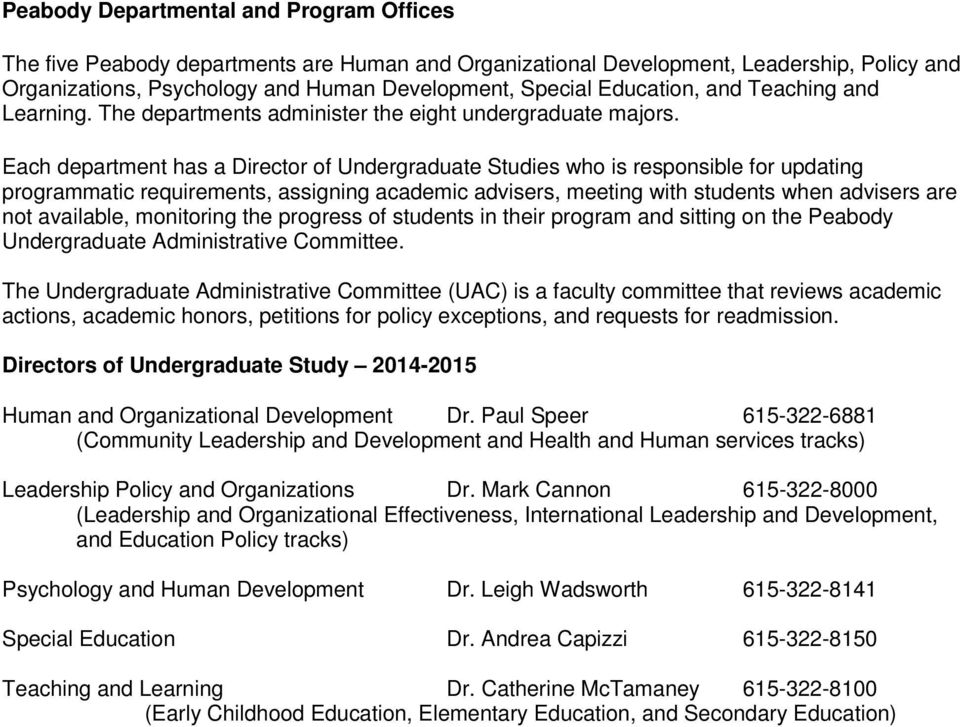
7 Peabody Departmental and Program Offices The five Peabody departments are Human and Organizational Development, Leadership, Policy and Organizations, Psychology and Human Development, Special Education, and Teaching and Learning. The departments administer the eight undergraduate majors. Each department has a Director of Undergraduate Studies who is responsible for updating programmatic requirements, assigning academic advisers, meeting with students when advisers are not available, monitoring the progress of students in their program and sitting on the Peabody Undergraduate Administrative Committee. The Undergraduate Administrative Committee (UAC) is a faculty committee that reviews academic actions, academic honors, petitions for policy exceptions, and requests for readmission. Directors of Undergraduate Study Human and Organizational Development Dr. Paul Speer (Community Leadership and Development and Health and Human services tracks) Leadership Policy and Organizations Dr. Mark Cannon (Leadership and Organizational Effectiveness, International Leadership and Development, and Education Policy tracks) Psychology and Human Development Dr. Leigh Wadsworth Special Education Dr. Andrea Capizzi Teaching and Learning Dr. Catherine McTamaney (Early Childhood Education, Elementary Education, and Secondary Education)
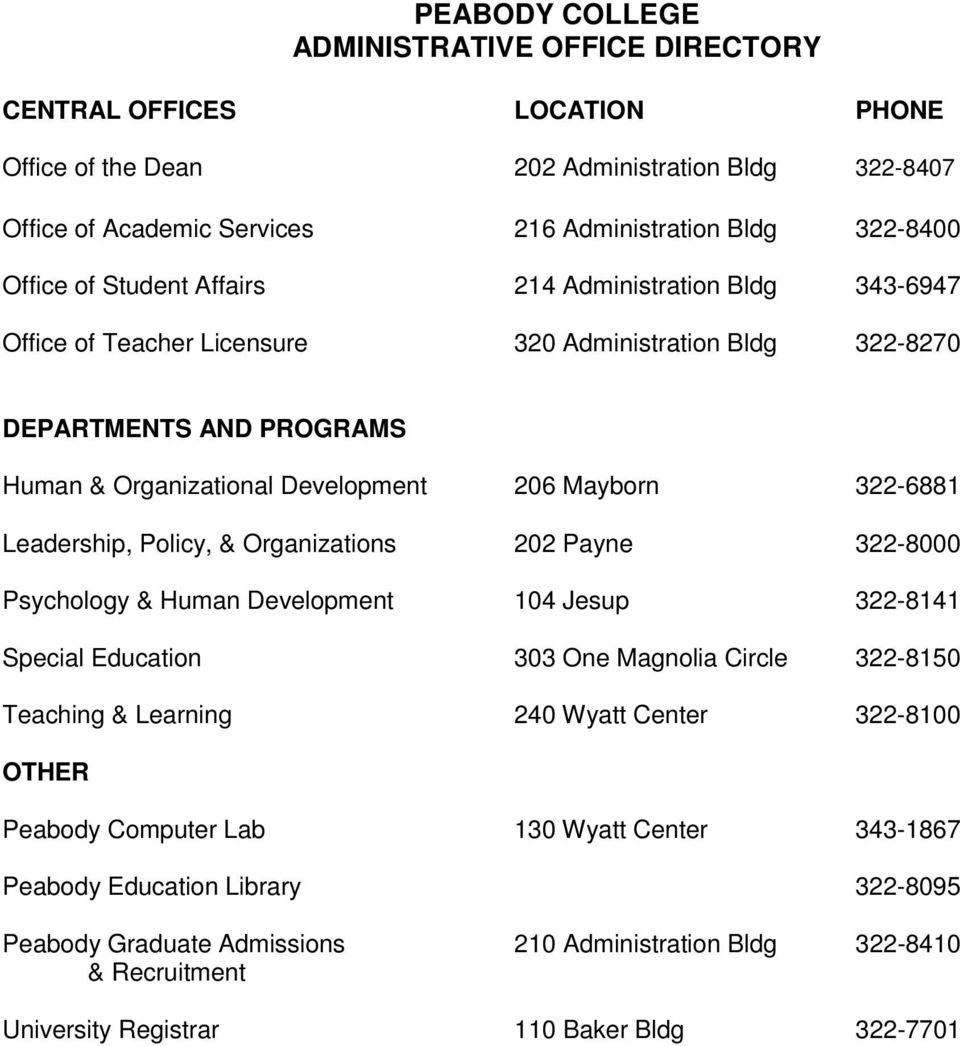
8 PEABODY COLLEGE ADMINISTRATIVE OFFICE DIRECTORY CENTRAL OFFICES LOCATION PHONE Office of the Dean 202 Administration Bldg Office of Academic Services 216 Administration Bldg Office of Student Affairs 214 Administration Bldg Office of Teacher Licensure 320 Administration Bldg DEPARTMENTS AND PROGRAMS Human & Organizational Development 206 Mayborn Leadership, Policy, & Organizations 202 Payne Psychology & Human Development 104 Jesup Special Education 303 One Magnolia Circle Teaching & Learning 240 Wyatt Center OTHER Peabody Computer Lab 130 Wyatt Center Peabody Education Library Peabody Graduate Admissions 210 Administration Bldg & Recruitment University Registrar 110 Baker Bldg
9 First Time Student Registration Help Document YOUR ENROLLMENT SERVICES YES (Your Enrollment Services) will be your entry point to access online academic services at Vanderbilt. Your academic record, mid-term and final grades, class and catalog searches, and term schedule will all be accessible from your YES landing page. YES is also where you will go to register for classes. Tutorials, printed instructions, and online help will be accessible from YES to assist you in using the site. The URL for the online help is listed at the end of this document. This document focuses on the registration features of YES.

10 LANDING PAGE Understanding your Student Landing Page When you log into YES, Your Enrollment Services, you will enter the student landing page. You will use your VUnet ID and e-password to log into this page. This page will launch you to your academic applications. You can link to Access to Academic Information (AAI), Address Change, Graduation System (GRAD), Financial Aid, OAK, and many more. On the top right hand corner there is a list of your enrollment windows. During these windows of time you will have the ability to enroll in classes. If you are not within an enrollment window, you will not be able to enroll in classes but will be able to search for classes, use your cart, and your planner. You will also see a holds box on your landing page. If you have any enrollment holds (student accounts, dean s, etc), they will appear in this box. Once you have enrolled, your schedule will be available at the bottom right hand corner of this page. General Navigation YES is available from the Vanderbilt home page. You will see a link on the bottom right hand side in the gold bar on the Vanderbilt homepage to YES, Your Enrollment Services. Select this link to log in. Use your VUnetID and e-password to access YES. Once you are logged in, the system will default you to your landing page. This page shows all currently enrolled classes, if there are any holds on your registration (adviser approval, financial, etc.) as well as links to launch your academic applications. To navigate to these applications, use the icons below your student photo or the applications tab in your navigation bar at the top of your screen. The navigation bar is the same throughout many of your academic applications. Academic Record (red button AAI) is the place where you can review your entire academic history, who taught your courses and see your grades as they are posted at the end of the term. The External tab has your non-vanderbilt transfer credit, AP credit, and ACT/SAT scores listed. You may change your address, if needed, as well as update the billing address or include emergency contact information using the blue Address Change button. Anchor Link (the 2 people talking button) helps organize your involvement in campus activities and centralizes information for student organizations. DoreWays is your connection to internship and professional opportunities.

11 If your bill is not paid for a semester, a hold may be placed on your ability to register until arrangements have been made. This hold may only be released by Student Accounts and is separate from the Adviser hold. You may pay your bill using the Billing Portal (the blue SM icon.) Use the Student Accounts button (a yellow calculator) to access scholarship data and 1098-T forms for tax purposes. If you have questions about Financial Aid, there is also a link to their site via the green dollar sign icon. Most Vanderbilt classes use OAK (Online Access to Knowledge). It houses course syllabi, announcements, discussion boards and other information. The Peabody Office of Academic Services does NOT have access to OAK and cannot provide any technical assistance with this program. The Graduation System (the purple icon) gives students an opportunity to make sure that their names are spelled correctly for their diplomas and the Commencement program, and that the university is listing their correct hometown, state, or country in the Commencement program. Students may provide addresses where they would like their diploma and Commencement ceremony information to be mailed. Most important of all, students may use this application to let us know whether or not they are planning to attend the Commencement ceremony in May of their senior year. If you have not submitted your Immunization form to Student Health Services, a registration hold may be placed that only they may release. You may review your Immunization information using the red cross icon. Questions about immunizations or other health services on campus may be directed here: You should review your Ethnic information using that icon (the green check box). Select the Student Registration link from your navigation bar or the available icons (the computer monitor). When you enter student registration, the system will default you the class search. The registration application uses carousel navigation within the class search, catalog search, and schedule. Within the class search carousel, you can view your cart and your enrolled classes by selecting the arrows next to the quick search or by using the links to the top right of your screen. When you view your enrolled list of classes from the class search carousel, the default view shows classes you are enrolled in or wait listing. If you dropped a class, use the dropped filter at the top right hand corner to view the dropped class. Catalog navigation works the same way as the class search. To navigate to the catalog search and planner, select the catalog link within the navigation bar at the top of the screen. To see the planner, you can use the carousel to the right of the catalog search or click the planner link at the top right. To view your schedule, select schedule in your navigation bar. The system will display a graphical view of your class schedule. You can use the filters at the top right of this graphical view to overlay the classes in your cart and the classes you are waitlisted for on this screen. A list view is also available for your schedule. Select the list icon above your graphical view or use the carousel navigation arrows next to your schedule. You may request an official Transcript through this link (dark blue TR) in YES. Vanderbilt does not issue unofficial transcripts. There is no fee for sending a transcript.

12 The Degree Audit (the brown icon with a white square inside) is a visual representation of your degree program. It is an excellent tool for advising and course selection. The online audit is not an official transcript, and it is not an official statement of requirements for graduation. Students should rely on their Academic Record for accurate total hours and Grade Point Average. The degree audit provides an online review of coursework and shows how that coursework fits into the requirements for majors, minors, core requirements, and degrees. The normal outcome for most audits throughout a student s career is NOT SATISFIED. This is because most students do not complete their programs until late in their careers. Courses that you are currently enrolled in may cause a degree audit requirement to read as SATISIFIED. If you drop the course or do not successfully complete the course the requirement will be reverted to NOT SATISFIED. When you look at a particular requirement, it will usually show Satisfying Courses (if any have been taken or are presently enrolled) and a Possible Courses tab. Any and all approved options for a requirement will be listed here. This is especially useful as you make selections for your liberal core. An explanation of the different categories: Incomplete, In-Progress & Ungraded Courses: All presently enrolled courses will be listed here Bachelor of Science Degree requirements: The minimum for your B.S. degree (GPA and total hours) Sixty Hours Vanderbilt courses required: All undergraduates must complete a minimum of 60 hours in residence (on campus) at Vanderbilt Writing Requirement: All undergraduates must complete 2 writing courses. AP/IB credit for ENGL 102W/105W/120W does not count for the Writing requirement. See the Liberal Core section for your major in this handbook for more information English 100 All undergraduates must satisfy this requirement either with appropriate test scores or by successfully completing the course. See the Liberal Core section for your major in this handbook for more information Liberal Core Education Requirements: Peabody wants our students to have a wide base of knowledge from which to build. There are different content areas within the core and all must be satisfied in order to graduate. We suggest completing them early so as to focus your later years on your major. The major section of your handbook has full details of your core and satisfying courses. Keep in mind that each major has a different liberal core. Major: The Liberal Education Core is different than AXLE in A&S. Check your handbook or your audit not with your roommate about satisfying courses. Your major requirements will appear here. They will include required pedagogical courses, major core courses, student teaching or internships. Second major or minors that have been declared will appear at the end of the audit.

13 REGISTRATION Searching for a class When you enter the student registration application, the system will default you to the class search. The class search is Semester based. The semester and session can be selected from the top left corner of the screen. Once you have the correct semester and session selected, you can begin your search using the quick search or the advanced search. The quick search is based on the subject area, subject area number, and title. The search will return any classes with your criteria in those three fields. To refine your search, use the advanced search link on the right hand side of the quick search. Select the advanced search link and a box will open up with additional search criteria. Title, Catalog Number, Instructor, Subject Areas, School, Instruction Mode, Career, Component, and Meeting Days and Times are all available for you to use in your search. To search between times or credit hours, slide the black circles inward and outward. The tags can be used if you have added tags to courses within your planner. Please see the Catalog Search/Planner section for more information on tags. Meeting Days: M Monday T Tuesday W Wednesday R Thursday F Friday Class attributes are a way for you to search for classes that are eligible for your major but are listed under a different subject area. For example, if you are an American Studies major all of your required classes may not be listed under the American Studies subject area. Some may be Sociology or Political Science classes. If you search by an eligible for tag it will only return results for classes that are not within that subject area. Use the subject area field in addition to the eligible for attribute if you want to see the subject area and all classes eligible for that particular major. The search results are listed underneath your search criteria. You can see more details on the classes by clicking anywhere on the desired class in your results. Within the details, there is a link to the class syllabus and book information, if provided by the instructor. The book information hyperlink will bring you to the efollett website for textbook pricing information. The class can be added to your cart from the class detail or from the blue plus sign to the right of your search results. You can begin adding classes to your cart as soon as they are available for the term you wish to register for. You can add up to twenty classes in your cart from the search.

14 Adding a Class to the Cart 1. On the student landing page, click Student Registration. 2. Use the drop down arrow to select the term. 3. Enter the subject area, course number, or title into the text box and click Search. To search using additional criteria click Advanced. Enter the class information below as needed and click Search. 4. Once you click Search, the class information will appear. To view the class detail, click anywhere within the class information section. To add the class to your cart, click the icon or select Add to Cart from the Class Detail page. If successful, a confirmation message will appear on the bottom right corner.

15 Enrolling from the Class Cart 1. Confirm that you are within your registration window by clicking on the date in the Enrollment Dates section (registration cannot occur outside of this timeframe until Open Enrollment). 2. View the class(es) in your cart by clicking in the In Cart section as indicated above. 3. The class(es) in your cart will appear. If the class has student option as the grading basis or variable hours, you can edit this information using the icon to the right of the class. 4. To register, click on the drop down arrow to the left of the class and select Enroll. You can also choose Do Not Enroll or Waitlist if Full. Repeat until all classes have been selected. Click Submit after selections have been made. 5. If registration is successful, you will receive a confirmation message on the bottom right corner. If registration is not successful, an error message will appear with the reason why.

16 Swapping a Class 1. Click in the In Cart section. 2. The class(es) in your cart will appear. Click the icon to select the class to swap. 3. Pick the class to drop by clicking on the icon again. 4. Confirm that the correct classes are listed and click Swap. 5. If the swap is successful, you will be taken to your enrolled classes where you should see the new course.

17 Swapping a class component Students have the option to change the discussion section (or other course component) of a course without being required to drop the lecture. You may only swap to an open section. 1. Go to your Enrolled classes and look for the class with an associated component. A green box with a white arrow appears next to the course you may swap.

18 2. Click on the green box to bring up a list of all available sections to choose from. Click on the green box that corresponds to the section you wish to swap to. 3. Click the Save button to swap the Discussion section

19 YES will take you to your Enrolled classes, displaying the updated discussion section.

20 Dropping a class 1. Use the drop down arrow to select the term. Click in the Enrolled section. 2. The class(es) that you are registered for will appear. To drop a class, click the icon on the row of the selected class. You can also check the box on the left side next to the class and click Drop. 3. A pop-up message will appear for verification. Click Yes to proceed or No to go back. 4. If the drop is successful, you will receive a confirmation message on the bottom right side. The enrolled credit hours will also decrease to reflect the change.

21 The Wait List 1. After adding a class to your cart, go to your Class Cart and select Waitlist if Full from the pulldown menu for the class you want. 2. A W will display next to the class you want to waitlist. Click the Submit button. 3. You will receive this message at the bottom of your screen:
22 Drop if Enrolled Drop if Enrolled can be used if you are waitlisted for a class. If you want to drop a class from your enrolled list upon getting enrolled from the waitlist, you can tell the system what class you wish to drop. This can be done as soon as you are added to the waitlist. This functionality is particularly useful if you have a time conflict with the class you are waitlisted for. YES will not let you enroll in a class from the waitlist if you are currently enrolled in a class that has a time conflict with the waitlisted class. You will remain on the waitlist if you do not set up a drop if enroll class in this situation. Drop if Enrolled works the same way if you are trying to enroll in a class that will take you over the maximum number of hours for your term. The system will not let you enroll off of the waitlist if that class will put you over the maximum hours allowed for the term. The Drop if Enrolled feature will allow you to work around this limit. To set up this drop if enroll class, you must be on the waitlist already. You may want to utilize the drop-if-enrolled function if your waitlisted course conflicts with one that you re currently enrolled in or enrollment in a waitlisted course would put you over 18 semester hours. To use this function, 1. Go to your Enrolled classes page and click on the brown box with arrows in it next to your waitlisted class
23 2. Select which class you want to drop if enrolled in your waitlisted class by clicking the brown box with arrows. 3. YES will ask you to confirm your selection. Click Save 4. Your waitlisted class will show which class you have chosen to drop if enrolled from the waitlist on your Enrolled page.
24 Editing hours/grading Basis Editing a class will allow you to do a variety of things. You can edit a class to change the grading basis, change the credit hours if your class is a variable credit class, or enter in permission numbers. If you are eligible (according to the Pass/Fail policy listed in this Handbook) to change the grading basis for the class you wish to enroll in, you can do so from the cart or the list of enrolled classes. Select the icon to the right of the class that looks like a notebook. This will prompt a pop up that will let you edit the class. If you are editing the grading basis, you can select from here. P/NP stands for pass/no pass. If you are not eligible to take a class P/NP, this option will not appear. First year students are not allowed to elect to take a class P/NP. To edit the hours of a variable credit class, use the same blue notebook icon to the right of the class. Use the hours dropdown to select the number of hours. If a class requires consent, you may be given a permission number to enroll in the class. If you are given a permission number upon receiving consent for a class, you must enter the permission number in the edit function prior to enrolling in the class. To do this, select the same blue notebook icon next to the class. If a class requires a permission number, you will not be able to enroll in the class without adding your permission number in the cart. Catalog Search and Planner Unlike the class search, the catalog is available year round. The class search is only available for schedules that have been published for the term. You can search the catalog and add courses to your planner whenever you want to. The catalog search works very much like the class quick search. The search will return anything with your criteria if it is in the subject area, subject area code, or title. The course detail is available from the list of results. To view the detail, click anywhere on the course row. The course can be added to the planner from the detail screen or from the blue plus sign to the right of the search results. Once courses are in your planner, you can organize them. You can add tags to the courses in your planner. If you are thinking about taking courses in a particular term, use the term tags. You can add tags by selecting the purple tag icon to the right of the course in your planner and using the tags that are available to you in the pop up window. Please note that just because a course is in the catalog, it will not necessarily be scheduled in the term you want to take it. The planner should be used as a tool to help you visualize what courses you want to take during your time here at Vanderbilt. Just because you add a course into your planner does not mean you actually have to take the course. The planner also allows you to create unique tags. Use the free format text box in the tag pop up window to add unique tags to a course. For example, if you know that certain courses are required for your major, you can create a tag that says major requirement. The system will keep a record of all the tags you have used so that you can reuse them on other courses within your planner. The courses and tags you add to your planner will save between logins. So, if you add a few courses to your semester this term, they will still be there next term if you do not remove them from your planner.
25 Printing Your Schedule 1. Click on Student Registration on the Student Landing Page. 2. Click Schedule at the top of the navigation bar. a. Enrolled classes will automatically be selected. You can add classes from your wait list and cart to the schedule view by checking the empty boxes above. b. Your class schedule will automatically default to the calendar view. c. To switch to the list view click List. d. To print your class schedule, click. the schedule Calendar View Add the schedule to your personal calendar
26 List View
27 HAVE A QUESTION OR NEED A FORM? QUESTIONS REGARDING WHERE TO GO PHONE Academic Advising Faculty Adviser Academic Probation Student Affairs Academic Dismissal Student Affairs Academic Awards Student Affairs AP Credit Academic Services Billing Student Accounts Career Planning Center for Student Prof Dev Course or Requirement Waivers Major Department Course Schedule Preparations Faculty Adviser Dean s List Academic Services Degree Audit Academic Services Drop & Add Courses Academic Services Enrollment Verification University Registrar Financial Aid (Undergraduate) Financial Aid Office Five Year Program Applications Admissions & Recruitment Graduation Academic Services Graduation Checkout Academic Services Graduate/Professional Programs Admissions & Recruitment Health Center Housing Insurance (Student) Student Accounts Licensure Requirements Teacher Licensure Office Lost and Found Mid-Semester Deficiencies Student Affairs PALS (Peabody Academic Leaders) Student Affairs Peabody Student Association Student Affairs Police/Security PRAXIS Registration Bulletin Department Offices Program Requirements Adviser/Department Recreation Center Registration for Courses Academic Services Transcripts University Registrar Vanderbilt Study Abroad Global Education Office
28 FORMS Many of them are available online: FORM PICK UP/RETURN TO LOCATION Adviser Change Academic Services Alternate Track Student Affairs 216 Peabody Admin 214 Peabody Admin Change of Address University Registrar 110 Baker Change of Course Academic Services Change of Name University Registrar Course Substitution Academic Services Course Time Conflict Academic Services Course Underload/Overload Student Affairs Declaration of Major/Minors Academic Service Good Standing Letters Academic Services Grade Changes Academic Services (only the Professor can submit this form not available for students) Graduate Course Credit Academic Services Incomplete Grade Academic Services Individual Learning Agreements Academic Services Intra University Transfer University Registrar Leave of Absence Student Affairs Screening Forms (Teacher Education) Departments/Online Summer Course Work Approval Academic Services Study Abroad Approval Academic Services (not available online) Study Elsewhere Approval Academic Services (not available online) Track Declaration Major Department (HOD, SED, & SPED only) Verification of Enrollment University Registrar Transfer Credit Academic Services Transfer Intra-University University Registrar Withdrawal Academic Services/Student Affairs
29 Advanced Placement & International Baccalaureate Test Score Credit Students are responsible for having official copies of all entrance test scores submitted before their first semester of attendance. The lists below indicate the Vanderbilt course credit to be awarded for the subjects and scores represented on the chart below for Advanced Placement (AP) and/or International Baccalaureate (IB) examinations. No more than eight hours of AP credit are allowed in any one subject area but Peabody does not limit the overall number of AP/IB hours that can be awarded. The Undergraduate Catalog will always supersede the college handbook in terms of policy or description of credit that may be awarded. Unless otherwise specified in this handbook, AP/IB credit will satisfy Peabody liberal core requirements. An example of where it will not is the writing requirement. ENGL 102W/105W/120W will NOT satisfy the Writing requirement but could satisfy communications or humanities in most Peabody programs. Please see the Liberal Core for your major for a full listing of courses. Advanced Placement Test Score Hours Course Credit Art History 4, 5 3, 3 HART 110, 111 Biology 4, 5 3, 1 BSCI 100, 101A Calculus AB 5 4 MATH 155A Calculus BC 4, 5 4, 4 MATH 155A, 155B Calculus BC 3 4 MATH 155A (sub-score 5 on Calculus AB) Credit cannot be awarded for both MATH 150A and 155A (see pages on selecting a math course for full information on credit duplication) Chemistry 5 3,1, 3, 1 CHEM 102A, 102B, 104A, 104B Chinese Language 4 5 CHIN 211 Chinese Language 5 5 CHIN 212 Computer Science (A) 5 3 CS 101 Economics: Macro 4, 5 3 ECON 100 Economics: Micro 4, 5 3 ECON 101 English: Language & 4, 5 3 ENGL 120W Composition English: Literature & 4, 5 3, 3 ENGL 102W, 105W Composition Environmental Science None European History 4, 5 3 HIST elective hours French Language 4, 5 5, 3 FREN 103, 201W French Literature 4, 5 5, 3 FREN 103, 3 hrs FREN elective German Language 4, 5 3, 3 Government & Politics: 4, 5 3 GER 103, 104 PSCI 101 Comparative Government & Politics: 4, 5 3 PSCI 100 United States Human Geography None Italian Language 4, 5 3, 3 ITA 200, 201W Japanese Language 4 5 JAPN 211 Japanese Language 5 5 JAPN 212 Latin: Vergil 4, 5 3 LAT 104 Latin Literature 4, 5 3 LAT 104 Music Theory 5 3 MUSC 120A
30 Physics B 5 3, 1 PHYS 110, 111 No credit if also have credit for 116 A/B and 118 A/B Physics C: Mechanics 5 3, 1 PHYS 116A, 118A Physics C: Electricity & 5 3, 1 PHYS 116B, 118B Magnetism Psychology 5 3 PSY 101 Spanish: 4 5 SPAN 104 Language or Literature 5 5, 3 SPAN 104, 202 Statistics 4, 5 3 MATH 127A Studio Art 4, 5 3 ARTS elective hours (2-D, 3-D or drawing) U.S. History 4, 5 3 HIST elective hours World History 4, 5 3 HIST elective hours International Baccalaureate Test Score Hours Course Credit Biology (standard/higher) 6, 7 3, 1 BSCI 100, 101A Chemistry (standard) 6, 7 3, 1, 3, 1 CHEM 101A/100A, 101B/100B Chemistry (higher) 6, 7 3, 1, 3, 1 CHEM 102A/104A, 102B/104B Economics (higher) 6, 7 3, 3 ECON 100, 101 English (standard) 6, 7 3 ENGL 100 English (higher) 6, 7 3, 3 ENGL 102W, 105W French (standard) 6, 7 5 FREN 103 French (higher) 6, 7 5, 3 FREN 103, 3 hrs Elec. History (higher) 6, 7 3 HIST elective credit Japanese (standard) 6, 7 5, 5 JAPN 211, 212 Japanese (higher) 6, 7 3, 3 JAPN 241, 242 Latin (standard) 6, 7 3 LAT 103 Latin (higher) 6, 7 3, 3 LAT 103, 104 Mathematics (standard) 6, 7 4, 3 MATH 127A, 140 Mathematics (higher) 6, 7 4, 3, 1 MATH 127A, 155A,1hr No credit for MATH 140 if also have credit for MATH 150A/155A. (see pages on selecting a math course for full information on credit duplication) Music (standard) 6, 7 3 MUSL 140 Music (higher) 6, 7 3 MUSL elective credit Physics (standard) 7 3 PHYS 110 No credit if also have credit for 116 A/B and 118 A/B Physics (higher) 7 3, 1, 3, 1 PHYS 116A/B, 118A/B Psychology (standard/higher) 6, 7 3 PSY 101 Russian (standard) 6, 7 5 RUSS 102 Russian (higher) 6, 7 3, 3 RUSS 203, 204 Spanish (standard) 6, 7 5 SPAN 104 Spanish (higher) 6, 7 5, 3 SPAN 104, 202 Visual Arts (standard) 6, 7 3 ARTS elective credit Visual Arts (higher) 6, 7 6 ARTS elective credit
31 SELECTING AN APPROPRIATE MATH COURSE Brief Outline for Placement in Mathematics COURSE MATH 127AB MATH 140 MATH 150AB MATH 155AB DESCRIPTION & BACKGROUND REQUIRED An introduction to probability and statistics. (Psy-PC 2101 is required for statistics in H&OD and CD, CGS, and CST majors. Therefore, students in these majors should not take Math 127A or B.) Requires high school algebra but does not use any trigonometry. (Strongly recommended) Requires trigonometry and Math SAT I score above 600, SAT II M1 score above 620 and/or SAT II M2 score above 570 recommended. Requires trigonometry and Math SAT I score above 600, SAT II M1 score above 620 and/or SAT II M2 score above 570 recommended. This sequence is generally taken by engineering students, science majors, and students who wish to cover the material at a little faster pace. For more information on placement, visit: If you have 1) earned credit for Math in one Calculus sequence and 2) are taking or are planning to take more Math courses in a different sequence, please CAREFULLY READ A, B, and C. A. Calculus Sequences The Department of Mathematics offers a calculus survey course, two standard calculus sequences, and a sequence in multivariable calculus and linear algebra for especially well prepared students. The survey course, Math 140, includes both differential and integral calculus at an introductory level. It is designed for students who do not have a need for further study in calculus. No background is trigonometry is required for Math 140. For most Peabody students, Math 140 is an appropriate course to meet the math requirement in their liberal education core. The standard calculus sequences are 150a-150b and 155a-155b-175. The second sequence is recommended for students who are planning to major in mathematics or a field of science or engineering in which calculus-based courses need to be taken in the sophomore year.
32 A student who achieves a score of 5 on the Calculus BC AP exam is eligible to enroll in Math 205a- 205b. These courses cover multivariable calculus and linear algebra with an emphasis on rigorous proofs and are alternatives to Math 175 and 204 for students with a strong interest in mathematics. While you may be eligible to enroll in a higher level of calculus based on test scores, it does not mean it is appropriate for you to do so. Students should consult with their instructors and their advisers for assistance as early as possible if regarding course selection and if they are struggling with a particular course. The Department of Mathematics strongly recommends that students enter a calculus sequence at the beginning (Math 150a or 155a) unless they have appropriate AP or transfer credit. There will be a two-week period at the beginning of the fall semester when students can change from one level of calculus to another. Students should consult with their instructors and their advisers for assistance during this period. Students with a weak background in algebra and/or trigonometry should enroll in Math 133 (precalculus mathematics) prior to taking 150a or 155a. A score of 550 or below on the SAT II M2 (Math 2) test is one indication of a problematic background for calculus. Math 133 does not satisfy the math requirement for the Peabody liberal core. You should only take this class if you plan to take the Math 150ab or 155ab sequence. The chart below shows how these sequences relate to each other (plus MATH 140). For example, if you have earned credit for 150a (3 cr.) and also complete 155a (4 cr.), you would have 2 hours of duplicate credit that would be deducted (see Duplicate Credit Policies to understand which credits would be affected).
33 B. Duplicate Credit Policies Deduction of credit caused by duplication proceeds as follows: If you have earned Math credit 1. through Advanced Placement/International Baccalaureate in one sequence and complete a course at Vanderbilt in the other sequence that duplicates this credit, you will lose credit from your Advanced Placement/International Baccalaureate earnings. ex: if you have earned 155a (4 cr.) through AP and complete 150b (3 cr.) at VU, 2 credits will be removed from 155a leaving 2 credits. 2. by transfer in one sequence and complete a course at Vanderbilt from another sequence that duplicates this credit, you will lose credit from your Vanderbilt course. ex: If you have earned 155a (4 cr.) through transfer credit and complete 150b (3 cr.) at VU, 2 credits will be removed from 150b leaving 1 credit. 3. at Vanderbilt in one sequence and complete a course at Vanderbilt from another sequence that duplicates this credit, you will lose credit from the second Vanderbilt course. ex: If you have completed 155a (4 cr.) in the Spring and complete 150b (3 cr.) in the Fall, 2 credits will be removed from 150b leaving 1 credit. C. Math Duplication Possibilities Table As a tool to help you quickly calculate any math credit duplication, the Math Duplication Possibilities table below shows all the possible overlap scenarios between the calculus sequences (plus Math 140). Each line lists a course that was earned, a second course taken that duplicates credit with the first, and the amount of credit that is lost (see Duplicate Credit Policies to understand which earned credits would be affected). First course earned First course credits Second course earned Second course credits Credit lost a b a a a 3 155a b b 3 155a b 3 155b a a 4 150a a 4 150b b 4 150b b or old 170a B 4 3
34 TESTING AND PLACEMENT AT A GLANCE Writing: Students must take English 100 if they do not present one of the following: AP/IB credit for English 102W and ENGL 105W or ENGL 120W. SAT Critical Reasoning and Writing combined score of 1220 with a minimum of 500 on each test. ACT minimum English score of 27 and a minimum writing score of 7. Foreign Languages: Use your SAT-II subject test score or Department test score (if they offer a language placement test) to find the most appropriate course for you. Questions about Language placement should be directed to the individual Department rather than your academic adviser. The minimum score on either the SAT-II or Department test for language proficiency is noted in each section. Sat II subject Department Test Scores Test Scores (DT) Course Placement FRENCH No French or A SAT/DT Proficiency 540/ W If you have studied French but have not taken the SAT French Subject Test, you must take it or the departmental placement test during the summer. The departmental test is available online at: You will need a valid Vanderbilt address to use this site. More information on French course placement is available at: Sat II subject Test Scores Course Placement GERMAN No German 101 SAT or 102* Proficiency , or *Consult with department before completing registration in the fall
35 Sat II subject Test Scores Course Placement LATIN No Latin or 1 yr HS years HS 100* SAT Proficiency (3yrs HS) (or 4yrs HS) 104 (in spring) , 206, 215, 220 *Latin 100 is a course designed for students who need a "refresher" before going into 103. Students with scores significantly below those recommended for a course should consult with the department. Sat II subject Department Test Scores Test Scores (DT) Course Placement SPANISH No Spanish SAT / DT Proficiency 520 / (& 3+yrs HS) W Students cannot place into Spanish 102; it is ONLY for students continuing from Spanish 100 or 101. The Spanish departmental test is available online at: You will need a valid Vanderbilt address to use this site. More information on Spanish course placement is available at: Proficiency scores for other languages: Sat II subject Test Scores HEBREW 530 ITALIAN 540 JAPANESE 440 With Listening
36 Useful VU Online Addresses The following addresses may be helpful when you can't find the paper copies. Academic Calendar: This is helpful when you need to know other calendar events not noted in this handbook. Your Enrollment Services - YES: Look up your Vanderbilt academic information o Entrance test scores o Transfer credit o Make address changes o Check Immunizations o Financial Aid o Student accounts (billing portal) o Grades o Graduation requirements o Course schedules o Register for classes o Order transcripts Catalogs: Course descriptions, academic programs and policies are available 24 hours a day at this site. Digital Life - Resnet: This is useful for information on computing services Final Examination Schedules: The final examination schedule is available at: Forms, Handbook Downloads, and other Registration Information: Global Education Office (VU Study Abroad): Application dates for study abroad and other information on the sites and offerings. Health Professions Advisery Office: For premed, veterinary, dental, physical therapy, pharmacy, and nursing advising Peabody College Web Pages
37 GENERAL ACADEMIC INFORMATION ACADEMIC ADVISING Academic advisers are faculty members within the five departments. Peabody students are assigned an academic major adviser when they arrive for their first semester. This adviser is knowledgeable about the courses needed to complete ones major. The adviser helps in schedule planning, makes suggestions as to which courses would be most suitable, and serves as a mentor to the student. Students are required to meet with their academic adviser during fall and spring pre- registration periods to assist in selecting a program of courses that fulfill degree requirements. Advisers also are available during the semester to discuss subjects of a non-academic nature. Students are encouraged to make appointments to meet with their advisers and to establish a good adviser/advisee relationship from the beginning of their undergraduate program. ADVANCED PLACEMENT The well-established advanced placement policy endeavors to recognize exceptional high school preparation, to avoid requiring freshmen to take courses clearly mastered in high school, and to encourage students to begin their college learning experience at the level most appropriate to their preparation. Advanced placement may be decided on the basis of good performance on the College Board Advanced Placement Examination (AP), on the College Board SAT II Subject Tests, on the International Baccalaureate tests (IB), or, in some cases, placement tests given by Vanderbilt. Appropriate documentation should be submitted to the Office of Undergraduate Admissions before matriculation at Vanderbilt. CREDIT FOR PREVIOUS COLLEGE WORK (Pre-Freshmen Credit) Entering freshmen who have taken pre-freshmen college work during their junior or senior year in high school or during summers prior to their offer of admission to Vanderbilt must report such work to the Office of Undergraduate Admissions. The Peabody Office of Academic Services will notify students as to whether such work may be credited toward the Vanderbilt degree. Credit will be awarded only if: 1) the course is regularly offered by an accredited two-year or four-year college or university, 2) if the teacher was a regular faculty member of that institution, 3) and if a majority of the students in the course were candidates for a degree at that institution. Credit is also not generally awarded if the course received both high school and college credit. If your class falls under that criterion, please speak to the Office of Academic Services about your situation. Appropriate documentation, including course descriptions and syllabi must be submitted to the Peabody Office of Academic Services for evaluation and approval by the appropriate Vanderbilt departments. The question of credit for previous college work must be settled in advance of the student s first semester of classes. The College of Arts and Science and Peabody College usually do not award credit for work at other colleges in the summer immediately preceding the student s first semester at Vanderbilt. Summer work elsewhere will be accepted for credit only if an unusual educational opportunity can be
38 demonstrated and if the courses sought are as rigorous as courses offered at Vanderbilt. Approval for work to be taken elsewhere must be obtained in advance from the appropriate dean. CLASS ATTENDANCE Students are expected to attend all scheduled meetings of classes in which they are enrolled; they have an obligation to contribute by full participation in the work of each class. At the beginning of the semester, instructors explain the policy regarding absences, and thereafter they report to the Dean of the College the name of any student whose achievement in a course is being adversely affected by excessive absences. In such cases, the Dean, in consultation with the instructor, takes appropriate action, which may include dropping the student from the class. Students dropped after the deadline for withdrawal receive the grade of F. Class attendance may be specified as a factor in determining the final grade in a course, and it cannot fail to influence the grade even when it is not considered explicitly. CONSENT TO RELEASE ACADEMIC INFORMATION Vanderbilt University is subject to the provisions of the Family Educational Rights and Privacy Act (Buckley Amendment) that affords to students certain rights of access to educational records and imposes obligations on the University in the release and disclosure of those records to third parties. The Buckley Amendment regulations, however, allow the University to provide academic progress reports and other academic information to parents of students if the student is a dependent of the parents for federal income tax purposes. In order to confirm the University s records and to administer the appropriate release of this information to parents, each new student completes a form to verify if the student is a dependent. COURSE LOAD During the fall and spring semesters, a student must take at least 12 hours of course work to qualify as a full-time undergraduate student. Students wishing to carry more than 18 hours must obtain the approval of the Dean of Peabody Student Affairs Office. All undergraduate students are assumed to be full time students for the purpose of administering probation and retention policies. There is an extra tuition charge for credits above 18 hours. A student who for health, family, or outside employment wishes to enroll in Peabody as a part-time student must obtain permission from the Dean of Peabody Student Affairs Office. The academic standing of such students will be considered on an individual basis. Normally, however, a student earning less than 12 hours will be either placed on academic probation or issued an academic warning. The one exception to this policy is that Seniors who have fewer than 12 hours required for completion of their degree. Beyond the hours associated with the HOD internship or student teaching, if they are to be taken in their final semester, Seniors can take fewer than 12 hours in one of their last 2 semester (whichever one the Internship or student teaching is not being taken) without penalty or special permission. DECLARATION OF MAJOR Peabody students choose a major at the time they apply to Vanderbilt and are assigned to the appropriate department for the purpose of advising and program planning. Students are assigned an adviser in their major prior to the first semester at Peabody. In their first semester, Freshmen are expected to take the coursework recommended for the major into which they were admitted. Students wishing to change into a different major cannot declare this change until March of their first year, to take effect the Fall of their second year. Forms are
39 available in the Peabody Office of Academic Services for students who wish to change a Peabody major to another Peabody major. If you wish to change your first major to one in A&S, Blair, or Engineering, you will need to apply as an Intra-University Transfer - Students must be in Peabody for 1 year, meaning you can apply to transfer from Peabody beginning in January of your second semester for the Summer or Fall term. The deadline for summer applications is typically mid-april, fall applications in mid-august, or spring applications in mid-december. Visit the IUT website for exact dates and the application. DECLARATION OF SECOND MAJOR/MINOR Students wishing to declare a second or third major/minor through Peabody College may pick up forms in the Peabody Office of Academic Services. Students wishing to declare a second or third major/minor through the College of Arts and Science must go to the applicable A&S department, fill out a Declaration of Major/Minor form, receive an A&S adviser assignment, and return the completed form to the Peabody Office of Academic Services. Students pursuing multiple majors and/or optional minors are limited in the amount of coursework that can be shared across their major and minor programs of study. If the major or minor is offered through a school other than Peabody, the amount of coursework that can be shared between the that major or minor and other majors or minors is determined by that school s policies. For a major offered through Peabody College, at least 21 credit hours need to be unique to that major. That is, 21 hours within the major cannot be used to count toward any other major or minor. For a minor offered through Peabody College, at least 15 hours need to be unique to that minor. LIBERAL EDUCATION CORE All Peabody undergraduates complete the requirements of the Liberal Education Core program. This Liberal Education Core component is intended to provide students with a solid foundation in the arts and sciences. Courses identified to fulfill the Liberal Education Core requirement for each Peabody undergraduate major are listed in the current program descriptions in this Handbook and The Bulletin of Vanderbilt University. Courses used to satisfy these core requirements may also be counted toward the fulfillment of requirements for an academic major. Special topic courses are ordinarily not acceptable for meeting Liberal Education requirements. These courses require prior approval as substitute courses. Independent study courses are not acceptable for meeting the requirements for the Liberal Education Core. Students enrolled in Peabody College are expected to satisfy most Liberal Education Core requirements during the freshman and sophomore years. Although legitimate circumstances sometimes force the postponement of Liberal Education requirements, upper-level students are not expected to have a significant number of these requirements outstanding. MAY SESSION In the interval of several weeks between final examinations in the spring semester and the beginning of summer sessions, Vanderbilt offers educational travel opportunities and a variety of total immersion courses that would be difficult to offer during a regular semester.
40 Students are permitted to take no more than one course during the May session. Housing and food services are available during the session. SUMMER COURSES AT VANDERBILT The ten-week summer session begins in early June and ends in early August. Peabody undergraduate courses offered during the Vanderbilt summer sessions are not intended to be comprehensive nor are they predictable. Peabody students are most likely to take basic Liberal Education Core courses. For students who plan to attend summer sessions, the best strategy for predicting the courses that will be offered in a given summer is to look at the previous summer s offerings. Students who do not advance in class standing at the end of the spring semester will be required to attend Vanderbilt summer school to make up the hours and/ or grade point average deficiencies.
41 ACADEMIC POLICIES ACADEMIC PROBATION AND DISMISSAL Peabody requires each student to maintain an academic record that will permit graduation according to a specified schedule. After achieving sophomore standing, the student may not be on academic probation for more than two semesters. The student whose academic record warrants a third semester of probation normally will be dismissed from the University. Students will be placed on academic probation, or may receive and academic warning, if any of the following conditions applies: Freshmen: 1. The student s cumulative grade point average falls below Probation is removed (assuming there is no other reason for probation) when the student s grade point average is raised to or above. 2. The student fails to earn at least 12 hours in the first regular semester as a freshman. Probation is removed when the student earns at least 12 hours in a subsequent semester and/or is judged to be making satisfactory academic progress. 3. The student fails to achieve sophomore standing (24 cumulative hours and cumulative grade point average) in the required two semesters. Probation is removed when the student achieves sophomore standing. 4. Freshmen who pass fewer than two regular courses in their first regular semester, or who earn a cumulative grade point average lower than have so seriously compromised their academic standing that they may be required to take a probationary leave of absence during the spring semester. Sophomores: 1. The student s cumulative grade point average falls below a Probation is removed (assuming there is no other reason for the probation) when the students grade point average is raised to or above, except that at the end of the second regular semester the student must qualify for junior standing. 2. The student fails to earn at least 12 hours in a regular semester as a sophomore. Probation is removed when the student earns at least 12 hours in a subsequent semester and/or is judged to be making satisfactory academic progress. 3. The student is placed on probation by the Undergraduate Administrative Committee for failure to make satisfactory progress toward the degree. Probation is removed when the specified conditions are met. 4. The student fails to achieve junior standing (54 hours and cumulative grade point average) in the required two semesters after achieving sophomore standing. Probation is removed when junior standing is achieved. Juniors: 1. The student s cumulative grade point average falls below a Probation is removed (assuming there is no other reason for the probation) when the grade point average is raised to or above, except that at the end of the second regular semester the student must qualify for senior standing. 2. The student fails to earn at least 12 hours in the first regular semester as a junior. Probation is removed when the student earns at least 12 hours in a subsequent semester and/or is judged to be making satisfactory academic progress 3. The student is placed on probation by the Undergraduate Administrative Committee for the failure to make satisfactory progress toward degree. Probation is removed when the specified conditions are met. 4. The student fails to achieve senior standing (84 cumulative hours and cumulative grade point average) in the required two semesters after achieving junior standing. Probation is removed when senior standing is achieved.
42 Seniors: 1. The student s cumulative grade point average falls below a Probation is removed when the grade point average is raised to or above. 2. The student fails to earn at least 12 hours in a regular semester as a senior, unless the semester is one in which the student needs fewer than 12 hours in order to complete the requirements for graduation (see the section on Course Load). Probation is removed when the students earns at least 12 hours in a subsequent semester and/or is judged to be making satisfactory academic progress and/or completes the requirements for graduation. Sudden Academic Insufficiency Any student who fails by wide margin to reach prescribed levels of academic achievement, either at the end of a semester or at mid-semester, or who has been placed on probation more than once is reviewed by the Peabody Undergraduate Administrative Committee. The Committee considers each case within the general guidelines for maintenance of satisfactory academic standing and may take any of several actions, among which are the following: The student may be placed on probation or issued an academic warning. The student may be advised to take a leave of absence or to withdraw from the University. The student may be required to take an academic probationary leave of absence. The student may be dismissed from the University. Under certain circumstances, a student who has been formally dismissed may be readmitted to Peabody. The Peabody Undergraduate Administrative Committee must review and approve any request for readmission. ALTERNATE TRACK Occasionally, students find that it will be necessary to reduce their normal course load due to medical reasons, varsity athletics, or other circumstances. The result is that they will earn the Bachelor of Science degree in nine or ten semester instead of eight. In such cases, the student may request Alternate Track status (normally done during the sophomore year). After discussing the Alternate Track option with his/her parents and faculty adviser, the student must complete and submit a Request for Alternate Track form to the Peabody Office of Academic Services. Along with the Request for Alternate Track form, the student is required to include a plan listing courses to be taken each remaining semester to complete all requirements for the degree. Alternate Track does not alter the earned hours required to achieve sophomore, junior or senior class standing. A student on Alternate Track status must meet the following guidelines to avoid probation. The minimum requirements are: Year Hours Per Semester Total Earned Hours GPA 1st year nd year rd year th year th year Complete degree 2.0
43 APPEALS 1. Petitions for exceptions to academic policies, appeals of academic policy implementations by the Peabody Dean s Office staff, and appeals of academic actions by the Chairman of the Peabody Undergraduate Administrative Committee (e.g. letters of dismissal) may be directed to the full Undergraduate Administrative Committee. Petitions and appeals should sent to: Chair, Peabody Undergraduate Administrative Committee C/o Peabody Dean s Office Campus Box 329, Peabody College Nashville, TN Fax: (615) A student may ask the UAC to reconsider a decision if the student has new information to offer. The Committee Chair will decide whether the full Committee will reconsider. Requests for reconsideration of UAC decisions should be sent to the above address. 3. A final negative decision of the Committee may be appealed to the Dean of Peabody, (at the above address) who may assign an Associate Dean to handle the matter on the Dean s behalf. The Dean or Associate Dean will consult with the Committee and other relevant faculty or staff as part of the review decision. 4. Appeals beyond Peabody College should be directed to the University Provost s Office. Please visit The Vanderbilt University Student Handbook site: for a description of the appeal process for nonacademic matters. AUDITING A COURSE Regularly enrolled Peabody College students who want to audit courses in any of the undergraduate schools of the university complete the Request to Audit form from the Peabody Academic Services site (Forms to Download page). Return the completed form to 216 Peabody Administration Building where the staff will register the student for the class for zero credit hours. No permanent record is kept of the audit; the course is removed from your schedule at the end of the semester and will not appear on your transcript. Regular students may audit one class each semester free of charge. CLASS ATTENDANCE Students who must miss a class due to illness, personal reasons, or other reasons should notify the course instructor (prior to the class meeting if possible). In case of serious illness or personal emergency causing an absence from campus, the student may request that the Peabody Office of Student Affairs notify instructors. The Office of Student Affairs does not excuse a student from class; it will simply notify instructors of the student s absence. The final decision of how to handle the absence is up to the course instructor. For further information, see the Class Attendance policy in the Peabody College section of the Undergraduate Catalog. CLASS STANDING In order to qualify for sophomore standing, a freshman must earn at least 24 hours with a grade point average of at least 1.8. A freshman who fails to achieve sophomore standing by the end of two regular semesters has one additional semester in which to qualify for sophomore standing. This additional semester must be completed during the summer session at Vanderbilt.
44 Listed below are the minimum requirements for reaching each classification: CLASS HOURS GPA REGULAR SEMESTERS Sophomore Junior Senior Students must qualify for the next classification after two regular semesters. Failure to reach these next classifications will result in the student being placed on academic probation. A student who is placed on academic probation more than twice after reaching sophomore standing is subject to dismissal from the University. DEAN S LIST The Dean s List recognizes outstanding academic performance in a semester. Students are named to the Dean s List when they earn a Grade Point Average of at least while carrying 12 or more graded hours with no temporary or missing grades in a course (credit or no-credit), and no grade of F. Dean s List is applied once per semester (approximately 30 days after the end of each term) and will only be awarded retroactively in the posting of a student s Vanderbilt (through the Global Education Office) study abroad work. INDEPENDENT STUDY REGULATIONS Intended for students in their junior and senior years, Independent Study courses, ranging from one to three hours of credit, are listed in the Schedule of Courses. Juniors or seniors wishing to take such courses must use the following procedure: 1. Students must be in academic good standing (may not be on probation or leave of absence). 2. Students must arrange the independent study with a full-time Vanderbilt faculty member who has agreed to supervise and grade this experience. 3. Students may enroll in up to three hours of independent study per semester. 4. Students must complete an Individual Learning agreement that includes a written study plan detailing the nature of the project and the amount of credit to be earned. The Individual Learning/Directed Study agreement must be approved by the instructor and the department chair (or the chair s designee). 5. The deadline for submitting the form to the Peabody Office of Academic Services is the last day of the registration change period. 6. Registration occurs when the completed Individual Learning/Directed Study Agreement is submitted to the Peabody Office of Academic Services. Students are not able to register themselves for independent studies. The following Peabody independent study options are listed in the Schedule of Courses: EDUC 2960 MTED 2960 ENED 2960 PSY-PC 2970, 2980* FLED 2960 SCED 2960 HOD 2980 SSED 2960 HMED 2960 SPED 2960 Students may not repeat independent study courses for grade replacement. *PSY-PC 2980, Directed Research, is open to sophomores and second semester first year students.
45 PASS/FAIL Students may elect to take courses in which they can receive the grade P (Pass).This grade is entered for the student enrolled under the P/F option who is awarded a grade of D- or higher. The grade P is neither counted in the grade point average nor used in the determination of honors. A failing grade will appear on the student record as F and will be counted in the student s grade point average. The following regulations apply to pass/fail: 1. Students must have completed two full semesters at Vanderbilt before being eligible to take a course pass/fail. 2. Students must be in good academic standing. 3. Students may elect to take no more than one course per semester pass/fail.* 4. Students must maintain registration for at least twelve hours in addition to the course they are taking or planning to take on a pass/fail basis or the pass/fail notation is removed. 5. Students may elect to take no more than three (3) courses pass/fail during their undergraduate career.* 6. No more than one course from any liberal core area may be taken pass/fail. 7. For students with a single, double major/minor, or interdisciplinary plan, courses in the department(s) of the major(s)/minor(s)/interdisciplinary plan or other courses counted toward the major(s)/minor(s) may not be taken pass/fail. 8. Liberal Education Core Courses that have been specifically identified by the student s primary major as needing to be taken on a graded basis may not be taken pass/fail. By program, these courses are: Human and Organizational Development: Courses taken to satisfy the 3-hour Liberal Core Economic requirement (i.e., Econ 100, 101, HOD 2260); Child Development, Child Studies, and Cognitive Studies: Courses taken to satisfy the 3-hour Liberal Core Statistics requirement (i.e., Econ 150, PSY-PC 2101, PSY 209). Special Education: PSY-PC 1630, PSY-PC 2310, EDUC 1020, SPED 1010, SPED 2020, SPED 2030, SPED 2060, SPED Early Childhood Education: ENED 2030, EDUC 2550, ENED 2100, MTED 2100, PSY- PC 1630, SSED Elementary Education: ENED 2030, EDUC 2550, 2200, MTED 2200, SCED 2200, PSY- PC Secondary Education: PSY-PC Pass/fail must be declared on the registration program. Requests to change a course to pass/fail after the last day to add a course will not be approved. 10. Students enrolled in a course pass/fail may elect to change back to a graded status by the published deadline (approximately week eight of the semester). 11. When a student wishes to complete a major or minor in a field in which a grade of P has been received, the registrar converts this grade to the regular grade originally earned. *NOTE: Courses that are only offered on a Pass/Fail basis by the University (e.g., certain fieldexperience courses) are not counted against the number of courses that a student may voluntarily elect to take on a pass/fail basis, either within or across semesters. Seniors who have met all other criteria may declare a course pass/fail with fewer than 12 additional hours. This must take place senior year during the fall or spring in which they are not completing student teaching or the HOD Internship. This applies to only one semester of the student s senior year. Registration for pass/fail with fewer than 12 hours must be processed through the Peabody Office of Academic Services. Seniors with fewer than 12 graded hours are not eligible for the Dean s List.
46 STUDENT LEAVE OF ABSENCE A student desiring a leave of absence should obtain application forms and instructions from the Peabody Student Affairs Office. All students are eligible, provided they have not been dropped by the University and are not dropped at the end of the semester during which application is made. TRANSFERRING COURSE WORK It is the student s responsibility to provide all of the information needed by the College to assess the program for which transfer credit is requested. Work presented for transfer must be from an accredited college and is subject to evaluation in light of the degree requirements of the college. Work transferred to Vanderbilt from another institution will not be computed in the Vanderbilt grade point average but will count as earned hours toward the degree. No course in which a grade below C- was received will be credited toward a degree program offered by the College. Transfer work will NOT replace a previously earned grade from a Vanderbilt course. SEMESTER ABROAD WORK AT ANOTHER INSTITUTION: Students wanting to receive transfer credit for a semester of abroad work at another institution must receive approval in advance from the Peabody Office of Academic Services. In order to be eligible to receive a maximum of 15 total credit hours, students must obtain the necessary forms (available in the Peabody Office of Academic Services). The following conditions must be met to obtain pre-approval to take courses elsewhere and complete the transfer of credit process: 1. The student must be in good standing and have at least a 2.7 cumulative GPA at the time of application. Application deadlines are: November 15 for the spring semester, April 15 for the fall semester. 2. Courses must be approved by the appropriate department, and endorsed by the student s adviser. 3. Transfer courses may not be part of the student s final 24 hours at Vanderbilt. 4. An official transcript must be sent to the Peabody Office of Academic Services to record the transfer credit on the Vanderbilt academic transcript. SUMMER COURSE WORK AT ANOTHER INSTITUTION: Students enrolled in Peabody College may receive credit for a maximum of 12 hours during summers at another fully accredited four-year institution. Students must obtain the necessary forms and gain approval from the Peabody Office of Academic Services. The following conditions must be met to obtain pre-approval to take summer course work elsewhere and complete the transfer of credit process: 1. The student must be in good standing with a minimum GPA of Courses must be approved by the appropriate department, and endorsed by the student s adviser. 3. Transfer courses may not be part of the student s final 24 hours at Vanderbilt. 4. An official transcript must be sent to the Peabody Office of Academic Services to record the transfer credit on the Vanderbilt academic transcript. Enrollment in appropriate courses to fulfill degree requirements: Knowledge of university/college policies and regulations regarding academic matters are the responsibility of the individual student. Contact the Peabody Office of Academic Services if you have questions about the policies or procedures.
47 Frequently Asked Questions 1. Do I need to take all of the core liberal education classes? Yes. All Peabody students must take them. The core classes ensure that you broaden your knowledge and experience different challenges and opportunities to grow. 2. There are a lot of courses to choose from in the liberal education core. Which are the ones that I really am supposed to take? For the most part it is truly up to you which courses you take to fulfill the liberal core requirements. In a couple of cases, there are some restrictions on the courses you need to take to fulfill a particular requirement (for example, the Human and Organizational Development program requires that you take a philosophy course as part of the humanities requirement), but otherwise, all of the options listed under each requirement are excellent options for you to choose among. In selecting which courses to take, you might sample from areas in which you are considering a second major or a minor, and you might choose courses that are simply fun or interesting to you. Fulfilling the Liberal Education requirement represents a rather unique opportunity to explore intellectual disciplines to which you otherwise might never be exposed. 3. How do I change my major or add a second major/minor? Change of Major Forms are used when you decide which major you want or don't want to do anymore. You may change your first major or declare a second major or minor in March of your first year at VU. To change your major or declare a second major or minor within Peabody: Pick up the major change form in Academic Services, 216 Administration Bldg. or download it from the Peabody Office of Academic Services website Visit the department of your proposed new major to obtain a new adviser. Human and Organizational Development Vicki Scalf 203D Mayborn Psychology and Human Development Ally Armstead 103 Jesup Special Education Dr. Andrea Capizzi 303E MRL Teaching and Learning Dr. Catherine McTamaney 341 Wyatt Turn the form in to Academic Services, 216 Administration Bldg. To declare a second major/minor in the College of Arts and Science, Blair or Engineering: Visit their school s Office of Academic Services to pick up the paperwork to declare a second major. The appropriate department will assign you a second major or minor adviser. If given multiple copies of the form, leave one copy of the form with the department. Bring the other to Peabody Academic Services, 216 Peabody Administration Bldg.
48 To change your FIRST major to one in A&S, Blair or Engineering: You will need to apply as an Intra-University Transfer. Information, deadlines, and the application is available here: 4. I need to drop this class. When is the last day to drop? There are different procedures and consequences for dropping courses early in the semester (during the change period) or later in the semester. Both types of situation, and their associated procedures and consequences, are discussed below: A. Dropping Classes During the Change Period, which is approximately the first week of classes (see page 1 and 2 of this handbook) students may add a course, change sections, and drop with no entry on the record and register for Pass/Fail status. Students must access YES to drop a course. (The professor does not do it for them) B. Withdrawal from classes After Change Period, and extending to the end of the eighth week of classes (see pages 1 and 2 of this handbook or the Calendar on the Office of Academic Services site) a course may be dropped with the consent of the instructor and the student s adviser. Withdrawal changes must be made by the student on a Change of Course Card, which is submitted to the Office of Academic Services, 216 Administration Bldg. After the above deadlines, students may withdraw from a class only by submitting a Withdrawal Petition and obtaining administrative approval. With any withdrawals after the initial change period, the course is still listed on the student s transcript, but with the designation of W (indicating withdrawal from the course) instead of a letter grade. 5. If I withdraw from classes, are W s on my transcript a bad thing? Not necessarily. If you only acquire a couple of W s over the course of your undergraduate career that will almost never be of any consequence. However, if you establish a pattern of frequently dropping courses after the change period, and acquire W s across several semesters, then people evaluating your transcripts, such as potential employers and graduate admissions committees might start to wonder about your ability to complete assignments. Thus, if you have to withdraw from classes once or twice over your undergraduate career, it isn t something you need to worry about. At the same time, withdrawing from classes is not something that you want to do regularly. 6. How many credits do I need to graduate? What is a credit anyway? Is that the same as an hour? The credit hour is a unit of measure for college credit. Hours refers to the amount of credit you receive for any given course. If a course is a 3 credit course, it generally meets for 3 hours of class time during the week for the entire semester. If you pass the course, you will have earned 3 hours of credit towards your degree. Most lecture courses are 3 hours of credit and most lab science courses are 4 hours of credit (3 hours of credit for the lecture and 1 hour of credit for the lab).
49 The minimum number of credits for a B.S. degree is 120 with all Liberal Education Core and major requirements satisfied. Some programs require more than 120 credits to complete all requirements. See your intended major for specific details. For example: to receive a Vanderbilt degree with HOD major as your first major, you must earn a minimum of 120 hours. 120 hours divided by 8 semesters equals 15 hours per semester. In theory, if you average 15 hours per semester, you should earn 120 credit hours by the end of your 8 th semester or 4 th year. You should plan on taking somewhere between 14 and 17 hours each semester. You will be spending more time studying on your own, and less time actually sitting in class, than you did in high school. Of course, you must also enroll and pass the required courses for the major! While you are choosing courses to meet HOD requirements, you also need to keep an eye on the bottom line. Any AP / IB credit that you have earned will count towards the 120 hours required to graduate. If you have AP / IB credit, you may be able to lessen your course load some semesters. 7. Do I really need to show up to all classes? Yes, you do. 8. If I am taking classes for a major and a minor can I graduate with a major and come back to complete the minor? Unfortunately, you cannot. The major and minor must be completed before you graduate, since both apply to the same bachelor's degree. Once you graduate, no further changes can be made to your academic record be sure to keep up with it and make sure that it is correct. 9. My Undergraduate Handbook says a specific course is required for graduation. However, the prerequisites for that class have changed. Which prerequisites do I follow? Always follow the prerequisites in place during the semester that you take the course, regardless of your year of entry. 10. Why do I need advising and how do I choose an adviser? If I don t know my major or want to change it, can someone help me find one? Advisers can help you explore your interests and can share information that will help you choose a major or minor, explore possible career paths, and help you to stay on track in your studies. See your adviser several times during your studies to check on your progress, choose classes, etc. If you wish to change your adviser, there is a form to do so in the Academic Services Office. 11. How many pass/fail (P/F) classes can I take in my major? What classes can I take this way? The university allows you to take up to a total of three courses on a Pass/Fail basis during your undergraduate career. Freshman may not elect to take courses pass/fail. Courses in your major or minor (even if they don t count toward a specific requirement) MAY NOT be taken pass/fail. See the academic policy section of this handbook for a full description of the pass/fail policy.
50 12. If I take a second major in the college of Arts and Sciences, do I need to complete the AXLE requirements in addition to the Peabody Liberal Core courses? No. In order to complete a second major in the College of Arts and Sciences (A&S) as a Peabody student, all you need to do is to complete the core requirements (and any prerequisites) listed for that major (usually between 27 and 36 hours). AXLE is the liberal education requirement for A&S students. As a Peabody student taking a second major in A&S you are still a Peabody student, and therefore you need to complete only the Peabody liberal core requirements (LEC) for your first Peabody major. 13. Can I study abroad and get credit for VU courses? Yes, there are a number of VU Abroad programs which allow you to take courses and earn residence credits that apply directly to your LEC or major. For more information contact the Vanderbilt Global Education Office in the Student Life Center, Suite 115; telephone ; or on the Web at: If you wish to participate in a non-vanderbilt program, please see the Semester Abroad section of this handbook or visit the Peabody Academic Services Office, 216 Peabody Administration for the forms and explanation of the process/policies. We do not make suggestions or recommendations regarding non-vanderbilt programs. You will need to find a program on your own. 14. What if I don t agree with the final grade I get in a class? Meet with the relevant professor during office hours to review the grade. She or he has final say about your grade. If there is a grade error, a Change of Grade Petition is completed by the professor and it is submitted to the Peabody Office of Academic Services, 216 Administration Bldg. 15. Why was I placed on probation? What will happen next? Students placed on academic probation will be notified by letter from the Dean explaining this status and what action is necessary to remove the probation. 16. How do I calculate my GPA? Calculate the GPA by finding the grade points for each grade obtained in a course, then multiply that number by the number of credits for the course (i.e., An A- is 3.7 grade points x 3 credits = 11.1 grade points.) Do this for each course taken, then add all the grade points and all the credits, and divide the grade points by the credits. This is the GPA. Use the information below: A = 4.0 B- = 1.7 D+ = 1.3 A- = 3.7 C+ = 2.3 D = 1.0 B+ = 3.3 C = 2.0 D- = 0.7 B = 3.0 C- = 1.7 F & CR/NC = 0.0
51 17. Do I really have to meet all the prerequisites for a class? Almost always, yes. Meeting prerequisites insure that students have the necessary background knowledge for the course and that they are prepared to study the subject. Professors will assume that all students have completed the prerequisites. If, as is sometimes the case, you believe that you have the requisite knowledge to take a class without having met the formal prerequisites, meet with the course instructor to discuss your situation. The professor can give you a clear sense of his/her expectations for the class, and can help you gauge whether or not you are really ready to take the class. The YES registration system will NOT allow you to register for a class with a stated prerequisite if you have not previously taken that class. 18. What is repeat credit? How do I take a class again to improve my grade? Will repeating a class keep from getting a job or into graduate school? You may repeat any course but only the last attempt will be factored into your earned hours/gpa. The original grade will appear on your transcript but no longer factor into your GPA. You may not take a course at another college/university and replace your Vanderbilt grade. All repeat credit must be taken at Vanderbilt. 19. I am a pre-med/nursing/etc. student. Where do I go for help on medical or nursing school requirements? Vanderbilt has a Health Professions Advisery Office that will help guide you on what requirements you need for a variety of careers and graduate study.
52 Human and Organizational Development
53 THE HUMAN AND ORGANIZATIONAL DEVELOPMENT PROGRAM The Human and Organizational Development (HOD) major prepares students to solve human problems in organizations and communities. Doing so requires knowledge of human development, group dynamics, organizational theory and behavior, economics, public policy, statistics, and methods of inquiry. The curriculum is planned to ensure that students obtain a strong foundation in science and liberal arts, with an emphasis on developing writing, oral presentation, and analytic skills. In addition to the core curriculum, students select a HOD track. The track options include: Community Leadership and Development; Health and Human Services; International Leadership and Development; Leadership and Organizational Effectiveness; and Education Policy. Many students also add an additional major or minor administered by the respective departments of those programs. The HOD program privileges an active learning approach to education. Students learn new ideas and concepts through seminars, simulations, case studies, field experiences, and interaction with professionals in the field. In addition, students are required to complete a semester-long internship in order to deploy the core competencies of HOD: understanding and solving problems in organizations and communities. Through the coursework that accompanies the internship, students integrate and apply concepts from earlier classes to analyze organizational performance and complete a project that enhances the effectiveness of the organization. Because the student chooses the internship placement, this experience also provides valuable vocational and career development in the student s field of interest. Internship sites include Nashville, Chicago, New York, San Francisco, Washington, D. C., and London, England. HOD graduates of the program assume positions in business, government agencies, social enterprises, and non-profit organizations. In addition, the HOD major is an excellent foundation for students interested in graduate or professional training in business, community development, counseling, divinity, education, health promotion, human resource development, law or medicine. The core curriculum is designed to help students: 1. Understand the basic principles and typical patterns of human development across the life cycle and use this knowledge to understand their own behavior and the behavior of others; 2. Understand the principles of group dynamics and use this knowledge to provide leadership and facilitate decision making in small group settings; 3. Understand theories of organizations and apply them to the solution of organizational problems; 4. Apply quantitative and qualitative methods of systematic inquiry and analysis; 5. Understand basic economics including monetary and fiscal theory; 6. Understand public policy processes and the factors that influence policy making; 7. Understand the ethical dimensions of personal and organizational decisions and apply this understanding to analyze social issues and make professional and personal decisions; 8. Develop enhanced skills of synthesis including the ability to integrate ideas from various sources, to appreciate diversity, and to design innovative programs;
54 In addition, the program helps students develop the following skills: 1. Written communication - with emphasis on developing a clear, concise, expository style and mastering the practical forms used in professional situations; 2. Oral presentation with emphasis on making informative and persuasive presentations with the effective use of technology and media; 3. Analytic thinking - with emphasis on applying analysis, creative thinking, and the skills of systems thinking to the recognition, definition, and solution of personal, professional, organizational, and social problems; 4. Interpersonal communication - with emphasis on inquiry, advocacy, and conflict resolution skills; 5. Leadership - with emphasis on motivating others, managing talent, and teamwork. HOD Honors Program The HOD Honors Program is designed for highly motivated students who want to pursue intensive research. It offers outstanding undergraduate HOD majors an opportunity to become involved in research teams with professors and graduate students. The program will help students develop skills in empirical research methods, writing, and presentation to provide a firm foundation for advanced graduate or professional training. The HOD Honors Programs requires a serious time commitment to an empirical research project. Application: Students may apply for the honors program at any time from the second semester of their sophomore year to the second semester of their junior year. The application must be signed by the faculty member with whom the student will work, and will outline the nature of the research project, which will ordinarily be an extension of the faculty member s ongoing research. Students must have completed HOD 1000, HOD 1100, HOD 1200, HOD 1700, and statistics (PSY-PC 2101, Psy 209, or Econ 150) and have an overall GPA of at least 3.6, across all classes, as of the end of the term in which they apply. This GPA must be maintained to graduate with honors. Applications will be evaluated by the Honors Committee, who will decide on admission, taking into consideration the numbers of applicants. Requirements: Upon admission students will complete two semesters of honors seminar (for six hours of credit), which can substitute for advanced electives in any track. In the course, they will learn advanced research methods. In addition to the honors seminar, the student will work with the faculty sponsor on research for approximately ten hours per week. Students must complete an empirical honors thesis that is approved by two readers, and publically present this work (at the time of internship presentations). Honors theses should be no longer than 30 double-spaced pages, including title page, abstract, and references, and should be in APA format. Students are additionally encouraged to attend departmental colloquia. Awards of departmental honors in HOD will depend on successful completion of the course and the thesis. Highest honors may be awarded by vote of the Honors Committee. A prize for Best HOD Honors Thesis will be awarded each year.
55 HOD CURRICULUM The curriculum in HOD includes a set of core courses, liberal education courses, track courses, and the internship experience (which is taken for either 12 credit hours in the summer or 15 credit hours during the fall or spring semesters). HOD CORE COURSES HOD 1000, Applied Human Development (3) HOD 1001, Intrapersonal Development* (1) HOD 1100, Small Group Behavior (3) HOD 1101, Interpersonal Development* (1) HOD 1200, Understanding Organizations (3) HOD 1400, Talent Management and Organizational Fit (3) HOD 1700, Systematic Inquiry (3) HOD 1800, Public Policy (3) * Not required for students who transfer into the HOD major LIBERAL EDUCATION COURSES Economics (3 hours): ECON 100, 101, OR HOD 2260 Calculus (3 hours): MATH 140, 150A, 150B, 155A, OR 155B Statistics (3 hours): PSY-PC 2101, ECON 150, OR PSY 209 Philosophy (3 hours): PHIL 105 (recommended) or any other philosophy course Communications (6 hours): see liberal education course options Humanities (6 hours): must include one non-philosophy course; see liberal education course options Natural Science (7 hours): must include one lab science; see liberal education course options Social Science (6 hours): must include one non-economics course; see liberal education course options Liberal Core electives (3 hours) TRACK COURSES INTERNSHIP Students take 15 hours of coursework related to one of five tracks described on the following pages. HOD 2900, Internship (3-6) HOD 2910, Advanced Seminar (3) HOD 2920, Theoretical Application (3) HOD 2930, Senior Project (3)
56 Human and Organizational Development Suggested Schedule Plan for Entering Freshmen Fall 2014 Credit Hours Courses Fall Spring Freshman Year 3 HOD 1000 Applied Human Development 1 HOD 1001 Intrapersonal Development 3-4 Math Math 140, 150A, Math 155A Liberal Education Core, including a writing W course 3 HOD 1100 Small Group Behavior 1 HOD 1101 Interpersonal Development 3 or 3 PHIL 105 Introduction to Ethics (PHIL 105 is recommended; however any regular PHIL class is acceptable) 3 Statistics PSY-PC 2101, PSY 209*, or ECON 150* Total Fall Spring Sophomore Year 3 or 3 HOD 1200 Understanding Organization 3 or 3 HOD 1400 Talent Management and Organizational Fit 3 HOD 1700 Systematic Inquiry 3 HOD 1800 Public Policy 3 or 3 HOD 2260 Economics of Human Resources OR ECON 100 Principles of Macroeconomics 6 3 Liberal Education Core/Electives Total Fall Spring Junior Year 3 or 3 HOD 2000 Practicum (optional) 3 6 Track Courses Liberal Education Core/Electives Total Fall Spring Senior Year 15 or 15 Internship HOD 2900 HOD 2910 HOD 2920 Internship Advanced Seminar Theoretical Application Senior Project HOD or 3 HOD 2960 Senior Thesis (optional) Track Courses/Electives Total You must earn 120 hours to graduate Note: A statistics course should be taken prior to HOD 1700, Systematic Inquiry. *Prerequisite for PSY 209 is PSY 101 or 115F section 1, 2, or 3; or a major in Child Development, Child Studies, or Cognitive Studies. Prerequisite for ECON 150 is Math 140, 150a, or 155a.
57 HOD Track Summaries At the end of their sophomore year, students in the Human and Organizational Development program select one of the following five areas of concentration ("tracks") in accordance with their general career focus: Community Leadership and Development Health and Human Services International Leadership and Development Leadership and Organizational Effectiveness Education Policy Each 15-hour track consists of a nine-hour core and six hours of track electives chosen from HOD courses above the 2100 level (other than HOD 2260, 2900, 2910, 2920, 2930, and ). Students wishing to satisfy the requirements for two tracks can do so by completing the nine-hour core for each of the tracks. Each track's elective requirement would be satisfied by six hours of the other track's core. Community Leadership and Development The Community Leadership and Development (CLD) track prepares students for community leadership in a globally changing world. The CLD track focuses on developing skills and knowledge for careers in community organizations, for-profit organizations in the public and private sectors, government and policy organizations, nonprofit agencies, housing, and community development banking. Students prepare themselves for immediate entry in staff positions or graduate study in law, policy, journalism, education, the social sciences, and related fields, obtaining applied professional experience in such venues as the Center for Community Studies, agencies in state government or surrounding counties, and selected community agencies and organizations. This track is closely connected to the master s program in Community Development Action. The nine-hour CLD track core requires 3 of the following 5 courses: HOD 2280, Ethics for Human Development Professionals HOD 2600, Community Development Theory HOD 2610, Community Development Organizations and Policies HOD 2620, Action Research and Program Evaluation HOD 2670, Introduction to Community Psychology In addition, CLD track students are required to select six hours of track electives from HOD courses above the 2100 level (other than HOD 2260, 2900, 2910, 2920, 2930 and ). Health and Human Services The Health and Human Services (HHS) track focuses on developing knowledge and skills for positions in service professions such as counseling, social work, medicine, dentistry, health policy, allied medical sciences, athletic training, physical therapy, and health promotion. It is a versatile track that provides students with a broad-based curriculum to pursue a wide range of career possibilities in the growing fields of health and human services. The demand for health and human service related professionals continues to increase due to a growing number of elders who require more services, advances in medical technology; the entrance of private industry into the health care delivery system; and the expansion of wellness and prevention programs.
58 HHS students, who plan to work in health and human service settings or go on to graduate or professional schools, have a choice of three options: 1. Pre-health Professions (development of entry-level knowledge and skills for health sciences professions including dentistry, medicine, nursing, occupational therapy, and physical therapy); 2. Health Policy and Administration (related roles include health care administrator, health specialist, and health policy analyst); and 3. Human Services (e.g., counseling, social work). The nine-hour HHS track core requires 3 of the following 5 courses: HOD 2500, Introduction to Human Services HOD 2505, Introduction to Counseling HOD 2510, Health Service Delivery to Diverse Populations HOD 2525, Introduction to Health Services HOD 2535, Introduction to Health Policy In addition, all HHS track students take six hours of electives from HOD courses above the 2100 level (other than HOD 2260, 2900, 2910, 2920, 2930, and ). International Leadership and Development The International Leadership and Development (ILD) track provides participants an empirical and theoretical basis for understanding and addressing issues of human and organizational development in the international arena. The track encompasses multilateral development institutions, international development policies, and community development processes in international perspective. The ILD track focuses on the major elements of the globalization process: modern international financial architecture, global non-government organizations and social movements, transnational corporations and international trade, cross-cultural immigration, and the emergence of global networks and their significance for human and organizational development at the community level. It is expected that the HOD internship requirement will be satisfied in an international agency, organization or setting, with language skills acquired separately that are appropriate to the work domain. Students who complete an HOD major in the ILD track will be prepared for entry-level positions in transnational business settings, relevant government agencies, and foundations, community development organizations or non-governmental organizations with international scope. Students also will be able to understand and follow debates over international development policy. Lastly, students will be well positioned for graduate training leading to careers in multilateral development agencies through such graduate majors as Political Science, Development Economics, Public Administration, Anthropology, Community Research and Action, Comparative Education, or Law. The nine-hour ILD track core requires 3 of the following 5 courses: HOD 2400, Global Dimensions of Community Development HOD 2410, Leadership and Change in International Organizations HOD 2420, International Organizations and Economic Development HOD 2430, Education and Economic Development HOD 2450, Building Knowledge Economics in Asia
59 HOD 2470, Effectiveness in International For-Profit Organizations Additionally, students are required to select six hours of electives from HOD courses above the 2100 level (other than HOD 2260, 2900, 2910, 2920, 2930, and ). Leadership and Organizational Effectiveness The Leadership and Organizational Effectiveness (LOE) track focuses on developing knowledge and skills to enhance the performance of individuals, groups, and organizations. Many of the students in this track are preparing for leadership or consulting roles in the public, private, and nonprofit sectors. Within Peabody College, this track is intellectually and professionally connected to the graduate programs of the Department of Leadership, Policy, and Organizations. The nine-hour LOE track core consists of the following courses: HOD 2700 HOD 2720 Leadership Theory and Practice Advanced Organizational Theory and one of the following: HOD 2715 Analyzing Organizational Effectiveness HOD 2730 Introduction to Human Resource Development HOD 2740 Human Resource Management HOD 2745 Evidence-based Practice in Organizations HOD 2750 Managing Organizational Change In addition, LOE track students are required to select six hours of track electives from HOD courses above the 2100 level (other than HOD 2260, 2900, 2910, 2920, 2930, and ). Education Policy The Education Policy (EP) track will provide students with a scholarly and applied understanding of public policy, with an explicit focus on educational policy. The EP track will provide the content knowledge, methods, and analytical skills to enable students to situate educational policymaking in a broader social, political, and economic context. Graduates will be prepared for a variety of careers in learning organizations and in government; in the nonprofit sector; in advocacy groups; and in research and consulting firms. The EP track will also provide graduates with excellent training for either professional or graduate study in public policy, in education, or in a related social science field. The nine-hour EP track core consists of the following required courses: HOD 2800, Education Policy Analysis Methods HOD 2810, Education and Public Policy HOD 2820, Introduction to Public Finance of Education In addition, EP track students are required to select six hours of electives from HOD courses above the 2100 level (other than HOD 2260, 2900, 2910, 2920, 2930, and ).
60 Relationship of HOD Tracks to Fifth-Year Master s Programs HOD tracks provide excellent preparation for advanced study in one of Peabody s fifth-year master s programs. Students wishing to pursue graduate study may apply in their junior year and, if admitted, begin taking graduate courses in their senior year, thus making it possible to complete most Peabody master s programs in one additional year of study after completion of their undergraduate degree. Currently, the following fifth-year master s programs are offered: Behavior Analysis Child Studies Education Policy Higher Education Administration Leadership and Organizational Performance Teacher Licensure programs in Elementary, Secondary, or Special Education The HOD Capstone Internship The HOD Internship is the culminating event in the students undergraduate experience. This graduation requirement is a 32 hour a week, semester-long organizational experience completed in the senior or second semester junior year. However, the purpose of the HOD Internship is academic, not vocational. This experience is designed to allow students an opportunity to apply and strengthen the core competencies of the HOD degree in an organizational setting. It is the ultimate test of whether the students can use what they have learned at Vanderbilt on the job and in everyday life. In addition to the work on-site, interns participate in a weekly 3-hour seminar designed to help students take theories, concepts, techniques and tools from earlier coursework and apply them in a real-world experience. While the weekly seminar is only 3 hours, students are enrolled in 4 courses, earning 15 credit hours for the HOD Internship experience (12 hours for the summer semester). The academic credit earned is awarded for the coursework that accompanies the internship and each course has specific learning objectives and requirements: HOD 2900, Internship in Human and Organizational Development: 6 credit hours fall/spring; 3 credit hours summer This includes the credit awarded for onsite internship performance and is pass/fail credit HOD 2910, Advanced Internship Seminar: 3 credit hours - graded This course assesses ability to apply self-directed learning skills in an organizational learning situation and to use key theories of human and organizational behavior to understand, evaluate, and respond to personal work experiences. HOD 2920, Theoretical Applications: 3 credit hours - graded This course assesses ability to demonstrate the competencies associated with the analysis portion of the organizational development/action research process. HOD 2930, Senior Project: 3 credit hours - graded This course assesses students ability to demonstrate the problem solving and project management competencies associated with the organizational development/action research process.
61 The HOD Internship can be performed in one of the six cities in which we have established formal programs: Nashville, Chicago, New York, Washington D.C., San Francisco, and London, England. The HOD Department retains adjunct faculty in these cities who conduct the weekly seminar. The HOD Internship Office is a resource available to help students maximize the learning potential of this exciting aspect of the HOD Degree. The HOD Internship Office maintains a diverse database that identifies pre-approved internship opportunities in numerous fields to allow students to pursue their vocational interests and academic goals. The Internship Office faculty and staff will provide guidance and counseling for students in their internship search. However, the internship search process mirrors the job search process and students choose their own internships, Students are not placed by the HOD Internship Office. All cities listed offer quality internship opportunities that will synthesize the students undergraduate learning and prepare them for their future endeavors. Students will receive additional information about the HOD Internship throughout their HOD experience. Additional information can be found on the HOD Internship webpage at
62 Liberal Education Core Requirements For Human and Organizational Development Major (Minimum 40 Credit Hours) Communications (6 hours): Communications Studies: CMST 100, 101, 115F, 200, 200, 201, 204 English: ENGL 102W, 104W, 105W, 115F, 116W, 117W, 118W, 120W, 122, 123 Theatre: THTR 100, 115F Humanities (9 hours and two fields required) to include: (the same course may not count in more than one Liberal Education Core area) Philosophy (3 hours): PHIL 100, 100W, 102, 103, 103W, 105, 108, 108W, 110, 115F, 120, 120W, 202, 203, 210, 211, 212, 213, 216, 217, 218, 220, 222, 224, 226, 228, 231, 232, 233W, 234, 235, 238, 239, 240, 241, 242, 243, 244, 245, 246, 247, 248, 248W, 249, 251, 252, 254, 256, 257, 258, 260, 261, 262, 263, 270, 271, 272, 272W, 273, 274 PHIL 105 is recommended Political Science: PSCI 203 Other Humanities Courses (6 hours and 2 subject areas): African American and Diaspora Studies: AADS 260 Arabic: ARA 210B, 220AB, 230AB, 250 Chinese: CHIN 202, 211, 212, 241, 242, 251, 252 Cinema and Media Arts: CMA 125 Classical Studies: CLAS 115F, 130, 146, 150, , 224 Computer Science: CS 151 English (the same course may not count for both Communications & Humanities): ENGL 102W, 104W, 105W,115F, 116W, 117W, 118W, 208AB, 209AB, 202, 210, 210W, 211, 211W, 212, 213W, 214AB, 219, 220, 221, 230, 231, 232AB, 233, 235, 236, 236W, 237, 237W, 242, 242W, 243, 243W, 244, 245, 246, 247, 248, 249, 250, 251, 252AB, 254AB, 255, 256, 258, 260, 262, 262W, 263, 263W, 264, 266, 267, 268AB, 271, 272, 272W, 273, 273W, 274, 274W, 275, 276, 277, 277W, 278, 278W, 279, 279W, 282, 283, 286AB French: FREN 102, 103, 115F, 201W, 204, 205, 209, 210, 211, 212, 214, 218, 219, 222, 224, 225, 226, 232, 234, 237, 238, 239, 240, 241, 251, 252, 253, 255, 256, 258, 260, 261, 265, 266, 267, 268, 269, 271, 272 German: GER 102, 103, 104, 105, 106, 115F, 172, 182, 201W, 213, 214, 216, 220, 221, 222, 223, 235, 237, 238, 241, 242, 243, 244, 245, 246, 248, 262, 263, 264, 265, 266, 267, 269, 270, 271, 273, 274, 275, 276, 278, 280 Greek: GRK 202, 203, 204, 210, 212, 215, 216, 218, 240 Hebrew: HEBR 111B, 113AB, 201, 202W History of Art: HART 110, 111, 112, 115F, 120, 122, 125, 206, 207, 208, 210, 211, 213W, 214, 216, 217, 217W, 218, 219, 220, 220W, 221, 222, 223, 224, 226, 229, 230, 231, 232, 233, 234, 235, 237, 238, 240, 241, 242, 246, 247, 248, 249, 251, 252, 253, 255, 260W, 262W, 264, 265, 266, 268, 270 Italian: ITA 101B, 102, 115F, 200, 201W, 214, 220, 231, 232, 233, 235, 236, 238, 240, 241, 242, 250 Japanese: JAPN 202, 211, 212, 232, 241, 242, 251, 252 Jewish Studies: JS 115F (section 1-10), 115W (sections 1 and 2), 120, 122, 135, 135W, 136W, 137W, 138W, 160, 180W, 194, 222, 233, 234, 235W, 240, 244, 245, 248W, 250, 251, 253, 254, 257
63 Latin: 102, 103, 104, 201, 202, 203, 204, 205, 206, 212, 215, 216, 217, 218, 220, 260, 264, 267, 268 Music Composition: MUSC 100, 102, 118, 120AB (Music minors may petition to substitute other MUSC classes) Music Literature: MUSL 103, 115F, 140, 141, 143, 144, 145, 148, 149, 151, 152,154, 183, 184, 185, 200, 201, 219, 221AB, 245, 247, 250, 252, 253, 261, 262, 264, 265 (Music minors may petition to substitute other MUSL classes) Philosophy (if not used for required PHIL course): PHIL 100, 100W, 102, 103, 103W, 105, 108, 108W, 110, 115F, 120, 120W, 202, 203, 210, 211, 212, 213, 216, 217, 218, 220, 222, 224, 226, 228, 231, 232, 233W, 234, 235, 238, 239, 240, 241, 242, 243, 244, 245, 246, 247, 248, 248W, 249, 251, 252, 254, 256, 257, 258, 260, 261, 262, 263, 270, 271, 272, 272W, 273, 274 Portuguese: PORT 102, 115F, 200, 201, 203, 205, 225, 232, 233 Religious Studies: RLST 101, 107, 108, 109, 111W, 112, 113, 115F, 120, 123, 130, 135, 136, 137, 140, 181, 200, 202, 203, 204W, 206, 210, 212, 213, 216, 219, 220W, 221, 222, 223, 225, 226, 230, 234, 238, 239, 240, 242, 243, 244, 246, 247, 249, 250, 251, 253, 254, 264, 265, 266, 269, 270, 275, 278 Russian: RUSS 102, 115F, 183, 190, 203, 204, 205, 221, 222, 223, 224, 231, 232, 233, 234, 238, 240, 257, 258 Spanish: SPAN 102, 103, 104, 115F, 200, 201W, 202, 292, 293 Theatre: THTR 100, 115F, , 232 Women s and Gender Studies: WGS 150, 271 Mathematics (6 hours): Statistics (3 hours): Economics: ECON 150 Psychology: PSY 209, PSY-PC 2101 Mathematics (3 hours): Mathematics: 140, 150A, 150B, 155A, 155B Natural Science (7 hours): One lab science (4 or 5 hours) from: Astronomy: ASTR 102 & 103 OR 104 Biological Science: BSCI 100 & 101A OR 101B, 105, 110A & 111A, 110B & 111B OR 111C, 118, 218, 219 Chemistry: CHEM 101A & 100A, 101B & 100B, 102A & 104A, 102B & 104B Earth and Environmental Sciences: EES 101 & 111, 103 & 113, 225 Nursing: NURS 150, 210A, 210B Physics: PHYS 110 & 111, 113A & 114A, 113B & 114B, 116A & 118A, 116B & 118B, 121A, 121B And one of the following 3 hours: Anthropology: ANTH 270, 272, 273, 280 Astronomy: ASTR 102, 201, 203, 205 Biological Science: BSCI 110A, 110B Chemistry: CHEM 101A Earth and Environmental Sciences: EES 101, 103, 107, 108, 114 Neuroscience: NSC 201 Nursing: NURS 231A and NURS 231B Physics: PHYS 110, 113A, 113B, 116A, 116B Or two lab science courses (8-10 hours) will meet the Natural Science requirement.
64 Social Science (9 hours and two fields required) to include: (the same course may not count in more than one Liberal Education Core area) Economics (3 hours): One course from: ECON 100, 101, HOD 2260 Note: ECON 115F does not count in this area Other Social Science Courses (6 hours); African American and Diaspora Studies: AADS 101, 221, 230 American Studies: AMER 100, 100W Anthropology: 101, 103, 104, 115F, 201, 203, 205, 206, 207, 208, 209, 211, 212, 213, 215, 216, 217, 219, 222, 224, 225, 226, 231, 232, 234, 240, 241, 242, 244, 246, 247, 248, 249, 250, 252, 254, 260, 261, 262, 267, 274, 275, 279, 281, 282, 283, 284, 286 Classical Studies: CLAS , 212, 213 Economics: ECON 100, 101, 226, 266, 271 (if not used for required ECON course) English: ENGL 240, 241, 259 History: HIST 105, 106, 107, 108, 109, 115F, 116, 119, 120, 127, 128, 135, 136, 137, 138, 139, 140, 141, 142, 144, 147, 148, 151, 153, 158, 160, 165, 166, 169, 169C, 169D, 170, 172, 173, 174, 176, 183, 184, 187, 188A, 200W, 202, 204, 205, 206, 209, 210, 211A, 211B, 212A, 213, 216, 217, 219, 222, 223, 225, 226, 227, 228, 229, 230, 231, 234, 239A, 241, 243W, 245, 246, 247, 248, 249, 251, 253A, 254A, 257, 258, 259, 260, 261, 262, 263, 264, 268, 269, 270, 271, 272A, 272B, 272C, 272D, 275, 280, 281, 283, 284A, 284B, 285W, 286B, 286C, 286D, 286E, 286G, 287A, 287B, 287C, 287D, 287E, 287G, 288A, 288B, 288C, 288D, 288E, 288G, 288W, 289A, 289D History of Art: HART 255, 256 Human and Organizational Development: HOD 2280, 2670 Italian: ITA 230 Jewish Studies: JS 121, 123, 124, 155, 157, 158, 252, 255, 256 Music Literature/History: MUSL 147, 153, 160, 171 Political Science: PSCI 100, 101, 102, 103, 115F, 150, 202, 203, 205, 207, 207W, 208, 209, 210, 211, 213, 215, 216, 217, 219, 221, 222, 223, 225, 226, 228, 229, 230, 235, 236, 238, 240, 241, 243, 244, 245, 247, 249, 250, 251, 252, 253, 254, 255, 256, 257, 258, 259, 260, 262, 263, 264W, 265, 266, 267, 268, 270, 271, 272W, 273, 275, 277 Psychology A&S: PSY 101, 115F, 208, 211, 214, 215, 216, 232, 236, 238, 239, 244, 245, 246, 247, 252, 253, 258, 270, 277 Psychology Peabody: PSY-PC 1150, 1157, 1200, 1207, 1500, 1600, 1630, 1700, 1750, 2000, 2100, 2230, 2250, 2310, 2320, 2330, 2510, 2530, 2540, 2550, 2560, 2570, 2580, 2590, 2600, 2610, 2620, 2700 Religious Studies: RLST 229, 252, 262 Russian: RUSS 171, 172, 250 Sociology: SOC 101, 101W, 102, 102W, 104, 104W, 115F, 201, 204, 205, 206, 207, 208, 211, 216, 218, 219,220, 221, 224, 225, 227, 228, 229, 230, 231, 232, 233, 234, 235, 236, 237, 239, 240, 244, 246, 247, 248, 249, 250, 251, 253, 254, 255, 256, 257, 264, 268, 270, 272, 274, 277, 279 Women s and Gender Studies: WGS 226, 240, 243, 267, 268
65 Liberal Core Elective (3 hours): Any course listed to satisfy any area of the Liberal Education Core that is not already being used to fulfill a core area. NOTES. Special topic courses are not ordinarily acceptable to meet liberal education core requirements. These courses require prior approval as substitute courses. Independent study courses are not acceptable to meet Liberal Education Core requirements. Courses chosen to fulfill an area of the Liberal Education Core can only be used to satisfy that one requirement. You may not use the same course for two requirement areas. Exception: Courses used to fulfill the Writing Requirement may also be used to satisfy the appropriate Liberal Education Core area. English 100 requirement: English 100 is required unless students have satisfied one of the following: 1. SAT I Critical Reading and writing combined test score of 1220 or above with a minimum test score of 500 in each component 2. ACT English test score of 27 or above and an ACT writing test score of 7 or above 3. AP/IB English test scores of 4 and 6 respectively English 100 counts for elective credit only toward the hours required for the B.S. degree. Academic credit is not awarded for SAT or ACT test scores. Writing Requirement: All first year students must successfully complete one writing intensive course at the 100 level before their fourth semester. In addition, before graduation, all students must successfully complete a second writing course at the 100 or 200 level. Writing-intensive courses either have a W after the course number (A&S, Blair or Engineering) or end with the digit 7 (Peabody courses). In addition, before graduation all students must successfully complete a second writing-intensive course at the 100 or 200 level. Note: First Year Seminars (courses labeled 115F) offered through the College of Arts and Science and Blair School of Music may count as writing intensive courses. Peabody freshmen may only register for First Year Seminars during the first week of the fall and spring semesters if the courses are open.
66 Human and Organizational Development Program of Studies Checklist For Students Entering Vanderbilt Summer 2014 and Fall 2014 Liberal Education Core Bachelor of Science Professional Core 40 hours minimum 20 Hours Check the Liberal Education Core Sheet or website for a complete list of course options HOD 1000, Applied Human Development (3) Communications (6 hours) HOD 1001, Intrapersonal Development*(1) HOD 1100, Small Group Behavior (3) HOD 1101, Interpersonal Development*(1) HOD 1200, Understanding Organizations (3) Philosophy (3 hours) PHIL 105 is recommended HOD 1400, Talent Mgmt & Organizational Fit (3) HOD 1700, Systematic Inquiry (3) HOD 1800, Public Policy (3) Humanities (6 hours) Must include at least one non-philosophy course *not required for students who transfer to the HOD major Internship (12 hours if taken in summer; 15 hours if taken in fall or spring) Statistics (3 hours) HOD 2900, Internship (3 6) HOD 2910, Advanced Seminar (3) HOD 2920, Theoretical Application (3) Mathematics (3 hours) HOD 2930, Senior Project (3) Natural Sciences (7 hours) Must include at least one lab science Economics (3 hours) Area of Concentration 15 hours of HOD track level courses You will select your area of concentration during the 2nd semester of your sophomore year. The track you select will determine what additional courses you will need to take. Social Science (6 hours) Must include at least 1 non-economics course In addition to fulfilling these requirements, you must earn a minimum of 120 credit hours to graduate. Elective (3 hours) Writing Requirement 2 W courses AP and IB credit will not count towards the writing requirement. These courses may also count in a liberal core area if on the approved liberal core area lists.
67 Human and Organizational Development Track Requirements Community Leadership and Development Track [15 hours] The nine-hour CLD track core requires 3 of the following 5 courses: HOD 2280 Ethics for Human Development Professionals HOD 2600 Community Development Theory HOD 2610 Community Development Organizations and Policies HOD 2620 Action Research and Program Evaluation HOD 2670 Introduction to Community Psychology Plus 2 additional HOD courses above the 2100 level excluding HOD 2260, 2900, 2910, 2920, 2930, ; track electives may be from any area of concentration. [6] Health and Human Services Track [15 hours] The nine-hour HHS track core requires 3 of the following 5 courses: HOD 2500 Introduction to Human Services HOD 2505 Introduction to Counseling HOD 2510 Health Service Delivery to Diverse Populations HOD 2525 Introduction to Health Services HOD 2535 Introduction to Health Policy Plus 2 additional HOD courses above the 2100 level excluding HOD 2260, 2900, 2910, 2920, 2930, : track electives may be from any area of concentration. [6] International Leadership and Development Track [15 hours] The nine-hour ILD track core requires 3 of the following 6 courses: HOD 2400 Global Dimensions of Community Development HOD 2410 Leadership and Change in International Organizations HOD 2420 International Organizations and Economic Development HOD 2430 Education and Economic Development HOD 2450 Building Knowledge Economics in Asia HOD 2470 Effectiveness in International For-Profit Organizations Plus 2 additional HOD courses above the 2100 level excluding HOD 2260, 2900, 2910, 2920, 2930, : track electives may be from any area of concentration. [6] Leadership and Organizational Effectiveness Track [15 hours] The nine-hour LOE track core includes the following required courses: HOD 2700 Leadership Theory and Practice HOD 2720 Advanced Organizational Theory 1 course chosen from the following 5 options: HOD 2715 Analyzing Organizational Effectiveness HOD 2730 Introduction to Human Resource Development HOD 2740 Human Resource Management HOD 2745 Evidence-based Practice in Organizations HOD 2750 Managing Organizational Change Plus 2 additional HOD courses above the 2100 level excluding HOD 2260, 2900, 2910, 2920, 2930, : track electives may be from any area of concentration. [6] Education Policy Track [15 hours] The nine-hour EP track core has the following required courses: HOD 2800 Education Policy Analysis Methods HOD 2810 Education and Public Policy HOD 2820 Introduction to Public Finance of Education Plus 2 additional HOD courses above the 2100 level excluding HOD 2260, 2900, 2910, 2920, 2930, : track electives may be from any area of concentration. [6]
68 POTENTIAL PEABODY SECOND MAJORS For students with a First Major in Human and Organizational Development (21 unique hours required for Peabody second majors) Child Development (CD) (30 hours) (See the CD major requirement pages for all required classes) Courses that may be applied to both majors: HOD 2280 and 2670 may be used for CD electives HOD 1700 may be used for the CD methods requirement PSY-PC or PSY courses used to satisfy the H&OD Liberal Education core social studies area as CD electives Students may only apply nine hours from the courses used for the Human and Organizational Development major to fulfill the Child Development second major. Child Studies (CST) (36 hours) (See the CST major requirement pages for all required classes) Courses that may be applied to both majors: HOD 1700 may satisfy the CST Research Methods requirement HOD 2510, 2600, and/or HOD 2670 may be used to partially satisfy the Families, Community, & Diversity CST area or be used in the CST elective category HOD 2280 may also be used as a CST elective course. PSY-PC or PSY courses used to satisfy the H&OD Liberal Education core social studies area may be used to partially satisfy CST Area categories or CST electives Students may only apply a maximum of fifteen hours from the courses used for the Human and Organizational Development major to fulfill the Child Studies second major. Cognitive Studies (CGS) (33 hours) (See the CGS major requirement pages for all required classes) Courses that may be applied to both majors: Six hours of HOD 1700 and 2620 may be used to satisfy CGS Methods of Inquiry PSY-PC or PSY courses used to satisfy the H&OD Liberal Education core social studies area may be used to partially satisfy CGS Area categories or CGS electives HOD 2280 and H&OD 2670 may also be used as CGS elective courses. Students may only apply a maximum of twelve hours from the courses used for the Human and Organizational Development major to fulfill the Child Studies second major. Note: Students who want to double-major in Human and Organizational Development and Early Childhood Education, Elementary Education or Special Education must take H&OD as their second major, due to state teacher licensure regulations.
69 Pre-Nursing Requirements for the 5 year HOD/Nursing Option Students at Peabody College may complete the B. S. degree with a major in Human and Organizational Development and also earn the Master of Science in Nursing (M.S.N.) through a senior-in-absentia program in the School of Nursing. The following nursing courses are required prior to the senior year. These courses will count towards the 7 hour Natural Science requirement in the HOD Liberal Education Core. Refer to the School of Nursing Catalog for requirements for the completion of the M.S.N. PSY 1630, Developmental Psychology (3) NURS 150, Microbiology (3 or 4 hrs as needed) NURS 210A, Anatomy & Physiology I (4) NURS 210B, Anatomy & Physiology II (4) NURS 231A, Nutrition (2) Approved Five Year HOD/Nursing students are exempt from the following H&OD major requirements: HOD 2900 HOD 2910 HOD 2920 HOD 2930 Internship Advanced Seminar Theoretical Applications Senior Project Students who have applied during their junior year and been granted admission to the School of Nursing will be enrolled in the fall and spring semesters of their senior year as School of Nursing master level students. The students will be enrolled in the following Nursing courses that will transfer back to their undergraduate program to complete the required 120 hours for a May graduation and the Bachelor of Science degree with a major in Human and Organizational Development: Fall NURS 215 Foundations of Professional Nursing Role Development I 2 NURS 220 Principles of Client-Centered Care 1 NURS 225 Enhancement of Community and Population Health I 2 NURS 235 Human Experience of Health & Illness Across the Lifespan I 4 NURS 245 Fundamentals for Clinical Practice 5 NURS 255A Pharmacology for Nursing Care I 2 16 Spring NURS 216 Foundations of Professional Nursing Role Development II 2 NURS 226 Enhancement of Community and Population Health II 2 NURS 236 Human Experience of Health & Illness Across the Lifespan II 5 NURS 246 Integration of Theoretical & Clinical Aspects Nursing 4 NURS 255B Pharmacology for Nursing Care II 2 15
70 Frequently Asked Questions 1) All of these choices are overwhelming! How do I start putting my fall schedule request together? The required fall courses for first-year HOD majors are HOD and HOD 1001 (4 credit hours). As an HOD major, you will be automatically enrolled in HOD and HOD You should choose 3 to 4 additional courses. Review the suggested schedule in this section. Also check the Peabody Undergraduate Handbook to see if you are exempt the English 100 requirement (also listed below). If you are required to take English 100, be sure to put it on your fall schedule. Then think about getting started on your Liberal Education Core requirements. If you are considering economics as a second major or minor, refer to question #7 below for math recommendations. If you consider yourself to be pre-med, refer to question #10. Some of the Liberal Education Core courses in your first semester could be a writing course, a math course and/or a philosophy course, but any could be postponed to the spring semester or your 2 nd year. In general, your HOD Liberal Ed Core courses should be completed by the end of your 4 th or 5 th semester. 2) Am I required to take English 100? English 100 is required unless you have satisfied one of the following: 1. SAT I Critical Reading and Writing combined test score of 1220 or above with a minimum test score of 500 in each component 2. ACT English test score of 27 or above and an ACT writing test score of 7 or above 3. AP / IB English test scores of 4 and 6 respectively If you do not satisfy one of the above, then you must register for English 100 for the fall semester. 3) Am I required to take a math course? HOD majors are required to take one math course and one statistics course. Students may receive math credit for AP or IB test depending on the score(s) received. Refer to Advanced Placement & International Baccalaureate Test Score Credit section of the Peabody Undergraduate Handbook. Students who score 4 or 5 on the AP statistics test receive credit for Math 127A. Math 127A DOES NOT FULFILL the statistics requirement for the HOD major. All HOD majors must take a statistics course. Choices are PSY-PC 2101, ECON 150 or PSY-AS 209. ECON 150 and PSY- AS 209 have prerequisites which you can view on YES. 4) Where should I have my AP/IB test scores sent? AP / IB test scores should be sent directly to Vanderbilt University Office of Undergraduate Admissions from the testing agency prior to your first semester of enrollment to obtain credit.
71 5) I have not received the scores for my AP/IB tests yet. How do I know which courses to request? You may have taken AP tests in your sophomore or junior year and already know those test results. You can look on the AP/IB chart in this handbook to see the exact Vanderbilt course credit you will earn. AP / IB tests results for tests taken in May will not be available until July. If you feel that you are likely to receive AP / IB credit, then you can choose to register for other courses. When YES reopens in July, you can adjust your schedule accordingly. Some students prefer to register for a course and then drop the course if they received a high enough score to receive credit. 6) I am planning on either a double major or a minor in economics and the information for economics majors/minors states that one semester of calculus is required. Will Math 140, Survey of Calculus, prepare me adequately for the economics courses I will eventually take or is Math 150A/155A a better choice? Although Math 140 meets the minimum requirements, Professor Malcolm Getz, the Director of Undergraduate Studies for Economics, recommends Math 150A/155A. "It [Math 150A] is a three credit course that more easily allows going on to 150B should you choose to do so...we find that students who complete two semesters of calculus on average earn whole letter grade higher grade in 231 (A rather than B). The amount of calculus used in upper level electives differs from course to course and instructor to instructor. More [economic] electives will be open to you with more math." Information on the requirements for the undergraduate economics major/minor can be found at 7) I m not clear about the nutrition courses, Nursing 231A and B (NURS 231A, NURS 231B). Can I take the courses at the same time? NURS 231A (2 credit hours) plus NURS 231B (1 credit hour) can be taken the same semester and will fulfill the 3 hour non-lab science requirement. Some students choose to take NURS 231A one semester and NURS 231B a subsequent semester and that is fine also. 8) I m not really a morning person. Can I take HOD , the section that is in the afternoon? Also, am I required to take HOD 1001? No, you cannot take HOD HOD is reserved for HOD incoming freshmen and HOD is for students who are considering transferring to the HOD major or students who have officially transferred to the HOD major. All first-year HOD majors are required to take HOD HOD 1000 and 1001 will already be listed on your fall schedule on YES. 9) I am pre-med. What courses do I need to take? Generally, the minimum required courses for consideration to medical school include 1 year of the following courses: English, biology, general chemistry, organic chemistry, and physics. All of the sciences should be taken with the appropriate labs and recitations. The Health Professions Advisery Office (HPAO) at Vanderbilt is also recommending a semester of biochemistry and an introductory statistics course (stats is also required for the HOD Liberal Education Core) in light of changes to the 2015 MCAT. In addition to the required HOD courses (HOD 1000, 1001), most HOD majors on a pre-med track will start out with general chemistry (Chemistry 102a, 104a and 106a) and then add 1 or 2 additional courses that will go towards the HOD Liberal Education Core. You might consider adding a math course and/or an English course. I also strongly suggest that sometime early in the fall that you contact Health Professions Advisery Office and talk to Dr. Robert Baum, Director of
72 the HPAO, about the suggested course sequence for the science courses and how HPAO advising works. You could even contact that office now if you'd like. The office number is (615) Here are some good websites to check out: Health Professions Advisery Office HPAO Frequently Asked Questions Premedical Advising Program at VU Course equivalents at VU VU School of Medicine required courses
73 Psychology and Human Development Majors: Child Development Child Studies Cognitive Studies
74 Child Development
75 CHILD DEVELOPMENT Department of Psychology and Human Development INTRODUCTION The child development major is designed for students who wish to study children (infancy through adolescence) and the major family, cultural, peer, school, and neighborhood contexts in which they live. The major is designed to provide a strong background in the social and behavioral sciences related to child development, a focused understanding of the scientific study of children and the contexts in which they develop, and opportunities for supervised and independent research on aspects of child development in ways that enable students to link theories and prior research to research design and data on children s development. The major is excellent preparation for graduate study in selected social science and professional fields (e.g., psychology, medicine, nursing, education, public policy) and offers an excellent complementary (or second) major for undergraduate students simultaneously pursuing a major in cognitive studies, elementary education, human and organizational development, psychology, or special education. The child development curriculum is designed to ensure that students develop a background in the liberal arts and sciences; a clear understanding of the theories, major research findings, and research methods central to the field of child development; and an area of focus or expertise in child development. Development of background in the liberal arts & sciences occurs within the context of the Liberal Education Core, composed of required and elective courses in communications, humanities, mathematics, natural sciences, and social sciences. A clear understanding of theory and research central to the field is developed through the major core courses. These include an overview of child development, courses focused on the domains of psychological processes central to human development (cognition; social and personality development), courses related to major epoch of child development (infancy and adolescence), and courses devoted to the major research methodologies in the field (experimental, observational, psychometric).students select an area of concentration (major elective area) to complement their knowledge of the field as a whole.
76 Communications (6 hours): Liberal Education Core Requirements For Child Development Major (Minimum 40 Credit Hours) Communications Studies: CMST 100, 101, 115F, 200, 200, 201, 204 English: ENGL 102W, 104W, 105W, 115F, 116W, 117W, 118W, 120W, 122, 123 Theatre: THTR 100, 115F Humanities (9 hours and two fields required) to include: (the same course may not count in more than one Liberal Education Core area) Philosophy (3 hours): PHIL 100, 100W, 102, 103, 103W, 105, 108, 108W, 110, 115F, 120, 120W, 202, 203, 210, 211, 212, 213, 216, 217, 218, 220, 222, 224, 226, 228, 231, 232, 233W, 234, 235, 238, 239, 240, 241, 242, 243, 244, 245, 246, 247, 248, 248W, 249, 251, 252, 254, 256, 257, 258, 260, 261, 262, 263, 270, 271, 272, 272W, 273, 274 PHIL 105 is recommended Political Science: PSCI 203 Other Humanities Courses (6 hours and 2 subject areas): African American and Diaspora Studies: AADS 260 Arabic: ARA 210B, 220AB, 230AB, 250 Chinese: CHIN 202, 211, 212, 241, 242, 251, 252 Cinema and Media Arts: CMA 125 Classical Studies: CLAS 115F, 130, 146, 150, , 224 Computer Science: CS 151 English (the same course may not count for both Communications & Humanities): ENGL 102W, 104W, 105W,115F, 116W, 117W, 118W, 208AB, 209AB, 202, 210, 210W, 211, 211W, 212, 213W, 214AB, 219, 220, 221, 230, 231, 232AB, 233, 235, 236, 236W, 237, 237W, 242, 242W, 243, 243W, 244, 245, 246, 247, 248, 249, 250, 251, 252AB, 254AB, 255, 256, 258, 260, 262, 262W, 263, 263W, 264, 266, 267, 268AB, 271, 272, 272W, 273, 273W, 274, 274W, 275, 276, 277, 277W, 278, 278W, 279, 279W, 282, 283, 286AB French: FREN 102, 103, 115F, 201W, 204, 205, 209, 210, 211, 212, 214, 218, 219, 222, 224, 225, 226, 232, 234, 237, 238, 239, 240, 241, 251, 252, 253, 255, 256, 258, 260, 261, 265, 266, 267, 268, 269, 271, 272 German: GER 102, 103, 104, 105, 106, 115F, 172, 182, 201W, 213, 214, 216, 220, 221, 222, 223, 235, 237, 238, 241, 242, 243, 244, 245, 246, 248, 262, 263, 264, 265, 266, 267, 269, 270, 271, 273, 274, 275, 276, 278, 280 Greek: GRK 202, 203, 204, 210, 212, 215, 216, 218, 240 Hebrew: HEBR 111B, 113AB, 201, 202W History of Art: HART 110, 111, 112, 115F, 120, 122, 125, 206, 207, 208, 210, 211, 213W, 214, 216, 217, 217W, 218, 219, 220, 220W, 221, 222, 223, 224, 226, 229, 230, 231, 232, 233, 234, 235, 237, 238, 240, 241, 242, 246, 247, 248, 249, 251, 252, 253, 255, 260W, 262W, 264, 265, 266, 268, 270 Italian: ITA 101B, 102, 115F, 200, 201W, 214, 220, 231, 232, 233, 235, 236, 238, 240, 241, 242, 250 Japanese: JAPN 202, 211, 212, 232, 241, 242, 251, 252 Jewish Studies: JS 115F (section 1-10), 115W (sections 1 and 2), 120, 122, 135, 135W, 136W, 137W, 138W, 160, 180W, 194, 222, 233, 234, 235W, 240, 244, 245, 248W, 250, 251, 253, 254, 257
77 Latin: 102, 103, 104, 201, 202, 203, 204, 205, 206, 212, 215, 216, 217, 218, 220, 260, 264, 267, 268 Music Composition: MUSC 100, 102, 118, 120AB (Music minors may petition to substitute other MUSC classes) Music Literature: MUSL 103, 115F, 140, 141, 143, 144, 145, 148, 149, 151, 152,154, 183, 184, 185, 200, 201, 219, 221AB, 245, 247, 250, 252, 253, 261, 262, 264, 265 (Music minors may petition to substitute other MUSL classes) Philosophy (if not used for required PHIL course): PHIL 100, 100W, 102, 103, 103W, 105, 108, 108W, 110, 115F, 120, 120W, 202, 203, 210, 211, 212, 213, 216, 217, 218, 220, 222, 224, 226, 228, 231, 232, 233W, 234, 235, 238, 239, 240, 241, 242, 243, 244, 245, 246, 247, 248, 248W, 249, 251, 252, 254, 256, 257, 258, 260, 261, 262, 263, 270, 271, 272, 272W, 273, 274 Portuguese: PORT 102, 115F, 200, 201, 203, 205, 225, 232, 233 Religious Studies: RLST 101, 107, 108, 109, 111W, 112, 113, 115F, 120, 123, 130, 135, 136, 137, 140, 181, 200, 202, 203, 204W, 206, 210, 212, 213, 216, 219, 220W, 221, 222, 223, 225, 226, 230, 234, 238, 239, 240, 242, 243, 244, 246, 247, 249, 250, 251, 253, 254, 264, 265, 266, 269, 270, 275, 278 Russian: RUSS 102, 115F, 183, 190, 203, 204, 205, 221, 222, 223, 224, 231, 232, 233, 234, 238, 240, 257, 258 Spanish: SPAN 102, 103, 104, 115F, 200, 201W, 202, 292, 293 Theatre: THTR 100, 115F, , 232 Women s and Gender Studies: WGS 150, 271 Mathematics (6 hours): Statistics (3 hours): Economics: ECON 150 Psychology: (A&S) PSY 209, (Peabody) PSY-PC 2101 Mathematics (3 hours): One from: Mathematics: 140, 150A, 150B, 155A, 155B Computer Science: CS 212 Psychology: PSY-PC 2102 Natural Science (7 hours): (One Biological Sciences or Nursing Course is required) One lab science (4 or 5 hours) from: Astronomy: ASTR 102 & 103 OR 104 Biological Science: BSCI 100 & 101A, 105, 110A & 111A, 110B & 111B OR 111C, 118, 218, 219 Chemistry: CHEM 101A & 100A, 101B & 100B, 102A & 104A, 102B & 104B Earth and Environmental Sciences: EES 101 & 111, 103 & 113, 225 Nursing: NURS 150, 210A, 210B Physics: PHYS 110 & 111, 113A & 114A, 113B & 114B, 116A & 118A, 116B & 118B, 121A, 121B And one of the following 3 hours: Anthropology: ANTH 270, 272, 273, 280 Astronomy: ASTR 102, 201, 203, 205 Biological Science: BSCI 110A, 110B Chemistry: CHEM 101A Earth and Environmental Sciences: EES 101, 103, 107, 108, 114 Neuroscience: NSC 201 Nursing: NURS 231A and NURS 231B Physics: PHYS 110, 113A, 113B, 116A, 116B Or two lab science courses (8-10 hours) will meet the Natural Science requirement.
78 Cultural Studies (3 hours) one course from the following: (the same course may not count in more than one Liberal Education Core area) African American and Diaspora Studies: AADS 101, 110, 120, 200, 201, 210, 215, 221, 230, 260 American Studies: AMER 100, 100W Anthropology: ANTH 101, 103, 206, 207, 210, 214, 220, 222, 223, 226, 232, , 260, Asian Studies: ASIA 211, 212, 230, 240 Chinese: CHIN 251, 252 Cinema and Media Arts: CMA 211 Classical Studies: CLAS 130, 146, 150, , 211, 220, 222, 224, 236, 238 Communication Studies: CMST 223, 224, 235 Earth & Environmental Sciences: EES 205 Economics: ECON 224, 267, 288 Education: EDUC 2060 English: ENGL 118W, 246, 260, 263, 265, 267, 268A, 268B, 271, 275, 277, 279, 279W, 282 European Studies: EUS 201 French: FREN 209, 210, 215, 218, 234, 239, 251, 255, 258, 261, 269 German: GER 172, 201W, 216, 221, 222, 235, 237, 241, 270, 271, 273, 274, 275 Greek: GRK 212 History: HIST , 127, 128, 137, 138, 144, 149, 160, 176, 183, 184, 202, 203, 205, 206, 209, 210, 213, 222, 223, 231, 234, 241, 243W-247, , 253a, , , 268, 269, History of Art: HART 120, 222, 238, 241, 242, 251, 252, 253, 256 Human and Organizational Development: HOD 2400, 2410, 2420, 2430, 2460, 2660 Italian: ITA 230 Jewish Studies: JS 115F (sections 1-10), 115W (sections 1 and 2), 120, , 135, 135W, 136W, 137W, 138W, 139W, 155, 157, 158, 160, 180W, 194, 222, 223, 234, 235W, 240, 244, 245, 248W, Latin: LAT 206, 215 Latin American Studies: LAS 201, 260 Medicine, Health and Society: MHS 201 Music Literature: MUSL103, 148, 149, 151, 152, 160, 171, 183, 200, 201, 250, 261, 262, 264 Philosophy: PHIL 103, 211, 235, 238, 252, 258, 261, 262, 263 Political Science: PSCI 101, 102, 205, 206, , 228, 230, 247, 263 Portuguese: PORT 225 Psychology: Peabody PSY-PC 2230 Religious Studies: RLST 107, 110W, 112, 113, 130, 204W, 206, 219, 220W, 222, 223, 229, 230, 244, 249, 251, 254, 262 Russian: RUSS 171, 172, 231, 232, 234, 250 Sociology: SOC , 218, 224, , 234, 237, 239, 246, 248, , , 268, 272, 277, 279 Spanish: SPAN 202, 204, 208, 221, 226, 231, 235, 243, 244 Special Education: SPED 2060 Theatre: THTR 216 Women s and Gender Studies: WGS 150, 201, 212, 226, 240, 243,
79 Social Science (6 hours and two fields required) to include: (3 of the 6 hours must be from a subject area other than the Cultural Studies selection) (the same course may not count in more than one Liberal Education Core area) African American and Diaspora Studies: AADS 101, 221, 230 American Studies: AMER 100, 100W Anthropology: ANTH 101, 103, 104, 115F, 201, 203, 205, 206, 207, 208, 209, 211, 212, 213, 215, 216, 217, 219, 222, 224, 225, 226, 231, 232, 234, 240, 241, 242, 244, 246, 247, 248, 249, 250, 252, 254, 260, 261, 262, 267, 274, 275, 279, 281, 282, 283, 284, 286 Classical Studies: CLAS , 212, 213 Economics: ECON 100, 101, 226, 266, 271 English: ENGL 240, 241, 259 History: HIST 105, 106, 107, 108, 109, 115F, 116, 119, 120, 127, 128, 135, 136, 137, 138, 139, 140, 141, 142, 144, 147, 148, 151, 153, 158, 160, 165, 166, 169, 169C, 169D, 170, 172, 173, 174, 176, 183, 184, 187, 188A, 200W, 202, 204, 205, 206, 209, 210, 211A, 211B, 212A, 213, 216, 217, 219, 222, 223, 225, 226, 227, 228, 229, 230, 231, 234, 239A, 241, 243W, 245, 246, 247, 248, 249, 251, 253A, 254A, 257, 258, 259, 260, 261, 262, 263, 264, 268, 269, 270, 271, 272A, 272B, 272C, 272D, 275, 280, 281, 283, 284A, 284B, 285W, 286B, 286C, 286D, 286E, 286G, 287A, 287B, 287C, 287D, 287E, 287G, 288A, 288B, 288C, 288D, 288E, 288G, 288W, 289A, 289D History of Art: HART 255, 256 Human and Organizational Development: HOD 2280, 2670 Italian: ITA 230 Jewish Studies: JS 121, 123, 124, 155, 157, 158, 252, 255, 256 Music Literature/History: MUSL 147, 153, 160, 171 Political Science: PSCI 100, 101, 102, 103, 115F, 150, 202, 203, 205, 207, 207W, 208, 209, 210, 211, 213, 215, 216, 217, 219, 221, 222, 223, 225, 226, 228, 229, 230, 235, 236, 238, 240, 241, 243, 244, 245, 247, 249, 250, 251, 252, 253, 254, 255, 256, 257, 258, 259, 260, 262, 263, 264W, 265, 266, 267, 268, 270, 271, 272W, 273, 275, 277 Psychology A&S: PSY 101, 115F, 208, 211, 214, 215, 216, 232, 236, 238, 239, 244, 245, 246, 247, 252, 253, 258, 270, 277 Psychology Peabody: PSY-PC 1150, 1157, 1200, 1207, 1500, 1600, 1630, 1700, 1750, 2000, 2100, 2230, 2250, 2310, 2320, 2330, 2510, 2530, 2540, 2550, 2560, 2570, 2580, 2590, 2600, 2610, 2620, 2700 Religious Studies: RLST 229, 252, 262 Russian: RUSS 171, 172, 250 Sociology: SOC 101, 101W, 102, 102W, 104, 104W, 115F, 201, 204, 205, 206, 207, 208, 211, 216, 218, 219,220, 221, 224, 225, 227, 228, 229, 230, 231, 232, 233, 234, 235, 236, 237, 239, 240, 244, 246, 247, 248, 249, 250, 251, 253, 254, 255, 256, 257, 264, 268, 270, 272, 274, 277, 279 Women s and Gender Studies: WGS 226, 240, 243, 267, 268 Liberal Core Elective (3 hours): Any course listed to satisfy any area of the Liberal Education Core that is not already being used to fulfill a core area. NOTES. Special topic courses are not ordinarily acceptable to meet liberal education core requirements. These courses require prior approval as substitute courses. Independent study courses are not acceptable to meet Liberal Education Core requirements. Courses chosen to fulfill an area of the Liberal Education Core can only be used to satisfy that one requirement. You may not use the same course for two requirement areas. Exception: Courses used to fulfill the Writing Requirement may also be used to satisfy the appropriate Liberal Education Core area..
80 English 100 requirement: English 100 is required unless students have satisfied one of the following: 1. SAT I Critical Reading and writing combined test score of 1220 or above with a minimum test score of 500 in each component 2. ACT English test score of 27 or above and an ACT writing test score of 7 or above 3. AP/IB English test scores of 4 and 6 respectively English 100 counts for elective credit only toward the hours required for the B.S. degree. Academic credit is not awarded for SAT or ACT test scores. Writing Requirement: All first year students must successfully complete one writing intensive course at the 100 level before their fourth semester. In addition, before graduation, all students must successfully complete a second writing course at the 100 or 200 level. Writing-intensive courses either have a W after the course number (A&S, Blair or Engineering) or end with the digit 7 (Peabody courses). In addition, before graduation all students must successfully complete a second writing-intensive course at the 100 or 200 level. Note: First Year Seminars (courses labeled 115F) offered through the College of Arts and Science and Blair School of Music may count as writing intensive courses. Peabody freshmen may only register for First Year Seminars during the first week of the fall and spring semesters if the courses are open.
81 CHILD DEVELOPMENT (CD) MAJOR Program of Studies Checklist Liberal Education Core (40 hours): Communications (6 hours) Humanities (9 hours) Philosophy: Other: Mathematics (6 hours) Statistics: Other: Natural Science (7 hours) Lab Sci: Other: Cultural Studies (3 hours) Social Science (6 hours) Electives (3 hours) Writing Requirement (6 hours) Other Electives/Second Major (50 hours minimum) Note: 120 hours minimum and a 2.0 cumulative grade point average are required to graduate with all Liberal Core and Major requirements satisfied. CD Major (30 hours): Major Core (21 hours) PSY-PC 1630 Developmental Psychology PSY-PC 1500 Cog. Aspects of Human Devl PSY-PC 1750 Social & Personality Devl PSY-PC 2102 Statistical Analysis Take one of the following: PSY-PC 2250 Infancy PSY-PC 2320 Adolescent Development Take two of the following: PSY-PC 2510 Experimental Methods PSY-PC 2520 PSY-PC 2530 Psychometric Methods PSY 208 Principles of Experimental Design PSY 209 Quantitative Methods PSY-PC 2980 or PSY-PC 2990 or PSY (3 hours only) Elective Area within the Major (9 hours) Select a minimum of three courses. Any course in the Peabody or A&S Psychology Departments that is not being used to meet another psychology requirement may be used as an elective. - Except for (except PSY 101, PSY-PC 1200/1207, and 2820) EDUC 2120 Children in Families and Schools EDUC 2130 EDUC 2140 Curriculum Program: Age 3 K ENED 2030 Fostering Language in Classrooms ENED 2100 Literature & Drama Young Child ENED 2200 Exploring Literature for Children HOD 2280 Ethics for Human Development Professionals HOD 2670 Intro to Community Psychology NSC 201 Neuroscience NSC 269 Developmental Neuroscience Phil 246 Philosophy of Language HOD 2280 Ethical Issues Health Services Prof. PSY-PC 2970, 2980, or 2990 or PSY (6 hours only) SPED 2020 Family Interventions SPED 2030 Intro Lang. & Communication SPED 2060 Cultural Diversity in American Education SPED 2400 Early Ed for Child with Disabilities. SPED 2420 Funct. Assessment Strategies SPED 2840 Oral and Written Language PSY-PC/PSY courses:
82 CHILD DEVELOPMENT MAJOR SUGGESTED SCHEDULE PLAN FALL HOURS SPRING HOURS First Year PSY-PC PSY-PC 1150/1157 (or in Spring) 3 PSY-PC 2101 (or in Sophomore year) 3 Liberal Education Core Courses 6-15 TOTAL 15 Sophomore Year PSY-PC PSY-PC 2101 (if not taken in first year) 3 PSY-PC 2250 or 2320 (or in spring) 3 Liberal Education courses/ 6-9 Second major courses TOTAL 15 Junior Year One CD methods course 3 (PSY-PC 2510/208, 2530 or 2980) CD Elective Courses 3-6 Second major courses/ 3-9 Electives TOTAL 15 Senior Year CD Elective Courses 3-6 Second major courses/ 9-12 Electives TOTAL 15 PSY-PC 1630 (if not in Fall) 3 PSY-PC 1150/1157 (if not in Fall) 3 PSY-PC 2102 (or in Sophomore year) 3 Liberal Education Core Courses 6-15 TOTAL 15 PSY-PC PSY-PC 2102 (if not taken first year) 3 PSY-PC 2250 or Liberal Education courses/ 6-9 Second major courses TOTAL 15 One CD methods course 3 (PSY-PC 2510/208, 2530 or 2980) CD Elective Courses 3-6 Second major courses/ 3-9 Electives TOTAL 15 CD Elective Courses 3-6 Second major courses/ 9-12 Electives TOTAL 15
83 POTENTIAL PEABODY SECOND MAJORS For students with a First Major in Child Development (21 unique hours required for Peabody second majors) Note: Due to overlapping courses, Child Studies cannot be a second major to Child Development. Cognitive Studies [CGS] (33 hours) (See the CGS major requirement pages for all required classes) Students may not use more than 12 hours from the CD major in the CGS major. A first major in Child Development and a second major in Cognitive Studies will require a minimum of 51 credit hours. Human and Organizational Development [H&OD] (45-48 hours) (See the H&OD major requirement pages for all required classes) Courses that may be applied to both majors: 3 credit hours from HOD 2400, 2410, 2420, 2430, 2460, 2660 in the CD Cultural Studies area of the Liberal Education core may be used in partial fulfillment of a track core or a track elective HOD 2280 and 2670 in the CD social science area of the Liberal Education Core may be used in partial fulfillment of a track core or as track electives Note: Students who want to double-major in Child Development and Early Childhood Education, Elementary Education or Special Education must take Child Development as their second major, due to state teacher licensure regulations.
84 THE HONORS PROGRAM IN CHILD DEVELOPMENT The Honors Program in Child Development offers qualified majors the opportunity to conduct individual research projects in collaboration with faculty members. This research experience culminates in the writing and public presentation of a senior thesis. Students who major in Child Development are eligible to apply for the Honors Program at the end of their sophomore year if they have an overall grade point average of at least 3.2 and a 3.2 in Child Development courses. Students who are accepted, complete the program successfully, and have a final grade point average of at least 3.2 will receive either Honors or Highest Honors in Child Development. Successful participation in the program should substantially aid those intending to do graduate work. More specific information concerning admission to and the requirements of the Honors Program is available from Professor Megan Saylor, Coordinator of the Psychology Honors Program for the Department of Psychology and Human Development.
85 THE FIVE-YEAR CHILD DEVELOPMENT/NURSING PROGRAM (3.5 year / 1.5 year) The Five-year Child Development/Nursing Program combines the undergraduate major degree in Child Development with the requirements of the Master of Science in Nursing program in the School of Nursing. The prerequisites for admission to the Five-year Child Development/Nursing program are completed within the first three years of the undergraduate program; these include all requirements of the Child Development major and all prerequisites for admission to the Master of Science in Nursing (MSN) program. Application to the MSN program in Nursing is made by December 1 of the student s junior year, and admissions decisions are made during the spring semester that follows. If admitted to the program, the student takes all senior year courses in the School of Nursing. The Bachelor of Science degree in Child Development is awarded after the completion of the senior year (and a minimum of 120 credit hours). The student continues in the Nursing program during the summer immediately following graduation, and continues through the fifth year as a student in the School of Nursing. The Master of Science in Nursing is awarded upon completion of all Nursing program requirements, usually at the end of the fifth year of study. SAMPLE CURRICULUM PLAN: CHILD DEVELOPMENT MAJOR/NURSING Freshman year Fall Spring PSY-PC 1630 Child Development 3 PSY-PC 1500 Cognitive Aspects of Human Development 3 PSY-PC 1750 Social & Personality Development 3 Liberal Education Core 12 9 Total Sophomore year PSY-PC 2101 Introduction to Statistical Analysis* 3 PSY-PC 2102 Statistical Analysis 3 Nursing 150 Microbiology** 4 One of the following: 3 PSY-PC 2250 Infancy PSY-PC 2320 Adolescent Development One of the following: 3 PSY-PC 2510 Experimental Methods PSY 208 Principles of Experimental Design PSY-PC 2530 Psychometric Methods PSY-PC 2980 Directed Research (only 3 hours can be applied to methods requirement) Liberal Education Core 10 6 Total Application to the Nursing program: middle of junior year Junior year Nursing 210a Anatomy & Physiology I** 4 Nursing 210b Anatomy & Physiology II** 4 Nursing 231a Nutrition 2 One of the following: 3 PSY-PC 2510 Experimental Methods PSY-PC 208 Research Methods PSY-PC 2530 Psychometric Methods PSY-PC 2980 Directed Research (only 3 hours can be applied to methods requirement) Child development major elective area 6 3 Liberal Education Core/Electives 3 6 Total 16 15
86 SAMPLE CURRICULUM PLAN: CHILD DEVELOPMENT MAJOR/NURSING (Continued) Required Nursing Courses (31 hours): (Senior Year taken while enrolled in the School of Nursing Admission Required) Fall NURS 215 Foundations of Professional Nursing Role Development I [2] NURS 220 Principles of Client-Centered Care [1] NURS 225 Enhancement of Community and Population Health I [2] NURS 235 Human Experience of Health & Illness Across Lifespan I [4] NURS 245 Fundamentals of Clinical Practice [5] NURS 255A Pharmacology for Nursing Care I [2] Spring NURS 216 Foundations of Professional Nursing Role Development II [2] NURS 226 Enhancement of Community and Population Health II [3] NURS 236 Human Experience of Health & Illness Across Lifespan II [5] NURS 246 Integration of Theoretical & Clinical Aspects of Nursing [3] NURS 255B Pharmacology for Nursing Care II [2] Fifth year Student continues enrollment full time in the School of Nursing in the Fall, Spring, and Summer semesters. Note that nurse-midwifery, nurse- midwifery/ family practitioner and women s health/adult nurse practitioner specialties require one or more additional semesters. * Child Development major prerequisite and meets Liberal Education Core requirement. ** Meets 5-Year Nursing Program requirement and Liberal Education Core requirement. *** Undergraduate degree (B.S. in Child Development) is awarded at the end of the senior year hours taken Fall and Spring are transferred to the Undergraduate degree program.
87 Child Studies
88 CHILD STUDIES Department of Psychology and Human Development INTRODUCTION Peabody has long had great strengths in the area of Child Studies. The 36 hour interdisciplinary major in Child Studies draws on courses from Psychology, Education, Special Education, and Human and Organizational Development. The major is excellent preprofessional preparation for students interested in Psychology or Education, in Law (e.g., Child and Family advocacy), or in various health related areas (e.g., Medicine, Nursing, Child Life Specialist) involving children. It is also appropriate for students who are interested in gaining a broader understanding of children and families in contemporary society. The major areas covered are: Developmental Psychology, Learning, Research Methods, Language and Literacy, and Families, Community and Diversity. Interested students should discuss the program with Leigh Wadsworth, Director of Undergraduate Studies.
89 Communications (6 hours): Liberal Education Core Requirements For Child Studies Major (Minimum 40 Credit Hours) Communication Studies: CMST 100, 101, 115F, 200, 200, 201, 204 English: ENGL 102W, 104W, 105W, 115F, 116W, 117W, 118W, 120W, 122, 123 Theatre: THTR 100, 115F Humanities [9 hours (3 courses) and two fields required] to include: (the same course may not count in more than one Liberal Education Core area) African American and Diaspora Studies: AADS 260 Arabic: ARA 210B, 220AB, 230AB, 250 Chinese: CHIN 202, 211, 212, 241, 242, 251, 252 Cinema and Media Arts: CMA 125 Classical Studies: CLAS 115F, 130, 146, 150, , 224 Computer Science: CS 151 English (the same course may not count for both Communications & Humanities): ENGL 102W, 104W, 105W,115F, 116W, 117W, 118W, 208AB, 209AB, 202, 210, 210W, 211, 211W, 212, 213W, 214AB, 219, 220, 221, 230, 231, 232AB, 233, 235, 236, 236W, 237, 237W, 242, 242W, 243, 243W, 244, 245, 246, 247, 248, 249, 250, 251, 252AB, 254AB, 255, 256, 258, 260, 262, 262W, 263, 263W, 264, 266, 267, 268AB, 271, 272, 272W, 273, 273W, 274, 274W, 275, 276, 277, 277W, 278, 278W, 279, 279W, 282, 283, 286AB French: FREN 102, 103, 115F, 201W, 204, 205, 209, 210, 211, 212, 214, 218, 219, 222, 224, 225, 226, 232, 234, 237, 238, 239, 240, 241, 251, 252, 253, 255, 256, 258, 260, 261, 265, 266, 267, 268, 269, 271, 272 German: GER 102, 103, 104, 105, 106, 115F, 172, 182, 201W, 213, 214, 216, 220, 221, 222, 223, 235, 237, 238, 241, 242, 243, 244, 245, 246, 248, 262, 263, 264, 265, 266, 267, 269, 270, 271, 273, 274, 275, 276, 278, 280 Greek: GRK 202, 203, 204, 210, 212, 215, 216, 218, 240 Hebrew: HEBR 111B, 113AB, 201, 202W History of Art: HART 110, 111, 112, 115F, 120, 122, 125, 206, 207, 208, 210, 211, 213W, 214, 216, 217, 217W, 218, 219, 220, 220W, 221, 222, 223, 224, 226, 229, 230, 231, 232, 233, 234, 235, 237, 238, 240, 241, 242, 246, 247, 248, 249, 251, 252, 253, 255, 260W, 262W, 264, 265, 266, 268, 270 Italian: ITA 101B, 102, 115F, 200, 201W, 214, 220, 231, 232, 233, 235, 236, 238, 240, 241, 242, 250 Japanese: JAPN 202, 211, 212, 232, 241, 242, 251, 252 Jewish Studies: JS 115F (section 1-10), 115W (sections 1 and 2), 120, 122, 135, 135W, 136W, 137W, 138W, 160, 180W, 194, 222, 233, 234, 235W, 240, 244, 245, 248W, 250, 251, 253, 254, 257 Latin: 102, 103, 104, 201, 202, 203, 204, 205, 206, 212, 215, 216, 217, 218, 220, 260, 264, 267, 268 Music Composition: MUSC 100, 102, 118, 120AB (Music minors may petition to substitute other MUSC classes) Music Literature: MUSL 103, 115F, 140, 141, 143, 144, 145, 148, 149, 151, 152,154, 183, 184, 185, 200, 201, 219, 221AB, 245, 247, 250, 252, 253, 261, 262, 264, 265 (Music minors may petition to substitute other MUSL classes) Philosophy: PHIL 100, 100W, 102, 103, 103W, 105, 108, 108W, 110, 115F,
90 120, 120W, 202, 203, 210, 211, 212, 213, 216, 217, 218, 220, 222, 224, 226, 228, 231, 232, 233W, 234, 235, 238, 239, 240, 241, 242, 243, 244, 245, 246, 247, 248, 248W, 249, 251, 252, 254, 256, 257, 258, 260, 261, 262, 263, 270, 271, 272, 272W, 273, 274 Portuguese: PORT 102, 115F, 200, 201, 203, 205, 225, 232, 233 Religious Studies: RLST 101, 107, 108, 109, 111W, 112, 113, 115F, 120, 123, 130, 135, 136, 137, 140, 181, 200, 202, 203, 204W, 206, 210, 212, 213, 216, 219, 220W, 221, 222, 223, 225, 226, 230, 234, 238, 239, 240, 242, 243, 244, 246, 247, 249, 250, 251, 253, 254, 264, 265, 266, 269, 270, 275, 278 Russian: RUSS 102, 115F, 183, 190, 203, 204, 205, 221, 222, 223, 224, 231, 232, 233, 234, 238, 240, 257, 258 Spanish: SPAN 102, 103, 104, 115F, 200, 201W, 202, 292, 293 Theatre: THTR 100, 115F, , 232 Women s and Gender Studies: WGS 150, 271 Mathematics (6 hours): Statistics (3 hours): Economics: ECON 150 Psychology: (A&S) PSY 209, (Peabody) PSY-PC 2101 Mathematics (3 hours): One from: Mathematics: 140, 150A, 150B, 155A, 155B Computer Science: CS 212 Psychology: PSY-PC 2102 Natural Science (7 hours): (One Biological Sciences or Nursing Course is required) One lab science (4 or 5 hours) from: Astronomy: ASTR 102 & 103 OR 104 Biological Science: BSCI 100 & 101A, 105, 110A & 111A, 110B & 111B or 111C, 118, 218, 219 Chemistry: CHEM 101A & 100A, 101B & 100B, 102A & 104A, 102B & 104B Earth and Environmental Sciences: EES 101 & 111, 103 & 113, 225 Nursing: NURS 150, 210A, 210B Physics: PHYS 110 & 111, 113A & 114A, 113B & 114B, 116A & 118A, 116B & 118B, 121A, 121B And one of the following 3 hours: Anthropology: ANTH 270, 272, 273, 280 Astronomy: ASTR 102, 201, 203, 205 Biological Science: BSCI 110A, 110B Chemistry: CHEM 101A Earth and Environmental Sciences: EES 101, 103, 107, 108, 114 Neuroscience: NSC 201 Nursing: NURS 231A and NURS 231B Physics: PHYS 110, 113A, 113B, 116A, 116B Or two lab science courses (8-10 hours) will meet the Natural Science requirement. Cultural Studies (3 hours) one course from the following: (the same course may not count in more than one Liberal Education Core area) African American and Diaspora Studies: AADS 101, 110, 120, 200, 201, 210, 215, 221, 230, 260 American Studies: AMER 100, 100W
91 Anthropology: ANTH 101, 103, 206, 207, 210, 214, 220, 222, 223, 226, 232, , 260, Asian Studies: ASIA 211,212, 230, 240 Chinese: CHIN 251, 252 Cinema and Media Arts: CMA 125 Classical Studies: CLAS 130, 146, 150, , 211, 220, 222, 224, 236, 238 Communication Studies: CMST 223, 224, 235 Earth & Environmental Sciences: EES 205 Economics: ECON 224, 267, 288 Education: EDUC 2060 English: ENGL 118W, 246, 260, 263, 265, 267, 268A, 268B, 271, 275, 277, 279, 279W, 282 European Studies: EUS 201 French: FREN 209, 210, 215, 218, 234, 239, 251, 255, 258, 261, 269 German: GER 172, 201W, 216, 221, 222, 235, 237, 241, 270, 271, 273, 274, 275 Greek: GRK 212 History: HIST , 127, 128, 137, 138, 144, 149, 160, 176, 183, 184, 202, 203, 205, 206, 209, 210, 213, 222, 223, 231, 234, 241, 243W-247, , 253a, , , 268, 269, History of Art: HART 120, 222, 238, 241, 242, 251, 252, 253, 256 Human and Organizational Development: HOD 2400, 2410, 2420, 2430, 2460, 2660 Italian: ITA 230 Jewish Studies: JS 115F (sections 1-10), 115W (sections 1 and 2), 120, , 135, 135W, 136W, 137W, 138W, 139W, 155, 157, 158, 160, 180W, 194, 222, 223, 234, 235W, 240, 244, 245, 248W, Latin: LAT 206, 215 Latin American Studies: LAS 201, 260 Medicine, Health and Society: MHS 201 Music Literature: MUSL 103, 148, 149, 151, 152, 160, 171, 183, 200, 201, 250, 261, 262, 264 Philosophy: PHIL 103, 211, 235, 238, 252, 258, 261, 262, 263 Political Science: PSCI 101, 102, 205, 206, , 228, 230, 247, 263 Portuguese: PORT 225 Psychology: Peabody PSY-PC 2230 Religious Studies: RLST 107, 110W, 112, 113, 130, 204W, 206, 219, 220W, 222, 223, 229, 230, 244, 249, 251, 254, 262 Russian: RUSS 171, 172, 231, 232, 234, 250 Sociology: SOC , 218, 224, 227, 230, 234, 237, 239, 246, 248, , , 268, 272, 277, 279 Spanish: SPAN 202, 204, 208, 221, 226, 231, 235, 243, 244 Special Education: SPED 2060 Theatre: THTR 216 Women s and Gender Studies: WGS 150, 201, 212, 226, 240, 243, Social Science (6 hours and two fields required) to include: (3 of the 6 hours must be from a subject area other than the Cultural Studies selection) (the same course may not count in more than one Liberal Education Core area) African American and Diaspora Studies: AADS 101, 221, 230 American Studies: AMER 100, 100W Anthropology: ANTH 101, 103, 104, 115F, 201, 203, 205, 206, 207, 208, 209, 211, 212, 213, 215, 216, 217, 219, 222, 224, 225, 226, 231, 232, 234, 240, 241, 242, 244, 246, 247, 248, 249, 250, 252, 254, 260, 261, 262, 267, 274, 275, 279, 281, 282, 283, 284, 286 Classical Studies: CLAS , 212, 213 Economics: ECON 100, 101, 226, 266, 271 English: ENGL 240, 241, 259
92 History: HIST 105, 106, 107, 108, 109, 115F, 116, 119, 120, 127, 128, 135, 136, 137, 138, 139, 140, 141, 142, 144, 147, 148, 151, 153, 158, 160, 165, 166, 169, 169C, 169D, 170, 172, 173, 174, 176, 183, 184, 187, 188A, 200W, 202, 204, 205, 206, 209, 210, 211A, 211B, 212A, 213, 216, 217, 219, 222, 223, 225, 226, 227, 228, 229, 230, 231, 234, 239A, 241, 243W, 245, 246, 247, 248, 249, 251, 253A, 254A, 257, 258, 259, 260, 261, 262, 263, 264, 268, 269, 270, 271, 272A, 272B, 272C, 272D, 275, 280, 281, 283, 284A, 284B, 285W, 286B, 286C, 286D, 286E, 286G, 287A, 287B, 287C, 287D, 287E, 287G, 288A, 288B, 288C, 288D, 288E, 288G, 288W, 289A, 289D History of Art: HART 255, 256 Human and Organizational Development: HOD 2280, 2670 Italian: ITA 230 Jewish Studies: JS 121, 123, 124, 155, 157, 158, 252, 255, 256 Music Literature/History: MUSL 147, 153, 160, 171 Political Science: PSCI 100, 101, 102, 103, 115F, 150, 202, 203, 205, 207, 207W, 208, 209, 210, 211, 213, 215, 216, 217, 219, 221, 222, 223, 225, 226, 228, 229, 230, 235, 236, 238, 240, 241, 243, 244, 245, 247, 249, 250, 251, 252, 253, 254, 255, 256, 257, 258, 259, 260, 262, 263, 264W, 265, 266, 267, 268, 270, 271, 272W, 273, 275, 277 Psychology (A&S): PSY 101, 115F, 208, 211, 214, 215, 216, 232, 236, 238, 239, 244, 245, 246, 247, 252, 253, 258, 270, 277 Psychology (Peabody): PSY-PC 1150, 1157, 1200, 1207, 1500, 1600, 1630, 1700, 1750, 2000, 2100, 2230, 2250, 2310, 2320, 2330, 2510, 2530, 2540, 2550, 2560, 2570, 2580, 2590, 2600, 2610, 2620, 2700 Religious Studies: RLST 229, 252, 262 Russian: RUSS 171, 172, 250 Sociology: SOC 101, 101W, 102, 102W, 104, 104W, 115F, 201, 204, 205, 206, 207, 208, 211, 216, 218, 219,220, 221, 224, 225, 227, 228, 229, 230, 231, 232, 233, 234, 235, 236, 237, 239, 240, 244, 246, 247, 248, 249, 250, 251, 253, 254, 255, 256, 257, 264, 268, 270, 272, 274, 277, 279 Women s and Gender Studies: WGS 226, 240, 243, 267, 268 Liberal Core Elective (3 hours): Any course listed to satisfy any area of the Liberal Education Core that is not already being used to fulfill a core area. NOTES. Special topic courses are not ordinarily acceptable to meet liberal education core requirements. These courses require prior approval as substitute courses. Independent study courses are not acceptable to meet Liberal Education Core requirements. Courses chosen to fulfill an area of the Liberal Education Core can only be used to satisfy that one requirement. You may not use the same course for two requirement areas. Exception: Courses used to fulfill the Writing Requirement may also be used to satisfy the appropriate Liberal Education Core area. English 100 requirement: English 100 is required unless students have satisfied one of the following: 1. SAT I Critical Reading and writing combined test score of 1220 or above with a minimum test score of 500 in each component 2. ACT English test score of 27 or above and an ACT writing test score of 7 or above 3. AP/IB English test scores of 4 and 6 respectively English 100 counts for elective credit only toward the hours required for the B.S. degree. Academic credit is not awarded for SAT or ACT test scores.
93 Writing Requirement: All first year students must successfully complete one writing intensive course at the 100 level before their fourth semester. In addition, before graduation, all students must successfully complete a second writing course at the 100 or 200 level. Writing-intensive courses either have a W after the course number (A&S, Blair or Engineering) or end with the digit 7 (Peabody courses). In addition, before graduation all students must successfully complete a second writingintensive course at the 100 or 200 level. Note: First Year Seminars (courses labeled 115F) offered through the College of Arts and Science and Blair School of Music may count as writing intensive courses. Peabody freshmen may only register for First Year Seminars during the first week of the fall and spring semesters if the courses are open.
94 CHILD STUDIES (CST) MAJOR Program of Studies Checklist Liberal Education Core (40 hours): Communications (6 hours) Humanities (9 hours) Mathematics (6 hours) Statistics: Other: Cultural Studies (3 hours) Natural Science (7 hours) Lab Sci: Other: Social Science (6 hours) Electives (3 hours) Writing Requirement (6 hours) Other Electives/Second Major (44 hours minimum) Note: 120 hours minimum and a 2.0 cumulative grade point average are required to graduate with all Liberal Core and Major requirements satisfied Developmental Courses (9 hours) PSY-PC 1630 Developmental Psychology PSY-PC 1500 Cognitive Aspects of HD PSY-PC 1750 Social & Personality Development PSY-PC 2250 Infancy PSY-PC 2320 Adolescent Development Learning (3 hours) MTED 2100/2200 Mathematics ECE/ELEM SCED 2200/SSED 2100 Science ECE/ELEM PSY-PC 2310 Educational Psychology SPED 2110 Managing Academic & Social Behv. SPED 2420 Functional Assessment Strategies Research Methods (3 hours) PSY-PC 2510 Experimental Methods PSY-PC 2520 PSY-PC 2530 Psychometric Methods PSY 208 Principles in Experimental Design HOD 1700 Systematic Inquiry Families, Communities, & Diversity (6 hours) EDUC 1020 Society, School, and the Teacher EDUC 2120 Children in Families & Schools EDUC 2060/SPED 2060 Cultural Diversity in American Education EDUC 2920 Social & Phil Aspects of Educ HOD 2510 Health Service Delivery Diverse Pop. HOD 2600 Community Development Theory HOD 2670/PSY-PC 2470 Community Psych SPED 1010 Introduction to Exceptionality SPED 2020 Family Interventions SPED 2060 Cultural Diversity in American Education Language and Literacy (6 hours) ANTH 201 Introduction to Linguistics EDUC 2115 Language & Literacy Young Child EDUC 2215 Theory & Reading Instruction EDUC 2430 Addressing Probs. Literacy Learning ENED 2030 Fostering Language in Classrooms ENED 2100/2200 Literature for ECE/ELEM PHIL 246 Philosophy of Language PSY-PC 2000 Language Development SPED 2030 Intro Lang. & Communication SPED 2840 Oral and Written Language Electives in Child Studies (9 hours) Choices from all courses listed above and any course in the Peabody or A&S Psychology Departments that is not being used to meet another psychology requirement may be used as an elective. - Except PSY 101, PSY-PC 1200/1207, & 2820 PSY-PC 2970, 2980, or 2990 or PSY (6 hours only) HOD 2280 Ethics for Human Dev Prof. CST Major (36 hours):
95 CHILD STUDIES MAJOR SUGGESTED SCHEDULE PLAN FALL HOURS SPRING HOURS First Year PSY-PC PSY-PC 1150/1157 (or in Spring) 3 PSY-PC 2101 (or in Sophomore year) 3 Liberal Education Core Courses 6-15 TOTAL 15 Sophomore Year Any CST 3 PSY-PC 2101 (if not taken in first year) 3 Liberal Education courses/ 9-12 Second major courses TOTAL 15 Junior Year One CST methods course 3 CST Elective Courses 3-6 Second major courses/ 3-9 Electives TOTAL 15 Senior Year CST Elective Courses 3-6 Second major courses/ 9-12 Electives TOTAL 15 PSY-PC 1630 (if not in Fall) 3 PSY-PC 1150/1157 (if not in Fall) 3 Any CST Course 3 Liberal Education Core Courses 6-15 TOTAL 15 Any CST Course 3 Any CST Course 3 Liberal Education courses/ 9-12 Second major courses TOTAL 15 One CST methods course (if not in Fall) 3 CST Elective Courses 3-6 Second major courses/ 3-9 Electives TOTAL 15 CST Elective Courses 3-6 Second major courses/ 9-12 Electives TOTAL 15
96 POTENTIAL PEABODY SECOND MAJORS For students with a First Major in Child Studies (21 unique hours required for Peabody second majors) Note: Due to overlapping courses, Child Development cannot be a second major to Child Studies. Cognitive Studies (CGS) (33 hours) (See the CGS major requirement pages for all required classes) Courses that may be applied to both majors: PSY-PC 2510 or PSY 208 in the 12 hour CGS Core and CST 3 hour Research Methods PSY-PC 2102 if taken in the CST Liberal Core Mathematics area may be used in partial fulfillment of the CGS Methods of Inquiry Requirement When selecting elective classes, remember that 21 hours must be unique to the second major. A first major in Child studies and a second major in Cognitive Studies will require a minimum of 57 credit hours. Human and Organizational Development (H&OD) (45-48 hours) (See the H&OD major requirement pages for all required classes) Courses that may be applied to both majors: HOD 1700 in the H&OD Major Core and in the CST Research Methods Area Six credit hours from HOD 2510, 2600, or 2610 from the Families, Community and Diversity area could be used to partially satisfy a track core or be used as track electives 3 credit hours from HOD 2400, 2410, 2420, 2430, 2460, 2660 in the CST Cultural Studies area of the Liberal Education core may be used in partial fulfillment of a track core or a track elective HOD 2280 and 2670 in the CST social science area of the Liberal Education Core may be used in partial fulfillment of a track core or as track electives Note: Students who want to double-major in Child Studies and Early Childhood Education, Elementary Education or Special Education must take Child Studies as their second major, due to state teacher licensure regulations.
97 THE HONORS PROGRAM IN CHILD STUDIES The Honors Program in Child Studies offers qualified majors the opportunity to conduct individual research projects in collaboration with faculty members. This research experience culminates in the writing and public presentation of a senior thesis. Students who major in Child Studies are eligible to apply for the Honors Program at the end of their sophomore year if they have an overall grade point average of at least 3.2 and a 3.2 in Child Development courses. Students who are accepted, complete the program successfully, and have a final grade point average of at least 3.2 will receive Honors or Highest Honors in Child Studies. Successful participation in the program should substantially aid those intending to do graduate work. More specific information concerning admission to and the requirements of the Honors Program is available from Professor Megan Saylor, Coordinator of the Psychology Honors Program for the Department of Psychology and Human Development.
98 Cognitive Studies
99 COGNITIVE STUDIES Department of Psychology and Human Development INTRODUCTION The cognitive studies program provides students the opportunity to study human learning, remembering, thinking, reasoning, and problem solving. A major focus is on ways to maximize one's own learning abilities and problem-solving skills, and on ways of helping other people to learn. This program is for persons who are intellectually curious and motivated to participate actively in the learning process. Students will be asked to lead discussions, present critical reviews of research, conduct their own research projects, and to translate theory into practice. Each student must complete a minimum of 33 hours of course work and related independent studies in the major. The curriculum is planned to ensure that students receive a strong background in both science and the liberal arts, with an emphasis on problemsolving and complex decision-making. The courses in the core curriculum focus on various aspects of human cognition, including communication, cognitive development, basic cognitive processes, applications of theories of knowledge, and socio-cultural aspects of learning. Students are encouraged to pursue a second major or develop an area of concentration that is consistent with their career plans. Choice of this major or concentration area is made by the student in consultation with the adviser. The major also emphasizes an appreciation of the scientific method and the research process, and numerous opportunities exist to pursue independent study in close collaboration with faculty members. Leadership and success in our society will depend increasingly on one's ability to process complex information, solve difficult problems using systematic analysis, and facilitate the learning of others. Cognitive studies, therefore, is a "practical major" that prepares students to be effective in almost any career. Students completing the cognitive studies program also are excellent candidates for graduate study in a variety of fields, depending on their chosen area(s) of expertise.
100 Communications (6 hours): Liberal Education Core Requirements For Cognitive Studies Major (Minimum 40 Credit Hours) Communication Studies: CMST 100, 101, 115F, 200, 200, 201, 204 English: ENGL 102W, 104W, 105W, 115F, 116W, 117W, 118W, 120W, 122, 123 Theatre: THTR 100, 115F Humanities [9 hours (3 courses) and two fields required] to include: (the same course may not count in more than one Liberal Education Core area) African American and Diaspora Studies: AADS 260 Arabic: ARA 210B, 220AB, 230AB, 250 Chinese: CHIN 202, 211, 212, 241, 242, 251, 252 Cinema and Media Arts: CMA 125 Classical Studies: CLAS 115F, 130, 146, 150, , 224 Computer Science: CS 151 English (the same course may not count for both Communications & Humanities): ENGL 102W, 104W, 105W,115F, 116W, 117W, 118W, 208AB, 209AB, 202, 210, 210W, 211, 211W, 212, 213W, 214AB, 219, 220, 221, 230, 231, 232AB, 233, 235, 236, 236W, 237, 237W, 242, 242W, 243, 243W, 244, 245, 246, 247, 248, 249, 250, 251, 252AB, 254AB, 255, 256, 258, 260, 262, 262W, 263, 263W, 264, 266, 267, 268AB, 271, 272, 272W, 273, 273W, 274, 274W, 275, 276, 277, 277W, 278, 278W, 279, 279W, 282, 283, 286AB French: FREN 102, 103, 115F, 201W, 204, 205, 209, 210, 211, 212, 214, 218, 219, 222, 224, 225, 226, 232, 234, 237, 238, 239, 240, 241, 251, 252, 253, 255, 256, 258, 260, 261, 265, 266, 267, 268, 269, 271, 272 German: GER 102, 103, 104, 105, 106, 115F, 172, 182, 201W, 213, 214, 216, 220, 221, 222, 223, 235, 237, 238, 241, 242, 243, 244, 245, 246, 248, 262, 263, 264, 265, 266, 267, 269, 270, 271, 273, 274, 275, 276, 278, 280 Greek: GRK 202, 203, 204, 210, 212, 215, 216, 218, 240 Hebrew: HEBR 111B, 113AB, 201, 202W History of Art: HART 110, 111, 112, 115F, 120, 122, 125, 206, 207, 208, 210, 211, 213W, 214, 216, 217, 217W, 218, 219, 220, 220W, 221, 222, 223, 224, 226, 229, 230, 231, 232, 233, 234, 235, 237, 238, 240, 241, 242, 246, 247, 248, 249, 251, 252, 253, 255, 260W, 262W, 264, 265, 266, 268, 270 Italian: ITA 101B, 102, 115F, 200, 201W, 214, 220, 231, 232, 233, 235, 236, 238, 240, 241, 242, 250 Japanese: JAPN 202, 211, 212, 232, 241, 242, 251, 252 Jewish Studies: JS 115F (section 1-10), 115W (sections 1 and 2), 120, 122, 135, 135W, 136W, 137W, 138W, 160, 180W, 194, 222, 233, 234, 235W, 240, 244, 245, 248W, 250, 251, 253, 254, 257 Latin: 102, 103, 104, 201, 202, 203, 204, 205, 206, 212, 215, 216, 217, 218, 220, 260, 264, 267, 268 Music Composition: MUSC 100, 102, 118, 120AB (Music minors may petition to substitute other MUSC classes) Music Literature: MUSL 103, 115F, 140, 141, 143, 144, 145, 148, 149, 151, 152,154, 183, 184, 185, 200, 201, 219, 221AB, 245, 247, 250, 252, 253, 261, 262, 264, 265 (Music minors may petition to substitute other MUSL classes)
101 Philosophy: PHIL 100, 100W, 102, 103, 103W, 105, 108, 108W, 110, 115F, 120, 120W, 202, 203, 210, 211, 212, 213, 216, 217, 218, 220, 222, 224, 226, 228, 231, 232, 233W, 234, 235, 238, 239, 240, 241, 242, 243, 244, 245, 246, 247, 248, 248W, 249, 251, 252, 254, 256, 257, 258, 260, 261, 262, 263, 270, 271, 272, 272W, 273, 274 Portuguese: PORT 102, 115F, 200, 201, 203, 205, 225, 232, 233 Religious Studies: RLST 101, 107, 108, 109, 111W, 112, 113, 115F, 120, 123, 130, 135, 136, 137, 140, 181, 200, 202, 203, 204W, 206, 210, 212, 213, 216, 219, 220W, 221, 222, 223, 225, 226, 230, 234, 238, 239, 240, 242, 243, 244, 246, 247, 249, 250, 251, 253, 254, 264, 265, 266, 269, 270, 275, 278 Russian: RUSS 102, 115F, 183, 190, 203, 204, 205, 221, 222, 223, 224, 231, 232, 233, 234, 238, 240, 257, 258 Spanish: SPAN 102, 103, 104, 115F, 200, 201W, 202, 292, 293 Theatre: THTR 100, 115F, , 232 Women s and Gender Studies: WGS 150, 271 Mathematics (6 hours): Statistics (3 hours): Economics: ECON 150 Psychology: (A&S) PSY 209, (Peabody) PSY-PC 2101 Mathematics (3 hours): One from: Mathematics: 140, 150A, 150B, 155A, 155B Computer Science: CS 212 Psychology: PSY-PC 2102 Natural Science (7 hours): One lab science (4 or 5 hours) from: Astronomy: ASTR 102 & 103 OR 104 Biological Science: BSCI 100 & 101A, 105, 110A & 111A, 110B & 111B OR 111C, 118, 218, 219 Chemistry: CHEM 101A & 100A, 101B & 100B, 102A & 104A, 102B & 104B Earth and Environmental Sciences: EES 101 & 111, 103 & 113, 225 Nursing: NURS 150, 210A, 210B Physics: PHYS 110 & 111, 113A & 114A, 113B & 114B, 116A & 118A, 116B & 118B, 121A, 121B And one of the following 3 hours: Anthropology: ANTH 270, 272, 273, 280 Astronomy: ASTR 102, 201, 203, 205 Biological Science: BSCI 110A, 110B Chemistry: CHEM 101A Earth and Environmental Sciences: EES 101, 103, 107, 108, 114 Neuroscience: NSC 201 Nursing: NURS 231A and NURS 231B Physics: PHYS 110, 113A, 113B, 116A, 116B Or two lab science courses (8-10 hours) will meet the Natural Science requirement. Cultural Studies (3 hours) one course from the following: (the same course may not count in more than one Liberal Education Core area) African American and Diaspora Studies: AADS 101, 110, 120, 200, 201, 210, 215, 221, 230, 260 American Studies: AMER 100, 100W
102 Anthropology: ANTH 101, 103, 206, 207, 210, 214, 222, 223, 226, 232, , 260, Asian Studies: ASIA 211, 212, 230, 240 Chinese: CHIN 251, 252 Cinema and Media Arts: CMA 211 Classical Studies: CLAS 130, 146, 150, , 211, 220, 222, 224, 236, 238 Communication Studies: CMST 223, 224, 235 Earth & Environmental Sciences: EES 205 Economics: ECON 224, 267, 288 Education: EDUC 2060 English: ENGL 118W, 246, 260, 263, 265, 267, 268A, 268B, 271, 275, 277, 279, 279W, 282 European Studies: EUS 201 French: FREN 209, 210, 215, 218, 234, 239, 251, 255, 258, 261, 269 German: GER 172, 201W, 216, 221, 222, 235, 237, 241, 270, 271, 273, 274, 275 Greek: GRK 212 History: HIST , 127, 128, 137, 138, 144, 149, 160, 176, 183, 184, 202, 203, 205, 206, 209, 210, 213, 222, 223, 231, 234, 241, 243W-247, 253a, , , , 268, 269, History of Art: HART 120, 222, 238, 241, 242, 251, 252, 253, 256 Human and Organizational Development: HOD 2400, 2410, 2420, 2430, 2460, 2660 Italian: ITA 230 Jewish Studies: JS 115F (sections 1-10), 115W (sections 1 and 2), 120, , 135, 135W, 136W, 137W, 138W, 139W, 155, 157, 158, 160, 180W, 194, 222, 223, 234, 235W, 240, 244, 245, 248W, Latin: LAT 206, 215 Latin American Studies: LAS 201, 260 Medicine, Health and Society: MHS 201 Music Literature: MUSL 103, 148, 149, 151, 152, 160, 171, 183, 200, 201, 250, 261, 262, 264 Philosophy: PHIL 103, 211, 235, 238, 252, 258, 261, 262, 263 Political Science: PSCI 101, 102, 205, 206, , 228, 230, 247, 263 Portuguese: PORT 225 Psychology: Peabody PSY-PC 2230 Religious Studies: RLST 107, 110W, 112, 113, 130, 204W, 206, 219, 220W, 222, 223, 229, 230, 244, 249, 251, 254, 262 Russian: RUSS 171, 172, 231, 232, 234, 250 Sociology: SOC , 218, 224, 227, 230, 234, 237, 239, 246, 248, , , 268, 272, 277, 279 Spanish: SPAN 202, 204, 208, 221, 226, 231, 235, 243, 244 Special Education: SPED 2060 Theatre: THTR 216 Women s and Gender Studies: WGS 150, 201, 212, 226, 240, 243, Social Science (6 hours and two fields required) to include: (3 of the 6 hours must be from a subject area other than the Cultural Studies selection) (the same course may not count in more than one Liberal Education Core area) African American and Diaspora Studies: AADS 101, 221, 230 American Studies: AMER 100, 100W Anthropology: ANTH 101, 103, 104, 115F, 201, 203, 205, 206, 207, 208, 209, 211, 212, 213, 215, 216, 217, 219, 222, 224, 225, 226, 231, 232, 234, 240, 241, 242, 244, 246, 247, 248, 249, 250, 252, 254, 260, 261, 262, 267, 274, 275, 279, 281, 282, 283, 284, 286 Classical Studies: CLAS , 212, 213
103 Economics: ECON 100, 101, 226, 266, 271 English: ENGL 240, 241, 259 History: History: HIST 105, 106, 107, 108, 109, 115F, 116, 119, 120, 127, 128, 135, 136, 137, 138, 139, 140, 141, 142, 144, 147, 148, 151, 153, 158, 160, 165, 166, 169, 169C, 169D, 170, 172, 173, 174, 176, 183, 184, 187, 188A, 200W, 202, 204, 205, 206, 209, 210, 211A, 211B, 212A, 213, 216, 217, 219, 222, 223, 225, 226, 227, 228, 229, 230, 231, 234, 239A, 241, 243W, 245, 246, 247, 248, 249, 251, 253A, 254A, 257, 258, 259, 260, 261, 262, 263, 264, 268, 269, 270, 271, 272A, 272B, 272C, 272D, 275, 280, 281, 283, 284A, 284B, 285W, 286B, 286C, 286D, 286E, 286G, 287A, 287B, 287C, 287D, 287E, 287G, 288A, 288B, 288C, 288D, 288E, 288G, 288W, 289A, 289D History of Art: HART 255, 256 Human and Organizational Development: HOD 2280, 2670 Italian: ITA 230 Jewish Studies: JS 121, 123, 124, 155, 157, 158, 252, 255, 256 Music Literature/History: MUSL 147, 153, 160, 171 Political Science: PSCI 100, 101, 102, 103, 115F, 150, 202, 203, 205, 207, 207W, 208, 209, 210, 211, 213, 215, 216, 217, 219, 221, 222, 223, 225, 226, 228, 229, 230, 235, 236, 238, 240, 241, 243, 244, 245, 247, 249, 250, 251, 252, 253, 254, 255, 256, 257, 258, 259, 260, 262, 263, 264W, 265, 266, 267, 268, 270, 271, 272W, 273, 275, 277 Psychology (A&S): PSY 101, 115F, 208, 211, 214, 215, 216, 232, 236, 238, 239, 244, 245, 246, 247, 252, 253, 258, 270, 277 Psychology (Peabody): PSY-PC 1150, 1157, 1200, 1207, 1500, 1600, 1630, 1700, 1750, 2000, 2100, 2230, 2250, 2310, 2320, 2330, 2510, 2530, 2540, 2550, 2560, 2570, 2580, 2590, 2600, 2610, 2620, 2700 Religious Studies: RLST 229, 252, 262 Russian: RUSS 171, 172, 250 Sociology: SOC 101, 101W, 102, 102W, 104, 104W, 115F, 201, 204, 205, 206, 207, 208, 211, 216, 218, 219,220, 221, 224, 225, 227, 228, 229, 230, 231, 232, 233, 234, 235, 236, 237, 239, 240, 244, 246, 247, 248, 249, 250, 251, 253, 254, 255, 256, 257, 264, 268, 270, 272, 274, 277, 279 Women s and Gender Studies: WGS 226, 240, 243, 267, 268 Liberal Core Elective (3 hours): Any course listed to satisfy any area of the Liberal Education Core that is not already being used to fulfill a core area. NOTES. Special topic courses are not ordinarily acceptable to meet liberal education core requirements. These courses require prior approval as substitute courses. Independent study courses are not acceptable to meet Liberal Education Core requirements. Courses chosen to fulfill an area of the Liberal Education Core can only be used to satisfy that one requirement. You may not use the same course for two requirement areas. Exception: Courses used to fulfill the Writing Requirement may also be used to satisfy the appropriate Liberal Education Core area.
104 English 100 requirement: English 100 is required unless students have satisfied one of the following: 1. SAT I Critical Reading and writing combined test score of 1220 or above with a minimum test score of 500 in each component 2. ACT English test score of 27 or above and an ACT writing test score of 7 or above 3. AP/IB English test scores of 4 and 6 respectively English 100 counts for elective credit only toward the hours required for the B.S. degree. Academic credit is not awarded for SAT or ACT test scores. Writing Requirement: All first year students must successfully complete one writing intensive course at the 100 level before their fourth semester. In addition, before graduation, all students must successfully complete a second writing course at the 100 or 200 level. Writing-intensive courses either have a W after the course number (A&S, Blair or Engineering) or end with the digit 7 (Peabody courses). In addition, before graduation all students must successfully complete a second writingintensive course at the 100 or 200 level. Note: First Year Seminars (courses labeled 115F) offered through the College of Arts and Science and Blair School of Music may count as writing intensive courses. Peabody freshmen may only register for First Year Seminars during the first week of the fall and spring semesters if the courses are open.
105 COGNITIVE STUDIES (CGS) MAJOR Program of Studies Checklist Liberal Education Core (40 hours): Communications (6 hours) Humanities (9 hours) Mathematics (6 hours) Statistics: Other: Cultural Studies (3 hours) Natural Science (7 hours) Lab Sci: Other: Social Science (6 hours) Electives (3 hours) Writing Requirement (6 hours) Other Electives/Second Major (47 hours minimum) CGS Major (33 hours): Major Core (12 hours) PSY-PC 1200/1207 Minds, Brains, Cntxt, & Culture PSY-PC 1600 Psychology of Thinking or PSY 225 Cognitive Psychology PSY-PC 2100 Advanced Topical Seminar or Take one of the following: PSY-PC 2510 Experimental Methods PSY 208 Principles of Experimental Design Elective Courses within the Major (15 hours) Any course in the Peabody or A&S Psychology Departments that is not being used to meet another psychology requirement may be used as an elective. - Except PSY 101, PSY-PC 1630 and 2820 ANTH 201 Introduction to Linguistics ENED 2030 Fostering Language in Classrooms NSC 201 Neuroscience PHIL 246 Philosophy of Language PHIL 256 Philosophy of Mind PSY-PC 2970, 2980, or 2990 or PSY (6 hours only) SPED 2030 Intro Lang. & Communication Methods of Inquiry (6 hours) (May be used to satisfy Liberal Education Core) ANTH 103 Intro to Biological Anthropology ANTH 211 Archaeology CHEM 210 Intro to Analytic Chemistry CS 101 Programming and Problem Solving CS 212 Discrete Structures EES 225 Earth Materials HOD 1700 Systematic Inquiry HOD 2620 Action Research & Prog. Eval. PHIL 102 General Logic PHIL 202 Formal Logic and Its Applications PHIL 244 Philosophy and the Natural Sciences PSY 209 Quantitative Methods PSY-PC 2102 Statistical Analysis PSY-PC 2520 PSY-PC 2530 Psychometric Methods PSY-PC 2980 or 2990 or PSY (3 hours only from any of these) SOC 211 Introduction to Social Research SPED 2110 Mng. Acad. & Social Behvr. Note: 120 hours minimum and a 2.0 cumulative grade point average are required to graduate with all Liberal Core and Major requirements satisfied.
106 COGNITIVE STUDIES MAJOR SUGGESTED SCHEDULE PLAN FALL HOURS SPRING HOURS First Year PSY-PC 1200/ PSY-PC 1150/1157 (or in Spring) 3 PSY-PC 2101 (or in Sophomore year) 3 Liberal Education Core Courses 9-12 TOTAL 15 Sophomore Year PSY-PC PSY-PC 2101 (if not taken in first year) 3 PSY-PC Core Elective 3 PSY-PC 1150/1157 (if not in Fall) 3 PSY-PC 2102 (or in Sophomore year) 3 Liberal Education Core Courses 9-12 TOTAL 15 PSY-PC Core Elective 3 PSY-PC 2102 (if not taken first year) 3 PSY-PC Core Elective 3 Liberal Education courses/ 6 Second major courses TOTAL 15 Junior Year PSY-PC 2510/208 (or in Spring) 3 Methods of Inquiry Course (or in Spring) 3 PSY-PC Core Elective 3 Second major courses/ 6-12 Electives TOTAL 15 Senior Year PSY-PC 2100 (or in Spring) 3 Second major courses/ 9-15 Electives TOTAL 15 Liberal Education courses/ 9 Second major courses TOTAL 15 PSY-PC 2510/PSY 208 (if not taken in fall) 3 Methods of Inquiry Course 3 (if not taken in fall) Core Elective 3 Second major courses/ 6-12 Electives TOTAL 15 PSY-PC 2100 (if not taken in fall) 3 Second major courses/ 9-15 Electives TOTAL 15
107 POTENTIAL PEABODY SECOND MAJORS For students with a First Major in Cognitive Studies (21 unique hours required for Peabody second majors) Child Development (CD) (30 hours): (See the CD major requirement pages for all required classes) Students may only apply nine hours from the courses used for the Cognitive Studies major to fulfill the Child Development second major. A first major in Cognitive Studies and a second major in Child Studies will require a minimum of 51 credit hours. Child Studies (CST) (36 hours) (See the CST major requirement pages for all required classes) Courses that may be applied to both majors: PSY-PC 2510 or PSY 208 in the CST 3 hour Research Methods and 12 hour CGS Core PSY-PC 2102 if taken in the CST Liberal Core Mathematics area may be used in partial fulfillment of the CGS Methods of Inquiry Requirement When selecting elective classes, remember that 21 hours must be unique to the second major. Human and Organizational Development (H&OD) (45-48 hours) (See the H&OD major requirement pages for all required classes) Courses that may be applied to both majors: 3 credit hours from HOD 2400, 2410, 2420, 2430, 2460, 2660 in the CGS Cultural Studies area of the Liberal Education core may be used in partial fulfillment of a track core or a track elective HOD 2280 and 2670 in the CGS social science area of the Liberal Education Core may be used in partial fulfillment of a track core or as track electives Note: Students who want to double-major in Cognitive Studies and Early Childhood Education, Elementary Education or Special Education must take Cognitive Studies as their second major, due to state teacher licensure regulations.
108 THE HONORS PROGRAM IN COGNITIVE STUDIES The Honors Program in Cognitive Studies offers qualified majors the opportunity to conduct individual research projects in collaboration with faculty members. This research experience culminates in the writing and public presentation of a senior thesis. Students who major in Cognitive Studies are eligible to apply for the Honors Program at the end of their sophomore year if they have an overall grade point average of at least 3.2 and a 3.2 in Cognitive Studies courses. Students who are accepted, complete the program successfully, and have a final grade point average of at least 3.2 will receive either Honors or Highest Honors in Cognitive Studies. Successful participation in the program should substantially aid those intending to do graduate work. More specific information concerning admission to and the requirements of the Honors Program is available from Professor Megan Saylor, Coordinator of the Psychology Honors Program for the Department of Psychology and Human Development.
109 Psychology & Human Development FAQ: 1. As a Cognitive Studies, Child Development, or Child Studies major, am I required to take a second major? No. A second major is not required for any of these programs. However, the possibility of taking a second major is very compatible with all three programs, and many students opt to take a double major to reflect their intellectual and/or career interests. Whether or not you take a double major is up to you, but it is an issue that your academic adviser will be very happy to discuss with you. 2. What are all the different Independent Study courses? Several different courses offered through the Department of Psychology and Human Development are experiential, in that they consist primarily in engaging in supervised hands-on activities in something other than a traditional classroom setting. Each course reflects a somewhat different type of experience: --PSY-PC 2810, Practicum in Child Development, involves observing and interacting with children in community settings. --PSY-PC 2820, Fieldwork in Psychology, is a vehicle by which interested students can participate in an internship at an off-campus site. --PSY-PC 2970, Independent Study, encompasses a variety of learning experiences, including serving as a Teaching Assistant in order to learn about the process of college teaching and learning, as well as student-initiated educational projects, such as writing a thesis on a relevant topic based on library or archival research. --PSY-PC 2980, Directed Research, involves engaging in psychological research as a member of a research lab under the supervision of a faculty sponsor. --PSY-PC 2990, Honors Research, is a research-based course for students admitted to the Psychology Honors Program, under which they conduct the research for, and write, their Senior Honors Thesis. 3. How much academic credit can I get from taking these experiential courses? Each of these courses (PSY-PC 2810, 2820, 2970, 2980, and 2990) can be repeated freely as general electives counting toward graduation. However, there are restrictions on how much credit from these courses can serve as elective credit within the Cognitive Studies, Child Development, and Child Studies majors. PSY-PC 2820 does not serve as an elective within any of these majors; PSY-PC 2810 can serve as an elective within the Child Studies and Child Development major, but not within the Cognitive Studies major; and the remaining three courses (PSY-PC 2970, 2980, and 2990) can serve as electives within all three majors. However, for all three majors, only a total of six hours from among the eligible courses, in any combination, can be used as elective credit within the major. In addition to this elective credit, 3 hours of credit from either PSY-PC 2980 or PSY-PC 2990 can be used as the second required research methods course in the Child Development major, or as one of the Methods of Inquiry courses in the Cognitive Studies major. This latter option is
110 not available for the Child Studies major because only one research methods course is required. 4. How do I register for these experiential courses? Registering for these courses is somewhat different than for traditional classroombased courses. For PSY-PC 2810 permission of the instructor is needed, and for PSY-PC 2990 the student needs to be admitted to the honors program in order to be eligible to register for that course. However, eligible students can register for both of these courses in the normal fashion on YES. For PSY-PC 2820, 2970, and 2980 the student must complete a Learning Agreement in collaboration with his or her faculty sponsor; have this agreement approved by the Director of Undergraduate Studies; and then have it turned in to the Peabody Office of Academic Services, 216 Administration Bldg. for entry into YES. The Individual Learning Agreement can be downloaded from: Please turn the form in to Ms. Ally Armstead, Education Programs Coordinator, in Jesup Room 103; she will pass the form on to the DUS for approval and send it to the Office of Academic Services.
111 Special Education
112 PEABODY S EDUCATION MAJORS For over a century, Peabody s programs in teacher education have been recognized nationally. The programs differ from that of other schools of education not only because of the excellent quality of course work and multiple practicum experiences, but also because of the well-planned and carefully selected student teaching placements. In addition, nearly every faculty member currently is researching the teaching and learning of children, yielding new information and opportunities to practice newly researched methods of working with children of every need and ability. Peabody faculty members are noted nationally for their expertise and frequent contributions to national publications and professional meetings as well as consulting roles with government agencies in the field of education. Majors that can lead to a bachelor s degree and teacher licensure in four years are available in Early Childhood Education (to teach children in preschool through grade 3), Elementary Education (to teach children in Kindergarten through grade 6), Secondary Education (to teach adolescents in grades 7-12), and Special Education (to teach children in a variety of grades, depending on the specialty area). If programs are carefully planned beginning with the freshman year, all requirements can be met within the usual four-year undergraduate program. In some cases, particularly when a student enters teacher education after the first semester of the freshman year, additional coursework beyond what is normally done within four years may be required. Most students who enter teacher education at Peabody have worked with children as camp counselors, team coaches, swimming teachers, or volunteers (although such prior experience is not mandatory). Because of the many opportunities to visit schools to observe and have limited participation during some education courses and practica, students gain early insights into the profession of teaching. For those students who complete the program and are licensed in Tennessee, teaching can be possible by interstate contractual agreement in most other states and overseas. Teachers who have graduated from Peabody can be found all over the world teaching children of all ages and abilities, nationalities, religions, socio-economic conditions, and cultures in careers ranging from preschool teachers to school superintendents and state and national officials. For additional information on licensure, contact Amanda Middagh ([email protected]) Director of Licensure, Effectiveness, and Accreditation
113 SPECIAL EDUCATION MAJORS The major in Special Education prepares the student for a variety of roles and settings for teaching persons with disabilities. All Special Education majors must complete the Liberal Education Core Requirements, the Special Education Area of Concentration Requirements, and the Related Area of Study Requirements. The student must choose one of the three areas of concentration explained below. Students may select two areas of concentration if they have not selected a dual major in another area. Special Education Severe Disabilities Program/Comprehensive A program of studies designed to prepare teachers for Tennessee Comprehensive Licensure with K-12 Endorsement to serve children and young adults with intellectual disabilities, multiple disabilities, and autism. These learners require a comprehensive educational approach to meet their academic, daily living, and social needs. During their early years, the focus is on communication, social, motor, functional academic, and adaptive behavior skills. In later years, the focus is on vocational, community and daily living skills. Potential jobs include special education classroom teacher, consultant teacher, community-based transition teacher, or job coach. Special Education High Incidence Program/Modified A program of studies designed to prepare teachers for Tennessee Modified Licensure with K-12 Endorsement to serve children and young adults with high-incidence disabilities (i.e., learning disabilities, behavior disorders, mild intellectual disabilities, ADHD, high-functioning autism), who require a modified curriculum. The program prepares teachers to become skilled instructors in reading, math, and content area modifications, and to manage inappropriate school behavior. Graduates work in resource rooms, specialized classrooms, and inclusive classrooms in public and private schools, clinics, and hospitals. (*subject to change based on revision to state licensure guidelines; Teacher candidates will be informed of any changes) Special Education Vision Program A program of studies designed to prepare teachers for Tennessee Visual Impairment Licensure with PreK-12 Endorsement to serve children and young adults who are blind or have low vision. Graduates work in local school programs, as itinerant or resource teachers, and in specialized schools for students with visual disabilities. Focus is on Braille, use of functional vision, assistive technology, orientation and mobility, teaching methods for instruction in the Expanded Core Curriculum content areas, and the impact of blindness or visual impairments on learning and development.
114 Dual Majors Students majoring in one of the three program areas of special education may pursue a second major or area of licensure. Students who choose the dual licensure program of studies must fulfill the requirements of both areas including both Liberal Education Cores. The following majors have been identified as particularly appropriate for students whose primary major is Special Education, although other majors may be possible with careful planning and adviser support from all major areas. Other Concentration Areas within Special Education: this allows students to consider dual endorsement in more than one area of Special Education Human and Organizational Development: appropriate for students interested in careers that involve finding solutions to human problems in organizations and communities. Child Development: designed for students who wish to study children (infancy through adolescence) and the major family, cultural, peer, school, and neighborhood contexts in which they live. The major is designed to provide a strong background in the social and behavioral sciences related to child development, a focused understanding of the scientific study of children and the contexts in which they develop. Child Studies: Like Child Development, the Child Studies major focuses on the developing child (infancy through adolescence), but with more of an applied focus. In particular, the Child Studies major is designed to examine the implications of what we know about children and their development for teaching and learning. Thus, it is an excellent second major for future educators. Cognitive Studies: provides students the opportunity to study human learning, remembering, thinking, reasoning, and problem solving. A major focus is on ways to maximize one s own learning abilities and problem solving skills and on ways of helping others learn. Course requirements for potential second areas of concentration and dual majors can be found later in this handbook. Additional information regarding the scheduling of the student s program may be obtained from the adviser. A matrix listing the sequence for each area of special education may also be found later in this handbook. Students should follow the Sequence of Courses when planning. Students may also combine their Special Education Major with majors in other departments (e.g., Arts and Science, Blair) of the University. Students interested in this should contact the Director of Undergraduate Studies for the Department of Special Education.
115 THE HONORS PROGRAM IN SPECIAL EDUCATION The Honors Program in Special Education offers qualified majors the opportunity to gain experience in conducting research in collaboration with a faculty mentor. This experience culminates in the writing and presentation of an honors project. Students who major in Special Education are eligible to apply for the Honors Program in Special Education in the spring of their sophomore year if they have an overall grade point average of 3.5 by March 1 st of the sophomore year and have met the requirements regarding their disposition across their SPED courses. Application review will not only consider the student s GPA but will include review of student course and field dispositions and consideration of fit with the selected faculty mentor programs. The Honors Program requires a substantial time commitment. Students should be aware that participation in the Honors Program is quite time-intensive and represents a substantial commitment of time and effort across at least two semesters. Therefore, potential participants must carefully consider whether they are able to, and want to, devote the required time and energy to this program. Students who are accepted into the Honors Program in Special Education, who successfully complete the Program, maintain the required grade point averages, and course and field dispositions met all requirements, will graduate with Honors in Special Education. Students interested in the Honors Program in Special Education should contact Professor Andrea Capizzi for more information: [email protected].
116 Liberal Education Core Requirements For Special Education Major (Minimum 60 Credit Hours) Communications (6 hours): Required (3 hours) SPED 2030 (Severe Disabilities/Comprehensive and Vision Programs) SPED 2840 (High Incidence/Modified program) Communications Electives (3 hours) Communications Studies: CMST 100, 101, 115F, 200, 200, 201, 204 English: ENGL 102W, 104W, 105W, 115F, 116W, 117W, 118W, 120W Theatre: THTR 100, 115F Humanities (6 hours) to include: (the same course may not count in more than one Liberal Education Core area) African American and Diaspora Studies: AADS 260 Arabic: ARA 210B, 220AB, 230AB, 250 Chinese: CHIN 202, 211, 212, 241, 242, 251, 252 Cinema and Media Arts: CMA 125 Classical Studies: CLAS 115F, 130, 146, 150, , 224 Computer Science: CS 151 English: (the same course cannot be used for both Communications and Humanities) ENGL 102W, 104W, 105W,115F, 116W, 117W, 118W, 208AB, 209AB, 202, 210, 210W, 211, 211W, 212, 213W, 214AB, 219, 220, 221, 230, 231, 232AB, 233, 235, 236, 236W, 237, 237W, 242, 242W, 243, 243W, 244, 245, 246, 247, 248, 249, 250, 251, 252AB, 254AB, 255, 256, 258, 260, 262, 262W, 263, 263W, 264, 266, 267, 268AB, 271, 272, 272W, 273, 273W, 274, 274W, 275, 276, 277, 277W, 278, 278W, 279, 279W, 282, 283, 286AB French: FREN 102, 103, 115F, 201W, 204, 205, 209, 210, 211, 212, 214, 218, 219, 222, 224, 225, 226, 232, 234, 237, 238, 239, 240, 241, 251, 252, 253, 255, 256, 258, 260, 261, 265, 266, 267, 268, 269, 271, 272 German: GER 102, 103, 104, 105, 106, 115F, 172, 182, 201W, 213, 214, 216, 220, 221, 222, 223, 235, 237, 238, 241, 242, 243, 244, 245, 246, 248, 262, 263, 264, 265, 266, 267, 269, 270, 271, 273, 274, 275, 276, 278, 280 Greek: GRK 202, 203, 204, 210, 212, 215, 216, 218, 240 Hebrew: HEBR 111B, 113AB, 201, 202W History of Art: HART 110, 111, 112, 115F, 120, 122, 125, 206, 207, 208, 210, 211, 213W, 214, 216, 217, 217W, 218, 219, 220, 220W, 221, 222, 223, 224, 226, 229, 230, 231, 232, 233, 234, 235, 237, 238, 240, 241, 242, 246, 247, 248, 249, 251, 252, 253, 255, 260W, 262W, 264, 265, 266, 268, 270 Italian: ITA 101B, 102, 115F, 200, 201W, 214, 220, 231, 232, 233, 235, 236, 238, 240, 241, 242, 250 Japanese: JAPN 202, 211, 212, 232, 241, 242, 251, 252 Jewish Studies: JS 115F (section 1-10), 115W (sections 1 and 2), 120, 122, 135, 135W, 136W, 137W, 138W, 160, 180W, 194, 222, 233, 234, 235W, 240, 244, 245, 248W, 250, 251, 253, 254, 257 Latin: LAT 102, 103, 104, 201, 202, 203, 204, 205, 206, 212, 215, 216, 217, 218, 220, 260, 264, 267, 268 Music Composition: MUSC 100, 102, 118, 120AB (Music minors may petition to substitute other MUSC classes)
117 Music Literature: MUSL 103, 115F, 140, 141, 143, 144, 145, 148, 149, 151, 152,154, 183, 184, 185, 200, 201, 219, 221AB, 245, 247, 250, 252, 253, 261, 262, 264, 265 (Music minors may petition to substitute other MUSL classes) Philosophy: PHIL 100, 100W, 102, 103, 103W, 105, 108, 108W, 110, 115F, 120, 120W, 202, 203, 210, 211, 212, 213, 216, 217, 218, 220, 222, 224, 226, 228, 231, 232, 233W, 234, 235, 238, 239, 240, 241, 242, 243, 244, 245, 246, 247, 248, 248W, 249, 251, 252, 254, 256, 257, 258, 260, 261, 262, 263, 270, 271, 272, 272W, 273, 274 Portuguese: PORT 102, 115F, 200, 201, 203, 205, 225, 232, 233 Religious Studies: RLST 101, 107, 108, 109, 111W, 112, 113, 115F, 120, 123, 130, 135, 136, 137, 140, 181, 200, 202, 203, 204W, 206, 210, 212, 213, 216, 219, 220W, 221, 222, 223, 225, 226, 230, 234, 238, 239, 240, 242, 243, 244, 246, 247, 249, 250, 251, 253, 254, 264, 265, 266, 269, 270, 275, 278 Russian: RUSS 102, 115F, 183, 190, 203, 204, 205, 221, 222, 223, 224, 231, 232, 233, 234, 238, 240, 257, 258 Spanish: SPAN 102, 103, 104, 115F, 200, 201W, 202, 292, 293 Theatre: THTR 100, 115F, , 232 Women s and Gender Studies: WGS 150, 271 Art and Music (3 hours) from the following: Classical Studies: CLAS History of Art: HART 110, 111, 112, 115F, 120, 122, 125, 206, 207, 208, 210, 211, 213W, 214, 216, 217, 217W, 218, 219, 220, 220W, 221, 222, 223, 224, 226, 229, 230, 231, 232, 233, 234, 235, 237, 238, 240, 241, 242, 246, 247, 248, 249, 251, 252, 253, 255, 260W, 262W, 264, 265, 266, 268, 270 Music Composition: MUSC 100, 102, 118, 120AB (Music minors may petition to substitute other MUSC classes) Music Literature: MUSL 103, 115F, 140, 141, 143, 144, 145, 148, 149, 151, 152,154, 183, 184, 185, 200, 201, 219, 221AB, 245, 247, 250, 252, 253, 261, 262, 264, 265 (Music minors may petition to substitute other MUSL classes) Studio Art: ARTS 101, 102, 110, 111, 112, 115F, 120, 121, 122, 130, 140, 141, 150, 151, 152, 171, 172, 173 Mathematics (6 hours): Required: Statistics (3 hours): Psychology: PSY-PC 2101 Mathematics Elective (3 hours): SAT-II Math Test Score Level I of 620 and up or Level II of 570 and up will exempt a student from the 3 hour math requirement. Academic credit is not awarded for SAT II scores. Students with SATII Math exemption should take three additional elective Liberal Core hours. Or one course from: MATH 140, 150A, 150B, 155A, 155B PSY-PC 2102 Natural Science (7 hours): One lab science (4 or 5 hours) from: Astronomy: ASTR 102 & 103 or 104 Biological Science: BSCI 100 & 101A, 105, 110A & 111A, 110B & 111B or 111C, 118, 218, 219 Chemistry: CHEM 101A & 100A, 101B & 100B, 102A & 104A, 102B & 104B Earth and Environmental Sciences: EES 101 & 111, 103 & 113, 225 Nursing: NURS 150, 210A, 210B
118 Physics: PHYS 110 & 111, 113A & 114A, 113B & 114B, 116A & 118A, 116A & 118B, 121A, 121B And one of the following 3 hours: Anthropology: ANTH 270, 272, 273, 280 Astronomy: ASTR 102, 201, 203, 205 Biological Science: BSCI 110A, 110B Chemistry: CHEM 101A Earth and Environmental Sciences: EES 101, 103, 107, 108, 114 Neuroscience: NSC 201 Nursing: NURS 231A and NURS 231B Physics: PHYS 110, 113A, 113B, 116A, 116B Or two lab science courses (8-10 hours) will meet the Natural Science requirement. Cultural Studies (3 hours) one course from the following: (the same course may not count in more than one Liberal Education Core area) African American & Diaspora Studies: AADS 101, 110, 120, 200, 201, 210, 215, 221, 230, 260 American Studies: AMER 100, 100W Anthropology: ANTH 101, 103, 206, 207, 210, 214, 222, 223, 226, 232, , 260, Asian Studies: ASIA 211, 212, 230, 240 Chinese: CHIN 251, 252 Cinema and Media Arts: CMA 211 Classical Studies: CLAS 130, 146, 150, , 211, 220, 222, 224, 236, 238 Communication Studies: CMST 223, 224, 235 Earth & Environmental Sciences: EES 205 Economics: ECON 224, 267, 288 Education: EDUC 2060 English: ENGL 118W, 246, 260, 263,265, 267, 268A, 268B, 271, 275, 277, 279, 279W, 282 European Studies: EUS 201 French: FREN 209, 210, 215, 218, 234, 239, 251, 255, 258, 261, 269 German: GER 172, 201W, 216, 221, 222, 235, 237, 241, 270, 271, 273, 274, 275 Greek: GRK 212 History: HIST , 127, 128, 137, 138, 144, 149, 160, 176, 183, 184, 202, 203, 205, 206, 209, 210, 213, 222, 223, 231, 234, 241, 243W-247, , 253A, , , 268, 269, History of Art: HART 120, 222, 238, 241, 242, 251, 252, 253, 256 Human & Organizational Development: HOD , 2460, 2660 Italian: ITA 230 Jewish Studies: JS 115F (sections 1-10), 115W (sections 1 and 2), 120, , 135, 135W, 136W, 137W, 138W, 139W, 155, 157, 158, 160, 180W, 194, 222, 223, 234, 235W, 240, 244, 245, 248W, Latin: LAT 206, 215 Latin American Studies: LAS 201, 260 Medicine, Health and Society: MHS 201 Music Literature: MUSL 103, , 151, 152, 160, 171, 183, 200, 201, 250, , 264 Philosophy: PHIL 103, 211, 235, 238, 252, 258, 261, 262, 263 Political Science: PSCI 101, 102, 205, 206, 208, , 228, 230, 247, 263 Portuguese: PORT 225 Psychology: Peabody PSY-PC 2230
119 Religious Studies: RLST 107, 110W, 112, 113, 130, 204W, 206, 219, 220W, 222, 223, 229, 230, 244, 249, 251, 254, 262 Russian: RUSS 171, 172, 231, 232, 234, 250 Sociology: SOC , 218, 224, 227, 230, 234, 237, 239, 246, 248, , , 268, 272, 277, 279 Spanish: SPAN 202, 204, 208, 221, 226, 231, 235, 243, 244 Special Education: SPED 2060 Theatre: THTR 216 Women s and Gender Studies: WGS 150, 201, 212, 226, 240, 243, Social Science (18 hours) to include: United States History (3 hours) from the following: History: HIST , 166, 169, 173, 174, 258, 259, , Other required Social Science Courses (15 Hours) Education: EDUC 1020 Psychology: PSY-PC 1630 PSY-PC 2310 Special Education: SPED 1010, SPED 2020 (required for Severe Disabilities/Comprehensive and Vision Tracks) or SPED 2060 (required for High Incidence/Modified Track)\ Liberal Core Electives (10-11 hours): Any course listed to satisfy any area of the Liberal Education Core that is not already being used to fulfill a core area. NOTES. Special topic courses are not ordinarily acceptable to meet liberal education core requirements. These courses require prior approval as substitute courses. Independent study courses are not acceptable to meet Liberal Education Core requirements. Courses chosen to fulfill an area of the Liberal Education Core can only be used to satisfy that one requirement. You may not use the same course for two requirement areas. Exception: Courses used to fulfill the Writing Requirement may also be used to satisfy the appropriate Liberal Education Core area. English 100 requirement: English 100 is required unless students have satisfied one of the following: 1. SAT I Critical Reading and writing combined test score of 1220 or above with a minimum test score of 500 in each component 2. ACT English test score of 27 or above and an ACT writing test score of 7 or above 3. AP/IB English test scores of 4 and 6 respectively English 100 counts for elective credit only toward the hours required for the B.S. degree. Academic credit is not awarded for SAT or ACT test scores.
120 Writing Requirement: All first year students must successfully complete one writing intensive course at the 100 level before their fourth semester. In addition, before graduation, all students must successfully complete a second writing course at the 100 or 200 level. Writing-intensive courses either have a W after the course number (A&S, Blair or Engineering) or end with the digit 7 (Peabody courses). In addition, before graduation all students must successfully complete a second writingintensive course at the 100 or 200 level. SPED 2877, taken in Fall semester of the Senior year counts as the second W course. Note: First Year Seminars (courses labeled 115F) offered through the College of Arts and Science and Blair School of Music may count as writing intensive courses. Peabody freshmen may only register for First Year Seminars during the first week of the fall and spring semesters if the courses are open.
121 SAMPLE COURSE SEQUENCE FOR SPECIAL EDUCATION SEVERE DISABILTIES/COMPREHENSIVE MAJORS With Second Major/Electives 1 st Year Fall EDUC 1020 (3) PSY-PC 1630 (3) SPED 1000 (1) Liberal Core/Second Major/Electives (6) 13 Credits 1 st Year Spring SPED 1010 (3) Liberal Core/Second Major/Electives (12) 15 Credits 2 nd Year Fall SPED 2010 (3) SPED 2030 (3) Liberal Core/Second Major/Electives (12) 18 Credits 2 nd Year Spring SPED 2020 (3) PSY-PC 2310 (3) Liberal Core/Second Major/Electives (9) 15 Credits 3 rd Year Fall SPED 2110 (3) SPED 2340 (3) SPED 2330 (3) SPED 2311 (3) Liberal Core/Second Major/Electives (6) 18 Credits 3 rd Year Spring SPED 2050 (3) SPED 2820 (3) SPED 2300 (3) SPED 2830 (3) SPED 2311 (3) 15 Credits 4 th Year Fall SPED 2350 (3) SPED 2877/71 (8) Liberal Core/Second Major/Electives (4) 15 Credits 4 th Year Spring Student Teaching Abroad EDUC 1020 (3) PSY-PC 1630 (3) SPED 1000 (1) Liberal Core/Second Major/Electives (6) 13 Credits SPED 1010 (3) Liberal Core/Second Major/Electives (12) 15 Credits SPED 2010 (3) SPED 2030 (3) SPED 2110 (3) SPED 2340 (3) SPED 2330 (3) SPED 2311 (3) 18 Credits SPED 2020 (3) PSY-PC 2310 (3) Liberal Core/Second Major/Electives (8) 16 Credits Liberal Core Abroad 12 credits SPED 2050 (3) SPED 2820 (3) SPED 2300 (3) SPED 2830 (3) SPED 2311(3) Liberal Core/Second Major/Electives (3) 18 Credits SPED 2350 (3) SPED 2877/71 (8) Liberal Core/Second Major/Electives (4) 16 Credits Student Teaching 12 Credits 12 Credits Note: All courses in the comprehensive program are set in a specific sequence.
122 SEVERE DISABILTIES PROGRAM /COMPREHENSIVE CHECKLIST LIBERAL EDUCATION CORE COMMUNICATION (6 HOURS) (3) SPED 2030 (3) MATHEMATICS (6 HOURS) Statistics Course (PSY-PC 2101) (3) Math Elective (3-4) or SAT Exemption SOCIAL SCIENCE (18 HOURS) American History (3) EDUC 1020 (3) PSY-PC 1630 (3) PSY-PC 2310 (3) SPED 1010 (3) SPED 2020 (3) CULTURAL STUDIES (3 HOURS) Cultural Studies Course (3) HUMANITIES (9 HOURS) Humanities Elective (3) Humanities Elective (3) Art or Music Course (3) NATURAL SCIENCE (7 HOURS) Natural Science with Lab (4) Natural Science (3) ELECTIVE CREDIT (11 HOURS) MUST BE NON EDUCATION COURSES ( ) ( ) ( ) *WRITING REQUIREMENT [6 Hours] ( ) ( ) ENGLISH 100 or exemption by AP Credit Test Scores SEVERE DISABILITIES/COMPREHENSIVE MAJOR COMPREHENSIVE (42 HOURS) SPED 1000 (1) SPED 2010 (3) SPED 2050 (3) SPED 2110 (3) SPED 2300 (3) SPED 2311 (Fall /3) SPED 2311 (Spring /3) SPED 2330 (3) SPED 2340 (3) SPED 2350 (3) SPED 2820 (3) SPED 2830 (3) SPED 2877 (3) SPED 2871 (5) STUDENT TEACHING (12 HOURS) Professional Seminar (3) Student Teaching (9) SECOND MAJOR OR ELECTIVE CREDIT (6 HOURS) ( ) ( ) ( ) ( ) ( ) ( ) ( ) ( ) ( ) ( ) ( ) ( ) COMPREHENSIVE EXAM Severe Disabilities Exam *All Students must successfully complete one W course before their fourth semester Before graduation all students must complete a second W course at the 100 or 200 level.
123 SAMPLE COURSE SEQUENCE FOR SPECIAL EDUCATION HIGH INCIDENCE/MODIFIED MAJORS* With Second Major/Electives 1st Year Fall EDUC 1020 (3) PSY-PC 1630 (3) SPED 1000 (1) Liberal Core/Second Major/Electives (6) 13 Credits 1st Year Spring SPED 1010 (3) SPED 2060 (3) PSY-PC 2310 (3) Liberal Core/Second Major/Electives (6) 15 Credits 2nd Year Fall SPED 2010 (3) SPED 2840 (3) Liberal Core/Second Major/Electives (10) 16 Credits 2nd Year Spring SPED 2830 (3) SPED 2801 (1) Liberal Core/Second Major/Electives (12) 16 Credits 3rd Year Fall SPED 2110 (3) SPED 2850 (3) SPED 2801 (2) Liberal Core/Second Major/Electives (9) 17 Credits 3rd Year Spring SPED 2810 (3) SPED 2820 (3) SPED 2860 (3) SPED 2801 (3) SPED Secondary (3) 15 Credits 4th Year Fall SPED 2877/71 (8) Liberal Core/Second Major/Electives (7) Abroad EDUC 1020 (3) PSY-PC 1630 (3) SPED 1000 (1) Liberal Core/Second Major/Electives (6) 13 Credits SPED 1010 (3) SPED 2060 (3) PSY-PC 2310 (3) Liberal Core/Second Major/Electives (6) 15 Credits SPED 2010 (3) SPED 2840 (3) Liberal Core/Second Major /Electives (9) 18 Credits SPED 2810 (3) SPED 2820 (3) SPED 2860 (3) SPED 2801 (3)** SPED 2830 (3) SPED Secondary (3) 18 Credits SPED 2110 (3) SPED 2850 (3) SPED 2801 (2) Liberal Core/Second Major/Electives (7) 15 credits Abroad Liberal Core/Second Major/Electives (12) 12 Credits SPED 2877/71 (8) Liberal Core/Second Major/Electives (9) 16 Credits 17 Credits 4th Year Spring Student Teaching Student Teaching 12 Credits 12 Credits Note: * subject to change based on revision to state licensure guidelines **students planning to go abroad may need to complete an extra hour of practicum during this semester
124 HIGH INCIDENCE PROGRAM/MODIFIED CHECKLIST LIBERAL EDUCATION CORE COMMUNICATION (6 HOURS) (3) SPED 2840 (3) MATHEMATICS (6 HOURS) Statistics Course (PSY-PC 2101) (3) Math Elective (3-4) or SAT Exemption SOCIAL SCIENCE (18 HOURS) American History (3) EDUC 1020 (3) PSY-PC 1630 (3) PSY-PC 2310 (3) SPED 1010 (3) SPED 2060 (3) CULTURAL STUDIES (3 HOURS) Cultural Studies Course (3) HUMANITIES (9 HOURS) Humanities Elective (3) Humanities Elective (3) Art or Music Course (3) NATURAL SCIENCE (7 HOURS) Natural Science with Lab (4) Natural Science (3) ELECTIVE CREDIT (11 HOURS) MUST BE NON EDUCATION COURSES ( ) ( ) ( ) *WRITING REQUIREMENT [6 Hours] ( ) ( ) ENGLISH 100 or exemption by AP Credit Test Scores HIGH INCIDENCE/MODIFIED MAJOR MODIFIED (39 HOURS) SPED 1000 (1) SPED 2010 (3) SPED 2110 (3) SPED 2801 (Fall - 2) / SPED 2801 (Spring 1/3) SPED 2810 (3) SPED 2820 (3) SPED 2830 (3) SPED 2850 (3) SPED 2860 (3) SPED Secondary (3) SPED 2877 (3) SPED 2871 (5) STUDENT TEACHING (12 HOURS) Professional Seminar (3) Student Teaching (9) SECOND MAJOR OR ELECTIVE CREDIT (9 HOURS) ( ) ( ) ( ) ( ) ( ) ( ) ( ) ( ) ( ) ( ) ( ) ( ) COMPREHENSIVE EXAM High Incidence Exam *All Students must successfully complete one W course before their fourth semester Before graduation all students must complete a second W course at the 100 or 200 level.
125 SAMPLE COURSE SEQUENCE FOR SPECIAL EDUCATION VISION MAJORS With Second Major/Electives 1 st Year Fall EDUC 1020 (3) PSY-PC 1630 (3) SPED 1000 (1) Liberal Core/Second Major/Electives (6) 13 Credits 1 st Year Spring SPED 1010 (3) Liberal Core/Second Major/Electives (13) 16 Credits 2 nd Year Fall SPED 2010 (3) SPED 2030 (3) Liberal Core/Second Major/Electives (9) 15 Credits 2 nd Year Spring SPED 2020 (3) PSY-PC 2310 (3) SPED 2030 (3) Liberal Core/Second Major/Electives (6) Abroad EDUC 1020 (3) PSY-PC 1630 (3) SPED 1000 (1) Liberal Core/Second Major/Electives (6) 13 Credits SPED 1010 (3) Liberal Core/Second Major/Electives (13) 16 Credits SPED 2030 (3) SPED 2010 (3) SPED 2110/11 (4) SPED 2500 (3) SPED 2510 (3) SPED 2530 (2) 18 Credits SPED 2020 (3) PSY-PC 2310 (3) SPED 2030 (3) Liberal Core/Second Major/Electives (6) 16 Credits 3 rd Year Fall SPED 2110/11 (4) SPED 2500 (3) SPED 2510 (3) SPED 2530 (2) Liberal Core/Second Major/Electives (5) 17 Credits 3 rd Year Spring SPED 2820/field-work (4) SPED 2810/field-work(4) SPED 2540 (3) SPED 2580 (3) Liberal Core/Second Major/Electives (3) 17 Credits 4 th Year Fall SPED 2877/71 (8) SPED 2550 (3) Liberal Core/Second Major/Electives (6) 17 Credits 4 th Year Spring Student Teaching (12) 12 Credits 16 Credits Liberal Core Abroad 12 Credits SPED 2820/field-work (4) SPED 2810/field-work(4) SPED 2540 (3) SPED 2580 (3) Liberal Core/Second Major/Electives (3) 17 Credits SPED 2877/71 (8) SPED 2550 (3) Liberal Core/Second Major/Electives (8) 17 Credits Student Teaching (12) 12 Credits
126 VISION PROGRAM CHECKLIST LIBERAL EDUCATION CORE COMMUNICATION (6 HOURS) (3) SPED 2030 MATHEMATICS (6 HOURS) Statistics Course (PSY-PC 2101) (3) Math Elective (3-4) or SAT Exemption SOCIAL SCIENCE (18 HOURS) American History (3) EDUC 1020 (3) PSY-PC 1630 (3) PSY-PC 2310 (3) SPED 1010 (3) SPED 2020 (3) CULTURAL STUDIES (3 HOURS) Cultural Studies Course (3) HUMANITIES (9 HOURS) Humanities Elective (3) Humanities Elective (3) Art or Music Course (3) NATURAL SCIENCE (7 HOURS) Natural Science with Lab (4) Natural Science (3) ELECTIVE CREDIT (11 HOURS) MUST BE NON EDUCATION COURSES ( ) ( ) ( ) *WRITING REQUIREMENT [6 Hours] ( ) ( ) ENGLISH 100 or exemption by AP Credit Test Scores VISION MAJOR VISION (41 HOURS) SPED 1000 (1) SPED 2010 (3) SPED 2110/fieldwork (3/1) SPED 2500 (3) SPED 2510 (3) SPED 2530 (2) SPED 2540 (3) SPED 2550 (3) SPED 2580 (3) SPED 2810/fieldwork (3/1) SPED 2820/fieldwork (3/1) SPED 2877 (3) SPED 2871 (5) SPED 2030 (3) STUDENT TEACHING (12 HOURS) Professional Seminar (3) Student Teaching (9) SECOND MAJOR OR ELECTIVE CREDIT (7 HOURS) ( ) ( ) ( ) ( ) ( ) ( ) ( ) ( ) ( ) ( ) ( ) ( ) COMPREHENSIVE EXAM Vision Exam *All Students must successfully complete one W course before their fourth semester Before graduation all students must complete a second W course at the 100 or 200 level. Note: All courses in the vision program are set in a specific sequence.
127 POTENTAL SECOND TRACK CONCENTRATION Severe Disabilities/Comprehensive [23Hours] SPED 2020 (3) SPED 2050 (3) SPED 2300 (3) SPED 2311 (5) SPED 2330 (3) SPED 2340 (3) SPED 2350 (3) High Incidence/Modified [23 Hours] SPED 2060 (3) SPED 2801 (5) SPED 2810 (3) SPED 2840 (3) SPED 2850 (3) SPED Secondary Course (3) SPED 2860 (3) Vision [20 Hours] SPED 2500 (3) SPED 2510 (3) SPED 2530 (2) SPED 2540 (3) SPED 2550 (3) SPED 2020 (3) SPED 2580 (3) Note: There is only one major in Special Education but students may have more than one track concentration.
128 POTENTIAL PEABODY SECOND MAJORS For students with a First Majors in Special Education (21 unique hours required for Peabody second majors) Human and Organizational Development [H&OD] (45 hours) (See the H&OD major requirement pages for all required classes) H&OD Major Core Exemption: HOD 1400 H&OD Track Core/Core Electives: Special Education first majors may use HOD 2400, 2410, 2420, 2430, 2460, and/or 2660 from the cultural studies area of the SPED Liberal Education Core for partial fulfillment of H&OD track core and/or track core electives. Internship/Student Teaching Substitutions (15 hours): HOD 2930 Senior Project (3) SPED 2901/2911 Student Teaching (9) SPED 2900 Student Teaching Seminar (3) Child Development [CD] (30 hours) (See the CD major requirement pages for all required classes) Special Education Majors must take all 21 hours in the CD major core (PSY 1630 will also count toward the SPED Liberal Education core), and they may use the following SPED classes to fulfill the nine hour CD elective classes: SPED 2020, 2030, 2060, 2420, or Cognitive Studies [CGS] (33 hours) (See the CGS major requirement pages for all required classes) Special Education majors may use the following classes from the Special Education program requirements to partially fulfill the CGS major: Methods of Inquiry: PSY-PC 2102 if taken in the Liberal Education Core for Mathematics and SPED 2110 taken in the SPED major. CGS Electives: PSY-PC 2310 and SPED 2030 taken in the SPED Liberal Education Core. Child Studies [CST] (36 hours) See the CST major requirement pages for all required classes) Special Education majors may count the following classes from the Special Education program requirements to partially fulfill areas of the CST major: Developmental: PSY-PC 1630 from the Liberal Education Core. (3 of 9 hours) Learning: PSY-PC 2310 or SPED 2110 Research Methods: Must take six hours from the list Families, Communities, & Diversity: EDUC 1020 and SPED 1010 Language and Literacy: SPED 2030 or 2840 (3 of 6 hours) Must take nine elective hours from the CST list which are not used in the SPED first major.
129 Required Steps For Obtaining Licensure in Special Education BASIC SKILLS REQUIREMENT (PRAXIS I: Pre-Professional Skills Tests) It is a Tennessee licensure requirement that all students seeking initial teacher licensure at the bachelor s degree level must demonstrate proficiency in reading comprehension, language arts, and mathematics. Students who apply for admission to a teacher education program (Screening I) must meet this requirement by either: (1) attaining an SAT > 1020 or ACT > 22, or (2) passing the PRAXIS I tests (either the paper/pencil version or the computerbased version) before the departments can review their applications. Application materials for the PRAXIS I tests are available on line at Students should be aware that attaining the minimum scores does not guarantee admission to Vanderbilt s teacher education programs. Minimum scores set by the state for PRAXIS I tests are as follows: paper/pencil version=math 173; Reading 174: Writing 173. (Minimum scores for the computerized version are: Math 318, Reading 321, Writing 319.) SECURITY CLEARANCE REQUIREMENT Each education student must have security clearance. Fingerprinting must be done during the first two weeks of enrollment in an education course that involves interaction with PreK- 12 children or vulnerable adults. Subsequent to fingerprinting, background clearance analysis by the TBI and the FBI must be reported to Peabody. Go to for detailed instructions. Following fingerprinting, the Background Clearance Consent Form must be filed, with original signature, with the Background Clearance Officer in the Peabody Administration Building. Students, in their role as a Vanderbilt student, may not be in the presence of PreK-12 students or vulnerable adults until their background clearance is finalized at Peabody. ADMISSION TO THE TEACHER EDUCATION PROGRAM (Screening I) Each student seeking teacher licensure must be formally admitted into the teacher education program (Screening I) for review by the faculty of the department(s) in which endorsement(s) is/are sought. Candidates normally apply for Screening I during the fall of the junior year (candidates should consult their Program Director for timelines in their program area). Deadlines are February 1 in the spring and October 1 in the fall. Students who transfer more than 24 hours to Vanderbilt from another institution must apply for admission into the teacher education program by the screening deadline of their second semester at Vanderbilt. Deadlines to apply for admission into the teacher education program each semester are: October 1st and February 1st (Note: If either of these dates fall on a weekend, the deadline is moved to the following Monday.) Students MUST apply for Screening I at least one semester prior to completing Screening II (discussed in the next section). The online application is at It is the student s
130 responsibility to complete the application by the deadline, which is enforced. After an initial review in the Office of Teacher Licensure, eligible applications will be forwarded to the appropriate department(s) for faculty review and vote. During the initial Screening I meeting, the faculty will review materials submitted by each applicant as well as discuss each applicant s performance and participation in coursework and field work. During this initial meeting concerns raised by the faculty will be documented and shared directly with the student(s) concerned. This will enable the student time address the concerns raised throughout the semester. The final vote by faculty regarding a Screening I application will be taken at the end of the semester in which the student applies for Screening I. Students will be notified of the results of the final departmental vote. Criteria for formal admission to teacher education (Screening I) are: A. Specific Criteria (*subject to change based on revision to state licensure guidelines; Teacher candidates will be informed of any changes) 1) 1020 SAT (combined verbal and math) or 22 ACT (Composite Score) (or passing scores on the PRAXIS I tests) 2) A minimum cumulative grade point average of ) Successful completion of EDUC 1020, SPED 1010, and each professional education course with a minimum grade of C. B. Specific Faculty Evaluation Criteria These criteria rest on the professional judgment of faculty members. Whether a student meets them or not is determined by a vote of appropriate faculty. 1) Endorsement by the appropriate faculty that the applicant has demonstrated that he/she possesses the academic qualifications expected of Vanderbilt teacher education candidates in areas in which teacher licensure is sought.* 2) Endorsement by the appropriate faculty that the applicant has demonstrated that he/she possesses the personal and character traits expected of Vanderbilt teacher education candidates in the areas in which teacher licensure is sought.* Students should be aware that departmental reviews are important steps in the screening process and that admission to the teacher education program and student teaching are not automatic with the attainment of a certain minimum grade point average and the completion of required courses. In the evaluation of a candidate s suitability for teaching, faculty members take into consideration such things as: 1. Dependability (as evidenced by good attendance in classes and practica, as well as the completion of required assignments and procedures on time) 2. Professional and ethical behavior (honesty, acceptance of responsibility, emotional maturity, etc.). 3. Attitude and interpersonal skills (including the ability to work with children and peers). 4. Academic competence. It is possible for a student to meet minimum grade point requirements and pass all courses and still have specific academic weaknesses which might cause denial of admission.
131 In order to help Department of Special Education faculty to make these evaluations, Screening I applicants must meet with faculty and individuals from local schools/agencies for a brief interview. Following the interview, faculty will submit a form directly to Professor Andrea Capizzi, Director of Undergraduate Studies. During the Screening I meeting, Department of Special Education faculty will review materials submitted for each applicant as well as discuss each applicant s performance and participation in course work and field work. Students will be notified in writing of the results of the departmental vote. In instances where there is a negative decision, a student wishing to appeal must do so in writing to the chairperson of the department denying the application. If the initial decision is upheld and the student wishes to continue the appeal. A written petition should be filed with the Undergraduate Administrative Committee of Peabody College. FIRST AID AND CPR REQUIREMENT To meet state standards, each licensure student must complete first aid and CPR training as a prerequisite to applying for Screening II (admission to student teaching). Training must have been completed no more than two years previous to completion of the SPED licensure program. Information is detailed at Training is offered on selected Saturdays in fall and spring semesters at the Vanderbilt Student Recreation Center but may be done at any approved training center. A copy of both first aid and CPR cards must be submitted in the Office of Teacher Licensure prior to or during the Screening II online application process. ADMISSION INTO STUDENT TEACHING AND REQUESTING A STUDENT TEACHING PLACEMENT (SCREENING II) The semester prior to the one in which a student plans to student teach, he/she must apply for student teaching (Screening II) and request student teaching placements. The student should be enrolled in any remaining required prerequisite courses. The deadlines to apply are October 1st and February 1st. (Note: if either of these dates falls on a weekend the deadline is moved to the following Monday.) Late applications will not be accepted. The screening application form is at The applications will be processed in the Office of Teacher Licensure, and if eligible, forwarded to the appropriate faculty for review and vote. It is the student s responsibility to complete the application at the appropriate time. Students must apply for Screening I at least one semester prior to completing Screening II. The criteria that must be met for a student to be admitted into student teaching are as follows: 1) Admission to a teacher education program (passing of Screening I) 2) At least second semester junior standing 3) Successful completion (C or above) in each professional education course prerequisite to student teaching
132 4) A minimum cumulative grade point average of ) First Aid and CPR cards copied & submitted before or with Screening II application 6) Satisfactory performance (C or above) in course work in areas in which teacher licensure is sought (any secondary education major who receives a grade lower than a C in the second major MUST meet with his/her academic adviser in the Department of Teaching and Learning to discuss implications for Screening II) 7) Approval by the appropriate faculty. (A student seeking a secondary education endorsement must be approved also by the Department of Teaching and Learning and the College of Arts and Science faculty in the department in which the student majors and seeks a second endorsement.) Students should be aware that departmental reviews are important steps in the screening process and that admission to the teacher education program and student teaching are not automatic with the attainment of a certain minimum grade point average and the completion of required courses. In the evaluation of a candidate s suitability for teaching, faculty members take into consideration such things as: 1) Dependability (as evidenced by good attendance in classes and practica and the completion of required assignments and procedures on time) 2) Professional and ethical behavior (honesty, acceptance of responsibility, emotional maturity, etc.) 3) Attitude and interpersonal skills (including the ability to work with children and peers) 4) Academic competence. It is possible for a student to meet minimum grade point requirements and pass all courses and still have specific academic weaknesses that might cause denial of admission. Students seeking licensure must be approved by each department through which licensure is sought. Secondary licensure candidates should contact an adviser or the Director of Undergraduate Studies in the appropriate Arts and Science department to be informed of any specific departmental requirements or standards above the minimum requirements for licensure in that major. Each Screening II application must be accompanied by additional documents. Faculty in the Department of Special Education require that the following materials be submitted electronically directly to TaskStream at the time of submitting the Screening II application. 1) Professional resume 2) Philosophy of Teaching Statement In addition, a copy of first aid and CPR cards should be submitted to [email protected] During the Screening II meeting, faculty in the Department of Special Education review materials submitted by each applicant, discuss each applicant s performance and participation in course work and practica, and discuss the type of student teaching
133 placements most appropriate for each applicant given his/her prior experience. Students who are approved to student teach will receive notification of their student teaching placements no later than during the Student Teacher Orientation at the beginning of the student teaching semester. There also is a required one-hour orientation with the Office of Teacher Licensure prior to the end of the Screening II semester. Students who have passed Screening II are assigned two student teaching placements in the Nashville area. TEACHER EDUCATION EXPENSES Candidates in our Teacher Preparation Program are responsible for the following estimated additional expenses: Undergraduate Fingerprinting $42.00 TaskStream $91.00 for 3 years Gas $ Per Practicum $ Pre-Student Teaching $ Student Teaching Materials $50.00 Per Semester First Aid/CPR $ PRAXIS II Exams $400.00* All amounts are approximate and subject to change. *Candidates who are seeking dual endorsements with through Teaching and Learning (i.e., double majoring in Early Childhood Education or Elementary Education) will have additional fees associated with their second major. TaskStream Peabody Teacher Education Candidates are required to purchase a subscription to TaskStream. TaskStream is a web-based software company that will allow candidates to upload key assessments throughout their program. All candidates in Special Education programs are required to subscribe to TaskStream. Data from key assessments and field-based evaluations will be used to document candidate performance across their program and to make program-wide improvements. All key assessment assignments will be labeled as key assessment on the course syllabus. Failure to upload a key assessment will result in an incomplete in the course. All key assessments must be uploaded no later than the last day of class. STUDENT TEACHING Students who have passed Screening II to student teach the next semester must register for 12 semester hours of credit (9 hours of student teaching and 3 hours of seminar). State and district policy prohibits student teachers from taking any additional hours during the student teaching semester. NO OTHER HOURS OR COURSES MAY BE TAKEN WITH STUDENT TEACHING. The 15 weeks of full-time student teaching will be divided into two placements. These placements will be based on each student s major(s) or area(s) of concentration. Required orientations during the student teaching semester are scheduled by the particular program director. Observance of holidays during fall or spring semesters of student teaching is done according to the calendar of the school district where student teaching is performed. This means that the student teacher s
134 holidays may not coincide with those recognized at Vanderbilt during the student teaching semester. The VU Director of Residential and Judicial Affairs may be of assistance if there are anticipated housing complications during the student teaching semester. One of the most important benefits to successful student teaching is the weekly supervision and visit from a Peabody supervisor during the student teaching semester. This design for supervision and frequent communication about student teaching performance requires that student teaching placements are within the Nashville area. During the 15-week student teaching semester, students travel daily to their student teaching site and once a week return to Peabody to participate in an afternoon seminar. To be eligible for a teaching license in Tennessee and other states, a graduate must earn a positive recommendation from the University. The University s recommendation of a candidate is based upon the following: 1) Maintaining the grade point average required for admission to teacher education (2.5 on a 4.0 scale) 2) Conferral of the bachelor s degree 3) Achieving at least the minimum required scores on the PRAXIS II examinations. The student must have official score reports sent by ETS to Vanderbilt (code 1871). Testing requirements change frequently; check instructions in the Office of Teacher Licensure before registering to take PRAXIS exams. 4) Receiving positive recommendation from the department(s) of the education major(s) by the faculty as a result of the student teaching experience. (A Pass for student teaching does not guarantee a favorable recommendation.) 5) Completing an exit meeting with the Director of Teacher Licensure, including completion of required forms for transcripts and licensure application. 6) First aid and CPR certification done within two years prior to licensure recommendation. Vanderbilt is accredited by the Southern Association of Colleges and Schools (SACS) and the National Council for Accreditation of Teacher Education (NCATE). Our teacher education programs also are approved by the Tennessee Department of Education and by national professional organizations corresponding with endorsement programs we offer such as the Council on Exceptional Children (CEC) and the National Council of Teachers of English (NCTE). APPLICATION FOR LICENSURE AND UNIVERSITY RECOMMENDATION FOR LICENSURE All students completing a teacher education program at Vanderbilt are strongly advised to apply for a teaching license in Tennessee whether or not they plan to teach in this state. In addition, licensure can be obtained in other states. Students should be aware that each state has its own set of requirements and that our program requirements are designed to ensure eligibility of a teaching license in Tennessee. While Tennessee maintains interstate agreements with forty states, states do have different requirements which change frequently. Please pay specific attention to whether the state you would like a license in will accept pass/fail grades. If you anticipate wanting to teach in a state other than Tennessee please look at the Office of Teacher Licensure page regarding licensure in other states: Please also be sure to consult with your adviser and the Office of Teacher Licensure. The student is responsible for applying for licensure through the Peabody Office of Teacher Licensure. A required exit meeting to complete licensure
135 application forms for Tennessee is scheduled for Monday evening the last week of student teaching. PRAXIS EXAMS (Vanderbilt Recipient Code is 1871) All students seeking Tennessee initial teacher licensure must pass required examinations. See the list of required tests for Tennessee at Students are required to take multiple tests, depending on their endorsement. Registration and scheduling information may be found at Because testing requirements change irregularly and frequently, check with the Office of Teacher Licensure prior to registering for PRAXIS exams. Although passing PRAXIS II exams for licensure is not a graduation requirement, it is required for licensure in Tennessee. Even if a student does not plan to teach in Tennessee, having a Tennessee teaching license serves as a basis upon which applications for licensure can be made in other states where a student is interested in teaching. Vanderbilt does not require that PRAXIS II exams are prerequisite to entering student teaching; however, it is recommended that students register for all required tests at the beginning of the senior year to ensure a seat at the preferred testing center and to request financial aid, if desired, from ETS to cover part of the testing fees. Testing early also allows for time to retake any tests, if necessary, and still have passing scores reported prior to graduation. For most endorsements (i.e., elementary, English, Special Education), testing must be done on at least two test dates because there are too many tests to take on only one test date. Most students begin testing prior to the student teaching semester and finish testing during student teaching. Required tests for Tennessee licensure, test dates and registration deadlines are detailed at It is recommended that, for May graduation, all PRAXIS II testing is completed by the end of March so that scores will arrive at Vanderbilt just prior to commencement, allowing the licensure recommendation to be made to state offices as soon as the degree is conferred. Delaying testing later than March causes delay in licensure recommendation, which may cause delays in a graduate s eligibility to sign a contract for a teaching position in Tennessee or other states.
136 TEACHER EDUCATION PROGRAM PROGRESSION CHECKLIST: SPECIAL EDUCATION When to initiate What Procedure Where to initiate Completed? Verify Major Office of Academic Services Fall of Freshman Year Fingerprinting Background Clearance Office : Peabody Administration Building Declare Track in SPED Office of Academic Services Sophomore Year Declare Second Major Office of Academic Services Fall of Junior Year Apply for Screening I Teacher Licensure website Apply for Screening II Teacher Licensure website Fall of Senior Year Comprehensive Exam Program Area Register to take PRAXIS exam(s) Office of Teacher Licensure
137 Disability Studies
138 COURSE REQUIREMENTS FOR THE DISABILITY STUDIES MAJOR (Specialization in High Incidence, Severe Disabilities, Vision, or Overview of Special Education) A student wishing to graduate with a Disability Studies major must submit a change of major form to the Peabody Office of Academic Services. This major does not lead to teacher licensure. LIBERAL CORE Requirements for the Disability Studies Major in Special Education COMMUNICATION (6 HOURS) SPED 2030 or 2840 (3) (3) MATHEMATICS (6 HOURS) (3) (3) SOCIAL SCIENCE (15 HOURS) EDUC 1020 (3) PSY-PC 1630 or PSY-PC 2320 (3) SPED 1010 (3) SPED 2020 (3) (3) * we strongly recommend taking U.S. History as one Social Science elective if there is any possibility of ever applying for licensure CULTURAL STUDIES (3 HOURS) SPED 2060 (3) HUMANITIES (9 HOURS) (3) (3) (3) * we strongly recommend taking an Art/Music course as one Humanities elective if there is any possibility of ever applying for licensure NATURAL SCIENCE (7 HOURS) Natural Science with Lab (4) Natural Science (3) LIBERAL CORE ELECTIVE (3) Any course from the liberal core areas (3) SECOND MAJOR, MINOR AND/OR OTHER GENERAL ELECTIVES (52-53 HOURS) ( ) ( ) ( ) ( ) ( ) ( ) ( ) ( ) ( ) ( ) ( ) *WRITING REQUIREMENT [6 Hours] ( ) ( ) ENGLISH 100 or exemption by AP Credit Test Scores *All Students must successfully complete one W course before their fourth semester Before graduation all students must complete a second W course at the 100 or 200 level. MAJOR COURSES Students following the Educational Studies program in Special education must select a track and follow the major courses outlined below:
139 MAJOR COURSE Requirements for the Disability Studies Major in Special Education Students follow Liberal Core requirements detailed above and a choice of one of 4 tracks detailed below: REQUIRED COURSES for all tracks (15 HOURS) SPED 1010 (3) SPED 2030 Severe/Vision or 2840 High Incidence (3) SPED 2010 (3) SPED 2020 High Incidence or 2060 Severe/Vision (3) SPED 2110 (3) SEVERE DISABILITIES Track (16 HOURS) SPED 2020 (3) SPED 2300 (3) SPED 2330 (3) SPED 2340 (3) SPED 2311 (2/ Fall Semester) SPED 2311 (2/ Spring Semester) HIGH INCIDENCE Track (16 HOURS) SPED 2810 (3) SPED 2820 (3) SPED 2830 or 2850 (3) SPED 2840 or 2860 (3) SPED 2801 (2/ Fall Semester) SPED 2801 (2/ Spring Semester) VISION Track (17 HOURS) SPED 2500 (3) SPED 2510 (3) SPED 2530 (2) SPED 2540 (3) SPED 2550 (3) SPED 2580 (3) OVERVIEW OF SPECIAL ED. Track (16-17 HOURS) SPED 2830/ 2801 (4) SPED 2300 (3) SPED 2500 (3) and a choice of: SPED 2810/2801 (4) SPED 2820/2801 (4) SPED 2330/2311 (4) SPED 2340/2311 (4) SPED 2510 (3) SPED 2530 (2) Note: All courses in the Severe Disabilities and Vision programs are set in a specific sequence.
140 Teaching and Learning Majors: Early Childhood Education Elementary Education Secondary Education
141 Peabody s Education Majors For over a century, Peabody s programs in teacher education have been recognized nationally. The programs differ from that of other schools of education not only because of the excellent quality of course work and multiple practicum experiences, but also because of the well-planned and carefully selected student teaching placements. In addition, nearly every faculty member currently is researching the teaching and learning of children, yielding new information and opportunities to practice newly researched methods of working with children of every need and ability. Peabody faculty members are noted nationally for their expertise and frequent contributions to national publications and professional meetings as well as consulting roles with government agencies in the field of education. Majors that can lead to a bachelor s degree and teacher licensure in four years are available in: Early Childhood Education (children in preschool through grade 3) Elementary Education (children in kindergarten through grade 6) Secondary Education (adolescents in grades 7-12) Special Education (children in any grade depending on the specialty area) If programs are carefully planned beginning with the freshman year, all requirements can be met within the usual four-year undergraduate program. In some cases, particularly when a student enters teacher education after the first semester of the freshman year, additional coursework beyond what is normally done within four years may be required. Most students who enter teacher education at Peabody have worked with children as camp counselors, team coaches, swimming teachers, or volunteers (although such prior experience is not mandatory). Because of the many opportunities to visit schools to observe and have limited participation during some education courses and practica, students gain early insights into the profession of teaching. For those students who complete the program and are licensed in Tennessee, teaching can be possible by interstate contractual agreement in most other states and overseas. Teachers who have graduated from Peabody can be found all over the world teaching children of all ages and abilities, nationalities, religions, socio-economic conditions, and cultures in careers ranging from preschool teachers to school superintendents and state and national officials. For additional information on licensure, contact: Amanda Middagh, Director of Licensure ([email protected])
142 Required Steps For Obtaining Licensure in Early Childhood, Elementary, or Secondary Education BASIC SKILLS REQUIREMENT (PRAXIS I: Pre-Professional Skills Tests) It is a Tennessee licensure requirement that all students seeking initial teacher licensure at the bachelor s degree level must demonstrate proficiency in reading comprehension, language arts, and mathematics. Students who apply for admission to a teacher education program (Screening I) must meet this requirement by either (1) attaining an SAT > 1020 or ACT > 22, or (2) passing the PRAXIS I tests (either the paper/pencil version or the computer-based version) before the departments can review their applications. Application materials for the PRAXIS I tests are available on line at Students should be aware that attaining the minimum scores does not guarantee admission to Vanderbilt s teacher education programs. Minimum scores set by the state for PRAXIS I tests are as follows: Paper/Pencil Version Math 173 Reading 174 Writing Computerized Version Math 318 Reading 321 Writing 319 SECURITY CLEARANCE REQUIREMENT Each education student must have security clearance. Fingerprinting must be done during the first two weeks of enrollment at Peabody in order to gain background clearance, as a Vanderbilt student, to be in the presence of PreK-12 children or vulnerable adults Detailed information about the $42 fingerprinting fee, registration, and procedures is available at Peabody s ORI code is TNCC Following fingerprinting, the Background Clearance Consent Form must be filed with the Peabody Background Clearance Officer in the Peabody Administration Building. Vanderbilt students may not participate in any activity when PreK-12 students or vulnerable adults are present until their background clearance is finalized at Peabody. ADMISSION TO THE TEACHER EDUCATION PROGRAM (Screening I) Each student seeking teacher licensure must be admitted into the teacher education program (Screening I) of the department he/she wishes to enter. Elementary and Early Childhood Education: The online applications must be submitted before the February 1st screening deadline during the spring semester of the sophomore year. However, with consent of the student s faculty adviser, application for admission into teacher education may be made as late as October 1st of the first semester of the junior year. Students who transfer more than 24 hours to Vanderbilt from another institution must apply for admission into the teacher education program by the screening deadline of their second semester at Vanderbilt.
143 Secondary Education: Students should apply for Screening I in the semester immediately after they complete the sophomore practicum (EDUC 2340). They must declare a second major before applying for Screening I. Deadlines to apply for admission into the teacher education program each semester are October 1st and February 1st (Note: If either of these dates fall on a weekend, the deadline is moved to the following Monday). Students MUST apply for Screening I at least one semester prior to completing Screening II (discussed in the next section). The online application is at It is the student s responsibility to complete the application by the deadline, which is enforced. After an initial review in the Office of Teacher Licensure, eligible applications will be forwarded to the appropriate department(s) for faculty review and vote. During the initial Screening I meeting, the faculty will review materials submitted by each applicant as well as discuss each applicant s performance and participation in coursework and field work. During this initial meeting concerns raised by the faculty will be documented and shared directly with the student(s) concerned. This will enable the student time to address the concerns raised throughout the semester. The final vote by faculty regarding a Screening I application will be taken at the end of the semester in which the student applies for Screening I. Students will be notified of the results of the final departmental vote. Criteria for formal admission to teacher education (Screening I) are: A. Specific Criteria 1) 1020 SAT or 22 ACT (or passing scores on the PRAXIS I tests) 2) A minimum cumulative grade point average of 2.5 on the 4.0 system. 3) Successful completion of EDUC 1020 and SPED 1010 with a minimum grade of C- in each professional education course. B. Specific Faculty Evaluation Criteria These criteria rest on the professional judgment of faculty members. Whether a student meets them or not is determined by a vote of appropriate faculty. 1) Endorsement by the appropriate faculty that the applicant has demonstrated that he/she possesses the academic qualifications expected of Vanderbilt teacher education candidates in areas in which teacher licensure is sought.* 2) Endorsement by the appropriate faculty that the applicant has demonstrated that he/she possesses the personal and character traits expected of Vanderbilt teacher education candidates in the areas in which teacher licensure is sought.* *An undergraduate student seeking secondary education endorsement must be approved by the Peabody Department of Teaching and Learning and will also be reviewed by the faculty of the College of Arts and Science department in which the student majors for the secondary education endorsement. Students should be aware that departmental reviews are important steps in the screening process and that admission to the teacher education program and student teaching are not automatic with the attainment of a certain minimum grade point average and the completion of required courses. In the evaluation of a candidate s suitability for teaching, faculty members take into consideration such things as: 1) Dependability (as evidenced by good attendance in classes and practica, as well as the completion of required assignments and procedures on time) 2) Professional and ethical behavior (honesty, acceptance of professional responsibility, emotional maturity, etc.)
144 3) Attitude and interpersonal skills (including the ability to work with children and to collaborate with peers as well as intellectual curiosity and a disposition for reflection and self-critique). 4) Academic competence. It is possible for a student to meet minimum grade point requirements, pass all courses, and still have specific academic weaknesses which might cause denial of admission. Students seeking teacher licensure must be approved by each department through which licensure is sought. Secondary licensure candidates should contact an adviser or the Director of Undergraduate Studies in the appropriate Arts and Science department(s), to be informed of any specific departmental requirements or standards beyond the minimum requirements for licensure. In order to help Department of Teaching and Learning faculty to make these evaluations, Screening I applicants must meet with faculty and individuals from local schools/agencies for a brief interview/review. Following the interview, faculty will submit a form directly to the appropriate program director. During the Screening I meeting, Department of Teaching and Learning faculty will review materials submitted for each applicant as well as discuss each applicant s performance and participation in course work and field work. Students will be notified in writing of the results of the departmental vote. In instances where there is a negative decision, a student wishing to appeal must do so in writing to the chairperson of the department denying the application. If the initial decision is upheld and the student wishes to continue the appeal, a written petition should be filed with the Undergraduate Administrative Committee of Peabody College. ADMISSION INTO STUDENT TEACHING AND REQUESTING A STUDENT TEACHING PLACEMENT (SCREENING II) FIRST AID AND CPR REQUIREMENT To meet state standards, each licensure student must complete first aid and CPR training as a prerequisite to applying for Screening II (admission to student teaching). Information is detailed at Training is offered on selected Saturdays in fall and spring semesters at the Vanderbilt Student Recreation Center ( but may be done at any approved training center. A copy of both first aid and CPR cards must be submitted in the Office of Teacher Licensure prior to or during the Screening II online application process. The semester prior to the one in which a student plans to student teach, he/she must apply for student teaching (Screening II) and request student teaching placements. The student should be enrolled in any remaining required prerequisite courses. The deadlines to apply are October 1st and February 1st (Note: if either of these dates falls on a weekend the deadline is moved to the following Monday). The screening application form is at The applications will be processed in the Office of Teacher Licensure, and if eligible, forwarded to the appropriate faculty for review and vote. It is the student s responsibility to complete the application at the appropriate time. The criteria that must be met for a student to be admitted into student teaching are as follows: 1) Admission to a teacher education program (passing of Screening I) 2) At least second semester junior standing
145 3) Successful completion (C- or above) in each professional education course prerequisite to student teaching 4) A minimum cumulative grade point average of 2.5 (4.0 scale) 5) First aid and CPR cards copied & submitted before or with Screening II application 6) Satisfactory performance (C- or above) in course work in areas in which teacher licensure is sought (any secondary education major who receives a grade lower than a C- in the second major MUST meet with his/her academic adviser in the Department of Teaching and Learning to discuss implications for Screening II) 7) Approval by the appropriate faculty. (A student seeking a secondary education endorsement must be approved by the Department of Teaching and Learning and is also reviewed by the College of Arts and Science faculty in the department in which the student majors and seeks a second endorsement.) Students should be aware that departmental reviews are important steps in the screening process and that admission to the teacher education program and student teaching are not automatic with the attainment of a certain minimum grade point average and the completion of required courses. In the evaluation of a candidate s suitability for teaching, faculty members take into consideration such things as: 1) Dependability (as evidenced by good attendance in classes and practica, as well as the completion of required assignments and procedures on time) 2) Professional and ethical behavior (honesty, acceptance of professional responsibility, emotional maturity, etc.) 3) Attitude and interpersonal skills (including the ability to work with children and to collaborate with peers as well as intellectual curiosity and a disposition for reflection and selfcritique). 4) Academic competence. It is possible for a student to meet minimum grade point requirements and pass all courses and still have specific academic weaknesses which might cause denial of admission. Each Screening II application must be accompanied by additional documents. Faculty in the Department of Teaching and Learning require that the following materials be submitted electronically with the Screening II application to: JJ Street - [email protected] NOTE that Secondary Education does not want a resume for Screening II (we ll get a resume earlier before making placements in practica in the fall semester and we ask for a Letter of Introduction to Parents/Guardians not a philosophy or teaching statement). 1) Professional resume (not required for Secondary Education) 2) Statement (addendum) articulating why the student wants to teach (not required for Elementary Education or Secondary Education) 3) Copy of first aid and CPR cards to [email protected] During the Screening II meeting, faculty in the Department of Teaching and Learning review materials submitted by each applicant, discuss each applicant s performance and participation in course work and practica, and discuss the type of student teaching placements most appropriate for each applicant given his/her prior experience. Students who are approved to student teach will receive notification of their student teaching placements no later than during the Student Teacher Orientation (Monday before Vanderbilt classes begin on Wednesday for the student teaching semester). There also is a required one-hour orientation with the Office of Teacher Licensure prior to the end of the Screening II semester.
146 Students who have passed Screening II are assigned two student teaching placements in the Nashville area. STUDENT TEACHING Students who have passed Screening II to student teach the next semester must register for 12 semester hours of credit (9 hours of student teaching and 3 hours of seminar). State and district policy prohibits student teachers from taking any additional hours during the student teaching semester. NO OTHER HOURS OR COURSES MAY BE TAKEN WITH STUDENT TEACHING. The 15 weeks of full-time student teaching will be divided into two placements. These placements will be based on each student s major(s) or area(s) of concentration. Required orientations during the student teaching semester are scheduled by the particular program director. Observance of holidays during fall or spring semesters of student teaching is done according to the calendar of the school district where student teaching is performed. This means that the student teacher s holidays may not coincide with those recognized at Vanderbilt during the student teaching semester. The VU Director of Residential and Judicial Affairs may be of assistance if there are anticipated housing complications during the student teaching semester. One of the most important benefits to successful student teaching is the weekly supervision and visit from a Peabody supervisor during the student teaching semester. This design for supervision and frequent communication about student teaching performance requires that student teaching placements are within the Nashville area. During the 15-week student teaching semester, students travel daily to their student teaching site and once a week return to Peabody to participate in an afternoon seminar. To be eligible for a teaching license in Tennessee and other states, a graduate must earn a positive recommendation from the University. The University s recommendation of a candidate is based upon the following: 1) Maintaining the grade point average required for admission to teacher education (2.5 on a 4.0 scale) 2) Conferral of the bachelor s degree 3) Achieving at least the minimum required scores on the PRAXIS II examinations. The student must have official score reports sent by ETS to Vanderbilt (code 1871). Testing requirements change frequently; check instructions in the Office of Teacher Licensure before registering to take PRAXIS exams. 4) Receiving positive recommendation from the department(s) of the education major(s) by the faculty as a result of the student teaching experience. (A Pass for student teaching does not guarantee a favorable recommendation.) 5) Completing an exit meeting with the Director of Teacher Licensure, including completion of required forms for transcripts and licensure application. 6) First aid and CPR certification done within two years prior to licensure recommendation. Vanderbilt is accredited by the Southern Association of Colleges and Schools (SACS) and the National Council for Accreditation of Teacher Education (NCATE). Our teacher education programs also are approved by the Tennessee Department of Education. Some also are approved by national professional organizations corresponding with endorsement programs we offer such as the National Council of Teachers of English (NCTE).
147 APPLICATION FOR LICENSURE AND UNIVERSITY RECOMMENDATION FOR LICENSURE All students completing a teacher education program at Vanderbilt are strongly advised to apply for a teaching license in Tennessee whether or not they plan to teach in this state. In addition, licensure can be obtained in other states. Students should be aware that each state has its own set of requirements and that our program requirements are designed to ensure eligibility of a teaching license in Tennessee. While Tennessee maintains interstate agreements with forty states, states do have different requirements which change frequently. Please pay specific attention to whether the state you would like a license in will accept pass/fail grades. If you anticipate wanting to teach in a state other than Tennessee please look at the Office of Teacher Licensure page regarding licensure in other states: Please also be sure to consult with your adviser and the Office of Teacher Licensure. The student is responsible for applying for licensure through the Peabody Office of Teacher Licensure. A required exit meeting to complete licensure application forms for Tennessee is scheduled for Monday evening the last week of student teaching. PRAXIS EXAMS (Vanderbilt Recipient Code is 1871) All students seeking Tennessee initial teacher licensure must pass required examinations. See the list of required tests for Tennessee at Students are required to take multiple tests, depending on their endorsement. Go to to register for the PRAXIS II exams, see testing scheduling options, information about each test, and other information about testing. Because testing requirements change irregularly and frequently, check with the Office of Teacher Licensure prior to registering for PRAXIS exams. Although passing PRAXIS II exams for licensure is not a graduation requirement, it is required for licensure in Tennessee. Even if a student does not plan to teach in Tennessee, having a Tennessee teaching license serves as a basis upon which applications for licensure can be made in other states where a student is interested in teaching. Vanderbilt does not require that passing PRAXIS II exams is prerequisite to entering student teaching; however, it is recommended that students register for all required tests at the beginning of the senior year to ensure a seat at the preferred testing center and to request financial aid, if desired, from ETS to cover part of the testing fees. Testing early also allows for time to retake any tests, if necessary, and still have passing scores reported prior to graduation. For most endorsements (i.e., elementary, English, Special Education), testing must be done on at least two test dates because there are too many tests to take on only one test date. Most students begin testing prior to the student teaching semester and finish testing during student teaching. Required tests for Tennessee licensure, test dates and registration deadlines are detailed at It is recommended that, for May graduation, all PRAXIS II testing is completed by March so that scores will arrive at Vanderbilt just prior to commencement, allowing the licensure recommendation to be made to state offices as soon as the degree is conferred. Delaying testing later than March causes delay in licensure recommendation, which may cause delays in a graduate s eligibility to sign a contract for a teaching position in Tennessee or other states.
148 TEACHER EDUCATION PROGRAM PROGRESSION CHECKLIST When to Initiate What Procedure Where to Initiate Complete d? Verify Major Office of Academic Services Fall of Freshman Year Fingerprinting Sophomore Year Declare Second Major (prior to applying for Screening I) Office of Academic Services Spring of Sophomore Year Apply for Screening I (at least one semester prior to Screening II application) eening.php Semester prior to student teaching Apply for Screening II eening.php Summer before graduation Register to take PRAXIS exam Check with Office of Teacher Licensure/Amanda Middagh During Senior Year Job Search Open a placement file (optional) Interfolio (check with the VU Career Center) End of Student Teaching Exit Meeting Office of Teacher Licensure
149 Early Childhood Education
150 EARLY CHILDHOOD EDUCATION MAJOR (Offered by the Department of Teaching and Learning) Early Childhood Endorsement (PreK-3) The early childhood education program is designed to prepare students for work with children in preschool programs and primary grades (PreK-3). The program s unique focus on children s developmental thinking and reasoning prepares majors for work in both school and non-school settings that involve teaching, advocacy, policy, and informal learning opportunities. Beginning in the freshman year students observe and participate in a variety of educational activities in local schools, public agencies, and experimental schools on campus. All early childhood education majors must complete Liberal Education Core requirements, the Early Childhood Education major, and a non-education major. The non-education major can be any major within Peabody College or the College of Arts and Science. State regulations governing licensure in early childhood education (PreK-3) require Liberal Education Core courses beyond the 44 semester hours specified for a Peabody degree. Thus the program of studies for an early childhood major (PreK-3) requires a minimum of 60 hours of Liberal Education Core courses instead of 44. Although degree requirements for the major are outlined in the Undergraduate Catalog, students find it useful to have these requirements organized in worksheet form so they may keep track of their progress. A program of studies worksheet is provided at the end of this section. A schedule plan is also included to provide an overview of the program. In order to ensure completion of degree requirements within 4 academic years, this schedule plan MUST be followed.
151 Students majoring in early childhood education must have a second major in another field of study. Depending upon the choice of second major, there may be additional courses required for licensure that will increase the total hours required beyond the 120 required for the degree. Students may choose either an interdisciplinary or single discipline major from the following: Peabody College Interdisciplinary Majors Language and Literacy Studies Math/Science Studies Natural Science Studies Second Language Studies Social Studies Peabody College Single Discipline Child Development Child Studies Cognitive Studies Disability Studies Human and Organizational Development College of Arts and Science Any major offered by the college A description and listing of required courses for each of the Peabody majors are found later in this manual. College of Arts and Science major requirements are listed in the Undergraduate Catalog. Note: Vanderbilt students seeking Tennessee teacher licensure must apply for licensure through the Vanderbilt Office of Teacher Licensure and must meet licensure requirements in effect at the time of their graduation which may be different from those in effect at the time they entered Vanderbilt. Requirements are currently undergoing change. Teacher licensure candidates are urged to consult the current Vanderbilt Undergraduate Catalog and/or materials published by the Vanderbilt Office of Teacher Licensure each year to keep abreast of possible changes in Tennessee requirements. Students should be aware that the requirements may change after publications of the Handbook and should be alert to notices or reminders sent from advisers or from the Office of Teacher Licensure. WARNINGS: 1) Because many courses for the Early Childhood major are offered once per year it is essential that you follow the suggested schedule plan. Deviation from the suggested schedule will likely require time beyond the usual 4 year Undergraduate program in order to complete required courses. 2) Because this specialization requires more than the minimum 120 hours to graduate and be licensed, students must begin their second major their freshman year. 3) Students need to plan to take more than the normal 15 hours each semester and/or plan to attend summer school in order to graduate within four years.
152 Liberal Education Core Requirements For Early Childhood Education Major (Minimum 60 Credit Hours) Communications (6 hours) Required (3 hours) ENED 2030 or EDUC 2550 Communications Elective (3 hours) Communication Studies: CMST 100, 101, 115F, 200, 200, 201, 204 English: ENGL 102W, 104W, 105W, 115F, 116W, 117W, 118W, 120W Theatre: THTR 100, 115F Humanities (9 hours) to include: (the same course may not count in more than one Liberal Education Core area) One course (3 hours) from the following courses: African American and Diaspora Studies: AADS 260 Arabic: ARA 210B, 220AB, 230AB, 250 Chinese: CHIN 202, 211, 212, 241, 242, 251, 252 Cinema and Media Arts: CMA 125 Classical Studies: CLAS 115F, 130, 146, 150, , 224 Computer Science: CS 151 English: 102W, 104W, 105W,115F, 116W, 117W, 118W, 208AB, 209AB, 202, 210, 210W, 211, 211W, 212, 213W, 214AB, 219, 220, 221, 230, 231, 232AB, 233, 235, 236, 236W, 237, 237W, 242, 242W, 243, 243W, 244, 245, 246, 247, 248, 249, 250, 251, 252AB, 254AB, 255, 256, 258, 260, 262, 262W, 263, 263W, 264, 266, 267, 268AB, 271, 272, 272W, 273, 273W, 274, 274W, 275, 276, 277, 277W, 278, 278W, 279, 279W, 282, 283, 286AB French: FREN 102, 103, 115F, 201W, 204, 205, 209, 210, 211, 212, 214, 218, 219, 222, 224, 225, 226, 232, 234, 237, 238, 239, 240, 241, 251, 252, 253, 255, 256, 258, 260, 261, 265, 266, 267, 268, 269, 271, 272 German: GER 102, 103, 104, 105, 106, 115F, 172, 182, 201W, 213, 214, 216, 220, 221, 222, 223, 235, 237, 238, 241, 242, 243, 244, 245, 246, 248, 262, 263, 264, 265, 266, 267, 269, 270, 271, 273, 274, 275, 276, 278, 280 Greek: GRK 202, 203, 204, 210, 212, 215, 216, 218, 240 Hebrew: HEBR 111B, 113AB, 201, 202W History of Art: HART 110, 111, 112, 115F, 120, 122, 125, 206, 207, 208, 210, 211, 213W, 214, 216, 217, 217W, 218, 219, 220, 220W, 221, 222, 223, 224, 226, 229, 230, 231, 232, 233, 234, 235, 237, 238, 240, 241, 242, 246, 247, 248, 249, 251, 252, 253, 255, 260W, 262W, 264, 265, 266, 268, 270 Italian: ITA 101B, 102, 115F, 200, 201W, 214, 220, 231, 232, 233, 235, 236, 238, 240, 241, 242, 250 Japanese: JAPN 202, 211, 212, 232, 241, 242, 251, 252 Jewish Studies: JS 115F (section 1-10), 115W (sections 1 and 2), 120, 122, 135, 135W, 136W, 137W, 138W, 160, 180W, 194, 222, 233, 234, 235W, 240, 244, 245, 248W, 250, 251, 253, 254, 257 Latin: LAT 102, 103, 104, 201, 202, 203, 204, 205, 206, 212, 215, 216, 217, 218, 220, 260, 264, 267, 268 Music Composition: MUSC 100, 102, 118, 120AB (Music minors may petition to substitute other MUSC classes) Music Literature: MUSL 103, 115F, 140, 141, 143, 144, 145, 148, 149, 151, 152,154, 183, 184, 185, 200, 201, 219, 221AB, 245, 247, 250, 252, 253, 261, 262, 264, 265 (Music minors may petition to substitute other MUSL classes)
153 Philosophy: PHIL 100, 100W, 102, 103, 103W, 105, 108, 108W, 110, 115F, 120, 120W, 202, 203, 210, 211, 212, 213, 216, 217, 218, 220, 222, 224, 226, 228, 231, 232, 233W, 234, 235, 238, 239, 240, 241, 242, 243, 244, 245, 246, 247, 248, 248W, 249, 251, 252, 254, 256, 257, 258, 260, 261, 262, 263, 270, 271, 272, 272W, 273, 274 Portuguese: PORT 102, 115F, 200, 201, 203, 205, 225, 232, 233 Religious Studies: RLST 101, 107, 108, 109, 111W, 112, 113, 115F, 120, 123, 130, 135, 136, 137, 140, 181, 200, 202, 203, 204W, 206, 210, 212, 213, 216, 219, 220W, 221, 222, 223, 225, 226, 230, 234, 238, 239, 240, 242, 243, 244, 246, 247, 249, 250, 251, 253, 254, 264, 265, 266, 269, 270, 275, 278 Russian: RUSS 102, 115F, 183, 190, 203, 204, 205, 221, 222, 223, 224, 231, 232, 233, 234, 238, 240, 257, 258 Spanish: SPAN 102, 103, 104, 115F, 200, 201W, 202, 292, 293 Theatre: THTR 100, 115F, , 232 Women s and Gender Studies: WGS 150, 271 Art and Music (3 hours) from the following: Classical Studies: CLAS History of Art: HART 110, 111, 112, 115F, 120, 122, 125, 206, 207, 208, 210, 211, 213W, 214, 216, 217, 217W, 218, 219, 220, 220W, 221, 222, 223, 224, 226, 229, 230, 231, 232, 233, 234, 235, 237, 238, 240, 241, 242, 246, 247, 248, 249, 251, 252, 253, 255, 260W, 262W, 264, 265, 266, 268, 270 Music Composition: MUSC 100, 102, 118, 120AB (Music minors may petition to substitute other MUSC classes) Studio Art: ARTS 101, 102, 110, 111, 112, 115F, 120, 121, 122, 130, 140, 141, 150, 151, 152, 171, 172, 173 Literature and Drama for Young Children (3 hours): English Education: ENED 2100 Mathematics (9 hours) to include: Statistics (3 hours): Mathematics: MATH 127A or 127B Psychology: PSY-PC 2101 Mathematics (3 hours): SAT-II Math Test Score Level I of 620 and up or Level II of 570 and up will exempt a student from the 3 hour math requirement. Academic credit is not awarded for SAT II scores. Students with SATII Math exemption should take three additional elective Liberal Core hours. Or one course from: MATH 140, 150A, 150B, 155A, 155B MATH 127A or 127B may be used here if not used for the statistics requirement Mathematics Education (3 hours): MTED 2100
154 Natural Science (7 hours): One Biological Science or Nursing course is required One lab science (4 or 5 hours) from: Astronomy: ASTR 102 & 103 or 104 Biological Science: BSCI 100 & 101, 105,110A & 111A, 110B & 111B or 111C, 118, 218, 219 Chemistry: CHEM 101A & 100A, 101B & 100B, 102A & 104A, 102B & 104B Earth and Environmental Sciences: EES 101 & 111, 103 & 113, 225 Nursing: NURS 150, 210A, 210B Physics: PHYS 110 & 111, 113A & 114A, 113B & 114B, 116A & 118A, 116B & 118B, 121A, 121B And one of the following 3 hours must be a Biological Sciences or Nursing course if not taken as a lab science: Anthropology: ANTH 270, 272, 273, 280 Astronomy: ASTR 102, 201, 203, 205 Biological Science: BSCI 100, 110A, 110B Chemistry: CHEM 101A Earth and Environmental Sciences: EES 101, 103, 107, 108, 114 Neuroscience: NSC 201 Nursing: NURS 231A and NURS 231B Physics: PHYS 110, 113A, 113B, 116A, 116B Or two lab science courses (8-10 hours) will meet the Natural Science requirement as long as one is a Biological Science or Nursing course. Cultural Studies (3 hours) one course from the following: (the same course may not count in more than one Liberal Education Core area) African American and Diaspora Studies: AADS 101, 110, 120, 200, 201, 210, 215, 221, 230, 260 American Studies: AMER 100, 100W Anthropology: ANTH 101, 103, 206, 207, 210, 214, 222, 223, 226, 232, , 260, Asian Studies: ASIA 211, 212, 230, 240 Chinese: CHIN 251, 252 Cinema and Media Arts: CMA 211 Classical Studies: CLAS 130, 146, 150, , 211, 220, 222, 224, 236, 238 Communication Studies: CMST 223, 224, 235 Earth & Environmental Sciences: EES 205 Economics: ECON 224, 267, 288 Education: EDUC 2060, EDUC 2530 English: ENGL 118W, 246, 260, 263, 265, 267, 268A, 268B, 271, 275, 277, 279, 279W, 282 European Studies: EUS 201 French: FREN 209, 210, 215, 218, 234, 239, 251, 255, 258, 261, 269 German: GER 172, 201W, 216, 221, 222, 235, 237, 241, 270, 271, 273, 274, 275 Greek: GRK 212 History: HIST , 127, 128, 137, 138, 144, 149, 160, 176, 183, 184, 202, 203, 205, 206, 209, 210, 213, 222, 223, 231, 234, 241, 243W-247, , , , 268, 269, History of Art: HART 120, 222, 238, 241, 242, 251, 252, 253, 256 Human and Organizational Development: HOD 2400, 2410, 2420, 2430, 2460, 2660 Italian: ITA 230
155 Jewish Studies: JS 115F (sections 1-10), 115W (sections 1 and 2), 120, , 135, 135W, 136W, 137W, 138W, 139W, 155, 157, 158, 160, 180W, 194, 222, 223, 234, 235W, 240, 244, 245, 248W, Latin: LAT 206, 215 Latin American Studies: LAS 201, 260 Medicine, Health and Society: MHS 201 Music Literature: MUSL 103, 148, 149, 151, 152, 160, 171, 183, 200, 201, 250, 261, 262, 264 Philosophy: PHIL 103, 211, 235, 238, 252, 258, 261, 262, 263 Political Science: PSCI 101, 102, 205, 206, , 228, 230, 247, 263 Portuguese: PORT 225 Psychology: Peabody PSY-PC 2230 Religious Studies: RLST 107, 110W, 112, 113, 130, 204W, 206, 219, 220W, 222, 223, 229, 230, 244, 249, 251, 254, 262 Russian: RUSS 171, 172, 231, 232, 234, 250 Sociology: SOC , 218, 224, 227, 230, 234, 237, 239, 246, 248, , , 268, 272, 277 Spanish: SPAN 202, 204, 208, 221, 226, 231, 235, 243, 244 Special Education: SPED 2060 Theatre: THTR 216 Women s and Gender Studies: WGS 150, 201, 212, 226, 240, 243, Social Science (9 hours) to include United States History (3 hours) from the following: History: HIST , 166, 169, 173, 174, 258, 259, , Other required Social Science Courses 6 Hours) Psychology: PSY-PC 1630 Social Studies Education: SSED 2100 Liberal Core Elective (17 hours): Any course listed to satisfy any area of the Liberal Education Core that is not already being used to fulfill a core area. NOTES. Special topic courses are not ordinarily acceptable to meet liberal education core requirements. These courses require prior approval as substitute courses. Independent study courses are not acceptable to meet Liberal Education Core requirements. Courses chosen to fulfill an area of the Liberal Education Core can only be used to satisfy that one requirement. You may not use the same course for two requirement areas. Exception: Courses used to fulfill the Writing Requirement may also be used to satisfy the appropriate Liberal Education Core area.
156 English 100 requirement: English 100 is required unless students have satisfied one of the following: SAT I Critical Reading and writing combined test score of 1220 or above with a minimum test score of 500 in each component ACT English test score of 27 or above and an ACT writing test score of 7 or above AP/IB English test scores of 4 and 6 respectively English 100 counts for elective credit only toward the hours required for the B.S. degree. Academic credit is not awarded for SAT or ACT test scores. Writing Requirement: All first year students must successfully complete one writing intensive course at the 100 level before their fourth semester. In addition, before graduation, all students must successfully complete a second writing course at the 100 or 200 level. A&S, Blair, and Engineering writing intensive courses have a W after the course number. Peabody writing intensive course numbers end with a [7] (exceptions: EDUC 2117 and EDUC 2217 are not writing courses). Note: First Year Seminars (courses labeled 115F) offered through the College of Arts and Science and Blair School of Music may count as writing intensive courses. Peabody freshmen may only register for First Year Seminars during the first week of the fall and spring semesters if the courses are open.
157 First Year Second Year Third Year Fourth Year Fall Semester 2014 Spring Semester 2015 Fall Semester 2015 Spring Semester 2016 Fall Semester 2016 Spring Semester 2017 Fall Semester 2017 Spring Semester 2018 Early Childhood Education (PreK-3) Schedule for Coursework in Major Class of 2018 Traditional Sequence Study Abroad Sequence EDUC 1020 (3) EDUC 1020 (3) PSY-PC 1630 (3) PSY-PC 1630 (3) Liberal Core, Liberal Core, Electives, or 2nd Electives, or 2nd Major (9-10) Major (9-10) SPED 1010 (3) Liberal Core, Electives, or 2nd Major (12-13) MTED 2100 (3) SSED 2100 (3) SPED 2010 (3) LC, Electives, or 2nd Major (6-9) EDUC 2140 (3) EDUC 2150 (3) EDUC 2151 (1) MTED 2150 (2) LC, Electives, or 2nd Major (6-9) ENED 2100 (3) EDUC 2115 (3) ENED 2030 (3) LC, Electives or 2nd Major (6-9) EDUC 2116 (1) EDUC 2117 (3) EDUC 2180 (2) HMED 2150 (2) SPED 2870 (3) LC, Electives, 2nd Major (3-6) EDUC 2702 (9) EDUC 2291 (3) EDUC 2120 (3) SPED 2870 * (3) LC, Electives, 2nd Major (9-12) SPED 1010 (3) Liberal Core, Electives, or 2nd Major (12-13) ENED 2030 (3) ENED 2100 (3) EDUC 2115 (3) MTED 2100 (3) SSED 2100 (3) SPED 2010* (3) EDUC 2140 (3) EDUC 2150 (3) EDUC 2151 (1) MTED 2150 (2) LC, Electives, or 2nd Major (6-9) SEMESTER ABROAD LC, Electives, or 2nd major (12-15) EDUC 2116 (1) EDUC 2117 (3) EDUC 2180* (2) HMED 2150 (2) SPED 2870 (3) LC, Electives, 2nd Major (3-6) EDUC 2702 (9) EDUC 2291 (3) EDUC 2120 (3) LC, Electives, 2nd Major (9-15) *These courses are offered every other year. SPED 2010 for ECE offered Fall 2015, 2017, etc.; EDUC 2180 offered Spring 2015, 2017, etc.; SPED 2870 will be offered Spring 2015, 2017, etc. Important Notes: 1. Because many required courses are offered on an every other year basis, the above sequence is essential. 2. If you are interested in studying abroad for a semester during the traditional academic year it is imperative that you speak with Prof. Amy Palmeri, the Program Director to plan an appropriate course of study.
158 Liberal Education Core Progression Checklist Early Childhood Major [60 Semester Hours Minimum] COMMUNICATIONS [6 HOURS] ENED 2030 Fostering Language in Classrooms (3) Communications Elective (3) CULTURAL STUDIES [3 HOURS] Cultural Studies Course (3) HUMANITIES [9 HOURS] Humanities Elective (3) Art, Art History, or Music (3) ENED 2100 Literature and Drama for Young Children (3) MATHEMATICS [9 HOURS] Statistics Course (3) Math (3-4) or SAT II Test Score Exemption MTED 2100 Young Children's Mathematical Thinking and Learning (3) NATURAL SCIENCES [7 Hours - 1 lab science required) Biological Science (3-4) Other Natural Science Course (3-4) SOCIAL SCIENCE [9 HOURS] American History (3) PSY-PC 1630 Developmental Psychology (3) SSED 2100 Scientific and Historical Reasoning in Young Children (3) ELECTIVES [17 HOURS] Any Non-Education Course ( ) ( ) ( ) ( ) ( ) ( ) ( ) ( ) WRITING REQUIREMENT* [6 Hours] ( ) ( ) ENGLISH 100 or exemption by AP Credit Test Scores *All Students must successfully complete one W course before their fourth semester Before graduation all students must complete a second W course at the 100 or 200 level.
159 Early Childhood Education/Child Studies Major Checklists EARLY CHILDHOOD EDUCATION [44 hours] Foundations Courses [6 hours] EDUC 1020 Society, the School, and the Teacher (3) SPED 1010 Introduction to Exceptionality (3) Pedagogical Courses [24 hours] EDUC 2117 Methods of Language and Literacy in Early Childhood (3) EDUC 2140 Learning and Development in Early Childhood Education (3) EDUC 2150 Science and Social Studies Instruction in Early Grades (3) EDUC 2180 Managing Instructional Settings for Young Children (2) HMED 2150 Arts Education for Young Children (2) MTED 2150 Mathematics Instruction in Early Grades (2) SPED 2010 Introduction to Instructional Model (3) SPED 2420 Assessment Procedures for Young Children (3) SPED 2870/2877 Accommodating Acad Diversity in the Classroom (3) Field Experiences [14 hours] EDUC 2116 Practicum Teaching Early Childhd Reading & Lang.Arts (1) EDUC 2151 Practicum Mathematics, Science, & Social Studies (1) EDUC 2291 Student Teaching Seminar: Early Childhood (3) EDUC 2702 Student Teaching in Early Childhood (9) Second Major in ( ) ( ) ( ) ( ) ( ) ( ) ( ) ( ) ( ) ( ) ( ) ( ) ( ) ( ) ( ) ( ) ( ) ( ) ( ) ( ) Additional Licensure Requirements (if not embedded in second major): EDUC 2115 Language & Literacy Learning in Young Children (3) EDUC 2120 Parents and Their Developing Children (3)
160 POTENTIAL PEABODY SECOND MAJORS For Students with a First Major in Early Childhood Education (21 unique hours required for Peabody second majors) Child Development (CD) (30 hours) (See the CD major requirement pages for all required classes) CD Major Core: In addition to PSY-PC 1630 taken in the ECE Liberal Education Core, students must complete the other 18 hours in the CD Major Core. These courses constitute the 21 unique hours required for the second major. CD Electives: EDUC 2140, ENED 2030, and ENED 2100 required in the ECE Liberal Education Core and the ECE major fulfill the CD Elective courses. Child Studies (CST) (36 hours) (See the CST major requirement pages for all required classes) Courses that may be applied to both majors: Four of the following five classes (twelve hours): EDUC 1020, EDUC 2115, EDUC 2120, SPED 1010, and SPED 2420 required in the ECE major, may also be used to partially fulfill requirements for the CST major. These four selected courses are the only classes that can be used for both majors. Six hours for the CST second major are to be chosen from the Developmental Course area and three hours must come from the Research Methods area. The remaining 15 hours may include ENED 2030, ENED 2100, MTED 2100, SCED 2100, SSED 2100 taken in the ECE Liberal Education Core. Cognitive Studies (CGS) (33 hours) (See the CGS major requirement pages for all required classes) Early Childhood Education students may use ENED 2030 taken in the Liberal Education Core as a CGS elective. Human and Organizational Development (H&OD) (45 hours) (See the H&OD major requirement pages for all required classes) H&OD Major Core Exemption: HOD 1400 H&OD Track Core/Core Electives: ECE first majors may use HOD 2400, 2410, 2420, 2430, 2460, and/or 2660 from the cultural studies area of the ECE Liberal Education Core for partial fulfillment of H&OD track core and/or track core electives. Internship/Student Teaching Substitutions (15 hours): HOD 2930 Senior Project (3) EDUC 2702/EDUC 2704 Student Teaching (9) EDUC 2291 Student Teaching Seminar: ECE (3)
161 Elementary Education
162 ELEMENTARY EDUCATION MAJOR (offered by the Department of Teaching and Learning) Elementary Endorsement (K-6) The elementary education program is designed to prepare students for work with children in grades K-6. Beginning in the freshman year, students observe and participate in a variety of educational activities in local schools, public agencies, and experimental schools on campus. All elementary education majors must complete Liberal Education Core requirements, the Elementary Education Major, and a non-education major. The non-education major can be any major within Peabody College or the College of Arts & Science. Students choosing a second major in Special Education will receive dual licensure in Elementary Education (K-6) and Special Education. Requirements for Peabody second majors are listed at the end of this section. State licensure regulations, which govern elementary programs, require Liberal Education Core courses beyond the 44 semester hours specified for a Peabody degree. Thus the program of studies for an elementary education major (K-6) will contain a minimum of 60 hours of Liberal Education Core courses instead of 44. Although degree requirements for the various Peabody majors are outlined in the Undergraduate Catalog, students find it useful to have these requirements organized in worksheet form so they may keep track of their progress. A program of studies worksheet is provided at the end of this section. A schedule plan is included to assist students planning for experiences like a semester for studying abroad. Choosing the appropriate pathway will ensure that students meet all prerequisites prior to student teaching. As with other teacher licensure majors, students in elementary education must have a second major in another field of study. Students may choose either an interdisciplinary or a single discipline major from the following: Peabody College Interdisciplinary Majors Language and Literacy Studies Math/Science Studies Natural Science Studies Second Language Studies Social Studies Peabody College Single Discipline Child Development Child Studies Cognitive Studies Disability Studies Human and Organizational Development College of Arts and Science Single Discipline Any major offered by the College A description and listing of required courses for each of the Peabody majors are found later in this manual. College of Arts and Science major requirements are listed in the Undergraduate Bulletin. Note: Vanderbilt students seeking Tennessee teacher licensure must apply for licensure through the Vanderbilt Office of Teacher Licensure and must meet licensure requirements in effect at the time of their graduation which may be different from those in effect at the time they entered Vanderbilt. Requirements are currently undergoing change. Teacher licensure candidates are urged to consult the current Vanderbilt Undergraduate Catalog and/or materials published by the
163 Vanderbilt Office of Teacher Licensure each year to keep abreast of possible changes in Tennessee requirements. Students should be aware that the requirements may change after publications of the Handbook and should be alert to notices or reminders sent from advisers or from the Office of Teacher Licensure. WARNING: Because this specialization requires more than the 120 hours to graduate and be licensed, students must begin their second major their freshman year. Students need to plan to take more than the normal 15 hours each semester and/or plan to attend summer school in order to graduate within four years.
164 Liberal Education Core Progression Checklist Elementary Education Major (60 Semester Hours Minimum) Communications (6 hours): Required (3 hours) ENED 2030 Communications Elective (3 hours) Communications Studies: CMST 100, 101, 115F, 200, 200, 201, 204 English: ENGL 102W, 104W, 105W, 115F, 116W, 117W, 118W, 120W Theatre: THTR 100, 115F Education: EDUC 2550 Humanities (9 hours) to include: (the same course may not count in more than one Liberal Education Core area) One course (3 hours) from the following courses: African American and Diaspora Studies: AADS 260 Arabic: ARA 210B, 220AB, 230AB, 250 Chinese: CHIN 202, 211, 212, 241, 242, 251, 252 Cinema and Media Arts: CMA 125 Classical Studies: CLAS 115F, 130, 146, 150, , 224 Computer Science: CS 151 English: ENGL 104W, 105W,115F, 116W, 117W, 118W, 208AB, 209AB, 202, 210, 210W, 211, 211W, 212, 213W, 214AB, 219, 220, 221, 230, 231, 232AB, 233, 235, 236, 236W, 237, 237W, 242, 242W, 243, 243W, 244, 245, 246, 247, 248, 249, 250, 251, 252AB, 254AB, 255, 256, 258, 260, 262, 262W, 263, 263W, 264, 266, 267, 268AB, 271, 272, 272W, 273, 273W, 274, 274W, 275, 276, 277, 277W, 278, 278W, 279, 279W, 282, 283, 286AB French: FREN 102, 103, 115F, 201W, 204, 205, 209, 210, 211, 212, 214, 218, 219, 222, 224, 225, 226, 232, 234, 237, 238, 239, 240, 241, 251, 252, 253, 255, 256, 258, 260, 261, 265, 266, 267, 268, 269, 271, 272 German: GER 102, 103, 104, 105, 106, 115F, 172, 182, 201W, 213, 214, 216, 220, 221, 222, 223, 235, 237, 238, 241, 242, 243, 244, 245, 246, 248, 262, 263, 264, 265, 266, 267, 269, 270, 271, 273, 274, 275, 276, 278, 280 Greek: GRK 202, 203, 204, 210, 212, 215, 216, 218, 240 Hebrew: HEBR 111B, 113AB, 201, 202W History of Art: HART 110, 111, 112, 115F, 120, 122, 125, 206, 207, 208, 210, 211, 213W, 214, 216, 217, 217W, 218, 219, 220, 220W, 221, 222, 223, 224, 226, 229, 230, 231, 232, 233, 234, 235, 237, 238, 240, 241, 242, 246, 247, 248, 249, 251, 252, 253, 255, 260W, 262W, 264, 265, 266, 268, 270 Italian: ITA 101B, 102, 115F, 200, 201W, 214, 220, 231, 232, 233, 235, 236, 238, 240, 241, 242, 250 Japanese: JAPN 202, 211, 212, 232, 241, 242, 251, 252 Jewish Studies: JS 115F (section 1-10), 115W (sections 1 and 2), 120, 122, 135, 135W, 136W, 137W, 138W, 160, 180W, 194, 222, 233, 234, 235W, 240, 244, 245, 248W, 250, 251, 253, 254, 257 Latin: LAT 102, 103, 104, 201, 202, 203, 204, 205, 206, 212, 215, 216, 217, 218, 220, 260, 264, 267, 268 Music Composition: MUSC 100, 102, 118, 120AB (Music minors may petition to substitute other MUSC classes) Music Literature: 103, 115F, 140, 141, 143, 144, 145, 148, 149, 151, 152,154, 183, 184, 185, 200, 201, 219, 221AB, 245, 247, 250, 252, 253, 261, 262, 264, 265 (Music minors may petition to substitute other MUSL classes)
165 Philosophy: PHIL 100, 100W, 102, 103, 103W, 105, 108, 108W, 110, 115F, 120, 120W, 202, 203, 210, 211, 212, 213, 216, 217, 218, 220, 222, 224, 226, 228, 231, 232, 233W, 234, 235, 238, 239, 240, 241, 242, 243, 244, 245, 246, 247, 248, 248W, 249, 251, 252, 254, 256, 257, 258, 260, 261, 262, 263, 270, 271, 272, 272W, 273, 274 Portuguese: PORT 102, 115F, 200, 201, 203, 205, 225, 232, 233 Religious Studies: RLST 101, 107, 108, 109, 111W, 112, 113, 115F, 120, 123, 130, 135, 136, 137, 140, 181, 200, 202, 203, 204W, 206, 210, 212, 213, 216, 219, 220W, 221, 222, 223, 225, 226, 230, 234, 238, 239, 240, 242, 243, 244, 246, 247, 249, 250, 251, 253, 254, 264, 265, 266, 269, 270, 275, 278 Russian: RUSS 102, 115F, 183, 190, 203, 204, 205, 221, 222, 223, 224, 231, 232, 233, 234, 238, 240, 257, 258 Spanish: SPAN 102, 103, 104, 115F, 200, 201W, 202, 292, 293 Theatre: THTR 100, 115F, , 232 Women s and Gender Studies: WGS 150, 271 Art and Music (3 hours) from the following: Classical Studies: CLAS History of Art: HART 110, 111, 112, 115F, 120, 122, 125, 206, 207, 208, 210, 211, 213W, 214, 216, 217, 217W, 218, 219, 220, 220W, 221, 222, 223, 224, 226, 229, 230, 231, 232, 233, 234, 235, 237, 238, 240, 241, 242, 246, 247, 248, 249, 251, 252, 253, 255, 260W, 262W, 264, 265, 266, 268, 270 Music Composition: MUSC 100, 102, 118, 120AB (Music minors may petition to substitute other MUSC classes) Music Literature: 103, 115F, 140, 141, 143, 144, 145, 148, 149, 151, 152,154, 183, 184, 185, 200, 201, 219, 221AB, 245, 247, 250, 252, 253, 261, 262, 264, 265 (Music minors may petition to substitute other MUSL classes) Studio Art: ARTS 101, 102, 110, 111, 112, 115F, 120, 121, 122, 130, 140, 141, 150, 151, 152, 171, 172, 173 Literature for Children (3 hours): English Education: ENED 2200 Mathematics (9 hours): Mathematics Education (3 hours): MTED 2200 AND: 6 hours from: Mathematics: MATH 127A, 127B, 140, 150A, 150B, 155A, 155B Psychology: PSY-PC 2101 OR: One Math course from the list above, and SAT-II Math Test Score Level I of 620 and up or Level II of 570 and up will exempt a student from the 3 hour math requirement. Academic credit is not awarded for SAT II scores. Students with SATII Math exemption should take three additional elective Liberal Core hours. Natural Science (10 hours): One course must be a Biological Sciences, Chemistry, Nursing, or Physics course One lab science (4 hours) from: Astronomy: ASTR 102 & 103 or 104 Biological Science: BSCI 100 & 101, 105, 110A & 111A, 110B & 111B or 111C, 118, 218, 219 Chemistry: CHEM 101A & 100A, 101B & 100B, 102A & 104A, 102B & 104B Earth and Environmental Sciences: EES 101 & 111, 103 & 113, 225
166 Nursing: NURS 150, 210A, 210B Physics: PHYS 110 & 111, 113A & 114A, 113B & 114B, 116A & 118A, 116B & 118B, 121A, 121B And one of the following 3 hours: Anthropology: ANTH 270, 272, 273, 280 Astronomy: ASTR 102, 201, 203, 205 Biological Science: BSCI 100, 110A, 110B Chemistry: CHEM 101A Earth and Environmental Sciences: EES 101, 103, 107, 108, 114 Neuroscience: NSC 201 Nursing: NURS 231A and NURS 231B Physics: PHYS 110, 113A, 113B, 116A, 116B And Science Education (3 hours): SCED 2200 Cultural Studies (3 hours) one course from the following: (the same course may not count in more than one Liberal Education Core area) African American and Diaspora Studies: AADS 101, 110, 120, 200, 201, 210, 215, 221, 230, 260 American Studies: AMER 100, 100W Anthropology: ANTH 101, 103, 206, 207, 210, 214, 222, 223, 226, 232, , 260, Asian Studies: ASIA 211, 212, 230, 240 Chinese: CHIN 251, 252 Cinema and Media Arts: CMA 211 Classical Studies: CLAS 130, 146, 150, , 211, 220, 222, 224, 236, 238 Communication Studies: CMST 223, 224, 235 Earth & Environmental Sciences: EES 205 Economics: ECON 224, 267, 288 Education: EDUC 2060, EDUC 2530 English: ENGL 118W, 246, 260, 263, 265, 267, 268A, 268B, 271, 275, 277, 279, 279W, 282 European Studies: EUS 201 French: FREN 209, 210, 215, 218, 234, 239, 251, 255, 258, 261, 269 German: GER 172, 201W, 216, 221, 222, 235, 237, 241, 270, 271, 273, 274, 275 Greek: GRK 212 History: HIST , 127, 128, 137, 138, 144, 149, 160, 176, 183,184, 202, 203, 205, 206, 209, 210, 213, 222, 223, 231, 234, 241, 243W-247, , , , 268, 269, History of Art: HART 120, 222, 238, 241, 242, 251, 252, 253, 256 Human and Organizational Development: HOD 2400, 2410, 2420, 2430, 2460, 2660 Italian: ITA 230 Jewish Studies: JS 115F (sections 1-10), 115W (sections 1 and 2), 120, , 135, 135W, 136W, 137W, 138W, 139W, 155, 157, 158, 160, 180W, 194, 222, 223, 234, 235W, 240, 244, 245, 248W, Latin: LAT 206, 215 Latin American Studies: LAS 201, 260 Medicine, Health and Society: MHS 201 Music Literature: MUSL 103, 148, 149, 151, 152, 160, 171, 183, 200, 201, 250, 261, 262, 264 Philosophy: PHIL 103, 211, 235, 238, 252, 258, 261, 262, 263 Political Science: PSCI 101, 102, 205, 206, , 228, 230, 247, 263
167 Portuguese: PORT 225 Psychology: Peabody PSY-PC 2230 Religious Studies: RLST 107, 110W, 112, 113, 130, 204W, 206, 219, 220W, 222, 223, 229, 230, 244, 249, 251, 254, 262 Russian: RUSS 171, 172, 231, 232, 234, 250 Sociology: SOC , 218, 224, 227, 230, 234, 237, 239, 246, 248, , , 268, 272, 277, 279 Spanish: SPAN 202, 204, 208, 221, 226, 231, 235, 243, 244 Special Education: SPED 2060 Theatre: THTR 216 Women s and Gender Studies: WGS 150, 201, 212, 226, 240, 243, Social Science (6 hours) to include: United States History (3 hours) from the following: History: HIST , 166, 169, 173, 174, 258, 259, , Other required Social Science Course (3 Hours) Psychology: PSY-PC 1630 Liberal Core Elective (16 hours): Any course listed to satisfy any area of the Liberal Education Core that is not already being used to fulfill a core area. NOTES. Special topic courses are not ordinarily acceptable to meet liberal education core requirements. These courses require prior approval as substitute courses. Independent study courses are not acceptable to meet Liberal Education Core requirements. Courses chosen to fulfill an area of the Liberal Education Core can only be used to satisfy that one requirement. You may not use the same course for two requirement areas. Exception: Courses used to fulfill the Writing Requirement may also be used to satisfy the appropriate Liberal Education Core area. English 100 requirement: English 100 is required unless students have satisfied one of the following: SAT I Critical Reading and writing combined test score of 1220 or above with a minimum test score of 500 in each component ACT English test score of 27 or above and an ACT writing test score of 7 or above AP/IB English test scores of 4 and 6 respectively English 100 counts for elective credit only toward the hours required for the B.S. degree. Academic credit is not awarded for SAT or ACT test scores.
168 Writing Requirement: All first year students must successfully complete one writing intensive course at the 100 level before their fourth semester. In addition, before graduation, all students must successfully complete a second writing course at the 100 or 200 level. A&S, Blair, and Engineering writing intensive courses have a W after the course number. Peabody writing intensive course numbers end with a [7] (exceptions: EDUC 2117 and EDUC 2217 are not writing courses). Note: First Year Seminars (courses labeled 115F) offered through the College of Arts and Science and Blair School of Music may count as writing intensive courses. Peabody freshmen may only register for First Year Seminars during the first week of the fall and spring semesters if the courses are open.
169 Elementary Education (K-5) Schedule for Coursework in Major Class of 2018 Preferred Sequence Alternate Sequence allowing for Study Abroad Fall 2014 Spring 2015 Fall 2015 Spring 2016 Fall 2016 Spring 2017 Fall 2017 Spring 2018 EDUC 1020 (3) Liberal Core (9-13) SPED 1010 (3) PSY 1630 (3) Liberal Core (9-12) PSY 2310 (3) ENED 2030 (3) ENED 2200 or SCED 2200 (3) EDUC 2430 (3) (or spring) Liberal Core & 2 nd Major (3-6) hours hours hours Science/SS Block (or Fall Year 3): SSED 2210 (2); SCED 2250 (2); and EDUC 2210 (1) ENED 2200 or SCED 2200 (3) EDUC 2270 or HMED 2250 (2) LC, 2 nd Major, Electives (6) 16 hours Science/SS Block (or Spring Year 2): SSED 2210 (2); SCED 2250 (2); and EDUC 2210 (1) EDUC 2270 or HMED 2250 (2) MTED 2200 (3) EDUC 2270 or HMED 2250 (2) 2 nd Major, Electives (3-6) EDUC 2215 (3) EDUC 2216 (1) EDUC 2217 (3) MTED 2250 (2) EDUC 2250 (1) 2 nd Major, Electives (6) Student Teaching OR LC, 2 nd Major, Electives LC, 2 nd Major, Electives OR Student Teaching hours 16 hours 12 hours hrs hrs 12 Hours EDUC 1020 (3) Liberal Core (9-13) SPED 1010 (3) PSY 1630 (3) Liberal Core (9-12) PSY 2310 (3) ENED 2030 (3) ENED 2200 or SCED 2200 (3) EDUC 2430 (3) (or spring) Liberal Core & 2 nd Major (3-6) Science/SS Block (or Fall Year 3): SSED 2210 (2); SCED 2250 (2); and EDUC 2210 (1) ENED 2200 or SCED 2200 (3) EDUC 2270 or HMED 2250 (2) LC, 2 nd Major, Electives (6) Science/SS Block (or Spring Year 2): SSED 2210 (2); SCED 2250 (2); and EDUC 2210 (1) EDUC 2270 or HMED 2250 (2) MTED 2200 (3) EDUC 2270 or HMED 2250 (2) 2 nd Major, Electives (3-6) SEMESTER ABROAD EDUC 2215 (3) EDUC 2216 (1) EDUC 2217 (3) MTED 2250 (2) EDUC 2250 (1) 2 nd Major, Electives (6) Student Teaching hours hours hours 16 hours hours 16 hours 12 hours ELL minor or second language studies coursework: Fall only courses: EDUC 2530 with EDUC 2571 (4 hours total); EDUC 2550 (3 hours) Spring only courses: EDUC 2540 with EDUC 2572 (4 hours total); EDUC 2560 with EDUC 2573 (4 hours total) ELL coursework does NOT have to be completed prior to student teaching
170 Liberal Education Core Progression Checklist Elementary Education Major [60 Semester Hours Minimum] COMMUNICATIONS [6 HOURS] ENED 2030 Fostering Language in Classrooms (3) Communications Elective (3) CULTURAL STUDIES [3 HOURS] Cultural Studies Course (3) HUMANITIES [9 HOURS] Humanities Elective (3) Art, Art History, or Music (3) ENED 2200 Literature for Children (3) MATHEMATICS [9 HOURS] Statistics Course (3) Math (3-4) or SAT II Test Score Exemption MTED 2200 Mathematics for Elementary Teachers (3) NATURAL SCIENCES [10 Hours - 1 lab science required) Natural Science with a Laboratory (4) Natural Science (3) SCED 2200 Science for Elementary Teachers (3) SOCIAL SCIENCE [6 HOURS] American History (3) PSY-PC 1630 Developmental Psychology (3) ELECTIVES [16-20 HOURS] Any Non-Education Course** ( ) ( ) ( ) ( ) ( ) ( ) ( ) ( ) WRITING REQUIREMENT* [6 Hours] ( ) ( ) ENGLISH 100 or exemption by AP Credit Test Scores *All Students must successfully complete one 100-level W course before their fourth semester. Before graduation all students must complete a second W course at the 100 or 200 level. ** Sixteen (16) elective hours if no math exemption and a 4 hour math class is taken. Twenty (20) elective hours if there is an SAT-II math exemption.
171 Elementary Education Major Checklists ELEMENTARY EDUCATION [43 hours] Foundations Courses [9 hours] EDUC 1020 Society, the School, and the Teacher (3) SPED 1010 Introduction to Exceptionality (3) PSY-PC 2310 Educational Psychology (3) Pedagogical Courses [19 hours] EDUC 2215 Theory & Methods of Reading Instruction Elementary (3) EDUC 2217 Language Arts in Elementary School (3) EDUC 2270 Managing Instructional Settings (2) EDUC 2430 Addressing Problems in Literacy Learning (3) HMED 2250 Introduction to Arts Education (2) MTED 2250 Teaching Mathematics in Elementary Schools (2) SCED 2250 Teaching Science in Elementary Schools (2) SSED 2210 Teaching Social Studies in Elementary Schools (2) Field Experiences [15 hours] EDUC 2210 Practicum in Elementary Education (1) EDUC 2216 Practicum Elementary Reading & Language Arts (1) EDUC 2250 Practicum in Elementary Sciences (1) EDUC 2290 Student Teaching Seminar: Elementary (3) EDUC 2701 Student Teaching in the Elementary School (9) Second Major in ( ) ( ) ( ) ( ) ( ) ( ) ( ) ( ) ( ) ( ) ( ) ( ) ( ) ( ) ( ) ( ) ( ) ( ) ( ) ( ) Note: Many second major courses may also count in the Liberal Education core. The Liberal Education Core, Elementary Education Major, and Second Major must total a minimum of 120 hours for graduation with the Bachelor of Science degree.
172 POTENTIAL PEABODY SECOND MAJORS For Students with a First Major in Elementary Education (21 unique hours required for Peabody second majors) Child Development (CD) (30 hours) (See the CD major requirement pages for all required classes) CD Major Core: In addition to PSY-PC 1630 taken in the ELEM Liberal Education Core, students must complete the other 18 hours in the CD Major Core. These courses constitute the 21 hours required for the second major. CD Electives: ENED 2030, ENED 210, PSY-PC 2310 required in the ELEM Liberal Education Core the ELEM major fulfill the CD Elective courses. unique and Child Studies (CST) (36 hours) (See the CST major requirement pages for all required classes) Courses that may be applied to both majors: EDUC 1020, EDUC 2215, EDUC 2430, PSY-PC 2310, and SPED 1010 are required in the ELEM major, may also be used to partially fulfill requirements for the CST major. These five selected courses are the only major classes that can be used for both majors. PSY-PC 1630 taken in the ELEM Liberal Education Core counts in the CST Developmental area. Six hours for the CST second major are to be chosen from the Developmental Course area and three hours must come from the Research Methods area. The remaining nine hours may include courses from ENED 2030, ENED 2200, MTED 2200, or SCED 2200 taken in the ELEM Liberal Education Core. Cognitive Studies (CGS) (33 hours) (See the CGS major requirement pages for all required classes) Elementary Education students may use ENED 2030 taken in the Liberal Education Core as a CGS elective. Human and Organizational Development (H&OD) (45 hours) (See the H&OD major requirement pages for all required classes) H&OD Major Core Exemption: HOD 1400 H&OD Track Core/Core Electives: ELEM first majors may use HOD 2400, 2410, 2420, or 2660 from the cultural studies area of the ELEM Liberal Education Core for partial fulfillment of H&OD track core and/or track core electives. Internship/Student Teaching Substitutions (15 hours): HOD 2930 Senior Project (3) EDUC 2702/EDUC 2704 Student Teaching (9) EDUC 2290 Student Teaching Seminar: ELEM (3)
173 Secondary Education
174 SECONDARY EDUCATION MAJOR (Offered by the Department of Teaching and Learning) Secondary Endorsement (7-12) The major in secondary education is designed to prepare students to teach one or more subjects at the secondary school level (grades 7 12). Students must complete Liberal Education Core requirements, the Secondary Education Major, and an Arts & Science major in at least one endorsement field, which involves hours of coursework in the discipline. Students may wish to add an additional endorsement. Students are required to complete the appropriate methods of teaching course for each area of endorsement. In addition to completing a content major and the content based course(s) in the secondary education major, some licensure areas may have additional requirements as determined by State Licensure criteria. Undergraduate students applying for admission into the teacher education program (Screening I) and into student teaching (Screening II) for secondary licensure must be approved by the faculty in the Department of Teaching and Learning as well as reviewed by the faculties of each Arts & Science department in which the student is seeking licensure. Students are instructed to consult an adviser or the Director of Undergraduate Studies in each Arts & Science department involved in order to be informed of departmental policy on reviewing students for teacher licensure. Although degree and licensure requirements for the secondary education major are outlined in the Undergraduate Catalog, students find it useful to have these requirements organized in worksheet form so they may keep track of their progress. A general program of studies worksheet is provided in this section, and the Liberal Education Core and Professional Core requirements for the secondary education major are outlined on it. Specific licensure requirements, above and beyond the Secondary Education Major and A&S major requirements for the various licensure areas follow the program of studies worksheet.
175 Added Endorsements Added Endorsements within the Social Sciences: Majors in economics, political science, psychology, and sociology who are seeking licensure in Secondary Education are required to have an added endorsement in history An individual who seeks primary endorsement in one social science area may add an endorsement in another social science area with the following requirements: o For an added endorsement in government, economics, sociology, or psychology you will need 9 hours in that content area. o For an added endorsement in history you will need 18 hours of history courses (6 hours of US history, 6 hours of European history, 3 hours of non US, Latin American, or European History, and 3 hours of History 200. Licensure in Two Content Areas (example uses Mathematics and History): Methods course in each content area is required (e.g. MTED 2380 and SSED 2380) Practicum in each content area (e.g. MTED 2360 and SSED 2360) not to exceed 45 combined practicum hours. Student teaching is split between the two content areas with one placement in Mathematics and the other in History Student Teaching Seminar will be split. While student teaching in Mathematics you will attend the Math Seminar (MTED 2292), while student teaching in Social Studies you will attend the Social Studies Seminar (SSED 2292) Additional licensure in content area(s) by test only. At present, Tennessee law permits a student with 7 12 licensure in one content area to obtain licensure in additional content areas by successfully passing the designated content area Praxis exam(s). To take advantage of this, candidates can petition the state to add an endorsement area after the initial license is issued Note: Vanderbilt students seeking Tennessee teacher licensure must apply for licensure through the Vanderbilt Office of Teacher Licensure and must meet licensure requirements in effect at the time of their graduation which may be different from those in effect at the time they entered Vanderbilt. Requirements are currently undergoing change. Teacher licensure candidates are urged to consult the current Vanderbilt Undergraduate Catalog and/or materials published by the Vanderbilt Office of Teacher Licensure each year to keep abreast of possible changes in Tennessee requirements. Students should be aware that the requirements may change after publications of the Handbook and should be alert to notices or reminders sent from advisers or from the Office of Teacher Licensure.
176 Liberal Education Core Requirements For Secondary Education Major (Minimum 60 Credit Hours) Communications (6 hours): Communications Elective (3 hours) Communications Studies: CMST 100, 101, 115F, 200, 200, 201, 204 English: ENGL 102W, 104W, 105W, 115F, 116W, 117W, 118W, 120W Theatre: THTR 100, 115F Linguistic Diversity (3 hours) Education: EDUC 2520, EDUC 2550 Humanities [9 hours (3 courses) and two fields required] to include: (the same course may not count in more than one Liberal Education Core area) African American and Diaspora Studies: AADS 260 Arabic: ARA 210B, 220AB, 230AB, 250 Chinese: CHIN 202, 211, 212, 241, 242, 251, 252 Cinema and Media Arts: CMA 125 Classical Studies: CLAS 115F, 130, 146, 150, , 224 Computer Science: CS 151 English: ENGL 102W, 104W, 105W,115F, 116W, 117W, 118W, 208AB, 209AB, 202, 210, 210W, 211, 211W, 212, 213W, 214AB, 219, 220, 221, 230, 231, 232AB, 233, 235, 236, 236W, 237, 237W, 242, 242W, 243, 243W, 244, 245, 246, 247, 248, 249, 250, 251, 252AB, 254AB, 255, 256, 258, 260, 262, 262W, 263, 263W, 264, 266, 267, 268AB, 271, 272, 272W, 273, 273W, 274, 274W, 275, 276, 277, 277W, 278, 278W, 279, 279W, 282, 283, 286AB French: FREN 102, 103, 115F, 201W, 204, 205, 209, 210, 211, 212, 214, 218, 219, 222, 224, 225, 226, 232, 234, 237, 238, 239, 240, 241, 251, 252, 253, 255, 256, 258, 260, 261, 265, 266, 267, 268, 269, 271, 272 German: GER 102, 103, 104, 105, 106, 115F, 172, 182, 201W, 213, 214, 216, 220, 221, 222, 223, 235, 237, 238, 241, 242, 243, 244, 245, 246, 248, 262, 263, 264, 265, 266, 267, 269, 270, 271, 273, 274, 275, 276, 278, 280 Greek: GRK 202, 203, 204, 210, 212, 215, 216, 218, 240 Hebrew: HEBR 111B, 113AB, 201, 202W History of Art: HART 110, 111, 112, 115F, 120, 122, 125, 206, 207, 208, 210, 211, 213W, 214, 216, 217, 217W, 218, 219, 220, 220W, 221, 222, 223, 224, 226, 229, 230, 231, 232, 233, 234, 235, 237, 238, 240, 241, 242, 246, 247, 248, 249, 251, 252, 253, 255, 260W, 262W, 264, 265, 266, 268, 270 Italian: ITA 101B, 102, 115F, 200, 201W, 214, 220, 231, 232, 233, 235, 236, 238, 240, 241, 242, 250 Japanese: JAPN 202, 211, 212, 232, 241, 242, 251, 252 Jewish Studies: JS 115F (section 1-10), 115W (sections 1 and 2), 120, 122, 135, 135W, 136W, 137W, 138W, 160, 180W, 194, 222, 233, 234, 235W, 240, 244, 245, 248W, 250, 251, 253, 254, 257 Latin: LAT 102, 103, 104, 201, 202, 203, 204, 205, 206, 212, 215, 216, 217, 218, 220, 260, 264, 267, 268 Music Composition: MUSC 100, 102, 118, 120AB (Music minors may petition to substitute other MUSC classes) Music Literature: 103, 115F, 140, 141, 143, 144, 145, 148, 149, 151, 152,154, 183, 184, 185, 200, 201, 219, 221AB, 245, 247, 250, 252, 253, 261, 262, 264, 265 (Music minors may petition to substitute other MUSL classes) Philosophy: PHIL 100, 100W, 102, 103, 103W, 105, 108, 108W, 110, 115F, 120, 120W, 202, 203, 210, 211, 212, 213, 216, 217, 218, 220, 222, 224, 226, 228, 231, 232, 233W, 234,
177 235, 238, 239, 240, 241, 242, 243, 244, 245, 246, 247, 248, 248W, 249, 251, 252, 254, 256, 257, 258, 260, 261, 262, 263, 270, 271, 272, 272W, 273, 274 Portuguese: PORT 102, 115F, 200, 201, 203, 205, 225, 232, 233 Religious Studies: RLST 101, 107, 108, 109, 111W, 112, 113, 115F, 120, 123, 130, 135, 136, 137, 140, 181, 200, 202, 203, 204W, 206, 210, 212, 213, 216, 219, 220W, 221, 222, 223, 225, 226, 230, 234, 238, 239, 240, 242, 243, 244, 246, 247, 249, 250, 251, 253, 254, 264, 265, 266, 269, 270, 275, 278 Russian: RUSS 102, 115F, 183, 190, 203, 204, 205, 221, 222, 223, 224, 231, 232, 233, 234, 238, 240, 257, 258 Spanish: 102, 103, 104, 115F, 200, 201W, 202, 292, 293 Theatre: THTR 100, 115F, , 232 Women s and Gender Studies: WGS 150, 271 Mathematics (6 hours): Mathematics: MATH 127A, 127B, 140, 150A, 150B, 155A, 155B Psychology: PSY-PC 2101 Or: One Math course from the list above And SAT-II Math Test Score Level I of 620 and up or Level II of 570 and up will exempt a student from the 3 hour math requirement. Academic credit is not awarded for SAT II scores. Students with SATII Math exemption should take three additional elective Liberal Core hours. Natural Science (7 hours): One lab science (4 or 5 hours) from: Astronomy: ASTR 102 & 103 or 104 Biological Science: BSCI 100 and 101A, 105, 110A & 111A, 110B & 111B, 118, 218, 219 Chemistry: CHEM 101A & 100A, 101B & 100B, 102A & 104A, 102B & 104B Earth and Environmental Sciences: EES 101 & 111,103 & 113, 225 Nursing: NURS 150, 210A, 210B Physics: PHYS 110 & 111, 113A & 114A, 113B & 114B, 116A & 118A, 116B & 118B, 121A, 121B And one of the following 3 hours: Anthropology: ANTH 270, 272, 273, 280 Astronomy: ASTR 102, 201, 203, 205 Biological Science: BSCI 110A, 110B Chemistry: CHEM 101A Earth and Environmental Sciences: EES 100, 101, 103, 107, 108, 114 Neuroscience: NSC 201 Nursing: NURS 231A and NURS 231B Physics: PHYS 110, 113A, 113B, 116A, 116B, Or two lab science courses (8-10 hours) will meet the Natural Science requirement. Cultural Studies (3 hours) one course from the following: (the same course may not count in more than one Liberal Education Core area) African American and Diaspora Studies: AADS 101, 110, 120, 200, 201, 210, 215, 221, 230, 260 American Studies: AMER 100, 100W Anthropology: ANTH 101, 103, 206, 207, 210, 214, 222, 223, 226, 232, , 260,
178 Asian Studies: ASIA 211, 212, 230, 240 Chinese: CHIN 251, 252 Cinema and Media Arts: CMA 211 Classical Studies: CLAS 130, 146, 150, , 211, 220, 222, 224, 236, 238 Communication Studies: CMST 223, 224, 235 Earth & Environmental Sciences: EES 205 Economics: ECON 224, 267, 288 Education: EDUC 2060, 2030, 2530 English: ENGL 118W, 246, 260, 263, 268A, 268B, 271, 275, 277, 279, 279W, 282 European Studies: EUS 201 French: FREN 209, 215, 218, 234, 239, 251, 255, 258, 261, 269 German: GER 172, 201W, 216, 221, 222, 235, 237, 241, 270, 271, 273, 274, 275 Greek: GRK 212 History: HIST , 127, 128, 137, 138, 144, 149, 160, 176, 183, 184, 202, 203, 205, 206, 209, 210, 213, 222, 223, 231, 234, 241, 243W-247, , , , 268, 269, History of Art: HART 120, 222, 238, 241, 242, 251, 252, 253, 256 Human and Organizational Development: HOD 2400, 2410, 2420, 2430, 2460, 2660 Italian: ITA 230 Jewish Studies: JS 115F (sections 1-10), 115W (sections 1 and 2), 120, , 135, 135W, 136W, 137W, 138W, 139W, 155, 157, 158, 160, 180W, 194, 222, 223, 234, 235W, 240, 244, 245, 248W, Latin: LAT 206, 215 Latin American Studies: LAS 201, 260 Medicine, Health and Society: MHS 201 Music Literature: MUSL 103, 148, 149, 151, 152, 160, 171, 183, 200, 201, 250, 261, 262, 264 Philosophy: PHIL 103, 211, 235, 238, 252, 258, 261, 262, 263 Political Science: PSCI 101, 102, 205, 206, , 228, 230, 247, 263 Portuguese: PORT 225 Psychology: Peabody PSY-PC 2230 Religious Studies: RLST 107, 110W, 112, 113, 130, 204W, 206, 219, 220W, 222, 223, 229, 230, 233, 244, 249, 251, 254, 262 Russian: RUSS 171, 172, 231, 232, 234, 250 Sociology: SOC , 218, 224, 227, 230, 234, 237, 239, 246, 248, , , 268, 272, 277, 279 Spanish: SPAN 202, 204, 208, 221, 226, 231, 235, 243, 244 Special Education: SPED 2060 Theatre: THTR 216 Women s and Gender Studies: WGS 150, 201, 212, 226, 240, 243, Social Science (6 hours) to include: United States History (3 hours) from the following: History: HIST , 166, 169, 173, 174, 258, 259, , Other required Social Science Course (3 Hours) Psychology: PSY-PC 2320
179 Liberal Core Elective (23 hours): Any course listed to satisfy any area of the Liberal Education Core that is not already being used to fulfill a core area. NOTES. Special topic courses are not ordinarily acceptable to meet liberal education core requirements. These courses require prior approval as substitute courses. Independent study courses are not acceptable to meet Liberal Education Core requirements. Courses chosen to fulfill an area of the Liberal Education Core can only be used to satisfy that one requirement. You may not use the same course for two requirement areas. Exception: Courses used to fulfill the Writing Requirement may also be used to satisfy the appropriate Liberal Education Core area. English 100 requirement: English 100 is required unless students have satisfied one of the following: SAT I Critical Reading and writing combined test score of 1220 or above with a minimum test score of 500 in each component ACT English test score of 27 or above and an ACT writing test score of 7 or above AP/IB English test scores of 4 and 6 respectively English 100 counts for elective credit only toward the hours required for the B.S. degree. Academic credit is not awarded for SAT or ACT test scores. Writing Requirement: All first year students must successfully complete one writing intensive course at the 100 level before their fourth semester. In addition, before graduation, all students must successfully complete a second writing course at the 100 or 200 level. A&S, Blair, and Engineering writing intensive courses have a W after the course number. Peabody writing intensive course numbers end with a [7] (exceptions: EDUC 2117 and EDUC 2217 are not writing courses). Note: First Year Seminars (courses labeled 115F) offered through the College of Arts and Science and Blair School of Music may count as writing intensive courses. Peabody freshmen may only register for First Year Seminars during the first week of the fall and spring semesters if the courses are open.
180 First Year Fall 2014 Spring 2015 Fall 2015 Secondary Education (7-12) Schedule for Coursework in Major English Education Mathematics Education Science Education Social Studies Education EDUC 1020 (3) EDUC 1020 (3) EDUC 1020 (3) EDUC 1020 (3) Liberal Core and 2 nd Liberal Core and 2 nd Liberal Core and Liberal Core and Major (12-15 hrs) Major (12-15 hrs) 2 nd Major ( nd Major (12-15 SPED 1010 (3) Liberal Core and 2 nd Major (12-15 hrs) PSY-PC 2320 (3) & EDUC 2340 (1) OR EDUC 2920 (3) Liberal Core and 2 nd Major (12-15 hrs) SPED 1010 (3) Liberal Core and 2 nd Major (12-15 hrs) PSY-PC 2320 (3) & EDUC 2340 (1) OR EDUC 2920 (3) MTED 2800 (3) Liberal Core and 2 nd Major(8-10hrs) hrs) SPED 1010 (3) Liberal Core and 2 nd Major (12-15 hrs) PSY-PC 2320(3) & EDUC 2340 (1) OR EDUC 2920 (3) Liberal Core and 2 nd Major (12-15 hrs) hrs) SPED 1010 (3) Liberal Core and 2 nd Major (12-15 hrs) PSY-PC 2320(3) & EDUC 2340 (1) OR EDUC 2920 (3) Liberal Core and 2 nd Major (12-15 hrs) Second Year Third Year Fourth Year Spring 2016 Fall 2016 Spring 2017 STUDY ABROAD TERM Fall 2017 PSY-PC 2320 (3) & EDUC 2340 (1) OR EDUC 2920 (3) Liberal Core and 2 nd Major (12-15 hrs) EDUC 2520 (3) ENED 2320 (3) ENED 2280 (3) EDUC 2350 (1) or spring Liberal Core, 2 nd Major & Electives (6-9 hrs) ENED 2920 (3) EDUC 2350 (1) or Fall Liberal Core, 2nd Major, & Electives (12-15 hrs) EDUC 2310 (3) ENED 2360 (1) ENED 2370 (3) ENED 2380 (3) 2nd Major and Electives (5-8 hrs) PSY-PC 2320(3) & EDUC 2340 (1) OR EDUC 2920 (3) Liberal Core and 2 nd Major (12-15 hrs) EDUC 2520 (3) MTED 2320 (3) EDUC 2350 (1) or spring Liberal Core, 2 nd Major & Electives (9-12 hrs) EDUC 2350 (1) or Fall Liberal Core, 2nd Major, & Electives (15-18 hrs) EDUC 2310 (3) MTED 2360 (1) MTED 2370 (3) SSED 2320 (3) 2nd Major and Electives (9-11 hrs) PSY-PC 2320(3) & EDUC 2340 (1) OR EDUC 2920 (3) Liberal Core and 2 nd Major (11-15 hrs) EDUC 2520 (3) SCED 2320 (3) EDUC 2350 (1) or spring Liberal Core, 2 nd Major & Electives (9-12 hrs) EDUC 2350 (1) or Fall Liberal Core, 2nd Major, & Electives (15-18 hrs) EDUC 2310 (3) SCED 2360 (1) SCED 2370 (3) SSED 2320 (3) 2nd Major and Electives (9-11 hrs) PSY-PC 2320(3) & EDUC 2340 (1) OR EDUC 2920 (3) Liberal Core and 2 nd Major (11-15 hrs) EDUC 2520 (3) EDUC 2400 (3) EDUC 2350 (1) or spring Liberal Core, 2 nd Major & Electives (9-12 hrs) EDUC 2350 (1) or Fall Liberal Core, 2nd Major, & Electives (15-18 hrs) EDUC 2310 (3) SSED 2320 (3) SSED 2360 (1) SSED 2320 (3) SSED 2370 (3) 2nd Major and Electives (6-8` hrs) EDUC 2703 (9) SSED 2292 (3) Spring 2018 EDUC 2703 (9) ENED 2292 (3) EDUC 2703 (9) MTED 2292 (3) EDUC 2703 (9) SCED 2292 (3) NOTE: When planning a study abroad semester, move any courses listed in bold for the spring semester of the third year to an earlier semester. EDUC 2520 is the required course. However, students seeking ESL endorsement may use EDUC 2530 to meet this requirement.
181 ADDITIONAL LICENSURE REQUIREMENTS IN CONTENT AREAS 2014 These are subject to change as state licensing requirements change BIOLOGICAL SCIENCES Completed Biological Science Major 3 Credit Hours of Ecology, Botany, or Zoology 8 Credit Hours of General Chemistry 8 Credit Hours of Organic Chemistry 4 Credit Hours of Introductory or General Physics 3 Credit Hours of Environmental Geology 3 Credit Hours of Calculus EARTH & ENVIRONMENTAL SCIENCES Completed Earth & Environmental Science Major 8 Credit Hours of General Chemistry 4 Credit Hours of Introductory or General Physics 3 Credit Hours of Atmospheric Physics 4 Credit Hours of Introductory Astronomy 4 Credit Hours of General Biology 3 Credit Hours of Calculus CHEMISTRY Completed Chemistry Major (Program A) 8 Credit Hours of General Physics 4 Credit Hours of General Biology 3 Credit Hours of Environmental Geology 6 Credit Hours of Calculus ECONOMICS Completed Economics Major 6 Credit Hours of United States History History Credit Hours of Human Geography (SSED 2400) Second Area of Endorsement in History Fulfilled by above History Courses and the following additional History Coursework: 6 Credit Hours of European History from HIST 135, 136, 160, Credit Hours of History that is not United States, Latin American, or European ENGLISH Completed English Major(Program 1) 3 Credit Hours of Shakespeare 3 Credit Hours of Advanced Writing 3 Credit Hours of Language Study in Secondary Classrooms (ENED 2280) 3 Credit Hours of Literature for Adolescents (ENED 2920) Two Semesters of College coursework in a Foreign Language HISTORY Completed History Major (US or European) 6 Credit Hours of United States History 6 Credit Hours of European History from HIST 135, 136, 160, Credit Hours in that is not United States, Latin American, or European History 3 Credit Hours of Human Geography (SSED 2400) 9 Credit Hours of Social Science Electives from Economics, Geography, Political Science, or Sociology
182 ADDITIONAL LICENSURE REQUIREMENTS IN CONTENT AREAS 2014 These are subject to change as state licensing requirements change MATHEMATICS Completed Mathematics Major (in order to stay on track the first and second year calculus sequence must be completed by the end of the sophomore year) The following courses to be embedded in the Mathematics Major are specifically required: MATH 204 (Spring sophomore year) MATH 215 (fall Junior year MATH 218 and MATH 218L (Spring Junior Year MATH 221 (Spring Junior year) MATH 240 (Fall Senior year) MATH 250 (Spring Junior year) MATH 252 (Fall senior year) 3 Credit Hours of MTED 2800 (Fall Sophomore year) POLITICAL SCIENCE Completed Political Science Major 6 Credit Hours of United States History History Credit Hours of Human Geography (SSED 2400) Second Area of Endorsement in History Fulfilled by above History Courses and the following additional History Coursework: 6 Credit Hours of European History from HIST 135, 136, 160, Credit Hours of History that is not United States, Latin American, or European SOCIOLOGY PHYSICS Completed Physics Major 8 Credit Hours of General Chemistry 4 Credit Hours of General Biology 3-4 Credit Hours of Environmental Geology or Earth Systems Science PSYCHOLOGY Completed Psychology Major 6 Credit Hours of United States History History Credit Hours of Human Geography (SSED 2400) Second Area of Endorsement in History Fulfilled by above History Courses and the following additional History Coursework: 6 Credit Hours of European History from HIST 135, 136, 160, Credit Hours of History that is not United States, Latin American, or European Completed Sociology Major 6 Credit Hours of United States History History Credit Hours of Human Geography (SSED 2400) Second Area of Endorsement in History Fulfilled by above History Courses and the following additional History Coursework: 6 Credit Hours of European History from HIST 135, 136, 160, Credit Hours of History that is not United States, Latin American, or European
183 Liberal Education Core Progression Checklist Secondary Education Major [60 Semester Hours Minimum] COMMUNICATIONS [6 HOURS] Communications Elective (3) EDUC 2520 Teaching Linguistically Diverse Students (For those seeking the ELL endorsement you will take EDUC 2530 instead (3) CULTURAL STUDIES [3 HOURS] Cultural Studies Course (3) HUMANITIES Two Subject Areas 3 Courses [9 HOURS minimum] Humanities selection course 1 Humanities selection course 2 Humanities selection course 3 MATHEMATICS [6 HOURS] Math/Statistics Course (3) Math (3-4) or SAT Test Score Exemption NATURAL SCIENCES [7 Hours - 1 lab science required) Natural Science (4) Natural Science (3-4) SOCIAL SCIENCE [6 HOURS] American History (3) PSY-PC 2320 Adolescent Psychology (3) ELECTIVES [16 HOURS] Any Non-Education Course ( ) ( ) ( ) ( ) ( ) ( ) ( ) ( ) WRITING REQUIREMENT* [6 Hours] ( ) ( ) ENGLISH 100 or exemption by AP Credit Test Scores *All Students must successfully complete one W course before their fourth semester Before graduation all students must complete a second W course at the 100 or 200 level.
184 Secondary Math [36 hours] Secondary Social Science [36 hours] Secondary English [39 hours] Secondary Education Major Checklists Foundation Courses [12 hours] EDUC 1020 Society, the School, and the Teacher EDUC 2520 Teaching Linguistically Diverse Students EDUC 2920 Social &Philosophical Aspects of Education SPED 1010 Introduction to Exceptionality Pedagogical Courses [9-12 hours] EDUC 2310 Teaching in Secondary Schools ENED/MTED/ SCED/SSED 2320 Content Literacy ENED/MTED/SCED/SSED 2370 Content Methods ENED 2380 Seminar English Educ. (English 2nd majors only) Field Experiences [15 hours] EDUC 2340 Practicum in Secondary Education I EDUC 2350 Practicum in Secondary Education II ENED/MTED/SCED/SSED 2360 Practicum SED III ENED/MTED/SCED/SSED 2292 Professional Seminar EDUC 2703 Student Teaching in the Secondary School Second Major in ( ) ( ) ( ) ( ) ( ) ( ) ( ) ( ) ( ) ( ) ( ) ( ) ( ) ( ) ( ) ( ) ( ) ( ) ( ) ( ) Note: Many second major courses may also count in the Liberal Education core. Students must consult their Arts and Science second major adviser and degree audit regarding completion of the second major requirements. Also refer to the Additional Licensure Requirements on the following pages. The Liberal Education Core, Elementary Education Major, and Second Major must total a minimum of 120 hours for graduation with the Bachelor of Science degree.
185 Educational Studies
186 REQUIREMENTS FOR THE EDUCATIONAL STUDIES MAJOR (Specialization in Early Childhood Education, Elementary Education, or Secondary Education) A student wishing to graduate with an Educational Studies major must submit a change of major form to the Peabody Office of Academic Services. This major does not lead to Teacher Licensure. Liberal Education Core (40 hours) Communications (6 hours) Humanities (9 hours) Mathematics (6 hours) Natural Science (7 hours) Cultural Studies (3 hours) Social Science (6 hours) Electives (3 hours) Major Core and Specialization (30-32 hours) Required Core (9 hours): EDUC 1020, SPED 1010, and PSY-PC 1630 or PSY-PC 2320 Area of Specialization (21 23 hours as specified below) Second Major, Minor, and other General Electives (48-53 hours) Minimum hours required for the Bachelor of Science degree totals 120 Areas of specialization within Educational Studies Major: Early Childhood Specialization (21 hours) EDUC 2115 Literacy Development in Young Children EDUC 2116 ECE Practicum: Language and Literacy EDUC 2117 Methods in Language Development and Beginning Reading EDUC 2150 Science, Social Studies Inst. in the Early Grades MTED 2150 Mathematics Instruction in the Early Grades EDUC 2151 ECE Practicum: Math, Science, Social Studies HMED 2150 Introduction to Arts Education Plus two of: EDUC 2120 Parents and their Developing Children EDUC 2140 Learning and Development in Early Childhood Education Other approved electives
187 Elementary Specialization (23 hours) EDUC 2215 Reading in Elementary Schools EDUC 2217 Language Arts in Elementary Schools EDUC 2430 Addressing Problems in Literacy Learning MTED 2250 Teaching Mathematics in Elementary Schools SSED 2210 Teaching Social Studies in Elementary Schools SCED 2250 Teaching Science in Elementary Schools HMED 2250 Introduction to Arts Education EDUC 2210 ELE Practicum: Social Studies EDUC 2216 ELE Practicum: Language and Literacy EDUC 2250 ELE Practicum: Mathematics and Science PSY-PC 2310 Educational Psychology Secondary Specialization (21 hours) EDUC 2310 Teaching in Secondary Schools EDUC 2520 Foundations for Teaching Linguistically Diverse Students EDUC 2920 Foundations of Education ENED/FLED/SCED/MTED/SSED 2320 (may still have a 2690 number) FLED/SCED/MTED/SSED 2370 or ENED 2380 Teaching Methods EDUC 2340 Practicum in Secondary Education I EDUC 2350 Practicum in Secondary Education II ENED/FLED/SCED/MTED/SSED 2360 Practicum in Secondary Education III SSED 2400 Human Geography Plus 3 hours of electives
188 Interdisciplinary Majors
189 INTERDISCIPLINARY MAJORS SPONSERED BY THE DEPARTMENT OF TEACHING AND LEARNING The Department of Teaching and Learning sponsors a variety of interdisciplinary majors that are best suited for those students majoring in Elementary Education. However, these majors are available to any Peabody College student as a second major. Specifically, the following interdisciplinary majors are available: Language and Literacy Studies Mathematics and Science Studies Natural Science Studies Second Language Studies Social Studies focused on Anthropology Social Studies focused on Economics Social Studies focused on United States History Social Studies focused on European History Social Studies focused on American Politics Social Studies focused on World Politics Social Studies focused on Sociology Program of study sheets for each of these interdisciplinary majors are included in this section. For more information, contact Professor Catherine McTamaney, Director of Undergraduate Studies in the Department of Teaching and Learning.
190 Language and Literacy Studies (36 hours) COMMUNICATIONS 6 hours from: CMST 100 Fundamentals of Public Speaking CMST 101 Interpersonal Communications ENGLISH 9 hours from: ENGL102W, 117W or 118W and 116W and 200 and above EDUCATION 9 hours from: ENED 2100, 2200 or 2920 (3 hours) ENED 2280 (3 hours) ENED 2030, SPED 2030 or PSY-PC 2000 (3 hours) ADDITIONAL COURSES 12 hours from two areas: ANTH 105 Introduction to Language and Culture ANTH 201 Introduction to Linguistics ANTH 203 Anthropological Linguistics ANTH 219 Comparative Writing Systems CMST 210 Rhetoric of Civic Life CMST 220 Rhetoric of American Experience, CMST 221 Rhetoric of American Experience, CMST 223 Values of Modern Communication CMST 225 Rhetoric of the American Experience 1945-Present CMST 241 Rhetoric of Mass Media PHIL102 General Logic PSCI 242 Political Communication THTR 100 Fundamentals of Theatre
191 Mathematics and Science Studies (35-37 hours) BIOLOGICAL SCIENCES 4 hours from: BSCI 100 and 101, Biology Today BSCI 105, Human Biology BSCI 110a and 111a, or BSCI 110b and 111b, Introduction to Biological Sciences BSCI 118, Green Earth, the Biodiversity and Evolution of Green Plants CHEMISTRY 4 hours from: CHEM100a and 101a, or CHEM 100b and 101b, Introductory Chemistry CHEM 102a and 104a, or CHEM 102b and 104b, General Chemistry PHYSICS 4 hours from: PHYS 110 and 111, Introductory Physics PHYS 116a and 118a or 116b and 118b, General Physics EARTH AND SPACE SCIENCES 3-4 hours from: ASTR 102 and103, Introductory Astronomy: Stars and Galaxies EES 101 and 111, The Dynamic Earth EES 103 and 113, Oceanography EES 108, Earth and Atmosphere EES 114W, Ecology, Evolution, and Climate through Time HISTORY/ PHIILOSOPHY OF SCIENCE 3 hours from: ASTR 203, Theories of the Universe HIST 280, Modern Medicine PHIL 244, Philosophy and the Natural Sciences CALCULUS 8-9 hours from: MATH 150a, 150b, and 170, Single-Variable Calculus I, II, and III MATH 155a and 155b, Accelerated Single-Variable Calculus I and II PROBABILITY AND STATISTICS 3 hours from: MATH 215, Discrete Mathematics MATH 218, Introduction to Probability and Mathematics Statistics PSY-PC 2101 Introduction to Statistical Analysis GEOMETRY 3 hours from: MATH 240, Transformation Geometry MATH 242, Introduction to Topology, MATH 250, Introduction to Mathematical Logic ALGEGRA 3 hours from: MATH 194, Methods of Linear Algebra MATH 204, Linear Algebra, MATH 223, Abstract Algebra
192 Natural Science Studies (35-36 Hours) BIOLOGICAL SCIENCES 8 hours from: BSCI 100/101, Biology Today BSCI 105, Human Biology BSCI 110a and 111a, and/or 110b and 111b, Introduction to Biological Sciences BSCI 118, Green Earth, the Biodiversity and Evolution of Green Plants CHEMISTRY 8 hours from: CHEM 100a and101a, and/or 100b/101b, Introductory Chemistry CHEM 102a and 104a and/or 102b and 104b, General Chemistry PHYSICS 4 hours from: PHYS 110 and111, Introductory Physics PHYS 116a/118a or 116b and 118b, General Physics EARTH AND SPACE SCIENCES 3-4 hours from: ASTR 102/103 Introductory Astronomy: Stars and Galaxies EES 101 and 111, The Dynamic Earth EES 103 and 113, Oceanography EES 108 Earth and Atmosphere EES 114W, Ecology, Evolution, and Climate through Time HISTORY/ PHIILOSOPHY OF SCIENCE 3 hours from: ASTR 203, Theories of the Universe HIST 280, Modern Medicine PHIL 244, Philosophy and the Natural Sciences ELECTIVES 9 hour (3 additional courses) in Astronomy, Biological Science, Chemistry, Earth and Environmental Science, Physics or History and Philosophy
193 Second Language Studies (36 hours) EDUCATION 9 hours from: EDUC 2530, ELL Educational Foundations EDUC 2550, Linguistics and Language Acquisition for ELL teachers ENGL 118W, Introduction to Literary and Cultural Analysis PSYCHOLOGY 3 hours from: PSY-PC 1630, Developmental Psychology PSY-PC 2310, Educational Psychology LINGUISTICS 3 hours from: ANTH 101 Introduction to Linguistics ENED 2030 Fostering Language in Diverse Classrooms SPED 2030 Introduction to Language and Communication. FOREIGN LANGUAGE 9 hours of language courses from: Arabic, Chinese, French, German, Hebrew, Italian, Japanese, Portuguese, Russian, or Spanish ELECTIVES 6 hours of elective courses are to be selected to reflect a concentration within a specific foreign language. Students MUST consult with their adviser when selecting elective hours. For elementary or early childhood majors seeking an added endorsement in ELL, in addition to the above major requirements the following 9 hours are required: EDUC 2540, ELL Methods and Materials (3 hours) EDUC 2560, Assessment of ELL (3 hours) EDUC 2571, 2572, and 2573, Practicum for ELL (3 hours)
194 Social Studies (36 hours) Students selecting an interdisciplinary major in social studies will have seven options available to them. Each option requires 18 hours of study focused on a single social science discipline that is supplemented with 18 hours of coursework drawn from studies within other social sciences. The seven options available to students include a focus on any of the following areas of study: Anthropology, Economics, American History, European History, American Politics, World Politics, or Sociology. Anthropology 9 hours from: ANTH 101, Introduction to Anthropology ANTH 103, Introduction to Biological Anthropology ANTH 104, Introduction to Archaeology 9 hours in specified courses: A Comparative Anthropology and Anthropological Theory Course (3 hours) An Archaeology and Physical Anthropology Course (3 hours) An Ethnography, Ethnohistory, and Linguistics Course (3 hours) Six courses (18 hours) drawn from at least three areas: Economics, History, Political Science, and Sociology Economics 9 hours required from: ECON 100, Principles of Macroeconomics ECON 101, Principles of Microeconomics; ECON150, Economic Statistics Additional 9 hours in Economics Courses Six courses (18 hours) drawn from at least three areas: Anthropology, History, Political Science, and Sociology United States History 6 hours from: HIST 139, America to 1776 HIST 140, US HIST 141, U.S HIST 142, US Post 1945 Additional four courses (12 hours) on United States History courses from: HIST , 166, 169, 172, 173, 258, 259, , , 292) Six courses (18 hours) drawn from at least three areas: Anthropology, Economics, Political Science, and Sociology
195 European History 6 hours from: HIST 135, History of Western Civilization to 1700 HIST 136, History of Western Civilization since 1700 Additional four courses on European History from: HIST 160, 209, 210, Six courses (18 hours) drawn from at least three areas: Anthropology, Economics, Political Science, and Sociology American Politics 3 hours from: PSCI 100, Intro. To American Government and Politics Any five (15 hours) of the following PSCI courses: 204, 222, Six courses (18 hours) drawn from at least three areas: Anthropology, Economics, History, and Sociology World Politics 3 hours from: PSCI 101, Introduction to Comparative Politics PSCI 102, Introduction to International Politics Any five (15 hours) of the following PSCI courses: and Six courses (18 hours) drawn from at least three areas: Anthropology, Economics, History, Sociology Sociology 6 hours from SOC 101 Introduction to Sociology or SOC 102, Contemporary Social Problems (3 hours) SOC 201 Sociological Perspectives (3 hours) 4 courses (12 hours) 3 hours from each of the following areas: A Sociology course drawn from the core area of Crime, Law, and Deviance A Sociology course drawn from the core area of Organizations, Politics, and Inequality A Sociology course drawn from the core area of Family, Medicine, and Mental Health A Sociology course drawn from the core area of Culture and Social Change Six courses (18 hours) drawn from at least three areas: Anthropology, Economics, History, and Political Science
196 Peabody Minors
197 PEABODY MINORS A minor is a program with recognized area of knowledge offering students more than a casual introduction to the area but less than a major. Although the completion of a minor is not a degree requirement, students may elect to complete the courses specified for one or more minors. A student who completes all designated courses in a minor with a grade point average of at least 2.0 will have the minor entered on the academic transcript at the time of graduation. Minors may be combined with any departmental major or interdisciplinary major. Each minor must, however, include at least fifteen credit hours that are not being counted toward any other major or minor. Courses being taken to fulfill a minor may not be taken on a Pass/Fail basis. Students wishing to declare a Peabody minor must obtain a "Minor Declaration" form available in the Office of Academic Services or the Departmental Offices, or downloaded from: An adviser will not be assigned for minors, and it will not appear on the transcript until the time of graduation. It is the student's responsibility to know and satisfy all the requirements for minors which he/she intends to complete. Minors will be checked during graduation check-out. Students wishing to declare a minor in the College of Arts and Science must obtain a "Minor Declaration" form from the appropriate department in the College of Arts and Science where the student will be acknowledged as having a minor. This form must be submitted to the Peabody Office of Academic Services for processing. A list of Arts and Science minors available to Peabody students are in the Undergraduate Catalog. Human and Organizational Development majors cannot declare Managerial Studies: Leadership and Organizations as a minor. Note: Minors, either Peabody or Arts and Science, are in addition to the Peabody major. Courses in the student's minor must be completed with a cumulative grade point average of or better and all courses must be completed on a graded basis. The following Peabody minors are offered: Psychology and Human Development: Child Development Cognitive Studies Quantative Methods Teaching and Learning: Educational Studies Reading/Literacy Education Teaching Linguistically Diverse Students Human and Organizational Development Special Education
198 CHILD DEVELOPMENT The minor in Child Development consists of 18 hours in the following courses: Required Courses: PSY-PC 1630 Developmental Psychology 3 PSY-PC 2101 Introduction to Statistical Analysis 3 (may be taken as part of the Liberal Education Core) One of the following: 3 PSY-PC 1500 Cognitive Aspects of Human Development PSY-PC 1750 Social and Personality Development One of the following: 3 PSY-PC 2250 Infancy PSY-PC 2320 Adolescent Development One of the following: 3 PSY-PC 2510 Experimental Research Methods PSY-PC 2530 Psychometric Methods PSY 208 Research Methods One Child Development elective course 3 Any of the courses above not taken to meet a minor requirement or any course listed for the major as a Child Development elective Total Hours in the Minor 18 COGNITIVE STUDIES The minor in Cognitive Studies consists of 15 hours in the following courses: Required Courses: 6 PSY-PC 1200/1207 Minds, Brains, Contexts, and Cultures PSY-PC 1600/1607 Psychology of Thinking or PSY 225 Cognitive Psychology 3 courses from the following: 9 ANTH 201 Introduction to Linguistics ENED 2030 Fostering Language in Classrooms PSY-PC 1150/1157 Freshman Seminar PSY-PC 1500 Cognitive Aspects of Human Development PSY-PC 1700 Social and Emotional Context of Cognition PSY-PC 1750 Social and Personality Development PSY-PC 2000 Language Development PSY-PC 2100 Advanced Topical Seminar (may be repeated providing no duplication of content) PSY 253 Human Memory PSY 268 Health Psychology PSY-PC 2700 Introduction to Clinical Psychology PSY-PC 2980 Directed Research (may not be repeated for minor credit) SPED 2030 Introduction to Language and Communication Total Hours in the Minor 15
199 QUANTITATIVE METHODS Quantitative skills are highly valued in a variety of fields. Training provided by the quantitative methods minor can provide a competitive edge on the job market or for future graduate study. Many advances in quantitative methods used in the social sciences and education are not covered in standard undergraduate introductory statistics courses. This minor exposes students to more recent developments in quantitative methods with concrete applications to practice. Emphasis is on application of methods to real social science data and interpretation of results. The quantitative methods minor helps students become better consumers and producers of scientific research. Students will have the opportunity to learn from leading experts in measurement and the statistical analysis of social science data. Structure of the Minor Prerequisites for the minor are completion of the introductory statistics sequence that is already required by the undergraduate psychology majors. This sequence is: PSY-PC 2101: Introduction to Statistical Analysis OR PSY 209: Quantitative Methods (3 credits; required)* AND PSY-PC 2102: Statistical Analysis (3 credits; required)* The Quantitative Methods minor is an 18-hour minor. The 18 hours include both PSY-PC-2101 (or PSY 209) and PSY-PC 2102, and these serve as the prerequisites for the electives. Following completion of these prerequisites (6 credits; required), the minor requires four additional courses (12 credits; electives). Any four courses offered by the Quantitative Methods program are applicable. At most, three credits of directed research/independent study can count toward the minor. Students with interest in directed research/independent study can contact individual quantitative methods faculty directly. Courses that would satisfy the elective requirements (pick 4): PSY-PC 2530: Psychometric Methods PSY-PC 2540: Psychometrics PSY-PC 2550: Modern Robust Statistical Methods PSY-PC 2560: Applied Latent Class and Mixture Modeling PSY-PC 2570: Latent Growth Curve Modeling PSY-PC 2580: Correlation and Regression PSY-PC 2590: Introduction to Item Response Theory PSY-PC 2600: Factor Analysis PSY-PC 2610: Applied Nonparametric Statistics PSY-PC 2620: Multivariate Statistics Prior to enrolling in a specific course, please contact the instructor regarding prerequisites. Undergraduates may request to be enrolled in QM graduate courses not yet cross-listed as undergraduate courses by using a substitution form, with permission of instructor. We anticipate adding more courses to the list of electives, which will be listed at: inor.php For inquiries about the Quantitative Methods minor, Dr. Kris Preacher: [email protected]
200 EDUCATIONAL STUDIES The minor in Educational Studies is offered through the Department of Teaching and Learning. This minor has a Secondary Education Emphasis that requires 17 hours of credit from the following courses. EDUC 1020 Society, School, and the Teacher 3 SPED 1010 Introduction to Exceptionality 3 EDUC 2310 Teaching in Secondary Schools 3 EDUC 2920 Social and Philosophical Aspects of Education 3 EDUC 2340 Practicum in Secondary Education I (with ED 2920) 1 EDUC 2350 Practicum in Secondary Education II (with PSY-PC 2320) 1 PSY-PC 2320 Adolescent Development 3 Total Hours in the Minor 17 Students interested in pursuing a minor in Educational Studies with an emphasis in Early Childhood or Elementary Education related to other educational contexts should contact Professor Catherine McTamaney, Director of Undergraduate Studies in the Department of Teaching and Learning. READING/LITERACY EDUCATION The minor in Reading/Literacy Education is offered through the Department of Teaching and Learning. This minor consists of 16 credit hours from the following courses: EDUC 2215 Theory & Methods of Reading 3 EDUC 2216 Practicum in Teaching Reading/Language Arts 1 EDUC 2217 Language Arts in Elementary Schools 3 EDUC 2430 Addressing Problems in Literacy Learning 3 ENED 2200 Exploring Literature for Children 3 PSY-PC 2310 Educational Psychology 3 Total Hours in the Minor 16 TEACHING LINGUISTICALLY DIVERSE STUDENTS (18 hours) (Leads to an added endorsement in teaching English as a second language) EDUC 2530 Foundations Teaching Linguistically Diverse Students 3 EDUC 2540 Meth. & Materials Teaching Linguistically Diverse Students 3 EDUC 2550 Teaching Linguistically and Culturally Diverse Students 3 EDUC 2560 English as a Second Language Assessment for Teachers 3 EDUC 2570 Teaching Practicum for Linguistically Diverse Students 3 ENED 2200 Exploring Literature for Children Or ENED 2920 Literature for Adolescents 3 Total Hours in the Minor 18
201 HUMAN AND ORGANIZATIONAL DEVELOPMENT MINOR The minor in human and organizational development consists of 18 credit hours in the following courses: Required Course: 3 hours HOD 1000 Applied Human Development Choose Two Additional Core Courses: 6 hours HOD 1100 Small Group Behavior HOD 1200 Understanding Organizations (required for Leadership and Organizational Effectiveness track students) HOD 1700 Systematic Inquiry (prerequisite for HOD 1800) HOD 1800 Public Policy (HOD 1800 or PSCI 100 required for Education Policy track students) Track Level Courses: 9 Students will choose all 3 courses (9 hours) from one of the following tracks to complete. The tracks are: Community Leadership and Development, Health and Human Services, International Leadership and Development, Leadership and Organizational Effectiveness or Education Policy. Community Leadership and Development Track [9 hours] The nine-hour CLD track core requires 3 of the following 5 courses: HOD 2280 Ethics for Human Development Professionals HOD 2600 Community Development Theory HOD 2610 Community Development Organizations and Policies HOD 2620 Action Research and Program Evaluation HOD 2670 Introduction to Community Psychology Health and Human Services Track [9 hours] The nine-hour HHS track core requires 3 of the following 5 courses: HOD 2500 Introduction to Human Services HOD 2505 Introduction to Counseling HOD 2510 Health Service Delivery to Diverse Populations HOD 2525 Introduction to Health Services HOD 2535 Introduction to Health Policy International Leadership and Development Track [9 hours] The nine-hour ILD track core requires 3 of the following 6 courses: HOD 2400 Global Dimensions of Community Development HOD 2410 Leadership and Change in International Organizations HOD 2420 International Organizations and Economic Development HOD 2430 Education and Economic Development HOD 2450 Building Knowledge Economics in Asia HOD 2470 Effectiveness in International For-Profit Organizations
202 Leadership and Organizational Effectiveness Track [9 hours] The nine-hour LOE track core includes the following required courses: HOD 2700 Leadership Theory and Practice (prerequisite HOD 1200) HOD 2720 Advanced Organizational Theory (prerequisite HOD 1200) 1 course chosen from the following 5 options: HOD 2715 Analyzing Organizational Effectiveness HOD 2730 Introduction to Human Resource Development (prerequisite HOD 1200) HOD 2740 Human Resource Management (prerequisite HOD 1200) HOD 2745 Evidence-based Practice in Organizations (prerequisite HOD 1200; concurrent enrollment allowed) HOD 2750 Managing Organizational Change (prerequisite HOD 2700 or HOD 2720) Education Policy Track [9 hours] The nine-hour EP track core has the following required courses: HOD 2800 Education Policy Analysis Methods (prerequisite HOD 1800 or PCSI 100) HOD 2810 Education and Public Policy (prerequisite HOD 1800 or PCSI 100) HOD 2820 Introduction to Public Finance of Education Total Hours in the Minor 18
203 SPECIAL EDUCATION The minor in Special education provides students with an opportunity to develop familiarity and expertise in working with children who have learning and social behavior problems. The minor requires 17 hours (15 unique to the minor) as detailed below: Required for all tracks (3 Hours) SPED 1010 Introduction to Exceptionality 3 Choice of track (14 hours) remaining hours are drawn from one of the 4 tracks below: Teaching Students with High Incidence Disabilities (14 hours) SPED 2010 Intro. To Teaching Students with Disabilities 3 SPED 2110/2801 Managing Academic and Social Behavior (fieldwork) 3/1 Choice of: SPED 2820/2801 Teaching Math to Students with Disabilities (fieldwork) 3/1 SPED 2830/2801 Teaching Reading (fieldwork) 3/1 SPED 2840 Language & Learning 3 SPED 2060 Cultural Diversity in American Education 3 Teaching Students with Severe Disabilities (14 hours) SPED 2020 Family Intervention 3 SPED 2030 Introduction to Language and Communication 3 SPED 2330/2311 Characteristics of Severe and Multiple Disabilities (fieldwork) 3/1 Choice of: SPED 2110/2311 Managing Academic and Social Behavior (fieldwork) 3/1 SPED 2340/2311 Procedures in Transition to Adult Life (fieldwork) 3/1 SPED 2350 Acces to Gen. Ed. And Tchg. Functional Academics 3 Teaching Students with Visual Impairments (14 hours) SPED 2500 Med. & Ed. Implications of Visual Impairments 3 SPED 2510 Educational Procedures for Studts. with VI 3 SPED 2530 Braille Reading and Writing 2 SPED 2540 Communication Skills for Students with VI 3 SPED 2580 Advanced Procedures for Students with VI 3 Overview of Special Education (14 hours) SPED 2110/2801 Managing Academic and Social Behavior (fieldwork) 3/1 SPED 2330/2311 Characteristics of Severe and Multiple Disabilities (fieldwork) 3/1 SPED 2500 Med. & Ed. Implications of Visual Impairments 3 SPED 2840 Language and Learning 3
2016/2017 Peabody Undergraduate Handbook Class of 2020
 2016/2017 Peabody Undergraduate Handbook Class of 2020 FOREWORD Welcome to Peabody! This is your guidebook designed to lead you to successful completion of your major at Peabody College. Over the next
Welcome. Registration Instructions. (Check the boxes to ensure all steps are complete.)
 Welcome Registration Instructions (Check the boxes to ensure all steps are complete.) o Read all enclosed materials carefully to help you register for your courses properly. o Log on to YES (Your Enrollment
Examination Credit and Transfer Credit
 Examination Credit and Transfer Credit In order to earn a degree from the College of the University of Chicago, a student must obtain credit for at least forty-two quarter courses, distributed among general
PEABODY COLLEGE ACADEMIC CALENDAR 2016-2017
 All times are Central time. PEABODY COLLEGE ACADEMIC CALENDAR 2016-2017 SPRING 2016 Jan 4 Jan 11 Jan 15 Jan 18 Jan 18 at 11:59 p.m. Jan 19-25 Feb 22 Mar 5-13 Mar 14 Mar 18 Mar 28 Apr 11 Deadline for all
Credit for Advanced Placement, International Baccalaureate, A-Levels, and Other Pre-Matriculation Examinations
 54 Requirements for Degrees Credit for Advanced Placement, International Baccalaureate, A-Levels, and Other Pre-Matriculation Examinations College Board Advanced Placement (AP): Entering students interested
Examination Credit. Placement Tests. Chemistry Placement Test. Economics Placement Test. Language Placement Tests
 2016-2017 University of Chicago 1 Examination Credit In order to earn a degree from the College of the University of Chicago, a student must obtain for at least forty-two quarter courses (4200 units),
2015-2016 Transfer Student Academic Advising Guide
 2015-2016 Transfer Student Academic Advising Guide 1 2015-2016 Transfer Student Academic Guide The Center for Academic Success and Advising (CASA) What to expect at orientation At orientation you will:
ASSOCIATE IN ARTS DEGREE GENERAL EDUCATION 2010-2011
 ASSOCIATE IN ARTS DEGREE GENERAL EDUCATION 2010-2011 Revised 2.23.11 Graduation from Santa Monica College with the Associate in Arts degree is granted upon successful completion of a program of study of
Academic Calendars. Term I (20081) Term II (20082) Term III (20083) Weekend College. International Student Admission Deadlines
 Academic Calendars Term I (20081) Term II (20082) Academic Calendars Term III (20083) Weekend College International Student Admission Deadlines Final Examination Schedule Broward Community College Catalog
College of Education. Introduction. Degree Requirements. Semester Hour Requirement. Course Requirements. General Education Core
 University of Illinois at Chicago 1 College of Education Contact Information: Campus Location: 3004 Education, Theatre, Music, and Social Work (ETMSW) (312) 996-5641 www.education.uic.edu Administration:
Admissions. Office of Admissions. Admission. When to Apply. How to Apply. Undergraduate Admission Directly from High School
 Iowa State University 2015-2016 1 Admissions Office of Admissions Director Katharine Johnson Suski Admission When to Apply Applicants for the fall semester are encouraged to apply during the fall of the
ORIENTATION FALL 2015 - SUMMER 2016 ADVISING & REGISTRATION
 ORIENTATION FALL 2015 - SUMMER 2016 ADVISING & REGISTRATION Important Fall 2015 Dates & Deadlines Tuesday, September 8 Fall semester begins Monday, September 14 Add deadline Monday, September 21 Tuesday,
NONTRADITIONAL CREDIT East Tennessee State University Office of Admissions
 NONTRADITIONAL CREDIT East Tennessee State University Office of Admissions Undergraduate, degree-seeking students enrolled at East Tennessee State University may establish advanced standing credit through
2015-2016 Articulation Manual
 2015-2016 Articulation Manual Ringling College of Art and Design For more information please visit: www.ringling.edu Mission Ringling College of Art and Design recognizes that artists and designers play
Requirements for Admission
 Requirements for Admission 25 Requirements for Admission Admissions Office Cope Administration Building 208 Application Filing Deadlines The deadline for Fall Semester applications is July 1. The deadline
COLLEGE OF LIBERAL ARTS
 COLLEGE OF LIBERAL ARTS Pre-matriculation Credits Pre-matriculation credits are defined as credits earned from certain scores on Advanced Placement and SATII examinations, scores on examinations of certain
Degree Works FAQ. These are general questions some pertain to advisor/faculty and some to students.
 Degree Works FAQ These are general questions some pertain to advisor/faculty and some to students. Q: What is Degree Works? DEGREE WORKS is a computerized degree audit program and academic advising tool
Major Declaration. Cognitive Science Major
 Major Declaration Cognitive Science Major What this presentation covers:! Cognitive Science Major Overview! Major Worksheet - Keep track of your requirements!! Major Declaration Form! Academic Planning
ACC Early College Start, Dual Credit, and Concurrent Enrollment Classes
 ACC Early College Start, Dual Credit, and Concurrent Enrollment Classes Juniors and seniors, you can start earning college credit before graduating from high school. Austin Community College enrolls eligible
ASSOCIATE DEGREE General Education 2013-2014
 ASSOCIATE DEGREE General Education 2013-2014 Graduation from Santa Monica College with an Associate degree is granted upon successful completion of a program of study of a minimum of 60 semester units
Overview of USI s College Achievement Program (CAP) for Prospective Instructors and School Administrators
 Overview of USI s College Achievement Program (CAP) for Prospective Instructors and School Administrators What is CAP? CAP is a concurrent credit program available to high school juniors & seniors, taught
ADVISING FAQ. I don t think I am going to get the required C- in my accounting class? What should I do?
 ADVISING FAQ ACADEMIC POLICIES AND PROCEDURES I don t think I am going to get the required C- in my accounting class? What should I do? First consider meeting with your instructor to go over your quizzes
Missy Bender, Plano ISD Trustee
 Missy Bender, Plano ISD Trustee Missy Bender was elected to the Plano ISD Board of Trustees in May 2006 and re-elected in 2009. She is serving her third year as Secretary of the Board. Ms. Bender is the
The University of Connecticut. School of Engineering COMPUTER SCIENCE GUIDE TO COURSE SELECTION AY 2013-2014. Revised May 23, 2013.
 The University of Connecticut School of Engineering COMPUTER SCIENCE GUIDE TO COURSE SELECTION AY 2013-2014 Revised May 23, 2013 for Computer Science (CSci) Majors in the School of Engineering Table of
Advisors: In the A-Z Search, click on A for Advisement for information about getting an advisor for your specific Program of Study.
 Glossary of Registration Terms Any questions or suggestions? Email us at [email protected] A Academic Calendar: The Calendar shows the dates and deadlines for the semester. In the A-Z Search, click
High School GPA: 3.0 on a 4.0 scale SAT: 1000 or Above ACT: 21 or Above
 APPLICATION PROCEDURES The Occupational Therapy Admissions Committee selects students for admission after they have met the general Tuskegee University requirements for admission to the Graduate Program.
ASSOCIATE DEGREE General Education 2015-2016
 ASSOCIATE DEGREE General Education 2015-2016 Graduation from Santa Monica College with an Associate degree is granted upon successful completion of a program of study of a minimum of 60 degree applicable
Dear Parents, We wish your student much success here at Bergen Community College and trust this information is helpful. Sincerely,
 Dear Parents, Making the transition from high school to college may be challenging and sometimes difficult. Students must adjust to new academic standards, make new friends, and make appropriate decisions
Table of Contents. Academic Calendar 2015 2016... 2 Index... 11
 Table of Contents Academic Calendar 2015 2016... 2 Index... 11 i ACADEMIC CALENDAR 2015 2016 Fall 2015 NOTE: Classes for FALL LONG SESSION run the full term beginning in the first week and ending in the
College of Liberal Arts. Dr. Christina Murphy, Dean Dr. Samuel L. Dameron, Associate Dean www.marshall.edu/cola [email protected]
 College of Liberal Arts Dr. Christina Murphy, Dean Dr. Samuel L. Dameron, Associate Dean www.marshall.edu/cola [email protected] MISSION OF THE COLLEGE The College of Liberal Arts is committed to excellence
Appendix II Advanced Placement (AP) Examinations
 Appendix II Advanced Placement (AP) Examinations UMBC will award credit and/or placement based on the scores indicated below in the approved Advanced Placement (AP) examinations listed. To receive credit
GRADUATE REGISTRATION GUIDE 2015-16
 GRADUATE REGISTRATION GUIDE 2015-16 STEP 1 Academic Advising STEP 2 Accessing Registration STEP 3 Plan your timetable Step 3A Browse Course Catalog Step 3B Search for Classes STEP 4 Enrollment Appointment
Tuition and Fees 2014-2015. Academic and Registration Info
 Tuition and Fees 2014-2015 Academic and Registration Info North Idaho College 31 2014-2015 REGISTRATION Registration is the official process of enrolling in classes. NIC is on a 16-week Fall/Spring Semester,
DOCTORAL DEGREES ADMISSION REQUIREMENTS
 DOCTORAL DEGREES Ball State University offers programs leading to the doctor of philosophy degree (PhD), the doctor of education degree (EdD), the doctor of arts degree (DA), and the doctor of audiology
Coastal Carolina University Catalog 2004/2005 ADMISSIONS
 ADMISSIONS 25 ADMISSION INFORMATION The Office of Admissions is committed to marketing the University and attracting students who seek to attend a comprehensive liberal arts institution. As a team, we
Advanced Placement (AP) College Level Examination Program (CLEP) DANTES Subject Standardized Test Program (DSST) International Baccalaureate (IB)
 UNIVERSITY OF INDIANAPOLIS COLLEGE CREDIT BY EXAMINATION College Level Examination Program (CLEP) DANTES Subject Standardized Test Program (DSST) International Baccalaureate (IB) Excelsior College Examinations
onlyone GORILL AN ATION Pittsburg State University A GUIDE FOR TRANSFER STUDENTS
 onlyone GORILL AN ATION Pittsburg State University A GUIDE FOR TRANSFER STUDENTS ADMISSION REQUIREMENTS Are You a Transfer Student? For admission purposes, you are considered a transfer student if you
UC SANTA CRUZ FALL 2016 TRANSFER ADMISSION GUARANTEE (TAG) PROGRAM ELIGIBILITY REVIEW FORM
 UC SANTA CRUZ FALL 2016 TRANSFER ADMISSION GUARANTEE (TAG) PROGRAM ELIGIBILITY REVIEW FORM. INSTRUCTIONS: Please circle the appropriate response for each question below to determine your TAG eligibility:
DUAL ENROLLMENT ARTICULATION AGREEMENT BETWEEN. NORTH FLORIDA COMMUNITY COLLEGE and HOME EDUCATION STUDENTS
 DUAL ENROLLMENT ARTICULATION AGREEMENT BETWEEN NORTH FLORIDA COMMUNITY COLLEGE and HOME EDUCATION STUDENTS Pursuant to s.1007.271 (13), F.S., the dual enrollment program is available for an eligible home
UNDERGRADUATE APPLICATION AND REQUIREMENTS
 www.nku.edu E-Mail: [email protected] Office of Admissions, Lucas Administrative Center 400 Nunn Drive, Highland Heights, KY 41099 UNDERGRADUATE APPLICATION AND REQUIREMENTS Northern Kentucky University
NON-MATRICULATED STUDENT APPLICATION AND REGISTRATION GUIDE
 COLLEGE OF NURSING Office of Student Affairs and Admissions 726 Broadway, 10 th Floor New York, NY 10003-9502 Telephone: (212) 998-5317 Fax: (212) 995-4302 NON-MATRICULATED STUDENT APPLICATION AND REGISTRATION
Campuses shall follow the current NCA Higher Learning Commission guidelines in awarding prior learning credit.
 Student Policy - Credit for Military Training State Board Policy: Institutions may allow students to earn course credits without enrolling in the course offering by evaluating their competency with locally
IMPORTANT DATES FOR STUDENTS 2013-2014
 IMPORTANT DATES FOR STUDENTS 2013-2014 Fall 2013 August 5, Monday August 22, Thursday August 22-25, Thursday-Sunday August 25, Sunday August 26, Monday August 28, Wednesday August 30, Friday Fall 2013
Transfer of Credit Policies and Procedures. Office of the Registrar. Oberlin College
 Transfer of Credit Policies and Procedures Office of the Registrar College General Policy Within the limits stated below, College permits credit earned at other fully accredited colleges and universities
General Information Academic Regulations 49
 General Information Academic Regulations 49 Academic Regulations Students are responsible for informing themselves of the academic regulations, requirements and policies set forth in this Bulletin and
Becoming a University Preparation Student at TRU. Online Tutorial Academic Advising
 Becoming a University Preparation Student at TRU Online Tutorial Academic Advising Introduction This tutorial is designed for new and prospective students who plan to attend Thompson Rivers University
Transfer Agreement Between Oklahoma City Community College and University of Central Oklahoma
 Page 1 of 9 Transfer Agreement Between Oklahoma City Community College and University of Central Oklahoma Effective Academic Year: 2010-2011 Associate in Applied Science Degree Technical and Occupational
Admissions. Campus Visits and Admission Application
 Admissions Campus Visits and Admission Application Several opportunities are available for prospective students to gain a personal view of life on the Hannibal-LaGrange University campus. Tours, entertainment,
Transfer Degree Options. WVC Degree Requirements
 28 www.wvc.edu The Wenatchee Valley College Abilities Outcomes: Through the course of pursuing degrees and certificates from WVC, successful students will be able to: Think critically (analyze, synthesize,
Transfer. Sacramento State Admission
 Transfer Sacramento State Admission Transfer Student Preparation Prospective transfer students may obtain general information on Sacramento State educational opportunities and matriculation procedures
Undergraduate Program Guide. Bachelor of Science. Computer Science 2015-2016. DEPARTMENT OF COMPUTER SCIENCE and ENGINEERING
 Undergraduate Program Guide Bachelor of Science in Computer Science 2015-2016 DEPARTMENT OF COMPUTER SCIENCE and ENGINEERING The University of Texas at Arlington 500 UTA Blvd. Engineering Research Building,
HANDBOOK. Educational Specialist Students. fv{ééä Éy Xwâvtà ÉÇ. for. TÇwÜxãá hç äxüá àç UxÜÜ xç fñü Çzá? ` v{ ztç
 HANDBOOK for Educational Specialist Students fv{ééä Éy Xwâvtà ÉÇ TÇwÜxãá hç äxüá àç UxÜÜ xç fñü Çzá? ` v{ ztç SPECIALIST CANDIDATE HANDBOOK INTRODUCTION This Handbook has been published to help students
IMPORTANT DATES FOR STUDENTS 2015-2016
 Fall 2015 August 4, Tuesday August 26, Wednesday IMPORTANT DATES FOR STUDENTS 2015-2016 Fall 2015 payment due. New transfer student check-in and orientation. Opening day for new students. New student check-in
Transfer Agreement Between Rose State College and University of Central Oklahoma
 Page 1 of 9 Transfer Agreement Between Rose State College and University of Central Oklahoma Effective Academic Year: 2009-2010 Associate in Applied Science Degree in Nursing Science (for RN s) and Bachelor
University of Alaska Anchorage prior Friday, November 6th, 2015 for spring admission or Friday, April 15th, 2016 for summer admission.
 University of Alaska Anchorage College of Education Master of Arts in Teaching with Secondary Certification 2016-2017 The Master of Arts in Teaching with Secondary Certification (MAT) is a comprehensive
TRANSFER CREDIT SERVICES GUIDE
 TRANSFER CREDIT SERVICES GUIDE Produced by the Office of the Registrar The policies and procedures outlined in this guide are subject to change at any time at the discretion of the College. To best understand
Online Course Options- Summer School, 2014
 Online Course Options- Summer School, 2014 Students will have an opportunity to take courses online during the summer but will be required to pay a higher cost than the face to face courses offered through
Bexley High School College Credit Plus 2015-16
 Dear Parent/Guardian, I hope you are having a wonderful spring. It s difficult to believe that we are more than 75% through this school year, and before we know it, your student will be a senior at BHS!
BUFFALO STATE COLLEGE
 BUFFALO STATE COLLEGE DIRECTORY OF POLICY STATEMENTS Policy Number: I:04:01 Date: Updated February 2009 Subject: Alternate Methods of Earning College Credit Advanced Placement Examinations Credit may be
Advising FAQs Page 1
 Advising FAQs Page 1 Basic Information 1. What is a credit hour? How can I tell how many credit hours each class is? A credit hour is the number of hours you will meet for classes in one week during a
Department of Counseling and Student Development
 Counseling & Academics How can a Counselor help you? How to schedule a Counseling Appointment Assessment Information Programs at LBCC Educational Options Chart Reading Classes ESL Composition Classes Math
ADDITIONAL SOURCES OF ACADEMIC CREDIT
 VCU ADDITIONAL SOURCES OF ACADEMIC CREDIT Before the end of the first semester of enrollment, dual-enrollment or military service transcripts and scores for the Advanced Placement test of the Entrance
CONGRATULATIONS H H H H H H H H H H H H H H H H H H H H H H COLLEGE OF CHARLESTON! ON YOUR ACCEPTANCE TO THE ABOUT MYCHARLESTON
 COUGAR NATION CONGRATULATIONS ON YOUR ACCEPTANCE TO THE COLLEGE OF CHARLESTON! In order to help you make a smooth transition to the College, we have scheduled ten, two-day orientation sessions. YOU ARE
External Credit Policies
 Johns Hopkins University - 2013-2014 1 External Credit Policies It is expected that the majority of credits applied towards degree requirements are earned by completion of courses taught at Johns Hopkins
Irvin D. Reid Honors College. Wayne State University. honors.wayne.edu. Welcome Wayne State University. Irvin D. Reid Honors College.
 Wayne State University Irvin D. Reid Honors College 2100 Undergraduate Library Detroit, Michigan 48202 honors.wayne.edu Welcome Wayne State University Irvin D. Reid Honors College Class of 2018 Welcome!
Bradley University. Transfer Work, Repeated and Incomplete Courses, and Placement Exams
 Bradley University Transfer Work, Repeated and Incomplete Courses, and Placement Exams 26 Transfer Work Students may at any time enroll in course work at another institution. For that work to transfer
Table Of Contents. Introduction 1 Declaring the International Relations Major 2
 Table Of Contents Introduction 1 Declaring the International Relations Major 2 International Relations Major A. Requirements 3 B. Directed Reading 5 C. Petitions 6 D. Transfer Credit 6 E. Language Requirement
Chapter 3 Admissions. Application Deadlines. Admission Standards. Standards for Freshmen. Table 3.1 Idaho College Admission Core
 The Admissions Office responds to prospective and newly admitted students. The primary functions are: To provide information about Boise State To host campus tours and other on-campus events To conduct
Dual Credit Program. Presented by. Nicole Barnes Special Admissions Coordinator/Advisor Central Park Campus, McKinney nbarnes@collin.
 Dual Credit Program Presented by Nicole Barnes Special Admissions Coordinator/Advisor Central Park Campus, McKinney [email protected] What is dual credit? & Simultaneously earn high school and college
Earning Course. Credit
 Earning Course Credit Earning Course Credit at KU The University of Kansas Hard Work Keeps You Out of the Classroom Earn credit for KU classes and jump past entry-level college courses through such options
Katy ISD/HCC Dual Credit Program. A cooperative effort between Katy ISD and Houston Community College SPRING 2015
 Katy ISD/HCC Dual Credit Program A cooperative effort between Katy ISD and Houston Community College SPRING 2015 This presentation will be posted on the Katy ISD website. www.katyisd.org Departments GT
LIM COLLEGE UNDERGRADUATE ACADEMIC CALENDAR 2016-2017
 LIM COLLEGE UNDERGRADUATE ACADEMIC CALENDAR 2016-2017 July-16 Event Friday, July 1 College closed Mon - Tues, Jul 4-5 July 4th extended holiday - College closed Friday, July 8 College closed Sunday, July
Fletcher Technical Community College Associate of General Studies Transfer Degree Program Handbook
 Fletcher Technical Community College Associate of General Studies Transfer Degree Program Handbook A Cooperative Agreement with Nicholls State University 2015 2016 Table of Contents Introduction... 4 Application
Online Degree Welcome Packet. Congratulations! Welcome to Ohio University!
 Congratulations! Welcome to Ohio University! I am your academic advisor, Michael Rinaldi-Eichenberg, and I look forward to assisting you in meeting your educational goals. This packet will help you get
Earning College Credit in High School Katy ISD offers three methods by which students may obtain college credit while in high school.
 Earning in High School Katy ISD offers three methods by which students may obtain college credit while in high school. The Advanced Placement Program (page 18) The Program (page 19) Articulated Credit
ADMISSION REQUIREMENTS AND PROCEDURES
 ADMISSION REQUIREMENTS AND PROCEDURES Changes to some admission requirements have occurred, edits are indicated below in red. Santa Fe University of Art and Design is an academically challenging institution
Mathematics Placement
 Mathematics Placement Students will be permitted to enroll in mathematics classes based on a prerequisite course, their VSU Math Index (VMI), or a mathematics placement exam as follows: Course Prerequisites
Admission Information and Requirements
 Admission Information and Requirements Admission Contacting the Office of Admission Office of Admission Butler University 4600 Sunset Ave. Indianapolis, IN 46208-3485 Local: (317) 940-8100 Fax: (317) 940-8150
GODLEY HIGH SCHOOL 2015-2016 Dual Credit Parent Night
 GODLEY HIGH SCHOOL 2015-2016 Dual Credit Parent Night May 6, 2015 What is Dual Credit? Dual Credit IS college. Students will be exposed to college-level material and are considered college students Students
Master s in Educational Administration K-12 / Tier I Credential Application Checklist
 Master s in Educational Administration K-12 / Tier I Credential Application Checklist Students applying for admission to the dual Master of Arts Degree/Preliminary Administrative Credential Program need
Indian River State College
 Indian River State College Dual Enrollment Information Session 2014-2015 WHAT IS DUAL ENROLLMENT? Dual enrollment is an acceleration option that enables students to pursue a rigorous curriculum for high
Course and Credit Course Exemption Score Exam. (No Credit Granted) APIEL (International 4 or 5 Departmental Review Departmental Review
 Advanced Placement Course and Credit Exam (No Credit ) APIEL (International 4 or 5 Departmental Review Departmental Review English Language) Art History 5 ARTH 251 (3) ARTH 252 (3) Art Studio Drawing 5
Welcome to Self Service for Students!
 Last Updated 2/23/2013. The audience for this class is CUNY students. I am introduce yourself to the group. Welcome to Self Service for Students! This course is specify the duration of the course. Feel
DEPARTMENT OF PHYSICS 65-30 KISSENA BOULEVARD FLUSHING, NEW YORK 11367-1597 TEL.: (718) 997-3174/FAX: (718) 997-3349 E-MAIL: [email protected].
 DEPARTMENT OF 65-30 KISSENA BOULEVARD FLUSHING, NEW YORK 11367-1597 TEL.: (718) 997-3174/FAX: (718) 997-3349 E-MAIL: [email protected] August 1, 2015 Subject: Pre-Engineering Program Dear Prospective
Tennessee Public Schools
 Advanced Placement: Student Participation 11.3% increase in the number of students participating between 25 and 26 In 26: 11,542 Tennessee Public School Students took AP Exams In 25: 1,368 Tennessee Public
Glossary of College Terms
 Glossary of College Terms Academic Advisor: Member of student services who helps and advises students on what classes to take, what major to pursue, etc. He or she also assists students during the registration
Approved Electives. Approved Humanities Transfer Electives. Educational Information. Minimum Requirements for Associate Degrees in the VCCS
 Educational Information General Education Minimum Requirements for Associate Degrees in the VCCS AA AS AA&S AAA/AAS Communication (a) 6 6 6 3 Humanities / Fine Arts 6 6 6 3 Foreign Language 6 0 0 0 (Intermediate
2012-2014 Elementary Education Program Information
 2012-2014 Elementary Education Program Information VCSU Procedures For more information about the Western Wyoming Community College/ VCSU Elementary Education Program, contact the School of Education and
EVALUATING STUDENT TRANSCRIPTS
 EVALUATING STUDENT TRANSCRIPTS SYMBOL ON TRANSCRIPT EXAMPLE MEANING % SPAN 1001% a grade followed by a % means the course was used to complete a high school course deficiency (College Preparatory Curriculum
Application and Admission
 15 DEGREE AND NON-DEGREE STUDENTS Students may register for graduate classes as degree seeking students or as non-degree seeking students. All students registering for graduate courses must hold a baccalaureate
UNIVERSITY, TECHNICAL COLLEGE/ APPRENTICESHIP, AND MILITARY ENTRANCE REQUIREMENTS. University of Wisconsin System: Preparing for College
 UNIVERSITY, TECHNICAL COLLEGE/ APPRENTICESHIP, AND MILITARY ENTRANCE REQUIREMENTS University of Wisconsin System: Preparing for College UW-Colleges (13 WI freshman/sophomore campuses) offer smaller classes