
Installation and Programming Manual
|
|
|
- Hilary Reynolds
- 10 years ago
- Views:
Transcription
1 Manual Installation and Programming Manual This Manual describes the Industrial Modem, its uses and set up. It also describes the use of the configuration software. Effective: 31 July, 2001 Niobrara Research & Development Corporation P.O. Box 3418 Joplin, MO USA Telephone: (800) or (417) Facsimile: (417) Internet:

2 SY/MAX, SY/NET, and Square D are registered trademarks of Square D Company. PowerLogic is a trademark of Square D Company. Allen-Bradley, A-B, and Data Highway are trademarks of Allen-Bradley Company. MODBUS is a trademark of AEG Modicon Company. PanelMate is a trademark of EATON IDT. Subject to change without notice. Niobrara Research & Development Corporation All Rights Reserved.

3 Contents 1 Introduction...13 Specifications...14 Module Specifications...14 Modem Specifications Installation...17 Module Installation...17 SW Software Installation...18 Serial Connection to the...18 LINE Connection to...21 Dial-up Connection...21 Four Wire Connection...22 Two-Wire Connection Operation...23 Memory Configuration...23 Command and Status Bits...24 Bit 1 (Dial, DCD)...24 Bit 2 (RTS, CTS)...24 Bit 3 (P-T-P, Multidrop)...25 Bit 4 (SY/MAX, Transparent)...26 Bit 5 (Auto Answer)...26 Bit 6 (Push to Talk)...26 Bit 7 (Watch Dog, Dial Input)...26 Bits 8 and 9 (Port Parity)...27 Bit 10 and 11 (Line Parity)...27 Bit 12 (Port Checksum)...27 Bit 13 (Line Checksum)...28 Bit 14 (Dial-up, Leased Line)...28 Bit 15 (Leased Line 2 or 4 Wire, PSTN Off Hook)...28 Bit 16 (Ring Indicator)...28 Baud Rate...29 Phone Number Storage...30 Error Register R[6]...32 Rack Addressing...32 I/O Direction...33 Configuration in SY/MAX Mode

4 Drop Drop Drop Configuration in Transparent Mode...34 AT Commands (PSTN mode only)...34 Dialing String Characters...35 S Registers...36 Front Panel Control Inputs...36 Hayes Switch...36 SY/MAX Switch...37 Orig Switch...37 Ansr Switch...37 Cnct Switch...37 Hangp Switch...37 DIAL Input...37 Push-to-Talk Relay Output...38 PSTN Operation...38 PSTN Connector...38 PHONE Connector...38 Multidrop Operation...39 Leased Line Operation...39 LL TX Port...39 LL RX Port...40 Four Wire Point-to-Point Operation...40 Two Wire Point-to-Point Operation...40 Multidrop Operation...40 Multidrop Tuning Parameters...41 Radio Operation...41 Password Security Operation...41 Caller Station Identification Configuration Software SW...45 Data Entry Keys...45 Main Menu...46 online...46 Communication Mode...47 Connection Type...48 Auto Answer...48 Answer on ring...48 Wait for Dial Tone...48 Wait for Carrier...48 Port BPS...48 Port Parity...48 Port Error Check...49 Line BPS...49 Line Parity...49 Line Error Check...49 Watchdog mode...49 Number Pointer...49 Dial String...50 Comma pause time...50 DTMF digit length...50 Hayes Escape char...50 Guard Time...50 Hayes CR char

5 Hayes LF char...50 Hayes BS char...50 CTS On delay...50 CTS Off delay...50 Carrier detect...51 Answer password...51 Last password received...51 Status Displays...51 Error Displays...51 Hot Keys...52 offline...52 Read from disk to memory...53 Write from memory to disk...53 Edit configuration in memory...53 Send configuration to module...53 Fetch configuration from module...53 Print configuration in memory...53 Delete configuration file...54 Quit offline functions...54 Utility...54 View registers...54 Signal Strength...55 Terminal Emulator...55 Lead Monitor...56 Connect or Hangup...57 SETUP...57 SY/MAX SETUP...57 Personal Computer COM: port...58 SY/LINK Connection...59 SFI-610 Connection...60 Terminal Emulator SETUP...60 Command Line Parameters...61 Other Included Software...61 DIAL.EXE...61 HANGUP.EXE...62 NRDMODE.EXE...62 NRDTERM.EXE...62 ZAPREG.EXE...63 ZAPREG SY/LINK Connection...64 ZAPREG SFI-610 Connection Dial-up 11 Bit SY/MAX Examples...67 PC to Processor...67 Dialing from the Cnct Switch...69 Dialing with a Telephone...70 Dialing from the PC...70 Online Operation...70 Manual Hang-up...70 Hanging up from the PC...71 PC to NIM...71 Dialing...71 Online Operation...71 Disconnecting...72 PC SY/LINK to NIM...72 Dialing

6 Online Operation...73 Disconnecting...73 Processor to Processor...74 Local Setup...75 Remote Setup...75 Model 400 Dialing...76 Model 400 Initiated Communication...76 Model 400 Disconnecting...76 Model 300 Dialing...76 Model 300 Initiated Communication...77 Model 300 Disconnecting...77 NIM to NIM...77 Originating Configuration...77 Answering Configuration...78 EPE5 to EPE Originating Configuration...79 Answering Configuration...79 to 2496X X Configuration...80 Configuration...81 to 1296X...82 EPE5 (SPE4) PLOGIC to PowerLogic CM...82 Local Setup...82 Remote Setup...82 Personal Computer to PowerLogic CM...83 Personal Computer SMS-770 Setup...83 Local Setup...83 Remote Setup Dial-up 10 Bit SY/MAX Examples...85 PC Hayes to Processor...85 Hayes Modem Setup...86 Remote Configuration...86 Dialing from the PC...87 Online Operation...87 Hanging up from the PC...87 PC to NIM...87 Dialing...88 Online Operation...88 Disconnecting...88 PC SY/LINK to NIM...88 Processor to Processor...88 Local Setup...89 Remote Setup...89 Model 400 Dialing...89 Model 400 Initiated Communication...91 Model 400 Disconnecting...91 Model 300 Dialing...91 Model 300 Initiated Communication...91 Model 300 Disconnecting...91 NIM to NIM...91 EPE5 to EPE to 2496X X Configuration...91 Configuration

7 to 1296X X Configuration...93 Configuration Dial-up Transparent Examples...95 PNIM to PowerLogic CM...95 Local Setup...95 Remote Setup...96 EPE5 (SPE4) PNIM to PowerLogic CM...96 Local Setup...96 Remote Setup...97 EPE5 (SPE4) to Micro Local Setup...97 Remote Setup...98 EPE5 (SPE4) to Model Local Setup...98 Remote Setup...99 PC to Micro PC to Model PC to BBS Leased Line SY/MAX Examples Processor to Processor Local Setup Remote Setup Model 400 Initiated Communication NIM to NIM Originating Configuration Answering Configuration EPE5 to EPE Originating Configuration Answering Configuration EPE5 (SPE4) PLOGIC to PowerLogic CM Local Setup Remote Setup to 2496X to 1296X Leased Line Transparent P-T-P Examples PNIM to PowerLogic CM Local Setup Remote Setup EPE5 (SPE4) PNIM to PowerLogic CM Local Setup Remote Setup EPE5 (SPE4) to Micro Local Setup Remote Setup EPE5 (SPE4) to Model Local Setup Remote Setup

8 10 Multidrop Examples Carrier Control RTS/CTS Push to Talk Backplane Carrier Control RNIM Example Configuration RNIM Configuration Connector Pinouts RS-422 ports on (DE9S with slide lock posts) PSTN RJ11 Connector PHONE RJ11 Connector LL TX RJ11 Connector LL RX RJ11 Connector Recommended Cabling Cabling required to configure an to personal computer cabling Cabling required to connect the port to an external device RS-422 to SY/MAX RS-422 port (Without Handshaking) RS-422 to SY/MAX RS-422 port (With Handshaking) RS-422 port to PowerLogic RS-485 (4-wire Multidrop Master) Troubleshooting Step 1 - Lights and Sounds Step 2 - Communicating to the Modem Last Step - Reset the Modem Statistics Registers General Module Information Port and Line Information Appendix A Federal Communications Commission Radio Frequency Interference Statement FCC Requirements: Service Requirements DOC Notification and Repair Information Appendix B Serial Communication Overview Hardware Overview RS RS RS-485 (four wire) RS-485 (two wire) mA Current Loop Hardware Handshaking Software Overview

9 Binary Representation of Data Start Bit Data Bits Parity Bit Stop Bit Message Determination Hexadecimal numbers ASCII characters Software Handshaking X-ON X-OFF Appendix C NR&D on the Internet Appendix D Command and Register Summary Figures Register List Command and Status Bit List RS-422 Port Baud Rate List PSTN and LL Port Baud Rate List Multidrop LL Port Baud Rate List Error Register Bit List Dialing String Character List Hayes Command List "S" Register List Special Function Register List Figure 1-1 Front Panel...16 Figure 2-1 initialization...19 Figure 2-2 SW Main Menu...19 Figure 2-3 Sy/Max Setup Window...20 Figure 2-4 SW online...21 Figure 2-5 PSTN Connection Example...21 Figure 2-6 Four Wire Point-to-Point Example...22 Figure 2-7 Two-Wire Point-to-Point Example...22 Figure 3-1 PSTN Connector...38 Figure 3-2 PHONE Connector...39 Figure 3-3 LL TX Connector...39 Figure 3-4 LL RX Connector...40 Figure 4-1 Main Menu Screen...46 Figure 4-2 online Screen...47 Figure 4-3 offline Menu...52 Figure 4-4 Utility Menu...54 Figure 4-5 View Registers...55 Figure 4-6 Signal Strength...55 Figure 4-7 Terminal Emulator...56 Figure 4-8 Lead Monitor...56 Figure 4-9 Connect or Hangup Utility

10 10 Figure 4-10 Setup Menu...57 Figure 4-11 SY/MAX Setup Screen...58 Figure 4-12 SY/LINK Setup Screen...59 Figure 4-13 Terminal Emulator Setup Screen...60 Figure 4-14 View Registers...64 Figure 5-1 to Dial-up Example...68 Figure 5-2 Personal Computer to NIM example...72 Figure 5-3 SY/LINK to NIM Example...74 Figure 5-4 Processor to Processor Example...75 Figure 5-5 SY/NET Blue Hose Dial-up Bridge...77 Figure 5-6 SY/NET Ethernet Dial-up Bridge...79 Figure 5-7 to 2496X Example...81 Figure 5-8 EPE5 PLOGIC to PowerLogic CM...82 Figure 5-9 Personal Computer to PowerLogic CM...84 Figure 6-1 Hayes 10 bit to Dial-up Example...86 Figure 6-2 Personal Computer to NIM 10 Bit example...88 Figure 6-3 Processor to Processor Example...89 Figure 6-4 to 2496X Example...92 Figure 6-5 to 1296X Example...93 Figure 7-1 PNIM CRM-565 Setup...96 Figure 7-2 EPE5 PNIM to PowerLogic CM...97 Figure 7-3 EPE5 to Micro Figure 7-4 EPE5 to Model Figure 7-5 Personal Computer to Micro Figure 7-6 Personal Computer to Model 50 PLC Figure 7-7 BBS Operation Figure 8-1 Processor to Processor Leased Line Example Figure 8-2 SY/NET Blue Hose Leased Line Bridge Figure 8-3 SY/NET Ethernet Leased Line Bridge Figure 8-4 EPE5 PLOGIC to PowerLogic CM Figure 9-1 PNIM CRM-565 Setup Figure 9-2 EPE5 PNIM to PowerLogic CM Figure 9-3 EPE5 to Micro Figure 9-4 EPE5 to Model Figure 10-1 Multidrop Push-to-Talk Timing Figure 10-2 RNIM Multidrop Example Figure 11-1 DE9S Configuration Figure 11-2 PSTN Connector Figure 11-3 PHONE Connector Figure 11-4 LL TX Connector Figure 11-5 LL RX Connector Figure 13-1 CLEAR Reset Switch Figure B-1 DTE to Modem connection Figure B-2 Null Modem connection Figure B-3 RS-422 Setup Figure B-4 RS-485 Four Wire Setup Figure B-5 RS-485 Two wire Multidrop Setup Figure B-6 20mA Current Loop (Full Duplex)...145

11 Tables Table 2-1 Factory Default Settings...18 Table 2-2 Software List...18 Table 3-1 Register List...23 Table 3-2 Command and Status Bit List...25 Table 3-3 RS-422 Port Baud Rate Table...29 Table 3-4 PSTN and LL Port Baud Rates...29 Table 3-5 Multidrop LL Port Baud Rates...30 Table 3-6 Dialing String Characters...31 Table 3-7 Phone Number Storage Example...31 Table 3-8 Phone Number Storage Example Table 3-9 Error Register Bit List...32 Table 3-10 Rack Addressing Example...33 Table 3-11 Hayes Command List...35 Table 3-12 Dialing String Characters...35 Table 3-13 "S" Register List...36 Table 3-14 PSTN Port Pinout...38 Table 3-15 PHONE Port Pinout...39 Table 3-16 LL TX Port Pinout...39 Table 3-17 LL RX Port Pinout...40 Table 3-18 Multidrop Tuning Registers...41 Table 3-19 Password Dialing Example...42 Table 3-20 Password Dialing with Continuation...43 Table 4-1 Software...61 Table 5-1 Local Configuration Register List...69 Table 5-2 Remote Configuration Register List...69 Table 5-3 Example Routing Summary...71 Table 5-4 Example Routing Summary...72 Table 5-5 Example Routing Summary...73 Table 5-6 Local Configuration...75 Table 5-7 Remote Configuration...76 Table 5-8 Originating Configuration...78 Table 5-9 Answering Configuration...78 Table 5-10 Originating Configuration...80 Table 5-11 Answering Configuration...80 Table 5-12 Configuration for 2496X 11 bit use...81 Table 6-1 Remote Configuration Register List...87 Table 6-2 Local Configuration...90 Table 6-3 Remote Configuration...90 Table 6-4 Configuration for 2496X 10 bit use...92 Table 6-5 Configuration for 1296X 10 bit use...94 Table 8-1 Local Configuration Table 8-2 Remote Configuration Table 8-3 Originating Configuration Table 8-4 Answering Configuration Table 8-5 Originating Configuration Table 8-6 Answering Configuration Table 10-1 RNIM Configuration Registers

12 12 Table 11-1 PSTN Port Pinout Table 11-2 PHONE Port Pinout Table 11-3 LL TX Port Pinout Table 11-4 LL RX Port Pinout Table B-1 25 pin RS-232 port Table B-2 Type A 9 pin RS-232 port Table B-3 Type B 9 pin RS-232 port Table B-4 DB25 Null Modem Table B-5 DE9 Null Modem Table B-6 SY/MAX DE9S RS-422 Pinout Table B-7 Decimal, Hex, Binary Table B-8 ASCII Table Table D-1 Options Register Bits Table D-2 Connection/Disconnection Source List Table D-3 Serial Port Statistics...161

13 1 Introduction The Niobrara Industrial Modem is a SY/MAX compatible modem which mounts in the RRK series register rack. The is able to operate on ordinary Dial-up Public Switched Telephone Networks (PSTN), 2 and 4-wire "Dry" leased-lines, and Radios to provide a long distance serial communication link. The is able to communicate over the audio connection at up to 14.4K baud. The is compatible with the Niobrara 2496X and 1296X modems. With proper configuration and software, the is compatible with standard 10 bit Hayes compatible modems. The is available in the following configurations: One (1) RS-422 port, the -D See Figure 1-1 for the front panel configuration of the. The is able to function in two modes: SY/MAX and Transparent (Hayes). The SY/MAX capabilities of make the module ideal for remote programming of processors, interconnecting of remote SY/NET networks, and remote monitoring of SY/MAX devices such as PowerLogic Circuit Monitors. While in SY/MAX mode, the will respond to certain special SY/MAX routes for configuration and control of the modem; either from the RS-422 port or the Line port. The Transparent mode allows non-sy/max communication over telephone lines, leased lines, and radios at baud rates of up to 14.4K baud, in 10 or 11 bit modes. This is useful for communicating with PNIM, IDEC, MODBUS, A-B, and ASCII devices. While in Transparent PSTN mode, the will respond to a set of Hayes AT commands for configuration and control of the modem from the RS- 422 port. The may be controlled from the backplane regardless of the operating mode. The PLC may rack address up to 64 registers for the. The first register controls the modem while the second register provides status information. Other registers are provided for baud rate control, error reporting, storage of telephone numbers, and general I/O usage. Additionally, registers 65 through 2048 are provided for non-volatile storage of telephone numbers, or general mailbox usage. Other registers in the 8000 through 8192 range provide other modem control settings and module information. All registers greater than 64 must be accessed from either the Data port or Line port in SY/MAX mode. Manual 1 Introduction 13

14 The also provides a password security feature for limiting access to systems from other PSTN users. If the password feature is enabled, a four digit DTMF code must be entered before the modem will initiate the answer sequence. The current password and a display of the last password entered are available to the PLC from the backplane in real time. This feature may also be used as a "Caller ID" system by assigning a unique password to be automatically dialed from each remote station. Specifications Module Specifications Mounting Requirements One register slot of a Square D Class 8030 Type CRK, DRK, GRK, HRK, or RRK I/O or the NR&D NRK1 or NRK2 rack assembly. Current Draw on SY/MAX power supply 800 ma Operating Temperature 0 to 60 degrees C operating. -40 to 80 degrees C storage. Humidity Rating up to 90% noncondensing Pressure Altitude -200 to +10,000 feet MSL Communication Port 9 pin D-connector, RS-422/485 compatible. Selectable baud rate, parity, error check, protocol mode. Active RTS/CTS handshake lines. Indicator lights 8 LEDs: Power, Off Hook, Carrier, Transmit, Ring, Ans Enbl, RX, and TX. Switches 3 center off momentary contact double throw: Hayes/SY/MAX Originate/Answer Connect/Hangup Physical Dimensions Single width module. Wt: 2.5 lb. W: 1.5 in. H: 12.8 in. D: 6.6 in. Dial Input Optically isolated voltage input. Active range: DC to 400 Hz. Current at 12 VDC 5 ma resistive. Load at 120 VAC 30 ma resistive. PTT Output Form 1A normally open single pole reed relay. 1 Amp non-inductive 150 V DC to 400 Hz. 14 Introduction 1 Manual

15 Modem Specifications Modulation and Data rate Full Duplex Bell bps, V bps, V.22 bis 2400 bps, V.32 QAM 4800 bps, V.32 bis TCM 7200 bps, V.32 TCM 9600 bps, V.32 bis TCM bps Half Duplex (for controlled carrier applications) V.26 bis 1200 bps, V.27 ter 2400 bps, V.29 QAM 4800, 7200, and 9600 bps, V.17 TCM 14,400 bps. DTMF Dial and Receive 0 through 9, #, *, A, B, C, D, Hookflash. Tone burst duration software adjustable. DTMF sensitivity over voice, 6 db. Transmit level -9dBm permissive in PSTN mode, 0 to -15 dbm software selected in private line mode. (Consult factory before adjusting transmit level). Transmitter equalized by digital compromise equalizer. Receiver sensitivity 0 to -37 dbm with automatic gain control and adaptive equalizer. Carrier recovery tolerance +/- 7 Hz. Ring detect 45 to 120 VRMS, 15 to 68 Hz. Cadence 10 seconds max. Software selectable auto answer 1 to 255 rings. Echo canceller (in firmware) 35 ms near or far span, near/far delay up to 1,200 ms. Manual 1 Introduction 15

16 POWER Off Hook Carrier Transmit Ring Ans Enbl PHONE PSTN LL TX LL RX Hayes SY/MAX Orig Ansr Cnct Hngp TX RX Mode Indicators (LEDs) Power (Green) - lights when module is powered and has passed selftest. Off Hook (Red) - lights when modem is attached to PSTN connection. The Phone connection is disconnected from the PSTN when on. Also lit in two wire Leased Line mode. Carrier (Red) - lights when modem has detected carrier. Transmit (Yellow) - lights when modem has carrier energy. Ring (Red) - lights when the PSTN connection is ringing. Ans Enbl (Red) - lit when the Auto Answer feature is enabled. Audio Connections Phone - RJ11 for connecting a telephone to the for voice communication. This port is connected to the PSTN port as long as the is not Off Hook. PSTN - RJ11 connector for attaching the to a PSTN (analog phone line) for dial-up usage. LL TX - RJ11 for the transmit pair of a four wire leased line. Also functions as the audio output for radio applications. LL RX - RJ11 for the Receive pair of a four wire leased line. Also functions as the audio input for radio applications. Momentary Contact Switches Hayes/SY/MAX - Hayes selects Transparent mode. SY/MAX selects SY/MAX compatible mode. Orig/Ansr - Orig selects originate mode for outbound dialing. Ansr selects Auto Answer mode for unattended answering. Cnct/Hngp - When Cnct is toggled, modem goes off hook and optionally dials a preprogrammed number. Hngp causes the modem to hang up. Communication Port Female RS-422 serial communication port. Features full RTS/CTS handshaking and SY/MAX compatible pinout. TX (Yellow) - Lights when data is transmitted from serial port. RX (Yellow) - Lights when data is received at serial port. DIAL PTT Figure 1-1 Front Panel Input/Output Contacts DIAL (Input) - 12 to 120 Volt input AC or DC. Causes unit to dial a preprogrammed telephone number. Also used as the input in Watchdog mode. PTT (Output) - Push to Talk, NO relay contact. 16 Introduction 1 Manual

17 2 Installation Warning Do NOT install or remove the with power applied to the Rack. Turn OFF power at the power supply. Damage to the equipment may occur if the power is on during installation. Module Installation 1 Remove power from the rack. 2 Mount the in an available slot in the register rack. Secure the screw at the bottom of the module. 3 Apply power to the rack. The lights on the will strobe during startup. The green power light should remain lit; depending upon the configuration, the yellow Transmit light and the red Ans Enbl light may also remain lit. The lights beneath the 9 pin RS-422 port on the illuminate only when data is passing through the port. 4 The will default to the settings held in non-volatile RAM. Factory default settings are shown in Table 2-1. Many installations of the will require only the installation of the unit in a rack and configuration using the front panel switches. More advanced applications may require the default settings to be modified by one of the following methods: Front panel center off momentary contact switches. Modification of setup registers from the RS-422 port using SY/MAX messages Modification of rack addressed setup registers from the PLC backplane. The most convenient method for modifying the configuration of the is through the use of the SW software. Manual 2 Installation 17

18 Table 2-1 Factory Default Settings Parameter RS-422 Port Modem Port Mode SY/MAX SY/MAX Dial-up Baud Rate Parity EVEN EVEN Data Bits 8 8 Stop Bits 1 1 Checksum BCC BCC SW Software Installation This MS-DOS compatible program runs on an IBM compatible personal computer. The software is distributed on a 3.5" 720K floppy and is compressed using an industry standard.zip format. For automatic installation perform the following steps. 1 Insert the floppy into a drive and run the INSTALL program from that drive. 2 Enter the floppy drive name that contains the distribution disk. 3 Select SW from the list of softwares to install. 4 Enter a directory name to install the SW software. It is recommended that a directory be used for the installation on your hard drive. 5 Once INSTALL is finished copying and expanding the files, exit by pressing the ESC key until the DOS prompt is reached. 6 Change to the directory and perform a directory with the following commands: C: CD \ DIR Table 2-2 lists the files that should appear in the directory. These files are described in Chapter 4 on page 45. Table 2-2 File Name DIAL.EXE HANGUP.EXE NRDMODE.EXE NRDTERM.EXE SW.EXE ZAPREG.EXE Software List Description Hayes AT dialing utility. Hayes AT hang-up utility. Advanced COM port configuration utility. Terminal emulator. SY/MAX protocol configuration program. SY/MAX register viewer. Serial Connection to the A physical connection must be made from the personal computer to the in order for SW to be able to fully function. This link may be a serial connection from a COM port on the personal computer to the RS-422 port on the. Usually an RS-232 to RS-422 converter is required for this connection and the Niobrara SC902 (or SC406) smart cable is recommended. The has active RTS/CTS handshake lines and requires the external power supply to be used with the smart cable. If the personal computer has a SY/LINK card, the RS-422 port on the SY/LINK card may be used to directly connect to the. Refer to page 59 for additional information on the SY/LINK setup. 18 Installation 2 Manual

19 Connect your personal computer to the. It is assumed here that this connection will be made from COM1: of the personal computer using an SC902 Smart Cable. The external power supply must be used to power the SC902. POWER Off Hook Carrier Ring Ans Enbl SC902 Cable with external transformer Figure 2-1 initialization Start SW.EXE to communicate with the in SY/MAX mode. C:\> SW The screen should appear as in Figure 2-2. Figure 2-2 SW Main Menu In order to communicate with the, the personal computer must be configured to match the communication parameters of the. This is accomplished using the SY/MAX Setup screen within SW. 1 From the Main menu, press "S" for Setup. 2 From the Setup menu, press "S" for Sy/Max setup. A window should open as in Figure. 3 At this point, set the parameters according to the local requirements. For a direct connection with an SC902 cable and COM1: the following parameters are suggested: Manual 2 Installation 19

20 a. Connection type Sy/Max COM: b. Port COM1: c. Baud Rate 9600 d. Data Bits 8 e. Stop Bits 1 f. Parity EVEN g. Error Check BCC h. Route 1,201 4 After Entering the Route, a confirmation window will appear to prompt the user to save the setup to disk. Select "Y" for Yes. Figure 2-3 Sy/Max Setup Window The personal computer is now ready to communicate with the. Press "N" for online and the TX and RX lights on the should start flashing. The screen on the personal computer should look something like Figure 2-4. The arrow keys are used to move the cursor around. Parameters may be changed by toggling values with the space bar, - and + keys, or by direct entry of numeric fields. Use caution while changing fields that relate to the RS-422 Port; communication may be interrupted if values such as baud rate, parity, or checksum are changed while online. 20 Installation 2 Manual

21 Figure 2-4 SW online LINE Connection to It is suggested that the Operation chapter of this manual be read before actual connection to the telephone line is made. Dial-up Connection For a simple dial-up connection, use the included RJ11 cable to connect the PSTN socket on the to a standard telephone outlet. (Figure 2-5) If desired, a standard telephone may be connected to the PHONE RJ11 connector on the. The telephone may be used for voice applications or for manually dialing modem connections. The telephone will be connected to the LINE whenever the is on hook. While online, choose PSTN as the connection type, SY/MAX as the operating mode and have the Line settings of both modems match. The should now be ready to dial a remote sight for connection. Use a route of 1,201 to access the Local, a route of 1,202 to access the Remote and NONE route to access the Model 400. Optional Phone Local POWER Off Hook Carrier Ring Ans Enbl Public Switched Telephone Network Remote POWER Off Hook Carrier Ring Ans Enbl Model 400 SY/MAX 400 SC902 Cable with external transformer CC-100 or DC1 Cable Figure 2-5 PSTN Connection Example Manual 2 Installation 21
22 Four Wire Connection For Four Wire Leased Line Point-to-Point applications, connect the LL TX pair from one modem to the LL RX pair on the other (Figure 2-6). For an office simulation, simply use the included RJ11 cables to make these connections. Make sure to set one for Originate, and the other for Auto-Answer. While online, choose Four Wire Leased Line as the connection type, SY/MAX as the operating mode and have the Line settings of both modems match. The modes should quickly obtain carrier. Use a route of 1,201 to access the Local, a route of 1,202 to access the Remote and NONE route to access the Model 400. Local Remote Model 400 POWER Off Hook Carrier Ring Ans Enbl POWER Off Hook Carrier Ring Ans Enbl SY/MAX 400 RJ11 Cables SC902 Cable with external transformer CC-100 or DC1 Cable Figure 2-6 Four Wire Point-to-Point Example Two-Wire Connection Two Wire Leased Line connections are made by simply connecting the LL TX pairs together. (Figure 2-7) For Point-to-Point connections, select one as Originate, and the Other as Auto- Answer. While online, choose Two-Wire Leased Line as the connection type, SY/MAX as the operating mode and have the Line settings of both modems match. The Off Hook light should come on and the modems should quickly obtain carrier. Use a route of 1,201 to access the Local, a route of 1,202 to access the Remote and NONE route to access the Model 400. Local Remote Model 400 POWER Off Hook Carrier Ring Ans Enbl POWER Off Hook Carrier Ring Ans Enbl SY/MAX 400 RJ11 Cable SC902 Cable with external transformer CC-100 or DC1 Cable Figure 2-7 Two-Wire Point-to-Point Example 22 Installation 2 Manual
23 3 Operation Memory Configuration The operation of the is determined by the configuration in memory and by the change of state of various inputs to that memory. These inputs include the toggle switches on the front panel, the dial input contact on the front panel, register rack data from the PLC, incoming SY/MAX messages from the RS-422 port, incoming SY/MAX messages on the modem port, or incoming Hayes messages on the RS-422 port. The s internal user-accessible memory is represented as SY/MAX processor equivalent registers. All configuration parameters are stored and displayed in these registers. A list of available registers is shown in Table 3-1. Table 3-1 Register List Register Function Non-volatile Rack Addressable Valid Data Values (decimal) 1 Command Bits Yes Yes (PLC Output) See Table Status Bits Determined on power-up. Yes (PLC Input) See Table Port Baud Rate Yes Yes (Either) See Table Line Baud Rate Yes Yes (Either) See Table Phone Number Pointer Either Yes (Either) Error Register Determined on power-up Yes (PLC Input) See Table Password Yes Yes (PLC Output) 8 Last Password Received Yes Yes (PLC Input) 9 Reserved Reserved Yes (Reserved) General Purpose Either Yes (Either) Any General Purpose Yes No Any Special Function Yes No See Table Statistics Registers No No See Table Hayes "S" Registers Yes No Any Module ID Yes No Any Manual 3 Operation 23
24 Command and Status Bits Registers R[1] and R[2] provide control and status for various features of the. Table 3-2 provides a summary of the meanings of each of these bits. The Command Register R[1] is a PLC Output register; if properly rack addressed, the PLC may write data to this register. By setting or clearing bits in this register the parameters listed in Table 3-2 may be altered. The Status Register R[2] is a PLC Input register; the PLC may only read the data and not write over it. Note: The Command register bits respond to being changed rather than to the current state. The may be changed from three sources, the rack, the data port, and the modem line port. A problem may arise of more than one of these sources is manipulating these bits. For example, say the PLC has the connect bit reset through the rack and someone initiates a connect by setting this bit through the port ( or pressing the front panel switch or asserting the dial input). The PLC cannot cause a hang-up because its copy of the bit is already 0. For the PLC to command a hang-up, it must first set the connect bit (which has no effect because the modem is already connected) and then clear it. The ladder program could continuously set the command bits to reflect the Status register and then it would be ready to change them. Probably, in actual practice, anyone who connects with the dial input will use it to hang-up, too. This discussion applies to ALL command and configuration bits in the Command register. The other configuration registers operate in the same way as the usual NR&D mailbox configuration where a port write changes the register to a PLC input. For further information on rack addressing, see page 32. Note: The Status register always displays the current settings for the modem. Bit 1 (Dial, DCD) Command - Connect (dial) or hang-up. (PSTN mode) (0) When this bit is cleared, the modem will go on hook and immediately disconnect. (1) When this bit is set, the modem will go off hook. If a value is stored in R[5] that points to a valid telephone number block, the modem will automatically dial that number. Status - Data Carrier Detect (DCD). (All modes) (0) DCD Inactive. The modem has not yet, or is unable to connect and achieve carrier with the other modem. (1) DCD Active. This means that the modem has successfully connected to another modem and the system is ready to transfer data. Bit 2 (RTS, CTS) Command - This bit allows the PLC to control the initiation of Carrier from the backplane. This bit would probably only be used if the user is writing their own multidrop system in Ladder code. This bit is normally left OFF. (0) Carrier Disabled. When this bit is cleared, the RS-422 port will drop RTS. (1) Carrier Enabled. This bit provides another source for enabling RTS on the RS-422 port thus allowing a radio to establish carrier. When this bit is set, the modem will assert RTS on the RS-422 port. Status - State of the Clear to Send (CTS) on the RS-422 Port. (0) CTS inactive. (1) CTS active. 24 Operation 3 Manual
25 Table 3-2 Command and Status Bit List Bit Number Command Register R[1] (PLC Output) 1 0 = Hang-up 1 = Connect (Dial) 2 0 = Carrier Enabled 1 = Carrier Disabled 3 0 = Point to Point 1 = Multidrop Mode 4 0 = SY/MAX Mode 1 = Transparent Mode (Hayes) 5 0 = AA Enabled 1 = AA Disabled 6 0 = PTT Relay Disabled 1 = PTT Relay Enabled 7 0 = Watch Dog OFF 1 = Watch Dog ON 8 0 = Port Parity EVEN 1 = Port Parity NONE 9 0 = Port Parity EVEN 1 = Port Parity ODD 10 0 = Line Parity EVEN 1 = Line Parity NONE 11 0 = Line Parity EVEN 1 = Line Parity ODD 12 0 = Port BCC 1 = Port CRC 13 0 = Line BCC 1 = Line CRC 14 0 = PSTN Mode 1 = Leased Line Mode 15 0 = Four Wire Leased Line 1 = Two Wire Leased Line 16 0 = Not Used. Do not modify 1 = Not Used. Do not modify 0 = DCD Inactive 1 = DCD Active 0 = CTS Enabled 1 = CTS Disabled 0 = Point to Point 1 = Multidrop Mode Status Register R[2] (PLC Input) 0 = SY/MAX Mode 1 = Transparent Mode (Hayes) 0 = AA Enabled 1 = AA Disabled 0 = PTT Relay Disabled 1 = PTT Relay Enabled 0 = DIAL INPUT OFF 1 = DIAL INPUT ON 0 = Port Parity EVEN 1 = Port Parity NONE 0 = Port Parity EVEN 1 = Port Parity ODD 0 = Line Parity EVEN 1 = Line Parity NONE 0 = Line Parity EVEN 1 = Line Parity ODD 0 = Port BCC 1 = Port CRC 0 = Line BCC 1 = Line CRC 0 = PSTN Mode 1 = Leased Line Mode 0 = Four Wire Leased Line or PSTN ON Hook 1 = Two Wire Leased Line or PSTN OFF Hook 0 = Ring Indicator 1 = Ring Indicator Bit 3 (P-T-P, Multidrop) Command - Point to Point or Multidrop operation (0) Point-to-Point Mode. This mode is selected for all PSTN connections and for LL connections with only two modems. (1) Multidrop Mode selected. SY/MAX operation is not allowed in Multidrop mode. If the Multidrop bit is set and the SY/MAX bit (BIT 4) is clear, Multidrop is ignored. If the modem is powered up in both SY/MAX and Multidrop, it will change all setup information to default values. Multidrop operation is not allowed in PSTN mode. If the modem is in PSTN mode and the multidrop bit is set, multidrop will be ignored. If the modem is in multidrop mode (leased line) and the PSTN mode is selected, multidrop mode is canceled. Status - Point to Point or Multidrop operating mode. (0) Point-to-Point Mode. Manual 3 Operation 25
26 (1) Multidrop Mode. Bit 4 (SY/MAX, Transparent) Command - SY/MAX or Transparent (Hayes) operating mode. (0) SY/MAX Mode. (1) Transparent (Hayes) mode. Status - SY/MAX or Transparent (Hayes) mode. (0) SY/MAX Mode. In SY/MAX mode, the will accept SY/MAX packets on one port and route them to the other port. Baud rate, parity, and checksum conversions may be applied at this time. The will ignore all routes except for the special drops 201, 202 and 206. If the last drop arriving on the RS-422 port in the incoming command is 201, the will perform the command locally. If the last drop in the route is 202 and the packet arrives on the Line port, the will perform that command locally. If the last drop in the route is 206 and the next to the last drop number matches the total number of SY/MAX mode s that have been routed through, then the message will be operated on locally. (1) Transparent (Hayes) mode. The Transparent mode includes a limited Hayes interpreter for accepting Hayes AT commands. The Hayes interpreter automatically determines the incoming baud rate and parity from the AT characters. The Line port automatically adjusts to the settings of the RS-422 port in Transparent mode. Bit 5 (Auto Answer) Command - Auto Answer Enable. (0) Auto Answer Enabled. When Auto Answer is enabled in PSTN mode, the modem will go off hook after the number of rings is met attempt to establish carrier. In Leased Line modes, this setting selects the Answer mode. (1) Originate Mode Enabled. When this bit is set in PSTN mode, Auto Answer is disabled. The modem will not answer a ringing PSTN line. In Leased Line modes, if connected to another modem in Answer mode, the Originating modem will start the carrier detect sequence. Status - Auto Answer Enable. (0) Auto Answer Enabled. (1) Originate Mode Enabled. Bit 6 (Push to Talk) Command - Push-to-Talk Relay. (0) Push to Talk Relay Disabled. (1) Push to Talk Relay Energized. Status - Push-to-Talk Relay. (0) Push to Talk Relay Disabled. (1) Push to Talk Relay Energized. Bit 7 (Watch Dog, Dial Input) Command - Watch Dog function. (0) Watch Dog function Disabled. (1) Watch Dog function Enabled. When this bit is set the Watch Dog feature expects the Dial voltage input to be toggled at least once every 30 seconds. If the Dial input does not 26 Operation 3 Manual
27 change states within this time the modem will automatically dial the phone number referenced in R[5]. If the connection is made and carrier is detected, the watchdog will ignore the dial input. If connection is not made, the modem will retry every 3 minutes. Status - Dial Input Status. (0) The DIAL INPUT is OFF. (1) The DIAL INPUT is ON. Bits 8 and 9 (Port Parity) Command - (RS-422) Port Parity setting. (0),(0) Parity set for EVEN. (0),(1) Parity Set for ODD. (1),(0) Parity Set for NONE (1),(1) Not valid. Defaults to EVEN and bit 7 of the error register R[6] is set. Status - (RS-422) Port Parity setting. (0),(0) Parity set for EVEN. (0),(1) Parity Set for ODD. (1),(0) Parity Set for NONE (1),(1) Not valid. Defaults to EVEN and bit 7 of the error register R[6] is set. Bit 10 and 11 (Line Parity) Command - (Audio) Line Parity setting. (0),(0) Parity set for EVEN. (0),(1) Parity Set for ODD. (1),(0) Parity Set for NONE (1),(1) Not valid. Defaults to EVEN and bit 2 of the error register R[6] is set. Status - (Audio) Line Parity setting. (0),(0) Parity set for EVEN. (0),(1) Parity Set for ODD. (1),(0) Parity Set for NONE (1),(1) Not valid. Defaults to EVEN and bit 2 of the error register R[6] is set. Bit 12 (Port Checksum) Command - (RS-422) Port Checksum setting. (0) BCC checksum. The BCC checksum is the default checksum and is required when connecting to any standard SY/MAX device such as a Square D processor, CRM-510 NIM, SY/LINK board, and the Niobrara AIM4, CAM500, or UCM. (1) CRC checksum. The CRC checksum is a special setting used most often in 10 bit applications where there is no parity setting. SY/MAX devices that support the CRC checksum include the Square D CRM-512 NIM, and SY/MATE PLUS version 2.0, and the Niobrara SPE4 and EPE5 modules as well as most Niobrara PC software products. Status - (RS-422) Port Checksum setting. (0) BCC checksum. (1) CRC checksum. Manual 3 Operation 27
28 Bit 13 (Line Checksum) Command - (Audio) Line Checksum setting. (0) BCC checksum. The BCC checksum is the default checksum and is required when connecting to any standard SY/MAX device. (1) CRC checksum. The CRC checksum is a special setting used most often in 10 bit applications where there is no parity setting. Status - (Audio) Line Checksum setting. (0) BCC checksum. The BCC checksum is the default checksum and is required when connecting to any standard SY/MAX device. (1) CRC checksum. The CRC checksum is a special setting used most often in 10 bit applications where there is no parity setting. Bit 14 (Dial-up, Leased Line) Command - Dial-up or Leased line modes. (0) PSTN connection. When this bit is cleared standard dial up operation is selected. This mode may be used for SY/MAX or Transparent modes in Point-to-Point operation only. Multidrop operation on PSTN is not permitted. (1) Leased Line connection. When set, this bit selects Leased Line operation. This mode is used for two or four wire lines in point-to-point or multidrop configurations. Multidrop operation is only valid while in Transparent mode. This setting is also used for radio applications. Status - Dial-up or Leased line modes. (0) PSTN connection. When this bit is cleared standard dial up operation is selected. This mode may be used for SY/MAX or Transparent modes in Point-to-Point operation only. Multidrop operation on PSTN is not permitted. (1) Leased Line connection. When set, this bit selects Leased Line operation. This mode is used for two or four wire lines in point-to-point or multidrop configurations. Multidrop operation is only valid while in Transparent mode. This setting is also used for radio applications. Bit 15 (Leased Line 2 or 4 Wire, PSTN Off Hook) Command - Leased line connection type. (0) Four Wire connection. (1) Two Wire connection. Status - Leased line connection type or PSTN Off-Hook. (0) Four Wire connection in Leased Line, or ON HOOK in PSTN. (1) Two Wire connection in Leased Line, or OFF HOOK in PSTN. Bit 16 (Ring Indicator) Command - Not Used. (0) Not Used. Do not modify. (1) Not Used. Do not modify. Status - Ring Indicator. (0) PSTN line is not ringing. (1) PSTN line is ringing. This bit is set while the PSTN line is ringing and the modem has not 28 Operation 3 Manual
29 yet gone OFF HOOK. As soon as the modem goes OFF HOOK, or the phone stops ringing, this bit is cleared. Baud Rate The baud rates of the RS-422 port and the audio line are set in registers R[4] and R[5]. The value placed in these registers determines the baud rate. Each of these ports has a limited range of valid baud rates as displayed in Tables 3-3 and 3-4. (The Modem port is really BPS) Table 3-3 Register Value (hex) RS-422 Port Baud Rate Table Register Value (decimal) Baud Rate Notes Not allowed in Hayes mode Not allowed in Hayes mode A Not allowed in Hayes mode. B C D E F Not allowed in Hayes mode. Table 3-4 Register Value (hex) PSTN and LL Port Baud Rates Register Baud Rate Modem Port Modulation Value (decimal) 0 0 Automatic PSTN SY/MAX mode only Bell 103 FSK V.22 DPSK V.22 bis QAM B V.32 QAM C V.32 bis TCM (16pt) D V.32 TCM (32 pt) E V.32 bis TCM (128 pt) While in Multidrop mode, the line and data ports may only be set for the values in Table 3-5. Manual 3 Operation 29
30 Table 3-5 Register Value (hex) Multidrop LL Port Baud Rates Register Baud Rate Modem Port Modulation Value (decimal) V.26 bis DPSK V.27 ter DPSK B V.29 QAM (4 point) C V.29 QAM (8 pt) D V.29 QAM (16 pt) E V.17 bis TCM (128 pt) Phone Number Storage Powering up in an illegal baud rate will cause the modem to program itself for defaults. In Transparent mode, the line baud rate is controlled by the port baud rate register which is a PLC output. If a Hayes compatible AT command is received, the port and line baud rates are set to match the command, the line baud rate register is loaded with the new rate and becomes a PLC input. Switching to SY/MAX mode will return the line baud rate register to a PLC output and set the line baud rate to the line baud rate register again on the next connect. Switching to the Hayes mode will change the port register to a PLC output but the setting will stay the same until an "AT" is received. The line baud rate setting (including the port rate register in Transparent mode) takes effect when the modem initiates a connect, either in originate or answer mode. Line rate register changes made when the modem is connected don t take effect until the modem is disconnected and attempts to connect again. One of the implications of this is that the line rate of a remote modem may be altered and then you can hang up and call back at the new baud rate. In SY/MAX mode, the port baud rate may be changed at any time. In Transparent mode, the Port rate register may be changed by an "AT" command but only when the modem is not connected. Internal storage of telephone numbers is accomplished through the use of a pointer variable located in R[5]. This value corresponds to the starting register of the phone number. The value in R[5] must fall within the valid range of usable registers in the module: 10 through The telephone number is stored in packed ASCII format of two characters per register. Only the ASCII characters 0, 1, 2, 3, 4, 5, 6, 7, 8, 9, *, #, A, B, C, D, W, [, ], T, P, R,!, ;, and the comma are valid. Any other character will act as the end of the telephone number and it is suggested that the last character of the number be followed by a 00 hex. These values are listed in Table 3-6. The *, #, A, B, C, and D characters generate these DTMF signals. (Most telephones have the * and # keys but not the A, B, C, and D keys.) The "W" character causes the to suspend dialing until it hears the Password tone from the answering. The "[" and "]" characters are used to enclose a decimal number to indicate the next phone number to dial in an automatic call progression scheme. The "T" character selects Tone dialing while the "P" character selects Pulse dialing. (Default is "T" tone dialing.) The "R" character has the modem connect in answer (Reverse) mode. The! character provides a 500mS hook flash. The semi-colon commands the modem to remain in command state after dialing. The "," comma character provides a pause of two seconds (Default value as set in register See Table 3-13 on page 36.). 30 Operation 3 Manual
31 Table 3-6 Dialing String Characters Character Description T Dial subsequent digits DTMF. P Dial subsequent digits pulse., Pause for R[8008] (default 2) seconds Pulse or Tone digits to dial. #,*,A,B,C,D Tone only digits to dial. R Connect in answer (Reverse) mode. ; Remain in command state after dialing! 500mS hook flash. W Wait for Password tone. Time in seconds stored in R[8013]. Default = 30 seconds. [x] Phone Number Pointer. x refers to the register for the next number to dial if the current number does not result in Carrier. For example, a long distance number requiring the area code is stored starting at R[25], (417) , and it is required to use pulse dialing. The registers to be set would include those in Table 3-7. To dial the number the decimal value 25 would be loaded into R[5] and then Bit 1 of R[1] would be set. Table 3-7 Register Phone Number Storage Example Value (hex) Value (decimal) Value (ASCII) P Another example would be a local number of stored in the s register R[232]. The decimal value 232 would be loaded into R[5] and then the dial command would be issued. Table 3-8 Phone Number Storage Example 2 Register Value (hex) Value (decimal) Value (ASCII) Phone numbers stored in registers R[10] through R[64] are non-volatile if written from the front panel and not the backplane. If these registers are written from the PLC backplane they may be cleared upon power up. For absolute non-volatile storage of numbers, use registers R[65] through R[2048]. The modem will default to the dialing type (pulse or tone) specified in the last dial command. The default condition upon power up is tone dialing. Manual 3 Operation 31
32 Error Register R[6] If the phone number pointer (register 5) is zero, then any connect command (switch, dial input, register 1 bit 1) will cause the modem to go off hook in originate mode but not dial anything. If a phone number is stored in registers less than 65, remember that the PLC can overwrite these registers via the rack interface. The is able to continually attempt to connect to a phone number, or sequence of phone numbers with the use of the [x] characters in the dial string. The number x inside the brackets is an integer that points to the next phone number block to be dialed if the current dialing string does not result in Carrier. The number [x] may point to another phone number block, or it may point to itself. For example, suppose an alarm relay actuates the Dial input of the. R[5] in the points to R[10] where the telephone number [20] is stored in registers R[10]...R[15]. The dials and tries to get carrier. If the line is busy, or does not answer, then the times out and goes on-hook for one second. The then goes off-hook and attempts to dial the number that starts in R[20]. The number in R[20] could in-turn point to another phone number...etc. Register R[6] is a PLC Input that provides error status of the module. This register has one bit for each error condition. When no errors are reported, this register displays the value 0. One or more bits are set on an error. Table 3-9 provides a list of the individual bits. Table 3-9 Error Register Bit List Bit Error Description 1 Illegal line baud rate setting. 2 Illegal line parity setting. 3 Multidrop and PSTN mode selected together. 4 SY/MAX and Multidrop selected together. 5 Port baud does not match line baud in Transparent mode. 6 Illegal port baud setting. 7 Illegal port parity setting. 8 Illegal digit in dial string. 9 Reserved. 10 Reserved. 11 Reserved. 12 Reserved. 13 Reserved. 14 Reserved. 15 Reserved. 16 Reserved. Rack Addressing In order for the PLC to monitor and control the operation of the from the backplane, the must be properly rack addressed. Only Registers 1 through 64 may be rack addressed. Registers above R[64] may only be accessed from the modem port or data port. When rack addressing the module, it is important to realize that R[1] in the will correspond to the first register assigned to the modem s rack slot. For example: An is located in slot 5 of an RRK-200 register rack. The PLC has been programmed to assign 15 PLC registers to that slot numbered R[1355] through R[1380]. These registers will correspond to R[1] through R[25] in the. See Table Operation 3 Manual
33 Notice that for the Processor to set the pointer to the phone number via the backplane, it needs to write to R[1359]. If an external source were to read this value from the modem s port, it would read R[5]. As in the above example, the user does not have to rack address all of the 64 available registers. Registers 16 through 64 are still available for mailbox use from the modem ports, just like R[65] through R[2048]. In some cases, it may not be necessary to rack address the modem at all thus limiting the available methods for controlling the modem to the front panel switches, and through serial communication commands. I/O Direction Registers 10 through 64 default to PLC outputs (Status Register = A000 hex). These registers remain PLC outputs until they are written to by an external device via the RS-422 port or the Line port. At this point, the register changes to a PLC input (Status Register = E000 hex) and the PLC may no longer write data to this register. Register 1 is always a PLC output. Register 2 is always a PLC input. Register 3 and 4 are usually PLC outputs, but this may change during Transparent operation. Registers 5 and 7 default to output, but may be changed to input with an external write. (Like R[10] through R[64]) Registers 6 and 8 are always PLC inputs. Register 9 is reserved for future use. Table 3-10 Rack Addressing Example PLC Register Register Function Command Bits Status Bits Port Baud Rate Line Baud Rate Pointer to Phone # Error Register Password Last Password Received Reserved General Purpose General Purpose General Purpose General Purpose General Purpose General Purpose Configuration in SY/MAX Mode The in SY/MAX mode may be configured from an external source capable of generating SY/MAX protocol network READs and WRITEs. This type of equipment includes: Processors, D- LOG modules, UCM modules, personal computers, SPE4 and EPE5 modules, and other computers. To modify the configuration simply write to the appropriate register within the module. The most convenient method of configuration is using the SW software on an IBM compatible personal computer. To access the in SY/MAX mode the use of special route numbers is required. Manual 3 Operation 33
34 Drop 201 If the last drop in the route of a SY/MAX packet arriving at an s RS-422 port is 201, the modem will operate on that packet. All other routes will be passed out the line port and ignored by the modem. Drop 202 If the last drop in the route of a SY/MAX packet arriving at an s line port is 202, the modem will operate on that packet. All other routes will be passed out the RS-422 port and ignored by the modem. Drop 206 If the last drop in the route of a SY/MAX packet arriving at an is 206, the modem will look at the next to last drop number and decrement that number if it is greater than 1. If the next to last drop number is one, then the modem will operate on that packet. This technique allows downstream s to be reached through multiple hops. To reach the fifth in the network, simply route to the with the normal route and have the next to last drop be 5 and the last drop number be 206. Configuration in Transparent Mode In SY/MAX mode, the modem differentiates between commands and data by the route field. Routes terminating in drop 20, 202, or 206 are processed by the modem as commands, all other routes are considered data and passed through. In Hayes mode, the modem differentiates between commands and data by assuming two states, data and command. In data state, it is a transparent modem and any bytes received on the serial port are transmitted to the line. In command state, the modem accepts a string of single letter commands. The command string must begin with the attention code "AT". When not connected, the modem is always in command state and uses the "AT" character pair to determine the baud rate of the host device and set itself to the same baud setting. The modem can be switched from command state to data state by dialing (unless the dial string includes the ; character), answering either manually with the ATA command or automatically, or with the ATO command from the connected state only. The modem is switched from the data state to the command state by loss of carrier or, when connected, by an escape sequence of three of the characters specified by S2. For the escape sequence to be recognized, it must be preceded by a guard time during which nothing is received on the serial port. The guard time is a minimum of S12 * 20mS. The maximum elapsed time between the first and third escape characters is also S12 * 20mS. In the connected command state (reached from connected state by the escape sequence), the automatic baud rate detection is not operative and the commands must be issued at the rate established when the connection was made. AT Commands (PSTN mode only) The incoming AT characters should be of the same case for proper automatic baud rate and parity determination. As described above, the in Transparent Mode may be configured by the use of ASCII Hayes AT commands through the RS-422 port. The must be in Command mode (Not Connect mode) to accept Hayes AT commands. The modem is in the Command mode when it is on hook. If the modem is off hook and has carrier then it is in the Connect mode and all incoming characters are transmitted out the modem port. To change from Connect to Command mode the following procedure is used: 1 Create a one second delay after any characters previously transmitted. 2 Send the modem Create another one second delay before any subsequent characters are transmitted. The modem will then be ready to accept AT commands. 34 Operation 3 Manual
35 The will accept the AT commands listed in Table Table 3-11 Hayes Command List AT Command Description Notes A Answer ATDT Cn Squelch Transmit carrier squelch if n = 0. D... Dial En Echo Command state echo. Echo if n <> 0. Hn Hookswitch Valid only in PSTN mode. Off Hook if n <> 0. H Hangup Valid only in PSTN mode. Ln Volume L0 = low (Ln valid in PSTN mode only.) L1 = medium L2 = loud (Default). Mn Speaker Control M0 = Speaker always OFF. (Mn valid in PSTN mode only.) M1 = Speaker only on through dial and handshake. (Default) M2 = Speaker always ON. M3 = Speaker only on through handskake. O Return to Connect Returns to online after +++ or dialing with ; Qn Quiet Result message quiet mode. Quiet if n <> 0. R Reverse Connect in answer (Reverse) mode. Sn? Read S register Sn=m Write S register Vn Vervbose Numeric codes if n = 0. W Wait Wait for Password Tone before proceeding. Xn Result codes Ignored. Modem is always X0. Z Reset to Factory Resets modem to factory defaults. A/ Repeat last Not supported at this time. command AX SY/MAX Switches back to SY/MAX mode. Dialing String Characters The dial string (including the stored packed ASCII strings) may include the following characters listed in Table Table 3-12 Dialing String Characters Character Description T Dial subsequent digits DTMF. P Dial subsequent digits pulse., Pause for S8 (default 2) seconds Pulse or Tone digits to dial. #,*,A,B,C,D Tone only digits to dial. R Connect in answer (Reverse) mode. W Wait for the Password Tone. ; Remain in command state after dialing! 500mS hook flash. Manual 3 Operation 35
36 S Registers In addition to the AT commands, the also supports several S registers. These registers are also located in the internal SY/MAX registers Table 3-13 lists the available S registers. Table 3-13 "S" Register List "S" Register SY/MAX Register Description Number of rings to answer on. Auto Answer can be enabled from the front panel or SY/MAX command register even if this register is zero. Default Value (decimal) Ring detect counter. Works even if Auto Answer is 0 disabled Escape code character Carriage Return character Line feed character Backspace character Wait for dial tone. To comply with FCC rules, the 2 modem won t wait less than 2 seconds regardless Time in seconds to wait (after dialing or answering) for 30 carrier Duration in seconds for comma pause in dial string Carrier Detect response time. (1/10 second unit) Delay between loss of carrier and hang up. (1/10 S) DTMF burst length in ms Escape code guard time in 20mS units Maximum duration in seconds for "W" command in 30 dial string Time in seconds to wait for proper password after sending password tone Front Panel Control Inputs In the, unlike common Hayes type modems, all S register settings and modes (ATV, ATQ, ATE) are non-volatile. For this reason, there is no AT&W command to "write setup to nonvolatile memory". The ATZ command resets the modem to factory defaults just like the CLEAR push-button on the PC board except that the ATZ leaves the modem in Hayes mode and the CLEAR button puts it in SY/MAX mode. The has a number of alternate control inputs available from the front panel for manual control. These include three double throw, spring loaded center off, toggle switches and a voltage sensing input. These switches may be disabled by setting Options bit 4 of register Hayes Switch The top toggle switch controls the mode of the modem to be in either Transparent (Hayes) or SY/MAX mode. When the switch is toggled toward the Hayes label, the modem will enter Transparent mode. The Status register R[2] will SET bit 4 to indicate that Transparent mode has been selected. 36 Operation 3 Manual
37 SY/MAX Switch The top toggle switch controls the mode of the modem to be in either Transparent (Hayes) or SY/MAX mode. When the switch is toggled toward the SY/MAX label, the modem will enter SY/MAX mode. The Status register R[2] will CLEAR bit 4 to indicate that SY/MAX mode has been selected. Orig Switch The middle switch controls the Auto Answer feature of the. When the switch is toggled towards the Orig label, Auto Answer is disabled. The Modem will not answer when the line rings. The Ans Enbl light will be turned off and bit 5 of the Status register R[2] will be SET. The Orig Switch is also used in Leased Line Point-to-Point modes. One of the two modems must be set for Originate and one must be set for Auto-Answer. Ansr Switch The middle switch controls the Auto Answer feature of the. When the switch is toggled towards the Ansr label, Auto Answer is enabled. The Modem will now answer when the line rings. The Ans Enbl light will be turned ON and bit 5 of the Status register R[2] will be CLEARED. The Ansr Switch is also used in Leased Line Point-to-Point modes. One of the two modems must be set for Originate and one must be set for Auto-Answer. Cnct Switch The bottom switch controls the OFF HOOK status of the modem. When this switch is toggled to the Cnct label the modem will go OFF HOOK. The Off Hook light will come on and the internal relay will disable the connection between the PSTN and PHONE connectors. Bit 1 of the Status register R[2] will be SET. If a non-zero value is present in the Phone number Pointer register R[5], the modem will attempt to dial the number and make connection. The Cnct switch may also be used in conjunction with the Orig switch and a telephone connected to the PHONE RJ11 for manually dialing and connecting to a remote modem. For this operation, perform the following: 1 To disable the automatic dialing feature, set R[5] = 0. 2 Toggle the Orig switch to the left to disable Ansr Enbl. 3 Lift the handset of the telephone and check for dial tone. 4 Dial the remote number on the telephone keyboard. 5 When the remote modem answer and squeals, press the Cnct switch. The Off Hook light will come on, the relay will disconnect the PSTN from the PHONE making the telephone go dead, and the two modems will negotiate for carrier. 6 The telephone handset may now be returned to the cradle. 7 Once the Carrier light is on, the modems are ready for use. Hangp Switch The bottom switch controls the OFF HOOK status of the modem. When this switch is toggled to the Hangp label the modem will go ON HOOK. The Off Hook light will go out and the internal relay will enable the connection between the PSTN and PHONE connectors. Bit 1 of the Status register R[2] will be CLEARED. DIAL Input The DIAL input provides a method of allowing a voltage input to control the Off Hook status of the modem. When a voltage is present at the DIAL input, the modem will go OFF HOOK, the Off Hook light will be turned on, the PHONE port will be disconnected from the PSTN port, bit 15 of R[2] will be SET, and if a valid non-zero pointer is present in R[5] the modem will attempt to dial that number. Manual 3 Operation 37
38 Push-to-Talk Relay Output PSTN Operation When the voltage input is removed from the DIAL input, the modem will hang up. Bit 15 of R[2] will be CLEARED, the Off Hook light will go out, the PHONE port will be connected to the PSTN port. If the [x] dialing continuation feature is used in the dial string, the will continue to dial the remote sights until Carrier is obtained or a phone number without a continuation field is dialed; regardless of the state of the Dial input. The continuation number [x] should be added at the beginning of the dialing string. The DIAL input is also used for the Watch Dog feature. When bit 7 of R[1] is SET, the Watch Dog feature is enabled. The Watch Dog feature expects a the DIAL input to change states at least once every 30 seconds. If the DIAL input fails to toggle within the time interval, the modem will automatically dial the preprogrammed number and attempt to make connection. The DIAL input may be configured to latch on a momentary event by setting bit 3 of the Options register 2054 in the. When this bit is set, the will not disconnect if the dial input goes low. The PTT output is a normally open contact that closes when RTS is enabled or when bit 6 of R[1] is set. For normal operation over Dial-up telephone lines, the Public Switched Telephone Network (PSTN) connection is used. PSTN Connector The incoming telephone line is connected to the PSTN connector with a standard RJ11 cable. The only uses the middle pair of the RJ11 connector. See Table 3-14 and Figure 3-1. Warning: Never connect any port of the to a digital PBX system. The PSTN line must only be connected to analog line. If a standard telephone may be used at the location, then the may also be used. Also, the must not be connected to a party line. Warning: Never connect the PSTN connector to an active line when two wire Leased line mode is selected. The line will be Off Hook at all times in this mode. Table 3-14 PSTN Port Pinout Pin Function 1 No Connection. 2 Line Connection 3 Line Connection 4 No Connection Figure 3-1 PSTN Pin 1 Pin 2 Pin 3 Pin 4 PSTN Connector PHONE Connector When the modem is on hook, the PHONE connector is connected to the PSTN connector via a relay. This allows a standard telephone connected to the PHONE connector to be used for dialing and voice operation. See Table 3-15 and Figure 3-2 for connection descriptions. Warning: Never connect the PSTN connector to an active line when two wire Leased line mode is selected. The line will be Off Hook at all times in this mode. 38 Operation 3 Manual
39 Table 3-15 PHONE Port Pinout Pin Function 1 No Connection 2 Switched Line Connection 3 Switched Line Connection 4 No Connection Figure 3-2 PHONE Pin 1 Pin 2 Pin 3 Pin 4 PHONE Connector Leased Line Operation Multidrop Operation Multidrop operation is not allowed in PSTN mode. If the modem is in PSTN mode and the multidrop bit is set, it will be ignored and Error bit 3 will be set. If the modem is in Multidrop mode (leased line) and the PSTN mode is selected, Multidrop mode is canceled. Leased line operation of the is available in four wire point to point, two wire point to point, and two wire multidrop. Warning: The leased line should be "dry", that is to say it should have 0Vdc across the pair. If the line is "wet" and has 48Vdc across the pair, the s internal transformers will become saturated leading to communication difficulties and possible damage to the modem. NOTE: The Private Line connection should be made using the LL TX port and the included JM8 connector. LL TX Port The LL TX Port contains connections for audio transmit and audio receive. The port pinout is shown in Table 3-16 and Figure 3-3. The middle pair of pins 2 and 3 provide the Audio Output in Four Wire mode and the bi-directional half-duplex connection in 2 wire mode. Table 3-16 LL TX Port Pinout Pin Function 1 RX (Audio IN from external device) 2 TX (Audio OUT to external device) 3 TX (Audio OUT to external device) 4 RX (Audio IN from external device) Figure 3-3 LL TX Pin 1 Pin 2 Pin 3 Pin 4 LL TX Connector Manual 3 Operation 39
40 LL RX Port The LL RX port contains connections for the Audio Receive lines from the external device for four wire operation. These lines are physically connected to Pins 1 and 4 of the LL TX port to allow option of using both ports or only the LL TX port. Table 3-17 LL RX Port Pinout Pin Function 1 No Connection 2 RX (Audio IN from external device) 3 RX (Audio IN From external device) 4 No Connection Figure 3-4 LL RX Pin 1 Pin 2 Pin 3 Pin 4 LL RX Connector Four Wire Point-to-Point Operation In leased line operation utilizing a four wire circuit, the TX pair of one modem is connected to the RX pair of the other modem. Four wire mode is selected by setting bit 14 and clearing bit 15 in R[1]. SY/MAX and Transparent modes are both available in four wire, point-to-point operation. Four wire mode is a full duplex configuration. One modem must be set for Originate and the other modem must be set for Auto Answer. As soon as the physical connection is made and the modem is placed in four wire, leased line, point-to-point modes the modems will negotiate for carrier. There is no need to issue the connect command. If carrier is ever lost, the originating modem will immediately try to initiate carrier again. Two Wire Point-to-Point Operation In leased line operation utilizing a two wire circuit, the TX pair of one modem is connected to the TX pair of the other modem. Two wire mode is selected by setting bits 14 and 15 in R[1]. SY/MAX and Transparent modes are both available in two wire, point-to-point operation. Two wire point-to-point mode is a full duplex configuration. One modem must be set for Originate and the other modem must be set for Auto Answer. As soon as the physical connection is made and the modem is placed in two wire, leased line, point-to-point modes the modems will negotiate for carrier. There is no need to issue the connect command. If carrier is ever lost, the originating modem will immediately try to initiate carrier again. Multidrop Operation Multidrop operation is only available in Transparent leased line mode. Multidrop mode is selected by setting bits 3, 4, 14, and 15 in R[1]. The modems are connected together by means of an audio hub, usually provided by the telephone company. This hub will provide proper termination for each modems on the network. Multidrop mode is a half duplex configuration. Each modem will automatically be set to Originate mode once Multidrop is selected.. The modem which receives RTS (from the RS-422 port or bit 2 of R[1]) first will initiate carrier. Once carrier is achieved, CTS on that modem will be asserted to allow the attached device to transmit. All other modems on the multidrop network will receive the data and pass it out their RS-422 ports. Once the originating device finishes sending its data, it must negate its RTS, causing all modems to drop carrier. Active RTS/CTS push-to-talk handshaking lines are required on the attached devices. It is not possible to SY/MAX processors directly to multidrop s; devices such as an RNIM, SPE4, EPE5, or UCM4 with push-to-talk handshaking must be employed. There must not be a PSTN connection while in Multidrop, Two Wire configuration. The PSTN connection will be OFF HOOK at all times. 40 Operation 3 Manual
41 Multidrop Tuning Parameters The Multidrop mode has special registers for tuning parameters that may require adjustment. These registers are listed in Table 3-18, and may only be monitored and modified by setting the to SY/MAX mode and routing with the 201, 202, or 206 drop. Table 3-18 Multidrop Tuning Registers Register Function Unit Valid Range Default Value 2049 Carrier Detect threshold CTS turn on delay 277uS CTS turn off delay 277uS Radio Operation Password Security Operation Increase the carrier detect threshold if carrier detect goes active when no unit is transmitting. Increase the CTS turn on delay if data is lost at the beginning of the packet. Increase the CTS turn off delay if data is lost at the end of the packet. Radio operation is accomplished with Multidrop mode. The LL TX is connected to the Audio IN on the radio and the LL RX is connected to the Audio OUT of the Radio. The s PTT relay is connected to the Radio s PTT input. The is designed for use in a 600 ohm impedance circuit. All units on the network are in originate mode. The unit that gets its RTS asserted first will enable its PTT relay, wait for a specific time to allow the radio to obtain carrier, and then assert CTS to allow the device to transmit. Once the device is finished transmitting, it drops RTS and the modem opens the PTT relay allowing the radio to drop carrier. All units on the network receive the data transmitted from each other modem. This feature, as well as the needed RTS/CTS functionality, usually requires some additional networking equipment such as an RNIM, EPE5, or SPE4 module. The multidrop tuning parameters in Table 3-18 may be used for fine tuning radio applications. There are people out there with computers programmed to dial numbers sequentially, searching for modems and other automated system. When they find something, the computer repeatedly tries passwords. This is especially a problem when a phone line can be reached by calling a toll-free number. Although chances of such a person figuring out how to program a SY/MAX PLC by trial and error are probably low, a little caution can t hurt anything. Password security allows PSTN access to a system via the to be restricted to authorized users. The modem can be programmed to require a four digit password to be dialed before it will emit answer tone and connect to the originating modem. The password can be supplied either manually with a tough-tone phone or as part of the origination modem s dial string. Dial-up password security is enabled by setting register 7 to a non-zero number. When enabled, this register is interpreted as a four digit hex password. When the receives an inbound call and password security is enabled, it answers with a beep and then waits for the four digit password to be dialed. If the password matches, the modem proceeds with the data answer tone and handshake sequence. If a mistake is made in manually dialing the password, enter the correct number. The modem looks at the last four digits keyed. DTMF digits 0 through 9 are encoded as hex digits 0 through 9 respectively. DTMF digits * and # are encoded as hex A and B respectively. DTMF digits A, B, C, and D are encoded as hex digits C, D, E, and F respectively. Register 8 holds the digits as they are received in real time. Therefore it will show the last password dialed. The DTMF digit D is a special digit that will cause the to immediately go on-hook when it is received. This is a special feature to allow daisy chaining of multiple modems to a single telephone line. Manual 3 Operation 41
42 Register 8 is initialized to hex FFFF when the modem goes off hook. Because of this, the modem may be configured to accept fewer than four digits by setting the leading digits of register 7 to hex F. The modem waits 10 seconds for a valid password before hanging up. The ring to answer on (register 8000) can be set to a large number to restrict how often a break-in attempt is allowed to be repeated. The hex character F can be used as a wild-card character to allow multiple remote units to gain access to a local site and still retain unique identification. For example, if the local has a password set for 00FF (hex), up to 255 remote units could call in and get carrier. Units such as: 0000, 0001, 0002, 001A, 00CC could call in. This feature is very useful for PowerLogic applications where the remote Circuit Monitor has an alarm and dials up a central station where System Manager is online with its own. It should be noted that, even with this feature, it is possible to break into a remote system by repeated calling and iteration passwords. If desired, additional security can be implemented in the PLC ladder program. For instance, the PLC could monitor unsuccessful calls and disabling the modem s autoanswer if a certain count is exceeded. If an is doing the dialing, there are four more DTMF digits available. dialing digits A, B, C, and D translate to password hex digits C, D, E, and F respectively. These digits do not appear on most telephone dials. A password should not start with hex F (DTMF D) since the last three digits alone would be also recognized. Also note that the DTMF D character will cause the to hangup when it receives that character. The includes a special character "W" in the dialing string that waits for the beep from the answering before sending the password. In the following example the number to dial is (417) and the password is DTMF 30A*. This information will be stored starting in R[10] in the. The dialing string would be as follows: W30A* and the registers would look like Table Table 3-19 Password Dialing Example Register Value (hex) Value (decimal) Value (ASCII) R[10] R[11] R[12] R[13] R[14] R[15] W R[16] R[17] 432A C* R[18] If the automatic call continuation feature is used in the dialing string, it is simply added to the beginning of the dialing string. If in the above example, the alarm condition warranted the continued dialing of the remote site until a connection is established the string would appear as follows: [10] W30C* and the registers would look like Table The would dial the above number over and over until carrier is obtained. 42 Operation 3 Manual
43 Table 3-20 Password Dialing with Continuation Register Value (hex) Value (decimal) Value (ASCII) R[10] 5B [1 R[11] 305D ] R[12} R[13] R[14] R[15] R[16] R[17] W R[18] R[19] 432A C* R[20] Caller Station Identification The password security feature may also be used for caller identification. Consider a master station with an and several remote stations, each with an. The master station s is programmed for the password AAAA. Each remote station s dialing string is programmed with the phone number of the master station, a comma, and a unique four digit password, say, 1001, 1002, 1003, 1004, etc. If an alarm condition occurs at a remote station causing it to dial the master station, the PLC at the master station will be able to look at the Last Password Received register, R[8], and immediately know which remote station is calling. If the incoming password matched one of its known stations, the PLC could copy R[8] to R[7] and the would immediately answer the call. This type of caller identification is especially useful in Transparent application where the remote device is disabled and the Watchdog feature of the remote is used to call in the alarm. A more convenient method for caller ID is to use the F wildcard character in the password string. In the above example, the local could have the password 100F. This would allow units 1000, 1001, 1003,...100B, 100C to be able to dial in and connect without PLC interference. If more remote units were present, simply change the local password to 10FF or 1FFF. Note: If the password is set to FFFF, the will answer regardless of the incoming password. So be careful. Manual 3 Operation 43
44
45 Configuration Software SW 4 Data Entry Keys The SW software program is provided free of charge to users. This software is used to help configure the operation of the. SW is primarily intended for use with the in SY/MAX mode. With the proper routing, an may be configured from the RS-422 port as well as through the Line port. For Transparent applications (Hayes mode) the included Terminal Emulator may be used for sending Hayes "AT" commands. Whenever data entry is allowed by the program, certain keys can be used to facilitate data entry. They are: BACKSPACE Move cursor left and remove character there LEFT ARROW Move cursor to the left one character RIGHT ARROW Move cursor to the right one character DEL Remove the character under the cursor INS Change between insert and overstrike modes of entry HOME Move cursor to the left edge of the field END Move cursor to the end of the data Control-F Move cursor right (Forward) one word Control-R Move cursor left (Reverse) one word Control-D Delete from the cursor to the end of the field Control-U Delete from cursor to the beginning of the field Control-Y Delete all characters in the field ESC Exit the field without modifying it ENTER Accept the contents of the field When a field is opened for input, the cursor is positioned at the left side of the field. If data is already present in the field, typing any character other than those listed above will cause the field to be blanked allowing entry of new data without first deleting the old. If it is desired to retain the previous data for editing, make sure the first key you type is an editing key such as a left or right arrow. Manual 4 Configuration Software SW 45
46 Main Menu The startup screen of SW is shown in Figure 4-1. The operational modes are selected by the highlighted menu bar on the fourth line. Selection can be made by moving the cursor to the desired option using the arrow keys and pressing ENTER. A short cut is provided, simply type "N" for online, "F" for offline, "U" for Utility, "S" for setup or "Q" to quit. online Figure 4-1 Main Menu Screen The online selection provides a direct connection to the settings in an modem. Upon selection of online, SW attempts to connect to the using the Setup parameters defined in the Sy/Max Setup menu. For online to function properly, all setup parameters must be correct for the equipment used including the baud rate, parity, checksum, and route. It is very important that the route be set with the last drop to be 201 if connected to the RS-422 port of the or 202 if the connection is to be made via the Line port, or 206 if traveling through multiple s.. The must also be set for SY/MAX mode to function with the online routine. For more information on the Sy/Max Setup parameters see page 45. Once SW has been able to connect to an, the screen should look something like Figure 4-2. The TX and RX lights under the RS-422 port will be flashing an the small line in the upper right corner of the screen should be spinning. While online, SW is continuously polling the and displaying the parameters on the screen. If any parameters are changed, the effect will be immediate and the modem will react according to the change. It is important to realize this, as changes made to parameters such as the mode, parity, baud rate, etc. may result in the loss of communication to the modem. The device connected to the modem will then need to be adjusted to match the new setting on the modem. Notice - The values displayed while online relating to the Command Register (Parity, Checksum, Connection type, Watchdog, Communication Mode, etc.) are the values that the presents in its Status Register R[2]. Certain mode settings do not take immediate effect upon issuance of the command. For instance, if the modem is connected (has Carrier) on PSTN, changes made to the Line Baud, Parity, and Checksum will not take affect until the connected is broken and re-established. 46 Configuration Software SW 4 Manual
47 Figure 4-2 online Screen The block cursor is moved about the screen using the arrow keys on the keyboard. Individual parameters may be modified by toggling through the permitted parameters using the -. +, and space bar. Parameters requiring direct value entry, such as the Dial string, may be edited with the commands listed on page 45. The various commands are described as follows. Notice - The command register responds to changes of state from its various inputs: RS-422 port, Line port, backplane, toggle switches, and Dial input. If for instance the online screen F7 hot key is used to dial the modem bit 1 of the command register will be set. If the hang-up switch is toggled from the front panel, the modem will go on hook but bit 1 will remain set. If F7 is pressed again from online, the modem will not go off hook as bit 1 is already set. Bit 1 must be cleared before F7 will work again. This may be accomplished by pressing F8 for hang-up while online, or using the Hangup Utility, or by manually clearing the bit in the View Registers Utility. This "change of state" latch will be apparent in other command register parameters such as the SY/MAX-Transparent mode bit. Communication Mode This value controls the protocol to which the modem responds. The two options are SY/MAX and Transparent. The default value is SY/MAX. In order to use SW to configure the modem, SY/MAX must be selected. If the mode is toggled to Transparent, a warning is issued to notify that a loss of communication will occur if Transparent is selected. If Transparent mode is the desired mode of operation, this value should be the last parameter changed. If Transparent mode is selected accidentally, the modem may easily be returned to SY/MAX mode by toggling the Hayes/SY/MAX switch on the front panel to SY/MAX, or if a direct connection from the personal computer exists and the is in PSTN mode, the terminal emulator may be used to issue the "AX" command. This may be performed with the following procedure: 1 Press Esc to return to the Main Menu of. 2 Select the Setup menu. 3 Select the Terminal Emulator menu item. 4 Set the Terminal Emulator to the same COM port, baud rate and parity as the SY/MAX connection. 5 Select Yes or No to save the settings to file. 6 From the Main Menu, select Utility. 7 Select the Terminal Emulator menu item. 8 If the modem has Carrier Detect, press +++ to return to the Command State. Manual 4 Configuration Software SW 47
48 9 Type the characters AT followed by the Enter key. The modem should respond with the letters OK<0D><0A>. This means that the Hayes interpreter has automatically adjusted itself to the current port settings. 10 To return to SY/MAX mode, type the characters AX followed by the Enter key. The Hayes Interpreter will not respond with an OK since the is immediately returned to SY/MAX mode. The may respond will a series of hexadecimal characters. These may be ignored as they are part of the reply to the SY/MAX message that was interrupted by changing to Hayes mode. 11 Exit the Terminal Emulator by pressing Ctrl and End at the same time. It should now be possible to go online from the Main Menu. As indicated in the Notice above, once the Transparent command bit is set while online, subsequent attempts to set it again from online will not be effective until that bit is first cleared. This may be accomplished by using the Utility Register Viewer to write a zero to R[1], or by using the offline Send command to download a new configuration to the. Connection Type The Connection Type sets the audio connection to PSTN, Four Wire, Two Wire, and Two Wire Multidrop. The Two Wire Multidrop is not permitted in SY/MAX mode. The default value is PSTN. Auto Answer The Auto Answer selection offers the possibility of Enabled or Disabled. The default value is Enabled. In PSTN mode, Disabled prevents the modem from ever answering in incoming call; while Enabled allows the modem to go Off Hook after the Answer on ring limit is enabled. In Leased Line modes, Disabled selects Originate mode for the modem; Enabled selects Answer mode. In Two and Four Wire Point-to-Point modes, one modem must be set for Originate and one modem must be set for Answer. Answer on ring The Answer on ring value determines the number of rings that the modem will wait before going Off Hook while in PSTN mode. For this value to be effective, Auto Answer must be Enabled. The default value is 3. Wait for Dial Tone This setting provides the number of seconds that the modem will wait between going Off Hook and dialing the programmed number. The default (and minimum) value is 2 Seconds. Wait for Carrier The Wait for Carrier setting determines the number of seconds that the modem will spend trying to establish carrier upon completion of the dialing sequence. The default value is 30 Seconds. Port BPS This value controls the baud rate of the RS-422 port. The possible settings in SY/MAX mode range from 300 to baud. A complete listing of baud rates is given in Table 3-3 on page 29 as well as in Appendix D. The default value if Port Parity This setting controls the parity setting on the RS-422 port. Possible values are: EVEN, ODD, and NONE. The default value is EVEN. 48 Configuration Software SW 4 Manual
49 Port Error Check The Port Error Check determines the SY/MAX checksum calculation technique between the BCC (standard) or the CRC (optional) methods. For normal connection to SY/MAX devices select BCC. The default value is BCC. If the connection is being made with the parity set to NONE, the CRC is recommended. The CRC method is superior to the BCC method for error detection. Line BPS This value controls the baud rate of the Line port. The possible settings in SY/MAX mode range from 300 to baud. Multidrop operation has a limited subset of available baud rates. A complete listing of baud rates is given in Tables 3-4 and 3-5 on pages 29 and 30 as well as in Appendix D. The default value if Line Parity This setting controls the parity setting on the Line port. Possible values are: EVEN, ODD, and NONE. The default value is EVEN. Line Error Check The Line Error Check determines the SY/MAX checksum calculation technique between the BCC (standard) or the CRC (optional) methods. For normal connection to SY/MAX devices select BCC. The default value is BCC. If the connection is being made with the parity set to NONE, the CRC is recommended. The CRC method is superior to the BCC method for error detection. Watchdog mode The Watchdog mode setting controls the Watchdog feature of the. This setting is only valid in PSTN mode. Possible values are Enabled and Disabled. When Enabled, the will watch the Dial voltage input to see if it changes state at least once every 30 seconds while the modem is without carrier. If the Dial input fails to change state, the modem will automatically go Off Hook and attempt to dial the number pointed to by register R[5]. If connection is not made, the modem will wait 3 minutes and try again. This will continue until connection is made or the watchdog input starts toggling again. This feature is very useful for applications where the device attached to the is unable to initiate communication. The Watchdog feature allows remote devices such as a Model 50 or Micro-1 to dial a message even though some trouble may be inhibiting its normal operation. The answering modem s device is then able to query the remote device for additional information. The Watchdog mode may be used to re-establish a dial-up link automatically by not connecting any input to the Dial input. See the NIM example on page 77. The Watchdog mode may also be used as a call back feature of the to reduce the telephone charges on the user s phone. The user simply calls up the remote, loads his present telephone number into the remote, turns on the watchdog feature, and then hangs up. Thirty seconds after the remote looses carrier, it will call back the user; thus allowing the majority of the charge to reside on the remote s telephone number. Number Pointer The Number Pointer sets the value in register R[5] and acts as an index to the block of packed ASCII characters representing the telephone number to be dialed. The number in R[5] represents the first register that the telephone number is stored in. By utilizing this pointer system, large numbers of telephone numbers may be stored in the and accessed simply by changing the value in register 5. In rack address systems, this allows a PLC to only rack address 5 or 6 registers to the and still be able to dial hundreds of numbers. SW will not allow values between 1 and 9 inclusive as pointer values. Telephone numbers must start at register 10 or higher. Manual 4 Configuration Software SW 49
50 The automatic dialing feature is disabled if the Number Pointer is set to 0 (default). Dial String The Dial String sets and displays the string that is determined by the Number Pointer. The dial string may include only valid Dialing String characters as shown in Table 3-12 on page 35 as well as in Appendix D. These characters include 0 through 9, #, *, A, B, C, D, W, [, ], P, R, T,,, ;, and!. Comma pause time The Comma pause time value determines the number of seconds that the modem will pause during the execution of a dial string when a comma is encountered. This is the value stored in R[8008] and in "S" register 8. The default value is 2 seconds. DTMF digit length This value gives the dual-tone multifrequency (DTMF) burst length in ms. This value may need to be increased if a particular telephone system or PBX is having difficulty accepting DTMF digits from the. The default value is 95mS. Hayes Escape char This is the decimal value that represents the ASCII character to be used as the Escape character by the Hayes Interpreter. The Escape character is used to return the modem from Connect to Command mode. This is accomplished by not sending any characters for the Escape Code Guard Time and then sending three Escape characters within the Guard Time. This value defaults to the decimal value 43 (ASCII +). Guard Time The Guard Time is the pause time required between sending any characters and sending the Escape character. The default value is 1000mS (1 Second). Hayes CR char This is the decimal value that represents the ASCII character to be used as the carriage return character by the Hayes Interpreter. The default value is the decimal value 13 (ASCII CR). Hayes LF char This is the decimal value that represents the ASCII character to be used as the line feed character by the Hayes Interpreter. The default value is the decimal value 10 (ASCII LF). Hayes BS char This is the decimal value that represents the ASCII character to be used as the back space character by the Hayes Interpreter. The default value is the decimal value 8 (ASCII BS). CTS On delay This value determines the delay that the modem waits to assert CTS after the end of the training sequence in 277uS increments. This value only applies to Multidrop mode. Increase this value if data is lost at the beginning of the packet. The valid range of settings is with the default value being 100. CTS Off delay This value determines the delay that the modem waits after RTS is negated before sending the turn off sequence in 277uS increments. This value only applies to Multidrop mode. Increase this value if data is lost at then end of the packet. The valid range of settings is with the default value being Configuration Software SW 4 Manual
51 Carrier detect Thus setting allows the adjustment of the Carrier Detect Threshold in Multidrop mode only. Increase this value if carrier detect goes active when no unit is transmitting. The valid range is 0..3 with the default value being 2. Answer password The Answer password is a four digit hexadecimal number that is used to restrict access to a system via the. If this value is non-zero, the modem will require the exact four digit password to be dialed before it will emit answer tone and connect to the originating modem. DTMF digits 0 through 9 are encoded as hex digits 0 through 9 respectively. DTMF digits * and # are encoded as hex A and B respectively. If the originating modem is another, there are four more DTMF digits available. dialing digits A, B, C, and D translate to password digits C, D, E, and F respectively. These digits do not appear on most telephone dials. The DTMF D digit will cause the to hangup when it is received. The DTMF D digit (hex F) if included in the password acts as a wildcard character and allows any valid digit to be accepted. The Last password received displays the digits as they are received in real time. The modem waits 10 seconds (default) for a valid password before hanging up. The wait time may be adjusted by changing the value in R[8014]. The ring to answer on can be set to a large number to restrict how often a break-in attempt may be repeated. For more information on the Password feature see Page 41. Last password received This value displays the last password received in real time. This value is active only if the Answer password is non-zero. The last password received is initialized to hex FFFF when the modem goes off hook. For this reason, the modem may be configured to accept fewer than four digits by setting the leading digits of the Answer Password to hex F. Status Displays The upper left corner of the online screen will display certain status messages occasionally. When the has carrier the word CONNECTED will appear above the online menu item. When the is ringing, the word RINGING will be displayed in this location. OFF HOOK is displayed when the modem is off hook and not connected in PSTN mode. Error Displays The bottom area of the screen below the Answer password is reserved for displaying error messages from the Error Register R[6] in the. The messages displayed are as follows: Illegal line rate - This error occurs if a value outside of the range of values listed in Table 3-4 on page 29 is placed in R[4]. To clear this error enter a proper baud rate for the audio line port. Illegal line parity - The audio line has been set for an illegal parity. Bits 10 and 11 in the Command register R[1] have both been set. This condition represents a non-valid parity setting. This error may be cleared by setting these bits to a proper pattern. Multidrop and PSTN - The selection of Multidrop mode with PSTN mode is not valid. Multidrop mode may only be set while in Leased Line, Transparent modes. Multidrop and Sy/Max - The selection of Multidrop mode while in SY/MAX mode is not valid. Multidrop mode may only be set while in Leased Line, Transparent modes. Illegal transparent port rate - A baud rate has been selected for Transparent mode operation that is not valid for Hayes mode operation. To clear this error, select a proper value from Table 3-4 on page 29. Illegal port rate - This error occurs if a value outside of the range of values listed in Table 3-3 on page 29 is placed in R[3]. To clear this error enter a proper baud rate for the RS-422 port. Manual 4 Configuration Software SW 51
52 Illegal port parity - The RS-422 port has been set for an improper parity. Bits 8 and 9 in the Command register have both been set. This condition represents a non-valid parity setting. This error may be cleared by setting these bits to a proper pattern. Illegal dial digit - A digit in the dialing string that is not listed in Table 3-12 on page 35 is present. Modify the dialing string to include only those digits, terminated by a 00 hex. Hot Keys The online screen has various Function keys available for immediate access to features such as Printing the screen, Help, Dialing, Hangup, and Setup. F1 Print Screen - The F1 Function key will provide a screen print at any time during the operation of SW. A window will appear to prompt the user for an output file. The output may be directed directly to a printer by selecting "PRN" or "LPT1" etc. or to an ASCII text file by entering a filename. Pressing Escape will abort the print screen. F2 Help - The F2 Function key will provide a Help screen to list the available editing keys and Function keys available. Pressing any key will exit the Help Screen. F7 Dial - The F7 Function key will first clear bit 1 and then set bit 1 of the Command register, thus causing the to attempt to dial a number. F8 Hangup - The F8 Function key will clear bit 1 of the Command register, if set, or if bit 1 of R[2] is set and bit 1 of R[1] is clear, then SW will write a 1 to bit 1 of R[1] and then clear that bit, thus causing the to hang-up. F9 SY/MAX Setup - The F9 Function key will bring up the SY/MAX Setup window for immediate modification of the setup parameters of SW. Pressing Escape will exit from the Setup window without making changes. F10 Clear Error - When any Error Window appears with a beep, the F10 key may be used to clear that error. offline The offline menu offers several choices for maintenance, storage, and retrieval of configurations. The offline menu is shown in Figure 4-3. The offline menu items perform their operations using a copy of setup parameters in the personal computer s memory. This copy may not be related to the actual configuration in an that may be connected online. Any changes made in the offline Editing that are needed to be transferred to a connected must be done with the Send memory to module menu item. Figure 4-3 offline Menu 52 Configuration Software SW 4 Manual
53 Read from disk to memory This function reads an configuration from disk into the computer s memory. The file to be read should have been created by the "Write from memory to disk" function described below and must have a.rmk extension. When "Read from disk to memory" is selected, a window will open and ask for the name of the file to read. The bottom part of the screen will show a list of all files with the extension.rmk in the current directory. Any subdirectories, or drives, will be shown in square brackets. The parent directory (of which the current directory is a subdirectory) is shown by the word "parent" in square brackets. You may either type the name of the file to read or you may use the arrow keys to move the highlight to the desired filename. Pressing ENTER with the highlight on a filename will select that file for reading. Pressing ENTER with the highlight positioned on a directory name (either a subdirectory or [parent]) will change the current directory to that directory and will show the.rmk files in the new directory. If there are more files than will fit on the screen, pressing the right arrow with the highlight at the right edge of the screen will scroll the display sideways to show more files. Typing the ESC key will return to the offline function menu without loading a file. Write from memory to disk This function saves a copy of the memory file to a disk file. "Write from memory to disk" uses the same point and shoot file selection described for "Read from disk to memory" above. To create a new file you must type the name. The name should be a valid MS/DOS filename but should not include any path name or extension. The program will append an extension of.rmk to the name and the file will be placed in the directory which is shown in the bottom half of the screen. To create a file in a directory other than the current one, use the arrow and ENTER keys to traverse the directory tree until a listing of the desired directory is shown in the bottom half of the screen. Then type in the file name and press ENTER. If you specify (either by typing or by pointing) a file that already exists, you will be prompted for approval before that file is overwritten. Edit configuration in memory The Edit selection brings up a screen similar to the online screen. Use the editor in the normal fashion to make changes to the memory file. Upon completion of the editing, it is advised that the work be saved using the "Write from memory to disk" routine. Upon exiting the editor, the main SW menu will appear. It is important to remember to save the file before exiting or the changes will not be made. Send configuration to module This function requires a physical connection from the computer to an. The SY/MAX setup must be properly configured to allow online communication to the. When the "Send configuration to module" selection is made, the configuration in the computer s memory is immediately transferred to the. Fetch configuration from module This function requires a physical connection from the computer to an. The SY/MAX setup must be properly configured to allow online communication to the. When the "Fetch configuration from module" selection is made, the configuration in the is immediately transferred to the offline memory. Print configuration in memory This function will produce a report showing the current offline configuration parameters in the computer s memory. When this function is selected, the user will be prompted for an output filename with the default value of PRN shown. To send the report to the PRN device (normally the parallel printer port), simply press ENTER. To send the report to a different port or to a file, type the name and then press ENTER. Online configurations may be printed with the F1 print screen key. Manual 4 Configuration Software SW 53
54 Utility Delete configuration file This function removes the selected source file from the disk. "Delete configuration file" uses the same point and shoot file selection described for "Read source from disk" above. The name should be a valid MS/DOS filename but should not include any path name or extension. The program remove the file from the disk as well as removing it from the bottom of the screen. To remove a file in a directory other than the current one, use the arrow and ENTER keys to traverse the directory tree until a listing of the desired directory is shown in the bottom half of the screen. Then type in the file name and press ENTER. Quit offline functions Selecting this menu item will return the user to the main menu. Pressing the Escape key will perform the same function. The Utility menu provides access to useful maintenance and testing functions of the SW software. Figure 4-4 Utility Menu View registers Selecting the View registers menu item will invoke a SY/MAX register data viewer/modifier. This viewer continuously performs a block read of 20 registers and displays the contents of those registers in hex, unsigned integer, signed integer, and binary. The status register associated with the data register is also displayed in hex. The register viewer is dependent on the values located in the SETUP Sy/Max menu. Mode, Baud rate, Parity, Route, etc. must be properly set for proper communication. The Up and Down arrow keys are used to move from register to register. The Page Up and Page Down keys move in increments of 10 registers. The Left and Right arrows move from column to column on the same register. This register viewer is highly useful in that it allows easy editing of the data in the register being viewed. By pressing 0..9 in the decimal fields or 0..9, or A..F in the hex field, an editing mode is entered. New data may be entered at this time. Pressing the Enter key or moving to a new field with the arrow keys will cause the new data to be written to the edited register. If the curser is located in the REGISTER column the block of registers being viewed may be adjusted by entering a new register number. To edit the binary values, press HOME when on the binary field. Move the cursor to the desired bit and enter a 0 or a 1 and press enter to accept. 54 Configuration Software SW 4 Manual
55 Pressing the F9 key will invoke the SY/MAX Setup window for immediate access to the personal computer s communication parameters. Pressing Esc will exit from the Register viewer and return to the main menu. Pressing Esc while editing a data field will result in canceling the edit and the modified data will not be written to the register. The STAT field displays the status register associated with the data register. The STATUS field is a read only display and can not be modified by the Register Viewer. Two common values are E000 and A000. A000 is the hex representation that the PLC recognizes as a PLC OUTPUT register. E000 is for a PLC INPUT register. This allows easy recognition of registers used by the as inputs and used by the PLC as outputs. Figure 4-5 Signal Strength View Registers The Signal Strength utility provides an indication of the quality of the audio connection. The value is displayed in dbm referenced to a 600 ohm impedance load. Typical Four Wire Point-to-Point dbm values should be around -9 dbm. Figure 4-6 Signal Strength Terminal Emulator Selecting the Terminal emulator from the Utilities menu will invoke a terminal emulator according to the setup selected in the Setup menu. The terminal emulator opens as shown in Figure 4-7. Manual 4 Configuration Software SW 55
56 The terminal sends the ASCII code for the alpha-numeric characters out the selected COM port. Functions keys F1 through F4 and the keypad arrows send ANSI (i.e. VT100) codes. F7 is reserved for starting a file capture. F8 will close the capture file. The backspace key sends ASCII BS (08 hex). The Delete key sends and ASCII DEL (7F hex). The Insert key allows the transmission of ASCII hexadecimal characters directly from the hex numbers separated by spaces. The F9 key will invoke the Terminal Emulator Setup Screen for immediate modification of the personal computer s communication setup parameters. The terminal displays printable ASCII characters which are received on the port. Non-printable characters are displayed as the hexadecimal value enclosed in <>, such as <0D><0A> indicates the carriage return, line feed characters. The terminal is always in this "monitor" mode and therefore ANSI output emulation is not provided. Figure 4-7 Terminal Emulator Lead Monitor The Lead Monitor provides online monitoring of various inputs and outputs on the. Figure 4-8 Lead Monitor 56 Configuration Software SW 4 Manual
57 Connect or Hangup The Connect or Hangup utility provides an easy method for controlling the from SY/MAX mode, especially from a batch file. The window displays the current status of Carrier Detect as well as the telephone number that is ready to be dialed. The User may press the character C to connect and dial, or H to hangup. Any other key that is pressed will exit this window to the Main Menu. SETUP Figure 4-9 Connect or Hangup Utility The setup menu accesses the setup parameters for the personal computer to enable it to communicate with the and the terminal emulator. The parameters chosen will depend on the exact equipment involved in making the connections. The Setup menu should appear as in Figure Figure 4-10 Setup Menu SY/MAX SETUP The connection type is mainly determined by the method of connection to outside world and may be broken into two groups: the personal computer s COM: port and the SY/LINK Network Interface Card. Manual 4 Configuration Software SW 57
58 Personal Computer COM: port If the connection from the personal computer is made through one of its serial ports then the Connection type should be one of the following: Sy/Max COM: Net-to-Net COM: Gateway COM: Sy/Max COM: is the default and most likely will be the one used. In this mode the personal computer will communicate through one of its COM: ports as though it were a SY/MAX device such as a PLC. The full SY/MAX protocol is supported including routing so SY/MAX COM: may be used through SY/MAX mode ports on NIMs and SPE4s with appropriate routing. This mode is to be used when a direct connection from the personal computer COM: port is made to the. In most cases an RS-232<>RS-422 conversion is required and the Niobrara SC406 (or SC902) cable makes this conversion very convenient. Net-to-Net COM: is used when connecting to a NIM or SPE4 that is set to Net-to-Net mode. The first drop number in the route will be that of the address of the NIM. Gateway COM: is used when connecting to an SPE4 port that is in Gateway mode. For more information about Gateway mode see the SPE4 instruction manual. Figure 4-11 SY/MAX Setup Screen Port - When one of the COM: connection types is selected a particular port of the personal computer must be selected. Available choices are: COM1:, COM2:, COM3:, and COM4:. Select the port which will be used to connect to the. Baud rate - The Baud rate selected here is the baud rate of the personal computer serial port selected. This value should be set to match the device connected to the personal computer. An has a default baud rate of 9600 and if a direct connection is made to the this is the setting that should be made on the personal computer. If the baud rate of the has been changed this value may need to be adjusted. Data bits - When in SY/MAX or Net-to-Net modes the data bits is required to be 8 and may not be changed. The SY/MAX protocol requires 8 data bits. The Gateway mode uses ASCII messages which do not require the full 8 data bits and may be set to 8 or 7 depending on the attached device. Stop bits - The stop bits are normally set to 1 but may be adjusted to 2 for some particular application. The is set for 1 stop bit. 58 Configuration Software SW 4 Manual
59 Parity - SY/MAX and Net-to-Net modes normally use EVEN parity and that is the default for the. Other choices are ODD and NONE. Route - The route is used to determine the path from the personal computer to the. If a direct connection is made from the personal computer to the, i.e. without going through a SY/NET network or an SPE4, this value is set to NONE by pressing the Delete key. If a SY/MAX connection is made to a SY/MAX mode port on an NIM or SPE4 the first drop will be that of the drop number of the NIM or SPE4 port. If any Net-to-Net drops are included between the port connected to the personal computer and the port connected to the, they must be included in order of occurrence from the personal computer to the. The next to last drop number listed will be that of the NIM or SPE4 SY/MAX mode port that is connected to the. The last drop will be 201, 202 or 206 depending upon which port of the the connection is being made. Up to 8 total drops are supported by the SY/MAX protocol. If the personal computer is in Net-to-Net mode the first drop will be that of the Net-to-Net port of the NIM or SPE4 that the personal computer is connected to. Subsequent drops will be included like above. The Gateway mode route will include the Gateway port on the SPE4 that the personal computer is connected and any subsequent Net-to-Net and SY/MAX drops to reach the. SY/LINK Connection SW provides full support of the Square D SY/LINK network interface card. Setup for the network interface is provided along with setup for the RS-422 port on the card. Figure 4-12 SY/LINK Setup Screen Connection type - The RS-422 port may be set to SY/MAX or Net-to-Net modes. For a direct connection to the AIM4 from the RS-422 port of the SY/LINK card choose the Sy/Link Direct mode. If an indirect connection from the RS-422 port of the card is made through other Net-to-Net ports choose Sy/Link Net-to-Net. If the RS-422 port is not used and the connection is make through the SY/NET network to another NIM, the choice does not matter. Base address - This is a hex value that represents the SY/LINK s cards address range selected by DIP switches on the card. Select the same range that is set on the card. RS422 Baud rate - Select the baud rate to match the external device, normally RS422 Data bits - Select the data bits to match the external device, normally 8. RS422 Stop bits - Select the stop bits to match the external device, normally 1. RS422 Parity - Select the parity to match the external device, normally EVEN. Sy/Net speed - Select to match the speed settings of the other devices on the SY/NET. Manual 4 Configuration Software SW 59
60 Sy/Net size - Select to match the setting on the other SY/NET devices. Route - The first drop in the route defines the network address of the SY/LINK board. Since the personal computer is connected to the SY/LINK card through the edge connector of the card, port 0, the drop number must start with 0. The remaining two digits of that drop should be selected not to match any other device on the SY/NET. For instance, there are three NIMs on the network addressed 01, 02, and 03. It seems logical to make the SY/LINK card be at address 04 so the first drop in the route field will be 004. The next drop will be that of the NIM port connected to the, or another Net-to-Net port. If Sy/Link Direct was selected and the is connected directly to the RS-422 port of the SY/LINK card the full route statement would be 004, 104, 201 as the RS-422 port is considered to be port 1. SFI-610 Connection SW provides support for the Square D SFI-610 Ethernet adapter. This adapter must be installed and configured with SFI610.EXE prior to starting SW. The SFI-610 program provides the SY/NET drop number that the Ethernet adapter has been assigned. This drop number is the first drop in the Route field. Additional drops will be required to reach the EPE5 or MEB port where the is attached. The last drop in the route will be 201 to reach a local, or 202 to reach a remote. Terminal Emulator SETUP The Terminal Emulator setup allows an individual setup for the operation of the terminal emulator. For instance, this separate setup will allow COM1 to be used for the SY/MAX connection and COM2 to be used for a terminal emulator connection. Figure 4-13 Terminal Emulator Setup Screen Port - Available choices are: COM1:, COM2:, COM3:, and COM4:. Select the port which will be used to connect to the external device. Baud rate - The Baud rate selected here is the baud rate of the personal computer serial port selected. This value should be set to match the device connected to the personal computer. Data bits - Selects the number of data bits for the message packet. Choices are 8 or 7 depending on the attached device. Stop bits - The stop bits are normally set to 1 but may be adjusted to 2 for some particular application. Parity - Choices are EVEN, ODD, and NONE. 60 Configuration Software SW 4 Manual
61 Command Line Parameters Other Included Software SW may be started from the DOS command line with a sequence of letters which represent the keystrokes necessary to perform any operation. This allows batch processing of various commands such as downloading of stored setup files. The special characters /R, /D, and /E refer to the Return key, Delete key, and Escape key respectively. The parameters are not case sensitive. The following example causes the to dial the current telephone number using the Utility Connect/Hangup routine and then quits. It is assumed that the is connected to the computer and the rest of SW setup is correct. >SW UCCQQ The U selects Utility, the C selects Connect/Hangup, the next C selects Connect, the Q quits the Connect/Hangup, and finally the last Q quits the program and returns to DOS. Another way of changing the Setup is to copy the setup file to another name in DOS, then copy it back to.stp in the batch file before calling SW. Table 4-1 lists the current programs distributed with the. Table 4-1 File Name DIAL.EXE HANGUP.EXE NRDMODE.EXE NRDTERM.EXE SW.EXE ZAPREG.EXE Software Description Hayes AT dialing utility. Hayes AT hangup utility. Advanced COM port configuration utility. Terminal emulator. SY/MAX compatible configuration software. SY/MAX register viewer. DIAL.EXE The Dial program provides an easy to use Hayes modem dialer. This program is executed from DOS and uses the current settings for the selected COM port. (The COM port must be first configured with the MODE or NRDMODE utility.) Dial supports up to three command line parameters for the COM port, phone number, and extra Hayes AT commands. The format is as shown below: DIAL COMx: nnnnnnnnn mmmmm where x is the personal computers COM port to which the modem is connected. nnnnnnnnn is the telephone number to be dialed. mmmmmm is extra AT commands for additional modem control. For example if a 9600 baud Hayes modem is attached to COM1, the modem is connected to a PBX system that requires a 9 for the first character to get an outside line, the number to be called is 1 (417) by DTMF tones, and DTR is to be ignored (&D0), and the flow control disabled (&K0), the following dial string is used: C:\> NRDMODE COM1:9600,N,8,1,N C:\> DIAL COM1: T &D0&K0 Notice that first the personal computer s COM port must be initialized with the NRDMODE command, then the dial command may be used. The T in the phone number field selects Tone dialing. For Pulse dialing, use the character P. Any valid dialing character may be used in this string. The additional Hayes AT commands are actually sent to the modem before the dial command is issued. Manual 4 Configuration Software SW 61
62 With the use of the command line parameters, the DIAL program may be easily used in DOS batch files for automatic dialing applications. HANGUP.EXE The Hangup program provides an easy to use method of returning a Hayes modem from the connect state to the command state and forcing the modem to go on hook. This program is executed from DOS and uses the current settings for the selected COM port. (The COM port must be first configured with the MODE or NRDMODE utility.) Dial supports one command line parameters for the COM port The format is as shown below: HANGUP COMx: where x is the personal computers COM port to which the modem is connected. With the use of the command line parameter, the DIAL program may be easily used in DOS batch files for automatic hangup applications. NRDMODE.EXE NRDMODE is a utility for configuring the UART for a specific COM port on a personal computer. NRDMODE allows the personal computer to be configured for baud rates and flow control that the DOS MODE command will not accept. The command line parameters are as follows: NRDMODE COMx:baud,parity,data,stop,handshake where x is the personal computer s com port. baud is the user selected baud rate. parity is the parity, None, Even, or Odd. data is the number of data bits. stop is the number of stop bits. handshake is the setting for handshaking. X for xon/xoff, N for none. For example to set COM2: for baud, EVEN parity, 8 data bits, 1 Stop bit and no handshaking the following string would be used: C:\> NRDMODE COM2:14400,E,8,1,N NRDTERM.EXE NRDTERM is a terminal emulator that may operate in a monitor mode. NRDTERM by default displays the hexadecimal value non-printable ASCII characters received on the port. The hex values are displayed within <>. For example a carriage return received on the port will be displayed as <0D>, a line feed will be displayed as <0A>. NRDTERM is called from the DOS command line as follows: C:\> NRDTERM COMx: Other command line parameters are available as described below. Debugging Terminal Emulator 19Sep94 Niobrara R&D Corporation Use NRDTERM -? for more information. Usage is NRDTERM COMn: [switches] Switches: -A Ascii mode, don t display control codes in hex. With ANSI.SYS loaded, -A emulates VT100. -X Set hex mode. Display all characters in hex. -M<baud>,[E O N],[7 8],[1 2] Set port mode. -F<file> Capture to file. F8 to close. -? Help, display this message 62 Configuration Software SW 4 Manual
63 During terminal session: F7 Open capture file. F8 Close capture file. F10 Change port setup. Insert Enter and send hex sequence. ctl-end Exit program. NRDTERM does not process ANSI sequences like a normal ANSI terminal. These sequences will be simply be displayed as hex characters. ZAPREG.EXE ZAPREG is a highly versatile SY/MAX register viewer/modifier utility. It provides a view of 20 contiguous registers, showing the data in hex, unsigned, and signed formats. Zapreg also may display the STATUS field for the registers to show if the register is a PLC input or PLC output. Zapreg is called from the command line as follows: C:\> ZAPREG COMx: route [settings] Each of the command line parameters is described below: Niobrara Sy/Max Register Editor ZAPREG 18Sep94 Type ZAPREG -? for more information. Usage is: ZAPREG COMn: [route] [switches] for COM: access. ZAPREG xxxx [route] [switches] for Sy/Link access where xxxx is base address. ZAPREG SFI [route] [switches] for SFI-610 access. Switches: -? Help, display this message. -G COM: port connected to Gateway device. -N Make connection in NET-TO-NET mode. -Rnnnn Start at register nnnn. -P Use priority reads and writes. -S Suppress status polling. -M<baud>,[E O N],[7 8],[1 2] Set port mode (COM). -M<speed> Set Sy/Net speed to 62.5,125,250,500 (Sy/Link) -D<drops> Set Sy/Net size to 31 or 100. Sy/Link defaults are 62.5KB, 100 drops. During session: Arrows to select register or radix. Page Up and Page Down to change register by 10. Home to go to register , A..F to enter new value. Enter to update without moving. F10 to acknowledge error. Escape to exit. Mode, Baud rate, Parity, Route, etc. must be properly set for proper communication. The Up and Down arrow keys are used to move from register to register. The Page Up and Page Down keys move in increments of 10 registers. The Left and Right arrows move from column to column on the same register. This register viewer is highly useful in that it allows easy editing of the data in the register being viewed. By pressing 0..9 in the decimal fields or 0..9, or A..F in the hex field, an editing mode is entered. New data may be entered at this time. Pressing the Enter key or moving to a new field with the Manual 4 Configuration Software SW 63
64 arrow keys will cause the new data to be written to the edited register. If the curser is located in the REGISTER column the block of registers being viewed may be adjusted by entering a new register number. Pressing Esc will exit from the Register viewer and return to the main menu. Pressing Esc while editing a data field will result in canceling the edit and the modified data will not be written to the register. The STAT field displays the status register associated with the data register. The STATUS field is a read only display and can not be modified by the Register Viewer. Two common values are E000 and A000. A000 is the hex representation that the PLC recognizes as a PLC OUTPUT register. E000 is for a PLC INPUT register. This allows easy recognition of registers used by the as inputs and used by the PLC as outputs. Figure 4-14 View Registers Route - The route is used to determine the path from the personal computer to the. The last drop number in the route must be either 201 or 202. The drop number 201 will act on the if it arrives at the RS-422 port. The drop number 202 will act on the if it arrives at the Line port. If a direct connection is made from the personal computer to the, i.e. without going through a SY/NET network or an SPE4, this value is set to 1, 201. If a SY/MAX connection is made to a SY/MAX mode port on an NIM or SPE4 the first drop will be that of the drop number of the NIM or SPE4 port. If any Net-to-Net drops are included between the port connected to the personal computer and the port connected to the, they must be included in order of occurrence from the personal computer to the. The next to last drop number listed will be that of the NIM or SPE4 SY/MAX mode port that is connected to the. The last drop number will be either 201 or 202. Up to 8 total drops are supported by the SY/MAX protocol. If the personal computer is in Net-to-Net mode the first drop will be that of the Net-to-Net port of the NIM or SPE4 that the personal computer is connected to. Subsequent drops will be included like above. The Gateway mode route will include the Gateway port on the SPE4 that the personal computer is connected and any subsequent Net-to-Net and SY/MAX drops to reach the. ZAPREG SY/LINK Connection ZAPREG provides full support of the Square D SY/LINK network interface card. Setup for the network interface is provided along with setup for the RS-422 port on the card. Connection type - The RS-422 port may be set to SY/MAX or Net-to-Net modes. For a direct connection to the AIM4 from the RS-422 port of the SY/LINK card choose the Sy/Link Direct mode. If an indirect connection from the RS-422 port of the card is made through other Net-to-Net ports choose 64 Configuration Software SW 4 Manual
65 Sy/Link Net-to-Net. If the RS-422 port is not used and the connection is make through the SY/NET network to another NIM, the choice does not matter. Base address - This is a hex value that represents the SY/LINK s cards address range selected by DIP switches on the card. Select the same range that is set on the card. RS422 Baud rate - Select the baud rate to match the external device, normally RS422 Data bits - Select the data bits to match the external device, normally 8. RS422 Stop bits - Select the stop bits to match the external device, normally 1. RS422 Parity - Select the parity to match the external device, normally EVEN. Sy/Net speed - Select to match the speed settings of the other devices on the SY/NET. Sy/Net size - Select to match the setting on the other SY/NET devices. Route - The first drop in the route defines the network address of the SY/LINK board. Since the personal computer is connected to the SY/LINK card through the edge connector of the card, port 0, the drop number must start with 0. The remaining two digits of that drop should be selected not to match any other device on the SY/NET. For instance, there are three NIMs on the network addressed 01, 02, and 03. It seems logical to make the SY/LINK card be at address 04 so the first drop in the route field will be 004. The next drop will be that of the NIM port connected to the, or another Net-to-Net port. If Sy/Link Direct was selected and the is connected directly to the RS-422 port of the SY/LINK card the full route statement would be as the RS-422 port is considered to be port 1. ZAPREG SFI-610 Connection ZAPREG provides full support of the Square D SFI-610 Ethernet network interface card. The SFI-610 must be installed and configured before ZAPREG is run. The first drop in the route must be the installed SY/NET drop number of the SFI-610. Manual 4 Configuration Software SW 65
66
67 Dial-up 11 Bit SY/MAX Examples 5 This chapter covers the most common SY/MAX mode configurations using standard dial-up telephone lines. Standard SY/MAX protocol involves 1 start bit, 8 data bits, an EVEN parity bit, and 1 stop bit. This adds up to 11 bits per character. Standard Hayes modems do not support the parity bit and are therefore called 10 bit modems. 10 bit operation examples are discussed in Chapter 6 starting on page 85. If a pair of s are used to make a remote connection, the highest throughput in SY/MAX mode will be realized by selecting Parity = NONE and errorcheck = CRC for the Line connection. Unless the SY/MAX devices on each end are SPE4s, EPE5s, MEBs, ADMs, or CRM-512 NIMs, the RS-422 port must be set for Parity = EVEN and errorcheck = BCC. It is important to note that the in SY/MAX mode is a routing device. Communication packets are received at the RS-422 port, routed to the line port, transmitted to the remote line port, routed to the remote RS-422 port and finally transmitted to the attached device. It is therefore in the users best interest to make as many of these connections at higher baud rates to ensure good throughput. If the local situation allows, use 14,400 baud for the line connection and at least 9600 baud for the port. If communication degrades under electrically noisy environments, the baud rates should be lowered and the use of shielded cables may be required. The exact configuration of the depends upon the equipment that it is connected to. The following examples provide a wide range of configurations. PC to Processor A personal computer is located in an office miles away from a remote pumping station with a Model 400 processor. On occasion the operator needs to connect with the processor to monitor the operation and perhaps make adjustments in the program of the Model 400. A has been installed in the register rack at the remote location. It is connected to the Model 400 with a DC1 cable. Another has been installed in a NRK1 single slot rack/power supply near the personal computer. The personal computer is connected to the with an SC902 Smart Cable with the external power supply attached. A standard dial-up telephone line is connected to the PSTN RJ11 port of each. See Figure 5-1. The phone number of the remote is (417) This number is loaded into the local registers R[10] through R[15] in packed ASCII as shown in Table 5-1. Notice that since the number is long distance, an additional 1 has been added to the beginning of the phone number. The Manual 5 Dial-up 11 Bit SY/MAX Examples 67
68 active phone number pointer register R[5] is set to the decimal value 10 (000A in hex) to indicate that the phone number to dial starts at register R[10]. The modems are configured as shown in Tables 5-1 and 5-2. Notice that the local Port baud rate is set for and the remote Port baud rate is This allows connection to the PLC without modifying the PLC s configuration, while providing a high throughput. Personal Computer Remote Local Model 400 POWER Off Hook Carrier Ring Ans Enbl Public Switched Telephone Network POWER Off Hook Carrier Ring Ans Enbl SY/MAX 400 SC902 with external power supply connected to COM1:. Phone # (316) Phone # (417) CC-100 or DC1 Cable Figure 5-1 to Dial-up Example As indicated in the tables, both modems are set for Auto-Answer, SY/MAX mode, PSTN operation, parity set for EVEN, and checksum set for BCC. The only difference is the stored telephone numbers and the baud rates of the RS-422 ports. The Remote modem usually will not need a preprogrammed telephone number unless it is required to perform outbound dialing. Normally the Remote modem is simply set for Auto-Answer. 68 Dial-up 11 Bit SY/MAX Examples 5 Manual
69 Table 5-1 Register Number Local Configuration Register List Value (hex) Value (decimal) Description R[1] 0 0 Command Register = SY/MAX, PSTN, P-T-P, AA, Port Parity EVEN, Line Parity EVEN, Port BCC, Line BCC R[2] 0 0 Status Register = SY/MAX, PSTN, P-T-P, AA, Port Parity EVEN, Line Parity EVEN, Port BCC, Line BCC R[3] F 15 Port Baud Rate = R[4] E 14 Line Baud Rate = R[5] A 10 Phone Number Pointer R[6] 0 0 Error Register R[7] 0 0 Password R[8] 0 0 Password Received R[9] 0 0 Reserved R[10] Phone Digits = 14 R[11] Phone Digits = 17 R[12] Phone Digits = 55 R[13] Phone Digits = 55 R[14] Phone Digits = 67 R[15] Phone Digits = 8 Table 5-2 Register Number Remote Configuration Register List Value (hex) Value (decimal) Description R[1] 0 0 Command Register = SY/MAX, PSTN, P-T-P, AA, Port Parity EVEN, Line Parity EVEN, Port BCC, Line BCC R[2] 0 0 Status Register = SY/MAX, PSTN, P-T-P, AA, Port Parity EVEN, Line Parity EVEN, Port BCC, Line BCC R[3] D 13 Port Baud Rate = 9600 R[4] E 14 Line Baud Rate = R[5] 0 0 Phone Number Pointer R[6] 0 0 Error Register Dialing from the Cnct Switch By toggling the Cnct switch on the local, the modem will automatically dial the preprogrammed number and connect with the remote. The following sequence of events will occur when the Cnct switch is toggled. 1 The local modem Cnct switch is toggled to Cnct. 2 The local modem Off Hook light will come on. 3 The local modem will dial the number stored starting in register R[7]. 4 The remote modem Ring light will come on when the telephone network rings that number. 5 The remote modem will go Off Hook and the Off Hook light will come on. 6 Both modems will negotiate for Carrier and upon completion, each will turn on the Carrier light and set bit 1 in the Status register. The modem is ready for use. Manual 5 Dial-up 11 Bit SY/MAX Examples 69
70 Dialing with a Telephone If a standard analog telephone is connected to the PHONE connector, it may be used for manually dialing the remote modem s telephone number. This procedure may be performed by following these steps: 1 Make sure that R[5] = 0. (This will prevent the modem from dialing when the Cnct switch is toggled later.) 2 With the in an on hook condition (Off Hook light off), lift the handset on the telephone. There should be a dial tone. 3 Dial the number of the remote modem with the telephone s keypad. 4 When the remote modem answers and begins to squeal, toggle the Cnct switch towards the left. The Off Hook light will come on, the telephone handset will go dead and may be returned to the cradle, and the modems will negotiate for carrier. 5 When carrier is achieved, the Carrier light will come on and set bit 1 of the status register. The modem is ready for use. Dialing from the PC For more convenient operation, it is possible to have the modem dialed without toggling the Cnct switch. This may be accomplished using a SY/MAX register viewer such as NR&D programs ZA- PREG.EXE, the Utility View Register feature of AIM4SW, SPE4SW, EPE5SW, CAM500SW, UC- MSW, or SW, the Data Screen of Square D s SY/MATE PLUS software, or the dialing features of SW. In every case it is important to select the proper route from the personal computer to the modem. With a direct connection from the COM port of the personal computer to the, the routing setup is easy; simply set the first drop number to any number between 0 and 199, and the last drop number to 201. A minimum of two drop numbers is required in a SY/MAX route. The maximum number of drops allowed is eight. Notice: The local modem will respond only to SY/MAX messages with the last drop number of 201. Any other incoming route on the RS-422 port will be ignored by the modem. In this example, the route 10, 201 might be chosen. Once communication is established between the personal computer and the, it is a simple matter of setting bit 1 of the Command register R[1] to cause the modem to dial. This is most easily accomplished using the Connect/Hangup Utility in SW. The status register R[2] may be monitored to indicate when carrier is detected. Once carrier is established, simply change the route to NONE, and the modem pairs will pass the SY/MAX packets through to the processor. Online Operation The modem connection is now ready for use. Start the programming software on the personal computer. Since the connection to the local modem is made at baud, the normal SY/MAX settings of 9600,E,8,1 must be modified for baud operation. The remote modem s RS-422 port is set for 9600 baud which should match the speed of the PLC s port without modification. The route from the personal computer to the processor should be set to NONE. With the modems connected, it is as though they are invisible to the SY/MAX packets. Manual Hang-up To end the connection, quit the programming software on the personal computer and then toggle the Hngp switch to Hngp. The Off Hook and Carrier lights will go off. and the modem will be ready for further use. 70 Dial-up 11 Bit SY/MAX Examples 5 Manual
71 Hanging up from the PC To cause the termination from the personal computer, set the route to XXX, 201, where XXX is any number between 0 and 199, clear bit 1 of R[1]. If the modem has been dialed from an external source, such as the Cnct switch, bit 1 of R[1] might already be 0. If this is the case, bit 1 must be first set to 1 and then cleared to 0 to cause the modem to hang up. The Connect/Hangup Utility in SW may be used to easily hang up the from SY/MAX mode. Table 5-3 Example Routing Summary Operation Route Dialing XXX, 201 Online Programming/Monitoring NONE Hang-up XXX, 201 PC to NIM A slightly more complicated example might involve the local personal computer connecting to a remote SY/NET network. This is accomplished by placing a at the remote location near a CRM-510 Network Interface Module. The is connected to the NIM by a CC-100 or DC1 cable, just like the connection to a processor. The remote must have its RS-422 port configured to match the settings of the NIM port. Most likely, this will be 9600 baud, 8 data bits, EVEN parity, 1 Stop bit, and BCC checksum mode. The local will be configured to match the personal computer at 9600,E,8,1, and BCC checksum. Both modem ports will be set for baud, EVEN parity, 8 data bits, SY/MAX mode, BCC checksum, Dial-up. Dialing The modem may be manually dialed and disconnected as in the previous example. Dialing via the RS- 422 port requires a two drop route with the last drop to be 201. The first drop number does not matter, as long as it is within the range When connection is made to the local, the Connect bit may be set to allow the modem to dial. Online Operation Once the connection is made, the route must be changed to have the first drop be that of the remote NIM. In Figure 5-2 the route from the personal computer to the Model 400 would be 014, 136. Manual 5 Dial-up 11 Bit SY/MAX Examples 71
72 NET Tx Error For more information about SY/NET routing or NIM configuration, consult the instruction bulletin for the CRM-510. Local POWER Off Hook Carrier Ring Ans Enbl Public Switched Telephone Network Remote POWER Off Hook Carrier Ring Ans Enbl SY/MAX NETWORK Rx 0 Tx 0 Rx 1 Tx 1 NET Rx Error NET Tx Error POWER 1 CRM-510 Thumbwheels set for 14 CRM-510 Model 400 SY/MAX NETWORK Rx 0 Tx 0 Rx 1 Tx 1 NET Rx Error POWER 3 SY/MAX Thumbwheels set for SC902 Cable with external transformer Phone # (417) CC-100 or DC1 Cable SY/NET Blue Hose CC-100 or DC1 Cable Figure 5-2 Personal Computer to NIM example Disconnecting Manual disconnect may be easily accomplished by toggling the Hngp switch to the right. Disconnecting via the RS-422 port requires establishing communication to the local by changing the route to XXX, 201 where XXX is a number between 0 and 199. Once a connection is established between the local and the personal computer, bit 1 of the command register R[1] may be cleared to disconnect the modem. Table 5-4 Example Routing Summary Operation Route Dialing XXX, 201 Online Programming/Monitoring 014, 136 Hang-up XXX, 201 PC SY/LINK to NIM The local personal computer is using a SY/LINK Network Interface Card to access a local SY/NET network. The user also wants to use the RS-422 port on the SY/LINK to connect to a for dialing up a remote SY/NET network. This is accomplished by placing a at the remote location near a CRM-510 Network Interface Module. Each is connected to the NIM and SY/LINK by a CC-100 or DC1 cable, just like the connection to a processor. The local SY/LINK board must be configured as the same drop number of the remote NIM. Since the RS-422 port of the SY/LINK board is the 1XX port, the remote must be connected to port 1 of the NIM. Both the SY/LINK board and the NIM must have their 1XX port configured for Net-to-Net operation. The SY/LINK board may be set for baud, but the NIM port may only be set for 9600 baud. 72 Dial-up 11 Bit SY/MAX Examples 5 Manual
73 The remote must have its RS-422 port configured to match the settings of the NIM port. Most likely, this will be 9600 baud, 8 data bits, EVEN parity, 1 Stop bit, and BCC checksum mode. The local will be configured to match the SY/LINK board at 19200,E,8,1, and BCC checksum. Both modem ports will be set for baud, EVEN parity, 8 data bits, SY/MAX mode, BCC checksum, Dial-up. Dialing The modem may be dialed and disconnected manually as in the previous examples. Dialing via the RS-422 port requires special attention to routing. The first drop of the route must be the PC port of the SY/LINK board. This port is the 0XX port of the SY/LINK and in this example would be 036. The next drop in the route will be the RS-422 port of the SY/LINK board, 136. The last drop in the route must be 201 for the local. Once a connection is made, the connect bit of R[1] is set to allow the modem to dial the programmed number. Online Operation Once a connection is made, the route must be changed to be able to communicate with the target device. In Figure 5-3 the route from the personal computer to the Model 400 would be 036, 136, 114. For more information about SY/NET routing or NIM configuration, consult the instruction bulletin for the CRM-510 and SFI-510. Disconnecting Manual disconnect may be easily accomplished by toggling the Hngp switch to the right. Disconnecting via the RS-422 port requires establishing communication to the local by changing the route to 036, 136, 201. Once a connection is established between the local and the personal computer, bit 1 of the command register R[1] may be cleared to disconnect the modem. Table 5-5 Example Routing Summary Operation Route Dialing 036, 136, 201 Online Programming/Monitoring 036, 136, 114 Hang-up 036, 136, 201 Manual 5 Dial-up 11 Bit SY/MAX Examples 73
74 NET Tx Error Local POWER Off Hook Carrier Ring Ans Enbl Public Switched Telephone Network Remote POWER Off Hook Carrier Ring Ans Enbl SY/MAX NETWORK Rx 0 Tx 0 Rx 1 Tx 1 NET Rx Error NET Tx Error POWER 6 CRM-510 Thumbwheels set for 36 CRM-510 Model 400 SY/MAX NETWORK Rx 0 Tx 0 Rx 1 Tx 1 NET Rx Error POWER 1 SY/MAX Thumbwheels set for CC-100 or DC1 Cable Phone # (417) CC-100 or DC1 Cable SY/NET Blue Hose CC-100 or DC1 Cable Figure 5-3 SY/LINK to NIM Example Processor to Processor Local Model 400 SY/MAX 400 POWER Off Hook Carrier Ring Ans Enbl Public Switched Telephone Network Remote POWER Off Hook Carrier Ring Ans Enbl Model 300 SY/MAX 300 CC-100 or DC1 Cable Phone # (417) Phone # (316) CC-100 or DC1 Cable 74 Dial-up 11 Bit SY/MAX Examples 5 Manual
75 Figure 5-4 Processor to Processor Example A local Model 400 processor periodically monitors a Model 300 at a remote location (Figure 5-4). The local is rack addressed by the Model 400 to allow the Model 400 to load the number of the remote site, dial the connection, and hang up; all from the backplane. The remote is also rack addressed to allow the Model 300 to dial the Model 400 if an alarm occurs that requires immediate attention. Local Setup The Model 400 has been rack addressed for the s slot to have the PLC registers 1025 through The will be configured for SY/MAX, PSTN, Point-to-Point, Auto-Answer, Port Parity EVEN, Line Parity EVEN, and BCC checksum. The Port baud rate will be 9600 and the Line baud rate will be The phone number 1(417) will be programmed into the s registers 10 through 15. Notice that the value in PLC register R[1029] is 10 to correspond to the register 10 where the phone number starts. See Table 5-6. This technique of loading the telephone numbers in the s registers saves rack address space. If the Model 400 needed to dial a different number, it could be programmed to change the pointer value in its register 1029 to point to a new phone number in the. Table 5-6 PLC Register Local Configuration Register Number Value (hex) Value (decimal) Description R[1025] R[1] 0 0 Command Register = SY/MAX, PSTN, P-T-P, AA, Port Parity EVEN, Line Parity EVEN, Port BCC, Line BCC R[1026] R[2] 0 0 Status Register = SY/MAX, PSTN, P-T-P, AA, Port Parity EVEN, Line Parity EVEN, Port BCC, Line BCC R[1027] R[3] D 13 Port Baud Rate = 9600 R[1028] R[4] E 14 Line Baud Rate = R[1029] R[5] A 10 Phone Number Pointer to R[10] R[1030] R[6] 0 0 Error Register R[1031] R[7] 0 0 Password R[1032] R[8] 0 0 Last Password Received R[1033] R[9] 0 0 Reserved Not accessible. R[10] Phone number digits = 14 Not accessible. R[11] Phone number digits = 17 Not accessible. R[12] Phone number digits = 55 Not accessible. R[13] Phone number digits = 59 Not accessible. R[14] Phone number digits = 34 Not accessible. R[15] Phone number digits = 1 Remote Setup The Model 300 has been rack addressed for the s slot to have the PLC registers 64 through 70. The will be configured for SY/MAX, PSTN, Point-to-Point, Auto-Answer, Port Parity EVEN, Line Parity EVEN, and BCC checksum. The Port baud rate will be 9600 and the Line baud rate will be The phone number 1(316) will be programmed into registers Notice that the value in PLC register R[69] is 10 to correspond to the register 10 where the phone number starts. See Table 5-7. Manual 5 Dial-up 11 Bit SY/MAX Examples 75
76 Table 5-7 PLC Register Remote Configuration Register Number Value (hex) Value (decimal) Description R[65] R[1] 0 0 Command Register = SY/MAX, PSTN, P-T-P, AA, Port Parity EVEN, Line Parity EVEN, Port BCC, Line BCC R[66] R[2] 0 0 Status Register = SY/MAX, PSTN, P-T-P, AA, Port Parity EVEN, Line Parity EVEN, Port BCC, Line BCC R[67] R[3] E 13 Port Baud Rate = 9600 R[68] R[4] F 14 Line Baud Rate = R[69] R[5] A 10 Phone Number Pointer to R[10] R[70] R[6] 0 0 Error Register R[71] R[7] 0 0 Password R[72] R[8] 0 0 Last Password Received R[73] R[9] 0 0 Reserved Not accessible. R[10] Phone number digits = 13 Not accessible. R[11] Phone number digits = 16 Not accessible. R[12] Phone number digits = 55 Not accessible. R[13] Phone number digits = 52 Not accessible. R[14] Phone number digits = 24 Not accessible. R[15] Phone number digits = 1 Model 400 Dialing The Model 400 should be programmed to set bit 1 of R[1025] only if bit 1 of R[1026] is clear; it should check that it does not already have carrier first. Once the dial bit is set, it should monitor the carrier bit for completion. Model 400 Initiated Communication When the carrier status bit is set, the Model 400 may trigger the SY/MAX READ and WRITE messages to pass information to and from the Model 300. In this particular setup no route is needed. If a SY/NET network were involved, the appropriate route would be required. Model 400 Disconnecting If the Model 400 initiated the call, simply clear the dial bit in the command register R[1025]. If the Model 400 s answered the call, then for the Model 400 to cause the disconnect, it will be required to first set the dial bit and then clear the same bit in order to hang up. If the Model 300 causes the disconnect by clearing the its dial bit, the Model 400 s will automatically hang up when it determines carrier loss. Model 300 Dialing The Model 300 should be programmed to set bit 1 of R[65] only if bit 1 of R[66] is clear; it should check that it does not already have carrier first. Once the dial bit is set, it should monitor the carrier bit for completion. If the Model 400 and 300 are both programmed for dialing, it may be possible for both units to attempt to dial each other at the same time. This would result in both modems receiving a busy signal and not connecting. The best solution to this problem would be to include a Retry Timeout timer in each ladder program to allow a delay between dialing attempts if connection is not made. Make sure that the Retry Timeout values are different for each processor. 76 Dial-up 11 Bit SY/MAX Examples 5 Manual
77 NET Tx Error Model 300 Initiated Communication When the carrier status bit is set, the Model 300 may trigger the SY/MAX READ and WRITE messages to pass information to and from the Model 400. In this particular setup no route is required. If a SY/NET network were involved, the appropriate route would be required. Model 300 Disconnecting NIM to NIM If the Model 400 initiated the call, it will probably cause the disconnect by clearing its dial bit. In this case, the Model 300 s will automatically hang up when it determines that it lost carrier. If the Model 300 initiated the call, then it may be programmed to cause the disconnect by clearing the dial bit. A common situation is to have two SY/NET networks that need to be connected via dial up telephone lines. (Figure 5-5) In this case an empty CRM-510 port is required on each network for connecting to the s. Both of these NIMs must be configured for the same drop number, baud rate, and must be placed in Net-to-Net mode. Communication between the networks will be accomplished with the addition of the Net-to-Net drop and the network will act as though the units are not present. Originating CRM-510 SY/MAX NETWORK Rx 0 Tx 0 Rx 1 Tx 1 NET Rx Error POWER 4 POWER Off Hook Carrier Ring Ans Enbl Public Switched Telephone Network A-Answer POWER Off Hook Carrier Ring Ans Enbl SY/MAX NETWORK Rx 0 Tx 0 Rx 1 Tx 1 NET Rx Error NET Tx Error POWER 4 CRM-510 Thumbwheels set for Thumbwheels set for SY/NET Blue Hose Phone # SY/NET Blue Hose CC-100 or DC1 Cable CC-100 or DC1 Cable Figure 5-5 SY/NET Blue Hose Dial-up Bridge Originating Configuration The Watch Dog feature of the will be used for automatic connection in case of carrier loss. With the Watch Dog feature enabled, the will monitor the front panel Dial voltage input to see if it toggles at least once every 30 seconds. If the Dial input does not toggle, the modem will automatically dial the programmed number and attempt to establish carrier. There will never be any voltage input on the Dial input of the originating, so after 30 seconds from power-up or after 30 seconds from carrier loss, the modem will attempt to establish connection. This feature allows an unattended startup of network communication. The Originating modem will be set for Originate, SY/MAX, EVEN parity, BCC checksum, Port baud rate of 9600, Line baud rate of 14,400, Point-to-Point, PSTN, and Watch Dog ON. The remote tele- Manual 5 Dial-up 11 Bit SY/MAX Examples 77
78 phone number of will be programmed into registers 10 through 13. (This is a local call and the area code is not required.) Table 5-8 Register Number Originating Configuration Value (hex) Value (decimal) Description R[1] Command Register = SY/MAX, PSTN, P-T-P, Orig, Port Parity EVEN, Line Parity EVEN, Port BCC, Line BCC, Watchdog R[2] Status Register = SY/MAX, PSTN, P-T-P, Orig, Port Parity EVEN, Line Parity EVEN, Port BCC, Line BCC R[3] D 13 Port Baud Rate = 9600 R[4] E 14 Line Baud Rate = R[5] A 10 Phone Number Pointer to R[10] R[6] 0 0 Error Register R[7] 0 0 Password R[8] 0 0 Last Password Received R[9] 0 0 Reserved R[10] Phone number digits = 55 R[11] Phone number digits = 58 R[12] Phone number digits = 74 R[13] Phone number digits = 5 Answering Configuration The Answering modem will be set for Auto-Answer, SY/MAX, EVEN parity, BCC checksum, Port baud rate of 9600, Line baud rate of 14,400, Point-to-Point, PSTN, and Watch Dog OFF. Since this modem only answers, there is no need to program any telephone numbers. Table 5-9 Register Number Answering Configuration Value (hex) Value (decimal) Description R[1] 0 0 Command Register = SY/MAX, PSTN, P-T-P, AA, Port Parity EVEN, Line Parity EVEN, Port BCC, Line BCC R[2] 0 0 Status Register = SY/MAX, PSTN, P-T-P, AA, Port Parity EVEN, Line Parity EVEN, Port BCC, Line BCC R[3] D 13 Port Baud Rate = 9600 R[4] E 14 Line Baud Rate = R[5] 0 0 Phone Number Pointer R[6] 0 0 Error Register EPE5 to EPE5 Another example is to have two SY/NET Ethernet networks that need to be connected via dial up telephone lines. (Figure 5-6) In this case an empty EPE5-D port is required on each network for connecting to the s. Both of these EPE5 ports must be configured for the same drop number, baud rate, parity, checksum, and must be placed in Net-to-Net mode. Communication between the networks will be accomplished with the addition of the Net-to-Net drop and the network will act as though the units are not present. 78 Dial-up 11 Bit SY/MAX Examples 5 Manual
79 EPE5 Originating A-Answer EPE5 Net-to-Net baud Even Parity Drop = 125 EPE5 PLUS E-net Act E-net Err Active Busy Error POWER Off Hook Carrier Ring Ans Enbl Public Switched Telephone Network POWER Off Hook Carrier Ring Ans Enbl EPE5 PLUS E-net Act E-net Err Active Busy Error Net-to-Net baud Even Parity Drop = 125 ThinWire Ethernet Phone # ThinWire Ethernet CC-100 or DC1 Cable CC-100 or DC1 Cable Figure 5-6 SY/NET Ethernet Dial-up Bridge Originating Configuration The Watch Dog feature of the will be used for automatic connection in case of carrier loss. With the Watch Dog feature enabled, the will monitor the front panel Dial voltage input to see if it toggles at least once every 30 seconds. If the Dial input does not toggle, the modem will automatically dial the programmed number and attempt to establish carrier. There will never be any voltage input on the Dial input of the originating, so after 30 seconds from power-up or after 30 seconds from carrier loss, the modems will attempt to establish connection. This feature allows an unattended startup of network communication. The Originating modem will be set for Originate, SY/MAX, EVEN parity, BCC checksum, Port baud rate of 19,200, Line baud rate of 14,400, Point-to-Point, PSTN, and Watchdog ON. The remote telephone number of will be programmed into registers 10 through 13. (This is a local call and the area code is not required.) See Table Answering Configuration The Answering modem will be set for Auto-Answer, SY/MAX, EVEN parity, BCC checksum, Port baud rate of 19,200, Line baud rate of 14,400, Point-to-Point, PSTN, and Watchdog OFF. Since this modem only answers, there is no need to program any telephone numbers. See Table Manual 5 Dial-up 11 Bit SY/MAX Examples 79
80 Table 5-10 Originating Configuration Register Number Value (hex) Value (decimal) Description R[1] Command Register = SY/MAX, PSTN, P-T-P, Orig, Port Parity EVEN, Line Parity EVEN, Port BCC, Line BCC, Watchdog R[2] Status Register = SY/MAX, PSTN, P-T-P, Orig, Port Parity EVEN, Line Parity EVEN, Port BCC, Line BCC R[3] F 15 Port Baud Rate = R[4] E 14 Line Baud Rate = R[5] A 10 Phone Number Pointer to R[10] R[6] 0 0 Error Register R[7] 0 0 Password R[8] 0 0 Last Password Received R[9] 0 0 Reserved R[10] Phone number digits = 55 R[11] Phone number digits = 58 R[12] Phone number digits = 74 R[13] Phone number digits = 5 Table 5-11 Answering Configuration Register Number Value (hex) Value (decimal) Description R[1] 0 0 Command Register = SY/MAX, PSTN, P-T-P, AA, Port Parity EVEN, Line Parity EVEN, Port BCC, Line BCC R[2] 0 0 Status Register = SY/MAX, PSTN, P-T-P, AA, Port Parity EVEN, Line Parity EVEN, Port BCC, Line BCC R[3] D 15 Port Baud Rate = R[4] E 14 Line Baud Rate = R[5] 0 0 Phone Number Pointer R[6] 0 0 Error Register to 2496X Applications with existing Niobrara 2496X modems may be easily upgraded to include modems. The 2496X is a stand alone modem that features both a SY/MAX compatible RS-422 port and a RS-232 port. While in SY/MAX modes these ports support a 9600 baud, EVEN parity SY/MAX protocol. The 2496X converts this baud rate and parity down to 300, 1200, or 2400 baud, EVEN or NONE parity, BCC or CRC checksum telephone line connection. 2496X Configuration Installations with both units and 2496X modems should be set for full 11 bit protocol by setting the line parity to EVEN on the and setting the 10/11 bit switch to the 11 bit position on the front panel of the 2496X. (Figure 5-7) The 2496X should have its baud rate rotary switch set for The Orig/Ansr switch should be set for Ansr in remote applications; this setting will allow the 2496X to automatically answer the PSTN line. 80 Dial-up 11 Bit SY/MAX Examples 5 Manual
81 Configuration To communicate with a 2496X configured as above, the must have its line set for 2400 baud, EVEN parity, and BCC checksum. The port will be set to match the attached device, typically 9600 baud, EVEN parity, and BCC checksum. The will be in SY/MAX, Point-to-Point, and PSTN modes. Table 5-12 Configuration for 2496X 11 bit use Register Number Value (hex) Value (decimal) Description R[1] 0 0 Command Register = SY/MAX, PSTN, P-T-P, Orig, Port Parity EVEN, Line Parity EVEN, Port BCC, Line BCC R[2] 0 0 Status Register = SY/MAX, PSTN, P-T-P, AA, Port Parity EVEN, Line Parity EVEN, Port BCC, Line BCC R[3] D 13 Port Baud Rate = 9600 R[4] 9 9 Line Baud Rate = 2400 R[5] A 10 Phone Number Pointer to R[10] R[6] 0 0 Error Register R[7] 0 0 Password R[8] 0 0 Last Password Received R[9] 0 0 Reserved R[10] Phone number digits = 55 R[11] Phone number digits = 58 R[12] Phone number digits = 74 R[13] Phone number digits = 5 Local Model 400 SY/MAX 400 POWER Off Hook Carrier Ring Ans Enbl Public Switched Telephone Network Model 300 SY/MAX 300 Figure 5-7 CC-100 or DC1 Cable to 2496X Example Phone # (316) Remote 2496X CC-100 or DC1 Cable Manual 5 Dial-up 11 Bit SY/MAX Examples 81
82 to 1296X The Niobrara 1296X modem may only be operated in 10 bit mode. See page 93 for more a 10 bit application with the 1296X modem. EPE5 (SPE4) PLOGIC to PowerLogic CM A SY/NET Ethernet to remote PowerLogic units may be easily made using the EPE5 module and a pair of modems. It is recommended that the SY/MAX mode be used (PLOGIC mode) of the EPE5 or SPE4 modules when connecting to PowerLogic units whenever possible. If the PLOGIC mode is used, the SY/MAX mode of the may also be used. On occasions where the PNIM protocol must be used, the s must be switched to Transparent mode. Local Setup The local is connected to a PLOGIC mode port of the EPE5. This port is set for 9600 baud, EVEN parity, 8 data bits, and 1 stop bit. The is set for SY/MAX 9600 baud, PSTN mode. The Line settings are baud, NONE parity, and CRC Error check. Since the PLOGIC mode uses the SY/MAX protocol (Single threaded) to communicate with the circuit monitors, simply changing the route will enable communication with the Local (and Remote). Therefore, the modem may be dialed by any SY/MAX device on the network by setting the last drop of the route to 201. EPE5 PLUS E-net Act E-net Err Active Busy Error EPE5 1 Local POWER Off Hook Carrier Ring Ans Enbl Public Switched Telephone Network Remote POWER Off Hook Carrier Ring Ans Enbl 2 PNIM Mode Drop = PowerLogic ThinWire Ethernet Phone # (417) E-Net Drop = 12 CC-100 or DC1 Cable PowerLogic Figure 5-8 EPE5 PLOGIC to PowerLogic CM Remote Setup The remote is also set for SY/MAX mode at 9600 baud, 8 data bits, EVEN parity, and BCC error check. The Line is set for baud, NONE parity, 8 data bits, and CRC error check. The Circuit Monitors are directly connected to the RS-422 port of the. This port complies with the RS-422/485 standard and includes an internal biasing network on its receive pair to allow direct attachment of a four-wire multidrop RS-485 network. Routing to the PowerLogic units is accomplished as though the modem pair were not present. For example, a Model 450 elsewhere on the Ethernet, with a E-NET drop number of 55, would read data from 82 Dial-up 11 Bit SY/MAX Examples 5 Manual
83 CM Unit #2 with the route 055, 012, 002. Other devices on the SY/NET Ethernet may just as easily access data in the PowerLogic units through the EPE5. Personal Computer to PowerLogic CM The PowerLogic System Manager Software SMS-770 (or PSW101) communicates with an 11 bit SY/MAX single threaded protocol from the personal computer s RS-232 port or the SY/LINK RS-422 port. The in SY/MAX mode may be used to provide remote service for PowerLogic devices using the SMS software. Since the units are SY/MAX compatible, they may be defined by SMS as a SY/MAX device and therefore controlled, i.e. Dial, Hang-up, change phone number, etc. from within the environment. Personal Computer SMS-770 Setup The personal computer running SMS-770 has COM1: open for use with the. From within SMS-770, select Setup > PC Interface > RS-232 Ports. From this window, select a baud rate of 9600, select COM1 and check the Installed box. Make sure that the NIM/PNIM (SY/MAX) box is checked. Select a Network Address such as 30. Click on the Update and then the Done buttons. The Routing settings for each device on the network must also be configured in the Setup > Routing. Each Device must have its own configuration. Configure the Circuit Monitors as normal. The s are SY/MAX Devices and the local may be reached with a route setting of Rt 1 = 30, Rt 2 = 201. The Remote may be reached with the route setting of Rt 1 = 30 and Rt 2 = 201. Local Setup The local is connected to a the personal computer COM1: port with an SC902 cable. The is set for SY/MAX 9600 baud, PSTN mode. The Line settings are baud, NONE parity, and CRC Error check. The Local modem may be dialed from with SMS by building a Control Output for bit 1 of register 1. Set this bit to cause a dial. Clear this bit to hang-up. The Ring bit in register 2 may be monitored to cause an alarm to indicate an incoming call. Local POWER Off Hook Carrier Ring Ans Enbl Public Switched Telephone Network Remote POWER Off Hook Carrier Ring Ans Enbl PowerLogic Phone # (316) SC902 Cable with external transformer Phone # (417) Dialing Alarm Voltage Output PowerLogic Manual 5 Dial-up 11 Bit SY/MAX Examples 83
84 Figure 5-9 Personal Computer to PowerLogic CM Remote Setup The remote is also set for SY/MAX mode at 9600 baud, 8 data bits, EVEN parity, and BCC error check. The Line is set for baud, NONE parity, 8 data bits, and CRC error check. The Circuit Monitors are directly connected to the RS-422 port of the. This port complies with the RS-422/485 standard and includes an internal biasing network on its receive pair to allow direct attachment of a four-wire multidrop RS-485 network. The Remote may be configured to automatically dial the personal computer on an Alarm event from the circuit monitors. Simply connect a voltage supply through the alarm relay on the circuit monitors such that when the alarm occurs, a voltage is presented to the Dial input on the. The will then dial the number for the personal computer s. The Password feature may also be used to provide the personal computer with the identity of the calling modem. A custom table within SMS could be used to monitor the Last Password Received register in the Local to perform this feat. 84 Dial-up 11 Bit SY/MAX Examples 5 Manual
85 Dial-up 10 Bit SY/MAX Examples 6 This chapter covers the most common 10 bit SY/MAX mode configurations using standard dial-up telephone lines. Standard SY/MAX protocol involves 1 start bit, 8 data bits, an EVEN parity bit, and 1 stop bit. This adds up to 11 bits per character. Standard Hayes modems do not support the parity bit and are therefore called 10 bit modems. 11 bit operation examples are discussed in Chapter 5 starting on page 67. In 10 bit operation, the security of the message is somewhat lessened with the removal of the parity bit. For this reason it is highly recommended to change the checksum from the standard BCC to the CRC. The CRC checksum provides a higher degree of integrity to the message. Several SY/MAX compatible products support the CRC checksum including: Square D s CRM-512 NIM and SY/MATE PLUS V2.x programming software, and Niobrara s, 2496X, SPE4, and EPE5 modules. It is important to note that the in SY/MAX mode is a routing device. Communication packets are received at the RS-422 port, routed to the line port, transmitted to the remote line port, routed to the remote RS-422 port and finally transmitted to the attached device. It is therefore in the users best interest to make as many of these connections at high baud rates to ensure good throughput. If the local situation allows, use 14,400 baud for the line connection and at least 9600 baud for the port. If communication degrades under electrically noisy environments, the baud rates should be lowered and the use of shielded cables may be required. The exact configuration of the depends upon the equipment that it is connected to. The following examples provide a wide range of configurations. PC Hayes to Processor A personal computer is located in an office miles away from a remote pumping station with a Model 400 processor. On occasion the operator needs to connect with the processor to monitor the operation and perhaps make adjustments in the program of the Model 400. A has been installed in the register rack at the remote location. It is connected to the Model 400 with a DC1 cable. The office computer does not have an 11 bit modem, instead an internal 9600 baud Hayes compatible modem is to be used. The use of the 10 bit modem is possible because the programming software is SY/MATE PLUS Version 2.0 or later. This revision of Square D s programming software provides the option of setting the Parity of the PC from EVEN to NONE. When no parity is selected, the software automatically selects the CRC version of the checksum. A standard dial-up telephone line is connected to the PSTN RJ11 port of the Hayes modem and the. See Figure 6-1. Manual 6 Dial-up 10 Bit SY/MAX Examples 85
86 Notice: The SY/MATE PLUS software does not allow a baud setting for the COM port; only 300, 1200, 9600, and baud rates are available. The modems will need to be configured for 9600 baud operation. The phone number of the remote is (417) The modems are configured as shown in Tables 5-1 and 5-2. Notice that the Hayes modem baud rate is set for 9600 and the remote s Line baud rate is The Line checksum is CRC while the Port checksum is BCC. Public Switched Telephone Network Remote Model 400 SY/MAX 400 POWER Off Hook Carrier Ring Ans Enbl Personal Computer with internal Hayes modem and SY/MATE PLUS programming software. Phone # (417) CC-100 or DC1 Cable Figure 6-1 Hayes 10 bit to Dial-up Example Hayes Modem Setup The Hayes modem must be properly configured for use with the SY/MAX protocol. All hardware and software flow control settings must be disabled. All error correction and data compression settings must also be disabled. Usually this will require the modification of various "AT" command settings and on occasion the modification of "S" registers within the modem. It is up to the user of the Hayes modem to determine which settings must be modified as each so called "Hayes compatible" modem is different; refer to the operating manual for the Hayes modem for complete listings of the AT commands. Hint: The most common AT settings that need to be changed are &D0, &K0, &Q0 but it varies with the modem. Usually, it is possible to obtain a listing of the current settings by using the AT command &V, or \S, but check the manual. In general if the setting deals with flow control, or data compression, set it to zero. The SY/MATE software must be set for COM1 or COM2. These are the only settings that allow the NONE selection for parity. The baud rate must be set for 9600, the Parity set to NONE, and Error checking set for CRC. The route will be set to match the system at the remote location. Remote Configuration The remote modem is set for Auto-Answer, SY/MAX mode, PSTN operation, Line parity set for NONE, Line checksum set for CRC, Line baud rate at The Port parity will be set for EVEN, checksum for BCC, and baud rate of Dial-up 10 Bit SY/MAX Examples 6 Manual
87 Table 6-1 Register Number Remote Configuration Register List Value (hex) Value (decimal) Description R[1] Command Register = SY/MAX, PSTN, P-T-P, AA, Port Parity EVEN, Line Parity NONE, Port BCC, Line CRC R[2] Status Register = SY/MAX, PSTN, P-T-P, AA, Port Parity EVEN, Line Parity NONE, Port BCC, Line CRC R[3] D 13 Port Baud Rate = 9600 R[4] D 13 Line Baud Rate = 9600 R[5] 0 0 Phone Number Pointer R[6] 0 0 Error Register Dialing from the PC The Hayes modem may be dialed from the personal computer with the use of any terminal emulator or Hayes AT dialer. It is important to set the baud rate of the personal computer, within the dialing software or with the MODE command to match the baud rate of the Line port of the. When the dialing software is exited, make sure that the modem is not allowed to hang up. Online Operation PC to NIM The modem connection is now ready for use to start the programming software on the personal computer. Since the connection to the local modem is made at 9600 baud, parity NONE, checksum CRC, the normal SY/MAX settings of 9600, E, 8, 1, BCC must be modified within SY/MATE PLUS. The remote modem s RS-422 port is set for 9600 baud, EVEN parity, and BCC checksum which should match the PLC s port without modification. The route from the personal computer to the processor should be set to NONE. With the modems connected, it is as though they are invisible to the SY/MAX packets. Hanging up from the PC To cause the modem to hang up, exit the programming software and return to the dialing software and issue the hang up command. A slightly more complicated example might involve the local personal computer connecting to a remote SY/NET network. This is accomplished by placing a at the remote location near a CRM-510 Network Interface Module. The is connected to the NIM by a CC-100 or DC1 cable, just like the connection to a processor. The remote must have its RS-422 port configured to match the settings of the NIM port. Most likely, this will be 9600 baud, 8 data bits, EVEN parity, 1 Stop bit, and BCC checksum mode. The Line port of the will be set for 9600 baud, NONE parity, and CRC checksum. Manual 6 Dial-up 10 Bit SY/MAX Examples 87
88 NET Tx Error Dialing The use of a Hayes dialing program, or the command ATDT from a terminal emulator may be implemented in dialing the remote number from the personal computer. Care must be taken to ensure the local modem is set for 9600 baud, 8 data bits, 1 stop bit, and no parity. It is important to disable any flow control and data compression in the local Hayes modem. Online Operation Once the connection is made, dialing software may be exited and the SY/MATE PLUS software started. The route must be changed to have the first drop be that of the remote NIM. In Figure 5-2 the route from the personal computer to the Model 400 would be 036, 114. For more information about SY/NET routing or NIM configuration, consult the instruction bulletin for the CRM-510. Remote CRM-510 CRM-510 Model 400 Public Switched Telephone Network POWER Off Hook Carrier Ring Ans Enbl SY/MAX NETWORK Rx 0 Tx 0 Rx 1 Tx 1 NET Rx Error NET Tx Error POWER 1 Thumbwheels set for 14 SY/MAX NETWORK Rx 0 Tx 0 Rx 1 Tx 1 NET Rx Error POWER 3 SY/MAX Thumbwheels set for Personal Computer with internal Hayes 10 bit modem and SY/MATE PLUS programming Software. Phone # (417) CC-100 or DC1 Cable SY/NET Blue Hose CC-100 or DC1 Cable Figure 6-2 Personal Computer to NIM 10 Bit example Disconnecting Once programming is finished, the SY/MATE software is exited and the dialing software is restarted. The Hang-up sequence may then be sent to the Hayes modem to cause the modem to go on hook. PC SY/LINK to NIM It is not possible to use the SY/LINK card with a 10 bit modem. An 11 bit modem such as the or 2496X must be used at the SY/LINK RS-422 port. See page 72 for details. Processor to Processor A local Model 400 processor periodically monitors a Model 300 at a remote location (Figure 6-3). The Model 300 is also occasionally called from a personal computer with a 10 bit Hayes modem. The remote must be set for 10 bit operation to allow the Hayes modem to communicate. The local must also be set for 10 bit operation to match the remote modem. The local is rack addressed by the Model 400 to allow the Model 400 to load the number of the remote site, dial the connection, and hang up; all from the backplane. The remote is also rack addressed to allow the Model 300 to dial the Model 400 if an alarm occurs that requires immediate attention. 88 Dial-up 10 Bit SY/MAX Examples 6 Manual
89 Local Setup The Model 400 has been rack addressed for the s slot to have the PLC registers 1025 through The will be configured for SY/MAX, PSTN, Point-to-Point, Auto-Answer, Port Parity EVEN, Line Parity NONE, Port checksum BCC, and Line checksum CRC. The Port baud rate will be 9600 and the Line baud rate will be The phone number 1(417) will be programmed into registers the s registers Notice that the value in PLC register R[1029] is 10 to correspond to the register 10 where the phone number starts. See Table 6-2. Local Model 400 SY/MAX 400 POWER Off Hook Carrier Ring Ans Enbl Public Switched Telephone Network Remote POWER Off Hook Carrier Ring Ans Enbl Model 300 SY/MAX 300 CC-100 or DC1 Cable Phone # (417) Phone # (316) CC-100 or DC1 Cable Figure 6-3 Processor to Processor Example Remote Setup The Model 300 has been rack addressed for the s slot to have the PLC registers 64 through 70. The will be configured for SY/MAX, PSTN, Point-to-Point, Auto-Answer, Port Parity EVEN, Line Parity NONE, Port checksum BCC, and Line checksum CRC. The Port baud rate will be 9600 and the Line baud rate will be The phone number 1(316) will be programmed into registers Notice that the value in PLC register R[69] is 10 to correspond to the register 10 where the phone number starts. See Table 6-3. Model 400 Dialing The Model 400 should be programmed to set bit 1 of R[1025] only if bit 1 of R[1026] is clear; it should check that it does not already have carrier first. Once the dial bit is set, it should monitor the carrier bit for completion. Manual 6 Dial-up 10 Bit SY/MAX Examples 89
90 Table 6-2 PLC Register Local Configuration Register Number Value (hex) Value (decimal) Description R[1025] R[1] Command Register = SY/MAX, PSTN, P-T-P, AA, Port Parity EVEN, Line Parity NONE, Port BCC, Line CRC R[1026] R[2] Status Register = SY/MAX, PSTN, P-T-P, AA, Port Parity EVEN, Line Parity NONE, Port BCC, Line CRC R[1027] R[3] D 13 Port Baud Rate = 9600 R[1028] R[4] D 13 Line Baud Rate = 9600 R[1029] R[5] A 10 Phone Number Pointer to R[10] R[1030] R[6] 0 0 Error Register R[1031] R[7] 0 0 Password R[1032] R[8] 0 0 Last Password Received R[1033] R[9] 0 0 Reserved Not Accessible R[10] Phone number digits = 14 Not Accessible R[11] Phone number digits = 17 Not Accessible R[12] Phone number digits = 55 Not Accessible R[13] Phone number digits = 59 Not Accessible R[14] Phone number digits = 34 Not Accessible R[15] Phone number digits = 1 Table 6-3 PLC Register Remote Configuration Register Number Value (hex) Value (decimal) Description R[65] R[1] Command Register = SY/MAX, PSTN, P-T-P, AA, Port Parity EVEN, Line Parity NONE, Port BCC, Line CRC R[66] R[2] Status Register = SY/MAX, PSTN, P-T-P, AA, Port Parity EVEN, Line Parity NONE, Port BCC, Line CRC R[67] R[3] D 13 Port Baud Rate = 9600 R[68] R[4] D 13 Line Baud Rate = 9600 R[69] R[5] A 10 Phone Number Pointer to R[7] R[70] R[6] 0 0 Error Register R[71] R[7] 0 0 Password R[72] R[8] 0 0 Last Password Received R[73] R[9] 0 0 Reserved Not Accessible R[10] Phone number digits = 13 Not Accessible R[11] Phone number digits = 16 Not Accessible R[12] Phone number digits = 55 Not Accessible R[13] Phone number digits = 52 Not Accessible R[14] Phone number digits = 24 Not Accessible R[15] Phone number digits = 1 90 Dial-up 10 Bit SY/MAX Examples 6 Manual
91 Model 400 Initiated Communication When the carrier status bit is set, the Model 400 may trigger the SY/MAX READ and WRITE messages to pass information to and from the Model 300. In this particular setup no route is required. If a SY/NET network were involved, the appropriate route would be required. Model 400 Disconnecting If the Model 400 initiated the call, simply clear the dial bit in the command register R[1025]. If the Model 400 s answered the call, then for the Model 400 to cause the disconnect, it will be required to first set the dial bit and then clear the same bit in order to hang up. If the Model 300 causes the disconnect by clearing the its dial bit, the Model 400 s will automatically hang up when it determines carrier loss. Model 300 Dialing The Model 300 should be programmed to set bit 1 of R[65] only if bit 1 of R[66] is clear; it should check that it does not already have carrier first. Once the dial bit is set, it should monitor the carrier bit for completion. Model 300 Initiated Communication When the carrier status bit is set, the Model 300 may trigger the SY/MAX READ and WRITE messages to pass information to and from the Model 400. In this particular setup no route is required. If a SY/NET network were involved, the appropriate route would be required. Model 300 Disconnecting NIM to NIM EPE5 to EPE5 to 2496X If the Model 400 initiated the call, it will probably cause the disconnect by clearing its dial bit. In this case, the Model 300 s will automatically hang up when it determines that it lost carrier. If the Model 300 initiated the call, then it may be programmed to cause the disconnect by clearing the dial bit. For network bridging with units and 10 bit operation is desired, set the Line Parity to NONE and set the Line checksum to CRC. All other parameters will be the same as those shown on page 77. For network bridging with units and 10 bit operation is desired, set the Line Parity to NONE and set the Line checksum to CRC. All other parameters will be the same as those shown on page 77. For maximum throughput, also set the RS-422 port parity to NONE and its errorcheck to CRC. Also set the EPE5 (or SPE4) ports to NONE for parity and CRC for errorcheck. Applications with existing Niobrara 2496X modems may be easily upgraded to include modems. The 2496X is a stand alone modem that features both a SY/MAX compatible RS-422 port and a RS-232 port. While in SY/MAX modes these ports support a 9600 baud, EVEN parity SY/MAX protocol. The 2496X converts this baud rate and parity down to 300, 1200, or 2400 baud, EVEN or NONE parity, BCC or CRC checksum telephone line connection. 2496X Configuration Installations with units and 2496X modems may be set for 10 bit protocol by setting the line parity to NONE on the and setting the 10/11 bit switch to the 10 bit position on the front panel of the 2496X. (Figure 6-4) The 2496X should have its baud rate rotary switch set for The Orig/Ansr switch should be set for Ansr in remote applications; this setting will allow the 2496X to automatically answer the PSTN line. If the is originating, the Line checksum may be set for CRC and the 2496X will automatically adjust itself for this checksum. If the 2496X is originating, the Line must be set for BCC. Manual 6 Dial-up 10 Bit SY/MAX Examples 91
92 Configuration To communicate with a 2496X, the must have its line set for 2400 baud, NONE parity, and BCC (or CRC) checksum. The port will be set to match the attached device, typically 9600 baud, EVEN parity, and BCC checksum. The will be in SY/MAX, Point-to-Point, and PSTN modes. Table 6-4 Register Number Configuration for 2496X 10 bit use Value (hex) Value (decimal) Description R[1] Command Register = SY/MAX, PSTN, P-T-P, Orig, Port Parity EVEN, Line Parity NONE, Port BCC, Line CRC R[2] Status Register = SY/MAX, PSTN, P-T-P, AA, Port Parity EVEN, Line Parity NONE, Port BCC, Line CRC R[3] D 13 Port Baud Rate = 9600 R[4] 9 9 Line Baud Rate = 2400 R[5] A 10 Phone Number Pointer to R[10] R[6] 0 0 Error Register R[7] 0 0 Password R[8] 0 0 Last Password Received R[9] 0 0 Reserved R[10] Phone number digits = 55 R[11] Phone number digits = 58 R[12] Phone number digits = 74 R[13] Phone number digits = 5 Local Model 400 Public Switched Telephone Network Model 300 SY/MAX 400 POWER Off Hook Carrier SY/MAX 300 Ring Ans Enbl CC-100 or DC1 Cable Phone # (316) Remote 2496X CC-100 or DC1 Cable Figure 6-4 to 2496X Example 92 Dial-up 10 Bit SY/MAX Examples 6 Manual
93 to 1296X Applications with existing Niobrara 1296X modems may be easily upgraded to include modems. The 1296X is a stand alone modem that features an RS-422 port. The 1296X only operates in SY/MAX mode with the RS-422 port at 9600 baud, EVEN parity SY/MAX protocol, and the line port at 1200 baud, parity NONE. 1296X Configuration The only setting on the 1296X is Originate or Answer. For remote applications, the switch should be set for Answer. The 1296X in Originate does not support automatic dialing and must be dialed with a telephone. The 1296X only supports BCC checksum. The 1296X is connected to the SY/MAX device with a custom cable included with the modem. Configuration To communicate with a 1296X, the must have its line set for 1200 baud, NONE parity, and BCC checksum. The port will be set to match the attached device, typically 9600 baud, EVEN parity, and BCC checksum. The will be in SY/MAX, Point-to-Point, and PSTN modes. Local Model 400 SY/MAX 400 POWER Off Hook Carrier Ring Ans Enbl Public Switched Telephone Network Model 300 SY/MAX 300 CC-100 or DC1 Cable Phone # (316) Remote 1296X Custom 1296X Cable Figure 6-5 to 1296X Example Manual 6 Dial-up 10 Bit SY/MAX Examples 93
94 Table 6-5 Register Number Configuration for 1296X 10 bit use Value (hex) Value (decimal) Description R[1] Command Register = SY/MAX, PSTN, P-T-P, Orig, Port Parity EVEN, Line Parity NONE, Port BCC, Line BCC R[2] Status Register = SY/MAX, PSTN, P-T-P, AA, Port Parity EVEN, Line Parity NONE, Port BCC, Line BCC R[3] D 13 Port Baud Rate = 9600 R[4] 7 7 Line Baud Rate = 1200 R[5] A 10 Phone Number Pointer to R[10] R[6] 0 0 Error Register R[7] 0 0 Password R[8] 0 0 Last Password Received R[9] 0 0 Reserved R[10] Phone number digits = 55 R[11] Phone number digits = 58 R[12] Phone number digits = 74 R[13] Phone number digits = 5 94 Dial-up 10 Bit SY/MAX Examples 6 Manual
95 Dial-up Transparent Examples 7 PNIM to PowerLogic CM Dial-up Transparent applications involve the transmission of data without regard for the protocol. This type of setup must be used whenever the SY/MAX protocol may not be used. Applications such as remote PNIM protocol PowerLogic Circuit Monitors, remote Idec processors, and remote MODBUS devices require the Transparent mode. The Transparent mode also allows the to be used as a standard Hayes compatible modem to gain access to Bulletin Board Services, , etc. This chapter covers a few of these types of applications. Transparent mode operation does not accept SY/MAX packets for local control of the. All control of the modem will be through the front panel switches, backplane registers, or through ASCII Hayes AT commands in the RS-422 port. In most cases, rack addressing the for control by the Processor will be the easiest method for controlling the local. The PowerLogic Circuit Monitor is able to communicate using the SY/MAX and PNIM protocols. Applications such as an EPE5 in PLOGIC mode, a SPE4 in PLOGIC mode, a direct connection to a Processor, a direct connection to a D-LOG, a direct connection to a UCM, a direct connection to a SY/LINK RS-422 port, or a direct connection to a personal computer use the SY/MAX protocol mode. The CRM-565 PNIM and the SPE4 (and EPE5) in PNIM mode use the PNIM protocol and thus require the Transparent mode of the for proper operation. Local Setup Figure 7-1 displays a SY/NET network with a CRM-565 PNIM connected to an. This connection is made from Port 0 of the PNIM with a baud rate of The is configured for Transparent mode, with a Port (and Line) baud rate of With the in Transparent mode, the only way to automatically dial this modem will be from the backplane. Manual 7 Dial-up Transparent Examples 95
96 NET Tx Error Model 400 SY/MAX 400 SY/MAX NETWORK Rx 0 Tx 0 Rx 1 Tx 1 NET Rx Error NET Tx Error POWER 1 CRM-510 Thumbwheels set for 14 Local CRM-565 SY/MAX NETWORK Rx 0 Tx 0 Rx 1 Tx 1 NET Rx Error POWER 3 POWER Off Hook Carrier Ring Ans Enbl Public Switched Telephone Network Remote POWER Off Hook Carrier Ring Ans Enbl Thumbwheels set for PowerLogic SY/NET Blue Hose CC-100 or DC1 Cable CC-100 or DC1 Cable Phone # (417) PowerLogic Figure 7-1 PNIM CRM-565 Setup Remote Setup The remote is also set for Transparent mode at 9600 baud. The Circuit Monitors are directly connected to the RS-422 port of the. This port complies with the RS-422/485 standard and includes an internal biasing network on its receive pair to allow direct attachment of a four-wire multidrop RS-485 network. Routing to the PowerLogic units is accomplished as though the modem pair were not present. For example, the Model 400 would read data from CM Unit #2 with the route 114, 036, 002. Other devices on the SY/NET may just as easily access data in the PowerLogic units through the PNIM. EPE5 (SPE4) PNIM to PowerLogic CM A SY/NET Ethernet to remote PowerLogic units may be easily made using the EPE5 module and a pair of modems. It is recommended that the SY/MAX mode be used (PLOGIC mode) of the EPE5 or SPE4 modules when connecting to PowerLogic units whenever possible. If the PLOGIC mode is used, the SY/MAX mode of the may also be used. On occasions where the PNIM protocol must be used, the s must be switched to Transparent mode. Local Setup The local is connected to a PNIM mode port of the EPE5. This port is set for 9600 baud, EVEN parity, 8 data bits, and 1 stop bit. The is set for Transparent 9600 baud, PSTN mode. This most convenient method for controlling this modem will be through a rack addressed interface and PLC control. With the SPE4 or EPE5, it is also possible to change the configuration of the EPE5 "on the fly" with properly routed SY/MAX WRITE messages to the port expander. The PNIM port could be changed to Peripheral mode to have the PLC send network print messages with Hayes AT com- 96 Dial-up Transparent Examples 7 Manual
97 mands to make the modem dial. This is considerably more complicated than simply rack addressing the modem. EPE5 PLUS E-net Act E-net Err Active Busy Error EPE5 1 Local POWER Off Hook Carrier Ring Ans Enbl Public Switched Telephone Network Remote POWER Off Hook Carrier Ring Ans Enbl 2 PNIM Mode Drop = PowerLogic ThinWire Ethernet Phone # (417) E-Net Drop = 12 CC-100 or DC1 Cable PowerLogic Figure 7-2 EPE5 PNIM to PowerLogic CM Remote Setup The remote is also set for Transparent mode at 9600 baud. The Circuit Monitors are directly connected to the RS-422 port of the. This port complies with the RS-422/485 standard and includes an internal biasing network on its receive pair to allow direct attachment of a four-wire multidrop RS-485 network. Routing to the PowerLogic units is accomplished as though the modem pair were not present. For example, a Model 450 elsewhere on the Ethernet, with a E-NET drop number of 55, would read data from CM Unit #2 with the route 055, 012, 002. Other devices on the SY/NET Ethernet may just as easily access data in the PowerLogic units through the EPE5. EPE5 (SPE4) to Micro-1 Remote monitoring of Micro-1 PLCs from larger Square D controllers may easily be obtained using an SPE4 or EPE5 and a pair of modems in Transparent mode. The SPE4 and EPE5 modules have the ability to configure ports to IDEC mode for communicating with Micro-1 and Model 50 processors. This connection may be extended with the use of the modems. Local Setup The Micro-1 requires EVEN parity at 9600 baud. The Local will be set for 9600 baud, Transparent, PSTN modes. For ease of operation, The will be rack addressed and controlled by a PLC from the backplane. Manual 7 Dial-up Transparent Examples 97
98 Drop = 105 IDEC Mode ThinWire Ethernet EPE5 PLUS E-net Act E-net Err Active Busy Error EPE E-Net Drop = 12 Local POWER Off Hook Carrier Ring Ans Enbl CC-100 or DC1 Cable Public Switched Telephone Network Phone # (417) Remote NRK1 POWER Off Hook Carrier Ring Ans Enbl Phone # (417) VAC Transformer MD422P Cable Voltage output for Dial Input. Figure 7-3 EPE5 to Micro-1 Remote Setup EPE5 (SPE4) to Model 50 The remote is configured for Transparent, 9600 baud, PSTN modes. The remote may be conveniently mounted in a Niobrara NRK1 single slot rack/power supply. The NRK1 provides a convenient method for mounting and powering a single module such as the. It includes a wall mount 120VAC power supply. Figure 7-3 displays a single Micro-1 connected to the RS-422 port of an with an NR&D MD422P smart cable. A network of up to 32 Micro-1 units may also be connected to the with proper cabling. This particular setup also uses a switched voltage output from the Micro-1 to the DIAL input of the to allow the Micro-1 to cause the to dial the Host under Alarm conditions. If this a critical application, this input may be used with the Watchdog feature of the to provide automatic dialing in the event of PLC or cable failure. The Host (Local) could also be set for Auto-Answer and once connected, the PLC could send inquiries to determine the problem. For an IDEC connection from an SPE4 or EPE5 to a remote Model 50 processor, the SPE4 or EPE5 port must be set for IDEC mode, 9600 baud, NONE parity, 8 data bits, and 2 stop bits. Local Setup The local is configured for Transparent PSTN mode, 9600 baud, and NONE parity. The remote telephone number will be loaded into registers starting at R[10]. The phone number pointer will be set for decimal Dial-up Transparent Examples 7 Manual
99 SY/MAX EPE5 PLUS E-net Act E-net Err Active Busy Error EPE Local POWER Off Hook Carrier Ring Ans Enbl Public Switched Telephone Network Remote POWER Off Hook Carrier Ring Ans Enbl NRK1 120VAC Transformer Drop = 105 IDEC Mode 4 ThinWire Ethernet E-Net Drop = 12 CC-100 or DC1 Cable Phone # (417) ID422P Cable Figure 7-4 EPE5 to Model 50 PC to Micro-1 Remote Setup The remote will also be configured for Transparent PSTN mode, 9600 baud,, NONE parity, and Auto Answer. The remote may be conveniently mounted in a Niobrara NRK1 single slot rack/power supply. The NRK1 provides a convenient method for mounting and powering a single module such as the. It includes a wall mount 120VAC power supply. The remote programming of a non-sy/max PLC may be accomplished with the use of a pair of s set for Transparent mode. For the Micro-1 PLC, the baud rate should be set for 9600 and the parity set for EVEN. The dialing of the local is easily done from the Transparent mode with the DIAL.EXE program. The connection may be performed with the following steps: 1 With the NRDMODE.EXE program set the personal computer s COM port for the appropriate settings. For example, for COM1:, enter the following command: C:\> NRDMODE COM1:9600,E,8,1,N 2 Use the DIAL.EXE program to send the Hayes commands to dial the remote sight. C:\> DIAL COM1: T After the modems are connected, run the SFW30 Micro-1 software as though the Micro-1 is directly connected to the computer. 4 After exiting the SFW30 software, the modems may be disconnected with the HANGUP.EXE program. C:\> HANGUP COM1: Manual 7 Dial-up Transparent Examples 99
100 The above list of command may easily be incorporated into a BATCH file for automatic operation from DOS. Local POWER Off Hook Carrier Ring Ans Enbl Public Switched Telephone Network Remote POWER Off Hook Carrier Ring Ans Enbl MD422P Cable Phone # (417) SC902 Cable With external power supply. PC to Model 50 Figure 7-5 Personal Computer to Micro-1 The remote programming of a non-sy/max PLC may be accomplished with the use of a pair of s set for Transparent mode. For the Model 50 PLC, the baud rate should be set for 9600 and the parity set for NONE. The dialing of the local is easily done from the Transparent mode with the DIAL.EXE program. The connection may be performed with the following steps: 1 With the NRDMODE.EXE program set the personal computer s COM port for the appropriate settings. For example, for COM1:, enter the following command: C:\> NRDMODE COM1:9600,N,8,1,N 2 Use the DIAL.EXE program to send the Hayes commands to dial the remote sight. C:\> DIAL COM1: T After the modems are connected, run the SFW50 Model 50 software as though the Model 50 is directly connected to the computer. 4 After exiting the SFW50 software, the modems may be disconnected with the HANGUP.EXE program. C:\> HANGUP COM1: The above list of commands may easily be incorporated into a BATCH file for automatic operation from DOS. 100 Dial-up Transparent Examples 7 Manual
101 Local POWER Off Hook Carrier Ring Ans Enbl Public Switched Telephone Network Remote POWER Off Hook Carrier Ring Ans Enbl MD422P Cable Phone # (417) SC902 Cable With external power supply. Figure 7-6 Personal Computer to Model 50 PLC The s may be conveniently mounted in Niobrara NRK1 single slot rack/power supplies. The NRK1 provides a convenient method for mounting and powering a single module such as the. It includes a wall mount 120VAC power supply. PC to BBS The may be used to gain access to Bulletin Board Services such as NR&D/Online. This BBS operated by Niobrara provides access to the latest NR&D automation products information and configuration software. Local POWER Off Hook Carrier Ring Ans Enbl NRK1 Public Switched Telephone Network Remote Computer BBS with 9600 baud Hayes Modem. 120VAC Transformer SC902 Cable With external power supply. Phone # (417) Manual 7 Dial-up Transparent Examples 101
102 Figure 7-7 BBS Operation The may be conveniently mounted in a Niobrara NRK1 single slot rack/power supply. The NRK1 provides a convenient method for mounting and powering a single module such as the. It includes a wall mount 120VAC power supply. With the use of modem communication software such as: PROCOMM, MIRROR, or even the Windows Terminal Emulator, and an in Transparent (Hayes) mode, any user may call (417) to connect to NR&D/Online. Set the for Transparent mode at 9600 baud, parity = NONE, and call us up. See Appendix C for more information on our BBS. 102 Dial-up Transparent Examples 7 Manual
103 Leased Line SY/MAX Examples 8 Processor to Processor This chapter covers the most common SY/MAX Leased Line mode configurations using "dry" two or four wire leased lines. The SY/MAX mode leased line operation is only available in Point-to-Point mode. If Multidrop operation is required, the Transparent mode must be used, see Chapter 10 on page 117. For Leased Line applications involving s, it is recommended that the 10 bit (Parity = NONE) SY/MAX protocol with the CRC checksum be implemented on the LINE connection. Throughput will be enhanced over the selection of the standard 11 bit BCC protocol. The CRC checksum is vastly superior to the BCC checksum for message integrity and more than makes up for the loss of the parity bit. The CRC protocol adds an additional byte to each SY/MAX packet, but if the packet is longer than 10 bytes (most SY/MAX packets are), the total bit count for the message will be lower, increasing the throughput potential. In all cases, remember that all of the modems on the line must have the same basic Line configuration. In most leased line applications, active control of the by a processor is not required and therefore only an initial configuration of the modem with a personal computer and SW is needed. Many of these applications will not require rack addressing of the module thus saving registers, scan time, and allowing the to be placed in a "power only" slot of the register rack. The exact configuration of the depends upon the equipment that it is connected to. The following examples provide a range of configuration possibilities. A main processing plant requires the continuous monitoring and control of a remote pumping station. A four wire leased line has been acquired for connecting the local Model 400 processor to a remote Model 300 processor. (Figure 8-1) The Model 400 will initiate all communication messages in this application. (The remote Model 300 could initiate communications if needed.) The local is rack addressed by the Model 400 to allow the Model 400 to monitor the status of the modem connection. (This rack addressing is not a requirement; the programmer just wanted to monitor all aspects of the communication.) The remote is not rack addressed and may be placed in a power only slot in the Register Rack. Local Setup The Model 400 has been rack addressed for the s slot to have the PLC registers 63 and 64. Only two registers are need to monitor the status of the connection. The will be configured for Manual 8 Leased Line SY/MAX Examples 103
104 SY/MAX, Leased Line, Four Wire, Point-to-Point, Originate, Port Parity EVEN, Line Parity NONE, and CRC checksum. The Port baud rate will be 9600 and the Line baud rate will be Local Model 400 SY/MAX 400 POWER Off Hook Carrier Ring Ans Enbl Four Wire Leased Line Remote POWER Off Hook Carrier Ring Ans Enbl Model 300 SY/MAX 300 CC-100 or DC1 Cable CC-100 or DC1 Cable Figure 8-1 Processor to Processor Leased Line Example Table 8-1 PLC Register Local Configuration Register Number Value (hex) Value (decimal) Description R[63] R[1] Command Register = SY/MAX, LL, 4 Wire, P-T-P, Orig, Port Parity EVEN, Line Parity NONE, Port BCC, Line CRC R[64] R[2] Status Register = SY/MAX, LL, 4 wire, P-T-P, Orig, Port Parity EVEN, Line Parity NONE, Port BCC, Line CRC R[3] D 13 Port Baud Rate = 9600 R[4] E 14 Line Baud Rate = R[5] 0 0 Phone Number Pointer (only used in PSTN mode) R[6] 0 0 Error Register Remote Setup The Model 300 does not require the to be rack addressed. The will be configured for SY/MAX, Leased Line, Four wire, Point-to-Point, Auto-Answer, Port Parity EVEN, Line Parity NONE, and CRC checksum. The Port baud rate will be 9600 and the Line baud rate will be See Table 8-2. Model 400 Initiated Communication As soon as the local modem is placed in Leased Line Originate mode, it will attempt to obtain carrier with the remote modem. When the carrier status bit is set, the Model 400 may trigger the SY/MAX READ and WRITE messages to pass information to and from the Model 300. In this particular setup no route is required. If a SY/NET network were involved, the appropriate route would be required. 104 Leased Line SY/MAX Examples 8 Manual
105 NET Tx Error Table 8-2 Register Number Remote Configuration Value (hex) Value (decimal) Description R[1] Command Register = SY/MAX, LL, 4 wire, P-T-P, AA, Port Parity EVEN, Line Parity NONE, Port BCC, Line CRC R[2] Status Register = SY/MAX, LL, 4 wire, P-T-P, AA, Port Parity EVEN, Line Parity NONE, Port BCC, Line CRC R[3] D 13 Port Baud Rate = 9600 R[4] E 14 Line Baud Rate = R[5] 0 0 Phone Number Pointer (only valid in PSTN mode) R[6] 0 0 Error Register NIM to NIM Two SY/NET networks need to be connected via leased lines. (Figure 8-2) In this case an empty CRM- 510 port is required on each network for connecting to the s. Both of these NIMs must be configured for the same drop number, baud rate, and must be placed in Net-to-Net mode. Originating CRM-510 SY/MAX NETWORK Rx 0 Tx 0 Rx 1 Tx 1 NET Rx Error POWER 4 POWER Off Hook Carrier Ring Ans Enbl Two Wire Leased Line A-Answer POWER Off Hook Carrier Ring Ans Enbl SY/MAX NETWORK Rx 0 Tx 0 Rx 1 Tx 1 NET Rx Error NET Tx Error POWER 4 CRM-510 Thumbwheels set for Thumbwheels set for SY/NET Blue Hose CC-100 or DC1 Cable CC-100 or DC1 Cable SY/NET Blue Hose Figure 8-2 SY/NET Blue Hose Leased Line Bridge Originating Configuration The Originating modem will be set for Originate, SY/MAX, EVEN parity, BCC checksum, Port baud rate of 9600, Line baud rate of 14,400, Point-to-Point, Leased Line, two wire, with the Line Parity NONE, and Line checksum CRC. Manual 8 Leased Line SY/MAX Examples 105
106 Table 8-3 Register Number Originating Configuration Value (hex) Value (decimal) Description R[1] Command Register = SY/MAX, LL, 2 wire, P-T-P, Orig, Port Parity EVEN, Line Parity NONE, Port BCC, Line CRC R[2] Status Register = SY/MAX, LL, 2 wire, P-T-P, AA, Port Parity EVEN, Line Parity NONE, Port BCC, Line CRC R[3] D 13 Port Baud Rate = 9600 R[4] E 14 Line Baud Rate = R[5] 0 0 Phone Number Pointer (only valid in PSTN mode) R[6] 0 0 Error Register Answering Configuration The Answering modem will be set for Auto-Answer, SY/MAX, EVEN parity, BCC checksum, Port baud rate of 9600, Line baud rate of 14,400, Point-to-Point, Leased Line, two wire mode, with the Line Parity NONE, and Line checksum CRC.. Table 8-4 Register Number Answering Configuration Value (hex) Value (decimal) Description R[1] Command Register = SY/MAX, LL, 2 wire, P-T-P, Orig, Port Parity EVEN, Line Parity NONE, Port BCC, Line CRC R[2] Status Register = SY/MAX, LL, 2 wire, P-T-P, AA, Port Parity EVEN, Line Parity NONE, Port BCC, Line CRC R[3] D 13 Port Baud Rate = 9600 R[4] E 14 Line Baud Rate = R[5] 0 0 Phone Number Pointer (only valid in PSTN mode) R[6] 0 0 Error Register EPE5 to EPE5 Another example is to have two SY/NET Ethernet networks that need to be connected via leased lines. (Figure 8-3) In this case an empty EPE5-D port is required on each network for connecting to the s. Both of these EPE5 ports must be configured for the same drop number, baud rate, parity, checksum, and must be placed in Net-to-Net mode. Communication between the networks will be accomplished with the addition of the Net-to-Net drop and the network will act as though the units are not present. The highest throughput capability may be reached with all connections made with no parity and CRC checksums. The RS-422 ports will be set for baud and the Line settings will be made at BPS. 106 Leased Line SY/MAX Examples 8 Manual
107 EPE5 Originating A-Answer EPE5 Net-to-Net baud NONE Parity Drop = 125 EPE5 PLUS E-net Act E-net Err Active Busy Error POWER Off Hook Carrier Ring Ans Enbl Four Wire Leased Line POWER Off Hook Carrier Ring Ans Enbl EPE5 PLUS E-net Act E-net Err Active Busy Error Net-to-Net baud NONE Parity Drop = 125 ThinWire Ethernet CC-100 or DC1 Cable CC-100 or DC1 Cable ThinWire Ethernet Figure 8-3 SY/NET Ethernet Leased Line Bridge Originating Configuration The Originating modem will be set for Originate, SY/MAX, NONE parity, CRC checksum, Port baud rate of 19,200, Line baud rate of 14,400, Point-to-Point, Leased Line, Four Wire. See Table 8-5. The EPE5 is also configured for baud, NONE parity, and CRC checksum. Answering Configuration The Answering modem will be set for Auto-Answer, SY/MAX, NONE parity, CRC checksum, Port baud rate of 19,200, Line baud rate of 14,400, Point-to-Point, Leased Line, Four Wire. See Table 8-6. The EPE5 is also configured for baud, NONE parity, and CRC checksum. Table 8-5 Register Number Originating Configuration Value (hex) Value (decimal) Description R[1] 3A Command Register = SY/MAX, LL, 4 wire, P-T-P, Orig, Port Parity NONE, Line Parity NONE, Port CRC, Line CRC R[2] 3A Status Register = SY/MAX, LL, 4 wire, P-T-P, Orig, Port Parity NONE, Line Parity NONE, Port CRC, Line CRC R[3] D 15 Port Baud Rate = R[4] E 14 Line Baud Rate = R[5] 0 0 Phone Number Pointer (valid only in PSTN mode) R[6] 0 0 Error Register Manual 8 Leased Line SY/MAX Examples 107
108 Table 8-6 Register Number Answering Configuration Value (hex) Value (decimal) Description R[1] 3A Command Register = SY/MAX, LL, 4 wire, P-T-P, AA, Port Parity NONE, Line Parity NONE, Port CRC, Line CRC R[2] 3A Status Register = SY/MAX, LL, 4 wire, P-T-P, AA, Port Parity NONE, Line Parity NONE, Port CRC, Line CRC R[3] F 15 Port Baud Rate = R[4] E 14 Line Baud Rate = R[5] 0 0 Phone Number Pointer R[6] 0 0 Error Register EPE5 (SPE4) PLOGIC to PowerLogic CM A SY/NET Ethernet to remote PowerLogic units may be easily made using the EPE5 module and a pair of modems. It is recommended that the SY/MAX mode be used (PLOGIC mode) of the EPE5 or SPE4 modules when connecting to PowerLogic units whenever possible. If the PLOGIC mode is used, the SY/MAX mode of the may also be used. On occasions where the PNIM protocol must be used, the s must be switched to Transparent mode. Local Setup The local is connected to a PLOGIC mode port of the EPE5. This port is set for 9600 baud, EVEN parity, 8 data bits, and 1 stop bit. The is set for SY/MAX 9600 baud, P-T-P, 4 wire, Leased Line, Originate mode. The Line connection is set for baud, NONE parity, and CRC error check. EPE5 PLUS E-net Act E-net Err Active Busy Error EPE5 1 Local POWER Off Hook Carrier Ring Ans Enbl 4 Wire Leased Line Remote POWER Off Hook Carrier Ring Ans Enbl 2 PLogic Mode Drop = PowerLogic ThinWire Ethernet E-Net Drop = 12 CC-100 or DC1 Cable PowerLogic 108 Leased Line SY/MAX Examples 8 Manual
109 to 2496X to 1296X Figure 8-4 EPE5 PLOGIC to PowerLogic CM Remote Setup The remote is also set for SY/MAX mode at 9600 baud, EVEN parity, P-T-P, Answer, 4 wire, Leased Line mode. The Line connection is set for baud, NONE parity, and CRC error check. The Circuit Monitors are directly connected to the RS-422 port of the. This port complies with the RS-422/485 standard and includes an internal biasing network on its receive pair to allow direct attachment of a four-wire multidrop RS-485 network. Routing to the PowerLogic units is accomplished as though the modem pair were not present. For example, a Model 450 elsewhere on the Ethernet, with a E-NET drop number of 55, would read data from CM Unit #2 with the route 055, 012, 002. Other devices on the SY/NET Ethernet may just as easily access data in the PowerLogic units through the EPE5. The PLOGIC mode allows a significant advantage over the PNIM mode as all messages are in the SY/MAX protocol and not the PNIM protocol. Therefore, the units may be accessed by using the last drop in the route as 201 for the local and 202 for the remote. The 2496X is for dial-up use only and may not be used on leased lines. The 1296X is for dial-up use only and may not be used on leased lines. Manual 8 Leased Line SY/MAX Examples 109
110
111 Leased Line Transparent P-T-P Examples 9 PNIM to PowerLogic CM Leased Line Transparent Point-to-Point applications involve the transmission of data without regard for the protocol. This type of setup is used whenever the attached devices do not support the SY/MAX protocol. Applications such as remote PNIM PowerLogic Circuit Monitors, remote Idec processors, and remote MODBUS devices require the Transparent mode. This chapter covers a few of these types of applications. Transparent mode operation does not accept SY/MAX packets for local control of the. All control of the modem in Leased Line mode will be through the front panel switches and backplane registers. In most cases, active control of the will not be required. The modems are configured once with a personal computer and then left to operate on their own. For applications that do require active control of the, rack addressing the for control by the Processor will be the easiest method for obtaining this control. The PowerLogic Circuit Monitor is able to communicate using the SY/MAX and PNIM protocols. Applications such as an EPE5 in PLOGIC mode, a SPE4 in PLOGIC mode, a direct connection to a Processor, a direct connection to a D-LOG, a direct connection to a UCM, a direct connection to a SY/LINK RS-422 port, or a direct connection to a personal computer use the SY/MAX protocol mode. The CRM-565 PNIM and the SPE4 (and EPE5) in PNIM mode use the PNIM protocol and thus require the Transparent mode of the for proper operation. Local Setup Figure 7-1 displays a SY/NET network with a CRM-565 PNIM connected to an. This connection is made from Port 0 of the PNIM with a baud rate of The is configured for Transparent mode, with a Port (and Line) baud rate of The Local modem will be set for Originate, P-T-P, 4-wire Leased Line mode. Manual 9 Leased Line Transparent P-T-P Examples 111
112 NET Tx Error Model 400 SY/MAX 400 SY/MAX NETWORK Rx 0 Tx 0 Rx 1 Tx 1 NET Rx Error NET Tx Error POWER 1 CRM-510 Thumbwheels set for 14 Local CRM-565 SY/MAX NETWORK Rx 0 Tx 0 Rx 1 Tx 1 NET Rx Error POWER 3 POWER Off Hook Carrier Ring Ans Enbl 4 Wire Leased Line Remote POWER Off Hook Carrier Ring Ans Enbl Thumbwheels set for PowerLogic SY/NET Blue Hose CC-100 or DC1 Cable CC-100 or DC1 Cable PowerLogic Figure 9-1 PNIM CRM-565 Setup Remote Setup The remote is also set for Transparent mode at 9600 baud, EVEN parity, Answer, P-T-P, 4- wire Leased Line modes. The Circuit Monitors are directly connected to the RS-422 port of the. This port complies with the RS-422/485 standard and includes an internal biasing network on its receive pair to allow direct attachment of a four-wire multidrop RS-485 network. Routing to the PowerLogic units is accomplished as though the modem pair were not present. For example, the Model 400 would read data from CM Unit #2 with the route 114, 036, 002. Other devices on the SY/NET may just as easily access data in the PowerLogic units through the PNIM. EPE5 (SPE4) PNIM to PowerLogic CM A SY/NET Ethernet to remote PowerLogic units may be easily made using the EPE5 module and a pair of modems. It is recommended that the SY/MAX mode be used (PLOGIC mode) of the EPE5 or SPE4 modules when connecting to PowerLogic units whenever possible. If the PLOGIC mode is used, the SY/MAX mode of the may also be used. On occasions where the PNIM protocol must be used, the s must be switched to Transparent mode. Local Setup The local is connected to a PNIM mode port of the EPE5. This port is set for 9600 baud, EVEN parity, 8 data bits, and 1 stop bit. The is set for Transparent 9600 baud, P-T-P, 4 wire, Leased Line, Originate mode. 112 Leased Line Transparent P-T-P Examples 9 Manual
113 EPE5 PLUS E-net Act E-net Err Active Busy Error EPE5 1 Local POWER Off Hook Carrier Ring Ans Enbl 4 Wire Leased Line Remote POWER Off Hook Carrier Ring Ans Enbl 2 PNIM Mode Drop = PowerLogic ThinWire Ethernet E-Net Drop = 12 CC-100 or DC1 Cable PowerLogic Figure 9-2 EPE5 PNIM to PowerLogic CM Remote Setup The remote is also set for Transparent mode at 9600 baud, EVEN parity, P-T-P, Answer, 4 wire, Leased Line mode.. The Circuit Monitors are directly connected to the RS-422 port of the. This port complies with the RS-422/485 standard and includes an internal biasing network on its receive pair to allow direct attachment of a four-wire multidrop RS-485 network. Routing to the PowerLogic units is accomplished as though the modem pair were not present. For example, a Model 450 elsewhere on the Ethernet, with a E-NET drop number of 55, would read data from CM Unit #2 with the route 055, 012, 002. Other devices on the SY/NET Ethernet may just as easily access data in the PowerLogic units through the EPE5. EPE5 (SPE4) to Micro-1 Remote monitoring of Micro-1 PLCs from larger Square D controllers may easily be obtained using an SPE4 or EPE5 and a pair of modems in Transparent mode. The SPE4 and EPE5 modules have the ability to configure ports to IDEC mode for communicating with Micro-1 and Model 50 processors. This connection may be extended with the use of the modems. Local Setup The Micro-1 requires EVEN parity at 9600 baud. The Local will be set for 9600 baud, Transparent, Point-to-Point, 4 wire, Leased Line, Originate modes. Manual 9 Leased Line Transparent P-T-P Examples 113
114 EPE5 PLUS E-net Act E-net Err Active Busy Error EPE5 1 Local POWER Off Hook Carrier Ring Ans Enbl 4 Wire Leased Line Remote POWER Off Hook Carrier Ring Ans Enbl NRK1 120VAC Transformer 2 3 MD422P Cable Drop = 105 IDEC Mode 4 ThinWire Ethernet E-Net Drop = 12 CC-100 or DC1 Cable Figure 9-3 EPE5 to Micro-1 Remote Setup EPE5 (SPE4) to Model 50 The remote is configured for Transparent, 9600 baud, EVEN parity, 4 wire Leased Line, P-T- P, Answer modes. The remote may be conveniently mounted in a Niobrara NRK1 single slot rack/power supply. The NRK1 provides a convenient method for mounting and powering a single module such as the. It includes a wall mount 120VAC power supply. Figure 7-3 displays a single Micro-1 connected to the RS-422 port of an with an NR&D MD422P smart cable. A network of up to 32 Micro-1 units may also be connected to the with proper cabling. For an IDEC connection from an SPE4 or EPE5 to a remote Model 50 processor, the SPE4 or EPE5 port must be set for IDEC mode, 9600 baud, NONE parity, 8 data bits, and 2 stop bits. Local Setup The local is configured for Transparent, P-T-P, 2 wire, Originate, Leased Line mode, 9600 baud, with NONE parity. 114 Leased Line Transparent P-T-P Examples 9 Manual
115 SY/MAX EPE5 PLUS E-net Act E-net Err Active Busy Error EPE Local POWER Off Hook Carrier Ring Ans Enbl 2 wire Leased Line Remote POWER Off Hook Carrier Ring Ans Enbl NRK1 120VAC Transformer Drop = 105 IDEC Mode 4 ThinWire Ethernet E-Net Drop = 12 CC-100 or DC1 Cable FA422P Cable Figure 9-4 EPE5 to Model 50 Remote Setup The remote will also be for Transparent P-T-P, 2 wire Leased Line, at 9600 baud, NONE parity, and Auto Answer. The remote may be conveniently mounted in a Niobrara NRK1 single slot rack/power supply. The NRK1 provides a convenient method for mounting and powering a single module such as the. It includes a wall mount 120VAC power supply. Manual 9 Leased Line Transparent P-T-P Examples 115
116
117 10 Multidrop Examples Multidrop operation allows several devices to use one media, such as a leased line or radio, to communicate together. Multidrop mode is only valid in Leased Line, Transparent modes. Carrier Control Multidrop mode requires active carrier control from the attached devices to operate. This is usually accomplished with the use of RTS/CTS handshake lines operated in a "Push to Talk" mode. Another method for carrier control is to have the PLC perform this function through the backplane with the use of bit 2 in the command register and the status register. RTS/CTS Push to Talk Figure 10-1 displays the Push-to-Talk timing sequence (not to scale) for the RTS, CTS, and Carrier lines on the. 0 The RTS pair from the attached device is connected to the CTS pair of the with same pin polarity. The CTS pair from the attached device is connected to the RTS pair of the. Normal operation requires all devices to normally keep their RTS pair (and thus the s CTS pair) negated. 1 When a device is ready to transmit, it asserts its RTS. This causes that particular to assume the Originate state and emit the carrier training sequence. All other modems on the network assume the Answer state and attempt to gain carrier. 2 When the originating modem has carrier, it waits for the amount of time determined by R[2050] (CTS turn on delay) and then asserts its RTS 3 (attached device s CTS) to allow the attached device to transmit. All other modems (and attached devices) on the line will hear the transmission. Manual 10 Multidrop Examples 117
118 4 When the attached device is finished transmitting, it negates its RTS and the Originating modem waits for the time determined in R[2051] (CTS Turn off Delay) and then drops carrier and negates its RTS 5 and the entire cycle is ready to be repeated. Carrier s RTS (Device s CTS) s CTS (Device s RTS) Data Transmitted 0 Idle Device Asserts RTS Asserts RTS Carrier Established Device Drops RTS Drops Carrier and RTS Time (Not to scale) RNIM Example Figure 10-1 Multidrop Push-to-Talk Timing Backplane Carrier Control If the attached device does not have active RTS/CTS handshake lines, such as a PLC, a "built from scratch" multidrop system may be done in ladder code in the PLC with the use of Bit 2 in the Command register, R[1], for Carrier Enabled/Disabled, and Bit 2 in the Status register, R[2], for CTS Enabled/Disabled. The operation of the multidrop link operates in the same fashion as the RTS/CTS handshake lines. 0 While Idle, the PLC clears Bit 2 (RTS) in R[1]. 1 When a device is ready to transmit, it sets Bit 2 in R[1] (asserts its RTS). This causes that particular to assume the Originate state and emit the carrier training sequence. All other modems on the network assume the Answer state and attempt to gain carrier. 2 When the originating modem has carrier, it waits for the amount of time determined by R[2050] (CTS turn on delay) and then sets Bit 2 of R[2] (CTS) 3. The PLC triggers its data message at this time. All other modems (and attached devices) on the line will hear the transmission. 4 When the attached device is finished transmitting, it Clears Bit 2 of R[1] (negates its RTS) and the Originating modem waits for the time determined in R[2051] (CTS Turn off Delay) and then drops carrier and Clears Bit 2 of R[2] (negates its RTS) 5 and the entire cycle is ready to be repeated. The may be used with the Square D CRM-560 RNIM for a multidrop network. The s may be directly connected together with a two or four wire multidrop connection or through external radios. The and CRM-560 must be connected together with an RS-422 handshake cable such 118 Multidrop Examples 10 Manual
119 NET Tx Error as the DC2 or Square D CC-104. If the connection is through a radio, the provides a Push to Talk (PTT) relay contact to key the radio. Figure 10-2 displays a simple RNIM configuration with a Master and two Slave units. Master CRM-560 Slave CRM-560 SY/MAX NETWORK Rx 0 Tx 0 Rx 1 Tx 1 NET Rx Error POWER 0 POWER Off Hook Carrier Ring Ans Enbl POWER Off Hook Carrier Ring Ans Enbl SY/MAX NETWORK Rx 0 Tx 0 Rx 1 Tx 1 NET Rx Error NET Tx Error POWER 0 Thumbwheels set for Thumbwheels set for SY/NET Blue Hose SY/NET Blue Hose CC-104 or DC2 Cable CC-104 or DC2 Cable Slave CRM-560 SY/MAX NETWORK Rx 0 Tx 0 Two Wire Multidrop Connection POWER Off Hook Carrier Ring Ans Enbl Rx 1 Tx 1 NET Rx Error NET Tx Error POWER 0 Thumbwheels set for CC-104 or DC2 Cable SY/NET Blue Hose Figure 10-2 RNIM Multidrop Example Configuration In the above example, the units are connected with a 2-wire cable to the LL TX RJ11 jack. All three s are set for 2 WIRE Multidrop, Transparent operation at 9600 baud with EVEN parity. The state of the ANS/ORIG is not important. The Carrier Detect threshold is set for its default value of 2. The CTS turn on delay and the CTS turn off delay are also set for their default values of 100. (If a lower baud rate is used, these values may need to be increased.) Manual 10 Multidrop Examples 119
120 RNIM Configuration The CRM-560 RNIMs operate in a Master/Slave fashion. In the above example, the Master is the unit with the NDN of 03. The other two RNIMs are configured for Slave operation. (Only one Master may be active on the network at one time.) The RNIM unit was designed for operation with low baud rate radios with a low duty cycle. Several configuration parameters in both the Master and the Slave units should be modified to provide reasonable throughput. It should be noted that the CRM-560 RNIMs do not retain their setup upon power loss. These configuration registers must be modified each time the RNIM is powered up. Table 10-1 RNIM Configuration Registers RNIM Register Default Value Master RNIM Suggested Value Default Value Slave RNIM Suggested Value Description CTS delay (50mS units) Message Response Timeout (Sec.) NA NA Number of Retries NA NA Pause Time (Sec.) NA NA Message Count before Pause. The CTS delay may need to be modified to achieve the best throughput for a given installation. All of the above parameters may need to be adjusted if an external radio is used. 120 Multidrop Examples 10 Manual
121 11 Connector Pinouts RS-422 ports on (DE9S with slide lock posts) 1 TX- transmit data (inverted) from to output device 2 TX+ transmit data (noninverted) from to output device 3 RX- receive data (inverted) from data source to 4 RX+ receive data (noninverted) from data source to 5 CTS- must be more negative than pin 7 to allow to transmit 6 RTS- driven low (0V) when is ready to receive data 7 CTS+ must be more positive than pin 5 to allow to transmit 8 RTS+ driven high (+5V) when is ready to receive data 9 Shield ground. AC coupled to the chassis Figure 11-1 DE9S Configuration Manual 11 Connector Pinouts 121
122 PSTN RJ11 Connector Table 11-1 PSTN Port Pinout Pin Function 1 No Connection. 2 Line Connection 3 Line Connection 4 No Connection PSTN Pin 1 Pin 2 Pin 3 Pin 4 Figure 11-2 PSTN Connector PHONE RJ11 Connector Table 11-2 PHONE Port Pinout Pin Function 1 No Connection 2 Switched Line Connection 3 Switched Line Connection 4 No Connection PHONE Pin 1 Pin 2 Pin 3 Pin 4 Figure 11-3 PHONE Connector LL TX RJ11 Connector Table 11-3 LL TX Port Pinout Pin Function 1 RX (Audio IN from external device) 2 TX (Audio OUT to external device) 3 TX (Audio OUT to external device) 4 RX (Audio IN from external device) LL TX Pin 1 Pin 2 Pin 3 Pin 4 Figure 11-4 LL TX Connector LL RX RJ11 Connector Table 11-4 LL RX Port Pinout Pin Function 1 No Connection 2 RX (Audio IN from external device) 3 RX (Audio IN From external device) 4 No Connection LL RX Pin 1 Pin 2 Pin 3 Pin 4 Figure 11-5 LL RX Connector 122 Connector Pinouts 11 Manual
123 12 Recommended Cabling Cabling required to configure an Configuration register data may be downloaded from an MS-DOS personal computer into the. The factory default configuration for the module in SY/MAX mode is 9600 baud, 8 data bits, EVEN parity, 1 stop bit. The correct cabling needs to be installed to connect the personal computer to an port. to personal computer cabling Connecting the RS-422 is very easy using Niobrara s SC406 (or SC902) RS-232 to RS-422 converter cable. If the personal computer has a 25-pin RS-232 port then no adapters are needed. If the personal computer has a 9-pin RS-232 port then a Niobrara SD pin to 9-pin adapter is needed for the SC406. The SC902 cable will plug directly into the 9-pin port of the personal computer so no adapter is needed. Note: The included power supply with the SC406 (or SC902) must be used when connecting to the It should be noted that the SC406 (or SC902) does not support handshaking and that functionality of certain features of the may not be implemented. Manual 12 Recommended Cabling 123
124 Cabling required to connect the port to an external device RS-422 to SY/MAX RS-422 port (Without Handshaking) DE-9P DE-9P 1 pair pair pair pair shield 9 This is a Niobrara DC1 cable. This cable is used for connecting an port to a Square D PLC such as a Model 300, 400, 500, 600, 700 etc. This cable is also used for connecting the port to NIMs, SY/LINK RS-422 ports, DLOGs, AIM4 Print/Prog ports, other SPE4s, EPE5s, IBSMs, s, 2496Xs, CAM500s, and other SY/MAX ports that do not require active handshake lines. RS-422 to SY/MAX RS-422 port (With Handshaking) DE-9P DE-9P 1 pair pair pair pair pair pair pair pair shield 9 This is a DC2 cable and it is used for connecting the to devices that require active handshaking. These devices include: NIMs such as the CRM-560 RNIM, SPE4s, EPE5s, etc. NOTICE: Never use an active handshake line cable to connect to a SY/MAX port that has +5V for handheld or smart cable power. These ports include the Square D PLCs such as the Model 100, 300, 400, 500, 600, and 700 families, the Niobrara AIM4 Print/Prog port, the CAM500 RS-422 port, the UCM1-D port, Port 0 on any SPE4, the SY/MAX port on an IBSM. 124 Recommended Cabling 12 Manual
125 RS-422 port to PowerLogic RS-485 (4-wire Multidrop Master) DB-9P Circuit Monitor Unit N Circuit Monitor Unit 1 1 IN - IN - 2 IN + IN + 3 OUT - OUT - 4 OUT + OUT SHIELD SHIELD When connecting to PowerLogic, or any other 4-wire multidrop network, always include proper termination at the far end of the network. The s RS-485 ports have internal biasing and terminating resistor networks so there is no need for termination at the end. Be certain to jumper the RTS/CTS pairs at the port. Manual 12 Recommended Cabling 125
126
127 13 Troubleshooting Troubleshooting the can be a daunting task. If it is possible to communicate to the using SY/MAX messages, the Statistics registers can be quite helpful in tracking down problems. Otherwise, the following steps may be helpful. Step 1 - Lights and Sounds The first step in troubleshooting the is just to take a look at it. When the boots up, the green Active light will come on and stay on, the red Answer Enable light will flash a couple of times and it might stay on, and the yellow Transmit light will flash and probably stay on. Depending on the mode, various lights may remain on after power-up. POWER, Transmit, and possibly Ans Enbl are on. - This may mean that the may be in one of the following modes: SY/MAX or Hayes PSTN. This is the default mode for the module when it is reset to factory defaults. The speaker should be quiet while it is On hook. The Orig/Ansr Enbl switch should toggle the Answer Enable light. The Connect/Hang-up switch should toggle the Off Hook light. It is not possible to distinguish between SY/MAX PSTN and Hayes PSTN without attempting communication. The Hayes/SY/MAX switch will switch between either mode. The s SY/MAX serial port defaults to 9600,Even,8,1,BCC settings, but it may be set for any other possible combination of these settings. When in Hayes mode, the Hayes interpreter will adapt to the incoming AT commands to set the baud rate and parity. When switched from Hayes to SY/MAX and back, the modem retains the current settings of baud rate and parity. SY/MAX or Transparent 4-wire Leased Line. The speaker may be quiet. The Orig/Answer switch should toggle the Answer Enable light. The Connect/Hang-up switch will have no effect. It is not possible to distinguish between SY/MAX LL and Hayes LL without attempting communication. The Hayes/SY/MAX switch will switch between either mode. The s SY/MAX serial port defaults to 9600,Even,8,1,BCC settings, but it may be set for any other possible combination of these settings. When in Transparent mode, modem will not reply to AT commands. When switched from Hayes to SY/MAX and back, the modem retains the current settings of baud rate and parity. POWER, Off Hook, Transmit, possibly Ans Enbl are on - This means that the modem is probably in 2- wire SY/MAX or Transparent Leased Line mode. The Orig/Answer switch will toggle the Answer Enable light. The Connect/Hang-up switch will have no effect. The modem will probably be noisy. It is not possible to distinguish between SY/MAX LL and Hayes LL without attempting communication. The Hayes/SY/MAX switch will switch between either mode. The s Manual 13 Troubleshooting 127
128 SY/MAX serial port defaults to 9600,Even,8,1,BCC settings, but it may be set for any other possible combination of these settings. When in Transparent mode, modem will not reply to AT commands. When switched from Hayes to SY/MAX and back, the modem retains the current settings of baud rate and parity. POWER with possibly Answer Enable - The is likely to be in 4-wire Multidrop. The Connect/Hang-up switch will have no effect. The Orig/Answer switch should toggle the Answer Enable light. The modem will only respond to serial communication if switched to SY/MAX mode. POWER, Off Hook, with possibly Answer Enable - The is likely to be in 2-wire Multidrop. The Connect/Hang-up switch will have no effect. The Orig/Answer switch should toggle the Answer Enable light. The modem will only respond to serial communication if switched to SY/MAX mode. If the lights are continuously strobing the power-up sequence, check the power supply to the rack. The requires 4.75 VDC to operate without resetting. The rack power should be right at 5.0 VDC. NOTICE: Option bit 4 disables the front panel switches. Therefore it is possible that none of the front panel switches work if this bit has been set. Also, Options bit 1 disables the internal speaker as well as Hayes command ATL0 command. Step 2 - Communicating to the Modem Once it has been determined which mode the may be in, now it is time to attempt communication. The first attempt should be to go online in the SY/MAX mode with SW. It is assumed that a serial connection from the personal computer s COM1: port is used with an RS-232 to RS-422 converter. 1 Select Setup, SY/MAX, from the main menu. 2 Enter SY/MAX COM:, COM1:, 9600, 8, 1, EVEN, BCC, and a route of 1, Press Y to save the setup to file. 4 Toggle the Hayes/SY/MAX switch on the to SY/MAX. 5 Select online from the main menu. The yellow RX light under the RS-422 port should flicker. If this light does not flicker, there is a problem with the converter or the personal computer s COM port. If a timeout error occurs, press F10 to clear it. 6 If the RX light flickers but the TX light does not, then the s baud rate or parity settings may not match the personal computer. If the TX light does flicker but a communication error still occurs, it may indicate a parity, baud rate, or checksum problem. If the is in Leased Line mode, it will be required to try various combinations until communication is established.. If the is in PSTN mode, the Hayes interpreter may be used to easily set the baud rate and parity. a. Select Setup, Terminal emulator from the main menu of SW. b. Enter COM1: 9600,8,1,EVEN. c. Press Y to save the setup to file. d. Toggle the Hayes/SY/MAX switch on the to Hayes. e. Select Utility, Debugging Terminal Emulator from the main menu of SW. This terminal emulator displays not-printable characters as their hexadecimal values within <>. f. Type AT followed by the Enter key on the keyboard. The yellow RX light on the should flash. The screen may display AT<0D><0A> with OK<0D><0A> on a line below if the echo is enabled in the. Otherwise, OK<0D><0A> may only be displayed. When OK is returned from the, the modem has just determined the baud rate and parity of the incoming AT characters and has adapted to those settings. If the Hayes/SY/MAX switch is now toggled to SY/MAX or the special Hayes command AX is entered, the will switch back to SY/MAX mode with the new baud rate and parity values. 128 Troubleshooting 13 Manual
129 g. To exit the terminal emulator, press the Ctrl and END keys at the same time. h. It should be possible to go online with the SY/MAX mode. If a communication error still occurs, check the TX light on the. If it flashes and an error occurs, try the other Error check in the SY/MAX Setup in SW. Last Step - Reset the Modem When all else fails, remove power from the and remove it from the rack. Rotate the module until you are looking at the edge connector on the back of the unit. Locate the CLEAR button on the circuit board near the silver clip. (Figure 13-1) Press and hold the CLEAR button for 10 seconds. This will clear the memory and the module will revert to factory default settings of SY/MAX PSTN, 9600,E,8,1,BCC. CLEAR Momentary Push Switch Statistics Registers Figure 13-1 CLEAR Reset Switch units with firmware 07Feb96 or later are equipped with a number of useful statistical registers to aid in troubleshooting. Registers 1 through 64 may be rack addressed and monitored from a PLC. All other registers must be viewed by SY/MAX messages and an appropriate route. If connecting to a local from the RS-422 port simply have the last drop in the route be 201. If connecting to a remote have the last drop in the route be 202. If multiple s must be passed through, use the x,206 route where x is the target. General Module Information 2 Module Status - This register displays the current condition of the.. The bits of this register are described below; 1 Carrier Detect. If this bit is 0 then the does not have carrier. If it is set to 1, then carrier has been obtained. 2 Backplane Controlled CTS. This bit is normally 0 which indicates that a PLC is not trying to control the modem s carrier from the backplane using R[1].2. This bit is only used in Transparent Multidrop modes when the PLC is controlling CTS from register 1. If set to 1, it indicates that register 1 bit 2 is set. 3 Point-to-Point/Multidrop. This bit is only set when the modem is in a Multidrop mode. Normal SY/MAX PSTN and Leased Line operations have this bit cleared. 4 SY/MAX/Transparent. When cleared to 0, the Modem is in SY/MAX mode. When set to 1, the modem is in Transparent mode. Manual 13 Troubleshooting 129
130 5 Auto Answer. If set, the automatic Answer Enable is on and the in PSTN mode will go off-hook and try to answer an incoming call after the appropriate number of rings have arrived. If cleared, the modem will ignore incoming rings. 6 PTT Relay. If set, the Push-to-Talk relay is energized and its contacts are closed. If cleared, the PTT relay is open. 7 Dial Input. If set, there is a voltage present on the Dial Input. 8 Port Parity. Bits 8 and 9 control the Port (RS-422) parity. If bits 8 and 9 are both cleared, the parity is EVEN. If bit 8 is set and bit 9 is cleared, the parity is NONE. 9 Port Parity. Bits 8 and 9 control the Port (RS-422) parity. If bits 8 and 9 are both cleared, the parity is EVEN. If bit 9 is set and bit 8 is cleared, the parity is ODD. 10 Line Parity. Bits 10 and 11 control the Line (Audio) parity. If bits 10 and 11 are both cleared, the parity is EVEN. If bit 10 is set and bit 11 is cleared, the parity is NONE. 11 Line Parity. Bits 10 and 11 control the Line (Audio) parity. If bits 10 and 11 are both cleared, the parity is EVEN. If bit 11 is set and bit 10 is cleared, the parity is ODD. 12 Port Error Check. If set, the RS-422 port is set for CRC checksum. If cleared, the port is set for normal SY/MAX BCC error check. 13 Line Error Check. If set, the Audio port is set for CRC checksum. If cleared, the port is set for normal SY/MAX BCC error check. 14 Dial-up/Leased Line. If set, the is set for Leased Line operation. If cleared, the modem is set for PSTN dial-up operation. 15 4/2-Wire and Off/On Hook. If the is in Leased Line mode then this bit is used to determine whether the connection is 4-wire or 2-wire. If set, the modem is in 2-wire mode; if cleared, 4-wire. If the is in PSTN (dial-up) mode, then this bit displays if the modem is OFF- Hook (SET) or ON-HOOK (CLEARed). 16 Ring Indicator. If the telephone line is ringing, Bit 16 will be set. 6 Module Error - This register displays the current error conditions in the. Each bit is described in the following list: 1 Illegal line baud rate. Register 4 has a value that is not valid for the audio connection. 2 Illegal line parity. This occurs when both bits 10 and 11 are set. 3 Multidrop and PSTN selected at the same time. It is not possible to do Multidrop operation using the PSTN port. PSTN operation will take precedence. 4 SY/MAX and Multidrop selected at the same time. Multidrop operation is only allowed in Transparent mode. If the SY/MAX mode is selected, it will take precedence over Multidrop. 5 Port baud rate does not match line baud rate in Transparent. When in Transparent mode, the port and line settings must be the same. Check registers 3 and 4. 6 Illegal port baud rate. Register 3 has a value that is not valid for the RS-422 port. 7 Illegal digit in dial string Receive dbm Monitor - This register displays the current receiver level in dbm referenced to 600 ohms at the s DSP. This value is in 10dBm units Receive Line Quality Monitor - This register displays the EQM line quality measurement from the DSP. This reading is only valid in 4800, 7200, 9600, and baud line settings and it is the average of the squared magnitude of the distance between the ideal and actual points on the complex plane compared to the symbols received. The lower the number, the better the connection. On a good leased line this number will be below 1000 decimal. On a good dial-up connection, this number should be below When this value rises above the Line Quality disconnect threshold set in Register 2076, 130 Troubleshooting 13 Manual
131 the modem will disconnect. Register 2076 is normally set to and if it is raised much higher than this value, the modem may have problems recognizing when it looses carrier. If the value of register 2075 is quite high (above 5000), try lowering the baud rate on the Line. It may be necessary to drop to 2400 baud for a reliable connection Most Recent Disconnect Source - Registers 2080 through 2082 are a FIFO for the most recent disconnection source within the. The following list displays the decimal values which may appear in these registers. 1 PLC Write. Bit 1 of register 1 has been cleared by the PLC through the backplane and this caused the to disconnect. 2 Port Write. Bit 1 of register 1 has been cleared by a SY/MAX message that came in the RS-422 port. This value may also indicate that a Hayes disconnect command was received through the RS-422 port. 3 Line Write. Bit 1 of register 1 has been cleared by a SY/MAX message that came in the Audio Line. 4 Hangp Switch. The modem was disconnected with the hang-up switch from the front panel. 5 Dial Input. The voltage source has been removed from the Dial Input, causing the to disconnect. 6 Not used. 7 Remote Disconnect. The other modem has sent a special disconnect message to the s DSP to tell it to disconnect. 8 Poor Line Quality. When the detects that the connection has been lost because the line quality exceeded the threshold, it will disconnect. This may mean that the other modem disconnected, the line was severed, or a large amount of noise interrupted the connection Second Most Recent Disconnect Source 2082 Third Most Recent Disconnect Source 2083 Most Recent Connection Attempt Source- Registers 2083 through 2085 are a FIFO for the most recent connection source within the. The following list displays the decimal values which may appear in these registers. 1 PLC Write. Bit 1 of register 1 has been set by the PLC through the backplane and this caused the to attempt a connection. 2 Port Write. Bit 1 of register 1 has been set by a SY/MAX message that came in the RS-422 port. This value may also indicate that a Hayes AT connect command was received through the RS-422 port. 3 Not Used. 4 Connect Switch. The modem was connected with the Dial switch from the front panel. 5 Dial Input. A voltage source arrived on the Dial Input, causing the to connect. 6 Watch Dog. The Watch Dog timer has expired without the dial input changing state, thus causing the modem to attempt a connection Second Most Recent Connection Attempt Source 2085 Third Most Recent Connection Attempt Source 2177 Number of PADs to send between SY/MAX Inquiries - This register is actually a command register that sets the number of PAD characters that the sends in SY/MAX mode over the Line to compensate for timing delays in the DSP and telephone network. The SY/MAX protocol has very explicit timing requirements between the transmission of a message and the receipt of an acknowledgment. This timing is noted by the sending of PAD characters between Manual 13 Troubleshooting 131
132 the end of the message and the inquiries.. The offers the ability to adjust the number of PAD characters (amount of time) sent between inquiries to compensate for delays in the transmission media (satellites, Microwave repeaters, etc.) and the DSPs in the modems. It is desired to set the number of PADs, i.e. Inquire Timing, to a value that is slightly larger than the transmission time of the message and the acknowledgment. The provides counters to display the total number of characters (PADs and Inquiries) sent after a message and before an acknowledgment. This value is displayed in register Simply send some messages through the modem connection and then inspect register 2165 in the. Adjust the number of PADs in register 2177 to be approximately 10% larger than the value in NOTE: If possible, adjust the PAD timing on both ends of the modem connection. Register 2164 displays the number of Inquiries received by the s Line port and this number is continuously incrementing during communication, the number of PADs at the other modem should be increased. Port and Line Information Both the Port and Line have 32 registers reserved for serial communication statistics. These statistics are incremented when the event described occurs. Those registers noted with {ERROR} indicate a problem with the transmission of the message. Register 8175 is a special error pointer register that displays the register number of the most recent error that occurred. Port, Line 2113, Receipt of a valid SY/MAX packet on the port. A positive ACK was sent. 2114, Incoming SY/MAX packet rejected because no buffers were available. A BUSY was sent. {ERROR} 2115, Invalid SY/MAX Packet Received, NAK was sent. This register counts all message protocol errors except bad checksum. {ERROR} 2116, Invalid SY/MAX Packet Checksum, NAK was sent. This will occur if one modem is set for BCC and the other is set for CRC. {ERROR} 2117, Reserved. 2118, Packet Transmitted successfully and an ACK was received. 2119, Packet Transmission FAILED. All retries were exhausted. {ERROR} 2120, Transmission Retries. These occur if a BUSY, NAK, or no acknowledgment was received for a message. 2121, Reserved. 2122, Illegal Operation request for local command received. This increments when an opcode is received that is not a read or write. {ERROR} 2123, Priority READ performed locally on the. 2124, Priority WRITE performed locally on the. 2125, Non-Priority READ performed locally on the. 2126, Non-Priority WRITE performed locally on the. 2127, Character Receiver Parity or Framing error. {ERROR} 2128, Characters Transmitted. 2129, Characters Received. 2130, NAKs received. This could be because of an incorrect checksum. 2131, BUSYs received. The other device is out of buffers. 2132, Inquiries received. The other device probably needs to have its PAD counter increased. It also may indicate the normal link establishment procedure. 132 Troubleshooting 13 Manual
133 2133, Characters (BYTES) sent per message before acknowledgment received. This includes PADs and inquiries. 2134, Running total of characters sent before acknowledgment received. When the ack is received, this value is copied to 2133 or , Reserved. 2136, Reserved. 2137, Reserved. 2138, Reserved. 2139, Reserved. 2140, Last Route Received. MSB = first drop, LSB = second drop 2141, Last Route Received. MSB = third drop, LSB = fourth drop 2142, Last Route Received. MSB = fifth drop, LSB = sixth drop 2143, Last Route Received. MSB = seventh drop, LSB = eighth drop 2144, Reserved. Manual 13 Troubleshooting 133
134
135 Appendix A Federal Communications Commission Radio Frequency Interference Statement FCC Requirements: This device complies with Part 68 of the FCC Rules. Operation is subject to the following two conditions: (1) this device may not cause harmful interference, and (2) this device must accept any interference received, including interference that may cause undesired operation. Warning: Changes or modifications to this unit not expressly approved by the party responsible for compliance could void the user s authority to operate the equipment. Note: This equipment has been tested and found to comply with the limits for a Class A digital device, pursuant to Part 68 of the FCC Rules. Those limits are designed to provide reasonable protection against harmful interference when the equipment is operated in a commercial environment. This equipment generates, uses, and can radiate radio frequency energy and, if not installed and used in accordance with the instruction manual, may cause harmful interference to radio communications. Operation of this equipment in a residential area is likely to cause harmful interference in which case the user will be required to correct the interference at his own expense. 1 The Federal Communications Commission (FCC) has established Rules which permit this device to be directly connected to the telephone network. Standardized jacks are used for these connections. This equipment should not be used on party lines or coin lines. 2 If this device is malfunctioning, it may also be causing harm to the telephone network; this device should be disconnected until the source of the problem can be determined and until repair has been made. If this is not done, the telephone company may temporarily disconnect service. 3 The telephone company may make changes in its technical operations and procedures; if such changes affect the compatibility of use of this device, the telephone company is required to give adequate notice of the changes. 4 If the telephone company requests information on what equipment is connected to their lines, inform them of: a. The telephone number this unit is connected to, b. The ringer equivalence number [0.8B], c. The USOC jack required [RJ-11C, JM8], Facility Interface Code (FIC) [02LS2], and Manual A Federal Communications Commission Radio Frequency Interference Statement 135
136 Service Requirements d. The FCC Registration number 2Y9USA MD-E. Items b and d are indicated on the label. An RJ-11 to JM8 cable is provided with the. The ringer equivalence (REN) is used to determine how many devices can be connected to your telephone line. In most areas, the sum of the RENs of all devices on any one line should not exceed five (5.0). If too many devices are attached, they may not ring properly. WARNING: This device must only be attached to a private line using the supplied JM8 connector. In the event of equipment malfunction, all repairs should be performed by our Company or an authorized agent. It is the responsibility of users requiring service to report the need for service to our Company or to one of our authorized agents. Service can be obtained at: Niobrara Research & Development Co Tanyard Road Joplin, MO Phone: (417) or (800) FAX: (417) A Return Material Authorization (RMA) is required for all returned equipment and may be obtained by contacting Niobrara at the above listed numbers. Items received without a RMA may be refused. DOC Notification and Repair Information NOTICE: The Industry Canada label identifies certified equipment. This certification means that the equipment meets certain telecommunications network protective, operational and safety requirements. The Industry Canada does not guarantee the equipment will operate to the user s satisfaction. Before installing this equipment, users should ensure that it is permissible to be connected to the facilities of the local telecommunications company. The equipment must also be installed using an acceptable method of connection. In some cases, the company s inside wiring associated with a single line individual service may be extended by means of a certified connector assembly (telephone extension cord). The customer should be aware that compliance with the above conditions may not prevent degradation of service in some situations. Repairs to certified equipment should be made by an authorized Canadian maintenance facility designated by the supplier. Any repairs or alterations made by the user to this equipment, or equipment malfunctions, may give the telecommunications company cause to request the user to disconnect the equipment. Users should ensure for their own protection that the electrical ground connections of the power utility, telephone lines and internal metallic water pipe system, if present are connected together. This precaution may be particularly important in rural areas. "Caution: Users should not attempt to make such connections themselves, but should contact the appropriate electric inspection authority, or electrician, as appropriate." "To prevent overloading, the Load Number (LN) assigned to each terminal device denotes the percentage of the total load to be connected to a telephone loop which is used by the device to prevent overloading. The termination on a loop may consist of any combination of devices subject only to the requirement that the total of the Load Numbers of all the devices does not exceed 100." DOC Certification No A Load Number Federal Communications Commission Radio Frequency Interference Statement A Manual
137 Appendix B Serial Communication Overview Hardware Overview This Appendix is meant to provide a general background for common types of asynchronous serial communication. The need for information to be exchanged between independent devices has brought about the development of several serial communication standards. The most commonly encountered are RS-232, RS- 422, RS-485, and 20mA current loop. RS-232 RS-232 is intended for connecting two devices together for serial communication for short distances (50 feet or less) and low baud rates (19200 baud or less). RS-232-C has two main classes of devices: DTE (Data Terminal Equipment) such as terminals and personal computers, and DCE (Data Communication Equipment) such as modems. The original implementation of the RS232 connection was for connecting terminals to modems as shown in Figure B-1 The standard connectors were mounted on the equipment were DB25 females. Straight through cables with 25 pin male connectors were used to connect the DTE to DCE. Straight through cable Terminal DTE Modem DCE Modem DCE Telephone Link Terminal DTE Figure B-1 DTE to Modem connection Each pin on the DTE was connected to the same pin on the DCE. The most common pins and their definitions are listed below. Pin 2: TD Transmit Data This circuit is the path that serial data is sent from the DTE to the DCE. Pin 3: RD Receive Data This circuit is the path that serial data is sent from the DCE to the DTE. Manual B Serial Communication Overview 137
138 Pin 4: RTS Request to Send This circuit is the signal that indicates that the DTE wishes to send data to the DCE. In normal operation the RTS line will be OFF (MARK). Once the DTE has data to send it asserts RTS (SPACE) and waits for the DCE to assert CTS. RTS will remain asserted until the data is completely sent. In a full duplex channel, RTS may be asserted at initialization and left in that state. Pin 5: CTS Clear to Send This circuit is the signal that indicates that the DCE is ready to receive data from the DTE. In normal operation the CTS is not asserted. When the DTE asserts RTS, the DCE will do whatever is necessary to allow data to be sent. (This may mean raising the carrier and waiting until it is stabilized.) When the DCE is ready, it asserts CTS which allows the DTE to send data. When the DTE is finished sending data it will reset the RTS and the DCE will in turn reset its CTS. Note: Most DTE must have CTS asserted before it will transmit. Pin 6: DSR Data Set Ready This circuit is the signal that informs the DTE that the DCE is active. It is normally asserted by the DCE at power-up and left that way. Note: Most DTE must have DSR asserted to operate properly. Pin 7: SG Signal Ground This circuit is the ground to which all signals are referenced. Pin 8: DCD Data Carrier Detect This circuit is the signal that the DCE informs the DTE that it has an incoming carrier. Note: Some DTE must have DCD asserted to operate properly. Also, some personal computer modems always assert DCD. Pin 20: DTR Data Terminal Ready This circuit provides the signal that informs the DCE that the DTE is alive and well. It is normally asserted by the DTE at power-up and left in that state. DTR is often used for restraint Note: Most DCE must have DTR asserted to operate properly. Pin 22: RI Ring Indicator This circuit provides the signal from the DCE to indicate that the modem is ringing. The line is asserted by the DCE during each ring cycle. The full pinout for the standard 25 pin connector is shown in Figure B-1. With the down-sizing of computers it became necessary to move to a 9 pin port to save room. Only the most commonly used functions were kept for the 9 pin configuration. The TYPE A and TYPE B configurations are shown in Figures B-2 and B-3. The only difference is pins 2 and Serial Communication Overview B Manual
139 Table B-1 25 pin RS-232 port Pin Name DTE/DCE Function 1 CG <---> Frame Ground 2 TD ---> Transmitted Data 3 RD <--- Received Data 4 RTS ---> Request to Send 5 CTS <--- Clear to Send 6 DSR <--- Data Set Ready 7 SG <---> Signal Ground 8 DCD <--- Data Carrier Detect 9* <--- Positive DC Test Voltage 10* <--- Negative DC test Voltage 11* QM <--- Equalizer Mode 12+ SDCD <--- Secondary Data Carrier Detect 13+ SCTS <--- Secondary Clear to Send 14+ STD ---> Secondary Transmitted Data 15# TC <--- Transmit Clock 16+ SRD <--- Secondary Receive Data 17# RC <--- Receive Clock 18* DCR <--- Divided Clock Receiver 19+ SRTS ---> Secondary Request to Send 20 DTR ---> Data Terminal Ready 21* SQ <--- Signal Quality Detect 22 RI <--- Ring Indicator 23* <--- Data Rate Selector 24* SCTE ---> Data Rate Selector 25* ---> Busy In the above table, the character following the pin number means: * rarely used + used only if secondary channel implemented # used only in synchronous interfaces Although originally all DB25 RS-232 ports were female, most personal computers which have a DB25 RS-232 connector use a male connector. The female DB25 connector on a personal computer is most likely the parallel printer port and should never be connected to any RS-232 device. As is indicated above, the 25 RS-232 standard has the option of 2 data channels, each with their own handshake lines, and the option of synchronous link. These functions are rarely used and have been left off of the newer 9 pin ports. Manual B Serial Communication Overview 139
140 Table B-2 Type A 9 pin RS-232 port Pin Name Function 1 DCD Data Carrier Detect 2 TD Transmitted Data 3 RD Received Data 4 DTR Data Terminal Ready 5 SG Signal Ground 6 DSR Data Set Ready 7 RTS Request to Send 8 CTS Clear to Send 9 RI Ring Indicator Table B-3 Type B 9 pin RS-232 port Pin Name Function 1 DCD Data Carrier Detect 2 RD Received Data 3 TD Transmitted Data 4 DTR Data Terminal Ready 5 SG Signal Ground 6 DSR Data Set Ready 7 RTS Request to Send 8 CTS Clear to Send 9 RI Ring Indicator The TYPE B connection is the most common on 9 pin personal computer ports. These ports are usually male connectors. Determining the type of 9 pin RS-232 port with a voltmeter. It is possible to determine the type of port with the use of a voltmeter using the following procedure: 1 Set the voltmeter for DC volts, 30 volt range. The voltage being read likely be negative and be within the range of +3VDC to -15VDC. 2 Power up the equipment. 3 Place the negative probe (black) of the voltmeter on the SG pin of the port. (Pin 7 of a DB25 port or pin 5 of a DE9 port) 4 Place the positive probe (red) of the voltmeter on pin 2. 5 Write down that voltage; including algebraic sign or polarity. 6 Place the positive probe (red) of the voltmeter on pin 3. 7 Write down that voltage. The TX voltage is within the range of -15V to -5V. The RX voltage is within the range of -3V to +3V. Therefore, if pin 2 is the more negative voltage of the two, the serial port is TYPE A. If pin 3 is the more negative voltage, the serial port is TYPE B. 140 Serial Communication Overview B Manual
141 Since almost every device that is not a modem is a DTE, it is quite common to connect DTE to DTE without a modem pair. A "null modem" connection has been established to simplify this situation. It simply reverses the transmit and receive connections from one side of the connector to another and jumpers some of the hardware handshake lines. Terminal DTE Straight through cable Null Modem Terminal DTE Figure B-2 Null Modem connection The null modem is frequently a small enclosure with one male connector and one female connector. Sometimes the null modem is built into a single cable to connect the DTE device to another DTE device. In addition to the crossing of the transmit and receive pins, some additional connections to the hardware handshake pins is usually made the pinouts of null modems for 25 pin and 9 pin connections are shown below. Table B-4 DB25 Null Modem Male Female Connector Connector Table B-5 Male Connector DE9 Null Modem Female Connector Manual B Serial Communication Overview 141
142 Electrical characteristics of RS-232 The RS-232 interface is an Single-Ended driver with an open ended receiver. The driver asserts a voltage between -5V and -15V relative to the Signal Ground to represent the MARK state (Logic TRUE). The driver asserts a voltage between +5V and +15V relative to the Signal Ground to represent a SPACE state (Logic FALSE). The fact that there may be a 30 volt swing between MARK and SPACE conditions may lead to problems with the slew rate of the signal due to the capacitance of the cable. If the cable run is long and communication problems are occurring, try lowering the baud rate. RS-422 The RS-422 interface uses a closed ended driver and a closed ended receiver. The RS-232 interface is ground referenced. This can cause trouble in situations where a common mode induced noise may severely affect the signal by changing the reference. A better solution for noise immunity is to convert the ground referenced data at the transmission end into a differential signal and transmit this down a balanced, twisted-pair line. At the receiving end any induced noise voltage will appear equally on each line. If the receiver only looks at the differential signal, any induced common mode voltage will be rejected. This is the idea behind the RS-422 and RS-485 standards. The RS-422 interface typically used in a point to point connection using a pair of wires from the transmitter of Unit 1 to the receiver of the Unit 2. Another pair of wires is from the transmitter of Unit 2 to the receiver of Unit 1. This connection allows for full duplex operation, i.e. the units can transmit messages while they are receiving messages. The Square D SY/MAX family of PLCs us RS-422 communication. Their standard pinout is as follows: Table B-6 SY/MAX DE9S RS-422 Pinout Pin Function Description 1 TX - Transmit Data from device. (Data OUT) (inverted) 2 TX+ Transmit Data from device. (Data OUT) (non-inverted) 3 RX- Receive Data (Data IN) (inverted) 4 RX+ Receive Data (Data IN) (non-inverted) 5 CTS- Clear to Send (inverted) 6 RTS- Request to Send (inverted) 7 CTS+ Clear to Send (non-inverted) 8 RTS+ Request to Send (non-inverted) 9 Shield Shield Ground. AC coupled to chassis. + + TX RX RX TX Unit Unit 2 Figure B-3 RS-422 Setup Like RS-485, the RS-422 protocol may be used in a multidrop configuration as shown in Figure B-4. The RS-485 standard requires a minimum capability of 32 receivers on the network. The RS-422 standard places no minimum requirement and therefore is typically used in point to point or as the host of a RS-485 network. 142 Serial Communication Overview B Manual
143 Always connect the + terminals on the TX to the + terminals on the RX. Similarly, connect the - terminals on the TX to the - terminals on the RX. Note: Occasionally the manufacturer incorrectly labels the polarity of the connections. If the system is not working try exchanging the polarity of the TX pair and the RX pair on the host. With the high noise immunity and low voltage swings, the RS-422 interface may have long runs of up to 10,000 feet. Electrical Characteristics of RS-422. The driver asserts a positive voltage across the receiver to represent a MARK state, a negative voltage to represent the SPACE state. The receiver triggers off of the transition through the zero voltage point. RS-485 (four wire) The RS-485 interface is functionally like the RS-422 interface with the exception that the transmitters are able to tri-state, i.e. float. This allows multiple transmitters to be connected to a host receiver. The previously mentioned minimum transmitter requirements allows multiple receivers to be connected to a host transmitter. This technique is called multidropping and is shown in Figure B-4. Square D PowerLogic Circuit monitors use this type of RS-485 for communication. Host + + TX RX RX TX Unit Unit 2 The terminator on the Host may not be required if the Host is a RS-422 port with internal biasing. All Niobrara RS-422 ports have the proper internal biasing for this type of setup. Terminator RX TX RX TX Unit 3 Unit 4 Figure B-4 RS-485 Four Wire Setup As shown in Figure B-4, it is possible to use a 4 wire RS-422 port to drive a 4 wire RS-485 multidrop network. If the RS-422 port does not have internal biasing on the RX pair it may be necessary to add a terminator to that end of the network. The terminator is a resistor correctly matched to the line which reduces reflections on the network. RS-485 (two wire) Another version of the differential communication system is the RS-485 two wire network. The two wire system is a half-duplex connection where each unit transmits and receives on the same pair of wires. Only one transaction may occur on the network at one time as opposed to the four wire system where the units may transmit while they are receiving. The two wire system is inexpensive to install because only one twisted pair cable is needed and flexible because peer-to-peer protocols are possible. Throughput is potentially lower than with full duplex standards such as RS-422. All the + terminals are Manual B Serial Communication Overview 143
144 connected together, all the - terminals are connected together. A terminating resistor is usually required on each end. Since each unit can listen to the transmissions of every other unit on the network, peer to peer communication is available. The trade off is that the half-duplex connection has half of the throughput of the full duplex four wire system. A typical installation is shown in Figure B-5. The Allen-Bradley Data Highway is an example of a two wire RS-485 multidrop network. TX/RX TX/RX Unit 1 Unit 2 Terminator + TX/RX - Unit 3 + TX/RX - Unit 4 Figure B-5 RS-485 Two wire Multidrop Setup Note: Occasionally the manufacture incorrectly labels the polarity of the connections. If the system is not working try exchanging the polarity of the TX/RX pair on the unit. 20mA Current Loop The 20mA Current Loop is another multidrop configuration with historical roots in manual telegraphy.. The transmitting mechanism may be explained as simply opening a normally closed switch for the data bit transmission. The receiver is usually a optical isolator (LED/phototransistor) unit. Each loop is powered by a Constant Current Source. The source may be part of one of the units or may be a separate device as shown in Figure B-6. As in other multidrop schemes, each unit watches the RX line for its messages with its address. The number of units on the network is dependent upon the addressing scheme as well as the voltage supply of the constant current source. Each RX receiver on the circuit will cause a voltage drop in the supply current. The series sum of these drops must be a value less than the available voltage from the current supply or none of the receivers will work. To check, add up the voltage drops around the loop and make sure that the sum is less than the compliance voltage of the current source. Some Telemechnique TSX processors and some Red Lion Controls equipment such as the Apollo message centers use a 20mA current loop for serial communication. 144 Serial Communication Overview B Manual
145 Host - + TX + RX + - RX TX Unit Unit 2 TX switches are normally closed to allow current flow. The switch is opened for data bit transmission TX RX Unit 3 Constant Current Source TX RX Unit 4 Hardware Handshaking Figure B-6 20mA Current Loop (Full Duplex) A half-duplex 20mA current loop may be formed by connecting the a single current supply through all RX and TX connections in series, thus only receivers are current sources. Sometimes it is necessary for the transmitting and receiving devices to signal each other to control the flow of data. This may be done with special characters in the software (see Software Handshaking on page 148.) or with physical connections to the hardware. This physical signaling system is known as hardware handshaking. The electrical characteristics of the handshaking lines are the same as the TX/RX lines of the system. It may be a single-ended, ground referenced signal in RS-232, or a differential pair in RS-422 or RS-485. The two most common types of hardware handshaking are: Request to Send (RTS) and Clear to Send (CTS). Request to Send (RTS) is employed in two different modes: Request to Send (also known as Push to Talk) and Restraint. This technique is also called "Flow Control". Request to Send (Push to Talk) mode is used by the transmitting device to signal the receiving device that it has data to send. This is typically used in modem and radio modem setups. When the transmitting device has data to send, it asserts its RTS. When the modem is ready, it asserts the CTS of the transmitting device to allow it to transmit. The transmitting device will keep RTS asserted until it has sent all of its data. Push to talk mode is the original mode of the RS-232 standard for connecting DTE to DCE. This mode of RTS usage is not commonly used in most serial communication situations and is usually restricted to modems and radios. Restraint mode is used by the receiving device to signal the transmitting device that it is sending data too quickly for to be processed. When this situation occurs, the receiving device negates its RTS to signal the transmitting device to stop. When the receiving device has "caught up" it asserts its RTS line to signal the transmitting device to continue. Restraint mode is the most common handshaking mode. Manual B Serial Communication Overview 145
146 Software Overview Sometimes if two RS-232 DTE devices are connected together, the DTR pin may be used as the restraint handshake line instead of RTS. Clear to Send (CTS) is used to signal the transmitting device that the receiving device is ready to accept data. The transmitting device will not send data until its CTS is asserted. In a typical hardware handshaking application RTS on the one device is usually connected to CTS on the other. The vast majority of cases do not require active hardware handshaking. In this case it is common to jumper the RTS of each unit to its own CTS. This will allow each port to transmit at will. Data Terminal Ready (DTR) is also often used as a restraint output of DTE such as a printer. Binary Representation of Data With the implementation of an appropriate hardware system, a uniform system must be implemented to allow the data to be transferred. In a synchronous serial system, each bit of data is transferred with a clock signal. This ensures that the receiving device "knows" when each bit is transferred so it can reconstruct the data. The throughput is determined by the number of data bits and the clock frequency. The data synchronization is accomplished by the transmission of a sync character which is an out-of-band character. The more common type of serial communication is asynchronous. In an asynchronous system the character timing is determined by a local clock at each end. This clock usually runs at 16 times the baud rate. Each bit is to stay in its MARK or SPACE state for the time determined by the baud rate. Data is transmitted in packets of the following form: Start bit; Data Bits, Parity Bit, Stop Bits. Start Bit The Start bit is always a SPACE bit and signifies the beginning of the data packet. Data Bits Typically 7 or 8 bits. On rare occasions may be 5 or 6 bits. The if the data is logic true it is in the MARK state. If the data is false it is in the SPACE state. The data is transmitted LSB first. Parity Bit The parity bit is an error detection bit that follows the last data bit. Its determination is based upon the type of parity selected. The most common types are ODD, EVEN, NONE, MARK, and SPACE. These parity selections are calculated as follows. Odd: The parity bit is set to the MARK state if the number of data bits in the MARK state are even. Therefore the total number of data bits in the MARK state including the parity bit is an ODD number. Even: The parity bit is set to the MARK state if the number of data bits in the MARK state are odd. Therefore the total number of data bits in the MARK state including the parity bit is an EVEN number. None: No parity bit. The stop bit comes immediately after the last data bit. Mark: Always logic high. Like an additional stop bit. The mark parity bit is usually used in conjunction with 7 bit ASCII data. Space: Always logic low. The space parity bit is usually used in conjunction with 7 bit ASCII data. Stop Bit The Stop bit is always a MARK bit. There is always one stop bit, sometimes two stop bits, and on rare occasions 1.5 stop bits. The receiving device starts timing for the next start bit half way through the last stop bit in the message. A message with two stop bits is the same as a message with one stop bit plus 146 Serial Communication Overview B Manual
147 Message Determination one extra bit time worth of dead space between packets. Therefore a device set for 1 stop bit can also receive a message with 2 stop bits. A character without a valid stop is called a "Framing Error". It is worth noting that the total number of bits in a packet is sometimes used to reference the type of communication. For instance, Square D SY/MAX packets have: 1 start bit + 8 data bits + 1 parity bit + 1 stop bit = 11 bits. Most Hayes modems can only handle a 10 bit protocol. Now this may be: 1 start bit + 8 data + 0 parity + 1 stop = 10 bits or 1 start bit + 7 data + 1 parity + 1 stop = 10 bits or 1 start bit + 7 data + 0 parity + 2 stop = 10 bits Since the Hayes modem is designed to handle only 10 bits per character, this explains why it is not possible to send an 11 bit protocol like SY/MAX across these modems. The bit count gets off when the 10th bit arrives at the modem and the modem expects a start bit instead of the stop bit. An 11 bit modem is required for this type of communication. With the above descriptions of an asynchronous serial packet, binary data may be sent from one device to another. Hexadecimal numbers Binary representation is somewhat cumbersome to deal with so hexadecimal numbers are often used. Hexadecimal (hex) numbers are base sixteen numbers. There are 16 digits in hex, the ten decimal digits 0 through 9 plus the six letters A through F which represent the decimal numbers 10 through 15. The following is a table of the decimal numbers 0 through 31, their hexadecimal equivalent and their binary equivalent. Manual B Serial Communication Overview 147
148 Table B-7 Decimal, Hex, Binary Dec Hex Binary Dec Hex Binary A A B B C C D D E E F F Notice that it takes four binary digits makes one hex digit. Conversion from binary to hex is straight forward and explains why hex is so popular in PLCs. Since the most PLC devices use 16-bit registers it takes 4 hex digits to represent one register i.e. 1A2F (the 16-bit binary pattern ). The first two characters "1A" make up the most significant byte (8 bits) and the last two characters make up the least significant byte. ASCII characters Software Handshaking ASCII is a set of 7-bit characters used in communication, computers and programmable logic controllers. The word ASCII is a acronym for American Standard Code for Information Interchange. ASCII is a way to interpret 7 bits (or 8 bits with a leading 0) as alphanumeric characters. There is an ASCII table following this section for your reference. In ASCII. the small letter "p" is represented by the binary number This is the hexadecimal number 70 or the decimal number 112. Similarly, the capital letter "E" is represented by the binary number which is the hexadecimal number 45 or the decimal number 69. It is common for communicating devices to need to exert control over each other. Typically the receiving device will need to force the transmitting device to stop and wait for it to catch up. This may be done at the hardware level (See Hardware Handshaking on page 145.) or at the software level using special characters. A common way for devices communicating with ASCII is to use the X-ON/X-OFF characters. X-ON The X-ON character is the ASCII character DC1, which has the decimal value 17, hex value 11, and may be generated by pressing Ctrl+Q. 148 Serial Communication Overview B Manual
149 When a device receives an X-ON it starts sending data from the position at which it received an X-OFF character. The X-ON is only acted upon if the device is first halted with an X-OFF. X-OFF The X-OFF character is the ASCII character DC3, which has the decimal value 19, the hex value 13, and the may be generated by pressing Ctrl+S. When a device receives an X-OFF it stops sending data. It will remain in this state until an X-ON character is received. At this time, it will resume sending the data. Obviously software handshaking is only useful when devices are sending characters for the handshake which are out of the normal range of data. Sometimes certain protocols get around this by specifying special escape sequences that the receiving device will recognize. This is done by methods such as sending that special character once if is to be recognized as a control character and twice if it is to be included as data. Manual B Serial Communication Overview 149
150 Table B-8 ASCII Table Hex Dec Character Description Abrv Hex Dec Char. Hex Dec Char. Hex Dec Char [CTRL]@ Null NUL SP [CTRL]a Start of Heading SOH 21 33! A a 02 2 [CTRL]b Start of Text STX " B b 03 3 [CTRL]c End Text ETX # C c 04 4 [CTRL]d End Transmit EOT $ D d 05 5 [CTRL]e Enquiry ENQ % E e 06 6 [CTRL]f Acknowledge ACK & F f 07 7 [CTRL]g Beep BEL G g 08 8 [CTRL]h Back space BS ( H h 09 9 [CTRL]i Horizontal Tab HT ) I i 0A 10 [CTRL]j Line Feed LF 2A 42 * 4A 74 J 6A 106 j 0B 11 [CTRL]k Vertical Tab VT 2B B 75 K 6B 107 k 0C 12 [CTRL]l Form Feed FF 2C 44, 4C 76 L 6C 108 l 0D 13 [CTRL]m Carriage Return CR 2D 45-4D 77 M 6D 109 m 0E 14 [CTRL]n Shift Out SO 2E 46. 4E 78 N 6E 110 n 0F 15 [CTRL]o Shift In SI 2F 47 / 4F 79 O 6F 111 o [CTRL]p Data Link Esc DLE P p [CTRL]q Dev Cont 1 X-ON DC Q q [CTRL]r Device Control 2 DC R r [CTRL]s Dev Cont 3 X-OFF DC S s [CTRL]t Device Control 4 DC T t [CTRL]u Negative Ack NAK U u [CTRL]v Synchronous Idle SYN V v [CTRL]w End Trans Block ETB W w [CTRL]x Cancel CAN X x [CTRL]y End Medium EM Y y 1A 26 [CTRL]z Substitute SUB 3A 58 : 5A 90 Z 7A 122 z 1B 27 [CTRL][ Escape ESC 3B 59 ; 5B 91 [ 7B 123 { 1C 28 [CTRL]\ Field Separation FS 3C 60 < 5C 92 \ 7C 124 1D 29 [CTRL]] Group Separation GS 3D 61 = 5D 93 ] 7D 125 } 1E 30 [CTRL]^ Record Separation RS 3E 62 > 5E 94 ^ 7E 126 ~ 1F 31 [CTRL]_ Unit Separation US 3F 63? 5F 95 _ 7F 127 DEL 150 Serial Communication Overview B Manual
151 Appendix C NR&D on the Internet Niobrara is now on the Internet at the website. Our web pages offer product information, cutsheets, ftp downloadable software, application notes, and links to other related web location. service to Niobrara customer support and marketing is also available: [email protected] [email protected] Manual C NR&D on the Internet 151
152
153 Appendix D Command and Register Summary Register List Register Function Non-volatile Rack Addressable Valid Data Values (decimal) 1 Command Bits Yes Yes (PLC Output) See Table Status Bits Determined on Yes (PLC Input) See Table 3-2 power-up. 3 Port Baud Rate Yes Yes (Either) See Table Line Baud Rate Yes Yes (Either) 5,6,9,11,12,13,14 See Table Pointer to Phone Either Yes (Either) Number Block 6 Error Register Determined on Yes (PLC Input) power-up 7 Password Yes Yes (PLC Output) Any 8 Last Password Recvd Yes Yes (PLC Input) Any 9 Reserved Reserved Yes Reserved General Purpose Either Yes (Either) Any General Purpose Yes No Any Special Function Yes No Statistics Registers No No 2177 Number of PADs No No Hayes "S" Registers Yes No Any 8175 Last Error No No Incremented 8176 Module Reset No No 0, 9F9F Module ID Yes No Any Manual D Command and Register Summary 153
154 Command and Status Bit List Bit Number Command Register R[1] (PLC Output) 1 0 = Hang-up 1 = Connect (Dial) 2 0 = Carrier Enabled 1 = Carrier Disabled 3 0 = Point to Point 1 = Multidrop Mode 4 0 = SY/MAX Mode 1 = Transparent Mode (Hayes) 5 0 = AA Enabled 1 = AA Disabled 6 0 = PTT Relay Disabled 1 = PTT Relay Enabled 7 0 = Watch Dog OFF 1 = Watch Dog ON 8 0 = Port Parity EVEN 1 = Port Parity NONE 9 0 = Port Parity EVEN 1 = Port Parity ODD 10 0 = Line Parity EVEN 1 = Line Parity NONE 11 0 = Line Parity EVEN 1 = Line Parity ODD 12 0 = Port BCC 1 = Port CRC 13 0 = Line BCC 1 = Line CRC 14 0 = PSTN Mode 1 = Leased Line Mode 15 0 = Four Wire Leased Line 1 = Two Wire Leased Line 16 0 = Not Used. Do not modify 1 = Not Used. Do not modify 0 = DCD Inactive 1 = DCD Active 0 = CTS Enabled 1 = CTS Disabled 0 = Point to Point 1 = Multidrop Mode Status Register R[2] (PLC Input) 0 = SY/MAX Mode 1 = Transparent Mode (Hayes) 0 = AA Enabled 1 = AA Disabled 0 = PTT Relay Disabled 1 = PTT Relay Enabled 0 = DIAL INPUT OFF 1 = DIAL INPUT ON 0 = Port Parity EVEN 1 = Port Parity NONE 0 = Port Parity EVEN 1 = Port Parity ODD 0 = Line Parity EVEN 1 = Line Parity NONE 0 = Line Parity EVEN 1 = Line Parity ODD 0 = Port BCC 1 = Port CRC 0 = Line BCC 1 = Line CRC 0 = PSTN Mode 1 = Leased Line Mode 0 = Four Wire Leased Line or PSTN ON Hook 1 = Two Wire Leased Line or PSTN OFF Hook 0 = Ring Indicator 1 = Ring Indicator 154 Command and Register Summary D Manual
155 RS-422 Port Baud Rate List Register Value (hex) Register Value (decimal) Baud Rate Notes Not allowed in Hayes mode Not allowed in Hayes mode A Not allowed in Hayes mode. B C D E F Not allowed in Hayes mode. PSTN and LL Port Baud Rate List Register Value (hex) Register Value (decimal) Baud Rate Modem Port Modulation 0 0 Automatic PSTN SY/MAX mode only Bell 103 FSK V.22 DPSK V.22 bis QAM B V.32 QAM C V.32 bis TCM (16pt) D V.32 TCM (32 pt) E V.32 bis TCM (128 pt) Multidrop LL Port Baud Rate List Register Value (hex) Register Value (decimal) Baud Rate Modem Port Modulation V.26 bis DPSK V.27 ter DPSK B V.29 QAM (4 point) C V.29 QAM (8 pt) D V.29 QAM (16 pt) E V.17 bis TCM (128 pt) Manual D Command and Register Summary 155
156 Error Register Bit List Bit Error Description 1 Illegal line baud rate setting. 2 Illegal line parity setting. 3 Multidrop and PSTN mode selected together. 4 SY/MAX and Multidrop selected together. 5 Port baud does not match line baud in Transparent mode. 6 Illegal port baud setting. 7 Illegal port parity setting. 8 Illegal digit in dial string. 9 Reserved. 10 Reserved. 11 Reserved. 12 Reserved. 13 Reserved. 14 Reserved. 15 Reserved. 16 Reserved. Dialing String Character List Note: The dialing string is limited to 40 characters. Character Description T Dial subsequent digits DTMF. P Dial subsequent digits pulse., Pause for R[8008] (default 2) seconds Pulse or Tone digits to dial. #,*,A,B,C,D Tone only digits to dial. R Connect in answer (Reverse) mode. ; Remain in command state after dialing! 500mS hook flash. W Wait for Password tone. Time in seconds stored in R[8013]. Default = 30 seconds. [x] Phone Number Pointer. x refers to the register for the next number to dial if the current number does not result in Carrier. 156 Command and Register Summary D Manual
157 Hayes Command List AT Command Description Notes A Answer ATDT Cn Squelch Transmit carrier squelch if n = 0. D... Dial En Echo Command state echo. Echo if n <> 0. Hn Hookswitch Valid only in PSTN mode. Off Hook if n <> 0. H Hangup Valid only in PSTN mode. Ln Volume L0 = low (Ln valid in PSTN mode only.) L1 = medium L2 = loud (Default). Mn Speaker Control M0 = Speaker always OFF. (Mn valid in PSTN mode only.) M1 = Speaker only on through dial and handshake. (Default) M2 = Speaker always ON. M3 = Speaker only on through handskake. O Return to Connect Returns to online after +++ or dialing with ; Qn Quiet Result message quiet mode. Quiet if n <> 0. R Reverse Connect in answer (Reverse) mode. Sn? Read S register Sn=m Write S register Vn Vervbose Numeric codes if n = 0. Xn Result codes Ignored. Modem is always X0. Z Reset to Factory Resets modem to factory defaults. A/ Repeat last command Not supported at this time. AX SY/MAX Switches back to SY/MAX mode. Manual D Command and Register Summary 157
158 "S" Register List "S" Register SY/MAX Register Description Number of rings to answer on. Auto Answer can be enabled from the front panel or SY/MAX command register even if this register is zero. Default Value (decimal) Ring detect counter. Works even if Auto Answer is 0 disabled Escape code character Carriage Return character Line feed character Backspace character Wait for dial tone. To comply with FCC rules, the 2 modem won t wait less than 2 seconds regardless Time in seconds to wait (after dialing or answering) for 30 carrier Duration in seconds for comma pause in dial string Carrier Detect response time. (1/10 second unit) Delay between loss of carrier and hang up. (1/10 S) DTMF burst length in ms Escape code guard time in 20mS units Maximum duration in seconds for "W" command in 30 dial string Time in seconds to wait for proper password after sending password tone Command and Register Summary D Manual
159 Special Function Register List Reg. Function Unit Valid Range Default Value 2049 Carrier Detect Threshold. Increase if carrier detect goes None active and no unit is transmitting. Multidrop only CTS turn on delay. Increase if data is lost at the beginning 277uS of the packet. Multidrop only CTS turn off delay. Increase if data is lost at the end of the packet. Multidrop only. 277uS Set transmitter power level. No effect in PSTN mode where the transmitter is fixed at -9dBm Actual baud rate for Audio connection. The baud rate of the Line connection will be displayed in decimal value Options Register, Monitor receiver power. Net of transmit energy in PSTN and 2-wire modes Signal Quality. (Inversely proportional) This value will lie under 3000 for a good dial-up line. This value is only good for 4800, 7200, 9600, and baud connections Signal Quality threshold. If the Signal Quality value in R[2075] rises above this value, the modem will disconnect. Centibels. Referenced to 1mW bps Read Only Read Only Centibels. Referenced to 1mW. Read Only Read Only 1/Quality Read Only Read Only 1/Quality Most Recent Disconnect Source Second Most Recent Disconnect Source Third Most Recent Disconnect Source Most Recent Connection Attempt Source Second Recent Cconnection AttemptSource Second Recent Cconnection AttemptSource Number of PADs to send between SY/MAX Inquiries Most recent statistic error incremented Table D-1 Options Register Bits Bit Option 1 Speaker Disabled when set. 2 Auto-Baud Disabled when set. 3 Dial Input Latch when set. 4 Front Panel Switches Disabled when set. Manual D Command and Register Summary 159
160 Table D-2 Connection/Disconnection Source List Value Descirption 1 PLC Backplane Write. 2 Port Write. 3 Line Write. 4 Cnct/Hangp Switch. 5 Dial Voltage Input. 6 Watchdog Timer. 7 Remote Modem Disconnect. 8 Poor Line Quality. 160 Command and Register Summary D Manual
161 Table D-3 Serial Port Statistics Port Reg. Line Reg. Description ERROR Receipt of valid SY/MAX packet. ACK sent Incomming SY/MAX packet rejected (no buffers). Busy sent. X Invalid SY/MAX Packet recieved. NAK sent. X Invalid SY/MAX Checkusm recieved. NAK sent. X Reserved Packet Transmitted successfully. ACK recieved Packet Transmission FAILED. Retries exhausted. X Transmission Retries Reserved Illegal operation request for loacl command recieved. X Priority READ performed locally Priority WRITE performed locally Non-Priority READ performed locally Non-Priority WRITE performed locally Charcter Reciever Parity or Framming Error. X Characters Transmitted Characters Received NAKs received BUSYs received Inquiries Received Characters sent per message before ACK received Running total of characters sent per message before ACK received Reserved Reserved Reserved Reserved Reserved Last Route Received. MSB = first drop, LSB = second drop Last Route Received. MSB = third drop, LSB = fourth drop Last Route Received. MSB = fifth drop, LSB = sixth drop Last Route Received. MSB = seventh drop, LSB = eighth drop Reserved Manual D Command and Register Summary 161
162
163 Index A Ansr Switch, 37 Answer on Ring, 48 Answer password, 51 AT Commands, 34 Auto Answer, 48 Auto-baud Disable, 159 B BBS, 101 C Cabling, 123 Carrier detect, 51 Cnct Switch, 37 Comma pause time, 50 Communication Port, 16 Connect, 57 Connection Type, 48 Connection/Disconnection Source, 160 CTS Off delay, 50 CTS On delay, 50 D DC1, 124 DC2, 124 Dialing String Characters, 31 Dial Input, 37 Dial Input Latch, 159 Dial String, 50 DIAL.EXE, 61 Drop 201, 34 Drop 202, 34 Drop 206, 34 DTMF digit length, 50 E EVEN, 59 F FOUR Wire, 40 G Guard Time, 50 H Hangp Switch, 37 Hangup, 57 HANGUP.EXE, 62 Hayes BS char, 50 Hayes CR char, 50 Hayes Escape char, 50 Hayes LF char, 50 Hayes Switch, 36 Hot Keys, 52 I Installation, 17 I/O, 16 L Last Password Received, 51 Lead Monitor, 56 Leased Line, 39 Leased Line Examples, 103 Lights, 16 Line BPS, 49 Line Error Check, 49 Line Parity, 49 LL RX Pinout, 122 LL TX Pinout, 122 M Micro-1, 97, 99, 113 Model 50, 98, 100, 114 Monitor Power Level, 159 Manual Index 163
164 Multidrop, 40 N NONE, 59 NRDMODE.EXE, 62 NRDTERM.EXE, 62 Number Pointer, 49 O ODD, 59 Options, 159 Orig Switch, 37 P PADS, 132 Password, 41, 51 PHONE, 38 Phone Number, 30 PHONE Pinout, 122 PLOGIC, 82 PNIM, 95, 96, 108, 111, 112 Port BPS, 48 Port Error Check, 49 Port Parity, 48 PowerLogic, 82, 83, 95, 96, 108, 111, 112 PSTN, 38 PSTN Pinout, 122 PTT Output, 38 R SY/MAX, 47 SY/MAX Switch, 37 S Registers, 36 T Terminal Emulator, 55 Transmitter Power Level, 159 Transparent Mode, 34 Transparent., 47 TWO Wire, 40 W Wait for Carrier, 48 Wait for Dial Tone, 48 Watchdog mode, 49 Z ZAPREG.EXE, X, 82, 93, X, 80, 91, 109 Rack Addressing, 32 Radio, 41 Register List, 23 SW, 45 RNIM, 118 Routing, 33 RS-422 Pinout, 121 S SC406, 123 SC902, 123 Security, 41 SETUP, 57 SFI-610, 60, 65 Signal Quality, 159 Signal Quality Threshold, 159 Signal Strength, 55 Speaker Disable, 159 Specifications, 14 Statistics, 129, 132 Status Display, 51 Switches, 16, 36 Switch Disable, Index Manual
Low Speed Modems for Dial and Leased Circuits 2400E-2 (Stand Alone) 2400R-2 (Rack Mount) 2400E-4 (Stand Alone) 2400R-4 (Rack Mount)
 Low Speed Modems for Dial and Leased Circuits 2400E-2 (Stand Alone) 2400R-2 (Rack Mount) 2400E-4 (Stand Alone) 2400R-4 (Rack Mount) QUALITY COMMUNICATIONS PRODUCTS Made in the U.S.A. 11-1010-002 INTRODUCTION
Dial-Up / Leased-Line Modem. User Manual. AGM Electronics, Inc Dial-Up / Leased-Line Modem, Series ( ) 5019-1 Manual Rev A + - DLM CTS RTS DTR DSR
 AGM Electronics, Inc Dial-Up / Leased-Line Modem, Series ( ) 5019-1 Manual Rev A User Manual + - CD CTS RTS DTR. DSR RI RX TX PHONE LINE DLM Dial-Up / Leased-Line Modem Dial-Up / Leased-Line Modem CONTENTS
HOW TO USE YOUR INTELE-MODEM
 HOW TO USE YOUR INTELE-MODEM 305-008800 Ultratec, Inc. 450 Science Drive Madison, WI 53711 (608) 238-5400 (Voice/TTY) Fax: (608) 238-3008 Email: [email protected] www.ultratec.com First Edition October
Date Rev. Details Author
 Jtech engineering ltd J - Te c h E n g i n e e ring, L t d. 11080 Bond Boulevard Delta BC V4E 1M7 Canada Tel: 604 543 6272 Fax: 604 543 6476 http://www.jtecheng.com AUTODIALER USER S MANUAL REVISION HISTORY
Technical Manual. For use with Caller ID signaling types: Belcore 202, British Telecom, & ETSI
 Technical Manual For use with Caller ID signaling types: Belcore 202, British Telecom, & ETSI Caller ID.com WHOZZ CALLING? POS 2 Caller ID Monitoring Unit Technical Manual For use with Caller ID signaling
1. Make sure that no client accounts are open. 2. Click on Setup, then click Modem. The Modem Setup window will appear.
 SECURITY SYSTEM MANAGEMENT SOFTWARE FOR WINDOWS WINLOAD MODEM SETUP The modem setup is a very important step in the connection process. If the modem setup is not properly completed communication between
OWNERS MANUAL. Status Monitor. for Windows 95, 98, ME, NT 4, 2000 & XP. SIGNALCRAFTERS TECH, INC. www.signalcrafters.com
 OWNERS MANUAL Status Monitor for Windows 95, 98, ME, NT 4, 2000 & XP SIGNALCRAFTERS TECH, INC. www.signalcrafters.com 57 Eagle Rock Avenue, East Hanover, NJ 07936 Tel: 973-781-0880 or 800-523-5815 Fax:
System Requirements. Hiro H50113
 1 Hiro H50113 System Requirements Hiro H50113 Computer with Pentium 200 MMX or higher processor. Windows 2000, Windows XP Home / Professional, XP Professional x64 Edition, Vista 32 / 64 Families, Windows
Virtual Integrated Design Getting started with RS232 Hex Com Tool v6.0
 Virtual Integrated Design Getting started with RS232 Hex Com Tool v6.0 Copyright, 1999-2007 Virtual Integrated Design, All rights reserved. 1 Contents: 1. The Main Window. 2. The Port Setup Window. 3.
Single channel data transceiver module WIZ2-434
 Single channel data transceiver module WIZ2-434 Available models: WIZ2-434-RS: data input by RS232 (±12V) logic, 9-15V supply WIZ2-434-RSB: same as above, but in a plastic shell. The WIZ2-434-x modules
ENET-710. ENET-710 - Ethernet Module ENET-710 JAN / 06 FOUNDATION
 ENET-710 ENET-710 - Ethernet Module JAN / 06 ENET-710 FOUNDATION E N E T 7 1 0 ME smar www.smar.com Specifications and information are subject to change without notice. Up-to-date address information is
SUDT AccessPort TM Advanced Terminal / Monitor / Debugger Version 1.37 User Manual
 SUDT AccessPort TM Advanced Terminal / Monitor / Debugger Version 1.37 User Manual Version 1.0 - January 20, 2015 CHANGE HISTORY Version Date Description of Changes 1.0 January 20, 2015 Initial Publication
Firmware version: 1.10 Issue: 7 AUTODIALER GD30.2. Instruction Manual
 Firmware version: 1.10 Issue: 7 AUTODIALER GD30.2 Instruction Manual Firmware version: 2.0.1 Issue: 0.6 Version of the GPRS transmitters configurator: 1.3.6.3 Date of issue: 07.03.2012 TABLE OF CONTENTS
How To Set Up A 366101 Modem (Marc) Model 366101 (Marc) Model 2 (Marr) Model 1 (Marm) Model 4 (Mariar) Model 8 (Marp) Model 6 (Mar
 DIN Rail Mounted Leased Line Modem Users Manual 366-101 Rev. 2 Copyright 2008 Miille Applied Research Co., Inc. Houston, Texas This page is left blank intentionally Page i TABLE OF CONTENTS LIST OF FIGURES...
APPLICATION NOTE # Using Sage SMOS for VoIP Testing, IP Phone to IP Phone TABLE OF CONTENTS
 Product: 930A L3 Communications Test Set 935AT Communications Test Set APPLICATION NOTE # Using Sage SMOS for VoIP Testing, IP Phone to IP Phone TABLE OF CONTENTS Introduction... 2 Configuring 935AT #1
Quectel Cellular Engine
 Cellular Engine GSM UART Port Application Notes GSM_UART_AN_V1.01 Document Title GSM UART Port Application Notes Version 1.01 Date 2009-11-16 Status Document Control ID Release GSM_UART_AN_V1.01 General
Modbus Communications for PanelView Terminals
 User Guide Modbus Communications for PanelView Terminals Introduction This document describes how to connect and configure communications for the Modbus versions of the PanelView terminals. This document
How To Use A 1232 On A 1236 On A Computer Or A Cell Phone
 12-36-1000 Autodialler and Relay Telephone Interface 1.0 INTRODUCTION 12-36-1000 I/O Telephone Interface with AutoDialer The 12-36-1000 is a autodialer and telephone interface that can be used autonomously
18.04.2005 version 3.1. Security modem with USB port user guide
 18.04.2005 version 3.1 Security modem with USB port user guide Introduction Congratulations on selecting the new SECURITY MODEM data transfer device. We designed this modem for special users who are involved
Teleservice via RS232 interface XC100/XC200
 User Manual 10/10 MN0500005Z-EN replaces 07/04 AWB74-1490GB Teleservice via RS interface XC100/XC00 All brand and product names are trademarks or registered trademarks of the owner concerned. Emergency
Technical Note #14. Phone Modem Device Support. GE ED&C Home Search ED&C GE ED&C Power Management Home GE ED&C PMCS Home
 1 of 7 GE ED&C Home Search ED&C GE ED&C Power Management Home GE ED&C PMCS Home GE Power Management Control System Description Software Hardware Operation Product Support Operator Interfaces F A Q s App
Programming and Using the Courier V.Everything Modem for Remote Operation of DDF6000
 Programming and Using the Courier V.Everything Modem for Remote Operation of DDF6000 1.0 Introduction A Technical Application Note from Doppler System July 5, 1999 Version 3.x of the DDF6000, running version
FAQs. XAP Frequently Asked Questions. Software/Configuration
 XAP Frequently Asked Questions ~ Software/Configuration ~ Echo Cancellation ~ Audio Performance ~ Expansion Bus ~ Firmware ~ Installation ~ Presets ~ Telephone Hybrid Software/Configuration What is the
LTM-1338B. Plus Communications Manual
 LTM-1338B Plus Communications Manual 2000. Best Power, Necedah, Wisconsin All rights reserved. Best Power The System Setup option from the Main Menu on the front panel is passwordprotected. The default
Rack mounted telephone- and leased line modem for industrial applications
 Rack mounted telephone- and leased line modem for industrial applications TR-6 Rack modem for industrial PSTNand /-wire leased line applications The TR-6 is an analogue V. 9 -rack PSTN modem as well as
CipherLab 5100 Time Attendance Utility Manual
 CipherLab 5100 Time Attendance Utility Manual K:\Products\Product Technical\BI\BI-PC5100T\CipherLab5100TimeAttendnaceUtilityManual0707-process.doc Page 1 / 13 1 Login A popup form as follows will appear
1 Serial RS232 to Ethernet Adapter Installation Guide
 Installation Guide 10/100 Mbps LED (amber color ) Link/Activity LED (green color ) 1. Introduction Thank you for purchasing this 1-port RS232 to Ethernet Adapter (hereinafter referred to as Adapter ).
Telephone- and leased line modem for industrial applications TD-36
 Telephone- and leased line modem for industrial applications TD-36 Modem for industrial PSTN- and leased line applications The TD-36 is an analogue V.34 PSTN modem as well as an industrial 2-wire leased
OPERATING INSTRUCTIONS Model ST-888 DTMF ANI/ENI Display Decoder
 P R O D U C T G R O U P OPERATING INSTRUCTIONS Model ST-888 DTMF ANI/ENI Display Decoder Manual # 600-0901 November 30, 1999 Rev. D - 99068 DESCRIPTION The ST-888 Mobilecall Display Decoder is a desktop
Bluetooth to Serial Adapter
 Bluetooth to Serial Adapter Third Edition, Oct 2007 Version 3.0 771-BTS1009C3-001 Contents 1.0 Features....P.2 2.0 Package Content....P.2 3.0 Hard Drives Requirement.P.2 4.0 Specifications.P.3 5.0 Pin
CelluLine CGW-TS GSM Cellular Gateway. Installation and Programming Manual
 CelluLine CGW-TS GSM Cellular Gateway Installation and Programming Manual CelluLine CGW-TS GSM Cellular Gateway Installation and Programming Manual CGWTS-M001A Version 1, Release 1, December 2004 NOTICE
ABB RTU560A Series CMU & Modules
 ABB RTU560A Series CMU & Modules 1KGT 150 648 V1.02 March 4, 2012 Slide 1 Contents RTU560A rack solutions March 4, 2012 Slide 2 560CSR01 Available for wall mounting and swing frame Supports redundant power
IPG/7700 Hardware Manual SYSTECH. Document number 80-001099-7 Revision A
 IPG/7700 Hardware Manual SYSTECH C O R P O R A T I O N Document number 80-001099-7 Revision A Created 2010, and Protected Under the U.S. Copyright Act of 1976. Copyright 2010, SYSTECH Corporation All Rights
Voice Over Internet Protocol (VoIP) Configuration
 (VoIP) Configuration ENGINEERING REPORT No: 02-003 Introduction This report describes interfacing the IPCS VoIP Gateway Model EGW-902 to an ESTeem Model 192E Wireless Ethernet radio modem in a demonstration
JNIOR. Overview. Get Connected. Get Results. JNIOR Model 310. JNIOR Model 312. JNIOR Model 314. JNIOR Model 410
 The INTEG is an Ethernet I/O (digital, analog) device that monitors and controls a small set of process signals. functions as both basic I/O for integration with another application or system AND as a
L5354 ControlNet Communications Interface
 L5354 ControlNet Communications Interface Technical Manual HA470733 Issue 2 Copyright SSD Drives Inc 2005 All rights strictly reserved. No part of this document may be stored in a retrieval system, or
AA9604 Auto Attendant
 AA9604 Auto Attendant Operation Manual 10AA96V4M.2.13.EN1 DSG, DSG logo, AA9604, VL880, VL880L, IM1200, IM2400, IL1000 and IL5000 are trademarks of DSG Technology. Windows and Outlook Express are trademarks
SWITCHED TELEPHONE NETWORK LEASED LINE
 Distribué par : Contact : [email protected] Tél : 0326824929 Fax : 0326851908 Siège social : 2 rue René Laennec 51500 Taissy France www.hvssystem.com MTi 133-1 V34 33 600 b/s INDUSTRIAL MODEM SWITCHED
ADA COMPLIANT BOX STYLE TELEPHONE INSTALLATION, PROGRAMMING AND OPERATING INSTRUCTIONS FOR MODEL PBX
 ADA COMPLIANT BOX STYLE TELEPHONE INSTALLATION, PROGRAMMING AND OPERATING INSTRUCTIONS FOR MODEL PBX INSTALLATION INSTRUCTIONS Step 1. Determine the position for the Hands-free phone in the elevator phone
MANUAL PC1000R [email protected]
 MANUAL PC1000R [email protected] Features The APart PC1000R is a professional multisource CD/USB/SD card music player, equipped with balanced and unbalanced analog outputs, coaxial and optical digital
MODBUS TCP to RTU/ASCII Gateway. User s Manual
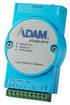 MODBUS TCP to RTU/ASCII Gateway User s Manual 1 INTRODUCTION... 1 1.1 FEATURES... 2 1.2 PRODUCT SPECIFICATIONS... 3 1.3 DEFAULT SETTINGS... 4 2 MAKING THE HARDWARE CONNECTIONS... 5 2.1 POWER CONNECTION...
User Manual IC-485AI 2002-09-27
 User Manual IC-485AI Note: This equipment has been tested and found to comply ith the limits for a Class A digital device pursuant to Part 15 of the FCC Rules. These limits are designed to provide reasonable
How to read this guide
 How to read this guide The following shows the symbols used in this Quick start guide with descriptions and examples. Symbol Description Example P oint Reference Caution [ ] This symbol explains information
PM1122 INT DIGITAL INTERFACE REMOTE
 PM1122 INT DIGITAL INTERFACE REMOTE PM1122 INT front panel description: 1. Clear wireless remotes knob: push this button for more than 2 seconds to clear the list of all assigned wireless remote settings
Process Control and Automation using Modbus Protocol
 Process Control and Automation using Modbus Protocol Modbus is the fundamental network protocol used in most industrial applications today. It is universal, open and an easy to use protocol. Modbus has
PLC Master / Slave Example
 PLC Master / Slave Example A 2 PLC The Example This chapter provides an example of a PLC master / slave network and is designed for the experienced user. This chapter does not provide detailed descriptions
PCM-3600 PC/104 Fax/Modem Module
 PCM-3600 PC/104 Fax/Modem Module Copyright Notice This document is copyrighted, 1996, by AAEON Technology Inc. All rights are reserved. AAEON Technology Inc. reserves the right to make improvements to
Aquadyne TechTip TITLE: TROUBLESHOOTING PC COM PORT AND MODEM PRODUCTS AFFECTED SYMPTOMS POSSIBLE CAUSES
 Aquadyne TechTip TITLE: TROUBLESHOOTING PC COM PORT AND MODEM COMMUNICATIONS WITH AN OCTOPUS. Article # 072297-1 Last reviewed: 03/25/98 Keywords: Serial Port, Modem, Polling, AquaWeb, Node Not Responding
2-Pair. Managed SHDSL Ethernet Extender. User s Manual
 2-Pair User s Manual 1. Quick Start Guide This quick start guide describes how to install and use the Managed SHDSL Ethernet Extender. This is the Ethernet Extender of choice to extend 10/100 Ethernet
Centrepoint Technologies. Phone System Solutions for: Smart homes Home businesses Small offices Branch/Remote offices DESKTOP PHONE SYSTEM.
 Centrepoint Technologies DESKTOP PHONE SYSTEM Phone System Solutions for: Smart homes Home businesses Small offices Branch/Remote offices User Guide Table of Contents 1.0 Installing TalkSwitch 1.1 What's
IP SERIAL DEVICE SERVER
 IP SERIAL DEVICE SERVER ( 1 / 2 / 4 serial port ) Installation guide And User manual Version 1.0 1Introduction... 5 1.1Direct IP mode...5 1.2Virtual COM mode...5 1.3Paired mode...6 1.4Heart beat... 6
UNIVERSAL POWER-LINE CARRIER SYSTEM TYPE OPU-1
 UNIVERSAL POWER-LINE CARRIER SYSTEM TYPE OPU-1 WHOLE BAND QAM MODEM MBPU Rev. 0 - July 2011 DIMAT Antonio Machado,78-80 08840 Viladecans, Barcelona-Spain Tel.: +34 933 490 700 Fax: +34 933 492 258 Mail
Different Ways of Connecting to. 3DLevelScanner II. A.P.M Automation Solutions LTD. www.apm-solutions.com Version 3.0
 3DLevelScanner II Different Ways of Connecting to 3DLevelScanner II A.P.M Automation Solutions LTD. www.apm-solutions.com Version 3.0 2 Different Ways of Connecting to 3DLevelScanner II Version 3.0 Table
4511 MODBUS RTU. Configuration Manual. HART transparent driver. No. 9107MCM100(1328)
 4511 MODBUS RTU Configuration Manual HART transparent driver No. 9107MCM100(1328) 9107 CONTENTS Introduction... 3 Modbus basics... 3 Modbus RTU... 3 Supported Function Codes... 3 Modbus Parameters and
Automatic Telephone Dialer TD-101(W)
 Automatic Telephone Dialer TD-101(W) The TD-101 is an automatic dialing device which can transmit prerecorded information via the telephone line. The dialer can send two different 10 second voice messages
MDM192 MULTI-DROPS DIGITAL MODEM FOR PRIVATE LINE. USER GUIDE Document reference : 9010709-03
 MDM192 MULTI-DROPS DIGITAL MODEM FOR PRIVATE LINE USER GUIDE Document reference : 9010709-03 If you have questions about the MDM192 or desire assistance, contact ETIC TELECOMMUNICATIONS at the following
ISHIDA BC-3000. Scale to Scale Communications
 ISHIDA BC-3000 Scale to Scale Communications Setup Procedure & Operating Instructions March 2006 PN 94561 Revision History Date Page Description March 2006 Initial publication August 2006 2 Added RS-232
K-2000-DVA See at a Glance when Lines are Multi-Input Ringing Voice. Telecommunication Peripheral Products. Technical Practice
 VIKING Telecommunication Peripheral Products K-2000-DVA See at a Glance when Lines are Multi-Input Ringing Voice or In-Use Dialer/Announcer Technical Practice The K-2000-DVA can store up to seven 16 digit
The Analyst RS422/RS232 Tester. With. VTR, Monitor, and Data Logging Option (LOG2) User Manual
 12843 Foothill Blvd., Suite D Sylmar, CA 91342 818 898 3380 voice 818 898 3360 fax www.dnfcontrolscom The Analyst RS422/RS232 Tester With VTR, Monitor, and Data Logging Option (LOG2) User Manual Manual
One Port Serial Server Users Manual Model ESP901, ESP901E
 One Port Serial Server Users Manual Model ESP901, ESP901E Documentation Number: ESP901-2303 International Headquarters B&B Electronics Mfg. Co. Inc. 707 Dayton Road -- P.O. Box 1040 -- Ottawa, IL 61350
EDI Distributor Control Interface Wiring and Setup Instructions
 Universal I/O EDI Distributor Control Interface Wiring and Setup Instructions EDI UNIVERSAL I/O INTERFACE MODULE The only interface needed for EDI-V5 controls Network compatible with all older EDI controls
1 Getting Started. Before you can connect to a network
 1 Getting Started This chapter contains the information you need to install either the Apple Remote Access Client or Apple Remote Access Personal Server version of Apple Remote Access 3.0. Use Apple Remote
Add Door Phones to Your Phone System
 Universal Door Phone System Material Code/Comcode # 408466563 (controller) and # 408466548 (speaker) PEC # 5324-001 Add Door Phones to Your Phone System The Door Entry Controller system dramatically expands
1MRS119000 Plug-in Modem. Operator s manual
 1MRS119000 Plug-in Modem Operator s manual 1MRS 750577-MUM EN Issued 98-06-02 Version A Checked MKa Approved OV 1MRS119000 Plug-in Modem Data subject to change without notice Contents 1.0 General... 4
PHONE MANAGER INDEX. page
 PHONE MANAGER INDEX page 1 HARDWARE... 4 1.1 Requirements... 4 1.2 Indicators... 4 1.3 Hardware Configuration... 5 1.4 Hardware Installation... 5 2 SOFTWARE... 7 2.1 Software Installation... 7 2.2 Use
Accessing Diagnostics using a Dialup Modem
 Purpose This application note is meant to guide a user through the setup and use of a dial-up modem to retrieve diagnostics data from a remote master. Equipment Used This application note was written specifically
VOCALISER USER INSTRUCTIONS. Pyronix Ltd OCTOBER 2000. RINS113 Issue 2
 VOCALISER USER INSTRUCTIONS Pyronix Ltd OCTOBER 2000 RINS113 Issue 2 9 RECEIVING A CALL FROM THE VOCALISER A telephone call from the Vocaliser is easily recognised by the distinctive three tones heard
LAN / WAN Connection Of Instruments with Serial Interface By Using a Terminal Server
 Products: EFA with EFA Scan, DVRM and DVMD with Realtime Monitor or Stream Explorer DVMD-B1 LAN / WAN Connection Of Instruments with Serial Interface By Using a Terminal Server Remote control of test and
VOICE RECORDING SYSTEM ISDN PRI / BRI
 Sense Box VOICE RECORDING SYSTEM ISDN PRI / BRI / Analog SUB-SYSTEM ISDN2, ISDN30 Sense Box USER MANUAL TABLE OF CONTENTS 1. STATUTORY INFORMATION... 3 1.1 SAFETY WARNING... 3 1.2 SAFETY EXTRA LOW VOLTAGE
ACU-1000 Manual Addendum Replacement of CPM-2 with CPM-4
 ACU-1000 Manual Addendum Replacement of CPM-2 with CPM-4 1 PURPOSE:... 1 2 CPM-4/CPM-2 COMPATIBILITY... 2 2.1 NETWORK CABLES... 2 2.2 FACTORY DEFAULT SETTINGS... 2 2.3 CHANGING THE RS-232 SERIAL PORT BAUD
Series Six Plus Programmable Controller
 Series Six Plus Programmable Controller Gl?K-0147B June 1989 Central Processor Unit 8-Slot Rack 1l-Slot Rack General Description The Central Processor Unit (CPU) for the Series Six Plus Programmable Logic
LS-101 LAN to Serial Device server. User s Manual
 LS-101 LAN to Serial Device server User s Manual Revision History Revision No Date Author Remarks 0.1 August 29, 2001 IDC Initial document INTRODUCTION Overview Almost all instruments and most industrial
Application Note 2. Using the TCPDIAL & TCPPERM Commands to Connect Two TransPort router Serial Interfaces Over TCP/IP.
 Application Note 2 Using the TCPDIAL & TCPPERM Commands to Connect Two TransPort router Serial Interfaces Over TCP/IP. Reverse Telnet or Serial Terminal Server MultiTX feature UK Support March 2014 1 Contents
FOSTCDR. Industrial Serial to Multimode Fiber Optic Converter PRODUCT INFORMATION B&B ELECTRONICS. Specifications Serial Technology
 FOSTCDR pn 8684R1 FOSTCDR-0812ds page 1/5 Industrial Serial to Multimode Fiber Optic Converter Data Rates up to 115.2 kbps 2.5 Mile (4 km) Range 10 to 30 VDC Input Voltage Wide Operating Temperature 2000V
Link Link sys E3000 sys RE1000
 User Guide High Performance Extender Wireless-N Router Linksys Linksys RE1000 E3000Wireless-N Table of Contents Contents Chapter 1: Product Overview 1 Front 1 Top 1 Bottom 1 Back 2 Chapter 2: Advanced
Adapter GL386. User Manual is available in other languages at
 Adapter GL386 User Manual is available in other languages at www.glipfone.com GL386 User Manual Contents: Chapter 1 Introduction ---------------------------------------------------------------- 1 Chapter
RACEAIR REMOTE PAGER SYSTEM
 Computech Systems, Inc. 301-884-5712 30071 Business Center Dr. Charlotte Hall, MD 20622 RACEAIR REMOTE PAGER SYSTEM TM Introduction: Computech s RaceAir Remote Competition Weather Station with the Data
TELULAR SX4E PHONECELL WITH THE 8210 SPEECH MODEM APPLICATION NOTE
 TELULAR SX4E PHONECELL WITH THE 8210 SPEECH MODEM APPLICATION NOTE September 2004 Prepared by: Integrated Systems Division The Sutron Corporation 21300 Ridgetop Circle Sterling, VA 20166 Copyright 2004
Modicon Premium PLCs TSX 57/PCX 57 Communication Network and Bus Interfaces Installation manual Volume 4
 Modicon Premium PLCs TSX 57/PCX 57 Communication Network and Bus Interfaces Installation manual Volume 4 eng May 2007 35009581_02 2 335009581 02 May 2007 Document Set Document Set At a Glance This documentation
AC-115 Compact Networked Single Door Controller. Installation and User Manual
 AC-115 Compact Networked Single Controller Installation and User Manual December 2007 Table of Contents Table of Contents 1. Introduction...5 1.1 Key Features... 6 1.2 Technical Specifications... 7 2.
How To Set Up A Modbus Cda On A Pc Or Maca (Powerline) With A Powerline (Powergen) And A Powergen (Powerbee) (Powernet) (Operating System) (Control Microsci
 Firmware Loader User Manual CONTROL MICROSYSTEMS SCADA products... for the distance 48 Steacie Drive Telephone: 613-591-1943 Kanata, Ontario Facsimile: 613-591-1022 K2K 2A9 Technical Support: 888-226-6876
TICO-EN. TiXML-Console TICO. User Manual V1.4.0.8
 TICO-EN TiXML-Console TICO User Manual V1.4.0.8 2008 Tixi.Com GmbH, Berlin Publication close: September 2008, v.1.4.0.8 This manual is protected by copyright. Any further sale is prohibited without the
PPM Users Manual Signature Software 01-12-00
 PPM Users Manual Signature Software 0-2-00 PPM User Manual /8/02 Software Versions: 0.0.27 Contents. Introduction 2 2. Parameters 3 2. Overload Limit...4 2.2 Relative Upper Limit...4 2.3 Relative Lower
Dealer s Manual VHF FM MOBILE TRANSCEIVER
 VHF FM MOBILE TRANSCEIVER Dealer s Manual Alinco s DR-135 transceivers support the Channel Indication mode (User s mode), which protects dealer-defined parameter settings from being changed by the user.
-Helping to make your life betterwww.person-to-person.net
 Household Telephone Management System Built on Interceptor ID Technology Owner/Operation Manual Telephone Management System- Model P2P101 Call Receiver - Model P2P301 (Receiver may be sold separately)
LOVELINK III- Process Monitoring, Logging, Graphing, & Configuration
 LOVELINK III- Process Monitoring, Logging, Graphing, & Configuration VERSION 1.00.00 USER MANUAL Updated 09/13/2002 Table of Contents Hardware/Software Requirements...2 Computer Requirements...2 Instrument
System Administration Guide. Model KS 832. Expandable up to 1664
 System Administration Guide Model KS 832 Expandable up to 1664 Introduction 4 Installation Hints 4 System Programming 5 - System Password 5 - Changing Password 5 Exchange Line Set up 6 - Caller Display
Part Number 129777-01 Revision A, January 1996. 3500 Monitoring System Rack Configuration and Utilities Guide
 Part Number 129777-01 Revision A, January 1996 3500 Monitoring System Rack Configuration and Utilities Guide Copyright 1995 Bently Nevada Corporation All Rights Reserved. No part of this publication may
M2M 3350 GSM/GPRS Modem User s Manual & Reference Guide Revision 1 June 2007
 M2M 3350 GSM/GPRS Modem User s Manual & Reference Guide Revision 1 June 2007 1999-2007 by Laipac Technology, Inc. All rights reserved The Specifications and information regarding the products in this manual
Optus VoIP IP Handset Quick Start Guide.
 Optus VoIP IP Handset Quick Start Guide. Congratulations on your new IP Handset The Linksys SPA-942 is a functionally powerful and easy to use business phone featuring a high resolution graphical display,
T3 Mux M13 Multiplexer
 T3 Mux M13 Multiplexer User Manual [Type the abstract of the document here. The abstract is typically a short summary of the contents of the document. Type the abstract of the document here. The abstract
RS-232 Baud Rate Converter CE Model 232BRC Documentation Number 232BRC-3903 (pn5104-r003)
 S-232 Baud ate Converter CE Model 232BC Documentation Number 232BC-3903 (pn5104-r003) International Headquarters B&B Electronics Mfg. Co. Inc. 707 Dayton oad -- P.O. Box 1040 -- Ottawa, IL 61350 USA Phone
PRODUCTIVITY THROUGH INNOVATION 600 CONTROL DIRECT DRIVE TECHNICAL/OPERATION MANUAL
 Rev. D PRODUCTIVITY THROUGH INNOVATION 600 CONTROL DIRECT DRIVE TECHNICAL/OPERATION MANUAL 10 BORIGHT AVENUE, KENILWORTH NEW JERSEY 07033 TELEPHONE: 800-524-0273 FAX: 908-686-9317 TABLE OF CONTENTS Page
DSX Master Communications
 DSX Access Systems, Inc. PC to Master Controller - Direct Connect Communications DSX Master Communications Communications between the Comm Server PC and the Master Controller can take several forms which
2. Terminal arrangement. Default (PV display) (SV display) Communication protocol selection Selects the Communication protocol. Modbus ASCII mode:
 COMMUNICATION INSTRUCTION MANUAL TEMPERATURE CONTROLLER KT4, KT8 and KT9 No.KTC1E6 2009.05 To prevent accidents arising from the misuse of this controller, please ensure the operator receives this manual.
Memcom Emergency Telephone
 Memcom Emergency Telephone Installation Guide Ref No. 450 900 (GB) Version 2 + + Simple wiring for quick installation + + Integrated LCD display shows you what you have programmed + + All code based programming
PCMCIA 1 Port RS232 2.1 EDITION OCTOBER 1999
 232 232232 PCMCIA 1 Port RS232 2.1 EDITION OCTOBER 1999 Guarantee. FULL 36 MONTHS GUARANTEE. We guarantee your interface card for a full 36 months from purchase, parts and labour, provided it has been
RN-WIFLY-EVAL-UM. WiFly Evaluation Kit. 2012 Roving Networks. All rights reserved. RN-WIFLY-EVAL-UM Version 1.32r 10/9/2012 USER MANUAL
 WiFly Evaluation Kit 2012 Roving Networks. All rights reserved. Version 1.32r 10/9/2012 USER MANUAL OVERVIEW This document describes the hardware and software setup for Roving Networks evaluation kits,
Bluetooth HC-06 with serial port module Easy guide
 1 Bluetooth HC-06 with serial port module Easy guide This manual consists of 3 parts: PART 1. Overview of Bluetooth HC-06 module with serial port. PART 2. Installing Bluetooth HC-06 module with Bolt 18F2550