
Enterprise Manager. Version 6.2. Administrator s Guide
|
|
|
- Kathlyn Miller
- 10 years ago
- Views:
Transcription
1 Enterprise Manager Version 6.2 Administrator s Guide

2 Enterprise Manager 6.2 Administrator s Guide Document Number Revision Date Description A August 2012 Initial release to support version B September 2012 Revised for version Disclaimers Information in this document is subject to change without notice. Trademarks and Copyright Trademarks used in this text: Dell, the DELL logo, and Compellent are trademarks of Dell Inc. Other trademarks and trade names may be used in this document to refer to either the entities claiming the marks and names or their products. Dell Inc. disclaims any proprietary interest in trademarks and trade names other than its own. Contacting Dell Technical Support Services Please contact Dell Technical Support Services from the following address if you need support assistance: support.dell.com/compellent 2012 Dell Inc. All rights reserved.

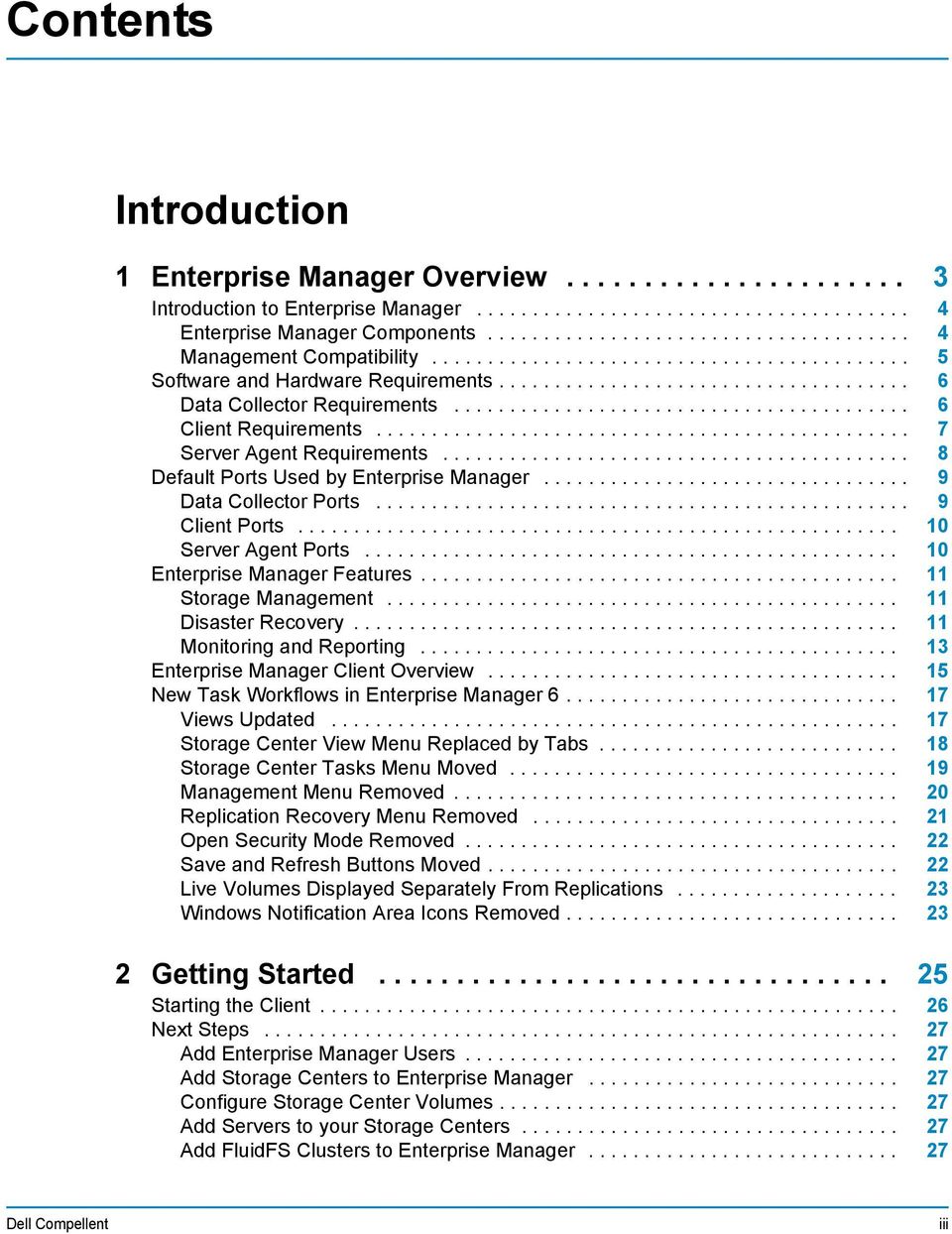
3 Contents Introduction 1 Enterprise Manager Overview Introduction to Enterprise Manager Enterprise Manager Components Management Compatibility Software and Hardware Requirements Data Collector Requirements Client Requirements Server Agent Requirements Default Ports Used by Enterprise Manager Data Collector Ports Client Ports Server Agent Ports Enterprise Manager Features Storage Management Disaster Recovery Monitoring and Reporting Enterprise Manager Client Overview New Task Workflows in Enterprise Manager Views Updated Storage Center View Menu Replaced by Tabs Storage Center Tasks Menu Moved Management Menu Removed Replication Recovery Menu Removed Open Security Mode Removed Save and Refresh Buttons Moved Live Volumes Displayed Separately From Replications Windows Notification Area Icons Removed Getting Started Starting the Client Next Steps Add Enterprise Manager Users Add Storage Centers to Enterprise Manager Configure Storage Center Volumes Add Servers to your Storage Centers Add FluidFS Clusters to Enterprise Manager Dell Compellent iii
4 Contents Configure Notifications Set up Remote Storage Centers and QoS Configure Replications and Live Volumes Prepare for Disaster Recovery Storage Management 3 Storage Centers Storage Center Concepts Volumes Replays and Replay Profiles Storage Profiles Disks and Disk Folders Storage Types Storage Center Management Summary Tab Storage Tab IO Usage Tab Charting Tab Adding and Removing Storage Centers Modifying Storage Center Properties Viewing and Modifying Storage Center Information Configuring Storage Center User Preferences Configuring Storage Center Data Settings Configuring Storage Center SSH Console Settings Managing Volumes Creating Volumes Modifying Volumes Creating and Managing Volume Folders Creating and Managing Volume Replays Mapping Volumes to Servers Preparing Volumes for Disaster Recovery Deleting Volumes and Volume Folders Managing Replay Profiles Managing Storage Profiles FluidFS Clusters Introduction to FluidFS Clusters Required Components for FluidFS Clusters FluidFS Cluster Storage Terminology Adding and Removing FluidFS Clusters Managing FluidFS Clusters Managing NAS Volumes Managing CIFS Shares Managing NFS Exports Monitoring FluidFS Clusters Viewing FluidFS Summary Information Viewing Detailed FluidFS Status Information Monitoring FluidFS File Systems Monitoring FluidFS Performance Viewing the FluidFS Cluster Event Log iv Enterprise Manager 6.2 Administrator s Guide

5 Contents 5 Servers Introduction Adding Servers to Storage Centers Registering Servers to Enterprise Manager Space Recovery on Windows Managing Servers on the Servers View Registering Servers with Enterprise Manager Editing Servers Registered to Enterprise Manager Categorizing and Sorting Registered Servers Updating Server Information Managing Data Collection and Reporting Settings Creating and Mapping Volumes/Datastores to Servers Assigning/Creating Virtual Servers on Storage Centers Managing Dell Compellent znas Appliances Managing NAS Appliances Powered by Windows Storage Server Setting Up the Enterprise Manager Server Agent Installing the Server Agent Registering the Server Agent from Server Agent Manager Using the Server Agent Manager Performing Space Recovery on Windows Enabling Automated Space Recovery Running Manual Space Recovery Viewing Space Recovery Results Managing Servers on the Storage Tab of the Storage (SAN/NAS) View Creating Servers Modifying Servers Mapping Volumes to Servers Creating and Managing Server Folders Deleting Servers and Server Folders SMI-S About SMI-S Dell Compellent SMI-S Provider Supported SMI-S 1.4 Profiles SMI-S User Account Requirements Setting Up SMI-S Verify SMI-S Prerequisites Enable SMI-S for the Data Collector Add a user for SMI-S Associate the SSL Certificate with the SMI-S Provider User Using the Dell Compellent SMI-S Provider with Microsoft SCVMM Verify pre-requisites Review Limitations for SCVMM Modify the SCVMM 2012 Management Server Registry to Allow HTTPS Use SCVMM 2012 to Discover the Dell Compellent SMI-S Provider Disaster Recovery 7 Remote Storage Centers and QoS Connecting to Remote Storage Centers Connecting Storage Centers Using Fibre Channel Dell Compellent v

6 Contents Connecting Storage Centers Using iscsi Creating and Managing Quality of Service (QoS) Definitions Replications Introduction Replication Requirements Replication Types Replication Icons Portable Volume Disks Configuring Replications Simulating Replications Creating Replications Modifying Replications Monitoring Replications Using Portable Volume Disks to Transfer Replication Data Prepare the Source Storage Center Choose Volumes to Transfer to the Destination Storage Center Move the Replication Data to the Destination Storage Center Managing Replication Baselines and Portable Volume Disks Live Volumes Introduction Live Volume Requirements Live Volume Icon Automatic Role Swapping for Live Volumes Creating Live Volumes Modifying Live Volumes Monitoring Live Volumes Disaster Recovery Activation Preparing for Disaster Recovery Saving and Validating Replication Restore Points Predefining Disaster Recovery Settings Testing Disaster Recovery Activating Disaster Recovery Restarting Failed Replications Restoring Failed Volumes Remote Data Collector Introduction Configuration Requirements Software Requirements Installing and Configuring a Remote Data Collector Installing a Remote Data Collector Configuring the Remote Data Collector with the Data Collector Setup Wizard Disconnecting and Reconnecting a Remote Data Collector Using a Remote Data Collector to Activate Disaster Recovery Enabling Notifications for the Remote Data Collector vi Enterprise Manager 6.2 Administrator s Guide

7 Contents 12 Storage Replication Adapter for VMware SRM Introduction Dell Compellent SRA Software Requirements Dell Compellent SRA Limitations VMware SRM and Enterprise Manager Configuration Prerequisites Enterprise Manager SRA Configurations Primary Data Collector Only Configuration Remote Data Collector Configuration Manual SRM Failback Procedure for VMware SRM Reprotecting After Migrations with SRM 5.0 and ESX 4.1 Hosts Selecting the Replay Type to Use for SRM 5.0 Volume Failover Monitoring and Reporting 13 Threshold Alerts Introduction Configuring Threshold Definitions Setting Up Threshold Definitions Assigning Storage Objects to a Threshold Definition Assigning Threshold Alert Definitions to Storage Objects Viewing Threshold Alerts on the Definition Tab Viewing Threshold Alerts Viewing Current and Historical Threshold Alerts Deleting Historical Threshold Alerts Exporting Threshold Alert Data Configuring Data Collection Settings Configuring Notifications for Threshold Alerts Performing Threshold Queries Setting Up Threshold Queries Running Threshold Queries Editing Threshold Queries Reports Introduction Storage Center Automated Reports Chargeback Reports Displaying Reports Working with Reports Configuring Automated Report Generation Testing Automated Reports Settings Configuring Settings for Reports Chargeback Introduction Configuring Chargeback Global Disk Classes Individual Storage Center Disk Tier Configuring Chargeback Departments Setting Up Departments Managing Department Line Items Dell Compellent vii

8 Contents Assigning Storage Center Volumes to Chargeback Departments Performing and Viewing Chargeback Runs Performing Manual Chargeback Runs Viewing Chargeback Runs Working with Charts Exporting Chargeback Data Log Monitoring Introduction Viewing Monitoring Data Viewing Storage Center Alerts Viewing Storage Center Indications Viewing Enterprise Manager Events Viewing Storage Center Logs Exporting Monitoring Data Configuring Data Collection and SMTP Server Settings Configuring Notification Settings Configuring Storage Center Log Settings Performance Monitoring Introduction Viewing Summary Information Using the Status Pane Using the Storage History Pane Using the Storage Summary Pane Using the Front End IO Summary Pane Using the Current Alerts Pane Using Replication Validation Pane Using Top 10 Fastest Growing Volumes Pane Using the Current Threshold Alerts Pane Viewing Historical IO Performance Using the IO Usage Tab Viewing Current IO Performance Using the Charting Tab Configuring Chart Options Configuring User Settings for Charts Configuring Chart Settings Exporting Usage Data Maintenance 18 Data Collector Management Introduction Using the Data Collector Manager Starting the Data Collector Manager Managing the Data Collector Service Using the Enterprise Manager Data Collector Website Updating Data Collector Properties Managing Data Collector Service Properties Configuring Network Settings viii Enterprise Manager 6.2 Administrator s Guide

9 Contents Configuring SMTP Server Settings Configuring Reporting Limit Settings Configuring SMI-S Settings Managing Available Storage Centers Managing Available FluidFS Clusters Managing Users Viewing Log Entries Setting Debug Log Options Cleaning Up Data Collector Databases Migrating the Primary Data Collector Migrating a Microsoft SQL Server Database User Management Introduction User Privileges User/Storage Center and User/FluidFS Cluster Maps Managing Users with the Data Collector Manager Managing User Settings with the Enterprise Manager Client User Information Settings Charting Options Client Options Phone Home Introduction Enabling Automatic Phone Home Manually Initiating Phone Home Dell Compellent ix

10 Contents x Enterprise Manager 6.2 Administrator s Guide

11 Introduction Chapter 1 Enterprise Manager Overview 3 Chapter 2 Getting Started 25 Dell Compellent 1

12 2 Enterprise Manager 6.2 Administrator s Guide

13 1 Enterprise Manager Overview Introduction to Enterprise Manager 4 Software and Hardware Requirements 6 Default Ports Used by Enterprise Manager 9 Enterprise Manager Features 11 Enterprise Manager Client Overview 15 New Task Workflows in Enterprise Manager 6 17 Dell Compellent 3

14 Chapter 1 Enterprise Manager Overview Introduction to Enterprise Manager Enterprise Manager allows you to monitor, manage, and analyze Storage Centers and FluidFS clusters from a centralized management console. The Enterprise Manager Data Collector stores data and alerts it gathers from Storage Centers and FluidFS clusters in an external database or an embedded database. Enterprise Manager Clients connect to the Data Collector to communicate with managed Storage Centers. This guide describes how to use Enterprise Manager to manage and monitor your Dell Compellent storage infrastructure. For information about installing and configuring required Enterprise Manager components, see the Enterprise Manager Installation Guide. Enterprise Manager Components Enterprise Manager consists of the following components: Component Description Required/ Optional Setup Documentation Primary Data Collector Service that gathers reporting data and alerts from Storage Centers Required Enterprise Manager Installation Guide Client Windows-based application that connects to the Data Collector to provide a centralized management console for one or more Storage Centers Required Enterprise Manager Installation Guide Remote Data Collector Data Collector that is connected to the primary Data Collector and can be used to activate a disaster recovery site if the primary Data Collector becomes unavailable Optional Enterprise Manager Administrator s Guide Server Agent Service for Windows that allows Enterprise Manager to free volume storage space from expired Replays that would otherwise remain locked by Windows Optional Enterprise Manager Administrator s Guide Charting Viewer Windows-based application that displays IO performance statistics for volumes, servers, disks, and controllers Optional Storage Center Charting Viewer Administrator s Guide 4 Enterprise Manager 6.2 Administrator s Guide

15 Management Compatibility Management Compatibility Enterprise Manager is compatible with the products listed in the following table. Product Version Dell Compellent Storage Center Storage Center OS versions Dell Compellent FS8600 FluidFS version 2.x Microsoft System Center Virtual Machine Manager (SCVMM) VMware vcenter Site Recovery Manager (SRM) Version 2012 Compatibility is provided by the Dell Compellent Storage Replication Adapter (SRA): SRM 4.0 is compatible with Dell Compellent SRA SRM 5.0 is compatible with Dell Compellent SRA and SRM 5.1 is compatible with Dell Compellent SRA Dell Compellent 5

16 Chapter 1 Enterprise Manager Overview Software and Hardware Requirements All Enterprise Manager components support 32-bit (x86) and 64-bit (x64) processors. The Intel Itanium architecture is not supported. Data Collector Requirements The following table lists the Enterprise Manager Data Collector requirements. Component Requirements Operating system Any of the following operating systems with the latest service packs (64-bit recommended): Windows Server 2003 Windows Server 2008 Windows Server 2008 R2 Windows Server 2012 Note: Windows Server Core is not supported. CPU 32-bit (x86) or 64-bit (x64) microprocessor with two or more cores RAM Disk space At least 4 GB; 8 GB if using the Dell Compellent Site Recovery Adapter (SRA) for VMware vcenter Site Recovery Manager At least 20 GB Software Microsoft.NET Framework 2.0 Microsoft.NET Framework 3.5 (for SMI-S only) Windows PowerShell 2.0 or higher (for SMI-S only) Java Runtime Environment (JRE) 1.6 or higher (1.6 Update 30 or higher recommended); on 64-bit systems both the 32-bit and the 64-bit JRE are required Web browser The online help is compatible with the following browsers: Internet Explorer 7, 8, and 9 Firefox 3 14 Safari 5.x Google Chrome 20 and earlier Note: Other web browsers may work but are not officially supported. 6 Enterprise Manager 6.2 Administrator s Guide

17 Client Requirements Component Database Requirements One of the following: Microsoft SQL Server 2005 Microsoft SQL Server 2005 Express (limited to 4 GB) Microsoft SQL Server 2008 Microsoft SQL Server 2008 Express (limited to 4 GB) Microsoft SQL Server 2008 R2 Microsoft SQL Server 2008 R2 Express (limited to 10 GB) Microsoft SQL Server 2012 Microsoft SQL Server 2012 Express (limited to 10 GB) MySQL 5.0 MySQL 5.1 MySQL 5.5 Embedded database on the file system (maximum of 30 days or 2 GB) Note: The database used for storing data can be changed after installation. Client Requirements The following table lists the requirements for the Enterprise Manager Client. Component Requirements Operating system Any of the following operating systems (with the latest service packs): Windows XP Windows Vista Windows 7 Windows 8 Windows Server 2003 Windows Server 2008 Windows Server 2008 R2 Windows Server 2012 Note: Windows Server Core is not supported. CPU 32-bit (x86) or 64-bit (x64) microprocessor Software Web browser Java Runtime Environment (JRE) 1.6 or higher (1.6 Update 30 or higher recommended); on 64-bit systems both the 32-bit and the 64-bit JRE are required The online help is compatible with the following browsers: Internet Explorer 7, 8, and 9 Firefox 3 14 Safari 5.x Google Chrome 20 and earlier Note: Other web browsers may work but are not officially supported. Dell Compellent 7

18 Chapter 1 Enterprise Manager Overview Server Agent Requirements The following table lists the requirements for the Enterprise Manager Server Agent for Windows-based servers. Component Requirements Operating system Any of the following operating systems (with the latest service packs): Windows Server 2003 Windows Server 2008 Windows Server 2008 R2 Windows Storage Server 2008 R2 Windows Server 2012 Note: Windows Server Core is not supported. CPU 32-bit (x86) or 64-bit (x64) microprocessor Software Microsoft.NET Framework Enterprise Manager 6.2 Administrator s Guide

19 Default Ports Used by Enterprise Manager Default Ports Used by Enterprise Manager The Enterprise Manager components use network connections to communicate with each other and with other network resources. The following tables list the default network ports used by the Data Collector, Server Agent, and Client. Many of the ports are configurable. Note: Some ports might not be needed for your configuration. For details, see the Purpose column in each table. Data Collector Ports The following table lists the ports used by the Enterprise Manager Data Collector. Port Protocol Name Purpose Inbound Ports 514 UDP syslog Receiving logs forwarded from Storage Centers 3033 TCP Web Server Port Receiving: Communication from all clients, including the Enterprise Manager Client and Storage Replication Adapter (SRA) and Alerts from FluidFS clusters 8080 TCP Legacy Web Services Port 7342 TCP Legacy Client Listener Port Receiving: Communication from Server Agents Alerts forwarded from Storage Centers Communication from Storage Replication Adapter (SRA) Communicating with the remote Data Collector Providing automatic upgrade functionality for previous versions of the Enterprise Manager Client 5988 TCP SMI-S over HTTP Receiving unencrypted SMI-S communication 5989 TCP SMI-S over HTTPS Receiving encrypted SMI-S communication Outbound Ports 25 TCP SMTP Sending notifications 443 TCP Storage Center Communicating with: Managed Storage Centers Managed znas servers 514 UDP syslog Forwarding Storage Center logs to syslog servers 1433 TCP Microsoft SQL Server Connecting to an external Microsoft SQL Server database 3306 TCP MySQL Connecting to an external MySQL database 8080 TCP VMware SDK Communicating with VMware servers TCP Server Agent Socket Listening Port Communicating with Server Agents TCP FluidFS Communicating with managed FluidFS clusters Dell Compellent 9

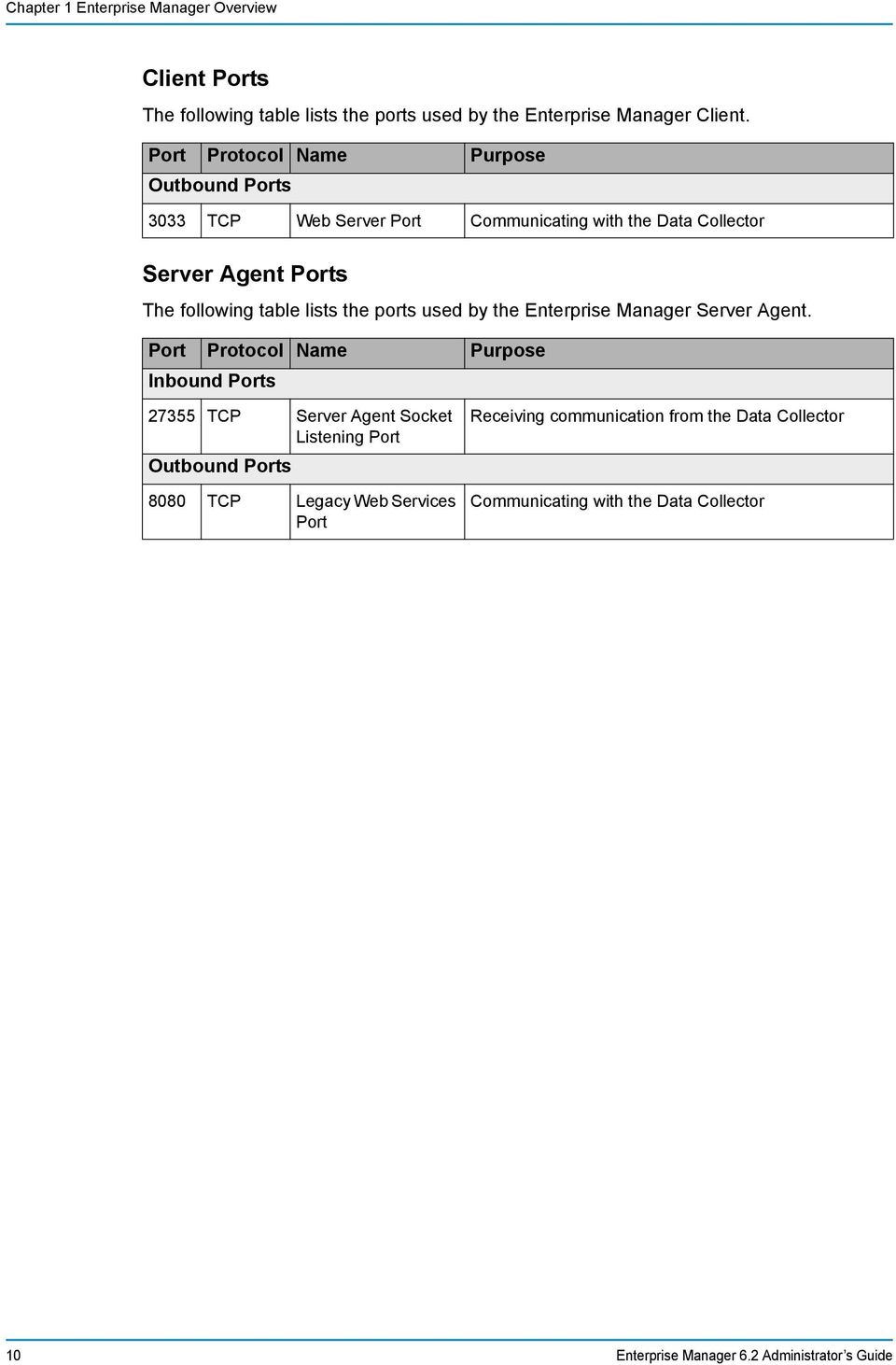
20 Chapter 1 Enterprise Manager Overview Client Ports The following table lists the ports used by the Enterprise Manager Client. Port Protocol Name Purpose Outbound Ports 3033 TCP Web Server Port Communicating with the Data Collector Server Agent Ports The following table lists the ports used by the Enterprise Manager Server Agent. Port Protocol Name Purpose Inbound Ports TCP Server Agent Socket Listening Port Outbound Ports 8080 TCP Legacy Web Services Port Receiving communication from the Data Collector Communicating with the Data Collector 10 Enterprise Manager 6.2 Administrator s Guide
21 Enterprise Manager Features Enterprise Manager Features Enterprise Manager provides the following features. Storage Management Enterprise Manager provides the following storage management features. Storage Center Management Enterprise Manager allows you to centrally manage your Dell Compellent Storage Centers. For each Storage Center, you can configure volumes, Replay Profiles, and Storage Profiles. You can also present configured storage to servers by defining server objects and mapping volumes to them. See also Chapter 3: Storage Centers, on page 31 FluidFS Clusters A FluidFS cluster is a unified NAS/SAN solution that allows administrators to easily leverage Dell Compellent Storage Center Dynamic Capacity (thin provisioning), high availability, and block-level storage performance across Windows, UNIX, and Linux shares. Storage Centers provide the storage used by FluidFS clusters, and Enterprise Manager provides management integration between FluidFS clusters and Storage Centers. Enterprise Manager also allows you to monitor FluidFS cluster status and performance. See also Chapter 4: FluidFS Clusters, on page 67 Servers Enterprise Manager allows you to manage the storage allocated to each server and provides Storage Center integration with Windows and VMware servers. There are two ways that servers can be managed: adding them to Storage Centers and registering them to the Enterprise Manager Data Collector. See also Chapter 5: Servers, on page 91 SMI-S Enterprise Manager supports the Storage Management Initiative Specification (SMI-S), a standard interface specification developed by the Storage Networking Industry Association (SNIA). SMI-S allows Enterprise Manager to interoperate with storage management software and hardware from other vendors. See also Chapter 6: SMI-S, on page 127 Disaster Recovery Enterprise Manager allows you to plan and implement a disaster recovery strategy for your Storage Center volumes. Dell Compellent 11
22 Chapter 1 Enterprise Manager Overview Remote Storage Centers and Quality of Service Storage Centers can be connected to each other by Fibre Channel or iscsi to allow data to be copied between them. Enterprise Manager allows you to coordinate connected Storage Centers to distribute copies of your data to remote sites, ensuring that your data is protected and available even if one site goes down. Quality of Service (QoS) definitions allow you to control when and how much bandwidth is used for communication between Storage Centers. See also Chapter 7: Remote Storage Centers and QoS, on page 143 Replications As part of an overall Disaster Recovery Plan, replication copies volume data from one Storage Center to another Storage Center to safeguard data against local or regional data threats. If the source Storage Center or source site becomes unavailable, you can activate the destination volume to regain access to your data. See also Chapter 8: Replications, on page 149 Live Volumes A Live Volume is a pair of replicating volumes that can be mapped and active at the same time. Similar to a conventional replication, the primary (source) volume on a primary Storage Center replicates to a secondary (destination) volume on a secondary Storage Center. However, both the primary volume and secondary volume can accept writes. See also Chapter 9: Live Volumes, on page 167 Disaster Recovery Activation If you configure replications, Live Volumes, or both, you can use Enterprise Manager to prepare for and perform disaster recovery. Enterprise Manager allows you to predefine your disaster recovery plans, including which servers the recovery volumes will be mapped to. In the event of a real disaster, you can use Enterprise Manager to activate your disaster recovery plans, making your data available to the resources that need it as soon as possible. See also Chapter 10: Disaster Recovery Activation, on page 177 Remote Data Collector A remote Data Collector is installed at a remote site and connected to the primary Data Collector to provide access to disaster recovery options when the primary Data Collector is unavailable. In the event that the primary Data Collector is down, you can connect to the remote Data Collector at another site to perform Disaster Recovery. See also Chapter 11: Remote Data Collector, on page Enterprise Manager 6.2 Administrator s Guide
23 Monitoring and Reporting Dell Compellent Storage Replication Adapter for VMware SRM Enterprise Manager includes the Dell Compellent Storage Replication Adapter (SRA), which allows sites to manage disaster recovery for VMware infrastructure using the VMware vcenter Site Recovery Manager. See also Chapter 12: Storage Replication Adapter for VMware SRM, on page 199 Monitoring and Reporting Enterprise Manager provides the following reporting and monitoring features. Threshold Alerts The Threshold Alerts feature provides centralized administration and monitoring of threshold alert definitions. The types of usage metrics that can be monitored are IO, storage, and replication usage. Enterprise Manager collects the usage data from the managed Storage Centers. Storage objects on the Storage Centers are assigned to threshold definitions and each threshold definition contains one or more threshold values. When the value of a monitored metric reaches a threshold value, an alert occurs. See also Chapter 13: Threshold Alerts, on page 211 Reports The Reports feature allows a user to view Storage Center and Chargeback reports generated by Enterprise Manager. Enterprise Manager can be configured to generate the reports on a scheduled basis. See also Chapter 14: Reports, on page 231 Chargeback The Chargeback feature monitors storage consumption and calculates data storage operating costs. Chargeback can be configured to charge for storage based on the amount of allocated space or the amount of configured space. When cost is based on allocated space, Chargeback can be configured to charge based on storage usage, which is the amount of space used, or storage consumption, which is the difference in the amount of space used since the last Chargeback run. See also Chapter 15: Chargeback, on page 241 Log Monitoring The Log Monitoring feature provides a centralized location to view Storage Center alerts, indications, and logs collected by the Enterprise Manager Data Collector and system events logged by Enterprise Manager. See also Chapter 16: Log Monitoring, on page 263 Dell Compellent 13
24 Chapter 1 Enterprise Manager Overview Performance Monitoring The Performance Monitoring feature provides access to summary information about the managed Storage Centers and historical/current IO performance information. Use this information to monitor the health and status of Storage Centers. See also Chapter 17: Performance Monitoring, on page Enterprise Manager 6.2 Administrator s Guide
25 Enterprise Manager Client Overview Enterprise Manager Client Overview The Enterprise Manager Client is a Windows-based program that allows you to connect to the Enterprise Manager Data Collector and centrally manage your Storage Centers and FluidFS clusters. Top pane View pane Views The following table describes the primary elements of the Enterprise Manager Client. Client Elements Description Top pane View pane Contains the following options: Edit Data Collector Settings: When clicked, opens a dialog box that allows you to view and modify Data Collector settings. Edit User Settings: When clicked, opens a dialog box that allows you to view and modify your account settings. Help: When clicked, displays the Enterprise Manager Online Help in a web browser. Support: When clicked, displays the Dell Compellent Support website in a web browser. About: When clicked, opens a dialog box that displays the software version of the Enterprise Manager Client. Displays options specific to the view that is currently selected. For example, when the Storage (SAN/NAS) view is selected, the view pane displays the Storage Centers and FluidFS clusters that have been added to Enterprise Manager. Dell Compellent 15
26 Chapter 1 Enterprise Manager Overview Client Elements Description Views Right pane Displays the view buttons and corresponding options for each view. The views are: Storage (SAN/NAS): When selected, allows you to view, monitor, and configure managed Storage Centers and FluidFS clusters. Servers: When selected, allows you to register servers to the Data Collector and perform server actions, such as space recovery. Replications & Live Volumes: When selected, allows you to configure replications, Live Volumes, Quality of Service definitions, and manage disaster recovery. Monitoring: When selected, allows you to view and acknowledge Storage Center alerts, indications, logs, and Enterprise Manager logs. Threshold Alerts: When selected, allows you to run threshold queries and define threshold alerts. Chargeback: When selected, allows you to configure and run chargeback in order to bill organizations based on storage usage. Reports: When selected, allows you to view automated reports and Chargeback reports. Displays management and monitoring options for the view that is selected in the views pane. 16 Enterprise Manager 6.2 Administrator s Guide
27 New Task Workflows in Enterprise Manager 6 New Task Workflows in Enterprise Manager 6 Enterprise Manager 6 introduces new user interfaces for the Client and Data Collector Manager. As a result, some task workflows have changed as compared to version 5.5. Views Updated Enterprise Manager 6 Client introduces three new views and relocates some existing views. New Views Enterprise Manager 6 introduces the following views: Storage (SAN/NAS): Allows you to view, monitor, and configure managed Storage Centers and FluidFS clusters. Replications & Live Volumes: Allows you to configure replications, Live Volumes, Quality of Service definitions, and manage disaster recovery. Monitoring: Allows you to view and acknowledge Storage Center alerts, indications, logs, and Enterprise Manager logs. Changes to Existing Views Some views that were present in previous releases have been converted to tabs. The Multi Storage Center view has been removed. The following table describes how the views have changed from the previous release. Enterprise Manager 5.5 View Multi Storage Center Current Alerts Enterprise Manager 6 Equivalent N/A Storage Center Alerts tab in the Monitoring view Dell Compellent 17
28 Chapter 1 Enterprise Manager Overview Enterprise Manager 5.5 View Replications Reports Chargeback Threshold Alerts Servers Remote Data Collector Enterprise Manager 6 Equivalent Replications & Live Volumes view Reports view Chargeback view Threshold Alerts view Servers view Remote Data Collector tab in the Replications & Live Volumes view Storage Center View Menu Replaced by Tabs The Storage Center Views have been replaced by tabs placed throughout the Client. Unlike the views that they replace, these tabs always appear and cannot be closed or reopened. As a result, the Storage Center View menu has been removed. The following table shows how tasks related to Storage Centers are performed in version 6. Task View summary information for a Storage Center View current alerts for a Storage Center View historical alerts for a Storage Center View logs for a Storage Center View historical IO performance statistics for a Storage Center Manage storage for a Storage Center View replications for a Storage Center Enterprise Manager 6 Steps 1 Click the Storage (SAN/NAS) view. 2 In the Storage (SAN/NAS) pane, select the Storage Center. 3 Click the Summary tab. 1 Click the Monitoring view. 2 Click the Storage Center Alerts tab. 3 In the Storage Centers pane, filter the alerts by selecting and/or clearing the check boxes for individual Storage Centers. 1 Click the Monitoring view. 2 Click the Storage Center Alerts tab. 3 In the Storage Centers pane, filter the alerts by selecting and/or clearing the check boxes for individual Storage Centers. 1 Click the Monitoring view. 2 Click the Storage Center Logs tab. 3 In the Storage Centers pane, filter the logs by selecting and/or clearing the check boxes for individual Storage Centers. 1 Click the Storage (SAN/NAS) view. 2 In the Storage (SAN/NAS) pane, select the Storage Center. 3 Click the IO Usage tab. 1 Click the Storage (SAN/NAS) view. 2 In the Storage (SAN/NAS) pane, select the Storage Center. 3 Click the Storage tab. 1 Click the Replications & Live Volumes view. 2 Click the Replications tab. 3 In the Storage Centers pane, filter the replications by source and destination Storage Centers. 18 Enterprise Manager 6.2 Administrator s Guide
29 Storage Center Tasks Menu Moved Task View current IO performance statistics for a Storage Center Enterprise Manager 6 Steps 1 Click the Storage (SAN/NAS) view. 2 In the Storage (SAN/NAS) pane, select the Storage Center. 3 Click the Charting tab. Storage Center Tasks Menu Moved The Storage Center Tasks menu has been moved from the top of the Client window to the selected Storage Center. To access the menu: 1 Click the Storage (SAN/NAS) view. 2 Perform either of the following actions: Right-click a Storage Center in the Storage (SAN/NAS) pane, then select Tasks from the context menu. Select a Storage Center in the Storage (SAN/NAS) pane, then click Tasks in any of the tabs. Dell Compellent 19
30 Chapter 1 Enterprise Manager Overview Management Menu Removed The workflow for management tasks has changed in Enterprise Manager 6 because the Management menu has been removed. The following table shows how management tasks are performed in version 6. Task Modify user settings Modify Data Collector properties Modify Storage Center properties Enterprise Manager 6 Steps In the top pane, click Edit User Settings. In the top pane, click Edit Data Collector Settings. 1 Click the Storage (SAN/NAS) view. 2 In the Storage (SAN/NAS) pane, select the Storage Center you want to modify. 3 In the Summary tab, click Edit Settings. Add a Storage Center 1 Click the Storage (SAN/NAS) view. 2 In the Storage (SAN/NAS) pane, select Dell Compellent or Storage Centers. 3 In the Summary tab, click Add Storage Center. Remove a Storage Center 1 Click the Storage (SAN/NAS) view. 2 In the Storage (SAN/NAS) pane, select the Storage Center you want to remove. 3 In the Summary tab, click Delete. 20 Enterprise Manager 6.2 Administrator s Guide
31 Replication Recovery Menu Removed Replication Recovery Menu Removed The workflow for disaster recovery tasks has changed in Enterprise Manager 6 because the Replication Recovery menu has been removed. Disaster recovery tasks are now performed in the Replications & Live Volumes view. The following table shows how the tasks are performed in version 6. Task Enterprise Manager 6 Steps Save restore points 1 Click the Replications & Live Volumes view. 2 In the Actions pane, click Save Restore Points. Validate restore points 1 Click the Replications & Live Volumes view. 2 In the Actions pane, click Validate Restore Points. Restore/restart DR volumes 1 Click the Replications & Live Volumes view. 2 Click the Restore Points tab. 3 Click Restore/Restart DR Volumes. Activate disaster recovery 1 Click the Replications & Live Volumes view. 2 Click the Restore Points tab. 3 Click Activate Disaster Recovery. Test disaster recovery activation 1 Click the Replications & Live Volumes view. 2 Click the Restore Points tab. 3 Click Test Activate Disaster Recovery. Predefine disaster recovery configuration 1 Click the Replications & Live Volumes view. 2 Click the Restore Points tab. 3 Click Predefine Activate Disaster Recovery. Delete DR test volumes 1 Click the Replications & Live Volumes view. 2 In the Actions pane, click Delete Test DR Volumes. Dell Compellent 21
32 Chapter 1 Enterprise Manager Overview Open Security Mode Removed Enterprise Manager 6 always operates in enhanced security mode because open security mode has been removed. As a result, new Enterprise Manager users must be created using the Data Collector Manager. Users cannot be created from the Enterprise Manager Client. Save and Refresh Buttons Moved Common buttons, such as Save and Refresh, have been moved from the top of the Client window to the navigation panes. 22 Enterprise Manager 6.2 Administrator s Guide
33 Live Volumes Displayed Separately From Replications Live Volumes Displayed Separately From Replications In the Client, Live Volumes are displayed and managed separately from replications on the Live Volumes tab in the Replications & Live Volumes view. To view Live Volumes for a specific Storage Center, select or clear Storage Center check boxes in the Source Storage Centers and DR Storage Centers panes. Windows Notification Area Icons Removed The Enterprise Manager Client and Data Collector Manager no longer add icons in the Windows notification area, also known as the system tray. When you close the Data Collector Manager, the Data Collector service continues to run in the background. When you close the Client, it does not continue to run in the background. To open the Data Collector Manager or Client after they are closed, use the Start Menu or appropriate desktop shortcut. The Server Agent continues to have an icon in the Windows notification area. Dell Compellent 23
34 Chapter 1 Enterprise Manager Overview 24 Enterprise Manager 6.2 Administrator s Guide
35 2 Getting Started Starting the Client 26 Next Steps 27 Dell Compellent 25
36 Chapter 2 Getting Started Starting the Client To start the Enterprise Manager Client and connect to the Data Collector: 1 Start the Enterprise Manager Client. From the Start menu, select All Programs Dell Compellent Enterprise Manager Enterprise Manager Client. The Enterprise Manager Client appears. 2 Complete the following fields: User Name: Enter the name of the user you created during Data Collector installation. Password: Enter the password for the administrator user. Host/IP: Enter the host name or IP address of the server that is hosting the Data Collector. Web Server Port: If you changed the Web Server Port during installation, enter the updated port. 3 Click Log In. The Client connects to the Data Collector and displays the Storage (SAN/ NAS) view. 26 Enterprise Manager 6.2 Administrator s Guide
37 Next Steps Next Steps This section describes some basic tasks that you may want to perform after your first log on to Enterprise Manager. These tasks are configuration dependent and not all tasks will be required at all sites. Add Enterprise Manager Users The Data Collector controls user access to Enterprise Manager functions and associated Storage Centers based on the privileges assigned to users: Reporter, Volume Manager, or Administrator. New users, as well as the associated Storage Centers, are created and managed only by the Data Collector Manager. If you want to allow other members of your organization to use Enterprise Manager, use the Data Collector Manager to create new Enterprise Manager users. See also Chapter 19: User Management, on page 327 Add Storage Centers to Enterprise Manager Use the Enterprise Manager Client to add Storage Centers to Enterprise Manager. See also Adding and Removing Storage Centers on page 39 Configure Storage Center Volumes After you have added Storage Centers to Enterprise Manager, you can start creating and managing volumes. You can also manage Replay Profiles and Storage Profiles. See also Managing Volumes on page 46 Managing Replay Profiles on page 60 Managing Storage Profiles on page 64 Add Servers to your Storage Centers Use Enterprise Manager to add servers that use Storage Center volumes to your Storage Centers. To enable additional functionality, such as the ability to display operating system and connectivity information, and to manage the volumes or datastores mapped to the servers, register these servers to the Enterprise Manager Data Collector. Before you register Windows servers, you must first install the Enterprise Manager Server Agent. See also Chapter 5: Servers, on page 91 Add FluidFS Clusters to Enterprise Manager If you have one or more FluidFS clusters, add them to Enterprise Manager during the FluidFS cluster deployment process. See also Adding and Removing FluidFS Clusters on page 69 Dell Compellent 27
38 Chapter 2 Getting Started Configure Notifications You can configure Enterprise Manager to notify you when threshold alerts are exceeded. You can also have automated reports and report notifications ed to you. To enable notifications, configure SMTP settings for the Data Collector, then add your address to your Enterprise Manager user account. See also Configuring Notifications for Threshold Alerts on page 225 Configuring Settings for Reports on page 240 Set up Remote Storage Centers and QoS If you want to protect your data by replicating volumes from one Storage Center to another, set up connectivity between your Storage Centers. Create Quality of Service (QoS) definitions on each Storage Center to control how much bandwidth is used to transmit data to remote Storage Centers. See also Chapter 7: Remote Storage Centers and QoS, on page 143 Configure Replications and Live Volumes To make sure that your data is protected even if one site goes down, configure replications and Live Volumes to mirror volumes to remote Storage Centers. See also Chapter 8: Replications, on page 149 Chapter 9: Live Volumes, on page 167 Prepare for Disaster Recovery If you configure replications or Live Volumes, you can predefine disaster recovery settings to simplify the disaster recovery process. You can also install a remote Data Collector at another site to allow access to Enterprise Manager disaster recovery options when the primary Data Collector is unavailable. See also Preparing for Disaster Recovery on page 178 Chapter 11: Remote Data Collector, on page Enterprise Manager 6.2 Administrator s Guide
39 Storage Management Chapter 3 Storage Centers 31 Chapter 4 FluidFS Clusters 67 Chapter 5 Servers 91 Chapter 6 SMI-S 127 Dell Compellent 29
40 30 Enterprise Manager 6.2 Administrator s Guide
41 3 Storage Centers Storage Center Concepts 32 Storage Center Management 35 Adding and Removing Storage Centers 39 Modifying Storage Center Properties 41 Managing Volumes 46 Managing Replay Profiles 60 Managing Storage Profiles 64 Dell Compellent 31
42 Chapter 3 Storage Centers Storage Center Concepts The Dell Compellent Storage Center SAN provides centralized, block-level storage that can be accessed by Fibre Channel or iscsi. Storage on the Storage Center is configured and managed using the following objects: Volumes Replays and Replay Profiles Storage Profiles Disks and Disk Folders Storage Types Volumes A Storage Center volume is a logical unit of storage that servers can access over a network. You can allocate more logical space to a volume than is physically available on the Storage Center. Storage Objects Used by Volumes Volumes are defined in combination with the objects listed in the following table. Object Type Replay Profile Description Describes when to take periodic Replays for one or more volumes and the time at which Replays are deleted (expired). Storage Profile Controls the RAID type and storage tiers used by the volume. Storage Type Specifies the tier redundancy and data page size of the storage used by the volume. Volume Icons The following table describes the volume icons that appear in the Storage tab navigation pane. Icon Description The volume is not mapped to any servers. The volume is mapped to one or more servers. The volume is the source for a replication to a remote Storage Center. Note: This icon is also displayed for volumes that have been configured to Copy, Mirror, or Migrate in the Storage Center Manager. These operations are not available in the Enterprise Manager Client. The volume is the destination for a replication from a remote Storage Center. The volume is currently the primary volume in a Live Volume. The volume is currently the secondary volume in a Live Volume. 32 Enterprise Manager 6.2 Administrator s Guide
43 Replays and Replay Profiles Replays and Replay Profiles A Replay is a point-in-time copy (PITC) of one or more volumes. Storage Center Replays differ from traditional PITCs because blocks of data or pages are frozen and not copied. No user data is moved, making the process efficient in both time taken to complete the Replay, and space used by Replays. Two default Replay Profiles are part of every Storage Center system. Replay Profiles A Replay Profile is a collection of rules describing when to take periodic Replays for one or more volumes and the time at which Replays are deleted (expired). By default, Storage Center provides two standard Replay Profiles: Daily and Sample. These Replay Profiles cannot be modified or deleted. Non-Consistent and Consistent Replay Profiles When a Replay is taken for a volume, IO is halted to allow the operation to take place. A non-consistent Replay Profile creates Replays for associated volumes without guaranteeing that the Replays will finish at the same time. In contrast, a consistent Replay Profile halts IO to all associated volumes until a Replay is taken for each volume. Consistent Replay Profile Halts IO across all volumes as a group Resource intensive Limited to 40 volumes Non-Consistent Replay Profile Halts IO for each volume independently of other volumes. Less resource intensive depends on the amount of data written since the previous Replay No limit to the number of volumes to which the Replay Profile is attached Replays are taken of all volumes simultaneously Choose between Standard (one volume at a time) or Parallel (all volumes simultaneously) Can set an Alert if Replays cannot be completed within a defined time. Replays not completed before alert is generated are not taken. (This can lead to incomplete groups of Replays across volumes.) Can delete incomplete group of Replays Can be converted to Non-Consistent Replay Profile All Replays are taken All Replays are taken Can be converted to Consistent Replay Profile Dell Compellent 33
44 Chapter 3 Storage Centers Storage Profiles Storage Profiles describe the RAID level and tiers on which data is stored. If disk space is not available within a selected tier, space in other tiers is used until space becomes available in the selected tier. All Storage Centers provide a set of standard Storage Profiles. Data can be migrated between RAID levels within a tier and between tiers. The system displays the Recommended Storage Profile to migrate data between tiers. The default Storage Profile for a system with Data Progression is the Recommended Storage Profile If Data Progression is not licensed and a system uses RAID 10 and RAID 5, data is migrated up or down within a Tier (drive class) but cannot be migrated between Tiers. If Data Progression is not licensed, a system has access only to Storage Profiles that use a single tier of storage; Storage Profiles with multiple tiers are not available. The High Priority Storage Profile is the default for a systems without Data Progression. By default, Storage Profiles are applied automatically and do not appear when you create a volume. Your User Volume Defaults in Storage Center determine whether you can configure Storage Profiles. Refer to the Storage Center System Manager Administrator s Guide for information on changing User Volume Defaults. Disks and Disk Folders Disks are grouped into disk folders to provide a pool of storage that can be used by volumes as needed. Enterprise Manager allows you to view disks attached to the Storage Center. To manage disks and disk folders, use the Storage Center System Manager. For more information, see the Storage Center System Manager Administrator s Guide. Storage Types A storage type describes a pool of storage (disk folder) with one datapage size (512 KB, 2 MB, or 4 MB) and either redundancy or no redundancy. Because Data Progression (an automatic process that moves infrequently accessed data to slower disks) cannot move data between storage types, a second storage type is a less efficient use of storage. Create a non-standard storage type only when an application program requires a datapage size smaller or larger than the default 2 MB datapage. Only an Administrator can create a storage type, and only if his or her user volume defaults permit changes. Enterprise Manager allows you to view Storage Types configured on the Storage Center. To manage Storage Types, use the Storage Center System Manager. For more information, see the Storage Center System Manager Administrator s Guide. 34 Enterprise Manager 6.2 Administrator s Guide
45 Storage Center Management Storage Center Management Most storage configuration and management for an individual Storage Center is performed from the Storage (SAN/NAS) view in the Enterprise Manager Client. Select a Storage Center in the Storage (SAN/NAS) navigation pane to view and manage it. The following tabs appear in the display pane when a Storage Center is selected: Summary Tab on page 35 Storage Tab on page 36 IO Usage Tab on page 37 Charting Tab on page 38 Summary Tab The Summary tab of the Storage (SAN/NAS) view displays a customizable dashboard that summarizes Storage Center information collected by Enterprise Manager. The Summary tab is displayed by default when a Storage Center is selected from the Storage (SAN/NAS) navigation tree. See also Modifying Storage Center Properties on page 41 Viewing Summary Information on page 281 Dell Compellent 35
46 Chapter 3 Storage Centers Storage Tab The Storage tab of the Storage (SAN/NAS) view allows you to view and manage storage on the selected Storage Center. This tab is made up of two elements: the navigation pane and the right pane. Navigation pane Right pane Navigation Pane The Storage tab navigation pane shows the following nodes: Storage Center: Shows a summary of current and historical storage usage on the selected Storage Center. Volumes: Allows you to create and manage volumes and volume folders on the selected Storage Center, as well as create a local recovery from a volume Replay. Servers: Allows you to create and manage physical and virtual servers, server clusters, and server folders on the selected Storage Center. Remote Storage Centers: Allows you to create and view iscsi connections to remote Storage Centers for which you have access. Disks: Allows you to view disk folders on the selected Storage Center. For information on Storage Center disks and disk folders, refer to the Storage Center System Manager Administrator s Guide. Portable Volumes: Allows you to view and manage portable volumes, which are used to transport initial replication data to remote Storage Centers. This option is useful when transferring the initial replication data over the network would be too slow. Storage Types: Allows you to view the Storage Types prepared on the selected Storage Center. For information on Storage Types, refer to the Storage Center System Manager Administrator s Guide. 36 Enterprise Manager 6.2 Administrator s Guide
47 IO Usage Tab Replay Profiles: Allows you to view, modify, and create Replay profiles for the selected Storage Center, as well as apply Replay Profiles to one or more volumes. Storage Profiles: Allows you to view and create Storage profiles defined on the selected Storage Center. This node appears only if Allow Storage Profile Selection is enabled in the Storage Center user preferences. For complete information on Storage Profiles, refer to the Storage Center System Manager Administrator s Guide. See also Adding and Removing Storage Centers on page 39 Modifying Storage Center Properties on page 41 Managing Volumes on page 46 Managing Replay Profiles on page 60 Managing Servers on the Storage Tab of the Storage (SAN/NAS) View on page 116 Managing Storage Profiles on page 64 Remote Storage Centers and QoS on page 143 Right Pane The right pane shows information and configuration options for the node or object selected in the navigation pane. The information and configuration options displayed for each node is described in the online Help. IO Usage Tab The IO Usage tab of the Storage (SAN/NAS) view displays historical IO performance statistics for the selected Storage Center and associated storage objects. See also Viewing Historical IO Performance on page 290 Dell Compellent 37
48 Chapter 3 Storage Centers Charting Tab The Charting tab of the Storage (SAN/NAS) view displays real-time IO performance statistics for the selected storage object. See also Viewing Current IO Performance on page Enterprise Manager 6.2 Administrator s Guide
49 Adding and Removing Storage Centers Adding and Removing Storage Centers The following tasks describe how to add Storage Centers, organize them into folders, and remove them. Note: For interface element descriptions, click Help. To add a Storage Center 1 Click the Storage (SAN/NAS) view. 2 In the Storage (SAN/NAS) pane, select Dell Compellent or Storage Centers. 3 In the Summary tab, click Add Storage Center. The Add Storage Center wizard appears. If one or more Storage Centers are mapped to another user, the dialog box displays a list of available Storage Centers. If no Storage Centers are mapped to another user, the dialog box allows you to enter a new Storage Center. 4 (Conditional) If the dialog box is displaying a list of Storage Centers, select a Storage Center from the list or add a new one. To add a Storage Center that does not appear in the list, make sure the Add a new Storage Center to the Data Collector check box is selected, then click Next. To add a Storage Center that appears in the list, clear the Add a new Storage Center to the Data Collector check box, select the appropriate Storage Center, then click Next. Dell Compellent 39
50 Chapter 3 Storage Centers 5 Enter Storage Center logon information. Host Name: (New Storage Center only) Enter the host name or IP address of a Storage Center controller. For a dual-controller Storage Center, enter the IP address or host name of the management controller. User Name and Password: Enter an Administrative Storage Center user name and password. Folder: Select the parent folder for the Storage Center. 6 Click Finish. To remove a Storage Center 1 Click the Storage (SAN/NAS) view. 2 In the Storage (SAN/NAS) pane, select the Storage Center you want to remove. 3 In the Summary tab, click Delete. The Delete Objects dialog box appears. 4 Click OK. To create a Storage Center folder 1 Click the Storage (SAN/NAS) view. 2 In the Storage (SAN/NAS) pane, select Storage Centers. 3 In the Summary tab, click Create Folder. The Create Folder dialog box appears. 4 In the Name field, type a name for the folder. 5 In the Parent field, select a parent folder. 6 Click OK. To move a Storage Center into a folder 1 Click the Storage (SAN/NAS) view. 2 In the Storage (SAN/NAS) pane, select the Storage Center you want to move. 3 In the Summary tab, click Move. The Select Folder dialog box appears. 4 Select a parent folder. 5 Click OK. To rename or move a Storage Center folder 1 Click the Storage (SAN/NAS) view. 2 In the Storage (SAN/NAS) pane, select the Storage Center folder you want to modify. 3 In the Summary tab, click Edit Settings. The Edit Settings dialog box appears. 4 In the Name field, type a name for the folder. 5 In the Parent field, select a parent folder. 6 Click OK. 40 Enterprise Manager 6.2 Administrator s Guide
51 Modifying Storage Center Properties Modifying Storage Center Properties The following sections describe how to modify Storage Center properties. Viewing and Modifying Storage Center Information on page 41 Configuring Storage Center User Preferences on page 42 Configuring Storage Center Data Settings on page 44 Configuring Storage Center SSH Console Settings on page 45 Viewing and Modifying Storage Center Information Enterprise Manager provides options for changing default properties for each individual Storage Center that is managed by Enterprise Manager. Note: For interface element descriptions, click Help. To rename a Storage Center 1 Click the Storage (SAN/NAS) view. 2 In the Storage (SAN/NAS) pane, select the Storage Center you want to modify. 3 In the Summary tab, click Edit Settings. The Edit Settings dialog box appears. 4 Click the General tab. 5 In the Storage Center Name field, type a new name. 6 Click OK. To change the operating mode of a Storage Center 1 Click the Storage (SAN/NAS) view. 2 In the Storage (SAN/NAS) pane, select the Storage Center you want to modify. 3 In the Summary tab, click Edit Settings. The Edit Settings dialog box appears. 4 Click the General tab. 5 In the Operating Mode field select Normal, Maintenance, or Install. Selecting Install or Maintenance isolates alerts from those that would occur during normal operation. 6 Click OK. To view Storage Center license information 1 Click the Storage (SAN/NAS) view. 2 In the Storage (SAN/NAS) pane, select the Storage Center. 3 In the Summary tab, click Edit Settings. The Edit Settings dialog box appears. 4 Click the License tab to display license information. 5 Click OK. Note: This window is informational only. To change Storage Center licensing, contact a Dell Compellent representative. Dell Compellent 41
52 Chapter 3 Storage Centers To connect to a Storage Center with Storage Center Manager From Enterprise Manager, you can go directly to the Storage Center Manager. 1 Click the Storage (SAN/NAS) view. 2 In the Storage (SAN/NAS) pane, select the Storage Center. 3 In the Summary tab, click Storage Center Manager. The Storage Center Manager window appears and connects to the Storage Center. Configuring Storage Center User Preferences Preference properties establish Storage Center user defaults for new volumes. Note: For interface element descriptions, click Help. To set the default size for new volumes 1 Click the Storage (SAN/NAS) view. 2 In the Storage (SAN/NAS) pane, select the Storage Center. 3 In the Summary tab, click Edit Settings. The Edit Settings dialog box appears. 4 Click the Preferences tab. 5 In the Default Volume Size field, type a default size for new volumes in kilobytes (KB), megabytes (MB), gigabytes (GB), or terabytes (TB). 6 To allow volume size to be specified in blocks, select the Show Block Size Option check box. 7 Click OK. To set default cache settings for new volumes 1 Click the Storage (SAN/NAS) view. 2 In the Storage (SAN/NAS) pane, select the Storage Center. 3 In the Summary tab, click Edit Settings. The Edit Settings dialog box appears. 4 Click the Preferences tab. 5 Select or clear the Read Cache, Write Cache, and Allow Cache Selection check boxes. These options are described in the online Help. 6 Click Apply Changes. To set the default base volume name for new volumes 1 Click the Storage (SAN/NAS) view. 2 In the Storage (SAN/NAS) pane, select the Storage Center. 3 In the Summary tab, click Edit Settings. The Edit Settings dialog box appears. 4 Click the Preferences tab. 5 In the Base Volume Name field, type a name to use as a base for new volumes. The default base is New Volume. 6 Click Apply Changes. 42 Enterprise Manager 6.2 Administrator s Guide
53 Configuring Storage Center User Preferences To set the default Replay options for new volumes 1 Click the Storage (SAN/NAS) view. 2 In the Storage (SAN/NAS) pane, select the Storage Center. 3 In the Summary tab, click Edit Settings. The Edit Settings dialog box appears. 4 Click the Preferences tab. 5 Choose default Replay profiles. a In the Replay area, click Change. The Select Replay Profiles dialog box appears. b In the top pane, select the Replay Profiles to assign to new volumes by default. c Click OK. The Select Replay Profiles dialog box closes. 6 In the Minimum Replay Interval field, the number of minutes that must pass after a replay is taken before a subsequent replay can be taken. 7 Click OK. To set the default operating system for new servers 1 Click the Storage (SAN/NAS) view. 2 In the Storage (SAN/NAS) pane, select the Storage Center. 3 In the Summary tab, click Edit Settings. The Edit Settings dialog box appears. 4 Click the Preferences tab. 5 From the Operating System drop-down menu, select the default operating system for new servers. 6 Click OK. To set the default Storage Profile for new volumes 1 Click the Storage (SAN/NAS) view. 2 In the Storage (SAN/NAS) pane, select the Storage Center. 3 In the Summary tab, click Edit Settings. The Edit Settings dialog box appears. 4 Click the Preferences tab. 5 From the Storage Profile drop-down menu, select the Storage Profile to use as the default for new volumes. 6 To allow users to select a Storage Profile when creating a volume, select Allow Storage Profile Selection. 7 Click OK. To set the default Storage Type for new volumes 1 Click the Storage (SAN/NAS) view. 2 In the Storage (SAN/NAS) pane, select the Storage Center. 3 In the Summary tab, click Edit Settings. The Edit Settings dialog box appears. 4 Click the Preferences tab. 5 From the Storage Type drop-down menu, select the Storage Type to use as the default for new volumes. Dell Compellent 43
54 Chapter 3 Storage Centers 6 To allow users to select a Storage Type when creating a volume, select Allow Storage Type selection. 7 Click OK. Configuring Storage Center Data Settings You can configure cache, Data Progression, Replay, and RAID stripe width settings for the Storage Center. Note: For interface element descriptions, click Help. To set Storage Center cache options Note: Global cache settings overwrite cache settings for individual volumes. 1 Click the Storage (SAN/NAS) view. 2 In the Storage (SAN/NAS) pane, select the Storage Center. 3 In the Summary tab, click Edit Settings. The Edit Settings dialog box appears. 4 Click the Storage tab. 5 Select or clear the Read Cache Enabled and Write Cache Enabled check boxes. These options are described in the online Help. 6 Click OK. To schedule or limit Data Progression (For version 5.1 or above) 1 Click the Storage (SAN/NAS) view. 2 In the Storage (SAN/NAS) pane, select the Storage Center. 3 In the Summary tab, click Edit Settings. The Edit Settings dialog box appears. 4 Click the Storage tab. 5 In the Data Progression Start Time field, select or type the time at which Data Progression starts running daily. 6 From the Data Progression Max Run Time drop-down menu, select the maximum time period that Data Progression is allowed to run. 7 Click OK. To set RAID stripe width 1 Click the Storage (SAN/NAS) view. 2 In the Storage (SAN/NAS) pane, select the Storage Center. 3 In the Summary tab, click Edit Settings. The Edit Settings dialog box appears. 4 Click the Storage tab. 5 From the RAID 5 Stripe Width drop-down menu, select a stripe width of 5 or 9 disks. 6 From the RAID 6 Stripe Width drop-down menu, select a stripe width of 6 or 10 disks. 7 Click OK. 44 Enterprise Manager 6.2 Administrator s Guide
55 Configuring Storage Center SSH Console Settings Configuring Storage Center SSH Console Settings You can enable the SSH console to allow support personnel to access the Storage Center console without connecting through the serial port. Note: Do not modify the secure console configuration without the assistance of Dell Technical Support Services. Note: For interface element descriptions, click Help. To enable SSH console access 1 Click the Storage (SAN/NAS) view. 2 In the Storage (SAN/NAS) pane, select the Storage Center. 3 In the Summary tab, click Edit Settings. The Edit Settings dialog box appears. 4 Click the SSH Console tab. 5 Select the Enable secure console access check box. 6 In the SSH Server Host or IP Address field, type the host name or IP address of an SSH server provided by Dell Technical Support Services. 7 If a SOCKS proxy is required to allow the Storage Center to communicate with the SSH server specified in the previous step, configure the Proxy Settings. a From the Proxy Type drop-down menu, select SOCKS4 or SOCKS5. b In the IP Address field, type the IP address of the proxy server. c In the Port field, type the port used by the proxy server. d If the proxy server requires authentication, complete the User Name and Password fields. 8 Click OK. To restart the Storage Center SSH server 1 Click the Storage (SAN/NAS) view. 2 In the Storage (SAN/NAS) pane, select the Storage Center. 3 In the Summary tab, click Edit Settings. The Edit Settings dialog box appears. 4 Click the SSH Console tab. 5 Click the Restart SSH Service. A confirmation dialog box appears. 6 Click OK to confirm. 7 Click OK. Dell Compellent 45
56 Chapter 3 Storage Centers Managing Volumes Use the following tasks to create and manage volumes: Creating Volumes on page 46 Modifying Volumes on page 47 Creating and Managing Volume Folders on page 50 Creating and Managing Volume Replays on page 51 Mapping Volumes to Servers on page 53 Preparing Volumes for Disaster Recovery on page 56 Deleting Volumes and Volume Folders on page 58 See also Volumes Creating Volumes Create volumes to present servers a logical unit of storage on a Storage Center. Note: For interface element descriptions, click Help. To create a volume 1 Click the Storage (SAN/NAS) view. 2 In the Storage (SAN/NAS) pane, select a Storage Center. 3 Click the Storage tab. 4 In the Storage tab navigation pane, select Volumes. 5 In the right pane, click Create Volume. The Create Volume dialog box appears. 6 Configure the volume attributes as needed. These attributes are described in the online Help. 7 When you are finished, click OK. To create multiple volumes simultaneously 1 Click the Storage (SAN/NAS) view. 2 In the Storage (SAN/NAS) pane, select a Storage Center. 3 Click the Storage tab. 4 In the Storage tab navigation pane, select Volumes. 5 In the right pane, click Create Multiple Volumes. The Create Volume dialog box appears. 6 Use the Create Volume dialog box to configure the first volume. a Configure the volume attributes as needed. These attributes are described in the online Help. b When you are finished, click OK. The Create Multiple Volumes dialog box appears and displays the volume you created in the previous step. 46 Enterprise Manager 6.2 Administrator s Guide
57 Modifying Volumes 7 Use the Create Multiple Volumes dialog box to create additional volumes. To manually define another volume, click Add Volume. To add a volume based on a previous volume, select the volume from the list, then click Add Volume w/ Attributes of Selected. To modify a previous volume, select the volume from the list, then click Edit Volume. To remove a previous volume, select the volume from the list, then click Remove Volume. 8 When you are finished, click OK. Modifying Volumes You can rename, move, or expand a volume after it has been created. You can also modify advanced volume attributes if needed. Note: For interface element descriptions, click Help. To rename a volume 1 Click the Storage (SAN/NAS) view. 2 In the Storage (SAN/NAS) pane, select a Storage Center. 3 Click the Storage tab. 4 In the Storage tab navigation pane, select the volume you want to modify. 5 In the right pane, click Edit Settings. The Edit Volume dialog box appears. 6 In the Name field, type a new name for the volume. 7 When you are finished, click OK. To move a volume to a different volume folder 1 Click the Storage (SAN/NAS) view. 2 In the Storage (SAN/NAS) pane, select a Storage Center. 3 Click the Storage tab. 4 In the Storage tab navigation pane, select the volume you want to modify. 5 In the right pane, click Edit Settings. The Edit Volume dialog box appears. 6 In the Volume Folder navigation pane, select a new parent volume folder. 7 When you are finished, click OK. To expand a volume 1 Click the Storage (SAN/NAS) view. 2 In the Storage (SAN/NAS) pane, select a Storage Center. 3 Click the Storage tab. 4 In the Storage tab navigation pane, select the volume you want to expand. 5 In the right pane, click Expand Volume. The Expand Volume dialog box appears. 6 Type a new size for the volume, then click OK. Dell Compellent 47
58 Chapter 3 Storage Centers To enable or disable read/write caching for a volume 1 Click the Storage (SAN/NAS) view. 2 In the Storage (SAN/NAS) pane, select a Storage Center. 3 Make sure Allow Cache Selection is enabled for volumes in the Storage Center user preferences. a In the Summary tab, click Edit Settings. The Edit Settings dialog box appears. b Click the Preferences tab. c Make sure the Allow Cache Selection check box is selected. d Click OK. 4 Click the Storage tab. 5 In the Storage tab navigation pane, select the volume you want to modify. 6 In the right pane, click Edit Settings. The Edit Volume dialog box appears. 7 Enable or disable the cache options as needed. These options are described in the online Help. Select or clear the Read Cache check box. For volumes using SSD storage, enabling this option may or may not improve performance, depending on the application. For these volumes, Dell Compellent recommends testing applications before enabling or disabling read cache. Select or clear the Write Cache check box. For volumes using SSD storage, Dell Compellent recommends disabling write cache to maximize performance for most applications. 8 When you are finished, click OK. To associate a different Storage Profile with a volume 1 Click the Storage (SAN/NAS) view. 2 In the Storage (SAN/NAS) pane, select a Storage Center. 3 Click the Storage tab. 4 In the Storage tab navigation pane, select the volume you want to modify. 5 In the right pane, click Edit Settings. The Edit Volume dialog box appears. 6 Configure the Storage Profile options as needed. These options are described in the online Help. a From the Storage Profile drop-down menu, select a Storage Profile. b (Optional) To force all data written to the volume to the lowest storage tier enabled in the selected Storage Profile, select Import to lowest tier. 7 When you are finished, click OK. To associate a Chargeback department with a volume 1 Click the Storage (SAN/NAS) view. 2 In the Storage (SAN/NAS) pane, select a Storage Center. 3 Click the Storage tab. 48 Enterprise Manager 6.2 Administrator s Guide
59 Modifying Volumes 4 In the Storage tab navigation pane, select the volume you want to modify. 5 In the right pane, click Edit Settings. The Edit Volume dialog box appears. 6 Next to Chargeback Department, click Change. The Add Chargeback Department dialog box appears. 7 Select the appropriate department, then click OK. 8 Click OK to close the Edit Volume dialog box. To configure a space consumption limit for a volume 1 Click the Storage (SAN/NAS) view. 2 In the Storage (SAN/NAS) pane, select a Storage Center. 3 Click the Storage tab. 4 In the Storage tab navigation pane, select the volume you want to modify. 5 In the right pane, click Edit Settings. The Edit Volume dialog box appears. 6 Configure the Space Consumption Limit options. a Select Enabled. b In the field, type the maximum space that can be used on the volume in kilobytes (KB), megabytes (MB), gigabytes (GB), or terabytes (TB). 7 When you are finished, click OK. To configure an OpenVMS Unique Disk ID for a volume 1 Click the Storage (SAN/NAS) view. 2 In the Storage (SAN/NAS) pane, select a Storage Center. 3 Click the Storage tab. 4 In the Storage tab navigation pane, select the volume you want to modify. 5 In the right pane, click Edit Settings. The Edit Volume dialog box appears. 6 In the Open Vms Unique Disk ID field, type a new disk ID. 7 When you are finished, click OK. To configure related view volume maximums for a volume 1 Click the Storage (SAN/NAS) view. 2 In the Storage (SAN/NAS) pane, select a Storage Center. 3 Click the Storage tab. 4 In the Storage tab navigation pane, select the volume you want to modify. 5 In the right pane, click Edit Settings. The Edit Volume dialog box appears. 6 In the Maximum Volume Count field, type the maximum number of view volumes, including the original volume, that can be created for volumes that share the same Replay history as this volume. Dell Compellent 49
60 Chapter 3 Storage Centers 7 In the Maximum Configured Volume Space, type the maximum combined size for all view volumes, including the original volume, that share the same Replay history as this volume in kilobytes (KB), megabytes (MB), gigabytes (GB), or terabytes (TB). To disable this limit, select the Unlimited check box. 8 When you are finished, click OK. Creating and Managing Volume Folders Create volume folders either to organize volumes or to restrict access to volumes. For more information on restricting access to users and groups, refer to the Storage Center System Manager User Guide. Note: For interface element descriptions, click Help. To create a volume folder Note: Create volume folders either to organize volumes or to restrict access to volumes. For more information on restricting access to users and groups, refer to the Storage Center System Manager User Guide. 1 Click the Storage (SAN/NAS) view. 2 In the Storage (SAN/NAS) pane, select a Storage Center. 3 Click the Storage tab. 4 In the Storage tab navigation pane, select Volumes. 5 In the right pane, click Create Volume Folder. The Create Volume Folder dialog box appears. 6 In the Name field, type a name for the folder. 7 In the Parent field, select a parent folder. 8 When you are finished, click OK. To rename a volume folder 1 Click the Storage (SAN/NAS) view. 2 In the Storage (SAN/NAS) pane, select a Storage Center. 3 Click the Storage tab. 4 In the Storage tab navigation pane, select the volume folder you want to rename. 5 In the right pane, click Edit Settings. The Edit Settings dialog box appears. 6 In the Name field, type a new name for the volume folder. 7 Click OK. To move a volume folder 1 Click the Storage (SAN/NAS) view. 2 In the Storage (SAN/NAS) pane, select a Storage Center. 3 Click the Storage tab. 4 In the Storage tab navigation pane, select the volume folder you want to move. 50 Enterprise Manager 6.2 Administrator s Guide
61 Creating and Managing Volume Replays 5 In the right pane, click Edit Settings. The Edit Settings dialog box appears. 6 In the Parent field, select the appropriate parent folder. 7 Click OK. To associate a Chargeback department with a volume folder 1 Click the Storage (SAN/NAS) view. 2 In the Storage (SAN/NAS) pane, select a Storage Center. 3 Click the Storage tab. 4 In the Storage tab navigation pane, select the volume folder you want to modify. 5 In the right pane, click Edit Settings. The Edit Settings dialog box appears. 6 Next to Chargeback Department, click Change. The Add Chargeback Department dialog box appears. 7 Select the appropriate department, then click OK. 8 Click OK to close the Edit Settings dialog box. Creating and Managing Volume Replays Use Replays to create a point-in-time copy of one or more volumes. Note: For interface element descriptions, click Help. To manually create a Replay for a volume 1 Click the Storage (SAN/NAS) view. 2 In the Storage (SAN/NAS) pane, select a Storage Center. 3 Click the Storage tab. 4 In the Storage tab navigation pane, select the volume. 5 In the right pane, click Create Replay. The Create Replay dialog box appears. If the volume is associated with one or more consistent Replay Profiles, a confirmation dialog box appears. 6 If a confirmation dialog box appears: Click Yes to create replays for all volumes associated with the consistent Replay Profile. Click No to create a replay for the selected volume only. 7 In the Expire Time field, type the number of minutes, hours, days, or weeks to keep the Replay before deleting it. If you do not want the Replay to expire, select Do Not Expire. Dell Compellent 51
62 Chapter 3 Storage Centers 8 (Optional) In the Description field, type a description of the Replay. The default descriptive text is Manually Created. 9 Click OK. To assign Replay Profiles to a volume 1 Click the Storage (SAN/NAS) view. 2 In the Storage (SAN/NAS) pane, select a Storage Center. 3 Click the Storage tab. 4 In the Storage tab navigation pane, select the volume you want to modify. 5 In the right pane, click Edit Settings. The Edit Volume dialog box appears. 6 Select the appropriate Replay Profiles. a Next to Replay Profiles, click Change. The Select Replay Profiles dialog box appears. b In the top pane of the dialog box, select the Replay Profiles to assign to the volume. c When you are finished, click OK. The Select Replay Profiles dialog box closes. 7 Click OK to close the Edit Volume dialog box. To create a local recovery volume from a Replay 1 Click the Storage (SAN/NAS) view. 2 In the Storage (SAN/NAS) pane, select a Storage Center. 3 Click the Storage tab. 4 In the Storage tab navigation pane, select the volume. 5 In the right pane, click the Replays tab. 6 Right-click the Replay from which you want to create a local recovery volume, then select Create Volume from Replay. The Create Volume from Replay dialog box appears. 7 Configure the volume attributes as needed. These attributes are described in the online Help. 8 Click OK to create the local recovery volume. To pause Replay creation/expiration for a volume 1 Click the Storage (SAN/NAS) view. 2 In the Storage (SAN/NAS) pane, select a Storage Center. 3 Click the Storage tab. 4 In the Storage tab navigation pane, select the volume. 5 In the right pane, click Edit Settings. The Edit Settings dialog box appears. 6 In the Replay Profiles area, select or clear the following check boxes: Pause Replay Creation Pause Replay Expiration Allow Replays to coalesce into active Replay 52 Enterprise Manager 6.2 Administrator s Guide
63 Mapping Volumes to Servers These check boxes are described in the online Help. 7 Click OK. To expire a Replay(s) 1 Click the Storage (SAN/NAS) view. 2 In the Storage (SAN/NAS) pane, select a Storage Center. 3 Click the Storage tab. 4 In the Storage tab navigation pane, select the volume for which you want to expire a Replay(s). 5 In the right pane, click the Replays tab. 6 Right-click the Replay you want to expire, then select Expire. The Expire dialog box appears. Note: To expire multiple Replays simultaneously, hold down Shift while you select the Replays, then right-click a selected Replay and select Expire. 7 Click OK to expire the selected Replay(s). See also Managing Replay Profiles on page 60 Mapping Volumes to Servers Map a volume to a server to allow the server to use the volume for storage. Note: For interface element descriptions, click Help. To map a volume to a server 1 Click the Storage (SAN/NAS) view. 2 In the Storage (SAN/NAS) pane, select a Storage Center. 3 Click the Storage tab. 4 In the Storage tab navigation pane, select the volume you want to map to a server. 5 In the right pane, click Map Volume to Server. The Map Volume to Server wizard appears. 6 Select the server to which you want to map the volume, then click Next. The wizard advances to the next page. 7 If you want to configure advanced mapping options, click Advanced Options. These options are described in the online Help. 8 When you are done, click Finish. To unmap a volume from a server(s) 1 Click the Storage (SAN/NAS) view. 2 In the Storage (SAN/NAS) pane, select a Storage Center. 3 Click the Storage tab. Dell Compellent 53
64 Chapter 3 Storage Centers 4 In the Storage tab navigation pane, select the volume you want to unmap from a server. 5 In the right pane, click Remove Mappings. The Remove Mappings dialog box appears. 6 Select the server(s) to unmap from the volume, then click OK. If the volume is the destination of a replication and you selected the mapping to the source Storage Center, a confirmation dialog box appears. 7 If a confirmation dialog box appears: Click OK to remove the mapping to the source Storage Center, which might interfere with the replication. Click Cancel to keep the mapping to the source Storage Center. To promote a volume mapping from server to a server cluster 1 Click the Storage (SAN/NAS) view. 2 In the Storage (SAN/NAS) pane, select a Storage Center. 3 Click the Storage tab. 4 In the Storage tab navigation pane, select the volume. 5 In the right pane, click the Mappings tab. 6 In the right pane, select the server for which you want to promote the mapping, then click Promote to Cluster. The Promote to Cluster dialog box appears. 7 Click OK. To demote a mapping from a server cluster to a server 1 Click the Storage (SAN/NAS) view. 2 In the Storage (SAN/NAS) pane, select a Storage Center. 3 Click the Storage tab. 4 In the Storage tab navigation pane, select the volume. 5 In the right pane, click the Mappings tab. 6 In the right pane, select the server cluster for which you want to demote the mapping, then click Demote from Cluster. The Demote from Cluster dialog box appears. 7 Click OK. 54 Enterprise Manager 6.2 Administrator s Guide
65 Mapping Volumes to Servers To change the LUN used by a volume/server mapping 1 Click the Storage (SAN/NAS) view. 2 In the Storage (SAN/NAS) pane, select a Storage Center. 3 Click the Storage tab. 4 In the Storage tab navigation pane, select the volume. 5 In the right pane, click the Mappings tab. 6 In the right pane, select the server for which you want to modify mapping settings, then click Edit Settings. The Edit Settings wizard appears. 7 Click Continue. The wizard advances to the next page. 8 Configure the LUN settings: To specify a specific LUN number, clear the Use next available LUN check box, then type the LUN in the LUN to use when mapping to Volume field. To assign the next unused LUN for the server, select the Use next available LUN check box. To make the volume bootable, select the Map volume using LUN 0 check box. 9 When you are finished, click OK. To specify which controller processes IO for a volume/server mapping For dual-controller Storage Centers, you can manually specify which controller processes IO for a volume/server mapping. By default, the Storage Center automatically chooses a controller. 1 Click the Storage (SAN/NAS) view. 2 In the Storage (SAN/NAS) pane, select a Storage Center. 3 Click the Storage tab. 4 In the Storage tab navigation pane, select the volume. 5 In the right pane, click the Mappings tab. 6 In the right pane, select the server for which you want to modify mapping settings, then click Edit Settings. The Edit Settings wizard appears. 7 Click Continue. The wizard advances to the next page. 8 Clear the Allow the Storage Center to automatically determine the best Controller to activate Volume on check box. 9 From the Activate Volume on Controller drop-down menu, select the controller that should process IO for the volume/server mapping. 10 When you are finished, click OK. To limit the number of paths that can be used for a volume/server mapping You can specify the maximum number of paths used by servers that support multipath IO. 1 Click the Storage (SAN/NAS) view. 2 In the Storage (SAN/NAS) pane, select a Storage Center. 3 Click the Storage tab. Dell Compellent 55
66 Chapter 3 Storage Centers 4 In the Storage tab navigation pane, select the volume. 5 In the right pane, click the Mappings tab. 6 In the right pane, select the server for which you want to modify mapping settings, then click Edit Settings. The Edit Settings wizard appears. 7 Click Continue. The wizard advances to the next page. 8 Use the arrows next to the Maximum number of paths per Server field to increase or decrease the path limit. 9 When you are finished, click OK. To change a volume/server mapping to read-only 1 Click the Storage (SAN/NAS) view. 2 In the Storage (SAN/NAS) pane, select a Storage Center. 3 Click the Storage tab. 4 In the Storage tab navigation pane, select the volume. 5 In the right pane, click the Mappings tab. 6 In the right pane, select the server for which you want to modify mapping settings, then click Edit Settings. The Edit Settings wizard appears. 7 Click Continue. The wizard advances to the next page. 8 Select the The volume should be presented as read-only to the server check box. 9 When you are finished, click OK. Preparing Volumes for Disaster Recovery To prepare a volume for disaster recovery, you can create a bootable copy of a volume and map it to a spare server, configure replication for a volume, or convert a volume to a Live Volume. Note: For interface element descriptions, click Help. To create a copy of a bootable volume and map it to a spare server 1 Click the Storage (SAN/NAS) view. 2 In the Storage (SAN/NAS) pane, select a Storage Center. 3 Click the Storage tab. 4 In the Storage tab navigation pane, select the volume you want to copy. 5 In the right pane, click Create Boot from SAN Copy. The Create Boot from SAN Copy dialog box appears. 6 To map the new volume to a server, click Change in the Server area, then select the server to which the volume should be mapped. 7 Configure the remaining volume attributes as needed. These attributes are described in the online Help. 8 When you are finished, click OK. 56 Enterprise Manager 6.2 Administrator s Guide
67 Preparing Volumes for Disaster Recovery To replicate a volume to another Storage Center 1 Make sure your configuration meets the replication requirements. 2 Click the Storage (SAN/NAS) view. 3 In the Storage (SAN/NAS) pane, select a Storage Center. 4 Click the Storage tab. 5 In the Storage tab navigation pane, select the volume you want to replicate. 6 In the right pane, click Replicate Volume. The Create Replication wizard appears. 7 Select the remote Storage Center to which the volume will be replicated, then click Next. The wizard advances to the next page. 8 Modify the replication and destination volume attributes as needed. These attributes are described in the online Help. 9 When you are finished, click Finish. See also Replication Requirements on page 150 Configuring Replications on page 153 To convert a volume to a Live Volume 1 Make sure your configuration meets the Live Volume requirements. 2 Click the Storage (SAN/NAS) view. 3 In the Storage (SAN/NAS) pane, select a Storage Center. 4 Click the Storage tab. 5 In the Storage tab navigation pane, select the volume you want to convert. 6 In the right pane, click Convert to Live Volume. The Create Live Volume wizard appears. 7 Select the remote Storage Center to which the volume will be replicated, then click Next. The wizard advances to the next page. 8 Modify the replication, destination volume, and Live Volume attributes as needed. These attributes are described in the online Help. 9 When you are finished, click Finish. See also Live Volume Requirements on page 168 Creating Live Volumes on page 170 Dell Compellent 57
68 Chapter 3 Storage Centers Deleting Volumes and Volume Folders Delete volumes and volume folders when they are no longer needed. Note: For interface element descriptions, click Help. To delete a volume By default, a deleted volume is moved to the Recycle Bin. Caution: You can recover a volume from the Recycle Bin, but after the Recycle Bin is emptied, data on that volume cannot be recovered. 1 Click the Storage (SAN/NAS) view. 2 In the Storage (SAN/NAS) pane, select a Storage Center. 3 Click the Storage tab. 4 In the Storage tab navigation pane, select the volume you want to delete. 5 In the right pane, click Delete. The Delete dialog box appears. Caution: Do not select Skip Recycle Bin and permanently delete volumes unless you want to immediately delete the volume without saving the metadata in the Recycle Bin. This permanently deletes the volume, preventing you from recovering the data. 6 Click OK to delete the volume. The volume is marked for deletion and moved to the Recycle Bin. To restore a volume from the Recycle Bin 1 Click the Storage (SAN/NAS) view. 2 In the Storage (SAN/NAS) pane, select a Storage Center. 3 Click the Storage tab. 4 In the Storage tab navigation pane, select the volume in the Recycle Bin that you want to restore. 5 In the right pane, click Restore Volume. The volume is moved from the Recycle Bin to its previous location. 58 Enterprise Manager 6.2 Administrator s Guide
69 Deleting Volumes and Volume Folders To empty the Recycle Bin Note: After the Recycle Bin is emptied, data on a recycled volume(s) cannot be recovered. 1 Click the Storage (SAN/NAS) view. 2 In the Storage (SAN/NAS) pane, select a Storage Center. 3 Click the Storage tab. 4 In the Storage tab navigation pane, select Recycle Bin. 5 In the right pane, click Empty Recycle Bin. The Empty Recycle Bin dialog box appears. 6 Click OK to confirm that you want to permanently delete all volumes in the Recycle Bin. The volume is moved from the Recycle Bin to its previous location. To delete a volume folder Note: Only empty volume folders can be deleted. 1 Click the Storage (SAN/NAS) view. 2 In the Storage (SAN/NAS) pane, select a Storage Center. 3 Click the Storage tab. 4 In the Storage tab navigation pane, select the volume folder you want to move. 5 In the right pane, click Delete. The Delete dialog box appears. 6 Click OK to delete the folder. Dell Compellent 59
70 Chapter 3 Storage Centers Managing Replay Profiles Use the following tasks to manage Replay Profiles. Note: For interface element descriptions, click Help. To create a Replay Profile 1 Click the Storage (SAN/NAS) view. 2 In the Storage (SAN/NAS) pane, select a Storage Center. 3 Click the Storage tab. 4 In the Storage tab navigation pane, select Replay Profiles. 5 In the right pane, click Create Replay Profile. The Create Replay Profile dialog box appears. 6 In the Name field, type a name for the Replay Profile. 7 Add a rule to the Replay Profile. a Click Add Rule. The Add Rule dialog box appears. b From the drop-down menu, select the interval at which the rule runs. c Configure the date(s) and time(s) at which you want Replays to be created. d In the Expiration field, type the length of time to keep Replays before deleting them. e Click OK. The Add Rule dialog box closes. 8 (Optional) Repeat Step 7 to create additional rules as necessary. 9 From the Replay Creation Method drop-down menu, select an option to control how Replays triggered by the Replay Profile are created. These options are described in the online Help. 10 When you are finished, click OK. To modify a Replay Profile Note: Changes to a Replay Profile affect only new Replays taken with the modified Replay Profile. Existing Replays are not changed. 1 Click the Storage (SAN/NAS) view. 2 In the Storage (SAN/NAS) pane, select a Storage Center. 3 Click the Storage tab. 4 In the Storage tab navigation pane, select the Replay Profile that you want to modify. 5 In the right pane, click Edit Settings. The Edit Settings dialog box appears. 6 Modify the Replay Profile options as needed. These options are described in the online Help. 7 When you are finished, click OK. 60 Enterprise Manager 6.2 Administrator s Guide
71 Managing Replay Profiles To create a Replay for all volumes associated with a Replay Profile 1 Click the Storage (SAN/NAS) view. 2 In the Storage (SAN/NAS) pane, select a Storage Center. 3 Click the Storage tab. 4 In the Storage tab navigation pane, select the Replay Profile. 5 In the right pane, click Create Replay. The Create Replay dialog box appears. 6 In the Expire Time field, type the number of minutes, hours, days, or weeks to keep the Replay before deleting it. If you do not want the Replay to expire, select Do Not Expire. 7 (Optional) In the Description field, type a description of the Replay. The default descriptive text is Manually Created. 8 Click OK. To apply a Replay Profile to a volume(s) 1 Click the Storage (SAN/NAS) view. 2 In the Storage (SAN/NAS) pane, select a Storage Center. 3 Click the Storage tab. 4 In the Storage tab navigation pane, select the Replay Profile. 5 In the right pane, click Apply to Volume(s). The Apply to Volume(s) dialog box appears. 6 Select the volume(s) to which you want to apply the Replay Profile. 7 (Optional) To remove existing Replay Profiles from the selected volume(s), select Replace existing Replay Profiles. 8 Click OK. To apply a Replay Profile to a server 1 Click the Storage (SAN/NAS) view. 2 In the Storage (SAN/NAS) pane, select a Storage Center. 3 Click the Storage tab. 4 In the Storage tab navigation pane, select the Replay Profile. 5 In the right pane, click Apply to Server. The Apply to Server dialog box appears. 6 Select the server to which you want to apply the Replay Profile. Note: If you apply a Replay Profile to a server cluster, the Replay Profile is applied only to the volumes that are mapped directly to the server cluster. Volumes that are mapped exclusively to servers that belong to the cluster are not affected. 7 (Optional) To remove existing Replay Profiles from the selected server, select Replace existing Replay Profiles. 8 Click OK. Dell Compellent 61
72 Chapter 3 Storage Centers To delete a Replay Profile Note: A Replay Profile cannot be deleted if it is being used by a volume(s). 1 Click the Storage (SAN/NAS) view. 2 In the Storage (SAN/NAS) pane, select a Storage Center. 3 Click the Storage tab. 4 In the Storage tab navigation pane, select the Replay Profile. 5 Make sure the Replay Profile is not in use by any volumes. 6 In the right pane, click Delete. The Delete dialog box appears. 7 Click OK. To create Replay Profile expiration rules for Remote Replays By default, Replay Profiles applied to remote volumes have the same rules for expiration as for local volumes. However, you can specify different expiration rules for remote volumes if needed. 1 Click the Storage (SAN/NAS) view. 2 In the Storage (SAN/NAS) pane, select a Storage Center. 3 Click the Storage tab. 4 In the Storage tab navigation pane, select the Replay Profile. 5 In the Schedule Rules pane, right-click the schedule and select Edit Remote Replay Expiration. The Edit Remote Replay Expiration dialog box appears. 6 Configure the remote Replay expiration rule. a Select the remote Storage Center(s) for which you want to specify an expiration rule for the Replays. b In the Remote Expiration field, type the number of minutes, hours, days, or weeks to keep the remote Replay before deleting it. c Click OK. 62 Enterprise Manager 6.2 Administrator s Guide
73 Managing Replay Profiles To modify a Replay Profile expiration rule for Remote Replays By default, Replay Profiles applied to remote volumes have the same rules for expiration as for local volumes. However, you can specify different expiration rules for remote volumes if needed. 1 Click the Storage (SAN/NAS) view. 2 In the Storage (SAN/NAS) pane, select a Storage Center. 3 Click the Storage tab. 4 In the Storage tab navigation pane, select the Replay Profile. 5 In the right pane, click the Remote Expiration Rules tab. 6 Right-click the remote expiration rule and select Edit Remote Replay Expiration. The Edit Remote Replay Expiration dialog box appears. 7 Configure the remote Replay expiration rule. a In the Remote Expiration field, type the number of minutes, hours, days, or weeks to keep the remote Replay before deleting it. b Click OK. See also Replays and Replay Profiles Dell Compellent 63
74 Chapter 3 Storage Centers Managing Storage Profiles Use the following tasks to manage Storage Profiles. Note: For interface element descriptions, click Help. To create a Storage Profile Note: To create a Storage Profile, Allow Storage Profile selection must be enabled in your Storage Center User Volume Defaults. 1 Click the Storage (SAN/NAS) view. 2 In the Storage (SAN/NAS) pane, select a Storage Center. 3 Click the Storage tab. 4 In the Storage tab navigation pane, select Storage Profiles. 5 In the right pane, click Create Storage Profile. The Create Storage Profile window appears. 6 From the Storage Center Tasks menu, select Storage Profile > Create Storage Profile. The Create Storage Profile dialog box appears. 7 Configure the Storage Profile. a In the Name field, type a name for the Storage Profile. b From the Raid Type Used drop-down menu, select the RAID level(s) used for volumes associated with the Storage Profile. c In the Storage Tiers area, select the Storage Tiers (disk classes) that can be used for volumes associated with the Storage Profile. 8 Click OK. To apply a Storage Profile to a volume(s) 1 Click the Storage (SAN/NAS) view. 2 In the Storage (SAN/NAS) pane, select a Storage Center. 3 Click the Storage tab. 4 In the Storage tab navigation pane, select the Storage Profile. 5 In the right pane, click Apply to Volume(s). The Apply to Volume(s) dialog box appears. 6 Select the volume(s) to which you want to apply the Storage Profile. 7 Click OK. 64 Enterprise Manager 6.2 Administrator s Guide
75 Managing Storage Profiles To apply a Storage Profile to a server 1 Click the Storage (SAN/NAS) view. 2 In the Storage (SAN/NAS) pane, select a Storage Center. 3 Click the Storage tab. 4 In the Storage tab navigation pane, select the Storage Profile. 5 In the right pane, click Apply to Server. The Apply to Server dialog box appears. 6 Select the server to which you want to apply the Storage Profile. 7 Click OK. To delete a Storage Profile Note: To delete a Storage Profile, Allow Storage Profile selection must be enabled in your Storage Center User Volume Defaults. 1 Click the Storage (SAN/NAS) view. 2 In the Storage (SAN/NAS) pane, select a Storage Center. 3 Click the Storage tab. 4 In the Storage tab navigation pane, select the Storage Profile. 5 In the right pane, click Delete. The Delete dialog box appears. 6 Click OK. See also Storage Profiles Dell Compellent 65
76 Chapter 3 Storage Centers 66 Enterprise Manager 6.2 Administrator s Guide
77 4 FluidFS Clusters Introduction to FluidFS Clusters 68 Adding and Removing FluidFS Clusters 69 Managing FluidFS Clusters 72 Managing NAS Volumes 74 Managing CIFS Shares 78 Managing NFS Exports 81 Monitoring FluidFS Clusters 84 Dell Compellent 67
78 Chapter 4 FluidFS Clusters Introduction to FluidFS Clusters A FluidFS cluster is a NAS solution that allows administrators to easily leverage Dell Compellent Storage Center Dynamic Capacity (thin provisioning), high availability, and block-level storage performance while providing file-level storage to Windows and Unix clients using the NFS and SMB protocols. Required Components for FluidFS Clusters To deploy a FluidFS cluster, one or more Storage Centers and an Enterprise Manager are also required. The following table describes how these components interact. Component FluidFS cluster Storage Center(s) Function Presents file-level storage to Windows and Unix clients using the NFS and SMB protocols Provide the back-end storage (NAS pool) to the FluidFS cluster Enterprise Manager Provides management and reporting functionality, including: Adding Storage Centers to a FluidFS cluster Managing the FluidFS cluster storage pool Creating and managing NAS volumes, CIFS shares, and NFS exports Creating NAS volume snapshots Monitoring the FluidFS cluster FluidFS Cluster Storage Terminology The following table defines storage terminology related to FluidFS clusters. Term NAS pool NAS volume Definition The sum of all back-end storage provided by one or more Storage Centers. A virtualized volume that consumes storage space in the NAS pool. Administrators can create CIFS shares and NFS exports on a NAS volume to share them with authorized users. A FluidFS cluster supports multiple NAS volumes. NAS volume snapshot An image of all the data frozen as read-only at a specific point-in-time. Snapshots avoid duplicating blocks if they are identical to the blocks in the active file system. Only when files in the Active file system are modified or added are the original blocks appended to the latest snapshot, which consumes disk space. CIFS share NFS export A directory in a NAS volume that is shared on the network using the Common Internet File System (CIFS) protocol. A directory in a NAS volume that is shared on the network using the Network File System (NFS) protocol. 68 Enterprise Manager 6.2 Administrator s Guide
79 Adding and Removing FluidFS Clusters Adding and Removing FluidFS Clusters The following tasks describe how to add FluidFS clusters, organize them into folders, and remove them. Note: For interface element descriptions, click Help. To add a FluidFS cluster Note: Before you add the FluidFS cluster to Enterprise Manager, the FluidFS cluster must be installed, cabled, and configured using the NAS Initial Deployment Utility (IDU). 1 Click the Storage (SAN/NAS) view. 2 In the Storage (SAN/NAS) pane, select Dell Compellent or FluidFS Clusters. 3 In the right pane, click Add a FluidFS Cluster. The Add FluidFS Cluster wizard appears and displays the Register FluidFS Cluster w/ Enterprise Manager page. 4 Complete the Register FluidFS Cluster w/ Enterprise Manager page. a In the Host or IP Address field, type the management host name or IP address of the FluidFS cluster. b In the User Name field, type the name of an administrator on the FluidFS cluster. c In the Password field, type the password for the FluidFS administrator. d In the Folder pane, select the parent folder for the FluidFS cluster. e Click Next. The Select Storage Center(s) page appears. 5 In the Storage Centers pane, select the Storage Center(s) that will provide the blocklevel storage for the NAS pool, then click Next. The Configure File System page appears. 6 In the NAS Pool Size field, enter the amount of storage that the Storage Center(s) will provide for the FluidFS cluster, then click Next. Enterprise Manager configures volumes on each Storage Center to make up the NAS pool. This process can take up to a half hour or more. When the process is complete, the final page of the wizard appears. 7 Click Finish. To add a FluidFS cluster folder 1 Click the Storage (SAN/NAS) view. 2 In the Storage (SAN/NAS) pane, select FluidFS Clusters. 3 In the right pane, click Create Folder. The Create Folder dialog box appears. 4 In the Name field, type a name for the folder. 5 In the Parent pane, select a parent folder. 6 Click OK. Dell Compellent 69
80 Chapter 4 FluidFS Clusters To delete a FluidFS cluster folder 1 Click the Storage (SAN/NAS) view. 2 In the Storage (SAN/NAS) pane, select the FluidFS cluster folder. 3 In the Summary tab, click Delete. The Delete Objects dialog box appears. 4 Click OK. To change the password for a FluidFS cluster 1 Use the NAS Manager web interface to change the FluidFS cluster password. a In the Enterprise Manager Client, click the Storage (SAN/NAS) view. b In the Storage (SAN/NAS) pane, select the FluidFS cluster. c In the right pane, click NAS Manager. The NAS Manager opens in the default browser. d Use the NAS Manager to change the FluidFS cluster password. 2 Change the FluidFS cluster password in Enterprise Manager. a In the Enterprise Manager Client, click the Storage (SAN/NAS) view. b In the Storage (SAN/NAS) pane, select the FluidFS cluster. c In the right pane, click Update Information. The message The server sent HTTP status code 401: Unauthorized appears. d Click Reconnect to FluidFS Cluster. The Reconnect to FluidFS Cluster dialog box appears. e Type the new password in the Password field, then click OK. Enterprise Manager reconnects to the FluidFS cluster. f In the right pane, click Update Information to update the displayed information. To remove a FluidFS cluster 1 Click the Storage (SAN/NAS) view. 2 In the Storage (SAN/NAS) pane, select the FluidFS cluster. 3 In the right pane, click Delete. The Delete FluidFS Cluster dialog box appears. 4 Click OK. 70 Enterprise Manager 6.2 Administrator s Guide
81 Adding and Removing FluidFS Clusters To remove a FluidFS cluster and delete all associated Storage Center volumes 1 Turn off the FluidFS cluster. 2 In the Enterprise Manager client, click the Storage (SAN/NAS) view, then select the FluidFS cluster. 3 In the right pane, click Delete. The Delete FluidFS Cluster dialog box appears. 4 Select the Delete volumes and Servers from associated Storage Centers check box. 5 To permanently delete the FluidFS-related volumes and servers from the Storage Center(s), select the Skip Recycling Ben and delete completely check box. Caution: If this check box is selected when you delete the FluidFS cluster, all data related to the FluidFS cluster is permanently removed from the Storage Center(s). 6 To confirm that you want to permanently delete the data, type the name of the FluidFS cluster in the Enter the cluster name to confirm deleting data field. 7 Click OK. Dell Compellent 71
82 Chapter 4 FluidFS Clusters Managing FluidFS Clusters Perform these tasks to manage a FluidFS cluster from Enterprise Manager. Note: For interface element descriptions, click Help. To move a FluidFS cluster into a folder 1 Click the Storage (SAN/NAS) view. 2 In the Storage (SAN/NAS) pane, select the FluidFS cluster. 3 In the Summary tab, click Move. The Select Folder dialog box appears. 4 Select a parent folder, then click OK. To open the FluidFS NAS Manager web interface 1 Click the Storage (SAN/NAS) view. 2 In the Storage (SAN/NAS) pane, select the FluidFS cluster. 3 In the Summary tab, click NAS Manager. The NAS Manager opens in the default browser. To expand the NAS pool 1 Click the Storage (SAN/NAS) view. 2 In the Storage (SAN/NAS) pane, select the FluidFS cluster. 3 In the Summary tab, click Tasks Storage Centers Expand NAS Pool. The Expand NAS Pool dialog box appears. 4 In the NAS Pool Size field, enter a value that is larger than the current size of the NAS pool, then click OK. Enterprise Manager configures additional Storage Center volumes as necessary to increase the size of the NAS pool. This process can take up to a half hour or more. 72 Enterprise Manager 6.2 Administrator s Guide
83 Managing FluidFS Clusters To add a Storage Center to provide storage for the NAS pool 1 Click the Storage (SAN/NAS) view. 2 In the Storage (SAN/NAS) pane, select the FluidFS cluster. 3 On the Summary tab, click Tasks Storage Centers Add Storage Center. The Add Storage Center dialog box appears. 4 In the Storage Centers pane, select the Storage Center(s) that will provide the block-level storage for the NAS pool. 5 If the Storage Center that you selected has more than one storage type configured, a dialog box appears. From the Storage Type drop-down menu, select the storage type to use for the NAS pool, then click OK. 6 In the NAS Pool Size field, enter the new size of the NAS pool. If you specify a value that is less than twice the size of the existing NAS pool, the new storage space is allocated exclusively on the new Storage Center. If you specify a value that is more than twice the size of the existing NAS pool, new storage space is allocated on both Storage Centers. First, storage is allocated on the new Storage Center equal to the existing size of the NAS pool. Next, additional storage is allocated on both Storage Centers to achieve the specified NAS pool size. Note: The size of the NAS pool must increase in order to take advantage of the storage provided by the new Storage Center. 7 Click OK. Enterprise Manager configures Storage Center volumes to increase the size of the NAS pool. This process can take up to a half hour or more. To send diagnostic information to Dell Compellent for troubleshooting purposes 1 Click the Storage (SAN/NAS) view. 2 In the Storage (SAN/NAS) pane, select the FluidFS cluster. 3 In the Summary tab, click Trigger Diagnostics. The Trigger Diagnostics dialog box appears. 4 (Optional) If you want the dialog to stay open until the operation is complete, select the Wait for diagnostics to complete check box. 5 Click OK. To verify storage connections 1 Click the Storage (SAN/NAS) view. 2 In the Storage (SAN/NAS) pane, select the FluidFS cluster. 3 In the Summary tab, click Tasks Storage Centers Verify Storage Connections. The Verify Storage Connections dialog box appears. 4 Click OK. Dell Compellent 73
84 Chapter 4 FluidFS Clusters Managing NAS Volumes Perform these tasks to manage FluidFS cluster NAS volumes from Enterprise Manager. Note: For interface element descriptions, click Help. To add a NAS volume 1 Click the Storage (SAN/NAS) view. 2 In the Storage (SAN/NAS) pane, select the FluidFS cluster. 3 Click the File System tab, then click Tasks Add NAS volume. The Add NAS volume dialog box appears. 4 In the Name field, type a name for the NAS volume. Spaces are not allowed in NAS volume names. 5 In the Allocated Space field, type the allocated size of the NAS volume in kilobytes (KB), megabytes (MB), gigabytes (GB), or terabytes (TB). 6 From the Security Style drop-down menu, choose a file access security method for the NAS volume. To allow both UNIX and NTFS security methods, select MIXED. If you choose this option, the default security of a file or directory is the last one set. Permissions and access rights from one method to another are automatically translated. To use UNIX permissions for all protocols, select UNIX. File permissions can be altered only using the chmod and chown commands through NFS mounts. To use NTFS Access Control Lists (ACLs) for all protocols, select NTFS. File permission and access rights can be altered only from a Windows client. 7 If you selected UNIX, configure the default UNIX folder and file permissions. a Note: The Tasks menu is available on all FluidFS cluster tabs. However, after NAS volumes are created they are managed on the File System tab. In the Default UNIX file permissions area, select or clear Execute, Write, and Read check boxes as needed to modify the file permissions. b In the Default UNIX folder permissions area, select or clear Execute, Write, and Read check boxes as needed to modify the folder permissions. 8 Configure the remaining attributes as needed. These attributes are described in the Online Help. 9 When you are finished, click OK. The NAS volume appears in the File System tab navigation tree. To rename a NAS volume 1 Click the Storage (SAN/NAS) view. 2 In the Storage (SAN/NAS) pane, select the FluidFS cluster. 3 Click the File System tab. 4 In the navigation tree, select the NAS volume. 5 In the right pane, click Edit. The Edit NAS Volume dialog box appears. 74 Enterprise Manager 6.2 Administrator s Guide
85 Managing NAS Volumes 6 Modify the Name field as necessary. Spaces are not allowed in NAS volume names. 7 When you are finished, click OK. To change the allocated size of a NAS volume 1 Click the Storage (SAN/NAS) view. 2 In the Storage (SAN/NAS) pane, select the FluidFS cluster. 3 Click the File System tab. 4 In the navigation tree, select the NAS volume. 5 In the right pane, click Edit. The Edit NAS Volume dialog box appears. 6 In the NAS Pool Size field, type a new size in kilobytes (KB), megabytes (MB), gigabytes (GB), or terabytes (TB). 7 Click OK. Note: The combined size of all NAS volumes cannot exceed the size of the NAS pool. To change alert threshold percentage for NAS volume low space alerts 1 Click the Storage (SAN/NAS) view. 2 In the Storage (SAN/NAS) pane, select the FluidFS cluster. 3 Click the File System tab. 4 In the navigation tree, select the NAS volume. 5 In the right pane, click Edit. The Edit NAS Volume dialog box appears. 6 In the Used Space Alert Threshold Percent field, type NAS volume usage percentage at which you want an alert to be issued. 7 Click OK. To change the interval at which file access time stamps are updated for a NAS volume 1 Click the Storage (SAN/NAS) view. 2 In the Storage (SAN/NAS) pane, select the FluidFS cluster. 3 Click the File System tab. 4 In the navigation tree, select the NAS volume. 5 In the right pane, click Edit. The Edit NAS Volume dialog box appears. 6 From the Access Time Granularity drop-down menu, select level of accuracy for file access time stamps. To prevent file access time stamps from being updated for any reads, select Disabled. To enable file access time stamps for all reads, select Always. To update file access time stamps once in a given time interval to improve performance, select Every Five Minutes, Hourly, Daily, or Weekly. 7 Click OK. Dell Compellent 75
86 Chapter 4 FluidFS Clusters To change the file access security method for a NAS volume 1 Click the Storage (SAN/NAS) view. 2 In the Storage (SAN/NAS) pane, select the FluidFS cluster. 3 Click the File System tab. 4 In the navigation tree, select the NAS volume. 5 In the right pane, click Edit. The Edit NAS Volume dialog box appears. 6 From the Security Style drop-down menu, choose a file access security method for the NAS volume. To allow both UNIX and NTFS security methods, select MIXED. If you choose this option, the default security of a file or directory is the last one set. Permissions and access rights from one method to another are automatically translated. To use UNIX permissions for all protocols, select UNIX. File permissions can only be altered using the chmod and chown commands through NFS mounts. To use NTFS Access Control Lists (ACLs) for all protocols, select NTFS. File permission and access rights can only be altered from a Windows client. 7 If you selected UNIX, configure the default UNIX folder and file permissions. a In the Default UNIX file permissions area, select or clear Execute, Write, and Read check boxes as needed to modify the file permissions. b In the Default UNIX folder permissions area, select or clear Execute, Write, and Read check boxes as needed to modify the folder permissions. 8 Click OK. To create a snapshot of a NAS volume 1 Click the Storage (SAN/NAS) view. 2 In the Storage (SAN/NAS) pane, select the FluidFS cluster. 3 Click the File System tab. 4 In the navigation tree, select the NAS volume. 5 In the right pane, click Create Snapshot. The Create Snapshot dialog box appears. 6 In the Name field, type a unique snapshot name. Spaces are not allowed in snapshot names. 7 Click OK. To rename a NAS volume snapshot 1 Click the Storage (SAN/NAS) view. 2 In the Storage (SAN/NAS) pane, select the FluidFS cluster. 3 Click the File System tab. 4 In the navigation tree, select the NAS volume. 5 In the right pane, click the Snapshots subtab. 6 Select the snapshot you want to rename, then click Edit under the Snapshots subtab. The Edit Snapshot dialog box appears. 76 Enterprise Manager 6.2 Administrator s Guide
87 Managing NAS Volumes 7 In the Name field, type a unique snapshot name. Spaces are not allowed in snapshot names. 8 Click OK. To delete a NAS volume snapshot 1 Click the Storage (SAN/NAS) view. 2 In the Storage (SAN/NAS) pane, select the FluidFS cluster. 3 Click the File System tab. 4 In the navigation tree, select the NAS volume. 5 In the right pane, click the Snapshots subtab. 6 Select the snapshot you want to delete, then click Delete under the Snapshots subtab. The Delete Objects dialog box appears. 7 Click OK. To delete a NAS volume 1 Click the Storage (SAN/NAS) view. 2 In the Storage (SAN/NAS) pane, select the FluidFS cluster. 3 Click the File System tab. 4 In the navigation tree, select the NAS volume. 5 Delete all CIFS shares from the volume. a Click the CIFS Shares subtab. b For each CIFS share, select the share and then click Delete. The Delete Objects dialog box appears. c Click OK. 6 Delete all NFS exports from the volume. a Click the NFS Exports subtab. b For each NFS export, select the export and then click Delete. The Delete Objects dialog box appears. c Click OK. 7 Near the top of the right pane, click Delete. The Delete Objects dialog box appears. 8 Click OK. Dell Compellent 77
88 Chapter 4 FluidFS Clusters Managing CIFS Shares Perform these tasks to manage Common Internet File System (CIFS) shares from Enterprise Manager. Note: For interface element descriptions, click Help. To create a CIFS share 1 Click the Storage (SAN/NAS) view. 2 In the Storage (SAN/NAS) pane, select the FluidFS cluster. 3 Click the File System tab. 4 In the navigation tree, select the NAS volume that hosts the directory you want to share. 5 In the right pane, click Create CIFS Share. The Create CIFS share dialog box appears. 6 In the Share Name field, type a name for the CIFS share. 7 In the Path field, type the path of the directory to share. To share the entire NAS volume, type /. If the directory has not been created, select the Create a folder if it does not exist check box. 8 Configure the remaining attributes as needed. These attributes are described in the Online Help. 9 When you are finished, click OK. To change the directory shared by a CIFS share 1 Click the Storage (SAN/NAS) view. 2 In the Storage (SAN/NAS) pane, select the FluidFS cluster. 3 Click the File System tab. 4 In the navigation tree, select the NAS volume that hosts the CIFS share. 5 In the right pane, click the CIFS Shares subtab. 6 Select the CIFS share you want to modify, then click Edit below the CIFS Shares subtab. The Edit CIFS share dialog box appears. 7 In the Path field, type the path of the directory to share. To share the entire NAS volume, type /. If the directory has not been created, select the Create a folder if it does not exist check box. 8 When you are finished, click OK. 78 Enterprise Manager 6.2 Administrator s Guide
89 Managing CIFS Shares To allow hosts that do not belong to the Active Directory domain to access the CIFS share Note: Guest access to individual files in the CIFS share is controlled by NTFS Access Control Lists (ACLs) at the file-level. 1 Click the Storage (SAN/NAS) view. 2 In the Storage (SAN/NAS) pane, select the FluidFS cluster. 3 Click the File System tab. 4 In the navigation tree, select the NAS volume that hosts the CIFS share. 5 In the right pane, click the CIFS Shares subtab. 6 Select the CIFS share you want to modify, then click Edit below the CIFS Shares subtab. The Edit CIFS share dialog box appears. 7 Select the Allow Guests check box, then click OK. To specify files to hide for a CIFS share 1 Click the Storage (SAN/NAS) view. 2 In the Storage (SAN/NAS) pane, select the FluidFS cluster. 3 Click the File System tab. 4 In the navigation tree, select the NAS volume that hosts the CIFS share. 5 In the right pane, click the CIFS Shares subtab. 6 Select the CIFS share you want to modify, then click Edit below the CIFS Shares subtab. The Edit CIFS share dialog box appears. 7 In the Hidden Files field, type a comma-separated list of file names to hide from CIFS clients. Use the asterisk (*) as a wildcard character. 8 When you are finished, click OK. To configure anti-virus scanning for a CIFS share Note: For anti-virus scanning to function, one or more anti-virus hosts must be specified in the FluidFS NAS Manager web interface. 1 Click the Storage (SAN/NAS) view. 2 In the Storage (SAN/NAS) pane, select the FluidFS cluster. 3 Click the File System tab. 4 In the navigation tree, select the NAS volume that hosts the CIFS share. 5 In the right pane, click the CIFS Shares subtab. 6 Select the CIFS share you want to modify, then click Edit below the CIFS Shares subtab. The Edit CIFS share dialog box appears. 7 Select the Anti-Virus check box. The anti-virus options appear. Dell Compellent 79
90 Chapter 4 FluidFS Clusters 8 From the Anti-Virus Policy drop down, select an option to control how virus-infected files are handled: Do Nothing: When selected, denies access to the client and keeps the file in its original location. Access is allowed only through other CIFS share(s) that does not use anti-virus scanning. Quarantine: When selected, denies access to the client and moves the file to the.quarantine folder in the NAS volume root folder. Remove: When selected, denies access to the client and deletes the file. 9 (Optional) In the Anti-Virus exclusion directories field, type a comma-separated list of directories to exempt from anti-virus scanning. 10 Configure an anti-virus scanning policy for file extensions. To scan only files with specific extensions, select Include from the Anti-Virus Extensions Policy drop down, then type a comma-separated list of file extensions to scan for viruses in the Scan ONLY files with the following extensions field. To scan all files except files that have specific extensions, select Exclude from the Anti-Virus Extensions Policy drop down, then type a comma-separated list of file extensions to exempt from anti-virus scanning in the Scan all files EXCEPT files with the following extensions field. 11 When you are finished, click OK. To delete a CIFS share 1 Click the Storage (SAN/NAS) view. 2 In the Storage (SAN/NAS) pane, select the FluidFS cluster. 3 Click the File System tab. 4 In the navigation tree, select the NAS volume that hosts the CIFS share. 5 In the right pane, click the CIFS Shares subtab. 6 Select the CIFS share you want to modify, then click Delete below the CIFS Shares subtab. The Delete Objects dialog box appears. 7 Click OK. 80 Enterprise Manager 6.2 Administrator s Guide
91 Managing NFS Exports Managing NFS Exports Perform these tasks to manage Network File System (NFS) exports from Enterprise Manager. Note: For interface element descriptions, click Help. To create an NFS export 1 Click the Storage (SAN/NAS) view. 2 In the Storage (SAN/NAS) pane, select the FluidFS cluster. 3 Click the File System tab. 4 In the navigation tree, select the NAS volume that hosts the directory you want to share. 5 In the right pane, click Create NFS export. The Create NFS export dialog box appears. 6 In the Share Name field, type a name for the NFS export. 7 In the Path field, type the path of the directory to share. To share the entire NAS volume, type /. If the directory has not been created, select the Create a folder if it does not exist check box. 8 Configure the remaining attributes as needed. These attributes are described in the Online Help. 9 When you are finished, click OK. To change the directory shared by an NFS export 1 Click the Storage (SAN/NAS) view. 2 In the Storage (SAN/NAS) pane, select the FluidFS cluster. 3 Click the File System tab. 4 In the navigation tree, select the NAS volume that hosts the NFS export. 5 In the right pane, click the NFS Exports subtab. 6 Select the NFS export you want to modify, then click Edit below the NFS Exports subtab. The Edit NFS export dialog box appears. 7 In the Path field, type the path of the directory to share. To share the entire NAS volume, type /. If the directory has not been created, select the Create a folder if it does not exist check box. 8 When you are finished, click OK. To specify which users are allowed to access an NFS export 1 Click the Storage (SAN/NAS) view. 2 In the Storage (SAN/NAS) pane, select the FluidFS cluster. 3 Click the File System tab. 4 In the navigation tree, select the NAS volume that hosts the NFS export. Dell Compellent 81
92 Chapter 4 FluidFS Clusters 5 In the right pane, click the NFS Exports subtab. 6 Select the NFS export you want to modify, then click Edit below the NFS Exports subtab. The Edit NFS export dialog box appears. 7 From the Trust Users drop-down menu, select the category of users that are trusted. All other users are identified as guests. 8 When you are finished, click OK. To specify which client hosts are allowed to access an NFS export 1 Click the Storage (SAN/NAS) view. 2 In the Storage (SAN/NAS) pane, select the FluidFS cluster. 3 Click the File System tab. 4 In the navigation tree, select the NAS volume that hosts the NFS export. 5 In the right pane, click the NFS Exports subtab. 6 Select the NFS export you want to modify, then click Edit below the NFS Exports subtab. The Edit NFS export dialog box appears. 7 From the Export to drop-down menu, select a method to grant access to client hosts: To all access to all hosts, select All Clients. To allow access to a single host, select One Client. To allow access to all hosts in a specific subnetwork, select Clients In Network. To allow access to all hosts that belong to a netgroup defined on the external Network Information Services (NIS) or Lightweight Directory Access Protocol (LDAP) server, select Clients In Netgroup. 8 If you selected One Client, Clients In Network, or Clients In Netgroup, specify which client hosts are allowed to access the NFS export: If you selected One Client, type the IP address or host name of the host in the IP or Domain Name field. If you selected Clients in Network, type the network address in the IP address field, then type the subnet mask in the Export Netmask field. If you selected Clients In Netgroup, type the name of the netgroup in the Netgroup field. 9 When you are finished, click OK. To enable or disable write access for an NFS export 1 Click the Storage (SAN/NAS) view. 2 In the Storage (SAN/NAS) pane, select the FluidFS cluster. 3 Click the File System tab. 4 In the navigation tree, select the NAS volume that hosts the NFS export. 5 In the right pane, click the NFS Exports subtab. 6 Select the NFS export you want to modify, then click Edit below the NFS Exports subtab. The Edit NFS export dialog box appears. 82 Enterprise Manager 6.2 Administrator s Guide
93 Managing NFS Exports 7 Enable or disable write access: To enable write access, select Read/write. To disable write access, select Read only. 8 When you are finished, click OK. To disallow insecure ports (1024 and higher) for an NFS export 1 Click the Storage (SAN/NAS) view. 2 In the Storage (SAN/NAS) pane, select the FluidFS cluster. 3 Click the File System tab. 4 In the navigation tree, select the NAS volume that hosts the NFS export. 5 In the right pane, click the NFS Exports subtab. 6 Select the NFS export you want to modify, then click Edit below the NFS Exports subtab. The Edit NFS export dialog box appears. 7 Select the Require Secure Port check box. 8 When you are finished, click OK. To limit the reported size for an NFS export 1 Click the Storage (SAN/NAS) view. 2 In the Storage (SAN/NAS) pane, select the FluidFS cluster. 3 Click the File System tab. 4 In the navigation tree, select the NAS volume that hosts the NFS export. 5 In the right pane, click the NFS Exports subtab. 6 Select the NFS export you want to modify, then click Edit below the NFS Exports subtab. The Edit NFS export dialog box appears. 7 Select the Limit Reported Size check box. 8 In the Maximum Reported Size field, type the maximum size to report in kilobytes (KB), megabytes (MB), gigabytes (GB), or terabytes (TB). 9 When you are finished, click OK. To delete an NFS export 1 Click the Storage (SAN/NAS) view. 2 In the Storage (SAN/NAS) pane, select the FluidFS cluster. 3 Click the File System tab. 4 In the navigation tree, select the NAS volume that hosts the NFS export. 5 In the right pane, click the NFS Exports subtab. 6 Select the NFS export you want to delete, then click Delete below the NFS Exports subtab. The Delete Objects dialog box appears. 7 Click OK. Dell Compellent 83
94 Chapter 4 FluidFS Clusters Monitoring FluidFS Clusters The following sections describe monitoring options for FluidFS clusters: Viewing FluidFS Summary Information on page 84 Viewing Detailed FluidFS Status Information on page 85 Monitoring FluidFS File Systems on page 87 Monitoring FluidFS Performance on page 88 Viewing the FluidFS Cluster Event Log on page 90 Viewing FluidFS Summary Information When a FluidFS cluster is selected in the Storage (SAN/NAS) pane, summary information is displayed on the Summary tab. The following summary panes appear on the Summary tab: Status: Displays a summary of storage usage and FluidFS cluster status. Load Balancing: Displays a summary of how the cluster load is distributed across individual FluidFS controllers. Controllers: Displays a status summary for the FluidFS controllers in the clusters. NAS Volumes: Displays a summary of the NAS volumes that are configured on the FluidFS cluster. Storage Center Servers: Displays the Storage Centers that provide block level storage to the FluidFS cluster. 84 Enterprise Manager 6.2 Administrator s Guide
95 Viewing Detailed FluidFS Status Information To view FluidFS summary information 1 Click the Storage (SAN/NAS) view. 2 In the Storage (SAN/NAS) pane, select the FluidFS cluster. 3 Click the Summary tab. To update the information displayed in a summary pane In the pane you want to update, click. To collapse a summary pane In the pane you want to collapse, click. To expand a summary pane In the pane you want to expand, click. Viewing Detailed FluidFS Status Information When a FluidFS cluster is selected in the Storage (SAN/NAS) pane, detailed status information is displayed on the Details tab. To view status messages for all controllers in a FluidFS cluster 1 Click the Storage (SAN/NAS) view. 2 In the Storage (SAN/NAS) pane, select the FluidFS cluster. 3 Click the Details tab. 4 In the Details tab navigation pane, make sure the FluidFS cluster is selected. 5 In the right pane, click the Status Messages tab. Dell Compellent 85
96 Chapter 4 FluidFS Clusters To view status messages for a single FluidFS controller 1 Click the Storage (SAN/NAS) view. 2 In the Storage (SAN/NAS) pane, select the FluidFS cluster. 3 Click the Details tab. 4 In the Details tab navigation pane, select the controller. 5 In the right pane, view the contents of the Status Messages tab. To view FluidFS cluster license information 1 Click the Storage (SAN/NAS) view. 2 In the Storage (SAN/NAS) pane, select the FluidFS cluster. 3 Click the Details tab. 4 In the Details tab navigation pane, make sure the FluidFS cluster is selected. 5 In the right pane, click the Installed Licenses tab. To view the Storage Center volumes that make up the NAS pool 1 Click the Storage (SAN/NAS) view. 2 In the Storage (SAN/NAS) pane, select the FluidFS cluster. 3 Click the Details tab. 4 In the Details tab navigation pane, make sure the FluidFS cluster is selected. 5 In the right pane, click the LUNs tab. To view FluidFS cluster network interface information 1 Click the Storage (SAN/NAS) view. 2 In the Storage (SAN/NAS) pane, select the FluidFS cluster. 3 Click the Details tab. 4 In the Details tab navigation pane, select Network. The FluidFS cluster interfaces are displayed in the right pane. 5 (Optional) In the right pane, select a network interface to view additional interface information. 86 Enterprise Manager 6.2 Administrator s Guide
97 Monitoring FluidFS File Systems Monitoring FluidFS File Systems When a FluidFS cluster is selected in the Storage (SAN/NAS) pane, overview information about the configured file systems is displayed on the File Systems tab. A graph displays storage usage data for the NAS pool. The following tabs are displayed: NAS Volumes tab: Displays a summary of the NAS volumes that are configured on the FluidFS cluster. CIFS Shares tab: Displays a summary of network file shares configured for the Common Internet File System (CIFS) protocol. NFS Exports tab: Displays a summary of network file shares configured for the Network File System (NFS) protocol. Historical Storage Usage tab: Displays a line chart that shows storage usage over time. Historical Object Count tab: Displays a line chart that shows the number of NAS volumes, CIFS shares, NFS exports, and snapshots over time. Dell Compellent 87
98 Chapter 4 FluidFS Clusters Monitoring FluidFS Performance When a FluidFS cluster is selected in the Storage (SAN/NAS) pane, performance information is displayed on the Performance tab. The following tabs are displayed: Load Balancing tab: Displays line charts that show CPU load and client connections over time. Traffic Statistics tab: Displays line charts that show network traffic statistics over time. Controller Comparison tab: Displays line charts that show network connections and load for each FluidFS controller over time. To change the period of data to display on the Performance tab 1 Click the Storage (SAN/NAS) view. 2 In the Storage (SAN/NAS) pane, select the FluidFS cluster. 3 Click the Performance tab. 4 Click one of the following buttons to change the period of performance data to display: Last Day: Displays the past 24 hours of IO usage data. Last 3 Days: Displays the past 72 hours of IO usage data. Last 5 Days: Displays the past 120 hours of IO usage data. Last Week: Displays the past 168 hours of IO usage data. Last Month: Displays IO usage data for the past month. Custom: Displays options that allow you to specify the start time and the end time of the IO usage data to display. 88 Enterprise Manager 6.2 Administrator s Guide
99 Monitoring FluidFS Performance 5 If you clicked Custom, perform the following tasks to specify the start time and end time of the IO usage data to display. To specify the start time: a Select Other from the Start Time drop-down menu. b Select the start date of the time period to display from the date drop-down menu calendar. c Specify the start time of the time period in the time field. To set the start time to the beginning of the day, select the Start of Day check box. d Click Update to display IO usage data using the specified start time. To specify the end time: a Clear the Use Current check box. b Select the stop date of the time period to display from the date drop-down menu calendar. c Specify the stop time of the time period in the time field. To set the stop time to the end of the day, select the End of Day check box. d Click Update to display IO usage data using the specified end time. To zoom into an area of the graph 1 Use the mouse to select an area of the graph in which to zoom. a Click and hold the right or left mouse button on the graph. b Drag the mouse to the right to select an area of the graph. 2 Release the mouse button to zoom into the selected area of the graph. To return to the normal view of the graph 1 Click and hold the right or left mouse button on the graph. 2 Drag the mouse to the left to return to the normal zoom level of the graph. To save the graph as a PNG image 1 Right-click the graph and select Save As. The Save dialog box appears. 2 Select a location to save the image and enter a name for the image in the File name field. 3 Click Save to save the graph. To print the graph 1 Right-click the graph and select Print. The Page Setup dialog box appears. 2 Select the paper size to print to from the Size drop-down menu. 3 Select the Landscape radio button to allow the entire graph to print. 4 Click OK. The Print dialog box appears. 5 Select the printer to use from the Name drop-down menu. 6 Click OK. The graph is printed to the selected printer. Dell Compellent 89
100 Chapter 4 FluidFS Clusters Viewing the FluidFS Cluster Event Log To view the FluidFS cluster event log: 1 Click the Storage (SAN/NAS) view. 2 In the Storage (SAN/NAS) pane, select the FluidFS cluster. 3 Click the Events tab. 90 Enterprise Manager 6.2 Administrator s Guide
101 5 Servers Introduction 92 Managing Servers on the Servers View 95 Setting Up the Enterprise Manager Server Agent 108 Performing Space Recovery on Windows 113 Managing Servers on the Storage Tab of the Storage (SAN/NAS) View 116 Dell Compellent 91
102 Chapter 5 Servers Introduction Enterprise Manager allows you to manage the storage allocated to each server and provides Storage Center integration with Windows and VMware servers. There are two ways that servers can be managed: adding them to Storage Centers and registering them to the Enterprise Manager Data Collector. Adding Servers to Storage Centers The Servers node on the Storage tab of the Storage (SAN/NAS) view is used to create or modify server objects on a Storage Center. When a server is selected on the Storage tab, the information that the Enterprise Manager displays includes server HBAs, virtual servers, volume mappings, connectivity, and historical usage. See Managing Servers on the Storage Tab of the Storage (SAN/NAS) View on page 116. Registering Servers to Enterprise Manager The Servers view in Enterprise Manager is used to register servers that are defined on the managed Storage Centers. The Servers view displays operating system and connectivity information gathered from the registered servers and allows management of the Storage Center volumes mapped to the servers. See Managing Servers on the Servers View on page 95. The Servers view can gather and display information about the following types of servers: Server Type Windows Server 2003 Windows Server 2008 (including Microsoft Hyper-V) Dell Compellent NAS Appliances powered by Windows Storage Server: Dell Compellent NAS Server Dell NX3000 for Compellent VMware ESX/ESXi 3.5 or 4.x VMware ESXi 5.0 VMware vcenter Server Description Enterprise Manage gathers and displays information about the server by communicating with the Enterprise Manager Server Agent, which must be installed on the server. Enterprise Manager gathers and displays information about the server by communicating with the Enterprise Manager Server Agent, which must be installed on the server. Enterprise Manager also communicates with the server Intelligent Platform Management Interface (IPMI) card to retrieve fan speed, temperature, voltage, and power supply information. The IPMI card also allows Enterprise Manager to clear the System Event Log (SEL), power off the server, and reset the server. For setup information, see to the appropriate documentation: Storage Center NAS Storage Solution Setup Guide Storage Center NAS Storage Solution User Guide Dell NX3000 for Compellent Setup Guide Enterprise Manager gathers and displays information for VMware ESX/ESXi Servers and VMware vcenter Servers. 92 Enterprise Manager 6.2 Administrator s Guide
103 Space Recovery on Windows Server Type Dell Compellent znas Description Enterprise Manager communicates with the server Intelligent Platform Management Interface (IPMI) card to retrieve fan speed, temperature, voltage, and power supply information for the znas server. The IPMI card also allows Enterprise Manager to clear the System Event Log (SEL), power off the server, and reset the server. For information on setting up and using a Dell Compellent znas server, see the following documents: Storage Center znas Setup Guide Storage Center znas User Guide Space Recovery on Windows Space Recovery finds and recovers unused disk space as reported by Windows. The amount of space that can be recovered depends on the frequency and expiration of Storage Center Replays. In general, more frequent Storage Center Replays with shorter expiration times result in more recoverable space. To be eligible for release, a Replay must be expired with no Storage Center View Volumes attached. Note: An Enterprise Manager Server Agent must be installed and running on a Windows Server to use the Space Recovery feature. Follow these guidelines for running Space Recovery: Schedule Space Recovery to run once per week during off hours. Instead of running Space Recovery immediately on any volume, maximize the amount of space recovered by scheduling Space Recovery to run once per week. If you run Space Recovery more frequently, note that Data Progression must run on the Storage Center prior to Space Recovery in order to recover unused space. View storage trends on volumes running Space Recovery to see progressive results. Regularly-scheduled Space Recovery operations gradually result in more space recovery. To see the progressive results of Space Recovery, view the storage trends of volumes running Space Recovery. Dell Compellent 93
104 Chapter 5 Servers Space Recovery Requirements The following tables lists the Space Recovery requirements for a Windows server: Component Operating system Software Disk/Volume Requirement Any of the following operating systems (with latest service packs): Windows Server 2003 Windows Server 2008 Windows Server 2008 R2 Windows Storage Server 2008 R2 Windows Server 2012 Note: Windows Server Core is not supported. Microsoft.NET Framework 2.0 (included) Only disks initialized as Basic (either MBR or GPT) are supported. Dynamic disks are not supported. Only NTFS files systems supported. Cluster shared volumes and volumes that were striped or mirrored by Windows mirroring utilities are not supported. Virtual Environment Space Recovery Requirements The following table lists the virtual environments supported by the Space Recovery feature: Environment VMware Microsoft Hyper-V Supported Configurations The virtual machine must be running one of the supported Windows Server operating systems and configured to access the Storage Center volume in one of the following ways: Direct map LUN using the Microsoft iscsi Software Initiator. Raw Device Mappings (RDMs) in physical mode mapped through ESX host. (RDMs in virtual mode do not work with Space Recovery.) The virtual machine must be running one of the supported Windows Server operating systems and configured to access the Storage Center volume in one of the following ways: Direct map LUN using the Microsoft iscsi Software Initiator. Pass-through disk using SCSI adapter on Hyper-V guest. (LUNs mapped using IDE adapter show up as virtual ATA devices and will not work with Space Recovery.) 94 Enterprise Manager 6.2 Administrator s Guide
105 Managing Servers on the Servers View Managing Servers on the Servers View The following sections describe how to register and manage servers on the Servers view: Registering Servers with Enterprise Manager on page 95 Categorizing and Sorting Registered Servers on page 98 Updating Server Information on page 99 Managing Data Collection and Reporting Settings on page 100 Creating and Mapping Volumes/Datastores to Servers on page 100 Assigning/Creating Virtual Servers on Storage Centers on page 104 Managing Dell Compellent znas Appliances on page 105 Managing NAS Appliances Powered by Windows Storage Server on page 106 Registering Servers with Enterprise Manager Register a physical or virtual server with Enterprise Manager to display information about that server in the Servers view. To register a Windows-based server 1 Make sure the Enterprise Manager Server Agent is installed and running on the server. 2 Click the Servers view. 3 Select the Servers folder in the Servers pane. 4 In the right pane, click Register Server and select Add Windows Server Agent. The Register Server dialog box appears. 5 Enter the host name or IP address of a Windows server in the Host or IP Address field. 6 Enter the port number of the socket listening port on the Server Agent in the Port field. 7 To automatically create and manage the server (and all virtual servers) on the Storage Center(s) to which it is connected, select the Auto Manage Storage Centers check box. Note: If the server has iscsi HBAs, Enterprise Manager may not automatically recognize the WWNs for the server. To populate the list of WWNs, manually map the server to the Storage Center(s) using the Enterprise Manager Client. See Manually Mapping a Server Agent to a Storage Center on page Select a parent folder for the server in the Folder navigation tree. 9 Click OK. See also Installing the Server Agent on page 108 Dell Compellent 95
106 Chapter 5 Servers To register a Dell NX3000 for Compellent appliance 1 Make sure the IPMI card in the appliance is configured. 2 Install the Enterprise Manager Server Agent on the NAS server. See Installing the Server Agent on page Use the Server Agent Manager to register the Server Agent and specify the IPMI configuration settings. See Registering the Server Agent from Server Agent Manager on page 109. To register a VMware vcenter Server 1 Click the Servers view. 2 Select the Servers folder in the Servers pane. 3 In the right pane, click Register Server and select Add VMware vcenter Server. The Register Server dialog box appears. 4 Enter the host name or IP address of a vcenter Server in the Host or IP Address field. 5 Enter the username and password of an administrator on the vcenter Server in the User Name and User Password fields. 6 To automatically create and manage the vcenter server, ESX servers, and all virtual servers on the Storage Center(s) to which they are connected, select the Auto Manage Storage Centers check box. 7 Select a parent folder for the server in the Folder navigation tree. 8 Click OK. To register a VMware ESX Server 1 Click the Servers view. 2 Select the Servers folder in the Servers pane. 3 In the right pane, click Register Server and select Add VMware ESX Server. The Register Server dialog box appears. 4 Enter the host name or IP address of a ESX server in the Host or IP Address field. 5 Enter the username and password of an administrator on the ESX server in the User Name and User Password fields. 6 To automatically create and manage the ESX server and all virtual servers on the Storage Center(s) to which they are connected, select the Auto Manage Storage Centers check box. 7 Select a parent folder for the server in the Folder navigation tree. 8 Click OK. To register a Dell Compellent znas appliance 1 Click the Servers view. 2 Select the Servers folder in the Servers pane. 3 In the right pane, click Register Server and select Add znas Server. The Register Server dialog box appears. 4 Enter the host name or IP address of the znas server in the Host or IP Address field. 96 Enterprise Manager 6.2 Administrator s Guide
107 Editing Servers Registered to Enterprise Manager 5 Enter the user name and password for an administrator on the znas server in the User Name and User Password fields. 6 Enter the host name or IP address of the IPMI card in the IPMI Host or IP Address field. 7 Enter the user name and password for IPMI in the IPMI User Name and IPMI User Password fields. 8 Select a parent folder for the server in the Folder navigation tree. 9 Click OK. Editing Servers Registered to Enterprise Manager Edit registered servers to modify the settings of a server in the Servers view. To edit a registered Windows-based server 1 Click the Servers view. 2 Select the server to edit in the Servers pane. 3 In the right pane, click Edit Settings. The Edit Settings dialog box appears. 4 To automatically manage the server on the Storage Center(s) to which it is connected, select the Auto Manage Storage Centers check box. 5 To change the parent folder of the server, select a different in the Folder navigation tree. 6 To configure automated Space Recovery settings, see Enabling Automated Space Recovery on page To manually map the server to one or more Storage Centers, see Manually Mapping a Server Agent to a Storage Center on page Click OK. To edit a registered VMware vcenter Server 1 Click the Servers view. 2 Select the server to edit in the Servers pane. 3 In the right pane, click Edit Settings. The Edit Settings dialog box appears. 4 To automatically manage the vcenter Server on the Storage Center(s) to which it is connected, select the Auto Manage Storage Centers check box. 5 To change the parent folder of the server, select a different in the Folder navigation tree. 6 Click OK. To edit a registered VMware ESX Server 1 Click the Servers view. 2 Select the server to edit in the Servers pane. 3 In the right pane, click Edit Settings. The Edit Settings dialog box appears. 4 To automatically manage the ESX server on the Storage Center(s) to which the server is connected, select the Auto Manage Storage Centers check box. 5 To change the parent folder of the server, select a different in the Folder navigation tree. 6 Click OK. Dell Compellent 97
108 Chapter 5 Servers To edit a registered Dell Compellent znas appliance 1 Click the Servers view. 2 Select the server to edit in the Servers pane. 3 In the right pane, click Edit Settings. The Edit Settings dialog box appears. 4 To change the parent folder of the server, select a different in the Folder navigation tree. 5 Click OK. Categorizing and Sorting Registered Servers Perform the following tasks to create and manage server folders as well as move servers into folders. To create a server folder 1 Click the Servers view. 2 Select a server folder in the Servers pane. 3 In the right pane, click Create Folder. The Create Folder dialog box appears. 4 Enter a name for the folder in the Name field. 5 Select a parent folder for the new folder in the Parent navigation tree. 6 Click OK. To rename a server folder 1 Click the Servers view. 2 In the Servers pane, select the server folder. 3 In the right pane, click Edit Settings. The Edit Folder dialog box appears. 4 Enter a new name for the folder in the Name field. 5 Click OK. To move a server folder 1 Click the Servers view. 2 In the Servers pane, select the server folder. 3 In the right pane, click Edit Settings. The Edit Folder dialog box appears. 4 Select a new parent folder in the Parent navigation tree. 5 Click OK. To move a server into a folder 1 Click the Servers view. 2 Select the server in the Servers pane. 3 In the right pane, click Edit Settings. The Edit Settings dialog box appears. 4 Select the folder to which to move the server in the Folder navigation tree. 5 Click OK. 98 Enterprise Manager 6.2 Administrator s Guide
109 Updating Server Information Updating Server Information Perform the following tasks to retrieve current information from the servers in the Servers view and scan for new volumes on the servers in the Servers view. To retrieve current information from a server 1 Click the Servers view. 2 Select a server in the Servers pane. The Summary tab appears. 3 In the right pane, click Update Information. The Update Information dialog box appears. 4 Click OK. To scan for new volumes on a server 1 Click the Servers view. 2 Select a server in the Servers pane. The Summary tab appears. 3 In the right pane, click Rescan for Volumes. The Rescan for Volumes dialog box appears. 4 Click OK. To retrieve current information from all of the servers 1 Click the Servers view. 2 Select the Servers folder in the Servers pane. The Summary tab for all servers appears. 3 In the right pane, click Update Information on Servers. The Update Information on Servers dialog box appears. Note: This process can take a several minutes to finish. 4 Click OK. To scan for new volumes on all of the servers 1 Click the Servers view. 2 Select the Servers folder in the Servers pane. The Summary tab for all servers appears. 3 In the right pane, click Rescan for Volumes on Servers. The Rescan for Volumes on Servers dialog box appears. 4 Click OK. Dell Compellent 99
110 Chapter 5 Servers Managing Data Collection and Reporting Settings The data collection and reporting settings of the Server view can be configured in the Edit Settings dialog box. To automatically retrieve information for all registered servers 1 Click the Servers view. 2 In the Servers pane, click Servers Properties. The Edit Settings dialog box appears. 3 Select the Allow Automated Update Information check box. 4 Click OK. When the Allow Automated Update Information check box is selected, the information displayed for all of the registered servers is updated every 30 minutes. To configure reporting settings for all registered servers 1 Click the Servers view. 2 In the Servers pane, click Servers Properties. The Edit Settings dialog box appears. 3 In the Days For Reporting field, enter the number of days of data to gather from registered servers. 4 Click OK. Creating and Mapping Volumes/Datastores to Servers When a volume is created on a Storage Center, it can be mapped as a volume on a Windows server or mapped as a datastore on a VMware ESX server or VMware vcenter Server. To create a volume and map it to a Windows server 1 Click the Servers view. 2 In the Servers pane, select the Windows server on which to create the volume. 3 In the right pane, click Create Volume. The Create Volume dialog box appears. 4 Enter a name for the volume, which is displayed as the disk label in Windows, in the Label field. 5 Select a unit of storage from the drop-down menu and enter the size for the volume in the Total Space field. The available storage units are kilobytes (KB), megabytes (MB), gigabytes (GB), and terabytes (TB). 6 Select the smallest amount of disk space that can be allocated for a file in the Allocation Size drop-down menu. The default allocation value is dependent on the size of the volume. 7 Select how to format the volume from the Format Type drop-down menu: GPT: Formats the volume using the GUID Partition Table disk partitioning scheme. MBR: Formats the volume using the master boot record disk partitioning scheme. 100 Enterprise Manager 6.2 Administrator s Guide
111 Creating and Mapping Volumes/Datastores to Servers 8 Specify how to mount the volume in the Drive or Mount Point area: Use Next Available Drive Letter: The volume is mounted on the server using the next unused drive letter. Assign to Drive Letter: The volume is mounted on the server using the drive letter selected from the drop-down menu.to update list the of drive letters that are available on the server, click Refresh. Mount to Empty NTFS Folder: The volume is mounted to an empty folder on the server. The path to the folder must be entered in the text field. To verify the path entered is valid, click Verify mount point is available. 9 Select the Storage Center on which to create the volume from the Storage Center drop-down. 10 To configure advanced volume mapping options, click Advanced Mapping. The Advanced Mapping dialog box appears. See Advanced Mapping on page To configure the volume creation settings, click Volume Settings. The Volume Settings dialog box appears. See Creating Volumes on page Click OK. To create a datastore and map it to a VMware ESX server 1 Click the Servers view. 2 In the Servers pane, select the VMware ESX server on which to create the datastore. 3 In the right pane, click Create Datastore. The Create Datastore dialog box appears. 4 Enter a name for the datastore in the Name field. 5 Select a unit of storage from the drop-down menu and enter the size for the volume in the Total Space field. The available storage units are kilobytes (KB), megabytes (MB), gigabytes (GB), and terabytes (TB). 6 Select the size limit for virtual disks within the datastore from the Max File Size drop-down. 7 Select the Storage Center on which to create the volume from the Storage Center drop-down. 8 To configure advanced volume mapping options, click Advanced Mapping. The Advanced Mapping dialog box appears. See Advanced Mapping on page To configure the volume creation settings, click Volume Settings. The Volume Settings dialog box appears. See Creating Volumes on page Click OK. To create a datastore and map to a VMware vcenter Server 1 Click the Servers view. 2 Click the plus sign (+) next to the VMware vcenter Server to display a list VMware ESX servers. If a cluster is displayed in the list, click the plus sign (+) next to the name of the cluster to display the ESX host servers. 3 Select the ESX server on which to create the datastore. 4 In the right pane, click Create Datastore. The Create Datastore dialog box appears. Dell Compellent 101
112 Chapter 5 Servers 5 Enter a name for the datastore in the Name field. 6 Select a unit of storage from the drop-down menu and enter the size for the volume in the Total Space field. The available storage units are kilobytes (KB), megabytes (MB), gigabytes (GB), and terabytes (TB). 7 Select the size limit for virtual disks within the datastore from the Max File Size drop-down. 8 Select the Storage Center on which to create the volume from the Storage Center drop-down. 9 To configure advanced volume mapping options, click Advanced Mapping. The Advanced Mapping dialog box appears. See Advanced Mapping on page To configure the volume creation settings, click Volume Settings. The Volume Settings dialog box appears. See Creating Volumes on page Click OK. To create a datastore and map it to a VMware virtual machine 1 Click the Servers view. 2 Click the plus sign (+) next to the ESX Server, on which the virtual machine is located, to display the Virtual Machines node. 3 Click the plus sign (+) next to the Virtual Machines node to display the virtual machine. 4 Select the virtual machine on which to create the datastore. 5 Click Create RDM Volume. 6 Enter a name for the datastore in the Volume Name field. 7 Select the unit of storage from the drop-down menu and enter the size of the datastore in the Total Space field. 8 Select the Storage Center on which to create the volume from the Storage Center drop-down. 9 To configure advanced volume mapping options, click Advanced Mapping. The Advanced Mapping dialog box appears. See Advanced Mapping on page To configure the volume creation settings, click Volume Settings. The Volume Settings dialog box appears. See Creating Volumes on page Click OK. To expand a datastore 1 Click the Servers view. 2 Select the datastore in the Servers pane. 3 In the right pane, click Expand Datastore. The Expand Datastore dialog box appears. 4 In the New Size field, type a new size for the datastore. 5 Click OK. 102 Enterprise Manager 6.2 Administrator s Guide
113 Creating and Mapping Volumes/Datastores to Servers To delete a volume or datastore 1 Click the Servers view. 2 Select the volume or datastore to delete in the Servers pane. 3 In the right pane, click Delete. The Delete Objects dialog box appears. 4 Click OK. Advanced Mapping The Advanced Mapping options allow the LUN settings, mapping paths, and volume usage to be configured. To configure advanced mapping options 1 To use the next available Logical Unit Number when mapping the volume, select the Use next available LUN check box. To specify the Logical Unit Number to use when mapping the volume, clear the Use next available LUN check box. The following options appear: a LUN to use when mapping to Volume: Specify the LUN to use when mapping the volume. b Use next available LUN if specified LUN is unavailable: Select this check box to allow the Storage Center to use the next available LUN if the specified LUN is not available. 2 To map the volume as LUN 0 and allow the server to boot from the volume, select the Map volume using LUN 0 check box. 3 For dual-controller Storage Centers, the Allow the Storage Center to automatically determine the best Controller to activate Volume check box appears: To allow the Storage Center to determine the controller on which to activate the volume, select this check box. To manually select a controller on which to activate the volume, clear this check box and select a controller from the Activate Volume on Controller drop-down menu. 4 For the Map to All Available Server Ports check box appears: To map the volume to all of the available server HBAs, select this check box. To manually map the volume to server HBAs, clear this check box and select the check boxes of server HBAs to which to map the volume. 5 For single-controller Storage Centers, specify a limit for the number of paths to use for mapping the volume in the Maximum number of paths per Server field. 6 For virtual servers, select whether to map the volume to the host virtualization server only, the guest virtual server only, or both from the Map Volume to Virtual Server On drop-down menu. 7 To make the volume read-only, select the The volume should be presented as readonly to the server check box. 8 Click OK. The mapping options are saved and the Advanced Mapping dialog box closes. Dell Compellent 103
114 Chapter 5 Servers Assigning/Creating Virtual Servers on Storage Centers Virtual servers that are not set up to be automatically managed on a Storage Center can be assigned to or create on a Storage Center. See Registering the Server Agent from Server Agent Manager on page 109 for information on enabling or disabling the Automatically Manage on Storage Center option. To assign a server defined on a Storage Center to the selected virtual machine 1 Click the Servers view. 2 In the Servers pane, select the virtual server that needs to be assigned to a Storage Center. 3 In the right pane, click Assign to Virtual Server on Storage Center. The Assign SC Server to Virtual Machine dialog box appears. 4 Select the Storage Center on which to assign the server. 5 Click Next. 6 Select the server on the Storage Center to assign to the virtual server. 7 Click Finish. To create a server on a Storage Center for the selected virtual machine 1 Click the Servers view. 2 In the Servers pane, select the virtual server that needs to be created on a Storage Center. 3 In the right pane, click Create Virtual Server on Storage Center. The Create SC Server for Virtual Machine dialog box appears. 4 Select the Storage Center on which to create the server. 5 Click Next. 6 Enter a name for the server in the Server Name field. 7 Select the operating system of the server from the Server Operating System field. 8 Click Finish. 104 Enterprise Manager 6.2 Administrator s Guide
115 Managing Dell Compellent znas Appliances Managing Dell Compellent znas Appliances Perform the following task to view and manage Dell Compellent znas appliances. To view znas appliance information 1 Click the Servers view. 2 In the Servers pane, select a znas appliance. The Summary tab appears. The Summary tab displays information about the NAS server and components of the server. To clear the IPMI system event log (SEL) for a znas appliance 1 Click the Servers view. 2 In the Servers pane, select a znas appliance. The Summary tab appears. 3 Click Clear SEL. The Clear SEL dialog box appears. 4 Click OK. The IPMI system event log is cleared. To shut down a znas appliance 1 Click the Servers view. 2 In the Servers pane, select a znas appliance. The Summary tab appears. 3 Click Power Off. The Power Off dialog box appears. 4 Click OK. The NAS server is powered off. To reset the power for a znas appliance 1 Click the Servers view. 2 In the Servers pane, select a znas appliance. The Summary tab appears. 3 Click Power Reset. The Power Reset dialog box appears. 4 Click OK. The power on the znas appliance is reset. To refresh the information displayed about the znas appliance 1 Click the Servers view. 2 In the Servers pane, select a znas appliance. The Summary tab appears. 3 Click Update Information. The Update Information dialog box appears. 4 Click OK. The information about the znas appliance is updated. Dell Compellent 105
116 Chapter 5 Servers Managing NAS Appliances Powered by Windows Storage Server Perform the following task to view and manage Dell Compellent NAS appliances powered by Windows Storage Server. To view operating system information about a Windows-based NAS appliance 1 Click the Servers view. 2 In the Servers pane, select a Windows-based NAS appliance. The Summary tab appears. The Summary tab displays information about the appliance operating system, connected Storage Centers, HBA ports, volumes, and Space Recovery history. To view HBA connectivity information for a Windows-based NAS appliance 1 Click the Servers view. 2 In the Servers pane, select a Windows-based NAS appliance. The Summary tab appears. 3 Click the Connectivity tab. The Connectivity tab displays information about the HBAs installed in the appliance. For each HBA, the Storage Center Server Ports pane displays the corresponding Storage Center server objects. To view hardware health information for a Windows-based NAS appliance 1 Click the Servers view. 2 In the Servers pane, select a Windows-based NAS appliance. The Summary tab appears. 3 Click the IPMI tab. The IPMI tab displays IPMI alerts, fan speed, temperature, voltage, and power supply information. To clear the system event log (SEL) for a Windows-based NAS appliance 1 Click the Servers view. 2 In the Servers pane, select a Windows-based NAS appliance. The Summary tab appears. 3 Click the IPMI tab. 4 Click Clear SEL. The Clear SEL dialog box appears. 5 Click OK. The system event log is cleared. To shut down a Windows-based NAS appliance 1 Click the Servers view. 2 In the Servers pane, select a Windows-based NAS appliance. The Summary tab appears. 3 Click the IPMI tab. 4 Click Power Off. The Power Off dialog box appears. 5 Click OK. The appliance is powered off. 106 Enterprise Manager 6.2 Administrator s Guide
117 Managing NAS Appliances Powered by Windows Storage Server To reset the power for a Windows-based NAS appliance 1 Click the Servers view. 2 In the Servers pane, select a Windows-based NAS appliance. The Summary tab appears. 3 Click the IPMI tab. 4 Click Power Reset. The Power Reset dialog box appears. 5 Click OK. The appliance power is reset. Dell Compellent 107
118 Chapter 5 Servers Setting Up the Enterprise Manager Server Agent The following sections describe how to install, register, and configure the Enterprise Manager Server Agent on a Windows server: Installing the Server Agent on page 108 Registering the Server Agent from Server Agent Manager on page 109 Using the Server Agent Manager on page 111 Installing the Server Agent Install the Enterprise Manager Server Agent on a Windows server to collect information and display information about the server. If you are using Microsoft Hyper-V, the Server Agent can be installed on the host server and virtual machines running Windows. If you are using VMware, the Server Agent can be installed on virtual machines running Windows. Note: If you are installing the Server Agent on a NAS server, make sure the IPMI card is configured. To download and install the Server Agent 1 In a web browser, enter the following address to access the Data Collector Website: Variable Data_Collector_Server Web_Server_Port Description The host name or IP address of the Enterprise Manager Data Collector server. The web server port of the Enterprise Manager Data Collector server. The default port is If a certificate warning appears, acknowledge the warning to continue to the Data Collector Website. 3 Click Download in the Server Agent Installer row and save the installer to the Windows server or virtual machine. 4 When the download is complete, double-click the downloaded file. A Security Warning dialog appears. 5 Click Run to start the installation. The InstallShield Wizard appears. 6 Complete the wizard to install the Server Agent. 108 Enterprise Manager 6.2 Administrator s Guide
119 Registering the Server Agent from Server Agent Manager Registering the Server Agent from Server Agent Manager Use the Server Agent Manager to register the Server Agent with the Data Collector. Note: Server Agents can also be registered using the Server view in the Enterprise Manager Client. Note: For interface element descriptions, click Help. To register the Server Agent 1 Start the Server Agent Manager. From the Start menu, select All Programs Dell Compellent Enterprise Manager Server Agent Enterprise Manager Server Agent Manager. If the Server Agent Manager is minimized, double-click the Server Agent Manager icon in the Windows system tray. The Server Agent Manager window appears. 2 Click Properties. The Properties dialog box appears. 3 Specify the address and port of the Enterprise Manager Data Collector. Host/IP Address: Enter the host name or IP address of the Data Collector. Web Services Port: Enter the Legacy Web Service Port of the Data Collector. The default is To automatically create the server (and all virtual servers) on the Storage Center(s) to which the server is connected, select the Automatically Manage on Storage Center check box. The Server Agent may not automatically recognize the WWNs for the server when it is registered. To populate the list of WWNs, manually map the server to the Storage Center(s) using the Enterprise Manager Client. See Manually Mapping a Server Agent to a Storage Center on page 110. Dell Compellent 109
120 Chapter 5 Servers 5 If the Server Agent is installed on a NAS server, enter the IPMI configuration settings in the following fields: IPMI IP Address: Enter the IP address of the IPMI card. IPMI User Name: Enter the IPMI user name. IPMI Password: Enter the IPMI password. 6 Click OK. Manually Mapping a Server Agent to a Storage Center If Enterprise Manager did not automatically recognize the WWNs of a Windows server when the Server Agent was registered, manually map the Server Agent to a Storage Center. To add a mapping between a Server Agent and a Storage Center 1 Click the Servers view. 2 Select a Windows server in the Servers pane. The Summary tab appears. 3 In the right pane, click Edit Settings. The Edit Settings dialog box appears. 4 Click Add in the Manual Storage Center Server Mapping area. The Select Storage Center dialog box appears. 5 Select the Storage Center to which you want to map a server and click OK. The Select Server dialog box appears. 6 Select the server object on the Storage Center to map to and click OK. 7 Click OK. The server mapping is added and the Edit Settings dialog box reappears. 8 Click OK. To remove a mapping between a Server Agent and a Storage Center 1 Click the Servers view. 2 Select a Windows server in the Servers pane. The Summary tab appears. 3 In the right pane, click Edit Settings. The Edit Settings dialog box appears. 4 Select the mapping to remove in the Manual Storage Center Server Mapping area. 5 Click Remove. The Delete Objects dialog box appears. 6 Click OK. The server mapping is removed and the Edit Settings dialog box reappears. 7 Click OK. 110 Enterprise Manager 6.2 Administrator s Guide
121 Using the Server Agent Manager Using the Server Agent Manager Use the Server Agent Manager to manage and configure the Server Agent service. Status Message Area Control Buttons Version and Port Commands To start the Server Agent Manager Perform either of the following actions: If the Server Agent Manager is not running, from the Start menu, select All Programs Compellent Technologies Server Agent Compellent Server Agent Manager. If the Server Agent Manager is minimized, double-click the Server Agent Manager icon in the Windows system tray. The Server Agent Manager window appears. To change the listening port of the Server Agent Service 1 Start the Server Agent Manager. If the Server Agent Manager is not running, from the Start menu, select All Programs Dell Compellent Enterprise Manager Enterprise Manager Server Agent Manager. If the Server Agent Manager is minimized, double-click the Server Agent Manager icon in the Windows system tray. The Server Agent Manager window appears. 2 Click Properties. The Properties dialog box appears. 3 Enter the port number in the Socket Listening Port field. 4 Click OK. To modify the connection to the Data Collector 1 Start the Server Agent Manager. If the Server Agent Manager is not running, from the Start menu, select All Programs Dell Compellent Enterprise Manager Enterprise Manager Server Agent Manager. If the Server Agent Manager is minimized, double-click the Server Agent Manager icon in the Windows system tray. The Server Agent Manager window appears. Dell Compellent 111
122 Chapter 5 Servers 2 Click Properties. The Properties dialog box appears. 3 Specify the address and port of the Enterprise Manager Data Collector. Host/IP Address: Enter the host name or IP address of the Data Collector. Web Services Port: Enter the Legacy Web Service Port of the Data Collector. The default is To automatically create and manage the server on the Storage Center(s) to which the server is connected, select the Automatically Manage on Storage Center check box. 5 If the Server Agent is installed on a NAS server, enter the configuration settings of IPMI in the following fields: IPMI IP Address: Enter the IP address of the IPMI card. IPMI User Name: Enter the IPMI user name. IPMI Password: Enter the IPMI password. 6 Click OK. The Properties dialog box closes. To update the Server Agent to match the Data Collector version 1 In the Windows system tray, double-click the Server Agent icon. The Server Agent Manager window appears. 2 Click CHECK FOR UPGRADE. The Server Agent contacts the Data Collector to determine if an update is available. If a new Server Agent is available, the Upgrade Available dialog box appears. 3 Click OK. The Enterprise Manager website opens in the default browser and prompts you to download the updated Server Agent install file. 4 Save the Server Agent setup file to a local disk on the Windows server. 5 Double-click on the setup file. If the Open File - Security Warning dialog box appears, click Run. A Server Agent upgrade dialog box appears that asks if you want to continue. 6 Click Yes. The install wizard appears. 7 Complete the install wizard to update the Server Agent. To minimize the Server Agent Manager window Click MINIMIZE. The Server Agent Manager is minimized to the Windows system tray. To close the Server Agent Manager window 1 Click EXIT. A confirmation dialog box appears. 2 Click Yes. 112 Enterprise Manager 6.2 Administrator s Guide
123 Performing Space Recovery on Windows Performing Space Recovery on Windows The following sections describe how to manage, perform, and view the results of Space Recovery: Enabling Automated Space Recovery on page 113 Running Manual Space Recovery on page 115 Viewing Space Recovery Results on page 115 Enabling Automated Space Recovery Automated Space Recovery can be globally enabled or disabled in the Edit Settings dialog box of the Servers view. When Automated Space Recovery is enabled, the time of day to perform Space Recovery can be specified. To globally enable Automated Space Recovery 1 Click the Servers view. 2 In the Servers pane, click Servers Properties. The Edit Settings dialog box appears. 3 Select the Automated Space Recovery check box. 4 In the Space Recovery Time of Day field, enter the time of day to perform automated Space Recovery. 5 Click OK. To globally disable Automated Space Recovery 1 Click the Servers view. 2 In the Servers pane, click Servers Properties. The Edit Settings dialog box appears. 3 Clear the Automated Space Recovery check box. 4 Click OK. To enable automated Space Recovery for a server folder 1 Click the Servers view. 2 Make sure automated Space Recovery is globally enabled under Servers Properties. 3 In the Servers pane, select a server folder. 4 In the right pane, click Edit Settings. The Edit Settings dialog box appears. 5 Select the Allow Automated Space Recovery check box. 6 To set a default Space Recovery schedule, select the Volumes Use Default Space Recovery Schedule check box, then specify the schedule in the Space Recovery Schedule fields. 7 Click OK. Dell Compellent 113
124 Chapter 5 Servers To enable automated Space Recovery for all volumes on a Windows server 1 Click the Servers view. 2 Make sure automated Space Recovery is enabled globally under Servers Properties and on the parent server folder(s). 3 Select the Windows server in the Servers pane. 4 In the right pane, click Edit Settings. The Edit Settings dialog box appears. 5 Select the Allow Automated Space Recovery check box. 6 To set a default Space Recovery schedule, select the Volumes Use Default Space Recovery Schedule check box, then specify the schedule in the Space Recovery Schedule fields. Daily: Space recovery is performed every day at the time specified in Enabling Automated Space Recovery on page 113. Weekly: Space recovery is performed every week, on day of the week selected from the drop-down menu that appears, and at the time specified in Enabling Automated Space Recovery on page 113. Monthly: Space recovery is performed every month, on day of the month specified in the field that appears or the last day of the month if selected, at the time specified in Enabling Automated Space Recovery on page Click OK. To specify a Space Recovery schedule for an individual volume on a Windows server 1 Click the Servers view. 2 Make sure automated Space Recovery is enabled globally under Servers Properties, on the parent server folder(s), and the parent server. 3 Select a Windows volume in the Servers pane. 4 In the right pane, click Edit Settings. The Edit Settings dialog box appears. 5 Make sure the Allow Automated Space Recovery check box is selected. 6 Clear the Use Parent s Space Recovery Schedule check box. 7 Select how often to perform Space Recovery from the Space Recovery Schedule drop-down. Daily: Space recovery is performed every day at the time specified in Enabling Automated Space Recovery on page 113. Weekly: Space recovery is performed every week, on day of the week selected from the drop-down menu that appears, and at the time specified in Enabling Automated Space Recovery on page 113. Monthly: Space recovery is performed every month, on day of the month specified in the field that appears or the last day of the month if selected, at the time specified in Enabling Automated Space Recovery on page Click OK. 114 Enterprise Manager 6.2 Administrator s Guide
125 Running Manual Space Recovery Running Manual Space Recovery Space recovery can be performed manually on Windows server volumes. To run manual Space Recovery for a volume 1 Click the Servers view. 2 Select the volume on which to run space recovery in the Servers pane. 3 In the right pane, click Run Space Recovery. The Run Space Recovery dialog box appears. 4 Click OK. Viewing Space Recovery Results The results of Space Recovery can be viewed or sent by to the current user. To view Space Recovery History 1 Click the Servers view. 2 Select Servers in the Servers pane. 3 In the right pane, click the Space Recovery History tab. The Space Recovery History tab appears and displays a log of past Space Recovery runs. To send Space Recovery Reports by 1 In the top pane of the Enterprise Manager Client, click Edit User Settings. 2 Click the Manage Events tab. 3 Select the Space Recovery Report check box. 4 Click OK. Dell Compellent 115
126 Chapter 5 Servers Managing Servers on the Storage Tab of the Storage (SAN/NAS) View Perform the tasks in the following sections to create servers on a Storage Center and manage servers created on a Storage Center. Creating Servers on page 116 Modifying Servers on page 119 Mapping Volumes to Servers on page 122 Creating and Managing Server Folders on page 124 Deleting Servers and Server Folders on page 125 Creating Servers Create a server to allow a Storage Center to pass IO through the ports on that server. After a server is created, volumes can be mapped to it. Note: For interface element descriptions, click Help. To create a physical server 1 Make sure the server HBA(s) has connectivity to the Storage Center HBA(s). iscsi: Configure the iscsi initiator on the server to use the Storage Center HBA(s) as the target. Fibre Channel: Configure Fibre Channel zoning to allow the server HBA(s) and Storage Center HBA(s) to communicate. 2 Click the Storage (SAN/NAS) view. 3 Select a Storage Center in the Storage (SAN/NAS) pane. 4 Click the Storage tab. 5 Select Servers in the Storage tab navigation pane. 6 In the right pane, click Create Server. The Create Server dialog box appears. 116 Enterprise Manager 6.2 Administrator s Guide
127 Creating Servers 7 Configure the server attributes. These attributes are described in the online Help. a Enter a name for the server in the Name field. b To add the server to a server folder, click Change, select a folder, and click OK. c Select the operating system for the server from the Operating System drop-down menu. d To generate Storage Center alerts when connectivity is lost between the Storage Center and the server, select Alert On Lost Connectivity. e Select or define one or more HBAs for the server. If one or more server HBAs are visible to the Storage Center, select them in the Host Bus Adapters table. If a server HBA is not visible to the Storage Center, click Manually Add HBA to define it manually. 8 Click OK. Note: IP address can be added for HBAs that will be installed on the server in the future. When the HBA that uses that IP address is installed, it will be configured and ready to use. To create a virtual server 1 Make sure the server HBA(s) has connectivity to the Storage Center HBA(s). iscsi: Configure the iscsi initiator on the server to use the Storage Center HBA(s) as the target. Fibre Channel: Configure Fibre Channel zoning to allow the server HBA(s) and Storage Center HBA(s) to communicate. 2 Click the Storage (SAN/NAS) view. 3 Select a Storage Center in the Storage (SAN/NAS) pane. 4 Click the Storage tab. 5 Select the server that hosts the virtual server in the Storage tab navigation pane. 6 In the right pane, click Create Virtual Server. The Create Virtual Server dialog box appears. Dell Compellent 117
128 Chapter 5 Servers 7 Configure the server attributes. These attributes are described in the online Help. a Enter a name for the server in the Name field. b To add the server to a server folder, click Change, select a folder, and click OK. c Select the operating system for the server from the Operating System drop-down menu. d To generate Storage Center alerts when connectivity is lost between the Storage Center and the server, select Alert On Lost Connectivity. e Select or define one or more HBAs for the server. If one or more server HBAs are visible to the Storage Center, select them in the Host Bus Adapters table. If a server HBA is not visible to the Storage Center, click Manually Add HBA to define it manually. 8 Click OK. Note: IP address can be added for HBAs that will be installed on the server in the future. When the HBA that uses that IP address is installed, it will be configured and ready to use. To create a server cluster 1 Click the Storage (SAN/NAS) view. 2 Select a Storage Center in the Storage (SAN/NAS) pane. 3 Click the Storage tab. 4 Select Servers in the Storage tab navigation pane. 5 In the right pane, click Create Server Cluster. The Create Server Cluster dialog box appears. 6 Configure the server cluster attributes. These attributes are described in the online Help. a Enter a name for the server in the Name field. b To add the server cluster to a server folder, click Change, select a folder, and click OK. 118 Enterprise Manager 6.2 Administrator s Guide
129 Modifying Servers c From the Operating System drop-down menu, select the operating system for the cluster. d To generate Storage Center alerts when connectivity is lost between the Storage Center and the server(s), select Alert On Lost Connectivity. e To add a server to the cluster, click Add Server to Cluster, select the server to add, and click OK. f Repeat Step e to add additional servers to the cluster. 7 Click OK. Modifying Servers Note: All servers in a server cluster must be running the same operating system. Modify a server to change its attributes, apply a Replay Profile, and add or remove HBAs. Note: For interface element descriptions, click Help. To apply one or more Replay Profiles to a server 1 Click the Storage (SAN/NAS) view. 2 Select a Storage Center in the Storage (SAN/NAS) pane. 3 Click the Storage tab. 4 Select the server in the Storage tab navigation pane. 5 In the right pane, click Apply Replay Profiles to Server. The Apply to Server dialog box appears. 6 Select the Replay Profiles to assign to the volume from the top pane of the dialog box. 7 To remove existing Replay Profiles from the server, select Replace existing Replay Profiles. 8 When you are finished, click OK. To add a server to a server cluster 1 Click the Storage (SAN/NAS) view. 2 Select a Storage Center in the Storage (SAN/NAS) pane. 3 Click the Storage tab. 4 Select the server to remove in the Storage tab navigation pane. 5 In the right pane, click Add Server to Cluster. The Add Server to Cluster dialog box appears. 6 Select the server cluster to which you want to add the server and click OK. To remove a server from a server cluster 1 Click the Storage (SAN/NAS) view. 2 Select a Storage Center in the Storage (SAN/NAS) pane. Dell Compellent 119
130 Chapter 5 Servers 3 Click the Storage tab. 4 Select the server to remove in the Storage tab navigation pane. 5 In the right pane, click Remove Server from Cluster. The Remove Server from Cluster dialog box appears. 6 Click OK. To convert a physical server to a virtual server 1 Click the Storage (SAN/NAS) view. 2 Select a Storage Center in the Storage (SAN/NAS) pane. 3 Click the Storage tab. 4 Select the server in the Storage tab navigation pane. 5 In the right pane, click Convert to Virtual Server. The Convert to Virtual Server dialog box appears. 6 Select the server or server cluster that hosts the virtual server, then click OK. To convert a virtual server to a physical server 1 Click the Storage (SAN/NAS) view. 2 Select a Storage Center in the Storage (SAN/NAS) pane. 3 Click the Storage tab. 4 Select the server in the Storage tab navigation pane. 5 In the right pane, click Convert to Physical Server. The Convert to Physical Server dialog box appears. 6 Click OK. To rename a server 1 Click the Storage (SAN/NAS) view. 2 Select a Storage Center in the Storage (SAN/NAS) pane. 3 Click the Storage tab. 4 Select the server in the Storage tab navigation pane. 5 In the right pane, click Edit Settings. The Edit Settings dialog box appears. 6 Enter a name for the server in the Name field. 7 Click OK. To change the operating system of a server 1 Click the Storage (SAN/NAS) view. 2 Select a Storage Center in the Storage (SAN/NAS) pane. 3 Click the Storage tab. 4 Select the server in the Storage tab navigation pane. 5 In the right pane, click Edit Settings. The Edit Settings dialog box appears. 120 Enterprise Manager 6.2 Administrator s Guide
131 Modifying Servers 6 Select the operating system for the server from the Operating System drop-down menu. 7 Click OK. To move a server to a different server folder 1 Click the Storage (SAN/NAS) view. 2 Select a Storage Center in the Storage (SAN/NAS) pane. 3 Click the Storage tab. 4 Select the server in the Storage tab navigation pane. 5 In the right pane, click Edit Settings. The Edit Settings dialog box appears. 6 Select the folder to which to move the server in the Server Folder navigation tree. 7 Click OK. To add one or more HBAs to a server 1 Make sure the server HBA(s) has connectivity to the Storage Center HBA(s). iscsi: Configure the iscsi initiator on the server to use the Storage Center HBA(s) as the target. Fibre Channel: Configure Fibre Channel zoning to allow the server HBA(s) and Storage Center HBA(s) to communicate. 2 Click the Storage (SAN/NAS) view. 3 In the Storage (SAN/NAS) pane, select a Storage Center. 4 Click the Storage tab. 5 In the Storage tab navigation pane, select the server. 6 In the right pane, click Add HBAs to Server. The Add HBAs to Server dialog box appears. 7 Select or define one or more HBAs for the server. If one or more server HBAs are visible to the Storage Center, select them in the Select HBA(s) to add to server table. If a server HBA is not visible to the Storage Center, click Manually Add HBA to define it manually. 8 When you are finished, click OK. To remove one or more HBAs from a server 1 Click the Storage (SAN/NAS) view. 2 In the Storage (SAN/NAS) pane, select a Storage Center. 3 Click the Storage tab. 4 In the Storage tab navigation pane, select the server. 5 In the right pane, click Remove HBAs from Server. The Remove HBAs from Server dialog box appears. 6 Select the HBA(s) that you want to remove. Dell Compellent 121
132 Chapter 5 Servers 7 When you are finished, click OK. If the HBA is used by one or more mapped volumes, a confirmation dialog box appears. 8 If a confirmation dialog box appears: Click Cancel to keep the HBA. Click OK to remove the HBA, which might interfere with the mapped volume. Mapping Volumes to Servers Map a volume to a server to allow the server to use the volume for storage. Note: For interface element descriptions, click Help. To map a volume to a server 1 Click the Storage (SAN/NAS) view. 2 In the Storage (SAN/NAS) pane, select a Storage Center. 3 Click the Storage tab. 4 Select a server in the Storage tab navigation pane. 5 In the right pane, click Map Volume to Server. The Map Volume to Server wizard appears. 6 In the Volume navigation tree, select the volume you want to map, then click Next. The wizard advances to the next page. 7 If you want to configure advanced mapping options, click Advanced Options. These options are described in the online Help. 8 When you are done, click Finish. To unmap volumes from a server 1 Click the Storage (SAN/NAS) view. 2 Select a Storage Center in the Storage (SAN/NAS) pane. 3 Click the Storage tab. 4 Select the server from which to unmap volumes in the Storage tab navigation pane. 5 In the right pane, click Remove Mappings. The Remove Mappings dialog box appears. 6 Select the volume(s) to unmap from the server. 7 Click OK. 122 Enterprise Manager 6.2 Administrator s Guide
133 Mapping Volumes to Servers To create a volume and map it to a server 1 Click the Storage (SAN/NAS) view. 2 Select a Storage Center in the Storage (SAN/NAS) pane. 3 Click the Storage tab. 4 Select the server on which to map a new volume in the Storage tab navigation pane. 5 In the right pane, click Create Volume. The Create Volume dialog box appears. 6 Enter a name for the volume in the Name field. 7 Select a unit of storage from the drop-down menu and enter the size for the volume in the Size field. The available storage units are kilobytes (KB), megabytes (MB), gigabytes (GB), and terabytes (TB). 8 To add the volume to a volume folder, select a folder from the Volume Folder navigation tree. 9 (Optional) Modify the remaining options as needed. These options are described in the online Help. 10 Click OK. The volume is created and mapped to the server. To create multiple volumes simultaneously and map them to a server 1 Click the Storage (SAN/NAS) view. 2 Select a Storage Center in the Storage (SAN/NAS) pane. 3 Click the Storage tab. 4 Select the server on which to map new volumes in the Storage tab navigation pane. 5 In the right pane, click Create Multiple Volumes. The Create Volume dialog box appears. 6 Enter a name for the volume in the Name field. 7 Select a unit of storage from the drop-down menu and enter the size for the volume in the Size field. The available storage units are kilobytes (KB), megabytes (MB), gigabytes (GB), and terabytes (TB). 8 To add the volume to a volume folder, select a folder from the Volume Folder navigation tree. 9 (Optional) Modify the remaining options as needed. These options are described in the online Help. 10 Click OK. The Create Multiple Volumes dialog box appears and displays the newly created volume. 11 Use the Create Multiple Volumes dialog box to create additional volumes. To manually define another volume, click Add Volume. To add a volume based on a previous volume, select the volume from the list and click Add Volume w/ Attributes of Selected. To modify a previous volume, select the volume from the list and click Edit Volume. To remove a previous volume, select the volume from the list and click Remove Volume. 12 Click OK. The volumes are created and mapped to servers. Dell Compellent 123
134 Chapter 5 Servers Creating and Managing Server Folders Use server folders to group and organize servers defined on the Storage Center. Note: For interface element descriptions, click Help. To create a server folder 1 Click the Storage (SAN/NAS) view. 2 Select a Storage Center in the Storage (SAN/NAS) pane. 3 Click the Storage tab. 4 Select a server in the Storage tab navigation pane. 5 In the right pane, click Create Server Folder. The Create Server Folder dialog box appears. 6 Enter a name for the server folder in the Name field. 7 Select a parent folder in the Parent navigation tree. 8 Click OK. To rename a server folder 1 Click the Storage (SAN/NAS) view. 2 Select a Storage Center in the Storage (SAN/NAS) pane. 3 Click the Storage tab. 4 Select a server in the Storage tab navigation pane. 5 In the right pane, click Edit Settings. The Edit Settings dialog box appears. 6 Enter a new name for the server folder in the Name field. 7 Click OK. To move a server folder 1 Click the Storage (SAN/NAS) view. 2 Select a Storage Center in the Storage (SAN/NAS) pane. 3 Click the Storage tab. 4 Select the server folder to move in the Storage tab navigation pane. 5 In the right pane, click Edit Settings. The Edit Settings dialog box appears. 6 Select a new parent folder in the Parent navigation tree. 7 Click OK. 124 Enterprise Manager 6.2 Administrator s Guide
135 Deleting Servers and Server Folders Deleting Servers and Server Folders Delete servers and server folders when they no longer utilize storage on the Storage Center. Note: For interface element descriptions, click Help. To delete a server Warning: When a server is deleted, all volume mappings to the server are also deleted. 1 Click the Storage (SAN/NAS) view. 2 Select a Storage Center in the Storage (SAN/NAS) pane. 3 Click the Storage tab. 4 Select the server to delete in the Storage tab navigation pane. 5 In the right pane, click Delete. The Delete dialog box appears. 6 Click OK. To delete a server folder Note: You can delete only empty server folders. 1 Click the Storage (SAN/NAS) view. 2 Select a Storage Center in the Storage (SAN/NAS) pane. 3 Click the Storage tab. 4 Select the server folder to delete in the Storage tab navigation pane. 5 In the right pane, click Delete. The Delete dialog box appears. 6 Click OK. Dell Compellent 125
136 Chapter 5 Servers 126 Enterprise Manager 6.2 Administrator s Guide
137 6 SMI-S About SMI-S 128 Setting Up SMI-S 129 Using the Dell Compellent SMI-S Provider with Microsoft SCVMM Dell Compellent 127
138 Chapter 6 SMI-S About SMI-S The Storage Management Initiative Specification (SMI-S) is a standard interface specification developed by the Storage Networking Industry Association (SNIA). Based on the Common Information Model (CIM) and Web-Based Enterprise Management (WBEM) standards, SMI-S defines common protocols and data models that enable interoperability between storage vendor software and hardware. Note: Enterprise Manager SMI-S integration has been tested only with Microsoft System Center Virtual Machine Manager (SCVMM) Although SMI-S integration may work with other storage management solutions, integration with other solutions has not been tested and is not officially supported. Dell Compellent SMI-S Provider The Dell Compellent SMI-S Provider is included with the Enterprise Manager Data Collector. You can configure SMI-S during initial Data Collector installation or postinstallation by modifying the Data Collector Manager properties. When SMI-S is enabled and configured, the Data Collector automatically installs and manages the Dell Compellent SMI-S Provider; no additional installation is required. Supported SMI-S 1.4 Profiles The Dell Compellent SMI-S provider packaged with Enterprise Manager supports the following SMI-S 1.4 profiles: Server Software Array Masking and Mapping Block Services Extent Composition FC Target Ports Multiple Computer System iscsi Target Ports Thin Provisioning Physical Package Copy Services Access Points Replication Services Block Server Performance Job Control Disk Drive Lite Health SMI-S User Account Requirements When SMI-S is enabled, at least one SMI-S user account must be added to the Dell Compellent SMI-S Provider. Each SMI-S user account must match: The name and password of an Enterprise Manager user. The name of a local Windows administrator user. The passwords do not need to match. A Windows PowerShell script that manages SMI-S user accounts is installed with the Data Collector. This script guides you through the process of creating a user that meets these requirements. 128 Enterprise Manager 6.2 Administrator s Guide
139 Setting Up SMI-S Setting Up SMI-S Complete the following tasks to set up SMI-S: 1 Verify SMI-S Prerequisites 2 Enable SMI-S for the Data Collector 3 Add a user for SMI-S 4 (HTTPS only) Associate the SSL Certificate with the SMI-S Provider User Verify SMI-S Prerequisites Before you configure SMI-S, make sure the required software is installed on the server that hosts the Enterprise Manager Data Collector. 1 Make sure the following Microsoft software is installed: Microsoft.NET Framework 3.5 Windows PowerShell 2.0 or later 2 Make sure Launch SMIS User Configuration Script via PowerShell appears in the Start menu under All Programs Dell Compellent Enterprise Manager. 3 (Conditional) If the script is not installed, perform the following steps to install it. Note: If you manually install the script it will not be available in the Start menu. a b c d From the Start menu, select All Programs > Accessories > Command Prompt. Run the appropriate command to change directories: 32-bit systems: cd C:\Program Files\Compellent Technologies\Compellent Enterprise Manager\msaservice\SmisConfigCmdlets 64-bit systems: C:\Program Files (x86)\compellent Technologies\Compellent Enterprise Manager\msaservice\SmisConfigCmdlets Run the following command to register the 32-bit cmdset: C:\windows\Microsoft.NET\Framework\v \InstallUtil.exe Compellent.SMISConfiguration.CommandSet.dll (64-bit systems) Run the following additional command to register the 64-bit cmdset: C:\windows\Microsoft.NET\Framework64\v \InstallUtil.exe Compellent.SMISConfiguration.CommandSet.dll 4 (Conditional) If you installed the script manually, perform these steps to launch the script. a Use Explorer to browse to the following folder: 32-bit systems: C:\Program Files\Compellent Technologies\Compellent Enterprise Manager\msaservice\SmisConfigCmdlets 64-bit systems: C:\Program Files (x86)\compellent Technologies\ Compellent Enterprise Manager\msaservice\SmisConfigCmdlets b Right-click the Configure-EM-SMIS file, then select Run with PowerShell. Dell Compellent 129
140 Chapter 6 SMI-S Enable SMI-S for the Data Collector Use the Enterprise Manager Data Collector Manager to enable SMI-S. 1 Start the Enterprise Manager Data Collector Manager. From the Start menu, select All Programs Dell Compellent Enterprise Manager Enterprise Data Collection Manager. The Enterprise Manager Login screen appears. 2 Enter the user name and password of a user that has the Administrator privilege, then click LOGIN. The Data Collector Manager window appears and displays the General Information tab. 3 Click the SMI-S tab. 4 Enable SMI-S. a Select the Enabled check box. When enabled, the Data Collector installs and starts the Dell Compellent SMI-S Provider, which runs as a separate task from the Data Collector. Note: When the Enterprise Manager Data Collector stops it also stops the Dell Compellent SMI-S Provider, which can take some time to complete. Make sure you stop the Data Collector and wait for the operation to finish before updating or uninstalling it. b (Optional) To force the Dell Compellent SMI-S Provider to use the Service Location Protocol (SLP) to broadcast the availability of the server, select the SLP Enabled check box. This option is disabled by default. c (Optional) To force the Dell Compellent SMI-S Provider to use HTTPS for connections, select the Use Https for SMI-S Server Connections check box. This option is disabled by default. When disabled, specify the HTTP Port to use for the SMI-S server. Dell Compellent recommends using the default port, which is When enabled, specify the HTTPS Port for the SMI-S server. Dell Compellent recommends using the default port, which is d Click Apply Changes. 5 Click OK to close the Data Collector properties. 130 Enterprise Manager 6.2 Administrator s Guide
141 Add a user for SMI-S Add a user for SMI-S Add a user for SMI-S to Enterprise Manager, then Use the SMIS User Configuration Script to add a matching user to the Dell Compellent SMI-S Provider. The name and password of both accounts must match. 1 Add a user to Enterprise Manager that has the Administrator privilege and has a password that is no longer than eight characters. For more information see Managing Users with the Data Collector Manager. The user that you add to the Dell Compellent SMI-S Provider must match this user. To avoid confusion, Dell Compellent recommends naming the user smis. 2 Make sure the Windows PowerShell execution policy allows scripts to run. a Start Windows PowerShell. b To view the current execution policy, run the command Get-ExecutionPolicy. c If the execution policy is currently set to Restricted, run the command Set-ExecutionPolicy AllSigned to allow signed scripts to run. After you are done using the script, you can change the execution policy back to Restricted if needed. 3 From the Start menu, select All Programs Dell Compellent Enterprise Manager Launch SMIS User Configuration Script via PowerShell. Windows PowerShell appears. 4 (Conditional) If PowerShell prompts you to run the script, press R or A, then press Enter. The script runs and displays a welcome message. Dell Compellent 131
142 Chapter 6 SMI-S 5 Add a user that matches the user name and password of an Enterprise Manager user. a Press U to manage users, then press Enter. The Manage Users menu appears. b Press A to add a user, then press Enter. The Please choose an EM user menu appears. c Type the number that corresponds to the Enterprise Manager user you added, then press Enter. A password prompt appears. d Type and confirm the password for the Enterprise Manager user that you selected in the previous step. After you confirm the password, the script prompts you to create a matching local Windows administrator account if it does not already exist. 132 Enterprise Manager 6.2 Administrator s Guide
143 Add a user for SMI-S e Press O to create a corresponding local Windows user, then press Enter. The script prompts you about the password for the local Windows user. To use the same password, press Y, then press Enter. To specify a different password, press N, then press Enter. If the local Windows administrator user does not have rights to log in as a service, it prompts you to add them. f Press O to allow the local Windows administrator user to log in as a service, then press Enter. The script prompts you to set the Password Never Expires option for the local Windows administrator user. Dell Compellent 133
144 Chapter 6 SMI-S g Choose whether you want to allow the password for the local Windows administrator user to expire. To prevent the password from expiring, press Y, then press Enter. To allow the password to expire, press N, then press Enter. When the user setup is complete, the script displays the text User added successfully and returns to the Mange Users menu. 6 To confirm that the user has been added at the Manage Users menu, press L to list users, then press Enter. Associate the SSL Certificate with the SMI-S Provider User If you configured the Data Collector to use HTTPS for SMI-S connections, use the SMIS User Configuration Script to associate the Dell Compellent SMI-S Provider SSL certificate with the user you created. 1 From the Start menu, select All Programs Dell Compellent Enterprise Manager Launch SMIS User Configuration Script via PowerShell. Windows PowerShell appears. 2 (Conditional) If PowerShell prompts you to run the script, press R or A, then press Enter. The script runs and displays a welcome message. 134 Enterprise Manager 6.2 Administrator s Guide
145 Associate the SSL Certificate with the SMI-S Provider User 3 Associate the Dell Compellent SMI-S Provider SSL certificate with the user you created. a Press C to manage certificates, then press Enter. The Manage Certificates menu appears. b Press A to add the SSL certificate to the trust store, then Press Enter. The script prompts you to select an SMI-S provider user with which the SSL certificate will be associated. c Type the number that corresponds to the SMI-S Provider user you added, then press Enter. The script associates the certificate with the SMI-S Provider user and displays the text Certificate added successfully and returns to the Mange Certificates menu. 4 To confirm that the certificate has been associated with the appropriate user at the Manage Certificates menu, press L to list users, then press Enter. Dell Compellent 135
146 Chapter 6 SMI-S Using the Dell Compellent SMI-S Provider with Microsoft SCVMM 2012 Complete the following tasks to allow Microsoft System Center Virtual Machine Manager (SCVMM) 2012 to discover the Dell Compellent SMI-S provider: 1 Verify pre-requisites. 2 Review Limitations for SCVMM (HTTPS only) Modify the SCVMM 2012 Management Server Registry to Allow HTTPS. 4 Use SCVMM 2012 to Discover the Dell Compellent SMI-S Provider. Verify pre-requisites Verify that the following requirements are met before you to use Microsoft SCVMM 2012 to discover the Dell Compellent SMI-S provider and Storage Centers. Microsoft SCVMM 2012 server and the Enterprise Manager Data Collector must be installed on separate physical servers, and both servers must be members of the same Active Directory domain. SMI-S must be enabled and configured for the Enterprise Manager Data Collector. The Storage Centers you want to manage with SMI-S must be added to the Enterprise Manager and mapped to the SMI-S user. Review Limitations for SCVMM 2012 Review the following limitations before you use Microsoft SCVMM 2012 to discover the Dell Compellent SMI-S provider and Storage Centers. Thin Provisioning The SCVMM 2012 console limits the maximum volume size at creation time to the available capacity of the storage pool. Dell Compellent thin provisioning does not have this restriction. This limitation can also cause the SCVMM 2012 console to display an error for Allocated Storage if allocated storage exceeds the available physical storage. To create a volume that is larger than the available storage pool, use the PowerShell cmdlet New-SCStorageLogicalUnit instead of the SCVMM 2012 console. Adding Server WWNs If a WWN is not associated with a Storage Center server object, SMI-S creates one new server object for each available WWN. If a server has more than one WWN, SMI-S creates one server object for each WWN instead of creating one server object with multiple WWNs. If a server has more than one WWN, create the server object manually instead of allowing SMI-S to automatically create the object(s). Volume Names SCVMM 2012 does not allow spaces or special characters such as underscores or dashes in volume names. However, volumes that have been created prior to discovery can include spaces in their names. When creating LUNs using SCVMM 2012, do not include spaces in volume names. 136 Enterprise Manager 6.2 Administrator s Guide
147 Modify the SCVMM 2012 Management Server Registry to Allow HTTPS Modify the SCVMM 2012 Management Server Registry to Allow HTTPS If you configured the Data Collector to use HTTPS for SMI-S connections, certificate errors can occur when SCVMM 2012 imports the Dell Compellent SMI-S Provider certificate. To prevent these errors, edit the registry on the SCVMM 2012 management server. Warning: Serious problems might occur if you modify the registry incorrectly. For added protection, back up the registry before you modify it. From the SCVMM 2012 management server: 1 Click Start, type regedit in the Search programs and files box, then press Enter. 2 In the User Account Control dialog box, click Yes to continue. The Registry Editor window appears. 3 Disable CN verification for the storage provider certificate. a In Registry Editor, select HKEY_LOCAL_MACHINE SOFTWARE Microsoft Storage Management. b From the Edit menu, select New > DWORD (32-bit) Value. c Type DisableHttpsCommonNameCheck, then press Enter. d Double-click DisableHttpsCommonNameCheck. e In the Value data box, type 1, then click OK. 4 If January 2012 Microsoft Security Update KB for Server 2008 R2 is installed on the SCVMM 2012 management server, disable this update. a In Registry Editor, select HKEY_LOCAL_MACHINE System CurrentControlSet Control SecurityProviders SCHANNEL. b From the Edit menu, select New > DWORD (32-bit) Value. c Type SendExtraRecord, then press Enter. d Double-click SendExtraRecord. e In the Value data box, type 2, then click OK. Note: For more information, see support.microsoft.com/kb/ Close Registry Editor. Use SCVMM 2012 to Discover the Dell Compellent SMI-S Provider 1 Start the Microsoft SCVMM 2012 Administrator Console. 2 Select and open the Fabric workspace. 3 On the Home tab, click Add Resources, then select Add Storage Devices. The Add Storage Devices wizard appears. Dell Compellent 137
148 Chapter 6 SMI-S 4 Use the Add Storage Devices wizard to add the Dell Compellent SMI-S Provider. See the following table for additional instructions. Note: Depending on the configuration of your Storage Centers, it can take several minutes to discover the Dell Compellent SMI-S provider. Wizard Step Specify the IP address or FQDN of the storage provider Description Enter the following: IP address/fqdn and port: Enter the IP address or the FQDN of the Enterprise Manager server, which hosts the Dell Compellent SMI-S provider, followed by the connection port. The default port for HTTP is 5988, and the default port for HTTPS is For example, enter hostname.example.com:5988 where hostname.example.com is the FQDN of the Enterprise Manager server and 5988 is the default HTTP port. Use secure connection: By default, the Use secure connection is enabled. To use a non-secure connection, clear the checkbox. Run As account: Specify the SMI-S user account and password that you added to the Dell Compellent SMI-S Provider. By default, Run As accounts that are assigned to the Storage Device category are listed. Note: If no Run As accounts exist, select Create Run As Account in the Select a Run As Account dialog. Gather Information Select Storage Pools Summary Page SCVMM 2012 automatically attempts to discover and import the storage device information. 1 If you selected the Use Secure connection option, the Import Certificate dialog appears. Review the certificate information and click Import. Note: If an error appears, make sure you have modified the registry of the SCVMM 2012 server to allow HTTPS connections. See Modify the SCVMM 2012 Management Server Registry to Allow HTTPS on page When the discovery process succeeds, the discovered storage arrays, storage pools, manufacturer, model, and capacity are listed on the page. When the process completes, click Next. Select storage pools you want SCVMM 2012 to manage: 1 Under a storage array, select the storage pool that you want SCVMM 2012 to manage. 2 In the Classification column, select the storage classification you want to assign to the storage array. Note: To create a new classification, click New Classification and enter a name and description for the classification. 3 Select storage arrays and associated classifications for all storage pools you want SCVMM 2012 to manage. 4 When you have finished selecting storage pools, click Next. Confirm all settings on the Summary Page and click Finish. 138 Enterprise Manager 6.2 Administrator s Guide
149 Use SCVMM 2012 to Discover the Dell Compellent SMI-S Provider 5 Verify the newly discovered storage information. Note: It can take several minutes for SCVMM 2012 to discover storage pools. Use the Jobs view to monitor discovery process. a b On the Home tab of the Fabric workspace, click Fabric Resources. Expand the Storage node, and verify any of the following: To view the storage pools that are assigned to a classification, click Classifications and Pools. Expand the classification where you added storage; expand a storage pool to view logical unit information for the storage pool. To view storage provider information, click Providers. You can view the storage provider name, management address, managed arrays, and the provider status. To view discovered storage arrays, click Arrays. You can view the name of the array, total and used capacity, the number of managed storage pools, the provider name and port, and the provider status. Dell Compellent 139
150 Chapter 6 SMI-S 140 Enterprise Manager 6.2 Administrator s Guide
151 Disaster Recovery Chapter 7 Remote Storage Centers and QoS 143 Chapter 8 Replications 149 Chapter 9 Live Volumes 167 Chapter 10 Disaster Recovery Activation 177 Chapter 11 Remote Data Collector 189 Chapter 12 Storage Replication Adapter for VMware SRM 199 Dell Compellent 141
152 142 Enterprise Manager 6.2 Administrator s Guide
153 7 Remote Storage Centers and QoS Connecting to Remote Storage Centers 144 Creating and Managing Quality of Service (QoS) Definitions 146 Dell Compellent 143
154 Chapter 7 Remote Storage Centers and QoS Connecting to Remote Storage Centers A remote Storage Center is a Storage Center that is configured to communicate with the local Storage Center over the Fibre Channel and/or iscsi transport protocols. Once connected, volumes can be replicated from one Storage Center to the other, or Live Volumes can be created using both Storage Centers. Storage Centers can be connected to each other using Fibre Channel, iscsi, or both. To connect Storage Centers, perform the tasks that correspond to the type of connection you want to use: Connecting Storage Centers Using Fibre Channel Connecting Storage Centers Using iscsi Connecting Storage Centers Using Fibre Channel To connect Storage Centers using Fibre Channel: 1 Connect both Storage Centers to the same Fibre Channel fabric. 2 Configure Fibre Channel zoning to the Storage Centers to communicate. When communication is established, each Storage Center automatically appears as a remote Storage Center. Connecting Storage Centers Using iscsi To connect Storage Centers using the iscsi protocol: Note: For interface element descriptions, click Help. To configure an iscsi connection for a remote Storage Center 1 Make sure the Storage Center(s) for which you want to configure iscsi connections are added to Enterprise Manager. 2 Click the Storage (SAN/NAS) view. 3 In the Storage (SAN/NAS) pane, select a Storage Center. 4 Click the Storage tab. 5 In the Storage tab navigation pane, select Remote Storage Centers. 6 In the right pane, click Configure iscsi Connection. The Configure iscsi Connection wizard appears. 7 Select the Storage Center for which you want to configure an iscsi connection, then click Next. The wizard advances to the next page. 8 Select iscsi controller ports and select the network speed. a In the Local iscsi Controller Ports table, select the iscsi port(s) on the local Storage Center to use for the iscsi connection. b In the Remote iscsi Controller Ports table, select the iscsi port(s) on the remote Storage Center to use for the iscsi connection. c From the iscsi Network Type drop-down menu, select the option that corresponds to the speed of the connection between the Storage Centers. 144 Enterprise Manager 6.2 Administrator s Guide
155 Connecting Storage Centers Using iscsi 9 (Optional) If network address translation (NAT) is performed for the connection between the local Storage Center and remote Storage Center, configure NAT settings. a Select the Configure using Network Address Translation (NAT) check box. The Configure NAT dialog box appears. b For each local iscsi port, type the translated IP address in the corresponding NAT IP Address field. c For each remote iscsi port, type the translated IP address in the corresponding NAT IP Address field. d When you are finished, click OK. 10 When you are done, click Finish. To remove an iscsi connection to a remote Storage Center 1 Make sure the Storage Center(s) for which you want to configure iscsi connections are added to Enterprise Manager. 2 Click the Storage (SAN/NAS) view. 3 In the Storage (SAN/NAS) pane, select a Storage Center. 4 Click the Storage tab. 5 In the Storage tab navigation pane, select the remote Storage Center. 6 In the right pane, click Configure iscsi Connection. The Configure iscsi Connection wizard appears. 7 Clear the check box for each iscsi port that you want to remove from the connection. If you remove all iscsi ports, the remote Storage Center is disconnected from the local Storage Center. 8 When you are done, click Finish. Dell Compellent 145
156 Chapter 7 Remote Storage Centers and QoS Creating and Managing Quality of Service (QoS) Definitions QoS definitions control how bandwidth is used for replications and Live Volumes. Create a QoS definition before you create a replication or Live Volume. Note: For interface element descriptions, click Help. To create a QoS definition 1 Make sure the Storage Center(s) for which you want to configure iscsi connections are added to Enterprise Manager. 2 Click the Replications & Live Volumes view. 3 Click the QoS Nodes tab. 4 In the right pane, click Create QoS Node. The Create Replication QoS wizard appears. 5 Select the Storage Center for which you want to create a QoS node, then click Next. The Create page appears. 6 Configure the attributes of the QoS definition. a In the Name field, type a name for the QoS definition. b In the Link Speed field, specify the speed of the link in kilobits per second (Kbps), megabits per second (Mbps), gigabits per second (Gbps), or terabits per second (Tbps). c Select the Bandwidth Limited check box, then click Finish. The wizard closes and the Edit Replication QoS Schedule dialog box appears. 7 Configure a bandwidth limit for replications and Live Volumes associated with the QoS definition. a To select a time range, click the first cell in the range and drag to the last cell in the range. b After the time range is selected, right-click the table, then select the percentage of available bandwidth that can be used. 8 Repeat Step 7 to set additional bandwidth limits as needed. 9 When you are finished, click OK. To rename a QoS definition 1 Click the Replications & Live Volumes view. 2 Click the QoS Nodes tab, then select the QoS definition. 3 In the right pane, click Edit Settings. The Edit Replication QoS dialog box appears. 4 In the Name field, type a name for the QoS definition. 5 Click OK. 146 Enterprise Manager 6.2 Administrator s Guide
157 Creating and Managing Quality of Service (QoS) Definitions To change the link speed for a QoS definition 1 Click the Replications & Live Volumes view. 2 Click the QoS Nodes tab, then select the QoS definition. 3 In the right pane, click Edit Settings. The Edit Replication QoS dialog box appears. 4 In the Link Speed field, specify the speed of the link in kilobits per second (Kbps), megabits per second (Mbps), gigabits per second (Gbps), or terabits per second (Tbps). 5 Click OK. To enable or disable bandwidth limiting for a QoS definition 1 Click the Replications & Live Volumes view. 2 Click the QoS Nodes tab, then select the QoS definition. 3 In the right pane, click Edit Settings. The Edit Replication QoS dialog box appears. 4 Select or clear the Bandwidth Limited check box. 5 Click OK. To modify the bandwidth limit schedule for a QoS definition 1 Click the Replications & Live Volumes view. 2 Click the QoS Nodes tab, then select the QoS definition. 3 In the right pane, click Edit Schedule. The Edit Replication QoS Schedule dialog box appears. 4 (Optional) To reset the bandwidth limit schedule to the default, click and drag to select all of the cells, then right-click the table and select 100%. 5 Configure a bandwidth limit for replications and Live Volumes associated with the QoS definition. a To select a time range, click the first cell in the range and drag to the last cell in the range. b After the time range is selected, right-click the table and select the percentage of available bandwidth that can be used. 6 Repeat Step 5 to set additional bandwidth limits as needed. 7 When you are finished, click OK. To delete a QoS definition Note: You can delete a QoS node only when the node is not currently used by a replication operation. 1 Click the Replications & Live Volumes view. 2 Click the QoS Nodes tab, then select the QoS definition. 3 In the right pane, click Delete. The Delete Objects dialog box appears. 4 Click OK. Dell Compellent 147
158 Chapter 7 Remote Storage Centers and QoS 148 Enterprise Manager 6.2 Administrator s Guide
159 8 Replications Introduction 150 Configuring Replications 153 Using Portable Volume Disks to Transfer Replication Data 159 Managing Replication Baselines and Portable Volume Disks 162 Dell Compellent 149
160 Chapter 8 Replications Introduction As part of an overall Disaster Recovery Plan, replication copies volume data from one Storage Center to another Storage Center to safeguard data against local or regional data threats. A Storage Center can replicate volumes to a remote system and simultaneously be the target of Replication from a remote system. Using Enterprise Manager, an administrator can set up a replication plan for Storage Centers that supports an overall Disaster Recovery strategy. Replication Requirements The following table lists the replication requirements. Requirement Storage Centers Description Both the source and destination Storage Centers must be added to the Enterprise Manager Client. Remote Storage Centers On the source Storage Center, the destination Storage Center must be defined as a remote Storage Center. On the destination Storage Center, the source Storage Center must be defined as a remote Storage Center. QoS Definition On the source Storage Center, a quality of service (QoS) definition must be set up for the replication. Replication Types There are two replication types: synchronous and asynchronous. Asynchronous replication copies Replays from the source volume and sends them to the replication destination. Synchronous replications copy only the active data of a source volume. Synchronous Replication Synchronous replication makes sure that a write is successfully written to the remote system before returning a Successful Completion command to the server IO request. The Storage Center does not acknowledge completion of the write-back to the server until both the write IO to the local volume and the IO sent to the remote system are complete. This means both the replicating volume and the replicated volume are fully synchronized and there is no data loss in the event of a failure on the source system. Replays are not copied to the remote Storage Center. Typically, synchronous replication is used only to load storage from other vendors or to enable immediate remote volume availability during Disaster Recovery. If connectivity is lost between the source Storage Center and the destination Storage Center, the entire data volume must be re-copied to ensure all data is present and accounted for in both locations. This also means historical instant Replay information will not be available from the replicated volume. Asynchronous Replication Asynchronous replication acknowledges a write IO back to the server as soon as it has been completed on the source system. The write IO is also queued for delivery to the Remote system. This allows for more efficient link utilization and data transfer optimization. It also means that in the event of a local failure, writes present on the source system may not be present on the remote system. 150 Enterprise Manager 6.2 Administrator s Guide
161 Replication Icons For asynchronous replication, you can enable the following options: Replicate Active Replay: Replicates the current state of the volume (data not captured in a Replay). If you do not specify this option and no Replays have been taken, Replication does not begin to replicate data until the first Replay is taken. (Until that time all data resides in the Active Replay.) Not selecting to replicate active volumes is appropriate for volumes that have few changes and are not mission critical. Deduplication: Reduces the amount of data transferred and enhances the storage efficiency of the remote Storage Center by copying only the changed portions of the Replay history on the source volume, rather than all data captured in each Replay. This is accomplished by comparing the changed data in the Replay being replicated with the previous data sector by sector, and only transmits sectors that differ. While deduplication can be resource-intensive, it is useful when replicating volumes over lower bandwidth WAN links. Replication Icons The following icons are displayed for replications on the Storage tab of the Storage (SAN/ NAS) view. Icon Description The volume is the source for a replication to a remote Storage Center. Note: This icon is also displayed for volumes that have been configured to Copy, Mirror, or Migrate in the Storage Center Manager. These operations are not available in the Enterprise Manager Client. The volume is the destination for a replication from a remote Storage Center. Portable Volume Disks A Portable Volume disk is an external USB disk that can be used to transfer replication data from one Storage Center to another Storage Center. You might want to use a Portable Volume disk(s) to set up replications if the connection between the Storage Centers is too slow to copy the initial replication data in a reasonable period of time. The replication data for each volume that is copied to a Portable Volume disk is referred to as a replication baseline. When a Portable Volume disk is connected to the destination Storage Center, the replication baselines are automatically restored to create replications. The general process of using Portable Volume disks includes: 1 Connecting the Portable Volume disk(s) to the source Storage Center. 2 Choosing the volumes that you want to transfer to the remote Storage Center. Selected volumes are copied to the Portable Volume disk(s), creating a replication baseline for each volume. 3 When the copy process completes, move the Portable Volume disk(s) to the destination site and start the restore process on the destination Storage Center. 4 After the restore is complete, the source and destination volumes are synchronized automatically. Dell Compellent 151
162 Chapter 8 Replications Portable Volume Requirements In addition to the requirements for replication, the following requirements must be met to use Portable Volume. Requirement Description Enterprise Manager Enterprise Manager 5.0 and higher. Storage Centers Source and destination Storage Centers must be running Storage Center or higher. Source and destination Storage Centers must be licensed for asynchronous replication. Removable Media Dell Compellent USB disks. Portable Volume Nodes When a Portable Volume disk is connected to a Storage Center or a Storage Center is the source or destination for a replication baseline, the Portable Volumes node appears in the Storage tab navigation pane. The following table describes the nodes that can appear under the Portable Volumes node. Portable Volume Node Unassigned Description Shows Portable Volume disks on the Storage Center that are currently unassigned. Repl Baselines To [destination] Shows Portable Volume disks on the Storage Center that contain baseline replications for which the Storage Center is the source. Repl Baselines From [source] Invalid Erasing Disks Shows Portable Volume disks on the Storage Center that contain baseline replications for which the Storage Center is the destination. Shows Portable Volume disks on the Storage Center that contain replications for which the Storage Center is neither the source or destination of the replications. Shows Portable Volume disks on the Storage Center that are currently being erased. 152 Enterprise Manager 6.2 Administrator s Guide
163 Configuring Replications Configuring Replications Use replications to copy volume data from one Storage Center to another Storage Center to safeguard against system instability and data loss. Note: By default, data is replicated from the source volume to the lowest storage tier of the destination volume. To change this default, you can modify the settings for a replication. Use the following tasks to simulate, create, modify, and monitor replications: Simulating Replications Creating Replications Modifying Replications Monitoring Replications Simulating Replications Simulated replications allow you to estimate system requirements for replication. You can simulate replications to determine an optimal balance between volumes, Replay schedules, bandwidth schedules, and your recovery plan. Note: For interface element descriptions, click Help. To create a simulated replication 1 Click the Storage (SAN/NAS) view. 2 In the Storage (SAN/NAS) pane, select the Storage Center that hosts the volume for which you want to simulate replication. 3 In the Summary tab, click Tasks, then select Replication Simulate Replicate Volumes. If one or more QoS definitions exist, the Create Simulation Replication wizard appears. If a Quality of Service (QoS) definition has not been created, the Create Replication QoS wizard appears. Use this wizard to create a QoS definition before you configure replication. 4 In the Simulate Volume(s) to Replicate table, select the volume(s) for which you want to simulate replication, then click Next. The wizard advances to the next page. 5 Configure replication attributes. a (Optional) Modify the replication attributes as necessary. These attributes are described in the online Help. b When you are finished, click Next. The wizard advances to the next page. 6 (Optional) To modify replication attributes for an individual simulated replication, select it, then click Edit Settings. 7 When you are done, click Finish. Use the Replications tab on the Replications & Live Volumes view to monitor the simulated replication(s). Dell Compellent 153
164 Chapter 8 Replications To convert a simulated replication to a real replication 1 Click the Replications & Live Volumes view. 2 In the Replications tab, select the simulated replication, then click Convert to Replication. The Convert to Replication dialog box appears. 3 Select the remote Storage Center to which you want to replicate the volume, then click Next. The wizard advances to the next page. 4 Configure replication and destination volume attributes. a (Optional) Modify the replication and destination volume attributes as necessary. These attributes are described in the online Help. b When you are finished, click Next. The wizard advances to the next page. 5 (Optional) To modify replication attributes for an individual replication, select it, then click Edit Settings. 6 Click Finish. The simulated replication is converted to a real replication and begins to synchronize with the remote Storage Center. Creating Replications Create a replication to copy a volume from one Storage Center to another Storage Center to safeguard data against local or regional data threats. Note: For interface element descriptions, click Help. To replicate a single volume to another Storage Center 1 Click the Storage (SAN/NAS) view. 2 In the Storage (SAN/NAS) pane, select the Storage Center that hosts the volume you want to replicate. 3 Click the Storage tab. 4 In the Storage tab navigation tree, select the volume you want to replicate. 5 In the right pane, click Replicate Volume. If one or more QoS definitions exist, the Create Replication wizard appears. If a Quality of Service (QoS) definition has not been created, the Create Replication QoS wizard appears. Use this wizard to create a QoS definition before you configure replication. 6 Select the remote Storage Center to which you want to replicate the volume, then click Next. The wizard advances to the next page. 7 Configure optional attributes. a (Optional) Modify the replication attributes as necessary. These attributes are described in the online Help. b (Optional) Modify the destination volume attributes as necessary. These attributes are described in the online Help. 8 When you are done, click Finish. The volume begins to replicate to the remote Storage Center. 154 Enterprise Manager 6.2 Administrator s Guide
165 Modifying Replications To replicate multiple volumes to another Storage Center 1 Click the Replications & Live Volumes view. 2 On the Replications tab, click Replicate Volumes. If one or more QoS definitions exist, the Create Replication wizard appears. If a Quality of Service (QoS) definition has not been created, the Create Replication QoS wizard appears. Use this wizard to create a QoS definition before you configure replication. 3 Select the Storage Center that hosts the volumes you want to replicate, then click Next. The wizard advances to the next page. 4 Select the remote Storage Center to which you want to replicate the volumes, then click Next. The wizard advances to the next page. 5 Select the check box for to each volume that you want to replicate, then click Next. The wizard advances to the next page. 6 Configure optional attributes. a (Optional) Modify the Replication Attributes and Destination Volume Attributes as necessary. These attributes are described in the online Help. b When you are done, click Next. The wizard advances to the next page. 7 Review the replications you have configured. a (Optional) If you want to modify a replication before it is created, select it, then click Edit Settings. b When you are done, click Finish. The volumes begin to replicate to the remote Storage Center. Modifying Replications Modify a replication if you want to enable or disable replication options, convert it to a Live Volume, or delete it. Note: For interface element descriptions, click Help. To include Active Replay data for a replication The Active Replay represents the current, unfrozen volume data. 1 Click the Replications & Live Volumes view. 2 On the Replications tab, select the replication, then click Edit Settings. The Edit Replication Settings dialog box appears. 3 Select or clear the Replicate Active Replay check box then, click OK. To enable or disable deduplication for a replication 1 Click the Replications & Live Volumes view. 2 On the Replications tab, select the replication, then click Edit Settings. The Edit Replication Settings dialog box appears. 3 Select or clear the Deduplication check box, then click OK. Dell Compellent 155
166 Chapter 8 Replications To select a different QoS definition for a replication 1 Click the Replications & Live Volumes view. 2 On the Replications tab, select the replication, then click Edit Settings. The Edit Replication Settings dialog box appears. 3 From the QoS Node drop-down menu, select a QoS definition. 4 Click OK. To allow a replication to write data to all storage tiers of the destination volume By default, data is replicated from the source volume to the lowest storage tier of the destination volume. 1 Click the Replications & Live Volumes view. 2 On the Replications tab, select the replication, then click Edit Settings. The Edit Replication Settings dialog box appears. 3 Clear the Replicate Storage To Lowest Tier check box. 4 Click OK. To convert a replication to a Live Volume 1 Click the Replications & Live Volumes view. 2 On the Replications tab, select the replication, then click Convert to Live Volume. The Convert to Live Volume dialog box appears. 3 Modify the Live Volume attributes as necessary. These attributes are described in the online Help. 4 When you are finished, click OK. To set Threshold Alert Definitions for a replication 1 Click the Replications & Live Volumes view. 2 On the Replications tab, select the replication, then click Set Threshold Alert Definitions. The Set Threshold Alert Definitions dialog box appears. 3 Select the alert definition for which you want to configure a threshold alert, then click Select Threshold Definition. The Select Threshold Definition dialog box appears. 4 Click Create Threshold Definition. The Create Threshold Definition dialog box appears. 5 Configure the threshold definition attributes as needed, then click OK. These attributes are described in the online Help. 6 Click OK to close the Select Threshold Definition dialog box, then click OK to close the Set Threshold Alert Definitions dialog box. 156 Enterprise Manager 6.2 Administrator s Guide
167 Monitoring Replications To delete a replication 1 Click the Replications & Live Volumes view. 2 On the Replications tab, select the replication, then click Delete. The Delete Objects dialog box appears. 3 Select deletion options: Recycle Dest Volume: Enable this check box if you want to move the destination volume to the Recycle Bin on the destination Storage Center. Delete Dest Volume: Select this check box if you do not want to retain the deleted destination volume in the Recycle Bin (not recommended). Warning: If you purge the destination volume, you cannot recover the volume it is permanently deleted from the Storage Center. Delete Restore Point: Select this check box to delete all saved restore points for the replication. 4 When you are finished, click OK. Monitoring Replications Monitor a replication to determine how much progress has been made. Note: For interface element descriptions, click Help. To filter replications by source Storage Center 1 Click the Replications & Live Volumes view. 2 In the Source Storage Centers pane, hide replications that originate from one or more Storage Centers by clearing the corresponding check boxes. 3 (Optional) When you are finished, you can revert to the default view by clicking Select All in the Source Storage Centers pane. To filter replications by destination Storage Center 1 Click the Replications & Live Volumes view. 2 In the DR Storage Centers pane, hide replications that are destined to one or more Storage Centers by clearing the corresponding check boxes. 3 (Optional) When you are finished, you can revert to the default view by clicking Select All in the DR Storage Centers pane. To pause a replication Note: Only replications currently in a Running state can be paused. 1 Click the Replications & Live Volumes view. 2 In the Replications tab, select the replication, then click Pause. The Pausing Replication dialog box appears. 3 Click OK. Dell Compellent 157
168 Chapter 8 Replications To resume a paused replication 1 Click the Replications & Live Volumes view. 2 On the Replications tab, select the paused replication, then click Resume. The Resuming Replication dialog box appears. 3 Click OK. To view the Replays for the source and destination volumes in a replication 1 Click the Replications & Live Volumes view. 2 On the Replications tab, select the replication. 3 In the bottom pane, click the Replays tab. To view the progress report for a replication 1 Click the Replications & Live Volumes view. 2 On the Replications tab, select the replication. 3 In the bottom pane, click the Progress Reports tab. To view IO/sec and KB/sec charts for a replication 1 Click the Replications & Live Volumes view. 2 On the Replications tab, select the replication. 3 In the bottom pane, click the IO Reports tab. 158 Enterprise Manager 6.2 Administrator s Guide
169 Using Portable Volume Disks to Transfer Replication Data Using Portable Volume Disks to Transfer Replication Data Perform these tasks to transfer a replication data from one Storage Center to another Storage Center using one or more Portable Volume disk(s): 1 Prepare the Source Storage Center on page Choose Volumes to Transfer to the Destination Storage Center on page Move the Replication Data to the Destination Storage Center on page 161 Note: For interface element descriptions, click Help. Prepare the Source Storage Center Perform the following tasks to prepare the source Storage Center. 1 Make sure the Portable Volume requirements are met. 2 Connect the Portable Volume disk(s) to the source Storage Center. Note: If you are using multiple Portable Volume disks with a dual-controller Storage Center, connect Portable Volume disks to both controllers to improve performance. 3 If the Portable Volume disk(s) contain data, use Enterprise Manager Client to erase them. See also Portable Volume Requirements on page 152 Managing Replication Baselines and Portable Volume Disks on page 162 Choose Volumes to Transfer to the Destination Storage Center On the source Storage Center, use the Start Replication Baseline wizard to select the destination Storage Center, the volumes that will be transferred, and the Portable Volume disk(s) that will transport the replication baselines for the volumes. 1 Click the Storage (SAN/NAS) view. 2 In the Storage (SAN/NAS) pane, select a Storage Center. 3 Click the Storage tab. 4 In the Storage tab navigation pane, select Portable Volumes. Note: The Portable Volumes node appears only if one or more Portable Volume disks are present on the Storage Center. 5 If the Portable Volume disk(s) contain data, erase them. a In the Storage tab navigation pane, select the portable volume disk. b In the right pane, click Erase. The Erase Portable Volume dialog box appears. Dell Compellent 159
170 Chapter 8 Replications c Select an Erase Type, then click Yes. 6 In the right pane, click Start Replication Baseline. The Start Replication Baseline wizard appears. 7 Select the destination Storage Center, then click Next. The wizard advances to the next page. 8 Select one or more Portable Volume disks and specify optional encryption. a (Optional) To encrypt the replication baseline, select the Use Encryption check box, then type a password in the Security Key field. b In the Select Portable Volume Disks table, select the Portable Volume disk(s) that will transport the replication baseline. c Click Next. The wizard advances to the next page. 9 Select the volume(s) to include. a Select each volume to add to the replication baseline, then click Add Volumes. When you add a volume, the Estimated Space Used by Volumes is updated. b When you are finished adding volumes, click Next. The wizard advances to the next page. 10 Configure the replication and destination volume attributes. a (Optional) Modify the Replication Attributes and Destination Volume Attributes as needed. These attributes are described in the online Help. b When you are finished, click Next. The wizard advances to the next page. 11 Review your selections. a (Optional) If you want to modify replication settings for an individual volume, select the volume, then click Edit Selected. b When you are done, click Finish. On the source Storage Center, Enterprise Manager creates a Portable Volume node for the replication to the destination Storage Center and the replication baseline begins to copy to the Portable Volume disk(s). Select the Repl Baselines To [destination] node to monitor copy progress. On the destination Storage Center, Enterprise Manager creates a Portable Volume node for the replication from the source Storage Center after the first replication baseline is copied to the Portable Volume disk. 160 Enterprise Manager 6.2 Administrator s Guide
171 Move the Replication Data to the Destination Storage Center Move the Replication Data to the Destination Storage Center After the replication baselines have been copied to the Portable Volume disk(s), transport the disk(s) to the destination Storage Center and load the replication baselines. 1 After the replication baselines are copied or the Portable Volume disk(s) are full, remove them from the source Storage Center. 2 Connect the Portable Volume disk(s) to the destination Storage Center. You can connect the disks in any order. If you are using multiple Portable Volume disks with a dual-controller Storage Center, connect Portable Volume disks to both controllers to improve performance. When a Portable Volume disk(s) is connected, the destination Storage Center detects it and begins restoring the replication baseline. 3 Use the Enterprise Manager Client to monitor restore progress. a Click the Storage (SAN/NAS) view. b In the Storage (SAN/NAS) pane, select the destination Storage Center. c Click the Storage tab. d In the Storage tab navigation pane, select Repl Baselines From [destination]. e Use the Portable Volumes tab to view transfer progress. When the replication baseline for a volume is finished restoring, it is removed from the table and the corresponding replication appears on the Replications tab in the Replications & Live Volumes view. 4 After all replication baselines have been restored from the Portable Volume disk(s), disconnect the disk(s) from the destination Storage Center. Dell Compellent 161
172 Chapter 8 Replications Managing Replication Baselines and Portable Volume Disks Use the following tasks to manage replication baselines and Portable Volume disks. Note: For interface element descriptions, click Help. To prepare a Portable Volume disk(s) without copying replication baselines to it The Manage Portable Volume Disks wizard allows you to prepare one or more Portable Volume disks to transport replication data without copying replication baselines for Storage Center volumes. You might want to do this if you haven t decided which volumes to include or you want to allow another Enterprise Manager user to add the volumes. 1 Connect one or more Portable Volume disks to the Storage Center. 2 Click the Storage (SAN/NAS) view. 3 In the Storage (SAN/NAS) pane, select a Storage Center. 4 Click the Storage tab. 5 In the Storage tab navigation pane, select Portable Volumes. Note: The Portable Volumes node appears only if one or more Portable Volume disks are present on the Storage Center. 6 If the Portable Volume disk(s) contain data, erase them. a In the Storage tab navigation pane, select the portable volume disk. b In the right pane, click Erase. The Erase Portable Volume dialog box appears. c Select an Erase Type, then click Yes. 7 In the right pane, click Manage Portable Volume Disks. The Manage Portable Volume Disks wizard appears. 8 Select the Storage Center to which the Portable Volume will transfer a replication baseline, then click Next. The wizard advances to the next page. 9 Select one or more Portable Volume disks and specify optional encryption. a (Optional) To encrypt the replication baseline, select the Use Encryption check box, then type a password in the Security Key field. b In the Select Portable Volume Disks table, select the Portable Volume(s) that will transport the replication baseline. c When you are done, click Finish. The replication baseline is created and the Portable Volume disk(s) are added to it. 162 Enterprise Manager 6.2 Administrator s Guide
173 Managing Replication Baselines and Portable Volume Disks To add a Portable Volume disk to a collection of replication baselines If the replication baselines that will be transferred to a destination Storage Center require more space than is provided by the Portable Volume disks you initially selected, you can add additional Portable Volume disks. 1 If necessary, connect an additional Portable Volume disk to the source Storage Center. 2 Click the Storage (SAN/NAS) view. 3 In the Storage (SAN/NAS) pane, select a Storage Center. 4 Click the Storage tab. 5 In the Storage tab navigation pane, select Repl Baseline To [dest]. 6 In the right pane, click Add Disks. The Add Portable Volume Disks dialog box appears. Note: The Add Disks button appears only if one or more available Portable Volume disks are connected to the Storage Center. 7 Select the Portable Volume disk(s) that you want to add, then click Finish. To add a Storage Center volume to a collection of replication baselines After you have prepared one or more Portable Volume disks, you can select additional Storage Center volumes to transfer. 1 Click the Storage (SAN/NAS) view. 2 In the Storage (SAN/NAS) pane, select a Storage Center. 3 Click the Storage tab. 4 In the Storage tab navigation pane, select Repl Baseline To [destination]. 5 In the right pane, click Add Volumes. The Add Portable Volumes wizard appears. 6 Select the volume(s) to add to the collection of replication baselines. a Select each volume to add, then click Add Volumes. When you add a volume, the Estimated Space Used by Volumes is updated. b When you are finished adding volumes, click Next. The wizard advances to the next page. 7 Configure the replication and destination volume attributes. a (Optional) Modify the Replication Attributes and Destination Volume Attributes as needed. These attributes are described in the online Help. b When you are finished, click Next. The wizard advances to the next page. 8 Review your selections. a (Optional) If you want to modify replication settings for an individual volume, select the volume, then click Edit Selected. b When you are done, click Finish. Dell Compellent 163
174 Chapter 8 Replications To modify the Portable Volume schedule The Portable Volume Schedule allows you to define when portable volume copy and restore operations are allowed and set a priority value (Not Allowed, Low, Medium, or High) for the operations. By default, the Portable Volume Schedule does not restrict portable volume copy/restore operations. 1 Click the Storage (SAN/NAS) view. 2 In the Storage (SAN/NAS) pane, select a Storage Center. 3 Click the Storage tab. 4 In the Storage tab navigation pane, select Portable Volumes. 5 In the right pane, click Edit Portable Volume Schedule. The Edit Portable Volume Schedule dialog box appears. 6 Add a rule to restrict copy/restore for Portable Volumes. a To select a time range, click the first cell in the range and drag to the last cell in the range. b After the time range is selected, right-click the table, then select the priority. To select a priority for copy/restore operations, select Low, Medium, or High. To prevent copy/restore operations from taking place, select Not Allowed. 7 Repeat Step 6 to set additional rules as needed. 8 When you are finished, click OK. 164 Enterprise Manager 6.2 Administrator s Guide
175 Managing Replication Baselines and Portable Volume Disks To change the Encryption Security Key for a Replication Baseline 1 Click the Storage (SAN/NAS) view. 2 In the Storage (SAN/NAS) pane, select a Storage Center. 3 Click the Storage tab. 4 In the Storage tab navigation pane, select the replication baseline as appropriate: Repl Baseline To [destination] Repl Baseline From [source] 5 In the right pane, click Edit Encryption Security Key. The Edit Encryption Security Key dialog box appears. 6 In the Encryption Security Key field, type a new security key, then click OK. To rename a Portable Volume disk 1 Click the Storage (SAN/NAS) view. 2 In the Storage (SAN/NAS) pane, select a Storage Center. 3 Click the Storage tab. 4 In the Storage tab navigation pane, select the Portable Volume disk. 5 In the right pane, click Edit Settings. The Edit Portable Volume dialog box appears. 6 In the Name field, type a new name for the Portable Volume disk, then click OK. To erase a Portable Volume disk 1 Click the Storage (SAN/NAS) view. 2 In the Storage (SAN/NAS) pane, select a Storage Center. 3 Click the Storage tab. 4 In the Storage tab navigation pane, select the Portable Volume Disk. 5 In the right pane, click Erase. The Erase Portable Volume dialog box appears. 6 From the Erase Type drop-down menu, select an erase method: Quick Erase: When selected, erases the directory for the data. One Pass Full Erase: When selected, performs one write pass on the disk and overwrites all data with zeroes. Seven Pass Full Erase: When selected, performs seven write passes on the disk, first overwriting the data with zeroes and then overwriting the disk six more times with sequences of data.the secure erase requires significant time to complete. 7 Click Yes. Dell Compellent 165
176 Chapter 8 Replications To cancel a Portable Volume disk erase operation 1 Click the Storage (SAN/NAS) view. 2 In the Storage (SAN/NAS) pane, select a Storage Center. 3 Click the Storage tab. 4 In the Storage tab navigation pane, select the Portable Volume disk. 5 In the right pane, click Cancel Erase. The Cancel Erase of Portable Volume dialog box appears. 6 Click Yes. To cancel a Portable Volume disk copy operation 1 Click the Storage (SAN/NAS) view. 2 In the Storage (SAN/NAS) pane, select a Storage Center. 3 Click the Storage tab. 4 In the Storage tab navigation pane, select Repl Baseline To [dest]. 5 In the right pane, on the Portable Volumes tab, right-click the volume copy that you want to cancel, then select Cancel Replication Baseline. The Cancel Replication Baseline dialog box appears. 6 Click Yes. To cancel a Portable Volume disk restore operation 1 Click the Storage (SAN/NAS) view. 2 In the Storage (SAN/NAS) pane, select a Storage Center. 3 Click the Storage tab. 4 In the Storage tab navigation pane, select Repl Baseline From [dest]. 5 In the right pane, on the Portable Volumes tab, right-click the volume copy that you want to cancel, then select Cancel Replication Baseline. The Cancel Replication Baseline dialog box appears. 6 Click Yes. 166 Enterprise Manager 6.2 Administrator s Guide
177 9 Live Volumes Introduction 168 Creating Live Volumes 170 Modifying Live Volumes 172 Monitoring Live Volumes 175 Dell Compellent 167
178 Chapter 9 Live Volumes Introduction A Live Volume is a pair of replicating volumes that can be mapped and active at the same time. Similar to a conventional replication, the source volume on a primary Storage Center replicates to a destination volume on a secondary Storage Center. However, both the source volume and destination volume can accept writes. Note: In Storage Center 5.0 through 5.1, Live Volume, a separately licensed Storage Center feature, is intended for evaluation/demonstration purposes only. Full functionality and support for Live Volume is provided in Storage Center version 5.2 and above. The primary/secondary Storage Center roles that determine the direction of the replication can be swapped automatically or manually. Write performance is reduced for the secondary volume because the primary volume must also acknowledge these writes. To avoid situations in which the secondary volume receives more IO than the primary volume, Enterprise Manager can automatically swap the roles of the primary and secondary volumes when certain conditions are met. Note: By default, data is replicated from the source volume on the primary Storage Center to the lowest storage tier configured for the destination volume on the secondary Storage Center. Live Volume Requirements To create Live Volumes, the following requirements must be met: Requirement Description Enterprise Manager Enterprise Manager 5.0 or above. Storage Centers Primary and secondary Storage Centers must be running Storage Center or above. Primary and secondary Storage Centers must be licensed for Live Volume and Asynchronous Replications. Connectivity Enterprise Manager Client must have access to the primary and secondary Storage Centers. That is, the Storage Centers must be added to the Enterprise Manager Client. Primary and secondary Storage Centers must be connected to each other by iscsi or Fibre Channel connections. QoS definitions must be created on the primary and secondary Storage Centers. Live Volume Icon The following icon is displayed for Live Volumes. Icon Description Primary/Secondary Live Volume Note: To determine whether a Live Volume is primary or secondary from the Storage tab, select the Live Volume, then see the Live Volume Attributes section under the Summary subtab. 168 Enterprise Manager 6.2 Administrator s Guide
179 Automatic Role Swapping for Live Volumes Automatic Role Swapping for Live Volumes Live Volumes can be configured to swap primary and secondary volumes automatically if any of the configured limits are reached. When automatic role swapping is enabled, the following limits determine when an automatic role swap takes place. Minimum storage space written to the secondary Live Volume: Specifies the minimum amount of storage space (in KB) that must be written to the Live Volume on the secondary Storage Center before the roles can be swapped. This value is set in the Min Amount Before Swap field. Minimum time as primary Live Volume: Specifies the number of minutes that must pass before the roles can be swapped. This value is set in the Min Time As Primary Before Swap (Minutes) field. Minimum percentage of IO on the secondary Live Volume: Specifies the minimum percentage of IO that must take place on the secondary volume before the roles can be swapped. This value is set in the Min Secondary Percent Before Swap (%) field. Dell Compellent 169
180 Chapter 9 Live Volumes Creating Live Volumes Create a Live Volume to copy a volume from one Storage Center to another Storage Center to safeguard data against local or regional data threats while allowing both Storage Centers to accept writes for the volume. Note: For interface element descriptions, click Help. To convert a single volume to a Live Volume 1 Click the Storage (SAN/NAS) view. 2 In the Storage (SAN/NAS) pane, select the Storage Center that hosts the volume you want to replicate. 3 Click the Storage tab. 4 In the Storage tab navigation tree, select the volume. 5 In the right pane, click Convert to Live Volume. If one or more QoS definitions exist, the Convert to Live Volume wizard appears. If a Quality of Service (QoS) definition has not been created, the Create Replication QoS wizard appears. Use this wizard to create a QoS definition before you configure a Live Volume. 6 Select the secondary Storage Center for the Live Volume, then click Next. The wizard advances to the next page. 7 (Optional) Modify the Replication Attributes, Destination Volume Attributes, and Live Volume Attributes as necessary. These attributes are described in the online Help. 8 When you are done, click Finish. The volume is converted to a Live Volume and begins to replicate to the secondary Storage Center. To convert multiple volumes to Live Volumes 1 Click the Replications & Live Volumes view. 2 On the Live Volumes tab, click Create Live Volumes. If one or more QoS definitions exist, the Create Live Volumes wizard appears. If a Quality of Service (QoS) definition has not been created, the Create Replication QoS wizard appears. Use this wizard to create a QoS definition before you configure Live Volumes. 3 Select the Storage Center that hosts the volumes you want to convert, then click Next. The wizard advances to the next page. 4 Select the secondary Storage Center for the Live Volumes, then click Next. The wizard advances to the next page. 5 Select the check box for to each volume that you want to convert, then click Next. The wizard advances to the next page. 170 Enterprise Manager 6.2 Administrator s Guide
181 Creating Live Volumes 6 Configure optional attributes. a (Optional) Modify the Replication Attributes, Destination Volume Attributes, and Live Volume Attributes as necessary. These attributes are described in the online Help. b When you are done, click Next. The wizard advances to the next page. 7 Review the Live Volumes you have configured. a (Optional) If you want to modify a Live Volume before it is created, select it, then click Edit Settings. b When you are done, click Finish. The Live Volumes are created and they begin to replicate to the secondary Storage Center. Dell Compellent 171
182 Chapter 9 Live Volumes Modifying Live Volumes Modify a Live Volume if you want to change replication attributes, Live Volume attributes, convert it to a replication, or delete it. Note: For interface element descriptions, click Help. To swap the primary Storage Center for a Live Volume 1 Click the Replications & Live Volumes view. 2 On the Live Volumes tab, select the Live Volume, then click Swap Primary Storage Center of Live Volume. The Swap Primary Storage Center of Live Volume dialog box appears. 3 Click OK. To include Active Replay data for a Live Volume The Active Replay represents the current, unfrozen volume data. 1 Click the Replications & Live Volumes view. 2 On the Live Volumes tab, select the Live Volume, then click Edit Settings. The Edit Live Volume dialog box appears. 3 Select or clear the Replicate Active Replay check box then, click OK. To enable or disable deduplication for a Live Volume 1 Click the Replications & Live Volumes view. 2 On the Live Volumes tab, select the Live Volume, then click Edit Settings. The Edit Live Volume dialog box appears. 3 Select or clear the Deduplication check box, then click OK. To select different QoS definitions for a Live Volume 1 Click the Replications & Live Volumes view. 2 On the Live Volumes tab, select the Live Volume, then click Edit Settings. The Edit Live Volume dialog box appears. 3 From the Primary QoS Node drop-down menu, select a QoS definition that will be used for the Live Volume by the primary Storage Center. 4 From the Secondary QoS Node drop-down menu, select a QoS definition that will be used for the Live Volume by the secondary Storage Center. 5 Click OK. 172 Enterprise Manager 6.2 Administrator s Guide
183 Modifying Live Volumes To allow a Live Volume to write data to all storage tiers of the secondary volume By default, data is replicated from the source volume to the lowest storage tier of the destination volume. 1 Click the Replications & Live Volumes view. 2 On the Live Volumes tab, select the Live Volume, then click Edit Settings. The Edit Live Volume dialog box appears. 3 Clear the Replicate Storage To Lowest Tier check box. 4 Click OK. To allow a Live Volume to automatically swap roles 1 Click the Replications & Live Volumes view. 2 On the Live Volumes tab, select the Live Volume, then click Edit Settings. The Edit Live Volume dialog box appears. 3 Select the Automatically Swap Roles check box. 4 (Optional) Modify the default swap behavior by editing the Min Amount Before Swap, Min Secondary Percent Before Swap (%), and Min Time As Primary Before Swap (Minutes) fields. These fields are described in the online Help. 5 Click OK. To revert a Live Volume to a replication 1 Click the Replications & Live Volumes view. 2 On the Live Volumes tab, select the Live Volume, then click Revert to Replication. The Revert to Replication dialog box appears. 3 Click OK. To set Threshold Alert Definitions for a Live Volume 1 Click the Replications & Live Volumes view. 2 On the Live Volumes tab, select the Live Volume, then click Set Threshold Alert Definitions. The Set Threshold Alert Definitions dialog box appears. 3 Select the alert definition for which you want to configure a threshold alert, then click Select Threshold Definition. The Select Threshold Definition dialog box appears. 4 Click Create Threshold Definition. The Create Threshold Definition dialog box appears. 5 Configure the threshold definition attributes as needed, then click OK. These attributes are described in the online Help. 6 Click OK to close the Select Threshold Definition dialog box, then click OK to close the Set Threshold Alert Definitions dialog box. Dell Compellent 173
184 Chapter 9 Live Volumes To delete a Live Volume 1 Click the Replications & Live Volumes view. 2 On the Live Volumes tab, select the Live Volume, then click Delete. The Revert to Replication dialog box appears. The Delete Objects dialog box appears. 3 Select deletion options: Recycle Secondary Volume: Enable this check box if you want to move the secondary volume to the Recycle Bin on the secondary Storage Center. Delete Secondary Volume: Select this check box if you do not want to retain the deleted destination volume in the Recycle Bin (not recommended). Warning: If you purge the destination volume, you cannot recover the volume it is permanently deleted from the Storage Center. Delete Restore Point: Select this check box to delete all saved restore points for the replication. 4 When you are finished, click OK. 174 Enterprise Manager 6.2 Administrator s Guide
185 Monitoring Live Volumes Monitoring Live Volumes Monitor a Live Volume to determine how much progress has been made. Note: For interface element descriptions, click Help. To filter Live Volumes by primary Storage Center 1 Click the Replications & Live Volumes view. 2 Click the Live Volumes tab. 3 In the Source Storage Centers pane, hide Live Volumes that originate from one or more Storage Centers by clearing the corresponding check boxes. 4 (Optional) When you are finished, you can revert to the default view by clicking Select All in the Source Storage Centers pane. To Live Volumes replications by secondary Storage Center 1 Click the Replications & Live Volumes view. 2 Click the Live Volumes tab. 3 In the DR Storage Centers pane, hide Live Volumes that are destined to one or more Storage Centers by clearing the corresponding check boxes. 4 (Optional) When you are finished, you can revert to the default view by clicking Select All in the DR Storage Centers pane. To pause a Live Volume Note: A Live Volume can be paused only if replication to the secondary Storage Center is in progress. 1 Click the Replications & Live Volumes view. 2 On the Live Volumes tab, select the Live Volume, then click Pause. The Pausing Live Volume dialog box appears. 3 Click OK. To resume a paused Live Volume 1 Click the Replications & Live Volumes view. 2 On the Live Volumes tab, select the paused Live Volume, then click Resume. The Resuming Live Volume dialog box appears. 3 Click OK. To view the Replays for the primary and secondary volumes in a Live Volume 1 Click the Replications & Live Volumes view. 2 On the Live Volumes tab, select the Live Volume. 3 In the bottom pane, click the Replays tab. Dell Compellent 175
186 Chapter 9 Live Volumes To view the progress report for a Live Volume 1 Click the Replications & Live Volumes view. 2 On the Live Volumes tab, select the Live Volume. 3 In the bottom pane, click the Progress Reports tab. To view IO/sec and KB/sec charts for a Live Volume 1 Click the Replications & Live Volumes view. 2 On the Live Volumes tab, select the Live Volume. 3 In the bottom pane, click the IO Reports tab. 176 Enterprise Manager 6.2 Administrator s Guide
187 10 Disaster Recovery Activation Preparing for Disaster Recovery 178 Activating Disaster Recovery 183 Restarting Failed Replications 185 Restoring Failed Volumes 186 Dell Compellent 177
188 Chapter 10 Disaster Recovery Activation Preparing for Disaster Recovery Perform these tasks to implement a disaster recovery plan: Saving and Validating Replication Restore Points on page 178 Predefining Disaster Recovery Settings on page 180 Testing Disaster Recovery on page 181 Saving and Validating Replication Restore Points Replication restore points include all information about current replications, including volumes being replicated, destination Storage Centers for the replications, and the QoS definitions used for the replications. If a Storage Center goes down, this information becomes the basis of a disaster recovery. Note: For interface element descriptions, click Help. To save replication restore points for one or more Storage Centers 1 Click the Replications & Live Volumes view. 2 In the Actions pane, click Save Restore Points. The Save Restore Points dialog box appears. 3 Select the check boxes for Storage Centers for which you want to save restore points, then click OK. To set a schedule for automatically saving and validating restore points 1 In the top pane, click Edit Data Collector Settings. The Edit Data Collector Settings dialog box appears. 2 Click the Schedules tab. 3 Select the Automatically save and validate restore points check box. 4 From the Frequency drop-down menu, select how often you want restore points to be automatically saved and validated. 5 (Conditional) If you selected Daily in the previous step, select the time of day to save and validate restore points from the Time drop-down menu. 6 Click OK. 178 Enterprise Manager 6.2 Administrator s Guide
189 Saving and Validating Replication Restore Points To validate replication restore points 1 Click the Replications & Live Volumes view. 2 In the Actions pane, click Validate Restore Points. Enterprise Manager reviews all saved replications and makes sure that they are still running and displays the results on the Restore Points tab. The Status column displays the results of the validation operation. Possible status values are: Up: The replication is up and running normally. Degraded: There is something wrong with the replication. See to the State column information about why replication is no longer running. This replication is eligible for disaster recovery. Down: The replication is not running. See to the State column information about why replication is no longer running. This could be because the destination system is no longer available or that the source and Destination volume are no longer up and running. 3 If one or more restore points are degraded or down, take corrective action. If a restore point is degraded, you can perform either of the following actions: Activate a disaster recovery site Restore or restart the replication to the source or destination Storage Center If a restore point is degraded or down because you deleted or aborted the corresponding replication, you can delete the restore point. To do so, right-click the restore point, then select Delete. See also Activating Disaster Recovery on page 183 Restarting Failed Replications on page 185 Restoring Failed Volumes on page 186 Dell Compellent 179
190 Chapter 10 Disaster Recovery Activation Predefining Disaster Recovery Settings Predefining disaster recovery for a restore point consists of assigning destination servers and Replay templates to destination volumes ahead of time, so that if you must activate a disaster recovery, the recovery site is ready. If you do not intend to access data from a destination site, you do not need to predefine the disaster recovery site. Note: For interface element descriptions, click Help. To predefine a disaster recovery for all restore points at a site 1 Click the Replications & Live Volumes view. 2 Click the Restore Points tab, then click Predefine Disaster Recovery. The Predefine Disaster Recovery wizard appears. 3 Select the source/destination Storage Center pair for which you want to predefine disaster recovery, then click Next. The wizard advances to the next page. 4 (Optional) Configure disaster recovery settings for each restore point. a Select the restore point that you want to modify, then click Edit Settings. The Predefine Disaster Recovery dialog box appears. b Modify the recovery volume settings as needed, then click OK. These attributes are described in the online Help. 5 When you are done, click Finish. To predefine disaster recovery settings for a single restore point 1 Click the Replications & Live Volumes view. 2 Click the Restore Points tab. 3 Right-click the restore point, then select Predefine Disaster Recovery. The Predefine Disaster Recovery dialog box appears. 4 In the Name field, type the name for the recovery volume. 5 Select the server to which the recovery volume will be mapped. a Next to the Server label, click Change. The Select Server dialog box appears. b Select the server, then click OK. 6 Configure the volume folder for the recovery volume. To use the original volume folder, select the Use Original Volumes Folder check box. To select a different volume folder or create a new volume folder, click Change next to the Volume Folder label. 7 (Optional) To use the current, unfrozen data for the recovery volume instead of the most current Replay, select the Use Active Replay check box. 8 Select the Replay Profile to use for the recovery volume. a Next to the Replay Profile List label, click Change. The Select Replay Profiles dialog box appears. b Select one or more Replay Profiles, then click OK. 180 Enterprise Manager 6.2 Administrator s Guide
191 Testing Disaster Recovery 9 (Optional) To require that the replication is synchronized before activating the recovery volume, select the Sync Replication Before Activate check box. 10 Click OK. Testing Disaster Recovery Testing disaster recovery for a restore point creates a recovery volume and maps it to the appropriate server without interrupting the original volume. This allows you to make sure that your disaster recovery plan is viable. Dell Compellent recommends that you periodically test disaster recovery for restore points. Note: For interface element descriptions, click Help. To test disaster recovery for multiple restore points at a site 1 Click the Replications & Live Volumes view. 2 Click the Restore Points tab, then click Test Activate Disaster Recovery. The Test Activate Disaster Recovery wizard appears. 3 Select the source/destination Storage Center pair for which you want to test disaster recovery, then click Next. The wizard advances to the next page. 4 In the Available Restore Points pane, select the restore points that you want to test, then click Next. The wizard advances to the next page. 5 Configure disaster recovery settings for each restore point. a Select the restore point that you want to modify, then click Edit Settings. The Predefine Disaster Recovery dialog box appears. b Modify the recovery volume settings as needed, then click OK. These attributes are described in the online Help. 6 When you are done, click Finish. Enterprise Manager activates the test recovery volumes. Use the Recovery Progress tab to monitor disaster recovery test activation To test disaster recovery for a single restore point 1 Click the Replications & Live Volumes view. 2 Click the Restore Points tab. 3 Right-click the restore point, then select Test Activate Disaster Recovery. The Test Activate Disaster Recovery dialog box appears. 4 In the Name field, type the name for the recovery volume. 5 Select the server to which the recovery volume will be mapped. a Next to the Server label, click Change. The Select Server dialog box appears. b Select the server, then click OK. Dell Compellent 181
192 Chapter 10 Disaster Recovery Activation 6 Configure the volume folder for the recovery volume. To use the original volume folder, select the Use Original Volumes Folder check box. To select a different volume folder or create a new volume folder, click Change next to the Volume Folder label. 7 Select the Replay to use for the recovery volume. To use the current, unfrozen data in the volume, select the Use Active Replay check box. To choose a frozen Replay, click Change next to the Replay label. 8 Select the Replay Profile to use for the recovery volume. a Next to the Replay Profile List label, click Change. The Select Replay Profiles dialog box appears. b Select the server, then click OK. 9 When you are finished, click OK. Enterprise Manager activates the test recovery volume. Use the Recovery Progress tab to monitor disaster recovery test activation To delete test disaster recovery volumes 1 Click the Replications & Live Volumes view. 2 In the Actions pane, click Delete Test DR Volumes. The Delete Test DR Volumes dialog box appears. 3 Select the check boxes for the test disaster recovery volumes you want to delete, then click OK. 182 Enterprise Manager 6.2 Administrator s Guide
193 Activating Disaster Recovery Activating Disaster Recovery Activate disaster recovery when a volume or site becomes unavailable. Note: For interface element descriptions, click Help. To activate disaster recovery for all restore points at a site 1 Click the Replications & Live Volumes view. 2 Click the Restore Points tab, then click Activate Disaster Recovery. The Activate Disaster Recovery wizard appears. 3 Select the source/destination Storage Center pair for which you want to activate disaster recovery, then click Next. The wizard advances to the next page. 4 Choose whether you want to allow planned disaster recovery activation. a (Optional) To allow disaster recovery to be activated while the source volume is still a available, select the Allow Planned Activate Disaster Recoveries check box. b Click Next. The wizard advances to the next page. 5 In the Available Restore Points pane, select the restore points that you want to activate, then click Next. The wizard advances to the next page. 6 Configure disaster recovery settings for each restore point. a Select the restore point that you want to modify, then click Edit Settings. The Activate Disaster Recovery dialog box appears. b Modify the recovery volume attributes as needed, then click OK. These attributes are described in the online Help. 7 When you are done, click Finish. Enterprise Manager activates the recovery volumes. Use the Recovery Progress tab to monitor disaster recovery activation To activate disaster recovery for a single restore point 1 Click the Replications & Live Volumes view. 2 Click the Restore Points tab. 3 Right-click the restore point, then select Activate Disaster Recovery. The Activate Disaster Recovery dialog box appears. 4 In the Name field, type the name for the recovery volume. 5 Select the server to which the recovery volume will be mapped. a Next to the Server label, click Change. The Select Server dialog box appears. b Select the server, then click OK. 6 Configure the volume folder for the recovery volume. To use the original volume folder, select the Use Original Volumes Folder check box. To select a different volume folder or create a new volume folder, click Change next to the Volume Folder label. Dell Compellent 183
194 Chapter 10 Disaster Recovery Activation 7 Select the Replay to use for the recovery volume. To use the current, unfrozen data in the volume, select the Use Active Replay check box. To choose a frozen Replay, click Change next to the Replay label. 8 Select the Replay Profile to use for the recovery volume. a Next to the Replay Profile List label, click Change. The Select Replay Profiles dialog box appears. b Select the server, then click OK. 9 When you are finished, click OK. Enterprise Manager activates the recovery volume. Use the Recovery Progress tab to monitor disaster recovery activation 184 Enterprise Manager 6.2 Administrator s Guide
195 Restarting Failed Replications Restarting Failed Replications If a source volume is in a good state and the destination system is available but a Replication failed or was deleted, you can restart the Replication. To see if a Replication can be restarted, validate Restore Points. Note: For interface element descriptions, click Help. To restart replication for multiple restore points in a site 1 Click the Replications & Live Volumes view. 2 Click the Restore Points tab, then click Restore/Restart DR Volumes. The Restore/ Restart DR Volumes wizard appears. 3 Select the source/destination Storage Center pair for which you want to restart replications, then click Next. The wizard advances to the next page. 4 Click Next. The wizard advances to the next page. 5 In the Available Restore Points pane, select the restore points for which you want to restart replication, then click Next. The wizard advances to the next page. 6 (Optional) Configure replication settings for each restore point. a Select the restore point that you want to modify, then click Edit Settings. The Restore/Restart DR Volumes dialog box appears. b Modify the replication settings as needed, then click OK. These settings are described in the online Help. 7 When you are done, click Finish. Enterprise Manager restarts the replications. Use the Recovery Progress tab to monitor the replications. To restart a replication for a single restore point 1 Click the Replications & Live Volumes view. 2 Click the Restore Points tab. 3 Right-click the restore point that corresponds to the replication, then select Restore/ Restart DR Volumes. The Restore/Restart DR Volumes dialog box appears. 4 Enable or disable the replication options as needed, then click OK. These options are described in the online Help. Dell Compellent 185
196 Chapter 10 Disaster Recovery Activation Restoring Failed Volumes Before a volume can be restored, at least one Replay must have been Replicated to the Destination system. To restore a volume to an alternate site, consult with Dell Technical Support Services (see support.dell.com/compellent). The process to restore a failed volume differs depending on whether disaster recovery was activated: Recover from a destination volume that was not activated: If a Source volume no longer exists, Enterprise Manager restores the data from the Destination volume by Replicating it back to a newly created Source volume. Once the Replication is complete, Enterprise Manager maps the new source volume to a selected server and restarts the Replication back from the Source system to the Destination system. Recover from a Destination Volume that was activated: Enterprise Manager recovers data from the Destination volume, including all new writes to the volume after it has been activated, to the original Source volume. If the original Source volume is no longer there it will be re-created. Once the Restore is complete, Enterprise Manager maps the Source volume to the selected server and restarts the Replication from the Source volume to the Destination volume. Note: For interface element descriptions, click Help. To restore failed volumes for all restore points in a site 1 Click the Replications & Live Volumes view. 2 Click the Restore Points tab, then click Restore/Restart DR Volumes. The Restore/ Restart DR Volumes wizard appears. 3 Select the source/destination Storage Center pair for which you want to restore failed volumes, then click Next. The wizard advances to the next page. 4 Read the Restart Warning and Recovery Warning text, then click Next. The wizard advances to the next page. 5 In the Available Restore Points pane, select the restore points for which you want to restore volumes, then click Next. The wizard advances to the next page. 6 (Optional) Configure replication settings for each restore point. a Select the restore point that you want to modify, then click Edit Settings. The Restore/Restart DR Volumes dialog box appears. b If a source volume is being restored: Select the Mirror Back Only check box to switch the primary and secondary roles when the replication is recreated. Select the Automatically Deactivate Destination check box to automatically move server mappings from the secondary volume to the newly recreated primary volume when the restore option is completed. Modify the New Source Volume Settings as needed. These settings are described in the online Help. c Modify the Replication Settings as needed. These settings are described in the online Help. d When you are finished, click OK. 186 Enterprise Manager 6.2 Administrator s Guide
197 Restoring Failed Volumes 7 When you are done, click Finish. Enterprise Manager restarts the replications. Use the Recovery Progress tab to monitor the replications. To restore a failed volume for a single restore point 1 Click the Replications & Live Volumes view. 2 Click the Restore Points tab. 3 Right-click the restore point that corresponds to the failed volume, then select Restore/ Restart DR Volumes. The Restore/Restart DR Volumes dialog box appears. 4 Enable or disable the replication options as needed, then click OK. These options are described in the online Help. Dell Compellent 187
198 Chapter 10 Disaster Recovery Activation 188 Enterprise Manager 6.2 Administrator s Guide
199 11 Remote Data Collector Introduction 190 Installing and Configuring a Remote Data Collector 191 Disconnecting and Reconnecting a Remote Data Collector 194 Using a Remote Data Collector to Activate Disaster Recovery 195 Enabling Notifications for the Remote Data Collector 197 Dell Compellent 189
200 Chapter 11 Remote Data Collector Introduction A remote Data Collector provides access to Enterprise Manager disaster recovery options when the primary Data Collector is unavailable. If a remote Data Collector is connected to the primary Data Collector: A client connected to the primary Data Collector displays the remote Data Collector status on the Remote Data Collector tab in the Replications & Live Volumes view. A client connected to the remote Data Collector displays only the Replications & Live Volumes view. Configuration actions are limited to disaster recovery preparation and activation, which can be performed on the Restore Points tab. The Primary Data Collector tab displays status information about the primary Data Collector. Configuration Requirements If installed and configured, a remote Data Collector can activate a disaster recovery site if the primary Data Collector becomes unavailable. Requirement Primary Data Collector License Description Before installing and configuring a remote Data Collector, the primary Data Collector must be installed, configured, and started (running). The remote Data Collector connects to the primary Data Collector. An Enterprise Manager Foundation license is required to install a remote Data Collector. The same license is used for both the primary and remote Data Collectors. Enterprise Manager Version The primary Data Collector and remote Data Collector must be at the same software version. Enterprise Manager Username and password To connect the remote Data Collector to the primary Data Collector, you must provide an existing Enterprise Manager username and password. Software Requirements The software requirements that apply to the primary Data Collector also apply to the remote Data Collector. However, a remote Data Collector uses the file system to store data so there is no database requirement. See also Data Collector Requirements on page Enterprise Manager 6.2 Administrator s Guide
201 Installing and Configuring a Remote Data Collector Installing and Configuring a Remote Data Collector Perform these tasks to install and configure a remote Data Collector at a disaster recovery site. Note: For interface element descriptions, click Help. Installing a Remote Data Collector 1 Download the Enterprise Manager Data Collector software. a Go to support.dell.com/compellent. b Log on to the customer or partner portal. c Click Knowledge Center, then download the Enterprise Manager Data Collector Setup file. 2 Unzip and launch the Enterprise Manager Data Collector Setup file. The Compellent Enterprise Manager Data Collector - InstallShield Wizard appears. 3 Click Next. The License Agreement page appears. 4 Click Yes to accept the license agreement. The Setup Status page appears and displays installation progress. When installation is complete, the InstallShield Wizard Complete page appears. 5 Click Finish. The Enterprise Manager Data Collector Setup wizard appears. Dell Compellent 191
202 Chapter 11 Remote Data Collector Configuring the Remote Data Collector with the Data Collector Setup Wizard Use the Data Collector Setup wizard to configure the remote Data Collector. 1 Configure the first page of the Data Collector Setup Wizard. a b Under Data Collector Type, select Configure as Remote Data Collector. (Optional) Under Data Collector Service Information, modify the default Data Collector ports if one or more of the default ports are already in use. Note: If a firewall is enabled on the host computer, make sure these ports are allowed inbound. c In the Service User Type box, select the type of Windows account under which the Data Collector will run. Note: User accounts (local or domain) must be able to log in as a service and must have administrator privileges. d Click Next. The Select Primary Data Collector page appears. 192 Enterprise Manager 6.2 Administrator s Guide
203 Configuring the Remote Data Collector with the Data Collector Setup Wizard 2 Enter the primary Data Collector information. a In the Server field, type the host name or IP address of the primary Data Collector server. b In the Client Listener Port field, confirm the port for the primary Data Collector. The default is c In the User Name field, type the name of user with the Administrator privilege on the primary Data Collector. d In the Password field, type the password for the specified user. e Click Next. The remote Data Collector attempts to connect to the primary Data Collector. When the connection is established, the Finished setup page appears. 3 Click Finish. Dell Compellent 193
204 Chapter 11 Remote Data Collector Disconnecting and Reconnecting a Remote Data Collector Perform these tasks to disconnect or reconnect a remote Data Collector. Note: For interface element descriptions, click Help. To temporarily disconnect a remote Data Collector 1 On the remote Data Collector server: a Open the Data Collector Manager. b On the General Information tab, click Stop to stop the Data Collector service. 2 Use the Enterprise Manager Client to connect to the primary Data Collector and log on. 3 Click the Replications & Live Volumes view, then click the Remote Data Collector tab. The State for the remote Data Collector shows Not Connected the next time the primary Data Collector attempts to synchronize with the remote Data Collector. To remove a remote Data Collector Note: If you intend to permanently remove the remote Data Collector, uninstall the Data Collector using Add/Remove Programs. 1 On the remote Data Collector server: a Open the Data Collector Manager. b On the General Information tab, click Stop to stop the Data Collector Manager service. 2 Use the Enterprise Manager Client to connect to the primary Data Collector and log on. 3 Click the Replications & Live Volumes view, then click the Remote Data Collector tab. 4 Click Remove Remote Data Collector. A confirmation dialog box appears. 5 Click Yes. To reconnect a remote Data Collector 1 On the remote Data Collector server: a Open the Data Collector Manager. b On the General Information tab, click Start to start the Data Collector service. 2 Use the Enterprise Manager Client to connect to the primary Data Collector and log on. 3 Click the Replications & Live Volumes view, then click the Remote Data Collector tab. When the remote Data Collector service has established a connection with the primary Data Collector, the state shows as Connected. 194 Enterprise Manager 6.2 Administrator s Guide
205 Using a Remote Data Collector to Activate Disaster Recovery Using a Remote Data Collector to Activate Disaster Recovery If the primary Data Collector is unavailable, you can perform Enterprise Manager DR tasks using the remote Data Collector. Note: For interface element descriptions, click Help. To log on to the remote Data Collector 1 Start the Enterprise Manager Client. From the Start menu, select All Programs Compellent Technologies Compellent Enterprise Manager Compellent Enterprise Manager Client. The Enterprise Manager Client appears. 2 Complete the following fields: User Name: Enter the name of an Enterprise Manager user. Password: Enter the password for the user. Host/IP: Enter the host name or IP address of the server that is hosting the remote Data Collector. Web Server Port: If you changed the API Web Server Port during installation, enter the updated port. 3 Click Log In. The Client connects to the remote Data Collector and displays the Primary Data Collector tab. Dell Compellent 195
206 Chapter 11 Remote Data Collector To use a remote Data Collector to prepare for disaster recovery 1 Use the Enterprise Manager Client to connect to the remote Data Collector. 2 Click the Restore Points tab. 3 Click one of the following buttons to prepare for disaster recovery: Validate Restore Points Test Activate Disaster Recovery See also Saving and Validating Replication Restore Points on page 178 Testing Disaster Recovery on page 181 To use a remote Data Collector to activate disaster recovery 1 Use the Enterprise Manager Client to connect to the remote Data Collector. 2 Click the Restore Points tab. 3 Click Activate Disaster Recovery. Note: Activate Disaster Recovery functions the same way for primary and remote Data Collectors. See also Activating Disaster Recovery on page Enterprise Manager 6.2 Administrator s Guide
207 Enabling Notifications for the Remote Data Collector Enabling Notifications for the Remote Data Collector You can configure the primary Data Collector to send you an notification if communication with the remote Data Collector is lost. 1 Start the Enterprise Manager Client and log on to the primary Data Collector. 2 In the top pane, click Edit User Settings. The Edit User Settings dialog box appears. 3 On the General tab, make sure your address is entered in the Address field. 4 Click the Manage Events tab. 5 In the table, select the Remote Data Collector Down check box. 6 Click OK. Dell Compellent 197
208 Chapter 11 Remote Data Collector 198 Enterprise Manager 6.2 Administrator s Guide
209 12 Storage Replication Adapter for VMware SRM Introduction 200 VMware SRM and Enterprise Manager Configuration Prerequisites 201 Enterprise Manager SRA Configurations 202 Manual SRM Failback Procedure for VMware SRM Reprotecting After Migrations with SRM 5.0 and ESX 4.1 Hosts 207 Selecting the Replay Type to Use for SRM 5.0 Volume Failover 208 Dell Compellent 199
210 Chapter 12 Storage Replication Adapter for VMware SRM Introduction The VMware vcenter Site Recovery Manager (SRM) supports storage vendors using Storage Replication Adapters. The Dell Compellent Storage Replication Adapter (SRA) allows sites to use VMware vcenter SRM on Dell Compellent Storage Centers through Dell Compellent Enterprise Manager. This chapter provides overview information about using SRM on Storage Centers through Enterprise Manager and the Dell Compellent SRA. For complete information on installing and configuring VMware vcenter SRM, see to the Site Recovery Manager Administration Guide available from VMware. Note: Before installing the Dell Compellent SRA, check the SRA readme file for the most current information regarding the installation and configuration process. Dell Compellent SRA Software Requirements The following table lists the software requirements for the Dell Compellent SRA. Component Requirements SRA Version SRA Version SRA Version Storage Center Version 4.0 or later Version 5.0 or later Version 5.0 or later Enterprise Manager Version 3.3 or later Version or later Version or later VMware vcenter Site Recovery Manager (SRM) Version 1.0/4.1 Version 5.0 Version 5.0 or 5.1 Microsoft.Net Framework Version 2.0 installed on the SRM server Version 2.0 installed on the SRM server Version 2.0 installed on the SRM server Note: Dell Compellent SRA version is deprecated. Support for SRA will be removed from a future Enterprise Manager version. Dell Compellent SRA Limitations The following features are not supported by the Dell Compellent SRA: Storage Center Live Volumes Storage Center Synchronous Replications VMware Consistency Groups VMware Consistent Images 200 Enterprise Manager 6.2 Administrator s Guide
211 VMware SRM and Enterprise Manager Configuration Prerequisites VMware SRM and Enterprise Manager Configuration Prerequisites To use the Dell Compellent SRA with VMware vcenter Site Recovery Manager, the following requirements must be met. Note: For information on installing and configuring VMware Site Recovery Manager, see to the Site Recovery Manager Administration Guide available from VMware. Requirement Data Collector Deployment Storage Center Configuration Enterprise Manager Users Communication between Enterprise Manager and SRM Description An Enterprise Manager Data Collector must be visible to all Storage Centers within the SRM configuration. Two options are available: Install and configure the Enterprise Manager Data Collector on the recovery SRM site only. Install and configure Enterprise Manager Primary Data Collector on the protected site; install and configure Enterprise Manager Remote Data Collector on the recovery site. VMware ESX/ESXi servers must be created on both the primary and secondary Storage Centers. QoS Nodes must be defined on both the source and destination Storage Centers. Three users are required: To install SRM: An Enterprise Manager user that can access all Storage Centers at the protected and recovery sites. To manage the protected site with SRM: An Enterprise Manager user that can access only the Storage Centers at the protected site. To manage the protected site with SRM: An Enterprise Manager user that can access only the Storage Centers at the recovery site. The firewall (if any) between SRM and Enterprise Manager must allow SOAP over HTTP on the appropriate port: SRA default port: 8080 SRA default port: 3033 SRA default port: 3033 Replications Using Enterprise Manager, create replications from the protected site to the recovery site. Source and destination volumes must not be replicating anywhere else. Restore points for replications must be validated and saved. Restore Points Restore points are not available to VMware vcenter SRM until they have been saved. Using Enterprise Manager, save restore points for the replications. If you are using Data Collectors on both the recovery and protected sites, you must save restore points on both sites. Dell Compellent 201
212 Chapter 12 Storage Replication Adapter for VMware SRM Enterprise Manager SRA Configurations This section presents two supported configurations for using VMware Site Recovery Manager with Enterprise Manager: Primary Data Collector configuration only Remote Data Collector configuration Primary Data Collector Only Configuration In the following figure, the Protected and the Recovery sites are connected by a single Enterprise Manager Primary Data Collector. In a configuration with only one Enterprise Manager Data Collector, locate the Data Collector at the Recovery Site. 202 Enterprise Manager 6.2 Administrator s Guide
213 Remote Data Collector Configuration Remote Data Collector Configuration In the following configuration, the Protected Site is connected to an Enterprise Manager Primary Data Collector; the Recovery Site is connected to an Enterprise Manager Remote Data Collector. In a configuration with an Enterprise Manager Remote Data Collector, locate the Remote Data Collector on the Recovery Site. This configuration allows DR activation from the remote site when the Protected Site goes down. By design, the Enterprise Manager Remote Data Collector is connected to the same Storage Centers as the Enterprise Manager Primary Data Collector. Dell Compellent 203
214 Chapter 12 Storage Replication Adapter for VMware SRM Manual SRM Failback Procedure for VMware SRM 4.1 Perform these tasks to failback to the protected SRM site if you are using VMware vcenter SRM 4.1. If you are using SRM 5.0 or higher, you do not need to perform these tasks. A failback to the protected SRM site can be performed only after a successful failover to the recovery SRM site. Failback Task Prepare the protected SRM server for failback Prepare the recovery SRM server for failback Prepare the Storage Center for failback Details On the protected site: 1 Log into the VI client. 2 Remove the virtual machines from the inventory. 3 Open the SRM tab. 4 Remove all the protection groups. On the recovery site: 1 Log into the VI client. 2 Power down all running virtual machines to which you want to fail back. 3 Open the SRM tab. 4 Remove all configured recovery plans. 1 Log into the Storage Center on the protected site, and delete the original replications. 2 Log into Enterprise Manager, and delete the original restore points. Note: If you have an Enterprise Manager Data Collector running on both the protected and recovery sites, delete restore points on both the protected and the recovery sites. Set up replications from the recovery site to the protected site Using Enterprise Manager: Note: Before a replication can start, there must be at least one Replay on the volume to be replicated. 1 Create a replication from an existing volume on the Storage Center in the recovery site to the Storage Center in the protected site. By default, the replicated volumes are named DR View of [Name of original replicated volume]. 2 Save restore points for the new replications. Note: If you have an Enterprise Manager Data Collector running on both the protected and recovery sites, save restore points on both the protected and recovery sites. Wait for replications to complete Before continuing to the next step, wait until Enterprise Manager reports that the replications are complete. If necessary, continue to refresh the view to see the status of the replications. 204 Enterprise Manager 6.2 Administrator s Guide
215 Manual SRM Failback Procedure for VMware SRM 4.1 Failback Task Set up SRM for failback Test the recovery plans Fail back to the protected SRM server (run the recovery plan) Clean up the SRM servers Details On the recovery site: 1 Log into the VI client. 2 Open the SRM tab. 3 Create protection groups for the new replications. By default, the replicated volumes are named DR View of [Name of original replicated volume]. Note: You may need to rescan the arrays. To do so, open the Array Manager configuration screen, click through the first two screens, and then click the Rescan Arrays button. On the protected site: 1 Log into the VI client. 2 Open the SRM tab. 3 Create recovery plans for the new protection groups. On the protected site: 1 In the VI client, open the SRM tab. 2 Test the recovery plan you created. On the protected site: In the VI client, run the recovery plan. Note: Running the recovery plan automatically shuts down all running virtual machines on the recovery site. On the recovery site: 1 Log into the VI client. 2 Remove from the inventory all the virtual machines that you failed over. 3 Open the SRM tab. 4 Remove the protection groups. Clean up Storage Center and Enterprise Manager On the protected site: 1 Log into the VI client. 2 Open the SRM tab. 3 Remove the recovery plan(s) you created. 1 Log into the Storage Center on the recovery site. 2 Remove the replications (replications should be down). 3 Log into Enterprise Manager. 4 Delete the restore points for the replications. Note: If you have an Enterprise Manager Data Collector running on both the protected and recovery sites, delete restore points on both sites. 5 On the recovery Storage Center, unmap the volume to recovery ESX server. Dell Compellent 205
216 Chapter 12 Storage Replication Adapter for VMware SRM Failback Task Restart replications Prepare SRM Details Using Enterprise Manager: 1 Create a replication from an existing volume on the protected Storage Center to the recovery Storage Center. 2 Save restore points for the replications. Note: If you have an Enterprise Manager Data Collector running on both the protected and recovery sites, save restore points on both sites. On the protected site: 1 Log into the VI client. 2 Open the SRM tab. 3 Create protection groups for the replicated virtual machines. On the recovery site: 1 Log into the VI client. 2 Open the SRM tab. 3 Create a recovery plan(s) for the protection groups. 206 Enterprise Manager 6.2 Administrator s Guide
217 Reprotecting After Migrations with SRM 5.0 and ESX 4.1 Hosts Reprotecting After Migrations with SRM 5.0 and ESX 4.1 Hosts If you are using Storage Center OS versions prior to with VMware SRM 5.0 and ESX 4.1 hosts, you must perform additional steps to reprotect virtual machines on ESX 4.1 hosts. If you do not perform a reprotect promptly after recovering from a planned migration with VMware SRM 5.0, hosts running VMware ESX 4.1 Update 1 attempt to write to LUNs that are read-only, causing /var/log on the hosts to begin filling up. Eventually the hosts become unresponsive and disconnect from VMware vcenter. To avoid this situation, run reprotect as soon as possible after running recovery. Perform the following steps to reprotect virtual machines on ESX 4.1 hosts: 1 Run reprotect as soon as possible after running recovery. The reprotect fails to complete. 2 If the ESX host disconnects from vcenter, perform the following steps: a Check /var/log partition space and delete unneeded vmkernel logs if necessary. b Reconnect to the ESX host with vcenter. 3 Run the reprotect again with force clean-up selected. 4 Restore placeholders for the ESX 4.1 update 1 host virtual machines. 5 Delete the *-tmp placeholders from the new recovery site. Dell Compellent 207
218 Chapter 12 Storage Replication Adapter for VMware SRM Selecting the Replay Type to Use for SRM 5.0 Volume Failover The SRM Selectable Replay option determines whether the Active Replay or last frozen Replay is used when VMware Site Recovery Manager (SRM) 5.0 initiates a failover or test failover. By default, the current, unfrozen state (Active Replay) of the volume is used. Perform these steps to change the Replay type used for SRM volume failover: 1 In the top pane, click Edit Data Collector Settings. The Edit Data Collector Settings dialog box appears. 2 Click the Replication Settings tab. 3 From the SRM Selectable Replay drop-down menu, select one of the following options: Always use Active Replay: Uses the current, unfrozen state of the data that has been transferred to the destination.(active Replay). This option is the default. Use Active Replay if Replicating Active Replay: Uses the current, unfrozen state of the data (Active Replay) only if Replicate Active Replay is enabled for the replication. If Replicate Active Replay is disabled, the last frozen Replay is used. Always use Last Frozen Replay: Uses the most current Replay that has been transferred to the destination. Use Restore Point Settings: Uses the settings that are configured for the restore point that corresponds to the volume. If Use Active Replay is not selected within the restore point, the last frozen Replay is used. 4 Click OK. 208 Enterprise Manager 6.2 Administrator s Guide
219 Monitoring and Reporting Chapter 13 Threshold Alerts 211 Chapter 14 Reports 231 Chapter 15 Chargeback 241 Chapter 16 Log Monitoring 263 Chapter 17 Performance Monitoring 279
220 210 Enterprise Manager 6.2 Administrator s Guide
221 13 Threshold Alerts Introduction 212 Configuring Threshold Definitions 213 Viewing Threshold Alerts 221 Exporting Threshold Alert Data 223 Configuring Data Collection Settings 224 Configuring Notifications for Threshold Alerts 225 Performing Threshold Queries 226 Dell Compellent 211
222 Chapter 13 Threshold Alerts Introduction The Threshold Alerts feature provides centralized administration and monitoring of threshold alert definitions. The types of usage metrics that can be monitored are IO usage, storage, and replication. Enterprise Manager collects the usage metric data from the managed Storage Centers. Storage objects on the Storage Centers are assigned to threshold definitions and each threshold definition contains one or more threshold values. When the value of a monitored metric reaches a threshold value, an alert occurs. The following threshold alert tasks are described in this chapter: Creating threshold definitions and applying storage objects to the thresholds on the Threshold Definitions tab. See Configuring Threshold Definitions on page 213. Viewing current and historical threshold alerts on the Alerts tab. See Viewing Threshold Alerts on page 221. Running threshold queries on the Queries tab to display information about IO usage, storage, and replication for the managed Storage Centers. See Performing Threshold Queries on page Enterprise Manager 6.2 Administrator s Guide
223 Configuring Threshold Definitions Configuring Threshold Definitions Threshold definitions monitor the usage metrics of storage objects and generate alerts if the user-defined thresholds are crossed. Perform the tasks in the following sections to set up and view threshold definitions: Setting Up Threshold Definitions on page 213 Assigning Storage Objects to a Threshold Definition on page 217 Assigning Threshold Alert Definitions to Storage Objects on page 218 Viewing Threshold Alerts on the Definition Tab on page 220 Setting Up Threshold Definitions Perform the tasks in the following sections to create, view, edit, and delete threshold definitions. Note: For interface element descriptions, click Help. To create a threshold definition 1 Click the Threshold Alerts view. 2 Click the Definitions tab. 3 Click Create Threshold Definition. The Create Threshold Definition dialog box appears. 4 Enter a name for the threshold definition in the Name field. 5 Select the type of threshold definition to create from the Type drop-down menu. IO Usage: Read and write IO performance. Storage: Use and growth of storage. Replication: Status of replications. Dell Compellent 213
224 Chapter 13 Threshold Alerts 6 Select the type of storage object to assign to the threshold definition from the Alert Object Type drop-down menu. 7 Select the type of usage metric to monitor from the Alert Definition drop-down menu. 8 To assign all of the storage objects to the threshold definition that are of the same type specified in the Alert Object Type field, select the All Objects check box. 9 Specify the alert notification settings for the Error, Warning, and Inform thresholds: Error Settings: Enter the threshold value that the usage metric must reach to trigger an Error threshold alert. To Error threshold alerts to the Enterprise Manager administrator(s), select the check box and enter the number of times that the usage metric must reach the Error Settings threshold value to trigger an alert . Warning Setting: Enter the threshold value that the usage metric must reach to trigger a Warning threshold alert. To Warning threshold alerts to the Enterprise Manager administrator(s), select the check box and enter the number of times that the usage metric must reach the Warning Settings threshold value to trigger the alert . Inform Settings: Enter the threshold value that the usage metric must reach to trigger an Inform threshold alert. To Inform threshold alerts to the Enterprise Manager administrator(s), select the check box and enter the number of times that the usage metric must reach the Inform Settings threshold value to trigger the alert To specify the period of time that Enterprise Manager will monitor the threshold definition: a Select the Time Constraint check box. b Enter the start of the time period in the Start Time field. c Enter the end of the time period in the End Time field. 11 To specify which days of the week that Enterprise Manager will monitor the threshold definition: a Select the Day Constraint check box. b Select the check boxes of the days of the week to monitor the threshold definition and clear the check boxes of the days of the week to not monitor the threshold definition. 12 Click OK to create the threshold definition. The Add Objects dialog box appears. 13 Select the storage objects to assign to the threshold definition in the Add Objects dialog box. 14 Click Finish. 214 Enterprise Manager 6.2 Administrator s Guide
225 Setting Up Threshold Definitions To view an existing threshold definition 1 Click Threshold Alerts in the view pane to display the Threshold Alerts window. 2 Click the Definitions tab. 3 Select the threshold definition to view. The threshold definition appears in the bottom pane of the Definitions tab. In addition, the following tabs appear in the bottom pane of the Definitions tab: Assigned Objects: Displays the storage objects assigned to the selected threshold definition. Current Thresholds: Displays the threshold alerts that are currently active for the selected threshold definition. Historical Threshold: Displays recent threshold alerts that are no longer active for the selected threshold definition. To edit an existing threshold definition 1 Click the Threshold Alerts view. 2 Click the Definitions tab. 3 Select the threshold definition to edit and click Edit Settings in the bottom pane. The Edit Threshold Definition dialog box appears. 4 To change the name of the threshold definition, enter a new name in the Name field. 5 To change the threshold value and notification settings for the Error threshold alert, enter new values in the Error Settings fields. 6 To change the threshold value and notification settings for the Warning threshold alert, enter new values in the Warning Settings fields. 7 To change the threshold value and notification settings for the Info threshold alert, enter new values in the Info Settings fields. Dell Compellent 215
226 Chapter 13 Threshold Alerts 8 To change the period of time that Enterprise Manager monitors the threshold definition Select or clear the Time Constraint check box to enable or disable the time constraint. If the Time Constraint check box is selected, enter the start of the time period in the Start Time field and enter the end of the time period in the End Time field. 9 To change the days of the week that Enterprise Manager monitors the threshold definition: Select or clear the Day Constraint check box to enable or disable the days of the week constraint. If the Day Constraint check box is selected, select the check boxes of the days of the week to monitor the threshold definition and clear the check boxes of the days of the week to not monitor the threshold definition. 10 Click OK. To delete a threshold definition 1 Click the Threshold Alerts view. 2 Click the Definitions tab. 3 Select the threshold definition to remove and click Delete in the bottom pane. The Delete Objects dialog box appears. 4 Click OK. To delete multiple threshold definitions 1 Click the Threshold Alerts view. 2 Click the Definitions tab. 3 Select the threshold definitions to remove. 4 Right-click on the selection and select Delete. The Delete Objects dialog box appears. 5 Click OK. 216 Enterprise Manager 6.2 Administrator s Guide
227 Assigning Storage Objects to a Threshold Definition Assigning Storage Objects to a Threshold Definition Perform the tasks in the following sections to assign storage objects to a threshold definition and unassign storage objects from a threshold definition. Note: For interface element descriptions, click Help. To assign storage objects to a threshold definition 1 Click the Threshold Alerts view. 2 Click the Definitions tab. 3 Select the threshold definition to which to assign storage objects. 4 Click Add Objects in the bottom pane. The Add Objects dialog box appears. The storage objects that appear in the Add Objects dialog box depend on the alert object type of the threshold definition. 5 Select the storage object(s) to assign to the threshold definition. 6 Click Finish. To unassign storage objects from a threshold definition 1 Click the Threshold Alerts view. 2 Click the Definitions tab. 3 Select the threshold definition from which you want to unassign storage objects. 4 Click the Assigned Objects tab. 5 Right-click on the storage object(s) to unassign and select delete. The Delete Objects dialog box appears. 6 Click OK. Dell Compellent 217
228 Chapter 13 Threshold Alerts Assigning Threshold Alert Definitions to Storage Objects Perform the tasks in the following sections to view threshold definitions assigned to storage objects and assign threshold definitions. Note: For interface element descriptions, click Help. To view the threshold definitions assigned to a Storage Center or storage object 1 Click the Storage (SAN/NAS) view. 2 Select a Storage Center in the Storage (SAN/NAS) pane. 3 Click the Storage tab. 4 To display the threshold definitions assigned to the Storage Center, skip to Step 5 on page 218. To display the threshold definitions assigned to a storage object, select one of the following: Volumes: Select the volume for which to display the assigned threshold definitions. Servers: Select the server for which to display the assigned threshold definitions. Remote Storage Centers: Select the remote Storage Center for which to display the assigned threshold definitions. Disks: Select the disk for which for which to display the assigned threshold definitions. Storage Profiles: Select the storage profile for which to display the assigned threshold definitions. 5 In the right pane, click Set Threshold Alert Definitions. The Set Threshold Alert Definitions dialog box appears. The threshold definitions assigned to usage metrics of the selected storage object are displayed in the dialog box. 218 Enterprise Manager 6.2 Administrator s Guide
229 Assigning Threshold Alert Definitions to Storage Objects To assign a threshold definition to a Storage Center or storage object 1 Click the Storage (SAN/NAS) view. 2 Select a Storage Center in the Storage (SAN/NAS) pane. 3 Click the Summary, Storage, IO Usage, or Charting tab. 4 To display the threshold definitions assigned to the Storage Center, skip to Step 5 on page 219. To display the threshold definitions assigned to a storage object, select one of the following: Volumes: Select the volume for which to display the assigned threshold definitions. Servers: Select the server for which to display the assigned threshold definitions. Remote Storage Centers: Select the remote Storage Center for which to display the assigned threshold definitions. Disks: Select the disk for which for which to display the assigned threshold definitions. Storage Profiles: Select the storage profile for which to display the assigned threshold definitions. 5 In the right pane, click Set Threshold Alert Definitions. The Set Threshold Alert Definitions dialog box appears. 6 Select storage object usage metric to which to assign a threshold definition. 7 Click Select Threshold Definition. The Select Threshold Definition dialog box appears. The threshold definitions that appear in the Select Threshold Definition dialog box depend on the type of usage metric selected. If a threshold definitions for the selected usage metric does not exist, create a threshold definition by clicking Create Threshold Definition and referring to Setting Up Threshold Definitions on page Select the threshold definition to assign to the usage metric. 9 Click OK. The Set Threshold Alert Definitions dialog box appears and shows the threshold definitions assigned to the usage metric. 10 Click OK. To unassign a storage objects from a threshold definition, see Assigning Storage Objects to a Threshold Definition on page 217, Dell Compellent 219
230 Chapter 13 Threshold Alerts Viewing Threshold Alerts on the Definition Tab Perform the tasks in the following sections view the current and past threshold alerts of the threshold definition selected on the Definition tab. Note: For interface element descriptions, click Help. To view the current threshold alerts of a threshold definition 1 Click the Threshold Alerts view. 2 Click the Definitions tab. 3 Select the threshold definition to view. The threshold definition appears in the bottom pane of the Definitions tab. 4 Click the Current Threshold Alerts tab, in the bottom pane, to display active threshold alerts for the selected threshold definition. To view the historical threshold alerts of a threshold definition 1 Click the Threshold Alerts view. 2 Click the Definitions tab. 3 Select the threshold definition to display. The threshold definition appears in the bottom pane of the Definitions tab. 4 Click the Historical Threshold Alerts tab, in the bottom pane, to display past threshold alerts for the selected threshold definition. 220 Enterprise Manager 6.2 Administrator s Guide
231 Viewing Threshold Alerts Viewing Threshold Alerts The current and historical threshold alerts of the managed Storage Centers are displayed on the Alerts tab. Refer to the following sections to view threshold alerts and delete historical threshold alerts: Viewing Current and Historical Threshold Alerts on page 221 Deleting Historical Threshold Alerts on page 222 Viewing Current and Historical Threshold Alerts Perform the tasks in the following sections to view information about the threshold alerts on the Alert tab. Note: For interface element descriptions, click Help. To view current and historical threshold alerts 1 Click the Threshold Alerts view. 2 Click the Alerts tab. 3 The Current Threshold Alerts pane displays all of the threshold alerts that are currently active for the selected Storage Centers. The Historical Threshold Alerts pane displays threshold alerts that are no longer active for the selected Storage Centers. The current and historical alerts are updated when the Storage Report report gathering tasks are run. By default, IO Usage and Replication report gathering is performed every 15 minutes and Storage report gathering is performed daily at midnight. 4 To filter the displayed threshold alerts by type (IO Usage, Storage, or Replication) select the Filter Type check box and select the type of threshold alert to display from the dropdown menu. If the Filter Type check box is selected, the Filter Alert Object Type check box can also be selected and the threshold alerts can be filtered by the type of storage object selected from the drop-down menu. If the Filter Alert Object Type check box is selected, the Filter Definition Type check box can also be selected and the threshold alerts can be filtered by the usage metric selected from the drop-down menu. 5 By default, all of the Storage Centers listed in the Storage Centers pane are selected to display threshold alerts in the Alerts tab. To hide threshold alerts for a single Storage Center, clear the check box of the Storage Center. To display threshold alerts for a Storage Center that is deselected, select the check box of the Storage Center. To hide threshold alerts for all of the Storage Centers, click Unselect All. To display threshold alerts for all of the Storage Centers, click Select All. Dell Compellent 221
232 Chapter 13 Threshold Alerts To view the alert definition that generated an alert 1 Click the Threshold Alerts view. 2 Click the Alerts tab. 3 Right-click on a current or historical threshold alert and select Go to Definition. The Threshold Definition window appears and the alert definition that triggered the alert is highlighted. Deleting Historical Threshold Alerts Perform the following task to delete a threshold alert from the Historical Threshold Alerts pane on the Alert tab. Note: For interface element descriptions, click Help. To delete historical threshold alerts 1 Click the Threshold Alerts view. 2 Click the Alerts tab. 3 Select the historical alert(s) to delete from the Historical Threshold Alerts pane. 4 Right-click on the selected alert(s) and select Delete. 222 Enterprise Manager 6.2 Administrator s Guide
233 Exporting Threshold Alert Data Exporting Threshold Alert Data Perform the following task to export threshold alert data to a file using the Save Threshold Alerts dialog box. Note: For interface element descriptions, click Help. To export threshold alert data to a file 1 Click the Threshold Alerts view. 2 Click Save Threshold Alerts in the Threshold Alerts pane. The Save Threshold Alerts dialog box appears. 3 To export active threshold alerts, select the Current Threshold Alerts check box. To export past threshold alerts, select the Historical Threshold Alerts check box. 4 Select the type of file to output: CSV, Text, Excel, HTML, XML, or PDF. 5 Click Browse to specify the name of the file and the location to which to export the file, then click Save. 6 Click OK. Dell Compellent 223
234 Chapter 13 Threshold Alerts Configuring Data Collection Settings Perform the following tasks to configure the data collection settings for threshold alerts. To configure Storage Center data collection schedules 1 In the top pane of the Enterprise Manager Client, click Edit Data Collector Settings. The Edit Data Collector Settings dialog box appears. 2 Click the Schedules tab. 3 Configure the data collection schedules, in the Storage Center Report Gathering Settings area, by performing the following steps: a To change how often IO usage data is collected, select a different period of time from the IO Usage drop-down menu. b To change how often replication usage data is collected, select a different period of time from the Replication Usage drop-down menu. c To change how often storage usage data is collected, select a different period of time from the Storage Usage drop-down menu. If Daily is selected from the Storage Usage drop-down menu, the time of the day that storage usage data is collected can be selected from the Storage Usage Time dropdown menu. 4 Click OK. 224 Enterprise Manager 6.2 Administrator s Guide
235 Configuring Notifications for Threshold Alerts Configuring Notifications for Threshold Alerts Perform the following tasks to configure notification settings for threshold alert s. To configure the SMTP server settings 1 In the top pane of the Enterprise Manager Client, click Edit Data Collector Settings. The Edit Data Collector Settings dialog box appears. 2 Click the SMTP Server tab. 3 Configure the SMTP sever settings by performing the following steps: a Enter the address to display as the sender of s from the Data Collector in the From Address field. b Enter the host name or IP address of the SMTP server in the Host or IP Address field. c If the port number of the SMTP sever is not 25, enter the correct port number in the Port field. d If the SMTP server requires authentication, select the Authentication check box, then enter the authentication username and password in the SMTP User Name and SMTP User Password fields. 4 Click OK. To configure the settings of your user account 1 In the top pane of the Enterprise Manager Client, click Edit User Settings. The General tab appears. 2 Enter the address of the current user in the Address field. 3 Select the format for s to the current user from the Format drop-down menu. 4 To send a test message to the address, click Test and click OK. Verify that the test message is sent to the specified address. 5 Click OK. To configure Enterprise Manager to send s when threshold alerts are exceeded 1 In the top pane of the Enterprise Manager Client, click Edit User Settings. The Edit User Settings dialog box appears. 2 Click the Manage Events tab. 3 Select the Threshold Alerts check box. 4 Click OK. Dell Compellent 225
236 Chapter 13 Threshold Alerts Performing Threshold Queries Usage monitoring of managed Storage Center can be performed using threshold queries. In contrast to threshold definitions, which Enterprise Manager monitors on a scheduled basis, threshold queries are run manually and return usage data for a specified period of time. Refer to the following sections to set up, run, and edit threshold queries: Setting Up Threshold Queries on page 226 Running Threshold Queries on page 227 Editing Threshold Queries on page 229 Setting Up Threshold Queries Perform the tasks in the following sections to view and create threshold queries. Note: For interface element descriptions, click Help. To view saved queries 1 Click the Threshold Alerts view. 2 Click the Queries tab. The Queries tab appears. Public and personal queries are displayed in the Saved Queries pane. 3 To refresh the list of saved queries, click Refresh on the Threshold Alerts pane. 226 Enterprise Manager 6.2 Administrator s Guide
237 Running Threshold Queries To create a threshold query 1 Click the Threshold Alerts view. 2 Click the Queries tab. The Queries tab appears. 3 Perform the following steps in the Save Query Filter Values pane: a Click New. If the New button is grayed out, skip to Step b. b Enter a name for the query in the Name field. c Specify whether or not to make the query available to other Enterprise Manager users by selecting or clearing the Public check box. By default, a new query is a personal query and is not available to other users. 4 Perform the following steps in the Query Filter pane: a Select whether the query is for all Storage Centers or a specific Storage Center. To select all of the Storage Centers for the query, select the All Storage Centers check box. To select a specific Storage Center for the query, clear the All Storage Centers check box and select a Storage Center from the drop-down menu. b Select the type of query to create from the first Definition drop-down menu. c Select the type of storage object to query from the second Definition drop-down menu. The available storage objects are dependent on the type of query selected in Step b. d Select the type of usage metric to query from the third Definition drop-down menu. The available threshold metrics are dependent on type of query selected in Step b and the type of object selected in Step c. e Select the period of time to query the data from the Start Time drop-down menu. f Enter the threshold value that the usage metric must have reached in the Threshold Value field. g To specify the number of times that the usage metric must have reached the threshold value, enter a value in the Occurrences field. To only return results that occurred in sequence, select the Concurrent occurrences check box. 5 Click Save As. The threshold query appears in the Saved Queries tab. Running Threshold Queries Perform the tasks in the following sections to run threshold queries. Note: For interface element descriptions, click Help. To run a new threshold query 1 Create a new query as described in Setting Up Threshold Queries on page Click Run. The results of the query appear in the Query Results pane at the bottom of the Queries tab. Dell Compellent 227
238 Chapter 13 Threshold Alerts To run a saved threshold query 1 Click the Threshold Alerts view. 2 Click the Queries tab. The Queries tab appears. The public and personal queries are displayed in the Saved Queries pane. 3 Select the query to run from the Saved Queries pane. 4 Click Run. The results of the query appear in the Query Results pane. To export the results of a query 1 Click the Threshold Alerts view. 2 Click the Queries tab. The Queries tab appears. The public and personal queries are displayed in the Saved Queries pane. 3 Select a query from Saved Queries pane or create a new query as described in Setting Up Threshold Queries on page Click Run. 5 Click Save Results. The Save Results dialog box appears. 6 Select a file type for the output: CSV (.csv), Text (.txt), Excel (.xls), HTML (.htm), XML (.xml), or PDF (.pdf). 7 Click Browse to specify the file name and location to save the file. 8 Click OK. The results of the query are exported. 228 Enterprise Manager 6.2 Administrator s Guide
239 Editing Threshold Queries Editing Threshold Queries Perform the tasks in the following sections to edit threshold queries. Note: For interface element descriptions, click Help. To edit an existing query 1 Click the Threshold Alerts view. 2 Click the Queries tab. The Queries tab appears. The public and personal queries are displayed in the Saved Queries pane. 3 Select the query to edit in the Saved Queries pane. 4 To change the name of the query, edit the name in the Name field. 5 To change a public query into a personal query, clear the Public check box. To change a personal query into a public query, select the Public check box. 6 To change the settings of the query, perform the following steps in the Query Filter pane: a Select whether the query is for all Storage Centers or a specific Storage Center. To select all of the Storage Centers for the query, select the All Storage Centers check box. To select a specific Storage Center for the query, clear the All Storage Centers check box and select a Storage Center from the drop-down menu. b Select the type of query to create from the first Definition drop-down menu. c Select the type of storage object to query from the second Definition drop-down menu. The available storage objects are dependent on the type of query selected in Step b. d Select the type of usage metric to query from the third Definition drop-down menu. The available threshold metrics are dependent on type of query selected in Step b and the type of object selected in Step c. e Select the period of time to query the data from the Start Time drop-down menu. f To change the threshold value, edit the value in the Threshold Value field g To specify the number of times that the usage metric must have reached the threshold value, enter a value in the Occurrences field. To only return results that occurred in sequence, select the Concurrent occurrences check box. 7 To undo changes to a query and display the saved values of the query, click Revert. 8 Save the query. If the name of the query was changed, click Save to change the name of the query to the new name or click Save As to save a copy of the query with the new name. If only the query filter values were changed, click Save to save the changes to the query. Dell Compellent 229
240 Chapter 13 Threshold Alerts 230 Enterprise Manager 6.2 Administrator s Guide
241 14 Reports Introduction 232 Displaying Reports 233 Working with Reports 235 Configuring Automated Report Generation 236 Testing Automated Reports Settings 239 Configuring Settings for Reports 240 Dell Compellent 231
242 Chapter 14 Reports Introduction The Reports feature allows a user to view Storage Center and Chargeback reports generated by Enterprise Manager. Storage Center Automated Reports The information displayed in a Storage Center Automated report depends on how often the report is generated, as well as the configured automated report settings. The following table lists Storage Center report types and the tabs they can contain. Report Type Description Daily Weekly Monthly A report that is generated at the end of each day and displays Storage Center information on the following tabs: Volume Storage: Displays volume storage statistics. Replications: Displays information about volume replications. Alerts: Displays Storage Center alerts. A report that is generated at the end of each week and displays Storage Center information on the following tabs: Disk Class: Displays information about storage space on each disk class. Volume Storage: Displays volume storage statistics. Replications: Displays information about volume replications. Alerts: Displays Storage Center alerts. Storage Center Summary: Displays information about storage space and the number of storage objects on the Storage Center. A report that is generated at the end of each month and displays Storage Center information on the following tabs: Disk Class: Displays information about storage space on each disk class. Volume Storage: Displays volume storage statistics. Replications: Displays information about volume replications. Storage Center Summary: Displays information about storage space and the number of storage objects on the Storage Center. Chargeback Reports The information displayed in a Chargeback report includes a sum of charges to each department and the cost/storage savings realized by using a Storage Center as compared to a legacy SAN. The following tabs are available for Chargeback reports: Chargeback: Displays the sum of all charges to each department for the selected Chargeback run. Chargeback Savings: Displays the estimated cost and storage space savings realized by using a Storage Center as compared to a legacy SAN. 232 Enterprise Manager 6.2 Administrator s Guide
243 Displaying Reports Displaying Reports The types of reports that can be displayed on the Reports view are Storage Center Automated reports and Chargeback reports. To view a Storage Center Automated report 1 Click the Reports view. The Automated Reports tab appears and it displays all of the Storage Center and Chargeback reports that can be viewed. 2 To display reports for an individual Storage Center, click the plus sign (+) next to the Storage Center in the Reports pane. The name of each report that is displayed consists of two parts: The first part of the name displays Daily, Weekly, or Monthly, which indicates how often the report is generated. The second part of the name displays the date and time that the report was generated. For example, the name of a daily report for March 1st, 2012 would be: Daily - 03/1/ :56:02 3 Select the report to view in the Reports pane or double-click on the report to view in the Automated Reports tab. The report tabs that are displayed depend on whether the report is a Daily, Weekly, or Monthly report. See also Storage Center Automated Reports on page 232 Dell Compellent 233
244 Chapter 14 Reports To view a Chargeback report 1 Click the Reports view. The Automated Reports tab appears and it displays all of the Storage Center and Chargeback reports that can be viewed. 2 To display only Chargeback reports, click the plus sign (+) next to the Chargeback folder. The name of each report consists of the text Chargeback followed by the date and time that the report was generated. For example, the name of a daily report for March 1st, 2012 would be: Chargeback - 03/1/ :56:02 3 Select the report to view in the Reports pane or double-click on the report to view in the Automated Reports tab. See also Chargeback Reports on page Enterprise Manager 6.2 Administrator s Guide
245 Working with Reports Working with Reports Perform the following tasks to update the list of reports, in addition to using the report options navigate, print, save, and delete reports. To update the list of reports 1 Click the Reports view. 2 Click Refresh on the Reports pane. To navigate through the pages of a report 1 Click the Reports view. 2 Select the report to view from the Reports pane. 3 Perform the following actions to navigate through the pages of the report: To display a specific page of the report, type the page number in the Page Number field and press Enter. To display the next page of the report, click Next. To display the previous page of the report, click Previous. To print a report 1 Click the Reports view. 2 Select the report to print from the Reports pane. 3 Click Print. The Print dialog box appears. 4 Select the printer to use from the Name drop-down menu. Note: For best results, Dell Compellent recommends printing reports using the Landscape orientation. 5 Click OK. The report is printed to the selected printer. To save the report 1 Click the Reports view. 2 Select the report to print from the Reports pane. 3 Click Save. The Select File dialog box appears. 4 Select a location to save the PDF file and enter a name for the file in the File name field. 5 Click OK. The report is saved in PDF format. To delete a report 1 Click the Reports view. 2 Select the report to delete from the Reports pane. To select multiple reports, hold the Shift or Control key while you select the reports. 3 Right-click on the selected report and select Delete. The Delete Objects dialog box appears. 4 Click OK. The selected report is deleted. Dell Compellent 235
246 Chapter 14 Reports Configuring Automated Report Generation The settings for automated reports can be set up globally for all Storage Centers or customized for individual Storage Centers. The global automated report settings are defined on the Automated Reports tab in the Edit Data Collector Settings dialog box. The automated report settings for individual Storage Centers are defined on the Automated Reports tab in the Edit Settings dialog box of the selected Storage Center. In addition to viewing automated reports in the Report view, Enterprise Manager can be configured to automated reports to users or save automated reports to a public directory. To set up automated reports for all Storage Centers (global settings) 1 In the top pane of the Enterprise Manager Client, click Edit Data Collector Settings. 2 Click the Automated Reports tab. 3 Select the check boxes in the Automated Report Settings area to specify how often to generate the following reports: Storage Center Summary: Select the Weekly and/or Monthly check boxes. Disk Class: Select the Weekly and/or Monthly check boxes. Alerts: Select the Daily and/or Weekly check boxes. Volume Storage: Select the Daily, Weekly, and/or Monthly check boxes. Replications: Select the Daily, Weekly, and/or Monthly check boxes. 236 Enterprise Manager 6.2 Administrator s Guide
247 Configuring Automated Report Generation 4 Select the check boxes In the Automated Table Report Settings area to specify how often to generate reports and the types of reports to generate. Note: Automated table reports can be saved in a public directory or attached to automated s but they do not appear in the Reports view. IO Reports: IO usage reports for volumes, servers, and disks. Frequency: Select the Daily, Weekly, and/or Monthly check boxes. Report Types: Select the Most Active Volumes, Most Active Servers, and/or Most Active Disks check boxes. Storage Reports: Storage reports for volumes, servers, and disks. Frequency: Select the Daily, Weekly, and/or Monthly check boxes. Volume Report Types: Select the Volume, Volume Folder, and/or Volume Growth check boxes. Server Report Types: Select the Server and/or Server Folder check boxes. Disk Report Types: Select the Disk, Disk Folder, Disk Class, and/or Disk Tier check boxes. 5 Select the check boxes in the Chargeback Automated Report Settings area to specify the types of Chargeback reports to generate. Chargeback: Select this check box to generate a Chargeback report at the end of every day. Chargeback Savings: Select this check box to generate a Chargeback Savings report at the end of every day. 6 To export the reports to a public directory, select the Store report in public directory check box and enter the full path to the directory in the Directory field. Note: To export the Chargeback reports in a pubic directory, see Configuring Chargeback on page To configure the Data Collector to the reports when they are generated: Select the Attach Automated Reports to check box to the reports in the Automated Reports Settings area. Select the Attach Table Reports to check box to the reports in the Automated Table Reports Settings area. Note: Enterprise Manager sends s to the address specified in the User Properties. For instructions on specifying the Enterprise Manager address, see Configuring Settings for Reports on page To specify the file format for exported and ed reports in the Automated Table Reports Settings area, select the radio button of the file format to use. 9 Click OK. Dell Compellent 237
248 Chapter 14 Reports To set up automated reports for an individual Storage Center 1 Click the Storage (SAN/NAS) view. 2 Select a Storage Center in the Storage (SAN/NAS) pane. 3 In the right pane, click Edit Settings. The Edit Settings dialog box appears. 4 Click the Automated Reports tab. 5 Deselect the Use global automated reporting settings for the Storage Center check box. 6 Select the check boxes in the Automated Report Settings area to specify how often to generate the following reports: Storage Center Summary: Select the Weekly and/or Monthly check boxes. Disk Class: Select the Weekly and/or Monthly check boxes. Alerts: Select the Daily and/or Weekly check boxes. Volume Storage: Select the Daily, Weekly, and/or Monthly check boxes. Replications: Select the Daily, Weekly, and/or Monthly check boxes. 7 Select the check boxes In the Automated Table Report Settings area to specify how often to generate reports and the types of reports to generate. IO Reports: IO usage reports for volumes, servers, and disks. Frequency: Select the Daily, Weekly, and/or Monthly check boxes. Report Types: Select the Most Active Volumes, Most Active Servers, and/or Most Active Disks check boxes. Storage Reports: Storage reports for volumes, servers, and disks. Frequency: Select the Daily, Weekly, and/or Monthly check boxes. Volume Report Types: Select the Volume, Volume Folder, and/or Volume Growth check boxes. Server Report Types: Select the Server and/or Server Folder check boxes. Disk Report Types: Select the Disk, Disk Folder, Disk Class, and/or Disk Tier check boxes. 8 Click OK. 238 Enterprise Manager 6.2 Administrator s Guide
249 Testing Automated Reports Settings Testing Automated Reports Settings Automated reports settings can be verified by using the Generate Reports Now option that is located on the bottom of the Automated Reports tab in the Edit Data Collector Settings dialog box. 1 In the top pane of the Enterprise Manager Client, click Edit Data Collector Settings. The Edit Data Collector Settings dialog box appears. 2 Click the Automated Reports tab. 3 Scroll to the bottom of the pane and click Generate Reports Now. The Generate Reports dialog box appears. 4 Select the check box(es) of the report(s) to generate. To generate daily reports, select the Generate Daily Reports check box. To generate weekly reports, select the Generate Weekly Reports check box. To generate monthly reports, select the Generate Monthly Reports check box. 5 If you made configuration changes to the Automated Reports tab before you clicked Generate Reports Now, make sure the Save current report settings before generating reports check box is selected. 6 Click OK. The reports are generated and the Generate Reports dialog box closes. 7 Click OK. Dell Compellent 239
250 Chapter 14 Reports Configuring Settings for Reports Automated reports and report notifications can be sent to the current user if the SMTP server settings and settings are configured correctly. To configure SMTP server settings 1 In the top pane of the Enterprise Manager Client, click Edit Data Collector Settings. The Edit Data Collector Settings dialog box appears. 2 Click the SMTP Server tab. 3 Configure the SMTP sever settings by performing the following steps: a Enter the address to display as the sender of s from the Data Collector in the From Address field. b Enter the host name or IP address of the SMTP server in the Host or IP Address field. c If the port number of the SMTP sever is not 25, enter the correct port number in the Port field. d If the SMTP server requires authentication, select the Authentication check box, then enter the authentication username and password in the SMTP User Name and SMTP User Password fields. 4 Click OK. To configure settings for the current user 1 In the top pane of the Enterprise Manager Client, click Edit User Settings. The Edit User Settings dialog box appears. 2 Enter the address of the current user in the Address field. 3 Select the format for s to the current user from the Format drop-down menu. 4 To send a test message to the address, click Test and click OK. Verify that the test message is sent to the specified address. 5 Click OK. To send automated report notifications 1 In the top pane of the Enterprise Manager Client, click Edit User Settings. The Edit User Settings dialog box appears. 2 Click the Manage Events tab. 3 Select the check boxes of the events to send to the current user: To send a notification when a new report is generated, select the New Automated Report check box. To send a notification if an error occurs when generating a report, select the Automated Report Generation Errors check box. 4 Click OK. 240 Enterprise Manager 6.2 Administrator s Guide
251 15 Chargeback Introduction 242 Configuring Chargeback 243 Configuring Chargeback Departments 247 Performing and Viewing Chargeback Runs 253 Working with Charts 260 Exporting Chargeback Data 261 Dell Compellent 241
252 Chapter 15 Chargeback Introduction The Chargeback feature monitors storage consumption and calculates data storage operating costs per department. Chargeback can be configured to charge for storage based on the amount of allocated space or the amount of configured space. When cost is based on allocated space, Chargeback can be configured to charge based on storage usage (the amount of space used), or storage consumption (the difference in the amount space used since the last automated Chargeback run). The following Chargeback tasks are described in this chapter: Configuring Chargeback costs and settings for global disk classes or individual Storage Center disk tiers in the Edit Chargeback Settings dialog box. See Configuring Chargeback on page 243. Configuring departmental costs and assigning volumes on the Departments tab. See Configuring Chargeback Departments on page 247. Performing manual Chargeback runs and viewing the results on the Chargeback Runs tab. See Performing and Viewing Chargeback Runs on page 253. Interacting with the Chargeback charts. See Working with Charts on page 260. Exporting Chargeback data to a file using the Save Chargeback Data dialog box. See Exporting Chargeback Data on page Enterprise Manager 6.2 Administrator s Guide
253 Configuring Chargeback Configuring Chargeback The Chargeback settings specify how to charge for storage consumption, how to assign base storage costs, and how to generate reports. Note: During the initial setup of Chargeback settings, the Default Department drop-down menu will be empty because the departments will not exist yet. To configure Chargeback settings 1 Click the Chargeback view. Note: For interface element descriptions, click Help. 2 Click Edit Chargeback Settings in the Actions pane. The Edit Chargeback Settings wizard appears. 3 Select whether to charge on the allocated space of a volume or the configured space of a volume: To charge based on the amount of space that a volume actually uses, select the Charge on Allocated Space check box. To charge based on the amount of space that each volume is configured to use, clear the Charge on Allocated Space check box. 4 If the Charge on Allocated Space check box is selected in Step 3 on page 243, select the Charge on Difference check box if you want to configure Chargeback to charge based on the difference between the amount of space a volume currently uses and the amount of space that a volume used during the last automated Chargeback run. Dell Compellent 243
254 Chapter 15 Chargeback 5 To add additional charges that are based on the number of Replays that have been created for a volume, select the Charge for Replays check box and enter the cost per Replay in the Replay Cost field. 6 To charge a higher rate for volume data that uses Fast Track disk space, select the Charge Extra for Fast Track check box and enter the percentage to increase the cost for volumes that use Fast Track disk space in the Fast Track Percent Increase field. 7 Select how to assign a base cost to storage from the Assign Cost By drop-down. Global Disk Classes: Costs are assigned to each available disk class. Individual Storage Center Disk Tier: Costs are assigned per storage tier level for each Storage Center. 8 Select a location from the Currency Locale drop-down menu to specify the type currency to display in Chargeback. For example, if the selected location is United States, the currency unit is dollars ($). 9 To specify a department that unassigned volumes will be assigned to when Chargeback is run, select the Use Default Department check box and enter select the department from the Default Department drop-down menu. 10 To automatically create a report when Chargeback is run: a Select the Export Report check box. b c To automatically create individual department reports when Chargeback is run, select the Export Department Reports check box. Enter the complete path of a directory to save the reports to in the Export Report Directory field. The directory must be a public directory that exists on the same server as the Enterprise Manager Data Collection Manager. d Select the file format of the Chargeback reports from the Export Report File Type drop-down menu. 11 Select how often to perform an automated Chargeback run from the Schedule dropdown menu. Daily: An automated Chargeback run is performed once a day. Weekly: An automated Chargeback run is performed once a week on the day selected from the Day of Week drop-down menu. Monthly: An automated Chargeback run is performed once a month. Quarterly: An automated Chargeback run is performed once a quarter starting with the month selected the First Month drop-down menu and every third month thereafter. 12 Click Next. If you selected Global Disk Classes in Step 7, see Global Disk Classes on page 245. If you selected Individual Storage Center Disk Tier in Step 7, see Individual Storage Center Disk Tier on page Enterprise Manager 6.2 Administrator s Guide
255 Global Disk Classes Global Disk Classes If the Edit Chargeback Settings wizard displays this page, perform the following steps to assign storage costs for global disk classes: 1 For each available disk class, select the unit of storage on which to base the storage cost from the per drop-down menu. 2 For each available disk class, enter an amount to charge per unit of storage in the Cost field. 3 Click Finish to save the Chargeback settings. Dell Compellent 245
256 Chapter 15 Chargeback Individual Storage Center Disk Tier If the Edit Chargeback Settings wizard displays this page, perform the following steps to assign storage costs for individual Storage Center disk tiers: 1 For each storage tier, select the unit of storage on which to base the storage cost from the per drop-down menu. 2 For each storage tier, enter an amount to charge per unit of storage in the Cost field. 3 Click Finish to save the Chargeback settings. 246 Enterprise Manager 6.2 Administrator s Guide
257 Configuring Chargeback Departments Configuring Chargeback Departments The Enterprise Manager software uses departments to assign base billing prices to departments and department line items to account for individual IT-related expenses. Volumes and volumes folder are assigned to departments for the purpose of charging departments for storage consumption. Setting Up Departments Perform the tasks in the following sections to create, edit, or delete Chargeback departments. Note: For interface element descriptions, click Help. To add a department 1 Click the Chargeback view. 2 Click the Departments tab. 3 In the Chargeback pane, select Departments. 4 Click Add Department. The Add Department dialog box appears. 5 Enter the name of the department in the Name field. 6 Enter the base price for storage in the Base Price field. 7 Enter percentage to apply to the global cost of storage in the Multiplier Percent field. To apply a discount to the cost of storage, enter the percentage by which to decrease the global cost and select Discount from the drop-down menu. To apply a premium to the cost of storage, enter the percentage by which to increase the global cost and select Premium from the drop-down menu. 8 Enter the account number of the department in the Account Number field. 9 Enter the purchasing code of the department in the Account Code field. 10 Enter the name of the department contact in the Contact Name field. 11 Enter the address of the department contact in the Contact field. 12 Enter the phone number of the department contact in the Contact Phone field. 13 Click OK to add the department. Dell Compellent 247
258 Chapter 15 Chargeback To edit a department 1 Click the Chargeback view. 2 Click the Departments tab. 3 Select the department that you want to edit from the list of departments on the Chargeback pane. 4 Click Edit Settings or right-click on the department and select Edit Settings. The Edit Settings dialog box appears. 5 To change the name of the department, edit the value in the Name field. 6 Click OK to save changes to the department. To delete a department 1 Click the Chargeback view. 2 Click the Departments tab. 3 Select the department to delete from the list of departments on the Chargeback pane. 4 Click Delete or right-click on the department and select Delete. The Delete Objects dialog box appears. 5 Click OK to delete the selected department. Managing Department Line Items Perform the tasks in the following sections to add, edit, or remove line-item expenses. Note: For interface element descriptions, click Help. To add a department line item 1 Click the Chargeback view. 2 Click the Departments tab. 3 Select the department to which you want to add the line item from the list of departments on the Chargeback pane. Information about the selected department appears on the Department tab. 4 Click Add Line Item. The Add Line Item dialog box appears. 5 Enter a name for the line item in the Name field. 6 Enter a short description for the line item in Description field. 7 Enter the cost for the line item in the Cost field. 8 Click OK to add the line item to the department. 248 Enterprise Manager 6.2 Administrator s Guide
259 Managing Department Line Items To edit a department line item 1 Click the Chargeback view. 2 Click the Departments tab. 3 Select the department that contains the line item that you want to edit from the list of departments on the Chargeback pane. 4 Select the line item you want to edit from the Department Line Items pane. 5 Click Edit Settings or right-click on the line item and select Edit Settings. The Edit Line Item dialog box appears. 6 To change the name of the line item, edit the value in the Name field. 7 To change the small description of the line item, edit the value in the Description field. 8 To change the cost for the line item, edit the value in the Cost field. 9 Click OK to save changes to the line item. To delete a department line item 1 Click the Chargeback view. 2 Click the Departments tab. 3 Select the department that contains the line item that you want to delete from the list of departments on the Chargeback pane. 4 Select the line item you want to delete from the Department Line Items pane. 5 Click Delete or right-click on the line item and select Delete. The Delete Objects dialog box appears. 6 Click OK to delete the selected line item. Dell Compellent 249
260 Chapter 15 Chargeback Assigning Storage Center Volumes to Chargeback Departments Perform the following steps to assign or unassign Storage Center volumes/volume folders to Chargeback departments Note: For interface element descriptions, click Help. To assign a volume to a department in the Chargeback view 1 Click the Chargeback view. 2 Click the Departments tab. 3 Select the department to which you want to assign the volume from the list of departments on the Chargeback pane. Information about the selected department appears on the Department tab. 4 Click Add Volumes. The Add Volumes dialog box appears. 5 Select the volume(s) to assign to the department. 6 Click Add Volumes to add the selected volume(s) to the list of volumes to assign to the department. 7 Click OK to assign the volume(s) to the department. 250 Enterprise Manager 6.2 Administrator s Guide
261 Assigning Storage Center Volumes to Chargeback Departments To assign a volume folder to a department in the Chargeback view 1 Click the Chargeback view. 2 Click the Departments tab. 3 Select the department to which you want to assign the volume folder from the list of departments on the Chargeback pane. Information about the selected department appears on the Department tab. 4 Click Add Volume Folders. The Add Volume Folders dialog box appears. 5 Select the volume folder(s) to assign to the department. 6 Click Add Volume Folders to add the selected volume folder(s) to the list of volume folders to assign to the department. 7 Click OK to assign the volume folder(s) to the department. To assign a volume/volume folder to a department in the Storage (SAN/NAS) view 1 Click the Storage (SAN/NAS) view. 2 In the Storage (SAN/NAS) pane, select a Storage Center. 3 Click the Storage tab. 4 In the Storage tab navigation pane, select the volume or volume folder. 5 In the right pane, click Edit Settings. A dialog box appears. 6 Next to Chargeback Department, click Change. The Add Chargeback Department dialog box appears. 7 Select the appropriate Chargeback department, then click OK. 8 Click OK to close the dialog box. Dell Compellent 251
262 Chapter 15 Chargeback To remove a volume/volume folder from a department in the Chargeback view 1 Click the Chargeback view. 2 Click the Departments tab. 3 Select the department that contains the volume(s) or volume folder(s) that you want to unassign. Information about the selected department appears on the Department tab. 4 Click the Storage Center Objects tab to display the volume(s) or volume folder(s) assigned to the department. 5 Select the volume(s) or volume folder(s) to unassign from the department. 6 Click Delete on the Storage Center Objects tab. The Delete dialog box appears. 7 Click OK to unassign the selected volume(s) or volume folder(s) from the department. To remove a volume/volume folder from a department in the Storage (SAN/NAS) view 1 Click the Storage (SAN/NAS) view. 2 In the Storage (SAN/NAS) pane, select a Storage Center. 3 Click the Storage tab. 4 In the Storage tab navigation pane, select the volume or volume folder. 5 In the right pane, click Edit Settings. A dialog box appears. 6 Next to Chargeback Department, click Change. The Add Chargeback Department dialog box appears. 7 Click OK without selecting a Chargeback department. The Add Chargeback Department dialog box closes and clears the Chargeback Department field. 8 Click OK to close the dialog box. 252 Enterprise Manager 6.2 Administrator s Guide
263 Performing and Viewing Chargeback Runs Performing and Viewing Chargeback Runs Chargeback runs can be configured to run automatically or they can be performed manually. When a Chargeback run is performed, an entry for that run is added to the Runs folder on the Chargeback Runs navigation pane. The results of a Chargeback run can be viewed by clicking on the Chargeback run entry in the Runs folder. Note: All cost estimates for Storage Centers and legacy SANs used in the savings reports are based on the costs currently configured in Chargeback settings. See Configuring Chargeback on page 243 for information on setting up costs for Chargeback. Performing Manual Chargeback Runs Perform the following tasks to perform manual Chargeback runs. Note: For interface element descriptions, click Help. To perform a manual Chargeback run 1 Click the Chargeback view. 2 Click Run Now in the Actions pane. The Run Now dialog box appears. 3 Click OK. Enterprise Manager performs the Chargeback run and creates a Manual Run entry in the Runs folder on the Chargeback pane. Dell Compellent 253
264 Chapter 15 Chargeback Viewing Chargeback Runs Perform the following tasks to view the results of a Chargeback run. Note: For interface element descriptions, click Help. To view the results of a Chargeback run 1 Click the Chargeback view. 2 Click the Chargeback Runs tab. 3 Select the Chargeback run to display from the Run folder on the Chargeback pane. The Chart tab is displayed by default, which shows the results of the Chargeback run in bar chart format. See Viewing Department Costs Chart Tab on page 255. To view the results of the Chargeback run in table format, click the Table tab. See Table Tab on page 256. To view the estimated amount of cost and storage space savings realized by using a Storage Center with Dynamic Capacity as compared to a legacy SAN configuration, click the Dynamic Capacity Savings tab. See Dynamic Capacity Savings Tab on page 257. To view the estimated cost and storage space savings realized by using Storage Center Data Instant Replays as compared to traditional SAN point-in-time-copies, click the Dynamic Instant Replay Savings tab. See Data Instant Replay Savings Tab on page 258. To view the estimated cost savings realized by using a Storage Center with Data Progression as compared to a traditional SAN, click the Dynamic Progression Savings tab. See Data Progression Savings Tab on page Enterprise Manager 6.2 Administrator s Guide
265 Viewing Chargeback Runs Viewing Department Costs Chart Tab The Chart tab displays a bar chart that shows the sum of all charges to each department for the Chargeback run. Note: For interface element descriptions, click Help. To filter the departments that are displayed in the bar chart 1 Click Filter Objects. The Filter Objects dialog box appears. 2 Select the check box(es) of the department(s) to display and clear the check box(es) of the department(s) to hide. To select all of the department check boxes, click Select All. To clear all of the department check boxes, click Unselect All. 3 Click OK. The bar chart hides the departments that had their check boxes cleared in the Filter Objects dialog box. Dell Compellent 255
266 Chapter 15 Chargeback Table Tab The Table tab displays a summary of the charges and storage usage for each department. When a department is selected, the bottom pane of the tab displays costs and size in numerical and graphical formats. To export Chargeback run data for the selected department, click Save Department Run Data. Note: For interface element descriptions, click Help. See also Exporting Chargeback Data on page Enterprise Manager 6.2 Administrator s Guide
267 Viewing Chargeback Runs Dynamic Capacity Savings Tab The Dynamic Capacity Savings tab displays an estimated amount of cost and storage space savings realized by using a Storage Center with Dynamic Capacity as compared to a legacy SAN configuration. Storage Centers allocate space as needed; whereas a legacy SAN allocates space when a volume is created. Note: For interface element descriptions, click Help. The Dynamic Capacity Savings tab displays: Storage Center Cost: Cost for a Storage Center to store active data (all the active space used for all volumes using the prices set for Chargeback). This cost does not include Replays or space used by RAID overhead. Legacy SAN Cost: Total Cost for a legacy SAN to have the same amount of space available to servers using the prices set for Chargeback. Cost Savings: Costs saved realized by using Dynamic Capacity rather than a legacy SAN. Space Used by Volumes: Storage space currently provisioned for volumes. Allocated/Unused on Legacy SAN: Storage space saved by using Dynamic Capacity rather than a legacy SAN. Dell Compellent 257
268 Chapter 15 Chargeback Data Instant Replay Savings Tab The Data Instant Replay Savings tab shows the estimated cost and storage space savings realized by using Storage Center Data Instant Replays as compared to legacy SAN point-in-time-copies. Data Instant Replay allocates space for a Replay only when data is written and saves only the delta between Replays; a legacy SAN allocates space for every point-in-time-copy. Note: For interface element descriptions, click Help. The Data Instant Replay Savings tab displays: Storage Center Cost: Total Cost for a Storage Center to store historical data by adding all the actual space used for all volumes. Legacy SAN Cost: Total Cost for a legacy SAN to have the same amount of historical data available. Cost Savings: Estimated savings derived by subtracting the Storage Center Cost from the Legacy SAN Cost. Space Used by Replays: Storage space used for all Replays. Allocated/Unused on Legacy SAN: Storage space saved by using Replays rather than allocating space for every point-in-time-copy like a legacy SAN. 258 Enterprise Manager 6.2 Administrator s Guide
269 Viewing Chargeback Runs Data Progression Savings Tab The Data Progression Savings tab shows the estimated cost savings realized by using a Storage Center with Data Progression as compared to a legacy SAN. For information on how Storage Center Data Progression works, see the Storage Center Manager User Guide. Note: For interface element descriptions, click Help. Data Progression Savings chart displays: For each storage tier, Compellent cost and the cost saved compared to a legacy SAN if all data is stored on a single tier or RAID 10. Total cost for using Compellent storage compared to the total cost of a tradition SAN. Dell Compellent 259
270 Chapter 15 Chargeback Working with Charts Perform the following tasks to zoom in and out of the charts and save or print charts. To zoom into an area of the chart 1 Use the mouse to select an area of the chart in which to zoom. a Click and hold the right or left mouse button on the chart. b Drag the mouse to the right to select an area of the chart. 2 Release the mouse button to zoom into the selected area of the chart. To return to the normal zoom level of the chart 1 Click and hold the right or left mouse button on the chart. 2 Drag the mouse to the left to return to the normal zoom level of the chart. To save the chart as a PNG image 1 Right-click the chart and select Save As. The Save dialog box appears. 2 Select a location to save the image and enter a name for the image in the File name field. 3 Click Save to save the chart. To print the chart 1 Right-click the chart and select Print. The Page Setup dialog box appears. 2 Select the paper size to print to from the Size drop-down menu. 3 Select the Landscape radio button to allow the entire chart to print. 4 Click OK. The Print dialog box appears. 5 Select the printer to use from the Name drop-down menu. 6 Click OK to print the chart. 260 Enterprise Manager 6.2 Administrator s Guide
271 Exporting Chargeback Data Exporting Chargeback Data Perform the following task to export Chargeback data to a file. Note: For interface element descriptions, click Help. To export Chargeback run data 1 Click the Chargeback view. 2 Make sure the Chargeback Runs tab is selected. 3 In the Chargeback pane, select the Chargeback run for which you want to export data. 4 In the Chargeback pane, click Save Chargeback Data. The Save Chargeback Data dialog box appears. 5 Select the type of file to output: CSV, Text, Excel, HTML, XML, or PDF. 6 Click Browse to specify the name of the file and the location to which to export the file, then click Save. 7 Click OK. To export Chargeback run data for a single department 1 Click the Chargeback view. 2 Make sure the Chargeback Runs tab is selected. 3 In the Chargeback pane, select the Chargeback run for which you want to export data. 4 Click the Table subtab. 5 Select the department for which you want to export data, then click Save Department Run Data. The Save Department Run Data dialog box appears. 6 Select the type of file to output: CSV, Text, Excel, HTML, XML, or PDF. 7 Click Browse to specify the name of the file and the location to which to export the file, then click Save. 8 Click OK. Dell Compellent 261
272 Chapter 15 Chargeback 262 Enterprise Manager 6.2 Administrator s Guide
273 16 Log Monitoring Introduction 264 Viewing Monitoring Data 265 Exporting Monitoring Data 273 Configuring Data Collection and SMTP Server Settings 274 Configuring Notification Settings 275 Configuring Storage Center Log Settings 276 Dell Compellent 263
274 Chapter 16 Log Monitoring Introduction The Log Monitoring feature provides a centralized location to view Storage Center alerts, indications, and logs collected by the Enterprise Manager Data Collector and system events logged by Enterprise Manager. The following log monitoring tasks are described in this chapter: Viewing the monitoring data collected by Enterprise Manager on the Storage Center Alerts, Storage Center Indications, Enterprise Manager Events, and Storage Center Logs tabs. See Viewing Monitoring Data on page 265. Exporting monitoring data to a file using the Save Monitoring Alerts dialog box. See Exporting Monitoring Data on page Enterprise Manager 6.2 Administrator s Guide
275 Viewing Monitoring Data Viewing Monitoring Data The following sections describe how to view and manage Storage Center alerts, indications, logs, and Enterprise Manager events using the Monitoring view. Viewing Storage Center Alerts on page 265 Viewing Storage Center Indications on page 267 Viewing Enterprise Manager Events on page 269 Viewing Storage Center Logs on page 270 Viewing Storage Center Alerts Storage Center alerts are error messages that have been generated by the managed Storage Centers. Perform the following tasks on the Storage Center Alerts tab to display, search for, and acknowledge Storage Center alerts. Note: For interface element descriptions, click Help. To display Storage Center alerts 1 Click the Monitoring view 2 Click the Storage Center Alerts tab. 3 Select the check boxes of the Storage Centers to display and clear the check boxes of the Storage Centers to hide. The tab displays alerts for the selected Storage Centers. 4 To display acknowledged alerts, select the Show Acknowledged Alerts check box. 5 To refresh the alert data for the selected Storage Centers, click Refresh on the Storage Center Alerts navigation pane. Dell Compellent 265
276 Chapter 16 Log Monitoring To search for Storage Center alerts 1 Click the Monitoring view 2 Click the Storage Center Alerts tab. 3 Enter the text to search for in the Search field. 4 To make the search case sensitive, select the Match Case check box. 5 To prevent the search from wrapping, clear the Wrap check box. Note: By default, when a search reaches the bottom of the list and Find Next is clicked, the search wraps around to the first match in the list. When a search reaches the top of the list and Find Previous is clicked, the search wraps around to the last match in the list. 6 To match whole phrases within the alerts, select the Full Match check box. 7 To highlight all of the matches of the search, select the Highlight check box. 8 Click Find Next or Find Previous to search for the text. If a match is found, the first alert with matching text is selected from the list of Storage Center alerts. If a match is not found, an Error dialog box appears and it displays the text that could not be found. To acknowledge Storage Center alerts 1 Click the Monitoring view 2 Click the Storage Center Alerts tab. 3 Select the Storage Center alert(s) to acknowledge. 4 Right-click on the selected alert(s) and select Acknowledge. The Acknowledge Alert dialog box appears. Note: The option to acknowledge an alert will not appear if an alert has already been acknowledged. 5 Click OK to acknowledge the Storage Center alert(s) displayed in the Acknowledge Alert dialog box. 266 Enterprise Manager 6.2 Administrator s Guide
277 Viewing Storage Center Indications Viewing Storage Center Indications Storage Center indications are conditions on the managed Storage Centers that may require direct user intervention to correct. Perform the following tasks on the Storage Center Indications tab to display, search for, and delete Storage Center indications. Note: For interface element descriptions, click Help. To display Storage Center indications 1 Click the Monitoring view. 2 Click the Storage Center Indications tab. 3 Select the check boxes of the Storage Centers to display and clear the check boxes of the Storage Centers to hide. The tab displays indications for the selected Storage Centers. 4 To refresh the indications for the selected Storage Centers, click Refresh on the Storage Center Indications navigation pane. To search for Storage Center indications 1 Click the Monitoring view 2 Click the Storage Center Indications tab. 3 Enter the text to search for in the Search field. 4 To make the search case sensitive, select the Match Case check box. Dell Compellent 267
278 Chapter 16 Log Monitoring 5 To prevent the search from wrapping, clear the Wrap check box. Note: By default, when a search reaches the bottom of the list and Find Next is clicked, the search wraps around to the first match in the list. When a search reaches the top of the list and Find Previous is clicked, the search wraps around to the last match in the list. 6 To only match whole words or phrases within the indications, select the Full Match check box. 7 To highlight all of the matches of the search, select the Highlight check box. 8 Click Find Next or Find Previous to search for the text. If a match is found, the first indication with matching text is selected from the list of Storage Center indications. If a match is not found, an Error dialog box appears and it displays the text that could not be found. To delete Storage Center indications 1 Click the Monitoring view 2 Click the Storage Center Indications tab. 3 Select the condition(s) on the Storage Centers to delete. 4 Right-click on the selected condition(s) and select Delete. The Delete Objects dialog box appears. 5 Click OK to delete the condition(s) displayed in the Delete Objects dialog box. 268 Enterprise Manager 6.2 Administrator s Guide
279 Viewing Enterprise Manager Events Viewing Enterprise Manager Events Enterprise Manager events are messages that have been generated by an event in Enterprise Manager. Perform the following tasks on the Enterprise Manager Events tab to display and search for Enterprise Manager events. Note: For interface element descriptions, click Help. To display Enterprise Manager events 1 Click the Monitoring view 2 Click the Enterprise Manager Events tab. 3 Select the check boxes of the Storage Centers to display and clear the check boxes of the Storage Centers to hide. The tab displays the events logged by the Enterprise Manager for the selected Storage Centers. 4 To refresh the events log for the selected Storage Centers, click Refresh on the Enterprise Manager Events navigation pane. To search for Enterprise Manager events 1 Click the Monitoring view 2 Click the Enterprise Manager Events tab. 3 Enter the text to search for in the Search field. 4 To make the search case sensitive, select the Match Case check box. Dell Compellent 269
280 Chapter 16 Log Monitoring 5 To prevent the search from wrapping, clear the Wrap check box. Note: By default, when a search reaches the bottom of the list and Find Next is clicked, the search wraps around to the first match in the list. When a search reaches the top of the list and Find Previous is clicked, the search wraps around to the last match in the list. 6 To only match whole words or phrases within the events, select the Full Match check box. 7 To highlight all of the matches of the search, select the Highlight check box. 8 Click Find Next or Find Previous to search for the text. If a match is found, the first event with matching text is selected from the list of Enterprise Manager events. If a match is not found, an Error dialog box appears and it displays the text that could not be found. Viewing Storage Center Logs Storage Center logs are records of event activity on the managed Storage Centers. Perform the following tasks on the Storage Center Logs tab view to display and search for events in the Storage Center logs. Note: For interface element descriptions, click Help. 270 Enterprise Manager 6.2 Administrator s Guide
281 Viewing Storage Center Logs To display events in the Storage Center logs 1 Click the Monitoring view. 2 Click the Storage Center Logs tab. 3 Select the check boxes of the Storage Centers to display and clear the check boxes of the Storage Centers to hide. The tab displays event log data from the selected Storage Centers. 4 To refresh the log data for the selected Storage Centers, click Refresh on the Storage Center Logs navigation pane. To select the date range of the events to display 1 Click the Monitoring view. 2 Click the Storage Center Logs tab. 3 Select the date range of the event log data to display by clicking one of the following: Last Day: Displays the past 24 hours of event log data. Last 3 Days: Displays the past 72 hours of event log data. Last 5 Days: Displays the past 120 hours of event log data. Last Week: Displays the past 168 hours of event log data. Last Month: Displays the past month of event log data. Custom: Displays options that allow you to specify the start time and the end time of the event log data to display. 4 If you clicked Custom, perform the following tasks to specify the start time and end time of the event log data to display. To specify the start time: a Select Other from the Start Time drop-down menu. b Select the start date of the time period to display from the date drop-down menu calendar. c Specify the start time of the time period in the time field. To set the start time to the beginning of the day, select the Start of Day check box. d Click Update to display the event log data using the specified start time. To specify the end time: a Clear the Use Current check box. b Select the stop date of the time period to display from the date drop-down menu calendar. c Specify the stop time of the time period in the time field. To set the stop time to the end of the day, select the End of Day check box. d Click Update to display the event log data using the specified end time. Dell Compellent 271
282 Chapter 16 Log Monitoring To search for events in the Storage Center logs 1 Click the Monitoring view 2 Click the Storage Center Logs tab. 3 Enter the text to search for in the Search field. 4 To make the search case sensitive, select the Match Case check box. 5 To prevent the search from wrapping, clear the Wrap check box. Note: By default, when a search reaches the bottom of the list and Find Next is clicked, the search wraps around to the first match in the list. When a search reaches the top of the list and Find Previous is clicked, the search wraps around to the last match in the list. 6 To only match whole words or phrases within the logs, select the Full Match check box. 7 To highlight all of the matches of the search, select the Highlight check box. 8 Click Find Next or Find Previous to search for the text. If a match is found, the first log entry with matching text is selected from the list of Storage Center logs. If a match is not found, an Error dialog box appears and it displays the text that could not be found. 272 Enterprise Manager 6.2 Administrator s Guide
283 Exporting Monitoring Data Exporting Monitoring Data Perform the following task to export Storage Center alerts, indications, logs, and Enterprise Manager events to a file using the Save Monitoring Data dialog box. Note: For interface element descriptions, click Help. To export monitoring data to a file 1 Click the Monitoring view 2 Click Save Monitoring Data in the Monitoring pane. The Save Monitoring Data dialog box appears. 3 Select the Storage Centers from which to export the monitoring data. To select all of the listed Storage Centers, click Select All. To deselect all of the listed Storage Centers, click Unselect All. 4 Select the type(s) of monitoring data to export: Storage Center Alerts: Error messages that have been generated by the selected Storage Centers. Storage Center Indications: Conditions on the selected Storage Centers that may require direct user intervention to correct. Enterprise Manager Events: Messages that have been generated by an event on the Enterprise Manager software. Storage Center Logs: Records of activity on the selected Storage Centers. 5 Select a file type for the output: CSV (.csv), Text (.txt), Excel (.xls), HTML (.htm), XML (.xml), or PDF (.pdf). If the output is an Excel file, the numerical value displayed within the parentheses of the Alerts, Indications, and Logs worksheets is the serial number of the Storage Center. 6 Click Browse to specify the name of the file and the location to which to export the file, then click Save. 7 Click OK. Dell Compellent 273
284 Chapter 16 Log Monitoring Configuring Data Collection and SMTP Server Settings Perform the following tasks to configure the Data Collector settings for monitoring Storage Centers and the SMTP server settings for sending event s. To configure data collection schedules 1 In the top pane of the Enterprise Manager Client, click Edit Data Collector Settings. The Edit Data Collector Settings dialog box appears. 2 Click the Schedules tab. 3 Configure the data collection schedules by performing the following steps: a To change how often IO usage data is collected, select a period of time from the IO Usage drop-down menu. b To change how often replication usage data is collected, select a period of time from the Replication Usage drop-down menu. c To change how often storage usage data is collected, select a period of time from the Storage Usage drop-down menu. If Daily is selected from the Storage Usage drop-down menu, the time of the day that storage usage data is collected can be selected from the Storage Usage Time dropdown menu. 4 Click OK. To configure the SMTP server settings 1 In the top pane of the Enterprise Manager Client, click Edit Data Collector Settings. The Edit Data Collector Settings dialog box appears. 2 Click the SMTP Server tab. 3 Configure the SMTP sever settings by performing the following steps: a Enter the address to display as the sender of s from the Data Collector in the From Address field. b Enter the host name or IP address of the SMTP server in the Host or IP Address field. c If the port number of the SMTP sever is not 25, enter the correct port number in the Port field. d If the SMTP server requires authentication, select the Authentication check box, then enter the username in the SMTP User Name field and enter the password in the SMTP User Password field. 4 Click OK. 274 Enterprise Manager 6.2 Administrator s Guide
285 Configuring Notification Settings Configuring Notification Settings Perform the following tasks to configure notification settings for event monitoring s. To configure the settings of your user account 1 In the top pane of the Enterprise Manager Client, click Edit User Settings. The Edit User Settings dialog box appears. 2 On the General tab, configure the settings of your user account. a Enter the address in the Address field. b Select the format of the from the Format drop-down menu. c To confirm that notifications are working, click Test to send a test to your user account and verify that you receive the . 3 Click OK. To configure Enterprise Manager to send s when certain events occurs 1 In the top pane of the Enterprise Manager Client, click Edit User Settings. The Edit User Settings dialog box appears. 2 Click the Manage Events tab. 3 Select the check boxes of the events that will cause notifications to be sent to your user account. 4 Click OK. Dell Compellent 275
286 Chapter 16 Log Monitoring Configuring Storage Center Log Settings When the settings of a Storage Center are edited, the Storage Center can be configured to send its alerts and logs to the Enterprise Manager Data Collector. When a Storage Center is configured to send logs to the Data Collector, Enterprise Manager overwrites the syslog server settings for the Storage Center. If you want to send the logs to the Data Collector and one or more syslog servers, configure the Data Collector to forward the log messages to the appropriate servers. Note: UDP port 514 must be open on the Enterprise Manager Data Collector server to receive logs from Storage Centers. To send Storage Center alerts and logs to the Data Collector 1 Click the Storage (SAN/NAS) view. 2 In the Storage (SAN/NAS) pane, select the Storage Center on which to configure Storage Center logs settings. 3 On the Summary tab, click Edit Settings. The Edit Settings dialog box appears. 4 Click the Data Collector tab. 5 To send alerts from the selected Storage Center to the Data Collector, select the Send Alerts to Data Collector check box. 6 To send logs from the selected Storage Center to the Data Collector, select the Send Logs to Data Collector check box. 7 Click OK. 276 Enterprise Manager 6.2 Administrator s Guide
287 Configuring Storage Center Log Settings To forward Storage Center log messages to a Syslog server 1 Click the Storage (SAN/NAS) view. 2 Select the Storage Center on which to configure Storage Center logs settings in the Storage (SAN/NAS) pane. 3 On the Summary tab, click Edit Settings. The Edit Settings dialog box appears for the selected Storage Center. 4 Click the Data Collector tab to display the settings of the Storage Center on the Data Collector. 5 To create add a Syslog server to which to forward log messages: a Click Add Server. The Add Server dialog appears. b Enter the host name or IP address of the Syslog server in the Host Name field. c Select the type of Syslog facility to which to send the log messages from the Facility drop-down. d Click OK. The Syslog server is added and the Add Server dialog box closes. To send a test message to a Syslog server 1 Click the Storage (SAN/NAS) view. 2 Select the Storage Center on which to configure Storage Center logs settings in the Storage (SAN/NAS) pane. 3 On the Summary tab, click Edit Settings. The Edit Settings dialog box appears for the selected Storage Center. 4 Click the Data Collector tab to display the settings of the Storage Center on the Data Collector. 5 Select the Syslog server/facility to which to send the test message. 6 Click Send Test Message. A Message dialog box appears that indicates the message was sent to the Syslog server. 7 Click OK to close the Message dialog box 8 Connect to the Syslog server to make sure the test message was successfully sent to the server. To remove a Syslog server 1 Click the Storage (SAN/NAS) view. 2 Select the Storage Center on which to configure Storage Center logs settings in the Storage (SAN/NAS) pane. 3 On the Summary tab, click Edit Settings. The Edit Settings dialog box appears for the selected Storage Center. 4 Click the Data Collector tab to display the settings of the Storage Center on the Data Collector. 5 Select the Syslog server to remove. 6 Click Remove Server. The Remove Server dialog box appears. 7 Click OK. The selected Syslog server is removed and Remove Server dialog box closes. Dell Compellent 277
288 Chapter 16 Log Monitoring 278 Enterprise Manager 6.2 Administrator s Guide
289 17 Performance Monitoring Introduction 280 Viewing Summary Information 281 Viewing Historical IO Performance 290 Viewing Current IO Performance 293 Configuring Chart Options 296 Exporting Usage Data 298 Dell Compellent 279
290 Chapter 17 Performance Monitoring Introduction The Performance Monitoring feature provides access to summary information about the managed Storage Centers and historical/current IO performance information. Use this information to monitor the health and status of a Storage Center. The following performance monitoring tasks are described in this chapter: Displaying summary information about a Storage Center using the customizable dashboard on the Summary tab. See Viewing Summary Information on page 281. Displaying historical IO performance statistics for a Storage Center on the IO Usage tab. See Viewing Historical IO Performance on page 290. Displaying current IO performance statistics for a Storage Center on the Charting tab. See Viewing Current IO Performance on page Enterprise Manager 6.2 Administrator s Guide
291 Viewing Summary Information Viewing Summary Information When a Storage Center is selected from the Storage (SAN/NAS) pane, information about the Storage Center is displayed on the panes of the Summary tab. The following panes can be configured to appear on the Summary tab: Status: Displays a summary of disk space and alerts for a Storage Center. See Using the Status Pane on page 282. Storage History: Displays a graph that shows available disk space, used disk space, and the low disk space alert threshold for a Storage Center. See Using the Storage History Pane on page 284. Storage Summary: Displays a list that shows the number storage objects on the Storage Center and a bar chart that shows the disk space on a Storage Center. See Using the Storage Summary Pane on page 285. Front End IO Summary: Displays a graph that shows front end IO from a Storage Center to the servers for the past four weeks. See Using the Front End IO Summary Pane on page 286. Current Alerts: Displays a table that shows all of the storage objects that currently have an alert status for a Storage Center. See Using the Current Alerts Pane on page 288. Replication Validation: Displays a table that shows replications and the corresponding replication statuses for a Storage Center. See Using Replication Validation Pane on page 288. Top 10 Fastest Growing Volumes: Displays a table that shows the fastest growing volumes on a Storage Center. See Using Top 10 Fastest Growing Volumes Pane on page 289. Current Threshold Alerts: Displays a table that shows all of the current threshold alerts for a Storage Center. See Using the Current Threshold Alerts Pane on page 289. To configure the panes of the Summary tab 1 Click the Storage (SAN/NAS) view. 2 Select a Storage Center from the Storage (SAN/NAS) pane. 3 On the Summary tab, click Select Summary Plugins. The Edit Summary Settings dialog box appears. 4 Select the check boxes of the panes to display and clear the check boxes of the view panes to hide. 5 To move a pane up one level, press Move Up once. 6 To move a pane down one level, press Move Down once. 7 To move a pane to the top, press Move to Top once. 8 To move a pane to the bottom, press Move to Bottom once. 9 Click OK to save changes to the panes of the Summary tab. Dell Compellent 281
292 Chapter 17 Performance Monitoring Using the Status Pane The Status pane displays Storage Center disk space information and the status of current and threshold alerts. Use the top part of the Status view to compare the amount of used disk space with amount of free disk space on a Storage Center. Use the bottom part of the Status pane to view a summary of the current alerts and threshold alerts on a Storage Center. To display more information about disk space Click More Details, which is located to the right of the disk space information, to display the Storage tab for the selected Storage Center. To display more information about the current alerts Click Current Alerts to display the Storage Center Alerts tab on the Monitoring view. To display more information about the replication restore point alerts Click Replication Restore Point Alerts to display the Reports Points tab on the Replications & Live Volumes view. To display more information about the threshold alerts Click Threshold Alerts to display the Definitions tab on the Threshold Alerts view. Status Information The following information is displayed about disk space usage on the Status pane: Field/Option Available Space Free Space Used Space Description Total amount of disk space available on all of the disks of a Storage Center. Amount of disk space available for use by a Storage Center, displayed in units of data and as a percentage of Available Space. Amount of disk space used by a Storage Center, displayed in units of data and as a percentage of Available Space. 282 Enterprise Manager 6.2 Administrator s Guide
293 Using the Status Pane The following information is displayed about the alerts for a Storage Center: Status Indicator Current Alerts Threshold Alerts Description Displays the total number of Storage Center alerts and the number of alerts for the each of following categories: Storage Alerts Disk Alerts Hardware Alerts System Alerts Connectivity Alerts The Current Alerts status icon indicates the highest unacknowledged alert level for the categories under Current Alerts. A green status icon indicates no unacknowledged alerts for a category. A yellow status icon indicates that the highest unacknowledged alert level is Degraded. A red status icon indicates that the highest unacknowledged alert level is Down. Displays the total number of Enterprise Manager threshold alerts and the number of alerts for each of the following categories: IO Alerts Storage Alerts Replication Alerts The Threshold Alerts status icon indicates the highest active alert level for the categories under Threshold Alerts. A green status icon indicates no unacknowledged alerts for a category. A yellow status icon indicates that the highest unacknowledged alert level is Warning. A red status icon indicates that the highest unacknowledged alert level is Error. Dell Compellent 283
294 Chapter 17 Performance Monitoring Using the Storage History Pane The Storage History pane displays a graph that shows the past four weeks of disk space usage for a Storage Center. Use this graph to compare the amount of used disk space to the amount of available disk space on a Storage Center. In addition, use this graph to compare the used disk space to the alert threshold for disk space. An alarm occurs if the amount of used disk space reaches the alert threshold value. To save the graph as a PNG image 1 Right-click the graph and select Save As. The Save dialog box appears. 2 Select a location to save the image and enter a name for the image in the File name field. 3 Click Save to save the graph. To print the graph 1 Right-click the graph and select Print. The Page Setup dialog box appears. 2 Select the paper size to print to from the Size drop-down menu. 3 Select the Landscape radio button to allow the entire graph to print. 4 Click OK. The Print dialog box appears. 5 Select the printer to use from the Name drop-down menu. 6 Click OK. The graph is printed to the selected printer. To zoom into an area of the graph 1 Use the mouse to select an area of the graph in which to zoom. a Click and hold the right or left mouse button on the graph. b Drag the mouse to the right to select an area of the graph. 2 Release the mouse button to zoom into the selected area of the graph. To return to the normal view of the graph 1 Click and hold the right or left mouse button on the graph. 2 Drag the mouse to the left to return to the normal zoom level of the graph. 284 Enterprise Manager 6.2 Administrator s Guide
295 Using the Storage Summary Pane Storage History Information The following information is displayed about past disk space usage on the Storage History pane: Field/Option Available Space Used Space Alert Threshold Space Description Total amount of disk space available on all of the disks of a Storage Center. Amount of disk space used by a Storage Center. Low disk space threshold for a Storage Center. Using the Storage Summary Pane The Storage Summary pane displays an Object Count area that shows the number storage objects on a Storage Center and a bar chart that shows detailed information about disk space on a Storage Center. Use the Object Count area to view the type and number of storage objects that exist on the Storage Center. Use the bar chart to view available disk space, allocated disk space, used disk space, free disk space, and Savings vs RAID 10. In addition, the amount of configured disk space and oversubscribed disk space is displayed below the bar chart. To save the bar chart as a PNG image 1 Right-click the bar chart and select Save As. The Save dialog box appears. 2 Select a location to save the image and enter a name for the image in the File name field. 3 Click Save to save the bar chart. To print the bar chart 1 Right-click the bar chart and select Print. The Page Setup dialog box appears. 2 Select the paper size to print to from the Size drop-down menu. 3 Select the Landscape radio button to allow the entire bar chart to print. 4 Click OK. The Print dialog box appears. 5 Select the printer to use from the Name drop-down menu. 6 Click OK. The bar chart is printed to the selected printer. Dell Compellent 285
296 Chapter 17 Performance Monitoring To zoom into an area of the bar chart 1 Use the mouse to select an area of the bar chart in which to zoom. a Click and hold the right or left mouse button on the bar chart. b Drag the mouse to the right to select an area of the bar chart. 2 Release the mouse button to zoom into the selected area of the bar chart. To return to the normal view of the bar chart 1 Click and hold the right or left mouse button on the bar chart. 2 Drag the mouse to the left to return to the normal zoom level of the bar chart. Storage Summary Bar Chart The following information is displayed in the bar chart on the Storage Summary pane: Field/Option Configured Space Oversubscribed Space Saving vs Raid Ten Available Space Allocated Space Used Space Free Space Description Total size for all volumes presented to the servers. Configured Space minus the Available Space. Amount of disk space saved by effective use of RAID 5 instead of RAID 10. Total amount of disk space available on the disks of a Storage Center. Amount of disk space allocated on the disks, displayed in units of data and as a percentage of Available Space. Amount of disk space used by a Storage Center, displayed in units of data and as a percentage of Available Space. Amount of disk space available for use by a Storage Center, displayed in units of data and as a percentage of Available Space. Using the Front End IO Summary Pane The Front End IO Summary pane displays two graphs that show the past four weeks of front end IO activity, which is measured in KB per second and IO operations per second. Use the Storage Center FE KB Report to view read, write, and total front end activity measured in KB/sec and use the FE IO Report to view read, write, and total front end activity measured in IO/sec. 286 Enterprise Manager 6.2 Administrator s Guide
297 Using the Front End IO Summary Pane To save a graph as a PNG image 1 Right-click on a graph and select Save As. The Save dialog box appears. 2 Select a location to save the image and enter a name for the image in the File name field. 3 Click Save to save the graph. To print a graph 1 Right-click on a graph and select Print. The Page Setup dialog box appears. 2 Select the paper size to print to from the Size drop-down menu. 3 Select the Landscape radio button to allow the entire bar chart to print. 4 Click OK. The Print dialog box appears. 5 Select the printer to use from the Name drop-down menu. 6 Click OK. The graph is printed to the selected printer. To zoom into an area of a graph 1 Use the mouse to select an area of a graph in which to zoom. a Click and hold the right or left mouse button on the graph. b Drag the mouse to the right to select an area of the graph. 2 Release the mouse button to zoom into the selected area of the graph. To return to the normal view of a graph 1 Click and hold the right or left mouse button on the graph. 2 Drag the mouse to the left to return to the normal zoom level of the graph. Dell Compellent 287
298 Chapter 17 Performance Monitoring Using the Current Alerts Pane The Current Alerts pane displays a table that lists alerts for a Storage Center and associated storage objects. Use this pane to monitor and acknowledge Storage Center alerts. See also Viewing Storage Center Alerts on page 265 To acknowledge an alert 1 Select the unacknowledged alert(s) to acknowledge. Unacknowledged alerts displays a status of No in the Acknowledge field. 2 Right-click the selected alert(s) and select Acknowledge. The Acknowledge Alert dialog box appears. Note: The Acknowledge option does not appear if one of the selected alerts is already acknowledged. 3 Click OK to acknowledge the selected alert(s). The Acknowledged status of the selected alert(s) changes to Yes. Using Replication Validation Pane The Replication Validation pane displays a table that lists replications and corresponding statuses. Use this pane to monitor the status of replications from the current Storage Center to a destination Storage Center. See also Saving and Validating Replication Restore Points on page 178 Testing Disaster Recovery Activating Disaster Recovery 288 Enterprise Manager 6.2 Administrator s Guide
299 Using Top 10 Fastest Growing Volumes Pane Using Top 10 Fastest Growing Volumes Pane The Top 10 Fastest Growing Volumes pane displays a table that lists the volumes on a Storage Center that are growing at the fastest rate. Use this pane to monitor the growth of the ten fastest growing volumes a Storage Center. To See also Creating Replications on page 154 Modifying Volumes on page 47 Using the Current Threshold Alerts Pane The Current Threshold Alerts pane displays a table that lists active threshold alerts for a Storage Center and associated storage objects. Use this pane to monitor current threshold alerts for a Storage Center. See also Viewing Threshold Alerts on page 221 To display the threshold definition for an alert 1 Select the alert for which you want to display the threshold definition. 2 Right-click the alert and select Go to Definition, or double-click the alert. The threshold definition of the selected alert is displayed on the Definitions tab of the Threshold Alerts view. See Configuring Threshold Definitions on page 213. Dell Compellent 289
300 Chapter 17 Performance Monitoring Viewing Historical IO Performance The IO Usage tab is used to view and monitor historical IO performance statistics for a Storage Center and associated storage objects. The Comparison View on the IO Usage tab is used to display and compare historical IO usage data from multiple storage objects. Using the IO Usage Tab Perform the following tasks on the IO Usage tab to view historical IO usage data for a Storage Center or associated storage object and compare IO usage data from multiple storage objects. Note: For interface element descriptions, click Help. To view historical IO usage data for a Storage Center 1 Click the Storage (SAN/NAS) view. 2 Select a Storage Center from the Storage (SAN/NAS) pane. 3 Click the IO Usage tab. 4 Select Storage Center object from the IO Usage navigation pane. The IO Charts tab displays a chart that shows the historical IO usage data of the Storage Center. 5 To refresh the displayed IO usage data, click Refresh on the IO Usage navigation pane. To view historical IO usage data for a storage object 1 Click the Storage (SAN/NAS) view. 2 Select a Storage Center from the Storage (SAN/NAS) pane. 3 Click the IO Usage tab. 4 Select a storage object from the IO Usage navigation pane. 5 Depending on the type of storage objects selected in Step 4, one or both of the following tabs appear: IO Charts: Displays charts that shows historical IO usage data. If a Storage Center is selected, the IO Charts tab displays IO usage data for the front end and back end connections of the Storage Center. If a storage object is selected that has other storage objects assigned to it, the IO Charts tab displays calculated averages of the IO usage data for all of the objects assigned to the selected storage object. If a storage object is selected that does not have storage objects assigned to it, the IO Charts tab displays the IO usage data of the selected storage object. Most Active Report: Displays a table that shows the minimum, maximum, average, and standard deviation values of the historical IO usage data. The Most Active Report tab is displayed only if the selected storage object is one of the following container objects: Volumes or a volume folder 290 Enterprise Manager 6.2 Administrator s Guide
301 Using the IO Usage Tab Servers or a server folder Remote Storage Centers Disks or disk speed folder 6 To refresh the displayed IO usage data, click Refresh on the IO Usage navigation pane. To change the period of data to display on the IO Usage tab 1 Click the Storage (SAN/NAS) view. 2 Select a Storage Center from the Storage (SAN/NAS) pane. 3 Click the IO Usage tab. 4 Click one of the following buttons to change the period of IO usage data to display: Last Day: Displays the past 24 hours of IO usage data. Last 3 Days: Displays the past 72 hours of IO usage data. Last 5 Days: Displays the past 120 hours of IO usage data. Last Week: Displays the past 168 hours of IO usage data. Last Month: Displays IO usage data for the past month. Custom: Displays options that allow you to specify the start time and the end time of the IO usage data to display. 5 If you clicked Custom, perform the following tasks to specify the start time and end time of the IO usage data to display. To specify the start time: a Select Other from the Start Time drop-down menu. b Select the start date of the time period to display from the date drop-down menu calendar. c Specify the start time of the time period in the time field. To set the start time to the beginning of the day, select the Start of Day check box. d Click Update to display IO usage data using the specified start time. To specify the end time: a Clear the Use Current check box. b Select the stop date of the time period to display from the date drop-down menu calendar. c Specify the stop time of the time period in the time field. To set the stop time to the end of the day, select the End of Day check box. d Click Update to display IO usage data using the specified end time. Dell Compellent 291
302 Chapter 17 Performance Monitoring To display the Comparison View 1 Click the Storage (SAN/NAS) view. 2 Select a Storage Center from the Storage (SAN/NAS) pane. 3 Click IO Usage tab. 4 Click Select View on the IO Usage navigation pane. 5 Select Comparison View from the drop-down menu. The options on the IO Usage navigation pane are replaced with Comparison View options. 6 Select the check boxes of the storage objects to compare from the IO Usage navigation pane. Note: The Comparison View cannot compare more than 10 objects at one time. 7 Click Update. The Total IO/Sec and Total KB/Sec charts appear by default and display the total IO usage for writes and reads, in IO/sec and KB/Sec, for the selected storage objects. 8 Select the check boxes of additional charts to display: Note: The charts that be can displayed depend on the storage objects that were selected in Step 6. Write IO/Sec: Displays writes, in IO/sec, for the selected storage objects in a single chart. Read IO/Sec: Displays reads, in IO/sec, for the selected storage objects in a single chart. Write KB/Sec: Displays writes, in KB/sec, for the selected storage objects in a single chart. Read KB/Sec: Displays reads, in KB/sec, for the selected storage objects in a single chart. Read Latency: Displays read latencies, in ms, for the selected storage objects in a single chart. Write Latency: Displays write latencies, in ms, for the selected storage objects in a single chart. Xfer Latency: Display data transfer latencies, in ms, for the selected servers or remote Storage Centers in a single chart. Avg IO Size: Displays average IO sizes for the selected storage objects in a single chart. IO Pending: Displays pending IOs for the selected volumes or storage profiles in a single chart. 9 Click Update. 292 Enterprise Manager 6.2 Administrator s Guide
303 Viewing Current IO Performance Viewing Current IO Performance The Charting tab is used to view and monitor current IO performance statistics for a Storage Center and associated storage objects. The Comparison View on the Charting tab is used to display and compare IO usage data from multiple storage objects. Using the Charting Tab Perform the following tasks on the Charting tab to view current IO usage data for a Storage Center or associated storage object and compare IO usage data for multiple storage objects. Note: For interface element descriptions, click Help. To view current IO usage data for a Storage Center 1 Click the Storage (SAN/NAS) view. 2 Select a Storage Center from the Storage (SAN/NAS) pane. 3 Click the Charting tab. 4 Select the Storage Center from the Charting navigation pane. The IO Charts tab displays a chart that shows the IO usage data for the Storage Center. 5 To refresh the IO usage data, click Refresh on the Charting navigation pane. 6 To stop collecting IO usage data from the Storage Center, click the Stop button. To resume collecting IO usage data, click the Start button. To view current IO usage data for a storage object 1 Click the Storage (SAN/NAS) view. 2 Select a Storage Center from the Storage (SAN/NAS) pane. 3 Click the Charting tab. 4 Select a storage object from the from the Charting navigation pane. 5 Depending on the type of storage objects selected in Step 4, one or both of the following tabs appear: IO Charts: Displays charts that shows IO usage data. If a Storage Center is selected, the IO Charts tab displays IO usage data for the front end and back end connections of the Storage Center. If a storage object is selected that has other storage objects assigned to it, the IO Charts tab displays calculated averages of the IO usage data for all of the objects assigned to the selected storage object. If a storage object is selected that does not have storage objects assigned to it, the IO Charts tab displays the IO usage data of the selected storage object. Most Active Report: Displays a table that shows the minimum, maximum, average, and standard deviation values of the IO usage data, which the Enterprise Manger collects every 5 minutes by default. The Most Active Report tab is displayed only if the selected storage object is one of the following container objects: Dell Compellent 293
304 Chapter 17 Performance Monitoring Volumes or a volume folder Servers or a server folder Remote Storage Centers Disks or disk speed folder 6 To refresh the IO usage data, click Refresh on the Charting navigation pane. 7 To stop collecting IO usage data from the Storage Center, click the Stop button. To resume collecting IO usage data, click the Start button. To change the period of data to display on the Charting tab 1 Click the Storage (SAN/NAS) view. 2 Select a Storage Center from the Storage (SAN/NAS) pane. 3 Click the Charting tab. 4 Select the period of the IO usage data to display on the Charting tab from the Show Last drop-down menu. 5 Minutes: Displays the past 5 minutes of IO usage data. 15 Minutes: Displays the past 15 minutes of IO usage data. 30 Minutes: Displays the past 30 minutes of IO usage data. 1 Hour: Displays the past 60 minutes of IO usage data. 294 Enterprise Manager 6.2 Administrator s Guide
305 Using the Charting Tab To display the Comparison View on the Charting tab 1 Click the Storage (SAN/NAS) view. 2 Select a Storage Center from the Storage (SAN/NAS) pane. 3 Click Charting tab. 4 Click Select View on the Charting navigation pane. 5 Select Comparison View from the drop-down menu. The options on the Charting navigation pane are replaced with Comparison View options. 6 Select the check boxes of the storage objects to compare from the Charting navigation pane. Note: The Comparison View cannot compare more than 10 objects at one time. 7 Click Update. The Total IO/Sec and Total KB/Sec charts appear by default and display the total IO usage for writes and reads, in IO/sec and KB/Sec, for the selected storage objects. 8 Select the check boxes of additional charts to display: Note: The charts that be can displayed depend on the storage objects that were selected in Step 6. Write IO/Sec: Displays writes, in IO/sec, for the selected storage objects in a single chart. Read IO/Sec: Displays reads, in IO/sec, for the selected storage objects in a single chart. Write KB/Sec: Displays writes, in KB/sec, for the selected storage objects in a single chart. Read KB/Sec: Displays reads, in KB/sec, for the selected storage objects in a single chart. Read Latency: Displays read latencies, in ms, for the selected storage objects in a single chart. Write Latency: Displays write latencies, in ms, for the selected storage objects in a single chart. Xfer Latency: Display data transfer latencies, in ms, for the selected servers or remote Storage Centers in a single chart. Avg IO Size: Displays average IO sizes for the selected storage objects in a single chart. IO Pending: Displays pending IOs for the selected volumes or storage profiles in a single chart. 9 Click Update. Dell Compellent 295
306 Chapter 17 Performance Monitoring Configuring Chart Options The User Settings affect the charts on the Summary, IO Usage, and Charting tabs and the Chart Settings affect the charts on the IO Usage and Charting tabs. Configuring User Settings for Charts on page 296 Configuring Chart Settings on page 297 Configuring User Settings for Charts Perform the following tasks to display alerts on the charts and change the chart colors. Note: For interface element descriptions, click Help. To display alerts on charts 1 In the top pane of the Enterprise Manager Client, click Edit User Settings. The Edit User Settings dialog box appears. 2 In the Charting Options area of the General tab, select the check box(es) of the alert(s) to display on charts: Show threshold alert levels on charts: Displays a horizontal line parallel to the X axis that shows the relationship between the reported data and the threshold level. The default is to hide threshold alerts. Show Storage Center alerts on charts: Displays a vertical line parallel to the Y axis that shows the relationship between the reported data and Storage Center alerts. The default is to hide Storage Center alerts. 3 Click OK. To customize chart colors 1 In the top pane of the Enterprise Manager Client, click Edit User Settings. The Edit User Settings dialog box appears. 2 Click on the General tab. The following colors are displayed in the Charting Options area: Background Color: Color of the background behind the chart. Gridline Color: Color of the gridlines in the chart. Crosshair Color: Color of the crosshairs in the chart. 3 To customize a color, click the Change link located to the right of the current color swatch. The Select Color dialog box appears. To select a color from a list of color swatches, click the Swatches tab, and click on a color to select it. To select a color based on an HSB value, click the HSB tab, then enter the HSB value by specifying hue (H), saturation (S), and brightness (B) values. To select a color based on an RGB value, click the RGB tab, then enter the RGB value by specifying red (R), green (G), and blue (B) values. 4 Click OK to close the Select Color dialog box. 5 Click OK. The customized color settings will appear the next time a chart is updated. 296 Enterprise Manager 6.2 Administrator s Guide
307 Configuring Chart Settings Configuring Chart Settings The chart configuration options include displaying threshold and Storage Center alerts on charts and changing the colors of charts. Note: For interface element descriptions, click Help. To combine usage data into one chart 1 Click the Storage (SAN/NAS) view. 2 Select a Storage Center from the Storage (SAN/NAS) pane. 3 Click the IO Usage or Charting tab. 4 Select the Combine Charts check box to combine the IO usage data into a single chart with multiple Y axes. To scale usage data in a chart 1 Click the Storage (SAN/NAS) view. 2 Select a Storage Center from the Storage (SAN/NAS) pane. 3 Click the IO Usage or Charting tab. 4 Select the check box of the usage metric to scale. To scale the KB/Sec metric, select the Set KB/Sec Scale check box. To scale the IO/Sec metric, select the Set IO/Sec Scale check box. To scale the latency metric, select the Set Latency Scale check box. 5 Enter a value in the selected usage metric field to scale the Y axis. 6 Press Enter. The data in the chart scales to fit the new Y axis. To select the usage data to display in a chart 1 Click the Storage (SAN/NAS) view. 2 Select a Storage Center from the Storage (SAN/NAS) pane. 3 Click the IO Usage or Charting tab. 4 Select a Storage Center or storage object from the IO Usage or Charting navigation pane. 5 Select the check boxes of the usage metrics to display in the chart and clear the check boxes of the usage metrics to not display in the chart. Note: Reducing the number of usage metrics to display reduces the time required to update the IO Chart tab. Dell Compellent 297
308 Chapter 17 Performance Monitoring Exporting Usage Data Perform the following tasks to export Storage Usage and IO Usage data. To export storage usage data 1 Click the Storage (SAN/NAS) view. 2 Select a Storage Center from the Storage (SAN/NAS) pane. 3 Click the Storage tab. 4 Click Save Storage Usage Data on the Storage navigation pane. The Save Storage Usage Data dialog box appears. 5 Specify the storage usage data to export by selecting or clearing the check boxes in the Storage Center Storage Usage, Volume Storage Usage, and Server Storage Usage areas of the dialog box. By default, all of the storage usage data is selected to be exported. 6 Specify how to display the size data in the output by selecting one of the following radio buttons: Save size data as text (easy for reading): Displays size data using the units that are the most appropriate for the displayed values. For example, megabytes is displayed as 2 TB. Save size data as MB (easy for sorting): Displays size data in megabytes, without a unit of measure label. For example, 2 TB is displayed as (megabytes). 7 Select a file type for the output: CSV (.csv), Text (.txt), Excel (.xls), HTML (.htm), XML (.xml), or PDF (.pdf). 8 Click Browse to specify the file name and location to save the file. 9 Click OK. 298 Enterprise Manager 6.2 Administrator s Guide
309 Exporting Usage Data To export IO usage data 1 Click the Storage (SAN/NAS) view. 2 Click the IO Usage or Charting tab. 3 Click Save IO Usage Data on the IO Usage or Charting navigation pane. The Save IO Usage Data dialog box appears. 4 Specify the type of IO usage data to export by selecting one of the following radio buttons: Save Most Active Report IO Usage Information: Save Chart IO Usage Information: 5 If you selected the Save Most Active Report IO Usage Information radio button, select the check boxes of the IO usage data to export: Volume Most Active: Exports IO usage data for the most active volume. Server Most Active: Exports IO usage data for the most active server. Disk Most Active: Exports IO usage data for the most active disk. 6 If you selected the Save Chart IO Usage Information radio button: a Select the storage object from which to export IO usage data from the Select Object Type drop-down menu. b If you selected an object other than a Storage Center, select the check boxes of the storage objects from which you want to export IO usage data. To select all of the storage objects, click Select All. To deselect all of the storage objects, click Unselect All. 7 Select a file type for the output: CSV (.csv), Text (.txt), Excel (.xls), HTML (.htm), XML (.xml), or PDF (.pdf). 8 Click Browse to specify the file name and location to save the file. 9 Click OK. Dell Compellent 299
310 Chapter 17 Performance Monitoring 300 Enterprise Manager 6.2 Administrator s Guide
311 Maintenance Chapter 18 Data Collector Management 303 Chapter 19 User Management 327 Chapter 20 Phone Home 335 Dell Compellent 301
312 302 Enterprise Manager 6.2 Administrator s Guide
313 18 Data Collector Management Introduction 304 Using the Data Collector Manager 305 Updating Data Collector Properties 309 Cleaning Up Data Collector Databases 323 Migrating the Primary Data Collector 324 Migrating a Microsoft SQL Server Database 325 Dell Compellent 303
314 Chapter 18 Data Collector Management Introduction The Enterprise Manager Data Collector is a Windows service that collects reporting data and alerts from managed Storage Centers. The Data Collector service is managed using the Data Collector Manager and the Storage Center information that the Data Collector is controlled using the Enterprise Manager Client. The following Data Collector tasks are described in this chapter: Using the Data Collector Manager to view the status of the Data Collector service, start and stop the service, and set Data Collector service properties. See Using the Data Collector Manager on page 305. Updating the properties/settings of the Data Collector service. See Updating Data Collector Properties on page 309. Cleaning up a Data Collector database to remove all data from the database. See Cleaning Up Data Collector Databases on page 323. Migrating the Primary Data Collector service to a new server. See Migrating the Primary Data Collector on page 324. Migrating the a Microsoft SQL Server database to a new Microsoft SQL Server. See Migrating a Microsoft SQL Server Database on page Enterprise Manager 6.2 Administrator s Guide
315 Using the Data Collector Manager Using the Data Collector Manager The Data Collector Manager to view the status of the Data Collector, start and stop the Data Collector service, and set Data Collector properties. Starting the Data Collector Manager Perform the following task to start the Data Collector Manager: To start the Data Collector Manager 1 From the Windows Start menu, select All Programs Dell Compellent Enterprise Manager Enterprise Data Collector Manager. The Enterprise Manager Login screen appears. 2 Enter the user name and password of a user that has the Administrator privilege in the User Name and Password fields. 3 To remember the username and password and use it the next time the Data Collector Manager is started, select the Remember Password check box. 4 Click Log In. The Data Collector Manager window appears and displays the General Information tab. The status of the Data Collector service is displayed on the General Information tab. Dell Compellent 305
316 Chapter 18 Data Collector Management Managing the Data Collector Service Use the General Information tab of the Data Collector Manager to manage the Data Collector service. Note: For interface element descriptions, click Help. To start the Data Collector service 1 In the Data Collector Manager, click the General Information tab. 2 Click Start. The General Information tab reappears after the Data Collector service is started. To stop the Data Collector service 1 In the Data Collector Manager, click the General Information tab. 2 Click Stop. The General Information tab reappears after the Data Collector service is stopped. To check for updates 1 In the Data Collector Manager, click the General Information tab. 2 Click Check for Upgrade. 3 If an upgrade is not available, click OK to acknowledge the dialog box. 4 If an upgrade is available: a Click Yes to download the upgrade. b Click Yes when the Enterprise Manager asks you if you want to install the new version of the Data Collector. 306 Enterprise Manager 6.2 Administrator s Guide
317 Managing the Data Collector Service To enter or update the Data Collector license Note: The Data Collector can be used for 30 days without activation. 1 In the Data Collector Manager, click the General Information tab. 2 In the License Information area, click Update. The Activate Enterprise Manager License page appears. 3 Activate the Enterprise Manager by perform the following steps: a If you are reactivating Enterprise Manager with a new product key, click New Product Key. b Enter the product key provided by Dell Compellent in the Product Key field. c Select the activation method to use: If the server that is hosting the Data Collector has Internet access, select Activate over Internet. If the server that is hosting the Data Collector does not have Internet access, select Activate over /Phone. d If you are activating over or telephone, contact Dell Technical Support Services to obtain the Confirmation Number. (See support.dell.com/compellent.) e Click Next. The General Information tab appears with updated license information. Dell Compellent 307
318 Chapter 18 Data Collector Management Using the Enterprise Manager Data Collector Website The Enterprise Manager Data Collector Website is set up automatically when a primary Data Collector is installed on a server. The Data Collector Website allows you to perform the following actions: Update Enterprise Manager Clients to the same software version as the installed Data Collector. Update Enterprise Manager server agents to the same software version as the installed Data Collector. View Enterprise Manager documentation in PDF and HTML format. To access the Data Collector Website from the Data Collector Manager 1 In the Data Collector Manager, click the General Information tab. 2 Click Go to Website. 3 If a certificate warning appears, acknowledge the warning to continue to the Data Collector Website. To access the Data Collector Website using the Website address In a web browser, enter the following address to access the Data Collector Website: Variable Data_Collector_Server Web_Server_Port Description The host name or IP address of the Enterprise Manager Data Collector server. The web server port of the Enterprise Manager Data Collector server. The default port is Enterprise Manager 6.2 Administrator s Guide
319 Updating Data Collector Properties Updating Data Collector Properties Use the Data Collector Manager to update Data Collector properties/settings. The options displayed in the Data Collector Manager vary based on whether the Data Collector is running and which features are licensed. Managing Data Collector Service Properties on page 309 Configuring Network Settings on page 313 Configuring SMTP Server Settings on page 315 Configuring Reporting Limit Settings on page 316 Configuring SMI-S Settings on page 317 Managing Available Storage Centers on page 318 Managing Available FluidFS Clusters on page 319 Managing Users on page 320 Viewing Log Entries on page 321 Setting Debug Log Options on page 322 Managing Data Collector Service Properties Use the Service tab to manage Data Collector service properties. Note: For interface element descriptions, click Help. Use the Operation System Service Properties area to change the type of Windows account under which the Data Collector runs and change the account information for local user and domain user accounts. Dell Compellent 309
320 Chapter 18 Data Collector Management Use the Change Data Source action to update Data Collector to use a new database. The sequence of steps presented in the Change Data Source wizard are the same as those presented in the initial setup for the Data Collector. Note: The Change Data Source option re-configures an existing primary Data Collector to use a new database. If you want to move the Data Collector to another server, follow the steps detailed in Migrating the Primary Data Collector on page 324. If the Data Collector is connected to a MySQL or Microsoft SQL Server database, the database schema can be exported to a file using the Export Database Schema action. If the Data Collector manages several Storage Centers, increasing the memory size limit in the Max Application Memory (MB) field can improve the performance of the Data Collector. If your site does not have connectivity to the Dell Compellent Phone Home servers, you can use the Export Historical Data action to save Phone Home data to a file in order to send it to Dell Technical Support Services. See also Manually Initiating Phone Home on page 339 To change the Data Collector service type 1 In the Data Collector Manager, click the Service tab. 2 Select the type of Windows account under which to run the Data Collector from the Type drop-down menu. Note: Local user and domain user accounts must be able to log in as a service and must have administrator privileges on the host server. If you selected Domain User Account, enter the domain name in the Domain field. If you selected Local User Account or Domain User Account, enter the user name and password for a valid administrator account on the host server. 3 Click Apply Changes. A confirmation dialog box appears stating that the Data Collector service must be stopped and restarted to apply the changes. 4 Click Yes to stop and restart the Data Collector service. To change Data Collector data source 1 Install and configure the database software for the new database before changing the data source. 2 In the Data Collector Manager, click the Service tab. 3 Click Change Data Source. The Change Data Source wizard appears. 4 Select either MySQL 5.0/5.1/5.5 or MS SQL Server 2005/2008/2012 as the new data source from the Database Type drop-down menu. 5 Enter the host name or IP address of the database server in the Server field. 310 Enterprise Manager 6.2 Administrator s Guide
321 Managing Data Collector Service Properties 6 Enter TCP port number of the database software in the Port field. 7 Enter the username and password of a user account that has database administrator rights in the Username and Password fields. 8 To specify a password for the login associated with the database user, select the Create New Password check box and enter the password in the Create New Password field. If the Create New Password check box is not selected, the password defaults to R3p0r!cty4sgs. Note: The name of database login and user are both compmsauser. 9 Click Next. When the wizard connects to the database server, the next page of the wizard appears. 10 To migrate historical data from the current database to the new database, clear the Do not migrate any data from previous data source check box. To migrate IO usage data, select the Migrate IO Usage Data check box, then select either Days or Weeks from the drop-down menu and specify the number of days or weeks of IO usage data to move in the Migrate Last field. To migrate storage data, select the Migrate Storage Usage Data check box, then select either Days or Weeks from the drop-down menu and specify the number of days or weeks of storage data to move in the Migrate Last field. To migrate replication data, select the Migrate Replication Usage Data check box, then select either Days or Weeks from the drop-down menu and specify the number of days or weeks of replication data to move in the Migrate Last field. 11 Click Next. Dell Compellent 311
322 Chapter 18 Data Collector Management The progress of the data migration is displayed on the last page of the wizard. 12 Click Finish. The Change Data Source wizard closes and the Service tab reappears. To export the database schema from a SQL database 1 In the Data Collector Manager, click the Service tab. 2 Click Export Database Schema. 3 Specify the location to save the schema file. 4 Enter a name for the schema file in the File name field. 5 Click Save. A dialog box appears after the schema file is saved. 6 Click OK. To change the maximum amount of memory that the Data Collector can use If the Data Collector manages many Storage Centers, increasing this limit can improve performance. 1 In the Data Collector Manager, click the Service tab. 2 In the Max Application Memory (MB) field, type a new maximum value in megabytes. For 32-bit systems, the value is 1024 MB, and it cannot be changed. For 64-bit systems, the default is 2048 MB, and there is no maximum value. Dell Compellent recommends specifying a value that is 1024 MB less than total memory available to the Data Collector host server. 3 Click Apply Changes. 312 Enterprise Manager 6.2 Administrator s Guide
323 Configuring Network Settings Configuring Network Settings Use the Network tab to manage the network settings of the Data Collector The ports of the Web server can be modified in the Server Port Usage area. A proxy server can be configured and the network adapter of the Data Collector server can be manually selected in the Advanced Network Configuration area. The Data Collector attempts to automatically select the network adapter to use by default. If the host server has multiple network adapters, automatic detection can fail and the network adaptor must be selected manually. Note: For interface element descriptions, click Help. To modify the ports used by the Data Collector 1 In the Data Collector Manager, click the Network tab. 2 To change the port used to by Enterprise Manager to receive data from Storage Centers and Server Agents, modify the value in the Legacy Web Service Port field. 3 To change the port used by the Enterprise Manager website and the Enterprise Manager Client, modify the value in the Web Server Port field. 4 Click Apply Changes. To configure a proxy server 1 In the Data Collector Manager, click the Network tab. 2 Select Use Proxy Server. 3 To specify that the connection between the Data Collector and the proxy server uses HTTPS instead of HTTP, select Proxy Server use HTTPS. 4 Enter the host name or IP address of the proxy server in the Proxy Server Host or IP Address field. Dell Compellent 313
324 Chapter 18 Data Collector Management 5 Enter the port on which the proxy server accepts connections in the Proxy Server Port field. 6 If the proxy server requires authentication: a Enter the authentication username in the Proxy Server User Name field. b Enter the authentication password in the Proxy Serve User Password field. 7 Click Apply Changes. To manually select the Data Collector network adapter 1 In the Data Collector Manager, click the Network tab. 2 Clear the Automatically Select Network Adapter check box. 3 Select the network adapter to use from the Network Adapter drop-down menu. 4 Click Apply Changes. 314 Enterprise Manager 6.2 Administrator s Guide
325 Configuring SMTP Server Settings Configuring SMTP Server Settings Use the SMTP Server tab to configure the SMTP server settings on the Data Collector. When an SMTP server is configured, the Enterprise Manager can send notifications. Note: For interface element descriptions, click Help. To configure the SMTP server settings 1 In the Data Collector Manager, click the SMTP Server tab. 2 Configure the SMTP sever settings by performing the following steps: a Enter the host name or IP address of the SMTP server in the Host or IP Address field. b Enter the address to display as the sender of s from Enterprise Manager in the From Address field. c If the port number of the SMTP sever is not 25, enter the correct port number in the Port field. d If the SMTP server requires authentication, select the Authentication check box, then enter the username in the SMTP User Name field and enter the password in the SMTP User Password field. 3 Click OK. Dell Compellent 315
326 Chapter 18 Data Collector Management Configuring Reporting Limit Settings Use the Limits tab to configure reporting limit settings. The maximum size and number of Data Collector debug logs can be modified in the Log Limits area. The number of days that log, alert, and reporting data is kept can be modified in the Reporting Information Limits area. Note: For interface element descriptions, click Help. To update Data Collector reporting limits 1 In the Data Collector Manager, click the Limits tab. 2 To modify the maximum file size for Data Collector debug logs, change the value in the Maximum Log File Size field. 3 To modify the maximum number of log files for each Data Collector debug log type, change the value in the Maximum Log Files field. 4 To modify the number of days after which a log is expired, change the value in the Log Lifetime field. 5 To modify the number of days after which an alert is expired, change the value in the Alert Lifetime field. 6 To modify the number of days after which reporting data is expired, change the value in the Reporting Data Lifetime field. 7 Click Apply Changes. 316 Enterprise Manager 6.2 Administrator s Guide
327 Configuring SMI-S Settings Configuring SMI-S Settings Use the SMI-S tab to configure SMI-S server settings. Note: For interface element descriptions, click Help. To change SMI-S server properties 1 In the Data Collector Manager, click the SMI-S tab. Note: For complete information on setting SMI-S properties, see Chapter 6: SMI-S, on page To enable the Dell Compellent SMI-S provider, select Enabled. When the SMI-S provider is enabled, the Data Collector installs and starts the OpenPegasus CIM Server. 3 To force the OpenPegasus server to use the Service Location Protocol (SLP) to broadcast the availability of the server, select SLP Enabled. 4 To change the port to use for the SMI-S server, modify the value in the HTTP Port field. 5 To forces the OpenPegasus server to use HTTPS for connection, select HTTPS Enabled. 6 If HTTPS Enabled is selected, enter the HTTPS port for the SMI-S server in the HTTPS field. 7 Click Apply Changes. Dell Compellent 317
328 Chapter 18 Data Collector Management Managing Available Storage Centers Use the Storage Centers tab to manage available Storage Centers. Note: For interface element descriptions, click Help. See also Chapter 3: Storage Centers To refresh the list of Storage Centers 1 In the Data Collector Manager, click the Storage Centers tab. 2 Click Refresh. To delete an available Storage Center 1 In the Data Collector Manager, click the Storage Centers tab. 2 Select the Storage Center to delete. 3 Click Delete System. A warning message appears. 4 Click Yes. To clear all data for a Storage Center 1 In the Data Collector Manager, click the Storage Centers tab. 2 Select the Storage Center for which you want to clear all data. 3 Click Clear System Data. A warning message appears. 4 Click Yes. 318 Enterprise Manager 6.2 Administrator s Guide
329 Managing Available FluidFS Clusters To clear a User/Storage Center map 1 In the Data Collector Manager, click the Storage Centers tab. 2 Select the Storage Center on which you want to delete a User/Storage Center map. 3 In the User/Storage Center Maps pane, select the user to unmap from the Storage Center. 4 Click Delete User/Storage Center Map. A warning message appears. 5 Click Yes. Managing Available FluidFS Clusters Use the FluidFS Clusters tab to manage available FluidFS clusters. Note: For interface element descriptions, click Help. See also Chapter 4: FluidFS Clusters To refresh the list of FluidFS clusters 1 In the Data Collector Manager, click the FluidFS Clusters tab. 2 Click Refresh. To delete an available FluidFS cluster 1 In the Data Collector Manager, click the FluidFS Clusters tab. 2 Select the FluidFS cluster you want to delete. 3 Click Delete System. A warning message appears. 4 Click Yes. Dell Compellent 319
330 Chapter 18 Data Collector Management To clear a User/FluidFS cluster map 1 In the Data Collector Manager, click the FluidFS Clusters tab. 2 Select the FluidFS cluster for which you want to delete a User/FluidFS cluster map. 3 In the User/FluidFS Cluster Maps pane, select the user you want to unmap from the FluidFS cluster. 4 Click Delete User/FluidFS Cluster Map. A warning message appears. 5 Click Yes. Managing Users Use the Users tab to manage Enterprise Manager users and mappings to Storage Centers. Note: For interface element descriptions, click Help. See also Chapter 19: User Management 320 Enterprise Manager 6.2 Administrator s Guide
331 Viewing Log Entries Viewing Log Entries Use the Logs tab to view Enterprise Manager log entries. Note: For interface element descriptions, click Help. To update the list of log entries 1 In the Data Collector Manager, click the Logs tab. 2 Click Refresh. To search the log entries 1 In the Data Collector Manager, click the Logs tab. 2 Enter the text to search for in the Search field. 3 To make the search case sensitive, select the Match Case check box. 4 To prevent the search from wrapping, clear the Wrap check box. Note: By default, when a search reaches the bottom of the list and Find Next is clicked, the search wraps around to the first match in the list. When a search reaches the top of the list and Find Previous is clicked, the search wraps around to the last match in the list. 5 To only match whole words or phrases within the logs, select the Full Match check box. 6 To highlight all of the matches of the search, select the Highlight check box. 7 Click Find Next or Find Previous to search for the text. If a match is found, the first log entry with matching text is selected from the list of logs. If a match is not found, an Error dialog box appears and it displays the text that could not be found. Dell Compellent 321
332 Chapter 18 Data Collector Management Setting Debug Log Options Use the Debug Loggers tab to set debug log options. Note: Do not set debug log options unless instructed to do so by Dell Technical Support Services. Note: For interface element descriptions, click Help. To set debug log options 1 In the Data Collector Manager, click the Debug Loggers tab. 2 Select the check boxes of the debug logs to enable. 3 Click Apply Changes. 322 Enterprise Manager 6.2 Administrator s Guide
333 Cleaning Up Data Collector Databases Cleaning Up Data Collector Databases To clean up data from the Data Collector database, perform the task that corresponds to the data source type being used by the Data Collector. To clean up a MySQL database 1 Enter the following SQL commands as an Admin user: mysql> Drop Database compmsadb; mysql> DELETE FROM mysql.user WHERE User = 'compmsauser'; mysql> FLUSH PRIVILEGES; 2 Reinstall the Enterprise Manager Data Collector. To clean up a Microsoft SQL database 1 Enter the following SQL commands as an Admin user: Drop Database compmsadb; EXEC SP_DropLogin 'compmsauser'; 2 Reinstall the Enterprise Manager Data Collector. To clean up a flat file database on the file system Reinstall the Enterprise Manager Data Collector. The flat file database on the file system is automatically cleaned up during the reinstallation process. Dell Compellent 323
334 Chapter 18 Data Collector Management Migrating the Primary Data Collector The primary Data Collector can be migrated from one server to a new server. To migrate the primary Data Collector to a different server 1 Download the Enterprise Manager Data Collector software. a Go to support.dell.com/compellent. b Log on to Dell Compellent Customer Support or Dell Compellent Partner Support. c Click Knowledge Center, then download the Enterprise Manager Data Collector Setup file. 2 Install the Enterprise Manager Data Collector on the new server. For detailed instructions, see the Enterprise Manager Installation Guide. 3 When the Data Collector Setup Wizard appears, select Data Collector options that match the configuration of the original primary Data Collector. In the Data Collector Type area, select Configure as Primary Data Collector. In the Data Collector Service Information area, select the Data Source Type that matches the original Data Collector. 4 When the Data Source Properties page appears, close the Data Collector Setup Wizard. 5 Copy the \etc folder from the original primary Data Collector to the new primary Data Collector. The default location for the etc folder is: 32-bit Windows: C:\Program Files\Compellent Technologies\Compellent Enterprise Manager\msaservice\etc 64-bit Windows: C:\Program Files (x86)\compellent Technologies\Compellent Enterprise Manager\msaservice\etc 6 Start the primary Data Collector on the new server. 324 Enterprise Manager 6.2 Administrator s Guide
335 Migrating a Microsoft SQL Server Database Migrating a Microsoft SQL Server Database If the database server is Microsoft SQL Server 2005/2008/2012, the Data Collector database can be migrated to a new Microsoft SQL Server. To migrate a Microsoft SQL Server database 1 Back up the database on the original Microsoft SQL Server. 2 Perform a restore of the database on the new Microsoft SQL Server. 3 Once restored, create a login of compmsauser. Do not assign to a schema at this time. 4 Run the following query on the compmsadb: sp_change_users_login update_one, compmsauser, compmsauser 5 After the query finishes, use the Data Collector Manager to change the data source to the new database. See also To change Data Collector data source on page 310 Dell Compellent 325
336 Chapter 18 Data Collector Management 326 Enterprise Manager 6.2 Administrator s Guide
337 19 User Management Introduction 328 Managing Users with the Data Collector Manager 329 Managing User Settings with the Enterprise Manager Client 332 Dell Compellent 327
338 Chapter 19 User Management Introduction The Data Collector controls user access to Enterprise Manager functions and associated Storage Centers based on the privileges assigned to users: Reporter, Volume Manager, or Administrator. New users, as well as the associated Storage Centers, are created and managed only by the Data Collector Manager. User Privileges The following table shows the Data Collector access capability of the three user privilege levels. Capability Reporter Volume Administrator Manager View Storage Center Data View Chargeback Data View Automated Reports View Threshold Alert View Server Agent Information Manage Storage Centers Manage FluidFS Clusters Manage Replications Manage Automated Reports Manage Chargeback Manage Server Agent Information Manage Threshold Alerts Manage Data Collector Properties Manage Phone Home Properties Manage Data Collector Users User/Storage Center and User/FluidFS Cluster Maps Storage Centers and FluidFS clusters are associated with specific Enterprise Manager users instead of the Data Collector. An individual user can view and manage only the systems that have been mapped to his or her account. Users with Administrator or Creator privileges manage their own Storage Center mappings using the Enterprise Manager Client. Users that have Reporter privileges cannot create user/storage Center maps; an Administrator user must create maps for Reporter users with the Data Collector Manager. 328 Enterprise Manager 6.2 Administrator s Guide
339 Managing Users with the Data Collector Manager Managing Users with the Data Collector Manager Enterprise Manager users and mappings to Storage Center can be configured on the Users tab of the Data Collector Manager. Note: For interface element descriptions, click Help. See also Starting the Data Collector Manager on page 305 To update the information displayed on the Users tab 1 In the Data Collector Manager, click the Users tab. 2 Click Refresh. The Users tab reappears after the data is refreshed. To create a user 1 In the Data Collector Manager, click the Users tab. 2 Click Create User. The User Settings page appears. 3 Enter information for the new user. a Type the name of the user in the Name field. b (Optional) Type the address of the user in the Address field. c Select the privilege level to assign to the user from the Privilege drop-down menu. d Enter a password for the user in the New Password and Confirm Password fields. e To force the user to change the password after the first login, select the Requires Password Change check box. 4 Click Next. The Users tab reappears after the user is created. Dell Compellent 329
340 Chapter 19 User Management To configure or edit the address of a user 1 In the Data Collector Manager, click the Users tab. 2 Select the user to modify and click Edit Settings. The User Settings page appears. 3 Enter the address of the user in the Address field. 4 Click Next. The Users tab reappears after the address is saved. To change the privileges assigned to a user 1 In the Data Collector Manager, click the Users tab. 2 Select the user to modify and click Edit Settings. The User Settings page appears. 3 Select the privilege level to assign to the user from the Privilege drop-down menu. 4 Click Next. The Users tab reappears after the privileges are changed. To force the user to change the password 1 In the Data Collector Manager, click the Users tab. 2 Select the user to modify and click Edit Settings. The User Settings page appears. 3 Select the Requires Password Change check box. 4 Click Next. The Users tab reappears after the password change is set. To change the password of a user 1 In the Data Collector Manager, click the Users tab. 2 Select the user to modify and click Change User Password. The Change Password page appears. 3 Enter a new password for the user in the New Password and Confirm Password fields 4 Click Next. The Users tab reappears after the password is changed. To set Storage Center mappings for a Reporter user Note: Storage Center mappings can be set only for users that have Reporter privileges. Users that have Administrator or Creator privileges manage their own Storage Center mappings using the Enterprise Manager Client. 1 In the Data Collector Manager, click the Users tab. 2 Select the Reporter user to modify and Select Storage Center Mappings. The Select Storage Center Mappings page appears. 3 Select the check box(es) of the Storage Center(s) to map to the user. Clear the check box(es) of the Storage Center(s) to unmap from the user. 4 Click Next. The Users tab reappears after the Storage Center mappings are changed. To delete a user 1 In the Data Collector Manager, click the Users tab. 2 Select the user to delete and click Delete User. A confirmation dialog box appears. 3 Click Yes. The Users tab reappears after the user is deleted. 330 Enterprise Manager 6.2 Administrator s Guide
341 Managing Users with the Data Collector Manager To delete a Storage Center mappings for a user 1 In the Data Collector Manager, click the Users tab. 2 Select the user for which you want to delete a Storage Center mapping. 3 Select the Storage Center to unmap from the user on the User/Storage Center Maps pane. 4 Click Delete User/Storage Center Map. A confirmation dialog box appears. 5 Click Yes. The Users tab reappears after the Storage Center mapping is deleted. Dell Compellent 331
342 Chapter 19 User Management Managing User Settings with the Enterprise Manager Client The following user settings of the Enterprise Manager Client can be configured on the General tab of the Edit User Settings dialog box. User Information The username and privileges of the current user are displayed on the User Information section of the General tab. In addition, the User Information section provides the ability to change the password of the current user. To change the password of the current user 1 In the top pane of the Enterprise Manager Client, click Edit User Settings. The Edit User Settings dialog box appears. 2 On the General tab, click Change Password. The Change Password dialog box appears. 3 Type a new password in the New Password and Confirm Password fields. 4 Click OK to save changes to the password and close the Change Password dialog box. 5 Click OK to close the Edit User Settings dialog box. Settings The address of the current user and the format of the s can be selected on the Settings section of the General tab. See also Configuring Notification Settings on page 275 Configuring Notifications for Threshold Alerts on page 225 Charting Options Threshold alert levels and Storage Center alerts can be configured to appear on charts for the current user and chart colors can be changed for the current user on the Charting Options section of the General tab. See also Configuring User Settings for Charts on page 296. Client Options The default view, storage units formatting, and warning/error threshold percentages can be configured for the current user on Client Options section of the General tab. To specify the default view to display in the Enterprise Manager Client 1 In the top pane of the Enterprise Manager Client, click Edit User Settings. The Edit User Settings dialog box appears. 2 On the General tab, select the view to display by default from the Default View drop-down. 3 Click OK to save changes and close the Edit User Settings dialog box. 332 Enterprise Manager 6.2 Administrator s Guide
343 Client Options To specify how to display storage units in Enterprise Manager 1 In the top pane of the Enterprise Manager Client, click Edit User Settings. The Edit User Settings dialog box appears. 2 On the General tab, select how to display the storage units from the Storage Units Formatting drop-down menu: Automatic: The units that are most appropriate for the displayed values are automatically selected. Always show in MB: All storage units are displayed in megabytes. Always show in GB: All storage units are displayed in gigabytes. Always show in TB: All storage units are displayed in terabytes. 3 Click OK to save changes and close the Edit User Settings dialog box. To change the warning percentage threshold in Enterprise Manager 1 In the top pane of the Enterprise Manager Client, click Edit User Settings. The Edit User Settings dialog box appears. 2 On the General tab, enter a new utilization percentage at which storage objects indicate a warning in the Warning Percentage Threshold field. 3 Click OK to save changes and close the Edit User Settings dialog box. To change the error percentage threshold in Enterprise Manager 1 In the top pane of the Enterprise Manager Client, click Edit User Settings. The Edit User Settings dialog box appears. 2 On the General tab, enter a new utilization percentage at which storage objects indicate an error in the Error Percentage Threshold field. 3 Click OK to save changes and close the Edit User Settings dialog box. Dell Compellent 333
344 Chapter 19 User Management 334 Enterprise Manager 6.2 Administrator s Guide
345 20 Phone Home Introduction 336 Enabling Automatic Phone Home 337 Manually Initiating Phone Home 339 Dell Compellent 335
346 Chapter 20 Phone Home Introduction The Enterprise Manager Phone Home feature sends data to Dell Technical Support Services for monitoring and troubleshooting purposes. You can configure Phone Home to run automatically, or you can manually Phone Home when needed. Phone Home settings can be configured for all managed Storage Centers or individually for each Storage Center. The following table summarizes the types of data that can be sent using Phone Home. Phone Home Data Type Description Phone Home Method Enterprise Manager IO Usage report Enterprise Manager Storage Usage report Enterprise Manager Replication report Storage Center configuration Summarizes read and write IO performance for one or more Storage Centers Summarizes storage use and growth for one or more Storage Centers Summarizes the status of replications Sends all Storage Center configuration information Automatic or manual Automatic or manual Automatic or manual Manual Storage Center logs Sends Storage Center logs Manual 336 Enterprise Manager 6.2 Administrator s Guide
347 Enabling Automatic Phone Home Enabling Automatic Phone Home Enable automatic phone home to send data to Dell Technical Support Services at regular intervals. When you enable Phone Home, you can choose which data to send. To enable automatic Phone Home for all managed Storage Centers 1 In the top pane of the Enterprise Manager Client, click Edit Data Collector Settings. The Edit Data Collector Settings dialog box appears. 2 Click the Phone Home tab. The Phone Home tab appears. 3 Select the how often to send Phone Home data from the Phone Home Frequency drop-down menu. 4 Hours: Sends usage statistics every 4 hours. 12 Hours: Sends usage statistics every 12 hours. 1 Day: Sends usage statistics every 24 hours. Note: The default collection schedule for Storage Usage data is daily at midnight. Therefore, the default Phone Home Frequency setting of 4 Hours is ignored for Storage Usage reports. Instead, Storage Usage reports are sent to Dell Technical Support Services on a daily basis by default. 4 Select the Enable Phone Home check box. 5 Select the check boxes of the Storage Center usage reports to send. 6 Click OK. Dell Compellent 337
348 Chapter 20 Phone Home To enable or customize automatic Phone Home for a single Storage Center 1 Click the Storage (SAN/NAS) view. 2 Select a Storage Center for which to configure Phone Home settings from the Storage (SAN/NAS) navigation pane. 3 Click Edit Settings on the Summary tab. The Edit Settings dialog box for the selected Storage Center appears. 4 Click the Phone Home tab. The Phone Home tab for the selected Storage Center appears. 5 Clear the Use global phone home settings for this Storage Center check box to allow configuration of the Phone Home settings for the selected Storage Center. Note: To view or change the global Phone Home settings, click Change Global Settings. 6 Select the Phone Home Enabled check box to enable Phone Home. 7 Select the check boxes of the Storage Center usage reports to send to Dell Technical Support Services. 8 (Optional) Change how often Phone Home data is sent to Dell Compellent. a Click Change Global Settings. The Edit Data Collector Settings dialog box appears and displays the Phone Home tab. b From the Phone Home Frequency drop-down menu, select a Phone Home interval. Note: The Phone Home Frequency drop-down menu controls the Phone Home interval for all managed Storage Centers. c Click OK. The Edit Data Collector Settings dialog box closes. 9 Click OK. 338 Enterprise Manager 6.2 Administrator s Guide
349 Manually Initiating Phone Home Manually Initiating Phone Home You can manually initiate Phone Home for multiple Storage Centers or for a specific Storage Center. To perform a manual Phone Home for multiple Storage Centers 1 In the top pane of the Enterprise Manager Client, click Edit Data Collector Settings. The Edit Data Collector Settings dialog box appears. 2 Click the Phone Home tab. 3 Click Phone Home Now. The Phone Home Now dialog box appears. 4 In the Storage Centers area, select the check boxes of the Storage Centers for which you want to send data to Dell Technical Support Services. 5 In the Reports area, select the check boxes of the Storage Center usage reports to send to Dell Technical Support Services. 6 In the Time Range area, choose the time period for which you want to send report data to Dell Technical Support Services. a In the Start Date fields, specify the start date and time. b In the End Date fields, specify the end date and time. To use the current date and time as the end date, select the Use Current check box. 7 In the Storage Center area, select the check boxes for the types of data to send to Dell Technical Support Services. 8 Click OK. The Phone Home Now dialog box displays Phone Home progress and closes when the process is complete. 9 Click OK to close the Data Collector Settings dialog box. Dell Compellent 339
350 Chapter 20 Phone Home To perform a manual Phone Home for a single Storage Center 1 Click the Storage (SAN/NAS) view. 2 Select a Storage Center for which to configure Phone Home settings from the Storage (SAN/NAS) navigation pane. 3 Click Edit Settings on the Summary tab. The Edit Settings dialog box for the selected Storage Center appears. 4 Click the Phone Home tab. The Phone Home tab for the selected Storage Center appears. 5 Click Phone Home Now. The Phone Home Now dialog box appears. 6 In the Reports area, select the check boxes of the Storage Center usage reports to send to Dell Technical Support Services. 7 In the Time Range area, choose the time period for which you want to send report data to Dell Technical Support Services. a In the Start Date fields, specify the start date and time. b In the End Date fields, specify the end date and time. To use the current date and time as the end date, select the Use Current check box. 8 In the Storage Center area, select the check boxes for the types of data to send to Dell Technical Support Services. 9 Click OK. The Phone Home Now dialog box displays Phone Home progress and closes when the process is complete. 10 Click OK to close the Edit Settings dialog box. To save Storage Center Phone Home data to a file If your site does not have connectivity to the Dell Compellent Phone Home servers, you can use the Data Collector Manager to save Phone Home data to a file and send it to Dell Technical Support Services manually. 1 On the server that hosts the Data Collector, start the Data Collector Manager. 2 Click the Service tab. 340 Enterprise Manager 6.2 Administrator s Guide
351 Manually Initiating Phone Home 3 In the Select Storage Center area, select the Storage Centers for which you want to save data. 4 In the Export Type area, select the Enterprise Manager-generated report data to save. 5 In the Time Range area, choose the time period for which you want to save report data. a In the Start Date fields, specify the start date and time. b In the End Date fields, specify the end date and time. To use the current date and time as the end date, select the Use Current check box. 6 In the Export Options area, choose how to export the Phone Home data file. To save the data to a file on the Data Collector server, click Browse and then choose a location and file name. To the Phone Home data file, type an address in the Address field. 7 Click OK. The Phone Home data is exported. Dell Compellent 341
352 Chapter 20 Phone Home 342 Enterprise Manager 6.2 Administrator s Guide
353 Glossary A Activate disaster recovery Bringing the destination volume in a replication online to provide access to the data while the source volume is unavailable. Active space Amount of space that is used by a volume if the volume has no Replays attached to it. This number does not include RAID overhead. Actual space Amount of active space plus Replay space. Assigned disks Disks that have been assigned to a disk folder. Asynchronous replication Type of replication that copies Replays from the source volume to the destination volume. If Replicate Active Replay is enabled, data that is written to the source volume is queued for delivery to the destination volume. If the local Storage Center or site fails before the write is delivered, it is possible that writes will not be delivered to the destination volume. Available space Total amount of storage available on all disks. B Bandwidth Rate of replication data transfer between one Storage Center and another Storage Center. Base price Chargeback feature that allows a base storage cost to be assigned to a department. Back end (BE) Connection between Storage Center controller(s) and disk enclosures. Dell Compellent 343
354 Glossary Client Enterprise Manager component that manages and displays Storage Centers, FluidFS clusters, and servers that are registered to the Enterprise Manager Data Collector. D Data Collector Enterprise Manager component collects information from all registered Storage Centers, FluidFS clusters, and servers. Data Instant Replay Captures point-in-time copies of Storage Center volumes, providing the ability to roll back volumes to a previous point in time. Data Progression Automatically migrates data to higher or to lower performance disk tiers based on data access requirements. Deduplication Replication feature that reduces the amount of data transferred and enhances the storage efficiency of the remote Storage Center by copying only the changed portions of the Replay history on the source volume, rather than all data captured in each Replay. Destination Storage Center Storage Center to which volumes are being replicated. Disk folder A collection of physical disks that can be associated with one or more Storage Types to provide storage for Storage Center volumes. E Enclosure A physical enclosure that provides a single interface, power and cooling to multiple disks. Also known as JBOD (Just a Bunch of Disks). F Fibre Channel (FC) High-speed serial communication protocol permitting data transfer rates of up to 8 Gigabits per second. Front end (FE) Connection between controller and server. Free space Total available space minus used space. 344 Enterprise Manager 6.2 Administrator s Guide
355 H Host Bus Adapter (HBA) An IO adapter that provides connectivity from a server to the Storage Center. I IO (input/output) Flow of data to and from a Storage Center. IO pending Number of IO operations that are currently waiting to be processed. IO usage Rate at which data is being transferred. iscsi Specification that defines the transport of SCSI packets over Ethernet using the TCP/IP protocol. L Latency Delay in data transmission. M Management controller In a dual-controller configuration, the controller that is communicating with the server. N NAT (Network Address Translation) Also known as network masquerading or IP-masquerading. NAT involves rewriting the source or destination addresses of IP packets as they pass through a router or firewall. Most systems use NAT to enable multiple hosts on a private network to access the Internet using a single public IP address. NAS (Network Attached Storage) A storage solution that provides file-level storage connected to a computer network. Dell Compellent offers NAS solutions based on the Windows Storage Server and NFS systems. O Oversubscribed space Configured space minus available space. Dell Compellent 345
356 Glossary P Price multiplier In Chargeback, a modifier applied to the storage costs of a department to add a premium or discount to the price. Q QoS (Quality of Service) Controls how bandwidth between Storage Centers is used for replications and Live Volumes. R RAID 0 Data is striped across the available disks providing improved performance. RAID 0 does not provide any data redundancy. RAID 5 Maintains a logical copy of the data using a mathematically derived rotating parity stripe. This method has less overhead for the redundant information than RAID 10; however, write performance is slower than RAID 10 due to the calculation of the parity stripe for every write. Read performance is similar to RAID 10. RAID 6 Has striped data with dual distributed parity and provides fault tolerance from two drive failures. The array can continue to operate with up to two failed drives. This makes larger RAID groups more practical, especially for high availability systems. RAID 10 Data is striped across available disk drives and mirrored, providing high availability and improved performance. Maintains a minimum of one full copy of all data on the volume. RAID 10 provides optimum Read/Write performance, increased probability of withstanding multiple failures, and the quickest restoration of data. Redundancy Fault tolerance such that if some disks fail, all or part of the data stored by the array is not lost. The cost of providing this feature is most typically increased disk space; RAID 10 requires a duplication of the entire data set. RAID 5-5 and 5-9 contain an error-correcting algorithm stored on the array. Replay Point-in-time copy of a volume that contains an image of the data as it appeared when the copy was initiated. Replay space Amount of space that is not actively being used by a volume and is contained in its Replays. This number does not include RAID overhead. Replay Profile A collection of rules that determine when Replays are created and how long they will be retained. 346 Enterprise Manager 6.2 Administrator s Guide
357 Replicating system Storage Center system being replicated. Replication The process of copying the Replay history of a volume from one Storage Center to another Storage Center. If Replicate Active Replay is enabled, the current state of the volume is also copied. Restore points Information stored by the Data Collector about the current state of Replications between Storage Centers, including what volumes are being replicated, to where, what QoS node Replications are using, and Source volume properties S SCSI (Small Computer Systems Interface) Collection of ANSI standards that define IO buses primarily intended for connecting storage devices to servers. Server Name representing the actual WWNs installed on the server. Space Recovery Utility that recovers space that Windows reports as being used but is actually empty, available space that can be used by Storage Center. Spare disk Disk reserved to replace a disk of same or smaller size in the event a disk fails. The controller writes the data from the failed disk to the spare disk on the fly. Storage usage Amount of space consumed by volumes on the disk (including Replay space and RAID overhead). Synchronous replication Type of replication that copies the raw data of the source volume to the destination volume. Each write to the source volume is written to the destination volume before the application receives an IO complete message. The source volume and destination volume are fully synchronized at all times. This redundancy ensures a near-zero loss of data and very quick recovery times from failures at the local site. T Threshold alert definition Defines the event or condition that triggers an alert. Threshold alert object Defines what logical objects are monitored, such as a Storage Center, volume folder, or volume. Dell Compellent 347
358 Glossary Total storage Actual space plus the amount of space taken up by RAID overhead. Total storage space Actual disk space used by the volume, including RAID overhead. U Unassigned disks Disks not yet managed by the Storage Center. Unassigned disks are not available for use by the Storage Center. Used space Storage written to by servers or consumed in Replays. V Volume A virtual disk drive hosted by a Storage Center. W World Wide Name (WWN) A unique identifier used by HBAs, enclosures, and disks. 348 Enterprise Manager 6.2 Administrator s Guide
359
360 B
Enterprise Manager. Version 6.2. Installation Guide
 Enterprise Manager Version 6.2 Installation Guide Enterprise Manager 6.2 Installation Guide Document Number 680-028-014 Revision Date Description A August 2012 Initial release to support version 6.2.1
Veeam Backup Enterprise Manager. Version 7.0
 Veeam Backup Enterprise Manager Version 7.0 User Guide August, 2013 2013 Veeam Software. All rights reserved. All trademarks are the property of their respective owners. No part of this publication may
NETWRIX EVENT LOG MANAGER
 NETWRIX EVENT LOG MANAGER QUICK-START GUIDE FOR THE ENTERPRISE EDITION Product Version: 4.0 July/2012. Legal Notice The information in this publication is furnished for information use only, and does not
How to Backup and Restore a VM using Veeam
 How to Backup and Restore a VM using Veeam Table of Contents Introduction... 3 Assumptions... 3 Add ESXi Server... 4 Backup a VM... 6 Restore Full VM... 12 Appendix A: Install Veeam Backup & Replication
Ekran System Help File
 Ekran System Help File Table of Contents About... 9 What s New... 10 System Requirements... 11 Updating Ekran to version 4.1... 13 Program Structure... 14 Getting Started... 15 Deployment Process... 15
http://docs.trendmicro.com
 Trend Micro Incorporated reserves the right to make changes to this document and to the products described herein without notice. Before installing and using the product, please review the readme files,
Desktop Surveillance Help
 Desktop Surveillance Help Table of Contents About... 9 What s New... 10 System Requirements... 11 Updating from Desktop Surveillance 2.6 to Desktop Surveillance 3.2... 13 Program Structure... 14 Getting
http://docs.trendmicro.com
 Trend Micro Incorporated reserves the right to make changes to this document and to the products described herein without notice. Before installing and using the product, please review the readme files,
Installing and Configuring vcenter Multi-Hypervisor Manager
 Installing and Configuring vcenter Multi-Hypervisor Manager vcenter Server 5.1 vcenter Multi-Hypervisor Manager 1.1 This document supports the version of each product listed and supports all subsequent
NSi Mobile Installation Guide. Version 6.2
 NSi Mobile Installation Guide Version 6.2 Revision History Version Date 1.0 October 2, 2012 2.0 September 18, 2013 2 CONTENTS TABLE OF CONTENTS PREFACE... 5 Purpose of this Document... 5 Version Compatibility...
Installation Guide for Pulse on Windows Server 2012
 MadCap Software Installation Guide for Pulse on Windows Server 2012 Pulse Copyright 2014 MadCap Software. All rights reserved. Information in this document is subject to change without notice. The software
Installation Guide for Pulse on Windows Server 2008R2
 MadCap Software Installation Guide for Pulse on Windows Server 2008R2 Pulse Copyright 2014 MadCap Software. All rights reserved. Information in this document is subject to change without notice. The software
Netwrix Auditor for Windows Server
 Netwrix Auditor for Windows Server Quick-Start Guide Version: 7.0 7/7/2015 Legal Notice The information in this publication is furnished for information use only, and does not constitute a commitment from
Core Protection for Virtual Machines 1
 Core Protection for Virtual Machines 1 Comprehensive Threat Protection for Virtual Environments. Installation Guide e Endpoint Security Trend Micro Incorporated reserves the right to make changes to this
LifeSize Control Installation Guide
 LifeSize Control Installation Guide April 2005 Part Number 132-00001-001, Version 1.0 Copyright Notice Copyright 2005 LifeSize Communications. All rights reserved. LifeSize Communications has made every
IBM Security QRadar Vulnerability Manager Version 7.2.1. User Guide
 IBM Security QRadar Vulnerability Manager Version 7.2.1 User Guide Note Before using this information and the product that it supports, read the information in Notices on page 61. Copyright IBM Corporation
WhatsUp Gold v16.3 Installation and Configuration Guide
 WhatsUp Gold v16.3 Installation and Configuration Guide Contents Installing and Configuring WhatsUp Gold using WhatsUp Setup Installation Overview... 1 Overview... 1 Security considerations... 2 Standard
OnCommand Performance Manager 1.1
 OnCommand Performance Manager 1.1 Installation and Setup Guide For Red Hat Enterprise Linux NetApp, Inc. 495 East Java Drive Sunnyvale, CA 94089 U.S. Telephone: +1 (408) 822-6000 Fax: +1 (408) 822-4501
User Manual. Onsight Management Suite Version 5.1. Another Innovation by Librestream
 User Manual Onsight Management Suite Version 5.1 Another Innovation by Librestream Doc #: 400075-06 May 2012 Information in this document is subject to change without notice. Reproduction in any manner
NETWRIX FILE SERVER CHANGE REPORTER
 NETWRIX FILE SERVER CHANGE REPORTER ADMINISTRATOR S GUIDE Product Version: 3.3 April/2012. Legal Notice The information in this publication is furnished for information use only, and does not constitute
VMware vcenter Log Insight Getting Started Guide
 VMware vcenter Log Insight Getting Started Guide vcenter Log Insight 1.5 This document supports the version of each product listed and supports all subsequent versions until the document is replaced by
User Guide. CTERA Agent. August 2011 Version 3.0
 User Guide CTERA Agent August 2011 Version 3.0 Copyright 2009-2011 CTERA Networks Ltd. All rights reserved. No part of this document may be reproduced in any form or by any means without written permission
Acronis Backup & Recovery 10 Advanced Server Virtual Edition. Quick Start Guide
 Acronis Backup & Recovery 10 Advanced Server Virtual Edition Quick Start Guide Table of contents 1 Main components...3 2 License server...3 3 Supported operating systems...3 3.1 Agents... 3 3.2 License
OnCommand Performance Manager 1.1
 OnCommand Performance Manager 1.1 Installation and Administration Guide For VMware Virtual Appliances NetApp, Inc. 495 East Java Drive Sunnyvale, CA 94089 U.S. Telephone: +1 (408) 822-6000 Fax: +1 (408)
Netwrix Auditor for Active Directory
 Netwrix Auditor for Active Directory Quick-Start Guide Version: 7.1 10/26/2015 Legal Notice The information in this publication is furnished for information use only, and does not constitute a commitment
Netwrix Auditor for SQL Server
 Netwrix Auditor for SQL Server Quick-Start Guide Version: 7.1 10/26/2015 Legal Notice The information in this publication is furnished for information use only, and does not constitute a commitment from
Application Discovery Manager User s Guide vcenter Application Discovery Manager 6.2.1
 Application Discovery Manager User s Guide vcenter Application Discovery Manager 6.2.1 This document supports the version of each product listed and supports all subsequent versions until the document
vsphere Replication for Disaster Recovery to Cloud
 vsphere Replication for Disaster Recovery to Cloud vsphere Replication 6.0 This document supports the version of each product listed and supports all subsequent versions until the document is replaced
with the ArchiveSync Add-On Evaluator s Guide 2015 Software Pursuits, Inc.
 with the ArchiveSync Add-On Evaluator s Guide 2015 Table of Contents Introduction... 2 System Requirements... 2 Contact Information... 3 Required Add-Ons for ArchiveSync in Real-Time... 3 Communications
Setting Up a Unisphere Management Station for the VNX Series P/N 300-011-796 Revision A01 January 5, 2010
 Setting Up a Unisphere Management Station for the VNX Series P/N 300-011-796 Revision A01 January 5, 2010 This document describes the different types of Unisphere management stations and tells how to install
Getting Started. Symantec Client Security. About Symantec Client Security. How to get started
 Getting Started Symantec Client Security About Security Security provides scalable, cross-platform firewall, intrusion prevention, and antivirus protection for workstations and antivirus protection for
Unitrends Virtual Backup Installation Guide Version 8.0
 Unitrends Virtual Backup Installation Guide Version 8.0 Release June 2014 7 Technology Circle, Suite 100 Columbia, SC 29203 Phone: 803.454.0300 Contents Chapter 1 Getting Started... 1 Version 8 Architecture...
XenClient Enterprise Synchronizer Installation Guide
 XenClient Enterprise Synchronizer Installation Guide Version 5.1.0 March 26, 2014 Table of Contents About this Guide...3 Hardware, Software and Browser Requirements...3 BIOS Settings...4 Adding Hyper-V
System Administration Training Guide. S100 Installation and Site Management
 System Administration Training Guide S100 Installation and Site Management Table of contents System Requirements for Acumatica ERP 4.2... 5 Learning Objects:... 5 Web Browser... 5 Server Software... 5
Rally Installation Guide
 Rally Installation Guide Rally On-Premises release 2015.1 [email protected] www.rallydev.com Version 2015.1 Table of Contents Overview... 3 Server requirements... 3 Browser requirements... 3 Access
Copyright 2013 Trend Micro Incorporated. All rights reserved.
 Trend Micro Incorporated reserves the right to make changes to this document and to the products described herein without notice. Before installing and using the software, please review the readme files,
ENTERPRISE STORAGE WITH THE FUTURE BUILT IN
 ENTERPRISE STORAGE WITH THE FUTURE BUILT IN Breakthrough Efficiency Intelligent Storage Automation Single Platform Scalability Real-time Responsiveness Continuous Protection Storage Controllers Storage
CTERA Agent for Windows
 User Guide CTERA Agent for Windows September 2013 Version 4.0 Copyright 2009-2013 CTERA Networks Ltd. All rights reserved. No part of this document may be reproduced in any form or by any means without
CTERA Agent for Windows
 User Guide CTERA Agent for Windows May 2012 Version 3.1 Copyright 2009-2012 CTERA Networks Ltd. All rights reserved. No part of this document may be reproduced in any form or by any means without written
Netwrix Auditor for File Servers
 Netwrix Auditor for File Servers Quick-Start Guide Version: 7.0 7/7/2015 Legal Notice The information in this publication is furnished for information use only, and does not constitute a commitment from
Deployment and Configuration Guide
 vcenter Operations Manager 5 This document supports the version of each product listed and supports all subsequent versions until the document is replaced by a new edition. To check for more recent editions
VMware vcenter Log Insight Getting Started Guide
 VMware vcenter Log Insight Getting Started Guide vcenter Log Insight 2.0 This document supports the version of each product listed and supports all subsequent versions until the document is replaced by
Copyright 2012 Trend Micro Incorporated. All rights reserved.
 Trend Micro Incorporated reserves the right to make changes to this document and to the products described herein without notice. Before installing and using the software, please review the readme files,
Pro Bundle Evaluator s Guide. 2015 Software Pursuits, Inc.
 Pro Bundle Evaluator s Guide 2015 Table of Contents Introduction... 2 System Requirements... 2 Contact Information... 3 About the Communications Agent Add-On... 3 Other SureSync Add-Ons... 4 File Locking
NetWrix Account Lockout Examiner Version 4.0 Administrator Guide
 NetWrix Account Lockout Examiner Version 4.0 Administrator Guide Table of Contents Concepts... 1 Product Architecture... 1 Product Settings... 2 List of Managed Domains and Domain Controllers... 2 Email
CTERA Agent for Mac OS-X
 User Guide CTERA Agent for Mac OS-X September 2013 Version 4.0 Copyright 2009-2013 CTERA Networks Ltd. All rights reserved. No part of this document may be reproduced in any form or by any means without
NetIQ Sentinel 7.0.1 Quick Start Guide
 NetIQ Sentinel 7.0.1 Quick Start Guide April 2012 Getting Started Use the following information to get Sentinel installed and running quickly. Meeting System Requirements on page 1 Installing Sentinel
Adaptive Log Exporter Users Guide
 IBM Security QRadar Version 7.1.0 (MR1) Note: Before using this information and the product that it supports, read the information in Notices and Trademarks on page page 119. Copyright IBM Corp. 2012,
CTERA Agent for Linux
 User Guide CTERA Agent for Linux September 2013 Version 4.0 Copyright 2009-2013 CTERA Networks Ltd. All rights reserved. No part of this document may be reproduced in any form or by any means without written
Quick Start - Virtual Server idataagent (Microsoft/Hyper-V)
 Page 1 of 31 Quick Start - Virtual Server idataagent (Microsoft/Hyper-V) TABLE OF CONTENTS OVERVIEW Introduction Key Features Complete Virtual Machine Protection Granular Recovery of Virtual Machine Data
Sharp Remote Device Manager (SRDM) Server Software Setup Guide
 Sharp Remote Device Manager (SRDM) Server Software Setup Guide This Guide explains how to install the software which is required in order to use Sharp Remote Device Manager (SRDM). SRDM is a web-based
Drobo How-To Guide. What You Will Need. Configure Replication for DR Using Double-Take Availability and Drobo iscsi SAN
 This document shows you how to use Drobo iscsi SAN storage with Double-Take Availability to deliver replication and DR for servers and applications. Double-Take Availability from Vision Solutions performs
StarWind iscsi SAN: Configuring Global Deduplication May 2012
 StarWind iscsi SAN: Configuring Global Deduplication May 2012 TRADEMARKS StarWind, StarWind Software, and the StarWind and StarWind Software logos are trademarks of StarWind Software that may be registered
Installing and Configuring WhatsUp Gold
 Installing and Configuring WhatsUp Gold This guide provides information about installing and configuring WhatsUp Gold v14.2, including instructions on how to run the WhatsUp web interface through an Internet
Remote Application Server Version 14. Last updated: 06-02-15
 Remote Application Server Version 14 Last updated: 06-02-15 Information in this document is subject to change without notice. Companies, names, and data used in examples herein are fictitious unless otherwise
Installation and configuration of Real-Time Monitoring Tool (RTMT)
 Installation and configuration of Real-Time Monitoring Tool (RTMT) How to install and upgrade RTMT, page 1 Services, servlets, and service parameters on server, page 5 Navigation of RTMT, page 6 Nonconfigurable
INSTALLATION AND SET UP GUIDE
 INSTALLATION AND SET UP GUIDE This guide will help IT administrators to install and set up NVivo Server. It provides step by step instructions for installing the software, configuring user permissions
vrealize Air Compliance OVA Installation and Deployment Guide
 vrealize Air Compliance OVA Installation and Deployment Guide 14 July 2015 vrealize Air Compliance This document supports the version of each product listed and supports all subsequent versions until the
DOE VPN Client Installation and Setup Guide March 2011
 DOE VPN Client Installation and Setup Guide March 2011 Table of Contents Introduction... 3 System Requirements... 3 Microsoft Windows... 3 Mac OS X... 4 Windows... 4 Installation for the Cisco AnyConnect
StarWind iscsi SAN: Global Deduplication with Veeam Backup&Replication
 StarWind iscsi SAN: Global Deduplication with Veeam Backup&Replication May 2012 TRADEMARKS StarWind, StarWind Software, and the StarWind and StarWind Software logos are trademarks of StarWind Software
OnCommand Unified Manager 6.3
 OnCommand Unified Manager 6.3 Installation and Setup Guide For VMware Virtual Appliances NetApp, Inc. 495 East Java Drive Sunnyvale, CA 94089 U.S. Telephone: +1 (408) 822-6000 Fax: +1 (408) 822-4501 Support
GlobalSCAPE DMZ Gateway, v1. User Guide
 GlobalSCAPE DMZ Gateway, v1 User Guide GlobalSCAPE, Inc. (GSB) Address: 4500 Lockhill-Selma Road, Suite 150 San Antonio, TX (USA) 78249 Sales: (210) 308-8267 Sales (Toll Free): (800) 290-5054 Technical
Installation Guide. Novell Storage Manager 3.1.1 for Active Directory. Novell Storage Manager 3.1.1 for Active Directory Installation Guide
 Novell Storage Manager 3.1.1 for Active Directory Installation Guide www.novell.com/documentation Installation Guide Novell Storage Manager 3.1.1 for Active Directory October 17, 2013 Legal Notices Condrey
Installing CaseMap Server User Guide
 Installing CaseMap Server User Guide CaseMap Server, Version 1.8 System Requirements Installing CaseMap Server Installing the CaseMap Admin Console Installing the CaseMap SQL Import Utility Testing Installation
LepideAuditor Suite for File Server. Installation and Configuration Guide
 LepideAuditor Suite for File Server Installation and Configuration Guide Table of Contents 1. Introduction... 4 2. Requirements and Prerequisites... 4 2.1 Basic System Requirements... 4 2.2 Supported Servers
Quick Start - Virtual Server idataagent (VMware)
 Page 1 of 24 Quick Start - Virtual Server idataagent (VMware) TABLE OF CONTENTS OVERVIEW Introduction Key Features Complete Virtual Machine Protection Granular Recovery of Virtual Machine Data Minimal
Administration GUIDE. Exchange Database idataagent. Published On: 11/19/2013 V10 Service Pack 4A Page 1 of 233
 Administration GUIDE Exchange Database idataagent Published On: 11/19/2013 V10 Service Pack 4A Page 1 of 233 User Guide - Exchange Database idataagent Table of Contents Overview Introduction Key Features
Issue Tracking Anywhere Installation Guide
 TM Issue Tracking Anywhere Installation Guide The leading developer of version control and issue tracking software Table of Contents Introduction...3 Installation Guide...3 Installation Prerequisites...3
NVivo Server 10 R2 INSTALLATION AND SET UP GUIDE
 NVivo Server 10 R2 INSTALLATION AND SET UP GUIDE This guide will help IT administrators to install and set up NVivo Server. It provides step by step instructions for installing the software, configuring
Netwrix Auditor. Administrator's Guide. Version: 7.1 10/30/2015
 Netwrix Auditor Administrator's Guide Version: 7.1 10/30/2015 Legal Notice The information in this publication is furnished for information use only, and does not constitute a commitment from Netwrix Corporation
vsphere Replication for Disaster Recovery to Cloud
 vsphere Replication for Disaster Recovery to Cloud vsphere Replication 5.8 This document supports the version of each product listed and supports all subsequent versions until the document is replaced
Installing Management Applications on VNX for File
 EMC VNX Series Release 8.1 Installing Management Applications on VNX for File P/N 300-015-111 Rev 01 EMC Corporation Corporate Headquarters: Hopkinton, MA 01748-9103 1-508-435-1000 www.emc.com Copyright
Nexio Connectus with Nexio G-Scribe
 Nexio Connectus with Nexio G-Scribe 2.1.2 3/20/2014 Edition: A 2.1.2 Publication Information 2014 Imagine Communications. Proprietary and Confidential. Imagine Communications considers this document and
Microsoft System Center 2012 SP1 Virtual Machine Manager with Storwize family products. IBM Systems and Technology Group ISV Enablement January 2014
 Microsoft System Center 2012 SP1 Virtual Machine Manager with Storwize family products IBM Systems and Technology Group ISV Enablement January 2014 Copyright IBM Corporation, 2014 Table of contents Abstract...
Configuration Guide. Websense Web Security Solutions Version 7.8.1
 Websense Web Security Solutions Version 7.8.1 To help you make the transition to Websense Web Security or Web Security Gateway, this guide covers the basic steps involved in setting up your new solution
F-Secure Messaging Security Gateway. Deployment Guide
 F-Secure Messaging Security Gateway Deployment Guide TOC F-Secure Messaging Security Gateway Contents Chapter 1: Deploying F-Secure Messaging Security Gateway...3 1.1 The typical product deployment model...4
Installation and Configuration Guide for Windows and Linux
 Installation and Configuration Guide for Windows and Linux vcenter Operations Manager 5.7 This document supports the version of each product listed and supports all subsequent versions until the document
RingStor User Manual. Version 2.1 Last Update on September 17th, 2015. RingStor, Inc. 197 Route 18 South, Ste 3000 East Brunswick, NJ 08816.
 RingStor User Manual Version 2.1 Last Update on September 17th, 2015 RingStor, Inc. 197 Route 18 South, Ste 3000 East Brunswick, NJ 08816 Page 1 Table of Contents 1 Overview... 5 1.1 RingStor Data Protection...
ArCycle vmbackup. for VMware/Hyper-V. User Guide
 ArCycle vmbackup for VMware/Hyper-V User Guide 2 Copyright Copyright ArCycle Software, Ltd., 2011-2014. All rights reserved. No part of this publication may be reproduced, stored in a retrieval system,
FileMaker Server 14. FileMaker Server Help
 FileMaker Server 14 FileMaker Server Help 2007 2015 FileMaker, Inc. All Rights Reserved. FileMaker, Inc. 5201 Patrick Henry Drive Santa Clara, California 95054 FileMaker and FileMaker Go are trademarks
Quick Start Guide for VMware and Windows 7
 PROPALMS VDI Version 2.1 Quick Start Guide for VMware and Windows 7 Rev. 1.1 Published: JULY-2011 1999-2011 Propalms Ltd. All rights reserved. The information contained in this document represents the
Veeam Backup & Replication
 Veeam Backup & Replication Version 7.0 Evaluator s Guide Hyper-V Environments August, 2013 2013 Veeam Software. All rights reserved. All trademarks are the property of their respective owners. No part
Netwrix Auditor for Exchange
 Netwrix Auditor for Exchange Quick-Start Guide Version: 8.0 4/22/2016 Legal Notice The information in this publication is furnished for information use only, and does not constitute a commitment from Netwrix
CONFIGURING MICROSOFT SQL SERVER REPORTING SERVICES
 CONFIGURING MICROSOFT SQL SERVER REPORTING SERVICES TECHNICAL ARTICLE November/2011. Legal Notice The information in this publication is furnished for information use only, and does not constitute a commitment
BackupAssist v6 quickstart guide
 New features in BackupAssist v6... 2 VSS application backup (Exchange, SQL, SharePoint)... 3 System State backup... 3 Restore files, applications, System State and mailboxes... 4 Fully cloud ready Internet
StarWind SMI-S Agent: Storage Provider for SCVMM April 2012
 StarWind SMI-S Agent: Storage Provider for SCVMM April 2012 TRADEMARKS StarWind, StarWind Software, and the StarWind and StarWind Software logos are trademarks of StarWind Software that may be registered
Dell SupportAssist Version 2.0 for Dell OpenManage Essentials Quick Start Guide
 Dell SupportAssist Version 2.0 for Dell OpenManage Essentials Quick Start Guide Notes, Cautions, and Warnings NOTE: A NOTE indicates important information that helps you make better use of your computer.
Remote Application Server Version 14. Last updated: 25-02-15
 Remote Application Server Version 14 Last updated: 25-02-15 Information in this document is subject to change without notice. Companies, names, and data used in examples herein are fictitious unless otherwise
Interworks. Interworks Cloud Platform Installation Guide
 Interworks Interworks Cloud Platform Installation Guide Published: March, 2014 This document contains information proprietary to Interworks and its receipt or possession does not convey any rights to reproduce,
NETWRIX WINDOWS SERVER CHANGE REPORTER
 NETWRIX WINDOWS SERVER CHANGE REPORTER INSTALLATION AND CONFIGURATION GUIDE Product Version: 4.0 March 2013. Legal Notice The information in this publication is furnished for information use only, and
BlackBerry Enterprise Service 10. Version: 10.2. Configuration Guide
 BlackBerry Enterprise Service 10 Version: 10.2 Configuration Guide Published: 2015-02-27 SWD-20150227164548686 Contents 1 Introduction...7 About this guide...8 What is BlackBerry Enterprise Service 10?...9
CommVault Simpana 10 Best Practices
 CommVault Simpana 10 Best Practices for the Dell Compellent Storage Center Andrew Smith, Data Protection Product Specialist Kris Piepho, Microsoft Product Specialist July, 2013 Revisions Date Description
vcenter Operations Manager for Horizon Supplement
 vcenter Operations Manager for Horizon Supplement vcenter Operations Manager for Horizon 1.6 This document supports the version of each product listed and supports all subsequent versions until the document
Synchronizer Installation
 Synchronizer Installation Synchronizer Installation Synchronizer Installation This document provides instructions for installing Synchronizer. Synchronizer performs all the administrative tasks for XenClient
Installation Guide. Help Desk Manager. Version v12.1.0
 Installation Guide Help Desk Manager Version v12.1.0 Documentation published: March 12, 2014 Contents Introduction to Help Desk Manager 3 Help Desk Manager Key Features 3 Do-It-Yourself Installation and
Quick Start Guide For Ipswitch Failover v9.0
 For Ipswitch Failover v9.0 Copyright 1991-2015 All rights reserved. This document, as well as the software described in it, is furnished under license and may be used or copied only in accordance with
INSTALLING MICROSOFT SQL SERVER AND CONFIGURING REPORTING SERVICES
 INSTALLING MICROSOFT SQL SERVER AND CONFIGURING REPORTING SERVICES TECHNICAL ARTICLE November 2012. Legal Notice The information in this publication is furnished for information use only, and does not
VEEAM ONE 8 RELEASE NOTES
 VEEAM ONE 8 RELEASE NOTES This Release Notes document provides last-minute information about Veeam ONE 8 Update 2, including system requirements, installation instructions as well as relevant information
Release Notes. LiveVault. Contents. Version 7.65. Revision 0
 R E L E A S E N O T E S LiveVault Version 7.65 Release Notes Revision 0 This document describes new features and resolved issues for LiveVault 7.65. You can retrieve the latest available product documentation
Getting Started with ESXi Embedded
 ESXi 4.1 Embedded vcenter Server 4.1 This document supports the version of each product listed and supports all subsequent versions until the document is replaced by a new edition. To check for more recent