
Administration GUIDE. Exchange Database idataagent. Published On: 11/19/2013 V10 Service Pack 4A Page 1 of 233
|
|
|
- Marshall Williamson
- 10 years ago
- Views:
Transcription
1 Administration GUIDE Exchange Database idataagent Published On: 11/19/2013 V10 Service Pack 4A Page 1 of 233

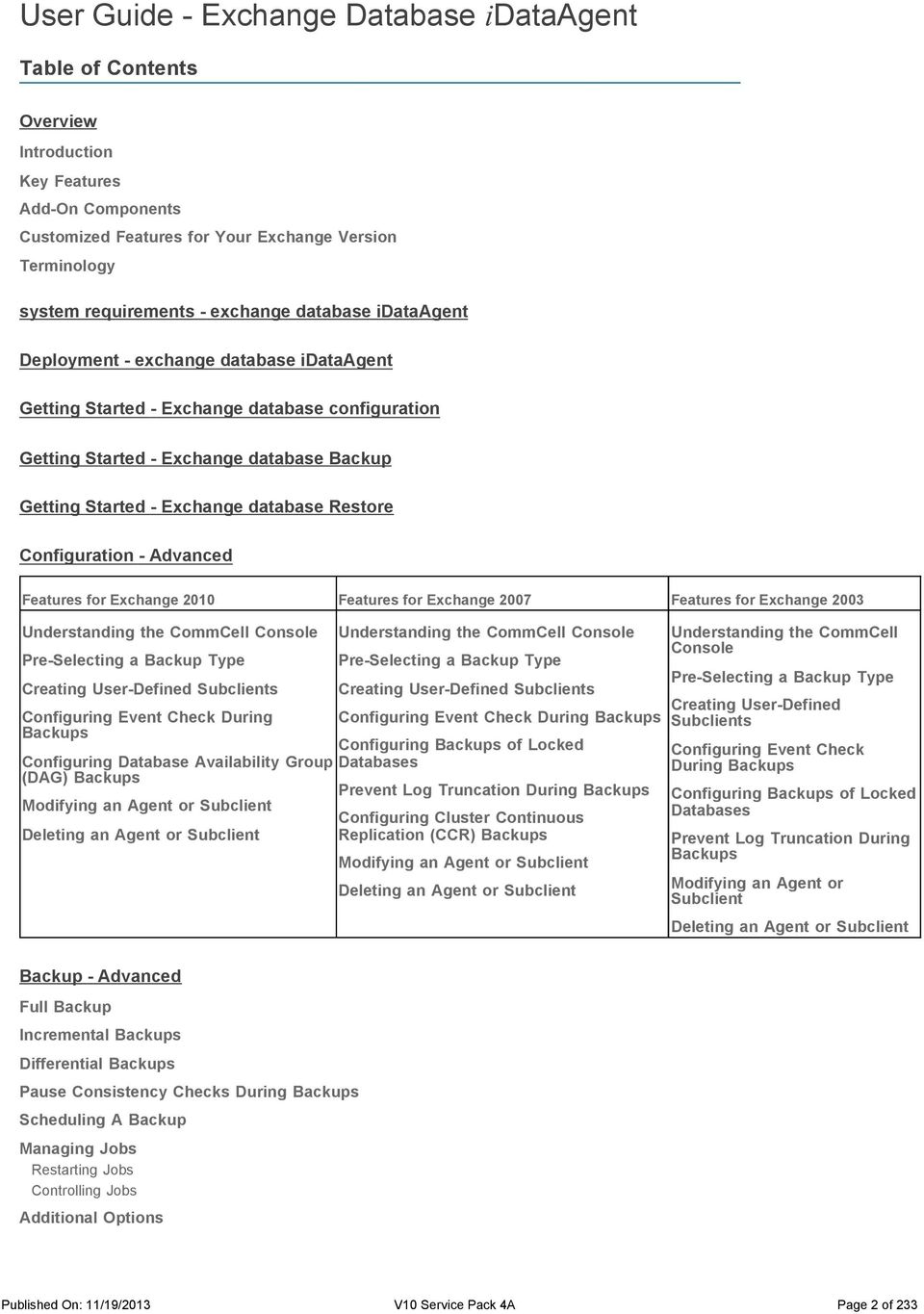
2 User Guide - Exchange Database idataagent Table of Contents Overview Introduction Key Features Add-On Components Customized Features for Your Exchange Version Terminology system requirements - exchange database idataagent Deployment - exchange database idataagent Getting Started - Exchange database configuration Getting Started - Exchange database Backup Getting Started - Exchange database Restore Configuration - Advanced Features for Exchange 2010 Features for Exchange 2007 Features for Exchange 2003 Understanding the CommCell Console Pre-Selecting a Backup Type Creating User-Defined Subclients Configuring Event Check During Backups Configuring Database Availability Group (DAG) Backups Modifying an Agent or Subclient Deleting an Agent or Subclient Understanding the CommCell Console Understanding the CommCell Console Pre-Selecting a Backup Type Pre-Selecting a Backup Type Creating User-Defined Subclients Creating User-Defined Configuring Event Check During Backups Subclients Configuring Backups of Locked Databases Prevent Log Truncation During Backups Configuring Cluster Continuous Replication (CCR) Backups Modifying an Agent or Subclient Deleting an Agent or Subclient Configuring Event Check During Backups Configuring Backups of Locked Databases Prevent Log Truncation During Backups Modifying an Agent or Subclient Deleting an Agent or Subclient Backup - Advanced Full Backup Incremental Backups Differential Backups Pause Consistency Checks During Backups Scheduling A Backup Managing Jobs Restarting Jobs Controlling Jobs Additional Options Published On: 11/19/2013 V10 Service Pack 4A Page 2 of 233
3 Restore - Advanced Exchange 2010 Exchange 2007 Exchange 2003 Restoring a Database Performing an Out-of-Place Restore Keep Existing Transaction Logs (No Loss Restore) Browsing Data Scheduling a Restore Listing Media Managing Restore Jobs Additional Restore Options Restoring a Database Performing an Out-of-Place Restore Restoring Logs Keep Existing Transaction Logs (No Loss Restore) Enhancing Restore Performance from Tapes (One-Pass Restore) Browsing Data Scheduling a Restore Listing Media Managing Restore Jobs Additional Restore Options Restoring a Database Restoring Logs Keep Existing Transaction Logs (No Loss Restore) Enhancing Restore Performance from Tapes (One-Pass Restore) Automatically Mount Database After Restore Browsing Data Scheduling a Restore Listing Media Managing Restore Jobs Additional Restore Options Data Aging Getting Started Extended Retention Rules Disaster Recovery Planning for a Disaster Recovery Disaster Recovery of the Exchange Database Additional Operations Audit Trail Auxiliary Copy License Administration Operation Window Online Help Links Schedule Policy Storage Policy Subclient Policy Uninstalling Components Offline Database Restore (Administrator) Deployment Setup Advanced Offline Database Restore (user) Getting Started Advanced srm for exchange database - basic Published On: 11/19/2013 V10 Service Pack 4A Page 3 of 233

4 srm for exchange database - advanced srm for exchange database - filters srm for exchange database - summaries srm for exchange database - faqs Frequently Asked Questions troubleshooting (backup) troubleshooting (restore) online help Published On: 11/19/2013 V10 Service Pack 4A Page 4 of 233

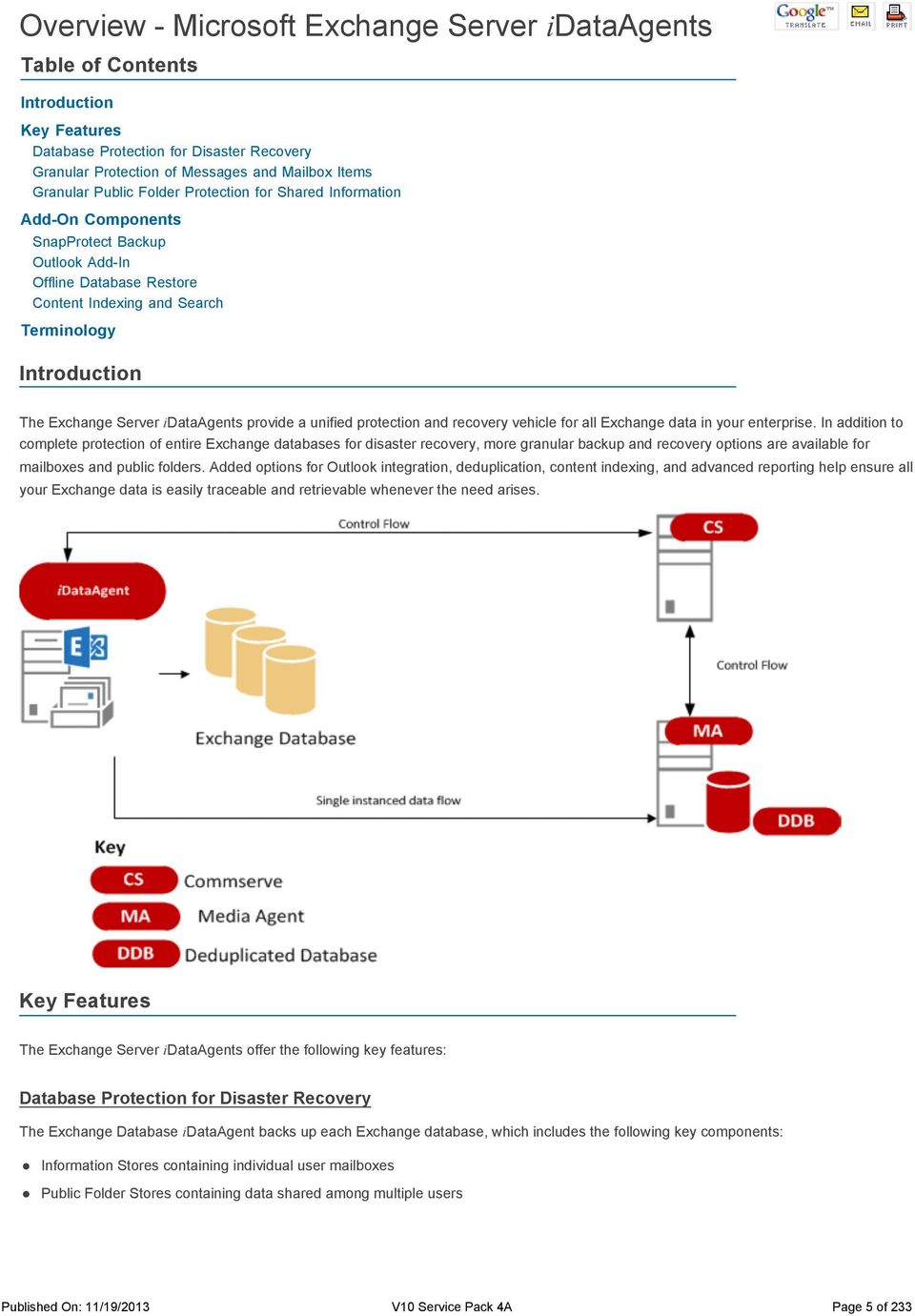
5 Overview - Microsoft Exchange Server idataagents Table of Contents Introduction Key Features Database Protection for Disaster Recovery Granular Protection of Messages and Mailbox Items Granular Public Folder Protection for Shared Information Add-On Components SnapProtect Backup Outlook Add-In Offline Database Restore Content Indexing and Search Terminology Introduction The Exchange Server idataagents provide a unified protection and recovery vehicle for all Exchange data in your enterprise. In addition to complete protection of entire Exchange databases for disaster recovery, more granular backup and recovery options are available for mailboxes and public folders. Added options for Outlook integration, deduplication, content indexing, and advanced reporting help ensure all your Exchange data is easily traceable and retrievable whenever the need arises. Key Features The Exchange Server idataagents offer the following key features: Database Protection for Disaster Recovery The Exchange Database idataagent backs up each Exchange database, which includes the following key components: Information Stores containing individual user mailboxes Public Folder Stores containing data shared among multiple users Published On: 11/19/2013 V10 Service Pack 4A Page 5 of 233
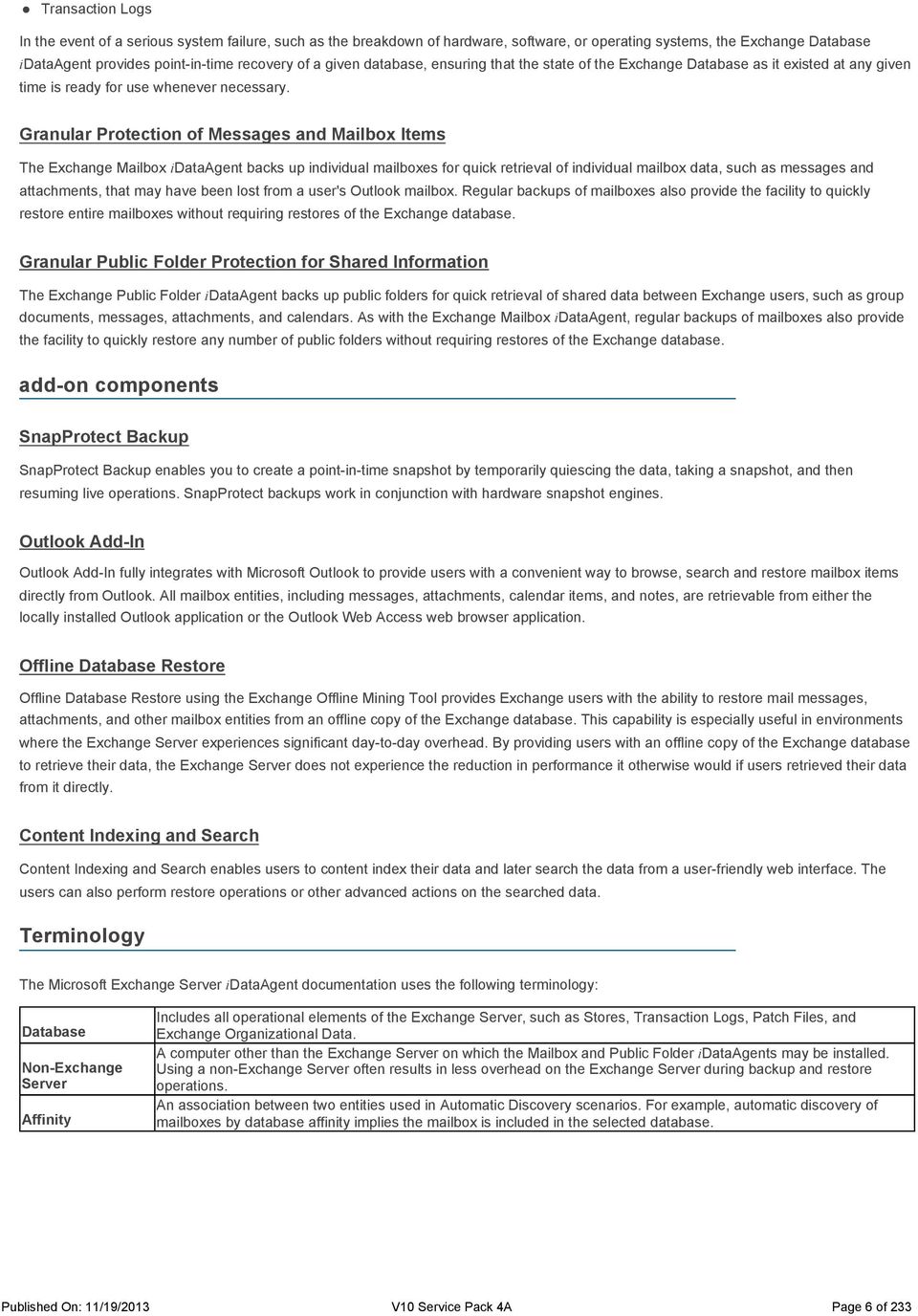
6 Transaction Logs In the event of a serious system failure, such as the breakdown of hardware, software, or operating systems, the Exchange Database idataagent provides point-in-time recovery of a given database, ensuring that the state of the Exchange Database as it existed at any given time is ready for use whenever necessary. Granular Protection of Messages and Mailbox Items The Exchange Mailbox idataagent backs up individual mailboxes for quick retrieval of individual mailbox data, such as messages and attachments, that may have been lost from a user's Outlook mailbox. Regular backups of mailboxes also provide the facility to quickly restore entire mailboxes without requiring restores of the Exchange database. Granular Public Folder Protection for Shared Information The Exchange Public Folder idataagent backs up public folders for quick retrieval of shared data between Exchange users, such as group documents, messages, attachments, and calendars. As with the Exchange Mailbox idataagent, regular backups of mailboxes also provide the facility to quickly restore any number of public folders without requiring restores of the Exchange database. add-on components SnapProtect Backup SnapProtect Backup enables you to create a point-in-time snapshot by temporarily quiescing the data, taking a snapshot, and then resuming live operations. SnapProtect backups work in conjunction with hardware snapshot engines. Outlook Add-In Outlook Add-In fully integrates with Microsoft Outlook to provide users with a convenient way to browse, search and restore mailbox items directly from Outlook. All mailbox entities, including messages, attachments, calendar items, and notes, are retrievable from either the locally installed Outlook application or the Outlook Web Access web browser application. Offline Database Restore Offline Database Restore using the Exchange Offline Mining Tool provides Exchange users with the ability to restore mail messages, attachments, and other mailbox entities from an offline copy of the Exchange database. This capability is especially useful in environments where the Exchange Server experiences significant day-to-day overhead. By providing users with an offline copy of the Exchange database to retrieve their data, the Exchange Server does not experience the reduction in performance it otherwise would if users retrieved their data from it directly. Content Indexing and Search Content Indexing and Search enables users to content index their data and later search the data from a user-friendly web interface. The users can also perform restore operations or other advanced actions on the searched data. Terminology The Microsoft Exchange Server idataagent documentation uses the following terminology: Database Non-Exchange Server Affinity Includes all operational elements of the Exchange Server, such as Stores, Transaction Logs, Patch Files, and Exchange Organizational Data. A computer other than the Exchange Server on which the Mailbox and Public Folder idataagents may be installed. Using a non-exchange Server often results in less overhead on the Exchange Server during backup and restore operations. An association between two entities used in Automatic Discovery scenarios. For example, automatic discovery of mailboxes by database affinity implies the mailbox is included in the selected database. Published On: 11/19/2013 V10 Service Pack 4A Page 6 of 233
7 System Requirements - Exchange Database idataagent System Requirements Supported Features License Requirements The following requirements are for the Microsoft Exchange Database idataagent: Application Microsoft Exchange bit Server up to the latest service pack Microsoft Exchange bit Server up to the latest service pack Microsoft Exchange bit Server up to the latest service pack Microsoft Exchange bit Server up to the latest service pack Operating System Windows Server 2012 Microsoft Windows Server 2012 Editions Windows Server 2008 Microsoft Windows Server 2008 x64 Editions* *Core Editions not supported Windows Server 2003 Microsoft Windows Server bit and x64 Editions with a minimum of Service Pack 2 Cluster - Support The software can be installed on a Cluster if clustering is supported by the above-mentioned operating systems. For information on supported cluster types, see Clustering - Support. Hard Drive 1 GB of minimum disk space is required for installing the software. 256 MB of free disk space is required for job result directory. 256 MB of free disk space is required for log directory. Processor All Windows-compatible processors supported Supported Components Exchange Offline Mining Tool The Exchange Offline Mining Tool is supported on any Windows Server platform. Notes on Exchange Offline Mining Tool Installation The following additional software packages must be installed on the same computer where the Exchange Offline Mining Tool is installed, if they are not already present on the computer:.net Framework 4.0 (will be automatically installed during Offline Mining Tool installation, if needed) Microsoft Outlook 2003 (or later) For Exchange Server 2010 Editions, the Exchange Offline Mining Tool is supported only with 32-bit versions of Outlook. Published On: 11/19/2013 V10 Service Pack 4A Page 7 of 233

8 For Exchange Server 2013, the Exchange Offline Mining Tool is supported only with 32-bit versions of Outlook. Miscellaneous The File System idataagent will be automatically installed during installation of this software, if it is not already installed. For System Requirements specific to the File System idataagent, refer to System Requirements - Microsoft Windows File System idataagent..net Framework.NET Framework 4.0 is automatically installed. Note that.net Framework 4.0 can co-exist with other versions of this software. Microsoft Visual C++ Microsoft Visual C and 2008 Redistributable Packages are automatically installed. Note that these Visual C++ Redistributable Packages can co-exist with other versions of this software. DISCLAIMER Minor revisions and/or service packs that are released by application and operating system vendors are supported by our software but may not be individually listed in our System Requirements. We will provide information on any known caveat for the revisions and/or service packs. In some cases, these revisions and/or service packs affect the working of our software. Changes to the behavior of our software resulting from an application or operating system revision/service pack may be beyond our control. The older releases of our software may not support the platforms supported in the current release. However, we will make every effort to correct the behavior in the current or future releases when necessary. Please contact your Software Provider for any problem with a specific application or operating system. Additional considerations regarding minimum requirements and End of Life policies from application and operating system vendors are also applicable Published On: 11/19/2013 V10 Service Pack 4A Page 8 of 233

9 Deployment - Exchange Database idataagent Where to Install Install the Exchange Database idataagent on the Exchange Server. The computer will be added as a client in the CommCell as soon as the installation completes successfully. Before You Begin System Requirements Verify that the computer in which you wish to install the software satisfies the minimum requirements specified in System Requirements. Download Software Packages Download the latest software package to perform the install. To install Exchange Mailbox idataagent together with Exchange Database idataagent, see Deployment - Exchange Mailbox idataagent. To install Exchange Public Folder idataagent together with Exchange Database idataagent, see Deployment - Exchange Public Folder idataagent. Prerequisites Before installing the agent, ensure that the user is a member of : Backup Operator Exchange Trusted Subsystem Local Administrator group Installation The software can be installed using one of the following methods: Method 1: Remote Install Using CommCell Console Use this procedure to install remotely on a client computer. Method 2: Interactive Install - Standard Use this procedure to install the software using the standard installation options. Method 3: Interactive Install - Custom Use this procedure to install the software by specifying installation settings and options. Method 1: Remote Install Using CommCell Console 1. Open CommCell Console: Click Start and point to All Programs. Click HDPS. Click Backup and Recovery Administrative Console. 2. From the CommCell Browser, click Tools Add/Remove Software Install Software. Published On: 11/19/2013 V10 Service Pack 4A Page 9 of 233
10 3. Click Next. 4. Click Next. Published On: 11/19/2013 V10 Service Pack 4A Page 10 of 233

11 5. Click Manually Select Computers. Click Next. 6. Enter the fully qualified domain name of the client computer. For example: mycomputer.mydomain.mycompany.com Click Next. Do not use space and the following characters when specifying the Host Name: \ `~!_@#$%^&*()+=<>/?,[]{}:;'" Published On: 11/19/2013 V10 Service Pack 4A Page 11 of 233
12 7. Choose one of the following: Click Next if you want to use the default cache location Click Override Software Cache and specify a new location in the Software Cache box and then click Next The software cache is the location from where the remote install program installs the software. This screen will not appear if the remote cache is not configured. For more information, see Managing Cache - Remote Cache. 8. Specify the User Name and Password that must be used to access the client computer, and then click Next. The user must be an Administrator or a member of the Administrator group on that computer. Account information is required while performing remote installs for the first time on a client. For subsequent remote installs on that client, click Next without specifying the account information. Published On: 11/19/2013 V10 Service Pack 4A Page 12 of 233
13 9. Click Database under Exchange. Click Next. 10. Select the following: Select a client group from the available Client Groups, and then click Add. From the Global Filters list, select one of the following: Use Cell level Policy to inherit the global filter policy configuration set for the CommCell. Always use Global Filters to apply the global filters policy to the default subclient regardless of the policy set for the CommCell. Do not use Global Filters if you plan to define specific filters for the Agent. From the Storage Policy To Use list, select a storage policy. Click Next. This screen will not be displayed if Client Groups are not configured in the CommCell Console. For more information, see Client Computer Groups. Published On: 11/19/2013 V10 Service Pack 4A Page 13 of 233
14 11. Choose one of the following: Click Next if you want to backup data that has changed since the last backup of any type. Click Differential Backup if you want to backup data that has changed since the last full backup and then click Next. Click the Help button to get more information on the available options. 12. Click Next. If necessary you can select additional options. Click the Help button to get more information on the available options. Published On: 11/19/2013 V10 Service Pack 4A Page 14 of 233
15 13. Click Next. If necessary you can select optional settings. Click the Help button to get more information on the available options. 14. Select one of the following: If firewall configuration is not required, click Next. If this computer and the CommServe is separated by a firewall, click Configure firewall services. For firewall options and configuration instructions, see Firewall Configuration and continue with the installation. Published On: 11/19/2013 V10 Service Pack 4A Page 15 of 233
16 15. Click Next. 16. Click Finish. This screen will reflect the components you selected for install, and may look different from the example shown. Published On: 11/19/2013 V10 Service Pack 4A Page 16 of 233
17 17. You can track the progress of the job from the Job Controller window of the CommCell console. From the Home menu, click Job Controller. Once the job is complete, view the job details from the Admin Job History. Right-click the <CommServe>, point to View and then click Admin Job History. Click Select Install/Upgrade/Remove/Repair Software. Click OK. Published On: 11/19/2013 V10 Service Pack 4A Page 17 of 233
18 You can view the following by right-clicking the job: Details of the job Option to Resubmit the job Events associated with the job Logs associated with the job Option to send the Logs associated with the job 18. To create a storage policy, you must have configured a library in the CommCell. If you do not already have a library configured, go to Disk Library Creation. If you have a library configured, go to Storage Policy Creation. DISK LIBRARY CREATION: 1. From the CommCell Browser, navigate to Storage Resources, right-click the Libraries, point to Add and then click Disk Library... Alternatively, you can also navigate to MediaAgents, right-click <MediaAgent>, point to All Tasks Create Library and then click Disk Library From the Add Disk Library dialog box, specify the following: In the Name box, specify name of the disk library. From the MediaAgent list, select the MediaAgent. Perform one of the following: Select Local Path if you wish to specify a local path in the MediaAgent computer. In the Disk Device box, type the name of the folder in which the disk library must located or click folder. button to select the Select Network Path, if you wish to specify a network path as the target share. In the Connect As box, type the user name. In the Password and Verify Password box, type the password to access the network share. In the Folder box, type the mount path or click button to select a mount path. Click OK. 3. The newly created disk library will be displayed under Libraries node. This will create a library and Storage Policy. Click to proceed to the Configuration section. Storage Policy Creation 1. From the CommCell Browser, navigate to Policies. 2. Right-click the Storage Policies and then click New Storage Policy. 3. Follow the prompts displayed in the Storage Policy Wizard. The required options are mentioned below: Published On: 11/19/2013 V10 Service Pack 4A Page 18 of 233

19 Select the Storage Policy type as Data Protection and Archiving and click Next. Enter the name in the Storage Policy Name box and click Next. From the Library list, click the name of a disk library to which the primary copy should be associated and then click Next. Ensure that you select a library attached to a MediaAgent operating in the current release. From the MediaAgent list, click the name of a MediaAgent that will be used to create the primary copy and then click Next. For the device streams and the retention criteria information, click Next to accept default values. Select Yes to enable deduplication for the primary copy. From the MediaAgent list, click the name of the MediaAgent that will be used to host the Deduplication Database (DDB). In the Location box, type the name of the folder in which the DDB must be located or click the Browse button to select the folder and then click Next. Review the details and click Finish to create the Storage Policy. This will create a storage policy. Click to proceed to the Configuration section. Several additional options are available for remotely installing the software from CommCell Console, refer to Install Software from the CommCell Console (Remote Install) for more information. Method 2: Interactive Install - Standard 1. Log on to the client computer as an Administrator or as a member of the Administrator group on that computer. 2. Run SetupAll.exe from the Software Installation Discs. 3. Click I accept the terms in the license agreement. Click Next. Published On: 11/19/2013 V10 Service Pack 4A Page 19 of 233

20 4. Click Standard. Click Next. 5. Click Join an Existing CommCell. Click Next. Published On: 11/19/2013 V10 Service Pack 4A Page 20 of 233
21 6. Click Exchange. Click Next. 7. Verify the default location for software installation. Click Next. If necessary, click Browse... to change the default location. Do not install the software to a mapped network drive Do not use the following characters when specifying the destination path: / : *? " < > # It is recommended that you use alphanumeric characters only Published On: 11/19/2013 V10 Service Pack 4A Page 21 of 233
22 8. Click Install. The Summary on your screen should reflect the components you selected for install, and may look different from the example shown. 9. Click Yes. 10. Click Next. Published On: 11/19/2013 V10 Service Pack 4A Page 22 of 233
23 11. Select one of the following: If firewall configuration is not required, click Next. If this computer and the CommServe is separated by a firewall, click Configure firewall services. For firewall options and configuration instructions, see Firewall Configuration and continue with the installation. 12. Enter the fully qualified domain name of the CommServe in the CommServe Host Name box. Do not use space and the following characters when specifying the CommServe Host Name: \ `~!@#$%^&*()+=<>/?,[]{}:;'" Click Next. Published On: 11/19/2013 V10 Service Pack 4A Page 23 of 233
24 13. Enter the following: The local (NetBIOS) name of the client computer is displayed in the Select a Client name list. If necessary you can also type a new (friendly) name for the client in this box. This name will be used in the CommCell and will also be displayed in the CommCell Console. Do not use spaces when specifying a new name for the client. The default network interface name of the client computer is displayed if the computer has only one network interface (NIC card). If the computer has multiple network interfaces, select the interface name that is preferred for communication with the CommServe. Click Next. If a component is already installed on this computer, this screen will not be displayed; instead, the install program will use the same name as previously specified. 14. Select one of the following options: If you do not want to disable Windows Firewall, click Next. If you want to disable Windows Firewall for all profiles, click Yes, disable Windows Firewall for all profiles and then click Next. You will get this screen if you did not configure the firewall settings in step 11. Published On: 11/19/2013 V10 Service Pack 4A Page 24 of 233
25 15. Select a Client Group. Click Next. This screen will not be displayed if Client Groups are not configured in the CommCell Console. For more information, see Client Computer Groups. 16. Select a storage policy from the Storage Policy list. Click Next. If you do not have a Storage Policy, the list will not be displayed. You can create the Storage Policy later in step 18. Published On: 11/19/2013 V10 Service Pack 4A Page 25 of 233
26 17. Select Exchange Server Name and Exchange Server Version from drop-down list. Click Next. 18. Select the backup type for Exchange Database backups. Choose either of the following options, then click Next. Differential - Specifies that each non-full Exchange Database backup secures all data that has changed since the last full backup. Transaction logs are not purged. Incremental - Specifies that each non-full Exchange Database backup secures only that data that has changed since the last backup of any type. Committed transaction logs are purged. Published On: 11/19/2013 V10 Service Pack 4A Page 26 of 233
27 19. Enter the following Exchange Administrator information, and then click Next. Account Name - Domain user account created with the exchange server administrator permissions. Do not include the domain name here. Account Password - The password assigned to the domain user. Mailbox Name for this Account - Mailbox associated with the user above. Profile Name - Specify profile name to be created during agent install. This profile is associated with the domain user's mailbox. Exchange Server Name - Name of the Exchange Server that the agent will communicate with for data protection and recovery operations. Enter the Mailbox Role Server name (NetBIOS). After installation configure the roles as described in Configure Mailboxes in Database Availability Group (DAG) Servers. Domain - The installation detects and enters a domain name. If necessary, modify the domain name by specifying Windows domain that the Exchange Server resides in. 20. Click Finish. This screen will reflect the components you selected for install, and may look different from the example shown. Published On: 11/19/2013 V10 Service Pack 4A Page 27 of 233
28 If you already have a storage policy selected in step 16, click to proceed to the Configuration section. If you do not have Storage Policy created, continue with the following step. 21. To create a storage policy, you must have configured a library in the CommCell. If you do not already have a library configured, go to Disk Library Creation. If you have a library configured, go to Storage Policy Creation. DISK LIBRARY CREATION: 1. From the CommCell Browser, navigate to Storage Resources, right-click the Libraries, point to Add and then click Disk Library... Alternatively, you can also navigate to MediaAgents, right-click <MediaAgent>, point to All Tasks Create Library and then click Disk Library From the Add Disk Library dialog box, specify the following: In the Name box, specify name of the disk library. From the MediaAgent list, select the MediaAgent. Perform one of the following: Select Local Path if you wish to specify a local path in the MediaAgent computer. In the Disk Device box, type the name of the folder in which the disk library must located or click folder. button to select the Select Network Path, if you wish to specify a network path as the target share. In the Connect As box, type the user name. In the Password and Verify Password box, type the password to access the network share. In the Folder box, type the mount path or click button to select a mount path. Click OK. 3. The newly created disk library will be displayed under Libraries node. This will create a library and Storage Policy. Click to proceed to the Configuration section. Published On: 11/19/2013 V10 Service Pack 4A Page 28 of 233
29 Storage Policy Creation 1. From the CommCell Browser, navigate to Policies. 2. Right-click the Storage Policies and then click New Storage Policy. 3. Follow the prompts displayed in the Storage Policy Wizard. The required options are mentioned below: Select the Storage Policy type as Data Protection and Archiving and click Next. Enter the name in the Storage Policy Name box and click Next. From the Library list, click the name of a disk library to which the primary copy should be associated and then click Next. Ensure that you select a library attached to a MediaAgent operating in the current release. From the MediaAgent list, click the name of a MediaAgent that will be used to create the primary copy and then click Next. For the device streams and the retention criteria information, click Next to accept default values. Select Yes to enable deduplication for the primary copy. From the MediaAgent list, click the name of the MediaAgent that will be used to host the Deduplication Database (DDB). In the Location box, type the name of the folder in which the DDB must be located or click the Browse button to select the folder and then click Next. Review the details and click Finish to create the Storage Policy. This will create a storage policy. Click to proceed to the Configuration section. Default Options Selected During Standard Install Listed below are the default options that are automatically selected while performing the Standard Install. OPTION ENABLED / DESCRIPTION DISABLED Add programs to the Windows Firewall Exclusion List Disabled This option allows you to add Data Protection Suite Published On: 11/19/2013 V10 Service Pack 4A Page 29 of 233
30 programs to the Windows Firewall exclusion list. This option is not selected. Global Filter Options Enabled This option is used to filter out specific directories or files from the backups within the CommCell. The filters are set using the Control Panel in the CommCell Console and, if enabled, they will be effective for the default subclient. Cell level policy is automatically selected. Components installed by default during Standard Install Listed below are the components that are installed by default while performing the Standard Install: SELECTED PACKAGE COMPONENTS INSTALLED Exchange Exchange Database idataagent Exchange Mailbox idataagent Exchange Public Folder idataagent File System Core Windows File System Method 3: Interactive install - Custom 1. Log on to the client computer as an Administrator or as a member of the Administrator group on that computer. 2. Run SetupAll.exe from the Software Installation Discs. 3. Click I accept the terms in the license agreement. Click Next. 4. Click Custom. Click Next. Published On: 11/19/2013 V10 Service Pack 4A Page 30 of 233
31 5. Click Select components to install on this computer and click Next. 6. Expand Exchange, and then click Database. Click Next. Published On: 11/19/2013 V10 Service Pack 4A Page 31 of 233
32 7. Verify the default location for software installation. Click Next. If necessary, click Browse... to change the default location. Do not install the software to a mapped network drive Do not use the following characters when specifying the destination path: / : *? " < > # It is recommended that you use alphanumeric characters only 8. Click Install. The Summary on your screen should reflect the components you selected for install, and may look different from the example shown. Published On: 11/19/2013 V10 Service Pack 4A Page 32 of 233
33 9. Click Yes. 10. Click Next. 11. Select one of the following: If firewall configuration is not required, click Next. If this computer and the CommServe is separated by a firewall, click Configure firewall services. For firewall options and configuration instructions, see Firewall Configuration and continue with the installation. Published On: 11/19/2013 V10 Service Pack 4A Page 33 of 233
34 12. Enter the fully qualified domain name of the CommServe in the CommServe Host Name box. Do not use space and the following characters when specifying the CommServe Host Name: \ `~!@#$%^&*()+=<>/?,[]{}:;'" Click Next. 13. Enter the following: The local (NetBIOS) name of the client computer is displayed in the Select a Client name list. If necessary you can also type a new (friendly) name for the client in this box. This name will be used in the CommCell and will also be displayed in the CommCell Console. Do not use spaces when specifying a new name for the client. The default network interface name of the client computer is displayed if the computer has only one network interface (NIC card). If the computer has multiple network interfaces, select the interface name that is preferred for communication with the CommServe. Click Next. If a component is already installed on this computer, this screen will not be displayed; instead, the install program will use the same name as previously specified. Published On: 11/19/2013 V10 Service Pack 4A Page 34 of 233
35 14. The default port numbers used for CommCell communication is displayed. If necessary, you can modify the port numbers. Click Next. This screen will not appear if the default port numbers are not used for CommCell communication. 15. Select one of the following options: If you do not want to disable Windows Firewall, click Next. If you want to disable Windows Firewall for all profiles, click Yes, disable Windows Firewall for all profiles and then click Next. You will get this screen if you did not configure the firewall settings in step 11. Published On: 11/19/2013 V10 Service Pack 4A Page 35 of 233
36 16. Select Add programs to the Windows Firewall Exclusion List, to add CommCell programs and services to the Windows Firewall Exclusion List. Click Next. This option enables CommCell operations across Windows firewall by adding CommCell programs and services to Windows firewall exclusion list. It is recommended to select this option even if Windows firewall is disabled. This will allow the CommCell programs and services to function if the Windows firewall is enabled at a later time. 17. Select a Client Group. Click Next. This screen will not be displayed if Client Groups are not configured in the CommCell Console. For more information, see Client Computer Groups. Published On: 11/19/2013 V10 Service Pack 4A Page 36 of 233
37 18. Select one of the following: Click Use Cell level Policy to inherit the global filter policy configuration set for the CommCell. Click Always use Global Filters to apply the global filters policy to the default subclient regardless of the policy set for the CommCell. Select Do not use Global Filters if you plan to define specific filters for the Agent. Click Next. 19. Select a storage policy from the Storage Policy list. Click Next. If you do not have a Storage Policy, the list will not be displayed. You can create the Storage Policy later in step 22. Published On: 11/19/2013 V10 Service Pack 4A Page 37 of 233
38 20. Select Exchange Server Name and Exchange Server Version from drop-down list. Click Next. 21. Select the backup type for Exchange Database backups. Choose either of the following options, then click Next. Differential - Specifies that each non-full Exchange Database backup secures all data that has changed since the last full backup. Transaction lobs are not purged. Incremental - Specifies that each non-full Exchange Database backup secures only that data that has changed since the last backup of any type. Committed transaction logs are purged. Published On: 11/19/2013 V10 Service Pack 4A Page 38 of 233
39 22. Enter the Administrator account information, and then click Next. 23. Click Finish. This screen will reflect the components you selected for install, and may look different from the example shown. Published On: 11/19/2013 V10 Service Pack 4A Page 39 of 233
40 If you already have a storage policy selected in step 18, click to proceed to the Configuration section. If you do not have Storage Policy created, continue with the following step. 24. To create a storage policy, you must have configured a library in the CommCell. If you do not already have a library configured, go to Disk Library Creation. If you have a library configured, go to Storage Policy Creation. DISK LIBRARY CREATION: 1. From the CommCell Browser, navigate to Storage Resources, right-click the Libraries, point to Add and then click Disk Library... Alternatively, you can also navigate to MediaAgents, right-click <MediaAgent>, point to All Tasks Create Library and then click Disk Library From the Add Disk Library dialog box, specify the following: In the Name box, specify name of the disk library. From the MediaAgent list, select the MediaAgent. Perform one of the following: Select Local Path if you wish to specify a local path in the MediaAgent computer. In the Disk Device box, type the name of the folder in which the disk library must located or click folder. button to select the Select Network Path, if you wish to specify a network path as the target share. In the Connect As box, type the user name. In the Password and Verify Password box, type the password to access the network share. In the Folder box, type the mount path or click button to select a mount path. Click OK. 3. The newly created disk library will be displayed under Libraries node. This will create a library and Storage Policy. Click to proceed to the Configuration section. Published On: 11/19/2013 V10 Service Pack 4A Page 40 of 233
41 Storage Policy Creation 1. From the CommCell Browser, navigate to Policies. 2. Right-click the Storage Policies and then click New Storage Policy. 3. Follow the prompts displayed in the Storage Policy Wizard. The required options are mentioned below: Select the Storage Policy type as Data Protection and Archiving and click Next. Enter the name in the Storage Policy Name box and click Next. From the Library list, click the name of a disk library to which the primary copy should be associated and then click Next. Ensure that you select a library attached to a MediaAgent operating in the current release. From the MediaAgent list, click the name of a MediaAgent that will be used to create the primary copy and then click Next. For the device streams and the retention criteria information, click Next to accept default values. Select Yes to enable deduplication for the primary copy. From the MediaAgent list, click the name of the MediaAgent that will be used to host the Deduplication Database (DDB). In the Location box, type the name of the folder in which the DDB must be located or click the Browse button to select the folder and then click Next. Review the details and click Finish to create the Storage Policy. This will create a storage policy. Click to proceed to the Configuration section. Additional Installation Methods Custom Package Create a compact software package for quick deployment to multiple clients. Published On: 11/19/2013 V10 Service Pack 4A Page 41 of 233
42 Decoupled Install Install the software first and later register the client in the CommCell. Remote Install Deploy the software from CommCell Console on multiple clients. While installing the Exchange Database idataagent in a clustered environment, in case of multi instancing, ensure that the same instance of the database is not configured in both installation instances as this may lead to data loss. Installing Restore only Agents Setup a client in the CommCell for restore purposes. Silent Install Deploy the software silently on multiple clients. Published On: 11/19/2013 V10 Service Pack 4A Page 42 of 233
43 Getting Started - Exchange Database idataagent Configuration Once installed, verify your backup type and configure a subclient as follows. 1. Open CommCell Console. From the CommCell Console, navigate to Client Computers <Client> Exchange Database. Right-click the Exchange Database and click Properties. 2. Verify or change the backup type that was selected during installation: Differential - Specifies that each non-full Exchange Database backup secures all data that has changed since the last full backup. Transaction logs are not purged. Incremental - Specifies that each non-full Exchange Database backup secures only that data that has changed since the last backup of any type. Committed transaction logs are purged. Click OK. Published On: 11/19/2013 V10 Service Pack 4A Page 43 of 233
44 3. From the CommCell Console, navigate to Client Computers <Client>. Right click Exchange Database, and click All Tasks New Subclient. 4. In the Subclient Name box, type a name. Click the Contents tab. Published On: 11/19/2013 V10 Service Pack 4A Page 44 of 233
45 5. Click Configure. In the Add/Modify Subclients box, click Discover. Select a database to be backed up from the Display Name column. Click the Subclient column and select this subclient from the drop-down list. Click OK. For your first backup, select just one database. Otherwise the backup will take longer when multiple databases are selected. Published On: 11/19/2013 V10 Service Pack 4A Page 45 of 233
46 6. Click Yes. 7. Verify that the database appears under Contents of subclient. Published On: 11/19/2013 V10 Service Pack 4A Page 46 of 233
47 8. Click the Storage Devices tab. Select a Storage Policy. Click OK. Click to continue. If you do not have Storage Policy created, click Create Storage Policy and proceed to the next step. Published On: 11/19/2013 V10 Service Pack 4A Page 47 of 233
48 9. If you do not have Storage Policy created, follow the step given below to create a storage policy. a. Click Create Storage Policy. b. Follow the prompts displayed in the Storage Policy Wizard. The required options are mentioned below: i. Select the Storage Policy type as Data Protection and Archiving and click Next. ii. iii. Enter the name in the Storage Policy Name box and click Next. From the Library list, click the name of a disk library to which the primary copy should be associated and then click Next. Ensure that you select a library attached to a MediaAgent operating in the current release. iv. From the MediaAgent list, click the name of a MediaAgent that will be used to create the primary copy and then click Next. v. For the device streams and the retention criteria information, click Next to accept default values. vi. vii. Select Yes to enable deduplication for the primary copy. From the MediaAgent list, click the name of the MediaAgent that will be used to host the Deduplication database (DDB). In the Location box, type the name of the folder in which the DDB must be located or click the Browse to select the folder, and then click Next. viii. Review the details and click Finish to create the Storage Policy. Published On: 11/19/2013 V10 Service Pack 4A Page 48 of 233
49 Published On: 11/19/2013 V10 Service Pack 4A Page 49 of 233
50 Getting Started - Exchange Database idataagent Backup WHAT GETS BACKED UP Exchange Database data Information and Public Folder stores Transaction Logs WHAT DOES NOT GET BACKED UP System State Data Active Directory Data Personal Information Stores Personal Address Books Offline Folders Use the Windows File System idataagent to back up the above mentioned data types. Perform a Backup 1. Disable Circular Logging on the Exchange Server. 2. Ensure that the Storage Group / Database name does not contain "+" in it 3. From the CommCell Console, navigate to Client Computers <Client> Exchange Database. Right-click the <subclient> and click Backup. 4. Select Full as backup type and Immediate to run the job immediately. Click OK. 5. You can track the progress of the job from the Job Controller window of the CommCell console. Published On: 11/19/2013 V10 Service Pack 4A Page 50 of 233
51 6. Once job is complete, view the details of job from the Backup History. Right-click the Subclient and select Backup History. 7. Click OK. 8. Right-click the job to: View job details, such as the number of mailboxes backed up. View media associated with the job. View events associated with the job. Resubmit the job. View messages that were backed up. Send the log file that is associated with the job. Published On: 11/19/2013 V10 Service Pack 4A Page 51 of 233
52 Published On: 11/19/2013 V10 Service Pack 4A Page 52 of 233
53 Getting Started - Exchange Database idataagent Restore Perform a Restore As restoring your backup data is very crucial, it is recommended that you perform a restore operation immediately after your first full backup to understand the process. The following section explains the steps for performing an out-of-place restore of a single database to a different client computer. 1. Before restoring the backed up data ensure that the Storage Group \ Database name does not contain "+" in it. Ensure the database you want to restore is dismounted and marked for overwrite. From the CommCell Console, navigate to Client Computers <Client> Exchange Database. Right-click the Agent and then click All Tasks Browse and Restore. 2. Click view Content. Published On: 11/19/2013 V10 Service Pack 4A Page 53 of 233
54 3. Select the database in the left pane. The data and logs will be selected in the right pane. Click Recover All Selected. 4. Select the name of the client computer from the Destination Client list. This client should not be the same client on which the database originally resided. Click... under Destination DB/Out of Place Location column. Select a folder on the destination client. Published On: 11/19/2013 V10 Service Pack 4A Page 54 of 233
55 5. Select Immediate from the Job Initiation tab. Click OK. 6. You can monitor the progress of the restore job in the Job Controller window of the CommCell Console. 7. Once the restore job has completed, right-click the agent and click View Restore History. Published On: 11/19/2013 V10 Service Pack 4A Page 55 of 233
56 8. Click OK. 9. You can view the following details about the job by right-clicking the job: View Restore Items You can view them as Successful, Failed, Skipped or All. View Job Details View Events of the restore job. View Log files of the restore job. Published On: 11/19/2013 V10 Service Pack 4A Page 56 of 233
57 10. The database is restored to the directory under the specified client. Congratulations - You have successfully completed your first backup and restore. If you want to further explore this Agent's features read the Advanced sections of this documentation. Published On: 11/19/2013 V10 Service Pack 4A Page 57 of 233
58 Advanced - Exchange Database idataagent Configuration Table of Contents Features for Exchange 2013 Understanding the CommCell Console Pre-Selecting a Backup Type Creating User-Defined Subclients Configuring Event Check During Backups Configuring Database Availability Group (DAG) Backups Configuring Master Client Configuring Manual DAG Server Selection Configuring Automatic Server Selection Discovering DAG Member Servers when the CommServe Cannot Access Active Directory Configuring the Maximum Number of Nodes for Backups Configuring User Accounts for Backups Modifying an Agent or Subclient Deleting an Agent or Subclient Features for Exchange 2010 Understanding the CommCell Console Pre-Selecting a Backup Type Creating User-Defined Subclients Configuring Event Check During Backups Configuring Database Availability Group (DAG) Backups Configuring Master Client Configuring Manual DAG Server Selection Configuring Automatic Server Selection Discovering DAG Member Servers when the CommServe Cannot Access Active Directory Configuring the Maximum Number of Nodes for Backups Configuring User Accounts for Backups Modifying an Agent or Subclient Deleting an Agent or Subclient Features for Exchange 2007 Understanding the CommCell Console Pre-Selecting a Backup Type Creating User-Defined Subclients Configuring Event Check During Backups Configuring Backups of Locked Databases Prevent Log Truncation During Backups Configuring Cluster Continuous Replication (CCR) Backups Configuring User Accounts for Backups Modifying an Agent or Subclient Deleting an Agent or Subclient Published On: 11/19/2013 V10 Service Pack 4A Page 58 of 233
59 Features for Exchange 2003 Understanding the CommCell Console Pre-Selecting a Backup Type Creating User-Defined Subclients Configuring Event Check During Backups Configuring Backups of Locked Databases Prevent Log Truncation During Backups Configuring User Accounts for Backups Modifying an Agent or Subclient Deleting an Agent or Subclient Understanding the CommCell Console The Exchange Database idataagent uses one main component to perform backup and restore operations from the CommCell Console. Agent - defines the Exchange Server to be backed up. Subclient - defines the database to be backed up. Pre-Selecting a Backup Type The backup type that was selected during installation can be changed. 1. From the CommCell Browser, right-click the Exchange Database agent in which you need to change the backup type, and then click Properties. 2. Click Incremental or Differential and click OK. Differential - Specifies that each non-full Exchange Database backup secures all data that has changed since the last full backup. Transaction lobs are not purged. Incremental - Specifies that each non-full Exchange Database backup secures only that data that has changed since the last backup of any type. Committed transaction logs are purged. 3. Right-click the Exchange Database agent and click All Tasks Backup All Subclients. 4. Click Pre-Selected Backup Type and click OK. The next backup that is run must be a Full backup. Published On: 11/19/2013 V10 Service Pack 4A Page 59 of 233
60 Creating User-Defined Subclients By default, all databases are automatically assigned to the default subclient. However, you can divide databases across one or more userdefined subclients to leverage your backups efficiently. 1. From the CommCell Browser, right-click the Exchange Database agent on the source client, and click All Tasks New Subclient. 2. Click the Contents tab and then click Configure. 3. Click Discover to display all databases. If a member server is grayed out in the results list please make sure that Exchange Database idataagent is installed for the current release and the hostname of the client is configured using the FQDN 4. Alternatively, you can select and assign a range of databases to the new or existing subclient using the Change all selected databases/storage groups to list. 5. Click OK. Once a database is assigned to a user-defined subclient, it is automatically removed from the default subclient. Published On: 11/19/2013 V10 Service Pack 4A Page 60 of 233
61 configuring event check The Event Check option can examine the event logs for the Exchange application to ensure that these errors have not occurred before initiating a backup of the database. Any of these errors occurring in the Exchange application event log before the specified date and time will be ignored, and any found after the specified date and time will be logged. This option can scan for the following file-level damage errors prior to continuing with the backup: JET_errReadVerifyFailure Published On: 11/19/2013 V10 Service Pack 4A Page 61 of 233
62 -1022 JET_errDiskIO. Follow the steps below to enable the event check option: 1. From the CommCell Browser, right-click the subclient you want to configure for Event Check, then click Properties. 2. Click Use Event Check. 3. Specify the date and time in the Last Event Check Time field. This will serve as the starting point to begin checking the Exchange application event log. 4. Click OK. Configuring Backups of Locked Databases In some cases, it may be desirable to allow write operations on data being backed up to continue while the backup runs. Enabling VSS for backups provides this capability. During a VSS backup, the free space needed on a volume for the shadow copy is related to the duration of the backup and the amount of changes being made to the data objects (files, databases) that are being backed up. VSS snapshots capture and copy disk blocks that are being changed by other processes while the backup for a particular object is running. If the backup runs longer, or there is a lot of disk activity (files or databases being changed). This causes VSS to copy more data blocks and therefore, use more disk space. VSS can be enabled for backups of local volumes in both clustered and non-clustered environments. If the operating system fails to create a shadow copy of the data a traditional backup of the data will be performed, and a corresponding message will appear in the Event Viewer. A consistency check of the database integrity will be performed by the system prior to backing up the data, and if the integrity check fails then the backup will fail. 1. Ensure the Exchange database is mounted. 2. From the CommCell Browser, right-click the Exchange Database agent on the source client and select Properties. 3. Select Use VSS. Published On: 11/19/2013 V10 Service Pack 4A Page 62 of 233
63 4. Click OK. Preventing Log Truncation During Backups By default, log files are truncated during backups. However, it may be desirable to keep log files from being truncated to preserve their original state if needed during a restore. This can be accomplished using the Copy Backup feature. 1. From the CommCell Browser, right-click the Agent for the Exchange Database, and then click Properties. 2. Click Copy Backup. 3. Click OK. Published On: 11/19/2013 V10 Service Pack 4A Page 63 of 233
64 Configuring Cluster Continuous Replication (CCR) Backups CCR backups continuously replicate the Exchange Database transaction logs residing on the active node of a CCR cluster to the passive node. In the event of failover, the replicated database will be available to users, which reduces the frequency at which full backups must be taken and the volume of backup data and media usage, as well as shortening the time it takes to recover from failure. No resources are shared and only one virtual server is used. Follow the steps below to enable cluster continuous replication backups: 1. From the CommCell Browser, right-click the Agent for the Exchange 2007 Database that you want to configure for CCR backups, and then click Properties. 2. Click the Use VSS and Backup from replica check-boxes. Select Backup on active node if passive node is unavailable if appropriate for your environment and if you intend to use backups from the active node to perform a CCR seeding operation of data to the passive node. 3. Click OK. CCR options are configured. Subsequent backups for the agent will use VSS to perform a Shadow Copy backup of the replica database on the passive node of a CCR cluster. Published On: 11/19/2013 V10 Service Pack 4A Page 64 of 233
65 Configuring to Restore Data to a Recovery Storage Group You can configure to restore the data to a Recovery Storage Group when you meet the following two conditions: The logical information in Active Directory about the storage group and the associated mailboxes is intact. You want to recover data from a single mailbox, a single database, or a group of databases that are in a single storage group. For example, you can configure a Recovery Storage Group to recover mailbox items that were deleted from a user's mailbox. Follow the steps given below to configure a Recovery Storage Group 1. Open Exchange System Manager and navigate to Exchange <Organization> Servers <Server Name>. 2. Right-click the <Server Name>, mouseover New and click Recovery Storage Group. 3. Browse and enter the Transaction Log Location. Ensure that the <Location> of the Recovery Storage Group has enough memory space for Transaction Logs. 4. Browse the System Path Location. 5. Click Ok. 6. Right-click on the newly created Recovery Storage Group and select Add Database to Recover. 7. Select the Exchange Database that you would like to recover, then click OK. 8. Click the Database tab and ensure the location of the database files are on a drive that has sufficient space. 9. Verify that the "This database can be overwritten by a Restore" option is enabled. Click OK. Published On: 11/19/2013 V10 Service Pack 4A Page 65 of 233
66 If the database to be restored is still in production, go to the properties page for the production database and ensure that this option is disabled in order to safeguard the database from being overwritten. Configuring Database Availability Group (DAG) Backups Configuring Master Client Prior to using the Exchange Database idataagent in Database Availability Group (DAG) environments, you must configure a master client and select the appropriate server as follows: 1. From the CommCell Browser, right-click the Client Computers node New Client Application Exchange DAG. 2. In the AD Domain Name box, select the Active Directory domain name. 3. Click Discover and enter the Active Directory credentials in the AD Server Credentials dialog. These credentials can be either for the current domain or a pre-configured external domain. Click OK. DAG Member Servers are listed with their fully qualified domain name and will appear highlighted if the Exchange Database idataagent of the current software release is installed. If a member server is grayed out in the results list please make sure that Exchange Database idataagent is installed for the current release and the hostname of the client is configured using the FQDN 4. Select a server from the DAG Servers drop-down list. 5. Select the Member Servers from the Member Servers list. 6. Enter the Client Name. 7. Click OK. The master client is created. All configuration, backup and restore operations will be initiated from the master client. Published On: 11/19/2013 V10 Service Pack 4A Page 66 of 233
67 Configuring Manual DAG Server Selection In a DAG configuration, you can configure to run backups from any of the available servers. Manual server selection facilitates backups of both mailbox and public folder databases. 1. From the CommCell Browser, navigate to the Master Client's subclient, right-click and select Properties. 2. Click the Server Selection tab. 3. Select Manual selection, a list of all discovered databases will be listed under Server Associations. 4. Select the server from which you want to backup the databases. 5. Click Ok. Published On: 11/19/2013 V10 Service Pack 4A Page 67 of 233
68 Configuring Automatic Server Selection In a DAG configuration, the default is to run backups from the next available passive server to enhance performance. However, in order to alleviate load from the passive copy you can configure to run the backups from the server with the highest number of activation preference. This is to ensure that the backup runs from such a server which will have less probability of becoming active in fallback cases. For example in a DAG environment, if there is one active server and four passive servers and the active server goes offline or is unavailable then the next available passive server takes over all the processes. Database centric process are resource intensive and therefore running a backup job on the active server may slow down other processes. To avoid this situation you can configure to run the backups from server four, which is the last activated passive server. Follow the steps given below to configure a passive server to backup the database if the active server is unavailable: 1. From the CommCell Browser, navigate to the Master Client's subclient, right-click and select Properties. 2. Click the Server Selection tab. 3. Select Auto selection, then select Backup from passive copy. 4. Select Use last activation preference to select passive copy. If there are no passive servers available, select Use active copy if no passive copy is available. 5. Click OK. Note that, automatic server selection enables backup of mailbox databases. Published On: 11/19/2013 V10 Service Pack 4A Page 68 of 233
69 Discovering DAG Member Servers when the CommServe Cannot Access Active Directory While configuring Exchange Database idataagent in a DAG environment, the CommServe connects with Active Directory to discover DAG servers. However, there might be a scenario where DAG is setup in a restricted environment and the CommServe is unable to establish a connection with Active Directory and discover the DAG servers. In such cases, you can configure a proxy that has access to the Active Directory and the CommServe by following the steps given below: Setup Proxy Install Exchange Database idataagent on a computer that has access to the Active Directory and the CommServe. For step-by-step instruction on installing the agent see, Deployment - Exchange Database idataagent. Add Proxy 1. From the CommCell Browser, right-click the CommServe point at All Task Add/Remove Software New Client Application and select Exchange 2010 DAG. 2. Select Use Proxy for DAG Discovery and select a Proxy computer from the available list (Proxy computer has the Exchange Database idataagent installed on it). 3. Click Discover and enter the Active Directory credentials in the AD Server Credentials dialog. These credentials can be either for the current domain or a pre-configured external domain. If a member server is grayed out in the results list please make sure that Exchange Database idataagent is installed for the current release and the hostname of the client is configured using the FQDN 4. Click OK. DAG Member Servers are listed with their fully qualified domain name and will appear highlighted if the Exchange Database idataagent of the current software release is installed. Published On: 11/19/2013 V10 Service Pack 4A Page 69 of 233
70 5. Select a server from the DAG Servers drop-down list. 6. Enter the Client Name. 7. Click OK. Modify the Member Servers of an Existing DAG Master Client Use the following steps to configure a proxy, if you have already added a DAG environment to the CommServe and subsequently a new DAG server is added which is not accessible due to restricted Active Directory setting: Setup Proxy Install Exchange Database idataagent on a computer that has access to the Active Directory and the CommServe. For step-by-step instruction on installing the agent see, Deployment - Exchange Database idataagent. 1. From the CommCell Browser, right-click the <DAG Client> and select Properties. 2. In the General tab click Advanced. 3. In the Member Servers tab select Use Proxy for DAG Discovery, select a Proxy computer from the available list and click Update. 4. An updated list of DAG servers will be displayed in the Member Servers box. 5. Click Ok. Configuring the Maximum Number of Nodes for Backups In a DAG environment, by default, one node is utilized for the backups. However, you can configure the maximum number of nodes to be utilized for the backups using the following steps: 1. From the CommCell browser, navigate to the <DAG Client> Exchange Database. 2. Right-click the <subclient>, and select Properties. Published On: 11/19/2013 V10 Service Pack 4A Page 70 of 233
71 3. Click the Storage Device tab. 4. In the Maximum node utilization for backups box, set the number of nodes to be used for the backups. 5. Click OK. Configuring User Accounts for Backups The Exchange Agents require a user account that has Exchange administrator privileges to: Perform backups and restores Log on to the related server to access the data Additional accounts should be established by the Exchange database administrator. By default, a user account with Exchange Administrator privileges is provided during the Agent installation. You can change the user account at the Agent level. Change User Account for the Exchange Agents Use the following steps to change the user account for the Exchange Administrator: 1. From the CommCell Browser, navigate to Client Computers <Client>. 2. Right-click Exchange and click Properties. 3. Click Change Account. 4. Type the user name in the Exchange Administrator Account box. Published On: 11/19/2013 V10 Service Pack 4A Page 71 of 233
72 5. Type the password in the Password box and re-enter it in the Confirm Password box. 6. Click OK. Modifying an Agent or Subclient There are several configurable properties available for your agent that can be modified from the agent or subclient level as per need. It is recommended that you do not modify the properties of a subclient when a job is in progress for that specific subclient. If a job is in progress, either wait for the job to complete or kill the job from the Job Controller. The following table describes the properties that can configured from the agent and subclient levels. OPTION DESCRIPTION RELATED TOPICS Change the Exchange You can modify the name of the Exchange Server. Server Name 1. From the CommCell browser, right-click the Exchange Database Agent. 2. Click Properties. 3. Select General. 4. Type the Exchange Server Name. 5. Click OK. Enable SRM Feature You can enable the SRM feature to generate the Exchange Database Summary Reports. Refer Primary Storage Reports - Exchange 1. From the CommCell browser, right-click the Exchange Database Agent. 2. Click Properties. 3. Select General. 4. Select Enable SRM Feature. 5. Click OK. Change Storage You can modify the storage policies in any of the following situations: Refer to Storage Policies. Policies To include a different media for the backup operation. Rename a Subclient To use a storage policy with a different retention criteria. You can change the storage policies from the subclient level. 1. From the CommCell Browser, right-click the subclient. 2. Click Properties. 3. Click Storage Device. 4. Select the Storage policy from the drop-down menu. 5. Click OK. You can rename a subclient: 1. From the CommCell Browser, right-click the subclient. 2. Click Properties. Published On: 11/19/2013 V10 Service Pack 4A Page 72 of 233
73 3. Type the new name in the Subclient name field. 4. Click OK. Data Transfer Options You can efficiently configure the available resources for transferring data secured by data protection operations from the subclient level. This includes the following: View Data Paths Configure a Subclient for Pre/Post Processing of Data Protection Configure Activity Control Enable or disable Data Compression either on the client or the MediaAgent. Configure the transfer of data in the network using the options for Network Bandwidth Throttling and Network Agents. You can configure the data transfer options. 1. From the CommCell Browser,right-click the subclient. 2. Click Properties. 3. Click Storage Device. 4. Click Data Transfer Option tab. 5. Choose the appropriate software compression option for this subclient. 6. Select Throttle Network Bandwidth and set the required bandwidth. 7. Click OK. You can view the data paths associated with the primary storage policy copy of the selected storage policy or incremental storage policy. You can also modify the data paths including their priority from the subclient level. 1. From the CommCell browser, right-click the subclient. 2. Click Properties. 3. Click Storage Device. 4. Select Storage Policy from the drop-down menu. 5. Click Data Paths. You can add, modify or view Pre/Post processes for the subclient. These are batch files or shell scripts that you can run before or after certain job phases. 1. From the CommCell browser, right-click the subclient. 2. Click Properties. 3. Click Pre/Post Process. 4. Click one of the following phases and type the full path of the process that you want to execute during that phase. Alternatively, click Browse to locate the process (applicable only for paths that do not contain any spaces). PreBackup Process PostBackup Process PreSnap Process Refer to Data Compression and Network Bandwidth Throttling. Refer to Pre/Post Processes. PostSnap Process 5. Click OK. 6. Select Run Post Backup Process for all attempts to run a post backup process for all attempts. 7. For subclients on Windows platforms, Run As displays Not Selected. If you want to change the account that has permission to run these commands, click Change. a. In the User Account dialog box, select Use Local System Account, or select Impersonate User and enter the user name and password. Click OK. b. If you selected Local System Account, click OK to the message advising you that commands using this account have rights to access all data on the client computer. You can enable backup and restore operations from the agent and subclient level. Refer to Activity Control. However, you can enable restore operations only from the agent level. 1. From the CommCell browser, right-click the subclient. 2. Click Properties. 3. Click Activity Control, select or clear option(s) as desired. Published On: 11/19/2013 V10 Service Pack 4A Page 73 of 233
74 Configure User Security 4. Click OK. You can configure user security from the agent or subclient level. You can perform the following functions: Identify the user groups to which this CommCell object is associated. Associate this object with a user group. Disassociate this object from a user group. 1. From the CommCell browser, right-click the subclient. 2. Click Properties. 3. Click Security. 4. Select the appropriate user groups to which you want to associate to the CommCell object from the Available Groups pane, and then move the user group to the Associated Groups pane. 5. Click OK. Enable/Disable Data When you configure encryption at the client level, it is configured automatically for Encryption all the subclients associated with all the agents installed on that client. If you want to disable or change the encryption at the subclient level, follow the steps given below: 1. From the CommCell browser, right-click the subclient. 2. Click Properties. 3. Click Encryption. 4. Select the desired encryption. 5. Click OK. View Software Version At the Client level, the Version tab of the Properties dialog box displays the software version of the component. 1. From the CommCell Browser, navigate to Client Computers. 2. Right-click the <Client> whose version you want to view, and then click Properties. 3. Select the Version tab. 4. Click OK. CommCell Configuration Report Deleting an Agent or Subclient The CommCell Configuration Report provides the properties of the CommServe, MediaAgents, clients, agents, subclients, and storage policies within the CommCell based on the selected filter criteria. 1. On the CommCell Console menu bar, select the Reports tab. 2. Click Configuration. The Report Selection dialog box appears. 3. Click Run. Refer to User Administration and Security. Refer to Data Encryption. Refer to CommCell Configuration. The following sections describe the steps involved in deleting an agent or subclient. When you delete an instance or backupset, the associated data is logically deleted and you can no longer access the corresponding data from CommCell Console for recovery purposes. Refer to the troubleshooting article on Recovering Data Associated with Deleted Clients and Storage Policies for information on how to recover data if you accidentally delete an entity. Deleting an Agent You need to uninstall or DeConfigure the agent software from the client computer before deleting from CommCell Browser. After you delete the client software, you can either leave the corresponding data intact for appropriate action or you can remove the data immediately. If you choose to remove the data immediately, you must delete the agent from the CommCell Browser. If you delete the agent, all of the agent's data is irretrievably lost. You cannot delete an agent while operations for that agent are running. Published On: 11/19/2013 V10 Service Pack 4A Page 74 of 233
75 1. From the CommCell Browser, navigate to Client Computers <Client>. 2. Right-click the <Agent>, and then click Delete. 3. A confirmation message is displayed with the following message: This operation will permanently delete the data backed up from this level and it cannot be restored. 4. Click OK to continue with the deletion operation or click No to abort the deletion. Deleting a Subclient Consider the following before deleting a subclient: You cannot delete a default subclient. Schedules associated with the subclient are also automatically deleted. 1. From the CommCell Browser, navigate to Client Computers <Client> <Agent> <Backup Set>. 2. Right-click the <subclient> that you want to delete, and then click Delete. 3. A confirmation message is displayed, asking if you want to delete the subclient. Click No to cancel the deletion and retain the subclient, or click Yes to continue the deletion. Published On: 11/19/2013 V10 Service Pack 4A Page 75 of 233
76 Advanced Microsoft Exchange Database idataagent Backup Table of Contents Full Backups Incremental Backups Differential Backups Pause Consistency Checks During Backups Scheduling A Backup Managing Jobs Restarting Jobs Controlling Jobs Additional Options Full Backup Full backups provide the most comprehensive protection of data. Before backing up the data ensure that the Storage Group \ Database name does not contain "+" in it 1. From the CommCell Browser, navigate to <Client> Exchange Database. 2. Right click the <Subclient> and click Backup. 3. Select Full as backup type and Immediate to run the job immediately. 4. Click OK. You can track the progress of the job from the Job Controller. When the backup has completed, the Job Controller displays Completed. Incremental Backup An incremental backup contains only data that is new or has changed since the last backup, regardless of the type. On average, incremental backups consume less media and use less resources than full backups. The illustration clarifies the nature of full and incremental backups. Follow steps given below to perform an incremental backup: To perform an incremental backup, the Pre-selected Backup Type must have been Published On: 11/19/2013 V10 Service Pack 4A Page 76 of 233
77 configured for incremental backups during installation. Before backing up the data ensure that the Storage Group \ Database name does not contain "+" in it 1. From the CommCell Browser, navigate to <Client> Exchange Database. 2. Right click the <Subclient> and click Backup. 3. Select Pre-Selected Backup Type as backup type and Immediate to run the job immediately. 4. Click OK. You can track the progress of the job from the Job Controller. When the backup has completed, the Job Controller displays Completed. Differential Backup A differential backup contains only the data that is new or has changed since the last full backup. Like incremental backups, differential backups also consume less media and use less resources than full backups. Differential backups are cumulative. This means that each differential backup contains all changes accumulated since the last full backup. Each successive differential backup contains all the changes from the previous differential backup. The illustration on the right demonstrates the nature of differential backups. For simplicity, assume there is a file system that contains six files as represented in the figure. To perform a differential backup, the Pre-selected Backup Type must have been configured for differential backups during installation. 1. From the CommCell Browser, navigate to <Client> Exchange Database. 2. Right click the <Subclient> and click Backup. 3. Select Pre-Selected Backup Type as backup type and Immediate to run the job immediately. Published On: 11/19/2013 V10 Service Pack 4A Page 77 of 233
78 4. Click OK. You can track the progress of the job from the Job Controller. When the backup has completed, the Job Controller displays Completed. Pause Consistency Checks During Backups Pause points allow Exchange system resources to be made available periodically to other processes (e.g. send and receive messages) during the following: Prolonged consistency checks of large databases High load on the Exchange Server 1. From the CommCell Browser, navigate to <Client> Exchange Database. 2. Right click the <Subclient> and click Backup. 3. Click Advanced. 4. Click the Data tab and select the Perform Consistency Check option. 5. Select the Throttle check for 1 second option and enter the number of I/O operations to complete before the throttle check is performed. 6. Click OK. Published On: 11/19/2013 V10 Service Pack 4A Page 78 of 233
79 Scheduling A backup 1. Navigate to Client Exchange Database. 2. Right-click the Subclient and click Backup. 3. Click Schedule to schedule the backup for a specific time. 4. Click Configure to set the schedule for the backup job. The Schedule Details dialog displays. 5. Select the appropriate scheduling options. For example: Click Weekly. Check the days you want the run the backup job. Change the Start Time to 9:00 PM Click OK to close the Schedule Details dialog Click OK to close the Backup Options dialog The backup job will execute as per the schedule. Published On: 11/19/2013 V10 Service Pack 4A Page 79 of 233
80 Managing Jobs Once you initiate the backup operation, a backup job is generated in the Job Controller. Jobs can be managed in a number of ways. The following sections provide information on the different job management options available: Restarting Jobs Jobs that fail to complete successfully are automatically restarted based on the job restartability configuration set in the Control Panel. Keep in mind that changes made to this configuration will affect all jobs in the entire CommCell. To Configure the job restartability for a specific job, you can modify the retry settings for the job. This will override the setting in the Control Panel. It is also possible to override the default CommServe configuration for individual jobs by configuring retry settings when initiating the job. This configuration, however, will apply only to the specific job. Backup jobs for this Agent are resumed from the point-of-failure. Configure Job Restartability at the CommServe Level 1. From the CommCell Browser, click Control Panel icon. 2. Select Job Management. 3. Click Job Restarts tab and select a Job Type. Select Restartable to make the job restartable. Change the value for Max Restarts to change the maximum number of times the Job Manager will try to restart a job. Change the value for Restart Interval (Mins) to change the time interval between attempts for the Job Manager to restart the job. 4. Click OK. Configure Job Restartability for an Individual Job 1. From the CommCell Console, navigate to <Client> Exchange Database 2. Right-click the Subclient and select Backup 3. Click Advanced. 4. In the Advanced Backup Options dialog box, click the Job Retry tab. 5. Select Enable Total Running Time and specify the maximum elapsed time before a job can be restarted or killed. Select Kill Running Jobs When Total Running Time Expires to kill the job after reaching the maximum elapsed time. 6. Select Enable Number Of Retries and specify the number of retries. 7. Click OK. Published On: 11/19/2013 V10 Service Pack 4A Page 80 of 233
81 Controlling Jobs The following controls are available for running jobs in the Job Controller window: Suspend Resume Kill Temporarily stops a job. A suspended job is not terminated; it can be restarted at a later time. Resumes a job and returns the status to Waiting, Pending, Queued, or Running. The status depends on the availability of resources, the state of the Operation Windows, or the Activity Control setting. Terminates a job. Suspending a Job 1. From the Job Controller of the CommCell Console, right-click the job and select Suspend. 2. The job status may change to Suspend Pending for a few moments while the operation completes. The job status then changes to Suspended. Resuming a Job 1. From the Job Controller of the CommCell Console, right-click the job and select Resume. 2. As the Job Manager attempts to restart the job, the job status changes to Waiting, Pending, or Running. Killing a Job 1. From the Job Controller of the CommCell Console, right-click the job and select Kill. 2. Click Yes when the confirmation prompt appears if you are sure you want to kill the job. The job status may change to Kill Pending for a few moments while the operation completes. Once completed, the job status will change to Killed and it will be removed from the Job Controller window after five minutes. Additional Options Several additional options are available to further refine your backup operations. The following table describes these options, as well as the steps for configuring them. Be sure to read the overview material referenced for each feature prior to using them. Published On: 11/19/2013 V10 Service Pack 4A Page 81 of 233
82 OPTION DESCRIPTION RELATED TOPICS Startup Options The Job Manager will use the startup priority setting when allocating the required resources. This is useful if you have jobs that are very important and must Refer to Job Priority and Priority Precedence. complete, or jobs that can be moved to a lower priority. 1. From the CommCell Browser, navigate to <Client> Exchange Database. 2. Right-click the Subclient and click Backup. 3. Click OK. 4. Click Advanced. 5. Select Startup. 6. Select Default Priority. You can select Change Priority for a job, between 0 (highest priority) and 999 (lowest priority). 7. Select Start up in suspended State to specify the selected job to start in the Job Controller in a suspended state. 8. Click OK. Job Retry Options The Job Retry option helps in configuring the retry behavior of the backup jobs. You Refer to Job Management. can specify the maximum elapsed time before a job can be restarted or killed and the maximum number of restart attempts. 1. From the CommCell Browser, navigate to <Client> Exchange Database. 2. Right-click the Subclient and click Backup. 3. Click OK. 4. Click Advanced. 5. Select Job Retry. 6. Select Enable Total Running Time and specify the maximum elapsed time in hours and minutes. 7. Select Number Of Retries and specify the number of retries. Based on this number, the Job Manager attempts to restart the job. 8. Select Kill Running Jobs When Total Running Time Expires. The job will be killed when the job is still in running status even after reaching the maximum elapsed time. 9. Click OK. Start New Media The Start New Media option helps in starting the backup/archive operation on a Refer to Start New Media. new media. This media management feature provides a degree of control over where the data physically resides. 1. From the CommCell Browser, navigate to <Client> Exchange Database. 2. Right-click the Subclient and click Backup. 3. Click OK. 4. Click Advanced. 5. Select Media. 6. Select Start New Media. 7. Click OK. Mark Media Full The Mark Media Full on Success option marks the Media as Full, 2 minutes after the successful completion of the backup/archive. This feature prevents any other data being written to the same media. Refer to Export Media. 1. From the CommCell Browser, navigate to <Client> Exchange Database. 2. Right-click the Subclient and click Backup. 3. Click OK. 4. Click Advanced. 5. Select Media. 6. Select Mark Media Full on Success. 7. Click OK. Published On: 11/19/2013 V10 Service Pack 4A Page 82 of 233
83 Allow other Schedules to use Media Set Extend Job Retention Data Path Options Vault Tracker The Allow Other Schedules to use Media Set option allows jobs that are part of the schedule or schedule policy and using the specific storage policy to start a new media. It also prevents other jobs from writing to the same set of media. Refer to Creating an Exportable Media Set. 1. From the CommCell Browser, navigate to <Client> Exchange Database. 2. Right-click the Subclient and click Backup. 3. Click OK. 4. Click Advanced. 5. Select Media. 6. Select Allow Other Schedules To Use Media Set. 7. Click OK. This option allows you to extend the retention end time of the selected job. You can extend the retention period to infinite period or for a specified number of days. You can also extend to storage policy default period. 1. From the CommCell Browser, navigate to <Client> Exchange Database. 2. Right-click the Subclient and click Backup. 3. Click OK. 4. Click Advanced. 5. Select Media. 6. Select any of the following Extend Job Retention period options: Infinite/Number of days/storage Policy default. 7. Click OK. Data Protection operations use a specific data path (Library, MediaAgent, Drive Refer Change Data Path. Pool, and Drive) to perform the backup operations as configured in the CommCell. By default, the system automatically identifies the data path for the backup operations. The following are some of the important situations where you may need to change the data path: When the preferred MediaAgent, library or drive pool is not available during the backup When you need to use a different MediaAgent, library or drive pool for load balancing purposes. When you need to direct that backup to a particular location for compliance purposes. 1. From the CommCell Browser, navigate to <Client> Exchange Database. 2. Right-click the Subclient and click Backup. 3. Click OK. 4. Click Advanced. 5. Select Data Path. 6. Select the MediaAgent and Library. 7. Select the Drive Pool and Drive for tape library. 8. Click OK. The VaultTracker feature provides the facility to manage media that are removed Refer to VaultTracker or from a library and stored in offsite locations. The VaultTracker function provides the VaultTracker Enterprise. following capabilities in your day-to-day operations: Identifies media that must be sent off-site for storage or brought back from off site locations. Automatically moves the media in sequence in the library and provides a pickup list for the operators. Identifies and tracks the media during transit. Records and tracks the movement of media not used by all MediaAgents or Foreign Media. 1. From the CommCell Browser, navigate to <Client> Exchange Database. 2. Right-click the Subclient and click Backup. 3. Click OK. Published On: 11/19/2013 V10 Service Pack 4A Page 83 of 233
84 4. Click Advanced. 5. Select VaultTracking. 6. Select the necessary options. Alerts Command Line Backups CommCell Readiness Report Backup Job Summary Report 7. Click OK. The Alert option is used for setting up the criteria to raise notifications/alerts for job statuses such as failure, success, or any other conditions triggered by the backup job. Adding alerts helps the user or the user group to get the notification automatically about the status of the backup job. 1. From the CommCell Browser, navigate to <Client> Exchange Database. 2. Right-click the Subclient and click Backup. 3. Click OK. 4. Click Advanced. 5. Select Alert. 6. Click Add Alert. 7. From the Add Alert Wizard window, select the Threshold and Notification Criteria. Click Next. 8. Select the Notification Types. Click Next. 9. Select the Users and User Groups. Click Next. 10. Verify the Summary. 11. Click Finish. 12. Click OK. Command Line Interface enables you to perform backups from the command line. The commands can be executed from the command line or can be integrated into your own scripts or scheduling programs. In addition, you can also generate scripts for specific operations from the CommCell Console using the Save As Script option. These scripts can later be executed using the commands from the command line interface. The CommCell Readiness Report provides you with vital information about the condition of your CommCell. The Backup Job Summary Report provides the details of all the backup jobs of clients. Refer to Alerts and Notifications. Refer to Command Line Interface. Refer to CommCell Readiness Report. Refer to Backup Job Summary Report. Related Topics Scheduling Provides comprehensive information on scheduling jobs. Job Management Provides comprehensive information on managing jobs. Back to Top Published On: 11/19/2013 V10 Service Pack 4A Page 84 of 233
85 Advanced - Microsoft Exchange Database idataagent Restore Restore Data Browse and Restore Table of Contents Exchange 2013 Exchange 2010 Exchange 2007 Exchange 2003 Restoring a Database Restoring a Database Restoring a Database Restoring a Database Performing an Out-of-Place Restore Restoring to a Storage Group Restoring to a Different Disk Location Exchange Server 2013 DAG Out-of-Place Restores Restoring Exchange Database as Files Keep Existing Transaction Logs (No Loss Restore) Restoring to Database Availability Group (DAG) Passive Copy (Seeding a DAG Passive Copy) Scheduling a Restore Listing Media Listing Media for a Subclient Managing Restore Jobs Restarting Jobs Controlling Jobs Additional Restore Options Performing an Out-of-Place Restore Restoring to a Storage Group Restoring to a Different Disk Location Restoring Exchange Database as Files Keep Existing Transaction Logs (No Loss Restore) Restoring to Database Availability Group (DAG) Passive Copy (Seeding a DAG Passive Copy) Scheduling a Restore Listing Media Listing Media for a Subclient Managing Restore Jobs Restarting Jobs Controlling Jobs Additional Restore Options Performing an Out-of-Place Restore For VSS-Enabled Backups Restoring to a Storage Group Restoring to a Different Disk Location Restoring Logs Restoring Logs To a Separate Location Restoring Logs From the Last Backup Restoring Logs and Databases Simultaneously Keep Existing Transaction Logs (No Loss Restore) Scheduling a Restore Listing Media Listing Media for a Subclient Managing Restore Jobs Restarting Jobs Controlling Jobs Additional Restore Options Restoring Logs Restoring Logs To a Separate Location Restoring Logs From the Last Backup Restoring Logs and Databases Simultaneously Keep Existing Transaction Logs (No Loss Restore) Automatically Mount Database After Restore Scheduling a Restore Listing Media Listing Media for a Subclient Managing Restore Jobs Restarting Jobs Controlling Jobs Additional Restore Options Restoring a Database By default the database is restored to the same client from which it is backed up. Follow the steps given below to perform the in-place restore: 1. Ensure the database you want to restore is dismounted and marked for overwrite. 2. Before restoring the backed up data ensure that the Storage Group \ Database name does not contain "+" in it. 3. From the CommCell Console, navigate to Client Computers <Client>. 4. Right-click Exchange Database and click All Tasks Browse and Restore. 5. Click View Content. 6. In the left pane of the Client Browse window, navigate to Exchange Database Microsoft Information Store <Storage Group/Database>. 7. Select the database to be restored in the right pane and click Recover All Selected. 8. Click OK to start the restore. 9. Manually mount the stores after the restore. Published On: 11/19/2013 V10 Service Pack 4A Page 85 of 233
86 Performing an Out-of-Place Restore For VSS-Enabled Backups Use one of the methods below to restore VSS-Enabled backups for Exchange Server 2007 and Restoring to a Storage Group You can restore the database stores to a different storage group (including Recovery Storage Groups) on the same Exchange Server, or to a different Exchange Server within the same Exchange organization. 1. Ensure the database you want to restore is dismounted and marked for overwrite. 2. Before restoring the backed up data ensure that the Storage Group \ Database name does not contain "+" in it 3. From the CommCell Console, navigate to Client Computers <Client>. 4. Right-click Exchange Database and then click All Tasks Browse and Restore. 5. Click View Content. 6. In the left pane of the Client Browse window, navigate to Exchange Database Microsoft Information Store <Storage Group/Database>. 7. Select the database to be restored in the right pane and click Recover All Selected. 8. Select the Destination client. 9. Click Restore to Another Database. 10. Select the Source DB. 11. Click.. in the Destination DB column and select a Storage Group. 12. Click OK. 13. Click OK to start the restore. 14. Manually mount the stores after the restore. Published On: 11/19/2013 V10 Service Pack 4A Page 86 of 233
87 Restoring to a Different Disk Location You can restore the database stores to be a physically different location on disk (i.e., non-exchange location) with a choice of whether or not to replay the logs. 1. From the CommCell Console, navigate to Client Computers <Client>. 2. Right-click Exchange Database and then click All Tasks Restore. 3. Click OK. 4. In the left pane of the Client Browse window, navigate to Exchange Database Microsoft Information Store <Storage Group>. 5. Select the database to be restored in the right pane and click Recover All Selected. 6. Select the Destination client. 7. Click Out of place restore to file location. If you do not want to replay the logs after restore, click Without Recovery. 8. Select the Source DB. 9. Click.. in the Destination DB column and select a destination folder from the destination client. Ensure that the Storage Group name does not contain "+" in it. 10. Click OK. 11. Click OK to start the restore. 12. Manually mount the stores after the restore. Published On: 11/19/2013 V10 Service Pack 4A Page 87 of 233
88 Exchange Server 2013 DAG Out-of-Place Restores Restoring to a Database You can restore the database stores to an active copy to a different database on the same Exchange Server, or to an active copy in a different Exchange Server within the same Exchange organization. For more details, see KB article number Backup, Restore, and Disaster Recovery. 1. Ensure the database you want to restore is dismounted and marked for overwrite. 2. From the CommCell Console, navigate to Client Computers <Client>. 3. Right-click Exchange Database and then click All Tasks Browse and Restore. 4. Click View Content. 5. In the left pane of the Client Browse window, navigate to Exchange Database Microsoft Information Store <Storage Group>. 6. Select the database to be restored in the right pane and click Recover All Selected. 7. Select the Destination client. 8. Select Restore to another database. 9. Select the Source DB and double-click in the Destination DB column. 10. Click.. and select a Storage Group. 11. Click OK. 12. Click OK to start the restore. 13. Run the following defragmentation command, in case the database fails to mount: Eseutil /d [edb file path] Published On: 11/19/2013 V10 Service Pack 4A Page 88 of 233
89 Example: Eseutil /d E:\Mailbox\MDB01\MDB01.edb 14. Manually mount the stores after the restore. Restoring to a Different Disk Location You can restore the database stores to be a physically different location on disk (i.e., non-exchange location) with a choice of whether or not to replay the logs. 1. From the CommCell Console, navigate to Client Computers <Client>. 2. Right-click Exchange Database and then click All Tasks Browse and Restore. 3. Click View Content. 4. In the left pane of the Client Browse window, navigate to Exchange Database Microsoft Information Store <Storage Group>. 5. Select the database to be restored in the right pane and click Recover All Selected. 6. Select the Destination client. 7. Select the Source DB and double-click in the Destination DB column. 8. Select Out of place restore to file location. 9. Click.. and select one of the following options in the Storage Group dialog box: Restore to Non-Exchange Location <Out of Place> - The database will be restored to the specified location and the logs will be replayed. Restore to Non-Exchange Location <Out of Place, No Recover> - The database will be restored to the specified location and the logs will not be replayed. 10. Double click in the Out of Place Location column and click.. to specify the fully-qualified destination. 11. Select the destination folder from the Destination client. 12. Click OK. 13. Click OK to start the restore. 14. Manually mount the stores after the restore. Published On: 11/19/2013 V10 Service Pack 4A Page 89 of 233
90 Restoring Exchange Database as Files By default, the Exchange Database cannot be restored as a file. Use the following steps to restore the database as files: 1. Install the Exchange Database idataagent as a Restore Only Agent on a Non-Exchange Server. For details see, Installing Restore only Agents. 2. From the CommCell Console, navigate to Client Computers <Client>. 3. Right-click Exchange Database and then click All Tasks Browse and Restore. 4. Click View Content. 5. Select the database to be restored in the right pane and click Recover All Selected. 6. From the available list, select the Destination Client (This is the Non-Exchange Server with the Restore Only Agent Installed on it). 7. Select Out of place restore to file location and click Without recovery for a Non-Exchange destination client. 8. Browse and select the location on the Destination Client where you want to restore the database as a flat file. 9. Click Ok. You can use the Exchange Offline Mining Tool to locate and restore the messages from these Exchange Database files(*.edb, *.log etc). For more details, see Exchange Offline Mining Tool.. automatically mount database after restore This option does not apply when restoring VSS-enabled backups. You can automatically mount a database after a restore as follows: Published On: 11/19/2013 V10 Service Pack 4A Page 90 of 233
91 1. From the CommCell Browser, navigate to Client Computers <Client>. 2. Right-click the Exchange Database and click All Tasks Restore. 3. Click OK. 4. In the left pane of the Client Browse window, navigate to Exchange Database Microsoft Information Store <Storage Group>. 5. Select the database to be restored in the right pane and click Recover All Selected. 6. Select Mount database after restore. 7. Select the Source DB and double-click in the Destination DB column. 8. Click.. and select a storage group. 9. Click OK to start the restore. Restoring Logs When you have not enabled VSS before performing a backup, you can choose the restore destination for database and logs as follows: Restoring Logs to a Separate Location 1. From the CommCell Browser, navigate to Client Computers <Client>. 2. Right-click the Exchange Database and click All Tasks Restore. 3. Click OK. 4. In the left pane of the Client Browse window, navigate to Exchange Database Microsoft Information Store <Storage Group>. Published On: 11/19/2013 V10 Service Pack 4A Page 91 of 233
92 5. Select the database to be restored in the right pane and click Recover All Selected. 6. Select the Source DB and double-click in the Destination DB column. 7. Click.. and select a storage group. 8. Click Advanced. 9. Click the Exchange Options tab. 10. Select Restore logs to separate location. 11. Click Browse and select a destination folder for logs. 12. Click OK. 13. Click OK to start the restore. Restoring Logs from the Last Backup Follow the steps given below to restore only the log files backed up in the current cycle to a specified out-of-place location: 1. From the CommCell Browser, navigate to Client Computers <Client>. 2. Right-click the Exchange Database and click All Tasks Restore. 3. Click OK. 4. In the left pane of the Client Browse window, navigate to Exchange Database Microsoft Information Store <Storage Group>. 5. Select the database to be restored in the right pane and click Recover All Selected. 6. Click Advanced. 7. Click the Exchange Options tab. 8. Select Restore all the logs in cycle. 9. Click OK. 10. Click OK to start the restore. Published On: 11/19/2013 V10 Service Pack 4A Page 92 of 233
93 Restoring Logs and databases Simultaneously Follow the steps given below to restore both the database and log files to a specified out-of-place location.: 1. From the CommCell Browser, navigate to Client Computers <Client>. 2. Right-click the Exchange Database and click All Tasks Restore. 3. Click OK. 4. In the left pane of the Client Browse window, navigate to Exchange Database Microsoft Information Store <Storage Group>. 5. Select the database to be restored in the right pane and click Recover All Selected. 6. Click Advanced. 7. Click the Exchange Options tab. 8. Select Restore DBs and Logs in separate location. 9. Click Browse and select a destination folder for logs and databases. 10. Click OK. 11. Click OK to start the restore. Keep existing transaction logs (no loss restore) Published On: 11/19/2013 V10 Service Pack 4A Page 93 of 233
94 A No Loss Restore appends the log files created since the last database backup to a restored database, thus bringing the database to the most current possible state. To perform a No Loss Restore, the database to be restored must be from the latest backup. 1. From the CommCell Browser, navigate to Client Computers <Client>. 2. Right-click the Exchange Database and click All Tasks Restore. 3. Click OK. 4. From the Browse window, select the data to be restored in the right pane and click Restore Current Selected. 5. From the General tab, select No Loss Restore. 6. Click OK. Restoring to Database Availability Group (DAG) Passive Copy (Seeding a DAG Passive Copy) You can seed an Exchange DAG database passive copy by restoring the database to a passive node using the following steps: 1. Suspend the passive copy for the database. 2. Mark the database for overwrite. 3. From the CommCell Browser, navigate to Client Computers <Client>. 4. Right-click the Exchange Database and click All Tasks Browse and Restore. 5. Select View Content. 6. From the Browse window, select the contents for restore and click Restore All Selected. 7. Select the passive node from the Destination client drop-down box. Published On: 11/19/2013 V10 Service Pack 4A Page 94 of 233
95 8. Click OK. 9. After the restore job completes successfully, resume the copy status of the database. Scheduling a Restore 1. From the CommCell Browser, navigate to Client Computers <Client>. 2. Right-click the Exchange Database and click All Tasks Restore. 3. Click OK. 4. Select one or storage groups in the left pane. The mailbox items (e.g., calendars, journals, etc.) will be selected in the right pane. 5. Click Recover All Selected. 6. Click Job Initiation tab and click Schedule. 7. Click Configure. 8. Select the appropriate scheduling options. For example: 9. Click Weekly. 10. Check the days you want the run the restore job. 11. Change the Start Time to 9:00 PM 12. Click OK to close the Schedule Details dialog 13. Click OK to close the Restore Options dialog The restore job will execute as per the schedule. Published On: 11/19/2013 V10 Service Pack 4A Page 95 of 233
96 Listing Media List media option is useful to predict media required for the following operations: To restore data associated with a specific backup set, subclient or instance To restore the index required to browse data associated with a specific backup set or subclient To restore a specific file (or specific files and folders) To restore data associated with a specific job The list media operation can be performed for instances, backup sets, and subclients. The following sections describe each of these methods. The List Media feature can also be used in a number of other capacities. Refer to the List Media documentation for a complete overview of this feature. Listing Media For a Subclient 1. From the CommCell Browser, navigate to Client Computers <Client> Exchange Database. 2. Right-click the subclient for which you wish to list media in the right pane and then click List Media. 3. From the List Media dialog box choose one of the following options: Click Media For the Latest Data to list media associated with the most recent data protection cycle. Click Specify Time Range to list media associated with data protection operations up to the specified date and time range. Use the Data Before box to specify the end date and time. Click Advanced and then click Exclude Data Before to list media associated with data protection operations after the specified date and time. Note that you can use the Specify Browse Time and Exclude Data Before options to list media between a specified date and time range. 4. Click OK. The appropriate media is listed in the Media dialog box. Managing Restore Jobs Once you initiate the restore operation, a restore job is generated in the Job Controller. Jobs can be managed in a number of ways. The following sections provide information on the different job management options available: Published On: 11/19/2013 V10 Service Pack 4A Page 96 of 233
97 Restarting Jobs Jobs that fail to complete successfully are automatically restarted based on the job restartability configuration set in the Control Panel. Keep in mind that changes made to this configuration will affect all jobs in the entire CommCell. To Configure the job restartability for a specific job, you can modify the retry settings for the job. This will override the setting in the Control Panel. It is also possible to override the default CommServe configuration for individual jobs by configuring retry settings when initiating the job. This configuration, however, will apply only to the specific job. Backup jobs for this Agent are resumed from the point-of-failure. Configure Job Restartability at the CommServe Level 1. From the CommCell Console toolbar, click Control Panel. 2. Under the System section, click Job Management. 3. Click Job Restarts tab and select a Job Type. Select Restartable to make the job restartable. You can change the value for Max Restarts to change the maximum number of times the Job Manager will try to restart a job. You can change the value for Restart Interval (Mins) to change the time interval between attempts for the Job Manager to restart the job. 4. Click OK. Controlling Jobs The following controls are available for running jobs in the Job Controller window: Suspend Resume Kill Temporarily stops a job. A suspended job is not terminated; it can be restarted at a later time. Resumes a job and returns the status to Waiting, Pending, Queued, or Running. The status depends on the availability of resources, the state of the Operation Windows, or the Activity Control setting. Terminates a job. Suspending a Job 1. From the Job Controller of the CommCell Console, right-click the job and select Suspend. 2. The job status may change to Suspend Pending for a few moments while the operation completes. The job status then changes to Suspended. Resuming a Job 1. From the Job Controller of the CommCell Console, right-click the job and select Resume. Published On: 11/19/2013 V10 Service Pack 4A Page 97 of 233
98 2. As the Job Manager attempts to restart the job, the job status changes to Waiting, Pending, or Running. Killing a Job 1. From the Job Controller of the CommCell Console, right-click the job and select Kill. 2. Click Yes when the confirmation prompt appears if you are sure you want to kill the job. The job status may change to Kill Pending for a few moments while the operation completes. Once completed, the job status will change to Killed and it will be removed from the Job Controller window after five minutes. Additional Restore Options Several additional options are available to further refine your restore operations. The following table describes these options, as well as the steps to implement them. Be sure to read the overview material referenced for each feature prior to using them. OPTION DESCRIPTION RELATED TOPIC Use hardware revert capability if available Startup Options Copy Precedence This option allow you to revert the data to the time when the snapshot was created. Selecting this option brings back the entire LUN to the point when the snapshot was created, overwriting all the modifications to data since the snapshot creation. This option is only available if the snapshot engine used for SnapProtect Backup supports the revert operation. 1. From the CommCell Browser, click Client Computers <Client>. 2. Right-click the Exchange Database and select All Tasks Browse Backup Data. 3. In the Browse Options dialog box, click OK. 4. In the Client Browse tab, select the data to be restored and click Recover all Selected. 5. In the Restore Options for All Selected Items dialog box, click Advanced. 6. Select Use hardware revert capability if available. 7. Click OK. The Startup Options are used by the Job Manager to set priority for resource allocation. This is useful to give higher priority to certain jobs. You can set the priority as follows: 1. From the CommCell Browser, click Client Computers <Client>. 2. Right-click the Exchange Database and select All Tasks Browse Backup Data. 3. In the Browse Options dialog box, click OK. 4. In the Client Browse tab, select the data to be restored and click Recover all Selected. 5. In the Restore Options for All Selected Items dialog box, click Advanced. 6. In the Advanced Restore Options dialog box, click Startup. 7. On the Startup tab, select Change Priority. Refer to Job Priority and Priority Precedence. 8. Enter a priority number - 0 is the highest priority and 999 is the lowest priority. 9. Select the Start up in suspended State check box to start the job in a suspended state. 10. Click OK. By default, the system retrieves data from the storage policy copy with the lowest Refer to Recovering Data copy precedence. If the data was pruned from the primary copy, the system From Copies. automatically retrieves data from the other copies of the storage policy in the lowest copy precedence to highest copy precedence order. Once the data is found, it is retrieved, and no further copies are checked. You can retrieve data from a specific storage policy copy (Synchronous Copy or Selective Copy). If data does not exist in the specified copy, the data retrieve operation fails even if the data exists in another copy of the same storage policy. Follow the steps given below to retrieve the data from a a specific storage policy Published On: 11/19/2013 V10 Service Pack 4A Page 98 of 233
99 copy: 1. From the CommCell Browser, click Client Computers <Client>. 2. Right-click the Exchange Database and select All Tasks Browse Backup Data. 3. In the Browse Options dialog box, click OK. 4. In the Client Browse tab, select the data to be restored and click Recover all Selected. 5. In the Restore Options for All Selected Items dialog box, click Advanced. 6. In the Advanced Restore Options dialog box, click Copy Precedence. 7. On the Copy Precedence tab, select the Restore from copy precedence check box. 8. Enter the copy precedence number. Data Path Options Encryption Alerts 9. Click OK. The data recovery operations use a default Library, MediaAgent, Drive Pool, and Drive as the Data Path. You can use this option to change the data path if the default data path is not available. Follow the steps given below to change the default data path: 1. From the CommCell Browser, click Client Computers <Client>. 2. Right-click the Exchange Database and select All Tasks Browse Backup Data. 3. In the Browse Options dialog box, click OK. 4. In the Client Browse tab, select the data to be restored and click Recover all Selected. 5. In the Restore Options for All Selected Items dialog box, click Advanced. 6. In the Advanced Restore Options dialog box, click Data Path. 7. On the Data Path tab, select the MediaAgent and Library. 8. Select the Drive Pool and Drive for tape library. 9. Select the name of the Proxy server if you wish to restore using a proxy server. Refer to Change Data Path. You can select the Proxy server only when you are restoring from a snapshot. This option is not available for a regular restore. 10. Click OK. Refer to Data Encryption. If the client's data is encrypted with a pass phrase, you must enter the pass-phrase to start the data recovery operation. Follow the steps given below to enter the passphrase: 1. From the CommCell Browser, click Client Computers <Client>. 2. Right-click the Exchange Database and select All Tasks Browse Backup Data. 3. In the Browse Options dialog box, click OK. 4. In the Client Browse tab, select the data to be restored and click Recover all Selected. 5. In the Restore Options for All Selected Items dialog box, click Advanced. 6. In the Advanced Restore Options dialog box, click Encryption. 7. Enter the Pass Phrase. 8. Click OK. This option enables users or user groups to get automatic notification on the status of the data recovery job. Follow the steps given below to set up the criteria to raise notifications/alerts: 1. From the CommCell Browser, click Client Computers <Client>. 2. Right-click the Exchange Database and select All Tasks Browse Backup Data. Refer to Alerts and Notifications. Published On: 11/19/2013 V10 Service Pack 4A Page 99 of 233
100 CommCell Readiness Report Restore Job Summary Report 3. In the Browse Options dialog box, click OK. 4. In the Client Browse tab, select the data to be restored and click Recover all Selected. 5. In the Restore Options for All Selected Items dialog box, click Advanced. 6. In the Advanced Restore Options dialog box, click Alerts. 7. Click Add Alert. 8. From the Add Alert Wizard dialog box, select the required threshold and notification criteria and click Next. 9. Select the required notification types and click Next. 10. Select the recipients and click Next. 11. Click Finish. 12. Click OK. The CommCell Readiness Report provides you with vital information such as connectivity and readiness of the Client, MediaAgent, and CommServe. It is useful to run this report before performing a backup or a recovery operation. Follow the steps given below to generate the report: 1. On the CommCell Console menu bar, select the Reports tab. 2. Click Readiness. The Report Selection dialog box appears. 3. If necessary, select Reports CommServe CommCell Readiness in the left pane. 4. Select the Computers tab, and then click Modify below the Computers list. 5. In the dialog box that appears, clear Include All Client Computers and All Client Groups. 6. Select the appropriate client from the Exclude list, and then click Include >. 7. Click OK. 8. Select the MediaAgent tab, and then clear Include All MediaAgents. 9. Select the appropriate MediaAgent from the Exclude list, and then click Include >. 10. Click Run. The report appears in your default Web browser. The Restore Job Summary Report provides you with information about all the data recovery jobs that are run in last 24 hours for a specific client and agent. You can get information such as failure reason, failed objects, job options, and so on. It is useful to run this report after performing the restore. Follow the steps given below to generate the report: 1. On the CommCell Console menu bar, select the Reports tab. 2. Click Summary. The Report Selection dialog box appears. 3. If necessary, select Reports Jobs Job Summary in the left pane. 4. On the General tab, select Data Recovery Jobs. 5. Select the Computers tab. 6. Select the appropriate client and the appropriate agent. 7. Click Run. The report appears in your default Web browser. Refer to CommCell Readiness Report. Refer to Restore Job Summary Report. Published On: 11/19/2013 V10 Service Pack 4A Page 100 of 233
101 Data Aging - Microsoft Exchange Database idataagent Table of Contents Getting Started Extended Retention Rules Getting Started Data Aging is the process of removing old data from secondary storage to allow the associated media to be reused for future backups. By default, all backup data is retained infinitely. However, you should change the retention of your data based on your needs. Note that if you continue to have infinite retention, you will also need infinite storage capacity. 1. From the CommCell Browser, navigate to Policies Storage Policies <Storage Policy>. Right-click the <Storage Policy Copy> and click the Properties. 2. Click the Retention tab. Under Basic Retention Rules for All Backups, click the Retain For. Enter number of days to retain the data. Enter number of cycles to retain the data. Click OK. Published On: 11/19/2013 V10 Service Pack 4A Page 101 of 233
102 3. Confirm Basic Retention dialog box will be displayed. Click Yes. 4. From the CommCell Console, click the Reports tab. Click the Forecast icon. 5. Under Reports, Data Retention Forecast and Compliance is selected by default. Click Run. 6. The report will display the data to be pruned when a data aging job is run. To ensure only data intended for aging is actually aged, it is important to identify the data that will be aged based on the retention rules you have configured. Hence, ensure this report Published On: 11/19/2013 V10 Service Pack 4A Page 102 of 233
103 includes only the data you intend to age. If necessary, fine-tune your rules so that only the intended data is aged. Once you run a data aging job, the data will be pruned. 7. From the CommCell Console, right click the <CommServe> icon, point to All Tasks and then click Data Aging. 8. Under Job Initiation, by default Immediate is selected to run the job immediately. Click OK. Published On: 11/19/2013 V10 Service Pack 4A Page 103 of 233
104 9. You can track the progress of the job from the Job Controller window. When the job is completed, in the Job Controller the Status will be displayed as Completed. Make sure that the job completes successfully. If the job did not complete successfully, rerun the job. Extended Retention Rules Extended retention rules allow you to keep specific full (or synthetic full) backups for longer periods of time. Extended retention rules can be used in the following circumstances: If you have a single drive tape library If you want to create a hierarchical retention scheme (grandfather-father-son tape rotation) In all other cases, it is recommended that the Auxiliary Copy feature be used for extended storage as it actually creates another physical copy of the data, thereby reducing the risk of data loss due to media failure. Understanding Extended Retention Rules Extended retention allows you to retain a specific full (or synthetic full) backup for an additional period of time. For example, you may want to retain your monthly full backups for 90 days. Extended retention rules allow you to define three additional "extended" retention periods for full (or synthetic full) backups. For example: You may want to retain your weekly full backups for 30 days. You may want to retain your monthly full backup for 90 days. You may want to retain your yearly full backup for 365 days. A backup job will be selected for extended retention based on its start time. For example: If a backup job starts at 11:55 pm on August 31st Published On: 11/19/2013 V10 Service Pack 4A Page 104 of 233
105 and ends at 1 am on September 1st, then it will be selected as the last full backup for the month of August and will be picked up for extended retention. Setting Up Extended Retention Rules Use the following steps for setting up the extended retention rules: 1. Right-click the storage policy copy and click Properties. 2. Click the Retention tab. 3. Set the basic retention rules by clicking Retain for and entering the number of days and cycles appropriate for your organization. 4. Set the extended retention rules as follows: a. Click the For button. b. Enter the number of Days Total to retain the backup. c. Click the Keep drop-down list, and select the desired backup criteria (e.g., Monthly Full, Weekly Full). d. Click the Grace Days drop-down list and select the number of days (e.g., 2). This allows you to consider the additional number of days along with the Extended Retention rule. For example, if the last full backup job fails with in the defined extended retention criteria, then the next full backup job that ran in the specified grace days will be selected for retention. 5. Repeat Step 4 to configure additional extended retention. 6. Click OK. Advanced Topics Data Aging - Advanced Provides comprehensive information on additional Data Aging capabilities. Published On: 11/19/2013 V10 Service Pack 4A Page 105 of 233
106 Disaster Recovery - Microsoft Exchange idataagent Database Table of Contents Planning for a Disaster Recovery Disaster Recovery of the Exchange Database Planning for a Disaster Recovery Before you begin a disaster recovery, make sure to do the following: Perform regular backups of the Exchange databases. These backups can be scheduled to run at convenient intervals. Ensure that the destination client is same as source client while performing a disaster recovery. Ensure that you have performed a Disaster Recovery of the computer using the Windows File System idataagent prior to restoring the Exchange databases. Refer to Disaster Recovery - Windows File System for detailed information. Make sure to install the Exchange database application in the destination client and create an empty database in the same directory structure as existing in the source client. In the case of Exchange Server 2003, also ensure that the database name is created with the same name as that in the source client. Disaster Recovery of the exchange database 1. Before restoring the backed up data ensure that the Storage Group \ Database name does not contain "+" in it. From the CommCell Console, navigate to Client Computers <Client> Exchange Database. Right-click the Agent and then click All Tasks Browse and Restore. 2. Click view Content. Published On: 11/19/2013 V10 Service Pack 4A Page 106 of 233
107 3. Select the database in the left pane. The data and logs will be selected in the right pane. Click Recover All Selected. 4. Select the name of the client computer from the Destination Client list. This client should not be the same client on which the database originally resided. Click... under Destination DB/Out of Place Location column. Select a folder on the destination client. Published On: 11/19/2013 V10 Service Pack 4A Page 107 of 233
108 5. Select Immediate from the Job Initiation tab. Click OK. In addition to Exchange databases, the Exchange Server also heavily utilizes following types of data that provide enhanced functionality and is critical to the continuous operation of the Exchange Server. System State Data Active Directory Data, such as information about distribution lists, recipients etc. Personal Information Stores contain messages that are moved from a server-controlled information store to.pst files. They are residing on a client's hard drive or shared location on a network. Personal Address Books stored on a client's hard drive in.pab files Offline Folders. These are the local copies of the folders on the exchange server, stored in.ost files. These data types are backed up using the Windows File System idataagent: For comprehensive information on performing non-database Exchange data backups, see Windows File System Published On: 11/19/2013 V10 Service Pack 4A Page 108 of 233
109 Back to Top idataagent. Published On: 11/19/2013 V10 Service Pack 4A Page 109 of 233
110 Additional Operations - Microsoft Exchange Database idataagent Table of contents Audit Trail Auxiliary Copy Operation Window Online Help Links Schedule Policy Storage Policy Uninstalling Components Audit Trail The Audit Trail feature allows you to track the operations of users who have access to the CommCell. This capability is useful if a detrimental operation was performed in the CommCell and the source of that operation needs to be determined. Audit Trail tracks operations according to four severity levels: Critical: This level records operations that will result in imminent loss of data. High: This level records operations that may result in loss of data. Medium: This level records changes to the general configuration of one or more entities. Such changes may produce unintended results when operations are performed. Low: This level records changes to status, addition of entities, and other operations that have minimal impact on existing CommCell functions. To set Audit Trail retention periods: 1. From the Home tab in the CommCell Console, click Control Panel. The Control Panel dialog box appears. 2. From the Monitoring options, click Audit Trail. 3. From the Audit Trail dialog box, select the desired retention time (in days) for each severity level. 4. Click OK. For details, see Audit Trail. Auxiliary Copy An auxiliary copy operation allows you to create secondary copies of data associated with data protection operations, independent of the original copy. 1. Expand the Policies node, right-click storage policy for which you want to perform an auxiliary copy, click All Tasks, and then click Run Auxiliary Copy. 2. If you are starting the auxiliary copy operation from the CommServe level, select the storage policy for which you wish to perform the auxiliary copy. If you are starting the auxiliary copy operation from the Storage Policy level, the Storage Policy field is already populated with the name of the Storage Policy you selected. 3. If the source copy is configured with a shared library, select the Source MediaAgent for the auxiliary copy. 4. Click OK to start the auxiliary copy operation. A progress bar displays the progress of the operation. Published On: 11/19/2013 V10 Service Pack 4A Page 110 of 233
111 For details, see Auxiliary Copy. Online Help Links Use the following links to view the online help for the corresponding tabs in the CommCell Console: Operations Entity Online Help Links Sub Links Configuration Agent Exchange Database Properties (General) Exchange Database Properties (Version) Exchange Database Properties (Security) Exchange Database Properties (Activity Control) Subclient Subclient Properties of <Subclient Name> (General) Subclient Properties of <Subclient Name> (Contents) Subclient Properties of <Subclient Name> (Pre/Post Add/Modify Subclient Content - Database Configuration User Account (Pre/Post) Process) Subclient Properties of <Subclient Name> (Encryption) Subclient Properties of <Subclient Name> (Storage Device) Subclient Properties of <Subclient Name> (SnapProtect Operations) Subclient Properties of <Subclient Name> (Activity Control) Backup Backup Options Backup Options for Subclient <Subclient Name> Save As Script Command Line XML Options Restore Advanced Backup Options Advanced Backup Options (Replication) Advanced Backup Options (Data) Advanced Backup Options (Startup) Advanced Backup Options (Job Retry) Advanced Backup Options (Media) Advanced Backup Options (VaultTracking) Advanced Backup Options (Alert) Restore Options Exchange Restore Options (General) Save As Script Choose Storage Group Advanced Restore Advanced Restore Options (General) Restore Log for Exchange Options Advanced Restore Options (Options) Database Advanced Restore Options (Copy Precedence) Advanced Restore Options (Data Path) Advanced Restore Options (Encryption) Advanced Restore Options (Startup) Advanced Restore Options (Alert) Operating System and Application Upgrades Operating system upgrades are only supported when upgrading from one version of an OS to a different version of the same OS (e.g., Win2003 to Win2008). The two methods of upgrading are: Seamless Upgrade - This involves uninstalling the Agent software, upgrading the operating system, and then re-installing the Agent software. Full OS Replacement - This involves performing a clean install of a new version of the OS, re-installing any application software, then re-installing the CommServe, MediaAgent, and/or Agent software. For Full OS Replacement, the client computer must be configured to have the CommServe, MediaAgent, and/or Client software re-installed Published On: 11/19/2013 V10 Service Pack 4A Page 111 of 233
112 to the same location, the same Fully Qualified Domain Name or short domain name, the same partitions, disk drive format (FAT, NTFS, et. al.), and IP configuration as previously. If it is necessary to remove Agent software to facilitate an operating system or application upgrade, do not delete the icon for the Agent from the CommCell Console, or all associated backed up data will be lost. Use the following strategy to upgrade the operating system software: Identify the computers you want to upgrade and the CommCell components installed on each of these computers. Choose the type of upgrade procedure you want to use on each computer: seamless or full replacement. CommServe, MediaAgent, and Client computers can be upgraded in any order. For details, see Operating System and Application Upgrades. Operation Window By default, all operations in the CommCell can run for 24 hours. To prevent certain operations from running during certain periods of the day, you can define operation rules so that these operations are disabled during those times. When operation rules are configured, operations that are started within the time window specified will go to a queued (as opposed to pending) state. Once the time window specified in the operation rule has elapsed, these queued or running operations will resume automatically. 1. In the CommCell Browser, right-click the appropriate entity, click All Tasks, and then click Operation Window. 2. Click Add. 3. From the Operation Window dialog box: Enter the name of the rule in the Name field. Select either an administration, data protection (either full or non-full), and/or a data recovery operation from the Operations pane. 4. Click OK. For details, see Operation Window. Schedule Policy An agent specific data protection schedule policy can be used as a scheduling template for data protection operations for all Database idataagents in a CommCell. This type of data protection policy is useful when there are many clients or subclients within the CommCell that require same schedules for specific data protection operations. Additionally this policy provides the ability to granularly define advanced data protection options specific to the Database idataagent. Use the steps given below to create a data protection schedule policy: 1. From the CommCell Browser, navigate to Policies. 2. Right-click Schedule Policies and click New Schedule Policy. 3. On the New Schedule Policy dialog: Enter a Name. Expand the Database node and select the Agent Type. Enter a Description. 4. Click Add. 5. Enter a Schedule Name and select the appropriate scheduling options. Published On: 11/19/2013 V10 Service Pack 4A Page 112 of 233
113 6. Click the Backup Options tab and select the backup type and other options that apply to your environment. Optionally, click Advanced to define advanced backup options for the database agents. 7. Click OK. 8. Click the Associations tab. 9. Select the client computer or client groups to associate with the schedule policy. You can also associate the schedule policy to a specific Agent, backup set or subclient of a client computer by expanding the client node. 10. Click OK. Storage Policy A Storage policy defines the data lifecycle management rules for protected data. Storage policies map data from its original location to a physical storage media and determine its retention period. 1. From the CommCell Browser, navigate to Policies. 2. Right-click Storage Policies, and then click New Storage Policy. 3. Click Next. 4. Select Data Protection and Archiving to create a regular storage policy or CommServe Disaster Recovery Backup to backup the CommServe database and click Next. 5. In the Storage Policy Name box, specify the name of the storage policy, and then click Next. 6. From the Library list, select a library for the primary copy, and then click 7. From the MediaAgent list, select the MediaAgent, and then click Next. 8. Enter number of data streams and set the retention period for the policy, and then click Next. 9. Click Next. 10. From the MediaAgent Name list, select the MediaAgent. 11. In the Location box, type or click Browse to your designated deduplication database location, and then click Next. 12. Confirm your selections, and then click Finish. For details, see Storage Policy. Uninstalling Components You can uninstall the components using one of the following method: Method 1: Uninstall Components Using the CommCell Console Method 2: Uninstall Components from Add or Remove Programs Method 1: Uninstall Components Using the CommCell Console 1. From the CommCell Browser, right-click the desired Client Computer and click All Tasks -> Add/Remove Software and click Uninstall Software. 2. Uninstall Software Options dialog will appear. 3. In the Uninstall Software tab, select Uninstall All to uninstall all the software packages. 4. In the Job Initiation tab, select Immediate to run the job immediately. Published On: 11/19/2013 V10 Service Pack 4A Page 113 of 233
114 You can track the progress of the job from the Job Controller or Event Viewer. Method 2: Uninstall Components from Add or Remove Programs 1. Click the Start button on the Windows task bar and then click Control Panel. 2. Double-click Add/Remove Programs. For Windows Vista/Windows 2008, click Uninstall a Program in the Control Panel. 3. Click Remove to uninstall the components in the following sequence: 1. <Agent> 2. File System idataagent 3. Base Software For details, see Uninstalling Components. Advanced Topics Provides comprehensive information about additional capabilities for the following features: Audit Trail Auxiliary Copy License Administration License Usage by Capacity Operating System and Application Upgrades Operation Window Schedule Policy Storage Policies Subclient Policies Uninstalling Components Back to Top Published On: 11/19/2013 V10 Service Pack 4A Page 114 of 233
115 Offline Database Restore (Administrator) Deployment Setup Advanced Troubleshooting The Exchange Offline Mining Tool is a stand-alone console which allows users to locate messages from an offline copy of the Exchange database. Supported Exchange Server Versions The Exchange Offline Mining Tool supports the following Microsoft Exchange Server databases: Microsoft Exchange Server 2003 Microsoft Exchange Server 2007 Microsoft Exchange Server 2010 Microsoft Exchange Server 2013 Out-of-place restores are not supported for VSS backups of Exchange Exchange 2003 databases. If the database you want to use as the offline copy was backed up using VSS, you must perform an additional non-vss backup of the database in order to perform the required out-of-place restore operation. Where to Install Install the Exchange Offline Mining Tool on a computer with Outlook 2003 or higher 32-bit installed and that satisfies the minimum system requirements. Prerequisites For installing the Exchange Offline Mining tool on Exchange 2013 databases, install Visual C++ Redistributable for Visual Studio For step-by-step instructions, see Visual C++ Redistributable for Visual Studio Installation The software can be installed using one of the following methods: Method 1: Remote Install Using CommCell Console Use this procedure to install remotely on a client computer. Method 2: Interactive Install Use this procedure to install the software by specifying installation settings and options. Method 1: Remote Install Using CommCell Console 1. Open CommCell Console: Click Start and point to All Programs. Click HDPS. Click Backup and Recovery Administrative Console. 2. From the CommCell Browser, click Tools Add/Remove Software Install Software. Published On: 11/19/2013 V10 Service Pack 4A Page 115 of 233
116 3. Click Next. 4. Click Next. Published On: 11/19/2013 V10 Service Pack 4A Page 116 of 233
117 \ 5. Click Manually Select Computers. Click Next. 6. Enter the fully qualified domain name of the client computer. For example: mycomputer.mydomain.mycompany.com Click Next. Do not use space and the following characters when specifying the Host Name: \ `~!_@#$%^&*()+=<>/?,[]{}:;'" Published On: 11/19/2013 V10 Service Pack 4A Page 117 of 233
118 7. Choose one of the following: Click Next if you want to use the default cache location Click Override Software Cache and specify a new location in the Software Cache box and then click Next The software cache is the location from where the remote install program installs the software. This screen will not appear if the remote cache is not configured. For more information, see Managing Cache - Remote Cache. 8. Specify the User Name and Password that must be used to access the client computer, and then click Next. The user must be an Administrator or a member of the Administrator group on that computer. Account information is required while performing remote installs for the first time on a client. For subsequent remote installs on that client, click Next without specifying the account information. Published On: 11/19/2013 V10 Service Pack 4A Page 118 of 233
119 9. Click Offline Mining. Click Next 10. Select the following: Select a client group from the available Client Groups, and then click Add. From the Global Filters list, select one of the following: Use Cell level Policy to inherit the global filter policy configuration set for the CommCell. Always use Global Filters to apply the global filters policy to the default subclient regardless of the policy set for the CommCell. Do not use Global Filters if you plan to define specific filters for the Agent. From the Storage Policy To Use list, select a storage policy. Click Next. This screen will not be displayed if Client Groups are not configured in the CommCell Console. For more information, see Client Computer Groups. Published On: 11/19/2013 V10 Service Pack 4A Page 119 of 233
120 11. Specify the folder path in the Exchange Offline Mining Tool Path. 12. Click Next. If necessary you can select additional options. Click the Help button to get more information on the available options. Published On: 11/19/2013 V10 Service Pack 4A Page 120 of 233
121 13. Click Next. 14. Select one of the following: If firewall configuration is not required, click Next. If this computer and the CommServe is separated by a firewall, click Configure firewall services. For firewall options and configuration instructions, see Firewall Configuration and continue with the installation. Published On: 11/19/2013 V10 Service Pack 4A Page 121 of 233
122 15. Click Next. 16. Click Finish. This screen will reflect the components you selected for install, and may look different from the example shown. Published On: 11/19/2013 V10 Service Pack 4A Page 122 of 233
123 17. You can track the progress of the job from the Job Controller window of the CommCell console. From the Home menu, click Job Controller. 18. Once the job is complete, view the job details from the Admin Job History. Right-click the <CommServe>, point to View and then click Admin Job History. Click Select Install/Upgrade/Remove/Repair Software. Click OK. You can view the following by right-clicking the job: Details of the job Option to Resubmit the job Published On: 11/19/2013 V10 Service Pack 4A Page 123 of 233
124 Events associated with the job Logs associated with the job Option to send the Logs associated with the job Method 2: Interactive install 1. Log on to the client computer as an Administrator or as a member of the Administrator group on that computer. 2. Run SetupAll.exe from the Software Installation Discs. 3. Click I accept the terms in the license agreement. Click Next. 4. Click Custom. Click Next. Published On: 11/19/2013 V10 Service Pack 4A Page 124 of 233
125 5. Click Select components to install on this computer and click Next. 6. Expand Exchange, and then click Offline Mining. Click Next. Published On: 11/19/2013 V10 Service Pack 4A Page 125 of 233
126 7. Verify the default location for software installation. Click Next. If necessary, click Browse... to change the default location. Do not install the software to a mapped network drive Do not use the following characters when specifying the destination path: / : *? " < > # It is recommended that you use alphanumeric characters only 8. Click Install. The Summary on your screen should reflect the components you selected for install, and may look different from the example shown. Published On: 11/19/2013 V10 Service Pack 4A Page 126 of 233
127 9. Click Yes. 10. Click Next. 11. Select one of the following: If firewall configuration is not required, click Next. If this computer and the CommServe is separated by a firewall, click Configure firewall services. For firewall options and configuration instructions, see Firewall Configuration and continue with the installation. Published On: 11/19/2013 V10 Service Pack 4A Page 127 of 233
128 12. Enter the fully qualified domain name of the CommServe in the CommServe Host Name box. Do not use space and the following characters when specifying the CommServe Host Name: \ `~!@#$%^&*()+=<>/?,[]{}:;'" Click Next. 13. Enter the following: The local (NetBIOS) name of the client computer is displayed in the Select a Client name list. If necessary you can also type a new (friendly) name for the client in this box. This name will be used in the CommCell and will also be displayed in the CommCell Console. Do not use spaces when specifying a new name for the client. The default network interface name of the client computer is displayed if the computer has only one network interface (NIC card). If the computer has multiple network interfaces, select the interface name that is preferred for communication with the CommServe. Click Next. If a component is already installed on this computer, this screen will not be displayed; instead, the install program will use the same name as previously specified. Published On: 11/19/2013 V10 Service Pack 4A Page 128 of 233
129 14. Select one of the following options: If you do not want to disable Windows Firewall, click Next. If you want to disable Windows Firewall for all profiles, click Yes, disable Windows Firewall for all profiles and then click Next. You will get this screen if you did not configure the firewall settings in step The default port numbers used for CommCell communication is displayed. If necessary, you can modify the port numbers. Click Next. This screen will not appear if the default port numbers are not used for CommCell communication. Published On: 11/19/2013 V10 Service Pack 4A Page 129 of 233
130 16. Select Add programs to the Windows Firewall Exclusion List, to add CommCell programs and services to the Windows Firewall Exclusion List. Click Next. This option enables CommCell operations across Windows firewall by adding CommCell programs and services to Windows firewall exclusion list. It is recommended to select this option even if Windows firewall is disabled. This will allow the CommCell programs and services to function if the Windows firewall is enabled at a later time. 17. Select one of the following: Click Use Cell level Policy to inherit the global filter policy configuration set for the CommCell. Click Always use Global Filters to apply the global filters policy to the default subclient regardless of the policy set for the CommCell. Select Do not use Global Filters if you plan to define specific filters for the Agent. Click Next. Published On: 11/19/2013 V10 Service Pack 4A Page 130 of 233
131 18. Select a storage policy from the Storage Policy list. Click Next. If you do not have a Storage Policy, the list will not be displayed. You can create the Storage Policy later in step Click Finish. This screen will reflect the components you selected for install, and may look different from the example shown. Published On: 11/19/2013 V10 Service Pack 4A Page 131 of 233
132 Published On: 11/19/2013 V10 Service Pack 4A Page 132 of 233
133 Offline Database Restore (Administrator) Deployment Setup Advanced Troubleshooting Create the Offline Database 1. Before restoring the backed up data ensure that the Storage Group \ Database name does not contain "+" in it. From the CommCell Console, navigate to Client Computers <Client> Exchange Database. Right-click the Agent and then click All Tasks Browse and Restore. 2. Click view Content. 3. Select the database in the left pane. The data and logs will be selected in the right pane. Click Recover All Selected. Published On: 11/19/2013 V10 Service Pack 4A Page 133 of 233
134 4. Select the name of the client computer from the Destination Client list. This client should not be the same client on which the database originally resided. Select Out of place restore to file location. Click.. and select one of the following options in the Storage Group dialog box: Restore to Non-Exchange Location <Out of Place> - The database will be restored to the specified location and the logs will be replayed. Restore to Non-Exchange Location <Out of Place, No Recover> - The database will be restored to the specified location and the logs will not be replayed. Double click in the Out of Place Location column and click.. to specify the fully-qualified destination. Select the destination folder from the Destination client. Select a folder on the destination client. 5. Select Immediate from the Job Initiation tab. Click OK. Published On: 11/19/2013 V10 Service Pack 4A Page 134 of 233
135 6. You can monitor the progress of the restore job in the Job Controller window of the CommCell Console. 7. Once the restore job has completed, right-click the agent and click View Restore History. 8. Click OK. Published On: 11/19/2013 V10 Service Pack 4A Page 135 of 233
136 9. You can view the following details about the job by right-clicking the job: View Restore Items You can view them as Successful, Failed, Skipped or All. View Job Details View Events of the restore job. View Log files of the restore job. 10. The database is restored to the directory under the specified client. Register the Offline Database 11. Log onto client computer that has the Exchange Offline Mining Tool installed. Published On: 11/19/2013 V10 Service Pack 4A Page 136 of 233
137 Navigate to Start All Programs <software> folder. Click Exchange Database Mining Tool. 12. Click the Exchange menu and then click New. 13. Browse or enter the location of the offline database's.edb files in the Exchange EDB Path box. For Exchange 2003, browse or enter the location of the offline database's.stm files in the Exchange STM Path box. Click OK. Published On: 11/19/2013 V10 Service Pack 4A Page 137 of 233
138 Repeat this step to register additional databases. Export Database Configuration for End-Users 14. Log onto client computer that has the Exchange Offline Mining Tool installed. Navigate to Start All Programs <software> folder. Click Exchange Database Mining Tool. 15. Click the Exchange menu and then click Save. Published On: 11/19/2013 V10 Service Pack 4A Page 138 of 233
139 16. Browse or enter the location of the Configuration File to be exported. Click OK. Published On: 11/19/2013 V10 Service Pack 4A Page 139 of 233
140 Offline Database Restore (Administrator) Deployment Setup Advanced Troubleshooting Table of contents Configure Permissions to View All Mailboxes Configure Language Support Create Database Using a Snapshot Mount the Snapshot Prepare the Database Configure Permissions to View All Mailboxes You can provide certain users with the ability to view all mailboxes as follows: 1. Log on to the computer with Exchange Offline Mining Tool and Active Directory installed. Navigate to Start and click Active Directory Users and Computers. 2. Right-click Users, point to New and then click Groups. Enter exchangedbmineadmins in the Group Name box. Under Group Type select Security. Click Ok. Published On: 11/19/2013 V10 Service Pack 4A Page 140 of 233
141 3. Navigate to Start and click Active Directory Users and Computers. Select Users. In the right-pane select a user or group of users, right-click and select Add to a group... From the Locations... tab, browse to the exchangedbmineadmins group in the From this location box. Click Ok. Configure Language Support By default, the Exchange Offline Mining tool will use the language setting of the computer on which it is installed. If you want the tool to use a different language, follow the steps given below: 1. Log onto the computer where the Exchange Offline Mining tool is installed. Navigate to EvMgrCHost file, located in the MiningToolExchange directory available in the software folder. Open the EvMgrCHost file in the edit mode and add lang=<language_code> Where language_code is one of the following: Published On: 11/19/2013 V10 Service Pack 4A Page 141 of 233
142 fr-fr (French - France) fr-ca (French - Canada) es-es (Spanish - Spain) es-mx (Spanish - Mexico) de-de (German - Standard) it-it (Italian) ja-jp (Japanese) ru-ru (Russian) zh-cn (Chinese - Simplified) en-us (English - United States) Create Database Using a Snapshot Database snapshots created with SnapProtect can be used for offline mining. If you have not previously used SnapProtect to back up your databases, perform the following tasks: Configure the Microsoft Exchange Database idataagent. See Microsoft Exchange Database Configuration for more details. Configure the available arrays. See Storage Array Configuration for more details. Perform a SnapProtect backup of the Exchange Database idataagent. See Exchange Database idataagent Backup for more information. Once you have the database snapshot, configure the database as described in the following sections. Published On: 11/19/2013 V10 Service Pack 4A Page 142 of 233
143 Mount the Snapshot 1. From the CommCell Browser, navigate to Client Computers <Client>. 2. Right-click Exchange Database and click All Tasks List Snaps. 3. Right-click the snapshot that you wish to mount and click Mount. To select multiple snapshots, hold <Shift> key and select the snapshots to be mounted. 4. Click Yes. 5. In the Mount Path dialog box, specify the destination client and the path on the client in the Destination Client and Destination Path fields. On a Windows platform, enter a CIFS Share Name for the Agent. 6. If you do not wish to save any changes made to the mounted snapshot after the snapshot is unmounted, select Protect Snapshot during mount. 7. Click OK. If you do not select Protect Snapshot during mount, the changes made to snapshot when it is mounted will be retained after the snapshot is unmounted and the snapshot can no longer be used for restore. Prepare the Database 1. Log onto the computer on which the Exchange Offline Mining Tool is installed. Navigate to the Destination path, where the snapshot is mounted. Copy the.edb/.stm, log and.dll files to a location from where the Exchange Offline Mining Tool will access these files. Navigate to Start All Programs <software> folder. Click Exchange Database Mining Tool. Published On: 11/19/2013 V10 Service Pack 4A Page 143 of 233
144 2. Click the Exchange menu and then click New. 3. Browse or enter the location of the.edb files in the Exchange EDB Path box. For Exchange 2003, browse or enter the location of.stm files in the Exchange STM Path box. Click OK. Repeat this step to register additional databases. Published On: 11/19/2013 V10 Service Pack 4A Page 144 of 233
145 4. Click the Exchange menu and then click Save. 5. Browse or enter the location of the Configuration File to be exported. Click OK. Published On: 11/19/2013 V10 Service Pack 4A Page 145 of 233
146 Published On: 11/19/2013 V10 Service Pack 4A Page 146 of 233
147 Offline Database Restore (User) Getting Started Advanced Restore a Message 1. Ensure you have access to the Configuration File provided by your administrator. Log onto client computer where Exchange Database Mining Tool is installed. Navigate to Start All Programs <software_location> Select Exchange Database Mining Tool. 2. From the Exchange menu, click Open. Type in or browse to the Configuration File. Click OK. Published On: 11/19/2013 V10 Service Pack 4A Page 147 of 233
148 3. From the left pane, expand the Databases Mailbox and select a mailbox. 4. Right-click the message and select Restore As Msg. Type in or Browse to the message restore location. For example: C:\offline\restore_1 Click OK. Published On: 11/19/2013 V10 Service Pack 4A Page 148 of 233
149 5. Navigate to the location where message has been restored. For example: C:\offline\restore_1 Double-click the restored file to open in Outlook. 6. Right-click the database and select Close Database. Published On: 11/19/2013 V10 Service Pack 4A Page 149 of 233
150 Published On: 11/19/2013 V10 Service Pack 4A Page 150 of 233
151 Offline Database Restore (User) Getting Started Advanced Table of contents Find a Message Restoring Multiple Messages Search and restore Restore as Message Restore as PST Open Message Customize the Display Find a Message Follow the steps given below to find and restore a message from a folder. The Find operation is always performed on a single folder at a time. 1. Log onto client computer where Exchange Database Mining Tool is installed. Navigate to Start All Programs <software_location> Select Exchange Database Mining Tool. From the Exchange menu, click Open. Type in or browse to the location of the Configuration File. Click OK. From the left pane, expand the Databases Mailbox and select a mailbox. Right-click the folder and select Find. 2. Enter the search criteria in the From, To and/or Subject boxes. Click OK. Published On: 11/19/2013 V10 Service Pack 4A Page 151 of 233
152 3. Right-click the message or range of messages and select Restore As Msg. 4. Type in or Browse the message restore location. For example: C:\offline\restore_1 Click OK. 5. Navigate to the message restore location. Double-click the MSG file to open the message. Published On: 11/19/2013 V10 Service Pack 4A Page 152 of 233
153 Restoring Multiple Messages Follow the steps given below to restore multiple messages. The restore is always performed at the message level. 1. Ensure you have access to the Configuration File provided by your administrator. Log onto client computer where Exchange Database Mining Tool is installed. Navigate to Start All Programs <software_location> Select Exchange Database Mining Tool. Published On: 11/19/2013 V10 Service Pack 4A Page 153 of 233
154 2. From the Exchange menu, click Open. Type in or browse to the Configuration File. Click OK. 3. From the left pane, expand the Databases Mailbox and select a mailbox. Published On: 11/19/2013 V10 Service Pack 4A Page 154 of 233
155 4. Right-click a range of messages and select Restore As PST. 5. Type in or Browse to the message restore location. Example: C:\offline\restore_1 Click OK. 6. Follow the steps given below to view the restored.pst file: Navigate to Start Outlook. Click File and then click Open. Published On: 11/19/2013 V10 Service Pack 4A Page 155 of 233
156 Click Import. Select Import from another program or file option and click Next. Under File Type, select Outlook Data File (.pst) and click Next. Click Browse and choose the.pst that was restored and click Next. Choose to import the file to the current folder or choose another folder and click Finish. When Import items into the same folder is selected, the data from the imported file will be added to the same folder in Outlook if the folder matches. If the folder doesn't match in Outlook, it will be created. Right-click the database and select Close Database. Search and restore You can searches through the s in only a mailbox database based on the following fields and restore the messages: Body From To Subject Restore as Message 1. Ensure you have access to the Configuration File provided by your administrator. Published On: 11/19/2013 V10 Service Pack 4A Page 156 of 233
157 Log onto client computer where Exchange Database Mining Tool is installed. Navigate to Start All Programs <software_location> Select Exchange Database Mining Tool. 2. From the Exchange menu, click Open. Type in or browse to the Configuration File. Click OK. 3. From the left pane, expand the Databases Mailbox and select a mailbox. 4. Right-click the <Mailbox> and click Search... Published On: 11/19/2013 V10 Service Pack 4A Page 157 of 233
158 5. In the Search for box enter a search criteria for example from, to, subject or body content and click Ok. If (+ - &&! ( ) { } [ ] ^ " ~ *? : \) characters are present in any of the above mentioned fields, it is recommended to use \ before these character. 6. Right-click the message or range of messages and select Restore As Msg. 7. Type in or Browse the message restore location. 8. For example: C:\offline\restore_1 9. Click OK. 10. Navigate to the message restore location. Double-click the MSG file to open the message. Restore as PST 1. Ensure you have access to the Configuration File provided by your administrator. Log onto client computer where Exchange Database Mining Tool is installed. Navigate to Start All Programs <software_location> Select Exchange Database Mining Tool. Published On: 11/19/2013 V10 Service Pack 4A Page 158 of 233
159 2. From the Exchange menu, click Open. Type in or browse to the Configuration File. Click OK. 3. From the Exchange menu, click Open. Type in or browse to the Configuration File. Click OK. Published On: 11/19/2013 V10 Service Pack 4A Page 159 of 233
160 4. From the left pane, expand the Databases Mailbox and select a mailbox. 5. Right-click the <Mailbox> and click Search In the Search for box enter a search criteria for example from, to, subject or body content and click Ok. If (+ - &&! ( ) { } [ ] ^ " ~ *? : \) characters are present in any of the above mentioned fields, it is recommended to use \ before these character. 7. Right-click the message or range of messages and select Restore to PST Type in or Browse to the message restore location. Example: C:\offline\restore_1 Click OK. 9. Follow the steps given below to view the restored.pst file: Navigate to Start Outlook. Click File and then click Open. Click Import. Select Import from another program or file option and click Next. Under File Type, select Outlook Data File (.pst) and click Next. Click Browse and choose the.pst that was restored and click Next. Choose to import the file to the current folder or choose another folder and click Finish. When Import items into the same folder is selected, the data from the imported file will be added to the same folder in Outlook if the folder matches. If the folder doesn't match in Outlook, it will be created. Published On: 11/19/2013 V10 Service Pack 4A Page 160 of 233
161 Open Message 1. Ensure you have access to the Configuration File provided by your administrator. Log onto client computer where Exchange Database Mining Tool is installed. Navigate to Start All Programs <software_location> Select Exchange Database Mining Tool. 2. From the Exchange menu, click Open. Type in or browse to the Configuration File. Click OK. Published On: 11/19/2013 V10 Service Pack 4A Page 161 of 233
162 3. From the Exchange menu, click Open. Type in or browse to the Configuration File. Click OK. 4. From the left pane, expand the Databases Mailbox and select a mailbox. 5. Right-click the <Mailbox> and click Search In the Search for box enter a search criteria for example from, to, subject or body content and click Ok. If (+ - &&! ( ) { } [ ] ^ " ~ *? : \) characters are present in any of the above mentioned fields, it is recommended to use \ before these character. 7. Right-click the message or range of messages and select Open Message. 8. Verify the Outlook Profile and click OK. Customize the Display 1. Navigate to Start All Programs <software_location> Select Exchange Database Mining Tool. Published On: 11/19/2013 V10 Service Pack 4A Page 162 of 233
163 Click View. 2. Select from the following options: Collapse All Groups - collapses all the message folders of a mailbox in the selected database in the left pane. Expand All Groups - expands all the message folders of a mailbox in the selected database in the left pane. Clear All Groups - displays the default view. Reading Pane (Bottom Right Off) - displays the selected message at the Bottom or on the Right. Published On: 11/19/2013 V10 Service Pack 4A Page 163 of 233
164 Troubleshooting - Microsoft Exchange Database idataagent Backup Backup Restore The following section provides information on some of the troubleshooting scenarios related to backup: EXDB0001: Error Code: 19:1109 Symptom For Exchange 2010, database backups fail with the following error message if you rename a database: Error Code: 19:1109 The "extidbbackup.log" file on the Exchange server will contain logs similar to: CVSSClientBase::DebugPrintMetadata() - **************************** Entering [CsVSSClientExchange2010Shadow::BuildExchangeInfo] CsVSSClientExchange2010Shadow::GetDatabaseList() - No databases for server [...] returned. CsVSSClientExchange2010Base::GetDatabaseIter() - Internal Exchange metadata empty. MarkDatabaseSelected () - Failed to get database handle. [ Store match not found.] [CsExchangeShadow::CreateExchangeShadow]: Error adding backup component. [::Backup]: Failed to perform VSS backup. Backup will NOT be executed with Classic API's. since its on exchange2010. ::cleanup() - Notifying Job Manager of backup phase failure. BKP CALLED COMPLETE (PHASE Status::FAIL), Token [20932:4:1] Possible Cause The database is renamed on the Exchange Server but the VSS writers are not automatically refreshed with the updated information. Resolution Reboot the Exchange Server. In order to continue with backups until a reboot of the Exchange Server is possible, temporarily separate out the failing database by assigning it to a separate subclient thereby eliminating the backup failure for the rest of the databases. EXDB0002: Error Code: 82:128 Symptom For Exchange 2010, database backup fails with following network received failure message: Error Code: 82:128 Errors similar to the following will be seen on the Exchange server in extidbbackup.log. This log file is located under C:\Program Files\Company Name\Data Protection Suite\Log Files Published On: 11/19/2013 V10 Service Pack 4A Page 164 of 233
165 1234 1d58 10/22 10:01: ** CVSession::receiveMessageInt(...): - RemoteHost=mediaagent.com. - RemoteProcess=cvd.exe. - checkdatawaiting () failed. Error= Error code translates to: [...]:Remote machine [...]. The socket connection was lost unexpectedly. MyIoctl returned 0 bytes waiting. Check Network Connectivity. The following error may also be seen in the extimbstartbackup.log on the CommServe specifically for DAG backups d58 10/22 11:01: ** CVSession::receiveMessageInt(...): - RemoteHost=exchangeserver.com. - RemoteProcess=extidbbackup.exe. - checkdatawaiting () failed. Error= Possible Cause This error may occur because there is an idle connection during the backup job. There are two scenarios that may trigger the issue: 1. Exchange backup during an integrity check between the MediaAgent and Exchange Server 2. Exchange DAG backups between the Exchange Server and the CommServe The Exchange database backup will first open a pipeline between the Media Agent and Exchange Server. During the time of an integrity check of the data, there will be no traffic over this connection. At all times during a DAG configured Exchange database backup, a monitoring thread on the CommServe is connected to the Exchange backup process. During the backup operation no data will be flowing through this pipeline. Many environments have network settings in place that will disconnect a connection if it is idle for more than a certain period of time. If the connection goes down the job will go pending with the above mentioned error. Resolution It is recommended to setup a one-way firewall between the servers that are losing connection. For more details on configuring the firewall, refer to Firewall - Direct Connections. With this configuration in place a persistent pipeline will be configured that will keep sending live messages at regular intervals. In the example below, it states MediaAgent and Exchange Server(s) but substitute the CommServe for the MediaAgent if the disconnect is occurring between CommServe and Exchange Server(s). Configure MediaAgent Firewall Settings: 1. To configure the CommServe, right-click the CommServe computer from the CommCell Browser and click Properties. Published On: 11/19/2013 V10 Service Pack 4A Page 165 of 233
166 2. Click the Firewall Configuration tab. From the Incoming Connections tab, click Add. 3. From the From list, select the name of the client you just installed. From the State list, specify the status of the connection from the client. Since in this case the client can reach the CommServe, assuming that the firewall is restricting connections to a specific port, select Restricted. Note that if the firewall allowed any connection from the client to the CommServe, then this entry is not required. Click OK. Click OK from the CommCell properties dialog box. Published On: 11/19/2013 V10 Service Pack 4A Page 166 of 233
167 4. From the CommCell Browser, right-click the CommServe computer and click All Tasks Push Firewall Configuration. 5. Click Continue. 6. Click OK. The CommServe is configured to receive communication from the client. Verify if your firewall configuration was pushed successfully in the Event Viewer window. 7. To configure the MediaAgent, right-click the MediaAgent computer from the CommCell Browser and click Properties. Published On: 11/19/2013 V10 Service Pack 4A Page 167 of 233
168 8. Click the Firewall Configuration tab. Click the Configure Firewall Settings check box. Click Add. 9. From the From list, select the name of the client you just installed. From the State list, specify the status of the connection from the client. Since in this case the client can reach the MediaAgent, assuming that the firewall is restricting connections to a specific port, select Restricted. Published On: 11/19/2013 V10 Service Pack 4A Page 168 of 233
169 Note that if the firewall allowed any connection from the client to the MediaAgent, then this entry is not required. Click OK. 10. Click the Incoming Ports tab. Specify the port number on which the incoming tunnel connection is received in the Listen for tunnel connections on port box. Additional Open Ports: For components that handle data transfer (for example, MediaAgent, File System idataagent, etc.), you can speed up the data transfer by opening additional ports on the firewall and recording them as open in this screen. Specify the range of ports in the Additional open ports area, From and To fields. Click Add to add the ports. To remove a port from the listing, select the port and click Delete. The ports must be within the range of Ensure that the ports specified here are not used by other applications. For more information on additional open ports, see Optimizing Backup and Restore using Additional Ports. Click OK. 11. From the CommCell Browser, right-click the MediaAgent computer and click All Tasks Push Firewall Configuration. Published On: 11/19/2013 V10 Service Pack 4A Page 169 of 233
170 12. Click Continue. 13. Click OK. The MediaAgent is configured to receive communication from the client. Verify if your firewall configuration was pushed successfully in the Event Viewer window. Configure Client Firewall Settings 1. Right-click the <Client> from the CommCell Browser and click Properties. From the client properties dialog box, click Advanced. Published On: 11/19/2013 V10 Service Pack 4A Page 170 of 233
171 2. Click the Firewall Configuration tab. Click the Configure Firewall Settings check box. Select Advanced and click OK from the warning dialog box. 3. Click Add. Published On: 11/19/2013 V10 Service Pack 4A Page 171 of 233
172 4. From the From list, specify the name of the CommServe computer. From the State list, select Blocked since the CommServe cannot open connections to the Client. Click OK. 5. Click Add again to specify the MediaAgent connection details. In the From field, specify the name of the MediaAgent computer. In the State field, select Blocked since the MediaAgent cannot open connections to the Client. Click OK. Published On: 11/19/2013 V10 Service Pack 4A Page 172 of 233
173 6. Click the Outgoing Routes tab. Click Add. Outgoing routes are automatically created in the direct connectivity setup manual entry is not required. However, you might want to create an entry if you wish to achieve one of the following. Enable HTTPS encryption for the tunnel or data traffic. Encrypt the data connections by forcing the connections into the tunnel. However, consider the following before using this option. Direct connections always work faster. Forcing data connections into the tunnel might degrade performance of data protection operations. If you wish to encrypt your backup data, you must rather configure encryption at the client level which offers more control and stores the data in encrypted form on the backup media as well. 7. Select the CommServe name from the Remote Group/Client list. Select HTTPS protocol. This will enable authentication and encryption for tunnel connections. Force all data (along with control) traffic into the tunnel option is not required as this route is not toward the MediaAgent. Click OK. Published On: 11/19/2013 V10 Service Pack 4A Page 173 of 233
174 8. From the CommCell Browser, right-click the <Client> and click All Tasks Push Firewall Configuration. 9. Click Continue. Published On: 11/19/2013 V10 Service Pack 4A Page 174 of 233
175 10. Click OK. The client is configured to communicate with the CommServe and MediaAgent. 11. From the CommCell Console, right-click the client computer and click All Tasks Check Readiness. The results are displayed in Client Connectivity dialog box. If the client computer is not ready, verify your settings with the above recommendations and revise the settings if required. EXDB0003: Exchange Database Restore Fails with Error Code 28:163 Symptom Exchange Database Non VSS restore fails with the following error: Error Code 28:163 The Exchange server returned the following error message: [0xc7fe1f42] - [Database not found. ]. Api: [HrESERestoreAddDatabase()], Item: [MBDB] Possible Cause The following are a few causes for the above mentioned issue: 1. A recovery storage group is created for another database. 2. The original database has been deleted. Published On: 11/19/2013 V10 Service Pack 4A Page 175 of 233
176 You may notice the following error in the extidbrestore.log on the Exchange server that is serving as the destination: c 03/20 14:08: [::DoRestoreWithSharedLogs]: Error in HrESERestoreAddDatabase() ( /0xc7fe1f42). Database not found. Resolution For Exchange Database 2003 and 2007 Delete the recovery storage group if that is not your target for the restore. Also ensure that the recovery storage group is deleted in case the production server is the target for restore. The streaming APIs being used when VSS is not in use will automatically try to go to a recovery storage group if it exists. For Exchange Database 2003, 2007 and 2010 This error will occur if the original database has been deleted the newly created database name and storage group has to match the original exactly. The restore may still fail even after restoring all of the data and replaying the log files with the above mentioned error at the end of the job. In this case Exchange will fail due to a GUID mismatch. The data will still be mountable at this point and can be used going forward. EXDB0004: Exchange Database Restore Fails with Error Code 27:118 Symptom Exchange Database VSS restore fails with the following error: Error Code 27:118 Error initializing XML files Possible Cause The following are a few causes for the above mentioned issue: 1. A recovery storage group is created for another database. 2. The original database has been deleted. You may notice the following error in the Windows Operating System Application event log: Exchange VSS Writer cannot restore a backup to the storage group 'RestoreDelete' because the database specified for restore ('MBDB.edb' in 'S:\deletetest\mbdb') does not match any of the databases in the target storage group. The original GUID for the database is 'd22b656b ba98-524d678b9128', but the target GUID specified in the Restore Options string is 'd22b656b ba98-524d678b9128', which does not exist in the Active Directory. Resolution For Exchange Database 2003, 2007 and 2010 This error will occur if the original database has been deleted the newly created database name and storage group has to match the original exactly. Published On: 11/19/2013 V10 Service Pack 4A Page 176 of 233
177 The restore may still fail even after restoring all of the data and replaying the log files with the above mentioned error at the end of the job. In this case Exchange will fail due to a GUID mismatch. The data will still be mountable at this point and can be used going forward. For Exchange Database 2007 and 2010 If the original database was removed and then recreated, Exchange will not allow for an In-place restore. In such a scenario an Out-of-Place restore should be done with the recovery option. For more details, see Restoring to a Different Disk Location. Completed with One or More Errors Backup jobs from Exchange Database idataagent will be displayed as "Completed w/ one or more errors" in the Job History in the following cases: 1. For Exchange Legacy: If at least one database is found to be un-mounted and the remaining databases are backed up successfully. If one database is failed to backup due to exchange streaming API failure or network failure and we cannot recover from those errors for the legacy backup. 2. For VSS backup: Some databases mounted, some un-mounted within one SG will not cause any failure 'un-mounted' error may cause job failure if all databases within one SG are un-mounted. Other database failures due to exchange, includes Exchange information store server down, Exchange VSS writer not in stable state etc. 3. For Exchange 2010: Backup from one node that is failing and the other succeeding will cause Completed w/ one or more Errors. Any un-mounted database (involved in a backup) will cause a job failure. Other database failures due to exchange, includes Exchange information store server down, Exchange VSS writer not in stable state etc. Published On: 11/19/2013 V10 Service Pack 4A Page 177 of 233
178 Troubleshooting - Microsoft Exchange Database idataagent Restore Backup Restore The following section provides information on some of the troubleshooting scenarios related to restore: Restore Failures Transaction Log restore fails Transaction log files are temporarily stored in the Job Results directory during a restore. Before performing a restore of these files, ensure that the Job Results directory has enough free space to hold all the transaction logs or the restore will fail. In-Place Database restore Ensure the database is marked for overwrite on the Exchange Server prior to performing the restore. fails No Loss restore fails The sequence of transaction logs may be broken or have become corrupted. Ensure that the transaction log sequence is in tact prior to performing the restore. Database mounting fails The database may contain a "+" character in the name. To resolve this issue: after a restore 1. Manually dismount the original database. 2. Perform the restore. 3. Once the restore is completed, manually mount the database. Completed with One or More Errors Restore jobs from Exchange Database idataagent will be displayed as "Completed w/ one or more errors" in the Job History in the following cases: During restore, if few databases or storage groups cannot be restored since no data was found to restore from. During restore, if at least one of the databases were not restored successfully though the rest were successfully restored. Local Continuous Replication continues to occur during a restore Suspend the Storage Group copy so that replication does not attempt to take place during the restore. Old files appear in the passive copy after restore After the restore has completed, you must manually resume the Storage Group copy, which will delete the old files in the passive copy and then reseed it before resuming replication. For more information on performing this task, refer to the Microsoft TechNet article on "Local Continuous Replication". EXDB0003: Exchange Database Restore Fails with Error Code 28:163 Symptom Exchange Database Non VSS restore fails with the following error: Error Code 28:163 The Exchange server returned the following error message: [0xc7fe1f42] - [Database not found. ]. Api: [HrESERestoreAddDatabase()], Item: [MBDB] Possible Cause The following are a few causes for the above mentioned issue: Published On: 11/19/2013 V10 Service Pack 4A Page 178 of 233
179 1. A recovery storage group is created for another database. 2. The original database has been deleted. You may notice the following error in the extidbrestore.log on the Exchange server that is serving as the destination: c 03/20 14:08: [::DoRestoreWithSharedLogs]: Error in HrESERestoreAddDatabase() ( /0xc7fe1f42). Database not found. Resolution For Exchange Database 2003 and 2007 Delete the recovery storage group if that is not your target for the restore. Also ensure that the recovery storage group is deleted in case the production server is the target for restore. The streaming APIs being used when VSS is not in use will automatically try to go to a recovery storage group if it exists. For Exchange Database 2003, 2007 and 2010 This error will occur if the original database has been deleted the newly created database name and storage group has to match the original exactly. The restore may still fail even after restoring all of the data and replaying the log files with the above mentioned error at the end of the job. In this case Exchange will fail due to a GUID mismatch. The data will still be mountable at this point and can be used going forward. EXDB0004: Exchange Database Restore Fails with Error Code 27:118 Symptom Exchange Database VSS restore fails with the following error: Error Code 27:118 Error initializing XML files Possible Cause The following are a few causes for the above mentioned issue: 1. A recovery storage group is created for another database. 2. The original database has been deleted. You may notice the following error in the Windows Operating System Application event log: Exchange VSS Writer cannot restore a backup to the storage group 'RestoreDelete' because the database specified for restore ('MBDB.edb' in 'S:\deletetest\mbdb') does not match any of the databases in the target storage group. The original GUID for the database is 'd22b656b ba98-524d678b9128', but the target GUID specified in the Restore Options string is 'd22b656b ba98-524d678b9128', which does not exist in the Active Directory. Resolution For Exchange Database 2003, 2007 and 2010 Published On: 11/19/2013 V10 Service Pack 4A Page 179 of 233
180 This error will occur if the original database has been deleted the newly created database name and storage group has to match the original exactly. The restore may still fail even after restoring all of the data and replaying the log files with the above mentioned error at the end of the job. In this case Exchange will fail due to a GUID mismatch. The data will still be mountable at this point and can be used going forward. For Exchange Database 2007 and 2010 If the original database was removed and then recreated, Exchange will not allow for an In-place restore. In such a scenario an Out-of-Place restore should be done with the recovery option. For more details, see Restoring to a Different Disk Location. Recovering data associated with deleted clients and storage policies Symptom In a disaster recovery scenario, use the following procedure to recover data associated with the following entities: Deleted storage policy Deleted client, agent, backup set or instance Before You Begin This procedure can be performed when the following are available: You have a Disaster Recovery Backup that contains information on the entity that you are trying to restore. For example, if you wish to recover a storage policy (and the data associated with the storage policy) that was accidentally deleted, you must have a copy of the disaster recovery backup that was performed before deleting the storage policy. Media containing the data you wish to recover is available and not overwritten. If a CommCell Migration license was available in the CommServe when the disaster recovery backup was performed, no additional licenses are required. If not, obtain the following licenses: IP Address Change license CommCell Migration license See License Administration for more details. A standby computer, which is used temporarily to build a CommServe. Resolution Recovering Deleted Data 1. Locate the latest Disaster Recovery Backup that contains the information on the entity (storage policy, client, agent, backup set or instance) you are trying to restore. Check the Phase 1 destination for the DR Set or use Restore by Jobs for CommServe DR Data to restore the data. If the job was pruned and you know the media containing the Disaster Recovery Backup, you can move the media in the Overwrite Protect Media Pool. See Accessing Aged Data for more information. You can then restore the appropriate DR Set associated with the job as described in Restore by Jobs for CommServe DR Data. If the job is pruned and you do not know the media containing the Disaster Recovery Backup, you can do one of the following: If you regularly run and have copies of the Data on Media and Aging Forecast report, you can check them to see if the appropriate media is available. If you do not have an appropriate report, and know the media that contains the DR Backup, catalog the media using Media Explorer. Once the cataloging process is completed, details of the data available in the media are displayed. 2. On a standby computer, install the CommServe software. For more information on installing the CommServe, see Install the CommServe. 3. Restore the CommServe database using the CommServe Disaster Recovery Tool from the Disaster Recovery Backup described in Published On: 11/19/2013 V10 Service Pack 4A Page 180 of 233
181 Step 1. (See CommServe Disaster Recovery Tool - Getting Started for step-by-step instructions.) 4. Verify and ensure that the HDPS Client Event Manager HDPS Communications Service (EvMgrS) is running. 5. If you did not have a CommCell Migration license available in the CommServe when the disaster recovery backup was performed, apply the IP Address Change license and the CommCell Migration license on the standby CommServe. See Activate Licenses for step-by-step instructions. 6. Export the data associated with the affected clients from the standby CommServe as described in Export Data from the Source CommCell. When you start the Command Line Interface to capture data, use the name of the standby CommServe in the -commcell argument. 7. Import the exported data to the main CommServe as described in Import Data on the Destination CommCell. This brings back the entity in the CommServe database and the entity is visible in the CommCell Browser. (Press F5 to refresh the CommCell Browser if the entity is not displayed after a successful merge.) 8. If you have additional data that was backed up after the disaster recovery backup and before the deletion of the entity, use the procedure described in Import Metadata from a Tape Media to obtain the necessary information. 9. You can now browse and restore the data from the appropriate entity. As a precaution, mark media (tape media) associated with the source CommCell as READ ONLY before performing a data recovery operation in the destination CommCell. Published On: 11/19/2013 V10 Service Pack 4A Page 181 of 233
182 Online Help Topics Agent Properties (General) Use this tab to obtain general information on the selected Exchange Database Agent. Client Name Displays the name of the client computer. Billing Department Displays the name of the billing department, when the Agent is associated with a billing department. This option is applicable when CommNet is enabled. idataagent/agent Type Displays the name of the agent. Installed date Displays the date on which the agent was installed or upgraded on the client computer. Backup Type Specifies the pre-selected backup level. This determines which data is secured by an Exchange Database backup that is not a full backup. Incremental specifies that each non-full Exchange Database backup secures only that data that has changed since the last backup of any type. Differential specifies that each non-full Exchange Database backup secures all data that has changed since the last full backup. Exchange Administrator Account Displays the Exchange Administrator Account for the site in which this Exchange Server resides. Change Account Click and populate the resulting dialog box only if you changed the Exchange Administrator Account and it now differs from the one displayed in the Exchange Administrator Account field. Use VSS This options applies for Exchange Server 2007/2003. When enabled, VSS is used to backup locked databases. When cleared, locked databases will be skipped during backups. CCR Options These options applies for Exchange Server 2007 when Cluster Continuous Replication (CCR) is configured. These options require the Use VSS option to be enabled. Backup from replica When enabled, the CCR database replica is backed up using VSS. Backup on active node if passive node is unavailable When enabled, the database will be backed up from the active node of the CCR cluster using VSS in cases where the passive node is not available. Exchange Server Name Displays the name of the Exchange Server that is installed on the client computer. Use this space to modify this server name if the name displayed is incorrect (e.g., not the same as the Client name or Host name). Published On: 11/19/2013 V10 Service Pack 4A Page 182 of 233
183 Copy Backup When selected, logs will be truncated. When cleared, logs will not be truncated. Description Use this field to enter a description about the entity. This description can include information about the entity's content, cautionary notes, etc. Back to Top Version Use this dialog box to view the software version. Version Information Displays the Agent software version installed on the computer. Activity Control Use this dialog box to enable or disable data management and data recovery operations on a selected client or client computer group. Enable Backup Specifies whether data management operations will occur from this agent. If cleared: The button Enable after a Delay appears to the right side of this operation activity. It allows to pre-determine the date and time at which data management operations will begin on the selected agent. Data management operations from this agent cannot be started and are skipped. Running and waiting data management operations for this agent run to completion. Stopped data management operations for this agent cannot be resumed until this option is enabled. Pending data management operations for this agent do not run until this option is enabled. (Job states are indicated in the Job Controller.) Enable Restore Specifies whether data recovery operations will occur from this agent. If cleared: The button Enable after a Delay appears to the right side of this operation activity. It allows to pre-determine the date and time at which data recovery operations will begin on the selected agent. Data recovery operations for this agent cannot be started and are skipped. Running data recovery operations for this agent run to completion. Pending data recovery operations for this agent do not run until data recovery operations are enabled. (Job states are indicated in the Job Controller.) Security Use this dialog box to: Identify the user groups to which this CommCell object is associated. Associate this object with a user group. Published On: 11/19/2013 V10 Service Pack 4A Page 183 of 233
184 Disassociate this object from a user group. Available Groups Displays the names of the user groups that are not associated with this CommCell object. Associated Groups Displays the names of user groups that are associated with this CommCell object. Backup/Archive Options Use this dialog box to schedule or immediately run a backup/archive job. Note that all the options described in this help may not be available and only the options displayed in the dialog box are applicable to the agent for which the information is being displayed. Select Backup Type Full Specifies the job as a Full backup, which backs up all data for the selected subclient(s). Pre-Selected Backup Type Specifies the job as either an Incremental or Differential backup, as determined during installation or later through client configuration. An Incremental backup backs up all data that is new or has changed since the last backup for the selected subclient. A Differential backup backs up all data that is new or has changed since the last Full backup for the selected subclient. Job Initiation Immediate Specifies that this job will run immediately. Schedule Specifies that this job will be scheduled. Click Configure to specify the schedule details. Configure Alert Alert The currently configured Alert. Add/Modify Alert When clicked, opens the Alert Wizard to configure alerts for this operation. Delete Alert When clicked, deletes any existing alerts that are already configured. Advanced Click to select advanced backup/archive options, such as create a new index, start new media, and mark media as full. Save As Script Click to open the Save As Script dialog, which allows you to save this operation and the selected options as a script file (in XML format). The script can later be executed from the Command Line Interface using qoperation execute command. When you save an operation as a script, each option in the dialog will have a corresponding XML parameter in the script file. When executing the script, you can modify the value for any of these XML parameters as per need. For more information on backups performed from the command line, see Command Line Interface for Exchange Database idataagent. Back to Top Published On: 11/19/2013 V10 Service Pack 4A Page 184 of 233
185 Advanced Backup/Archive Options (Data) You can select advanced backup/archive data options for the operation. Perform Consistency Check Select this option to perform a consistency check. Throttle check for 1 second Enter the number of I/O operations to complete before a consistency check is performed. Create Backup Copy immediately Select to create an inline backup copy to start movement of snapshot to media, immediately after the completion of the SnapProtect backup job. Advanced Backup/Archive/Content Indexing Options (Startup) You can specify advanced backup/archive/content indexing startup options for the operation. For more information, select one of the following: Set a Job Priority Description Use this field to enter a description about the entity. This description can include information about the entity's content, cautionary notes, etc. Startup in Suspended State Startup Select from the following options. Note that all the options described in this help may not be available and only the options displayed in the dialog box are applicable to the operation for which the information is being displayed. Priority Use Default Priority If selected, the default priority for this type of job will be used in determining how the Job Manager will allocate resources for this job. Change Priority Use this option to manually specify the priority for the job, between 0 (highest priority) and 999 (lowest priority). The Job Manager will use the priority setting when allocating the required resources. This is useful if you have jobs that are very important and must complete, or jobs that can be moved to a lower priority. Start up in suspended state Specifies that this job will start in the Job Controller in a suspended state and cannot run until the job is manually resumed using the Resume option. This option can be used to add a level of manual control when a job is started. For example, you could schedule jobs to start in the suspended state and then choose which scheduled jobs complete by resuming the operation started in the suspended state. Description Use this field to enter a description about the entity. This description can include information about the entity's content, cautionary notes, etc. Published On: 11/19/2013 V10 Service Pack 4A Page 185 of 233
186 Advanced Backup Options (Media) You can select advanced backup media options for the operation. Start New Media This option starts the backup/migration/archive operation on a new media, which causes the following to occur: If removable media is used, the current active media is marked as Appendable and a new media is used for the backup/migration/archive. If disk media is used, a new volume folder is created for the backup/migration/archive. If cleared, the operation automatically uses the current active media or volume. Mark Media Full On Success This option marks media full, 2 minutes after the completion of the backup/archive operation. If any jobs are initiated within the 2 minutes, they are allowed to write to the media. If the job was associated with the prior media, new media (such as a new tape) will be used for subsequent jobs. (Applies to all backup/archive types.) Allow other Schedule to use Media Set This option allows jobs that are part of a schedule policy or schedule and using a specific storage policy to start a new media and also prevent other jobs from writing to the set of media. It is available only when the Start New Media and Mark Media Full options are enabled, and can be used in the following situations: When one scheduled job initiates several jobs and you only want to start new media on the first job. When you want to target specific backups to a media, or a set of media if multiple streams are used. Extend Job Retention Infinite: Select this option to retain this job indefinitely. Number of Days: Select this option to prune this job after the number of days specified. Storage Policy Default: Select this option to apply the retention rules of the associated storage policy, which is the default option. Advanced Backup Options (Data Path) Select the data path to be used for the backup/archive operation. Ensure that the Library, MediaAgent, Drive Pool, and Drive selected for this operation is available online and is a part of the associated Storage Policy. Use MediaAgent Specifies the name of the MediaAgent that will be used to perform the backup operation. If necessary, you can change the name of the MediaAgent. For example, if the library is shared and you wish to use a specific MediaAgent (instead of the system selected MediaAgent, or a MediaAgent which may be idle, or less critical) or if you know that the library attached to the specified MediaAgent. Use Library Specifies the name of the library that will be used to perform the backup operation. Use this option when you wish to backup to a specific library. Use Drive Pool Specifies the name of the Drive Pool that will be used to perform the backup operation. Use this option when you wish to backup using a specific Drive Pool. Use Drive Published On: 11/19/2013 V10 Service Pack 4A Page 186 of 233
187 Specifies the name of the Drive that will be used to perform the backup operation. Use this option when you wish to backup using a specific Drive from the selected Drive Pool. Use Proxy Specifies the name of the proxy that will be used to perform the backup operation. Vault Tracking Select options to export and track media, using Vault Tracker. Export media after the job finishes Specifies the media used by the data protection operation and media with the specific Media Status (if specified) will be exported and tracked by Vault Tracker. Exclude Media Not Copied When selected, allows you to exclude media with jobs that have to be copied. Media Status Vault Tracking Options will be displayed only when a Vault Tracker license is available in the CommServe. Vault Tracking options are only applicable for data protection operations using a storage policy associated with a library containing removable media (e.g., tape or stand-alone.) All Click to select all media. Clear this option to select media with a specific status. Active Click to select media with its status marked as active. Full Click to select media with its status marked as full. Overwrite Protected Click to select media with its status marked as read-only. Bad Click to select media with its status marked as bad. Export Location Specifies the destination location and lists the stationary locations entered using the Export Location Details dialog box. Track Transit Specifies that transit information must be tracked, and lists the transit locations entered using the Export Location Details dialog box. Use Virtual Mail Slots Specifies the exported media is stored within the library in the virtual mail slots defined in the Library Properties (Media) dialog box. Filter Media By Retention Specifies that the system must automatically filter media based on whether the media has extended retention jobs or not. Media with extended retention job(s) Specifies that media with at least one extended retention job will be exported. Media with no extended retention job(s) Published On: 11/19/2013 V10 Service Pack 4A Page 187 of 233
188 Specifies that media with no extended retention jobs will be exported. Alerts and Notifications Overview Getting Started Predefined Alerts Available Alerts Advanced Online Help The following sections provide context-sensitive help information related to this feature. Alerts Use this dialog box to view, add, modify, disable and delete user alerts. Note that if a CommCell user does not have the Alert Management capability with CommCell level association and is not a member of the View All user group, that user can only view those alerts in this window for which that user has created or is designated to receive. The following information is displayed: Name The name of the alert. (This field can be modified without changing any configurations of the alert.) Alert Category The category to which the alert belongs to. Alert Type The type of alert, based on the alert category. Creator The name of the CommCell user that created the alert. Add Click to configure an alert from the Add Alert Wizard. Modify Click to modify an alert from the Modify Alert Wizard. Delete Click to delete an alert. Refresh Click to update the windowpane with the latest alert configurations. Disable/Enable Click to disable/enable an alert. Test Click to send a test message to the recipients of the configured alert. (The Test button is a right-click option for an alert in the alerts windowpane.) Alert Summary Displays the options selected for an alert. Summary Displays selected options such as Alert Category, Alert Type, and Alert Criteria. It also displays selected configuration options such as Reporting Criteria, Notification Types, and the users and/or user groups who will receive the alert. Monitored Nodes Displays the specific entities that are associated with the alert. Published On: 11/19/2013 V10 Service Pack 4A Page 188 of 233
189 General Information Use this step to select the name and the category and type of the alert/srm report threshold. Display Name A name defined by the user for the alert/threshold. Category The category of alerts/threshold. Type The type of alert/threshold. Only the types of alerts/threshold that pertain to the selected alert/threshold category will be displayed. Subscription based alert* Select this option to display the selected alert in the Web Console. Alerts configured with this option are automatically associated to all clients in the CommCell as well as to their client owners. Users managing their data from the Web Console will be able to use the alert configured in this wizard. *This option is available for Job Management - Data Protection and Data Recovery alerts only. Entities Selection Use this step to select the entities that can be associated with the alert. The entity selected will be used as the criteria for the alert notification. Note that some alert types cannot be associated with an entity. The available entities are: Client Group Client Machines Agent Backup Set Instance Subclient MediaAgent Library Storage Policy Storage Policy Copy If an entity is uninstalled or deconfigured after an entity is associated with a configured alert, this entity is subsequently removed from this tab. Threshold and Notification Criteria Selection Use this step to select or modify the alert threshold and notification criteria. Alert Criteria Select the conditions that will initiate the alert. The alerts available are grouped into five categories: Application Management Automatic Updates Configuration Job Management Media Management Published On: 11/19/2013 V10 Service Pack 4A Page 189 of 233
190 For detailed information on the alert criteria available for each alert type, see Available Alerts. Send Individual Notification for This Alert Enable this option to send an individual alert notification, instead of multiple alerts within a single alert notification, for the criteria selected. Notification Criteria Note that the following options are not available for all alert types. Repeat notification every n hr(s) n min(s)* Select this option to send the alert notification to its intended recipients more than one time. Specify in the hr(s) and min(s) boxes the frequency at which the alert must notify the recipients. Notify when the condition clears* Select this option to send the notification only when the alert condition clears. Notify only when jobs qualify for extended retention** Select this option when configuring a Job Management Data Protection alert. If selected, when a data protection job meets the thresholds of the configured alert criteria, users will only be notified of those jobs that are set for extended retention. Notify only when job contains failed objects** Select this option when configuring a Job Management Data Protection alert. If selected, when a data protection job meets the thresholds of the configured alert criteria, users will only be notified of those jobs that contain failed objects. Notify only if job is DDB job** Select this option when configuring a Job Management Data Protection alert. If selected, when a data protection job meets the thresholds of the configured alert criteria, users will be notified only if the job is deduplication database backup job. Escalate Notification Criteria* Select this option to configure an alert to escalate its notification criteria and specify the time at which the escalated alert notification should be sent. You can also use the following options to further configure the escalation: Repeat notification every n hr(s) n min(s) Select this option to send the alert notification to its intended recipients more than one time. Specify in the hr(s) and min(s) boxes the frequency at which the alert must notify the recipients. Notify when the condition clears Select this option to send the notification only when the alert condition clears. *This notification option is applicable for Application Management - ContinuousDataReplicator, Configuration - MediaAgents, Media Management - Device Status and Library Management alerts only. **This notification option is applicable for Job Management - Data Protection alerts only. Alert Criteria The Alert criteria contains the types of available alerts within each category, the user capabilities needed for each alert, the entities the alert can be associated with, the types of criteria available, and a description. Please refer Available Alerts for details. Notification Type(s) Selection Use this step to select or modify the method(s) that will be used to send an alert to the intended recipient(s). Choose Locale Select the language in which the alert should be displayed. Published On: 11/19/2013 V10 Service Pack 4A Page 190 of 233
191 Use this tab to select as the notification method for an alert. The can be in HTML or TEXT format. You can use the Add Token option to customize the subject and body of the message. SNMP Use this tab to select SNMP as the notification method for an alert. When the alert is sent, it is trapped by the trap receiver software. You can use the Add Token option to customize the subject and body of the alert. Note that once an alert is sent as an SNMP Trap it cannot be resent. Event Viewer Use this tab to select the Windows System Event Viewer on the CommServe as the notification method for the alert. The alerts will be located in the Application log of the Windows System Event Viewer dialog box. Run Command Use this tab to select the Run Command as the notification method for an alert. The Run Command can be located on the CommServe or remote machines, but is executed only on the CommServe machine. The command can be configured with arguments; multiple arguments should be separated by spaces, which the system allows for this command. Use the Change option to change the account information to access the network share. Save to Disk Use this tab to select the Save to Disk as the notification method for an alert. The alert notification messages can be sent in the form of a text file to a designated directory either locally or on a network share. Enter the path in the Location field. RSS Feeds Use this tab to select the RSS Feeds as the notification method for an alert. The alert notification messages can be sent in the form of an RSS feed, which can be automatically integrated with your Web Browser. Enter or select the URL in the Select/Enter the Feed Location field. Console Alerts Use this tab to select Console alerts as the notification method. Alert notifications can be sent in the form of an message to the CommCell Console. The notification message can be in HTML or TEXT format. You can use the Add Token option to customize the subject and body of the message. User(s) and User Group(s) Selection Use this step to select the CommCell users and CommCell user groups who will receive the alert. Notification Recipients Use this pane to select the CommCell users and CommCell user groups who will receive the alert. You can configure alert notifications to be received by CommCell user groups and also by external domain user groups (if they have logged on to the CommCell previously). Available Displays the available user and user groups for alert notification. Select Add > or Add All >> to add the user or user group to the selected list. Selected Displays the selected user and user groups for alert notification. Select < Remove or << Remove All to remove the user or user group from the selected list. to Recipients (comma separated) Enter the address of the recipient(s). If entering multiple addresses, separate each entry with a comma (,). Summary Use this step to view the options that were selected for the alert. Published On: 11/19/2013 V10 Service Pack 4A Page 191 of 233
192 Summary Displays selected options such as the alert category and type, alert criteria, reporting criteria selected for the alert, the type of notification method, and the users and/or user groups that will receive the alert. Monitored Nodes Displays the specific entities that are associated with the alert. Alert Use this tab to configure a new alert. Configure Alert Alert The currently configured alert. Add/Modify Alert When clicked, opens the Alert Wizard to configure alerts for this operation. Delete Alert When clicked, deletes any existing alerts that are already configured. Console Alerts Use this window to view the details of all Console alerts configured in the CommCell.... Allows you to mark the alerts that are important as well as setting them as Read or Unread. Client Name The name of the client computer associated with the corresponding alert. Job ID The job ID of the CommCell activity that triggered the alert. Alert Name The name of the alert. Alert Type The type of alert, based on the alert category. For example, Operation Management - Event Viewer Events. Alert Criteria The threshold and notification criteria that triggered the alert. Detected Time The date and time at which the alert threshold and notification criteria was detected on the client. Active Alert Detail Dialog Use this dialog box to review the details of a Console alert. This dialog box also allows you to: mark the alert as important by clicking the pin at the bottom of the dialog box delete the alert by clicking the 'X' at the bottom of the dialog box Published On: 11/19/2013 V10 Service Pack 4A Page 192 of 233
193 Change User Account Use this dialog box to provide the user credentials of a CommCell user. Use This Account Click to change the user account. User Name The user account that will be used to access the network path for Run Command and Save To Disk notification types. Password Use the space to type the password for the User Account. Confirm Password Use the space to re-type the password for confirmation. Browse and Restore Data Getting Started Advanced FAQ Support Troubleshooting Online Help Restore Options (Time Range) Use this dialog box to select the basic options under which you want to browse the data secured by a data protection operation in the selected client, agent, instance/partition, or backup set level depending on the functionality of a given agent. These options influence the behavior of the browse operation in the subsequent Restore window. These settings will only impact supported agents residing on the client. Latest Backup Specifies whether the browse operation must display data from the most recent data protection operation (from now back to the last full backup) in the Restore window. This option is selected by default. Time Range Specifies whether the browse operation must display data up to the specified date start and end time in the Restore window. Data secured after the specified date and time will be omitted in this window. This time considers all the cycles falling in this time range. This option is not supported by all agents. Refer to Browse Data - Support for a complete listing of agents that support this option. Absolute Time Allows you to specify the Start Time and/or End Time of the data protection operations which need to be included in the Restore operations. you may also change the dates along with time to take up larger backup cycles. Time Zone Lists the time zones. To change the time zone, click one in the list. Relative Time Allows you to specify relative time in terms of number of Days, Weeks, Months or Years. The Browse and restore operation will consider all cycles falling within the specified time. Documentum View Published On: 11/19/2013 V10 Service Pack 4A Page 193 of 233
194 Specifies to browse and restore Documentum documents that have been secured by a data protection operation. Select a subclient from the dropdown menu. This option is not supported by all agents. Refer to Browse Data - Support for a complete listing of agents that support this option. File Level Browse (Restore individual files/folders from disk image) Specifies whether the operation will browse all the files and folders secured by all data protection operations for the selected backup set or subclient as of the specified browse items. Volume Level Browse (Restore the disk image/volume) Specifies whether the operation will browse all the volumes secured by all data protection operations for the selected backup set or subclient as of the specified browse items. Table View For Oracle and and Oracle RAC, when selected, the backup data will be displayed as individual database tables during the browse operation. This option is visible only when you perform browse for a DumpBasedBackupSet. This option is not supported by all agents. Refer to Browse Data - Support for a complete listing of agents that support this option. Browse/Restore Directory Server data from Database (ntds.dit/adamntds.dit) file For Active Directory Offline Mining, enter the path to the database from which you want to restore directory server data. For Active Directory Server databases, this file will be the ntds.dit file. For ADAM and Lightweight Server databases, this file will be the adamntds.dit file. Click Browse to locate the database or enter the complete database path in the File Path field. Browse Data from SQL Specifies that SharePoint documents can be mined from an offline mining database. This option is not supported by all agents. Refer to Browse Data - Support for a complete listing of agents that support this option. SQL Instance For SharePoint Offline mining, specifies the SQL instance that is associated with the offline mining database. Click... to select from a list or type the instance name. Content Database For SharePoint Offline mining, specifies the Content Database that will be used to mine SharePoint documents. Click... to select from a list or type the Content Database name. Restore Options (Advanced Options) Use this dialog to access additional browse capabilities for the browse window. These settings will only impact supported agents residing on the client. Show Deleted Items This option is also referred as Image/No-Image Browse. Specifies whether the operation will browse all the data (including deleted items) secured by all data protection operations for the selected backup set as of the specified browse times. When a time range is selected for the browse operation a no-image browse is performed, all deleted files across cycles are shown. This option is not supported by all agents. Refer to Browse Data - Support for a complete listing of agents that support this option. The main difference between image browse and no-image browse is that deleted items are shown only by the no-image browse. Keep in mind that the display of deleted items depends on whether full backup transparency is enabled. If full backup transparency is disabled (the default), only those deleted items that existed back through the most recent full backup are shown. However if full backup transparency is enabled, the deleted items shown includes those that existed during the time interval from initial index creation through the time being browsed. Include Troubleshooting Folders Published On: 11/19/2013 V10 Service Pack 4A Page 194 of 233
195 For all Exchange based idataagents, enabling this options helps in restoring job based metadata that the client populated for this job. This is helpful in troubleshooting purposes. Browse from copy precedence When selected, the system retrieves the data from the storage policy copy with the specified copy precedence number. If data does not exist in the specified copy, the operation fails even if the data exists in another copy of the same storage policy. When cleared, (or by default) the system retrieves data from the storage policy copy with the lowest copy precedence. If the data was pruned from the primary copy, the system automatically retrieves the data from the other copies of the storage policy starting with the copy with the lowest copy precedence and proceeding through the copies with higher copy precedence. Once the data is found, it is retrieved, and no further copies are checked. Starting Path Allows you to specify the starting point for the browse operation, for e.g. "C:/Workfare/". Page Size Specifies the number of objects to be displayed in the browse window. You can browse through each page list by selecting the appropriate page number in the Restore window. Once the default is changed, it uses the same page size which was used in previous browse request until changed again. Use MediaAgent Data can be restored from any compatible library and drive type in the CommCell. By default, the system automatically identifies and restores data from any configured library in the CommCell, even if the media is not available in the original library in which the data protection operation was performed. This option allows you to select the MediaAgent associated with the data you want to browse. However, by default Any MediaAgent option is selected. Database For SQL Server, specifies whether to browse individual databases. File/File Group Specifies whether to browse file groups and files for the databases. This option is not supported by all agents. Refer to Browse Data - Support for a complete listing of agents that support this option. Restore Options (Filter) Use this dialog to add filters to your browse results. This option is not supported by all agents. Refer to Browse Data - Support for a complete listing of agents that support this option. Criteria Allows specifying different parameters for filtering the browse results. Click Add to select from a list of available filters. File System Based Filters File name Enables viewing files with specified name pattern. Modified Date Enables viewing the file as per specified modification date. File Size Enables viewing files of specified size range in KB, MB or GB. Stubbed Objects Enables viewing the stubbed files that were backed up Failed Objects Published On: 11/19/2013 V10 Service Pack 4A Page 195 of 233
196 Enables viewing the files failed during backups. Contains Enables filtering content with specific wordings. This filter will work only if the Content Indexing Engine is installed and a Content Indexing job has been run after the last backup job. Exchange Based Filters From Enables filtering s from specific senders, e.g. [email protected]. To Enables filtering s sent to specific senders, e.g. [email protected]. Subject Enables filtering s sent with a specific subject. You can enter the subject of the mail in Subject box. Importance Enables filtering s sent with some level of importance. Select the importance priority from the list. Mail Size Enables filtering s of specific size. Select from the list of available operators. Received Time Enables filtering s received on specific day or days. You can use this filter to include mails based on its receiving attributes, select the attribute from the list Has Attachments Enables filtering s with or without attachments. Select Has Attachments check box to backup mails with attachments. Clear Has Attachments check box to backup mails without any attachments Folder Path Enables filtering s that reside in a specific folder on the mailbox. Enter a Folderpath in the given text area to backup s belonging to that folder. Attachment Name Enables filtering s with specific attachments with a name. You can specify the name of the attachment in the given text area. Categories Enables filtering s that have some category specified within the mailbox, e.g. "Red", this would filter all mails with Red category specified within the mailbox. Contains Enables filtering s with specific wordings in the body. This filter will work only if the Content Indexing Engine is installed and a Content Indexing job has been run after the last backup job. Stubbed Enables filtering and including stubbed s or only show stubbed s in a mailbox. Restore Options (Virtual Server) This section provides the facility to select the type of restore you want to perform following the Browse operation. This option is not supported by all agents. Refer to Browse Data - Support for a complete listing of agents that support this option. Published On: 11/19/2013 V10 Service Pack 4A Page 196 of 233
197 Individual Files/Folders Select this option if you intend on performing a file/folder-level restore. Entire Volume Select this option if you intend on performing a volume-level restore. Container Restore Select this option if you intend on performing a disk-level restore. Advanced Restore Options (Browse Options) Use this dialog box to specify advanced restore options. Restore Deleted Items Specifies that the restore/recovery operation will include data that was secured during all backup/archive operations, including deleted items. Specify Time Range Specifies to restore/recover data within a specified time zone and time threshold. Select the checkbox to enable this option. Clearing the checkbox disables this option. If this option is enabled, set the following parameters: Time Zone - Restores/recovers only those jobs within a specified time zone. Click the pull-down list and click the desired time zone. Start Time - Displays the start time for the restore/recovery operation. Click the pull-down arrow and click a date; use the up and down arrows to specify a time. End Time - Displays the end time for the restore/recovery operation. Click the pull-down arrow and click a date; use the up and down arrows to specify a time. Back to top List Media Use this dialog box to select the options that must be used to predict the required media. Media For the Latest Data Specifies whether the list media operation must display media associated with the most recent data protection operation (from now back to the last full backup) This option is selected by default. Specify Time Range Specifies whether the whether the list media operation must display media associated with the specified date and time. Data Before/Time Range Specifies the date and time that must be used to display media. Time Zone Lists the time zones. To change the time zone, click one in the list. Advanced Click to access additional options. Add/Modify Subclient Content - Database Configuration Use this dialog box to discover and change the associations of database elements/storage Groups to the available subclients. The last five fields are exclusive to versions of SharePoint that interact with SQL Server databases. Published On: 11/19/2013 V10 Service Pack 4A Page 197 of 233
198 Database Name/Storage Group Name Displays the display name of the database element/storage Group. Subclient (Name) Lists the name of the subclient currently associated with the database element/storage Group. To change the subclient association, click on the subclient then select a different one from the list. Change all selected databases/storage groups/data types to: When a range of database elements/storage Groups is selected, you may select a subclient from the list to assign all of the selected database elements/storage Groups to the selected subclient. If a single database element/storage Group is selected, this field is disabled. Discover Click to discover any new database elements/storage Groups, or if the display dialog box is blank and does not display any items, or to manually discover new items. Data Type Displays the type of object that has been discovered. Virtual Server Displays the name of the IIS virtual server that the object uses. Portal Site/Index Server For an object, displays the name of the Portal Site that the object is part of. For Site indexes, displays the Index Server name. Desc For site databases, displays the type of database. For any other items, displays an index value. Database Server Displays the name of the SQL instance used to store the databases. Operation Window Use this dialog box to add, modify, or delete operation rules for system operations. Name The friendly name assigned to the operation window. Operations The operations included in the rule. Days Displays the days in which the operations in this rule should not be run. Do not run intervals Displays the times in which the operations in this rule should not be run. Add Click this button to add an operation rule from the Operation Rule Details dialog box. Modify Click this button to modify an operation rule from the Operation Rule Details dialog box. Delete Published On: 11/19/2013 V10 Service Pack 4A Page 198 of 233
199 Click this button to delete an operation rule. Ignore Operation Rules at Higher Levels (not applicable at the CommServe and Client group level) Select this option to disable all operation rules set at levels above the currently selected entity. Subclient Properties (General) Use Subclient Properties (General) tab to add, modify or view general information on the selected subclient. Client Name Displays the name of the Client computer to which this subclient belongs. Billing Department Displays the name of the billing department, when the subclient is associated with a billing department. For more information on Billing and Costing See the CommNet Books Online. idataagent Type Displays the name of the Agent to which this subclient belongs. Subclient Name Displays the name of this Subclient. You can use this space to enter or modify the name of the subclient. Billable Entity The name of the Billable Entity assigned to this subclient. Use Event Check Specifies whether the system will examine application event logs for Exchange Database to ensure that the three most common errors associated with file-level damage to the database have not occurred prior to backing up the database. When selected, event logs will be examined for these errors based on the starting point specified in Last Event Check Time. Last Event Check Time Use the spaces provided to choose the date and time that you would like to configure as the starting point for the Event Check. Any of the three most common file-level damage errors occurring in the Exchange application event log before the specified date and time will be ignored, and any found after the specified date and time will cause the backup to fail. Number of Data Readers for Backup Copy Use this space to specify the number of simultaneous backup data streams allowed for this subclient. For best performance, this should not be set higher than the number of physical drives that hold this subclient's data, except for specialized hardware such as RAID. Allow multiple data readers for Backup Copy Specifies whether multiple data reads are allowed for a single Windows physical drive during backups on this subclient. This should be selected only for specialized hardware such as RAID, or possibly in the case of spanned volumes. Description Use this field to enter a description about the entity. This description can include information about the entity's content, cautionary notes, etc. Back to Top Subclient Properties (Content) Use this dialog to add databases to the subclient. Contents of subclient Published On: 11/19/2013 V10 Service Pack 4A Page 199 of 233
200 Displays a list of databases included as content for this subclient. Configure Click to discover and change the associations of the database to the subclients. Any content included for a user-defined subclient will be automatically excluded from the default subclient. Subclient Properties (Pre/Post Process) Use this dialog box to add, modify or view Pre/Post processes for the selected subclient. Pre-Backup process Displays the name/path of the process that you want to run before the backup phase. You can use this space to enter a path for a process that will execute before the backup phase on the subclient. Click Browse to search for and select the name/path of the process. Use a quotation mark if the name/path has a space. For example., "c:\program files\test file\pre.bat" Post-Backup process Displays the name/path of the process that you want to run after the backup phase. You can use this space to enter a path for a process that will execute after the backup phase on the subclient. Click Browse to search for and select the name/path of the process. Use a quotation mark if the name/path has a space. Run Post Backup Process for all attempts When selected, specifies to execute the specified pre-post processes to run when the job phase is interrupted, suspended, or fails. When cleared, the specified process will only execute for successful, killed, or failed jobs. PreSnap process Displays the name/path of the Snap process that you want to run before the respective phase. You can use this space to add or modify PreSnap processes for a subclient. Click Browse to search for and select the name/path of the process. The system allows the use of spaces in the name/path, provided they begin with an opening quotation mark and end with a closing quotation mark. PostSnap process Displays the name/path of the Snap process that you want to run after the respective phase. You can use this space to add or modify PostSnap processes for a subclient. Click Browse to search for and select the name/path of the process. The system allows the use of spaces in the name/path, provided they begin with an opening quotation mark and end with a closing quotation mark. On Source Specifies whether the PreSnap/PostSnap process will execute on the source computer. On Proxy Specifies whether the PreSnap/PostSnap process will execute on the proxy computer. Browse Click to search for and select the Pre/Post Process. Run As / User Account Displays either the Local System Account, or for added security, another account as having permission to run these commands. Change Click to add or modify the account that has permission to run these commands. Published On: 11/19/2013 V10 Service Pack 4A Page 200 of 233
201 Back to Top Storage Device Use this dialog box to establish the storage device related settings on the selected subclient. Note that all the options described in this help may not be available and only the options displayed in the dialog box are applicable to the agent or enabler for which the information is being displayed. The following tabs are displayed: (Data) Storage Policy Data Transfer Option Deduplication Storage Policy Use this tab to select or view storage policy settings on the selected subclient. Data/Database/Transaction Log Storage Policy Displays the storage policy to which this subclient is currently associated. To associate a storage policy to a new subclient or to change the storage policy associated with an existing subclient, click one in the list. Incremental Storage Policy Displays the name of the Incremental Storage Policy associated with this subclient, if the storage policy has the Incremental Storage Policy option enabled. Data Paths Click to view or modify the data paths associated with the primary storage policy copy of the selected storage policy. Number of Data/Database/Transaction Log Backup Streams Displays the number of streams used for backup operations. To change the number of streams, click one in the list. For DB2 DPF, be sure to set the appropriate number of streams for each database partition by double-clicking the appropriate Stream space and typing the desired number. Client/Instance/Status/Stream Displays the names of the instances according to current backup priority along with other associated information that are included in the Oracle RAC node. To change the backup priority of the instances, click the instance name as appropriate and use the directional arrows provided. Maximum Backup Streams For Informix, displays the maximum number of streams used for database backup operations, which is determined from the ONCONFIG file. The number of streams for backups cannot be set currently from the CommCell Console. Instead, you must set the BAR_MAX_BACKUP parameter in the $ONCONFIG file on the Informix client. Also, the number of streams specified by the storage policy must be greater than or equal to the number specified by the BAR_MAX_BACKUP parameter. Data Threshold Streams For Oracle RAC, specifies whether to run the backup job immediately when the total number of reserved streams is greater than or equal to the value in this field. If you click this option, use the space provided to change this value if desired. Create Storage Policy Click to launch the Create a Storage Policy wizard. Once the storage policy has been created, it will be displayed in the list of storage policies to which the selected subclient can be associated. Buffer Size Published On: 11/19/2013 V10 Service Pack 4A Page 201 of 233
202 Use this space to specify the size (in 4 KB pages) of each buffer to be used for building the backup image. The minimum value is 8, and the default value is If you select value 0, the value of the backbufz database manager configuration parameter will be used as the buffer allocation size. Data Transfer Option Use this tab to establish the options for data transfer. Note that all the options described in this help may not be available and only the options displayed in the dialog box are applicable to the agent for which the information is being displayed. Software Compression Indicates whether software compression for the subclient or instance is enabled or disabled, and if enabled whether it is performed on the client or MediaAgent computer. On Client Click to enable software compression on the client computer. On MediaAgent Click to enable software compression on the MediaAgent computer. Use Storage Policy Settings Click to use the settings enabled on deduplicated storage policy copy. This option applies when subclient is associated with a storage policy copy that is deduplicated. See Copy Properties (Deduplication) - Advanced tab for compression settings on deduplicated storage policy copy. Off Click to disable software compression. Note that hardware compression has priority over the software compression. Hardware compression is established in the Data Path Properties dialog box. The above software compression option will take effect when the data path is associated with a disk library, or when hardware compression is disabled in the data path associated with tape libraries. For non-deduplicated storage policy copy, select On Client or On MediaAgent options to turn on compression, depending upon your environment. Resource Tuning Indicates the processes used by the client to transfer data based and whether bandwidth throttling is enabled or not. Network Agents Specifies the number of data pipes/processes that the client uses to transfer data over a network. Increasing this value may provide better throughput if the network and the network configuration in your environment can support it. On non-unix computers, the default value is 2 and a maximum of 4 can be established if necessary. On UNIX computers the default value is 1 and a maximum of 2 can be established if necessary. Throttle Network Bandwidth (MB/HR) Specifies whether the backup throughput is controlled or not. (By default this option is not selected and therefore the throughput is not controlled). When selected, use the space to specify a value for the throughput. By default, this is set to 500. The minimum value is 1 and the maximum is Use this option to set the backup throughput, based on the network bandwidth in your environment. Use this option to reduce the backup throughput, so that the entire network bandwidth is not consumed, especially in slow links. Increasing this value will end up consuming the bandwidth with the maximum throughput limited to the network bandwidth capability. Note that throttling is done on a per Network Agent basis. Application Read Size Published On: 11/19/2013 V10 Service Pack 4A Page 202 of 233
203 This option specifies the amount of application data (such as SQL data, Windows File System data, and virtual machine data) backup jobs will read for each unit transferred to the MediaAgent. The default value for this options is 64KB; however, this value may be increased to reduce the amount of data read from the given application, which in turn reduces the amount of I/O operations performed against it. As a result, overall backup performance may increase. However, backup memory usage may also increase, which may inadvertently consume additional resources from the application. Thus, it is recommended that this value be set at either the default value or match the block size directed by the application. Deduplication Use this tab to establish the options for deduplication on the subclient. It indicates whether deduplication for the subclient is enabled or disabled, and if enabled whether the signature generation (a component of deduplication) is performed on the client or MediaAgent computer. Note that deduplication is supported on disk storage devices. So the deduplication options are applicable only if the subclient is associated with a Storage Policy containing disk storage. On Client Click to enable signature generation on the client computer. On MediaAgent Click to enable signature generation on the MediaAgent computer. Back to Top Subclient Properties (SnapProtect Operations) SnapProtect Backup with hardware Snap Engines SnapProtect Backup with Data Replicator Use this tab to enable SnapProtect backup and to establish the options for SnapProtect backup operation, for the selected subclient. These options are available if you select a hardware Snap Engine. Note that all the options described in this help may not be available and only the options displayed in the dialog box are applicable to the agent for which the information is being displayed. SnapProtect Specifies whether SnapProtect backup for the selected subclient is enabled or disabled. Available Snap Engines Lists the available snapshot engine vendors. To select a snapshot engine vendor, click the pull-down arrow and click the one that you want to use. Enter Array Credentials Click to access the Array Management dialog box, which enables you to add or modify access information for a array. Use Proxy Use this list to specify the name of the proxy server that will be used for performing the SnapProtect backup operations. Use Separate Proxy for Snap to Tape Use this option if you want to perform backup copy operations in a different MediaAgent. Select the MediaAgent from the Proxy list. If not selected, the MediaAgent that is specified in Use Proxy will be used. Minimum size of file using hash comparisons The minimum size of the file (in KB) that would be picked up for hash comparisons during data replication. Files less than the minimum size would be replicated without comparison. Block size to use for hashing Published On: 11/19/2013 V10 Service Pack 4A Page 203 of 233
204 Block size (in KB) used in hash comparisons. Back to Top Activity Control Use this dialog box to enable or disable data management and data recovery operations on a selected client or client computer group. Enable Backup Specifies whether data management operations will occur from this agent. If cleared: The button Enable after a Delay appears to the right side of this operation activity. It allows to pre-determine the date and time at which data management operations will begin on the selected agent. Data management operations from this agent cannot be started and are skipped. Running and waiting data management operations for this agent run to completion. Stopped data management operations for this agent cannot be resumed until this option is enabled. Pending data management operations for this agent do not run until this option is enabled. (Job states are indicated in the Job Controller.) Encryption Use this dialog box to select the data encryption options for the selected content. When accessing this dialog box from the Subclient Properties Encryption tab, this setting applies only to the selected subclient content for operations run from the CommCell Console. When accessing this dialog box from the Instance Properties Encryption tab, this setting applies only to third-party Command Line operations. The functionality is not propagated to the Subclient Properties Encryption tabs. None When selected, no encryption will take place during a data protection operations. Media Only (MediaAgent Side) When selected, for data protection operations, data is transmitted without encryption and then encrypted prior to storage. During data recovery operations, data is decrypted by the client. When using this setting in conjunction with the client property With a Pass-Phrase, you will be required to provide a pass-phrase for data recovery operations unless you export the client pass-phrase to the destination client(s). When using pass-phrase security for third-party Command Line operations or DataArchiver Agents stub recovery operations, you must export the pass- phrase to the destination client. Network and Media (Agent Side) When selected, for data protection operations, data is encrypted before transmission and is stored encrypted on the media. During data recovery operations, data is decrypted by the client. When using this setting in conjunction with the client property With a Pass-Phrase, you will be required to provide a pass-phrase for data recovery operations unless you export the client pass-phrase to the destination clients. Network Only (Agent Encrypts, MediaAgent Decrypts) When selected, for data protection operations, data is encrypted for transmission and then decrypted prior to storage on the media. During data recovery operations, data is encrypted by the MediaAgent and then decrypted in the client. When using this setting in conjunction with the client property With a Pass-Phrase, you will not be required to provide a pass-phrase for data recovery operations. Script Preview Published On: 11/19/2013 V10 Service Pack 4A Page 204 of 233
205 Click to display the backup script, based on the current subclient configuration, that will be submitted to RMAN when backups are performed for the selected Oracle subclient. Subclient Properties (SRM Options) Use this dialog box to specify the Data Collection requirements. SRM Data Collection This option will be enabled if Enable SRM feature option is selected in the agent's Properties tab. Discovery Select this option for the collection of less detailed information for the client. Restore Options (General) Use this dialog box to control how the specified data is to be restored. Job Details Displays a summary of the restore job, including the job type, idataagent, etc. Options for Microsoft Information Store These options are not available for certain databases. No Loss Restore Specifies that the restore operation will perform a no loss restore of the transaction logs. The transaction logs created since the last backup are appended to the restored data. Mount database after restore Specifies whether the restore operation should remount the database or store(s) when the restore operation is completed. If the option is cleared, the database or store(s) must be remounted manually after the restore operation. n o When restoring Exchange Database data from a VSS backup, the restore options to Mount database after restore and No Loss Restore do not apply. Dismount database during restore Specifies whether the system will automatically dismount the selected store(s) during the initial phase of the restore operation. Selecting this option will cause the system to dismount the store(s) you selected on the Browse Data window before restoring them. Display pane For Exchange 2007 database, the display pane provides options for out-of-place restores when restoring from a VSS-enabled backup. Source DB Displays a browseable tree of information stores on the client which allows you to select the stores you want to restore from. Destination DB When a store is selected from the Source DB column, you can double-click the space under the Destination DB column in the display pane to show the "..." button which, when clicked, displays a dialog box for you to select out-of-place restore options. Out of Place Location This field is only enabled when Restore to Non-Exchange Location <Out Of Place> or Restore to Non-Exchange Location <Out Of Place, No Recover> is selected for the Destination DB column. When enabled, you can double-click the space under this column in the display pane to show the "..." button which, when clicked, displays a browse window for you to select a path on the destination client to Published On: 11/19/2013 V10 Service Pack 4A Page 205 of 233
206 which the data will be restored. Advanced Click to select additional restore options. Save As Script Click to open the Save As Script dialog, which allows you to save this operation and the selected options as a script file (in XML format). The script can later be executed from the Command Line Interface using qoperation execute command. When you save an operation as a script, each option in the dialog will have a corresponding XML parameter in the script file. When executing the script, you can modify the value for any of these XML parameters as per need. For more information on restores performed from the command line, see Command Line Interface for Exchange Database idataagent. Back to Top Restore Log for Exchange Database Use this dialog box to enter the date/time of the incremental backup to which you want all store(s) within the selected Storage Group to be rolled forward. Prior to using this feature, an existing recovered QR Volume is required. To Time Specifies the time to which the databases within the selected Storage Group will be rolled forward. Time Zone Lists the time zones. To change the time zone, select one from the list. Mount database after restore Specifies whether the restore operation should remount the database or store(s) when the restore operation is completed. If the option is cleared, the database or store(s) must be remounted manually after the restore operation. n o When restoring Exchange Database data from a VSS backup, the restore options to Mount database after restore and No Loss Restore do not apply. Decryption Click to enter the pass-phrase that is currently assigned to the client for restore operations that are run immediately. Change Priority Click to change the priority for the restore operation. Choose Storage Group Use this dialog box to select options for restoring data out-of-place from a VSS-enabled backup of Exchange 2007 Database. Restore to Non-Exchange Location <Out Of Place> When selected, the data will be restored to a location on the Exchange Server and the logs will be played back. Keep in mind that the data can be restored only on the Exchange Server, but to any location on that computer. Restore to Non-Exchange Location <Out Of Place, No Recover> When selected, the data will be restored to a location on the Exchange Server and the logs will not be played back. Keep in mind that the data can be restored only on the Exchange Server, but to any location on that computer. storage group list Published On: 11/19/2013 V10 Service Pack 4A Page 206 of 233
207 Use the storage group list in the display pane to select the storage group that you want to restore data to. Job Controller Getting Started Advanced FAQ Online Help Job Management (General) Use this dialog box to set the job alive check interval, to influence the way jobs are preempted, and to establish the priorities of individual jobs. General Job Alive Check Interval (Mins) Allows you to specify the time interval (in minutes) by which active jobs are monitored. By default, the time interval is 2 minutes. High Watermark Level The total number of jobs (total streams) allowed in the CommServe. The value of high watermark is set to a default of 10 for Reports. Queue Jobs if other conflicting jobs are active Specifies that new jobs which start to conflict with other running jobs will go into the Queued state. Once the conflicting jobs have completed, the queued jobs will resume automatically. Jobs conflict with other jobs if the operation is performed on the same CommCell object, such as a subclient, CommServe database, or storage policy. On Demand Data Protection jobs will always queue because the directive and content files can change with every run. Queue Jobs if activity is disabled Specifies that jobs will go into the Queued state if activity control for these jobs is disabled. Once activity control for these jobs is enabled again, the queued jobs will resume automatically. Allow running jobs to complete past the operation window Specifies that jobs that run past the operation window rule set for these jobs are allowed to run until completion. Without this option selected, the jobs will go into a Pending/Queued state. Queue Scheduled Jobs Specifies that all scheduled jobs will go into the Queued state. These jobs can be resumed manually using the Resume option, or by disabling this option. Do not start backups on disabled client When selected, backups will not be performed for clients that are disabled. Enable Multiplexing for Oracle When selected, Oracle backup streams can multiplex and write to fewer tapes instead of requiring a tape per stream of backup. Enable Multiplexing for database agents (non-oracle/rac) When selected, backup streams of database agents other than Oracle/RAC can multiplex and write to fewer tapes instead of requiring a tape per stream of backup. Job Pre-Emption Control Published On: 11/19/2013 V10 Service Pack 4A Page 207 of 233
208 Restore Preempts Other Jobs When selected, restores and index restores will preempt other jobs of lower priority. Backups Preempts Other Backups When selected, backups will preempt other backups of lower priority. Backups Preempts Auxiliary Copy When selected, backups will preempt auxiliary copy jobs. Job Management (Job Updates) Use this dialog box to view or modify how often information must be updated for data protection, data recovery or data collection operations in the Job Details dialog box. Agent Type Lists the agent types that are available. Protection (Mins) Specifies the time interval in minutes by which data protection/data collection operation details of an Agent are updated in the Job Details dialog box. Click the integer in the column to change the time interval. Recovery (Mins) Specifies the time interval in minutes by which an agent type's data recovery operation details are updated in the Job Details dialog box. Click the integer in the column to change the time interval. Changes made to the protection time interval or recovery time interval will not affect job updates. State update interval for ContinuousDataReplicator Specifies the time interval (in minutes) at which ContinuousDataReplicator will transfer Replication Logs from the source computer to the destination computer. This will happen when there has not been sufficient change activity to fill the log and cause automatic transfer. Administration Job Details (General) Use this dialog box to view the job details of this administration operation. Not all fields are applicable to all types of administration operations. Job ID A unique number allocated by the Job Manager that identifies this operation. Operation The type of administration operation. Storage Policy The storage policy to which this operation is directed. Storage Policy Copy For an Auxiliary Copy operation, the secondary copy for which the data from the source copy is being copied to. For a Data Verification operation, the primary or secondary copy whose data is being verified. MediaAgent/Source MediaAgent Displays the MediaAgent name from which this operation originated. Destination MediaAgent Published On: 11/19/2013 V10 Service Pack 4A Page 208 of 233
209 Displays the MediaAgent name of the destination copy for Auxiliary Copy operation. Total Data Processed Displays the total amount of application data that has been copied at this time. Data Transferred/Data Transferred on Network Displays the amount of data transferred through the network. This amount of data is calculated by adding all the data written attempts by this job. Enabling data deduplication or compression on the source reduces the amount of data transferred over the network. If the job completed with multiple attempts or if the data included sparse files, metadata, etc, the data transferred may be larger than the application size. Total Data to Process Displays the total amount of application data that must be copied during this operation. This amount is calculated by adding application size of all jobs ran to the source storage policy copy. Percent complete The percentage completion status of this operation at the present time. Start Time/Started Time The date and time of the CommServe when this operation started. Estimated Completion Time The time the Job Manager has estimated that this operation will be completed. Priority The job priority that is assigned to this operation. Status Displays the job status of this operation. Last Job Update Time The last time the Job Manager updated this operation. Job Started By/User Name The name of the CommCell user who initiated this operation. Job Started From Indicates where this operation has started from, either from a CommCell Console, Web Start application, or from a scheduled job. Reason for Job delay Includes a detailed description of the reason why this operation may be pending, waiting or failing. Reasons may include resource contention, media issues, application specific errors, or operation control issues. Click on the Error Code to review the troubleshooting article(s) available from the customer support website. Library Displays the name of the library for which: An inventory operation is being performed Media is being erased during this erase media operation Media is being exported during this scheduled export media operation. A drive cleaning operation is being performed. Description Use this field to enter a description about the entity. This description can include information about the entity's content, cautionary notes, etc. Published On: 11/19/2013 V10 Service Pack 4A Page 209 of 233
210 Disaster Recovery Backup Operations Backup Type The type of Disaster Recovery Backup operation that is being conducted, either full or differential. Database The database containing the metadata to be backed up during this operation. Export Media Operations Media Count The number of media that has been exported. Successfully Exported The number of media that the scheduled export media operation has successfully exported at this time. Failed to Export The number of media that the scheduled export media operation has failed to export at this time. Total The total number of media that is required to be exported by the operation. Erase Spare Media Operations Media Count The number of media that has been erased. Successfully Erased The number of media that an erase media operation has successfully erased at this time. Failed to Erase The number of media that an erase media operation has failed to erase at this time Total The total number of media that is required to be erased by the operation. Inventory Operations Inventory Type The type of inventory operation (i.e. Search, Full, Quick, Verify, or Discover) that is being conducted. Source Job ID The job ID associated with this operation (i.e. data protection or data recovery operation) that initiated an inventory operation. DrivePool The name of the drive pool that initiated this operation. Media Barcode The user configurable identifier provided for the media. Media Unique ID A unique ID generated by the software for the media, when the media was discovered. Drive Operations Drive Name The name of the drive for which a drive cleaning operation is being performed. Published On: 11/19/2013 V10 Service Pack 4A Page 210 of 233
211 Administration Job Details (Attempts) Use this dialog box to view the phase attempts of an administration operation. Not all fields are applicable to all types of administration operations. Phase Identifies the phase of this operation. Start Time The date and time on the CommServe when that attempt of the operation started. End Time The date and time on the CommServe when that attempt of the operation ended. Elapsed Time The duration of time consumed by that phase of the operation (hh:mm:ss). Transfer Time The time taken for the data to be transferred. Data Transferred The amount of data that has been transferred. Throughput The data transfer rate. Status Displays the job status for that phase of the operation. Administration Job Details (Progress) Use this dialog box to view the progress of an administration operation. Not all fields are applicable to all types of administration operations. Copy Name For an auxiliary copy operation, the secondary copy for which the data from the source copy is being copied to. For a data verification operation, the copy that is being verified. Current Phase Identifies the current phase of the operation. Percent Complete A percentage completion status of the operation. Data Size Displays the amount of application data that has been transferred. Throughput Unit (GB/Hr) Displays the application data transfer rate of all active streams. Elapsed Time The duration of time consumed by this phase. (hh:mm:ss). Last Job Update Time The last time the Job Manager received job updates for the operation. Published On: 11/19/2013 V10 Service Pack 4A Page 211 of 233
212 Status Displays the job status for that phase of the operation. Inventory Operations Only: Number of slots already scanned Identifies the number of slots that have been scanned for media. This information is displayed only for Full or Quick Inventory. Number of slots remaining to be scanned Identifies the number of slots that have not been scanned for media. This information is displayed only for Full or Quick Inventory. Download Updates Only: Total Files to Download The total number of updates that will be downloaded during this operation. Files Downloaded The total number of updates that have been downloaded up to the present time. Size of Files Downloaded The total size (in bytes) of the files that were downloaded up to the present time. Administration Job Details (Streams) Use this dialog box to determine the number of streams that are running for this auxiliary copy operation. Read and write streams are combined on the same row. No The stream number. Status Displays the Job Status for the particular data stream of this operation. Native Data The amount of data (in uncompressed bytes) that has been transferred to the copy. MediaAgent The MediaAgent from which data is content indexed. Compressed Data The amount of data (in compressed bytes) that was included during that attempt of this operation. Source MediaAgent The MediaAgent of the drive/mount path that is reading data from the source copy. Drive/Mount Path The drive or mount path that is reading the data for content indexing. Source Drive/Mount Path The drive or mount path that is reading data from the source copy. Destination MediaAgent The MediaAgent of the drive/mount path that is writing data to the destination copy. Destination Drive/Mount Path Published On: 11/19/2013 V10 Service Pack 4A Page 212 of 233
213 The destination drive or mount path that is writing data to the destination copy. Storage Policy The storage policy of the copy to which data is being copied to. Source Copy Displays the name of the copy from which the data is being read. Source Stream No Displays the number of source stream. Destination Copy Displays the name of the destination copy to which data is being written. Destination Stream No Displays the stream number that is used during copy operation. This number will be same as source stream number if you don't have Combine Source Data Stream option enabled on secondary copy and Distribute data evenly among multiple streams for offline read operations enabled on the Storage Policy Properties dialog box. Total Data to Copy Displays the amount of application data to be copied by this stream. Data Copied Displays the amount of application data copied by this stream at this time. Current Throughput (GB/Hr) Displays the current rate of application data transfer. Data Transferred on Network Displays the amount of data transferred through the network by this stream. Overall Throughput The overall data transfer rate of the job (GB/hr). Total Bytes to Copy The total number of bytes remaining to be copied. Maximum Number of Readers Displays the number of streams selected to copy in parallel when the auxiliary copy job was initiated. Number of Readers in Use Displays the number of readers currently in use for the auxiliary copy job. Media Prediction Job Details (General) Use this dialog box to view the job details of a list media operation. Job ID A unique number allocated by the Job Manager that identifies this operation. Start time The date and time on the CommServe when this operation started. Client Computer The client computer from which the this operation is initiated. Published On: 11/19/2013 V10 Service Pack 4A Page 213 of 233
214 idataagent The agent on the client computer from which the this operation is initiated. Backup Set The backup set from which this operation is initiated.. User Name The user name associated with the user initiating the job. Job Started From Indicates how this operation originated - e.g., schedule, interactive, etc Backup/Information Management Job Details (General) Use this dialog box to view the job details of a data protection, Offline Content Indexing, or Information Management operation. Note that all the options described in this help may not be available and only the options displayed in the dialog box are applicable to the agent for which the information is being displayed. Job ID A unique number allocated by the Job Manager that identifies this operation. Policy Name Specifies the Automated Content Classification Policy name for the Information Management job. Backup/Content Index Type The type of operation that is being conducted. Index Indicates whether this migration operation is creating a new index (displays New Index) or not (displays a blank value). Priority The priority that is assigned to this operation. Total number of files (databases or mailboxes) The number of items that are included in this operation such as files, mailboxes, or databases. Number of Files (mailboxes or databases) transferred The number of files and directories (mailboxes or databases) that this operation has transferred at this time. Start time The date and time on the CommServe when this operation started. Status The current status of the job. Last Job Update Time The time at which the last job update was obtained. Percent Complete The percentage of the job that has completed. User Name The name of the user from which the job was initiated. Client Name Published On: 11/19/2013 V10 Service Pack 4A Page 214 of 233
215 The client computer to which the subclient belongs. idataagent (Agent Type) The agent on the client computer that is performing this data protection operation. Instance/Partition The application instance/partition on the client computer for which this operation is taking place. Database/Backup Set The database or backup set to which the subclient belongs. Subclient The subclient that is being included in this operation. Storage Policy The storage policy to which this operation is directed. MediaAgent The MediaAgent to which this operation is directed. Backup Level The backup level that was specified in the Subclient Properties dialog for database agents that support multi-level incremental backups. Job Started By The name of the CommCell user who initiated this operation. Job Started From Indicates where this operation originated from, either from the CommCell Console, from a schedule, or a third party interface. Database Size The size of the index for the content indexing operation. Scan Type Displays the type of scan used for this operation. Scan Change Reason Displays the reason for a scan change, if during the operation a change of scan type occurred. Software Compression Indicates the level of software compression (e.g., client, MediaAgent) used during the operation. System State Indicates if system state was backed up during the operation. Description Use this field to enter a description about the entity. This description can include information about the entity's content, cautionary notes, etc. View RMAN Log Click to display the RMAN log for the selected Oracle backup or restore job. View BR Tools Log Click to display the BRTools log for the selected SAP for Oracle backup or restore job. View Media Click to view the information about the media used by the backup job. Published On: 11/19/2013 V10 Service Pack 4A Page 215 of 233
216 (The detail information below are displayed only for Content Indexing operations) Files Indexed The number of files indexed. Files Failed to Index The number of files that failed to be indexed. Files Skipped for Index The number of files skipped during the content indexing operation. Backup/Information Management Job Details (Attempts) Use this dialog box to view the phase attempts of this data protection, Offline Content Indexing, or Information Management operation. Note that all the options described in this help may not be available and only the options displayed in the dialog box are applicable to the agent for which the information is being displayed Phase Identifies the phase of this operation. Start Time The date and time on the CommServe when that attempt of this job started. End Time The date and time on the CommServe when that attempt of this job ended. Elapsed Time The duration of time consumed by that phase of this operation (hh:mm:ss). Transfer Time The time taken for the data to be transferred. Size on Media The amount of data that was transferred to the media. Note: When viewing the jobs from the client level, the amount displayed is an uncompressed size and includes valid and invalid attempts of the backup jobs, and thus, may be larger than the size displayed when viewing the jobs from any other level. Throughput (GB/hr) The data transferred rate. Status Displays the Job Status for that phase of this operation. Library The name of the library in which this operation was conducted. MediaAgent The name of the MediaAgent through which the job is occurring. DrivePool The name of the drive pool that initiated the operation. Storage Policy The storage policy of the copy to which data is being copied to. Published On: 11/19/2013 V10 Service Pack 4A Page 216 of 233
217 Copy For a stream that writes the data, the copy to which data is being copied to. For a stream that reads data, the copy to which data is being copied from. Streams The number of data streams that is being used for that phase of the operation. View RMAN Log Click to display the RMAN log for the selected Oracle backup or restore job. View BR Tools Log Click to display the BRTools log for the selected SAP for Oracle backup or restore job. View Media Click to view the information about the media used by the backup job. Backup/Information Management Job Details (Progress) Use this dialog box to view the progress of the data protection, or Information Management operation. Not all fields are applicable to all agents. Current Phase Identifies the current phase of this operation. The number of backup phases varies depending on the agent. State The status of this operation up to the present time. Attempt start time The time of the latest attempt of this operation started. Elapsed Time The duration of time consumed by that phase of this operation (hh:mm:ss). Number of files transferred The current number of files that are being transferred. Skipped Files The current number of files that are being skipped. Failures Includes the number of files and folders that failed to be included in this operation. Size of Application The amount of application data that has been protected (actual size of the backed up data). Data Transferred on Network The amount of data transferred through the network calculated by adding all the data written attempts by this job. Enabling data deduplication or compression on the source reduces the amount of data transferred over the network. If the job completed with multiple attempts or if the data included sparse files, metadata, etc, the data transferred may be larger than the application size. Compression The percentage of compressed data during this operation. Published On: 11/19/2013 V10 Service Pack 4A Page 217 of 233
218 Transfer Time The time taken thus far for the data to be transferred. Estimated Completion Time The time that the system estimates for this job to be completed. Last Job Update Time The last time the Job Manager received job updates for this operation. Percent Complete A percentage completion status of this operation. Current Throughput (GB/hr) The data transferred rate for the current operation. The rate is adjusted as the throughput changes (for example, when the transferred data undergoes an update). Currently Backing Up The drive or mount path of the data being protected. Average Throughput (GB/hr) The average data transfer rate (in GB of data per hour) based on all data transfer attempts that have taken place. Reason for Job Delay Includes a detailed description of the reason why this operation may be pending, waiting, or failing. Reasons may include resource contention, media issues, application specific errors, or job control issues. View RMAN Log Click to display the RMAN log for the selected Oracle backup or restore job. View BR Tools Log Click to display the BRTools log for the selected SAP for Oracle backup or restore job. View Media Click to view the information about the media used by the backup job. Backup/Information Management Job Details (Streams) Use this dialog box to determine the number of streams that are running for this data protection, Offline Content Indexing, or Information Management operation. The information in this dialog box is only available during those job phases that actually transfer data. Note that all the options described in this help may not be available and only the options displayed in the dialog box are applicable to the agent for which the information is being displayed No. The stream number. Status Displays the Job Status for the particular data stream of this operation. Native Data/Size of Application The amount of data (in uncompressed bytes) that has been transferred. Note that the number of bytes backed up for a Unix raw partition job displays as '0' on the CommCell Console even for a successful data protection operation. However, the correct number of bytes is displayed in the Job History. Compressed Data Published On: 11/19/2013 V10 Service Pack 4A Page 218 of 233
219 The amount of data (in compressed bytes) that has been transferred. Transfer Time The time taken for the data to be transferred. MediaAgent The name of the MediaAgent through which the job is occurring. Drive/Mount Path The drive or mount path that is being used to write the data. Storage Policy The storage policy of the copy to which data is being copied to. Copy For a stream that writes the data, it displays the type of storage policy copy to which data is being copied to. For a stream that reads data, it displays the type of storage policy copy to which data is being copied from. Type The type of data transfer during the stream, either read or write. Currently Backing Up The drive or mount path of the data being protected. Throughput (GB/Hr) The amount of data (in GB) that is transferring through the stream per hour. Maximum Number of Readers The maximum number of data readers that can be used by the data protection operation. Number of Readers in Use The number of readers currently being used for the data protection operation. View RMAN Log Click to display the RMAN log for the selected Oracle backup or restore job. View BR Tools Log Click to display the BRTools log for the selected SAP for Oracle backup or restore job. View Media Click to view the information about the media used by the backup job. Information Management Job Details (Phase Details) Use this dialog box to view the details of each phase of the Information Management operation. Phase: Search Displays the details for the Search phase of the Information Management operation. Phase: Legal Hold Displays the details for the Legal Hold phase of the Information Management operation. Phase: Restore to Review Displays the details for the Restore to Review phase of the Information Management operation. Published On: 11/19/2013 V10 Service Pack 4A Page 219 of 233
220 Phase: Tagging Displays the details for the Tagging phase of the Information Management operation. Media Used By Job ID Use this dialog box to view information about the media used by backup job. Status Indicates the current status of the media. (See Identifying Media Icons for more information.) Barcode The barcode label for the media. For disk libraries, this is displayed as Disk. Library f the media is available in a library, the name of the library in which it currently resides. If the media is exported, the name of the library in which the last data protection job was conducted. Location The location of the media. If the media is inside the library, this field displays the storage slot or the Drive Name in which the media resides. If the media is outside the library and you entered a location when you exported it (e.g., Shelf 4 in Storage Room), that location is displayed here. Note that the MediaAgent has no control over media once they leave the library; it is your responsibility to ensure that exported media are stored in the location entered. For disk libraries the mount path is displayed Storage Policy The storage policy used to write to the media. Copy The storage policy copy used to write to the media. Stream No. The stream number used to write to the media. Print Click to print the details displayed in the dialog box. Save to File Click to save the details displayed in the dialog box either as a tab (.xls) or comma (.csv) separated file. Job Details (General) Use this dialog box to view the general details of the operation. Note that all the fields described in this help may not be available and only those fields displayed in the dialog box are applicable to the operation for which the information is being displayed. Job ID A unique number allocated by the Job Manager that identifies this operation. Priority The job priority that is assigned to this operation. Start Time The date and time of the CommServe when this operation started. Published On: 11/19/2013 V10 Service Pack 4A Page 220 of 233
221 User Name The name of the CommCell user who initiated this operation. Job Started From Indicates where this operation has started from, either from a CommCell Console (stand-alone or remote web-based application) or from a scheduled job. Client Name Displays the client whose data was included in the operation. Agent Type The agent that performed the operation. Description Use this field to enter a description about the entity. This description can include information about the entity's content, cautionary notes, etc. Job Details (Attempts) Use this dialog box to view the phase attempts of the operation. Note that all the fields described in this help may not be available and only those fields displayed in the dialog box are applicable to the operation for which the information is being displayed. Phase Identifies the phase of this operation. Start Time The date and time on the CommServe when that attempt of the operation started. End Time The date and time on the CommServe when that attempt of the operation ended. Elapsed Time The duration of time consumed by that phase of the operation (hh:mm:ss). Status Displays the job status for that phase of the operation. Job Details (Progress) Use this dialog box to view the progress of the operation. Note that all the fields described in this help may not be available and only those fields displayed in the dialog box are applicable to the operation for which the information is being displayed. Current Phase Identifies the current phase of the operation. State Displays the status for that phase of the operation. Attempt Start Time The date and time on the CommServe when the attempt of the phase started. Elapsed Time The duration of time consumed by this phase. (hh:mm:ss). Total Files to Download Published On: 11/19/2013 V10 Service Pack 4A Page 221 of 233
222 The number of files that will be downloaded during the update process. Files Downloaded The number of files downloaded. Size of Files Downloaded The total size of the downloaded files. Percent Complete The percentage of the update process completed. Client Status Displays the clients' update status. This field can be filtered or sorted by update status. Reason for job delay Includes a detailed description of the reason why the operation may be pending, waiting or failing. Reasons may include resource contention, cache corruption, media issues, application specific errors, or operation control issues. If cache corruption is found, information pertaining to the missing update or service pack will be provided. Restore Job Details (Attempts) Use this dialog box to view the phase attempts of this data recovery operation. Note that all the options described in this help may not be available and only the options displayed in the dialog box are applicable to the agent for which the information is being displayed Phase Identifies the phase of this data recovery operation. Attempt Number The number of times the phase of the job phase was attempted. Files Restored The number of files and directories that have been restored/recovered at this time. Failed The number of files and directories that have failed to be restored/recovered at this time. Skipped The number of files and directories that have been skipped at this time. Start Time The date and time on the CommServe when that attempt of this data recovery job started. End Time The date and time on the CommServe when that attempt of this data recovery job ended. Elapsed Time The duration of time consumed by that phase of this data recovery operation (hh:mm:ss). Status Displays the Job Status for that phase of this data recovery operation. View RMAN Log Click to display the RMAN log for the selected Oracle backup or restore job. View BR Tools Log Published On: 11/19/2013 V10 Service Pack 4A Page 222 of 233
223 Click to display the BRTools log for the selected SAP for Oracle backup or restore job. Restore Job Details (General) Use this dialog box to view the job details of this data recovery operation. Note that all the options described in this help may not be available and only the options displayed in the dialog box are applicable to the agent for which the information is being displayed. Note that for DataArchiver agents, some active data recovery jobs are combined into one job in the Job Controller dialog box. Job ID A unique number allocated by the Job Manager for this data recovery operation. Priority The priority that is assigned to this data recovery operation. Start time The date and time on the CommServe when this data recovery operation started. Total number of files (mailboxes, databases) to be Restored The number of items that are restored/recovered in this data recovery operation. Source Client Computer The client computer from which the data originated. idataagent (Agent Type) The agent that conducted this data recovery operation. Instance/Partition The application instance/partition on the client computer for which this data recovery operation is taking place. Database/Backup Set The database or backup set on the source client computer from which this restore/recovery operation originated. Destination Client Computer The client computer to which the data is being restored/recovered. MediaAgent The MediaAgent to which this data recovery operation is directed. User Name The name of the user initiating the job. Job Started By The name of the CommCell user who initiated this data recovery operation. For DataArchiver stub recoveries from Outlook, the Exchange Mailbox Alias Name will be displayed. Job Started From Indicates where this data recovery operation originated from, either from the CommCell Console, a schedule, or a third party interface. View RMAN Log Click to display the RMAN log for the selected Oracle backup or restore job. View BR Tools Log Click to display the BRTools log for the selected SAP for Oracle backup or restore job. Published On: 11/19/2013 V10 Service Pack 4A Page 223 of 233
224 Restore Job Details (Progress) Use this dialog box to view the job details of this data recovery operation. Not all fields are applicable to all agents. Current Phase Identifies the current phase of this data recovery operation. State Displays the status of the job. Attempt Start Time Displays the start time of the job. Elapsed time The duration of time consumed by that phase of this data recovery operation (hh:mm:ss). Number of Files Restored The number of files and directories (or mailboxes, databases, or archive files) that this data recovery operation has transferred at this time. Failed Count The number of files and directories (or mailboxes, databases, or archive files) that this data recovery operation has failed to restore at this time. Skipped Count The number of files and directories (or mailboxes, databases, or archive files) that this data recovery operation has skipped at this time. Data Transferred The amount of data that has been restored/recovered. (In the case of a File Level restore using the Image Level idataagent, this is the size of the extents involved in the restore.) Current Database Being Restored The database being restored for this data recovery operation. Last Job Update Time The last time the Job Manager received job updates for this data recovery operation. Skip Errors and Continue When selected, all media errors will be ignored and the operation will continue. Toggle Click this button to select/deselect the Skip Errors and continue option. Reason for job delay Includes a detailed description of the reason why this data recovery operation may be pending, waiting, or failing. Reasons may include resource contention, media issues, application specific errors, or job control issues. View RMAN Log Click to display the RMAN log for the selected Oracle backup or restore job. View BR Tools Log Click to display the BRTools log for the selected SAP for Oracle backup or restore job. Restore Job Details (Streams) Published On: 11/19/2013 V10 Service Pack 4A Page 224 of 233
225 Use this dialog box to view the streams of this data recovery operation. Note that all the options described in this help may not be available and only the options displayed in the dialog box are applicable to the agent for which the information is being displayed No The stream number. Status The status of the data recovery stream. Native Data The amount of data (in uncompressed bytes) that has been recovered for the stream. Compressed Data The amount of data (in compressed bytes) that was included during the stream. Files Transferred The number of files that have been recovered for a stream up to the present time. Files Failed The number of files that failed to recover during the stream. MediaAgent The MediaAgent of the data recovery stream. Drive/Mount Path The drive/mount path of the data recovery stream. Storage Policy The storage policy of the copy to which data is being recovered. Copy The copy from which the data is being recovered. Currently Restoring The file that is currently being recovered. View RMAN Log Click to display the RMAN log for the selected Oracle backup or restore job. View BR Tools Log Click to display the BRTools log for the selected SAP for Oracle backup or restore job. Index Restore Job Details Use this dialog box to obtain job details for an index restore job. Job ID The job ID of this index restore job. Operation The type of job. Client Displays the client whose data was included in the operation. Published On: 11/19/2013 V10 Service Pack 4A Page 225 of 233
226 idataagent (Agent Type) The agent on the client computer that is performing this data protection operation. Backup Set The backup set associated with the operation. MediaAgent The MediaAgent performing the index restore job. Started Time The date and time that the index restore job started. User Name The name of the user that initiated this index restore job. Reason for Job delay Includes a detailed description of the reason why this operation may be pending, waiting or failing. Reasons may include resource contention, media issues, application specific errors, or operation control issues. Click on the Error Code to review the troubleshooting article(s) available from the customer support website. Multi-Job Control Dialog Use this dialog box to suspend, resume, or kill groups of jobs in the Job Controller dialog box. The selection of jobs listed in the Job Controller is done from the Job Controller prior to opening this dialog box. Action Select an action. Suspend Temporarily stops a job. A suspended job is not terminated, it can be restarted at a later time. Only preemptible jobs can be suspended. Resume Resumes a job and returns the status to Waiting, Pending, or Running depending on the availability of resources or the state of operation windows and activity control settings. Kill Terminates a job. Selection Select one group of jobs on which the above selected action will take place. All Jobs Only the current running jobs in the Job Controller will be suspended, resumed, or killed. All Selected Jobs From the Job Controller, highlight any or all of the jobs currently present in the Job Controller. All Jobs For This Client Select a client computer from the list so that only the data protection and data recovery operations for the client you select will be either suspended, resumed, or killed. Only Jobs For This Agent Type Select this check box and choose an agent so that only the jobs for the selected agent on this client will be either suspended, resumed, or killed. Published On: 11/19/2013 V10 Service Pack 4A Page 226 of 233
227 All Jobs On This MediaAgent Select a MediaAgent from the list so that only the data protection operations for the MediaAgent you select will be either suspended, resumed, or killed. Enter Option Use this dialog box to start this job in a suspended state. Start job in suspended state Specifies that this job will start in the Job Controller in a suspended state and cannot run until the job is manually resumed using the Resume option. Filter Definition Use this dialog box to create or edit a filter for the jobs or scheduled jobs you would like to view in the Job Controller or Scheduled Jobs window. Name Type the name of the filter. Filter By Operation Data Protection Displays all types of data protection operations. You can also select to filter the following types of data protection operations: Backup Archive/Compliance Archive QR Volume Data Recovery Displays all type of data recovery operations. You can also select to filter the following types of data recovery operations: Restore Recovery Quick Recovery Agent Recovery Admin Jobs Displays all type of administration operations. You can also select to filter the following types of administration operations: Disaster Recovery Backup Auxiliary Copy Data Aging Data Verification Report and others SRM Jobs Displays all type of data collection and report operations. You can also select to filter the following types of SRM job operations: SRM Analysis and Discovery SRM Reports All Entities Allows you to filter the CommCell entity to which the above operations are/scheduled to be run. Filter Operation Published On: 11/19/2013 V10 Service Pack 4A Page 227 of 233
228 Use this dialog box to apply an existing filter or to create a new filter for the jobs or scheduled jobs you would like to view in the Job Controller or Scheduled Jobs window. Filters Select the filter you wish to apply from the drop-down list. Displays the details of the filter selected in the Filters drop-down list. Initiates the Filter Definition window to create a new filter. Apply Applies the filter that is selected in the Filters drop-down list to the jobs or scheduled jobs in the Job Controller or Scheduled Jobs window. Deletes the filter selected in the Filters drop-down list. Note: If the filter is currently active in the Job Controller or Scheduled Jobs window, it cannot be deleted. Alert Use this dialog box to configure and the alerts associated with Content Indexing operation. Configure Alert Provides the necessary options to configure the alerts associated with this operation. Use this option to the results of the operation as an alert. Add/Modify Alert Click to access the Alert Wizard to configure necessary alerts for this operation. Delete Alert Click to delete any existing alerts that are already configured. Report Job Details (General) Use this dialog box to view the job details of an SRM Report operation. Job ID A unique number allocated by the Job Manager that identifies this operation. Priority The job priority that is assigned to this operation. Start Time The date and time of the CommServe when this operation started. User Name The name of the CommCell user who initiated this operation. Job Started From Indicates where this operation has started from, either from a CommCell Console (stand-alone or remote web-based application) or from a scheduled job. Report Type Published On: 11/19/2013 V10 Service Pack 4A Page 228 of 233
229 The name of the SRM Report that initiated this operation. Description Use this field to enter a description about the entity. This description can include information about the entity's content, cautionary notes, etc. Job Initiation Select from the following options. Note that all the options described in this help may not be available and only the options displayed in the dialog box are applicable to the operation for which the information is being displayed. Immediate Run This Job Now Specifies this job will run immediately. Schedule Specifies this job will be scheduled. When you click Configure, the Schedule Details dialog box will open and allow you to configure the schedule pattern. Result file location on CommServe This option is only applicable for List Media operations. Specifies the name of the file in which the results of the scheduled list media job must be saved. Click Browse to access to the Directory Browse dialog box which allows you to select the folder / file in the CommServe computer. Automatic Copy Specifies that an auxiliary copy operation will be performed at the interval specified. This operation will occur when new data that must be copied is found on the primary copy. Interval The time interval in which the Automatic Copy will be performed. The default interval is 30 minutes. Save As Script Click to open the Save As Script dialog, which allows you to save this operation and the selected options as a script file (in XML format). The script can later be executed from the Command Line Interface using qoperation execute command. When you save an operation as a script, each option in the dialog will have a corresponding XML parameter in the script file. When executing the script, you can modify the value for any of these XML parameters as per need. To view the command line XML values for the operations supporting save as script option, refer to Command Line documentation. Configure Alert Provides the necessary options to configure the alerts associated with this operation. Add/Modify Alert When clicked, opens the Alert Wizard to configure necessary alerts for this operation. Delete Alert When clicked, deletes any existing alerts that are already configured. Advanced Click to select additional options. Script Preview Click to display the restore script, based on the selected restore options, that will be submitted to RMAN when restores are performed for the selected Oracle client. Published On: 11/19/2013 V10 Service Pack 4A Page 229 of 233
230 Job Retry Note that all the options described in this help may not be available and only the options displayed in the dialog box are applicable to the agent or operation for which the information is being displayed. Enable Total Running Time The maximum elapsed time, in hours and minutes, from the time that the job is created. When the specified maximum elapsed time is reached, as long as the job is in the "Running" state, it will continue; if the job is not in the "Running" state when the specified time is reached, Job Manager will kill the job. Enable Number of Retries The number of times that Job Manager will attempt to restart the job. Once the maximum number of retry attempts has been reached, if the job has still not restarted successfully, Job Manager will kill the job. Note that this job-based setting will not be valid if restartability has been turned off in the Job Management Control Panel. Kill Running Jobs When Total Running Time Expires Option to kill the job when the specified Total Running Time has elapsed, even if its state is "Running". This option is available only if you have specified a Total Running Time. Advanced Restore Options (General) Use this dialog box to access additional restore options. Use hardware revert capability if available Specifies whether to revert the data to the time when the snapshot was created. Selecting this option brings back the entire LUN to the point when the snapshot was created, overwriting all the modifications to data since the snapshot creation. This option is only available if the snapshot engine used for SnapProtect backup supports the revert operation. Back to Top Advanced Restore Options (Copy Precedence) Choose the copy from which you wish to recover or retrieve. Select from the following options: Restore/recover from copy precedence When selected, the system retrieves the data from the storage policy copy with the specified copy precedence number. If data does not exist in the specified copy, the operation fails even if the data exists in another copy of the same storage policy. When cleared, (or by default) the system retrieves data from the storage policy copy with the lowest copy precedence. If the data was pruned from the primary copy, the system automatically retrieves the data from the other copies of the storage policy starting with the copy with the lowest copy precedence and proceeding through the copies with higher copy precedence. Once the data is found, it is retrieved, and no further copies are checked. Use MediaAgent / Library / Drive Pool See Advanced Restore Options (Data Path) Advanced Restore Options (Data Path) Published On: 11/19/2013 V10 Service Pack 4A Page 230 of 233
231 Select the data path for the restore/recovery operation. You can specify the MediaAgent, Library, Drive Pool, and Drive from which the restore operation must be performed. Use MediaAgent Specifies the name of the MediaAgent that will be used to perform the restore operation. If necessary, you can change the name of the MediaAgent. For example, if the library is shared and you wish to use a specific MediaAgent (instead of the system selected MediaAgent, or a MediaAgent which may be idle, or less critical) or if you know that the media containing the data you wish to restore is available in the library attached to the specified MediaAgent. If the media containing the data is not available in the tape library attached to the MediaAgent, the system will automatically prompt you to insert the appropriate media. In the case of a disk library, the operation will fail if the requested data is not available in the disk library attached to the specified MediaAgent. Use Library Specifies the name of the library that will be used to perform the restore operation. Use this option when you wish to restore using a specific library. For example, if you know that the media containing the data you wish to restore is available in a specific library. Use Drive Pool Specifies the name of the Drive Pool that will be used to perform the restore operation. Use this option when you wish to restore using a specific Drive Pool. To restore NAS data, select the drive pool type that was used to perform the backup, i.e., if an NDMP drive pool was used, specify an NDMP drive pool. Use Drive Specifies the name of the drive in the drive pool that will be used to perform the restore operation. Use this option when you wish to restore using a specific Drive in the Drive Pool. Use Proxy Specifies the name of the proxy server that will be used to perform the restore operation. Use this option when you wish to restore using a proxy server. Advanced Restore Options (Encryption) Use this tab to to provide pass-phrase during data recovery operations. Pass-Phrase Enter the pass-phrase that is currently assigned to the client, whose data you are restoring. Note that if you have changed the pass-phrase since you secured the client data, you need to provide the new pass-phrase here, not the old one. Re-enter Pass-Phrase Re-enter the pass-phrase for confirmation. If you attempt an immediate restore of encrypted data that was pass-phrase protected without entering the pass-phrase here, the restore operation will fail. If you have an exported pass-phrase set up, and you enter the pass-phrase under Decryption, you over-ride (not overwrite) the client properties pass-phrase. Thus, if you enter the pass-phrase incorrectly, the restore does not complete successfully. Subclient Properties (Pre/Post Process) Published On: 11/19/2013 V10 Service Pack 4A Page 231 of 233
232 Use this dialog box to add, modify or view Pre/Post processes for the selected subclient. Pre-Backup process Displays the name/path of the process that you want to run before the backup phase. You can use this space to enter a path for a process that will execute before the backup phase on the subclient. Click Browse to search for and select the name/path of the process. Use a quotation mark if the name/path has a space. For example., "c:\program files\test file\pre.bat" Post-Backup process Displays the name/path of the process that you want to run after the backup phase. You can use this space to enter a path for a process that will execute after the backup phase on the subclient. Click Browse to search for and select the name/path of the process. Use a quotation mark if the name/path has a space. Run Post Backup Process for all attempts When selected, specifies to execute the specified pre-post processes to run when the job phase is interrupted, suspended, or fails. When cleared, the specified process will only execute for successful, killed, or failed jobs. PreSnap process Displays the name/path of the Snap process that you want to run before the respective phase. You can use this space to add or modify PreSnap processes for a subclient. Click Browse to search for and select the name/path of the process. The system allows the use of spaces in the name/path, provided they begin with an opening quotation mark and end with a closing quotation mark. PostSnap process Displays the name/path of the Snap process that you want to run after the respective phase. You can use this space to add or modify PostSnap processes for a subclient. Click Browse to search for and select the name/path of the process. The system allows the use of spaces in the name/path, provided they begin with an opening quotation mark and end with a closing quotation mark. On Source Specifies whether the PreSnap/PostSnap process will execute on the source computer. On Proxy Specifies whether the PreSnap/PostSnap process will execute on the proxy computer. Browse Click to search for and select the Pre/Post Process. Run As / User Account Displays either the Local System Account, or for added security, another account as having permission to run these commands. Change Click to add or modify the account that has permission to run these commands. Back to Top Startup Select from the following options. Note that all the options described in this help may not be available and only the options displayed in the dialog box are applicable to the operation for which the information is being displayed. Priority Published On: 11/19/2013 V10 Service Pack 4A Page 232 of 233
233 Use Default Priority If selected, the default priority for this type of job will be used in determining how the Job Manager will allocate resources for this job. Change Priority Use this option to manually specify the priority for the job, between 0 (highest priority) and 999 (lowest priority). The Job Manager will use the priority setting when allocating the required resources. This is useful if you have jobs that are very important and must complete, or jobs that can be moved to a lower priority. Start up in suspended state Specifies that this job will start in the Job Controller in a suspended state and cannot run until the job is manually resumed using the Resume option. This option can be used to add a level of manual control when a job is started. For example, you could schedule jobs to start in the suspended state and then choose which scheduled jobs complete by resuming the operation started in the suspended state. Description Use this field to enter a description about the entity. This description can include information about the entity's content, cautionary notes, etc. Advanced Restore Options (Options) Use this dialog box to make modifications in the names and locations of databases for restore. Database Displays the name of the database. You can edit the name by clicking within the box. Changes cause the data to be restored to a new database on the selected server. For a detailed description on how to change the name of a SQL database, see the procedure titled "Restore a Database with a Different Name" in Books Online. Device Name Displays the device name of the database. File Name Displays the name of the database file to be restored. Physical Path Displays the complete path to the selected database file. You can edit the path by clicking within the box. Changes cause the database files to be restored to a new location. If the specified path does not exist, it will be created during the restore process. For SQL, if the database file path is changed without changing the name of the database, then the existing database will be overwritten and will point to the new location. For a detailed description, see the procedure titled "Restore with a Different Data File Path" in Books Online. Size (MB) Displays the size of the database file in megabytes. Find & Replace For SQL, click to change multiple Database Name or Database File Path CommVault Systems Inc. All rights reserved. This document may not be copied or further distributed, in whole or in part, without written permission from CommVault Systems Inc. Published On: 11/19/2013 V10 Service Pack 4A Page 233 of 233
How To Install The Exchange Idataagent On A Windows 7.5.1 (Windows 7) (Windows 8) (Powerpoint) (For Windows 7) And Windows 7 (Windows) (Netware) (Operations) (X
 Page 1 of 208 User Guide - Exchange Database idataagent TABLE OF CONTENTS OVERVIEW Introduction Key Features Add-On Components Customized Features for Your Exchange Version Terminology SYSTEM REQUIREMENTS
How To Manage Your Email On A Microsoft Powerbook 2.5 (For Microsoft) On A Macbook 2 (For A Mac) On An Iphone Or Ipad (For An Ipad) On Your Pc Or Macbook
 Page 1 of 285 User Guide - Exchange Mailbox idataagent TABLE OF CONTENTS OVERVIEW Introduction Key Features Add-On Components Terminology SYSTEM REQUIREMENTS - EXCHANGE MAILBOX IDATAAGENT DEPLOYMENT -
User Guide - Exchange Database idataagent
 User Guide - Exchange Database idataagent TABLE OF CONTENTS OVERVIEW Introduction Key Features Add-On Components Customized Features for Your Exchange Version Terminology SYSTEM REQUIREMENTS - EXCHANGE
User Guide - Exchange Public Folder idataagent
 Page 1 of 191 User Guide - Exchange Public Folder idataagent TABLE OF CONTENTS OVERVIEW Introduction Key Features Add-On Components Terminology SYSTEM REQUIREMENTS - EXCHANGE PUBLIC FOLDER IDATAAGENT DEPLOYMENT
Administration GUIDE. SharePoint Server idataagent. Published On: 11/19/2013 V10 Service Pack 4A Page 1 of 201
 Administration GUIDE SharePoint Server idataagent Published On: 11/19/2013 V10 Service Pack 4A Page 1 of 201 Getting Started - SharePoint Server idataagent Overview Deployment Configuration Decision Table
Quick Start Guide - Exchange Mailbox idataagent
 Quick Start Guide - Exchange Mailbox idataagent TABLE OF CONTENTS OVERVIEW Introduction Key Features Add-On Components Customized Features for Your Exchange Version Terminology SYSTEM REQUIREMENTS - EXCHANGE
User Guide - Exchange Mailbox Archiver Agent
 Page 1 of 245 User Guide - Exchange Mailbox Archiver Agent TABLE OF CONTENTS OVERVIEW Introduction Key Features Add-On Components Terminology SYSTEM REQUIREMENTS - EXCHANGE MAILBOX ARCHIVER AGENT DEPLOYMENT
Quick Start - Virtual Server idataagent (Microsoft/Hyper-V)
 Page 1 of 19 Quick Start - Virtual Server idataagent (Microsoft/Hyper-V) TABLE OF CONTENTS OVERVIEW Introduction Key Features Complete Virtual Machine Protection Granular Recovery of Virtual Machine Data
TABLE OF CONTENTS. Quick Start - Windows File System idataagent. Page 1 of 44 OVERVIEW SYSTEM REQUIREMENTS DEPLOYMENT
 Page 1 of 44 Quick Start - Windows File System idataagent TABLE OF CONTENTS OVERVIEW Introduction Key Features Simplified Data Management Point-In-Time Recovery System State SnapProtect Backup Office Communications
Features - Microsoft Data Protection Manager
 Page 1 of 63 Features - Microsoft Data Protection Manager TABLE OF CONTENTS OVERVIEW SYSTEM REQUIREMENTS - MICROSOFT DATA PROTECTION MANAGER INSTALLATION Install the Microsoft Data Protection Manager BACKUP
TABLE OF CONTENTS. User Guide - Windows File System idataagent. Page 1 of 379 OVERVIEW SYSTEM REQUIREMENTS DEPLOYMENT
 Page 1 of 379 User Guide - Windows File System idataagent TABLE OF CONTENTS OVERVIEW Introduction Key Features Simplified Data Management Point-In-Time Recovery System State SnapProtect Backup Office Communications
Quick Start - Virtual Server idataagent (VMware)
 Page 1 of 24 Quick Start - Virtual Server idataagent (VMware) TABLE OF CONTENTS OVERVIEW Introduction Key Features Complete Virtual Machine Protection Granular Recovery of Virtual Machine Data Minimal
Quick Start - Generic NAS File Archiver
 Page 1 of 19 Quick Start - Generic NAS File Archiver TABLE OF CONTENTS OVERVIEW Introduction Key Features Terminology SYSTEM REQUIREMENTS DEPLOYMENT Installation Method 1: Interactive Install Method 2:
Quick Start - Virtual Server idataagent (Microsoft/Hyper-V)
 Page 1 of 31 Quick Start - Virtual Server idataagent (Microsoft/Hyper-V) TABLE OF CONTENTS OVERVIEW Introduction Key Features Complete Virtual Machine Protection Granular Recovery of Virtual Machine Data
Quick Start - NetApp File Archiver
 Page 1 of 19 Quick Start - NetApp File Archiver TABLE OF CONTENTS OVERVIEW Introduction Key Features Terminology SYSTEM REQUIREMENTS DEPLOYMENT Installation Method 1: Interactive Install Method 2: Install
Quick Start - Exchange Mailbox Archiver Agent
 Quick Start - Exchange Mailbox Archiver Agent TABLE OF CONTENTS OVERVIEW Introduction Key Features Add-On Components Terminology SYSTEM REQUIREMENTS - EXCHANGE MAILBOX ARCHIVER AGENT UPGRADE - EXCHANGE
Administration GUIDE. Exchange Mailbox Archiver Agent. Published On: 11/19/2013 V10 Service Pack 4A Page 1 of 210
 Administration GUIDE Exchange Mailbox Archiver Agent Published On: 11/19/2013 V10 Service Pack 4A Page 1 of 210 User Guide - Exchange Mailbox Archiver Agent Table of Contents Overview Introduction Key
Administration Guide - OnePass Agent for Windows File System
 Page 1 of 44 Administration Guide - OnePass Agent for Windows File System TABLE OF CONTENTS OVERVIEW Introduction Key Features Terminology SYSTEM REQUIREMENTS DEPLOYMENT Installation Method 1: Interactive
TABLE OF CONTENTS. Quick Start Guide - Active Directory idataagent. Page 1 of 25 OVERVIEW NEW FEATURES SYSTEM REQUIREMENTS SUPPORTED FEATURES
 Page 1 of 25 Quick Start Guide - Active Directory idataagent TABLE OF CONTENTS OVERVIEW NEW FEATURES SYSTEM REQUIREMENTS SUPPORTED FEATURES GETTING STARTED - ACTIVE DIRECTORY DEPLOYMENT GETTING STARTED
Administration Guide - Virtual Server idataagent (Microsoft Hyper-V)
 Page 1 of 83 Administration Guide - Virtual Server idataagent (Microsoft Hyper-V) TABLE OF CONTENTS OVERVIEW Introduction Key Features Complete Virtual Machine Protection Granular Recovery of Virtual Machine
TABLE OF CONTENTS. Features - SharePoint Server idataagent. Page 1 of 72 OVERVIEW SYSTEM REQUIREMENTS - SHAREPOINT SERVER IDATAAGENT INSTALLATION
 Page 1 of 72 Features - SharePoint Server idataagent TABLE OF CONTENTS OVERVIEW SYSTEM REQUIREMENTS - SHAREPOINT SERVER IDATAAGENT INSTALLATION Install the SharePoint Server idataagent BACKUP DATA - SHAREPOINT
How To Use A Microsoft Microsoft Database Server With Idataagent And Restore On A Microsable 2.5 (Windows) And Microsourge (Windows 2) On A Pcode (Windows 3) On An Uniden 2
 Page 1 of 175 User Guide - SQL Server idataagent TABLE OF CONTENTS OVERVIEW Introduction Key Features Add-On Components Terminology NEW FEATURES SYSTEM REQUIREMENTS SUPPORTED FEATURES GETTING STARTED SQL
Table of Contents. Page 1 of 122. Install the Exchange idataagents Install the Exchange idataagents - Clustered Environment -Virtual Server
 Page 1 of 122 Features - Exchange Database idataagent Table of Contents Overview System Requirements - Microsoft Exchange Database idataagent Installation Install the Exchange idataagents Install the Exchange
TABLE OF CONTENTS. Administration Guide - Virtual Server idataagent (VMware) Page 1 of 176 OVERVIEW
 Page 1 of 176 Administration Guide - Virtual Server idataagent (VMware) TABLE OF CONTENTS OVERVIEW Introduction Key Features Complete Virtual Machine Protection Granular Recovery of Virtual Machine Data
TABLE OF CONTENTS GETTING STARTED ADVANCED. User Guide - SQL Server idataagent. Page 1 of 175 OVERVIEW NEW FEATURES SYSTEM REQUIREMENTS
 Page 1 of 175 User Guide - SQL Server idataagent TABLE OF CONTENTS OVERVIEW Introduction Key Features Add-On Components Terminology NEW FEATURES SYSTEM REQUIREMENTS SUPPORTED FEATURES GETTING STARTED SQL
TABLE OF CONTENTS. User Guide - Active Directory idataagent. Page 1 of 85 OVERVIEW NEW FEATURES SYSTEM REQUIREMENTS DEPLOYMENT
 Page 1 of 85 User Guide - Active Directory idataagent TABLE OF CONTENTS OVERVIEW Introduction Key Features Comprehensive Data Protection and Recovery Point-in-Time Recovery Efficient Job Management and
External Data Connector (EMC Networker)
 Page 1 of 26 External Data Connector (EMC Networker) TABLE OF CONTENTS OVERVIEW SYSTEM REQUIREMENTS INSTALLATION (WINDOWS) INSTALLATION (UNIX) GETTING STARTED Perform a Discovery Perform a Migration ADVANCED
TABLE OF CONTENTS. Quick Start Guide - SQL Server idataagent. Page 1 of 53 OVERVIEW NEW FEATURES SYSTEM REQUIREMENTS SUPPORTED FEATURES
 Page 1 of 53 Quick Start Guide - SQL Server idataagent TABLE OF CONTENTS OVERVIEW NEW FEATURES SYSTEM REQUIREMENTS SUPPORTED FEATURES GETTING STARTED - SQL SERVER DEPLOYMENT GETTING STARTED - SQL SERVER
Quick Start - NetApp File Archiver
 Quick Start - NetApp File Archiver TABLE OF CONTENTS OVERVIEW SYSTEM REQUIREMENTS GETTING STARTED Upgrade Configuration Archive Recover Page 1 of 14 Overview - NetApp File Archiver Agent TABLE OF CONTENTS
TABLE OF CONTENTS. Administration Guide - Virtual Server idataagent (Xen) Page 1 of 90 OVERVIEW SYSTEM REQUIREMENTS - VIRTUAL SERVER IDATAAGENT (XEN)
 Page 1 of 90 Administration Guide - Virtual Server idataagent (Xen) TABLE OF CONTENTS OVERVIEW Introduction Key Features Complete Virtual Machine Protection Granular Recovery of Virtual Machine Data Minimal
BackupAssist v6 quickstart guide
 Using the new features in BackupAssist v6... 2 VSS application backup (Exchange, SQL, SharePoint)... 2 Backing up VSS applications... 2 Restoring VSS applications... 3 System State backup and restore...
TABLE OF CONTENTS OVERVIEW SYSTEM REQUIREMENTS - SAP FOR ORACLE IDATAAGENT GETTING STARTED - DEPLOYING ON WINDOWS
 Page 1 of 44 Quick Start - SAP for Oracle idataagent TABLE OF CONTENTS OVERVIEW Introduction Key Features Full Range of Backup and Recovery Options SnapProtect Backup Command Line Support Backup and Recovery
Exchange Server Backup and Restore
 WHITEPAPER BackupAssist Version 6 www.backupassist.com Cortex I.T. 2001-2007 2 Contents 1. Introduction... 3 1.1 Overview... 3 1.2 Requirements... 3 1.3 Requirements for remote backup of Exchange 2007...
TABLE OF CONTENTS. Administration Guide - SAP for MAXDB idataagent. Page 1 of 89 OVERVIEW SYSTEM REQUIREMENTS - SAP FOR MAXDB IDATAAGENT
 Page 1 of 89 Administration Guide - SAP for MAXDB idataagent TABLE OF CONTENTS OVERVIEW Introduction Key Features Full Range of Backup and Recovery Options SnapProtect Backup Command Line Support Backup
TABLE OF CONTENTS. Administration Guide - SAP for Oracle idataagent. Page 1 of 193 OVERVIEW SYSTEM REQUIREMENTS - SAP FOR ORACLE IDATAAGENT
 Page 1 of 193 Administration Guide - SAP for Oracle idataagent TABLE OF CONTENTS OVERVIEW Introduction Key Features Full Range of Backup and Recovery Options SnapProtect Backup Command Line Support Backup
CommVault Simpana 10 Best Practices
 CommVault Simpana 10 Best Practices for the Dell Compellent Storage Center Andrew Smith, Data Protection Product Specialist Kris Piepho, Microsoft Product Specialist July, 2013 Revisions Date Description
Features - NAS NDMP Client
 Page 1 of 78 Features - NAS NDMP Client TABLE OF CONTENTS OVERVIEW SYSTEM REQUIREMENTS - NAS NDMP IDATAAGENT INSTALLATION Install the MediaAgent - Windows Install the MediaAgent - Windows -Clustered Environment
BackupAssist v6 quickstart guide
 New features in BackupAssist v6... 2 VSS application backup (Exchange, SQL, SharePoint)... 3 System State backup... 3 Restore files, applications, System State and mailboxes... 4 Fully cloud ready Internet
Laptop Backup - Administrator Guide (Windows)
 Laptop Backup - Administrator Guide (Windows) Page 1 of 86 Page 2 of 86 Laptop Backup - Administrator Guide (Windows) TABLE OF CONTENTS OVERVIEW PREPARE COMMCELL SETUP FIREWALL USING PROXY SETUP FIREWALL
User Guide - OSSV Plug-In
 Page 1 of 68 User Guide - OSSV Plug-In TABLE OF CONTENTS OVERVIEW NEW FEATURES SYSTEM REQUIREMENTS GETTING STARTED SETUP THE NETAPP OSSV AGENT OSSV PLUG-IN DEPLOYMENT ON WINDOWS OSSV PLUG-IN DEPLOYMENT
CommVault Simpana Archive 8.0 Integration Guide
 CommVault Simpana Archive 8.0 Integration Guide Data Domain, Inc. 2421 Mission College Boulevard, Santa Clara, CA 95054 866-WE-DDUPE; 408-980-4800 Version 1.0, Revision B September 2, 2009 Copyright 2009
Administration Guide - Documentum idataagent (DB2)
 Page 1 of 65 Administration Guide - Documentum idataagent (DB2) TABLE OF CONTENTS OVERVIEW Introduction Key Features Supported Environments Full Range of Backup and Recovery Options Scheduling Efficient
SonicWALL CDP 5.0 Microsoft Exchange InfoStore Backup and Restore
 SonicWALL CDP 5.0 Microsoft Exchange InfoStore Backup and Restore Document Scope This solutions document describes how to configure and use the Microsoft Exchange InfoStore Backup and Restore feature in
Features - SRM NAS Agent
 Page 1 of 41 Features - SRM NAS Agent Table of Contents Overview System Requirements - SRM NAS Agent Installation Install the SRM NAS Agent Configuration SRM Data Collection SRM Summaries SRM NAS Reports
VERITAS NetBackup 6.0 for Microsoft Exchange Server
 VERITAS NetBackup 6.0 for Microsoft Exchange Server System Administrator s Guide for Windows N152688 September 2005 Disclaimer The information contained in this publication is subject to change without
Acronis Backup & Recovery 11.5
 Acronis Backup & Recovery 11.5 Update 2 Backing Up Microsoft Exchange Server Data Copyright Statement Copyright Acronis International GmbH, 2002-2013. All rights reserved. Acronis and Acronis Secure Zone
Technical Notes TECHNICAL NOTES. Release number 8.2 Service Pack 1 302-001-239 REV 01. January, 2015
 EMC NetWorker Module for Microsoft: Exchange Server Granular Level Recovery (GLR) using EMC NetWorker Module for Microsoft with Ontrack PowerControls Release number 8.2 Service Pack 1 TECHNICAL NOTES 302-001-239
Veritas NetBackup for Microsoft Exchange Server Administrator s Guide
 Veritas NetBackup for Microsoft Exchange Server Administrator s Guide Windows Release 6.5 Veritas NetBackup for Microsoft Exchange Server Administrator s Guide Copyright 2002-2007 Symantec Corporation.
Acronis Backup & Recovery 11.5. Backing Up Microsoft Exchange Server Data
 Acronis Backup & Recovery 11.5 Backing Up Microsoft Exchange Server Data Copyright Statement Copyright Acronis International GmbH, 2002-2012. All rights reserved. Acronis and Acronis Secure Zone are registered
System Protection for Hyper-V Whitepaper
 Whitepaper Contents 1. Introduction... 2 Documentation... 2 Licensing... 2 Hyper-V requirements... 2 Definitions... 3 Considerations... 3 2. About the BackupAssist Hyper-V solution... 4 Advantages... 4
User Guide - NAS idataagent
 Page 1 of 192 User Guide - NAS idataagent TABLE OF CONTENTS OVERVIEW Introduction Key Features Add-On Components Terminology NEW FEATURES SYSTEM REQUIREMENTS SUPPORTED FEATURES SUPPORTED VENDORS GETTING
TABLE OF CONTENTS OVERVIEW SYSTEM REQUIREMENTS GETTING STARTED - DEPLOYMENT GETTING STARTED - DEPLOYMENT ON A CLUSTER
 Page 1 of 30 Quick Start - AIX File System idataagent TABLE OF CONTENTS OVERVIEW Introduction Key Features Add-On Components Terminology SYSTEM REQUIREMENTS GETTING STARTED - DEPLOYMENT Where to Install
Laptop Backup - User Guide (Windows)
 Laptop Backup - User Guide (Windows) Page 1 of 14 Page 2 of 14 Laptop Backup - User Guide - (Windows) TABLE OF CONTENTS INSTALLATION MONITOR RESTORE ADVANCED OPTIONS Adding Backup Content Filtering Contents
Features - NAS NDMP Client
 Page 1 of 86 Features - NAS NDMP Client Table of Contents Overview System Requirements - NAS NDMP idataagent Installation Install the MediaAgent - Windows Install the MediaAgent - Windows -Clustered Environment
BACKUP & RESTORE (FILE SYSTEM)
 Table of Contents Table of Contents... 1 Perform a Backup (File System)... 1 What Gets Backed Up... 2 What Does Not Get Backed Up... 3 Perform a Restore... 4 Perform a Backup (File System) The following
Technical Notes. EMC NetWorker Performing Backup and Recovery of SharePoint Server by using NetWorker Module for Microsoft SQL VDI Solution
 EMC NetWorker Performing Backup and Recovery of SharePoint Server by using NetWorker Module for Microsoft SQL VDI Solution Release number 9.0 TECHNICAL NOTES 302-001-760 REV 01 September, 2015 These technical
WhatsUp Gold v16.3 Installation and Configuration Guide
 WhatsUp Gold v16.3 Installation and Configuration Guide Contents Installing and Configuring WhatsUp Gold using WhatsUp Setup Installation Overview... 1 Overview... 1 Security considerations... 2 Standard
Hyper-V Protection. User guide
 Hyper-V Protection User guide Contents 1. Hyper-V overview... 2 Documentation... 2 Licensing... 2 Hyper-V requirements... 2 Windows Server 2012 Hyper-V support... 3 2. Hyper-V protection features... 3
Database Administrator (DBA) GUIDE. DB2 idataagent. Published On: 11/19/2013 V10 Service Pack 4A Page 1 of 73
 Database Administrator (DBA) GUIDE DB2 idataagent Published On: 11/19/2013 V10 Service Pack 4A Page 1 of 73 DB2 DBA Guide Table of Contents Overview System Requirements Getting Started - Backup Administrator
Table of Contents. Page 1 of 105. Install the Lotus Notes idataagents - Windows Install the Lotus Notes Database idataagent - Unix
 Page 1 of 105 Features - Lotus Notes Database idataagent Table of Contents Overview System Requirements - Lotus Notes Database idataagent Installation Install the Lotus Notes idataagents - Windows Install
NETWRIX FILE SERVER CHANGE REPORTER
 NETWRIX FILE SERVER CHANGE REPORTER ADMINISTRATOR S GUIDE Product Version: 3.3 April/2012. Legal Notice The information in this publication is furnished for information use only, and does not constitute
NSi Mobile Installation Guide. Version 6.2
 NSi Mobile Installation Guide Version 6.2 Revision History Version Date 1.0 October 2, 2012 2.0 September 18, 2013 2 CONTENTS TABLE OF CONTENTS PREFACE... 5 Purpose of this Document... 5 Version Compatibility...
CA ARCserve and CA XOsoft r12.5 Best Practices for protecting Microsoft Exchange
 CA RECOVERY MANAGEMENT R12.5 BEST PRACTICES CA ARCserve and CA XOsoft r12.5 Best Practices for protecting Microsoft Exchange Overview Benefits The CA Advantage The CA ARCserve Backup Support and Engineering
NETWRIX WINDOWS SERVER CHANGE REPORTER
 NETWRIX WINDOWS SERVER CHANGE REPORTER INSTALLATION AND CONFIGURATION GUIDE Product Version: 4.0 March 2013. Legal Notice The information in this publication is furnished for information use only, and
Lenovo Online Data Backup User Guide Version 1.8.14
 Lenovo Online Data Backup User Guide Version 1.8.14 Contents Chapter 1: Installing Lenovo Online Data Backup...5 Downloading the Lenovo Online Data Backup Client...5 Installing the Lenovo Online Data
VSS Backup Solution for Exchange Server 2007 and Symantec Backup Exec 12.5 using ETERNUS VSS Hardware Provider
 VSS Backup Solution for Exchange Server 2007 and Symantec Backup Exec 12.5 using ETERNUS VSS Hardware Provider System Configuration Guide November 2009 Fujitsu Limited Table of Contents 1. Executive Summary...
Acronis Backup Advanced for Exchange. Version 11.5 Update 3. Backing Up Microsoft Exchange Server Data
 Acronis Backup Advanced for Exchange Version 11.5 Update 3 Backing Up Microsoft Exchange Server Data Copyright Statement Copyright Acronis International GmbH, 2002-2014. All rights reserved. Acronis and
WhatsUp Gold v16.1 Installation and Configuration Guide
 WhatsUp Gold v16.1 Installation and Configuration Guide Contents Installing and Configuring Ipswitch WhatsUp Gold v16.1 using WhatsUp Setup Installing WhatsUp Gold using WhatsUp Setup... 1 Security guidelines
NETWRIX EVENT LOG MANAGER
 NETWRIX EVENT LOG MANAGER QUICK-START GUIDE FOR THE ENTERPRISE EDITION Product Version: 4.0 July/2012. Legal Notice The information in this publication is furnished for information use only, and does not
Metalogix SharePoint Backup. Advanced Installation Guide. Publication Date: August 24, 2015
 Metalogix SharePoint Backup Publication Date: August 24, 2015 All Rights Reserved. This software is protected by copyright law and international treaties. Unauthorized reproduction or distribution of this
Acronis Backup & Recovery 11.5. Update 2. Backing Up Microsoft Exchange Server Data
 Acronis Backup & Recovery 11.5 Update 2 Backing Up Microsoft Exchange Server Data Copyright Statement Copyright Acronis International GmbH, 2002-2013. All rights reserved. Acronis and Acronis Secure Zone
Hyper-V Protection. User guide
 Hyper-V Protection User guide Contents 1. Hyper-V overview... 2 Documentation... 2 Licensing... 2 Hyper-V requirements... 2 2. Hyper-V protection features... 3 Windows 2012 R1/R2 Hyper-V support... 3 Custom
Acronis Backup Advanced Version 11.5 Update 6
 Acronis Backup Advanced Version 11.5 Update 6 APPLIES TO THE FOLLOWING PRODUCTS Advanced for Exchange BACKING UP MICROSOFT EXCHANGE SERVER DATA Copyright Statement Copyright Acronis International GmbH,
Acronis Backup & Recovery 11
 Acronis Backup & Recovery 11 Quick Start Guide Applies to the following editions: Advanced Server Virtual Edition Advanced Server SBS Edition Advanced Workstation Server for Linux Server for Windows Workstation
Administration Guide - NetApp File Archiver
 Administration Guide - NetApp File Archiver TABLE OF CONTENTS OVERVIEW SYSTEM REQUIREMENTS GETTING STARTED Upgrade Configuration Archive Recover ADVANCED OPTIONS Configuration Archive Recover Data Aging
WhatsUp Gold v16.2 Installation and Configuration Guide
 WhatsUp Gold v16.2 Installation and Configuration Guide Contents Installing and Configuring Ipswitch WhatsUp Gold v16.2 using WhatsUp Setup Installing WhatsUp Gold using WhatsUp Setup... 1 Security guidelines
System Protection for Hyper-V User Guide
 User Guide BackupAssist User Guides explain how to create and modify backup jobs, create backups and perform restores. These steps are explained in more detail in a guide s respective whitepaper. Whitepapers
Moving the TRITON Reporting Databases
 Moving the TRITON Reporting Databases Topic 50530 Web, Data, and Email Security Versions 7.7.x, 7.8.x Updated 06-Nov-2013 If you need to move your Microsoft SQL Server database to a new location (directory,
HP D2D NAS Integration with CommVault Simpana 9
 HP D2D NAS Integration with CommVault Simpana 9 Abstract This guide provides step by step instructions on how to configure and optimize CommVault Simpana 9 in order to back up to HP StorageWorks D2D devices
How To Use A Microsoft Networker Module For Windows 8.2.2 (Windows) And Windows 8 (Windows 8) (Windows 7) (For Windows) (Powerbook) (Msa) (Program) (Network
 EMC NetWorker Module for Microsoft Applications Release 2.3 Application Guide P/N 300-011-105 REV A03 EMC Corporation Corporate Headquarters: Hopkinton, MA 01748-9103 1-508-435-1000 www.emc.com Copyright
How To Recover From A Disaster In An Exchange 5.5 Server
 9 Backup and Recovery Operations Systems do not always run as smoothly as you would like. Hardware failures, software failures, human error, hacker attacks, and sometimes even natural disasters can disrupt
Symantec Backup Exec 12.5 for Windows Servers. Quick Installation Guide
 Symantec Backup Exec 12.5 for Windows Servers Quick Installation Guide 13897290 Installing Backup Exec This document includes the following topics: System requirements Before you install About the Backup
CTERA Agent for Windows
 User Guide CTERA Agent for Windows May 2012 Version 3.1 Copyright 2009-2012 CTERA Networks Ltd. All rights reserved. No part of this document may be reproduced in any form or by any means without written
EVault for Data Protection Manager. Course 321 Protecting Exchange 2010 with DPM
 EVault for Data Protection Manager Course 321 Protecting Exchange 2010 with DPM Table of Contents Objectives... 3 Scenario... 3 Estimated Time to Complete This Lab... 3 Requirements for This Lab... 3 Computers
VERITAS Backup Exec TM 10.0 for Windows Servers
 VERITAS Backup Exec TM 10.0 for Windows Servers Quick Installation Guide N134418 July 2004 Disclaimer The information contained in this publication is subject to change without notice. VERITAS Software
Acronis Backup & Recovery 11. Backing Up Microsoft Exchange Server Data
 Acronis Backup & Recovery 11 Backing Up Microsoft Exchange Server Data Copyright Acronis, Inc., 2000-2012. All rights reserved. Acronis and Acronis Secure Zone are registered trademarks of Acronis, Inc.
How To Install Powerpoint 6 On A Windows Server With A Powerpoint 2.5 (Powerpoint) And Powerpoint 3.5.5 On A Microsoft Powerpoint 4.5 Powerpoint (Powerpoints) And A Powerpoints 2
 DocAve 6 Service Pack 1 Installation Guide Revision C Issued September 2012 1 Table of Contents About the Installation Guide... 4 Submitting Documentation Feedback to AvePoint... 4 Before You Begin...
User Guide. CTERA Agent. August 2011 Version 3.0
 User Guide CTERA Agent August 2011 Version 3.0 Copyright 2009-2011 CTERA Networks Ltd. All rights reserved. No part of this document may be reproduced in any form or by any means without written permission
Exchange Mailbox Protection Whitepaper
 Exchange Mailbox Protection Contents 1. Introduction... 2 Documentation... 2 Licensing... 2 Exchange add-on comparison... 2 Advantages and disadvantages of the different PST formats... 3 2. How Exchange
Online Backup Client 3.9 Manual
 HelpAndManual_unregistered_evaluation_copy by BackupAgent BV Index Online Backup Client 3.9 1 1. Benefits 2 2. Features 3 3. System Requirements 4 4. Setup 5 5. Client 8 5.1 Registration Wizard... 9 5.2
Features - Media Management
 Page 1 of 14 Features - Media Management TABLE OF CONTENTS OVERVIEW SYSTEM REQUIREMENTS - MEDIAAGENT INSTALLATION Install the MediaAgent - Windows Install the MediaAgent - Solaris Install the MediaAgent
Acronis Backup & Recovery 10 Advanced Server Virtual Edition. Quick Start Guide
 Acronis Backup & Recovery 10 Advanced Server Virtual Edition Quick Start Guide Table of contents 1 Main components...3 2 License server...3 3 Supported operating systems...3 3.1 Agents... 3 3.2 License
Backup Exec Private Cloud Services. Planning and Deployment Guide
 Backup Exec Private Cloud Services Planning and Deployment Guide Chapter 1 Introducing Backup Exec Private Cloud Services This chapter includes the following topics: About Backup Exec Private Cloud Services