
Modicon M340 for Ethernet
|
|
|
- Thomasina Stanley
- 10 years ago
- Views:
Transcription
1 Modicon M340 for Ethernet /2011 Modicon M340 for Ethernet Communications Modules and Processors User Manual 07/

2 The information provided in this documentation contains general descriptions and/or technical characteristics of the performance of the products contained herein. This documentation is not intended as a substitute for and is not to be used for determining suitability or reliability of these products for specific user applications. It is the duty of any such user or integrator to perform the appropriate and complete risk analysis, evaluation and testing of the products with respect to the relevant specific application or use thereof. Neither Schneider Electric nor any of its affiliates or subsidiaries shall be responsible or liable for misuse of the information contained herein. If you have any suggestions for improvements or amendments or have found errors in this publication, please notify us. No part of this document may be reproduced in any form or by any means, electronic or mechanical, including photocopying, without express written permission of Schneider Electric. All pertinent state, regional, and local safety regulations must be observed when installing and using this product. For reasons of safety and to help ensure compliance with documented system data, only the manufacturer should perform repairs to components. When devices are used for applications with technical safety requirements, the relevant instructions must be followed. Failure to use Schneider Electric software or approved software with our hardware products may result in injury, harm, or improper operating results. Failure to observe this information can result in injury or equipment damage Schneider Electric. All rights reserved /2011

3 Table of Contents Part I Safety Information About the Book Modicon M340 Hardware and Communication Requirements Chapter 1 Modicon M340 Modules for Ethernet Communications External Features BMX NOE 01x0 Physical Description BMX P Physical Description BMX P /20302 Physical Description Common Features of Modicon M340 Modules and Processors Module Dimensions Ethernet LED Indicators /100 BASE-T Interface Chapter 2 Modicon M340 Ethernet Module Overview General Presentation of an Ethernet Network Rack Position: BMX NOE 01x0 and BMX P34 20x0x Chapter 3 Choosing an Ethernet Communications Module or Processor for Modicon M Communication Module Features and Selection Guide BMX P34 xxxxx Processors Catalog Ethernet Service Selection Table Compatibility: BMX NOE 01x0 and BMX P34 20x Chapter 4 Hardware Installation Assembling a Modicon M340 Station Grounding of Installed Modules Modicon M340 Memory Cards Memory Card Features Wiring Considerations /2011 3

4 Part II Ethernet Communications Chapter 5 IP Parameters Methods for IP Addressing Modicon M340 Rotary Switches Deriving IP Parameters from the MAC Address The IP Address Assignment Process Ethernet Port Status Chapter 6 Multi-Module Communication Multi-Module Communication Chapter 7 Description of Ethernet Communications Services I/O Scanning Service I/O Scanning Service Read and Write Zones Address Assignment through DHCP and BOOTP Address Assignment through DHCP/BOOTP Modicon M340 DHCP/BOOTP Example BMX NOE 01x0 as a DHCP Server SNMP SNMP and Schneider Private MIB Overview SNMP Communication SNMP Operations Example Global Data Global Data Faulty Device Replacement Replacing Faulty Devices Bandwidth Monitoring Bandwidth Monitoring Static and Dynamic Bandwidth Monitoring TCP/IP Messaging Data Exchange Transparent Device Access Time Synchronization Service Introducing the Time Synchronization Service Using the Time Synchronization Service Using the R_NTPC Block for Time Synchronization Electronic Mail Notification Service Introducing the Electronic Mail Notification Service Using the Electronic Mail Notification Service Using the SEND_ Block for Electronic Mail Notification Electronic Mail Notification Service Error Codes /2011

5 Part III Modicon M340 Module Descriptions and Specifications Chapter 8 The BMX NOE 01x0 Communication Module BMX NOE 01x0 Ethernet Services BMX NOE 01x0 Electrical Characteristics Modicon M340H (Hardened) Equipment Chapter 9 The BMX P and BMX P CPUs BMX P34 20x0 Ethernet Services BMX P34 20x0x Electrical Characteristics Part IV Ethernet Configuration with Unity Pro Chapter 10 Software Configuration Parameters The Configuration Screen The Module Configuration Screen IP Configuration Parameters The IP Configuration Tab Configuration Parameters for IP Addresses Ethernet Frame Format Messaging Configuration Parameters The Messaging Configuration Tab Messaging Configuration Parameters I/O Scanner Configuration Parameters The I/O Scanning Tab I/O Scanning Contextual Menu for Copy/Cut/Paste I/O Scanning with Multiple Lines Introduction to Configuring Advantys from Unity Pro Introduction to Configuring the PRM Master DTM Introduction to Configuring a BMX PRA 0100 from Unity Pro Property Box Saving an Advantys Configuration in an Unity Pro Application Managed Variables I/O Scanner Concepts Scanning Period Configuration of Parameters Linked to the I/O Scanner Utility Configuration of General Parameters for the I/O Scanner I/O Scanner: Health Block Bits I/O Scanner: Device Control Block Global Data Configuration Parameters The Global Data Configuration Tab Configuration of Global Data Variables Configuration of General Parameters for Global Data Configuration of Parameters Linked to Global Data SNMP Configuration Parameters Configuring SNMP as an Agent SNMP Configuration Parameters /2011 5
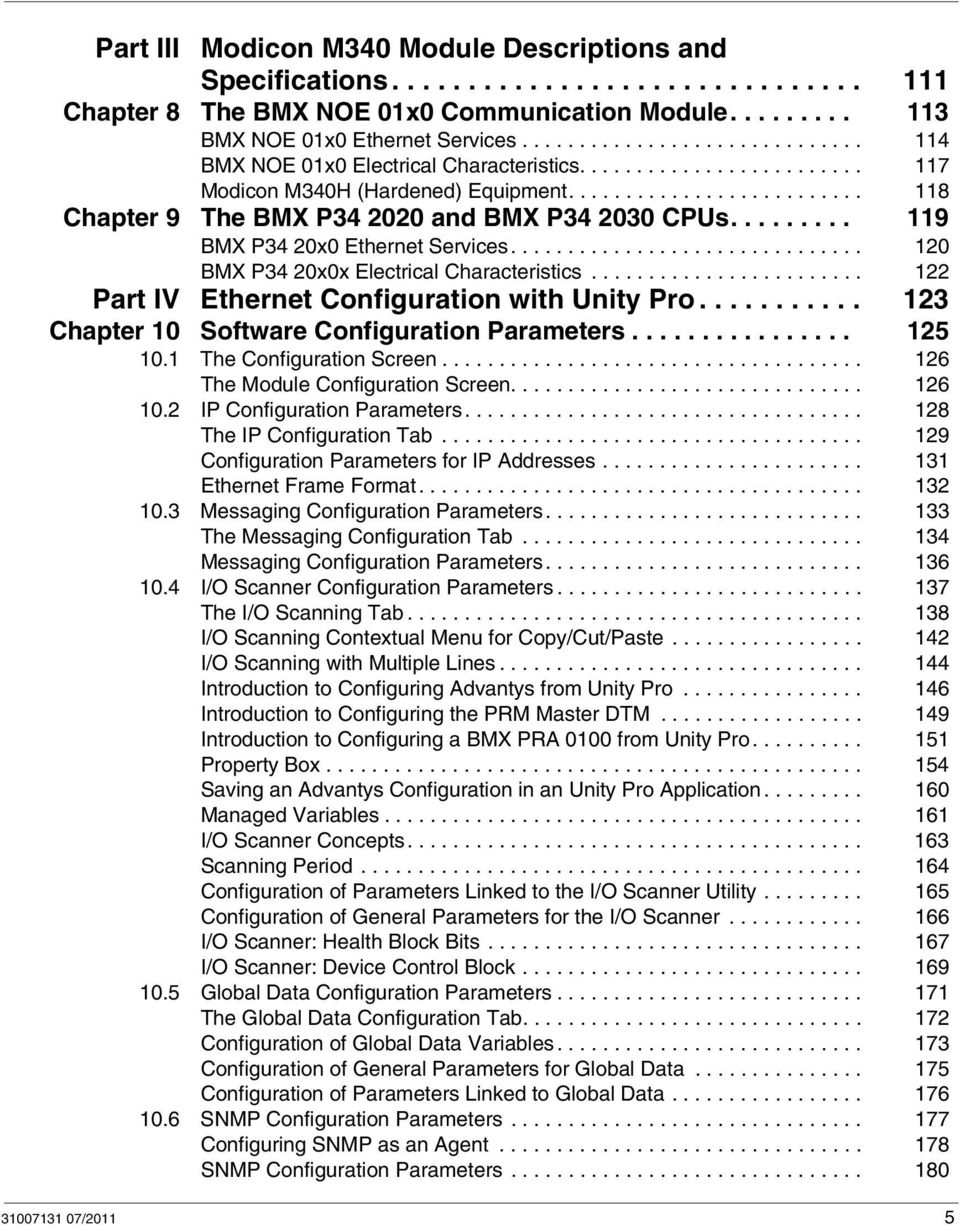
6 10.7 Address Server Configuration Parameters Address Server Bandwidth Checking Bandwidth Checking Configuration Electronic Mail Notification Service Configuration Parameters The SMTP Tab Time Synchronization Service Configuration Parameters The NTP Tab Chapter 11 Configuring an Ethernet Network Configuration Methodology for an Ethernet Network Adding the Module to an Ethernet Network Chapter 12 Debugging with Unity Pro Module Debugging Screen General Debugging Parameters Debugging Parameters for TCP/IP Utilities Debugging Parameters for I/O Scanning Debugging Parameters for Global Data Chapter 13 Ethernet Language Objects Language Objects and IODDTs of Ethernet Communication Language Objects and IODDTs of Ethernet Communication Implicit Exchange Language Objects Associated with the Application- Specific Function Explicit Exchange Language Objects Associated with the Application- Specific Function Exchange Objects of Type T_COM_ETH_BMX Details of Implicit Exchange Objects of the IODDT Type T_COM_ETH_BMX Details of Explicit Exchange Objects of the IODDT Type T_COM_ETH_BMX Details of Explicit Exchange Objects of the Non-IODDT Type T_COM_ETH_BMX Language Objects Associated with BMX NOE 01x0 and BMX P34 20x0 CPU Configuration Language Objects for Configuration Language Objects for Implicit Exchange Language Objects for Explicit Exchange Language Objects and Generic IODDT Applicable to Communication Protocols Details of the Language Objects of the IODDT of Type T_GEN_MOD Chapter 14 M340 Ethernet Communications Quick Start Hardware Installation Modicon M340 Configuration with Unity Pro Ethernet Network Configuration with Unity Pro Assign the BMX NOE 0100 IP Address /2011
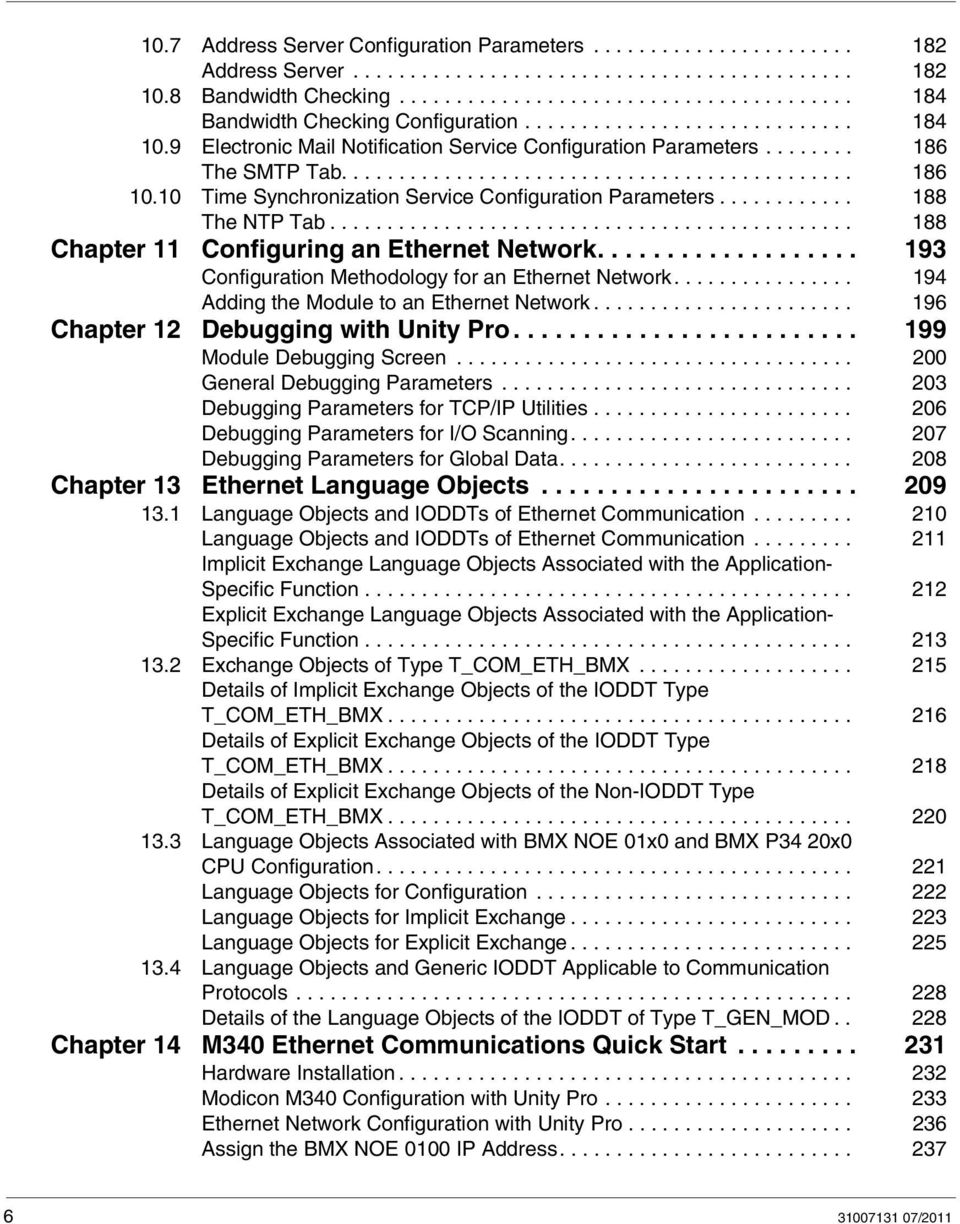
7 Configure Ethernet Communication Service (I/O Scanning) Associate the Network with the Module Build a Program Connect the System and Download the Configuration Debugging the Module Part V Embedded Web Pages Chapter 15 Embedded Web Pages M340 Web Pages Introduction to Web Services Embedded HTTP Server BMX NOE 0100 Home Page BMX NOE 0100 Monitoring Page BMX NOE 0100 Diagnostics Page Server Rack Display Page BMX NOE 0100 Setup Page FTP Security Page HTTP and Data Editor (Write) Page Upload MIB File Properties Ethernet Service Diagnostics Pages Global Data I/O Scanning Messaging Statistics Bandwidth Monitoring Class C Services Introduction to Class C Services Graphic Editor Overview Top Window User Functions Display Window User Functions Property Sheet Security Graphic Editor Applet Parameters Graphic Objects Extended Graphic Objects Appendices Appendix A TCP/IP Technical Characteristics Summary of TCP/IP Characteristics Address Management for Ethernet Modules Modbus Communication on the TCP/IP Profile Managing TCP Connections for Modbus Opening a TCP/IP Connection Closing a TCP/IP Connection Broken TCP/IP Connections /2011 7
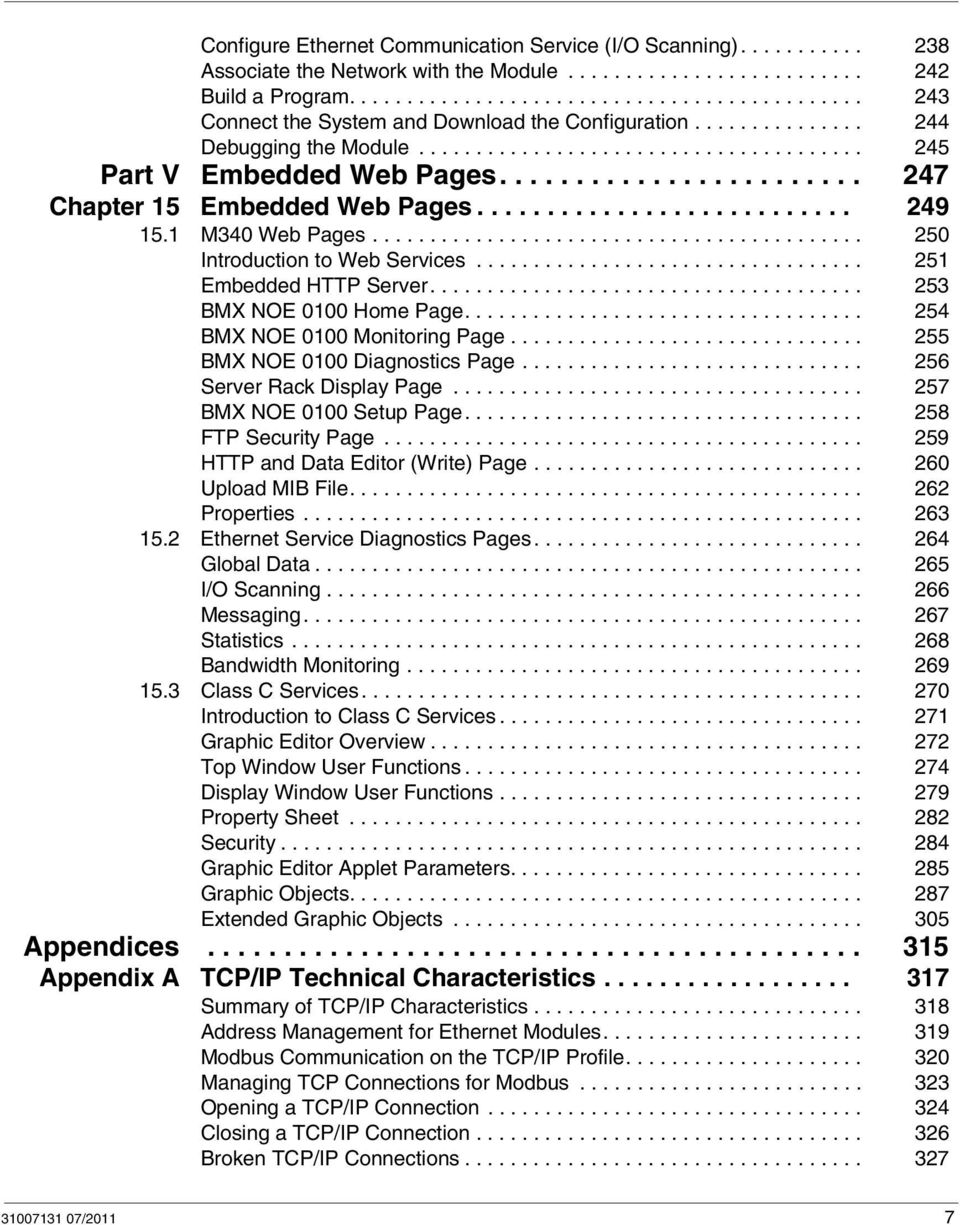
8 Appendix B IP Address Details IP Addresses and Classes Multicasting Considerations Appendix C Transparent Ready Service Classes Service Classes Appendix D Schneider Private MIB The Schneider Private MIB Schneider Private MIB Tree Structure MIB Subtree Description Switch Subtree Description Port 502 Messaging Subtree Description I/O Scanning Subtree Description Global Data Subtree Description Web Subtree Description Address Server Subtree Description Equipment Profile Subtree Description Time Management Subtree Description Subtree Description Transparent Factory MIB Version Private Traps and MIB Files Glossary Index /2011
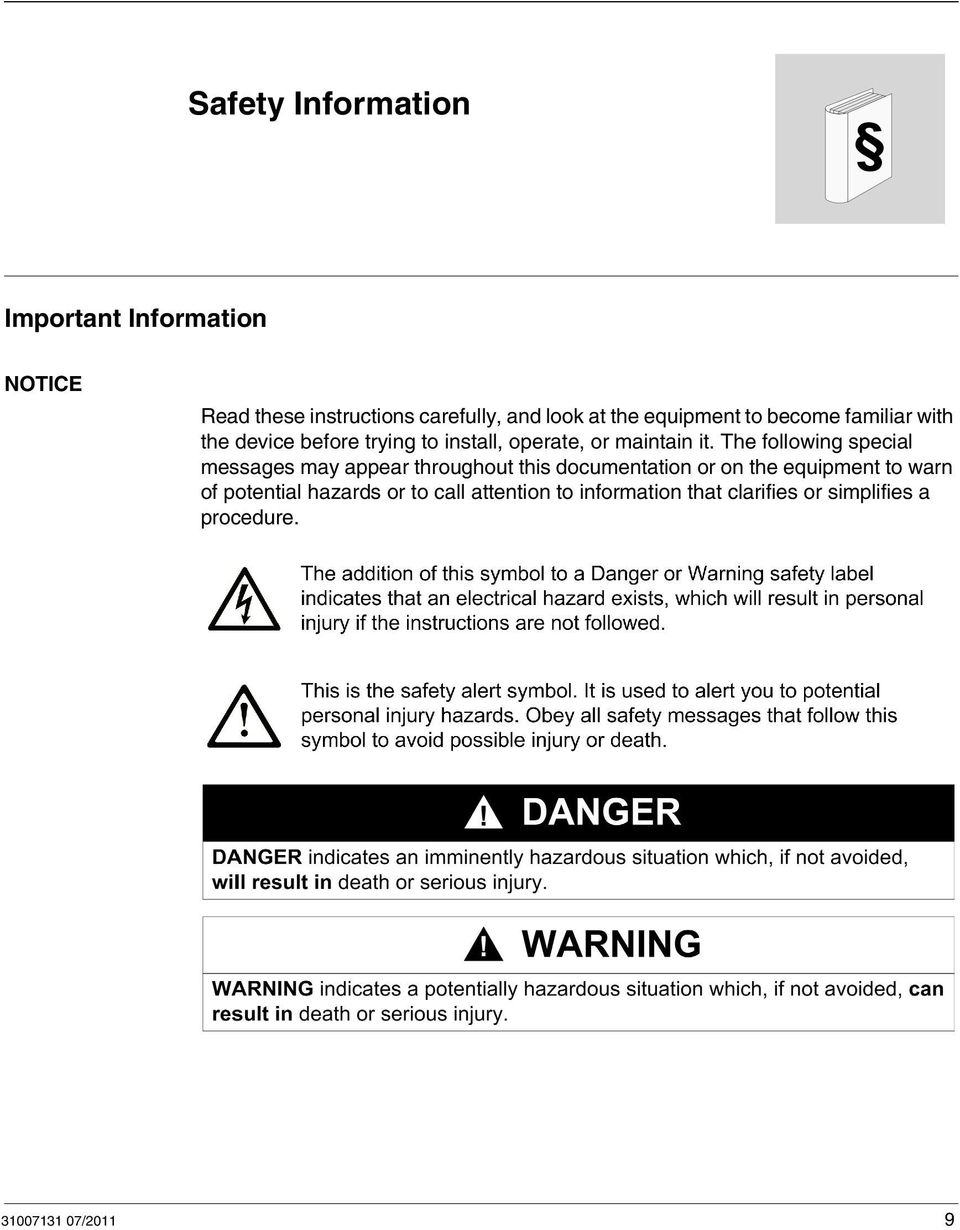
9 Safety Information Important Information NOTICE Read these instructions carefully, and look at the equipment to become familiar with the device before trying to install, operate, or maintain it. The following special messages may appear throughout this documentation or on the equipment to warn of potential hazards or to call attention to information that clarifies or simplifies a procedure /2011 9
10 PLEASE NOTE Electrical equipment should be installed, operated, serviced, and maintained only by qualified personnel. No responsibility is assumed by Schneider Electric for any consequences arising out of the use of this material. A qualified person is one who has skills and knowledge related to the construction and operation of electrical equipment and its installation, and has received safety training to recognize and avoid the hazards involved /2011

11 About the Book At a Glance Document Scope This manual describes the implementation of the BMX NOE 01x0 communication module and the BMX P34 20x0 CPU platforms with embedded ports on Ethernet networks using Unity Pro Version 5.0 or later. Validity Note This document is valid for Unity Pro 5.0 or later. The technical characteristics of the device(s) described in this manual also appear online. To access this information online: Step Action 1 Go to the Schneider Electric home page 2 In the Search box type the model number of a product or the name of a product range. Do not include blank spaces in the model number/product range. To get information on a grouping similar modules, use asterisks (*). 3 If you entered a model number, go to the Product datasheets search results and click on the model number that interests you. If you entered the name of a product range, go to the Product Ranges search results and click on the product range that interests you. 4 If more than one model number appears in the Products search results, click on the model number that interests you. 5 Depending on the size of your screen, you may need to scroll down to see the data sheet. 6 To save or print a data sheet as a.pdf file, click Download XXX product datasheet. The characteristics presented in this manual should be the same as those that appear online. In line with our policy of constant improvement we may revise content over time to improve clarity and accuracy. In the event that you see a difference between the manual and online information, use the online information as your reference /

12 Related Documents Title of Documentation Modicon M340 using Unity Pro: Processors, Racks and Power Supply Modules Transparent Ready User Guide FactoryCast for Modicon M340 User Manual Reference Number (E), (F), (G), (I), (S), (C) (E), (F), (G), (S) (E), (F), (G), (S), (I) You can download these technical publications and other technical information from our website at Product Related Information WARNING UNINTENDED EQUIPMENT OPERATION The application of this product requires expertise in the design and programming of control systems. Only persons with such expertise should be allowed to program, install, alter, and apply this product. Follow all local and national safety codes and standards. Failure to follow these instructions can result in death, serious injury, or equipment damage. User Comments We welcome your comments about this document. You can reach us by at /2011

13 Modicon M340 for Ethernet Modicon M340 Hardware and Communication Requirements /2011 Modicon M340 Hardware and Communication Requirements I About this Part This part contains an overview of hardware and communications requirements for the BMX NOE 01x0 modules and BMX P34 20x0 CPUs on Ethernet networks. For Modicon M340 system installation and specifications, see the book Modicon M340 using Unity Pro: Processors, Racks and Power Supply Modules. NOTE: The BMX NOE 01x0 modules have an embedded Web server. You can access the website for monitoring, diagnosing or setting up the module. Refer to the FactoryCast for Modicon M340 User Manual for a description of the website. What s in this Part? This part contains the following chapters: Chapter Chapter Name Page 1 Modicon M340 Modules for Ethernet Communications 15 2 Modicon M340 Ethernet Module Overview 31 3 Choosing an Ethernet Communications Module or Processor for Modicon M Hardware Installation /

14 Modicon M340 Hardware and Communication Requirements /2011

15 Modicon M340 for Ethernet Modicon M340 Modules for Ethernet Communications /2011 Modicon M340 Modules for Ethernet Communications 1 Introduction This chapter provides graphic representations of the Modicon M340 modules that can be used for communications between Ethernet networks and Modicon M340 rack assemblies. The appropriate modules are: BMX NOE 0100 and BMX NOE 0110: These network option modules are dedicated to Ethernet communications. BMX P and BMX P : In addition to their functionality as processors, these CPU modules have embedded ports for Ethernet communications. Elsewhere in this guide is information about selecting the appropriate hardware for your system and application needs (see page 35). What s in this Chapter? This chapter contains the following sections: Section Topic Page 1.1 External Features Common Features of Modicon M340 Modules and Processors /

16 Modicon M340 Modules for Ethernet Communications 1.1 External Features About this Section This section identifies the external features and ports on the BMX NOE 01x0 modules and BMX P34 20x0 CPUs. What s in this Section? This section contains the following topics: Topic Page BMX NOE 01x0 Physical Description 17 BMX P Physical Description 18 BMX P /20302 Physical Description /2011
17 Modicon M340 Modules for Ethernet Communications BMX NOE 01x0 Physical Description The Module This illustration shows the BMX NOE 01x0 communication modules: Legend: 1 LED display (see page 22) 2 Ethernet port (see page 28) 3 memory card slot A memory card can be used to store files, such as Web pages and log files. Elsewhere in this guide are performance characteristics of standard and optional memory cards (see page 45). 4 reset button Press this button to cold start the module. (After the reset, the network recognizes the module as a new device.) /

18 Modicon M340 Modules for Ethernet Communications BMX P Physical Description The Module This illustration shows the BMX P CPU: Legend: 1 LED display (see page 22) 2 USB port 3 Ethernet port (see page 28) 4 memory card slot Used to: store files, such as Web pages and log files back up code back up application Elsewhere in this guide are performance characteristics of standard and optional memory cards (see page 45). 5 Modbus serial port /2011

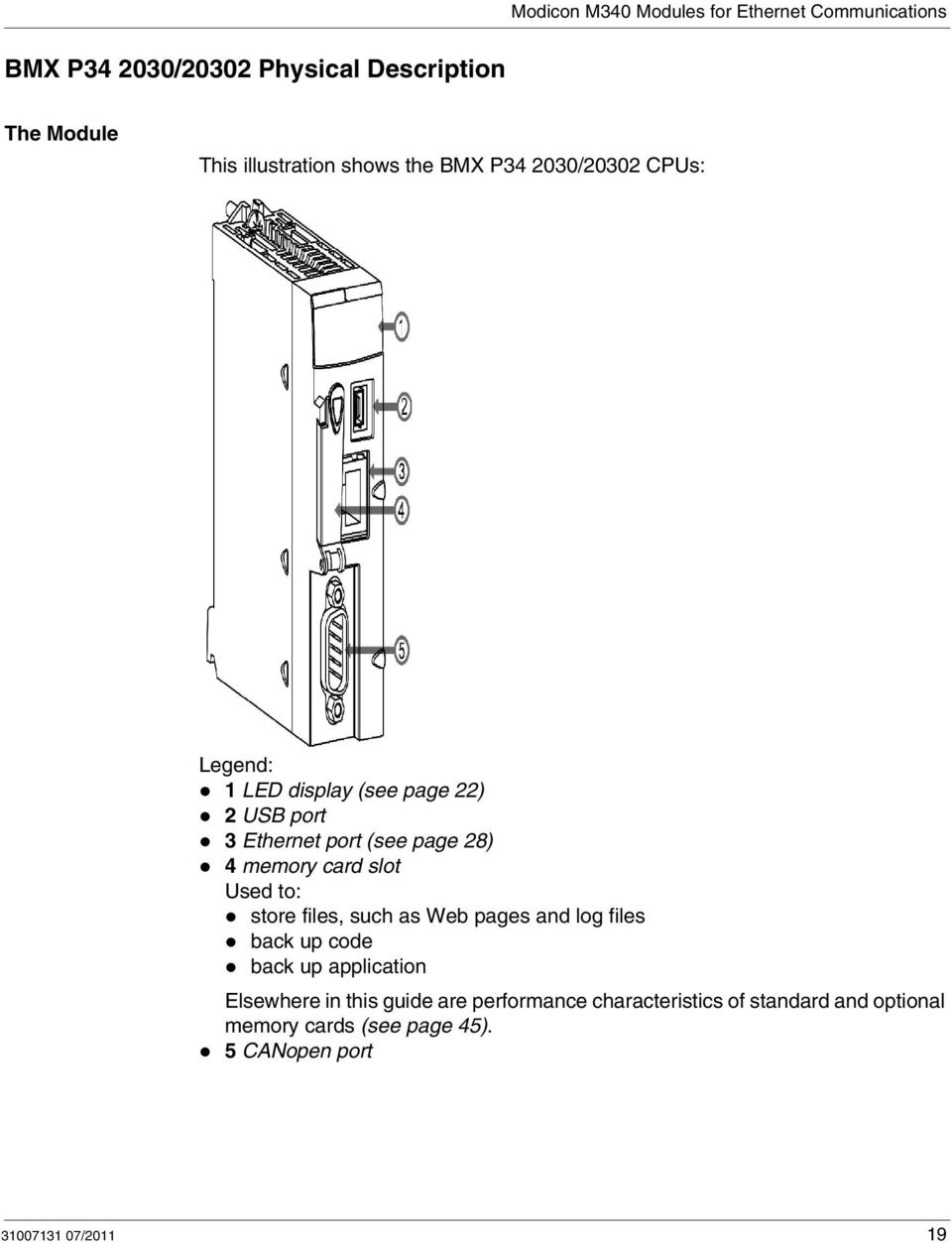
19 Modicon M340 Modules for Ethernet Communications BMX P /20302 Physical Description The Module This illustration shows the BMX P /20302 CPUs: Legend: 1 LED display (see page 22) 2 USB port 3 Ethernet port (see page 28) 4 memory card slot Used to: store files, such as Web pages and log files back up code back up application Elsewhere in this guide are performance characteristics of standard and optional memory cards (see page 45). 5 CANopen port /
20 Modicon M340 Modules for Ethernet Communications 1.2 Common Features of Modicon M340 Modules and Processors About this Section This section describes the common physical features of the BMX NOE 01x0 modules and BMX P34 20x0 CPUs. What s in this Section? This section contains the following topics: Topic Page Module Dimensions 21 Ethernet LED Indicators 22 10/100 BASE-T Interface /2011

21 Modicon M340 Modules for Ethernet Communications Module Dimensions Dimensions The dimensions of the Modicon M340 modules conform to the characteristics of the BMX XBP rack. This figure shows the dimensions (in mm) for the M340 Ethernet communication modules and M340 CPUs: /
22 Modicon M340 Modules for Ethernet Communications Ethernet LED Indicators Introduction There are several LEDs available on the front panel of each Modicon M340 module or processor, enabling rapid diagnosis of the PLC status: These LEDs provide information on: PLC functioning the memory card communication with the modules serial communication communication on the CANopen network communication on the Ethernet network BMX NOE 01x0 LEDs The following diagram shows the diagnostic LEDs on the BMX NOE 01x0 modules. Note that two displays exist, depending on whether you are using firmware V1 or V2 (or greater) of the module /2011
23 Modicon M340 Modules for Ethernet Communications The colors and blink patterns of the LEDs indicate the status and operating conditions of Ethernet communications on the module: Label Pattern Indication RUN (green): operational on Module is operating and configured. state flashing Module is blocked by a software detected error. off Module is not configured (application is absent, invalid, or incompatible). ERR (red): detected error on Processor, system, or configuration detected error flashing Module is not configured (application is absent, invalid, or incompatible). Module is blocked by a software detected error. off Normal (no detected errors) ETH STS (green): Ethernet on Communication OK communication status 2 flashes Invalid MAC address 3 flashes Link not connected 4 flashes Duplicate IP address 5 flashes Waiting for a server IP address 6 flashes Secure and safe mode (with default IP address) 7 flashes Configuration conflict between rotary switches and internal configuration CARDERR (red): memory card detected error on Memory card is missing. Memory card is not usable (bad format, unrecognized type). Memory card had been removed and reinserted. off Memory card is valid and recognized. Note 1: Rapid flashing is defined as ON for 50 ms and OFF for 50 ms. Note 2: Slow flashing is defined as ON for 200 ms and OFF for 200 ms /
24 Modicon M340 Modules for Ethernet Communications BMX P , BMX P /20302 Processor LEDs The following diagram shows the diagnostic LEDs on the BMX P processor. Note that two displays exist, depending on whether you are using firmware V1 or V2 (or greater) of the processor. The following diagram shows the diagnostic LEDs on the BMX P /20302 processor. Note that two displays exist, depending on whether you are using firmware V1 or V2 (or greater) of the processor. The colors and blink patterns of the LEDs indicate the status and operating conditions of Ethernet communications on the module: Label Pattern Indication RUN (green): operational state on PLC hardware and PLC program operations are normal. Module is in RUN state. flashing PLC is in STOP mode or a blocking error in the application has been detected. Processor is configured but not in RUN state. off PLC is not configured (application is absent, invalid, or incompatible). ERR (red): detected error on Processor, system, or configuration detected error flashing PLC is not configured (application is absent, invalid, or incompatible). PLC is in STOP mode or a blocking error in the application has been detected. off Normal (no detected errors) /2011
25 Modicon M340 Modules for Ethernet Communications Label Pattern Indication ETH STS (green): Ethernet communication status CARDERR (red): memory card detected error on Communication OK 2 flashes Invalid MAC address 3 flashes Link not connected 4 flashes Duplicate IP address 5 flashes Waiting for a server IP address 6 flashes Secure and safe mode (with default IP address) 7 flashes Configuration conflict between rotary switches and internal configuration on Memory card is missing. Memory card not usable (bad format, unrecognized type). Memory card content is inconsistent with internal RAM application. off Memory card is valid and recognized. Application on card is consistent with the internal RAM application. I/O (red): input/output status on Error detected on a configured module or CPU channel Configuration mismatch with the application (module missing...) off Normal (no detected errors) SER COM (yellow): serial data status CAN RUN (green): CANopen operations flashing off on rapid flashing (note 1) slow flashing (note 2) Data exchange (send/receive) on the serial connection in progress No data exchange on the serial connection CANopen network operational Automatic detection of data flow or LSS services in progress (alternates with CAN ERR). CANopen network is pre-operational. 1 flash CANopen network is stopped. 3 flashes Downloading CANopen firmware /
26 Modicon M340 Modules for Ethernet Communications Label Pattern Indication CAN ERR (red): CANopen detected error CARDAC (green): memory card access Note: This LED is located under the memory card door (see page 17). on rapid flashing (note 1) slow flashing (note 2) CANopen bus is stopped. Automatic detection of data flow or LSS services in progress (alternates with CAN RUN). CANopen configuration is not valid. 1 flash At least one error counter has reached or exceeded alert level. 2 flashes A guard event (NMT slave or NMT master) or a heartbeat event has occurred. 3 flashes The SYNC message was not received before the end of the communication cycle period. off No error detected on CANopen. on flashing off Access to the card is enabled. Activity on the card: during each access, the card LED is set to OFF, then back to ON. Access to the card is disabled. You can remove the card after you disable card access by setting system bit %S65 to 0. Note 1: Rapid flashing is defined as ON for 50 ms and OFF for 50 ms. Note 2: Slow flashing is defined as ON for 200 ms and OFF for 200 ms. LED Differences Between Firmware V1 and V2 Modules for both BMX NOE 01x0 and BMX P34 20x0x The following table describes the meaning of the ETH ACT and ETH 100 LEDs on the front panel for firmware V1 NOE and CPU modules. Label Pattern Indication ETH ACT (green): Ethernet on Ethernet link detected: no communications activity. communication (transmission/reception off No Ethernet link detected. activity) flashing Ethernet link detected: receiving or sending packets. ETH 100 (green): Ethernet transmission speed on off Ethernet transmission at 100 Mbit/s (Fast Ethernet). Ethernet transmission at 10 Mbit/s (Ethernet) or no link detected /2011
27 Modicon M340 Modules for Ethernet Communications The following table describes the meaning of the ETH ACT and ETH LNK LEDs on the front panel for firmware V2 NOE and CPU modules. Label Pattern Indication ETH ACT (green): Ethernet on Communications activity detected. communication (transmission/reception) activity off No communications activity detected. ETH LNK (green): Ethernet link status NOTE: on off Ethernet link detected. No Ethernet link detected. Rapid flashing is defined as ON for 50 ms and OFF for 50 ms. Slow flashing is defined as ON for 200 ms and OFF for 200 ms /
28 Modicon M340 Modules for Ethernet Communications 10/100 BASE-T Interface General The module s 10/100 BASE-T interface is a standard RJ45 connector. In an industrial environment, you must use a cable with the following characteristics: shielded twisted double pair impedance 100 Ω±15 Ω (from 1 to 16 MHz) maximum attenuation 11.5 db/100 meters maximum length 100 meters The following straight-through ConneXium cables fit these requirements for connecting terminal devices: Description Reference Length, m (ft) Low Smoke Zero Halogen UL/CSA CMG Straight-through 490 NTW NTW U 2 (6.6) cable with RJ45 ends 490 NTW NTW U 5 (16.4) 490 NTW NTW U 12 (39.4) 490 NTW NTW U 40 (131.2) 490 NTW NTW U 80 (262.5) Pin Assignment The connector: Pinout assignment table: Pin Signal 1 TD+ 2 TD- 3 RD+ 4 not connected /2011
29 Modicon M340 Modules for Ethernet Communications Pin Signal 5 not connected 6 RD- 7 not connected 8 not connected NOTE: If there is a connection via a shielded cable, the connector casing on the module is linked up to the ground connection. Line Speed The different line speeds that are available for the BMX NOE 01x0 and the integrated Ethernet port of the BMX P /2030/20302 CPUs are: 100 Mb in half duplex 100 Mb in full duplex 10 Mb in half duplex 10 Mb in full duplex The user can not configure the line speed. Characteristics of speed adaptation are: Auto-sensing and auto-negotiation allow the Ethernet module to quickly configure itself to the local Ethernet switch s speed and duplex mode. The negotiated speed between two Ethernet devices is limited to the speed of the slower device. Port Status Elsewhere in this guide is a discussion of the Ethernet port status (see page 63) /
30 Modicon M340 Modules for Ethernet Communications /2011
31 Modicon M340 for Ethernet Modicon M340 Ethernet Module Overview /2011 Modicon M340 Ethernet Module Overview 2 Introduction This chapter contains an overview of the BMX NOE 01x0 modules and BMX P34 20x0 CPUs on Ethernet networks. What s in this Chapter? This chapter contains the following topics: Topic Page General Presentation of an Ethernet Network 32 Rack Position: BMX NOE 01x0 and BMX P34 20x0x /
32 Modicon M340 Ethernet Module Overview General Presentation of an Ethernet Network Overview In general, Ethernet is designed to facilitate: coordination between programmable controllers local or centralized supervision communication with the business data processing of production communication with remote inputs/outputs An Ethernet network: NOTE: Be careful routing the Ethernet cable through the factory as the cable may be damaged by other equipment within the factory /2011
33 Modicon M340 Ethernet Module Overview Rack Position: BMX NOE 01x0 and BMX P34 20x0x Introduction This topic describes the appropriate rack positions of the BMX NOE 01 0 modules and BMX P34 20x0x CPUs on a BMX XBP station assembly during installation (see page 41). Available Modules A Modicon M340 CPU can manage an entire BMX XBP rack. These three CPUs have Ethernet communication ports: BMX P BMX P BMX P The BMX P34 20x0x CPUs can manage a station composed of: discrete I/O modules analog I/O modules function modules (counting, communication, etc.) NOTE: Refer to the Modicon M340 Using Unity Pro -- Processors, Racks, and Power Supply Modules Setup Manual for specific part numbers. Rack Position The following rack assembly includes a Modicon M340 CPU (in this case a BMX P ) and a BMX NOE 01 0 module (in this case a BMX NOE 0100). Rack positions 0 to 8 are indicated. (As always, the double-wide power supply is mounted at the beginning of the rack.) 0 BMX P CPU at rack position 0 1 discrete I/O module at rack position 1 2 counter module at rack position 2 3 BMX NOE 0100 Ethernet communications module at rack position available rack positions 8 Modicon M340 extension module at rack position /
34 Modicon M340 Ethernet Module Overview Module Positioning Mechanically, it is possible to position the BMX P34 CPU or the I/O modules in any slot. However, we recommend placing the modules in these positions: BMX P34 20x0 : You must place the CPU at position 0. Position 0 also conforms to the CPU form factor. BMX NOE 01x0: Modules that conform to the Modicon M340 I/O form factor, such as the BMX NOE 01 0 modules, can be placed in any other available slot. BMX CPS 2000: The double-wide rack power supply is mounted at the beginning of the assembly on the left. BMX P Processors The following table shows the rack operations and communications details for the BMX P34 20x0x CPUs: Physical Maximum Number of I/O* Maximum Integrated Port CPU Format Discrete Analog Memory Size CANopen Ethernet Modbus Serial BMX P simple Kb X X BMX P /20302 simple Kb X X *: per rack X: available : not available /2011
35 Modicon M340 for Ethernet Ethernet Hardware Selection /2011 Choosing an Ethernet Communications Module or Processor for Modicon M340 3 Introduction This section helps you select the hardware that is most appropriate for your Ethernet application and system requirements. Ethernet networks can be complex. Therefore, the BMX NOE 01x0 communication modules and BMX P34 20x0 CPUs support a variety of network services. What s in this Chapter? This chapter contains the following topics: Topic Page Communication Module Features and Selection Guide 36 BMX P34 xxxxx Processors Catalog 37 Ethernet Service Selection Table 38 Compatibility: BMX NOE 01x0 and BMX P34 20x /
36 Ethernet Hardware Selection Communication Module Features and Selection Guide Introduction The Modicon M340 PLCs can communicate with Ethernet networks using: Ethernet communication modules (BMX NOE 01x0 (see page 113)) embedded ports on the Modicon M340 CPUs (BMX P34 20x0x (see page 119)) The interfaces for these communications modules are described below. When making your selection, consider each module s services (see page 38). Embedded Ports on Modicon M340 CPUs The BMX P34 20x0x CPUs have these ports: CPU Ports BMX P USB Ethernet Modbus serial BMX P /20302 USB Ethernet CANopen The locations of the ports are shown at External Features (see page 16) /2011
37 Ethernet Hardware Selection BMX P34 xxxxx Processors Catalog Introduction The choice of BMX P34 xxxxx processor is made, primarily, according to its characteristics and possibilities. BMX P34 xxxxx Processors Catalog The following table describes the important maximum characteristics of the BMX P34 xxxxx processors. Characteristic BMX P BMX P BMX P /20102 Maximum Number of channels Maximum Number of modules Memory size Discrete rack inputs/outputs Analog inputs/outputs Expert channels (counting, PTO, MPS, NOM, etc.) Embedded Serial port Embedded Ethernet port Embedded CANopen port Network communication (TCP/IP) AS-i fieldbus 1 communication User application BMX P BMX P / Kb 4096 Kb 4096 Kb 4096 Kb 4096 Kb Legend 1 The AS-i field bus requires at least PLC Operating System V2.10 and Unity Pro /
38 Ethernet Hardware Selection Ethernet Service Selection Table Available Services This tables summarizes the services that are available for the different Ethernet communications modules. Service Ethernet Modules Embedded Ports on CPUs BMX NOE 01x0 BMX P /20302 BMX P Connection at 10 Mbits/s X X X Connection at 100 Mbits/s X X X TCP/IP X X X SNMP: Standard MIB X X X MIB Transparent Factory X X X I/O Scanner X Address Server (BOOTP/DHCP server) X BOOTP/DHCP client X X X Modbus Messaging X X X Firmware update via Unity Loader X X X Embedded HTTP server X X X Global Data X NTP X SMTP X X Faulty Device Replacement (FDR server) X FDR client X X X Diagnostics from Web pages X X X User-customizable Web pages with an installed class C memory card (BMX NOE 0110 modules only) Additional interface N/A CANopen Serial Legend X: service is present : service is not available See the detailed descriptions for: Ethernet services (see page 71) Schneider s Transparent Ready service classes (see page 337) Class C services for the BMX NOE 01x0 modules (see page 337) /2011
39 Ethernet Hardware Selection Compatibility: BMX NOE 01x0 and BMX P34 20x0 M340 NOE and CPU Version Compatibility Note the following compatibility issues when plugging an BMX NOE 01x0 module with a BMX P34 20x0 CPU in the rack. Certain combinations of firmware V1 and V2 modules are supported. The following table shows compatible module combinations. NOE Firmware V1 NOE Firmware V2 (with an application for an NOE V1) NOE Firmware V2 (with an application for an NOE V2) CPU Firmware V1 Compatible Compatible Incompatible CPU Firmware V2 (with an Compatible Compatible Incompatible application for a CPU V1) CPU Firmware V2 (with an application for a CPU V2) *Incompatible Incompatible Compatible * In this case, the NOE module will be not recognized as correct by the CPU when the application starts. An I/O error message will be displayed, as if a module other than an NOE were inserted in the slot /
40 Ethernet Hardware Selection /2011
41 Modicon M340 for Ethernet Installation /2011 Hardware Installation 4 Introduction This chapter describes the installation of the BMX NOE 01x0 modules and BMX P34 20x0 CPUs. What s in this Chapter? This chapter contains the following topics: Topic Page Assembling a Modicon M340 Station 42 Grounding of Installed Modules 44 Modicon M340 Memory Cards 45 Memory Card Features 49 Wiring Considerations /
42 Installation Assembling a Modicon M340 Station Introduction WARNING MODULE DESTRUCTION - LOSS OF APPLICATION Disconnect all power to the rack before the installation of the BMX P34 20x0 CPUs Failure to follow these instructions can result in death, serious injury, or equipment damage. This topic provides steps for installing the Modicon M340 communication modules and CPUs on the BMX XBP rack. Modicon M340 modules and processors are powered by the backplane bus. Fitting operations (installation, assembly, and disassembly) are described below. Elsewhere in this guide is a discussion of the proper address locations on the backplane for BMX NOE 01x0 and Modicon M340 CPUs (see page 33). Installing a Processor A BMX P34 20x0 processor is always installed on the BMX XBP rack in slot marked 00 (address 0). The following diagram shows a BMX P34 20x0 processor mounted on a BMX XBP rack in the slot marked 00 (address 0): NOTE: Before installing a module, take off the protective cap from the module connector located on the backplane /2011
43 Installation Mounting Instructions NOTE: The mechanical assembly instructions for the BMX NOE 01x0 and the BMX P34 20x0 CPUs are identical. To mount a module or processor on the BMX XBP rack: Step Action Illustration 1 Position the two pins on the reverse side of the module or CPU (at the bottom) in the corresponding slots on the rack. Note: Before positioning the pins, make sure you have removed the protective cover. The following diagram describes steps 1 and 2: 2 Incline the module or CPU towards the top of the rack so that the module sits flush with the back of the rack. It is now set in position. 3 Tighten the safety screw to ensure that the module or CPU is held in place on the rack. The recommended tightening torque is between 0.4 and 1.5 Nm. The following diagram describes step 3: /
44 Installation Grounding of Installed Modules General The grounding of Modicon M340 modules is crucial to avoid electric shocks. Grounding Processors and Power Supplies DANGER HAZARD OF ELECTRIC SHOCK, EXPLOSION OR ARC FLASH Ensure ground connection contacts are present and not bent out of shape. If they are, do not use the module and contact your Schneider Electric representative. Failure to follow these instructions will result in death or serious injury. WARNING UNINTENDED EQUIPMENT OPERATION Tighten the clamping screws of the modules to guarantee the system characteristics. A break in the circuit could lead to an unexpected behavior of the system. Failure to follow these instructions can result in death, serious injury, or equipment damage. All Modicon M340 modules are equipped with ground connection contacts at the rear for grounding purposes: These contacts connect the grounding bus of the modules to the grounding bus of the rack /2011
45 Installation Modicon M340 Memory Cards Introduction WARNING RISK OF LOST APPLICATION Do not remove the memory card from the module while the PLC is running. Remove the memory card only when the power is off. Failure to follow these instructions can result in death, serious injury, or equipment damage. This topic discusses the Schneider memory cards that are available for Modicon M340 CPUs and the BMX NOE 01x0 modules. Elsewhere in this guide is a discussion of the card location on the modules (see page 16). Card Functionality The following table describes the functionality of the different memory cards when inserted in Modicon M340 CPUs and BMX NOE 01x0 modules: Memory Card Part Functionality BMX P34 CPUs BMX NOE 01x0 Comment BMX RMS 008MP application backup Web server activation on the embedded Ethernet port (Transparent Ready class B) BMX RMS 008MPF application backup Web server activation on the embedded Ethernet port (Transparent Ready class B) 8 MB file storage (usability) BMX RMS 128MPF application backup Web server activation on the embedded Ethernet port (Transparent Ready class B) 128 MB file storage (usability) Delivered with the BMX P34 CPUs Order separately Order separately BMXRWSB000M services for Transparent Ready class B30 BMX RWSF016M services for Transparent Ready class C30 Web page memory (16 MB) Delivered with the BMX NOE 0100 module No longer sold. Nevertheless, it can be updated to BMX RWSFC016M /
46 Installation Memory Card Part Functionality BMX P34 CPUs BMX NOE 01x0 Comment BMX RWSFC016M services for Transparent Ready class C30 FactoryCast services Web page memory (64 MB) Note: See the detailed discussions for: Ethernet service classes A, B, C, and D (see page 337) Class C services for the BMX NOE 0100 module (see page 337) Delivered with the BMX NOE This card is required for usercustomizable Web pages and FactoryCast services. Card Services CAUTION INOPERABLE MEMORY CARD Do not format the memory card with a non-schneider tool. The memory card needs a structure to contain program and data. Formatting with another tool destroys this structure. Failure to follow these instructions can result in equipment damage. CAUTION UNINTENDED EQUIPMENT OPERATION Do not use a write-protected memory card with the module. Write-protected cards prevent some services from operating properly. Failure to follow these instructions can result in injury or equipment damage. The following table lists the services that are available when the memory card is inserted in various Modicon M340 modules: Memory Card Module Program Backup File Storage FDR Server Web Server Class BMX RMS 008MP BMX P Yes No BMX P Yes No BMX P Yes No BMX P Yes No BMX P Yes No No B BMX P Yes No No B BMX P Yes No No B FactoryCast /2011
47 Installation Memory Card Module Program Backup File Storage FDR Server Web Server Class BMX RMS 008MPF BMX P Yes No BMX P Yes Yes BMX P /20102 Yes Yes BMX P Yes Yes No B BMX P /20302 Yes Yes No B BMX RMS 128MPF BMX P Yes No BMX P Yes Yes BMX P /20102 Yes Yes BMX P Yes Yes No B BMX P /20302 Yes Yes No B BMXRWSB000M BMX NOE 0100 Yes B BMXRWSC016M BMX NOE 0100 Yes C BMXRWSFC016M BMX NOE 01x0 Yes C Yes B = embedded web page C = user-customized web page Elsewhere in this guide is a description of the Web server classes (see page 337). FactoryCast NOTE: The NOE module works only with a memory card that is present at boot-up time. A memory card that is inserted during NOE operations is not recognized. Although operation is possible without a valid memory card inserted in the module, a valid memory card should be present at all times in the module to ensure correct operation of the module and all its services. Card Compatibility with NOE Versions The following table lists the compatibility issues between memory card versions and BMX NOE 01x0 versions: Memory Card NOE NOE 0100 Firmware V1 NOE 0100 Firmware V2 NOE 0110 Firmware V1 BMX RWS C016M Class C V1 BMX RWS C016M upgraded to FactoryCast V1.1 BMX RWS C016M upgraded to FactoryCast V2 BMX RWSF C032M V1.1 BMX RWSF C032M V2 Compatible *Incompatible *Incompatible *Incompatible Not supported Compatible (with a V1 application) Not supported *Incompatible *Incompatible Not supported Not supported Compatible Not supported Compatible Not supported BMX_RWS B000M Class B Compatible Compatible (with a V1 application) Compatible /
48 Installation Memory Card NOE NOE 0110 Firmware V2 BMX RWS C016M Class C V1 Not supported BMX RWS C016M upgraded to FactoryCast V1.1 BMX RWS C016M upgraded to FactoryCast V2 BMX RWSF C032M V1.1 BMX RWSF C032M V2 BMX_RWS B000M Class B Not supported Compatible Not supported Compatible Compatible (with a V1 application) * In these cases, the Web server is embedded in the memory card, then loaded into the NOE module. At start-up, the NOE will block this memory card. Card Compatibility with CPU Versions The following table lists the compatibility issues between memory card versions and BMX P versions: Memory Card BMX RMS 008MP / MPF Web Pages V1 or V1.1 BMX RMS 008MP / MPF Web Pages V2 CPU CPU Firmware V1 Compatible Compatible (with a V1 application) CPU Firmware V2 (with an application for a CPU V1) Compatible (with a V1 application) Compatible (with a V1 application) CPU Firmware V2 (with an application for a CPU V2) Compatible Compatible Precautions CAUTION MEMORY CARD DESTRUCTION To keep the memory card in normal working order, the following precautions should be taken: Do not remove the memory card from its slot when the module is accessing it (green access LED on or flashing). Do not touch the memory card connections. Keep the memory card away from electrostatic and electromagnetic sources as well as heat, sunlight, water and moisture. Avoid impacts to the memory card. Check the postal service security policy before sending a memory card by postal service. In some countries the postal service exposes mail to high levels of radiation, as a security measure. These high levels of radiation may erase the contents of the memory card and render it unusable. Failure to follow these instructions can result in equipment damage /2011
49 Installation Memory Card Features Introduction This topic discusses the features and services provided by Schneider memory cards for Modicon M340 CPUs and the BMX NOE 01x0 modules. Card Features The following table describes the features and services of the different memory cards when inserted in Modicon M340 CPUs and the BMX NOE 01x0: Memory Card BMXRMS008MP / BMXRMS008MPF / BMXRMS128MPF BMXRWSB000M BMXRWSFC032M Module BMX P /2030/20302 BMX NOE 0100 BMX NOE 0110 TR Class level B B C Monitoring Data Editor X X X Data Editor Lite X X X Graphic Editor - - X Graphic Viewer - - X Symbol, unlocated access - - X Custom Web pages - - X Diagnostic Ethernet services Lite X X - Ethernet services - - X Rack Viewer Lite X X - Multi-Rack Viewer - - X Zoom module in rack X - X Zoom bus CANopen X - X Alarm Viewer - - X Setup HTTP security X X X FTP security - - X FactoryCast SOAP XML support - - X RDE on Pocket PC - - X Widget library - - X NTP FTP - X X Web Designer support - - X /
50 Installation Legend X: service is present : service is not available Memory Card BMXRMS008MP / BMXRMS008MPF / BMXRMS128MPF BMXRWSB000M BMXRWSFC032M NOTE: You can update the content of the BMXRWSC016M card to include the features and services of the BMXRWSFC032M card using Unity Loader. Without Memory Card If no memory card is inserted in the module, you cannot access the website. The following error message appears: "Access Error: Site temporary unvailable. Try again. No SD card present." Also, if no memory card is inserted in the module: The address server will not work (NOE modules only). NTP has no time zone files (NOE modules only). Unity Loader will not work (NOE and CPU modules) /2011
51 Installation Wiring Considerations The Link The following situations can create a temporary disruption in the application or communications: The RJ45 10/100 BASE-T interface connector is connected or disconnected when the power is on. Modules are re-initialized when the power is switched back on /
52 Installation /2011
53 Modicon M340 for Ethernet Ethernet Communications /2011 Ethernet Communications II About this Part This part describes Ethernet communications. What s in this Part? This part contains the following chapters: Chapter Chapter Name Page 5 IP Parameters 55 6 Multi-Module Communication 65 7 Description of Ethernet Communications Services /
54 Ethernet Communications /2011
55 Modicon M340 for Ethernet IP Parameters /2011 IP Parameters 5 About this Chapter This chapter describes the assignment of IP parameters to the BMX NOE 01x0 and BMX P34 20x0 CPUs. Each network address must be valid and unique on the network. Elsewhere in this guide you can find information about: address management for Ethernet modules (see page 319) IP address classes (see page 330) What s in this Chapter? This chapter contains the following topics: Topic Page Methods for IP Addressing 56 Modicon M340 Rotary Switches 57 Deriving IP Parameters from the MAC Address 59 The IP Address Assignment Process 61 Ethernet Port Status /
56 IP Parameters Methods for IP Addressing Addressing Methods The Modicon M340 modules and CPUs with Ethernet functionality can have their addresses set through the rotary switches (see page 57), the Unity Pro IP Configuration tab (see page 129), and combinations of the two: Address Method STORED device name (over DHCP) CLEAR IP BOOTP from a server (STORED) disabled Description The lower rotary switch is set to STORED (manufacturer default setting), and the module uses the application s configured parameters. There are two components of the device name: default device name of the module: BMX_2020_xxy (BMX P CPU) BMX_2030_xxy (BMX P /20302 CPU) BMX_0100_xxy (BMX NOE 0100 and BMX PRA 0100 modules) BMX_0110_xxy (BMX NOE 0110 module) numeric value between 00 and 159 set on the rotary switches (see page 57) (For the default device name, xx is the value of the upper rotary switch and y is the value of the lower rotary switch.) Example: For a BMX NOE 0100 module, values of 120 (12 x 10) and 6 (6 x 1) on the respective upper and lower rotary switches indicate a value of 126. The value is appended to the default device name (BMX_0100_xxy) to create the valid DHCP device name of BMX_0100_126. The lower rotary switch is set to CLEAR IP, and the module uses its MAC-based default IP address (see page 59). Set the lower rotary switch (see page 57) to one of its BOOTP positions to get an address over BOOTP (see note). Note: To configure the module in the application to get its address from a BOOTP server, see "from a server," below. A server-assigned IP address can then be obtained from either a BOOTP or DHCP server (see page 76). BOOTP: Set the lower rotary switch to one of its STORED positions. Select From a server on the IP Configuration tab (see page 129). Leave the Device Name field empty. DHCP: Set the lower rotary switch to one of its STORED positions. Select From a server on the IP Configuration tab (see page 129). Enter a valid device name in the Device Name field. Note: The M340 Ethernet modules will not receive an IP address from a BOOTP/DHCP server on application download if the IP configuration has not changed. Communications are disabled. Note: An error can occur when the assigned address is a mismatch for the address in the application. Details of these errors are at Ethernet Port Status (see page 63) /2011
57 IP Parameters Modicon M340 Rotary Switches Introduction The BMX NOE 01 0 or BMX P34 20x0 operates as a single node on an Ethernet LAN and possibly other networks. The module must have a unique IP address. The two rotary switches on the back of the module provide a simple way to select an IP address: NOTE: Set the arrow firmly into the desired position. If you do not feel the switch click into place, the value of the switch may be incorrect or undetermined. Summary of Valid IP Address Settings Each rotary switch position that you can use to set a valid IP address is marked on the module. The following information summarizes the valid address settings: device name: For a switch-set device name, select a numeric value from 00 to 159. You can use both switches: On the upper switch (Tens digit), the available settings are 0 to 15. On the lower switch (Ones digit), the available settings are 0 to /
58 IP Parameters The device name is calculated from the sum of the two switch values. For example, a BMX P CPU with the switch setting in the above figure is assigned the DHCP device name BMX_2020_123. The selection on the lower switch of any non-numeric (BOOTP, STORED, CLEAR IP, DISABLED) makes the setting on the upper switch inconsequential. BOOTP: To get an IP address from a BOOTP server, select either of the two BOOTP positions on the bottom switch. STORED: The device uses the application s configured (stored) parameters. CLEAR IP: The device uses the default IP parameters. DISABLED: The device does not respond to communications. The functionality of the rotary switch when used in conjunction with the Unity Pro IP Configuration tab (see page 129) is discussed throughout the IP Address chapter (see page 55). Switch Labels To assist you in setting the rotary switches to their proper positions, a label is affixed to the right side of the module. The switch settings are described in this table: Upper Switch 0 to 9: Tens value for the device name (0, 10, ) 10(A) to 15(F): Tens value for the device name (100, 110, ) Lower Switch 0 to 9: Ones value for the device name (0, 1, 2...9) BOOTP: Set the switch to A or B to receive an IP address from a BOOTP server. Stored: Set the switch to C or D to use the application s configured (stored) parameters. Clear IP: Set the switch to E to use the default IP parameters. Disabled: Set the switch to F to disable communications /2011
59 IP Parameters Deriving IP Parameters from the MAC Address Introduction If no IP parameters are received from the application when the rotary switch (see page 57) is set to either of its STORED positions, the module is configured at power-up with its default IP address. The default IP address for the module is derived from its hardware MAC address in accordance with a default IP address format. Default IP Address Format The default IP address format is 84.x.x.x: 84: a fixed value x: The last three fields in the default IP address are composed of the decimal equivalents of the last three hexadecimal bytes in the MAC address. Example For example, with the MAC address of C4, you are concerned only with the last three bytes, C4. Convert these bytes from hexadecimal to decimal. (See the procedure below if you don t know how to do this.) The hexadecimal values 12, 01, and C4 have corresponding decimal values of 18, 1, and 196, respectively. These values are combined with the default IP address format (84.x.x.x) to yield a default IP address of Hexadecimal-to-Decimal Conversion Hexadecimal values in the MAC address must be converted to decimal notation to derive default IP addresses. The easiest ways to convert values in a MAC address from hexadecimal to decimal is with a calculator in scientific mode or through one of the many conversion charts easily accessed on the Internet. You can also convert hexadecimal values in MAC address to decimal values for default IP address by following these steps: Step Action Comment 1 Ignore the first 3 bytes of the 6-byte MAC address. 2 In the first relevant byte (12), multiply the value in the second digit column (1) by Add the value in the lowest digit column (2) to the subtotal (16). 4 Convert the second relevant byte (01) in the same manner. For a MAC address of C4, concern yourself only with the last three bytes, C4. Subtotal = 16 (1 x 16 = 16) Hexadecimal value = 18 (16 + 2) Hexadecimal value = 01 ((0 x 16 = 0) + 1 = 1) /
60 IP Parameters Step Action Comment 5 In the third relevant byte (C4), multiply the second digit column with the value of C in hex (or 12 in decimal) by Add the second digit (4) to the subtotal (192). 7 Add the three decimal values to the fixed address value of 84. Subtotal = 192 (The sequence of base-16 hexadecimal values is 1, 2, 3, 4, 5, 6, 7, 8, 9, A, B, C, D, E, F. Therefore, the hexadecimal value C has a decimal value of 12.) Hexadecimal value = 196 ( ) Default IP address = /2011
61 IP Parameters The IP Address Assignment Process Determining the IP Address The IP addressing methods for the Modicon M340 module are shown in the figure: /
62 IP Parameters IP address assignment (continued): Frame Format Priorities The module supports communications in the Ethernet II and frame formats. (Ethernet II is the default.) When communicating with a BOOTP or DHCP server, the module makes 4 requests based on the configured frame type. To avoid flooding the server with simultaneous requests, the transmission time of each request is base on the backoff algorithms defined by the respective BOOTP and DHCP RFCs. NOTE: In addition, modules that communicate with DHCP servers make requests in this order: first: 4 requests in the DHCP format defined by RFC 2132 second: 4 requests in the DHCP format defined by RFC /2011
63 IP Parameters Ethernet Port Status Port Status The status of the Ethernet port depends on the IP address configuration in the application and the setting on the rotary switches (see page 57): Application None Configured From a server without device name (3) From a server with device name Switch Setting DHCP (device name from rotary switches) BOOTP STORED CLEAR IP DISABLED DEFAULT: Get IP address. (1) MISMATCH: Get IP address. (1) NO ERROR: Get IP address. (2) NO ERROR: Get IP address. Device name derived from switches (2) (5) DEFAULT: Get IP address. (1) MISMATCH: Get IP address. (1) NO ERROR: Get IP address. (2) MISMATCH: Get IP address. (1) DEFAULT: Use default IP address. (1) NO ERROR: Get IP address from application. (2) NO ERROR: Get IP address with BOOTP. (2) NO ERROR: Get IP address with DHCP (device name from application). (2)(4) DEFAULT: This switch setting implements device s default IP parameters regardless of the application type. LED off. This switch setting stops communications between the module and the network, so the application type is inconsequential. Note 1: start default services only Note 2: start application-configured services Note 3: Leaving the From a server/device Name field empty on the IP Configuration tab (see page 129) facilitates communications that are compatible with any rotary switch setting. Note 4: To use the device name from the IP Configuration tab (see page 129) in the Unity Pro application, the lower rotary switch much be set to one of its STORED positions. Note 5: When the server returns a name that matches the one you configure on the IP Configuration tab (see page 129), communications are OK. When there is a mismatch, there is a communications error. Note 6: The M340 Ethernet modules will not receive an IP address from a BOOTP/DHCP server on application download if the IP configuration has not changed. Elsewhere in this guide is a detailed discussion about deriving the default IP address (see page 59) /
64 IP Parameters Device Name CAUTION UNINTENDED EQUIPMENT OPERATION The communications port can enter the idle state when the position of the rotary switches does not match the port network configuration in the application. For example, the switches may be set to BOOTP or DHCP while the application calls for a fixed IP address. Failure to follow these instructions can result in injury or equipment damage. The device name generated by the rotary switch setting follows this format: BMX P CPU: BMX_2020_xxy BMX P CPU: BMX_2030_xxy BMX P CPU: BMX_20302_xxy BMX NOE 0100 module: BMX_0100_xxy BMX NOE 0110 module: BMX_0110_xxy (Note that xx is the value of the upper rotary switch and y is the value of the lower rotary switch.) NOTE: For information about how the module prioritizes IP addressing options, refer to the discussion on IP address assignment (see page 55) /2011
65 Modicon M340 for Ethernet Multi-Module Communication /2011 Multi-Module Communication 6 Multi-Module Communication At a Glance This topic explains communication capabilities across modules and devices in a PLC configuration. Different modules and devices are available providing access to USB, Modbus and/or Ethernet communication: CPU devices with embedded USB, Modbus and/or Ethernet ports NOE modules for Ethernet communication Overview A maximum of two NOE modules can be installed on a PLC configuration. Therefore, the maximum number of configured Ethernet links is three: one link via the CPU with embedded Ethernet port two links via the NOE modules (more are not allowed, even if the CPU configured has no Ethernet port) The following illustration shows a possible configuration: This example describes a rack with four modules: the CPU at rack module address [0.0] the NOE1 at rack module address [0.1] /
66 Multi-Module Communication the NOE2 at rack module address [0.2] an I/O module or function module (in this example, we show a DDM discrete module at rack module address [0.3]). NOTE: To define the rack/slot combination [x.x]: first digit = rack number second digit = slot number Communication Overview and Definitions The following illustration presents the overall installation: In this example, there are: two NOE modules that are connected to two different Ethernet networks a CPU that is connected to a third Ethernet network and to a Modbus slave /2011
67 Multi-Module Communication The following table defines the terms that are used to describe communication methods using multiple communication modules: Term Channel Channel Server CPU Server Definition Represents the communication channel itself, able to manage the dispatching of the messaging flow. A server dedicated to the management of the communication channel itself. For example, it provides statistical information on an Ethernet link. Unity Pro accesses this server to display information related to an NOE module, for example. This server answers all requests sent to the CPU, whatever the communication media used to access it. Routing Table The following table describes the communication capabilities across the different modules: Destination NOE1 Channel Server NOE1 Channel Source NOE1 Channel supported not supported NOE2 Channel supported not supported CPU Ethernet supported not supported NOE2 Channel Server supported supported supported NOE2 Channel not supported not supported not supported CPU Ethernet Channel not supported not supported not supported CPU Modbus Master supported supported supported CPU USB supported supported supported supported supported supported CPU Modbus supported supported supported supported supported not supported Slave /
68 Multi-Module Communication Example 1: NOE2 Channel to NOE1 Channel Server The following illustration describes the connection from an NOE2 channel (source) to an NOE1 channel server (destination). The same methodology can be implemented from an NOE1 channel to an NOE2 channel server: Example 2: CPU Modbus Slave to NOE Channel, NOE Server Channel, CPU Ethernet Channel This example describes the connection from a CPU Modbus slave to: an NOE1 channel server (1) an NOE2 channel (2) a CPU Ethernet channel (3) /2011
69 Multi-Module Communication Example 3: CPU Ethernet to NOE Channel Server, CPU Modbus Master This example describes the connection from a CPU Ethernet to: an NOE1 channel server (1) a CPU Modbus Master (2) Example 4: Not Supported - NOE1 Channel to NOE2 Channel Not Supported This example illustrates a configuration that is not supported, with communication from an NOE1 channel to an NOE2 channel: /
70 Multi-Module Communication /2011
71 Modicon M340 for Ethernet Ethernet Communications Services /2011 Description of Ethernet Communications Services 7 About this Chapter This chapter briefly describes the services that are available for Modicon M340 modules that support Ethernet communications (BMX NOE 01x0 and BMX P34 20x0 CPUs). NOTE: Not all services are available for all modules at all times. Elsewhere in this guide is a list of the services that are available for each Ethernet communications module (see page 38). What s in this Chapter? This chapter contains the following sections: Section Topic Page 7.1 I/O Scanning Service Address Assignment through DHCP and BOOTP SNMP Global Data Faulty Device Replacement Bandwidth Monitoring TCP/IP Messaging Time Synchronization Service Electronic Mail Notification Service /
72 Ethernet Communications Services 7.1 I/O Scanning Service About this Section This section presents some functions, characteristics, and configuration options for the I/O scanning service. What s in this Section? This section contains the following topics: Topic Page I/O Scanning Service 73 Read and Write Zones /2011
73 Ethernet Communications Services I/O Scanning Service Introduction The I/O Scanner is used to periodically: read remote inputs write remote outputs read/write remote outputs The I/O Scanner is used to periodically read or write remote inputs and outputs on the Ethernet network without specific programming. Configure the I/O Scanner with Unity Pro (see page 137). NOTE: I/O scanning is not supported by the Ethernet port of BMX P34 20x0 CPUs. Characteristics This service comprises the following essential elements: read zone: the values of remote inputs write zone: the values of remote outputs scanning periods: independent of the PLC cycle and specific to each remote device During operation, the module: manages the TCP/IP connections with each remote device scans inputs and copies their values into the configured %MW word zone scans outputs and copies their values from the configured %MW word zone reports status words so that correct operation of the service can be monitored by the PLC application applies the preconfigured fallback values (in the event of a communication problem) enables or disables each entry in the I/O scanner table in accordance with its application Recommended Use Scanning is performed only when the PLC is in Run mode. This service operates with all devices that support Modbus TCP/IP server mode. The exchange mechanism, which is transparent to the user, is executed with these request types (as long as the remote devices support them): read write read and write /
74 Ethernet Communications Services I/O Scanner Operation This figure illustrates the scanning of remote inputs and outputs: 1 As soon as the PLC switches to Run mode, the module successfully opens a connection for each scanned device. (One connection is made for each line entered in the table of scanned devices.) 2 Then the module periodically reads input words and reads/writes output words for each device. 3 If the PLC switches to Stop mode, the connections to all devices are closed. Summary of Functionality The I/O scanning service: manages the connection with each remote device (one connection per remote device) scans the inputs/outputs of the device using Modbus read/write requests on the TCP/IP server mode updates the read and write zones in the application memory refreshes the status bits for each remote device Each I/O Scanner device can be enabled/disabled (see page 169). NOTE: These status bits show whether the module s input/output words have been refreshed /2011
75 Ethernet Communications Services Read and Write Zones The Zones Within the application memory, the I/O scanning service defines: %MW word zone: reserved for reading inputs %MW word zone: reserved for writing outputs refresh periods: independent of the PLC scan The read and write zones associated with the Ethernet module are tables of internal words (%MW) that contiguously group all input and output word values for connected remote devices. Remote input and output devices are supplied with: input words: used to send back the values of the inputs to the module output words: used to assign the value of the outputs to the remote device NOTE: Refer to the documentation for each device for the number and details of input and output words to be managed. Example In this example, the Ethernet module scans three devices: a Momentum module at address IP1 (type 170 AA : 16 analogue inputs; this module has 16 input words and 4 output words) a Momentum module at address IP2 (type 170 AA : 16 discrete inputs; this module has one input word) a Premium PLC with 125 input words at address IP3 The read zone begins at %MW100 and the write zone at %MW400. NOTE: The fields dedicated to remote devices must not have any overlap. Equally, the read and write zones must not have any overlap. NOTE: Not all devices can be write-scanned by multiple modules. Check the remote device s documentation to see if it can be accessed by the I/O Scanner /
76 Ethernet Communications Services 7.2 Address Assignment through DHCP and BOOTP About this Section This section explains how the BMX NOE 01x0 modules or the Ethernet ports on the BMX P34 20x0 CPUs get their IP addresses through DHCP or BOOTP, network protocols that can dynamically assign IP addresses to network devices. What s in this Section? This section contains the following topics: Topic Page Address Assignment through DHCP/BOOTP 77 Modicon M340 DHCP/BOOTP Example 78 BMX NOE 01x0 as a DHCP Server /2011
77 Ethernet Communications Services Address Assignment through DHCP/BOOTP Introduction This topic discusses the manner in which a BMX NOE 01x0 modules or the Ethernet port of a BMX P34 20x0 CPUs get an IP address from a DHCP/BOOTP server. NOTE: Before attempting to get an IP address from a DHCP/BOOTP server, obtain the appropriate network address and subnetwork mask from your system administrator. NOTE: The BMX NOE 01x0 module will not get an IP address from a DHCP/BOOTP server while downloading an application if the IP configuration has not changed. Address Request and Reply This table explains how a DHCP/BOOTP client (like an Ethernet module or CPUs with Ethernet ports) gets an IP address: Step Action 1 The module supports communications in the Ethernet II and frame formats. (Ethernet II is the default.) When communicating with a DHCP or BOOTP server, the module makes 4 requests based on the configured frame type. To avoid flooding the server with simultaneous requests, the transmission time of each request is based on the backoff algorithms defined by the respective DHCP and BOOTP RFCs. Note: In addition, modules that communicate with DHCP servers make requests in this order: first: 4 requests in the DHCP format defined by RFC 2132 second: 4 requests in the DHCP format defined by RFC The remote device acting as the DHCP/BOOTP address server responds to this request and assigns to the client module: an IP address the gateway IP address the corresponding subnetwork mask Note: The display of this information from a browser connected on the HTML pages of the rack display on the web server is not constantly updated. Therefore, connect a Unity Pro application on the correct PLC to obtain the actual values. In the absence of an address server or if there is no server response, the client module can not get a stable IP address. Therefore, its services are not available. The client continues to issue periodic BOOTP/DHCP requests until it receives a response from the server. NOTE: Setting the rotary switch position to Clear IP is one way to force the client module to use its default IP address to start basic services, including Modbus TCP messaging. These concepts are graphically represented in the IP address assignment process flowchart (see page 61) /
78 Ethernet Communications Services Modicon M340 DHCP/BOOTP Example Example This figure shows the routing of requests during start-up of a device on a network: A1 request from BMX NOE 0100 at device name 2 A2 response from DHCP/BOOTP server B1 request from BMX P at MAC1 address B2 response from DHCP/BOOTP server The DHCP server in the above figure contains the following table: MAC Address IP Address MAC1 Address IP1 Address device name 2 IP2 Address MAC3 Address IP3 Address device name 4 IP4 Address /2011
79 Ethernet Communications Services BMX NOE 01x0 as a DHCP Server About DHCP DHCP (Dynamic Host Configuration Protocol) manages network parameters for network devices. Individual devices can get network IP configurations from a DHCP server. To do so, the device includes its device name in the request to the server. The BMX NOE 01x0 modules (with memory card (see page 45) required) can be configured as a DHCP server only after the station power is cycled. It can also have its address configured by the user or dynamically allocated from an address server when the device is configured as a DHCP/BOOTP client. NOTE: Before attempting to get an IP address from a DHCP server, obtain the appropriate network address and subnet mask from your system administrator. Because DHCP is built on BOOTP functionality (see page 77), a DHCP server can respond to BOOTP protocol requests. Server Response CAUTION UNINTENDED EQUIPMENT OPERATION Do not configure the PLC to automatically start in RUN mode when a module acts as a server for starting scanned devices. Doing so risks that some devices (such as Momentum 170s) will not obtain IP addresses when the DHCP server restarts. Failure to follow these instructions can result in injury or equipment damage. The server responds to client requests and sends them their IP address configurations. To do this, the server device has a table, which groups: correspondence between the MAC addresses or the Names (device names) of the client stations and the IP addresses the Netmask and the Gateway the names and access paths to the parameter files NOTE: The server on the BMX NOE 01x0 supplies network configuration data only to client stations connected to the LAN. Talk to your system administrator about LAN connections on your network /
80 Ethernet Communications Services You may experience a time delay for DHCP server responses if your DHCP server module is busy with other higher priority services (such as IO Scanning, Global Data, or Modbus Messaging): For general DHCP server use (such as IP address configuration), the maximum server performance is achieved through the use of a dedicated DHCP server. If you plan to use the Faulty Device Replacement (FDR) service, we recommend that you configure a lightly utilized Schneider Ethernet module with an FDR server for maximum performance. Example of DHCP Server This figure shows request routing during the response to a start-up request from the client: NOTE: The subnetwork mask and the address of the gateway are provided by the DHCP server /2011
81 Ethernet Communications Services 7.3 SNMP About this Section This section describes the Simple Network Management Protocol (SNMP). What s in this Section? This section contains the following topics: Topic Page SNMP and Schneider Private MIB Overview 82 SNMP Communication 83 SNMP Operations Example /
82 Ethernet Communications Services SNMP and Schneider Private MIB Overview Introduction An SNMP agent runs on: Ethernet communication modules CPUs with embedded Ethernet communications ports Network management systems use SNMP to monitor and control all Ethernet architecture components for the rapid diagnosis of problems. Network management systems allows a network manager to: monitor and control network components isolate problems and find their causes query devices, such as host computer(s), routers, switches, and bridges, to determine their status obtain statistics about the networks to which they are attached NOTE: Network management systems are available from a variety of vendors. Schneider Electric provides an SNMP-based diagnostics tool called ConneXview. Simple Network Management Protocol Ethernet communication modules support SNMP, the standard protocol for managing local area networks (LANs). SNMP defines exactly how a manager communicates with an agent. SNMP defines the format of: requests that a manager sends to an agent replies that the agent returns to the manager The MIB The set of all objects that SNMP can access is known as a Management Information Base (MIB). Ethernet monitoring and management tools use standard SNMP to access configuration and management objects included in the device s MIB, providing that: objects that SNMP can access are defined and given unique names manager and agent programs agree on the names and meanings of fetch and store operations Transparent Ready products support two SNMP network management levels: Standard MIB II: This first level of network management can be accessed via this interface. It lets the manager identify the devices that create the architecture and retrieve general information on the configuration and operation of the Ethernet TCP/IP interface. MIB Transparent Ready interface: Schneider has obtained a private MIB, groupeschneider (3833) (see page 341). This MIB includes a set of data that enables the network management system to supervise all the Transparent Ready services. The Transparent Ready private MIB can be downloaded from the Web server on any Transparent Ready module in a PLC /2011
83 Ethernet Communications Services SNMP Communication Overview SNMP defines network management solutions in terms of network protocols and the exchange of supervised data. The SNMP structure relies on the following essential elements: Manager: The manager allows entire or partial network supervision. Agents: Each supervised device has one or more software modules named "Agent" that are used by the SNMP protocol. MIB: The Management Information Base is a database or collection of objects. The SNMP agent is implemented on the Modicon M340 modules and on the Ethernet port of the processors. This allows a manager to access MIB-II standardized objects from the Modicon M340 agent through the SNMP protocol. The MIB-II allows management of TCP/IP communication layers. On the modules that support Ethernet communications, it is possible to access objects from the MIB Transparent Factory, which provides specific information about Global Data, I/O Scanning, and Messaging. The following figure shows the tree structure of the TFE Ethernet MIB: The source file of the TFE private MIB (see page 341) is available on modules and CPUs that support Ethernet communications. The MIB can be uploaded from the module s web page by selecting Upload MIB File (see page 262). This file may be compiled by the major SNMP managers on the market /
84 Ethernet Communications Services The SNMP Protocol The SNMP protocol defines 5 types of messages between the agent and the manager. These messages are encapsulated in UDP datagrams. Messages from the manager to an agent: Get_Request: message used to obtain the value of one or more variables Get_Next_Request: obtains the value of the next variables Set_Request : sets the value of a variable Messages from an agent to the manager: Get_Response: allows the agent to re-send the value of the requested variable. Trap: allows asynchronous event signaling by the agent /2011
85 Ethernet Communications Services SNMP Operations Example Modicon M340 Example The SNMP manager transmits read or write requests (Set_Request, Get_Request, Get_Next_Request, etc.) for objects defined in the MIB - II SNMP and the SNMP agent of the Modicon M340 module responds. 1 SNMP manager 2 SNMP agent (Modicon M340) 3 Get_Response trap 4 Set_Request, Get_Request, Get_Next_Request The module s SNMP agent transmits events (traps) to the Manager. The managed traps systems are as follows: Coldstart Trap: On the BMX NOE 01x0 modules and on the Ethernet port of the BMX P34 20x0 CPUs, the event is transmitted following a module supply Reset, a processor Reset, or the downloading of an application to the PLC. Authentication Failure Trap: event transmitted following an authentication problem. The Community Name field in the received message is different to the one configured on the module. This trap can be enabled during module configuration /
86 Ethernet Communications Services 7.4 Global Data Global Data Introduction Global Data, which is supported by the BMX NOE 01x0 modules, provides an automatic data exchange for the coordination of PLC applications. NOTE: Global Data is not supported by the Ethernet port of BMX P34 20x0 CPUs. Global Data Key features of Global Data: Data exchanges are based on a standard producer/consumer protocol, giving optimal performance while maintaining a minimum network load. The Global Data service provides real-time exchanges between stations in the same distribution group, which share variables used for PLC coordination. Global Data can synchronize remote applications or share a common database among several distributed applications. A maximum of 64 stations can participate in Global Data within the same distribution group. Operation An application variable is a group of contiguous words from a PLC. Communication module stations can publish or subscribe to application variables: publish: Communication modules can publish one 1024-byte local application variable for other communication modules in the time-based distribution group. The publication period can be configured from 10 ms to ms (in 10 ms increments). subscribe: A communication module can subscribe to between 1 and 64 application variables that are published by other modules in their distribution group, regardless of their location. The validity for each variable is controlled by health status bits, linked to a refresh timeout configurable between 50 ms and 15 s (15000 ms). Access to a variable element is not possible. The maximum size of the subscribed variables is 4 Kbytes. Through Global Data configuration you can define: the number of valid published and subscribed variables the group with which these variables are associated for the communications module /2011
87 Ethernet Communications Services Once the module is configured, exchanges between the communication modules sharing the same Distribution Group are automatically carried out when the PLC is in RUN mode. A distribution group is a group of communication modules identified by the same multicast IP address. Multicast exchanges (see page 335) distribute Global Data. Several independent distribution groups can co-exist on the same subnetwork with different multicast addresses. Important points: A publish/subscribe protocol on UDP/IP is used for data distribution. The content of the publication variable is synchronized during the out section of the MAST task. The content of the subscribed variables are copied to the PLC application memory during the in section of the MAST task. The PLC memory zones that receive the various subscription variables should not overlap. Do not use these variables for any other purpose. Health Bits A health bit (status bit) is associated with each application variable. This bit indicates the validity of each subscription variable. It is 1 if the variable has been published and the subscriber has received it in the configured validity time. Otherwise, it is 0. Multicast Filtering Global Data uses multicast addressing. In accordance with the nature of broadcast messages, the multicast frames transmitted by a module are repeated on all switch ports, generating network congestion. When the switches possess this function, multicast filtering allows multicast frame spreading to be limited to only the ports that require it. The GMRP protocol establishes the list of ports involved in data traffic /
88 Ethernet Communications Services Operating Modes The operating modes are as follows: Stopping the PLC stops Global Data exchanges. The use of the I/O forcing system bits (%S9, %SW8, %SW9) does not stop Global Data exchanges. Limits There are no theoretical limits for the number of stations that share a distribution group. There is a limit on the number of variables (64) that can be exchanged within the distribution group. For more information, refer to the table describing the parameters for the BMX NOE 01x0 modules (see page 115) later in this user manual. NOTE: It is recommend to use fewer than 200 modules in any single distribution group /2011
89 Ethernet Communications Services 7.5 Faulty Device Replacement Replacing Faulty Devices Introduction This service provides automatic recovery of I/O module parameters or intelligent modules connected to a Transparent Factory Ethernet sub-segment. The recovery of this information is important during the replacement of a faulty module with a functioning module. This service: supplies an IP address to a device from the name given to this station (device name) gives a remote station the capacity to store parameters and (when required) recover them Operation This service requires the use of the DHCP server (see page 79) and the FTP/TFTP server of the BMX NOE 01x0 modules. It can manage up to 64 remote stations. Operating principles: initially: (1) The valid device obtains an IP address from the name that has been given to it (device name). (2) The device gives its configuration parameters to the server. secondly: This station breaks down. It is replaced with a non-configured device of the same type, which has the same name as the station it replaces: (1) It then transmits a DHCP request to the server. (2) It receives its configuration file, which was saved first on the server. (3) The device restarts automatically. NOTE: The Device Name is limited to 16 ASCII characters /
90 Ethernet Communications Services 7.6 Bandwidth Monitoring About this Section This section describes the bandwidth monitoring function of the BMX NOE 01x0 communication modules and the Ethernet channel of the BMX P34 20x0 CPUs. Bandwidth monitoring tracks the module allocation for each of these services: messaging (see page 94) I/O scanning (see page 72) Global Data (see page 86) With the workload data that it retrieves, the bandwidth monitoring service reports: the available resources for the module the current working capacity of the module What s in this Section? This section contains the following topics: Topic Page Bandwidth Monitoring 91 Static and Dynamic Bandwidth Monitoring /2011
91 Ethernet Communications Services Bandwidth Monitoring Introduction Transparent Ready offers two types of services: real time: High-performance and predictable behavior are expected from services such as: periodic services: I/O Scanner and Global Data non-periodic services: Messaging on port 502 (Modbus) other: for Web and network management After you configure the I/O Scanner, it is possible to estimate the load percentage of the module for this service. The Bandwidth Monitoring function carries out this estimate during configuration. The actual distribution of service loads is shown on the module s Unity Pro diagnostics screen and on the diagnostics services bandwidth monitoring Web page. Operation In order to estimate this load, Unity Pro asks you to supply two pieces of information during configuration: an estimate of the number of messaging transactions per second an estimate of the number of Global Data subscriptions received per second Using this information, the software is able to display the load percentage of the module for: I/O Scanner (see page 72) Global Data (see page 72) messaging services (see page 94) remaining services (see page 71) NOTE: During the configuration phase, these pieces of information are only estimates. The actual distribution is displayed in online mode /
92 Ethernet Communications Services Static and Dynamic Bandwidth Monitoring Introduction For the BMX NOE 01x0 and BMX P34 20x0 CPUs, the static bandwidth monitoring feature shows the approximate load as a percentage of the maximum available. Dynamic monitoring tracks certain counters to display the value of the load at the time of monitoring. Static Bandwidth Monitoring Configuration choices have an impact on the module load. The static bandwidth monitoring feature reports the approximate load as a percentage of the maximum available. For example, each I/O Scanner entry and subscription variable adds to the load, as do Modbus messaging function blocks. However, it is not possible to predict how often the Modbus messaging will run. Estimating Traffic To estimate network traffic, enter: the number of Global Data publications within the group (per second) the number of incoming Modbus/TCP requests from the network (per second) the number of outgoing Modbus/TCP requests per second (from the EFBs in the application) Network Environment Choice For the BMX P34 20x0 CPUs, choose among three network environments for network polling: isolated: lessens the impact of Ethernet communication on the scan by limiting the number of polled Ethernet messages to 700 per second mastered: increases the maximum number of polled messages to 1400 per second open: increases the maximum number of polled messages to 2100 per second Be aware that an increase in the number of polled messages increases the load on the CPU module, which may be evident in a slower scan time /2011
93 Ethernet Communications Services Dynamic Bandwidth Monitoring For the BMX NOE 01x0 and BMX P34 20x0 CPUs, the Bandwidth Monitoring service allows dynamic monitoring by tracking the total number of: packets processed per second broadcast packets processed per second multicast packets processed per second unicast packets processed per second useless packets (dropped by software) processed per second As part of Ethernet Statistics, the service tracks the total number of dropped packets: total packets dropped by the hardware, due to buffer Elsewhere in this guide is an illustration of the bandwidth debugging window (see page 205). The Bandwidth Monitoring service tracks these counters to allow for dynamic monitoring: Packets Message Type Comment Total All packets Broadcast All ARP, etc. Multicast All non-filtered multicast Includes non-subscribed Global Data Unicast Modbus 502, FTP, HTTP, SNMP Useless Software dropped Dropped Lost Dropped by hardware /
94 Ethernet Communications Services 7.7 TCP/IP Messaging About this Section This section describes the functions and characteristics of the TCP/IP profile. NOTE: Elsewhere in this guide is reference material for the detailed technical characteristics of TCP/IP communication (see page 317). What s in this Section? This section contains the following topics: Topic Page Data Exchange 95 Transparent Device Access /2011
95 Ethernet Communications Services Data Exchange Exchanges Data exchanges take place in one of two modes: server mode: All Modbus-over-TCP requests from the PLC are supported by the Ethernet module. client mode: This type of exchange enables Modbus-over-TCP requests to be sent using the functions: READ_VAR (see page 322) WRITE_VAR (see page 322) DATA_EXCH (see the Communication Block Library for Unity Pro) /
96 Ethernet Communications Services Transparent Device Access About TDA Transparent Device Access (TDA) functionality means that clients that run Unity Pro (and that are connected to a USB, Ethernet, or Modbus terminal port of a communications module) can access or download applications to devices on distributed control networks. The reverse, however, is not true. In other words, a Unity Pro PC connected to the CPU s Modbus port can access devices on other core networks, but those remote devices can not access other devices on different networks through the Modicon M340 station. Scenarios The following communication scenarios are possible: Ethernet port on the BMX P34 20x0x CPUs to the BMX NOE 01x0 Ethernet modules BMX NOE 01x0 Ethernet modules to the Ethernet port on the BMX P34 20x0x CPUs USB port on the BMX P34 20x0x CPUs to the Ethernet port on the BMX P34 20x0x CPUs USB port on the BMX P34 20x0x CPUs to the BMX NOE 01x0 Ethernet modules Modbus port on the BMX P CPU to the Ethernet port on the BMX P34 20x0x CPUs Modbus port on the BMX P CPU to the BMX NOE 01x0 Ethernet modules Examples The following figure shows three different scenarios for downloading information from a PC running Unity Pro to an end device: scenario A: TDA through the USB port of a BMX P CPU scenario B: TDA through the Modbus port of a BMX P CPU scenario C: TDA through the Ethernet port of a BMX NOE 01x0 module /2011
97 Ethernet Communications Services This figure shows the ports (identified by IP address, where applicable): Legend: A1: Data is sent over USB source port on a BMX P CPU in slot position 0 of a Modicon M340 station. A2: The program is downloaded to an Ethernet module ( ) in a Premium rack. (For scenario A, the Unity Pro address syntax is SYS\\CPU Ethernet port rack.slot.channel{destination IP address}. Therefore, the address in the figure is SYS\\0.0.3{ }.) B1: Data is sent over Modbus source port on a BMX P CPU (Modbus address: 2) at slot position 0 of a Modicon M340 station. B2: The program is downloaded via Ethernet to a Modbus end device ( ). (For scenario B, the Unity Pro address syntax is CPU Modbus address\\cpu Ethernet port rack.slot.channel{destination IP address}. Therefore, the address in the figure is 2\\0.0.3{ }.) C1: Data is sent over the Ethernet source port on a BMX P CPU in slot position 0 of a Modicon M340 station. C2: The BMX NOE 01 0 transmits over Ethernet to the Ethernet module ( ) in a Quantum rack assembly in another network. (For scenario C, the Unity Pro address syntax is source IP address\\source port rack.slot.channel{destination IP address}. Therefore, the address in the figure is \\0.3.0{ }.) /
98 Ethernet Communications Services 7.8 Time Synchronization Service About this Section This section describes the time synchronization service, which establishes an accurate local clock by referencing a network time protocol (NTP) server via the network transfer protocol (NTP). What s in this Section? This section contains the following topics: Topic Page Introducing the Time Synchronization Service 99 Using the Time Synchronization Service 101 Using the R_NTPC Block for Time Synchronization /2011
99 Ethernet Communications Services Introducing the Time Synchronization Service Overview The time synchronization service establishes accuracy among computer clocks on an Ethernet system. For example, the time of one client may be synchronized either with another server, a referenced time source such as a radio or satellite receiver, or a GPS time server. Typical time service configurations use redundant servers and diverse network paths to establish high accuracy and reliability. Time service accuracy can be within a millisecond on LANs and within tens of milliseconds on WANs. Use the time synchronization service for: event recording (for example, tracking a sequence of events) event synchronization (for example, triggering simultaneous events) alarm and I/O synchronization (for example, time stamping alarms) Features of the Service The time synchronization service offers: periodic time corrections obtained from the reference standard, for example, the NTP server automatic switchover to a backup time server if a problem occurs with the normal server system local time zone configurable and customizable (including daylight saving time adjustments) Controller projects use a function block to read the clock, a feature that allows events or variables in the project to be time stamped. Time stamping is accurate to: 5 ms typical 10 ms worst case Time Synchronization and Time Stamps The BMX NOE 01x0 Ethernet communications modules send a source timesynchronization signal to a CPU. The NOE s firmware includes an NTP client, which provides time synchronization. The synchronization process occurs as follows: The NTP Client requests a time synchronization signal from the NTP server over an Ethernet network stores the time sends a message to the clock system counter in the CPU. Result The NTP server sends a signal. The CPU updates its internal clock. The CPU s clock is now typically within 5 ms of the NTP server, with a worst case of 10 ms. Before the next time synchronization signal, the CPU s clock is updated each ms by an internal timer /
100 Ethernet Communications Services Use the R_NTPC function block (see page 102) in either MAST, FAST, or Interrupt sections to read the clock from the PLC application. All the CPUs on an Ethernet network should be synchronized with the same NTP server. Time Synchronization Terms Term local clock offset time accuracy settling time polling period dependency time zone daylight saving time leap second Description of Service Accurate local time adjustments are made via a local clock offset. The local clock offset is calculated as: ((T2 - T1) + (T3 - T4))2 where: T1 = time when NTP request is transmitted from the module T2 = time when NTP server receives the request (provided by the module in response) T3 = time when the NTP server transmits the response (provided to the module in the response) T4 = time when NTP response is received by the module The local time error is < 10 ms compared to the referenced NTP server s time. typical: 5 ms worst case: <10 ms Maximum accuracy is obtained after 2 updates from the NTP server. Accuracy depends on the polling period. Less than 10 ms of error is guaranteed for polling periods of 120 s or less. To obtain the best possible accuracy (when your network bandwidth allows), reduce the polling period to a small value e.g., a polling time of 5 s provides better accuracy than a time of 30 s. The default format is universal time, coordinated (UTC). Optionally you may configure the service to use a local time zone e.g., GMT+1 for Barcelona or Paris The module automatically adjusts the time change in the spring and fall. To compensate for the deceleration of the earth s rotation, the module automatically inserts a leap second in the UTC time every 18 months via an international earth rotation service (IERS). Leap seconds are inserted automatically as needed. When needed, they are inserted at the end of the last minute in June or December, as commanded by the NTP server /2011
101 Ethernet Communications Services Using the Time Synchronization Service Establishing Accuracy at Power Up Before starting a system, the Ethernet network must be configured for a predefined interval within which the accuracy is established. Accuracy is established at powerup, when the Ethernet module boots and then obtains the time from the NTP server. Several updates may be required to achieve peak accuracy. Once an accurate time is obtained, the time synchronization service sets the STATUS (see page 102) in the associated time service register. Obtaining and Maintaining Accuracy The time service clock starts at 0 and increments until the Ethernet network time is fully updated from the module. Model Starting Date M340 with Unity Pro January 1, :00:00.00 Clock characteristics: Clock accuracy is not affected by issuing stop/run commands on the PLC Clock updates are not affected by issuing stop/run commands on the PLC Mode transitions do not affect the accuracy of the Ethernet network Reinitializing the Time Service Register After a download or an NTP server swap, the status clock value associated with the time service register in the CPU is reinitialized. Two polling periods elapse before an accurate time is reestablished /
102 Ethernet Communications Services Using the R_NTPC Block for Time Synchronization R_NTPC Representation The block reads the Ethernet network system time and transfers it into specified parameters. The additional parameter EN should be configured. R_NTPC block has a 16-bit status word. R_NTPC Parameter Description Description of parameters: Parameter Data Type Description Display_NTPC (OUT1) Calc_NTPC (OUT2) DT + INT UDINT+INT NTP clock value displayed in: year, month, day, hours, minutes, and seconds using the DT format milliseconds as an INT NTP clock value displayed in: seconds as an UDINT fractions of a second as an INT /2011
103 Ethernet Communications Services Parameter Data Type Description Status INT Low Byte High Byte Description 0 0 un-initialized state 1 0 illegal 0 1 The CPU is out of synchronization with the NTP server, but the clock has been updated at least once by an external server. 1 1 normal operation The low byte is managed by the controller Set = 0 The clock value is NOT available. The date/time is NOT updated within last two minutes. Set = 1 The date/time is updated within the last two minutes. The date/time is acceptable. The high byte is managed by the NOE. Set = 0 The NTP server clock value is not available. Set = 1 The updated date/time is received from server and sent to the module (at least once). within two-minute time interval acceptable (10 ms or less error) For a valid time in the CPU, the low and high bytes of the STATUS parameter must be set to /
104 Ethernet Communications Services 7.9 Electronic Mail Notification Service About this Section This section describes the electronic mail notification service, which uses SMTP to send messages. What s in this Section? This section contains the following topics: Topic Page Introducing the Electronic Mail Notification Service 105 Using the Electronic Mail Notification Service 106 Using the SEND_ Block for Electronic Mail Notification 107 Electronic Mail Notification Service Error Codes /2011
105 Ethernet Communications Services Introducing the Electronic Mail Notification Service Introduction The electronic mail notification service allows controller-based projects to report alarms or events. The controller monitors the system and dynamically creates an electronic mail message to alert local or remote users. Mail Service Client The BMX P34 20x0 processors include an SMTP client. When the module receives a specific request from the project, the module sends an message to the mail server on the network. Mail System Types SMTP provides two mechanisms for the transmission of messages direct connection and a relay system: Mechanism Condition Result Direct connection Relay system Sender and receiver are connected to the same transport service. Sender and receiver are connected to different transport services. messages are sent to host. messages are relayed from one server to another. The SMTP server must be supplied with the address of both the destination host and the destination mailbox. Operating Modes and Sending Requests Because the application program sends the request, a controller cannot send an message either while in the stopped mode or while downloading a project. As soon as the controller is in run mode, the function block sends a request during the first project scan. Diagnostic counters are reset to 0 after either a power-up, a project download, or a reconfiguration of the electronic mail notification service /
106 Ethernet Communications Services Using the Electronic Mail Notification Service Configuring the Service An authorized administrator may use the SMTP configuration screen to: configure the electronic mail notification service set the IP address of the mail server NOTE: The default TCP port number for SMTP is 25. Ensure that you configure the port specified by your local mail server. Message Creation and Delivery A user-defined event or condition triggers the SEND_ block to create a message. Each message uses one of three user-defined headers. Each message sent from the controller can contain text and variable information (up to a maximum of bytes). The project selects the appropriate header. Each header contains: sender name list of recipients subject Header Examples An authorized administrator can define and update the text and variable information via the SMTP configuration screen. You should define mail headers to indicate different levels of importance. For example: header 1 could be Urgent problem reported by PLC 10 header 2 could be Notification from substation 10 header 3 could be Info message from water system Listing different recipients in each of the three headers assures that information flows quickly to the right recipients. The project adds pertinent information such as the specific device, process, or location. This information is added to the body of the mail message. Then the complete message is sent to an electronic mail server for distribution to recipients. Recipients may be engineers, managers, or process owners. Security (Authentication) An optional login (system ID) and password can be used to authenticate the connection to the SMTP mail server. The SMTP-supported authentication method is LOGIN /2011
107 Ethernet Communications Services Using the SEND_ Block for Electronic Mail Notification SEND_ Representation To send an message from the application (configured through the SMTP Unity screen (see page 186)), use a SEND_ function block. The addressing to use to send a message to the service is: rack, slot, channel=3. The address entry of the SEND_ function block requires the NetLink where the should go out from. The sendbuffer takes the user payload (ASCII text string). A dedicated errcode output is defined. Parameter Description The following table describes the input parameters: Parameters Data Type Description ADR ARRAY [0...7] OF INT Use the ADDM function block to build this field. Note that this service is limited to the embedded Ethernet port on the CPU. If the application sends an to an NOE module, you will get a destination address incorrect (see page 109) error code. HEAD_KEY INT Corresponds to the s addresses handled with Unity Pro software (only 1, 2, and 3 are accepted). SUBJ_STR STRING Represents the dynamic part of the subject that is appended to the static subject string. BODY_STR STRING Represents the body of the /
108 Ethernet Communications Services The following table describes the input/output parameters: Parameters Data Type Description Management_ Param ARRAY [0...3] OF INT Exchange management table consisting of four words (activity, report, timeout, length) used to control parameters of the execution. The length parameter (4th word of the management table) is an output parameter. This word is written by the system with the total length of the (dynamic subject + body). The maximum size of the dynamic subject + body is characters. If the size of the dynamic subject + body exceeds characters, an incorrect send length (see page 109) error code is generated. SEND_ Rules After the launch of a SEND_ function block, the activity bit is set until the is sent. There is no confirmation that the has arrived to the destination address. If a timeout is programmed (third management word <> 0), the is cancelled if it has not been sent within this time. In this case, the second management word receives an exchange stop on timeout (0x01) (see page 109) error code. You may send four simultaneous s, using four function blocks. A fifth function block trying to send an will receive a no processor system resources (0x0B) (see page 109) error code until one of the resources is free. SEND_ Example /2011
109 Ethernet Communications Services SEND_ EF Local Error Codes Error Code (hex) Description 16#00 No error 16#01 Time out 16#02 User cancelled 16#03 Bad address format 16#04 Destination address incorrect 16#06 Com Fb parameters incorrect (e.g., HEAD_KEY parameter not equal to 1, 2, or 3) 16#07 Generic transmission problem 16#09 Receive buffer too small 16#0B No system resources 16#0E Incorrect send length NOTE: The SEND_ EF local error codes provide more information than the Ethernet channel diagnostic information (in the Unity Debug screen). For example, when the message body is greater than allowed, the is truncated and sent. Whereas, with the Ethernet diagnostic, there is no error, while the EF displays the code 16#0E /
110 Ethernet Communications Services Electronic Mail Notification Service Error Codes Error Codes The following codes are available only on the diagnostic screen for the electronic mail notification service: Error Code (hex) Description 5100 Internal error detected 5101 SMTP component not operational 5102 Mail header not configured 5104 Cannot connect to SMTP server 5105 Error detected during transmitting content of body to SMTP server 5106 Closing SMTP connection with the server returned an error message 5107 SMTP HELO request unsuccessful 5108 SMTP MAIL request unsuccessful SMTP server may require authentication 5109 SMTP RCPT request unsuccessful 510A No recipient accepted by the SMTP server 510B SMTP DATA request unsuccessful 510C Send request contains an invalid length 510D Authentication unsuccessful 510E A reset component request was received while the connection was open /2011
111 Modicon M340 for Ethernet Descriptions and Specifications /2011 Modicon M340 Module Descriptions and Specifications III About this Part This part describes physical characteristics and technical specifications for the Modicon M340 modules that support Ethernet communications: BMX NOE 0100 module BMX NOE 0110 module BMX P CPU BMX P CPU NOTE: Elsewhere in this book is a guide for selecting the appropriate hardware for your system and application requirements (see page 35). For Modicon M340 system installation and specifications, see the book Modicon M340 using Unity Pro: Processors, Racks and Power Supply Modules. What s in this Part? This part contains the following chapters: Chapter Chapter Name Page 8 The BMX NOE 01x0 Communication Module The BMX P and BMX P CPUs /
112 Descriptions and Specifications /2011
113 Modicon M340 for Ethernet BMX NOE 01x0 Description /2011 The BMX NOE 01x0 Communication Module 8 About this Chapter The BMX NOE 01x0 is the network option module for communications on Ethernet systems with Modicon M340 range I/O rack-based modular platforms. What s in this Chapter? This chapter contains the following topics: Topic Page BMX NOE 01x0 Ethernet Services 114 BMX NOE 01x0 Electrical Characteristics 117 Modicon M340H (Hardened) Equipment /
114 BMX NOE 01x0 Description BMX NOE 01x0 Ethernet Services Introduction Described below are the Ethernet services that are available for the BMX NOE 01x0 modules. NOTE: Elsewhere in this guide are more detailed descriptions of the individual services (see page 71). Modbus TCP Messaging This service allows the exchange of data between devices supporting Modbus over TCP/IP. Maximum Capacity The maximum Ethernet frame size depends on the type of transaction. The maximum frame size is 256 bytes for messaging. The BMX NOE 01x0 modules are used to: manage these TCP connections using port 502 messaging: servers (32 connections) clients (16 connections) Transparent Device Access (2 connections) scan up to a maximum of 64 devices using the I/O scanner serve as the address server for a maximum of 64 devices I/O Scanning The module can scan up to 64 Modbus TCP devices. It can send: Modbus read (FC03) requests (a maximum of 125 registers) Modbus write (FC16) requests (a maximum of 100 registers) Modbus read/write (FC23) requests (a maximum of 125 read registers and 100 write registers) There are available registers each for storing read and write data. The following table indicates I/O Scanner performance limits: Parameter Value Range for Option Module Number of I/O devices Modbus function code available FC3, FC16, FC23 Size of the Read words for each device Size of the Write words for each device Total size of the Read 2 K words Total size of the Write 2 K words /2011
115 BMX NOE 01x0 Description Parameter Repetitive rate Application storage area Health status Value Range for Option Module ,000 msec contiguous %IW, %MW 1 bit for each variable in the IODDT DHCP CAUTION UNINTENDED EQUIPMENT OPERATION Do not use a write-protected memory card with the module. The DHCP server service writes to the card during operations, so a write-protected card prevents the service from starting. Failure to follow these instructions can result in injury or equipment damage. DHCP (dynamic host configuration protocol) is a TCP/IP protocol that allows a server to assign an IP address with a device name that corresponds to a network node. The DHCP server supplies other parameters to clients on the network. SNMP SNMP (simple network management protocol) is a UDP/IP standard protocol used to monitor and manage nodes on an IP network. The SNMP agent supports both the MIB II and the Transparent Ready Private MIB (see page 341). Global Data Global data provides the automatic exchange of data variables for the coordination of PLC applications. The BMX NOE 01x0 modules support Global Data. The table describes the parameters for the BMX NOE 01x0 modules in the Transparent Ready service: Parameter Number of variables in the distribution group Number of publications per device Size of published variables Publication rate Number of subscriptions per device Size of subscribed variables Value Range for Option Module variables variable Up to 512 words each, total size of 512 words per module 10 ms ms (in 10 ms increments) variables Up to 512 words each, mapped to several noncontiguous application areas, total size of 2048 words /
116 BMX NOE 01x0 Description Parameter Application storage area Health status Value Range for Option Module non-contiguous %IW, %MW and unlocated 1 bit for each variable in the IODDT Every Ethernet port can manage only one distribution group, identified with an IP multicast address. The range of IP multicast addresses for global data is between and Faulty Device Management The FDR (faulty device replacement) service on the BMX NOE 01x0 offers a method of handling device replacement without disrupting the system nor interrupting service. The FDR server parameter files are stored on a memory card (see page 45). The FDR server uses the device path to initialize the rest of the FDR system on bootup, as shown in the table below. Parameters BMX NOE 01x0 Number of I/O devices 64 memory size (max) 256K bytes NOTE: Memory card considerations: The FDR server does not run on a write-protected memory card. FDR server operations require 256 Kbytes of available space on the memory card. Bandwidth Monitoring The bandwidth monitoring service indicates how a communication module s CPU is shared between services (such as gobal data, I/O scanner, messaging, etc.). NTP The NOE s firmware includes an NTP client, which provides time synchronization. The time synchronization service establishes accuracy among computer clocks on an Ethernet system. For example, the time of one client may be synchronized either with another server, a referenced time source such as a radio or satellite receiver, or a GPS time server. Use the time synchronization service for: event recording (for example, tracking a sequence of events) event synchronization (for example, triggering simultaneous events) alarm and I/O synchronization (for example, time stamping alarms) /2011
117 BMX NOE 01x0 Description BMX NOE 01x0 Electrical Characteristics Consumed Current The BMX NOE 01x0 modules can be inserted into any rack slot on the BMX XBP station assembly (see page 33). The table shows the current that the BMX NOE 01x0 and the BMX NOE 01x0H (see page 118) consume from the 24 VDC rack power and the residual dissipated power: Consumed Current Dissipated Power Ethernet Module BMX NOE 01x0 90 ma 2.2 W NOTE: At the temperature extremes ( ºC and ºC) ( ºF) and ( ºF), the BMX NOM 01x0H operating characteristics are the same as the BMX NOM 01x0 characteristics within its (0 60ºC)( ºF) temperature range /
118 BMX NOE 01x0 Description Modicon M340H (Hardened) Equipment M340H The Modicon M340H (hardened) equipment is a ruggedized version of M340 equipment. It can be used at extended temperatures ( ºC) ( ºF) and in harsh chemical environments. The M340H equipment, when within the standard temperature range (0...60ºC) ( ºF), has the same characteristics as the standard M340 equipment. At the temperature extremes ( ºC and ºC) ( ºF) and ( ºF) the hardened versions can have reduced power ratings that impact power calculations for Unity Pro applications. If this equipment is operated outside the ºC ( ºF) temperature range, the equipment can operate abnormally. CAUTION UNINTENDED EQUIPMENT OPERATION Do not operate M340H equipment outside of its temperature range. Failure to follow these instructions can result in injury or equipment damage. Hardened equipment has a conformal coating applied to its electronic boards. This protection, when associated with appropriate installation and maintenance, allows it to be more robust when operating in harsh chemical environments /2011
119 Modicon M340 for Ethernet BMX P34 20x0 Description /2011 The BMX P and BMX P CPUs 9 About this Chapter This chapter describes the physical characteristics of the embedded Ethernet ports on the BMX P and BMX P CPUs. What s in this Chapter? This chapter contains the following topics: Topic Page BMX P34 20x0 Ethernet Services 120 BMX P34 20x0x Electrical Characteristics /
120 BMX P34 20x0 Description BMX P34 20x0 Ethernet Services Introduction Described below are the Ethernet services that are available for the BMX P34 20x0 CPUs. NOTE: Elsewhere in this guide are more detailed descriptions of the individual services (see page 71). Modbus TCP Messaging The Modbus TCP messaging service allows the exchange of data between devices supporting Modbus over TCP/IP. Maximum Capacity The maximum frame size depends on the type of transaction: For messaging, the maximum frame size is 256 bytes. The BMX P34 20x0 CPUs allow you to: manage these TCP connections using port 502 messaging: servers (32 connections) clients (16 connections) Transparent Device Access (2 connections) NOTE: Elsewhere in this guide is detailed information for opening and closing connections (see page 317). SNMP SNMP (simple network management protocol) is a UDP/IP standard protocol used to monitor and manage nodes on an IP network. The SNMP agent supports both the MIB II and the Transparent Ready Private MIB (see page 341). FDR Client In the event of a device malfunction, the Faulty Device Replacement service (see page 89) automatically reconfigures the replacement CPU in accordance with its device name. The new device retrieves its IP addresses, network parameters, and FDR file path from a DHCP server. Embedded Web Pages The BMX P34 20x0 CPUs support the diagnostics Web pages that you can access through the Modicon M340 Diagnostics screen /2011
121 BMX P34 20x0 Description Bandwidth Monitoring The Bandwidth Monitoring service (see page 90) indicates how a communication module s CPU is shared between services (such as global data, I/O scanner, messaging, etc.). SMTP The BMX P34 20x0 processors include an SMTP client, which is an electronic mail notification service that allows controller-based projects to report alarms or events. The controller monitors the system and dynamically creates an electronic mail message to alert local or remote users. The PLC sends the mail message to a mail server on the network for distribution /
122 BMX P34 20x0 Description BMX P34 20x0x Electrical Characteristics Consumed Current The BMX P34 20x0x CPUs are inserted into in the BMX XBP rack assembly (see page 33). The table shows the current that the BMX P34 20x0x CPUs consume from the 24VDC rack power and the residual dissipated power: Embedded Ethernet Port BMX P BMX P /20302 Consumed Current 95 ma 135 ma Dissipated Power 2.3 W 3.2 W These values do not include the consumption of devices connected on the communication port s 5V supply /2011
123 Modicon M340 for Ethernet Unity Pro Configuration /2011 Ethernet Configuration with Unity Pro IV About this Part This part describes the Unity Pro configuration of the BMX NOE 01x0 communication modules and BMX P34 20x0 CPUs. What s in this Part? This part contains the following chapters: Chapter Chapter Name Page 10 Software Configuration Parameters Configuring an Ethernet Network Debugging with Unity Pro Ethernet Language Objects M340 Ethernet Communications Quick Start /
124 Unity Pro Configuration /2011
125 Modicon M340 for Ethernet Software Configuration Parameters /2011 Software Configuration Parameters 10 About this Chapter This chapter introduces the configuration parameters for the different facilities used by the BMX NOE 01x0 modules and the BMX P34 20x0 CPUs. What s in this Chapter? This chapter contains the following sections: Section Topic Page 10.1 The Configuration Screen IP Configuration Parameters Messaging Configuration Parameters I/O Scanner Configuration Parameters Global Data Configuration Parameters SNMP Configuration Parameters Address Server Configuration Parameters Bandwidth Checking Electronic Mail Notification Service Configuration Parameters Time Synchronization Service Configuration Parameters /
126 Software Configuration Parameters 10.1 The Configuration Screen The Module Configuration Screen The Screen Use this screen to declare the communication channel and to configure the necessary parameters for an Ethernet port. NOE configuration screen: /2011
127 Software Configuration Parameters CPU configuration screen: The configuration screen is divided into several zones: Model Family: Select the model family for configuration. Module Address: When the selected network is associated with a module, the rack, module, and channel appears in this zone. Module Utilities: Select the utilities used by the module. Module IP Address: This field displays the module s IP address. service tabs: To configure a particular service, select the appropriate tab. NOTE: The SMTP utility is only available on the CPU modules, and the NTP utility is only available on the NOE modules. NOTE: Instructions on configuring an Ethernet network (see page 236) from the communication module in the project browser are found in a later chapter /
128 Software Configuration Parameters 10.2 IP Configuration Parameters About this Section This section introduces the configuration parameters on the IP Configuration tab. What s in this Section? This section contains the following topics: Topic Page The IP Configuration Tab 129 Configuration Parameters for IP Addresses 131 Ethernet Frame Format /2011
129 Software Configuration Parameters The IP Configuration Tab Introduction To communicate on Ethernet networks through the BMX NOE 01x0 or BMX P34 20x0 modules, it is necessary to set the configuration parameters linked to TCP/IP. On the IP Configuration tab you can: declare the communication channel configure the necessary parameters for an Ethernet port IP Configuration Tab The following procedure shows how to access the IP Configuration tab from the index page: Step Action 1 Access the module configuration screen. 2 Select the IP Configuration tab (see illustration below). The following figure shows the IP Configuration tab: NOE configuration screen: /
130 Software Configuration Parameters CPU configuration screen: The IP configuration parameter zones are discussed in detail elsewhere in this guide: IP Address configuration (see page 131) Ethernet configuration (see page 132) /2011
131 Software Configuration Parameters Configuration Parameters for IP Addresses Introduction On the IP Configuration tab (see page 129), you can define the IP address of a module in the IP Address Configuration zone. The options are: Configured: Manually enter the IP address, subnetwork mask, and gateway address. From a server: The configuration is supplied by a server device. NOTE: To configure IP addresses, obtain the appropriate network address and subnetwork mask from your system administrator. Elsewhere in this guide is detailed information for IP addressing (see page 55). Configured IP Address Selecting the Configured field allows manual configuration according to your own requirements: IP Address: The IP address of the module Subnetwork mask: The mask defines the part allocated to the subnetwork identifier in the IP address. Gateway Address: The gateway address is the IP address of the default gateway to which messages for other networks are transmitted. NOTE: If the module is connected to an existing TCP/IP network, the IP addresses are administered globally, therefore the IP parameters must be configured. Otherwise there is a risk of disturbance on the existing network caused by possible double allocation of the IP addresses. From a Server Selecting the From a server field allows the module s IP address to be configured from a remote device acting as a DHCP/BOOTP server (see page 77). When the From a server button is active: Leaving the Device Name field empty facilitates communications that are compatible with any setting on the rotary switches (see page 57). To use a device name in the Device Name field, set the lower rotary switch to its STORED position. If you set the switch any other position, the result depends on the setting of the lower rotary switch, as described in the Ethernet Port Status table (see page 63). The configured IP parameters have no effect and are grayed out. NOTE: The M340 Ethernet modules will not receive an IP address from a BOOTP/DHCP server on application download if the IP configuration has not changed. NOTE: The maximum length for the device name is 16 characters. Valid characters include alphanumerics (0 to 9, A to Z) and underscores /
132 Software Configuration Parameters Ethernet Frame Format Introduction The Ethernet configuration field on the IP Configuration tab (see page 129) is used to define the frame format for TCP/IP communications in accordance with those formats required by end devices (valid for configured IP addresses only). Options are: Ethernet II: The Ethernet II format complies with the RFC 894 standard (the most common standard) : The format complies with the RFC 1042 standard /2011
133 10.3 Messaging Configuration Parameters Software Configuration Parameters About this Section The section discusses the configuration of IP messaging parameters. What s in this Section? This section contains the following topics: Topic Page The Messaging Configuration Tab 134 Messaging Configuration Parameters /
134 Software Configuration Parameters The Messaging Configuration Tab Introduction To limit access to the BMX NOE 01x0 and BMX P34 20x0 CPUs, set the access control parameters on the Messaging tab. Messaging Tab The following procedure shows how to access the Messaging page from the index page: Step Action 1 Access the module configuration screen. 2 Select the Messaging tab (see illustration below). The Messaging tab is shown below: NOE configuration screen: /2011
135 Software Configuration Parameters CPU configuration screen: The messaging configuration parameters are discussed in detail on the following pages /
136 Software Configuration Parameters Messaging Configuration Parameters Accessing Messaging Configuration Parameters Configuration parameters can be accessed in two areas on the Messaging tab screen: the Connection Configuration area the Access Control area Connection Configuration Area The Connection Configuration area is used to: activate an access control utility list the remote devices that can connect to the module according to a communication protocol Access Control The Access Control box is used to activate or deactivate control of remote devices that are attempting to open a TCP connection to the module. The functionality depends on whether the box is checked or not: checked: Access control management is activated and the Access column of the table is active (no longer grayed out). The module can only communicate to the addresses entered in the 128 available spaces in the IP address column. With the module in client mode it can only connect to remote devices selected by the Access column in the Connection Configuration table. unchecked: Access control management is inoperative and the Access column of the table is not active (grayed out). With the module in server mode, remote third-party devices can connect as clients (before communicating with the module) without being declared in the table. NOTE: Access control is only effective on the TCP/IP profile and assists module operations in server and client mode. NOTE: If you select the Access Control check box, but do not enter addresses in the IP address column, messaging will stop working /2011
137 10.4 I/O Scanner Configuration Parameters Software Configuration Parameters About this Section This section introduces the configuration parameters linked to the I/O Scanner. An I/O Scanner in the BMX NOE 01x0 communication modules transfer data between network devices and allows a CPU to regularly read data from and write data to scanned devices. The I/O Scanner is configured with Unity Pro. What s in this Section? This section contains the following topics: Topic Page The I/O Scanning Tab 138 I/O Scanning Contextual Menu for Copy/Cut/Paste 142 I/O Scanning with Multiple Lines 144 Introduction to Configuring Advantys from Unity Pro 146 Introduction to Configuring the PRM Master DTM 149 Introduction to Configuring a BMX PRA 0100 from Unity Pro 151 Property Box 154 Saving an Advantys Configuration in an Unity Pro Application 160 Managed Variables 161 I/O Scanner Concepts 163 Scanning Period 164 Configuration of Parameters Linked to the I/O Scanner Utility 165 Configuration of General Parameters for the I/O Scanner 166 I/O Scanner: Health Block Bits 167 I/O Scanner: Device Control Block /
138 Software Configuration Parameters The I/O Scanning Tab Introduction Use the I/O Scanner to scan I/O modules to get inputs and set outputs. I/O Scanner Tab The following procedure shows how to access the BMX NOE I/O Scanning tab from the index page: Step Action 1 Open your application using the BMX NOE 01x0 in Unity Pro. 2 In the Project browser, locate the Communication Networkssub-directory. 3 Click the Ethernet module (BMX NOE 01x0 in our example) to open the Ethernet module configuration screen. 4 In the Module Utilities field, select Yes in the IO Scanning menu. 5 Select the I/O Scanning tab to open the I/O scanning configuration screen: 6 Enter the parameter settings under each of the column headings for one line of the I/O Scanner Configuration. Refer to I/O Scanning Parameters (below) to see the settings used for this example. 7 Click the validate check box in the upper tool bar to confirm the I/O scanning parameter settings /2011
139 Software Configuration Parameters I/O Scanner Parameter above Table Master %MW zone parameters: Parameter Field Description Read Ref. A pair of data boxes From and to The values in these boxes define the range of destination address values in the CPU for the data read from each device. The addresses you enter here are displayed in the RD Master Object column of the dialog. In the example above, the Read Ref. values range from 0 to 599; notice that these values are displayed as %MW0, %MW599, etc. in the Master Object column. Write Ref. A pair of data boxes From and to The Repetitive Rate Step parameter: The values in these boxes define the range of source address values in the CPU. The address you enter here is displayed in the WR Master Object column. In the example above, values starting at %MW2000 are shown in the WR Master Object column. Parameter Field Description Repetitive Rate Step data box The Repetitive Rate Step is set in multiples of 5 ms (the minimum) through 200 ms (the maximum). The Repetitive Rate column is where you enter a rate of time for how often you want the I/O scanner to send a query to the device after the rate has timed out. NOTE: The Repetitive Rate of the I/O scanner table is a multiple of the rate displayed in the Repetitive Rate Step box. The real repetitive rate being executed by the I/O scanner service is shown in the Repetitive Rate column. Note: An entry in the Repetitive Rate column is rounded up to the next multiple that was entered in the Repetitive Rate Step if the entry is not a multiple of the Repetitive Rate Step. For example, if the entry in the Repetitive Rate Step is 5 and you enter a 7 in the Repetitive Rate column, the 7 is rounded up to 10; if you change the Repetitive Rate Step to 6 and enter a 7 in the Repetitive Rate column, the 7 is rounded up to 12. I/O Scanner Table Parameters The I/O Scanner table configuration parameters are: Parameter Description Example Entry # This is the first column; it has no name. Valid range: Each entry represents an I/O Scanning exchange on the network. IP Address This is the IP address of the scanned Ethernet slave device /
140 Software Configuration Parameters Parameter Description Example Device Name Unit ID Slave Syntax To configure a device (Advantys island, DTM or PRA), click the... button to open the Property box (see page 154) to start the device configuration software. For an introduction to this procedure for Advantys, go to Advantys configuration (see page 146). For an introduction to this procedure for DTMs, go to PRM Master DTM configuration (see page 149). For an introduction to this procedure for PRA, go to BMX PRA 0100 configuration (see page 151). NOTE: While the Property box is open, I/O scanning cannot be edited. This field associates the slave address of the device connected to an Ethernet/Modbus gateway with the IP address of that gateway: Value range: 1 to 255 Default value: 255 When using a bridge, enter the bridge index (1 to 255) in this field. Use this drop-down menu to pick the way RD Ref Slave and WR Ref Slave values are displayed. The 4 choices are (with an example): Index: 100 Modbus: IEC 0: %MW100 IEC 1: %MW101 Health Timeout (ms) This field sets the maximum interval between the responses from a remote device: Range: 1ms to 50 seconds Interval: 1ms After this time period expires, the received data is invalid. The health timeout must longer than the repetitive rate. For a NOE Ethernet module, it also must be longer than the CPU scan time. Repetitive rate (ms) RD Master Object* The rate at which data will be scanned, from in multiples of the Repetitive Rate Step. Destination address in the master PLC where, from each device, newly read information is stored. This parameter cannot be accessed. It is calculated automatically as the sum of: The From address (beginning) of Read ref. (in the zone above the table) The RD length value (in the table below) MySTB1, Master_PRM_DTM_10, PRA1 255 Index (default value) 1500ms 60ms %mw /2011
141 Software Configuration Parameters Parameter Description Example RD Slave Ref.** Source address index in the slave/remote device The format of this value depends on the Slave Syntax: Index: 5 Modbus: IEC 0: %MW5 IEC 1: %MW6 RD length Number of words to read 10 Last value (Input) This field configures the behavior of inputs in the event of an access error in relation to the remote device (for example: inoperative network or device power supply, etc.): Hold last Set to 0: fall back to 0 Hold last: maintain last value WR Master Object* WR Slave Ref.** Source address of the master PLC whose data is being written into the slave/remote device. This parameter cannot be accessed. It id calculated automatically as the sum of: The From address (beginning) of Write ref. (in the zone above the table) The WR length value (in the table below) Write operations are always performed at the word level. The address of the first word written into the slave/remote device. WR length Number of words to be written 10 Description Additional information *Master refers to the client PLC that makes the request. **Slave refers to the server from which data is read or to which data is written. %mw20 The format of this value depends on the Slave Syntax: Index: 1 Modbus: IEC 0: %MW1 IEC 1: %MW2 NOTE: Refer to information about the I/O Scanning table Contextual Menu for Copy/Cut/Paste (see page 142) NOTE: Refer to information about the I/O Scanning with Multiple Lines (see page 144) /
142 Software Configuration Parameters I/O Scanning Contextual Menu for Copy/Cut/Paste At a Glance A right-click on a line in the I/O Scanning table opens the I/O Scanning Contextual Menu. Use this menu to perform common operations on the lines of the I/O Scanning table, such as, delete a device, copy & paste, cut & paste, insert a new line, etc. Contextual Menu The following illustration is the I/O Scanning contextual menu: Delete Device Cut line(s) Copy line(s) Paste line(s) Insert copied line(s) Insert empty line Pack all lines The following table describes the menu functions: Menu Item Delete Device Cut line(s) Copy line(s) Paste line(s) Insert copied line(s) Description For an ACS or PRA configuration, Delete Device permanently deletes the Device Name and all its data (and associated ACS symbols). For a PRM Master DTM, its link to the I/O Scanning table is deleted, NOTE: Deleting a PRM Master DTM link from the I/O Scanning table does not delete the corresponding DTM from the connectivity tree in the DTM Browser. Cut line(s) copies and deletes the selected I/O Scanning lines. The lines are copied without the Device Name information. For an ACS or PRA configuration, it permanently deletes the Device Name and all its data (and associated ACS symbols). For a PRM Master DTM, the link between the DTM and the I/O Scanning line is removed. Copy line(s) copies the selected lines, but without the Device Name. Paste line(s) has 2 actions depending on its target line: If the line is empty, it fills the line with the copied line (without a Device Name) If the line is not empty, it replaces the line with the copied line (without a Device Name). Be careful, it also permanently deletes the Device Name link to the I/O Scanner table and, for an ACS or PRA configuration, all its data (and associated ACS symbols) of the old line before replacing it with the copied line. Insert copied line(s) inserts the copied line between the selected line and the line just above it. Be careful with ACS or DTM configurations, all the lines below the inserted line become desynchronized. To synchronize these lines, open and close the device configuration tool, then do an Update from the Property box (see page 154) /2011
143 Software Configuration Parameters Menu Item Insert empty line Pack all lines Description Insert empty line inserts an empty line above the line selected line. Inserting an empty line does not desynchronize the devices below the line, but using this line for a new device can, depending the number of words needed, desynchronize the devices below the line. Pack all lines removes any empty lines between the top of the I/O Scanning table and the last non-empty of the table /
144 Software Configuration Parameters I/O Scanning with Multiple Lines At a Glance Modbus exchanges are limited to a maximum of 125 input words and 100 output words. If an application needs to exchange more than these limits for a device, more than one I/O Scanning line can be used: multiple lines for one device. When the length is higher than the authorized limit for one Modbus exchange, the length is divided into 2 or more Modbus exchanges. New lines are created for each Modbus exchanges with the PLC. The following I/O Scanning table is used for the multiple device lines example: NOTE: This example shows an Advantys island, but DTM and PRA devices work the same way. Multiple Line Length Configuration Example In this example, the first (the main) I/O Scanning line 2 contains all the information for the exchanges with the device including the totals for the RD length and WR length. The second line 2 contains the specific word lengths (125 and 100) needed so that it can also be used for part of the exchanges. Line 2 needs a RD length of 300 word and a WR length of 110 words. How many extra lines are needed: RD length = 300/125 = 2.72 = 3 lines needed. WR length = 110/110 = 1.10 = 2 lines needed. The larger of the 2 numbers is used: Three lines are needed to accommodate the RD length: 125 words, 125 words, 50 words for a total of 300 words. The 3 lines for the WR length are: 100 words, 10 words, 0 words for a total of 110 words. The second line 2, line 3 and line 4 correspond to the Modbus exchange queries /2011
145 Software Configuration Parameters When multiple lines are used only the RD length and WR length columns of these new lines can be edited. In the case of ACS or DTM, it supplies the RD length and WR length and they cannot be changed in the I/O Scanning table. NOTE: It is not necessary to have a Device Name defined to use multiple lines. The total number of words allowed in a I/O Scanning table is: 4 kw for Premium extended and Quantum networks 2 KW for Premium ETY and M340 NOE modules Line Length for Multiple Word Variables When using variables with 2 or more words, the RD and WR lengths must be adjusted so that a variable is not partly on one I/O Scanning line and partly on the next. Because the 2 newly created lines result in two independent Modbus exchanges that can be sent unsynchronised to the device. The variables can receive the wrong values (if the two parts are received at different times). It may be necessary to use a RD length < 125 and a WR length < 100 for some of the scanned lines, in order to get each variable on only one exchange line. WARNING UNEXPECTED SYSTEM BEHAVIOR Verify that multiple word variables are completely on the same I/O Scanning line to avoid sending parts of a variable data in two unsynchronized I/O Scanning Modbus exchanges. Failure to follow these instructions can result in death, serious injury, or equipment damage /
146 Software Configuration Parameters Introduction to Configuring Advantys from Unity Pro At a Glance The Advantys Configuration Software (ACS) is integrated in Unity Pro. This allows you to configure Advantys STB and OTB islands from the Unity Pro Ethernet I/O scanning tab. Configuring an Advantys Island WARNING UNEXPECTED SYSTEM BEHAVIOR Always launch ACS from Unity Pro in order to synchronize variables and data between Unity Pro and ACS. Failure to follow these instructions can result in death, serious injury, or equipment damage. WARNING UNEXPECTED SYSTEM BEHAVIOR Stop the PLC before transferring an ACS configuration and/or I/O Scanning modifications. Failure to follow these instructions can result in death, serious injury, or equipment damage. The following procedure configures an Advantys STB or OTB island: Step Action Results 1 Open the Ethernet network configuration screen. 2 In the Module Utilities zone select YES for IO Scanning. 3 Select the I/O Scanning tab. I/O Scanning screen opens. 4 Enter, on a free line, the IP address for the connection you want to use to communicate with the Advantys island. 5 Enter RD length and WR length on the same line. The lengths must be long enough for the expected Advantys configuration. 6 Validate the I/O Scanning screen. 7 Click on the... button (that is next to Device Name cell on the same line). 8 Select STB or OTB in the Device Type drop-down menu. The Property box (see page 154) opens /2011
147 Software Configuration Parameters Step Action Results 9 Enter a Device Name (following the naming rules (see page 157)). 10 You have 2 choices: 1. If you want to go to ACS now to configure an island, click on the Launch Advantys Configuration Software button. Click on Yes in the Confirm device name and type Message Box and go to Step If you want to configure the Advantys island later, click on the OK button. Click on Yes in the Confirm device name and type Message Box. To open the ACS later: Carry out Step 7. Click on the Launch Advantys Configuration Software button. 11 After ACS opens, configure your Advantys island. NOTE: While the ACS is open Ethernet screen is locked and cannot be edited, but the other Unity Pro services can be edited. NOTE: The User Defined Label must be filled in the IO image. If not, the Advantys varialble will no be added in the Unity Data Editor. 12 When your Advantys island has been built and validated, close ACS. 13 You have 2 choices: 1. Click on Yes in the update Message Box and go to Step Click on No in the update Message Box. You are returned to the I/O Scanning screen without carrying out the Yes results. Later, when you want to update the Advantys symbols into Unity Pro: Carry out Step 7 In the Property box, click on the Update button and go to Step 14. Results for both 1. and 2. are: A Unity Pro Message Box opens: The device name and device type won t be modifiable. Do you want to confirm the device name and device type? The Device Type and Device Name are verified and saved. The Property box closes. A Unity Pro Message Box opens Do you want to update your symbols now? If you clicked on No: You are returned to I/O Scanning without carrying out the results in Step 14. The Device Name is displayed in the I/O Scanning in red. This indicates that the island configuration has not been synchronized with Unity Pro /
148 Software Configuration Parameters Step Action Results 14 Your Advantys island configuration is being synchronized with Unity Pro. After the synchronization is finished, you are returned to I/O Scanning. Verify that the Device Name is now displayed in black. 15 Build your Unity Pro application. 16 STOP the PLC. 17 Transfer: Unity Pro application to the PLC STB or OTB configuration to the Advantys island using ACS 18 RUN your application in the PLC. The results are: The Advantys island modifications are synchronized with the Unity Pro application. The Advantys island symbols are imported into the Unity Pro Data Editor. The Advantys Device Name is displayed in the I/O Scanning in black. This indicates that the island configuration is synchronized. Copy an Existing Island This following procedure copies an existing Advantys island file (*.isl) into a new Advantys island configuration: Step Action 1 From Unity Pro, open a new Advantys island in ACS. 2 In ACS, select File menu Copy Island Contents. 3 In the Open island window, select the island file (*.isl) to copy. 4 Click on Yes in the Do you want to proceed? message box. 5 The message Island file has been saved. in the Log Window verifies that the operation was successful. Copy an Island File to a New Location The following procedure copies an Advantys island file (*.isl) to a new directory: Step Action 1 In ACS, open an island configuration, for example, STB1. 2 Select File menu => Copy STB1 Contents 3 In the Copy STB1.isl to window, select the target directory. 4 The message A copy of the island file has been saved with another name. includes in the Log Window verifies that the operation was successful. The name is new because its path has changed /2011
149 Software Configuration Parameters Introduction to Configuring the PRM Master DTM At a Glance The PRM Bus Master uses the Unity Pro I/O Scanner to communicate with the CPU through an Ethernet port. This requires configuring the PRM Master DTM in the Unity Pro Ethernet I/O Scanning tab. Configuring a PRM Master DTM The following procedure configures a PRM Master DTM in the I/O Scanner: Step Action 1 Install the PRM Master DTM on the Host PC. NOTE: After installing new DTMs, the Hardware Catalog must be updated. 2 Add a PRM Master DTM to the connectivity tree in the DTM Browser using the contextual Device menu service. 3 In the DTM Browser, select the PRM Master and use the contextual Device menu function to open the DTM PRM Offline Parameter screen. 4 In the General Setting part of this screen set the IP address of the PRM device. 5 Open the I/O Scanning configuration editor (tab). 6 In the Module Utilities zone select YES for IO Scanning. 7 Select the I/O Scanning tab. Results: I/O Scanning configuration editor opens. 8 Enter, on a free line, the IP address for the connection to be used to communicate with the PRM Bus Master. 9 Set correct values for the Read Ref. and Write Ref. parameters. 10 Enter RD length and WR length for the IP address line (within the Read Ref. and Write Ref. constraints). NOTE: The lengths must be long enough for the expected configuration PRM Master DTM and its subnode DTMs. 11 Validate the I/O Scanning screen. 12 Click on the... button (next to Device Name cell). Results: The Property box (see page 154) opens. 13 Select DTM in the Device Type drop-down menu. 14 Select the protocol in the DTM Protocol drop-down menu. 15 Select a PRM Master DTM in the DTM Name drop-down menu. 16 Click on OK to validate the choices you made. Results: The Device Type, Device Protocol and Device Name are verified and saved. The Property box closes /
150 Software Configuration Parameters Step Action 17 Update the I/O Scanning line, refer to Updating I/O Scanning for a PRM Master DTM (see page 150). 18 Build the Unity Pro application. 19 Stop the PLC. 20 Transfer the Unity Pro application to the PLC. 21 In the DTM Browser, right click on PRM Master and select the Connect function. 22 In the DTM Browser, right click on PRM Master and select the Store data to device function. 23 Run the application in the PLC. Updating I/O Scanning for a PRM Master DTM The following procedure updates the I/O Scanning information for a PRM Master DTM: Step Action 1 Configure and validate the PRM Bus Masters in the DTM Browser using the contextual Device menu function. 2 Open the I/O Scanning configuration editor (tab). 3 Click on the... button (that is next to the Device Name of the PRM Master DTM to update). 4 In the open Property box (see page 154), click on the Update button. Results: The PRM Master DTM modifications are synchronized with the Unity Pro application. The PRM Master DTM symbols are imported into the Unity Pro Data editor. The DTM Name is displayed in the I/O Scanning configuration tab in black. This indicates that the PRM configuration is synchronized. The Property box closes /2011
151 Software Configuration Parameters Introduction to Configuring a BMX PRA 0100 from Unity Pro At a Glance Unity Pro allows configuration of BMX PRA 0100 modules through the Ethernet I/O scanning tab. The PRA device configuration is done in a second instance of Unity Pro. Configuring a PRA The following procedure configures a PRA device: Step Action Results 1 Open the Ethernet network configuration screen. 2 In the Module Utilities zone select YES for IO Scanning. 3 Select the I/O Scanning tab. I/O Scanning screen opens. 4 Enter, on a free line, the IP address for the connection you want to use to communicate with the PRA. NOTE: The IP address in the I/O Scanning table must be the same as the IP address of the PRA device. 5 Enter RD length and WR length on the same line. 6 Validate the I/O Scanning screen. 7 Click on the... button (that is next to Device Name cell on the same line). 8 Select PRA in the Device Type drop-down menu. 9 Enter a Device Name (following the naming rules (see page 157)). The Property box (see page 154) opens /
152 Software Configuration Parameters Step Action Results 10 You have 2 choices: 1. If you want to now configure a PRA, click on the Launch PRA button. Click on Yes in the Confirm device name and type Message Box and go to Step If you want to configure a PRA later, click on the OK button. Click on Yes in the Confirm device name and type Message Box. NOTE: The Device Name becomes red in the I/O Scanning table. This indicates that a PRA has not been configured for the table line that contains the Device Name To configure a PRA later: Carry out Step 7. Click on the Launch PRA button. NOTE: While the second PRA instance of Unity Pro is running no changes can be made to the Ethernet Editor in the first (master) instance of Unity Pro. 11 After the second instance of Unity Pro opens: File menu Open Change the file type to.xef Open the PRA application template, PRA_Template.XEF 12 When your PRA application is configured: If desired, you can build the PRA application now. Save the application. NOTE: The Save As function is not available. To copy your PRA application use the Export or Save Archive function. Close this instance of Unity Pro. NOTE: You are asked if you want to save the PRA application in the master application *.stu file. If you select No, all changes are lost. NOTE: Later you can build your PRA application by carrying out Step 7. Because the PRA application is saved (embedded) in the master application *.stu file, it is opened. You can then build the PRA application. NOTE: If there is no PRA application in the master *.stu, an empty application is opened (as happens the first time the Launch PRA button is used in the Property box) Results for both 1. and 2. are: A Unity Pro Message Box opens: The device name and device type won t be modifiable. Do you want to confirm the device name and device type? The Device Type and Device Name are verified and saved. The Property box closes /2011
153 Software Configuration Parameters Step Action Results 13 Build your Unity Pro application. 14 STOP the PLC. 15 Transfer: Unity Pro application to the PLC PRA configuration to the PRA device NOTE: There are no imported variables, the user must ensure the synchronization of the data exchange. 16 RUN your application in the PLC. NOTE: When the second (PRA) instance of Unity Pro is closed, there is no indication if the PRA application has been built or not. Copy an Existing PRA Application This following procedure copies an existing PRA application: Step Action 1 From the Unity Pro I/O Scanning table using the... button, open an existing PRA application. 2 In the second Unity Pro instance, save the existing PRA application with a new name as a *.sta or.xef file. 3 Close this second Unity Pro instance. 4 In the Unity Pro I/O Scanning table create a new PRA application on a new line. 5 Import or Open the *.xef or *.sta file previously saved. 6 If desired, build the new PRA application and transfer it to the PRA device. 7 Close the second Unity Pro instance /
154 Software Configuration Parameters Property Box At Glance The Property box is the link between Unity Pro and a device configuration tool. It is used to select and name a device and to launch the configuration tool for the device. Property Box The following illustration is the Property box before selecting the Device Type. For details on how top use the Property box, refer to: Advantys (see page 155) DTM (see page 158) BMX PRA 0100 (see page 156) /2011
155 Software Configuration Parameters Property Box for Advantys This Property box allows you to choose the name and type of Advantys island to be configured using the Advantys Configuration Software (ACS). The following illustration is the Property box for Advantys after Device Type and Device Name entered: Property Box for Advantys Elements The elements of the Advantys Property box are: Element Device Type Device Name Data Exchange Required Use Device Name as prefix Description Selection of a STB or OTB device is made from this drop-down list. After the first validation (using the OK or Launch Advantys button) the Device Type cannot be changed. The Device Name (see page 157) is used as a prefix to all variables created for an Advantys island in ACS. This allows unique variables for duplicated islands. After validation (using the OK or Launch Advantys button) the Device Name cannot be changed. These are the minimum number of words necessary for communication between the Unity Pro module and the Advantys island. These values cannot be changed via the Property box. NOTE: Increasing the RD/WR lengths via the I/O Scanning tab leaves enough data exchange words for the future expansion of your Advantys island. Expanding an island that does not use the last line in the I/O Scanning table requires changing the values for all the lines below the line that needs the additional exchange words. If this checkbox is unchecked, the user is in charge of giving unique names to the variables and symbols in all Advantys islands. This checkbox is only available for ASC V5.5 or higher. For versions less than 5.5 the Device Name is automatically added to all variables and symbols in all Advantys islands /
156 Software Configuration Parameters Element OK Launch Advantys Configuration Software Update Close Description This button is only available after entering the Device Type and Device Name. When clicked, the Device Type and Device Name are checked to see if they are valid. If there is a problem, a message box opens explaining the why they were not valid. OK is only available during the first use of the Property box for a new island. This button is only available if both: The Device Type and Device Name have been entered ACS is installed This button does two things: It carries out the action of the OK button If there is no problem during validation, it launches ACS When clicked, the ACS modifications are synchronized with your Unity Pro application (after these modifications have been validated in ACS). It also imports and updates all ACS symbols and variables into the Unity Pro variable manager. NOTE: All variables modified in ACS are deleted and rewritten in the Unity Pro Data Editor. But they are not updated in the program. This button closes the Property box without saving anything. Property Box for BMX PRA 0100 This Property box allows you to choose the name for the PRA module to be configured. The following illustration is the Property box for the PRA after Device Name validation: /2011
157 Software Configuration Parameters Property Box for PRA Elements The elements of the PRA Property box are: Element Device Type Device Name Data Exchange Required OK Launch PRA Close Description Selection of the PRA device is made from this drop-down list. After the first validation (using the OK or Launch PRA button) the Device Type cannot be changed. The Device Name (see page 157) is the name of PRA application. This is not used when configuring a PRA device. This button is only available after entering the Device Type and Device Name. When clicked, the Device Type and Device Name are checked to see if they are valid. If there is a problem, a message box opens explaining why they are not valid. OK is only available during the first use of the Property box for a new PRA configuration. This button is only available if the Device Type and Device Name has been entered. This button does two things: It carries out the action of the OK button If there is no problem during validation, it launches another instance of Unity Pro, which is used to do the actual configuration of the PRA. This button closes the Property box without saving anything. Valid Name A valid Device Name for a configuration: Does not already exist in the application Is not a empty name Starts with a letter Has a maximum of 8 characters Only ASCII characters, not Unicode characters Has no spaces Follows the Windows file naming conventions: no slashes, question marks, etc. Follows Unity Pro variable naming conventions /
158 Software Configuration Parameters Property Box for a PRM Master DTM This Property box allows you to choose the type and protocol for a PRM Master DTM: The following illustration is the Property box after selecting the Device Type, DTM Protocol and DTM Name: Property Box PRM Master DTM Elements The elements of the DTM Property box are: Element Device Type DTM Protocol Device Name Data Exchange Required Description Selection of DTM device type is made from this drop-down list. Select the protocol to be used from this drop-down list. This list contains the DTM protocols of all the DTMs in the DTM Browser that can be linked with I/O Scanning. Select a PRM Master DTM from this drop-down list.this list uses the DTM Browser Alias names. This list contains all the PRM Master DTMs in the DTM Browser that support the selected DTM Protocol. To validate the choices, click on the OK button. These are the minimum number of words necessary for communication between Unity Pro and the PRM Master DTMs. These values cannot be changed via the Property box. NOTE: Increasing the RD/WR lengths via the I/O Scanning tab leaves enough data exchange words for the future expansion of your DTM topology tree. Expanding a tree that does not use the last line in the I/O Scanning table requires changing the values for all the lines below the line that needs the additional exchange words /2011
159 Software Configuration Parameters Element OK Launch No Tool Update Close Description The OK button is only available after selecting the Device Type, DTM Protocol and DTM Name. When clicked, the DTM Protocol and DTM Name are checked to see if they are valid. If there is a problem, a message box opens explaining the why they were not valid. The OK button is only available during the first use of the Property box for a new PRM Master DTM. This button is never available for PRM Master DTMs. Use the Update button after validating or changing the configuration of the linked PRM Master DTM. Refer to Update I/O Scanning for a PRM Master DTM (see page 150). The Close button closes the Property box without saving anything /
160 Software Configuration Parameters Saving an Advantys Configuration in an Unity Pro Application At a Glance ACS saves an island configuration in an *.isl file. To add the island to an application, it is necessary for Unity Pro to know the location of the island configuration information. Saving the Configuration The recommended way to save your island configuration information is to save your Unity Pro application as a *.stu or *.sta file. The *.isl file is automatically included in these files. Uploading or Importing There are 2 situations where the information contained in the *.isl file is not available: 1. Uploading the application running in the PLC 2. Importing an *.xef file In these 2 cases, if ACS is launched from the Property box (see page 154), it automatically tries to open the latest Device Name.isl file the Unity Pro General Path => Project Path directory: If the same PC is used for the import (upload) and export (download) and the Unity Pro Project Path has not changed, the island configuration is synchronized with ACS. If the same PC is not used for the import (upload) and export (download) or if the Unity Pro Project Path has changed, either: Create a new island Use the File menu => Copy Island Contents function NOTE: The new Device Name.isl file is copied to the Project Path directory /2011
161 Software Configuration Parameters Managed Variables At a Glance Variables of devices that are linked to Unity Pro through I/O Scanning or DTM are managed variables. They are created by the device configuration tool or by the DTM and are imported into Unity Pro. They are named as a concatenation of the Property box (see page 154) Device Name + device symbol name. Managed Variables in the Data Editor Advantys symbols become managed variables when imported into Unity Pro. An Advantys managed variable name is a concatenation of: the Advantys island name + Advantys symbol name. This Data Editor illustration shows managed variables with their device name prefixes and their Owner attributes: Managed variables follow the usual rules for Unity Pro and ACS or DTM naming. The optional Owner column lists the owner attribute of the managed variables. This allows you to filter the variables according to their Device Name. The Unity Pro managed variables are locked and cannot be modified through the Data Editor. You have to use the device configuration tool (ACS or the DTM) to modify these variables /
162 Software Configuration Parameters Importing Managed Variables from a Device (Advantys, DTM) Using the Update button on the Property box (see page 154) imports the device Symbols into the Data Editor as Unity Pro managed variables. In the case of a conflict between an device Symbol and an existing variable in the Data Editor: If the Unity Pro variable is not managed, a message box allows you to replace this variable with the managed variable coming from the ACS- or DTM-controlled device). If the Unity Pro variable is already managed, the update is cancelled. For an already managed variable, there are 2 options, either: 1. Use the device configuration tool (ACS or the DTM) to rename the variable. 2. Delete the old managed variable using the tool that manages the variable, then use the tool to perform an Update. After performing one of these options, use the Update button again on the device being updated to complete the import without a conflict. Permanent Deletion of a Managed Variable Managed variables cannot be deleted directly from the Data Editor. Removing a managed variable from a configuration must be done from the tool (ACS or the DTM) that manages the device (either delete the device using the DTM or delete the Symbol using the ACS). NOTE: During an Update, all managed variables are deleted and recreated during synchronization between Unity Pro and the device. Partial Import of a Managed Variable Starting with Unity Pro V5.0, the managed variables become unmanaged during a partial import from an.xsy file. This allows deletion of the variables if the linked device is not also imported. After importing variables from an.xsy file, an Update is needed to resynchronize the managed variables linked to a device. During this Update, a conflict box appears to allow validation of the replacement managed variables /2011
163 Software Configuration Parameters I/O Scanner Concepts I/O Scan List An I/O scan list is a configuration table that identifies the targets with which repetitive communication is authorized. While the CPU is running, the Ethernet module transfers data to and from the CPU s registers in accordance with I/O scan list. Connections The I/O Scanner opens one connection for each entry in the I/O scanner table. If several table entries have the same IP address, multiple connections are opened. I/O Scanner Limits The I/O Scanner on the BMX NOE 01x0 modules are limited to: max. number of devices: 64 max. number of input words: 2048 max. number of output words: 2048 Using the I/O Scanner across a Network Router The I/O Scanner can scan devices through an IP router with a TTL (time to live) of 10. Scanning Period Remote input/outputs are scanned periodically depending on the application requirements. A scanning period is defined for each device through configuration, according to the update speed. NOTE: Keep in mind: The lower the scanning period, the faster the input/outputs are updated. However, this speed increases the network load. %SW8 and %SW9 do not stop remote station scanning, but inhibit the copying of I/Os to and from the application variables /
164 Software Configuration Parameters Scanning Period At a Glance Remote input/outputs are scanned periodically depending on the application requirements. A scanning period is defined for each device through configuration, according to the update speed. NOTE: The lower the scanning period, the faster the input/outputs are updated. However, this speed increases the network load. NOTE: %SW8 and %SW9 do not stop remote station scanning, but inhibit the copying of I/Os to and from the application memory. NOTE: If you configure a scanning period of 0, the request is sent immediately after the response to the previous request is received. NOTE: The entry in the Repetitive rate step field should be a multiple of 10. Any other number will not work correctly /2011
165 Software Configuration Parameters Configuration of Parameters Linked to the I/O Scanner Utility Parameter Table The BMX NOE 01x0 modules have configuration parameters linked to the I/O Scanner: Parameters BMX NOE 01x0 master %MW zones read ref. X write ref. X Repetitive rate (ms) in ms RD Master Object automatic RD Slave Index X RD length X Last value (input) Hold last/set to 0 (fallback) WR Master Object automatic WR Slave Index X WR length X Health timeout X Legend: X: available /
166 Software Configuration Parameters Configuration of General Parameters for the I/O Scanner Introduction Configure the general parameters (Master %MW zones) on the I/O Scanner tab (see page 138) to periodically read or write remote inputs/outputs on the Ethernet network without specific programming. Master %MW Zones In the Master %MW zones zone you can define the ranges of internal words of the application memory (%MW) specific to the read and write zones. To do this, you must complete: Read Ref.: This read zone lists the starting address in the table of internal words for reading inputs. Write Ref.: This write zone lists the starting address in the table of internal words for writing outputs. For the BMX NOE 01x0, the length of tables has a maximum exchange capacity of: read zone: 2048 words write zone: 2048 words NOTE: The tables must not overlap and an overrun check is made on global validation /2011
167 Software Configuration Parameters I/O Scanner: Health Block Bits Health Block Bits The health block is the block of 4 words (%IW) topological objects that give the health status of the I/O scan. Each health block bit corresponds to an entry in the I/O Scanner table. Each entry represents one logical device. If a health bit is switched to 0, the health status on the corresponding device is bad. The following table shows the corresponding health bit for each device based on its table entry: /
168 Software Configuration Parameters The bits in the health block (mapped to %IW topological objects) correspond to the different data types: Table Entry Health Bits Comment 1 %IWr.m.c.1.0 r: rack number 2 %IWr.m.c.1.1 m: slot number located by the module c: module channel number (always 0 for BMX NOE 01x0) 3 %IWr.m.c %IWr.m.c.2.0 Example: If a BMX NOE 01x0 module is configured in rack 0, slot 3, then the health bit for table entry 2 is stored in $IW %IWr.m.c %IWr.m.c %IWr.m.c %IWr.m.c %IWr.m.c %IWr.m.c %IWr.m.c %IWr.m.c %IWr.m.c /2011
169 Software Configuration Parameters I/O Scanner: Device Control Block Device Control Block The device control block is a block of 4 word (%QW) topological objects that enable and disable the I/O scanner for each table entry. Each device control block bit corresponds to an entry in the I/O Scanner table. Each entry represents one logical device: To disable an individual scanner device: Step Action 1 Create element variables with predefined IODDT type T_COM_ETH_BMX. 2 Set the bit to 1 to disable it from within the application or from an animation table. NOTE: A value of 1 in the device control block bit disables the I/O Scanner table entry. A value of 0 in the device control block bit enables the entry. Each entry corresponds to a particular logical device in the IO Scanning configuration table /
170 Software Configuration Parameters Each I/O Scanner table entry can be disabled by setting the corresponding device control bit to 1. The following table shows the mapping between the I/O Scanner table entries and the device control bits stored in %QW topological objects: Table Entry Device Control Bits Comment 1 %QWr.m.c.0.0 r: rack number 2 %QWr.m.c.0.1 m: slot number located by the module c: module channel number (always 0 for the 3 %QWr.m.c.0.2 BMX NOE 01x0) %QWr.m.c.1.0 The device control block bits are mapped to I/O Scanner entries (%QWrack.slot.channel.word(0-3). 18 %QWr.m.c.1.1 Example: Table entry 2 can be disabled by setting 19 %QWr.m.c.1.2 %QWr.m to 1. (%QWr.m is associated with DISABLE_IO_2 in the predefined IODDT type %QWr.m.c.2.0 T_COM_ETH_BMX for the BMX NOE 01x0 modules.) 34 %QWr.m.c %QWr.m.c %QWr.m.c %QWr.m.c %QWr.m.c %QWr.m.c.3.15 NOTE: M340 devices use topological addresses to represent device control block bits. Premium and Quantum PLCs have data structures that differ from this /2011
171 10.5 Global Data Configuration Parameters Software Configuration Parameters About this Section This section introduces the configuration parameters linked to Global Data. What s in this Section? This section contains the following topics: Topic Page The Global Data Configuration Tab 172 Configuration of Global Data Variables 173 Configuration of General Parameters for Global Data 175 Configuration of Parameters Linked to Global Data /
172 Software Configuration Parameters The Global Data Configuration Tab Introduction In order to use the BMX NOE 01x0 with global data, it is necessary to set the configuration parameters. Global Data Tab To access the configuration parameters on the global data tab: Step Action 1 Go to the module configuration screen (see page 126). 2 In the Module Utilities field, select Yes in the Global Data menu. 3 Select the Global Data tab. 4 In accordance with your system and application needs, elect and assign the global data configuration parameters (see page 175). 5 Configure the global data variables (see page 173) /2011
173 Software Configuration Parameters Configuration of Global Data Variables Configure Variables Before you configure Global Data variables, you must go to the Unity Pro variable editor: Step Action Illustration and Comments 1 In the Project Browser, go to the Structural view and double-click Variables and FB Instances (see figure at right). Result: The Data Editor table (in step 3) appears. By default, the Global data column does not yet appear. 2 To make the Global data column visible, rightclick in the first row on the Data Editor screen, and scroll down to Customize Columns. The Customize Columns window appears (see figure at right). Select the Global Data check box, and press OK /
174 Software Configuration Parameters Step Action Illustration and Comments 3 The Data Editor screen appears: 4 In the Global data column, there are three choices for variable configuration: NO, PUB, and SUB. Definition of variable types: NO: neither published nor subscribed PUB: published SUB: subscribed 5 Give the Global Data group a name in the Group field. 6 Fill in the DataID field: identifier of a remote stations in a distribution group. NOTE: IODDT data structures for M340 devices are different from the data structures for Premium and Quantum PLCs /2011
175 Software Configuration Parameters Configuration of General Parameters for Global Data General Parameters The following parameters can be set in the Global Data configuration zone on the Global Data configuration screen (see page 172): Parameter Health time out Group address Distribution period Group name Multicast filtering Description The Health time out zone is used to adjust the health "time-out" value. The value is from 50 to ms in increments of 50 ms. An associated status bit (%IW topological objects between %IWr.m.c.5 and %IWr.m.c.8) is linked to each Global Data item and is used to monitor whether the data has been published and received by the end of the time indicated in this window. If yes, the value is 1, otherwise the bit is set to 0. The Group address indicates the multicast IP address (class D) of the distribution group to which the station belongs: minimum value: maximum value (default): The Distribution period zone is used to select the distribution period of the publication. The publication is time-based and is not synchronized with the PLC master task. The distribution value is multiplied by 10, so the available parameter range of 1 to 1500 represents distribution periods between 10 and ms (in increments of 10). The Group name is defined in the Unity Pro data editor. The name associates a variable from the variable editor with a particular module. Filtering can reduce data flow on large networks. Multicast filtering requires the use of switches that support this function (GMRP IEEE 802.1D protocol). The status of the check box indicates: checked: on unchecked: off /
176 Software Configuration Parameters Configuration of Parameters Linked to Global Data Introduction In addition to the general Global Data parameters (see page 175), you must also configure the Global Data variables in the data editor. Publish/Subscribe Variables Association between Global Data variables (network variables) and application variables is carried out in the Unity Pro variable editor. Each application variable published or subscribed (Global Data field) in a Distribution Group (Group field) is linked to a Global Data item (network variable). Each Global Data item has a unique identification (Data ID) within a Distribution Group. The rank of the status bit in the Health Bit zone of Global Data corresponds to the identifier (Data ID) of the Global Data. Global Data Properties Type Value max. number of publications 1 size of a variable at publication 1 to 512 words size of a variable at subscription 1 to 512 words max. number of subscriptions 64 (see note) max. variable size at subscription total of 2K words Note: The combined total number of variables is 64. Therefore, when 1 publication variable is configured only 63 subscription variables are available /2011
177 10.6 SNMP Configuration Parameters Software Configuration Parameters About this Section This section introduces the configuration parameters linked to SNMP. What s in this Section? This section contains the following topics: Topic Page Configuring SNMP as an Agent 178 SNMP Configuration Parameters /
178 Software Configuration Parameters Configuring SNMP as an Agent Introduction To use the BMX NOE 01x0 or BMX P34 20x0 module as an SNMP agent, it is necessary to adjust the SNMP configuration parameters. The SNMP Tab The following procedure shows how to access the SNMP configuration page from the index page: Step Action 1 Access the module configuration screen (see page 126). 2 Select the SNMP tab (see illustration below). NOE configuration screen: /2011
179 Software Configuration Parameters CPU configuration screen: Configuring SNMP The following procedure gives the configuration principle for SNMP: Step Action 1 Enter the IP Address Managers addresses: IP address manager 1 IP address manager 2 2 Fill in the Agent fields: Location (SysLocation) Contact (SysLocation) Or alternatively check the SNMP manager box to indicate that the information will be completed by the SNMP manager. 3 If you want to set access rights, fill in the Community names: Set Get Trap Note: Elsewhere in this guide are discussions of: SNMP configuration parameters (see page 180) SNMP message types (see page 84) /
180 Software Configuration Parameters SNMP Configuration Parameters Introduction Parameters on the SNMP configuration tab (see page 178) are divided into four categories: the IP addresses of SNMP manager devices SNMP agents the community names security NOTE: Only 7-bit ASCII characters can be used in the character string entry fields. IP Address Managers This zone allows you to complete the IP addresses of the SNMP managers. The modules authorize a maximum of two managers. These addresses are used during possible transmission of events (TRAP). The transmission of supervised data is detailed at the topic SNMP (see page 81). Agent This zone allows the localization and identification of an agent from the SNMP manager. It comprises two fields: The Location (SysLocation) field: indicates the physical location of the device (32 characters maximum). The Contact (SysLocation) field: indicates the person to contact for device management and the method of contact (strings of 32 characters maximum). If you prefer to have this information assigned by an SNMP Manager tool for network management, check the SNMP Manager box. Community Name This zone is used to define community names for the Set, Get and Trap utilities. It comprises three fields: The Set field defines the community name for the Set utility (strings of 16 characters maximum). The default value of the field is Public. The Get field defines the community name for the Get utility (strings of 16 characters maximum). The default value of the field is Public. The Trap field defines the community name for the Trap utility (strings of 16 characters maximum). The default value of the field is Public. The purpose of these fields is to define the access rights for the MIB objects of the SNMP agent (local module) in relation to requests sent by the manager. Example: If the manager sends a SetRequest request with the community name Test and the module has the community name Public, the request is not executed /2011
181 Software Configuration Parameters Security CAUTION UNEXPECTED NETWORK BEHAVIOR - SNMP PARAMETERS RESET The SNMP manager is able to modify the value of certain configurable parameters(enabling "Authentication failure," Location, Contact. etc.). the SNMP Manager box is not checked and there is a cold start, warm restart, or application download, the initially configured values are restored. Failure to follow these instructions can result in injury or equipment damage. This zone contains the Enable "Authentication Failure" trap check box. Checking this box allows you to validate the transmission of an authentication failure event (TRAP) from the SNMP agent to the configured manager. In this way, the agent warns the manager that the request has been refused following an identification error (community name configured in the manager is different from the one configured in the agent) /
182 Software Configuration Parameters 10.7 Address Server Configuration Parameters Address Server Introduction The BMX NOE 01x0 modules use the Address Server tab to configure the correspondence table between the MAC addresses or the Name (device name) and the IP addresses of the module if the latter is configured as a DHCP/BOOTP server. Address management is performed in a dedicated IP address server. To avoid the task of managing each device s IP address individually, BOOTP/DHCP automatically provides devices with IP parameters. The address server employs DHCP (an extension of BOOTP), to automatically assign IP configuration parameters to devices. This function is useful when replacing a failed remote device (for example, a faulty Momentum module). Address Server Tab The following procedure describes access the Address Server page from the index page: Step Action 1 Access the module configuration screen (see page 126). 2 In the Module Utilities field, select Yes in the Address Server menu. 3 Select the Address Server tab. (See illustration below.) /2011
183 Software Configuration Parameters Address Server Configuration The Address Server tab has only one zone, the Client/Server address table. This table: lists by MAC address or name (16 ASCII characters) the remote stations that need the DHCP server to start up provides a correspondence between the MAC address or name and the IP address of the remote station, subnetwork mask, and gateway To configure the address server, fill in the fields of the table for each device that requires the module as DHCP server: MAC Address or Name IP Address Netmask /
184 Software Configuration Parameters 10.8 Bandwidth Checking Bandwidth Checking Configuration Introduction The BMX NOE 01x0 communication modules and BMX P34 20x0 CPUs provide a service for checking the implemented bandwidth. Bandwidth Tab To access the Bandwidth page from the index page: Step Action Comment 1 Configure the I/O scanning tab (see page 138). This step is required for the BMX NOE 01x0 modules. 2 Access the module configuration screen (see page 126). 3 Select the Bandwidth tab. See the illustration below. 4 Select the appropriate Ethernet Environment zone for the BMX P34 20x0 CPUs. 5 Enter the estimate for the Global Data information zone. 6 Enter the estimate for the Messaging information zone. These parameters are not available (or visible) for the BMX NOE 01x0 modules. This is an estimate of the number of publication periods. The value entered must be the estimated average publication frequency of the distribution (local and remote) group stations. This is an estimate of the number of transactions per second. 7 If the module overflows, the message "The maximum number of messages for the Extended Ethernet network must not exceed 2000 messages" appears /2011
185 Software Configuration Parameters NOE configuration screen: CPU configuration screen: NOTE: An explanation of Isolated, Mastered, and Open (see page 92) are discussed earlier in this manual /
186 Software Configuration Parameters 10.9 Electronic Mail Notification Service Configuration Parameters The SMTP Tab Introduction In order to use the embedded Ethernet feature on the BMX P34 20x0 processors with SMTP, you must set the configuration parameters. NOTE: The SMTP feature is available only on V2 modules or later. SMTP Tab The following procedure shows how to access the SMTP tab from the index page: Step Action 1 Access the module configuration screen. 2 In the Module Utilities field, select Yes in the SMTP menu. 3 Select the SMTP tab. (See illustration below.) /2011
187 Software Configuration Parameters The figure shows the SMTP dialog box for BMX P34 20x0 processors: SMTP Configuration Configure the following parameters: Parameter IP Address of SMTP Description Enter a valid IP address. This parameter identifies SMTP server. Port Default = 25 If needed, enter a new value to match the SMTP server s port. Password Authentication If security is needed, select the Enable check box. Enter values for: Login Any printable character allowed 12-character maximum Password Any printable character allowed 12-character maximum 3 Mail Headers Each header must contain: 1. Sender s ID in the From field 32-character maximum (no spaces) 2. List of recipients in the To field Separate each address with a comma. 128-character maximum 3. Fixed part of message in the Subject field 1 32-character maximum Subject field (see page 107) consists of two parts (1 024-character maximum): 1. dynamic subject 2. body /
188 Software Configuration Parameters Time Synchronization Service Configuration Parameters The NTP Tab Introduction In order to use the BMX NOE 01x0 modules with NTP, you must set the configuration parameters. NOTE: The NTP feature is available only on V2 modules or later. NTP Tab The following procedure shows how to access the NTP tab from the index page: Step Action 1 Access the module configuration screen. 2 In the Module Utilities field, select Yes in the NTP menu. 3 Select the NTP tab. (See illustration below.) /2011
189 Software Configuration Parameters The figure shows the NTP dialog box for BMX NOE 01x0 modules: Configuring NTP Configure or change the following parameters on the NTP configuration page: 1. IP address of Primary NTP Server Enter a valid IP address. 2. IP address of Secondary NTP Server Enter a valid IP address. 3. Polling period (in seconds) (the time between time updates from the NTP server) Enter a value: min = 1 sec max = 120 sec default = 5 sec 4. Time Zone (see the following table for available times zones) Select from drop-down menu. Universal Time, Coordinated (GMT) = default Custom time zone 5. Automatically adjust clock for daylight saving change Parameter is selected by default (check mark appears) if daylight saving time is chosen /
190 Software Configuration Parameters Time Zones Available Select a time zone the from drop-down menu. Time Zone Description DST Available Custom Yes (GMT-12:00) Dateline Standard Time [Eniwetok Kwajalein] No (GMT-11:00) Samoa Standard Time [Midway Is Samoa] No (GMT-10:00) Hawaiian Standard Time [Hawaii Honolulu] No (GMT-09:00) Alaskan Standard Time [Anchorage] Yes (GMT-08:00) Pacific Standard Time [Los Angeles Tijuana] Yes (GMT-07:00) Mexican Standard Time [Chihuahua La Paz Mazatlan] Yes (GMT-07:00) Mountain Standard Time [Arizona Phoenix] No (GMT-07:00) Mountain Standard Time [Denver] Yes (GMT-06:00) Central Standard Time [Chicago] Yes (GMT-06:00) Mexico Standard Time [Tegucigalpa] No (GMT-06:00) Canada Central Standard Time [Saskatchewan Regina] No (GMT-06:00) Central America Standard Time [Mexico_city] Yes (GMT-05:00) SA Pacific Standard Time [Bogota Lima Quito] No (GMT-05:00) Eastern Standard Time [New York] Yes (GMT-05:00) Eastern Standard Time [Indiana (East)] [Indianapolis] No (GMT-04:00) SA Western Standard Time [Caracas La Paz] No (GMT-04:00) Pacific SA Standard Time [Santiago] Yes (GMT-03:30) Newfoundland Standard Time [Newfoundland St Johns] Yes (GMT-03:00) E. South America Standard Time [Brasilia Sao_Paulo] Yes (GMT-03:00) SA Eastern Standard Time [Buenos Aires Georgetown] No (GMT-02:00) Mid-Atlantic Standard Time [South_Georgia] No (GMT-01:00) Azores Standard Time [Azores Cape Verde Island] Yes (GMT) Universal Coordinated Time [Casablanca, Monrovia] No (GMT0) Greenwich Mean Time [Dublin Edinburgh Lisbon London] Yes (GMT+01:00) Romance Standard Time [Amsterdam CopenHagen Madrid Paris Vilnius] Yes (GMT+01:00) (GMT+01:00) Central European Standard Time [Belgrade Sarajevo Skopje Sofija Zagreb] Central Europe Standard Time [Bratislava Budapest Ljubljana Prague Warsaw] Yes Yes /2011
191 Software Configuration Parameters Time Zone Description DST Available (GMT+01:00) W. Europe Standard Time [Brussels Berlin Bern Rome Stockholm Vienna] (GMT+02:00) GTB Standard Time [Athens Istanbul Minsk] Yes (GMT+02:00) E. Europe Standard Time [Bucharest] Yes (GMT+02:00) Egypt Standard Time [Cairo] Yes (GMT+02:00) South Africa Standard Time [Johannesburg Harare Pretoria] No (GMT+02:00) FLE Standard Time [Helsinki Riga Tallinn] Yes (GMT+02:00) Israel Standard Time [Israel Jerusalem] Yes (GMT+03:00) Arabic Standard Time [Baghdad] Yes (GMT+03:00) Arab Standard Time [Kuwait Riyadh] No (GMT+03:00) Russian Standard Time [Moscow St. Petersburg Volgograd] Yes (GMT+03:00) E. Africa Standard Time [Nairobi] No (GMT+03:30) Iran Standard Time [Tehran] Yes (GMT+04:00) Arabian Standard Time [Abu Dhabi Muscat] No (GMT+04:00) Caucasus Standard Time [Baku Tbilisi] Yes (GMT+04:00) Afghanistan Standard Time [Kabul] No (GMT+05:00) Ekaterinburg Standard Time [Ekaterinburg] Yes (GMT+05:00) West Asia Standard Time [Islamabad Karachi Tashkent] No (GMT+05:30) India Standard Time [Bombay Calcutta Madras New Delhi] No (GMT+06:00) Central Asia Standard Time [Almaty Dhaka] Yes (GMT+06:00) Sri Lanka Standard Time [Columbo] No (GMT+07:00) SE Asia Standard Time [Bangkok Hanoi Jakarta] No (GMT+08:00) China Standard Time [Beijing Chongqing Hong Kong Urumqi] No (GMT+08:00) W. Australia Standard Time [Perth] No (GMT+08:00) Singapore Standard Time [Singapore] No (GMT+08:00) Taipei Standard Time [Taipei] No (GMT+09:00) Tokyo Standard Time [Osako Sapporo Tokyo] No (GMT+09:00) Korea Standard Time [Seoul] No (GMT+09:00) Yakutsk Standard Time [Yakutsk] Yes (GMT+09:30) Cen. Australia Standard Time [Adelaide] Yes (GMT+09:30) AUS Central Standard Time [Darwin] No (GMT+10:00) E. Australia Standard Time [Brisbane] No (GMT+10:00) AUS Eastern Standard Time [Canberra Melbourne Sydney] Yes (GMT+10:00) West Pacific Standard Time [Guam Port Moresby] No Yes /
192 Software Configuration Parameters Time Zone Description DST Available (GMT+10:00) Tasmania Standard Time [Hobart] Yes (GMT+10:00) Vladivostok Standard Time [Vladivostok] Yes (GMT+11:00) Central Pacific Standard Time [Magadan Solomon Is New Caledonia] Yes (GMT+12:00) New Zealand Standard Time [Auckland Wellington] Yes (GMT+12:00) Fiji Standard Time [Fiji Kamchatka Marshall Is] No Important Information about the Time Service NOTE: Without an SD card in an NOE module, time zones will not function correctly when changing from daylight saving time. Customizing Time Zone Parameters If you want a time zone not listed in the time zone table: Step Action Comment 1 Write the text rules for the custom time zone. 2 Using an FTP client, store your rules in the file: /FLASH0/wwwroot/conf/NTP/custo mrules user ID: ntpupdate password: ntpupdate 3 When the rules are written, choose the drop down menu on the NTP configuration screen, and configure (or reboot) the module by selecting: Time Zone = Custom If you want more information, the syntax to write those rules along with a few examples are found in the module in: /FLASH0/wwwroot/conf/NTP/instructions.txt Root directory to store customrules is set by the FTP server as /FLASH0/wwwroot/conf/NTP The NTP component looks for customrules, calls the tz compiler, and generates a new file called tz_custom. This file is binary file and should not be edited. If the tz compiler detects a syntax error in customrules, the syntax error is logged in the file: /FLASH0/wwwroot/conf/NTP/error.log 1. NTP component is not launched. 2. NTP Status field in the diagnostic screen displays NOT OK /2011
193 Modicon M340 for Ethernet Configuring an Ethernet Network /2011 Configuring an Ethernet Network 11 About this Chapter This chapter describes the creation and configuration of an Ethernet network for BMX P34 20x0 CPUs through these major stages: Stage Description Comment 1 creation of an Ethernet logic network run from the project browser 2 configuration of an Ethernet logic network 3 choose a logical network family 3 declaration of the module run from the hardware configuration 4 association of the module with the logic network editor Note: The benefit of this method is that from the second stage onwards, you can design your communication application and use the simulator to test its operation. (You do not have to have the hardware to start working.) What s in this Chapter? This chapter contains the following topics: Topic Page Configuration Methodology for an Ethernet Network 194 Adding the Module to an Ethernet Network /
194 Configuring an Ethernet Network Configuration Methodology for an Ethernet Network Creating a Network To create a logical Ethernet network: Step Action 1 In the Project Browser, right-click the Network subdirectory in the Communication directory and select the New Network option. The Add Network screen appears: 2 Choose Ethernet in the List of available networks and choose a meaningful name for your selection: Note: If desired, a comment may be added by clicking on the Comment tab. 3 Click OK, and a new logic network is created. The new Ethernet network appears in the project browser: Note: As you can see, a small icon indicates that the logical network is not associated with a PLC device /2011
195 Configuring an Ethernet Network Accessing Network Configuration To access the logical Ethernet network configuration: Step Action 1 Open the project browser in order to see the logic networks of your application: 2 Right-click the Ethernet logic network to be configured and select Open. The Ethernet configuration screen is displayed. 3 Scroll to choose the Model Family of your network: /
196 Configuring an Ethernet Network Adding the Module to an Ethernet Network Declare the Module To declare an Ethernet module: Step Action Result 1 Open the hardware configuration editor. 2 Double-click the empty slot in which you wish to place the module. The New Device window appears. 3 Expand (+) the Communication family. 4 Left-click to select the desired Ethernet module from the list of Communication family modules. 5 Press OK. The module appears in the rack (see note). Note: In the case of Ethernet solutions integrated in the processors, the Ethernet communication channel is automatically declared when a processor is chosen: BMX NOE 01x0 modules: Channel 0 BMX P34 20x0 Ethernet port: Channel 3 NOTE: You can also use the drag and drop method to add a module (see page 233) to an Ethernet network /2011
197 Configuring an Ethernet Network Associate the Module with the Network To associate the logical Ethernet network with the module you have just declared: Step Action 1 Open the hardware configuration editor. 2 Double-click the module /
198 Configuring an Ethernet Network Step Action 3 In the Function menu, scroll to a network to associate with the module. Then, in the Net link menu, scroll to the logic network you wish to associate with the Ethernet channel of the module. 4 Confirm your choice and close the window. The Ethernet factory_2 logic network is associated with the Ethernet BMX NOE 0100 module. The module address is written in the logic network s configuration window. The icon associated with this logic network changes and indicates the links with a PLC /2011
199 Modicon M340 for Ethernet Debugging with Unity Pro /2011 Debugging with Unity Pro 12 About this Chapter This chapter describes procedures for debugging the configuration of the BMX NOE 01 0 modules with Unity Pro. What s in this Chapter? This chapter contains the following topics: Topic Page Module Debugging Screen 200 General Debugging Parameters 203 Debugging Parameters for TCP/IP Utilities 206 Debugging Parameters for I/O Scanning 207 Debugging Parameters for Global Data /
200 Debugging with Unity Pro Module Debugging Screen The Screen This four-zone Unity Pro Debug tab provides options to debug an Ethernet port. NOE screen: /2011
201 Debugging with Unity Pro CPU screen: This table describes the zones in the configuration screen: Zone Function 1: Module module description zone (For details refer to LED Indicators (see page 22).) 2: Channel channel selection zone 3: Parameters general parameters zone Run on: module is operating off: PLC not configured Err. on: configuration or system error off: operation is normal (no error) STS on: communication is OK flashing: communication error /
202 Debugging with Unity Pro Zone Function 4: Debug tab Address information displays TCP/IP utility configuration tests communication of the TCP/IP profile Messages Message traffic IO Scanning Global Data NTP SMTP displays the number of open connections and the number of messages that are unauthorized, refused, received, and sent. displays the number of messages processed by the module per minute displays the status for each remote input/output module displays the status of global data variables displays the status of the NTP server (NOE modules only) displays the status of the SMTP server (CPU modules only) /2011
203 Debugging with Unity Pro General Debugging Parameters Introduction Double-click the module to open the debug tab (see page 245). The general debugging parameters on the module debugging screen (see page 200) are grouped into two windows: the Message traffic window the Messages window Message Traffic The Message traffic window looks like this: It graphically shows the number of Ethernet packets per second handled by the module (sent and received). The Reset button resets the Min., Av., and Max counters to 0. Messages The Messages window looks like this: This window reports the number of: open TCP/IP connections (the combined number of server, client, and Transparent Device Access connections that are open) non-authorized TCP/IP connections refused TCP/IP messages received TCP/IP messages sent TCP/IP messages This window includes three buttons: Reset counters: Press this button to reset the counters to 0. Ping (see below) Bandwidth (see below) /
204 Debugging with Unity Pro Ping You can test the routing between your module and another device through a PING request: Step Action Comment 1 Enter the IP address of the device for which you want to test communications and press Ping. 2 Wait for the request to be processed This window appears: 3 The COMMUNICATION window informs you that the exchange was successful. The COMMUNICATION window: 4 Press OK. With the successful PING request, a value appears in the ms field /2011
205 Debugging with Unity Pro Bandwidth Press the Bandwidth button to see the number of messages received per second in the Bandwidth window. Available bandwidth and network load are reported in terms of dynamic bandwidth monitoring (see page 93). NOTE: Press Reset to clear the Max column fields /
206 Debugging with Unity Pro Debugging Parameters for TCP/IP Utilities Address Information The debugging parameters for TCP/IP utilities on the module debugging screen (see page 200) are grouped together in the Address information window: This window displays the configuration of: MAC Address IP Address Subnetwork mask Gateway Address /2011
207 Debugging with Unity Pro Debugging Parameters for I/O Scanning IO Scanning Dialog When the I/O Scanner is activated, the status of each configured device is displayed on the module debugging screen (see page 200): A device referenced in the I/O Scanning configuration tab can have the following states: Not configured (white) Scanned (green) Unscanned (black): caused by the I/O Scanner not being activated (nothing selected in configuration) Faulty or Absent (red) NOTE: In the cases of Not configured or Unscanned, no Modbus request is sent to the device. NOTE: This is the same information as seen in the IODDT (see page 209) for the module /
208 Debugging with Unity Pro Debugging Parameters for Global Data Global Data Dialog When Global Data is activated, the status of a Global Data variable is displayed on the module debugging screen (see page 200): A Global Data variable can have the following status: Not configured (white) SUB variable (green): subscribed variable received in the health timeout limit Default SUB (red): subscribed variable not received in the health time out limit PUB variable (black): published variable /2011
209 Modicon M340 for Ethernet Ethernet Language Objects /2011 Ethernet Language Objects 13 About this Chapter This chapter describes the language objects associated with the Ethernet communication modules. There is also a discussion of IODDTs. The IODDT (Input/Output Derived Data Type) is a data type associated with a PLC channel or module. Expert modules are associated with specific IODDTs. What s in this Chapter? This chapter contains the following sections: Section Topic Page 13.1 Language Objects and IODDTs of Ethernet Communication Exchange Objects of Type T_COM_ETH_BMX Language Objects Associated with BMX NOE 01x0 and BMX P34 20x0 CPU Configuration 13.4 Language Objects and Generic IODDT Applicable to Communication Protocols /
210 Ethernet Language Objects 13.1 Language Objects and IODDTs of Ethernet Communication About this Section This section provides a general overview of language objects and IODDTs of Ethernet communication. What s in this Section? This section contains the following topics: Topic Page Language Objects and IODDTs of Ethernet Communication 211 Implicit Exchange Language Objects Associated with the Application-Specific 212 Function Explicit Exchange Language Objects Associated with the Application-Specific Function /2011
211 Ethernet Language Objects Language Objects and IODDTs of Ethernet Communication General Ethernet communication has the following IODDT: T_COM_ETH_BMX: specific to modules with Ethernet communication IODDTs are predefined by the manufacturer and contain input/output language objects belonging to the channel of an application-specific module. NOTE: IODDT variables can be created with: the I/O objects tab the Data Editor Types of Language Objects Each IODDT has a set of language objects that is used to control and check the operation of the IODDT. There are two types of language objects: implicit: Implicit exchange objects are exchanged automatically on each cycle turn of the task associated with the module. These exchanges concern the states of modules, communication signals, slaves, etc. explicit: Explicit exchange objects are exchanged at the request of the application, using explicit exchange instructions. These exchanges set parameters and diagnose the module. Elsewhere in this guide are detailed descriptions for the IODDT types (see page 221) /
212 Ethernet Language Objects Implicit Exchange Language Objects Associated with the Application-Specific Function At a Glance An integrated application-specific interface or the addition of a module automatically enhances the language objects application used to program this interface or module. These objects correspond to the input/output images and software data of the module or integrated application-specific interface. Reminders The module inputs (%I and %IW) are updated in the PLC memory at the start of the task, the PLC being in RUN or STOP mode. The outputs (%Q and %QW) are updated at the end of the task, only when the PLC is in RUN mode. NOTE: When the task occurs in STOP mode, either of the following are possible, depending on the configuration selected: outputs are set to fallback position (fallback mode) outputs are maintained at their last value (maintain mode) Figure The following diagram shows the operating cycle of a PLC task (cyclical execution) /2011
213 Ethernet Language Objects Explicit Exchange Language Objects Associated with the Application-Specific Function Introduction Explicit exchanges are performed at the user program s request using these instructions: READ_STS (read status words) WRITE_CMD (write command words) WRITE_PARAM (write adjustment parameters) READ_PARAM (read adjustment parameters) SAVE_PARAM (save adjustment parameters) RESTORE_PARAM (restore adjustment parameters) These exchanges apply to a set of %MW objects of the same type (status, commands or parameters) that belong to a channel. NOTE: These objects can: provide information about the module (for example, type of channel fault) have command control of the module (for example, switch command) define the module s operating modes (save and restore adjustment parameters in the process of application) NOTE: In order to avoid several simultaneous explicit exchanges for the same channel, it is necessary to test the value of the word EXCH_STS (%MWr.m.c.0) of the IODDT associated to the channel before calling any EF addressing this channel /
214 Ethernet Language Objects General Principle for Using Explicit Instructions The diagram below shows the different types of explicit exchanges that can be made between the application and module. Managing Exchanges During an explicit exchange, it is necessary to check performance to ensure data is only taken into account when the exchange has been correctly executed. To do this, two types of information is available: information concerning the exchange in progress the exchange report The following diagram describes the management principle for an exchange. NOTE: In order to avoid several simultaneous explicit exchanges for the same channel, it is necessary to test the value of the word EXCH_STS (%MWr.m.c.0) of the IODDT associated to the channel before calling any EF addressing this channel /2011
215 Ethernet Language Objects 13.2 Exchange Objects of Type T_COM_ETH_BMX About this Section The section describes the implicit and explicit exchange objects of type T_COM_ETH_BMX. What s in this Section? This section contains the following topics: Topic Page Details of Implicit Exchange Objects of the IODDT Type T_COM_ETH_BMX 216 Details of Explicit Exchange Objects of the IODDT Type T_COM_ETH_BMX 218 Details of Explicit Exchange Objects of the Non-IODDT Type 220 T_COM_ETH_BMX /
216 Ethernet Language Objects Details of Implicit Exchange Objects of the IODDT Type T_COM_ETH_BMX Objects The IODDT of type T_COM_ETH_BMX has implicit exchange objects, which are described below. This type of IODDT applies to the BMX P34 20x0 and BMX NOE 01x0 modules. Standard Symbol Type Access Meaning Address CH_ERROR BOOL R line error bit %Ir.m.c.ERR SERVICES_STS INT R status of the different services %IWr.m.c.0 P502_STATUS_BIT BOOL R Port 502 messaging service status (0=OK, 1=NOK) %IWr.m.c.0.0 IOS_STATUS_BIT BOOL R IO Scanner service status (0=OK, 1=NOK) GLBD_STATUS_BIT BOOL R Global Data service status (0=OK, 1=NOK) _STATUS_BIT BOOL R service status (0=OK, 1=NOK) FDRS_STATUS_BIT BOOL R FDR server service status (0=OK, 1=NOK) NTPC_STATUS_BIT BOOL R NTP Client service status (0=OK, 1=NOK) %IWr.m.c.0.1 %IWr.m.c.0.2 %IWr.m.c.0.3 %IWr.m.c.0.4 %IWr.m.c.0.5 TCPOPEN_STATUS_BIT BOOL R Reserved for L2 (for future use) %IWr.m.c.0.6 REFRESH_IO_1 to REFRESH_IO_16 BOOL R indicates that the inputs/outputs of the I/O Scanner from stations 1 to 16 are refreshed REFRESH_IO_17 to REFRESH_IO_32 BOOL R indicates that the inputs/outputs of the I/O Scanner from stations 17 to 32 are refreshed REFRESH_IO_33 to REFRESH_IO_48 BOOL R indicates that the inputs/outputs of the I/O Scanner from stations 33 to 48 are refreshed REFRESH_IO_49 to REFRESH_IO_64 BOOL R indicates that the inputs/outputs of the I/O Scanner from stations 49 to 64 are refreshed VALID_GD_1 to VALID_GD_16 BOOL R indicates that Global Data from stations 1 to 16 are refreshed VALID_GD_17 to VALID_GD_32 BOOL R indicates that Global Data from stations 17 to 32 are refreshed VALID_GD_33 to VALID_GD_48 BOOL R indicates that Global Data from stations 33 to 48 are refreshed %IWr.m.c.1.0 to %IWr.m.c.1.15 %IWr.m.c.2.0 to %IWr.m.c.2.15 %IWr.m.c.3.0 to %IWr.m.c.3.15 %IWr.m.c.4.0 to %IWr.m.c.4.15 %IWr.m.c.5.0 to %IWr.m.c.5.15 %IWr.m.c.6.0 to %IWr.m.c.6.15 %IWr.m.c.7.0 to %IWr.m.c /2011
217 Ethernet Language Objects Standard Symbol Type Access Meaning Address VALID_GD_49 to VALID_GD_64 BOOL R indicates that Global Data from stations 49 to 64 are refreshed DISABLE_IO_1 to DISABLE_IO_16 BOOL R/W enables/disables the refreshing of inputs/outputs of the I/O Scanner for stations 1 to 16 DISABLE_IO_17 to DISABLE_IO_32 BOOL R/W enables/disables the refreshing of inputs/outputs of the I/O Scanner for stations 17 to 32 DISABLE_IO_33 to DISABLE_IO_48 BOOL R/W enables/disables the refreshing of inputs/outputs of the I/O Scanner for stations 33 to 48 DISABLE_IO_49 to DISABLE_IO_64 BOOL R/W enables/disables the refreshing of inputs/outputs of the I/O Scanner for stations 49 to 64 R = read only R/W = read/write %IWr.m.c.8.0 to %IWr.m.c.8.15 %QWr.m.c.0.0 to %QWr.m.c.0.15 %QWr.m.c.1.0 to %QWr.m.c.1.15 %QWr.m.c.2.0 to %QWr.m.c.2.15 %QWr.m.c.3.0 to %QWr.m.c /
218 Ethernet Language Objects Details of Explicit Exchange Objects of the IODDT Type T_COM_ETH_BMX System Words The table below shows the meaning of the system word bits: Standard Symbol Type Access Meaning Address EXCH_STS INT R exchange status %MWr.m.c.0 STS_IN_PROGR BOOL R reading of status words of the channel in progress %MWr.m.c.0.0 CMD_IN_PROGR BOOL R command parameter write in progress ADJ_IN_PROGR BOOL R adjust parameter exchange in progress RECONF_IN_PROGR BOOL R reconfiguration in progress %MWr.m.c.0.1 %MWr.m.c.0.2 %MWr.m.c.0.15 EXCH_RPT INT R channel report %MWr.m.c.1 STS_ERR BOOL R error while reading %MWr.m.c.1.0 channel status CMD_ERR BOOL R error while sending a command on the channel ADJ_ERR BOOL R error while adjusting the channel RECONF_ERR BOOL R error while reconfiguring the channel R = read only %MWr.m.c.1.1 %MWr.m.c.1.2 %MWr.m.c.1.15 Status Words The table below gives the meanings of the status word bits CH_FLT (%MWr.m.c.2). The reading is taken by a READ_STS: Standard Symbol Type Access Meaning Address INTERNAL_FLT BOOL R internal or channel self-test %MWr.m.c.2.4 fault APPLI_FLT BOOL R application fault (adjustment or configuration fault) R = read only %MWr.m.c /2011
219 Ethernet Language Objects The table below shows the result of a READ_STS call: Standard Symbol Type Access Meaning Address ETH_STATUS INT R Ethernet port global %MWr.m.c.3 status IP_ADDR DINT R IP address %MDr.m.c.4 P502_NB_CONN_DENIED INT R number of denied Port %MWr.m.c connections BW_MAX_MSG_IN INT R maximum number of received messages on the Ethernet port per second BW_MAX_MSG_BC INT R maximum number of broadcast messages received per second %MWr.m.c.10 %MWr.m.c.14 reserved INT R reserved for future use %MWr.m.c.15 R = read only Command Words This table shows the available command words: Standard Symbol Type Access Meaning Address ETH_RESET BOOL W Ethernet component reset %MWr.m.c.16.0 BW_CNT_RESET BOOL W max. message counters reset %MWr.m.c.16.1 P502_CNT_RESET BOOL W messaging counters reset %MWr.m.c.16.2 W = write only /
220 Ethernet Language Objects Details of Explicit Exchange Objects of the Non-IODDT Type T_COM_ETH_BMX Status Words The table below shows the result of a READ_STS call for non-ioddt objects: Address Type Access Meaning %MWr.m.c.7 INT R number of received messages on the Ethernet port per second (BW_NB_MSG_IN) %MWr.m.c.8 INT R number of useless messages filtered by the Ethernet port per second (BW_NB_MSG_FILTER) %MWr.m.c.9 INT R number of messages dropped by the Ethernet port per second (BW_NB_MSG_DROP) %MWr.m.c.11 INT R maximum number of useless messages filtered by the Ethernet port per second (BW_MAX_MSG_FILTER) %MWr.m.c.12 INT R maximum number of messages dropped by the Ethernet port per second (BW_MAX_MSG_DROP) %MWr.m.c.13 INT R maximum number of multicast messages received per second (BW_MAX_MSG_MC) R = read only /2011
221 13.3 Language Objects Associated with BMX NOE 01x0 and BMX P34 20x0 CPU Configuration Ethernet Language Objects About this Section This section describes the configuration language objects associated with the Ethernet communication modules on BMX NOE 01x0 communication modules and BMX P34 20x0 CPUs. What s in this Section? This section contains the following topics: Topic Page Language Objects for Configuration 222 Language Objects for Implicit Exchange 223 Language Objects for Explicit Exchange /
222 Ethernet Language Objects Language Objects for Configuration Introduction This topic describes the language objects for the configuration of the BMX NOE 01x0 modules and BMX P34 20x0 CPUs. Configuration Words The following table describes the configuration word (%KW) language objects: Object Description BMX NOE 01x0 BMX P34 20x0 %KWr.m.c.0 %KWr.m.c.0 reserved for future use %KWr.m.c.1 %KWr.m.c.1 reserved for future use %KWr.m.c.2 %KWr.m.c.2 general services configured: bit 0 = 1: I/O scanning configured bit 1 = 1: address server configured bit 2 = 1: global data configured bit : reserved /2011
223 Ethernet Language Objects Language Objects for Implicit Exchange Introduction This topic describes the implicit exchange language objects for the BMX NOE 01x0 module and BMX P34 20x0 CPUs. Input Bits The following table describes the input bit (%I) language objects: Object Description BMX NOE 01x0 BMX P34 20x0 %Ir.m.0.ERR %Ir.m.3.ERR line error bit (CH_ERROR) Input Words The following table describes the input word (%IW) language objects: Object Description BMX NOE 01x0 BMX P34 20x0 %IWr.m.0.0 %IWr.m.3.0 status of Ethernet services: bit 0: port 502 messaging service status (0=OK, 1=NOK) bit 1: IO Scanner service status (0=OK, 1=NOK) bit 2: Global Data service status (0=OK, 1=NOK) bit 3: service status (0=OK, 1=NOK) bit 4: FDR Server service status (0=OK, 1=NOK) bit 5: BMX NOE 01x0: reserved for future use %IWr.m %IWr.m.0.4 %IWr.m %IWr.m.0.8 %IWr.m %IWr.m.3.4 %IWr.m %IWr.m.3.8 BMX P34 20x0: reserved for compatibility with the BMX NOE 01x0 bit 6: reserved for future use bit 7: reserved IOS health (or refresh) block: 64 devices (maximum) 1 bit per IOS device 1 = healthy; 0 = unhealthy GD health (or refresh) block: 64 GD stations (maximum) 1 bit per GD station 1 = healthy; 0 = unhealthy /
224 Ethernet Language Objects Output Words The following table describes the output word (%QW) language objects: Object BMX NOE 01x0 %QWr.m %QWr.m.0.3 BMX P34 20x0 %QWr.m %QWr.m.3.3 Description IOS device control (disable/enable) block: 64 devices (maximum) 1 bit per IOS device 1 = disable; 0 = enable /2011
225 Ethernet Language Objects Language Objects for Explicit Exchange Introduction This topic describes the explicit exchange language objects for the BMX NOE 01x0 module and BMX P34 20x0 CPUs. System Words The following table describes the system word (%MW, READ) language objects: Object Description BMX NOE 01x0 BMX P34 20x0 %MWr.m.0.0 %MWr.m.3.0 exchange status (EXCH_STS): bit 0 = 1: reading of status words of the channel in progress (STS_IN_PROGR) bit 1 = 1: command write in progress (CMD_IN_PROGR) %MWr.m.0.1 %MWr.m.3.1 exchange report (EXCH_RPT): bit 0 = 1: error while reading channel status (STS_ERR) bit 1 = 1: error while writing a command to the channel (CMD_ERR) Note: Always 0 for the BMX P34 20x0 Status Words The following table describes the status word (%MW or %MD, READ) language objects: Object Description BMX NOE 01x0 BMX P34 20x0 %MWr.m.0.2 %MWr.m.3.2 Standard channel faults (CH_FLT): bit 4 (%MWr.m.0.2.4) = 1: Internal or channel selftest fault (INTERNAL_FLT) bit 7 (%MWr.m.0.2.7) = 1: Application fault (APPLI_FLT) %MWr.m.0.3 %MWr.m.3.3 Ethernet Port Global status (ETH_PORT_STATUS) %MDr.m.0.4 %MDr.m.3.4 IP address (IP_ADDR) %MWr.m.0.6 %MWr.m.3.6 number of denied Port 502 connections (P502_NB_CONN_DENIED) %MWr.m.0.7 %MWr.m.3.7 number of received messages on the Ethernet port per second (BW_NB_MSG_IN) /
226 Ethernet Language Objects Object Description BMX NOE 01x0 BMX P34 20x0 %MWr.m.0.8 %MWr.m.3.8 number of useless messages filtered by the Ethernet port per second (BW_NB_MSG_FILTER) %MWr.m.0.9 %MWr.m.3.9 number of messages dropped by the Ethernet port per second (BW_NB_MSG_DROP) %MWr.m.0.10 %MWr.m.3.10 maximum number of received messages on the Ethernet port per second (BW_MAX_MSG_IN) %MWr.m.0.11 %MWr.m.3.11 maximum number of useless messages filtered by the Ethernet port per second (BW_MAX_MSG_FILTER) %MWr.m.0.12 %MWr.m.3.12 maximum number of messages dropped by the Ethernet port per second (BW_MAX_MSG_DROP) %MWr.m.0.13 %MWr.m.3.13 maximum number of Multicast messages received per second (BW_MAX_MSG_MC) %MWr.m.0.14 %MWr.m.3.14 maximum number of broadcast messages received per second (BW_MAX_MSG_BC) %MWr.m.0.15 %MWr.m.3.15 reserved for future use Command Words The following table describes the command word (%MW, WRITE) language objects: Object Description BMX NOE 01x0 BMX P34 20x0 %MWr.m.0.16 %MWr.m.3.16 Ethernet command word (ETH_CMD): bit 0 = 1 for Ethernet Component Reset (ETH_RESET) bit 1 = 1 for Max Message Counters reset (BW_CNT_RESET) bit 2 = 1 for Messaging counters reset (P502_CNT_RESET) %MWr.m.0.17 %MWr.m.3.17 reserved for modulo 4 address alignment /2011
227 Ethernet Language Objects Parameter Words The following table describes the parameter word (%MW or %MD, R/W) language objects, please note that parameters are accessible in read using the READ_STATUS function: Object Description BMX NOE 01x0 BMX P34 20x0 %MWr.m.0.18 %MWr.m.3.18 PARAM_NET_CONF: 0 = disabled (not supported) 1 = from screen configuration (default) 2 = from a server (DHCP server) %MWr.m.0.19 %MWr.m.3.19 PARAM_DRIVER_CONF: (TBD) Bit 0: FRAME_TYPE %MDr.m.0.20 %MDr.m.3.20 IP address (PARAM_IP_ADDR) %MWr.m.0.22 %MWr.m.3.22 subnetwork mask (PARAM_IP_NETMASK) %MWr.m.0.24 %MWr.m.3.24 default gateway (PARAM_IP_GATEWAY) %MWr.m.0.26 %MWr.m.3.26 device name (character 1 and 2) PARAM_IP_DEVICE_NAME1 %MWr.m.0.27 %MWr.m.3.27 device name (character 3 and 4) PARAM_IP_DEVICE_NAME2 %MWr.m.0.28 %MWr.m.3.28 device name (character 5 and 6) PARAM_IP_DEVICE_NAME3 %MWr.m.0.29 %MWr.m.3.29 device name (character 7 and 8) PARAM_IP_DEVICE_NAME4 %MWr.m.0.30 %MWr.m.3.30 device name (character 9 and 10) PARAM_IP_DEVICE_NAME5 %MWr.m.0.31 %MWr.m.3.31 device name (character 11 and 12) PARAM_IP_DEVICE_NAME6 %MWr.m.0.32 %MWr.m.3.32 device name (character 13 and 14) PARAM_IP_DEVICE_NAME7 %MWr.m.0.33 %MWr.m.3.33 device name (character 15 and 16) PARAM_IP_DEVICE_NAME8 NOTE: For explicit exchanges, the READ_PARAM function is not available for the following modules: BMX P34 20x0 BMX NOE /
228 Ethernet Language Objects 13.4 Language Objects and Generic IODDT Applicable to Communication Protocols Details of the Language Objects of the IODDT of Type T_GEN_MOD Introduction All the modules of Modicon M340 PLCs have an associated IODDT of type T_GEN_MOD. Observations In general, the meaning of the bits is given for bit status 1. In specific cases an explanation is given for each status of the bit. Some bits are not used. List of Objects The table below presents the objects of the IODDT. Standard Symbol Type Access Meaning Address MOD_ERROR BOOL R Module detected error bit %Ir.m.MOD.ERR EXCH_STS INT R Module exchange control word %MWr.m.MOD.0 STS_IN_PROGR BOOL R Reading of status words of the module in progress %MWr.m.MOD.0.0 EXCH_RPT INT R Exchange report word %MWr.m.MOD.1 STS_ERR BOOL R Event when reading module status words %MWr.m.MOD.1.0 MOD_FLT INT R Internal detected errors word of the module %MWr.m.MOD.2 MOD_FAIL BOOL R module inoperable %MWr.m.MOD.2.0 CH_FLT BOOL R Inoperative channel(s) %MWr.m.MOD.2.1 BLK BOOL R Terminal block incorrectly wired %MWr.m.MOD.2.2 CONF_FLT BOOL R Hardware or software configuration anomaly %MWr.m.MOD.2.5 NO_MOD BOOL R Module missing or inoperative %MWr.m.MOD.2.6 EXT_MOD_FLT BOOL R Internal detected errors word of the module (Fipio extension only) %MWr.m.MOD.2.7 MOD_FAIL_EXT BOOL R Internal detected error, module unserviceable (Fipio extension only) %MWr.m.MOD.2.8 CH_FLT_EXT BOOL R Inoperative channel(s) (Fipio extension only) %MWr.m.MOD.2.9 BLK_EXT BOOL R Terminal block incorrectly wired (Fipio extension only) %MWr.m.MOD /2011
229 Ethernet Language Objects Standard Symbol Type Access Meaning Address CONF_FLT_EXT BOOL R Hardware or software configuration anomaly (Fipio extension only) %MWr.m.MOD.2.13 NO_MOD_EXT BOOL R Module missing or inoperative (Fipio extension only) %MWr.m.MOD /
230 Ethernet Language Objects /2011
231 Modicon M340 for Ethernet M340 Ethernet Communications Quick Start /2011 M340 Ethernet Communications Quick Start 14 Overview This quick start procedure helps you to quickly configure Modicon M340 Ethernet communication modules (BMX NOE 01x0, BMX P34 20x0) and set up basic communication services such as I/O scanning. NOTE: The performance of your module depends on the specific configuration of services and features on the module. To maximize module performance, refer to these Modicon M340 automation platform catalogs: Ethernet TCP/IP network, Transparent Ready: Performances (43425) Communication, integrated ports and modules (0504Q) Ethernet TCP/IP network, Transparent Ready: Processor solutions with integrated port or module (43417) What s in this Chapter? This chapter contains the following topics: Topic Page Hardware Installation 232 Modicon M340 Configuration with Unity Pro 233 Ethernet Network Configuration with Unity Pro 236 Assign the BMX NOE 0100 IP Address 237 Configure Ethernet Communication Service (I/O Scanning) 238 Associate the Network with the Module 242 Build a Program 243 Connect the System and Download the Configuration 244 Debugging the Module /
232 M340 Ethernet Communications Quick Start Hardware Installation Rack Assembly You can select the appropriate power supply, processor, Ethernet communication module(s), and other M340 modules from the Modicon M340 automation platform catalog (part number 43423). The following figure shows the rack assembly used for this Quick Start example: 1 power supply 2 BMX P in rack slot 0 3 BMX NOE 0100 in rack slot 1 To assemble the rack: Step Action Result 1 Plug the power supply into the leftmost position on See the above figure. the rack. 2 Add the CPU in the next rack slot. The example shows the BMX P at rack address 0. 3 Place other modules into the remaining available rack slots. The example shows the BMX NOE 0100 at rack address /2011
233 M340 Ethernet Communications Quick Start Modicon M340 Configuration with Unity Pro Instructions Use these instructions to configure an M340 Ethernet module with Unity Pro: Step Action 1 Open the Unity Pro software from the Start menu: Note: The name of your Unity Pro package (Unity Pro M, Unity Pro L, Unity Pro XL, etc.) may vary. 2 In the File menu, select New... to create a new project: 3 In the New Project screen, expand the Modicon M340 family to select the installed processor: /
234 M340 Ethernet Communications Quick Start Step Action 4 In the Project Browser screen, double-click Project Configuration PLC bus to access the configuration of the local rack: 5 Double-click on each slot to show the hardware catalog. Choose the appropriate module part numbers. Drag or double-click the part numbers from the catalog list to insert modules into the local rack: /2011
235 M340 Ethernet Communications Quick Start Step Action 6 A sample view of a finished rack assembly shows the BMX P at rack address 0 and the BMX NOE 0100 at address 1: /
236 M340 Ethernet Communications Quick Start Ethernet Network Configuration with Unity Pro Instructions Add a new Ethernet network: Step Action 1 In the Project Browser, right-click the Network subdirectory in the Communication directory and select the New Network option. The Add Network screen appears: 2 In the List of available networks, scroll to Ethernet and enter a meaningful network name in the Change Name field. (We used the name BMXNOE0100 in our example). 3 Click OK /2011
237 M340 Ethernet Communications Quick Start Assign the BMX NOE 0100 IP Address Assign IP Parameters Assign IP parameters to the M340 Ethernet communications module: Step Action Comment 1 From the Project Browser, open the new logical network (BMXNOE0100 in this example) under Communication Networks. The BMXNOE0100 network configuration screen appears: Note: The example uses the BMX NOE 0100 module. Use these same steps to configure IP parameters for M340 CPUs with Ethernet ports (BMX P and BMX P /20302). 2 In the Model Family list, slect the appropriate module family. 3 On the IP Configuration tab, select Configured. You can now manually configure IP parameters. 4 Enter the appropriate values in the IP address, Subnetwork mask, and Gateway address fields. (For safety reasons, consult your network administrator who can assign network parameters.) 5 Click the validate toolbar icon to confirm the IP configuration setting. Example parameters: IP address: subnetwork mask: gateway address: /
238 M340 Ethernet Communications Quick Start Configure Ethernet Communication Service (I/O Scanning) Introduction The Modicon BMX NOE 01x0 modules support Ethernet communication services (such as I/O scanning, global data, Modbus messaging, SNMP, etc.). I/O Scanning Service This example shows you how to configure one service, I/O scanning. Use this service to: Transfer data between network devices Allow a CPU to regularly read data from and write data to scanned devices Accessing I/O Scanning Configure the I/O scanning service with the Unity Pro software: Step Action 1 Open your application using the BMX NOE 01x0 in Unity Pro. 2 In the Project browser, locate the Communication\Networks sub directory. 3 Click the Ethernet module (BMX NOE 01x0 in our example) to open the Ethernet module configuration screen. 4 Select Yes in the Module Utilities menu: 5 Select the IO Scanning tab to open the I/O scanning configuration screen. 6 Enter the parameter settings under each of the column headings for one line of the I/O Scanner Configuration. Refer to I/O Scanning Parameters (below) to see the settings used for this example. 7 Click the validate check box in the upper tool bar to confirm the I/O scanning parameter settings: /2011
239 M340 Ethernet Communications Quick Start I/O Scanner Parameters above I/O Scanner Table A description of the parameters above the I/O scanning table used in the example are listed in the following table: Parameter Field Description Read Ref. From and to data boxes The values in these boxes define the range of destination address values in the CPU for the data read from each device. The addresses you enter here are displayed in the RD Master Object column of the dialog. In the example above, the Read Ref. values range from 0 to 599; notice that these values are displayed as %MW0, %MW599, etc. in the Master Object column. Write Ref. From and to data boxes The values in these boxes define the range of source address values in the CPU. The address you enter here is displayed in the WR Master Object column. In the example above, values starting at %MW2000 are shown in the WR Master Object column. Repetitive Rate Step data box The Repetitive Rate Step is set in multiples of 5 ms (the minimum) through 200 ms (the maximum). The Repetitive Rate column is where you enter a rate of time for how often you want the I/O scanner to send a query to the device after the rate has timed out. NOTE: The Repetitive Rate of the I/O scanner table is a multiple of the rate displayed in the Repetitive Rate Step. The real repetitive rate being executed by the I/O scanner service is shown in the Repetitive Rate column. Note: An entry in the Repetitive Rate column is rounded up to the next multiple that was entered in the Repetitive Rate Step box if the entry is not a multiple of the Repetitive Rate Step. For example, if the entry in the Repetitive Rate Step is 5 and you enter a 7 in the Repetitive Rate column, the 7 is rounded up to 10; if you change the Repetitive Rate Step to 6 and enter a 7 in the Repetitive Rate column, the 7 is rounded up to 12. I/O Scanner Table Parameters A description of the parameters in the I/O scanning table used in the example are listed in the following table: Parameter Description Example Entry # This is the first column; it has no name. Valid range: Each entry represents an I/O Scanning exchange on the network. IP Address This is the IP address of the scanned Ethernet slave device /
240 M340 Ethernet Communications Quick Start Parameter Description Example Device Name Unit ID Slave Syntax Health Timeout (ms) Repetitive rate (ms) RD Master Object* To configure a device (Advantys island or DTM), click the... button to open the Property box (see page 154) to start the device configuration software. For an introduction to this procedure for Advantys, go here (see page 146). For an introduction to this procedure for DTMs, go FDT Container. NOTE: While the Property box is open, I/O scanning cannot be edited. This field associates the slave address of the device connected to an Ethernet/Modbus gateway with the IP address of that gateway: Value range: 1 to 255 Default value: 255 When using a bridge, enter the bridge index (1 to 255) in this field. Use this drop-down menu to pick the way RD Ref Slave and WR Ref Slave values are displayed. There are 4 types of display available: Index: 100 Modbus: (Modbus register) IEC 0: %MW100 M340 and Premium PLC slaves IEC 1: %MW101 Ouantum PLC slaves This field sets the maximum interval between the responses from a remote device. After this time period expires, the received data is invalid. The health timeout should be longer than the repetitive rate. For a BMX NOE Ethernet module, it also should be longer than the CPU scan time. Range: 1ms to 50 s Interval: 1ms The rate at which data will be scanned, from in multiples of the Repetitive Rate Step. Destination address in the master PLC where, from each device, newly read information is stored. This parameter cannot be accessed. It is calculated automatically as the sum of: The From address (beginning) of Read ref. (in the zone above the table) The RD length value (in the table below) MySTB1 or Master_PRM_DTM_ Index (default value) 1500ms 60ms %mw /2011
241 M340 Ethernet Communications Quick Start Parameter Description Example RD Slave Ref.** Source address index in the slave/remote device RD length Number of words to read 10 Last value (Input) WR Master Object* WR Slave Ref.** This field configures the behavior of inputs in the event of an access error in relation to the remote device (for example: inoperative network or device power supply, etc.): Set to 0: fall back to 0 Hold last: maintain last value Source address of the master PLC whose data is being written into the slave/remote device. This parameter cannot be accessed. It id calculated automatically as the sum of: The From address (beginning) of Write ref. (in the zone above the table) The WR length value (in the table below) Write operations are always performed at the word level. The address of the first word written into the slave/remote device. WR length Number of words to be written 10 Description Additional information *Master refers to the client PLC that makes the request. **Slave refers to the server from which data is read or to which data is written. The format of this value depends on the Slave Syntax: Index: 5 Modbus: IEC 0: %MW5 IEC 1: %MW6 Hold last %mw20 The format of this value depends on the Slave Syntax: Index: 1 Modbus: IEC 0: %MW1 IEC 1: %MW2 NOTE: Refer to Information about I/O Scanning with Multiple Lines (see page 144). NOTE: Refer to Information about the I/O Scanning table Contextual Menu for Copy/Cut/Paste (see page 142) /
242 M340 Ethernet Communications Quick Start Associate the Network with the Module Instructions Associate the new logical network with the BMX NOE 0100 module: Step Action Comment 1 In the Project Browser, double-click PLC Bus to show the rack configuration. 2 Double-click the BMX NOE 0100 module. The network link screen appears. 3 Under BMX NOE 0100, click Channel 0 (item 1 in the figure) to display the function. 4 At Function (item 2), scroll to ETH TCP IP. 5 Choose the name of your logical network (in this case, BMXNOE0100) from Net Link (item 3). 6 Click the validate toolbar icon (item 4) to confirm the network link (Net Link) configuration /2011
243 M340 Ethernet Communications Quick Start Build a Program The Build Command Before building the program, make sure you select the standard mode, not the simulation mode, on the toolbar. Build the entire program before downloading it to your PLC. Choose Build Rebuild All Project to build the program: The program should build without errors /
244 M340 Ethernet Communications Quick Start Connect the System and Download the Configuration Introduction This topic tells you how to connect the M340 system to the Unity Pro Software and download the configuration program. Connect and Download After building the program you can download it to the PLC. To do this, link the PLC to the Unity Pro software through USB (cable), Ethernet, or Modbus. This example uses a USB cable to connect Unity Pro to the M340 system as an example: Step Action 1 Make sure the M340 system is powered up. 2 Open the Set Address screen by choosing the Unity Pro tab. Select PLC Set Address. The Set Address screen appears: 3 In the Media menu, select USB, as shown in the above figure. 4 Press OK. 5 On the Unity Pro tab, select PLC Connect to link to the M340 system. 6 Open the Transfer Project to PLC screen by selecting PLC Transfer Project to PLC on the Unity Pro tab: 7 Click the Transfer button to transfer the product. 8 Press OK on the confirmation screen. 9 At the Unity Pro screen, press Run to run the program /2011
245 M340 Ethernet Communications Quick Start Debugging the Module Introduction You can debug the Ethernet module by examining the physical LEDs on the front of the module or the debug screen in the Unity Pro software. This topic describes the latter, the debug screen. Access the Debug Screen To access Unity Pro s debug screen: Step Action 1 On the Unity Pro tab, select PLC Connect to link to the M340 system. 2 In the Project Browser, double-click BMXNOE0100 at Station Configuration PLC bus. 3 Select the Debug tab to display the debug screen (below). The Unity Pro debug screen: NOTE: The debug screen dynamically updates the Ethernet module s communication services (I/O scanning, global data, etc.) /
246 M340 Ethernet Communications Quick Start /2011
247 Modicon M340 for Ethernet Embedded Web Pages /2011 Embedded Web Pages V /
248 Embedded Web Pages /2011
249 Modicon M340 for Ethernet Embedded Web Pages /2011 Embedded Web Pages 15 Introduction This chapter discusses the embedded web pages for modules that can communicate on Ethernet networks. The installed HyperText Transfer Protocol (HTTP) server transmits Web pages between a server and a browser, providing Ethernet communications modules with easy access to devices anywhere in the world through standard browsers such as Internet Explorer or Netscape Navigator. What s in this Chapter? This chapter contains the following sections: Section Topic Page 15.1 M340 Web Pages Ethernet Service Diagnostics Pages Class C Services /
250 Embedded Web Pages 15.1 M340 Web Pages Introduction This section describes the Web pages associated with the BMX NOE 0100 and BMX P /2030 CPUs in terms of appearance and access rights. What s in this Section? This section contains the following topics: Topic Page Introduction to Web Services 251 Embedded HTTP Server 253 BMX NOE 0100 Home Page 254 BMX NOE 0100 Monitoring Page 255 BMX NOE 0100 Diagnostics Page 256 Server Rack Display Page 257 BMX NOE 0100 Setup Page 258 FTP Security Page 259 HTTP and Data Editor (Write) Page 260 Upload MIB File 262 Properties /2011
251 Embedded Web Pages Introduction to Web Services Enabling Web Services Depending on the type of memory card (see page 45) the slot, the BMX NOE 0100 can access either: the basic pages on the Web site the user-customizable pages on the Web site Embedded Ethernet Schneider Electric communication modules (and CPUs with embedded Ethernet ports) have integrated Web services that communicate on Ethernet TCP/IP using: real-time communication functions based on Ethernet TCP/IP predefined Web pages for advanced installation diagnostics When the memory card with class C services is inserted into a communications module, the module provides transparent access to system and application diagnostic information in real time, using Web technologies. Communication modules integrate TCP/IP services (Modbus messaging, SNMP functions, etc.) and offer: standard Web services the capacity to host dynamic user-defined Web pages or any document (doc, pdf, etc.) designed to assist maintenance NOTE: The sample Web screens shown in this chapter are for the BMX NOE 0100 module with class C services (see page 270). They may not represent the exact functionality of other modules. Creating Web Pages Web modules have an 16-Mbyte memory (accessed like a hard drive) that you can use to host Web pages and user-defined documents (maintenance manuals, diagrams, etc.) created in standard applications such as Word or Acrobat Reader. These pages can be created using any standard tool that enables creation and editing in HTML format (such as MicroSoft FrontPage). You may want to create Web pages (see page 271): to display and modify all PLC variables in real time to create hyperlinks to other external Web servers (documentation, suppliers, etc.) This function is particularly suited to creating graphic screens for: display, monitoring, diagnostics generation of real-time production reports maintenance help operator guides /
252 Embedded Web Pages Diagnostics from Web Pages The embedded Web server provides Web pages to diagnose the following Transparent Factory / Real Time services: Global Data diagnostics status of all Global Data services status of all subscribed and published variables publication/subscription rate I/O scanning diagnostics status of all I/O Scanning services status of individual scanned devices actual I/O scanning rate messaging diagnostics diagnostic information for Port 502 messaging bandwidth monitoring throughput measurement of NOE by service NOTE: All these pages are protected by the general HTTP password /2011
253 Embedded Web Pages Embedded HTTP Server Introduction Some Ethernet modules include an embedded Web server, which allows: access to PLC data diagnostics to be carried out on the entire configuration All the processor or module data is presented as standard Web pages in HTML format. Access Web pages with Internet Explorer 4.0 or higher running JRE 1.4.1_04 or higher. None of the functions supplied by the Web site require any prior configuration or programming within the module. The summary table below shows the various selections possible. According to the type of module, the availability of these functions changes: Function BMX NOE 0100 BMX P BMX P /20302 server X X X predefined pages X X X user-customized pages* X client site size* 16 MB Legend: X: available : not available *Requires the BMXRWSC016M memory card (see page 45). Embedded Server Functions The functions available on an embedded server are generally as follows: Ethernet services (see page 264): These pages report the status of Ethernet network services. security (see page 260): This page is used to modify the user name and the password to access the site. rack display (see page 257): This page enables you to display the configuration of the PLC which is controlling the module. data editor (see page 173): This page allows you to display PLC data. diagnostics (see page 256): This pages allow network diagnostics /
254 Embedded Web Pages BMX NOE 0100 Home Page Home Page Access the BMX NOE 0100 home page by entering the IP address of the module in a web browser. (No password is required to display the home page.) Links From the BMX NOE 0100 home page, you can access the following pages: Monitoring (see page 255) Diagnostics (see page 256) Setup (see page 258) /2011
255 Embedded Web Pages BMX NOE 0100 Monitoring Page Monitoring Page From the BMX NOE 0100 home page (see page 254), click the Monitoring link to display this page: Links From the BMX NOE 0100 Monitoring page, you can access the following Data Editor pages: Lite: This smaller version of the Data Editor loads faster, but can access most of the same Modicon M340 PLC data. Standard: Allows access to Modicon M340 PLC data /
256 Embedded Web Pages BMX NOE 0100 Diagnostics Page Diagnostics Page From the BMX NOE 0100 home page (see page 254), click the Diagnostics link to display this page: Links From the BMX NOE 0100 Diagnostics page, you can access the following pages: Rack viewer (Lite): See the description for the Rack Viewer page (see page 257). Ethernet: You can diagnose the status of Ethernet services through these links: Global Data (see page 265) IO Scanning (see page 266) Messaging (see page 267) Statistics (see page 268) Bandwidth Monitoring (see page 269) Upload MIB file (see page 262) Properties (see page 263) /2011
257 Embedded Web Pages Server Rack Display Page Introduction This page allows you to carry out diagnostics on the modules in the local rack configuration that includes the Ethernet module. By clicking on a module in the configuration, you obtain a set of diagnostic information on this module: LED status display the type and the version of the module as well as its position in the rack information specific to the functions of the module Accessing the Server Rack Display Page Follow this procedure to access the rack display page from the index page: Step Action 1 Click the Diagnostics link. 2 Click the Rack Viewer link. The NOE 0100 rack display page appears. An example is shown below: /
258 Embedded Web Pages BMX NOE 0100 Setup Page Setup Page From the BMX NOE 0100 home page (see page 254), click the Setup link to display this page: Links From the BMX NOE 0100 Setup page, you can access the following password pages: Security (see page 260) /2011
259 Embedded Web Pages FTP Security Page Introduction You can modify the username and password for FTP access rights on this page. NOTE: You can download Web pages to the C type memory card over FTP. FTP Page The Setup page (see page 258) has a link to the FTP password page: To modify the FTP username and password: Step Action 1 Enter the new username. (The default is USER.) 2 Enter the new password. (The default is USER.) 3 Confirm the new password by entering it again. 4 Confirm the modification using the Change Password button /
260 Embedded Web Pages HTTP and Data Editor (Write) Page Introduction Access this page with the Security link on the Setup page (see page 258). Use the Security page to: modify the user name and the password for accessing the index page modify the password for writing variables in the data editor (You can read the data editor values without a password.) The maximum size of the user name or passwords is 15 characters (non-extended ASCII). The Security Page The security page appears: Modify the HTTP access rights: Step Action 1 Enter the new username (default is USER). 2 Enter the new password (default is USER). 3 Confirm the new password by entering it again. 4 Confirm the modification using the Change Password button. Result: An Ethernet Configuration page appears. 5 Click the Reboot Device button to recognize the modification in the module /2011
261 Embedded Web Pages Modify the Data Editor Write Password: Step Action 1 Enter the current password (case sensitive). (The default value of this field is: USER.) 2 Enter the new password (default is USER). 3 Confirm the new password by entering it again. 4 Confirm the modification with the Change Write Password button. Result: An Ethernet Configuration page appears, indicating that the password has been modified /
262 Embedded Web Pages Upload MIB File File Download Dialog When you select Upload MIB File, the File Download dialog box appears. You are asked if you want to save the MIB file or open it: /2011
263 Embedded Web Pages Properties Dialog Box The Properties dialog box is accessible through a link from several embedded Web pages. The Properties link reports the properties of the Web pages: /
264 Embedded Web Pages 15.2 Ethernet Service Diagnostics Pages Introduction You can link to the screens in this section to diagnose the performance of Ethernet services. Access these screens through the Ethernet menu on the Web pages associated with your module. What s in this Section? This section contains the following topics: Topic Page Global Data 265 I/O Scanning 266 Messaging 267 Statistics 268 Bandwidth Monitoring /2011
265 Embedded Web Pages Global Data Diagnostics Page Click this link to see these Global Data diagnostics: status number of publications per second number of subscriptions per second This page also shows a table that regroups all published and subscribed variables in the same distribution group. The nature of each variable is identified by its color code: green subscribed variables black published variables white unconfigured variables red variables with communication faults View of the Global Data diagnostics page: /
266 Embedded Web Pages I/O Scanning Diagnostics Page Click this link to see these diagnostics of the I/O Scanner: status number of transactions per second number of connections per second This page also displays a summary of the status of all modules: green: scanned modules black: unscanned modules white: unconfigured modules red: faulty modules View of the I/O scanning diagnostics page: /2011
267 Embedded Web Pages Messaging Diagnostics Page Click this link to see the current information on the open TCP connection on port 502. The number of sent/received messages on the port can be found at the top of this page. A table provides, for each connection (numbered from 1 to 64): Remote addr. remote IP Address Remote port remote TCP port Local local TCP port Mess. sent number of messages sent from this connection Mess. received number of messages received from this connection Err. sent error number on this connection /
268 Embedded Web Pages Statistics Diagnostics Page This page shows the Ethernet module statistics that are used to diagnose network activity: /2011
269 Embedded Web Pages Bandwidth Monitoring Diagnostics Page Click this link to see the load distribution of the module among services (Global Data, I/O Scanning, Messaging, and others.) The distribution of the load among services is represented as a percentage: /
270 Embedded Web Pages 15.3 Class C Services Introduction This section describes the Class C Web services that are applicable to the BMX NOE 0100 module. What s in this Section? This section contains the following topics: Topic Page Introduction to Class C Services 271 Graphic Editor Overview 272 Top Window User Functions 274 Display Window User Functions 279 Property Sheet 282 Security 284 Graphic Editor Applet Parameters 285 Graphic Objects 287 Extended Graphic Objects /2011
271 Embedded Web Pages Introduction to Class C Services Overview Features of Class C services for the BMX NOE 0100 module: Using a simple Internet browser, class C services allow you to control, configure, and monitor plant data locally and remotely. Monitoring and control can be enhanced with user-customized Web pages. Class C services provide the functions and features of the Graphic Editor, a Java applet that enables you to create dynamic graphic displays with a Web browser, using a set of pre-defined graphic objects. The Graphic Editor is only used as an editor for creating and modifying displays. The Graphic Viewer is the run-time environment for viewing displays while they are dynamically animated with runtime data from the PLC. The viewer is lighter than the editor, resulting in faster loading times and operation. Download Web Pages to Memory Card The BMX NOE 0100 has an embedded FTP server. Classs C services allow you to use any FTP client (like Windows Explorer) to download Web pages or user-defined documentation to the memory card through the FTP security page (see page 259). You can also change the FTP password. NOTE: Downloading write-protected files to the memory card can prevent the Unity loader from properly upgrading the module. Some FTP clients (for example, the Windows Explorer client) can not remove write-protected files from the card. You can delete write-protected files from the card with some FTP clients /
272 Embedded Web Pages Graphic Editor Overview The Interface The Graphic Editor applet is separated into three windows: Top Window: This window provides the area for presenting all the user controls and dialogs for creating, saving, reading, and editing a graphic display. Display Window: This window provides an area for presenting the current graphic display. When you create a new graphic display, this window becomes an "empty canvas" on which you can add the graphic objects that will compose the desired graphic display. Message Window: This window presents any messages generated by the Graphic Editor. Illustration The figure below shows the Graphic Editor applet with its initial top window, and empty display and message windows. Graphic Objects All graphic objects provided with the Graphic Editor are capable of communicating with the PLC from which the Graphic Editor applet was downloaded. There is no additional "wiring" of the graphic objects with "communication objects." All graphic objects are standalone, meaning there are no connections required between them and each is capable of operating independently /2011
273 Embedded Web Pages Viewing a Graphic Display After the Graphic Editor applet has been uploaded to a Web browser, you will usually want to either view a graphic display (for monitoring/controlling the PLC application) or create or modify a graphic display. A user who only wants to view and interact with existing graphic displays (e.g., an operator) can select the Graphic Viewer link instead of Graphic Editor. They will see a window with the widgets that does not include the Edit menu. This viewer loads faster than the standard Graphic Editor because it is lighter. You need only to enter a password to write data to the PLC. Create and Modify Graphic Displays To create and modify graphic displays, click the Edit... button to see the standard graphic editor functions. These include selecting objects from a palette, dropping them onto a canvas, moving and resizing them with a mouse, and setting object properties. You can immediately test the modified graphic display with run-time data from the PLC by clicking the Done button to exit edit mode. When satisfied with your creation, the graphic display can be saved to the PLC for re-use by clicking the Save... button, assuming you entered the correct password. User Functions Most of the Graphic Editor s user functions are available as Top Window User Functions (see page 274). From the display window, you can directly manipulate a graphic object s size and location. All properties of a graphic object (e.g., scaling values, labels, colors, PLC addresses of the run-time data) are set in the Property Sheet (see page 282) /
274 Embedded Web Pages Top Window User Functions Overview The Graphic Editor applet s top window consists of several "dialog panels," only one of which is visible at any time. Switching from one dialog to another is done by clicking buttons on the current dialog. This topic describes the dialog panels that compose the top window. Top Dialog The Top Dialog is the dialog panel that is initially shown in the top window when the Graphic Editor applet is started. Access to all other dialog panels of the top window is from this dialog. The controls of the Top Dialog provide the following functions: Drop-down List. The drop-down list box shows all graphic display files that have been saved to the Web server module and are available for retrieval. When you select a graphic display from this list, the graphic display currently in the window is replaced with the selected one. If the current graphic display has been modified since it was last saved, you are asked for confirmation that the changes are to be discarded. If the special entry <new> is chosen from the list, the display window is cleared and a new graphic display can be created. Save. The Save button makes the Save Dialog visible. This button is disabled until you have entered a correct write-enabled password. Delete. The Delete... button makes the Delete Dialog visible. This button is disabled until you have entered a correct password, or if the current graphic display has not yet been saved. Edit. The Edit... button makes the Edit Dialog visible. Password. The Password... button makes the Password Dialog visible. Information display area. The information display area shows the name and version of the Concept, PL7, or Unity Pro program that is running in the connected PLC /2011
275 Embedded Web Pages Save Dialog The Save Dialog allows you to save the current graphic display. When the Save Dialog is presented, the name of the current graphic display is shown in the dialog s text field. If the current graphic display has never been saved (i.e., a "new" graphic display), then the text field is blank. Once you have either accepted the current name (with a "save" operation) or provided a new name (with a "save as" operation), then you can click the OK button to save the contents of the current graphic display to the Web server module. The Cancel button will cause the Top Dialog to be shown again, with no action being taken. Delete Dialog The Delete Dialog allows you to delete the current graphic display. If you click Yes, the existing graphic display window is cleared and the graphics file on the Web server module is deleted. Clicking No will cause the Top Dialog to be shown again, with no action being taken. Password Dialog The Password Dialog allows you to enter the password that enables those user functions that modify graphic display files or PLC run-time data values. If you enter the correct password and click OK, then you will be allowed to save and delete the current graphic display. Correct entry of the password also permits you to write new values to the PLC (via those graphic objects that support writing values to a PLC, if any). Clicking OK when the text field is empty clears the current password permissions (if there are any). The Cancel button redisplays the Top Dialog without changing the current password permissions /
276 Embedded Web Pages Edit Dialog The Edit Dialog allows you to select a graphic object for placement in the display window, and provides access to all graphic editing functions. The available graphic objects are presented in a set of palettes, with one palette visible at a time. There are two palettes. The standard palatte: The extended palatte: The controls of the Edit Dialog provide the following functions: The Drop-down List Box shows the set of available palettes. When you select the name of a palette from the list, the graphic objects in that palette appear in the palette display area of the dialog. The Palette shows the graphic objects in the current palette. An icon depicts each graphic object s type (meter, button, etc.). When you click any icon in the palette, a graphic object of the corresponding type is selected for insertion. If you click in an open area of the display window while the Graphic Editor is in "insert mode," an instance of the selected graphic object is inserted into the graphic display. The Information Area shows the name and size of the graphic object that is currently selected. The Cut button causes the currently selected graphic object(s) to be removed from the graphic display and saved to a buffer (i.e., an internal clipboard), replacing the existing contents of the buffer. The Copy button causes the currently selected graphic object(s) to be copied to the buffer, replacing the existing contents of the buffer. The Paste button causes the content of the clipboard to be inserted into the upper left corner of the graphic display. The pasted graphic objects can then be moved to the desired location in the display. The Properties button displays the currently selected graphic object s Property Sheet. The Customize button displays the currently selected object s Customizer (see page 281) (if the graphic object has one). The Layout button makes the Layout Dialog visible. The Options button makes the Options Dialog visible. The Done button makes the Top Dialog visible again /2011
277 Embedded Web Pages Layout Dialog The Layout Dialog allows you to change the position and size of a group of graphic objects. The controls of the Layout Dialog provide the following functions: For aligning the edges of graphic objects, the Right, Bottom, Left, and Top buttons move the selected graphic objects so that their specified sides are at the same position. At least two graphic objects must be selected for these buttons to be enabled. For aligning the center lines of graphic objects, the Horizontally and Vertically buttons move the selected graphic objects so that their horizontal or vertical center lines, respectively, are at the same position. At least two graphic objects must be selected for these buttons to be enabled. For positioning graphic objects so that they are evenly spaced, the Horizontally and Vertically buttons move the selected graphic objects so that either the horizontal or vertical spacing between the objects is the same. At least three graphic objects must be selected for these buttons to be enabled. To automatically size graphic objects, use the Width and Height buttons to resize the currently selected graphic objects so that either the widths or heights, respectively, of the objects match. At least two graphic objects must be selected for these buttons to be enabled. The Done button makes the Edit Dialog visible again. NOTE: For all layout operations (except Space evenly) one of the selected objects is considered the "reference object" to which all other selected objects adjust for their new position or dimension. For example, when the "Width" button is pressed, all selected objects have their widths changed to match that of the reference object. The reference object is differentiated from the other selected objects by making its selection box a different color than the others /
278 Embedded Web Pages Options Dialog The Options Dialog allows you to change the settings related to a grid that can be drawn in the display window. The grid is solely for assistance in editing a graphic display and is shown only when the Graphic Editor is in "edit mode." Edit mode starts when you switch to the Edit Dialog and ends when you return to the Top Dialog. The Options Dialog controls provide the following functions: The cell size of the grid can be changed by the entering the grid s column width and row height in the dialog s text fields. If the Show grid check-box is checked, the grid is drawn; otherwise, no grid is shown. If the Snap to grid check-box is checked, then, when you change the size or position of a graphic object, the changed coordinate(s) or dimension(s) is automatically adjusted to coincide with a grid point. The OK button causes the current option settings to become active, and the Edit Dialog to be shown again. The Cancel button causes the Edit Dialog to be shown again, with no option settings being changed /2011
279 Embedded Web Pages Display Window User Functions Overview The user functions available from the Graphic Editor display window allow you to select, move, and size objects. Moving and sizing operations require that your first select those graphic object(s) that you want to modify. A selected object is indicated by its surrounding selection box; an unselected or deselected object has no surrounding selection box. The figure below shows the Graphic Editor display /
280 Embedded Web Pages Selecting Graphic Objects A graphic object s selection state (selected/deselected) can be set via the following user actions: A single graphic object can be selected by simply clicking on it with a mouse. If any other objects are currently selected, they will be deselected. Multiple graphic objects can be selected with a selection box in the display window. If you press a mouse button in an open area of the display window (i.e., not on a graphic object) and drag the mouse without releasing it, you will see a dotted outline box. One corner of the box is fixed where the mouse button was initially pressed while the opposite corner tracks the current mouse position. When the mouse button is released, all objects that intersect the selection box are selected. Objects outside the box will be deselected. A graphic object s selection state can be toggled between selected and deselected without affecting the selection state of other objects by pressing the CTRL key when clicking on the object. With this action, graphic objects can be individually added or removed from the group of selected objects. A graphic object can be selected without affecting the selection state of any other objects by pressing the SHIFT key when clicking on the object. When an object is selected this way, it becomes the reference object (see Layout Dialog Top Window User Functions, page 274) for the group of selected objects. The primary purpose of this action is to change the reference object in a group of selected objects prior to invoking one of the Layout operations. All graphic objects can be deselected by clicking the mouse in an open area of the display window, that is, not on a graphic object. Sizing Graphic Objects A graphic object s size can be changed by first selecting it, then using the mouse to change the size of the object s selection box. As you move the mouse over an object s selection box, the mouse pointer changes to reflect the type of sizing operation to be performed. If you press a mouse button while the mouse is over an object s selection box and drag the mouse without releasing it, a dotted outline box appears. When the mouse button is released, the object s size is changed to match the size of the outline. There are eight possible sizing actions depending on which part of an object s selection box is dragged. Each corner of the box will allow only its adjacent sides to move; each side of the box will allow only that side to move /2011
281 Embedded Web Pages Moving Graphic Objects A graphic object can be moved in the display window with the mouse. If you press a mouse button while the cursor is over an object and drag without releasing the button, then a selection box will be shown. When the mouse button is released, the object moves to the location of the selection box. Multiple graphic objects can be moved by first selecting the objects to be moved, and then dragging the entire group of objects in the same way a single object is moved. While a group of objects is moved, a selection box is shown for each object in the group. Setting Graphic Object Properties You can set a graphic object s properties via the Property Sheet. If the Property Sheet is visible, the properties of the selected graphic object are presented for editing. The Property Sheet can displayed by pressing the Properties... button or by double-clicking the mouse anywhere on the selected object in the display window. Customizing Complex Graphic Objects Some complex graphic objects have a very large number of properties. Configuring such an object with the Property Sheet can be cumbersome. An available Customizer can ease the configuration of complex graphic objects. A Customizer is a dialog window designed specifically to configure its associated graphic object. When the Graphic Editor detects that a selected graphic object has a Customizer, it will enable the Customizer... button, which brings up the graphic object s Customizer. When you double-click on a graphic object that is associated with a Customizer, the Customizer comes up (instead of the Property Sheet). If a graphic object is associated with a Customizer, the only item in the Property Sheet is its name. Display Background Image A Graphic Editor display has a Background Image property that can be used to designate an image as the display s background. The image can be a GIF or JPEG file. All file locations are relative to the Embedded Server s /wwwroot directory. For example, if the image "cool.gif" was put in the Embedded Server s /wwwroot/images directory, then the Background Image property should be set to /images/cool.gif /
282 Embedded Web Pages Property Sheet Overview The Property Sheet is a "floating" (non-modal) dialog that shows the configurable properties of the currently selected graphic object: The properties of a graphic object are specific to an object s type. The properties are presented in a scrollable list, with the name and the value of each property listed. The Graphic Editor comes with a description of graphic objects (see page 287) /2011
283 Embedded Web Pages Lookup Dialog For each of the graphic objects provided with the Graphic Editor, a property editor is provided for its Address property. This editor not only allows you to directly enter the address of a Quantum/Premium/Micro register (or Concept/PL7/Unity Pro variable name), but also provides access to the Lookup Dialog. This dialog allows you to pick a Concept/PL7/Unity Pro symbol (variable) name from a list of symbolized variables that have been "Web enabled" by the FactoryCast Configurator: NOTE: The variables window is empty because it is not possible to access variables in this manner at this time /
284 Embedded Web Pages Security Security You are protected from unauthorized access to your PLC data in three ways. The HTML page containing the Graphic Editor applet has been placed in the secure directory on the Web module, then the Web browser user is asked for a password before being allowed to download the HTML page. You must enter the correct password via the Password Dialog to have permission to save/delete files or send data values to the connected PLC. With respect to sending data values to the PLC, the Graphic Editor will enforce its "read-only" mode by disabling the user-input controls of all graphic objects. Web Designer for FactoryCast allows you to specify that an item is read-only. The Graphic Editor will enforce the read-only attribute of a symbol (variable) or address by rejecting any request to set a new value for the data item, and informing the user in the Graphic Editor message window. WARNING UNINTENDED EQUIPMENT OPERATION Do not use graphic objects in situation where loss of communication to the FactoryCast module can affect human or material integrity. Graphic objects are not intended for use in safety critical machine functions. Failure to follow these instructions can result in death, serious injury, or equipment damage. For example, say you have programmed a pushbutton object to jog a motor when the button is depressed and to stop jogging when the button is released. If communications are lost while the button is depressed, the motor will continue to jog even when the button is released. Graphic objects should not be used to control situations such as this unless other interlock methods are installed in the system /2011
285 Embedded Web Pages Graphic Editor Applet Parameters Overview Three applet parameters can customize the behavior of the Graphic Editor. Applet parameters are specified with <PARAM> tags within the <APPLET> tag in the Graphic Editor s HTML page. The parameters recognized by the Graphic Editor applet are: LOAD: This parameter tells the Graphic Editor to auto-load a specific graphics file when it starts. If the file does not exist, a message appears. If this parameter is not provided in the <APPLET> tag, then a file is not auto-loaded at startup and you have to select an initial graphics file from the list provided by the Graphic Editor. MODE: This parameter tells the Graphic Editor whether to startup in its normal "Edit Mode" or in a special "View Mode." When started in view mode, the Graphic Editor shows only its display window. When this parameter is used with the LOAD parameter, a Web site can be designed using HTML pages that are dedicated to specific graphic displays. No explicit selection of graphic files is required by a user, providing more typical HMI screen behavior. The possible values for this parameter are: EDIT (default value): The Graphic Editor starts up in its normal Edit Mode. VIEW_RO: The Graphic Editor starts up in read-only view mode. The Web browser user will not be allowed to send data values to the PLC. VIEW_RW: The Graphic Editor starts up in read/write view mode. The Web browser user will be allowed to send data values to the PLC after entering the write-access password. AUTO_LOGIN: This parameter tells the Graphic Editor to automatically enter the password that is required to permit writing to the PLC. If the MODE parameter is set to VIEW_RW or EDIT, then setting this parameter to TRUE will cause the Graphic Editor to allow writing to the PLC without requiring the user to enter the password. The possible values for this parameter are FALSE (default) and TRUE /
286 Embedded Web Pages Example The following is an example of an applet tag for the Graphic Editor that causes it to start up in view mode while automatically loading a graphics file named UNIT_1. In this case, the Web browser allows you to send values to the PLC via any graphic objects that support sending values (assuming you have entered the write-access password). <APPLET codebase="/classes" archive="sacomm.jar,gde.jar,widgets.jar" code="com.schneiderautomation.gde.gdeapplet" width="700" height="514"> <PARAM name="load" value="unit_1"> <PARAM name="mode" value="view_rw"> <PARAM name="auto_login" value="false"> </APPLET> /2011
287 Embedded Web Pages Graphic Objects Overview The set of graphic objects provided with the Graphic Editor supports the construction of graphic displays that mimic conventional instrument panels. The data monitoring and control objects have built-in communication capabilities and are designed as standalone graphic objects. Be aware, however, that if communication to the device linked to the graphic object is lost, the object becomes inoperative without the end device s knowledge. UNINTENDED EQUIPMENT OPERATION WARNING Do not use graphic objects in a situation where loss of communication to the FactoryCast module can affect human or material integrity. Do not use graphic objects in safety critical machine functions. Failure to follow these instructions can result in death, serious injury, or equipment damage. For example, say you have programmed a pushbutton object to jog a motor when the button is depressed and to stop jogging when the button is released. If communications are lost while the button is depressed, the motor will continue to jog even when the button is released. Graphic objects should not be used to control situations such as this unless other interlock methods are installed in the system. Additionally, each object in the Graphic Editor set is available in an applet version to support customers that want to put several simple applets on a single HTML page. When used in conjunction with LiveBeanApplet, the Graphic Editor graphic objects can be used in the same way as the LiveLabelApplet. This topic describes standard graphic objects and their properties. Horizontal Indicator A Horizontal Indicator provides an analog representation of the value of a symbol (variable) or direct address in a PLC. It is a horizontal bar that represents the value as a percentage of its range in engineering units. Optionally, a digital indication of the value can be shown in the center of the bar area. The following table describes the properties for the Horizontal Indicator: Property Description Limits Name The name of the graphic object Address The direct address or the name of a symbol (variable) to monitor See Note 1, Notes, page /
288 Embedded Web Pages Property Description Limits Data Type Background Label Label Color Label Font Major Scale Divisions Minor Scale Divisions Scale Color Scale Font Scale Precision Maximum EU Value Minimum EU Value Maximum PLC Value Minimum PLC Value Value Visible Value Font Bar Background Bar Color High High Limit Value High High Limit Color High Limit Value High Limit Color Low Limit Value The data type of the direct address or symbol (variable) The background color of the graphic object The label to be displayed as part of the graphic object The color of the label The font used on the label The number of major (labeled) scale divisions 0 to 100 The number of minor (unlabeled) scale divisions 0 to 100 The color of the scale and its labels The font used on scale labels The number of fractional digits to be shown for scale labels (set to -1 to use a general exponential format) The maximum value, in engineering units, of the direct address or symbol (variable) The minimum value, in engineering units, of the direct address or symbol (variable) The maximum raw (unscaled) value of the direct address or symbol (variable) in the PLC The minimum raw (unscaled) value of the direct address or symbol (variable) in the PLC Indicates whether a digital display of the scaled value is to be shown The font for the digital display of the value (if shown) The background color of the bar indicator area The color of the indicator bar (when the scaled value within High/Low limits) The value in engineering units for the High High limit The color of the indicator bar when the scaled value is greater than the High High limit The value in engineering units for the High limit The color of the indicator bar when the scaled value is greater than the High limit The value in engineering units for the Low limit See Note 2, Notes, page to 6 See Note 3, Notes, page 303 See Note 3, Notes, page /2011
289 Embedded Web Pages Property Description Limits Low Limit Color Low Low Limit Value Low Low Limit Color Limit Deadband The color of the indicator bar when the scaled value is less than the Low limit The value in engineering units for the Low Low limit The color of the indicator bar when the scaled value is less than the Low Low limit The deadband (as percentage of EU range) to apply to High/Low limit checking 0 to 10 Border Width The width (in pixels) of the graphic object s border 0 to 32 Border Color The color of the graphic object s border PLC Value A simulated, raw (unscaled) input value for testing the graphic object See Note 3, Notes, page 303 Vertical Indicator A Vertical Indicator provides an analog representation of the value of a symbol (variable) or direct address in a PLC. It is a vertical bar that represents the value as a percentage of its range in engineering units. The following table describes the properties of the Vertical Indicator: Property Description Limits Name The name of the graphic object Address The direct address or the name of a symbol (variable) to monitor See Note 1, Notes, page 303 Data Type Background Label Label Color Label Font Major Scale Divisions Minor Scale Divisions Scale Color Scale Font Scale Precision The data type of the direct address or symbol (variable) The background color of the graphic object The label to be displayed as part of the graphic object The color of the label The font used for the label The number of major (labeled) scale divisions 0 to 100 The number of minor (unlabeled) scale divisions 0 to 100 The color of the scale and its labels The font used for scale labels The number of fractional digits to be shown for scale labels (set to -1 to use a general exponential format) See Note 2, Notes, page to /
290 Embedded Web Pages Property Description Limits Maximum EU Value Minimum EU Value Maximum PLC Value Minimum PLC Value Bar Background Bar Color High High Limit Value High High Limit Color High Limit Value High Limit Color Low Limit Value Low Limit Color Low Low Limit Value Low Low Limit Color Limit Deadband The maximum value, in engineering units, of the direct address or symbol (variable) The minimum value, in engineering units, of the direct address or symbol (variable) The maximum raw (unscaled) value of the direct address or symbol (variable) in the PLC The minimum raw (unscaled) value of the direct address or symbol (variable) in the PLC The background color of the bar indicator area The color of the indicator bar (when the scaled value within High/Low limits) The value in engineering units for the High High limit The color of the indicator bar when the scaled value is greater than the High High limit The value of the High limit in engineering units The color of the indicator bar when scaled value is greater than the High limit The value of the Low limit in engineering units The color of the indicator bar when the scaled value is less than the Low limit The value of the Low Low limit in engineering units The color of the indicator bar when the scaled value is less than the Low Low limit The deadband (as percentage of EU range) to apply to High/Low limit checking See Note 3, Notes, page 303 See Note 3, Notes, page to 10 Border Width The width (in pixels) of the graphic object s border 0 to 32 Border Color The color of the graphic object s border PLC Value A simulated, raw (unscaled) input value for testing the graphic object See Note 3, Notes, page /2011
291 Embedded Web Pages Horizontal or Vertical Slider A Horizontal or Vertical Slider provides an analog representation of the value of a symbol (variable) or direct address in a PLC. It is a scroll bar with a "thumb" position that represents the value as a percentage of its range in engineering units. With the mouse, you can change the value of the scroll bar, sending a new value to the PLC. The following table describes the properties for the Horizontal or Vertical Slider: Property Description Limits Name The name of the graphic object Address The direct address or the name of a symbol (variable) to monitor See Note 1, Notes, page 303 Data Type The data type of the direct address or symbol (variable) See Note 2, Notes, page 303 Background The background color of the graphic object Label The label to be displayed as part of the graphic object Label Color The color of the label Label Font The font used for the label Major Scale Divisions The number of major (labeled) scale divisions 0 to 100 Minor Scale Divisions The number of minor (unlabeled) scale divisions 0 to 100 Scale Color The color of the scale and its labels Scale Font The font used for scale labels Scale Precision The number of fractional digits to be shown for scale labels (set to -1 to use a general exponential format) Maximum EU Value Minimum EU Value Maximum PLC Value Minimum PLC Value Block Increment The maximum value, in engineering units, of the direct address or symbol (variable) The minimum value, in engineering units, of the direct address or symbol (variable) The maximum raw (unscaled) value of the direct address or symbol (variable) in the PLC The minimum raw (unscaled) value of the direct address or symbol (variable) in the PLC The amount that the scaled value should change when the scroll bar s scroll area is clicked -1 to 6 Unit Increment The amount that the scaled value should change when the scroll bar s arrow buttons are clicked Border Width The width (in pixels) of the graphic object s border 0 to 32 Border Color The color of the graphic object s border See Note 3, Notes, page 303 See Note 3, Notes, page /
292 Embedded Web Pages Horizontal or Vertical Selector A Horizontal or Vertical Selector allows you select from a set of choices. When a selection is made, the value corresponding to the choice is sent to the PLC. The choices are shown as labels of a "scale," with the current selection indicated by the position of the "thumb" of a scroll bar. The following table describes the properties of the Horizontal or Vertical Selector: Property Description Limits Name The name of the graphic object Address The direct address (or the name of a symbol (variable)) to monitor See Note 1, Notes, page 303 Data Type The data type of the direct address or symbol (variable) See Note 2, Notes, page 303 Background The background color for the graphic object Choices The choices for the selector. Each choice is given as a label=value entry (when you select label, value is sent to PLC). Minimum of two choices required Label The label to be displayed as part of the graphic object Label Color The color of the label Label Font The font used for the label Scale Visible Indicates whether a "scale," labeled with the choices, is to be shown Scale Color The color of the scale and its labels Scale Font The font used for scale labels Border Width The width (in pixels) of the graphic object s border 0 to 32 Border Color The color of the graphic object s border Digital Indicator A Digital Indicator provides a numeric representation of the value of a symbol (variable) or direct address in a PLC. The value can be shown in various formats, and can be made to change color when a preset high or low limit is exceeded. The following table describes the properties of the Digital Indicator: Property Description Limits Name The name of the graphic object Address The direct address or the name of a symbol (variable) to monitor See Note 1, Notes, page 303 Data Type The data type of the direct address or symbol (variable) See Note 2, Notes, page 303 Background The background color of the graphic object Label The label to be displayed as part of the graphic object /2011
293 Embedded Web Pages Property Description Limits Label Color Label Font Value Format Value Precision The color of the label The font used for the label The format (decimal, hex, etc.) to use in displaying the scaled value The number of fractional digits to be shown for the scaled value (set to -1 to use a general exponential format) Value Background The background color of the value display area Value Color The text color for the digital display of the value Value Font The font used for the digital display of the value Units The label for the value s engineering units (appended to the numerical display of the value) Maximum EU Value Minimum EU Value Maximum PLC Value Minimum PLC Value High High Limit Value High High Limit Color High Limit Value High Limit Color Low Limit Value Low Limit Color Low Low Limit Value Low Low Limit Color Limit Deadband The maximum value, in engineering units, of the direct address or symbol (variable) The minimum value, in engineering units, of the direct address or symbol (variable) The maximum raw (unscaled) value of the direct address or symbol (variable) in the PLC The minimum raw (unscaled) value of the direct address or symbol (variable) in the PLC The value of the High High limit in engineering units The color of the indicator bar when the scaled value is greater than the High High limit The value of the High limit in engineering units The color of the indicator bar when the scaled value is greater than the High limit The value of the Low limit in engineering units The color for the indicator bar when scaled value is less than the Low limit The value of the Low Low limit in engineering units The color of the indicator bar when the scaled value is less than the Low Low limit The deadband (as percentage of EU range) to apply to High/Low limit checking -1 to 6 See Note 3, Notes, page 303 See Note 3, Notes, page to 10 Border Width The width (in pixels) of the graphic object s border 0 to 32 Border Color The color of the graphic object s border PLC Value A simulated, raw (unscaled) input value for testing the graphic object See Note /
294 Embedded Web Pages Message Display A Message Display shows a text message based on the value of a symbol (variable) or direct address in a PLC. For each specified message, a specified value triggers its display. The following table describes the properties of the Message Display: Property Description Limits Name The name of the graphic object Address The direct address or the name of a symbol (variable) to monitor See Note 1, Notes, page 303 Data Type The data type of the direct address or symbol (variable) See Note 2, Notes, page 303 Background The background color of the graphic object Messages The set of messages to display. Each message is given as a value=text entry (when the PLC value equals value, text is displayed as the message). Minimum of one message required Message Background The background color of the message display area Message Color The color of the message text Message Font The font used for the message text Label The label to be displayed as part of the graphic object Label Color The color of the label Label Font The font used for the label Border Width The width (in pixels) of the graphic object s border 0 to 32 Border Color The color of the graphic object s border PLC Value A simulated input value for testing the graphic object See Note 3, Notes, page 303 Push Button A Push Button allows you to send preset value(s) to a PLC when clicked with the mouse. The following table describes the properties of the Push Button: Property Description Limits Name The name of the graphic object Address The direct address or the name of a symbol (variable) to monitor See Note 1, Notes, page 303 Data Type The data type of the direct address or symbol (variable) See Note 2, Notes, page 303 Background The background color of the graphic object /2011
295 Embedded Web Pages Property Description Limits Values The value(s) to send to the PLC See Note 4, Notes, page 303 Reset Values Reset Delay Label Label Color Label Font Button Label Button Background Button Label Color The value(s) to send to the PLC after the reset delay time has expired. If no reset values are provided, no reset action will occur. The delay time (in milliseconds) that the Push Button should wait after sending the value(s) to the PLC before sending the reset value(s). The label to be displayed as part of the graphic object The color of the label The font used for the label The text label for the button The color of the button 0 to 100 The color of the button label Button Label Font The font used for the button label Border Width The width (in pixels) of the graphic object s border 0 to 32 Border Color The color of the graphic object s border Direct Output Station The Direct Output Station allows you to enter a numeric value in a text field directly with the keyboard. When the entered value is within preset high and low limits, a Set button is enabled. In this case, the entered value will be sent to the PLC when you press either the Set button or the ENTER key (if the input field has keyboard input focus). The following table describes the properties of the Direct Output Station: Property Description Limits Name The name of the graphic object Address The direct address or the name of a symbol (variable) to monitor See Note 1, Notes, page 303 Data Type The data type of the direct address or symbol (variable) See Note 2, Notes, page 303 Background The background color of the graphic object Label The label to be displayed as part of the graphic object Label Color The color of the label Label Font The font used for the label Maximum EU Value The maximum value, in engineering units, of the direct address or symbol (variable) /
296 Embedded Web Pages Property Description Limits Minimum EU Value Maximum PLC Value Minimum PLC Value Maximum Input The minimum value, in engineering units, of the direct address or symbol (variable) The maximum raw (unscaled) value of the direct address or symbol (variable) in the PLC The minimum raw (unscaled) value of the direct address or symbol (variable) in the PLC The maximum value, in engineering units, that is valid for the entered input value Minimum Input The minimum value, in engineering units, that is valid for the entered input value Border Width The width (in pixels) of the graphic object s border 0 to 32 Border Color The color of the graphic object s border See Note 3, Notes, page 303 See Note 3, Notes, page 303 Indicator Light The Indicator Light provides a dual-state indication of the value of a symbol (variable) or direct address in a PLC. Unless the Input Inverted property is set to TRUE, an input value of zero is deemed OFF and a non-zero value is deemed ON. If the Flash Interval property is set to greater than zero, the light will flash while the input value is on. The following table describes the properties of the Indicator Light: Property Description Limits Name The name of the graphic object Address The direct address (or the name of a symbol (variable)) to monitor See Note 1, Notes, page 303 Data Type The data type of the direct address or symbol (variable) See Note 2, Notes, page 303 Background The background color of the graphic object Label The label to be displayed as part of the graphic object Label Color The color of the label Label Font The font used for the label Off Word The text to show when the input value is off Off Word Background The background color of the light when the Off Word is shown Off Word Color Off Word Font On Word The color of the Off Word text The font used for the Off Word text The text to show when the input value is on /2011
297 Embedded Web Pages Property Description Limits On Word Background On Word Color On Word Font Flash Interval Shape Input Inverted The background color of the light when the On Word is shown The color of the On Word font The font used for the On Word text The flashing time period (in milliseconds) of the light when the input value is on. Set to zero for no flashing. The shape (circle, rectangle, etc.) of the light If TRUE, inverts the input value. (Light will show the Off Word when input value is on.) 200 to 2000 Border Width The width (in pixels) of the graphic object s border 0 to 32 Border Color The color of the graphic object s border PLC Value A simulated input value for testing the graphic object See Note 3, Notes, page 303 Motor Control Station The Motor Control Station is designed to mimic the typical start/stop push button station that is often used to control motors. This graphic object is essentially a composite of two push buttons and an indicator light. A Customizer is provided to make it easier to set the object s many properties. Most properties (except Name) are set with its Customizer, not with the Graphic Editor s Property Sheet. The following table describes the properties of the Motor Control Station: Property Description Limits Name The name of the graphic object Background The background color of the graphic object Label The label to be displayed as part of the graphic object Label Color The color of the label Label Font The font used for the label Border Width The width (in pixels) of the graphic object s border 0 to 32 Border Color The color of the graphic object s border Indicator Light Same properties as the Indicator Light graphic object, excluding the shared properties listed above Top Push Button Same properties as the Push Button graphic object, excluding the shared properties listed above Bottom Push Button Same properties as the Push Button graphic object, excluding the shared properties listed above /
298 Embedded Web Pages Analog Meter An Analog Meter provides an analog representation of the value of a symbol (variable) or direct address in a PLC. It is represented as a pointer on a circular dial; its position indicates the value as a percentage of its range in engineering units. You can set the size of the meter s circular dial (degrees sweep of a circle), the colors of the dial, and the style of the pointer. The following table describes the properties of the Analog Meter: Property Description Limits Name The name of the graphic object Address The direct address or the name of a symbol (variable) to monitor See Note 1, Notes, page 303 Data Type The data type of the direct address or symbol (variable) See Note 2, Notes, page 303 Background The background color of the graphic object Label The label to be displayed as part of the graphic object Label Color The color of the label Label Font The font used for the label Major Scale Divisions The number of major (labeled) scale divisions 0 to 100 Minor Scale Divisions Scale Color Scale Font Scale Precision Maximum EU Value Minimum EU Value Maximum PLC Value Minimum PLC Value Dial Degrees Sweep Pointer Type Pointer Color Dial Color The number of minor (unlabeled) scale divisions 0 to 100 The color of the scale and its labels The font used for scale labels The number of fractional digits to be shown for scale labels (set to -1 to use a general exponential format) The maximum value, in engineering units, of the direct address or symbol (variable) The minimum value, in engineering units, of the direct address or symbol (variable) The maximum raw (unscaled) value of the direct address or symbol (variable) in the PLC The minimum raw (unscaled) value of the direct address or symbol (variable) in the PLC -1 to 6 See Note 3, Notes, page 303 See Note 3, Notes, page 303 The amount of a circular arc to use for drawing the dial 60 to 300 The type (needle, arrow head, etc.) of pointer to use The color for the pointer The color of the dial (that part that is within the High/Low limits) /2011
299 Embedded Web Pages Property Description Limits High High Limit Value High High Limit Color High Limit Value High Limit Color Low Limit Value Low Limit Color Low Low Limit Value Low Low Limit Color The value of the High High limit in engineering units The color of the indicator bar when the scaled value is greater than the High High limit The value of the High limit in engineering units The color of the indicator bar when the scaled value is greater than the High limit The value of the Low limit in engineering units The color of the indicator bar when the scaled value is less than the Low limit The value of the Low Low limit in engineering units The color of the indicator bar when the scaled value is less than the Low Low limit Border Width The width (in pixels) of the graphic object s border 0 to 32 Border Color The color of the graphic object s border PLC Value A simulated, raw (unscaled) input value for testing the graphic object See Note 3, Notes, page 303 Rotary Slider A Rotary Slider provides an analog representation of the value of a symbol (variable) or direct address in a PLC. It is represented as a knob on a circular dial; its position indicates the value as a percentage of its range in engineering units. The dial size and knob color can be set. With the mouse, you can change the position of the knob, sending a new value to the PLC. The following table describes the properties of the Rotary Slider: Property Description Limits Name The name of the graphic object Address The direct address or the name of a symbol (variable) to monitor See Note 1, Notes, page 303 Data Type The data type of the direct address or symbol (variable) See Note 2, Notes, page 303 Background The background color of the graphic object Label The label to be displayed as part of the graphic object Label Color The color of the label Label Font The font used for the label Major Scale Divisions The number of major (labeled) scale divisions 0 to /
300 Embedded Web Pages Property Description Limits Minor Scale Divisions The number of minor (unlabeled) scale divisions 0 to 100 Scale Color The color of the scale and its labels Scale Font The font used for scale labels Scale Precision The number of fractional digits to be shown for scale labels (set to - 1 to use a general exponential format) -1 to 6 Dial Degrees Sweep The amount of a circular arc to use for drawing the dial 60 to 300 Dial Color The color of the dial Knob Color The color used for the knob Maximum EU Value The maximum value, in engineering units, of the direct address or symbol (variable) Minimum EU Value The minimum value, in engineering units, of the direct address or symbol (variable) Maximum PLC Value The maximum raw (unscaled) value of the direct address or symbol (variable) in the PLC Minimum PLC The minimum raw (unscaled) value of the direct address or symbol Value (variable) in the PLC Border Width The width (in pixels) of the graphic object s border 0 to 32 Border Color The color of the graphic object s border See Note 3, Notes, page 303 See Note 3, Notes, page 303 Rotary Selector A Rotary Selector allows you to select from a set of choices. When a selection is made, the value corresponding to the choice is sent to the PLC. The choices are shown as labels of a "scale," with the current selection indicated by the position of the knob. The size of the circular dial (degrees sweep of a circle) and knob color can be set. The following table describes the properties of the Rotary Selector: Property Description Limits Name The name of the graphic object Address The direct address or the name of a symbol (variable) to monitor See Note 1, Notes, page 303 Data Type The data type of the direct address or symbol (variable) See Note 2, Notes, page 303 Background The background color of the graphic object Choices The choices for the selector. Each choice is given as a label=value entry. (When you select label, value is sent to PLC.) Minimum of two choices required Label The label to be displayed as part of the graphic object /2011
301 Embedded Web Pages Property Description Limits Label Color The color of the label Label Font The font used for the label Scale Visible Indicates whether a "scale," labeled with the choices, is to be shown Scale Color The color of the scale and its labels Scale Font The font used for scale labels Dial Degrees Sweep The amount of a circular arc to use for drawing the dial 60 to 300 Knob Color The color of the knob Border Width The width (in pixels) of the graphic object s border 0 to 32 Border Color The color of the graphic object s border Trend Recorder A Trend Recorder provides a continuous, time-based charting of the value of up to six symbol(s) (variables) or direct addresses in a PLC. A Trend Recorder emulates a strip-chart recorder, with the pens on the right, and the "paper" moving from right to left. A vertical scale can be shown on the left side of the chart for showing the range of the values being recorded, and a horizontal scale can be shown below the chart for showing the time span of the chart. You can set the rate at which the chart is updated, and the appearance of the chart. A Customizer is provided to make it easier to set this object s many properties. Most properties (except Name) are set with its Customizer, not with the Graphic Editor s Property Sheet. The following table describes properties of the Trend Recorder. Properties available for each pen are described in the next table: Property Description Limits Name The name of the graphic object Background The background color of the graphic object Label The label to be displayed as part of the graphic object Label Color The color of the label Label Font The font used for the label Major Scale Divisions The number of major (labeled) scale divisions 0 to 100 Minor Scale Divisions Scale Color Scale Font The number of minor (unlabeled) scale divisions 0 to 100 The color of the scale and its labels The font used for scale labels /
302 Embedded Web Pages Property Description Limits Scale Precision Maximum EU Value Minimum EU Value The number of fractional digits to be shown for scale labels (set to -1 to use a general exponential format) The maximum value, in engineering units, of the direct address or symbol (variable) The minimum value, in engineering units, of the direct address or symbol (variable) These Trend Recorder properties are available for each pen: -1 to 6 Update Period The update interval (in seconds) for the chart 0.5 to 120 Time Scale The number of horizontal scale divisions 0 to 6 Divisions Chart Background Grid Color Vertical Grid Divisions The color of the chart area The color of the grid drawn in the chart area The number of vertical divisions for the grid 0 to 100 Border Width The width (in pixels) of the graphic object s border 0 to 32 Border Color The color of the graphic object s border Property Description Limits Address The direct address (or the name of a symbol (variable)) to monitor See Note 1, Notes, page 303 Data Type The data type of the direct address or symbol (variable) See Note 2, Notes, page 303 Maximum PLC Value Minimum PLC Value Pen Color Pen Label The maximum raw (unscaled) value of the direct address or symbol (variable) in the PLC The minimum raw (unscaled) value of the direct address or symbol (variable) in the PLC The color of the "pen" used to record the scaled value The label used to identify the pen See Note 3, Notes, page 303 See Note 3, Notes, page /2011
303 Embedded Web Pages Display Link A Display Link is a special graphic object that allows you to switch to another graphic display by clicking on it with a mouse. To indicate that the object is a link to another display, the text label for the link is underlined and the mouse cursor changes to a hand icon when the mouse is moved over it. This object is especially useful when the Graphic Editor is used in view mode, where no drop-down list of graphic displays is available for selecting a display. A Display Link can also be used as a hyperlink to an HTML file. If a URL is entered as the Link Display Name, the URL can be opened in a new browser window if you press the SHIFT key while clicking the link; otherwise, the existing browser window is replaced with the URL when the link is clicked. If the Link Display Name is blank, then the Label will be shown as not underlined, and the displayed object becomes a simple text label. The following table describes the properties of the Display Link: Property Description Limits Label The label of the link Link Display Name The name of the graphic display to be loaded when the link is clicked, or a URL of a Web page Label Color The color of the label Label Font The font used for the label Notes These are the notes for this topic: 1. If the Address property of a graphic object is a direct address, the Data Type property is set to UNDEFINED, a default Data Type (BOOL, INT, DINT, or REAL, based on the implied size of the data value) is used. If the Address property is a symbol (variable) name, the Data Type property does not have to be specified and can be set to UNDEFINED. If, however, the Data Type property is specified for a symbol (variable), it must exactly match the symbol s (variable s) actual data type. If the Address property is a direct address for a discrete PLC reference (Quantum 0x/1x reference), set the Data Type property to BOOL. The Data Type property may be set to BOOL only for a discreet PLC reference /
304 Embedded Web Pages 2. The meanings of the possible values of the Data Type property are: Data Type Meaning UNDEFINED no data type specified BOOL 1-bit discreet (Boolean) SHORT 8-bit signed integer USHORT 8-bit unsigned integer INT 16-bit signed integer UINT 16-bit unsigned integer DINT 32-bit signed integer UDINT 32-bit unsigned integer REAL 32-bit IEEE floating point TIME 32-bit unsigned integer (in milliseconds) DATE Date (32-bit BCD) TOD Time of Day (32-bit BCD) DT Date and Time (64-bit BCD) 3. The limits for the Maximum PLC Value and Minimum PLC Value properties are the natural limits of the Data Type property that is set. A Data Type setting of UNDEFINED is treated as REAL with respect to its limit values. 4. For a Push Button, provide at least one value. If the Address property is a symbol (variable) name, then only one value will ever be sent to the PLC, and any additional values are ignored. If the Address property is a direct address, then all of the values provided are sent to the PLC as an array of values starting at the specified direct address /2011
305 Embedded Web Pages Extended Graphic Objects Overview The extended graphic objects provided in the Graphic Editor are used to build graphic displays that mimic advanced graphic panels. All of the data monitoring and control objects have built-in communication capabilities and are designed as standalone graphic objects. Be aware, however, that if communication to the device linked to the extended graphic object is lost, the object becomes inoperative without the end device s knowledge. UNINTENDED EQUIPMENT OPERATION WARNING Do not use graphic objects in situations where loss of communication to the FactoryCast module can affect human or material integrity. Do not use graphic objects in safety critical machine functions. Failure to follow these instructions can result in death, serious injury, or equipment damage. For example, say you have programmed a pushbutton object to jog a motor when the button is depressed and to stop jogging when the button is released. If communications are lost while the button is depressed, the motor will continue to jog even when the button is released. Graphic objects should not be used to control situations such as this unless other interlock methods are installed in the system. Additionally, to support customers that want to put several simple applets on a single HTML page, each object in the Graphic Editor set is provided in an applet version. When used in conjunction with the LiveBeanApplet, Graphic Editor graphic objects can be used in the same way as the LiveLabelApplet. ASCII Text Writer The ASCII text writer is based on the message display widget. It allows you to input new text. The properties of the ASCII text writer are: Property Description Limits Name The name of the graphic object Address The direct address or the name of a symbol (variable) to monitor See Note 1, Notes, page 314 Max. Text Length The maximum length of the text /
306 Embedded Web Pages Property Description Limits Text Color The color of the text Text Font The font of the text Swap Bytes False if target order of bytes is same as PC one. Value The text itself Bar Graph A bar graph provides an analog representation of the value of a symbol (variable) or direct address in a PLC. It draws a vertical bar whose length is proportional to the value as a percentage of its range in engineering units. The properties of the bar graph are: Property Description Limits Name The name of the graphic object Address The direct address or the name of a symbol (variable) to monitor See Note 1, Notes, page 314 Data Type Background Label Label Color Label Font Maximum EU Value Minimum EU Value Maximum PLC Value Minimum PLC Value Bar Background Bar Color High High Limit Value High High Limit Color High Limit Value The data type of the direct address or symbol (variable) The background color of the graphic object The label to be displayed as part of the graphic object The color of the label The font used on the label The maximum value, in engineering units, of the direct address or symbol (variable) The minimum value, in engineering units, of the direct address or symbol (variable) The maximum raw (unscaled) value of the direct address or symbol (variable) in the PLC The minimum raw (unscaled) value of the direct address or symbol (variable) in the PLC The background color of the bar indicator area The color of the indicator bar (when scaled value within High/Low limits) The value of the High High limit in engineering units The color of the indicator bar when the scaled value is greater than the High High limit The value of the High limit in engineering units See Note 2, Notes, page 314 See Note 3, Notes, page 314 See Note 3, Notes, page /2011
307 Embedded Web Pages Property Description Limits High Limit Color Low Limit Value Low Limit Color Low Low Limit Value Low Low Limit Color Limit Deadband The color of the indicator bar when scaled value is greater than the High limit The value of the Low limit in engineering units The color of the indicator bar when the scaled value is less than the Low limit The value of the Low Low limit in engineering units The color of the indicator bar when the scaled value is less than the Low Low limit The deadband (as percentage of EU range) to apply to High/Low limit checking 0 to 10 Border Width The width (in pixels) of the graphic object s border 0 to 32 Border Color The color of the graphic object s border PLC Value A simulated, raw (unscaled) input value for testing the graphic object See Note 3, Notes, page 314 Bitmap The bitmap widget displays a static bitmap on the screen. The properties of the bitmap widget are: Property Description Limits Name The name of the graphic object Background The background color of the graphic object See Note 1, Notes, page 314 Label The label to be displayed as part of the graphic object Label Color The color of the label Label Font The font used for the label Border Width The width (in pixels) of the graphic object s border Border Color The color of the graphic object s border Bitmap Choices Represents the filenames of the custom bitmaps to display. The default root path of the file location directory is /FLASH1/wwwroot;; ":images/ thus refers to /FLASH1/wwwroot/images/ /
308 Embedded Web Pages Generic Bitmap The generic bitmap widget lets you display one static bitmap for each distinct value of a PLC variable. It can be used to display dynamic animations, for instance the changing level in a tank. The properties of the Generic Bitmap widget are: Property Description Limits Name The name of the graphic object Address The direct address or the name of a symbol (variable) to monitor See Note 1, Notes, page 314 Data Type The data type of the direct address or symbol (variable) See Note 2, Notes, page 314 Background The background color of the graphic object See Note 1, Notes, page 314 Label Label Color Label Font Bitmap Choices Border Width Border Color PLC Value The label to be displayed as part of the graphic object The color of the label The font used for the label Represents the filenames of the custom bitmaps to display. Clicking on this property opens a text editor that makes it possible to type the PLC value conditions and related bitmaps to display, such as "0:key.gif:images/" where 0 is the PLC value, "key.gif" the bitmap file related to the value, "images" the directory in which the file is located. The default root path of the file location directory is /FLASH1/wwwroot; images/ thus refers to /FLASH1/wwwroot/images/. The width (in pixels) of the graphic object s border The color of the graphic object s border A simulated input value for testing the graphic object behavior /2011
309 Embedded Web Pages Graphic Link A graphic link is a special graphic object that lets you switch to another graphic display by clicking on it. Graphic links can also be recognized by their underlined labels, and the mouse cursor changes to a hand icon when the mouse moves over them. This object is especially useful when the Graphic Editor is used in view mode, where no drop-down list of graphic displays is available. A graphic link can also be used as a hyperlink to an HTML file. If a URL is entered as the Link Display Name, the URL can be opened in a new browser window by simultaneously pressing the SHIFT key and clicking the link. Otherwise, the URL opens in the existing browser window when the link is clicked. If the Link Display Name is blank, then the label is not underlined, and the displayed object becomes a simple text label. The properties of the display link are: Property Description Limits Label The link label Link Display Name The name of the graphic display to be loaded when the link is clicked, or the URL of a Web page Label Color The color of the label Label Font The font used on the label Bitmap Choices The filename of the bitmap on which to click Indicator Light The indicator light displays the value of a symbol (variable) or direct address in a PLC with two possible states. An input value of 0 is considered off and a non-zero value is considered on. If the Flash Interval property is set to a value greater than 0, the light flashes while the input value is on. There is a bitmap for the on-state and a different one for the off-state. The properties of the indicator light are: Property Description Limits Name The name of the graphic object Address The direct address or the name of a symbol (variable) to monitor See Note 1, Notes, page 314 Data Type Background Label Label Color The data type of the direct address or symbol (variable) The background color of the graphic object The label to be displayed as part of the graphic object The color of the label See Note 2, Notes, page /
310 Embedded Web Pages Property Description Limits Label Font The font used for the label OFF Word The text to display when the input value is off OFF Bitmap Choice The light bitmap when the OFF word is displayed OFF Word Color The color of the OFF word text OFF Word Font The font used for the OFF word text ON Word The text to display when the input value is on ON Bitmap Choice The light bitmap when the ON word is displayed ON Word Color The color of the ON word font ON Word Font The font used for the ON word text Flash Interval The flashing time period (in ms) of the light when the input value is on. Set to 0 for no flashing. 200 to 2000 Input Inverted If true, inverts the input value. (Light will show the off-word when input value is on.) Border Width The width (in pixels) of the graphic object s border 0 to 32 Border Color The color of the graphic object s border PLC Value A simulated input value for testing the graphic object See Note 3, Notes, page 314 Motor The motor widget displays the value of a symbol (variable) or direct address in a PLC with three possible states. An input value of 0 is considered off, a value of 1 is considered on and other values are considered default. The three states are represented by different bitmaps. The properties of the motor widget are: Property Description Limits Name The name of the graphic object Address The direct address or the name of a symbol (variable) to monitor See Note 1, Notes, page 314 Data Type Background Label Label Color Label Font The data type of the direct address or symbol (variable) The background color of the graphic object The label to be displayed as part of the graphic object The color of the label The font used for the label See Note 2, Notes, page /2011
311 Embedded Web Pages Property Description Limits OFF Word The text to display when the input value is off OFF Bitmap Choice The motor bitmap when the OFF word is displayed OFFWord Color The color of the OFF word text OFF Word Font The font used for the OFF word text ON Word The text to display when the input value is ON ON Bitmap Choice The motor bitmap when the ON word is displayed ON Word Color The color of the ON word font ON Word Font The font used for the ON word text DEFAULTWord The text to display when the input value is ON DEFAULT Bitmap Choice The motor bitmap when the DEFAULT word is displayed DEFAULT Word Color The color of the DEFAULT word font DEFAULT Word Font The font used for the DEFAULT word text Border Width The width (in pixels) of the graphic object s border 0 to 32 Border Color The color of the graphic object s border PLC Value A simulated input value for testing the graphic object See Note 3, Notes, page 314 Pipe The pipe displays the value of a symbol (variable) or direct address in a PLC with two possible states. An input value of 0 is considered off and a non-zero value is considered on. There is a bitmap for the on-state and a different one for the off-state. The properties of the pipe are: Property Description Limits Name The name of the graphic object Address The direct address or the name of a symbol (variable) to monitor See Note 1, Notes, page 314 Data Type Background Label Label Color Label Font The data type of the direct address or symbol (variable) The background color of the graphic object The label to be displayed as part of the graphic object The color of the label The font used for the label See Note 2, Notes, page /
312 Embedded Web Pages Property Description Limits OFF Word The text to display when the input value is off OFF Bitmap Choice The pipe bitmap when the OFF word is displayed OFF Word Color The color for the OFF word text OFF Word Font The font used for the OFF word text ON Word The text to display when the input value is on ON Bitmap Choice The pipe bitmap when the ON word is displayed ON Word Color The color of the ON word font ON Word Font The font used for the ON word text Border Width The width (in pixels) of the graphic object s border 0 to 32 Border Color The color of the graphic object s border PLC Value A simulated input value for testing the graphic object See Note 3, Notes, page 314 Push Button A push button sends preset value(s) to a PLC when the user clicks it with the mouse. These are the properties of the Push Button. Property Description Limits Name The name of the graphic object Address The direct address or the name of a symbol (variable) to monitor See Note 1, Notes, page 314 Data Type The data type of the direct address or symbol (variable) See Note 2, Notes, page 314 Background The background color of the graphic object Values The value(s) to send to the PLC See Note 4, Notes, page 314 Reset Values The value(s) to send to the PLC after the reset delay time has expired. If no reset values are provided, no reset action will occur. Reset Delay The delay time (in milliseconds) that the Push Button should use after sending the value(s) to the PLC before sending the reset value(s) Label Label Color Label Font Button Label The label to be displayed as part of the graphic object The color of the label The font used for the label The text label for the button /2011
313 Embedded Web Pages Property Description Limits Button Label The color of the button label Color Button Label Font The font used for the button label OFF Bitmap Choice The button bitmap when the OFF state is displayed ON Bitmap Choice The button bitmap when the ON state is displayed Border Width The width (in pixels) of the graphic object s border 0 to 32 Border Color The color of the graphic object s border Valve The valve displays the value of a symbol (variable) or direct address in a PLC with two possible states. An input value of 0 is considered off and a non-zero value is considered on. There is a bitmap for the on-state and a different one for the off-state. The properties of the valve are: Property Description Limits Name The name of the graphic object Address The direct address or the name of a symbol (variable) to monitor See Note 1, Notes, page 314 Data Type Background Label Label Color Label Font OFF Word OFF Bitmap Choice The data type of the direct address or symbol (variable) The background color of the graphic object The label to be displayed as part of the graphic object The color of the label The font used for the label The text to display when the input value is off The valve bitmap when the OFF word is displayed See Note 2, Notes, page 314 OFF Word Color The color of the OFF word text OFF Word Font The font used for the OFF word text ON Word The text to display when the input value is ON ON Bitmap Choice The valve bitmap when the ON word is displayed ON Word Color The color of the ON word font ON Word Font The font used for the ON word text Flash Interval The flashing time period (in ms) of the light when the input value is on. Set to 0 for no flashing. 200 to /
314 Embedded Web Pages Property Description Limits Border Width The width (in pixels) of the graphic object s border 0 to 32 Border Color The color of the graphic object s border PLC Value A simulated input value for testing the graphic object See Note 3, Notes, page 314 Notes These are the notes for the chapter. 1. If the address property of a graphic object is a direct address, the data type property is set to UNDEFINED, a default data type (BOOL, INT, DINT, or REAL based on the implied size of the data value) is used. If the address property is a symbol (variable) name, the data type property does not have to be specified and can be set to UNDEFINED. If, however, the data type property is specified for a symbol, it is valid only if it exactly matches the symbol s actual data type. If the address property is a direct address for a Quantum 0x/1x reference, the data type property must be set to BOOL. The data type property may be a BOOL only for a discrete PLC reference. 2. The meaning of the possible values of the Data Type property are: Data Type Meaning UNDEFINED no data type specified BOOL 1-bit discreet (Boolean) SHORT 8-bit signed integer USHORT 8-bit unsigned integer INT 16-bit signed integer UINT 16-bit unsigned integer DINT 32-bit signed integer UDINT 32-bit unsigned integer REAL 32-bit IEEE floating point TIME 32-bit unsigned integer (in milliseconds) DATE Date (32-bit BCD) TOD Time of Day (32-bit BCD) DT Date and Time (64-bit BCD) 3. The limits for the Maximum PLC Value and Minimum PLC Value properties are the natural limits of the Data Type property that is set. A Data Type setting of UNDEFINED is treated as REAL with respect to its limit values. 4 For a Push Button, enter at least one value. If the Address property is a symbol name, only one value is sent to the PLC, and any additional values are ignored. If the Address property is a direct address, all of the values are sent to the PLC as an array, starting at the specified direct address /2011
315 Modicon M340 for Ethernet /2011 Appendices Introduction These technical appendices supplement the information in this guide. What s in this Appendix? The appendix contains the following chapters: Chapter Chapter Name Page A TCP/IP Technical Characteristics 317 B IP Address Details 329 C Transparent Ready Service Classes 337 D Schneider Private MIB /
316 /2011
317 Modicon M340 for Ethernet TCP/IP Technical Characteristics /2011 TCP/IP Technical Characteristics A About this Chapter This chapter contains some of the more technical network and communications characteristics of TCP/IP, as it relates to Modicon M340 devices. What s in this Chapter? This chapter contains the following topics: Topic Page Summary of TCP/IP Characteristics 318 Address Management for Ethernet Modules 319 Modbus Communication on the TCP/IP Profile 320 Managing TCP Connections for Modbus 323 Opening a TCP/IP Connection 324 Closing a TCP/IP Connection 326 Broken TCP/IP Connections /
318 TCP/IP Technical Characteristics Summary of TCP/IP Characteristics TCP/IP Communication Profile The following figure shows the composition of a typical TCP/IP stack as it relates to the 7-layer OSI model: Software Port 502 The port reserved for the BMX NOE 01x0 or the Ethernet port on the BMX P34 20x0 is TCP port 502. When a client wishes to access the server of these modules, it must do so through this port. Timeout on TCP Connection If a TCP connection cannot be established (when the destination is absent for example), a timeout error occurs after 80 seconds. Each communication function timeout must be set to a value higher than 80 seconds if the first exchange was not successfully completed. Keep Alive Frame The TCP layer sends a "keep alive" frame (see page 327) almost every two hours so that breaks in connection can be detected (for example, cable disconnection, detection of power outage from the client by a server, etc.) /2011
319 TCP/IP Technical Characteristics Address Management for Ethernet Modules Introduction CAUTION UNINTENDED EQUIPMENT OPERATION You must carefully manage the modules IP addresses because each device on the network requires a unique address. If two devices have duplicate network addresses, you can not predict the operation of the equipment. Failure to follow these instructions can result in injury or equipment damage. NOTE: Consult your system administrator to obtain the appropriate network address and subnetwork mask. MAC Address The MAC address is unique to each Ethernet module. It is defined in the factory by the module manufacturer. NOTE: Given the risk of duplicate addresses, ensure that the address conforms to the manufacturer s addressing scheme. IP Address General case: Define this address when configuring the module. This address must be unique. Exception: In the absence of configuration by Unity Pro, the server, etc., the default IP address of the BMX NOE 01x0 and the Ethernet port of the BMX P34 20x0 CPUs is derived from the MAC address (see page 59) /
320 TCP/IP Technical Characteristics Modbus Communication on the TCP/IP Profile Modbus Messaging and TCP Port 502 Modbus has been the standard for serial link protocols in industry since Millions of automation devices use Modbus for communications. For Ethernet, the TCP port 502 is reserved for Modbus. Therefore, Modbus messaging can be used for exchanging automation data on both Ethernet TCP/IP and the Internet, as well as for all other applications (file exchange, Web pages, , etc.). The simple structure of Modbus allows you to download the specifications and source code for numerous devices that use the Modbus TCP/IP protocol. These items are available free of charge from the Modbus-IDA Web site ( Port 502 messaging paths: server path: Port 502 messaging can process up to 8 incoming requests from the network. Requests are received during the previous scan and sent to the Modbus server in the IN section. Port 502 messaging can process up to 8 responses from the Modbus server in the IN section (including writing the data into the socket). client path: Port 502 messaging can process up to 16 outgoing requests from the application in the OUT section (including writing the data into the socket). Port 502 messaging can process up to 16 incoming responses from the network in the IN section. Responses are sent to the application. Modbus Communications This service enables communications through the Modbus protocol between a Modicon M340 PLC and: a Quantum PLC a Premium PLC a PC with supervisor software another device complying with the Modbus protocol /2011
321 TCP/IP Technical Characteristics The following figure shows the Modbus communications over open TCP/IP connections: 1 Modicon M340 PLC (1) 2 Modicon M340 PLC (2) 3 Modbus protocol 4 Quantum server/client 5 client supervisor 6 TCP/IP Ethernet The same module can communicate with a remote device in client mode (for example a Quantum PLC) and another remote device in server mode (for example a supervisor PC). In the above figure, Modicon M340 PLC (1) is the client to the Quantum PLC. It opens the TCP/IP connection and sends Modbus messages to the Quantum. Modicon M340 PLC (2) is the server to the supervisor. The supervisor has opened a TCP/IP connection for sending Modbus messages to Modicon M340 PLC (2) /
322 TCP/IP Technical Characteristics Data Exchange The following requests are addressed to the device on which you want to perform variable read or write operations: Modbus Requests Function Code (Hexadecimal) Communication Function Read bits 16#01 READ_VAR Read input bits 16#02 READ_VAR Read words 16#03 READ_VAR Write a bit or n bits 16#0F WRITE_VAR Write a word or n words 16#10 WRITE_VAR NOTE: The timeout value for READ_VAR is user-configurable as follows: If you enter a 0 as the timeout value, the block will never timeout. If you enter a non-zero value, the block will timeout at the non-zero value you entered. Correspondence of Object Types This table describes object type correspondence between a Modicon M340 PLC and a Momentum, Quantum, or Premium PLC: Modicon M340 Objects %MW: internal words %M: internal bits %IW: input words %I: input bits Quantum or Momentum Objects 4x... memory area 0x... memory area 3x... memory area 1x... memory area /2011
323 TCP/IP Technical Characteristics Managing TCP Connections for Modbus Overview The connection can be opened either by the local PLC or by a remote station that wants to communicate with the local PLC. A connection is characterized by the pair: (local TCP port, local IP address; remote TCP port, remote IP address) NOTE: Connection management is transparent to the user /
324 TCP/IP Technical Characteristics Opening a TCP/IP Connection Introduction WARNING UNINTENDED EQUIPMENT OPERATION Do not exceed the maximum number of connections. Idle connections that are closed automatically when the limit is reached can affect system performance. See the discussion of closed connections (see page 326). Failure to follow these instructions can result in death, serious injury, or equipment damage. A TCP/IP connection can be opened by a request from: a remote device the local PLC With a Remote Device The module prepares for a connection coming from a remote device. When the connection is received, verification of the IP address of the remote machine is done only if an access control check (see page 136) is activated. The test checks to see if the address is on a list of remote machines authorized for connection: positive result: connection is opened negative result: connection is closed With a Local PLC When a message is sent out by a communication function while there is no connection to the remote device, the module automatically (internally) opens a connection to the remote 502 port /2011
325 TCP/IP Technical Characteristics Opening a Connection Example The following figure shows an example of connections. (All communications are over Ethernet TCP/IP.) In this example, three TCP connections are open for communication between the PC and the PLC stations or between two PLC stations. Either of two PLCs can open the connection between them /
326 TCP/IP Technical Characteristics Closing a TCP/IP Connection Summary WARNING UNINTENDED EQUIPMENT OPERATION Do not exceed the maximum number of connections. Idle connections that are closed automatically when the limit is reached can affect system performance. Unity Pro configuration in TCP/IP mode is not a terminal connection; it can be closed. When the maximum number of connections is reached, the Unity Pro connection may be closed. Failure to follow these instructions can result in death, serious injury, or equipment damage. TCP/IP connections can be closed by the: remote station: The remote station ends communication by sending a TCP/IP connection closure. local station: When the maximum number of open connections is reached and a new connection is required, the connection that has been idle for the longest time is closed. Elsewhere in this guide are details of the maximum number of connections for the BMX NOE 01x0 (see page 114) and the maximum number of connections for the BMX P34 20x0 CPUs (see page 120) /2011
327 TCP/IP Technical Characteristics Broken TCP/IP Connections Introduction There are two types of broken TCP/IP connections: a physical problem with the network cable (cut or disconnected) the disappearance of the remote device (break down, loss of power, etc.) If the socket is active, the device can detect the failed connection quickly using the diagnostic bit, LED, health bit, etc. If the socket connection is not active, the failed connection is detected after 2 hours by the Keep Alive request. If the connection is reestablished during this interval, the method for restarting communications differs according to the type of break: cable disconnection lost connection to server lost connection to client These situations are addressed below. NOTE: Elsewhere in this guide are instructions for opening a connection (see page 324) and closing a connection (see page 326). Cable Disconnection In this case the break in connection is caused by a network cable but the two stations remain operational. When the cable is reconnected, communication between the Modicon M340 module and the remote device will start again on the same TCP/IP connection that was previously open. Lost Connection to Server The remote device that disappeared was the server. 1 The client Modicon M340 module is still sending out data on the old connection (which remains half open). 2 The server receiving the information without associated connection sends out a Reset command and closes the old connection. 3 The client Modicon M340 module opens a new connection /
328 TCP/IP Technical Characteristics Lost Connection to Client The remote device that disappeared was the client. 1 The client opens a new connection. 2 The server Modicon M340 module receives the request to open a new connection. 3 The server Modicon M340 module closes the old connection (if there is nothing in progress) and authorizes the new one /2011
329 Modicon M340 for Ethernet IP Address Details /2011 IP Address Details B About this Chapter This chapter discusses some important IP address details to consider when incorporating Transparent Ready capabilities into your network design. What s in this Chapter? This chapter contains the following topics: Topic Page IP Addresses and Classes 330 Multicasting Considerations /
330 IP Address Details IP Addresses and Classes Summary An IP address allows a device to have a unique logical address to locate the device on the TCP/IP network and group it with others for network design and management purposes. Dotted Decimal Notation A computer sees an IP address in a binary form of 32 bits. For ease of use, the 32 bits have been divided into four 8-bit groups. Each group is converted into its decimal equivalent, which results in four decimal numbers separated by dots. As an example, an IP address in binary can be written in a simpler format by converting each individual octet into a decimal value, Network Address Defined An IP address consists of two parts, the network address and the host or device address. The subnetwork mask is a filter that is applied to the IP address to determine which part of the IP address is the network address and which part is the host or device address. The network address is the part of an IP address that identifies the subnet that the address is a part of. The mask is a 32-bit value that uses one-bits for the network and subnet portions and zero-bits for the host portion. In classful addressing, the network address portion of the IP address consists of one, two or three octets, starting from the left. IP Address Subnetwork Mask Network Portion of IP Address /2011
331 IP Address Details Classful Addressing In classful addressing, these are the possible classes of IP addresses to use, depending on the size of your enterprise: Class A = /8 through /8 Class B = /16 through /16 Class C = /24 through /24 Class D = through is used for multicasting (see page 335) The remaining addresses known as Class E are reserved for experimental use. An address comprises 2 parts: the network information the host (node or end device) information The IP address comprises four sets of decimal numbers called octets, each separated by a period, with a value from 0 to 255 that represents a converted binaryto-decimal number Classless Addressing Classless addressing (also known as CIDR or supernetting) was developed to improve current Internet problems regarding the efficient utilization of address space. It also is used to add to the routing scalability of networks. Allocating portions of the large but limited number of addresses to an enterprise all at one time often resulted in the waste of some reserved addresses. Including each network in a table resulted in overload. Also, medium-sized enterprises that fit the class B category have multiplied the fastest, using much of the space in that class. Classless addressing, by allowing the delineation point between network information and host information to be flexible, has expanded the number of addresses available to all sizes of enterprise and has reduced the size of routing tables. Choosing an Address Range Public addresses, for use on the Internet, are assigned by a governing organization called the Internet Assigned Numbers Authority (IANA). However, your company may already have been assigned a section of addresses and your IT person can allocate the quantity that you need. If you have not been given a predefined set of IP ranges, you should be aware that the following three blocks have been reserved by IANA for private Internets: (10/8 prefix) (172.16/12 prefix) ( /16 prefix) /
332 IP Address Details Special Addresses There are three types of special addresses that should be mentioned: broadcast loopback network A broadcast message, usually used for network management and diagnostic purposes, is addressed to all stations on the network. The destination address in a broadcast message is made up of all 1s ( ). A loopback address is used to test the implementation of the TCP/IP protocol on a host. The lower layers are bypassed by sending to a loopback address. This allows the higher layers (IP and above) to be tested without exposing problems at the lower layers is the address typically used for loopback testing. As described in the previous section, network address refers to the network portion of an IP (Internet Protocol) address. Sufficient Addresses In planning for your network, you should anticipate the need for these addresses: for the gateway (one address) for broadcast for the number of services for future devices added to the network Tools can be found on the Internet to help calculate the number of addresses your network requires. Subnetting Forming subnets divides a large network into more manageable segments; it can allow you to expand the number of networks, while using only the single IP address. You need not apply for more of the limited number of IP address numbers. Network traffic is reduced by sending messages to only a limited segment of the network. Subnetting can be particularly helpful on a network that handles a lot of broadcast traffic. It can also be useful if you have a slow WAN link connecting your far-flung locations. To subnet, the default subnetwork mask for a network is extended to cover bits of the address that would otherwise be part of the host field. Once these bits are masked, they become part of the network field and are used to identify subnets of the larger network /2011
333 IP Address Details Choose a subnet of a size (number of addresses) appropriate for the number of devices on it; a size that allows for growth, but is not wasteful of addresses. For example, if you have 50 devices, choose a subnet of 64 addresses, not The following table contains one column presenting the number of addresses and another with the corresponding mask. subnetwork Mask Number of Addresses ,294,964, ,147,482, ,073,741, ,870, ,435, ,217, ,108, ,554, ,777, ,388, ,194, ,097, ,048, , , , , , , , , , /
334 IP Address Details subnetwork Mask Number of Addresses For a subnet with 64 addresses, the subnetwork mask is The IP address would therefore be , the network address would be and the host range would be from 0.1 to.63. Using Subnets in a Plant By using subnets in your plant, you can divide the plant into sections to avoid traffic overload. Use a router to pass traffic between subnets. There should be no more than 200 to 300 devices per network. However, it is preferable to have a smaller network with 50 to 100 devices. Add networks if you must accommodate more devices than the preferred number. Assigning Addresses You may obtain addresses from the governing organization or use a group of those already assigned to your company. The next step is to assign a unique address to each end device by one of several methods. In static addressing, each user is assigned one fixed IP address to be used every time the user connects to the Internet. Dynamic addressing assigns the IP automatically, as needed. BootP (Bootstrap Protocol) as its name suggests, allows a workstation to configure itself without a hard drive or floppy disk. The workstation can discover its own IP address, the IP of a server and a file to be loaded into memory to boot the machine. DHCP assigns a different address to a device when it requests one. The software, rather than the administrator as in static addressing, keeps track of the IP addresses /2011
335 IP Address Details Multicasting Considerations Summary IP multicast, a method of selectively sending messages promoted by an industry consortium of prominent companies, is an up-and-coming technology that will be used increasingly for: monitoring: manufacturing and other types of real-time information, sensor equipment or security systems. announcements: network time, multicast session schedules, random numbers, keys, configuration updates, etc. file distribution and caching: Web site content, executable binaries scheduled distribution of audio and video push media: news headlines, weather updates, sports scores, etc. On the Internet You should make sure that your router and/or switches support multicast, your workstations are configured to join a multicast group and that you have installed any specific applications needed to receive the multicast. IP Multicasting Transport The UDP protocol is used for IP multicasting. The multicast address selected is important in allowing network managers to control the way hosts (end devices) join groups and how routers exchange multicast information. IP Multicast Addresses In IP multicasting, each group has a multicast group ID, a set of Class D IP addresses used to specify the destination of a message. The addresses range from to Each multicast IP address can have a number of hosts listening to it. Hosts can belong to a multicast group, and the IP addresses are associated with that group. Each configured device has a multicast IP address that is in addition to its own IP address /
336 IP Address Details Class D addresses can be classified as follows: permanently assigned: addresses in the range to , permanently assigned by IANA for certain applications such as routing protocols; for example: for the base address for all systems on this subnet for all routers on this subnet for DVMRP routers nonpermanent: addresses in the range to , used for assignment as needed on the Internet administered nonpermanent: addresses in the range to , reserved for use in private Intranets /2011
337 Modicon M340 for Ethernet Transparent Ready Service Classes /2011 Transparent Ready Service Classes C Service Classes Introduction The Transparent Ready service classes make it possible to identify the services provided by each device, such as: diagnostic, display, and control services via Web technologies Ethernet communication services Web Service Classes The four Web service classes are defined by letter: class A: no Web services class B: standard Web services class C: configurable Web services class D: active Web services Transparent Ready devices with an embedded Web server can provide four types of Web service: maintenance control diagnostic optional, such as documentation and configuration NOTE: The availability of Web service classes depends on your choice from the standard and optional memory cards (see page 45) /
338 Transparent Ready Service Classes This table specifies the services provided by each Web service class (A, B, C, D): Web Server Class Web Services Maintenance Monitoring and IT Link Diagnostics Optional A none no web service B standard remote device software update remote auto-tests C configurable user Web site update D active user Web site update device description data viewer PLC variables editor remote commands user Web pages SOAP/XML (server) autonomous execution of specific services (e.g., alarm notification by , exchange with databases, calculations,...) SOAP/XML (client/server) device description data diagnostic communication service diagnostics state of internal device resources configuration of network parameters and Ethernet communication services device documentation user documentation user-defined states user documentation Ethernet Communication Service Classes The Ethernet communication services provided by devices are (identified by number): class 10: standard Ethernet communication services class 20: Ethernet communication management services (network level and device level) class 30: advanced Ethernet communication services Transparent Ready devices can provide these Ethernet communication services: Modbus TCP/IP messaging service (see page 94) I/O scanning service (see page 72) FDR (Faulty Device Replacement) service (see page 89) SNMP network management service (see page 81) Global Data service (see page 86) Bandwidth management service (see page 90) /2011
339 Transparent Ready Service Classes Ethernet Communication Service Classes 30 advanced services 20 communication management services The following table specifies the services provided for each Ethernet communication service class: 10 standard services reading/writing of data words Ethernet communication services Modbus Messaging I/O Scanning FDR direct reading/writing of I/O periodic read/write of I/O config. of the list of scanned devices Ethernet communication service classes (continued): automatic control/update of device parameter config. automatic assignment of IP address and network parameters control/update config. and device parameters by the user Local assignment of the IP address Verification of duplicate IP addresses Ethernet Communication Service Classes 30 advanced services 20 communication management services 10 standard services Ethernet communication services Network Management Global Data SNMP use of the MIB library by SNMP manager detection of devices by SNMP manager publish/subscribe network variables Bandwidth Management monitor load level Choosing Transparent Ready Devices Transparent Ready devices are chosen from four main families: sensor and actuator type field devices (simple or intelligent) controllers and PLCs Human Machine Interface (HMI) applications dedicated gateways and servers /
340 Transparent Ready Service Classes The services provided by a given Transparent Ready device are identified by the level of Web service (a letter) followed by the level of Ethernet communication service (a number). For example: a class A10 product is a device in with class A Web services (none) and class 10 Ethernet services (standard) a class C30 product is a device with class C Web services (configurable) and class 30 Ethernet services (advanced) NOTE: Service classes are incremental subsets. That is, class D includes all the services in class C, and class C includes all the services in class B. (Class A has no services.) The selection table on the following pages can be used for choosing Transparent Ready devices according to the required service classes: Ethernet Communication Services Class A Class B Class C Class D no service standard configurable active Class 30 advanced service A30 B30 C30 D30 Class 20 communication management services A20 B20 C20 D20 Class 10 standard services A10 B10 C10 D /2011
341 Modicon M340 for Ethernet Schneider Private MIB /2011 Schneider Private MIB D About this Chapter This chapter provides the detailed tree structure of the Schneider private MIB and a description of its services. What s in this Chapter? This chapter contains the following topics: Topic Page The Schneider Private MIB 342 Schneider Private MIB Tree Structure 344 MIB Subtree Description 352 Switch Subtree Description 353 Port 502 Messaging Subtree Description 354 I/O Scanning Subtree Description 355 Global Data Subtree Description 356 Web Subtree Description 357 Address Server Subtree Description 358 Equipment Profile Subtree Description 359 Time Management Subtree Description 361 Subtree Description 362 Transparent Factory MIB Version 363 Private Traps and MIB Files /
342 Schneider Private MIB The Schneider Private MIB Introduction A MIB (Management Information Base) is an element used in network management. Network management services are based on the need to monitor and manage: performance fault occurrences security NOTE: The Transparent Factory private MIB does not define specific management applications and policies. Each MIB contains a finite number of objects. Use the SNMP manager s GET and SET to retrieve system information and to set system environment variables. Schneider Private MIB The Transparent Factory SNMP-embedded component controls the Schneider private MIB function. This private MIB, and its associated services, manages all system components. The private MIB provides the data to manage the main Transparent Factory communication services for all the communication components of the Transparent Factory architecture, including: Ethernet communication modules (NOE, ETY, M1E, etc.) CPUs with Ethernet communication ports Elsewhere in this guide is the detailed tree structure of the transparentfactory- Ethernet MIB (see page 344). Private MIB Identifier Schneider Electric obtained a Private Enterprise Number (PEN) from the Internet Assigned Numbers Authority (IANA). That number represents a subtree in the SNMP MIB, a number that is a unique identifier used for Groupe Schneider /2011
343 Schneider Private MIB The object identifier for the root of the Groupe Schneider subtree is and represents a path to the subtree as follows: iso(1) org(3) dod(6) internet(1) private(4) enterprises(1) groupeschneider(3833) transparentfactoryethernet(1) Under the Groupe Schneider private MIB is a TFE private MIB, transparentfactoryethernet(1) /
344 Schneider Private MIB Schneider Private MIB Tree Structure Introduction This topic outlines the tree structure for the private Schneider MIB (Schneider TFE- V01-04.mib) for all Transparent Ready products. The groupeschneider (3833) subtree is the root of Groupe Schneider s private MIB in the Structure of Management Information (SMI) used by SNMP and defined in RFC-1155, a specification that defines the structure and identification of management information for TCP/IP-based networks. Tree Structure groupeschneider (3833) (1) transparentfactoryethernet ---(1) switch (14) saconfiguration (1) sachassis (2) saagent (3) sausergroup (5) saringredundancy (7) salldp (15) saplatform (1) saplatform4basicl2 ---(2) Port502Messaging (1) port502status (2) port502supportedprotocol (3) port502ipsecurity (4) port502maxconn (5) port502localconn (6) port502remconn (7) port502ipsecuritytable (1) port502ipsecurityentry (1) attemptfails (2) ipsourceaddress (8) port502conntable (1) port502connentry /2011
345 Schneider Private MIB (1) port502connlocalport (2) port502connremaddress (3) port502connremport (4) port502conntype (5) port502connmsgin (6) port502connmsgout (7) port502connmsgerr (8) port502xwaynet (9) port502xwaystation (9) port502msgin (10) port502msgout (11) port502msgouterr (12) port502addstackstat (13) port502addstackstattable (1) port502addstackstatentry (1) port502addstackstatindex (2) port502peaktcpretranssegs ---(3) ioscanning (1) ioscanstatus (2) ioscanmaxdevice (3) ioscanpolleddevice (4) ioscantranssend (5) ioscanglbhealth (6) ioscanningdevicetable (1) ioscandeviceentry (1) IoScanDeviceRemAddress (2) IoScanDeviceHealth (3) IoScanDeviceRate (4) ioscaninputlocaladdress (5) ioscanoutputlocaladdress ---(4) globaldata (1) glbdatastatus (2) glbdatamaxpub /
346 Schneider Private MIB (3) glbdatamaxsub (4) glbdatapub (5) glbdatasub (6) glbdatapuberr (7) glbdatasuberr (8) glbdataglbsubhealth (9) glbdatapubtable (1) glbdatapubentry (1) glbdatapubsourceaddress (2) glbdatapubhostid (3) glbdatapubnetid (4) glbdatapubgroupid (5) glbdatapubcnt (6) glbdatapuberrcnt (7) glbdatapubdistribrate (8) glbdatapubduplicateerr (10) glbdatasubtable (1) glbdatasubentry (1) glbdatasubsourceaddress (2) glbdatasubhostid (3) glbdatasubnetid (4) glbdatasubgroupid (5) glbdatasubcnt (6) glbdatasuberrcnt (7) glbdataminimumseparation (8) glbdatahealth (9) glbdatahealthtimeout (10) glbdatalastrecerr ---(5) Web (1) webstatus (2) webpassword (3) websuccessfullaccess (4) webfailedattempts /2011
347 Schneider Private MIB ---(6) addressserver (1) addressserverstatus ---(7) equipmentprofile (1) profileproductname (2) profileversion (3) profilecommunicationservices (4) profileglobalstatus (5) profileconfigmode (6) profilerolename (7) profilebandwidthmgt (8) profilebandwidthdisttable (1) profilebandwidthdistentry (1) bandwidthdistributionindex (2) port502bandwidth (3) ioscanningbandwidth (4) globaldatabandwidth (5) otherbandwidth (9) profileleddisplaytable (1) profileleddisplayentry (1) ledindex (2) ledname (3) leddescr (4) ledstate (10) profileslot (11) profilecputype (12) profiletraptableentriesmax (13) profiletraptable (1) profiletrapentry (1) trapcommunityname (2) remoteipaddress (3) authenticationtrap (4) port502trap (5) ioscanningtrap /
348 Schneider Private MIB (6) globaldatatrap (7) webtrap (8) addressservertrap (9) profiletrap (10) timemanagementtrap (11) trap (14) profilespecificid (15) profileipaddress (16) profileipnetmask (17) profileipgateway (18) profilemacaddress (19) profileimplementationclass (100) premiumprofile (101) quantumprofile (100) qnoe (1) qnoecommand (102) microprofile (100) metz (1) etzipmgtstatus (2) etzipmgtdhcptries (3) etzipmgtdhcpmode (4) etzrepuserbkups (5) etzrepautobkups (6) etzrepstatus (7) etzreptfpcnxerrors (8) etzreptfpxfererrors (103) momentumioprofile (1) momentumiobasetype (2) momentumiobasename (3) momentumiomasteriptable (1) momentumiomasteripentry (1) momentumiomasteripvalue (4) momentumiomoduletimeout /2011
349 Schneider Private MIB (5) momentumioasciimoduleheader (6) momentumioreservationtime (7) momentumioinputdatatable (1) momentumioinputdataentry (1) momentumioinputdataindex (2) momentumioinputdatavalues (3) momentumioinputdatawords (4) momentumioinputdatapoints (8) momentumiooutputdatatable (1) momentumiooutputdataentry (1) momentumiooutputdataindex (2) momentumiooutputdatavalues (3) momentumiooutputdatawords (4) momentumiooutputdatapoints (104) momentumm1eprofile (105) advantysprofile (106) gatewayprofile (107) modiconm340profile (255) tfproducts (1) ety (2) noe (3) etz (4) momentumio (5) momentumm1e (6) altivar (7) stbnip (8) tsxntp (9) nwm (10) wmy (11) quantumplc (12) premiumplc (13) etg (14) egx /
350 Schneider Private MIB (15) ecc (16) cev (17) inducteixgks (18) ositracktap (19) twidoplc (20) modiconm340plc (21) modiconm340dplc (22) modiconm340cplc (23) modiconm340noe ---(8) timemanagement (1) ntp (1) ntpstatus (2) ntpsrvaddr (3) ntplnksrvstatus (4) ntpreqcnt (5) ntprespcnt (6) ntperrcnt (7) ntpdate (8) ntptime (9) ntptimezone (10) ntpdststatus (11) ntplasterr ---(9) (1) smtp (1) table (1) entry (1) index (2) smtpstatus (3) smtpsrvaddr (4) smtpmailsentcnt (5) smtperrcnt (6) smtplasterr (7) smtplastmailelapsedtime /2011
351 Schneider Private MIB (8) smtplnksrvstatus (9) smtpsrvchkfailcnt ---(255) tfemibversion (1) tfemibversionnumber (2) tfemibversiondate /
352 Schneider Private MIB MIB Subtree Description Transparent Factory Ethernet Subtree This topic details some of the objects in the Schneider private MIB tree. The transparentfactoryethernet(1) subtree defines groups that support the TFE services and devices: Service switch(1) (see page 353) port502messaging(2) (see page 354) ioscanning(3) (see page 355) globaldata(4) (see page 356) web(5) addressserver(6) (see page 358) equipmentprofile(7) (see page 359) timemanagement(8) (NTP) (see page 361) (9) (SMTP) (see page 362) tfemibversion(255) (see page 363) Subtree Definition the brand of switches labeled objects for managing explicit client/server communications to support applications (for example, HMI, SCADA, or programming tools) objects for managing I/O device communications that use the I/O Scanner with the Modbus/TCP protocol objects for managing the application coordination service using a publish/subscribe protocol objects for managing the activity of the embedded Web servers objects for managing the activity of the BOOTP or DHCP servers objects for each device type in Transparent Factory Ethernet product portfolio objects for managing the UTC time stamp service objects for managing the service the version of the Schneider TFE MIB supported by the product NOTE: All listed services are not available on all communications modules. Refer to the available services for your module. When devices are added to the Schneider catalog, the private MIB is extended in the following manner: If needed, a Transparent Factory communication-service object is added for the new device in the subtree that corresponds to equipmentprofile(7) (see page 359). This subtree can hold as many objects as are required. If needed, a new branch is added at the same level as transparentfactory- Ethernet(1). This subtree is created for product-specific objects. When a new device is added to the catalog a corresponding object description is created in the ASN.1 format. The ASN.1 file(s) are then given to producers of SNMP manager software for inclusion in their products /2011
353 Schneider Private MIB Switch Subtree Description Switch Subtree The switch (1) subtree, or group, indicates the brand of switches labeled. The following list describes the function of each object. Service Indicates... sachassis(1) configuration of the chassis saagent(2) configuration of Agent saringredundancy(3) management of Ring Redundancy sausergroup(5) management of user groups salldp(7) management of proprietary extensions of 802.1AB (station and Media access control Connectivity Discovery) /
354 Schneider Private MIB Port 502 Messaging Subtree Description Port 502 Messaging Subtree The port502messaging (2) subtree, or group, provides connection management and data flow services. The following list describes the function of each object. Service Indicates... port502status(1) status of the service (idle or operational) port502supportedprotocol(2) supported protocols (MODBUS, X-way, etc.) port502ipsecurity(3) status of the Port 502 IP Security service (enabled or disabled) port502maxconn(4) maximum number of TCP connections supported by the Port 502 entity port502localconn(5) number of TCP connections currently opened by the local Port 502 entity port502remconn(6) number of TCP connections currently opened by the remote entity to the local Port 502 entity port502ipsecuritytable(7) a table containing the number of unsuccessful attempts to open a TCP connection from a remote TCP entity port502conntable(8) a table containing Port 502 TCP specific information (MsgIn, MsgOut) port502msgin(9) total number of Port 502 messages received from the network port502msgout(10) total number of Port 502 messages sent from the network port502msgouterr(11) total number of diagnostic messages built by the Port 502 messaging entity and sent to the network port502addstackstat(12) the support of additional Port 502 stack statistics port502addstackstattable(13) additional stack statistics for Port 502 (optional) /2011
355 Schneider Private MIB I/O Scanning Subtree Description I/O Scanning Subtree The ioscanning (3) subtree, or group, contains the objects related to I/O scanning device management and associated Modbus communications on port 502. Service Indicates... ioscanstatus(1) global status of the I/O scanning service ioscanmaxdevice(2) maximum number of devices supported by the I/O scanning entity ioscanpolleddevice(3) number of devices currently polled by the I/O scanning entity ioscantranssend(4) total number of transactions sent by the I/O scanning entity ioscanglbhealth(5) global health status for the I/O scanning service ioscanningdevicetable(6) a table containing information on each remote device polled by the I/O scanning entity /
356 Schneider Private MIB Global Data Subtree Description Global Data Subtree The globaldata (4) subtree, or group, contains the objects related to Global Data. Service Indicates... glbdatastatus(1) global status of the Global Data service glbdatamaxpub(2) maximum number of published variables configured by the Global Data entity glbdatamaxsub(3) maximum number of subscribed variables configured by the Global Data entity glbdatapub(4) total number of publications sent to the network glbdatasub(5) total number of subscriptions received from the network glbdatapuberr(6) total number of publication errors detected by the local entity glbdatasuberr(7) total number of subscription errors detected by the local entity glbdataglbsubhealth(8) global health status of the Global Data service glbdatapubtable(9) a table containing information on each published variable (the number of publications, the source IP address, the number of errors, etc.) glbdatasubtable(10) a table containing information on each subscribed variable (the number of subscriptions, the source IP address, the number of errors, health, etc.) /2011
357 Schneider Private MIB Web Subtree Description Web Subtree The web (5) subtree, or group, contains the objects related to the Web server service. Service Indicates... webstatus(1) global status of the Web service webpassword(2) enable or disable Web passwords websuccessfullaccess(3) total number of successful attempts to access Web site webfailedattempts(4) total number of failed attempts to access Web site /
358 Schneider Private MIB Address Server Subtree Description Address Server Subtree The addressserver (6) subtree, or group, contains the objects related to the Address Server. The address server can be either a BOOTP server or a DHCP server. Service Indicates... addressserverstatus(1) global status of the address server service /2011
359 Schneider Private MIB Equipment Profile Subtree Description Equipment Profile Subtree The equipmentprofile (7) subtree contains a set of common objects. Service Indicates... profileproductname(1) the commercial name of the communication product in string form (for example: 140 NOE , BMX NOE 0100, etc.) profileversion(2) the software version of the communication product in string form (for example, Vx.y or V1.1) profilecommunicationservices(3) the communication services supported by the profile (Port502Messaging, I/O scanning Messaging, Global Data, Web, and Address Server) profileglobalstatus(4) the global status of the communication module profileconfigmode(5) the IP configuration mode of the communication module profilerolename(6) the role name for the IP address management if it exists (empty string if there is none) profilebandwidthmgt(7) the status of Bandwidth Management profilebandwidthdisttable(8) the CPU time distribution between Global Data, Port 502 Messaging, I/O scanning profileleddisplaytable(9) a table giving the name and the state of each module s LEDs profileslot(10) the position of the communication module inside the rack if there is one (if there is no rack, the profileslot value is 0) profilecputype(11) the host for which that communication module is a part when a CPU type exists (if there is no host, the string is empty) profiletraptableentriesmax(12) the maximum numbers of entries in the Trap Table (equal to the number of possible remote managers) profiletraptable(13) a table allowing you to enable or disable the private traps for each of the communication services profilespecificid(14) a unique Profile Specific Identification inside the equipmentprofile object of the Schneider Transparent Factory MIB (for example, the PLC Premium family is 100) profileipaddress(15) the IP address of the SNMP agent /
360 Schneider Private MIB Service Indicates... profileipnetmask(16) profileipgateway(17) profilemacaddress(18) profileimplementationclass(19) premiumprofile(100) quantumprofile(101) microprofile(102) momentumioprofile(103) momentumm1eprofile(104) advantysprofile(105) gatewayprofile(106) modiconm340profile(107) tfproducts(225) the subnetwork mask associated with the IP address of the SNMP agent (the value of the mask is an IP address with all the network bits set to 1 and all the host bits set to 0) the default Gateway IP address of the SNMP agent the Ethernet media-dependent address of the SNMP agent a textual description of the implementation class supported by the product managed products (ETY, ETY port) managed products (NOE) managed products (ETZ) managed products (ENT) managed products (M1E) managed products (STB NIP) managed products (ETG) managed products (Modicon M340 PLC) Transparent Factory products /2011
361 Schneider Private MIB Time Management Subtree Description Time Management Subtree The timemanagement (8) subtree contains a set of common NTP objects. Service Indicates... ntpstatus(1) the status of the NTP service (not server) ntpsrvaddr(2) the IP address of the NTP server in dot notation format ntplnksrvstatus(3) the status of the link between the module and the NTP server ntpreqcnt(4) the number of requests sent to the NTP server ntprespcnt(5) the number of responses received from the NTP server ntperrcnt(6) the total number of communication errors ntpdate(7) date of the day ntptime(8) time of the day ntptimezone(9) current time zone ntpdststatus(10) daylight saving time status ntplasterr(11) last error code generated by system /
362 Schneider Private MIB Subtree Description Subtree The (9) subtree contains a set of common SMTP objects. Service Indicates... index(1) the index value in the service table smtpstatus(2) the status of SMTP service (not server) smtpsrvaddr(3) the IP address of SMTP server in dot notation format smtpmailsentcnt(4) the total number of s sent to the network and successfully acknowledged by the server smtperrcnt(5) the total number of messages that could not be sent to the network or that have been sent but not acknowledged by the server smtplasterr(6) the error code of the last error that occurred while trying to send an message to the network smtplastmailelapsedtime(7) the number of elapsed seconds since last successful was sent to the server smtplnksrvstatus(8) the status of link with SMTP server smtpsrvchkfailcnt(9) the number of times the link to SMTP server is detected as down /2011
363 Schneider Private MIB Transparent Factory MIB Version tfemibversion Subtree This group contains information about the version of the Schneider TFE MIB (see page 342) supported by the product. Service Indicates... tfemibversionnumber(1) the version of the SchneiderTFE Mib in Vxx.yy form (example V01.04) tfemibversiondate(2) the date of last update of the SchneiderTFE MIB in ddmmmyy form (example: 09Jan06) /
364 Schneider Private MIB Private Traps and MIB Files Private Traps and MIB Files Traps are used to signal status changes to the manager while avoiding additional traffic: LEDs (profileled): This trap is sent if the LED state changes. communications ports (port502statuschange): This trap is sent if port502status changes. I/O scanning health value (ioscanstatuschange): This trap is sent if ioscanstatus changes. global data health value (glbdatastatuschange): This trap is sent if glbdatastatus changes. Web service (webstatuschange): This trap is sent if webstatus changes. address server (addressserverstatuschange): This trap is sent if addressserverstatus changes. NTP service (see below) SMTP service (see below) Private traps can: send messages to the two managers whose IP addresses are configured in the SNMP configuration use the community name given to this configuration enable or disable each of the Transparent Factory Ethernet Private MIB groups listed in the Transparent Factory Ethernet Subtree (see page 352). Private traps are described in the MIB ASN.1 description, which is contained in a.mib text file. NTP Traps NTP status (ntpstatuschange): This trap is sent if ntpstatus changes. server change (ntpserverchange): This trap is sent if the NTP component switches from the Primary NTP server to the standby NTP server or vice versa. link server status change (ntplnksrvstatuschange): This trap is sent if the NTP link server status changes. leap second (ntpleapsecond): This trap is sent when leap seconds are inserted. DST change (ntpdstchange): This trap notifies the manager that the NTP server time has changed from either: standard time to daylight savings time, or daylight savings time to standard time /2011
365 Schneider Private MIB SMTP Traps SMTP status change (smtpstatuschange): This trap is sent if smtpstatus of the service referenced by index changes. SMTP link to server status (smtplnksrvchange): This trap is sent when the smtplnksrvstatus of the service referenced by index changes. The trap is sent when the service tries to send an . Every 30 minutes a periodic test checks the connection to the SMTP server /
366 Schneider Private MIB /2011
367 Modicon M340 for Ethernet Glossary /2011 Glossary 0-9 %I Represents an input bit. %IW Represents an input word register. %M Represents a memory bit. %MW Represents a memory word register. %QW Represents an output word register. %S Represents a system bit. %SW Represents a system word register /
368 Glossary 10/100 Base-T An adaptation of the IEEE (Ethernet) standard, the 10/100 Base-T standard uses twisted-pair wiring with a maximum segment length of 100 m (328 ft) and terminates with an RJ-45 connector. A 10/100Base-T network is capable of transmitting data on normal Ethernet (10 Mbit/s) and Fast Ethernet (100 Mbits/s) networks frame A frame format, specified in the IEEE (Ethernet) standard, in which the header specifies the data packet length. A ASN.1 Abstract Syntax Notation One. ASN.1 is a method for encoding/decoding messages sent between systems of different types that use different languages. It is defined by ISO standards 8824/ITU X.208 and 8825/ITU X.209. B BOOTP bootstrap protocol. A UDP/IP protocol that allows an Internet node to obtain its IP parameters based on its MAC address. bps bits per second. bridge A bridge device connects two or more physical networks that use the same protocol. Bridges read frames and decide whether to transmit or block them based on their destination address. broadcast Broadcast communications send packets from a one station to every network destination. Broadcast messages pertain to every network device or only one device for which the address is not known. (See multicast and unicast.) /2011
369 Glossary C CAN controller area network. The CAN protocol (ISO 11898) for serial bus networks is designed for the interconnection of smart devices (from multiple manufacturers) in smart systems for real-time industrial applications. CAN multi-master systems ensure high data integrity through the implementation of broadcast messaging and advanced error mechanisms. Originally developed for use in automobiles, CAN is now used in a variety of industrial automation control environments. CANopen CANopen is higher level protocol that is used in automation networks. It is based on the CAN application layer (CAL) in accordance with CiA DS 301 (EN ). configuration The arrangement and interconnection of hardware components within a system and the hardware and software selections that determine the operating characteristics of the system. ConneXview ConneXview is a set of configuration files to be used with HiVision 6.x network management software from Hirschmann Electronics GmbH & Co. KG. ConneXview makes it possible to manage Schneider Electric Transparent Factory devices using HiVision 6.0 or newer. ConneXview is built on the widely used simple network management protocol (SNMP). D default gateway The IP address of the network or host to which all packets addressed to an unknown network or host are sent. The default gateway is typically a router or other device. device name A user defined, unique logical personal identifier for a network device. After the Ethernet communications module is configured with a valid device name, the DHCP server uses it to identify the rack at power up /
370 Glossary DHCP dynamic host configuration protocol. DHCP is a TCP/IP protocol that allows network devices (DHCP clients) to obtain their IP addresses from a DHCP server through a request to the server. E EFB elementary function block. EFBs are the elementary functions and function blocks (based on C language) that can be user-customized and stored in different block libraries. embedded Web pages Embedded Web pages (accessed by an installed HTTP server) provide Ethernet communications modules with easy access to devices anywhere in the world from standard browsers such as Internet Explorer or Netscape Navigator. EMC electromagnetic compatibility. Devices that meet EMC requirements can operate within a system s expected electromagnetic limits without error. Ethernet A LAN cabling and signaling specification used to connect devices within a defined area, e.g., a building. Ethernet uses a bus or a star topology to connect different nodes on a network. Ethernet II A frame format in which the header specifies the packet type, Ethernet II is the default frame format for STB NIP 2212 communications /2011
371 Glossary F FactoryCast FactoryCast is an open automation framework based on Internet technologies that is designed to provide seamless communication between plant floor and business systems. Its main capabilities include: Modbus TCP/IP for client-server messaging I/O scanner for handling I/O devices embedded web services for diagnostics and configuration a full set of Internet protocols FAST The fast (FAST) task is a periodic, high-priority task of a short duration that is run on a processor through its programming software. The fast speed of the task keeps it from interfering with the execution of lower priority master (MAST) tasks. A FAST task is useful when fast periodic changes in discrete inputs need to be monitored. FDR The FDR (faulty device replacement) service offers a method of handling device replacement without disrupting the system nor interrupting service. Flash memory Flash memory is nonvolatile memory that can be overwritten. It is stored on a special EEPROM that can be erased and reprogrammed. frame A frame is a group of bits that form a discrete block of information. Frames contain network control information or data. The size and composition of a frame is determined by the network technology being used. framing type Two common framing types for Ethernet are Ethernet II and IEEE FTP File Transfer Protocol. FTP is the World Wide Web s file transfer protocol /
372 Glossary G gateway A device that connects networks with dissimilar network architectures and which operates at the Application Layer of the OSI model. This term may refer to a router. Global Data Global Data provides the automatic exchange of data variables for the coordination of PLC applications. GMRP GARP multicast registration protocol. GMRP is a GARP (Generic Attribute Registration Protocol) application that allows switches and bridges to dynamically manage the membership of multicast groups. GMRP is defined by IEEE 802.1D. H half duplex (HDX) A method of data transmission capable of communication in either of two directions, but in only one direction at a time. HMI human-machine interface. An operator interface, usually graphical, for industrial equipment. hot swapping Replacing a component with a like component while the system remains operational. When the replacement component is installed, it begins to function automatically. HTTP HyperText Transfer Protocol. HTTP is the protocol for the formatting and transmission of files on the world wide web. HTTP runs on top of TCP/IP (Internet) protocols /2011
373 Glossary HTTP server The installed HTTP server transmits Web pages between a server and a browser, providing Ethernet communications modules with easy access to devices anywhere in the world from standard browsers such as Internet Explorer or Netscape Navigator. hub A hub device connects a series of flexible and centralized modules to create a network. I I/O module In a programmable controller system, an I/O module interfaces directly to the sensors and actuators of the machine/process. This module is the component that mounts in an I/O base and provides electrical connections between the controller and the field devices. Normal I/O module capacities are offered in a variety of signal levels and capacities. I/O Scan List A configuration table which identifies the targets with which repetitive communication is authorized. I/O scanning An I/O scan continuously polls I/O modules to collect data bits and status, error, and diagnostics information. This process monitors inputs and control outputs. ICMP Internet Control Message Protocol. ICMP is a protocol within TCP/IP that reports errors in datagram transmissions. IEEE Institute of Electrical and Electronics Engineers, Inc. The international standards and conformity assessment body for all fields of electrotechnology, including electricity and electronics /
374 Glossary IODDT input/output derived data type. IODDT is a structured data type representing a module or a channel of a PLC module. Each application expert module possesses its own IODDTs. IP Internet protocol. That part of the TCP/IP protocol family that tracks the Internet addresses of nodes, routes outgoing messages, and recognizes incoming messages. IP address Internet protocol address. This 32-bit address is assigned to hosts that use TCP/IP. L LAN local area network. A short-distance data communications network. layer In the OSI model, a layer is a portion of the structure of a device that provides defined services for the transfer of information. LED light emitting diode. An indicator that lights up when electricity passes through it. It indicates the operation status of a communications module. M MAC address media access control address. A 48-bit number, unique on a network, that is programmed into each network card or device when it is manufactured. MAST A master (MAST) task is a processor task that is run through its programming software. The MAST task has two sections: IN: Inputs are copied to the IN section before execution of the MAST task. OUT: Outputs are copied to the OUT section after execution of the MAST task /2011
375 Glossary MIB management information base. The MIB is an object database that is monitored by a network management system like SNMP. SNMP monitors devices that are defined by their MIBs. Schneider has obtained a private MIB, groupeschneider (3833). Modbus Modbus is an application layer messaging protocol. Modbus provides client and server communications between devices connected on different types of buses or networks. Modbus offers many services specified by function codes. There are two types of Modbus transmission, based on information in the physical layer: MB/serial: the Modbus type that transmits data over serial RS-232 and RS- 422/485 MB/TCP: the Modbus type that transmits data over Ethernet multicast Multicast communications send packets from a single source to a predefined multicast group of network destinations, usually through a router or switch. Sending messages to just the group members relieves unnecessary traffic created by broadcast communications and eliminates the requirement for a separate unicast transmission to each recipient.(see broadcast, unicast, GMRP.) multicast filtering Multicast filtering is a process for deciding that multicast messages are delivered only to the stations that are registered members of the appropriate multicast group. N NMT network management. NMT protocols provide services for network initialization, error control, and device status control. NTP network time protocol. NTP synchronizes the time of one client or server to the time of another server or referenced source (such as a satellite receiver) /
376 Glossary O OSI model Open Systems Interconnection model. The OSI reference model is the abstract seven-layer model for establishing logical communications and protocol design. The model was developed by the International Standards Organization (ISO). P packet The unit of data sent across a network. PING packet Internet groper. A PING program tests communications to another network destination. PL7 PL7 software from Telemecanique is a programming language for TSX Micro and Modicon Premium PLCs. PLC programmable logic controller. The PLC is the brain of an industrial manufacturing process. It automates a process as opposed to relay control systems. PLCs are computers suited to survive the harsh conditions of the industrial environment. port 502 TCP/IP reserves specific server ports for specific applications through IANA (Internet Assigned Numbers Authority). Modbus requests are sent to registered software port 502. private MIB Schneider has obtained a private MIB, groupeschneider (3833). Under the Groupe Schneider private MIB is a Transparent Factory Ethernet (TFE) private MIB. The Transparent Factory SNMP embedded component controls the Schneider private MIB function. This MIB includes a set of data that enables the network management system to supervise all the Transparent Ready services. The Transparent Ready private MIB can be downloaded from the Web server on any Transparent Ready module in a PLC /2011
377 Glossary PUB A Global Data variable that is published. R router A router device connects two or more sections of a network and allows information to flow between them. A router examines every packet it receives and decides whether to block the packet from the rest of the network or transmit it. The router attempts to send the packet through the network by the most efficient path. RTU Remote Terminal Unit. S service class Transparent Ready service classes make it possible to identify the services provided by each device, such as: diagnostic, display, and control services via Web technologies Ethernet communication services The Transparent Ready service classes thus simplify the choice of products and ensure their interoperability within an architecture. SMTP Simple Mail Transfer Protocol. SMTP is a transmission protocol for sending and receiving . SMTP messages are usually retrieved from a server with an client (such as POP or IMAP). SNMP simple network management protocol. The UDP/IP standard protocol used to monitor and manage devices on an IP network. SNMP agent The SNMP application that runs on a network device /
378 Glossary SUB A Global Data variable that is defined as a subscription variable. subnet The subnet is that portion of the network that shares a network address with the other parts of the network. A subnet may be physically or logically independent from the rest of the network. A part of an Internet address called a subnet number, which is ignored in IP routing, distinguishes the subnet. subnet mask The subnet mask is a bit mask that identifies or determines which bits in an IP address correspond to the network address and which correspond to the subnet portions of the address. The subnet mask comprises the network address plus the bits reserved for identifying the subnetwork. switch A network switch connects two or more separate network segments and allows traffic to be passed between them. A switch determines whether a frame should be blocked or transmitted based on its destination address. T TCP/IP Transmission Control Protocol/Internet Protocol. TCP/IP is the communication protocol of the Internet. TFE transparent factory Ethernet. Schneider Electric s open automation framework based on TCP/IP. TFTP Trivial File Transfer Protocol. TFTP is a scaled-down version of FTP that uses UDP, often to initialize diskless workstations /2011
379 Glossary Transparent Device Access Transparent Device Access (TDA) functionality means that clients that run Unity Pro (and that are connected to a USB, Ethernet, or Modbus terminal port of a communications module) can access or download applications to devices on distributed control networks. The reverse, however, is not true. In other words, a Unity Pro PC connected to the CPU s Modbus port can access devices on other core networks, but those remote devices can not access other devices on different networks through the PLC station. Transparent Factory See TFE. Transparent Ready Schneider Electric s Transparent Ready products (based on universal Ethernet TCP/IP and Web technologies) can be integrated into real-time, data sharing systems, with no need for interfaces. U UDP user datagram protocol. UDP is a connectionless Internet communications protocol defined by IETF RFC 768. This protocol facilitates the direct transmission of datagrams on IP networks. UDP/IP messages do not expect a response, and are therefore ideal for applications in which dropped packets do not require retransmission (such as streaming video and networks that demand real-time performance). unicast Unicast communications send point-to-point packets from a single source to a specific network destination. It is an efficient means of communication between hosts that has a minimal impact on network traffic. (See broadcast and multicast.) Unity Pro Unity Pro is the programming software for all Unity PLCs. It includes 5 IEC languages that comply with IEC Depending on requirements, the application may use a mixture of different languages /
380 Glossary USB universal serial bus. USB is a nearly universal hardware interface for connecting peripheral devices. V variable A variable is a memory entity of the type BOOL, WORD, DWORD, etc., whose contents can be modified by the program during execution /2011
381 Modicon M340 for Ethernet Index /2011 Index CBA /100 BASE-T interface, 28 A addressing BOOTP, 76 DHCP, 76 Advantys, 161 B bandwidth checking configuration parameters, 184 bandwidth monitoring, 90, 116 BMXNOE01x0, 17, 113 BMXP342020, 119 BMXP342030, 119 BMXRMS008MP, 45 BMXRMS008MPF, 45 BMXRMS128MPF, 45 BMXRWSB000M, 45 BMXRWSC016M, 45 C channel data structure for all modules T_GEN_MOD, 228 configuration bandwidth checking, 184 configuring for Ethernet, 123 D debugging communication, 199 DHCP addressing, 115 DTM container, 154 E electronic mail notification, 104 error message without memory card, 50 Ethernet modules, 15 communication requirements, 13 communication services, 53 device name, 57, 64 hardware, 57, 111 hardware requirements, 13 hardware selection, 35 IP parameters, 55 language objects, 209 memory card selection, 45 module overview, 31 port status, 63 Web pages, 247 Ethernet network, 32 F faulty device replacement, 89, 116 frame format, 62 frame size Ethernet, /
382 Index G global data, 86, 115 grounding, 44 I I/O scanner, 72, 114 I/O scanning BMX NOE Ethernet, 138 IP address, 329 IP parameters, 55 M M340 hardened, 118 ruggedized, 118 managed variables, 161 memory card features, 49 memory cards, 45, 45 MIB, 82, 341 Modbus TCP messaging, 114 N NTP, 98, 116 P parameter settings, 210 PRA Unity Pro, 154 S selecting Ethernet devices, 339 SEND_ , 107 service classes Transparent Ready, 337 services addressing (BOOTP, DHCP), 76 bandwidth monitoring, 90, 116 DHCP addressing, 115 electronic mail notification, 104 Ethernet, 71 faulty device replacement, 89, 116 global data, 86, 115 I/O scanner, 72, 114 Modbus TCP messaging, 114 NTP, 116 selecting, 38 SNMP, 81, 115 TCP/IP messaging, 94 time synchronization, 98 SMTP, 104 SNMP, 81, 115 software configuration parameters, 125 T T_COM_ETH_BMX, 215 T_GEN_MOD, 228 TCP/IP messaging, 94 technical characteristics, 317 TDA, 96 time synchronization, 98, 116 U Unity Pro Advantys, 154 DTM container, 154 W Web pages, 247 website, /2011
Modicon M340 Peripheral Remote I/O Adapter BMX PRA 0100 User Manual
 Modicon M340 EIO0000000510 04/2014 Modicon M340 Peripheral Remote I/O Adapter BMX PRA 0100 User Manual 04/2014 EIO0000000510.04 www.schneider-electric.com The information provided in this documentation
Web Designer for Modicon M340, Premium and Quantum
 35016149 02/2010 Web Designer for Modicon M340, Premium and Quantum User Manual 02/2010 35016149.03 www.schneider-electric.com The information provided in this documentation contains general descriptions
TSX ETG 1000 Module User's Manual
 TSX ETG 1000 Module User's Manual eng October 2004 35009104.00 2 Table of Contents Safety Information.................................... 7 About the Book.......................................9 Chapter
SCADAPack E ISaGRAF 3 User Manual
 SCADAPack E ISaGRAF 3 User Manual 2 SCADAPack E ISaGRAF 3 User Manual Table of Contents Part I ISaGRAF 3 User Manual 3 1 Technical... Support 3 2 Safety... Information 4 3 Preface... 6 4 Overview... 8
TSX ETY 110 Module 8
 Module 8 Introduction Subject of this chapter What s in this Chapter? This chapter describes the implementation of a TSX ETY 110 module. This chapter contains the following sections: Section Topic Page
Modicon M340 Firmware
 Modicon M340 Firmware Update procedure 04/2009 eng Edition V2.0 www.schneider-electric.com EIO0000000057.01 Purpose Subject of this Document This document explains how to update Modicon M340 PLC firmware
ENET-710. ENET-710 - Ethernet Module ENET-710 JAN / 06 FOUNDATION
 ENET-710 ENET-710 - Ethernet Module JAN / 06 ENET-710 FOUNDATION E N E T 7 1 0 ME smar www.smar.com Specifications and information are subject to change without notice. Up-to-date address information is
Modicon M580 Change Configuration On The Fly User Guide
 Modicon M580 EIO0000001590 10/2014 Modicon M580 Change Configuration On The Fly User Guide 10/2014 EIO0000001590.01 www.schneider-electric.com The information provided in this documentation contains general
SNMP Web card. User s Manual. Management Software for Uninterruptible Power Supply Systems
 SNMP Web card User s Manual Management Software for Uninterruptible Power Supply Systems Table of Contents 1. Overview... 3 1.1 Introduction... 3 1.2 Features... 3 1.3 Overlook... 3 1.4 Installation and
T3 Mux M13 Multiplexer
 T3 Mux M13 Multiplexer User Manual [Type the abstract of the document here. The abstract is typically a short summary of the contents of the document. Type the abstract of the document here. The abstract
Unity Pro. Unity Loader User Manual 07/2008 eng. 33003805.03
 Unity Pro Unity Loader User Manual 07/2008 eng 33003805.03 www.schneider-electric.com 2 Table of Contents Safety Information.................................... 5 About the Book.......................................7
MicroTech II McQuay Maverick II Rooftop Unit Controller BACnet Communication Module (MS/TP)
 Installation and Maintenance Manual IM 852 Group: Controls Part Number: IM 852 Date: June 2007 Supercedes: New MicroTech II McQuay Maverick II Rooftop Unit Controller BACnet Communication Module (MS/TP)
TDP43ME NetPS. Network Printer Server. Control Center. for Ethernet Module
 Panduit Corp. 2010 TDP43ME NetPS PA26306A01 Rev. 01 11-2010 Network Printer Server Control Center for Ethernet Module NOTE: In the interest of higher quality and value, Panduit products are continually
PROFINET IO Diagnostics 1
 PROFINET IO is a very cost effective and reliable technology. However, extensive installations can have thousands of PROFINET IO devices operating on many networks. The reliable operation of these networks
TCP/IP MODULE CA-ETHR-A INSTALLATION MANUAL
 TCP/IP MODULE CA-ETHR-A INSTALLATION MANUAL w w w. c d v g r o u p. c o m CA-ETHR-A: TCP/IP Module Installation Manual Page Table of Contents Introduction...5 Hardware Components... 6 Technical Specifications...
MicroTech III Rooftop and Self Contained Unit Controller BACnet Communication Module (MS/TP)
 Installation and Maintenance Manual IM 917-1 Group: Controls Part Number: IM 917 Date: October 2009 Supercedes: IM 917 MicroTech III Rooftop and Self Contained Unit Controller BACnet Communication Module
L5354 ControlNet Communications Interface
 L5354 ControlNet Communications Interface Technical Manual HA470733 Issue 2 Copyright SSD Drives Inc 2005 All rights strictly reserved. No part of this document may be stored in a retrieval system, or
3.5 EXTERNAL NETWORK HDD. User s Manual
 3.5 EXTERNAL NETWORK HDD User s Manual Table of Content Before You Use Key Features H/W Installation Illustration of Product LED Definition NETWORK HDD Assembly Setup the Network HDD Home Disk Utility
Network Management Card
 Network Management Card Installation manual IP= MAC=00E0D8FF855E Reset 100 10 data Card Settings 1 2 RS232 Download ETHERNET RS232 66074 34003641EN/AG - Page 1 1 2 1 2 Quick start ASI or STS U-Talk ASI
Starting Guide - Poseidon 3265 First steps for remote monitoring with Poseidon & GSM
 Poseidon 3265 starting guide Poseidon 3265 Starting Guide - Poseidon 3265 First steps for remote monitoring with Poseidon & GSM 1) Connecting Poseidon 3265 1.1) Check DIP switches settings. For installation
Management Software. Web Browser User s Guide AT-S106. For the AT-GS950/48 Gigabit Ethernet Smart Switch. Version 1.0.0. 613-001339 Rev.
 Management Software AT-S106 Web Browser User s Guide For the AT-GS950/48 Gigabit Ethernet Smart Switch Version 1.0.0 613-001339 Rev. A Copyright 2010 Allied Telesis, Inc. All rights reserved. No part of
Adding a Modbus TCP Device to the Network. Setting Up Your Network
 Page 1 of 17 Adding a Modbus TCP Device to the Network Overview This section extends the sample Unity Pro application, by describing how to: add an STB NIP 2212 Modbus TCP network interface module to your
StruxureWare Power Monitoring 7.0.1
 StruxureWare Power Monitoring 7.0.1 Installation Guide 7EN02-0308-01 07/2012 Contents Safety information 5 Introduction 7 Summary of topics in this guide 7 Supported operating systems and SQL Server editions
H0/H2/H4 -ECOM100 DHCP & HTML Configuration. H0/H2/H4--ECOM100 DHCP Disabling DHCP and Assigning a Static IP Address Using HTML Configuration
 H0/H2/H4 -ECOM100 DHCP & HTML 6 H0/H2/H4--ECOM100 DHCP Disabling DHCP and Assigning a Static IP Address Using HTML 6-2 H0/H2/H4 -ECOM100 DHCP DHCP Issues The H0/H2/H4--ECOM100 is configured at the factory
How to read this guide
 How to read this guide The following shows the symbols used in this Quick start guide with descriptions and examples. Symbol Description Example P oint Reference Caution [ ] This symbol explains information
Wireless Router Setup Manual
 Wireless Router Setup Manual NETGEAR, Inc. 4500 Great America Parkway Santa Clara, CA 95054 USA 208-10082-02 2006-04 2006 by NETGEAR, Inc. All rights reserved. Trademarks NETGEAR is a trademark of Netgear,
Bullet Camera. Installation Guide. Hangzhou Hikvision Digital Technology Co., Ltd. http://www.hikvision.com
 Bullet Camera Installation Guide Hangzhou Hikvision Digital Technology Co., Ltd. http://www.hikvision.com 1 Thank you for purchasing our product. If there are any questions, or requests, please do not
Network Interface Panel User s Guide NPD4747-01 EN
 User s Guide NPD4747-01 EN Contents Contents Copyright and Trademarks Safety Instructions Important Safety Instructions... 4 Cautions and Notes... 4 Getting to Know Your Network Interface Panel Package
LifeSize Networker Installation Guide
 LifeSize Networker Installation Guide November 2008 Copyright Notice 2006-2008 LifeSize Communications Inc, and its licensors. All rights reserved. LifeSize Communications has made every effort to ensure
Modbus Communications for PanelView Terminals
 User Guide Modbus Communications for PanelView Terminals Introduction This document describes how to connect and configure communications for the Modbus versions of the PanelView terminals. This document
SETUP GUIDE SNMP ALARM ADAPTOR COMPATIBLE WITH SIGMA, RADIAN, TPCMQ, auro-he & BLUEstreak POWER SHELVES
 SNMP ALARM ADAPTOR COMPATIBLE WITH SIGMA, RADIAN, TPCMQ, auro-he & BLUEstreak POWER SHELVES www.unipowerco.com 2014 UNIPOWER LLC All Rights Reserved NORTH AMERICA 3900 Coral Ridge Drive, Coral Springs,
Ethernet Radio Configuration Guide
 Ethernet Radio Configuration Guide for Gateway, Endpoint, and Repeater Radio Units April 20, 2015 Customer Service 1-866-294-5847 Baseline Inc. www.baselinesystems.com Phone 208-323-1634 FAX 208-323-1834
AXIS 262+ Network Video Recorder
 31433/EN/R4/0803 Complete Network Video Recording Solution Complete Network Video Recording Solution Picture this: A simple and reliable, plug-and-play video surveillance system for hotels, shops, banks,
DVPPF02-H2. PROFIBUS DP Slave Communication Module Application Manual
 DVPPF02-H2 PROFIBUS DP Slave Communication Module Application Manual Warning Please read this instruction carefully before use and follow this instruction to operate the device in order to prevent damages
Backup Recovery User Manual
 Backup Recovery User Manual 04/2014 www.schneider-electric.com The information provided in this documentation contains general descriptions and/or technical characteristics of the performance of the products
EPSON Network Image Express Card User s Guide
 Network Scan Server English EPSON Network Image Express Card User s Guide All rights reserved. No part of this publication may be reproduced, stored in a retrieval system, or transmitted in any form or
SIMATIC NET. CP 243-2 AS-Interface Master B C. Preface Contents. Technical Description and Installation Instructions Interface to the User Program
 Preface Contents SIMATIC NET CP 243-2 AS-Interface Master Manual Technical Description and Installation Instructions Interface to the User Program 2 in the S7-200 CPU Access to the Data of the AS-i Slaves
External Storage 200 Series. User s Manual
 External Storage 200 Series User s Manual Version 1.2 00P3DS200ZSEA2 Table of Contents User s Manual 1. Overview...3 2. Key Features...3 3. Rear Connectors...4 4. Setup the External Storage 200...4 5.
Crow Limited Warranty. Print Version 017
 Crow Limited Warranty (Crow) warrants this product to be free from defects in materials and workmanship under normal use and service for a period of one year from the last day of the week and year whose
Part Number 129777-01 Revision A, January 1996. 3500 Monitoring System Rack Configuration and Utilities Guide
 Part Number 129777-01 Revision A, January 1996 3500 Monitoring System Rack Configuration and Utilities Guide Copyright 1995 Bently Nevada Corporation All Rights Reserved. No part of this publication may
Setup Manual and Programming Reference. RGA Ethernet Adapter. Stanford Research Systems. Revision 1.05 (11/2010)
 Setup Manual and Programming Reference Stanford Research Systems Revision 1.05 (11/2010) Certification Stanford Research Systems certifies that this product met its published specifications at the time
IPG/7700 Hardware Manual SYSTECH. Document number 80-001099-7 Revision A
 IPG/7700 Hardware Manual SYSTECH C O R P O R A T I O N Document number 80-001099-7 Revision A Created 2010, and Protected Under the U.S. Copyright Act of 1976. Copyright 2010, SYSTECH Corporation All Rights
Infinity C Reference Guide
 1 2! Infinity C Reference Guide Table of Contents Components... 1 Hardware Setup... 5 SmartDrive Configuration... 12 Startup... 15 Login... 16 System Configuration... 19 DICOM Setup... 20 Monitoring Status...
Manual. IP Sensor and Watchdog IPSW2210. I P S W 2 2 1 0 M a n u a l P a g e 1. Relay Output. Power input. 12VDC adapter LED Indicators. 2 Dry.
 IP Sensor and Watchdog IPSW2210 Manual Relay Output Power input 12VDC adapter LED Indicators 1 wire 2 Dry Output Green : Power Yellow: Link temperature & humidity contact inputs LED indicator sensor input
Chapter 4 Management. Viewing the Activity Log
 Chapter 4 Management This chapter describes how to use the management features of your NETGEAR WG102 ProSafe 802.11g Wireless Access Point. To get to these features, connect to the WG102 as described in
User manual Compact Web PLC WP240 series IEC-line
 User manual Compact Web PLC WP240 series IEC-line update: 09-01-2014 IEC-line by OVERDIGIT overdigit.com 1. General description The WP240 device is a PLC, programmable in IEC61131-3 language using CoDeSys
Reboot the ExtraHop System and Test Hardware with the Rescue USB Flash Drive
 Reboot the ExtraHop System and Test Hardware with the Rescue USB Flash Drive This guide explains how to create and use a Rescue USB flash drive to reinstall and recover the ExtraHop system. When booting
Amcrest 960H DVR Quick Start Guide
 Amcrest 960H DVR Quick Start Guide Welcome Thank you for purchasing our Amcrest 960H DVR! This quick start guide will help you become familiar with our DVR in a very short time. Before installation and
N300 WiFi Range Extender
 Model EX2700 User Manual July 2014 202-11395-01 350 East Plumeria Drive San Jose, CA 95134 USA Support Thank you for selecting NETGEAR products. After installing your device, locate the serial number on
Chapter 3 Management. Remote Management
 Chapter 3 Management This chapter describes how to use the management features of your ProSafe 802.11a/g Dual Band Wireless Access Point WAG102. To access these features, connect to the WAG102 as described
WAP3205 v2. User s Guide. Quick Start Guide. Wireless N300 Access Point. Default Login Details. Version 1.00 Edition 2, 10/2015
 WAP3205 v2 Wireless N300 Access Point Version 1.00 Edition 2, 10/2015 Quick Start Guide User s Guide Default Login Details Web Address http://zyxelsetup Password www.zyxel.com 1234 Copyright 2014 ZyXEL
ZC-24DO CANopen I/O Module: 24 Digital Outputs
 Z-PC Line EN ZC-24DO CANopen I/O Module: 24 Digital Outputs Installation Manual Contents: - General Specifications - Technical Specifications - Installation Rules - Electrical connections - DIP-switches
Advantys STB Ethernet Modbus TCP/IP Network Interface Applications Guide. 890USE17700 Version 1.0
 Advantys STB Ethernet Modbus TCP/IP Network Interface Applications Guide 890USE17700 Version 1.0 31003688 00 31003688 00 2 890USE17700 September 2003 Table of Contents Safety Information....................................
How To Use 1Bay 1Bay From Awn.Net On A Pc Or Mac Or Ipad (For Pc Or Ipa) With A Network Box (For Mac) With An Ipad Or Ipod (For Ipad) With The
 1-bay NAS User Guide INDEX Index... 1 Log in... 2 Basic - Quick Setup... 3 Wizard... 3 Add User... 6 Add Group... 7 Add Share... 9 Control Panel... 11 Control Panel - User and groups... 12 Group Management...
Frontier DSL SelfConnect Guide
 Frontier DSL SelfConnect Guide Frontier DSL Self-Installation Guide Table of Contents Getting Started...2 Customer and Computer Requirements...2...3 STEP 1: Install Microfilters...3 STEP 2: Install Your
SIMATIC S7-300. Getting Started for First Time Users. Order No.: 6ZB5310-0NC02-0BA0 04/2007 A5E01094750-01
 SIMATIC S7-300 Getting Started for First Time Users Order No.: 6ZB5310-0NC02-0BA0 04/2007 A5E01094750-01 Safety Guidelines This manual contains notices you have to observe in order to ensure your personal
Software User Guide UG-461
 Software User Guide UG-461 One Technology Way P.O. Box 9106 Norwood, MA 02062-9106, U.S.A. Tel: 781.329.4700 Fax: 781.461.3113 www.analog.com ezlinx icoupler Isolated Interface Development Environment
MAKING MODERN LIVING POSSIBLE. AK-SC255 On-Site Installation Guide DANFOSS ELECTRONIC CONTROLS & SENSORS
 MAKING MODERN LIVING POSSIBLE AK-SC255 On-Site Installation Guide DANFOSS ELECTRONIC CONTROLS & SENSORS How to Use This Guide Read this Guide completely as you install and start up your new AK-SC 255 controller.
Medical Vacuum Systems-PXMI
 Medical Vacuum Systems-PXMI Please read and save these instructions. Read carefully before attempting to assemble, install, operate or maintain the product described. Protect yourself and others by observing
mysensors mysensors Wireless Sensors and Ethernet Gateway Quick Start Guide Information to Users Inside the Box mysensors Ethernet Gateway Quick Start
 mysensors Information to Users mysensors Wireless Sensors and Ethernet Gateway Quick Start Guide This equipment has been tested and found to comply with the limits for a Class B digital devices, pursuant
Temperature Alert. LAN-based Temperature and Humidity Data Logger
 Temperature Alert LAN-based Temperature and Humidity Data Logger LAN-based Temperature and Humidity Monitoring - Supports Simultaneous WiFi and Hardwired Interfaces -20 C to +60 C (-4 F to +140 F) Standard
Comdial Network Management System User Instructions
 Comdial Network Management System User Instructions GCA40 237.01 8/00 printed in U.S.A. Microsoft and Windows 95 are registered trademarks of Microsoft Corporation, Redmond WA. pcanywhere is a registered
Network Management Card. User Manual
 User Manual 1 Contents Contents 2 Chapter 1 Overview 3 1.1 NMC package contents 4 1.2 NMC CD Resources 4 1.3 Features 4 1.4 NMC Applications 5 Chapter 2 NMC parameters setting via serial COM port 6 2.1
How to Mimic the PanelMate Readout Template with Vijeo Designer
 Data Bulletin 8000DB0709 04/2010 Raleigh, NC, USA How to Mimic the PanelMate Readout Template with Vijeo Designer Retain for future use. Overview The purpose of this data bulletin is to provide step-by-step
NetProbe Lite. Web Based 8 Channel Sensor Collector. User Manual. Version 1.2
 NetProbe Lite Web Based 8 Channel Sensor Collector User Manual Version 1.2 Copyright Information Copyright 2004-2005, Mega System Technologies, Inc. All rights reserved. Reproduction without permission
NETWORK PRINT MONITOR User Guide
 NETWORK PRINT MONITOR User Guide Legal Notes Unauthorized reproduction of all or part of this guide is prohibited. The information in this guide is subject to change without notice. We cannot be held liable
C-more Remote HMI App
 Topic: CM630 C-more Remote HMI App SAFETY NOTICE: The C-more Remote HMI App allows the user to connect to remote C-more panels from Ethernet, Wi-Fi, or cellular network connections. The Remote user can
Prestige 202H Plus. Quick Start Guide. ISDN Internet Access Router. Version 3.40 12/2004
 Prestige 202H Plus ISDN Internet Access Router Quick Start Guide Version 3.40 12/2004 Table of Contents 1 Introducing the Prestige...3 2 Hardware Installation...4 2.1 Rear Panel...4 2.2 The Front Panel
7.7 Ethernet Communication (AFPX-COM5)
 7.7 Ethernet Communication (AFPX-COM5) 7.7.1 AFPX-COM5 Overview The communication cassette AFPX-COM5 has an Ethernet interface at the COM1 port and a 3-wire RS232C interface at the COM2 port. The Ethernet
Ponto Series. A new concept for automation
 Ponto Series A new concept for automation Programmable Controller Remote I/O for Field Buses Special models of I/O modules Web connection Ponto Series Programmable Controller High connectivity CPUs Direct
BIT COMMANDER. Serial RS232 / RS485 to Ethernet Converter
 BIT COMMANDER Serial RS232 / RS485 to Ethernet Converter (Part US2000A) Copyrights U.S. Converters 1 Contents Overview and Features... 3 Functions..5 TCP Server Mode... 5 Httpd Client Mode.5 TCP Auto mode....6
SIP Proxy Server. Administrator Installation and Configuration Guide. V2.31b. 09SIPXM.SY2.31b.EN3
 SIP Proxy Server Administrator Installation and Configuration Guide V2.31b 09SIPXM.SY2.31b.EN3 DSG, DSG logo, InterPBX, InterServer, Blaze Series, VG5000, VG7000, IP590, IP580, IP500, IP510, InterConsole,
Chapter 2 Connecting the FVX538 to the Internet
 Chapter 2 Connecting the FVX538 to the Internet Typically, six steps are required to complete the basic connection of your firewall. Setting up VPN tunnels are covered in Chapter 5, Virtual Private Networking.
To perform Ethernet setup and communication verification, first perform RS232 setup and communication verification:
 PURPOSE Verify that communication is established for the following products programming option (488.2 compliant, SCPI only): DCS - M9C & DCS M130, DLM M9E & DLM-M9G & DLM M130, DHP - M9D, P series, SG,
OPTICAL HEADEND PLATFORM OTOHP-NMS NETWORK MONITORING MODULE INSTRUCTION MANUAL
 OPTICAL HEADEND PLATFORM OTOHP-NMS NETWORK MONITORING MODULE INSTRUCTION MANUAL Phone: (209) 586-1022 (800) 545-1022 Fax: (209) 586-1026 OTOHP-NMS Rev. X1 E-Mail: [email protected] www.olsontech.com
Technical Notes TN 1 - ETG 3000. FactoryCast Gateway TSX ETG 3021 / 3022 modules. How to Setup a GPRS Connection?
 FactoryCast Gateway TSX ETG 3021 / 3022 modules How to Setup a GPRS Connection? 1 2 Table of Contents 1- GPRS Overview... 4 Introduction... 4 GPRS overview... 4 GPRS communications... 4 GPRS connections...
User s Manual Network Management Card
 User s Manual Network Management Card RMCARD202 Intelligent Network Management Card allows a UPS system to be managed, monitored, and configured Version 1.0 E-K01-SNMP005-0 TABLE OF CONTENTS Introduction
Ethernet Interface Manual Thermal / Label Printer. Rev. 1.01 Metapace T-1. Metapace T-2 Metapace L-1 Metapace L-2
 Ethernet Interface Manual Thermal / Label Printer Rev. 1.01 Metapace T-1 Metapace T-2 Metapace L-1 Metapace L-2 Table of contents 1. Interface setting Guiding...3 2. Manual Information...4 3. Interface
PU-USBX. USB over Ethernet Extender OPERATION MANUAL
 PU-USBX USB over Ethernet Extender OPERATION MANUAL Safety Precautions Please read all instructions before attempting to unpack or install or operate this equipment, and before connecting the power supply.
MBP_MSTR: Modbus Plus Master 12
 Unity Pro MBP_MSTR 33002527 07/2011 MBP_MSTR: Modbus Plus Master 12 Introduction This chapter describes the MBP_MSTR block. What s in this Chapter? This chapter contains the following topics: Topic Page
HP UPS R1500 Generation 3
 HP UPS R1500 Generation 3 Installation Instructions Part Number 650952-001 NOTE: The rating label on the device provides the class (A or B) of the equipment. Class B devices have a Federal Communications
User s Manual UPS SERIES. Network Interface Card UPS-IPCARD. I-00453 Rev B
 User s Manual UPS SERIES Network Interface Card UPS-IPCARD I-00453 Rev B TABLE OF CONTENTS INTRODUCTION............................................................. 3-4 INSTALLATION GUIDE.......................................................
Ultra Thin Client TC-401 TC-402. Users s Guide
 Ultra Thin Client TC-401 TC-402 Users s Guide CONTENT 1. OVERVIEW... 3 1.1 HARDWARE SPECIFICATION... 3 1.2 SOFTWARE OVERVIEW... 4 1.3 HARDWARE OVERVIEW...5 1.4 NETWORK CONNECTION... 7 2. INSTALLING THE
Installation and start-up guide NETA-21 remote monitoring tool
 Remote monitoring options for ABB drives, converters and inverters Installation and start-up guide NETA-21 remote monitoring tool 3AUA0000096881 REV C Effective: 2013-03-01 2013 ABB Oy. All rights reserved.
CashFlow Programming Module CPM
 CashFlow Programming Module CPM Installation & User Guide GB REV G4 08/08/2006 Table of Content Table of Content... 2 CashFlow Programming Module (CPM)... 4 What is a CPM?... 4 CPM Identification... 4
Square D Clipsal DIN-Rail Four-Channel Auxiliary Input Unit
 Square D Clipsal DIN-Rail Four-Channel Auxiliary Input Unit SLCLE5504AUX for Use with Wired C-Bus Networks Instruction Bulletin Retain for future use. Square D Clipsal DIN-Rail Four-Channel Auxiliary Input
English version. LW320/LW321 Sweex Wireless 300N Router. Package Contents. Terminology list
 LW320/LW321 Sweex Wireless 300N Router Do not expose the Sweex Wireless 300N Router to extreme temperatures. Do not place the device in direct sunlight or in the direct vicinity of heating elements. Do
Table of Contents. Chapter1. Introduction...1. 1.1 Before Installation... 1 1.2 System Requirements... 1
 Table of Contents Chapter1. Introduction...1 1.1 Before Installation... 1 1.2 System Requirements... 1 Chapter2. IVS-110 1-Channel Internet Video Server...2 2.1 Package Content... 2 2.2 Physical Installation...
Wireless LAN 802.11g USB Adapter
 Wireless LAN 802.11g USB Adapter User s Guide Version 1.0 User s Guide 0 Copyright statement No part of this publication may be reproduced, stored in a retrieval system, or transmitted in any form or by
Application/Connection Examples
 This Quick Start Guide is designed to familiarize the user with the connection and configuration of the DTS-305 DIN rail mounted single / 3 phase power & energy meter with RS-485 or TCP communications.
PROFINET Diagnostics Software and Tools
 PROFINET Diagnostics Software and Tools Dr. Xiu Ji Static wiring test, diagnostics Live system diagnostics Basics of PROFINET Content PROFINET Diagnostics by Dr. Xiu Ji, Page 2 What is PROFINET? PROFINET
Quick Start Guide. WRV210 Wireless-G VPN Router with RangeBooster. Cisco Small Business
 Quick Start Guide Cisco Small Business WRV210 Wireless-G VPN Router with RangeBooster Package Contents WRV210 Router Ethernet Cable Power Adapter Product CD-ROM Quick Start Guide Welcome Thank you for
User Manual Revision 1.400 English Converter / Adapter Ethernet to RS232 / RS485 (Order Code: HD67038-2 HD67038-2-M HD67038-25 HD67038-25-M)
 Document code: MN67038-2_ENG Revision 1.400 Page 1 of 25 User Manual Revision 1.400 English Converter / Adapter Ethernet to RS232 / RS485 (Order Code: HD67038-2 HD67038-2-M HD67038-25 HD67038-25-M) for
USER MANUAL GUIMGR Graphical User Interface Manager for FRM301/FRM401 Media Racks
 USER MANUAL GUIMGR Graphical User Interface Manager for FRM301/FRM401 Media Racks CTC Union Technologies Co., Ltd. Far Eastern Vienna Technology Center (Neihu Technology Park) 8F, No. 60 Zhouzi St. Neihu,
IMPORTANT PRODUCT INFORMATION
 January 2010 IMPORTANT PRODUCT INFORMATION READ THIS INFORMATION FIRST Product: Max-ON Hot-Backup Redundancy Software, Release 2.05 Introduction Max-ON is a trademark of GE Intelligent Platforms, Inc.
2012 uptimedevices.com
 2012 uptimedevices.com Contents Product Overview...3 Installation...4 Web Interface Orientation...5 Web Interface (Login Screen)...6 Summary Screen...7 Sensors Screen...8 Sensor Names...9 Graph...10 Alerts
8-port 10/100Base-TX +2-port 100Base-FX Switch. User s Guide
 8-port 10/100Base-TX +2-port 100Base-FX Switch User s Guide COPYRIGHT All rights reserved. No part of this publication may be reproduced, stored in a retrieval system, or transmitted in any form or by
3.1 RS-232/422/485 Pinout:PORT1-4(RJ-45) RJ-45 RS-232 RS-422 RS-485 PIN1 TXD PIN2 RXD PIN3 GND PIN4 PIN5 T+ 485+ PIN6 T- 485- PIN7 R+ PIN8 R-
 MODEL ATC-2004 TCP/IP TO RS-232/422/485 CONVERTER User s Manual 1.1 Introduction The ATC-2004 is a 4 Port RS232/RS485 to TCP/IP converter integrated with a robust system and network management features
User s Guide for version 5 Page
 Network Management Interface Catalog VPi 32.15E For use with these ATS products: 7000 & 4000 Series (Group 5 Controller) Series 300 (Group 1 Controller), and 940, 962, 436, 434, 447, 448 (Group 6A/7A Control
EPSON Scan Server & EPSON TWAIN Pro Network
 EPSON Scan Server & EPSON TWAIN Pro Network EPSON Scan Server & EPSON TWAIN Pro Network SCANNER UTILITY PROGRAMS All rights reserved. No part of this publication may be reproduced, stored in a retrieval