
School of Computing, Informatics and Media. Undergraduate Degree Courses
|
|
|
- Vivian Rodgers
- 10 years ago
- Views:
Transcription
1 School of Computing, Informatics and Media Undergraduate Degree Courses

2 Please address all course enquiries to: Recruitment and Marketing Manager School of Computing, Informatics and Media University of Bradford Bradford West Yorkshire BD7 1DP UK Tel: Web: If you are dialling from outside the UK, please use the code before the final six-figure number General Course Enquiries Course Enquiries Office Tel: Fax: School of Computing, Informatics and Media Tel: (0) Web:

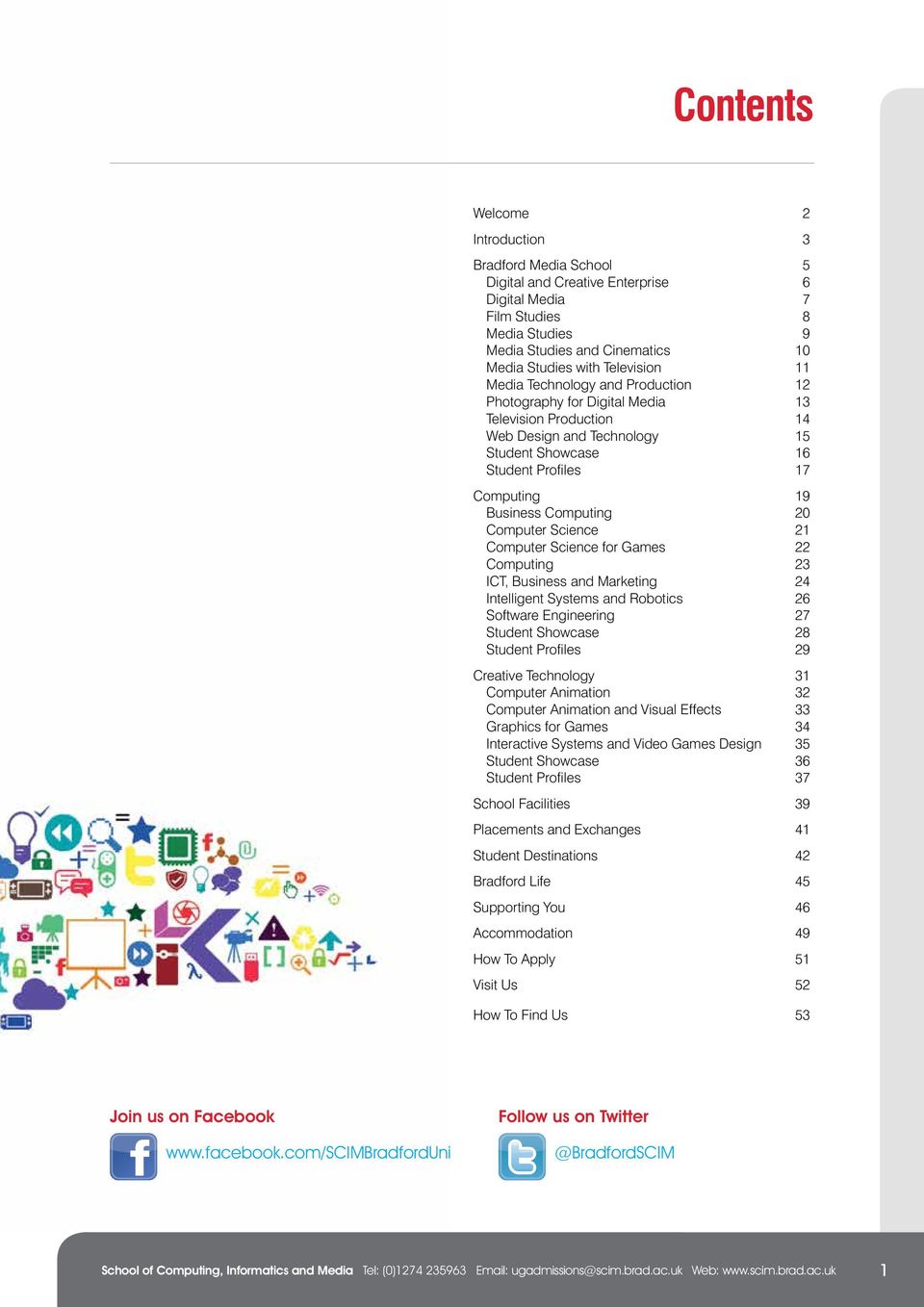
3 Contents Welcome 2 Introduction 3 Bradford Media School 5 Digital and Creative Enterprise 6 Digital Media 7 Film Studies 8 Media Studies 9 Media Studies and Cinematics 10 Media Studies with Television 11 Media Technology and Production 12 Photography for Digital Media 13 Television Production 14 Web Design and Technology 15 Student Showcase 16 Student Profiles 17 Computing 19 Business Computing 20 Computer Science 21 Computer Science for Games 22 Computing 23 ICT, Business and Marketing 24 Intelligent Systems and Robotics 26 Software Engineering 27 Student Showcase 28 Student Profiles 29 Creative Technology 31 Computer Animation 32 Computer Animation and Visual Effects 33 Graphics for Games 34 Interactive Systems and Video Games Design 35 Student Showcase 36 Student Profiles 37 School Facilities 39 Placements and Exchanges 41 Student Destinations 42 Bradford Life 45 Supporting You 46 Accommodation 49 How To Apply 51 Visit Us 52 How To Find Us 53 Join us on Facebook Follow us on School of Computing, Informatics and Media Tel: (0) [email protected] Web: 1
4 Welcome The School of Computing, Informatics and Media has a long history of being at the forefront of new developments in the fields of computing and media. The definition of Informatics relates to the study of information, and we use this definition in its widest sense: our activities and courses cover areas as diverse as Computer Science and Media Studies. What underpins all these activities is the belief that information, its creation, processing, transmission and interpretation, is at the heart of everything that we do, from the development of the latest piece of software to the production of the next blockbuster movie. The School has a track record of developing innovative new interdisciplinary courses and being at the forefront of research across a range of areas. We were one of the first universities in the country to offer computer science degrees, broke new ground by creating a digital media programme with the National Media Museum and are part of the world s first Media Academy Network devised by Creative Skillset. We blend academic excellence with real-world practical skills, and this is shown by industry recognition of our programmes by professional organisations such as the British Computer Society. Our students regularly win awards for the work that they produce during their studies and go on to have just as successful careers. If you re interested in computer science, artificial intelligence, computer games, animation, visual effects, digital media, television, media or information technology of any kind, we re sure we have the right course for you. Please check our website at for the latest information. We hope that the information on these pages reflects this vision and will motivate you to learn more about us with a view to participating in our programmes. If you have an opportunity to visit us in person, you are assured of a warm welcome at our Open Days or Applicant Visit Days, or at other times. 2 School of Computing, Informatics and Media Tel: (0) [email protected] Web:

5 Introduction Welcome to the School of Computing, Informatics and Media undergraduate prospectus. At the University of Bradford, our core values of Making Knowledge Work and of sustainability are what will make your time here so valuable for years to come. Making Knowledge Work is not just about helping you into employment It means making your knowledge and skills work for the benefit of the world beyond university, and making what you learn here work for you at a personal level as well. Bradford Media School Bradford Media School is a leader in the teaching of digital media production and cultural and contextual studies of media. The School has the very latest in digital media and television production facilities, and our partnership with the nearby National Media Museum gives students privileged access to archives and exhibitions. Computing One of the largest schools in computing and computer applications in the UK, we are driving the revolution in computer applications in communications, business, health, science and industry with many of our courses accredited by the British Computer Society. Creative Technology We have a pioneering department with more than 10 years experience of being at the leading edge of computer graphics and interactive media technologies for animation, computer games, visual effects and computing applications. We are a certified Skillset Media Academy offering accredited industry-standard courses in television and interactive media We are a member of Games Republic which is an industry-led games network which supports the Yorkshire and UK games industry The BBC has a partnership with the University of Bradford to develop creative talent in the north of England We enjoy a unique partnership with the National Media Museum, allowing our students full access to the Museum s world-class archives, festivals and events We offer a number of courses accredited by the British Computer Society which is the leading provider for computing and information systems Bradford was designated as the first UNESCO World City of Film. This was to recognise Bradford s heritage of cinematic history and the city s contribution to the development of cinema School of Computing, Informatics and Media Tel: (0) [email protected] Web: 3

6 4 School of Computing, Informatics and Media Tel: (0) Web:

7 The Bradford Media School has a long and successful track record in providing courses in new media technologies and media studies, taking advantage of the up-to-date knowledge of the School s teaching and research staff and our links with industry. The courses are taught as part of the University s unique partnership with the National Media Museum, which boasts worldclass resources and archives, and the School is part of the Yorkshire and Humber Skillset Media Academy. We are also a BBC Partner which means our students get regular opportunities to work on live briefs and win BBC placements. All Bradford Media School courses develop your experience and understanding of the technologies that are creating the new generation of digital media You will study technical fundamentals, the integrated use of major current software packages, the conventions of key forms of digital media production, and the social and cultural contexts within which media products are distributed Significant and successful professionals working in the media are involved in course design and give regular lectures, tutorials and masterclasses If you wish, you may take the opportunity to spend a year out period of 12 months in appropriate employment or study overseas at one of our partner universities Our digital arts and media production facilities are state-of-the-art and include equipment for still and moving image creation, manipulation and output Students undertake professional-style production projects that replicate the creative industrial experience Students have access to a range of state-of-the-art broadcast television production and post-production facilities including a full HD outside broadcast truck and television studio Our degrees prepare you for a range of careers in media-related areas, and we are proud of our graduates achievements. Our first students graduated in 1994 and many are now important figures within the media industry in organisations such as the BBC, Channel 4, ITV and Endemol. Our alumni have worked on highprofile productions such as Big Brother, The X Factor and Doctor Who. The creative and technical skill to produce content across a variety of platforms is the underlying principle behind the Bradford Media School. Its media courses and activities offer opportunities to specialise, but all within the context of the modern media landscape. Ali Rashid Head of Department School of Computing, Informatics and Media Tel: (0) [email protected] Web: 5

8 BA Digital and Creative Enterprise 1-year conversion course bms.brad.ac.uk The Digital and Creative Enterprise programme is aimed at people who have already studied for two years in the field of digital media; for example, on a Foundation Degree or an HND. The course allows you to further develop your skills and knowledge of a wide range of digital media by undertaking major projects, both individually and in groups, working under the guidance of practising professionals. Alongside these projects you will have the opportunity to increase your knowledge in specific areas such as digital videography or multimedia, depending on your interests and previous experience. There is a strong emphasis on practical skills that will allow you to develop a portfolio of work you can use to demonstrate your skills and abilities to potential employers. The emphasis in this year is on media production; the business of planning, researching, executing and developing a major group project of professional quality. Whilst the course focus is audio-visual media, your work may include computer animation, multimedia, graphic design and web development. You will work as part of a carefully selected team and your project will form a significant part of your portfolio on graduation. Top-Up Degree Modules Creative Media Enterprise, Digital Arts: Engaging the Audience, Production Projects: Pre-production, Production and Post-production Options include: Individual Project Film and Media, Digital Videography UCAS Course Code: WW26 Entry Requirements: This course is available to students who have completed or are expected to complete an appropriate Foundation Degree or HND with at least 2 distinctions and 3 merits, and GCSE English and Mathematics at a minimum of grade C Interview: Applicants will be invited to attend an interview day and provide a portfolio of visual media and/or written work Facilities: Access to specialist media production computer suites, a range of digital imaging equipment and state-of-the-art media production facilities. Students will also have access to our HDTV Outside Broadcast Truck for experience of location production environments Graduate Destinations: Past students have worked in a range of industries including television, web and graphic design, marketing and public relations in the UK, Europe and overseas 6 School of Computing, Informatics and Media Tel: (0) [email protected] Web:

9 BSc Digital Media 3-year degree course bms.brad.ac.uk The Digital Media course is designed for students who wish to develop expertise in a full range of audio-visual media disciplines, working in the digital domain. On this course you will study the basics of image production and manipulation, multimedia and web, television and audio production. While the main emphasis is on content creation to produce a strong portfolio of work, the course also provides you with an extensive level of technical understanding, giving you a distinct advantage when competing for jobs. In addition, you will develop an appreciation of the social, cultural, and economic contexts within which new media are produced and circulated. You also work on a group project, normally for an external client, under the supervision of media industry professionals. Past projects have included students producing series of work for Bradford City Council s outdoor big screen and for the BBC short documentaries. Year 1 Degree Modules Conventions of Videography, Key Concepts in Media, Principles of Design for Media, Visual Literacy and Imaging, Issues in Web Development and Technology, Technical Fundamentals, Imaging and Design Year 2 Degree Modules Media Ethics: Compliance and Sustainability, Sound and Visual Media, Soundscapes, Multimedia Application Development, Storytelling for Multiple Platforms Options include: Broadcast Television, Photography Research and Practice Year 3 Degree Modules Creative Media Enterprise, Digital Arts: Engaging the Audience, Production Projects: Pre-production, Production and Post-production Options include: Design for Mobile Content, Digital Videography, Individual Project Film and Media UCAS Course Code: GW46 Entry Requirements: Entry onto this course will require 260 UCAS points, and GCSE English and Mathematics at a minimum of grade C Interview: Applicants will be invited to attend an interview and provide an accompanying portfolio of visual media and/or written work Facilities: Students will have access to stateof-the-art video production facilities including our broadcast HDTV studio and outside broadcast truck plus a range of design facilities and photographic equipment Graduate Destinations: Students have found work in web design, TV production, multimedia development, graphic design and many other fields of digital media including companies such as: BBC Education, Headland Media, Palma Pictures, and Attic Media School of Computing, Informatics and Media Tel: (0) [email protected] Web: 7

10 BA Film Studies 3-year degree course bms.brad.ac.uk Bradford Media School aims to provide an Honours degree programme which enables students to develop an integrated range of knowledge, understanding and skills in the field of film studies. Learning through critical engagement with film and media theory and cutting-edge production practices will enable you to apply these skills in professional, industrial, educational and academic contexts. Our Film Studies course will engage you on an intellectual level in the study of film and film-related materials and media in Bradford, the first UNESCO World City of Film. While this study of the cinematic arts will be largely theoretical, the course will also offer some complementary practical skills in digital film production. This combination of around 80% theory and 20% practice will enable you to develop a deeper understanding of the social, political and cultural impact of cinema, and the course aims to produce graduates who have an aesthetic sensibility as well as contextual knowledge of the institutions of film. Students can take advantage of our partnership with the National Media Museum, accessing the Museum s extensive archives and attending events such as the Timecode Seminar Series and the Bradford International Film Festival. Year 1 Degree Modules Conventions of Videography, Film Style and Language, Film Narrative and Genre, Key Concepts in Film Studies, Key Concepts in Media, Media Institutions Year 2 Degree Modules Factual Film and Television, British Film and Television Drama, Hollywood and Society, Media Ethics Compliance and Sustainability, Media Archaeologies Options include: Authorship in Film, International Media, Representations of Race in Film and TV Year 3 Degree Modules Dissertation Preparation and Write-up, Individual Project: Film, Media and World Cinema Options include: Realism and the Cinema, Philosophies of Media and Film, Alternative Film and Media, Digital Videography UCAS Course Code: P303 Entry Requirements: Entry onto this course will require 240 UCAS points, and GCSE English and Mathematics at a minimum of grade C Interview: Applicants will be invited to attend an interview day and provide a portfolio of visual media and/or written work Facilities: Access to the National Media Museum s extensive archives, resources and rare screenings. On-site specialist video production facilities, plus a range of media resources held within the University s extensive library collections Graduate Destinations: Graduates from the Film Studies degree have found work in areas such as education, teaching, academic research, film and media journalism, film distribution and exhibition, or film and television production 8 School of Computing, Informatics and Media Tel: (0) [email protected] Web:

11 BA Media Studies 3-year degree course bms.brad.ac.uk The Media Studies course takes a mixture of both traditional and new approaches to the study of media. Focusing partly on media institutions, histories, audiences, and tools for the analysis of media products, the course will also take advantage of the Department s up-to-date expertise in new media content creation and production in areas like television, photography, digital design and the web. On graduation, you should have a practical and critical understanding of the role of the media in today s society. An enormous amount of what we know comes to our attention through the media. A degree in Media Studies will help you make better sense of what s going on around you; this course gives you an invaluable insight into the ways in which our media work looking at a broad selection of areas, from the origins of the press, through the rise of radio and television, to the present expansion of new media and mobile communications. Our courses are for people who envisage a career in the media or related areas, or in other sectors such as education. All our courses address the latest developments in digital-media theory and practice and offer an opportunity to specialise in a specific area. Students can take advantage of our partnership with the National Media Museum, accessing the Museum s extensive archives and attending events such as the Timecode Seminar Series and the Bradford International Film Festival. Year 1 Degree Modules Conventions of Videography, Elements of Visual Media, Visual Literacy and Communication, Key Concepts in Media, Media Histories, Media Institutions Year 2 Degree Modules Media Archaeologies, Media Audiences, International Media Options include: Crime and Media, Factual Film and Television, Imaging and Design, Media Ethics Compliance and Sustainability, Sound and Visual Media, Soundscapes, Broadcast Television Year 3 Degree Modules Dissertation Preparation and Write-up Options include: Creative Media Enterprise, Digital Videography, Individual Project Film and Media, Photography Research and Practice, Computers and Music, Research Methods and Methodologies, Broadcast Television, Multimedia Application Development UCAS Course Code: P300 Entry Requirements: Entry onto this course will require 240 UCAS points, and GCSE English and Mathematics at a minimum of grade C. Interview: Applicants will be invited to attend an interview day and provide a portfolio of visual media and/or written work Facilities: Access to the National Media Museum s extensive archives and resources. On-site specialist video production, photography and digital design facilities, plus a range of media resources held within the University s extensive library collections Graduate Destinations: Media Studies can prepare you for a wide range of employment both in the media and in other sectors. Graduates from this course will have skills which will make them well suited to careers in television, radio, film, journalism, marketing, public relations, publishing and media consultancy. Recent graduates have also developed careers in teaching at school, college or university level, obtained various roles within the arts and museum sector, and developed their own business and consultancy services. This has included companies such as the National Media Museum, RM Education, On Lime and the BBC School of Computing, Informatics and Media Tel: (0) [email protected] Web: 9

12 BA Media Studies with Cinematics 3-year degree course bms.brad.ac.uk The University of Bradford has a long track record in offering courses in new media technologies, media production and media studies. The Media Studies with Cinematics programme looks at low-budget and art house digital video work, allowing students to show their creativity by breaking traditional conventions. The course is designed for students who wish to develop a critical understanding of the development and current status of media and cinema, the products that industries make and their audience. You will also study the major media production forms, taking advantage of Bradford Media School s state-of-theart media production facilities. This course will enable you to develop an integrated range of knowledge, understanding and skills in the media and cinematics field through critical engagement with media theory. Throughout the course you will cover a range of contemporary issues and historical developments in cinematic forms, languages, ethics, instructions and their relationships to their audience, commerce, nation and government. Bradford is the world s first UNESCO City of Film, and this along with our unique partnerships and collaborations with the BBC and National Media Museum (NMeM) provide our students with access to a wealth of industry experience and expertise, including access to the rich resources of the NMeM s film programmes and festivals. Year 1 Degree Modules Conventions of Videography, Elements of Visual Media, Key Concepts in Media, Media Histories, Media Institutions, Visual Literacy and Communication Year 2 Degree Modules Imaging and Design, Media Archaeologies, Media Audiences, International Media Options include: Hollywood and Society, Soundscapes, Media Ethics Compliance and Sustainability, Sound and Visual Media Year 3 Degree Modules Digital Videography, Dissertation Preparation and Write-up Options include: Creative Media Enterprise, Research Methods and Methodologies, Computers and Music, Multimedia Application Development, Broadcast Television UCAS Course Code: P3W6 Entry Requirements: Entry onto this course will require 240 UCAS points, and GCSE English and Mathematics at a minimum of grade C Interview: Applicants will be invited to attend an interview day and provide a portfolio of visual media and/or written work Facilities: Access to the National Media Museum s extensive archives and resources. On-site specialist video production, photography and digital design facilities, plus a range of media resources held within the University s extensive library collections Graduate Destinations: Recent graduates have worked in areas such as film, TV, education, marketing and public relations, working for companies such as National Media Museum, Channel 4 and Endemol 10 School of Computing, Informatics and Media Tel: (0) [email protected] Web:

13 BA Media Studies with Television 3-year degree course bms.brad.ac.uk The Media Studies with Television course provides an opportunity to gain practical TV production work, including studio experience, camera work and editing whilst developing an in-depth theoretical knowledge of television. The course provides a mixture of both traditional and contemporary approaches, focusing on media institutions, histories, audiences and tools for analysis of media products. The course takes advantage of the School s extensive expertise in new media content creation and production technology in areas such as television, web design, digital media and photography. The combination of around 60% theory and 40% practice will enable you to develop a deeper understanding of the social, political and cultural impact of television, and the course aims to produce graduates who have practical production skills as well as an in-depth contextual knowledge of media and television. Throughout the course students produce work to high technical and aesthetic standards using discipline-specific skills to make informed judgements in the context of the rapidly developing and converging media industries. Students will also have access to our state-of-the-art television production and new media content creation facilities as well as exclusive access to the National Media Museum s extensive archives and resources. Year 1 Degree Modules Conventions of Videography, Elements of Visual Media, Visual Literacy and Communication, Key Concepts in Media, Media Histories, Media Institutions Year 2 Degree Modules Sound and Visual Media, Broadcast Television, Media Archaeologies, Media Audiences, International Media Options include: Factual Film and Television, Media Ethics: Compliance and Sustainability Year 3 Degree Modules Creative Media Enterprise, Individual Project Film and Media, Dissertation Preparation and Write-up Options include: British Film and Television Drama, Photography Research and Practice UCAS Course Code: P301 Entry Requirements: Entry onto this course will require 240 UCAS points, and GCSE English and Mathematics at a minimum of grade C Interview: Applicants will be invited to attend an interview day and provide a portfolio of visual media and/or written work Facilities: Access to the National Media Museum s and University s extensive archives, collections and resources. On-site specialist video production, photography and digital design facilities, including our full-scale outside HDTV broadcast vehicle and television studio Graduate Destinations: Graduates will have skills which will make them well suited to careers in television, radio, film production, journalism and marketing. Other students have progressed into teaching at schools, colleges and universities or have gone onto work in the arts and museums sector. This has included companies such as Channel 4, Endemol, Talkback Thames and the BBC School of Computing, Informatics and Media Tel: (0) [email protected] Web: 11

14 BSc Media Technology and Production 3-year degree course bms.brad.ac.uk The Media Technology and Production course focuses on the business of media production with an emphasis on television. It covers the generation of ideas, through the stages of proposal writing, development and management of the production processes. A large proportion of the teaching on the course, especially in the final year, is done by practising media professionals, and the course aims to duplicate as closely as possible the aesthetic values and technical standards that you will encounter in industry. In the first year you will study a number of core modules covering the theory of media analysis and design and introducing you to the technical tools and skills which you will use throughout the course. This is continued in the second year with the addition of courses covering practical skills and project management. The emphasis in the final year is on production itself; the business of planning, researching, executing and developing a major group project of professional quality. Whilst the course focus is audio-visual media, your work may include computer animation, multimedia, graphic design and web development. You will work as part of a carefully selected team and your project will form a significant part of your portfolio on graduation. Many recent student productions have won awards and critical acclaim from industrial bodies including the Royal Television Society: bms.brad.ac.uk/showcase/ Year 1 Degree Modules Conventions of Videography, Key Concepts in Media, Principles of Design for Media, Issues in Web Development and Technology, Visual Literacy and Communication, Technical Fundamentals, Editing Year 2 Degree Modules Media Ethics Compliance and Sustainability, Sound and Visual Media, Soundscapes, Broadcast Television, Storytelling for Multiple Platforms Options include: Media Archaeologies, Imaging and Design, Photography Research and Practice Year 3 Degree Modules Creative Media Enterprise, Production Project: Preproduction, Production and Post-production Options include: Design for Mobile Content, Digital Videography, Individual Project: Film and Media UCAS Course Code: HP63 Entry Requirements: Entry onto this course will require 260 UCAS points, and GCSE English and Mathematics at a minimum of grade C Interview: Applicants will be invited to attend an interview and provide an accompanying portfolio of visual media and/or written work Facilities: Students have access to a range of state-of-the-art broadcast television production and post-production facilities including a full HD outside broadcast truck and television studio Graduate Destinations: Recent graduates have found work as web designers and programmers, film and TV camera operators, editors, directors, producers and scriptwriters, television and radio presenters, graphic designers and new media consultants for organisations such as Orange, BBC, Channel 4, ITV, O 2, MTV, Warner Brothers and Endemol 12 School of Computing, Informatics and Media Tel: (0) [email protected] Web:

15 BA Photography for Digital Media 3-year degree course bms.brad.ac.uk Photography for Digital Media is designed to enable you to develop your creative flair in photography. You will study both the practical and theoretical aspects of Digital Photography in a variety of professional, creative and artistic contexts. On the course you will study both the practical application and critical theory of Digital Photography. You will learn to analyse the contexts and content of a rich variety of media artefacts which will give you the knowledge and skills necessary to appraise your own and others work and give you the background to think creatively. Extensive use is made of the National Media Museum (NMeM) photography archives including the Royal Photographic Society archive, the Kodak Collection, the Daily Herald archive and others. Students can also take advantage of visiting photography exhibitions at the museum and the Impressions Gallery in the city centre. Digital photography holds a unique and central position in relation to all other forms of digital media, and the programme s location within the Bradford Media School means that we are able to exploit these connections to their fullest. You will study specialist photography modules throughout the three years of the course in the context of digital media. This will give you opportunity to learn important skills in interactive web design, video production and design for print and mobile application. Year 1 Degree Modules Conventions of Photography, Conventions of Videography, Elements of Visual Media, Key Concepts in Media, Visual Literacy and Communication Year 2 Degree Modules Media Ethics: Compliance and Sustainability, Photographic Collaborations, Photography Research and Practice, Imaging and Design Options include: Factual Film and Television, Media Audiences, Digital Videography, Issues in Web Development and Technology, Media Archaeologies, Storytelling for Multiple Platforms Year 3 Degree Modules Creative Media Enterprise, Digital Arts: Engaging the Audience, Production Projects: Pre-production, Production and Post-production Options include: Dissertation, Design for Mobile Content, Digital Videography, Individual Project Film and Media UCAS Course Code: WP63 Entry Requirements: Entry onto this course will require 240 UCAS points, and GCSE English and Mathematics at a minimum of grade C Interview: Applicants will be invited to attend an interview and provide an accompanying portfolio of visual media and/or written work Facilities: Access to digital photography studios, specialist camera and lighting equipment and dedicated print facilities Graduate Destinations: Graduates from this course can expect to find work in any aspect of professional photography, digital design and media for organisations such as BBC and Fujitsu. Other students have progressed to work as successful freelancers, photojournalists and agency photographers School of Computing, Informatics and Media Tel: (0) [email protected] Web: 13

16 BA Television Production 3-year degree course bms.brad.ac.uk The Television Production course provides you with the opportunity to engage with television, both intellectually and practically, and to develop an aesthetic sensibility that will inform your production work. Increasingly graduates are required to be multi-skilled, so the course provides opportunities to engage in a wide variety of production roles. Most practical work takes place within the School s excellent high-definition broadcast television production facilities, including studio space and cameras with audio equipment, plus our HDTV outside broadcast unit for location shooting and a range of state-of-the-art post-production facilities. Professional actors are also provided for use within studio-based projects and scripted dramas. Extensive use is made of the National Media Museum (NMeM) archives, which hold more than 1,000 television programmes of historical and cultural value. Students have access to research material and curators who will facilitate a deeper understanding of television s cultural importance. Our partnership with the BBC enable students to attend workshops, masterclasses and gain experience of TV, radio and web production at Media City in Salford. Not only do students experience the activities at the BBC but they are also able to make valuable friends and industry contacts. The course will help you develop a strong portfolio of work demonstrating your understanding of television and appropriate transferable skills. Studying Television Production at Bradford is unique, combining a traditional university experience alongside engagement with the dynamics of a national museum and an international broadcaster. Year 1 Degree Modules Conventions of Videography, Key Concepts in Media, Media Histories, Issues in Web Development and Technology, Scriptwriting for Television, Editing Year 2 Degree Modules Factual Film and Television, Media Ethics Compliance and Sustainability, Sound and Visual Media, British Film and Television Drama, Broadcast Television, Storytelling for Multiple Platforms Year 3 Degree Modules Creative Media Enterprise, Dissertation Preparation, Dissertation, Production Projects: Pre-production, Production and Post-production Options include: Digital Arts: Engaging the Audience, Digital Videography, Individual Project Film and Media UCAS Course Code: P311 Entry Requirements: Entry onto this course will require 240 UCAS points, and GCSE English and Mathematics at a minimum of grade C Interview: Applicants will be invited to attend an interview and provide an accompanying portfolio of visual media and/or written work Facilities: Students have access to a range of state-of-the-art broadcast television production and post-production facilities including our HD outside broadcast truck and television studio Graduate Destinations: Recent graduates have found work as web designers and programmers, film and TV camera operators, editors, directors, producers and scriptwriters, television and radio presenters, graphic designers, new media consultants with major media organisations such as Palma Pictures, ITV, Channel 4, True North Productions and the BBC 14 School of Computing, Informatics and Media Tel: (0) [email protected] Web:

17 BSc Web Design and Technology 3-year degree course bms.brad.ac.uk Web Design and Technology involves the production of web-based projects on an individual and group basis. The course covers browser and server technology, wired and wireless network systems and graphic design for various platforms. The course will enable you to produce state-of-the-art web-based applications for desktop and mobile devices. You will examine the technology, socio-cultural and content-related issues concerning the current state and the future of the internet and competing delivery systems whilst working in teams on multi-platform projects. As a Web Design and Technology student at the University of Bradford, you will study how to make interactive and animated websites, with integrated sound and video including how to produce online games. In addition you will study key languages such as HTML, CSS and PHP to enable you to create dynamically driven sites. Students are also encouraged to explore mobile development for Android and iphone platforms. The course will cover all aspects of web design and technology including media theory to provide you with a theoretical context in which to place your own practical work. Year 1 Degree Modules Conventions of Videography, Key Concepts in Media, Issues in Web Development and Technology, Visual Literacy and Communication, Principles of Design for Media, Technical Fundamentals Options include: Multimedia Application Development Year 2 Degree Modules Media Ethics: Compliance and Sustainability, Design for Mobile Content, Computer Communications and Networks, SQL Programming and Administration, Web Design and Technology, Personal Web Project, Storytelling for Multiple Platforms Year 3 Degree Modules Individual Project: Film and Media, Creative Media Enterprise, Production Projects: Pre-production, Production and Post-production Options include: Deploying Web Technologies, Digital Arts: Engaging the Audience, Security, Privacy and Data Protection UCAS Course Code: GW4F Entry Requirements: Entry onto this course will require 260 UCAS points, and GCSE English and Mathematics at a minimum of grade C Interview: Applicants will be invited to attend an interview and provide an accompanying portfolio of visual media and/or written work Facilities: Specialist lab facilities equipped with high-spec dual monitor and dual boot Linux and Windows machines Graduate Destinations: Recent graduates have found work as web designers and graphic designers and new media consultants with major media organisations such as BBCi, TotalJobs.com, CTi, Attic Medic and the NHS, whist other graduates have set up their own web design agencies or work as freelancers School of Computing, Informatics and Media Tel: (0) [email protected] Web: 15

18 16 School of Computing, Informatics and Media Tel: (0) Web:

19 Student Profiles The University offers free up-to-date industrialstandard equipment as a loan and the facilities within the University are there for access whereever needed. I m also working with the University on projects to help gain further experience. Currently I am a student representative, Head Editor for Bradford University TV (YouBeTV) and the official photographer for Bradford Football Club. Taking into consideration there are only a number of universities in the UK which teach media-related subjects, the University of Bradford was one of the best choices for the type of course I was looking for with the mix of areas I wanted to expand on. Hamid Jamal I chose to study Digital Media because I wanted to learn about the various software packages that are used right across the industry. On the course there is a strong emphasis on content creation which really helps add to your portfolio for when you graduate. Bradford Media School hasn t disappointed. I ve learnt a lot since coming here and had many great opportunities in doing so such as working with the BBC and EMI. The staff are brilliant, lots of top people that have industry experience and are always willing to help. I ve never been stuck for an answer at Bradford. Oliver James Sunia Begum The course offered me variety, variety to study everything in the media sector, from graphics to web design. The course is amazing, much more practical and the staff are brilliant. The most amazing staff in Bradford Uni. The University of Bradford has one of the best atmospheres compared to any other universities. I love coming on a daily basis whether it s to study or to meet up with friends. So far I love the course, and I know that I have a lot more exciting stuff to look forward to in the upcoming semesters. Mohammed Shuheb The lecturers encourage us a lot to get this handson experience so when we leave University we have more skills to help us go into a job. I ve already had work experience on a radio show. The best thing about it is, I can do all the fun things in one course, not just film making but also photography, web design and more. The practical work has been challenging but also fun, just the right combination for a great course! Arfan Janjua Studying at Bradford has been a great experience, from week one I was able to enter a TV studio and work as a camera operator. The modules are very challenging, interesting but fun at the same time. The lecturers and tutors are amazing and are ready to help you at any point. There are plenty of opportunities for you, so far I ve been to a number of workshops including several at the BBC. Stefan Necula To find out more information about studying at Bradford see our full student profiles at: bms.brad.ac.uk/people School of Computing, Informatics and Media Tel: (0) [email protected] Web: 17

20 18 School of Computing, Informatics and Media Tel: (0) Web:

21 Modern business increasingly depends on information systems. Industry and the public services need graduates able to develop reliable, sophisticated, complex, cost-effective and high-quality computer systems. The Department of Computing courses cover the techniques and principles of computing that will allow you to become a professional in this high-demand area. You will undertake practical work throughout the course and this is underpinned by theory to enable you to make informed choices and decisions. The Department of Computing was one of the pioneers of computing in higher education in the UK and we are continuing to offer a wide spread of courses at undergraduate and postgraduate level as well as undertaking research to take our subject into the future. Our former students have gone on to employment in a wide variety of industries, and some are now our industrial and research collaborators. Emphasis is placed on the application of theory to the solution of real problems within industry and commerce, with practical work throughout the course The Department of Computing has its own network based on powerful servers running UNIX, accessed by Linux and Windows workstations. The system can also be accessed from across the campus and beyond All courses are available as either three-year continuous courses, or four-year sandwich courses with many of our courses accredited by the British Computer Society The main programming language used is Java, which supports object orientation, graphical user interfaces, concurrency and networking. Other industry-standard languages are also studied such as C#, C++, Haskell, Python and Ruby Most students share a common first year providing flexibility of study, depending on your chosen specialism Our dynamic, internationally-acknowledged staff develop new techniques for network performance, quantum computing, data mining, artificial intelligence, mobile computing, graphics, visualisation and computer games to help equip you with the skills you need for a career in the computing sector. All undergraduate courses are available with a sandwich option allowing for a year s work experience between the second and final year. Computing is changing our world, come and join us in making that change happen. We offer a wide range of courses with excellent facilities that we believe will give you the chance to make a difference to the future. Mick Ridley Head of Department School of Computing, Informatics and Media Tel: (0) [email protected] Web: 19
22 BSc Business Computing 3/4-year degree course computing.brad.ac.uk Business Computing aims to produce graduates who can become hybrid managers having both computing and management skills. Your time is divided between modern business and management skills and the fundamentals of computing. Specialised modules each year in business and management are provided at the University s prestigious School of Management. A range of computing and management options allows you to specialise in areas of particular interest to you and you will also undertake an individual computing project in the final year that can be related to management or business. Our course will equip you with high-level computing and business skills so you can take up computing management, administration and analysis posts in any sector of industry and commerce or continue your studies on one of the many Master slevel taught courses or research programmes offered within the School or the School of Management. Year 2 Degree Modules Database Systems, Network Business and Distributed Information Management, User Interface Development, Software Engineering with Group Project Work Options include: Marketing Management and Strategy, Psychology at Work, Resource Planning, Information Systems Analysis and Design, How to run an SME, Management of Service Operations, Marketing Communications Year 3 Degree Modules Final-Year Project Options include: Decision Support Systems, Deploying Web Technologies, Electronic Commerce, Ethics in Business and Society, Global Business Environment, Information Engineering, Retail and Services Marketing, Understanding Strategic Management, Applied Strategic Management, World- Class Operations, Human Resource Management, Advanced Database Systems, Marketing and Entrepreneurship, Artificial Intelligence for Games, International Business Strategy, Web Engineering UCAS Course Code: 3-year degree course: G510 4-year degree course: G511 Entry Requirements: Entry onto this course will require 240 UCAS points, and GCSE English and Mathematics at a minimum of grade C Placement: It is possible to take a one-year industrial placement as part of the course. For further information on placements please [email protected] Year 1 Degree Modules Introduction to Web Technologies, Formal Approaches, Software Development, Developing Professional Skills, Foundations of Human-Computer Interaction Options include: Business Economics, Foundations of Accounting, Organisational Behaviour, Foundations of Production/Operations Management, Introduction to Marketing, Sociology of Work Facilities: 24-hour access to the School s student labs with Tomcat, Apache, PostgreSQL and MySQL servers for student use Graduate Destinations: Recent employers of our graduates include Santander, Lombard Risk Management, HM Revenue and Customs and Lovell Development 20 School of Computing, Informatics and Media Tel: (0) [email protected] Web:
23 BSc Computer Science 3/4-year degree course computing.brad.ac.uk The BSc (Hons) Computer Science degree is the broadest and most popular of our courses. This cuttingedge programme aims to enable you to develop a thorough grounding in the fundamentals of computer science. You will gain an in-depth knowledge and expertise in the latest techniques concerned with the design and exploitation of modern computer technology. The course combines core modules with a range of options to develop your theoretical knowledge, practical skills and contextual understanding of computer systems from both hardware and systems software perspectives. Group work and modules specifically designed to deal with professional skills will enable you to put the computing theory into practice. This course offers the greatest flexibility of option choice in our suite of undergraduate programmes. Year 2 Degree Modules Computer Architecture and Systems Software, Computer Communications and Networks, Software Engineering with Group Project Work, Database Systems, User Interface Development Options include: Artificial Intelligence, Symbolic and Declarative Computing, Data Structures and Algorithms Year 3 Degree Modules Final-Year Project Options include: Advanced Rendering and Real-Time Graphics, Decision Support Systems, Deploying Web Technologies, Formal Methods, Neural Networks and Fuzzy Systems, Advanced Database Systems, Systems Administration, Unix Programming, Computer Graphics, Digital Image Processing, Artificial Intelligence for Games, Concurrent and Distributed Systems, Foundations of Cryptography, Real-Time Simulation Modelling, Real- Time Systems, Sustainable Computer Technology, Systems Administration, Web Engineering UCAS Course Code: 3-year degree course: G400 4-year degree course: G401 Entry Requirements: Entry onto this course will require 240 UCAS points, and GCSE English and Mathematics at a minimum of grade C Placement: It is possible to take a one-year industrial placement as part of the course. For further information on placements please [email protected] Facilities: Access to specialist lab facilities including dedicated Networking and System Administration labs Year 1 Degree Modules Introduction to Web Technologies, Software Development, Computer Architecture and Systems Software, Developing Professional Skills, Formal Foundations, Foundations of Human-Computer Interaction Graduate Destinations: Recent graduates from this course have gone on to work as systems administrators, software developers, project analysts, systems analysts and even company directors in companies such as Cap Gemini, FDM Group and National Savings and Investments. Other students have also progressed into various levels of teaching and research School of Computing, Informatics and Media Tel: (0) [email protected] Web: 21
24 BSc Computer Science for Games 3/4-year degree course computing.brad.ac.uk Computer Science for Games aims to develop computer scientists with a particular interest in games programming. The computer games industry employs multidisciplinary teams to design and develop computer games, but each specialist in the team needs an appreciation of the role of others, and a feel for the big picture. The aim of the course is to provide you with the theoretical base, and the tools and techniques which software developers need, regardless of their field of application, but placed within the interesting, practical context of games design. You will be taught fundamental modules that are essential to all computer scientists, such as software development, computer architecture and systems software in the first year, which are built upon in the second year, with study of data structures and algorithms, database systems, and computer networks. In parallel, the technical fundamentals and conventions of interactive systems and video games are introduced, and developed in Year 2 with topics such as technical animation and real-time 3D computer graphics. The final year consists of a major project, together with choices from a range of options, so that you may choose the particular area in which you are strong or wish to specialise, which builds on the knowledge and understanding gained throughout the course. Year 1 Degree Modules Introduction to Web Technologies, Computer Architecture and Systems Software, Developing Professional Skills, Principles of Design for Media, Software Development, History and Conventions of Computer Games Year 2 Degree Modules Database Systems, Script Programming and Technical Animation, User Interface Development, Computer Communications and Networks, Data Structures and Algorithms, Game Design Programming and Development, Real-Time 3D Computer Graphics for Games Year 3 Degree Modules Computer Animation and Special Effects, Final- Year Project, Concurrent and Distributed Systems, Computer Graphics and Systems Options include: Advanced Rendering and Real- Time Graphics, Physics and Dynamics Programming for Games, Artificial Intelligence for Games, Real- Time Simulation Modelling, Real-Time Systems UCAS Course Code: 3-year degree course: G452 4-year degree course: G451 Entry Requirements: Entry onto this course will require 240 UCAS points, and GCSE English and Mathematics at a minimum of grade C Placement: It is possible to take a one-year industrial placement as part of the course. For further information on placements please [email protected] Facilities: Access to development lab facilities and our Vicon Motion Capture suite Graduate Destinations: Graduates can look forward to an exciting career in Britain s fast-moving games industry, but also because of the increasing importance of multimedia and interactivity in the film, television, and communications industries you will find that there is potential for a career in all of these areas 22 School of Computing, Informatics and Media Tel: (0) [email protected] Web:
25 BSc Computing 1-year conversion course computing.brad.ac.uk The course provides a programme of computer science and related subjects with the flexibility to combine a range of core and option modules in related fields. The course will enable you to develop your knowledge, practical skills and understanding of computer systems from both hardware and software perspectives. The course provides a final one-year programme of computer science and related subjects with the flexibility to combine option modules from streams in networks and the web, artificial intelligence, security, software engineering, information systems, system administration and multimedia computing. The course extends the knowledge and skills of those who have previously studied advanced programmes like an HND or Foundation Degree and will provide you with an understanding of the current developments and issues in the design of computer systems and software. Top-Up Degree Modules Options include: Decision Support Systems, Deploying Web Technologies, Formal Methods, Information Engineering, Neural Networks and Fuzzy Systems, Security, Privacy and Data Protection, Advanced Database Systems, Artificial Intelligence for Games, Computer Graphics, Computers and Music, Concurrent and Distributed Systems, Digital Image Processing, Foundations of Cryptography, Web Engineering UCAS Course Code: G403 Entry Requirements: This course is available to students who have completed or are expected to complete an appropriate Foundation Degree or HND with at least 2 distinctions and 3 merits, and GCSE English and Mathematics at a minimum of grade C Facilities: Access to dedicated final-year lab facilities and specialist Master s project room Graduate Destinations: Graduates from our top-up courses have gone on to careers in areas such as software development, programming, systems administration, mobile computing, web development, IT support, IT analysis and teaching for companies such as Reapit Software, NatWest and Morrisons School of Computing, Informatics and Media Tel: (0) [email protected] Web: 23
26 ICT Pathways 3/4-year degree course computing.brad.ac.uk Information and Communications Technologies (ICT) plays an ever-increasingly important role in today s technological society and is crucial to the success and survival of businesses and organisations. ICT is about understanding and managing organisational information systems, and evaluating, developing and deploying effective, innovative and tailored solutions to information, communication and technology problems. Our highly rewarding programmes will develop your critical understanding of, and expertise in, the tools, packages, systems and networks that allow us to manage, translate and exchange secure information in the office and around the globe. BSc ICT The Information and Communications Technologies programme explores the way in which computers are able to support commercial and industrial life. Students will gain knowledge of the basis of the problems that users face and their solutions, both in terms of the technology, software and hardware and the human issues surrounding the use of computers. This is one of our most flexible programmes allowing you to specialise in topics like Networking or System Administration and focus on higher level Analysis and Deign skills. UCAS Course Code: 3-year degree course: G502 4-year degree course: G503 BSc ICT with Business There is a clear demand from employers for ICT graduates who are also well versed in business knowledge. On this course you will have the opportunity to integrate information technology solutions with business functions to meet the increasing information needs of modern commerce. This interdisciplinary programme covers key business and information management-related issues and draws on the combined expertise of the Department of Computing and the University s internationally renowned School of Management. UCAS Course Code: 3-year degree course: G5N1 4-year degree course: G5NC BSc ICT with Marketing Information and communications technology is central to modern marketing in terms of both gathering and utilising consumer information and effectively communicating marketing messages to targeted audiences. This programme is run in conjunction with the School of Management, and in addition to the core ICT subjects you will also cover key marketing-related issues and topics. Graduates from this course are equipped to develop ICT careers within marketing, advertising and public relations. UCAS Course Code: 3-year degree course: G5N5 4-year degree course: G5NM 24 School of Computing, Informatics and Media Tel: (0) [email protected] Web:
27 ICT Pathways All ICT Courses Year 1 Degree Modules Introduction to Web Technologies, Principles of Design for Media, Developing Professional Skills, Foundations of Human-Computer Interaction, Fundamentals of Computer Programming, Organisational Information Systems Year 2 Degree Modules ICT Group Project, Network Business and Distributed Information Management, SQL Programming and Administration, Computer Communications and Networks, How to run an SME, Information Systems Analysis and Design Year 3 Degree Modules Final-Year Project, Final-Year Project with Undergraduate Ambassadors Scheme (Schoolbased project), Deploying Web Technologies, Information Engineering, Web Engineering ICT Year 1 Degree Modules Media Histories, Relational Databases, Global Economic Issues Year 2 Degree Modules Options include: Business Information Systems, Systems Administration, Unix Programming Year 3 Degree Modules Options Include: Design for Mobile Content, Security, Privacy and Data Protection, Multimedia Application Development, Systems Administration ICT with Business Year 1 Degree Modules Business Economics, Foundations of Accounting, Relational Databases, Introduction to Marketing Year 2 Degree Modules Options include: Marketing Management and Strategy, Business Information Systems, Consumer Behaviour, Innovation, Marketing Communications Year 3 Degree Modules Options include: Electronic Commerce, Ethics in Business and Society, Global Business Environment, Marketing and Entrepreneurship, International Business Strategy, Marketing and Entrepreneurship, Strategic Information Systems ICT with Marketing Year 1 Degree Modules Business Economics, Foundations of Accounting, Relational Databases, Introduction to Marketing Year 2 Degree Modules Marketing Management and Strategy, Consumer Behaviour Options include: Innovation, Marketing Communications Year 3 Degree Modules Retail Marketing, Marketing and Entrepreneurship, Services Marketing Options include: Electronic Commerce, Ethics in Business and Society Entry Requirements: Entry onto these courses will require 240 UCAS points, and GCSE English and Mathematics at a minimum of grade C Placements: It is possible to take a one-year industrial placement as part of the course. For further information on placements please [email protected] Facilities: 24-hour access to the School s lab facilities including high-spec dual monitor and dual boot systems, offering both Windows and Linux systems. Access to specialists and tailored software specific to each course Graduate Destinations: Recent graduates have found work as Computer officers, Development analysts, IT analyst, IT engineer, Network support, Software consultant, Software engineer, Technical sales assistant, Website developer, and Web programmers. In addition graduates have found careers within marketing, advertising, public relations, business and commercial sectors from a range of companies including Blockbuster, Lewis Group, Royal Bank of Scotland and Morrisons. Other students have also entered into various levels of teaching and research School of Computing, Informatics and Media Tel: (0) [email protected] Web: 25
28 BSc Intelligent Systems and Robotics 3/4-year degree course computing.brad.ac.uk We are on the edge of a new lifestyle revolution through the development of robotic structures which will provide support in many aspects of our lives at home, at work and on transportation systems. This course will introduce you to the combination of artificial intelligence and robotic systems that are making that revolution possible. Intelligent Systems and Robotics is the study of computers simulating human intelligence within robotic control structures. The course will enable you to gain a physical connection to this behaviour, allowing you to build these structures simulating human senses including touch, sight and sound. If you have an interest in computers together with an interest in how things work and are controlled, especially within the field of artificial intelligence, and want to be at the forefront of the next technological revolution, then this course is for you. You will gain an understanding of the basic mechanics, electrical sensors, programming and computers at the heart of any robot. You will learn how to create systems that control the small movements of a robot, and how these are delivered and controlled from a supervisory control command system. You will develop an understanding of the different contexts of robotic operation as autonomous systems operating over the internet or within a robotic community. Year 1 Degree Modules Software Development, Computer Architecture and Systems Software, Developing Professional Skills, Formal Foundations, Robotics, Electronics Application Project, Introduction to Signals Year 2 Degree Modules Robotics Applications, Sensors and Actuators, Symbolic and Declarative Computing and Artificial Intelligence, Automation and Control, Digital Electronics Design, Robotic Systems Options include: Computer Architecture and Systems Software. Computer Communications and Networks, Embedded Systems, How to run an SME Year 3 Degree Modules Neural Networks and Fuzzy Systems, Final-Year Project, Intelligent Robotics Options include: Design for Mobile Content, Formal Methods, Artificial Intelligence for Games, Concurrent and Distributed Systems, Digital Image Processing, Real-Time Computing and Instrumentation, Real-Time Systems UCAS Course Code: 3-year degree course: GH76 4-year degree course: GH7P Entry Requirements: Entry onto this course will require 240 UCAS points, and GCSE English and Mathematics at a minimum of grade C Placement: It is possible to take a one-year industrial placement as part of the course. For further information on placements please [email protected] Facilities: Dedicated Robotics Lab and 24-hour access to the School s IT facilities and labs Graduate Destinations: Graduates have become robotics developers for the automotive, consumer electronics, healthcare, industrial cleaning, military, public safety or retail industries 26 School of Computing, Informatics and Media Tel: (0) [email protected] Web:
29 BEng Software Engineering 3/4-year degree course computing.brad.ac.uk Software Engineering will prepare you for challenging problems in industry and commerce concerned with large-scale software development and its reliability. You receive a thorough grounding in the fundamental theory of computer science, along with the knowledge of current best practice in the principles and methods of software engineering. Our course will prepare you to deal with some of the most challenging problems in industry and commerce concerned with software development and reliability. You will receive a thorough grounding in the fundamentals of computer science, and an opportunity to develop your expertise in the principles and methods of software engineering. You will be encouraged to develop your professionalism as a software engineer with an allembracing concern for software reliability, correctness, safety and cost that will help you to build a successful career in this vital sector. Year 1 Degree Modules Introduction to Web Technologies, Formal Foundations, Software Development, Computer Architecture and Systems Software, Developing Professional Skills, Foundations of Human- Computer Interaction Year 2 Degree Modules Computer Architecture and Systems Software, Computer Communications and Networks, Data Structures and Algorithms, Information Systems Analysis and Design, Network Business and Distributed Information Management, Database Systems, User Interface Development, Software Engineering with Group Project Work Year 3 Degree Modules Decision Support Systems, Deploying Web Technologies, Design for Mobile Content, Formal Methods, Information Engineering, Networks Performance Modelling and Analysis, Final-Year Project, Advanced Database Systems, Artificial Intelligence for Games, Concurrent and Distributed Systems, Foundations of Cryptography, Multimedia Systems, Real-Time Systems, Web Engineering UCAS Course Code: 3-year degree course: G601 4-year degree course: G602 Entry Requirements: Entry onto this course will require 240 UCAS points, and GCSE English and Mathematics at a minimum of grade C Placement: It is possible to take a one-year industrial placement as part of the course. For further information on placements please [email protected] Facilities: Specialist lab facilities equipped with high-spec dual monitor and dual boot Linux and Windows machines Graduate Destinations: Recent graduates have found careers in software development, engineering, development and analysis in business, industry and the public sector for companies such as JCK Ltd, NHS, Virgin Media and Software Solutions School of Computing, Informatics and Media Tel: (0) [email protected] Web: 27
30 28 School of Computing, Informatics and Media Tel: (0) Web:
31 Student Profiles Bradford has always kept in touch with the pace of changing technology, modules are adapted to include improving technologies in the world. For example I have recently completed a module in web technologies but it also incorporates upcoming future technologies. They keep changing and always try to implement that in the modules and teaching material. In terms of my placement, it was a really good decision to make. I was in my second year and debating whether I should do a web placement. When I started my placement I found out that there s a lot that I learnt at Uni but also how I can apply that to a work environment. It helped me to take direction as to what I need to focus on when I got back to the University. Grant Mbewe Alexandru Ardelean The lecturers are very helpful and the facilities are great: high-quality systems to which you have access 24/7 which helps motivate you to complete your coursework and start your own projects. The reason I chose this course was because I have a passion for Business and ICT. This course provided me with both the knowledge and experience in information technology solutions and within management. I have really enjoyed the course as I have learnt and I believe I have overcome several hurdles, improving my technical skills such as team working and report writing and theoretical skills in management and database management. My experience of dealing with the staff at Bradford has been flawless. They have always been there to help with a smile on their face. Farhan Butt The staff at the University of Bradford are very helpful and approachable. Whenever I have had any concerns, I felt comfortable in approaching my lecturers. I am certain that the facilities at Bradford are among the best in the country, particularly the labs, which offer computers with the very latest hardware and software. Overall, I have loved studying computer science. The course has provided me with vital skills, preparing me for the working world. Adil Jaura I chose this course due to my keen interest in technology, business and management. I felt this course allowed me to touch on all of these areas briefly rather than choosing to study a combined degree. I also felt it would give me useful skills in industry in the future due to technology being a large part of everyday life and business processes. The staff are all friendly and really helpful. Computing facilities are good too and nearly always available. Victoria Coble The staff members within the University of Bradford are extremely welcoming, helpful and would go out of their own way to ensure a student s satisfaction. The facilities such as computers are in abundance and are constantly improving to keep up with the latest technology. Usmaan Khan Dad To find out more information about studying at Bradford see our full student profiles at: computing.brad.ac.uk/people School of Computing, Informatics and Media Tel: (0) [email protected] Web: 29
32 30 School of Computing, Informatics and Media Tel: (0) Web:
33 The Department of Creative Technology focuses on the areas of computer animation and visual effects, games development and interactive media. Our ethos is to help you immerse yourself in these areas, and to encourage you to make your own contribution towards advancing them. After all, there s never been a better time to develop and utilise your creative talents. With today s technology, we can visualise impossible events and build worlds that bring our imagination to life. We can interact with fantastic environments that challenge us and connect us to global communities. Art, science, creativity and technology are all meeting head on, and this is having a profound impact on the way that we make sense of the world around us. All of the courses in the Department of Creative Technology develop your experience and understanding in a wide range of creative, technical and practical modules, which allow you to build up a strong portfolio of work within your chosen specialism Significant and successful industry professionals are involved in course design and give regular lectures, tutorials and masterclasses Students can undertake professional-style production projects that replicate the creative industrial experience Students utilise the most up-to-date animation and CGI facilities as part of their courses, such as Escape Studios Courseware and our Vicon 16-camera Motion Capture Suite We work closely with an extended family of industrial contacts, to stay on top of fast-moving developments and trends. We have excellent resources in the Department that match and often surpass what you ll find in the commercial sector. Whilst we deal with relatively new subjects, we have a long track record in these fields and were one of the first UK Universities to develop courses in computer animation and games. Since the early 1990s, we have always encouraged a blend of creative and technical know-how, embracing timeless principles and traditions, and forward-thinking innovation at the same time. If you wish, you may take the opportunity to spend a year-out period of twelve months in appropriate employment. Past placements have included Disney Interactive, Redstar and Jagex We have a unique partnership with the National Media Museum, which is home to Bradford Animation Festival (BAF) - one of the largest annual animation and games festivals in the UK. We co-host the BAF Game strand of this event on campus, giving students access to high-level industry talks and workshops Within our department we pride ourselves on combining traditional study with industry expertise. In our enriched learning environment, you will be able to learn the skills and techniques necessary to succeed in a highly competitive industry. Mark Goodliff Head of Department School of Computing, Informatics and Media Tel: (0) [email protected] Web: 31
34 BA Computer Animation 3/4-year degree course ct.brad.ac.uk Computer animation is a challenging but fantastically rewarding subject to pursue at degree level. Your studies begin with an introduction to 2D and 3D computer animation, immediately making use of industry-standard resources and familiarising yourself with the technologies of the trade. You will also be engaged with observational drawing, photographic and digital imaging, and visual communication theory. The second year of the course is also very practical, allowing students to: operate broadcast-quality video equipment whilst making a short film; work with motion-capture technology; composite graphics onto live action footage; and experiment with effective use of audio alongside your visual project work. Whilst your day-to-day studies will understandably be focused on computer animation and activities in support of it, you will also develop wider transferable skills that will help you get the most from your course and any career that you might choose beyond it. There are multiple opportunities to manage a project individually and within a team, to pitch and present your research and project work, and to critically analyse and be objective about your creations all of these are vital and timeless skills that will serve you well in an ever-changing employment market. Year 1 Degree Modules Introduction to 3D Computer Animation, Observational Drawing, Visual Literacy and Imaging, Conventions of Animation, Developing Professional Skills, 3D Character Modelling and Animation Year 2 Degree Modules Advanced Character Animation, Advanced Observational Drawing, Media Ethics: Compliance and Sustainability, Video Production, Animation Appreciation and Analysis, CGI Lighting, Rendering and Look Development, Computer-Generated Special Effects, Motion Capture Options include: Concept and Idea Development, Facial Modelling and Animation Year 3 Degree Modules Individual Project, Design for Industry Project Options include: Dissertation Write-up and Preparation, Individual Specialisation, Final-Year Project with Undergraduate Ambassadors Scheme (School-based placement), Facial Modelling and Animation, Concept and Idea Development, Motion Capture, Digital Videography UCAS Course Code: 3-year degree course: G450 4-year degree course: I701 Entry Requirements: Entry onto this course will require 240 UCAS points, and GCSE English and Mathematics at a minimum of grade C Placement: It is possible to take a one-year industrial placement as part of the course. For further information on placements please [email protected] Facilities: 24-hour access to specialist lab facilities including software such as the Autodesk suite consisting off Maya, Motion Builder and Mudbox and Pixologic Zbrush Graduate Destinations: Graduates will be well qualified to enter careers in computer animation and post-production, as well as working in animation departments in other fields such as the video games industry. Past students have worked for a range of industries including Disney Interactive, Aardman, BBC, Red Star 3D and The Moving Picture Company 32 School of Computing, Informatics and Media Tel: (0) [email protected] Web:
35 BSc Computer Animation and Visual Effects 3/4-year degree course ct.brad.ac.uk The use of computer-generated images (CGI) in video and film work is now so commonplace that hardly any project passes through the post-production phase without being manipulated in some way on a computer. It is a growing area of the television and film industry and there is an increasing demand for people with the necessary specialist skills. For more than a decade, the Computer Animation and Visual Effects (CAVFX) course has provided students with an opportunity to explore the technical and artistic aspects of these related fields. Graduates from the course are held in high regard by major companies in the UK and worldwide, and have worked on Oscar-winning films such as Avatar, Hugo and Inception. As with all Creative Technology courses, CAVFX mixes both theoretical, creative and technical skills. After broadbased core animation modules in the first year, you progress to specialist work in computer animation in which you study advanced techniques and their application with a variety of industry-standard software packages. Year 1 Degree Modules Introduction to 3D Computer Animation, 3D Character Modelling and Animation, Observational Drawing, Visual Literacy and Imaging, Developing Professional Skills, Conventions of Animation Year 2 Degree Modules 3D Matchmoving for VFX, Animation Appreciation and Analysis, CGI Lighting, Rendering and Look Development, Advanced Character Animation, Script Programming and Technical Animation, Video Production, Computer-Generated Visual Effects Options include: Technical Animation for VFX, Facial Modelling and Animation, Motion Capture Year 3 Degree Modules Individual Project, Design for Industry Project Options include: Individual Specialisation, Final- Year Project with Undergraduate Ambassadors Scheme (School-based placement), Motion Capture, Technical Animation for VFX, Facial Modelling and Animation UCAS Course Code: 3-year degree course: G443 4-year degree course: I700 Entry Requirements: Entry onto this course will require 260 UCAS points, and GCSE English and Mathematics at a minimum of grade C Placement: It is possible to take a one-year industrial placement as part of the course. For further information on placements please [email protected] Facilities: Access to range of specialist software including Autodesk Maya, Motion Builder and Mudbox, Vicon Optical Motion Capture and the Foundry s Nuke Graduate Destinations: Recent graduates have found work with major organisations such as Double Negative Visual Effects, Framestore, Weta Digital, Industrial Light & Magic, Pinewood Studios, Sony Computer Entertainment and Electronic Arts, and elsewhere in roles such as as: 3D Modellers, Editors, Graphic Designers and New Media Consultants School of Computing, Informatics and Media Tel: (0) [email protected] Web: 33
36 BA Graphics for Games 3/4-year degree course ct.brad.ac.uk Graphics for Games centres on the production of visual assets and artwork for use within games. In addition to the full range of topics covered by this course, you will also engage in practical drawing classes and will study theoretical modules that will enable you to develop your own creative work more thoughtfully. This approach can be taken as far as the final year if you wish, where you ll be able to produce a dissertation alongside your portfolio of project work, enabling you to develop practical work in a specialist area. You will learn the techniques and practices used in the production of games, as well as learning the skills used in pre-production and in the submission phases of game development. The course will explore how the technology of video games works and how the different elements fit together, giving you first-hand experience in making this work on your own projects. You will also learn how important game-play design is, and how your work and the work of others fit into the wider media market. To make your knowledge work in the real world you will also develop your presentation and communication skills and learn how to pitch and work effectively in teams, a skill essential to the modern game development industry. Year 1 Degree Modules Introduction to 3D Computer Animation, Observational Drawing, Visual Literacy and Imaging, History and Conventions of Computer Games, Developing Professional Skills, 3D Character Modelling and Animation Year 2 Degree Modules Advanced Character Animation, Advanced Observational Drawing, Game Appreciation and Analysis, Media Ethics: Compliance and Sustainability, Environment, Set and Prop Creation, Concept and Idea Development, Games Industry Studies Options include: Facial Modelling and Animation, Motion Capture Year 3 Degree Modules Individual Project, Design for Industry Project, Final-Year Project with Undergraduate Ambassadors Scheme (School-based placement) Options include: Dissertation Write-up and Preparation, Individual Specialisation, Facial Modelling and Animation, Individual Project, Motion Capture UCAS Course Code: 3-year degree course: GW42 4-year degree course: I630 Entry Requirements: Entry onto this course will require 240 UCAS points, and GCSE English and Mathematics at a minimum of grade C Placement: It is possible to take a one year industrial placement as part of the course. For further information on placements please [email protected] Facilities: Access to a range of specialist software including the Autodesk Suite, Mudbox, UDK and Adobe Creative Suite products Graduate Destinations: Graduates will have skills that will make them well suited to careers in commercial and indie game development, but due to the wide variety of skills learnt during the programme, possibilities exist in other fields such as multimedia development and computer animation. Recent graduates have worked for companies such as Rockstar Leeds, Play Fish, Blitz Games, Sony Computer Entertainment, Electronic Arts and Blizzard Entertainment 34 School of Computing, Informatics and Media Tel: (0) [email protected] Web:
37 BSc Interactive Systems and Video Games Design 3/4-year degree course ct.brad.ac.uk The video games industry now makes more money than films and DVDs combined. With gamer demographics continuing to change and grow, the market for games is getting bigger all the time. The hardware and software of games and gaming platforms is also expanding and diversifying into a range from high-spec home entertainment systems in high definition and stereoscopic 3D to smaller, powerful handheld and portable devices with accessible applications and digital distribution methods. The course examines the theory and practice of game play as well as user interface design, computer animation and graphics programming. Interactive Systems and Video Games Design (ISVGD) emphasises the development of theoretical as well as highly practical skills needed for indie game development and commercial game design, and is taught by staff with years of games industry experience. As an ISVGD student, you will study the history of games, strategy and AI, from traditional games such as chess through to the most sophisticated computer games. ISVGD students also learn how to design and develop complex real-time interactive software in a creative and inclusive environment. In the final year of the course you will put these skills into practice, working individually and as a team on production projects that involve the development of game levels and prototypes with live clients. Some of the previous years titles from our students are available on the Xbox Live Arcade platform. Year 2 Degree Modules Advanced Character Animation, Game Appreciation and Analysis, Game Design Programming and Development, Script Programming and Technical Animation, Environment, Set and Prop Creation, Introductory Computer Programming, Games Industry Studies Options include: Technical Animation for VFX, Facial Modelling and Animation, Multimedia Application Development, Real-Time 3D Computer Graphics for Games Year 3 Degree Modules Individual Project, Design for Industry Project Options include: Individual Specialisation, Final-Year Project with Undergraduate Ambassadors Scheme (School-based placement), Technical Animation for VFX, Facial Modelling and Animation, Multimedia Application Development, Real-Time 3D Computer Graphics for Games, Motion Capture, Artificial Intelligence for Games UCAS Course Code: 3-year degree course: G473 4-year degree course: I620 Entry Requirements: Entry onto this course will require 260 UCAS points, and GCSE English and Mathematics at a minimum of grade C Placement: It is possible to take a one-year industrial placement as part of the course. For further information on placements please [email protected] Facilities: Access to range of specialist software including Autodesk Maya, Unity Game Development Tool, Microsoft XNA, CryEngine, Unreal Development Kit and our Vicon Optical Motion Capture Suite Year 1 Degree Modules Introduction to 3D Computer Animation, History and Conventions of Computer Games, Technical Fundamentals, Visual Literacy and Imaging, 3D Character Modelling and Animation, Developing Professional Skills, Fundamentals of Computer Programming Graduate Destinations: Graduates of the ISVGD course can look forward to an exciting career in Britain s fast-moving games industry, but also because of the increasing importance of multimedia and interactivity in the film, television and communications industries you will find that there is potential for a career in all of these areas. Past students have worked for a range of industries including, Frontier Studios, Cogwork Studios, Blizzard Entertainment, Blitz Games, Rockstar Games and Codemasters School of Computing, Informatics and Media Tel: (0) [email protected] Web: 35
38 36 School of Computing, Informatics and Media Tel: (0) Web:
39 Student Profiles Peter Balogh I am glad I chose the University of Bradford because I have found it very helpful. Most staff on my course are from industry, so they can offer advice on how to develop my skills and get a job after I graduate. Sarah York I chose this course because I felt the modules covered the skills I might need to achieve a job as an animator. The University has great links and industry professionals working on the course and I must admit the motion capture studio definitely helped my interest! Dan Evans Steele Walker Pauls Kalnenieks The reason why I chose Bradford University was because it was part of the Skillset Academy, and only five Universities at the time were part of the Skillset group where you know what you are going to leave with was set industry standards The course is incredibly fun to be on mainly due to the staff, the staff are so easy to talk to and to learn from. They genuinely care about your progress. The facilities have every bit of software you could ever need and are very reliable. The course I chose allows you to develop a wide variety of skills and the tutors are very knowledgeable and insightful. The best thing is that you can approach them as a friend as well as a student. I found Bradford to be a great city for students, I like the University because it gives you lots of facilities, friendly staff and is also a nice place to have fun in your spare time. Last but not least that the Creative Technology Department is a great place to study at because of the high level of teaching as well as friendliness and the best equipment on the market to work and study on. In general, every aspect is made just right so you can get the best of the best. Razvan Hurduc Our tutors and guest lecturers have extensive experience of the industry from various fields from computing to stop motion animation. All push us to work hard and to achieve our goals. You get all of these contacts that you can use afterwards. There s a couple of us thinking about setting up a freelance company now, just from the uni labs and group work we ve done together. Ilze Kolosovska To find out more information about studying at Bradford see our full student profiles at: School of Computing, Informatics and Media Tel: (0) [email protected] Web: 37
40 38 School of Computing, Informatics and Media Tel: (0) Web:
41 School Facilities The School of Computing, Informatics and Media prides itself on its excellent facilities and resources available to both students and staff. This includes a range of industry-standard equipment as well as state-of-the-art studios, labs and technology. Outside Broadcasting Truck: The OBT offers broadcast-quality SD and HD outputs using five Thompson LDK6000 MkII cameras with a dedicated Final Cut edit suite and commentary booth. This facility is unique in UK higher education TV Production Facilities and Studio: Our purposebuilt television studio contains studio pedestals for broadcast TV cameras and a cold light studio system. For location work we have a range of Sony HD cameras, pro lighting kits and a full range of portable audio recording and mixing equipment Digital Arts and Editing Suites: Our Mac-based suites contain a range of packages including Final Cut Pro, AVID and Adobe Creative Suite with additional sound production facilities, graphics tablets, scanners and large format printers Chroma Key Studio: Our unique Chroma Key studio is used for special effects work and is equipped with specialist cameras, a full lighting rig plus both a blue, green and innovative grey screen systems Motion Capture Suite: Our 16-camera Vicon Optical Motion Capture system enables professional-standard editing acquisition of human body motion Animation and Games Lab: Our dedicated hub for final-year project work provides 30 high-end machines running industry-standard software with 24-hour access to promote group work and collaborative atmosphere between students Networking and Administration Lab: The lab contains skeleton PC Systems with bootable caddy drives allowing users to install various operating systems for project work Student Support: The Student Support Office provides a central School reception where students can receive information and guidance as well as submit work for assessment Photographic Studios: We have a dedicated black box studio with the Canon EOS range of Digital SLR cameras and a variety of tripods, flash units and lighting boxes Computing Labs: The School has excellent lab facilities with over 200 computers available 24 hours a day Student Breakout Areas: Breakout areas are used by students to relax in between lectures or to hold group meetings. Each area is equipped with vending machines, relaxed seating and open access PCs Animation and Games Viewing Suite: Our 3D TV viewing area is equipped to showcase student work and discussions. It holds a static console unit containing Xbox 360, PS3, Wii and retro games consoles plus a number of highspec test PCs Drawing Studio: Our drawing studio holds practical art classes to facilitate still life drawing. The studio is well equipped with easels and drawing materials as well as a wealth of objects for still life interpretations Technical Support: Technical Support maintain IT and support services across the School including our extensive equipment loans desk available to all current students School of Computing, Informatics and Media Tel: (0) [email protected] Web: 39
42 40 School of Computing, Informatics and Media Tel: (0) Web:
43 Placements and Exchanges Industry Placements Many of our courses are available both as a three-year continuous course or a four-year course incorporating a work placement year, normally between study years two and three. A work placement is invaluable for preparing you for the working environment, allowing students to apply skills learnt over the first two years of study in a professional workplace. This practical training gives students a fresh insight into academic work and often helps with career opportunities after graduation. Students undertaking a placement will be provided with a range of supervised work appropriate to their course. Past students undertaking a placement year have worked for various companies such as; Hewlett Packard, IBM, Dyson, Disney Interactive, Fujitsu, Lloyds TSB, Redstar, Jagex, West Yorkshire Fire Service and Siemens. Many placements offer both paid opportunities as well as voluntary work which can both greatly enhance your CV. A full schedule of sessions are provided for students undertaking a placement year including information and advice on job-seeking, sourcing a placement as well as application guidance. During the placement year students maintain regular contact with their supervisor through evidence logs and reports plus an assessment visit. On successful completion of a placement year students will be awarded an additional qualification, the Diploma of Industrial Studies, to recognise your achievements through industry experience. For further information on taking a placement year please [email protected] These experiences are fantastic ways to develop your character, there will be highs and lows. I m starting to realise that myself, and it s completely normal to go through. And that in essence is why if you ever get the chance to go on a Student Exchange, Do it! Oliver James, Study Abroad Scheme to Australia I would definitely recommend a placement to future students as this placement has shown me the world of work and opportunities that are out there. I have been given the opportunity to return to FDM after I graduate without having to go through the assessment process. I think within the IT industry it s as important to have experience as it is good qualifications to stand a chance of working with big organisations. Khurram Aziz FDM Group Erasmus and International Exchanges Studying abroad offers an exhilarating opportunity to combine your passion for travelling and learning. At Bradford we have many exciting study abroad options, including studying for a semester or one year in Australia, Canada, Europe, Hong Kong, New Zealand, Taiwan and the USA. Many of our students who have completed a study abroad programme describe it as a life-changing experience. It offers a great opportunity for you to travel and live in another country, and to make new friends and contacts. By immersing yourself in a different culture and overcoming the challenges that living and studying in a different environment brings, you will find yourself growing in maturity, confidence and self awareness. If you choose a country where English is not the native language, you will also be improving your fluency in speaking a foreign language. Employers also rate highly graduates who have participated in study abroad as they think it shows that you are more confident, resilient, independent and flexible. For further information please see our exchange website: to read Oliver s full blog visit our student blogs at: School of Computing, Informatics and Media Tel: (0) [email protected] Web: 41
44 Student Destinations The Sunday Times University Guide 2012 has ranked the University in the Top 20 for graduate-level jobs in the UK and as Number 1 in Yorkshire. The 2011 survey by the Higher Education Statistics Agency (HESA) showed that 88% of University of Bradford graduates went into employment or further study immediately after graduation. Our courses are designed with industry input, we work with national, international and local businesses. We support entrepreneurship for those who want help and support in starting or entering business, and maintain close links with potential employers, to help you get the graduate career you want. Once I came to the BBC and I had an interview, I went and read all the notes that I made at University and I still find today that the things that I learnt on the course helped me 100%. It s not just one thing that I do, I ll do anything from floor managing and they trained me on cameras in the studio. I sound mix the programme for Look North and various other programmes like the Super League Show and the Politics Show. I direct breakfast bulletins for Look North and graphic design. It wasn t just being there for three years, even after I finished I ve had postgrad support, I ve had s that have come through, tutors that had stayed in contact, even friends from the course. Some of them are working on radio stations, some of them are presenting and that s just from being on the Media Technology and Production course. I would encourage anyone to join the Bradford Media School, they are an absolutely fantastic team. Jai Limbachia Whenever you are getting into a particular course or a particular career you need to have something set in your mind. What s your plan? Are you going into the hardware side or the software side, you just can t go in with general skills. What I would say first, to anyone who wants to do Software Engineering, they need to learn the hardware side first. Because there is no point knowing how to build software to work for something when you don t even know how it starts off. If you pick a specific course to do, you get more out of it because you get into the course and you really learn the nitty gritties of everything rather than just doing it as an overview. They also seemed to be the only University around that offered Software Engineering as a specialist course. But the main thing that you really have to do, regardless of what University you go to, you have to have the heart. Jackeline Miarmi Last year In August I was made the lead lighting artist at RedStar Studios. The asset department basically models and creates all the different assets we need for film, and then we have the Animation Department and the Lighting and Rendering Department, and I am the lead Lighting Artist. At the end of the day what you want out of a university degree is a good job and that s what I ve got, so it definitely was a very good choice. The good thing about the course was, it allowed you to sort of go through all the different aspects of Computer Animation but at the same time there were modules structured in a way that would help you just focus on any one of those specific fields. I would say that no course alone on its own can help you to achieve anything, you as a person yourself have to really push hard. The courses are there, the facilities are there at the University. I m sure if you do make use of them, you will achieve whatever you want to. Haris Ahmed 42 School of Computing, Informatics and Media Tel: (0) [email protected] Web:
45 School of Computing, Informatics and Media Tel: (0) Web: 43
46 44 School of Computing, Informatics and Media Tel: (0) Web:
47 Bradford Life The City Bradford is perfectly placed, right in the middle of the UK, and with great transport links that mean you can go anywhere you like with ease, whilst living in the least expensive student city in the UK. Leeds is just 20 minutes away by train, the Dales and Manchester are within easy travelling distance for a day or a night out, and there are trains and coaches direct to London too. Meanwhile in Bradford itself there is art, music, theatre, history, clubbing and great food and drink from all over the world right on your doorstep, and at little expense. Bradford is a famously global city the perfect place to learn about other cultures, particularly during the annual Mela festival celebrating Asian culture, and through the many wonderful international restaurants and curry houses, which earned Bradford the title of Curry Capital of Britain But at the same time it has also been voted the most English city in the UK for its love of cricket, fish and chips and events like the annual beer festival, which is held in the beautiful UNESCO World Heritage Site of Saltaire. Bradford was the first of the two UNESCO Cities of Film (Sydney, Australia, is the other), and hosts an international film festival, animation festival and horror festival each year, with other film-related activities here for you to enjoy all year round. Bradford also offers a thriving cultural scene including the National Media Museum, with its huge IMAX screen, as well as galleries, theatres and museums of arts and technology. There are many more theatres and art galleries are plentiful, most within walking distance of the city campus. Annual street events and festivals within the area are always spectacular, bringing together residents and visitors to enjoy fabulous flavours and the benefits of living in a global community. The Campus The city campus is very close to the centre of Bradford and transport links, as well as being well equipped and developing all the time. New students will be among the first to use our new accommodation, The Green, and the brand-new Student Central where you ll find social and study spaces, bars and venues and the Students Union. On campus there is also a theatre, library, gallery, music centre, new gym, pool, and many places to eat and drink. As well as all of these new facilities, there is plenty of green space for you to enjoy on campus, the largest of which is the amphitheatre outside Student Central, which plays host to barbecues, sunbathing and events during summer and to sledging and snowball fights in winter. Students studying Management subjects are mainly based at the dedicated School of Management parkland campus a couple of miles away, which is home to both beautiful historic buildings and highly sustainable state-of-the-art facilities. Behind all of this is a commitment to sustainable living that has won our campus the award for Outstanding Contribution to Sustainable Development in The Times Higher Education Awards two years running. So you can study safe in the knowledge that you are helping to save the planet at the same time. School of Computing, Informatics and Media Tel: (0) [email protected] Web: 45
48 Supporting You For every single aspect of your student life at the University, there is a team of staff whose only role is to support you towards achieving your full potential. Enrolment and Courses: From the first time you arrive at the University, The Hub will support you through enrolment and any changes you want to make to your course. Finance: Explaining fees, helping you with budgets and advising you on dealing with other debts, we are always there to help you to understand and handle your finances. Counselling: Our discreet and friendly counsellors are here to help, and there is nothing too big or too small to talk through with them. Disability Services: Students with any extra needs will find that the Disability Services team are well equipped to help in all kinds of ways. International Office: With 2,000 international students studying at the University we are very experienced in understanding the extra support needed by our international students. Library and IT: WiFi is available in numerous places throughout our campuses. We have well-stocked libraries and computing facilities, which on the city campus are available for learning and research 24/7. Learner Development Unit (LDU): The LDU is here to support students with a range of academic skills with regular workshops and clinics held by our skills advisers. Faith: Due to the huge variety of backgrounds at the University, we have provision for various different faiths on campus. You will find societies, places of worship and staff dedicated purely to student faith. 46 School of Computing, Informatics and Media Tel: (0) [email protected] Web:
49 Arts on Campus: The arts are highly valued at the University; we have three major arts venues across campus including Tasmin Little Music Centre, Theatre in the Mill and Gallery II. Students Union: The University of Bradford Students Union (UBU) is home to services for all students covering support, help, sports, societies and volunteering opportunities. Our dedicated team of staff work directly for you as a student. Student Activities: We have over 60 societies you can join, 30 sports to be played, and many volunteering opportunities to suit you. Advice Centre: Staff are always on hand to help you with academic, financial, visa, personal and other issues. Career Development Services: The Careers Service offers a range of workshops and resources to help develop employability skills including practical help on CV writing, jobhunting skills and finding local part-time work whilst you are studying. Arts and Entertainment: At the Students Union we have our own student newspaper, radio station RamAir and the Bradford Student Cinema. We run regular activities such as freshers week, club nights, comedy nights, markets and our massive end of term party. Sports: If you enjoy sport, you will have lots of opportunity to follow your particular interest or to take up new ones. You will find excellent facilities at Unique: Fitness & Lifestyle offering a range of facilities for indoor and outdoor activities. School of Computing, Informatics and Media Tel: (0) [email protected] Web: 47
50 48 School of Computing, Informatics and Media Tel: (0) Web:
51 Accommodation For students living away from home for the first time, The Green aims to provide a welcoming and sociable environment, supporting an enjoyable and educational student experience. Opened in September 2011, The Green is based on the University s city campus, and puts students right at the heart of academic studies, student facilities, support and social activities. You will be guaranteed a place at our new student village, The Green, during your first year, if you apply before the specified time (full details are online). The Green is both a lovely place to live and an eco-friendly one as well. Buildings are arranged as a small village, with rooms available in apartments or townhouses. Every building there meets the highest standards of sustainability, meaning it costs very little to heat and light, and it makes the most of natural resources like solar power and rainwater. The Green has been designed with a community, village feel in mind. Whilst it is its own self-contained community it has great connectivity into the city campus and is within easy reach of the city centre, just a 5-minute walk. Regular bus services pass by the village into the city centre, Leeds and other parts of the Yorkshire Dales. The Green is a 40 million purpose-built student village in the heart of the city campus This groundbreaking scheme is a blueprint for ecofriendly living The Green has the highest accredited award for sustainable building development and operation It is the first BREEAM Outstanding student accommodation in the country At the centre of the Village is The Orchard which is a central hub building that has the Accommodation and Management office, and a launderette. The Orchard overlooks the central area and biodiversity pond. The pond, which reuses rainwater, provides a home for a number of animal and plant species and acts as a passive coolant in summer. There are lots of places to meet, socialise and relax within the attractive landscaped gardens which help create an enjoyable place to live. There are built-in barbecue sets, external seating and grassed areas. The Townhouses have patio doors at the back that lead onto grassed areas so really students have their own garden. There is also plenty of alternative and well-priced accommodation in houses and flats very close by, and we can help you to find what you want. For more details about what s available, and for costs, visit: School of Computing, Informatics and Media Tel: (0) [email protected] Web: 49
52 50 School of Computing, Informatics and Media Tel: (0) Web:
53 How to Apply Full-time study All applications must be submitted via UCAS s (Universities and Colleges Admissions Service) online facility. Your school or college will be able to advise you about making your application. Alternatively, full instructions can be found at UCAS also provides a comprehensive guide called Applying Online which can be downloaded from the same web address. If you are not currently at school or college, or have difficulty obtaining relevant literature, UCAS can be contacted directly: Tel: [email protected] Website: Part-time study Many of our courses are available as part-time study options, for further details on applying for part-time study please contact us at [email protected]. ac.uk International applicants International applicants living outside the UK (EU and worldwide) may obtain advice directly from UCAS or by contacting their nearest British Council Office or similar centre. The University of Bradford also has a dedicated International Office who can advise you. Further information can be found at: international UCAS Tariff Points GCE & VCE UCAS Tariff Progression IB Diploma points Diploma BTEC Nationals A Level & AVCE IB Points National National Diploma Certificate 360 DDD 350 A* DDM A DMM B 240 MMM DD 200 C MMP DM 160 MPP MM 150 D A* 140 A 120 PPP MP B 100 E C 80 PP D 60 E 40 This is a summary of the most commonly presented qualifications. Full details of all UCAS tariff-based qualifications, including Scottish and Irish qualifications, can be found at: School of Computing, Informatics and Media Tel: (0) [email protected] Web: 51
54 Visit us You ll find a vibrant community atmosphere on campus where students from different backgrounds, faiths, nationalities and ages becomes friends for life. Once you have visited our fantastic and welcoming campus and met our friendly staff and students, we know that you will want to stay. So book a place on one of our Open Days to see the University for yourself. We usually run open days in summer and autumn. For more details please check: openday Alternatively you can register to attend one of the School s Open Days which generally run between January and April. Further details can be found at: Bradford Media School: Computing: Creative Technology: Or by contacting us at: [email protected] Tel: Interview Days A number of our courses will require applicants to complete an interview as part of the admission process. Although the interview is a fairly informal event it does provide the basis of any offer that we make to you. The interview gives us the opportunity to meet you and discuss your reasons for applying for the course, giving you a chance to ask questions and inform us of any additional skills or experience you may have. It also gives you the opportunity to view our facilities, meet some of our existing students and experience the environment here at the University of Bradford. Applicants will be invited to bring with them to interview a portfolio of practical and/or written work that demonstrates skills in research, development and production. This work can be in any format or media, which may not be directly related to your chosen area of study and should showcase your creativity, imagination and your commitment to ideas and communication. School and College Visits We regularly hold school and college events and workshops on and off campus in areas such as Computing, Robotics, Animation, Games Design, Visual Effects, TV and Film Production, Media and Mathematics. If you are interested in planning a visit or hosting a talk please contact us for further details of our upcoming sessions. Education Events The School of Computing, Informatics and Media regularly attends a number of national and international education fairs and conferences each year, providing further information on our undergraduate, postgraduate and research opportunities. For further information on our upcoming events please contact us at [email protected] 52 School of Computing, Informatics and Media Tel: (0) [email protected] Web:
55 How to Find Us Coach Services connect most parts of the country to Bradford s Travel Interchange. Rail Bradford Interchange and Forster Square stations have extensive rail links, though many involve changing at Leeds. Approximate journey times are: London, King s Cross 3 hours Edinburgh 4 hours Birmingham 3 hours Manchester 1 hour York 1 hour Leeds 20 minutes National Media Museum There is a free city bus connecting Bradford Travel Interchange, Forster Square station and the city centre to the University. Road Bradford is connected to the national motorway network via the M62 and M606. Approximate distances are: London 200 miles (320 km) Edinburgh 200 miles (320 km) Birmingham 120 miles (192 km) Bristol 220 miles (352 km) Manchester 35 miles (56 km) Newcastle 95 miles (152 km) York 33 miles (53 km) Leeds 8 miles (13 km) We can arrange for this material to be transcribed into an accessible format such as Braille, large print, E-text (compatible with screen-reading software) or digital audio such as CD. Please contact the School of Computing, Informatics and Media. Tel: The University of Bradford Confronting Inequality: Celebrating Diversity The University of Bradford is committed to promoting equality, diversity and an inclusive and supportive environment for students, staff and others closely associated with the University in conformity with the provisions of its Charter. The contents of this publication are correct at the time of printing. The University reserves the right to alter or withdraw courses, services and facilities as described in this booklet without notice and to amend Ordinances, Regulations, fees and charges at any time. Students should enquire as to the up-to-date position when applying for their course of study. Admittance to the University is subject to the requirement that the student complies with the University s admissions procedures and observes the Charter and Statutes and the Ordinances and Regulations of the University. More detailed maps of the University campus are available on our website at: Produced by Marketing and Communications, University of Bradford Print Production: Inprint and Design, University of Bradford Air There are direct regular air services into Leeds/Bradford International Airport, 7 miles (11 km) from the University, from various cities around the UK and Ireland as well as from Amsterdam and other European locations. You can get from the Airport to the University by bus or taxi. Many internal and international flights can also be made into Manchester Airport, 50 miles (80 km) south-west of Bradford. 1649/2,000/09/2012 School of Computing, Informatics and Media Tel: (0) [email protected] Web: 53
56
Media and Photography
 Media and Photography The director calling lights, camera, action. The actors and actresses collecting all the gongs. The influential radio presenter playing the latest hits. They would all be nothing
University of Bradford. Creative Skillset
 UNIVERSITY OF BRADFORD Faculty of Engineering and Informatics School of Media, Design and Technology Programme title: BSc (Hons) Web Design and Technology Awarding & teaching institution: University of
BSc (Hons) Computer Games. Options in Art and Animation, Design, Software Development or Indie Development
 BSc (Hons) Computer Games Options in Art and Animation, Design, Software Development or Indie Development BSc (Hons) Computer Games Options in Art and Animation, Design, Software Development or Indie Development
School of Design. BA (Hons) Graphic and Communication Design
 School of Design BA (Hons) Graphic and Communication Design The information contained in this brochure is accurate at the date of publication. However, courses, University services and the content of this
School of Computing and Technology
 School of Computing and Technology We offer employmentfocused education and research in computing, the built environment and engineering, giving our students industry-relevant skills and knowledge. Applied
Foundation Degree in Animation and Creative Video. This programme is only offered at Barking & Dagenham College
 UNIVERSITY OF EAST LONDON UNDERGRADUATE PROGRAMME SPECIFICATION Foundation Degree in Animation and Creative Video Production This programme is only offered at Barking & Dagenham College Final award Intermediate
YOU THINK YOU MIGHT WANT TO STUDY:
 YOU THINK YOU MIGHT WANT TO STUDY: ANIMATION DIGITAL MEDIA DESIGN PRODUCT DESIGN VISUAL COMMUNICATION MOTION GRAPHICS 70 DESIGN & CREATIVE MEDIA Course LISTING Bachelor of Arts in Animation Bachelor of
UNDERGRADUATE PROGRAMME SPECIFICATION
 UNDERGRADUATE PROGRAMME SPECIFICATION Programme Title: Awarding Body: Teaching Institution: Final Awards: Intermediate Awards: Mode of Study: UCAS Codes: QAA Benchmarks: Music Business and Production Staffordshire
BSc (Hons) Computer Animation
 BSc (Hons) Computer Animation Programme Specification EDM-DJ-08/2014 Primary Purpose: Course management, monitoring and quality assurance. Secondary Purpose: Detailed information for students, staff and
School of Design. BA (Hons) Fashion Design
 School of Design BA (Hons) Fashion Design BA (Hons) Fashion Design at the University of Leeds The University of Leeds is a top civic university in the heart of one of the UK s most fashionable and student
www.bournemouth.ac.uk Jo Tyler Lecturer in Radio Production
 Jo Tyler Lecturer in Radio Production Webinar content Bournemouth University overview The Faculty of Media and Communication Our course portfolio Work placements Research Bournemouth University International
School of Design. BA (Hons) Graphic and Communication Design
 School of Design BA (Hons) Graphic and Communication Design BA (Hons) Graphic and Communication Design at the University of Leeds The University of Leeds is a top civic university in the heart of one of
PROGRAMME SPECIFICATION
 PROGRAMME SPECIFICATION Bachelor of Arts with Honours in Journalism Awarding institution Teaching institution UCAS Code JACS Code Programme Duration Language of Programme Subject benchmark statement Programme
Film and television Undergraduate
 Film and television Undergraduate I moved to London after graduating. I wanted to work in the film industry and was very lucky to be offered an unpaid internship. Then I became assistant to a producer,
Pearson BTEC Level 3 National Diploma in
 Pearson BTEC Level 3 National Diploma in Film and Television Production Film and Television Visual Effects Sound Production Digital Publishing Digital Games Design and Development Specification First teaching
HND Media Production. at Ashton Sixth Form College Validated by University of Salford Manchester. Guidance & Information
 HND Media Production at Ashton Sixth Form College Validated by University of Salford Manchester Guidance & Information Ashton Sixth Form College Higher Education Contents When are the deadlines?... 2 What
REVISED GRID FOR MICRO LEVEL APPROACH
 Cover sheet Country: Sector: Level: United Kingdom Bank EQF Level: 6 IT NQF Level: 6 Institution (private/state): Name of the study program : Duration (in years/months): University (state) BSc Computer
BIMM Course Specification
 Full title of the course & award BA (Hons) in Music Production Mode of attendance Full-time Length of course This course is taught as a three-year course at levels four, five and six. Start date Initial
UNDERGRADUATE PROGRAMME SPECIFICATION
 UNDERGRADUATE PROGRAMME SPECIFICATION Programme Title Awarding Body Teaching Institution Final Awards Intermediate Awards Mode of Study UCAS Codes QAA Subject Benchmarks JACS Code: QAA Subject Benchmarks:
LOUGHBOROUGH UNIVERSITY
 LOUGHBOROUGH UNIVERSITY Programme Specification Computer Science Please note: This specification provides a concise summary of the main features of the programme and the learning outcomes that a typical
LIVERPOOL HOPE UNIVERSITY FACULTY OF SCIENCE COMPUTER SCIENCE YOUR FUTURE STARTS WITH HOPE
 LIVERPOOL HOPE UNIVERSITY FACULTY OF SCIENCE COMPUTER SCIENCE YOUR FUTURE STARTS WITH HOPE 021015 Computer Science Fact File Faculty: Science Department: Mathematics and Computer Science Campus Location:
N/A. Art and Design CONTENTS. This programme specification contains the following components:
 UNIVERSITY OF EAST LONDON UNDERGRADUATE PROGRAMME SPECIFICATION BA (Hons) Degree in Animation This programme is only offered at Barking & Dagenham College Final award BA (Hons) in Animation Intermediate
Multimedia Systems Engineering
 Appendix 3.11 Multimedia Systems Engineering Major Profile MASSEY UNIVERSITY BACHELOR OF ENGINEERING with HONOURS Multimedia Systems Engineering Major Profile Description and Competency Framework 2009
UNIVERSITY OF EAST LONDON. UNDERGRADUATE PROGRAMME SPECIFICATION Foundation Degree in Animation. Alternative locations for studying this programme
 UNIVERSITY OF EAST LONDON UNDERGRADUATE PROGRAMME SPECIFICATION Foundation Degree in Animation This programme is only offered at: Barking & Dagenham College Final award Intermediate awards available Mode
Undergraduate 2015-16. Accounting programmes
 Undergraduate 2015-16 Accounting programmes 5 reasons why 1 2 3 4 5 You ll be taught by award winning* lecturers who are passionate about their subject and have a wealth of professional experience and
Department of Computer Science. BSc COMPUTER SCIENCE. At the forefront of today s digital world UNDERGRADUATE
 Department of Computer Science BSc COMPUTER SCIENCE At the forefront of today s digital world UNDERGRADUATE COMPUTER SCIENCE AT READING Join the next generation of computer scientists driving the digital
Postgraduate Computing at Goldsmiths
 Postgraduate Computing at Goldsmiths We aim to develop your creative as well as your technical skills. That s what makes computing at Goldsmiths so distinctive Key features Our range of Masters extend
PROGRAMME SPECIFICATION UNDERGRADUATE PROGRAMMES
 PROGRAMME SPECIFICATION UNDERGRADUATE PROGRAMMES KEY FACTS Programme name Creative Industries (Music Event Management and Production) Award Foundation Degree School School of Arts and Social Sciences Department
Programme Specification
 Programme Specification BA (Hons) Film Studies (Single and Combined Valid from: September 2012 Faculty of Design, Technology and Environment SECTION 1: GENERAL INFORMATION Awarding body: Teaching institution
BA (Hons) Photography course content
 BA (Hons) Photography course content Year One Year One modules Representation and Construction in Photography (80 credits) This first visual practice module presents you with some of the misconceptions
University of Sussex Informatics. our degrees. informatics MSc
 University of Sussex Informatics our degrees informatics MSc This booklet is designed to give you an outline of our MSc degree courses and modules. If you have any questions, please do not hesitate to
School of Design. BA (Hons) Fashion Marketing
 School of Design BA (Hons) Fashion Marketing BA (Hons) Fashion Marketing at the University of Leeds The University of Leeds is a top civic university in the heart of one of the UK s most fashionable and
Public Relations and Communications
 Public Relations and Communications BA Hons Greenwich Campus gre.ac.uk/business Why study this programme? The public relations (PR) industry has expanded rapidly in the last two decades. It is increasingly
Programme Specification. BSc (Hons) Sound Technology and Digital Music. Valid from: September 2012 Faculty of Technology, Design and Environment
 Programme Specification BSc (Hons) Sound Technology and Digital Music Valid from: September 2012 Faculty of Technology, Design and Environment SECTION 1: GENERAL INFORMATION Awarding body: Teaching institution
School of Design. BA (Hons) Textile Design
 School of Design BA (Hons) Textile Design BA (Hons) Textile Design at the University of Leeds The University of Leeds is a top civic university in the heart of one of the UK's most fashionable and student
Why study at Winchester?
 BA (Hons) Media and Communication BA (Hons) Media and Audio Communication BA (Hons) Media Communication and Advertising BA (Hons) Media Communication and Journalism BA (Hons) Media Communication and Social
Which courses is London College of Communication (LCC) phasing-out in 2013/14?
 Student FAQs on Course Closure Updated September 2012 Why is the LCC phasing-out some courses in 2013/14? LCC has considered its portfolio of courses over the last year, aiming to consolidate its portfolio
School of Design. BA (Hons) Fashion Marketing
 School of Design BA (Hons) Fashion Marketing Important Information The information contained in this brochure is accurate at the date of publication. However, courses, University services and the content
British Computer Society
 Faculty of Engineering and Informatics School of Electrical Engineering and Computer Science Programme Specification Programme title: BSc (Hons) Business Computing Academic Year: 2015-2016 Degree Awarding
Prospectus. Europe s New Home for Performing and Recording Arts Education Inspiring the next generation of international creative artists
 Prospectus Europe s New Home for Performing and Recording Arts Education Inspiring the next generation of international creative artists Working in partnership to secure validation Inspired and supported
Contents. Why choose Film Studies at Liverpool? 01 Degrees 03 Example student timetable 04 Module details 06 Honours Select 08
 Film Studies Contents Why choose Film Studies at Liverpool? 01 Degrees 03 Example student timetable 04 Module details 06 Honours Select 08 @livuni www.facebook.com/universityof Liverpool @livuni UofLTube
BA (Hons) Broadcast Journalism and BA (Hons) Print Journalism
 BA (Hons) Broadcast Journalism and BA (Hons) Print Journalism These degree courses share all modules except for the practical modules that are specific to either broadcast or print. There are no options
N/A. Computing, Engineering
 UNIVERSITY OF BRADFORD School of Engineering and Informatics School of Electrical Engineering and Computer Science Programme title: BEng (Hons) Software Engineering Awarding institution: Teaching institution:
LONDON SCHOOL OF COMMERCE. Programme Specification for the. Cardiff Metropolitan University. BSc (Hons) in Computing
 LONDON SCHOOL OF COMMERCE Programme Specification for the Cardiff Metropolitan University BSc (Hons) in Computing Contents Programme Aims and Objectives Programme Structure Programme Outcomes Mapping of
Film and Television Faculty
 Film and Television Faculty Academy of Performing Arts In Bratislava CONTACT Address Academy of Performing Arts in Bratislava (VŠMU) Ventúrska 3 813 01 Bratislava Slovakia Tel.: + 42 12 59 30 14 60 Fax:
Dublin City University Ollscoil Chathair Bhaile Átha Cliath
 Dublin City University Ollscoil Chathair Bhaile Átha Cliath DCU SCHOOL OF COMMUNICATIONS Postgraduate Study 2008 Graduates of the masters programmes in DCU School of Communications help our society tell
UNIVERSITY OF EAST LONDON UNDERGRADUATE PROGRAMME SPECIFICATION BA (Hons) Photography. This programme is only offered at: Barking & Dagenham College
 UNIVERSITY OF EAST LONDON UNDERGRADUATE PROGRAMME SPECIFICATION BA (Hons) Photography This programme is only offered at: Barking & Dagenham College Final award Intermediate awards available UCAS code Details
PROGRAMME SPECIFICATION KEY FACTS. Programme name Journalism AND Psychology. Department or equivalent Journalism. Total UK credits 360 Total ECTS 180
 PROGRAMME SPECIFICATION KEY FACTS Programme name Journalism AND Psychology Award BA (Hons) School School of Arts Department or equivalent Journalism UCAS Code CP85 Programme code UJJAPS Type of study Full
Psychology. Undergraduate
 Undergraduate Psychology Psychology encompasses a range of disciplines that share an interest in understanding how humans and other animals interpret and respond to their mental and physical world. It
UNIVERSITY OF BRADFORD School of Computing Informatics and Media Department of Computing Programme/course title: Computing
 UNIVERSITY OF BRADFORD School of Computing Informatics and Media Department of Computing Programme/course title: Computing Awarding and teaching institution: Teaching institute: University of Bradford
Undergraduate 2015-16. Business & Management programmes
 Undergraduate 2015-16 Business & Management programmes 1 2 3 4 5 5 reasons why You ll study at a top research-led University and gain an incisive and indepth understanding of business and how it works,
PROGRAMME SPECIFICATION
 PROGRAMME SPECIFICATION Bachelor of Arts with Honours (SW) in Marketing Awarding institution Teaching institution UCAS Code JACS Code Programme Duration Language of Programme Liverpool John Moores University
FACULTY OF MEDIA & COMMUNICATION. Wiltshire College Salisbury Media Production Undergraduate Framework:
 FACULTY OF MEDIA & COMMUNICATION Wiltshire College Salisbury Media Production Undergraduate Framework: BA (Hons) Photography BA (Hons) Film Production and Cinematography Version 2.0 FRAMEWORK SPECIFICATION
Course Specification. MSc Audio Engineering 2016-17 (MSADE) www.leedsbeckett.ac.uk LEEDS BECKETT UNIVERSITY
 LEEDS BECKETT UNIVERSITY Course Specification MSc Audio Engineering 2016-17 (MSADE) Our courses undergo a process of review periodically, in addition to annual review and enhancement. Course Specifications
Psychology. Further information Admissions and Course Enquiries T: +44 (0)1752 585858 E: [email protected]. 210 www.plymouth.ac.
 After graduating from Psychology with first-class honours, I completed an MSc in Research Methods and am now studying for a PhD that combines with marine biology, exploring the impact of coastal visits
Programme name Computer Science with Artificial Intelligence
 PROGRAMME SPECIFICATION KEY FACTS Programme name Computer Science with Artificial Intelligence Award BSc (Hons) School School of Informatics Department or equivalent School of Informatics UCAS Code G4G7
The Flying Start Degree Programme Henley Business School at the University of Reading
 The Flying Start Degree Programme Henley Business School at the University of Reading Start your degree Start your career Realise your potential BA Accounting and Business (NN41) Welcome This booklet will
Hertfordshire Higher Education Consortium Sports Studies
 Hertfordshire Higher Education Consortium Sports Studies Foundation Degree B A C Foundation Degree Foundation Degree What is a Foundation Degree? Foundation Degrees are university level degree courses
PROGRAMME SPECIFICATION POSTGRADUATE PROGRAMME
 PROGRAMME SPECIFICATION POSTGRADUATE PROGRAMME KEY FACTS Programme name Advanced Computer Science Award MSc School Mathematics, Computer Science and Engineering Department or equivalent Department of Computing
Programme Specification. BSc (Hons) Computer Games and Animation. Valid from: September 2012 Faculty of Technology, Design and Environment
 Programme Specification BSc (Hons) Computer Games and Animation Valid from: September 2012 Faculty of Technology, Design and Environment SECTION 1: GENERAL INFORMATION Awarding body: Teaching institution
ASTON UNIVERSITY PROGRAMME SPECIFICATION
 ASTON UNIVERSITY PROGRAMME SPECIFICATION Programme Title UCAS/JACS Code School/Subject Area Final Award Interim Awards Mode(s) of Study Normal Length of Programme Electronic Engineering and Computer Science
Technology-Enhanced Communication for Cultural Heritage (TEC-CH)
 82 Technology-Enhanced Communication for Cultural Heritage (TEC-CH) TEC-CH is a Master of Science in Communication designed to train the next generation of communication professionals using state-of-the-art
VISUAL COMMUNICATION NEWS
 SCHOOL OF ART & DESIGN VISUAL COMMUNICATION NEWS BA (HONS) ANIMATION BA (HONS) ART & DESIGN MEDIA PRACTICE (ONE YEAR TOP-UP) BA (HONS) GRAPHIC DESIGN BA (HONS) PHOTOGRAPHY FdA MEDIA CREATIVES IMAGES: FINAL-YEAR
PROGRAMME SPECIFICATION KEY FACTS. Programme name Journalism AND Sociology. Department or equivalent Journalism. Total UK credits 360 Total ECTS 180
 PROGRAMME SPECIFICATION KEY FACTS Programme name Journalism AND Sociology Award BA (Hons) School School of Arts Department or equivalent Journalism UCAS Code LP35 Programme code UJJASO Type of study Full
Marketing. BA Hons. Greenwich Campus. gre.ac.uk/business
 Marketing BA Hons Greenwich Campus gre.ac.uk/business Why study this programme? The BA Hons Marketing degree programme has been designed in consultation with employers and other important stakeholders,
Your course opportunities CENTRE FOR CAREER & PERSONAL DEVELOPMENT. Faculty of Education
 Your course opportunities CENTRE FOR CAREER & PERSONAL DEVELOPMENT Faculty of Education 2 Centre for Career & Personal Development A place for career building Faculty of Education Centre for Career & Personal
Birmingham City University Faculty of Computing, Engineering and the Built Environment. Undergraduate Programme. Programme Specification
 Birmingham City University Faculty of Computing, Engineering and the Built Environment Undergraduate Programme BSc (Hons) Digital Media Technology Date of Course Approval/Review Version Number Version
Management School. MSc/PG Dip/PG Cert. MSc Business and Management. University of Stirling Management School
 Management School MSc/PG Dip/PG Cert MSc Business and Management University of Stirling Management School I am passionate about helping our students to excel and achieve whatever they wish in their careers.
Advertising and Marketing Communications
 Advertising and Marketing Communications BA Hons Greenwich Campus gre.ac.uk/business Why study this programme? This programme concentrates on the skills and techniques associated with the specialist area
Programme Specification and Curriculum Map for BA (Honours) 3D Animation and Games
 and Curriculum Map for BA (Honours) 3D Animation and Games 1. Programme title BA (Hons) in 3D Animation and Games 2. Awarding institution Middlesex University 3. Teaching institution Middlesex University
PROGRAMME SPECIFICATION
 PROGRAMME SPECIFICATION Course record information Name and level of final award: Name and level of intermediate awards: The BSc (Hons) Computer Science is a B.Sc. BSc (Hons) Computer Science with Industrial
2. Basis for computing design and implementation at all levels through OS, distributed systems, human interface and computer graphics.
 School of Science 1 Awarding institution Bangor University 2 Teaching institution Bangor University 3 Programme accredited by BCS 4 Final award BSc (Hons) 5 Programme Science 6 UCAS code G400 7 QAA subject
BA (Hons) Graphic Design
 BA (Hons) Graphic Design Programme Specification EDM-DJ-08/2015 Primary Purpose: Course management, monitoring and quality assurance. Secondary Purpose: Detailed information for students, staff and employers.
University of the Arts London (UAL) BA (Hons) Games Design Art and Design Date of production/revision July 2015
 Programme Specification Every taught course of study leading to a UAL award is required to have a Programme Specification. This summarises the course aims, learning outcomes, teaching, learning and assessment
Journalism and Public Relations BA Hons
 SCHOOL OF HUMANITIES & SOCIAL SCIENCES Journalism and Public Relations BA Hons Greenwich Campus Journalism and Public Relations Programme information This degree is aimed especially at those interested
BRITISH HIGHER SCHOOL OF ART & DESIGN MOSCOW Mar 2013
 BRITISH HIGHER SCHOOL OF ART & DESIGN MOSCOW Mar 2013 Role title: Position: Lecturer / Senior Lecturer Graphic Design Full time Salary range: 34000 42000 Salary details: Responsible to: Monthly salary
Human Resource Management
 Human Resource Management BA Hons Greenwich Campus gre.ac.uk/business Why study this programme? Human resource management has been undergoing significant changes in recent years. The increased realisation
Fashion with Textiles Design BA (Hons) + Fashion Business BA. + Foundation in Fashion. Programmes are validated by:
 Fashion with Textiles Design BA (Hons) + Fashion Business BA (Hons) + Foundation in Fashion Programmes are validated by: WELCOME TO THE AMSTERDAM FASHION ACADEMY THE AMSTERDAM FASHION ACADEMY IS AN INTERNATIONAL
BSc (Hons) Computer Games Technology
 BSc (Hons) Computer Games Technology Programme Specification EDM-DJ-08/2015 Primary Purpose: Course management, monitoring and quality assurance. Secondary Purpose: Detailed information for students, staff
University of the Arts London (UAL)
 Programme Specification Every taught course of study leading to a UAL award is required to have a Programme Specification. This summarises the course aims, learning outcomes, teaching, learning and assessment
Hertfordshire Higher Education Consortium Graphic Design
 Hertfordshire Higher Education Consortium Graphic Design Foundation Degree B A C Foundation Degree Foundation Degree What is a Foundation Degree? Foundation Degrees are university level degree courses