
2 Identifying Minerals
|
|
|
- Sheena Melton
- 9 years ago
- Views:
Transcription
1 CHAPTER 5 2 Identifying Minerals SECTION Minerals of Earth s Crust KEY IDEAS As you read this section, keep these questions in mind: What are seven physical properties scientists use to identify minerals? What are five special properties some minerals have? How Do Scientists Identify Minerals? Earth scientists who study minerals are called mineralogists. Mineralogists identify and classify minerals. The main way a mineralogist identifies a mineral is by studying its properties. The seven main physical properties that mineralogists can use to identify minerals are shown below. Property Color Streak Luster Cleavage and fracture Hardness Crystal shape Density Description what color the mineral has in white light the color of a mineral when it is a powder how the mineral reflects light how the mineral breaks how difficult it is to scratch the mineral what kind of crystal the mineral forms the mass of a given volume of a mineral COLOR A mineral s color is one of the easiest properties to observe. However, the color of a mineral sample is generally not enough to identify the mineral. Different minerals can have the same color. For example, many different minerals are clear or white. In addition, different samples of the same mineral can have different colors. For example, quartz can be clear, purple, pink, or even black. STREAK If you grind a mineral into a fine powder, its color may seem to change. The color of a mineral in powdered form is known as the mineral s streak. You can see the color of a mineral s streak by rubbing the mineral against a tool called a streak plate. No matter what color they are, all samples of a given mineral have the same streak. READING TOOLBOX Summarize As you read this section, make two-column notes to summarize the mineral properties described in the section. Write the name of the property in the first column. Write a description of the property in the second column. If you wish, use drawings to help you remember the different properties. READING CHECK 1. Explain Why is color usually not enough to identify a mineral? Holt McDougal Earth Science 63 Minerals of Earth s Crust

2 Talk About It Research Use the Internet or library to find pictures of minerals with different lusters. Describe the luster of each mineral in your own words. Share your descriptions with a partner. READING CHECK 2. Describe What do minerals with a metallic luster look like? LUSTER Some minerals, such as pyrite, look shiny when light shines on them. Others, such as talc, look dull. These minerals look different because they reflect light differently. The way a mineral reflects light is called its luster. Some minerals look like polished metal. These minerals have a metallic luster. Galena, gold, and pyrite are examples of minerals with a metallic luster. Minerals that do not look like polished metal have a nonmetallic luster. Talc, quartz, and calcite are examples of minerals with a nonmetallic luster. Minerals with a nonmetallic luster may look greasy, like talc does. They may look bright and glassy, like quartz does. They may look pearly, like mica does. They may even look dull, as if they do not reflect light at all. Critical Thinking 3. Explain Why do people who cut minerals for jewelry need to know about a mineral s cleavage or fracture? CLEAVAGE AND FRACTURE If you hit a diamond in the right way, it will break along a smooth, flat surface. People who cut minerals to make jewelry must know how different minerals break. Minerals such as diamond that break along smooth, flat surfaces show the property of cleavage. Mica is another example of a mineral that shows cleavage. Mica breaks easily into thin, flat sheets. Some minerals, such as quartz, do not break along flat surfaces. Instead, they break unevenly. A mineral that breaks unevenly shows the property of fracture. Minerals that show fracture may form different shapes when they break. If the mineral breaks to form a rough surface, it has an uneven or irregular fracture. If the mineral looks like broken wood, it has a splintery or fibrous fracture. If the mineral forms a curved surface, it has a conchoidal fracture. Quartz shows conchoidal fracture. It breaks along a curved surface. Holt McDougal Earth Science 64 Minerals of Earth s Crust

3 HARDNESS AND THE MOHS SCALE You may have heard that diamonds are the hardest substance on Earth. This does not mean that diamonds are hard to break. When mineralogists talk about a mineral s hardness, they are talking about how difficult it is to scratch the mineral. Diamonds are the hardest minerals because no other mineral can scratch them. Mineralogists use a scale called the Mohs hardness scale to describe the hardness of a mineral. The Mohs scale is a list of 10 minerals. Each mineral is harder than the minerals below it on the scale. Therefore, each mineral will scratch all the minerals below it on the scale. You can use the Mohs scale to find the hardness of a mineral not on the scale. To do this, scratch the unknown mineral with each of the minerals on the scale. The mineral s hardness is higher than the hardest mineral it will scratch. It is lower than the softest mineral it will not scratch. For example, galena will scratch gypsum, but it will not scratch calcite. Gypsum s hardness is 2. Calcite s hardness is 3. Therefore, galena s hardness is between 2 and 3. The table below shows the Mohs hardness scale. It also describes some common tests you can do to identify the hardness of a mineral. READING CHECK 4. Define What do mineralogists mean when they talk about the hardness of a mineral? Mineral Hardness Common Test Talc 1 easily scratched by a fingernail Gypsum 2 can barely be scratched by a fingernail Calcite 3 can barely be scratched by a copper penny Fluorite 4 easily scratched by glass or steel Apatite 5 can barely be scratched by glass or steel Feldspar 6 scratches glass, but does not scratch steel Quartz 7 easily scratches glass and steel Topaz 8 scratches quartz Corundum 9 scratches topaz Diamond 10 scratches everything LOOKING CLOSER 5. Apply Concepts A particular mineral will scratch apatite, but not feldspar. What is the hardness of the mineral? CRYSTAL SHAPE Remember that a mineral always forms crystals of the same shape. There are six main crystal systems, or shapes. The table on the next page shows the crystal systems. Holt McDougal Earth Science 65 Minerals of Earth s Crust

4 Talk About It Make Connections Use a dictionary to look up the meaning of the prefix iso-. With a partner, discuss why cubic crystals are sometimes also called isometric crystals. Crystal System Isometric (also called cubic) Description The crystals have three axes. All three axes are the same length. They form 90 angles where they meet. axis Orthorhombic The crystals have three axes. All the axes are different lengths. They form 90 angles where they meet. Tetragonal The crystals have three axes. Two of the axes are the same length. The third axis is longer or shorter than the other two. The axes form 90 angles where they meet. LOOKING CLOSER 6. Compare What is the main difference between cubic crystals and orthorhombic crystals? Hexagonal The crystals have four axes. Three of the axes are the same length. They form 120 angles where they meet. The fourth axis is longer or shorter than the other three. Monoclinic The crystals have three axes. All three are different lengths. Two of the axes form 90 angles where they meet. 7. Compare What is the main difference between monoclinic crystals and triclinic crystals? Triclinic The crystals have three axes. All three are different lengths. None of the axes form 90 angles where they meet. Holt McDougal Earth Science 66 Minerals of Earth s Crust

5 DENSITY A mineral s density is the ratio of the mineral s mass to its volume. You can calculate density using the formula below. The most common units of density are grams per cubic centimeter (g/cm 3 ). Water has a density of about 1 g/cm 3. Math Skills 8. Calculate A mineral sample has a mass (m) of 85 g and a volume (V) of 34 cm 3. What is its density? density mass, or D m volume V The density of a specific mineral is always the same. Most minerals on Earth have densities between 2 g/cm 3 and 3 g/cm 3. Minerals that contain heavy metals, such as lead or gold, may have much higher densities. What Other Properties Can Minerals Have? Some minerals have special properties. Mineralogists can use these properties to identify the minerals more easily. The table below describes five examples of special properties. Property Fluorescence or phosphorescence Chatoyancy or asterism Double refraction Magnetism Radioactivity Description Minerals that glow under ultraviolet light have the property of fluorescence. Some samples of calcite show the property of fluorescence. If a mineral keeps glowing after the light is shut off, it has the property of phosphorescence. Some minerals look silky when light reflects off of them. These minerals have the property of chatoyancy. Asterism is a similar property. When light shines on a mineral with asterism, a six-sided star shape appears on the mineral. When light passes through some minerals, it is split into two rays. If you look at a picture or line through one of these minerals, it will seem to be doubled. This property is called double refraction. Calcite is an example of a mineral that shows double refraction. Some minerals will stick to magnets. Other minerals can act like magnets. These minerals have the property of magnetism. Lodestone is an example of a magnetic mineral. The atoms of some elements, such as uranium, are unstable. Over time, they break down into atoms of other elements. When they break down, they give off energy, such as X rays. Minerals that contain these elements also give off radiation. A mineral that gives off radiation has the property of radioactivity. Pitchblende is an example of a mineral that shows radioactivity. Talk About It Discuss Talk with a partner about other words you have heard that include the root aster. Make a prediction of what you think that root means. Use a dictionary to test your prediction. LOOKING CLOSER 9. Compare How is fluorescence different from phosphorescence? Holt McDougal Earth Science 67 Minerals of Earth s Crust

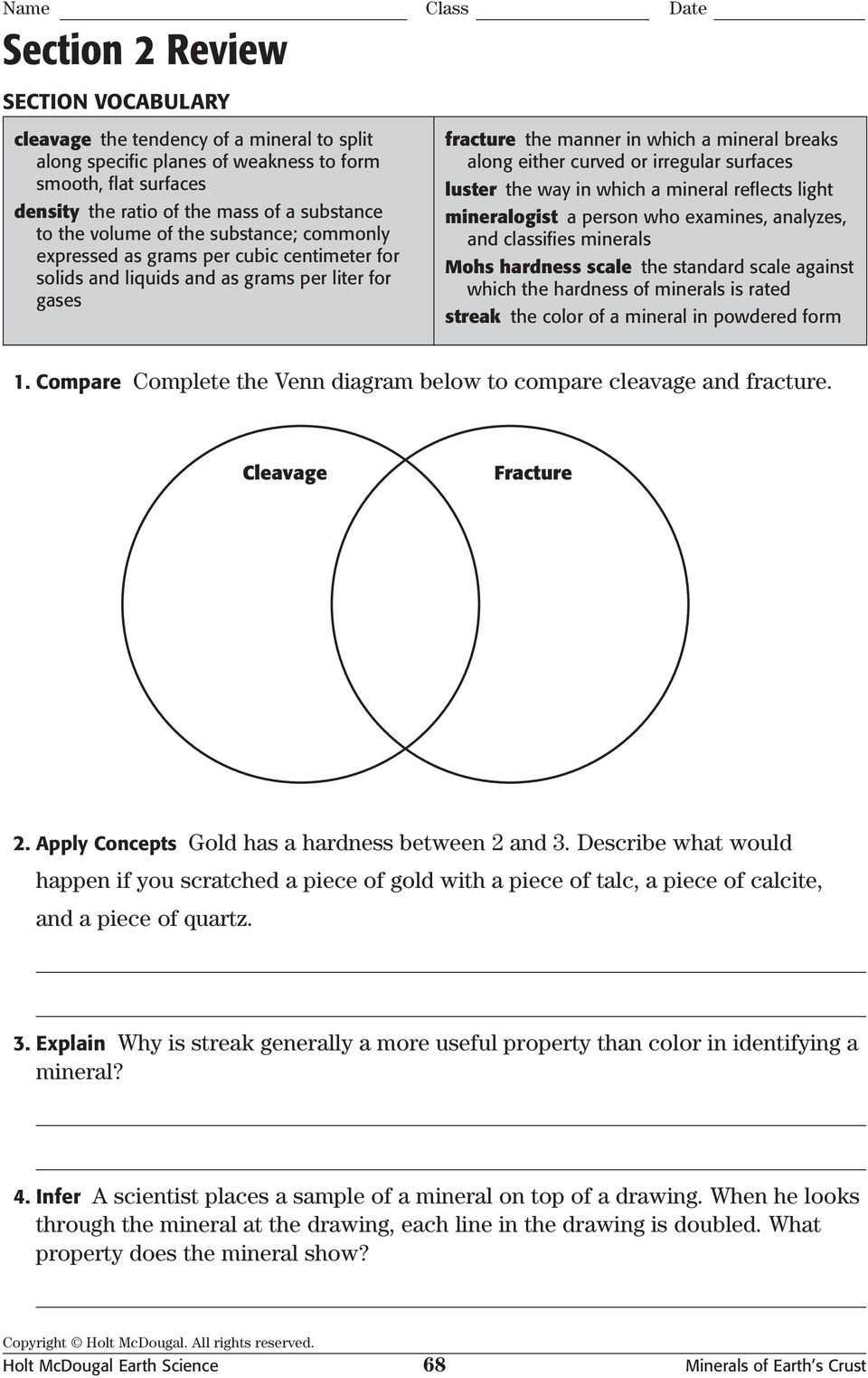
6 Section 2 Review SECTION VOCABULARY cleavage the tendency of a mineral to split along specific planes of weakness to form smooth, flat surfaces density the ratio of the mass of a substance to the volume of the substance; commonly expressed as grams per cubic centimeter for solids and liquids and as grams per liter for gases fracture the manner in which a mineral breaks along either curved or irregular surfaces luster the way in which a mineral reflects light mineralogist a person who examines, analyzes, and classifies minerals Mohs hardness scale the standard scale against which the hardness of minerals is rated streak the color of a mineral in powdered form 1. Compare Complete the Venn diagram below to compare cleavage and fracture. Cleavage Fracture 2. Apply Concepts Gold has a hardness between 2 and 3. Describe what would happen if you scratched a piece of gold with a piece of talc, a piece of calcite, and a piece of quartz. 3. Explain Why is streak generally a more useful property than color in identifying a mineral? 4. Infer A scientist places a sample of a mineral on top of a drawing. When he looks through the mineral at the drawing, each line in the drawing is doubled. What property does the mineral show? Holt McDougal Earth Science 68 Minerals of Earth s Crust
Mineral Identification
 Mineral Identification Name Notes Page Objectives Explain which mineral properties are most important in identification. Explain how to identify minerals by their properties. Classify some common minerals
Identifying Minerals
 Identifying Minerals All rocks are made up of minerals. Rocks have different colors, textures, and shapes. Some rocks or minerals are very hard. Some are soft. A gemstone is a mineral that is rare and
Name: Class: Date: Multiple Choice Identify the letter of the choice that best completes the statement or answers the question.
 Class: Date: Minerals Study Guide Modified True/False Indicate whether the sentence or statement is true or false. If false, change the identified word or phrase to make the sentence or statement true.
EARTH SCIENCE 110 INTRODUCTION to GEOLOGY MINERALS & ROCKS LABORATORY
 EARTH SCIENCE 110 INTRODUCTION to GEOLOGY DR. WOLTEMADE NAME: SECTION: MINERALS & ROCKS LABORATORY INTRODUCTION The identification of minerals and rocks is an integral part of understanding our physical
** Rocks are aggregates of one or more minerals ** 3. Hardness: A measure of resistance to scratching. On the Mohs Scale, it ranges from 1 to 10.
 Lab 2: Mineral Lab notes. Minerals are inorganic, solid, naturally occurring substances that have a characteristic chemical compositions, distinctive physical properties, and crystalline structures. Chemical
Objectives: Vocabulary: Materials: Students will: Safety: Element Mineral Streak. Absolute Hardness
 : Finding Clues Like a Scientist Author: Kris Poduska Date Created: 2000 Subject: Earth Science, Classification Level: Elementary and Middle School Standards: New York State- Intermediate Science (www.emsc.nysed.gov/ciai/)
FAIRLY SIMPLE MINERAL IDENTIFICATION EXERCISE. John J. Thomas
 FAIRLY SIMPLE MINERAL IDENTIFICATION EXERCISE John J. Thomas Purpose An exercise in the identification of minerals that uses minerals with very distinct characteristics. The students will learn the characteristics
Earth Materials: Minerals. Mineral Properties. Mineral Properties. Some optical properties. Three general categories:
 1 2 Earth Materials: Minerals What is a mineral? Properties/characteristics of different types of minerals Mineral structures and bonding Major categories of minerals Importance and uses of minerals What
LAB 2: MINERAL PROPERTIES AND IDENTIFICATION
 OBJECTIVES: LAB 2: MINERAL PROPERTIES AND IDENTIFICATION 1) to become familiar with the properties important in identifying minerals; 2) to learn how to identify the common rock-forming minerals. Preparatory
Identification of Rock forming mineral -Sean Tvelia-
 Identification of Rock forming mineral -Sean Tvelia- Minerals are the natural material that every inorganic material on planet Earth is composed of. They are the foundation of both our planet and most
Mineral Identification Tests. Test One: Density and Relative Mass
 Test One: Density and Relative Mass Some minerals are heavier than other minerals. This allows geologists to distinguish between them. Scale Graduated Beaker or Cylinder Water Examine each of the minerals.
Lab 3: Minerals. (2) Minerals are solids, therefore liquids and gases are not considered minerals.
 Introduction Minerals Minerals are the basic building blocks that make up the solid Earth. Therefore, any study of the solid Earth must begin with an understanding of minerals. A mineral, by definition,
Rocks & Minerals 1 Mark Place, www.learnearthscience.com
 Name: KEY Rocks & Minerals 1 KEY CONCEPT #1: What is a mineral? It is a naturally occurring, inorganic substance which has a definite chemical composition What would be the opposite of this? man-made,
Procedures for identifying minerals:
 Procedures for identifying minerals: 1. Separate metallic/earthy minerals from nonmetallic minerals. If you re not sure about the luster of the mineral, then it is probably nonmetallic. a. EARTHY AND METALLIC
Unit 8.3.1 Study Guide: Rocks, Minerals, and the Rock Cycle
 Name Date Per Unit 8.3.1 Study Guide: Rocks, Minerals, and the Rock Cycle I Can Statements I Can Statements are the learning targets for each unit. By the time you take the test for this unit, you should
Exploring Minerals. Targeted Objective: Identify properties of minerals and be able to identify certain minerals using specific tests.
 Exploring Minerals Grade Level: 3-4 Purpose and Goals: This lesson begins by guiding students to the connection between differences in rocks and the presences of minerals in the rocks. The differences
Chapter 1 MINERALS SECTION I: INTRODUCTION
 Chapter 1 MINERALS SECTION I: INTRODUCTION From the perspective of a gemologist a mineral is an exciting thing! Most gems are minerals and minerals even in their natural form can be quite beautiful and
FIFTH GRADE MINERALS 2 WEEKS LESSON PLANS AND ACTIVITIES
 FIFTH GRADE MINERALS 2 WEEKS LESSON PLANS AND ACTIVITIES WEEK 1. PRE: Describing a chemical reaction. LAB: Illustrating how molecules move. POST: Comparing salt and sugar crystals. ROCK CYCLE OVERVIEW
Rock Identification Lab
 Rock Identification Lab Name Mineral Hardness Objective: You will determine the relative hardness of common objects relative to the known hardness of index minerals. We will use fingernail, copper, glass,
Grade 9 Geography - Unit 3 Lesson 3 The Rock Cycle
 Grade 9 Geography - Unit 3 Lesson 3 The Rock Cycle What is the difference between a Rock and a Mineral? Minerals are homogeneous, naturally occurring, inorganic solids. Each mineral has a definite chemical
P1: Rock identification (I)
 P1: Rock identification (I) Examine the rocks specimens provided with the aid of these notes. All the rocks come from Ireland, as detailed on the attached map. Answer the short question on each specimen
Name: Rocks & Minerals 1 Mark Place, www.learnearthscience.com
 Name: Rocks & Minerals 1 KEY CONCEPT #1: What is a mineral? It is a, substance which has a What would be the opposite of this? KEY CONCEPT #2: What causes minerals to have different physical properties?
1 Exploring Earth s Interior
 1 Exploring Earth s Interior Crust Mantle Outer Core Crust-to-Mantle Inner Core Cross Section From Surface to Center SCIENCE EXPLORER Focus on Earth Science Prentice-Hall, Inc. 2 Evidence for Continental
Investigation 1-Part 1: Investigating Mock Rocks. Geology: the scientific study of Earth s history and structure
 Investigation 1-Part 1: Investigating Mock Rocks Geology: the scientific study of Earth s history and structure Geologist: a person who studies the Earth and the materials of which it is made Property:
Lab Activity on Minerals
 Lab Activity on Minerals 2002 Ann Bykerk-Kauffman, Dept. of Geological and Environmental Sciences, California State University, Chico * Introduction Rocks are made of many mineral grains stuck together.
Ex 10 Mineral Resources
 103 Exercise 10 Mineral Resources James S. Reichard Georgia Southern University Student Name Section In this lab you will: explore the connection between society and its use of mineral and rock resources.
Rocks & Minerals. 10. Which rock type is most likely to be monomineralic? 1) rock salt 3) basalt 2) rhyolite 4) conglomerate
 1. Of the Earth's more than 2,000 identified minerals, only a small number are commonly found in rocks. This fact indicates that most 1) minerals weather before they can be identified 2) minerals have
Properties of Minerals
 Some of the samples used in Mineralogy Lab are museum specimens. Please do not destroy them. You can do just about anything you want to the grungy ones, but be nice to the pretty specimens as they are
Chemical Weathering Lab. 4th grade PSI
 Chemical Weathering Lab 4th grade PSI Teacher s Notes: Having students conduct Mohs Hardness Test requires a lot of preparation. Rock samples and the materials used to test them need to be collected and
Crystal Optics of Visible Light
 Crystal Optics of Visible Light This can be a very helpful aspect of minerals in understanding the petrographic history of a rock. The manner by which light is transferred through a mineral is a means
LESSON PLAN FOR ROCKS AND MINERALS. Episode Six 306 Street Science (Earth Science)
 LESSON PLAN FOR ROCKS AND MINERALS Episode Six 306 Street Science (Earth Science) Science lessons come easily if you are along a stream bed or road cut. All around you are examples of sedimentary rocks,
Rocks and Minerals Multiple Choice
 Rocks and Minerals Multiple Choice 1. The basaltic bedrock of the oceanic crust is classified as (1) felsic, with a density of 2.7 g/cm3 (2) felsic, with a density of 3.0 g/cm3 (3) mafic, with a density
Rocks and Minerals. Reader. Students will
 Delta Science Reader Rocks and Minerals Delta Science Readers are nonfiction student books that provide science background and support the experiences of hands-on activities. Every Delta Science Reader
Geometry of Minerals
 Geometry of Minerals Objectives Students will connect geometry and science Students will study 2 and 3 dimensional shapes Students will recognize numerical relationships and write algebraic expressions
PHYSICAL PROPERTIES: GLASS. Forensic Science CC 30.07 Spring 2007 Prof. Nehru
 PHYSICAL PROPERTIES: GLASS Physical vs. Chemical Properties The forensic scientist must constantly determine those properties that impart distinguishing characteristics to matter, giving it a unique identity.
The measuring of the hardness
 The measuring of the hardness In the field of mechanics one often meets with the notion of "hardness", and in fact the hardness is a fundamental characteristic to determine whether a certain material is
XVI. Science and Technology/Engineering, Grade 5
 XVI. Science and Technology/Engineering, Grade 5 Grade 5 Science and Technology/Engineering Test The spring 2013 grade 5 Science and Technology/Engineering test was based on learning standards in the four
Mineral Identification
 Laboratory Manual for Physical Geology Mineral Identification Overview... 2 Materials Needed... 2 Scientific Definition of Minerals... 2 Physical Properties of Minerals... 5 Identification Process... 13
Chapter 3 Student Reading
 Chapter 3 Student Reading If you hold a solid piece of lead or iron in your hand, it feels heavy for its size. If you hold the same size piece of balsa wood or plastic, it feels light for its size. The
Presents the. Rock Test Study Resource
 Presents the Rock Test Study Resource Created by Simone Markus Published by EngLinks 1 Preface This is a free resource provided by EngLinks for students in APSC 151. This presentation is a supplementary
Chapter 1. Minerals and Mineraloids
 Chapter 1 Minerals and Mineraloids When most people think of minerals, they usually imagine expensive gemstones like diamonds, emeralds and sapphires, or economic minerals like silver, gold and copper.
rotation,, axis of rotoinversion,, center of symmetry, and mirror planes can be
 Crystal Symmetry The external shape of a crystal reflects the presence or absence of translation-free symmetry y elements in its unit cell. While not always immediately obvious, in most well formed crystal
After a wave passes through a medium, how does the position of that medium compare to its original position?
 Light Waves Test Question Bank Standard/Advanced Name: Question 1 (1 point) The electromagnetic waves with the highest frequencies are called A. radio waves. B. gamma rays. C. X-rays. D. visible light.
Physical and Chemical Properties of Materials
 Physical and Chemical Properties of Materials 40- to 2 50-minute sessions ACTIVITY OVERVIEW 14 L A B O R ATO R Y Students explore the properties of a wide variety of materials and examine the relationship
Assessment Plan for Geology 101 Lab (Online)
 Plan for Geology 101 Lab (Online) John Turbeville, Earth Sciences MiraCosta College Description of course: This is an optional companion laboratory course for Geology 101, which is a survey level class.
FIRST GRADE ROCKS 2 WEEKS LESSON PLANS AND ACTIVITIES
 FIRST GRADE ROCKS 2 WEEKS LESSON PLANS AND ACTIVITIES ROCK CYCLE OVERVIEW OF FIRST GRADE CHEMISTRY WEEK 1. PRE: Comparing solids, gases, liquids, and plasma. LAB: Exploring how states of matter can change.
Earth Science Grade 4 Minerals
 Earth Science Grade 4 Minerals Standards: Identifies the physical properties of minerals Teacher Background Minerals are pure substances and mix together to make rocks. Rocks have a cycle and different
Atoms and Elements. Atoms: Learning Goals. Chapter 3. Atoms and Elements; Isotopes and Ions; Minerals and Rocks. Clicker 1. Chemistry Background?
 Chapter 3 Atoms Atoms and Elements; Isotopes and Ions; Minerals and Rocks A Review of Chemistry: What geochemistry tells us Clicker 1 Chemistry Background? A. No HS or College Chemistry B. High School
Test Bank - Chapter 3 Multiple Choice
 Test Bank - Chapter 3 The questions in the test bank cover the concepts from the lessons in Chapter 3. Select questions from any of the categories that match the content you covered with students. The
This topic explores the key concepts of magnetism as they relate to: the phenomenon of magnetism magnetic forces and fields a theory of magnetism.
 Magnetism Introduction This topic explores the key concepts of magnetism as they relate to: the phenomenon of magnetism magnetic forces and fields a theory of magnetism. Key concepts of magnetism The activities
Mineral Examination. Logot: Heureka, Pencil, Ecsite, EU
 Mineral Examination Logot: Heureka, Pencil, Ecsite, EU This laboratory programme has been developed at Heureka, the Finnish Science Centre as a deliverable for the Work Package 8: Chemistry for Primary
SEDIMENTARY ROCKS. Sedimentary rocks are formed near or at the surface of the earth.
 SEDIMENTARY ROCKS Sedimentary rocks are formed near or at the surface of the earth. They are derived from preexisting source rocks. They are composed by sediments, this is material that has been weathered,
Science In Action 8 Unit C - Light and Optical Systems. 1.1 The Challenge of light
 1.1 The Challenge of light 1. Pythagoras' thoughts about light were proven wrong because it was impossible to see A. the light beams B. dark objects C. in the dark D. shiny objects 2. Sir Isaac Newton
Cluster 4: Rocks, Minerals, and Erosion
 Grade 4 Cluster 4: Rocks, Minerals, and Erosion Overview The study of rocks and minerals introduces students to geology. By examining various rocks and minerals found in the Earth s crust, students learn
DETERMINING THE DENSITY OF LIQUIDS & SOLIDS
 DETERMINING THE DENSITY OF LIQUIDS & SOLIDS 17 Density, like color, odor, melting point, and boiling point, is a physical property of matter. Therefore, density may be used in identifying matter. Density
Layers of the Earth s Interior
 Layers of the Earth s Interior 1 Focus Question How is the Earth like an ogre? 2 Objectives Explain how geologists have learned about the interior of the Earth. Describe the layers of the Earth s interior.
2 Wind Erosion and Deposition
 CHAPTER 3 2 Wind Erosion and Deposition SECTION Agents of Erosion and Deposition BEFORE YOU READ After you read this section, you should be able to answer these questions: How can wind erosion shape the
Mechanical Properties and Fracture Analysis of Glass. David Dutt Chromaglass, Inc.
 Mechanical Properties and Fracture Analysis of Glass David Dutt Chromaglass, Inc. IES ALC Williamsburg 2006 2 IES ALC Williamsburg 2006 3 Outline The Ideal The Practical The Reality IES ALC Williamsburg
Crystalline Structures Crystal Lattice Structures
 Jewelry Home Page Crystalline Structures Crystal Lattice Structures Crystal Habit Refractive Index Crystal Forms Mohs Scale Mineral Classification Crystal Healing Extensive information on healing crystals,
CHEM 150 Exam 1 KEY Name Multiple Choice
 CEM 150 Exam 1 KEY Name Multiple Choice Identify the letter of the choice that best completes the statement or answers the question. _B 1. Which of the following is synonymous with "fact"? a. a hypothesis
Buoyancy. What floats your boat?
 Buoyancy What floats your boat? Sink or float? Test The cube sinks to the bottom. WHY? Weight Due to the pulling force of gravity both the cube and the water have the property of weight. Gravity Gravity
Metals are located on the left side of the periodic table and are generally shiny, malleable, ductile, and good conductors.
 Section 1: are located on the left side of the periodic table and are generally shiny, malleable, ductile, and good conductors. K What I Know W What I Want to Find Out L What I Learned Essential Questions
Chapter 2 Measurement and Problem Solving
 Introductory Chemistry, 3 rd Edition Nivaldo Tro Measurement and Problem Solving Graph of global Temperature rise in 20 th Century. Cover page Opposite page 11. Roy Kennedy Massachusetts Bay Community
History of the Atom & Atomic Theory
 Chapter 5 History of the Atom & Atomic Theory You re invited to a Thinking Inside the Box Conference Each group should nominate a: o Leader o Writer o Presenter You have 5 minutes to come up with observations
How can you tell rocks apart?
 How can you tell rocks apart? Grade Range: 4-7 G.L.E Focus: 1.1.5 Time Budget: 1 1.5 hours WASL Vocabulary: Overview: Different rocks have different characteristics because of their minerals, the ways
Interaction at a Distance
 Interaction at a Distance Lesson Overview: Students come in contact with and use magnets every day. They often don t consider that there are different types of magnets and that they are made for different
Sorting Materials into Groups
 Sorting Materials into Groups 4 CHAPTER Tips and Tricks Objects around us have different shapes, colours and uses. They are made up of one or more materials such as paper, glass, plastic, cloth, wood,
Chapter 3, Lesson 4: Density: Sink and Float for Solids
 Chapter 3, Lesson 4: Density: Sink and Float for Solids Key Concepts The density of an object determines whether it will float or sink in another substance. An object will float if it is less dense than
Geometric Optics Converging Lenses and Mirrors Physics Lab IV
 Objective Geometric Optics Converging Lenses and Mirrors Physics Lab IV In this set of lab exercises, the basic properties geometric optics concerning converging lenses and mirrors will be explored. The
Physical Science Study Guide Unit 7 Wave properties and behaviors, electromagnetic spectrum, Doppler Effect
 Objectives: PS-7.1 Physical Science Study Guide Unit 7 Wave properties and behaviors, electromagnetic spectrum, Doppler Effect Illustrate ways that the energy of waves is transferred by interaction with
4S Archimedes Test for Density
 4S Archimedes Test for Density Density, or specific gravity of minerals is important in separating them. It is important to have a test for the density of mineral samples found at Snailbeach. Galena is
Friction and Gravity. Friction. Section 2. The Causes of Friction
 Section 2 Friction and Gravity What happens when you jump on a sled on the side of a snow-covered hill? Without actually doing this, you can predict that the sled will slide down the hill. Now think about
2 The Structure of Atoms
 CHAPTER 4 2 The Structure of Atoms SECTION Atoms KEY IDEAS As you read this section, keep these questions in mind: What do atoms of the same element have in common? What are isotopes? How is an element
Crystal Structure Determination I
 Crystal Structure Determination I Dr. Falak Sher Pakistan Institute of Engineering and Applied Sciences National Workshop on Crystal Structure Determination using Powder XRD, organized by the Khwarzimic
PERIODIC TABLE / STATIONS LAB
 PERIODIC TABLE / STATIONS LAB Name STATION 1 / REPRESENTATIVE ELEMENTS IN GROUPS 1 AND 2 Group 1 / What is the common name of this group? NOTE: Although Hydrogen is shown at the very top of this group,
DETERMINING WHICH COLOR UV BEAD CHANGES COLORS THE FASTEST
 DETERMINING WHICH COLOR UV BEAD CHANGES COLORS THE FASTEST Helen C Cary Academy ABSTRACT The purpose of this experiment was to determine which color UV bead changes colors the fastest. The bead colors
Chapter 1 Student Reading
 Chapter 1 Student Reading Chemistry is the study of matter You could say that chemistry is the science that studies all the stuff in the entire world. A more scientific term for stuff is matter. So chemistry
1 of 9 2/9/2010 3:38 PM
 1 of 9 2/9/2010 3:38 PM Chapter 23 Homework Due: 8:00am on Monday, February 8, 2010 Note: To understand how points are awarded, read your instructor's Grading Policy. [Return to Standard Assignment View]
Explore and Discover Materials Unearth the treasure game
 Explore the similarities and differences between different rocks, making comparisons and describing them. Use senses to explore and recognise different materials. Gallery visited (please see accompanying
ES 104: Laboratory # 7 IGNEOUS ROCKS
 ES 104: Laboratory # 7 IGNEOUS ROCKS Introduction Igneous rocks form from the cooling and crystallization of molten rock material. This can occur below the surface of the earth forming intrusive rocks
Energy and Energy Transformations Test Review
 Energy and Energy Transformations Test Review Completion: 1. Mass 13. Kinetic 2. Four 14. thermal 3. Kinetic 15. Thermal energy (heat) 4. Electromagnetic/Radiant 16. Thermal energy (heat) 5. Thermal 17.
EXAMPLE EXERCISE 4.1 Change of Physical State
 EXAMPLE EXERCISE 4.1 Change of Physical State State the term that applies to each of the following changes of physical state: (a) Snow changes from a solid to a liquid. (b) Gasoline changes from a liquid
Lesson 26: Reflection & Mirror Diagrams
 Lesson 26: Reflection & Mirror Diagrams The Law of Reflection There is nothing really mysterious about reflection, but some people try to make it more difficult than it really is. All EMR will reflect
EXPERIMENT O-6. Michelson Interferometer. Abstract. References. Pre-Lab
 EXPERIMENT O-6 Michelson Interferometer Abstract A Michelson interferometer, constructed by the student, is used to measure the wavelength of He-Ne laser light and the index of refraction of a flat transparent
Chapter Test A. Elements, Compounds, and Mixtures MULTIPLE CHOICE. chemically combined? MIXs2 a. element b. compound c. mixture d.
 Assessment Chapter Test A Elements, Compounds, and Mixtures MULTIPLE CHOICE Write the letter of the correct answer in the space provided. 1. What is a pure substance made of two or more elements that are
KINDERGARTEN PHYSICS
 KINDERGARTEN PHYSICS 3 WEEKS LESSON PLANS AND ACTIVITIES APPLIED SCIENCE OVERVIEW OF KINDERGARTEN SCIENCE AND MATH WEEK 1. PRE: Describing and comparing nests, birds, and eggs. LAB: Describing different
AP Physics B Ch. 23 and Ch. 24 Geometric Optics and Wave Nature of Light
 AP Physics B Ch. 23 and Ch. 24 Geometric Optics and Wave Nature of Light Name: Period: Date: MULTIPLE CHOICE. Choose the one alternative that best completes the statement or answers the question. 1) Reflection,
TESTING WHETHER THE TEMPERATURE OF A MAGNET WILL AFFECT HOW FAR ITS MAGNETIC FIELD IS
 TESTING WHETHER THE TEMPERATURE OF A MAGNET WILL AFFECT HOW FAR ITS MAGNETIC FIELD IS Kenan Balkas Cary Academy ABSTRACT The purpose of this experiment is about testing to see what the strengths will be
Measurement of Length, Mass, Volume and Density
 Measurement of Length, Mass, Volume and Density Experimental Objective The objective of this experiment is to acquaint you with basic scientific conventions for measuring physical quantities. You will
KINDERGARTEN CHEMISTRY 1 WEEK LESSON PLANS AND ACTIVITIES
 KINDERGARTEN CHEMISTRY 1 WEEK LESSON PLANS AND ACTIVITIES ROCK CYCLE OVERVIEW OF KINDERGARTEN CHEMISTRY WEEK 1. PRE: Distinguishing the four types of matter. LAB: Classifying heavy and light rocks. POST:
E/M Experiment: Electrons in a Magnetic Field.
 E/M Experiment: Electrons in a Magnetic Field. PRE-LAB You will be doing this experiment before we cover the relevant material in class. But there are only two fundamental concepts that you need to understand.
Key. Name: OBJECTIVES
 Name: Key OBJECTIVES Correctly define: observation, inference, classification, percent deviation, density, rate of change, cyclic change, dynamic equilibrium, interface, mass, volume GRAPHICAL RELATIONSHIPS
II. Fourth Grade, Rocks and Minerals 2004 Colorado Summer Writing Institute 1
 Rocks & Minerals Grade Level or Special Area: Fourth Grade Written by: Janet Child, John Hancock Charter School, Pleasant Grove, UT and Laura Wirsig, Belle Creek Charter School, Brighton, CO Length of
TESTING THE STRENGTH OF DIFFERENT MAGNETS. Anthony Guzzo. Cary Academy ABSTRACT
 TESTING THE STRENGTH OF DIFFERENT MAGNETS Anthony Guzzo Cary Academy ABSTRACT The purpose of the experiment was to determine the strongest type of magnet. The three types of magnets that were being tested
X-Ray Diffraction HOW IT WORKS WHAT IT CAN AND WHAT IT CANNOT TELL US. Hanno zur Loye
 X-Ray Diffraction HOW IT WORKS WHAT IT CAN AND WHAT IT CANNOT TELL US Hanno zur Loye X-rays are electromagnetic radiation of wavelength about 1 Å (10-10 m), which is about the same size as an atom. The
Radiation and the Universe Higher Exam revision questions and answers
 Radiation and the Universe Higher Exam revision questions and answers Madeley High School Q.The names of three different processes are given in List A. Where these processes happen is given in List B.
1. Base your answer to the following question on on the photographs and news article below. Old Man s Loss Felt in New Hampshire
 UNIT 3 EXAM ROCKS AND MINERALS NAME: BLOCK: DATE: 1. Base your answer to the following question on on the photographs and news article below. Old Man s Loss Felt in New Hampshire FRANCONIA, N.H. Crowds