
Grade 9 Geography - Unit 3 Lesson 3 The Rock Cycle
|
|
|
- Jonathan Leonard
- 9 years ago
- Views:
Transcription
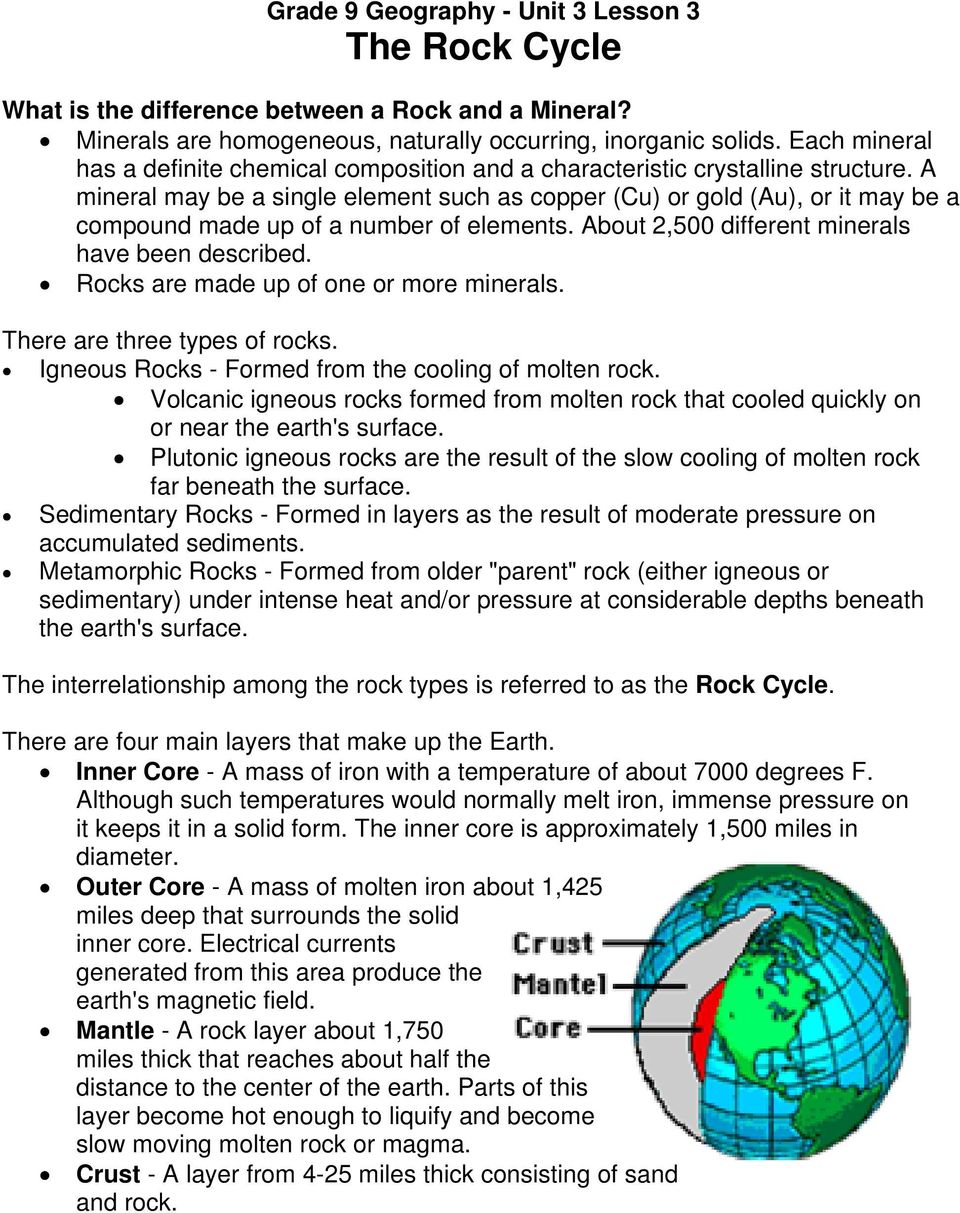
1 Grade 9 Geography - Unit 3 Lesson 3 The Rock Cycle What is the difference between a Rock and a Mineral? Minerals are homogeneous, naturally occurring, inorganic solids. Each mineral has a definite chemical composition and a characteristic crystalline structure. A mineral may be a single element such as copper (Cu) or gold (Au), or it may be a compound made up of a number of elements. About 2,500 different minerals have been described. Rocks are made up of one or more minerals. There are three types of rocks. Igneous Rocks - Formed from the cooling of molten rock. Volcanic igneous rocks formed from molten rock that cooled quickly on or near the earth's surface. Plutonic igneous rocks are the result of the slow cooling of molten rock far beneath the surface. Sedimentary Rocks - Formed in layers as the result of moderate pressure on accumulated sediments. Metamorphic Rocks - Formed from older "parent" rock (either igneous or sedimentary) under intense heat and/or pressure at considerable depths beneath the earth's surface. The interrelationship among the rock types is referred to as the Rock Cycle. There are four main layers that make up the Earth. Inner Core - A mass of iron with a temperature of about 7000 degrees F. Although such temperatures would normally melt iron, immense pressure on it keeps it in a solid form. The inner core is approximately 1,500 miles in diameter. Outer Core - A mass of molten iron about 1,425 miles deep that surrounds the solid inner core. Electrical currents generated from this area produce the earth's magnetic field. Mantle - A rock layer about 1,750 miles thick that reaches about half the distance to the center of the earth. Parts of this layer become hot enough to liquify and become slow moving molten rock or magma. Crust - A layer from 4-25 miles thick consisting of sand and rock.
2 The core, mantle and crust of the earth can be envisioned as a giant rock recycling machine. However, the elements that make up rocks are never created or destroyed although they can be redistributed, transforming one rock type to another. The Recycling Machine - Liquid (molten) rock material solidifies either at or below the surface of the earth to form igneous rocks. Uplifting occurs forming mountains made of rock. The exposure of rocks to weathering and erosion at the earth's surface breaks them down into smaller grains producing soil. The grains (soil) are transported by wind, water and gravity and eventually deposited as sediments. This process is referred to as erosion. The sediments are deposited in layers and become compacted and cemented (lithified) forming sedimentary rocks. Variation in temperature, pressure, and/or the chemistry of the rock can cause chemical and/or physical changes in igneous and sedimentary rocks to form metamorphic rocks. When exposed to higher temperatures, metamorphic rocks (or any other rock type for that matter) may be partially melted resulting in the creation once again of igneous rocks starting the cycle all over again.

3 Since most of the earth's surface is covered by water - molten material from inside the earth often breaks through the floor of the ocean and flows from fissures where it is cooled by the water resulting in the formation of igneous rocks. Some low grade metamorphism often occurs during and after the formation of the rock due to the intrusion of the material by the sea water. As the molten material flows from the fissure, it begins forming ridges adjacent to it. If we examine the rock cycle in terms of plate tectonics, as depicted in the figure above, we see that igneous rocks form on the sea floor as spreading ridges. As the rocks cool, and more magma is introduced from below, the plate is forced away from the spreading ridge, and acquires a sediment cover. As shown in the figure, in this case, the oceanic plate eventually "dives" under the adjacent continental plate. As the oceanic plate travels deeper, high temperature conditions cause partial melting of the crustal slab. When that occurs, the surrounding "country rock" (existing adjacent rock) is metamorphosed at high temperature conditions by the contact. The molten material is either driven to the surface as volcanic eruptions, or crystallizes to form plutonic igneous rocks. Recognizing Rocks How Do I Know What Rock I Have? Type Features Example Igneous Sedimentary Metamorphic interlocking texture of the grains the presence of vesicules (holes) in extrusive igneous rocks may be dark-colored and heavy may display two grain sizes, one much larger than the other grains cemented together the presence of fossils light-colored and light weight may display interlocking grains but is very light weight interlocking texture of large grains foliation (layering) banded light and dark colours "ching" sound instead of a "chunk" sound when tapped Granite Sandstone Shale Coal Marble Slate

4 Figure 1. Rock Cycle

5 Grade 9 Geography - Unit 3 Geological History Geological Time Scale in Terms of the 12-Hour Clock When Time Topic Era (Millions of ears) 12-Hour Clock Earth's Formation Precambrian :00 First Rocks :05 Single-Celled Organisms :36 Shellfish Paleozoic :36 Fish :45 Land Plants :55 Insects :57 Amphibians :02 Reptiles :07 Conifers :10 Dinosaurs Mesozoic :23 Mammals :27 Birds :37 Flowering Plants :40 Last Dinosaurs 67 11:50 Grass Cenozoic 25 11:56 Humans <2 11:59 (0.26%) (2.85%) (7.51%) (89.39%)

6 Grade 9 Geography of Canada - Unit 3 Rocks and Minerals Mineral - a natural substance which has its own distinctive structure and may have its composition expressed with a chemical formula. Some examples are quartz, calcite, and galena. Quartz has the chemical composition Si0 2. About 100 minerals are relatively common. There have been over 4000 minerals identified. Rock - usually composed of two or more minerals in some physical combination, although some rocks are composed of only one mineral. Examples of rocks are limestone, sandstone, granite, or shale. (If you wanted to think of a comparison to food, a mineral would be like flour and sugar, and a rock would be a cake.) Properties of minerals - ou can tell the differences between minerals by looking for certain properties. Because each mineral is unique both chemically and structurally, each has its own set of physical, optical, and structural properties to aid in its identification. Chemistry refers to the basic building blocks that the mineral is made of. Optical properties are the way a mineral looks and what light does when it shines on it. Physical properties such as hardness and streak can be tested easily. Physical properties Physical properties may be divided into two groups: (1) those concerned with the effects of light on the mineral, and (2) other tests. Light-dependent properties: The easiest tests to do are about how light interacts with the mineral. These are color, luster and diaphany. ou can do all of these light tests using only your eye. Color is the most obvious property of the mineral, but it is also the least used because a given mineral, like quartz, may have a variety of colors (colorless, purple, blue, pink, black, violet, green, tan, et cetera). Luster is easy to tell by looking at the mineral. Does the mineral reflect light like a piece of metal? If so, then it has metallic luster. If not, then it has non-metallic luster. Non-metallic luster is further subdivided into how brilliant the mineral reflects the light: vitreous (like glass), adamantine (brilliant, bright like metal), pearly, greasy, oily, dull, etc.
7 Diaphany means how translucent the mineral is. Can you see through it like a clear crystal, or not? Or maybe just a little. The answers for diaphany may be opaque, translucent, or transparent. This property is usually noted for a thin chip of the mineral because if the mineral is strongly colored, it may mask this property. Other Properties of Minerals Specific gravity - measure of each mineral's own unique density and how it compares to the density of water. The mineral's density is what makes the mineral heavy or light. Some minerals are very dense, like the native metals copper, silver, or gold, and some are even lighter than water and will float! Volcanic pumice will float on water. ou have to have a specially designed balance to measure specific gravity. Quartz is always a good mineral to compare another sample to, since it has a specific gravity of Minerals with a specific gravity higher than around 3.2 are considered to have relatively high specific gravity. They either contain heavy atoms, like those of the middle of the Chemist's Periodic Table (titanium, manganese, iron, cobalt, nickel, copper, zinc, lead) or have a very dense packing arrangement of the atoms (like with carbon in diamond). Streak is an easy field test to do. Interestingly, the powder of a particular mineral may or may not be the same color as the mineral! Using an unglazed piece of porcelain, like the back of a common bathroom tile, you can do a streak test. The color of the powdered mineral (the streak) may surprise you. Try it for a piece of pyrite (fool's gold). Hardness measures how hard the mineral is relative to other minerals. It is called the scratch or hardness test. Most minerals will not scratch a quartz crystal. Many years ago, a man named Moh took a lot of minerals and tried to scratch them with each other. From his experiment, he came up with chart of the relative hardness of his minerals, one to another. This chart is called Moh's hardness scale. Talc is the softest, diamond is the hardest. A chemical test allows us to determine if the mineral reacts with dilute acid. We use a drop of 10% hydrochloric acid to check for effervesence, or fizzing, and note if there is a reaction.
8 Grade 9 Geography of Canada - Unit 3 Lesson 3 Ice as a Mineral Can a Mineral be a Rock? Is ice a rock or a mineral? Are all rocks made of minerals? Can a mineral be a rock? Earth is made of solids, liquids, and gases. The atmosphere and oceans surrounding the planet are the main gas and liquid parts, although there are liquids (magma) and gas within the Earth, too. The solid part of the Earth, though, is basically rock. Now rocks are made of minerals. A rock can be made of a single mineral. Or a rock can be made of many minerals. A mineral has to satisfy the following criteria: be inorganic naturally occurring crystalline solid definite chemical formula unique physical properties Now, let's see if ice fits these criteria. Inorganic? Ice is not "organic" in the sense that it is not animal or vegetable matter. Naturally occurring? Snow, ice in glaciers, etc. are natural. Crystalline? Ice has a crystalline structure (it can be hexagonal or cubic) with atoms of hydrogen and oxygen covalently bound in water molecules and water molecules bound together in the crystal structure by hydrogen bonds. Definite chemical formula? Ice is always H 2 0. Definite physical properties "Solid"? How do you define a solid? Does ice qualify? In the true, technical sense, ice is a crystalline solid. And natural ice should be considered a mineral. Some people also consider glacial ice as rock.
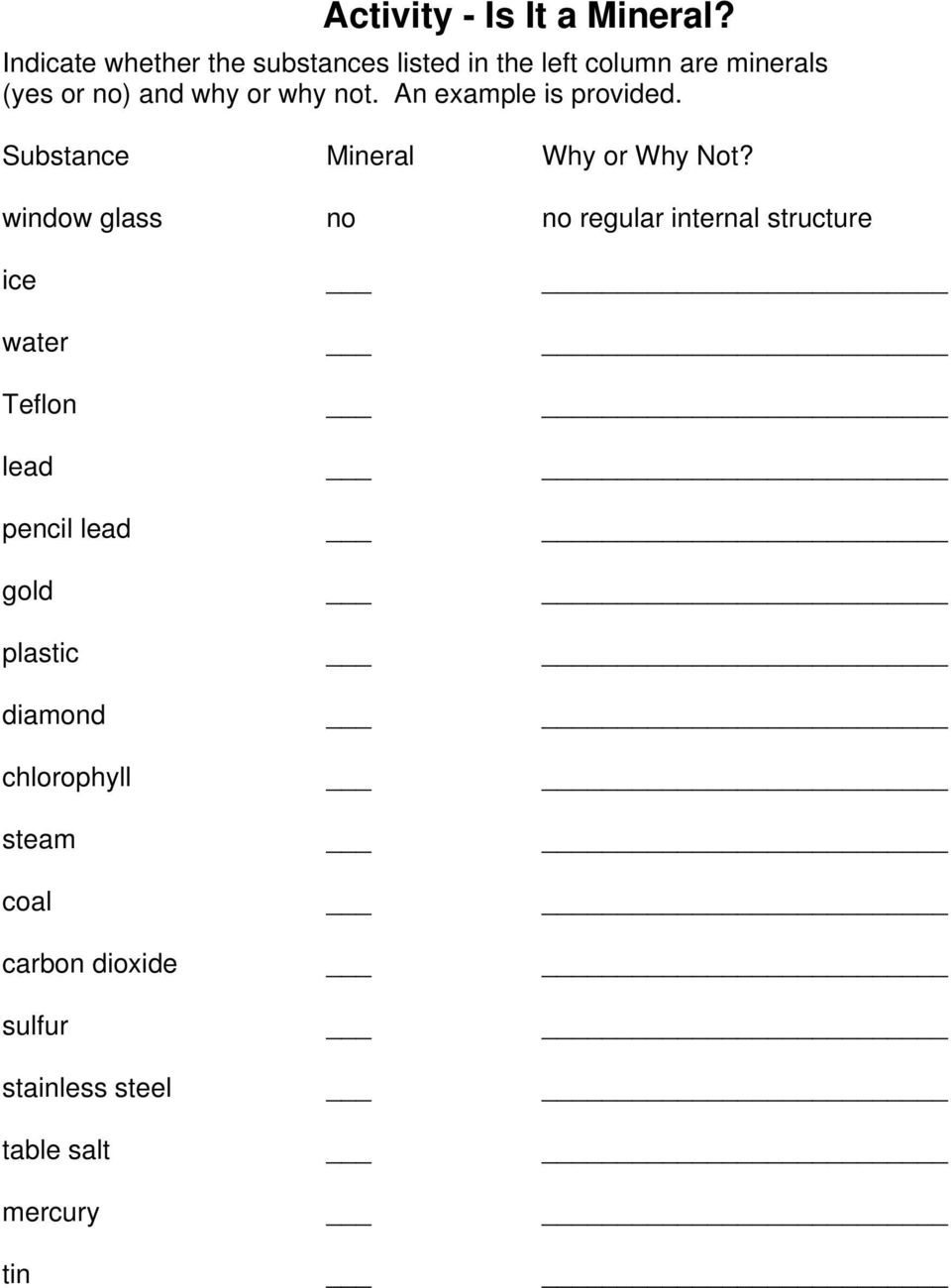
9 Activity - Is It a Mineral? Indicate whether the substances listed in the left column are minerals (yes or no) and why or why not. An example is provided. Substance Mineral Why or Why Not? window glass no no regular internal structure ice water Teflon lead pencil lead gold plastic diamond chlorophyll steam coal carbon dioxide sulfur stainless steel table salt mercury tin
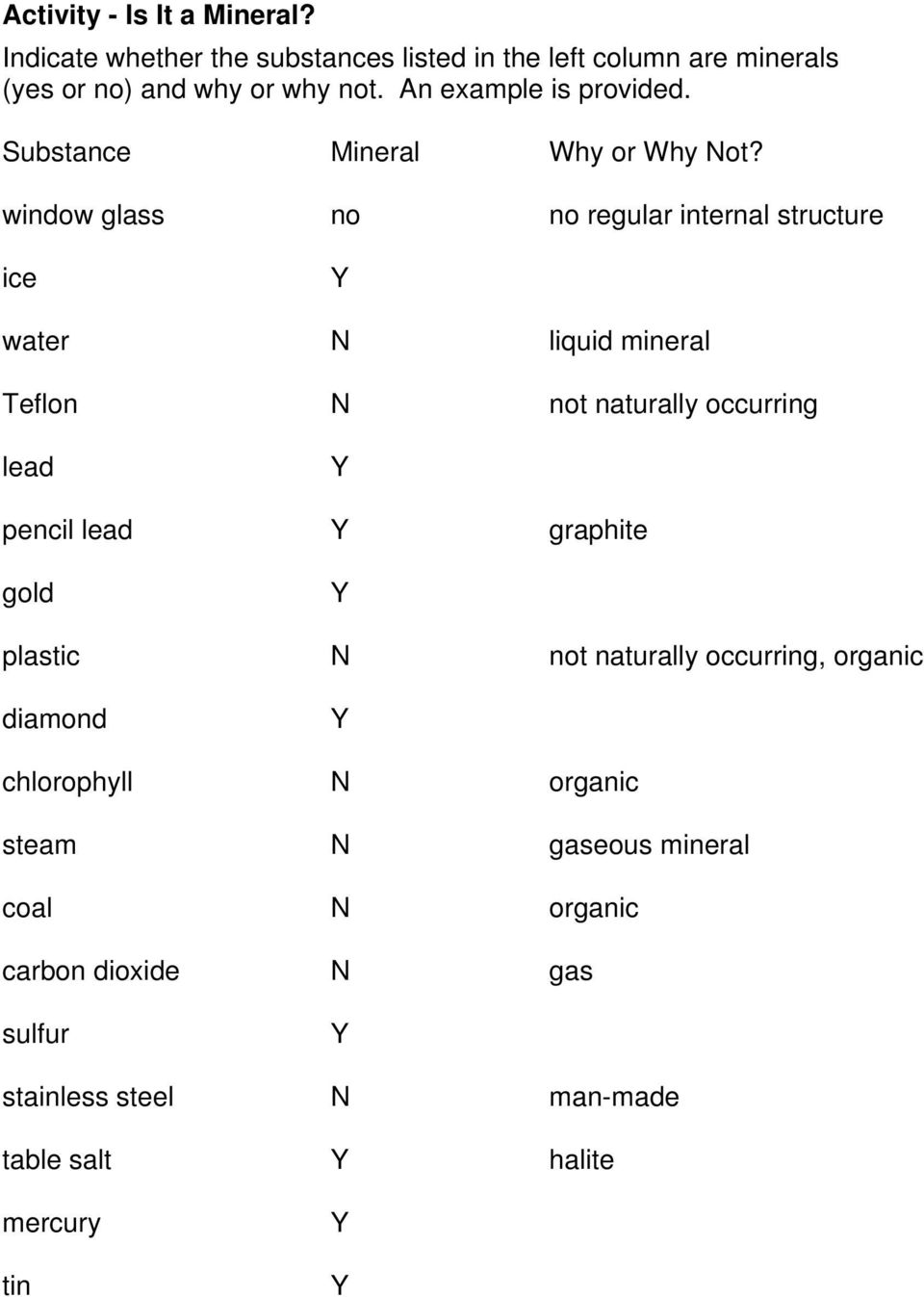
10 Activity - Is It a Mineral? Indicate whether the substances listed in the left column are minerals (yes or no) and why or why not. An example is provided. Substance Mineral Why or Why Not? window glass no no regular internal structure ice water N liquid mineral Teflon N not naturally occurring lead pencil lead graphite gold plastic N not naturally occurring, organic diamond chlorophyll N organic steam N gaseous mineral coal N organic carbon dioxide N gas sulfur stainless steel N man-made table salt halite mercury tin
Unit 8.3.1 Study Guide: Rocks, Minerals, and the Rock Cycle
 Name Date Per Unit 8.3.1 Study Guide: Rocks, Minerals, and the Rock Cycle I Can Statements I Can Statements are the learning targets for each unit. By the time you take the test for this unit, you should
Rocks & Minerals. 10. Which rock type is most likely to be monomineralic? 1) rock salt 3) basalt 2) rhyolite 4) conglomerate
 1. Of the Earth's more than 2,000 identified minerals, only a small number are commonly found in rocks. This fact indicates that most 1) minerals weather before they can be identified 2) minerals have
Rocks & Minerals 1 Mark Place, www.learnearthscience.com
 Name: KEY Rocks & Minerals 1 KEY CONCEPT #1: What is a mineral? It is a naturally occurring, inorganic substance which has a definite chemical composition What would be the opposite of this? man-made,
Name: Rocks & Minerals 1 Mark Place, www.learnearthscience.com
 Name: Rocks & Minerals 1 KEY CONCEPT #1: What is a mineral? It is a, substance which has a What would be the opposite of this? KEY CONCEPT #2: What causes minerals to have different physical properties?
Name: Class: Date: Multiple Choice Identify the letter of the choice that best completes the statement or answers the question.
 Class: Date: Minerals Study Guide Modified True/False Indicate whether the sentence or statement is true or false. If false, change the identified word or phrase to make the sentence or statement true.
Rocks and Minerals What is right under your feet?
 Rocks and Minerals What is right under your feet? Name: 1 Before you start What do you already know? What is the difference between a rock and a mineral? What are the three categories of rocks? 1. 2. 3.
Mineral Identification
 Mineral Identification Name Notes Page Objectives Explain which mineral properties are most important in identification. Explain how to identify minerals by their properties. Classify some common minerals
The rock cycle. Introduction. What are rocks?
 The rock cycle This Revision looks at the three types of rock: sedimentary, igneous and metamorphic. It looks at how they are formed, the weathering of rocks and the way one form of rock turns into another,
EARTH SCIENCE 110 INTRODUCTION to GEOLOGY MINERALS & ROCKS LABORATORY
 EARTH SCIENCE 110 INTRODUCTION to GEOLOGY DR. WOLTEMADE NAME: SECTION: MINERALS & ROCKS LABORATORY INTRODUCTION The identification of minerals and rocks is an integral part of understanding our physical
Earth Science Grade 4 Minerals
 Earth Science Grade 4 Minerals Standards: Identifies the physical properties of minerals Teacher Background Minerals are pure substances and mix together to make rocks. Rocks have a cycle and different
What are Rocks??? Rocks are the most common material on Earth. They are a naturally occurring collection of one or more minerals.
 The Rock Cycle What are Rocks??? Rocks are the most common material on Earth. They are a naturally occurring collection of one or more minerals. The Rock Cycle a cycle that continuously forms and changes
Ch6&7 Test. Multiple Choice Identify the choice that best completes the statement or answers the question.
 Ch6&7 Test Multiple Choice Identify the choice that best completes the statement or answers the question. 1. Which of the following does NOT change the form of existing rock? a. tremendous pressure c.
What is a rock? How are rocks classified? What does the texture of a rock reveal about how it was formed?
 CHAPTER 4 1 The Rock Cycle SECTION Rocks: Mineral Mixtures BEFORE YOU READ After you read this section, you should be able to answer these questions: What is a rock? How are rocks classified? What does
Rocks and Plate Tectonics
 Name: Class: _ Date: _ Rocks and Plate Tectonics Multiple Choice Identify the choice that best completes the statement or answers the question. 1. What is a naturally occurring, solid mass of mineral or
Rock Identification Lab
 Rock Identification Lab Name Mineral Hardness Objective: You will determine the relative hardness of common objects relative to the known hardness of index minerals. We will use fingernail, copper, glass,
1 Exploring Earth s Interior
 1 Exploring Earth s Interior Crust Mantle Outer Core Crust-to-Mantle Inner Core Cross Section From Surface to Center SCIENCE EXPLORER Focus on Earth Science Prentice-Hall, Inc. 2 Evidence for Continental
1. Base your answer to the following question on on the photographs and news article below. Old Man s Loss Felt in New Hampshire
 UNIT 3 EXAM ROCKS AND MINERALS NAME: BLOCK: DATE: 1. Base your answer to the following question on on the photographs and news article below. Old Man s Loss Felt in New Hampshire FRANCONIA, N.H. Crowds
Atoms and Elements. Atoms: Learning Goals. Chapter 3. Atoms and Elements; Isotopes and Ions; Minerals and Rocks. Clicker 1. Chemistry Background?
 Chapter 3 Atoms Atoms and Elements; Isotopes and Ions; Minerals and Rocks A Review of Chemistry: What geochemistry tells us Clicker 1 Chemistry Background? A. No HS or College Chemistry B. High School
Objectives: Vocabulary: Materials: Students will: Safety: Element Mineral Streak. Absolute Hardness
 : Finding Clues Like a Scientist Author: Kris Poduska Date Created: 2000 Subject: Earth Science, Classification Level: Elementary and Middle School Standards: New York State- Intermediate Science (www.emsc.nysed.gov/ciai/)
How can you tell rocks apart?
 How can you tell rocks apart? Grade Range: 4-7 G.L.E Focus: 1.1.5 Time Budget: 1 1.5 hours WASL Vocabulary: Overview: Different rocks have different characteristics because of their minerals, the ways
FIRST GRADE ROCKS 2 WEEKS LESSON PLANS AND ACTIVITIES
 FIRST GRADE ROCKS 2 WEEKS LESSON PLANS AND ACTIVITIES ROCK CYCLE OVERVIEW OF FIRST GRADE CHEMISTRY WEEK 1. PRE: Comparing solids, gases, liquids, and plasma. LAB: Exploring how states of matter can change.
Unit 4: The Rock Cycle
 Unit 4: The Rock Cycle Objective: E 3.1A Discriminate between igneous, metamorphic, and sedimentary rocks and describe the processes that change one kind of rock into another. E 3.1B Explain the relationship
Rapid Changes in Earth s Surface
 TEKS investigate rapid changes in Earth s surface such as volcanic eruptions, earthquakes, and landslides Rapid Changes in Earth s Surface Constant Changes Earth s surface is constantly changing. Wind,
Rocks and Minerals Multiple Choice
 Rocks and Minerals Multiple Choice 1. The basaltic bedrock of the oceanic crust is classified as (1) felsic, with a density of 2.7 g/cm3 (2) felsic, with a density of 3.0 g/cm3 (3) mafic, with a density
Lesson 13: Plate Tectonics I
 Standards Addressed Lesson 13: Plate Tectonics I Overview Lesson 13 introduces students to geological oceanography by presenting the basic structure of the Earth and the properties of Earth s primary layers.
LAB 2: MINERAL PROPERTIES AND IDENTIFICATION
 OBJECTIVES: LAB 2: MINERAL PROPERTIES AND IDENTIFICATION 1) to become familiar with the properties important in identifying minerals; 2) to learn how to identify the common rock-forming minerals. Preparatory
3. Practice describing and classifying rocks as sedimentary, metamorphic or igneous.
 Science Unit: Lesson 3: Renewable & Non-renewable Resources Mining in BC School Year: 2009/20010 Developed for: Developed by: Grade level: Duration of lesson: Notes: Dr. R. E. McKechnie Elementary School,
Earth Materials: Intro to rocks & Igneous rocks. The three major categories of rocks Fig 3.1 Understanding Earth
 Earth Materials: 1 The three major categories of rocks Fig 3.1 Understanding Earth 2 Intro to rocks & Igneous rocks Three main categories of rocks: Igneous Sedimentary Metamorphic The most common minerals
Ride the Rock Cycle. Suggested Goals: Students will gain an understanding of how a rock can move through the different stages of the rock cycle.
 Illinois State Museum Geology Online http://geologyonline.museum.state.il.us Ride the Rock Cycle Grade Level: 5 6 Purpose: To teach students that the rock cycle, like the water cycle, has various stages
Layers of the Earth s Interior
 Layers of the Earth s Interior 1 Focus Question How is the Earth like an ogre? 2 Objectives Explain how geologists have learned about the interior of the Earth. Describe the layers of the Earth s interior.
FIRST GRADE CHEMISTRY
 FIRST GRADE CHEMISTRY 1 WEEK LESSON PLANS AND ACTIVITIES ROCK CYCLE OVERVIEW OF FIRST GRADE CHEMISTRY WEEK 1. PRE: Comparing solids, gases, liquids, and plasma. LAB: Exploring how states of matter can
1. The diagram below shows a cross section of sedimentary rock layers.
 1. The diagram below shows a cross section of sedimentary rock layers. Which statement about the deposition of the sediments best explains why these layers have the curved shape shown? 1) Sediments were
Essential Standards: Grade 4 Science Unpacked Content
 This document is designed to help North Carolina educators teach the Essential Standards (Standard Course of Study). NCDPI staff are continually updating and improving these tools to better serve teachers.
Sedimentary Rocks. Find and take out 11B-15B and #1 From Egg Carton
 Sedimentary Rocks Find and take out 11B-15B and #1 From Egg Carton Erosion Erosion is a natural process where rocks and soil are Broken and Moved We will focus on 4 types of erosion; Wind, Rain, Ice and
Lab 3: Minerals. (2) Minerals are solids, therefore liquids and gases are not considered minerals.
 Introduction Minerals Minerals are the basic building blocks that make up the solid Earth. Therefore, any study of the solid Earth must begin with an understanding of minerals. A mineral, by definition,
Identifying Minerals
 Identifying Minerals All rocks are made up of minerals. Rocks have different colors, textures, and shapes. Some rocks or minerals are very hard. Some are soft. A gemstone is a mineral that is rare and
The Earth, Sun, and Moon
 reflect The Sun and Moon are Earth s constant companions. We bask in the Sun s heat and light. It provides Earth s energy, and life could not exist without it. We rely on the Moon to light dark nights.
The Earth System. The geosphere is the solid Earth that includes the continental and oceanic crust as well as the various layers of Earth s interior.
 The Earth System The atmosphere is the gaseous envelope that surrounds Earth. It consists of a mixture of gases composed primarily of nitrogen, oxygen, carbon dioxide, and water vapor. The atmosphere and
FAIRLY SIMPLE MINERAL IDENTIFICATION EXERCISE. John J. Thomas
 FAIRLY SIMPLE MINERAL IDENTIFICATION EXERCISE John J. Thomas Purpose An exercise in the identification of minerals that uses minerals with very distinct characteristics. The students will learn the characteristics
Section 1 The Earth System
 Section 1 The Earth System Key Concept Earth is a complex system made up of many smaller systems through which matter and energy are continuously cycled. What You Will Learn Energy and matter flow through
Chemistry Worksheet: Matter #1
 Chemistry Worksheet: Matter #1 1. A mixture (is/is not) a chemical combining of substances. 2. In a compound the (atoms/molecules) are (chemically/physically) combined so that the elements that make up
Presents the. Rock Test Study Resource
 Presents the Rock Test Study Resource Created by Simone Markus Published by EngLinks 1 Preface This is a free resource provided by EngLinks for students in APSC 151. This presentation is a supplementary
SECOND GRADE ROCKS 1 WEEK LESSON PLANS AND ACTIVITIES
 SECOND GRADE ROCKS 1 WEEK LESSON PLANS AND ACTIVITIES ROCK CYCLE OVERVIEW OF SECOND GRADE CHEMISTRY WEEK 1. PRE: Comparing the states of matter. LAB: Observing the elements on the periodic table. POST:
TYPES OF ROCKS & THE ROCK CYCLE
 Visit http://www.learner.org/interactives/rockcycle/index.html to complete the following questions and activities. TYPES OF ROCKS: 1. Click on TYPES OF ROCKS. Read the information on the webpage and answer
CHAPTER 3: MATTER. Active Learning Questions: 1-6, 9, 13-14; End-of-Chapter Questions: 1-18, 20, 24-32, 38-42, 44, 49-52, 55-56, 61-64
 CHAPTER 3: MATTER Active Learning Questions: 1-6, 9, 13-14; End-of-Chapter Questions: 1-18, 20, 24-32, 38-42, 44, 49-52, 55-56, 61-64 3.1 MATTER Matter: Anything that has mass and occupies volume We study
P1: Rock identification (I)
 P1: Rock identification (I) Examine the rocks specimens provided with the aid of these notes. All the rocks come from Ireland, as detailed on the attached map. Answer the short question on each specimen
2 MATTER. 2.1 Physical and Chemical Properties and Changes
 2 MATTER Matter is the material of which the universe is composed. It has two characteristics: It has mass; and It occupies space (i.e., it has a volume). Matter can be found in three generic states: Solid;
Georgia Performance Standards Framework for Science Grade 6. Unit Organizer: Geology: Inside the Earth (Approximate Time: 7 Weeks)
 The following instructional plan is part of a GaDOE collection of Unit Frameworks, Performance Tasks, examples of Student Work, and Teacher Commentary. Many more GaDOE approved instructional plans are
CHAPTER 6 THE TERRESTRIAL PLANETS
 CHAPTER 6 THE TERRESTRIAL PLANETS MULTIPLE CHOICE 1. Which of the following is NOT one of the four stages in the development of a terrestrial planet? 2. That Earth, evidence that Earth differentiated.
EXAMPLE EXERCISE 4.1 Change of Physical State
 EXAMPLE EXERCISE 4.1 Change of Physical State State the term that applies to each of the following changes of physical state: (a) Snow changes from a solid to a liquid. (b) Gasoline changes from a liquid
EXPLORATION AND DISCOVERY IN PLANETARY SCIENCE
 Rocks and Minerals I. OBJECTIVES One of the many ways to study Earth is by examining the rocks that make up its surface. Earth is a dynamic planet, with plate tectonics, water, wind, volcanoes, and mountains.
[Geology Layers of the Earth] [Basic: Grade 2-3] [Advanced: Grade 5: Introduction to Plate Tectonics}
![[Geology Layers of the Earth] [Basic: Grade 2-3] [Advanced: Grade 5: Introduction to Plate Tectonics}](/thumbs/40/21755359.jpg "[Geology Layers of the Earth] [Basic: Grade 2-3] [Advanced: Grade 5: Introduction to Plate Tectonics}") [Geology Layers of the Earth] [Basic: Grade 2-3] [Advanced: Grade 5: Introduction to Plate Tectonics} BACKGROUND Scientists and geologists have been able to do some drilling on Earth. They are also able
[Geology Layers of the Earth] [Basic: Grade 2-3] [Advanced: Grade 5: Introduction to Plate Tectonics} BACKGROUND Scientists and geologists have been able to do some drilling on Earth. They are also able
SEDIMENTARY ROCKS. Sedimentary rocks are formed near or at the surface of the earth.
 SEDIMENTARY ROCKS Sedimentary rocks are formed near or at the surface of the earth. They are derived from preexisting source rocks. They are composed by sediments, this is material that has been weathered,
Exploring How Rocks Are Formed
 Exploring How Rocks Are Formed Grade Level: 3-4 Purpose and Goals: In this lesson, students are introduced to the three types of rocks: igneous, sedimentary, and metamorphic. After receiving background
WEATHERING, EROSION, AND DEPOSITION PRACTICE TEST. Which graph best shows the relative stream velocities across the stream from A to B?
 NAME DATE WEATHERING, EROSION, AND DEPOSITION PRACTICE TEST 1. The diagram below shows a meandering stream. Measurements of stream velocity were taken along straight line AB. Which graph best shows the
FROM SEDIMENT INTO SEDIMENTARY ROCK. Objectives. Sediments and Sedimentation
 FROM SEDIMENT INTO SEDIMENTARY ROCK Objectives Identify three types of sediments. Explain where and how chemical and biogenic sediments form. Explain three processes that lead to the lithification of sediments.
SECOND GRADE 1 WEEK LESSON PLANS AND ACTIVITIES
 SECOND GRADE 1 WEEK LESSON PLANS AND ACTIVITIES WATER CYCLE OVERVIEW OF SECOND GRADE WATER WEEK 1. PRE: Exploring the properties of water. LAB: Experimenting with different soap mixtures. POST: Analyzing
Geologic History Review
 1. The climate that existed in an area during the early Paleozoic Era can best be determined by studying (1) the present climate of the area (2) recorded climate data of the area since 1700 (3) present
1. You are about to begin a unit on geology. Can anyone tell me what geology is? The study of the physical earth I.
 PLATE TECTONICS ACTIVITY The purpose of this lab is to introduce the concept of plate tectonics and the formation of mountains. Students will discuss the properties of the earth s crust and plate tectonics.
Lab Activity on Minerals
 Lab Activity on Minerals 2002 Ann Bykerk-Kauffman, Dept. of Geological and Environmental Sciences, California State University, Chico * Introduction Rocks are made of many mineral grains stuck together.
Name: Period: # Plate Tectonics. Journey to the center of the Earth
 Plate Tectonics Journey to the center of the Earth Use pages 124 129 to answer the following questions. Exploring Inside Earth (p. 125-126) 1. What are the two main types of evidence that Geologist use
6.E.2.2 Plate Tectonics, Earthquakes and Volcanoes
 Name: Date: 1. The road shown below was suddenly broken by a natural event. 3. The convergence of two continental plates would produce Which natural event most likely caused the crack in the road? island
Identification of Rock forming mineral -Sean Tvelia-
 Identification of Rock forming mineral -Sean Tvelia- Minerals are the natural material that every inorganic material on planet Earth is composed of. They are the foundation of both our planet and most
Three Main Types of Rocks Igneous Rocks. Sedimentary Rocks Metamorphic Rocks. Made by Liesl at The Homeschool Den
 Three Main Types of Rocks Igneous Rocks Sedimentary Rocks Metamorphic Rocks Igneous Rocks Above and below: Basalt Above: Gabbro Above: Pumice Above: Basalt, Giant Causeway in Ireland Above: Obsidian Above:
1. A student found a sample of a solid material that was gray, shiny and made of all the same material. What category does this sample best fit?
 Grade 4 Standard 3 Unit Test A Earth Materials Multiple Choice 1. A student found a sample of a solid material that was gray, shiny and made of all the same material. What category does this sample best
The Dynamic Crust 2) EVIDENCE FOR CRUSTAL MOVEMENT
 The Dynamic Crust 1) Virtually everything you need to know about the interior of the earth can be found on page 10 of your reference tables. Take the time to become familiar with page 10 and everything
** Rocks are aggregates of one or more minerals ** 3. Hardness: A measure of resistance to scratching. On the Mohs Scale, it ranges from 1 to 10.
 Lab 2: Mineral Lab notes. Minerals are inorganic, solid, naturally occurring substances that have a characteristic chemical compositions, distinctive physical properties, and crystalline structures. Chemical
Chapter 3 Student Reading
 Chapter 3 Student Reading If you hold a solid piece of lead or iron in your hand, it feels heavy for its size. If you hold the same size piece of balsa wood or plastic, it feels light for its size. The
ROCKS OF THE GRAND CANYON BACKGROUND INFORMATION FOR DOCENTS
 ROCKS OF THE GRAND CANYON BACKGROUND INFORMATION FOR DOCENTS There are three distinct types of rock. Igneous rocks. Igneous comes from the Greek word for fire. It is so hot deep in the Earth that rocks
Ocean Floor Continental Slope Begins at the Continental Shelf Very sharp drop to depths over 2 miles Covered with thick layers of sand, mud, and rocks
 Ocean Floor Continental Shelf Begins at the shoreline Gently slopes underwater Average depth of 430 feet Thick layers of sand, mud, and rocks The beach is part of the Continental Shelf Ocean Floor Continental
ORANGE PUBLIC SCHOOLS OFFICE OF CURRICULUM AND INSTRUCTION OFFICE OF SCIENCE. GRADE 6 SCIENCE Post - Assessment
 ORANGE PUBLIC SCHOOLS OFFICE OF CURRICULUM AND INSTRUCTION OFFICE OF SCIENCE GRADE 6 SCIENCE Post - Assessment School Year 2013-2014 Directions for Grade 6 Post-Assessment The Grade 6 Post-Assessment is
Scope and Sequence Interactive Science grades 6-8
 Science and Technology Chapter 1. What Is Science? 1. Science and the Natural World 2.Thinking Like a Scientist 3. Scientific Inquiry Scope and Sequence Interactive Science grades 6-8 Chapter 2. Science,
Earth Materials: Minerals. Mineral Properties. Mineral Properties. Some optical properties. Three general categories:
 1 2 Earth Materials: Minerals What is a mineral? Properties/characteristics of different types of minerals Mineral structures and bonding Major categories of minerals Importance and uses of minerals What
ES 104: Laboratory # 7 IGNEOUS ROCKS
 ES 104: Laboratory # 7 IGNEOUS ROCKS Introduction Igneous rocks form from the cooling and crystallization of molten rock material. This can occur below the surface of the earth forming intrusive rocks
Physical and Chemical Properties of Materials
 Physical and Chemical Properties of Materials 40- to 2 50-minute sessions ACTIVITY OVERVIEW 14 L A B O R ATO R Y Students explore the properties of a wide variety of materials and examine the relationship
Lecture 23: Terrestrial Worlds in Comparison. This lecture compares and contrasts the properties and evolution of the 5 main terrestrial bodies.
 Lecture 23: Terrestrial Worlds in Comparison Astronomy 141 Winter 2012 This lecture compares and contrasts the properties and evolution of the 5 main terrestrial bodies. The small terrestrial planets have
Santillana Intensive English Levels 4-6
 Santillana Intensive English Levels 4-6 California Science Content Standards Grades 4-6 Grade 4 Physical Sciences 1. Electricity and magnetism are related effects that have many useful applications in
Weathering, Erosion, and Soils. Weathering and Erosion. Weathering and Erosion
 Weathering, Erosion, and Soils 1 The Grand Canyon, a landscape shaped by weathering and erosion 2 Weathering vs. erosion Types of weathering Physical Chemical Rates of weathering and erosion Climate Rock
II. Earth Science (Geology) Section (9/18/2013)
 EAPS 100 Planet Earth Lecture Topics Brief Outlines II. Earth Science (Geology) Section (9/18/2013) 1. Interior of the Earth Learning objectives: Understand the structure of the Earth s interior crust,
TECTONICS ASSESSMENT
 Tectonics Assessment / 1 TECTONICS ASSESSMENT 1. Movement along plate boundaries produces A. tides. B. fronts. C. hurricanes. D. earthquakes. 2. Which of the following is TRUE about the movement of continents?
FOURTH GRADE PLATE TECTONICS 1 WEEK LESSON PLANS AND ACTIVITIES
 FOURTH GRADE PLATE TECTONICS 1 WEEK LESSON PLANS AND ACTIVITIES PLATE TECTONIC CYCLE OVERVIEW OF FOURTH GRADE VOLCANOES WEEK 1. PRE: Comparing different structures of volcanoes. LAB: Modeling three types
KINDERGARTEN CHEMISTRY 1 WEEK LESSON PLANS AND ACTIVITIES
 KINDERGARTEN CHEMISTRY 1 WEEK LESSON PLANS AND ACTIVITIES ROCK CYCLE OVERVIEW OF KINDERGARTEN CHEMISTRY WEEK 1. PRE: Distinguishing the four types of matter. LAB: Classifying heavy and light rocks. POST:
Chapter Outline. 3 Elements and Compounds. Elements and Atoms. Elements. Elements. Elements 9/4/2013
 3 Elements and Compounds Chapter Outline 3.1 Elements A. Distribution of Elements Foundations of College Chemistry, 14 th Ed. Morris Hein and Susan Arena Copyright This reclining Buddha in Thailand is
What are the controls for calcium carbonate distribution in marine sediments?
 Lecture 14 Marine Sediments (1) The CCD is: (a) the depth at which no carbonate secreting organisms can live (b) the depth at which seawater is supersaturated with respect to calcite (c) the depth at which
Characteristics of Sedimentary Rocks
 Characteristics of Sedimentary Rocks Deposited at the earth s surface by wind, water, glacier ice, or biochemical processes Typically deposited in strata (layers) under cool surface conditions. This is
Chemical Weathering Lab. 4th grade PSI
 Chemical Weathering Lab 4th grade PSI Teacher s Notes: Having students conduct Mohs Hardness Test requires a lot of preparation. Rock samples and the materials used to test them need to be collected and
Key concepts of rocks and soil
 Rocks and soil Introduction It is by no means necessary to be a geological expert to implement a worthwhile study of rocks and soil at primary school level. Rocks and soil are not difficult to collect,
Paper 2. Year 9 science test. Remember: First name. Last name. Class. Date
 Sc KEY STAGE 3 Year 9 science test TIER 4 7 Paper 2 First name Last name Class Date Please read this page, but do not open your booklet until your teacher tells you to start. Write your name, your class
Georgia Performance Standards Framework for Shaky Ground 6 th Grade
 The following instructional plan is part of a GaDOE collection of Unit Frameworks, Performance Tasks, examples of Student Work, and Teacher Commentary. Many more GaDOE approved instructional plans are
Metamorphic rocks are rocks changed from one form to another by intense heat, intense pressure, and/or the action of hot fluids.
 Metamorphic Rocks, Processes, and Resources Metamorphic rocks are rocks changed from one form to another by intense heat, intense pressure, and/or the action of hot fluids. Protolith or parent rock is
Name Date Class CHAPTER 1 REVIEW. Answer the following questions in the space provided.
 CHAPTER 1 REVIEW Matter and Change SECTION 1 SHORT ANSWER Answer the following questions in the space provided. 1. a Technological development of a chemical product often (a) lags behind basic research
Specimen Paper. Chemistry 1F. Time allowed! 60 minutes
 Centre Number Surname Candidate Number Specimen Paper For Examiner s Use Other Names Candidate Signature Examiner s Initials General Certificate of Secondary Education Foundation Tier Question 1 Mark Science
Volcano in the lab: a wax volcano in action: teacher s notes
 Volcano in the lab: a wax volcano in action: teacher s notes Level This activity is designed for students aged 11-14, as a simple demonstration of igneous activity. English National Curriculum reference
Mixtures. reflect. How is seawater different from pure water? How is it different from rocky soil?
 reflect Everything around us is made out of tiny bits of matter. These particles may combine in different ways to produce new materials. Sometimes we need to separate the parts of a material. If we know
Sedimentary Rock Formation Models. 5.7 A Explore the processes that led to the formation of sedimentary rock and fossil fuels.
 Sedimentary Rock Formation Models 5.7 A Explore the processes that led to the formation of sedimentary rock and fossil fuels. The Formation Process Explained Formation of these rocks is one of the important
Introduction and Origin of the Earth
 Page 1 of 5 EENS 1110 Tulane University Physical Geology Prof. Stephen A. Nelson Introduction and Origin of the Earth This page last updated on 30-Jul-2015 Geology, What is it? Geology is the study of
The Rock Cycle: Metamorphic, Sedimentary, and Igneous Rocks
 The Rock Cycle: Metamorphic, Sedimentary, and Igneous Rocks Intended for Grade: 3 Subject: Science Description: This presentation teaches students about the properties and formation of each of the three
Topic: Rocks, Minerals and Soil Duration: Grade Level: 6 9 days
 6 th Grade Science Unit: Sedimentary Rocks Unit Snapshot Topic: Rocks, Minerals and Soil Duration: Grade Level: 6 9 days Summary The following activities allow students to focus on the study of rocks.
Ex 10 Mineral Resources
 103 Exercise 10 Mineral Resources James S. Reichard Georgia Southern University Student Name Section In this lab you will: explore the connection between society and its use of mineral and rock resources.