
Guide to your Nestlé Super. Defined Benefit category IBR
|
|
|
- Aron Jennings
- 10 years ago
- Views:
Transcription
1 Australia Group Superannuation Fund Guide to your Nestlé Super Defined Benefit category IBR The information in this document forms part of the Nestlé Super Product Disclosure Statement Defined Benefit category dated 15 December 2014

2 Contents Section Page 2 How superannuation works 2 3 Benefits of investing with Nestlé Super 4 5 How we invest your money 15 6 Fees and costs 20 7 How super is taxed 23 8 Insurance in your super 25 1

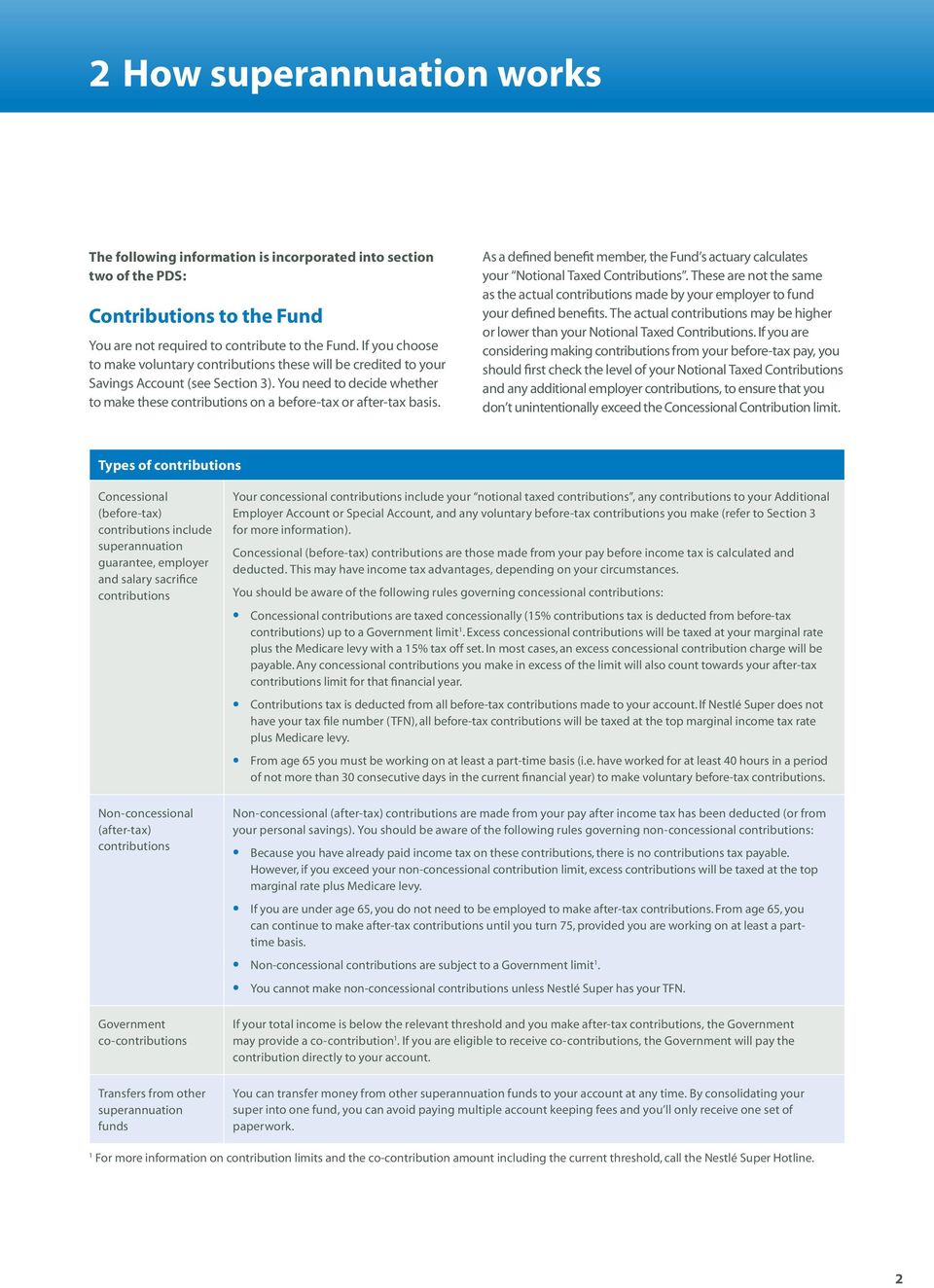
3 2 How superannuation works The following information is incorporated into section two of the PDS: Contributions to the Fund You are not required to contribute to the Fund. If you choose to make voluntary contributions these will be credited to your Savings Account (see Section 3). You need to decide whether to make these contributions on a before-tax or after-tax basis. As a defined benefit member, the Fund s actuary calculates your Notional Taxed Contributions. These are not the same as the actual contributions made by your employer to fund your defined benefits. The actual contributions may be higher or lower than your Notional Taxed Contributions. If you are considering making contributions from your before-tax pay, you should first check the level of your Notional Taxed Contributions and any additional employer contributions, to ensure that you don t unintentionally exceed the Concessional Contribution limit. Types of contributions Concessional (before-tax) contributions include superannuation guarantee, employer and salary sacrifice contributions Non-concessional (after-tax) contributions Government co-contributions Transfers from other superannuation funds Your concessional contributions include your notional taxed contributions, any contributions to your Additional Employer Account or Special Account, and any voluntary before-tax contributions you make (refer to Section 3 for more information). Concessional (before-tax) contributions are those made from your pay before income tax is calculated and deducted. This may have income tax advantages, depending on your circumstances. You should be aware of the following rules governing concessional contributions: Concessional contributions are taxed concessionally (15% contributions tax is deducted from before-tax contributions) up to a Government limit 1. Excess concessional contributions will be taxed at your marginal rate plus the Medicare levy with a 15% tax off set. In most cases, an excess concessional contribution charge will be payable. Any concessional contributions you make in excess of the limit will also count towards your after-tax contributions limit for that financial year. Contributions tax is deducted from all before-tax contributions made to your account. If Nestlé Super does not have your tax file number (TFN), all before-tax contributions will be taxed at the top marginal income tax rate plus Medicare levy. From age 65 you must be working on at least a part-time basis (i.e. have worked for at least 40 hours in a period of not more than 30 consecutive days in the current financial year) to make voluntary before-tax contributions. Non-concessional (after-tax) contributions are made from your pay after income tax has been deducted (or from your personal savings). You should be aware of the following rules governing non-concessional contributions: Because you have already paid income tax on these contributions, there is no contributions tax payable. However, if you exceed your non-concessional contribution limit, excess contributions will be taxed at the top marginal rate plus Medicare levy. If you are under age 65, you do not need to be employed to make after-tax contributions. From age 65, you can continue to make after-tax contributions until you turn 75, provided you are working on at least a parttime basis. Non-concessional contributions are subject to a Government limit 1. You cannot make non-concessional contributions unless Nestlé Super has your TFN. If your total income is below the relevant threshold and you make after-tax contributions, the Government may provide a co-contribution 1. If you are eligible to receive co-contributions, the Government will pay the contribution directly to your account. You can transfer money from other superannuation funds to your account at any time. By consolidating your super into one fund, you can avoid paying multiple account keeping fees and you ll only receive one set of paperwork. 1 For more information on contribution limits and the co-contribution amount including the current threshold, call the Nestlé Super Hotline. 2
4 Withdrawing your super Superannuation is a long-term investment, with special tax advantages that are designed to encourage you to save for retirement. Because of this, the Government restricts when and how you can access your superannuation. When can you withdraw your super? Most, if not all, of your super is preserved (i.e. inaccessible) until you meet one of the following conditions of release: retire at or after your preservation age; cease employment at or after age 60; reach age 65; become permanently incapacitated; become terminally ill or die; or are a temporary resident permanently leaving Australia. What if I want to transfer my existing account balance to another fund? As a Defined Benefit member of Nestlé Super you may be able to elect to transfer some of your benefit to another fund. Please refer to Portability in section three of this document. Your superannuation (excluding any non-preserved amount) must be preserved in a complying superannuation fund until you meet one of the conditions of release above. What happens when you turn 65? You can withdraw your super as a lump sum or transfer it to a retirement income product, such as the Nestlé Super Account Based Pension, but may be required to maintain a minimum balance in your current account see Portability in section three of this document. If you leave the Defined Benefit category, you can keep your super in the Retained Members category of Nestlé Super, provided it is above the minimum balance. Your preservation age depends on the year you were born. Date of birth Preservation age Before 1 July /7/ /6/ /7/ /6/ /7/ /6/ /7/ /6/ After 30 June

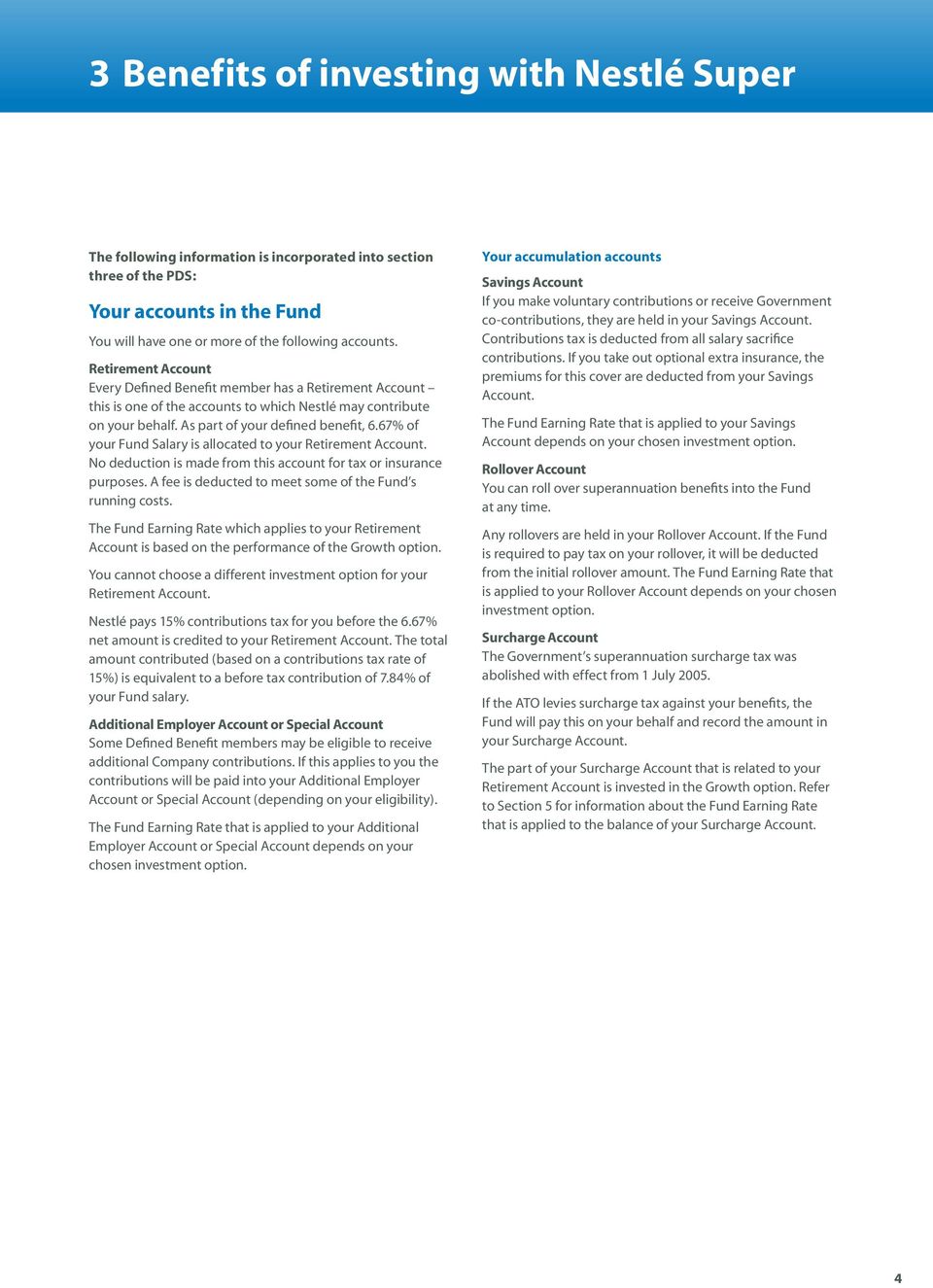
5 3 Benefits of investing with Nestlé Super The following information is incorporated into section three of the PDS: Your accounts in the Fund You will have one or more of the following accounts. Retirement Account Every Defined Benefit member has a Retirement Account this is one of the accounts to which Nestlé may contribute on your behalf. As part of your defined benefit, 6.67% of your Fund Salary is allocated to your Retirement Account. No deduction is made from this account for tax or insurance purposes. A fee is deducted to meet some of the Fund s running costs. The Fund Earning Rate which applies to your Retirement Account is based on the performance of the Growth option. You cannot choose a different investment option for your Retirement Account. Nestlé pays 15% contributions tax for you before the 6.67% net amount is credited to your Retirement Account. The total amount contributed (based on a contributions tax rate of 15%) is equivalent to a before tax contribution of 7.84% of your Fund salary. Additional Employer Account or Special Account Some Defined Benefit members may be eligible to receive additional Company contributions. If this applies to you the contributions will be paid into your Additional Employer Account or Special Account (depending on your eligibility). The Fund Earning Rate that is applied to your Additional Employer Account or Special Account depends on your chosen investment option. Your accumulation accounts Savings Account If you make voluntary contributions or receive Government co-contributions, they are held in your Savings Account. Contributions tax is deducted from all salary sacrifice contributions. If you take out optional extra insurance, the premiums for this cover are deducted from your Savings Account. The Fund Earning Rate that is applied to your Savings Account depends on your chosen investment option. Rollover Account You can roll over superannuation benefits into the Fund at any time. Any rollovers are held in your Rollover Account. If the Fund is required to pay tax on your rollover, it will be deducted from the initial rollover amount. The Fund Earning Rate that is applied to your Rollover Account depends on your chosen investment option. Surcharge Account The Government s superannuation surcharge tax was abolished with effect from 1 July If the ATO levies surcharge tax against your benefits, the Fund will pay this on your behalf and record the amount in your Surcharge Account. The part of your Surcharge Account that is related to your Retirement Account is invested in the Growth option. Refer to Section 5 for information about the Fund Earning Rate that is applied to the balance of your Surcharge Account. 4
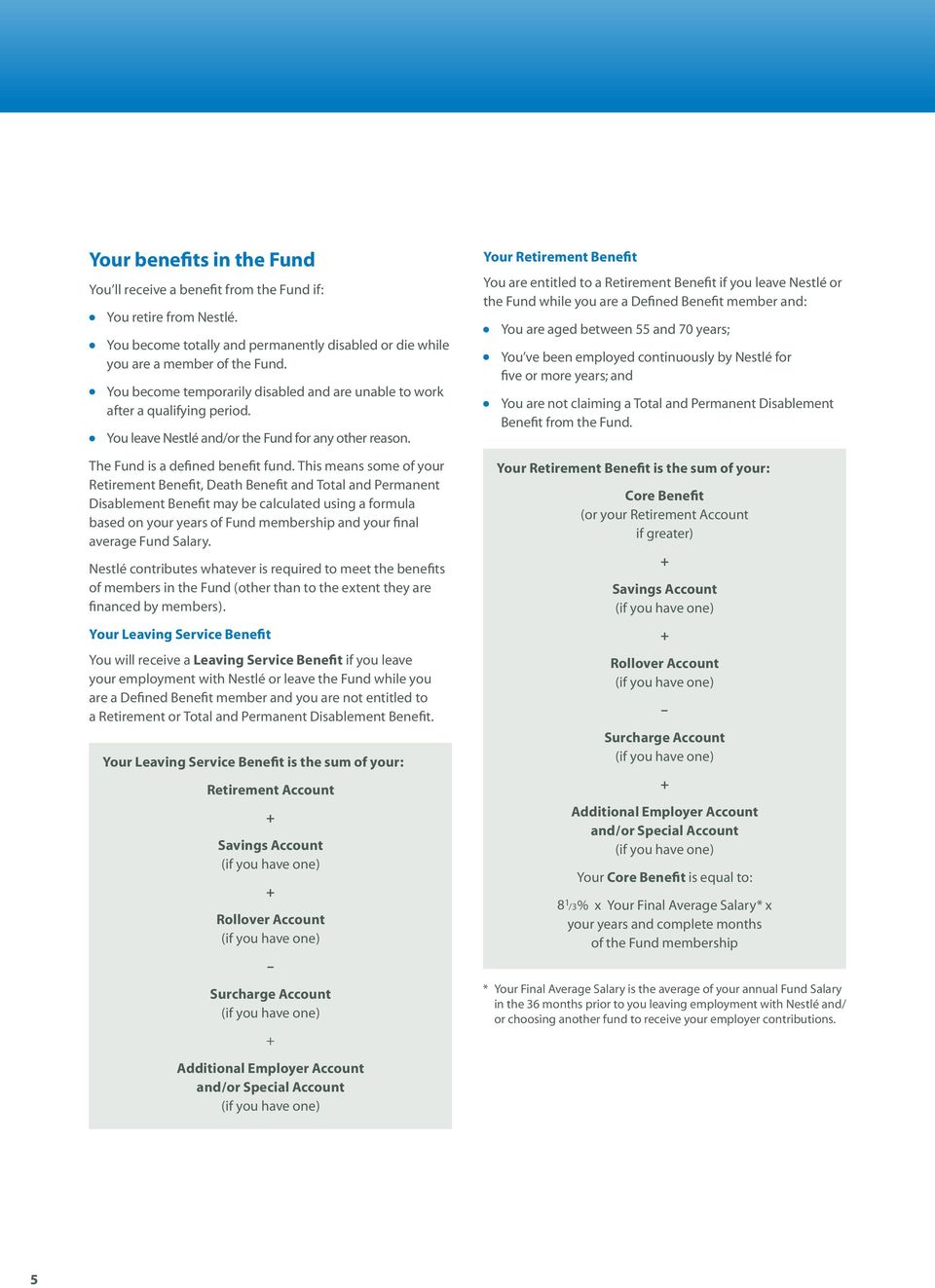
6 Your benefits in the Fund You ll receive a benefit from the Fund if: You retire from Nestlé. You become totally and permanently disabled or die while you are a member of the Fund. You become temporarily disabled and are unable to work after a qualifying period. You leave Nestlé and/or the Fund for any other reason. The Fund is a defined benefit fund. This means some of your Retirement Benefit, Death Benefit and Total and Permanent Disablement Benefit may be calculated using a formula based on your years of Fund membership and your final average Fund Salary. Nestlé contributes whatever is required to meet the benefits of members in the Fund (other than to the extent they are financed by members). Your Leaving Service Benefit You will receive a Leaving Service Benefit if you leave your employment with Nestlé or leave the Fund while you are a Defined Benefit member and you are not entitled to a Retirement or Total and Permanent Disablement Benefit. Your Leaving Service Benefit is the sum of your: Retirement Account Savings Account (if you have one) Rollover Account (if you have one) Surcharge Account (if you have one) Your Retirement Benefit You are entitled to a Retirement Benefit if you leave Nestlé or the Fund while you are a Defined Benefit member and: You are aged between 55 and 70 years; You ve been employed continuously by Nestlé for five or more years; and You are not claiming a Total and Permanent Disablement Benefit from the Fund. Your Retirement Benefit is the sum of your: Core Benefit (or your Retirement Account if greater) Savings Account (if you have one) Rollover Account (if you have one) Surcharge Account (if you have one) Additional Employer Account and/or Special Account (if you have one) Your Core Benefit is equal to: 8 1 /3% x Your Final Average Salary* x your years and complete months of the Fund membership * Your Final Average Salary is the average of your annual Fund Salary in the 36 months prior to you leaving employment with Nestlé and/ or choosing another fund to receive your employer contributions. Additional Employer Account and/or Special Account (if you have one) 5
7 An example of a Retirement Benefit Kim is 56 and is retiring from Nestlé after 10 years as a Defined Benefit member of the Fund. Kim s Final Average Salary is $36,000. Kim s Core Benefit would be: 8 1 /3% x $36,000 x 10 years = $30,000 Kim s Retirement Account is $24,000. As the Core Benefit is the greater amount, Kim s Retirement Benefit is calculated using the Core Benefit amount. Kim also has a Savings Account of $14,250, a Surcharge Account of $500 and an Additional Employer Account of $800. Kim s Retirement Benefit is therefore: Core Benefit $30,000 Savings Account $14,250 Rollover Account Nil Late Retirement Benefit The Late Retirement Benefit applies to members who leave Nestlé or the Fund s Defined Benefit category from age 70. The Late Retirement Benefit is the sum of: 1. The benefit that would have been payable if you left Nestlé at age Any contributions paid on your behalf from that date, including personal contributions, rollovers, etc 3. Administration expenses 4. Any relevant taxes (including surcharge taxes) /- 5. Earnings at the Fund Earning Rate Surcharge Account ($500) Additional Employer Account $800 Special benefits and adjustments Total $44,550 If you have transferred from a previous fund or category or have been notified that special arrangements apply to you, these are not described in this document, but were explained at the time you transferred or were originally notified of your special arrangements. All of the benefits described in this section may be reduced to allow for the impact of surcharge tax and any payments to a former spouse under the Family Law Act, where applicable. Temporary residents If you are a temporary resident of Australia (excluding New Zealand citizens), additional restrictions on withdrawing your superannuation apply, as well as different tax rates on withdrawal of your benefits. If you hold a temporary visa, we recommend that you seek financial advice on termination of employment and/or departure from Australia. If you do not claim your benefit within six months of the later of your visa ceasing and departing Australia, the Trustee may be required to pay it to the Australian Taxation Office (ATO). If this happens, you will need to contact the ATO to access your benefit. 6

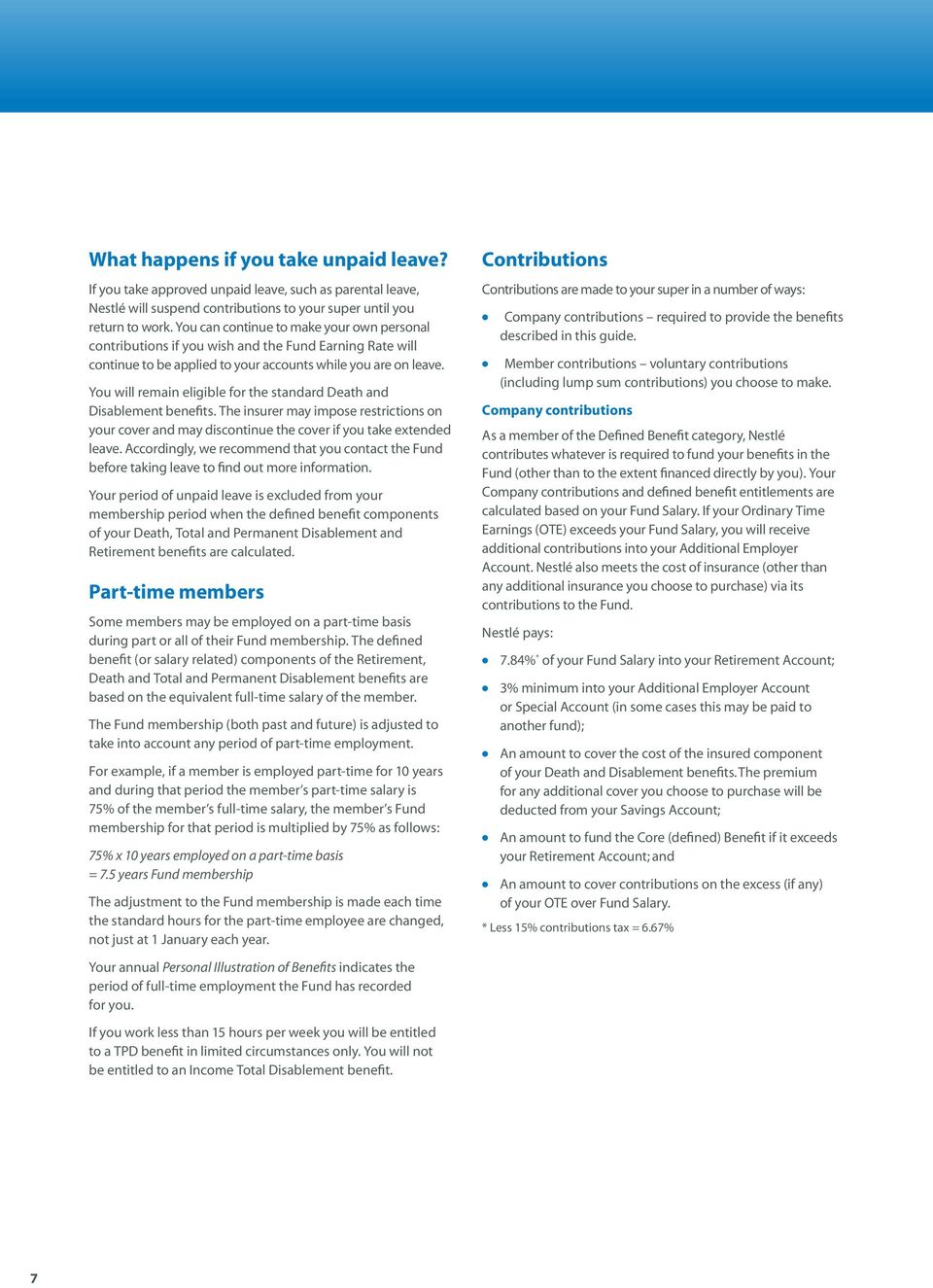
8 What happens if you take unpaid leave? If you take approved unpaid leave, such as parental leave, Nestlé will suspend contributions to your super until you return to work. You can continue to make your own personal contributions if you wish and the Fund Earning Rate will continue to be applied to your accounts while you are on leave. You will remain eligible for the standard Death and Disablement benefits. The insurer may impose restrictions on your cover and may discontinue the cover if you take extended leave. Accordingly, we recommend that you contact the Fund before taking leave to find out more information. Your period of unpaid leave is excluded from your membership period when the defined benefit components of your Death, Total and Permanent Disablement and Retirement benefits are calculated. Part-time members Some members may be employed on a part-time basis during part or all of their Fund membership. The defined benefit (or salary related) components of the Retirement, Death and Total and Permanent Disablement benefits are based on the equivalent full-time salary of the member. The Fund membership (both past and future) is adjusted to take into account any period of part-time employment. For example, if a member is employed part-time for 10 years and during that period the member s part-time salary is 75% of the member s full-time salary, the member s Fund membership for that period is multiplied by 75% as follows: 75% x 10 years employed on a part-time basis = 7.5 years Fund membership The adjustment to the Fund membership is made each time the standard hours for the part-time employee are changed, not just at 1 January each year. Contributions Contributions are made to your super in a number of ways: Company contributions required to provide the benefits described in this guide. Member contributions voluntary contributions (including lump sum contributions) you choose to make. Company contributions As a member of the Defined Benefit category, Nestlé contributes whatever is required to fund your benefits in the Fund (other than to the extent financed directly by you). Your Company contributions and defined benefit entitlements are calculated based on your Fund Salary. If your Ordinary Time Earnings (OTE) exceeds your Fund Salary, you will receive additional contributions into your Additional Employer Account. Nestlé also meets the cost of insurance (other than any additional insurance you choose to purchase) via its contributions to the Fund. Nestlé pays: 7.84% * of your Fund Salary into your Retirement Account; 3% minimum into your Additional Employer Account or Special Account (in some cases this may be paid to another fund); An amount to cover the cost of the insured component of your Death and Disablement benefits. The premium for any additional cover you choose to purchase will be deducted from your Savings Account; An amount to fund the Core (defined) Benefit if it exceeds your Retirement Account; and An amount to cover contributions on the excess (if any) of your OTE over Fund Salary. * Less 15% contributions tax = 6.67% Your annual Personal Illustration of Benefits indicates the period of full-time employment the Fund has recorded for you. If you work less than 15 hours per week you will be entitled to a TPD benefit in limited circumstances only. You will not be entitled to an Income Total Disablement benefit. 7
9 What is your Fund Salary? Your Fund Salary is your annual base pay, not including shift allowance, overtime, bonuses, penalty rates or commissions or the value of any benefit to which you are entitled. It is calculated when you join the Fund and updated at 1 January each year to include pay rises in the previous year. Your Fund Salary does not change during the year, even if your annual base pay changes. Every three years, an actuary reviews the financial position of the Fund and advises the Trustee on the level of Company contributions that is required to ensure the Fund is financially sound, so that it can provide the benefits to you as outlined in this guide. Leaving employment with Nestlé If you leave your employment with Nestlé and you choose to leave your super in the Fund you may be able to elect to have your new employer pay their super contributions into your account in Nestlé Super. Making your own voluntary contributions to your super You can choose to make regular voluntary contributions. These need to be a whole percentage of your Fund Salary e.g. 1%, 2%, or 3%. You can also nominate a fixed dollar amount. You can make contributions from: Your after-tax salary, known as non-concessional contributions, or You can ask your employer to make these for you from your before-tax salary (i.e. salary sacrifice), known as concessional contributions. How much you contribute, the way in which contributions are made and your income, will affect how much tax you pay and the type of tax you pay. Depending on your income level, you may also be eligible to receive the Government cocontributions if you make non-concessional contributions. As a Defined Benefit member, if your Notional Taxed Contributions plus contributions to your Additional Employer Account or Special Account are below the concessional contributions cap, you may make voluntary before-tax contributions up to your annual cap without incurring excess concessional contributions tax. Making contributions BPAY Using BPAY, you can make after-tax contributions 24 hours a day, seven days a week. Biller Code: Reference No: Your unique customer reference number, that will be sent to you when you join the Fund. Registered to BPAY Pty Ltd ABN Cheque Contributions can also be made by cheque. Remember to allow adequate time for these to be received by the Fund, particularly if you are sending contributions near the end of the financial year. Rollovers You can choose to transfer (roll over) money from other superannuation funds into Nestlé Super, making it easier to control your super and potentially saving on multiple administration fees. Any rollovers you bring into the Fund, together with investment returns, go into your Rollover Account. The Fund Hotline can help you track down any lost super you might have from previous funds, to enable you to roll over this money to Nestlé Super. Changing your contribution rate You can change your contribution rate and the way in which you contribute (i.e. by salary sacrifice or after tax) at any time during the year. To do this, you must complete a Contribution Rate Change Form well in advance of your nominated change date and send it to: [email protected] or fax: If you want to make voluntary contributions and you re unsure which method is best for you (i.e. before-tax or after-tax), you should speak to a licensed financial adviser. 8
10 Contribution splitting Contribution splitting allows you to split eligible super contributions with your spouse. You have the option of splitting up to 85% of your concessional contributions (or up to the concessional contributions cap, if lower) with your spouse that is, contributions your employer makes including any salary sacrifice contributions you have chosen to make. However, any concessional contributions you split will count towards your concessional contributions cap, not your spouse s. You cannot split: contributions made to your Retirement Account as they are used to fund your defined benefit; non-concessional contributions; or rollovers or transfers (e.g. from overseas funds) into the Fund. After the financial year (1 July to the following 30 June) has ended, you can apply to the Trustee to split the contributions you have made during that financial year with your spouse. To enable the Fund to process your application, it must be received no later than 30 April of the following year. If you are leaving the Fund and wish to split your contributions, you must make this request at the same time as you request a benefit payment. You can split your super contributions only once for the financial year and you can nominate to split either a whole dollar amount or percentage of your contributions, provided the amount you nominate is within the legislative limits. If your spouse is not working or earns a low income, contribution splitting may be a useful way to help them save for retirement. Splitting may also be of assistance if one partner is much closer to retirement than the other. You can apply to split your super contributions by completing a Splitting your super contributions with your spouse Form. If you wish these contributions to be paid into an account in the Fund in your spouse s name and your spouse is not yet a member of the Fund, you and your spouse should also complete an Application for Spouse Contributions Form and return it as directed. Choice of Fund Under the Choice of Fund legislation, depending on your employment conditions, you may be able to choose a fund other than Nestlé Super to receive the future contributions Nestlé makes to your super. If this choice is available, you can also transfer all or part of your existing super benefit in the Fund to your chosen fund. Any remaining benefit will be held in the Retained Membership category of the Fund. As a Defined Benefit member, if you choose another fund for your future contributions, your Leaving Service Benefit (or Retirement Benefit, if applicable) will be calculated based on the date your final employer contribution is received by the Fund. This amount will then be transferred to your nominated fund (if you have requested this) or to the Retained Membership category and all insurance cover in the Fund will cease immediately. No insurance cover will be available to you if you choose another fund to receive your future contributions and you die or become disabled while a member of the Retained Membership category. If you later change your mind, you can have your future employer contributions redirected to the Defined Benefit category but only after 12 months from your choice of fund decision (i.e. from the date on which the last employer contribution was received by the Fund). You will become a new Defined Benefit member only on the date you first redirected employer contribution is received (even if you have remained a member of the Fund, in the Retained Membership category). In order to be entitled to the Death, TPD and Income Total Disablement benefits provided to other Defined Benefit members, you may need to provide satisfactory health evidence. If the insurer does not provide the full cover requested by the Trustee, your Death and Disablement benefits will be reduced accordingly. You will be advised if this applies to you. If you choose another superannuation fund prior to joining the Fund and then later decide to join the Fund, the same rules will apply. 9
11 Portability Transfer your existing account balance Even if you are not eligible under the Choice of Fund legislation to choose another fund for your future Company contributions, once in each 12 month period you may be able to transfer part of your super (excluding your Retirement Account and any other account used to calculate your defined benefit) to another fund while you are still employed by Nestlé. Conditions may apply. Leaving your Employer If you leave Nestlé, you will need to decide what you want to do with your super. You can choose to: take any non-preserved super you have as cash, less any applicable tax, roll over all or part of your super into another complying super fund, keep all or part of your super in the Retained Membership category of the Fund ($2,000 minimum balance applies), or purchase a pension from the Fund, provided you are eligible to do so. If you don t notify the Trustee within 90 days of leaving Nestlé of the way in which your benefit should be paid and your account balance is greater than $2,000, it will be automatically transferred to the Retained Membership category where your total benefit will be invested in the investment choice you had previously nominated for your eligible accounts, (i.e. your choice before the transfer) until you choose a different option. If your benefit is less than $2,000 and you do not provide payment instructions within 90 days of leaving Nestlé, your benefit will be transferred to the nominated Eligible Rollover Fund (ERF): Keeping your super in the Retained Membership category The key features of this category include: The Fund Earning Rate applied to your account depends on your chosen investment option. You can make rollovers and lump sum contributions at any time (including by BPAY). Members over age 65 can make contributions provided they meet superannuation law requirements of a minimum number of hours worked over a specified period. You must maintain an account balance of not less than $2,000. No insurance is available. You may be able to request your new employer to pay your future employer contributions into your account. When your insurance ceases When you leave Nestlé Australia Limited: your Death and Total and Permanent Disablement cover continues for up to 60 days (up until you reach age 65), or until cover commences under an individual policy issued under a continuation option, if earlier; and your Income Total Disablement cover continues for up to 60 days (up until you reach age 65), provided you continue in permanent employment. The amount of cover provided is that which applied immediately prior to the date you ceased to be employed by Nestlé Australia Limited. Remember that if you elect to have future employer contributions paid to another fund (under the Choice of Fund legislation) all insured benefits will cease immediately, on the date we receive your last company contribution. Colonial SuperTrace Locked Bag 5429 Parramatta NSW 2124 Telephone: A benefit transferred to the ERF continues to be subject to the preservation and other rules governing super. Once your benefit is paid to the ERF it cannot be transferred back to the Fund unless you are re-employed by Nestlé. You should check the investment strategy of the ERF to ensure that it is suited to your personal circumstances. 10
12 Insurance continuation options When you leave Nestlé Australia Limited you may be eligible to purchase an individual Death, TPD and/or income protection policy (similar to the Income Total Disablement benefit) from the Fund s insurer without providing evidence of health. The maximum amount of cover available to you is the final amount of cover for which you were insured in the Fund. To be eligible for a new individual policy from the Fund s insurer, you: a) must be an Australian resident under the age of 60 to continue death cover, or under 55 to continue TPD cover and income protection cover; b) must not be joining the armed forces of any country; c) must not be claiming, entitled to claim, or intend to claim an insured benefit from the Fund; d) must not be ceasing employment due to ill-health; and e) for the purposes of continuing TPD and income protection cover, must be intending to commence permanent employment in an occupation that is not an excluded occupation under the underwriting criteria that the Fund s insurer currently applies to other similar individual policies. You must complete an application for a personal retail policy and send it to the Fund s insurer together with the applicable premium, within 75 days of your cessation of employment with Nestlé Australia Limited. The premiums will be based on the insurer s current retail premium rates and will be different to those which you paid (if any) while a member of the Fund. Benefit payment processing Benefit payments are processed as quickly as possible after all required information has been received by the Fund. Processing times will vary, depending on when we receive all the required documentation and final contributions. If you have ceased employment with Nestlé or have lodged a combined choice of fund and portability request, the Fund will require your employer to confirm that the final contributions have been paid to the Fund on your behalf and, if applicable, your date of termination of employment. You have the opportunity to request a partial payment of your benefit (subject to any minimum account balance restrictions), pending receipt of all of the necessary documentation and contributions or you may be happy to wait until the benefit can be paid in full. Once the Fund has received all the required documentation, as advised on the Benefit Payment Options Form, we will be able to process your benefit payment. Processing times will vary on a case by case basis, but benefits are generally paid within 3 business days after we have determined that all requirements have been met. Pending payment of your benefit (or transfer to the Retained Membership category) your defined benefit calculated as at your date of termination of employment, will be invested in the Growth option and the balance of your benefit, will continue to be invested in your chosen investment option (or Growth option if you have not made an investment choice). How to claim your benefit Call the Fund Hotline or visit the Fund website at for the appropriate forms. Provided you satisfy the eligibility criteria and you have completed the application form and paid the premium, the Fund s insurer will issue a personal retail policy without the need to complete a personal statement. However, any special terms and conditions, loadings, and exclusions applying to your insurance cover in Nestlé Super will continue to apply to the new personal retail policy issued by the Fund s insurer. 11
13 Providing proof of identity The security of your super entitlements in Nestlé Super is a key priority for the Trustee. Nestlé Super has procedures in place to manage risks associated with fraud and other illegal activities. At times, these procedures may cause inconvenience to you. Please remember that they are being applied to protect your entitlements. In addition, under the Anti-Money Laundering and Counter-Terrorism Financing Act 2006, superannuation funds are required to have an anti-money laundering and counter-terrorism financing program in place. A key element of this program is customer identification and verification procedures. Typically, you will be required to provide proof of your identity before you withdraw benefits from Nestlé Super or commence an income stream. As a result, some requested transactions cannot proceed until we receive and verify the necessary identification documents. The Trustee does not accept liability for any loss you may incur as a result of circumstances such as a delay in payment of a benefit or commencement of an income stream where the delay arises from our need to comply with legislative requirements. We may be required to request additional customer identification or related information from you at other times. If we cannot obtain the requisite information from you, we may be unable to process your requested transaction. The Trustee must also report specified matters to the regulator, AUSTRAC, and this may include the provision of personal information about you. If this happens, the Trustee is not permitted to advise you that such a report has been made. Taking out a pension When you retire, you can use your benefit to purchase an Account Based Pension or a Lifetime Pension. However, you do not need to have permanently retired from the workforce to access some or all of your super. You may be able to move into retirement gradually, while still continuing to contribute to your super. The Fund offers a Transition to Retirement Pension. As a Defined Benefit member, you can open a Transition to Retirement Pension using the balance of your Retirement Account and/or your accumulation accounts while you are still employed by Nestlé. You must have reached your preservation age (see page 3). A Transition to Retirement Pension pays you a regular income (provided there are sufficient funds in your account) but does not allow your balance to be cashed as a lump sum before you satisfy a condition of release for preserved benefits. Family Law A Family Law settlement can be made by an agreement or court order. Before a court order is made, you should contact Nestlé Super to check that the instructions in the proposed court order can be carried out. It is possible that we may also need to be asked to comment on a draft agreement. A fee applies for Family Law processing. Please refer to Section 6 for more information. 12

14 Learn more about your super Nestlé Super can provide you with tools and education to help you make sense of your super. Calculators Our online superannuation calculators help you look at your specific circumstances. Super Calculator get a feel for what your superannuation benefit may be worth at retirement or how much you need to contribute to reach your retirement goal. Pension Calculator map the retirement income you may be able to achieve by investing your retirement benefits in a pension. General advice over the phone As a member of Nestlé Super you can receive free general advice via our Hotline. Find out more about: what to consider when choosing an investment option; the benefits of salary sacrifice; whether you are eligible to receive the Government co-contribution; your options at retirement; and what to look for in a superannuation fund. If you need more detailed advice, our Hotline representatives are able to refer you to a licensed financial adviser who knows about the Fund. Member seminars Annual education seminars are held in your workplace in most of the major centres in Australia. Website We have additional information available on our website Online access to your account Keep up to date through online access to your personal super account via our secure website. You can also access a range of calculators to help you maximise your super and plan for your retirement. Easy ways to contribute You can make contributions directly into your account using BPAY or Electronic Funds Transfer (EFT) without filling in any forms. To find out more visit our website. Hear from an expert Access ongoing super and investment education via a range of services such as seminars. Dedicated client service Our superannuation specialists are available through our Hotline and can provide free general advice about your super. Financial advice We have chosen a small number of qualified financial advisers who we believe are well placed to provide personal financial advice to you. The first appointment is free. The Trustee and its relationship with service providers Total Risk Management Pty Limited (TRM), ABN , is the Trustee of the Fund and is responsible for its overall operation. The Trustee has directors who have extensive experience in all facets of superannuation management. In fulfilling its obligations, the Trustee has appointed Russell Investment Management Limited to provide advice on the investment strategy of the Fund and Russell Employee Benefits Pty Ltd to manage the day to day administration of the Fund. The Fund s assets are controlled by TRM, which is a subsidiary company of Russell Employee Benefits Pty Ltd. The assets of Nestlé Super are held separately from the assets of Nestlé Australia and the Russell Investments companies. As required by the Australian Prudential Regulation Authority (APRA), the Federal Government s prudential regulator of the financial services industry, TRM has a bank guarantee for $5 million. This guarantee is a minimum capital requirement for the Trustee and provides comfort to members in the event of any default in the operation of Nestlé Super. 13

15 Protecting your privacy Russell provides a range of services to the Fund. In providing those services, Russell may collect personal information directly from you or from your employer. It may also be collected from a medical practitioner if you make a disablement claim. In relation to that information please note as follows. Contact details If you need to contact the Trustee, address your enquiry to: Nestlé Australia Group Superannuation Fund Locked Bag A5025 Sydney South NSW 1235 Access Subject to certain conditions, you can gain access to your personal information that Russell has collected and where appropriate, request the Fund to correct any incorrect or out of date information. Purposes of collection The information is collected for the primary purpose of assisting with the provision of services to you as a member of the Fund and to comply with legislative requirements. This may include a range of related secondary purposes, including the provision of general education about superannuation and retirement issues and information about other benefits available to you as a current or former member of the Fund. Disclosure Your information may be disclosed by Russell to a number of other parties, including advisers, insurers, regulators and courts. Information may be provided to your employer if the Trustee considers this necessary or appropriate for the proper management of Nestlé Super. In some situations, the law may require the provision of information to your spouse or former spouse. Personal information is accessed by Tech Mahindra Ltd, an entity based in India that provides some administration services. The law Federal legislation covering superannuation and taxation matters requires certain minimum information to be collected to provide services to you as a member of the Fund. Consequences of non-provision If you choose not to provide information, the consequences are typically changes or reductions to benefit entitlements or tax concessions. It may also mean that the Fund is unable to process your instructions. More information is detailed in the Trustee s Privacy Policy which can be obtained by calling the Fund Hotline on Alternatively, you can access a copy via the Fund s website at 14

16 5 How we invest your money The following information is incorporated into section five of the PDS: Nestlé Super offers members four investment options to choose from. You can only invest in one investment option for your eligible accounts at a time. If you don t make an investment choice, your eligible accounts will be invested in to the default investment option which is the Nestlé Growth option. The Trustee has appointed Russell Investment Management Ltd (Russell) as the investment manager for Nestlé Super. The majority of the underlying assets of each of the options are invested in Russell unit trusts. Russell appoints and manages the investment managers who manage the assets of the Russell unit trusts. Russell does not take into account labour standards or environmental, social or ethical considerations in its decision to engage underlying investment managers to manage the investments of Russell funds. (Russell has consented to the inclusion of this statement.) The Trustee does not take into account labour standards or environmental, social or ethical considerations when it decides how the assets of the Fund are to be invested. Choosing your investments The Fund offers you four investment options: wish to obtain advice from a licensed financial adviser before making any decisions. Your eligible accounts Member Investment Choice applies to the total amount of any super you have in the following accounts in the Fund, i.e. your eligible accounts. Savings Account Member Contribution Account Rollover Account Special Account Additional Employer Account or similar Company Contribution Account Surcharge Account for surcharge not related to your Retirement Account or Core Benefit Member Investment Choice does not apply to your Retirement Account or that part of your Surcharge Account (if you have one) that relates to your Retirement Account or your Core Benefit. Your Retirement Account is invested in the Nestlé Growth option. You cannot choose a different investment option for your Retirement Account. the Nestlé Cash option the Nestlé Conservative option the Nestlé Growth option and the Nestlé High Growth option. Each option has its own investment strategy and objectives, and carries a different level of risk and expected investment return. You will be notified of any change in the available investment options. You can choose one of these options. The option you choose will apply to any existing balance in your eligible accounts and to all future eligible contributions, until you change your investment choice. Your investment choice is personal to you and it s important that you take the time to understand the choices you have, to assist you to make a decision that is right for you. You may 15

17 Surcharge Account Surcharge tax was abolished by the Government from 1 July If the Fund has paid surcharge tax on your behalf, any surcharge amounts will be recorded in your Surcharge Account. If you have a Surcharge Account, any amounts that relate to your Retirement Account or your Core Benefit will be increased or decreased by the Fund Earning Rate for the Nestlé Growth option. The remainder of your Surcharge Account is increased (or decreased) by the Fund Earning Rate (which can be positive or negative) of the investment option you have chosen for your eligible accounts in the Fund. The balance of your Surcharge Account is deducted from your final benefit before it is paid. How to make a choice When you are ready to make your investment choice you can either complete the Member Investment Choice form or make your choice online at You have the opportunity to change your investment option four times a year - effective 1 January, 1 April, 1 July and 1 October (switching dates). Please note that your instructions must be received by the Fund administrator at least five business days prior to your nominated switching date. Each year the Trustee will send you a Personal Illustration of Benefits to tell you how much is recorded in each of your accounts in the Fund as at the end of the year, including how much is recorded in your Surcharge Account. Why doesn t Member Investment Choice apply to your Retirement Account? Nestlé contributes at a rate that the actuary considers necessary to fund defined benefits (other than to the extent they are financed by member contributions). Your Core Benefit is calculated using a formula based on your Final Average Fund Salary and your years of Fund membership. This means that your defined benefit will be impacted by investment returns only if the balance in your Retirement Account is greater than your Core Benefit. Because Nestlé is responsible for financing this part of your benefit, the Trustee determines how your Retirement Account is invested and has currently chosen to invest in the Nestlé Growth option. However, this is subject to change at the Trustee s discretion. 16

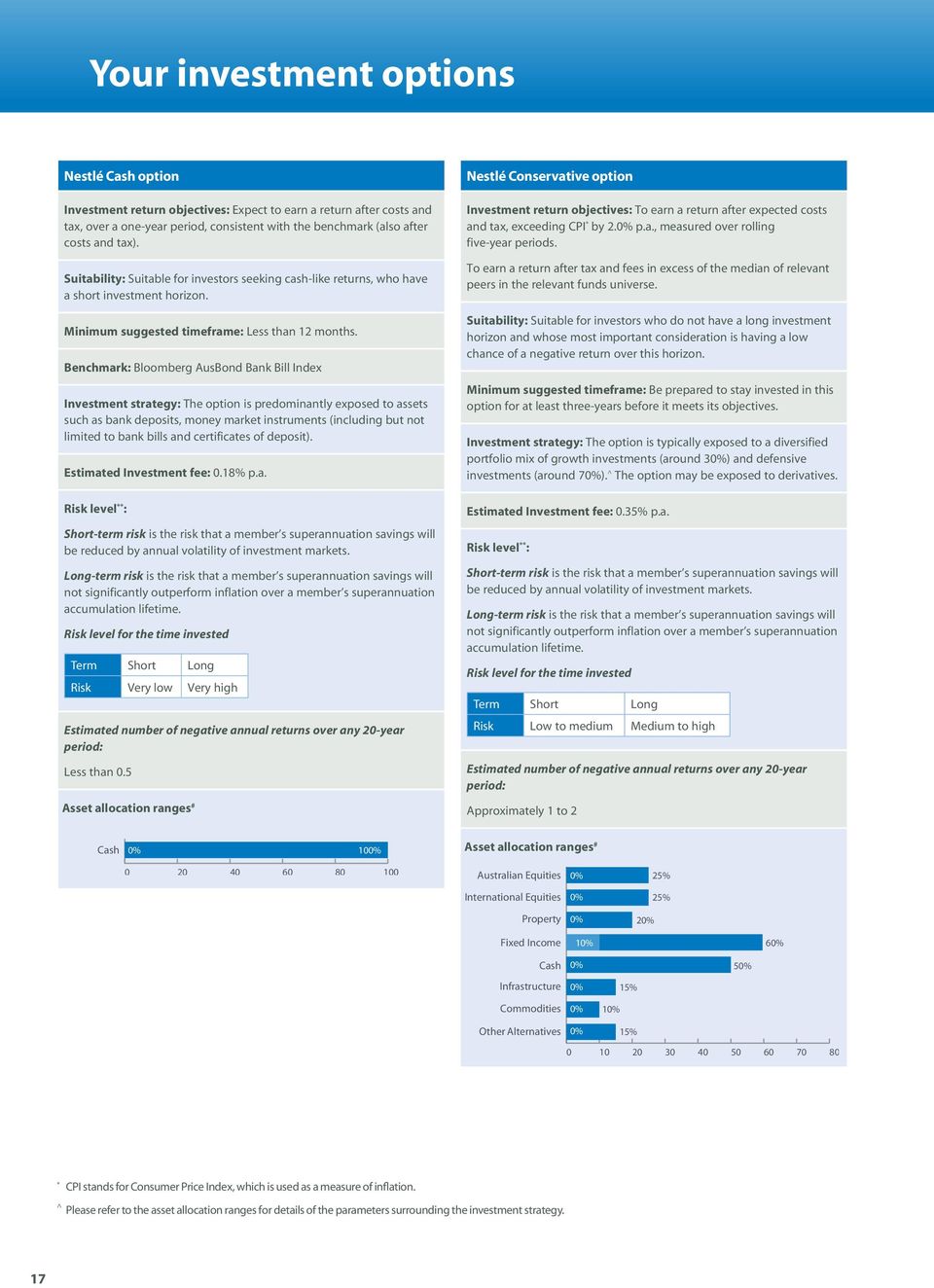
18 Your investment options Nestlé Cash option Investment return objectives: Expect to earn a return after costs and tax, over a one-year period, consistent with the benchmark (also after costs and tax). Suitability: Suitable for investors seeking cash-like returns, who have a short investment horizon. Minimum suggested timeframe: Less than 12 months. Benchmark: Bloomberg AusBond Bank Bill Index Investment strategy: The option is predominantly exposed to assets such as bank deposits, money market instruments (including but not limited to bank bills and certificates of deposit). Estimated Investment fee: 0.18% p.a. Risk level ** : Short-term risk is the risk that a member s superannuation savings will Nestlé Conservative be reduced Option by annual volatility of investment markets. Long-term risk is the risk that a member s superannuation savings will Australian Equities 0% not significantly outperform inflation over a member s superannuation International accumulation Equities 0% lifetime. Property 0% Risk level for the time invested 20% Fixed Income 10% 60% Term Short Long Cash 0% 50% Risk Very low Very high Infrastructure 0% 15% Commodities 0% 10% Estimated number of negative annual returns over any 20-year Other Alternatives 0% 15% period: Less than 0.5 Nestlé Asset Cash allocation Optionranges # Nestlé Conservative option Investment return objectives: To earn a return after expected costs and tax, exceeding CPI * by 2.0% p.a., measured over rolling five-year periods. To earn a return after tax and fees in excess of the median of relevant peers in the relevant funds universe. Suitability: Suitable for investors who do not have a long investment horizon and whose most important consideration is having a low chance of a negative return over this horizon. Minimum suggested timeframe: Be prepared to stay invested in this option for at least three-years before it meets its objectives. Investment strategy: The option is typically exposed to a diversified portfolio mix of growth investments (around 30%) and defensive investments (around 70%).^ The option may be exposed to derivatives. Estimated Investment fee: 0.35% p.a. Risk level ** : Short-term risk is the risk that a member s superannuation savings will be reduced by annual volatility of investment markets. Long-term risk is the risk that a member s superannuation savings will not significantly outperform inflation over a member s superannuation accumulation lifetime. Risk level for the time invested Term Short Long Risk Low to medium Medium to high Estimated number of negative annual returns over any 20-year period: Approximately 1 to 2 Cash 0% 100% Nestlé Conservative Option Asset allocation ranges # Australian Equities 0% Nestlé High GrowthOption International Equities Property 0% 0% 20% Australian Equities 15% 45% International Equities 15% 45% Property 0% 30% Fixed Income 0% 35% Cash 0% Infrastructure 0% Commodities 0% 10% Other Alternatives 0% Nestlé High GrowthOption Fixed Income Cash Infrastructure Commodities Other Alternatives 10% 0% 0% 0% 0% 60% 50% 15% 10% 15% Nestlé Cash Option Cash 0% 100% * Australian CPI stands Equities for Consumer Price Index, which is used as a measure 65% of inflation. Nestlé High GrowthOption International ^ Please Equities refer to the asset allocation ranges for details of the parameters 65% surrounding the investment strategy. 17 Property 0% Fixed Income 0% Cash 0% Infrastructure 0% 30% Australian Equities 15% 15% International Equities Property Fixed Income 15% 15% 0% 0% 30% 35% 45% 45%
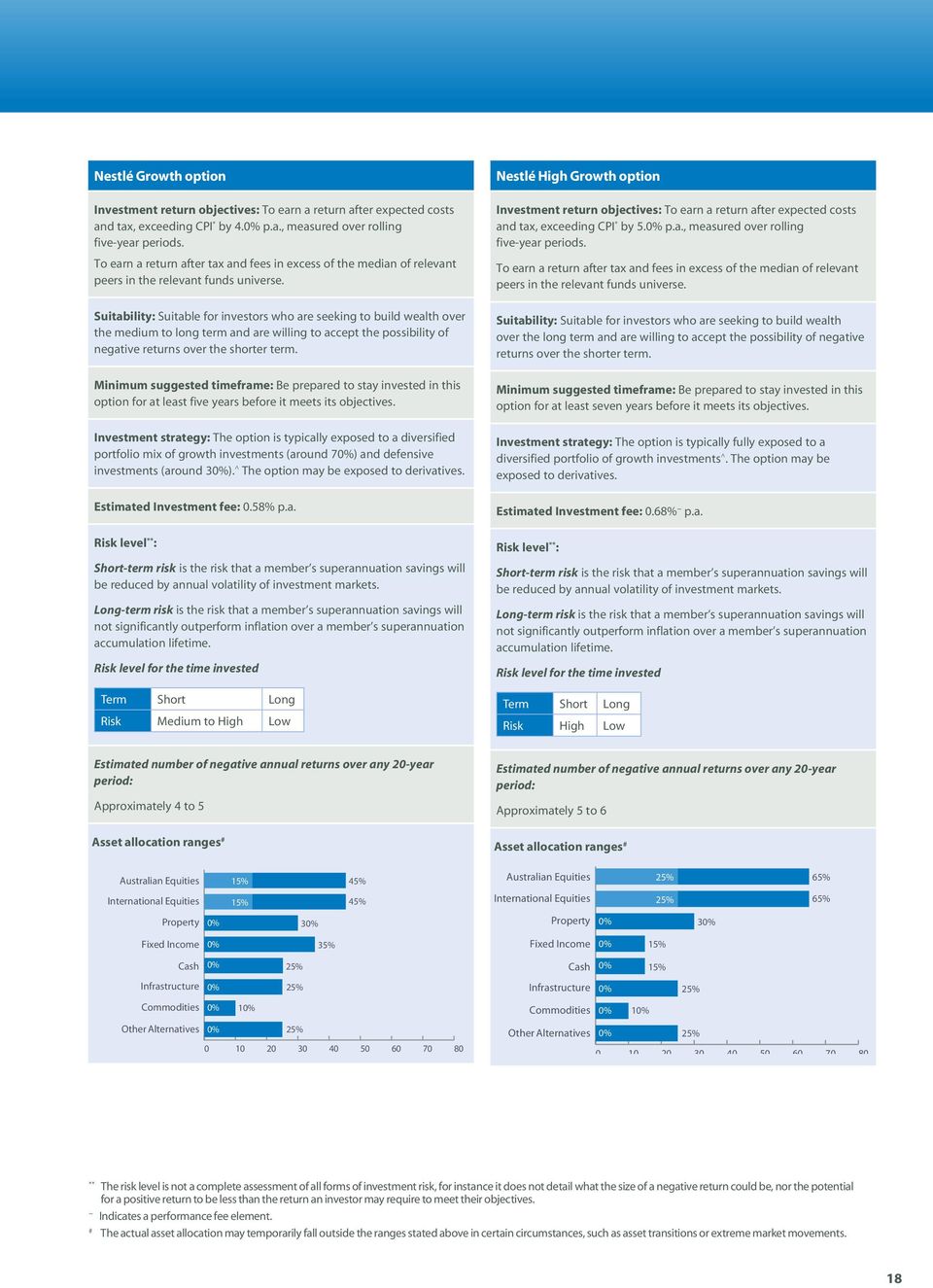
19 Nestlé Growth option Investment return objectives: To earn a return after expected costs and tax, exceeding CPI * by 4.0% p.a., measured over rolling five-year periods. To earn a return after tax and fees in excess of the median of relevant peers in the relevant funds universe. Suitability: Suitable for investors who are seeking to build wealth over the medium to long term and are willing to accept the possibility of negative returns over the shorter term. Minimum suggested timeframe: Be prepared to stay invested in this option for at least five years before it meets its objectives. Investment strategy: The option is typically exposed to a diversified portfolio mix of growth investments (around 70%) and defensive investments (around 30%).^ The option may be exposed to derivatives. Estimated Nestlé Conservative Investment Option fee: 0.58% p.a. Australian Risk level ** Equities 0% : International Equities 0% Short-term risk is the risk that a member s superannuation savings will Property 0% 20% be reduced by annual volatility of investment markets. Fixed Income 10% 60% Long-term risk is the risk that a member s superannuation savings will not significantly Cash 0% outperform inflation over a member s 50% superannuation accumulation Infrastructure lifetime. 0% 15% Risk level Commodities for the time 0% invested 10% Other Alternatives 0% 15% Term Short Long Risk Medium to High Low Nestlé Cash Option Estimated number of negative annual returns over any 20-year period: Cash 0% Approximately 4 to 5 Asset Nestlé allocation High GrowthOption ranges # 100% Nestlé High Growth option Investment return objectives: To earn a return after expected costs and tax, exceeding CPI * by 5.0% p.a., measured over rolling Nestlé five-year Conservative periods. Option To earn a return after tax and fees in excess of the median of relevant Australian Equities 0% peers in the relevant funds universe. International Equities 0% Suitability: Property Suitable 0% for investors 20% who are seeking to build wealth over the Fixed long Income term and are willing to accept the possibility of negative 10% 60% returns over the shorter term. Cash 0% 50% Minimum Infrastructure suggested 0% timeframe: 15% Be prepared to stay invested in this option Commodities for at least seven 0% years 10% before it meets its objectives. Other Alternatives 0% 15% Investment strategy: The option is typically fully exposed to a diversified portfolio of growth investments^. The option may be exposed to derivatives. Nestlé Cash Option Estimated Investment fee: 0.68% ~ p.a. Risk level ** : Cash 0% 100% Short-term risk is the risk that a member s superannuation savings will be reduced by annual volatility of investment markets. Nestlé High GrowthOption Long-term risk is the risk that a member s superannuation savings will inflation over a superannuation not Australian significantly Equities outperform 15% member s 45% accumulation lifetime. International Equities 15% 45% Risk level for the time invested Property 0% TermFixed Income Short 0% Long 30% 35% Risk High Cash 0% Low Infrastructure 0% Estimated Commodities number 0% of negative 10% annual returns over any 20-year period: Other Alternatives 0% Approximately 5 to Nestlé High GrowthOption Asset allocation ranges # Australian Equities 15% 45% Australian Equities 65% International Equities 15% 45% International Equities 65% Property 0% 30% Property 0% 30% Fixed Income 0% 35% Fixed Income 0% 15% Cash 0% Infrastructure 0% Commodities 0% 10% Other Alternatives 0% Nestlé High GrowthOption Cash 0% 15% Infrastructure 0% Commodities 0% 10% Other Alternatives 0% Australian Equities 65% International Equities 65% Property 0% 30% Fixed Income 0% 15% ** The risk level is not a complete assessment of all forms of investment risk, for instance it does not detail what the size of a negative return could be, nor the potential Cash 0% for a positive return to be less than 15% the return an investor may require to meet their objectives. ~ Indicates Infrastructure a performance 0% fee element. # The actual Commodities asset allocation 0% may 10% temporarily fall outside the ranges stated above in certain circumstances, such as asset transitions or extreme market movements. Other Alternatives 0%
20 How the Earning Rate for each option is determined The Earning Rate for each investment option is based on the net investment returns achieved on the assets underlying that investment option, with adjustments for applicable fees and taxes. The Earning Rate allocated to your accounts may be positive or negative depending on the performance of investment markets and the earnings and losses of your chosen option. Annual Earning Rate To determine the final Earning Rate for each investment option, gross investment returns are adjusted to allow for any investment taxes and investment and management fees and the costs of running the Fund, excluding those costs covered by fees collected from members during the year. The relevant monthly Earning Rate for each of the Fund s options is applied to the balance of each of your accounts at the beginning of the year and to the following amounts, from the date they are received by or paid from your accounts (as the case may be): Interim Earning Rate If you leave the Fund during the year, or transfer to the Retained Membership category and at the same time make a cash withdrawal, earnings or losses will be allocated: at the Interim Earning Rate for each month since the previous 1 January, based on the net investment return earned by the Fund s options, and at a rate based on the Fund s bank account rate (bank rate) from the end of the last month for which the Fund s actual investment returns are known to the payment date. The actual investment return earned by each option for any month is generally not confirmed until about three weeks following the end of the month. This means that, where a benefit is paid during the first three weeks of any month, there is a chance that you will be paid the bank rate for a period of up to seven weeks. This may be higher or lower than the actual investment returns for your chosen option for that period. Lump sum deposits paid into the Fund during the year. Rollovers or transfers received during the year. All contributions paid by you or on your behalf, including employer contributions, spouse contributions and Government co-contributions. Lump sum withdrawals paid out of the Fund or transferred from your accounts during the year. Surcharge assessments paid out of the Fund or refunded by the Australian Taxation Office during the year. 19

21 6 Fees and Costs The following information is incorporated into section six of the PDS: The table below outlines the fees that apply to your account Type of fee Amount How and when paid Investment fees * Administration fee Cash option: 0.18% p.a. Conservative option: 0.35% p.a. Growth option: 0.58% p.a. High Growth option: 0.68% p.a. Estimated cost of 0.20% p.a. of your account balance. Plus a fixed-dollar amount of $104 p.a. Investment fees are deducted from investment returns before the earning rate for each option is declared. They are not deducted from your account. The percentage administration fee is deducted from investment earnings. The fixed dollar administration fee is deducted effective 31 December or (proportionally) if you leave the fund during the year. Buy-sell spread Nil Not applicable Switching fee Nil Not applicable Exit fee Nil Not applicable Advice fees Nil Not applicable Other fees and costs Indirect cost ratio (ICR) Family Law Request for information $250 for initial request and $50 for each subsequent request. Splitting a benefit fee equal to the lesser of $1,000 and the actual costs incurred by the Fund. Operational Risk Reserve (ORR) # cost of 0.13% p.a. of your account balance. Family Law fees are payable for information requests and for payment splits. You can read more about these fees in the Additional Explanation of fees and costs section. These costs are deducted from investment earnings and are reflected in the earnings for each option. # The Trustee is required by law to establish an Operational Risk Reserve equal to 0. of assets. To spread the impact on investment performance, the ORR is deducted monthly up to a maximum of 0.13% or 13 basis points per year. * The Investment fee varies according to the option you invest in and may include a performance fee, as outlined in the Additional explanation of fees and costs section Additional explanation of fees and costs Family Law fees The Family Law Act allows Nestlé Super to charge fees for certain activities. Requests for information $250 for the first request and $50 for each subsequent request. The fee will be charged to the person making the enquiry. A cheque made payable to Nestlé Super for the relevant amount must be received by the Fund before the information can be provided. Splitting a benefit if your super is split under a Family Law agreement or Court Order, fees equal to the lesser of $1,000 and the actual costs incurred by the Fund will apply. Splitting costs are normally shared evenly between you and your former spouse. Build up of Operational Risk Reserve (ORR) Legislative amendments have been made which impose new obligations on all superannuation fund trustees from 1 July 2013 to maintain and manage financial resources to cover operational risks. To comply with these requirements, the Trustee is building up a single segregated reserve within Nestlé Super, known as the Operational Risk Reserve (ORR). The ORR is expected to initially be funded over a two-year period (in line with APRA s prudential standard) partially by amounts deducted from the investment returns of the Fund before crediting rates are determined and not directly from Member s account balances. 20
22 Payment of Adviser remuneration The Trustee does not pay any adviser remuneration. Administration fee An administration fee is a fee that relates to the administration or operation of a superannuation entity and includes costs incurred by the trustee, or the trustees, of the entity that: (a) relate to the administration or operation of the fund; and (b) are not otherwise charged as an investment fee, a buy-sell spread, a switching fee, an exit fee, an activity fee, an advice fee or an insurance fee. This covers administration, audit, legal and other fees incurred by the Fund. Any costs not covered by the deduction from each member s account of $104 p.a. and other fees charged directly to members accounts are deducted from the investment returns earned by the Fund before they are applied to your accounts. The balance of the administration fee is estimated to be 0.20% of the Fund s assets. The exact amount is determined at the end of each year after the Fund s Financial Statements have been prepared and any necessary adjustment to the Earning Rate for each investment option will then be made and reflected in the amounts recorded on your Personal Illustration of Benefits. Included in the management costs are all of the Trustee s expenses that relate to the proper performance of its duties and are recoverable from Nestlé Super, including custody, administration, GST (less any reduced input tax credits), Trustee, legal, reporting and audit expenses. The Trustee is also entitled to be indemnified for any other liability it properly incurs in relation to Nestlé Super. Estimated indirect cost ratio (ICR) The Indirect cost ratio (ICR) for an investment option offered by a superannuation entity, is the ratio of the total of indirect costs for the investment option, to the total average net assets of the superannuation entity attributed to the investment option. Investment fee An investment fee is a fee that relates to the investment of the assets of a superannuation entity and includes: (a) fees in payment for the exercise of care and expertise in the investment of those assets (including performance fees); and (b) costs incurred by the trustee, or the trustees, of the entity that: (i) relate to the investment of assets of the entity; and (ii) are not otherwise charged as an administration fee, a buy-sell spread, a switching fee, an exit fee, an activity fee, an advice fee or an insurance fee. Performance fees Performance fees provide an incentive for managers/funds to achieve superior performance. Performance fees may be charged by the underlying managers/funds (including Russell) that each option invests in. Where an option invests in an underlying manager/fund that charges a performance fee, that performance fee has been estimated with reference to the performance of the underlying manager/fund over the 12 months to 31 March 2014 and is included in the disclosed estimated investment fee. As past performance is not a reliable indicator of future performance it is impossible to accurately forecast the performance fees that will be payable. The Trustee reviews the estimated performance fees every 12 months. Generally, a performance fee will not be payable unless the underlying manager/fund has achieved a return in excess of the relevant hurdle rate, and unless any past underperformance has been recovered. 21
23 Please note that a performance fee may be payable to an underlying manager/fund that has satisfied its individual performance fee criteria even at times when the option as a whole has underperformed its benchmark. Performance fees are based on realised gains and unrealised gains. Therefore a performance fee may be paid on unrealised gains that may never subsequently be realised. Performance fees are accrued daily. Performance fees paid to 31 March 2014 Cash option 0.00% Conservative option 0.00% Growth option 0.02% High Growth option 0.02% Buy-sell spread A buy-sell spread is a fee to recover transaction costs incurred by the trustee, or the trustees, of a superannuation entity. Switching fee A switching fee is a fee to recover the costs of switching all or part of a member s interest in a superannuation entity from one class of beneficial interest in the entity to another. Exit fee An exit fee is a fee to recover the costs of disposing of all or part of members interests in a superannuation entity. Activity fee A fee is an activity fee if: (a) the fee relates to costs incurred by the trustee, or the trustees, of a superannuation entity that are directly related to an activity of the trustee, or the trustees: (i) that is engaged in at the request, or with the consent, of a member; or (ii) that relates to a member and is required by law; and Advice fee A fee is an advice fee if: (a) the fee relates directly to costs incurred by the trustee, or the trustees, of a superannuation entity because of the provision of financial product advice to a member by: (i) a trustee of the entity; or (ii) another person acting as an employee of, or under an arrangement with, a trustee or trustees of the entity; and (b) those costs are not otherwise charged as an administration fee, an investment fee, a switching fee, an exit fee, an activity fee or an insurance fee. Insurance fee A fee is an insurance fee if: (a) the fee relates directly to either or both of the following: (i) insurance premiums paid by the trustee, or the trustees, of a superannuation entity in relation to a member or members of the entity; (ii) costs incurred by the trustee, or the trustees, of a superannuation entity in relation to the provision of insurance for a member or members of the entity; and (b) the fee does not relate to any part of a premium paid or cost incurred in relation to a life policy or a contract of insurance that relates to a benefit to the member that is based on the performance of an investment rather than the realisation of a risk; and (c) the premiums and costs to which the fee relates are not otherwise charged as an administration fee, an investment fee, a switching fee, an exit fee, an activity fee or an advice fee. (b) those costs are not otherwise charged as an administration fee, an investment fee, a buy-sell spread, a switching fee, an exit fee, an advice fee or an insurance fee. 22
24 7 How super is taxed The following information is incorporated into section seven of the PDS: All complying superannuation funds receive concessional tax treatment. Superannuation is one of the most taxeffective investments available to Australians. Taxation of superannuation can be complex. You should take the time to review the current taxation regime and consider how it may apply given your personal circumstances. Contributions There are limits, set by legislation, on the amount of superannuation contributions that are taxed at a concessional rate. If you make contributions in excess of these limits, you will have to pay additional tax. Notional Taxed Contributions representing the amount your employer contributes to provide your Defined Benefit, any additional employer contributions as well as any salary sacrifice contributions by you from your before-tax pay, are called Concessional Contributions, and these contributions have contributions tax deducted from them. You will be required to pay additional tax if the sum of your Notional Taxed Contributions, any additional Employer contributions and your before-tax Additional Voluntary Contributions exceeds your concessional limit. No tax is payable by the Fund on nonconcessional contributions. However, if your non-concessional contributions exceed the relevant contribution limit, you will have to pay excess contributions tax. Excess contributions tax Concessional contributions, also known as before-tax contributions, include all contributions made from your before-tax salary, including salary sacrifice contributions and employer contributions. The concessional contributions limits are outlined in the table below: Age under 50 Age 50 and over From 1 July 2014 $30,000 $35,000 Before-tax contributions are taxed concessionally (15% contributions tax is deducted from before-tax contributions) up to a Government limit. Contributions tax for people with a total income of $300,000 or more increased to 30% from 1 July For people with an income that is less than $300,000 but the inclusion of any concessional contributions pushes their income over this threshold, the 30% tax will only apply to that part of their concessional contributions that is in excess of this threshold. The Fund must also pay contributions tax on the actual contributions paid by your employer. All excess concessional contributions will be taxed at your marginal rate plus Medicare levy. A tax offset of 15% is provided, to allow for the tax paid by the Fund. In most cases, an excess concessional contributions charge will be payable. You can elect to have up to 85% of the excess contributions released from the Fund, to avoid having them count towards your non-concessional contribution limit. Excess concessional contributions count towards your nonconcessional contribution limit for the relevant financial year. Non-concessional contributions, also known as after-tax contributions, are contributions made from after-tax money. Non-concessional contributions cannot be accepted by the Fund if your Tax File Number (TFN) has not been provided to the Fund by you or your employer. If the Fund receives a non-concessional contribution and if we have not received your TFN within 30 days from the date of receipt of the contribution, we must return it. The non-concessional contribution limit is: Age under 65 From 1 July 2014 $180,000 $540,000 Bring forward rule over 3 years If you are considering making contributions in excess of the annual non-concessional contribution limit, please call the Hotline to obtain further information about how this bring forward provision operates. If your non-concessional contributions to the Fund exceed your non- concessional contribution limit or are below your non-concessional contribution limit, but you have made contributions to another fund and together these exceed your non-concessional contribution limit, then any contributions received by the Fund in excess of the non-concessional contribution limit will be taxed at the top marginal rate plus the Medicare levy. We recommend that you monitor the level of your concessional and non-concessional contributions neither the Fund nor your employer will do this on your behalf. Please remember that the contribution limits apply on a financial year basis (ie to 30 June) and not on a Fund year basis (ie to 31 December). 23
25 Investment earnings The investment earnings within each investment option are taxed at a maximum rate of 15%. The actual rate may be lower because we can offset the tax payable with tax credits, such as imputation credits. Capital gains made on assets that are held in a super fund for at least 12 months are taxed at an effective maximum rate of 10%. These taxes are accounted for in the Earning Rate of the option, and are not deducted separately from your account. Withdrawals There is no longer a requirement to withdraw your superannuation at a particular age it can remain invested in superannuation for as long as you wish. When you become eligible to withdraw your super, you can take it as one lump sum, as regular pension payments (an income stream) or a combination of both. If you are aged 60 or over, you can withdraw your super tax free. Superannuation is made up of taxable and tax-free components. Withdrawals are paid proportionally from each component. For example, if 20% of your account balance is tax-free at the time of your withdrawal, then 20% of the amount paid to you will be tax-free. There is no tax on the tax-free component. The following table outlines tax on the taxable component. If your marginal tax rate is lower than the rate of tax we have withheld from the taxable component you will receive a credit for the difference when you lodge your tax return. WARNING If you do not provide your Tax File Number (TFN) to the Fund tax will be withheld at the rate of 45% plus Medicare levy from the taxable component of any payment made to you. Taxable component Under preservation age Lump sum 20% Disability income streams Marginal Rate ** Other income streams Marginal Rate ** At or after preservation age Lump sum up to $185,000, prior to age 60 *** 0% Lump sum excess above $185,000, prior to age 60 *** 15% Income streams prior to age 60 Marginal Rate ** Lump sum and income streams from age 60 Maximum tax rate (excluding Medicare levy) * * Where the maximum tax rate is greater than 0%, the Medicare levy is also payable. ** 15% tax offset applies. *** This threshold is a lifetime limit per individual, not per withdrawal. The threshold is indexed each financial year, and the amount shown is current for the 2014/15 year. Refer to the table on page 3 to work out your preservation age. A lump sum benefit paid to you on total and permanent disablement will be taxed as any other lump sum benefit, except that the component that qualifies as a disability lump sum benefit will be tax free, regardless of your age. If you qualify for a terminal illness benefit, it will be tax free. A lump sum benefit paid to your dependants on death is tax free. However, a child will be treated as a dependant for tax purposes only if he/she is under 18 or qualifies otherwise as a dependant ie is financially dependent on you or in an interdependency relationship with you at the date of death. If the benefit is paid to a non-dependant, tax will be payable on the taxable component at a maximum rate of 15% (plus the Medicare levy). 0% Temporary Residents If you are a temporary resident you may generally only access your superannuation after departing Australia. This is known as a Departing Australia Superannuation Payment (DASP). The tax payable on a DASP is 38% for the taxable component and zero for any tax-free component. New Zealand citizens are not considered temporary residents. 24
26 8 Insurance in your super The following information is incorporated into section eight of the PDS: Your Death Benefit If you die while you are an employee of Nestlé and a member of the Defined Benefit category, unless you have been advised by the Fund Trustee that a different benefit applies to you, your dependants or your estate will receive a lump sum Death Benefit, which is the sum of your: Standard Lump Sum* (or your Retirement Account if greater) Savings Account (if you have one) Rollover Account (if you have one) Surcharge Account (if you have one) Additional Employer Account and/or Special Account (if you have one) Standard Lump Sum is calculated at the date of death and is equal to the sum of Two years Fund Salary One month s Fund Salary for each year (a proportionate amount applies for part years) from the date of your death until your 65th birthday. Insured Component Part of the death benefit is insured, with the cost of insurance paid by Nestlé. The amount of this cover is calculated by the following formula: Standard Lump Sum is (as described) Member s Retirement Account Where your Member s Retirement Account is equal to or greater than your Standard Lump Sum, the insured component is nil. Your death and TPD benefits may be limited to your Leaving Service Benefit (or Retirement Benefit) if the insurer does not pay your claim your claim or has not provided you with cover for any reason. For example, if Nestlé Super is your default superannuation fund and you did not join the Defined Benefit category on first becoming eligible to do so, or left the Defined Benefit category and later re-joined. In these circumstances, the insurer may require evidence of good health and may decide not to provide any cover. Alternatively, the insurer may decide to provide part but not all of the cover requested by the Trustee on your behalf. For example, if the amount of your insurance cover (as calculated by the formula shown above) exceeds the amount provided automatically by the insurer without health evidence, you will be asked to provide evidence of your good health to the insurer. If you do not provide this evidence or you provide evidence but the insurer declines to provide you with cover (over the amount automatically provided), then your benefit will be capped at the amount automatically issued by the insurer. In the event of a claim, the Trustee can reduce your total benefit to the extent that the full insurance proceeds are not received. The Trustee will let you know in writing if this situation applies to you. 25
27 Who receives your benefit if you die? It can take some time to pay a death benefit from Nestlé Super, depending on how long it takes the Trustee to obtain the necessary information from the potential dependants. In order to minimise the impact of any adverse market movements during this period, your benefit will be invested in the Cash option once the Fund receives the death certificate. Under superannuation law, your dependants are normally: your spouse (including a de facto partner of the same or opposite sex who is living with you on a genuine domestic basis in a relationship as a couple or with whom you are in a relationship that is registered under relevant State or Territory law) your children (including adopted children, step children and children born outside of marriage) and any child who is the child of your spouse; With a non-binding nomination, the Trustee will consider your personal circumstances at the time of death in determining who receives your benefit. Keep the Trustee informed about your beneficiaries It s important to let the Trustee know if you would like to change your nominated beneficiaries, that is, who you would like to receive your benefit if you die. Consider reviewing your nominated beneficiaries if your circumstances change (e.g. if you marry or have a child). See your annual Personal Illustration of Benefits or access the Fund s website to find out who you last nominated and to obtain a new form if you want to make a change. You can also make a non-binding nomination on the Fund website using your Member Number and PIN. any person who is financially dependent on you; any person with whom you have an interdependency relationship including: any person with whom you have a close personal relationship and live with, where one or both of you also provides ongoing financial support, domestic support and personal care; or any person with whom you have a close personal relationship, where, because of a disability, the above requirements of living together, financial support, domestic support and personal care are not able to be satisfied. If you do not make a nomination, your death benefit will be paid to your dependants or to your Estate, as determined by the Trustee. Tax may be payable on your death benefit. You can make either a binding or non-binding nomination. Non-binding nomination With a non-binding nomination, the Trustee makes the final decision on who will receive your benefit. Superannuation legislation seeks to ensure that it is paid to people with whom you have a close personal relationship or who are financially dependent on you. You can advise the Trustee of whom you want to receive your benefit by completing the relevant sections of the Nomination of Dependants Form. The Trustee will consider your nomination before paying out the money, so it s important to keep your nomination up-todate, and to pay attention to who qualifies as a dependant. Binding nomination A binding nomination allows you to control, within certain bounds, who receives your death benefit. A valid binding nomination is legally binding, meaning that the Trustee is required by law to pay your death benefit to the person(s) nominated by you. To make a valid binding nomination, you must complete the relevant sections of the Nomination of Dependants Form. In particular, you will need to: nominate individuals who satisfy one of the above dependant relationship criteria, or alternatively, nominate your Legal Personal Representative or Estate if you wish your death benefit to be paid to your Estate *; ensure that the percentages allocated to the nominated individual(s) add up to 100%; sign and date the nomination form; have the form signed by two witnesses (who must be over 18 years of age and not be nominated as beneficiaries); and have these two witnesses complete the declaration in the form. * Note: You should note that the relationship between you and each of the nominated beneficiaries will not be investigated at the time of receipt of a binding nomination but will be validated at the date of death. In the event that a nominated beneficiary is not an eligible beneficiary under superannuation law at the date of death (i.e. no longer financially dependent, has pre-deceased the member etc), then the WHOLE binding nomination will be treated as invalid. An invalid binding nomination will be treated in the same way as a non-binding nomination. 26
28 A binding nomination will remain in place for a period of three years from the date it was signed by you unless it is replaced or revoked within this time. You can replace your binding nomination via the same process used to make the original nomination, i.e. complete a new Nomination of Dependants Form, including the witnessing process. If the Fund receives a new Nomination of Dependants Form, it will automatically replace any existing binding nomination held by the Fund. If you do not replace your binding nomination it will expire at the end of the three year period and will be treated in the same way as a non-binding nomination, that is, the Trustee will make the final decision as to who will receive your death benefit. If your binding nomination is valid at the date of your death, in terms of superannuation law, the Trustee is required to pay your death benefit in accordance with your instructions. You should be aware that a binding nomination will not become invalid just because your personal circumstances change. As such it is important you review your nomination regularly to ensure it remains up-to-date. Your Disablement Benefits As a Defined Benefit member, you have two types of disability benefit. A Total and Permanent Disablement Benefit a lump sum benefit that may be payable if you become ill or injured and in the opinion of the Trustee it is unlikely that you will be able to work again. An Income Total Disablement Benefit a monthly income benefit that may be payable if, through illness or injury, you are temporarily unable to work after a waiting period. This type of benefit is sometimes also known as a temporary disability, income protection, or salary continuance benefit. Your Total and Permanent Disablement Benefit Your Total and Permanent Disablement Benefit is calculated in the same way as your Death Benefit. To qualify for this benefit, you must have been absent from work for at least six months. You must also have terminated employment with Nestlé in order to receive a benefit. The Trustee may, at its discretion, reduce the six month waiting period if there are special circumstances. Special conditions apply if you have been retrenched from Nestlé. If you become totally and permanently disabled after age 65 and while you are employed by Nestlé, you will receive your Leaving Service Benefit or Retirement Benefit. Following termination of employment, your benefit will be moved automatically to the Retained Membership category. Your Leaving Service Benefit (or Retirement benefit, as applicable) will be calculated at the date of termination of employment and this amount (adjusted for investment earnings from the date of termination) will be transferred to your new account in the Retained Membership category. This generally occurs about 90 days after your termination date. If your Total & Permanent Disablement benefit is later approved, any additional benefit will be credited to your Retained Membership account. It is important to remember that in the Retained Membership category, you will bear investment risk i.e. you will benefit if investment returns are positive but your account balance will decrease during periods when investment returns are negative. You can elect how your account in the Retained Membership category is invested, from the available investment options. Provided that you satisfy the definition of each type of disability and the Trustee and the insurer agree with this, then both benefits can be paid at the same time after allowing for the different waiting periods that apply to each, and provided you satisfy the terms and conditions set out in the Fund s Trust Deed. If you wish, you can apply to increase one or both of these benefits by purchasing additional insurance cover. Any increase in your cover will be effective only on written approval by the Insurer. 27
29 What is total and permanent disablement? For members whose date of disablement (as defined in the insurance policy) is on or before 30 June 2014 Total and permanent disablement in relation to a member at a particular point in time (relevant time) means that: 1. As a result of an injury or illness, at least six months or such lesser period as the Trustee approves, has passed since the date you were last actively at work doing your normal duties, and 2. You have at the relevant time and as a result of the injury or illness in paragraph 1, become incapacitated to such an extent that even with further medical and other relevant treatment you will be unlikely to ever be able to earn income on either a full time or part time basis from personal exertion in any work (excluding work for which you would be required to undertake a full programme of college, tertiary or similar training). The question of whether you have become totally and permanently disabled at the relevant time is to be determined by the Trustee on consideration of the available medical and other relevant evidence. In some circumstances, the insurer may agree to pay your TPD benefit as a terminal illness benefit. If this occurs, the benefit will be paid to you from the Fund, provided you satisfy an appropriate condition of release. For members whose date of disablement (as defined in the insurance policy) is on or after 1 July 2014 Total and permanent disablement in relation to a member at a particular point in time (relevant time) means in the insurers opinion, you are: 1. under the care of, and following the advice of, a Medical Practitioner; and 2. meet one or more of the following definitions Parts (a), (b), (c) or (d) as applicable; and 3. meets the Permanent Incapacity definition under the Superannuation Industry (Supervision) Regulations 1994 (Cth), as amended from time to time. Solely because of illness or injury: (a) you have suffered the permanent loss of: (i) the use of two limbs (where limb is defined as the whole hand below the wrist or whole foot below the ankle); or (ii) the sight in both eyes; or (iii) the use of one limb and the sight in one eye; or (b) you are unlikely ever to be able to perform at least two of the following activities of daily living: (i) dressing the ability to put on and take off clothing without assistance; (ii) bathing the ability to wash or shower without assistance; (iii) toileting the ability to use the toilet, including getting on and off, without assistance; (iv) mobility the ability to get in and out of bed and a chair without assistance; or (v) feeding the ability to get food from a plate into the mouth without assistance; where assistance means the assistance of another person; or (c) where at the Date of Disablement, you were in Gainful Employment of 15 or more hours per week (averaged over the 13 week period prior to the Date of Disablement or such shorter period if employed for less than 13 weeks immediately prior to the Date of Disablement), you (i) have been absent as a result of illness or injury from employment for six consecutive months; and (ii) at the end of the period of six months, after consideration of all relevant evidence you are disabled to such an extent as to render them unlikely to ever again be engaged in any occupation for which you are reasonably suited by your education, training or experience; or (d) where at the Date of Disablement, you were not in Gainful Employment and were engaged in Domestic Duties at home, you (i) are as a result of illness or injury under the care of a Medical Practitioner; and (ii) are unable to perform those Domestic Duties; and (iii) are unable to leave their home unaided; and (iv) have not engaged in any Gainful Employment for a period of six consecutive months after the occurrence of the injury or illness; and (v) at the end of the period of six months, in the Insurer s opinion, after consideration of all relevant evidence you are disabled to such an extent as to render you unlikely to perform those Domestic Duties or engage in any gainful occupation for which you are reasonably suited by education, training or experience. 28
30 An example of a Total and Permanent Disablement Benefit Lee is 51 and becomes totally and permanently disabled and leaves work. Lee has 14 years until reaching age 65. Lee s Fund Salary is $48,000 p.a., and he has $36,000 in a Retirement Account, $1,000 in a Surcharge Account, $18,500 in a Savings Account, $5,000 in a Rollover Account and does not have an Additional Employer Account or Special Account. Lee s Total and Permanent Disablement Benefit is calculated as: Lee s lump sum Total and Permanent Disablement Benefit is calculated using the formula: Standard Lump Sum Savings Account Rollover Account Surcharge Account Additional Employer Account or Special Account Standard Lump Sum is calculated as the greater of: Two years Fund Salary of $48,000 p.a $96,000 One month s Fund Salary ($4,000 i.e. 1 /12 th of $48,000) for 14 years (to age 65) $56,000 $152,000 OR Lee s Retirement Account $ 36,000 As $152,000 is greater than Lee s Retirement Account ($36,000) the Standard Lump Sum we use in the formula is: $152,000 Using the information provided above we can determine Lee s Total and Permanent Disablement Benefit using the formula: Standard lump sum $152,000 Savings Account $18,500 Rollover Account $5,000 Surcharge Account ($1,000) Additional Employer Account or Special Account Nil Lee s Total and Permanent Disablement Benefit is: $174,500 29
31 What is total disablement for the Income benefit? Total disablement means that as a direct result of an illness or injury you: a) are unable to perform at least one important income producing duty of your regular occupation; b) are not working in any capacity, gainful employment or otherwise; and c) are under the regular care a medical practitioner and complying with the advice and treatment given by that medical practitioner. A waiting period applies. Your Income Total Disablement Benefit If you become ill or injured and you meet the definition of total disablement as set out in the Fund s insurance policy, you will be entitled to an Income Total Disablement Benefit equal to 60% of the Fund Salary p.a. for a period of up to two years. As the payments are payable monthly in arrears, the first payment will not be made any earlier than a month after the end of the waiting period. To apply for this benefit, you must be under age 65 and have been absent from work for at least three months (and have used up all of your accrued sick leave entitlements). You do not need to have terminated your employment with Nestlé in order to apply for this benefit. However, after you have been off work for 12 months, you do need to have terminated employment in order for the payments to continue. The benefit is reduced by the amount of any Workers Compensation (or similar) payments, Statutory compensation, pension, social security or similar schemes or any other disability Income protection payments. If you qualify for an Income Total Disablement Benefit while you are still employed by Nestlé, Nestlé may continue to make Company contributions. Special arrangements apply to you if you were a member of the Fund on 31 December 2001 or if you were an eligible member of the Uncle Tobys Superannuation Fund who joined the Defined Benefit category of the Fund on 1 April You were notified of these arrangements at that time. Some restrictions Under some circumstances, your entitlement to the Income Total Disablement Benefit may be restricted or will not apply. These exclusions and restrictions include the following: Exclusions for claims arising from an intentional self-inflicted act or intentional self-inflicted injury; uncomplicated pregnancy or childbirth; war or acts of war, whether declared or not; service in the armed forces of any national or international organisation including with armed reserved units. If the insurer does not provide the full amount of cover requested by the Trustee, your benefit will be reduced accordingly (and no benefit will be paid if the insurer refuses to provide any cover to the Trustee). Restriction where you have been absent from employment for more than 12 months and have not terminated employment. In this case, depending on whether your accrued sick leave exceeds 90 days, your benefits may be limited to less than 9 months of payments. Payments will cease on your death or if you turn 65 during the two-year period. If you were a member of the Fund on 31 December 2001, and these restrictions did not apply, you may still be entitled to claim a benefit under the old rules of the Fund. This benefit would be paid out of the Fund s reserves and not by the insurer. Making a claim Income Total Disablement claims If you have been off work for two months, and your doctor does not think it is likely that you will be able to return to work within the three month waiting period *, you should contact the Fund Hotline toll free on to request the claim forms for you and your doctor to complete. The completed forms will need to be returned to the Fund administrator, who will obtain other information from your employer and will then lodge all forms with the insurer. Forms should be returned to the following address: The Fund Administrator Nestlé Australia Group Superannuation Fund Locked Bag A5025 Sydney South NSW 1235 Remember, the claim cannot be processed until you have used up all of your accrued sick leave. Claims must be lodged within 12 months of leaving employment with Nestlé. * If you have accrued sick leave entitlements for longer than 90 days then your waiting period will end when you have exhausted your accrued sick leave entitlements. 30
32 Total and Permanent Disablement claims If you wish to make a claim for a Total and Permanent Disablement Benefit, you should contact the Fund Hotline to obtain the appropriate forms. If you wish to make a claim, it is in your interests to lodge your claim as soon as possible. The Trustee and the insurer may require you to undergo medical examinations in order to determine whether or not you satisfy the definition of Total and Permanent Disablement. Claims must be lodged within 12 months of leaving employment with Nestlé. It can take some time to obtain all of the required information or obtain appointments for medical examinations. Therefore, it may be some time before your claim is finalised by the Trustee and, if it is accepted, for payment to be made. The Trustee will keep you informed of the progress of the claim. Optional extra insurance You can apply to purchase optional extra Death and Disablement insurance through the Fund. The optional extra insurance is currently provided through an insurance policy which the Trustee has taken out with an external insurer. If a claim is accepted by the insurer, this optional extra insurance is paid in addition to your Death or Disablement benefits outlined on the previous pages. There are various levels of insurance available, depending on how much additional cover you want and how much you want to pay in premiums. The table on the next page outlines how much death and TPD cover you can apply to purchase for annual premiums of $80 p.a., $160 p.a. and $240 p.a.. You can purchase any whole multiple of these amounts (but not fractional amounts of premiums, such as $200 p.a.). For example, if you are age 40, for $320 p.a. you can apply to purchase $328,000 (4 x $82,000) of cover. The benefit scales are based on your age at 1 January each year. Premiums are deducted from your Savings Account in the Fund. Please note that upon written request, you can choose to cancel or reduce your optional extra insurance. To apply for optional extra insurance complete the Application for Optional Extra Insurance available on the Fund website or by calling the Hotline. Do I have to provide evidence of good health? Yes. If you apply for optional extra insurance, you will be asked to provide the insurer with a medical statement. You will be notified if the insurer has accepted your application. The insurer may decline to pay a claim where injuries result from service in the armed forces or where injuries are self-inflicted. Other exclusions may also apply, e.g. if, for any reason, your insurance premiums have not been paid. 31
33 Optional extra insurance premium table Death and Total and Permanent Disablement Age at previous 1 January Cover provided by premium of $80 p.a. Cover provided by premium of $160 p.a. Cover provided by premium of $240 p.a. Up to age 30 $150,000 $300,000 $450, $146,000 $292,000 $438, $142,000 $284,000 $426, $138,000 $276,000 $414, $134,000 $268,000 $402, $130,000 $260,000 $390, $122,000 $244,000 $366, $114,000 $228,000 $342, $106,000 $212,000 $318, $98,000 $196,000 $294, $90,000 $180,000 $270, $82,000 $164,000 $246, $74,000 $148,000 $222, $66,000 $132,000 $198, $58,000 $116,000 $174, $50,000 $100,000 $150, $45,000 $90,000 $135, $40,000 $80,000 $120, $35,000 $70,000 $105, $30,000 $60,000 $90, $25,000 $50,000 $75, $22,500 $45,000 $67, $20,000 $40,000 $60, $17,500 $35,000 $52, $15,000 $30,000 $45, $12,500 $25,000 $37, $11,250 $22,500 $33, $10,000 $20,000 $30, $8,750 $17,500 $26, $7,500 $15,000 $22, $6,250 $12,500 $18, $6,000 $12,000 $18, $5,750 $11,500 $17, $5,500 $11,000 $16, $5,250 $10,500 $15, $5,000 $10,000 $15, nil nil nil 32
34 Top up your Income Total Disablement Benefit You can apply for top-up insurance to increase your potential monthly income if you become disabled. The maximum total cover, including the standard cover paid for by Nestlé, is 75% of the Fund Salary. If you do wish to apply for this cover: 1. You will need to complete an application form and a health statement. You will be advised by the insurer whether or not your application has been accepted. 2. Premiums will be deducted from your Savings Account in the Fund. If your Fund Salary is over $100,000, different premiums will apply. Contact the Fund Hotline to find out how much top-up cover will cost, how much top-up cover is available to you and to request a health statement. If you wish to apply for top-up cover, complete the Application for Optional Extra Insurance form available on the Fund s website or by calling the Hotline. The total of any Worker s Compensation (or similar), Statutory compensation, pension, social security or similar schemes or other disability income protection payments which may be payable to you will be offset against your Income Total Disablement Benefit. You may apply to purchase or cancel this additional cover at any time. The table below shows the scale of premiums to provide extra cover of 15% of Fund Salary for members with a Fund Salary of up to $100,000. Age last birthday Annual premiums for males Annual premiums for females Age 34 or younger $10 $15 Age 35 to age 39 $10 $20 Age 40 to age 44 $15 $35 Age 45 to age 49 $30 $60 Age 50 to age 54 $50 $90 Age 55 to age 59 $90 $130 Age 60 to age 62 $140 $180 Age 63 onwards Cover not available 33
35
36 Australia Group Superannuation Fund Issued by Total Risk Management Pty Ltd (ABN ) (RSE Licence No. L ), as Trustee for the Nestlé Australia Group Superannuation Fund (ABN ). The Trustee is an Australian Financial Services Licensee (Licence No ). Date of issue: December NES_PDS_IBR_DB_V1F_1410
Your Super Guide. Product Disclosure Statement 15 December 2014 Nestlé Super Insured Accumulation category. Contents. Important Information
 Australia Group Superannuation Fund Your Super Guide Product Disclosure Statement 15 December 2014 Nestlé Super Insured Accumulation category Contents 1 About Nestlé Super p2 2 How super works p2 3 Benefits
Product Disclosure Statement
 AMP Retirement Savings Account Product Disclosure Statement Contents 1. About AMP Retirement Savings Account 2. How super works 3. Benefits of investing with AMP Retirement Savings Account 4. Risks of
MLC MasterKey Super & Pension Fundamentals MLC MasterKey Super & Pension How to Guide
 MLC MasterKey Super & Pension Fundamentals MLC MasterKey Super & Pension How to Guide Preparation date 1 July 2015 Issued by The Trustee, MLC Nominees Pty Limited (MLC) ABN 93 002 814 959 AFSL 230702 The
Product Disclosure Statement
 Product Disclosure Statement MYSUPER AUTHORISATION NUMBER 72229227691044 1 July 2014 NESS Super, the industry fund to power your financial future inside 1 About NESS Super 2 2 How super works 2 3 Benefits
Member Booklet: RBF Tasmanian. Accumulation Scheme. Table of contents. About the RBF Tasmanian 2. Accumulation Scheme
 Member Booklet: RBF Tasmanian Accumulation Scheme Information in this booklet is current as at 1 July 2015 Table of contents About the RBF Tasmanian 2 Accumulation Scheme How super works Benefits of investing
Contributing to your super
 SUP E R ANNUATION Contributing to your super GESB Super and West State Super ISSUE DATE: 1 July 2015 PREPARATION DATE: 26 June 2015 Government Employees Superannuation Board ABN 43 418 292 917 Contents
Telstra Super Personal Plus
 01/ 17 NOVEMBER 2015 PRODUCT DISCLOSURE STATEMENT Telstra Super Personal Plus Making the most of your future Contents 01 About Telstra Super and Telstra Super Personal Plus 02 02 How super works 02 03
Your Guide. to the Meridian. Personal. Super Plan. Product Disclosure Statement. Issued 1 January 2004 MPS 4
 Your Guide to the Meridian Product Disclosure Statement Issued 1 January 2004 Personal Super Plan MPS 4 What this Guide is about MPSuper Product Disclosure Statement This Guide was prepared and issued
Additional Information Booklet
 SuperWrap Additional Information Booklet Dated 20 November 2015 This Additional Information Booklet ( Booklet ) has been prepared by the issuer of SuperWrap: BT Funds Management Limited ABN 63 002 916
State Super retirement FuND
 State Super retirement FuND Additional Information Booklet Date of Issue 20 January 2015 State Super Financial Services Australia Limited ABN 86 003 742 756 Australian Financial Services Licence No. 238430
AMP Eligible Rollover Fund Product Disclosure Statement
 AMP Eligible Rollover Fund Product Disclosure Statement Issued 30 June 2014 Contents 1. About AMP Eligible Rollover Fund 2. How super works 3. Benefits of investing with AMP Eligible Rollover Fund 4. Risks
Plum Superannuation Fund Plum Superannuation Fund Plum Personal Plan Preparation date: 18 December 2015
 Plum Superannuation Fund Plum Superannuation Fund Plum Personal Plan Preparation date: 18 December 2015 This update to the Plum Superannuation Fund Product Disclosure Statement is provided as a result
SUPER SA PRODUCT DISCLOSURE STATEMENT. Date of issue: 10 August 2015. m e m be r g u id e:
 SUPER SA PRODUCT DISCLOSURE STATEMENT Date of issue: 10 August 2015 m e m be r g u id e: S e l p i r T Triple S > PDS CONTENTS > 2 1. About Triple S 3 2. How super works 4 3. Benefits of investing with
ENTERPRISE SUPER MEMBERS GUIDE. EMPLOYER SPONSORED SUPERANNUATION & PERSONAL SUPERANNUATION Issue Date: 22 June 2012
 ENTERPRISE SUPER EMPLOYER SPONSORED SUPERANNUATION & PERSONAL SUPERANNUATION Issue Date: 22 June 2012 Enterprise Super is a division of General Retirement Plan, ABN 32 894 907 884 PO Box 1282, Albury NSW
Super taxes, caps, payments, thresholds and rebates
 Fact Sheet Super taxes, caps, payments, thresholds and rebates This fact sheet provides a useful one-stop reference guide to the tax rates, caps, thresholds and rebates that apply or are related to superannuation
BT Super for Life. Product Disclosure Statement (PDS) Contents. Dated 1 July 2014
 Contents BT Super for Life Product Disclosure Statement (PDS) Dated 1 July 2014 1. About BT Super for Life 2 2. How super works 2 3. Benefits of investing with BT Super for Life 3 4. Risks of super 5 5.
HOSTPLUS Superannuation Fund and HOSTPLUS Personal Super Plan Member Guide. Everything you need to get the most from your super.
 Everything you need to get the most from your super Product Disclosure Statement 31 October 2011 Issued by Host-Plus Pty Limited ABN 79 008 634 704, AFSL No. 244392 as trustee for the HOSTPLUS Superannuation
OneAnswer Personal Super and Pension. Additional Information Guide
 OneAnswer Personal Super and Pension Additional Information Guide 27 February 2012 Entity details in this guide Name of legal entity Registered numbers Abbreviated terms used throughout the PDS OnePath
BT Super for Life. Product Disclosure Statement (PDS) Contents. Dated: 1 July 2015
 Contents BT Super for Life Product Disclosure Statement (PDS) Dated: 1 July 2015 1. About BT Super for Life 2 2. How super works 2 3. Benefits of investing with 3 BT Super for Life 4. Risks of super 5
How super works. VicSuper FutureSaver Member Guide
 How super works VicSuper FutureSaver Member Guide Date prepared 1 July 2015 The information in this document forms part of the VicSuper FutureSaver Product Disclosure Statement (PDS) dated 1 July 2015.
Reliance Super. Taxation Supplement. 14 March 2014. a membership category of Maritime Super
 Taxation Supplement 14 March 2014 Contents Tax on contributions 2 Tax on rollovers 3 Tax on investment earnings 3 Tax on super benefits 3 Spouse tax offset 7 Tax deductions for the self-employed 7 Low
The sooner you start thinking about growing your super, the better. But it s never too late.
 > Get calculating! If you d like to see the effect that personal contributions may have on your final entitlement, access the Super SA Benefit Projector on the Super SA website www.supersa.sa.gov.au. The
Issued ₁ July ₂₀₁₅. Member guide. SuperLeader Fact sheet. AMP Corporate Super Registered trademark of AMP Life Limited ABN 84 079 300 379.
 Issued ₁ July ₂₀₁₅ Member guide SuperLeader Fact sheet AMP Corporate Super Registered trademark of AMP Life Limited ABN 84 079 300 379. This is a member guide fact sheet for SuperLeader. It is an important
Your 14.3% Defined Benefit
 Your 14.3% Defined Benefit Product Disclosure Statement Scan this image using your smartphone s camera to go directly to apss.com.au to learn more about your super in the APSS and check your current APSS
ADVANCE RETIREMENT SAVINGS ACCOUNT Annual Report for year ended 30 June 2014. Issued by BT Funds Management Limited ABN 63 002 916 458 AFSL 233724
 ADVANCE RETIREMENT SAVINGS ACCOUNT Annual Report for year ended 30 June 2014 Issued by BT Funds Management Limited ABN 63 002 916 458 AFSL 233724 CONTENTS Introduction... 1 Recent developments in superannuation...
Making the Most of Your Super
 Making the Most of Your Super For many people, super is one of the best ways to accumulate wealth. The Government provides tax benefits to encourage people to fund their own retirement. With more Australians
Understanding Superannuation
 Understanding Superannuation Client Fact Sheet July 2012 Superannuation is an investment vehicle designed to assist Australians save for retirement. The Federal Government encourages saving through superannuation
Lump Sum My Retirement
 Lump Sum My Retirement General advice warning The schemes administered by Super SA are exempt public sector schemes and therefore we are not required to hold an Australian Financial Services licence to
Personal Plan. Product Disclosure Statement. www.australiansuper.com/join
 Personal Plan Product Disclosure Statement www.australiansuper.com/join 1. About AustralianSuper 2. How super works 3. Benefits of investing with AustralianSuper 4. Risks of super 5. How we invest your
REST Super Member Guide
 REST Super Member Guide Effective 1 October 2015 REST Super has a MySuper option The information in this document forms part of the REST Super Product Disclosure Statement (PDS), effective 1 October 2015.
KPMG Staff Superannuation Plan Product Disclosure Statement
 KPMG Staff Superannuation Plan Product Disclosure Statement Prepared: 27 June 2014 Things you should know: This Product Disclosure Statement ( PDS ) is a summary of significant information and contains
Superannuation. A Financial Planning Technical Guide
 Superannuation A Financial Planning Technical Guide 2 Superannuation Contents Superannuation overview 4 Superannuation contributions 4 Superannuation taxation 7 Preservation 9 Beneficiary nomination 9
2015 Product Disclosure Statement
 2015 Product Disclosure Statement Personal Division Issued 1 November 2015 Contents 1. About NSF Super 2. How super works 3. Benefits of investing with NSF Super 4. Risks of super 5. How we invest your
Defined Benefits Fund guide
 Defined Benefits Fund guide Queensland local government employees other than Brisbane City Council, Queensland Urban Utilities and associated employees Closed to new members from 1 July 1998 Date prepared:
Fact Sheet Tax on Super 2009/10
 It pays to belong TM Key Focus A tax of 15% applies to concessional (i.e. before tax) contributions. All employer and salary sacrifice contributions will be taxed at the top marginal rate if your super
MEMBER GUIDE PRODUCT DISCLOSURE STATEMENT
 MEMBER GUIDE PRODUCT DISCLOSURE STATEMENT Date of issue: 13 August 2015 2 SUPER SA SELECT > PDS CONTENTS 1. About Super SA Select 3 2. How super works 4 3. Benefits of investing with Super SA Select 6
CLIENT FACT SHEET. If you are under age 65 you may make personal contributions to superannuation on your own behalf.
 CLIENT FACT SHEET July 2010 Understanding superannuation and superannuation contributions Superannuation is an investment vehicle designed to assist Australians in saving for their retirement. The Government
Nestlé Australia Group Superannuation Fund
 Nestlé Australia Group Superannuation Fund Information about your super Greg Hughes - Russell Investments What we are going to talk about today.. How to find out more about your super In particular: Your
The Executive Superannuation Fund
 The Executive Superannuation Fund Agenda Overview of The Executive Superannuation Fund ( the Fund ) Contributions ti and insurance benefits available to KPMG staff Investment option asset allocation Investment
Contributions are taxed differently depending on whether you are making contributions to a taxed or untaxed fund.
 Tax and super Issue Date: 1 July 2015 SUP E R ANNUATION The information in this document forms part of the Product Information Booklets for GESB Super and West State Super, each dated 1 July 2015. You
Tax on contributions. Non-concessional (after tax) contribution caps. Age at 1 July 2015 Annual cap Tax rate Under 65 $180,000* Nil 65-74 $180,000 Nil
 This section summarises the main Federal Government taxes that apply to superannuation at the time of preparation. For more information, contact MyLife MySuper on 1300 MYLIFE (695 433) or the Australian
BT Lifetime. Personal Super. Contents. 1. About BT Lifetime Personal Super 2 2. How super works 2 3.
 Contents BT Lifetime Personal Super Product Disclosure Statement (PDS) Dated 1 July 2014 1. About BT Lifetime Personal Super 2 2. How super works 2 3. Benefits of investing with BT Lifetime Personal Super
Product Disclosure Statement
 Product Disclosure Statement bcu Retirement Savings Account (Current as at August 20, 2014) Bananacoast Community Credit Union Ltd ABN 50 087 649 750 AFSL No. 241077 The information in this PDS is general
Defence Bank Super Assured Retirement Savings Account
 RETIREMENT SAVINGS ACCOUNT (RSA) Defence Bank Super Assured Retirement Savings Account Superannuation fee free. The way it should be for all Australians. General Information and Application Form Product
How super is taxed. About this document. Tax on concessional contributions. Concessional contribution tax rates from 1 July 2015:
 How super is taxed Date of issue: 1 July 2015 mtaasuper.com.audate Phone: 1300December 362 415 2014 Fax: 1300 365 142 of issue: The information in this document forms part of the Product Disclosure Statement
AustChoice Super general reference guide (ACH.02)
 AustChoice Super general reference guide (ACH.02) Issued: 28 May 2015 This guide contains important information not included in the AustChoice Super PDS. We recommend you read this entire guide. The information
SignatureSuper Member Guide Fact Sheet
 SignatureSuper Member Guide Fact Sheet Issued 30 June 2014 AMP Corporate Super The information in this Fact Sheet forms part of the SignatureSuper Product Disclosure Statement dated 1 January 2014 for
LifeTrack Personal Superannuation
 This product disclosure statement has been produced for the successor fund transfer of existing members of the LifeTrack Superannuation Fund to the IOOF Portfolio Service Superannuation Fund. LifeTrack
BT Lifetime Personal Super (BT Super)
 BT Lifetime Personal Super (BT Super) Additional Information Booklet Part 1 General Information Dated 1 July 2014 Things you should know The information in this document forms part of the Product Disclosure
How To Understand Your Superannuation Account At Sunsuper For Life
 Sunsuper for life guide Want to know more about: Superannuation Income in retirement Preparation date: 9 June 2015 Issue date: 1 July 2015 Contents 1 Benefits of investing with Sunsuper for life 1 Here
Personal Choice Private ewrap Super/Pension
 Personal Choice Private ewrap Super/Pension Product Disclosure Statement (PDS) Part 2 Additional Information I 1 July 2014 PERSONAL CHOICE PRIVATE This Personal Choice Private ewrap Super/Pension PDS Part
Super Saver Induction Booklet
 VISION SUPER YOUR INDUSTRY SUPER FUND Super Saver Induction Booklet December 2013 99 Low fees and great value for money 99 Automatic Income Protection and Death & Disability cover 99 No commissions or
How To Save For Retirement
 Booklet 1 Getting the best out of your superannuation savings MAStech Smart technical solutions made simple Contents Introduction 01 Introduction 03 Saving through super 08 How a super fund works 09 How
Concept ne. Great News. Concept ne. and Concept One Superannuation Plan will merge to form... the Industry Superannuation Fund
 Great News FOR EMPLOYERS! The Industry Superannuation Fund and Concept One Superannuation Plan will merge to form... Concept ne the Industry Superannuation Fund SIGNIFICANT EVENT NOTICE On 22 February
Superannuation Product Disclosure Statement effective 1 January 2016
 Superannuation Pensions Insurance Financial Advice Superannuation Product Disclosure Statement effective 1 January 2016 Contents About us 2 How super works 3 Benefits of investing with us 3 Risks of super
General reference guide
 General reference guide (TPS.01) Issued: 1 July 2015 The Portfolio Service Super Essentials The Portfolio Service Superannuation Plan The Portfolio Service Retirement Income Plan This guide contains important
Insurance Cover Changes SIGNIFICANT EVENT NOTICE
 Insurance Cover Changes SIGNIFICANT EVENT NOTICE This Significant Event Notice is issued by CSF Pty Limited (ABN 30 006 169 286), (AFSL 246664) in its capacity as trustee of the Catholic Superannuation
Retirement Savings Account (RSA)
 Retirement Savings Account (RSA) Product Disclosure Statement (PDS) Incorporated (by reference) Information Booklet - Superannuation, Rollovers and Pensions. As at 12 March 2012 Issued by the Qantas Staff
ewrap Super/Pension Additional Information Booklet
 ewrap Super/Pension Additional Information Booklet Issue date: 24 November 2014 This ewrap Super/Pension Additional Information Booklet (this Booklet) has been prepared by the trustee of ewrap Super/Pension:
SOUTH AUSTRALIAN AMBULANCE SERVICE SUPERANNUATION SCHEME
 SOUTH AUSTRALIAN AMBULANCE SERVICE SUPERANNUATION SCHEME Product Disclosure Statement Product Disclosure Statement Date of issue: September 2015 IMPORTANT INFORMATION Issuer Super SA Board ABN 81 557 964
Product Disclosure Statement
 AMP Retirement Savings Account Product Disclosure Statement Contents 1. About AMP Retirement Savings Account 2. How super works 3. Benefits of investing with AMP Retirement Savings Account 4. Risks of
Additional Information Booklet
 SuperWrap Additional Information Booklet Dated 1 July 2014 This Additional Information Booklet ( Booklet ) has been prepared by the issuer of SuperWrap: BT Funds Management Limited ABN 63 002 916 458 AFSL
Personal Choice Private ewrap Super/Pension
 Personal Choice Private ewrap Super/Pension Product Disclosure Statement PART 1 General Information I 1 July 2014 PERSONAL CHOICE PRIVATE Trustee of Personal Choice Private ewrap Super/Pension and issuer
SUPERANNUATION. Home Insurance. Super fundamentals. Foundations for your future
 SUPERANNUATION Home Insurance Super fundamentals Foundations for your future As one of your most important financial investments, it s worth understanding how superannuation works. For many Australians,
Member Application Form
 Member Application Form ABN 76 829 356 693 RSE R1004366 SFN 299 735 940 SPIN CFS0102AU Chifley Financial Services Limited (Trustee) ABN 75 053 704 706 AFSL 231148 RSEL L0001120 Instructions Member Services
Retirement Savings Account (RSA)
 Retirement Savings Account (RSA) Product Disclosure Statement (PDS) Incorporated (by reference) Information Booklet - Superannuation, Rollovers and Pensions. As at 24 September 2014 Issued by the Qantas
secure your future the lump sum scheme Everything you need to know about your super DIVISION 2 - MEMBERS BOOKLET DIVISION 2 - MEMBERS BOOKLET
 the lump sum scheme secure your future Everything you need to know about your super DIVISION 2 - MEMBERS BOOKLET 1 Adding power to your financial future 3 THE LUMP sum scheme MADE EASY 4 CONTRIBUTIONS
Planning for retirement
 Planning for retirement 1 Disclaimer This presentation contains general advice current as at April 2016 and has been prepared without taking account of your objectives, financial situation or needs. Before
ESSS Defined Benefit Fund Product Disclosure Statement. Proudly serving our members. For operational emergency services members. Issued 1 January 2016
 ESSS Defined Benefit Fund Product Disclosure Statement For operational emergency services members Proudly serving our members Issued 1 January 2016 Issued by: Emergency Services Superannuation Board ABN
Accumulation 1. Inside. Product Disclosure Statement issued 22 July 2013 by UniSuper Limited ABN 54 006 027 121
 Accumulation 1 Product Disclosure Statement issued 22 July 2013 by UniSuper Limited ABN 54 006 027 121 Inside 1. About UniSuper 2. How super works 3. Benefits of investing with UniSuper 4. Risks of super
2013 Benefit Statement Notes
 2013 Benefit Statement Notes At 30 June 2013 Important information The Board of Trustees of the State Public Sector Superannuation Scheme (ABN 32 125 059 006) (QSuper Board) is required to provide you
SWMS Super Wrap. Product Disclosure Document. This product is issued by: Issued 1 July 2014
 SWMS Super Wrap Product Disclosure Document Issued 1 July 2014 This product is issued by: Oasis Fund Management Limited as Trustee of the SWMS Super Wrap ABN 38 106 045 050 AFSL 274331 242 Pitt Street,
ANZ Superannuation Savings Account
 ANZ Superannuation Savings Account ADDITIONAL INFORMATION GUIDE 21 JUNE 2012 Issued by OnePath Custodians Pty Limited ABN 12 008 508 496, AFSL 238346, RSE L0000673 About this Additional Information Guide
Getting to know your AMP Flexible Super
 Issued ₁ July ₂₀₁₅ Getting to know your AMP Flexible Super Fact sheet Registered trademark of AMP Limited ABN 49 79 354 519 This is a fact sheet for AMP Flexible Super. The AMP Flexible Super fact sheets
Superannuation: dealing with life s changes
 Booklet 2 Superannuation: dealing with life s changes MAStech Smart technical solutions made simple Contents Introduction 01 Introduction 03 Accessing your superannuation benefits 04 Conditions of release
Member Product Disclosure Statement
 Member Product Disclosure Statement Dated: 1 December 2012 CONTENTS About MTAA Super...2 How super works...2 Benefits of investing with MTAA Super...3 Risks of super...3 How we invest your money...4 Fees
Smart strategies for your super
 Smart strategies for your super 2010 Make your super count Superannuation is still one of the best ways to accumulate wealth and save for your retirement. The main reason, of course, is the favourable
WA Super Member Guide
 MY SUPER APPROVED D uper OVED WA Super Member Guide The information in this document forms part of the WA Super Product Disclosure Statement, November 2013 You should read the PDS in conjunction with this
Reliance Super. Product Disclosure Statement. 1 July 2015. Contents. a membership category of Maritime Super. Contact Member Services
 Product Disclosure Statement 1 July 2015 Contents 1. About Maritime Super s Reliance Super 2 Reliance Super a membership category of Maritime Super 2. How super works 2 3. Benefits of investing with Reliance
Atwood Oceanics Australia Superannuation Plan sub-plan of The Executive Superannuation Fund
 Atwood Oceanics Australia Superannuation Plan sub-plan of The Executive Superannuation Fund ACCUMULATION DIVISION INCORPORATED INFORMATION Prepared: 11 September 2012 The issuer and Trustee of the Atwood
Member guide. Superannuation and Personal Super Plan. The information in this document forms part of the Hostplus Product Disclosure Statement issued
 Member guide. Superannuation and Personal Super Plan Product Disclosure Statement The information in this document forms part of the Hostplus Product Disclosure Statement issued Section 7. How super is
Superannuation and Residency Fact Sheet - October 2014
 Superannuation and Residency Fact Sheet - October 2014 A change in residence has significant implications for superannuation. A number of issues arise when an individual relocates overseas whether temporarily
Information for employers
 ₁ Issued July ₂₀₁₅ Information for employers AMP Flexible Super Guide Registered trademark of AMP Limited ABN 49 079 54 519. This guide provides information specifically for employers about AMP Flexible
Superannuation Surcharge Guide. Issued: December 2013
 Superannuation Surcharge Guide Issued: December 2013 Contents Introduction... 3 Surcharge process... 4 What are my options?... 5 Need more information?... 7 Contact Centres 70 Eagle Street Brisbane 63
AMP Eligible Rollover Fund
 AMP Eligible Rollover Fund Fact sheet Issued 30 June 2014 Issued by AMP Superannuation Limited ABN 31 008 414 104, AFSL No. 233060, the Trustee of AMP Eligible Rollover Fund ABN 32 931 224 407. Registered
Matrix Superannuation Master Trust Supplementary Product Disclosure Statement
 Matrix Superannuation Master Trust Supplementary Product Disclosure Statement Issued 12 December 2014 Issued by Oasis Fund Management Limited ABN 38 106 045 050 AFSL 274331 as Operator of the Matrix Portfolio
Superannuation Savings Account
 Superannuation Savings Account Super. Simple. Guaranteed. Tax and other information brochure Preparation date: 1 July 2015 Contents What is the Superannuation Savings Account? 1 Tax on money going into
ANZ Super Advantage INSurANce GuIde
 ANZ Super Advantage Insurance Guide 27 February 2012 ANZ Super Advantage Entity details in this Insurance Guide Name of legal entity Registered numbers Abbreviated terms used throughout this Guide OnePath
RBF Tasmanian Accumulation Scheme Redundancy
 Fact sheet RBF Tasmanian Accumulation Scheme Redundancy Important note This information is only for members of the RBF Tasmanian Accumulation Scheme. Please refer to the Membership Category as shown on
BT Super for Life. Additional. Dated 1 July 2014. Dated July 2013. Things you should know information
 BT Super for Life Additional Product Information Disclosure Booklet Statement Dated July 2013 Dated 1 July 2014 We recommend that you read this Product Disclosure Statement (PDS) in full before making
iaccess Personal Super Allocated Pension
 Personal Super Allocated Pension Product Disclosure Statement (PDS) Part A Issue Number 10, 5 November 2012 Effective 12 November 2012 This iaccess Personal Super and Allocated Pension PDS comprises: Part
A DIFFERENT KIND OF WEALTH MANAGEMENT FIRM. www.jaswealth.com.au. Superannuation 101. Everything you always wanted to know but were too afraid to ask
 A DIFFERENT KIND OF WEALTH MANAGEMENT FIRM www.jaswealth.com.au Superannuation 101 Everything you always wanted to know but were too afraid to ask What is Superannuation? Superannuation 101 Contents What
End of financial year planning tips May 2014
 End of financial year planning tips May 2014 With the end of the financial year fast approaching, it is a good time to review financial planning strategies with a view to optimising your outcomes. This
Product Disclosure Statement
 Product Disclosure Statement Prepared and issued 15 June 2015 CONTENTS 1. About QIEC Super 2. How super works 3. Benefits of investing with QIEC Super 4. Risks of super 5. How we invest your money 6. Fees
Lump sum benefit payment request for your superannuation or account based pension
 Lump sum benefit payment request for your superannuation or account based pension How to claim a benefit To claim a benefit you will need to complete the attached Benefit Payment Request and send it direct
ADDITIONAL DESCRIPTION DATE INSURANCE GUIDE FOR EMPLOYERS AND THEIR EMPLOYEES 25 MAY 2015. Tailored Employer Plans
 ANZ Smart Headline Choice goes Super here ADDITIONAL DESCRIPTION DATE INSURANCE GUIDE FOR EMPLOYERS AND THEIR EMPLOYEES 25 MAY 2015 Tailored Employer Plans Legal entity referred to in this Guide Name of