
SWMS Super Wrap. Product Disclosure Document. This product is issued by: Issued 1 July 2014
|
|
|
- Piers Booth
- 9 years ago
- Views:
Transcription
1 SWMS Super Wrap Product Disclosure Document Issued 1 July 2014 This product is issued by: Oasis Fund Management Limited as Trustee of the SWMS Super Wrap ABN AFSL Pitt Street, Sydney NSW 2000

2 Contents 2 1. What is a Wrap and Benefits of investing with SWMS Super Wrap 3 2. Key features at a glance 4 3. About SWMS Super Wrap 6 4. How super works 7 5. Risks Investment options Fees and costs How super is taxed Insurance in your super How to open an account Other information 55! Contact details: If you have any questions or would like more information about SWMS Super Wrap please contact us via: Phone weekdays between 8.30am and 6.00pm (Sydney time) [email protected] Fax (02) Website swmsolutions.com.au This Product Disclosure Statement (PDS) describes the main features, benefits, costs and risks of investing in the SWMS Super Wrap (Super Wrap), and contains all relevant forms for your completion. When reading this PDS some expressions (shown in bold) have a special meaning. This meaning is either explained in context or in the Definitions section on page 51. Entity details in this PDS Name of legal entity Oasis Fund Management Limited Registered numbers Abbreviated terms used ABN The issuer, Trustee, AFSL OFM, we, us and our RSE Licence L Oasis Asset Management Limited ABN Oasis Asset Management, Administrator Oasis Superannuation Master Trust OnePath Life Limited Australia and New Zealand Banking Group Limited Australian Investment Exchange Ltd HSBC Bank Australia Limited ABN RSE R ABN AFSL ABN AFSL ABN AFSL ABN AFSL Unique Superannuation OAM0001AU Identifier Superior Wealth Management Solutions ABN Pty Ltd Master Trust, Trust, Super Wrap OnePath Life, Insurer ANZ AUSIEX, Online Broker HSBC, Custodian USI Distributor Important information Oasis Fund Management Limited is the Trustee and issuer of this product. OnePath Life Limited is the issuer of OneCare, an insurance product offered through this product. The terms and conditions of the OneCare product are contained in the OnePath Life OneCare External Master Trust Product Disclosure Statement (OneCare). A copy of the OneCare Product Disclosure Statement can be obtained from the Trustee or your financial adviser free of charge or downloaded at swmsolutions.com.au. OFM and OnePath Life are wholly owned subsidiaries of Australia and New Zealand Banking Group Limited. ANZ is an authorised deposit taking institution (Bank) under the Banking Act Although OFM is owned by ANZ it is not a Bank. Except as described in this PDS an investment in this product is not a deposit or other liability of ANZ or its related group companies and none of them stands behind or guarantees the issuer or the capital or performance of the investment. This material is current as at the issue date on the front cover but is subject to change. Updated information will be available free of charge by calling Client Services on Any worked dollar examples are for illustrative purposes only. OFM reserves the right to change matters which are the subject of representations. This PDS contains general information only, has been prepared without taking into account your objectives, financial situation or needs and may not be reproduced without the issuer s prior written permission. Interests to which this PDS relates will only be issued to members on receipt of an Application form issued together with this PDS. The invitation to invest in the SWMS Super Wrap (Super Wrap), is only available to persons receiving this PDS in Australia. The Issuer is not bound to accept an application to invest in the Super Wrap. Past performance is not indicative of future performance. The issuer does not promise any rate of return or that there will be no capital loss or taxation consequences from investment. The Trustee is a member of the Financial Services Council (FSC). FSC member companies must comply with standards set by the association. The FSC is not the issuer or distributor of this product and provides no endorsement or recommendation of this product or the information contained within this PDS.

3 What is a Wrap? A Wrap service draws all of your investments together around a central cash account. This enables simple administration of your retirement savings, as all buying, selling, reporting and maintenance of investments held in your account occurs in one place. SWMS Super Wrap is a wrap style account designed for investors who are looking for: competitive pricing, comprehensive investment and insurance choices, streamlined online services, consolidated reporting, and someone to manage all of the paperwork related to your retirement savings. SWMS Super Wrap is full-service wrap solution, offering both super and pension division, designed to support you in managing and protecting your investments. SWMS Super Wrap allows you to take more control of your investments by providing access to investments such as direct shares, managed investments, term deposits and cash as well as giving you protection through Group and Retail insurance options. Benefits of investing with SWMS Super Wrap Competitive pricing The SWMS Super Wrap is truly a value for money service, with a simple and competitive pricing structure including: Simple administration fee options ASX-listed stock trading from as little as $29 per trade Flexible Adviser Service Fee functionality to suit both you and your financial adviser s needs and budgets PLUS you can benefit from additional family pricing bundle discounts. Comprehensive investment choices Everyone s investment needs are different, that s why we provide you with access to a huge variety of different investments including direct shares, managed investments, term deposits and cash. This means you and your adviser can develop a comprehensive investment strategy to meet your individual financial objectives. Managed investments An extensive range of more than 340 managed investments, from boutique fund managers to global leaders Access to all of the main asset classes Access to managed investments generally with wholesale fees, which can be significantly cheaper than the retail fees you would pay if you invested in each managed investment directly. Australian Securities Exchange (ASX) listed securities 300 of the largest securities by market capitalisation of the ASX a range of Listed Investment Companies (LICs), Listed Interest Rates (LIRs), Preference Shares and Exchange Traded Funds (ETFs). Term deposits 3, 6 and 12 month options. Streamlined reporting on your account Our sophisticated online solutions allow you and your financial adviser to efficiently manage your account at any time. The consolidated reporting we provide you with consists of comprehensive details reflecting: Your investments and their valuations all transactions on your account the performance of your account your asset allocation, and any income received and the expenses charged to your account. Our commitment to client services Our attention to detail and high quality client services helps to achieve reliable, excellent service outcomes for you. We pride ourselves on our commitment to outstanding client service and believe that this is what really sets us apart. Transfer your existing assets into your account You may transfer approved ASX listed securities and managed investments on the SWMS investment menu that you already own into your account. Please note, stamp duty may be payable on the transfer. Individual tax processing Individual tax processing within your account helps you to benefit from your individual investment decisions. Depending upon your circumstances, you may benefit from certain capital gains tax (CGT) treatment and franking credits from your investments. Ordinarily, as part of our individual tax processing, your account is credited with any taxation benefits derived from fees and insurance premiums at the time they are deducted from your account. 3

4 Key features at a glance Outlined below are the key features of the SWMS Super Wrap. Extensive investment options Diversified multi-manager A selection of multi-manager managed investments that combine active management with index investments. managed investments Diversified and single sector managed Access to an extensive range of diversified and single sector managed investments offered by leading fund managers. investments The SWMS Super Wrap Cash Account is currently invested with major Australian banks and in short term money Cash Account market securities. Term deposits Access to ANZ term deposit options with competitive interest rates. S&P/ASX 300 and selected Exchange Traded Funds (ETFs) You will have access to 300 of the largest securities by market capitalisation on the ASX and selected ETFs. Your adviser can place orders at any time the ASX is open and receive electronic confirmation of transactions made. The share trading service offers realtime trading and web-based corporate action management. Your adviser will be able to use this service on your behalf to place instructions to buy and sell shares directly in the market, take up any corporate actions that may affect your holdings, view your share holdings and peruse live ASX data. Life insurance you have the option to apply for Group Insurance and/or OneCare Insurance Group Insurance Cover (Super Division only) OneCare Insurance Cover (Super Division only) The Group Insurance offering includes: Death Only Cover (including Terminal Illness) Death & Total and Permanent Disablement (TPD) Cover Salary Continuance Cover. The OneCare Insurance offering includes: Life Cover TPD Cover Income Secure Cover Extra Care Cover. Flexible fee arrangements Contribution/Rollover fee Up to 4.1%. Account balance Fee p.a. First $250, % Next $250, % Administration fee Next $500, % Next $1 million % Amount over $2 million Nil A minimum administration fee of $16.25 per half month ($390 p.a.) applies if the account balance is below $100,000. Member fee Nil. Adviser Service fee You can negotiate a fee for advice with your financial adviser which will be transparent to you. Where you invest in managed investments the Investment Management fee will range from 0.00% to 17.43% p.a. Investment fee depending on the specific fund invested. Please refer to the underlying investment PDS for the current investment management fee. Trading via the Online Broker 0.10% of the transaction value with a minimum charge of $29.00 per trade. Brokerage Trading via an external broker If you trade via an external broker, you will agree on the brokerage to be charged with your adviser and the external broker. A settlement fee of $20.50 per contract note is charged in addition to the negotiated brokerage. You can select one of two options: Switching fee Unlimited Switching Service Unlimited switching on your account for $246 p.a. ($20.50 per month). Switch Transaction fee $30.50 per transaction on your account. Group Insurance Administration fee $2.05 per month for each type of cover acquired on your behalf. OneCare Insurance Administration fee* $2.05 per month for each OneCare policy you hold. Insurance fees Insurance fees are made up of administration fees (outlined above for both Group Insurance and OneCare insurance) and insurance premiums which will depend on your age, type and amount of cover. See the rates tables on pages to calculate an annual premium. Exit fee $60 on exiting the Super Wrap. 4 * In addition to the OneCare Insurance Administration fee, you will be charged a OneCare policy fee. For further information in relation to the OneCare policy fee, please refer to the current OneCare External Master Trust PDS. Any insurance commissions paid to your adviser in relation to the provision of OneCare Insurance are paid by OnePath Life.

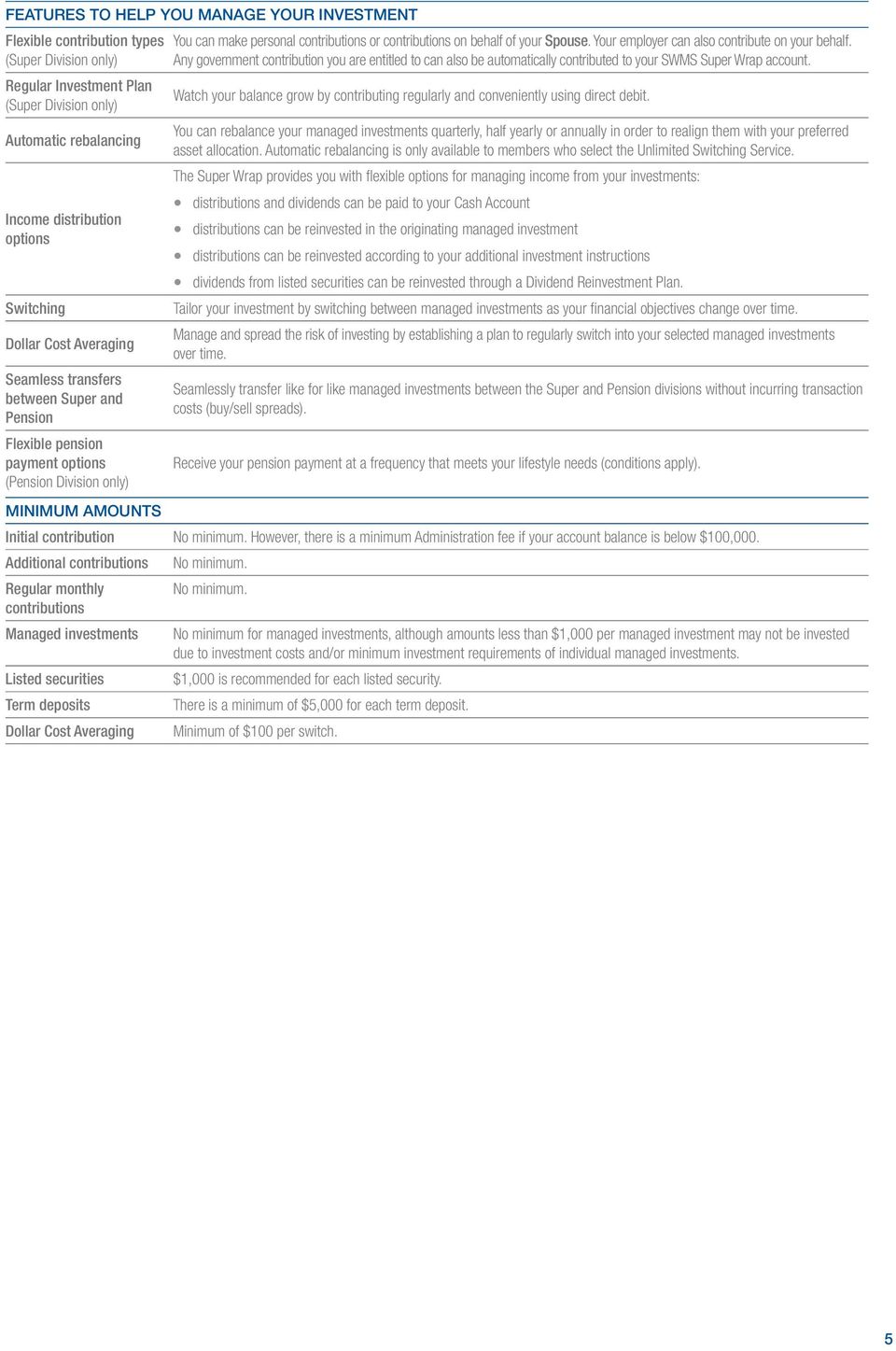
5 Features to help you manage your investment Flexible contribution types (Super Division only) Regular Investment Plan (Super Division only) Automatic rebalancing Income distribution options Switching Dollar Cost Averaging Seamless transfers between Super and Pension Flexible pension payment options (Pension Division only) You can make personal contributions or contributions on behalf of your Spouse. Your employer can also contribute on your behalf. Any government contribution you are entitled to can also be automatically contributed to your SWMS Super Wrap account. Watch your balance grow by contributing regularly and conveniently using direct debit. You can rebalance your managed investments quarterly, half yearly or annually in order to realign them with your preferred asset allocation. Automatic rebalancing is only available to members who select the Unlimited Switching Service. The Super Wrap provides you with flexible options for managing income from your investments: distributions and dividends can be paid to your Cash Account distributions can be reinvested in the originating managed investment distributions can be reinvested according to your additional investment instructions dividends from listed securities can be reinvested through a Dividend Reinvestment Plan. Tailor your investment by switching between managed investments as your financial objectives change over time. Manage and spread the risk of investing by establishing a plan to regularly switch into your selected managed investments over time. Seamlessly transfer like for like managed investments between the Super and Pension divisions without incurring transaction costs (buy/sell spreads). Receive your pension payment at a frequency that meets your lifestyle needs (conditions apply). Minimum amounts Initial contribution No minimum. However, there is a minimum Administration fee if your account balance is below $100,000. Additional contributions No minimum. Regular monthly No minimum. contributions Managed investments No minimum for managed investments, although amounts less than $1,000 per managed investment may not be invested due to investment costs and/or minimum investment requirements of individual managed investments. Listed securities $1,000 is recommended for each listed security. Term deposits There is a minimum of $5,000 for each term deposit. Dollar Cost Averaging Minimum of $100 per switch. 5
6 Other services Easy contribution payment methods Online access Regular communications and reporting Supporting you SWMS Super Wrap (Super Wrap) has a range of payment methods to make it easy for you to make a contribution to your account. Contributions can be made via the following options: BPAY Cheque Easy payment (EFT) Direct debit. Registered to BPAY Pty Limited ABN Track your account online. You will automatically be registered for online access upon joining SWMS Super Wrap. Online access allows you to: access your historical statements and annual reports view transactions on your account, including your contributions and rollovers, fees, taxes and charges as well as investment switches select any period of time and obtain a summary of your account balance, benefits, investment returns, contribution and rollover details, fees, tax, insurance premium deductions and insurance cover access information about your managed investments, investment performance, unit prices, listed security prices, asset allocation, transaction history, insurance cover and other items. As a member of the Super Wrap, you will receive: a Welcome Letter when you join the Super Wrap Login code to access the Super Wrap website Super Division members will receive a Customer Reference Number for BPAY and personalised Easy Payment details an Annual Statement a Trustee Annual Report Insurance review information (insured members only) Pension Division members will also receive a Tax Statement and pension review information a Super Tax Notice (only members who make personal contributions), and on leaving the Super Wrap you will receive a Member statement and Rollover Benefits Statement containing necessary tax information. A team of dedicated professionals providing helpful and efficient customer service responding to your needs through telephone, and in writing. Call Client Services on , available between 8.30am and 6.00pm Monday to Friday, Sydney time, excluding national public holidays. For information on your OneCare insurance cover, please contact OneCare on Which SWMS Super Wrap solution is right for me? Super Division If you: are still working and want to save for your retirement in a tax effective way want tax effective insurance cover through your superannuation investment want to rollover and consolidate superannuation benefits. Pension Division If you are eligible and want to: transfer your superannuation savings to an income stream receive a regular income from your retirement savings. 6

7 About SWMS Super Wrap The Super Wrap comprises: Super Division offering you a flexible and tax effective means of saving for your retirement where you, your employer, Spouse or third party can make contributions Pension Division allowing you to invest your superannuation benefit and receive a regular, tax effective income in retirement, or if you are still working, as you transition to retirement. Focused on delivering a high quality of service, SWMS Super Wrap (Super Wrap) provides dedicated support for you and your financial adviser as you progress through your working life and into your retirement. The Super Wrap is a sub-fund of the Oasis Superannuation Master Trust (Master Trust). The Trustee Oasis Fund Management Limited as the Trustee administers the Super Wrap in accordance with the Trust Deed dated 24 March 2000 as amended from time to time. The Trustee is responsible for ensuring the Super Wrap: is administered in the best interests of its members complies with all legislative and regulatory requirements is administered in accordance with the Trust Deed. You can find trustee and executive remuneration disclosure for the Fund and any other documents which must be disclosed in accordance with the superannuation industry regulations (from the date required by legislation) by visiting oasisasset. com.au > Corporate governance > Trustee information. About ANZ The trustee is proudly owned by ANZ, one of the leading banks here in Australia and overseas. ANZ is committed to building lasting partnerships with our customers, shareholders and communities in 33 markets globally with representation in Australia, New Zealand, Asia Pacific, Europe, America and the Middle East. ANZ provides products and services to more than 8 million retail customers worldwide and employs over 47,000 people. ANZ aims to become a super regional bank. This involves growing in the Asia Pacific region while also remaining very focused on the business and opportunities that exist in Australia and New Zealand. ANZ has a strong involvement in the community, leading the way with programs targeting financial literacy, indigenous inclusion, the environment, volunteering and sponsorship. The Administrator The Trustee outsources the administration of the Super Wrap to Oasis Asset Management. The Trustee is a 100% owned subsidiary of Oasis Asset Management. Oasis Asset Management performs the administration function under an agreement between Oasis Asset Management and the Trustee. Your adviser The term adviser refers to either a financial services licensee or an authorised representative of a financial services licensee. In relation to the Super Wrap, you use the services of an adviser to provide: initial and ongoing advice and guidance education and financial planning services investment instructions to us and brokers, including the online broker, on your behalf. If you require assistance with your Super Wrap membership, you should consult your adviser. Your adviser may receive payment for providing these services. Any payments made to your adviser from the Super Wrap must be made solely for advice in relation to your interest in the Super Wrap. The Distributor Superior Wealth Management Solutions Pty Ltd is the Distributor of the Super Wrap. They provide certain services to the SWMS Super Wrap including, but not limited to, market research, development of platform and product specifications, system testing, PDS and communication review, adviser training services, adviser issues escalations and distribution monitoring. The Online Broker AUSIEX has been appointed as the Online Broker for the Trust. When you wish to buy or sell financial products listed on the Australian Securities Exchange (ASX) as part of your investment in the Trust, the Trustee trades as principal with AUSIEX. AUSIEX is a leading provider of online broking services in the Australian market and is a wholly owned and non-guaranteed subsidiary of the Commonwealth Bank of Australia. The Custodian The Trustee has appointed HSBC as the independent custodian of the Trust s assets. The Auditor KPMG are the auditors of the Master Trust. KPMG is one of the world s leading professional services firms with over 152,000 people worldwide and provide audit, tax and advisory services in around 156 countries. In Australia, KPMG operates nationally across 14 offices with over 5,200 people. The Insurer Group Insurance consisting of Death Only, Death & TPD and Salary Continuance cover is provided to members of the Super Division who are provided cover under Group Insurance policies owned by the Trustee and issued by OnePath Life. OneCare Insurance consisting of Life, TPD, Income Secure and Extra Care cover is also provided to members of the Super Division who are accepted for cover under Individual Insurance policies owned by the Trustee and issued by OnePath Life. OnePath Life is a related body corporate of the Trustee. 7

8 8 How super works Super is a tax effective long-term savings plan that enables you to save money for your retirement and is, in part, compulsory. There are different ways that you and your employer can contribute to your super. While you are working, your employer is, in most cases, required to make contributions to your super account (known as compulsory super or Super Guarantee). Generally, you have the right to choose the super fund to which these contributions are made. You, your employer, Spouse or third party may also be eligible to make voluntary contributions. There are some limits on the contributions that you can make to super. There are also restrictions around when you can access your super. However, when you reach age 65 or your preservation age and have retired, you can access your super savings as a lump sum or receive a regular income stream through a pension account. There may be other circumstances when you can access your super. A pension account allows you to draw a regular income from your super savings in a tax effective manner. What contributions and rollovers can be made into my super account? Types of superannuation contributions The following table provides details about the types of contributions that can be made to your super account. Please speak to your financial adviser if you require further information about any of these contributions. Contribution type Personal Spouse Employer What is this contribution? You may decide to make regular or lump-sum contributions. Personal contributions are member contributions made by you or on your behalf, and include payments from: foreign superannuation funds eligible proceeds that relate to capital gains tax (CGT) small business concessions payments that relate to structured settlements or orders for personal injuries personal deductible contributions where you may be entitled to a tax deduction for your personal contributions. Your Spouse may make a member contribution for your benefit. This must be made from after-tax money and will be treated as a non-concessional contribution. Your spouse may be eligible for a tax offset of up to $540 when making a spouse contribution. Your employer may make employer contributions for your benefit. This includes employer additional and salary sacrifice contributions. Salary sacrifice is an arrangement between you and your employer whereby your employer makes a contribution to your ANZ Smart Choice Super account instead of making an equivalent gross payment as salary to you. An Employer Additional contribution occurs when your employer makes a contribution greater than Superannuation Guarantee which is not salary sacrifice. Contribution type Third party contributions Government co-contribution Government low income superannuation contribution # What is this contribution? These are contributions made for you by anyone other than your Spouse or employer. Sometimes these are called family and friend contributions. If your income is less than $49,488 p.a. (2014/2015) and you make personal contributions to super you may be eligible for a government incentive of up to $500. The government contributes up to 50 cents for every $1 of personal contributions you make, subject to a maximum $500. The amount paid by the government depends on your income. Any government contribution is made to your super account by the Australian Tax Office (ATO), provided you have lodged your tax return (conditions apply). A government contribution of up to $500 (nonindexed) is payable for persons with adjusted taxable income * of up to $37,000 (non-indexed) (conditions apply). This contribution effectively offsets the tax (up to $500) on concessional contributions. # At the time of writing, the Government has proposed to discontinue the Government low income superannuation contribution. Please refer to the ATO or visit our website for up to date information. * Adjusted taxable income includes taxable income, reportable employer superannuation contributions, personal deductible contributions, adjusted fringe benefits, target foreign income, total net investment losses, government tax free pensions/benefits less child support paid. Who can contribute? The following table outlines the rules relating to who can make super contributions. Your age Under 65 At least 65 but under 70 At least 70 but under 75 Who can contribute You, your spouse, your employer and a third party. You, your spouse, your employer and a third party, provided you have been gainfully employed* for at least 40 hours during any 30 consecutive day period in the financial year. Your employer must make compulsory employer contributions. You and your employer, provided you have been gainfully employed* for at least 40 hours during any 30 consecutive day period in the financial year. Your employer must make compulsory employer contributions. 75 and over Your employer may make a compulsory employer contribution. * Gainfully employed means being employed or self-employed for gain or reward in any business, trade, profession, vocation, calling, occupation or employment. Personal and employer contributions may be accepted (other than compulsory employer contributions) on or before the 28th day of the month following that in which you turn 75 if you have been gainfully employed. Generally, the Super Wrap cannot accept and must return: member contributions made by you or on your behalf if you have not quoted your Tax File Number (TFN) to the Trustee certain non-concessional contributions that exceed $540,000 if you are under 65 years of age at 1 July of the financial year that the contribution is made, otherwise $180,000 p.a. (indexed) if you are age 65 or over contributions made if you are age 75 or over unless they are mandated employer contributions.

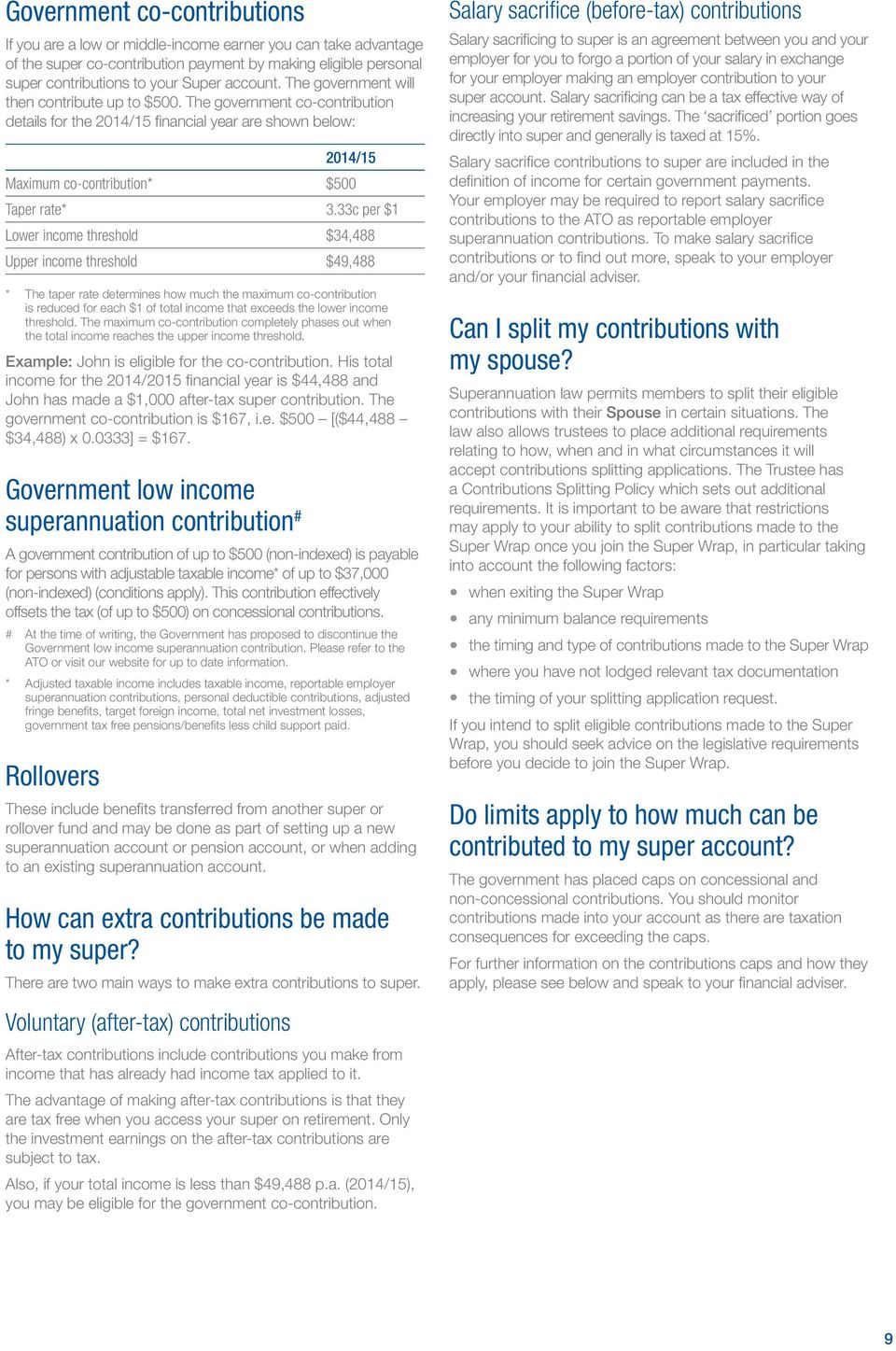
9 Government co-contributions If you are a low or middle-income earner you can take advantage of the super co-contribution payment by making eligible personal super contributions to your Super account. The government will then contribute up to $500. The government co-contribution details for the 2014/15 financial year are shown below: 2014/15 Maximum co-contribution* $500 Taper rate* 3.33c per $1 Lower income threshold $34,488 Upper income threshold $49,488 * The taper rate determines how much the maximum co-contribution is reduced for each $1 of total income that exceeds the lower income threshold. The maximum co-contribution completely phases out when the total income reaches the upper income threshold. Example: John is eligible for the co-contribution. His total income for the 2014/2015 financial year is $44,488 and John has made a $1,000 after-tax super contribution. The government co-contribution is $167, i.e. $500 [($44,488 $34,488) x ] = $167. Government low income superannuation contribution # A government contribution of up to $500 (non-indexed) is payable for persons with adjustable taxable income* of up to $37,000 (non-indexed) (conditions apply). This contribution effectively offsets the tax (of up to $500) on concessional contributions. # At the time of writing, the Government has proposed to discontinue the Government low income superannuation contribution. Please refer to the ATO or visit our website for up to date information. * Adjusted taxable income includes taxable income, reportable employer superannuation contributions, personal deductible contributions, adjusted fringe benefits, target foreign income, total net investment losses, government tax free pensions/benefits less child support paid. Rollovers These include benefits transferred from another super or rollover fund and may be done as part of setting up a new superannuation account or pension account, or when adding to an existing superannuation account. How can extra contributions be made to my super? There are two main ways to make extra contributions to super. Salary sacrifice (before-tax) contributions Salary sacrificing to super is an agreement between you and your employer for you to forgo a portion of your salary in exchange for your employer making an employer contribution to your super account. Salary sacrificing can be a tax effective way of increasing your retirement savings. The sacrificed portion goes directly into super and generally is taxed at 15%. Salary sacrifice contributions to super are included in the definition of income for certain government payments. Your employer may be required to report salary sacrifice contributions to the ATO as reportable employer superannuation contributions. To make salary sacrifice contributions or to find out more, speak to your employer and/or your financial adviser. Can I split my contributions with my spouse? Superannuation law permits members to split their eligible contributions with their Spouse in certain situations. The law also allows trustees to place additional requirements relating to how, when and in what circumstances it will accept contributions splitting applications. The Trustee has a Contributions Splitting Policy which sets out additional requirements. It is important to be aware that restrictions may apply to your ability to split contributions made to the Super Wrap once you join the Super Wrap, in particular taking into account the following factors: when exiting the Super Wrap any minimum balance requirements the timing and type of contributions made to the Super Wrap where you have not lodged relevant tax documentation the timing of your splitting application request. If you intend to split eligible contributions made to the Super Wrap, you should seek advice on the legislative requirements before you decide to join the Super Wrap. Do limits apply to how much can be contributed to my super account? The government has placed caps on concessional and non-concessional contributions. You should monitor contributions made into your account as there are taxation consequences for exceeding the caps. For further information on the contributions caps and how they apply, please see below and speak to your financial adviser. Voluntary (after-tax) contributions After-tax contributions include contributions you make from income that has already had income tax applied to it. The advantage of making after-tax contributions is that they are tax free when you access your super on retirement. Only the investment earnings on the after-tax contributions are subject to tax. Also, if your total income is less than $49,488 p.a. (2014/15), you may be eligible for the government co-contribution. 9
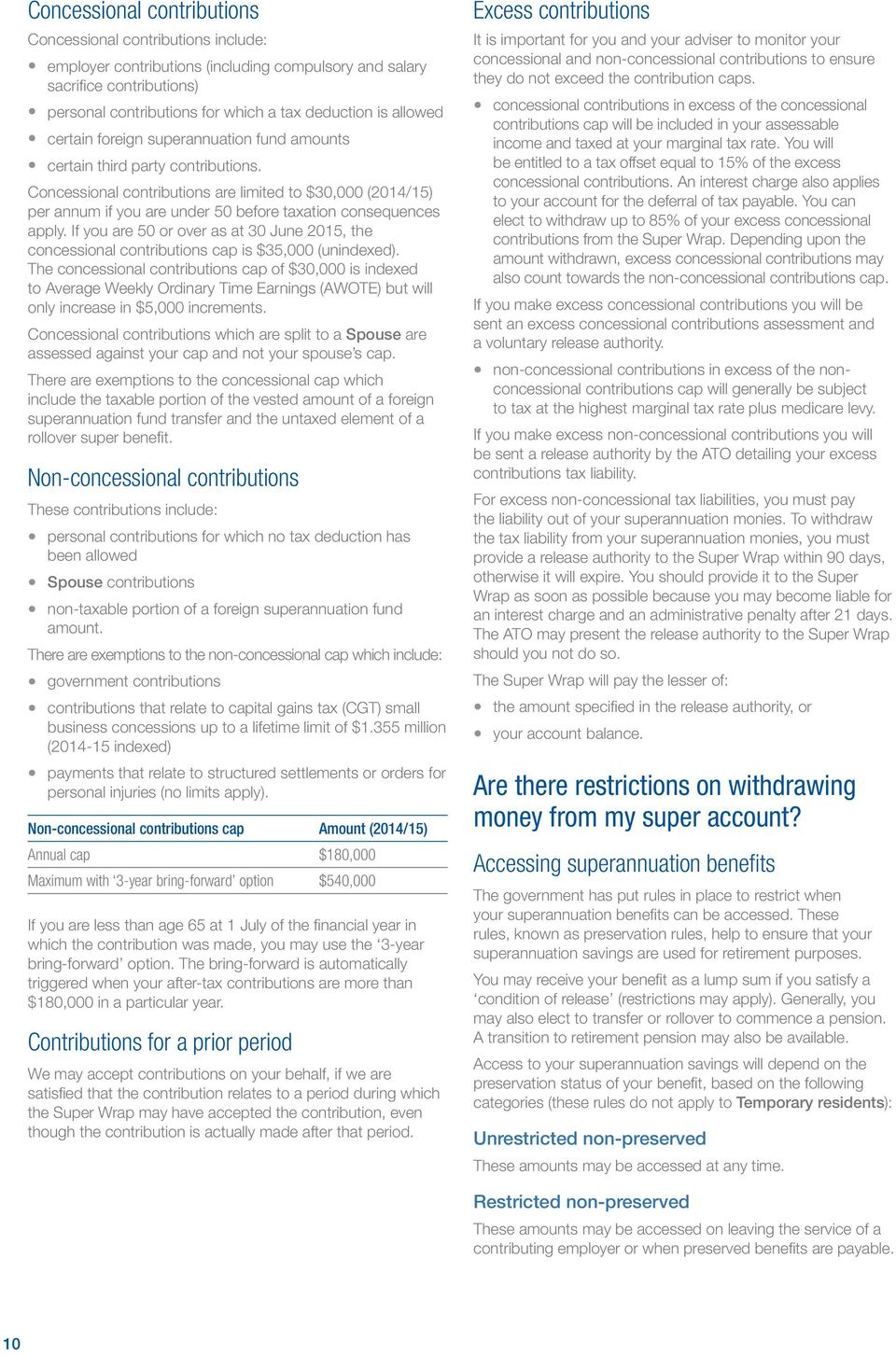
10 Concessional contributions Concessional contributions include: employer contributions (including compulsory and salary sacrifice contributions) personal contributions for which a tax deduction is allowed certain foreign superannuation fund amounts certain third party contributions. Concessional contributions are limited to $30,000 (2014/15) per annum if you are under 50 before taxation consequences apply. If you are 50 or over as at 30 June 2015, the concessional contributions cap is $35,000 (unindexed). The concessional contributions cap of $30,000 is indexed to Average Weekly Ordinary Time Earnings (AWOTE) but will only increase in $5,000 increments. Concessional contributions which are split to a Spouse are assessed against your cap and not your spouse s cap. There are exemptions to the concessional cap which include the taxable portion of the vested amount of a foreign superannuation fund transfer and the untaxed element of a rollover super benefit. Non-concessional contributions These contributions include: personal contributions for which no tax deduction has been allowed Spouse contributions non-taxable portion of a foreign superannuation fund amount. There are exemptions to the non-concessional cap which include: government contributions contributions that relate to capital gains tax (CGT) small business concessions up to a lifetime limit of $1.355 million ( indexed) payments that relate to structured settlements or orders for personal injuries (no limits apply). Non-concessional contributions cap Amount (2014/15) Annual cap $180,000 Maximum with 3-year bring-forward option $540,000 If you are less than age 65 at 1 July of the financial year in which the contribution was made, you may use the 3-year bring-forward option. The bring-forward is automatically triggered when your after-tax contributions are more than $180,000 in a particular year. Contributions for a prior period We may accept contributions on your behalf, if we are satisfied that the contribution relates to a period during which the Super Wrap may have accepted the contribution, even though the contribution is actually made after that period. Excess contributions It is important for you and your adviser to monitor your concessional and non-concessional contributions to ensure they do not exceed the contribution caps. concessional contributions in excess of the concessional contributions cap will be included in your assessable income and taxed at your marginal tax rate. You will be entitled to a tax offset equal to 15% of the excess concessional contributions. An interest charge also applies to your account for the deferral of tax payable. You can elect to withdraw up to 85% of your excess concessional contributions from the Super Wrap. Depending upon the amount withdrawn, excess concessional contributions may also count towards the non-concessional contributions cap. If you make excess concessional contributions you will be sent an excess concessional contributions assessment and a voluntary release authority. non-concessional contributions in excess of the nonconcessional contributions cap will generally be subject to tax at the highest marginal tax rate plus medicare levy. If you make excess non-concessional contributions you will be sent a release authority by the ATO detailing your excess contributions tax liability. For excess non-concessional tax liabilities, you must pay the liability out of your superannuation monies. To withdraw the tax liability from your superannuation monies, you must provide a release authority to the Super Wrap within 90 days, otherwise it will expire. You should provide it to the Super Wrap as soon as possible because you may become liable for an interest charge and an administrative penalty after 21 days. The ATO may present the release authority to the Super Wrap should you not do so. The Super Wrap will pay the lesser of: the amount specified in the release authority, or your account balance. Are there restrictions on withdrawing money from my super account? Accessing superannuation benefits The government has put rules in place to restrict when your superannuation benefits can be accessed. These rules, known as preservation rules, help to ensure that your superannuation savings are used for retirement purposes. You may receive your benefit as a lump sum if you satisfy a condition of release (restrictions may apply). Generally, you may also elect to transfer or rollover to commence a pension. A transition to retirement pension may also be available. Access to your superannuation savings will depend on the preservation status of your benefit, based on the following categories (these rules do not apply to Temporary residents): Unrestricted non-preserved These amounts may be accessed at any time. Restricted non-preserved These amounts may be accessed on leaving the service of a contributing employer or when preserved benefits are payable. 10
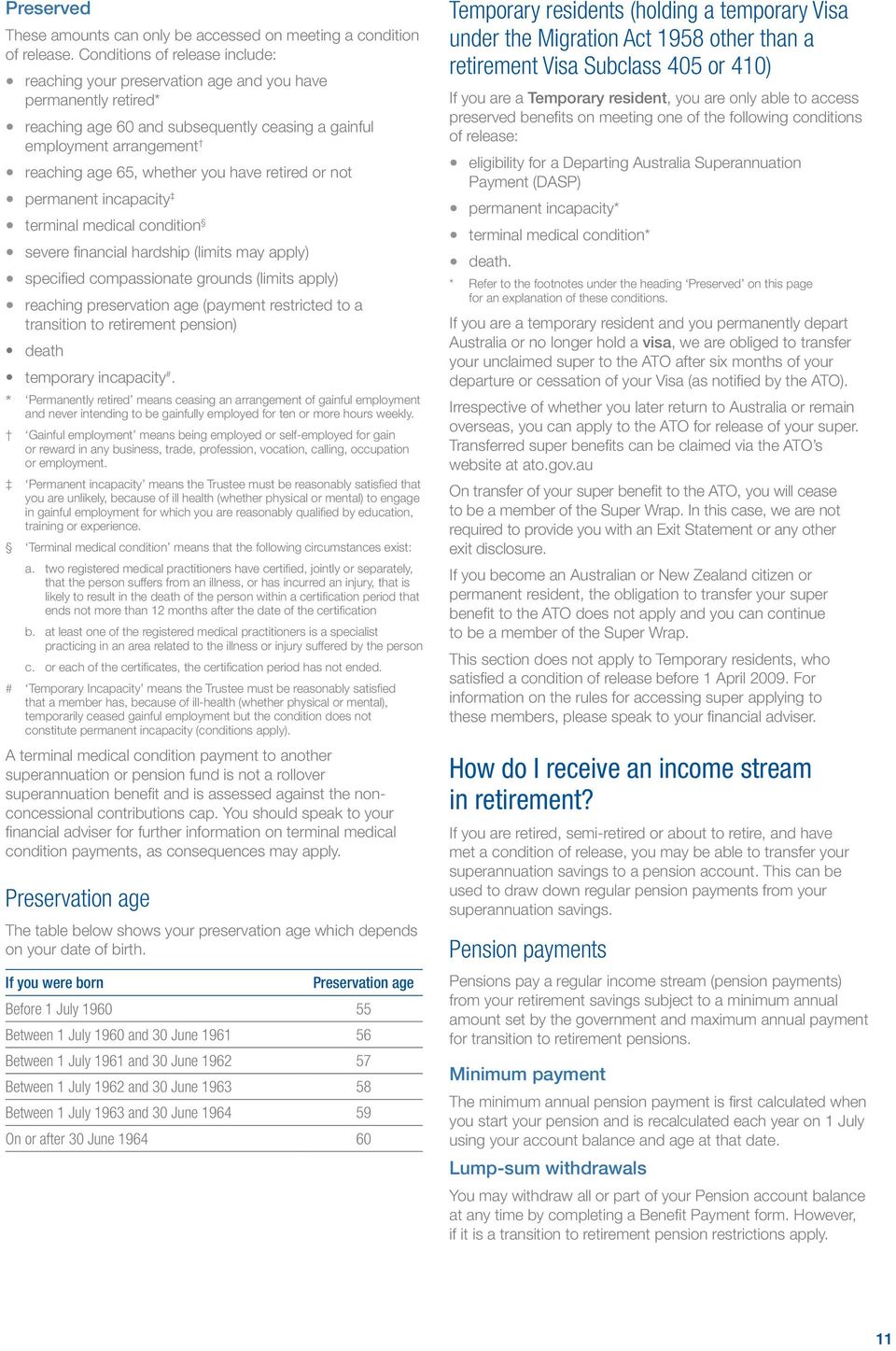
11 Preserved These amounts can only be accessed on meeting a condition of release. Conditions of release include: reaching your preservation age and you have permanently retired* reaching age 60 and subsequently ceasing a gainful employment arrangement reaching age 65, whether you have retired or not permanent incapacity terminal medical condition severe financial hardship (limits may apply) specified compassionate grounds (limits apply) reaching preservation age (payment restricted to a transition to retirement pension) death temporary incapacity #. * Permanently retired means ceasing an arrangement of gainful employment and never intending to be gainfully employed for ten or more hours weekly. Gainful employment means being employed or self-employed for gain or reward in any business, trade, profession, vocation, calling, occupation or employment. Permanent incapacity means the Trustee must be reasonably satisfied that you are unlikely, because of ill health (whether physical or mental) to engage in gainful employment for which you are reasonably qualified by education, training or experience. Terminal medical condition means that the following circumstances exist: a. two registered medical practitioners have certified, jointly or separately, that the person suffers from an illness, or has incurred an injury, that is likely to result in the death of the person within a certification period that ends not more than 12 months after the date of the certification b. at least one of the registered medical practitioners is a specialist practicing in an area related to the illness or injury suffered by the person c. or each of the certificates, the certification period has not ended. # Temporary Incapacity means the Trustee must be reasonably satisfied that a member has, because of ill-health (whether physical or mental), temporarily ceased gainful employment but the condition does not constitute permanent incapacity (conditions apply). A terminal medical condition payment to another superannuation or pension fund is not a rollover superannuation benefit and is assessed against the nonconcessional contributions cap. You should speak to your financial adviser for further information on terminal medical condition payments, as consequences may apply. Preservation age The table below shows your preservation age which depends on your date of birth. If you were born Preservation age Before 1 July Between 1 July 1960 and 30 June Between 1 July 1961 and 30 June Between 1 July 1962 and 30 June Between 1 July 1963 and 30 June On or after 30 June Temporary residents (holding a temporary Visa under the Migration Act 1958 other than a retirement Visa Subclass 405 or 410) If you are a Temporary resident, you are only able to access preserved benefits on meeting one of the following conditions of release: eligibility for a Departing Australia Superannuation Payment (DASP) permanent incapacity* terminal medical condition* death. * Refer to the footnotes under the heading Preserved on this page for an explanation of these conditions. If you are a temporary resident and you permanently depart Australia or no longer hold a visa, we are obliged to transfer your unclaimed super to the ATO after six months of your departure or cessation of your Visa (as notified by the ATO). Irrespective of whether you later return to Australia or remain overseas, you can apply to the ATO for release of your super. Transferred super benefits can be claimed via the ATO s website at ato.gov.au On transfer of your super benefit to the ATO, you will cease to be a member of the Super Wrap. In this case, we are not required to provide you with an Exit Statement or any other exit disclosure. If you become an Australian or New Zealand citizen or permanent resident, the obligation to transfer your super benefit to the ATO does not apply and you can continue to be a member of the Super Wrap. This section does not apply to Temporary residents, who satisfied a condition of release before 1 April For information on the rules for accessing super applying to these members, please speak to your financial adviser. How do I receive an income stream in retirement? If you are retired, semi-retired or about to retire, and have met a condition of release, you may be able to transfer your superannuation savings to a pension account. This can be used to draw down regular pension payments from your superannuation savings. Pension payments Pensions pay a regular income stream (pension payments) from your retirement savings subject to a minimum annual amount set by the government and maximum annual payment for transition to retirement pensions. Minimum payment The minimum annual pension payment is first calculated when you start your pension and is recalculated each year on 1 July using your account balance and age at that date. Lump-sum withdrawals You may withdraw all or part of your Pension account balance at any time by completing a Benefit Payment form. However, if it is a transition to retirement pension restrictions apply. 11
12 If you withdraw a lump sum, legislation does not allow your minimum income level to be recalculated, based on the new account balance, until the following 1 July. We may also be required by law to ensure you have taken your minimum pension payment (pro-rated) for the current year. Any additional pension payment that is required to be made will be processed before the withdrawal. A withdrawal will generally consist of two components taxable and tax free. You are required to draw down proportionately from these components. Before withdrawing from your pension, you should speak to your financial adviser about any tax implications. You should also speak to your financial adviser for further information on terminal medical condition payments, as consequences may apply. A terminal medical condition payment to another superannuation or pension fund is not a rollover superannuation benefit and is assessed against the non-concessional contribution cap. Please refer to Making a withdrawal from your Pension on page 14 for more information on withdrawing from your Pension account. How does the SWMS Super Wrap division work? Becoming a member You become a member of the Super Wrap when you have submitted all the relevant documentation, including an Application form and a rollover or contribution has been received on your behalf. The Trustee reserves the right to accept or reject an application without giving a reason. Super Division Making contributions You can make your initial and additional contributions by cheque or BPAY. Where BPAY is elected, the initial contribution can only be made once your account has been established by the Trustee and your account information has been provided. We must receive your initial contribution within 120 days of you receiving your Welcome Letter, otherwise the account will be closed. Easy Payment Easy Payment is an electronic funds transfer method that deposits your contribution directly into your account without the need to submit any paperwork. To use Easy Payment you will need an Easy Payment BSB number and your own personal Easy Payment Account Number. You can obtain these numbers from the Welcome Letter you receive when you join the Super Wrap, by contacting Client Services, your adviser or by logging into your online account. You are not required to submit further processing instructions when using Easy Payment. BPAY To make contributions via BPAY you will require a Biller Code and Customer Reference Number. The Biller Code you use is determined by the type of contribution you are making: Contribution type Biller Code Personal contribution (non-concessional) Employer superannuation guarantee contribution Employer salary sacrifice contribution Employer other contribution Spouse non-concessional contribution Your Customer Reference Number can be obtained from the Welcome Letter you receive when you join the Super Wrap, by contacting Client Services, your adviser or by logging into your online account. You are not required to submit further processing instructions if you contribute via BPAY. Direct Debit Request (DDR) You or your employer can make regular contributions by completing a DDR form. Deduction of contributions will then commence from your nominated Australian financial institution account on a monthly, quarterly, half yearly or yearly basis on the 25th of the month. To use the direct debit facility the Trustee requires that you: read and understand the DDR agreement, and complete and return the DDR form. You can vary the amount deducted from your nominated account at any time by providing us with a written request. If you wish to change the financial institution from which your contributions are deducted, then you must provide us with a new DDR form. Cheque If you or your employer make a contribution by cheque, please ensure that the cheque is made payable to the SWMS Super Wrap and is crossed Not negotiable. In specie transfers You can also transfer acceptable assets into the Super Wrap as a contribution or rollover. This is known as an in specie transfer. Acceptable assets include any managed investment or listed security that is on the SWMS Investment Menu. For information on how to complete an in specie transfer, please speak to your adviser. Processing contributions Contributions will be invested according to your investment instructions. Small amounts, generally less than $1,000 per managed investment, may not be invested due to investment costs and/or minimum investment requirements. In this circumstance, the applicable amount will be retained in your Cash Account. Consolidate your super Many people who have had several jobs often have more than one super account. Having multiple accounts makes it harder to manage your superannuation and may mean paying more in fees than you should. Rolling over other superannuation balances you may have into the Super Wrap provides the many benefits of consolidating your superannuation into one account. You just need to complete a Transfer Request Authority form and your adviser will do the rest. 12
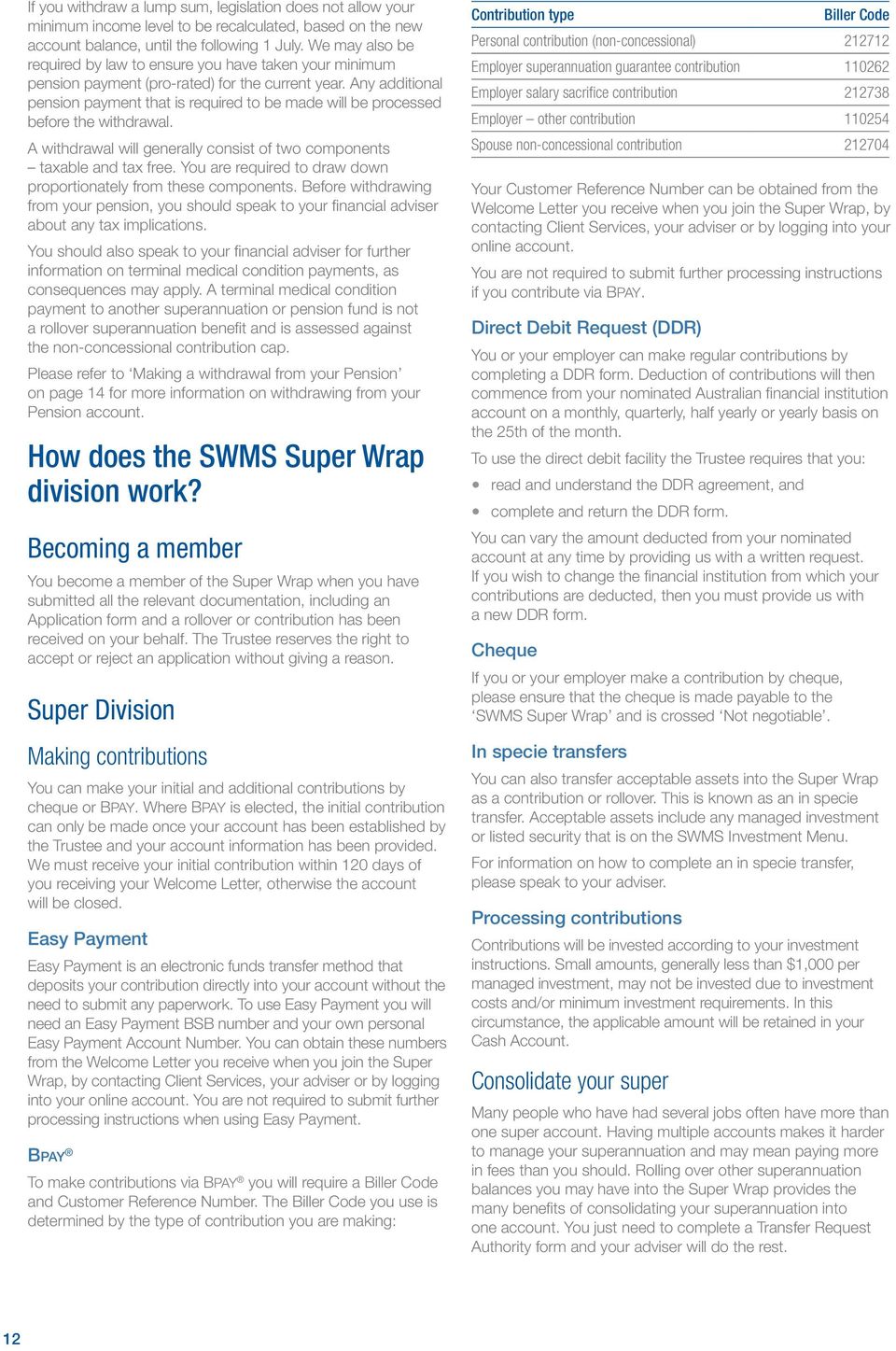
13 Some funds may charge an exit fee to transfer your superannuation, please check with the administrator of your other fund/s for details. Before consolidating your super you should also consider any other adverse consequences for you (e.g. loss of benefits such as insurance cover or increase in investment risk). For more information about consolidating your superannuation please speak to your adviser. Choice of fund The Super Wrap is a complying superannuation fund able to accept all types of superannuation contributions. Provided you are eligible to choose a fund under the government s Super Choice legislation, you can nominate the Super Wrap to receive compulsory employer (superannuation guarantee and/ or award) contributions. If you wish to do this, simply return to your employer a completed Section A of the Standard Choice form (which your employer can give to you), along with the SWMS Complying Fund Letter which is available from your adviser, our website or by contacting Client Services. Transferring between Super and Pension Transferring between the Super and Pension divisions is easy. If you choose to transfer your balance between the same managed investments, with the same amounts, you will not incur transaction costs (buy/sell spreads) and there will be no capital gains tax on transfers as the trustee remains the same. Pension Division The Pension Division allows you to roll over your superannuation benefit to an allocated pension or Transition to Retirement allocated pension. If you intend to claim a tax deduction for personal contributions (or vary this amount) please ensure you do so while in the Super Division, prior to rolling over to the Pension Division. Commencing a pension If you are retired, semi-retired or about to retire, and have met a condition of release, you may be able to rollover your superannuation benefit from your existing SWMS Super Wrap Super account or from another superannuation fund into a SWMS Super Wrap Pension account. This is an arrangement where you invest superannuation savings and regularly receive an income stream from a pension account, as long as there are funds in your account. You can nominate the level of payments you wish to receive and alter them at any time, provided that they are above the minimum limits set by the government. Also you may be able to withdraw a lump sum from your pension account at any time. Transition to retirement pension If you have reached your preservation age and are less than 65 years of age and would like the security of a regular income stream, even if you are still working, a Transition to Retirement pension within SWMS Super Wrap could be a suitable solution. A Transition to Retirement allocated pension is the same as an allocated pension, except you generally cannot make lump sum withdrawals from your account, unless under exceptional circumstances. You also cannot receive pension payments of more than 10% of the account balance of the pension in a financial year. Funds used to invest in a Transition to Retirement allocated pension will become fully preserved regardless of their prior preservation status. This means that until you satisfy a condition of release, the only way of accessing your funds will be through a pension payment from your Transition to Retirement allocated pension. Pension payments Minimum payment Your pension payment each year must be greater than or equal to the minimum limits set by the government. This minimum is based on your age and account balance and is calculated upon the commencement of your investment. Minimum percentage factors Age of beneficiary Under 65 4% % % % % % 95 or more 14% For example, if on 1 July you are 65 years of age with $100,000 in your allocated pension, you can nominate to receive a pension payment above or equal to the following in the financial year. Minimum amount: $100,000 x 5% = $5,000 If your pension starts on a day other than 1 July, the minimum payment for the first year is pro-rated. This is applied proportionately to the number of days remaining in the financial year following (and including) the commencement date of the pension. Where the commencement date is after 1 June, no payment is required for that financial year. For example, if you are 64 and commence a pension with $100,000 on 1 November, your minimum pension payment will be calculated as follows: Pro-rated minimum amount: $100,000 x 4% x (No. of days from 1 Nov to 30 June/365) = $4,000 x 242/365 = $2,650 These examples are provided for illustration only, are based on the factors stated and should not be taken to contain an estimate or guarantee. Maximum payment For Transition to Retirement pensions, a maximum annual pension payment equal to 10% of the account balance will apply each year. If you choose to obtain the maximum amount for the Transition to Retirement allocated pension, it will not be pro-rated. The maximum pension income payment is first calculated when you start your pension and is recalculated each year on 1 July, using your account balance at that date. 13
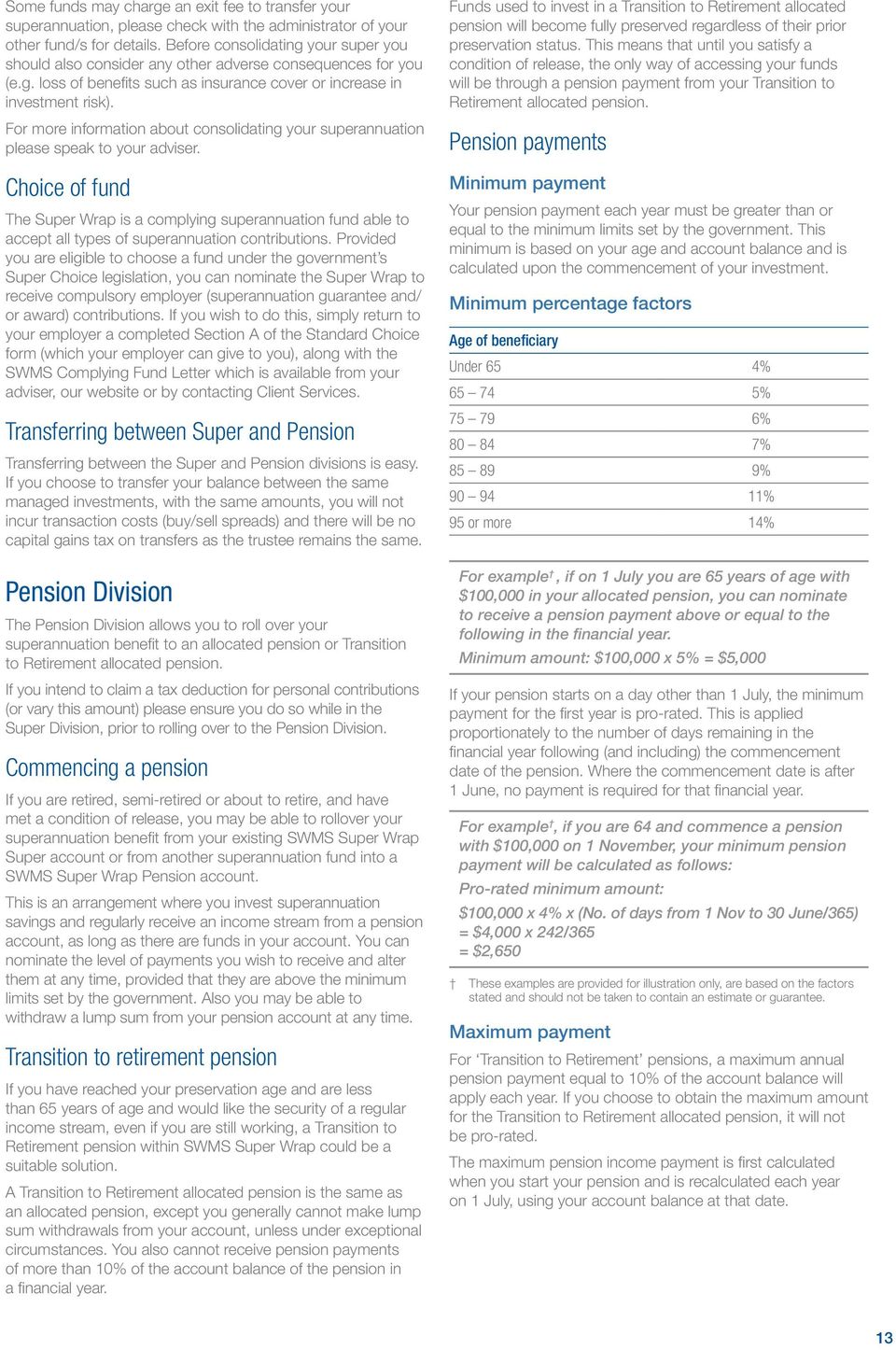
14 Frequency of payments On your Application form, you can nominate to receive your pension payment: monthly quarterly half yearly, or annually. You can select one of the four following pension payment days per month: 7th of the month 14th of the month 21st of the month, or 28th of the month. Where your chosen day is not a Sydney business day, you will be paid on the previous Sydney business day. Making a withdrawal from your pension You may withdraw all or part of your Pension account balance at any time by completing a benefit payment form (restrictions apply to withdrawing from transition to retirement pensions). Withdrawals can be paid to you as a cheque or deposited into your nominated bank account. If your withdrawal results in a full withdrawal from the Pension Division and you have not yet received your minimum pension amount for the relevant portion of that financial year, we will pay you part of this withdrawal as a pension amount to bring you up to the minimum annual pension payment amount. This portion will be regarded as income for tax purposes. The remainder of the withdrawal will be regarded as a lump sum withdrawal for tax purposes. Withdrawals can only be made from Transition to Retirement allocated pensions if: you need to pay a surcharge liability you meet a condition of release such as retirement or reaching age 65 you wish to rollover or transfer to another Transition to Retirement allocated pension you need to satisfy a payment split required under Family Law you wish to transfer your benefits back to a superannuation account to accumulate further benefits. Should you wish to withdraw all or part of the balance of your account, subject to the restrictions described in the sections on withdrawals above, investments held in respect of your account will need to be sold and converted to cash before any payment is made to you. Ongoing contributions Once you have commenced a pension you cannot make any further contributions to the account, therefore it is important to consolidate all your money prior to commencing your pension. If you wish to make future contributions to the Pension Division, you will need to start a new pension account. Managing your account Adviser authority to transact It is important to note that by becoming a member of the Super Wrap, you authorise your adviser to submit instructions to the Trustee or to brokers relating to purchases and sales of investments in respect of your interest in the Super Wrap. This authority includes the ability to submit investment instructions to the Online Broker to undertake purchases and sales of listed securities on behalf of the Trustee according to your instructions and submitting instructions to the Trustee in relation to the purchase and sale of managed investments. In carrying out this activity your adviser will be acting as your agent. The Trustee will act on your adviser s instructions. Your consent will not be sought before the transaction occurs. In providing this authority to your adviser, you also agree not to hold the Trustee responsible in any way for any transactions entered into by your adviser on your behalf. While this authority allows your adviser to provide instructions to the Trustee in relation to purchases and sales, it does not authorise them to provide instructions in relation to withdrawals. How your account balance is calculated Your account balance is the total value of your managed investments, listed securities, term deposits and your Cash Account. The value of a managed investment is calculated by multiplying the number of units you hold in that managed investment by the sell unit price of the managed investment. The sell unit price is equal to the value of the assets (net of the product issuer costs) of a managed investment divided by the number of units on issue. Unit prices are generally calculated daily; however, investments such as hedge funds may calculate their unit prices less frequently. The value of each listed security you hold is calculated by multiplying the number of shares you hold in a particular listed security by the last sale price. The last sale price of a listed security is the price quoted at the close of the previous trading day on the ASX. Switch and reweight To switch or reweight your managed investments, simply contact your adviser who will then lodge the request with the Trustee. Your adviser can complete a reweight or a full or partial account balance switch on your behalf. We will normally act on any instructions to purchase or sell managed investments on a daily basis (Sydney business days only). However, this will only occur once your application has been processed. This is also subject to minimum investment requirements and the time taken by the product issuers of the underlying investments to process your investment instructions. This may result in the sell price being higher, or lower, than that prevailing on the date the Trustee received your investment instructions. The Trustee is not liable for any loss that may result from this occurring. The switch and reweight process applies to managed investments only, not listed securities or term deposits. Changes to your listed security holdings are made by your adviser issuing buy or sell instructions directly to the Online Broker or an external broker on behalf of the Trustee. 14
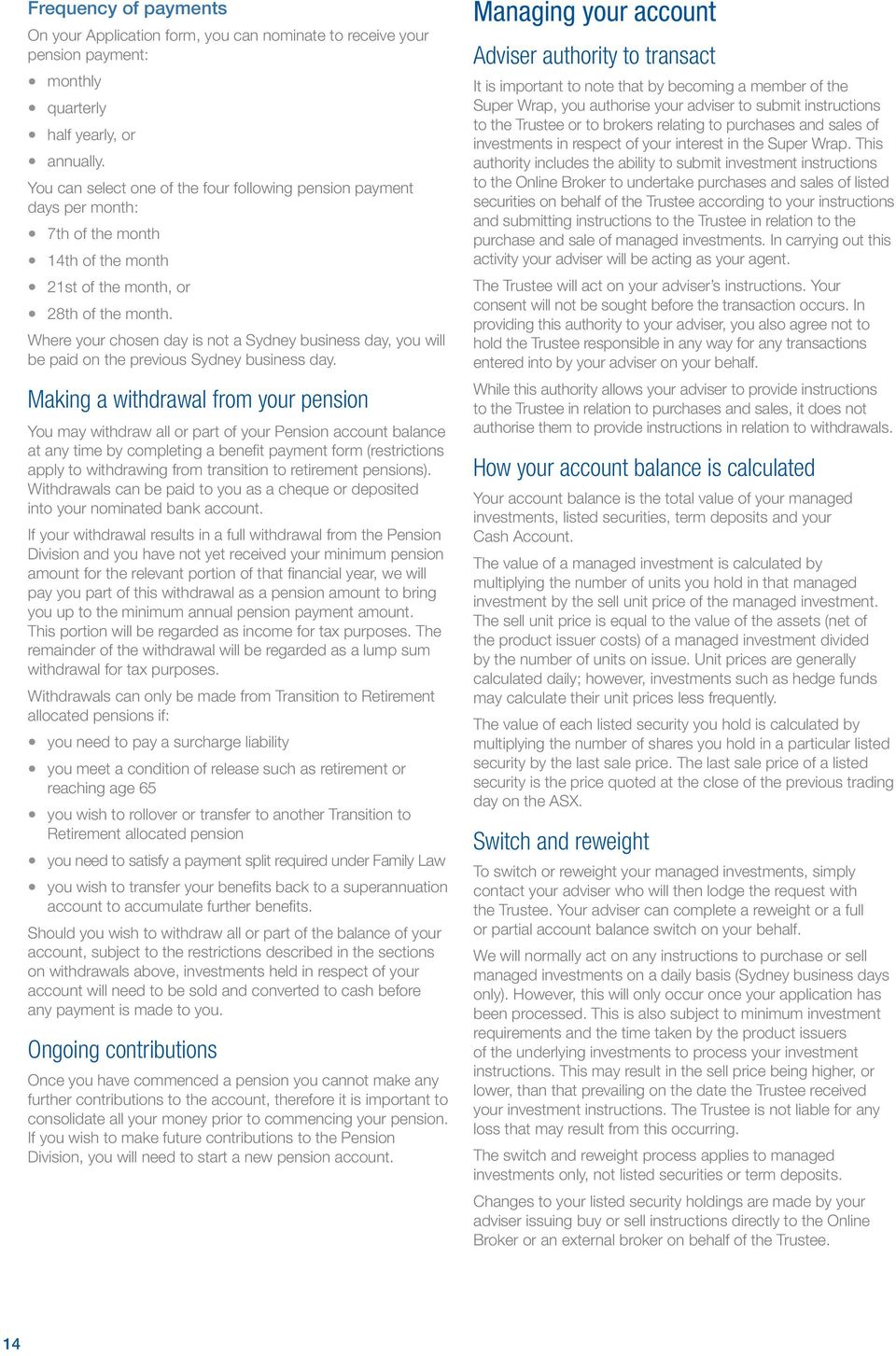
15 Automatic rebalancing Individual managed investments are subject to market flows and movements and consequently their actual balance may not always reflect the percentages allocated in your current investment instructions. To enable your managed investments to be re-aligned with your selected percentage allocation, the Super Wrap offers automatic rebalancing. Automatic rebalancing is an optional facility which automatically restores the weighting of your managed investments to that which you have specified in your additional investment instructions. It works by switching units between the investments in your nominated additional investment instructions in order to realign your investments to your nominated percentage allocation. Automatic rebalancing is only available to members who select the Unlimited Switching Service and only applies to managed investments that price daily. Listed securities and term deposits cannot be rebalanced. How automatic rebalancing works If you select this facility, the Super Wrap periodically reviews your managed investments and will: sell managed investments that are over the selected percentage allocation*, and buy managed investments that are under the selected percentage allocation*. When automatic rebalancing has been completed, the percentage allocated to each investment will match as closely as possible to your additional investment instructions (after allowing for the cash account minimum). If additional investment instructions have not been provided, your account will not be rebalanced. In order to minimise the number of investment transactions made on your account and to meet upcoming cash requirements for items such as contributions tax, the rebalance process may result in a higher Cash Account balance than the Cash Account minimum or higher nominated amount. You can elect to have your managed investments rebalanced: quarterly in February, May, August and November half yearly in February and August, or annually in August. You can elect to rebalance your managed investments using the Account Alteration form. If you hold managed investments that are not included in your additional investment instructions, these investments will be excluded from the rebalance process and their allocation will remain unchanged. Only the managed investments that are included in your additional investment instructions will be rebalanced. Listed securities and Term Deposits cannot be included on additional investment instructions and cannot be part of the rebalancing process.. * Small amounts, generally less than $1,000 per managed investment, may not be invested or redeemed due to investment costs and/or minimum investment requirements. For example*: Account before rebalancing Additional investment instructions Account after rebalancing Investment Holding Investment % Investment Holding A $20,000 A 40% A $40,000 B $30,000 B 25% B $25,000 C $50,000 C 35% C $35,000 D $10,000 D $10,000 E $20,000 E $20,000 * This example is for illustration purposes only and does take into consideration the cash account minimum. Further, your entire account will be excluded from the rebalancing process where your additional investment instructions include an investment: that does not price daily that becomes closed to new monies or is wound up (terminated) by the product issuer that has a balance less than $300, or where the product issuer is not accepting applications or redemptions. Where an account with active instructions fails to rebalance twice or more in succession, the rebalance instruction will be automatically be cancelled. However, if you remove the investment that is affected by any of the above four points from your additional investment instructions, the automatic rebalancing process will rebalance the managed investments according to your additional investment instructions. Keeping in mind that investments that are not included in your additional investment instructions will remain unchanged after the rebalance has occurred. If there are any outstanding purchase, switch or redemption requests for your managed investments, your rebalance may be delayed. Your account will also be excluded from the rebalancing process if you set up a Dollar Cost Averaging (DCA) facility. When you use the automatic rebalancing facility, you may incur costs associated with switching, such as buy/sell spread costs for managed investments which are included in the unit price of the managed investments. Dollar Cost Averaging (DCA) Trying to predict the best time to enter the market is near impossible. DCA is one useful technique that aims to take the guesswork out of when to invest. It works by investing at set regular intervals and averaging out the cost of the units you buy in a managed investment over time. This may help manage and spread the risk of investing. To determine if DCA is appropriate to your individual circumstances you should speak to your adviser. Establishing DCA on your account To establish a DCA plan you must complete a Dollar Cost Averaging form, which is available from your adviser, our website or by contacting Client Services. On the form you must nominate an amount you would like to invest from your Cash Account on a regular basis and we will purchase managed investments according to your additional investment instructions. 15
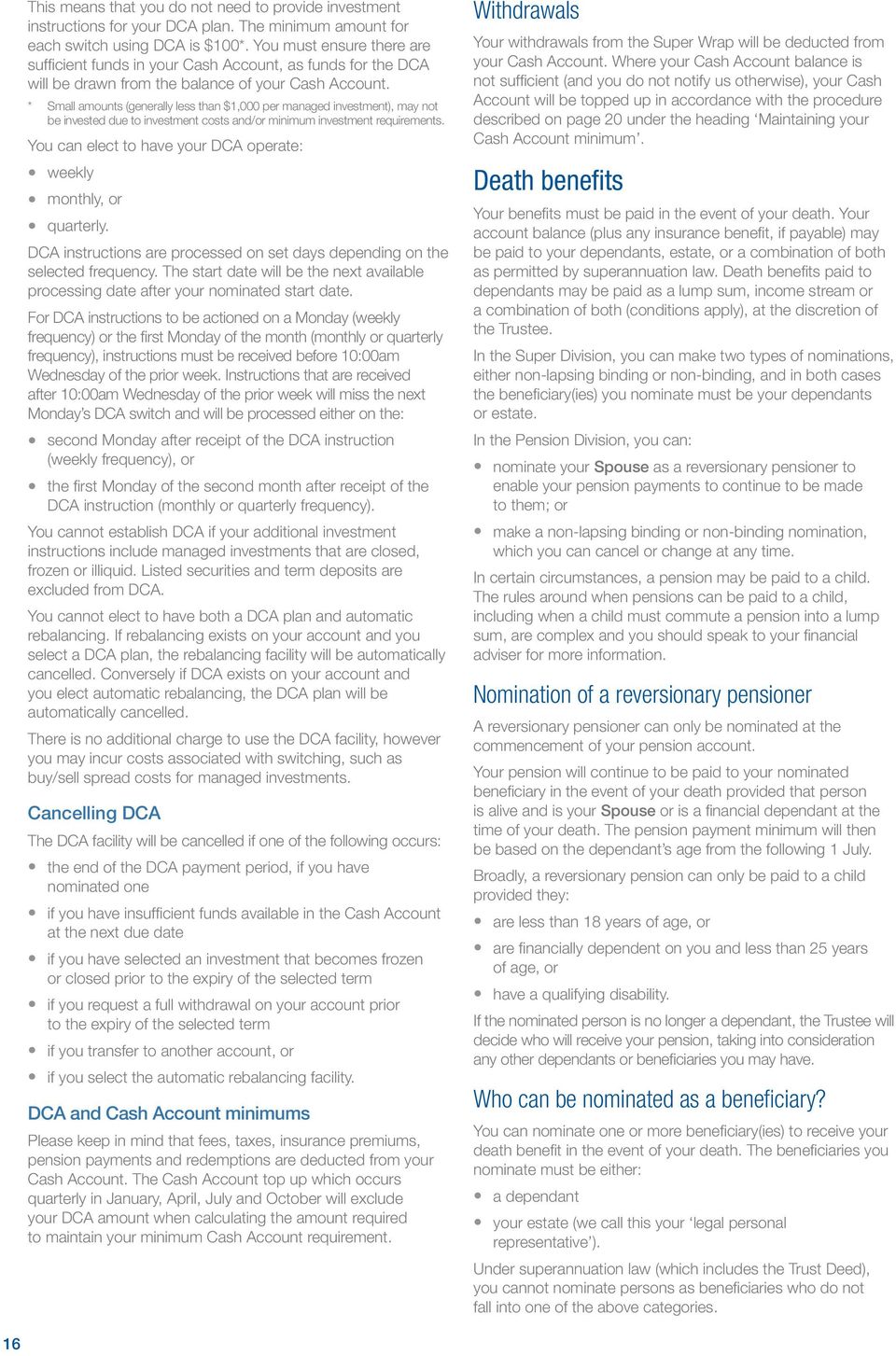
16 This means that you do not need to provide investment instructions for your DCA plan. The minimum amount for each switch using DCA is $100*. You must ensure there are sufficient funds in your Cash Account, as funds for the DCA will be drawn from the balance of your Cash Account. * Small amounts (generally less than $1,000 per managed investment), may not be invested due to investment costs and/or minimum investment requirements. You can elect to have your DCA operate: weekly monthly, or quarterly. DCA instructions are processed on set days depending on the selected frequency. The start date will be the next available processing date after your nominated start date. For DCA instructions to be actioned on a Monday (weekly frequency) or the first Monday of the month (monthly or quarterly frequency), instructions must be received before 10:00am Wednesday of the prior week. Instructions that are received after 10:00am Wednesday of the prior week will miss the next Monday s DCA switch and will be processed either on the: second Monday after receipt of the DCA instruction (weekly frequency), or the first Monday of the second month after receipt of the DCA instruction (monthly or quarterly frequency). You cannot establish DCA if your additional investment instructions include managed investments that are closed, frozen or illiquid. Listed securities and term deposits are excluded from DCA. You cannot elect to have both a DCA plan and automatic rebalancing. If rebalancing exists on your account and you select a DCA plan, the rebalancing facility will be automatically cancelled. Conversely if DCA exists on your account and you elect automatic rebalancing, the DCA plan will be automatically cancelled. There is no additional charge to use the DCA facility, however you may incur costs associated with switching, such as buy/sell spread costs for managed investments. Cancelling DCA The DCA facility will be cancelled if one of the following occurs: the end of the DCA payment period, if you have nominated one if you have insufficient funds available in the Cash Account at the next due date if you have selected an investment that becomes frozen or closed prior to the expiry of the selected term if you request a full withdrawal on your account prior to the expiry of the selected term if you transfer to another account, or if you select the automatic rebalancing facility. DCA and Cash Account minimums Please keep in mind that fees, taxes, insurance premiums, pension payments and redemptions are deducted from your Cash Account. The Cash Account top up which occurs quarterly in January, April, July and October will exclude your DCA amount when calculating the amount required to maintain your minimum Cash Account requirement. Withdrawals Your withdrawals from the Super Wrap will be deducted from your Cash Account. Where your Cash Account balance is not sufficient (and you do not notify us otherwise), your Cash Account will be topped up in accordance with the procedure described on page 20 under the heading Maintaining your Cash Account minimum. Death benefits Your benefits must be paid in the event of your death. Your account balance (plus any insurance benefit, if payable) may be paid to your dependants, estate, or a combination of both as permitted by superannuation law. Death benefits paid to dependants may be paid as a lump sum, income stream or a combination of both (conditions apply), at the discretion of the Trustee. In the Super Division, you can make two types of nominations, either non-lapsing binding or non binding, and in both cases the beneficiary(ies) you nominate must be your dependants or estate. In the Pension Division, you can: nominate your Spouse as a reversionary pensioner to enable your pension payments to continue to be made to them; or make a non-lapsing binding or non-binding nomination, which you can cancel or change at any time. In certain circumstances, a pension may be paid to a child. The rules around when pensions can be paid to a child, including when a child must commute a pension into a lump sum, are complex and you should speak to your financial adviser for more information. Nomination of a reversionary pensioner A reversionary pensioner can only be nominated at the commencement of your pension account. Your pension will continue to be paid to your nominated beneficiary in the event of your death provided that person is alive and is your Spouse or is a financial dependant at the time of your death. The pension payment minimum will then be based on the dependant s age from the following 1 July. Broadly, a reversionary pension can only be paid to a child provided they: are less than 18 years of age, or are financially dependent on you and less than 25 years of age, or have a qualifying disability. If the nominated person is no longer a dependant, the Trustee will decide who will receive your pension, taking into consideration any other dependants or beneficiaries you may have. Who can be nominated as a beneficiary? You can nominate one or more beneficiary(ies) to receive your death benefit in the event of your death. The beneficiaries you nominate must be either: a dependant your estate (we call this your legal personal representative ). Under superannuation law (which includes the Trust Deed), you cannot nominate persons as beneficiaries who do not fall into one of the above categories. 16
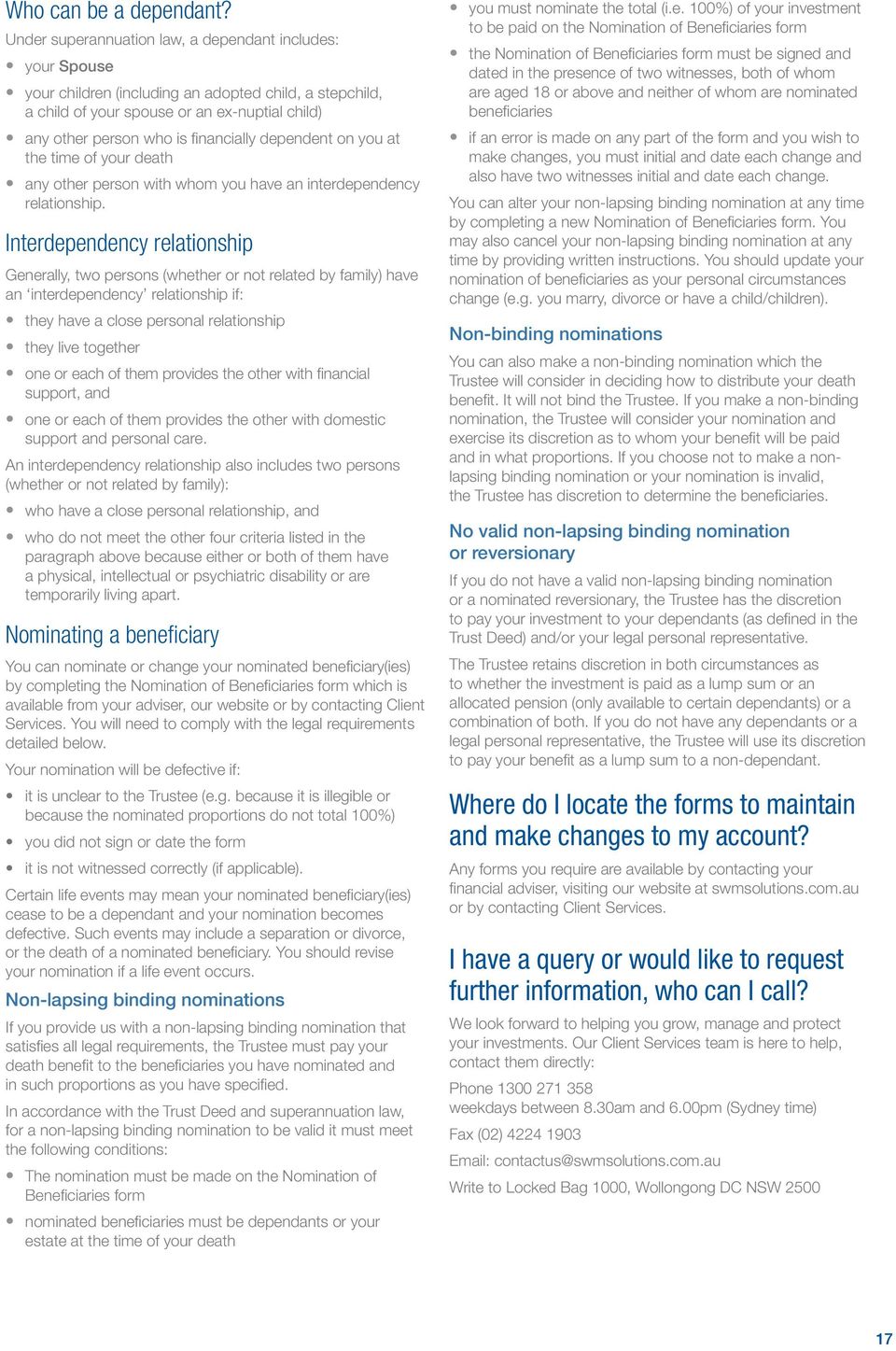
17 Who can be a dependant? Under superannuation law, a dependant includes: your Spouse your children (including an adopted child, a stepchild, a child of your spouse or an ex-nuptial child) any other person who is financially dependent on you at the time of your death any other person with whom you have an interdependency relationship. Interdependency relationship Generally, two persons (whether or not related by family) have an interdependency relationship if: they have a close personal relationship they live together one or each of them provides the other with financial support, and one or each of them provides the other with domestic support and personal care. An interdependency relationship also includes two persons (whether or not related by family): who have a close personal relationship, and who do not meet the other four criteria listed in the paragraph above because either or both of them have a physical, intellectual or psychiatric disability or are temporarily living apart. Nominating a beneficiary You can nominate or change your nominated beneficiary(ies) by completing the Nomination of Beneficiaries form which is available from your adviser, our website or by contacting Client Services. You will need to comply with the legal requirements detailed below. Your nomination will be defective if: it is unclear to the Trustee (e.g. because it is illegible or because the nominated proportions do not total 100%) you did not sign or date the form it is not witnessed correctly (if applicable). Certain life events may mean your nominated beneficiary(ies) cease to be a dependant and your nomination becomes defective. Such events may include a separation or divorce, or the death of a nominated beneficiary. You should revise your nomination if a life event occurs. Non-lapsing binding nominations If you provide us with a non-lapsing binding nomination that satisfies all legal requirements, the Trustee must pay your death benefit to the beneficiaries you have nominated and in such proportions as you have specified. In accordance with the Trust Deed and superannuation law, for a non-lapsing binding nomination to be valid it must meet the following conditions: The nomination must be made on the Nomination of Beneficiaries form nominated beneficiaries must be dependants or your estate at the time of your death you must nominate the total (i.e. 100%) of your investment to be paid on the Nomination of Beneficiaries form the Nomination of Beneficiaries form must be signed and dated in the presence of two witnesses, both of whom are aged 18 or above and neither of whom are nominated beneficiaries if an error is made on any part of the form and you wish to make changes, you must initial and date each change and also have two witnesses initial and date each change. You can alter your non-lapsing binding nomination at any time by completing a new Nomination of Beneficiaries form. You may also cancel your non-lapsing binding nomination at any time by providing written instructions. You should update your nomination of beneficiaries as your personal circumstances change (e.g. you marry, divorce or have a child/children). Non-binding nominations You can also make a non-binding nomination which the Trustee will consider in deciding how to distribute your death benefit. It will not bind the Trustee. If you make a non-binding nomination, the Trustee will consider your nomination and exercise its discretion as to whom your benefit will be paid and in what proportions. If you choose not to make a nonlapsing binding nomination or your nomination is invalid, the Trustee has discretion to determine the beneficiaries. No valid non-lapsing binding nomination or reversionary If you do not have a valid non-lapsing binding nomination or a nominated reversionary, the Trustee has the discretion to pay your investment to your dependants (as defined in the Trust Deed) and/or your legal personal representative. The Trustee retains discretion in both circumstances as to whether the investment is paid as a lump sum or an allocated pension (only available to certain dependants) or a combination of both. If you do not have any dependants or a legal personal representative, the Trustee will use its discretion to pay your benefit as a lump sum to a non-dependant. Where do I locate the forms to maintain and make changes to my account? Any forms you require are available by contacting your financial adviser, visiting our website at swmsolutions.com.au or by contacting Client Services. I have a query or would like to request further information, who can I call? We look forward to helping you grow, manage and protect your investments. Our Client Services team is here to help, contact them directly: Phone weekdays between 8.30am and 6.00pm (Sydney time) Fax (02) [email protected] Write to Locked Bag 1000, Wollongong DC NSW
18 Risks All investments carry risk and different strategies may carry different levels of risk, depending on the assets that make up the strategy. For instance, assets with the highest long-term returns may also carry the highest level of short-term risk. Before investing, you should consider the level of risk involved with a particular investment and whether the potential returns justify those risks. When considering risk associated with your superannuation investment, it is important to keep the following in mind: The value of investments can rise and fall the returns you receive from your investment will vary and future returns may be different to past returns returns are not guaranteed and you may lose some of your money you may outlive your retirement assets if the value of your investments is insufficient to adequately meet your retirement needs your investment may be affected by changes in the economic and political climate or changes to legislation, particularly in relation to taxation and superannuation laws you may not be able to withdraw your money at the time you want to, as the law restricts when you can withdraw your funds. The level of risk will mainly depend on the investment strategy you and your adviser select and the individual investments you are invested in. in order to understand the risks specific to a particular investment you should read the PDS or other disclosure document for that investment. The level of risk you face will vary depending on a range of factors, including your age, investment timeframes, your risk tolerance and what other investments you hold. Risk and return Generally, the return of an investment is dependent on the risk associated with the investment. With a higher risk investment, such as listed securities, there is the potential for higher returns but also a greater potential for volatility in the value of the investment. With a lower risk investment, such as cash or a capital stable managed investment, the potential returns are usually lower and the potential volatility is also less. Your adviser should help you to assess your tolerance to risk and return objectives. Your chosen investments should reflect this. Individuals have different preferences when it comes to risk and return. Those seeking to maximise returns may be less concerned about short term losses because of a higher tolerance to risk or a longer investment time horizon. Those seeking to preserve their capital may be more concerned about short term losses because of a lower tolerance to risk or a shorter time horizon. When choosing an investment option, past performance should not be taken as an indication of likely future performance. The risks associated with investing through the Super Wrap will depend on the particular managed investments you choose, some of risks associated with your investments are: Market risk This is the risk that affects specific markets and includes factors such as business confidence, economic cycles, government policies and investor sentiment. These factors will all influence market performance. Investment performance The performance of investments will depend on such factors as the investments chosen, the prevailing market conditions and the state of domestic and international economies. Neither the Trustee nor the product issuers guarantee the performance of any investment option through the Trust. Investment volatility Investment volatility is a measure of the uncertainty of an investment s performance. Generally, with a higher risk investment, such as shares, there is the potential for higher returns but also a greater potential for uncertainty in its performance. With a lower risk investment, such as cash or a capital stable managed investment, the level of uncertainty around its performance is usually lower but the potential returns are also less. Investment specific risk The value of an investment such as a share in a company can be affected by events that are specific to that company. For example, changes to management, profit and loss announcements and changes to its business or regulatory environment are all events that can have a positive or negative effect on the value of the company. Product issuer risk For managed investments, the product issuer may underperform compared to other managers of the same or similar type (for example, the product issuer misreads the market). Inflation risk Rises in prices due to inflation can erode the real value of investments. To avoid this risk over the long term, your investments need to earn a return equal to or above the rate of inflation. Interest rate risk The value of the different asset classes can fluctuate in reaction to changes in interest rates. For example, if interest rates increase this may result in the capital value of fixed interest investments falling. Bonds with longer duration (timeframe until maturity) tend to be more sensitive to price volatility and interest rate movements. 18

19 Liquidity risk Investment in mortgages, direct property, unlisted property, small specialised markets or alternative investments are often illiquid, i.e. hard to buy and sell quickly. Some managed investments may also be illiquid if redemptions from an investment are suspended by the product issuer which could cause delays in your ability to withdraw or switch investments. Credit risk A decline in the credit quality of a bond or the ability of the issuer to pay the interest or principal on a bond can adversely affect the value of a bond. Currency risk Investments that have an asset allocation to international investments, may be exposed to fluctuations in the value of foreign currencies against the Australian dollar. Currency management strategies may be utilised by some product issuers but this does not remove the risk associated with international investment. Investors should note that currency gains and/or losses may be a part of their overall investment performance. Diversifying to reduce risk Investments are affected differently by economic, political and other factors. One method of reducing risk is to diversify your investment by selecting a range of: asset sectors (cash, fixed interest, property, shares) investment markets (Australian and international) product issuers investment management styles. Diversification is amongst the most important principles in investment management, as it can significantly reduce the variability of a portfolio s returns. By not having all your eggs in one basket, diversification helps reduce the risk of suffering a short term fall in value and fluctuations in investment value and returns. A well-diversified portfolio of moderately risky investments may actually have a lower overall risk than a poorly-diversified portfolio of less risky investments. Legislative risk Changes to superannuation or tax legislation have the potential to impact on your account. Family law risk The Family Law Act (FLA) may have a significant effect on your benefits. If you and your spouse separate or divorce, your account may be split between you and your ex spouse. These arrangements apply to all legally married couples and to defacto (including same-sex) couples. In the absence of any financial agreement between you and your ex spouse, the Family Court may make an order to flag or split your superannuation or pension interest. Both a financial agreement and a court order are binding on the Trustee. If you want to know more about the way in which the FLA may affect your benefit, you should consult your accountant, legal adviser or financial adviser. Use of financial derivatives The managers of the underlying assets in the managed investments may use financial derivatives such as futures, options, swaps and forward rate agreements. Whether financial derivatives are used depends on the investment strategies of the individual investment options. For more information about the risks associated with each managed investment, please refer to the separate PDS for each managed investment, which can be obtained from your adviser. Service provider risk Your investment may be impacted if the Trustee or one of its service providers encounters problems with its administration and computer systems. The Trustee has procedures in place that are designed to reduce these risks. However, you should be aware that not all of these risks can be foreseen or appropriately mitigated. 19

20 Investment options The Super Wrap offers a broad choice of investment options for you to design your own tailored investment portfolio. It provides the opportunity for you to access these investment options through one investment vehicle in a cost effective manner. We strongly recommend consulting with your adviser when deciding on your investments. Your adviser should consider your circumstances and attitude to risk and return and tailor a portfolio to meet your objectives. A range of investment choices The Super Wrap offers you a carefully selected range of investment options, including ASX listed securities, term deposits and managed investments from some of the leading product issuers in Australia and around the world. Your investment choices include: the Cash Account term deposits listed securities 300 of the largest securities by market capitalisation on the ASX as amended from time to time, as well as a range of Exchange Traded Funds managed investments including: multi-sector options investments that diversify across two or more asset sectors (cash, fixed interest, property and shares), and single sector options investments that predominantly focus on one specific asset sector. You should refer to the SWMS Investment Menu for a list of all available investment options. In selecting the available listed securities the Trustee has used its discretion to exclude certain listed securities. The Cash Account When you join the Super Wrap, we will establish a Cash Account as part of your investment in the Super Wrap. Your Cash Account is used to: receive contributions, rollovers and transfers pay fees, taxes and other charges pay insurance premiums (Super Division only) pay pension payments (Pension Division only) receive interest earnings on your Cash Account buy investments in accordance with your investment instructions receive the proceeds of investments sold, and receive income from investments. Government taxes, charges, fees and insurance premiums Contribution and rollovers Your SWMS Super Wrap account Buying investments CASH ACCOUNT Selling investments Investment options Investment income Withdrawals and pension payments You can elect to have all or part of your account balance invested in the Cash Account. The balance of funds held in the Cash Account will vary through the deduction of fees and investment processes such as investment rebalancing, income reinvestment and the Cash Account top up. How your Cash Account is invested The Cash Account is currently invested with major Australian banks and in short term money market securities. The Trustee may, at its discretion, choose different institutions and accounts to invest the Cash Account. Cash Account minimums The Cash Account minimum amount is set to 2% of your account balance, subject to a minimum of $300 and unless you decide otherwise, a maximum of $10,000. In addition to this, your Cash Account must also contain sufficient funds to pay: three months of insurance premiums (Group and/or OneCare) and your quarterly tax liability where applicable (Super Division), or three months of pension payments (Pension Division). The amount required to satisfy the Cash Account minimum will be deducted from the initial rollovers and/or contributions stated on the Application form. If there are multiple initial rollovers an amount is deducted from each rollover as they are received to maintain the Cash Account minimum amount. Further, an amount may be deducted from any additional investments made to restore the minimum, where required. Where your listed securities are traded on your behalf using the online broker or an external broker, your adviser should monitor your Cash Account balance to ensure sufficient funds are available to cover any listed security purchases you may make. Should you have insufficient funds in your Cash Account, this will result in your purchase not being executed. Maintaining your Cash Account minimum Your Cash Account balance should be regularly monitored by your adviser to ensure there are sufficient funds to meet the Cash Account minimum. If required, your adviser may need to redeem investments in order to top up your Cash Account to the minimum amount. Your Cash Account is also monitored by the Trustee on a quarterly basis to ensure you have the required minimum amount of cash. When your Cash Account falls below the minimum amount the Trustee will redeem investments to top up your Cash Account. The top up process is performed quarterly in January, April, July and October on the last Sunday of the month. Further, if two weeks prior to a pension payment being made, your Cash Account is below the minimum level, the Trustee will redeem your investments to top up your Cash Account to the minimum level. If the amount in the Cash Account exceeds the minimum amount, no top up will occur nor will your Cash Account balance be reduced to the minimum amount. 20
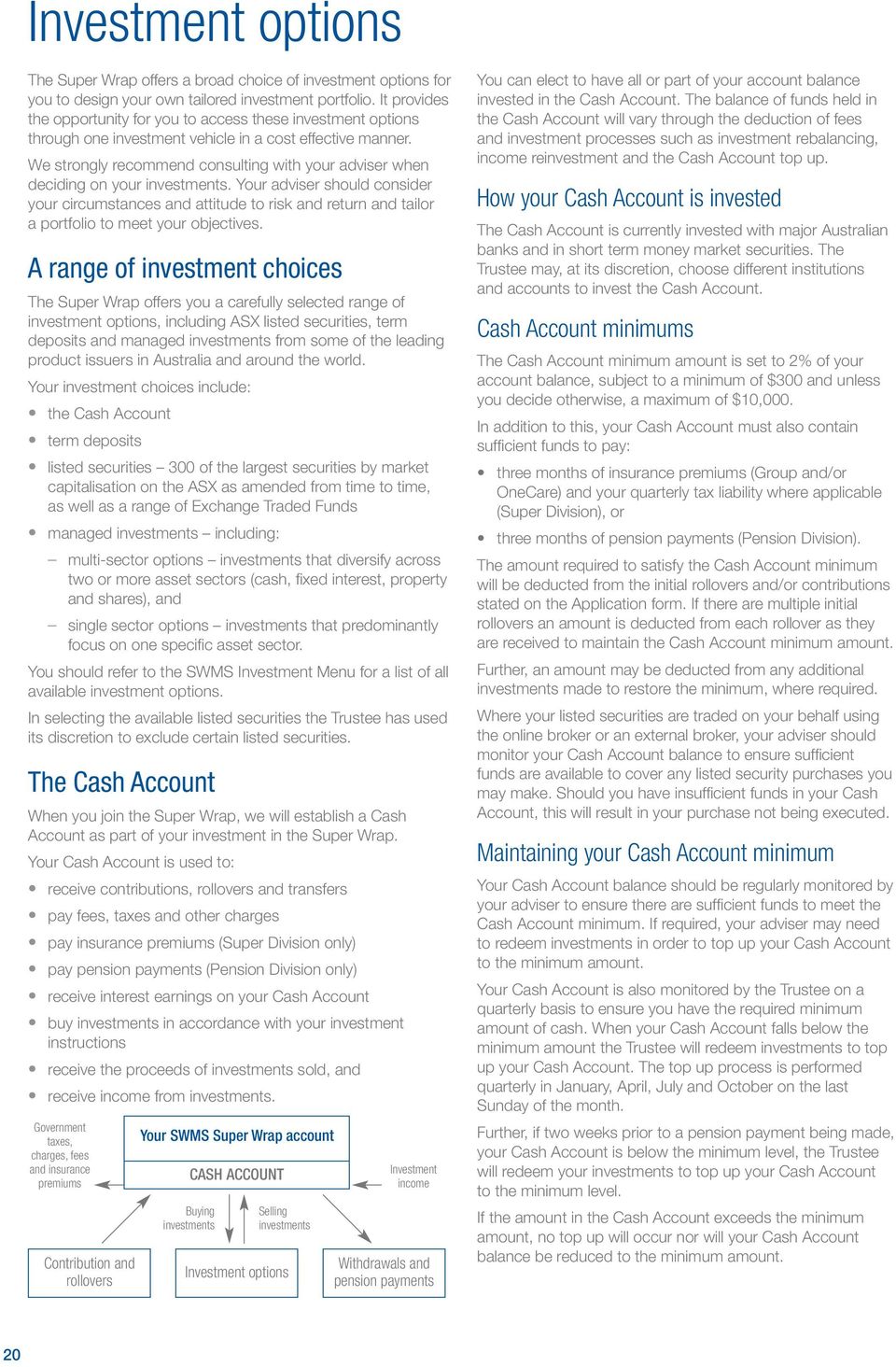
21 How the Trustee redeems investments will be based on instructions provided on your Application form or new instructions provided on a subsequent form. In situations where there are no instructions provided, conflicting instructions, or the balance of your nominated managed investments are exhausted, the default option will apply and the Trustee will sell managed investments in the following order: 1. Managed investments that price daily these will be sold from those with the largest balance to those with the smallest. 2. Managed investments that do not price daily these will only be sold where the balance of your funds in all other investments are exhausted. Managed investments that do not price daily are marked with an asterisk (*) on the SWMS Investment Menu and are unable to be nominated for Cash Account top ups. 3. Listed securities and term deposits these are unable to be nominated by you for Cash Account top ups; however, where these need to be sold the Trustee will contact your adviser to arrange the sell down, which will be conducted by your adviser on behalf of the Trustee. In the situation where your adviser cannot be contacted, the Trustee may authorise the sell down of your listed securities. If you have insufficient cash levels we may need to break the term of your term deposit to bring your Cash Account up to the minimum level, please be aware that early termination fees will apply. The Trustee will not take into account your personal circumstances nor the tax consequences of topping up your Cash Account. Allocating additional amounts to the Cash Account You may allocate an additional amount to the Cash Account by requesting a higher Cash Account percentage on your Application or Account Alteration form. Your adviser can update your investment instructions at any time. Where you require that a contribution be held in the Cash Account, your additional investment instructions should be updated to allocate 100% to the Cash Account. Term deposits Term deposits are available within the Super Wrap, offering a range of terms and other features. What is the minimum investment? There is a minimum investment of $5,000 for each term deposit, amounts below $5,000 cannot be invested. The Trustee has a guideline that no more than 80% of a member s account be invested in term deposits. This is due to the need to maintain minimum cash levels in your Cash Account to pay fees, insurance premiums and taxes as required. If you have insufficient cash levels we may need to break the term of your term deposit to bring your Cash Account up to the minimum level, please be aware that early termination fees will apply. Refer to the ANZ Savings and Transaction Products Terms and Conditions Document available online for more information on early termination penalties. How do I invest and switch in? Investing in term deposits can be done by selecting from one of the available terms on the term deposit Application form. The prevailing interest rate at the time of the investment will apply. Details of the current interest rates are available online or by contacting Client Services. How is interest calculated? Interest is payable at maturity of your term deposit. Interest is calculated daily on your term deposit using the following formula: Interest = Deposit balance x Interest rate (p.a.) x (Term in days/365). What happens at maturity? On maturity, the term deposit principal and interest is deposited into your Cash Account. If you choose to, you can then apply for another new term deposit by completing a term deposit application form or switch into other investments. It is important to note that you need to complete a new term deposit application for each and every term deposit you wish to purchase, including those you wish to roll-over from a recently matured term deposit. On maturity, if you have standing investment instructions in place, such as rebalance, the proceeds from the term deposit (principal and interest) may be switched from cash and invested as per these investment instructions, unless alternative instructions are received. What happens if I withdraw prior to maturity? To access funds invested in a term deposit prior to maturity, the entire deposit must be withdrawn, the interest rate payable will be subject to an interest rate reduction as outlined in the ANZ Savings and Transaction Products Terms and Conditions Document available online. If a penalty is incurred, this will be deducted from the interest received. How are pension payments made? Pension payments cannot be made from a term deposit. It is important that you leave sufficient funds in your Cash Account or other liquid assets to make payments for the length of the term deposit. Please be aware that if you do not have sufficient funds in your account to make your pension payments we will redeem your entire term deposit and you will incur all early withdrawal penalties. Other important information about investing in term deposits Term deposits cannot be nominated for rebalancing or as part of your additional investment instructions. 21
22 Listed Securities When you join the Super Wrap and nominate listed security trading on your account, your adviser will have authority to trade on your behalf (if licensed to provide listed security advice). You may also obtain access to trading on your account where authorised by your adviser. Where you have trading access, the references below to your adviser s ability to trade in listed securities will also apply to you. You have a choice of two methods to trade listed securities: Online Broker the Trustee will trade as principal with the Online Broker according to instructions given by your adviser. External brokers the Trustee will trade as principal with a broker on the External Broker Panel according to instructions given by your adviser. A settlement fee per contract note applies in addition to the brokerage negotiated between you, your adviser and the external broker. Please consult your adviser or Client Services for the list of available brokers on the External Broker Panel. The Trustee may add or remove external stockbrokers from time to time. In these circumstances, the Trustee will notify your adviser. When an instruction is given to the Online Broker on behalf of the Trustee, a limit on the price can be set at which the trade will be executed or the market price can be accepted. Where a limit order is placed, the order will remain open until it is filled for a maximum of 21 days. The order will be cancelled if it is not filled within this time. The length of time it takes for the trade to be completed will depend on market conditions. The broker will settle the transaction according to the market settlement rules and market practice, but generally trade settlement occurs on the third ASX settlement day after execution. Once the order is completed the Trustee will remove funds from your Cash Account to settle the order. It is important that you ensure your Cash Account has available cleared funds (this amount must be above your Cash Account minimum) prior to purchasing a listed security. Following settlement, any securities purchased will be operated and sponsored in CHESS in the name of the Custodian by the Online Broker on behalf of the Trustee. Purchasing approved securities only Your adviser may only trade approved listed securities as shown in the SWMS Investment Menu. Your adviser will be requested to reverse any trades (either with the Online Broker or an external broker) in non-approved securities on market. The Trustee is not responsible for any costs, fees, charges or investment losses resulting from the reversal of trades in non-approved securities. Online broking service The Online Broker has been appointed to provide an executiononly broking service to the Trustee in relation to your adviser s instructions to buy or sell listed securities. When trading instructions are entered, they are sent directly to the Online Broker. The Online Broker will only act on instructions it receives from your adviser on behalf of the Trustee. When trading in listed securities with respect to your instructions, the Trustee and the Online Broker are each bound by the Corporations Act 2001 (Commonwealth) and the rules, procedures, customs, usages and market practices of the ASX Group, as relevant. Trade notification If an order has been placed via the Online Broker on behalf of the Trustee, when the trade instruction has been executed, your adviser will be notified via . If an order via an external broker has been placed, a trade confirmation will be sent directly to your adviser by the external broker. Cancellation of orders It is the responsibility of your adviser to ensure your trade instructions are correct. Generally, once a trade is placed it cannot be cancelled or amended. CHESS The Clearing House Electronic Subregister System (CHESS) is a paperless system which records listed security ownership on an electronic account, rather than by a paper certificate. It is operated by ASX Settlement and Transfer Corporation Pty Limited (ASTC) in accordance with the settlement rules (ASTC rules) by which participants must abide. Listed security ownership and corporate actions Listed securities held through the Super Wrap are held on behalf of the Trustee in the name of the Custodian and operated and sponsored in CHESS by the Online Broker. Although the securities are held in the name of the Custodian, the Trustee remains the beneficial owner of these securities at all times. Your securities will be held under a unique individual Holder Identification Number (HIN) on the CHESS register, allowing your various listed security holdings to be grouped together. Under this structure your listed security holdings are held in the Custodian s name (HSBC), but unlike some other custodial arrangements you retain full entitlement to participate in voluntary corporate actions. For further information please refer to HSBC custodial terms and conditions for listed securities on page 58. How corporate actions are treated At certain times a corporate action such as a rights issue, bonus issue or share split, may occur which affects your listed security holdings. These may be involuntary, such as a share split, and require no action on your behalf or they may be voluntary, such as rights issues, and will only affect your holding should your adviser elect for you to participate on your behalf. Where a corporate action is initiated on a listed security you hold, the company s share registry will deal directly with the Trustee. The Trustee may forward any documents received from the share registry to your adviser or inform them where such documents may be obtained. The Trustee will then act on any instructions provided by your adviser in relation to a voluntary corporate action. If a corporate action requires payment, you must ensure your Cash Account has sufficient funds to complete the transaction. If you do not have sufficient cleared funds available in your Cash Account at the time your instructions are received by the Trustee, the transaction will not occur and the Trustee has no liability in relation to the corporate action. 22
23 Your adviser (if licensed to provide listed security advice) is responsible for sending your instructions to the Trustee prior to the specified cut-off time. It is also the responsibility of your adviser to contact the Trustee prior to the specified cut-off time if you amend your election in regard to a corporate action instruction. Instructions received after the specified cut-off time, or amendments to your original instructions will be treated on a reasonable endeavours basis. In the event that no instruction is issued, the Trustee will take no action and the market default will apply. Where you have trading access you will not have the ability to participate in voluntary corporate actions. The Trustee will process all corporate action instructions upon receiving them and will monitor their progress to ensure successful completion. However, this is dependent on processing by third parties such as company registrars. The Trustee is not liable for any loss that may result from third party delays or errors. The Trustee will contact your adviser in situations where your instructions cannot proceed for example, insufficient funds and timing issues. If a corporate action results in you obtaining additional shares which increases your holding taking you above the diversification guidelines or you acquire non-approved securities, the Trustee reserves the right to correct any corporate action transactions on your behalf. In the situation where a sell down of assets is required, the Trustee will be in contact with your adviser to notify them of this process. The Trustee is not responsible for any costs, fees, charges or investment losses resulting from its corporate action interventions on your behalf. For further information on specific corporate actions as they happen, please consult your adviser. Advice for listed securities PDSs are not available for listed securities that you acquire through the Super Wrap. You should obtain specific information on a listed security from your adviser before you acquire that investment. Suggested guidelines for listed security investments Refer to Diversification guidelines on page 25. Managed investments When you join the Super Wrap your adviser will have authority to transact in managed investments on your behalf. You can nominate how your initial and additional funds will be invested on your Application form. Additional one-off contributions received into your account will be invested according to the additional investment instructions provided on your Application or subsequent form. Where additional investment instructions have not been provided, contributions will be invested in your Cash Account. Regular contributions* received into your account via direct debit will be invested according to your direct debit instructions provided on your Direct Debit Request form. Where direct debit instructions have not been provided, contributions will be invested according to your additional investment instructions. Subsequent managed investment selections and changes can also be made by contacting your adviser. Purchases of listed securities cannot be included in your additional investment instructions. Purchases of these assets can be arranged through your adviser. If you do not make a managed investment selection, contributions will be automatically invested in your Cash Account. * Such contributions may be made when you do not have a copy of the current SWMS Super Wrap (Super Wrap) PDS. Copies of this may be obtained from your adviser. How units in managed investments are allocated The number of units you will be allocated in a managed investment will generally be the amount of money invested divided by the buy price at the time the units were purchased by the Trustee. Unit prices for managed investments Each managed investment will have a different unit price. The unit price that you receive is determined by the product issuer, usually at the time they issue the units. How units in managed investments are purchased and sold The Trustee generally invests in and redeems managed investments on a daily basis (Sydney business days only) on behalf of its investors. This will only occur for your chosen managed investments once your application or withdrawal is processed. This is also subject to minimum investment requirements and the time taken to process investments or withdrawals by the managers of the underlying managed investments and may result in the unit price being higher or lower than that prevailing on the date your instruction was received by the Trustee. The Trustee is not liable for any loss that may result from this occurring. Redemptions from illiquid managed investments will take longer to process and may be delayed, particularly where redemptions are suspended by a product issuer. The Trustee is not liable for any loss that may result from this occurring. 23
24 Where a redemption request is received for a dollar amount and the result will leave a minimal holding* remaining in that specific managed investment, the request will be converted to a total unit redemption. * The amount of the minimal holding is at the Trustee s discretion. Changes to the available managed investments The Trustee may change the available managed investments in the following circumstances: Review of managed investments As part of its ongoing review process, the Trustee continually monitors the suitability of the managed investments offered and may add or remove managed investments. Closure of a managed investment (new monies) A product issuer or the Trustee may close a particular managed investment to all new monies. Your current investment in this option will not be affected. However, subsequent investments that would have been made to this option will be directed to the Cash Account. Closure of a managed investment (new investors) A product issuer or the Trustee may close a particular managed investment to all new investors. New investors will not be able to invest funds into this managed investments but investors with current investments in this option will not be affected. Termination of a managed investment A product issuer or the Trustee may terminate a managed investment to all new and existing investors. This will require your investment to be sold and the proceeds reinvested into the Cash Account. Subsequent investments that would have been made to this managed investment will also be directed to the Cash Account. If a managed investment is closed or terminated, we will notify your adviser of any relevant impact on your investment and investment instructions that you have provided. Investments ceasing to be offered The Trustee may dispose of an investment held in respect of your account without consulting you or your adviser in the following limited circumstances: if the Trustee ceases to offer the relevant investment strategy if the Trustee removes the investment from the list of available investments under the relevant investment strategy if the investment is liquidated, closed or not available for any other reason. If you become a member of the Super Wrap, you will be taken to have authorised and instructed the Trustee to take such action. The proceeds of any such disposal will be credited to your Cash Account. It is important that you realise that such a disposal may not be consistent with your personal investment strategy and may give rise to certain costs. There may be transaction costs and costs associated with purchasing or exiting particular managed investments which are included in the unit price of the managed investments. If so, these will be disclosed in the PDS for the relevant underlying investment. The Trustee will not take into account the tax consequences for you of disposing of investments in such circumstances. Notwithstanding the above, the Trustee will endeavour to contact your adviser prior to any disposal, unless circumstances require otherwise. PDSs for managed investments The managed investments that you acquire through the Super Wrap each have a separate PDS. The Trustee must be satisfied that you have received the necessary PDSs for the managed investments that you select in the Super Wrap prior to carrying out your investment instructions. You agree when you become a member of the Super Wrap and when you acquire new managed investments through the Super Wrap that you will either obtain the necessary PDSs from our website at swmsolutions.com.au or that your adviser has provided you with the necessary PDSs before you invest. Trustee s selection process for managed investments The Trustee s approach to selecting managed investments includes: reviewing the past performance of the managed investments to ensure that the investment and/or product issuer has a proven track record reviewing the level of funds under management held in the managed investments reviewing the stability of the management team within the product issuer reviewing the reasonableness of the product issuer s fees and ensuring that they are competitive reviewing the reasonableness of the managed investment s asset allocation and ensuring that the volatility and the sector classification are consistent ensuring that the level of service, including the reporting provided by the product issuer in relation to a managed investment, enables the Trustee to provide quality service to members and to comply with relevant laws. Neither the Trustee nor the product issuer guarantee repayments of capital or any particular rate of return. Responsibilities of the Trustee and members in relation to investment strategy Superannuation law requires the Trustee to formulate and give effect to an investment strategy that has regard to the whole of the circumstances of the Super Wrap including, but not limited to, the following: the risk involved in making, holding and realising, and the likely return from, the Super Wrap s investments having regard to its objectives and its expected cash flow requirements the composition of the Super Wrap s investments as a whole including the extent to which the investments are diverse or involve the Super Wrap in being exposed to risks from inadequate diversification the liquidity of the Super Wrap s investments having regard to its expected cash flow requirements, and the ability of the Super Wrap to discharge its existing and prospective liabilities. Superannuation law permits the Trustee to discharge this obligation by allowing you to select from a menu of appropriate investment options made available by the Trustee. To this end, the Trustee: offers a broad range of different investment options, and offers a broad range of different investment categories. 24
25 The identification of managed investments is achieved through research undertaken or sourced by the Investment Operations Forum (IOF) of the Trustee, both prior to the addition of any investment options and on an ongoing basis. The Trustee may engage a reputable investment organisation to provide additional investment research to assist in the selection and monitoring of the managed investments. The identification of listed securities is undertaken by the IOF of the Trustee. From time to time, the Trustee may add or remove listed securities from the Super Wrap, based on the recommendations of the IOF. As a member of the Super Wrap, you are responsible for formulating an appropriate investment strategy that takes into account the whole of your circumstances and goals and attitude to risk and return and for selecting investment options suited to that investment strategy. The Super Wrap is promoted through intermediaries such as your adviser, who is able to assist you in formulating an appropriate investment strategy after taking into account your circumstances, goals and attitude to risk and return. Your adviser is also able to assist you in selecting investment options suited to your investment strategy. The Trustee is not responsible for determining your circumstances or goals nor your attitude to risk and return. The Trustee is also not responsible for determining a suitable investment strategy for you or whether the investment options chosen by you are suited to your investment strategy. It is important to note that the Trustee does not guarantee the return for any investment option selected. Diversification guidelines In order to ensure adequate diversification and reduce the risks of investing, the Trustee suggests that listed securities are invested according to the guidelines below. The Trustee will monitor these limits each time you purchase listed securities. The Trustee will advise you where your holdings fall outside these suggested limits. Category S&P/ASX 300 (1 200 by market cap) S&P/ASX 300 ( by market cap) Preference Shares and Listed Interest Rates (LIRs) Listed Investment Companies (LICs) Guidelines No more than 20% of your account should be invested in any one share. No more than 10% of your account should be invested in any one share. No more than 10% of your account should be invested in any one listed security of this type. No more than 20% of your account should be invested in any one LIC. Exchange Traded Commodities (ETCs) No more than 20% of your account or single sector/industry Exchange should be invested in any one listed Traded Fund (ETFs) e.g. Gold, Property security of this type. Foreign currency exposure When you invest in international shares or fixed interest, or other investments with international assets, your account is exposed to foreign currency risk. Some of these investments may be fully hedged, some partially hedged and some may be unhedged in terms of currency exposure. It is important that you discuss with your adviser the level of foreign currency hedging that is appropriate to your circumstances. Specific information on hedge funds Hedge funds generally use a wide range of investment strategies and instruments in order to achieve returns. These strategies may include: Short selling selling borrowed securities with the intent to buy back later at lower prices. Derivative positions utilising options, futures, forwards or swaps to adopt a particular strategy or create a market neutral position. Arbitrage strategies to exploit price discrepancies between similar securities on different markets. Leverage borrowing money to increase the size of the portfolio. Hedge funds as an asset class comprise many different strategies, some of which are market neutral, meaning they can profit in both rising and falling markets, and some of which have low correlation to traditional asset classes. Diversification benefits can be achieved by combining hedge funds with different strategies, low correlations to each other, or low correlations to traditional asset classes. Given the wide range of strategies used by hedge product issuers, you should ensure that you fully understand the impact of investing into funds using these strategies. Proxy voting The standard position for the Trustee will be not to vote. In exceptional circumstances the Trustee may however decide to vote on a resolution. You can request a copy of the Trustee s Voting policy, a copy can be provided free of charge by contacting client services. Minimum investment requirements Managed investments There are no minimum initial investment requirements within the Super Wrap for each of the managed investments selected, but there may be minimums imposed by individual product issuers. Small amounts, generally less than $1,000 per managed investment, may not be invested due to investment costs and/or minimum investment requirements and will be retained in the Cash Account. Listed securities There is a minimum initial investment recommended within the Super Wrap of $1,000 for each listed security. Term deposits There is a minimum investment recommended within the Super Wrap of $5,000 for each term deposit. Investment earnings interest, distributions and dividends Interest on your Cash Account Interest earned on your Cash Account is generally paid monthly and is retained in your Cash Account. Dividends from listed securities You can elect on the Application form how you wish dividends received on your behalf to be treated. You have two options: all dividends retained in your Cash Account (the default) 25
26 dividends reinvested back into the originating investments via a dividend reinvestment plan, for all listed securities that offer this facility, subject to the terms and conditions of the relevant dividend reinvestment plan. The Trustee will notify the share registry of dividend elections on your behalf. It is important to note that the option you choose will apply to all your listed securities. If a listed security does not offer dividend reinvestment, dividends are retained in the Cash Account. You may change your dividend election at any time; however, this is dependent on processing by third parties. Further, if any of your listed security holdings are undergoing a corporate action, your instructions may not be completed within the specified cut-off time. The Trustee is not liable for any loss that may result from third party delays or errors. The share/company registry from which your dividends are received is responsible for the management and payment of dividends on listed securities acquired through the Super Wrap. Distributions from managed investments Distributions received from your managed investments are generally paid quarterly; however, some managed investments distribute half yearly or annually. To determine the frequency of distributions for a particular investment, refer to the PDS for that investment. You can elect on your Application form how you wish distributions from your managed investments to be treated. You have three options: all distributions retained in your Cash Account (the default) all distributions reinvested back into the originating investment* all distributions reinvested according to your additional investment instructions*. Where you do not select an option or select multiple options for a managed investment, income distributions for that managed investment will be retained in the Cash Account. You should note that you may not have the current PDS for a managed investment at the time distributions are reinvested back into that managed investment. You can obtain a copy of the PDS from your adviser. * Small amounts, generally less than $1,000 per managed investment, may not be reinvested due to investment costs and/or minimum investment requirements. Investment strategy Multi-sector funds Conservative Investment objectives Key features Asset allocation long term ranges* To provide a secure return over the short term with little risk of capital loss. Suggested minimum time frame*** 3 to 5 years Volatility Moderate Growth potential Moderate Cash 0% 90% Australian fixed interest 0% 90% International fixed interest 0% 90% Australian shares 0% 50% International shares 0% 40% Property 0% 50% Other 0% 35% Investment management fee range** 0.33% 0.97% Buy/sell range** 0.00% 0.80% balanced Investment objectives Key features Asset allocation long term ranges* To provide a moderate return over the medium term through exposure to growth assets while using diversification to reduce volatility. Suggested minimum time frame*** 4 years or more Volatility Moderate to High Growth potential Moderate Cash 0% 70% Australian fixed interest 0% 80% International fixed interest 0% 70% Australian shares 0% 65% International shares 0% 60% Property 0% 30% Other 0% 50% Investment management fee range** 0.34% 2.36% Buy/sell range** 0.00% 0.97% Investment instructions Your adviser can recommend the appropriate mix to suit your long term goals and risk profile. You can only use the Application form to invest in managed investments, the SWMS Investment Menu located on our website contains a list of all available investment options. Share trades will need to be placed with either the Online Broker or an external broker. You can change your investment selections at any time (a buy/sell spread or brokerage may apply). Any additional contributions or rollovers you make to the Super Wrap will be invested according to your additional investment instructions. If you wish to change the way further contributions or rollovers are invested, you will need to provide an Account Alteration form. We strongly recommend you consult your adviser prior to making any changes to ensure your investment selections will continue to match your long term goals. 26
27 growth Investment objectives Key features Asset allocation long term ranges* To provide a moderate to high return over the medium to long term through significant exposure to growth assets while using diversification to reduce volatility. Suggested minimum time frame*** 5 years or more Volatility Moderate to High Growth potential Moderate to High Cash 0% 50% Australian fixed interest 0% 70% International fixed interest 0% 35% Australian shares 0% 80% International shares 0% 60% Property 0% 60% Other 0% 60% Investment management fee range** 0.36% 2.65% Buy/sell range** 0.00% 1.04% high growth Investment objectives Key features Asset allocation long term ranges* To provide a high return over the medium to long term through significant exposure to growth assets. Suggested minimum time frame*** 5 years or more Volatility High Growth potential High Cash 0% 20% Australian fixed interest 0% 15% International fixed interest 0% 15% Australian shares 20% 100% International shares 10% 100% Property 0% 30% Other 0% 35% Investment management fee range** 0.37% 1.23% Buy/sell range** 0.30% 0.70% Single sector funds cash Investment objectives Key features To provide a secure return over any time frame with minimal risk of capital loss. Suggested minimum time frame*** Volatility Growth potential Any Low Low Asset allocation Cash 0% 100% long term ranges* Australian fixed interest 0% 100% Investment management fee range** 0.00% 0.51% Buy/sell range** 0.00% 0.10% australian fixed interest Investment objectives Key features To provide a higher return than cash through exposure to Australian fixed interest. Suggested minimum time frame*** 3 years or more Volatility Low to moderate Growth potential Low to moderate Asset Cash 0% 100% allocation long term Australian fixed interest 0% 100% ranges* International fixed interest 0% 41% Investment management fee range** 0.20% 0.88% Buy/sell range** 0.00% 0.20% international fixed interest Investment objectives Key features To provide a higher return than cash through exposure to international fixed interest. Suggested minimum time frame*** 3 years or more Volatility Moderate Growth potential Low to moderate Asset Cash 0% 25% allocation Australian fixed interest 0% 10% long term International fixed interest 30% 100% ranges* Other 0% 30% Investment management fee range** 0.26% 0.65% Buy/sell range** 0.00% 0.20% diversified fixed interest Investment objectives Key features Asset allocation long term ranges* To provide a higher return than cash through exposure to Australian and international fixed interest. Suggested minimum time frame*** 3 years or more Volatility Moderate Growth potential Low to moderate Cash 0% 100% Australian fixed interest 0% 100% International fixed interest 0% 100% Other 0% 30% Investment management fee range** 0.49% 1.18% Buy/sell range** 0.00% 0.30% 27
28 diversified credit / hybrid income Investment objectives Key features Asset allocation long term ranges* To provide a higher return than cash through exposure to diversified credit and hybrid income. Suggested minimum time frame*** 3 years or more Volatility Moderate Growth potential Low to Moderate Cash 0% 100% Australian fixed interest 0% 100% International fixed interest 0% 100% Australian shares 0% 30% International shares 0% 10% Property 0% 50% Other 0% 50% Investment management fee range** 0.34% 2.84% Buy/sell range** 0.20% 1.00% property Investment objectives Key features Asset allocation long term ranges* To provide a moderate to high return over the medium to long term through exposure to Australian and international property. Suggested minimum time frame*** 3 years or more Volatility Moderate to High Growth potential Moderate to High Cash 0% 20% Australian fixed interest 0% 10% Australian shares 0% 5% Property 80% 100% Investment management fee range** 0.24% 5.00% Buy/sell range** 0.30% 0.79% australian shares Investment objectives Key features Asset allocation long term ranges* To provide a high return over the long term through exposure to Australian shares. Suggested minimum time frame*** 5 years or more Volatility High Growth potential High Cash 0% 150% Australian fixed interest 0% 20% Australian shares 0% - 150% International shares 0% 30% Property 0% 15% Other 0% 5% Investment management fee range** 0.00% 5.00% Buy/sell range** 0.00% 0.85% australian shares smaller companies Investment objectives Key features Asset allocation long term ranges* To provide a high return over the long term through exposure to a mix of smaller or emerging Australian shares. Suggested minimum time frame*** 5 years or more Volatility High Growth potential High Cash 0% 50% Australian shares 50% 100% International shares 0% 15% Investment management fee range** 0.66% 17.43% Buy/sell range** 0.00% 0.90% international shares Investment objectives Key features Asset allocation long term ranges* To provide a high return over the long term through exposure to international shares. Suggested minimum time frame*** 5 years or more Volatility High Growth potential High Cash 0% 100% Australian fixed interest 0% 10% International fixed interest 0% 20% Australian shares 0% 100% International shares 0% 100% Other 0% 5% Investment management fee range** 0.18% 5.48% Buy/sell range** 0.00% 1.10% alternatives / hedge funds Investment objectives Key features Asset allocation long term ranges* To provide exposure to specialist and alternative investments which can be outside traditional asset classes such as shares or fixed interest. Suggested minimum time frame*** Various time frames Volatility High to Very High Growth potential Moderate to High Cash -50% 150% Australian fixed interest -50% 150% International fixed interest 0% 100% Australian shares -50% 150% International shares 0% 120% Property 0% 20% Other 0% 100% Investment management fee range** 0.71% 2.72% Buy/sell range** 0.00% 0.70% Further details about the managed investments, including historical returns and investment management fees, are contained in the PDSs, which are available from your adviser or our website at swmsolutions.com.au * Based on the investment strategies of the underlying investments. ** Based on the most recently available investment management fees and buy/sell spreads of the underlying investments. *** This is general information only. To determine whether a particular investment strategy is appropriate to your individual circumstances, you should speak to your adviser. 28
29 Fees and costs! Did you know? Small differences in both investment performance and fees and costs can have a substantial impact on your long term returns. For example, total annual fees and costs of 2% of your fund balance, rather than 1%, could reduce your final return by up to 20% over a 30 year period (for example, reduce it from $100,000 to $80,000). You should consider whether features such as superior investment performance or the provision of better member services justify higher fees and costs. Your employer may be able to negotiate to pay lower administration fees. Ask the fund or your financial adviser #. To find out more If you would like to find out more, or see the impact of the fees based on your own circumstances, the Australian Securities and Investments Commission (ASIC) website ( has a superannuation calculator to help you check out different fee options. Disclosure of fees and other costs This document shows fees and other costs that you may be charged. These fees and costs may be deducted from your money, from the returns on your investment or from the Trust assets as a whole. Other fees, such as activity fees, advice fees for personal advice and insurance fees, may also be charged, but these will depend on the nature of the activity, advice or insurance chosen by you. Taxes and insurance costs are set out in another part of this document. You should read all the information about fees and costs because it is important to understand their impact on your investment. Type of fee Amount How and when paid Investment fee* 0.00% p.a % p.a. of the balance of the relevant managed investment. Performance based fees, ranging from 0% to 25% of outperformance apply to certain managed investments. A fee of up to 2.00% applies to the Cash Account. This fee (including any applicable performance fee) is deducted from the assets of each managed investment and is included in the unit price. This is an indirect fee charged by the product issuer of each managed investment. Please refer to the PDS of the relevant managed investment for how and when the fee is charged. The fee in respect of your Cash Account is deducted from the interest payable before it is credited to your account. Administration fee Account balance Fee p.a. First $250, % Next $250, % Next $500, % Next $1 million % Amount over $2 million Nil This fee is deducted half monthly from your Cash Account. A minimum administration fee of $16.25 per half month ($390 p.a.) applies if the account balance is below $100,000. Buy/sell spread* 0.00% 1.10% A buy/sell spread, if charged, is generally included in the unit price when purchasing or selling units in a managed investment. This is an indirect fee charge by the product issuer of each managed investment. Please refer to the PDS for the relevant managed investment for details on how and when the buy/sell spread is charged. 29
30 Type of fee Amount How and when paid Switching fee You have two different fee payment options for the Switching fee: Unlimited Switching Service $246 p.a. ($20.50 per month) Switch Transaction fee $30.50 per transaction Unlimited Switching Service Deducted monthly from your Cash Account. Switch Transaction fee: An amount of $30.50 will be charged for each applicable managed investment switch transaction performed. These charges will be deducted monthly from your Cash Account. Exit fee $60 When you close your account and exit the Wrap. Advice fee Nil Not applicable. relating to all members investing in a particular MySuper product or investment fund Other fees and costs See Additional explanation of fees and costs. Indirect cost ratio The ratio of indirect costs of a particular managed investment to the net asset value of that managed investment. Only applies to certain managed investments and differs according to the managed investments you hold. Indirect costs are amounts, other than fees, which directly or indirectly reduce the return on the underlying managed investment and are generally reflected in the unit price of the underlying managed investment. For information on any indirect costs which apply to a particular managed investment, you should refer to the PDS of that managed investment. # As the Super Wrap is not a standard employer-sponsored superannuation fund, the administration fee is not negotiable with the Trustee or your adviser. However, the fees and costs payable to your adviser can be negotiated with your adviser. * These ranges are current at the date of this PDS but may change as new managed investments are added to the investment menu or if issuers change the fees they charge for the managed investment. For the investment fee that applies to a specific managed investment see the investment menu available online or by contacting Client Services. Other fees and costs such as activity fees, fees for personal advice and insurance fees may apply depending on your circumstances, refer to the Additional explanation of fees and costs section of this PDS for more information. Example of annual fees and costs for a balanced managed investment The table below gives an example of how the fees and costs in a balanced managed investment* for this product can affect your super investment over a one year period. You should use this table to compare this product with other super products. EXAMPLE The balanced investment option* Balance $50,000 Investment fees 0.95% For every $50,000 you have in the investment option you will be charged $475. PLUS Administration fees $390 AND for the first $50,000 you have in the investment option you will be charged $390 in administration fees each year. PLUS Indirect costs for the NIl No indirect costs will be deducted from your investment. investment option EQUALS Cost of the product If your balance was $50,000, then for that year you will be charged fees of $865^ for the product. This example is provided for illustration only, it is based on the factors stated and should not be taken to contain an estimate or guarantee. * The balanced managed investment chosen for this example is the BlackRock Wholesale Balanced Fund (government regulations require a balanced managed investment to be used in the example; being a managed investment in which the ratio of investment in growth assets, such as shares or property, to investment in defensive assets, such as cash or bonds, is as close as practicable to 70:30). The Investment fee for this option is 0.95% p.a. Please note that the Investment fee for other balanced managed investment available in the Trust may be higher or lower than 0.95% p.a. Additional fees may apply. And, if you leave the superannuation entity early, you may also be charged exit fees of $60. For this example, it is assumed that a balance of $50,000 is invested in the BlackRock Wholesale Balanced Fund. This must be read subject to the requirement that the Cash Account minimum is maintained at the greater of $300 or the percentage as determined by your account balance subject to a maximum of $10,000. ^ Additional fees may apply. What it costs you will depend on the investment options your account is invested in, your account balance, and the fees you negotiate with your adviser. 30
31 General information about fees and costs Fees and costs for particular managed investments are set out in their relevant PDSs. A range for each investment strategy is included in the investment strategy tables on pages 26 to 28. These fees and costs are additional to the fees and costs of the Trust. You must look at both this PDS and the PDS for a particular managed investment in order to know all of the fees and costs that are payable. Unless otherwise stated, the fees and costs disclosed in this PDS are stated net of Goods and Services Tax (GST), which is inclusive of GST less any Reduced Input Tax Credit (RITC) at the applicable rate available to the Trust. Defined fees Investment fee An investment fee is a fee that relates to the investment of the assets of a superannuation entity and includes: (a) fees in payment for the exercise of care and expertise in the investment of those assets (including performance fees); and (b) costs incurred by the trustee of the entity that: (i) relate to the investment of assets of the entity; and (ii) are not otherwise charged as an administration fee, a buy/sell spread, a switching fee, an exit fee, an activity fee, an advice fee or an insurance fee. Investment fees will apply if you choose to invest in a managed investment through the Trust and in respect of your Cash Account. Investment fees are the fees and costs (including investment and custody costs) charged by the product issuer/s for operating the managed investments and the fees charged by the Trustee for administering the Cash Account. The Investment fees charged in respect of the managed investments will vary and are detailed in the relevant PDS for the underlying managed investment. The Investment fee charged in respect of managed investments may also change as determined by the product issuer. Investment fees are in addition to the Trust s fees. These costs do not apply to investments in listed securities or Term Deposits. The fees table on page 29 indicates the range of Investment fees (from lowest to highest) of the current managed investments available through the Trust and the fees charged in respect of the Cash Account. The Investment fees in respect of the managed investments may also include performance based fees when investment performance of a managed investment exceeds a set benchmarks or other criteria as specified in the relevant managed investment s PDS. Performance based fees range from 0% to 25% of outperformance above the set benchmark or other criteria, depending on the managed investments chosen. For example*, consider a situation where investment returns are 20% for one year and the hurdle (benchmark) is 10% for the same period, i.e. the investment return has exceeded its benchmark by 10%. The performance fee of say, 25% is then applied to the 10% outperformance and the product issuer would receive 2.50%. In some cases investment managers need to `make good prior losses before a performance fee is payable. * This example is provided for illustration only, is based on the factors stated and should not be taken to contain an estimate or guarantee. Administration fee An administration fee is a fee that relates to the administration or operation of the superannuation entity and includes costs incurred by the trustee of the entity that: (a) relate to the administration or operation of the entity; and (b) are not otherwise charged as an investment fee, a buy/ sell spread, a switching fee, an exit fee, an activity fee, an advice fee or an insurance fee. This fee covers the general administration of your account in the Trust. These fees are calculated as a percentage of your account balance and are subject to a minimum fee. This fee is deducted half monthly from your Cash Account and is calculated as an annual percentage of the value of your account balance at the time it is deducted from your Cash Account. The scale of Administration fees applies for each account in both the Super and Pension Division of the Fund. Buy/sell spread A buy/sell spread is a fee to recover transaction costs incurred by the Trustee in relation to the sale and purchase of assets of the entity. The buy/sell price spread represents the difference between the purchase and sale price of units in a managed investment. The purpose is to compensate existing investors for transaction costs incurred when buying or selling assets as investors enter or leave an investment option. At the date of issue of this PDS the buy/sell spread of managed investments ranges from 0.00% 1.10% (for example, if your balance is $10,000 in a managed investment, you may pay between $0 and $110 as a result of buying or selling the investment). This is an additional cost when you purchase or sell units in a managed investment. Generally, no part of the buy/sell spread differential is paid to the trustee except in the circumstances explained under `Netting of investments on page 34. Switching fee A switching fee is a fee to recover the costs of switching all or part of a member s interest in the Trust from one class of beneficial interest in the entity to another. You can select from one of the following Switching fee options: Unlimited Switching Service, or Switch Transaction fee. Your Switching fee selection can be made on the Application form. If you do not make a selection we will automatically apply the Unlimited Switching Service option. Unlimited Switching Service This option allows you to perform unlimited switches and reweights of managed investments on your account for a flat annual fee of $246 p.a. ($20.50 per month). This fee will apply from the date you become a member in the Trust. Switch Transaction fee A fee of $30.50 will be charged for each managed investment switch transaction required to: allocate your initial contribution/rollover into your nominated investments, and process all switch or reweight instructions. 31
32 32 An instruction to switch (including reweights) between managed investments will be processed as a withdrawal from (switch from) one managed investment followed by an application (switch to) into another. The proceeds from the sale will be placed in your Cash Account and then used for the purchase of the new managed investment. An accumulative Switch Transaction fee will be charged monthly. Automatic Rebalancing is not available to members who select this option. Transactions free of Switching fees The following transactions are free to all members regardless of the option selected for the Switching fee: cash top ups regular contributions* income distribution reinvestments ad hoc contributions* corporate actions pension payments Dollar Cost Averaging. * $30.50 per switch may apply to the first contribution if there have been no previous switches. Moving between switching fee options When moving between switching fee options, you will continue to be charged in accordance with your current selection until the change becomes effective on your account. If you move from the Unlimited Switching Service to the Switch Transaction fee option you will be charged the full Unlimited Switching Service annual fee for the current year, this fee will continue to be deducted monthly from your Cash Account until the end of the 12 month period from which you commenced. The Switch Transaction fee option will commence at the end of the relevant 12 month period. If you move from the Switch Transaction fee to the Unlimited Switching Service option, you will continue to be charged for any switches you request until the change becomes effective on your account. This change may not take effect until the end of the following month, depending on the date you commenced. The Unlimited Switching Service option will then be applied to your account. Exit fee A fee of $60 will be charged if you close your account and exit the Trust. The Exit fee will be waived if you are transferring from one account to another within the Trust. Indirect cost ratio The indirect cost ratio (ICR), for an investment option offered by a superannuation entity, is the ratio of the total of the indirect costs for the investment option, to the total average net assets of the superannuation entity attributed to the investment option. Additional explanation of fees and costs Activity fees A fee is an activity fee if it relates to costs incurred by the Trustee that are directly related to an activity of the Trustee that is engaged in at your request or with your consent or that relates to you and is required by law (and those costs are not otherwise charged as an administration fee, an investment fee, a buy/sell spread, a switching fee, an exit fee, an advice fee or an insurance fee). Asset transfer fee Transfers of assets between sub-funds of the Master Trust will incur a fee of $61.50 per asset. In specie transfer fee When you transfer listed securities into the Trust, a fee of $25.63 will apply to each listed security asset transferred. Stamp duty may be payable on the managed investments transferred into the Trust. This will be deducted from your Cash Account once the transfer is complete. A transfer of assets into the Trust will represent a change in legal ownership of the asset. Depending on the individual circumstances and taxation position of the seller, this may result in a capital gain or loss arising upon disposal, which may be required to be disclosed in their income tax return for the year. The Trustee is not responsible for reporting, paying, or calculating this tax liability for the seller. Family law fees The Trustee may charge for some costs incurred in attending to queries and or other work in relation to family law and superannuation matters. Currently, we do not charge such fees. We will advise you of any change to this position. Special request fees For any special requests (e.g. for additional information), the Trustee reserves the right to impose a reasonable charge. Insurance fees The insurance fees of the Super Division consist of your Group Insurance premium (which includes commission), Group Insurance Administration fee and/or OneCare Insurance Administration fee: Group Insurance premium The Group Insurance premium rate tables on page 45 include a Group Insurance commission of 35% (inclusive of GST) of the Group Insurance premiums payable to the Insurer. This commission is payable to your adviser. You may be able to negotiate a lower Group Insurance commission with your adviser. Group Insurance Administration fee $2.05 net of GST ($2.20 inclusive of GST) per month is charged for each type of cover acquired on your behalf. This fee covers the cost associated with establishing and maintaining your Group Insurance and is not included in the Group Insurance premium rate tables on page 45. OneCare Insurance Administration fee $2.05 net of GST per month is charged for each OneCare policy acquired on your behalf. This fee covers the cost associated with establishing and maintaining your OneCare Insurance through your superannuation account and is in addition to any fees disclosed in the current OneCare External Master Trust PDS.
33 Any adviser commissions or fees that are applicable to the OneCare Insurance offering are defined in the current OneCare External Master Trust PDS. Adviser remuneration Your adviser s role is to help you to plan, implement and evaluate your strategy and also to implement ongoing account transactions. The adviser will expect to be paid for their service and strategic advice to help you reach your financial goals. Your adviser must clarify and agree on all fees and payments with you. The actual amount can include a Contribution fee, an Ongoing Adviser Service fee, a One-off Adviser Service fee and/or an Adviser Group Insurance Commission. Financial advisers are also required by law to provide you with a copy of their Financial Services Guide and/or Statement of Advice. These documents must list the remuneration (including commissions) and other benefits (including non-monetary forms of remuneration, such as paying for conferences, sponsorships etc.) they receive for providing you with financial advice, including for recommending certain financial products to you. The actual amount paid by you in respect of the Contribution fee, Ongoing Adviser Service fee and One-off Adviser Service fee is inclusive of GST. Where the Trust is entitled to claim an RITC in respect of these fees, the RITC will be passed on to you. In particular, the fees that may be paid to your adviser from your product are as follows: Contribution fee A contribution fee may be charged on each amount contributed to your investment, either by you or your employer. This fee is deducted from each contribution or rollover at the time it is deposited into your account and is paid to your adviser. This fee cannot exceed 4.40% (inclusive of GST) and is negotiable with your adviser. For example, if you have negotiated a Contribution fee of 4.40% and you contribute $10,000 into your superannuation account, the Trustee will deduct $440 from your account and pay this to your adviser as a Contribution fee. Alternatively you can arrange with your adviser that a fixed dollar amount be deducted. This fee can also be applicable to the transfer of your Super division account to a Pension division account. Ongoing Adviser Service fee This fee may be charged on an ongoing basis as a flat dollar amount per annum and/or as a percentage of your account balance per annum and is inclusive of GST. Where a percentage amount is nominated this will be charged in one of two ways: as a set percentage of your account balance, or as a tiered percentage of your account balance. The total Ongoing Adviser Service fee will be any flat dollar amount plus any nominated percentage amount. This fee is in addition to the fees outlined on pages 29 to 30, is negotiable with your adviser and will be deducted half monthly from your cash account. One-off Adviser Service fee This fee may be charged on a one-off basis as a flat dollar amount or as a percentage of your account balance and is inclusive of GST. This fee is in addition to the fees outlined on pages 29 to 30 and is negotiable with your adviser. If you nominate a percentage based One-off Adviser Service fee on your Application form, it will be calculated as a percentage of the total amount nominated by you as your initial investment on the Application form. This amount is deducted from the cash account and is in addition to the minimum cash account requirement. You will need to ensure that there are enough funds in the cash account to cover this fee. There is currently no maximum Adviser Service fee. However, the Trustee has discretion to reduce or reject the Adviser Service fee if it is deemed unreasonable. Adviser Group Insurance Commission You may agree with your adviser for an entitlement to an ongoing Adviser Group Insurance Commission of up to 35% p.a. (inclusive of GST) of the Group Insurance premiums payable to the Insurer. This fee is not an additional cost to you. Distributor remuneration Some fees are also paid to the Distributor, these fees are not an additional cost to you and are as follows: Administration fee: Administration fees apply to your account as set out on page 29. These fees are calculated as a percentage of your account balance and out of this fee, up to 0.048% p.a. net of GST (0.052% p.a. inclusive of GST) is paid to the Distributor. Where the minimum administration fee applies the Distributor will receive $1.67 (net of GST), per half month of this fee. Brokerage Brokerage is the cost of purchasing or selling listed securities on the ASX via a registered broker. It is a fee that is paid to the broker for managing the transaction. Online Broker For trades executed via the Online Broker, the Trustee will be charged brokerage of 0.10% of the trade value with a minimum charge of $29.00 per trade. This fee is paid by you and will be deducted from your Cash Account. External Broker Share Settlement fee If you trade via an external broker, you will agree on the brokerage to be charged with your adviser and the external broker. You will be charged $20.50 per transaction by the Trust (to cover administration costs) in addition to the brokerage fee charged by the external broker. This fee will be deducted from your Cash Account. Please refer to your adviser for brokerage charged by external brokers. The Trustee may receive a payment with respect to brokerage and other fees paid by it to the Online Broker. Other costs Trade fail fees In the unlikely event of a trade failing to settle as scheduled, the Trustee reserves the right to pass on all costs as charged by the ASX and broker for the trade settlement failure. The ASX currently charges 0.10% (excluding GST) per day of the settlement shortfall amount with a minimum charge of $ (excluding GST) per day. Manual Handling fee If for some reason a trade requires manual intervention by the Trustee to achieve settlement, a fee of $20.50 may be charged every time the trade is handled. This fee will be charged to your adviser who reserves the right to pass on the charge to you. 33
34 Off Market Transfer fee Where you transfer your listed securities assets from one account (HIN) to another, a fee of $25.63 applies to each listed security asset transferred. Expense recoveries This is an estimate of the out-of-pocket expenses the Trustee is entitled to recover from the Trust. Expense recovery fees will be deducted from time to time from your Cash Account. The Trustee is entitled to recover previously unrecovered expenses as well as ongoing expenses as they are incurred. The expenses that can be recovered are: audit bank charges custodian compliance costs taxation advice costs government taxes, duties and levies including Australian Prudential Regulation Authority (APRA) levy legal postage printing and stationery. Dishonour fee Where you attempt to make a contribution or rollover, whether by cheque or otherwise, and it is subsequently dishonoured, a fee of $51.25 may be deducted from your Cash Account. Other fee related issues Goods and Services Tax (GST) Your contributions into and transfers or withdrawals from this product are not subject to GST. The fees and costs incurred in managing your investment in this product may be subject to GST. Unless otherwise stated, the fees and costs disclosed in this PDS that are charged to you, are stated net of GST, which is, inclusive of GST less any RITC available to the Trust. Where the Trust incurs taxable costs it may be entitled to claim RITCs from the ATO at the applicable rate. Where the Trust is entitled to claim RITCs from the ATO in respect of taxable costs, these RITCs will be credited to your account when the Administrator receives them from the ATO. Where available, RITCs are credited to your account monthly. The remuneration we pay to your adviser and the Distributor includes GST. Your adviser must pay GST to the ATO at a rate of 10% of the GST-exclusive remuneration received from the Trustee. Where there is an entitlement to an RITC to the Trust for a payment made to your adviser or Distributor, these RITCs will be credited to your account. Family discount Family groups (parents, children and grandparents of the same family) and related entities (Family Trust and Self Managed Super Fund) at the Trustee s discretion and approval will be able to apply for a family discount. This will require at least two or more accounts held by an individual, family members or a family member and a related entity to enable the Administration fee to be reduced by 15%. The minimum Administration fee will continue to apply but will be reduced by 15%. Members can apply for the discount by completing the Family Discount form. Indexation The Trustee may index the Dishonour fee, the thresholds for the Administration fee tiers and the minimum Administration fee by the annual Consumer Price Index (CPI) movement. The Trustee reserves the right to defer accumulated CPI increases to a later date. Changes to any fees and costs The Trustee reserves the right to alter fees at any time where it considers it reasonable to do so. You will be given notice of any new fee/charge or increase in fee/charge. Interest earnings, distributions, dividends and RITCs when you leave the Trust At the discretion of the Trustee, if you leave the Trust, any interest earnings, distributions, dividends and/or RITCs received after you leave the Trust, which are less than $25, may be retained. Investment management and other supplier payments The Trustee may receive payments from product issuers and other financial institutions (Institutions). These amounts are generally calculated on the value of the assets invested with the Institution and are paid at a rate of up to 2.00% p.a. The Trustee may pay Superior Wealth Management Solutions Pty Ltd (ABN ) a portion of the amounts received. This is not an additional cost to you. Netting of investments The Trustee or Administrator, including the Custodian, may offset your instructions to buy or sell investments against instructions from other investors. The Trustee intends to do this in relation to managed investments but not in relation to listed securities. The Administrator is entitled to retain any resulting benefit that may be gained in respect of the buy/sell spread on underlying managed investments. Records of Non-Monetary benefits In accordance with the law, Oasis Fund Management Limited maintains records of all non-monetary benefits paid in relation to the provision of financial advice in relation to the Fund. If you would like to see these records, please contact Client Services. 34
35 How super is taxed Tax law in superannuation is complex and the information provided has been prepared as a guide only and does not represent taxation advice. Please see your tax adviser for independent tax advice taking into account your individual circumstances. Generally, the tax paid in a super fund is lower than the tax that would be paid on an investment outside of super, which is why super can be a tax effective way to grow your retirement savings. Your super may be taxed: when contributions are made while your super is invested when you withdraw from super. Taxation laws may change as a result of government legislation. Call the Australian Taxation Office on , visit ato.gov.au/ super or talk to your financial adviser for the latest information. What tax applies on contributions and rollovers? Contribution and rollover type Tax Employer contributions (including SG) 15%* Salary sacrifice contributions Personal contributions for which a tax deduction has been claimed Taxable portion of a foreign super fund transfer Third party contributions Untaxed element of a rollover 15% Personal contributions for which no tax deduction has been claimed Nil Spouse contributions Government contributions Non-taxable portion of a foreign super fund transfer Taxed element of a rollover Nil * An additional 15% tax may apply on certain concessional contributions, if your adjusted taxable income exceeds $300,000 in the financial year. Third party contributions exclude contributions for children under 18 years of age. Can I claim a tax deduction for contributions? If your employer contributes to super on your behalf, you generally will not be able to claim a tax deduction for any personal contributions you make. However, if you do not earn income from employment or if your combined assessable income, reportable fringe benefits and reportable employer super contributions from employment is less than 10% of your total assessable income, reportable fringe benefits and reportable employer super contributions, you may be entitled to claim a tax deduction for any personal contributions you make to the Super Wrap. Before you can claim the deduction you will need to lodge a valid notice (such as a Notice of intent to claim or vary a deduction for personal super contributions form available from the ATO website) with us and we must acknowledge that we have received and accepted your notice (conditions apply). Where a partial withdrawal or rollover is made, a tax deduction for personal contributions may only be allowed on a proportional basis. Generally this affects personal contributions which are claimed as a tax deduction after a partial withdrawal or rollover has been made. Please see your financial or tax adviser to determine your eligibility to claim a tax deduction. What are the super contributions caps? Due to the concessional tax treatment of super, limits known as contributions caps have been placed on super contributions. Concessional contributions cap Concessional contributions include employer contributions (e.g. Superannuation Guarantee and salary sacrifice contributions), personal contributions for which a tax deduction has been allowed and certain third party contributions. An annual cap on concessional contributions applies on a financial year basis. The cap is $30,000 for the 2014/15 financial year if you are under age 50 as at the 30 June 2015*. If you are 50 or over as at 30 June 2015, the concessional contributions cap is $35,000 (unindexed). * The concessional contributions cap is indexed annually in line with average weekly ordinary time earnings (AWOTE), in increments of $5,000 (rounded down). Concessional contributions that you split to your Spouse are assessed against your cap and not your spouse s cap. There are exemptions to the concessional contributions cap which include the: taxable portion of the vested amount of a foreign super fund transfer untaxed element of a rollover super benefit. Non-concessional contributions cap Non-concessional contributions include: personal contributions for which no tax deduction has been allowed Spouse contributions non-taxable portion of a foreign superannuation amount. An annual cap on non-concessional contributions applies on a financial year basis. The non-concessional contributions cap is $180,000 for the 2014/15 financial year. If you are under age 65 at any time during the financial year, larger contributions can be made by bringing forward the next two years non-concessional contributions caps. If you choose this option, you can contribute up to $540,000 in the 2014/15 financial year (provided you haven t already chosen this option in the previous two financial years). This effectively creates a three-year block period where total non-concessional contributions cannot exceed three times the first financial year s non-concessional contributions cap. The bring-forward is automatically triggered when your after-tax contributions are more than $180,000 in a particular year. 35
36 36 There are exemptions to the non-concessional contributions cap which include: government contributions small business CGT concessions, up to a lifetime limit of $1,355,000 (2014/15) payments that relate to structured settlements or orders for personal injuries (no limits apply) rollover super benefits. For further information on contributions caps, we recommend you speak to a financial adviser. What are the tax consequences of exceeding the contributions caps? Excess concessional contributions from 1 July 2013 will be included in an individual s assessable income and taxed at their marginal tax rate. An individual will be entitled to a tax offset equal to 15% of their excess concessional contributions. An interest charge also applies to account for the deferral of tax. Individuals can elect to withdraw up to 85% of their excess concessional contributions from their superannuation. Depending upon the amount effectively withdrawn, excess concessional contributions may also count towards the non-concessional contributions cap. Non-concessional contributions which exceed the nonconcessional contributions cap may be taxed at the highest marginal tax rate plus medicare levy. This must be paid from your super account. What tax applies while my super is invested? Most of the managed investment offered by the Super Wrap are non tax paid investments. These investments do not pay tax at the investment level and the Super Wrap is generally liable for: tax at a rate of up to 15% on taxable income including managed investment distributions, interest on your Cash Account and dividends from listed securities tax at a rate of up to 15% of any capital gain distributed or arising from the realisation on disposal of the investment. The Super Wrap may be entitled to a one third discount where the realised investment has been held for at least 12 months. Any franking credits and foreign income tax offsets received in relation to the investments of the Super Wrap may be used to reduce the effective tax rate to below 15%. Investment earnings (income and capital gains), in the Pension Division of the Super Wrap are exempt from tax. The full entitlement of franking credits received in relation to the investments of the Pension Division of the Super Wrap are paid to your Cash Account. What tax applies when I withdraw my super? When you are eligible to access your super you may take it as either a lump-sum withdrawal or use it to purchase a regular income stream (pension product). For lump-sum withdrawals Age 60 or over A lump-sum withdrawal from your super or pension account is tax free if you are aged 60 or over. Under age 60 Your benefit will generally consist of two components taxable and tax free. You are required to draw down proportionately from these components. Tax is not payable on the portion of the lump-sum payment made from the tax free component of your benefit. The table below shows the maximum rates of tax payable on the taxable component of lump-sum withdrawals if you have provided your TFN. Your age Preservation age to age 59 (inclusive) Maximum rate of tax (including the Medicare levy of 2%) Amount up to low rate cap* 0% Amount over low rate cap* 17% Under preservation age 22% * The low rate cap threshold for the financial year is $180,000 (the amount may be indexed but in $5,000 increments only). For income stream payments Age 60 or over Income stream payments from your pension account are tax free if you are aged 60 or over. Under age 60 Your income stream payments will only be taxable if you are under age 60 at the date the payment is made. Your benefit will generally consist of two components taxable and tax free. You are required to draw down proportionately from these components. The tax free and taxable proportions are set at the commencement of your income stream. Tax is not payable on the portion of the payment that is made from the tax free component of your benefit. The amount that is paid from the taxable component of your benefit will form part of your assessable income and will be taxed at your marginal rate. If you have reached your preservation age or are being paid a disability income stream, you will generally be entitled to a 15% tax offset on the taxable component until you reach age 60, in which case the pension payments become tax free. If you received a payment while you were under age 60 at any time in the financial year, we will send you a PAYG Payment Summary at the end of each year showing the income and the tax that has been withheld under PAYG withholding requirements (if any) that you will need to include in your tax return. Withholding tax rates for temporary residents Withholding tax rates apply on DASP benefits cashed out by Temporary residents on permanent departure from Australia. Rates currently in effect are: tax free component no tax payable taxable component (taxed element) taxed at 35% taxable component (untaxed element) taxed at 45%.
37 How is my super taxed if I am permanently incapacitated? Any benefits paid as a result of permanent disablement may be paid as a lump sum or an income stream and taxed in accordance with the tax rules for lump-sum payments and pension payments outlined on page 36. The tax free component may be increased if your payment qualifies as a disability super benefit. For more information contact your tax adviser or financial adviser. Tax free terminal medical condition benefit payments Tax and superannuation laws allow members who have satisfied a terminal medical condition condition of release to receive their lump-sum payments tax free. For more information contact your financial adviser. How is my super taxed if I die? The tax treatment of death benefits payment depends on whether a death benefits dependant or non-dependant ultimately receives that benefit. What if my super is paid to a dependant? A death benefit may be paid to a dependant in the form of a lump-sum or an income stream, or a combination of both. A death benefits lump sum paid to a death benefits dependant is tax free. A death benefits dependant includes a Spouse, former spouse, child under 18 years of age, or someone who had an interdependency relationship with, or was financially dependent on the deceased at the time of death. Where either the deceased or the death benefit beneficiary is age 60 or over, a death benefits income stream will generally be tax free. Where both the deceased and the death benefit beneficiary are under age 60, the death benefits income stream will generally consist of only two components, taxable and tax free. Tax is not payable on the tax free component. Generally, the taxable component will be taxed at the beneficiary s marginal tax rate with a 15% tax offset available until the beneficiary is aged 60, in which case the pension payments become tax free. What if my super is paid to a non-dependant? A death benefits lump sum paid to a person who is not classified as a death benefits dependant will generally consist of taxable and tax free components. No tax is payable on the tax free component. The taxable-taxed element will generally be taxed at a maximum rate of 17% (including Medicare levy of 2%). Where life insurance cover was in force at the date of death, the benefit may also include a taxable untaxed element which will be taxed at a maximum rate of 32% (including Medicare Levy of 2%). Special tax concessions apply to lump sum death benefits paid in respect of a person who dies in the line of duty as a member of the Defence Force, member of the Australian Federal Police or the police force of a State or Territory, or as a protective services officer. A non-dependant who receives a lump sum death benefit in these circumstances is taxed as if they were a death benefits dependant. What if my super is paid to my estate? A lump-sum payment to your estate will be taxed depending on whether your dependants or non-dependants ultimately receive your benefit. Your legal personal representative is responsible for tax arrangements when your estate pays the benefit to your beneficiary(ies). The Medicare levy does not apply for payments from an estate. What happens to my pension if I die? In the event of death, a pension may be: automatically reverted to a dependant paid to a dependant as a pension (conditions apply) at the Trustee s discretion, or paid as a lump sum to one or more of your dependants and/or your legal personal representative. If you do not have any dependants or a legal personal representative, the Trustee will use its discretion to pay your benefit to a non-dependant or your estate. You can elect to have a non-lapsing binding nomination on your pension, see Nominating a beneficiary on page 17. Lump sum A pension cannot revert to a non-dependant on death, rather death benefit payments to non-dependants can only be made as a lump sum. A lump sum death benefit paid to a person who is not classified as a death benefits dependant will generally consist of a taxable and tax-free component. No tax is payable on the tax-free component. The taxable component (taxed element) will generally be taxed at a maximum rate of 16.5% (including Medicare Levy of 2%). Special tax concessions apply to lump sum death benefits paid in respect of a person who dies in the line of duty as a member of the Defence Force, member of the Australian Federal Police or the police force of a State or Territory, or as a protective services officer. A non-dependant who receives a lump sum death benefit in these circumstances is taxed as if they were a death benefits dependant. Reversionary pension The taxation of a death benefit paid as a reversionary pension will depend on the ages of the primary and reversionary beneficiaries. If the primary pensioner was aged 60 or over at the time of death, then payments to the reversionary beneficiary will be tax free. If the primary pensioner was under age 60 at the time of death, the pension will be taxed at the reversionary beneficiary s marginal tax rate (less any tax free amount and pension offset) unless, or until, the reversionary beneficiary is aged 60 or over, in which case the pension becomes tax free. Anti-detriment payments We are able to pay an amount in addition to your available death benefit if your death benefit is payable for the benefit of your dependant(s)*. This additional payment notionally represents the amount that would have been included in your death benefit had contributions tax not been payable. Payments vary from member to member and where payments are applicable, they will be paid automatically by the Trustee. For more information on antidetriment payments please speak to your financial adviser. * A dependant for this purpose includes your Spouse, ex-spouse, child, spouse s child or, in certain circumstances, your estate. 37
38 Why is it important to provide my tax file number (TFN)? You are not obligated to provide your TFN and declining to quote your TFN is not an offence. However, if you do not provide your TFN you could be subject to the following: you could pay additional tax on concessional contributions (an additional 32%) we will be unable to accept member contributions you could miss out on any government contributions (if eligible) you will not be able to split your eligible contributions with your Spouse you may not be able to continue your membership if only insurance cover is held, i.e. without an account balance you may incur additional tax on lump-sum payments. We are authorised to collect your TFN under super laws. If you do decide to provide your TFN we: will only use it for legal purposes, including finding or identifying your super benefits where other information is insufficient, calculating tax on any contributions or payments you may be entitled to and providing information to the Australian Taxation Office (ATO), such as reporting details of contributions for the purposes of the government co-contribution, lost member reporting and monitoring of contributions caps may provide your TFN to the trustee of another super fund or Retirement Savings Account (RSA) provider where the trustee or provider is to receive your transferred benefits in the future will not pass your TFN to another fund if you tell us in writing that you do not want us to pass it on. The purposes for which we can use your TFN and the consequences of not providing it can change in the future as a result of changes to the law. These factors could significantly impact your super savings. Your Tax File Number and contributions Members who have not provided their TFN will be subject to the following: Member contributions cannot be accepted by the Super Wrap. Where the Super Wrap receives member contributions with no TFN, the Super Wrap will refund these within 30 days in accordance with the relevant regulations. Concessional contributions the Trustee will deduct a provision for the required tax payable at the rate of 15%. If your TFN has not been provided, additional tax will be assessed and deducted upon the earlier of exit from the Super Wrap or at the end of a financial year, bringing the total tax deducted in respect of these contributions to the highest marginal tax rate plus medicare levy. The additional tax will be claimed back by the Super Wrap and refunded to you (on request) if a TFN is later quoted within the three years of the end of the financial year in which contributions were subject to the additional tax. This tax offset amount will then be credited to your account. Importantly, you should be aware that the tax may not be refunded for some time after you have quoted your TFN and you will not be able to claim for loss of investment earnings on tax deducted from your contributions. The consequences of not providing your TFN to the Trustee may change in the future, as a result of legislative change. How is tax calculated and collected? A member s share of the Super Wrap s tax liability generally depends on the member s own individual investment circumstances, i.e. the particular investments the member has chosen and the transactions affecting those investments. How is tax deducted from your account? Tax is calculated on a daily basis and is deducted from your Cash Account in the following circumstances: at the end of each quarter an amount is deducted from your account to sufficiently meet the Super Wrap s tax liability and is paid to the ATO when you leave the Super Wrap your tax liability is calculated and tax is deducted from your account when you receive a partial benefit payment that is greater than 80% of your account balance, your tax liability is calculated and tax is deducted from your account when your superannuation account is being rolled over to an allocated pension or Transition to Retirement allocated pension account within the Super Wrap, any accrued taxes will be deducted prior to the commencement of your pension within 30 days of the Super Wrap receiving a valid release authority from you or the ATO. Following the conclusion of each financial year, the Super Wrap receives final tax information from product issuers which are used to calculate the actual tax liability of the trust for the prior year. At this time, your tax position may differ to the tax collections that have been processed throughout the year and if applicable the appropriate tax adjustments will be made to your Cash Account. These tax adjustments will be calculated as the relevant tax information becomes available and will be included in the next tax collection. If a member leaves the Trust prior to the calculation of the Trust s final tax liability, they will not receive a tax adjustment and the amount will be credited to a tax reserve. The Super Wrap Deed and superannuation law permits the Super Wrap to maintain a tax reserve for the benefit of members of the Super Wrap. Some or all of this reserve may be credited to members accounts from time to time at the discretion of the Trustee. The taxation information provided in this PDS is of a general nature and based on the Trustee s interpretation of existing legislation at the date this PDS was issued. The PDS does not constitute taxation advice. Taxation legislation may change from time to time. The Trustee therefore recommends that you consult your adviser or a professional taxation consultant if you wish to obtain further information regarding taxation and how it may affect you. Further information regarding the taxation of superannuation including future thresholds and limits is available from your adviser, our website or the ATO website at ato.gov.au 38
39 Insurance in your super Insurance should be considered as a key element of your overall financial planning strategy, as it can provide both you and your family with financial security and peace of mind by easing the potential financial burden that may result should you become disabled or pass away. Linking insurance to your Super account can potentially be both cost and tax-effective. SWMS Super Wrap provides you with two options for arranging insurance within your superannuation: OneCare insurance cover provides Life, TPD, Extra Care (consisting of Accidental Death and Terminal Illness cover) and Income Secure insurance cover. Group insurance cover provides Death Only, Death & Total and Permanent Disability (TPD) and Salary Continuance insurance cover. The premiums for both options are deducted from your cash account. Your adviser will assist you in deciding the appropriate insurance cover and amount by assessing your individual needs and financial requirements. Insurance cover can be cancelled at any time by submitting a signed request to Client Services. Important information The information in this PDS is a summary only. Full terms and conditions, including any exceptions or offsets, as well as detailed definitions and requirements are contained in the policy documents between the Trustee and the Insurer, and take precedence over this PDS. Copies of the policy documents issued to the Trustee are available on request via our Client Services team. The Insurer has consented to the use of their name in this PDS. Because this PDS provides only a summary of the terms and conditions of the policies issued to the Trustee, you should request a copy of the policy documents if you require more detailed information. The Insurer will rely on the terms and conditions of the policies in all circumstances when determining their liability to any claim lodgment. Trustee s responsibility The Trustee is only liable to members for insured benefits paid by the Insurer. The Trustee is not liable where the Insurer declines cover or refuses a claim. Some factors to consider when determining the appropriate amount of insurance cover you may need include the amount of: money you require to cover living expenses any outstanding debts you have other existing insurance cover you may have. The Trustee recommends that you consult your adviser if you require assistance in determining the appropriate amount of insurance cover for your particular circumstances. Duty of Disclosure Before you enter into a contract of life insurance with the Insurer, you have a duty under the Insurance Contracts Act 1984 (Cth) to disclose to the Insurer every matter that you know or could reasonably be expected to know, that is relevant to the Insurer s decision whether to accept the risk of insurance and, if so, on what terms. You have the same duty to disclose those matters to the Insurer before you renew, extend, vary or reinstate your cover. Your duty however does not require disclosure of a matter that: diminishes the risk to be undertaken by the Insurer; is of common knowledge; the Insurer s knows or, in the ordinary course of business, ought to know; or as to which compliance with the duty of disclosure is waived by the Insurer. The duty of disclosure continues to apply until the Insurer accepts (or declines) your application and confirmation is issued in writing. Non-disclosure If you do not disclose to the Insurer every matter that you know or could reasonably be expected to know, that would be relevant to the Insurer s decision whether to accept the risk of the insurance and if so, on what terms, the Insurer may avoid the contract, or avoid cover in respect of you within three years of entering into it, provided that the Insurer would not have entered into that contract or accepted cover for you had full disclosure been made. Where the Insurer is entitled to avoid the contract or avoid cover, the Insurer may elect not to avoid it but apply either of the following options: reduce the sum that you would have been insured for in accordance with a formula that takes into account the premium that would have been payable if you had disclosed all relevant matters to the Insurer; or vary the contract or cover in such a way as to place the Insurer in a position that the Insurer would have been had you disclosed all relevant matters or not made a misrepresentation. Where your contract or cover is in respect of death cover, the Insurer may only apply the first of the two options and the Insurer must do so within three years of the Insurer entering into the contract or providing you with cover. When reading this insurance section, some expressions (shown in bold) have a special meaning. This meaning is either explained in context or in the Definitions section on page
40 OneCare Insurance OneCare Insurance is available through an agreement between the Trustee and OnePath Life as a provider of insurance. You must have an existing SWMS Super Wrap super account to acquire and maintain OneCare Insurance, with the Trustee as the policy owner. OnePath Life must assess your application for insurance and if you are accepted for OneCare cover this will be issued by OnePath Life under individual insurance policies owned by the Trustee. The Trustee has outsourced aspects of the insurance administration process of OneCare Insurance to OnePath Life. This section is not intended to include full details of the terms and conditions of OneCare. Please refer to the current OneCare External Master Trust PDS for further information. OneCare at a glance Cover type Benefit payment type Insured events Possible purposes* Premium type Life Cover Lump sum When the member dies or becomes To pay out debt, leave money for Stepped Premium, or (including terminal terminally ill family to live on or help with living illness) expenses or estate planning Level Premium TPD Cover Lump sum When the member becomes totally To pay out debt, have money to Stepped Premium, or (please refer to the and permanently disabled continue standard of living and OneCare External Master cover medical expenses etc. Level Premium Trust PDS for the types of TPD definitions available) Income Secure Cover Indemnity monthly benefit Extra Care Cover Accidental Death, or Terminal Illness Lump sum When the member is temporarily, totally or partially disabled and is unable to work due to illness or injury When the member dies in an accident or becomes terminally ill To replace wages or salary so you Stepped Premium, or can cover bills, mortgage payments, Level Premium daily living costs etc. To top up any of the main covers for extra protection Stepped Premium * This is general information only. To determine if a particular type of cover is appropriate to your individual circumstances, you should seek professional advice. Please refer to the OneCare External Master Trust PDS for further information about OneCare, and to either our website or your adviser for further information on the availability of the SuperLink TPD feature. How do I apply? To apply for OneCare Insurance, you must be a member of the Super Division and you must either complete the relevant application forms attached to the current OneCare External Master Trust PDS or have your adviser complete your application electronically. OnePath Life must assess your application for insurance and if your application is accepted, an individual insurance policy will be issued to the Trustee. OnePath Life will issue you with a Policy Schedule and a OneCare External Master Trust Policy Terms booklet confirming your insurance cover. How much do I pay? The amount you pay to maintain a OneCare policy is called a premium. The premium is affected by the product choices you make and a range of other factors. These factors include your: age gender smoking status health occupation any sporting or recreational activity you undertake. Your premium deductions are paid to the Insurer by the Trustee on your behalf. OneCare Insurance premiums are deducted from your Cash Account, in accordance with your elected frequency of payment. By completing a OneCare Insurance application, either electronically or on a paper application, you are authorising OnePath Life to notify the Trustee of the amount of your OneCare Insurance premiums, and give your authority to the Trustee to deduct these OneCare Insurance premiums from your Cash Account. Where a premium is due but not paid as a result of insufficient funds, your insurance cover will cease after the Trustee gives you notice of cancellation in writing. OneCare premiums may be tax deductible to the Super Wrap. Subject to legislation, where a tax deduction is received in respect of this insurance premium, the benefit of that deduction will be passed on to you. For more detail in relation to premiums, please refer to the current OneCare External Master Trust PDS. Insurance risks It is important to be aware of the risks and possible limitations of OneCare Insurance. In this context, the impact of the preservation requirements of the Superannuation Industry (Supervision) Act 1993 (SIS), and the release of any insurance payments received by the Trustee may be restricted in light of the cashing restrictions under SIS. In this event, the Trustee will invest any insurance payments received in accordance with your chosen managed investments. Please refer to the current OneCare External Master Trust PDS, which covers the insurance risks in detail. 40
41 Group insurance Group Insurance is available through an agreement between the Trustee and OnePath Life as a provider of insurance. You must have an existing SWMS Super Wrap super account to acquire and maintain Group Insurance, with the Trustee as the policy owner. OnePath Life must assess your application for insurance and if you are accepted for Group cover this will be issued by OnePath Life under the relevant policy. Group insurance at a glance Cover type Benefit payment type Insured events Possible purposes* Death Only Lump sum (including terminal illness) Death & TPD Any Occupation (including terminal illness) lump sum Indemnity monthly Salary Continuance benefit When the member dies or becomes Terminally Ill To pay out debt, leave money for family to live on or help with living expenses or estate planning When the member dies or becomes Terminally Ill or becomes Totally and Permanently Disabled When the member is temporarily, Totally or Partially Disabled and is unable to work due to illness or injury To pay out debt, leave/have money to continue standard of living and cover medical expenses etc. To replace wages or salary so you can cover bills, mortgage payments, daily living costs etc. * This is general information only. To determine if a particular type of cover is appropriate to your individual circumstances, you should seek professional advice. All forms and guides mentioned in this Group Insurance section are available from your adviser, on our website or by contacting Client Services. What is Death cover? Death Only cover provides a lump sum benefit if you die. The maximum amount of Death cover available is unlimited, but must be financially justifiable. Death Only cover is available to you if you are aged at least 16 next birthday and continues in force until your 75th birthday, however you must be less than 70 to be eligible to take out Death Only cover. Am I eligible for Death cover? Death Only cover is available if you meet the following eligibility criteria: you are less than 70 you are an Australian resident or a visa holder you reside in Australia (unless you are working overseas with the Insurer s prior written approval), and you work in an occupation that the Insurer does not class as an excluded occupation you have not previously been declined or elected to discontinue cover under the Policy you are a member of the Trust. Terminal Illness cover Death cover includes Terminal Illness cover. Payment of a claim must be approved by the Insurer and payment of your insured benefit will be made by the Insurer to the Trustee. Provided that the Trustee is satisfied with the Insurer s decision your insured benefit and any account balance in the Super Wrap will be paid to you. The benefit payable will be the lesser of: the insured benefit, or $2.5 million. Your Death cover will be reduced by any amount of the Terminal Illness benefit paid to you by the Insurer. If your Death cover is greater than $2.5 million, the balance will be paid on your death, as long as: this is before the benefit expiry age premiums continue to be paid for the reduced Death cover the Death cover is still in force. What is Death & TPD Cover? This cover offers the benefits listed under Death Only cover as well as the TPD benefits below. A TPD benefit will be paid if the Insurer determines that you are Totally and Permanently Disabled whilst this policy is in force and before any of the following occurs: your cover ends; you become terminally ill. There are unrestricted and restricted TPD benefits. To qualify for an unrestricted TPD benefit, you must be employed in a gainful occupation, business or profession for an average 15 hours or more per week on a permanent basis (including an eligible contractor), and must have worked for six months or more immediately prior to the date giving rise to the disablement. An insured member who does not qualify for an unrestricted TPD benefit may be eligible for a restricted TPD benefit. To receive an unrestricted TPD benefit, you must satisfy at least one of the following TPD definitions: Part 1a unlikely to return to work Part 2 permanent impairment Part 3 specific loss Part 4 loss of independent existence Part 5 cognitive loss. To receive a restricted TPD benefit, you must satisfy at least one of the following TPD definitions: Part 1b unlikely to return to home-making duties Part 2 permanent impairment Part 3 specific loss Part 4 loss of independent existence Part 5 cognitive loss. 41
42 Payment of a claim must be approved by the Insurer and payment of your insured benefit will be made by the Insurer to the Trustee. Provided that the Trustee is satisfied with the Insurer s decision your insured benefit and any account balance in the Super Wrap will be paid to you. The maximum benefit you can receive, if you have been accepted for this amount of cover, is $3 million. TPD cover can only be taken in conjunction with Death cover. The TPD cover amount cannot exceed the Death cover amount. Am I eligible for Death & TPD cover? Death & TPD cover is available if you are aged at least 16 next birthday until your 70th birthday providing you meet the following eligibility criteria: you are less than 70 you are an Australian resident or a visa holder you reside in Australia (unless you are working overseas with the Insurer s prior written approval), and you work in an occupation that the Insurer does not class as an excluded occupation. you have not previously been declined or elected to discontinue cover under the Policy you are a member of the Trust. What is the Salary Continuance benefit and how is it calculated? Salary Continuance can provide cover up to 75% of your monthly salary (subject to the maximum benefit level of $25,000) should you become totally or partially disabled for longer than the waiting period. You also have the option to include up to 10% of your salary to pay continuing superannuation contributions while you are receiving the monthly benefit. Your salary may include: regular overtime (averaged over the previous three years, or since you commenced employment with your current employer) the monetary value of non-cash benefits or fringe benefits provided to you as a direct substitute of your salary by your employer any performance related commission, bonuses or other monetary benefits, averaged over the previous three years, or since you commenced your employment with your current employer. If you are employed, your salary for insurance purposes is determined from the annual cash salary received from your employer and may include any commissions and other regular payments or benefits provided to you by your employer. If you are self employed, your salary means that part of the pre-tax income of your business due directly to your personal exertion less business expenses reasonably apportionable to you. Am I eligible for Salary Continuance cover? Salary Continuance cover is available providing you meet the following eligibility criteria: have not reached the benefit expiry age of 70 if you have selected a 2 year benefit period, or have not reached the benefit expiry age of 65 if you have selected a benefit period to age 65, and are an Australian resident or a visa holder reside in Australia (unless you are working overseas with the Insurer s prior written approval) work in an occupation that the Insurer does not class as an excluded occupation are a member of the Trust you have not previously been declined or elected to discontinue cover under the Policy. Benefit periods The benefit period is the maximum period of time for which a monthly benefit will be paid by the Insurer provided you continue to be classed as either totally or partially disabled. You may select one of the following benefit periods: 2 years, or to age 65. Should your benefit period be 2 years, your cover may continue to age 70, and will cease on your 70th birthday, provided you continue to be employed, premiums continue to be paid, and you do not cease to satisfy the eligibility criteria for any reason. Should you select a benefit period to age 65, your cover may continue to age 65, and will cease on your 65th birthday provided you continue to be employed and premiums continue to be paid and you do not cease to satisfy the eligibility criteria for any reason. Waiting periods The waiting period is the number of consecutive days for which you must be totally or partially disabled before you will become eligible to receive a benefit payment. You may select one of the following waiting periods: 30 days 60 days, or 90 days. Generally, the longer the waiting period you select, the lower the cost of your premium. You may return to work to perform your normal duties of your occupation for up to five consecutive days, without having to recommence your selected waiting period. Total and Partial disability To be eligible for Salary Continuance benefits (namely, Total Disability benefit or Partial Disability benefit), you must be employed and have worked in a gainful occupation, business or profession for an average of at least 15 hours per week on a permanent basis (including an eligible contractor) over a period of six months or more immediately prior to the date of total or partial disablement. The Total Disability benefit will be paid after the expiry of the waiting period, if you satisfy all of the following: you have been totally disabled for at least 7 days out of the first 12 consecutive days of the waiting period; you are totally disabled for the balance of the waiting period; at the expiry of the waiting period, you remain totally disabled. 42
43 The monthly benefit for Total Disability benefit starts to accrue from the day after the end of the waiting period. The Partial Disability benefit will be paid after the expiry of the waiting period, if you satisfy all of the following: you have been totally disabled for at least 7 days out of the first 12 consecutive days of the waiting period; you are totally disabled for the balance of the waiting period; at the expiry of the waiting period you remain partial disabled. The Partial Disability benefit will also be paid if you return to work in a limited capacity after we have paid a Total Disability benefit. For Partial Disability benefit, the proportion of the monthly benefit will be calculated as follows: A B x monthly benefit A Where: A is your pre-disability salary; B is the greater of the salary you earn, or are capable of earning, during the month that the Partial Disability benefit is payable. The Insurer will calculate the amount you are capable of earning based on medical advice, which will include the opinion of the insured member s medical practitioner, and all other relevant information. The Partial Disability benefit begins to accrue rom the day after you are no longer totally disabled (where a Total Disability benefit has been payable), or after the end of the waiting period, as the case may be. Exclusions Death Only and Death & TPD cover exclusions The Insurer may reduce or decline to pay Death or TPD benefits if: any relevant information is not disclosed to the Insurer a Death or TPD claim is made within 13 months of the date that the cover or an increase in cover commences where the claim has occurred as a result of any intentional or deliberate act or omission any such exclusion as the Insurer may apply to an individual insured member as a condition of acceptance of cover. In the event of war, the Insurer may: offer increased premium rates, or exclude benefit payments if the event giving rise to the claim is caused directly or indirectly from such war (except where the insured member dies on war service). Pre-existing conditions Cover applied for extends to pre-existing conditions only if the member complied with Duty of Disclosure and there were no relevant misrepresentations made when the application for cover or an increase in cover was accepted by the Insurer. Salary Continuance cover exclusions A Salary Continuance benefit will not be payable where the direct or indirect cause of claims is: by war, or act of war, or by an insured member s intentional self-inflicted act, or by pregnancy, unless the insured member is disabled for more than three months after the end of the pregnancy, in which case the waiting period is deemed to start on the later of, the date total disability begins and the end of the pregnancy. The Insurer may reduce or decline to pay benefits: while the insured member is imprisoned if the insured member does not comply with the Insurer s claim requirements if the insurer has not received notice at the time an insured member s disability starts to the extent that its assessment or management of the claim is prejudiced. Pre-existing conditions Cover applied for extends to pre-existing conditions only if the member complied with Duty of Disclosure and there were no relevant misrepresentations made when the application for cover or an increase in cover was accepted by the Insurer. Applying for Group Insurance cover The table below outlines the relevant forms to complete when applying for Death Only cover, Death & TPD cover or Salary Continuance cover through SWMS Super Wrap. New or additional cover Transfer of cover from an external insurer Cover type Death Only or Death & TPD cover up to and including $500,000 Death Only or Death & TPD cover up to and including $1.5 million Salary Continuance cover Application process Short Form Personal Statement. This form will indicate if you will also need to complete a Group Insurance Application and Personal Statement. Group Insurance Transfer Personal Statement and Certificate of Currency from the existing insurer. This form will indicate if you will also need to complete a Group Insurance Application and Personal Statement. Group Insurance Application and Personal Statement. All applications for Group insurance cover under the Super Wrap are subject to the assessment and acceptance by the Trust s insurer. The insurer: may require you to provide medical or financial evidence when you apply for insurance cover will assess your application for cover and provide written confirmation if it is accepted or declined, and may impose special terms and conditions, premium loadings and exclusions on your Group Insurance cover. Interim accident cover If you apply for Death Only cover, Death & TPD cover, Salary Continuance cover or an increase in cover, the Insurer will provide interim accident cover to you while your application is being assessed, at the same level as the cover applied for, or the difference between the level of increased cover applied for and the current level of cover, subject to the maximum benefit level for the relevant cover. Interim accident cover is at no cost to you, and starts from the date your completed Group Short Form Personal Statement or Group Insurance Application and Personal Statement by the Insurer at their principal office in Sydney. Interim accident cover continues until the earlier of: 43
44 the date the Insurer accepts or declines your application for cover or an increase in cover, or 90 days after the date the interim accident cover starts when cover otherwise ends as set out under When cover ends. Where interim accident cover is applicable, a Death, TPD or Salary Continuance benefit is only payable in the event of an accident. The accident must happen after the interim accident cover has commenced under the policy and before interim cover ends. The amount of the benefit payable under the interim accident cover will be all or, that part of the cover for which you are being underwritten for. Calculating Group Insurance premiums Occupational loadings The Group Insurance premiums you pay are affected by your occupation. An occupation loading is applied as a part of the overall calculation of your Group Insurance premiums to determine the final premium you pay. The occupation loadings that may apply to you are contained in the table below. To obtain the correct occupational category applicable to your occupation, please refer to the Occupation Rating Guide which is available from your adviser, our website or by contacting Client Services. Occupational categories Death Only Death & TPD Salary Continuance Professional White Light blue Heavy blue skilled Heavy blue unskilled Stamp duty Stamp duty is imposed on insurance premiums by each State and Territory government of Australia. Stamp duty is not included in the Salary Continuance premium rates quoted in the PDS. The Group Insurance premium you pay is inclusive of applicable stamp duty. The amount of stamp duty included in the Group Insurance premium you pay will depend on a number of factors including your State of residence.the below table outlines the Stamp duty rate imposed per State and Territory on Salary Continuance cover. State Stamp duty (%) Stamp duty (decimal)* NSW 5% 1.05 NT 10% 1.10 SA 11% 1.11 TAS 10% 1.10 VIC 10% 1.10 WA 10% 1.10 QLD 9% 1.09 * Decimal figures to be used in the calculation of Salary Continuance premiums. Australian Capital Territory (ACT) Stamp duty rates Commencing 1 October 2012, the ACT government announced that insurance duty applied to polices of insurance issued to ACT residents will decrease by 2% each July until finally being abolished with effect from 1 July The below table outlines the applicable ACT insurance duty rates going forward on Salary Continuance cover. Effective date Stamp duty (%) Stamp duty (decimal)* 1 July % July % July 2016 Nil Nil * Decimal figures to be used in the calculation of Salary Continuance premiums. How to calculate your annual premium The premium you pay is dependent on your age, gender, occupation, type of cover, amount of cover, benefit period and waiting period elected, if applicable and your smoker status. You are classified as a smoker if you have smoked tobacco or any other substance in the last 12 months. The following formula shows how to calculate an annual premium for Death Only or Death & TPD cover using the relevant premium rates from the tables on the following pages. (premium rate x occupational loading) x sum insured 1,000 = annual premium The following formula shows how to calculate an annual premium for Salary Continuance cover using the relevant premium rates from the tables on the following pages. (premium rate x occupational loading x stamp duty) x monthly benefit 100 = annual premium 44
45 Death Only and Death & TPD cover Annual premium rates per $1,000 of cover male Age next birthday Death Only Nonsmoker Smoker Death & TPD Nonsmoker Smoker Death Only and Death & TPD cover Annual premium rates per $1,000 of cover female Age next birthday Death Only Nonsmoker Smoker Death & TPD Nonsmoker Smoker
46 Salary Continuance cover with a 2 year benefit period Annual premium rates per $100 monthly benefit male Age next birthday Nonsmoker 30 days 60 days 90 days Smoker Nonsmoker Smoker Nonsmoker Smoker Salary Continuance cover with a 2 year benefit period Annual premium rates per $100 monthly benefit female Age next birthday Nonsmoker 30 days 60 days 90 days Smoker Nonsmoker Smoker Nonsmoker Smoker
47 Salary Continuance cover with a benefit period to age 65 Annual premium rates per $100 monthly benefit male Age next birthday Nonsmoker 30 days 60 days 90 days Smoker Nonsmoker Smoker Nonsmoker Smoker Salary Continuance cover with a benefit period to age 65 Annual premium rates per $100 monthly benefit female Age next birthday Nonsmoker 30 days 60 days 90 days Smoker Nonsmoker Smoker Nonsmoker Smoker The cost of your Group Insurance may differ to the premium rates shown in the tables above as the rates that will apply to you may be affected by occupation and medical loadings applied by the Insurer. The premium rates shown are inclusive of your adviser s remuneration, any applicable taxes (except stamp duty on Salary Continuance cover) and other fees that may be charged by the Super Wrap. 47
48 Additional information about your Group Insurance cover Insurance risks Should you elect insurance cover under the Super Wrap, there are a number of insurance risks you should be aware of: The insurance cover you select under the Super Wrap may not provide the appropriate cover for your needs. Your adviser can help you decide on the insurance that is most appropriate for your specific needs and circumstances. If you do not disclose to the Insurer every matter that you know or could be reasonably expected to know, that would be relevant to the Insurer s decision whether to accept the risk of the insurance and if so, on what terms, the Insurer may avoid the contract (or avoid cover in respect of any cover provided for you) within three years of entering into it, provided the Insurer would not have entered into that contract on any terms had full disclosure been made. If your non-disclosure is fraudulent, the Insurer may avoid the contract in respect of your cover at any time. Where a premium is due but not paid due to insufficient funds, your Group Insurance cover will cease after 60 days and the Insurer will not assess any claim which arises after the cancellation date. Any benefits payable under your Group Insurance cover are paid to the Trustee as the policy owner. The release of these benefits by the Trustee will be subject to the Trust Deed and relevant superannuation laws. Premium deductions Premiums are deducted from your Cash Account monthly in advance on the first Sydney business day of the month. Where a premium is due but not paid because you have insufficient funds, your Group Insurance cover will cease after 60 days. You will be notified prior to your cover being cancelled. Group Insurance reviews Every year in March we will review your Group Insurance cover and notify you in writing of your new Group Insurance details applicable for the next 12 month period. Will the premium I pay change? The Insurer will not change the underlying disclosed base premium rates (refer to the premium tables on pages 45 to 47) before 28 February However, the Insurer may adjust the premium rates before 28 February 2015 in line with any new or increased government charges, duties or taxes and in the event of a war involving Australia, New Zealand or the insured member s country of residence. The Trustee will write to you in the event of premium rate changes. The Trustee also reserves the right to consider alternate insurance providers and will notify you should there be a change in the insurance provider. Protection against inflation To protect your sum insured against inflation, you have the option to elect for your Death Only or Death & TPD sum insured to be adjusted each year in March, as a part of the annual review in line with the Consumer Price Index (CPI). If elected CPI Indexation will automatically be applied to your sum insured annually and will cease to occur under the following circumstances: you request to cancel CPI indexation your 74th birthday for Death cover and your 69th birthday for TPD cover the date of an event giving rise to claim under your cover the date your sum insured reaches the maximum benefit limit for cover. Guaranteed insurability option The guaranteed insurability option allows you to increase your Death Only or Death & TPD cover without the need for underwriting, subject to certain conditions, should one of the following life events occur: you or your Spouse give birth to or adopt a child you enter into a marriage (only available once) a dependant child of yours starts secondary school. You may increase your sum insured by up to the lesser of: 25% of your existing sum insured, or $200,000. To take up the guaranteed insurability option you will need to submit the completed Guaranteed Insurability Option form within 30 days of the life event occurring. You will also need to provide evidence of the life events having occurred such as a birth certificate or marriage certificate to the Insurer on request. You may only apply for an increase in cover for one specific life event in any 12 month period across all policies issued by the Insurer, at the time of applying you must not be in receipt of or be eligible to receive a payment of any insurance policy. Any increase in cover will be under the same terms and conditions that apply to the existing cover. Cover during paid and unpaid leave Your cover will continue if you are on paid leave, including sick leave, bereavement leave, annual leave or long service leave. If you commence leave without pay to travel, undertake full time study, maternity/paternity or other extended leave, you will continue to be covered under this policy for a period of up to 12 months, subject to the following conditions: before unpaid leave commences, you must request and the Insurer must agree in writing to continue your cover. The Insurer may restrict or apply special conditions in relation to your cover or may decline to continue your cover in your request in writing you must provide the date leave is commencing, the date you are expected to return to work and details of any expected travel. Cover during overseas employment If you are an Australian resident who is temporarily employed overseas you will be covered for up to three years unless otherwise agreed to in writing by the Insurer. Cover for non-australian residents If you are not an Australian resident but hold a visa you will be covered while you reside in Australia. If you depart Australia, cover will cease immediately except for overseas trips of three months or less. 48
49 World wide cover You will be provided with 24 hour worldwide cover while on holiday or business, for up to three years in duration while you are outside your normal country of residence unless otherwise agreed to in writing by the Insurer. When cover ends Your Group Insurance cover for Death Only, Death & TPD and Salary Continuance will cease upon the first to occur of the following events: the date the Trustee receives your request to cancel your Group Insurance cover, or the date you commence active duty with the armed forces of any country, or the date you are on leave without pay for a period longer than the Insurer has agreed to provide cover, or the date you are employed overseas for a period longer than the Insurer has agreed to provide cover, or the date that you cease to be a member of the Super Wrap, or 60 days after the day of which your insurance fee is due but not paid due to insufficient funds in your account for Death and Death & TPD cover, or the date you reach age 75 for Death cover or age 70 for TPD cover, or for Death & TPD the date a total and permanent disability benefit is paid or payable, or the earliest of the date you receive a benefit under the Super Wrap or you transfer to an allocated pension division, or the date you commence an allocated pension within the Trust, or the date you permanently retire from employment for Salary Continuance cover, or the date you reach age 65 if you have a Salary Continuance benefit period to age 65, or the date you reach age 70 if you have a Salary Continuance benefit period of 2 years, or the date you no longer meet the Salary Continuance eligibility criteria, or the date the relevant policy is terminated, or the date you die. Death Cover continuation upon benefit expiry Where your Death cover ends because you have reached the Death Only cover benefit expiry age of 75, you have the option to apply for an individual Death Only policy direct with the Insurer within 90 days of your 75th birthday. You can apply for a Death Only policy outside superannuation direct with the Insurer, with a sum insured equal to or less than, the sum insured of your expired superannuation Death Only policy. You will not be required to provide medical evidence, but to take up this option you must: apply in writing directly to the Insurer within 90 days of the date you turn 75 pay one month s deposit premium and complete the Insurer s application for an individual policy in which you will be required to provide details on your occupation, sports and pastimes, residence, travel and smoking status complete any questions pertaining to AIDS to the Insurer s satisfaction be 75 years of age provide any other information the Insurer may request for the purpose of assessing your application. You must not have: received, or be eligible to receive, benefits under your Group Insurance cover held within the Super Wrap, or joined or be joining the armed forces in any country. Continuation Options Death Only and Death & TPD cover If your Death Only or Death & TPD cover ends because you no longer meet eligibility criteria for reasons other than your injury or illness, you can apply for a continuation option that is an individual Death only or Death & TPD with the Insurer within 60 days ceasing to be an eligible person. The Insurer will not require medical evidence to be provided; however, to exercise the continuation option you must: apply in writing directly to the Insurer within 60 days of the date you cease to be an eligible person under the policy pay one month s deposit premium and complete the Insurer s application for an individual policy in which you will be required to provide details of your occupation, sports and pastimes, residence, travel and smoking status complete any questions pertaining to AIDS to the Insurer s satisfaction be less than 60 years of age provide any other information the Insurer may request for the purpose of assessing your application for Death & TPD only, be commencing new full time employment in an occupation allowed under the individual policy within 60 days of the date you cease to be an eligible person under the policy. You must not have: received, or be eligible to receive, benefits under the Policy or former policy that the new Policy replaced, or joined or be joining the armed forces in any country. Salary Continuance cover If your Salary Continuance cover end because you no longer satisfy the eligibility criteria other than for reasons of injury or illness, you can apply for a Salary Continuance policy direct with the Insurer within 60 days of leaving the Trust. The individual policy must have terms no more favourable than those you had through the Salary Continuance cover you previously held through the Trust. The Insurer will not require medical evidence to be provided; however, to exercise the continuation option you must: apply in writing directly to the Insurer within 60 days of the date you cease to be an eligible person pay one month s deposit premium and complete the Insurer s application for an individual policy in which you will be required to provide details of your occupation, sports and pastimes, residence, travel and smoking status 49
50 complete any questions pertaining to AIDS to the Insurer s satisfaction be less than 60 years of age provide any other information the Insurer may request for the purpose of assessing your application be commencing new full time employment in an occupation acceptable to the Insurer within 90 days of the date you cease to be an eligible person. The new employment must be located in a country acceptable to the Insurer. You must not: have received, or be eligible to receive, benefits under your Group Insurance cover held within the Super Wrap or any former policy that the Policy replaces, or have received, or be eligible to receive, a total and permanent disability benefit under any insurance policy, or have joined or be joining the armed forces in any country, or be permanently retiring from the work force. Claims The Trustee must notify the Insurer within 30 days of an event entitling you to lodge a claim for a Death, TPD or Salary Continuance benefit. Accordingly, you must notify the Trustee of an event giving rise to a claim as soon as possible after the event. Claim forms will be sent to you and must be completed and returned to the Trustee with any requested supporting documentation. If a claim is notified more than one year after the occurrence of the event and the delay results in the interests of the Insurer being prejudiced, the Insurer may be able to reduce the benefit payable to the extent of such prejudice. Payment of a benefit will be conditional upon you providing any evidence that the Insurer may reasonably require to assess the claim including but not limited to proof of age, medical reports, entitlement to claim and attending an interview. Final payment of a benefit is processed directly into your cash account. Death Only and Death & TPD As the insurance policy is issued to the Trustee and cover is offered to you under the policy as a member of SWMS Super Wrap, OnePath Life will pay all benefits to the Trustee. Any claims made on the policy must be made through the Trustee as the policy owner. Before any insurance benefit can be paid by the Trustee to you or your beneficiary(ies), it must be accepted by OnePath Life and approved by the Trustee. The Trustee will pay the death benefit to whomever you have nominated as a beneficiary using your valid binding or nonbinding nomination. Salary Continuance The following may be applicable, should you submit a request to claim on your Salary Continuance cover. Reduction in monthly salary continuance benefit Whilst claiming a Salary Continuance benefit, the amount payable to you will be reduced if you receive any of the following entitlements during the claim period: Income benefits from other policies of insurance Workers compensation, and Statutory compensation, pension, social security or income from similar schemes. Annual leave, sick leave and long service leave entitlements as well as investment income received by you are not taken into account when determining a reduction in your monthly benefit. Any lump sum benefit you receive is converted to the equivalent monthly amount at the rate of 1/60 of the lump sum per month for a maximum of 5 years or the length of the benefit period, whichever is the lesser. The reduction in your payments will be by amounts necessary to ensure that the total of payments you receive under your Salary Continuance cover and those entitlements mentioned above does not exceed the insured monthly benefit amount. Waiver of Premiums Premiums for Salary Continuance cover are waived while you are in receipt of either total or partial disability benefits. CPI escalation of benefits If you have selected a benefit period to age 65, your Salary Continuance benefit whist you are on claim will be increased each year by the lesser of: The annual Consumer Price Index (CPI) based on the preceding quarter prior to the claim commencement date, or 5%. The Insurer will determine the escalation factor and automatically apply the benefit escalation to your Salary Continuance benefit. Once your period of claim has ceased, your monthly benefit will revert back to the insured monthly benefit that was applicable prior to the benefit escalation being applied. Recurring disablement Should you suffer a recurrence of the disability that was the cause of your earlier claim within six months of your earlier claim ending, the Insurer will consider any further claim to be a continuation of your initial claim if: you were engaged in full time work prior to a period of disability and return to full time work after your period of disability, or you were engaged in part time work prior to a period of disability and return to either full time or part time work after your period of disability, or your cover is still in place. This means that your selected waiting period will not apply again, however, the claim will be part of the same benefit period. Return to work program Once you have advised the Trustee and Insurer of an injury or illness which may give rise to a claim for a total or partial disability benefit, the Insurer may pay some or all of the expenses incurred should you participate in a return to work program, if the Insurer is of the opinion that such a program may help you return to work. Payment for program expenses will only be made where the Insurer has approved the payments in advance, and will be made directly to a service provider by the Insurer. Repayment of benefits If for any reason it is determined that a benefit paid was not actually payable under the terms of the policy, all or part of the benefit must be repaid. 50
51 Policy Documents Policy documents outlining the full terms and conditions in further detail are available from the Trustee. For further information please contact Client Services. Statutory Fund The premiums received will be placed in OnePath Life Limited Statutory Fund No. 3 and any claims will be paid from this fund. There is no investment component in these Insurance Policies and the policies will not acquire any surrender value. Definitions Accident refers to a fortuitous, external event that occurs by chance causing death or Total and Permanent Disablement for the purposes of Death and Death & TPD cover or partial disability for the purposes of salary continuance cover. It does not refer to an event which results in sickness, disease, injury or infirmity of the person insured, such that they would qualify for a Death or TPD benefit (as applicable) to be paid under this policy. Whether the death, Total and Permanent Disablement or Total or Partial Disablement was caused by an unintended and unexpected characteristic or consequence, or consequence of an intended act (such as the application of unintentionally excessive force, or the creation of unintended excessive pressure or strain) is irrelevant in determining whether death, Total and Permanent Disablement or Total or Partial Disablement has arisen as a result of an accident. An accident must result in the death, Total and Permanent Disablement or Total or Partial Disablement of that person insured for a benefit to be payable where liability is contingent on an event being caused by an accident or by accidental injury. For the avoidance of doubt, an accident shall specifically exclude death, Total and Permanent Disablement or Total or Partial Disablement: arising out of, or contributed to in any way by, any preexisting sickness, disease, injury, gradual physical or mental deformity, or infirmity known to the person insured at the effective date of their cover under this policy arising in circumstances where the person insured deliberately assumed the risk or courted disaster, irrespective of whether he or she intended or contemplated the results of his or her actions. Where there is any doubt as to the cause of the death, Total and Permanent Disablement or Total or Partial Disablement sustained as a result of an accident, the cause will be characterised as being the result of a sickness. AIDS means acquired immune deficiency syndrome. Australian resident means an Australian citizen or a New Zealand citizen living in Australia on a permanent basis. Medical practitioner means a medical practitioner who is legally qualified and properly registered, and not related to the relevant insured member. Partial disability/partially disabled means: (a) you have been totally disabled: i. for a period during which a Total Disability Benefit has been paid; or ii. for at least 7 days out of the first 12 consecutive days during the waiting period. and (b) you have returned to work, or are medically certified as being capable of returning to your usual occupation, but only in a limited capacity; and (c) the salary you are earning, or are capable of earning, is less than your pre-disability salary due to the injury or illness causing total disability; and (d) you are following the advice of a medical practitioner. Policy means the relevant Group Life or Group Salary Continuance policy entered into between the Trustee and the Insurer. Pre-disability salary means the total monthly value of the salary received from your usual occupation averaged over the lesser of the 12 month period immediately prior to you becoming disabled and the actual period of work (provided the period of work occurred in the 12 month period preceding the disablement), if less than 12 months. Spouse means a person (same or different sex) who, although not legally married to you, lives with you on a genuine domestic basis in a relationship as a couple. It generally does not include a person who lives separately and apart from you on a permanent basis. Temporary resident means a holder of a temporary Visa under the Migration Act 1958 other than a retirement Visa Subclass 405 or 410. Terminally Ill or Terminal Illness means all of the following (i) to (iv) have been satisfied in respect of an insured member: (i) the insured member suffers from an illness or injury; (ii) two medical practitioners (at least one of whom is a specialist practising in an area related to the illness or injury suffered by the insured member), have certified in writing (the written certification ), either jointly or separately, that the illness or injury will, despite medical treatment, be likely to lead to the death of the insured member within 12 months from the date of such written certification (the certification period ); (iii) for each written certification, the certification period has not ended; (iv) the written certification by both medical practitioners must be dated during the period the insured member is insured for death cover under the policy. Total Disability Solely as a result of injury or illness, you are: medically certified as being incapable of performing one or more duties of your usual occupation necessary to produce income not engaged in any occupation, and following the advice of a medical practitioner Visa means a current and valid working or spouse visa, without a no work condition, issued in accordance with the Migration Act 1958 (Cth). 51
52 TPD definition Totally and Permanently Disabled or Total and Permanent Disability or Total and Permanent Disablement means: Part 1a Unlikely to return to work If the insured member is engaged in a gainful occupation, business, profession or employment when suffering an injury or illness and, as a result of that injury or illness, he or she is: totally unable to engage in any occupation, business, profession or employment for a period of six consecutive months; and determined by the Insurer at the end of that six month period (or such later time the Insurer agrees with the Trustee), to be permanently incapacitated to such an extent as to render him or her unlikely ever to engage in any gainful occupation, business profession or employment, for which he or she is reasonably suited by education, training or experience. Part 1b Unlikely to return to Home-making duties As a result of illness or injury, and where wholly engaged in full time unpaid domestic duties in their own residence, the insured member is: under the regular care of a medical practitioner and is unable, for a period of six consecutive months, to perform normal domestic duties, leave their home unaided, or be engaged in any occupation; and is disabled at the end of the period of six months, to such an extent that they require ongoing medical care and are unlikely ever again to be able to perform any normal domestic duties or be engaged in any occupation for which they are reasonably suited by their education, training or experience. Part 2 Permanent impairment If the insured member is engaged in a gainful occupation, business, profession or employment when suffering an injury or illness and, as a result of that injury or illness, he or she: suffers a permanent impairment of at least 25% of whole person function as defined in the American Medical Association publication Guides to the Evaluation of Permanent Impairment, 4th edition, or an equivalent guide to impairment approved by the Insurer; and is disabled to such an extent, as a result of this impairment, that they are unlikely ever again to be able to engage in any occupation, business, profession, or employment for which they are reasonably suited by their education, training or experience. Part 3 Specific Loss As a result of illness or injury, the insured member suffers the total and permanent loss of the use of: two limbs (where limb is defined as the whole hand or the whole foot); the sight in both eyes; or one limb and the sight in one eye. AND the Insurer has determined that the insured member is permanently incapacitated to such an extent as to render him or her unlikely ever to engage in any gainful occupation, business, profession or employment, for which he or she is reasonably suited by education, training or experience Part 4 Loss of Independent Existence As a result of an injury or illness, the insured member suffers loss of independent existence, and the Insurer has determined that the insured member is permanently incapacitated to such an extent as to render him or her unlikely ever to engage in any gainful occupation, business, profession or employment, for which he or she is reasonably suited by education, training or experience. Loss of independent existence means the Insurer has determined the insured member is totally and irreversibly unable to perform at least two of the following five activities of daily living without the assistance of another adult person: Bathing and/or showering; Dressing and undressing; Eating and drinking; Using a toilet to maintain personal hygiene; Getting in and out of bed, a chair or wheelchair, or moving from place to place by walking, wheelchair or with the assistance of a walking aid. Part 5 Cognitive loss As a result of illness or injury, the insured member suffers cognitive loss, and the Insurer has determined that the insured member is permanently incapacitated to such an extent as to render him or her unlikely ever to engage in any gainful occupation, business, profession or employment, for which he or she is reasonably suited by education, training or experience. Cognitive loss means the Insurer has determined a total and permanent deterioration or loss of intellectual capacity has required the insured member to be under continuous care and supervision by another adult person for at least six consecutive months and, at the end of that six month period, they are likely to require permanent ongoing continuous care and supervision by another adult person. 52
53 How to open an account Before deciding to apply for an account in the SWMS Super Wrap, you should read this PDS and any information applied, adopted or incorporated into this PDS. To apply you should complete an Application form and submit to Locked Bag 1000, Wollongong DC NSW Cheques should be made payable to the SWMS Super Wrap. You become a member of the Super Wrap when you have submitted all the relevant documentation, including an Application form and a rollover or contribution has been received on your behalf. The Trustee reserves the right to accept or reject an application without giving a reason. Your initial contribution or rollover must be received within 120 days of you receiving your Welcome letter, otherwise your account will be closed. Cooling off period After joining the Super Wrap, you are given a period of time to decide whether the Super Wrap is right for you. This is referred to as a cooling off period and it lasts for 14 days from the earlier of: the date you receive confirmation of your membership of the Super Wrap, or the end of the fifth Sydney business day after you become a member of the Super Wrap. To exercise your cooling off rights you should notify us in writing within the cooling off period. The cooling off period only applies to the first contribution made into the Super Wrap. You cannot exercise your cooling off rights in respect of a contribution after you have exercised any other rights or powers you have in respect of that contribution. If you decide to cancel within the cooling off period, you will not be liable for certain charges. The Trustee will withdraw and rollover the current value (based on the price of the units and shares held by you) of your investment to your chosen superannuation fund or, if eligible, have it paid to you. The value of your investment will be subject to investment fluctuations. The time taken to redeem and make payments will be dependent upon the time taken by the managers of the underlying managed investments to process the redemptions or to trade listed securities by the broker. Any tax that was payable or will be payable by the Trustee in respect of your investments will also be deducted prior to your investment being paid. You should contact Client Services in writing at the correspondence address shown on the front cover of this PDS if you require further information regarding the cooling off period. Terms and conditions for accepting faxed instructions You can fax certain requests to us on the relevant Super Wrap form for the transactions you are requesting. The terms and conditions for faxed instructions, including switch requests are: the Trustee is not responsible to you for any fraudulently completed request the Trustee is not responsible to you for any loss suffered by you in processing a fax that has been corrupted during transmission the Trustee will not compensate you for any losses that may result from the two points above should any fraud have taken place, you will release and indemnify the Trustee against any liabilities whatsoever arising as a result of acting on any communication received by fax in respect of your investment. Certain rights cannot be excluded under Federal and State laws. We expressly exclude all representations and warranties to the extent permitted by law. Customer concerns We pride ourselves on our customer service and will endeavour to solve your concerns quickly and fairly. If you have an enquiry or complaint regarding your benefit or a complaint about a product issuer you should address your enquiry or complaint to: Write to: Client Services SWMS Super Wrap Locked Bag 1000 Wollongong DC NSW 2500 Phone: [email protected] Further help options If you are not satisfied with the outcome of your complaint, you can contact one of the below services which are free dispute resolution services external to the SWMS Super Wrap. Please note that before they can investigate your complaint, they generally require you to have first provided us with the opportunity to address the complaint. Invalid or incomplete forms In accordance with the Trust Deed, we reserve the right to refuse any notification of change in detail if it is invalid or incomplete. 53
54 Superannuation Complaints Tribunal (SCT) For super related complaints The SCT is a statutory body that deals with complaints about the decisions and conduct of superannuation providers, including trustees of super funds, relating to members, but not in relation to decisions and conduct relating to the management of a fund as a whole. Write to: Superannuation Complaints Tribunal Locked Mail Bag 3060 Melbourne VIC 3001 Phone: Fax: (03) [email protected] Website: sct.gov.au If your complaint is outside the jurisdiction of the SCT, you may have the right to take your complaint to the Financial Ombudsman Service (FOS). Financial Ombudsman Service (FOS) For complaints that do not relate to super FOS is an external dispute resolution scheme that was established to provide free advice and assistance to consumers to help them in resolving complaints relating to members of the financial services industry, including life insurance companies, superannuation providers, financial planners, product issuers, general insurance companies and their agents. Write to: Financial Ombudsman Service GPO Box 3 Melbourne VIC 3001 Phone: Fax: (03) [email protected] Website: fos.org.au 54
55 Other information If your details change You should advise us immediately in writing of any changes or corrections to your: name (i.e. due to marriage, separation, deed poll)* postal address nominated dependants**. * You must attach a certified copy of a document linking your old name to your new name, such as a Marriage Certificate, Certificate of Divorce or Decree Absolute, or Deed Poll. For more information on who can certify please see the Completing proof of identity document on our website or contact Client Services. ** Please contact your adviser or Client Services for more information. Portable benefits Your benefit in the Super Wrap is portable and can be transferred to another Approved Superannuation Fund. Your personal information To enable us to provide you with the products and services you require, we will request personal details and certain information from you. Protecting the privacy of your personal details and information is important to us. Privacy In this section we, us and our refers to Oasis Fund Management Limited and other members of the ANZ Group. We collect your personal information from you in order to manage and administer our products and services, we may need to disclose it to certain third parties. Without your personal information, we may not be able to process your application/contributions or provide you with the products or services you require. We are committed to ensuring the confidentiality and security of your personal information. In order to undertake the management and administration of our products and services, it may be necessary for us to disclose your personal information to certain third parties. Unless you consent to such disclosure we will not be able to consider the information you have provided. Providing your information to others The parties to whom we may routinely disclose your personal information include: an organisation that assists us and/or ANZ to detect and protect against consumer fraud any related company of ANZ which will use the information for the same purposes of ANZ and will act under ANZ s Privacy Policy an organisation that is in an arrangement or alliance with us and/or ANZ to jointly offer products and/or to share information for marketing purposes (and any of its outsourced service providers or agents), to enable them or us and/or ANZ to provide you with products or services and/or to promote a product or service organisations performing administration compliance functions in relation to the products and services we provide organisations providing medical or other services for the purpose of the assessment of any insurance claim you make with us (such as reinsurers) our solicitors or legal representatives organisations maintaining our information technology systems organisations providing mailing and printing services persons who act on your behalf (such as your agent or financial adviser) regulatory bodies, government agencies, law enforcement bodies and courts. We will also disclose your personal information in circumstances where we are required by law to do so. Examples of such laws include but are not limited to: The Family Law Act 1975 (Cth) enables certain persons to request information about your interest in a superannuation fund. There are disclosure obligations to third parties s under the Anti-Money Laundering and Counter-Terrorism Financing Act If you do not want us, ANZ or our alliance partners to tell about products or services, phone Client Services to withdraw your consent. Life risk Sensitive information For life risk products, where applicable, we may collect health information with your consent. Your health information will only be disclosed to service providers or organisations providing medical or other services for the purpose of underwriting, assessing the application or assessing any claim. Information required by law ANZ may be required by relevant laws to collect certain information from you. Details of these laws and why they require us to collect this information are contained in our Privacy Policy. Privacy consent We and other members of the ANZ Group may send you information about our financial products and services from time to time. ANZ may also disclose your information to its related companies or alliance partners to enable them or ANZ to tell you about a product or service offered by them or a third party with whom they have an arrangement. You may elect not to receive such information at any time by contacting Client Services. Where you wish to authorise any other parties to act on your behalf, to receive information and/ or undertake transactions please notify us in writing. 55
56 If you give us or ANZ personal information about someone else, please show them a copy of this document so that they may understand the manner in which their personal information may be used or disclosed by us or ANZ in connection with your dealings with us or ANZ. Privacy policy Our Privacy Policy contains information about: when we or ANZ may collect information from a third party how you may access and seek correction of the personal information we hold about you and how you can raise concerns that we or ANZ has breached the Privacy Act or an applicable code and how we and/or ANZ will deal with those matters. You can contact us about your information or any other privacy matter as follows: Client Services SWMS Super Wrap Locked Bag 1000 Wollongong DC NSW 2500 Phone: [email protected] We may charge you a reasonable fee for this. If any of your personal information is incorrect or has changed, please let us know by contacting Client Services. More information can be found in our Privacy Policy which can be obtained by contacting Client Services. Overseas recipients We or ANZ may disclose information to recipients (including service providers and related companies) which are (1) located outside Australia and/or (2) not established in or do not carry on business in Australia. You can find details about the location of these recipients in ANZ s Privacy Policy and at anz.com/privacy. Why is it important to keep my details up to date? It is important that you stay in touch with us and keep your account active, so you do not become lost. You may be classified as a lost member if two items of written correspondence to you are returned to us as unclaimed mail from your last known address and we have not received a contribution or rollover from you, or on your behalf, in the last 12 months of membership. We are required to report lost members to the ATO. Additionally, we are required to transfer a lost member s account to the ATO if: the account balance is less than $2,000, or we have insufficient records to pay an amount to the member. The account balance threshold is proposed to increase from $2,000 to $4,000 from 31 December 2015 and then to $6,000 from 31 December Unclaimed monies Your superannuation will be classified as unclaimed money and paid to the government if: you are aged 65 or over, and we have not received a contribution or rollover from you, or on your behalf, for two years, and we are unable to contact you after five years since we last contacted you. Consolidating your accounts If you have more than one Superannuation or Pension account, the Trustee may consolidate these accounts into a single account where it considers this to be in your best interests. We will notify you prior to consolidating any of your accounts, giving you the option to opt out of consolidation. How do you search for lost super? The ATO website provides a lost super online search facility that can help you track down any lost super you may have. Visit the ATO website at to access the SuperSeeker online search facility. Supermatching Supermatching is a service the ATO provides to super funds which allows them to search various ATO databases, including the Lost Members Register, so that members may be matched with their super benefits. We may conduct this search process on behalf of members. If we match a member with their missing benefits, we may advise them and offer to consolidate the member s benefits within their Super account. If you do not want us to undertake this free service on your behalf please advise us in writing. Eligible Rollover Fund Under superannuation law, the Trustee has the authority to transfer a member s benefit to an Eligible Rollover Fund (ERF). The Trustee may do so if: you are a lost member, or your account balance is less than $1,000. The Super Wrap s ERF is the AMP Eligible Rollover Fund (AMP ERF). The address is: The Administrator AMP Eligible Rollover Fund Locked Bag 5400 Parramatta NSW 1741 Toll free number If the Trustee is able to provide the AMP ERF with current contact details upon your transfer, the AMP ERF in turn will provide you with their current PDS, which outlines all the operational details of its fund. You can also obtain more information about the AMP ERF by contacting them directly. The AMP ERF will apply a different fee structure to the Super Wrap. You should refer to the PDS for the AMP ERF for further details of their fee structure and how and when its fees apply. The AMP ERF does not provide insurance cover. If your benefit is transferred to the AMP ERF: you will cease to be a member of the Super Wrap and any insurance cover will cease any rights against the Trustee of the Super Wrap in relation to your benefit will cease you will become a member of the AMP ERF and be subject to its governing rules. 56
57 Family law and superannuation Superannuation laws facilitate the division of a member s super on the breakdown of a marriage or de facto relationship*. The laws enable the splitting and flagging of a super benefit. Splitting means that the payment of the super benefit is split between the separating parties. Flagging prevents the super benefit from being paid by us until the parties, or the court, decide how to split the benefit between the separating parties. Splitting or flagging can be achieved by agreement between the separating parties, or by court order. If requested, we are required to provide information about your super to either: your Spouse a person who intends to enter into an arrangement with you about splitting your super in the event of a separation of marriage or breakdown of a de facto relationship (same or different sex). The request must be in a form prescribed by law. The law prevents us from telling you about any such request and from providing your address to a person requesting the information. We may charge for costs incurred in attending to enquiries and/or other work in relation to family law and superannuation matters. Currently, we do not charge such fees. We will advise you of any change to this position. For more information, speak to your financial or legal adviser. * Provision for de facto relationships in family law does not apply to all states. For more information, please seek legal advice. Trust Deed The Trust Deed of the Master Trust is dated 24 March The Trust Deed, together with relevant legislation such as the Superannuation Industry (Supervision) Act, the Corporations Act 2001, the Income Tax Assessment Act and general trust law, govern the way in which the Trust operates. A copy of the Trust Deed can be inspected at the registered office of the Trustee, or on request. The Trust Deed contains important information including: the Trustee s rights, including indemnities and duties your rights and duties amendments to the Trust Deed termination of the Super Wrap retirement of the Trustee. Transfers Your investments may be transferred to another Approved Superannuation Fund. This transfer may only be done with your consent or where the transfer is to a successor fund. A successor fund is a superannuation fund that will provide you with rights that are at least equivalent to the rights that you have in respect of the benefits in the Super Wrap. Generally, these transfers (or rollovers) must be processed within 30 days from the date of receipt of the request. The one exception to the processing time of 30 days, is where the member s benefit includes illiquid investments that cannot be easily converted to cash in less than 30 days or to do so would have a significant adverse impact on the realisable value of the investment. These illiquid investments are identified in the SWMS Investment Menu located on our website. Trans-Tasman portability It may also be possible for members to transfer their Australian super benefits to a KiwiSaver scheme upon permanent emigration to New Zealand. Please speak to your financial adviser if you require further information as conditions apply. UK pension transfers The Super Wrap has received qualifying recognised overseas pension scheme (QROPS) status from the UK regulatory authority, Her Majesty s Revenue & Customs (HMRC). The QROPS reference number is QROPS Generally, QROPS status allows the transfer of UK benefits without UK taxes being applied. UK law and the requirements of the UK pension scheme regulator, HMRC, regulate a transfer from the UK. The laws and requirements continue to be relevant after the transfer takes place. Australian taxes and other obligations, such as the reporting to HMRC of subsequent payments and rollovers, also apply. We recommend you seek professional advice from your financial adviser and/or tax adviser before transferring money from a UK registered pension fund, or withdrawing money that has already been transferred. Anti-money laundering and counter terrorism The Anti-Money Laundering and Counter-Terrorism Financing Act 2006 (the AML/CTF Act) requires us to identify you and verify your identity before we can provide you with certain prescribed services. Generally, your financial adviser will undertake these steps but to enable them to do so you will need to provide certain documents (such as your passport or current driver s licence) for sighting and verification. If you are requesting these services without an adviser, you will need to include certified copies of these documents with your transaction request. If you are applying for an allocated pension or Transition to Retirement allocated pension you will need to provide us with a copy of your certified identification or a copy of a completed approved dealer customer identification. If you do not provide identifying documents we will not be able to process your transaction. We may also request further information from you, your estate or anyone acting on your behalf. You must provide all information to us, which we reasonably require in order to manage our money-laundering, terrorism-financing or economic and trade sanctions risk or to comply with any laws or regulations in Australia or any other country. We may disclose any information to any law enforcement, regulatory agency or court where required by any such law or regulation in Australia or elsewhere. We may delay, block or refuse to process any transaction without incurring any liability if we suspect that: a. the transaction may breach any laws or regulations in Australia or any other country b. the transaction involves any person (natural, corporate or governmental) that is itself sanctioned or is connected, directly or indirectly, to any person that is sanctioned under economic and trade sanctions imposed by the United States, the European Union or any country, or c. the transaction may directly or indirectly involve the proceeds of, or be applied for the purposes of, conduct which is unlawful in Australia or any other country. 57
58 Bankruptcy legislation The Bankruptcy Act allows bankruptcy trustees to recover superannuation contributions made prior to bankruptcy with the intention to defeat creditors. An Official Receiver is allowed to issue a notice to freeze a member s interest in a superannuation fund or to recover void contributions. Proceeds of crime Generally, your superannuation benefits may not be cashed or rolled over, where the Trustee must comply with a forfeiture order which allows the proceeds of crime to be recovered from your superannuation. HSBC custodial terms and conditions for listed securities HSBC Bank Australia Limited (ABN , AFSL No ) (HSBC), has been appointed as the Custodian of the Super Wrap s assets. In respect of trading listed equities belonging to the Super Wrap, OFM as the Trustee, has selected and appointed Australian Investment Exchange Ltd (ABN , AFSL No ) (AUSIEX) as broker for the Super Wrap for the purpose of equity execution and has instructed the Custodian to appoint AUSIEX as (1) CHESS sponsor for the Super Wrap and (2) attorney for the Custodian, to operate and sponsor all listed equities belonging to the Super Wrap (AUSIEX Sponsored Holding). At the request of OFM as the Trustee: all instructions in respect of the equities held in the AUSIEX Sponsored Holding are provided to AUSIEX directly by the investor or their appointed agent with no involvement whatsoever by the Custodian which means that the equities may be transacted upon or otherwise transferred or dealt with by AUSIEX as operator and sponsor of the AUSIEX Sponsored Holding, without the knowledge of the Custodian, and all records of the equities held in the AUSIEX Sponsored Holding are kept by AUSIEX and Oasis Asset Management Limited as the Administrator for the Super Wrap and not the Custodian. As a result of the above, the listed equities in the AUSIEX Sponsored Holding are operated and sponsored in CHESS by AUSIEX and the Custodian does not have the ability to exercise exclusive control over such listed securities. Accordingly, and as expressly set out in the Custody Agreement, the Custodian has no responsibility whatsoever for any loss suffered by the Super Wrap or any investors as a result of the Super Wrap s decision to appoint and use the services of AUSIEX. In appointing AUSIEX at the instructions of OFM as the Trustee, the Custodian does not make any representation or warranty as to the appropriateness or suitability of using AUSIEX and the appointment of AUSIEX is not an endorsement, approval or recommendation of AUSIEX by the Custodian. The Custodian is under no duty to, and does not, supervise compliance with the investment objective, policy, investment restrictions, borrowing restrictions or operating guidelines of the Super Wrap. OnePath Life, KPMG and AUSIEX consents OnePath Life, KPMG and AUSIEX have consented to the statements made by or about them being included in this PDS, in the form and context that they appear. OnePath Life, KPMG and AUSIEX have not withdrawn their consents before the issue date of this PDS and have not authorised or caused the issue of this PDS. HSBC consent HSBC Bank Australia Limited (ABN , AFSL No ) (HSBC), has given its written consent to the issue of this PDS with the statements referring to it as the Custodian in the form and context in which they are included, and has not withdrawn its consent before the date of this PDS. HSBC has not authorised or caused the issue of this PDS or made any statement that is included in this PDS or any statement on which a statement in this PDS is based, except as stated above. Other than stated above, HSBC expressly disclaims and takes no responsibility for any statements in, or any omissions from, this PDS. This applies to the maximum extent permitted by law but does not apply to any material to which the consent given above relates. How to obtain up to date information In the event of any material change to the Superannuation Master Trust that results in the information contained in this PDS becoming false or misleading, the Trustee will withdraw, replace or supplement this PDS. If the change is not materially adverse to investors we will publish the updated information on our website swmsolutions.com.au You should regularly check this website to ensure you have the most up to date information. You may also request a printed copy of any updated information free of charge by contacting your adviser or Client Services. 58
59
60 Client Services Phone: Fax: (02) Correspondence address SWMS Super Wrap Locked Bag 1000 Wollongong DC NSW 2500 OASS036/0714
Matrix Superannuation Master Trust Supplementary Product Disclosure Statement
 Matrix Superannuation Master Trust Supplementary Product Disclosure Statement Issued 12 December 2014 Issued by Oasis Fund Management Limited ABN 38 106 045 050 AFSL 274331 as Operator of the Matrix Portfolio
OneAnswer Personal Super and Pension. Additional Information Guide
 OneAnswer Personal Super and Pension Additional Information Guide 27 February 2012 Entity details in this guide Name of legal entity Registered numbers Abbreviated terms used throughout the PDS OnePath
ANZ Superannuation Savings Account
 ANZ Superannuation Savings Account ADDITIONAL INFORMATION GUIDE 21 JUNE 2012 Issued by OnePath Custodians Pty Limited ABN 12 008 508 496, AFSL 238346, RSE L0000673 About this Additional Information Guide
Additional Information Booklet
 SuperWrap Additional Information Booklet Dated 20 November 2015 This Additional Information Booklet ( Booklet ) has been prepared by the issuer of SuperWrap: BT Funds Management Limited ABN 63 002 916
MLC MasterKey Super & Pension Fundamentals MLC MasterKey Super & Pension How to Guide
 MLC MasterKey Super & Pension Fundamentals MLC MasterKey Super & Pension How to Guide Preparation date 1 July 2015 Issued by The Trustee, MLC Nominees Pty Limited (MLC) ABN 93 002 814 959 AFSL 230702 The
Product Disclosure Statement
 AMP Retirement Savings Account Product Disclosure Statement Contents 1. About AMP Retirement Savings Account 2. How super works 3. Benefits of investing with AMP Retirement Savings Account 4. Risks of
Reliance Super. Taxation Supplement. 14 March 2014. a membership category of Maritime Super
 Taxation Supplement 14 March 2014 Contents Tax on contributions 2 Tax on rollovers 3 Tax on investment earnings 3 Tax on super benefits 3 Spouse tax offset 7 Tax deductions for the self-employed 7 Low
Personal Choice Private ewrap Super/Pension
 Personal Choice Private ewrap Super/Pension Product Disclosure Statement PART 1 General Information I 1 July 2014 PERSONAL CHOICE PRIVATE Trustee of Personal Choice Private ewrap Super/Pension and issuer
How super works. VicSuper FutureSaver Member Guide
 How super works VicSuper FutureSaver Member Guide Date prepared 1 July 2015 The information in this document forms part of the VicSuper FutureSaver Product Disclosure Statement (PDS) dated 1 July 2015.
General reference guide
 General reference guide (TPS.01) Issued: 1 July 2015 The Portfolio Service Super Essentials The Portfolio Service Superannuation Plan The Portfolio Service Retirement Income Plan This guide contains important
Issued ₁ July ₂₀₁₅. Member guide. SuperLeader Fact sheet. AMP Corporate Super Registered trademark of AMP Life Limited ABN 84 079 300 379.
 Issued ₁ July ₂₀₁₅ Member guide SuperLeader Fact sheet AMP Corporate Super Registered trademark of AMP Life Limited ABN 84 079 300 379. This is a member guide fact sheet for SuperLeader. It is an important
Understanding Superannuation
 Understanding Superannuation Client Fact Sheet July 2012 Superannuation is an investment vehicle designed to assist Australians save for retirement. The Federal Government encourages saving through superannuation
AustChoice Super general reference guide (ACH.02)
 AustChoice Super general reference guide (ACH.02) Issued: 28 May 2015 This guide contains important information not included in the AustChoice Super PDS. We recommend you read this entire guide. The information
Additional Information Booklet
 SuperWrap Additional Information Booklet Dated 1 July 2014 This Additional Information Booklet ( Booklet ) has been prepared by the issuer of SuperWrap: BT Funds Management Limited ABN 63 002 916 458 AFSL
Your Super Guide. Product Disclosure Statement 15 December 2014 Nestlé Super Insured Accumulation category. Contents. Important Information
 Australia Group Superannuation Fund Your Super Guide Product Disclosure Statement 15 December 2014 Nestlé Super Insured Accumulation category Contents 1 About Nestlé Super p2 2 How super works p2 3 Benefits
State Super retirement FuND
 State Super retirement FuND Additional Information Booklet Date of Issue 20 January 2015 State Super Financial Services Australia Limited ABN 86 003 742 756 Australian Financial Services Licence No. 238430
Superannuation. A Financial Planning Technical Guide
 Superannuation A Financial Planning Technical Guide 2 Superannuation Contents Superannuation overview 4 Superannuation contributions 4 Superannuation taxation 7 Preservation 9 Beneficiary nomination 9
Contributing to your super
 SUP E R ANNUATION Contributing to your super GESB Super and West State Super ISSUE DATE: 1 July 2015 PREPARATION DATE: 26 June 2015 Government Employees Superannuation Board ABN 43 418 292 917 Contents
Superannuation Technical Information Booklet
 Superannuation Technical Information Booklet Macquarie Wrap Document number MAQST02 The information contained in this Technical Information Booklet should be read in conjunction with the relevant Product
REST Super Member Guide
 REST Super Member Guide Effective 1 October 2015 REST Super has a MySuper option The information in this document forms part of the REST Super Product Disclosure Statement (PDS), effective 1 October 2015.
Personal Choice Private ewrap Super/Pension
 Personal Choice Private ewrap Super/Pension Product Disclosure Statement (PDS) Part 2 Additional Information I 1 July 2014 PERSONAL CHOICE PRIVATE This Personal Choice Private ewrap Super/Pension PDS Part
Tax on contributions. Non-concessional (after tax) contribution caps. Age at 1 July 2015 Annual cap Tax rate Under 65 $180,000* Nil 65-74 $180,000 Nil
 This section summarises the main Federal Government taxes that apply to superannuation at the time of preparation. For more information, contact MyLife MySuper on 1300 MYLIFE (695 433) or the Australian
ADVANCE RETIREMENT SAVINGS ACCOUNT Annual Report for year ended 30 June 2014. Issued by BT Funds Management Limited ABN 63 002 916 458 AFSL 233724
 ADVANCE RETIREMENT SAVINGS ACCOUNT Annual Report for year ended 30 June 2014 Issued by BT Funds Management Limited ABN 63 002 916 458 AFSL 233724 CONTENTS Introduction... 1 Recent developments in superannuation...
AMP Eligible Rollover Fund
 AMP Eligible Rollover Fund Fact sheet Issued 30 June 2014 Issued by AMP Superannuation Limited ABN 31 008 414 104, AFSL No. 233060, the Trustee of AMP Eligible Rollover Fund ABN 32 931 224 407. Registered
ewrap Super/Pension Additional Information Booklet
 ewrap Super/Pension Additional Information Booklet Issue date: 24 November 2014 This ewrap Super/Pension Additional Information Booklet (this Booklet) has been prepared by the trustee of ewrap Super/Pension:
SUPERANNUATION. Home Insurance. Super fundamentals. Foundations for your future
 SUPERANNUATION Home Insurance Super fundamentals Foundations for your future As one of your most important financial investments, it s worth understanding how superannuation works. For many Australians,
How To Save For Retirement
 Booklet 1 Getting the best out of your superannuation savings MAStech Smart technical solutions made simple Contents Introduction 01 Introduction 03 Saving through super 08 How a super fund works 09 How
How super is taxed. VicSuper FutureSaver Member Guide
 How super is taxed VicSuper FutureSaver Member Guide Date prepared 1 July 2015 The information in this document forms part of the VicSuper FutureSaver Product Disclosure Statement (PDS) dated 1 July 2015.
CLIENT FACT SHEET. If you are under age 65 you may make personal contributions to superannuation on your own behalf.
 CLIENT FACT SHEET July 2010 Understanding superannuation and superannuation contributions Superannuation is an investment vehicle designed to assist Australians in saving for their retirement. The Government
Telstra Super Personal Plus
 01/ 17 NOVEMBER 2015 PRODUCT DISCLOSURE STATEMENT Telstra Super Personal Plus Making the most of your future Contents 01 About Telstra Super and Telstra Super Personal Plus 02 02 How super works 02 03
ANZ Smart Choice Super and Pension. Additional information GUIDE 11 NOVEMBER 2013
 ANZ Smart Choice Super and Pension Additional information GUIDE 11 NOVEMBER 2013 Entity details in this Additional Information Guide Name of legal entity Registered numbers Abbreviated terms used throughout
Making the Most of Your Super
 Making the Most of Your Super For many people, super is one of the best ways to accumulate wealth. The Government provides tax benefits to encourage people to fund their own retirement. With more Australians
BT Select Portfolio SuperWrap
 BT Select Portfolio SuperWrap Product Disclosure Statement BT Select Portfolio SuperWrap Personal Super Plan BT Select Portfolio SuperWrap Pension Plan Dated 11 March 2013 The distributor of BT Select
Important Information and Issuer Information. Contents. 1. About ING DIRECT 3. 2. Benefits of ING DIRECT Living Super 3. 3.
 1 Contents 1. About ING DIRECT 3 2. Benefits of ING DIRECT Living Super 3 3. How super works 5 4. How your ING DIRECT Living Super account works 10 5. Investment options 20 6. Fees and other costs 27 7.
Supplementary Product Disclosure Statement SuperWrap
 Supplementary Product Disclosure Statement SuperWrap This Supplementary Product Disclosure Statement ( SPDS ) is dated 20 November 2015 and supplements the Product Disclosure Statement ( PDS ) for SuperWrap.
Fact Sheet Tax on Super 2009/10
 It pays to belong TM Key Focus A tax of 15% applies to concessional (i.e. before tax) contributions. All employer and salary sacrifice contributions will be taxed at the top marginal rate if your super
Super and Tax Advantages for the Self Employed
 YOUR SUPER Freelancers, the self-employed & super. If you are self-employed or a freelance or contract worker Media Super can help you understand your super and tax options, and what you can do to maximise
BT Lifetime. Personal Super. Contents. 1. About BT Lifetime Personal Super 2 2. How super works 2 3.
 Contents BT Lifetime Personal Super Product Disclosure Statement (PDS) Dated 1 July 2014 1. About BT Lifetime Personal Super 2 2. How super works 2 3. Benefits of investing with BT Lifetime Personal Super
Your Guide. to the Meridian. Personal. Super Plan. Product Disclosure Statement. Issued 1 January 2004 MPS 4
 Your Guide to the Meridian Product Disclosure Statement Issued 1 January 2004 Personal Super Plan MPS 4 What this Guide is about MPSuper Product Disclosure Statement This Guide was prepared and issued
Put your clients on the TTR track
 RETIREMENT November 2012 Put your clients on the TTR track Adviser guide to transition to retirement strategies About OnePath OnePath is one of Australia s leading providers of wealth, insurance and advice
SignatureSuper Member Guide Fact Sheet
 SignatureSuper Member Guide Fact Sheet Issued 30 June 2014 AMP Corporate Super The information in this Fact Sheet forms part of the SignatureSuper Product Disclosure Statement dated 1 January 2014 for
How super is taxed. About this document. Tax on concessional contributions. Concessional contribution tax rates from 1 July 2015:
 How super is taxed Date of issue: 1 July 2015 mtaasuper.com.audate Phone: 1300December 362 415 2014 Fax: 1300 365 142 of issue: The information in this document forms part of the Product Disclosure Statement
Member guide. Superannuation and Personal Super Plan. The information in this document forms part of the Hostplus Product Disclosure Statement issued
 Member guide. Superannuation and Personal Super Plan Product Disclosure Statement The information in this document forms part of the Hostplus Product Disclosure Statement issued Section 7. How super is
Super taxes, caps, payments, thresholds and rebates
 Fact Sheet Super taxes, caps, payments, thresholds and rebates This fact sheet provides a useful one-stop reference guide to the tax rates, caps, thresholds and rebates that apply or are related to superannuation
ANZ Smart Choice Super ADDITIONAL INFORMATION GUIDE EMPLOYERS AND THEIR EMPLOYEES 25 MAY 2015
 ANZ Smart Choice Super ADDITIONAL INFORMATION GUIDE EMPLOYERS AND THEIR EMPLOYEES 25 MAY 2015 Entity details in this Additional Information Guide (AIG) Name of Legal Entity Registered numbers Abbreviated
ANZ Smart Choice Super
 ANZ Smart Choice Super PRODUCT DISCLOSURE STATEMENT EMPLOYERS AND THEIR EMPLOYEES 25 MAY 2015 Contents 1. About ANZ Smart Choice Super 3 2. How super works 3 3. Benefits of investing with ANZ Smart Choice
Product Disclosure Statement
 Product Disclosure Statement MYSUPER AUTHORISATION NUMBER 72229227691044 1 July 2014 NESS Super, the industry fund to power your financial future inside 1 About NESS Super 2 2 How super works 2 3 Benefits
BT Super for Life. Product Disclosure Statement (PDS) Contents. Dated 1 July 2014
 Contents BT Super for Life Product Disclosure Statement (PDS) Dated 1 July 2014 1. About BT Super for Life 2 2. How super works 2 3. Benefits of investing with BT Super for Life 3 4. Risks of super 5 5.
Guide to your Nestlé Super. Defined Benefit category IBR
 Australia Group Superannuation Fund Guide to your Nestlé Super Defined Benefit category IBR The information in this document forms part of the Nestlé Super Product Disclosure Statement Defined Benefit
The sooner you start thinking about growing your super, the better. But it s never too late.
 > Get calculating! If you d like to see the effect that personal contributions may have on your final entitlement, access the Super SA Benefit Projector on the Super SA website www.supersa.sa.gov.au. The
LifeTrack Personal Superannuation
 This product disclosure statement has been produced for the successor fund transfer of existing members of the LifeTrack Superannuation Fund to the IOOF Portfolio Service Superannuation Fund. LifeTrack
Superannuation and Residency Fact Sheet - October 2014
 Superannuation and Residency Fact Sheet - October 2014 A change in residence has significant implications for superannuation. A number of issues arise when an individual relocates overseas whether temporarily
KPMG Staff Superannuation Plan Product Disclosure Statement
 KPMG Staff Superannuation Plan Product Disclosure Statement Prepared: 27 June 2014 Things you should know: This Product Disclosure Statement ( PDS ) is a summary of significant information and contains
Accumulation Account Guide. Issued 3 August 2015
 Issued 3 August 2015 2 WINNER 2015 Our superannuation product identification number (SPIN) is QSU0101AU (Accumulation) Our superannuation fund number (SFN) is 2610 419 41 Our MySuper authorisation number
Member Booklet: RBF Tasmanian. Accumulation Scheme. Table of contents. About the RBF Tasmanian 2. Accumulation Scheme
 Member Booklet: RBF Tasmanian Accumulation Scheme Information in this booklet is current as at 1 July 2015 Table of contents About the RBF Tasmanian 2 Accumulation Scheme How super works Benefits of investing
ENTERPRISE SUPER MEMBERS GUIDE. EMPLOYER SPONSORED SUPERANNUATION & PERSONAL SUPERANNUATION Issue Date: 22 June 2012
 ENTERPRISE SUPER EMPLOYER SPONSORED SUPERANNUATION & PERSONAL SUPERANNUATION Issue Date: 22 June 2012 Enterprise Super is a division of General Retirement Plan, ABN 32 894 907 884 PO Box 1282, Albury NSW
SUMMARY OF RATES AND THRESHOLDS 2015/16
 SUMMARY OF RATES AND THRESHOLDS 2015/16 CONTENTS Superannuation rates and thresholds Concessional contributions Non-concessional contributions Capital Gains Tax (CGT) cap amount Untaxed plan cap amount
INSURANCE Life insurance through superannuation
 INSURANCE Life insurance through superannuation Annual Report 1 July 2013 to 30 June 2014 Issued December 2014 Contents Annual Report About OnePath 2 OnePath MasterFund 3 About this Annual Report 3 Abridged
Guide for notice of intent to claim a tax deduction for personal super contributions 2014/2015
 Guide for notice of intent to claim a tax deduction for personal super contributions 2014/2015 Under section 290-170 of the Income Tax Assessment Act 1997 Need Help? For more information about your eligibility
Challenger Guaranteed Allocated Pension
 Challenger Guaranteed Allocated Pension Product Disclosure Statement (PDS) Dated 1 January 2015 Challenger Retirement Fund Allocated Pension (SPIN CIT0101AU) (ABN 87 883 998 803) (RSE Registration Number
Super Accelerator. Supplementary Product Disclosure Statement. 2 April 2015. Issuer/trustee details: netwealth Investments Limited
 Super Accelerator Supplementary Product Disclosure Statement 2 April 2015 Issuer/trustee details: netwealth Investments Limited Level 8/52 Collins Street MELBOURNE VIC 3000 ABN 85 090 569 109 AFSL 230975
Smart strategies for your super
 Smart strategies for your super 2010 Make your super count Superannuation is still one of the best ways to accumulate wealth and save for your retirement. The main reason, of course, is the favourable
Superannuation Savings Account
 Superannuation Savings Account Super. Simple. Guaranteed. Supplementary Product Disclosure Statement Preparation Date: 21 June 2007 This is a Supplementary Product Disclosure Statement (SPDS) to the Commonwealth
Contributions are taxed differently depending on whether you are making contributions to a taxed or untaxed fund.
 Tax and super Issue Date: 1 July 2015 SUP E R ANNUATION The information in this document forms part of the Product Information Booklets for GESB Super and West State Super, each dated 1 July 2015. You
MyState Wealth Management Superannuation Account Reference Guide
 MyState Wealth Management Superannuation Account Reference Guide 19 August 2015 Superannuation Account Reference Guide 1 Trustee and Issuer: The Trust Company (Superannuation) Limited ABN 49 006 421 638
Key Superannuation Rates and Thresholds
 Key Superannuation Rates and Thresholds Concessional contributions cap Concessional contributions consist of: 1. Employer contributions including salary sacrifice contributions 2. Personal contributions
Adviser Tax Guide ONECARE 1 JULY 2014 ANZ WEALTH
 Adviser Tax Guide ONECARE 1 JULY 2014 ANZ WEALTH This guide is current at 1 July 2014 and is subject to change. Updated information will be available free of charge from onepath.com.au or by calling 1800
End of financial year planning tips May 2014
 End of financial year planning tips May 2014 With the end of the financial year fast approaching, it is a good time to review financial planning strategies with a view to optimising your outcomes. This
BT Super for Life. Product Disclosure Statement (PDS) Contents. Dated: 1 July 2015
 Contents BT Super for Life Product Disclosure Statement (PDS) Dated: 1 July 2015 1. About BT Super for Life 2 2. How super works 2 3. Benefits of investing with 3 BT Super for Life 4. Risks of super 5
Supplementary Product Disclosure Statement
 The Portfolio Service Superannuation Plan The Portfolio Service 1 July 2014 Supplementary Product Disclosure Statement Issuer: Questor Financial Services Limited ABN 33 078 662 718 AFS Licence No. 240829
Plum Superannuation Fund Plum Superannuation Fund Plum Personal Plan Preparation date: 18 December 2015
 Plum Superannuation Fund Plum Superannuation Fund Plum Personal Plan Preparation date: 18 December 2015 This update to the Plum Superannuation Fund Product Disclosure Statement is provided as a result
Super move enhancements to your plan. Notice to members of BT Business Super ( BT Super )
 Super move enhancements to your plan Notice to members of BT Business Super ( BT Super ) Contents 1_Overview 2_Changes to Fees and other costs Reduced Administration fees 4 Reduced Investment Manager Charge
ANZ Super Advantage INSurANce GuIde
 ANZ Super Advantage Insurance Guide 27 February 2012 ANZ Super Advantage Entity details in this Insurance Guide Name of legal entity Registered numbers Abbreviated terms used throughout this Guide OnePath
PERPETUAL PRIVATE SUPER WRAP
 PERPETUAL PRIVATE SUPER WRAP Product Disclosure Statement PRODUCT DISCLOSURE STATEMENT Issue number 4 dated 2 February 2015 Issued by Perpetual Superannuation Limited ABN 84 008 416 831 AFSL 225246 RSE
Asgard Elements Super/Pension
 Asgard Elements Super/Pension Updating the information in the Supplementary Product Disclosure Statement (SPDS) and Product Disclosure Statement (PDS) This update, dated 1 July 2015, relates to the Asgard
Smart strategies for maximising retirement income 2012/13
 Smart strategies for maximising retirement income 2012/13 Why you need to create a life long income Australia has one of the highest life expectancies in the world and the average retirement length has
Superannuation: dealing with life s changes
 Booklet 2 Superannuation: dealing with life s changes MAStech Smart technical solutions made simple Contents Introduction 01 Introduction 03 Accessing your superannuation benefits 04 Conditions of release
Atwood Oceanics Australia Superannuation Plan sub-plan of The Executive Superannuation Fund
 Atwood Oceanics Australia Superannuation Plan sub-plan of The Executive Superannuation Fund ACCUMULATION DIVISION INCORPORATED INFORMATION Prepared: 11 September 2012 The issuer and Trustee of the Atwood
Investment. A guide to investment bonds
 Investment A guide to investment bonds Investment bonds represent an opportunity to build wealth in a unique tax environment. * Here is a brief explanation of how investment bonds work. About OnePath OnePath
Defence Bank Super Assured Retirement Savings Account
 RETIREMENT SAVINGS ACCOUNT (RSA) Defence Bank Super Assured Retirement Savings Account Superannuation fee free. The way it should be for all Australians. General Information and Application Form Product
BT Lifetime Personal Super (BT Super)
 BT Lifetime Personal Super (BT Super) Additional Information Booklet Part 1 General Information Dated 1 July 2014 Things you should know The information in this document forms part of the Product Disclosure
ANZ OneAnswer. Investment Portfolio. Incorporated Material
 ANZ OneAnswer Investment Portfolio Incorporated Material 5 May 2008 How do I read this Incorporated Material? This Incorporated Material provides further information and/or specific terms and conditions
SUPER SA PRODUCT DISCLOSURE STATEMENT. Date of issue: 10 August 2015. m e m be r g u id e:
 SUPER SA PRODUCT DISCLOSURE STATEMENT Date of issue: 10 August 2015 m e m be r g u id e: S e l p i r T Triple S > PDS CONTENTS > 2 1. About Triple S 3 2. How super works 4 3. Benefits of investing with
Retirement Savings Account (RSA)
 Retirement Savings Account (RSA) Product Disclosure Statement (PDS) Incorporated (by reference) Information Booklet - Superannuation, Rollovers and Pensions. As at 24 September 2014 Issued by the Qantas
iaccess Personal Super Allocated Pension
 Personal Super Allocated Pension Product Disclosure Statement (PDS) Part A Issue Number 10, 5 November 2012 Effective 12 November 2012 This iaccess Personal Super and Allocated Pension PDS comprises: Part
Planning for retirement
 Planning for retirement 1 Disclaimer This presentation contains general advice current as at April 2016 and has been prepared without taking account of your objectives, financial situation or needs. Before
The Executive Superannuation Fund
 The Executive Superannuation Fund Agenda Overview of The Executive Superannuation Fund ( the Fund ) Contributions ti and insurance benefits available to KPMG staff Investment option asset allocation Investment
Smart strategies for maximising retirement income
 Smart strategies for maximising retirement income 2010 Why you need to create a life-long income Australia has one of the highest life expectancies in the world and the average retirement length has increased
Super terms explained
 Super terms explained Here is a useful reference guide to some of the terms we use with Super. The guide provides plain English information about Super, but does not give formal legal definitions. For
Self Managed Super Fund Service
 Self Managed Super Fund Service Product Disclosure Statement Issued by the trustees Issue date: 15 April 2010 Prepared by Smartsuper Pty Ltd ABN 47 003 822 339 AFS Licence 247120 PO Box 529 North Sydney
BT Income Protection as Superannuation
 BT Income Protection as Superannuation Annual Report for the year ended 30 June 2014 The issuer of Income Protection as Superannuation (part of the Superannuation Division of Westpac MasterTrust ABN 81
Structuring & Tax. Ensuring your plans for your super become a reality. By Ben Andreou Partner Head of Structuring & Tax
 Structuring & Tax Ensuring your plans for your super become a reality By Ben Andreou Partner Head of Structuring & Tax December 2015 Table of Contents Page Why should you read this paper?... 3 Background...