
Getting to know your AMP Flexible Super
|
|
|
- Brandon Stanley
- 10 years ago
- Views:
Transcription
1 Issued ₁ July ₂₀₁₅ Getting to know your AMP Flexible Super Fact sheet Registered trademark of AMP Limited ABN

2 This is a fact sheet for AMP Flexible Super. The AMP Flexible Super fact sheets and member benefit schedule (for employee members only) are important documents. You should read them with the applicable product disclosure statement to understand how AMP Flexible Super works. Contents How AMP Flexible Super works Investing in super Insurance through super Making a contribution Taxes and fees Starting your retirement Other information about AMP Flexible Super The information in this document forms part of the product disclosure statement for AMP Flexible Super dated 1 July 215 (PDS). To understand how AMP Flexible Super works, read this fact sheet with the applicable PDS, the investing and your options fact sheet, the applicable insurance fact sheet and, and for employee members, the member benefit schedule. Information in this document may change from time to time. We may update information which is not materially adverse to you and make it available at amp.com.au/pdsupdates. A paper copy of the update can also be obtained (at no charge) by calling us on or from your financial adviser. The information provided in this document is general information only and does not take into account your personal financial situation or needs. You should obtain financial advice tailored to your personal circumstances. AMP Flexible Super is part of the AMP Retirement Trust. AMP Superannuation Limited is the trustee and is referred to ASL, trustee, we or us in this document. No other company in the AMP group of companies or any of the investment managers of the investment options: is responsible for any statements or representations made in this document guarantees the performance of ASL s obligations to members, or assumes any liability to members in connection with AMP Flexible Super. Except as expressly disclosed in the PDS or a fact sheet: investments in the investment options are not deposits or liabilities of ASL, AMP Bank Limited ABN (AMP Bank), any other member of the AMP group or any of the investment managers no person guarantees the performance of this super product or any of the investment options, any particular rate of return or the repayment of capital. The trustee may enter into financial or other transactions with related bodies corporate in relation to AMP Flexible Super. That related body corporate may be entitled to earn fees, profits, reimbursements or expenses or other benefits in relation to any such appointment or transaction and to retain them for its own account. AMP Flexible Super is managed and administered in accordance with the PDS and fact sheets. We may change the way AMP Flexible Super is managed and administered at any time with, in the case of an increase in fees, at least 3 days notice. Otherwise, notice will be provided before or as soon as practicable after the change occurs. This offer is available only to persons receiving (including electronically) the PDS and fact sheets within Australia. Issued by AMP Superannuation Limited ABN , AFSL Licence No. 2336, RSE Licence No. L55, the trustee of the AMP Retirement Trust, ABN
3 Section ₁ : How AMP Flexible Super works In this section you ll learn more about super and how it works: How to set up your AMP Flexible Super The steps you need to take to set up and understand your super. When you can access your super We explain the rules around accessing your super, and explore the definitions of preservation age, retirement age and conditions of release. Your beneficiaries Making the transition to retirement What is a transition to retirement and what is involved. Keeping you informed What information we ll send you.

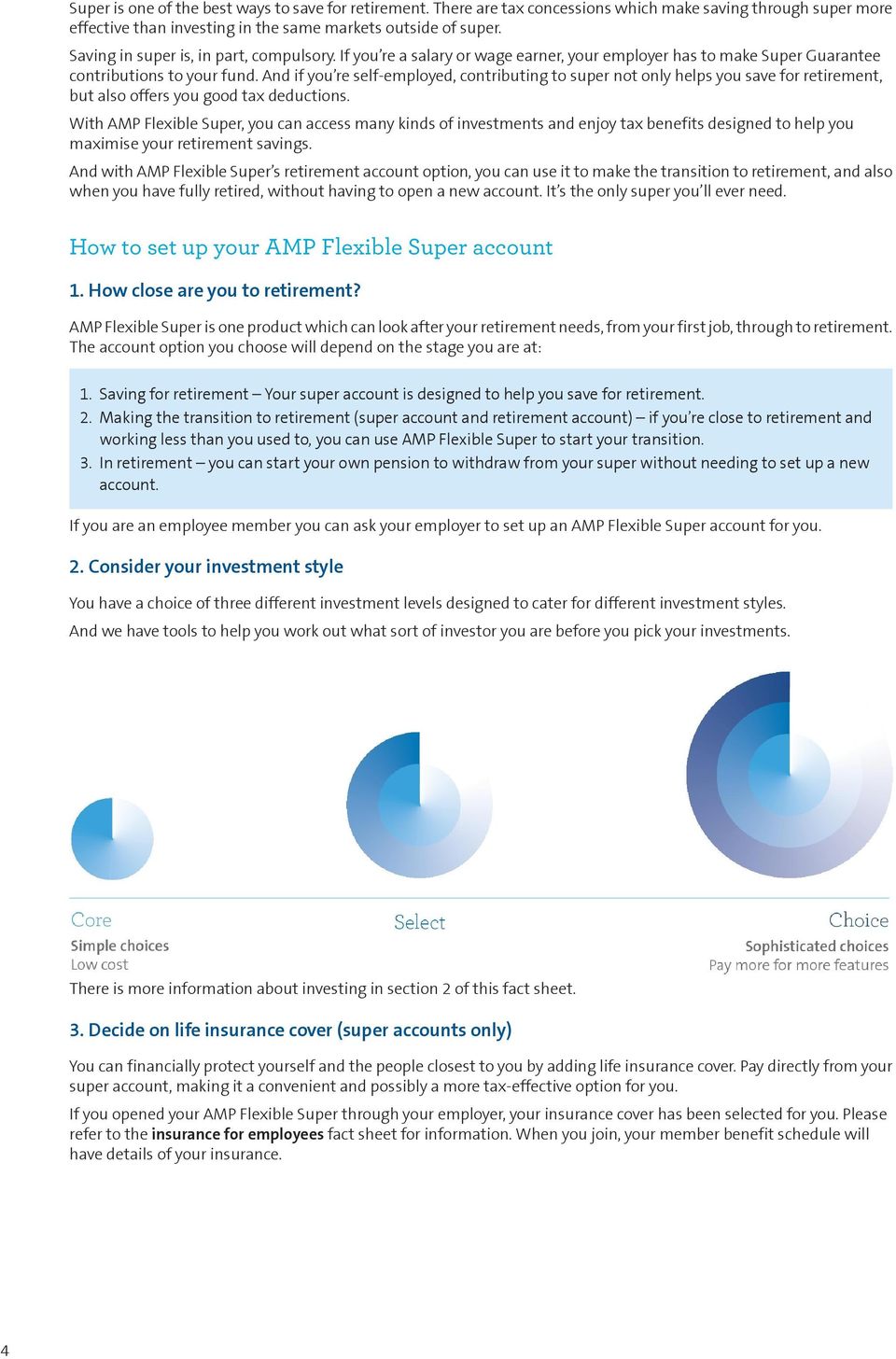
4 Super is one of the best ways to save for retirement. There are tax concessions which make saving through super more effective than investing in the same markets outside of super. Saving in super is, in part, compulsory. If you re a salary or wage earner, your employer has to make Super Guarantee contributions to your fund. And if you re self-employed, contributing to super not only helps you save for retirement, but also offers you good tax deductions. With AMP Flexible Super, you can access many kinds of investments and enjoy tax benefits designed to help you maximise your retirement savings. And with AMP Flexible Super s retirement account option, you can use it to make the transition to retirement, and also when you have fully retired, without having to open a new account. It s the only super you ll ever need. How to set up your AMP Flexible Super account 1. How close are you to retirement? AMP Flexible Super is one product which can look after your retirement needs, from your first job, through to retirement. The account option you choose will depend on the stage you are at: 1. Saving for retirement Your super account is designed to help you save for retirement. 2. Making the transition to retirement (super account and retirement account) if you re close to retirement and working less than you used to, you can use AMP Flexible Super to start your transition. 3. In retirement you can start your own pension to withdraw from your super without needing to set up a new account. If you are an employee member you can ask your employer to set up an AMP Flexible Super account for you. 2. Consider your investment style You have a choice of three different investment levels designed to cater for different investment styles. And we have tools to help you work out what sort of investor you are before you pick your investments. There is more information about investing in section 2 of this fact sheet. 3. Decide on life insurance cover (super accounts only) You can financially protect yourself and the people closest to you by adding life insurance cover. Pay directly from your super account, making it a convenient and possibly a more tax-effective option for you. If you opened your AMP Flexible Super through your employer, your insurance cover has been selected for you. Please refer to the insurance for employees fact sheet for information. When you join, your member benefit schedule will have details of your insurance. 4
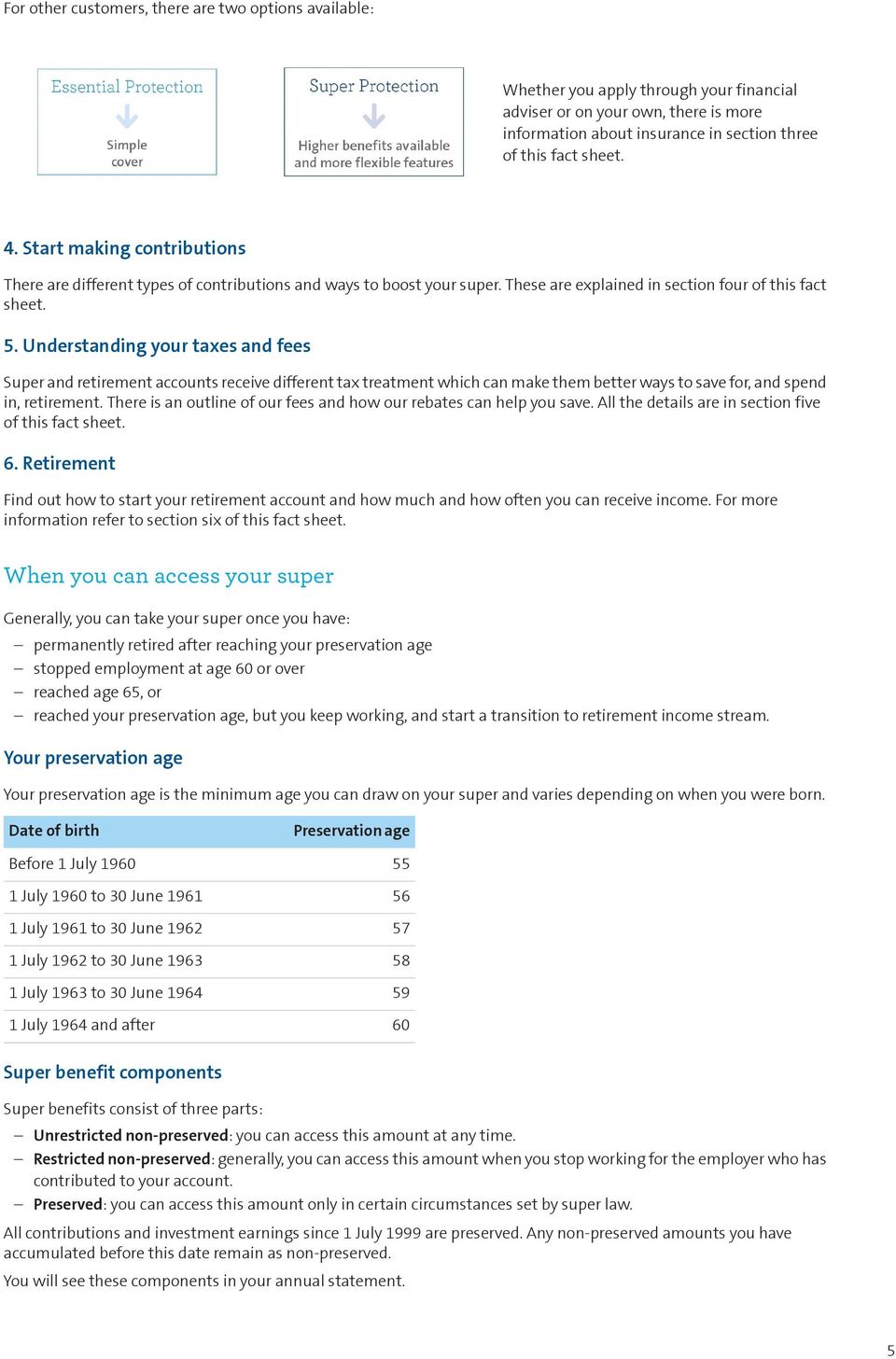
5 For other customers, there are two options available: Whether you apply through your financial adviser or on your own, there is more information about insurance in section three of this fact sheet. 4. Start making contributions There are different types of contributions and ways to boost your super. These are explained in section four of this fact sheet. 5. Understanding your taxes and fees Super and retirement accounts receive different tax treatment which can make them better ways to save for, and spend in, retirement. There is an outline of our fees and how our rebates can help you save. All the details are in section five of this fact sheet. 6. Retirement Find out how to start your retirement account and how much and how often you can receive income. For more information refer to section six of this fact sheet. When you can access your super Generally, you can take your super once you have: permanently retired after reaching your preservation age stopped employment at age 6 or over reached age 65, or reached your preservation age, but you keep working, and start a transition to retirement income stream. Your preservation age Your preservation age is the minimum age you can draw on your super and varies depending on when you were born. Date of birth Before 1 July July 196 to 3 June July 1961 to 3 June July 1962 to 3 June July 1963 to 3 June July 1964 and after Preservation age Super benefit components Super benefits consist of three parts: Unrestricted non-preserved: you can access this amount at any time. Restricted non-preserved: generally, you can access this amount when you stop working for the employer who has contributed to your account. Preserved: you can access this amount only in certain circumstances set by super law. All contributions and investment earnings since 1 July 1999 are preserved. Any non-preserved amounts you have accumulated before this date remain as non-preserved. You will see these components in your annual statement. 5
6 Retirement You are retired if you have reached your preservation age and stopped employment. If you stopped working before or at age 6, we need to be reasonably satisfied that you do not intend to return to work for 1 or more hours a week. Making the transition to retirement Investing in a retirement account under the transition to retirement rules When you reach your preservation age and you are still working, you can invest in both super and retirement accounts under the transition to retirement (TTR) rules. You must make at least one payment a year from your retirement account and you can withdraw up to 1% of the account balance each year. A retirement account under the transition to retirement rules does not generally allow lump-sum withdrawals until you can access your super on other grounds. You can find more information about transition to retirement rules at amp.com.au or speak to your financial adviser. Other conditions of release The other circumstances which allow you to withdraw money from your super include where you: have a terminal medical condition became permanently incapacitated qualify on compassionate grounds or severe financial hardship if you were a temporary resident 1 of Australia, when you permanently leave Australia and you request in writing for the release of your benefits. (This option is not available to holders of subclasses 45 and 41, Australian or New Zealand citizens or Australian permanent residents) stop working for the employer who has contributed to your account and purchase a non-commutable life pension or annuity, or terminate your employment with an employer-sponsor and your preserved benefit is less than $2. were a lost member and are subsequently found, and your account value is $2 or less. 1 Super funds are, under certain circumstances, required to transfer a temporary resident s super to the ATO following their departure from Australia. Such a transfer would only occur when at least six months have passed since the temporary resident s visa had ceased to be in effect, they had left Australia and not taken their benefit. Former temporary residents can subsequently access their benefit from the ATO. The ATO can be contacted on Relying on ASIC relief, we are not obliged to notify or give an exit statement to a member who was a temporary resident where we transfer their super to the ATO following their departure from Australia. Note: If you are or were a temporary resident, you will generally only be able to access your benefit under the following conditions of release: Death Terminal medical condition Permanent incapacity Temporary incapacity Departing Australia Super Payment paid to temporary residents leaving Australia permanently and who apply in writing for the release of their benefits Trustee payments to the ATO under the Superannuation (Unclaimed Money and Lost Members) Act 1999 Release Authorities under the Income Tax Assessment Act 1997, and/or If you met a condition of release allowed under a superannuation law before 1 April 29. Note: If you are or were a temporary resident, you will generally not be able to access your benefit under the following conditions of release: on retirement on reaching age 65. 6

7 Permanent incapacity, terminal medical condition, compassionate grounds and severe financial hardship You can access some or all of your super benefits at any age in certain circumstances for example, if you have a terminal medical condition, retirement due to permanent incapacity, severe financial hardship or compassionate grounds. There are specific conditions for the release of benefits and, in the case of compassionate grounds, release is also subject to approval by the Department of Human Services and the Trustee. You are permanently incapacitated if the Trustee is reasonably satisfied that your ill health (whether physical or mental) makes it unlikely that you will engage in gainful employment for which you are reasonably qualified by education, training or experience. You suffer a terminal medical condition if the following circumstances exist: Two registered medical practitioners have certified, jointly or separately, that you suffer from an illness, or have incurred an injury, that is likely to result in your death within a period (the certification period) that ends not more than 24 months after the date of the certification. At least one of the registered medical practitioners is a specialist practising in an area related to the illness or injury suffered. For each of the certificates, the certification period has not ended. Your retirement age for social security purposes Your retirement age is important, as it is the age when you access the aged pension. It is currently age 65. From 217 the retirement age will increase by six months every two years until it reaches 67. When you must take your super benefit Super rules do not require you to take your benefits at any maximum age. This allows you to keep your investment in your super account indefinitely. Your benefit must be paid out on your death. Current Unclaimed monies legislation for members over age 65 requires us to transfer your benefit to the Australian Tax Office (ATO) if all of the following conditions are met: you have not contributed to your super in the last 2 years, and it has been 5 years or more since you have transacted on your account or we last had contact with you, and we are unable to contact you after reasonable efforts have been made. Transfer to another super fund You can ask us to transfer your super benefit to another super fund at any time. If you transfer your whole balance, any insurance cover will generally cease on the date of transfer. Your account balance on death If you die, your account balance will be transferred to the Super Easy investment option, as at the date we are notified of your death. Anti-detriment payments extra amount for some death benefit payments Tax law may allow us to pay an extra amount if we pay your death benefit directly to a certain dependant(s) (or indirectly to them via your legal personal representative/estate). Your beneficiaries If you are age 18 years or over, you can nominate one or more beneficiaries to receive your death benefit. Generally, all beneficiaries must be your dependant(s). You can also nominate your estate (we call this your legal personal representative). If you are under age 18, you or your parent or guardian cannot make a death benefit nomination. 7

8 Who is a dependant? A dependant under superannuation law includes: your spouse (including a de facto spouse whether of the opposite or same sex) your children (including an adopted child, a stepchild, or ex-nuptial child) any person who is financially dependent on you, and any person with whom you have an interdependency relationship. A person must be a dependant on the date of your death to be a beneficiary. There is more detailed information about who is a dependant and inter-dependent relationships in the other super information guide available from amp.com.au/flexiblesuper. Paying your death benefit You can choose how you want your benefit paid. You have a choice of: Binding Nomination Non-Binding (Preferred) Nomination Reversionary Nomination No Nomination A description of these options are detailed below: Binding nomination Binding nominations are valid for a period of up to three years, and must be renewed on expiry. In most circumstances we must pay your benefit to the beneficiaries you have nominated in a valid binding nomination and in the proportions you have specified. You must be aged 18 or over to make a binding nomination. For a binding nomination to be valid: the total allocation must equal 1% and must be in whole numbers you can only nominate a dependant and/or your estate/legal personal representative (LPR) your nomination must be signed and dated in the presence of two witnesses who are over age 18 and who are not nominated beneficiaries. When we receive your nomination we will not check if your nominated beneficiaries are your dependants or your legal personal representative. Details of what will make a binding nomination invalid and treated as a non-binding nomination are outlined under the heading when will my binding or non-lapsing nomination be treated as a non-binding nomination?. Non-lapsing nomination From November 215, non-lapsing nominations which do not expire (and so do not need to be renewed) will be available. A non-lapsing nomination is a request by you to the trustee to pay your benefit to the beneficiaries you have nominated and in the proportions you have specified. If the trustee consents to the nomination and it is valid at the time of your death, the trustee is bound to pay your death benefit in accordance with the nomination. A non-lapsing nomination will continue to apply until you revoke an existing nomination or make a new nomination. In certain circumstances a non-lapsing nomination will be treated as a non-binding nomination - see when will my binding or non-lapsing nomination be treated as a non-binding nomination? in this fact sheet. It is important that you review your non-lapsing nomination regularly to ensure that it is still appropriate for you. You must be aged 18 or over to make a non-lapsing nomination. For a non-lapsing nomination to be valid: the total allocation must equal 1% and must be in whole numbers you can only nominate a dependant and/or your estate/legal personal representative (LPR) your nomination must be signed and dated in the presence of two witnesses who are over age 18 and who are not nominated beneficiaries. When we receive your nomination we will not check if your nominated beneficiaries are your dependants or your legal personal representative. Details of what will make a binding nomination invalid and treated as a non-binding nomination are outlined under the heading when will my binding or non-lapsing nomination be treated as a non-binding nomination? 8
9 When will my binding or non-lapsing nomination be treated as a non-binding nomination? We will automatically treat your nomination as though it was a non-binding nomination if: you and/or your witnesses do not sign or complete the binding nomination correctly if you have a lapsing binding nomination, three years have passed from the date you signed the binding nomination form (you will need to reconfirm your nomination every three years if you want to continue to have a binding nomination) any nominated beneficiary dies before you die any nominated beneficiary (other than the legal personal representative (LPR) ) is not a dependant at the date of your death your relationship changes after signing the Binding Nomination form or the non-lapsing nomination form, eg you get married, enter into a de facto relationship, get divorced or your de facto relationship ends. If you revoke your binding nomination or your non-lapsing nomination in writing without making another nomination, then we must pay your death benefit in accordance with the no nomination option. Nominating a beneficiary under Power of Attorney You can nominate a person or persons under a power of attorney to operate your membership. To do so, send us a certified copy of a valid power of attorney together with a declaration that the appointment has not been revoked. The legislation is different for each state and further information can be found online at australia.gov.au/content/powers-of-attorney. You must explicitly state in the power of attorney document that you allow the person you have nominated as your attorney to nominate themselves as a beneficiary of your super, if this is your desire. If you don't explicitly state that the appointed attorney can nominate themselves as a beneficiary the trustee will not implement any direction from the attorney to do so. Non-binding death benefit nomination With a non-binding (or preferred) nomination the trustee must pay your death benefit to one or more of your dependants or LPR in proportions that the trustee determines. If no dependant or LPR is appointed within a reasonable time, the trustee must pay your death benefit to any other person or persons in proportions which the trustee determines. A non-binding nomination will continue to apply until you cancel an existing nomination or make a new one. Reversionary nomination If you make a reversionary nomination, your retirement/pension account will continue to be paid to your spouse. You can only nominate your spouse (including de facto spouse) as a reversionary nomination. If they are not your spouse when you die then we will pay your benefit in accordance with the no nomination option. No nomination If you do not make a nomination or you cancel your existing nomination, we must pay your death benefit to your estate. However, if your estate is insolvent or if an LPR has not been appointed within a reasonable period of time, then we will look to pay your dependants; or, if none, other persons in proportions which the trustee determines. If you do not have a death benefit nomination you should consider making a will. It is important to review your nomination regularly and update it if your circumstances change. When and how we pay your death benefit Once we receive notification of your death, the balance will be paid to the Super Easy investment option. If you made a reversionary nomination, all amounts in your retirement account will remain in your chosen investment options, with the exception of any amount held in a Super Easy Term Deposit, in which case the term deposit will break and the amount transferred to Super Easy. Interest will be allocated at an adjusted crediting rate. For more information please refer to the additional information about Super Easy Term Deposits section in the investing and your options fact sheet. It s important to understand the differences between a binding, non-lapsing and non-binding nomination and the definitions of a dependant, as this may affect the payment of your benefit and its taxation. For more details about the terms and conditions relating to each of these options, please refer to the beneficiaries section in this fact sheet. 9

10 Keeping you informed Electronic communications This product is moving to electronic communications. By joining this product, you agree to receive or access all of our communications, such as confirmation of transactions, annual statements and other correspondence, by an electronic means (such as from our secure website, MyPortfolio). We will notify you when this occurs. The correspondence you receive includes: Super accounts Retirement accounts Welcome letter Welcome letter Member benefit schedule for employee members Confirmation of certain transactions only Annual statement Confirmation of certain transactions Annual update Annual statement PAYG payment summary Annual updates. Annual account review 3 June Guide to your tax return. If you leave you will receive: If you leave you will receive: Payment summary and/or superannuation rollover benefit statement Payment summary and/or superannuation rollover benefit statement Exit statement. Exit statement. The annual report for AMP Flexible Super is available from amp.com.au/flexiblesuper. You should keep a copy of the above information, the PDS, your member benefit schedule (employee members) and the fact sheets for future reference. Member tip Help us to keep you informed. We want to make sure you receive all the information you need to manage your super. Please let us know immediately if your personal details change. 1

11 Section ₂ : Investing in super In this section we highlight: Your investment options Our three investment levels Core, Select and Choice feature a range of investments to suit your investment needs, whether it s a simple low-cost strategy, a lifestage or risk based strategy, or a sophisticated approach which gives you access to lots of specialised funds. What sort of investor are you? This will help you determine your attitude to risk and the types of investments you ll be most comfortable with. Unit pricing and how it works A quick overview of how unit prices are set. Understanding risk All investments involve some level of risk. It is important to understand the different types of risk your investment will face. Switching We explain how you can change your investment options.

12 Choosing your investment options Before you start, there are three things to consider: 1. Your investment goals: Are they short-term or long-term goals? How much will you need? 2. Your timeframe: When do you want to retire? If you ve already retired, how long will your money last? 3. Your attitude to risk : Are you comfortable with negative returns in the short-term when seeking higher returns over the long-term? Or, are you more comfortable with moderate and consistent returns? Flexible investing AMP Flexible Super gives you the flexibility to choose between the Core, Select or Choice investment levels, to guide you through your investment goals. 12

13 Deciding what type of investor you are Our what investor style am I? simulator is a quick way to help you work out your investment style. It shows the relationship between risk and return as well as the impact of your time horizon. Visit amp.com.au/investorstyle. We have a number of super and retirement calculators available at amp.com.au/calculators to help you make the right decisions. You can also watch a range of educational videos at amp.com.au/videos. What it means to invest It is important to remember that when you invest in a particular investment option(s) you are selecting an exposure to certain types of assets such as cash, fixed interest, property, alternative assets, or shares. You do not receive any direct entitlement to the assets underlying the investment option(s). How your investment is valued When investing in a fund through superannuation, your contribution will appear either as a dollar amount or as units. This will also affect how your returns are credited to your account, which will either be as a: crediting rate investment, or unitised investment. Crediting rate investment Some investments have a crediting rate instead of a unit price, such as term deposits and cash investments. The crediting rate is similar to an interest rate, but it can be negative, is not guaranteed and can change at any time without notice. The crediting rate is accrued daily and paid to your account according to the frequency specified. Unitised investment The best way to allow many different investors to invest at the same time is to issue units, which represent a proportion of the underlying assets of the total investment. This also allows people to withdraw at a time that suits them. The value of the investment will change over time and unit prices will vary in line with this. When you invest in a unitised investment we allocate units to you based on the investment amount and unit price. Value of your investment option = Number of units held in the option x Unit price Setting unit prices AMP Life values the assets in each investment option at market prices and makes allowances (based on estimates) for: investment income and capital gains provision for tax on investment income and capital gains the costs of transacting operational costs incurred in maintaining property and other direct investments any administration fee, MySuper administration fee, investment fees, MySuper investment fees and performance based fees. The result of this valuation is then divided by the total number of units allocated. This gives the unit price. Unit prices will generally rise and fall with movements in the value of the underlying assets. Listed assets are valued at the end of each day using the price at that time. Other assets are valued in accordance with our valuation policy. If new investments are expected to exceed withdrawals from an investment option, then asset values may be adjusted by adding an allowance for some or all of the costs of buying assets. This will increase the unit price. If new investments are expected to be less than withdrawals from an investment option, then asset values may be adjusted by subtracting an allowance for some or all of the costs of selling assets. This will decrease the unit price. 13
14 Calculating unit prices AMP Life calculates unit prices each Sydney business day and generally, makes this price available the following Sydney business day. What unit price or crediting rate will you receive? You will receive the latest unit price calculated as at the date we receive all relevant information at an AMP processing centre, provided it is received before 3pm Sydney time. Otherwise, it will be the unit price applicable for the next Sydney business day. The day that applies will also determine when you are credited with returns. There are exceptions to this rule as follows: If the transactions are for the Pension Refresh Facility. If we need to delay switches or withdrawals, in which case you will receive the unit price available at the time the transaction occurs. Monitoring unit prices AMP Life has processes in place to check the accuracy of unit prices. You will be compensated directly into your account for any errors equal to or greater than.3% that affected the value of your transaction. If you have closed your account, AMP Life will: pay compensation directly into another of your AMP accounts if your benefit is not preserved, send you a compensation payment if the payment is above a dollar minimum set by the trustee, or roll the compensation into the AMP Eligible Rollover Fund. If we are unable to contact you or the payment is below a dollar minimum, the compensation will be paid into the fund on an unallocated basis. The trustee, acting in members interests, and AMP Life may agree to make other adjustments, as appropriate. Risks of investing In this section we look at some risks of investing. All investments have risk and you may not get back the same amount you invested, so it s important to understand what the risks are. Type of risk Investment risk Inflation risk Timing risk Market risk Systemic risk Liquidity risk Interest rate risk Description The value of your investment can rise and fall. Even if the investment rises, it may not perform according to your expectations, or the investment managers may not be able to achieve their stated aims and objectives. Your money may lose its purchasing power with inflation. When prices go up, your investment also needs to go up by at least the rate of inflation or the real value of your investment will decline. The risk your funds are invested at an unfavourable point in the investment cycle. For instance, buying into a market at higher market prices than those available soon after. Changes in market conditions which may adversely impact your investments, such as inflation, interest rates and global events. Systemic risk refers to major movements across several asset classes, or to the entire system simultaneously. This is generally due to some event affecting the economic system, eg global financial crisis. Liquidity risk refers to how quickly an asset can be bought and sold in the market place. eg direct property, hedge funds and unlisted equity investments. Interest rates affect all markets, particularly cash, cash-like securities and fixed interest investments. For instance, bonds will generally lose value if market interest rates are higher than the bond s fixed rate. Registered trademark of AMP Limited ABN

15 Type of risk International investment risk Description International investments are subject to the normal market risks, currency risk (exchange rate losses) and the legal risk that the laws of other countries may not provide adequate protection. Individual asset class risk Each type of market also known as an asset class has its own risks. Shares Property Fixed interest Alternative assets Description Shares are generally classified as a growth asset and include Australian shares and international shares (which may be hedged or unhedged to the Australian dollar). Specific risks include: industry risk factors disappointing profits and dividends management changes reassessment of the outlook for the company or industry currency risk for any investment in unhedged global shares. Property is generally classified as a growth asset and covers listed and direct property, and global and Australian property. Risks of property include: vacancies location unprofitable property development activities declining values share market volatility delays in approvals liquidity international investment risk (global property). Fixed interest is generally classified as a defensive asset and covers both Australian fixed interest and international fixed interest. Risks include: changes in interest rates generally, the investment value falls if yields rise default liquidity international investment risk (for global fixed interest investments) credit risk the risk that a a borrower will default on either the payment of interest or the return of principal. is generally classified as a defensive asset and may include corporate bonds and derivatives. Historically, long-term returns have been generally lower and have not kept up with inflation over the long term. Alternative assets can be broadly classified into growth and defensive asset classes. They include non-traditional liquid investments that target positive and uncorrelated returns by using short selling, gearing and derivatives. Investments such as private equity, venture capital, mezzanine finance and other private placement debt often present higher risks. 15

16 How markets move These two graphs show how markets, which historically have provided the best returns also involve the greatest risk. Historical performance is not a reliable indicator of future performance. Switching You can switch between investment options at any time. There is currently no fee for switching between investment options. Once we have received an investment option switch request it cannot be cancelled. On occasion there may be circumstances beyond our control that could delay the processing of your request. You may change your investment options at any time online through My Portfolio or by completing the investment options selection form, which can be obtained by visiting amp.com.au/forms or by contacting us. Before you decide to switch, we recommend you speak to a financial adviser. Please note: While you invest in LifeStages, you may not select any other investment options. If you wish to switch from LifeStages to another investment option, you will need to switch your entire LifeStages balance. 16

17 Authority for your financial adviser to submit investment switches This feature is only available where the financial adviser's advice licensee has an arrangement in place with AMP Life. You can instruct AMP to accept investment switching requests from your financial adviser on your behalf by completing a confirmation of limited authority to operate form. By submitting this form your financial adviser will be able to switch investment options in relation to your account at any time without the need for you to complete a switch form. Under the limited authority to operate, your financial adviser will not be authorised to operate your account in any other way. If you change your financial adviser you must tell us immediately in writing. If you don't inform us of the change, we will continue to process investment switching requests from your previous financial adviser. Please note: A limited authority to operate (LATO) is an agreement solely between you and your financial adviser. We will accept instructions for investment switches from your adviser if they confirm you have given them authority to act on your behalf. We will not request evidence from the adviser that this agreement is in place. Auto-rebalancing your investment options An auto-rebalancing facility means we ll keep your funds invested according to your nominated investment profile, as a percentage (%), over the long term. You can choose to have your account rebalanced either: quarterly: on or around 1 February, 1 May, 1 August and 1 November half yearly: on or around 1 February and 1 August, or yearly: on or around 1 August each year. If any of these dates fall on a weekend or a Sydney public holiday, we will rebalance your account on the next Sydney business day. There will be a 2% tolerance to prevent an auto-rebalance for significantly low amounts. All future contributions, switches, or withdrawals may affect your auto-rebalancing facility. You cannot select auto-rebalancing if you would like your future contributions to be invested differently to your nominated investment profile. If there are transactions on your account outside your nominated investment profile, we will cancel auto-rebalancing, unless you advise us you want to change your allocations. You can choose to apply auto-rebalancing to your account using the investment options selection form, available at amp.com.au/forms, or on My Portfolio. Auto-rebalancing is currently free of any fees. 17

18 Section ₃ : Insurance through super Insuring through your super is a tax-effective way to provide cover for you, and those who are important to you. In this section you ll get a quick overview of: AMP Flexible Super and its two levels of insurance cover for personal members. Important: Insurance is only available to super account members.
19 Personal insurance There are two types of personal insurance cover available through AMP Flexible Super: Essential Protection Super Protection. Here is an overview: Insurance feature Insurance payable if you die Entry age range Age cover ceases Insured amount Insurance payable for Total and Permanent Incapacity Entry age range Age cover ceases Insured amount Insurance payable for income replacement Entry age range Essential Protection Death cover $5, $25, (in $1, increments) Total and Permanent Disablement (TPD) cover (i) $5, $25, (in $1, increments) (must equal Death cover insured amount) - Super Protection Death cover $1, minimum, no maximum Permanent Incapacity cover (i) (but a modified permanent incapacity definition applies after age 65) $1, minimum $5 million maximum Temporary Incapacity cover (i) 16 6 Expiry age Insured amount How to apply - - Complete the insurance section of the AMP Flexible Super application. We will decide if you are eligible for Essential Protection based on your answers to the questions in the form. 65 $1,25 per month minimum $3, per month maximum Complete the insurance section of the AMP Flexible Super application, and the personal statement. We will assess your application by considering your medical history, likely future good health, lifestyle, family history, occupation and pastimes. Minimum premium - $2.83 per month when you apply. (i) Occupation eligibility rules apply. To find out more details about these insurance arrangements, and the terms and conditions which apply, please go to our insurance fact sheet at amp.com.au/flexiblesuper. Insurance for employer plans If you are an employee member, please refer to our insurance for employees fact sheet for information about Employee Essential Protection and Employee Flexible Protection. 19

20 Section ₄ : Making a contribution In this section you ll find more information about contributing to super: About contributions We clarify the technical terms describing different types of contributions and the caps on how much you can contribute. Ways to boost your super Understand the Federal Government s co-contribution scheme, spouse super, the effect of splitting contributions, UK pensions and how easy it is to consolidate through AMP. How to make a contribution We explain how you can make a contribution.

21 All about contributions Types of contributions We can accept the following contributions into your account: Contribution type (super account) Member contributions Spouse contributions Description Contributions you as a member pay either from your after-tax income, including contributions for which you intend to claim a tax deduction. Contributions your spouse makes into your account for which they may qualify for a tax-offset. These count as non-concessional contributions. Superannuation guarantee (SG) and award/industrial arrangement employer contributions Money paid by your employer into a super fund under the SG legislation, and to comply with an award or industrial arrangement. Salary sacrifice and additional employer contributions Government co-contributions Government low income super contributions Capital gains tax exempt contributions Contributions from the proceeds of personal injury payments Transfer/Rollovers Where you arrange for your employer to make contributions to your super account from your pre-tax salary or wages. These are concessional contributions. Federal Government scheme which aims to encourage saving in super by offering to co-contribute a certain amount into your super. A contribution from the Federal Government to offset the tax impacts on people making concessional contributions on low incomes. This will remain until the end of the 216/17 financial year. You can make contributions to super which are sourced from some or all of the capital gain or proceeds from the sale of a small business in certain circumstances. You can make contributions to super which arise from a structured settlement or order for personal injuries. You can transfer or rollover existing super monies into your account at any time no matter how old your are. Contributions caps and tax on excess contributions There are limits on the amount of contributions made to a super fund. These are known as contributions caps and are applied to the two types of contributions: concessional contributions non-concessional contributions. Concessional contributions are generally those contributions made from your pre-tax income. These include superannuation guarantee contributions and contributions you ve made and claimed as a tax deduction. Non-concessional contributions are generally contributions made from after-tax income. They also include spouse contributions and the tax-free part of overseas transfers. Note: we cannot accept these contributions unless we have your TFN. Please note: Concessional contributions which are above their cap are also considered, and taxed, as non-concessional contributions. There are exclusions from the contributions caps, such as: transfers from taxed super funds proceeds from certain small business capital gains concessions, collectively capped at $1,395, in the 215/16 financial year (indexed) covering the: small business retirement exemption ($5, maximum) small business 15 year exemption proceeds proceeds from certain personal injury settlements taxable amount of overseas transfers. 21
22 Type of contribution Concessional contributions cap Non-concessional contributions cap Cap $3, pa (i) $18, pa (ii) Special arrangement A $35, pa (not indexed) cap applies to people aged 5 and over. If under age 65, you can bring forward two years of contributions caps. You can make contributions of up to $54, in one financial year, but you will not be able to make any more non-concessional contributions for the next two years. (i) (ii) Normally indexed annually in line with average weekly ordinary time earnings in increments of $5, (rounded down). This cap will be calculated as six times the standard concessional contributions cap. Tax on excess contributions Excess concessional contributions tax was abolished for concessional contributions made from 1 July 213. Instead, for the 213/14 financial year and onwards, your income will automatically include the amount of any excess concessional contributions made in the year and an excess concessional contributions interest charge calculated by the ATO will be payable. In addition, you will have the option of withdrawing up to 85% of your excess concessional contributions from your super. The treatment of excess non-concessional contributions has been changed and applies to excess non-concessional contributions made from 1 July 213. You will be allowed to withdraw those excess contributions plus 85% of an associated earnings amount. Where you choose this option, no excess non-concessional contribution tax will be payable and associated earnings will be taxed at your individual marginal tax rate. It remains that excess non-concessional tax (at the top marginal tax rate of 47% plus Medicare levy) will continue to be imposed on excess non-concessional contributions that are not released from super. Please note that the excess contributions tax rates are applied to the gross amount of the contribution or payment and there is no reduction for death and disability premiums, unlike the standard 15% contributions tax allowance on concessional contributions. Ways to boost your super Salary sacrificing Salary sacrificing is where you agree to forgo part of your future salary in return for your employer paying a pre-tax contribution to your super. You can grow your super and reduce your tax at the same time. Government co-contributions The Federal Government provides a co-contribution to your after-tax personal member contributions, up to a maximum co-contribution of $5 per year, if you are a low income earner and satisfy a number of qualifying rules. Spouse contributions Making a spouse contribution may provide your spouse with a tax offset of up to $54 when they contribute to super for you. This provides an incentive for couples to make sure both their super funds are growing. Government low income superannuation contribution The Federal Government will make a contribution of up to $5 in a financial year for you if you received concessional contributions during the financial year and your adjusted taxable income is less than $37,. This will remain in place until the end of the 216/17 financial year. Contribution splitting You may, under certain circumstances, be able to split to your spouse s super up to 85% of your annual employer contributions and member contributions for which you claimed as a tax deduction. 22
23 International transfers UK pension transfers Where we are permitted to accept transfers of UK pension savings we will. However, any withdrawals of amounts of UK transferred benefits will be subject to UK legislative requirements. KiwiSaver schemes At this time, we do not accept transfers from KiwiSaver schemes. However, you may transfer your benefits from your account to a New Zealand KiwiSaver scheme. Important: We recommend you see your financial adviser or taxation advisor before transferring any amounts as there may be currency risks and tax consequences. Bring your super together Consolidating your super into your AMP Flexible Super is easy using our free Super Consolidation Service. With our online consolidation service, there is no paperwork. If you know your external fund name and account number we will automatically send through your consolidation request to the other fund. If you don t know your other external fund details, we can complete an ATO Super Search on your behalf with your consent to use your TFN. We will get back to you within a few days with the details. Benefits of consolidating your super: Save on fees If you have more than one super account, you are probably paying more in fees than you need to. You could reduce the fees you pay by reducing the number of accounts you have and increasing the balance of your main fund. Help your balance grow With compounding returns, the money you save in fees could really help your super balance grow. Reduce the chances of losing track of your super. Consolidate your super online at amp.com.au/consolidate or by calling us on Important: Before consolidating, you need to consider how your existing super accounts compare to AMP Flexible Super, whether any exit fees apply and what effect consolidating will have on any insurance cover. If you are unsure, speak with your financial adviser or contact AMP. How to make a contribution You or your employer can make contributions using the following payment methods: Direct debit credit card cheque 1 biller codes: Member contributions: 8798 Spouse contributions: SG and Award contributions: Salary sacrifice and additional employer contributions: Australia Post esuper (for employers only). Employers can refer to the information for employers guide to find out more about making contributions. 1 By law, payment by cheque is a non-compliant way of making contributions for large employers (2 or more employees) and from 1 July 216 will be non-compliant for small employers (19 or less employees). Registered to Pty Ltd ABN
24 Section ₅ : Taxes and fees In this section you ll read about: Find out about the taxes on your super, both on money being contributed and as you withdraw. AMP Flexible Super fees Understand the fees on your AMP Flexible Super, the rebates and flexible bonus. Definitions of fees This tax and social security information is of a general nature only and only considers Australian Commonwealth laws. Tax and social security laws are complex and can change. We recommend you discuss your circumstances with your financial adviser and/or tax adviser before you decide to invest.
25 Tax Generally, your super is taxed: when contributions are made while your money is invested, and when you withdraw money from super under age 6. When contributions are made A contributions tax of up to 15% applies to: employer contributions eg superannuation guarantee, and after-tax member contributions where a tax deduction is claimed. The contribution is reduced by any death and disability insurance premiums paid through your super before the tax is applied. Contributions tax is deducted quarterly and when you close your AMP Flexible Super. If your income and certain contributions exceed $3, in a financial year, you will be taxed another 15% on the lesser of the excess over $3, and the contributions. If you make after-tax member contributions and do not claim a tax deduction, or a spouse makes a contribution to your super, contributions tax will not be deducted. If you exceed your contributions caps, you will be required to pay an excess contributions tax of up to 47% (plus Medicare Levy) of the excess. This tax is levied on you in addition to income tax. The Federal Government has changed the treatment of excess non-concessional contributions to allow individuals to withdraw excess contributions and associated earnings. Another tax (called the no-tfn tax) of 34% applies to employer contributions if you do not give us your tax file number (TFN). There is no reduction to this taxable amount for insurance premiums. This tax is calculated and deducted at the earlier of 3 June each year and when you leave AMP Flexible Super. The no-tfn tax may be offset if the TFN is supplied within four financial years from the start of the financial year when the contribution is made. Any refund will be added to your super benefit and will be subject to the usual cashing and taxing rules. When you transfer money from another fund Generally, transfers from taxed sources are not taxed when added to your super. Any remaining superannuation surcharge liability from your previous fund may be transferred to your new plan with us and we will subtract it from your account. The taxable component that you transfer from an untaxed super source will be taxed up to 15%. While your money is invested A maximum of up to 15% tax is applied to the investment earnings of your super account. Investment returns earned by your retirement account will be tax-free. Capital gains on some assets within a super fund that are held for at least 12 months are taxed at an effective rate of up to 1%. This tax is deducted before we declare investment returns. Super benefit components A super benefit is made up of two components for tax purposes taxable and tax-free and each component has its own taxation treatment. Lump sum tax on withdrawals from your retirement account depends on the components. We withhold any PAYG tax payable for income payments and we also withhold any PAYG tax from lump sum withdrawals. 25
26 Advantages Currently, the tax laws can give you some advantages for retirement accounts. These include: No lump sum tax on rollover. No tax on investment earnings. Part of each regular income payment may be returned tax-free. (If you re over age 6, all of your payment is tax free). A 15% tax offset (rebate) is available on the taxable component of your super. The payment is taxable in your hands. Senior Australians and pensioner tax offset is available for those with taxable incomes below certain limits. Certain recipients of Department of Veterans Affairs payments may be eligible for this offset earlier than aged 6. When you withdraw money from super No lump sum tax for 6 and over All lump sum and pension benefits received by you on or after age 6 are tax-free. Lump sum tax rates for under 6s If you are under age 6, withdraw your money from your retirement or super account, then generally you are subject to lump sum tax based on the components of your withdrawal benefit (see table below). Component Tax treatment Tax-free component Completely tax-free Taxable component Under preservation age (i) Maximum = 2% (ii) (ie taxed element) Preservation age to 59 Maximum tax> $195, (iii) Age 6 or over First $195, (iii) = % 15% (ii) Completely tax-free (i) (ii) (iii) For your preservation age see the 'when you can access your super' section in this fact sheet. Plus Medicare levy. For the 215/16 financial year. You are only allowed one low rate cap amount regardless of how many funds you are invested in and whether they are taxed or untaxed. The low rate cap amount may be reduced by previous lump sum withdrawals of low rate amounts. The low rate cap amount is indexed annually in accordance with average weekly ordinary time earnings. This list is not exhaustive. For more details, contact your financial adviser. If you transfer the money directly to another super fund, or retirement account, you will not need to pay any lump sum tax. Lump sum death benefits Generally, lump sum death benefits are tax-free, where the benefit is paid to a dependant under tax law. The taxable component of lump sum death benefits paid to a non-dependant under tax law will incur 15% tax on the taxed element plus Medicare levy and 3% tax on the untaxed element plus Medicare levy. Non-dependants of defence and police force personnel killed in the line of duty are defined as tax dependants. Lump sum disability benefits Disablement benefits are subject to tax but usually receive favourable tax treatment if specific requirements are met. Your financial adviser can provide more information. Terminal medical condition Lump sum benefits are totally tax-free once certification requirements are met. Temporary salary continuance/temporary incapacity benefits A member who receives temporary salary continuance/temporary incapacity payments has to pay tax at their personal marginal tax rate, with no offset. 26
27 Tax if investing in the retirement account If you are aged 6 or over, all income payments and withdrawals are tax-free. Currently, the tax laws can give you some advantages for payments from a Retirement account compared to other forms of investment. These advantages include: No lump sum tax on rollover No tax on investment earnings When you roll your superannuation benefit into your Retirement account, you won t have to pay any lump sum tax on the rollover amount. This means that from the start, you will have more of your money working for you and your future. If you have an element untaxed of the taxable component, we deduct 15% contributions tax at the time you rollover this component. Investment returns earned by your Retirement account will be tax-free while kept in your Retirement account. Part of each regular income payment may be returned tax-free Retirement account: If you are aged 6 or over, all your income payments are tax-free. Beneficiary retirement account: If you are age 6 or over, or you are under age 6 and the deceased member was over age 6, all your pension payments are tax-free. If you are under age 6, and the deceased member was under age 6, a part of each regular pension payment you receive from your allocated pension may be tax-free. The balance of each payment is taxable in your hands. A 15% tax offset may apply Retirement account: If you are aged 6 or over all your income payments are tax-free. If you are aged under 6 and your income is taxable, you may also be eligible for a 15% tax offset (rebate) on the taxable portion of the income payments from your Retirement account. This offset generally applies to income recipients aged between 55 and 59 and will further reduce the tax payable on your income payments. It may also apply if the income is paid as a result of the death of another person or your disability. Beneficiary retirement account: If you are age 6 or over, or the deceased member was over age 6, all your pension payments are tax-free, therefore no offset applies. If you are under age 6, and the deceased member was under age 6, and your pension is taxable, you will be eligible for a 15% tax offset (rebate) on the taxed element of the taxable component of the pension payments from your allocated pension. Senior and Pensioner s tax offset How PAYG withholding tax affects your income payments There is a special tax offset (rebate) which may be available to certain individuals who have taxable income below a certain limit. This offset is not needed in respect of your AMP Flexible Super income stream payments if you are aged over 6 because these payments will be completely tax-free. However, certain recipients of Department of Veterans Affairs payments may be eligible for this offset earlier than aged 6. Being eligible for this offset may assist with your tax liability on taxed pension payments. If you are age 6 or over, all income payments are tax-free. For income payments subject to PAYG tax, we withhold any PAYG tax payable from each income payment as required by law. We also withhold any PAYG tax from permitted lump sum withdrawals from your account. Tax on withdrawal of a lump sum from a Retirement account If you are age 6 or over, all lump sum withdrawals are tax-free. A superannuation benefit is made up of two components taxable and tax-free and each component has its own taxation treatment. The taxation of a lump sum withdrawn from your Retirement account is determined by the components in your withdrawal. 27
28 If self-employed, how do you claim a tax deduction for your member contributions? To claim a tax deduction for your member contributions you will need to complete a notice of intent to claim or vary a deduction for personal super contributions form and return it to AMP on or before the day you lodge your tax return or by the end of the next financial year. Around the end of July each year, we will send you the form if you are: a new member who has made member contributions into your AMP Flexible Super account in the previous financial year, or an existing member who has made member contributions into your AMP Flexible Super account in the previous financial year and claimed a tax deduction in either of the last two financial years. The form must be lodged with us before: you lodge your income tax return for the year(s) for which you are claiming a tax deduction, or the end of the income year after the year for which you are claiming a tax deduction, whichever is the earlier the date you ceased to have your contributions in your accumulation account, and the date part or all of your contribution was used to start an income stream. Once we receive a completed form, we will send you a superannuation fund acknowledgement. You should keep this for your tax records. Social security Centrelink may count your super under the means test. As the rules are complex, you should seek the advice of your financial adviser, the Financial Information Service provided by Centrelink, or the Department of Veterans Affairs. Fees and other costs Important note: We refer to investment options that are not the AMP MySuper Balanced investment option as choice investment options. This section shows fees and other costs that you may be charged. These fees and other costs may be deducted from your account, from the returns on your investment or from the fund as a whole. Other fees, such as activity fees, advice fees for personal advice and insurance fees, may also be charged, but these will depend on the nature of the activity, advice or insurance chosen by you. Taxes, how insurance premiums are charged and other costs relating to insurance are set out later in this section. You should read all the information about fees and other costs because it is important to understand their impact on your investment. The fees and other costs for each MySuper product offered by the superannuation entity, and each investment option offered by the entity, are set out in the investing and your options fact sheet. Fees and other costs for the AMP MySuper Balanced investment option (Please see the next table for fees and other costs for choice investment options) AMP Flexible Super AMP MySuper Balanced investment option (Super account only) Type of fee Investment fee Administration fee Buy-sell spread Amount.15% pa.5% pa Plus MySuper member fee $1.97 (i) per week as at 1 July 215. No buy sell spread applies, however transaction costs will apply. How and when paid Deducted daily from the investment option and reflected in the unit price. Deducted daily from the investment option and reflected in the unit price. Deducted monthly directly from your account. For further information on transaction costs, see other fees and costs below. 28
29 AMP Flexible Super AMP MySuper Balanced investment option (Super account only) Type of fee Switching fee Exit fee Amount Nil $36.45 (i)(ii) as at 1 July 215. How and when paid N/A Deducted from your account on full or partial withdrawal from the fund. Advice fees relating to all members investing in a particular MySuper product or investment option Other fees and costs (iii) Nil +/- to.37% of amount invested (iv) Plus Advice fees for personal advice as agreed between you and your financial adviser. Plus Insurance fees insurance premiums will apply if you have insurance cover. Plus Other indirect costs of.%. N/A Estimated transaction costs are the costs of buying and selling assets within the investment option and are included in the unit price. When estimated transaction costs change, the value of your investment in the investment option will either increase or decrease depending on the change that was made. Deducted directly from your account. Deducted directly from your account at the end of each month. Other indirect costs (v) are variable and are deducted from the underlying assets of the investment option and are included in the unit price as and when they are incurred. These costs are not charged separately. (i) (ii) (iii) (iv) (v) The MySuper member fee and exit fee will increase on 1 July each year in line with the Consumer Price Index The MySuper Exit Fee does not apply to a withdrawal made to satisfy a payment to the ATO under a Release Authority. For more information on other fees and costs see the 'additional explanation of fees and costs' section in this fact sheet and for insurance fees, the applicable insurance fact sheet These amounts are a reasonable approximation of the anticipated transaction costs for the investment option based on the information available to AMP at the date of this document. The actual transaction costs for an investment option depend primarily on the type of assets in the investment option and the frequency of trading those assets. As a result, the actual transaction costs for an investment option may vary from the estimated amount at any time. See transaction costs in this fact sheet for further details. Other indirect costs are variable and may be more or less than the estimate shown here. Fees and other costs for choice investment options AMP Flexible Super Type of fee Amount How and when paid Investment fee The amount you pay for specific investment options ranges: Core: Between.15% and.34% pa Select: Between.1% and.34% pa Choice: Between.1% and 2.2% pa The amount you pay for each investment option is shown in the investing and your options fact sheet. (i) The investment fee is deducted from the assets of each investment option and is reflected in the unit price or crediting rate when declared. It is not deducted directly from your account. 29
30 AMP Flexible Super Type of fee Amount How and when paid Administration fee Administration fee The amount you pay for specific investment options ranges: Core: Between.25% and.5% pa Select: Between.25% and.5% pa Choice: Between.25% and.85% pa The amount you pay for each investment option is shown in the investing and your options fact sheet. Plus a Stronger Super fee (ii) AMP Flexible Super super accounts:.4% pa of the amount invested in choice investment options. AMP Flexible Super retirement accounts:.1% pa of the amount invested in choice investment options. Less Administration fee rebate (applies to Choice investment level only) Total relationship balance Rebate rate (% pa) on the balance invested in Super Easy investment options and AMP Capital Dynamic Markets option Rebate rate (% pa) on the balance invested in premium investment options The administration fee is deducted daily from the assets of each investment option and is reflected in the unit price or crediting rate when declared. It is not deducted directly from your account. The Stronger Super fee is deducted daily from the assets of each investment option and is reflected in the daily unit price or crediting rate when declared. It is not deducted directly from your account. The rebate, if applicable, is normally paid directly into your account, usually within seven business days after the end of each month. You may qualify for another rebate under the flexible bonus feature (iii). Under $1, $1, $199,999 $2, $499,999 $5, $999,999 $1,, $2,999,999 Nil Nil Nil Nil.1 Nil $3,, or more.2.85 The rebate is applied to your account balance based on the applicable rebate rate (converted to an equivalent monthly rate). See additional explanation of fees and costs later in this section for more information. Plus a Member fee Depending on the investment level chosen, the member fee as at 1 July 215 is: Core: $1.66 per week Select: $2.22 per week Choice: $2.78 per week This fee will increase on 1 July each year in line with the Consumer Price Index (CPI). The member fee is deducted from your account, usually within seven business days of the end of each month. The member fee is deducted from each investment (excluding the Super Easy Term Deposit and the AMP MySuper Balanced investment options) in proportion to your investments in each option. 3
31 AMP Flexible Super Type of fee Amount How and when paid Buy-sell spread No buy sell spread applies, however transaction costs will apply. For further information on transaction costs, see other fees and costs below. Switching fee Nil Exit fee Nil If you were a member of GIO who was transferred to an AMP product, a withdrawal fee (special exit fee) may apply if you transfer your account balance to a retirement account. This will be shown on your last member statement for your existing AMP product. This fee is deducted from your account whenever you make a lump sum withdrawal from your retirement account. Advice fees relating to all members investing in a particular investment option. Other fees and costs (iv) Nil Estimated transaction costs of between +/- % to 1.1% of the amount you have invested in the investment option (v) Estimated transaction costs are the costs of buying and selling assets within the investment option and are included in the unit price. When estimated transaction costs change, the value of your investment in the investment option will either increase or decrease depending on the change that was made. Plus Advice fees for personal advice as agreed between you and your financial adviser. Advice fees for personal advice will be deducted directly from your account. Plus Insurance fees insurance premiums will apply if you have insurance cover. Deducted monthly from your account. Indirect cost ratio Performance Based Fees (PBF) of up to 25%* of the Performance based fees are paid to certain outperformance over the index for the relevant investment managers when they meet specific investment manager. investment performance targets. These fees are * A PBF of up to 3% is payable for the K2 Australian deducted from the assets of the relevant Absolute Return Fund. investment option and are reflected in the daily Estimates for each investment option are shown in unit price or crediting rate. See 'additional the investing and your options fact sheet. explanation of fees and costs' for further details. Plus Other indirect costs (vi) of between.23%pa of the amount you have invested in the investment option. Other indirect costs are variable and are deducted from the underlying assets of the investment option and included in the unit price or crediting rate as and when they are incurred. These costs are not charged separately. (i) (ii) (iii) For the Specialist Geared Australian Share investment option, the investment fee is paid on the gross amount invested. The Federal Government has introduced Stronger Super, a program of changes designed to streamline and strengthen Australia s superannuation system. The Stronger Super fee is to help cover the costs associated with implementing these changes. This fee is expected to cease by 1 November 218. Flexible bonus is a feature that allows you and one immediate family member to link your accounts together to benefit from an administration fee rebate rate which is based on the total of your linked account balances. See the 'flexible bonus' section for further information. 31
32 (iv) (v) (vi) For more information see the 'additional explanation of fees and costs' section in this fact sheet and for insurance fees, the applicable insurance fact sheet. These amounts are a reasonable approximation of the anticipated transaction costs for the investment option based on the information available to AMP at the date of this document. The actual transaction costs for an investment option depend primarily on the type of assets in the investment option and the frequency of trading those assets. As a result, the actual transaction costs for an investment option may vary from the estimated amount at any time. Estimated transaction costs by investment option are shown in the investing and your options fact sheet. See transaction costs in this fact sheet for further details. The range shown here is an estimate only based on the year ended 31 December 214 actual costs rounded to two decimal places. Other indirect costs are variable and may be more or less that the estimates shown here. Estimates for each investment option are shown in the investing and your options fact sheet Please note: For the definitions of the fees and costs in the table above, please refer to the 'additional explanation of fees and costs' section below. Additional explanation of fees and costs Rebates, tax and fees The actual amount of fees you pay (or rebates you receive) in AMP Flexible Super will be reduced by up to 15%. This is because super funds currently receive a tax deduction for expenses, which is passed on to you. The fees and rebates shown in the tables of fees and other costs section in this fact sheet are before any applicable tax deduction. The fees described in the PDS and the fact sheets include, if applicable, GST less input tax credits. Further information on taxes are set out in section seven of the applicable PDS and the tax section of this fact sheet. Administration fee rebate To be eligible for an administration fee rebate you need to select the Choice investment level in either your super or retirement account. Your administration fee rebate depends on your total relationship balance and the investment options chosen. Your total relationship balance is described below: Type of member Employer sponsored member (employee member) Family member who is linked to an employee member under family membership (ii) Total relationship balance The size of the member s employer plan. (i) Employee member with a link to an Association Business Group Family member who is linked to an employee member within an Association Business Group under family membership (ii) The size of the Association Business Group, which is: the size of the member s employer plan (i) plus a percentage of the sizes of the other employer plans (i) that are part of the Association Business Group. Association Business Group type(iii) Associated employer % 1 Employer association Franchise 2 1 Personal member who is not linked to an employee member under family membership (ii) The sum of the member s super and retirement accounts. If you are a personal super member, you may be eligible to link a family member for the flexible bonus. See the flexible bonus section for more information. (i) (ii) The size of the employer plan is determined as the sum of all: Employee members super accounts and (if linked) retirement accounts in that plan. Family members super and retirement accounts, if those members are linked under family membership to employee members in that plan. See 'eligible relationships - Flexible bonus and family membership' in this fact sheet. 32
33 (iii) Association Business Group types are: Associated employer: a group of employers that are companies that satisfy the definition of Associated Entity in section 5AAA of the Corporations Act 21 (Cth) that AMP has agreed to recognise as an Association Business Group for the purpose of determining administration fee rebates. Employer association: an organisation representing a group of employers with similar interests that AMP has agreed, with the employer, to recognise as an Association Business Group for the purpose of determining administration fee rebates. Franchise: a group of employers licensed by a franchisor to operate a franchise system that AMP has agreed to recognise as an Association Business Group for the purpose of determining administration fee rebates. Administration fee rebates do not apply to balances invested in the AMP MySuper Balanced option. There are two categories of investment options for the purpose of calculating administration fee rebates for Choice investment options: all Super Easy investment options, and all other investment options (with the exception of AMP Capital Dynamic Markets, which uses the Super Easy rebate rate). The different rates applying to these categories are specified in the fees and other costs table in this fact sheet. If you switch from a Super Easy investment option into another investment option, you become eligible for the higher rebate rate in the month after you switch. Your rebate rates are applied to your AMP Flexible Super account balances (excluding any amounts invested in the AMP MySuper Balanced fund). For super accounts, this rebate amount is reduced by up to 15% to allow for the tax deduction which has already been included in the original fee. The rebate is paid by issuing units or crediting an amount usually within seven business days after the month s end (excludes Super Easy Term Deposits). We allocate the rebate in proportion to the balance of each investment option or, if applicable, in accordance with your deductions and rebates profile. If you withdraw money before the end of the month or before the rebate is paid (in the next month), and as a result you no longer meet the minimum relationship balance requirements, no administration fee rebate will be paid. Flexible bonus Flexible bonus means you may pay less for your super by you and one family member linking your AMP accounts together. Linking the accounts Accounts in the following products are eligible to be linked under the flexible bonus: AMP Flexible Super Flexible Lifetime Super Flexible Lifetime Allocated Pension Flexible Lifetime Investments (Series 1 and 2) Flexible Lifetime Term Pension. The administration fee rebate rate for linked accounts is based on the total of the linked account balances at the end of the month. For AMP Flexible Super and Flexible Lifetime Super, the administration fee rebate does not apply to balances in the AMP MySuper options but they are included in determining the administration fee rebate under the flexible bonus. For Flexible Lifetime Investments (Series 1 and Series 2), the management fee rebate does not apply to balances in the AMP Monthly Income Funds but they are included in determining the level of management fee rebate under the flexible bonus. How the flexible bonus is worked out Your entitlement to the flexible bonus is described in this table: Type of member Total relationship balance Family member who is linked to an employee member under family membership. You are not eligible for any additional rebates in respect of your AMP Flexible Super account. 33
34 Type of member Total relationship balance Personal member who is not linked to an employee member under family membership. You may be entitled to rebates for your Flexible Lifetime products linked under flexible bonus. The rebate rate for linked products is determined by the total of linked account balances at the end of the month. The current rebate tiers and rates for those products, outlined in the fees and other costs for choice investment options table in this fact sheet, will apply. The rebate rate for linked products is determined by the total of linked account balances at the end of the month The applicable account balances includes AMP Flexible Super account, your other eligible AMP products as well as those of your family member who is linked under the flexible bonus. The current rebate tiers and rates for AMP Flexible Super outlined in the fees and other costs for choice investment options table in this fact sheet will apply. Any rebate payable under the flexible bonus is paid in the same way as any rebate that is payable under the main rebate arrangements described in the fees and other costs for choice investment options table, except that payment occurs on the 15th day of each month. If you close your account after the end of the month, but before the 15th day of the next month, no rebate under the flexible bonus will be payable for the previous month. Eligible relationships Flexible bonus and family membership The Flexible bonus option can only be used to link your account with one other person's AMP account. Your account cannot be linked under the Flexible Bonus option if it results in a third person benefiting from the management fee rebate. This includes accounts held jointly or by a company, partnership, deceased estate, trust, super fund or parent/guardian on behalf of a child under the age of 18. Under Family membership, there is no limit to the number of family members who can be linked to your employee account in order to benefit from the administration fee rebate. Eligible relationships for the flexible bonus and/or family membership are: your spouse, parent, sibling (brother or sister), child, grandparent, grandchild, father or mother-in-law, brother or sister-in-law, son or daughter-in-law, or someone with whom you have an interdependency relationship. For more information please refer to the what is an interdependency relationship? section in the other super information guide. How to apply for the flexible bonus If you would like to link any of your accounts, please use the flexible bonus form at amp.com.au or call us on for a copy. If we receive a form after the 25th of the month, the link (and eligibility for the administration fee rebate) will not apply until the end of the following month. When linking your accounts, you and your family member consent to the sharing and disclosure of the account name, account number and account type with each other (and if applicable, each other s financial advisers). We may cancel a link if you no longer satisfy the criteria outlined above. If you want to link an account to a different family member, you will need to cancel the link with the existing family member. In the event of death, your accounts remain linked until a death benefit is paid from the relevant account. Deductions and rebates profile The deductions and rebates profile enables you to nominate a single investment option where fees, premiums and other costs are deducted from, and rebates are credited to. Only MySuper fees are deducted from the AMP MySuper Balanced investment option. You can t nominate the AMP MySuper Balanced investment option for other investment options' deductions and rebates. If you have not nominated an investment option or if there are insufficient funds in your nominated option, then the deduction will be taken proportionally from all investment options (excluding the AMP MySuper Balanced and Super Easy Term Deposit investments). If you have not nominated a deductions and rebates profile, rebates will be allocated in proportion to your investment balances (excluding AMP MySuper Balanced and Super Easy Term Deposit). 34
35 Performance based fees A performance based fee (PBF) is a reward an investment manager receives if they exceed specific performance targets. Any fee charged is incorporated into the investment option s unit price (or crediting rate, if applicable). Performance fees are charged separately and do not affect administration fees and investment fees. Each performance fee is calculated slightly differently but they all have the following common elements: A performance fee is only payable to a manager if they achieve a target level of return. Each time a performance fee is paid the portfolio must reach the previous highest value plus the appropriate performance hurdle before a new performance fee is payable. Performance fees are calculated and accrued regularly (at least monthly) and incorporated into the calculation of unit prices. The accrued performance fee can rise or fall in line with delivered performance. Performance fees are only payable at the end of each financial year and in certain circumstance payments may be delayed. Multi-sector and multi-manager investment options may have a number of investment managers with performance based fees, and each will be determined on each investment manager s performance. This means an individual manager can earn its performance based fee irrespective of the investment option s overall investment returns. Estimated performance based fees can be found in the investment options and fees section of the investing and your options fact sheet. Performance Based Fee example The following example shows how a PBF is calculated. The example should not be taken as the amount of the actual PBF in relation to this product. The actual PBF for each investment option will depend on various other factors. ABC Investment Option is a hypothetical Multi-sector (Traditional) investment option. It has a multi-manager investment approach and certain investment managers within some of the asset classes have a PBF of up to 25% of their outperformance over their relevant benchmark index. For the purpose of this example, the following three assumptions apply. Assumptions Assumption 1 The ABC investment option s asset allocation (by asset class) and percentage of investment managers for each asset class entitled to PBFs is shown in the table below. Global shares Australian shares Growth alternatives Direct property Listed property Defensive alternatives Global bonds Australian bonds (A) % allocation to each asset class (B) % of managers entitled to a PBF Assumption 2 Assumption 3 PBF as a % of outperformance payable for all asset classes = 25% Performance in excess of the benchmark for each investment manager = 1% The estimated PBF for each asset class is calculated using the following formula: (A) Allocation to an asset class (Assumption 1) X (B) % of managers entitled to a PBF (Assumption 1) X (25%) PBF as a % of outperformance (Assumption 2) X (1%) the performance in excess of the benchmark (Assumption 3) 35
36 Based on the calculation below, if you have a balance of $1, in the ABC investment option and if the outperformance of 1% by all the managers occurs in one year, the total PBF to you for this option across all the asset classes would be $158. Asset sector Assumption 1 % (A) Assumption 1 % (B) Assumption 2 % Assumption 3 % Total PBF % Total PBF ($) Global shares Australian shares Growth alternatives Direct and listed property Defensive alternatives Global bonds Australian bonds Total 158. Further details of the investment options that have one or more investment managers who can earn a PBF is available on request. Payments to your financial adviser Advice fees for personal advice Please note: You may have to pay additional fees to your financial adviser if you consult one. Please refer to the Statement of Advice or Member acknowledgement form(general advice) you will be given by your financial adviser. You may agree with your financial adviser for a fee to be paid for the services provided to you. This fee may be: a one-off amount paid as a lump sum, and/or an ongoing fee, paid monthly, which is either: a fixed amount, or a set percentage of your account balance. Advice fees for personal advice must only be for services provided in respect of your AMP Flexible Super account and must not be used to pay for any other products or financial planning advice about broader non-super savings and investment opportunities. If a financial adviser s AFS licensee has an agreement with AMP Life and the trustee agrees to it, AMP Life will be responsible for paying the fee and will charge a fee of an equivalent amount to your AMP Flexible Super account. Your financial adviser may receive only part of the fee paid. Your financial adviser s AFS licensee may also make additional payments to your financial adviser. For more details of those payments and any other benefits, ask your financial adviser. Any ongoing advice fee is deducted from your account, effective the last day of the month. For your super account, advice fees for personal advice agreed with your financial adviser will only be paid from the date your balance first reaches $1,2 or more. If your account balance is $1, or less, or a payment of the above fee(s) would result in your account balance decreasing to $1, or less, no payment will apply. For your retirement account, no minimum applies. You can change or cancel any ongoing fee by agreement with your financial adviser and completing a changing your advice and service fees form. We need to receive your completed form at least four Sydney business days before the end of the month, for the change or cancellation to apply in that month. 36
37 Insurance fees If you have insurance, a premium will be deducted from your super account each month to pay for your insurance. We will deduct your insurance premiums, in the following order: 1. First, from any money held in Choice investment option(s), excluding any amount held in term deposits. 2. If there is insufficient money in Choice investment option(s) or if your only investment is in the AMP MySuper Balanced investment option, we will then deduct from the AMP MySuper Balanced investment option. For more information about the costs of insurance, see the insurance in your super section in the PDS and the applicable insurance fact sheet. Insurance commission We pay commission on insurance premiums to your financial adviser if you have selected: Choice investment option(s), and Super Protection. We normally pay a standard commission to your financial adviser, you do not pay an additional amount. There are no commissions paid if you have invested in the AMP MySuper Balanced investment option or in Essential Protection. You can obtain details on commission rates from your financial adviser. Transaction costs The estimated transaction costs are the costs of buying and selling assets within the investment. They include brokerage, settlement and clearing of the assets, commissions and government taxes and duties. We do not use a buy or a sell price, instead a single unit price is used to value your investment option(s) and any new investments or withdrawals that you make. If new investments are expected to exceed withdrawals from an investment option, then asset values may be adjusted by adding an allowance for some or all of the costs of buying assets. This will increase the unit price. If new investments are expected to be less than withdrawals from an investment option, then asset values may be adjusted by subtracting an allowance for some or all of the costs of selling assets. This will decrease the unit price. The estimated transaction costs may change on a regular basis at any time without notice to you. When estimated transaction costs change the value of your investment in the investment option will either increase or decrease depending on the change that was made. Estimated transaction costs for each investment option are shown in the investing and your options fact sheet. The transaction cost allowance remains within the assets of the investment and may be a benefit or an additional cost to you. It is not paid to AMP Life or the investment managers. Other indirect costs Other indirect costs are not fixed and will vary from time to time and will depend on the actual mix of assets of the underlying investments and are estimated based on past experience. They include operational costs of maintaining direct and real property investments as well as establishment and organisational costs for certain investments such as alternative assets. Estimates for other indirect costs for each investment option are shown in the investing and your options fact sheet. Changing the fees The fees currently applying to your product are charged by AMP Life under a life policy issued to the Trustee. Under the policy, AMP Life is entitled to increase its fees, including performance based fees, up to the maximum amounts set out in the policy. The Trustee and AMP Life may also change the fees, or introduce new fees, if they agree. None of these changes require your consent. We will notify you at least 3 days before any increase in fees (other than for CPI increases). The trust deed for the AMP Retirement Trust permits us to be paid remuneration out of the Trust of up to 3% pa of a member s account balance. This is not currently charged, but we reserve the right to do so in the future. 37
38 Defined fees Fee Activity fee Administration fee Advice fee Buy-sell spread Exit fee Indirect cost ratio (ICR) Insurance fee Investment fee Switching fee Definition A fee is an activity fee if: a. the fee relates to costs incurred by us that are directly related to an activity of the trustee: i. that is engaged in at the request, or with the consent, of a member; or ii. that relates to a member and is required by law; and b. those costs are not otherwise charged as an administration fee, an investment fee, a buy sell spread, a switching fee, an exit fee, an advice fee or an insurance fee. An administration fee is a fee that relates to our administration or operation and includes costs incurred that: a. relate to our administration or operation; and b. are not otherwise charged as an investment fee, a buy sell spread, a switching fee, an exit fee, an activity fee, an advice fee or an insurance fee. A fee is an advice fee if: a. the fee relates directly to costs incurred by us because of the provision of financial product advice to a member by: i. us; or ii. another person acting as an employee of, or under an arrangement with, us; and b. those costs are not otherwise charged as an administration fee, an investment fee, a switching fee, an exit fee, an activity fee or an insurance fee. A buy-sell spread is a fee to recover transaction costs incurred by us in relation to the sale and purchase of assets of the fund. An exit fee is a fee to recover the costs of disposing of all or part of your interests in the superannuation fund. The indirect cost ratio (ICR), for a MySuper product or an investment option offered by us, is the ratio of the total of the indirect costs for the MySuper product or investment option, to our total average net assets attributed to the MySuper product or investment option. Note 1: A dollar-based fee deducted directly from a member's account is not included in the indirect cost ratio. Relates to insurance premiums and costs incurred in providing insurance. An investment fee is a fee that relates to the investment of the assets of a superannuation fund and includes: a. fees in payment for the exercise of care and expertise in the investment of those assets (including performance fees); and b. costs incurred by the trustee of the fund that: i. relate to the investment of assets of the fund; and ii. are not otherwise charged as an administration fee, a buy sell spread, a switching fee, an exit fee, an activity fee, an advice fee or an insurance fee. A switching fee for a MySuper option or product is a fee to recover the costs of switching all or part of your interest in a superannuation fund from MySuper to a Choice investment option, and for Choice investment options is a fee to recover the costs of switching all or part of your interest in the superannuation fund from one investment option to another. 38
39 Section ₆ : Starting your retirement In this section you ll read about: Starting your retirement account How to open a retirement account and what we will send you. Knowing your income limits Find out what your income limits are, and how easy it is to calculate them, as well as information on withdrawing lump sums. Pension refresh You can keep topping up your retirement account with our pension refresh facility. EasyDraw We have an easy way for you to draw from your retirement account EasyDraw.
40 Starting your retirement account You can only open your retirement account with a single rollover as the law doesn t allow you to add money to an existing retirement account. If you have several super accounts you may want to consolidate, or if you want to make extra contributions before starting your retirement account, you can do this through your super account. If you don t have an active super account, we can activate an AMP Flexible Super account for you to bring your super together before starting a retirement account. What account can I use? Type of account Super account and retirement account under the transition to retirement rules Retirement account Suitable for? If you are between your preservation age and 64, and you have not retired. If you are 65 or older If you are not retired but you ceased employment when 6 or over If you have reached your preservation age and retired. About your new retirement account For your new retirement account you will receive: a new retirement account member number confirmation of your income payments a statement detailing transactions on your super account, and a schedule showing a new amount for social security purposes. Knowing your income limits You can choose the amount you receive each financial year as long as it is at least the minimum limit set by the Government. You can change the amount at any time, although we may adjust your income payments if they are below your minimum limit. Please note: If we receive your request within five business days before 3 June, to: open a retirement account make an additional income payment or withdrawal, or adjust your income payment arrangements your request may not be processed until after 1 July. If this occurs the transaction will count in the financial year it was processed in. The minimum annual income amount is based on your account balance and your age at the date you invest, then recalculated every 1 July. This applies for the rest of the financial year. If you invest under the transition to retirement rules (refer to the making the transition to retirement section), there is a maximum annual limit, currently set at 1% of your account balance. This is recalculated each year based on your account balance on 1 July. Flexible payment options You can choose to receive your income fortnightly, monthly, quarterly or annually. You can choose the amount of the income payments you receive, as long as the total amounts are within the limits. 4
41 Pension factors Your minimum annual income payment is calculated using the following formula and table using a balance as at 1 July each year: Account balance X Pension factor Your age at date of calculation Under = Minimum annual income payment Pension factor (%) How to calculate your annual income payment Example Irene is 68 years old and invests $15, in a Retirement account on 1 October. What income can Irene receive in the rest of that financial year? First, we calculate the minimum annual income payment for a full financial year. $15, x 5% = $7, Irene invested on 1 October so the number of days remaining in that financial year is: 273. This is approximately 75% (273/365). 95 and over 14 Where you start your retirement account part way through the year, your minimum annual income payment is calculated pro-rata to reflect the remaining days in the financial year. When you start a transition to retirement pension during the financial year, the maximum amount is not pro-rated. 75% of $7,5 = $5,61 (All figures have been rounded to the nearest $1.) How we make sure you receive at least the minimum annual income We monitor your payments to make sure they are above the minimum limits. We will let you know if we increase your income. If you open a retirement account in June, you don t need to take any income payment until the new financial year. Withdrawing lump sums You can withdraw some, or all, of your investment as a lump sum at any time. When making a full or partial withdrawal, you may be required by law to take some of the withdrawal as an income payment. Note, if you are invested in a retirement account under the transition to retirement rules you generally cannot make lump sum withdrawals. We withhold tax from withdrawals from your account as required by the tax laws. Pension Refresh Facility The Pension Refresh Facility lets you move your money between your AMP Flexible Super account and retirement accounts with ease. Superannuation law prohibits adding more money to an existing retirement account. The Pension Refresh Facility consolidates your existing super and retirement money to start a new retirement account. It is generally used as part of a pension refresh strategy or for one final consolidation of funds, before retirement. To use this facility, you must have reached your preservation age. You can use this facility by completing the pension refresh form available from your financial adviser or amp.com.au/forms. The unit price you receive for pension refreshes will be the unit price available on the day we process your request. It is recommended you seek financial advice, as there are likely to be financial, taxation and social security implications. Registered trademark of AMP Limited ABN
42 How the facility works When you instruct us to refresh your retirement account, we will: 1. Transfer your current retirement account balance and consolidate into your AMP Flexible Super account (Super Easy investment option) 2. Transfer the amount you request to a new AMP Flexible Super retirement account. In most cases, you will need to leave some money in your super account. You should consider leaving more in your super account if you have insurance cover. Processing your request If you submit a request for us to refresh your retirement account, where an income payment is due within five business days of us processing the request, we usually delay processing until after that next payment. We may delay the processing if we need to ensure that any rebates or deductions required will occur on your account first. Where you request a pension refresh within five business days before 3 June, your new retirement account will be opened after 1 July. Processing your request may take a number of days, especially where your request requires multiple transactions eg re-contribution, claiming on your personal contributions, switch or where we require more information. Commuting your current Retirement account On commuting your current retirement account, you will receive for this account: a statement detailing transactions to the date of transfer, and a PAYG Payment Summary (if applicable). We are required by law to pay any minimum income payments due to you for the current financial year. This will be paid in line with your usual payment instructions. How your money is invested The investment asset allocation in your new retirement account will use the same weighting as your old retirement account. If your retirement account has auto-rebalancing, your nominated investment profile will remain in place. If you are invested in the Super Easy Term Deposit investment option If you have invested in a Super Easy Term Deposit investment option and request a pension refresh, you will have been deemed to break the term and interest will be allocated at an adjusted crediting rate. Your money in this investment option will be invested in Super Easy in your new retirement account. EasyDraw EasyDraw allows you to make an additional income payment or make a partial withdrawal from your account without needing to complete a withdrawal form. With EasyDraw, you can instruct us of the withdrawal by phone or online via My Portfolio and have the money transferred directly to your nominated bank account. Minimum withdrawal: $5. Maximum daily withdrawal: $1,. With EasyDraw, you can also set up the account to make regular withdrawals either fortnightly, monthly, quarterly, half-yearly or yearly. You are automatically eligible for EasyDraw if you open a retirement account. You will generally receive the money in your bank account within three business days. 42
43 Section ₇ : Other information about AMP Flexible Super In this section you ll read about: Cooling-off rights Enquiries and complaints AMP and your privacy Our relationship with other service providers
44 Cooling-off rights Cooling-off an AMP Flexible Super employer s rights If your employer no longer wants to be part of this plan, they can withdraw by contacting us on The employer has a limited time to do this, being 14 days starting on the earlier of: the date the employer received the letter from us welcoming them to the plan, or five business days after the date of the letter welcoming the employer to the plan. The plan cannot be returned if the employer has exercised rights or powers under the terms of the plan. Cooling-off a personal member's rights Please note: No cooling-off rights apply to employee members of AMP Flexible Super. This section only applies to family members who joined the AMP Flexible Super Plan and to retirement account members. For information on cooling-off rights for personal members, refer to the PDS for AMP Flexible Super Personal and Retirement members. You can return it by contacting us (contact details are on the back cover). You have a limited time to do this, being 14 days starting the earlier of: the date you received your welcome letter, or five business days after the date of your welcome letter. You cannot return your account in the AMP Flexible Super plan if you have exercised any rights or powers available under the terms of the plan. Refunds The amount we refund to an employer, retirement account members or family members will be the original amount invested less any tax and reasonable administration costs incurred by the trustee relating to the establishment of and termination of your account in the AMP Flexible Super Plan. We will also adjust the amount to allow for the unit price of any market linked investment options chosen. We can only pay unrestricted non-preserved amounts direct to the member. All other amounts must be paid to another complying super fund. We will need the details of this fund within one month of notifying us of your withdrawal. Enquiries and complaints If you are unhappy about any aspect of your account or our service, please contact AMP Customer Service. We will try to resolve your complaint as quickly as possible and we will keep you informed about our progress. Where we cannot resolve your complaint within 9 days or if you are unhappy with our decision, you may be able to lodge a complaint with the Superannuation Complaints Tribunal (SCT). The SCT is an independent body established by the Government to review certain decisions of superannuation trustees. The SCT can only become involved after the trustee s efforts at resolving your complaint have failed. Superannuation Complaints Tribunal web phone mail sct.gov.au Locked Bag 36 MELBOURNE VIC 31 Time limits on making complaints to the SCT Time limits apply to certain complaints to the SCT, for example in respect of total and permanent disablement claims. If you have a complaint, you should contact the SCT immediately to find out if a time limit applies. 44
45 AMP and your privacy We may collect personal information directly from you, your employer or your financial adviser. The main purpose in collecting personal information from you is so that we can establish and manage your account(s). If we are not provided with the required information necessary to process your application, then we may not be able to process it. We may collect personal information if it is required or authorised by law including the Superannuation Industry (Supervision) Act 1993, the Corporations Act 21 and the Anti-Money Laundering and Counter-Terrorism Financing (AML/CTF) Act 26. We may also use this information for related purposes for example providing you with ongoing information about financial services that may be useful for your financial needs through direct marketing. These services may include investment, retirement, financial planning, banking, credit, life and general insurance products and enhanced customer services that may be made available by us, other members of the AMP group, or by your financial adviser. Please contact us if you do not want your personal information used for direct marketing purposes. We may need to disclose your personal information to other parties, such as: other members of the AMP group your employer, financial adviser or broker (if any) and members of the policy committee responsible for your employer sponsored plan your financial adviser or broker (if any). your parent or guardian, if you are under age 18 external service suppliers who supply administrative, financial or other services to assist the AMP Group in providing you with AMP financial services, both here and overseas. A list of countries where these providers are likely to be located can be accessed via our Privacy Policy the Australian Taxation Office (ATO) (with your prior consent) to conduct SuperMatch searches to assist you to bring all your super together your spouse or another person who intends to enter into an agreement with you about splitting your super as part of a marriage separation or a de facto (including same sex) separation (the law prevents us from telling you if we receive one of these requests for information about your account), or anyone you have authorised or if required by law. If information about your health is collected in relation to this product, then additional restrictions apply. The primary purpose for obtaining this health information is for the insurer, AMP Life, to assess your application for new or additional insurance. AMP Life may also use this information for directly related purposes eg deciding whether more information is needed, arranging reinsurance, assessing further applications and processing claims. Your health information may be disclosed to: the financial adviser or broker responsible for the account or employer plan your parent or guardian, if you are under 18 your employer (if you are part of an employer-sponsored plan) only to the extent necessary to process any claim you make AMP Life (as administrator) the Trustee AMP Life s reinsurers medical practitioners any person AMP Life considers necessary to help either assess claims or resolve complaints, and anyone you have authorised or if required by law. Under the current AMP Privacy Policy, you may access personal information about you held by the AMP group. The AMP Privacy Policy sets out the AMP Group s policy on management of personal information, including information about how you can access your personal information, seek to have any corrections made on inaccurate, incomplete or out-of-date information, how you can make a complaint about privacy and information about how AMP deals with such complaints. You may obtain a copy by contacting us on or visiting amp.com.au. Information about other individuals Where you provide any information about one or more other persons, you agree to obtain any such person s consent to the disclosure and to inform them: of our identity; why their information is collected by us and how it will be used and to whom it may be disclosed by us; and that they may obtain access to their information from us and how to contact us. 45
46 Collection of Tax File Numbers We are required to tell you the following details before you provide your Tax File Number (TFN) for your super products. Under the Superannuation Industry (Supervision) Act 1993, the trustee is authorised to collect your TFN, which will only be used for lawful purposes. These purposes may change in the future as a result of legislative change. The trustee may disclose your TFN to another super provider when your benefits are being transferred, unless you request the trustee in writing that your TFN not be disclosed to any other super provider. It is not an offence not to quote your TFN. However, giving your TFN to the fund will have the following advantages (which may not otherwise apply): The fund will be able to accept all types of contributions to your account(s). The tax on contributions to your super account/s will not increase. Other than the tax that may ordinarily apply, no additional tax will be deducted when you start drawing down your super benefits, and It will make it much easier to trace different super accounts in your name so that you receive all your super benefits when you retire. If you do not provide your TFN you may also be subject to additional tax. Speak to your financial adviser for more information. Family Law and your super If you separate or divorce from your Spouse, then your interest in your super may be split. Currently, in all States and Territories (apart from Western Australia), an interest in a super account may also be split if a de facto relationship (including a same sex relationship) breaks down. Your account can also be flagged as part of a separation or divorce this prevents us from making most types of payments. The law sets down how super interests will be valued and split for these purposes. Splitting or flagging can be achieved by agreement between the separating or divorcing couple or by a court order. If your AMP Flexible Super account is split, then your Spouse will not automatically have an AMP Flexible Super account of their own. Your Spouse can apply to have a personal super account with AMP, transfer the benefit to another super fund or take the benefit in cash if they satisfy a condition of release. If your interest is split, then your Spouse s interest may be transferred to the AMP Eligible Rollover Fund. Because the laws regarding splitting your account on separation are complex, we recommend that you seek legal advice. 46
47 Relationship between us and other service providers From time to time, we may engage companies in and outside the AMP group to provide services in relation to AMP Flexible Super. We may change these service providers without giving you notice. The companies in the AMP group we use are AMP Life, AMP Capital and AMP Bank. AMP Life, AMP Capital and AMP Bank have given and not withdrawn their consent to the statements in relation to themselves (including their names) being included in the PDS and the fact sheets in the form and context in which they appear. These and other companies in the AMP group may receive information about you. Please refer to the section 'AMP and your privacy'. AMP Life The superannuation policies we currently hold are issued to us by AMP Life from its No. 1 and No. 2 Statutory Funds. Under these policies, AMP Life administers AMP Flexible Super, provides insurance and invests contributions received from AMP Flexible Super with AMP Capital, AMP Bank, or in managed investment schemes outside the AMP group on behalf of the Trustee. AMP Capital AMP Capital is the investment manager appointed by AMP Life under an investment management agreement with AMP Life and is the responsible entity for the many managed investment schemes that AMP Life invests in. It appoints itself and other companies outside the AMP group to be the investment managers of these schemes. It is a subsidiary of AMP Limited. AMP Bank AMP Bank is a direct banking business that manufactures, distributes and services lending products and deposit accounts both to retail and wholesale customers. AMP Life, AMP Capital and AMP Bank are subsidiaries of AMP Limited, and are companies related to us. Contact us phone web mail am 6pm (Sydney time) Monday Friday amp.com.au/flexiblesuper [email protected] Customer Service AMP Life Limited PO Box 3 PARRAMATTA NSW 2124 Issued by AMP Superannuation Limited ABN , AFSL No. 2336, the Trustee of the AMP Retirement Trust ABN /15 47
48 Issued ₁ July ₂₀₁₅ Investing and your options AMP Flexible Super Fact sheet Registered trademark of AMP Limited ABN
49 This document is a fact sheet for AMP Flexible Super. The AMP Flexible Super fact sheets and member benefit schedule (for employee members only) are important documents. You should read them with the product disclosure statement (PDS) to understand how AMP Flexible Super works. Contents AMP Flexible Super investments Managing your risks Investment option fees Core investment level Select investment level Choice investment level Explanation of investment terms The information in this document forms part of the product disclosure statement for AMP Flexible Super dated 1 July 215 (PDS). To understand how AMP Flexible Super works, read this fact sheet with the PDS, the getting to know your AMP Flexible Super fact sheet, the applicable insurance fact sheet and, for employee members, the member benefit schedule. Information in this document may change from time to time. We may update information which is not materially adverse to you and make it available at amp.com.au/pdsupdates. A paper copy of the update can also be obtained (at no charge) by calling us on or from your financial adviser. The information provided in this document is general information only and does not take into account your personal financial situation or needs. You should obtain financial advice tailored to your personal circumstances. AMP Flexible Super is part of the AMP Retirement Trust. AMP Superannuation Limited is the trustee and is referred to as ASL, trustee, we or us in this document. No other company in the AMP group of companies or any of the investment managers of the investment options: is responsible for any statements or representations made in this document guarantees the performance of ASL s obligations to members, or assumes any liability to members in connection with AMP Flexible Super. Except as expressly disclosed in the PDS or a fact sheet: investments in the investment options are not deposits or liabilities of ASL, AMP Bank Limited ABN , AFSL No (AMP Bank), any other member of the AMP group or any of the investment managers no person guarantees the performance of this super product or any of the investment options, any particular rate of return or the repayment of capital. The trustee may enter into financial or other transactions with related bodies corporate in relation to AMP Flexible Super. That related body corporate may be entitled to earn fees, profits, reimbursements or expenses or other benefits in relation to any such appointment or transaction and to retain them for its own account. AMP Flexible Super is managed and administered in accordance with the PDS and fact sheets. We may change the way AMP Flexible Super is managed and administered at any time with, in the case of an increase in fees, at least 3 days notice. Otherwise, notice will be provided before or as soon as practicable after the change occurs. This offer is available only to persons receiving (including electronically) the PDS and fact sheets within Australia. Changes to investment options We regularly monitor our investment options and investment managers to ensure our range continues to suit the needs of our customers. We may add, close or terminate investment options, add new investment managers, as well as change the aim and strategy and asset range or benchmark of an investment option at any time. We will notify you about any material changes to the investment options which may be after the change has occurred. If you have money in an investment option that is terminated, we will switch your money to an investment option with a similar risk/return profile. Issued by AMP Superannuation Limited ABN , AFSL Licence No. 2336, RSE Licence No. L55, the trustee of the AMP Retirement Trust, ABN
50 Section ₁ : AMP Flexible Super investments In this section we will provide information about: Approaches to investing Access a range of investment managers across a number of different investment approaches Investment options in each investment level Investment options available in the Core, Select and Choice investment levels
51 AMP Flexible Super gives you the flexibility to choose between the Core, Select or Choice investment levels, to guide you through your investment goals. Approaches to investing Between the Core, Select and Choice investment levels we aim to give you access to a range of leading Australian and international investment managers across a number of different investment approaches: LifeStages which automatically lowers the risk your investments take as you get older Traditional risk profile investing AMP diversifieds and the Professional range Index-style investing Super Easy Multi-manager investing Specialist range Ethical multi-manager investing Responsible Investment Leaders, and Single manager and single market investing. LifeStages Available in the Select and Choice investment levels. LifeStages is a simple investment approach which automatically lowers your investment risk as you get older. This means that when you are young, you will have a larger portion of your super in markets like shares and property (also known as growth assets) whose values can vary markedly but whose long-term return potential is higher. As you move closer to retirement, the portion of what are called defensive assets such as cash and fixed interest, increases to reduce the risk of you losing your money (capital). Although defensive assets are less volatile than growth assets, their overall return potential is also less. The aim is for your savings to be more stable in the years before retirement when you have more to risk and there s less time to recover any short-term losses. LifeStages is intended to be a 'whole of working life' strategy, so you cannot mix this strategy with any other investments. It gives you access to a wide variety of investment markets and two choices the option to match the return of each investment market before fees, or try to outperform them. The following table shows the different age bands, risk profile and investments attached to each stage of LifeStages. LifeStages also gives you a choice of different investment approaches depending on your investment level. Age range Risk profile Select and Choice investment levels Choice investment level Super Easy LifeStages an index-style approach through the Super Easy multi-sector investments AMP LifeStages an active-style approach through the AMP multi-sector investments Under age 3 Aggressive Super Easy High Growth AMP All Growth Age 3 to 39 Moderately aggressive Super Easy Growth AMP High Growth Age 4 to 49 Balanced Super Easy Balanced AMP Balanced Growth Age 5 to 59 Moderately conservative Super Easy Moderately Conservative AMP Moderate Growth Age 6 and over Conservative Super Easy Conservative AMP Conservative 4
52 Professional expert risk profile based investing Available in the Choice investment level The Professional diversified investment range combines expert investment management with risk profile based portfolios. Each one may invest in a variety of markets including shares, property, fixed interest, cash and alternatives both in Australia and overseas. ipac, the portfolio manager, conducts extensive research to select managers ranging from large global firms to boutique managers, and blends these to construct multi-manager portfolios based on risk profiles. Each of the Professional investments caters for different risk profiles: Conservative, Moderately Conservative, Balanced, Growth and High Growth by investing in a different combination of assets. ipac may review, replace or change the selected managers or the investment allocations at any time to ensure that risks are actively managed and the long term performance objectives are achieved. Super Easy passive index investing Available in the Select and Choice investment level The Super Easy index investment range provides both risk profile based and single market investments which aim to achieve the same return (before fees) as the investment market in which they invest. Each of the Super Easy multi-sector investments caters for different risk profiles: Conservative, Moderately Conservative, Balanced, Growth and High Growth using different investment allocations. The Super Easy single market investments, invest in a variety of markets including shares, property, fixed interest, cash and alternatives both in Australia and overseas. Specialist multi-manager investing Available in the Choice investment level The Specialist multi-manager approach blends investment managers with different styles into single, market based investments to deliver more stable returns across different stages of the economic and market cycle. AMP Capital, the investment manager appointed by AMP Life (and a company related to us) works with our AMP s Advice team using AMP s recommended model portfolio to select investment managers based on their individual strengths and how their styles complement each other. The Specialist investments can be used to tailor your risk profile or build your own portfolio. Single manager, single market investing Available in the Choice investment level AMP Flexible Super offers a further range of investment options if you want to build your own investment portfolio. Environmental and socially responsible considerations Unless specifically stated, neither AMP Capital nor any of the underlying investment managers actively takes into account labour standards, environmental, social or ethical considerations in relation to the investment decision making. They may, however, take into account these considerations if they become aware of them, but only to the extent that they financially affect the investments. The primary focus of AMP Capital and the investment managers in relation to these options is on economic and financial outcomes. Additional information about Responsible Investment Leaders - multi-manager responsible investing AMP Capital s Responsible Investment Leaders multi-manager range blends investment managers who specifically recognise how broader social, ethical, governance, labour and environmental factors like labour standards, occupational health and safety, corporate and political corruption, carbon generation, and environmental sustainability can impact longterm business success. These investment options also exclude areas of high negative social impact and will avoid investing in companies with any exposure greater than 1% of revenue to the production of tobacco, nuclear power (including uranium), armaments, alcohol, pornography and gambling. Investment manager selection approach The AMP Capital responsible investing approach follows five key steps that combine a stringent investment assessment with a responsible and ethical overlay; both of which are critical in meeting the objectives of producing competitive returns within a sustainable and responsible framework. Step 1 Setting the investment objectives and considerations Responsible Investment Leaders (RIL) operates under distinct investment objectives. These relate to the targeted financial return relative to a specific benchmark and respective asset allocations. Social and environmental considerations, as outlined in Step 3, are consistent across RIL. Step 2 Identifying the manager universe AMP Capital searches the responsible investing manager universe in Australia and overseas for the leading managers that can meet requirements, both from investment and ethical perspectives. This search includes seeking out managers across all asset classes. Step 3 Selecting the managers Managers are assessed from both an investment and environmental, social and governance (ESG) perspective. The following manager characteristics are evaluated from an investment perspective: 5
53 A robust business model that demonstrates proper governance and alignment structures, with a high quality parent organisation appropriate scale or funds under management talented, experienced and sufficiently resourced investment teams clearly defined and consistently applied investment philosophy the manager s investment philosophy and approach must be consistent with the investment strategy for the asset class a sound and disciplined investment process track record (both risk and return metrics). From an environmental, social and governance perspective, AMP Capital seeks out managers that are identifying leaders across industries and are active in their approach to the following responsible investing issues: Environmental considerations including energy and resource use and product stewardship (for example, where a company takes into account the life cycle of the product, from manufacture to the extent to which the product can be recycled). Social considerations including indigenous relations and community involvement. Ethical considerations including meeting fundamental human rights, and articulating and implementing a code of conduct. Labour standards including occupational health and safety, International Labour Organisation standards, working conditions and the exclusion of child labour. Governance considerations including meeting corporate governance guidelines on board structures and remuneration. Additionally, investment managers and funds will also be well regarded if they actively participate in corporate engagement and governance initiatives. Managers are also required to avoid companies operating within sectors with recognised high negative social impact. This means that RIL will avoid exposure, either directly or indirectly through underlying managers and funds, to companies with material exposure to the production or manufacture of alcohol, armaments, gambling, pornography, tobacco and nuclear power (including uranium). Material exposure is considered to be where a company derives more than 1% of its total revenue from these industries. RIL also seeks to limit exposure to companies which have a material exposure to the most carbon intensive fossil fuels by excluding any company that has more than a 2% exposure (as measured by percentage of market capitalisation, or other appropriate financial metric) to one, or a combination of mining thermal coal, exploration and development of oil sands, brown-coal (or lignite) coal-fired power generation, transportation of oil from oil sands and conversion of coal to liquid fuels/feedstock. Responsible investing policies vary between underlying managers Managers are assessed with respect to their ability to achieve the guidelines detailed above. At a minimum, each manager selected excludes investment in companies with material exposure to the sectors identified above as having high negative social impact. Managers may also apply other considerations due to commercial, geographical or other influences. For instance, some managers may impose wider restrictions on the industries that can be considered or must be avoided. Step 4 Determining the optimal manager mix When determining the optimal manager mix, consideration is given to the investment style and risk diversification of the managers, with the aim of generating a style neutral blend that most effectively provides stable returns across fluctuating market cycles. Step 5 Monitoring and operational governance Two specialist committees the Investment Committee and the Ethics Committee monitor the managers and the asset allocations for RIL, maintain RIL s responsible investing integrity, and oversee the overall operation of the RIL product range. Specific tasks include analysing the ongoing performance and style of the underlying managers (from a financial perspective), as well as the stock listings and governance and engagement initiatives (from a responsible investing perspective). 1. Investment Committee The Investment Committee is responsible for overseeing and approving investment decision-making, including strategic asset allocation and manager selection. It also performs a monitoring function, incorporating performance measurement and risk management. The Investment Committee includes investment professionals from within AMP Capital and advisers appointed to provide advice on investment manager selection, as well as other investment research. Except in limited circumstances, advisers are paid for these services and they are not a cost to RIL. AMP Capital, or any of the appointed advisers, may terminate a current consulting arrangement, and aspects of an arrangement may change. 2. Ethics Committee The Ethics Committee is responsible for responsible investing integrity and corporate governance and engagement, and performs two key tasks: Overseeing the investments to ensure they reflect RILs responsible investing objectives. Providing input on matters of priority for corporate engagement and governance, where environmental, social or ethical issues, or labour standards, are relevant. The Ethics Committee includes responsible investing research and investment professionals from within AMP Capital, and client representatives. In performing its key tasks, the Ethics Committee refers to the guidelines 6
54 outlined in the Responsible Investment Leaders Charter of Operation. A copy of the Charter is available online at ampcapital.com.au. es The AMP Capital responsible investing approach, which addresses environmental, social and governance (ESG) factors, applies to the Australian and international share components of RIL, together with direct property investments, corporate and government bonds, and alternative investments. Currently, environmental, social and ethical considerations, labour standards and corporate governance factors are not taken into account in respect of listed property and cash. Further information RIL investments are generally not geared. However, they are not restricted in the amount they can borrow and they may borrow to meet short-term liquidity needs. For further information on the RIL investment options, including the list of current investment managers, speak to your financial planner or visit the website ampcapital.com.au and follow the prompts to multi-manager investing. Retention and realisation policies While the companies invested in are monitored on an ongoing basis, there is a formal reassessment of each company at least every two years. If a company falls below investible responsible investment standards, and no longer meets negative screening criteria, it is to be sold within six months. Investments in companies may also be divested for purely economic reasons. This policy will be monitored, and breach may lead to termination of the relevant underlying investment manager. Options in each investment level Type MySuper Balanced Specialist Fund name AMP MySuper Balanced (super account only) Super Easy Balanced Super Easy Active Balanced Super Easy AMP Capital Dynamic Markets Type Conservative Cautious Moderately conservative Moderately aggressive Aggressive Fund name Super Easy Conservative Super Easy Cautious Super Easy Moderately Conservative Super Easy Growth Super Easy High Growth 7
55 Type Fund name Multi-sector (diversified) Conservative Moderately conservative Balanced Moderately aggressive Aggressive Multi-sector (secure) Multi-sector (specialist) Single-sector investments Australian shares AMP Conservative Professional Conservative Responsible Investment Leaders Conservative AMP Moderate Growth Professional Moderately Conservative AMP Balanced Growth Professional Balanced Responsible Investment Leaders Balanced AMP High Growth Professional Growth Responsible Investment Leaders Growth AMP All Growth Professional High Growth AMP Secure Growth (Retirement account only) AMP Capital Multi-Asset AMP Capital Premium Growth BlackRock Global Allocation ipac Income Generator Schroder Real Return AMP Capital Australian Equity Concentrated AMP Capital Australian Equity Opportunities AMP Capital Equity AMP Capital Equity Income Generator Alphinity Australian Share Ausbil Australian Active Equity Goldman Sachs Australian Equities Ironbark Karara Australian Share K2 Australian Absolute Return Perennial Value Income Wealth Defender Perennial Value Australian Share Perpetual Industrial Share Plato Australian Shares Income Responsible Investment Leaders Australian Share Schroder Australian Equities Specialist Australian Share Specialist Geared Australian Share Super Easy Australian Share UBS-HALO Australian Share 8
56 Type Small capitalisation shares Global shares Property and infrastructure Alternative strategies Diversified bonds Australian bonds Global bonds Specialist bonds Term deposits Fund name Specialist Australian Small Companies Aberdeen Emerging Opportunities Arrowstreet Global Equity BlackRock Scientific Hedged International Share BlackRock Scientific International Share Fidelity Global Equities Grant Samuel Epoch Global Equity Shareholder Yield (unhedged) Magellan Global Platinum International Responsible Investment Leaders International Share Schroder Global Active Value Specialist Hedged International Share Specialist International Share Super Easy International Share Walter Scott Global Equity Zurich American Century Global Growth AMP Capital Global Infrastructure Series (hedged) AMP Capital Global property Securities AMP Listed Property Trusts Legg Mason Australian Real Income RARE Infrastructure Value Specialist Property & Infrastructure Super Easy Property UBS Clarion Global Property Securities UBS Property Securities Super Easy Alternative PIMCO Diversified Fixed Interest Specialist Diversified Fixed Income AMP Australian Bond AMP Capital Corporate Bond Macquarie Income Opportunities Schroder Fixed Income Super Easy Australian Fixed Interest Super Easy International Fixed interest BlackRock Global Bond AB Dynamic Global Fixed Income Bentham Global Income Franklin Templeton Multi-Sector Bond Goldman Sachs Global Strategic Bond Super Easy Term Deposits 9
57 Section ₂ : Managing your risks In this section we will discuss: Diversification What is diversification? The Standard Risk Measure An industry standard measure that allows you to compare investment options. Risks of particular investment strategies Understand how particular strategies may change the risks of investing.
58 Diversification Diversification in simple terms means not putting all your eggs in one basket. It s a way to spread risk by investing in different markets as these rise and fall at different times. This can also include using a range of different investment managers, as well as different investment styles. Standard Risk Measure The Standard Risk Measure is based on industry guidance to allow investors to compare investment options that are expected to deliver a similar number of negative annual returns over any 2 year period. Each investment option described in this document includes a Standard Risk Measure. The table below sets out the Standard Risk Measure bands/labels used for each investment option based on the estimated number of negative annual returns that an investment option may experience over any 2 year period. Negative annual returns may not occur in consecutive years. Risk band Label Very low Low Low to medium Medium Medium to high High Very high Estimated number of negative annual returns over any 2 year period Less than.5.5 to less than 1 1 to less than 2 2 to less than 3 3 to less than 4 4 to less than 6 6 or greater The Standard Risk Measure is not a complete assessment of investment risk. For instance, it does not detail what the size of a negative return could be or if a positive return is less than an investor may need to meet their objectives. And it doesn t take into account the impact of administration fees and tax on the likelihood of a negative return. Members should still ensure they are comfortable with the risks and potential losses associated with their chosen investment option/s. For further information on the methodology used to establish the Standard Risk Measure, please go to amp.com.au. 11
59 Risk of particular investment strategies Some investments and investment managers use particular strategies which may change the risks of investing. Such strategies may include: Strategy Gearing Short selling Derivatives Description This is the process of borrowing money to purchase assets. Gearing can magnify an investment s potential gains or losses. There is also a risk the assets will be exposed to increases in interest rates, which increases the borrowing cost and may reduce the potential returns of the investment. Short selling is a technique used by investors in order to profit from the falling price of an asset. The aim of short selling is to sell at a higher price and buy the asset at a later time, at a lower price. This form of active management can increase an investor s ability to generate additional returns. Due to the nature of short selling, the potential amount of loss to the relevant investment option may be greater than for more traditional purchase and sale transactions, as the potential increase in price of the asset sold (and hence the potential loss) is unlimited. Furthermore, the lender of the borrowed stock may recall it prior to the period deemed optimal by the investment manager, and this may result in the inability to achieve the targeted profits on the trade. Derivatives can be used for many purposes, including hedging to protect an asset against market fluctuations, reducing transaction costs, achieving a desired market exposure and maintaining benchmark asset allocations. Derivatives can also be used to implement the investment objective of the investment option. Risks of using derivatives include: price or basis risk: The risk that a price change in the market underlying a derivative contract, or in the derivative contract itself, is not matched by the price change in the derivative position held. leveraging risk: The risk that any losses will be magnified by creating greater exposure to a market than that of the assets backing the position. liquidity risk: The risk that a derivative position cannot be reversed. default risk: The risk that the party on the other side of a derivative contract defaults on payments. Investment managers may use derivatives such as options, futures, swaps or forward exchange rate agreements. The use of derivatives by investment managers is in accordance with the guidelines of the investment strategy, the objectives of the investment option, and the relevant risk management processes on the use of derivatives. Additional information on hedge fund disclosure Australian Securities Investments Commission (ASIC) Regulatory Guide 24: Hedge Funds The Australian Securities Investments Commission (ASIC) has developed new regulation to improve the information available to investors on the classification of hedge funds and on the way hedge funds invest. RG 24 prescribes benchmark and disclosure principles that may further assist you in making an informed decision about whether to invest. In summary, RG 24 information requires AMP to disclose information relevant to the investment options, including: Details of the investment strategy The people responsible for managing the investment The structure The holding of assets The ability to realise assets in a timely manner The maximum leverage The use of derivatives Any use of short selling How you can withdraw from the investment option. 12
60 Section ₃ : Investment option fees In this section we will discuss: The AMP MySuper Balanced investment option Understand the fees and costs associated with the AMP MySuper Balanced investment option. Core, Select and Choice investment options Understand the fees and costs associated with Core, Select and Choice investment options. Investment profiles Learn how to read the investment profiles.
61 The fees applying to your investments This section profiles the investments available, their fees and estimated Performance Based Fee where applicable. The fees shown do not include any fee rebates that may apply to you read the getting to know your AMP Flexible Super fact sheet for further details. AMP MySuper Balanced Available in Core, Select and Choice investment levels AMP MySuper gives you access to an investment solution that is well diversified across a broad range of investment markets and focuses on delivering sound long-term returns. We call this the AMP MySuper Balanced investment. Fees and costs apply based on the balance held in the AMP MySuper Balanced investment option. Additional administration fees may apply regardless of your account balance. See the fees and other costs section in the getting to know your AMP Flexible Super fact sheet for further information. The fees you actually pay may be reduced by up to 15% to allow for the tax deduction passed on to you. Investment Option name MySuper Administration Fee % pa MySuper Investment Fee % pa Total MySuper Administration fee + MySuper Investment fee % pa Performance Based Fee and estimate % pa (i) Estimated Transaction costs % (ii) Estimated Other Indirect costs % pa(iii) AMP MySuper Balanced No +/-.37 Nil (i) (ii) (iii) Estimates shown here are based on the year ended 31 December 214 actual fees. The use of an estimate for the calculation of the PBF is not an indication of future performance and should not be relied on as such. The actual rate of return of the AMP MySuper Balanced investment option and therefore the PBF payable will vary from these estimates. If the investment performance of a particular asset class is better than the set benchmark, the amount of fees paid could be much higher. For more information about PBFs, please see the fees and other costs section in the getting to know your AMP Flexible Super fact sheet. These amounts are a reasonable approximation of the anticipated transaction costs for the investment based on the information available to AMP at the date of this document. The actual transaction costs for an investment depend primarily on the type of assets in the investment and the frequency of trading those assets. As a result, the actual transaction costs for an investment option may vary from the estimated amount at any time. For more information about transaction costs, please see the fees and other costs section in the getting to know your AMP Flexible Super fact sheet. Estimates shown here are based on the year ended 31 December 214 actual costs. Other indirect costs are variable and may be more or less than the estimates shown here. For more information about other indirect costs, please see the fees and other costs section in the getting to know your AMP Flexible Super fact sheet. 14
62 Core level investments Fees and costs apply based on the balance held in choice investment options. Additional administration fees may apply regardless of your account balance. See the fees and other costs section in the getting to know your AMP Flexible Super fact sheet for further information. The fees you actually pay are reduced by up to 15% to allow for the tax deduction passed on to you. Super Retirement Investment category/ option name Administration fee % pa (i) Investment fee % pa (i) Stronger Super fee % pa (i) Total Administration fee + Investment fee + Stronger Super fee % pa Investment fee % pa (i) Stronger Super fee % pa (i) Total Administration fee + Investment fee + Stronger Super fee % pa Performance based fee estimate % pa (ii) Estimated Transaction costs % (iii) Estimated Other Indirect costs % pa (iv) Balanced Super Easy Active Balanced Yes/.1 +/-.46 Super Easy Balanced No +/-.2 Super Easy No Nil Specialist AMP Capital Dynamic Markets Yes/.1 +/-.3 Please refer to notes on Page
63 Select level investments Core investments are available in Select, see tables above. Super Retirement Investment category/ option name Administration fee % pa (i) Investment fee % pa (i) Stronger Super fee % pa (i) Total Administration fee + Investment fee + Stronger Super fee % pa Investment fee % pa (i) Stronger Super fee % pa (i) Total Administration fee + Investment fee + Stronger Super fee % pa Performance based fee estimate % pa (ii) Estimated Transaction costs % (iii) Estimated Other Indirect costs % pa (iv) Conservative Super Easy Conservative No +/-.2 Cautious Super Easy Cautious No +/-.2 Moderately conservative Super Easy Moderately Conservative No +/-.2 Moderately aggressive Super Easy Growth No +/-.25 Aggressive Super Easy High Growth No +/-.3 Please refer to notes on Page
64 Choice level investments Core and Select investments are available in Choice, see tables above. Multi-sector (traditional) investment Super Retirement Investment category/ option name Administration fee % pa (i) Investment Fee % pa (i) Stronger Super Fee % pa (i) Total Administration fee + Investment fee + Stronger Super fee % pa Investment Fee % pa (i) Stronger Super fee % pa (i) Total Administration fee + Investment fee + Stronger Super fee % pa Performance based fee estimate % pa (ii) Estimated Transaction costs % (iii) Estimated Other Indirect costs % pa (iv) Conservative AMP Conservative Yes/.1 +/ Professional Conservative Yes/. +/-.36 Responsible Investment Leaders Conservative No +/-.28 Moderately conservative AMP Moderate Growth Yes/.1 +/ Professional Moderately Conservative Yes/. +/-.39 Balanced AMP Balanced Growth Yes/.2 +/ Professional Balanced Yes/. +/-.5 Responsible Investment Leaders Balanced Yes/. +/-.44 Moderately Aggressive AMP High Growth Yes/.2 +/ Professional Growth Yes/. +/-.55 Please refer to notes on Page
65 Super Retirement Investment category/ Option name Administration fee % pa (i) Investment fee % pa (i) Stronger Super fee % pa (i) Total Administration fee + Investment fee + Stronger Super fee % pa Investment fee % pa (i) Stronger Super fee % pa (i) Total Administration fee + Investment fee + Stronger Super fee % pa Performance based fee estimate % pa (ii) Estimated transaction costs % (iii) Estimated Other Indirect costs % pa (iv) Moderately Aggressive Responsible Investment Leaders Growth No +/-.5 Aggressive AMP All Growth Yes/.1 +/ Professional High Growth Yes/. +/-.48 Multi-sector (secure) investment Super Retirement Investment category/ option name Administration fee % pa (i) Investment fee % pa (i) Stronger Super fee % pa (i) Total Administration fee + Investment fee + Stronger Super fee % pa Investment fee % pa (i) Stronger Super fee % pa (i) Total Administration fee + Investment fee + Stronger Super fee % pa Performance based fee estimate % pa (ii) Estimated transaction costs % (iii) Estimated Other Indirect costs % pa (iv) Secure AMP Secure Growth.85 N/a N/a N/a Yes/.3 Nil.3 Please refer to notes on Page
66 Multi-sector (specialist) investment Super Retirement Investment category/ option name Administration fee % pa (i) Investment fee % pa (i) Stronger Super fee % pa (i) Total Administration fee + Investment fee + Stronger Super fee % pa Investment fee % pa (i) Stronger Super fee % pa (i) Total Administration fee + Investment fee + Stronger Super fee % pa Performance based fee estimate % pa (ii) Estimated transaction costs % (iii) Estimated Other Indirect costs % pa (iv) Specialist AMP Capital Multi-Asset Yes/.27 +/-.21 AMP Capital Premium Growth Yes/. +/-.37 BlackRock Global Allocation Yes/1.55 +/-.6 ipac Income Generator No +/-.38 Schroder Real Return No +/-.4 Single-sector investment options Super Retirement Investment category/ option name Administration fee % pa (i) Investment fee % pa (i) Stronger Super fee % pa (i) Total Administration fee + Investment fee + Stronger Super fee % pa Investment fee % pa (i) Stronger Super fee % pa (i) Total Administration fee + Investment fee + Stronger Super fee % pa Performance based fee estimate % pa (ii) Estimated transaction costs % (iii) Estimated Other Indirect costs % pa (iv) Australian shares AMP Capital Australian Equity Concentrated No +/-.4 AMP Capital Australian Equity Opportunities Yes/. +/-.8 AMP Capital Equity No +/-.5 Please refer to notes on Page
67 Super Retirement Investment category/ option name Administration fee % pa (i) Investment fee % pa (i) Stronger Super fee % pa (i) Total Administration fee + Investment fee + Stronger Super fee % pa Investment fee % pa (i) Stronger Super fee % pa (i) Total Administration fee + Investment fee + Stronger Super fee % pa Performance based fee estimate % pa (ii) Estimated transaction costs % (iii) Estimated Other Indirect costs % pa (iv) Australian shares AMP Capital Equity Income Generator No +/-.4 Alphinity Australian Share No +/-.4 Ausbil Australian Active Equity No +/-.6 Goldman Sachs Australian Equities No +/-.4 Ironbark Karara Australian Share Yes/. +/-.5 K2 Australian Absolute Return Yes/2.6 +/-.8 Perennial Value Income Wealth Defender No +/-.6 Perennial Value Australian Share No +/-.5 Perpetual Industrial Share No +/-.3 Plato Australian Shares Income No +/-.4 Responsible Investment Leaders Australian Share No +/-.5 Schroder Australian Equities No +/-.5 Please refer to notes on Page 25. 2
68 Super Retirement Investment category/ option name Administration fee % pa (i) Investment fee % pa (i) Stronger Super fee % pa (i) Total Administration fee + Investment fee + Stronger Super fee % pa Investment fee % pa (i) Stronger Super fee % pa (i) Total Administration fee + Investment fee + Stronger Super fee % pa Performance based fee estimate % pa (ii) Estimated transaction costs % (iii) Estimated Other Indirect costs % pa (iv) Australian shares Specialist Australian Share Yes/. +/-.5 Specialist Geared Australian Share (v) Yes/. +/ Super Easy Australian Share No +/-.3 UBS-HALO Australian Share No +/-.5 Small capitalisation shares Specialist Australian Small Companies Yes/. +/-.7 Global shares Aberdeen Emerging Opportunities No +/- 1.1 Arrowstreet Global Equity No +/-.29 BlackRock Scientific Hedged International Share No +/-.36 BlackRock Scientific International Share No +/-.34 Fidelity Global Equities Yes/.12 +/-.6 Please refer to notes on Page
69 Super Retirement Investment category/ option name Administration fee % pa (i) Investment fee % pa (i) Stronger Super fee % pa (i) Total Administration fee + Investment fee + Stronger Super fee % pa Investment fee % pa (i) Stronger Super fee % pa (i) Total Administration fee + Investment fee + Stronger Super fee % pa Performance based fee estimate % pa (ii) Estimated transaction costs % (iii) Estimated Other Indirect costs % pa (iv) Global Shares Grant Samuel Epoch Global Equity Shareholder Yield (Unhedged) No +/-.4 Magellan Global Yes/.45 +/-.2 Platinum International No +/-.5 Responsible Investment Leaders International Share No +/-.5 Schroder Global Active Value.85.8 (until 1 November 215).66 (from 1 November 215) (until 1 November 215).66 (from 1 November 215) No (until 1 November 215) Yes (from 1 November 215) +/-.6 Specialist Hedged International Share Yes/. +/-.6 Specialist International Share Yes/. +/-.5 Super Easy International Share No +/-.6 Walter Scott Global Equity No +/-.27 Zurich American Century Global Growth No +/-.16 Please refer to notes on Page
70 Super Retirement Investment category/ option name Administration fee % pa (i) Investment fee % pa (i) Stronger Super fee % pa (i) Total Administration fee + Investment fee + Stronger Super fee % pa Investment fee % pa (i) Stronger Super fee % pa (i) Total Administration fee + Investment fee + Stronger Super fee % pa Performance based fee estimate % pa (ii) Estimated transaction costs % (iii) Estimated Other Indirect costs % pa (iv) Property and infrastructure AMP Capital Global Infrastructure Securities (hedged) No +/-.6 AMP Capital Global Property Securities No +/-.7 AMP Listed Property Trusts No +/-.5 Legg Mason Australian Real Income No +/-.4 RARE Infrastructure Value Yes/.31 +/-.45 Specialist Property & Infrastructure Yes/. +/-.48 Super Easy Property No +/-.2 UBS Clarion Global Property Securities No +/-.4 UBS Property Securities No +/-.7 Alternative strategies Super Easy Alternative No +/-.2 Diversified bonds PIMCO Diversified Fixed Interest No +/-.1 Specialist Diversified Fixed Income No +/
71 Super Retirement Investment category/ option name Administration fee % pa (i) Investment fee % pa (i) Stronger Super fee % pa (i) Total Administration fee + Investment fee + Stronger Super fee % pa Investment fee % pa (i) Stronger Super fee % pa (i) Total Administration fee + Investment fee + Stronger Super fee % pa Performance based fee estimate % pa (ii) Estimated transaction costs % (iii) Estimated Other Indirect costs % pa (iv) Australian bonds AMP Australian Bond No +/-.2 AMP Capital Corporate Bond No +/-.4 Macquarie Income Opportunities No +/-.3.1 Schroder Fixed Income No +/-.24 Super Easy Australian Fixed Interest No +/-.2 Global bonds BlackRock Global Bond No +/-.12 Super Easy International Fixed Interest No +/-.2 Specialist bonds AB Dynamic Global Fixed Income No +/-.3 Bentham Global Income No +/-.8.5 Franklin Templeton Multi-Sector Bond No Nil Goldman Sachs Global Strategic Bond No Nil Term deposits Super Easy Term Deposits No Nil Please refer to notes on Page
72 Notes: (i) (ii) (iii) (iv) (v) Administration and investment fees apply based on the account balance held in each investment option. For Super accounts, the fees you actually pay are reduced by 15% to allow for the tax deduction passed on to you. The Federal Government has introduced Stronger Super, a program of changes designed to streamline and Strengthen Australia s superannuation system. The Stronger Super Fee is to help cover the costs associated with implementing these changes. This fee is expected to cease by 1 November 218. Performance based fee (PBF) estimates are rounded to two decimal places and for each applicable investment assumes the following: For investments with performance-based incentives, we have used the actual PBF payable for the year: ended 3 June 214 for the BlackRock Global Allocation, Magellan Global, Macquarie Income Opportunities, RARE Infrastructure Value and K2 Australian Absolute Return investment options. end 31 December 214 for other investments. For any performance-based incentives introduced to an investment option or new investment options with performance-based incentives we have assumed performance is in line with the relevant benchmark and therefore no PBF is payable. The use of an estimate for the calculation of the PBF is not an indication of future performance and should not be relied on as such. The actual rate of return of an investment option and therefore the PBF payable will vary from these estimates. If the investment performance of a particular asset class is better than the set benchmark, the amount of fees paid could be much higher. For more information about PBFs, please see the getting to know your AMP Flexible Super fact sheet. These amounts are a reasonable approximation of the anticipated transaction costs for the investment option based on the information available to AMP at the date of this document. The actual transaction costs for an investment option depend primarily on the type of assets in the investment option and the frequency of trading those assets. As a result, the actual transaction costs for an investment option may vary from the estimated amount at any time. For more information about transaction costs, please see the fees and other costs section in the getting to know your AMP Flexible Super fact sheet. Estimates shown here are based on the year ended 31 December 214 actual costs rounded to two decimal places. Other indirect costs are variable and may be more or less that the estimates shown here. For more information about other indirect costs, please see the fees and other costs section in the getting to know your AMP Flexible Super fact sheet. For Specialist Geared Australian Share, the investment fee is payable on gross assets under management. Refer to the additional information about Specialist Geared Australian Share in this fact sheet for further information. 25
73 Reading the investment profiles Each investment appears under a category which classifies it based on its strategy or the market in which it invests. The following illustration explains the information provided for each investment shown on the following pages. 26
74 Section ₄ : Core investment level In this section we will provide information about the investment options available in the Core investment level
75 MySuper Balanced Who is this option suitable for? Investors seeking moderate to higher returns primarily from capital growth with some income over the long term by investing across all asset types, with a higher exposure to growth assets with a focus on obtaining a passive exposure to a range of traditional listed markets. Who are these options suitable for? Investors seeking to achieve moderate to higher returns primarily from capital growth with some income over the long term by investing across all asset types, with higher exposure to growth assets. Investors are willing to accept a medium level of volatility to achieve these returns. AMP MySuper Balanced (Super account only) Aim and strategy: To provide moderate to high returns primarily from capital growth with some income over the long term through a diversified portfolio, with a higher exposure to growth assets (such as shares and property). The exposure to the different sources of risk and return will typically be through index exposure to a range of traditional listed markets. This investment option s asset allocation is actively managed to take advantage of long-term under and over-valuations between asset classes. This investment option aims to achieve a rate of return above the Consumer Price Index of 4. per cent, after fees and superannuation tax, over a 1 year period. International investments may be partially or fully hedged back to Australian dollars. Subject to certain conditions, the underlying investments may use derivatives (such as options, futures, forwards and swaps) and engage in short selling. The performance benchmark is the average weighted return of the benchmark indices used for each asset class. Suggested minimum investment timeframe: 1 years Standard risk measure: 5/ Medium to high Australian Shares Global Shares Australian Property Global Property Global Infrastructure Australian Bonds Global Bonds Super Easy Balanced Aim and strategy: To provide moderate to higher returns primarily from capital growth with some income over the long term by investing across the main asset classes, with higher exposure to growth assets. Exposure to individual asset classes will be attained through the use of index focussed investment managers. This investment option seeks to provide an index focussed solution to diversified investing. Through a process of diversified market analysis combined with selection of the most appropriate investment managers for each underlying asset class, this investment is designed to provide market tracking returns over the suggested investment time frame. Suggested minimum investment timeframe: 5 to 7 years Standard risk measure: 5/ Medium to high Australian Shares Global Shares Growth Alternatives Australian Property Australian Bonds Global Bonds
76 Super Easy Active Balanced Aim and strategy: To provide a total return (primarily capital growth with some income) after costs and before tax, above the strategy s performance benchmark on a rolling 3 year basis, by investing across a range of asset types, with high exposure to growth assets. The strategy aims to provide investors with exposure to a diversified range of Australian and international growth sources across asset classes including shares, Australian listed property trusts, and global listed property securities. Suggested minimum investment timeframe: 5 years Standard risk measure: 5/ Medium to high Australian Shares Global Shares Australian Property Growth Alternatives Defensive Alternatives Australian Bonds Global Bonds Who are these options suitable for? Investors seeking stable returns and capital stability by generally investing in bank deposits, bank bills, corporate bills, and Commonwealth and State Government securities. Super Easy Aim and strategy: To achieve competitive cash based returns before fees and taxes by investing in a wholesale deposit with an Australian bank (currently AMP Bank). This is a crediting rate investment option. Suggested minimum investment timeframe: None Standard risk measure: 1/ Very low Additional information about Super Easy Crediting rate you will receive Super Easy invests in a wholesale bank deposit with AMP Bank. The crediting rate for the investment option is linked on a daily basis to the rate of investment return on that deposit. The crediting rate equals that rate of investment return, less the investment and administration fee, less an allowance for superannuation tax. Current superannuation tax is 15% for investment earnings in super. These superannuation tax rates will change automatically if the government changes the relevant tax rates. The crediting rate can change at any time without notice. The investment return based on the crediting rate is accrued daily and credited to your account annually or when you withdraw from the investment option. AMP Bank deposit In common with all Australian banks, AMP Bank is subject to regulation by the Australian Prudential Regulation Authority (APRA). Neither APRA nor the Reserve Bank of Australia guarantees deposits in Australian banks. The Investment in an AMP Bank deposit for Super Easy will rank behind the secured creditors and direct retail depositors in AMP Bank in the event of its wind-up. It is important to note however that AMP Group Holdings Limited has provided an unconditional and irrevocable guarantee that all of AMP Bank s debts will be paid by it if AMP Bank is unable to meet any of its financial obligations. AMP Life does not provide a guarantee. Provided AMP Life continues to value the wholesale deposit at its face value, the investment return on the wholesale deposit will be equal to the rate used by AMP Bank to determine interest on the deposit. If for any reason AMP Life places a value on the wholesale deposit that is less than its face value, this will result in a negative crediting rate. 1 N/A 29
77 Specialist Who are these options suitable for? Investors seeking capital growth and income over the medium to long term by investing through a multi-sector strategy with non-traditional asset allocation techniques. Investors are generally peer unaware and are willing to accept higher levels of manager risk compared to traditional multi-sector strategies. AMP Capital Dynamic Markets Aim and strategy: To provide a total return (income and capital growth) before costs and before tax of inflation (consumer price index) + 4.5% pa, on a rolling five-year basis, by investing in a portfolio that is diversified across asset classes. The aim is to maintain a portfolio that is relevant to market conditions, and which more closely matches the needs of the investor. The portfolio is actively managed in terms of asset allocation and currency hedging, with the flexibility to change the asset class mix and currency hedging level at any time within broad ranges. This allows AMP Capital to move the asset allocation mix across a range of asset classes to take advantage of opportunities arising from market mispricing. The investment option provides investors with diversification by investing across a range of traditional asset classes such as shares, listed property, commodities, fixed income, credit and cash. The underlying asset class exposures are achieved by investing in passively managed investments such as index strategies, exchange traded funds (ETFs) and derivatives. Suggested minimum investment timeframe: 5 years Standard risk measure: 5/ Medium to high Australian shares Global shares Growth alternatives Global property Australian bonds Global bonds High yield bonds
78 Section ₅ : Select investment level In this section we will provide information about the investment options available in the Select investment level
79 Select includes all of the investments offered in Core, plus this range of Super Easy funds, designed to match your attitude to investing. Conservative Cautious Who are these options suitable for? Investors seeking stability of capital and who are prepared to accept lower returns to achieve this objective. Returns are primarily from income as well as some capital growth over the short to medium term, achieved by investing mainly in defensive assets with some exposure to growth assets. A low level of volatility can be expected from time to time. Who are these options suitable for? Investors seeking stability of capital and who are prepared to accept modest returns to achieve this objective. Returns are primarily from income as well as some capital growth over the short to medium term, achieved by investing mainly in defensive assets with some exposure to a diversified range of growth assets. A low level of volatility is expected from time to time. Super Easy Conservative Aim and strategy: To provide returns primarily from income as well as some capital growth over the short to medium term, by investing mainly in defensive assets with some exposure to growth assets. Exposure to individual asset classes will be attained through the use of index focussed investment managers. This investment option seeks to provide an index focussed solution to diversified investing. Through a process of diversified market analysis combined with selection of the most appropriate investment managers for each underlying asset class, this investment is designed to provide market tracking returns over the suggested investment timeframe. Suggested minimum investment timeframe: 3 years Standard risk measure: 2/ Low Australian Shares Global Shares Growth Alternatives Australian Property Australian Bonds Global Bonds Cautious Index Aim and strategy: To provide returns primarily from income as well as some capital growth over the short to medium term, by investing mainly in defensive assets with some exposure to growth assets. Exposure to individual asset classes will be attained through the use of index focused investment managers. This investment option seeks to provide an index focused solution to diversified investing. Through a process of diversified market analysis combined with selection of the most appropriate investment managers for each underlying asset class, this investment is designed to provide market tracking returns over the suggested investment timeframe. Suggested minimum investment timeframe: 3 years Standard risk measure: 3/ Low to medium Australian Shares Global Shares Growth Alternatives Australian Property Australian Bonds Global Bonds
80 Moderately conservative Moderately aggressive Who are these options suitable for? Investors seeking to achieve moderate returns from a balance of income and capital growth over the medium to long term by investing in a diversified mix of growth and defensive assets. Capital stability is still a priority, however investors are willing to accept some risk and low levels of volatility to achieve these returns. Who are these options suitable for? Investors seeking to achieve moderate to high returns predominantly from capital growth by investing across all asset types, but with a substantially higher exposure to growth assets. Investors are prepared to accept higher volatility and medium risks to achieve these returns. Super Easy Moderately Conservative Aim and strategy: To provide moderate returns from a balance of income and capital growth over the medium to long term by investing in a diversified mix of growth and defensive assets. Exposure to individual asset classes will be attained through the use of index focussed investment managers. This investment option seeks to provide an index focussed solution to diversified investing. Through a process of diversified market analysis combined with selection of the most appropriate investment managers for each underlying asset class, this investment is designed to provide market tracking returns over the suggested investment timeframe. Suggested minimum investment timeframe: 3 to 5 years Standard risk measure: 4/ Medium Australian Shares Global Shares Growth Alternatives Australian Property Australian Bonds Global Bonds Super Easy Growth Aim and strategy: To provide moderate to high returns predominantly from capital growth by investing across the main asset classes, but with a substantially higher exposure to growth assets. Exposure to individual asset classes will be attained through the use of index focussed investment managers. This investment option seeks to provide an index focussed solution to diversified investing. Through a process of diversified market analysis combined with selection of the most appropriate investment managers for each underlying asset class, this investment is designed to provide market tracking returns over the suggested investment timeframe. Suggested minimum investment timeframe: 6 to 9 years Standard risk measure: 5/ Medium to high Australian Shares Global Shares Growth Alternatives Australian Property Global Property Australian Bonds Global Bonds
81 Aggressive Who are these options suitable for? Investors seeking to achieve high returns from capital growth over the long term by investing in growth assets. Capital stability is not a concern as investors are prepared to accept high volatility to pursue potentially greater long-term returns. Investment choices are diverse but carry with them a higher level of risk. Super Easy High Growth Aim and strategy: To provide high returns from capital growth over the long term by investing in growth assets. Exposure to individual asset classes will be attained through the use of index focussed investment managers. This investment option seeks to provide an index focussed solution to diversified investing. Through a process of diversified market analysis combined with selection of the most appropriate investment managers for each underlying asset class, this investment is designed to provide market tracking returns over the suggested investment timeframe. Suggested minimum investment timeframe: 7 years Standard risk measure: 6/ High Australian Shares Global Shares Growth Alternatives Australian Property Australian Bonds Global Bonds
82 Section ₆ : Choice investment level In this section we will provide information about the investment options available in the Choice investment level
83 Choice includes all of the investments offered in Core and Select plus this range of sophisticated choices to help you take control of your investments. Multi-sector (diversified) investments Multi-sector (diversified) investments use a long-term asset allocation approach with investments spread over various asset classes to provide pre-selected portfolios under the following risk profiles: Conservative, Cautious, Moderately Conservative, Balanced, Moderately Aggressive and Aggressive. Conservative Who are these options suitable for? Investors seeking stability of capital and who are prepared to accept lower returns to achieve this objective. Returns are primarily from income as well as some capital growth over the short to medium term, achieved by investing mainly in defensive assets with some exposure to growth assets. A low level of volatility can be expected from time to time. AMP Conservative Aim and strategy: To provide returns greater than those from cash over the short to medium term through a diversified portfolio, with a core of cash and fixed interest and some exposure to shares and property. Suggested minimum investment timeframe: 3 years Standard risk measure: 2/ Low Australian shares Global shares Growth alternatives Australian property Global infrastructure Global property Defensive alternatives Australian bonds Global bonds Professional Conservative Aim and strategy: To provide modest investment returns, with reasonably limited fluctuations in the value of the investment from year to year. The portfolio will primarily invest in a diversified mix of defensive and growth assets managed by professional asset managers identified and selected by ipac within each asset class. Suggested minimum investment timeframe: 2 to 3 years Standard risk measure: 3/ Low to medium Australian Shares Global Shares Growth Alternatives Australian Property Global Property Global Infrastructure Defensive Alternatives Australian Bonds Global Bonds Responsible Investment Leaders Conservative Aim and strategy: To provide a total return (primarily income with some capital growth) after costs and before tax, above the return from the relevant benchmarks of the underlying investments on a rolling three-year basis. The portfolio invests in all asset classes, with a core of cash and fixed interest and some exposure to shares and property. With the exception of cash and listed property, the portfolio is managed using a responsible investment approach, which focuses on investing in companies that contribute to a socially and environmentally sustainable world (see Additional Information on Responsible Investment Leaders - multi-manager responsible investing for more information). Suggested minimum investment timeframe: 3 years Standard risk measure: 3/ Low to medium Australian shares Global shares Australian property Global property Australian bonds Global bonds
84 Moderately Conservative Who are these options suitable for? Investors seeking to achieve moderate returns from a balance of income and capital growth over the medium to long term by investing in a diversified mix of growth and defensive assets. Capital stability is still a priority, however investors are willing to accept some risk and low levels of volatility to achieve these returns. Balanced Who are these options suitable for? Investors seeking to achieve moderate to higher returns primarily from capital growth with some income over the long term by investing across all asset types, with higher exposure to growth assets. Investors are willing to accept a medium level of volatility to achieve these returns. AMP Moderate Growth Aim and strategy: To provide returns greater than those from cash or fixed interest over the medium to long term through a diversified portfolio of cash, fixed interest, shares and property. Suggested minimum investment timeframe: 3 to 5 years Standard risk measure: 4/ Medium AMP Balanced Growth Aim and strategy: To provide moderate to high returns over the medium to long term through a portfolio diversified across the main asset classes, but with an emphasis on shares and property. Suggested minimum investment timeframe: 5 years Standard risk measure: 5/ Medium to high Australian shares Australian shares Global shares Global shares Growth alternatives Growth alternatives Australian property Australian property 6 1 Global property 3 2 Global property 4 16 Global infrastructure 3 1 Australian bonds Defensive alternatives 2 5 Global bonds Australian bonds Global bonds Professional Balanced Professional Moderately Conservative Aim and strategy: To provide moderate long term investment returns, with limited likelihood of fluctuations in the value of the investment from year to year. The portfolio will primarily invest in a diversified mix of defensive and growth assets managed by professional asset managers identified and selected by ipac within each asset class. Suggested minimum investment timeframe: 3 to 5 years Standard risk measure: 4/ Medium Australian Shares Global Shares Growth Alternatives Australian Property Global Property Global Infrastructure Defensive Alternatives Australian Bonds Global Bonds Aim and strategy: To provide moderate investment returns over the long term, with the likelihood of fluctuations in the value of the investment from year to year. The portfolio will primarily invest in a diversified mix of defensive and growth assets managed by professional asset managers identified and selected by ipac within each asset class. Suggested minimum investment timeframe: 5 to 7 years Standard risk measure: 5/ Medium to high Australian Shares Global Shares Growth Alternatives Australian Property Global Property Global Infrastructure Defensive Alternatives Australian Bonds Global Bonds
85 Responsible Investment Leaders Balanced Aim and strategy: To provide a total return (income and capital growth) after costs and before tax, above the return from the relevant benchmarks of the underlying investments on a rolling five-year basis. The portfolio invests in all asset classes, but with an emphasis on growth assets (shares and property). With the exception of cash and listed property, the portfolio is managed using a responsible investment approach, which focuses on investing in companies that contribute to a socially and environmentally sustainable world (see additional information on responsible investment leaders for more information). Suggested minimum investment timeframe: 5 years Standard risk measure: 5/ Medium to high Australian shares Global shares Growth alternatives Australian property Global property Australian bonds Global bonds Moderately Aggressive Who are these options suitable for? Investors seeking to achieve moderate to high returns predominantly from capital growth by investing across all asset types, but with a substantially higher exposure to growth assets. Investors are prepared to accept higher volatility and medium risks to achieve these returns. AMP High Growth Aim and strategy: To provide high returns over the medium to long term through a diversified portfolio investing mostly in shares with some property, fixed interest and alternative assets. Suggested minimum investment timeframe: 6 to 9 years Standard risk measure: 6/ High Australian shares Global shares Growth alternatives Australian property Global property Global infrastructure Defensive alternatives Australian bonds Global bonds Professional Growth Aim and strategy: To provide moderate to high investment returns over the long term, with the likelihood of significant fluctuations in the value of the investment from year to year. The portfolio will primarily invest in a diversified mix of defensive and growth assets managed by professional asset managers identified and selected by ipac within each asset class. Suggested minimum investment timeframe: 6 to 9 years Standard risk measure: 6/ High Australian Shares Global Shares Growth Alternatives Australian Property Global Property Global Infrastructure Defensive Alternatives Australian Bonds Global Bonds Responsible Investment Leaders Growth Aim and strategy: To provide a total return (income and capital growth) after costs and before tax, above the return from the relevant benchmarks of the underlying investments on a rolling five-year basis. The portfolio invests in all asset classes, but with an emphasis on growth assets (shares and property). With the exception of cash and listed property, the portfolio is managed using a responsible investment approach, which focuses on investing in companies that contribute to a socially and environmentally sustainable world (see additional information on responsible investment leaders for more information). Suggested minimum investment timeframe: 5 to 7 years Standard risk measure: 6/ High Australian shares Global shares Growth alternatives Australian property Australian bonds Global bonds
86 Aggressive Who are these options suitable for? Investors seeking to achieve high returns from capital growth over the long term by investing in growth assets. Capital stability is not a concern as investors are prepared to accept high volatility to pursue potentially greater long-term returns. Investment choices are diverse but carry with them a higher level of risk. AMP All Growth Aim and strategy: To provide high returns over the long term through a portfolio investing mostly in Australian and international shares. Suggested minimum investment timeframe: 7 years Standard risk measure: 6/ High Australian shares Global shares Growth alternatives Australian property Global property Global infrastructure Defensive alternatives Australian bonds Global bonds Professional High Growth Aim and strategy: To provide high investment returns over the long term, with the likelihood of significant fluctuations in the value of the investment from year to year. The portfolio will primarily invest in a diversified mix of defensive and growth assets managed by professional asset managers identified and selected by ipac within each asset class. Suggested minimum investment timeframe: 7 years or more Standard risk measure: 6/ High Australian Shares Global Shares Growth Alternatives Australian Property Global Property Global Infrastructure Defensive Alternatives Australian Bonds Multi-sector (secure) investments (retirement account only) Multi-sector (secure) investment options will typically invest in multiple asset classes and may be protected from capital losses at specified times. This is available in the retirement account only. Who are these options suitable for? Investors seeking some capital security whilst having exposure to a mix of growth and defensive assets. Returns (after fees and before-tax) may exceed inflation over the longer term, but with lower returns and less variability of returns compared to other investments with the same exposure to bonds, cash, shares and property. Investors are protected from capital losses at specified times, and subject to conditions. AMP Secure Growth Aim and strategy: To provide returns (after fees and before-tax) which exceed inflation over the longer term, but with lower returns and less variability of returns than would be expected from an investment option with the same exposure to bonds, cash, shares and property. The investment strategy is to invest in a diversified portfolio with a core of cash and bonds and limited exposure to shares and property. Changes to investments can be made according to the outlook for the various investment sectors and the nature of the plan. This is a crediting rate investment option. Assurance: Investors are protected from capital losses at specified times (see additional information about AMP Secure Growth for more information). Suggested minimum investment timeframe: 5 years Standard risk measure: 1/ Very low Please note: This option is restricted only to existing AMP members (eg Flexible Lifetime Super or Flexible Lifetime Allocated Pension members) who are already invested in this option and would like to retain this option as part of their application for an AMP Flexible Super retirement account. Otherwise, this investment option is not available. Australian shares Global shares Growth alternatives Australian property Global property Defensive alternatives Australian bonds Global bonds
87 Additional information about AMP Secure Growth AMP Secure Growth is only available to former members of Flexible Lifetime Super, Flexible Lifetime Allocated Pension and AMP MultiFund Flexible Income Plan who are currently invested in this option and are transferring their plan to an AMP Flexible Super retirement account. No additional money can be invested in this option. Assurances If you only use your investment in the AMP Secure Growth investment option for receiving pension payments (within the government set limit(s)) and never withdraw or switch out of the option, AMP Life Limited (AMP Life) will always pay: your initial investment in the AMP Secure Growth investment option plus any interest credited to the plan, and/or less pension payments, taxes and fees, over the term of your investment. Also, if you die, AMP Life will always pay the full dollar balance as at the date of notification of death. The dollar balance is equal to your initial investment in this option plus interest, less pension payments, withdrawals, switches, fees and taxes. For withdrawals and switches out we will also pay the full dollar balance if you have given us 12 months notice of your withdrawal or switch. For this purpose, transfers between your super account and retirement account (including by using the Pension Refresh facility) will not be considered a withdrawal or switch (that is, these assurances are not affected by such transfers). When assurances do not apply If you give us less than 12 months notice for a withdrawal or switch, we will only pay the full dollar balance if the value of the underlying assets backing the AMP Secure Growth investment option is more than the total of all member balances in this option. In this case: We may delay payment for 12 months. We will pay the full dollar balance at that time. We may declare a crediting rate on these delayed payments which is lower than that prevailing on the AMP Secure Growth investment option, or You can close your AMP Secure Growth investment option immediately, but the amount we pay may be less than the dollar balance. This provision protects members remaining in AMP Secure Growth if the assets (especially shares and property) backing this investment option fall in value. Any payment will be no less than any legislated minimum and the principles used in calculating this amount will be approved by the board of AMP Life on the advice of the appointed actuary. AMP Secure Growth has smoothed crediting rates The AMP Secure Growth investment option has no unit price. Investment earnings are credited using a declared annual crediting rate. AMP Life ensures that this rate will never be negative. The crediting rates should generally show less variation than the returns experienced by a market linked investment backed by the same assets. The investment return, based on the crediting rate, is calculated daily on the member s balance in AMP Secure Growth. How is the crediting rate applied to AMP Secure Growth? AMP Secure Growth is a participating option in AMP Life s No.1 Statutory Fund. This means that the net investment returns are shared between the life office (ie AMP Life) and the policyholders. AMP Life s share is limited to a maximum of 2%, in accordance with the Life Insurance Act The crediting rate for the AMP Secure Growth investment option will be determined after an actuarial review based on: Recent investment returns of the AMP Life No.1 Statutory Fund which back the option, after allowance for fees, taxes and any other expenses, and An assessment of future investment returns. The crediting rate declared is after all fees, taxes and any other expenses have been deducted thereby reducing the investment earnings credited to your account, subject to the crediting rate not falling below zero. For more information, call Multi-sector (specialist) investments Multi-sector (specialist) investment options use a broad range asset allocation approach and are not based on risk profiles. They will typically invest in multiple asset classes, but may also be concentrated on a few asset classes therefore you should consider any concentration risk as these investment options may not offer you appropriate diversification. Who are these options suitable for? Investors seeking capital growth and income over the medium to long term by investing through a multi-sector strategy with non-traditional asset allocation techniques. Investors are generally peer unaware and are willing to accept higher levels of manager risk compared to traditional multi-sector strategies. 4
88 AMP Capital Multi-Asset Aim and strategy: To provide a total return (income and capital growth) before costs and tax of 5.5% pa above the trimmed mean Consumer Price Index (CPI) on a rolling five-year basis by investing in a diversified portfolio with broad asset allocation ranges. The portfolio invests across a range of traditional asset classes such as shares, credit, cash, fixed income and property, and is further diversified by investment in alternative assets, such as infrastructure and absolute return strategies, which are generally more illiquid. Exposure to a broad range of asset classes is achieved either through investment in underlying investments or direct investment into an asset. Set within a dynamic asset allocation framework, the portfolio s asset classes and asset allocation ranges are determined with reference to the portfolio s risk and liquidity guidelines. allocation and ranges may vary at any stage of the investment cycle. There is no guarantee that the asset allocation strategy will provide positive returns at all stages of the investment cycle. Throughout the investment cycle, when necessary, the portfolio will be rebalanced with the aim of ensuring that exposure to illiquid assets is no greater than 2% of the portfolio. The portfolio may also have exposure to currencies through both actively-managed investment strategies and risk management processes. International investments may be partially or fully hedged back to Australian dollars. The portfolio and its underlying managers or direct investments may use derivatives such as options, futures, forwards and swaps. The investment manager imposes restrictions on the use of derivatives within the portfolio and monitors the implementation of these restrictions in accordance with their risk management processes on the use of derivatives. Underlying managers or strategies in which the portfolio invests may use short selling. Suggested minimum investment timeframe: 5 years Standard risk measure: 4/ Medium AMP Capital Premium Growth Aim and strategy: To provide high growth investment returns over the long term, using a more diversified range of specialist equity, multi-asset, sector-specific and non-traditional investment strategies than traditional high-growth portfolios. This includes alternative investments and strategies. Investments are assessed taking into account a range of factors, including return potential and the ability to reduce risk through diversification. Suggested minimum investment timeframe: 7 years Standard risk measure: 5/ Medium to high Australian shares Emerging market shares Growth alternatives Global property Australian shares Global shares Emerging market shares Growth alternatives Australian property Global property Property and infrastructure Australian infrastructure Global infrastructure Defensive alternatives Global bonds High yield bonds
89 BlackRock Global Allocation Aim and strategy: To provide high total investment return through a fully managed investment policy utilising international equity securities, debt and money market securities, the combination of which will be varied from time to time both with respect to types of securities and markets in response to changing market and economic trends. Total return means the combination of capital growth and investment income. Currency is actively managed around a fully hedged Australian Dollar benchmark. In making investment decisions, the investment manager tries to identify the long-term trends and changes that could benefit particular markets and/or industries relative to other markets and industries. A variety of factors is considered when selecting the markets, such as the rate of economic growth, natural resources, capital reinvestment and the social and political environment. In deciding between equity and debt investments, the investment manager looks at a number of factors, such as the relative opportunity for capital appreciation, capital recovery risk, dividend yields and the level of interest rates paid on debt securities of different maturities. The investment manager will seek to identify the equity securities of companies and industry sectors that are expected to provide high total return relative to alternative equity investments. The investment management will generally seek to invest in securities that are believed to be undervalued and may seek to invest in the stock of smaller or emerging growth companies that are expected to provide a higher total return than other equity investments. The portfolio can invest in all types of debt securities, although the investment manager may only invest up to 35% of the portfolio's assets in junk bonds, corporate loans and distressed securities. The performance benchmark is a weighted average of the Australian dollar-hedged returns provided by market indices in underlying asset classes. Equity market indices include the S&P 5 Index and the FTSE World (ex-us) Index. Fixed interest indices include the BofA Merrill Lynch Current 5-year US Treasury Index and the Citigroup Non-USD World Government Bond Index. The portfolio may short sell securities and use financial derivatives such as futures, options and forward contracts to protect against risks or enhance returns. Currency is actively managed around a fully-hedged Australian dollar benchmark. The portfolio is not bound by specific asset allocation ranges or diversification targets and has full flexibility to invest at any spectrum of its asset allocation range. Suggested minimum investment timeframe: 5 years Standard risk measure: 5/ Medium to high ipac Income Generator Aim and strategy: To provide regular income with some capital growth over the medium to long term with moderate fluctuations in value likely. The portfolio uses a range of specialist investment managers to invest in a diversified mix of income-producing assets, including traditional income-generating investments like fixed interest and growth assets like equities (particularly Australian shares that generally pay higher dividends and can provide franking credits). Suggested minimum investment timeframe: 5 years Standard risk measure: 5/ Medium to high Australian shares Global shares Property and infrastructure Australian infrastructure Global infrastructure Australian property Global property Australian bonds Global bonds High yield bonds Australian shares Global shares Australian bonds Global bonds
90 Schroder Real Return Aim and strategy: To deliver an investment return of 5% pa before fees above Australian inflation over rolling three-year periods. Inflation is defined as the RBA s Trimmed Mean, as published by the Australian Bureau of Statistics. The portfolio invests across a broad array of asset classes including equity, alternatives and debt to ensure the portfolio is truly diversified in both an economic and asset class sense. The portfolio employs a an objective-based asset allocation framework in which both asset market risk premium and, consequently, the asset allocations of the portfolio are constantly reviewed. As risk premium (and thereby expected returns) change, so too will the asset allocation of the portfolio (and sometimes significantly). The portfolio will reflect those assets that in combination are most closely aligned with the delivery of the objective. The investment manager believes that in effect it's not the asset classes that are important but the likely characteristics of the return. The approach utilises a combination of Schroder s longer-term return estimates together with their shorter-term value, cycle and liquidity framework. Suggested minimum investment timeframe: 5 years Standard risk measure: 3/ Low to medium Australian shares Global shares Australian property Growth alternatives Australian bonds Global bonds High yield bonds Single-sector investments Single-sector investment options typically have their assets invested in a single-asset class (usually in addition to the cash asset class). You can use these options to construct a portfolio to match your own investor profile. Australian shares Who are these options suitable for? Investors seeking higher returns from capital investment growth over the long term, through exposure to the Australian sharemarket and who can accept volatile capital values. Investors are prepared for capital losses over the shorter term. Passive Super Easy Australian Share Aim and strategy: To provide returns over the long term in line with an appropriate index by investing in Australian Equities. Exposure to this asset class will be attained through the use of index focussed investment managers. The strategy aims to provide returns that track the S&P/ASX 3 Accumulation Index with net dividends reinvested. Suggested minimum investment timeframe: 5 to 7 years Standard risk measure: 6/ High Australian Shares Multi-manager active Specialist Australian Share Aim and strategy: To provide a total return (income and capital growth) after costs and before tax, above the S&P/ASX 3 Accumulation Index on a rolling three-year basis. The portfolio primarily invests in shares listed on the Australian Securities Exchange (ASX). Managers are also permitted to purchase up to 5% in international listed securities, where those securities are also listed on the ASX. In normal circumstances the portfolio's international investments are fully hedged back to Australian dollars. The portfolio may use derivatives such as options, futures or swaps to protect against risks or enhance returns. The portfolio may also short sell securities. Suggested minimum investment timeframe: 7 years Standard risk measure: 6/ High Australian shares Socially responsible 1 Responsible Investment Leaders Australian Share Aim and strategy: To provide a total return (income and capital growth) after costs and before tax, above the S&P/ASX 2 Accumulation Index on a rolling five-year basis. The portfolio primarily invests in shares listed on the Australian Securities Exchange and is managed using a responsible investment approach. In certain market conditions, the portfolio may hold a higher level of cash. (see additional information on responsible investment leaders for more information). Suggested minimum investment timeframe: 5 years Standard risk measure: 6/ High Australian shares
91 Core AMP Capital Equity Aim and strategy: To provide high returns over the long term while accepting high levels of volatility in returns, by investing in a portfolio of shares listed on the Australian Securities Exchange. The portfolio aims to provide returns, after costs and before tax, above the S&P/ASX 2 Accumulation Index. Suggested minimum investment timeframe: 5 to 7 years Standard risk measure: 6/ High Australian Shares Schroder Australian Equities Aim and strategy: To outperform the S&P/ASX 2 Accumulation Index over the medium to longer term. The core of the investment manager's investment philosophy is that corporate value creation, or the ability to generate returns on capital higher than the cost of capital, leads to sustainable share price outperformance in the long term. The investment process is a combination of qualitative industry and company competitive position analysis and quantitative financial forecasts and valuations. Suggested minimum investment timeframe: 3 to 5 years Standard risk measure: 6/ High Australian shares Goldman Sachs Australian Equities Aim and strategy: To achieve medium-to-long term capital growth through exposure to companies listed on the Australian Securities Exchange. In doing so, the aim is to outperform the S&P/ASX 2 Accumulation Index over rolling three-year periods. Suggested minimum investment timeframe: 5 to 7 years Standard risk measure: 6/ High Australian shares Ironbark Karara Australian Share Aim and strategy: Karara Capital is an active investment manager whose approach to Australian equities is built on the belief that original, forward-looking research can identify underappreciated companies. Karara Capital s approach emphasises the development of insights into a company s longer-term prospects. They look to consider all factors that they believe are relevant and carefully assess whether this view is reflected in the market place. Portfolios are built from a diverse range of insights and close attention is paid to understanding the interplay between the holdings. The strategy will primarily invest in companies included in the S&P/ASX 1 Index plus an allocation to smaller companies. The allocation to smaller companies is generally between -2% of the portfolio, however this can vary over time. Investments of the strategy may also include derivatives such as index futures, which would be used for risk management purposes or as substitutes for physical securities. Suggested minimum investment timeframe: 5+ years Standard risk measure: 6/ High Australian shares Growth Alphinity Australian Share Aim and strategy: The strategy aims to outperform its benchmark after costs and over rolling five-year periods. The strategy is managed by Alphinity who seeks to build a portfolio of Australian stocks listed on the ASX that is well diversified across different industries and sectors and aims to meet the strategy s investment objectives in a risk-controlled manner. The strategy is intended for investors who are happy to invest for at least five years, are seeking high levels of return and are comfortable with high volatility, including the possibility of periods of negative returns. Suggested minimum investment timeframe: 5+ years Standard risk measure: 6/ High Australian shares Ausbil Australian Active Equity Aim and strategy: The strategy predominantly invests in a portfolio of listed large cap Australian equities that are primarily chosen from the S&P/ASX 3 Index and aims to achieve returns (before fees and taxes) in excess of the benchmark over the medium to long term with moderate tax effective income. Suggested minimum investment timeframe: 5+ years Standard risk measure: 6/ High Australian shares
92 Value Perennial Value Australian Share Aim and strategy: To grow the value of the investment over the long term via a combination of capital growth and tax effective income, by investing in a diversified portfolio of Australian shares, and to provide a total return (after fees) that outperforms the S&P/ASX 3 Accumulation Index measured on a rolling three-year basis. The portfolio invests in a range of companies listed (or soon to be listed) on the ASX and will typically hold approximately 45 stocks with a minimum stock holding of 2 and a maximum of 7. The portfolio may utilise derivative instruments for risk management purposes, subject to the specific restriction that they cannot be used to gear portfolio exposure. For reasons of investment efficiency, the portfolio may gain its exposure by holding units in other Perennial unit trusts. Suggested minimum investment timeframe: 5 years Standard risk measure: 6/ High Australian shares Perpetual Industrial Share Aim and strategy: To provide long-term capital growth and regular income through investment in quality Australian industrialshares. The strategy aims to outperform the S&P/ASX 3 Industrials Accumulation Index (before fees and taxes) over rolling three-year periods. The strategy employs a strategy of selecting companies which are of a high investment quality and which are appropriately priced. Investment quality is based on four key criteria: conservative debt levels, sound management, quality business and recurring earnings. Suggested minimum investment timeframe: 5+ years Standard risk measure: 6/ High Australian Shares Income AMP Capital Equity Income Generator Aim and strategy: The AMP Capital Equity Income Generator strategy aims to provide a dividend income stream that exceeds that of the S&P/ASX 2 Accumulation Index with long-term capital growth. The strategy invests in a portfolio of Australian securities listed, or about to be listed, on the Australian Securities Exchange, that AMP Capital believes will produce a strong level of dividends and a total return (including franking credits and before fees) above the broader Australian equity market as measured by the S&P/ASX 2 Accumulation Index (adjusted to include franking credits). The strategy also aims to provide these returns with a lower volatility than the broader Australian equity market. Suggested minimum investment timeframe: 5 years Standard risk measure: 6/ High Perennial Value Income Wealth Defender Aim and strategy: The strategy aims to outperform the S&P/ASX 3 Accumulation Index by investing in a diversified portfolio of Australian shares and using protection strategies to dynamically protect the portfolio through market cycles, thereby reducing the magnitude of significant negative returns in falling equity markets. The investment strategy is designed to actively manage allocations between equities, derivative protection and cash throughout market cycles with the aim of enhancing long-term performance by maximising returns when markets rally and minimising the magnitude of significant losses when markets fall. The strategy invests in a portfolio of long-only positions in listed (or soon to be listed) large and small cap Australian shares using a bottom-up, value-style investment process and utilises a range of asset allocation, derivatives strategies and cash investments to cushion the impact of market falls. From time to time, the strategy may hold investments in securities and derivatives in offshore markets. Suggested minimum investment timeframe: 5 years Standard risk measure: 6/ High Australian shares Plato Australian Shares Income Aim and strategy: To provide an annual gross yield (including franking) that exceeds the gross yield of the S&P/ASX 2 Index before fees and taxes. The portfolio also aims to outperform the S&P/ASX 2 Index after fees. The fund is a long-only equity income fund managed specifically for pension and superannuation investors. The fund takes advantage of income opportunities available in the Australian tax system that can specifically benefit low tax investors such as franking credits, special dividends and off market buy-backs. The portfolio will invest in ASX listed entities and listed SPI futures and will typically hold between 5 and 12 stocks, with +/- 5% of the weight in the S&P/ASX 2 benchmark. Suggested minimum investment timeframe: 5 7 years Standard risk measure: 6/ High Australian shares Australian shares
93 Specialist concentrated AMP Capital Australian Equity Concentrated Aim and strategy: To provide total returns (income and capital growth), after costs and before tax, above the S&P/ASX 2 Accumulation Index on a rolling three-year basis. The portfolio primarily invests in securities listed on the ASX, including ordinary and partly paid shares, convertible notes, preference shares and derivatives. The investment manager takes an investment approach that combines active management with a research driven process to build a concentrated portfolio of typically securities. This approach supports the investment manager's high conviction that the portfolio has the potential to outperform the Australian equities market over the long term. The portfolio may also invest in companies listed or expected to be listed on the ASX that are outside the S&P/ASX 2 Accumulation Index. The portfolio may use derivatives to mitigate risk in the portfolio. Suggested minimum investment timeframe: 5 years Standard risk measure: 6/ High Australian shares UBS-HALO Australian Share Aim and strategy: To provide a rate of return (after fees and expenses and before taxes) which exceeds the return of the relevant Benchmark of the strategy on a rolling four year basis. The strategy will invest in a diversified portfolio of quality ASX-listed Australian and New Zealand industrial shares, where these shares are identified by our investment team as being undervalued. Suggested minimum investment timeframe: 4 5 years Standard risk measure: 6/ High Australian shares Specialist absolute return AMP Capital Australian Equity Opportunities Aim and strategy: To provide total returns (income and capital growth), after costs and before tax, above the S&P/ASX 2 Accumulation Index on a rolling three-year basis. The portfolio primarily invests in securities listed on the ASX, including ordinary and partly paid shares, convertible notes, preference shares and derivatives. A long/short investment strategy is used that allows the investment manager to invest in securities that it believes will outperform the Australian equities market. Conversely, the investment manager can take short positions in securities that it believes will underperform. The portfolio may also invest in companies listed or expected to be listed on the ASX that are outside the S&P/ASX 2 Accumulation Index and may also invest up to 15% in companies listed on international exchanges (including Australian companies listed overseas) where these investments are expected to add value and are consistent with the portfolio s investment objectives. The portfolio may use derivatives to mitigate risk in the portfolio. Suggested minimum investment timeframe: 5 years Standard risk measure: 6/ High Australian shares K2 Australian Absolute Return Aim and strategy: The strategy aims to deliver investment returns and capital growth over the long-term by adopting a flexible investment style, which reflects the economic cycle by being index unaware with a long bias and actively adjusting net equity exposure through the dynamic allocation of capital in identification of major catalysts or themes. It invests in listed equities in Australia and New Zealand; typically holding between 5 and 7 different stocks in a range of sectors and cash. The strategy s performance returns may be impacted either positively or negatively by market conditions, interest rates, equity specific factors, liquidity and currency movements. Short selling may be used when specific opportunities or market conditions have the potential to increase returns. Short positions are subject to diligent ongoing risk review by the investment team and stringent stop-loss guidelines. The strategy does not use leverage to increase the net invested position greater than the Gross Asset Value of the fund. The strategy may also hold high levels of cash, and may use derivatives including futures, options and forwards for hedging purposes. Such instruments are currently used sparingly and the strategy does not have pre-determined allocation ranges for these asset types. Equities are denominated in their local currency. The strategy does not use other types of leverage. AMP Life accesses the strategy by investing in an Australian domiciled fund denominated in Australian dollars run by the manager K2 Asset Management. This investment strategy and related risks are not expected to change over the life of this PDS. Suggested minimum investment timeframe: 3 to 5 years Standard risk measure: 6/ High Australian shares
94 Specialist geared Specialist Geared Australian Share Aim and strategy: To provide high returns over the long term through geared exposure to securities listed on the Australian Securities Exchange. The aim is to manage gearing to a level that is supported by expected income. Therefore an investor can gain greater exposure to the Australian share market than an investor with a non-geared exposure. The objective of the investment portfolio before gearing is applied is to provide a total return (income and capital growth) after costs and before tax, above the S&P/ASX 2 Accumulation Index on a rolling three-year basis. The strategy invests in a diversified portfolio of equities listed on the Australian Securities Exchange (ASX). The investment portfolio is geared, which allows it the ability to borrow in order to increase the amount that can be invested. The aim of gearing is to contribute more capital and to provide greater exposure to the Australian share market. Underlying managers are also permitted to purchase up to 5% in international listed securities, where those securities are also listed on the ASX. The strategy may also invest up to 1% in cash. However, in certain market conditions the strategy may hold higher levels of cash and short selling may also be used. Any currency exposure will be hedged back to Australian dollars using derivatives, and they may also be used to gain equity market exposure. AMP Life accesses the strategy by investing in an Australian domiciled fund denominated in Australian dollars run by the manager AMP Capital. The strategy invests all of its assets in other underlying funds owned by AMP Capital and managed by fund managers appointed by AMP Capital. These funds are Australian registered managed investment schemes, denominated in Australian dollars. The investment fee is payable on gross assets under management ie your investment plus the amount borrowed on your behalf. The portfolio may also incur other costs related to a specific asset or activity to produce income eg manager transition costs, gearing costs (including interest and government charges) and debt advisory costs paid to third parties providing these services, which may include related parties. These costs will be paid out of the portfolio. This investment strategy and related risks are not expected to change over the life of this PDS. Suggested minimum investment timeframe: 7 years Standard risk measure: 7/ Very high Australian shares Specialist small capitalisation shares Specialist Australian Small Companies Aim and strategy: To provide a total return (income and capital growth) after costs and before tax, higher than the return from the S&P/ASX Small Ordinaries Accumulation Index on a rolling three-year basis. The portfolio invests in small companies listed on the ASX. For this portfolio small companies are considered to be those outside the top 1 listed companies (by market value). Up to 2% of the portfolio may be invested in unlisted companies that the investment manager believes are likely to be listed in the next 12 months, or in companies between the top 5 and 1 listed on the ASX. Suggested minimum investment timeframe: 7 years Standard risk measure: 6/ High Australian small company shares 1 Additional information about Specialist Geared Australian Share Short selling may also be used, which involves the sale of an asset not owned by the seller at the time they agree to sell. The aim of short selling is to sell at a high price and buy the asset at a later time, at a lower price. In order to short sell, the seller will typically borrow the asset from another party or use derivatives such as swaps. For additional information on short selling, see the risk of particular investment strategies. In normal circumstances the portfolio aims to fully hedge any international investments back to Australian dollars, to minimise the effects of currency fluctuations. This investment provides investors with: An exposure to Australian shares across a blend of managers and investment styles. The potential for enhanced returns through the use of gearing. The potential for increased franking credits through geared exposure to the Australian share market. Gearing Gearing provides the ability to borrow in order to increase the amount that can be invested. The aim of this is to contribute more capital and to provide greater exposure to the Australian sharemarket. The investment manager, AMP Capital, will take out a loan and invest the proceeds together with application money from investors. This means that if the portfolio's gearing ratio is 5%, for every $1 invested, an additional $1 will be borrowed to invest. The portfolio is internally geared, which means the portfolio borrows the money instead of investors. The advantages of this internal gearing are that the portfolio is able to use its capacity to qualify as a large investor and therefore borrow at competitive interest rates, and investors don't need to apply for a loan or offer security in market downturns as all gearing obligations are met within the portfolio. Gearing can result in significant variations in the value of the investment; consequently, 47
95 an investor can expect magnified returns and losses. For additional information on gearing, see the risk of particular investment strategies. Gearing management The investment manager aims to manage gearing to a level that enhances returns over the long term. The investment manager expects the dividend income to exceed borrowing and other costs, and therefore enable franking credits to be passed through to investors. The portfolio aims to use dividend income to make loan repayments. The investment manager adheres to guidelines designed to minimise the risks associated with gearing. These include but are not limited to: the portfolio's forecast income (dividend yield) from its investment must exceed the loan's interest expense, the underlying investments must have a moderate level of tracking risk relative to the portfolio's performance benchmark, and regardless of the portfolio's level of income the target gearing ratio is up to a maximum of 6%, which means that the investment manager will not borrow while the portfolio's total borrowings are at a value greater than 6% of its total assets. This ratio is calculated by dividing the total interest bearing liabilities by the total assets of the portfolio. The portfolio's gearing ratio is reviewed daily and rebalanced regularly in accordance with these guidelines. Additionally the gearing level is managed to ensure continued compliance within the current capitalisation safe harbour rules for continual tax deductibility of interest expenses. Additional risks Gearing has the effect of magnifying returns, both positive and negative, which means that the risk of loss of capital may be greater than if gearing did not take place. Additionally, increases in interest rates may affect the cost of borrowings and reduce returns. In connection with the loan taken out to provide the gearing, the investment manager has been granted security over the assets of the portfolio in favour of the loan provider in the form of a fixed and floating charge. The charge gives the loan provider certain rights, including the power to take possession of or sell assets of the portfolio following the occurrence of an event of default by the investment manager. Events of default include: failure by the investment manager to make payments when they are due insolvency of the one investment manager, or the portfolio, and breach of one of the investment manager's representations or warranties. There is a risk that, if an event of default occurs, the loan provider will exercise its rights in respect of the assets of the portfolio. Additionally, the portfolio's ability to achieve its investment objectives may be affected when there are changes to its borrowing capacity, or if it's unable to obtain suitable finance or borrowings. Taxation considerations As the underlying fund borrows to invest, it incurs an interest expense which significantly reduces its taxable income. In the event that interest and other expenses exceed the underlying fund s assessable income the fund may be unable to make a distribution and as such may not be able to distribute franking credits that it has received. This risk is reduced by the regular monitoring and management of the gearing levels of the fund. Further, any tax loss cannot be passed on to investors. Such a loss remains in the underlying fund and can only be used to offset future income and gains in the fund, subject to satisfying certain tests. These considerations do not directly affect your tax position, but are taken into account in determining unit pricing. Investment fee The investment fee shown in the fees for choice investment options table is payable on gross assets under management, that is on your investment plus the amount borrowed on your behalf. The portfolio may also incur costs (related to a specific asset or activity to produce income) that an investor would incur if he or she invested directly in a similar portfolio of assets, for example manager transition costs, the costs of gearing including interest and government charges; and debt advisory costs paid to parties providing these services, which may include related parties. These costs will be paid out of the portfolio. For additional information refer to the fees and other costs section in the Getting to know your AMP Flexible Super fact sheet. 48
96 Global shares Who are these options suitable for? Investors seeking potentially higher returns from capital investment growth over the long term, through exposure to the global sharemarket (may be hedged or unhedged to the Australian dollar). Investors can accept volatile capital values and are prepared for capital losses over the shorter term. Passive Super Easy International Share Aim and strategy: To provide returns over the long term in line with an appropriate index by investing in International Equities. Exposure to this asset class will be attained through the use of index focussed investment managers. The strategy aims to provide returns that track the MSCI World ex Australia Index with net dividends reinvested. This option is unhedged to Australian dollars. Suggested minimum investment timeframe: 5 to 7 years Standard risk measure: 6/ High Global Shares Multi-manager active Specialist Hedged International Share Aim and strategy: To provide a total return (income and capital growth) after costs and before tax, higher than the return from the MSCI World (ex-australia) Accumulation Index (hedged back to Australian dollars) on a rolling three-year basis, through investing in a diversified portfolio of international shares. This option aims to be fully hedged to Australian dollars. In certain market conditions, the portfolio may hold a higher level of cash than the 1% limit. Suggested minimum investment timeframe: 5 to 7 years Standard risk measure: 6/ High Global shares Socially responsible Responsible Investment Leaders International Share Aim and strategy: To provide a total return (income and capital growth) after costs and before tax, above the MSCI All Country World Index on a rolling five-year basis. The portfolio invests primarily in international shares diversified across countries, industries and types of companies and is managed using a responsible investment approach. The portfolio may also invest a portion of its assets in emerging markets. In certain market conditions, the portfolio may hold a higher level of cash (see additional information on responsible investment leaders for more information). Suggested minimum investment timeframe: 5 years Standard risk measure: 6/ High Global shares Core (hedged) 1 BlackRock Scientific Hedged International Share Aim and strategy: To provide returns before fees that exceeds the MSCI World (ex-australia) Index (hedged to the Australian dollar with net dividends reinvested), over rolling three-year periods, while maintaining a similar level of investment risk to the index. The investment strategy uses a combination of stock selection, industry selections and country and currency allocation strategies. Active stock and industry selection is conducted using the investment manager's equity investment process across global developed markets. Active country allocation and currency management decisions are implemented using a range of valuation, market environment and economic inputs to measure both the relative value across equity markets and the relative value across currency markets. Investment risk is managed by diversifying across many countries and currencies, and by holding the shares of a large number of companies within each country. This option is fully hedged back to the Australian dollar to reduce the impact of currency movements against the Australian dollar. Suggested minimum investment timeframe: 5 years Standard risk measure: 6/ High Global shares Specialist International Share Aim and strategy: To provide a total return (income and capital growth) after costs and before tax, higher than the return from the MSCI World (ex-australia) Accumulation Index on a rolling three-year basis, through a diversified portfolio of international shares. In certain market conditions, the portfolio may hold a higher level of cash than the 1% limit. Suggested minimum investment timeframe: 5 to 7 years Standard risk measure: 6/ High Global shares
97 Core (unhedged) Arrowstreet Global Equity Aim and strategy: To seek to achieve a long-term total return before fees and expenses that exceeds the MSCI All Country World Index ex-australia, in Australian dollars unhedged with net dividends reinvested. The portfolio is a diversified portfolio of approximately 15 to 4 international stocks that will include exposure to stocks in developed markets, emerging markets and small capitalisation companies. The investment manager's investment process utilises quantitative methods that focus on identifying and incorporating investment signals into its proprietary return forecast, risk forecast and transaction cost forecast models. It is best characterised as a dynamic process that uses these models to evaluate securities on an integrated basis to exploit tactical opportunities across companies, sectors, and countries while seeking to avoid long-term systematic biases towards any particular country, sector, style, or market cap. The portfolio may use spot foreign exchange to facilitate settlement of stock purchase and may use derivatives such as forward foreign exchange contracts to opportunistically manage currency exposures relative to the benchmark. Derivatives will not be used for leverage or gearing purposes. The portfolio's exposure to international assets is not hedged back to Australian dollars, which means that investors will be exposed to currency risk resulting from movements in exchange rates. Suggested minimum investment timeframe: 7 years Standard risk measure: 6/ High Global shares 1 BlackRock Scientific International Share Aim and strategy: To provide returns before fees, that exceed the MSCI World (ex-australia) Index (unhedged to the Australian dollar with net dividends reinvested) over rolling three-year periods, while maintaining a similar level of investment risk to the index. Investment risk is managed by diversifying across the world s developed countries and currencies, and by holding the shares of a large number of companies within each country. This option is not hedged to the Australian dollar. The investment strategy uses a combination of stock selection, industry selections and country and currency allocation strategies. Active stock and industry selection is conducted using the investment manager's equity investment process across global developed markets. Active country allocation and currency management decisions are implemented using a range of valuation, market environment and economic inputs to measure both the relative value across equity markets and the relative value across currency markets. Investment risk is managed by diversifying across many countries and currencies, and by holding the shares of a large number of companies within each country. Suggested minimum investment timeframe: 5 years Standard risk measure: 6/ High Global shares Growth Fidelity Global Equities Aim and strategy: To achieve returns in excess of the MSCI ACWI (All Country World Index) Index over the suggested minimum investment time period of five to seven years. The portfolio takes a go-anywhere approach it is managed with broad geographic and sector parameters to allow the portfolio manager to build a portfolio of the best opportunities uncovered by the investment manager s strength in global research in a core international investment. Fidelity believes that markets are semi-efficient and share prices don t always reflect inherent value. Through in-house, bottom-up company research, Fidelity aims to uncover the opportunities that it believes offer the greatest scope for outperformance. Based on this research approach, Fidelity seeks out stocks that it believes are undervalued and likely to generate growth. The companies selected for the portfolio must demonstrate good management, strong competitive advantages and enjoy favourable industry dynamics. The portfolio s exposure to international assets will not be hedged back to Australian dollars. Suggested minimum investment timeframe: 5 to 7 years Standard risk measure: 6/ High Global shares Walter Scott Global Equity Aim and strategy: To seek to achieve a long-term return before fees and expenses that exceeds the MSCI World ex-australia Index, in Australian dollars unhedged with net dividends reinvested. The portfolio is a concentrated portfolio of approximately 4 to 6 stocks that the investment manager believes offer strong and sustained earnings growth and therefore warrant long-term investment. The investment manager adopts a buy and hold strategy to allow time for a company's earnings growth to translate into strong share price performance over time. The portfolio is actively managed using a bottom-up investment approach driven by in-depth financial analysis and qualitative research that aims to identify companies capable of generating strong and sustained growth earnings. The investment manager expects that on average and based on long-term experience, 15 to 25 per cent of the stocks in the portfolio will be turned over each year, which reflects the investment manager's long-term buy and hold approach. The portfolio may use spot foreign exchange contract to facilitate settlement of stock purchases. Derivatives will not be used for leverage or gearing purposes. The portfolio's exposure to international assets is not hedged back to Australian dollars, which means that investors will be exposed to currency risk resulting from movements in exchange rates. Suggested minimum investment timeframe: 5 to 7 years Standard risk measure: 6/ High Global shares
98 Zurich American Century Global Growth Aim and strategy: To provide investors with long-term capital growth by using a distinctive growth oriented investment strategy designed for long-term investors who want to capitalise on the unique opportunities presented by fast-growing companies around the world. The portfolio invests in securities listed on international stock exchanges and aims to outperform the MSCI World ex-australia Index in Australian dollars over periods of five or more years. Suggested minimum investment timeframe: 7+ years Standard risk measure: 6/ High Global Shares Income Grant Samuel Epoch Global Equity Shareholder Yield (Unhedged) Aim and strategy: The strategy's goal is to generate superior risk adjusted returns with a dividend yield that exceeds the dividend yield of the MSCI World ex-australia in Australian dollars (net dividends reinvested). The strategy is designed for investors who want a medium to long-term exposure to a portfolio of high quality global companies with attractive income and capital appreciation potential. The strategy pursues attractive total returns with an above average level of income by investing in a diversified portfolio of global companies with strong and growing free cash flow. Suggested minimum investment timeframe: 3+ years Standard risk measure: 6/ High Value Global shares Schroder Global Active Value 1 Aim and strategy: To obtain exposure to global equities through active investment in a diversified portfolio of equity and equity related securities of companies worldwide excluding Australia. The performance benchmark is the MSCI World (ex-australia) Index in Australian dollars. Opportunities are reviewed from the widest possible investment universe available and recognise that a value-oriented style (focusing on companies whose shares appear under-priced) is a high returning long-term investment strategy. With an all capitalisation exposure, the investment universe is comprised of both developed and emerging markets. To determine how much of a stock to buy, a quantitative assessment is made of the probability of the stock outperforming its peer group and higher allocations are made to those stocks with superior fundamentals. Each stock s liquidity is also assessed and the portfolio has a limit in any one stock at the time of investment in order to ensure a highly diversified portfolio. The portfolio is unhedged to Australian dollars. Suggested minimum investment timeframe: 7 years Standard risk measure: 6/ High Global shares Specialist - absolute return Magellan Global Aim and strategy: The primary objectives are to achieve attractive risk-adjusted returns over the medium to long term, while reducing the risk of permanent capital loss. The investment option seeks to invest in companies that have sustainable competitive advantages, which translate into returns on capital in excess of their cost of capital for a sustained period of time. The investment manager endeavours to acquire these companies at discounts to their assessed intrinsic value. The portfolio primarily invests in the securities of companies listed on stock exchanges around the world, but will also have some exposure to cash. The portfolio can use foreign exchange contracts to facilitate settlement of stock purchases and to mitigate currency risk on specific investments within the portfolio. It is not the investment manager's intention to hedge the foreign currency exposure of the portfolio arising from investments in overseas markets. Suggested minimum investment timeframe: 7 to 1 years Standard risk measure: 6/ High Global shares
99 Platinum International Aim and strategy: To provide capital growth over the long term through searching out undervalued listed (and unlisted) investments around the world. The MSCI All Country World Net Index (in Australian dollars) is referenced for performance comparison purposes, however, the investment manager does not invest by reference to the weight of the index and therefore the security holdings may vary considerably to the make-up of the index. The portfolio primarily invests in listed securities. The portfolio will ideally consist of 1 to 2 securities that the investment manager believes to be undervalued by the market. may be held when undervalued securities cannot be found. The investment manager may short sell securities that it considers overvalued. The portfolio will typically have 5% or more net equity exposure. The portfolio: permits a wide range of investments including international shares, cash, fixed income (debt) securities, derivatives, currency contracts and, at times, Australian shares may invest in bullion and other physical commodities (total value at the time of acquisition will not exceed 2% of the net asset value) does not have any restriction on borrowing, however, the investment manager s policy is not to borrow on behalf of the portfolio. Short-term overdrafts can arise from trade settlement delays is subject to foreign currency exposure which is managed using hedging devices (eg foreign exchange forwards, swaps, nondeliverable forwards and currency options) and cash foreign exchange trades may use derivatives for risk management purposes and to take opportunities to increase returns. The underlying value of derivatives may not exceed 1% of the net asset value of the portfolio, and the underlying value of long stock positions and derivatives will not exceed 15% of the net asset value of the portfolio may use short selling for risk management purposes and to take opportunities to increase returns. This investment strategy and related risks are not expected to change over the life of this PDS.In addition, AMP Life accesses the strategy by investing in an Australian domiciled fund denominated in Australian dollars run by Platinum Asset Management Suggested minimum investment timeframe: 5 or more years Standard risk measure: 6/ High Specialist - emerging market shares Aberdeen Emerging Opportunities Aim and strategy: To provide investors with high capital growth over the medium to long term (three to five years) by seeking exposure to emerging stock markets worldwide or companies with significant activities in emerging markets. The benchmark is the MSCI Emerging Markets Index. In seeking to achieve the objective, the investment manager may invest in securities that are not contained in the index used as the performance benchmark. This investment option primarily invests in a diversified portfolio of emerging market securities. The normal characteristics of this investment option are: low turnover the average holding period is around four years significant divergence from the benchmark low cash allocations (cash treated as a residual ie fully invested), and a beta less than or equal to one. On occasions such as where the purchasing costs of the investment can be reduced, a portion of the investment may be directly invested in other investment vehicles managed by other Aberdeen Group companies. This investment option does not generally borrow to invest and is not hedged to the Australian dollar. Suggested minimum investment timeframe: 3 to 5 years Standard risk measure: 7/ Very high Emerging market shares Global shares
100 Property and infrastructure Who are these options suitable for? Investors seeking moderate investment returns from income and capital growth through exposure to property-related securities, or in a combination of direct property and property related securities, or global infrastructure securities. Investors are prepared for capital losses over the short term. Diversified Property Legg Mason Australian Real Income Aim and strategy: To provide a total return from a portfolio invested in Australian real estate investment trusts, utility, infrastructure and similar securities that are listed on the Australian Securities Exchange. For example, securities may be from companies that hold physical assets such as A-REITs, toll roads, ports, airports, electricity and gas grids. The portfolio expects to hold about 2 to 35 securities. At the time of purchasing securities, the portfolio aims to limit exposure to individual securities to 7.5% of the portfolio and hold cash and cash equivalents of no more than 1% of the portfolio. Suggested minimum investment timeframe: 3 to 5 years Standard Risk Measure: 6/ High Australian Property and Infrastructure Multi-manager active Specialist Property and Infrastructure Aim and strategy: To provide total returns (income and capital growth) after costs and before tax, above the return of 2% of the S&P/ASX2 A-REIT Accumulation, 35% FTSE EPRA NAREIT Developed Net Total Return (hedged to the Australian dollar), 3% Dow Jones Brookfield Global Infrastructure Net Accumulation (hedged to the Australian dollar) and 15% Mercer/IPD Australian Pooled Property strategy indices on a rolling three-year basis. The strategy provides exposure to a diversified portfolio of direct property, listed property and infrastructure securities, both in Australia and around the world. The portfolio may also invest in direct infrastructure from time to time. and up to 1% in cash. The strategy diversifies its direct property and listed property and infrastructure securities exposure across a range of both active and passive strategies. Active strategies are diversified across a range of active investment managers by using a multi-manager approach. Exposures to active managers are to managers who demonstrate competitive advantages within the various investment styles that are used when investing in the Australian and international property and infrastructure markets. The strategy may invest up to 1% in cash however, in certain market conditions may hold higher levels of cash. The strategies diversifies investment styles that are used when investing in the Australian and international property and infrastructure markets to minimise the risk of underperformance should one particular investment style be out of favour within a particular investment timeframe. Suggested minimum investment timeframe: 5 to 7 years Standard risk measure: 6/ High Australian listed property Global listed property Global listed infrastructure Unlisted property Australian Listed Property Passive Super Easy Property Aim and strategy: To provide returns over the long term in line with an appropriate index by investing in Property Securities. Exposure to this asset class will be attained through the use of index focussed investment managers. The strategy aims to provide returns that track the S&P/ASX 2 A-REIT Index with net dividends reinvested. Suggested minimum investment timeframe: 5 years Standard risk measure: 6/ High Australian Property
101 Active AMP Listed Property Trusts Aim and strategy: To provide a total return (income and capital growth) after costs and before tax, above the S&P/ASX 2 A-REIT Accumulation Index on a rolling 12-month basis. The portfolio invests in property (and property related) securities listed on the ASX, and may also invest in property securities listed on securities exchanges outside of Australia and unlisted securities if listing is anticipated within 12 months. Under normal circumstances this option must have a minimum exposure of at least 9% to listed property, with at least an 8% exposure to securities listed on the ASX. Suggested minimum investment timeframe: 5 years Standard risk measure: 6/ High Australian property UBS Property Securities Aim and strategy: The portfolio aims to provide investors with a total return (after management costs) in excess of the benchmark which is the S&P/ASX 3 Property Accumulation Index when measured over rolling five-year periods. The portfolio aims to provide a well-diversified portfolio of mainly Australian property securities. The strategy can hold a maximum of 2% international property securities and a maximum of 5% Australian listed non-benchmark securities. If international property securities are held in the portfolio, they will not necessarily be hedged to the Australian dollar. Suggested minimum investment timeframe: 5 years Standard risk measure: 6/ High Australian property Global Listed Property Active AMP Capital Global Property Securities Aim and strategy: To provide a total return (income and capital growth) after costs and before tax, above the FTSE EPRA/NAREIT Developed Rental Net Total Return Index (hedged back to Australian dollars) on a rolling three-year basis, by investing in property securities listed on sharemarkets around the world. Securities in which the portfolio invests are diversified across a range of asset classes, property sectors and geographic regions. The portfolio includes investments in real estate investment trusts and property securities companies across the Americas, Europe and Asia Pacific. The portfolio is managed by an investment team made up of on-the-ground regional investment specialists based in Sydney, Chicago, London and Hong Kong, implementing a research driven process that integrates a macroeconomic (top-down) approach to regional and country allocation, with a stock specific (bottom-up) selection process. Suggested minimum investment timeframe: 5 years Standard risk measure: 6/ High Global property 1 UBS Clarion Global Property Securities Aim and strategy: The strategy aims to provide investors with a total return (after management costs) in excess of the FTSE EPRA/NAREIT Developed Rental Net Return Index (AUD Hedged) when measured over rolling three-year periods. The strategy can invest in real estate securities listed, or in the process of being listed, on any recognised stock exchange in the developed or emerging markets, cash, derivatives and currency instruments. The strategy seeks to provide investors with attractive returns over the long term through the construction of a diversified portfolio of publicly traded securities in real estate companies/trusts. As an active manager, UBS seeks to outperform its benchmark by taking meaningful positions at the company or trust level, having regard to property type and geography, and by seeking to identify the best opportunities to add value. The strategy places an emphasis on analysing countries and property sectors experiencing the strongest fundamentals. To do this UBS aims to invest in companies run by quality management teams, who it considers are likely to maintain conservative balance sheets and deliver above average cash flow yield and earnings growth. Suggested minimum investment timeframe: 5 years Standard risk measure: 6/ High Global property
102 Global Listed Infrastructure Active AMP Capital Global Infrastructure Securities (Hedged) Aim and strategy: To provide total returns (income and capital growth) after costs and before tax, above the Dow Jones Brookfield Global Infrastructure Index (Australian dollar hedged) performance benchmark over the long term. The portfolio invests primarily in infrastructure securities around the world, with a focus on infrastructure companies operating in developed markets, and may invest in infrastructure companies operating in growing, emerging markets. The portfolio focuses on companies that own and operate infrastructure assets, derive most of their cash flow from those assets, and have liquid market listings on major global stock exchanges. Investments are diversified across geographic regions and infrastructure sectors, with a focus on four major sectors: energy including electricity transmission and distribution, and oil and gas transportation and storage, transportation including toll roads, airports and ports, communication and water. The manager may select unlisted securities only where it considers that the security is likely to be listed within 12 months of its inclusion in the portfolio. The portfolio may also invest in other financial products such as managed strategies where this is consistent with the investment objective and approach. International investments are generally hedged back to Australian dollars. The portfolio may also use derivatives such as options and futures. Suggested minimum investment timeframe: 5 years Standard risk measure: 6/ High Global infrastructure RARE Infrastructure Value Aim and strategy: To provide investors with regular and stable income comprised of dividends, distributions and interest received, plus capital growth. The benchmark used is an accumulation index comprised of the OECD G7 Inflation Index plus 5.5% pa. The portfolio intends to invest in securities that offer positive absolute returns, rather than selecting securities because they are included in a particular industry standard index. It aims to provide investors with sustainable returns over the medium to long term from a diversified portfolio of global securities with attractive risk/return characteristics. The main investments include: securities listed on stock exchanges from around the world (developed and developing nations) cash (and cash equivalents such as other investment grade interest-bearing securities) derivatives, and depository receipts or other such securities where the underlying securities are inaccessible or illiquid. The investment manager may invest up to 2% of the portfolio in unlisted securities should opportunities arise. The investment manager: may use options, futures and other derivatives to reduce risk or gain exposure to underlying physical investments. Derivatives are not used speculatively and are not used for the purpose of gearing may borrow for the purposes of ensuring the portfolio maintains adequate liquidity but will not borrow to make investments, and intends to substantially hedge all currency exposure back to Australian dollars (for hedged strategies only). Suggested minimum investment timeframe: 3 to 5 years Standard risk measure: 6/ High Global infrastructure
103 Alternative strategies Who are these options suitable for? Investors seeking returns above cash over the medium term by investing in skill-based strategies or strategies aiming to capture non-traditional sources of risk. Returns are likely to be unrelated to the returns from traditional share, bond and property markets and have the potential to be significantly different to the returns of rising and falling markets. Investors should be prepared for capital losses over the short term. Passive Super Easy Alternative Aim and strategy: To provide returns over the long term similar to a customised Hedge strategy Replication Index (HFRI) benchmark, by taking long and short positions using derivative instruments such as futures linked to indices in multiple asset classes. Quantitative models are used to analyse the recent performance of the benchmark and determine a diversified portfolio of investment instruments intended to perform similarly to the benchmark. Investments are made across US and global equity futures markets (large and small cap), US and international government bond futures markets, currency futures markets and commodity futures markets. The strategy does not make investments in underlying hedge strategies. Currency exposures are not hedged back to Australian dollars, and are instead used as a value add strategy. The strategy is allowed to gear using its short positions - no more than 3% of the Net Asset Value of the strategy. AMP Life accesses the strategy by investing in an Australian domiciled strategy denominated in Australian Dollars held by AMP Capital but run by the manager K2/D&S Management together with its affiliate, K2 Advisors. Suggested minimum investment timeframe: 5 years Standard risk measure: 4/ Medium Growth Alternatives Diversified bonds Who are these options suitable for? Investors seeking income-based returns above inflation and cash over the medium term by investing in Australian and global fixed interest securities (including government, inflation-linked, corporate bonds and asset-backed securities). Investors are prepared for capital losses over the short term. Diversified bonds PIMCO Diversified Fixed Interest Aim and strategy: To achieve maximum total return by investing in underlying strategies that invest in Australian and international bonds. The portfolio applies a wide range of diverse strategies, concentrating on two sources of return: sector allocation and rotation, and bottom-up credit analysis for securities. Sector allocation is driven by the manager s short-term and long-term economic outlook based on fundamentals such as productivity and interest rates. Bottom-up credit analysis assesses the quality of securities based on cash flows, capital structure and qualitative factors of the issuer, and industry dynamics. Other portfolio strategies include duration, relative value analysis and security selection. The portfolio invests in indirect and direct government, corporate, mortgage and other fixed interest securities. It invests predominantly in investment grade securities but may also invest in non-investment grade fixed interest securities and emerging market debt. The portfolio currently seeks to achieve its investment objective by investing in other strategies where PIMCO is investment manager, primarily PIMCO Australian Bond strategy and PIMCO Global Bond strategy. The benchmark is comprised of 5% Barclays Capital Global Aggregate Bond Index (hedged into Australian dollars) and 5% UBS Australian Composite Bond Index. Suggested minimum investment timeframe: 5 to 7 years Standard risk measure: 3/ Low to medium Australian bonds Global bonds
104 Multi-manager active Specialist Diversified Fixed Income Aim and strategy: To provide a total return (income and capital growth) after costs and before taxes, above the performance of 6% of the Bloomberg AusBond Composite Bond All Maturities Index and 4% of the Barclays Global Aggregate Bond Index (hedged to Australian dollars) benchmarks, on a rolling three-year basis. The strategy provides exposure to a diversified portfolio of Australian and international fixed income securities including government securities, government-related securities, corporate securities, asset-backed securities, cash, derivatives and foreign currency. The strategy diversifies manager risk across a range of investment managers by using a multi-manager approach. Exposures are to managers who demonstrate competitive advantages, within the various investment styles used when investing in the Australian and international fixed income markets. Suggested minimum investment timeframe: 2 to 3 years Standard risk measure: 3/ Low to medium Core AMP Australian Bond Aim and strategy: To provide a total return (income and capital growth) after costs and before tax, above the UBS Composite Bond (All Maturities) Index on a rolling 12-month basis. The portfolio invests primarily in Australian government bonds and credit securities and the portfolio may also invest in global fixed income securities, and derivatives in global fixed income markets, which may include a small exposure to emerging markets. Exposure to global fixed interest securities will principally be hedged back to Australian dollars. AMP Life accesses the strategy by investing in an Australian domiciled fund denominated in Australian dollars run by the manager AMP Capital. This fund is an Australian registered managed investment scheme, denominated in Australian dollars. This investment strategy and related risks are not expected to change over the life of this PDS. Suggested minimum investment timeframe: 2 years Standard risk measure: 3/ Low to medium Australian bonds Australian Bonds Global bonds Australian bonds Who are these options suitable for? Investors seeking income-based returns above inflation and cash over the short to medium term by investing in Australian fixed interest securities including sovereign and corporate bonds and asset-backed securities. Investors are prepared for infrequent capital losses over the short term. Passive Super Easy Australian Fixed Interest Aim and strategy: To provide returns over the long term in line with an appropriate index by investing in Australian Fixed Interest. Exposure to this asset class will be attained through the use of index focussed investment managers. The strategy aims to provide returns that track the UBS Composite Bond Index with net dividends reinvested. Suggested minimum investment timeframe: 3 years Standard risk measure: 3/ Low to medium Schroder Fixed Income Aim and strategy: To obtain exposure to a diversified range of domestic and international fixed income securities with the principal aim of outperforming the UBS Composite Bond Index over the medium term. The objective is to provide a diversified portfolio delivering low capital volatility and competitive risk-adjusted returns with low correlation to equity markets by investing in a broad range of domestic and international fixed income assets. The investment adopts a core-plus approach, whereby a core portfolio comprising Australian bonds is complemented by investments in a diverse range of global and domestic fixed income securities. International securities are hedged to the Australian dollar. Suggested minimum investment timeframe: 3 to 5 years Standard risk measure: 3/ Low to medium Australian bonds Global bonds High yield bonds Australian Bonds
105 Income AMP Capital Corporate Bond Aim and strategy: To provide a total return (capital growth and income) after costs and before tax, above the UBS Credit Index +, on a rolling three-year basis. The portfolio aims to provide investors with regular monthly distributions through investment in an actively managed portfolio of credit securities such as corporate bonds. The portfolio focuses on investment grade rated corporate bonds in the Australian market, and also has exposure to global bond markets. Exposure to global credit securities will principally be hedged back to Australian dollars. Investments may also include: asset backed securities and derivatives, preference shares, convertible bonds, hybrid securities and loans in the Australian market global credit securities and derivatives in global credit markets, which may also include a small exposure to emerging markets non-investment grade rated securities up to a maximum of 1% of the portfolio s investments cash and cash-like securities such as bank bills government, semi-government, government guaranteed or similar securities, or other financial products, such as securities and managed strategies offered by AMP Capital or its associates. Suggested minimum investment timeframe: 3 years Standard risk measure: 3/ Low to medium Australian bonds Macquarie Income Opportunities Aim and strategy: To outperform the Bloomberg AusBond Bank Bill Index over the medium term (before fees). It aims to provide higher income returns than traditional cash investments at all stages of interest rate and economic cycles. The portfolio provides exposure to a wide range of Australian credit-based securities (predominantly floating and fixed rate corporate bonds, and asset-backed securities) and cash. It may also have exposure to global investment grade credit securities, global high yield credit securities, emerging market debt, hybrid securities and a range of other credit opportunities when they are expected to outperform, and reduce exposure to these sectors when they are expected to underperform. Generally, exposure will be to floating rate notes. The portfolio may also have exposure to fixed rate notes with the interest rate risk hedged out through the use of derivatives such as swaps and futures. The portfolio gains exposure to securities either directly or through investments managed by Macquarie and other managers. The portfolio may also be exposed to derivatives to implement its investment strategy. For example, protection may be purchased on issuers that are believed to be over-valued or at risk of downgrade. These positions increase in value when the underlying instrument falls in value and decrease in value when the underlying instrument rises in value. The portfolio is generally hedged to Australian dollars. Suggested minimum investment timeframe: 3 years Standard risk measure: 5/ Medium to high Australian bonds Global bonds High yield bonds Credit mortgages
106 Global bonds Who are these options suitable for? Investors seeking income-based returns above inflation and cash over the short to medium term by investing in global fixed interest securities (including sovereign and corporate bonds and asset-backed securities). Investors are prepared for infrequent capital losses over the short term. Passive Super Easy International Fixed Interest Aim and strategy: To provide returns over the long term in line with an appropriate index by investing in International Fixed Interest. Exposure to this asset class will be attained through the use of index focussed investment managers. The strategy aims to provide returns that track the Barclays Global Aggregate Bond Index hedged to Australian dollars. This option is hedged to Australian dollars. Suggested minimum investment timeframe: 3 years Standard risk measure: 3/ Low to medium Global Bonds Core BlackRock Global Bond Aim and strategy: To generate capital and income return for investors seeking exposure to international fixed income markets, including Australia. The portfolio aims to outperform the Barclays Global Aggregate Index (Australian dollar hedged) over rolling three-year periods. The portfolio invests predominantly in international debt securities and foreign currency exposures. These include a broad universe of investment instruments, which may include some or all of the following: any fixed income security, negotiable instrument, note or other debt instrument issued or guaranteed by a central or regional government (or their agencies), corporation or supranational body mortgage securities including fixed rate mortgage pools and pass-throughs, adjustable rate mortgages, collateralised mortgage obligations, forward contracts on mortgage-backed securities and other transferable mortgage securities, including structured products. cash, receivables, time deposits (term deposits), certificates of deposit, commercial paper, treasury bills, discount notes and other money market securities asset-backed bonds repurchase agreements or stock lending on any eligible investments any instrument whose value is derived from eligible physical instruments, cash or currency exposures such instruments include, but are not restricted to, futures, options, interest rate swaps, cross currency swaps, index swaps, credit swaps, credit default agreements and forward currency exposures, and units in any managed or pooled investment vehicle provided that the vehicle s list of eligible investments doesn't include any instruments outside the portfolio s eligible investments. BlackRock Global Bond Suggested minimum investment timeframe: 5 years Standard risk measure: 3/ Low to medium Global bonds Specialist Income Bentham Global Income Aim and strategy: The strategy aims to provide exposure to global credit markets and to generate income with some potential for capital growth over the medium to long term. The strategy aims to outperform its composite benchmark over the suggested minimum investment timeframe. Bentham aims to fully hedge any foreign currency exposure back to the Australian dollar. Suggested minimum investment timeframe: 3 to 5 years Standard risk measure: 5/ Medium to high Global Bonds High Yield Bonds Specialist Opportunistic AB Dynamic Global Fixed Income Aim and strategy: The strategy is designed for investors with higher risk tolerances and who want income returns exceeding Australian bank bill rates over the long term by investing in global debt or fixed income securities. It implements a global, multi-sector strategy investing in a broad range of debt securities. The strategy may hold corporate bonds, government bonds, asset-backed securities, mortgage-backed securities and bank loans located anywhere in the world, including emerging countries. Up to 4% of the strategy s assets may be high risk and rated below investment grade. The strategy intends to hedge its foreign currency exposures to Australian dollars. Derivatives may be used to manage risk exposures, invest cash and gain or reduce investment exposures. Derivatives will not be used for leveraging or gearing purposes. Suggested minimum investment timeframe: 5 years Standard risk measure: 3/ Low to medium Global bonds High yield bonds
107 Franklin Templeton Multi-Sector Bond Aim and strategy: To maximise total investment returns consisting of a combination of interest income, capital appreciation and currency gains. The benchmark is the Barclays Capital Multiverse Index (hedged into Australian dollars). The portfolio will seek to achieve its objective by investing primarily in a portfolio of fixed income securities and debt obligations of government, government-related, securitised and corporate issuers worldwide. Sub-investment grade exposure may be up to 5% of the portfolio and may take the form of emerging market debt or high yield credit exposure. The portfolio may also invest in securities linked to the assets or currencies of any nation. The portfolio may purchase foreign currency denominated fixed income securities and debt obligations, and may also invest in derivatives. Suggested minimum investment timeframe: 5 years Standard risk measure: 5/ Medium to high High yield bonds Goldman Sachs Global Strategic Bond 1 1 Aim and strategy: To achieve income and capital growth over the longer term through exposure to a portfolio of investments mainly in currencies, publicly-traded fixed income securities and financial derivative instruments, primarily in the global fixed income and currency markets. GSAM will seek to employ a number of diverse investment strategies and to allocate capital tactically to the strategies that it believes will offer the best opportunities at a given point in time in a given market or sector. Suggested minimum investment timeframe: 3 to 5 years Standard risk measure: 3/ Low to medium Global bonds High yield bonds Term deposits Who are these options suitable for? Investors seeking stable returns and capital stability by generally investing in bank deposits, bank bills, corporate bills, and Commonwealth and State Government securities. Super Easy Term Deposits Aim and strategy: To provide stable returns with a low risk of capital loss by investing in wholesale term deposits with an Australian bank (currently AMP Bank). This is a crediting rate investment option. Terms: Currently available in the following terms: 3 months, 6 months, 1 year, 2 years, 3 years, and 5 years (interest paid on maturity and Yearly for terms over 1 year). For terms of 1 year and more, monthly interest payment option is also available. Suggested minimum investment timeframe: None Standard risk measure: 1/ Very low 1 See the following section for more information about this option. N/A Additional information about Super Easy Term Deposits Super Easy Term Deposits are available for six different investment terms and provide a choice of interest payments. Interest is paid on maturity, and can be paid annually or monthly for terms of one year or more. Interest is calculated on a simple interest basis. All interest is paid to Super Easy. The terms available are: Terms 3 months 6 months 1, 2, 3 and 5 years Payment options Maturity only Maturity only Annually, monthly and maturity options Term Deposit features Minimum investment: $5, per Super Easy Term Deposit Maximum investment(s): No more than 7% of your total account balance You may invest in multiple Super Easy Term Deposits. The maximum investment applies separately to your super account and your retirement account. If you have a retirement account, pension payments will be made from the remaining 3% of your balance. Please ensure there will be enough funds to meet pension payments or you will need to break your Super Easy Term Deposit early and an adjusted crediting rate will apply. 6
108 Switching in You can only invest in the Super Easy Term Deposit investment by switching from an existing investment. If you wish to switch from more than one investment, we will first need to switch your money into Super Easy before switching the consolidated amount. Existing members should complete the term deposit switch form. New members should complete the application form and the term deposit switch form. Full details of the switch form and crediting rates currently on offer are available from amp.com.au/flexiblesuper or from your financial adviser. On maturity About six weeks prior to maturity we will write to you so that you can provide us with your instructions. Your options are: Reinvest the principal and interest payable on maturity into a new Super Easy Term Deposit at the then current crediting rate. Reinvest the principal into a new Super Easy Term Deposit, and switch the interest payable on maturity into Super Easy. Switch the principal and interest payable on maturity to Super Easy. We can accept maturity instructions until 3pm Sydney time on the day prior to the maturity date. If we do not receive instructions from you, we will reinvest the balance on maturity into a new term deposit for the same term at the rate current on the first Sydney business day after maturity. If AMP Life has ceased to offer the Super Easy Term Deposit or if this would result in a breach of the maximum of 7% of your total account balance, the balance on maturity will be switched to Super Easy. Upon maturity we will send you a confirmation of the instructions followed. MySuper and Term Deposits You can invest in the AMP MySuper Balanced investment option and term deposits at the same time. Where you are only invested in the AMP MySuper Balanced investment option and term deposits, the MySuper fees will be deducted from the AMP MySuper Balanced investment option. Any other member fees applicable will be accrued and then charged either: on payment of interest from the term deposit, on break of the term deposit, or at maturity of the term deposit. If you are also invested in other investment options (excluding term deposits), any other (non-mysuper) member fees applicable will be deducted from your balance in these options, instead of being accrued as described above. Start date A Super Easy Term Deposit will start on the Sydney business day that all information has been received by us prior to 3pm Sydney time and for existing customers with multiple investment options, when the requested amount has been switched into Super Easy. What crediting rate applies? Your Super Easy Term Deposit will be invested at the applicable crediting rate on the day all requirements have been received for the term and payment option selected by you. For a five-year term deposit that would mature on a non-sydney business day, then it will mature on the last Sydney business day prior to the maturity date. For all other term deposits maturing on a non-sydney business day, they will mature on the next Sydney business day. Where interest payments fall on a non-sydney business day, they will be paid on the next Sydney business day. Crediting rate you will receive Under a superannuation policy we hold, each term deposit is invested by AMP Life in a wholesale bank deposit with AMP Bank Limited (AMP Bank). The crediting rate will generally be equal to the rate of investment return (in the corresponding deposit with AMP Bank) less the applicable investment and administration fees, less an allowance for superannuation tax (currently 15% for super accounts and % for retirement accounts). If the crediting rate changes after you complete your application form but before we receive all the required information and, if applicable, have switched the total amount to be invested into Super Easy then: 1. If the crediting rate has increased we will continue to process your application at the higher rate. 2. If the crediting rate has decreased we will contact you to confirm your application. If we cannot contact you in five Sydney business days, we will return your switch request. Adjusted crediting rate If your term deposit is terminated for any reason before the end of its term, an adjusted crediting rate will apply. This rate reflects the break costs and risks incurred: % of term completed to less than 25% 25% to less than 5% 5% to less than 75% 75% to less than 9% 9% or more (i) Pre tax adjustment (i) 3.% 2.5% 2.% 1.5% 1.% These amounts will be reduced on account of an allowance for superannuation tax, which is currently 15% for your super account and % for your retirement account. This rate of allowance for superannuation tax will change automatically if the government changes the relevant tax rates. 61
109 For example: If you invested $1, paying annual interest with an interest rate of 4.34% pa for 12 months and you left after 5 days then your rate would be adjusted by 3%, less an allowance of 15% for tax, i.e. adjusted by 2.55% pa and you would receive $1,245 at an adjusted crediting rate of 1.79% pa. Early closure We may close your Super Easy Term Deposits early if there is insufficient money in your other investments to fund any fees, charges, premiums, pension payments or taxes or to pay for an early withdrawal (see below). We will contact you if your other investments reduce to 1% of your overall account balance (in either your super or retirement account) to remind you your term deposit will be closed. If you have multiple Super Easy Term Deposits, we will contact you and confirm which term deposit to break. Until we receive this confirmation we will not process your payment request. Withdrawal On early withdrawal or maturity withdrawal, your investment will be switched to Super Easy. Any transfers from your super account to your retirement account (including a pension refresh) which affect your Super Easy Term Deposit will also be considered to be an early break and the adjusted crediting rate will apply. In the event of a death, disablement, terminal illness, financial hardship or compassionate grounds notification, for a family law split, the Super Easy Term Deposit will be broken and the adjusted crediting rate will apply. Your funds will be switched to Super Easy. Reversionary nomination If you have made a reversionary nomination, in the event of your death the Super Easy Term Deposit will be broken and the adjusted crediting rate will apply. The balances in your other investment options will remain in those options on transfer to your beneficiary. Fees and charges Fees and charges are outlined in the investment option fees section in this fact sheet. Impacts on your investment instructions Investments in the Super Easy Term Deposit investment options are excluded from being able to receive ongoing contributions and rebates, and cannot be used to make ongoing payments, for example member fees and pension payments. If you would like to switch your term deposit funds into another investment option, you have to break your Super Easy Term Deposit (and an adjusted crediting rate will apply). This means that: your future contributions into, and/or payments from, investment options will exclude the Super Easy Term Deposit investment option and any amounts received, and/or paid will be proportioned across your other selected investment options. if you ask us to switch your account balance proportionally e.g. You request us to switch 1% of your account into two other options at a proportion of 5%-5%, the amount that we switch will exclude any balances in Super Easy Term Deposits. Features excluded for the Super Easy Term Deposits investment The following features are not available for accounts investing in Super Easy Term Deposits: contributions, withdrawals and pension payments cannot be made directly to and from Super Easy Term Deposits online switching auto-rebalancing is not available and any existing auto-rebalancing facility is automatically terminated if you invest in a Super Easy Term Deposit, and full functionality in My Portfolio. AMP Bank deposit In common with all Australian banks, AMP Bank is subject to regulation by the Australian Prudential Regulation Authority (APRA). Neither APRA nor the Reserve Bank of Australia guarantees deposits in Australian banks. The investment in an AMP Bank deposit for Super Easy Term Deposits will rank behind the secured creditors and direct retail depositors of AMP Bank in the event of its wind-up. It is important to note, however, that AMP Group Holdings Limited has provided an unconditional and irrevocable guarantee that all of AMP Bank s debt will be paid by it if AMP Bank is unable to meet any of its financial obligations. AMP Life does not provide a guarantee. AMP Life does not provide a guarantee over Super Easy Term Deposits. Provided AMP Life continues to value the wholesale deposit at its face value, the investment return on the wholesale deposit will be equal to the rate used by AMP Bank to determine interest on the deposit. If for any reason AMP Life places a value on the wholesale deposit that is less than its face value, this will result in a negative crediting rate. 62
110 Section ₇ : Explanation of investment terms
111 Investment term Active management Alpha benchmarks ranges Beta Combined growth/value Core Credit rating Dynamic Asset Allocation Growth Growth/defensive assets Long (long position) Momentum Multi-style Opportunistic Quality (qualitative) Quantitative (quant) Responsible investment (RI) Short (short position) Definition Active managers seek to outperform the relevant benchmark index by using certain techniques (eg research, forecasting, opinion, and experience) to make investment decisions. The difference in return above or below the return of the benchmark. Alpha estimates the value added by a manager due to skill rather than luck (or randomness). A positive alpha indicates that a manager outperformed the benchmark, while a negative alpha indicates underperformance. The average percentages the investment manager aims to hold in each asset class in accordance with the stated investment aim and strategy. At any time the benchmarks are within the asset class ranges. The asset class ranges show the degree to which the manager can vary allocations around the benchmark. A measure of the volatility or risk of a portfolio in comparison to the benchmark. It measures the movement of a portfolio s returns in relation to its market (eg ASX 2). Investment managers using this investment style look for companies whose businesses are likely to expand or grow. However, the share must also be reasonably priced or good value for money. Investment managers using a 'core' style take a fundamental, bottom-up approach to selection of shares without any pre-determined value or growth bias. In some instances a slight bias towards value or growth can exist. A measure of credit quality. Bond-rating agencies publish issuer ratings that generally reflect the likelihood that the issuer will default on interest and principal payments. Rating systems vary, however, bonds rated A (AAA or Aaa) are of the highest quality, while those rated below triple B (BBB or Baa) are of the lowest quality and are considered speculative or non-investment grade. Ratings are statements of opinion, not statements of fact or recommendation to buy, hold or sell any securities or make any other investment decision. Dynamic Asset Allocation (DAA) is an investment process used to take advantage of short to medium term valuation opportunities by deviating asset allocation from a fund s long term strategic benchmark. Growth investment managers are primarily looking for companies whose businesses are likely to expand or grow via future earnings growth. An example of a growth company is one likely to increase its profits year after year. Growth assets (including shares, property, direct investment and alternative assets) usually have a higher level of volatility than defensive assets and the asset values can change, sometimes markedly, from day to day. Defensive assets (including cash, fixed interest and some alternative assets) are less volatile than growth assets, however their overall return potential is also lower. The buying of a security, such as a stock, commodity or currency, with the expectation that the asset will rise in value. The momentum investor believes that financial markets are driven by investor sentiment and this generally results in trends in the market. Investment managers exploit the market s tendency to under-react to changes in the underlying fundamentals of stocks. Typically, earnings upgrades or downgrades are not immediately reflected in the share prices of stocks. This means that profits can be made by buying stocks with a profile of earnings upgrades from the market. The multi-style approach uses a combination of investment styles such as enhanced index, growth, quantitative, responsible investing and value to enhance diversification. Investment managers using this investment style generally look to invest in under valued assets with the expectation of increases in cash flow and/or value. Investment managers seek to produce returns from all available opportunities for an investment which can be triggered by situations that create short-term opportunities. The quality investor identifies securities based on the quality of a company. This is generally identified through fundamental factors such as balance sheet analysis and management assessments. The quantitative investor identifies securities based on mathematical and/or statistic modelling (eg financial data such as earning per share). RI is an investment which, in addition to accessing a company s financial performance, may take into account non-financial concerns such as working conditions, human rights, social impacts, shareholders rights and, of course, the environment. The sale of a borrowed security, commodity or currency with the expectation that the asset will fall in value. 64
112 Investment term Value Definition Value investment managers will tend to buy shares that are out of favour whose price looks cheap or 'good value for money', while selling shares that are currently popular and appearing expensive. 65
113 Contact us phone web mail am 6pm (Sydney time) Monday Friday amp.com.au/flexiblesuper Customer Service AMP Life Limited PO Box 3 PARRAMATTA NSW /15
114 Issued ₁ July ₂₀₁₅ Insurance guide Personal super and retirement account AMP Flexible Super fact sheet Registered trademark of AMP Limited ABN
115 This is a fact sheet for AMP Flexible Super. The AMP Flexible Super fact sheets are important documents. You should read them with the product disclosure statement (PDS) (personal super and retirement account) to understand how AMP Flexible Super works. Contents More about our insurance offer Essential Protection in detail Super Protection in detail Duty of disclosure Making a claim The information in this document forms part of the product disclosure statement for AMP Flexible Super dated 1 July 215 (PDS). To understand how AMP Flexible Super works, read this fact sheet with the PDS, the investing and your options fact sheet and the getting to know your AMP Flexible Super fact sheet. Information in this document may change from time to time. We may update information which is not materially adverse to you and make it available at amp.com.au/pdsupdates. A paper copy of the update can also be obtained (at no charge) by calling us on or from your financial adviser. The information provided in this document is general information only and does not take into account your personal financial situation or needs. You should obtain financial advice tailored to your personal circumstances. AMP Flexible Super is part of the AMP Retirement Trust. AMP Superannuation Limited is the trustee and is referred to ASL, trustee, we or us in this document. Insurance cover through AMP Flexible Super is provided under an insurance policy issued by AMP Life to the Trustee. In this insurance fact sheet we, us, or our means AMP Life Limited. No other company in the AMP group of companies or any of the investment managers of the investment options: is responsible for any statements or representations made in this document guarantees the performance of ASL s obligations to members or assumes any liability to members in connection with AMP Flexible Super. Except as expressly disclosed in the PDS or a fact sheet: investments in the investment options are not deposits or liabilities of ASL, AMP Bank Limited ABN (AMP Bank), any other member of the AMP group or any of the investment managers no person guarantees the performance of this super product or any of the investment options, any particular rate of return or the repayment of capital. The trustee may enter into financial or other transactions with related bodies corporate in relation to AMP Flexible Super. That related body corporate may be entitled to earn fees, profits, reimbursements or expenses or other benefits in relation to any such appointment or transaction and to retain them for its own account. AMP Flexible Super is managed and administered in accordance with the PDS and fact sheets. We may change the way AMP Flexible Super is managed and administered at any time with, in the case of an increase in fees, at least 3 days notice. Otherwise, notice will be provided before or as soon as practicable after the change occurs. This offer is available only to persons receiving (including electronically) the PDS and fact sheets within Australia. Issued by AMP Superannuation Limited ABN , AFSL Licence No. 2336, RSE Licence No. L55, the trustee of the AMP Retirement Trust, ABN
116 More about our insurance offer When your cover starts You will need to apply if you want insurance cover in AMP Flexible Super. Your application will be assessed and we will let you know if it has been accepted. When we confirm your insurance cover we will also confirm your insurance premium. When we receive a contribution, we will deduct the costs of your cover from the day the insurance started. If we don t receive a contribution within 6 days of your account starting, we will then cancel your cover (but only after we have told you in writing). Your insurance premium Premiums (including any applicable stamp duty) are deducted on a monthly basis from your super account. Factors that can affect the calculation of your premium include: product Essential Protection or Super Protection type of cover age gender smoking status amount of insurance cover occupation state of health waiting period and benefit period sports/recreational activities optional extras, and stamp duty. We can change AMP Flexible Super premium rates at any time. If we increase your premium, we will notify you at least 3 days in advance unless the increase is due to: age or CPI-based recalculations on 1 July each year you changing your insurance, or a stamp duty change or new government charge. If we reduce premium rates (or increase discounts), we may keep the premium you pay the same by increasing your insured amount. We will write to you before we do this. Our approach to claims We recognise that your situation is unique. We will work with you transparently, fairly and with respect and empathy. Together we will select the best solution for you based on your situation, providing the right support and management at the right time. We provide more than financial assistance. Wherever we can, we will help you return to work. In 214, we paid more than $887 million in claims across our entire policy range temporary salary continuance (temporary incapacity), total and permanent disability (permanent incapacity), terminal illness, death and trauma. 3
117 Section ₁ : Essential Protection in detail In this section you will find information about: Types of cover available in Essential Protection Occupation categories for Essential Protection Claims When your cover stops Insurance definitions for Essential Protection
118 Types of cover available Essential Protection provides a basic level of: Death cover (including terminal illness benefit), or Death and Total and Permanent Disablement (TPD) cover. TPD is only available with Death cover and the insured amount must be the same as Death cover. The insured amount for both Death and TPD cover ranges from $5, to $25, (in $1, increments), age 16 to 65. Death cover If you have Death cover, we will pay the Death cover insured amount if you die (except as outlined below). If we pay an insured death benefit to your super account, your TPD cover will end. Terminal illness benefit Death cover has an in-built terminal illness benefit at no extra cost. If you are terminally ill, we will pay 1% of your Death cover insured amount to your super account (except as outlined in the when we won t pay a claim section of this fact sheet). The amount we pay is the Death cover insured amount on the date we determine you are likely to die within 12 months. We may ask you to provide additional evidence we require in order to determine whether you are terminally ill. This may include providing information from doctors we choose. No terminal illness benefit will be paid if the Death cover has lapsed, been cancelled, or is otherwise not in force prior to the date you became terminally ill. We will reduce your TPD cover insured amount by the amount of any terminal illness benefit that is paid. On payment of the terminal illness benefit, your Death cover will cease. Total and Permanent Disablement cover If you have TPD cover, we will pay the TPD cover insured amount to your super account if you become totally and permanently disabled (except as outlined on Page 6). If we pay a benefit for TPD cover, your Death cover will end. Informing us early about your illness or injury will help us process your claim more efficiently. Delays in notification could impact the benefit paid to you. 5
119 Occupation categories for Essential Protection Death cover is available in all occupation categories. To be eligible for TPD cover, you must be working at least 1 hours per week in an occupation classified as white collar, light manual or heavy manual. TPD cover is not available to occupations classified as hazardous. These categories are defined in the table below. Occupation category White collar (including full-time home duties) Light manual Heavy manual Hazardous Description Where duties are of a sedentary nature. Includes indoor occupations which require tertiary qualifications and may involve very light physical work. Includes white collar workers whose duties are not always limited to an office environment, who may be required to travel or who require customer contact outside the office environment. Examples: Accountant, administrator, clerk, computer programmer, dentist, doctor, physiotherapist, receptionist, sales representative, teacher. Occupations involving light manual work performed by skilled crafts people or licensed trades people. Includes those supervising manual work, with some involvement in light manual work only. Examples: Chef, café proprietor, driving instructor, electrician, hairdresser, jeweller, locksmith, mechanic, newsagent, nurse, painter, panel beater, upholsterer. Heavy manual work performed by skilled workers. Light manual work performed by unskilled workers. Examples: Concreter, cleaner, ceiling fixer, car detailer, greengrocer, market gardener, postman, sales assistant fast food, storeman, waiter/waitress. Heavy manual work performed by unskilled workers or those involved in hazardous duties. Examples: Abalone/rescue diver, ammunition worker, asbestos worker, diving instructor, explosive worker, flying instructor, horse breaker/jockey, scaffolder, underground miner. Claims Making a claim Step 1 Contact us. Step 2 Send us the claim requirements. Step 3 We will assess your claim. Step 4 We will assist you with your claim payment and, wherever we can, support you in returning to work. For more information about how to make a claim, refer to the how to make a claim section at the end of this fact sheet. When we won t pay a claim Death cover (including terminal illness benefit) We won't pay the Death benefit: if death was a result of suicide, or if your terminal illness results from wilful and intentional self-inflicted illness or injury, or within 13 months of the insurance being taken out, reinstated, or increased (for the amount of the increase). We won t pay a terminal illness benefit if either: we have not been provided with any evidence we reasonably require to determine whether you have a terminal medical condition, or if your terminal illness results from wilful and intentional self-inflicted illness or injury. TPD cover We won t pay an insured TPD benefit if disablement results from a deliberate and intentional act. 6
120 When your cover stops Your insurance cover continues until: you turn 65 you cancel your cover we pay a claim for which you are eligible you stop being a member, or you die. If there isn t enough money in your account to pay the insurance premium, your insurance cover will stop 3 days after we give you written notice of this (unless sufficient further contributions are received). If your insurance cover stops, you will need to reapply if you want insurance cover again. Insurance definitions for Essential Protection Term Doctor Stamp duty Terminally ill Definition A legally qualified medical practitioner registered to practice in Australia, New Zealand, the United Kingdom, the United States of America or Canada. That person may not be: you your business partner, or a member of your immediate family. Stamp duty is a state/territory tax and differs between states and territories. The additional stamp duty charges are currently up to 11% of the cost of premiums, depending on your insurance cover and the state or territory we record as your residential address. Terminally ill means you are suffering from an illness, or have incurred an injury, and: two doctors have certified, jointly or separately, that you suffer from an illness, or have incurred an injury, that is likely to result in your death within a period (the certification period) that ends not more than 12 months after the date of the certification at least one of the doctors is a specialist practising in an area related to the illness or injury suffered, and for each of the certificates, the certification period has not ended, and after consideration of such evidence as we might reasonably require, we are of the opinion that your death is likely within 12 months. Insurance benefits are paid by AMP Life to the Trustee and are credited to your super account. Please note: If your Death cover commenced prior to 1 July 214 and you have continuously held Death cover since, a different definition of terminally ill applies. Total and permanent disablement or totally and permanently disabled (TPD) You are totally and permanently disabled if you: suffer an injury or illness and are unable to work, or suffer an illness or injury that in our opinion deems you to have suffered permanent incapacity and: results in the total and irrecoverable loss of the use of two limbs or the sight of both eyes, or the use of one limb and the sight of one eye (and survive for 14 days after the loss) means you are unable to perform two or more activities of daily living without assistance from someone else (and survive for 14 days), or you suffer significant and permanent cognitive impairment (and survive for 14 days). Please Note: If your TPD cover commenced prior to 1 July 214 and you have continuously held TPD cover since, a different definition of total and permanent disablement applies. (Terms in bold are defined below). Activities of daily living Washing: You can wash yourself by some means. Dressing: You can put clothing on or take clothing off. Feeding: You can get food from a plate into your mouth. Continence: You can control both your bowel and your bladder function. Mobility: You can: 7
121 Term Definition get in and out of bed get on or off a chair/toilet, and move from place to place without using a wheelchair. Cognitive impairment You suffer cognitive impairment with a loss of intellectual capacity, and you are required to be under the continuous care and supervision of someone else. Gainfully employed You are employed or self-employed for gain or reward in any business, trade, profession, vocation, occupation or employment. Limb The whole hand below the wrist or the whole foot below the ankle. Ongoing care You: sought advice, care and associated treatment that was reasonably necessary and appropriate, from an appropriate doctor or consultant medical specialist who personally assessed you, and were provided with full clinical details in relation to your illness or injury, and you have continued to do so at reasonable intervals in the circumstances followed the advice, care and associated treatment of the appropriate doctor or consultant medical specialist, and have taken all other reasonable measures to minimise or avoid further illness or injury. Permanent incapacity You are permanently incapacitated if AMP Life is reasonably satisfied that your ill-health (whether physical or mental) makes it unlikely that you will engage in gainful employment for which you are reasonably fitted by education, training or experience. Regular remunerative work You are doing work in any employment, business or occupation for at least 1 hours per week. You must be doing the work for reward or hope of reward of any type. Unable to work You suffer an illness or injury while engaged in regular remunerative work (or within six months after you ceased regular remunerative work) and: your illness or injury wholly prevents you from engaging in regular remunerative work for at least six months in a row since you became ill or injured, you have been under ongoing care for that illness or injury, and in our opinion, the illness or injury means that you are unlikely to ever return to gainful employment for which you are reasonably qualified by education, training or experience. You must survive for six months from the date of ceasing regular remunerative work. 8
122 Section ₂ : Super Protection in detail In this section you will find more information about Types of cover available Worldwide coverage Premium examples Death cover in detail Permanent Incapacity cover in detail Temporary Incapacity cover in detail Other features and options in detail Claims When your cover stops Insurance definitions
123 Types of cover available Super Protection provides a comprehensive level of insurance for: Death cover (including Terminal Medical Condition cover) Permanent Incapacity cover Temporary Incapacity cover (income replacement) You can include insurance for one or more of the above, in any combination, in your Super account. Included features CPI feature Interim cover Future personal insurability Future income insurability Waiver of premium Death benefit Change of employer feature Included with Death cover and Permanent Incapacity cover only Included with Temporary Incapacity cover only Included with Temporary Incapacity cover only Included with Permanent Incapacity cover and Temporary Incapacity cover only Included with Temporary Incapacity cover only Extra cost options CPI feature (Temporary Incapacity cover, to age 65 benefit period only) Future business insurability Waiver of premium option Super guarantee option Automatically increase the Temporary Incapacity cover benefit by the lesser of the annual change in the CPI and 1% while we are paying you Available if you are a business owner with more than $5, in Death cover and/or Permanent Incapacity cover only (i) Available for Death cover and Permanent Incapacity cover only Available for Temporary Incapacity cover only (i) Not available if your cover has a premium loading or exclusion(s) for health reasons. More information about each type of cover, and the options available with them, is provided in this fact sheet. Death cover Death cover pays a lump sum if you die. If you have Death cover on your account, we will pay the Death cover insured amount to your super account if you die (except as outlined on Page 24). Terminal Medical Condition cover Death cover has in-built Terminal Medical Condition cover at no extra cost. If you have Death cover on your account, we will pay1% of your Death cover insured amount to your super account if you are diagnosed as having a terminal medical condition (defined on Page 28), except as outlined on Page 24. More information about Terminal Medical Condition cover begins on Page 12. Permanent Incapacity cover Permanent Incapacity cover pays a lump sum to your super account if you suffer a long-term disability (except as outlined in the 'when we won t pay a claim' section of this fact sheet). We pay the Permanent Incapacity cover insured amount. More information about Permanent Incapacity cover, and the options available with this benefit, begins on Page 12. 1
124 Temporary Incapacity cover (income replacement) Temporary Incapacity cover pays a monthly amount if you are unable to work due to illness or injury (except as outlined on Page 24), and is designed to help you continue paying your day-to-day living expenses while you are unable to work and your temporary incapacity premium is waived during this period. We will pay you a monthly benefit into your super account if you meet the Temporary Incapacity cover definition. More information about Temporary Incapacity cover, and the options available with this benefit, begins on Page 14. Interim cover We will provide you with Interim cover while we consider your application for Super Protection. A full description of Interim cover is provided on Page 23. ₂₄ hour worldwide coverage For Death cover, Permanent Incapacity cover and the waiver of premium option, we will pay for death or an illness or injury that happens anywhere in the world at any time. For Temporary Incapacity cover we will pay for an illness or injury that happens anywhere in the world at any time. We may only pay you for a maximum of three months while you are outside Australia or New Zealand (if you are still entitled to be paid). If we decide to pay the benefits while you are outside Australia or New Zealand for longer than three months, we may set the conditions for payment. Premiums examples To give you an illustration of how much Super Protection insurance can cost, some premium examples are provided in this section. You need to be aware they are examples only. The insurance premium you would pay needs to be specifically tailored to you. You can obtain a tailored premium quote from your financial adviser or by calling us on Member s details Example 1 Personal insurance selected Approximate insurance premium payable Age 4 next birthday as at previous 1 July Male Non-smoker Qualified accountant Death cover $3, Permanent Incapacity cover $3, Temporary Incapacity cover $4,5 per month: 3 day waiting period two year benefit period $78.69 per month Example 2 Age 4 next birthday as at previous 1 July Female Non-smoker Qualified accountant Death cover $3, Permanent Incapacity cover $3, Temporary Incapacity cover $4,5 per month: 3 day waiting period two year benefit period $93.11 per month Each example premium provided in the table is based on a person residing in New South Wales and is effective at the time this fact sheet was prepared. Death cover in detail If you are aged between 13 and 74, you can apply for Death cover. You must apply for at least $1, in cover, but there is no maximum limit on Death cover. If you have Death cover on your account we will pay the Death cover insured amount to your super account if you die. Death cover automatically includes future personal insurability. The sooner we are notified, the more efficiently we will be able to assess a claim. If a delay affects our ability to assess a claim, we may reduce the benefit paid to take that into account. 11
125 Terminal Medical Condition cover Death cover has in-built Terminal Medical Condition cover at no extra cost. If you have a terminal medical condition, except as outlined below, we will pay 1% of your Death cover insured amount to your super account. The definition of terminal medical condition is explained on Page 28. We may ask you to provide additional evidence to confirm your prognosis. This may include providing information from medical advisers we choose. The amount we pay under Terminal Medical Condition cover is the Death cover insured amount on the date we agree with the doctor s prognosis. No terminal medical condition benefit will be paid if the Death cover has lapsed, has been cancelled, or is otherwise not in force prior to the date you became terminally ill. We only pay a benefit if the insured event happens after the cover starts and before the cover ends. We will reduce your Permanent Incapacity cover by the amount of any terminal medical condition benefit paid. On payment of a terminal medical condition benefit, the Death cover will cease. Permanent Incapacity cover in detail If you are aged between 16 and 6, and your occupation meets the eligibility rules, you can apply for Permanent Incapacity cover of between $1, and $5 million. If you have Permanent Incapacity cover on your account, we pay the insured amount to your super account if you become permanently incapacitated. The definition of permanently incapacitated is below. Permanent incapacity has a corresponding meaning. If we pay a permanent incapacity benefit, any Death cover insured amount you have is reduced by the amount of Permanent Incapacity cover paid. We only pay a benefit if the insured event happens after the cover starts and before the cover ends. The sooner we are notified of your illness or injury, the more effectively we will be able to work with you through the claims process. If we are not notified of your illness or injury as soon as reasonably possible, we may reduce the amount of any benefit paid, to the extent that we have been prejudiced by the delay and our ability to assess your claim. Permanent Incapacity cover automatically includes future personal insurability and the death benefit. If you permanently leave employment (eg retirement), you must tell us to stop your cover, otherwise we will continue to charge the full premium for a benefit you will no longer be eligible to claim. If you stop working temporarily, you may continue to pay the premium to ensure your cover is maintained for a point in the future when you do return to work. When we pay We will pay your Permanent Incapacity insured amount to your super account if: you become permanently incapacitated; and you survive for eight days from the occurrence of the illness or injury that directly or indirectly caused you to become permanently incapacitated; and you have been under the ongoing care and attention of a doctor for that illness or injury; and the illness or injury that caused you to become permanently incapacitated wholly prevented you from engaging in regular remunerative work or home duties (where applicable) for the qualifying period of at least three months in a row. What does permanently incapacitated mean? Standard definition You are permanently incapacitated if AMP Life is reasonably satisfied that your ill-health (whether physical or mental) makes it unlikely that you will ever engage in gainful employment for which you are reasonably fitted by education, training or experience, unless the modified definition applies to you. 12
126 Modified definition If, at the time you suffer an illness or injury, you: are aged 65 or over have not engaged in regular remunerative work in the last six months; or have been solely performing home duties for the last six months, you are permanently incapacitated if: AMP Life is reasonably satisfied that your ill-health (whether physical or mental) makes it unlikely that you will ever engage in gainful employment for which you are reasonably fitted by education, training or experience; and the permanent incapacity was caused by: total and irrecoverable loss of: the use of two limbs the sight of both eyes the use of one limb and the sight of one eye; or total and permanent inability to perform at least two of the activities of daily living without assistance from someone else significant and permanent cognitive impairment with a loss of intellectual capacity, and you are required to be under the continuous care and supervision of someone else, or total and permanent inability to perform home duties (only applies where at the time of suffering ill-health you are under the age of 65 and have been solely performing home duties for the last six months). What does ongoing care mean? You: have sought advice, care and associated treatment that was reasonably necessary and appropriate, from an appropriate doctor or consultant medical specialist who personally assessed you, and you have continued to do so at reasonable intervals in the circumstances, and were provided with full clinical details in relation to your illness or injury followed the advice, care and associated treatment of the appropriate doctor or consultant medical specialist, and have taken all other reasonable measures to minimise or avoid further illness or injury. What does regular remunerative work mean? You are engaged in regular remunerative work if you are doing work in any employment, business or occupation for at least 1 hours per week. You must be doing the work for reward or hope of reward of any type. What does gainful employment mean? You are employed or self-employed for gain or reward in any business, trade, profession, vocation, calling, occupation or employment. What does home duties mean? The following duties related to running the family home: cleaning the family home shopping for food and household items meal preparation laundry services, and caring for a child or dependant. 13
127 Waiving the qualifying period We will waive the three month qualifying period if you became permanently incapacitated as a result of one of the following conditions: Alzheimer s disease and other dementias paralysis quadriplegia blindness paralysis tetraplegia cardiomyopathy Parkinson s disease (advanced) loss of hearing primary pulmonary hypertension loss of speech severe rheumatoid arthritis lung failure major head trauma motor neurone disease multiple sclerosis muscular dystrophy paralysis diplegia paralysis hemiplegia paralysis paraplegia significant and permanent cognitive impairment with a loss of intellectual capacity, and you are required to be under the continuous care and supervision of someone else total and irrecoverable loss of the use of one limb and the sight of one eye, or total and permanent inability to perform at least two of the activities of daily living without assistance from someone else. Death benefit This is an in-built feature of Permanent Incapacity cover. If you have Permanent Incapacity cover but do not have Death cover or any Death cover under any AMP policy, we will pay an amount if you die. We pay under the death benefit if you die while this account is in force. We will pay $1, (or the Permanent Incapacity cover insured amount if it is lower than $1,). We will only pay once across all accounts you hold with AMP. This feature must be claimed within 12 months of death. This benefit is not payable if you die by your own hand within 13 months of the commencement or reinstatement of Permanent Incapacity cover, or if you are entitled to a Permanent Incapacity benefit. Temporary Incapacity cover in detail What is Temporary Incapacity cover and how does it work? Temporary Incapacity cover includes: total temporary incapacity, and partial temporary incapacity. The total temporary incapacity benefit only applies if you are unable to work and you are under the ongoing care of a doctor. The partial temporary incapacity benefit is available if you have returned to work, but you are earning less than you were prior to the temporary incapacity. If you choose Temporary Incapacity cover and you meet the definition of temporarily incapacitated, we will pay you a monthly benefit into your super account. Temporary Incapacity cover automatically includes the: CPI feature (see Page 23) death benefit (see Page 19) change of employer feature (see Page 19), and future income insurability (see Page 2) at no extra cost. You can also apply for the super guarantee option (see Page 18). Monthly benefit how much can I be insured for? If you are aged between 16 and 6, you can choose the amount of the monthly benefit, subject to the following maximum percentages: up to 75% of the first $32, of your annual income, plus up to 5% of the next $24, of your income. Further, the insured amount must be between $1,25 and $3, per month. We encourage you to review your cover (in relation to your current earnings) with your financial adviser from time to time. 14
128 Benefit period When you apply for Temporary Incapacity cover, you must select a benefit period. This is the maximum period you want the benefit to be paid for if you become temporarily incapacitated. You can choose from one of the following benefit periods: two years five years, or to age 65. Waiting period You must also select the waiting period. The waiting period is the period in which no benefits are payable from the date you first become eligible for a benefit. Benefit period Two years Five years To age 65 Waiting period available days 3, 6, 9, 18 3, 6, 9, 18 3, 6, 9, 18, 72 Eligibility to claim a total temporary incapacity benefit You must be temporarily incapacitated for the duration of the waiting period before a total temporary incapacity benefit can be payable. Eligibility to claim a partial temporary incapacity benefit To be eligible to claim you must be: temporarily incapacitated for at least the first 14 days during the waiting period, and earning less than you did before the period of temporary incapacity, due to the illness or injury that caused your temporary incapacity, for the remaining days of the waiting period. Returning to work during the waiting period If you return to work for five days or less during the waiting period and you cease work again because of the same disablement, the waiting period will not begin again. If you return to work for more than five days, the waiting period will start again. What happens if I stop working? If you cease to be employed for reasons other than injury or illness, then we will not pay any temporary incapacity benefit. If you leave employment, then you should tell us to stop your cover otherwise we will continue charging you the full premium for a benefit you will no longer be eligible to claim. Total temporary incapacity The total temporary incapacity benefit is designed to pay you a monthly amount if you are unable to work. We will pay a benefit if you are temporarily incapacitated for a period longer than your waiting period. What does temporarily incapacitated mean? You are temporarily incapacitated if ill-health (physical or mental) caused you to be unable to do your usual occupation. You must have ceased to be able to do your usual occupation (or have ceased temporarily to receive any gain or reward under a continuing arrangement to do your usual occupation). When we pay We pay the monthly total temporary incapacity insured amount if you are temporarily incapacitated, and: you are so ill or injured that you can t do your usual occupation, and you are under the ongoing care of a doctor for the illness or injury that caused you to be temporarily incapacitated. You must be temporarily incapacitated for a period longer than your waiting period before the benefit is paid. 15
129 What we pay We will pay an amount up to 75% of your pre-incapacity income. We do not pay more than the maximum monthly benefit. Pre-incapacity income is defined on Page 27. What does gainfully employed mean? You are employed or self-employed for gain or reward in any business, trade, profession, vocation, calling, occupation or employment. When we assess your ability to be gainfully employed, the assessment is based on your capacity to carry out any one duty, or combination of duties, that are critical to the proper performance of your usual occupation. What does ongoing care mean? You: have sought advice, care and associated treatment that is reasonably necessary and appropriate, from an appropriate doctor or consultant medical specialist who has personally assessed you, and you are continuing to do so at reasonable intervals in the circumstances have been provided with full clinical details in relation to your illness or injury are following the advice, care and associated treatment of the appropriate doctor or consultant medical specialist, and are taking all other reasonable measures to minimise or avoid further illness or injury. If you receive income from other sources If you receive income from other sources while you are receiving a benefit from us, we will reduce the amount we pay. We will reduce this amount so that, when it is added to the amounts paid from other sources, you don t receive more than 75% of your pre-incapacity income while you are temporarily incapacitated. We do not pay more than the maximum monthly benefit. Payments that we take into account as other sources include regular payments from: any sick leave, any workers compensation, accident compensation or public liability scheme, or any insurance plans that you obtained after you applied for Temporary Incapacity cover, if your total income protection benefits from all insurance plans exceeds 75% of your pre-incapacity income. If any of these regular payments are paid other than monthly, we will convert them to monthly payments for our calculation. If the payment is a lump sum, then only that part of the payment that relates to compensation for loss of wages or earning capacity will be taken into consideration. We do not take investment income or other forms of unearned income into account. When will you receive your payment? We pay total temporary incapacity benefits monthly in arrears, so the first payment will be made approximately one month after the waiting period ends. How long will you be paid for? Depending on the benefit period you selected, we either pay for a maximum of two years, five years, or until you turn 65 for a single claim. If you qualify for a temporary incapacity benefit while you are outside Australia or New Zealand, AMP Life may pay you for a maximum period of three months. Temporary incapacity benefit payments will recommence when you return to Australia or New Zealand (if you are still entitled to be paid). If AMP Life decides to pay benefits while you are outside Australia or New Zealand for longer than three months, then AMP Life may set certain conditions for these payments. Claim requirements The sooner we are notified of your illness or injury, the more effectively we will be able to work with you through the claims process. If we are not notified of your illness or injury as soon as reasonably possible, we may reduce the amount of any benefit paid, to the extent that we have been prejudiced by the delay and our ability to assess your claim. 16
130 Partial temporary incapacity When we pay We pay you the partial temporary incapacity benefit when you return to work after a period of temporary incapacity, if: an illness or injury which made you temporarily incapacitated causes you to earn less than you did before the period of temporary incapacity the period of temporary incapacity lasted for at least the first two weeks of the waiting period you have the approval of your doctor to return to work and AMP agrees, and you remain under the ongoing care and advice of your doctor. What you will receive The amount you will receive is the total temporary incapacity benefit, reduced by a proportion to reflect what you are earning. We will calculate your partial temporary incapacity benefit using the following calculation: (A - B) A x C = your partial temporary incapacity benefit Where: A is your monthly pre-incapacity income. B is the current monthly amount you earn from working. C is the monthly total temporary incapacity benefit amount. If you receive income from other sources If you receive regular income amounts from other sources while you are receiving a benefit, we will reduce the amount we pay. We will reduce this amount so you don t receive more than 1% of your pre-incapacity income while you are claiming a partial temporary incapacity benefit. We do not pay more than the maximum monthly benefit. Payments that we take into account as other sources include regular payments from: any sick leave, any workers compensation, accident compensation or public liability scheme, or any insurance plans that you obtained after you applied for Temporary Incapacity cover, if either we did not consider this plan in assessing your eligibility or if your total income from all insurance plans exceeds 75% of your pre-incapacity income. If any of these regular payments are paid other than monthly, we will convert them to monthly payments for our calculation. If the payment is a lump sum, then only that part of the payment that relates to compensation for loss of wages or earning capacity will be taken into consideration. We do not take investment income or other forms of unearned income into account. When will I receive my payment? We pay partial temporary incapacity benefits monthly in arrears so the first payment will be made approximately one month after the waiting period ends. If we have already been paying a total temporary incapacity benefit for this claim, we keep paying on the same dates and the waiting period will not apply again. How long will I be paid for? We pay the partial temporary incapacity benefits until you no longer meet all the conditions listed under when we pay, in the partial temporary incapacity section. We will not pay for longer than the benefit period. If you qualify for a temporary incapacity benefit while you are outside Australia or New Zealand, AMP Life may pay you for a maximum period of three months. Temporary incapacity benefit payments will recommence when you return to Australia or New Zealand (if you are still entitled to be paid). If AMP Life decides to pay benefits while you are outside Australia or New Zealand for longer than three months, then AMP Life may set certain conditions for these payments. 17
131 Returning to work during the waiting period The same conditions as those outlined under total temporary incapacity on Page 15 apply. When temporary incapacity benefit payments stop We stop paying if any of the following occur: all the periods for which we have paid under the one claim add up to the benefit period in our opinion, you are no longer temporarily incapacitated (either totally or partially) you are able to earn your full income again (for partial temporary incapacity claims) you do any remunerative work, except where a partial temporary incapacity benefit applies you are no longer under the ongoing care of a doctor the Temporary Incapacity cover ends you turn 65, or you die. When your payments stop, we will also stop: waiving your Temporary Incapacity cover premiums, and paying any member contributions under the super guarantee option (if applicable). Relapse If we stop paying your temporary incapacity benefit and you return to work, another period of incapacity for the same or related cause will only be treated as a new claim if you have worked in your usual occupation for six consecutive months or more, for at least your usual income. Otherwise we treat this relapse as a continuation of the previous claim and the waiting period and benefit period do not start again. No further payments will be made if you have already been paid for the entire benefit period. Waiver of Temporary Incapacity cover premiums You don t have to pay your Temporary Incapacity cover premiums while we are paying either a total temporary incapacity benefit or partial temporary incapacity benefit to you. Super guarantee option (extra cost option) This feature is an option under Temporary Incapacity cover. What is the super guarantee option? If you become incapacitated, and are unable to earn an income, your employer may also stop making super guarantee (SG) contributions. The super guarantee option allows you to insure these contributions, subject to the maximum insurable amounts described under the what will you receive section below. Please note: Because this option provides for an increased benefit, your premium will be higher if you choose this option. What will you receive? The maximum monthly benefit will include the super guarantee option. Under this option you can choose to insure an amount equal to either: your compulsory SG contributions as at the time of your application, or a nominated percentage of annual income above the default minimum, but not more than 15%. The percentage nominated is limited to your actual superannuation contribution percentage at the time of application. At each plan anniversary, we will increase this amount by the annual change in the CPI. We will pay under the super guarantee option, into your super account, if we are paying you under one of the following income benefits: total temporary incapacity benefit, or partial temporary incapacity benefit. The amount insured under the super guarantee option will be in addition to these income benefits. 18
132 If the super guarantee option applies to your plan, your SG contributions or nominated percentage can t be included as income when determining your maximum monthly benefit. Any contributions exceeding 15% of your annual income can be included as income for the purpose of calculating the monthly benefit. See Page 26 for the definition of income. How long will you be paid for? The increased cover will be clearly set out in a document we send you. The final amount we pay into your super account will be your chosen super guarantee option amount, reduced by any fees and taxes payable on member contributions. The deduction from your benefit and contribution to your Super account will only be made if it is allowed under current Government regulation. Please provide your tax file number for the Trustee to be able to make this contribution for you. See the getting to know your AMP Flexible Super fact sheet for more details. If the Trustee does not have your tax file number then it will need to make this payment to a superannuation fund nominated by you We will make any payments due under the super guarantee option until: we stop paying you a total or partial temporary incapacity benefit, or your insurance under Temporary Incapacity cover ends. Death benefit This is an in-built feature of Temporary Incapacity cover only if all insurance policies you hold with AMP don t have Death cover for you. We pay additional payments under the death benefit if you die while you are eligible to receive, and are receiving either a total temporary incapacity cover benefit or a partial temporary incapacity cover benefit. We don t pay under the death benefit if you die during the waiting period. We pay six extra payments, with each payment equal to the amount we would have paid each month if you were totally temporarily incapacitated. The maximum we will pay under the death benefit under all insurance plans you hold with AMP is $6,. This feature must be claimed within 12 months of death. The death benefit is only payable once under all policies held with AMP. Other features and options in detail Change of employer feature (for Temporary Incapacity cover) You can shorten the waiting period to the next shortest available waiting period if you change employer for reasons other than illness or injury. This feature must be exercised within 6 days of leaving your employer and you can only apply to shorten your waiting period once in any 12 month period. If you shorten the waiting period, the premium will increase. You can t shorten the waiting period while we are paying you a Temporary Incapacity cover benefit (or during the waiting period). If your Temporary Incapacity cover has a specified waiting period on it, which was added during the application process, you cannot change the waiting period. When you ask us to shorten the waiting period, you need to provide proof that you have changed employer. The change of employer feature is not available to self-employed members or contractors. 19
133 Future income insurability (for Temporary Incapacity cover) Future income insurability allows you to increase your Temporary Incapacity cover when your income increases without having to provide any more evidence of your health. Future income insurability is built-in if you have Temporary Incapacity cover on your account. You may apply for an increase once in any 12 month period. You can increase your insured amount when: To increase your insured amount you must: you have an income increase of at least 5% and $5,. future income insurability may only be exercised once every 12 months. provide appropriate proof of your increase in income, such as a letter from your employer. The maximum you may increase your cover at any one time is the lesser of: 1% of the maximum monthly benefit amount, or $1,5 per month (above the amount of any increase for CPI) across all income protection insurances with AMP. The maximum by which you can increase cover over the life of your account is either: You will not be eligible to increase your insured amount if at the time of your request: twice your original maximum monthly benefit, or $3,, whichever is less. you are aged under 16 or over 55 your account has more than one exclusion or a premium loading of more than 5%, or both an exclusion and premium loading, or any other special terms applied to it, or you are entitled to make a terminal illness, total and permanent disablement (permanent incapacity), trauma, temporary incapacity cover or income protection claim under any superannuation or insurance plan. Future personal insurability (for Death cover and Permanent Incapacity cover) Future personal insurability allows you to increase your Death cover and/or Permanent Incapacity cover insured amount when certain life events occur, without having to provide any more evidence of your health or pastimes. Future personal insurability is built-in if you have Death cover and/or Permanent Incapacity cover on your account. You can increase your insured amount when: To increase your insured amount you must: you marry, register a de facto relationship or enter into a de facto agreement you get divorced, legally separate, register a separation from a marriage or registered de facto relationship or cancel a de facto agreement your spouse or registered de facto partner or a de facto partner who has entered into a de facto agreement with you dies your child is born or you legally adopt a child your child starts primary school for the first time you are granted a housing loan by a financial institution for you to buy your first residential home you increase your mortgage for your primary place of residence you complete your first undergraduate degree at a recognised Australian university you increase your financial interest in a business for which you are a working partner or a working director, and your Super Protection insurance forms part of a buy/sell, share protection or business succession agreement you have an annual income increase of at least $1, and 1%, or you become a carer for the first time. apply for the increase within 12 months of the date the event occurs. The event must happen after the cover starts, and provide appropriate proof of that event, acceptable to us such as certification of the event or a statutory declaration. 2
134 The maximum amount you may increase your insured amount at any one time under this feature is: The maximum total amount by which you can increase your insured amount under this feature over the life of your account is: You will not be eligible to increase your insured amount if: up to the lesser of: 25% of the insured amount, or $25,. You can only increase your insured amount once under this feature in any 12 month period. Death cover the lesser of: the original Death cover insured amount under your account, or $1 million. The maximum amount you can increase the Death cover insured amount to under this feature is $5 million. Permanent Incapacity cover the lesser of: the original Permanent Incapacity cover insured amount under your account, or $25,. The maximum amount you can increase the Permanent Incapacity cover insured amount to under this feature is $2.5 million. you are aged under 16 or over 55 you have more than one exclusion or a premium loading of more than 5%, or both an exclusion and a premium loading, or any other special terms added on your insurance your premiums are being waived under the waiver of premium option, or you are entitled to make a terminal illness, total and permanent disablement (permanent incapacity), temporary salary continuance (temporary incapacity), income protection or trauma claim under a superannuation or insurance plan for business events, where an increase has already been exercised under the future business insurability option, for the same event. More information about increasing your cover: If you increase your insured amount, premiums will be based on the new increased insured amount and those rates applicable at the time of the increase. If you apply to increase your Death cover or Permanent Incapacity cover insured amount under this feature, as a result of an increase to your mortgage, the maximum increase will also be limited to the amount the mortgage is increased by. If you apply to increase your Death or Permanent Incapacity cover under this feature, as a result of an increase in salary, the maximum increase will also be limited to 1 times the amount of the salary increase. Extra cost option What is future business insurability and how does it work? Future business insurability is an option that may be added to your plan if you are a business owner, aged between 16 and 55, and your Death cover and/or Permanent Incapacity cover insured amount is $5, or more (for each benefit). This option will apply to both covers. If your insurance is used as part of a written buy/sell agreement or loan guarantee, future business insurability allows you, in certain circumstances, to increase your cover to reflect an increase in the value of your business without having to provide any further evidence of your health. When you apply for an increase, you will need to provide a valuation of your business by an appropriately qualified business valuer, accountant or other appropriate person, all of whom we must approve together with evidence of a current written buy/sell or loan guarantee agreement. 21
135 What is the maximum increase amount? The maximum amount by which you can increase each of your insured amounts at any one time is the lesser of: 25% of your existing insured amount, or $1 million. You may only exercise future business insurability once every 12 months. Any increase is subject to our approval and to the normal maximum cover limits. The maximum amount to which you can increase cover by exercising future business insurability is the lower of five times the original insured amount and for: Death cover of $15 million Permanent Incapacity cover of $2.5 million. If your insured amount reaches these limits, then future business insurability will automatically expire. When else is the ability to increase no longer available? Future business insurability also expires if: you don t request an increase under future business insurability within the first five years after the benefit started on your account it has been 1 years since the benefit started on your account, or you turn 65. You cannot use this benefit if you are being paid a claim or you are eligible to make claim for a terminal medical condition/terminal illness, trauma or TPD/permanent incapacity, or temporary incapacity/ income protection benefit under any superannuation or insurance plan. Waiver of premium option Extra cost option If you choose the waiver of premium option, and you become totally disabled, you do not have to pay your member fee (if applicable) and any insurance premiums for Death cover or Permanent Incapacity cover, waiver of premium option and future business insurability. This means we will not deduct premiums for this insurance cover when you may not be contributing to your account. The waiver of premium option is available to add to your account if you are between ages 16 and 6. Any waiver of premiums under the waiver of premium option will continue until you: turn 65 die stop being a member, or are no longer totally disabled, whichever occurs first. You must notify us within 12 months of total disablement occurring. If you don t, then we may reduce the amount of premiums we waive. A definition for totally disabled for the waiver of premium option appears in insurance definitions table on Page 29. We will not waive premiums under the waiver of premium option if the total disability is caused, directly or indirectly, by or results from wilful or intentional self-inflicted illness or injury. 22
136 Consumer Price Index feature (for all types of cover) To help you keep up with increases in the cost of living, the Consumer Price Index (CPI) feature automatically increases the insured amount on your account on 1 July each year. If you select the CPI feature: Death cover and the Permanent Incapacity cover sums insured automatically increase by the higher of 5% and the annual change in the CPI. The Temporary Incapacity cover insured amount will increase each year by the lesser of annual change in the CPI and 1%. If you choose the CPI feature for your Temporary Incapacity cover on a to age 65 benefit period, this will be at an extra cost as your Temporary Incapacity cover benefit amount will also automatically increase by the CPI while we are paying you. If you wish to add it to your account after opening, you will need to provide satisfactory evidence of your health and meet other eligibility criteria. The table below explains when CPI increases will stop. CPI increases stop: When we pay you a permanent incapacity benefit. When we pay you a terminal medical condition benefit. While we are paying you a temporary incapacity benefit. Once you turn 65. For the following insurance benefits: Any remaining Death cover and/or temporary incapacity cover benefit. Any remaining Death cover, Permanent Incapacity cover, and/or Temporary Incapacity cover. Temporary Incapacity cover with a two or five year benefit period. Death cover, Permanent Incapacity cover and Temporary Incapacity cover. Interim cover (for all types of cover) When does this cover start? Cover will start when we receive a completed application for Super Protection insurance, including personal statement, and we have received a contribution into your account. When we will pay If you die we will pay if you have applied for Death cover and you die during the Interim cover period. Or If you become permanently incapacitated we will pay if you have applied for Permanent Incapacity cover, and solely as a result of an accident during the Interim cover period, you become permanently incapacitated. Or If you are temporarily incapacitated we will pay you if you have applied for Temporary Incapacity cover and you become temporarily incapacitated (defined on Page 14) as a result of either: an accident occurring during the Interim cover period, or an illness occurring 3 days or more after the commencement of the Interim cover. The benefit is paid monthly while you are temporarily incapacitated, starting from the end of the waiting period selected, for a maximum of 12 months. No partial temporary incapacity benefit is payable under Interim cover. What we pay We only pay Interim cover once. The amount we pay is as follows: If you die, then we pay the Death cover insured amount you have applied for, but we do not pay more than $1 million. If you become permanently incapacitated, then we pay the Permanent Incapacity cover insured amount you have applied for, but we do not pay more than $6,. If you have applied for Temporary Incapacity cover, then the monthly amount we pay you will be the lesser of: $1, per month, or the maximum monthly benefit you applied for. 23
137 When we won t pay We will not pay: if your application is one which we would not normally accept under our standard underwriting rules and exclusions when death or disablement is caused by intentional self-inflicted injury or suicide when death or disablement is caused by a pre-existing condition you were aware of at the time of applying for this cover, or when death or disablement is caused by you engaging in any sport, pastime or occupation, which would not normally be covered under our standard underwriting rules. Pre-existing condition means: An injury or illness you were diagnosed with, had any symptoms of, or were treated for, prior to the commencement of Interim cover, unless attributed to a sickness or disability that: you were not aware of, and a reasonable person in the circumstances could not be expected to have been aware of, at the time the Interim cover commenced. When this cover stops Interim cover will stop on the earliest of: 9 days from the date Interim cover starts the date your Super Protection insurance (Death cover, Permanent Incapacity cover or Temporary Incapacity cover) commences the date you withdraw your application, or the date we advise of cancellation of the Interim cover or Super Protection insurance application. If we change the insurance offered while considering your application, your Interim cover may change accordingly. When this cover is not available Interim cover will not be available if you: have ever withdrawn an application for insurance (including through a super fund) have ever applied for similar insurance and the application was declined are applying for, or have obtained, similar insurance with another insurer, or are applying for insurance to replace existing cover. Claims Making a claim Step 1 Contact us. Step 2 Send us the claim requirements. Step 3 We will assess your claim. Step 4 We will assist you with your claim payment and, wherever we can, support you in returning to work. For more information about how to make a claim, refer to the how to make a claim section at the end of this fact sheet. Claiming a permanent incapacity benefit and you die before the claim is accepted If you die while your permanent incapacity claim is being considered, we will consider eligibility to claim under Death cover instead, unless your Permanent Incapacity cover is higher than your Death cover insured amount. AMP Flexible Super insurance cover will not pay both the Permanent incapacity and the Death cover. Only the higher amount will be paid. When we won t pay a Super Protection claim Other than the standard exclusions detailed below, we will tell you in writing of any other specific terms (exclusions) that may apply when the insurance is accepted on your account. 24
138 Temporary Incapacity cover We won t pay a Temporary Incapacity cover benefit if your disablement results from intentionally self-inflicted illness or injury, or if your illness or injury was caused by war. We don t pay for normal and uncomplicated pregnancy or childbirth. However, we pay if the insured person is temporarily incapacitated because they experienced complications during pregnancy or while giving birth. Permanent Incapacity cover and waiver of premium option We won t pay the Permanent Incapacity cover insured amount or waive a premium under the waiver of premium option if disablement results from intentionally self-inflicted illness or injury. Death cover (including Terminal Medical Condition cover) We won t pay the death benefit: If death was as a result of suicide if your terminal medical condition was caused by your own hand within 13 months of the insurance being taken out, reinstated, or increased (for the amount of the increase). We won t pay a terminal medical condition benefit if either: we have not been provided with any evidence we reasonably require to determine whether you have a terminal medical condition, or you are terminally ill as a result of wilful and intentional self-inflicted illness or injury. If your account replaces a previous cover issued by us or another insurer, the 13 months exclusion for Death cover and Terminal Medical Condition cover will not apply if you were entitled to claim under the previous cover, provided: the previous cover was in force at the time we issued this insurance, and the previous cover was in force for at least 13 months. At the time of any claim, for this exception to apply, we will require satisfactory evidence of your previous cover. When your Super Protection cover stops Your insurance continues until: for Death cover, you turn 99. for future business insurability, you turn 65. for Permanent Incapacity cover, you turn 99 1 you cancel your insurance benefit(s), or for Temporary Incapacity cover, you turn 65. you stop being a member, or for waiver of premium, you turn 65. you die. If there isn t enough money in your account to pay the insurance premium, your insurance will stop 3 days after we give you written notice of this (unless sufficient further contributions are made). If your insurance stops, you will need to reapply if you want insurance cover. If we pay a claim for: Terminal Medical Condition cover, any Permanent Incapacity cover insured amount will be reduced by the amount paid. Permanent Incapacity cover, any Death cover insured amount will be reduced by the amount paid. Replacement option If you wish to continue your Death cover after you are no longer permitted to make superannuation contributions under superannuation law, you can apply for an AMP non-superannuation insurance plan without providing any evidence of health. The new insurance plan will be dependent on the terms and conditions applicable at the time. You must apply within 6 days of cancellation of your superannuation insurance. You can t take up this option if you re eligible to make a terminal medical condition claim under this super account. Taxation You may have to pay tax on amount we pay you. We will deduct any tax that is required to be deducted before we pay you. Temporary Incapacity cover does not receive the super tax concessions. 1 A modified Permanent Incapacity definition applies after age 65 see Permanent Incapacity cover in detail 25
139 Insurance definitions for Super Protection Term Accident/Accidental Activities of daily living Alzheimer s disease and other dementias Base factor Benefit period (for Temporary incapacity cover) Blindness (for Temporary Incapacity cover) Cardiomyopathy Carer Doctor Income (for Temporary Incapacity cover) Insurance premiums Limb Definition Accident is bodily injury caused directly or solely by violent, external and visible means and independent of all other causes. 1. Washing: You can wash yourself by some means. 2. Dressing: You can put clothing on or take clothing off. 3. Feeding: You can get food from a plate into your mouth. 4. Continence: You can control both your bowel and bladder function. 5. Mobility: You can a. get in and out of a bed b. get on or off a chair/toilet c. move from place to place without using a wheelchair. You receive an unequivocal clinical diagnosis of dementia (including but not limited to Alzheimer s disease) resulting in significant cognitive impairment with a Mini-Mental State Examination (MMSE) score of 24 or less. The monthly base factor premium is $8.25 and only applies if you have Death cover on your account. The base factor premium will be increased with indexation on 1 July each year. The longest period of time for which we will pay any one claim. You lose the sight of both eyes to the extent that visual acuity is 6/6 or less in both eyes, or to the extent that the visual field is reduced to 1 degrees or less of arc. That loss must be irreversible and unable to be corrected by glasses or any other means. Your heart muscle fails to function properly resulting in permanent physical impairment to at least Class 3 of the New York Heart Association Classification of Cardiac Impairment. The primary caregiver for a disabled or aged person who provides assistance with communication, mobility or self-care for more than six months. A legally qualified medical practitioner registered to practise in Australia, New Zealand, the United Kingdom, the United States of America or Canada. That person may not be: you your business partner, or a member of your immediate family. If you are employed income means includes your total income package from employment, including commissions, regular bonuses, fringe benefits, employer superannuation contributions and any other items relating to your own efforts. We include superannuation contributions made by your employer that are part of a salary sacrifice arrangement between you and your employer. Investment income is not included. If you choose the super guarantee option, any superannuation contribution amount insured under this option will not be included in the calculation of income. If you are self-employed if you own (directly or indirectly) all or part of your business or practice, income means the income earned by the business or practice as a result of your personal exertion or activities, less your share of the business expenses incurred in earning that Income. Investment income is not included. The total premium you pay for the insurance benefits and options on your account. This amount excludes any stamp duty payable. The whole hand below the wrist or the whole foot below the ankle. 26
140 Term Loss of hearing Loss of speech Lung failure Major head trauma Maximum monthly benefit (for Temporary Incapacity cover) Motor neurone disease Multiple sclerosis Muscular dystrophy Paralysis diplegia Paralysis hemiplegia Paralysis paraplegia Paralysis quadriplegia Definition You suffer a total and permanent loss of hearing, both natural and assisted from both ears. A cochlear implant must be deemed necessary by an appropriate consultant medical specialist. This must be certified at least three months after the ability to hear was first lost. You totally lose the ability to speak due to organic brain disease or accidental injury. The loss must be irreversible and must not be due to any psychological cause. You suffer chronic lung disease and as a result require permanent supplementary oxygen. The requirement for supplementary oxygen will be an arterial blood oxygen partial pressure of 55mmol/L or less, while breathing room air. You suffer an accidental head injury which produces neurological deficit causing the inability to perform any one of the activities of daily living without assistance from someone else or causing significant functional impairment, which in the opinion of an appropriate consultant medical specialist, is likely to be permanent. The amount agreed when your Temporary Incapacity cover commences. The monthly amount we pay will not exceed the amount you have nominated in your application form and which we have agreed to insure you for. It may have subsequently changed as a result of: the CPI feature, or you requesting a change and we agree to the change. You receive an unequivocal diagnosis of motor neurone disease by an appropriate consultant medical specialist. You receive an unequivocal diagnosis of multiple sclerosis with more than one episode of well-defined neurological deficit with persisting neurological abnormalities by an appropriate consultant medical specialist. You receive an unequivocal diagnosis of muscular dystrophy by an appropriate consultant medical specialist. You suffer total and permanent paralysis of both arms or both legs due to organic disease or accidental injury. You suffer total and permanent paralysis of both the arm and the leg on the same side of the body due to organic disease or accidental injury. You suffer total and permanent paralysis of both legs due to organic disease or accidental injury. You suffer total and permanent paralysis of both arms and both legs due to organic disease or accidental injury. Paralysis tetraplegia Parkinson s disease (Advanced) Pre-incapacity income (for Temporary Incapacity cover) Primary pulmonary hypertension You suffer total and permanent paralysis of both arms and both legs, together with loss of head movement, due to organic disease or accidental injury. You receive an unequivocal diagnosis of advanced Parkinson s disease. There must be significant neurological deficit which causes permanent inability to perform any one of the activities of daily living without assistance from someone else. Your income prior to a period of total temporary incapacity. We use the 12 months immediately before you became temporarily incapacitated. We divide that amount by 12 to get the monthly amount. If you are taking, or have returned to work within the last 12 months after taking, maternity leave, paternity leave or leave without pay, we use the 12 months immediately before the start of that leave. We divide that amount by 12 to get the monthly amount. You suffer primary pulmonary hypertension with right ventricular enlargement established by investigations including cardiac catheterisation. 27
141 Term Severe rheumatoid arthritis Stamp duty Terminal medical condition Definition You are diagnosed as having severe rheumatoid arthritis, by an appropriate consultant medical specialist who has confirmed all of the following complications occurred as a direct result of the rheumatoid arthritis: at least a six-week history of severe rheumatoid arthritis which involves three or more of the following joint areas: proximal interphalangeal joints in the hands metacarpophalangeal joints in the hands metatarsophalangeal joints in the foot, wrist, elbow, knee or ankle simultaneous bilateral and symmetrical joint soft tissue swelling or fluid (not bony overgrowth alone) typical rheumatoid joint deformity, and at least two of the following criteria: morning stiffness rheumatoid nodules erosions seen on x-ray imaging, or the presence of either a positive rheumatoid factor or the serological markers consistent with the diagnosis of severe rheumatoid arthritis. This does not include any other form of arthritis. Stamp duty is a state/territory tax and differs between states and territories. The additional stamp duty charges are currently up to 11% of the cost of premiums, depending on your insurance cover and the state or territory we record as your residential address You are suffering from an illness, or have incurred an injury, and: two registered medical practitioners have certified, jointly or separately, that you suffer from an illness, or have incurred an injury, that is likely to result in your death within a period (the certification period) that ends not more than 12 months after the date of the certification, and at least one of the registered medical practitioners is a specialist practising in an area related to the illness or injury suffered, and for each of the certificates, the certification period has not ended, and after consideration of such evidence as we might reasonably require, we are of the opinion that your death is likely within 12 months. The amount we pay under Terminal Illness cover is the Death cover insured amount on the date we agree with the doctor s prognosis. We may ask you to provide additional evidence that we require in order to agree with the prognosis. This may include providing information from medical advisers we choose. No Terminal Illness cover will be paid if the Death cover has lapsed, been cancelled, or is otherwise not in force prior to this date. Note: If your Death cover commenced prior to 1 July 214 and you have continuously held Death cover since, a different definition of terminal medical condition applies. 28
142 Term Totally disabled (for waiver of premium option) Waiting period (for Temporary Incapacity cover) Definition Totally disabled means disablement which: results from an illness, accident or injury, and starts when you have the waiver of premium option and before you turn 65, and prevents you from working for at least six consecutive calendar months and continues to prevent you engaging in any occupation for remuneration or profit for which you are reasonably fitted by education, training and experience, and has required you to remain under the ongoing care and attention of a doctor. On the admittance of your claim, we will refund any premium paid that fell during the six-month waiting period. What does ongoing care mean? You: have sought advice, care and associated treatment that is reasonably necessary and appropriate, from an appropriate doctor or consultant medical specialist who has personally assessed you and you are continuing to do so at reasonable intervals in the circumstances, have been provided with full clinical details in relation to your illness or injury, are following the advice, care and associated treatment of the appropriate doctor or consultant medical specialist, and are taking all other reasonable measures to minimise or avoid further illness or injury. The period before we start to pay. 29
143 Duty of disclosure Before you obtain cover under the trustee s life insurance contract with the insurer, you have a duty to tell the insurer anything that you know, or could reasonably be expected to know, may affect the insurer s decision to insure you and on what terms. You have this duty until the insurer agrees to insure you. You have the same duty before your insurance cover is extended, varied or reinstated. You do not need to tell the insurer anything that: reduces the risk the insurer insures you for; or is common knowledge; or the insurer knows or should know as an insurer; or the insurer waives your duty to tell it about. If you do not tell the insurer something In exercising the following rights, the insurer may consider whether different types of cover can constitute separate contracts of life insurance. If they do, the insurer may apply the following rights separately to each type of cover. If you do not tell the insurer anything you are required to, and the insurer would not have insured you if you had told the insurer, the insurer may avoid the cover within three years of providing it. If the insurer chooses not to avoid the contract, it may, at any time, reduce the amount you have been insured for. This would be worked out using a formula that takes into account the premium that would have been payable if you had told the insurer everything you should have. However, for death cover, the insurer may only exercise this right within three years of providing the cover. If the insurer chooses not to avoid the cover or reduce the amount you have been insured for, the insurer may, at any time vary the cover in a way that places it in the same position it would have been in if you had told the insurer everything you should have. However, this right does not apply for death cover. If your failure to tell the insurer is fraudulent, the insurer may refuse to pay a claim and treat the contract as if it never existed. 3
144 Making a claim We have a four step claims process. Step 1: Contact us You can contact our Claims team on the following numbers: Death claims Disability claims We will let you know what information you need to provide us with so that we can assess your claim. This will vary depending on the type of claim you are making and on your individual situation. Informing us early about your illness or injury will help us process your claim more efficiently. If a delay affects our ability to assess a claim, we may reduce the benefit paid to take that into account. Step 2: Send us the claim requirements If you require any assistance in providing us with the claim requirements, please call us on the above numbers and our experienced claims staff will assist you. Please send the claim requirements as soon as reasonably possible to: AMP Life Limited PO Box 3 PARRAMATTA NSW 2124 Fax Step 3: We will assess your claim On reviewing the claim requirements we may require additional medical or other information. We will pay the costs of obtaining this information. In all other cases, you must pay the costs of providing information in support of your claim. Throughout this time, your dedicated claims assessor will keep in regular contact with you and inform you of the progress of your claim. Step 4: We will assist you with your claim payment and wherever we can, support you in returning to work If your claim is accepted, payment will be made as soon as possible. In the case of temporary incapacity claims, we will work with you to design solutions to proactively support your return to work and activity. Contact us phone web mail am 6pm (Sydney time) Monday Friday amp.com.au/flexiblesuper [email protected] Customer Service AMP Life Limited PO Box 3 PARRAMATTA NSW 2124 Issued by AMP Superannuation Limited ABN , AFSL No. 2336, the trustee of the AMP Retirement Trust ABN
Issued ₁ July ₂₀₁₅. Member guide. SuperLeader Fact sheet. AMP Corporate Super Registered trademark of AMP Life Limited ABN 84 079 300 379.
 Issued ₁ July ₂₀₁₅ Member guide SuperLeader Fact sheet AMP Corporate Super Registered trademark of AMP Life Limited ABN 84 079 300 379. This is a member guide fact sheet for SuperLeader. It is an important
AustChoice Super general reference guide (ACH.02)
 AustChoice Super general reference guide (ACH.02) Issued: 28 May 2015 This guide contains important information not included in the AustChoice Super PDS. We recommend you read this entire guide. The information
AMP Eligible Rollover Fund
 AMP Eligible Rollover Fund Fact sheet Issued 30 June 2014 Issued by AMP Superannuation Limited ABN 31 008 414 104, AFSL No. 233060, the Trustee of AMP Eligible Rollover Fund ABN 32 931 224 407. Registered
SignatureSuper Member Guide Fact Sheet
 SignatureSuper Member Guide Fact Sheet Issued 30 June 2014 AMP Corporate Super The information in this Fact Sheet forms part of the SignatureSuper Product Disclosure Statement dated 1 January 2014 for
Product Disclosure Statement
 AMP Retirement Savings Account Product Disclosure Statement Contents 1. About AMP Retirement Savings Account 2. How super works 3. Benefits of investing with AMP Retirement Savings Account 4. Risks of
General reference guide
 General reference guide (TPS.01) Issued: 1 July 2015 The Portfolio Service Super Essentials The Portfolio Service Superannuation Plan The Portfolio Service Retirement Income Plan This guide contains important
Reliance Super. Taxation Supplement. 14 March 2014. a membership category of Maritime Super
 Taxation Supplement 14 March 2014 Contents Tax on contributions 2 Tax on rollovers 3 Tax on investment earnings 3 Tax on super benefits 3 Spouse tax offset 7 Tax deductions for the self-employed 7 Low
Additional Information Booklet
 SuperWrap Additional Information Booklet Dated 20 November 2015 This Additional Information Booklet ( Booklet ) has been prepared by the issuer of SuperWrap: BT Funds Management Limited ABN 63 002 916
Superannuation. A Financial Planning Technical Guide
 Superannuation A Financial Planning Technical Guide 2 Superannuation Contents Superannuation overview 4 Superannuation contributions 4 Superannuation taxation 7 Preservation 9 Beneficiary nomination 9
REST Super Member Guide
 REST Super Member Guide Effective 1 October 2015 REST Super has a MySuper option The information in this document forms part of the REST Super Product Disclosure Statement (PDS), effective 1 October 2015.
Your Super Guide. Product Disclosure Statement 15 December 2014 Nestlé Super Insured Accumulation category. Contents. Important Information
 Australia Group Superannuation Fund Your Super Guide Product Disclosure Statement 15 December 2014 Nestlé Super Insured Accumulation category Contents 1 About Nestlé Super p2 2 How super works p2 3 Benefits
Additional Information Booklet
 SuperWrap Additional Information Booklet Dated 1 July 2014 This Additional Information Booklet ( Booklet ) has been prepared by the issuer of SuperWrap: BT Funds Management Limited ABN 63 002 916 458 AFSL
Understanding Superannuation
 Understanding Superannuation Client Fact Sheet July 2012 Superannuation is an investment vehicle designed to assist Australians save for retirement. The Federal Government encourages saving through superannuation
Contributions are taxed differently depending on whether you are making contributions to a taxed or untaxed fund.
 Tax and super Issue Date: 1 July 2015 SUP E R ANNUATION The information in this document forms part of the Product Information Booklets for GESB Super and West State Super, each dated 1 July 2015. You
KPMG Staff Superannuation Plan Product Disclosure Statement
 KPMG Staff Superannuation Plan Product Disclosure Statement Prepared: 27 June 2014 Things you should know: This Product Disclosure Statement ( PDS ) is a summary of significant information and contains
ADVANCE RETIREMENT SAVINGS ACCOUNT Annual Report for year ended 30 June 2014. Issued by BT Funds Management Limited ABN 63 002 916 458 AFSL 233724
 ADVANCE RETIREMENT SAVINGS ACCOUNT Annual Report for year ended 30 June 2014 Issued by BT Funds Management Limited ABN 63 002 916 458 AFSL 233724 CONTENTS Introduction... 1 Recent developments in superannuation...
Tax on contributions. Non-concessional (after tax) contribution caps. Age at 1 July 2015 Annual cap Tax rate Under 65 $180,000* Nil 65-74 $180,000 Nil
 This section summarises the main Federal Government taxes that apply to superannuation at the time of preparation. For more information, contact MyLife MySuper on 1300 MYLIFE (695 433) or the Australian
Personal Choice Private ewrap Super/Pension
 Personal Choice Private ewrap Super/Pension Product Disclosure Statement (PDS) Part 2 Additional Information I 1 July 2014 PERSONAL CHOICE PRIVATE This Personal Choice Private ewrap Super/Pension PDS Part
ewrap Super/Pension Additional Information Booklet
 ewrap Super/Pension Additional Information Booklet Issue date: 24 November 2014 This ewrap Super/Pension Additional Information Booklet (this Booklet) has been prepared by the trustee of ewrap Super/Pension:
Contributing to your super
 SUP E R ANNUATION Contributing to your super GESB Super and West State Super ISSUE DATE: 1 July 2015 PREPARATION DATE: 26 June 2015 Government Employees Superannuation Board ABN 43 418 292 917 Contents
Telstra Super Personal Plus
 01/ 17 NOVEMBER 2015 PRODUCT DISCLOSURE STATEMENT Telstra Super Personal Plus Making the most of your future Contents 01 About Telstra Super and Telstra Super Personal Plus 02 02 How super works 02 03
ENTERPRISE SUPER MEMBERS GUIDE. EMPLOYER SPONSORED SUPERANNUATION & PERSONAL SUPERANNUATION Issue Date: 22 June 2012
 ENTERPRISE SUPER EMPLOYER SPONSORED SUPERANNUATION & PERSONAL SUPERANNUATION Issue Date: 22 June 2012 Enterprise Super is a division of General Retirement Plan, ABN 32 894 907 884 PO Box 1282, Albury NSW
MLC MasterKey Super & Pension Fundamentals MLC MasterKey Super & Pension How to Guide
 MLC MasterKey Super & Pension Fundamentals MLC MasterKey Super & Pension How to Guide Preparation date 1 July 2015 Issued by The Trustee, MLC Nominees Pty Limited (MLC) ABN 93 002 814 959 AFSL 230702 The
How super is taxed. VicSuper FutureSaver Member Guide
 How super is taxed VicSuper FutureSaver Member Guide Date prepared 1 July 2015 The information in this document forms part of the VicSuper FutureSaver Product Disclosure Statement (PDS) dated 1 July 2015.
ANZ Superannuation Savings Account
 ANZ Superannuation Savings Account ADDITIONAL INFORMATION GUIDE 21 JUNE 2012 Issued by OnePath Custodians Pty Limited ABN 12 008 508 496, AFSL 238346, RSE L0000673 About this Additional Information Guide
The sooner you start thinking about growing your super, the better. But it s never too late.
 > Get calculating! If you d like to see the effect that personal contributions may have on your final entitlement, access the Super SA Benefit Projector on the Super SA website www.supersa.sa.gov.au. The
CLIENT FACT SHEET. If you are under age 65 you may make personal contributions to superannuation on your own behalf.
 CLIENT FACT SHEET July 2010 Understanding superannuation and superannuation contributions Superannuation is an investment vehicle designed to assist Australians in saving for their retirement. The Government
Super taxes, caps, payments, thresholds and rebates
 Fact Sheet Super taxes, caps, payments, thresholds and rebates This fact sheet provides a useful one-stop reference guide to the tax rates, caps, thresholds and rebates that apply or are related to superannuation
How super works. VicSuper FutureSaver Member Guide
 How super works VicSuper FutureSaver Member Guide Date prepared 1 July 2015 The information in this document forms part of the VicSuper FutureSaver Product Disclosure Statement (PDS) dated 1 July 2015.
Investment Bond & Rollover
 Investment Bond & Rollover This report includes: Deferred Annuity Capital Guaranteed Collection Rollover Rollover Portfolio and Rollover Parking Fund Capital Guaranteed Collection Investment Bond Investment
Product Disclosure Statement
 Product Disclosure Statement MYSUPER AUTHORISATION NUMBER 72229227691044 1 July 2014 NESS Super, the industry fund to power your financial future inside 1 About NESS Super 2 2 How super works 2 3 Benefits
Making the Most of Your Super
 Making the Most of Your Super For many people, super is one of the best ways to accumulate wealth. The Government provides tax benefits to encourage people to fund their own retirement. With more Australians
State Super retirement FuND
 State Super retirement FuND Additional Information Booklet Date of Issue 20 January 2015 State Super Financial Services Australia Limited ABN 86 003 742 756 Australian Financial Services Licence No. 238430
Fact Sheet Tax on Super 2009/10
 It pays to belong TM Key Focus A tax of 15% applies to concessional (i.e. before tax) contributions. All employer and salary sacrifice contributions will be taxed at the top marginal rate if your super
BT Super for Life. Product Disclosure Statement (PDS) Contents. Dated 1 July 2014
 Contents BT Super for Life Product Disclosure Statement (PDS) Dated 1 July 2014 1. About BT Super for Life 2 2. How super works 2 3. Benefits of investing with BT Super for Life 3 4. Risks of super 5 5.
Workforce Superannuation. Product Guide
 Workforce Superannuation Product Guide Issued 31 December 2013 Contents Welcome to Workforce Superannuation 1 Product Summary 2 Contributions 4 Managing your account 7 Accessing your benefits 10 How we
SUPERANNUATION. Home Insurance. Super fundamentals. Foundations for your future
 SUPERANNUATION Home Insurance Super fundamentals Foundations for your future As one of your most important financial investments, it s worth understanding how superannuation works. For many Australians,
How super is taxed. About this document. Tax on concessional contributions. Concessional contribution tax rates from 1 July 2015:
 How super is taxed Date of issue: 1 July 2015 mtaasuper.com.audate Phone: 1300December 362 415 2014 Fax: 1300 365 142 of issue: The information in this document forms part of the Product Disclosure Statement
Atwood Oceanics Australia Superannuation Plan sub-plan of The Executive Superannuation Fund
 Atwood Oceanics Australia Superannuation Plan sub-plan of The Executive Superannuation Fund ACCUMULATION DIVISION INCORPORATED INFORMATION Prepared: 11 September 2012 The issuer and Trustee of the Atwood
How To Save For Retirement
 Booklet 1 Getting the best out of your superannuation savings MAStech Smart technical solutions made simple Contents Introduction 01 Introduction 03 Saving through super 08 How a super fund works 09 How
Suncorp WealthSmart Product Guide
 Suncorp WealthSmart Product Guide Issued 1 July 2014 Suncorp WealthSmart Product Guide Suncorp EASE TM Product Disclosure Statement (for business) This Product Guide provides further information to the
Your Guide. to the Meridian. Personal. Super Plan. Product Disclosure Statement. Issued 1 January 2004 MPS 4
 Your Guide to the Meridian Product Disclosure Statement Issued 1 January 2004 Personal Super Plan MPS 4 What this Guide is about MPSuper Product Disclosure Statement This Guide was prepared and issued
Member guide. Superannuation and Personal Super Plan. The information in this document forms part of the Hostplus Product Disclosure Statement issued
 Member guide. Superannuation and Personal Super Plan Product Disclosure Statement The information in this document forms part of the Hostplus Product Disclosure Statement issued Section 7. How super is
Plum Superannuation Fund Plum Superannuation Fund Plum Personal Plan Preparation date: 18 December 2015
 Plum Superannuation Fund Plum Superannuation Fund Plum Personal Plan Preparation date: 18 December 2015 This update to the Plum Superannuation Fund Product Disclosure Statement is provided as a result
BT Super for Life. Product Disclosure Statement (PDS) Contents. Dated: 1 July 2015
 Contents BT Super for Life Product Disclosure Statement (PDS) Dated: 1 July 2015 1. About BT Super for Life 2 2. How super works 2 3. Benefits of investing with 3 BT Super for Life 4. Risks of super 5
ANZ Smart Choice Super and Pension. Additional information GUIDE 11 NOVEMBER 2013
 ANZ Smart Choice Super and Pension Additional information GUIDE 11 NOVEMBER 2013 Entity details in this Additional Information Guide Name of legal entity Registered numbers Abbreviated terms used throughout
MyState Wealth Management Superannuation Account Reference Guide
 MyState Wealth Management Superannuation Account Reference Guide 19 August 2015 Superannuation Account Reference Guide 1 Trustee and Issuer: The Trust Company (Superannuation) Limited ABN 49 006 421 638
Generations Personal Super and Personal Pension
 Generations Personal Super and Personal Pension Additional information booklet (AIB) update This is an update to the Generations Personal Super and Personal Pension additional information booklet, issue
Challenger Guaranteed Allocated Pension
 Challenger Guaranteed Allocated Pension Product Disclosure Statement (PDS) Dated 1 January 2015 Challenger Retirement Fund Allocated Pension (SPIN CIT0101AU) (ABN 87 883 998 803) (RSE Registration Number
Supplementary Product Disclosure Statement SuperWrap
 Supplementary Product Disclosure Statement SuperWrap This Supplementary Product Disclosure Statement ( SPDS ) is dated 20 November 2015 and supplements the Product Disclosure Statement ( PDS ) for SuperWrap.
How To Understand Your Superannuation Account At Sunsuper For Life
 Sunsuper for life guide Want to know more about: Superannuation Income in retirement Preparation date: 9 June 2015 Issue date: 1 July 2015 Contents 1 Benefits of investing with Sunsuper for life 1 Here
Superannuation Technical Information Booklet
 Superannuation Technical Information Booklet Macquarie Wrap Document number MAQST02 The information contained in this Technical Information Booklet should be read in conjunction with the relevant Product
Personal Choice Private ewrap Super/Pension
 Personal Choice Private ewrap Super/Pension Product Disclosure Statement PART 1 General Information I 1 July 2014 PERSONAL CHOICE PRIVATE Trustee of Personal Choice Private ewrap Super/Pension and issuer
LifeTrack Personal Superannuation
 This product disclosure statement has been produced for the successor fund transfer of existing members of the LifeTrack Superannuation Fund to the IOOF Portfolio Service Superannuation Fund. LifeTrack
OneAnswer Personal Super and Pension. Additional Information Guide
 OneAnswer Personal Super and Pension Additional Information Guide 27 February 2012 Entity details in this guide Name of legal entity Registered numbers Abbreviated terms used throughout the PDS OnePath
Member Booklet: RBF Tasmanian. Accumulation Scheme. Table of contents. About the RBF Tasmanian 2. Accumulation Scheme
 Member Booklet: RBF Tasmanian Accumulation Scheme Information in this booklet is current as at 1 July 2015 Table of contents About the RBF Tasmanian 2 Accumulation Scheme How super works Benefits of investing
Guide to your Nestlé Super. Defined Benefit category IBR
 Australia Group Superannuation Fund Guide to your Nestlé Super Defined Benefit category IBR The information in this document forms part of the Nestlé Super Product Disclosure Statement Defined Benefit
AMP Eligible Rollover Fund Product Disclosure Statement
 AMP Eligible Rollover Fund Product Disclosure Statement Issued 30 June 2014 Contents 1. About AMP Eligible Rollover Fund 2. How super works 3. Benefits of investing with AMP Eligible Rollover Fund 4. Risks
Taxpayers Australia Inc
 Taxpayers Australia Inc Superannuation Australia (A wholly owned subsidiary of Taxpayers Australia Inc) Glossary of superannuation terms These terms are commonly used in the superannuation sector. Account-based
Product Disclosure Statement
 AMP Retirement Savings Account Product Disclosure Statement Contents 1. About AMP Retirement Savings Account 2. How super works 3. Benefits of investing with AMP Retirement Savings Account 4. Risks of
Lump Sum My Retirement
 Lump Sum My Retirement General advice warning The schemes administered by Super SA are exempt public sector schemes and therefore we are not required to hold an Australian Financial Services licence to
BT Lifetime. Personal Super. Contents. 1. About BT Lifetime Personal Super 2 2. How super works 2 3.
 Contents BT Lifetime Personal Super Product Disclosure Statement (PDS) Dated 1 July 2014 1. About BT Lifetime Personal Super 2 2. How super works 2 3. Benefits of investing with BT Lifetime Personal Super
Superannuation and Residency Fact Sheet - October 2014
 Superannuation and Residency Fact Sheet - October 2014 A change in residence has significant implications for superannuation. A number of issues arise when an individual relocates overseas whether temporarily
WA Super Member Guide
 MY SUPER APPROVED D uper OVED WA Super Member Guide The information in this document forms part of the WA Super Product Disclosure Statement, November 2013 You should read the PDS in conjunction with this
Superannuation: dealing with life s changes
 Booklet 2 Superannuation: dealing with life s changes MAStech Smart technical solutions made simple Contents Introduction 01 Introduction 03 Accessing your superannuation benefits 04 Conditions of release
A DIFFERENT KIND OF WEALTH MANAGEMENT FIRM. www.jaswealth.com.au. Superannuation 101. Everything you always wanted to know but were too afraid to ask
 A DIFFERENT KIND OF WEALTH MANAGEMENT FIRM www.jaswealth.com.au Superannuation 101 Everything you always wanted to know but were too afraid to ask What is Superannuation? Superannuation 101 Contents What
Issued ₁ July ₂₀₁₅. AMP Growth Bond. Product disclosure statement. This document is issued by AMP Life Limited ABN 84 079 300 379, AFSL No. 233671.
 Issued ₁ July ₂₀₁₅ AMP Growth Bond Product disclosure statement This document is issued by AMP Life Limited ABN 84 079 300 379, AFSL No. 233671. Contents About the AMP Growth Bond Features at a glance
Lump sum benefit payment request for your superannuation or account based pension
 Lump sum benefit payment request for your superannuation or account based pension How to claim a benefit To claim a benefit you will need to complete the attached Benefit Payment Request and send it direct
Planning for retirement
 Planning for retirement 1 Disclaimer This presentation contains general advice current as at April 2016 and has been prepared without taking account of your objectives, financial situation or needs. Before
Superannuation Product Disclosure Statement effective 1 January 2016
 Superannuation Pensions Insurance Financial Advice Superannuation Product Disclosure Statement effective 1 January 2016 Contents About us 2 How super works 3 Benefits of investing with us 3 Risks of super
2015 Product Disclosure Statement
 2015 Product Disclosure Statement Personal Division Issued 1 November 2015 Contents 1. About NSF Super 2. How super works 3. Benefits of investing with NSF Super 4. Risks of super 5. How we invest your
SUPER SA PRODUCT DISCLOSURE STATEMENT. Date of issue: 10 August 2015. m e m be r g u id e:
 SUPER SA PRODUCT DISCLOSURE STATEMENT Date of issue: 10 August 2015 m e m be r g u id e: S e l p i r T Triple S > PDS CONTENTS > 2 1. About Triple S 3 2. How super works 4 3. Benefits of investing with
Flexible Lifetime Super
 Issued ₁ July ₂₀₁₅ Flexible Lifetime Super Insurance fact sheet Registered trademark of AMP Life Limited ABN 84 079 300 379. This document is a fact sheet for the product disclosure statement (PDS) dated
HOSTPLUS Superannuation Fund and HOSTPLUS Personal Super Plan Member Guide. Everything you need to get the most from your super.
 Everything you need to get the most from your super Product Disclosure Statement 31 October 2011 Issued by Host-Plus Pty Limited ABN 79 008 634 704, AFSL No. 244392 as trustee for the HOSTPLUS Superannuation
MEMBER GUIDE PRODUCT DISCLOSURE STATEMENT
 MEMBER GUIDE PRODUCT DISCLOSURE STATEMENT Date of issue: 13 August 2015 2 SUPER SA SELECT > PDS CONTENTS 1. About Super SA Select 3 2. How super works 4 3. Benefits of investing with Super SA Select 6
Important Information and Issuer Information. Contents. 1. About ING DIRECT 3. 2. Benefits of ING DIRECT Living Super 3. 3.
 1 Contents 1. About ING DIRECT 3 2. Benefits of ING DIRECT Living Super 3 3. How super works 5 4. How your ING DIRECT Living Super account works 10 5. Investment options 20 6. Fees and other costs 27 7.
BT Select Portfolio SuperWrap
 BT Select Portfolio SuperWrap Product Disclosure Statement BT Select Portfolio SuperWrap Personal Super Plan BT Select Portfolio SuperWrap Pension Plan Dated 11 March 2013 The distributor of BT Select
Defence Bank Super Assured Retirement Savings Account
 RETIREMENT SAVINGS ACCOUNT (RSA) Defence Bank Super Assured Retirement Savings Account Superannuation fee free. The way it should be for all Australians. General Information and Application Form Product
Super and Tax Advantages for the Self Employed
 YOUR SUPER Freelancers, the self-employed & super. If you are self-employed or a freelance or contract worker Media Super can help you understand your super and tax options, and what you can do to maximise
CommInsure Corporate Insurance. Superannuation Trust. Annual Report 2013
 CommInsure Corporate Insurance Superannuation Trust Annual Report 2013 Fund CommInsure Corporate Insurance Superannuation Trust ABN 49 968 181 565 R1072457 PO Box 1282 ALBURY NSW 2640 Phone: 1300 767 400
Reliance Super. Product Disclosure Statement. 1 July 2015. Contents. a membership category of Maritime Super. Contact Member Services
 Product Disclosure Statement 1 July 2015 Contents 1. About Maritime Super s Reliance Super 2 Reliance Super a membership category of Maritime Super 2. How super works 2 3. Benefits of investing with Reliance
Retirement Savings Account (RSA)
 Retirement Savings Account (RSA) Product Disclosure Statement (PDS) Incorporated (by reference) Information Booklet - Superannuation, Rollovers and Pensions. As at 24 September 2014 Issued by the Qantas
Challenger Guaranteed Annuity (Liquid Lifetime)
 Challenger Guaranteed Annuity (Liquid Lifetime) Product Disclosure Statement (PDS) Dated 27 October 2014 Challenger Guaranteed Annuity (SPIN CHG0005AU) Issuer Challenger Life Company Limited (ABN 44 072
Superannuation Savings Account
 Superannuation Savings Account Super. Simple. Guaranteed. Supplementary Product Disclosure Statement Preparation Date: 21 June 2007 This is a Supplementary Product Disclosure Statement (SPDS) to the Commonwealth
Member Product Disclosure Statement
 Member Product Disclosure Statement Dated: 1 December 2012 CONTENTS About MTAA Super...2 How super works...2 Benefits of investing with MTAA Super...3 Risks of super...3 How we invest your money...4 Fees
Tax and your CSS benefit
 CSF27 04/12 Tax and your CSS benefit Who should read this? All contributing CSS members. What is in this fact sheet? > > What should I know up front? > > My benefits in the CSS > > How are contributions
Family law and superannuation
 Family law and superannuation Fact sheet This fact sheet looks at the process of splitting a superannuation benefit under the family law process and the types of benefits that may be affected, including
The Executive Superannuation Fund
 The Executive Superannuation Fund Agenda Overview of The Executive Superannuation Fund ( the Fund ) Contributions ti and insurance benefits available to KPMG staff Investment option asset allocation Investment
PERPETUAL PRIVATE SUPER WRAP
 PERPETUAL PRIVATE SUPER WRAP Product Disclosure Statement PRODUCT DISCLOSURE STATEMENT Issue number 4 dated 2 February 2015 Issued by Perpetual Superannuation Limited ABN 84 008 416 831 AFSL 225246 RSE
Telstra Super Personal Plus Application Please complete this application form to open a Telstra Super Personal Plus account.
 Telstra Super Personal Plus Application Please complete this application form to open a Telstra Super Personal Plus account. RED SECTIONS FOR YOUR INFORMATION GREY SECTIONS TO FILL OUT INVESTMENT CHOICE
Your guide to what is included in the MLC MasterKey Business Super Product Disclosure Statement. MLC MasterKey Business Super Insurance Guide
 MySuper Compliant Contents 1 About MLC MasterKey Business Super 1 2 How super works 2 3 Benefits of investing with MLC MasterKey Business Super 2 4 Risks of super 3 5 How we invest your money 3 6 Fees
secure your future the lump sum scheme Everything you need to know about your super DIVISION 2 - MEMBERS BOOKLET DIVISION 2 - MEMBERS BOOKLET
 the lump sum scheme secure your future Everything you need to know about your super DIVISION 2 - MEMBERS BOOKLET 1 Adding power to your financial future 3 THE LUMP sum scheme MADE EASY 4 CONTRIBUTIONS
Structuring & Tax. Ensuring your plans for your super become a reality. By Ben Andreou Partner Head of Structuring & Tax
 Structuring & Tax Ensuring your plans for your super become a reality By Ben Andreou Partner Head of Structuring & Tax December 2015 Table of Contents Page Why should you read this paper?... 3 Background...
Accumulation Account Guide. Issued 3 August 2015
 Issued 3 August 2015 2 WINNER 2015 Our superannuation product identification number (SPIN) is QSU0101AU (Accumulation) Our superannuation fund number (SFN) is 2610 419 41 Our MySuper authorisation number
Product Disclosure Statement. Your guide to AvSuper for Income Stream Members
 Product Disclosure Statement Your guide to AvSuper for Income Stream Members 1 July 2015 Contents welcome 1 transition to retirement 2 starting an Income Stream 3 accessing your money 4 your beneficiaries
Super move enhancements to your plan. Notice to members of BT Business Super ( BT Super )
 Super move enhancements to your plan Notice to members of BT Business Super ( BT Super ) Contents 1_Overview 2_Changes to Fees and other costs Reduced Administration fees 4 Reduced Investment Manager Charge
Challenger Guaranteed Annuity
 Challenger Guaranteed Annuity Product Disclosure Statement (PDS) Dated 13 June 2014 Challenger Guaranteed Annuity (SPIN CHG0005AU) Issuer Challenger Life Company Limited (ABN 44 072 486 938) (AFSL 234670)