
State Super retirement FuND
|
|
|
- Ethan Ray
- 9 years ago
- Views:
Transcription
1 State Super retirement FuND Additional Information Booklet Date of Issue 20 January 2015 State Super Financial Services Australia Limited ABN Australian Financial Services Licence No Trustee of the State Super Retirement Fund ABN
2 How Before super you works start Information regarding the State Super Tailored Super Plan USI , the State Super Flexible Income Plan USI , the State Super Personal Retirement Plan USI SSI0017AU and the State Super Allocated Pension Fund USI SSI0009AU is contained in the applicable Product Disclosure Statement (PDS) and various Booklets, including this Retirement Fund Additional Information Booklet (Booklet). You can obtain a copy of these documents without charge on ssfs.com.au or by contacting us. The information in this Booklet forms part of: the Tailored Super Plan PDS dated 20 January 2015; the Flexible Income Plan PDS dated 1 July 2014; the Personal Retirement Plan PDS dated 20 January 2015; and the Allocated Pension Fund PDS dated 1 July The information in each PDS and the Booklets is general information only and doesn t take into account your financial situation or needs. You may wish to consult your financial planner to obtain financial advice that is tailored to your personal circumstances. The Tailored Super Plan, Flexible Income Plan, Personal Retirement Plan and Allocated Pension Fund are offered in the State Super Retirement Fund (Retirement Fund). State Super Financial Services Australia Limited ABN , AFSL Number (referred to in this Booklet as SSFS, the trustee, we, us) is the trustee of the Retirement Fund. This Booklet is issued solely by SSFS. No other person (whether or not related to SSFS) is responsible for the information contained in this Booklet. None of the Commonwealth, State or Territory Governments, SSFS, the SAS Trustee Corporation, the investment managers we appoint or our service providers, or their respective officers, employees or agents guarantee that your investment in the Retirement Fund will increase or retain its value, guarantee the repayment of the money you invest in the Retirement Fund or guarantee the performance of the Retirement Fund. For an explanation of important words and phrases, see the Glossary on page 37. The information in each PDS and the Booklets may change from time to time. We may update information which is not materially adverse to you on ssfs.com.au. A paper copy can also be obtained without charge from your financial planner or by calling We may change any of the matters described in a PDS and the Booklets from time to time. We will notify you of material or significant changes which may affect you before or after the change has taken place in accordance with the law. 2 State State Super Super Retirement Fund Fund Additional Information Booklet Booklet

3 Contents State Super retirement plan How super works 2 How super in retirement works 9 How to switch and withdraw 13 Special Investment Facility 20 Progressive Investment Facility 20 Transaction processing 21 Reporting 23 How is super taxed? 24 Tax on contributions and rollovers 24 Tax on fund earnings 25 Tax on benefits 25 Your Tax File Number (TFN) 27 How are pensions taxed? 28 What tax is payable? 28 Tax on rollovers 28 Tax on fund earnings 28 Tax on benefits 28 Other information 31 Death benefits and nominations 31 Can you change your mind? 33 Any enquiries or complaints 34 Personal information 34 Family law 36 Our responsibilities to you 36 Anti-Money Laundering and Counter Terrorism Financing 36 Glossary 38 Directory Inside back cover REGISTERED OFFICE Level 7, 83 Clarence Street, Sydney Mail: GPO Box 5336 Sydney NSW 2001 Telephone: Fax: Internet: Visit our website or call for further information 1

4 How super works (personal retirement plan and tailored Super plan members only) How to invest How much is needed to invest in the Personal Retirement Plan or the Tailored Super Plan? Initial investment: The total minimum initial investment (total of contributions and rollovers) in the Personal Retirement Plan or the Tailored Super Plan is $2,000. Additional investment: Each subsequent ad hoc contribution must be at least $500, and each regular investment must be at least $100. Who can invest in the Personal Retirement Plan or the Tailored Super Plan? Subject to the limits on contributions set out below, we can accept the following types of contributions into the Personal Retirement Plan or the Tailored Super Plan: Contribution type Superannuation Guarantee and industrial instrument employer contributions Personal contributions Salary sacrifice contributions Spouse contributions Rollovers Government co-contributions Contribution description Contributions made by your employer into the Personal Retirement Plan or the Tailored Super Plan for your benefit. Employers may make contributions to the Personal Retirement Plan or the Tailored Super Plan to satisfy their Superannuation Guarantee obligations or, to comply with their obligations under an industrial instrument in which case they are called mandated contributions. Contributions you as a member make. Personal contributions can either be personal after-tax contributions, paid from your after-tax income or personal before-tax contributions, paid from your before-tax income. You may be able to arrange for your employer to make contributions to the Personal Retirement Plan or the Tailored Super Plan instead of paying you an equivalent amount of pre-tax salary. These salary sacrifice contributions are treated as employer contributions. Your employer can also make additional contributions for your benefit over and above any Superannuation Guarantee, industrial instrument or salary sacrifice contributions. Contributions your spouse pays into the Personal Retirement Plan or the Tailored Super Plan for your benefit. You can rollover existing superannuation monies into the Personal Retirement Plan or the Tailored Super Plan. You may be eligible to receive a co-contribution from the Government (up to $500 for the 2014/15 financial year) (see page 5 for more details). 2 State Super Retirement Fund Additional Information Booklet
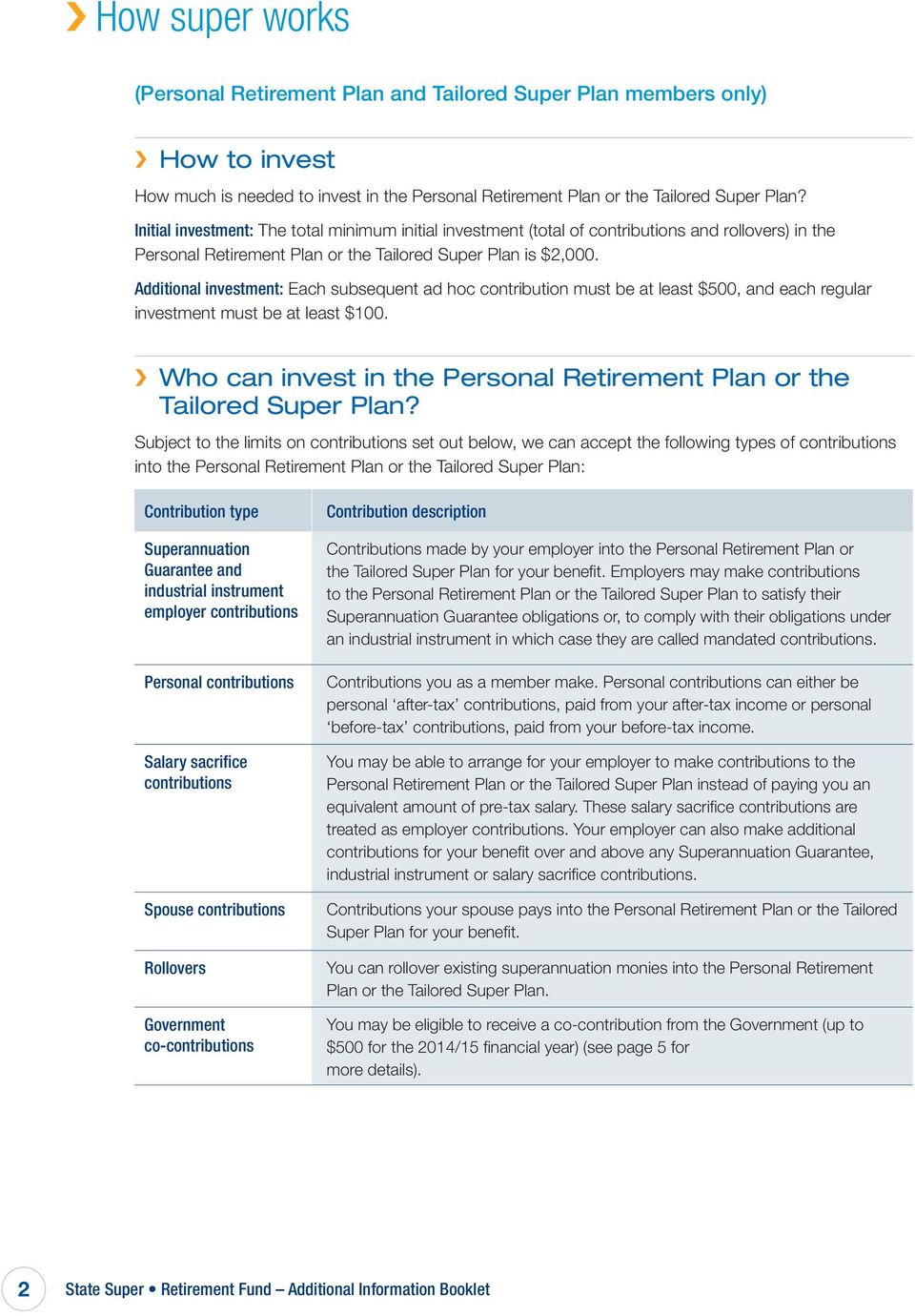
5 How super works Limits on contributions The following table summarises the rules in relation to contributions: Contribution Rules Superannuation Guarantee and industrial instrument employer contributions Personal contributions, salary sacrifice contributions and additional employer contributions Spouse Contributions Under 65 Yes 1 Yes 1 Yes 1 At least 65, and under 70 Yes 1 Yes, provided you satisfy the annual work test 1,2 At least 70 and under 75 Yes 1 Yes, provided you satisfy the annual work test 1,2,3 Yes, provided you satisfy the annual work test 1,2 No 75 and over Yes 1 No 3 No 1 Subject to the limits outlined in Capping of contributions below. 2 The annual work test requires you to have been gainfully employed for at least 40 hours in a period of not more than 30 consecutive days in the financial year. 3 Contributions may be made up to 28 days after the end of the month in which you turn age 75. You must also have satisfied the annual work test. There is no age restriction on rollovers. Importantly, we will not accept any contributions made by you or for your benefit unless you have provided your Tax File Number to us. Any amount received in these circumstances will be invested in a non-interest bearing trust account and, if you do not provide your TFN, returned to you within 30 days. Capping of contributions The Government limits the amount of contributions that can be made to your superannuation, which receive favourable tax treatment. These limits are called contribution caps. There are two contribution caps: a concessional contribution cap a non-concessional contribution cap Additional tax may be payable if you exceed the caps. Please refer to How is super taxed? on page 23 for further details about the additional tax that may apply. Visit our website or call for further information 3
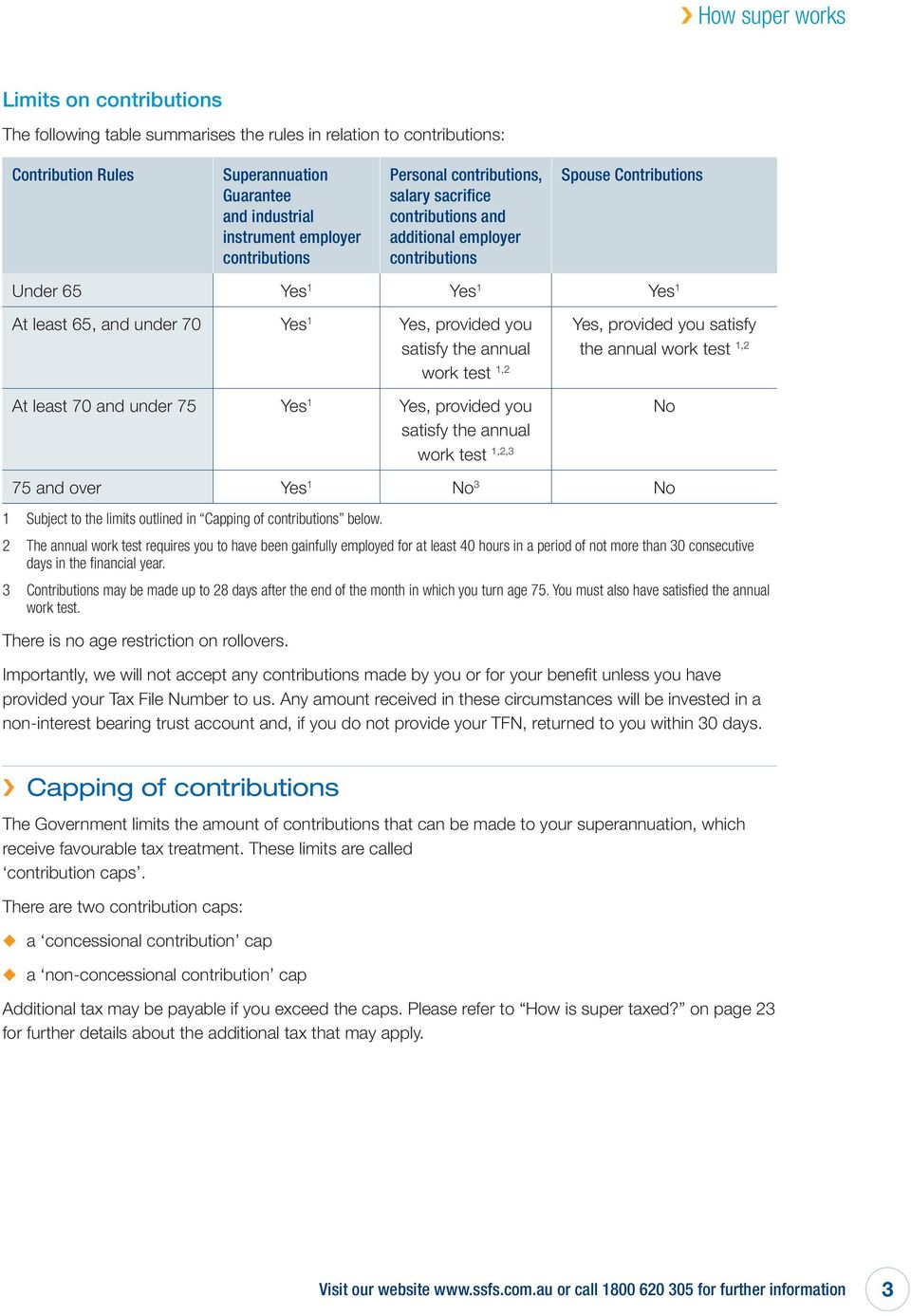
6 How super works The concessional contribution cap Concessional contributions are generally contributions for which a tax deduction is claimed and include employer contributions, salary sacrifice contributions and personal contributions you claimed as a tax deduction. In the 2014/15 financial year, the general concessional contribution cap is $30,000. To assist people who are close to retirement, the government has introduced a flat age based higher concessional contribution cap. The caps will apply as summarised in the table below. Age Concessional contribution cap Less than 50 $30,000 (indexed 1 ) 50 and over $35,000 (not indexed) 1 Indexed annually in line with Average Weekly Ordinary Time Earnings (AWOTE), in increments of $5,000. Concessional contributions in excess of the applicable concessional contributions cap are called excess concessional contributions. You may elect to have up to 85% of your excess concessional contributions for the financial year released from your superannuation account. Where you elect to leave the excess concessional contributions in super, the excess amounts will count towards the non-concessional contributions cap. The non-concessional contribution cap Non-concessional contributions are generally after-tax contributions, including personal after-tax contributions, spouse contributions and excess concessional contributions which have not been released (e.g. returned to you). Your non-concessional contributions are reduced by 100/85 of the amount of any excess concessional contributions released from superannuation. If you are under age 65 in the relevant financial year, you can bring forward up to 2 years worth of nonconcessional contributions without exceeding the cap. However, you will not be able to make any further non-concessional contributions for the next 2 financial years. For example, an investor could contribute $540,000 in the 2014/15 financial year as a single lump sum, using up any allowable cap for that year and the following 2 financial years, without incurring additional tax. The bring forward is automatically triggered as soon as non-concessional contributions exceed the non-concessional contributions cap for that year. The current non-concessional contributions caps, applicable for the 2014/15 financial year, are summarised in the table below. Under age 65 Age 65 and over $180,000 1 per annum, or $540,000 over a three-year period $180,000 1 per annum 1 The non-concessional contributions cap is equal to six times the general concessional contributions cap (i.e. $180,000 in the 2014/15 financial year). Amounts from the disposal of certain small business assets paid as after-tax contributions are excluded from the non-concessional contributions cap up to a lifetime limit, called the CGT Cap. The CGT Cap is indexed and is $1,355,000 for the 2014/15 financial year. Please see your financial planner for further details on the CGT Cap. 4 State Super Retirement Fund Additional Information Booklet
7 How super works Note: The Government has announced changes to the treatment of excess nonconcessional contributions to allow individuals to withdraw excess contributions and associated earnings. However, these changes have not yet been made law. Please visit treasury.gov.au for further information. Government Co-Contribution Scheme The Government has a Superannuation Co-Contribution Scheme, which involves the Government paying a superannuation co-contribution to an eligible investor s account where the investor makes personal after-tax contributions. To be eligible for a co-contribution, you need to: be under age 71 at the end of the income year in which your after-tax contribution was made; have total income (gross assessable income plus reportable fringe benefits plus reportable employer superannuation contributions less allowable business deductions) below the relevant threshold - ($49,488 for the 2014/15 financial year); earn at least 10% of your total income from carrying on a business, employment-related activities or a combination of both (for the purposes of this test, business deductions are not taken into account in the total income amounts); have lodged your income tax return with the Australian Taxation Office for the financial year; not have been a temporary resident at any time during the financial year (unless you are a New Zealand citizen or the holder of a prescribed visa). If you earn more than $34,488 for the 2014/15 financial year (indexed annually), the maximum co-contribution of $500 is scaled back at the rate of cents in the dollar. To find out more about the Superannuation Co-contribution Scheme, ask your financial planner or go to Please note: The co-contribution does not count towards the non-concessional contributions cap. Government Low Income Superannuation Contribution The Government will make a contribution of up to $500 in a financial year in respect of a member where: the member s adjusted taxable income for the financial year does not exceed $37,000; a concessional contribution in respect of the member was made in the financial year; the member earns at least 10% of the member s total income (gross assessable income plus reportable fringe benefits plus reportable employer superannuation contribution) from carrying on a business, employment-related activities or a combination of both, in the financial year; the member is not a temporary resident at any time in the financial year (unless the member is a New Zealand citizen or the holder of a prescribed visa); Visit our website or call for further information 5
8 How super works The amount of the Government low income superannuation contribution that will be made in respect of an eligible member in a financial year is determined as the lesser of: (a) 15% of the total concessional contributions made in respect of the member in the financial year; and (b) $500. However, if the member is eligible for a Government low income super contribution that is less than $10 for the financial year, the Government low income super contribution for that member will be rounded up to $10 for that financial year. Note: The Government has passed legislation to repeal the Government low income super contribution scheme from 1 July Payments without an investment instruction Should we receive a Superannuation Guarantee payment/mandated contribution, a Government cocontribution or a Government low income super contribution into the Personal Retirement Plan or the Tailored Super Plan, and we have received no specific instructions from you we will invest the amount in accordance with your existing Fund allocation at the time of receipt of the payment. Please note: The Superannuation Guarantee payment/mandated contribution will count towards the concessional contributions cap. How do you invest in the Personal Retirement Plan or the Tailored Super Plan? Your initial investment in the Personal Retirement Plan or the Tailored Super Plan can consist of a rollover from another superannuation product and/or a contribution. You can then make ad hoc and/or regular superannuation contributions to, or rollovers into, the Personal Retirement Plan or the Tailored Super Plan. Superannuation contributions may be made by you, or made on your behalf by others such as your spouse or your employer. Any contributions to the Personal Retirement Plan or the Tailored Super Plan from your employer must be made under an arrangement between you and your employer. Initial investments (contributions and rollovers) To make an initial investment to the Personal Retirement Plan or the Tailored Super Plan, complete the Personal Retirement Plan or the Tailored Super Plan application form and forward it to us and: t o the extent your initial investment consists of personal or spouse contributions, forward to us a cheque from you or your spouse for the amount of the contribution; to the extent your initial investment consists of an employer contribution, direct your employer to send the payment for the amount of the contribution to us; to the extent your initial investment consists of a rollover from another superannuation product, notify your current superannuation fund by completing a Request to Transfer form (available from ssfs.com. au or any of our offices) and sending it to them. Alternatively, you can send your transfer authority to us, and we will initiate the rollover from your current fund on your behalf. Your current fund will send the details of your rollover and your superannuation benefits directly to us to invest; or 6 to the extent that you are transferring from another SSFS product you must complete section 7 of the Personal Retirement Plan or the Tailored Super Plan application form. State Super Retirement Fund Additional Information Booklet

9 How super works If your application form does not specify the Fund(s) for investment, we will contact you to obtain your investment allocation. If we are unable to contact you we may not be able to accept your application. Please note that the trustee is not bound to accept any application for the Personal Retirement Plan or the Tailored Super Plan and may refuse an application without giving any reason. additional investments (ad hoc contributions and rollovers) After becoming a member of the Personal Retirement Plan or the Tailored Super Plan, additional ad hoc contributions and rollovers can be made at any time either by cheque or money order or using BPAY. When sending a cheque or money order the following information must be provided: your personal details; the amount of your contribution/ rollover; if the investment is in the form of a contribution, what type of contribution it is; the Fund allocation; and any necessary rollover forms as outlined above. Registered to BPAY Pty Ltd. ABN Please forward to Attention: Registry Services, State Super Financial Services Australia Limited, (see address inside the back cover). BPAY payments can be made via your bank or financial institution. Details of Biller Code(s), together with your Customer Reference Number(s) can be located on SSFS client website (ssfs.com.au) or by contacting your local regional office. If you wish to change the Fund allocation for future/additional contributions, you will need to complete a Request to Change Fund Allocation Future Contributions/Investments form (available from ssfs.com. au or any of our offices). If you do not specify the Fund(s) for investment we will invest the additional investment in accordance with your existing Fund allocation (other than the Fixed Term Fund) at the time of receipt of the additional investment. You will then be issued a transaction confirmation and may then be able to switch the investment into one or more other Funds at any time (see page 13 for more information on switching). additional investments (regular Contributions plan) You can arrange for regular contributions to be paid into the Personal Retirement Plan or the Tailored Super Plan. This facility involves: SSFS making automatic deductions from a bank, credit union or building society account on the 16th day of each month. If this is not a business day, the amount will be deducted on the first business day thereafter; or a cheque being sent on a regular basis to Attention: Registry Services, State Super Financial Services Australia Limited (see address inside the back cover). Please note: You should check whether your financial institution will charge you a fee for each withdrawal from your account before arranging for regular contributions to be deducted. Should you wish to take advantage of the regular contributions facility, complete the Personal Retirement Plan application form and the regular contributions application form and send both forms to us. Visit our website or call for further information 7
10 How super works If your application for the regular contributions facility does not specify the Fund(s) for investment, unless you tell us otherwise, each contribution received by us through the regular contributions facility will be invested in accordance with your existing Fund allocation (other than the Fixed Term Fund) at the time of receipt of the contribution. You may be able to switch the investment into one or more other Funds at any time (see page 13 for more information on switching). Note: The regular contributions facility is not available in respect of investments in the Fixed Term Fund. Contribution splitting arrangements The splitting of contributions with your spouse may be permitted in certain circumstances. The main benefits of contribution splitting are that you can take advantage of 2 concessional contributions caps and it facilitates income splitting between partners for lower overall tax. We recommend you seek financial advice before making a decision to split your contributions. You may be able to split with your spouse any concessional contributions that are made to your account in the Personal Retirement Plan. The maximum amount that can be split is the lesser of: 85% of concessional contributions received for a financial year; and the concessional contributions cap for the financial year. For example, if you are over age 50 and under age 60 and you made concessional contributions of $35,000 in the 2014/15 financial year the maximum you can split is $29,750, which is the lesser of 85% of your concessional contributions (being $29,750) and the concessional contributions cap for that financial year (being $35,000). Any contributions that are split will form part of the taxable component of your spouse s account balance. Your spouse receiving the split contribution must either. be under preservation age (see the section called What is your preservation age? ); or have reached their preservation age, be under 65 years and must not have permanently retired. Contributions can generally be split after the conclusion of the financial year in which they are made or in the financial year in which they are made where the member s entire benefit is to be transferred. For example, contributions made from 1 July 2014 to 30 June 2015 can be split from 1 July 2015 to 30 June However, if you transferred your entire benefit to another fund before 30 June 2015, you could split your contributions for that financial year before transferring the benefit. For further information please contact your financial planner. 8 State Super Retirement Fund Additional Information Booklet
11 How super in retirement works (allocated pension Fund and Flexible Income plan members only) How much is needed to invest in the Allocated Pension Fund or the Flexible Income Plan? The minimum initial investment in an Allocated Pension or the Flexible Income Plan (including a Pre- Retirement Allocated Pension or Pre-Retirement Flexible Income Plan) is $20,000. Who can invest in the Allocated Pension Fund or the Flexible Income Plan? The Allocated Pension Fund and the Flexible Income Plan are each designed for retirees, semi-retired people or those about to retire, who are looking to: rollover their superannuation monies into a superannuation fund; defer tax on cashing in their superannuation monies and take advantage of the superannuation pension tax concessions; or receive a regular income stream from their superannuation monies. Both the Allocated Pension Fund and Flexible Income Plan only accept in respect of an ordinary Allocated Pension or ordinary Flexible Income Plan respectively, rollover from other superannuation products (including the State Super Personal Retirement Plan and the State Super Tailored Super Plan) that consist solely of unrestricted non-preserved amounts (see page 13 for further information on preservation amounts). If you are over your preservation age (see page 11) you can start a Pre-Retirement Allocated Pension or a Pre-Retirement Flexible Income Plan with any combination of unrestricted non-preserved amounts and/or restricted non-preserved amounts and/or preserved amounts. If you have a Pre-Retirement Allocated Pension or a Pre-Retirement Flexible Income Plan, then once you reach age 65, or otherwise satisfy a condition of release prescribed by superannuation law (refer to page 14), your Pre-Retirement Allocated Pension becomes an ordinary Allocated Pension or your Pre- Retirement Flexible Income Plan becomes an ordinary Flexible Income Plan, as applicable. This means, for example, that if you do not commute your pension at that time, you will continue to receive a pension from the State Super Allocated Pension Fund or Flexible Income Plan subject to the same minimum payment limits, but without any maximum payment limits and commutations are allowed. How do you invest in the Allocated Pension Fund or the Flexible Income Plan? Initial investment All you need to do to invest in the Allocated Pension Fund or the Flexible Income Plan is: complete the Allocated Pension Fund or Flexible Income Plan application form and send to Attention: Registry Services, State Super Financial Services Australia Limited (see address inside the back cover); Visit our website or call for further information 9

12 How super in retirement works complete a tax file number declaration form (if you are under age 60) and also send it to us; and if relevant: notify your current superannuation fund by completing a transfer authority form (available from ssfs.com.au or any of our offices) and sending it to them. Alternatively, you can send your transfer authority to us, and we will initiate the rollover from your current fund on your behalf your current fund will send the details of your rollover and your superannuation monies directly to us. To the extent that you are transferring from the State Super Personal Retirement Plan or Tailored Super Plan you must complete section 8 of the Allocated Pension Fund or Tailored Super Plan application form. If your application does not specify the Fund(s) for investment, we will contact you to obtain your investment allocation. If we are unable to contact you we may not be able to accept your application. The trustee is not bound to accept any application for the Allocated Pension Fund or the Flexible Income Plan and may refuse an application without giving any reason. additional investments You cannot make any additional contributions or rollovers to any Allocated Pension or Flexible Income Plan once the pension has commenced. Pension payments What pension payments will you receive? You can choose whether to receive pension payments monthly, quarterly, half yearly or annually. In order to make a pension payment, the trustee will redeem sufficient units and/or close sufficient Fixed Fund investments from your account balance to satisfy the amount of the payment. For default order of withdrawal for pension payments please see page 16. Order of withdrawal pre-retirement allocated pensions/pre-retirement Flexible Income plans Superannuation law requires that pension payments in respect of Pre-Retirement Allocated Pensions or Pre-Retirement Flexible Income Plans are paid in the following order: Firstly, from any unrestricted non-preserved amount; Secondly, from any restricted non-preserved amount; and Thirdly, from any preserved amount. 10 State Super Retirement Fund Additional Information Booklet

13 How super in retirement works amount of the pension payments You can choose the amount of your pension payments. Please note, however, the total annual amount you choose to be paid from an Allocated Pension (including a Pre-Retirement Allocated Pension) or from a Flexible Income Plan (including a Pre-Retirement Flexible Income Plan) must be at least equal to the legislated minimum annual payment amount for that year, which is a percentage of your account balance (calculated, in the first financial year, at the start of your pension and, in subsequent financial years, at the start of each financial year i.e. 1 July), in accordance with the following table: Age Minimum Percentage of your Account Balance (%) 2014/15 financial year Under or more 14 There is no maximum limit on the amount of pension payments you can receive from an ordinary Allocated Pension or Flexible Income Plan in a year. However, the total annual amount you choose to be paid for a Pre-Retirement Allocated Pension or Pre-Retirement Flexible Income Plan must be no greater than the legislated maximum payment amount for that year, which is 10% of your account balance (calculated, in the first financial year, at the start of your pension and, in subsequent financial years, at the start of each financial year i.e. 1 July). When deciding the amount of pension payments you wish to receive in a financial year, please bear in mind that payments can only be made while there is money in your pension account. When a pension commences on a day other than 1 July, the minimum payment limits in the first year are applied proportionately to the number of days remaining in the financial year that include and follow the commencement date. However, the maximum payment limit for a Pre-Retirement Allocated Pension and for a Pre-Retirement Flexible Income Plan remains equal to 10% of the account balance at the time the pension commenced. The maximum payment limit ceases to apply from the time you satisfy a condition of release (see page 16). This means that, after satisfying a condition of release, you could make a lump sum withdrawal up to the amount of your account balance. The minimum and maximum pension amounts are calculated on your initial account balance, and then re-calculated as at 1 July every year thereafter based on: Visit our website or call for further information 11
14 How super in retirement works your age; and your account balance in the Allocated Pension/Flexible Income Plan or Pre-Retirement Allocated Pension/Pre-Retirement Flexible Income Plan, as applicable as at the date of each calculation. Your account balance will vary depending on factors such as: the amount of pension payments paid to you during the year; the net earnings of the Fund(s) in which you are invested; and any lump sum withdrawals made by you. Generally speaking, you must receive at least one pension payment every financial year. However, if the pension commences on or after 1 June in any financial year, no payment is required to be made for that financial year, although a payment may be made by 30 June of that year. If your minimum pension amount for a financial year has not been reached by the date of the last payment due to be made to you in the financial year, an additional payment will be made to ensure the minimum amount is paid. We will take into account pension payments and any lump sum withdrawals (including lump sum withdrawals under a payment split, but not any amounts rolled over to another superannuation arrangement) in a year when determining whether the minimum amount has been paid from your pension in that year. For Pre-Retirement Allocated Pensions and Pre-Retirement Flexible Income Plans, any lump sum withdrawals are not taken into account when determining whether the maximum amount has been paid from your pension in that year. If the maximum pension amount for your Pre-Retirement Allocated Pension or Pre-Retirement Flexible Income Plan is reached during the financial year, the relevant payment that would result in your exceeding the maximum will be reduced to ensure the maximum amount is not exceeded. No further pension payments can be made to you for that financial year. By way of example, consider the situation if you had an Allocated Pension or Flexible Income Plan which you started on 1 July 2014 with a purchase price of $150,000, and you were aged 65. In the first year the minimum payment amount is $7,500. The maximum payment would be the amount of your account balance. The amount of the payment will be tax free as you are over age 60. Note: The example above is illustrative only and is based on the factors stated. It should not be taken to provide an estimate of the minimum amount you must be paid in respect of your Allocated Pension or Flexible Income Plan. 12 State Super Retirement Fund Additional Information Booklet

15 How to switch and withdraw How are pension payments made? Pension payments are paid directly to the bank, credit union or building society account you have nominated by the 20th day of the relevant month. You must be at least one of the parties to the account nominated. Pension payments are not made by cheque. If you elected to receive your pension on a quarterly, half yearly or annual basis, your payments will be made in the following months: March, June, September and December for quarterly payments; June and December for half yearly payments; and June for annual payments. Switching A switch is the process of redeeming an interest in a Fund and using the redemption proceeds to purchase interests in another Fund(s). You can switch a minimum of $5,000 ($10,000 for the Fixed Term Fund or Fixed Payment Fund) in the Allocated Pension Fund or Flexible Income Plan; or $500 ($10,000 for the Fixed Term Fund) in the Personal Retirement Plan or the Tailored Super Plan, from one Fund to one or more of the Funds. You can arrange a switch by completing the relevant switch notification form available from any of our offices or by providing the necessary details in writing to us. There is no restriction on the number of times you may switch part or all of your investment. It is recommended that you consult with your financial planner before switching so as to understand the consequences of switching. There are special rules and procedures for switching into or from a Fixed Fund. Please refer to the Investment Booklet Fixed Fund for further information. When can you withdraw your benefits? When you make a withdrawal, the trustee will redeem sufficient units and/or close sufficient Fixed Fund investments from your account balance to satisfy the amount of the withdrawal request, as well as any tax payable on the withdrawal, subject to the rules below. Superannuation benefits are divided into three components, with different restrictions on when you can get access to each component: unrestricted non-preserved you can access this amount at any time; restricted non-preserved generally you can access this amount when you stop working for the employer who has contributed to your account; and preserved you can access this amount when you satisfy a condition of release (see page 16). All superannuation contributions and investment earnings since 1 July 1999 are preserved. Any non-preserved amounts you have accumulated before this date remain as non-preserved. There are special rules and procedures for withdrawing a Fixed Fund investment before maturity. Please refer to the Investment Booklet Fixed Fund for further information. Visit our website or call for further information 13
16 How to switch and withdraw (personal retirement plan and tailored Super plan members only) You may withdraw a minimum of $500 (or the total of your account balance, if it is less than $500) from the Personal Retirement Plan or the Tailored Super Plan by completing a redemption notification form available from any of our offices. However, superannuation law divides your account balance into different preservation components and has rules as to when a trustee can pay each component in cash. Your ability to withdraw from the Personal Retirement Plan or the Tailored Super Plan may be limited by the superannuation law. In any event you can make a withdrawal from the Personal Retirement Plan or the Tailored Super Plan: if you satisfy a condition of release (see section on What are the conditions of release? on page 16); or to effect a payment split under family law; or to pay an excess contributions tax liability; or to pay a superannuation surcharge liability (where liabilities arose prior to 1 July 2005); or at any time by transferring your benefit to another complying superannuation fund or to a retirement savings account; or in certain circumstances by transferring your benefit to the Allocated Pension and Term Allocated Pension Division or the Flexible Income Division of the State Super Retirement Fund. (The Allocated Pension Fund and Flexible Income Plan are products issued by SSFS, as trustee of the Retirement Fund. The relevant Product Disclosure Statement, the relevant Fee Booklet, the Investment Booklet Fixed Fund and the Retirement Fund Investment Booklet can be obtained by contacting us. You should consider these documents before making a decision to acquire or continue to hold the product.) The trustee will redeem sufficient units from your account balance to satisfy the amount of the withdrawal request. Where applicable, an amount will be deducted from any withdrawal to meet tax and superannuation surcharge requirements. (allocated pension Fund and Flexible Income plan members only) You can withdraw as a lump sum, amounts of $5,000 or more (or the total of your account balance, if it is less than $5,000) from the unrestricted non-preserved amount of your ordinary Allocated Pension, Flexible Income Plan, Pre-Retirement Allocated Pension or Pre-Retirement Flexible Income Plan at any time by completing a redemption notification form available from any of our offices. Preserved amounts and/or restricted non-preserved amounts can generally only be withdrawn from your Pre-Retirement Allocated Pension or Pre-Retirement Flexible Income Plan as a lump sum: when you have satisfied a condition of release (see section on What are the conditions of release? on page 16); to effect a payment split under family law; to pay a superannuation surcharge liability (where liabilities arise prior to 1 July 2005); or to pay an excess contributions tax liability. 14 State Super Retirement Fund Additional Information Booklet
17 How to switch and withdraw How much will I receive when I withdraw my benefit? The amount you receive as a benefit when you withdraw a lump sum from the Personal Retirement Plan, Tailored Super Plan, Allocated Pension Fund or Flexible Income Plan is dependent upon such factors as the amount of: contributions net of tax; your initial investment in the Allocated Pension Fund, Flexible Income Plan, Personal Retirement Plan or Tailored Super Plan; tax payable in relation to the lump sum withdrawal; investment earnings or losses (net of any applicable tax); fees and costs (net of any applicable tax), together with your age. A superannuation lump sum is made up of only two components, a tax-free component and a taxable component (which may be comprised of taxed and/or untaxed elements). By way of example for the Personal Retirement Plan or Tailored Super Plan, if in 2014/2015: your account balance was $250,000; the account comprised $200,000 of taxable component (all of which is taxed element) and $50,000 tax-free component; you are permanently retired and aged 58 (assuming your preservation age is 55); no other superannuation lump sums have been paid to you since reaching preservation age; and you withdrew a single lump sum of $240,000; you would be entitled to: amount of benefit $240,000 Less: tax on exit (see note) ($1,190) Net benefit paid to bank $238,810 Note: The amount of the tax-free component in the withdrawal is 20% of the total withdrawal i.e. $48,000. This tax-free percentage of 20% is calculated as $50,000 (the amount of the tax-free component in the account) divided by $250,000 (the total account balance). The remaining portion of $192,000 is the taxable component (all of which is taxed element). The excess $7,000 of taxable component withdrawn over the $185,000 low rate cap is taxed at 15% plus Medicare Levy, i.e. $1,190. No tax is payable on amounts under the low rate cap. Please note: Any amounts withdrawn after reaching age 60 would be completely tax-free. The low rate cap in the example is for the 2014/15 financial year. This example is for illustrative purposes only and is based on the factors stated. It is not intended to be indicative of the superannuation benefit you are entitled to or the actual tax that will be payable on your withdrawal. By way of example for the Flexible Income Plan or the Allocated Pension Fund, if: your account balance was $250,000; the tax free component of your account was 20%; you are permanently retired and aged 58 (assuming your preservation age is 55); and no other superannuation benefits or employment termination payments have been paid to you previously, you would be entitled to: Visit our website or call for further information 15
18 How to switch and withdraw Amount of benefit $250,000 Less: Tax on exit (see note) ($2,550) Net benefit paid in cash $247,450 Note: the amount of the tax-free component in the withdrawal is 20% of the full withdrawal amount. Therefore, 80% of $250,000, i.e. $200,000 is the taxable component (all of which is taxed element). $15,000 of the taxable component (the excess amount withdrawn over the low rate cap, which is $185,000 in 2014/15 financial year, indexed annually by AWOTE and reduced by any amount previously applied to the low rate threshold) is taxed at 15% plus Medicare Levy. i.e. $2,550. No tax is payable on amounts under the low rate cap. Any amounts withdrawn on or after reaching age 60 would be completely tax-free. Please note: the example above is illustrative only and is based on the factors stated. It should not be taken to contain or provide an estimate of any withdrawal benefits you will receive from the Allocated Pension Fund or Flexible Income Plan or the actual tax payable on your withdrawal. Defaults on withdrawals and for pension payments If you fail to provide us with details of the Fund(s) from which you wish your units and/or Fixed Fund investments to be redeemed, or your instruction cannot be followed, we will deem that you have requested us to redeem sufficient units and/or close sufficient Fixed Fund investments to satisfy your withdrawal request (including pension payments) in the following order: 1. from the Cash Fund (until all funds are exhausted); 2. from the Fixed Interest Fund (until all funds are exhausted); 3. from the Capital Stable Fund (until all funds are exhausted); 4. from the Moderate Fund (until all funds are exhausted); 5. from the Balanced Fund (until all funds are exhausted); 6. from the Growth Fund (until all funds are exhausted); 7. from the Growth Plus* Fund (until all funds are exhausted); 8. from the Australian Equities Fund (until all funds are exhausted); 9. from the International Equities Fund (until all funds are exhausted) ; 10. and finally from the Fixed Term Fund or Fixed Payment Fund**. * The Growth Plus Fund is only available in the Personal Retirement Plan and the Allocated Pension Fund. ** The Fixed Payment Fund is only available in the Flexible Income Plan and Allocated Pension Fund. Redemptions for ATO release authorities are pro-rated. If a Fixed Fund is closed before maturity, an early closure cost may be payable. Please refer to the relevant Fee Booklet for further information. 16 State Super Retirement Fund Additional Information Booklet
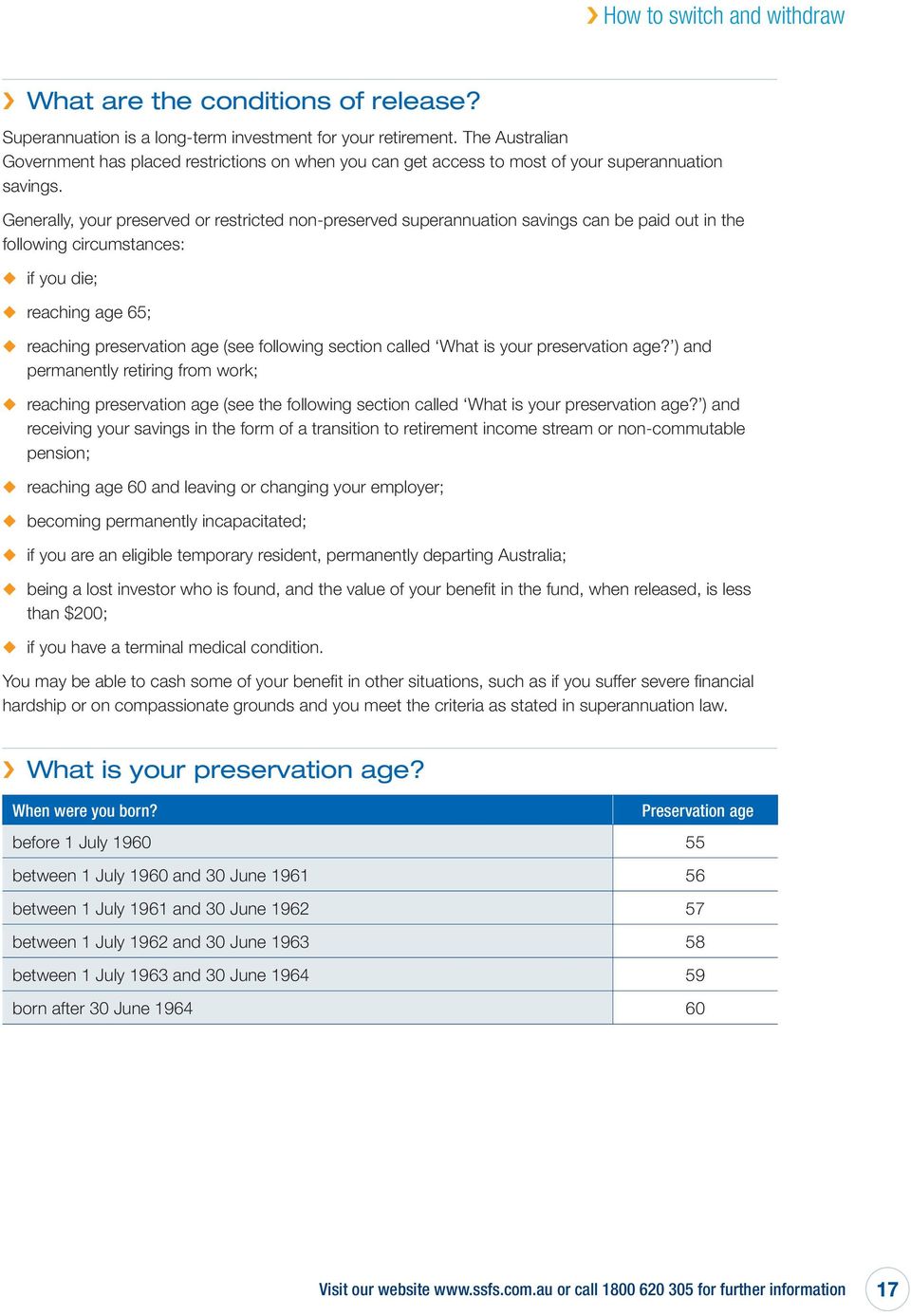
19 How to switch and withdraw What are the conditions of release? Superannuation is a long-term investment for your retirement. The Australian Government has placed restrictions on when you can get access to most of your superannuation savings. Generally, your preserved or restricted non-preserved superannuation savings can be paid out in the following circumstances: if you die; reaching age 65; reaching preservation age (see following section called What is your preservation age? ) and permanently retiring from work; reaching preservation age (see the following section called What is your preservation age? ) and receiving your savings in the form of a transition to retirement income stream or non-commutable pension; reaching age 60 and leaving or changing your employer; becoming permanently incapacitated; if you are an eligible temporary resident, permanently departing Australia; being a lost investor who is found, and the value of your benefit in the fund, when released, is less than $200; if you have a terminal medical condition. You may be able to cash some of your benefit in other situations, such as if you suffer severe financial hardship or on compassionate grounds and you meet the criteria as stated in superannuation law. What is your preservation age? When were you born? Preservation age before 1 July between 1 July 1960 and 30 June between 1 July 1961 and 30 June between 1 July 1962 and 30 June between 1 July 1963 and 30 June born after 30 June Visit our website or call for further information 17
20 How to switch and withdraw Trans-Tasman portability Individuals may transfer retirement savings between Australia and New Zealand after their permanent migration from one country to the other. The transfer of retirement savings is voluntary for members. You may only transfer your superannuation balance in the Personal Retirement Plan or the Tailored Super Plan to a New Zealand KiwiSaver scheme. Once the superannuation monies are in a KiwiSaver scheme, there are restrictions on when these funds can be accessed, such as: it cannot be used to purchase your first home; it cannot be moved to a third country; it can be accessed when the member reaches 60 years of age and satisfies the Australian definition of retirement at that age. We recommend you consult your financial planner before transferring all or part of your retirement savings in the Personal Retirement Plan or the Tailored Super Plan to a KiwiSaver scheme as there may be currency risks and tax consequences. At this time, the Personal Retirement Plan and the Tailored Super Plan does not accept transfers from KiwiSaver schemes. rules for temporary residents Must transfer superannuation to Australian Taxation Office (ATO): If you are a temporary resident (excluding certain visa holders, and New Zealand nationals), we are required by law to transfer your super to the ATO if you leave Australia, your visa has expired or been cancelled, and you don t claim your superannuation benefit within six months after your leave. However, you can apply to the ATO to claim your super. If your super is transferred to the ATO, the trustee will rely on ASIC relief and you will not receive an exit statement nor be notified with respect to such transfer. Withholding rates: The withholding tax rates that apply to departing Australia superannuation payments are: a. 0% for the tax-free component; b. 38% for a taxed element of a taxable component; and c. 47% for an untaxed element of a taxable component. 18 State Super Retirement Fund Additional Information Booklet
21 How to switch and withdraw Restrictions on conditions of release: preserved or restricted non-preserved superannuation savings of a temporary resident can only be paid out in limited circumstances, including: a. death; b. becoming permanently or temporarily incapacitated; c. having a terminal medical condition; d. upon request after permanently departing Australia and cessation of the temporary visa; e. if you have a valid release authority to pay additional tax on excess concessional contributions and excess non-concessional contributions (see page 16). Transfers (partial or full) to another superannuation product You also have the right to transfer your existing account balance (partial or full) to another superannuation product at any time. This is known as portability. Under the Stronger Super Data and Payment Standards, we must generally transfer your benefits within 30 days of receiving a fully completed transfer request from you. If you have a Fixed Fund investment we may not be able to transfer your entire benefits within 30 days. If this is the case we will transfer your investments in unitised Funds (if any) within 30 days and your investments in the non-unitised Funds within 45 days. Please refer to the Investment Booklet - Fixed Fund for further information. things to consider when transferring superannuation You should consider all relevant information before deciding whether to transfer your superannuation. Some of the points to consider are: Fees your FROM fund may charge you exit or withdrawal fees for transferring superannuation, which could significantly reduce your final benefit; Insurance benefits your FROM fund may insure you against death, illness or accident which leaves you unable to return to work. If you choose to leave your FROM fund for the Retirement Fund, you may lose any insurance entitlements you have as we do not offer insurance. Visit our website or call for further information 19
22 Special Investment Facility progressive Investment Facility You may benefit from regularly investing a specified amount into one or more Funds over time, as this may reduce the risk linked to attempting to time the market with a lump sum investment. This is often called dollar cost averaging. By doing so, more units may be purchased when prices are low and fewer units purchased when prices are high. The aim is to lower the total average cost per units of your investment, giving you a lower overall cost for the units purchased over time The Progressive Investment Facility enables you to access the benefits of dollar cost averaging. This Facility enables you to switch fixed amounts on a regular basis (monthly or quarterly) into nominated Fund(s), other than the Fixed Term Fund or the Fixed Payment Fund, from amounts held in your Cash Fund. This Facility involves us making automatic switches on: if you have selected a monthly facility, the 25th day of each month; and if you have selected quarterly facility, the 25th day of March, June, September and December. If this is not a business day, the switch will occur on the first business day thereafter. The minimum amount that can be switched under the Progressive Investment Facility is $2,000 per switch. In the instance where there are insufficient funds to perform a switch out we will only switch out the remaining balance of the Cash Fund. Should you wish to take advantage of the Progressive Investment Facility, complete the Progressive Investment Facility application form available from any of our offices. The Progressive Investment Facility application form must be received in our office by the 20th day of the relevant month to take effect from the 25th day of that month. 20 State Super Retirement Fund Additional Information Booklet
23 Transaction processing Unitised funds This section applies to the unitised Funds only. For details of transaction processing for the non-unitised Funds please refer to the Investment Booklet Fixed Fund. unit prices and valuations Your investment in each Fund is represented by units in that unitised Fund. Unit prices are based on the net value of the assets (assets minus liabilities) of the relevant unitised Fund(s). Any rise or fall in the value of a unitised Fund s investments is reflected in a corresponding rise or fall in the unit price. Each unitised Fund is required to be valued at least weekly, however we currently value each unitised Fund as at the close of each business day. We may change this practice without notice. The unit price based on that calculation is the applicable unit price for that day. Income earned on each unitised Fund s investments accumulates within the Fund and is reflected in the unit price. No distribution of investment income is made directly to investors. The assets referable to the unitised Funds are valued at market prices. Assets may rise or fall in value. In valuing assets, allowances by way of estimates are made for: provisions for tax on investment income realised and unrealised capital gains (including the effect of imputation credits and deferred tax on unrealised gains); any management fees; and any investment-related charges. Currently, the issue price of a unit is the same as the redemption price of a unit. This is because we do not currently apply a buy/sell spread to the unit prices for the Retirement Fund. A buy/sell spread is effectively a fee that seeks to cover the costs incurred when buying and selling assets as a result of investments in or switches or withdrawals from a Fund. The trustee may choose to apply a buy/sell spread in the future. As the trustee does not apply a buy/sell spread, investors do not incur transaction costs when making investments in a unitised Fund or switches or withdrawals from a unitised Fund. Transaction costs are taken into account at the time the assets of a unitised Fund are valued and are reflected in unit prices. Should we propose to change this in the future we will provide you with at least 30 days notice. For your convenience, the latest available unit price information is available 24 hours a day on our website at ssfs.com.au. We may exercise certain discretions that could affect unit prices on investment, switching or withdrawal in each of the Fixed Interest, Capital Stable, Moderate, Balanced, Growth, Growth Plus, Australian Equities and International Equities Funds. The types of discretions that we may exercise, in what circumstances, our policies on how we exercise the discretions and the reasons why we consider our policies are reasonable, are set out in our Unit Pricing Discretions Policy. If we exercise discretion in a way that departs from the policies set out in our Unit Pricing Discretions Policy, we are required to keep a record of this in a Register of Exceptions. You can obtain a copy of our Unit Pricing Discretions Policy or Register of Exceptions, or both, free of charge, by calling any of our Regional Offices (see the Directory on the inside back cover). Visit our website or call for further information 21
24 Transaction processing Unitised funds We may suspend or delay unit pricing where: a significant event or incident occurs that has the potential to affect the investment markets; or an event occurs that has the potential to affect unit prices (such as an external investment manager being unable to provide current unit prices). processing of investment, withdrawal and switch transactions from the unitised Funds We generally process investment applications, withdrawal and switch requests involving unitised Funds each business day. If your investment application or your withdrawal or your switch request involving unitised Funds is received before 3.00pm Sydney time on any business day, it will be processed using the unit price applicable for that day. This price is not known until Business Day 2. It is important to consider this when making your transaction request. If we receive your investment application or your withdrawal or your switch request involving unitised Funds after 3.00pm Sydney time on a business day, or on a non-business day, we treat it as having been received before 3.00pm Sydney time on the next occurring business day and it will be processed using the unit price applicable for that next occurring business day. Please note: If you ask for a unit price or investment valuation we can only provide a historical unit price or investment valuation. You should allow at least two business days after the processing of your withdrawal from a unitised Fund for the funds to be credited to your bank, credit union or building society account. There may be situations where we delay or suspend the processing of investment application, withdrawal or switch transactions involving a unitised Fund. This could occur, for example, because of the closure, termination or suspension of an external fund by an investment manager, where processing of a transaction would adversely affect the interests of others invested in a Fund or we are unable to realise sufficient assets to satisfy the transaction. We are not responsible for any losses caused by these suspensions or delays. Different processing rules apply in relation to the Fixed Funds, as discussed in the Investment Booklet Fixed Fund. 22 State Super Retirement Fund Additional Information Booklet
25 Reporting Regular reporting transaction statement A transaction statement will be issued to you when you first invest in the Retirement Fund or, for Personal Retirement Plan and Tailored Super Plan members only, when you make additional adhoc investments. No transaction statement will be issued for contributions received via the Regular Contribution Plan facility or periodic contributions received from your employer. A transaction statement will be issued for lump sum cash withdrawals and rollovers to another superannuation fund. No transaction statement will be issued for pension payments. Currently all transaction statements are printed and mailed to you, however the Trustee reserves the right to issue electronic copies of transactions statements to you in the future, provided you agree to this. annual Statement and Six monthly statement to 31 December If you have registered to view your account information online, you may elect to receive: An notifying you that your Annual Statement and six monthly statement can be viewed online; or A paper copy of your Annual Statement and six monthly statement in the mail. If you have not registered to view your account information online, or have not elected to receive an notification, your Annual Statement and six monthly statements will be sent to you in the mail. annual report The Annual Report of the Retirement Fund, containing information about the Personal Retirement Plan, the Allocated Pension Fund, the Tailored Super Plan and the Flexible Income Plan, together with financial information extracted from the Retirement Fund s audited financial statements, will be available from our website within four months after the end of each financial year. The direct link for the Annual Report is: ssfs.com.au/prp. You can ask us to send you a copy of the Annual Reportwithout additional charge. Alternatively, we can notify you by when the Annual Report is available on our website. Please see section below titled Accessing information online for further information. accessing information online We offer you a service whereby you can view your account balances and other useful information online via our website located at ssfs.com.au. There is no additional charge for this service. If you choose to use this service your unique password in conjunction with your client code (provided to you by us at the time you first invest in a product issued by SSFS), can be used to access your investment information at any time. Use of this service is subject to the terms and conditions listed on the ssfs.com.au website. Visit our website or call for further information 23
26 How is super taxed? (personal retirement plan and tailored Super plan members only) The following summary of taxation information is an outline only of the main income tax issues affecting superannuation investments. It is recommended that you contact your financial planner before investing in the Personal Retirement Plan or the Tailored Super Plan in order to discuss the tax and superannuation information. Tax may be payable on contributions, rollovers, fund earnings, pension payments, lump sum withdrawals and death benefits. Tax on contributions and rollovers Tax may be payable from the following amounts paid to the Personal Retirement Plan or the Tailored Super Plan: employer contributions; personal before-tax contributions; salary sacrifice contributions; untaxed amounts above the untaxed plan cap amount ($1,355,000 for the 2014/15 financial year) rolled over from another superannuation product. The untaxed amounts of rollovers in excess of the untaxed plan cap amount will be taxed at a rate of 45% plus Medicare Levy and the Temporary Budget Repair Levy. A provision (of 15%) for tax is deducted from employer contributions, personal before-tax contributions and salary sacrifice contributions prior to the issue of units in the relevant Fund. Should it be determined that tax should have been paid in respect of an amount where no provision has been deducted we may redeem your units without notice to meet the tax obligation. If your income and certain contributions exceed $300,000 p.a. in a financial year, you will be liable for an additional 15% on the lesser of the excess over $300,000 and the contributions. tax on contributions in excess of the concessional contribution cap Where you have made concessional contributions above the concessional contributions cap for your age in a financial year, you will be liable for additional tax at your marginal tax rate, plus an excess concessional contributions charge. Eligible individuals will have the option to have excess concessional contributions for the financial year released from their super. In these circumstances the ATO will issue a release authority to you allowing you to withdraw up to 85% of your excess concessional contributions for the financial year from your super account. To the extent the amount released exceeds your outstanding tax liabilities; the ATO must refund the excess to you. tax on contributions in excess of the non-concessional contribution cap You may need to pay an additional tax of 45% plus Medicare Levy and the Temporary Budget Repair Levy if your non-concessional contributions for a financial year exceed the non-concessional contributions cap applicable to you in that financial year. Where an excess non-concessional contribution is made, the additional tax must be withdrawn from the fund. In these circumstances, the ATO will issue a release authority to the investor or, in some cases, directly to the Retirement Fund, allowing you to withdraw the additional tax from your super account. 24 State Super Retirement Fund Additional Information Booklet
27 How is super taxed? Provided you do not withdraw more than the amount authorised in the release, you will not pay any tax on the withdrawal amount. If you access a greater amount, you will pay income tax on this amount at your marginal tax rates. Note: The Government has announced changes to the treatment of excess non-concessional contributions to allow individuals to withdraw excess contributions and associated earnings. However, these changes have not yet been made law. Please visit treasury.gov.au for further information. release authorities The Retirement Fund will pay the lesser of: the amount specified in the release authority; your account balance; or the amount requested by you, within 30 days of receiving a valid release authority. Note that the Retirement Fund may pay the withdrawal amount after the tax liability is due to be paid to the ATO. For all release authorities received, either provided by you or the ATO, the amount redeemed from each Fund is based on the proportion of the Fund s investment value of the total value of the account from which the release authority is being redeemed. Please consult your financial planner for further information. Tax on fund earnings The Personal Retirement Plan and the Tailored Super Plan is generally subject to tax at a rate of 15% on its taxable income. The effective rate of income tax paid on most capital gains derived by or distributed to the Personal Retirement Plan or the Tailored Super Plan is generally a maximum of 10%. Tax on benefits Components of superannuation benefits Superannuation benefits, including lump sum withdrawals, can be made up of two components: the tax-free component; and the taxable component (which may be comprised of taxed and/or untaxed elements). The tax-free component is generally made up of personal after-tax contributions and amounts which represent the portion of a superannuation benefit that accrued before 1 July 1983 (if any). The taxable component is calculated as the difference between the total value of the superannuation benefit and the tax-free component. Visit our website or call for further information 25
28 How is super taxed? Lump sum withdrawals Under current taxation legislation, lump sum benefits withdrawn from the Personal Retirement Plan or the Tailored Super Plan are taxed at concessional rates according to your age at the time of withdrawal. Lump sum superannuation benefits received after the age of 60 will be tax free (the tax-free component of a cashed benefit is tax-free at any age). If you receive a lump sum benefit after your preservation age but before age 60, the amount of the taxed element of the taxable component up to the low rate cap ($185,000 for the 2013/2014 financial year) will be tax free (the low rate cap is indexed annually by AWOTE, and is reduced by any amount previously applied to the low rate threshold). The balance will be taxed at 15% (plus the Medicare levy). If you receive a lump sum benefit before your preservation age, the taxed element of the taxable component will be taxed at 20% (plus the Medicare levy). We will not deduct tax from a lump sum benefit where the benefit is paid in respect of a terminal medical condition (as defined in the tax law). taxation of Death benefits No tax is payable on any lump sum amount we pay to any of your dependants (for tax purposes). No tax is payable on any tax-free component of a lump sum benefit payable on death to your nondependants (for tax purposes). If a lump sum is paid to any of your non-dependants (for tax purposes), the taxed element of the taxable component of the death benefit is subject to 15% tax plus Medicare Levy. Any lump sum benefit paid to your Estate is governed by the above rules. For example, where a nondependant is expected to receive part of the superannuation benefit from the Estate, the Estate will be subject to tax on that portion of the payment of the death benefit as if the death benefit were directly paid to the non-dependant. However, the non-dependant will not pay tax on the benefit at the time he or she receives payment (the Estate/ Executor bears this tax). In accordance with taxation law, in certain circumstances, we may increase the lump sum death benefit payment to a dependant (anti-detriment payment). If a pension is paid to your dependant upon your death: if either you or your dependant are aged 60 or over at the time of your death, payments of a pension to your dependant will be tax free; if both you and your dependant are aged under 60 at the time of your death, the taxed element of the taxable component of the pension will be taxed at: where your dependant is at or above their preservation age but under 60 your dependant s marginal tax rate (less a 15% pension tax offset) where your dependant is under their preservation age your dependant s marginal tax rate with no tax offset (a 15% tax offset is available if the benefit is a disability super benefit), until the dependant turns 60, after which the pension payment will be tax-free. A non-dependant can only receive a death benefit as a lump sum. If you are in doubt concerning the impact of these rules, you should seek the appropriate professional advice. 26 State Super Retirement Fund Additional Information Booklet
29 How is super taxed? Your tax file number (tfn) Under the Superannuation Industry (Supervision) Act 1993, your superannuation fund is authorised to collect your TFN, which will only be used for lawful purposes. These purposes may change in the future as a result of legislative change. We may disclose your TFN to another superannuation provider, when your benefits are being transferred, unless you request us in writing that your TFN not be disclosed to any other superannuation provider. It is not an offence not to quote your TFN. However, giving your TFN to your superannuation fund has the following advantages (which may not otherwise apply): your superannuation fund will be able to accept all types of contributions to your account; the tax on contributions to your superannuation account(s) will not increase; other than the tax that may ordinarily apply, no additional tax will be deducted when you start drawing down your superannuation benefits; and it will make it much easier to trace different superannuation accounts in your name so that you receive all your superannuation benefits when you retire. Personal Retirement Plan or Tailored Super Plan: You are not required to provide your TFN but if you decline to provide it, we will not accept any contributions made by you or in respect of you. Note: The Government has introduced a Temporary Budget Repair Levy which raised the top marginal tax rate to 47% from 1 July 2014 until 1 July 2017, impacting a number of tax rates that are aligned to the top marginal tax rate. Please visit treasury.gov.au for further information. If you are in doubt concerning the impact of these rules, you should seek the appropriate professional advice. Visit our website or call for further information 27
30 How are pensions taxed? (allocated pension Fund and Flexible Income plan members only) What tax is payable? The following summary of taxation information is an outline only of the main income tax issues affecting superannuation investments. It is recommended that you contact your financial planner before investing in the Allocated Pension or the Flexible Income Plan in order to discuss the tax and superannuation information. Tax may be payable on rollovers, fund earnings, pension payments, lump sum withdrawals and death benefits. Tax on rollovers Tax may be payable from untaxed amounts above the untaxed plan cap amount ($1,355,000 for the 2014/15 financial year) rolled over from another superannuation product paid to the Allocated Pension or the Flexible Income Plan. A provision (of 15%) for tax is deducted from these amounts prior to the issue of interests in the relevant Fund. The untaxed amount of rollovers in excess of the untaxed plan cap amount will be taxed at a rate of 45% plus Medicare Levy and the Temporary Budget Repair Levy. Should it be determined that tax should have been paid in respect of an amount where no provision has been deducted we may redeem your units and/or investments without notice to meet the tax obligation. Tax on fund earnings No income tax is payable by the Retirement Fund on the income and capital gains earned from the Allocated Pension or the Flexible Income Plan s investments. Tax on benefits Components of superannuation benefits Superannuation benefits, including pension payments and lump sum withdrawals, can be made up of two components: the tax-free component; and the taxable component (which may be comprised of taxed and/or untaxed elements). The tax-free component is generally made up of personal after-tax contributions and amounts which represent the portion of a superannuation benefit that accrued before 1 July 1983 (if any). The taxable component is calculated as the difference between the total value of the superannuation benefit and the tax-free component. Any tax-free amount in your pension payment or lump sum withdrawal from a pension is calculated on the proportion of the tax components used to purchase the pension. For example, if a pension commences with a 40% tax-free component and 60% taxable component, the tax-free amount of each pension payment and lump sum withdrawal will be 40%. 28 State Super Retirement Fund Additional Information Booklet
31 How are pensions taxed pension payments How you are taxed on your pension payments will depend on your age. The whole amount of each pension payment received on or after turning 60 is not included in your assessable income and is not subject to tax. If you are below age 60, the amount of the pension (less any tax-free amount the tax-free component of a cashed benefit is tax-free at any age) is included in your assessable income and taxed at your marginal rate. However, if you have reached your preservation age, a tax offset of 15% on any taxed element of the taxable component is available to reduce your tax payable. You will also be entitled to a 15% tax offset on any taxed element of the taxable component if you have not reached your preservation age and have suffered physical or mental ill-health and two legally qualified medical practitioners certify that because of your ill-health, you are unlikely to ever engage in gainful employment for which you are reasonably qualified due to your education, experience or training. Lump sum withdrawals Under current taxation legislation, lump sum benefits withdrawn from the Allocated Pension or the Flexible Income Plan are taxed at concessional rates according to your age at the time of withdrawal. Lump sum superannuation benefits received after the age of 60 will be tax free (the tax-free component of a cashed benefit is tax-free at any age). If you receive a lump sum benefit after your preservation age but before age 60, the amount of the taxed element of the taxable component up to the low rate cap ($185,000 for the 2014/15 financial year) will be tax free (the low rate cap is indexed annually by AWOTE and is reduced by any amount previously applied to the low rate threshold). The balance will be taxed at 15% (plus the Medicare Levy). If you receive a lump sum benefit before your preservation age, the taxed element of the taxable component will be taxed at 20% (plus the Medicare Levy). We will not deduct tax from a lump sum benefit where the benefit is paid in respect of a terminal medical condition (as defined in the tax law). taxation of Death benefits No tax is payable on any lump sum amount we pay to any of your dependants (for tax purposes). No tax is payable on any tax-free component of a lump sum benefit payable on death to your nondependants (for tax purposes). If a lump sum is paid to any of your non-dependants (for tax purposes), the taxed element of the taxable component of the death benefit is subject to 15% tax plus Medicare Levy. Any lump sum benefit paid to your Estate is governed by the above rules. For example, where a nondependant is expected to receive part of the superannuation benefit from the Estate, the Estate will be subject to tax on that portion of the payment of the death benefit as if the death benefit were directly paid to the non-dependant. However, the non-dependant will not pay tax on the benefit at the time he or she receives payment (the Estate/ Executor bears this tax). In accordance with taxation law, in certain circumstances, we may increase the lump sum death benefit payment to a dependant (anti-detriment payment). Visit our website or call for further information 29
32 How are pensions taxed If a pension is paid to your dependant upon your death: if either you or your dependant are aged 60 or over at the time of your death, payments of a pension to your dependant will be tax free. if both you and your dependant are aged under 60 at the time of your death, the taxed element of the taxable component of the pension will be taxed at: where your dependant is at or above their preservation age but under age 60 your dependant s marginal tax rate (less a 15% pension tax offset); where your dependant is under their preservation age your dependant s marginal tax rate with no tax offset (a 15% tax offset is available if the benefit is a disability super benefit), until the dependant turns 60, after which the pension payment will be tax-free. A non-dependant can only receive a death benefit as a lump sum. Note: The Government has introduced a Temporary Budget Repair Levy which raised the top marginal tax rate to 47% from 1 July 2014 until 1 July 2017, impacting a number of tax rates that are aligned to the top marginal tax rate. Please visit treasury.gov.au for further information. If you are in doubt concerning the impact of these rules, you should seek the appropriate professional advice. 30 State Super Retirement Fund Additional Information Booklet
33 Other information Death benefits and nominations What happens to your benefit on your death? In the event of your death, your account balance may be paid as a lump sum and/or a pension to either: one or more of your dependants (see Glossary for definition of dependant ); and/or the executor or administrator of your Estate. However, a death benefit can only be paid as a pension to a child of yours: who is less than 18 years of age; or being 18 years or more of age, who either is financially dependent on you and is less than 25 years of age or has a disability. If death benefits are being paid in the form of a pension to a child, the benefits will be automatically cashed as a lump sum on the day that the child reaches age 25, unless the child is disabled. Payment to your nominated beneficiaries If are age 18 or older and you wish to make a: non-binding nomination or non-lapsing nomination, you can only nominate one or more of your dependants and / or your Estate; or reversionary nomination, you can only nominate your spouse. Note: Members under age 18 cannot nominate beneficiaries. You can complete the beneficiaries nomination form available from our website at ssfs.com.au/ education-centre/downloads-and-resources/client-downloads or from one of our offices. You must provide the following details for each beneficiary: name and address and relationship of person to you; the percentages to be paid to each (must add up to exactly 100%); and whether your nomination is to be a non-binding nomination, non-lapsing nomination or reversionary beneficiary nomination. You may change any aspect of your beneficiary nomination in options 2, 3 or 4 below at any time by completing and lodging a new beneficiaries nomination form available from any of our offices. Nomination Options You may choose one of the following options for nomination of beneficiaries for your death benefit: 1. No nomination The trustee has absolute discretion to pay your account balance to any of your dependants and/or to your Estate in any proportion. If you have not made a beneficiary nomination, you should consider making a Will (or amending your current Will) which outlines your preferences regarding the distribution of your investment in the Retirement Fund, as this will assist the trustee in determining to whom it will pay your account balance. However, the trustee is not obliged to pay any amount in accordance with your Will. Visit our website or call for further information 31
34 Other information 2. Non-lapsing nominations If the trustee consents to your non-lapsing nomination(s) and it is valid and effective at the time of your death, the trustee is bound to pay to the beneficiaries you have nominated or to your Estate the percentage of your account balance specified. A non-lapsing nomination does not need to be renewed. Accordingly, it is important to review your nomination regularly to ensure that it is still appropriate for you. Please note that special conditions apply in order for your non-lapsing nomination(s) to be valid. These include: your nominated beneficiary or beneficiaries must survive you; and if you nominate a beneficiary other than your Estate, that person must be a dependant at the time of your death. You may only give the trustee directions regarding the percentage of your account balance to be paid to your beneficiary(s). You cannot give directions as to the form of payment (i.e. pension or lump sum). The form of the payment made to your nominated beneficiaries will be at the trustee s absolute discretion. A non-lapsing nomination ceases to be effective and valid on the earliest of the following: you revoke the non-lapsing nomination; on receipt by the trustee of a replacement, conflicting or inconsistent beneficiary nomination; you marry; you have a child; in the trustee s opinion, you commence living with another person on a genuine domestic basis as a couple; you separate on a permanent basis from your spouse; or one or more of the nominated beneficiaries pre-deceased you. If your non-lapsing nomination is invalid or ineffective at the time of your death, the trustee has absolute discretion to pay your account balance to any of your dependants (whether nominated or not) and/or to your Estate in any proportion. The trustee will not take into account your nomination. 3. Non-binding nominations If you do not wish your nominations to be binding on the trustee, the trustee has absolute discretion to pay your account balance to any of your dependants and/or to your Estate in any proportion. In making its decision, the trustee will take into account your non-binding nomination(s) and any directions regarding superannuation contained in your Will but is not obliged to pay any amount in accordance with your nominations(s). A non-binding nomination does not need to be renewed. Accordingly, it is important to review your nomination regularly to ensure that it is still appropriate for you. 32 State Super Retirement Fund Additional Information Booklet
35 Other information 4. reversionary pension nomination (For Flexible Income plan and allocated pension Fund members only) If you are a member of the Flexible Income Plan or Allocated Pension Fund, you can nominate your spouse as a reversionary beneficiary. If you make a reversionary nomination which is valid at the time of your death, 100% of your pension will automatically continue to be paid to your spouse. You cannot nominate your Estate or any other dependant as a reversionary beneficiary. You cannot have a reversionary nomination at the same time as a non-binding nomination or non-lapsing nomination. A reversionary nomination ceases to be effective and valid on the earliest of the following you revoke the reversionary nomination; you separate on a permanent basis from your spouse; or your spouse pre-deceases you. A reversionary nomination does not need to be renewed. Once your Flexible Income Plan or Allocated Pension Fund investment is reverted to your spouse under a reversionary nomination, they have authority to manage the account in the same way as the original investor, except that a reversionary beneficiary cannot make a reversionary pension nomination. If your reversionary nomination is invalid or ineffective at the time of your death, the trustee has absolute discretion to pay your account balance to any of your dependants (whether nominated or not) and/or to your Estate in any proportion. The trustee will not take into account your nomination. Can you change your mind? If you change your mind about being a member of the Retirement Fund you have a 14 day cooling-off period to tell us in writing. This starts from the earlier of either: the day you receive confirmation of your initial investment; or the end of the 5th business day after the day on which we issue units to you. If you decide you no longer want to be a member of the Retirement Fund, we will generally transfer your money to another superannuation fund nominated in writing by you. Benefits that you transferred to the Retirement Fund from superannuation fund which have no preservation restrictions can be paid to you. You should be aware the amount refunded under the cooling-off rules may be less than the amount you invested. The amount refunded is based on the unit price for the business day on which we receive your request (provided we receive it by 5.00pm Sydney time on a business day), less any applicable tax (including any tax or surcharge for which we may be assessed in respect of contributions). Cooling-off does not apply to switching between Funds, or regular contributions or additional one-off investments. You cannot exercise your cooling-off rights if you have exercised any other right or power you have in relation to your investment in the Retirement Fund. Visit our website or call for further information 33
36 Other information Any enquiries or complaints? If you have an enquiry or would like further information about the Retirement Fund, please contact a Client Service Officer at your nearest office see inside back cover for contact details. If you are not satisfied with the service you receive from us, you are entitled to complain. We have established procedures to ensure all enquiries are answered and complaints are resolved. Any complaint should be directed in writing and sent to the General Manager Financial Planning, State Super Financial Services Australia Limited GPO Box 5336, Sydney NSW We will respond to your complaint as quickly as possible and will make every effort to resolve your complaint within 45 days. If your complaint is not satisfactorily resolved within 90 days you can refer your complaint to the Superannuation Complaints Tribunal (SCT), which is independent of us. The SCT can be contacted from anywhere in Australia on The SCT can deal with the decisions and conduct of trustees of superannuation funds, including the conduct and decisions of people acting on behalf of the trustee. Time limits apply to certain complaints to the SCT. If you have a complaint you should contact the SCT immediately to find out if a time limit applies. Personal information It is SSFS s policy to respect the privacy of individuals. SSFS is bound by the Australian Privacy Principles contained in the Privacy Act 1988 (the Act ). We understand the importance you attach to information that identifies you. Our business provides a financial advice service and financial products. To operate effectively, we need to collect personal information. This policy applies to the personal information obtained through, and held in relation to, our services and products. Where reasonable and practicable, we collect personal information directly from you. In some cases, we may collect personal information about you from: your employer; your spouse or partner; your lawyers or accountants if they have been authorised by you; the trustee of your superannuation fund or its related parties, associates or affiliates; government agencies and corporate entities. 34 State Super Retirement Fund Additional Information Booklet
37 Other information Our main purpose for collecting and holding personal information is to establish and manage our financial products and services for our customers and reviewing their ongoing needs. To do this effectively, we obtain personal information about you: to establish and administer the financial products and services that you acquire; for internal administration, including development of new products & services, systems development and testing and accounting functions; to comply with various legal, statutory and regulatory obligations; for fraud investigation and prevention; and for your beneficiaries to receive death benefit payments. We may collect personal details unlikely to be known to other people to help us identify you over the telephone, internet or other digital communications. Collecting personal information also allows us to meet legal obligations we might have including those under the Corporations Act, the Anti-Money Laundering and Counter-Terrorism Financing Act and the U.S. Foreign Account Tax Compliance Act. We may also use personal information for purposes related to those set out above such as market research or surveys for enhancing our products and customer service and providing you with information about investment, retirement and financial planning opportunities or special offers that may be of interest to you. You have the right not to provide personal information to us. However, if you choose not to provide the information we need, it may affect the appropriateness of our financial advice or we may not be able to provide you with your requested product or service. We may disclose personal information to: our related parties, associates and affiliates; other superannuation funds or financial institutions; Government bodies in Australia or in the US; your executor, attorney or accountant; courts, tribunals and other dispute resolution bodies; anyone authorised by law to obtain information about you; and our external service providers. Under the Act, you generally have the right to request access to personal information that we hold about you and to request its correction. Your right to access this information however is subject to certain exceptions under the Act. We will, prior to providing access in accordance with this policy, require you to provide evidence of your identity. Our Privacy Policy at ssfs.com.au tells you how you can access or correct the information we hold and our privacy complaints process. It also contains information about how you may complain to us about a breach of the Australian Privacy Principles and how we will deal with such a complaint. Visit our website or call for further information 35
38 Other information Family Law Family Law legislation provides for the splitting and flagging of superannuation interests. An interest in the Retirement Fund may be split when parties to a marriage separate. In all States and Territories of Australia, apart from Western Australia, the Family Law legislation also permits superannuation to be split upon the breakdown of a de facto relationship (including same-sex couples). The law sets out how superannuation and pension assets will be valued and split for these purposes. An interest in the Personal Retirement Plan or Tailored Super Plan may also be flagged which prevents the trustee from making certain payments while these assets are flagged. Flagging is not permitted in the Allocated Pension Fund and Flexible Income Plan. Splitting or flagging can be achieved by an appropriately executed agreement between the parties or by court order. Our responsibilities to you The trust deed, this Booklet, the Retirement Fund Investment Booklet, the relevant Fee Booklet, the relevant PDS, the Investment Booklet Fixed Fund and the law govern our relationship with you. Superannuation law limits our need to compensate you if we comply with our duties. In these circumstances, we do not need to compensate you for any loss you may suffer. Anti-Money Laundering and Counter Terrorism Financing Customer identification and verification We are required to comply with the Anti-Money Laundering and Counter-Terrorism Financing Act 2006 (Cth). This means that we may need to obtain information and documentation verifying your identity (identification documentation) when you first apply to invest in the Retirement Fund and when undertaking transactions in relation to your investment. If you are investing through a financial planner, your financial planner may ask to see either original or certified copies of your identification documentation and may retain copies of the documentation. If your application form is signed under Power of Attorney, we will also require a certified copy of the Power of Attorney and a specimen signature of the attorney. If you are not investing through a financial planner and have not invested in another State Super Financial Services investment, we will ask to be provided with either the original or certified copies of your identification documentation and may retain copies of the documentation. We may need to ask you for additional information about yourself or anyone acting on your behalf, either when we are processing your application or at some stage after we issue units in a Fund. 36 State Super Retirement Fund Additional Information Booklet
39 Other information What identification documentation do you need to provide? The actual identification documentation that you need to provide is available by contacting one of our offices. If we do not receive all the required identification documentation or we are unable to verify your identity, we may not be able to proceed with your investment or a transaction in relation to your investment. We will contact you as soon as possible if we require more information. Who can certify identification documentation? Any of the following people can certify identification documentation as a true copy of an original document: Justice of the Peace Police officer Financial institution officer with 2 or more continuous years of service (for the purposes of the Statutory Declaration Regulations 1993) Finance company officer with 2 or more continuous years of service (for the purposes of the Statutory Declaration Regulations 1993) Officer with, or authorised representative of, a holder of an Australian financial services licence, having 2 or more continuous years of service with one or more licensees Member of the Institute of Chartered Accountants in Australia, CPA Australia or the National Institute of Accountants Judge of a court Magistrate A person who is enrolled on the roll of the Supreme Court of a State or Territory, or the High Court of Australia, as a legal practitioner (however described) Agent of the Australian Postal Corporation who is in charge of an office supplying postal services to the public Permanent employee of the Australian Postal Corporation with 2 or more years of continuous service who is employed in an office supplying postal services to the public Chief Executive Officer of a Commonwealth court Registrar or deputy registrar of a court Australian consular officer or an Australian diplomatic officer (within the meaning of the Consular Fees Act 1955) Notary public (for the purposes of the Statutory Declaration Regulations 1993) Visit our website or call for further information 37
40 Glossary account balance annual work test AWOTE business day child commutation concessional contributions concessional contribution cap dependant (for superannuation purposes) Your account balance is calculated by multiplying the number of units held in each unitised Fund by the then prevailing unit price for each unitised Fund and totalling these amounts with the dollar value of your investments in non-unitised Funds. Means being gainfully employed for at least 40 hours in a period of not more than 30 consecutive days in that financial year. Average Weekly Ordinary Time Earnings. A business day is a day other than a Saturday or Sunday on which the trustee and banks are open for business in Sydney. Includes: an adopted child, a step-child and an ex-nuptial child a child of a member s spouse someone who is a child of a person within the meaning of the Family Law Act 1975 (for example, a child as a result of a Court order giving effect to a surrogacy arrangement). The conversion of all or part of a pension into a lump sum payment. Contributions for which a tax deduction is claimed (either by your employer or, if you are eligible, by you) and include: employer contributions (including salary sacrifice contributions) member contributions you claimed as a tax deduction. The amount of concessional contributions that can be made to your superannuation without being subject to additional tax is capped at $35,000 (not indexed) for members aged 50 and over and $30,000 (indexed annually in line with AWOTE) for all other members. Includes: your spouse (including de facto and same sex spouse); your children; a person with whom you have an interdependency relationship; or a person who is financially dependent on you. 38 State Super Retirement Fund Additional Information Booklet
41 Glossary dependant (for tax purposes) excess concessional contributions excess non-concessional contributions financial year interdependency relationship Includes: your spouse (including de facto and same sex spouse) or former spouse; your children (aged less than 18); a person with whom you have an interdependency relationship; or any other person who was financially dependent on you. Concessional contributions in excess of the concessional contribution cap. Non-concessional contributions in excess of the non-concessional contribution cap. The 12 month period between 1 July and the following 30 June. Generally, a close personal relationship between two people who live together, where one or both provides the other with financial support and where one or both provides the other with domestic support and personal care. If the two people have a close personal relationship but do not meet the other criteria listed above because either or both of them suffer from a physical, intellectual or psychiatric disability or were temporarily living apart, they may still be regarded as having an interdependency relationship. non-concessional contributions non-concessional contribution cap Non-concessional contributions are generally after-tax contributions and include: member non-deductible contributions (personal after tax contributions) spouse contributions tax-free part of overseas transfers, and excess concessional contributions that have not been released. There are exclusions from the non-concessional contribution cap, such as: Government co-contributions Certain contributions under the small business CGT concessions, rollovers from taxed superannuation funds, and proceeds from certain personal injury settlements. Non-concessional contributions cap for each financial year is six times the general concessional contributions cap for that year. For example, it is $180,000 for the 2014/15 financial year. Visit our website or call for further information 39
42 Glossary non-unitised Fund permanent incapacity spouse A Fund where your return is derived from an interest rate or crediting rate. You are permanently incapacitated if the trustee is reasonably satisfied that your ill health (whether physical or mental), makes it unlikely that you will engage in gainful employment for which you are reasonably qualified by education, training or experience. Includes: another person legally married to the person another person (whether of the same sex or opposite sex) with whom the person is in: (a) a registered relationship registered under the Relationship Act 2008 (Vic); (b) a significant relationship registered under the Relationship Act 2003 (Tas); (c) a civil union registered under the Civil Unions Act 2012 (ACT); (d) a registered relationship under the Relationships Register Act 2010 (NSW); or (e) or a registered relationship under the Civil Relationships Act 2011 (Qld) another person, who although not legally married to the person lives or lived with the person on a genuine domestic basis in a relationship as a couple. terminal medical condition unitised Fund A person has a terminal medical condition if the following circumstances exist: (a) two registered medical practitioners have certified, jointly or separately, that the person suffers from an illness, or has incurred an injury, that is likely to result in the death of the person within a period (the certification period) that ends not more than 12 months after the date of certification; (b) at least one of the registered medical practitioners is a specialist practicing in an area related to the illness or injury suffered by the person; and (c) for each of the certificates, the certification period has not ended. A Fund where you are issued units and your return is derived from movements in the unit price. 40 State Super Retirement Fund Additional Information Booklet
43 Directory Registry Services GPO Box 5336 Sydney NSW 2001 Brisbane QlD Level 10, 133 Mary Street, BRISBANE PO Box City East QLD 4002 Client Services: Charge Free: Canberra City ACT Northbourne Avenue, BRADDON PO Box 725 Civic Square ACT 2608 Client Services: Charge Free: Canberra Woden ACT Level 1, 10 Corinna Street, PHILLIP PO Box 49 Woden ACT 2606 Client Services: Charge Free: Melbourne VIC Level 16, 440 Collins Street, MELBOURNE GPO Box 2817 Melbourne VIC 3001 Client Services: Charge Free: Perth WA Level 3, 197 St Georges Terrace, PERTH PO Box 5657 Perth WA 6831 Client Services: Toll Free: Sydney Clarence Street NSW Level 9, 83 Clarence Street, SYDNEY GPO Box 5336 Sydney NSW 2001 Client Services: Charge Free: Sydney Pitt Street NSW Level 9, 175 Pitt Street, SYDNEY GPO Box 5058, Sydney NSW 2001 Client Services: Charge Free: liverpool NSW Level 3, 1 Moore Street, LIVERPOOL PO Box 137 Liverpool NSW 2170 Client Services: Charge Free: Newcastle NSW Level 2, 22 Honeysuckle Drive, NEWCASTLE PO Box 1765 Newcastle NSW 2300 Client Services: Charge Free: Parramatta NSW Level 1, 90 Phillip Street, PARRAMATTA PO Box 966 Parramatta NSW 2124 Client Services: Charge Free: Penrith NSW Level 3, 331 High Street, PENRITH PO Box 1014, Penrith NSW 2751 Client Services: Charge Free: Wollongong NSW Level 4, Keira Street, WOLLONGONG PO Box 349 Wollongong East NSW 2520 Client Services: Charge Free: Central Coast NSW Level 2, 40 Mann Street, GOSFORD PO Box 354 Gosford NSW 2250 Client Services: Charge Free: Mid North Coast NSW 40 Gordon Street, PORT MACQUARIE PO Box 2117 Port Macquarie NSW 2444 Client Services: Charge Free: North West NSW Ground Floor, 17 White Street, TAMWORTH PO Box 297 Tamworth NSW 2340 Client Services: Charge Free: Northern Rivers NSW River Street, BALLINA PO Box 1078 Ballina NSW 2478 Client Services: Charge Free: South West NSW 14 Morrow Street, WAGGA WAGGA PO Box 13 Wagga Wagga NSW 2650 Client Services: Charge Free: Central West NSW 180 Anson Street, ORANGE PO Box 2381 Orange NSW 2800 Client Services: Charge Free: Visit our website or call for further information 41
44 RFAI 0115
General reference guide
 General reference guide (TPS.01) Issued: 1 July 2015 The Portfolio Service Super Essentials The Portfolio Service Superannuation Plan The Portfolio Service Retirement Income Plan This guide contains important
Additional Information Booklet
 SuperWrap Additional Information Booklet Dated 20 November 2015 This Additional Information Booklet ( Booklet ) has been prepared by the issuer of SuperWrap: BT Funds Management Limited ABN 63 002 916
Issued ₁ July ₂₀₁₅. Member guide. SuperLeader Fact sheet. AMP Corporate Super Registered trademark of AMP Life Limited ABN 84 079 300 379.
 Issued ₁ July ₂₀₁₅ Member guide SuperLeader Fact sheet AMP Corporate Super Registered trademark of AMP Life Limited ABN 84 079 300 379. This is a member guide fact sheet for SuperLeader. It is an important
AustChoice Super general reference guide (ACH.02)
 AustChoice Super general reference guide (ACH.02) Issued: 28 May 2015 This guide contains important information not included in the AustChoice Super PDS. We recommend you read this entire guide. The information
Product Disclosure Statement
 AMP Retirement Savings Account Product Disclosure Statement Contents 1. About AMP Retirement Savings Account 2. How super works 3. Benefits of investing with AMP Retirement Savings Account 4. Risks of
ADVANCE RETIREMENT SAVINGS ACCOUNT Annual Report for year ended 30 June 2014. Issued by BT Funds Management Limited ABN 63 002 916 458 AFSL 233724
 ADVANCE RETIREMENT SAVINGS ACCOUNT Annual Report for year ended 30 June 2014 Issued by BT Funds Management Limited ABN 63 002 916 458 AFSL 233724 CONTENTS Introduction... 1 Recent developments in superannuation...
MLC MasterKey Super & Pension Fundamentals MLC MasterKey Super & Pension How to Guide
 MLC MasterKey Super & Pension Fundamentals MLC MasterKey Super & Pension How to Guide Preparation date 1 July 2015 Issued by The Trustee, MLC Nominees Pty Limited (MLC) ABN 93 002 814 959 AFSL 230702 The
CLIENT FACT SHEET. If you are under age 65 you may make personal contributions to superannuation on your own behalf.
 CLIENT FACT SHEET July 2010 Understanding superannuation and superannuation contributions Superannuation is an investment vehicle designed to assist Australians in saving for their retirement. The Government
Retirement Savings Account (RSA)
 Retirement Savings Account (RSA) Product Disclosure Statement (PDS) Incorporated (by reference) Information Booklet - Superannuation, Rollovers and Pensions. As at 24 September 2014 Issued by the Qantas
Super taxes, caps, payments, thresholds and rebates
 Fact Sheet Super taxes, caps, payments, thresholds and rebates This fact sheet provides a useful one-stop reference guide to the tax rates, caps, thresholds and rebates that apply or are related to superannuation
Superannuation. A Financial Planning Technical Guide
 Superannuation A Financial Planning Technical Guide 2 Superannuation Contents Superannuation overview 4 Superannuation contributions 4 Superannuation taxation 7 Preservation 9 Beneficiary nomination 9
How super is taxed. About this document. Tax on concessional contributions. Concessional contribution tax rates from 1 July 2015:
 How super is taxed Date of issue: 1 July 2015 mtaasuper.com.audate Phone: 1300December 362 415 2014 Fax: 1300 365 142 of issue: The information in this document forms part of the Product Disclosure Statement
Additional Information Booklet
 SuperWrap Additional Information Booklet Dated 1 July 2014 This Additional Information Booklet ( Booklet ) has been prepared by the issuer of SuperWrap: BT Funds Management Limited ABN 63 002 916 458 AFSL
How super works. VicSuper FutureSaver Member Guide
 How super works VicSuper FutureSaver Member Guide Date prepared 1 July 2015 The information in this document forms part of the VicSuper FutureSaver Product Disclosure Statement (PDS) dated 1 July 2015.
ewrap Super/Pension Additional Information Booklet
 ewrap Super/Pension Additional Information Booklet Issue date: 24 November 2014 This ewrap Super/Pension Additional Information Booklet (this Booklet) has been prepared by the trustee of ewrap Super/Pension:
Personal Choice Private ewrap Super/Pension
 Personal Choice Private ewrap Super/Pension Product Disclosure Statement (PDS) Part 2 Additional Information I 1 July 2014 PERSONAL CHOICE PRIVATE This Personal Choice Private ewrap Super/Pension PDS Part
Reliance Super. Taxation Supplement. 14 March 2014. a membership category of Maritime Super
 Taxation Supplement 14 March 2014 Contents Tax on contributions 2 Tax on rollovers 3 Tax on investment earnings 3 Tax on super benefits 3 Spouse tax offset 7 Tax deductions for the self-employed 7 Low
Contributing to your super
 SUP E R ANNUATION Contributing to your super GESB Super and West State Super ISSUE DATE: 1 July 2015 PREPARATION DATE: 26 June 2015 Government Employees Superannuation Board ABN 43 418 292 917 Contents
Retirement Savings Account (RSA)
 Retirement Savings Account (RSA) Product Disclosure Statement (PDS) Incorporated (by reference) Information Booklet - Superannuation, Rollovers and Pensions. As at 12 March 2012 Issued by the Qantas Staff
The sooner you start thinking about growing your super, the better. But it s never too late.
 > Get calculating! If you d like to see the effect that personal contributions may have on your final entitlement, access the Super SA Benefit Projector on the Super SA website www.supersa.sa.gov.au. The
Superannuation and Residency Fact Sheet - October 2014
 Superannuation and Residency Fact Sheet - October 2014 A change in residence has significant implications for superannuation. A number of issues arise when an individual relocates overseas whether temporarily
Defence Bank Super Assured Retirement Savings Account
 RETIREMENT SAVINGS ACCOUNT (RSA) Defence Bank Super Assured Retirement Savings Account Superannuation fee free. The way it should be for all Australians. General Information and Application Form Product
Your Super Guide. Product Disclosure Statement 15 December 2014 Nestlé Super Insured Accumulation category. Contents. Important Information
 Australia Group Superannuation Fund Your Super Guide Product Disclosure Statement 15 December 2014 Nestlé Super Insured Accumulation category Contents 1 About Nestlé Super p2 2 How super works p2 3 Benefits
Understanding Superannuation
 Understanding Superannuation Client Fact Sheet July 2012 Superannuation is an investment vehicle designed to assist Australians save for retirement. The Federal Government encourages saving through superannuation
Superannuation Product Disclosure Statement effective 1 January 2016
 Superannuation Pensions Insurance Financial Advice Superannuation Product Disclosure Statement effective 1 January 2016 Contents About us 2 How super works 3 Benefits of investing with us 3 Risks of super
SignatureSuper Member Guide Fact Sheet
 SignatureSuper Member Guide Fact Sheet Issued 30 June 2014 AMP Corporate Super The information in this Fact Sheet forms part of the SignatureSuper Product Disclosure Statement dated 1 January 2014 for
Contributions are taxed differently depending on whether you are making contributions to a taxed or untaxed fund.
 Tax and super Issue Date: 1 July 2015 SUP E R ANNUATION The information in this document forms part of the Product Information Booklets for GESB Super and West State Super, each dated 1 July 2015. You
Investment Bond & Rollover
 Investment Bond & Rollover This report includes: Deferred Annuity Capital Guaranteed Collection Rollover Rollover Portfolio and Rollover Parking Fund Capital Guaranteed Collection Investment Bond Investment
Member guide. Superannuation and Personal Super Plan. The information in this document forms part of the Hostplus Product Disclosure Statement issued
 Member guide. Superannuation and Personal Super Plan Product Disclosure Statement The information in this document forms part of the Hostplus Product Disclosure Statement issued Section 7. How super is
Guide to your Nestlé Super. Defined Benefit category IBR
 Australia Group Superannuation Fund Guide to your Nestlé Super Defined Benefit category IBR The information in this document forms part of the Nestlé Super Product Disclosure Statement Defined Benefit
Key Superannuation Rates and Thresholds
 Key Superannuation Rates and Thresholds Concessional contributions cap Concessional contributions consist of: 1. Employer contributions including salary sacrifice contributions 2. Personal contributions
ENTERPRISE SUPER MEMBERS GUIDE. EMPLOYER SPONSORED SUPERANNUATION & PERSONAL SUPERANNUATION Issue Date: 22 June 2012
 ENTERPRISE SUPER EMPLOYER SPONSORED SUPERANNUATION & PERSONAL SUPERANNUATION Issue Date: 22 June 2012 Enterprise Super is a division of General Retirement Plan, ABN 32 894 907 884 PO Box 1282, Albury NSW
OneAnswer Personal Super and Pension. Additional Information Guide
 OneAnswer Personal Super and Pension Additional Information Guide 27 February 2012 Entity details in this guide Name of legal entity Registered numbers Abbreviated terms used throughout the PDS OnePath
ASC Superannuation Plan
 ASC Superannuation Plan sub-plan of The Executive Superannuation Fund Product Disclosure Statement 28 June 2013 Things you should know: This Product Disclosure Statement ( PDS ) is a summary of significant
Lump Sum My Retirement
 Lump Sum My Retirement General advice warning The schemes administered by Super SA are exempt public sector schemes and therefore we are not required to hold an Australian Financial Services licence to
Generations Personal Super and Personal Pension
 Generations Personal Super and Personal Pension Additional information booklet (AIB) update This is an update to the Generations Personal Super and Personal Pension additional information booklet, issue
Tax on contributions. Non-concessional (after tax) contribution caps. Age at 1 July 2015 Annual cap Tax rate Under 65 $180,000* Nil 65-74 $180,000 Nil
 This section summarises the main Federal Government taxes that apply to superannuation at the time of preparation. For more information, contact MyLife MySuper on 1300 MYLIFE (695 433) or the Australian
How super is taxed. VicSuper FutureSaver Member Guide
 How super is taxed VicSuper FutureSaver Member Guide Date prepared 1 July 2015 The information in this document forms part of the VicSuper FutureSaver Product Disclosure Statement (PDS) dated 1 July 2015.
Member Booklet: RBF Tasmanian. Accumulation Scheme. Table of contents. About the RBF Tasmanian 2. Accumulation Scheme
 Member Booklet: RBF Tasmanian Accumulation Scheme Information in this booklet is current as at 1 July 2015 Table of contents About the RBF Tasmanian 2 Accumulation Scheme How super works Benefits of investing
SALARY PACKAGING SUPERANNUATION GUIDE TO EMPLOYEES
 SALARY PACKAGING SUPERANNUATION GUIDE TO EMPLOYEES Superannuation Introducing Salary Packaging Salary packaging has been made available to all staff of the University through the Enterprise Agreement process.
Telstra Super Personal Plus
 01/ 17 NOVEMBER 2015 PRODUCT DISCLOSURE STATEMENT Telstra Super Personal Plus Making the most of your future Contents 01 About Telstra Super and Telstra Super Personal Plus 02 02 How super works 02 03
Superannuation Technical Information Booklet
 Superannuation Technical Information Booklet Macquarie Wrap Document number MAQST02 The information contained in this Technical Information Booklet should be read in conjunction with the relevant Product
Making the Most of Your Super
 Making the Most of Your Super For many people, super is one of the best ways to accumulate wealth. The Government provides tax benefits to encourage people to fund their own retirement. With more Australians
SUMMARY OF RATES AND THRESHOLDS 2015/16
 SUMMARY OF RATES AND THRESHOLDS 2015/16 CONTENTS Superannuation rates and thresholds Concessional contributions Non-concessional contributions Capital Gains Tax (CGT) cap amount Untaxed plan cap amount
Your Guide. to the Meridian. Personal. Super Plan. Product Disclosure Statement. Issued 1 January 2004 MPS 4
 Your Guide to the Meridian Product Disclosure Statement Issued 1 January 2004 Personal Super Plan MPS 4 What this Guide is about MPSuper Product Disclosure Statement This Guide was prepared and issued
REST Super Member Guide
 REST Super Member Guide Effective 1 October 2015 REST Super has a MySuper option The information in this document forms part of the REST Super Product Disclosure Statement (PDS), effective 1 October 2015.
Frequently asked questions about BT Super for Life
 Frequently asked questions about BT Super for Life Information current as at: 1 July 2015 To be read in conjunction with the BT Super for Life PDS also found on this website. Contents Contributions caps
Fact Sheet Tax on Super 2009/10
 It pays to belong TM Key Focus A tax of 15% applies to concessional (i.e. before tax) contributions. All employer and salary sacrifice contributions will be taxed at the top marginal rate if your super
SMSF Solutions for Advisers & Accountants.
 SMSF Solutions for Advisers & Accountants. 1 November 2015 www.multiport.com.au Multiport Pty Ltd ABN 76 097 695 988 AFS LICENCE NO: 291195 Contents Taking the hassle out of SMSF administration and compliance
Product Disclosure Statement
 Product Disclosure Statement MYSUPER AUTHORISATION NUMBER 72229227691044 1 July 2014 NESS Super, the industry fund to power your financial future inside 1 About NESS Super 2 2 How super works 2 3 Benefits
KPMG Staff Superannuation Plan Product Disclosure Statement
 KPMG Staff Superannuation Plan Product Disclosure Statement Prepared: 27 June 2014 Things you should know: This Product Disclosure Statement ( PDS ) is a summary of significant information and contains
Tax and your CSS benefit
 CSF27 04/12 Tax and your CSS benefit Who should read this? All contributing CSS members. What is in this fact sheet? > > What should I know up front? > > My benefits in the CSS > > How are contributions
stc factsheet 13 information about the commonwealth
 information about the commonwealth government s superannuation co-contribution and the low income superannuation contribution This fact sheet provides an overview of the Commonwealth Government s superannuation
Important Information and Issuer Information. Contents. 1. About ING DIRECT 3. 2. Benefits of ING DIRECT Living Super 3. 3.
 1 Contents 1. About ING DIRECT 3 2. Benefits of ING DIRECT Living Super 3 3. How super works 5 4. How your ING DIRECT Living Super account works 10 5. Investment options 20 6. Fees and other costs 27 7.
Taxpayers Australia Inc
 Taxpayers Australia Inc Superannuation Australia (A wholly owned subsidiary of Taxpayers Australia Inc) Glossary of superannuation terms These terms are commonly used in the superannuation sector. Account-based
Atwood Oceanics Australia Superannuation Plan sub-plan of The Executive Superannuation Fund
 Atwood Oceanics Australia Superannuation Plan sub-plan of The Executive Superannuation Fund ACCUMULATION DIVISION INCORPORATED INFORMATION Prepared: 11 September 2012 The issuer and Trustee of the Atwood
SUPER SA PRODUCT DISCLOSURE STATEMENT. Date of issue: 10 August 2015. m e m be r g u id e:
 SUPER SA PRODUCT DISCLOSURE STATEMENT Date of issue: 10 August 2015 m e m be r g u id e: S e l p i r T Triple S > PDS CONTENTS > 2 1. About Triple S 3 2. How super works 4 3. Benefits of investing with
IOOF Employer Super. Pension. Product Disclosure Statement. Staff Superannuation Plan. Dated: 31 October 2014. a sub-plan of IOOF Employer Super
 IOOF Employer Super IOOF Employer Super Pension Product Disclosure Statement Dated: 31 October 2014 Staff Superannuation Plan a sub-plan of IOOF Employer Super Prepared by IOOF Investment Management Limited.
AMP Eligible Rollover Fund Product Disclosure Statement
 AMP Eligible Rollover Fund Product Disclosure Statement Issued 30 June 2014 Contents 1. About AMP Eligible Rollover Fund 2. How super works 3. Benefits of investing with AMP Eligible Rollover Fund 4. Risks
MEMBER GUIDE PRODUCT DISCLOSURE STATEMENT
 MEMBER GUIDE PRODUCT DISCLOSURE STATEMENT Date of issue: 13 August 2015 2 SUPER SA SELECT > PDS CONTENTS 1. About Super SA Select 3 2. How super works 4 3. Benefits of investing with Super SA Select 6
ESSS Defined Benefit Fund Product Disclosure Statement. Proudly serving our members. For operational emergency services members. Issued 1 January 2016
 ESSS Defined Benefit Fund Product Disclosure Statement For operational emergency services members Proudly serving our members Issued 1 January 2016 Issued by: Emergency Services Superannuation Board ABN
Smart strategies for your super
 Smart strategies for your super 2010 Make your super count Superannuation is still one of the best ways to accumulate wealth and save for your retirement. The main reason, of course, is the favourable
ANZ Superannuation Savings Account
 ANZ Superannuation Savings Account ADDITIONAL INFORMATION GUIDE 21 JUNE 2012 Issued by OnePath Custodians Pty Limited ABN 12 008 508 496, AFSL 238346, RSE L0000673 About this Additional Information Guide
1 What is the role of a financial planner when advising a client about retirement planning?
 Questions with Guided Answers by Graeme Colley 2013 Reed International Books Australia Pty Limited trading as LexisNexis. Permission to download and make copies for classroom use is granted. Reproducing
Superannuation Savings Account
 Superannuation Savings Account Super. Simple. Guaranteed. Supplementary Product Disclosure Statement Preparation Date: 21 June 2007 This is a Supplementary Product Disclosure Statement (SPDS) to the Commonwealth
Guide for notice of intent to claim a tax deduction for personal super contributions 2014/2015
 Guide for notice of intent to claim a tax deduction for personal super contributions 2014/2015 Under section 290-170 of the Income Tax Assessment Act 1997 Need Help? For more information about your eligibility
Product Disclosure Statement
 Product Disclosure Statement bcu Retirement Savings Account (Current as at August 20, 2014) Bananacoast Community Credit Union Ltd ABN 50 087 649 750 AFSL No. 241077 The information in this PDS is general
AMP Eligible Rollover Fund
 AMP Eligible Rollover Fund Fact sheet Issued 30 June 2014 Issued by AMP Superannuation Limited ABN 31 008 414 104, AFSL No. 233060, the Trustee of AMP Eligible Rollover Fund ABN 32 931 224 407. Registered
RBF Tasmanian Accumulation Scheme Redundancy
 Fact sheet RBF Tasmanian Accumulation Scheme Redundancy Important note This information is only for members of the RBF Tasmanian Accumulation Scheme. Please refer to the Membership Category as shown on
Lump sum benefit payment request for your superannuation or account based pension
 Lump sum benefit payment request for your superannuation or account based pension How to claim a benefit To claim a benefit you will need to complete the attached Benefit Payment Request and send it direct
Sunsuper for life guide
 Sunsuper for life guide Want to know more about: Superannuation Income in retirement Preparation date: 6 June 2016 Issue date: 1 July 2016 Contents 1 Benefits of investing with Sunsuper for life 1 Here
2013 Benefit Statement Notes
 2013 Benefit Statement Notes At 30 June 2013 Important information The Board of Trustees of the State Public Sector Superannuation Scheme (ABN 32 125 059 006) (QSuper Board) is required to provide you
SWMS Super Wrap. Product Disclosure Document. This product is issued by: Issued 1 July 2014
 SWMS Super Wrap Product Disclosure Document Issued 1 July 2014 This product is issued by: Oasis Fund Management Limited as Trustee of the SWMS Super Wrap ABN 38 106 045 050 AFSL 274331 242 Pitt Street,
Superannuation: dealing with life s changes
 Booklet 2 Superannuation: dealing with life s changes MAStech Smart technical solutions made simple Contents Introduction 01 Introduction 03 Accessing your superannuation benefits 04 Conditions of release
retirement savings SUPER ACCOUNT Product Disclosure Statement a refreshing attitude to banking EFFECTIVE FROM 6 JUNE 2012
 SUPER retirement savings ACCOUNT Product Disclosure Statement EFFECTIVE FROM 6 JUNE 2012 a refreshing attitude to banking 1 Contents Your Queensland Country Credit Union Limited Product Disclosure Statement
How To Save For Retirement
 Booklet 1 Getting the best out of your superannuation savings MAStech Smart technical solutions made simple Contents Introduction 01 Introduction 03 Saving through super 08 How a super fund works 09 How
SOUTH AUSTRALIAN AMBULANCE SERVICE SUPERANNUATION SCHEME
 SOUTH AUSTRALIAN AMBULANCE SERVICE SUPERANNUATION SCHEME Product Disclosure Statement Product Disclosure Statement Date of issue: September 2015 IMPORTANT INFORMATION Issuer Super SA Board ABN 81 557 964
SuperFuture Retirement Savings Account
 SuperFuture Retirement Savings Account Part 1 - SuperFuture Retirement Savings Account Product Disclosure Statement (Corporations Act (Cth) 2001) This Product Disclosure Statement document for the SuperFuture
Application for benefit payment or transfer
 Application for benefit payment or transfer Use this form if you want to cash in your benefit or transfer all or part of your super balance to another super fund. This form should not be used by temporary
Product Disclosure Statement
 AMP Retirement Savings Account Product Disclosure Statement Contents 1. About AMP Retirement Savings Account 2. How super works 3. Benefits of investing with AMP Retirement Savings Account 4. Risks of
Smart strategies for maximising retirement income
 Smart strategies for maximising retirement income 2010 Why you need to create a life-long income Australia has one of the highest life expectancies in the world and the average retirement length has increased
Super terms explained
 Super terms explained Here is a useful reference guide to some of the terms we use with Super. The guide provides plain English information about Super, but does not give formal legal definitions. For
MyState Wealth Management Superannuation Account Reference Guide
 MyState Wealth Management Superannuation Account Reference Guide 19 August 2015 Superannuation Account Reference Guide 1 Trustee and Issuer: The Trust Company (Superannuation) Limited ABN 49 006 421 638
understand how West State Super operates. 5. How we invest your money 4
 SUP E R ANNUATION West State Super Product Information Booklet Contents This Product Information Booklet (PIB) outlines the main features and benefits of West State Super and how your account 1. About
Withdrawals. 1. Investor details
 MLC Navigator Investment Plan MLC Navigator Retirement Plan MLC Navigator Access Investment MLC Navigator Access Super and Pension Withdrawals Please tick where appropriate: Account closure (Sections 1,
Getting to know your AMP Flexible Super
 Issued ₁ July ₂₀₁₅ Getting to know your AMP Flexible Super Fact sheet Registered trademark of AMP Limited ABN 49 79 354 519 This is a fact sheet for AMP Flexible Super. The AMP Flexible Super fact sheets
Gold State Super essentials
 Gold State Super essentials issue date: october 2011 Contents Your super...3 Benefits and features of Gold State Super... 3 Your final benefit...4 Working part-time... 5 Taking unpaid leave... 7 Salary
BT Lifetime. Personal Super. Contents. 1. About BT Lifetime Personal Super 2 2. How super works 2 3.
 Contents BT Lifetime Personal Super Product Disclosure Statement (PDS) Dated 1 July 2014 1. About BT Lifetime Personal Super 2 2. How super works 2 3. Benefits of investing with BT Lifetime Personal Super
Understanding superannuation Version 5.0
 Understanding superannuation Version 5.0 This document provides some additional information to help you understand the financial planning concepts discussed in the SOA in relation to superannuation. This
Taxation of lump sums
 MB09 04/12 Taxation of lump sums What you need to know Under current tax law both, your Employer and Member Benefits may be subject to tax if withdrawn as either a rollover or cash lump sum. The only exception
LifeTrack Personal Superannuation
 This product disclosure statement has been produced for the successor fund transfer of existing members of the LifeTrack Superannuation Fund to the IOOF Portfolio Service Superannuation Fund. LifeTrack
we make it easy for you
 Insurance Guide PDS Supplement we make it easy for you Dated 10 November 2015 CARE Super Pty Ltd (Trustee) ABN 91 006 670 060 AFSL 235226 CARE Super (Fund) ABN 98 172 275 725 PDS Supplement The information
Smart strategies for maximising retirement income 2012/13
 Smart strategies for maximising retirement income 2012/13 Why you need to create a life long income Australia has one of the highest life expectancies in the world and the average retirement length has
Retain copies. Beneficiaries. Guarantee. Contact us
 North MyNorth Client data collection form MyNorth Super A guide to completing this form Purpose of this form This form may be used by you to collect client data for the submission of a MyNorth application