
Atwood Oceanics Australia Superannuation Plan sub-plan of The Executive Superannuation Fund
|
|
|
- Willis York
- 9 years ago
- Views:
Transcription
1 Atwood Oceanics Australia Superannuation Plan sub-plan of The Executive Superannuation Fund ACCUMULATION DIVISION INCORPORATED INFORMATION Prepared: 11 September 2012 The issuer and Trustee of the Atwood Oceanics Australia Superannuation Plan sub-plan of The Executive Superannuation Fund (ABN: ) is The Trust Company (Superannuation) Limited (ABN: , AFSL No: ) Address: PO Box 361, Collins Street West VIC Ph: (03) , Fax: (03) The Administrator of the Atwood Oceanics Australia Superannuation Plan sub-plan of The Executive Superannuation Fund is KPMG Superannuation Services Pty Limited (ABN: , AFSL No: ) Address: PO Box H67, Australia Square NSW Ph: (02)
2 The information in this document forms part of the Product Disclosure Statement ( PDS ) for members in the Accumulation Division of the Atwood Oceanics Australia Superannuation Plan sub-plan of The Executive Superannuation Fund ( Fund ), dated 11 September The Atwood Oceanics Australia Superannuation Plan is referred to as the Plan in this document. The information provided in the PDS and this Incorporated Information is a summary of the benefits and terms and conditions of the Plan including on transfer of members to the Plan s Personal Division (after ceasing employment with Atwood Oceanics Australia Pty Limited or any other participating employer of the Plan ( Employer ), however, the terms of the trust deed governing the Plan have precedence over anything in the PDS and this Incorporated Information. The PDS and Incorporated Information provides general advice only and does not take into account your individual financial situation, circumstances or needs. You should take these into account when making decisions about your benefit in the Plan, and consult a financial adviser where required. All parties named in the PDS and Incorporated Information have consented to being named in the form and context in which they have been named and have not withdrawn their consent prior to printing of the PDS and Incorporated Information. Any statements attributable to third parties have also been consented to by those parties. 2

3 0BContents Section 1. Super and your benefits Part A: Contributions and rollovers 4 Part B: Withdrawals 9 Part C: Other important benefits and features 14 Section 2: Risks of investing in super 16 Section 3: How we invest your money 18 Section 4: Fees and costs 24 Section 5: How super is taxed 28 Section 6: Insurance in your super 32 Section 7: Other information 35 Further information and how to contact us 37 3
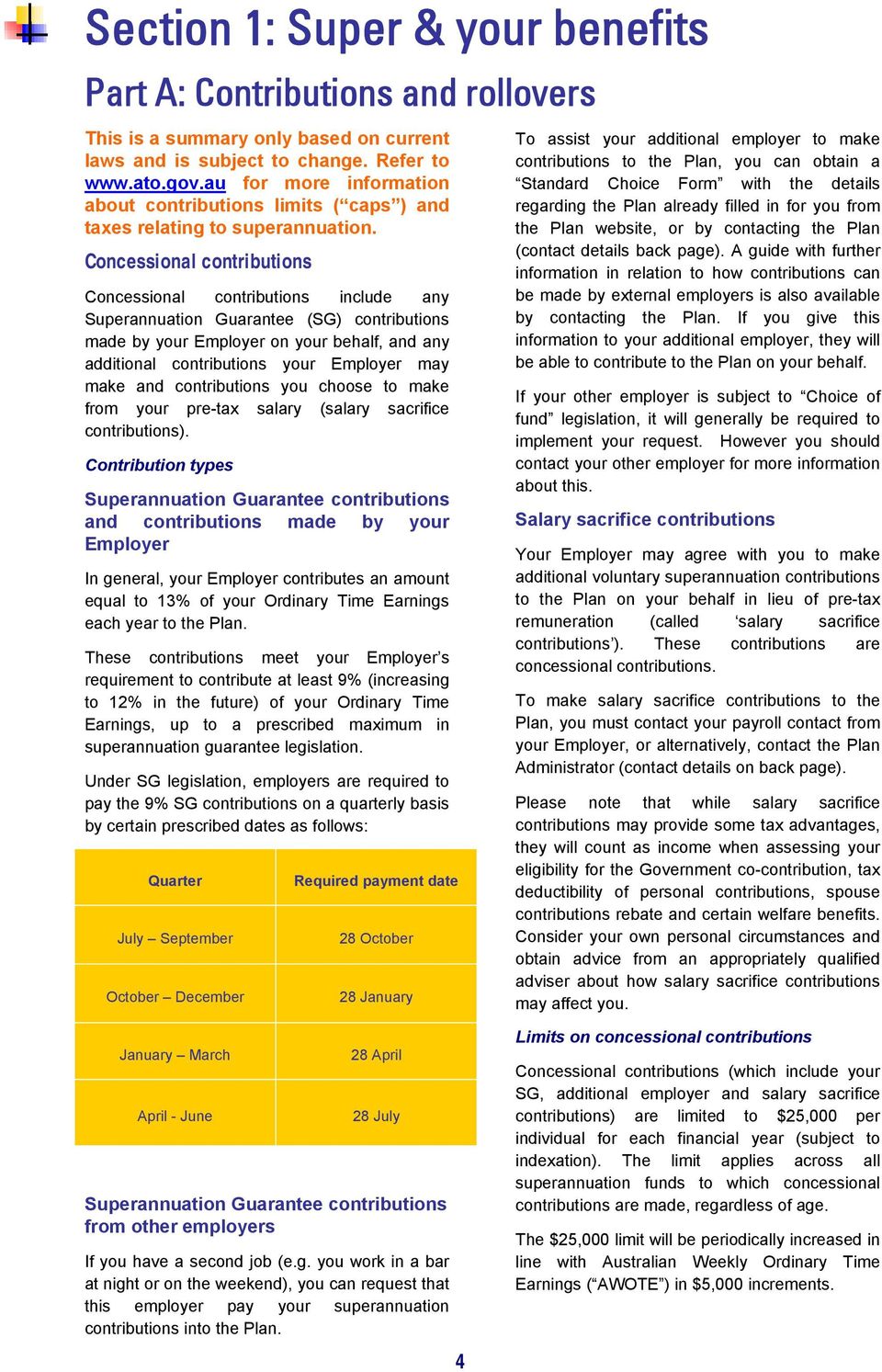
4 Section 1: Super & your benefits Part A: Contributions and rollovers This is a summary only based on current laws and is subject to change. Refer to for more information about contributions limits ( caps ) and taxes relating to superannuation. Concessional contributions Concessional contributions include any Superannuation Guarantee (SG) contributions made by your Employer on your behalf, and any additional contributions your Employer may make and contributions you choose to make from your pre-tax salary (salary sacrifice contributions). Contribution types Superannuation Guarantee contributions and contributions made by your Employer In general, your Employer contributes an amount equal to 13% of your Ordinary Time Earnings each year to the Plan. These contributions meet your Employer s requirement to contribute at least 9% (increasing to 12% in the future) of your Ordinary Time Earnings, up to a prescribed maximum in superannuation guarantee legislation. Under SG legislation, employers are required to pay the 9% SG contributions on a quarterly basis by certain prescribed dates as follows: Quarter July September October December Required payment date 28 October 28 January To assist your additional employer to make contributions to the Plan, you can obtain a Standard Choice Form with the details regarding the Plan already filled in for you from the Plan website, or by contacting the Plan (contact details back page). A guide with further information in relation to how contributions can be made by external employers is also available by contacting the Plan. If you give this information to your additional employer, they will be able to contribute to the Plan on your behalf. If your other employer is subject to Choice of fund legislation, it will generally be required to implement your request. However you should contact your other employer for more information about this. Salary sacrifice contributions Your Employer may agree with you to make additional voluntary superannuation contributions to the Plan on your behalf in lieu of pre-tax remuneration (called salary sacrifice contributions ). These contributions are concessional contributions. To make salary sacrifice contributions to the Plan, you must contact your payroll contact from your Employer, or alternatively, contact the Plan Administrator (contact details on back page). Please note that while salary sacrifice contributions may provide some tax advantages, they will count as income when assessing your eligibility for the Government co-contribution, tax deductibility of personal contributions, spouse contributions rebate and certain welfare benefits. Consider your own personal circumstances and obtain advice from an appropriately qualified adviser about how salary sacrifice contributions may affect you. January March April - June 28 April 28 July Superannuation Guarantee contributions from other employers If you have a second job (e.g. you work in a bar at night or on the weekend), you can request that this employer pay your superannuation contributions into the Plan. 4 Limits on concessional contributions Concessional contributions (which include your SG, additional employer and salary sacrifice contributions) are limited to $25,000 per individual for each financial year (subject to indexation). The limit applies across all superannuation funds to which concessional contributions are made, regardless of age. The $25,000 limit will be periodically increased in line with Australian Weekly Ordinary Time Earnings ( AWOTE ) in $5,000 increments.
5 Concessional contributions made up to the $25,000 limit will ordinarily be subject to tax payable by the Plan at the rate of 15%, deducted by the Fund. (Note: the Government has proposed an increase in the concessional rate of tax for individuals earning over $300,000 per year. For further information go to the ATO website or consult a taxation adviser). Any concessional contributions made in excess of the $25,000 limit will be subject to tax at the rate of 46.5%. The liability for the excess tax (that is, the tax in excess of the concessional rate which ordinarily applies) will be levied on you personally by the ATO, i.e. you will receive a notice from the ATO requesting payment of the excess tax. However, on receipt of the notice, you can nominate a superannuation fund to release monies to pay the liability. In addition, any excess contributions you make above the limit will be counted towards your nonconcessional contribution limit (see below). Note: the Government has proposed that excess concessional contributions up to a certain amount can be returned to a member in limited circumstances. For further information go to the ATO website or consult a taxation adviser. Amounts excluded from the concessional contributions cap Some amounts that can be contributed or transferred to superannuation do not count towards your concessional contribution cap including: Rollovers (including those from an overseas superannuation fund) subject to some special rules for any untaxed amounts; and Government co-contributions. See information published by the ATO at for more information regarding the concessional contributions cap. Non-concessional contributions Non-concessional contributions are contributions you make to superannuation from your after-tax salary. You can make up to $150,000 of nonconcessional contributions to superannuation each financial year. This limit will be maintained at six times the $25,000 (indexed) cap on concessional contributions (see above). If you are under age 65, you can average this limit over three years, i.e. you can make contributions of $450,000 in one year, provided you do not make any additional nonconcessional contributions for the following two years. Contributions made up to the $150,000 (or $450,000) limit will not be subject to tax. Any contributions in excess of the limit will be taxed at the rate of 46.5%. The liability for this tax will be levied on you personally by the ATO. You must then nominate a superannuation fund to release monies to pay the liability. Any excess contributions you make during a year that, in total, are above the limit may remain in the Plan. Where you make a contribution in excess of the 3-year limit (if you are under age 65 on 1 July of the relevant financial year) or, otherwise, the 1- year limit, the amount in excess of the limit will be returned to you, as it cannot be accepted by the Plan. The amount returned may be adjusted for investment fluctuations and reasonable expenses. You can make non-concessional contributions to the Plan on a one off basis at any time, or on a regular basis. You can change your ongoing election to make non-concessional contributions quarterly. To do so, contact the Plan (contact details on the back page). The Plan does not monitor whether your nonconcessional contributions (over a year) will result in you exceeding your cap. It is your responsibility to monitor your ongoing contributions to the Plan for tax purposes. Other amounts measured against the nonconcessional contributions cap Other amounts that count towards your nonconcessional contributions cap include: Any excess concessional contributions you make; The non-taxable portion of any benefit transferred from an overseas superannuation fund; and Contributions made to your account by your Spouse. Amounts excluded from the nonconcessional contributions cap Some amounts that can be contributed or transferred to superannuation are not counted towards your non-concessional contribution cap. They include: Rollovers from within the superannuation system; The taxable portion of a benefit transferred from an overseas superannuation fund. Note, the untaxed portion will count towards your non-concessional limit; 5

6 Government co-contributions; Proceeds from the sale of qualifying small business assets which have been held for 15 years or are subject to the CGT retirement exemption (subject to a lifetime limit which varies from year to year); and Settlements for personal injuries resulting in permanent disablement made to the Plan within 90 days of receiving the payment. See information published by the ATO at for more information regarding the non-concessional contributions cap. Inability to apply contributions without a Tax File Number ( TFN ) You or an employer will be unable to make any contributions to the Plan if we have not been provided with your TFN. The law does not allow us to accept or retain member contributions if we do not have your TFN, and the Trustee has decided that employer contributions will not be permitted if we do not hold your TFN to more effectively manage the Fund s tax liabilities. Any contributions that you attempt to make to the Plan will be returned to you within 30 days if you do not provide your TFN to the Plan, after taking into account any allowable adjustments for investment fluctuations and reasonable costs. You can provide your TFN by contacting the Plan Administrator (contact details on the back page). Your Employer is required to automatically provide your TFN to the Plan, however this may not always occur. You should ensure that the Plan holds your TFN. You can provide your TFN by contacting the Plan Administrator (contact details on the back page). Eligibility to contribute to superannuation Any person under age 65 may contribute to superannuation, regardless of whether or not they are employed. From the ages of 65 to 69, you must have worked at least 40 hours during a continuous 30- day period during the financial year ( work test ) in order to be able to make a contribution to superannuation. However, mandated employer contributions are not subject to the work test. You cannot make personal contributions to superannuation past the age of 74 (contributions to your account by a person other than your employer cannot be made past the age of 70). Generally, from age 75, no contributions other than award or compulsory employer contributions can be made to superannuation. Contributions made to the Plan in contravention of these eligibility rules must be rejected or refunded by the Trustee in certain circumstances. A refund may be adjusted for any allowable investment fluctuations and reasonable costs. Government co-contributions Some members of the Plan may be eligible to receive the Government co-contribution. The Government co-contribution applies to nonconcessional contributions made by low and middle-income earners. The Government co-contribution matches eligible personal non-concessional contributions made by qualifying low and middle-income earners, up to a specified amount. The Government cocontribution is paid annually to qualifying low and middle-income earners superannuation funds. The Government has announced that the maximum co-contribution for the 2012/2013 financial year is $500 and is available to people earning an assessable income plus reportable fringe benefits and reportable employer superannuation contributions of $31,920 or less. It has also been announced that the maximum co-contribution amount phases out completely for incomes of $46,920. The Government co-contribution (the amount contributed by the Government) does not count towards either your concessional or nonconcessional contribution caps. Refer to to determine eligibility criteria for the Government co-contribution (including income thresholds and the available cocontribution amount) applicable from year to year. How to contribute to the Plan SG and salary sacrifice contributions (where applicable) are made automatically to the Plan by your Employer. All other contributions made to the Plan must generally be made by cheque, payable to The Trust Company (Superannuation) Limited ATF The Executive Superannuation Fund. Cheques should be accompanied by a Contribution Form (available on the Plan website or by contacting the Plan), detailing your membership number, name and the type of contribution employer SG, member after-tax, spouse contribution etc. Contributions cannot be made to the Plan electronically. You may be required to provide additional information in respect to other amounts that you wish to 6

7 contribute to superannuation (e.g. sale of small business proceeds). Contribution Splitting You can request that up to 85% of your concessional (SG, employer and salary sacrifice) contributions made during a financial year are split with your spouse, including a de facto spouse. This is subject to a maximum of your concessional contributions limit. The Trustee may also make whatever adjustments to the splittable amount it considers necessary or appropriate (for example, to meet any tax liabilities relating to your benefits). You are unable to split non-concessional contributions, your previously accumulated account balance, previously rolled over amounts or employment termination payments paid into your superannuation account with your spouse. In general, you can apply to split contributions made to the Plan during the financial year after the end of each financial year. You can only split your contributions with your spouse once each financial year. Where you are terminating your membership of the Plan and are rolling over your entire benefit to another superannuation fund, you can request to split the contributions made in the current financial year immediately prior to your exit from the Plan. Your applications to split the contributions made during the year and to rollover your entire benefit to another Plan must be made together. The contributions that you split with your spouse can be transferred to your spouse s account in a superannuation fund of which your spouse is a member. Your spouse must be under the age of 65, under their preservation age or aged between their preservation age and 65 and not permanently retired in order to be able to receive split contributions. If your spouse is between their preservation age and 65, they must submit a declaration to the Plan with your splitting application, stating that they are still gainfully employed either on a full-time or part-time basis and are not permanently retired. Contribution splitting may provide tax planning opportunities where superannuation benefits are withdrawn prior to age 60, or provide superannuation benefits to a spouse who is not working. You may wish to discuss the advantages of contribution splitting with a licensed or authorised financial adviser to determine whether splitting contributions with your spouse is appropriate for you. To request to split contributions, contact the Plan (contact details on the back page). The Trustee may establish rules or policies in relation to contribution splitting from time to time at its discretion. Rolling over into the Plan If you have benefits in another superannuation fund, Retirement Savings Account or Approved Deposit Fund, you may choose to transfer these into the Plan. Such amounts will accrue earnings as per your other benefits in the Plan. Advantages of rolling over benefits into the Plan may include: The Plan may have lower administration fees than the current superannuation fund, Retirement Savings Account or Approved Deposit Fund where your benefit is currently located; and You only pay administration fees to one fund as a consequence of consolidating your benefits. To roll over other superannuation benefits that you may have to the Plan, refer to the guide titled How to rollover into the Fund, available on the Plan website or by contacting the Plan (contact details on the back page). The guide contains instructions on how to roll over your superannuation benefits to the Plan. You may incur fees or lose benefits if you withdraw benefits from your other fund (contact your other fund for more information). UK Pension Transfers The Fund is registered with the UK s HM Revenue and Customs as a Qualifying Recognised Overseas Pension Scheme ( QROPS ) (reference number QROPS/500104). As such, you can elect to transfer any monies you hold in a UK pension fund into the Plan. If you are considering such a transfer, you should be aware that such a transfer is subject to complex rules (including guidance issued by relevant UK authorities which may change from time to time) and may have significant tax implications depending on your personal circumstances. There may be other taxation implications for any lump sum transferred from an overseas fund depending on your personal circumstances. As such, members should seek appropriate advice prior to considering overseas transfers and in particular, amounts that are in excess of the nonconcessional contribution cap. 7

8 Up to date information relating to UK pension fund transfers is available by contacting the Plan (see contact details on the back page). Other payments into the Plan Other payments may also be made into the Plan, for example, disability settlement amounts, foreign sourced superannuation (other than UK Pension Transfers) and the proceeds from the sale of a small business. The rules relating to the transfer of other amounts into the Plan are complex. We recommend you seek advice (including taxation advice) from an appropriately qualified adviser. 8

9 Section 1: Super & your benefits Part B: Withdrawals Withdrawing benefits from superannuation The preserved component of your superannuation benefit must remain within the Australian superannuation system, generally until your permanent retirement from the workforce after you reach your preservation age. Your preservation age is determined in accordance with the following: Date of birth Preservation age Before 1 July July June July June July June July June After 30 June From 1 July 1999, all superannuation contributions (including member contributions) and earnings are preserved. Any component of your benefit that was non-preserved at 1 July 1999 will continue to be non-preserved and can be taken in cash at any time. Your ability to claim preserved benefits other than at retirement (as described above) is restricted, however, the law does allow for the release of benefits where you are an Australian citizen, New Zealand citizen or permanent resident and otherwise satisfy a condition of release, including as follows: When you reach age 60 and cease an employment arrangement; When you reach age 65; When you die; When you suffer from a terminal medical condition as defined in superannuation legislation; When you have ceased gainful employment with your Employer and your account balance is less than $200; If in the Trustee's opinion you are "permanently incapacitated" in accordance with superannuation legislation; If the Trustee approves the early release of preserved benefits on the grounds of severe financial hardship. Should you wish to apply 9 for a benefit on these grounds, the application form is available on the Plan website, or by contacting the Plan (contact details on the back page); If the Department of Human Services ( DHS ) determines preserved benefits should be released on pre-defined specified grounds ( compassionate grounds ), such as to cover palliative care or funeral costs; or Where the law otherwise permits (for example, to satisfy an ATO Release Authority). The Trustee may also allow the payment of your benefit in the form of a Transition to Retirement Pension, once a member has reached their preservation age, but chooses to continue employment. See the Plan s Pension PDS for more information, available by contacting the Plan Administrator (contact details on the back page). Different rules apply to temporary residents. Some (but not all) of the conditions of release outlined above apply to temporary residents (e.g. death, permanent incapacity) and a former temporary resident may be able to access their superannuation benefits as a Departing Australia Superannuation Payment ( DASP ) on permanently departing Australia and expiry of their visa. More details are available by contacting the Plan Administrator (contact details on the back page). Withdrawing benefits from the Plan Whilst employed by your Employer While you are still employed with your Employer you can transfer some or all of your benefits to an alternative superannuation plan at any time, provided the following conditions are met: You have not rolled over benefits from the Plan within the last 12 months; and If you are rolling over part of your benefit, your remaining account balance within the Plan will be at least $5,000. If a member chooses to utilise this feature, the Trustee must be satisfied that you have received or know you have access to all the information you need about your entitlements. You should be aware that the transfer of your benefit to another fund may have consequences such as the loss of insurance cover and employer subsidisation of fees and costs under the Plan.

10 A standard form and standard proof of identity requirements apply when transferring benefits between superannuation funds. Upon the receipt of all necessary information, superannuation funds have a maximum of 30 days to transfer benefits, however a longer period may apply in the case of illiquid investments. Additional information may be required in the case of a request to transfer benefits to a self managed superannuation fund. Any partial payment of superannuation benefits from the Plan must be withdrawn from the exempt (tax-free) and taxable components in proportion (see the Taxation section of this Incorporated Information for more information about these components). The Trustee is required to carry out proof of identity procedures before paying a benefit in cash (lump sum or pension payments) or purchasing a superannuation pension. The requirements arise under the Government s Anti Money Laundering and Counter Terrorism Financing (AML/CTF) legislation. These requirements may also be applied by the Trustee from time to time in relation to the administration of your superannuation benefits as required or considered appropriate under the Government s legislation. You will be notified of any requirements when applicable. If you do not comply with these requirements there may be consequences for you, for example, a delay in the payment of your benefits. If any further information is required from you to enable a benefit payment to be made, you will be notified. Upon termination of employment with your Employer Upon termination of employment with your Employer, your benefit will automatically be transferred to the Personal Division of the Plan (unless you are an insurance only member with no account balance). Your chosen investment option(s) will be maintained. However, the Personal Division has some notable differences from the Accumulation Division. Your Death and TPD insurance cover will cease upon retirement or termination of employment and transfer to the Personal Division. The Personal Division does not provide insurance cover. Your Employer will no longer meet any part of your fees (they are deducted from your account). You will need to ensure that you maintain a sufficient account balance for the deduction of these fees. UK Pension Transfer amounts If you transfer benefits from a UK pension fund into the Plan, withdrawal restrictions may apply to satisfy requirements of the relevant UK authorities. For further information, contact the Plan (contact details on the back page). When you die nomination of beneficiaries You can nominate those persons whom you would prefer to receive your benefit in the event of your death. You should notify the Trustee whenever you decide to alter your beneficiary nomination. The Plan offers you two types of beneficiary nominations to allow you to confirm your intentions for the payment of the benefit from the Plan upon your death. The two types of nominations are as follows: 1. Non-lapsing Binding beneficiary nominations; and 2. Discretionary beneficiary nominations. These nominations apply to lump sum payments only and will apply to any benefits you accrue in the Plan until such time as the nomination expires, is revoked or replaced with another valid and effective nomination. A summary of each type of beneficiary nomination is outlined below. Please consider each type of nomination and, where appropriate, seek qualified estate planning, financial or taxation advice, prior to choosing the one which is right for you. Non-lapsing Binding beneficiary nomination You can elect to make a non-lapsing binding death benefit nomination, which means that upon your death, the Trustee is obliged to pay any remaining account balance to the person(s) you have nominated provided the nomination is valid and effective at the date of death. With a non-lapsing binding death benefit nomination, the nominated individuals must be either a dependant or your legal personal representative. A non-lapsing binding nomination cannot be made on your behalf under a Power of Attorney. To be accepted, your non-lapsing binding nomination must be witnessed by two individuals who are over the age of 18 (and not your nominated beneficiaries). A valid nonlapsing binding death benefit nomination remains 10
11 effective for as long as you are a member of the Plan unless (after you give the nomination) you: Marry; or Enter into a defacto or like relationship with a person of either gender; or Separate on a permanent basis from your spouse or partner; or Have a child with a person other than your spouse or partner. If any of these circumstances occur, the Trustee must pay your death benefit to your legal personal respresentative. You can amend or revoke your non-lapsing binding nomination at any time. Any amendment or revocation must also be in writing and signed before two witnesses (as described above). Where a non-lapsing binding death benefit nomination is not validly made or is no longer effective (for example, under government legislation, the Trust Deed or rules made by the Trustee at the time of death), the death benefit becomes payable to the Member s personal legal representative. To the extent that a non-lapsing binding death benefit nomination nominates some (but not all) individuals who are not a dependant or legal personal representative, the proportion of the death benefit applicable to these individuals must be paid to the legal personal representative. The Trustee may, at any time, withdraw its consent to members giving non-lapsing binding nominations. This may affect any existing nonlapsing binding nominations held by the Trustee, where the Trustee considers appropriate or necessary. If there is any other information you reasonably need to understand your right to make a non-lapsing binding Nomination, please contact the Plan Administrator (contact details on the back page). Discretionary beneficiary nomination By utilising a discretionary beneficiary nomination, you may nominate a dependant and/or legal personal representative to receive your benefit within the Plan upon your death, however, the Trustee has the discretion to pay your benefit to whom it believes is the most appropriate recipient. Whilst full consideration is given to your wishes when utilising a discretionary beneficiary nomination, it is important to realise that, where you have dependants or legal personal representative, the Trustee is required, under the Fund s Trust Deed, to pay the benefit to your dependants or legal personal representative (estate) in such proportions as the Trustee sees fit. General Information about nominations In relation to a member, a dependant includes the spouse of the member, any children of the member or the member s spouse, any person financially dependent on the member and any person with whom the member has an interdependency relationship. A spouse may include person to whom you are legally married or any other person recognised by law and the Fund s trust deed as your spouse. Two people have an interdependency relationship if: They have a close personal relationship; and They live together; and One or each of them provides the other with financial support; and One or each of them provides the other with domestic support and personal care. If two people have a close personal relationship but the other criteria above are not satisfied due to the fact that one person suffers from a physical, intellectual or psychiatric disability, they may still have an interdependency relationship. Note: for taxation purposes, a child aged 18 or more is not a dependant (unless financially dependent on the member or interdependent). In the situation where you do not have any dependants or legal personal representative, the Trustee has the discretion to pay the benefit to a third party who is a non-dependant. In making a payment to a non-dependant, the Trustee takes into account your personal circumstances at the time of your death in making its decision, however, the Trustee may distribute the benefit to individuals that you have not nominated. It should be noted that different tax treatment applies to death benefits paid to a non-dependant of the deceased. For tax purposes, a nondependant includes a child aged 18 or more (unless the child is otherwise financially dependent or interdependent). For more information about the taxation of benefits, see the Taxation section of this Incorporated Information Booklet. If you are unsure which nomination is right for you, seek professional advice. Furthermore, it is always advisable to make a will. If you would like to do so, you should consult a solicitor or the office of the Public Trustee. You can update your nominated beneficiaries at any time by completing a Nomination of Beneficiary Form, which is available online via the Plan website ( 11

12 In the case of lump sum death benefits, you may also receive an anti-detriment payment (refer to Section 5 of this document for more information). Splitting superannuation upon relationship breakdown Superannuation benefits are treated as property when deciding a financial settlement in the event of marriage breakdown or a breakdown of other recognised relationships (breakdown). You can enquire about your benefit in the Plan for the purposes of considering a financial settlement in the event of breakdown. Provided certain requirements are met, your spouse can also enquire about your superannuation. Your spouse may request information from the Plan regarding your benefits in the Plan, without your knowledge or consent. The Trustee is restricted by legislation from informing you about such an enquiry from your spouse. As part of a financial settlement in the event of breakdown, your benefit in the Plan can be split between you and your spouse. This must be by instruction to the Trustee via a Superannuation Agreement between you and your spouse or by a court order. Note: As a result of reforms to Federal Government legislation, splitting of superannuation benefits may also occur when de facto relationships (including same sex relationships) breakdown. The rules are complex. For more information, contact the Plan Administrator (contact details on the back page) and seek advice from a legal adviser. Pensions The Plan s Pension Division offers members the ability to take out an account based pension (Superannuation Pension) upon retirement. A Superannuation Pension allows you to receive your superannuation benefits as an income stream, as opposed to one lump sum payment. Superannuation Pensions are highly flexible. You can select the frequency of your pension payments, as well as the size of the pension payments you wish to receive, provided government limits are met. Except for Transition to Retirement Pensions, you can also commute (end your pension and take the remaining assets as a lump sum) or take a portion of your account balance as a lump sum, at any time (subject to tax rules). Your Superannuation Pension will last until the assets supporting the pension are exhausted. The amount of assets you begin the pension with, the size of the pension payments you select, whether or not you withdraw any lump sums (where permissible) and the investment returns your account balance earns will all affect how long your pension lasts. You can invest the assets supporting your pension in one of the Plan s four investment options available to pensioners. Upon your death, pension payments can be continued to a dependant (subject to government restrictions applicable to the payment of pensions to children), or can be paid out as a lump sum to a dependant or non-dependant. If you have passed your preservation age but have not yet fully retired, you can take out a Transition to Retirement Pension, which is a Superannuation Pension that is subject to additional limits, including that it is unable to be commuted until you retire (except in very limited circumstances). For further information regarding the pensions available from the Plan, see the website or contact the Plan Administrator for a copy of the Pension PDS (contact details on the back page). You should consider this PDS, issued by the Trustee, before making a decision about whether to acquire a pension. We also recommend you obtain appropriately qualified advice. Your contact details with the Plan It is important that you keep the contact details that the Plan has for you up to date. If the Plan loses contact with you, your benefit in the Plan may be transferred to the Fund s nominated Eligible Rollover Fund ( ERF ) or to the ATO (see below for further details). To stop this happening, you simply need to keep the Trustee informed if you change address or other contact details. You can update your contact details on the Plan website or by contacting the Plan directly (contact details on back page). Eligible Rollover Fund The Trustee has selected the Super Safeguard Fund ( SUSA ) as the Fund s nominated Eligible Rollover Fund (ERF). An ERF is a fund designated by the Australian Prudential Regulation Authority ("APRA") to receive and invest the entitlements of superannuation members in certain circumstances. Subject to any requirement on the Trustee to transfer accumulation benefits to the ATO, your benefit may be transferred to SUSA if: 12

13 Your benefit in the Plan falls below $1,000, or You become a "lost member", where two pieces of mail are returned to sender and the Plan no longer has updated contact details for you and is otherwise unable to contact you. Note: if your benefit is transferred to the SUSA any insurance cover that you may have will cease as at the date of transfer. Once your benefit has been transferred to the SUSA or the ATO, you will have no entitlement to benefits from the Plan. If your benefit is transferred to SUSA, you will become a member of SUSA and be subject to its governing rules. If the Trustee holds your current address or contact details, you will be provided with a PDS from SUSA upon transfer of your benefit to them. The SUSA PDS will outline the operational and membership details of SUSA. The investments, fees and costs in relation to the SUSA will be different from those of the Plan. In addition, SUSA does not offer insurance benefits in the event of death or disablement. As such, apart from the grace period for Death and TPD cover described in Section 6 of this Incorporated Information, on leaving the Plan, any insurance benefits you may have will cease at the time your benefit is transferred to the SUSA. Members wishing to locate their benefit after it has been transferred from the Plan, or members who have any enquiries on the nominated ERF, should contact SUSA at the following address: Postal address Super Safeguard Fund GPO Box 3426 MELBOURNE VIC Unclaimed Money Under Federal Government (Unclaimed Money) legislation, there are a number of circumstances in which superannuation must be paid to the Australian Taxation Office as unclaimed money including inactive benefits of an uncontactable member who has reached age 65 and lost members with: Account balances of less than $200; or Accounts which have been inactive for a period of five years and there are insufficient records to ever identify the owner of the account. A former temporary resident s superannuation benefit must also be paid to the ATO as unclaimed money where it has been at least six months since they have departed Australia and their visa has lapsed AND the ATO issues a notice to the Fund requesting the benefit be paid to the ATO. If this happens, you have a right, under the Government s legislation, to claim your super money directly from the ATO (subject to the applicable tax rates). Further information about unclaimed money can be found obtained from If you are a former temporary resident whose superannuation benefits are transferred to the ATO as unclaimed money, you may not be notified of this or receive an exit statement after the transfers occurs. The Trustee will rely on relief provided by the Australian Securities & Investments Commission (ASIC) Class Order [CO 09/437] which says, in effect, that the trustee of a superannuation fund is not obliged to meet certain disclosure requirements in relation to non-residents that have ceased to hold an interest in the fund as a result of the payment of unclaimed superannuation to the Commissioner of Taxation. If you require any further information, contact the Plan Administrator. 13
14 Section 1: Super & your benefits Part C: Other important benefits and features Allocation of investment returns to your account The Trustee has adopted a policy of fully allocating the Plan s investment earnings (net of relevant taxes, fees and costs) to members accounts, based on the investment performance of the investment options in which a member participates. As such, it does not hold any investment fluctuation reserves. The net earnings of your chosen investment option(s) are based on the option s actual investment earnings, less relevant taxes, fees and costs, and are equal to the net investment return. (For details regarding fees and costs deducted from earnings, see Section 4 of this Incorporated Information). Net earnings are allocated to your account on a pro-rata daily basis and are compounded annually each 30 June, when you elect to change investment options or close your account, based on monthly earning rates declared by the Trustee. The net earnings of the Plan s investment options are subject to normal investment market movements and future investment performance cannot be guaranteed. As a result, the earning rate of any investment option may be positive or negative. Interim crediting rates Members who close their account before 30 June, transfer to another category of membership (eg. the Pension Division), make a partial withdrawal or switch investment options are entitled to an interim crediting rate. The interim crediting rates change over time and reflect the investment experience of the Plan at the time of the interim rate calculation, less any applicable taxes, fees and costs. Interim crediting rates are determined by the Trustee at such times as deemed relevant by the Trustee. Interim crediting rates may be positive or negative. How do I know the value of my account and benefits in the Plan? You will be provided with an Annual Member Statement showing your account and benefit entitlements in the Plan as at the Plan s Annual review date of 30 June each year. This information is also available on the Plan website or by contacting the Plan Administrator (contact details on the back page). 14 Privacy This privacy statement relates to the collection, use, storage and disclosure of personal information about you in all communications with the Trustee. The Trustee collects personal information about you to: Process your enrolment in the Plan (in accordance with the Superannuation Industry (Supervision) Act 1993); Administer and manage your participation in the Plan and communicate with you about the Plan; Provide you with information about other products or services that may be of assistance to you; and Facilitate our internal business operations, including fulfilment of any legal requirements. If you do not provide the personal information sought from time to time, it may mean that your enrolment in the Plan cannot be processed or that services cannot be provided to you. The Trustee may disclose your personal information (as necessary): To its agents, contractors or third party service providers that provide financial, administrative or other services in connection with the operation of the Plan or its business, for example where a fund administrator is appointed; To your financial adviser, or sponsoring employer, if any, unless you tell us not to; To an insurer where insurance services are arranged in connection with your enrolment in the Plan; To any new Trustee as may be appointed from time to time; To any party which holds amounts on your behalf which will be transferred to the Plan; and Where the law requires or permits us to do so (e.g. to law enforcement agencies or other government agencies such as AUSTRAC, the agency responsible for monitoring anti-money laundering and counter-terrorism financing legislation), or if you consent. By becoming a member of the Plan, you agree to the Trustee collecting, using, storing and

15 disclosing personal information about you in accordance with this privacy statement. For a further explanation of our privacy practices and how we comply with privacy laws, please contact the Plan for a copy of the privacy policy. Access to information Under privacy laws, you are entitled to request access to personal information held by the Trustee about you and to ask the Trustee to correct this information where you believe it is incorrect or out of date. No fee will be charged for an access request. You may be charged the reasonable expenses incurred in giving you any information you have requested (e.g. searching and photocopying costs). To access personal information about you or to obtain more information about your rights or our privacy policy, please contact the Plan Administrator (contact details on the back page). Member online access and the Plan website You can access your account details online through the Plan website at To log on to the website, you need to provide your member number in the Plan and your log-in PIN number. You will be provided with your member number and initial PIN details upon joining the Plan. Alternatively, you can also request your initial PIN by contacting the Plan Administrator via phone or (see details back page). Your should contain the subject line PIN request and provide your name, date of birth, residential address and member number in the Plan in the body of the . Your PIN will then be ed to you along with instructions to log onto the website. You can personalise your password when you log onto the website for the first time. Individual member account details You can view the following details regarding your account online and confirm transactions that may occur from time to time: Your insurance details; and Details regarding your chosen investment option(s). You can also update/provide certain details regarding your account such as: Your address details; Your nominated beneficiaries (however please note that you can only update nonbinding nominations via the website). Please see pages 10 to 12 of this Incorporated Information for more details regarding beneficiary nominations; and Your TFN. You can also access general information about the Plan on the website, such as investment updates, as well as other product information. The website is provided by the Administrator to the Plan, KPMG Superannuation Services Pty Limited (AFSL No ). With the exception of the Plan documentation issued by the Trustee which can be accessed via the website (such as this Incorporated Information), the Trustee is not responsible for the information provided on the website. More information in relation to the website can be obtained from the Plan (contact details on the back page). Policy Committee Members are required to elect a Policy Committee, in accordance with superannuation legislation governing the operation of the Fund. The role of the Policy Committee encompasses reviewing the overall management of the Fund and making any suggestions to the Trustee relevant to the Fund s operation. For information on the method and process utilised in appointing and removing representatives of the Policy Committee or for information regarding the current Policy Committee, contact the Plan Administrator (contact details on the back page). Your membership details such as your name, date of birth, the date you joined; Your up to date account balance and benefit quotes; The transaction history of your account; Your nominated beneficiaries; 15

16 Section 2: Risks of the Plan There are a number of significant risks associated with investments in superannuation funds and associated with particular investment options within superannuation funds. These include: Market risk Various economic, technological, political, legal and social factors have an effect on the value of investment markets and may affect the value of your investment in your chosen investment option within the Plan. The Trustee and the Plan s underlying investment managers seek to reduce and manage this market risk through the specific investment strategies adopted for each investment option, as described in Section 3 of this Incorporated Information. Investment risk Investment risk can be described as the variability of returns or the chance of negative returns. An investment that has a high chance of fluctuations or negative returns is considered high risk and an investment with a low chance of negative returns is considered low risk. Generally, share investments are considered high risk and cash or fixed interest investments are considered low risk. Investment risk is also affected by the length of time that an investment is held because the chance of a negative return may decrease (and the potential for higher returns may increase) the longer that an investment is held. For example, a share investment held over a period of only one year might be considered very high risk compared to a share investment held over a much longer period (say 10 years). Over the long term, highrisk investments may, therefore, lead to greater returns than low risk investments. Risks associated with various investment options may change depending on the economic environment and other external factors. This means that different asset classes perform differently at different times. For example, returns in relation to shares may increase over a period, whereas, the returns in relation to fixed interest investments may decrease over the same period of time. Should you leave the Plan or withdraw monies, fluctuations in investment returns (in addition to taxation, fees and costs) may result in you getting back less than you have contributed. The risk associated with any particular investment option will depend on the composition of the assets and underlying investments used in each investment option. See the investment profiles later in this Incorporated Information for each of the investment options available in the Plan for a general indication of the level of risk associated with each option (this is a general guide only and does not take into account your personal circumstances). The risk level shown is not a complete assessment of all forms of investment risk, for instance it does not detail what the size of a negative return could be or the potential for a positive return to be less than a member may require to meet their objectives. Further, it does not take into account the impact of administration fees and tax on the likelihood of a negative return. Members should still ensure they are comfortable with the risks and potential losses associated with their chosen investment option. Superannuation fund risk Risks specific to the Plan, as with any other superannuation fund, include the possibility of changes to the Plan or its internal operations such as changes to key staff involved in the management of the Plan or a disruption of its systems. The Trustee seeks to minimise these risks by taking into account the best interests of members at all times when making decisions about the Plan and maintaining a risk management and compliance framework in accordance with legislative requirements. Risk of changes in the legal environment Superannuation laws, the Corporations Act, Australian taxation laws and other laws affect the Plan and the Plan s investments. Changes in superannuation laws may affect your ability to access your benefit in the Plan. Changes in taxation laws may also affect the value of your benefit. Diversification risk The Plan offers four investment options, each with allocations to particular market sectors, with limited diversification of underlying assets. Diversification in underlying assets or investments may help you to realise your goals and potentially moderate the risk of lower investment returns. By spreading your investments across different assets classes you may reduce your exposure to risk. We recommend you consult a licensed or authorised financial adviser for assistance with how to manage your investment risk having regard to your personal objectives, situation or needs. 16

17 You can help manage your investment risk and the volatility of returns by diversifying your investments and by giving consideration to and selecting an investment option suited to your personal circumstances (including your investment timeframe). 17

18 . Section 3: How we invest your money To provide investment flexibility, you can choose how your account balance and future contributions to the Plan are invested. There are four investment options available to members: The Aggressive option; The Balanced option; The Conservative option; and The Cash option. These options are designed to suit different time horizons and levels of risk. Each option has its own investment objectives. These objectives are not a promise or guarantee of any particular benefit or return but are used to measure the performance of the Plan s investments. You need to choose the one that best suits your circumstances. The investment options are described in more detail on the following pages, and in the Member Investment Choice Brochure issued by KPMG Superannuation Services Pty Limited available on the website or by contacting the Plan (see contact details on the back page). You can choose a combination of the investment options offered, however you must ensure that your total investment allocation between the four options totals to 100%. You should review your investment strategy regularly, to ensure that it continues to suit your circumstances and fits in with your overall financial plan. Investment choice for existing account balance Existing account balances in the Plan can be split between multiple investment options. You can split the investment of your existing account balance in any proportion between the Plan s four investment options. If you select more than one investment option, after your existing account balance has been invested in the proportions nominated by you, no adjustments are made to your existing balance s allocation to each option (ie. the account balance is not rebalanced so that your nominated proportions are maintained over time). This means your account balance s allocation to each option will fluctuate from time to time. 18 Investment choice for future contributions You can direct your future contributions to one of the Plan s four investment options. How often can I change my investment choice? You can change your nominated investment option(s) for your account balance or future contributions once per month. The table below shows the switching dates for 2012 and 2013, as well as the due date by which you need to return your "Investment Choice Form" to affect an investment switch. Due date of request Switch effective date 22 June June July July August August September September October October November November December December January January February February March March April April May May June June 2013 Note that changes to your investment option apply to the account balance at the time of switching and any future contributions. While there is no fee charged by the Plan for switching investment options, you should however be aware that a buy/sell spread (reflecting fees charged by the Plan s underlying investment managers for the redemption and acquisition of assets) may apply. Further details regarding buy/sell spreads are contained in Section 4 of this Incorporated Information. How do I change my investment choice? You can change your investment choice by completing an Investment Choice Form, available on the Plan website or by contacting the Plan (contact details on the back page). What if I don t choose an option? If you don t choose an investment option for your existing account balance and/or future

19 contributions when you first join the Plan, your account balance and/or future contributions will be invested in the Balanced option (the Plan s default option). Further details regarding the Balanced option are contained on page 21 of this Incorporated Information. Choosing an investment option The information contained in this Incorporated Information is general information only. It does not take into account your individual objectives, financial situation or needs. As such, you should consider your investment goals and the time your superannuation will be invested, as part of your investment choice decision. When making an investment choice, the performance of the investment options may also be considered, however, past performance is not necessarily an indicator of future performance. If required, contact a licensed or authorised financial planner before making an investment decision, to ensure that your investment choice fits in with your overall financial plan and goals. Investment of superannuation benefits between the date of a member s death and payment to beneficiaries Upon receipt of written notification of a member s death, the Trustee will invest the benefit of the deceased member into the Plan s Cash Option. This approach is intended to ensure that the final benefit paid from the Plan corresponds as closely as possible to the value of the deceased member s benefit at the time of their death. The Cash Option is invested entirely in cash assets and, as such, provides a low-risk investment vehicle which is suitable for the investment of superannuation death benefits during the short timeframe in which most death benefits are paid out from the Plan. Trustee considerations The Trustee of the Plan does not take into account labour standards, environmental, social or ethical considerations in making investment decisions or selecting underlying investment managers. Underlying investment managers may take these factors into account, however they do so in their own right and not on behalf of the Trustee. Asset Consultant The Asset Consultant to the Plan is Newport Investment Consulting Pty Ltd (AFSL ). The Asset Consultant regularly reviews the investments of the Plan and provides recommendations to the Trustee of the Plan. 19
20 The Plan s investment options Aggressive option Suitability Investment objectives This option is intended to be suitable for members seeking long term returns with high levels of volatility. To achieve investment returns (net of tax and investment fees) exceeding: Consumer Price Index ( CPI ) + 4.5% p.a. over rolling 5 year periods; and The return of the median superannuation fund high growth investment option, as measured by the SuperRatings 25 High Growth Index over rolling 5 year periods. Risk Level Potential long term return Likely variability of return Potential for negative returns High High 5 in 20 years on average Minimum Suggested Investment Timeframe Members should be invested for the long term with a minimum time frame greater than 10 years. Asset classes and Strategic Benchmark Allocations Aust Shares 57% Overseas Shares 32.6% Property 5.3% Private Equity 0.1% Aust Fixed Interest 2.0% Overseas Fixed Interest 1.5% Cash 1.5% Historical crediting rates- year ending 30 June (net of relevant fees and taxes) Five year compound average to 30 June % 11.36% % % 17.92% -0.32% p.a. Information about underlying assets utilised in this investment option is available in the Plan s Annual Report. Past performance is not a reliable indicator of future performance. 20

21 Balanced option Suitability Investment objectives This option is intended to be suitable for members seeking long term returns with moderate to high levels of volatility. To achieve investment returns (net of tax and investment fees) exceeding: CPI + 3.0% p.a. over rolling 5 year periods; and The return of the median superannuation fund growth investment option, as surveyed by the SuperRatings 50 Balanced Index over rolling 5 year periods. Risk Level Potential long term return Likely variability of return Potential for negative returns Moderate High Moderate High 3 in 20 years on average Minimum Suggested Investment Timeframe Members should be invested for the long term with a minimum time frame between 5 and 10 years. Asset classes and Strategic Benchmark Allocations Aust Shares 38.4% Overseas Shares 24.7% Property 6.8% Private equity 0.1% Aust Fixed Interest 16.8% Overseas Fixed Interest 7.2% Cash 6.0% Historical crediting ratesyear ending 30 June (net of relevant fees and taxes) Five year compound average to 30 June % 10.83% % % 13.88% 1.94% p.a. Information about underlying assets utilised in this investment option is available in the Plan s Annual Report. Past performance is not a reliable indicator of future performance. 21
22 Conservative option Suitability Investment objectives This option in intended to be suitable for members seeking stable investment returns with moderate to low levels of volatility. To achieve investment returns (net of tax and investment fees) exceeding: CPI + 2.0% p.a. over rolling 5 year periods; and The return of the median superannuation fund conservative investment option, as surveyed by SuperRatings 50 Capital Stable Index over rolling 5 year periods. Risk Level Potential long term return Likely variability of return Potential for negative returns Moderate Low Moderate Low 1 in 10 years on average Minimum Suggested Investment Timeframe Members should be invested for the medium term with a minimum time frame between 3 and 5 years. Asset classes and Strategic Benchmark Allocations Aust Shares 15.8% Overseas Shares 9.1% Property 5.1% Aust Fixed Interest 30.5% Overseas Fixed Interest 11.5% Cash 28.0% Historical crediting ratesyear ending 30 June (net of relevant fees and taxes) Five year compound average to 30 June % 7.71% -4.08% -2.85% 8.45% 3.07% Information about underlying assets utilised in this investment option is available in the Plan s Annual Report. Past performance is not a reliable indicator of future performance. 22
23 Cash option Suitability Investment objectives This option is intended to be suitable for members seeking stable returns and minimal risk of a negative return. To achieve investment returns (gross of tax but net of investment fees) meeting or exceeding: The return of the UBS Bank Bill Index over rolling 5 year periods; and The return of the median superannuation fund cash investment option, as surveyed by SuperRatings 50 Cash Index over rolling 5 year periods. Risk Level Potential long term return Likely variability of return Potential for negative returns Low Low Rarely if ever Asset classes and Strategic Benchmark Allocations Cash 100.0% Historical crediting rates- year ending 30 June (net of relevant fees and taxes) % 3.84% 4.10% 4.09% Historical net earnings rates prior to the year ending 30 June 2007 are not available as this option commenced in July Information about underlying assets utilised in this investment option is available in the Plan s Annual Report. Past performance is not a reliable indicator of future performance. 23
24 Section 4: Fees and costs This document shows fees and other costs that you may be charged. These fees and costs may be deducted from your money, from the returns on your investment or from the Plan assets as a whole. Taxes and insurance costs are set out in another part of this document. You should read all information about fees and costs because it is important to understand their impact on your investment. Type of fee or cost Amount How and when paid Fees when your money moves in or out of the Plan (Note: none of the fees of the Plan are negotiable) Establishment Fee The fee to open your investment. Contribution Fee The fee on each amount contributed to your investment either by you or your Employer. Withdrawal Fee The fee on each amount you take out of your investment. Termination Fee The fee to close your investment. Management Costs The fees and costs for managing your investment. Nil Nil $30.75 Nil Administration Fee $63.96 p.a. Aggressive option 0.62 % plus 0.45% of Plan assets p.a.* Balanced option 0.53 % plus 0.45% of Plan assets p.a.* Conservative option 0.34 % plus 0.45% of Plan assets p.a.* Cash option 0.06 % plus 0.45% of Plan assets p.a.* Not applicable Not applicable Paid by your Employer to the Plan upon withdrawal unless you are transferred to the Personal Division. This fee is not deducted from your account unless you are transferred to the Personal Division. Not applicable Your Employer pays this fee on your behalf unless you are transferred to the Personal Division. It is not deducted from your account or the assets of the Plan unless you are transferred to the Personal Division. The fees (other than 0.45%) are deducted from the earnings of the Plan prior to being allocated to your account, through declared monthly earning rates (or interim rates) calculated for each investment option. Your Employer pays the estimated 0.45% fee unless you are transferred to the Personal Division. This fee is not deducted from your account or the assets of the Plan unless you are transferred to the Personal Division. Service Fees** Investment Switching Fee The fee for changing investment options Nil Not applicable (however buy/sell spreads may apply). *The above fee is an estimate only based on the financial year ending 30 June The actual fees deducted from the crediting rate may vary from year to year. Please refer to the Additional Explanation of fees and costs on page 25 for additional information. ** Additional service fees apply. See Service fees section in the Additional explanation of fees and costs section on page
25 Additional explanation of fees and costs Management Costs The management costs of the Plan are made up of the following fees. Some management costs are paid by your Employer unless you are transferred to the Personal Division. Other management costs are deducted before the allocation of earnings to member accounts. Administration fee A fee of $63.96 p.a. applies to meet the cost of the administration of the Plan. The administration fee is paid to KPMG Superannuation Services Pty Limited, as the Administrator of the Plan, by your Employer and is not deducted from your account unless you are transferred to the Personal Division. It is deducted annually, or upon receiving a benefit payment on a pro rata basis if you are transferred to the Personal Division. Note, these fees may increase on 1 July each year in accordance with the increase in the CPI. Estimated Investment Management Fee The investment management fees for each of the Plan s investment options are estimated as follows, based on the historical experience of the Plan, but may vary from year to year: Investment option Fee Aggressive 0.62% Balanced 0.53% Conservative 0.34% Cash 0.06% The investment management fee reflects the fees charged by the underlying investment managers to the Plan. Each of the managers utilised by the Plan charges an asset-based fee. The combination of each of these fees, for the managers utilised in each investment option, gives the total estimated investment management fee for each investment option, as outlined above. 25 The fees charged by the investment managers are deducted from the earnings of the Plan prior to these being allocated to your account (via declared monthly or interim net earning rates). Investment Management Fee Example: For a member with an account balance of $10,000 for a full year, who has chosen the Balanced option, the estimated investment management fee per annum would be: $10,000 x 0.53% = $53.00 Estimated Operational and Compliance fee The operational and compliance fee is an asset based fee of 0.375% of assets per annum. This is an estimate based on the historical experience of the Plan for the year ending 30 June This is paid by your Employer and is not deducted from your account or the assets of the Plan unless you are transferred to the Personal Division in which case it is deducted annually or on receiving a benefit payment on a pro rata basis. The operational and compliance fee covers the costs of the day-to-day operation of the Plan and the regular fees charged by the Administrator, Asset Consultant and auditor etc. It also covers compliance costs such as fees payable to the Australian Prudential Regulation Authority ( APRA ) etc. Trustee fee This fee is paid to the Trustee for managing the operations of the Plan. The annual amount of this fee is 0.075% of the assets of the Plan. This is paid by your Employer and is not deducted from your account or the assets of the Plan unless you are transferred to the Personal Division in which case it is deducted annually or on receiving a benefit payment on a pro rata basis. Insurance premiums For information about insurance premiums, see the Insurance section of this Incorporated Information. Buy/sell spreads The Trustee does not apply a switching fee to change investment options. However, the underlying investment managers utilised in the investment options may apply fees upon switching. This is referred to as a buy/sell spread in this document, and reflects the transactional and operational cost of buying and selling
26 investments associated with any investment option switch. This is an additional cost to a member and may be deducted from the member s account. The entirety of the buy/sell spread applied is paid to the investment managers of the Plan for the investment and redemption of assets. Due to some overlap between investment managers used in the Plan s investment options, the overall buy/sell spread that may be applied to your account when you switch investment options will depend on which two options you are moving between and may vary up to the maximum buy/sell spreads outlined in the following summary table: Investment option change Maximum % of members accounts Balanced > Aggressive 0.21% Conservative > Aggressive 0.40% Cash > Aggressive 0.52% Aggressive > Balanced 0.05% Conservative > Balanced 0.21% Cash > Balanced 0.36% Aggressive > Conservative 0.06% Balanced > Conservative 0.02% Cash > Conservative 0.18% Aggressive > Cash 0.00% Balanced > Cash 0.00% Conservative > Cash 0.00% Example The maximum fee that may be charged upon switching $50,000 from the Aggressive to Balanced option would be as follows: 0.05% x $50,000 = $25 Service fees Fees relating to splitting or flagging a benefit upon relationship breakdown The following fees will be charged in relation to processing requests for information under the Family Law Act and splitting and flagging of benefits in the event of marriage breakdown or breakdown of other relationships (including defacto partners of the same or opposite sex) recognised under the Family Law Act: 26 Request Fee* Processing an application for information $55 Processing payment splits $110 Placing a payment flag on a benefit $110 Lifting a payment flag on a benefit $55 * Note, these fees may increase on 1 July each year in accordance with the increase in the CPI. With the exception of the fee for processing an application for information (which will be requested to be paid by cheque), the parties to a relationship breakdown will be able to pay these fees either by cheque or by deduction from their benefit at the time of processing the relevant request. For further information regarding splitting of superannuation benefits upon marriage or relationship breakdown, see page 12, or contact the Plan (contact details on the back page). Note: as a result of reforms to Federal Government legislation, splitting of superannuation benefits may also occur under the Family Law Act in the case of defacto relationships (including same sex partners). For more information, contact the Plan or seek advice from a legal adviser. Protection of small account balances Government regulations require that the benefits of members with small account balances in the Plan be protected from erosion by administration costs in certain circumstances. This applies if your account balance is less than $1,000 at the annual review date or the date you exit the Fund and includes (or has included) mandated employer contributions. The member protection rules do not protect a member's benefit from erosion against all fees and charges, but only against administration costs that are deducted from members accounts. This protection does not extend to fees and costs levied against the assets of the Plan as a whole or against taxation. In a negative investment period, special rules apply under the Government s regulations, which enable some administration fees to be charged. Changes to fees and costs The Trustee may change the fees charged to members accounts, for example to reflect changes in the underlying costs of operating the Plan. The Trustee will advise you of any material increases to the fees charged to your account, at least 30 days prior to the effective date of the change.
27 Estimated management costs may vary from year to year depending on the actual experience of the Plan (including the size of the Plan s assets). Administration fees and Family law related fees may be subject to CPI increases from year to year. Note: On retirement or termination of employment you will be automatically transferred to the Personal Division (unless you are an insurance only member with no account balance). Your Employer will no longer meet any part of your fees (instead they will be deducted from your account). You will need to ensure that you maintain a sufficient account balance for the deduction of these fees. Taxation The contributions tax deducted from your account takes into account a 15% rebate applicable to any insurance premiums and administration fees (deducted from your account) for which the Plan is entitled to a tax deduction. In this way, the benefit of any tax deductions is passed onto members. All fees shown in the PDS and this Incorporated Information, and applied to your account are, where applicable, inclusive of GST (less reduced input tax credits), and stamp duty. Please refer to the Taxation section of this Incorporated Information for information regarding the applicable taxation of benefits. 27
28 Section 5: How super is taxed Certain taxes apply to superannuation benefits, when monies enter and exit a superannuation fund. How these taxes are applied depends upon certain factors such as your age. This section contains a summary of the main taxation implications relevant to your benefits, based on legislation or government announcements as at the date of preparation of this Incorporated Information. It assumes that benefits do not contain an untaxed element (higher tax can apply to untaxed elements). It does not take into account your personal circumstances. You should seek professional taxation advice regarding your own circumstances. Updated information is available from Tax on contributions Concessional contributions made to the Plan will be subject to tax, ordinarily deducted upon receipt by the Plan, at a rate of up to 15%. Low income earners may receive an offset of up to $500. (Note: the Government has proposed an increase in the concessional rate for individuals earning more than $300,000). Non-concessional contributions will not usually be taxed upon receipt by the Plan. However, additional tax will be levied on you personally by the ATO where either the cap on either concessional or non-concessional contributions is exceeded. More information in relation to the limits on contributions and the taxation of contributions in excess of these limits is provided earlier in this Incorporated Information. Where your total concessional contributions exceed the concessional contributions limit, the ATO will levy tax on you at the rate of 31.5% on the contributions in excess of the limit (in addition to the 15% that ordinarily applies). Where your total non-concessional contributions exceed the non-concessional contributions limit, the ATO will levy tax on you at the rate of 46.5% on the contributions in excess of the limit. In the case of a tax liability for excessive concessional contributions, you can choose to nominate a superannuation fund to release monies to pay the additional tax, or meet this additional tax liability yourself. In the case of a tax liability for excessive non-concessional contributions, you must nominate a superannuation fund to release monies to pay the additional tax liability. Tax rates and the provision of your TFN allow us to accept or retain member contributions if we do not have your TFN, and the Trustee has decided that employer contributions will not be permitted if we do not hold your TFN, to more effectively manage the Plan s tax liabilities. Any contributions received when the Plan does not have your TFN will be returned to you or your employer within 30 days of receipt subject to any allowable adjustments. To provide your TFN to the Plan, go to the Plan website where you can provide your TFN online, or contact the Plan (contact details on the back page). Your Employer is generally required to automatically provide your TFN to the Plan but this may not always occur. You should ensure we hold your TFN to avoid any adverse or other tax consequences. Taxes upon exit from superannuation The tax payable upon exit from superannuation will depend largely on your age. In general, benefits paid from superannuation to persons aged 60 or over are tax free (if paid from a taxed source). Some tax may apply to benefits paid to persons under age 60. The following table outlines the tax rates that apply in relation to lump sum benefits (assuming the Plan holds your TFN). Special rules apply to Departing Australia Superannuation Payments and benefits paid to a member suffering a terminal illness condition (see further below). If the Plan does not hold your TFN at the end of the financial year, it will not be able to accept any contributions on your behalf. The law does not 28
29 Age / status Lump sum Age 60 or more Tax free Benefit does not have to be included in income tax return. Preservation age* to age 59 (see page 9) Tax free component no tax payable. First $175,000* of the taxable component - no tax payable. Taxable component above $175,000 taxed at 20%. Less than preservation age (see page 9) Tax free component no tax payable. Taxable component taxed at 20% plus Medicare Levy. * The $175,000 threshold (2012/2013) is indexed in line with AWOTE in $5,000 increments. Explanation of terms: Exempt component Comprises the following components: Crystallised segment** Pre 1 July 1983 component; Undeducted contributions; CGT exempt component; Post June 1994 invalidity component; Concessional component. Contributions segment: Any non-concessional contributions from 1 July 2007 ** The components of the crystallised segment were fixed ( crystallised ) as a dollar amount as at 30 June 2007 and may form part of the amounts you rollover or transfer into the Plan. Any nonconcessional contributions you make to the Plan after joining will form part of the Tax free component. Taxable component The total benefit less the tax-free component. Note: Higher rates of tax apply to Departing Australia Superannuation Payments. Death benefits and benefits paid in the event of a terminal illness condition are also treated differently. 29
30 Taxation in relation to death benefits Death benefits paid to a dependant are able to be paid as a lump sum or pension. Death benefits paid to a non-dependant may only be paid as a lump sum. For this purpose, a dependant does not include a child aged 18 or more (unless financially dependent or an interdependent). Where a death benefit is paid to a dependant as a lump sum (regardless of age) or as a pension where the deceased and / or recipient is over age 60, the benefit will be tax free. Where a pension is paid where the deceased is less than 60 and the recipient is also less than 60, the taxable component of the pension will be subject to tax at the marginal rate, plus the Medicare Levy, with a 15% tax offset applied. Where a death benefit is paid to a non-dependant, it must be paid as a lump sum. The taxable component is generally taxed at 15%, plus the Medicare Levy (higher tax may apply if the death benefit contains an untaxed element). Where a death benefit is received by the legal personal representative of a deceased estate, tax is determined according to who is intended to benefit from the estate. Taxation in relation to terminal illness benefits Tax does not apply to lump sums paid to individuals diagnosed with terminal medical conditions (as defined in Government legislation). Where you are diagnosed with a terminal medical condition, you can apply to the Plan to access your super lump sum benefit tax free, regardless of your age. Departing Australia Superannuation Payments ( DASP ) The tax applicable to DASPs is withholding tax. The withholding tax rates are as follows (assuming the Fund holds your TFN): Tax free component Nil; Taxable component 35%. Amounts rolled over into your account If you rollover an amount from another superannuation fund, generally no tax is applied (unless the rollover amount contains an untaxed element). Investment earnings Investment earnings (other than earnings relating to pension assets) are taxed at a maximum rate of 15%. Tax payable on any earnings is deducted prior to net earnings being allocated to accumulation accounts. 30 Tax rebate in relation to insurance premiums and administration fees The contributions tax deducted from your account takes into account a 15% rebate applicable to any insurance premiums and administration fees (deducted from your account) for which the Plan is entitled to a tax deduction. Tax File Number ( TFN ) notification Under the Superannuation Industry (Supervision) Act 1993 ( SIS ), the Trustee is authorised to collect your TFN, which will only be used for lawful purposes. These purposes may change in the future as a result of legislative change. The Trustee may disclose your TFN to another superannuation provider, when your benefits are being transferred, unless you request the Trustee in writing that your TFN not be disclosed to any other superannuation provider. It is not an offence not to quote your TFN. However giving your TFN to the Plan will have the following advantages (which may not otherwise apply): The Plan will be able to accept all types of contributions to your account; The tax on contributions to your account will not increase; Other than the tax that may ordinarily apply, no additional tax will be deducted when you start drawing down your superannuation benefits; and It will make it much easier to trace different superannuation accounts in your name so that you receive all your superannuation benefits when you retire. Anti-detriment payments Lump Sum Death Benefits only A lump sum benefit payable on the death of a member that is paid to a dependant of the deceased is typically not subject to tax. In some circumstances, the amount of the death benefit may be increased by an anti-detriment payment. Anti-detriment payments are designed to compensate certain dependants (for example a spouse, former spouse or child) who receive a death benefit for tax that has been paid previously on contributions made in respect of the deceased. Trustees of superannuation funds may (but are not required to) make anti-detriment payments. The Trustee has adopted a policy of allowing antidetriment payments where a death benefit is paid from the Plan to an eligible dependant, subject to the availability of a tax deduction to the Plan and provided certain conditions are satisfied. Where
31 the recipient of the death benefit is the trustee of the deceased member s estate, the anti-detriment payment will be calculated having regard to the extent to which an eligible dependant can reasonably be expected to benefit from the estate. The amount of the anti-detriment payment is calculated by reference to the amount of contribution tax paid in respect of the deceased using a formula prescribed in tax legislation. Where this information is not available, in some circumstances the anti-detriment payment can be calculated using a formula that estimates the amount of the tax that has been paid. The Trustee is able to make anti-detriment payments because, under tax legislation, in certain circumstances a tax deduction can be claimed. If the Trustee determines that, at the time the payment is being processed, the Plan may be unable to claim some or all of the available deduction, the Trustee may decide that no anti-detriment payment will be made or that only part of the payment will be made. The Trustee may also determine at any time to discontinue anti-detriment payments or amend the criteria for the availability of anti-detriment payments. Members will be notified of any changes to the Trustee s approach to antidetriment payments. 31
32 Section 6: Insurance in your super This information in this section is based on insurance arrangements applicable as the date of preparation of this Incorporated Information. Prior to 1 August 2011 the terms and conditions of the insurance arrangements were different. Any claim relating to the period prior to this date, is subject to these prior terms and conditions. For more information, contact the Plan Administrator. Benefits Division provided by the Accumulation Eligible members (that is, permanent employees of Atwood Oceanics Australia Pty Limited or any other participating employer of the Plan ( Employer )) under age 65 are automatically provided with the following types of insurance cover: Death (including terminal illness); and Total and Permanent Disablement ( TPD ). If you have elected to have your Employer s contributions made to an alternative superannuation fund, you will have been joined as an insurance only member of the Plan, so that your insurance benefits can be administered. Insurance cover is not provided to members who are transferred to the Plan s Personal Division. See below for further information about when cover commences. Death and Total and Permanent Disablement insurance benefits In the event of your death or the Insurer is satisfied that you became totally and permanently disabled whilst you are a current employee of your Employer and an insured member of the Plan, you in the case of a TPD benefit or your nominated beneficiaries (as determined by the Trustee taking into account any nominations by you) in the case of a death benefit will receive a lump sum benefit equal to your: ACCOUNT BALANCE + INSURED BENEFIT The insured benefit is as follows: Insured Benefit* Death and TPD benefit * For members over the age of 60 the insured benefit payable on Total and Permanent Disablement reduces by 10% per annum for each year until 50% at age 65. $300, Example In the event of a member s death at age 62, and assuming an account balance of $100,000 at the date of death, the lump sum benefit payable to the beneficiary would be: Account balance (say) Plus The insured benefit of $300,000 (30,000 x 2)* = Total benefit received** * The level of each insured member s insured cover for total and permanent disablement is reduced by 10% from the beginning of each policy year starting from the policy year in which the insured member turns 61 years of age. ** Taxation may apply. Benefit amount may vary due to investment returns from the date of death to the date of payment. $100,000 $240,000 $340,000 The insured terminal illness benefit amount is the same as the insured death benefit amount. When cover starts and ceases Generally, cover commences upon becoming employed by your Employer and is determined in accordance with the provisions of the Trust Deed and the Plan s insurance policy. If you are not "actively at work" (as defined below) on the date you become employed by your Employer or the date you joined the Plan, cover will not commence until you are accepted for cover by the Insurer. Your work status is based on information provided by your Employer to the Trustee. A person is "actively at work" if they are employed or engaged by the employer to carry out identifiable duties, are actually performing those duties at least 35 hours per week and, in our opinion, are not restricted by illness or injury from being capable of performing those duties (and the duties of their normal occupation). Cover ceases upon termination of employment with your Employer, ceasing membership of the
33 Plan (subject to any grace period applicable to you as described on page 33), payment of a terminal illness benefit or turning age 65. You cannot request to cancel or reduce insurance cover provided to you. Insurance premiums If you are eligible for insurance cover, your Employer pays for insurance premiums on your behalf. The cost of this insurance does not reduce your account. Your Employer pays the insurance premium amount directly to the Plan s Insurer. Total and Permanent Disablement what does this mean? Total and permanent disablement ( TPD ) is defined in the insurance policy. You may be considered totally and permanently disabled if the Insurer is satisfied that you meet one of the definitions while an insured member of the Plan, as summarised below: an inability to work on a permanent basis; (for persons aged 65 or less on the date of disablement); total and permanent loss of limbs and/or blindness; OR an inability to perform (unassisted) activities of daily living (dressing, toileting, mobility, continence and feeding) referred to as the Activities of Daily Living definition. For more detailed information about the applicable definition(s), contact the Plan Administrator. The Trustee must also be satisfied that any insured TPD benefit is payable under the trust deed and superannuation legislation, which includes being satisfied that you are permanently incapacitated. Terminal Illness what does this mean? The insurance policy defines terminal illness as follows: A person is regarded as terminally ill when a medical practitioner, specialising in the insured perosn s illness, certifies in writing that the illness will (despite medical treatment) lead to the insured person s death within 12 months of the date of the certification. For this benefit to be paid, the Insurer must be satisfied with this evidence; and the illness from which the insured person suffers must occur, and the date of the certification must take place while the insured person is covered under the insurance policy. The Trustee must also be satisfied that any insured terminal illness benefit is payable under the trust deed and superannuation legislation. Insurance only members Insurance cover for insurance only members ceases after 30 days from the date of termination of your employment with Atwood. If you are insurance only member of the Plan, your standard Death and TPD insurance cover will not continue within the Personal Division of the Fund upon your termination of employment with Atwood. Evidence of health You will not be required to provide evidence of health to be eligible for the insurance benefits provided by the Plan whilst an employee of your Employer. Insurance cover is provided automatically. Where evidence of health is required, you will be advised personally. Exclusions A benefit will not be paid for an insured person if his or her death, terminal illness or TPD is directly or indirectly caused by war, including any act of war (whether declared or not), revolution, invasion, rebellion or civil unrest. A benefit will not be paid for death caused directly or indirectly by a pandemic illness or any other condition which is directly or indirectly caused by, or related to, the pandemic illness, where: we have given you at least 14 days prior notice of the operation of this pandemic illness exclusion, and the death occurs within 30 days of the death cover starting, restarting or increasing (but only the increased benefit is not payable). A pandemic illness is an illness for which a pandemic alert or similar publication is issued by the Australian Government or the World Health Organisation. Grace period for death and TPD cover when leaving the Plan In the event of you closing your account and ceasing your insurance benefits (other than as a result of TPD) you will continue to be covered for death benefits, for 60 days, and TPD insurance benefits, for 30 days, from the date of termination of your cover. Continuation option Within 60 days of voluntary termination of employment with your Employer, you may elect to continue your death and/or TPD cover, by taking out a continuation option. A continuation option allows you to be covered for any amount up 33
34 to the level of insurance you had on your date of leaving service, provided insurance cover has not ceased for some other reason. To obtain cover under this continuation option members do not have to undergo full medical underwriting, but may be required to complete an AIDS declaration and a blood test for HIV. If you take out a continuation option, you will effectively be taking out a new insurance policy directly with CommInsure (the insurance cover is not provided via the Plan). The insurance premiums will be based on retail premium rates and will be payable by you personally, rather than by your Employer. Cover under a continuation option will commence from the date your application for cover is approved and confirmed by CommInsure. As such, there may be a period after you have ceased employment when you are not insured. A continuation option is available for Death insurance up to age 65, but for TPD insurance only up to age 50. To take out a continuation option for TPD cover, you must be working (or going to be working) at least 25 hours per week. Proof of age Proof of age may be required, should an insurance claim be made, at the time of submitting a claim. Such proof may include your birth certificate, passport, naturalisation certificate etc. Fund insurer Insurance cover is subject to the terms and conditions of the insurance policy issued by the Insurer, which is available on request from the Plan Administrator. The payment of any insured benefits by the Trustee from the Plan is subject to acceptance of a claim by the Insurer, Trust Deed and superannuation legislation. If, for whatever reason, insurance benefits are denied, reduced or limited by the Insurer, then the benefit payable from the Plan will be affected. 34
35 Section 7: How to open an account Enquiries and complaints procedure The Superannuation Industry (Supervision) Act, 1993 ( SIS ) requires the Trustee to take all reasonable steps to ensure that there are arrangements in place under which: Members or their beneficiaries have the right to enquire into, or complain about, the operation or management of the Plan; and Those enquiries or complaints will be properly considered and dealt with within 90 days. It is important to distinguish between enquiries and complaints. Enquiries are requests for information about the Plan or your benefits. Complaints are expressions of dissatisfaction. Enquiries If you have an enquiry regarding the Plan, you should contact the Plan (contact details on the back page). Enquiries can be made by , phone or in writing. If you do not receive a satisfactory response within 28 days, you should immediately contact the Trustee (see back page for contact details). handling of your complaint. If the tribunal accepts your complaint, it may attempt to resolve the matter through conciliation, which involves assisting you and the Plan to come to a mutual agreement. If conciliation is unsuccessful, the complaint is referred to the tribunal for a determination which is binding. You should be aware, however, that a party may appeal a decision of the tribunal to the Federal Court. If you wish to find out whether the tribunal can handle your complaint and the type of information you would need to provide, phone the following number for the cost of a local call anywhere in Australia: Postal address Superannuation Complaints Tribunal Locked Bag 3060 Melbourne VIC Complaints The Trustee has an Internal Dispute Resolution Policy that covers complaints by members of the Fund. Complaints should generally be made in writing to the Trustee and you should receive a response from the Trustee within 90 days. The contact details for complaints to the Trustee are: Complaints Officer The Trust Company (Superannuation) Limited PO Box 361 Collins Street West VIC 8007 (03) (03) Superannuation Complaints Tribunal If you are not satisfied with the Trustee s handling of your complaint or their decision, or a response is not received within 90 days, you may contact the Superannuation Complaints Tribunal. The tribunal is an independent body set up by the Federal Government to assist members or beneficiaries to resolve certain types of complaints with fund trustees. The tribunal may be able to assist you to resolve your complaint, but only if you are not satisfied with the response received from the Trustee s 35
36 This page has been left blank intentionally 36
37 Further information and how to contact us Should you require any further information in respect of the Plan, information is available as follows: Plan web-site Plan Administrator KPMG Superannuation Services Pty Limited Level 4, 10 Shelley Street SYDNEY NSW 2000 (02) (02) : mailto: [email protected] Trustee The Trust Company (Superannuation) Limited PO Box 361 Collins Street West VIC 8007 (03) (03) The Trust Company (Superannuation) Limited (ABN , AFSL No ) as Trustee for Atwood Oceanics Australia Superannuation Plan sub-plan of The Executive Superannuation Fund 37
Retirement Savings Account (RSA)
 Retirement Savings Account (RSA) Product Disclosure Statement (PDS) Incorporated (by reference) Information Booklet - Superannuation, Rollovers and Pensions. As at 24 September 2014 Issued by the Qantas
KPMG Staff Superannuation Plan Product Disclosure Statement
 KPMG Staff Superannuation Plan Product Disclosure Statement Prepared: 27 June 2014 Things you should know: This Product Disclosure Statement ( PDS ) is a summary of significant information and contains
AustChoice Super general reference guide (ACH.02)
 AustChoice Super general reference guide (ACH.02) Issued: 28 May 2015 This guide contains important information not included in the AustChoice Super PDS. We recommend you read this entire guide. The information
General reference guide
 General reference guide (TPS.01) Issued: 1 July 2015 The Portfolio Service Super Essentials The Portfolio Service Superannuation Plan The Portfolio Service Retirement Income Plan This guide contains important
Retirement Savings Account (RSA)
 Retirement Savings Account (RSA) Product Disclosure Statement (PDS) Incorporated (by reference) Information Booklet - Superannuation, Rollovers and Pensions. As at 12 March 2012 Issued by the Qantas Staff
Product Disclosure Statement
 AMP Retirement Savings Account Product Disclosure Statement Contents 1. About AMP Retirement Savings Account 2. How super works 3. Benefits of investing with AMP Retirement Savings Account 4. Risks of
ENTERPRISE SUPER MEMBERS GUIDE. EMPLOYER SPONSORED SUPERANNUATION & PERSONAL SUPERANNUATION Issue Date: 22 June 2012
 ENTERPRISE SUPER EMPLOYER SPONSORED SUPERANNUATION & PERSONAL SUPERANNUATION Issue Date: 22 June 2012 Enterprise Super is a division of General Retirement Plan, ABN 32 894 907 884 PO Box 1282, Albury NSW
Additional Information Booklet
 SuperWrap Additional Information Booklet Dated 20 November 2015 This Additional Information Booklet ( Booklet ) has been prepared by the issuer of SuperWrap: BT Funds Management Limited ABN 63 002 916
Tax on contributions. Non-concessional (after tax) contribution caps. Age at 1 July 2015 Annual cap Tax rate Under 65 $180,000* Nil 65-74 $180,000 Nil
 This section summarises the main Federal Government taxes that apply to superannuation at the time of preparation. For more information, contact MyLife MySuper on 1300 MYLIFE (695 433) or the Australian
How super is taxed. About this document. Tax on concessional contributions. Concessional contribution tax rates from 1 July 2015:
 How super is taxed Date of issue: 1 July 2015 mtaasuper.com.audate Phone: 1300December 362 415 2014 Fax: 1300 365 142 of issue: The information in this document forms part of the Product Disclosure Statement
How super is taxed. VicSuper FutureSaver Member Guide
 How super is taxed VicSuper FutureSaver Member Guide Date prepared 1 July 2015 The information in this document forms part of the VicSuper FutureSaver Product Disclosure Statement (PDS) dated 1 July 2015.
Reliance Super. Taxation Supplement. 14 March 2014. a membership category of Maritime Super
 Taxation Supplement 14 March 2014 Contents Tax on contributions 2 Tax on rollovers 3 Tax on investment earnings 3 Tax on super benefits 3 Spouse tax offset 7 Tax deductions for the self-employed 7 Low
Superannuation. A Financial Planning Technical Guide
 Superannuation A Financial Planning Technical Guide 2 Superannuation Contents Superannuation overview 4 Superannuation contributions 4 Superannuation taxation 7 Preservation 9 Beneficiary nomination 9
Additional Information Booklet
 SuperWrap Additional Information Booklet Dated 1 July 2014 This Additional Information Booklet ( Booklet ) has been prepared by the issuer of SuperWrap: BT Funds Management Limited ABN 63 002 916 458 AFSL
ADVANCE RETIREMENT SAVINGS ACCOUNT Annual Report for year ended 30 June 2014. Issued by BT Funds Management Limited ABN 63 002 916 458 AFSL 233724
 ADVANCE RETIREMENT SAVINGS ACCOUNT Annual Report for year ended 30 June 2014 Issued by BT Funds Management Limited ABN 63 002 916 458 AFSL 233724 CONTENTS Introduction... 1 Recent developments in superannuation...
ewrap Super/Pension Additional Information Booklet
 ewrap Super/Pension Additional Information Booklet Issue date: 24 November 2014 This ewrap Super/Pension Additional Information Booklet (this Booklet) has been prepared by the trustee of ewrap Super/Pension:
ANZ Superannuation Savings Account
 ANZ Superannuation Savings Account ADDITIONAL INFORMATION GUIDE 21 JUNE 2012 Issued by OnePath Custodians Pty Limited ABN 12 008 508 496, AFSL 238346, RSE L0000673 About this Additional Information Guide
Super taxes, caps, payments, thresholds and rebates
 Fact Sheet Super taxes, caps, payments, thresholds and rebates This fact sheet provides a useful one-stop reference guide to the tax rates, caps, thresholds and rebates that apply or are related to superannuation
MLC MasterKey Super & Pension Fundamentals MLC MasterKey Super & Pension How to Guide
 MLC MasterKey Super & Pension Fundamentals MLC MasterKey Super & Pension How to Guide Preparation date 1 July 2015 Issued by The Trustee, MLC Nominees Pty Limited (MLC) ABN 93 002 814 959 AFSL 230702 The
Superannuation Technical Information Booklet
 Superannuation Technical Information Booklet Macquarie Wrap Document number MAQST02 The information contained in this Technical Information Booklet should be read in conjunction with the relevant Product
AMP Eligible Rollover Fund Product Disclosure Statement
 AMP Eligible Rollover Fund Product Disclosure Statement Issued 30 June 2014 Contents 1. About AMP Eligible Rollover Fund 2. How super works 3. Benefits of investing with AMP Eligible Rollover Fund 4. Risks
Member guide. Superannuation and Personal Super Plan. The information in this document forms part of the Hostplus Product Disclosure Statement issued
 Member guide. Superannuation and Personal Super Plan Product Disclosure Statement The information in this document forms part of the Hostplus Product Disclosure Statement issued Section 7. How super is
Fact Sheet Tax on Super 2009/10
 It pays to belong TM Key Focus A tax of 15% applies to concessional (i.e. before tax) contributions. All employer and salary sacrifice contributions will be taxed at the top marginal rate if your super
Contributions are taxed differently depending on whether you are making contributions to a taxed or untaxed fund.
 Tax and super Issue Date: 1 July 2015 SUP E R ANNUATION The information in this document forms part of the Product Information Booklets for GESB Super and West State Super, each dated 1 July 2015. You
Personal Choice Private ewrap Super/Pension
 Personal Choice Private ewrap Super/Pension Product Disclosure Statement (PDS) Part 2 Additional Information I 1 July 2014 PERSONAL CHOICE PRIVATE This Personal Choice Private ewrap Super/Pension PDS Part
REST Super Member Guide
 REST Super Member Guide Effective 1 October 2015 REST Super has a MySuper option The information in this document forms part of the REST Super Product Disclosure Statement (PDS), effective 1 October 2015.
Issued ₁ July ₂₀₁₅. Member guide. SuperLeader Fact sheet. AMP Corporate Super Registered trademark of AMP Life Limited ABN 84 079 300 379.
 Issued ₁ July ₂₀₁₅ Member guide SuperLeader Fact sheet AMP Corporate Super Registered trademark of AMP Life Limited ABN 84 079 300 379. This is a member guide fact sheet for SuperLeader. It is an important
Defence Bank Super Assured Retirement Savings Account
 RETIREMENT SAVINGS ACCOUNT (RSA) Defence Bank Super Assured Retirement Savings Account Superannuation fee free. The way it should be for all Australians. General Information and Application Form Product
State Super retirement FuND
 State Super retirement FuND Additional Information Booklet Date of Issue 20 January 2015 State Super Financial Services Australia Limited ABN 86 003 742 756 Australian Financial Services Licence No. 238430
ASC Superannuation Plan
 ASC Superannuation Plan sub-plan of The Executive Superannuation Fund Product Disclosure Statement 28 June 2013 Things you should know: This Product Disclosure Statement ( PDS ) is a summary of significant
Contributing to your super
 SUP E R ANNUATION Contributing to your super GESB Super and West State Super ISSUE DATE: 1 July 2015 PREPARATION DATE: 26 June 2015 Government Employees Superannuation Board ABN 43 418 292 917 Contents
MyState Wealth Management Superannuation Account Reference Guide
 MyState Wealth Management Superannuation Account Reference Guide 19 August 2015 Superannuation Account Reference Guide 1 Trustee and Issuer: The Trust Company (Superannuation) Limited ABN 49 006 421 638
AMP Eligible Rollover Fund
 AMP Eligible Rollover Fund Fact sheet Issued 30 June 2014 Issued by AMP Superannuation Limited ABN 31 008 414 104, AFSL No. 233060, the Trustee of AMP Eligible Rollover Fund ABN 32 931 224 407. Registered
2015 Product Disclosure Statement
 2015 Product Disclosure Statement Personal Division Issued 1 November 2015 Contents 1. About NSF Super 2. How super works 3. Benefits of investing with NSF Super 4. Risks of super 5. How we invest your
CLIENT FACT SHEET. If you are under age 65 you may make personal contributions to superannuation on your own behalf.
 CLIENT FACT SHEET July 2010 Understanding superannuation and superannuation contributions Superannuation is an investment vehicle designed to assist Australians in saving for their retirement. The Government
Taxpayers Australia Inc
 Taxpayers Australia Inc Superannuation Australia (A wholly owned subsidiary of Taxpayers Australia Inc) Glossary of superannuation terms These terms are commonly used in the superannuation sector. Account-based
Challenger Guaranteed Allocated Pension
 Challenger Guaranteed Allocated Pension Product Disclosure Statement (PDS) Dated 1 January 2015 Challenger Retirement Fund Allocated Pension (SPIN CIT0101AU) (ABN 87 883 998 803) (RSE Registration Number
The sooner you start thinking about growing your super, the better. But it s never too late.
 > Get calculating! If you d like to see the effect that personal contributions may have on your final entitlement, access the Super SA Benefit Projector on the Super SA website www.supersa.sa.gov.au. The
Understanding Superannuation
 Understanding Superannuation Client Fact Sheet July 2012 Superannuation is an investment vehicle designed to assist Australians save for retirement. The Federal Government encourages saving through superannuation
Investment Bond & Rollover
 Investment Bond & Rollover This report includes: Deferred Annuity Capital Guaranteed Collection Rollover Rollover Portfolio and Rollover Parking Fund Capital Guaranteed Collection Investment Bond Investment
Product Disclosure Statement
 Product Disclosure Statement MYSUPER AUTHORISATION NUMBER 72229227691044 1 July 2014 NESS Super, the industry fund to power your financial future inside 1 About NESS Super 2 2 How super works 2 3 Benefits
Lump sum benefit payment request for your superannuation or account based pension
 Lump sum benefit payment request for your superannuation or account based pension How to claim a benefit To claim a benefit you will need to complete the attached Benefit Payment Request and send it direct
How super works. VicSuper FutureSaver Member Guide
 How super works VicSuper FutureSaver Member Guide Date prepared 1 July 2015 The information in this document forms part of the VicSuper FutureSaver Product Disclosure Statement (PDS) dated 1 July 2015.
Family law and superannuation
 Family law and superannuation Fact sheet This fact sheet looks at the process of splitting a superannuation benefit under the family law process and the types of benefits that may be affected, including
Virgin Super. Member Guide
 Virgin Super Member Guide 1 December 2015 Issued by the Trustee The Trust Company (Superannuation) Limited ABN 49 006 421 638, AFSL 235153, as trustee for Virgin Super ABN 88 436 608 094 The information
OneAnswer Personal Super and Pension. Additional Information Guide
 OneAnswer Personal Super and Pension Additional Information Guide 27 February 2012 Entity details in this guide Name of legal entity Registered numbers Abbreviated terms used throughout the PDS OnePath
AIA Australia Risk Only Super Solution
 AIA Australia Risk Only Super Solution A division of the AIA Superannuation Fund Member Product Disclosure Statement Dated 1 December 2014 Featuring: Death cover (including Terminal Illness cover) Total
The Executive Superannuation Fund
 The Executive Superannuation Fund Agenda Overview of The Executive Superannuation Fund ( the Fund ) Contributions ti and insurance benefits available to KPMG staff Investment option asset allocation Investment
Superannuation death benefits
 Last updated: 7 September 2010 Last updated: 1 January 2011 Superannuation death benefits This TapIn Guide looks at the key tax issues relating to superannuation death benefits paid from a complying superannuation
Your Super Guide. Product Disclosure Statement 15 December 2014 Nestlé Super Insured Accumulation category. Contents. Important Information
 Australia Group Superannuation Fund Your Super Guide Product Disclosure Statement 15 December 2014 Nestlé Super Insured Accumulation category Contents 1 About Nestlé Super p2 2 How super works p2 3 Benefits
Superannuation and Residency Fact Sheet - October 2014
 Superannuation and Residency Fact Sheet - October 2014 A change in residence has significant implications for superannuation. A number of issues arise when an individual relocates overseas whether temporarily
How To Understand Your Superannuation Account At Sunsuper For Life
 Sunsuper for life guide Want to know more about: Superannuation Income in retirement Preparation date: 9 June 2015 Issue date: 1 July 2015 Contents 1 Benefits of investing with Sunsuper for life 1 Here
Telstra Super Personal Plus
 01/ 17 NOVEMBER 2015 PRODUCT DISCLOSURE STATEMENT Telstra Super Personal Plus Making the most of your future Contents 01 About Telstra Super and Telstra Super Personal Plus 02 02 How super works 02 03
Your Guide. to the Meridian. Personal. Super Plan. Product Disclosure Statement. Issued 1 January 2004 MPS 4
 Your Guide to the Meridian Product Disclosure Statement Issued 1 January 2004 Personal Super Plan MPS 4 What this Guide is about MPSuper Product Disclosure Statement This Guide was prepared and issued
REQUEST FOR WITHDRAWAL
 REQUEST FOR WITHDRAWAL If you need help For assistance call NGS Super Customer Service Team on 1300 133 177. Step 1. Complete your personal details Please print in black or blue pen, in uppercase, one
Zurich Super Estate Management
 Zurich Super Estate Management Binding Nominations The Trustee of the Zurich Master Superannuation Fund is Zurich Australian Superannuation Pty Limited ABN 78 000 880 553, AFSL 253 500, RSE Licence No.
SUMMARY OF RATES AND THRESHOLDS 2015/16
 SUMMARY OF RATES AND THRESHOLDS 2015/16 CONTENTS Superannuation rates and thresholds Concessional contributions Non-concessional contributions Capital Gains Tax (CGT) cap amount Untaxed plan cap amount
Guide to your Nestlé Super. Defined Benefit category IBR
 Australia Group Superannuation Fund Guide to your Nestlé Super Defined Benefit category IBR The information in this document forms part of the Nestlé Super Product Disclosure Statement Defined Benefit
How To Save For Retirement
 Booklet 1 Getting the best out of your superannuation savings MAStech Smart technical solutions made simple Contents Introduction 01 Introduction 03 Saving through super 08 How a super fund works 09 How
SignatureSuper Member Guide Fact Sheet
 SignatureSuper Member Guide Fact Sheet Issued 30 June 2014 AMP Corporate Super The information in this Fact Sheet forms part of the SignatureSuper Product Disclosure Statement dated 1 January 2014 for
RBF family law. This brochure covers the treatment of your RBF super for family law purposes. Contents Introduction
 RBF family law This brochure covers the treatment of your RBF super for family law purposes Contents Introduction 2 If a couple separates or divorces must super be split? Can all super be split? Who can
Product Disclosure Statement
 AMP Retirement Savings Account Product Disclosure Statement Contents 1. About AMP Retirement Savings Account 2. How super works 3. Benefits of investing with AMP Retirement Savings Account 4. Risks of
Superannuation Savings Account
 Superannuation Savings Account Super. Simple. Guaranteed. Supplementary Product Disclosure Statement Preparation Date: 21 June 2007 This is a Supplementary Product Disclosure Statement (SPDS) to the Commonwealth
Superannuation Product Disclosure Statement effective 1 January 2016
 Superannuation Pensions Insurance Financial Advice Superannuation Product Disclosure Statement effective 1 January 2016 Contents About us 2 How super works 3 Benefits of investing with us 3 Risks of super
The Executive Superannuation Fund
 The Executive Superannuation Fund ANNUAL REPORT KPMG STAFF SUPERANNUATION PLAN FOR THE YEAR ENDING 30 JUNE 2012 Important Information The issuer and Trustee of The Executive Superannuation Fund (ABN: 60
Insurance Cover Changes SIGNIFICANT EVENT NOTICE
 Insurance Cover Changes SIGNIFICANT EVENT NOTICE This Significant Event Notice is issued by CSF Pty Limited (ABN 30 006 169 286), (AFSL 246664) in its capacity as trustee of the Catholic Superannuation
BT Lifetime. Personal Super. Contents. 1. About BT Lifetime Personal Super 2 2. How super works 2 3.
 Contents BT Lifetime Personal Super Product Disclosure Statement (PDS) Dated 1 July 2014 1. About BT Lifetime Personal Super 2 2. How super works 2 3. Benefits of investing with BT Lifetime Personal Super
Things you should know
 Westpac Group Plan Defined Benefit Pension (including Spouse pension) Product Disclosure Statement (PDS) Dated: 1 July 2014 Things you should know The Westpac Group Plan Defined Benefit pension provides
SUPERANNUATION. Home Insurance. Super fundamentals. Foundations for your future
 SUPERANNUATION Home Insurance Super fundamentals Foundations for your future As one of your most important financial investments, it s worth understanding how superannuation works. For many Australians,
Getting to know your AMP Flexible Super
 Issued ₁ July ₂₀₁₅ Getting to know your AMP Flexible Super Fact sheet Registered trademark of AMP Limited ABN 49 79 354 519 This is a fact sheet for AMP Flexible Super. The AMP Flexible Super fact sheets
Member Product Disclosure Statement
 Member Product Disclosure Statement Dated: 1 December 2012 CONTENTS About MTAA Super...2 How super works...2 Benefits of investing with MTAA Super...3 Risks of super...3 How we invest your money...4 Fees
2013 Benefit Statement Notes
 2013 Benefit Statement Notes At 30 June 2013 Important information The Board of Trustees of the State Public Sector Superannuation Scheme (ABN 32 125 059 006) (QSuper Board) is required to provide you
retirement savings SUPER ACCOUNT Product Disclosure Statement a refreshing attitude to banking EFFECTIVE FROM 6 JUNE 2012
 SUPER retirement savings ACCOUNT Product Disclosure Statement EFFECTIVE FROM 6 JUNE 2012 a refreshing attitude to banking 1 Contents Your Queensland Country Credit Union Limited Product Disclosure Statement
Telstra Super Personal Plus Application Please complete this application form to open a Telstra Super Personal Plus account.
 Telstra Super Personal Plus Application Please complete this application form to open a Telstra Super Personal Plus account. RED SECTIONS FOR YOUR INFORMATION GREY SECTIONS TO FILL OUT INVESTMENT CHOICE
Product Disclosure Statement
 Product Disclosure Statement bcu Retirement Savings Account (Current as at August 20, 2014) Bananacoast Community Credit Union Ltd ABN 50 087 649 750 AFSL No. 241077 The information in this PDS is general
Superannuation: dealing with life s changes
 Booklet 2 Superannuation: dealing with life s changes MAStech Smart technical solutions made simple Contents Introduction 01 Introduction 03 Accessing your superannuation benefits 04 Conditions of release
PRODUCT DISCLOSURE STATEMENT. 02 9331 8664 [email protected] www.nowinfinity.com.au PO BOX 1409 Potts Point NSW 1335 ABN 16 154 927 376
 PRODUCT DISCLOSURE STATEMENT 02 9331 8664 [email protected] www.nowinfinity.com.au PO BOX 1409 Potts Point NSW 1335 ABN 16 154 927 376 SMSF Product Disclosure Statement CONTENTS SMSF Product Disclosure
Notice of intent. Fact sheet and form. What this fact sheet covers. Who is this fact sheet for? When should I complete a notice of intent?
 Fact sheet and form Notice of intent A notice of intent to claim or vary a deduction for personal super contributions (notice of intent) allows you to claim a tax deduction for your personal contributions,
ANZ Smart Choice Super and Pension. Additional information GUIDE 11 NOVEMBER 2013
 ANZ Smart Choice Super and Pension Additional information GUIDE 11 NOVEMBER 2013 Entity details in this Additional Information Guide Name of legal entity Registered numbers Abbreviated terms used throughout
Lump Sum My Retirement
 Lump Sum My Retirement General advice warning The schemes administered by Super SA are exempt public sector schemes and therefore we are not required to hold an Australian Financial Services licence to
ESSS Defined Benefit Fund Product Disclosure Statement. Proudly serving our members. For operational emergency services members. Issued 1 January 2016
 ESSS Defined Benefit Fund Product Disclosure Statement For operational emergency services members Proudly serving our members Issued 1 January 2016 Issued by: Emergency Services Superannuation Board ABN
Plum Superannuation Fund Plum Superannuation Fund Plum Personal Plan Preparation date: 18 December 2015
 Plum Superannuation Fund Plum Superannuation Fund Plum Personal Plan Preparation date: 18 December 2015 This update to the Plum Superannuation Fund Product Disclosure Statement is provided as a result
Supplementary Product Disclosure Statement SuperWrap
 Supplementary Product Disclosure Statement SuperWrap This Supplementary Product Disclosure Statement ( SPDS ) is dated 20 November 2015 and supplements the Product Disclosure Statement ( PDS ) for SuperWrap.
Super move enhancements to your plan. Notice to members of BT Business Super ( BT Super )
 Super move enhancements to your plan Notice to members of BT Business Super ( BT Super ) Contents 1_Overview 2_Changes to Fees and other costs Reduced Administration fees 4 Reduced Investment Manager Charge
Understanding superannuation Version 5.0
 Understanding superannuation Version 5.0 This document provides some additional information to help you understand the financial planning concepts discussed in the SOA in relation to superannuation. This
Guide to family law and super
 Guide to family law and super About this guide Following the breakdown of a marriage or de facto relationship, spouses are able to split their superannuation interests either by applying for a Court Order
Withdrawal Form 1 July 2015
 Withdrawal Form 1 July 2015 OnePath Life Limited ABN 33 009 657 176 AFSL 238 341 242 Pitt Street, Sydney NSW 2000 Customer Services Phone 133 665 Email [email protected] Website onepath.com.au Instructions
Application for superannuation benefits temporary residents departing Australia permanently
 GPO Box 89 Melbourne Vic 3001 VicSuper Member Centre 1300 366 216 vicsuper.com.au Application for superannuation benefits temporary residents departing Australia permanently * Indicates that providing
SuperFuture Retirement Savings Account
 SuperFuture Retirement Savings Account Part 1 - SuperFuture Retirement Savings Account Product Disclosure Statement (Corporations Act (Cth) 2001) This Product Disclosure Statement document for the SuperFuture
Member Application Form
 Member Application Form ABN 76 829 356 693 RSE R1004366 SFN 299 735 940 SPIN CFS0102AU Chifley Financial Services Limited (Trustee) ABN 75 053 704 706 AFSL 231148 RSEL L0001120 Instructions Member Services
Westpac Personal Superannuation Fund.
 Westpac Personal Superannuation Fund. Annual Report for the year ended 30 June 1 Features at a glance. 2 Investment Overview. 4 Investment Options. 5 Investment Option profiles. 10 Performance. 12 Fees
Making the Most of Your Super
 Making the Most of Your Super For many people, super is one of the best ways to accumulate wealth. The Government provides tax benefits to encourage people to fund their own retirement. With more Australians
Personal Plan. Product Disclosure Statement. www.australiansuper.com/join
 Personal Plan Product Disclosure Statement www.australiansuper.com/join 1. About AustralianSuper 2. How super works 3. Benefits of investing with AustralianSuper 4. Risks of super 5. How we invest your
Tax deductible superannuation contributions
 Tax deductible superannuation contributions TB 35 TECHNICAL SERVICES ISSUED ON 29 OCTOBER 2014 ADVISER USE ONLY VERSION 1.1 Summary Employers and certain individuals can claim a tax deduction for contributions
CommInsure Corporate Insurance. Superannuation Trust. Annual Report 2013
 CommInsure Corporate Insurance Superannuation Trust Annual Report 2013 Fund CommInsure Corporate Insurance Superannuation Trust ABN 49 968 181 565 R1072457 PO Box 1282 ALBURY NSW 2640 Phone: 1300 767 400
stc factsheet 13 information about the commonwealth
 information about the commonwealth government s superannuation co-contribution and the low income superannuation contribution This fact sheet provides an overview of the Commonwealth Government s superannuation