
PHYSICAL EDUCATION GRADES K-5. EWING PUBLIC SCHOOLS 2099 Pennington Road Ewing, NJ 08618
|
|
|
- Ronald Winfred Barton
- 9 years ago
- Views:
Transcription
1 PHYSICAL EDUCATION GRADES K-5 EWING PUBLIC SCHOOLS 2099 Pennington Road Ewing, NJ BOE Approval Date: August 29, 2016 Michael Nitti Revised by: Elementary H&PE Staff Superintendent In accordance with The Ewing Public Schools Policy 2230, Course Guides, this curriculum has been reviewed and found to be in compliance with all policies and all affirmative action criteria.

2 TABLE OF CONTENTS Page Scope and Sequence Chart 1 Course Description 2 Scope of Essential Learning: Unit 1: Flexibility and Stretching 5 Unit 2: Cardiovascular Activities 7 Unit 3: Cooperative Games and Team Building Activities 9 Unit 4: Lead-up Games and Team Sports 11 Unit 5: Rhythm and Dance 13 Unit 6: Parachute Games 15 Unit 7: Balance and Coordination 17 Unit 8: Throwing and Catching 19 Unit 9: Loco-Motor Activities 21 Unit 10: Spatial Awareness Activities 23 Unit 11: Cross Curriculum Games 25 Descriptions of Applicable NJCCS Standards/CPIs 27

3 1 Scope and Sequence Chart Unit Pre-K K 1st 2nd 3rd 4th 5th Flexibility & Stretching I I I/R R R/S S S Cardiovascular Activities I I I/R R R/S S S Cooperative Games & Team Building - I I/R R R/S S S Lead-Up Games - I I/R R R/S S S Rhythm & Dance I I I/R R R/S S S Parachute Games I I I/R R R/S S S Balance & Coordination I I I/R R R/S S S Throwing and Catching I I I/R R R/S S S Loco-Motor Activities I I I/R R R/S S S Spatial Awareness Activities I I I/R R R/S S S Cross Curriculum Games - I I/R R R/S S S I - Introduced R - Reinforced S - Stressed

4 2 Course Description Students should complete six years of physical education, acquiring knowledge and appreciation of a healthy lifestyle and physical fitness. Students will gain awareness of their own personal fitness levels and learn how to meet their own goals. Students will learn how to implement healthy decisions dealing with nutrition, exercise and safety. Students will also gain appreciation and learn how to demonstrate character, good citizenship, and good sportsmanship while engaging in activities. Why Are These Units Important? Decisions/choices have an impact or direct relationship to quality of life, longevity and overall health/wellness/fitness. Enduring Understandings: 1. Students will understand that improving the heart rate improves total overall fitness level. 2. Students will understand that staying physically active throughout one s life can promote physical, emotional and mental well being. 3. Students will understand the FITT (frequency, intensity, type, time) principal of exercise and how it applies to a personal fitness plan. 4. Students will understand that cooperating with others has a positive impact on the success of a group or team. Essential Questions: 1. How does the choice of exercise and nutrition impact a person s overall health? 2. How does being physically active impact one s life? 3. How does working cooperatively impact daily life? 4. How does being physically fit impact the other components of wellness? Learning Experiences and Instructional Activities: Anticipatory Sets (Do Nows): 1. Instant activities 2. Ice breakers 3. Mirroring activities In Class Activities: 1. Cardiovascular warm-ups 2. Stretching and flexibility exercises 3. Rule discussion/demonstration 4. Skill work 5. Activities

5 3 6. Cool down Home-Link Activities: 1. Carry over practice skills; i.e., push-ups, sit-ups, running 2. Physical Fitness Homework Moral/Spiritual/Ethical Challenges: 1. What do you do when you see a student being bullied? 2. What do you do when you see a student stealing? 3. What do you do when you see a students defacing school property? 4. How could you help a friend who has poor fitness habits? 5. Does the behavior of celebrities impact your thoughts on health, fitness and how you treat others? Physical Education and Health Literacy Components: FITT (Frequency, Intensity, Type, Time) Healthy diet Exercise Caloric expenditure Muscular strength Muscular endurance Muscles Body systems Sportsmanship Team building Character education Reps Principal of reversibility Healthy attitude Being prepared Safety components Pulse rate Acquired Knowledge: 1. Develop competence and confidence in gross and fine motor skills provides a foundation for participation in physical activities. 2. Understand the fundamental concepts related to effective execution of actions for participation in games, sports, dance, and recreational activities. 3. Respond to ongoing feedback for improvement and effectiveness of movement actions. 4. Offensive, defensive, and cooperative strategies will be understood and applied in most games, sports, and other activity situations, as well as effective communication and other interactions between team members. 5. Grasp the importance of practicing appropriate and safe behaviors while participating in and viewing games, sports, and other competitive events 6. Develop a fitness goal and monitor progress towards achievement of the goal. Acquired Skills: 1. Apply decision making skills in physical education class, school, and outside of school. 2. Understanding of the importance of good sportsmanship and personal character.

6 4 3. Loco-motor skills, components of fitness (health and skill related), teamwork and cooperation, throwing/striking/kicking. Benchmark or Major Assessments 1. Fitness Testing 2. Daily observance of students during the activity 3. Rubric(s) 4. Student Feedback 5. Questioning 6. Choral Response 7. Visual Cues Interdisciplinary Connections Mathematics Science Music Language Arts Reading Geography History Accommodations and Extensions (Special Education, ELL, Gifted Learners) 1. Special accommodations will be made as specified in individual 504 and IEP plans. 2. Challenge by choice. List of Applicable NJCCS: See attached list under each individual unit. Teacher Resources: Peer Sharing In-services and workshops NJAPHERD Websites: Technology Integration: Websites to look up information ipod, boom box

7 5 Unit 1: Flexibility and Stretching Why Is This Unit Important? Proper stretching exercises, improve flexibility which in turn enhances body movement and physical fitness. Enduring Understandings: 1. Students will understand that proper stretching will improve body flexibility. 2. Students will understand that greater flexibility equals greater body movement and physical fitness. 3. Students will understand that proper warm-up exercises are necessary to prepare the muscles for physical activity. 4. Students will understand that the more consistent their stretching exercises are the more flexible they will be and the easier the workout will become. Essential Questions: 1. How will stretching help prepare you for a game or physical activity? 2. How do you do a proper, safe stretching exercise for greatest body benefit? 3. How will stretching exercise become easier to do and muscle soreness is minimal or not even felt the next day? 4. How does greater flexibility improve physical fitness? Acquired Knowledge: 1. Stretch should be done slowly and held as opposed to a balancing action. 2. Important to stretch all areas of the body during warm-up exercises but definitely the muscles used in the activity. 3. Students should learn some general stretches to warm-up the major parts of their body. Acquired Skills: 1. Students should be able to demonstrate proper stretching techniques for many warm-up exercises. Benchmark or Major Assessments Formative Assessments: 1. Pre sit and reach fitness test 2. Daily observance of students stretching
8 6 Summative Assessments: 1. Post sit and reach test Interdisciplinary Connections Mathematics Music Science Vocabulary Accommodations and Extensions (Special Education, ELL, Gifted Learners) 1. Individualized goals 2. Challenge by choice 3. Special accommodations will be made as specified in individual 504 and IEP plans. List of Applicable NJCCS: See attached core content standard pacing chart specific to each grade level in regard to fitness and physical activity, sportsmanship, rules and safety, strategy and movement concepts and skills. Teacher Resources Resource books, internet Websites: Technology Integration Websites to look up information ipod, boom box
9 7 Unit 2: Cardiovascular Activities Why Is This Unit Important? Students will learn activities that promote a strong healthy heart. Enduring Understandings: 1. Students will understand that improving the heart rate improves total overall fitness level. 2. Children who regularly participate in physical activity tend to stay active throughout their lives. 3. Getting active and staying active is a key component of a healthy lifestyle. Essential Questions: 1. Why is it so difficult to become healthy and physically fit? 2. Why is it even harder to stay healthy and physically fit? 3. How can I set challenging fitness goals that help me stay committed to wellness? Acquired Knowledge: 1. Students will be able to calculate pre and post exercise heart rate. Acquired Skills: 1. Students will be able to choose cardiovascular activities that they enjoy. Benchmark or Major Assessments Formative Assessments: 1. Daily observance of students during activity Summative Assessments: 2. Teacher observation 3. Fitness testing Interdisciplinary Connections Mathematics Science Music
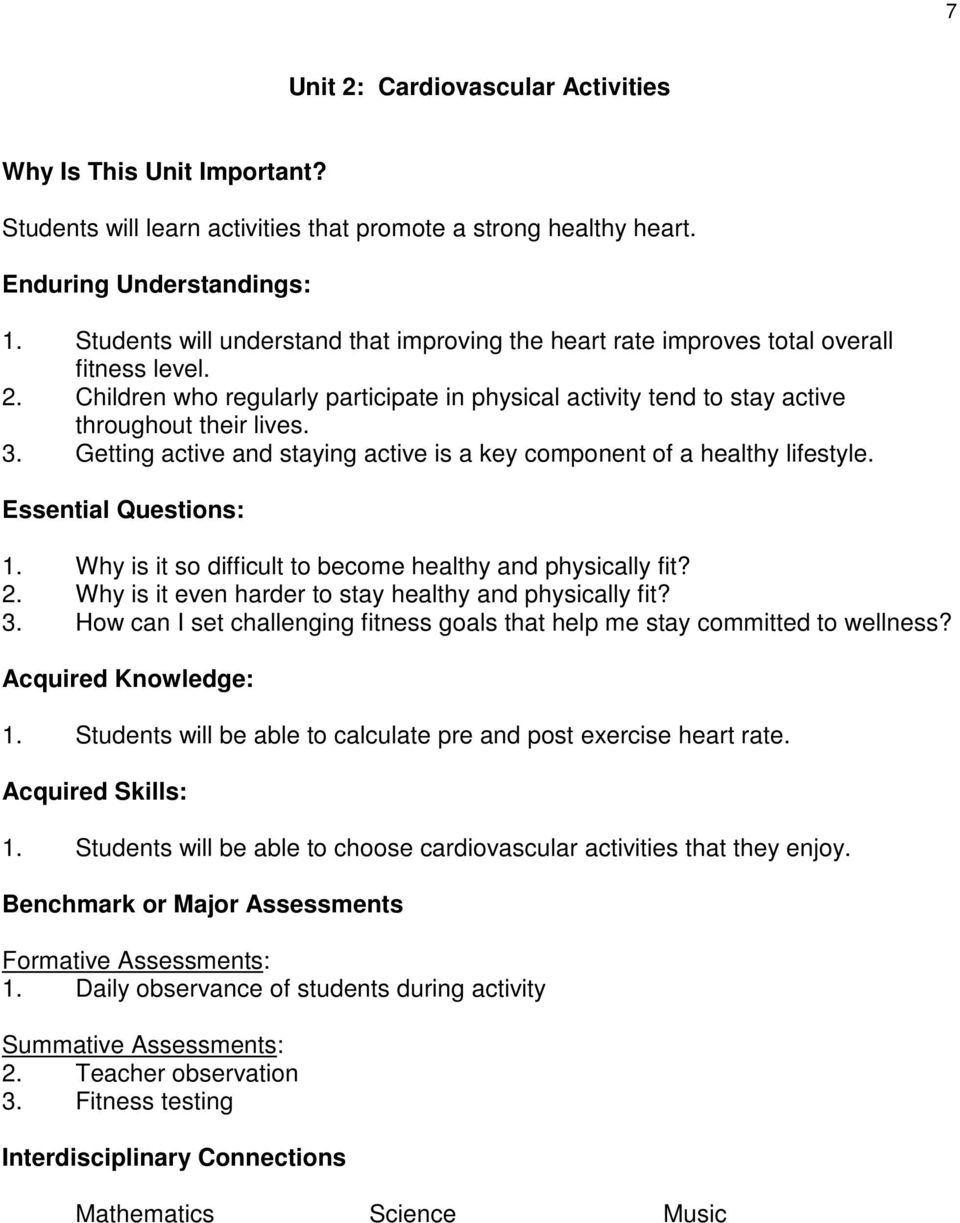
10 8 Accommodations and Extensions (Special Education, ELL, Gifted Learners) 1. Challenge by choice 2. Special accommodations will be made as specified in individual 504 and IEP plans. List of Applicable NJCCS: A A A A A A.1-4,6 Teacher Resources Resource books, internet Websites: Technology Integration Stopwatch, pedometers Websites to look up information ipod, boom box
11 9 Unit 3: Cooperative Games and Team Building Activities Why Is This Unit Important? It is important for social and cognitive development. Enduring Understandings: 1. The social skills learned are important for adulthood interactions. Essential Questions: 1. What positives come from working together as a team? 2. How can a team meet the objectives? Acquired Knowledge: 1. Learning how to work and play with others to achieve a specific goal. Acquired Skills: 1. Listening 2. Communication skills 3. Compromising skills 4. Critical thinking Benchmark or Major Assessments Formative Assessments: 1. Teacher observation 2. Teacher evaluation 3. Positive, prescriptive feedback Summative Assessments: 1. Teacher observation 2. Teacher evaluation Interdisciplinary Connections Mathematics Social Skills Music Language Arts

12 10 Accommodations and Extensions (Special Education, ELL, Gifted Learners) 1. Challenge by choice 2. Special accommodations will be made as specified in individual 504 and IEP plans. List of Applicable NJCCS: A.1-2, A.1-2, A.1-2, A.1-2 Teacher Resources Resource books, internet Websites: Technology Integration Websites to look up information ipod, boom box Stopwatch, pedometers
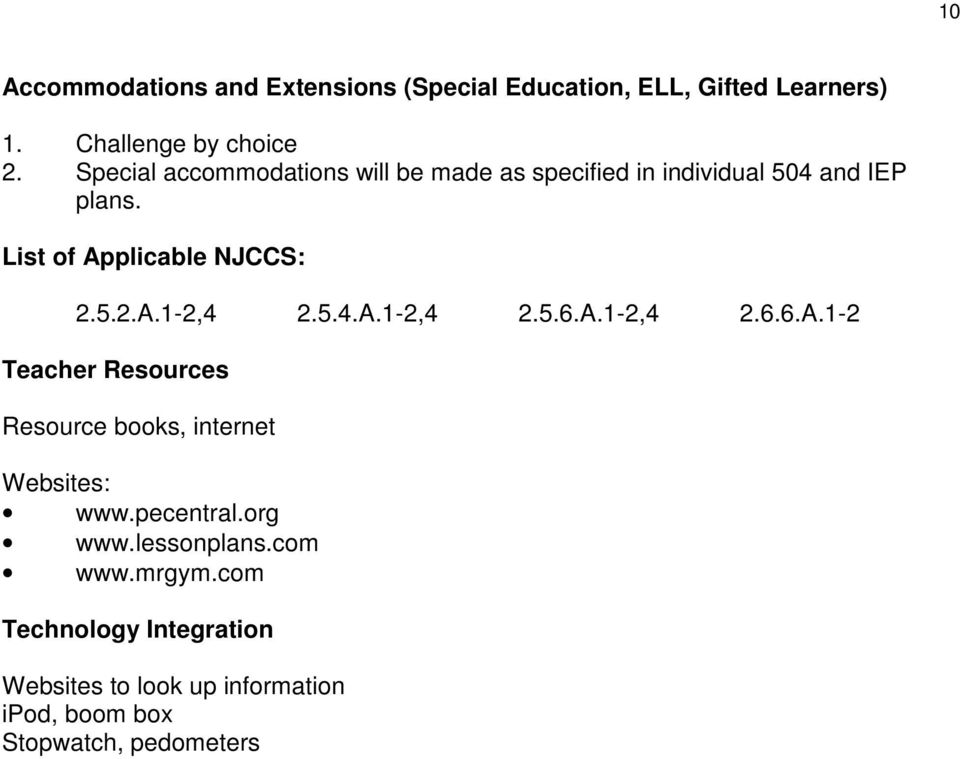
13 11 Unit 4: Lead-Up Games and Team Sports Why Is This Unit Important? Playing games and team sports improves physical fitness, increases skill development, and enhances one character by being part of a team. Enduring Understandings: 1. Students will understand how playing games and team sports can improve their physical fitness. 2. Students will understand how lead-up games help prepare them to play team sports. 3. Students will understand what skills are needed for different lead-up games and team sports. 4. Students will understand how they as individuals can contribute to the success of a team. 5. Students will understand how having and demonstrating good sportsmanship on a team enhances ones own character. Essential Questions: 1. How does a lead-up game help prepare you for a team sport? 2. How does playing a team sport develop one s character? 3. How do lead-up games and team sports improve physical fitness? 4. How are skills developed by playing lead-up games and team sports? Acquired Knowledge: 1. Understand that lead-up games help develop the skills necessary to prepare you for team sports. Acquired Skills: 1. Understanding the importance of good sportsmanship and personal character when playing games and team sports. 2. Even though there is no I in team, each I ndividual needs to know how to make his/her own contribution. Benchmark or Major Assessments Formative Assessments: 1. Daily observance of students playing lead-up games

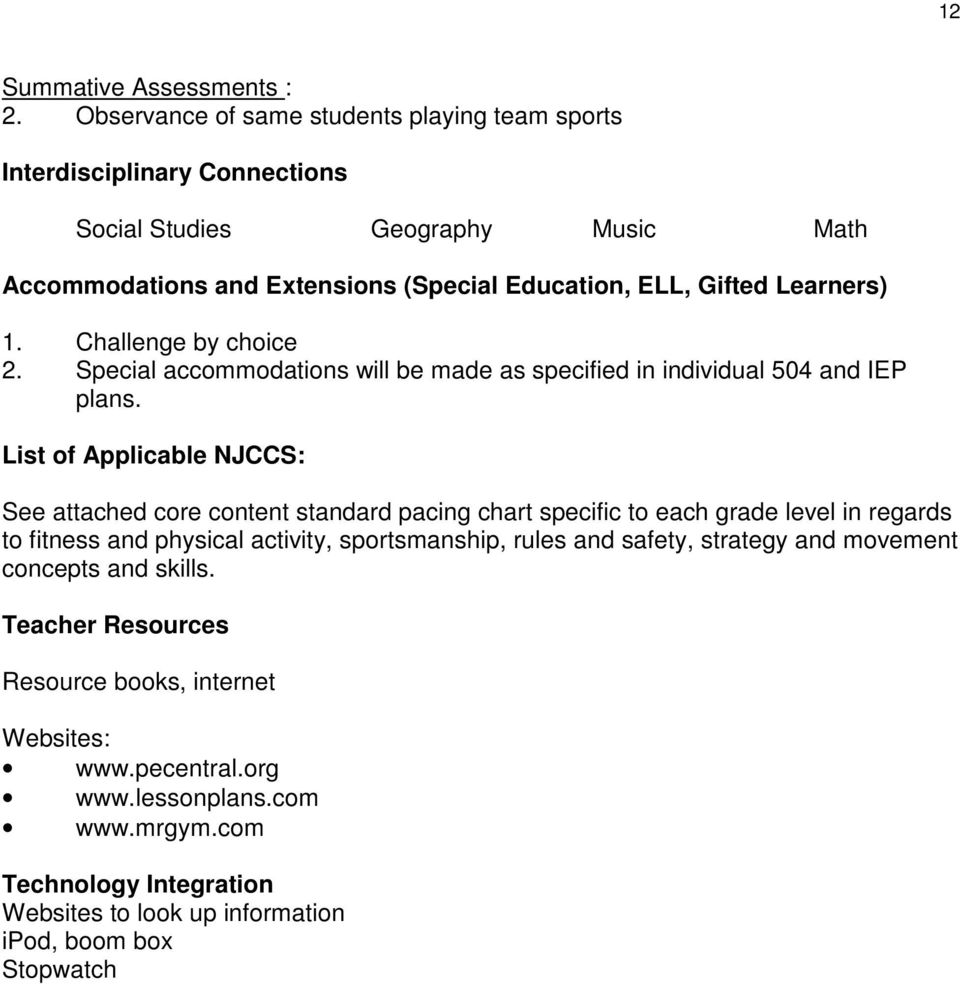
14 12 Summative Assessments : 2. Observance of same students playing team sports Interdisciplinary Connections Social Studies Geography Music Math Accommodations and Extensions (Special Education, ELL, Gifted Learners) 1. Challenge by choice 2. Special accommodations will be made as specified in individual 504 and IEP plans. List of Applicable NJCCS: See attached core content standard pacing chart specific to each grade level in regards to fitness and physical activity, sportsmanship, rules and safety, strategy and movement concepts and skills. Teacher Resources Resource books, internet Websites: Technology Integration Websites to look up information ipod, boom box Stopwatch
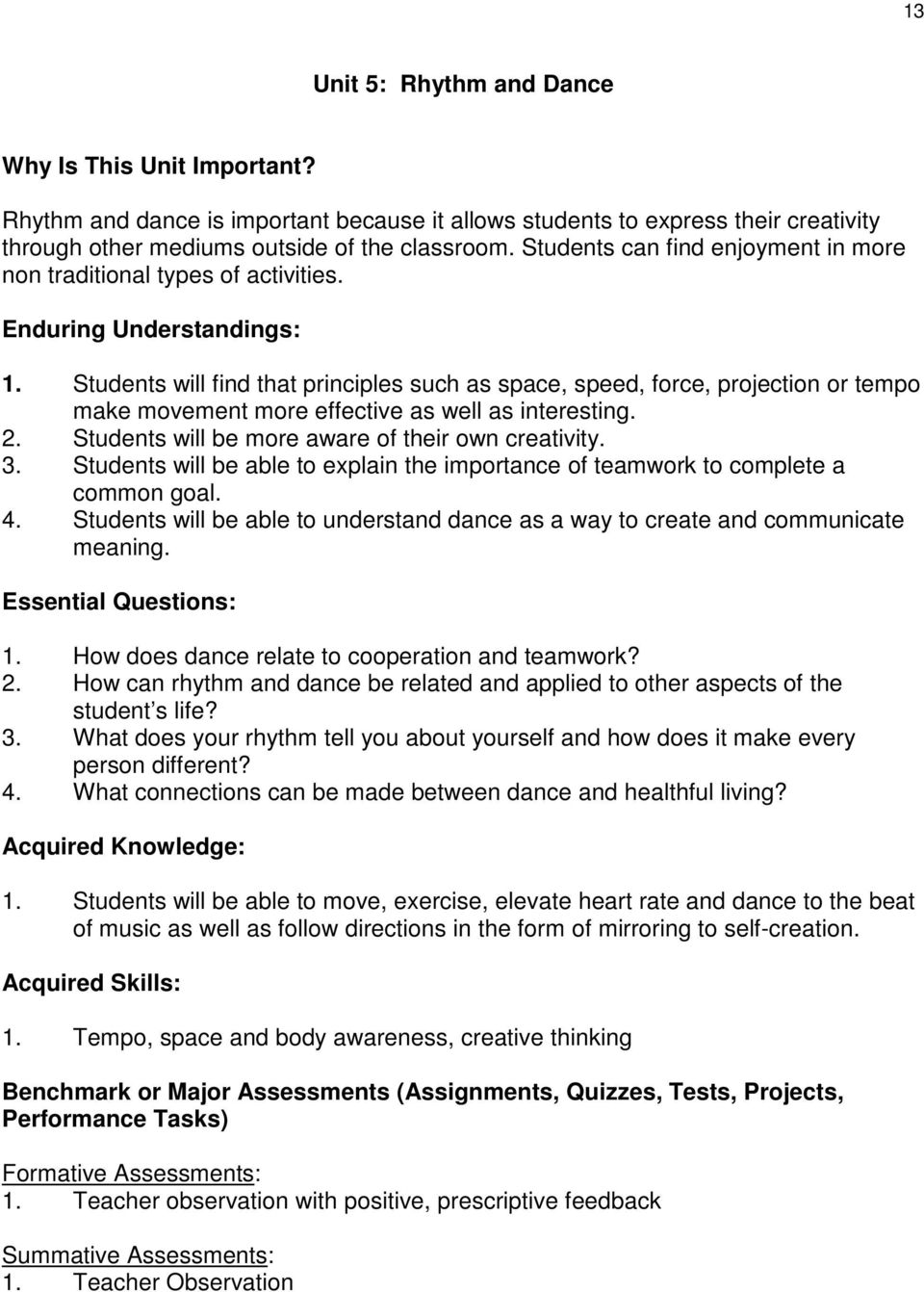
15 13 Unit 5: Rhythm and Dance Why Is This Unit Important? Rhythm and dance is important because it allows students to express their creativity through other mediums outside of the classroom. Students can find enjoyment in more non traditional types of activities. Enduring Understandings: 1. Students will find that principles such as space, speed, force, projection or tempo make movement more effective as well as interesting. 2. Students will be more aware of their own creativity. 3. Students will be able to explain the importance of teamwork to complete a common goal. 4. Students will be able to understand dance as a way to create and communicate meaning. Essential Questions: 1. How does dance relate to cooperation and teamwork? 2. How can rhythm and dance be related and applied to other aspects of the student s life? 3. What does your rhythm tell you about yourself and how does it make every person different? 4. What connections can be made between dance and healthful living? Acquired Knowledge: 1. Students will be able to move, exercise, elevate heart rate and dance to the beat of music as well as follow directions in the form of mirroring to self-creation. Acquired Skills: 1. Tempo, space and body awareness, creative thinking Benchmark or Major Assessments (Assignments, Quizzes, Tests, Projects, Performance Tasks) Formative Assessments: 1. Teacher observation with positive, prescriptive feedback Summative Assessments: 1. Teacher Observation
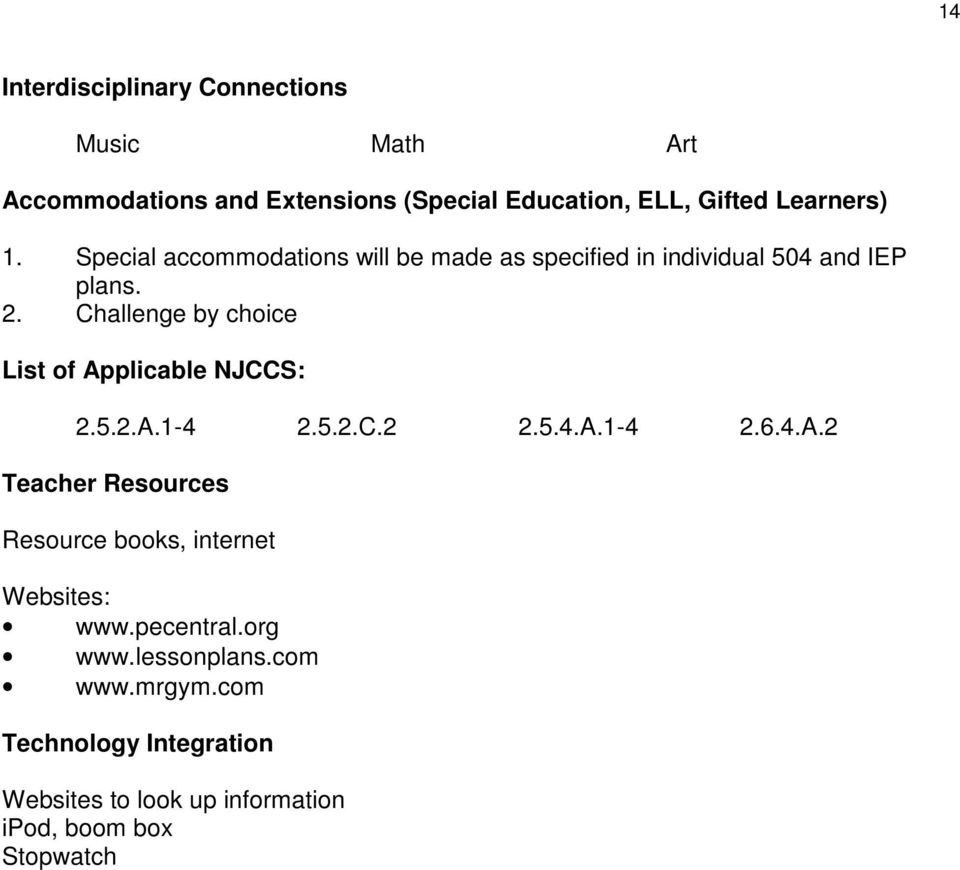
16 14 Interdisciplinary Connections Music Math Art Accommodations and Extensions (Special Education, ELL, Gifted Learners) 1. Special accommodations will be made as specified in individual 504 and IEP plans. 2. Challenge by choice List of Applicable NJCCS: A C A A.2 Teacher Resources Resource books, internet Websites: Technology Integration Websites to look up information ipod, boom box Stopwatch
17 15 Unit 6: Parachute Games Why Is This Unit Important? Parachute activities are important because they allow students to focus on fine and gross motor movements in a way that is enjoyable. They can exercise using wind as the resistance. It is a great way to do large group/ whole class non competitive, cooperative activities. Enduring Understandings: 1. Students will find that principles such as force, gravity, Newton s laws, speed, rhythm and tempo make movement more effective and fun as well as interesting. 2. Students will be more aware of their own space and movement through it. 3. Students will be able to explain the importance of teamwork to complete a common goal. 4. Students will be able to understand the parachute is designed to harness air and use it. Essential Questions: 1. How does the parachute activity relate to cooperation and teamwork? 2. How can the principles learned here be related and applied to other aspects of the student s life? Acquired Knowledge: 1. Students will be able to move, exercise, elevate heart rate and make creations with the parachute in a cooperative manor. Acquired Skills: 1. Fine and gross motor movements, tempo and rhythm of movement with the parachute space and body awareness, using one s imagination. Benchmark or Major Assessments Formative Assessments: 1. Teacher observation with positive, prescriptive feedback Summative Assessments: 1. Teacher observation

18 16 Interdisciplinary Connections Mathematics Science Music Language Arts Reading Geography History Accommodations and Extensions (Special Education, ELL, Gifted Learners) 1. Special accommodations will be made as specified in individual 504 and IEP plans. 2. Challenge by choice List of Applicable NJCCS: See attached core content standard pacing chart specific to each grade level in regards to fitness and physical activity, sportsmanship, rules and safety, strategy and movement concepts and skills. Teacher Resources Resource books, internet Websites: Technology Integration Websites to look up information ipod, boom box Stopwatch
19 17 Unit 7: Balance and Coordination Why Is This Unit Important? Balance and coordination is a fundamental building block for all other activities and healthy life long habits. Enduring Understandings: 1. Students will understand the importance of balance as it relates to controlling and maneuvering their bodies. 2. Students will understand the importance of coordination as it relates to all daily activities. Essential Questions: 1. How does balance and coordination help in daily activities? 2. How does balance and coordination help in improving physical fitness? 3. How does balance and coordination help in keeping yourself and others safe? Acquired Knowledge: 1. Students will be able to use balance and coordination in all other units of physical education as well as all arenas of daily life. Acquired Skills: 1. Loco-motor movements 2. Maneuvering multiple body parts in unison Benchmark or Major Assessments Formative Assessments: 1. Teacher observation with positive, prescriptive feedback Summative Assessments: 1. Teacher observation Interdisciplinary Connections Life Skills Mathematics Science Music Language Arts

20 18 Accommodations and Extensions (Special Education, ELL, Gifted Learners) 1. Special accommodations will be made as specified in individual 504 and IEP plans. 2. Challenge by choice List of Applicable NJCCS: See attached core content standard pacing chart specific to each grade level in regards to fitness and physical activity, sportsmanship, rules and safety, strategy and movement concepts and skills. Teacher Resources Resource books, internet Websites: Technology Integration Websites to look up information ipod, boom box Stopwatch

21 19 Unit 8: Throwing and Catching Why Is This Unit Important? Throwing is important to teach correct body movement (arm extension and follow through while stepping in opposition) while throwing an object. Catching is important for teaching eye and hand coordination as well as timing while catching an object. Both improve gross motor coordination and balance. Enduring Understandings: 1. Students will understand the importance of body and eye coordination, balance, and timing as they relate to efficient throwing and catching. Essential Questions: 1. How does throwing and catching carry over into other games and activities? 2. Why is eye-hand coordination and balance in everyday life? Acquired Knowledge: 1. Students will understand stepping in opposition and body balance is important while throwing an object 2. Students will understand why eye-hand coordination and timing is important for catching an object. Acquired Skills: 1. Throwing o Body balance o Stepping in opposition o Aiming and accuracy o Overhand throwing 2. Catching o Eye-hand coordination o Timing o Absorbing Benchmark or Major Assessments Formative Assessments: 1. Teacher observation with positive, prescriptive feedback Summative Assessments: 1. Teacher observation
22 20 Interdisciplinary Connections Mathematics Science Music Language Arts Reading Geography Accommodations and Extensions (Special Education, ELL, Gifted Learners) 1. Special accommodations will be made as specified in individual 504 and IEP plans. 2. Challenge by choice. Increasing/decreasing distance, using non dominate hand, increasing/decreasing size of targets. Using other types of objects. Change the way of throwing (underhand toss and rolling). List of Applicable NJCCS: See attached core content standard pacing chart specific to each grade level in regards to fitness and physical activity, sportsmanship, rules and safety, strategy and movement concepts and skills. Teacher Resources Resource books, internet Websites: Technology Integration Websites to look up information ipod, boom box
23 21 Unit 9: Loco-Motor Activities Why Is This Unit Important? Loco-motor activities are important because they lay a foundation for how students move through space. It improves gross motor coordination and balance. Enduring Understandings: 1. Understanding the importance of loco-motor movements as they relate to being the building blocks of safe movement in participation in games, sports, dance, and recreational activities. Essential Questions: 1. How does performing loco-motor movements carry over into other games and activities? Acquired Knowledge: 1. Students will be able to move about the classroom and other arenas of their life safely while maintaining the appropriate social behaviors in terms of safe traveling. Acquired Skills: 1. Tempo, space and body awareness Running Walking Leaping Hopping Jumping Skipping Galloping Sliding Benchmark or Major Assessments Formative Assessments: 1. Teacher observation with positive, prescriptive feedback Summative Assessments: 1. Teacher observation
24 22 Interdisciplinary Connections Mathematics Science Music Language Arts Reading Geography History Accommodations and Extensions (Special Education, ELL, Gifted Learners) 1. Special accommodations will be made as specified in individual 504 and IEP plans. 2. Challenge by choice List of Applicable NJCCS: See attached core content standard pacing chart specific to each grade level in regards to fitness and physical activity, sportsmanship, rules and safety, strategy and movement concepts and skills. Teacher Resources Resource books, internet Websites: Technology Integration Websites to look up information ipod, boom box Stopwatch, pedometers
25 23 Unit 10: Spatial Awareness Activities Why Is This Unit Important? Spatial awareness is important because it serves as a basis for all activities in physical education as well as appropriate social behavior and personal safety. Enduring Understandings: 1. Understanding the importance of spatial awareness as it relates to maintaining a safe learning environment. 2. Students will find out how they can maneuver throughout their own space to achieve a common goal. Essential Questions: 1. How does operating in your own space help maintain a safer environment? Acquired Knowledge: 1. Students will be able to move about the classroom and other arenas of their life safely while maintaining the appropriate social behaviors in terms of personal space. Acquired Skills: 1. Body awareness Benchmark or Major Assessments Formative Assessments: 1. Teacher observation with positive, prescriptive feedback Summative Assessments: 1. Teacher observation Interdisciplinary Connections Everyday aspects of life Accommodations and Extensions (Special Education, ELL, Gifted Learners) 1. Challenge by choice 2. Special accommodations will be made as specified in individual 504 and IEP plans.
26 24 List of Applicable NJCCS: See attached core content standard pacing chart specific to each grade level in regards to fitness and physical activity, sportsmanship, rules and safety, strategy and movement concepts and skills. Teacher Resources Resource books, internet Websites: Technology Integration Websites to look up information ipod, boom box Stopwatch, pedometers
27 25 Unit 11: Cross Curriculum Games Why Is This Unit Important? Cross curriculum games are important because they help reinforce other areas of education and draws connections between the disciplines which relates to real world experiences. Enduring Understandings: 1. Understanding the importance of the curricula connections and appreciating the diversity of the world around us. Essential Questions: 1. How do cross curricula games reinforce other academic areas? 2. How do cross curricula games prepare you for everyday life experiences? Acquired Knowledge: 1. Students will be able to understand how cross curricular games and activities will benefit academic areas and life. Acquired Skills: 1. Critical thinking 2. Teamwork 3. Deductive reasoning 4. Forming hypotheses Benchmark or Major Assessments Formative Assessments: 1. Teacher observation with positive, prescriptive feedback Summative Assessments: 1. Teacher observation Interdisciplinary Connections Mathematics Science Music Language Arts Reading Geography History
28 26 Accommodations and Extensions (Special Education, ELL, Gifted Learners) 1. Special accommodations will be made as specified in individual 504 and IEP plans. 2. Challenge by choice List of Applicable NJCCS: See attached core content standard pacing chart specific to each grade level in regards to fitness and physical activity, sportsmanship, rules and safety, strategy and movement concepts and skills. Teacher Resources Resource books, internet Websites: Technology Integration Websites to look up information ipod, boom box Stopwatch, pedometers
29 27 Descriptions of Applicable NJCCS Standards/CPIs A A A A A A A A A A A A A A A A A A A A A A A A.6 Explain and perform movement skills with developmentally appropriate control in isolated settings (i.e., skill practice) and applied settings (i.e., games, sports, dance, and recreational activities). Demonstrate changes in time, force, and flow while moving in personal and general space at different levels, directions, ranges and pathways. Respond in movement to changes in tempo, beat, rhythm or musical style. Correct movement errors in response to feedback. Explain and perform essential elements of movement skills in both isolated settings (i.e., skill practice) and applied settings (i.e., games, sports, dance, and recreational activities). Use body management skills and demonstrate control when moving in relation to others, objects and boundaries in personal and general space. Explain and demonstrate movement sequences, individually and with others, in response to various tempos, rhythms and musical styles. Correct movement errors in response to feedback and explain how the change improves performance. Explain and perform movement skills that combine mechanically correct movement in smooth flowing sequences in isolated settings (i.e., skill practice) and applied settings (i.e., games, sports, dance and recreational activities). Explain concepts of force and motion and demonstrate control while modifying force, flow, time, space and relationships in interactive dynamic environments. Create and demonstrate planned movement sequences, individually and with others, based on tempo, beat, rhythm and music (creative, cultural, social and fitness dance). Use self-evaluation and external feedback to detect and correct errors in one s movement performance. Explain the role of regular physical activity in relation to personal health. Explain what it means to be physically fit and engage in moderate to vigorous ageappropriate activities that promote fitness. Develop a fitness goal and monitor progress towards achievement of the goal. Determine the physical, social, emotional and intellectual benefits of regular physical activity. Participate in moderate to vigorous age-appropriate activities that address each component of health-related and skill-related fitness. Develop a health-related fitness goal and track progress using health/fitness indicators. Determine the extent to which different factors influence personal fitness, such as heredity, training, diet and technology. Analyze the social, emotional, and health benefits of selected physical experiences. Determine to what extent various activities improve skill-related fitness versus health-related fitness. Develop and implement a fitness plan based on the assessment of one s personal fitness level, and monitor health/fitness indicators before, during and after the program. Predict how factors such as health status, interests, environmental conditions, and available time may impact personal fitness. Explain and apply the training principles of frequency, intensity, time and type (FITT) to improve personal fitness.
Tri-District Physical Education Grade K - 12 Curriculum
 Tri-District Physical Education Grade K - 12 Curriculum 2013 Mr. Patrick Fletcher Superintendent River Dell Regional Schools Ms. Lorraine Brooks Principal River Dell High School Mr. Richard Freedman Principal
GRADE ONE. End of 1st 9 Weeks. Initial Evaluation. Scoring: Not attempted 0 points Attempted 1 point Performs most 2 points Mastery 3 points
 GRADE ONE Date 1. Demonstrate jumping and landing skills by using one- and two-foot take-off methods, balancing at varying levels on multiple body parts, and forming bridges using different body parts.
Content Outline for MTTC Test Review
 Content Outline for MTTC Test Review Concepts and Strategies of Physical Education Components of health-related physical fitness, the F.I.T.T. principle, and methods for applying these components. o What
Kindergarten Elementary Physical Education Curriculum Moon Area School District. Month August/September
 Month August/September Unit: Rules & Procedures/Safety/Low organized Games If we have a question what do we do? Classroom Rules and procedures for Where is our assigned seat? What is personal space? When
One Stop Shop For Educators. Georgia Performance Standards Framework for Physical Education
 PE3.1: Demonstrates competency in motor skills and movement patterns needed to perform a variety of physical activities. Description: Students demonstrate mature form in all locomotor and non-locomotor
One Stop Shop For Educators. Georgia Performance Standards Framework for Physical Education
 PEHS.1: Demonstrates competency in motor skills and movement patterns needed to perform a variety of physical activities. Description: Students in grades 9 12 will demonstrate the ability to participate
Physical Education Curriculum Framework
 1 PHYSICAL EDUCATION PHILOSOPHY/RATIONALE AND THE CURRICULUM GUIDE Philosophy/Rationale In schools, we believe and understand that each person is created in God s image as unique and loveable. As independent
One Stop Shop For Educators. Georgia Performance Standards Framework for Physical Education
 PEK.1: Demonstrates competency in motor skills and movement patterns needed to perform a variety of activities. Description: Students will experience all locomotor movement patterns (e.g., hop, jump, and
PHILOSOPHY OF PHYSICAL EDUCATION
 PHILOSOPHY OF PHYSICAL EDUCATION Children in grades K-4 learn in a variety of ways. For children of this age level, play is an important learning tool. The PE program takes play and structures it into
Kindergarten Physical Education Scope and Sequence
 Kindergarten Physical Education Scope and Sequence Participate in daily activities that require physical exertion for short periods of time. Recognize physiological signs of moderate physical activity,
5TH GRADE FITNESS STUDY GUIDE
 PHYSICAL EDUCATION 5 TH GRADE FITNESS STUDY GUIDE PART I. Revised 5-13 DIRECTIONS: Review the following terms and concepts. Do not try to memorize the definitions, rather think about and understand: 1)
HADDONFIELD PUBLIC SCHOOLS Curriculum Map for Physical Education, Grade Five
 Curriculum Map for Physical Education, Grade Five Targeted Standard(s): NJCCCS 2.5 Strands A-D; 2.6 1 st Trimester Enduring Understandings : -Knowledge of health and physical education concepts and skill
PHYSICAL EDUCATION A. PROGRAM RATIONALE AND PHILOSOPHY
 PHYSICAL EDUCATION A. PROGRAM RATIONALE AND PHILOSOPHY The aim of the Kindergarten to Grade 12 physical education program is to enable individuals to develop the knowledge, skills and attitudes necessary
2014-2015 Curriculum Blueprint Grade: 6/7 Course: M/J Comprehensive P.E. 6 th and 7 th Grade Unit 1: Safety and Fitness
 Unit 1: Safety and Fitness 15 days 1 Heat exhaustion, heat stroke, dehydration, frostbite, warm up, cool down, aerobic, anaerobic, resting heart rate, target heart rate, cardiovascular fitness, strength,
Subchapter B. Middle School
 Chapter 116. Texas Essential Knowledge and Skills for Physical Education Subchapter B. Middle School Statutory Authority: The provisions of this Subchapter B issued under the Texas Education Code, 28.002,
Content Map For PHYSICAL EDUCATION
 Content Strand: Health-Related Fitness Activities 3-PE-1 Perform, sit-ups, shuttle run, v-sit, pull ups/flexed arm hang, mile run/walk. 3-PE-2 Perform walking, jogging, aerobic dancing activities and fitness
INTRODUCTION. The benefits of having standards for physical education
 Standards - What are they? INTRODUCTION Standards are statements that define what students should know and be able to do upon completion of specific levels of instruction. Standards serve as a gauge for
Parachute Play. 1 week PE 1.1, 1.2, 1.3, 1.6. Objectives Methods Resources Assessment
 1. demonstrate the proper grip-hold on the parachute. 2. execute proper form of the basic skills. 3. name and perform basic routines to music 4. perform directional changes and hands off moves. 5. use
North Carolina Essential Standards Physical Education. (MS) Motor Skills
 Note on Numbering: example PE.K.MS.1.1 indicates Kindergarten Motor Skills 1 and Clarifying Objective 1. Note: MS = Motor Skills, MC = Movement Concepts, HF = Health-Related Fitness, PR = Personal/Social
Educational Innovation
 Educational Innovation July, 2013 Dear Educators, On behalf of all of MCESA, we are excited that you are using our content specific assessments in your school or district. We sincerely hope that the assessments
Physical Education 6 th Grade
 Physical Education 6 th Grade Grade 6 Physical and Health Education is focused on the acquisition of basic movement patterns and motor skills as they relate to physical fitness. Students will be exposed
Demonstrate knowledge of movement concepts, principles, and strategies as they apply to learning and performance of physical activities.
 Standard 1: Standard 2: Standard 3: Standard 4: Standard 5: California Physical Education Content Standards Grade 5 Demonstrate motor skills and movement patterns needed to perform a variety of physical
Personal Fitness Plan
 Personal Fitness Plan 7 th Grade 1 week plan/1 week food log Name Period 0 1 2 3 4 5 6 7 Date When you complete this project, you will accomplish the following: Set specific short-term and long-term personal
Indiana Content Standards for Educators PHYSICAL EDUCATION
 Indiana Content for Educators PHYSICAL EDUCATION Physical education teachers are expected to have understanding of the knowledge and skills needed for this educator license, and to use that knowledge to
Sing, Spell, Read & Write
 Sing, Spell, Read & Write Correlated to Head Start DOMAIN: LANGUAGE DEVELOPMENT Element: Listening & Understanding Demonstrates increasing ability to attend to and understand conversations, stories, songs,
High School Physical Education Curriculum. Table of Contents... - 1 - High School Physical Education Program...- 7 -
 High School Physical Education Curriculum TABLE OF CONTENTS Table of Contents... - 1 - High School Physical Education Program...- 7 - Adaptive Physical Education: Course Descriptions and Benchmark Numbers...-
Content Standard 1: 5-8 Benchmark 1: 5-8 Benchmark 2:
 Physical Education Grades 5-8 Content Standard 1: Demonstrates competency in many movement forms and proficiency in a few movement forms. Students will: 5-8 Benchmark 1: Demonstrate proficiency in combining
Knowledge and Understanding of the World. Early Learning Goals. National Curriculum. (learning objectives) (level 1 descriptors)
 Knowledge and Understanding of the World Knowledge and Understanding of the world Science K&U4 Ask questions about why things happened and how things work To talk about what they see To make recordings
Holly Hill Methodist/Church of England (Aided) Infant and Nursery School. Vision
 Holly Hill Methodist/Church of England (Aided) Infant and Nursery School Physical Education Policy, January 2015 (Miss Allen, Physical Education Coordinator) Vision Physical Education (PE) at Holly Hill
Standards for Certification in Early Childhood Education [26.110-26.270]
![Standards for Certification in Early Childhood Education [26.110-26.270]](/thumbs/24/3436110.jpg "Standards for Certification in Early Childhood Education [26.110-26.270]") I.B. SPECIFIC TEACHING FIELDS Standards for Certification in Early Childhood Education [26.110-26.270] STANDARD 1 Curriculum The competent early childhood teacher understands and demonstrates the central
I.B. SPECIFIC TEACHING FIELDS Standards for Certification in Early Childhood Education [26.110-26.270] STANDARD 1 Curriculum The competent early childhood teacher understands and demonstrates the central
TEXAS RISING STAR WEBINAR SERIES: CURRICULUM AND EARLY LEARNING GUIDELINES RECORDED OCTOBER 29, 2015 NOTES
 TEXAS RISING STAR WEBINAR SERIES: CURRICULUM AND EARLY LEARNING GUIDELINES RECORDED OCTOBER 29, 2015 NOTES The topics that will be addressed during these webinars include: 1. The General Overview: Curriculum
Grade Band Overview by Standard and Organizers
 physical education Grade Band Overview by Standard and Organizers 87 Standard 1 Demonstrates competency in motor skills and movement patterns needed to perform a variety of physical Standard 2 Demonstrates
Health and wellbeing Principles and practice
 Health and wellbeing Principles and practice Curriculum for Excellence has an important role to play in promoting the health and wellbeing of children and young people and of all of those in the educational
CONCEPT CONTENT HEALTH & PHYSICAL EDUCATON CONTENT CONCEPTS
 HEALTH & PHYSICAL EDUCATON CONTENT CONCEPT 1 Students will demonstrate knowledge and competent skills in a variety of movements, physical activities and sports. CONCEPT 2 Students will achieve and maintain
GetYourselfMoving A.S.A.P. JohnBaker&AaronHart
 GetYourselfMoving A.S.A.P. JohnBaker&AaronHart Get Yourself Moving A.S.A.P. Session Objectives: Participate in SPARK ASAP activities Learn instructional strategies to increase MVPA in your classes Start
Course Overview Name of Course: Child Care I Name of Department: Family and Consumer Science
 Course Overview Name of Course: Child Care I Name of Department: Family and Consumer Science The Child Care Career Program This is a three year program designed to give students interested in a career
North Shore Schools. Elementary Standards-Based Report Card Parent Guide
 North Shore Schools Elementary Standards-Based Report Card Parent Guide 2015-2016 1 North Shore Schools Board of Education Herman Berliner, President, Antoinette Labbate, Vice President Joanna Commander
HACKETTSTOWN, NEW JERSEY. Computer Animation Grades 10-12 CURRICULUM GUIDE FINAL DRAFT. July 2014
 HACKETTSTOWN, NEW JERSEY Computer Animation Grades 10-12 CURRICULUM GUIDE FINAL DRAFT July 2014 Mr. David C. Mango, Superintendent Ms. Nadia Inskeep, Director of Curriculum & Instruction Developed by:
MODULE THREE WELLNESS PLAN
 MODULE THREE WELLNESS PLAN Fill in all logs and answer the reflection questions completely with supporting details.. SECTION 1: GOALS Include your goals for each area of wellness before completing the
Age Developmental Characteristics:
 6 Year Old: 1. Good supply of energy. 2. Muscular control becoming more effective with large objects. 3. There is a noticeable change in the eye-hand behavior. 4. Legs lengthening rapidly. 5. Big muscles
CURRICULUM MAP. Elementary and Early Childhood Program: Alignment of Student Learning Outcomes, Standards, and Assessments
 CURRICULUM MAP Elementary and Early Childhood Program: Alignment of Student Learning Outcomes, Standards, and Assessments ACEI = Association for Childhood Education International Standards (see below for
Physical Education Course Standards for High School Graduation Requirement
 Physical Education Course Standards for High School Graduation Requirement Approved by the SD Board of Education July 10, 2006 Guide to the Numbering and Symbol System Used in the Document Standards are
Lead-Deadwood Physical Education Curriculum Kindergarten-Second Grade
 Lead-Deadwood Physical Education Curriculum - Standard 1: The physically literate individual demonstrates proficiency in a variety of motor skills and movement patterns. S1.E1 Performs locomotor skills
DOMINICAN INTERNATIONAL SCHOOL. Physical Education
 DOMINICAN INTERNATIONAL SCHOOL Physical Education Elementary School Grade 3-5 S.Y. 2015~2016 Grade Level: 3-5 Teacher: Julie Chiu Email: [email protected] Course Description The activities and topics
Arkansas Early Childhood Education Framework Benchmarks
 Arkansas Early Childhood Education Framework BRIGANCE Diagnostic Inventory of Early Development II (IED II) CURRICULUM ASSOCIATES, Inc. Arkansas Early Childhood Education Framework DEVELOPMENTAL LEARNING
What is Physical Fitness?
 What is Physical Fitness? Physical fitness is made up of two components: Skill-related fitness and Health related fitness. Skill related fitness items are factors, which relate to the possibility of you
UPPER SCHOOL COURSE CATALOG Grades 6-7
 UPPER SCHOOL COURSE CATALOG Grades 6-7 Of Nevada 2015-2016 1 P a g e DORAL ACADEMY of NEVADA MISSION STATEMENT Doral Academy of Nevada is dedicated to providing an enhanced educational experience. We will
Alignment of the Hawaii Preschool Content Standards With HighScope s Preschool Child Observation Record (COR), 2nd edition
 Alignment of the Hawaii Preschool Content Standards With HighScope s Preschool Child Observation Record (COR), 2nd edition The following chart shows how items from the Hawaii Preschool Content Standards
Elementary Physical Education Curriculum Essentials Document
 Elementary Physical Education Curriculum Essentials Document Boulder Valley School District Department of Curriculum and Instruction May 2009 . Elementary Physical Education Curriculum Essentials Document
Demonstrate knowledge of movement concepts, principles, and strategies as they apply to learning and performance of physical activities.
 Standard 1: Standard 2: Standard 3: Standard 4: Standard 5: California Physical Education Content Standards Grade 4 Demonstrate motor skills and movement patterns needed to perform a variety of physical
9 th Grade Physical Education Unpacked Content
 This document is designed to help North Carolina educators teach the Essential Standards (Standard Course of Study). NCDPI staff are continually updating and improving these tools to better serve teachers.
9-12 Physical Education and Leisure Curriculum Framework. Revised 2011
 9-12 Physical Education and Leisure Curriculum Framework Revised 2011 Course Title: Physical Education and Leisure Course/Unit Credit: 1 Course Number: 485000 Teacher Licensure: Please refer to the Course
Arkansas State PIRC/ Center for Effective Parenting
 Increasing Your Child s Motivation to Learn In order to be successful in school and to learn, students must stay involved in the learning process. This requires students to do many different activities
Art & Music Five Year Plan. Program Review, Research & Recommendations Chris McCullough, Supervisor Fine & Applied Arts June, 2012
 Art & Music Five Year Plan Program Review, Research & Recommendations Chris McCullough, Supervisor Fine & Applied Arts June, 2012 RPS Arts Mission Statement We regard the arts as basic to the education
food intake. It can also increase the awareness of children to foods that may not be part of the family s usual diet.
 I. To Establish and Maintain a Safe, Healthy Learning Environment Functional Area 1 Safety of all children in the preschool environment is the preeminent responsibility of all caregivers. Safety must be
KEY SKILLS OF JUNIOR CYCLE
 KEY SKILLS OF JUNIOR CYCLE Key skills of junior cycle Learners need a wide range of skills to help them face the many challenges presented to them in today s world. They develop specific skills in their
Physical Activity in the School Environment and the Community
 Chapter 5 Physical Activity in the School Environment and the Community Chapter objectives: To briefly describe how our changing society is influencing the effect of schools on the behaviour of modern
School Improvement Plan for Numeracy 2015-2016
 School Improvement Plan for Numeracy 2015-2016 May 2015 School Improvement Plan Numeracy 1.1. The Following Areas are Prioritized for Improvement On the bases of the all the data gathered and analysed
New Hampshire Department of Education Special Education Program Approval and Improvement Process
 New Hampshire Department of Education Special Education Program Approval and Improvement Process The mission of NHDOE Special Education Program Approval is to improve education results for all learners.
file://10.16.128.12/common/administration/common/program%...
 Page 1 of 5 Health/Physical Ed Curriculum Physical Education 10 The Fairfax County Public Schools Physical Education Program of Studies incorporates the Virginia Physical Education Standards of Learning,
CHESHIRE PUBLIC SCHOOLS SUBJECT AREA SUMMARY SHEETS MUSIC
 CHESHIRE PUBLIC SCHOOLS SUBJECT AREA SUMMARY SHEETS MUSIC Curriculum Review Cycle Schedule 14-15 Analyze/Plan-Presentation to CCC 15-16 Implement I 16-17 Implement II 17-18 Implement III 18-19 Evaluation
21ST CENTURY SKILLS T1 T2 T3. Teacher Comments. Riverview Student Report Card. 1st Trimester (T1) Parent Conference Held on October 21
 Tardies: 0 1st Trimester 0 nd Trimester 0 3rd Trimester 0 Year Total Student Name: Absences: 0 1st Trimester Grade: Middle School 0 nd Trimester Teacher: Carroll 0 3rd Trimester School Year: 011-01 0 Year
How To Teach Your Children To Be Healthy
 PHYSICAL EDUCATION/HEALTH COURSES PHYSICAL EDUCATION/HEALTH KINDERGARTEN GRADE 2 The Kindergarten through Grade 2 Physical Education program is designed to develop a positive attitude in children toward
The Dance Lesson. A good dance lesson should contain some or all of the following:-
 The Dance Lesson The Primary School Curriculum says:- Dance in education involves the child in creating, performing and appreciating movement as a means of expression and communication. Dance differs from
Preschool Development Assessment
 Preschool Development Assessment Child s Name: DOB: Completed by: Date began: This document may be copied for classroom use only. Not to be sold or used on any other website. Property of www.re-teach.com.
Early Childhood Foundations to the Indiana Academic Standards
 Alignment of the Early Childhood Foundations to the Indiana Academic Standards for Young Children from Birth to Age 5 with the Preschool Child Observation Record (COR), 2 nd edition The Preschool Child
COACHING GUIDE. Preparing Athletes for Competition
 COACHING GUIDE Preparing Athletes for Competition Table of Contents Table of Contents Psychological Considerations Anxiety and Stress Management Winning and Losing Handling Grief Taking Athletes to Competition
CONNECTICUT SEED Student and Educator Support Specialists Guidance Document
 CONNECTICUT SEED Student and Educator Support Specialists Guidance Document Physical Education Teachers 1 This document provides guidance to administrators and Student and Educator Support Specialists
JAPANESE KINESIOLOGY COURSE DESCRIPTION. WEST LOS ANGELES COLLEGE 2014 2016 CATALOG (revised Fall 2015) 209. (Replaces Physical Education )
 JAPANESE 1 Elementary Japanese I (5) This course provides the fundamentals of the Japanese language with emphasis on the spoken word. The Japanese syllabary for Hiragana, Katakana and basic Kanji are introduced.
number of exercise or activity sessions per week e.g. three sessions (Tuesday, Thursday and Sunday)
 F.I.T.T. Principle A guide used to develop a personal exercise plan Frequency: number of exercise or activity sessions per week e.g. three sessions (Tuesday, Thursday and Sunday) Intensity: level of exertion
Literacy across learning Principles and practice
 Literacy across learning Principles and practice Language and literacy are of personal, social and economic importance. Our ability to use language lies at the centre of the development and expression
CHORLTON HIGH SCHOOL: CURRICULUM YEAR 8 PE
 ELE 2 Days: ELE 4 Days CHORLTON HIGH SCHOOL: CURRICULUM Year 8 Autumn 1 Autumn 2 Spring 1 Spring 2 Summer 1 Summer 2 Subject First 2 weeks will involve Athletics testing LAPs: LAPs: Content LAPs: Continue
Planning Commentary Respond to the prompts below (no more than 9 single-spaced pages, including prompts).
 Planning Commentary Respond to the prompts below (no more than 9 single-spaced pages, including prompts). 1. Central Focus a. Describe the central focus and purpose for the content you will teach in this
8th Grade Personal Fitness Plan
 8th Grade Personal Fitness Plan 2 Week Activity Log & 1 week Food Log Name: Period: Date: Personal Fitness Contract I,, am going to make a commitment to helping build my lifelong fitness and nutrition
The Creative Curriculum for Preschool: Objectives for Development & Learning
 Curriculum Alignment of The Creative Curriculum for Preschool: Objectives for Development & Learning with Alignment of The Creative Curriculum for Preschool: Objectives for Development & Learning With
General Certificate of Secondary Education (Short Course) June 2011. Unit 1: Knowledge and Understanding for the Active Participant (Short Course)
 Version 1 General Certificate of Secondary Education (Short Course) June 2011 Physical Education 48901 (Specification 4891) Unit 1: Knowledge and Understanding for the Active Participant (Short Course)
USCGA Health and Physical Education Fitness Preparation Guidelines
 USCGA Health and Physical Education Fitness Preparation Guidelines MUSCULAR STRENGTH Muscular strength and endurance can be improved by systematically increasing the load (resistance) that you are using.
CHILD S NAME INSERT CHILD S PHOTO HERE
 RECORD OF F DEVELOPMENT T A AND N PROGRESS AT KINDERGARTEN RT LEVEL CHILD S NAME INSERT CHILD S PHOTO HERE GUIDELINES for Kindergarten Assistants: Every Kindergarten Assistant (KGA) must know if each child
Middle School Course Catalog
 Middle School Course Catalog 2015-2016 1 P a g e Mater Academy of Nevada School Mission Statement The mission of Mater Academy of Nevada is to provide an innovative, challenging, multi-cultural education,
Years and Curriculum Levels
 Years and Curriculum Levels This diagram shows how curriculum levels typically relate to years at school. Many students do not, however, fit this pattern. They include those with special learning needs,
Curriculum Guide for Physical Education Parent Guide
 Curriculum Guide for Physical Education Parent Guide District Mission The South Brunswick School District will prepare students to be lifelong learners, critical thinkers, effective communicators and wise
California Subject Examinations for Teachers
 CSET California Subject Examinations for Teachers TEST GUIDE PHYSICAL EDUCATION SUBTEST I Subtest Description This document contains the Physical Education subject matter requirements arranged according
Subchapter C. High School
 Chapter 116. Texas Essential Knowledge and Skills for Physical Education Subchapter C. High School Statutory Authority: The provisions of this Subchapter C issued under the Texas Education Code, 28.002,
Fundamental Movement Skills:
 Fundamental Movement Skills: FMS Tools for Schools Brett Thompson About Us Founded in 1933, Physical and Health Education Canada (PHE Canada) is a national advocacy leader for the healthy growth and development
Middle School. Physical Education Curriculum Guide
 Middle School Physical Education Curriculum Guide Table of contents Subject pages Introduction and Purpose of the Curriculum Guide..... 3-11 P.E. II Standards, GLIs, Assessment, & OGT... 12-35 P.E. Sample
Mathematics Policy. Mathematics Policy
 Mathematics Policy 1. Aims 1.1 Mathematics teaches children to make sense of the world around them through developing their ability to calculate, reason and solve problems. It enables children to understand
EARLY CHILDHOOD EDUCATION CENTER
 The Isadore Joshowitz EARLY CHILDHOOD EDUCATION CENTER HILLEL ACADEMY OF PITTSBURGH The Isadore Joshowitz Early Childhood Center at Hillel Academy of Pittsburgh is a warm, nurturing, and inclusive environment
Creative Curriculum Developmental Continuum Checklist
 Social/Emotional Development: Prosocial Behavior Curriculum Objective: 13 Uses thinking skills to resolve conflicts Accepts adult solution to resolve a conflict Seeks adult assistance to resolve a conflict
Health and PE. Smyth County Schools Curriculum Map Grade:9 Subject:PE
 Standards Dev. 03/2008 1 Grade:9 Subject:PE 1st Quarter 9.1a: Apply competencies in all locomotor, non-locomotor, and manipulative skills to appropriate game/sport, dance, and recreational activities 9.2a:
North Stainley Primary School. Policy for PE. The importance of Physical Education to the curriculum
 North Stainley Primary School Policy for PE The importance of Physical Education to the curriculum Physical Education (P.E.) develops pupils' physical competence and confidence, and their ability to use
Expectations for the Mastery of Physical Education Standards
 All students will: All teachers will: Expectations for the Mastery of Physical Education Standards Show evidence of the skills and self-confidence to perform a variety of physical activities. Know the
Page 1 Sugar Creek Charter School Wellness Plan Introduction
 Sugar Creek Charter School Wellness Plan To help combat childhood obesity, Congress passed a law requiring each local educational agency participating in the United States Department of Agriculture s school
Teaching Handball in the Elementary Schools. By LeaAnn Martin and Pete Tyson 2006
 Teaching Handball in the Elementary Schools By LeaAnn Martin and Pete Tyson 2006 Table of Contents Grades K-1 Grades 2-5 Table of Contents page page Introduction page page Reasons to Teach Handball page
ST. PATRICK'S CATHOLIC PRIMARY SCHOOL. Policy on Music
 ST. PATRICK'S CATHOLIC PRIMARY SCHOOL Policy on Music 1 Aims and objectives 1.1 Music is a unique way of communicating that can inspire and motivate children. It is a vehicle for personal expression, and
Archery: Coaching Young Athletes. Developing Fundamental Movement Skills
 Archery: Coaching Young Athletes Developing Fundamental Movement Skills Make a long term commitment Long Term Athlete Development Long Term Athlete Development (LTAD) is a strategy for helping youngsters
Overview of Gifted and Talented Programs: A Handbook for Parents
 Overview of Gifted and Talented Programs: A Handbook for Parents NAPERVILLE COMMUNITY UNIT SCHOOL DISTRICT 203 203 West Hillside Road Naperville, IL 60540-6589 630.420.6300 Table of Contents District Mission...
Short Course. Physical Education. Specification for Junior Cycle
 Short Course Physical Education for June 2014 Contents Page 3 Introduction to junior cycle Page 4 Rationale Page 5 Aim Page 6 Links Page 8 Course overview Page 9 Expectations for students 10 Strand 1:
FARMINGTON PUBLIC SCHOOLS ELEMENTARY PHYSICAL EDUCATION CURRICULUM
 FARMINGTON PUBLIC SCHOOLS ELEMENTARY PHYSICAL EDUCATION CURRICULUM Developed and written November, 2000 TABLE OF CONTENTS Acknowledgments 3 Curriculum Review Process 4 District Mission Statement 7 Physical
Indiana Academic Standards for Visual Arts
 Indiana Academic Standards for Visual Arts The IPFW Community Arts Academy Addresses these standards for grades K-12. For detail, see http://ideanet.doe.state.in.us/standards/welcome2.html or contact the