
The TSL 6.4 GHz ECR ion source status, improvements and measurements
|
|
|
- Alexis Jordan
- 10 years ago
- Views:
Transcription
1 NUKLEONIKA 2003;48(Supplement 2):S99 S104 PROCEEDINGS The TSL 6.4 GHz ECR ion source status, improvements and measurements Daniel van Rooyen, Dan Wessman Abstract The TSL 6.4 GHz ECR ion source performs reliably and is well optimized for the various ion species that are routinely provided for experiments. Beam intensities are comparable with other similar sources but at the lower end of the spectrum. We are thus investigating a number of methods of improvement. The development of a micro-oven for low melting point materials was successfully concluded. Further development is needed to improve the consumption rate in order to enable more effective use of expensive isotopes. Measurements with operation of the source in the after-glow mode were successful but the pulse to pulse reproducibility should be further improved. Although the maximum gain compared to the CW mode is satisfactory, accomplishing a higher factor would be even more advantageous for beams delivered to CELSIUS. A systematic study of various parameters was started in order to find optimal operating conditions running in the after-glow mode. Key words ECR ion source after-glow mode Introduction The TSL 6.4 GHz ECR ion source was constructed in a collaboration between TSL and JYFL (Jyväskylä) as a copy of the Michigan RT 6.4 GHz. The first beams were extracted in November Subsequently, a similar ECRIS was constructed for installation at JYFL. ECR beams are vertically injected into the cyclotron, which is a single pole machine with three sectors for vertical focussing. The maximum average field is 1.75 T at a maximum useful radius of 1.2 m. The bending limit is given by K = 192 Q 2 /A MeV; the focussing limit (protons) of 100 MeV is circumvented by using frequency modulation up to 180 MeV. Refer to Refs. [3, 7] for more detailed descriptions of the characteristics of the cyclotron. The ECRIS is routinely used for a number of periodically recurring experiments in various fields: physics (fusion reactions, CHICSI experiments in the CELSIUS storage ring); bio-medical research (DNA double-stranded break repair etc.); ion track micro-technology (nano-wires and GMR based magnetic field sensors). Beams most often extracted are: B, N, O, Ne, Mg, Ar, Xe. D. van Rooyen, D. Wessman The Svedberg Laboratory, Uppsala University, P.O. Box 533, S Uppsala, Sweden, Tel.: / , Fax: / , [email protected] Received: 26 November 2002, Accepted: 20 May 2003 Status and performance of the TSL ECR ion source Considering the long and extensive use of the TSL ECR ion source, near optimal tuning conditions were established for the different ion species. It should be noted that the source operation proved to be very reliable and beam-time is very seldom lost due to breakdowns or insufficient intensity. In a comparison of similar sources, it is clear that the per-

2 S100 D. van Rooyen, D. Wessman Fig. 1. Comparison of the performance of the TSL 6.4 GHz ECR with various other similar ECR, s. (The data for the JYFL 6.4 GHz reflects the status before the magnetic field upgrade.) formance of our source is comparable, but at the lower end of the spectrum (Fig. 1). In the recent two years it was again attempted to verify the nature of the difference between the JYFL and TSL ECR ion sources. Due to the many factors playing a role in the performance of an ECR of which is not the least the previous ion history, even repeating previous performances are not always trivial. Nevertheless we are seriously embarking on (1) a study of possible explanations of these differences and (2) various actions that can be taken to improve its performance. New beams User interest was expressed for a sulphur [13] beam, which was satisfactorily developed but not accelerated. The developed (and accelerated) silicon beam was satisfactory with the intensity comparing reasonably well with reports from other laboratories. Beam currents were as in the Table 1. Fe beam development using the MIVOC (Metal Ions from Volatile Organic Compounds) [1] method resulted in stable beams but with beam currents only on the verge of usable intensities. Beam intensities of up to a factor 2 higher could not be kept stable for reasonably long periods. Instead of implementing the micro-oven it is thus as yet not an option to rather use the MIVOC method for metallic beams of (relative) expensive isotopes. Development of micro-oven A micro-oven for low melting point solids was developed during 2000, with a first run with Mg 25 and Mg 26 in September 2000, and the oven further improved for a next run in February Details of the oven are shown in Figs. 2 and 3. A primary condition in the design was the essentiality to be able to refill the oven without disturbing the ECRIS vacuum. Although the oven is now functioning well, further optimization is necessary. Due to the limited space available with access via the radial ports (Fig. 4), the volume of the oven is severely restricted with the implication that the maximum mass is limited to ca. 230 mg Mg thus limiting runs to ca. 90 hours before refilling is needed. Consumption rate and ionization efficiency measurements were routinely done. Ionization efficiency is defined as, for example, the summed beam current for all Mg ions relative to the mass of Mg metal consumed. Depending on the beam intensity needed, and thus the degree of heating, the consumption rate (Mg) is varying between 2.5 and 4.5 mg/h. The ionization efficiency of ca. 0.7% compares well with figures reported [2]. For the moment we are content with the oven performance as it is as yet not foreseen that beams from solids will become a strong component of our beam spectrum. Even though Mg 25,26 is not so extremely expensive, it would be advantageous to prevent loosing large percentages of the material on colder inner surfaces. A heated inner structure Table 1. Analyzed silicon, sulphur and iron beam intensities from the TSL 6.4 GHz ECR ion source. ECRIS Laboratory Data source Beam currents (eµa) Silicon Sulphur Iron Q JYFL, 6.4 GHz Jyväskylä, Finland Web (before upgrade) LBL, 9.2&6.4 GHz Berkeley, USA [5] NAC, 10.1 GHz Faure, South Africa NAC beam records TSL, 6.4 GHz Uppsala, Sweden TSL beam records * HIL UW, 10 GHz Warsaw, Poland [10] * Fe intensities of 2.5 to 3 µa could not be kept stable for longer periods than several hours.

3 The TSL 6.4 GHz ECR ion source status, improvements and measurements S101 Fig. 2. Close-up of oven tip (26 mm outside diameter). Fig. 5. Ar 11+ beam current measurement with the ECRIS operated in the after-glow mode. concentric with the plasma chamber inner surface would be worthwhile to be developed. Increasing the volume in a new micro-oven design will also be a high priority. With even better optimization of the various source parameters it is believed that both the consumption rate and ionization efficiency could be further improved. As time allows we will thus proceed with these mentioned improvements. Operation in pulsed mode Fig. 3. Detail of micro-oven. Fig. 4. TSL ECR ion source indicating radial port where microoven is positioned. More often, at TSL as elsewhere, it is essential to have the maximum possible average beam available to users which thus necessitates the use of DC ECR beams. This is not the case, for example, when heavy ions are produced for acceleration in CELSIUS. At various laboratories it has been established that pulsing of the microwave power leads to a factor of 2 to 3 increase in the extracted beam intensity measured immediately after cut-off of the RF pulse. For high charge states increase factors of up to 10 were also reported [6]. Previous measurements with the TSL ECRIS operated in the so-called after-glow mode extracting lighter ions were not very encouraging due to plasma instabilities. Ar 11+ is of specific interest for acceleration in CELSIUS and running the ECRIS in pulsed mode optimized for this (heavier) ion was further investigated. With re-tuning of several of the source parameters, a stable condition of the plasma could be accomplished. The after-glow peak of 10 µa was repetitive with time and is thus an increase almost by a factor of 2 compared to the DC beam (Fig. 5). For this relative low charge state this result was very satisfactory. For this test measurement the relevant parameters are pre-sented in Table 2. Conclusions from a preliminary systematic study are: increasing the pulsing frequency does not lead to a significant increase in beam intensity and leads to the plasma being more susceptible to instabilities; the RF on pulse should be sufficiently long for the plasma to stabilize; tuning is simpler if the RF off pulse is sufficiently long for the plasma to completely die away but there seems to be an advantage in building up the plasma before it completely quenches.

4 S102 D. van Rooyen, D. Wessman Table 2. Typical parameters for operation in the pulsed mode (after-glow mode). Klystron off Klystron on Pulsing Length of after-glow (ms) (ms) frequency (Hz) beam pulse (ms) Improvements and measurements Biased disk A small change to enable increased voltage deliverable to the biased disk led to an intensity increase of ca. 20% for higher charge states, i.e. Xe 27+, which made acceleration of these beams more comfortable. History effects of Si and B It could not statistically be indicated sufficiently well enough that a run with Si, and thus creating a SiO 2 layer on the plasma chamber inner surface, has a positive effect on subsequent beam intensities. One may conclude that the cold electron effect of the SiO 2 is not noticeable when superimposed on the effect of the biased disk. A positive effect that was indeed clear is that optimal tuned conditions for subsequent beams are reached with more ease. Contrary to measurements performed at other laboratories (private communication J. Ärje, JYFL, Jyväskylä), a run with B seems to have a negative effect on subsequent beams. A possible explanation is that our observance applies only to high Q beams (for example: 129 Xe 27+ ) where very high vacuum is essential and that B, using the MIVOC method with decaborane H 14 B 10, is still outgassing from the inlet lines. Fig. 6. Comparison of axial magnetic field before and after upgrade of coil configuration with reference to the SC-ECRIS magnetic field. (Figure courtesy of Hannu Koivisto, JYFL.) The SC-ECRIS at NSCL/MSU is a very well performing 6.4 GHz ECR ion source. From a study of the magnetic field characteristics of the SC-ECRIS at NSCL/MSU it was concluded [9] that the magnetic field of the RT 6.4 GHz ECR s can be adapted and the magnitude increased to such an extent to resemble the configuration of the SC-ECRIS (Fig. 6). During 2001 the magnetic field configuration of the JYFL 6.4 GHz ECRIS was adapted to incorporate these calculations with very positive results as shown in Fig. 7. In collaboration with JYFL, a similar reconstruction of the TSL ECRIS is scheduled to start in November Currently the 9 axial coils are symmetrically positioned in 3 groups of 3 each at injection, centre and extraction. A new yoke will be manufactured and the 9 coils regrouped in only an injection set (5 coils) and extraction group (4 coils). The new yoke will completely surround each set of coils enabling a further enhancement of the magnetic field. Additionally, the fields at the injection and extraction region will be strengthened by respectively adding a plug of high quality magnetic steel at injection and two rings in the vicinity of the plasma electrode. The strength of the hexapole magnetic field will also be increased. This will be accomplished by adding a cylinder of magnetic steel closely surrounding the plasma chamber. With completion of the last scheduled run with heavy ions at the end of December 2002, we start with the disassembly of the ECR ion source. Towards the end of January 2003 the coil modifications should be completed and all yoke components on site and ready for assembly. During February the new yoke and coils will be assembled and all services connected. The final stage of positioning the plasma chamber and the injection assembly (extra iron plug, biased disk, gasfeeds) will be completed such that pumping vacuum can start at the beginning of March. We allow for ca. two Magnetic field upgrade Fig. 7. Improvement in beam intensities for the Jyväskylä 6.4 GHz ECR ion source after adaptation of the magnetic field configuration. (Figure courtesy of Hannu Koivisto, JYFL.)

5 The TSL 6.4 GHz ECR ion source status, improvements and measurements S103 weeks of pumping and outgassing which then provides a final 3 weeks for testing before the first experiments with heavy ions from the ECR ion source are scheduled for the beginning of April All drawings are now finalized and we have received the first quotations for those yoke components whose dimensions are too large to be manufactured internally. The first of the necessary new components involved in the upgrade have also been manufactured and machining will continue dependent on available workshop time. Future prospects Apart from the magnetic field upgrade, further future prospects are: Improving plasma characteristics VECC, Calcutta reports [12] the very positive effect of plating the inner surface of the plasma chamber with Al and thereby increasing beam intensities with up to a factor of 2. This confirms the established belief that provision of secondary cold electrons (in this case from the oxidised Al) to the ECR plasma has a significant effect stabilizing the plasma, resulting also in significantly higher beam intensities extracted. Using a biased disk positioned axially at injection is an alternative source of cold electrons, although new results seems to indicate that the effect of the biased disk is rather related to optimisation of the plasma potential or improved extraction conditions. Similar to the detailed study of various effects and operational modes of biased disks at RIKEN (Japan) [8] and ATOMKI (Hungary) [4], it should thus also be experimentally established what the optimal operational mode for the TSL ECR ion source is. Improving MIVOC beams The MIVOC method is known as a very convenient technique to produce metallic ions, especially as the use of an oven or any other heating or sputtering is avoided. The method does, on the other hand, require exact procedures and careful tuning of the source. Understanding of the MIVOC method and the related tuning of the ECRIS have been improved and valuable experience has been gained. It is believed that we can still further improve on reached intensities. Furthermore, this knowledge can now be extended to other elements (Ni, Co, Cu, Ge and also I 2 ). Optimization of the extraction system On a longer term it would be worthwhile to study the extraction system and verify whether possibilities exist to improve the current system. Additionally, the injection beam-line should be re-evaluated and the possibility of an updated emittance system investigated. New inflector To improve the acceptance and transmission of beams from the ECRIS into/through the cyclotron, a new inflector was designed [11]. The relevant parameters (e.g. k which is related to the direction of the electric field) are chosen to minimize the inflector fringe field. The electrode spacing at entrance, d 0, is 8 mm and the width of the electrode is 16 mm, thus improving the aspect ratio from 1 to 2. The off-centre distance between the centre of the cyclotron and the centre of the trajectory at the inflector exit was chosen as 11.7 mm. Calculations for the ion trajectories for 3 reference ions were done. These calculations indicated that the inflector exit parameters and the energy gain is sufficient to clear all the central region components. Construction of the inflector is nearly completed and the first tests are scheduled for October Conclusion The source is performing well and in a stable and dependable fashion. Extracted beam intensities can be improved. First tests for the operation of the ECRIS in the after-glow mode gave positive results. We have, with reference to various aspects, embarked on a programme to improve our ECRIS. In addition, we expect that the development and further optimization of the new inflector will improve intensities available from the cyclotron. References 1. Ärje J, Leinonen H, Seppälä R et al. (1999) Status report of the JYFL-ECR ion sources. In: Proc of the 14th ECRIS Workshop, 3 6 May 1999, CERN, Geneva, Switzerland, pp Barué C, Been T, Dupuis M et al. (1999) Metallic ion developments at GANIL. In: Proc of the 14th ECRIS Workshop, 3 6 May 1999, CERN, Geneva, Switzerland, pp Berglund M (1993) Studies of axial injection in the Gustav Werner Cyclotron. UPTEC E. Institute of Technology, Uppsala University 4. Biri S, Nakagawa T, Kidera M et al. (1999) Highly charged ion production using an electrode in biased and floating modes. In: Proc of the 14th ECRIS Workshop, 3 6 May 1999, CERN, Geneva, Switzerland, pp Brown IG (ed.) (1989) The physics of ion sources. Wiley, New York 6. Geller R (1996) Electron cyclotron resonance ion sources and ECR plasmas. IOP, Bristol 7. Hedblom K, Berglund M (1993) Beam optics calculations for the axial hole in the Gustav Werner Cyclotron. TSL-Note Uppsala University 8. Kidera M, Higurashi Y, Nakagawa T et al. (1999) Effect of biased electrode to high energetic electrons in plasma of RIKEN 18 GHz ECRIS. In: Proc of the 14th ECRIS Workshop, 3 6 May 1999, CERN, Geneva, Switzerland, pp Koivisto H, Heikkinen P, Ärje J et al. (2001) Development work with the JYFL ECR ion sources. In: Proc of the 16th Int Conf on Cyclotrons and their Applications held at NSCL/MSU, May 2001, East Lansing, USA. AIP 600:

6 S104 D. van Rooyen, D. Wessman 10. Sudlitz K, Kulczycka E (1999) 10 GHz ECRIS for Warsaw Cyclotron. In: Proc of the 14th ECRIS Workshop, 3 6 May 1999, CERN, Geneva, Switzerland, pp Toprek D, Reistad D, Lundstrȯ. m B et al. (2002) Design of the central region in the Gustav Werner Cyclotron at the Uppsala University. Nucl Instrum Meth Phys Res A 486: VECC Progress report (2000) VECC, Calcutta, India 13. Zyromski KE, Loveland W, Souliotis GA et al. (2001) Fusion enhancement in the 32,38 S Ta reaction. Phys Rev C 63:024615

Status of High Current Ion Sources. Daniela Leitner Lawrence Berkeley National Laboratory
 http://ecrgroup.lbl.gov Status of High Current Ion Sources Daniela Leitner Lawrence Berkeley National Laboratory October, 27th, 2003 1 Content Overview of available high current sources Requirements for
Development of Radiation Resistant Quadrupoles Based on High Temperature Superconductors for the Fragment Separator
 Development of Radiation Resistant Quadrupoles Based on High Temperature Superconductors for the Fragment Separator R. Gupta and M.Harrison, Brookhaven National Laboratory A. Zeller, Michigan State University
HIGH CURRENT OPERATION OF THE ACSI TR30 CYCLOTRON
 HIGH CURRENT OPERATION OF THE ACSI TR30 CYCLOTRON 18 th International Conference on Cyclotrons and their Applications, Sicily, 2007 Vasile Sabaiduc, Project Manager, RF Senior Engineer Advanced Cyclotron
Coating Technology: Evaporation Vs Sputtering
 Satisloh Italy S.r.l. Coating Technology: Evaporation Vs Sputtering Gianni Monaco, PhD R&D project manager, Satisloh Italy 04.04.2016 V1 The aim of this document is to provide basic technical information
Cathode Ray Tube. Introduction. Functional principle
 Introduction The Cathode Ray Tube or Braun s Tube was invented by the German physicist Karl Ferdinand Braun in 897 and is today used in computer monitors, TV sets and oscilloscope tubes. The path of the
A new extraction system for the upgraded AIC-144 cyclotron
 NUKLEONIKA 2001;46(2):51 57 ORIGINAL PAPER A new extraction system for the upgraded AIC-144 cyclotron Edmund Bakewicz, Krzysztof Daniel, Henryk Doruch, Jacek Sulikowski, Ryszard Taraszkiewicz, Nikolaj
High Power Neutral Beam Injection in LHD
 JP0655016 High Power Neutral Beam Injection in LHD K. Tsumori, Y. Takeiri, K. Nagaoka, K. Ikeda, M. Osakabe, Y. Oka, O. Kaneko, M. Shibuya, T. Kondo, M. Sato and E. Asano. National Institute for Fusion
Principles of Ion Implant
 Principles of Ion Implant Generation of ions dopant gas containing desired species BF 3, B 2 H 6, PH 3, AsH 3, AsF 5 plasma provides positive ions (B 11 ) +, BF 2+, (P 31 ) +, (P 31 ) ++ Ion Extraction
An example: helium isotopes. An example: helium isotopes. Limits to Detection/Measurement. Lecture 14 Measurements II: Mass spectrometry
 Limits to Detection/Measurement Ionization is fundamentally a Probabilistic Process Just like radioactive decay So is transmission through the analyzer There is an intrinsic statistical uncertainty Proportional
The ithemba LABS Radioactive Beam Project. R A Bark
 The ithemba LABS Radioactive Beam Project R A Bark Scientific Committee Local Committee Rob Bark Krish Bharuth-Ram Pete Jones Steve Karataglidis Kobus Lawrie Rudzani Nemutudi Rudolf Nchodu Paul Papka Carlos
Activities at the University of Frankfurt (IAP)
 Activities at the University of Frankfurt (IAP) Holger Podlech Ulrich Ratzinger Oliver Kester Institut für Angewandte Physik (IAP) Goethe-Universität Frankfurt am Main H. Podlech 1 Development of 325 MHz
FIVE PROJECTS OF HIGH RF POWER INPUT COUPLERS & WINDOWS FOR SRF ACCELERATORS*
 FIVE PROJECTS OF HIGH RF POWER INPUT COUPLERS & WINDOWS FOR SRF ACCELERATORS* Quan-Sheng Shu, Joe Susta, Guangfeng Cheng AMAC International Inc., 12050 Jefferson Ave, Newport News, VA 23606 Abstract Various
13C NMR Spectroscopy
 13 C NMR Spectroscopy Introduction Nuclear magnetic resonance spectroscopy (NMR) is the most powerful tool available for structural determination. A nucleus with an odd number of protons, an odd number
Nuclear Structure. particle relative charge relative mass proton +1 1 atomic mass unit neutron 0 1 atomic mass unit electron -1 negligible mass
 Protons, neutrons and electrons Nuclear Structure particle relative charge relative mass proton 1 1 atomic mass unit neutron 0 1 atomic mass unit electron -1 negligible mass Protons and neutrons make up
DEMONSTRATION ACCELERATOR DRIVEN COMPLEX FOR EFFECTIVE INCINERATION OF 99 Tc AND 129 I
 DEMONSTRATION ACCELERATOR DRIVEN COMPLEX FOR EFFECTIVE INCINERATION OF 99 Tc AND 129 I A.S. Gerasimov, G.V. Kiselev, L.A. Myrtsymova State Scientific Centre of the Russian Federation Institute of Theoretical
Modification of Pd-H 2 and Pd-D 2 thin films processed by He-Ne laser
 Modification of Pd-H 2 and Pd-D 2 thin films processed by He-Ne laser V.Nassisi #, G.Caretto #, A. Lorusso #, D.Manno %, L.Famà %, G.Buccolieri %, A.Buccolieri %, U.Mastromatteo* # Laboratory of Applied
INFRARED MONITORING OF 110 GHz GYROTRON WINDOWS AT DIII D
 GA A23981 INFRARED MONITORING OF 110 GHz GYROTRON WINDOWS AT DIII D by Y. GORELOV, J. LOHR, R.W. CALLIS, and D. PONCE MAY 2002 DISCLAIMER This report was prepared as an account of work sponsored by an
PHYS 222 Spring 2012 Final Exam. Closed books, notes, etc. No electronic device except a calculator.
 PHYS 222 Spring 2012 Final Exam Closed books, notes, etc. No electronic device except a calculator. NAME: (all questions with equal weight) 1. If the distance between two point charges is tripled, the
STUDY OF THE TRANSVERSE BEAM EMITTANCE OF THE BERN MEDICAL CYCLOTRON
 Proceedings of IBIC15, Melbourne, Australia - Pre-Release Snapshot 17-Sep-15 1:3 MOPB41 STUDY OF THE TRANSVERSE BEAM EMITTANCE OF THE BERN MEDICAL CYCLOTRON K. P. Nesteruka,, M. Augera, S. Braccinia, T.
How To Improve The Ganil Control System
 FR9800224 Extending the GANIL Control System for the SPIRAL Project L corche Eric Control Group GANIL BP5027 14076 Caen Cedex 5 France e-mail: [email protected] GANIL A 97 02 Extending the GANIL Control
Current Probes. User Manual
 Current Probes User Manual ETS-Lindgren L.P. reserves the right to make changes to any product described herein in order to improve function, design, or for any other reason. Nothing contained herein shall
Multi-elemental determination of gasoline using Agilent 5100 ICP-OES with oxygen injection and a temperature controlled spray chamber
 Multi-elemental determination of gasoline using Agilent 5100 ICP-OES with oxygen injection and a temperature controlled spray chamber Application note Energy & chemicals, petrochemicals Authors Elizabeth
World-first Proton Pencil Beam Scanning System with FDA Clearance
 Hitachi Review Vol. 58 (29), No.5 225 World-first Proton Pencil Beam Scanning System with FDA Clearance Completion of Proton Therapy System for MDACC Koji Matsuda Hiroyuki Itami Daishun Chiba Kazuyoshi
DENSITY MEASURING SYSTEMS
 SHIBAYAMA SCIENTIFIC CO., LTD. DENSITY MEASURING SYSTEMS Density Gradient Tube Method Direct Reading Type A / Type B Comply with the standards below: JIS K-0061-1992, K-7112 1980 ASTM D1505 Type A /Left
TOF FUNDAMENTALS TUTORIAL
 TOF FUNDAMENTALS TUTORIAL Presented By: JORDAN TOF PRODUCTS, INC. 990 Golden Gate Terrace Grass Valley, CA 95945 530-272-4580 / 530-272-2955 [fax] www.rmjordan.com [web] [email protected] [e-mail] This
THE ALIGNMENT STRATEGY FOR THE SPIRAL2 SUPERCONDUCTING LINAC CRYOMODULES
 THE ALIGNMENT STRATEGY FOR THE SPIRAL2 SUPERCONDUCTING LINAC CRYOMODULES R. Beunard, GANIL, BP 55027, 14076 CAEN, CEDEX 5, France Abstract The SPIRAL2* project, located at the GANIL** facility in Caen,
The Periodic Table: Periodic trends
 Unit 1 The Periodic Table: Periodic trends There are over one hundred different chemical elements. Some of these elements are familiar to you such as hydrogen, oxygen, nitrogen and carbon. Each one has
A Remote Plasma Sputter Process for High Rate Web Coating of Low Temperature Plastic Film with High Quality Thin Film Metals and Insulators
 A Remote Plasma Sputter Process for High Rate Web Coating of Low Temperature Plastic Film with High Quality Thin Film Metals and Insulators Dr Peter Hockley and Professor Mike Thwaites, Plasma Quest Limited
2 ATOMIC SYSTEMATICS AND NUCLEAR STRUCTURE
 2 ATOMIC SYSTEMATICS AND NUCLEAR STRUCTURE In this chapter the principles and systematics of atomic and nuclear physics are summarised briefly, in order to introduce the existence and characteristics of
C.-K. Ng. Stanford Linear Accelerator Center. and. T. Weiland. University oftechnology. FB18, Schlossgartenstr. 8. D64289, Darmstadt, Germany.
 SLAC-PUB-95-7005 September, 1995 Impedance of the PEP-II DIP Screen C.-K. Ng Stanford Linear Accelerator Center Stanford University, Stanford, CA 94309, USA and T. Weiland University oftechnology FB18,
RF SYSTEM FOR VEPP-5 DAMPING RING
 Ó³ Ÿ. 2006.. 3, º 7(136).. 60Ä64 Š 621.384.634.14 RF SYSTEM FOR VEPP-5 DAMPING RING Ye. Gusev, N. Kot, S. Krutikhin, I. Kuptsov, G. Kurkin, I. Makarov, N. Matyash, L. Mironenko, S. Motygin, V. Osipov,
Product Specification
 Product Specification Model No.: DC-240-L01-00-TR Description: H=3.00mm Horizontal SMD DC Power Jacks Pin Shaft Diameter: 0.65mm Packing Method: Tape & Reel (600pcs./R) 1. General 1a. Scope The jacks should
Magnetic Field and Magnetic Forces
 Chapter 27 Magnetic Field and Magnetic Forces PowerPoint Lectures for University Physics, Thirteenth Edition Hugh D. Young and Roger A. Freedman Lectures by Wayne Anderson Goals for Chapter 27 Magnets
State of the art in reactive magnetron sputtering
 State of the art in reactive magnetron sputtering T. Nyberg, O. Kappertz, T. Kubart and S. Berg Solid State Electronics, The Ångström Laboratory, Uppsala University, Box 534, S-751 21 Uppsala, Sweden D.
EXPERIMENTAL CONDITIONS FOR CROSS SECTION MEASUREMENTS FOR ANALYTICAL PURPOSES. L. Csedreki 1. Abstract. I. Introduction
 ACTA PHYSICA DEBRECINA XLVI, 25 (2012) EXPERIMENTAL CONDITIONS FOR CROSS SECTION MEASUREMENTS FOR ANALYTICAL PURPOSES L. Csedreki 1 1 Institute of Nuclear Research of the Hungarian Academy of Sciences,
Reliability and Availability Aspects of. the IPHI Project
 Reliability and Availability Aspects of the IPHI Project Pierre-Yves Beauvais CEA/DSM/DAPNIA for the IPHI Team 18/02/2002 Pierre-Yves Beauvais, CEA Saclay 1 Table of contents Brief description of IPHI
Laser drilling up to15,000 holes/sec in silicon wafer for PV solar cells
 Laser drilling up to15,000 holes/sec in silicon wafer for PV solar cells Rahul Patwa* a, Hans Herfurth a, Guenther Mueller b and Khan Bui b a Fraunhofer Center for Laser Technology, 48170 Port Street,
GA A25827 EFFECTS OF ELECTRON CYCLOTRON CURRENT DRIVE, COUNTER-NBI, AND ROTATIONAL ENTRAINMENT ON NEOCLASSICAL TEARING MODE CONTROL IN DIII-D
 GA A25827 EFFECTS OF ELECTRON CYCLOTRON CURRENT DRIVE, COUNTER-NBI, AND ROTATIONAL ENTRAINMENT ON NEOCLASSICAL TEARING MODE CONTROL IN DIII-D by R. PRATER, R.J. LA HAYE, C.C. PETTY, E.J. STRAIT, J.R. FERRON,
How To Analyze Plasma With An Inductively Coupled Plasma Mass Spectrometer
 What is ICP-MS? and more importantly, what can it do? Inductively Coupled Plasma Mass Spectrometry or ICP-MS is an analytical technique used for elemental determinations. The technique was commercially
ION ENERGY DISTRIBUTION FUNCTION MEASURED BY RETARDING FIELD ENERGY ANALYZERS
 ION ENERGY DISTRIBUTION FUNCTION MEASURED BY RETARDING FIELD ENERGY ANALYZERS Laboratoire de Physique des Plasmas Ane Aanesland CNRS Ecole Polytechnique France Overview 1. Principle and requirements for
14.5GHZ 2.2KW CW GENERATOR. GKP 22KP 14.5GHz WR62 3x400V
 14.5GHZ 2.2KW CW GENERATOR GKP 22KP 14.5GHz WR62 3x400V UTILIZATION OF GKP 22KP GENERATOR With its characteristics of power stability whatever the load, very fast response time at a pulse, low ripple,
4 SENSORS. Example. A force of 1 N is exerted on a PZT5A disc of diameter 10 mm and thickness 1 mm. The resulting mechanical stress is:
 4 SENSORS The modern technical world demands the availability of sensors to measure and convert a variety of physical quantities into electrical signals. These signals can then be fed into data processing
E. K. A. ADVANCED PHYSICS LABORATORY PHYSICS 3081, 4051 NUCLEAR MAGNETIC RESONANCE
 E. K. A. ADVANCED PHYSICS LABORATORY PHYSICS 3081, 4051 NUCLEAR MAGNETIC RESONANCE References for Nuclear Magnetic Resonance 1. Slichter, Principles of Magnetic Resonance, Harper and Row, 1963. chapter
Electron Beam and Sputter Deposition Choosing Process Parameters
 Electron Beam and Sputter Deposition Choosing Process Parameters General Introduction The choice of process parameters for any process is determined not only by the physics and/or chemistry of the process,
arxiv:astro-ph/0509450 v1 15 Sep 2005
 arxiv:astro-ph/0509450 v1 15 Sep 2005 TESTING THERMO-ACOUSTIC SOUND GENERATION IN WATER WITH PROTON AND LASER BEAMS K. GRAF, G. ANTON, J. HÖSSL, A. KAPPES, T. KARG, U. KATZ, R. LAHMANN, C. NAUMANN, K.
Shielding Effectiveness Test Method. Harbour s LL, SB, and SS Coaxial Cables. Designs for Improved Shielding Effectiveness
 Shielding Effectiveness Test Method Harbour s LL, SB, and SS Coaxial Cables Designs for Improved Shielding Effectiveness Harbour Industries 4744 Shelburne Road Shelburne Vermont 05482 USA 802-985-3311
Section 21. Telecommunication Hardware. www.geindustrial.com BuyLog Catalog 21-1
 Introduction...21-1 Fiber Closure Hardware...21-2 Cable Location Surge Protectors...21-4 Introduction GE has been manufacturing Telecommunication Hardware products for over 20 years and has become a leader
AORC Technical meeting 2014
 http : //www.cigre.org B1-196 AORC Technical meeting 214 Evaluation of Insulating Materials for HVDC Transmission Cable using Space Charge Measurement Y. TANAKA Tokyo City University Japan SUMMARY Some
Spherical Aberration Corrections for an Electrostatic Gridded Lens
 BNL-8 1593-2008-IR C-AlAPl#3 12 May 2008 Spherical Aberration Corrections for an lectrostatic Gridded Lens Alexander Pikin Collider-Accelerator Department Brookhaven National Laboratory Upton, NY 11973
3. What would you predict for the intensity and binding energy for the 3p orbital for that of sulfur?
 PSI AP Chemistry Periodic Trends MC Review Name Periodic Law and the Quantum Model Use the PES spectrum of Phosphorus below to answer questions 1-3. 1. Which peak corresponds to the 1s orbital? (A) 1.06
Lasers Design and Laser Systems
 Lasers Design and Laser Systems Tel: 04-8563674 Nir Dahan Tel: 04-8292151 [email protected] Thank You 1 Example isn't another way to teach, it is the only way to teach. -- Albert Einstein Course
Overview of Proton Beam Cancer Therapy with Basic Economic Considerations
 Overview of Proton Beam Cancer Therapy with Basic Economic Considerations Wayne Newhauser, Ph.D. Proton Therapy Project, Houston Cyclotron 235 MeV 300 na Extraction Channel Radial Probe Energy Degrader
High Rate Oxide Deposition onto Web by Reactive Sputtering from Rotatable Magnetrons
 High Rate Oxide Deposition onto Web by Reactive Sputtering from Rotatable Magnetrons D.Monaghan, V. Bellido-Gonzalez, M. Audronis. B. Daniel Gencoa, Physics Rd, Liverpool, L24 9HP, UK. www.gencoa.com,
High Power Tests of Beryllium Oxide Windows to the Lower Hybrid Current Drive Launcher in JET
 JET R(98)11 A Ekedahl et al High Power Tests of Beryllium Oxide Windows to the Lower Hybrid Current Drive Launcher in JET This document is intended for publication in the open literature. It is made available
Quantum Computing for Beginners: Building Qubits
 Quantum Computing for Beginners: Building Qubits Suzanne Gildert Condensed Matter Physics Research (Quantum Devices Group) University of Birmingham 28/03/2007 Overview of this presentation What is a Qubit?
K O M A C. Beam Commissioning of 100-MeV KOMAC Linac. Korea Multi-purpose Accelerator Complex 양 성 자 가 속 기 연 구 센 터
 LINAC14, Geneva Beam Commissioning of 100-MeV KOMAC Linac Yong-Sub Cho for KOMAC accelerator team September 2, 2014 KOMAC, KAERI 0 Outline KOrea Multi-purpose Accelerator Complex Facility Introduction
Series 6000 Torque measured metal bellow coupling
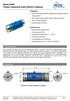 Properties Free of float metal bellow coupling with integrated torque measurement Non-contact measurement system, high robustness High torsional stiffness Limited torque of inertia Performance Measurement
Information about the T9 beam line and experimental facilities
 Information about the T9 beam line and experimental facilities The incoming proton beam from the PS accelerator impinges on the North target and thus produces the particles for the T9 beam line. The collisions
ITER - business in fusion
 ITER - business in fusion Madrid, Journée Nucléaire Franco Espagnole 25 th June 2013 Benjamin Perier 1 What is fusion? 2 What is fusion? Fusion is the source of energy of the sun and stars Nuclei of light
Alternative Linear Motion Systems. Iron Core Linear Motors
 Alternative Linear Motion Systems ME EN 7960 Precision Machine Design Topic 5 ME EN 7960 Precision Machine Design Alternative Linear Motion Systems 5-1 Iron Core Linear Motors Provide actuation forces
Neuere Entwicklungen zur Herstellung optischer Schichten durch reaktive. Wolfgang Hentsch, Dr. Reinhard Fendler. FHR Anlagenbau GmbH
 Neuere Entwicklungen zur Herstellung optischer Schichten durch reaktive Sputtertechnologien Wolfgang Hentsch, Dr. Reinhard Fendler FHR Anlagenbau GmbH Germany Contents: 1. FHR Anlagenbau GmbH in Brief
MEASUREMENTS OF THRUST LOAD IN CABLE SYSTEMS SEMI-RIGIDLY INSTALLED IN DUCT / MANHOLE STRUCTURES
 MEASUREMENTS OF THRUST LOAD IN CABLE SYSTEMS SEMI-RIGIDLY INSTALLED IN DUCT / MANHOLE STRUCTURES Riccardo BODEGA, Prysmian Cables and Systems, The Netherlands, [email protected] Henk GEENE,
Atoms and Elements. Outline Atoms Orbitals and Energy Levels Periodic Properties Homework
 Atoms and the Periodic Table The very hot early universe was a plasma with cationic nuclei separated from negatively charged electrons. Plasmas exist today where the energy of the particles is very high,
High Power VASIMR Experiments using Deuterium, Neon and Argon
 High Power VASIMR Experiments using Deuterium, Neon and Argon IEPC-2007-181 Presented at the 30 th International Electric Propulsion Conference, Florence, Italy Jared P. Squire *, Franklin R. Chang-Díaz,
Chapter 1: Moles and equations. Learning outcomes. you should be able to:
 Chapter 1: Moles and equations 1 Learning outcomes you should be able to: define and use the terms: relative atomic mass, isotopic mass and formula mass based on the 12 C scale perform calculations, including
Active noise control in practice: transformer station
 Active noise control in practice: transformer station Edwin Buikema 1 ; Fokke D. van der Ploeg 2 ; Jan H. Granneman 3 1, 2, 3 Peutz bv, Netherlands ABSTRACT Based on literature and extensive measurements
B) atomic number C) both the solid and the liquid phase D) Au C) Sn, Si, C A) metal C) O, S, Se C) In D) tin D) methane D) bismuth B) Group 2 metal
 1. The elements on the Periodic Table are arranged in order of increasing A) atomic mass B) atomic number C) molar mass D) oxidation number 2. Which list of elements consists of a metal, a metalloid, and
source at CERN G.McMonagle AB/RF
 12 GHz Stand alone power source at CERN G.McMonagle AB/RF Objectives Install a 12GHz power source at CERN as soon as possible to allow high gradient structure testing independent from the CTF3 machine
ROTATING MACHINES. Alignment & Positioning of. Fast, easy and accurate alignment of rotating machines, pumps, drives, foundations, etc.
 Alignment & Positioning of ROTATING MACHINES Fast, easy and accurate alignment of rotating machines, pumps, drives, foundations, etc. To compete in today s marketplace, you have to outperform your competitors
Facilities Perspectives
 Facilities Perspectives of the Association Euratom-FZK - Overview and Mission Orientation - Important Facility Enhancements Facility Review Meeting May 27-28, 2008 M. Thumm, Deputy Head, Topic Fusion Technology,
CHAPTER 4 DESIGN OF INTEGRAL SLOT AND FRACTIONAL SLOT BRUSHLESS DC MOTOR
 47 CHAPTER 4 DESIGN OF INTEGRAL SLOT AND FRACTIONAL SLOT BRUSHLESS DC MOTOR 4.1 INTRODUCTION This chapter deals with the design of 24 slots 8 poles, 48 slots 16 poles and 60 slots 16 poles brushless dc
Linac RF Commissioning with the SNS HPRF Systems
 Linac RF Commissioning with the SNS HPRF Systems 4 th CWHAP Workshop May 3, 2006 M. McCarthy, R. Fuja, P. Gurd, T. Hardek, Y. Kang SNS RF Group The SNS RF Group The mission of the RF Group is to ensure
Projects and R&D activities
 Projects and R&D activities J.M. Jimenez On behalf of the Vacuum, Surface and Coatings Group (VSC) Vacuum, Surface and Coatings group* Mandate Design, construction, operation, maintenance and upgrade of
AUTOMATION OF OPERATIONS ON THE VEPP-4 CONTROL SYSTEM
 10th ICALEPCS Int. Conf. on Accelerator & Large Expt. Physics Control Systems. Geneva, 10-14 Oct 2005, PO1.072-7 (2005) AUTOMATION OF OPERATIONS ON THE VEPP-4 CONTROL SYSTEM A. Bogomyagkov, S. Karnaev,
COLLATED QUESTIONS: ELECTROMAGNETIC RADIATION
 COLLATED QUESTIONS: ELECTROMAGNETIC RADIATION 2011(2): WAVES Doppler radar can determine the speed and direction of a moving car. Pulses of extremely high frequency radio waves are sent out in a narrow
Enhanced Stripline Scanning Array B.M. Cahill and J.C. Batchelor
 Enhanced Stripline Scanning Array B.M. Cahill and J.C. Batchelor This paper is a postprint of a paper submitted to and accepted for publication in IET Microwaves, Antennas and Propagation and is subject
AMD Analysis & Technology AG
 AMD Analysis & Technology AG Application Note 120419 Author: Karl-Heinz Maurer APCI-MS Trace Analysis of volatile organic compounds in ambient air A) Introduction Trace analysis of volatile organic compounds
Atomic Theory: History of the Atom
 Atomic Theory: History of the Atom Atomic Theory: experimental observations that led scientists to postulate the existence of the atom (smallest bit of an element). 1. Law of Conservation of Mass -During
& Tunnel Cross Section
 CLIC workshop Working group: Two beam hardware and Integration ti CLIC Civil Engineering Layouts & Tunnel Cross Section John Osborne TS-CE Acknowledgements : C.Wyss, J-L Baldy, N.Baddams 17 October 2007
Ferrostat Speed Sensor Series DSF Explosion Proof Versions EEx
 Ferrostat Speed Sensor Series DSF Explosion Proof Versions EEx DSF..10.**.HV Ex ATEX Operating Instructions 374E-64368 Valid from lot nr. 0103 General Function Use in potentially explosive environment
RI-80 SMD Series Dry Reed Switch
 formerly RI-80 SMD Series Dry Reed Switch RI-80 SMD Series Ultra-micro dry-reed switch hermetically sealed in a gas-filled glass envelope. Single-pole, single-throw (SPST) type, having normally open contacts,
Experimental results for the focal waveform and beam width in the focusing lens with a 100 ps filter
 EM Implosion Memos Memo 51 July, 2010 Experimental results for the focal waveform and beam width in the focusing lens with a 100 ps filter Prashanth Kumar, Carl E. Baum, Serhat Altunc, Christos G. Christodoulou
User checks and maintenance of laboratory balances
 Technical Note 13 March 2014 Issued: July 1995 Amended and reissued: July 2005, July 2007, October 2007, May 2010, March 2013, March 2014 User checks and maintenance of laboratory balances Copyright National
8 Speed control of Induction Machines
 8 Speed control of Induction Machines We have seen the speed torque characteristic of the machine. In the stable region of operation in the motoring mode, the curve is rather steep and goes from zero torque
Mars Atmosphere and Volatile EvolutioN (MAVEN) Mission
 Mars Atmosphere and Volatile EvolutioN (MAVEN) Mission MAVEN Science Community Workshop December 2, 2012 Particles and Fields Package Solar Energetic Particle Instrument (SEP) Davin Larson and the SEP
Vacuum Pumping of Large Vessels and Modelling of Extended UHV Systems
 Vacuum Pumping of Large Vessels and Modelling of Extended UHV Systems Georgy L. Saksaganski D.V. Efremov Institute, St Petersburg, Russia [email protected] An overview of the methods for reducing of
First Measurements with U-probe on the COMPASS Tokamak
 WDS'13 Proceedings of Contributed Papers, Part II, 109 114, 2013. ISBN 978-80-7378-251-1 MATFYZPRESS First Measurements with U-probe on the COMPASS Tokamak K. Kovařík, 1,2 I. Ďuran, 1 J. Stöckel, 1 J.Seidl,
Selected Radio Frequency Exposure Limits
 ENVIRONMENT, SAFETY & HEALTH DIVISION Chapter 50: Non-ionizing Radiation Selected Radio Frequency Exposure Limits Product ID: 94 Revision ID: 1736 Date published: 30 June 2015 Date effective: 30 June 2015
Understanding Ignition Waveforms
 FIRE IN THE HOLE Understanding Ignition Waveforms BY BERNIE C. THOMPSON The ignition waveform is a window that allows you to see what s occurring in the combustion chamber. Join us for a closer look. From
SIMULATIONS OF ELECTRON CLOUD BUILD-UP AND SATURATION IN THE APS *
 SIMULATIONS OF ELECTRON CLOUD BUILD-UP AND SATURATION IN THE APS * K. C. Harkay and R. A. Rosenberg, ANL, Argonne, IL 60439, USA M. A. Furman and M. Pivi, LBNL, Berkeley, CA 94720, USA Abstract In studies
Coaxial Cable Products Guide. Connectivity for Business-Critical Continuity
 Coaxial Cable Products Guide Connectivity for Business-Critical Continuity The Difference Starts With The Cable BULK CABLES SLA Series Lowest loss cable available to 18 GHz, best choice for critical applications
METHOD OF STATEMENT FOR STATIC LOADING TEST
 Compression Test, METHOD OF STATEMENT FOR STATIC LOADING TEST Tension Test and Lateral Test According to the American Standards ASTM D1143 07, ASTM D3689 07, ASTM D3966 07 and Euro Codes EC7 Table of Contents
BM SERIES WAVE COMPACT 6.3 GHZ CW SERIES PULSE RADAR LEVEL INSTRUMENTS (6.3 GHz)
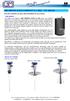 CW SERIES PULSE RADAR LEVEL INSTRUMENTS (6.3 GHz) DESCRIPTION The Radar Level Meters of BM COMPACT WAVE 6.3 GHz series are excellent devices for no contact level measurement. The microwave impulses, emitted
Tom Wilson Product Marketing Manager Delivery Systems Varian Medical Systems International AG. CERN Accelerator School, May 2015
 INDUSTRIAL DESIGN Tom Wilson Product Marketing Manager Delivery Systems Varian Medical Systems International AG VARIAN ONCOLOGY SYSTEMS 1 VARIAN ONCOLOGY SYSTEMS CERN Accelerator, May 2015 Industrial Design