
SOLUTION MANUAL SI UNIT PROBLEMS CHAPTER 9 SONNTAG BORGNAKKE VAN WYLEN. FUNDAMENTALS of. Thermodynamics. Sixth Edition
|
|
|
- Elmer Junior Woods
- 9 years ago
- Views:
Transcription
1 SOLUTION MANUAL SI UNIT PROBLEMS CHAPTER 9 SONNTAG BORGNAKKE VAN WYLEN FUNDAMENTALS of Thermodynamics Sixth Edition

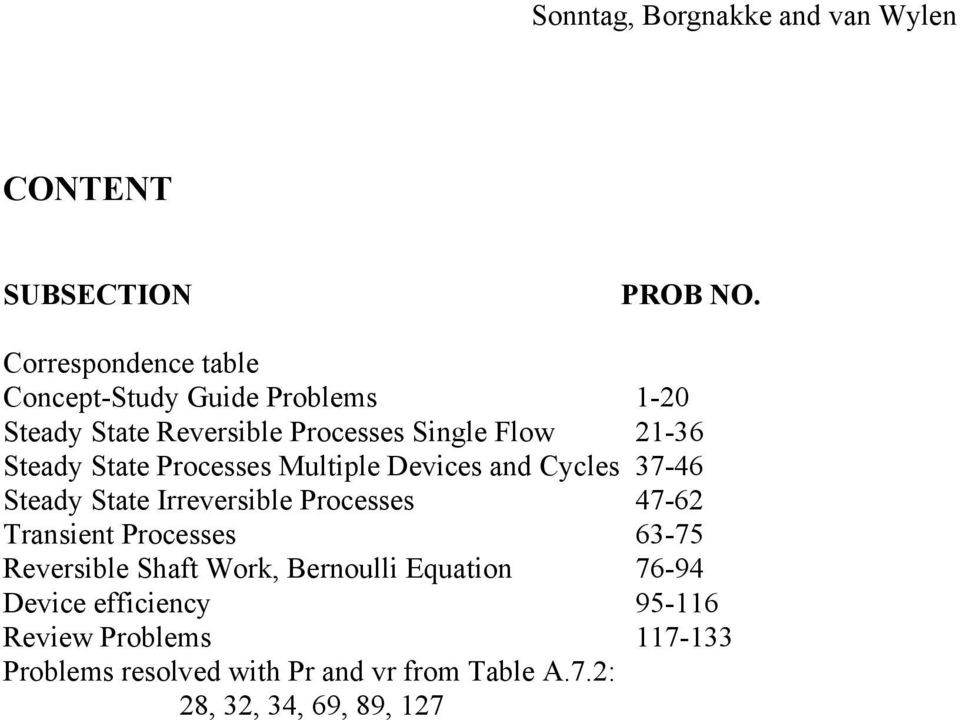
2 CONTENT SUBSECTION PROB NO. Correspondence table Concept-Study Guide Problems -20 Steady State Reversible Processes Single Flow 2-36 Steady State Processes Multiple Devices and Cycles Steady State Irreversible Processes Transient Processes Reversible Shaft Work, Bernoulli Equation Device efficiency 95-6 Review Problems 7-33 Problems resolved with Pr and vr from Table A.7.2: 28, 32, 34, 69, 89, 27
3 Correspondance Table CHAPTER 9 6 th edition The correspondence between the new problem set and the previous 5th edition chapter 9 problem sets. New 5th New 5th New 5th 2 new new 6 new 99 new new 00 new 25 new 63 new new mod new new new new new 69 3 mod new 70 new new new new new new new 40 new mod new mod a mod mod new 87 new new 88 new new 89 new new 9 new new mod 55 new 93 new new new new 96 5

4 Concept-Study Guide Problems 9. In a steady state single flow s is either constant or it increases. Is that true? No. Steady state single flow: s e = s i + e dq i T + s gen Entropy can only go up or stay constant due to s gen, but it can go up or down due to the heat transfer which can be positive or negative. So if the heat transfer is large enough it can overpower any entropy generation and drive s up or down. 9.2 Which process will make the previous statement true? If the process is said to be adiabatic then: Steady state adiabatic single flow: s e = s i + s gen s i 9.3 A reversible adiabatic flow of liquid water in a pump has increasing P. How about T? Steady state single flow: s e = s i + e dq i T + s gen = s i Adiabatic (dq = 0) means integral vanishes and reversible means s gen = 0, so s is constant. Properties for liquid (incompressible) gives Eq.8.9 then constant s gives constant T. ds = C T dt

5 9.4 A reversible adiabatic flow of air in a compressor has increasing P. How about T? Steady state single flow: s e = s i + e dq i T + s gen = s i so s is constant. Properties for an ideal gas gives Eq.8.23 and for constant specific heat we get Eq A higher P means a higher T, which is also the case for a variable specific heat, recall Eq.8.28 for the standard entropy. 9.5 An irreversible adiabatic flow of liquid water in a pump has higher P. How about T? Steady state single flow: s e = s i + e dq i T + s gen = s i s gen so s is increasing. Properties for liquid (incompressible) gives Eq.8.9 where an increase in s gives an increasse in T. 9.6 A compressor receives R-34a at 0 o C, 200 kpa with an exit of 200 kpa, 50 o C. What can you say about the process? Properties for R-34a are found in Table B.5 Inlet state: s i =.7328 kj/kg K Exit state: s e =.7237 kj/kg K Steady state single flow: s e = s i + e dq i T + s gen Since s decreases slightly and the generation term can only be positive, it must be that the heat transfer is negative (out) so the integral gives a contribution that is smaller than -s gen.

6 9.7 An air compressor has a significant heat transfer out. See Example 9.4 for how high T becomes if no heat transfer. Is that good or should it be insulated? A lower T at a given pressure P means the specific volume is smaller, Ideal gas: Pv = RT ; Shaft work: w = - v dp This gives a smaller work input which is good. 9.8 A large condenser in a steam power plant dumps 5 MW at 45 o C with an ambient at 25 o C. What is the entropy generation rate? This process transfers heat over a finite temperature difference between the water inside the condenser and the outside ambient (cooling water from the sea, lake or river or atmospheric air) C.V. The wall that separates the inside 45 o C water from the ambient at 25 o C. Entropy Eq. 9. for steady state operation: ds dt = 0 = Q. T + Ṡ gen = Q. T Q. 45 T + Ṡ gen 25 Condensing water Sea water cb 45 o C 25 o C Ṡ gen = 5 MW K 5 MW K = 3.7 kw K

7 9.9 Air at 000 kpa, 300 K is throttled to 500 kpa. What is the specific entropy generation? C.V. Throttle, single flow, steady state. We neglect kinetic and potential energies and there are no heat transfer and shaft work terms. Energy Eq. 6.3: h i = h e T i = T e (ideal gas) Entropy Eq. 9.9: s e = s i + e dq i T + s gen = s i + s gen Change in s Eq.8.24: s e s i = e dt Cp i T R ln P e P = R ln P e i P i s gen = s e s i = ln = 0.2 kj kg K 9.0 Friction in a pipe flow causes a slight pressure decrease and a slight temperature increase. How does that affect entropy? The friction converts flow work (P drops) into internal energy (T up if single phase). This is an irreversible process and s increases. If liquid: Eq. 8.9: ds = C T dt so s follows T dt If ideal gas Eq. 8.23: ds = C p T R dp P (both terms increase) 9. A flow of water at some velocity out of a nozzle is used to wash a car. The water then falls to the ground. What happens to the water state in terms of V, T and s? let us follow the water flow. It starts out with kinetic and potential energy of some magnitude at a compressed liquid state P, T. As the water splashes onto the car it looses its kinetic energy (it turns in to internal energy so T goes up by a very small amount). As it drops to the ground it then looses all the potential energy which goes into internal energy. Both of theses processes are irreversible so s goes up. If the water has a temperature different from the ambient then there will also be some heat transfer to or from the water which will affect both T and s.

8 9.2 The shaft work in a pump to increase the pressure is small compared to the shaft work in an air compressor for the same pressure increase. Why? The reversible work is given by Eq. 9.4 or 9.8 if no kinetic or potential energy changes w = v dp The liquid has a very small value for v compared to a large value for a gas. 9.3 If the pressure in a flow is constant, can you have shaft work? The reversible work is given by Eq.9.4 w = v dp + (V 2 i V2 e ) + g (Z i Z e ) For a constant pressure the first term drops out but the other two remains. Kinetic energy changes can give work out (windmill) and potential energy changes can give work out (a dam). 9.4 A pump has a 2 kw motor. How much liquid water at 5 o C can I pump to 250 kpa from 00 kpa? Incompressible flow (liquid water) and we assume reversible. Then the shaftwork is from Eq.9.8 w = v dp = v P = 0.00 m 3 /kg (250 00) kpa = 0.5 kj/kg ṁ = Ẇ -w = = 3.3 kg/s

9 9.5 Liquid water is sprayed into the hot gases before they enter the turbine section of a large gasturbine power plant. It is claimed that the larger mass flow rate produces more work. Is that the reason? No. More mass through the turbine does give more work, but the added mass is only a few percent. As the liquid vaporises the specific volume increases dramatically which gives a much larger volume flow throught the turbine and that gives more work output. Ẇ = ṁw = ṁ v dp = ṁv dp = V. dp This should be seen relative to the small work required to bring the liquid water up to the higher turbine inlet pressure from the source of water (presumably atmospheric pressure). 9.6 A polytropic flow process with n = 0 might be which device? As the polytropic process is Pv n = C, then n = 0 is a constant pressure process. This can be a pipe flow, a heat exchanger flow (heater or cooler) or a boiler. 9.7 A steam turbine inlet is at 200 kpa, 500 o C. The exit is at 200 kpa. What is the lowest possible exit temperature? Which efficiency does that correspond to? We would expect the lowest possible exit temperature when the maximum amount of work is taken out. This happens in a reversible process so if we assume it is adiabatic this becomes an isentropic process. Exit: 200 kpa, s = s in = kj/kg K T = 24.9 o C The efficiency from Eq.9.27 measures the turbine relative to an isentropic turbine, so the efficiency will be 00%.

10 9.8 A steam turbine inlet is at 200 kpa, 500 o C. The exit is at 200 kpa. What is the highest possible exit temperature? Which efficiency does that correspond to? The highest possible exit temperature would be if we did not get any work out, i.e. the turbine broke down. Now we have a throttle process with constant h assuming we do not have a significant exit velocity. Exit: 200 kpa, h = h in = kj/kg T = 495 o C Efficiency: η = w w s = 0 P T i i h = C e e v s Remark: Since process is irreversible there is no area under curve in T-s diagram that correspond to a q, nor is there any area in the P-v diagram corresponding to a shaft work.

11 9.9 A steam turbine inlet is at 200 kpa, 500 o C. The exit is at 200 kpa, 275 o C. What is the isentropic efficiency? Inlet: h in = kj/kg, s in = kj/kg K Exit: h ex = kj/kg, s ex = kj/kg K Ideal Exit: 200 kpa, s = s in = kj/kg K h s = kj/kg w ac = h in - h ex = = kj/kg w s = h in - h s = = 52.6 kj/kg η = w ac w s = = P i e s e ac T 200 kpa i 200 kpa e ac e s v s 9.20 The exit velocity of a nozzle is 500 m/s. If η nozzle = 0.88 what is the ideal exit velocity? The nozzle efficiency is given by Eq and since we have the actual exit velocity we get V 2 e s = V2 ac /η nozzle V e s = V ac / η nozzle = 500 / 0.88 = 533 m/s

12 Steady state reversible processes single flow 9.2 A first stage in a turbine receives steam at 0 MPa, 800 C with an exit pressure of 800 kpa. Assume the stage is adiabatic and negelect kinetic energies. Find the exit temperature and the specific work. C.V. Stage of turbine. The stage is adiabatic so q = 0 and we will assume reversible so s gen = 0 i e W T Energy Eq.6.3: w T = h i - h e Entropy Eq.9.8: s e = s i + dq/t + s gen = s i Inlet state: B..3: h i = 44.9 kj/kg, s i = kj/kg K Exit state: 800 kpa, s = s i Table B..3 T C, h e = 36 kj/kg w T = = kj/kg P i T 0 MPa i 800 kpa e s e s v s

13 9.22 Steam enters a turbine at 3 MPa, 450 C, expands in a reversible adiabatic process and exhausts at 0 kpa. Changes in kinetic and potential energies between the inlet and the exit of the turbine are small. The power output of the turbine is 800 kw. What is the mass flow rate of steam through the turbine? C.V. Turbine, Steady single inlet and exit flows. Adiabatic: Q. = 0. Continuity Eq.6.: ṁ i = ṁ e = ṁ, Energy Eq.6.2: ṁh i = ṁh e + Ẇ T, Entropy Eq.9.8: ṁs i + 0/ = ṁs e ( Reversible Ṡ gen = 0 ) Explanation for the work term is in Sect. 9.3, Eq.9.8 P 2 v T 2 s Inlet state: Table B..3 h i = 3344 kj/kg, s i = kj/kg K Exit state: P e, s e = s i Table B..2 saturated as s e < s g x e = ( )/7.50 = , h e = = kj/kg ṁ = Ẇ T /w T = Ẇ T /(h i - h e ) = 800/( ) = kg/s

14 9.23 A reversible adiabatic compressor receives 0.05 kg/s saturated vapor R-22 at 200 kpa and has an exit presure of 800 kpa. Neglect kinetic energies and find the exit temperature and the minimum power needed to drive the unit. C.V. Compressor, Steady single inlet and exit flows. Adiabatic: Q. = 0. Continuity Eq.6.: ṁ i = ṁ e = ṁ, Energy Eq.6.2: ṁh i = ṁh e + Ẇ C, Entropy Eq.9.8: ṁs i + 0/ = ṁs e ( Reversible Ṡ gen = 0 ) Inlet state: B 4.2.: h i = kj/kg, s i = kj/kg K Exit state: P e, s e = s i Table B.4.2 h e = kj/kg, T e 40 C w c = h e - h i = = kj/kg Ẇ c = Power In = w c ṁ = =.72 kw Explanation for the work term is in Sect. 9.3, Eq.9.8 P 2 T 2 v s

15 9.24 In a heat pump that uses R-34a as the working fluid, the R-34a enters the compressor at 50 kpa, 0 C at a rate of 0. kg/s. In the compressor the R-34a is compressed in an adiabatic process to MPa. Calculate the power input required to the compressor, assuming the process to be reversible. C.V. Compressor, Steady single inlet and exit flows. Adiabatic: Q. = 0. Continuity Eq.6.: ṁ = ṁ 2 = ṁ, Energy Eq.6.2: ṁh = ṁh 2 + Ẇ C, Entropy Eq.9.8: ṁs + 0/ = ṁs 2 ( Reversible Ṡ gen = 0 ) Inlet state: Table B.5.2 h = kj/kg, s =.7606 kj/kg K Exit state: P 2 = MPa & s 2 = s h 2 = kj/kg Ẇ c = ṁw c = ṁ(h - h 2 ) = 0. ( ) = -4. kw Explanation for the work term is in Sect. 9.3 P 2 T 2 Eq.9.8 v s

16 9.25 A boiler section boils 3 kg/s saturated liquid water at 2000 kpa to saturated vapor in a reversible constant pressure process. Assume you do not know that there is no work. Prove that there is no shaftwork using the first and second laws of thermodynamics. C.V. Boiler. Steady, single inlet and single exit flows. Energy Eq.6.3: h i + q = w + h e ; Entropy Eq.9.8: s i + q/t = s e States: Table B..2, T = T sat = C = K h i = h f = kj/kg, s i = kj/kg K h e = h g = kj/kg, s e = kj/kg K q = T(s e s i ) = ( ) = kj/kg w = h i + q h e = = -0. kj/kg It should be zero (non-zero due to round off in values of s, h and T sat ). cb Often it is a long pipe and not a chamber

17 9.26 Consider the design of a nozzle in which nitrogen gas flowing in a pipe at 500 kpa, 200 C, and at a velocity of 0 m/s, is to be expanded to produce a velocity of 300 m/s. Determine the exit pressure and cross-sectional area of the nozzle if the mass flow rate is 0.5 kg/s, and the expansion is reversible and adiabatic. C.V. Nozzle. Steady flow, no work out and no heat transfer. Energy Eq.6.3: h i + V 2 i /2 = h e + V2 e /2 Entropy Eq.9.8: s i + dq/t + s gen = s i = s e Properties Ideal gas Table A.5: C Po =.042 kj kg K, R = kj kg K, k =.40 h e - h i = C Po (T e - T i ) =.042(T e ) = ( )/(2 000) Solving for exit T: T e = 430 K, Process: s i = s e => For ideal gas expressed in Eq.8.32 k P e = P i (T e /T i ) k- = = kpa v e = RT e /P e = ( )/357.6 = m 3 /kg A e = ṁv e /V e = = m 2 Inlet Exit P i T i Vi cb Ve e v e s

18 9.27 Atmospheric air at -45 C, 60 kpa enters the front diffuser of a jet engine with a velocity of 900 km/h and frontal area of m 2. After the adiabatic diffuser the velocity is 20 m/s. Find the diffuser exit temperature and the maximum pressure possible. C.V. Diffuser, Steady single inlet and exit flow, no work or heat transfer. Energy Eq.6.3: h i + V 2 i /2 = h e + V2 e /2, and h e h i = C p(t e T i ) Entropy Eq.9.8: s i + dq/t + s gen = s i = s e (Reversible, adiabatic) Heat capacity and ratio of specific heats from Table A.5: C Po =.004 k =.4, the energy equation then gives:.004[ T e - (-45)] = 0.5[( /3600) ]/000 = 3.05 kj/kg => T e = 4.05 C = 259. K Constant s for an ideal gas is expressed in Eq.8.32: k P e = P i (T e /T i ) k- = 60 (259./228.) 3.5 = 93.6 kpa kj kg K, 2 Fan P 2 v T 2 s

19 9.28 A compressor receives air at 290 K, 00 kpa and a shaft work of 5.5 kw from a gasoline engine. It should deliver a mass flow rate of 0.0 kg/s air to a pipeline. Find the maximum possible exit pressure of the compressor. C.V. Compressor, Steady single inlet and exit flows. Adiabatic: Q. = 0. Continuity Eq.6.: ṁ i = ṁ e = ṁ, Energy Eq.6.2: ṁh i = ṁh e + Ẇ C, Entropy Eq.9.8: ṁs i + Ṡ gen = ṁs e ( Reversible Ṡ gen = 0 ) Ẇ c = ṁw c => -w c = -Ẇ/ṁ = 5.5/0.0 = 550 kj/kg Use constant specific heat from Table A.5, C Po =.004, k =.4 h e = h i => T e = T i + 550/.004 T e = /.004 = K s i = s e => P e = P i (T e /T i ) k- Eq.8.32 P e = 00 (837.8/290) 3.5 = 4098 kpa k P e i v T e h = 550 kj/kg i s i -W C e

20 9.29 A compressor is surrounded by cold R-34a so it works as an isothermal compressor. The inlet state is 0 C, 00 kpa and the exit state is saturated vapor. Find the specific heat transfer and specific work. C.V. Compressor. Steady, single inlet and single exit flows. Energy Eq.6.3: h i + q = w + h e ; Entropy Eq.9.8: s i + q/t = s e Inlet state: Table B.5.2, h i = kj/kg, s i =.828 kj/kg K Exit state: Table B.5., h e = kj/kg, s e =.7262 kj/kg K q = T(s e s i ) = 273.5( ) = kj/kg w = (-27.83) = kj/kg Explanation for the work term is in Sect. 9.3 P e i T e i Eqs. 9.6 and 9.8 v s

21 9.30 A diffuser is a steady-state device in which a fluid flowing at high velocity is decelerated such that the pressure increases in the process. Air at 20 kpa, 30 C enters a diffuser with velocity 200 m/s and exits with a velocity of 20 m/s. Assuming the process is reversible and adiabatic what are the exit pressure and temperature of the air? C.V. Diffuser, Steady single inlet and exit flow, no work or heat transfer. Energy Eq.6.3: h i + V 2 i /2 = h e + V 2 e /2, => h e - h i = C Po (T e - T i ) Entropy Eq.9.8: s i + dq/t + s gen = s i = s e (Reversible, adiabatic) Use constant specific heat from Table A.5, C Po =.004 Energy equation then gives: kj kg K, k =.4 C Po (T e - T i ) =.004(T e ) = ( )/(2 000) => T e = K The isentropic process (s e = s i ) gives Eq.8.32 k P e = P i (T e /T i ) k- = 20(322.9/303.2) 3.5 = 49.6 kpa P e T e Inlet Exit i v i s Hi V Low P, A Low V Hi P, A
22 9.3 The exit nozzle in a jet engine receives air at 200 K, 50 kpa with neglible kinetic energy. The exit pressure is 80 kpa and the process is reversible and adiabatic. Use constant heat capacity at 300 K to find the exit velocity. C.V. Nozzle, Steady single inlet and exit flow, no work or heat transfer. Energy Eq.6.3: h i = h e + V 2 e /2 ( Z i = Z e ) Entropy Eq.9.8: s e = s i + dq/t + s gen = s i Use constant specific heat from Table A.5, C Po =.004 The isentropic process (s e = s i ) gives Eq.8.32 kj kg K, k =.4 k- => T e = T i ( P e /P i ) k = 200 (80/50) = K The energy equation becomes V 2 e /2 = h i - h e C P ( T i - T e ) V e = 2 C P ( T i - T e ) = 2.004( ) 000 = m/s P i T i Hi P Low P e v e s Low V Hi V
23 9.32 Do the previous problem using the air tables in A.7 The exit nozzle in a jet engine receives air at 200 K, 50 kpa with neglible kinetic energy. The exit pressure is 80 kpa and the process is reversible and adiabatic. Use constant heat capacity at 300 K to find the exit velocity. C.V. Nozzle, Steady single inlet and exit flow, no work or heat transfer. Energy Eq.6.3: h i = h e + V 2 e /2 ( Z i = Z e ) Entropy Eq.9.8: s e = s i + dq/t + s gen = s i Process: q = 0, s gen = 0 as used above leads to s e = s i Inlet state: h i = kj/kg, s o Ti = kj/kg K The constant s is rewritten from Eq.8.28 as s o Te = so Ti + R ln(p e / P i ) = ln (80/50) = Interpolate in A.7 => T e = = K h e = ( ) From the energy equation we have V 2 e /2 = h i - h e, so then = V e = 2 (h i - h e ) = 2( ) 000 = m/s P i T i Hi P Low P e v e s Low V Hi V
24 9.33 An expander receives 0.5 kg/s air at 2000 kpa, 300 K with an exit state of 400 kpa, 300 K. Assume the process is reversible and isothermal. Find the rates of heat transfer and work neglecting kinetic and potential energy changes. C.V. Expander, single steady flow. Energy Eq.: ṁh i + Q. = ṁh e + Ẇ Entropy Eq.: ṁs i + Q. /T + ṁs gen = ṁs e Process: T is constant and s gen = 0 Ideal gas and isothermal gives a change in entropy by Eq. 8.24, so we can solve for the heat transfer Q. = Tṁ(s e s i ) = ṁrt ln P e P i = ln From the energy equation we get Ẇ = ṁ(h i h e ) + Q. = Q. = 69.3 kw = 69.3 kw P i T i e i Q e e v s W exp
25 9.34 Air enters a turbine at 800 kpa, 200 K, and expands in a reversible adiabatic process to 00 kpa. Calculate the exit temperature and the work output per kilogram of air, using a. The ideal gas tables, Table A.7 b. Constant specific heat, value at 300 K from table A.5 air i Turbine Ẇ C.V. Air turbine. Adiabatic: q = 0, reversible: s gen = 0 Energy Eq.6.3: w T = h i h e, e Entropy Eq.9.8: s e = s i a) Table A.7: h i = kj/kg, s o Ti = kj/kg K The constant s process is written from Eq.8.28 as s o Te = so Ti + R ln( P e P ) = ln 00 i 800 = kj/kg K Interpolate in A.7. T e = 706 K, h e = 79.9 kj/kg w = h i - h e = kj/kg b) Table A.5: C Po =.004 kj/kg K, R = kj/kg K, k =.4, then from Eq.8.32 k- T e = T i (P e /P i ) k = = 662. K w = C Po (T i - T e ) =.004( ) = kj/kg
26 9.35 A flow of 2 kg/s saturated vapor R-22 at 500 kpa is heated at constant pressure to 60 o C. The heat is supplied by a heat pump that receives heat from the ambient at 300 K and work input, shown in Fig. P9.35. Assume everything is reversible and find the rate of work input. C.V. Heat exchanger Continuity Eq.: ṁ = ṁ 2 ; 2 Q H Energy Eq.: ṁ h + Q. H = ṁ h 2 Table B.4.2: h = 250 kj/kg, s = kj/kg K h 2 = kj/kg, s 2 =.0696 kj/kg K HP T L Q L W Notice we can find Q. H but the temperature T H is not constant making it difficult to evaluate the COP of the heat pump. C.V. Total setup and assume everything is reversible and steady state. Energy Eq.: ṁ h + Q. L + Ẇ = ṁ h 2 Entropy Eq.: ṁ s + Q. L /T L + 0 = ṁ s 2 (T L is constant, s gen = 0) Q. L = ṁ T L [s 2 - s ] = [ ] = kw Ẇ = ṁ [h 2 - h ] - Q. L = 2 ( ) = 0.7 kw
27 9.36 A reversible steady state device receives a flow of kg/s air at 400 K, 450 kpa and the air leaves at 600 K, 00 kpa. Heat transfer of 800 kw is added from a 000 K reservoir, 00 kw rejected at 350 K and some heat transfer takes place at 500 K. Find the heat transferred at 500 K and the rate of work produced. C.V. Device, single inlet and exit flows. Energy equation, Eq.6.2: ṁh + Q. 3 - Q. 4 + Q. 5 = ṁh 2 + Ẇ T3 T4 Q3 Q 4 Entropy equation with zero generation, Eq.9.8: 2 ṁs + Q. 3 /T 3 - Q. 4 /T 4 + Q. 5 /T 5 = ṁs 2 Solve for the unknown heat transfer using Table A.7. and Eq for change in s Q. 5 = T 5 [s 2 - s ]ṁ + T 5 T 4 Q. 4 - T 5 T 3 Q. 3 W 500 K = 500 ( ln ) = = 67.2 kw Now the work from the energy equation is Ẇ = ( ) = 66.2 kw Q 5
28 Steady state processes multiple devices and cycles 9.37 Air at 00 kpa, 7 C is compressed to 400 kpa after which it is expanded through a nozzle back to the atmosphere. The compressor and the nozzle are both reversible and adiabatic and kinetic energy in and out of the compressor can be neglected. Find the compressor work and its exit temperature and find the nozzle exit velocity. -W 2 =3 T 2 P2 P s Separate control volumes around compressor and nozzle. For ideal compressor we have inlet : and exit : 2 Adiabatic : q = 0. Reversible: s gen = 0 Energy Eq.6.3: h + 0 = w C + h 2 ; Entropy Eq.9.8: s + 0/T + 0 = s 2 - w C = h 2 - h, s 2 = s Properties Table A.5 air: C Po =.004 kj/kg K, R = kj/kg K, k =.4 Process gives constant s (isentropic) which with constant C Po gives Eq.8.32 k- => T 2 = T ( P 2 /P ) k = 290 (400/00) = K w C = C Po (T 2 T ) =.004 ( ) = 4.46 kj/kg The ideal nozzle then expands back down to P (constant s) so state 3 equals state. The energy equation has no work but kinetic energy and gives: 2 V2 = h 2 - h = -w C = J/kg (remember conversion to J) V 3 = = 53.9 m/s
29 9.38 A small turbine delivers 50 kw and is supplied with steam at 700 C, 2 MPa. The exhaust passes through a heat exchanger where the pressure is 0 kpa and exits as saturated liquid. The turbine is reversible and adiabatic. Find the specific turbine work, and the heat transfer in the heat exchanger. Continuity Eq.6.: Steady 2 3 ṁ = ṁ 2 = ṁ 3 = ṁ W T -Q Turbine: Energy Eq.6.3: w T = h h 2 Entropy Eq.9.8: s 2 = s + s T gen Inlet state: Table B..3 h = kj/kg, s = kj/kg K Ideal turbine s T gen = 0, s 2 = s = = s f2 + x s fg2 State 3: P = 0 kpa, s 2 < s g => saturated 2-phase in Table B..2 x 2,s = (s - s f2 )/s fg2 = ( )/7.50 = h 2,s = h f2 + x h fg2 = = kj/kg w T,s = h h 2,s = kj/kg ṁ = Ẇ / w T,s = 50 / 397 = kg/s Heat exchanger: Energy Eq.6.3: q = h 3 h 2, Entropy Eq.9.8: s 3 = s 2 + dq/t + s He gen q = h 3 h 2,s = = kj/kg Q. = ṁ q = ( ) = kw Explanation for the work term is in Sect. 9.3, Eq.9.8 P T v 2 s
30 9.39 One technique for operating a steam turbine in part-load power output is to throttle the steam to a lower pressure before it enters the turbine, as shown in Fig. P9.39. The steamline conditions are 2 MPa, 400 C, and the turbine exhaust pressure is fixed at 0 kpa. Assuming the expansion inside the turbine to be reversible and adiabatic, determine a. The full-load specific work output of the turbine b. The pressure the steam must be throttled to for 80% of full-load output c. Show both processes in a T s diagram. a) C.V Turbine. Full load reversible and adiabatic Entropy Eq.9.8 reduces to constant s so from Table B..3 and B..2 s 3 = s = 7.27 = x 3a => x 3a = h 3a = = kj/kg Energy Eq.6.3 for turbine w 3a = h - h 3a = = kj/kg b) The energy equation for the part load operation and notice that we have constant h in the throttle process. w T = = 79.4 = h 3b h 3b = = x 3b => x 3b = s 3b = = kj/kg c) s 2b = s 3b = h 2b = h = T = 2a 2b h = C P 2b = 50 kpa & T 2b = C 2 3 3a 3b s W T
31 9.40 Two flows of air both at 200 kpa, one has kg/s at 400 K and the other has 2 kg/s at 290 K. The two lines exchange energy through a number of ideal heat engines taking energy from the hot line and rejecting it to the colder line. The two flows then leave at the same temperature. Assume the whole setup is reversible and find the exit temperature and the total power out of the heat engines. Q H Q H Q H 3 HE W HE W HE W 2 Q L Q L Q L 4 C.V. Total setup Energy Eq.6.0: ṁ h + ṁ 2 h 2 = ṁ h 3 + ṁ 2 h 4 + Ẇ TOT Entropy Eq.9.7: ṁ s + ṁ 2 s 2 + Ṡ gen + dq. /T = ṁ s 3 + ṁ 2 s 4 Process: Reversible Ṡ gen = 0 Adiabatic Q. = 0 Assume the exit flow has the same pressure as the inlet flow then the pressure part of the entropy cancels out and we have Exit same T, P => h 3 = h 4 = h e ; s 3 = s 4 = s e ṁ h + ṁ 2 h 2 = ṁ TOT h e + Ẇ TOT ṁ s + ṁ 2 s 2 = ṁ TOT s e m s e = s + m TOT m 2 s 2 = m = TOT Table A.7: => T e 323 K; h e = Ẇ TOT = ṁ (h - h e ) + ṁ 2 (h 2 - h e ) = ( ) + 2( ) =.36 kw Note: The solution using constant heat capacity writes the entropy equation using Eq.8.25, the pressure terms cancel out so we get 3 C p ln(t e /T ) C p ln(t e /T 2 ) = 0 => lnt e = (lnt + 2 lnt 2 )/3
32 9.4 A certain industrial process requires a steady supply of saturated vapor steam at 200 kpa, at a rate of 0.5 kg/s. Also required is a steady supply of compressed air at 500 kpa, at a rate of 0. kg/s. Both are to be supplied by the process shown in Fig. P9.4. Steam is expanded in a turbine to supply the power needed to drive the air compressor, and the exhaust steam exits the turbine at the desired state. Air into the compressor is at the ambient conditions, 00 kpa, 20 C. Give the required steam inlet pressure and temperature, assuming that both the turbine and the compressor are reversible and adiabatic. C.V. Each device. Steady flow. Both adiabatic (q = 0) and reversible (s gen = 0) Steam turbine Air compressor k- Compressor: s 4 = s 3 => T 4 = T 3 (P 4 /P 3 ) k = = K. W C = ṁ 3 (h 3 - h 4) = ( ) = -7.2 kw Turbine: Energy:. W T = +7.2 kw = ṁ (h - h 2 ); Entropy: s 2 = s Table B..2: P 2 = 200 kpa, x 2 = => h 2 = kj/kg, s 2 = 7.27 h = /0.5 = kj/kg s = s 2 = 7.27 kj/kg K At h, s P = 242 kpa T = 38.3 C
33 9.42 Consider a steam turbine power plant operating near critical pressure, as shown in Fig. P9.42. As a first approximation, it may be assumed that the turbine and the pump processes are reversible and adiabatic. Neglecting any changes in kinetic and potential energies, calculate a. The specific turbine work output and the turbine exit state b. The pump work input and enthalpy at the pump exit state c. The thermal efficiency of the cycle Q H 4 W P, in W T P = P 4 = 20 MPa T = 700 C P 2 = P 3 = 20 kpa T 3 = 40 C 3. Q L 2 a) State : (P, T) Table B..3 h = kj/kg, s = kj/kg K C.V. Turbine. Entropy Eq.9.8: s 2 = s = kj/kg K Table B..2 s 2 = x => x 2 = h 2 = = b) Energy Eq.6.3: w T = h - h 2 = 569 kj/kg State 3: (P, T) Compressed liquid, take sat. liq. Table B.. h 3 = 67.5 kj/kg, v 3 = m 3 /kg Property relation in Eq.9.3 gives work from Eq.9.8 as w P = - v 3 ( P 4 - P 3 ) = ( ) = -20. kj/kg h 4 = h 3 - w P = = 87.6 kj/kg c) The heat transfer in the boiler is from energy Eq.6.3 q boiler = h - h 4 = = kj/kg w net = = kj/kg η TH = w net /q boiler = = 0.428
34 9.43 A turbo charger boosts the inlet air pressure to an automobile engine. It consists of an exhaust gas driven turbine directly connected to an air compressor, as shown in Fig. P9.43. For a certain engine load the conditions are given in the figure. Assume that both the turbine and the compressor are reversible and adiabatic having also the same mass flow rate. Calculate the turbine exit temperature and power output. Find also the compressor exit pressure and temperature. CV: Turbine, Steady single inlet and exit flows, Process: adiabatic: q = 0, reversible: s gen = 0 EnergyEq.6.3: w T = h 3 h 4, 2 Engine 3 W 4 Entropy Eq.9.8: s 4 = s 3 Compressor Turbine The property relation for ideal gas gives Eq.8.32, k from Table A.5 k- s 4 = s 3 T 4 = T 3 (P 4 /P 3 ) k = = K The energy equation is evaluated with specific heat from Table A.5 w T = h 3 h 4 = C P0 (T 3 - T 4 ) =.004( ) = 30.5 kj/kg. W T = ṁw T = 3.05 kw C.V. Compressor, steady inlet and exit, same flow rate as turbine. Energy Eq.6.3: -w C = h 2 h, Entropy Eq.9.8: s 2 = s Express the energy equation for the shaft and compressor having the turbine power as input with the same mass flow rate so we get -w C = w T = 30.5 = C P0 (T 2 - T ) =.004(T ) T 2 = K The property relation for s 2 = s is Eq.8.32 and inverted as k P 2 = P (T 2 /T ) k- = = kpa
35 9.44 A two-stage compressor having an interstage cooler takes in air, 300 K, 00 kpa, and compresses it to 2 MPa, as shown in Fig. P9.44. The cooler then cools the air to 340 K, after which it enters the second stage, which has an exit pressure of 5.74 MPa. Both stages are adiabatic, and reversible. Find q in the cooler, total specific work, and compare this to the work required with no intercooler intercooler -W C C2 Q -W 2 C.V.: Stage air, Steady flow Process: adibatic: q = 0, reversible: s gen = 0 Energy Eq.6.3: -w C = h 2 h, Entropy Eq.9.8: s 2 = s Assume constant C P0 =.004 from A.5 and isentropic leads to Eq.8.32 k- T 2 = T (P 2 /P ) k = 300(2000/00) = K w C = h - h 2 = C P0 (T - T 2 ) =.004( ) = kj/kg C.V. Intercooler, no work and no changes in kinetic or potential energy. q 23 = h 3 - h 2 = C P0 (T 3 - T 2 ) =.004( ) = kj/kg C.V. Stage 2. Analysis the same as stage. So from Eq.8.32 k- T 4 = T 3 (P 4 /P 3 ) k = 340(5.74/2) = 63.4 K w C2 = h 3 - h 4 = C P0 (T 3 - T 4 ) =.004( ) = kj/kg Same flow rate through both stages so the total work is the sum of the two w comp = w C + w C2 = = kj/kg For no intercooler (P 2 = 5.74 MPa) same analysis as stage. So Eq.8.32 T 2 = 300(5740/00) = K w comp =.004( ) = kj/kg
36 9.45 A heat-powered portable air compressor consists of three components: (a) an adiabatic compressor; (b) a constant pressure heater (heat supplied from an outside source); and (c) an adiabatic turbine. Ambient air enters the compressor at 00 kpa, 300 K, and is compressed to 600 kpa. All of the power from the turbine goes into the compressor, and the turbine exhaust is the supply of compressed air. If this pressure is required to be 200 kpa, what must the temperature be at the exit of the heater? Heater P 2 = 600 kpa, P 4 = 200 kpa 2 3 Adiabatic and reversible compressor: C q H T Process: q = 0 and s gen = 0 4 Energy Eq.6.3: h w c = h 2 Entropy Eq.9.8: s 2 = s For constant specific heat the isentropic relation becomes Eq.8.32 T 2 = T k- P 2 P k = 300(6) = K w c = C P 0 (T 2 - T ) =.004( ) = 20.5 kj/kg Adiabatic and reversible turbine: q = 0 and s gen = 0 Energy Eq.6.3: h 3 = w T + h 4 ; Entropy Eq.9.8: s 4 = s 3 For constant specific heat the isentropic relation becomes Eq.8.32 k- T 4 = T 3 (P 4 /P 3 ) k = T 3 (200/600) = T 3 Energy Eq. for shaft: w c = w T = C P 0 (T 3 T 4) 20.5 =.004 T 3 ( ) => T 3 = K P 2 3 T kpa 4 v kpa 4 00 kpa s
37 9.46 A certain industrial process requires a steady 0.5 kg/s supply of compressed air at 500 kpa, at a maximum temperature of 30 C. This air is to be supplied by installing a compressor and aftercooler. Local ambient conditions are 00 kpa, 20 C. Using an reversible compressor, determine the power required to drive the compressor and the rate of heat rejection in the aftercooler. Air Table A.5: R = kj/kg-k, C p =.004 kj/kg K, k =.4 State : T = T o = 20 o C, P = P o = 00 kpa, ṁ = 0.5 kg/s State 2: P 2 = P 3 = 500 kpa State 3: T 3 = 30 o C, P 3 = 500 kpa Compressor: Assume Isentropic (adiabatic q = 0 and reversible s gen = 0 ) From entropy equation Eq.9.8 this gives constant s which is expressed for an ideal gas in Eq.8.32 k- T 2 = T (P 2 /P ) k = (500/00) = K st Law Eq.6.3: q c + h = h 2 + w c ; q c = 0, assume constant specific heat from Table A.5 w c = C p (T - T 2 ) = kj/kg Ẇ C = ṁw C = -86 kw Aftercooler Energy Eq.6.3: q + h 2 = h 3 + w; w = 0, assume constant specific heat q = C p (T 3 - T 2 ) = -205 kj/kg, Q. = ṁq = kw 2 Q cool 3 Compressor -W c Compressor section Aftercooler section
38 Steady state irreversible processes 9.47 Analyze the steam turbine described in Problem Is it possible? C.V. Turbine. Steady flow and adiabatic. 2 Continuity Eq.6.9: ṁ = ṁ 2 + ṁ 3 ; Energy Eq.6.0: ṁ h = ṁ 2 h 2 + ṁ 3 h 3 + Ẇ 3 W T Entropy Eq.9.7: ṁ s + Ṡ gen = ṁ 2 s 2 + ṁ 3 s 3 States from Table B..3: s = , s 2 = , s 3 = kj/kg K Ṡ gen = = 42.9 kw/k > 0 Since it is positive => possible. Notice the entropy is increasing through turbine: s < s 2 < s 3
39 9.48 Carbon dioxide at 300 K, 200 kpa is brought through a steady device where it is heated to 500 K by a 600 K reservoir in a constant pressure process. Find the specific work, specific heat transfer and specific entropy generation. C.V. Heater and walls out to the source. Steady single inlet and exit flows. Since the pressure is constant and there are no changes in kinetic or potential energy between the inlet and exit flows the work is zero. w = 0 Continuity Eq.6.: Energy Eq.6.3: Entropy Eq.9.8, 9.23: ṁ i = ṁ e = ṁ h i + q = h e s i + dq/t + s gen = s e = s i + q/t source + s gen Properties are from Table A.8 so the energy equation gives q = h e - h i = = 87. kj/kg From the entropy equation s gen = s e - s i - q/t source = ( ) - 87./600 = = kj/kg K 600 K Q 2 P 2 T2 T v T 2 s
40 9.49 Consider the steam turbine in Example 6.6. Is this a reversible process? At the given states Table B..3: s i = kj/kg K; s e = kj/kg K Do the second law for the turbine, Eq.9.8 ṁ e s e = ṁ i s i + dq. /T + Ṡ gen s e = s i + dq/t + s gen s gen = s e - s i - dq/t = (negative) > 0 Entropy goes up even if q goes out. This is an irreversible process. P i T 2 MPa i 00 kpa e ac e ac v s
41 9.50 The throttle process described in Example 6.5 is an irreversible process. Find the entropy generation per kg ammonia in the throttling process. The process is adiabatic and irreversible. The consideration with the energy given in the example resulted in a constant h and two-phase exit flow. Table B.2.: s i =.2792 kj/kg K Table B.2.: s e = s f + x e s fg = = kj/kg K We assumed no heat transfer so the entropy equation Eq.9.8 gives s gen = s e - s i - dq/t = = kj/kg K 2 i T e.5 MPa 29 kpa h = C s
42 9.5 A geothermal supply of hot water at 500 kpa, 50 C is fed to an insulated flash evaporator at the rate of.5 kg/s. A stream of saturated liquid at 200 kpa is drained from the bottom of the chamber and a stream of saturated vapor at 200 kpa is drawn from the top and fed to a turbine. Find the rate of entropy generation in the flash evaporator. Continuity Eq.6.9: ṁ = ṁ 2 + ṁ 3 Energy Eq.6.0: ṁ h = ṁ 2 h 2 + ṁ 3 h 3 Entropy Eq.9.7: ṁ s + Ṡ gen + dq. /T = ṁ 2 s 2 + ṁ 3 s 3 Process: Q. = 0, irreversible (throttle) 3 Two-phase out of the valve. The liquid drops to the bottom. 2 B.. h = kj/kg, s =.847 kj/kg K B..2 h 3 = kj/kg, s 3 = 7.27 kj/kg K, h 2 = kj/kg, s 2 =.53 kj/kg K From the energy equation we solve for the flow rate ṁ 3 = ṁ (h - h 2 )/(h 3 - h 2 ) = = kg/s Continuity equation gives ṁ 2 = ṁ - ṁ 2 =.435 kg/s Entropy equation now leads to Ṡ gen = ṁ 2 s 2 + ṁ 3 s 3 - ṁ s = = 0.07 kw/k P T 500 kpa 2 3 v kpa s
43 9.52 Two flowstreams of water, one at 0.6 MPa, saturated vapor, and the other at 0.6 MPa, 600 C, mix adiabatically in a steady flow process to produce a single flow out at 0.6 MPa, 400 C. Find the total entropy generation for this process. : B..2 h = kj/kg, s = kj/kg K 2: B..3 h 2 = kj/kg, s 2 = kj/kg K 3: B..3 h 3 = kj/kg, s 3 = kj/kg K Continuity Eq.6.9: ṁ 3 = ṁ + ṁ 2, Energy Eq.6.0: ṁ 3 h 3 = ṁ h + ṁ 2 h 2 => ṁ /ṁ 3 = (h 3 h 2 ) / (h h 2 ) = Entropy Eq.9.7: ṁ 3 s 3 = ṁ s + ṁ 2 s 2 + Ṡ gen => Ṡ gen /ṁ 3 = s 3 (ṁ /ṁ 3 ) s (ṁ 2 /ṁ 3 ) s 2 = = 0.28 kj/kg K 2 T 600 kpa Mixing 3 chamber 2 3 s The mixing process generates entropy. The two inlet flows could have exchanged energy (they have different T) through some heat engines and produced work, the process failed to do that, thus irreversible.
44 9.53 A condenser in a power plant receives 5 kg/s steam at 5 kpa, quality 90% and rejects the heat to cooling water with an average temperature of 7 C. Find the power given to the cooling water in this constant pressure process and the total rate of enropy generation when condenser exit is saturated liquid. C.V. Condenser. Steady state with no shaft work term. Energy Eq.6.2: ṁ h i + Q. = ṁh e Entropy Eq.9.8: ṁ s i + Q. /T + Ṡ gen = ṁ s e Properties are from Table B..2 h i = = kj/kg, h e = kj/kg s i = = kj/kg K, s e = kj/kg K Q. out = Q. = ṁ (h i h e ) = 5( ) = 0679 kw Ṡ gen = ṁ (s e s i ) + Q. out/t = 5( ) /( ) = = 4.83 kw/k
45 9.54 A mixing chamber receives 5 kg/min ammonia as saturated liquid at 20 C from one line and ammonia at 40 C, 250 kpa from another line through a valve. The chamber also receives 325 kj/min energy as heat transferred from a 40 C reservoir. This should produce saturated ammonia vapor at 20 C in the exit line. What is the mass flow rate in the second line and what is the total entropy generation in the process? CV: Mixing chamber out to reservoir Continuity Eq.6.9: ṁ + ṁ 2 = ṁ 3 Energy Eq.6.0: ṁ h + ṁ 2 h 2 + Q. = ṁ 3 h 3 Entropy Eq.9.7: ṁ s + ṁ 2 s 2 + Q. /T res + Ṡ gen = ṁ 3 s MIXING CHAMBER Q. 2 P 3 v From the energy equation: ṁ 2 = [(ṁ (h - h 3 ) + Q. ]/(h 3 - h 2 ) = [5 ( ) + 325] / ( ) = kg/min ṁ 3 = kg/min Ṡ gen = ṁ 3 s 3 ṁ s ṁ 2 s 2 Q. /T res = /33.5 = 8.94 kj/k min
46 9.55 A heat exchanger that follows a compressor receives 0. kg/s air at 000 kpa, 500 K and cools it in a constant pressure process to 320 K. The heat is absorbed by ambient ait at 300 K. Find the total rate of entropy generation. C.V. Heat exchanger to ambient, steady constant pressure so no work. Energy Eq.6.2: ṁh i = ṁh e + Q. out Entropy Eq.9.8, 9.23: ṁs i + Ṡ gen = ṁs e + Q. out/t Using Table A.5 and Eq.8.25 for change in s Q. out = ṁ(h i h e ) = ṁc Po (T i T e ) = ( ) = 8.07 kw Ṡ gen = ṁ(s e s i ) + Q. out/t = ṁc Po ln( T e /T i ) + Q. out/t = ln( 320/500) /300 = kw/k Using Table A.7. and Eq for change in entropy h 500 = kj/kg, h 320 = kj/kg; s T = kj/kg K, 500 st = kj/kg K 320 Q. out = ṁ(h i h e ) = 0. ( ) = 8.28 kw Ṡ gen = ṁ(s e s i ) + Q. out/t = 0.( ) /300 = kw/k
47 9.56 Air at 327 C, 400 kpa with a volume flow m 3 /s runs through an adiabatic turbine with exhaust pressure of 00 kpa. Neglect kinetic energies and use constant specific heats. Find the lowest and highest possible exit temperature. For each case find also the rate of work and the rate of entropy generation. C.V Turbine. Steady single inlet and exit flows, q = 0. Inlet state: (T, P) v i = RT i / P i = /400 = m 3 /kg ṁ = V. /v i = / = kg/s The lowest exit T is for maximum work out i.e. reversible case Process: Reversible and adiabatic => constant s from Eq.9.8 k- Eq.8.32: T e = T i (P e /P i ) k = 600 (00/400) = K w = h i - h e = C Po (T i - T e ) =.004 ( ) = 97 kj/kg Ẇ T = ṁw = = kw and Ṡ gen = 0 Highest exit T occurs when there is no work out, throttling q = ; w = h i - h e = 0 T e = T i = 600 K Ṡ gen = ṁ (s e - s i ) = - ṁr ln P e P = ln 00 i 400 = kw/k
48 9.57 In a heat-driven refrigerator with ammonia as the working fluid, a turbine with inlet conditions of 2.0 MPa, 70 C is used to drive a compressor with inlet saturated vapor at 20 C. The exhausts, both at.2 MPa, are then mixed together. The ratio of the mass flow rate to the turbine to the total exit flow was measured to be Can this be true? Assume the compressor and the turbine are both adiabatic. C.V. Total: Compressor Turbine Continuity Eq.6.: ṁ 5 = ṁ + ṁ 3 Energy Eq.6.0: ṁ 5 h 5 = ṁ h + ṁ 3 h Entropy: ṁ 5 s 5 = ṁ s + ṁ 3 s 3 + Ṡ C.V.,gen s 5 = ys + (-y)s 3 + Ṡ C.V.,gen /ṁ 5 Assume y = ṁ /ṁ 5 = 0.62 State : Table B.2.2 h = kj/kg, s = kj/kg K, State 3: Table B.2. h 3 = 48. kj/kg, s 3 = 5.66 kj/kg K Solve for exit state 5 in the energy equation h 5 = yh + (-y)h 3 = ( )48. = kj/kg State 5: h 5 = kj/kg, P 5 = 200 kpa s 5 = kj/kg K Now check the 2nd law, entropy generation Ṡ C.V.,gen /ṁ 5 = s 5 - ys - (-y)s 3 = Impossible The problem could also have been solved assuming a reversible process and then find the needed flow rate ratio y. Then y would have been found larger than 0.62 so the stated process can not be true.
49 9.58 Two flows of air both at 200 kpa; one has kg/s at 400 K and the other has 2 kg/s at 290 K. The two flows are mixed together in an insulated box to produce a single exit flow at 200 kpa. Find the exit temperature and the total rate of entropy generation. Continuity Eq.6.9: ṁ + ṁ 2 = ṁ 3 = + 2 = 3 kg/s Energy Eq.6.0: 2 3 ṁ h + ṁ 2 h 2 = ṁ 3 h 3 Entropy Eq.9.7: ṁ s + ṁ 2 s 2 + Ṡ gen = ṁ 3 s 3 Using constant specific heats from A.5 and Eq.8.25 for s change. Divide the energy equation with ṁ 3 C Po T 3 = (ṁ /ṁ 3 )T + (ṁ 2 /ṁ 3 )T 2 = = K Ṡ gen = ṁ (s 3 - s ) + ṁ 2 (s 3 - s 2 ) =.004 ln (326.67/400) ln (326.67/290) = kw/k Using A.7. and Eq.8.28 for change in s. h 3 = (ṁ /ṁ 3 )h + (ṁ 2 /ṁ 3 )h 2 = = kj/kg From A.7.: T 3 = K s T3 = kj/kg K Ṡ gen = ( ) + 2( ) = kw/k The pressure correction part of the entropy terms cancel out as all three states have the same pressure.
50 9.59 One type of feedwater heater for preheating the water before entering a boiler operates on the principle of mixing the water with steam that has been bled from the turbine. For the states as shown in Fig. P9.59, calculate the rate of net entropy increase for the process, assuming the process to be steady flow and adiabatic. CV: Feedwater heater, Steady flow, no external heat transfer. Continuity Eq.6.9: Energy Eq.6.0:. m + ṁ 2 = ṁ 3. m h + (ṁ 3 - ṁ )h 2 = ṁ 3 h 3 Properties: All states are given by (P,T) table B.. and B..3 h = 68.42, h 2 = 2828, h 3 = s = 0.572, all kj/kg s 2 = 6.694, s 3 =.9422 all kj/kg K 2 FEED WATER HEATER 3 3 T 2 MPa s Solve for the flow rate from the energy equation.. m 3 (h 3 - h 2 ) 4( ) m = (h - h 2 ) = ( ) = kg/s. m 2 = = kg/s The second law for steady flow, Ṡ CV = 0, and no heat transfer, Eq.9.7: Ṡ C.V.,gen = Ṡ SURR = ṁ 3 s 3 - ṁ s - ṁ 2 s 2 = 4(.9422) (0.572) (6.694) = kj/k s
51 9.60 A supply of 5 kg/s ammonia at 500 kpa, 20 C is needed. Two sources are available one is saturated liquid at 20 C and the other is at 500 kpa and 40 C. Flows from the two sources are fed through valves to an insulated mixing chamber, which then produces the desired output state. Find the two source mass flow rates and the total rate of entropy generation by this setup. C.V. mixing chamber + valve. Steady, no heat transfer, no work. Continuity Eq.6.9: ṁ + ṁ 2 = ṁ 3 ; Energy Eq.6.0: ṁ h + ṁ 2 h 2 = ṁ 3 h 3 Entropy Eq.9.7: ṁ s + ṁ 2 s 2 + Ṡ gen = ṁ 3 s 3 T 2 MIXING CHAMBER s State : Table B.2. h = kj/kg, s =.0408 kj/kg K State 2: Table B.2.2 h 2 = kj/kg, s 2 = kj/kg K State 3: Table B.2.2 h 3 = kj/kg, s 3 = kj/kg K As all states are known the energy equation establishes the ratio of mass flow rates and the entropy equation provides the entropy generation. ṁ h +( ṁ 3 - ṁ 2 )h 2 = ṁ 3 h 3 => ṁ = ṁ 3 h 3 - h 2 h - h 2 = kg/s ṁ 2 = ṁ 3 - ṁ = 4.05 kg/s Ṡ gen = = kw/k
52 9.6 A counter flowing heat exchanger has one line with 2 kg/s at 25 kpa, 000 K entering and the air is leaving at 00 kpa, 400 K. The other line has 0.5 kg/s water coming in at 200 kpa, 20 C and leaving at 200 kpa. What is the exit temperature of the water and the total rate of entropy generation? C.V. Heat exchanger, steady flow inlet and exit for air and water each. The two flows exchange energy with no heat transfer to/from the outside. air water Energy Eq.6.0: ṁ AIR h AIR = ṁ H2O h H2O From A.7: h - h 2 = = kj/kg From B..2 h 3 = kj/kg; s 3 = kj/kg K h 4 - h 3 = (ṁ AIR /ṁ H2O )(h - h 2 ) = (2/0.5) = kj/kg h 4 = h = kj/kg < h g at 200 kpa T 4 = T sat = C, x 4 = ( )/ = , s 4 =.53 + x = kj/kg K From entropy Eq.9.7 Ṡ gen = ṁ H2O (s 4 - s 3 ) + ṁ AIR (s 2 - s ) = 0.5( ) + 2( ln (00/25)) = =.54 kw/k
53 9.62 A coflowing (same direction) heat exchanger has one line with 0.25 kg/s oxygen at 7 C, 200 kpa entering and the other line has 0.6 kg/s nitrogen at 50 kpa, 500 K entering. The heat exchanger is very long so the two flows exit at the same temperature. Use constant heat capacities and find the exit temperature and the total rate of entropy generation. 4 C.V. Heat exchanger, steady 2 flows in and two flows out. 2 3 Energy Eq.6.0: ṁ O2 h + ṁ N2 h 3 = ṁ O2 h 2 + ṁ N2 h 4 Same exit temperature so T 4 = T 2 with values from Table A.5 ṁ O2 C P O2 T + ṁ N2 C P N2 T 3 = (ṁ O2 C P O2 + ṁ N2 C P N2 )T 2 T 2 = = K Entropy Eq.9.7 gives for the generation Ṡ gen = ṁ O2 (s 2 - s ) + ṁ N2 (s 4 - s 3 ) = ṁ O2 C P ln (T 2 /T ) + ṁ N2 C P ln (T 4 /T 3 ) = = ln (443.4/290) ln (443.4/500) = = kw/k
54 Transient processes 9.63 Calculate the specific entropy generated in the filling process given in Example 6.. C.V. Cannister filling process where: Q 2 = 0 ; W 2 = 0 ; m = 0 Continuity Eq.6.5: m 2-0 = m in ; Energy Eq.6.6: m 2 u 2-0 = m in h line u 2 = h line Entropy Eq.9.2: m 2 s 2-0 = m in s line S 2 gen Inlet state :.4 MPa, 300 C, h i = kj/kg, s i = kj/kg K final state:.4 MPa, u 2 = h i = kj/kg => T 2 = 452 C, s 2 = kj/kg K S 2 gen = m 2 (s 2 - s i ) s 2 gen = s 2 - s i = = kj/kg K T line 2 s
55 9.64 Calculate the total entropy generated in the filling process given in Example 6.2. Since the solution to the problem is done in the example we will just add the second law analysis to that. Initial state: Table B..2: s = kj/kg K Final state: Table B..3: s 2 = ( ) = kj kg K Inlet state: Table B..3: s i = kj/kg K Entropy Eq.9.2: Now solve for the generation m 2 s 2 m s = m i s i + S 2 gen S 2 gen = m 2 s 2 m s - m i s i = = 0.32 kj/k > 0
56 9.65 An initially empty 0. m 3 cannister is filled with R-2 from a line flowing saturated liquid at 5 C. This is done quickly such that the process is adiabatic. Find the final mass, liquid and vapor volumes, if any, in the cannister. Is the process reversible? C.V. Cannister filling process where: Q 2 = 0/ ; W 2 = 0/ ; m = 0/ Continuity Eq.6.5: m 2-0/ = m in ; Energy Eq.6.6: m 2 u 2-0/ = m in h line + 0/ + 0/ u 2 = h line 2: P 2 = P L ; u 2 = h L 2 phase u 2 > u f ; u 2 = u f + x 2 u fg Table B.3.: u f = 3.26 ; u fg = 37.6 ; h f = 3.45 all kj/kg x 2 = ( )/37.6 = v 2 = v f + x 2 v fg = = m 3 /kg m 2 = V/v 2 = kg ; m f = kg; m g = 0.74 kg V f = m f v f = m 3 ; V g = m g v g = 0.03 m 3 Process is irreversible (throttling) s 2 > s f T line line 2 s
57 9.66 A -m 3 rigid tank contains 00 kg R-22 at ambient temperature, 5 C. A valve on top of the tank is opened, and saturated vapor is throttled to ambient pressure, 00 kpa, and flows to a collector system. During the process the temperature inside the tank remains at 5 C. The valve is closed when no more liquid remains inside. Calculate the heat transfer to the tank and total entropy generation in the process. C.V. Tank out to surroundings. Rigid tank so no work term. Continuity Eq.6.5: m 2 - m = m e ; Energy Eq.6.6: m 2 u 2 - m u = Q CV m e h e Entropy Eq.9.2: m 2 s 2 - m s = Q CV /T SUR m e s e + S gen State : Table B.3., v = V /m = /00 = x x = 0.349, u = = 5.25 kj/kg s = = ; h e = h g = kj/kg State 2: v 2 = v g = , u 2 = u g = 23.35, s 2 = kj/kg K Exit state: h e = 255.0, P e = 00 kpa T e = -4.7 C, s e =.097 m 2 = / = kg; m e = = kg Q CV = m 2 u 2 - m u + m e h e = = 3 86 kj S CV = m 2 s 2 - m s = 33.34(0.9062) - 00( ) = S SUR = Q CV /T SUR + m e s e = -386/ (.097) = S gen = S NET = = kj/k sat vap Qcv e 789 P h = C e 2 v T P = C 2 e s
58 9.67 Air in a tank is at 300 kpa, 400 K with a volume of 2 m 3. A valve on the tank is opened to let some air escape to the ambient to a final pressure inside of 200 kpa. Find the final temperature and mass assuming a reversible adiabatic process for the air remaining inside the tank. C.V. Total tank. Continuity Eq.6.5: m 2 m = m ex Energy Eq.6.6: m 2 u 2 m u = m ex h ex + Q 2 - W 2 Entropy Eq.9.2: m 2 s 2 m s = m ex s ex + dq/t + S 2 gen Process: Adiabatic Q 2 = 0; rigid tank W 2 = 0 This has too many unknowns (we do not know state 2). C.V. m 2 the mass that remains in the tank. This is a control mass. Energy Eq.5.: m 2 (u 2 u ) = Q 2 - W 2 Entropy Eq.8.4: m 2 (s 2 s ) = dq/t + S 2 gen Process: Adiabatic Q 2 = 0; Reversible S 2 gen = 0 s 2 = s Ideal gas and process Eq.8.32 T 2 = T k- P 2 P k m 2 = P 2 V RT = = 400(200/300) = K = 3.92 kg Notice that the work term is not zero for mass m 2. The work goes into pushing the mass m ex out. m 2 cb
59 9.68 An empty cannister of m 3 is filled with R-34a from a line flowing saturated liquid R-34a at 0 C. The filling is done quickly so it is adiabatic. Find the final mass in the cannister and the total entropy generation. C.V. Cannister filling process where: Q 2 = 0/ ; W 2 = 0/ ; m = 0/ Continuity Eq.6.5: m 2-0/ = m in ; Energy Eq.6.6: m 2 u 2-0/ = m in h line + 0/ + 0/ u 2 = h line Entropy Eq.9.2: m 2 s 2-0/ = m in s line + 0/ + S 2 gen Inlet state: Table B.5. h line = 200 kj/kg, s line =.0 kj/kg K State 2: P 2 = P line and u 2 = h line = 200 kj/kg > u f x 2 = ( ) / = v 2 = x = m 3 /kg s 2 =.0 + x = kj/kg K m 2 = V / v 2 = 0.002/ = kg S 2 gen = m 2 (s 2 - s line ) = ( ) = kj/k T line 2 s
60 9.69 An old abandoned saltmine, m 3 in volume, contains air at 290 K, 00 kpa. The mine is used for energy storage so the local power plant pumps it up to 2. MPa using outside air at 290 K, 00 kpa. Assume the pump is ideal and the process is adiabatic. Find the final mass and temperature of the air and the required pump work. C.V. The mine volume and the pump Continuity Eq.6.5: Energy Eq.6.6: m 2 - m = m in m 2 u 2 - m u = Q 2 - W 2 + m in h in Entropy Eq.9.2: m 2 s 2 - m s = dq/t + S 2 gen + m in s in Process: Adiabatic Q 2 = 0, Process ideal S 2 gen = 0, s = s in m 2 s 2 = m s + m in s in = (m + m in )s = m 2 s s 2 = s Constant s Eq.8.28 s o T2 = so Ti + R ln(p 2 / P in) s o T2 = ln( 2 ) = kj/kg K A.7 T 2 = 680 K, u 2 = kj/kg m = P V /RT = /( ) = kg m 2 = P 2 V 2 /RT 2 = /( ) = kg m in = kg W 2 = m inh in + m u - m 2 u 2 = m in (290.43) + m (207.9) - m 2 (496.94) = kj P s = C T 2 2 T2, i v kpa, i s
61 9.70 Air in a tank is at 300 kpa, 400 K with a volume of 2 m 3. A valve on the tank is opened to let some air escape to the ambient to a final pressure inside of 200 kpa. At the same time the tank is heated so the air remaining has a constant temperature. What is the mass average value of the s leaving assuming this is an internally reversible process? C.V. Tank, emptying process with heat transfer. Continuity Eq.6.5: m 2 - m = -m e Energy Eq.6.6: m 2 u 2 - m u = -m e h e + Q 2 Entropy Eq.9.2: m 2 s 2 - m s = -m e s e + Q 2 /T + 0 Process: T 2 = T => Q 2 in at 400 K State : Ideal gas Reversible S 2 gen = 0 m = P V/RT = 300 2/ = kg State 2: 200 kpa, 400 K m 2 = P 2 V/RT 2 = 200 2/ = kg From the energy equation: => m e =.7422 kg Q 2 = m 2 u 2 - m u + m e h e = =.7422( ) = 200 kj m e s e = m s - m 2 s 2 + Q 2 /T = [ ln (300/00)] [ ln (200/00)] + (200/400) m e s e = = 2.08 kj/k s e = 2.08/.7422 = = kj/kg K Note that the exit state e in this process is for the air before it is throttled across the discharge valve. The throttling process from the tank pressure to ambient pressure is a highly irreversible process.
62 9.7 An insulated 2 m 3 tank is to be charged with R-34a from a line flowing the refrigerant at 3 MPa. The tank is initially evacuated, and the valve is closed when the pressure inside the tank reaches 3 MPa. The line is supplied by an insulated compressor that takes in R-34a at 5 C, quality of 96.5 %, and compresses it to 3 MPa in a reversible process. Calculate the total work input to the compressor to charge the tank. C.V.: Compressor, R-34a. Steady inlet and exit flow, no heat transfer. st Law Eq.6.3: q c + h = h = h 2 + w c Entropy Eq.9.8: s + dq/t + s gen = s + 0 = s 2 inlet: T = 5 o C, x = use Table B.5. s = s f + x s fg = =.6993 kj/kg K, h = h f + x h fg = = kj/kg exit: P 2 = 3 MPa From the entropy eq.: s 2 = s =.6993 kj/kg K; T 2 = 90 o C, h 2 = kj/kg w c = h - h 2 = -4.6 kj/kg C.V.: Tank; V T = 2 m 3, P T = 3 MPa st Law Eq.6.6: Q + m i h i = m 2 u 2 - m u + m e h e + W; Process and states have: Q = 0, W = 0, m e = 0, m = 0, m 2 = m i u 2 = h i = kj/kg Final state: P T = 3 MPa, u 2 = kj/kg T T = 0.9 o C, v T = m 3 /kg m T = V T /v T = kg; The work term is from the specific compressor work and the total mass -W c = m T (-w c ) = kj
63 9.72 An 0.2 m 3 initially empty container is filled with water from a line at 500 kpa, 200 C until there is no more flow. Assume the process is adiabatic and find the final mass, final temperature and the total entropy generation. C.V. The container volume and any valve out to line. Continuity Eq.6.5: Energy Eq.6.6: m 2 - m = m 2 = m i m 2 u 2 - m u = m 2 u 2 = Q 2 - W 2 + m i h i = m i h i Entropy Eq.9.2: m 2 s 2 - m s = m 2 s 2 = dq/t + S 2 gen + m i s i Process: Adiabatic Q 2 = 0, Rigid W 2 = 0 Flow stops P 2 = P line State i: h i = kj/kg; s i = kj/kg K State 2: 500 kpa, u 2 = h i = kj/kg => Table B..3 T C, s 2 = kj/kg, v 2 = m 3 /kg m 2 = V/v 2 = 0.2/ = 0.36 kg From the entropy equation S 2 gen = m 2 s 2 - m 2 s i = 0.36( ) = 0.86 kj/k T line 2 s
64 9.73 Air from a line at 2 MPa, 5 C, flows into a 500-L rigid tank that initially contained air at ambient conditions, 00 kpa, 5 C. The process occurs rapidly and is essentially adiabatic. The valve is closed when the pressure inside reaches some value, P 2. The tank eventually cools to room temperature, at which time the pressure inside is 5 MPa. What is the pressure P 2? What is the net entropy change for the overall process? CV: Tank. Mass flows in, so this is transient. Find the mass first m = P V/RT = = kg Fill to P 2, then cool to T 3 = 5 C, P 3 = 5 MPa Mass: m 3 = m 2 = P 3 V/RT 3 = = kg m i = m 2 - m = = kg In the process -2 heat transfer = 0 T 2 MPa line 5 MPa v = C kpa s st law Eq.6.6: m i h i = m 2 u 2 - m u ; m i C P0 T i = m 2 C V0 T 2 - m C V0 T T 2 = ( ) = 40.2 K P 2 = m 2 RT 2 /V = ( )/0.5 = MPa Consider now the total process from the start to the finish at state 3. Energy Eq.6.6: Q CV + m i h i = m 2 u 3 - m u = m 2 h 3 - m h - (P 3 - P )V But, since T i = T 3 = T, m i h i = m 2 h 3 - m h Q CV = -(P 3 - P )V = -( )0.5 = kj From Eqs S NET = m 3 s 3 - m s - m i s i - Q CV /T 0 = m 3 (s 3 - s i ) - m (s - s i ) - Q CV /T 0 = [ ln 5 2] [ ln 0. 2] + (2450 / 288.2) = kj/k
65 9.74 An initially empty canister of volume 0.2 m 3 is filled with carbon dioxide from a line at 000 kpa, 500 K. Assume the process is adiabatic and the flow continues until it stops by itself. Use constant heat capacity to solve for the final mass and temperature of the carbon dioxide in the canister and the total entropy generated by the process. C.V. Cannister + valve out to line. No boundary/shaft work, m = 0; Q = 0. Continuity Eq.6.5: Energy Eq.6.6: Entropy Eq.9.2: m 2 0 = m i m 2 u 2 0 = m i h i m 2 s 2 0 = m i s i + S 2 gen State 2: P 2 = P i and u 2 = h i = h line = h 2 RT 2 (ideal gas) To reduce or eliminate guess use: h 2 h line = C Po (T 2 T line ) Energy Eq. becomes: C Po (T 2 T line ) RT 2 = 0 Use A.5: C P = T 2 = T line C Po /(C Po R) = T line C Po /C Vo = k T line kj kg K, k =.289 => T m 2 = P 2 V/RT 2 = /( ) =.643 kg 2 = = K S 2 gen = m 2 (s 2 s i ) = m 2 [ C P ln(t 2 / T line ) R ln(p 2 / P line )] =.644[0.842 ln(.289) - 0] = 0.35 kj/k If we use A.8 at 550 K: C P =.045 kj kg K, k =.22 => T 2 = 60 K, m 2 =.735 kg P T 2 2 line CO T Tline v s
66 9.75 A cook filled a pressure cooker with 3 kg water at 20 C and a small amount of air and forgot about it. The pressure cooker has a vent valve so if P > 200 kpa steam escapes to maintain a pressure of 200 kpa. How much entropy was generated in the throttling of the steam through the vent to 00 kpa when half the original mass has escaped? The pressure cooker goes through a transient process as it heats water up to the boiling temperature at 200 kpa then heats more as saturated vapor at 200 kpa escapes. The throttling process is steady state as it flows from saturated vapor at 200 kpa to 00 kpa which we assume is a constant h process. C.V. Pressure cooker, no work. Continuity Eq.6.5: m 2 m = m e Energy Eq.6.6: m 2 u 2 m u = m e h e + Q 2 Entropy Eq.9.2: m 2 s 2 m s = m e s e + dq/t + S 2 gen State : v = v f = m 3 /kg V = m v = m 3 State 2: m 2 = m /2 =.5 kg, v 2 = V/m 2 = 2v, P 2 = 200 kpa Exit: h e = h g = kj/kg, s e = s g = 7.27 kj/kg K So we can find the needed heat transfer and entropy generation if we know the C.V. surface temperature T. If we assume T for water then S 2 gen = 0, which is an internally reversible externally irreversible process, there is a T between the water and the source. C.V. Valve, steady flow from state e (200 kpa) to state 3 (at 00 kpa). Energy Eq.: h 3 = h e Entropy Eq.: s 3 = s e + e s 3 gen generation in valve (throttle) State 3: 00 kpa, h 3 = kj/kg Table B T 3 = ( ) = 5.2 C s 3 = ( ) = kj/kg K e S 3 gen = m e (s 3 s e ) =.5 ( ) = kj/k
67 Reversible shaft work, Bernoulli equation 9.76 A large storage tank contains saturated liquid nitrogen at ambient pressure, 00 kpa; it is to be pumped to 500 kpa and fed to a pipeline at the rate of 0.5 kg/s. How much power input is required for the pump, assuming it to be reversible? C.V. Pump, liquid is assumed to be incompressible. Table B.6. at P i = 0.3 kpa, v Fi = m 3 /kg Eq.9.8 w PUMP = - w cv = vdp v Fi (P e - P i ) liquid = (500-0) = kj/kg i nitrogen e. W PUMP = ṁw PUMP = 0.5 kg/s (0.494 kj/kg) = kw
68 9.77 Liquid water at ambient conditions, 00 kpa, 25 C, enters a pump at the rate of 0.5 kg/s. Power input to the pump is 3 kw. Assuming the pump process to be reversible, determine the pump exit pressure and temperature. C.V. Pump. Steady single inlet and exit flow with no heat transfer. Energy Eq.6.3: w = h i h e = Ẇ/ṁ = -3/0.5 = kj/kg Using also incompressible media we can use Eq.9.8 w = vdp v i (P e P i ) = (P e 00) from which we can solve for the exit pressure P e = / = 6082 kpa = MPa e Pump i -Ẇ -Ẇ = 3 kw, P i = 00 kpa. T i = 25 C, m = 0.5 kg/s Energy Eq.: h e = h i w = ( 6) = 0.87 kj/kg Use Table B..4 at 5 MPa => T e = 25.3 C Remark: If we use the software we get: s i = = s e At s e & P T e e = 25. C
69 9.78 A small dam has a pipe carrying liquid water at 50 kpa, 20 C with a flow rate of 2000 kg/s in a 0.5 m diameter pipe. The pipe runs to the bottom of the dam 5 m lower into a turbine with pipe diameter 0.35 m. Assume no friction or heat transfer in the pipe and find the pressure of the turbine inlet. If the turbine exhausts to 00 kpa with negligible kinetic energy what is the rate of work? C.V. Pipe. Steady flow no work, no heat transfer. DAM 2 Turbine 3 States: compressed liquid B.. v 2 v v f = m 3 /kg Continuity Eq.6.3: ṁ = ρ AV = AV/v V = ṁv /A = / ( π ) = 0.2 m s - V 2 = ṁv 2 /A 2 = / ( π ) = m s - From Bernoulli Eq.9.7 for the pipe (incompressible substance): v(p 2 P ) + 2 (V2 2 V2 ) + g (Z 2 Z ) = P 2 = P + [ 2 (V2 V2 2 ) + g (Z Z 2 )]/v = 50 + [ ]/( ) = = 32.2 kpa Note that the pressure at the bottom should be higher due to the elevation difference but lower due to the acceleration. Now apply the energy equation Eq.9.4 for the total control volume w = v dp + 2 (V2 V2 3 ) + g(z Z 3 ) = (00 50) + [ ] /000 = 0.25 kj/kg Ẇ = ṁw = = 500 kw
70 9.79 A firefighter on a ladder 25 m above ground should be able to spray water an additional 0 m up with the hose nozzle of exit diameter 2.5 cm. Assume a water pump on the ground and a reversible flow (hose, nozzle included) and find the minimum required power. C.V.: pump + hose + water column, total height difference 35 m. Here V is velocity, not volume. Continuity Eq.6.3, 6.: ṁ in = ṁ ex = (ρav) nozzle Energy Eq.6.2: Process: ṁ(-w p ) + ṁ(h + V 2 /2 + gz) in = ṁ(h + V 2 /2 + gz) ex h in h ex, V in V ex = 0, z ex - z in = 35 m, ρ = /v /v f -w p = g(z ex - z in ) = 9.8 (35-0) = J/kg The velocity in the exit nozzle is such that it can rise 0 m. Make that column a C.V. for which Bernoulli Eq.9.7 is: gz noz + 2 V2 noz = gz ex + 0 V noz = 2g(z ex - z noz ) = = 4 m/s 35 m 0 m ṁ = π v f D 2 2 Vnoz = ( π/4) / 0.00 = kg/s -Ẇ p = -ṁw p = kg/s J/kg = 2.36 kw
71 9.80 A small pump is driven by a 2 kw motor with liquid water at 50 kpa, 0 C entering. Find the maximum water flow rate you can get with an exit pressure of MPa and negligible kinetic energies. The exit flow goes through a small hole in a spray nozzle out to the atmosphere at 00 kpa. Find the spray velocity. C.V. Pump. Liquid water is incompressible so work from Eq.9.8 Ẇ = ṁw = -ṁv(p e - P i ) ṁ= Ẇ/ [-v(p e - P i ) ] = -2/[ ( ) ] = 2.35 kg/s C.V Nozzle. No work, no heat transfer, v constant => Bernoulli Eq V2 ex = v P = 0.00 ( ) = 0.9 kj/kg = 900 J/kg V ex = J/kg = 42.4 m s -
72 9.8 A garden water hose has liquid water at 200 kpa, 5 C. How high a velocity can be generated in a small ideal nozzle? If you direct the water spray straight up how high will it go? Liquid water is incompressible and we will assume process is reversible. Bernoulli s Eq. across the nozzle Eq.9.7: v P = ( 2 V2 ) V = 2v P = (200-0) 000 = 4.08 m/s Bernoulli s Eq.9.7 for the column: ( 2 V2 ) = gz Z = ( 2 V2 )/g = v P/g = (200 0) 000/9.807 = 0. m
73 9.82 Saturated R-34a at -0 C is pumped/compressed to a pressure of.0 MPa at the rate of 0.5 kg/s in a reversible adiabatic process. Calculate the power required and the exit temperature for the two cases of inlet state of the R-34a: a) quality of 00 %. b) quality of 0 %. C.V.: Pump/Compressor, ṁ = 0.5 kg/s, R-34a a) State : Table B.5., T = -0 o C, x =.0 Saturated vapor P = P g = 202 kpa, h = h g = kj/kg, s = s g =.739 kj/kg K Assume Compressor is isentropic, s 2 = s =.739 kj/kg-k h 2 = kj/kg, T 2 = 45 o C st Law Eq.6.3: q c + h = h 2 + w c ; q c = 0 w cs = h - h 2 = kj/kg; => Ẇ C = ṁw C = -6.7 kw b) State : T = -0 o C, x = 0 Saturated liquid. This is a pump. P = 202 kpa, h = h f = kj/kg, v = v f = m 3 /kg st Law Eq.6.3: q p + h = h 2 + w p ; q p = 0 Assume Pump is isentropic and the liquid is incompressible, Eq.9.8: w ps = - v dp = -v (P 2 - P ) = -0.6 kj/kg h 2 = h - w p = ( - 0.6) = 87.3 kj/kg, P 2 = MPa Assume State 2 is approximately a saturated liquid => T o C Ẇ P = ṁw P = -0.3 kw P 2b b 2a a v T 2b b 2a a s
74 9.83 A small water pump on ground level has an inlet pipe down into a well at a depth H with the water at 00 kpa, 5 C. The pump delivers water at 400 kpa to a building. The absolute pressure of the water must be at least twice the saturation pressure to avoid cavitation. What is the maximum depth this setup will allow? C.V. Pipe in well, no work, no heat transfer From Table B.. P inlet pump 2 P sat, 5C = = 3.4 kpa Process: Assume KE, v constant. => Bernoulli Eq.9.7: v P + g H = 0 => i e H ( ) H = 0 H = 9.86 m Since flow has some kinetic energy and there are losses in the pipe the height is overestimated. Also the start transient would generate a very low inlet pressure (it moves flow by suction)
75 9.84 A small pump takes in water at 20 C, 00 kpa and pumps it to 2.5 MPa at a flow rate of 00 kg/min. Find the required pump power input. C.V. Pump. Assume reversible pump and incompressible flow. This leads to the work in Eq.9.8 w p = - vdp = -v i (P e - P i ) = ( ) = -2.4 kj/kg Ẇ p = ṁw p = kg/min sec/min (-2.4 kj/kg) = -4.0 kw
76 9.85 A pump/compressor pumps a substance from 00 kpa, 0 C to MPa in a reversible adiabatic process. The exit pipe has a small crack, so that a small amount leaks to the atmosphere at 00 kpa. If the substance is (a) water, (b) R-2, find the temperature after compression and the temperature of the leak flow as it enters the atmosphere neglecting kinetic energies. C 2. -W c 3 C.V.: Compressor, reversible adiabatic Eq.6.3: h w c = h 2 ; Eq.9.8: s = s 2 State 2: P 2, s 2 = s C.V.: Crack (Steady throttling process) Eq.6.3: h 3 = h 2 ; Eq.9.8: s 3 = s 2 + s gen State 3: P 3, h 3 = h 2 a) Water : compressed liquid, Table B.. w c = + vdp = v f (P 2 P ) = 0.00 (000 00) = 0.9 kj/kg h 2 = h w c = = kj/kg => T 2 = 0.2 C P 3, h 3 compressed liquid at ~0.2 C P 2, 3 v T 2 3 s States and 3 are at the same 00 kpa, and same v. You cannot separate them in the P-v fig. b) R-2 : superheated vapor, Table B.3.2, s = kj/kg K s 2 = s & P 2 T 2 = 98.5 C, h 2 = kj/kg w c = h 2 h = = kj/kg P 3, h 3 T 3 = 86.8 C P 2 T 2 00 kpa 3 v 3 h = C s
77 9.86 Atmospheric air at 00 kpa, 7 C blows at 60 km/h towards the side of a building. Assume the air is nearly incompressible find the pressure and the temperature at the stagnation point (zero velocity) on the wall. C.V. A stream line of flow from the freestream to the wall. Eq.9.7: v(p e -P i ) + 2 (V2 e -V2 i ) + g(z e - Z i ) = 0 V V i = 60 km h 000 m km h 3600 s = m/s v = RT i P = i 00 = m3 kg P = 2v V2 i = P e = P i + P = 00.7 kpa = 0.7 kpa Then Eq.8.32 for an isentropic process: T e = T i (P e /P i ) = = K Very small effect due to low velocity and air is light (large specific volume)
78 9.87 You drive on the highway with 20 km/h on a day with 7 C, 00 kpa atmosphere. When you put your hand out of the window flat against the wind you feel the force from the air stagnating, i.e. it comes to relative zero velocity on your skin. Assume the air is nearly incompressible and find the air temperature and pressure right on your hand. Energy Eq.6.3: 2 V2 + h o = h st T st = T o + 2 V2 /C p = [(20 000)/3600]2 (/004) = /004 = 7.6 C v = RT o /P o = /00 = m 3 /kg From Bernoulli Eq.9.7: v P = 2 V2 P st = P o + 2 V2 /v = /( ) = kpa
79 9.88 An air flow at 00 kpa, 290 K, 200 m/s is directed towards a wall. At the wall the flow stagnates (comes to zero velocity) without any heat transfer. Find the stagnation pressure a) assuming incompressible flow b) assume an adiabatic compression. Hint: T comes from the energy equation. Ideal gas: v = RT o /P o = /00 = m 3 /kg Kinetic energy: 2 V2 = 2 (2002 /000) = 20 kj/kg a) Reversible and incompressible gives Bernoulli Eq.9.7: P = 2 V2 /v = 20/ = 24 kpa P st = P o + P = 24 kpa b) adiabatic compression Energy Eq.6.3: 2 V2 + h o = h st h st - h o = 2 V2 = C p T 0 St cb T = 2 V2 /C p = 20/.004 = 9.92 C => T st = = K Entropy Eq.9.8 assume also reversible process: s o + s gen + (/T) dq = s st as dq = 0 and s gen = 0 then it follows that s = constant This relation gives Eq.8.32: P st = P o k T st T k- = 00 (309.92/290) 3.5 = 26 kpa o
80 9.89 Calculate the air temperature and pressure at the stagnation point right in front of a meteorite entering the atmosphere (-50 C, 50 kpa) with a velocity of 2000 m/s. Do this assuming air is incompressible at the given state and repeat for air being a compressible substance going through an adiabatic compression. Kinetic energy: 2 V2 = 2 (2000)2 /000 = 2000 kj/kg Ideal gas: a) incompressible v atm = RT/P = /50 =.28 m 3 /kg Energy Eq.6.3: h = 2 V2 = 2000 kj/kg If A.5 T = h/c p = 992 K unreasonable, too high for that C p Use A.7: h st = h o + 2 V2 = = kj/kg T st = 977 K Bernoulli (incompressible) Eq.9.7: b) compressible P = P st - P o = 2 V2 /v = 2000/.28 = kpa P st = = 62.5 kpa T st = 977 K the same energy equation. From A.7.: s o T st = kj/kg K; so T o = kj/kg K Eq.8.28: P st = P o e(s o T st - so T o )/R = 50 exp [ = kpa ] Notice that this is highly compressible, v is not constant.
81 9.90 Helium gas enters a steady-flow expander at 800 kpa, 300 C, and exits at 20 kpa. The mass flow rate is 0.2 kg/s, and the expansion process can be considered as a reversible polytropic process with exponent, n =.3. Calculate the power output of the expander. i Q e CV: expander, reversible polytropic process. From Eq.8.37: W exp T e = T i P e P i n- n = = 370 K Work evaluated from Eq.9.9 w = vdp = nr n- (T e - T i ) = 0.3 ( ) = kj/kg. W = ṁw = = kw P i n = e n =.3 v T i n = k =.667 n = e n =.3 s
82 9.9 Air at 00 kpa, 300 K, flows through a device at steady state with the exit at 000 K during which it went through a polytropic process with n =.3. Find the exit pressure, the specific work and heat transfer. C.V. Steady state device, single inlet and single exit flow. Energy Eq.6.3: h + q = h 2 + w Neglect kinetic, potential energies Entropy Eq.9.8: s + dq/t + s gen = s 2 T e = 000 K; T i = 300 K; P i = 00 kpa n.3 n- Process Eq.8.37: P e = P i (T e / T i ) = 00 (000/300) 0.3 = kpa and the process leads to Eq.9.9 for the work term w = n n- R (T e - T i ) = (.3/-0.3) ( ) = kj/kg q = h e - h i + w = = kj/kg P e n = n =.3 i v T e n = k =.4 n = i n =.3 s Notice: dp > 0 so dw <0 ds < 0 so dq < 0
83 9.92 A flow of 4 kg/s ammonia goes through a device in a polytropic process with an inlet state of 50 kpa, -20 C and an exit state of 400 kpa, 80 C. Find the polytropic exponent n, the specific work and heat transfer. C.V. Steady state device, single inlet and single exit flow. Energy Eq.6.3: h + q = h 2 + w Neglect kinetic, potential energies Entropy Eq.9.8: s + dq/t + s gen = s 2 Process Eq.8.37: P v n = P2 v 2 n : State : Table B.2.2 State 2: Table B.2.2 v = , s = kj/kg K, h = kj/kg v 2 = 0.426, s 2 = kj/kg K, h 2 = kj/kg ln (P 2 /P ) = n ln (v / v 2 ) => = n n = ln (P 2 /P ) / ln (v / v 2 ) =.538 From the process and the integration of v dp gives Eq.9.9. w shaft = n n (P 2 v 2 P v ) = ( ) = kj/kg q = h 2 + w - h = = 73.8 kj/kg P 2 T n = k =.3 2 n =.54 n = n = n =.54 v s Notice: dp > 0 so dw <0 ds > 0 so dq > 0
84 9.93 Carbon dioxide flows through a device entering at 300 K, 200 kpa and leaving at 500 K. The process is steady state polytropic with n = 3.8 and heat transfer comes from a 600 K source. Find the specific work, specific heat transfer and the specific entropy generation due to this process. C.V. Steady state device, single inlet and single exit flow. Energy Eq.6.3: h i + q = h e + w Neglect kinetic, potential energies Entropy Eq.9.8: Process Eq.8.37: s i + dq/t + s gen = s e n n- P e = P i (T e / T i ) = 200(500/300) = 400 kpa and the process leads to Eq.9.9 for the work term Energy equation gives w = - n n- R (T e - T i ) = ( ) = -5.3 kj/kg q = h e - h i + w = = 35.8 kj/kg Entropy equation gives (CV out to source) s gen = s e s i q/t source = s o Te so Ti R ln(p e / P i ) q/t source = ln (400/200) (35.8/600) = 0.7 kj/kg K P e n = n = 3.8 i v T n = k =.29 e n = 3.8 n = i s Notice: dp > 0 so dw <0 ds > 0 so dq > 0 Notice process is externally irreversible, T between source and CO 2
85 9.94 An expansion in a gas turbine can be approximated with a polytropic process with exponent n =.25. The inlet air is at 200 K, 800 kpa and the exit pressure is 25 kpa with a mass flow rate of 0.75 kg/s. Find the turbine heat transfer and power output. C.V. Steady state device, single inlet and single exit flow. Energy Eq.6.3: h i + q = h e + w Entropy Eq.9.8: Process Eq.8.37: s i + dq/t + s gen = s e n- n T e = T i (P e / P i ) so the exit enthalpy is from Table A.7. Neglect kinetic, potential energies = 200 (25/800) = K h e = ( ) = kj/kg The process leads to Eq.9.9 for the work term. W = ṁw = -ṁnr n- (T e - T i ) = ( ) = kw Energy equation gives. Q = ṁq = ṁ(h e - h i ) + Ẇ = 0.75( ) = = 8.9 kw P i e n = n =.25 v T i n = k =.4 n = e n =.25 s Notice: dp < 0 so dw > 0 ds > 0 so dq > 0 Notice this process has some heat transfer in during expansion which is unusual. The typical process would have n =.5 with a heat loss.
86 Device efficiency 9.95 Find the isentropic efficiency of the R-34a compressor in Example 6.0 State : Table B.5.2 h = kj/kg; s =.7665 kj/kg K State 2ac: h 2 = 435. kj/kg State 2s: s =.7665 kj/kg K, 800 kpa => h = 43.8 kj/kg; T = 46.8 C -w c s = h 2s - h = = 44.6 kj/kg -w ac = 5/0. = 50 kj/kg η = w c s / w ac = 44.6/50 = 0.89 P T e s e ac e ac e s v i s
87 9.96 A compressor is used to bring saturated water vapor at MPa up to 7.5 MPa, where the actual exit temperature is 650 C. Find the isentropic compressor efficiency and the entropy generation. C.V. Compressor. Assume adiabatic and neglect kinetic energies. Energy Eq.6.3: w = h - h 2 Entropy Eq.9.8: s 2 = s + s gen We have two different cases, the ideal and the actual compressor. States: : B..2 h = kj/kg, s = kj/kg K 2ac: B..3 h 2,AC = kj/kg, s 2,AC = kj/kg K 2s: B..3 (P, s = s ) h 2,s = kj/kg IDEAL: -w c,s = h 2,s - h = 782 kj/kg ACTUAL: -w C,AC = h 2,AC - h = 95.8 kj/kg Definition Eq.9.28: η c = w c,s /w c,ac = ~ 85% Entropy Eq.9.8: s gen = s 2 ac - s = = kj/kg K
88 9.97 Liquid water enters a pump at 5 C, 00 kpa, and exits at a pressure of 5 MPa. If the isentropic efficiency of the pump is 75%, determine the enthalpy (steam table reference) of the water at the pump exit.. CV: pump Q CV 0, KE 0, PE 0 2nd law, reversible (ideal) process: Eq.9.8 for work term. es s es = s i w s = - vdp -v i (P e - P i ) = ( ) = kj/kg i Real process Eq.9.28: Energy Eq.6.3: w = w s /η s = /0.75 = kj/kg h e = h i - w = = kj/kg
89 9.98 A centrifugal compressor takes in ambient air at 00 kpa, 5 C, and discharges it at 450 kpa. The compressor has an isentropic efficiency of 80%. What is your best estimate for the discharge temperature? C.V. Compressor. Assume adiabatic, no kinetic energy is important. Energy Eq.6.3: w = h - h 2 Entropy Eq.9.8: s 2 = s + s gen We have two different cases, the ideal and the actual compressor. We will solve using constant specific heat. State 2 for the ideal, s gen = 0 so s 2 = s and it becomes: Eq.8.32: T 2s = T P 2 P k- k = (450 / 00) = K w s = h - h 2s = C p (T - T 2s ) =.004 ( ) = The actual work from definition Eq.9.28 and then energy equation: w ac = / 0.8 = kj/kg = h - h 2 = C p (T - T 2 ) T 2 = T - w ac / C p = /.004 = 48.5 K Solving using Table A.7. instead will give State : Table A.7.: s o T = kj/kg K Now constant s for the ideal is done with Eq.8.28 s o T2s = so T + R ln(p 2 P ) = ln( ) = kj/kg K From A.7.: T 2s = 442. K and h 2s = kj/kg w s = h - h 2s = = kj/kg The actual work from definition Eq.9.28 and then energy equation: w ac = /0.8 = -94. kj/kg h 2 = = , Table A.7.: T 2 = 480 K
90 9.99 An emergency drain pump should be able to pump 0. m 3 /s liquid water at 5 C, 0 m vertically up delivering it with a velocity of 20 m/s. It is estimated that the pump, pipe and nozzle have a combined isentropic efficiency expressed for the pump as 60%. How much power is needed to drive the pump? C.V. Pump, pipe and nozzle together. Steady flow, no heat transfer. Consider the ideal case first (it is the reference for the efficiency). Energy Eq.6.2: ṁ i (h i + V 2 i/2 + gz i ) + Ẇ in = ṁ e (h e + V 2 e/2 + gz e ) Solve for work and use reversible process Eq.9.3 Ẇ ins = ṁ [h e - h i + (V 2 e -V 2 i)/2 + g(z e - Z i )] = ṁ[( P e -P i )v + V 2 e/2 + g Z] ṁ = V. /v = 0./ = 99.9 kg/s Ẇ ins = 99.9[0 + (20 2 /2) (/000) (0/000)] = 99.9( ) = 29.8 kw With the estimated efficiency the actual work, Eq.9.28 is Ẇ inactual = Ẇ ins /η = 29.8/0.6 = 49.7 kw = 50 kw
91 9.00 A pump receives water at 00 kpa, 5 C and a power input of.5 kw. The pump has an isentropic efficiency of 75% and it should flow.2 kg/s delivered at 30 m/s exit velocity. How high an exit pressure can the pump produce? CV Pump. We will assume the ideal and actual pumps have same exit pressure, then we can analyse the ideal pump. Specific work: w ac =.5/.2 =.25 kj/kg Ideal work Eq.9.28: w s = η w ac = = kj/kg As the water is incompressible (liquid) we get Energy Eq.9.4: w s = (P e - P i )v + V 2 e/2 = (P e - P i ) (30 2 /2)/000 = (P e - P i ) Solve for the pressure difference P e - P i = (w s 0.45)/ = 487 kpa P e = 587 kpa
92 9.0 A small air turbine with an isentropic efficiency of 80% should produce 270 kj/kg of work. The inlet temperature is 000 K and it exhausts to the atmosphere. Find the required inlet pressure and the exhaust temperature. C.V. Turbine actual energy Eq.6.3: w = h i - h e,ac = 270 kj/kg Table A.7: h i = h e,ac = kj/kg, C.V. Ideal turbine, Eq.9.27 and energy Eq.6.3: T e = K w s = w/η s = 270/0.8 = = h i - h e,s h e,s = kj/kg From Table A.7: T e,s = K Entropy Eq.9.8: s i = s e,s adiabatic and reversible To relate the entropy to the pressure use Eq.8.28 inverted and standard entropy from Table A.7.: P e /P i = exp[ (s o Te so Ti ) / R ] = exp[( )/0.287] = P i = P e / = 0.3/ = 4 kpa P i T i Pi e, ac e, s s = C v e, s P e e, ac s If constant heat capacity were used T e = T i - w/c p = /.004 = 73 K C.V. Ideal turbine, Eq.9.27 and energy Eq.6.3: w s = w/η s = 270/0.8 = kj/kg = h i - h e,s = C p (T i - T e,s ) T e,s = T i - w s /C p = /.004 = K Eq.9.8 (adibatic and reversible) gives constant s and relation is Eq.8.32 P e /P i = (T e /T i ) k/(k-) P i = 0.3 (000/663.8) 3.5 = 425 kpa
93 9.02 Repeat Problem 9.42 assuming the turbine and the pump each have an isentropic efficiency of 85%. Q H 4 W P, in W T P = P 4 = 20 MPa T = 700 C P 2 = P 3 = 20 kpa T 3 = 40 C 3. Q L 2 η P = η T = 85% a) State : (P, T) Table B..3 h = kj/kg, s = kj/kg K C.V. Turbine. First we do the ideal, then the actual. Entropy Eq.9.8: s 2 = s = kj/kg K Table B..2 s 2 = x => x 2 = h 2 s = = kj/kg Energy Eq.6.3: w T s = h - h 2 s = 569 kj/kg w T AC = η T w T s = = h - h 2 AC h 2 AC =h - w T AC = kj/kg; b) x 2,AC = ( )/ = 0.943, T 2,AC =60.06 C State 3: (P, T) Compressed liquid, take sat. liq. Table B.. h 3 = kj/kg, v 3 = m 3 /kg w P s = - v 3 ( P 4 - P 3 ) = ( ) = -20. kj/kg -w P,AC = -w P,s /η ρ = 20./0.85 = 23.7 = h 4,AC - h 3 h 4,AC = 9.2 T 4,AC 45.7 C c) The heat transfer in the boiler is from energy Eq.6.3 q boiler = h - h 4 = = kj/kg w net = = 30 kj/kg η TH = w net /q boiler = = 0.362
94 9.03 Repeat Problem 9.4 assuming the steam turbine and the air compressor each have an isentropic efficiency of 80%. A certain industrial process requires a steady supply of saturated vapor steam at 200 kpa, at a rate of 0.5 kg/s. Also required is a steady supply of compressed air at 500 kpa, at a rate of 0. kg/s. Both are to be supplied by the process shown in Fig. P9.4. Steam is expanded in a turbine to supply the power needed to drive the air compressor, and the exhaust steam exits the turbine at the desired state. Air into the compressor is at the ambient conditions, 00 kpa, 20 C. Give the required steam inlet pressure and temperature, assuming that both the turbine and the compressor are reversible and adiabatic. C.V. Each device. Steady flow. Both adiabatic (q = 0) and actual devices (s gen > 0) given by η st and η sc Steam turbine Air compressor k- Air Eq.8.32, T 4s = T 3 (P 4 /P 3 ) k = = K. W Cs =. m 3 (h 3 - h 4s ) = ( ) = -7.2 kw. W Cs = ṁ 3 (h 3 - h 4) = Ẇ Cs /η sc = -7.2/0.80 = -2.5 kw Now the actual turbine must supply the actual compressor work. The actual state 2 is given so we must work backwards to state.. W T = +2.5 kw = ṁ (h - h 2 ) = 0.5(h ) h = kj/kg Also, η st = 0.80 = (h - h 2 )/(h - h 2s ) = 43/( h 2s ) h 2s = kj/kg = x 2s ( ) => x 2s = s 2s = ( ) = kj/kg K (s = s 2s, h ) P = 269 kpa, T = 43.5 C
95 9.04 Steam enters a turbine at 300 C, 600 kpa and exhausts as saturated vapor at 20 kpa. What is the isentropic efficiency? C.V. Turbine. Steady single inlet and exit flow. To get the efficiency we must compare the actual turbine to the ideal one (the reference). Energy Eq.6.3: w T = h - h 2 ; Entropy Eq.9.8: s 2s = s + s gen = s Process: Ideal s gen = 0 State : Table B..3 h = kj/kg, s = kj/kg K State 2s: 20 kpa, s 2s = s = kj/kg K < s g so two-phase x 2s = s - s f s = fg = h 2s = h f + x 2s h fg = x 2s = kj/kg w Ts = h - h 2s = = kj/kg State 2ac: Table B..2 h 2ac = kj/kg, s 2ac = kj/kg K Now we can consider the actual turbine from energy Eq.6.3: w T ac = h - h 2ac = = Then the efficiency from Eq η T = w T ac / w Ts = 45.93/630.6 = 0.77 T P 2s 2ac P 2 s
96 9.05 A turbine receives air at 500 K, 000 kpa and expands it to 00 kpa. The turbine has an isentropic efficiency of 85%. Find the actual turbine exit air temperature and the specific entropy increase in the actual turbine. C.V. Turbine. steady single inlet and exit flow. To analyze the actual turbine we must first do the ideal one (the reference). Energy Eq.6.3: w T = h - h 2 ; Entropy Eq.9.8: s 2 = s + s gen = s Entropy change in Eq.8.28 and Table A.7.: s o T2 = so T + R ln(p 2 /P ) = ln(00/000) = Interpolate in A.7 => T 2s = 849.2, h 2s = => w T = = kj/kg Now we can consider the actual turbine from Eq.9.27 and Eq.6.3: w T ac = η T w T = = = h - h 2ac => h 2ac = h - w T ac = => T 2ac = 95 K The entropy balance equation is solved for the generation term s gen = s 2ac - s = ln(00/000) = kj/kg K T P 2s 2ac P 2 s
97 9.06 The small turbine in Problem 9.38 was ideal. Assume instead the isentropic turbine efficiency is 88%. Find the actual specific turbine work and the entropy generated in the turbine. Continuity Eq.6.: (Steady) ṁ = ṁ 2 = ṁ 3 = ṁ Turbine: Energy Eq.6.3: w T = h h 2 2 W T Q out 3 Entropy Eq.9.8: s 2 = s + s T gen Inlet state: Table B..3 h = kj/kg, s = kj/kg K Ideal turbine s T gen = 0, s 2 = s = = s f2 + x s fg2 State 2: P = 0 kpa, s 2 < s g => saturated 2-phase in Table B..2 x 2,s = (s - s f2 )/s fg2 = ( )/7.50 = h 2,s = h f2 + x h fg2 = = kj/kg w T,s = h h 2,s = kj/kg Explanation for the reversible work term is in sect. 9.3 Eq.9.8 P T 2ac 3 2s 3 v 2s 2ac s w T,AC = η w T,s = kj/kg = h - h 2,AC h 2,AC = h - w T,AC = kj/kg T 2,AC = 00 C, s 2,AC = kj/kg-k s T gen = s 2,AC - s = kj/kg K
98 9.07 Air enters an insulated turbine at 50 C, and exits the turbine at - 30 C, 00 kpa. The isentropic turbine efficiency is 70% and the inlet volumetric flow rate is 20 L/s. What is the turbine inlet pressure and the turbine power output? C.V.: Turbine, η s = 0.7, Insulated Air table A.5: C p =.004 kj/kg K, R = kj/kg K, k =.4 Inlet: T i = 50 o C, V. i = 20 L/s = 0.02 m3 /s ; ṁ = PV. /RT = /( ) = kg/s Exit (actual): T e = -30 o C, P e = 00 kpa st Law Steady state Eq.6.3: q T + h i = h e + w T ; q T = 0 Assume Constant Specific Heat w T = h i - h e = C p (T i - T e ) = 80.3 kj/kg w Ts = w/η = 4.7 kj/kg, w Ts = C p (T i - T es ) Solve for T es = K Isentropic Process Eq.8.32: k P e = P i (T e / T i ) k- => P i = 46 kpa Ẇ T = ṁw T = = 7.98 kw
99 9.08 Carbon dioxide, CO 2, enters an adiabatic compressor at 00 kpa, 300 K, and exits at 000 kpa, 520 K. Find the compressor efficiency and the entropy generation for the process. C.V. Ideal compressor. We will assume constant heat capacity. Energy Eq.6.3: w c = h - h 2, Entropy Eq.9.8, 8.32: s 2 = s : T 2s = T P 2 P k = = K w cs = C p (T - T 2s ) = 0.842( ) = kj/kg C.V. Actual compressor w cac = C p (T - T 2ac ) = 0.842( ) = kj/kg η c = w cs /w cac = /(-85.2) = 0.92 Use Eq.8.25 for the change in entropy k- s gen = s 2ac - s = C p ln (T 2ac /T ) - R ln (P 2 /P ) = ln(520 / 300) ln(000 / 00) = kj/kg K P T Pe e, s e, s e, ac e, ac i s = C v i P i s Constant heat capacity is not the best approximation. It would be more accurate to use Table A.8.
100 9.09 Air enters an insulated compressor at ambient conditions, 00 kpa, 20 C, at the rate of 0. kg/s and exits at 200 C. The isentropic efficiency of the compressor is 70%. What is the exit pressure? How much power is required to drive the compressor? Assume the ideal and actual compressor has the same exit pressure. C.V. Compressor: P, T, T e (real), η s COMP known, assume constant C P0 Energy Eq.6.3 for real: -w = C P0 (T e - T i ) =.004(200-20) = Ideal -w s = -w η s = = 26.5 Energy Eq.6.3 for ideal: 26.5 = C P0 (T es - T i ) =.004(T es ), T es = 49.2 K Constant entropy for ideal as in Eq.8.32: k P e = P i (T es /T i ) k- = 00(49.2/293.20) 3.5 = 349 kpa -Ẇ REAL = ṁ(-w) = = 8.07 kw P T Pe e, s e, s e, ac e, ac i s = C v i P i s
101 9.0 Assume an actual compressor has the same exit pressure and specific heat transfer as the ideal isothermal compressor in Problem 9.8 with an isothermal efficiency of 80%. Find the specific work and exit temperature for the actual compressor. C.V. Compressor. Steady, single inlet and single exit flows. Energy Eq.6.3: h i + q = w + h e ; Entropy Eq.9.8: s i + q/t = s e Inlet state: Table B.5.2, h i = kj/kg, s i =.828 kj/kg K Exit state: Table B.5., h e = kj/kg, s e =.7262 kj/kg K q = T(s e s i ) = 273.5( ) = kj/kg w = (-27.83) = kj/kg From Eq.9.29 for a cooled compressor w ac = w T /η = /0.8 = 28.5 kj/kg Now the energy equation gives h e = h i + q w ac = (-27.83) = T e ac 6 C P e = 294 kpa Explanation for the reversible work term is in Sect. 9.3 P e,s e,ac i T e,s e,ac i Eqs. 9.6 and 9.8 v s
102 9. A water-cooled air compressor takes air in at 20 C, 90 kpa and compresses it to 500 kpa. The isothermal efficiency is 80% and the actual compressor has the same heat transfer as the ideal one. Find the specific compressor work and the exit temperature. Ideal isothermal compressor exit 500 kpa, 20 C Reversible process: dq = T ds => q = T(s e s i ) q = T(s e s i ) = T[s o Te so T R ln(p e / P i )] = - RT ln (P e / P i ) = ln (500/90) = kj/kg As same temperature for the ideal compressor h e = h i w = q = kj/kg => w ac = w /η = kj/kg, q ac = q Now for the actual compressor energy equation becomes q ac + h i = h e ac + w ac h e ac - h i = q ac - w ac = (-80.3) = 36 kj/kg C p (T e ac - T i ) T e ac = T i + 36/.004 = 55.9 C
103 9.2 A nozzle in a high pressure liquid water sprayer has an area of 0.5 cm 2. It receives water at 250 kpa, 20 C and the exit pressure is 00 kpa. Neglect the inlet kinetic energy and assume a nozzle isentropic efficiency of 85%. Find the ideal nozzle exit velocity and the actual nozzle mass flow rate. C.V. Nozzle. Liquid water is incompressible v constant, no work, no heat transfer => Bernoulli Eq V2 ex 0 = v(p i - P e ) = ( ) = kj/kg V ex = J/kg = 7.34 m s - This was the ideal nozzle now we can do the actual nozzle, Eq V2 ex ac = η 2 V2 ex = = kj/kg V ex ac = J/kg = 5.99 m s - ṁ= ρav ex ac = AV ex ac /v = / = kg/s
104 9.3 A nozzle is required to produce a flow of air at 200 m/s at 20 C, 00 kpa. It is estimated that the nozzle has an isentropic efficiency of 92%. What nozzle inlet pressure and temperature is required assuming the inlet kinetic energy is negligible? C.V. Air nozzle: P e, T e (real), V e (real), η s (real) For the real process: h i = h e + V 2 e/2 or T i = T e + V 2 e/2c P0 = / = 33. K For the ideal process, from Eq.9.30: V 2 es/2 = V 2 e/2η s = / = 2.74 kj/kg and h i = h es + (V 2 es/2) T es = T i - V 2 es/(2c P0 ) = /.004 = 29.4 K The constant s relation in Eq.8.32 gives k P i = P e (T i /T es ) k- = = 28.6 kpa
105 9.4 Redo Problem 9.79 if the water pump has an isentropic efficiency of 85% (hose, nozzle included). C.V.: pump + hose + water column, height difference 35 m. V is velocity. Continuity Eq.6.: ṁ in = ṁ ex = (ρav) nozzle ; Energy Eq.6.2: ṁ(-w p ) + ṁ(h + V 2 /2 + gz) in = ṁ(h + V 2 /2 + gz) ex Process: h in h ex, V in V ex = 0, z ex - z in = 35 m, ρ = /v /v f 35 m 0 m -w p = g(z ex - z in ) = (35-0) = J/kg The velocity in nozzle is such that it can rise 0 m, so make that column C.V. gz noz + 2 V2 noz = gz ex + 0 V noz = 2g(z ex - z noz ) = = 4 m/s ṁ = (π/v f ) (D 2 /4) V noz = ( π/4) / 0.00 = kg/s ; -Ẇ p = ṁ(-w p )/η = /0.85 = 2.77 kw
106 9.5 Find the isentropic efficiency of the nozzle in example 6.4. C.V. adiabatic nozzle with known inlet state and velocity. Inlet state: B..3 h i = kj/kg; s i = kj/kg K Process ideal: adiabatic and reversible Eq.9.8 gives constant s ideal exit, (50 kpa, s) ; x es = ( )/ = h es = h f + x es h fg = kj/kg V 2 es/2 = h i - h es + V 2 i /2 = (50 2 )/2000 = kj/kg V es = 76.2 m/s From Eq.9.30, η noz. = (V 2 e/2)/( V 2 es/2) = 80/ = 0.70
107 9.6 Air flows into an insulated nozzle at MPa, 200 K with 5 m/s and mass flow rate of 2 kg/s. It expands to 650 kpa and exit temperature is 00 K. Find the exit velocity, and the nozzle efficiency. C.V. Nozzle. Steady inlet and exit flows, no heat transfer, no work. Energy Eq.6.3: h i + (/2)V 2 i = h e + (/2)V2 e Entropy Eq.9.8: s i + s gen = s e Ideal nozzle s gen = 0 and assume same exit pressure as actual nozzle. Instead of using the standard entropy from Table A.7 and Eq.8.28 let us use a constant heat capacity at the average T and Eq First from A C p 50 = =.66 kj/kg K; C v = C p 50 - R = = , k = C p 50 /C v =.326 Notice how they differ from Table A.5 values. k- T e s = T i (P e /P i ) k = = K 2 V2 e s = 2 V2 i + C(T i - T e s ) = ( ) 000 = = J/kg V e s = m/s Actual nozzle with given exit temperature 2 V2 e ac = 2 V2 i + h i - h e ac = (200 00) 000 = J/kg V e ac = 483 m/s η noz = ( 2 V2 e ac - 2 V2 i )/ ( 2 V2 e s - 2 V2 i ) = = (h i - h e, AC )/(h i - h e, s ) = = 0.829
108 Review Problems 9.7 A coflowing heat exchanger has one line with 2 kg/s saturated water vapor at 00 kpa entering. The other line is kg/s air at 200 kpa, 200 K. The heat exchanger is very long so the two flows exit at the same temperature. Find the exit temperature by trial and error. Calculate the rate of entropy generation. C.V. Heat exchanger, steady 2 flows in and two flows out. No W, no external Q Flows: ṁ = ṁ 2 = ṁ H2 O ; ṁ 3 = ṁ 4 = ṁ air Energy: ṁ H2 O (h 2 - h ) = ṁ air (h 3 - h 4 ) State : Table B..2 h = kj/kg State 2: 00 kpa, T 2 State 3: Table A.7 h 3 = kj/kg, State 4: 200 kpa, T 2 Only one unknown T 2 and one equation the energy equation: 2( h ) = ( h 4 ) => 2h 2 + h 4 = kw At 500 K: h 2 = , h 4 = => LHS = 6307 too small At 700 K: h 2 = , h 4 = => LHS = 7383 too large Linear interpolation T 2 = 560 K, h 2 = , h 4 = => LHS = 6662 Final states are with T 2 = K = 28 C H2O: Table B..3, h 2 = kj/kg, s 2 = 8.473, s = kj/kg K AIR: Table A.7, h 4 = kj/kg, s T4 = , s T3 = kj/kg K The entropy balance equation, Eq.9.7, is solved for the generation term: Ṡ gen = ṁ H2 O (s 2 - s ) + ṁ air (s 4 - s 3 ) = 2( ) + ( ) = kw/k No pressure correction is needed as the air pressure for 4 and 3 is the same.
109 9.8 A vortex tube has an air inlet flow at 20 C, 200 kpa and two exit flows of 00 kpa, one at 0 C and the other at 40 C. The tube has no external heat transfer and no work and all the flows are steady and have negligible kinetic energy. Find the fraction of the inlet flow that comes out at 0 C. Is this setup possible? C.V. The vortex tube. Steady, single inlet and two exit flows. No q or w. Continuity Eq.: ṁ = ṁ 2 + ṁ 3 ; Energy: ṁ h = ṁ 2 h 2 + ṁ 3 h 3 Entropy: ṁ s + Ṡ gen = ṁ 2 s 2 + ṁ 3 s 3 States all given by temperature and pressure. Use constant heat capacity to evaluate changes in h and s. Solve for x = ṁ 2 /ṁ from the energy equation ṁ 3 /ṁ = - x; h = x h 2 + (-x) h 3 => x = (h - h 3 )/(h 2 - h 3 ) = (T - T 3 )/(T 2 - T 3 ) = (20 40)/(0 40) = 0.5 Evaluate the entropy generation Ṡ gen /ṁ = x s 2 + (-x)s 3 - s = 0.5(s 2 - s ) + 0.5(s 3 - s ) = 0.5 [C p ln(t 2 / T ) R ln(p 2 / P )] + 0.5[C p ln(t 3 / T ) R ln(p 3 / P )] = 0.5 [.004 ln( ) ln( 200 )] [.004 ln( ) ln( 200 )] = kj/kg K > 0 So this is possible.
110 9.9 An initially empty spring-loaded piston/cylinder requires 00 kpa to float the piston. A compressor with a line and valve now charges the cylinder with water to a final pressure of.4 MPa at which point the volume is 0.6 m 3, state 2. The inlet condition to the reversible adiabatic compressor is saturated vapor at 00 kpa. After charging the valve is closed and the water eventually cools to room temperature, 20 C, state 3. Find the final mass of water, the piston work from to 2, the required compressor work, and the final pressure, P 3. in -W c Process 2: transient, adiabatic. for C.V. compressor + cylinder Assume process is reversible Continuity: m 2-0 = m in, Energy: m 2 u 2-0/ = (m in h in ) - W c - W 2 Entropy Eq.: m 2 s 2-0/ = m in s in + 0 s 2 = s in Inlet state: Table B..2, h in = kj/kg, s in = kj/kg K W 2 = PdV = 2 (P float+ P 2 )(V 2-0/) = 2 (00+400)0.6 = 450 kj State 2: P 2, s 2 = s in Table B..3 v 2 = , u 2 = kj/kg m 2 = V 2 /v 2 = 0.6/ = kg W c = m in h in - m 2 u 2 - W 2 = ( ) = kj P V State 3 must be on line & 20 C Assume 2-phase P 3 = P sat (20 C) = kpa less than P float so compressed liquid Table B..: v 3 v f (20 C) = V 3 = m 3 v 3 = m 3 On line: P 3 = 00 + (400-00) /0.6 = 05.8 kpa
111 9.20 In a heat-powered refrigerator, a turbine is used to drive the compressor using the same working fluid. Consider the combination shown in Fig. P9.20 where the turbine produces just enough power to drive the compressor and the two exit flows are mixed together. List any assumptions made and find the ratio of mass. flow rates m 3 /ṁ and T 5 (x 5 if in two-phase region) if the turbine and the compressor are reversible and adiabatic CV: compressor s 2S = s = kj/kg K T 2S = 52.6 C w SC = h - h 2S = = kj/kg CV: turbine s 4S = s 3 = = x 4S => x 4S = h 4S = = kj/kg w ST = h 3 - h 4S = = kj/kg As ẇ TURB = -ẇ COMP, CV: mixing portion. m h 2S + ṁ 3 h 4S = (ṁ + ṁ 3 )h 5. m 3 /ṁ = - w SC w ST = = = h 5 h 5 = = x => x 5 =
112 9.2 A stream of ammonia enters a steady flow device at 00 kpa, 50 C, at the rate of kg/s. Two streams exit the device at equal mass flow rates; one is at 200 kpa, 50 C, and the other as saturated liquid at 0 C. It is claimed that the device operates in a room at 25 C on an electrical power input of 250 kw. Is this possible? Control volume: Steady device out to ambient 25 C. 2 Q. cb Steady device. W el 3 Energy Eq.6.0: ṁ h + Q. + Ẇ el = ṁ 2 h 2 + ṁ 3 h 3 Entropy Eq.9.7: ṁ s + Q. /T room + Ṡ gen = ṁ 2 s 2 + ṁ 3 s 3 State : Table B.2.2, State 2: Table B.2.2 State 3: Table B.2. From the energy equation h = 58.2 kj/kg, s = kj/kg K h 2 = kj/kg, s 2 = kj/kg K h 3 = kj/kg, s 3 = kj/kg K Q. = = kw From the entropy equation Ṡ gen = (-929.4)/298.5 = kw/k > 0/ since Ṡ gen > 0/ this is possible
113 9.22 A frictionless piston/cylinder is loaded with a linear spring, spring constant 00 kn/m and the piston cross-sectional area is 0. m 2. The cylinder initial volume of 20 L contains air at 200 kpa and ambient temperature, 0 C. The cylinder has a set of stops that prevent its volume from exceeding 50 L. A valve connects to a line flowing air at 800 kpa, 50 C. The valve is now opened, allowing air to flow in until the cylinder pressure reaches 800 kpa, at which point the temperature inside the cylinder is 80 C. The valve is then closed and the process ends. a) Is the piston at the stops at the final state? b) Taking the inside of the cylinder as a control volume, calculate the heat transfer during the process. c) Calculate the net entropy change for this process. x line P 20 V 50 T o = 0 o C = K A p = 0. m 2, V stop = 50 L Air from Table A.5: R = 0.287, C p =.004, C v = 0.77 kj/kg-k State : T = 0 o C, P = 200 kpa, V = 20 L = 0.02 m 3, m = P V /RT = /( ) = kg State 2: T 2 = 80 o C, P 2 = 800 kpa, a) P stop = P + k s A 2 p Inlet: T i = 50 o C, P i = 800 kpa (V stop - V ) = 500 kpa, P 2 > P stop Piston hits stops V 2 = V stop = 50 L, m 2 = PV/RT = kg b) st Law: Q 2 + m i h i = m 2 u 2 - m u + m e h e + W 2 ; m e = 0, m i = m 2 - m W 2 = P dv = (P + P stop )(V stop - V )/2 = 0.5 kj Assume constant specific heat Q 2 = m 2 C v T 2 - m C v T - (m 2 - m ) C p T i + W 2 c) 2 nd Law: S net = m 2 s 2 - m s - m i s i - Q cv T o S net = m 2 (s 2 - s i ) - m (s - s i ) - Q cv T o = -.6 kj s 2 - s i = C p ln(t 2 / T i ) R ln(p 2 / P i ) = kj/kg-k (P 2 = P i ) s - s i = C p ln(t / T i ) R ln(p / P i )= kj/kg-k S net = kj/k
114 9.23 An insulated piston/cylinder contains R-22 at 20 C, 85% quality, at a cylinder volume of 50 L. A valve at the closed end of the cylinder is connected to a line flowing R-22 at 2 MPa, 60 C. The valve is now opened, allowing R-22 to flow in, and at the same time the external force on the piston is decreased, and the piston moves. When the valve is closed, the cylinder contents are at 800 kpa, 20 C, and a positive work of 50 kj has been done against the external force. What is the final volume of the cylinder? Does this process violate the second law of thermodynamics? C.V. Cylinder volume. A transient problem. Continuity Eq.: m 2 - m = m i Energy Eq.: m 2 u 2 - m u = Q 2 + m i h i - W 2 Entropy Eq.: m 2 s 2 - m s = Q 2 /T + m i s i + S 2 gen Process: Q 2 = 0, W 2 = 50 kj State : T = 20 o C, x = 0.85, V = 50 L = 0.05 m 3 P = P g = kpa, u = u f + x u fg = 208. kj/kg v = v f + x v fg = = m 3 /kg, s = s f + x s fg = = kj/kg K m = V /v = 2.25 kg State 2: T 2 = 20 o C, P 2 = 800 kpa, superheated, v 2 = m 3 /kg, u 2 = kj/kg, s 2 = kj/kg K Inlet: T i = 60 o C, P i = 2 MPa, h i = kj/kg, s i = kj/kg K Solve for the mass m 2 from the energy equation (the only unknown) m 2 = [m u - W 2 - m h i ] / [u 2 - h i ] = V 2 = m 2 v 2 = 0.58 m 3 Now check the second law = 5.94 kg S 2 gen = m 2 s 2 - m s - Q 2 /T - m i s i = ( ) = kj/k > 0, Satisfies 2 nd Law
115 9.24 Air enters an insulated turbine at 50 C, and exits the turbine at - 30 C, 00 kpa. The isentropic turbine efficiency is 70% and the inlet volumetric flow rate is 20 L/s. What is the turbine inlet pressure and the turbine power output? C.V.: Turbine, η s = 0.7, Insulated Air: C p =.004 kj/kg-k, R = kj/kg-k, k =.4 Inlet: T i = 50 o C, V. i = 20 L/s = 0.02 m3 /s Exit: T e = -30 o C, P e = 00 kpa a) st Law steady flow: q + h i = h e + w T ; q = 0 Assume Constant Specific Heat w T = h i - h e = C p (T i - T e ) = 80.3 kj/kg w Ts = w/η = 4.7 kj/kg, w Ts = C p (T i - T es ) Solve for T es = K k Isentropic Process: P e = P i (T e / T i ) k- => P i = 46 kpa b) Ẇ T = ṁw T ; ṁ = PV. /RT = kg/s => Ẇ T = 7.98 kw
116 9.25 A certain industrial process requires a steady 0.5 kg/s supply of compressed air at 500 kpa, at a maximum temperature of 30 C. This air is to be supplied by installing a compressor and aftercooler, see Fig. P9.46. Local ambient conditions are 00 kpa, 20 C. Using an isentropic compressor efficiency of 80%, determine the power required to drive the compressor and the rate of heat rejection in the aftercooler. Air: R = kj/kg-k, C p =.004 kj/kg-k, k =.4 State : T = T o = 20 o C, P = P o = 00 kpa, ṁ = 0.5 kg/s State 2: P 2 = P 3 = 500 kpa State 3: T 3 = 30 o C, P 3 = 500 kpa Assume η s = 80 % (Any value between 70%-90% is OK) Compressor: Assume Isentropic k- T 2s = T (P 2 /P ) k, T 2s = K st Law: q c + h = h 2 + w c ; q c = 0, assume constant specific heat w cs = C p (T - T 2s ) = kj/kg ηs = w cs /w c, w c = w cs /ηs = -25, Ẇ C = ṁw C = kw w c = C p (T - T 2 ), solve for T 2 = K Aftercooler: st Law: q + h 2 = h 3 + w; w = 0, assume constant specific heat q = C p (T 3 - T 2 ) = 205 kj/kg, Q. = ṁq = kw
117 9.26 Consider the scheme shown in Fig. P9.26 for producing fresh water from salt water. The conditions are as shown in the figure. Assume that the properties of salt water are the same as for pure water, and that the pump is reversible and adiabatic. a. Determine the ratio (ṁ7/ṁ ), the fraction of salt water purified. b. Determine the input quantities, w P and q H. c. Make a second law analysis of the overall system. C.V. Flash evaporator: Steady flow, no external q, no work. Energy Eq.:. m h 4 = (ṁ - ṁ 7)h 5 + ṁ 7h 6 Table B.. or = ( - (ṁ 7/ṁ )) (ṁ 7/ṁ ) ṁ 7/ṁ = C.V. Pump steady flow, incompressible liq.: w P = - vdp -v (P 2 - P ) = (700-00) = -0.6 kj/kg h 2 = h - w P = = 63.6 kj/kg C.V. Heat exchanger: h 2 + (ṁ7/ṁ )h 6 = h 3 + (ṁ7/ṁ )h = h => h 3 = kj/kg C.V. Heater: q H = h 4 - h 3 = = 328. kj/kg CV: entire unit, entropy equation per unit mass flow rate at state S C.V.,gen = - q H /T H + ( - (ṁ 7/ṁ ))s 5 +(ṁ 7/ṁ )s 7 - s = (-328./473.5) = kj/k kg m
118 9.27 Supercharging of an engine is used to increase the inlet air density so that more fuel can be added, the result of which is an increased power output. Assume that ambient air, 00 kpa and 27 C, enters the supercharger at a rate of 250 L/s. The supercharger (compressor) has an isentropic efficiency of 75%, and uses 20 kw of power input. Assume that the ideal and actual compressor have the same exit pressure. Find the ideal specific work and verify that the exit pressure is 75 kpa. Find the percent increase in air density entering the engine due to the supercharger and the entropy generation. ex. C.V.: Air in compressor (steady flow) -W c Cont: ṁ in = ṁ ex = ṁ = V. /v in = 0.29 kg/s in Energy: ṁh in - Ẇ = ṁh ex Assume: Q. = 0 v in = RT in P in Table A.7: Entropy: ṁs in + Ṡ gen = ṁs ex = m 3 /kg, s o Ti = kj/kg K, h in = kj/kg η c = w C s /w C ac => -Ẇ S = -Ẇ AC η c = 5 kw -w C s = -Ẇ S/ṁ = kj/kg, -w C ac = kj/kg h ex s = h in - w C s = = kj/kg T ex s = 35.5 K, s o Te = kj/kg K P ex = P in e (so T ex - so T in )/R = 00 exp [ = kpa The actual exit state is h ex ac = h in - w C ac = kj/kg T ex ac = K v ex = RT ex /P ex = m 3 /kg, s o Tex ac = ρ ex /ρ in = v in /v ex = 0.864/ =.45 or 4.5% increase s gen = s ex - s in = ln( ) = kj/kg K ]
119 9.28 A jet-ejector pump, shown schematically in Fig. P9.28, is a device in which a low-pressure (secondary) fluid is compressed by entrainment in a high-velocity (primary) fluid stream. The compression results from the deceleration in a diffuser. For purposes of analysis this can be considered as equivalent to the turbine-compressor unit shown in Fig. P9.20 with the states, 3, and 5 corresponding to those in Fig. P9.28. Consider a steam jet-pump with state as saturated vapor at 35 kpa; state 3 is 300 kpa, 50 C; and the discharge pressure, P 5, is 00 kpa.. a. Calculate the ideal mass flow ratio, m /ṁ 3. b. The efficiency of a jet pump is defined as η = (ṁ/ṁ 3) actual / (ṁ/ṁ 3) ideal for the same inlet conditions and discharge pressure. Determine the discharge temperature of the jet pump if its efficiency is 0%. a) ideal processes (isen. comp. & exp.) expands 3-4s comp -2s then mix at const. P s 4s = s 3 = = x 4s => x 4s = h 4s = = kj/kg s 2s = s = T 2s = 74 C & h 2s = kj/kg. m (h 2s - h ) = ṁ 3(h 3 - h 4s ) (ṁ/ṁ ) IDEAL = = b) real processes with jet pump eff. = 0.0 (ṁ /ṁ 3) ACTUAL = = st law. m h + ṁ 3h 3 = (ṁ + ṁ 3)h = h 5 State 5: h 5 = kj/kg, P 5 = 00 kpa => T 5 = 36.5 o C
120 9.29 A rigid steel bottle, V = 0.25 m 3, contains air at 00 kpa, 300 K. The bottle is now charged with air from a line at 260 K, 6 MPa to a bottle pressure of 5 MPa, state 2, and the valve is closed. Assume that the process is adiabatic, and the charge always is uniform. In storage, the bottle slowly returns to room temperature at 300 K, state 3. Find the final mass, the temperature T 2, the final pressure P 3, the heat transfer Q 3 and the total entropy generation. C.V. Bottle. Flow in, no work, no heat transfer. Continuity Eq.6.5: m 2 - m = m in ; Energy Eq.6.6: m 2 u 2 - m u = m in h in State and inlet: Table A.7, u = kj/kg, h in = kj/kg m = P V/RT = ( )/( ) = kg m 2 = P 2 V/RT 2 = /(0.287 T 2 ) = /T 2 Substitute into energy equation u T 2 = Now trial and error on T 2 T 2 = 360 => LHS = (low); T 2 = 370 => LHS = (high) Interpolation T 2 = K (LHS = OK) m 2 = /362.3 = kg ; P 3 = m 2 RT 3 /V = 440 kpa Now use the energy equation from the beginning to the final state Q 3 = m 2 u 3 - m u - m inh in = ( ) = kj Entropy equation from state to state 3 with change in s from Eq.8.28 S gen = m 2 s 3 - m s - m in s in - Q 3 /T = m 2 (s 3 -s in ) - m (s - s in ) - Q 3 /T = 2.022[ R ln(440/6000)] [ R ln(00/6000)] /300 = kj/k P 3 line 2 T2 v T 6 MPa 2 line 3 v = C 5 MPa 00 kpa s Problem could have been solved with constant specific heats from A.5 in which case we would get the energy explicit in T 2 (no iterations).
121 9.30 A horizontal, insulated cylinder has a frictionless piston held against stops by an external force of 500 kn. The piston cross-sectional area is 0.5 m 2, and the initial volume is 0.25 m 3. Argon gas in the cylinder is at 200 kpa, 00 C. A valve is now opened to a line flowing argon at.2 MPa, 200 C, and gas flows in until the cylinder pressure just balances the external force, at which point the valve is closed. Use constant heat capacity to verify that the final temperature is 645 K and find the total entropy generation. The process has inlet flow, no work (volume constant) and no heat transfer. Continuity Eq.6.5: m 2 m = m i Energy Eq.6.6: m 2 u 2 m u = m i h i m = P V /RT = /( ) = kg Force balance: P 2 A = F P 2 = = 000 kpa For argon use constant heat capacities so the energy equation is: m 2 C Vo T 2 m C Vo T = (m 2 m ) C Po T in We know P 2 so only unknown for state 2. Use ideal gas law to write m 2 T 2 = P 2 V /R and m T = P V /R and divide the energy equation with C Vo to solve for the change in mass (P 2 V P V )/R = (m 2 m ) (C Po /C Vo ) T in (m 2 m ) = (P 2 P )V /(R k T in ) = ( ) 0.25/( ) =.29 kg m 2 = =.863 kg. T 2 = P 2 V /(m 2 R) = /( ) = 645 K Entropy Eq.9.2: m 2 s 2 - m s = m i s i S 2 gen S 2 gen = m (s 2 - s ) + (m 2 - m )(s 2 - s i ) OK = m [C p ln T 2 T - R ln P 2 P ] + (m 2 - m )[C p ln T 2 T i - R ln P 2 P i ] = 0.644[ 0.52 ln ln 200 ] [ 0.52 ln ln 200 ] = = 0.2 kj/k
122 9.3 A rigid.0 m 3 tank contains water initially at 20 C, with 50 % liquid and 50% vapor, by volume. A pressure-relief valve on the top of the tank is set to.0 MPa (the tank pressure cannot exceed.0 MPa - water will be discharged instead). Heat is now transferred to the tank from a 200 C heat source until the tank contains saturated vapor at.0 MPa. Calculate the heat transfer to the tank and show that this process does not violate the second law. C.V. Tank and walls out to the source. Neglect storage in walls. There is flow out and no boundary or shaft work. Continuity Eq.6.5: m 2 m = m e Energy Eq.6.6: m 2 u 2 m u = - m e h e + Q 2 Entropy Eq.9.2: m 2 s 2 m s = m e s e + dq/t + S 2 gen State : T = 20 o C, Table B.. v f = m 3 /kg, v g = m 3 /kg, m liq = 0.5V /v f = 47.7 kg m g = 0.5V /v g = 0.56 kg, m = kg, x = m g /m = u = u f + x u fg = = kj/kg, s = s f + x s fg = =.534 kj/kg-k State 2: P 2 =.0 MPa, sat. vap. x 2 =.0, V 2 = m 3 v 2 = v g = m 3 /kg, m 2 = V 2 /v 2 = 5.4 kg u 2 = u g = kj/kg, s 2 = s g = kj/kg-k Exit: P e =.0 MPa, sat. vap. x e =.0, h e = h g = kj/kg, s e = s g = kj/kg, m e = m - m 2 = kg From the energy equation we get Q 2 = m 2 u 2 m u + m e h e = kj From the entropy Eq.9.24 (with 9.25 and 9.26) we get S 2 gen = m 2 s 2 m s + m e s e Q 2 T H ; T H = 200 o C = 473 K S 2 gen = S net = 20.4 kj/k > 0 Process Satisfies 2 nd Law
123 9.32 A certain industrial process requires a steady 0.5 kg/s of air at 200 m/s, at the condition of 50 kpa, 300 K. This air is to be the exhaust from a specially designed turbine whose inlet pressure is 400 kpa. The turbine process may be assumed to be reversible and polytropic, with polytropic exponent n =.20. a) What is the turbine inlet temperature? b) What are the power output and heat transfer rate for the turbine? c) Calculate the rate of net entropy increase, if the heat transfer comes from a source at a temperature 00 C higher than the turbine inlet temperature. C.V. Turbine, this has heat transfer, PV n = Constant, n =.2 Exit: T e = 300K, P e = 50 kpa, V e = 200 m/s n- a) Process polytropic Eq.8.37: T e / T i = (P e /P i ) n => T i = K b) st Law Eq.6.2: ṁ i (h + V 2 /2) in + Q. = ṁ ex (h + V 2 /2) ex + Ẇ T Reversible shaft work in a polytropic process, Eq.9.4 and Eq.9.9: w T = v dp + ( V 2 i V2 e )/2 = n n- (P e v e - P i v i ) + ( V2 i V2 e )/2 = n n- R(T e -T i ) V2 e /2 = 7.8 kj/kg Ẇ T = ṁw T = 35.9 kw Assume constant specific heat in the energy equation Q. = ṁ[c P (T e -T i ) + V 2 e /2 ] + Ẇ T = 9.2 kw c) 2 nd Law Eq.9.7 or 9.23 with change in entropy from Eq.8.25: ds net /dt = Ṡ gen = ṁ(s e -s i ) - Q. H /T H, T H = T i + 00 = K s e - s i = C p ln(t e / T i ) - R ln(p e / P i ) = 0.74 kj/kg K ds net /dt = /453.3 = kw/k P i n = e n =.2 v T i n = k =.4 n = e n =.2 s
124 9.33 Assume both the compressor and the nozzle in Problem 9.37 have an isentropic efficiency of 90% the rest being unchanged. Find the actual compressor work and its exit temperature and find the actual nozzle exit velocity. -W 3 T 2 3 P 2= P3 C.V. Ideal compressor, inlet: exit: 2 Adiabatic : q = 0. Reversible: s gen = P s Energy Eq.6.3: h + 0 = w C + h 2 ; Entropy Eq.9.8: s + 0/T + 0 = s 2 - w Cs = h 2 - h, s 2 = s Properties use air Table A.5: C Po =.004 kj kg K, R = kj kg K, k =.4, Process gives constant s (isentropic) which with constant C Po gives Eq.8.32 k- => T 2 = T ( P 2 /P ) k = 290 (400/00) = K w Cs = C Po (T 2 T ) =.004 ( ) = 4.46 kj/kg The ideal nozzle then expands back down to state (constant s). The actual compressor discharges at state 3 however, so we have: w C = w Cs /η C = T 3 = T - w C /C p = K Nozzle receives air at 3 and exhausts at 5. We must do the ideal (exit at 4) first. k- s 4 = s 3 Eq.8.32: T 4 = T 3 (P 4 /P 3 ) k = K 2 V s 2 = C p (T 3 - T 4 ) = V 2 ac = 32 kj/kg Vac = 53.8 m/s If we need it, the actual nozzle exit (5) can be found: T 5 = T 3 - V 2 ac/2cp = 35 K
125 Problems solved with P r and v r functions 9.28 A compressor receives air at 290 K, 00 kpa and a shaft work of 5.5 kw from a gasoline engine. It should deliver a mass flow rate of 0.0 kg/s air to a pipeline. Find the maximum possible exit pressure of the compressor. C.V. Compressor, Steady single inlet and exit flows. Adiabatic: Q. = 0. Continuity Eq.6.: ṁ i = ṁ e = ṁ, Energy Eq.6.2: ṁh i = ṁh e + Ẇ C, Entropy Eq.9.8: ṁs i + Ṡ gen = ṁs e ( Reversible Ṡ gen = 0 ) Ẇ c = ṁw c => -w c = -Ẇ/ṁ = 5.5/0.0 = 550 kj/kg Use Table A.7, h i = kj/kg, P r i = h e = h i + (-w c ) = = kj/kg A.7 => T e = 86.5 K, P r e = 4.77 P e = P i (P r e /P r i ) = 00 (4.77/0.9899) = 424 kpa P e i v T e h = 550 kj/kg i s i -W C e
126 9.32 Do the previous problem using the air tables in A.7 The exit nozzle in a jet engine receives air at 200 K, 50 kpa with neglible kinetic energy. The exit pressure is 80 kpa and the process is reversible and adiabatic. Use constant heat capacity at 300 K to find the exit velocity. C.V. Nozzle, Steady single inlet and exit flow, no work or heat transfer. Energy Eq.6.3: h i = h e + V 2 e /2 ( Z i = Z e ) Entropy Eq.9.8: s e = s i + dq/t + s gen = s i Process: q = 0, s gen = 0 as used above leads to s e = s i Inlet state: h i = kj/kg, P r i = 9.7 The constant s is done using the P r function from A.7.2 P r e = P r i (P e / P i ) = 9.7 (80/50) = Interpolate in A.7 => T e = = K h e = ( ) = kj/kg From the energy equation we have V 2 e /2 = h i - h e, so then V e = 2 (h i - h e ) = 2( ) 000 = 635 m/s P i T i Hi P Low P e v e s Low V Hi V
127 9.34 Air enters a turbine at 800 kpa, 200 K, and expands in a reversible adiabatic process to 00 kpa. Calculate the exit temperature and the work output per kilogram of air, using a. The ideal gas tables, Table A.7 b. Constant specific heat, value at 300 K from table A.5 air i Turbine Ẇ C.V. Air turbine. Adiabatic: q = 0, reversible: s gen = 0 Energy Eq.6.3: w T = h i h e, e Entropy Eq.9.8: s e = s i a) Table A.7: h i = kj/kg, P r i = 9.7 The constant s process is done using the P r function from A.7.2 P r e = P r i (P e / P i ) = = Interpolate in A.7. T e = K, h e = 79.7 kj/kg w = h i - h e = = 558. kj/kg b) Table A.5: C Po =.004 kj/kg K, R = kj/kg K, k =.4, then from Eq.8.32 k- T e = T i (P e /P i ) k = = 662. K w = C Po (T i - T e ) =.004( ) = kj/kg
128 9.69 An old abandoned saltmine, m 3 in volume, contains air at 290 K, 00 kpa. The mine is used for energy storage so the local power plant pumps it up to 2. MPa using outside air at 290 K, 00 kpa. Assume the pump is ideal and the process is adiabatic. Find the final mass and temperature of the air and the required pump work. C.V. The mine volume and the pump Continuity Eq.6.5: Energy Eq.6.6: m 2 - m = m in m 2 u 2 - m u = Q 2 - W 2 + m in h in Entropy Eq.9.2: m 2 s 2 - m s = dq/t + S 2 gen + m in s in Process: Adiabatic Q 2 = 0, Process ideal S 2 gen = 0, s = s in m 2 s 2 = m s + m in s in = (m + m in )s = m 2 s s 2 = s Constant s P r2 = P r i (P 2 / P i ) = A.7.2 T 2 = 680 K, u 2 = kj/kg = m = P V /RT = /( ) = kg m 2 = P 2 V 2 /RT 2 = /( ) = kg m in = kg W 2 = m inh in + m u - m 2 u 2 = m in (290.43) + m (207.9) - m 2 (496.94) = kj P s = C T 2 2 T2, i v kpa, i s
129 9.89 Calculate the air temperature and pressure at the stagnation point right in front of a meteorite entering the atmosphere (-50 C, 50 kpa) with a velocity of 2000 m/s. Do this assuming air is incompressible at the given state and repeat for air being a compressible substance going through an adiabatic compression. Kinetic energy: 2 V2 = 2 (2000)2 /000 = 2000 kj/kg Ideal gas: a) incompressible Energy Eq.6.3: v atm = RT/P = /50 =.28 m 3 /kg h = 2 V2 = 2000 kj/kg If A.5 T = h/c p = 992 K unreasonable, too high for that C p Use A.7: h st = h o + 2 V2 = = kj/kg T st = 977 K Bernoulli (incompressible) Eq.9.7: P = P st - P o = 2 V2 /v = 2000/.28 = kpa P st = = 62.5 kpa b) compressible T st = 977 K the same energy equation. From A.7.2: Stagnation point P r st = 580.3; Free P r o = P st = P o P r st P r o = = kpa Notice that this is highly compressible, v is not constant.
130 9.27 Supercharging of an engine is used to increase the inlet air density so that more fuel can be added, the result of which is an increased power output. Assume that ambient air, 00 kpa and 27 C, enters the supercharger at a rate of 250 L/s. The supercharger (compressor) has an isentropic efficiency of 75%, and uses 20 kw of power input. Assume that the ideal and actual compressor have the same exit pressure. Find the ideal specific work and verify that the exit pressure is 75 kpa. Find the percent increase in air density entering the engine due to the supercharger and the entropy generation. ex. C.V.: Air in compressor (steady flow) -W c Cont: ṁ in = ṁ ex = ṁ = V. /v in = 0.29 kg/s in Energy: ṁh in - Ẇ = ṁh ex Assume: Q. = 0 Entropy: ṁs in + Ṡ gen = ṁs ex Inlet state: v in = RT in /P in = m 3 /kg, P r in =.67 η c = w C s /w C ac => -Ẇ S = -Ẇ AC η c = 5 kw -w C s = -Ẇ S/ṁ = kj/kg, -w C ac = kj/kg Table A.7: h ex s = h in - w C s = = kj/kg T ex s = 35.5 K, P r ex =.949 P ex = P in P r ex /P r in = /.67 = 74.5 kpa The actual exit state is h ex ac = h in - w C ac = kj/kg T ex ac = K v ex = RT ex /P ex = m 3 /kg ρ ex /ρ in = v in /v ex = 0.864/0.606 =.42 or 42 % increase s gen = s ex - s in = ln(74/00)] = kj/kg K
APPLIED THERMODYNAMICS TUTORIAL 1 REVISION OF ISENTROPIC EFFICIENCY ADVANCED STEAM CYCLES
 APPLIED THERMODYNAMICS TUTORIAL 1 REVISION OF ISENTROPIC EFFICIENCY ADVANCED STEAM CYCLES INTRODUCTION This tutorial is designed for students wishing to extend their knowledge of thermodynamics to a more
Sheet 5:Chapter 5 5 1C Name four physical quantities that are conserved and two quantities that are not conserved during a process.
 Thermo 1 (MEP 261) Thermodynamics An Engineering Approach Yunus A. Cengel & Michael A. Boles 7 th Edition, McGraw-Hill Companies, ISBN-978-0-07-352932-5, 2008 Sheet 5:Chapter 5 5 1C Name four physical
ME 201 Thermodynamics
 ME 0 Thermodynamics Second Law Practice Problems. Ideally, which fluid can do more work: air at 600 psia and 600 F or steam at 600 psia and 600 F The maximum work a substance can do is given by its availablity.
CHAPTER 7 THE SECOND LAW OF THERMODYNAMICS. Blank
 CHAPTER 7 THE SECOND LAW OF THERMODYNAMICS Blank SONNTAG/BORGNAKKE STUDY PROBLEM 7-1 7.1 A car engine and its fuel consumption A car engine produces 136 hp on the output shaft with a thermal efficiency
Thermodynamics - Example Problems Problems and Solutions
 Thermodynamics - Example Problems Problems and Solutions 1 Examining a Power Plant Consider a power plant. At point 1 the working gas has a temperature of T = 25 C. The pressure is 1bar and the mass flow
APPLIED THERMODYNAMICS. TUTORIAL No.3 GAS TURBINE POWER CYCLES. Revise gas expansions in turbines. Study the Joule cycle with friction.
 APPLIED HERMODYNAMICS UORIAL No. GAS URBINE POWER CYCLES In this tutorial you will do the following. Revise gas expansions in turbines. Revise the Joule cycle. Study the Joule cycle with friction. Extend
UNIT 2 REFRIGERATION CYCLE
 UNIT 2 REFRIGERATION CYCLE Refrigeration Cycle Structure 2. Introduction Objectives 2.2 Vapour Compression Cycle 2.2. Simple Vapour Compression Refrigeration Cycle 2.2.2 Theoretical Vapour Compression
How To Calculate The Performance Of A Refrigerator And Heat Pump
 THERMODYNAMICS TUTORIAL 5 HEAT PUMPS AND REFRIGERATION On completion of this tutorial you should be able to do the following. Discuss the merits of different refrigerants. Use thermodynamic tables for
FUNDAMENTALS OF ENGINEERING THERMODYNAMICS
 FUNDAMENTALS OF ENGINEERING THERMODYNAMICS System: Quantity of matter (constant mass) or region in space (constant volume) chosen for study. Closed system: Can exchange energy but not mass; mass is constant
The Second Law of Thermodynamics
 The Second aw of Thermodynamics The second law of thermodynamics asserts that processes occur in a certain direction and that the energy has quality as well as quantity. The first law places no restriction
CO 2 41.2 MPa (abs) 20 C
 comp_02 A CO 2 cartridge is used to propel a small rocket cart. Compressed CO 2, stored at a pressure of 41.2 MPa (abs) and a temperature of 20 C, is expanded through a smoothly contoured converging nozzle
An analysis of a thermal power plant working on a Rankine cycle: A theoretical investigation
 An analysis of a thermal power plant working on a Rankine cycle: A theoretical investigation R K Kapooria Department of Mechanical Engineering, BRCM College of Engineering & Technology, Bahal (Haryana)
The Second Law of Thermodynamics
 Objectives MAE 320 - Chapter 6 The Second Law of Thermodynamics The content and the pictures are from the text book: Çengel, Y. A. and Boles, M. A., Thermodynamics: An Engineering Approach, McGraw-Hill,
ES-7A Thermodynamics HW 1: 2-30, 32, 52, 75, 121, 125; 3-18, 24, 29, 88 Spring 2003 Page 1 of 6
 Spring 2003 Page 1 of 6 2-30 Steam Tables Given: Property table for H 2 O Find: Complete the table. T ( C) P (kpa) h (kj/kg) x phase description a) 120.23 200 2046.03 0.7 saturated mixture b) 140 361.3
Lesson. 11 Vapour Compression Refrigeration Systems: Performance Aspects And Cycle Modifications. Version 1 ME, IIT Kharagpur 1
 Lesson Vapour Compression Refrigeration Systems: Performance Aspects And Cycle Modifications Version ME, IIT Kharagpur The objectives of this lecture are to discuss. Performance aspects of SSS cycle and
C H A P T E R T W O. Fundamentals of Steam Power
 35 C H A P T E R T W O Fundamentals of Steam Power 2.1 Introduction Much of the electricity used in the United States is produced in steam power plants. Despite efforts to develop alternative energy converters,
Open Cycle Refrigeration System
 Chapter 9 Open Cycle Refrigeration System Copy Right By: Thomas T.S. Wan 温 到 祥 著 Sept. 3, 2008 All rights reserved An open cycle refrigeration system is that the system is without a traditional evaporator.
Boiler Calculations. Helsinki University of Technology Department of Mechanical Engineering. Sebastian Teir, Antto Kulla
 Helsinki University of Technology Department of Mechanical Engineering Energy Engineering and Environmental Protection Publications Steam Boiler Technology ebook Espoo 2002 Boiler Calculations Sebastian
1. A belt pulley is 3 ft. in diameter and rotates at 250 rpm. The belt which is 5 ins. wide makes an angle of contact of 190 over the pulley.
 Sample Questions REVISED FIRST CLASS PARTS A1, A2, AND A3 (NOTE: these questions are intended as representations of the style of questions that may appear on examinations. They are not intended as study
DET: Mechanical Engineering Thermofluids (Higher)
 DET: Mechanical Engineering Thermofluids (Higher) 6485 Spring 000 HIGHER STILL DET: Mechanical Engineering Thermofluids Higher Support Materials *+,-./ CONTENTS Section : Thermofluids (Higher) Student
OUTCOME 2 INTERNAL COMBUSTION ENGINE PERFORMANCE. TUTORIAL No. 5 PERFORMANCE CHARACTERISTICS
 UNIT 61: ENGINEERING THERMODYNAMICS Unit code: D/601/1410 QCF level: 5 Credit value: 15 OUTCOME 2 INTERNAL COMBUSTION ENGINE PERFORMANCE TUTORIAL No. 5 PERFORMANCE CHARACTERISTICS 2 Be able to evaluate
REFRIGERATION (& HEAT PUMPS)
 REFRIGERATION (& HEAT PUMPS) Refrigeration is the 'artificial' extraction of heat from a substance in order to lower its temperature to below that of its surroundings Primarily, heat is extracted from
Problem Set 1 3.20 MIT Professor Gerbrand Ceder Fall 2003
 LEVEL 1 PROBLEMS Problem Set 1 3.0 MIT Professor Gerbrand Ceder Fall 003 Problem 1.1 The internal energy per kg for a certain gas is given by U = 0. 17 T + C where U is in kj/kg, T is in Kelvin, and C
Chapter 17. For the most part, we have limited our consideration so COMPRESSIBLE FLOW. Objectives
 Chapter 17 COMPRESSIBLE FLOW For the most part, we have limited our consideration so far to flows for which density variations and thus compressibility effects are negligible. In this chapter we lift this
Chapter 18 Temperature, Heat, and the First Law of Thermodynamics. Problems: 8, 11, 13, 17, 21, 27, 29, 37, 39, 41, 47, 51, 57
 Chapter 18 Temperature, Heat, and the First Law of Thermodynamics Problems: 8, 11, 13, 17, 21, 27, 29, 37, 39, 41, 47, 51, 57 Thermodynamics study and application of thermal energy temperature quantity
The final numerical answer given is correct but the math shown does not give that answer.
 Note added to Homework set 7: The solution to Problem 16 has an error in it. The specific heat of water is listed as c 1 J/g K but should be c 4.186 J/g K The final numerical answer given is correct but
Chapter 10: Refrigeration Cycles
 Capter 10: efrigeration Cycles Te vapor compression refrigeration cycle is a common metod for transferring eat from a low temperature to a ig temperature. Te above figure sows te objectives of refrigerators
ME 24-221 THERMODYNAMICS I
 Solution to extra problem in chapter 8 Noember 9, 000 Fall 000 J. Murthy ME 4- HERMODYNAMICS I 8.5 Water i ued a the working fluid in a Carnot cycle heat engine, where it change from aturated liquid to
Supplementary Notes on Entropy and the Second Law of Thermodynamics
 ME 4- hermodynamics I Supplementary Notes on Entropy and the Second aw of hermodynamics Reversible Process A reversible process is one which, having taken place, can be reversed without leaving a change
Condensers & Evaporator Chapter 5
 Condensers & Evaporator Chapter 5 This raises the condenser temperature and the corresponding pressure thereby reducing the COP. Page 134 of 263 Condensers & Evaporator Chapter 5 OBJECTIVE QUESTIONS (GATE,
FEASIBILITY OF A BRAYTON CYCLE AUTOMOTIVE AIR CONDITIONING SYSTEM
 FEASIBILITY OF A BRAYTON CYCLE AUTOMOTIVE AIR CONDITIONING SYSTEM L. H. M. Beatrice a, and F. A. S. Fiorelli a a Universidade de São Paulo Escola Politécnica Departamento de Engenharia Mecânica Av. Prof.
Answer, Key Homework 6 David McIntyre 1
 Answer, Key Homework 6 David McIntyre 1 This print-out should have 0 questions, check that it is complete. Multiple-choice questions may continue on the next column or page: find all choices before making
Exergy: the quality of energy N. Woudstra
 Exergy: the quality of energy N. Woudstra Introduction Characteristic for our society is a massive consumption of goods and energy. Continuation of this way of life in the long term is only possible if
Stirling heat engine Internal combustion engine (Otto cycle) Diesel engine Steam engine (Rankine cycle) Kitchen Refrigerator
 Lecture. Real eat Engines and refrigerators (Ch. ) Stirling heat engine Internal combustion engine (Otto cycle) Diesel engine Steam engine (Rankine cycle) Kitchen Refrigerator Carnot Cycle - is not very
Efficiency of Hydrogen Liquefaction Plants
 Efficiency of Hydrogen Liquefaction Plants Takashi FUKANO**, Urs FITZI*, Karl LÖHLEIN*, Isabelle VINAGE* * Linde Kryotechnik AG, CH-8422 Pfungen, Switzerland ** Nippon Sanso Corporation, JP-210-0861 Kawasaki-City,
Optimal operation of simple refrigeration cycles Part I: Degrees of freedom and optimality of sub-cooling
 Computers and Chemical Engineering 31 (2007) 712 721 Optimal operation of simple refrigeration cycles Part I: Degrees of freedom and optimality of sub-cooling Jørgen Bauck Jensen, Sigurd Skogestad Department
We will try to get familiar with a heat pump, and try to determine its performance coefficient under different circumstances.
 C4. Heat Pump I. OBJECTIVE OF THE EXPERIMENT We will try to get familiar with a heat pump, and try to determine its performance coefficient under different circumstances. II. INTRODUCTION II.1. Thermodynamic
POSSIBILITY FOR MECHANICAL VAPOR RE-COMPRESSRION FOR STEAM BASED DRYING PROCESSES
 POSSIBILITY FOR MECHANICAL VAPOR RE-COMPRESSRION FOR STEAM BASED DRYING PROCESSES M. Bantle 1, I. Tolstorebrov, T. M. Eikevik 2 1 Department of Energy Efficiency, SINTEF Energy Research, Trondheim, Norway,
Warm medium, T H T T H T L. s Cold medium, T L
 Refrigeration Cycle Heat flows in direction of decreasing temperature, i.e., from ig-temperature to low temperature regions. Te transfer of eat from a low-temperature to ig-temperature requires a refrigerator
Development of a model for the simulation of Organic Rankine Cycles based on group contribution techniques
 ASME Turbo Expo Vancouver, June 6 10 2011 Development of a model for the simulation of Organic Rankine ycles based on group contribution techniques Enrico Saverio Barbieri Engineering Department University
High Pressure Ammonia Systems New Opportunities
 Purdue University Purdue e-pubs International Refrigeration and Air Conditioning Conference School of Mechanical Engineering 2010 High Pressure Ammonia Systems New Opportunities Andy Pearson Star Refrigeration
Physics 5D - Nov 18, 2013
 Physics 5D - Nov 18, 2013 30 Midterm Scores B } Number of Scores 25 20 15 10 5 F D C } A- A A + 0 0-59.9 60-64.9 65-69.9 70-74.9 75-79.9 80-84.9 Percent Range (%) The two problems with the fewest correct
Engineering Problem Solving as Model Building
 Engineering Problem Solving as Model Building Part 1. How professors think about problem solving. Part 2. Mech2 and Brain-Full Crisis Part 1 How experts think about problem solving When we solve a problem
Chapter 3.4: HVAC & Refrigeration System
 Chapter 3.4: HVAC & Refrigeration System Part I: Objective type questions and answers 1. One ton of refrigeration (TR) is equal to. a) Kcal/h b) 3.51 kw c) 120oo BTU/h d) all 2. The driving force for refrigeration
GEOTHERMAL POWER PLANT CYCLES AND MAIN COMPONENTS
 Presented at Short Course on Geothermal Drilling, Resource Development and Power Plants, organized by UNU-GTP and LaGeo, in Santa Tecla, El Salvador, January -, 0. GEOTHERMAL TRAINING PROGRAMME LaGeo S.A.
6 18 A steam power plant receives heat from a furnace at a rate of 280 GJ/h. Heat losses to the surrounding air from the steam as it passes through
 Thermo 1 (MEP 261) Thermodynamics An Engineering Approach Yunus A. Cengel & Michael A. Boles 7 th Edition, McGraw-Hill Companies, ISBN-978-0-07-352932-5, 2008 Sheet 6:Chapter 6 6 17 A 600-MW steam power
STEAM TURBINE 1 CONTENT. Chapter Description Page. V. Steam Process in Steam Turbine 6. VI. Exhaust Steam Conditions, Extraction and Admission 7
 STEAM TURBINE 1 CONTENT Chapter Description Page I Purpose 2 II Steam Turbine Types 2 2.1. Impulse Turbine 2 2.2. Reaction Turbine 2 III Steam Turbine Operating Range 2 3.1. Curtis 2 3.2. Rateau 2 3.3.
Jet Propulsion. Lecture-2. Ujjwal K Saha, Ph.D. Department of Mechanical Engineering Indian Institute of Technology Guwahati 1
 Lecture-2 Prepared under QIP-CD Cell Project Jet Propulsion Ujjwal K Saha, Ph.D. Department of Mechanical Engineering Indian Institute of Technology Guwahati 1 Simple Gas Turbine Cycle A gas turbine that
ES-7A Thermodynamics HW 5: 5-62, 81, 96, 134; 7-29, 40, 42, 67, 71, 106 Spring 2003 Page 1 of 7
 ES-7A hermodynamic HW 5: 5-6, 8, 96, 34; 7-9, 4, 4, 67, 7, 6 Sring 3 Page of 7 5-6 Heat Pum Given: A heat um i ued to maintain a houe at 3 C. he houe loe heat to the outide at a rate of 6, kj/h, and the
Chapter 2 P-H Diagram Refrigeration Cycle Analysis & Refrigerant Flow Diagram
 Chapter 2 P-H Diagram Refrigeration Cycle Analysis & Refrigerant Flow Diagram Copy Right By: Thomas T.S. Wan 温 到 祥 著 Sept. 3, 2008 All rights reserved Industrial refrigeration system design starts from
Chapter 5 MASS, BERNOULLI AND ENERGY EQUATIONS
 Fluid Mechanics: Fundamentals and Applications, 2nd Edition Yunus A. Cengel, John M. Cimbala McGraw-Hill, 2010 Chapter 5 MASS, BERNOULLI AND ENERGY EQUATIONS Lecture slides by Hasan Hacışevki Copyright
So T decreases. 1.- Does the temperature increase or decrease? For 1 mole of the vdw N2 gas:
 1.- One mole of Nitrogen (N2) has been compressed at T0=273 K to the volume V0=1liter. The gas goes through the free expansion process (Q = 0, W = 0), in which the pressure drops down to the atmospheric
Design of heat exchangers
 Design of heat exchangers Exchanger Design Methodology The problem of heat exchanger design is complex and multidisciplinary. The major design considerations for a new heat exchanger include: process/design
THE KINETIC THEORY OF GASES
 Chapter 19: THE KINETIC THEORY OF GASES 1. Evidence that a gas consists mostly of empty space is the fact that: A. the density of a gas becomes much greater when it is liquefied B. gases exert pressure
Air Water Vapor Mixtures: Psychrometrics. Leon R. Glicksman c 1996, 2010
 Air Water Vapor Mixtures: Psychrometrics Leon R. Glicksman c 1996, 2010 Introduction To establish proper comfort conditions within a building space, the designer must consider the air temperature and the
PG Student (Heat Power Engg.), Mechanical Engineering Department Jabalpur Engineering College, India. Jabalpur Engineering College, India.
 International Journal of Emerging Trends in Engineering and Development Issue 3, Vol. (January 23) EFFECT OF SUB COOLING AND SUPERHEATING ON VAPOUR COMPRESSION REFRIGERATION SYSTEMS USING 22 ALTERNATIVE
How Ground/Water Source Heat Pumps Work
 How Ground/Water Source s Work Steve Kavanaugh, Professor Emeritus of Mechanical Engineering, University of Alabama Ground Source s (a.k.a. Geothermal s) are becoming more common as the costs of energy
Refrigeration and Airconditioning Prof. M. Ramgopal Department of Mechanical Engineering Indian Institute of Technology, Kharagpur
 Refrigeration and Airconditioning Prof. M. Ramgopal Department of Mechanical Engineering Indian Institute of Technology, Kharagpur Lecture No. # 22 Refrigeration System Components: Compressor (Continued)
The First Law of Thermodynamics
 Thermodynamics The First Law of Thermodynamics Thermodynamic Processes (isobaric, isochoric, isothermal, adiabatic) Reversible and Irreversible Processes Heat Engines Refrigerators and Heat Pumps The Carnot
Diesel Cycle Analysis
 Engineering Software P.O. Box 1180, Germantown, MD 20875 Phone: (301) 540-3605 FAX: (301) 540-3605 E-Mail: [email protected] Web Site: http://www.engineering-4e.com Diesel Cycle Analysis Diesel Cycle
AME 50531: Intermediate Thermodynamics Homework Solutions
 AME 50531: Intermediate Thermodynamics Homework Solutions Fall 2010 1 Homework 1 Solutions 1.1 Problem 1: CPIG air enters and isentropic nozzle at 1.30 atm and 25 C with a velocity of 2.5 m/s. The nozzle
How does solar air conditioning work?
 How does solar air conditioning work? In a conventional air conditioning system; The working fluid arrives at the compressor as a cool, low-pressure gas. The compressor is powered by electricity to squeeze
Thermochemistry. r2 d:\files\courses\1110-20\99heat&thermorans.doc. Ron Robertson
 Thermochemistry r2 d:\files\courses\1110-20\99heat&thermorans.doc Ron Robertson I. What is Energy? A. Energy is a property of matter that allows work to be done B. Potential and Kinetic Potential energy
AC 2011-2088: ON THE WORK BY ELECTRICITY IN THE FIRST AND SECOND LAWS OF THERMODYNAMICS
 AC 2011-2088: ON THE WORK BY ELECTRICITY IN THE FIRST AND SECOND LAWS OF THERMODYNAMICS Hyun W. Kim, Youngstown State University Hyun W. Kim, Ph.D., P.E. Hyun W. Kim is a professor of mechanical engineering
AN INTRODUCTION TO THE CONCEPT OF EXERGY AND ENERGY QUALITY. Truls Gundersen
 AN INRODUION O HE ONEP OF EXERGY AND ENERGY QUALIY by ruls Gundersen Department of Energy and Process Engineering Norwegian University of Science and echnology rondheim, Norway Version 4, March 211 ruls
a) Use the following equation from the lecture notes: = ( 8.314 J K 1 mol 1) ( ) 10 L
 hermodynamics: Examples for chapter 4. 1. One mole of nitrogen gas is allowed to expand from 0.5 to 10 L reversible and isothermal process at 300 K. Calculate the change in molar entropy using a the ideal
DRAFT. Appendix C.2 - Air Conditioning Thermodynamics 1
 Appendix C.2 - Air Conditioning Thermodynamics 1 To aid in discussing the alternative technologies, it is helpful to have a basic description of how air conditioning systems work. Heat normally flows from
Air-sourced 90 Hot Water Supplying Heat Pump "HEM-90A"
 Air-sourced 90 Hot Water Supplying Heat Pump "HEM-90A" Takahiro OUE *1, Kazuto OKADA *1 *1 Refrigeration System & Energy Dept., Compressor Div., Machinery Business Kobe Steel has developed an air-sourced
Chem 338 Homework Set #5 solutions October 10, 2001 From Atkins: 5.2, 5.9, 5.12, 5.13, 5.15, 5.17, 5.21
 Chem 8 Homework Set #5 solutions October 10, 2001 From Atkins: 5.2, 5.9, 5.12, 5.1, 5.15, 5.17, 5.21 5.2) The density of rhombic sulfur is 2.070 g cm - and that of monoclinic sulfur is 1.957 g cm -. Can
SAMPLE CHAPTERS UNESCO EOLSS
 STEAM TURBINE OPERATIONAL ASPECTS R.A. Chaplin Department of Chemical Engineering, University of New Brunswick, Canada Keywords: Steam Turbines, Operation, Supersaturation, Moisture, Back Pressure, Governing
The first law: transformation of energy into heat and work. Chemical reactions can be used to provide heat and for doing work.
 The first law: transformation of energy into heat and work Chemical reactions can be used to provide heat and for doing work. Compare fuel value of different compounds. What drives these reactions to proceed
C H A P T E R F I V E GAS TURBINES AND JET ENGINES
 169 C H A P T E R F I V E GAS TURBINES AND JET ENGINES 5.1 Introduction History records over a century and a half of interest in and work on the gas turbine. However, the history of the gas turbine as
ENGINEERING INFORMATION Hot water and steam service
 ENGINEERING INFORMTION Hot water and steam service WHT IS STEM? Like other substances, water can exist in the form of a solid, when we call it ice; as a liquid when we call it water or as a gas when we
Chapter 7 Energy and Energy Balances
 CBE14, Levicky Chapter 7 Energy and Energy Balances The concept of energy conservation as expressed by an energy balance equation is central to chemical engineering calculations. Similar to mass balances
THERMAL TO MECHANICAL ENERGY CONVERSION: ENGINES AND REQUIREMENTS
 THERMAL TO MECHANICAL ENERGY CONVERSION: ENGINES AND REQUIREMENTS Oleg N. Favorsky Russian Academy of Science, Division of Physical-Technical Problems of Energetics, Moscow, Russia Keywords: Power, heat,
Chapter 14. At temperatures below the critical temperature, the gas GAS VAPOR MIXTURES AND AIR-CONDITIONING. Objectives
 Chapter 14 GAS VAPOR MIXTURES AND -CONDITIONING At temperatures below the critical temperature, the gas phase of a substance is frequently referred to as a vapor. The term vapor implies a gaseous state
PERFORMANCE ANALYSIS OF VAPOUR COMPRESSION REFRIGERATION SYSTEM WITH R404A, R407C AND R410A
 Int. J. Mech. Eng. & Rob. Res. 213 Jyoti Soni and R C Gupta, 213 Research Paper ISSN 2278 149 www.ijmerr.com Vol. 2, No. 1, January 213 213 IJMERR. All Rights Reserved PERFORMANCE ANALYSIS OF VAPOUR COMPRESSION
Testing methods applicable to refrigeration components and systems
 Testing methods applicable to refrigeration components and systems Sylvain Quoilin (1)*, Cristian Cuevas (2), Vladut Teodorese (1), Vincent Lemort (1), Jules Hannay (1) and Jean Lebrun (1) (1) University
ENERGY SAVING WORT BOILING SISTEM IN BREWING FACTORY
 ENERGY SAVING WORT BOILING SISTEM IN BREWING FACTORY Mariana Geta TOMESCU (cas. Cismarescu) *, Carol CSATLOS** * Faculty of Food and Tourism, Transilvania University of Braşov, Braşov, Romania ** Faculty
Phys222 W11 Quiz 1: Chapters 19-21 Keys. Name:
 Name:. In order for two objects to have the same temperature, they must a. be in thermal equilibrium.
Thermodynamics. Thermodynamics 1
 Thermodynamics 1 Thermodynamics Some Important Topics First Law of Thermodynamics Internal Energy U ( or E) Enthalpy H Second Law of Thermodynamics Entropy S Third law of Thermodynamics Absolute Entropy
Energy Analysis and Comparison of Advanced Vapour Compression Heat Pump Arrangements
 Energy Analysis and Comparison of Advanced Vapour Compression Heat Pump Arrangements Stuart Self 1, Marc Rosen 1, and Bale Reddy 1 1 University of Ontario Institute of Technology, Oshawa, Ontario Abstract
New Trends in the Field of Automobile Air Conditioning
 New Trends in the Field of Automobile Air Conditioning E. Janotkova and M. Pavelek Department of Thermomechanics and Environmental Engineering Brno University of Technology, 61669 Brno, Czech Republic
QUESTIONS THERMODYNAMICS PRACTICE PROBLEMS FOR NON-TECHNICAL MAJORS. Thermodynamic Properties
 QUESTIONS THERMODYNAMICS PRACTICE PROBLEMS FOR NON-TECHNICAL MAJORS Thermodynamic Properties 1. If an object has a weight of 10 lbf on the moon, what would the same object weigh on Jupiter? ft ft -ft g
EXPERIMENTAL RESEARCH ON FLOW IN A 5-STAGE HIGH PRESSURE ROTOR OF 1000 MW STEAM TURBINE
 Proceedings of 11 th European Conference on Turbomachinery Fluid dynamics & Thermodynamics ETC11, March 23-27, 2015, Madrid, Spain EXPERIMENTAL RESEARCH ON FLOW IN A 5-STAGE HIGH PRESSURE ROTOR OF 1000
DE-TOP User s Manual. Version 2.0 Beta
 DE-TOP User s Manual Version 2.0 Beta CONTENTS 1. INTRODUCTION... 1 1.1. DE-TOP Overview... 1 1.2. Background information... 2 2. DE-TOP OPERATION... 3 2.1. Graphical interface... 3 2.2. Power plant model...
Mohan Chandrasekharan #1
 International Journal of Students Research in Technology & Management Exergy Analysis of Vapor Compression Refrigeration System Using R12 and R134a as Refrigerants Mohan Chandrasekharan #1 # Department
COMBUSTION. In order to operate a heat engine we need a hot source together with a cold sink
 COMBUSTION In order to operate a heat engine we need a hot source together with a cold sink Occasionally these occur together in nature eg:- geothermal sites or solar powered engines, but usually the heat
Research on the Air Conditioning Water Heater System
 Purdue University Purdue e-pubs International Refrigeration and Air Conditioning Conference School of Mechanical Engineering 28 Research on the Air Conditioning Water Heater System Fei Liu Gree Electric
Scroll compressors for Low GWP Heat Pumps using R290 natural refrigerant. Pierre Ginies, Next Heat Pump Generation 2015 p.ginies@danfoss.
 Scroll compressors for Low GWP Heat Pumps using R290 natural refrigerant Pierre Ginies, Next Heat Pump Generation 2015 [email protected] Danfoss Commercial Compressors Leading compressor R&D and manufacturing
Chapter 17: Change of Phase
 Chapter 17: Change of Phase Conceptual Physics, 10e (Hewitt) 3) Evaporation is a cooling process and condensation is A) a warming process. B) a cooling process also. C) neither a warming nor cooling process.
Thermodynamics. Chapter 13 Phase Diagrams. NC State University
 Thermodynamics Chapter 13 Phase Diagrams NC State University Pressure (atm) Definition of a phase diagram A phase diagram is a representation of the states of matter, solid, liquid, or gas as a function
Exergy Analysis of a Water Heat Storage Tank
 Exergy Analysis of a Water Heat Storage Tank F. Dammel *1, J. Winterling 1, K.-J. Langeheinecke 3, and P. Stephan 1,2 1 Institute of Technical Thermodynamics, Technische Universität Darmstadt, 2 Center
Fluid Mechanics Prof. S. K. Som Department of Mechanical Engineering Indian Institute of Technology, Kharagpur
 Fluid Mechanics Prof. S. K. Som Department of Mechanical Engineering Indian Institute of Technology, Kharagpur Lecture - 20 Conservation Equations in Fluid Flow Part VIII Good morning. I welcome you all
A basic introduction to steam
 A basic introduction to steam FOR HOT, COLD, MOIST AND DRY, FOUR CHAMPIONS FIERCE. STRIVE HERE FOR MASTERY Milton 1666 Steam Wonderful Steam Very high heat content Recyclable Clean, non toxic Biodegradable
DEVELOPMENT OF A TWIN SCREW EXPRESSOR AS A THROTTLE VALVE REPLACEMENT FOR WATER-COOLED CHILLERS
 DEVELOPMENT OF A TWIN SCREW EXPRESSOR AS A THROTTLE VALVE REPLACEMENT FOR WATER-COOLED CHILLERS J J Brasz, Carrier Corporation, Syracuse, NY, 13221, USA [email protected] I K Smith and N Stosic
THEORETICAL AND EXPERIMENTAL EVALUATION OF AUTOMOBILE AIR-CONDITIONING SYSTEM USING R134A
 THEORETICAL AND EXPERIMENTAL EVALUATION OF AUTOMOBILE AIR-CONDITIONING SYSTEM USING R134A Jignesh K. Vaghela Assistant Professor, Mechanical Engineering Department, SVMIT, Bharuch-392001, (India) ABSTRACT
Temperature. Number of moles. Constant Terms. Pressure. Answers Additional Questions 12.1
 Answers Additional Questions 12.1 1. A gas collected over water has a total pressure equal to the pressure of the dry gas plus the pressure of the water vapor. If the partial pressure of water at 25.0
where V is the velocity of the system relative to the environment.
 Exergy Exergy is the theoretical limit for the wor potential that can be obtaed from a source or a system at a given state when teractg with a reference (environment) at a constant condition. A system