
SUBSTRUCTURE EXAMPLE. Full Height Abutment on Spread Footing
|
|
|
- Noel Cunningham
- 10 years ago
- Views:
Transcription
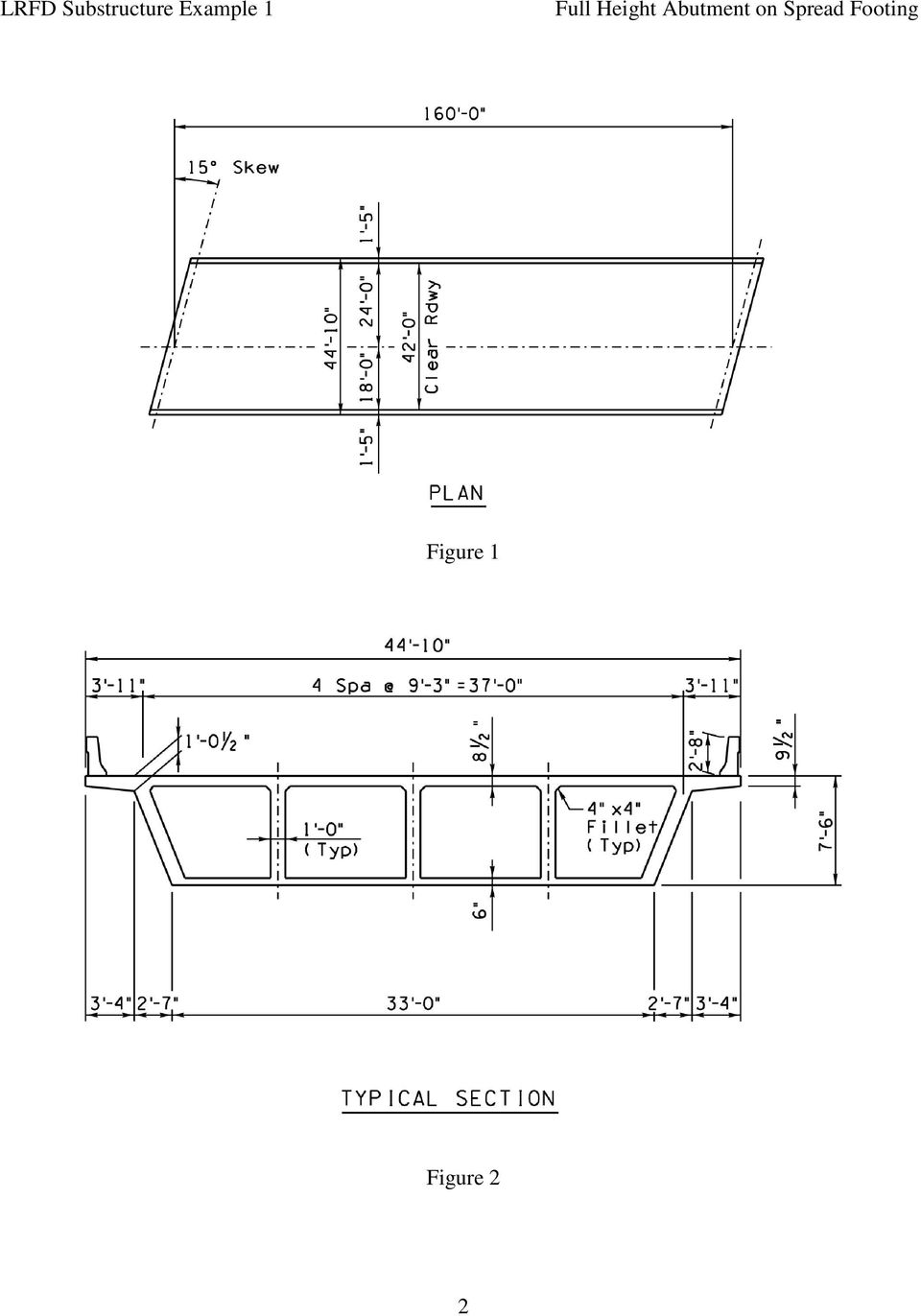
1 SUBSTRUCTURE EXAMPLE Full Height Abutment on Spread Footing This example illustrates the design of a full height abutment on spread footings for a single span ast-in-plae post-tensioned onrete box girder bridge. The bridge has a 160 feet span with a 15 degree skew. Standard ADOT 32-inh f-shape barriers will be used resulting in a typial dek setion onsisting of 1-5 barrier, 12-0 outside shoulder, two 12-0 lanes, a 6-0 inside shoulder and 1-5 barrier. The overall out-to-out width of the bridge is A plan view and typial setion of the bridge are shown in Figures 1 and 2. The following legend is used for the referenes shown in the left-hand olumn: [2.2.2] LRFD Speifiation Artile Number [ ] LRFD Speifiation Table or Equation Number [C2.2.2] LRFD Speifiation Commentary [A2.2.2] LRFD Speifiation Appendix [BDG] ADOT Bridge Design Guideline Superstruture Design Example 1 demonstrates design of the superstruture and bearings for a single span ast-in-plae post-tensioned onrete box girder bridge using LRFD. Critial dimensions and loads are repeated here for ease of referene. Bridge Geometry Bridge span length Bridge width Roadway width Loads DC Superstruture DW Superstruture ft ft ft kips kips Substruture This example demonstrates basi design features for design of a full height abutment supported on a spread footing. The substruture has been analyzed in aordane with the AASHTO LRFD Bridge Design Speifiations, 4 th Edition, 2007 and the 2008 Interim Revisions. Geotehnial The soil profile used in this example is the one used for the Geotehnial Poliy Memo Number 1: Development of Fatored Bearing Resistane Chart by a Geotehnial Engineer for Use by a Bridge Engineer to Size Spread Footings on Soils based on Servie and Strength Limit States. 1

2 Figure 1 Figure 2 2
3 Material Properties [ ] Reinforing Steel Yield Strength f y = 60 ksi Modulus of Elastiity E s = 29,000 ksi Conrete f = 3.5 ksi [ ] [C3.5.1] Unit weight for normal weight onrete is listed below. The unit weight for reinfored onrete is inreased kf greater than that for plain onrete. Unit weight for omputing E = kf Unit weight for DL alulation = kf [C ] The modulus of elastiity for normal weight onrete where the unit weight is kf may be taken as shown below: E = 1820 f ' = = 3405 ksi [5.7.1] The modular ratio of reinforing to onrete should be rounded to the nearest whole number n = = 8.52 Use n = [ ] Modulus of Rupture [ ] β 1 = the ratio of the depth of the equivalent uniformly stressed ompression zone assumed in the strength limit state to the depth of the atual ompression zone stress blok. For onrete strengths not exeeding 4.0 ksi, β 1 = The modulus of rupture for normal weight onrete has several values. When used to alulate servie level raking, as speified in Artile for side reinforing or in Artile for determination of defletions, the following equation should be used: f r = 0.24 f ' = = ksi When the modulus of rupture is used to alulate the raking moment of a member for determination of the minimum reinforing requirement as speified in Artile , the following equation should be used: f r = 0.37 f ' = = ksi 3
![4] The modulus of elastiity for normal weight onrete where the unit weight is 0.145 kf may be taken as shown below: E = 1820 f ' = 1820 3.5 = 3405 ksi [5.7.](/docs-images/40/220690/images/page_3.jpg "1] The modular ratio of reinforing to onrete should be rounded to the nearest whole number. 29")
4 Existing Soil The existing soil has the following properties: Depth ft Soil Type Total unit weight, γ s pf φ degrees 0-25 Fine to oarse sands Gravelly sands Fine to oarse sands Gravels The following assumptions have been made. No groundwater is present. The soils will not experiene any long-term (onsolidation or reep) settlement. The Fatored Net Bearing Resistane Chart plots the fatored net bearing resistane versus effetive footing width for a range of immediate settlements as shown in Figure 3. Figure 3 Bakfill Soil The soil used for bakfill has the following properties: γ s = kf k a =

5 Limit States [1.3.2] [ ] In the LRFD Speifiation, the general equation for design is shown below: η iγ iqi ϕrn = R r For loads for whih a maximum value of γ i is appropriate: [ ] η η η η 0.95 i = D R I For loads for whih a minimum value of γ i is appropriate: [ ] 1 η i = η η η D R I 1.0 [1.3.3] Dutility For strength limit state for onventional design and details omplying with the LRFD Speifiations and for all other limit states: η D = 1.0 [1.3.4] Redundany For the strength limit state for onventional levels of redundany and for all other limit states: η R = 1.0 [1.3.5] Operational Importane For the strength limit state for typial bridges and for all other limit states: η I = 1.0 For an ordinary struture with onventional design and details and onventional levels of dutility, redundany, and operational importane, it an be seen that η i = 1.0 for all ases. Sine multiplying by 1.0 will not hange any answers, the load modifier η i has not been inluded in this example. [BDG] For atual designs, the importane fator may be a value other than one. The importane fator should be seleted in aordane with the ADOT Bridge Design Guidelines. 5
![2.1-3] 1 η i = η η η D R I 1.0 [1.3.3] Dutility For strength limit state for onventional design and details omplying with the LRFD Speifiations and for all other limit states: η D = 1.0 [1.3.4] Redundany For the strength limit state for onventional levels of redundany and for all other limit states: η R = 1.](/docs-images/40/220690/images/page_5.jpg "0 [1.3.5] Operational Importane For the strength limit state for typial bridges and for all other limit states: η I = 1.")
6 SUBSTRUCTURE Loads Setion 3 Loads There are several major hanges and some minor hanges onerning the determination of loads. The DC loads must be kept separate from the DW loads sine different load fators apply. The live load is different as seen in the superstruture design. The dynami load allowane is a onstant rather than a funtion of the span and only applies to members above the ground. The Longitudinal Fore in the Standard Speifiations has been modified and replaed by the Braking Fore. A vehile ollision fore relating to protetion of piers or abutments has been added. The wind and wind on live load is similar but has a modifiation fator for elevations above 30 feet. The vertial wind pressure is the same but the speifiation larifies how to apply the fore to the proper load group. The lateral earth pressure inludes better larifiation of the following items: when to use the Rankine or Coulomb Method, when to use ative or at rest pressure, and when to use the equivalent fluid pressure method. The disussion of dead and live load surharges is enhaned. Figure 4 Abutment 1 is pinned while Abutment 2 is expansion. The pinned abutment will resist externally applied longitudinal fores. The expansion abutment will resist the frition and internal fores from the deformation of the bearing pads. Sine determining whih abutment is ritial is not obvious, the fores at eah abutment will be determined. [10.5.2] [10.5.3] Limit States For substruture design, foundation design at the servie limit state inludes settlement, lateral displaement and overall stability. Foundation design at the strength limit state inludes bearing resistane, limiting eentriity (exessive loss of ontat), sliding at the base of the footing, and strutural resistane. Three strength limit states require investigation. Strength I is the basi load ombination without wind. Strength III is the load ombination inluding wind exeeding 55 mph. Strength V is the load ombination ombining normal vehiular use with a wind of 55 mph. 6

7 [3.6.5] For substruture design, Extreme Event I load ombination inludes seismi events while Extreme Event II load ombination inludes ollision of substruture units by vehiles. These limit states are not onsidered in this example. A diagram showing the general dimensions (feet) for the abutment follows: Figure 5 7

8 [3.5] [3.5.1] PERMANENT LOADS DC Dead Load Strutural Components DC superstruture dead load inludes self-weight inluding intermediate and abutment diaphragms and barriers. DC Superstruture = k e long = (16.00 / ) = 1.25 ft M long = ( )(1.25) = 1537 ft-k DC substruture dead load inludes the weight of the abutment inluding end bloks, wingwalls and footing. Item N H W L Weight X A M A Bakwall Seat / Stem Footing End Blk / Wing Total DC Substruture = k.g. =7631 / = ft e long = / = ft M long = (947.85)(-0.051) = -48 ft-k DW Dead Load Wearing Surfae and Utilities The DW superstruture load inludes the future wearing surfae and utility loads. This bridge has no utilities. DW = k M long = (85.63)(1.25) = 107 ft-k EV - Vertial Earth Pressure The LRFD Speifiation does not provide data on unit weights of well ompated soils. For this example use a vertial earth pressure based on a unit weight of kf. In atual design use the values speified in the Geotehnial Report. 8

9 Design for the full height of the wall even though the soil only extends to the top of the seat. To avoid the omplexities of how to deal with the weight of the approah slab it is simpler to design for the taller height of soil. Item N H W L Weight X A M A Toe Heel Seat / Total Note: Some numbers may not add up due to rounding. EV = 850 kips.g. = 9879 / = ft e long = / = ft M long = (849.89)(-3.624) = ft-k [3.11.5] EH - Horizontal Earth Pressure Two deisions must be made before analysis begins: (1) whether to use at-rest or ative lateral earth pressure and (2) whether to use the Rankine or Coulomb theory. Typial abutments supported on ohensionless soils with elastomeri bearings supporting the superstruture with strutural grade bakfill will deflet adequately to mobilize ative soil pressure. Therefore, ative pressure will be used in the design. [C ] The LRFD Speifiation states that the Coulomb method is neessary for design of retaining walls where the bak fae of the wall interferes with the development of the full sliding surfaes in the bakfill soil assumed in the Rankine theory. Abutment onrete antilever walls with short heels will require the use of the Coulomb method. Abutment onrete antilever walls with long heels may be designed with either the Rankine or Coulomb method. The LRFD Speifiation indiates that the Rankine method of determining lateral earth pressure is not appropriate when the heel is determined to be a short heel. However, the use of the Coulomb Method is a major departure from ADOT past pratie. In addition, a value of frition must be onsidered in the Coulomb Method yet the reommended value varies widely. 9

10 Foundation Analysis and Design by Bowles partially agrees with the LRFD Speifiation but omes to the onlusion that neither method in its pure form an be used. However, either method an be used if the following modifiation is made: the soil loads are applied to a vertial line extending from the end of the heel and the soil on top of the heel is treated as a stati load. [BDG] The Rankine formula provides more onservative designs, is allowed per ADOT Bridge Design Guidelines and will be used in this example. The soil data will be provided in the Geotehnial Report. For this problem assume that the soil extends to the full height of the abutment with the following properties: γ s = kf k a = The lateral earth pressure is assumed to be linearly proportional to the depth of earth and taken as: [ ] p = k a γ s z = (0.295)(0.120)(24.50) = ksf/ft EH = 0.5(0.867)(24.50)(46.41) = k/ft The resultant ats at a height of H/3 above the base of the wall. M long = (493.08)(24.50) / 3 = 4027 ft-k/ft 10
![stati load. [BDG] The Rankine formula provides more onservative designs, is allowed per ADOT Bridge Design Guidelines and will be used in this example.](/docs-images/40/220690/images/page_10.jpg "The soil data will be provided in the Geotehnial Report. For this problem assume that the soil extends to the full height of the abutment with the following properties: γ s = 0.120 kf k a = 0.")
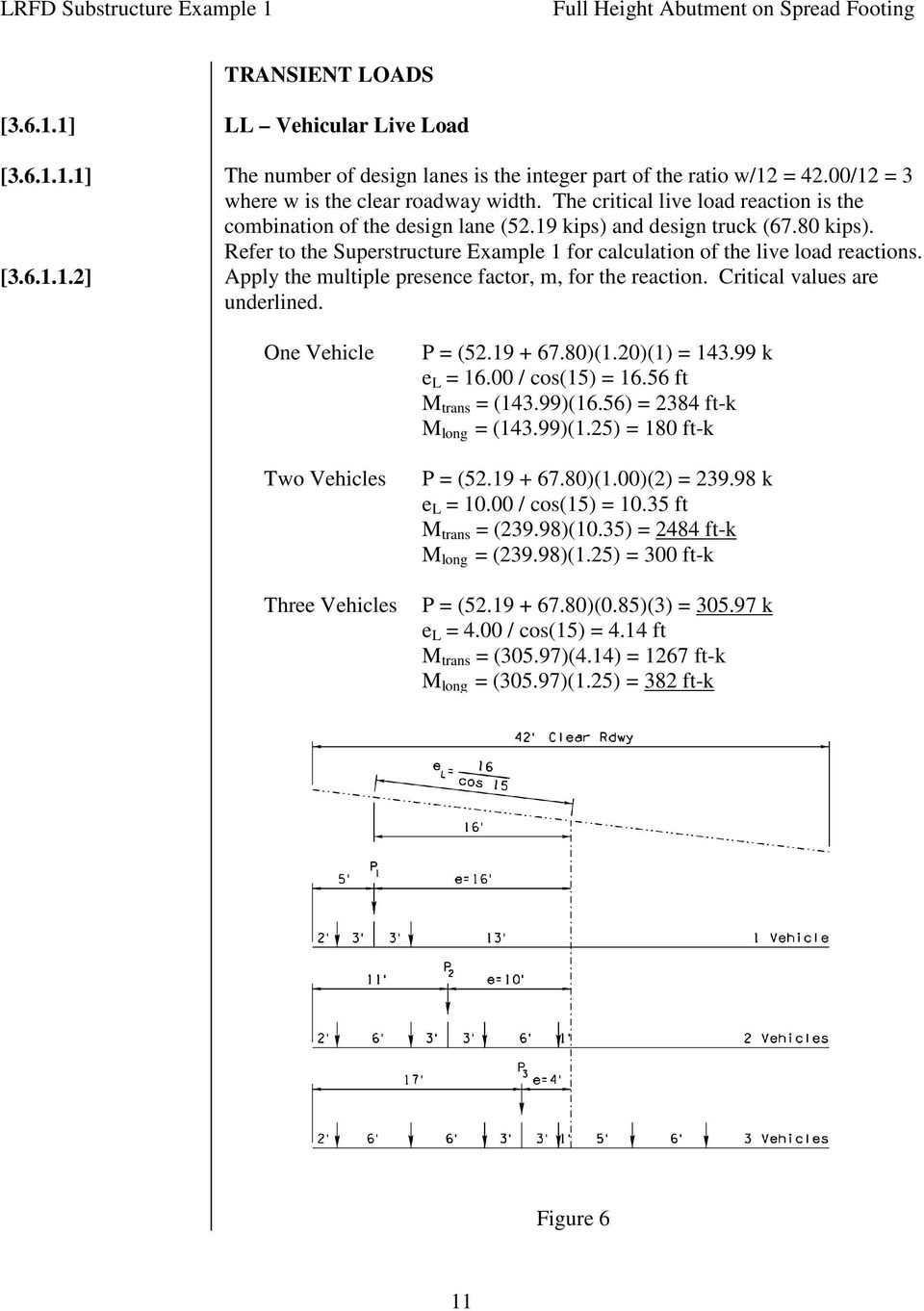
11 TRANSIENT LOADS [ ] [ ] [ ] LL Vehiular Live Load The number of design lanes is the integer part of the ratio w/12 = 42.00/12 = 3 where w is the lear roadway width. The ritial live load reation is the ombination of the design lane (52.19 kips) and design truk (67.80 kips). Refer to the Superstruture Example 1 for alulation of the live load reations. Apply the multiple presene fator, m, for the reation. Critial values are underlined. One Vehile Two Vehiles Three Vehiles P = ( )(1.20)(1) = k e L = / os(15) = ft M trans = (143.99)(16.56) = 2384 ft-k M long = (143.99)(1.25) = 180 ft-k P = ( )(1.00)(2) = k e L = / os(15) = ft M trans = (239.98)(10.35) = 2484 ft-k M long = (239.98)(1.25) = 300 ft-k P = ( )(0.85)(3) = k e L = 4.00 / os(15) = 4.14 ft M trans = (305.97)(4.14) = 1267 ft-k M long = (305.97)(1.25) = 382 ft-k Figure 6 11
12 To simplify the problem, the maximum reation and moments will be used even though they do not our simultaneously. This will redue the number of load ases without substantially simplifying the design. [3.6.2] IM Dynami Load Allowane Dynami load allowane need not apply for foundation omponents that are entirely below ground suh as footings. For the portion of the abutment above the ground, the dynami load allowane is only a design load for the stem. [3.6.4] BR Vehiular Braking Fore The braking fore shall be taken as the greater of: 25 perent of the axle weights of the design truk or design tandem V = (0.25)( ) = k <= Critial V = (0.25)( ) = k 5 perent of the design truk plus lane load or 5 perent of the design tandem plus lane load V = (0.05)[ (160.00)(0.640)] = 8.72 k V = (0.05)[ (160.00)(0.640)] = 7.62 k It should be noted that the truk load will always ontrol and the tandem fore need not be alulated. The braking fore shall be plaed in all design lanes that are onsidered to be loaded whih arry traffi in the same diretion. For this bridge the number of lanes equals the lear roadway width of 42 feet divided by 12 foot lanes = 3.5. Sine only full lanes are used, use 3 lanes. The bridge is a one diretional struture with all lanes headed in the same diretion. Therefore, all design lanes shall be simultaneously loaded and the multiple presene fator shall apply. BR = (18.00)(3)(0.85) = k This load is applied 6 feet above the dek surfae. However, due to the pinned restraint the longitudinal fore will be applied at the seat level. V long = os(15) = k V trans = sin(15) = k M long = (44.34)(16.83) = 746 ft-k M trans = (11.88)(16.83) = 200 ft-k 12

13 [ ] LS - Live Load Surharge A live load surharge shall be applied where a vehiular load is expeted to at on the surfae of the bakfill within a distane equal to one-half the wall height behind the bak fae of the wall. The inrease in horizontal pressure due to live load surharge may be estimated as: [ ] p = kγ s h eq where: [ ] γ s = total unit weight of soil = kf k = oeffiient of lateral earth pressure, k a, for walls that deflet h eq = equivalent height of soil for vehiular load from Table 1 = 2.0 ft for abutment height > 20.0 feet p = (0.295)(0.120)(2.0) = ksf P = (0.120)(2.0)(6.5)(46.41) = k V long = (0.0708)(24.50)(46.41) = k M long = (80.50)(24.50) / 2 = 986 ft-k [C3.4.1] [ ] The vertial weight of the soil surharge is to be inluded for foundation designs where the load inreases the load effet but ignored where the load inreases the resistane. For bearing resistane the vertial soil weight on the heel will inrease the total load and therefore the load effet and should be inluded. For sliding resistane and overturning the vertial soil weight will inrease the resistane and therefore should be ignored. If the vehiular loading is transmitted through a strutural slab, whih is also supported by means other than earth, a orresponding redution in the surharge loads may be permitted. The standard ADOT approah slab satisfies this riterion. However, the abutment is tall ompared to the slab length and no method is provided to determine the amount of the redution, so the full live load surharge will be used. In addition, onstrution vehiles ould produe a live load surharge before the approah slab is onstruted. 13
![fae of the wall. The inrease in horizontal pressure due to live load surharge may be estimated as: 4-1] p = kγ s h eq where: 4-1] γ s = total unit weight of soil = 0.](/docs-images/40/220690/images/page_13.jpg "120 kf k = oeffiient of lateral earth pressure, k a, for walls that deflet h eq = equivalent height of soil for vehiular load from Table 1 = 2.0 ft for abutment height > 20.0 feet p = (0.295)(0.")
14 [3.8] [ ] WS Wind Load on Struture Wind pressures are based on a base design wind veloity of 100 mph. For strutures with heights over 30 feet above the groundline, a formula is available to adjust the wind veloity. The wind is assumed to at uniformly on the area exposed to the wind. The exposed area is the sum of the areas of all omponents as seen in elevation taken perpendiular to the assumed wind diretion. Height = (44.83) = ft Area = (11.07)(160.00) = 1770 ft 2 Wind on Superstruture [ ] The base pressure for girder bridges orresponding to the 100 mph wind is psf. The minimum wind loading shall not be less than 0.30 klf. Sine the girder bridge has spans greater than 125 feet, the wind must be evaluated for various angles of attak. The enter of gravity of the loads is loated (11.07) / 2 = feet above the bottom of the footing. Wind fore in the diretion of the span will be applied at the top of the seat due to the pinned ondition. Wind pressures for various angles of attak are taken from Table Refer to Figure 4 for proper inlusion of the skew affet for the load ombinations. Critial values are underlined. Pinned Abutment 0 Degree Skew Angle V long = [(1770)(0.050)sin(15)]/2 + (1770)(0.000)os(15) = k V trans = [(1770)(0.050)os(15)]/2 + (1770)(0.000)sin(15) = k M long = [(1770)(0.050)(22.36)sin(15)]/2 + (1770)(0.000)(16.83)os(15) = 256 ft-k M trans = [(1770)(0.050)(22.36)os(15)]/2 + (1770)(0.000)(16.83)sin(15) = 956 ft-k 15 Degree Skew Angle V long = [(1770)(0.044)sin(15)]/2 + (1770)(0.006)os(15) = k V trans = [(1770)(0.044)os(15)]/2 + (1770)(0.006)sin(15) = k M long = [(1770)(0.044)(22.36)sin(15)]/2 + (1770)(0.006)(16.83)os(15) = 398 ft-k M trans = [(1770)(0.044)(22.36)os(15)]/2 + (1770)(0.006)(16.83)sin(15) = 887 ft-k 14
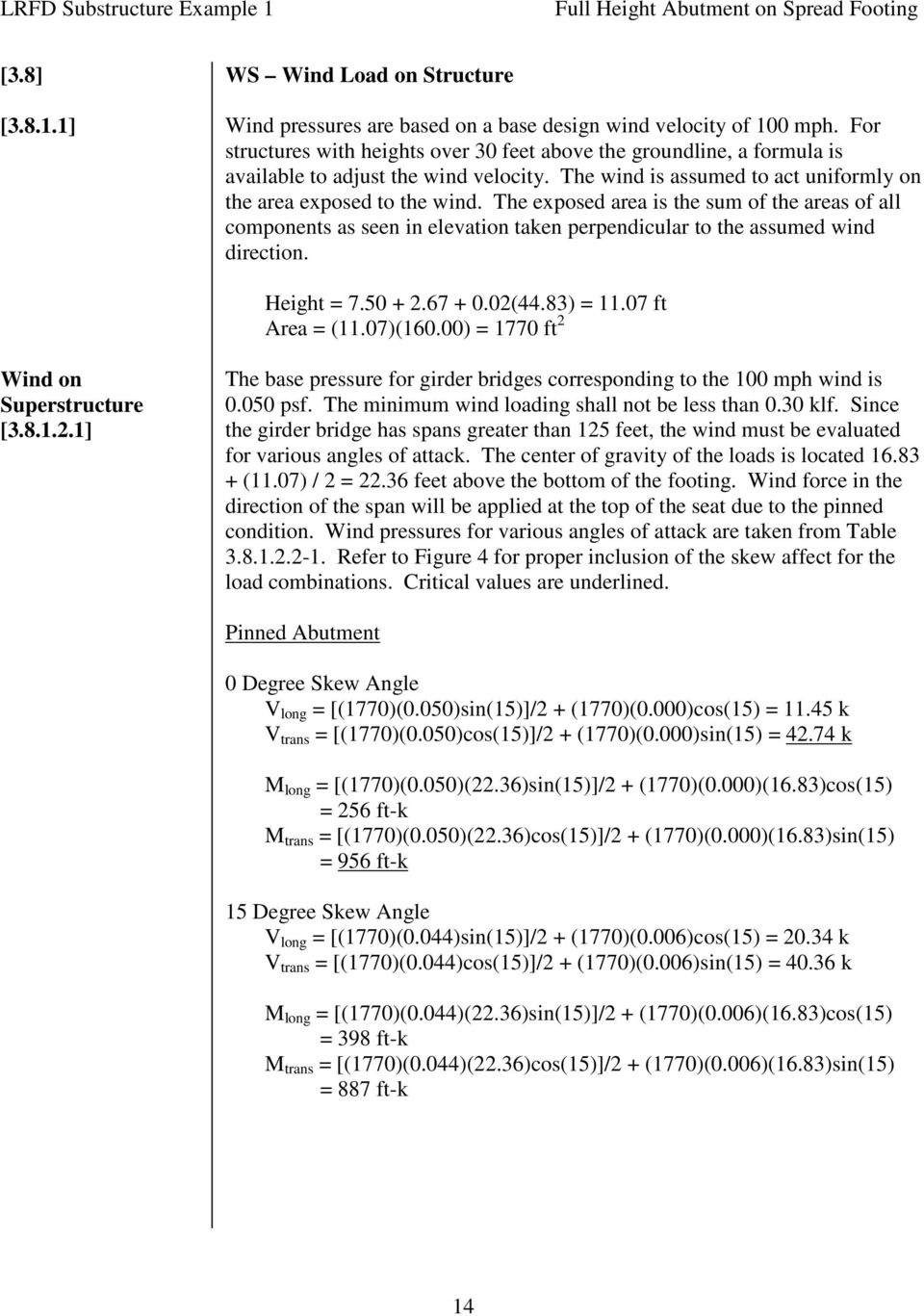
15 30 Degree Skew Angle V long = [(1770)(0.041)sin(15)]/2 + (1770)(0.012)os(15) = k V trans = [(1770)(0.041)os(15)]/2 + (1770)(0.012)sin(15) = k M long = [(1770)(0.041)(22.36)sin(15)]/2 + (1770)(0.012)(16.83)os(15) = 555 ft-k M trans = [(1770)(0.041)(22.36)os(15)]/2 + (1770)(0.012)(16.83)sin(15) = 876 ft-k 45 Degree Skew Angle V long = [(1770)(0.033)sin(15)]/2 + (1770)(0.016)os(15) = k V trans = [(1770)(0.033)os(15)]/2 + (1770)(0.016)sin(15) = k M long = [(1770)(0.033)(22.36)sin(15)]/2 + (1770)(0.016)(16.83)os(15) = 629 ft-k M trans = [(1770)(0.033)(22.36)os(15)]/2 + (1770)(0.016)(16.83)sin(15) = 754 ft-k 60 Degree Skew Angle V long = [(1770)(0.017)sin(15)]/2 + (1770)(0.019)os(15) = k V trans = [(1770)(0.017)os(15)]/2 + (1770)(0.019)sin(15) = k M long = [(1770)(0.017)(22.36)sin(15)]/2 + (1770)(0.019)(16.83)os(15) = 634 ft-k M trans = [(1770)(0.017)(22.36)os(15)]/2 + (1770)(0.019)(16.83)sin(15) = 471 ft-k Expansion Abutment 0 Degree Skew Angle V long = [(1770)(0.050)sin(15)]/2 = k V trans = [(1770)(0.050)os(15)]/2 = k M long = [(1770)(0.050)(22.36)sin(15)]/2 = 256 ft-k M trans = [(1770)(0.050)(22.36)os(15)]/2 = 956 ft-k 15 Degree Skew Angle V long = [(1770)(0.044)sin(15)]/2 = k V trans = [(1770)(0.044)os(15)]/2 = k M long = [(1770)(0.044)(22.36)sin(15)]/2 = 225 ft-k M trans = [(1770)(0.044)(22.36)os(15)]/2 = 841 ft-k 15
![033)sin(15)]/2 + (1770)(0.016)os(15) = 34.91 k V trans = [(1770)(0.033)os(15)]/2 + (1770)(0.016)sin(15) = 35.54 k M long = [(1770)(0.033)(22.36)sin(15)]/2 + (1770)(0.016)(16.](/docs-images/40/220690/images/page_15.jpg "83)os(15) = 629 ft-k M trans = [(1770)(0.033)(22.36)os(15)]/2 + (1770)(0.016)(16.83)sin(15) = 754 ft-k 60 Degree Skew Angle V long = [(1770)(0.017)sin(15)]/2 + (1770)(0.019)os(15) = 36.")
16 30 Degree Skew Angle V long = [(1770)(0.041)sin(15)]/2 = 9.39 k V trans = [(1770)(0.041)os(15)]/2 = k M long = [(1770)(0.041)(22.36)sin(15)]/2 = 210 ft-k M trans = [(1770)(0.041)(22.36)os(15)]/2 = 784 ft-k 45 Degree Skew Angle V long = [(1770)(0.033)sin(15)]/2 = 7.56 k V trans = [(1770)(0.033)os(15)]/2 = k M long = [(1770)(0.033)(22.36)sin(15)]/2 = 169 ft-k M trans = [(1770)(0.033)(22.36)os(15)]/2 = 631 ft-k 60 Degree Skew Angle V long = [(1770)(0.017)sin(15)]/2 = 3.89 k V trans = [(1770)(0.017)os(15)]/2 = k M long = [(1770)(0.017)(22.36)sin(15)]/2 = 87 ft-k M trans = [(1770)(0.017)(22.36)os(15)]/2 = 325 ft-k A onservative answer an be ahieved by simplifying the problem by using the maximum values in eah diretion ating simultaneously. If wind ontrols the design, the omplexities of ombining 5 wind ombinations should be performed. A summary of wind fores used in the design follows: Pinned V long = k V trans = k M long = 634 ft-k M trans = 956 ft-k Expansion k k 256 ft-k 956 ft-k Wind on Substruture [ ] The transverse and longitudinal fores to be applied diretly to the substruture are alulated from an assumed base wind pressure of ksf. Beause the longitudinal wind blows opposite the earth pressure, the ritial wind on substruture load in the longitudinal diretion will be zero. V long = 0 k V trans = 0.040[(10.50)(18.00)] = 7.56 k M long = 0 ft-k M trans = 0.040(10.50)(18.00)(15.50) = 117 ft-k 16
![017)sin(15)]/2 = 3.89 k V trans = [(1770)(0.017)os(15)]/2 = 14.53 k M long = [(1770)(0.017)(22.](/docs-images/40/220690/images/page_16.jpg "36)sin(15)]/2 = 87 ft-k M trans = [(1770)(0.017)(22.")
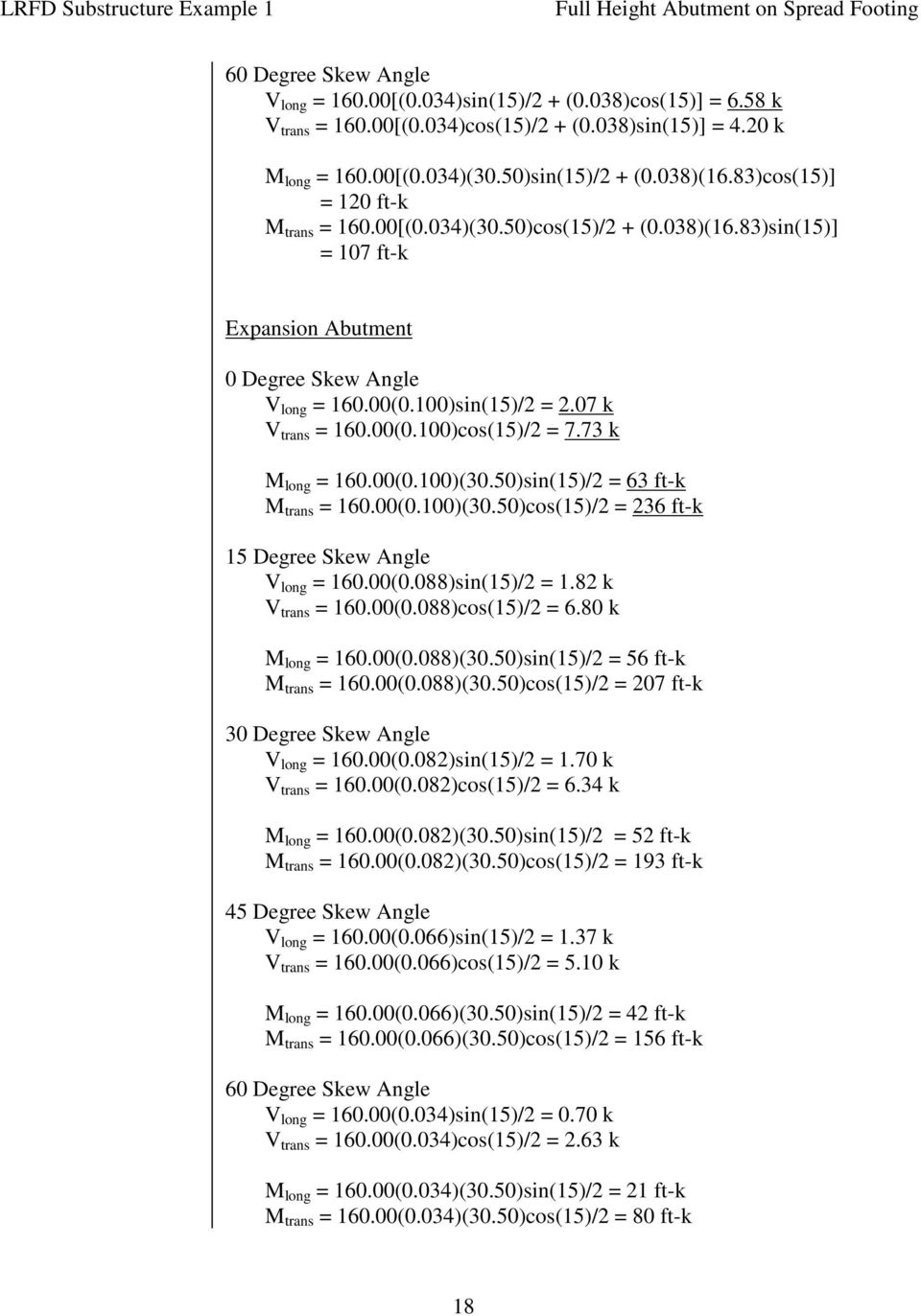
17 [ ] WL Wind Pressure on Vehiles Wind pressure on vehiles is represented by a moving fore of 0.10 klf ating normal to and 6.0 feet above the roadway. Loads normal to the span should be applied at a height of = ft Pinned Abutment 0 Degree Skew Angle V long = [(0.100)sin(15)/2 + (0.000)os(15)] = 2.07 k V trans = [(0.100)os(15)/2 + (0.000)sin(15)] = 7.73 k M long = [(0.100)(30.50)sin(15)/2 + (0.000)(16.83)os(15)] = 63 ft-k M trans = [(0.100)(30.50)os(15)/2 + (0.000)(16.83)sin(15)] = 236 ft-k 15 Degree Skew Angle V long = [(0.088)sin(15)/2 + (0.012)os(15)] = 3.68 k V trans = [(0.088)os(15)/2 + (0.012)sin(15)] = 7.30 k M long = [(0.088)(30.50)sin(15)/2 + (0.012)(16.83)os(15)] = 87 ft-k M trans = [(0.088)(30.50)os(15)/2 + (0.012)(16.83)sin(15)] = 216 ft-k 30 Degree Skew Angle V long = [(0.082)sin(15)/2 + (0.024)os(15)] = 5.41 k V trans = [(0.082)os(15)/2 + (0.024)sin(15)] = 7.33 k M long = [(0.082)(30.50)sin(15)/2 + (0.024)(16.83)os(15)] = 114 ft-k M trans = [(0.082)(30.50)os(15)/2 + (0.024)(16.83)sin(15)] = 210 ft-k 45 Degree Skew Angle V long = [(0.066)sin(15)/2 + (0.032)os(15)] = 6.31 k V trans = [(0.066)os(15)/2 + (0.032)sin(15)] = 6.43 k M long = [(0.066)(30.50)sin(15)/2 + (0.032)(16.83)os(15)] = 125 ft-k M trans = [(0.066)(30.50)os(15)/2 + (0.032)(16.83)sin(15)] = 178 ft-k 17
![000)sin(15)] = 7.73 k M long = 160.00[(0.100)(30.50)sin(15)/2 + (0.000)(16.83)os(15)] = 63 ft-k M trans = 160.00[(0.100)(30.50)os(15)/2 + (0.000)(16.83)sin(15)] = 236 ft-k 15 Degree Skew Angle V long = 160.](/docs-images/40/220690/images/page_17.jpg "00[(0.088)sin(15)/2 + (0.012)os(15)] = 3.68 k V trans = 160.00[(0.088)os(15)/2 + (0.012)sin(15)] = 7.30 k M long = 160.00[(0.088)(30.50)sin(15)/2 + (0.012)(16.83)os(15)] = 87 ft-k M trans = 160.00[(0.088)(30.50)os(15)/2 + (0.")
18 60 Degree Skew Angle V long = [(0.034)sin(15)/2 + (0.038)os(15)] = 6.58 k V trans = [(0.034)os(15)/2 + (0.038)sin(15)] = 4.20 k M long = [(0.034)(30.50)sin(15)/2 + (0.038)(16.83)os(15)] = 120 ft-k M trans = [(0.034)(30.50)os(15)/2 + (0.038)(16.83)sin(15)] = 107 ft-k Expansion Abutment 0 Degree Skew Angle V long = (0.100)sin(15)/2 = 2.07 k V trans = (0.100)os(15)/2 = 7.73 k M long = (0.100)(30.50)sin(15)/2 = 63 ft-k M trans = (0.100)(30.50)os(15)/2 = 236 ft-k 15 Degree Skew Angle V long = (0.088)sin(15)/2 = 1.82 k V trans = (0.088)os(15)/2 = 6.80 k M long = (0.088)(30.50)sin(15)/2 = 56 ft-k M trans = (0.088)(30.50)os(15)/2 = 207 ft-k 30 Degree Skew Angle V long = (0.082)sin(15)/2 = 1.70 k V trans = (0.082)os(15)/2 = 6.34 k M long = (0.082)(30.50)sin(15)/2 = 52 ft-k M trans = (0.082)(30.50)os(15)/2 = 193 ft-k 45 Degree Skew Angle V long = (0.066)sin(15)/2 = 1.37 k V trans = (0.066)os(15)/2 = 5.10 k M long = (0.066)(30.50)sin(15)/2 = 42 ft-k M trans = (0.066)(30.50)os(15)/2 = 156 ft-k 60 Degree Skew Angle V long = (0.034)sin(15)/2 = 0.70 k V trans = (0.034)os(15)/2 = 2.63 k M long = (0.034)(30.50)sin(15)/2 = 21 ft-k M trans = (0.034)(30.50)os(15)/2 = 80 ft-k 18
19 A onservative answer for wind on live load an be ahieved by using the maximum values in eah diretion ating simultaneously. If wind ontrols the design, the omplexities of ombining 5 wind diretions should be performed. Pinned V long = 6.58 k V trans = 7.73 k M long = 125 ft-k M trans = 236 ft-k Expansion 2.07 k 7.73 k 63 ft-k 236 ft-k [3.8.2] Vertial Wind Pressure A vertial upward wind fore of ksf times the width of the dek shall be applied at the windward quarter point of the dek. This load is only applied for limit states whih inlude wind but not wind on live load (Strength III Limit State) and only when the diretion of wind is taken to be perpendiular to the longitudinal axis of the bridge. When appliable the wind loads are as shown: P = (0.020)(44.83)(160) / 2 = upward M trans = [71.73(44.83) / 4]os(15) = 777 ft-k M long = [71.73(44.83) / 4]sin(15) = 208 ft-k [3.13] [ ] [ ] FR Frition Fores Frition fores from the greased bearings aused by superstruture movement will be transmitted to the substruture for Abutment 2, the expansion abutment. These fores will our during the stressing operation and for a short period of time afterwards while the bridge undergoes long term prestress shortening. This fore was alulated for the elastomeri bearing for the Superstruture Example 1 as repeated below: H bu = µp u P u = 1.25DC DW P u = 1.25(245.86) (17.13) = k H bu = (0.10)(333.02) = k per bearing pad It is important to note that this fore is already fatored and only applies to strength and extreme event limit states. Table does list FR as a load with a load fator of 1.0 for all limit states inluding servie. However, this FR does not apply to servie limit states. 19
![73 k 63 ft-k 236 ft-k [3.8.2] Vertial Wind Pressure A vertial upward wind fore of 0.020 ksf times the width of the dek shall be applied at the windward quarter point of the dek.](/docs-images/40/220690/images/page_19.jpg "This load is only applied for limit states whih inlude wind but not wind on live load (Strength III Limit State) and only when the diretion of wind is taken to be perpendiular to the longitudinal")
20 V trans = (33.30)(5 bearings)sin(15) = k V long = (33.30)(5 bearings)os(15) = k M trans = (43.09)(16.83) = 725 ft-k M long = (160.83)(16.83) = 2707 ft-k Bearing Translation The elastomeri bearing pad will also transmit fores to the substruture due to horizontal displaements aused by temperature, shrinkage, reep and prestress shortening. For the greased pad the shrinkage, reep and prestress shortening are resisted as a frition load so there is no diret load for SH and CR. The fore due to deformation of an elastomeri bearing pad due to TU shall be taken as: [ ] H bu = GA h u rt u = shear deformation from appliable strength and extreme event load ombinations in Table h rt = ( )(3 interior) + ( )(2 exterior) = 1.70 [BDG] [BDG] For a post-tensioned box girder with greased sliding pads the elasti shortening and reep are assumed to be taken by the greased pad in a sliding mode. Afterwards the grease hardens and the pad resists temperature movement by deformation of the pad. The strength limit state load fator for TU deformations is The 0.65 fator reflets the fat that the pads are not always onstruted at the mean temperature. The temperature range for elevations less than 3000 feet is 90 degrees. u = (0.50)(0.65)( )(90)(160)(12) = in H bu = ( 0.130) (28) (14) = kips 1.70 The fore from frition (33.30 k/pad) is higher than the fore resulting from the internal deformation of the elastomeri bearing (10.10 k/pad). This bearing translation fore only applies to the strength and extreme event load ombinations and is also already fatored. Sine the FR fores are greater than the TU fores and only one fore an our at a time, only the FR fores will be onsidered further. 20

21 Bearing Rotation Rotations in the elastomeri bearing pads will ause bending moments that will be transmitted to the substruture. For unonfined elastomeri bearings the moment shall be taken as: [ ] M u = 1.60 ( 0.5E I ) θ h s rt where: I = moment of inertia of plan shape of bearing I = WL 3 /12 = (28)(14) 3 / 12 = 6403 in 3 [C ] E = effetive modulus of elastomeri bearing in ompression E = 6GS 2 = 6(0.130)(11) 2 = ksi Refer to Example 1 Superstruture Bearing alulations. θ S = radians Strength Limit States [ ] M u = ( 1.60) (0.5) (94.38) (6403) 12 = 199 ft-k 1.70 M long = (199)(5 bearings)os(15) = 961 ft-k M trans = (199)(5 bearings)sin(15) = 258 ft-k Again this moment is already fatored. The 1.60 fator in the formula is the load fator that allows for use of servie limit rotations. This load only applies to the strength and extreme limit states. 21
22 A summary of unfatored axial loads, shears and moments exept as otherwise noted follows: Abutment 1 (Pinned) Load P max P min V long V trans M long M trans kip kip kip kip ft-k ft-k DC super DC sub DC DW EV EH LL BR LS WS super WS sub WS WS vertial WL FR * Bearing Rotation* Abutment 2 (Expansion) Load P max P min V long V trans M long M trans kip kip kip kip ft-k ft-k DC super DC sub DC DW EV EH LL BR LS WS super WS sub WS WS vertial WL FR* Bearing Rotation* * Loads are fatored and only apply to strength limit states 22
23 [ ] LOAD COMBINATIONS STRENGTH I Max = 1.25DC DW EH EV (LL + BR +LS) + FR + Bearing Min = 0.90DC DW EH EV (LL + BR + LS) + FR + Bearing STRENGTH III Max = 1.25DC DW EH EV (WS + WS vert ) + FR + Bearing Min = 0.90DC DW EH EV (WS + WS vert ) + FR + Bearing STRENGTH IV Max = 1.50DC DW EH EV + FR + Bearing STRENGTH V Max = 1.25DC DW EH EV (LL + BR + LS) WS WL + FR + Bearing Min = 0.90DC DW EH EV (LL + BR + LS) WS WL + FR + Bearing SERVICE I Max = 1.00(DC + DW + EH + EV) (LL + BR + LS) WS WL The moment due to bearing rotation and frition fores from the bearing only apply to strength limit states and are already fatored. As previously disussed, CR and SH fores are not ritial for this bridge and are not inluded in the load ombinations above. 23
24 General The methods used to estimate loads for the design of foundations using LRFD are fundamentally the same as the proedures used in the past for ASD. What has hanged is the way the loads are onsidered for evaluation of foundation stability (bearing and sliding resistane of spread footing foundations) and foundation deformation. The design of foundations supporting bridge abutments should onsider all limit states loading onditions appliable to the struture being designed. The following Strength Limit States may ontrol the design and should be investigated: Strength I Limit State will ontrol for high live to dead load ratios. Strength III or V will ontrol for strutures subjeted to high wind loads Strength IV Limit State will ontrol for high dead to live load ratios A spread footing foundation will be evaluated for the following failure onditions: 1. Bearing Resistane Strength Limit States 2. Settlement Servie I Limit State 3. Sliding Resistane Strength Limit States 4. Load Eentriity (Overturning) Strength Limit States 5. Overall Stability Servie I Limit State 6. Strutural Resistane Servie I and Strength Limit States 24
25 1. Bearing Resistane [11.5.3] Bearing resistane hek is a strength limit state. The appropriate strength limit states are I, III and V. The maximum bearing stress will be found by applying the maximum load fators to eah appliable load. The Fatored Net Bearing Resistane Chart will be provided in the Geotehnial Report. The load fators and loads are shown below: Strength I (max) Limit State: [C ] Figure 7 [11.5.5] Strength I = 1.25DC DW EH EV (LL + BR + LS) + FR + Bearing P max = 1.25(2177) (86) (850) ( ) = 4659 k Pinned Abutment M long = 1.25(1489) (107) (4027) (-3080) ( ) = 9643 ft-k M trans = 1.25(0) (0) (0) (0) ( ) = 4955 ft-k e long = e B = 9643 / 4659 = ft e trans = e L = 4955 / 4659 = ft [ ] B = (2.070) = ft (effetive footing width) L = (1.064) = ft (effetive footing length) q max = 4659 / [(11.86)(47.39)] = 8.29 ksf 25
26 q nveu = (0.120)(6.50) = 7.24 ksf Expansion Abutment M long = 1.25(1489) (107) (4027) (-3080) ( ) = ft-k M trans = 1.25(0) (0) (0) (0) ( ) = 5330 ft-k e long = e B = / 4659 = ft e trans = e L = 5330 / 4659 = ft B = (2.370) = ft (effetive footing width) L = (1.144) = ft (effetive footing length) q max = 4659 / [(11.26)(47.23)] = 8.76 ksf q nveu = (0.120)(6.50) = 7.71 ksf <= Critial Strength III (max) Limit State: Figure 8 26
27 Strength III = 1.25DC DW EH EV (WS+ WS vert ) + FR + Bearing P max = 1.25(2177) (86) (850) = 3998 k Pinned Abutment M long = 1.25(1489) (107) (4027) (-3080) ( ) = 7122 ft-k M trans = 1.25(0) (0) (0) (0) ( ) = 2848 ft-k e long = e B = 7122 / 3998 = ft e trans = e L = 2848 / 3998 = ft B = (1.781) = ft (effetive footing width) L = (0.712) = ft (effetive footing length) q max = 3998 / [(12.44)(48.10)] = 6.68 ksf q nveu = (0.120)(6.50) = 5.63 ksf Expansion Abutment M long = 1.25(1489) (107) (4027) (-3080) ( ) = 9300 ft-k M trans = 1.25(0) (0) (0) (0) ( ) = 3573 ft-k e long = e B = 9300 / 3998 = ft e trans = e L = 3573 / 3998 = ft B = (2.326) = ft (effetive footing width) L = (0.894) = ft (effetive footing length) q max = 3998 / [(11.35)(47.73)] = 7.38 ksf q nveu = (0.120)(6.50) = 6.33 ksf 27
28 Strength V (max) Limit State: Figure 9 Strength V = 1.25DC DW EH EV (LL + BR + LS) WS WL + FR + Bearing P max = 1.25(2177) (86) (850) ( ) = 4508 k Pinned Abutment M long = 1.25(1489) (107) (4027) (-3080) ( ) (634) (125) = 9176 ft-k M trans = 1.25(0) (0) (0) (0) ( ) (1073) (236) = 4547 ft-k e long = e B = 9176 / 4508 = ft e trans = e L = 4547 / 4508 = ft B = (2.035) = ft L = (1.009) = ft q max = 4508 / [(11.93)(47.50)] = 7.96 ksf q nveu = (0.120)(6.50) = 6.91 ksf 28
29 Expansion Abutment M long = 1.25(1489) (107) (4027) (-3080) ( ) (256) (63) = ft-k M trans = 1.25(0) (0) (0) (0) ( ) (1073) (236) = 5002 ft-k e long = e B = / 4508 = ft e trans = e L = 5002 / 4508 = ft B = (2.365) = ft (effetive footing width) L = (1.110) = ft (effetive footing length) q max = 4508 / [(11.27)(47.30)] = 8.46 ksf q nveu = (0.120)(6.50) = 7.41 ksf The maximum fatored net bearing stress is 7.71 ksf for Strength I (max) Limit State at the expansion abutment. The fatored net bearing resistane from the Fatored Net Bearing Resistane Chart from the geotehnial report as shown in Figure 10 below is 9.20 ksf. Therefore, the bearing resistane riterion is satisfied. Figure 10 29
30 [11.5.2] 2. Settlement Settlement is a servie limit state. For a single span bridge settlement and differential settlement will not ause strutural distress to the superstruture but must be onsidered for the bearing and joint design. There are also limits to settlement to ensure a smooth ride. The Geotehnial Foundation Report will provide a hart that plots the fatored net bearing stress versus the effetive footing width for various settlement urves. This hart is speifi for a given effetive footing length and embedment depth. The geotehnial engineer will inlude the bearing resistane fator in the hart sine the fator is a funtion of variables only the geotehnial engineer an determine. The bridge engineer will determine the amount of settlement that the bridge an tolerate, determine the atual bearing stress and ompare the orresponding settlement determined from the hart to the tolerable settlement. As an alternative the bridge engineer may determine the amount of settlement that the bridge an tolerate, determine the maximum bearing stress from the hart for a given settlement and ompare the atual bearing stress to the maximum. The bridge engineer will also evaluate whether the struture an handle the estimated horizontal movement. [BDG] Bridge Group guidane on this topi is under development. Refer to the Bridge Design Guidelines for the most urrent guideline. The proposed riterion is to limit the maximum settlement to 3 inhes per 100 feet for simple span bridges orresponding to a tolerable angle of (3) / [(100)(12)] = radians. For a span of 160 feet the orresponding tolerable settlement equals (3)[(160) / (100)] = 4.80 inhes. The example was originally developed for a rotation limit of radians. The radian value is used in the elastomeri bearing design and subsequent load ombinations and was not realulated using the radian riterion. For the servie limit state, fores from the bearing rotation and bearing frition are not inluded. Servie I Limit State P max = 1.0(DC + DW + EH + EV) + 1.0(LL + BR + LS) + 0.3WS + 1.0WL P max = 1.0( ) +1.0( ) = 3491 kips Pinned Abutment M long = 1.0( ) + 1.0( ) + 0.3(634) +1.0(125) = 4972 ft-k M trans = 1.0(0) + 1.0( ) + 0.3(1073) + 1.0(236) = 3242 ft-k 30
31 e long = e B = 4972 / 3491 = ft e trans = e L = 3242 / 3491 = ft B = (1.424) = ft (footing effetive width) L = (0.929) = ft (footing effetive length) q tveu = 3491 / [(13.15)(47.66)] = 5.57 ksf The total fatored equivalent uniform vertial bearing stress, q tveu, at the base of the footing is 5.57 ksf. To determine the orresponding settlement for this bearing stress, the equivalent net uniform bearing stress is required. To determine the equivalent net uniform bearing stress, the fatored overburden stress is subtrated. q nveu = (0.120)(6.50) = 4.79 ksf The Fatored Net Bearing Resistane Chart is only valid for a speifi effetive footing length, L, and embedment depth of 6.50 feet. The bridge engineer will enter the hart for an effetive footing width, B = feet, for a net equivalent uniform bearing stress of 4.79 ksf. From the hart the orresponding settlement is approximately 0.95 inh. Refer to Figure 11. Figure 11 31
32 Expansion Abutment M long = 1.0( ) + 1.0( ) + 0.3(256) + 1.0(63) = 4051 ft-k M trans = 1.0(0) + 1.0(2484) + 0.3(1073) + 1.0(236) = 3042 ft-k e long = e B = 4051 / 3491 = ft e trans = e L = 3042 / 3491 = ft B = (1.160) = ft (effetive footing width) L = (0.871) = ft (effetive footing length) q tveu = 3491 / [(13.68)(47.78)] = 5.34 ksf The gross equivalent uniform bearing stress at the base of the footing is 5.34 ksf. To determine the orresponding settlement for this bearing stress, the equivalent net uniform bearing stress is required. To determine the equivalent net uniform bearing stress, the fatored overburden stress is subtrated. q nveu = (0.120)(6.50) = 4.56 ksf The bridge engineer will enter the Fatored Net Bearing Resistane Chart for an effetive footing width B of feet and a net equivalent uniform bearing stress of 4.56 ksf to determine the orresponding settlement of 0.90 inh as seen in Figure 12. Figure 12 32
33 The estimated settlement is less than the target settlement of 4.80 inhes and the settlement design limit state is satisfied. While not required, a more preise method of analysis will be used to demonstrate how to determine the settlement onsidering the phased appliation of the loads. Phase 1 onsists of onstrution of the abutment and earth fill. At this point any differential settlement an be orreted with onstrution of the superstruture sine the expansion joint losure pour for the bakwall has not been poured. P max = 1.0( ) = 1798 kips M long = 1.0( ) = 899 ft-k M trans = 0 ft-k e long = e B = 899 / 1798 = ft e trans = e L = 0 ft B = (0.500) = ft (effetive footing width) L = (0.000) = ft (effetive footing length) q tveu = 1798 / [(15.00)(49.52)] = 2.42 ksf q nveu = (0.120)(6.50) = 1.64 ksf Figure 13 33
34 From the design hart the settlement is approximately 0.25 inhes. Phase 2 onsists of the ompleted struture with all design loads applied. The settlement from this ase has been alulated to be 0.90 inh. The differene between the settlement for Phase 1 and Phase 2 is both the design differential settlement. The differential settlement equals = 0.65 inhes. Sine this value is less than the tolerable settlement of 4.80 inhes the settlement design limit state is satisfied. 34
35 [ ] [ ] [11.5.3] 3. Sliding Spread footings must be designed to resist lateral loads without sliding failure of the foundation. The sliding resistane of a footing on ohesionless soil is based on the normal stress and the interfae frition between the foundation and the soil. The Geotehnial Foundation Report should provide the oeffiient of sliding resistane, µ, for use in design. For this example, assuming a ast-in-plae footing, µ = tanφ = tan(30) = The Strength Limit States are used for this hek. Sine the resistane is based on the reation, minimum fators are used for all vertial loads and the vertial weight of the live load surharge is ignored on the footing heel. The maximum fators are used with the horizontal fores. Strength I (min) Limit State: [C ] Figure 14 Max Strength I = 1.25DC DW EH EV (LL + BR + LS) + FR Min Strength I = 0.90DC DW EH EV (LL + BR + LS) + FR Sine DW is the future wearing surfae, the surfae may not be present for some time if at all and the weight should be zero. P min = 0.90(2177) (0) (0) (850) = 2809 k 35
36 Pinned Abutment V long = 1.25(0) (0) (493) (0) ( ) = 958 k V trans = 1.25(0) (0) (0) (0) (0+12+0) = 21 k 2 2 ( 958) + ( 21) = k V u = 958 ϕv n = 0.80(0.577)(2809) = 1297 k Expansion Abutment V long = 1.25(0) (0) (493) (0) (0+0+81) = 1042 k V trans = 1.25(0) (0) (0) (0) (0+0+0) + 43 = 43 k 2 2 ( 1042) + ( 43) = k V u = 1043 ϕv n = 0.80(0.577)(2809) = 1297 k Strength III (min) Limit State: Figure 15 36
37 Max Strength III = 1.25DC DW EH EV (WS + WS vert ) + FR Min Strength III = 0.90DC DW EH EV (WS + WS vert ) + FR P min = 0.90(2177) (0) (0) (850) (-72) = 2709 k Pinned Abutment V long = 1.25(0) (0) (493) (0) (36) = 790 k V trans = 1.25(0) (0) (0) (0) (51) = 71 k 2 2 ( 790) + ( 71) = k V u = 793 ϕv n = 0.80(0.577)(2709) = 1250 k Expansion Abutment V long = 1.25(0) (0) (493) (0) (11) = 916 k V trans = 1.25(0) (0) (0) (0) (51) + 43 = 114 k 2 2 ( 916) + ( 114) = k V u = 923 ϕv n = 0.80(0.577)(2709) = 1250 k Strength V (min) Limit State: Figure 16 37
38 Max Strength V = 1.25DC DW EH EV (LL + BR + LS) WS +1.00WL + FR Min Strength V = 0.90DC DW EH EV (LL + BR + LS) WS +1.00WL + FR P min = 0.90(2177) (0) (0) (850) = 2809 k Pinned Abutment V long = 1.25(0) (0) (493) (0) ( ) (36) (7) = 930 k V trans = 1.25(0) (0) (0) (0) ( ) (51) (8) = 45 k 2 2 ( 930) + ( 45) = k V u = 931 ϕv n = 0.80(0.577)(2809) = 1297 k Expansion Abutment V long = 1.25(0) (0) (493) (0) ( ) (11) (2) = 1016 k V trans = 1.25(0) (0) (0) (0) ( ) (51) (8) + 43 = 71 k 2 2 ( 1016) + ( 71) = k V u = 1018 ϕv n = 0.80(0.577)(2809) = 1297 k Sine the resistane to sliding, ϕv n, is greater than the fatored load, V u, for all strength limit states, the sliding riteria is satisfied. 38
39 4. Limiting Eentriity (Overturning or Exessive Loss of Contat) [ ] Spread footing foundations must be designed to resist overturning whih results from lateral and eentri vertial loads. For LRFD, the riteria were revised to reflet the fatoring of loads. As a result, the eentriity of footings for fatored loads must be less than B/4 and L/4 for footings on soil. These new limits were developed by diret alibration with ASD. The effet of fatoring the loads is to inrease the eentriity of the load resultant suh that the permissible eentriity is inreased. The appropriate strength limit states are I, III and V. The maximum eentriity will be found by applying the maximum load fators to eah lateral or eentrially applied load but to apply the minimum load fators to the resisting loads. The load ombinations are the same as for sliding exept moments are grouped instead of lateral loads. Strength I (min) Limit State Max Strength I = 1.25DC DW EH EV (LL + BR + LS) + FR + Bearing Min Strength I = 0.90DC DW EH EV (LL + BR + LS) + FR + Bearing P min = 0.90(2177) (0) (0) (850) = 2809 k Pinned Abutment M long = 1.25(1489) (107) (4027) (-3080) ( ) = 9643 ft-k M trans = 1.25(0) (0) (0) (0) ( ) = 4955 ft-k e long = 9643 / 2809 = 3.43 ft < B / 4 = / 4 = 4.00 ft e trans = 4955 / 2809 = 1.76 ft < L / 4 = / 4 = ft Expansion Abutment M long = 1.25(1489) (107) (4027) (-3080) ( ) = k M trans = 1.25(0) (0) (0) (0) ( ) = 5330 ft-k e long = / 2809 = 3.93 ft < 4.00 ft e trans = 5330 / 2809 = 1.90 ft < ft 39
40 Strength III (min) Limit State: P min = 0.90(2177) (0) (0) (850) +1.4(-72) = 2709 k Pinned Abutment M long = 1.25(1489) (107) (4027) (-3080) ( ) = 7122 ft-k M trans = 1.25(0) (0) (0) (0) ( ) = 2848 ft-k e long = 7122 / 2709 = 2.63 ft < 4.00 ft e trans = 2848 / 2709 = 1.05 ft < ft Expansion Abutment M long = 1.25(1489) (107) (4027) (-3080) ( ) = 9300 ft-k M trans = 1.25(0) (0) (0) (0) ( ) = 3573 ft-k e long = 9300 / 2709 = 3.43 ft < 4.00 ft e trans = 3573 / 2709 = 1.32 ft < ft Strength V (min) Limit State: P min = 0.90(2177) (0) (0) (850) =2809 k Pinned Abutment M long = 1.25(1489) (107) (4027) (-3080) ( ) (634) (125) = 9176 ft-k M trans = 1.25(0) (0) (0) (0) ( ) (1073) (236) = 4547 ft-k e long = 9176 / 2809 = 3.27 ft < 4.00 ft e trans = 4547 / 2809 = 1.62 ft < ft 40
41 Expansion Abutment M long = 1.25(1489) (107) (4027) (-3080) ( ) (256) (63) = k M trans = 1.25(0) (0) (0) (0) ( ) (1073) (236) = 5002 ft-k e long = / 2809 = 3.80 ft < 4.00 ft e trans = 5002 / 2809 = 1.78 ft < ft Sine the eentriity for all strength limit states is within the allowable limit, the abutment is stable. [11.5.2] 5. Overall Stability Overall stability is a servie limit state. This will depend upon the properties of the supporting soil as well as the geometry of the land inluding any slopes. This design hek is the responsibility of the geotehnial engineer. The results of this analysis should be inluded in the Final Foundation Report. [11.5.3] 6. Strutural Resistane All omponents of the abutment must satisfy the appropriate strength and servieability requirements. The three major parts of the abutment onsist of the bakwall, stem and footing. The design will be based on a foot wide strip. BACKWALL DESIGN Bakwall Design Figure 17 41
42 [3.5.1] DC Loads: The bakwall must support the eentri load from the seat inluding the self-weight of half the approah slab. A onservative assumption is to ignore the approah slab where this load redues the ritial moment. Seat M = 0.15[(1.00)(1.00)(1.00) +0.50(1.00)(1.00)(0.83)] = ft-k/ft Approah Slab M = 0.15(1.00)os(15)(7.50)(1.00) = ft-k/ft DW Load: The approah slab ould have a wearing surfae added in the future. Wearing surfae M = 0.025(1.00)os(15)(7.50)(1.00) = ft-k/ft [ ] EH Load: The horizontal soil pressure will exert an inward fore on the bakwall. To simplify the problem, the soil is onservatively assumed to extend to the top of the bakwall. V = (0.295)(0.120)(7.67) 2 / 2 = k/ft M = (1.041)(7.67) / 3 = 2.66 ft-k/ft [ ] [3.6.1] LS Load: The live load surharge will not be seen by the bakwall after the approah slab is onstruted. Live load vehiles ating within a distane equal to one-half the wall height behind the bak fae of the wall will be arried by the approah slab. For this short wall height the live load surharge an be ignored. LL Load: The live load vehile will reat through the approah slab seat produing a moment in the bakwall. Assuming a 45 degree angle of distribution along the bakwall, the distribution width of one vehile will be /os(15) = feet. For two vehiles separated by 6 feet the distribution width will be (6.00)/os(15) = feet. For three vehiles eah separated by 6 feet, the distribution width will be (6.00)/os(15) = feet. The resulting live load moment inluding the multiple presene fator is: M = [32.00(1)(1.20) / 21.55](1.00) = ft-k/ft M = [32.00(2)(1.00) / 33.97](1.00) = ft-k/ft M = [32.00(3)(0.85) / 46.40](1.00) = ft-k/ft [3.6.2] IM Load: the dynami load allowane of 33 perent applies to the bakwall. M = (-1.88)(0.33) = ft-k/ft 42
43 [3.6.4] BR Load: The effet of braking vehiles on the top of the bakwall and approah slab must be inluded. The 18 kip braking fore previously alulated for the footing design is intended to reflet the braking fore applied to the superstruture. Sine only an axle an reat on the bakwall, the fore may be proportioned as follows: BR = 18.00[(32) / ( )] = 8.00 kips. Assume that the bakwall resists the entire fore without assistane from the approah slab. V = [8.00(1)(1.20) / 21.55] = k/ft V = [8.00(2)(1.00) / 33.97] = k/ft V = [8.00(3)(0.85) / 46.40] = k/ft M = (0.445)(7.67) = 3.41 ft-k/ft M = (0.471)(7.67) = 3.61 ft-k/ft M = (0.440)(7.67) = 3.37 ft-k/ft Sine wind is not a design fore for the bakwall design, Strength I will be the ontrolling limit state. Sine all the fores are not in the same diretion, use the minimum load fator when the fore redues the magnitude of the final result. Redution due to Earth Pressure [3.11.7] For horizontal earth pressure, use half the value when opposing the primary diretion of loads. This redution need not be ombined with the minimum load fator speified in Table A summary of unfatored bakwall shears and moments follows: Load V pos V neg M pos M neg k/ft k/ft ft-k/ft ft-k/ft DC bakwall DC Appr slab DW EH LL IM BR
44 Standard ADOT pratie is to use a minimum 12 inhes for the vertial reinforing in both faes unless alulations require additional reinforing. [3.4.1] Strength I Limit State M u = 1.25( ) (-0.18) (2.66) [ ] = ft-k/ft <= Critial Assuming the approah slab is supported on soil and DC Appr slab = 0. M u = 0.90(-0.21) (2.66) (3.61) = ft-k/ft Try # 12 inhes A s = 0.44 in 2 /ft d s = lear 0.75 / 2 = 9.63 in [ ] As f y = 0.85 f ' β1b = ( 0.44) ( 60) ( 0.85) ( 3.5) ( 0.85) ( 12) = in [ ] d s = = < Therefore, f s in Equation may be replaed by f y. [ ] ( 0.85) ( 0.870) a = β in 1 = = The net tensile strain in the reinforing is: [C ] [C ] [ ] [ ] ε t d t 9.63 = = = Sine the net tensile strain, ε t = > 0.005, the setion is tension-ontrolled. Sine the setion is tension-ontrolled, the redution fator φ = ϕ M n = ( 0.90) ( 0.44) ( 60) = ft-k/ft Sine the fatored flexural resistane is greater than the fatored load, the setion is adequate for flexure. Maximum Reinforing [ ] The provision that limited the amount of reinforing in a setion was deleted in
45 Minimum Reinforing [ ] [ ] Chek setion for minimum reinforing riteria: ( 12) 2 (12) S = bh = = 288 in 3 /ft 6 6 f 0.37 f ' = = ksi r = 2 The amount of reinforing shall be adequate to develop a fatored flexural resistane at least equal to the lesser of: 1.2M r = 1.2(0.692)(288) 12 = ft-k/ft 1.33M u = 1.33(11.26) = ft-k/ft <= Critial Sine the flexural resistane, φm n = ft-k/ft > ft-k/ft, the minimum reinforing riteria is satisfied. Control of Craking [ ] This setion applies to all members in whih tension in the ross-setion exeeds 80 perent of the modulus of rupture at servie limit state. For this requirement the modulus of rupture is: [ ] f 0.24 f ' = = ksi r = 0.80 f r = (0.80)(0.449) = ksi [3.4.1] Servie I Limit State ontrols as follows: M s = 1.0( ) + 1.0( 0.18) + 0.5(2.66) + 1.0( ) = ft-k/ft <= Critial M s = 1.0(-0.21) + 1.0(2.66) + 1.0(3.61) = 6.06 ft-k/ft The stress in the unraked setion of the bakwall under servie loads, where the setion modulus was previously alulated, is as follows: ( 6.26) ( 12) M s f s = = = ksi S 288 Sine the servie limit stress, f s = ksi, in the setion is less than 80 perent of the raking stress, 0.80f r = 0.359, the provisions of this setion need not be satisfied. 45
46 Shrinkage & Temperature Reinforement [5.10.8] Reinforing shall be distributed equally on both faes in both diretions with a minimum area of reinforement satisfying: ( b + h) ( 1.30) ( 92.0) ( 12.0) ( 2) ( ) ( 60) 1.30bh A s = = in 2 2 f y and 0.11 < A s < 0.60 The spaing shall not exeed: 3.0 times the thikness = (3.0)(12.0) = 36 in, or 18.0 in Use 12 inhes for horizontal temperature and shrinkage reinforement in the bakwall. Development of Reinforement [5.11.2] The vertial reinforing must be developed on eah side of the ritial setion for its full development length. Required development length for #6 bars: [ ] For #11 bar and smaller 1.25A b f ' f y = ( 1.25) ( 0.44) ( 60) 3.5 = 17.6 in but not less than 0.4d b f y = 0.4(0.75)(60) = 18.0 in [ ] Modifiation Fators that derease l d : Spaing not less than 6 inh = 0.8 Exess reinforing = / = Required development: l d = (0.8)(0.614)(18.0) = 8.8 in Use 1-0 minimum Splie Length [ ] [ ] A Class C splie is required for the vertial bars in the bakwall sine all the bars are splied at the same loation and the area of reinforing required divided by the area provided is less than 2. A Class C splie requires a minimum length of 1.7 l d. Splie = 1.7(18.0)(0.8)(0.614) = 15.0 in Use
47 Diagonal Shear [5.8] [3.4.1] The diagonal tension shear may be determined a distane d v from the fae of the support. For simpliity determine the fatored shear at the fae. If the setion does not have adequate shear resistane the alulation should be refined to use the fatored shear at a distane d v from the support. Strength I Limit State V u = 1.50(1.041) (0.471) = 2.39 k/ft [ ] [C ] Simplified Proedure [ ] The value for d v is the greater of the following: d v = d e a / 2 = / 2 = 9.26 in <= Critial d v = 0.9d e = (0.9)(9.63) = 8.67 in d v = 0.72h = (0.72)(12.00) = 8.64 in For members having an overall depth of less than 16.0 inhes the Simplified Proedure may be used and β = 2.0. The onrete resistane is as follows: [ ] V = β f ' b d v v ( ) ( 2.0) 3.5 ( 12.0) ( 9.26) = V = k/ft Sine the setion will be heked as an unreinfored setion for shear, V s will be zero. The nominal shear resistane is the lesser of: [ ] [ ] [ ] [ ] V n1 = V + V s = k/ft <= Critial V n2 = 0.25f b v d v = (0.25)(3.5)(12.0)(9.26) = k/ft Sine the shear behavior of the bakwall is similar to that of a slab, Equation need not be satisfied. Therefore shear reinforing an be omitted when the fatored shear is less than the fatored resistane. V r = ϕv n = (0.90)(13.14) = k/ft > 2.39 k/ft ok 47
48 Interfae Shear [5.8.4] Interfae shear transfer shall be onsidered aross a given plane at an interfae between two onretes ast at different times suh as the onstrution joint at the base of the bakwall. The fatored load was determined above to be V u = 2.39 k/ft. The nominal shear resistane, V ni used in the design shall not be greater than the lesser of: [ ] [ ] V ni K 1 f A v, or V ni K 2 A v Where A v = area of onrete onsidered to be engaged in interfae shear transfer. [ ] For onrete plaed against a lean onrete surfae, free of laitane with surfae intentionally roughened to an amplitude of 0.25 inh: = 0.24 ksi µ = 1.0 K 1 = 0.25 K 2 = 1.5 ksi The nominal shear resistane of the interfae plans shall be taken as: [ ] V ni = A v + µ(a vf f y + P ) V ni = (0.24)(12)(9.26) + 1.0(0.44)(60 + 0) = k/ft But not greater than the lesser of: V ni = (0.25)(3.5)(12.0)(9.26) = k/ft V ni = (1.5)(12.0)(9.26) = k/ft [ ] [ ] Minimum Reinforement [ ] V ri = φv ni = (0.90)(53.07) = k/ft V ui = 2.39 k/ft The minimum area of interfae shear reinforement shall satisfy: A vf 0.05A f y v = ( 0.050) ( 12.0) ( 9.26) 60 = 0.09 in 2 /ft Sine #6 at 12 inhes is provided aross the interfae, the riteria is satisfied. 48
49 STEM DESIGN Stem Design The major loads on the stem are the horizontal earth pressure and the loads transmitted from the superstruture to the substruture through the bearings or pinned onnetion. Design is based on a one foot wide strip. Dimensions are shown in feet. Figure 18 [3.5.1] DC Loads: The stem must resist the eentri dead loads from the seat, bakwall, the approah slab and the superstruture. Seat = 0.15[(1.00)(1.00)(2.50) +0.50(1.00)(1.00)(2.33)] = ft-k/ft Appr Slab = 0.15(1.00)os(15)(7.50)(2.50) = ft-k/ft Bakwall = 0.15(1.00)(7.67)(1.50) = ft-k/ft Super = (0.75) / = ft-k/ft DC = = ft-k/ft DW Load: The approah slab ould have a wearing surfae added in the future. FWS Super = 85.63(0.75) / = 1.32 ft-k/ft FWS Appr Slab = 0.025(1.00)os(15)(7.50)(2.50) = ft-k/ft DW = = 0.87 k/ft 49
50 [ ] EH Load: V = (0.295)(0.120)(21.00) 2 / 2 = 7.81 k/ft M = (7.81)(21.00) / 3 = ft-k/ft [ ] LS Load: The live load surharge will be redued by the presene of the approah slab. However, ignore this effet for the design of the stem. V = (0.295)(0.120)(2.00)(21.00) = 1.49 k/ft M = (1.49)(21.00) / 2 = ft-k/ft [3.6.1] LL Load: The live load will reat through the bearing produing a moment in the stem. For a fully loaded struture, three vehiles will be present. M = [( )(3)(0.85) / 48.48](0.75) = 4.73 ft-k/ft [3.6.2] IM Load: The dynami load allowane of 33 perent applies only to the design truk portion of the live load. M = 0.33[(67.80)(3)(0.85) / 48.48](0.75) = 0.88 ft-k/ft [3.6.4] BR Load: From foundation load alulations the longitudinal fores are: V = (44.34) / = 0.91 k/ft M = (44.34)(13.33) / = ft-k/ft [3.13] FR Load: V = (160.83) / = 3.32 k/ft M = (160.83)(13.33) / = ft-k/ft [ ] Bearing Pad Rotation: V = 0 k/ft M = (961) / = ft-k/ft The FR Load and Bearing Pad Rotation fores are already fatored and only apply to the strength limit states. 50
51 A summary of unfatored stem shears and moments unless otherwise noted follow: Load V long M long k/ft ftk/ft DC DW EH LL IM BR LS FR* Bearing Rotation* *Fatored loads for strength limit states only [3.4.1] The flexural resistane for the stem will be ontrolled by the Strength I Limit State. Pinned Abutment M u = 1.25(14.02) (0.87) (54.64) ( ) = ft-k/ft Expansion Abutment M u = 1.25(14.02) (0.87) (54.64) ( ) = ft-k/ft <= Critial [ ] [ ] Try 7 inhes A s = (0.79)(12 / 7) = 1.35 in 2 /ft d s = lear 1.00 / 2 = in = As f y =.85 f ' β b ( 1.35) ( 60) ( 3.5) ( 0.85) ( 12) = in [ ] d s = = < 0.6 Therefore, f y may be used in above equation ( 2.669) a = β 1 = (0.85) = in [C ] The net tensile strain in the reinforing is: 51
52 ε t [C ] [ ] [ ] d t = = = Sine the net tensile strain, ε t = > 0.005, the setion is tension-ontrolled. Sine the setion is tension-ontrolled the redution fator φ = ϕ M n = ( 0.90) ( 1.35) ( 60) = ft-k/ft Sine the fatored flexural resistane is greater than the fatored load, the setion is adequate for flexure. Maximum Reinforement [ ] Minimum Reinforement [ ] [ ] The provision that limited the amount of reinforing in a setion was deleted in Chek setion for minimum reinforing riteria: ( 48) 2 (12) S = bh = = 4608 in 3 /ft 6 6 f 0.37 f ' = = ksi r = 2 The amount of reinforing shall be adequate to develop a fatored flexural resistane at least equal to the lesser of: 1.2M r = 1.2(0.692)(4608) 12 = ft-k/ft 1.33M u = 1.33(201.97) = ft-k/ft <= Critial Sine the flexural resistane, φm n = ft-k/ft > ft-k/ft, the minimum reinforing riteria is satisfied. Control of Craking [ ] [ ] This setion applies to all members in whih tension in the ross-setion exeeds 80 perent of the modulus of rupture at servie limit state. For this requirement the modulus of rupture is: f 0.24 f ' = = ksi r = 0.80 f r = (0.80)(0.449) = ksi 52
53 [3.4.1] Servie I Limit State ontrols as follows: Pinned Abutment M s = 1.00(14.02) (0.87) (54.64) + 1.0( ) = ft-k/ft <= Critial Expansion Abutment M s = 1.00(14.02) (0.87) (54.64) ( ) = ft-k/ft The stress in the unraked setion of the stem under servie loads follows: ( ) ( 12) M s f s = = = ksi S 4608 Sine this servie limit stress is less than 80 perent of the raking load stress, the rak ontrol riteria is satisfied. Shrinkage & Temperature Reinforement [ Reinforing shall be distributed equally on both faes in both diretions with a minimum area of reinforement satisfying: ( b + h) ( 1.30) ( 160.0) ( 48.0) ( 2) ( ) ( 60) 1.30bh A s = = in 2 2 f y and 0.11 < A s < 0.60 The spaing shall not exeed: 3.0 times the thikness = (3.0)(48.0) = in, or 18.0 in 12.0 inhes for walls greater than 18 inh thik. Use 12 inhes for horizontal temperature and shrinkage reinforement in the stem. 53
54 Development of Reinforement [5.11.2] The vertial reinforing must be developed on eah side of the ritial setion for its full development length. Required development length for #8 bars: [ ] For #11 bar and smaller 1.25A b f ' f y = ( 1.25) ( 0.79) ( 60) 3.5 = 31.7 in but not less than 0.4d b f y = 0.4(1.00)(60) = 24.0 in [ ] Modifiation Fators that derease l d : Spaing not less than 6 inhes = 0.8 Exess reinforing = / = Required development: l d = (0.8)(0.749)(31.7) = 19.0 in Use 1-9 minimum Adequate development length is available to embed straight bars into the footing. However, hook bars per usual pratie for ease of onstrution where the hooked bars an be set on top of the bottom matt of reinforing. 54
55 Diagonal Shear [5.8] [3.4.1] The diagonal tension shear may be determined a distane d v from the fae of the support. For simpliity determine the fatored shear at the fae. If the setion does not have adequate shear resistane the alulation should be refined to use the fatored shear a distane d v from the support. Strength I Limit State Pinned Abutment V u = 1.50(7.81) ( ) = k/ft Expansion Abutment V u = 1.50(7.81) (1.49) = k/ft <= Critial [ ] [C ] The value for d v is the greater of the following: d v = d e a / 2 = /2 = in Critial d v = 0.9d e = (0.9)(45.50) = in d v = 0.72h = (0.72)(48.00) = in Based on the above, the shear depth, d v, equals inhes. Design Proedure [ ] [ ] Three methods are available to determine shear resistane. Sine none of the riteria required to use the simplified proedure is satisfied, this simplified method may not be used. The seond method desribed in the General Proedure does not require minimum transverse reinforement and will be used. Determine Crak Width Shear reinforing is typially not used in a stem wall. For shear design with less than minimum transverse reinforing the maximum expeted rak width must be determined. [ ] 1.38 sxe = sx 80 in a g a g = maximum aggregate size = ¾ inhes. s x = d v for members without uniformly spaed reinforing throughout the depth, where the primary reinforing is lumped in one loation as in the ase for the stem design. 55
56 1.38 s xe = ( 44.37) = 44. in Calulate strain, ε s The strain in nonprestressed longitudinal tension reinforement may be determined by the following formula when ε s is positive. [ ] ε s M d = v u + 0.5N E s u A + V s u + E V p A p ps A ps f po where: A ps = area of prestressing steel on the flexural tension side of the member. A ps = 0 in 2 A s = area of nonprestressed steel on the flexural tension side of the member. A s = 1.35 in 2. f po = 0 ksi N u = fatored axial fore taken as positive if tensile. This load is only used for permanent loads that will always be present. This value an be onservatively ignored for ompressive loads as is done in this example. N u = 0 kips V u = fatored shear fore. V u = kips V p = 0 kips M u = fatored moment but not to be taken less than V u d v. M u = ft-k > (17.64)(44.37) / 12 = ft-k 56
57 ε s = ε s = ( ) ( 12) ( 0) ( 29000) ( 1.35) Prior to the 2008 Interim Revisions, the General Proedure for shear design was iterative and required the use of tables for the evaluation of β and θ. With the 2008 Revisions, this design proedure was modified to be non-iterative and algebrai equations were introdued for the evaluation of β and θ. When setions do not ontain at least the minimum amount of shear reinforement: β = ( ε ) ( 39 + ) s s xe 0 [ ] β = ( ( ) ) ( ) = 1.23 ( 3500) ( ) θ ε = 29 + = degrees = s [ ] Calulate Conrete Shear Strength, V The nominal shear resistane from onrete, V, is alulated as follows: [ ] V = β f ' b d v v ( 1.23) 3.5 ( 12.00) ( 44.37) V = = k/ft The nominal shear resistane is the lesser of: V n1 = V + V s + V p = [ ] = k/ft [ ] [ ] [ ] [ ] V n2 = 0.25f b v d v + V p = 0.25(3.5)(12.00)(44.37) + 0 = k/ft Exept for slabs, footings and ulverts, transverse reinforing shall be provided V > 0.5ϕ V + V. Sine the stem may be treated as a slab, this where ( ) u p equation need not be satisfied. V r = ϕv n = (0.90)(38.72) = k/ft > V u = k/ft Therefore, the setion is adequate for shear without transverse reinforement. 57
58 Interfae Shear [5.8.4] Interfae shear transfer shall be onsidered aross a given plane at an interfae between two onretes ast at different times suh as the onstrution joint at the base of the stem. The fatored load was determined above to be V u = k/ft. The nominal shear resistane, V ni used in the design shall not be greater than the lesser of: [ ] [ ] V ni K 1 f A v, or V ni K 2 A v Where A v = area of onrete onsidered to be engaged in interfae shear transfer. [ ] For onrete plaed against a lean onrete surfae, free of laitane with surfae intentionally roughened to an amplitude of 0.25 inh: = 0.24 ksi µ = 1.0 K 1 = 0.25 K 2 = 1.5 ksi The nominal shear resistane of the interfae plans shall be taken as: [ ] V ni = A v + µ(a vf f y + P ) V ni = (0.24)(12)(44.37) + 1.0(1.35)(60 + 0) = k/ft But not greater than the lesser of: V ni = (0.25)(3.5)(12.0)(44.37) = k/ft V ni = (1.5)(12.0)(44.37) = k/ft [ ] [ ] Minimum Reinforement [ ] V ri = φv ni = (0.90)(208.79) = k/ft V ui = k/ft The minimum area of interfae shear reinforement shall satisfy: ( 0.050) ( 12.0) ( 44.37) 0.05Av Avf = = 0.44 in 2 f 60 y Sine #8 at 7 inhes is provided aross the interfae, the riteria is satisfied. 58
59 TOE DESIGN Footing Design The major loads to be used in the footing design were determined for the stability analysis. For the footing design, loads and moments are redued to a one-foot wide strip analysis. Load Combinations A disussion on load fators is in order sine an understanding of this issue is ritial to proper design of footings. A brief summary of key items disussed in the Speifiation follows. [3.4.1] [C3.4.1] The load fators shall be seleted to produe the total extreme fatored fore effet. For eah load ombination both positive and negative extremes shall be investigated. In load ombinations where one fore effet dereases another effet, the minimum value shall be applied to the load reduing the fore effet. For permanent fore effets the load fator that produes the more ritial ombination shall be seleted from Table sine the atual magnitude of permanent loads may be less than the nominal value. It is unneessary to assume that one type of load varies by span, length or omponent within a bridge. For example, when investigating uplift at a bearing in a ontinuous beam, it would not be appropriate to use the maximum load fator for permanent loads in spans that produe a negative reation and a minimum load fator in spans that produe a positive reation. For eah fore effet, both extreme ombinations may need to be investigated by applying either the high or the low load fator as appropriate. The algebrai sums of these produts are the total fore effets for whih the bridge and its omponents should be designed. From the previous results of this example, Strength I Limit State using maximum load fators for the expansion abutment produes the maximum soil stress in the toe. Sine a single load fator should be used for eah load type the toe, heel and stem should all have the same fator. Use of a maximum load fator for the DC and EV loads produes the maximum soil pressure but also produes the maximum resisting moment and shear sine the overburden soil and footing toe resist the soil pressure. Use of a minimum load fator for the DC and EV loads redues soil pressure but produes the minimum resisting moment or shear. Whether a maximum or minimum load fator produes the maximum moment and shear is not obvious, resulting in the need to analyze eah possible ombination of maximum and minimum load fators for all the loads. This problem does not exist when onsidering the effets of Servie I Limit State sine all ritial loads have a load fator of
60 Toe Design A simplified method of analysis that is used in this example is to determine maximum moments and shears for the toe of a footing based on use of load fators that produe the maximum soil pressure and minimum resisting loads even when those different load fators are used for the same omponent. This method is neither onsistent nor in strit adherene with the LRFD Speifiation but is onservative and eliminates the need for multiple ombinations. For the toe design in this example, minimum load fators are used for the opposing fores from the overburden and footing self- weight. A more rigorous analysis that inludes onsistent use of load fators for all possible ombinations is always aeptable and should be used when the simplified method beomes too onservative. A summary of dimensions in feet for the footing toe and loads is shown below. Figure 19 60
61 Unlike settlement and bearing resistane heks where the average uniform bearing stress is determined, for the design of strutural elements a triangular or trapezoidal shaped soil stress distribution is assumed. This assumption will provide the maximum moments and shears in the footing. P max = 4659 / = k/ft M long = / = ft-k/ft e long = / = ft q max = P/B(1 + 6e / B) = [94.08/16][1 + 6(2.370) / 16] = ksf q min = P/B(1-6e / B) = [94.08/16][1-6(2.370) / 16] = ksf q toe = ( )(10.50) / 16 = ksf q d = ( )( ) / 16 = ksf Strit adherene to LRFD Speifiations would require that the same load fators used in the determination for the soil stress would also be used for determining shears and moments requiring several ombinations of maximum and minimum load fators to be studied. The simplified method is demonstrated below. DC Moment = 0.90[0.15(3.50)(5.50)](2.75) = 7.15 ft-k/ft EV Moment = 1.00[0.12(3.00)(5.50)](2.75) = 5.45 ft-k/ft Strength I Limit State [3.4.1] Flexural Resistane [ ] [ ] [ ] [ ] M u = 7.513(5.50) ( )(5.50) = ft-k/ft If the maximum load fators were used the moment would derease by (7.15)(1.25) / (5.45)(1.35) / = 4.69 ft-k/ft or less than 4 perent of the total. Try 8 inhes A s = (0.79)(12 / 8) = in 2 /ft d s = lear 1.00 / 2 = in ( 1.185) ( 60) ( 3.5) ( 0.85) ( 12) As f y = = = in 0.85 f ' β1b = = 0.061< 0.6 Therefore, f y may be used in the above equation d s ( 2.343) a = β 1 = (0.85) = in 61
62 The net tensile strain in the reinforing is: [C ] [C ] [ ] [ ] ε t d t = = = Sine the net tensile strain, ε t = > 0.005, the setion is tension-ontrolled and the redution fator φ = ϕ M n = ( 0.90) ( 1.185) ( 60) = ft-k/ft Sine the fatored strength, φm n = ft-k/ft, is greater than the fatored load, M u = ft-k/ft, the setion is adequate for flexural strength. Maximum Reinforing [ ] Minimum Reinforing [ ] [ ] The provision that limited the amount of reinforing in a setion was deleted in Chek setion for minimum reinforing riteria: ( 42) 2 (12) S = bh = = 3528 in 3 /ft 6 6 f 0.37 f ' = = ksi r = 2 The amount of reinforing shall be adequate to develop a fatored flexural resistane at least equal to the lesser of: 1.2M r = 1.2(0.692)(3528) 12 = ft-k/ft 1.33Mu = 1.33(137.26) = ft-k/ft <= Critial Sine the flexural resistane, φm n = ft-k/ft > ft-k/ft, the minimum reinforing riteria is satisfied. Controlling Craking [ ] [ ] This setion applies to all members in whih tension in the ross-setion exeeds 80 perent of the modulus of rupture at servie limit state. For this requirement the modulus of rupture is: f 0.24 f ' = = ksi r = 0.80 f r = (0.80)(0.449) = ksi 62
63 The Servie I Limit State applies with the pinned abutment ritial. The pinned abutment ontrols beause the longitudinal fores are transmitted thru this abutment and the large frition and rotation load from the bearing pads is not onsidered for servie limit states. The servie limit state design moment follows: P s = 1.0( ) + 1.0( ) = 3491 k Pinned Abutment M s = 1.0( ) + 1.0( ) + 0.3(634) + 1.0(125) = 4972 ft-k Expansion Abutment M s = 1.0( ) + 1.0( ) + 0.3(256) + 1.0(63) = 4033 ft-k For the pinned abutment: P s = 3491 / = k/ft M s = 4972 / = ft-k/ft e B = / = ft q max = / (1 + 6(1.424) / 16) = ksf q min = / (1 6(1.424) / 16) = ksf q toe = ( )(10.50) / 16 = ksf Figure 20 shows the servie load soil stress distribution. Figure 20 63
64 The toe moment is the result of the upward soil pressure redued by the weight of the footing and over soil taken at the fae of the abutment stem. M s = 5.141(5.50) ( )(5.50) 2 3 [0.15(3.50) (3.00)](5.50) 2 2 = ft-k/ft ( 80.69) ( 12) M s f s = = = ksi S 3528 Sine the servie limit stress is less than 80 perent of the modulus of rupture the rak ontrol riteria need not be applied. Shrinkage & Temperature Reinforement [5.10.8] Reinforing shall be distributed equally on both faes in both diretions with a minimum area of reinforement satisfying: ( b + h) ( 1.30) ( 66.0) ( 42.0) ( 2) ( ) ( 60) 1.30bh A s = = in 2 2 f y and 0.11 < A s < 0.60 The spaing shall not exeed: 3.0 times the thikness = 126 in, or 18.0 in 12.0 inhes for walls greater than 18 inh thik Use 12 inhes for temperature and shrinkage reinforement in the toe. Development of Reinforement [5.11.2] [ ] The reinforing must be developed on eah side of the ritial setion for its full development length. For the toe design the ritial available embedment length is (5.50)(12) 2.00 lear = inhes. Required development length for #8 bars: 1.25Ab f y 1.25 For #11 bar and smaller = f ' ( ) ( 0.79) ( 60) 3.5 = 31.7 in but not less than 0.4d b f y = 0.4(1.00)(60) = 24.0 in [ ] Modifiation Fators that Derease l d : Spaing not less than 6 inh = 0.8 Exess reinforing = / = Required development: l d = (0.8)(0.686)(31.7) = 17.4 in Sine the available development length is greater than the required, the development length riteria is satisfatory. 64
65 Shear [5.8] [ ] [C ] The ritial shear is loated a distane d v from the fae of the stem. The value for d v is the greater of the following: d v = d e a / 2 = / 2 = in <= Critial d v = 0.9d e = (0.9)(38.50) = in d v = 0.72h = (0.72)(42.00) = in The distane from the toe to a distane d v from the fae of support equals / 12 = 2.37 feet. [3.4.1] Strength I Limit State V u = (2.37)( ) / (0.15)(3.50)(2.37) (0.12)(3.00)(2.37) = k/ft [ ] Simplified Proedure For onrete footings in whih the distane from the point of zero shear (toe) to the fae of the wall (5.50 feet) is less than 3d v = 3(37.51) / 12 = 9.38 feet: β = 2.0 [ ] V = β f ' b d v v ( 2.0) 3.5 ( 12.0) ( 37.51) V = = k/ft Sine the setion will be heked as an unreinfored setion for shear, V s will be zero. The nominal shear resistane is the lesser of: [ ] [ ] [ ] [ ] V n1 = V + V s = k/ft <= Critial V n2 = 0.25f b v d v = (0.25)(3.5)(12.0)(37.51) = k/ft For footings: V r = ϕv n = (0.90)(53.22) = k/ft > V u = k/ft Sine the fatored shear resistane exeeds the fatored load, the shear riteria is satisfied. 65
66 HEEL DESIGN Heel Design The simplest method for design of the heel is to ignore the soil reation produing a very onservative design for both shear and moment. For this example the effets of the soil stress will be inluded. The loads that will at diretly on the heel are the self-weight, soil, live load surharge and the resisting soil stress. The simplified method disussed for the toe design will be used for the heel also. The ritial group ombination for the heel design will be the load fators produing the minimum axial loads with maximum eentriities resulting in the minimum soil pressure. The ritial ombination is Strength I with minimum axial load for the expansion abutment. P min = 2809 / = k/ft M long = / = ft-k/ft e long = / = ft Figure 21 Sine the strength limit state eentriity is greater than one-sixth the footing width there will be some uplift for a triangular soil stress distribution. Length of stress region = ( )(3) = ft q max = [(56.72)(2)] / = ksf q heel = [( ) / (12.204)](9.295) = ksf 66
67 Strength I Limit State [3.4.1] The loation of the ritial moment and shear will be at the bak fae of the stem. M u = 1.25(0.150)(3.50)(6.50)(3.25) (0.120)(21.00)(6.50)(3.25) (0.120)(2.0)(6.50)(3.25) (2.056)(2.70) 2 6 = ft-k/ft Flexural Resistane [ ] Try 10 inhes A s = (0.60)(12 / 10) = in 2 /ft d s = lear / bottom = in For footings it is ommon pratie to ignore the bottom inh in strength alulations sine this onrete is ast diretly on the soil. The varying soil level and moisture ontent may affet the strength of the ontat layer. [ ] As f y = 0.85 f ' β1b = 0.85 ( 0.720) ( 60) ( 3.5) ( 0.85) ( 12) = in [ ] d s = = < 0.6 Therefore, f y may be used in above equation [ ] ( 1.424) a = β 1 = (0.85) = in The net tensile strain in the reinforing is: [C ] [C ] [ ] ε t d t = = = Sine the net tensile strain, ε t = > 0.005, the setion is tension-ontrolled and the redution fator φ = [ ] 1.21 ϕ M n = ( 0.90) ( 0.72) ( 60) = ft-k/ft Sine the flexural resistane, φm n = ft-k/ft, is greater than the fatored load, M u = ft-k/ft, the setion is adequate for flexural resistane. Maximum Reinforing [ ] The provision that limited the amount of reinforing in a setion was deleted in
68 Minimum Reinforement [ ] [ ] Chek setion for minimum reinforing riteria: ( 42) 2 (12) S = bh = = 3528 in 3 /ft 6 6 f 0.37 f ' = = ksi r = 2 The amount of reinforing shall be adequate to develop a fatored flexural resistane at least equal to the lesser of: 1.2M r = 1.2(0.692)(3528) 12 = ft-k/ft 1.33M u = 1.33(92.10) = ft-k/ft Sine the flexural resistane, φm n = ft-k/ft > ft-k/ft, the minimum reinforing riteria is satisfied. Control of Craking [ ] This setion applies to all members in whih tension in the ross-setion exeeds 80 perent of the modulus of rupture at servie limit state. For this requirement the modulus of rupture is: [ ] Servie I Limit State [3.4.1] f 0.24 f ' = = ksi r = 0.80 f r = (0.80)(0.449) = ksi P min = [1.0(2177) + 1.0(850)] / = k/ft M long = 4972 / = ft-k/ft e long = / = ft The heel moment is the result of the weight of the footing, soil on the heel and the weight of the live load surharge redued by the upward soil pressure taken at the fae of the abutment stem. q max = (61.13 / 16.00)(1 + 6(1.642) / 16.00) = ksf q min = (61.13 / 16.00)(1 6(1.642) / 16.00) = ksf q heel = ( )(6.50) / = ksf M s = [0.15(3.50) (21.00) (2.00)](6.50)(3.25) (1.468)(6.50)(3.25) ( )(6.50)(6.50 / 6) = ft-k/ft ( 24.93) ( 12) M s f s = = = ksi S 3528 Sine the servie limit stress is less than 80 perent of the modulus of rupture the rak ontrol riteria need not be applied. 68
69 Shrinkage & Temperature Reinforement [5.10.8] Reinforing shall be distributed equally on both faes in both diretions with a minimum area of reinforement satisfying: ( b + h) ( 1.30) ( 78.0) ( 42.0) ( 2) ( ) ( 60) 1.30bh A s = = in 2 2 f y and 0.11 < A s < 0.60 The spaing shall not exeed: 3.0 times the thikness = (3)(42.0) = in, or 18.0 in 12.0 inhes for walls greater than 18 inh thik Use 12 inhes for temperature and shrinkage reinforement in the heel. Development of Reinforement [5.11.2] The reinforing must be developed on eah side of the ritial setion. For the heel design the ritial available embedment length is (6.50)(12) 2.00 lear = inhes. Required development length for #7 bars: [ ] For #11 bar and smaller 1.25A f b f ' y 1.25 = ( 0.60) ( 60) 3.5 = 24.1 in but not less than 0.4d b f y = 0.4(0.875)(60) = 21.0 in [ ] Modifiation Fators that Inrease l d : Top bars = 1.40 [ ] Modifiation Fators that Derease l d : Spaing not to exeed 6 inh = 0.8 Exess reinforing = / = Required development: l d = (24.1)(1.40)(0.8)(0.749) = 20.2 in Sine the available development length is greater than the required, the development length riteria is satisfied. 69
70 Shear [5.8] Strength I Limit State [3.4.1] [ ] [C ] The ritial shear ours at the bak fae of the stem. V u = 1.25(0.150)(3.50)(6.50) (0.120)(21.00)(6.50) (0.120)(2.00)(6.50) (2.056)(2.70) / 2 = k/ft The value for d v is the greater of the following: d v = d e a / 2 = / 2 = in <= Critial d v = 0.9d e = (0.9)(38.56) = in d v = 0.72h = (0.72)(42.00) = in [ ] Simplified Proedure For onrete footings in whih the distane from the point of zero shear (heel) to the fae of the stem (6.50 feet) is less than 3d v = 3(37.96) / 12 = 9.49 feet, the simplified proedure for shear may be used. [ ] β = 2.0 Conrete Strength V = β f ' b d v v ( 2.0) 3.5 ( 12.0) ( 37.96) V = = k/ft Sine the heel will be heked as an unreinfored setion for shear, V s will be zero. The nominal shear resistane is the lesser of: [ ] [ ] [ ] [ ] V n1 = V + V s = k/ft V n2 = 0.25f b v d v = (0.25)(3.5)(12.0)(37.96) = k/ft For footings: V r = ϕv n = (0.90)(53.86) = k/ft > V u = k/ft Sine the fatored shear resistane is greater than the fatored load, the setion is adequate for shear. 70
71 Figure 22 71
In order to be able to design beams, we need both moments and shears. 1. Moment a) From direct design method or equivalent frame method
 BEAM DESIGN In order to be able to design beams, we need both moments and shears. 1. Moment a) From diret design method or equivalent frame method b) From loads applied diretly to beams inluding beam weight
Fig. 1.1 Rectangular foundation plan.
 Footings Example 1 Design of a square spread footing of a seven-story uilding Design and detail a typial square spread footing of a six ay y five ay seven-story uilding, founded on stiff soil, supporting
CHAPTER J DESIGN OF CONNECTIONS
 J-1 CHAPTER J DESIGN OF CONNECTIONS INTRODUCTION Chapter J of the addresses the design and heking of onnetions. The hapter s primary fous is the design of welded and bolted onnetions. Design requirements
) ( )( ) ( ) ( )( ) ( ) ( ) (1)
 OPEN CHANNEL FLOW Open hannel flow is haraterized by a surfae in ontat with a gas phase, allowing the fluid to take on shapes and undergo behavior that is impossible in a pipe or other filled onduit. Examples
Measurement of Powder Flow Properties that relate to Gravity Flow Behaviour through Industrial Processing Lines
 Measurement of Powder Flow Properties that relate to Gravity Flow ehaviour through Industrial Proessing Lines A typial industrial powder proessing line will inlude several storage vessels (e.g. bins, bunkers,
Chapter 1: Introduction
 Chapter 1: Introdution 1.1 Pratial olumn base details in steel strutures 1.1.1 Pratial olumn base details Every struture must transfer vertial and lateral loads to the supports. In some ases, beams or
SHAFTS: TORSION LOADING AND DEFORMATION
 ECURE hird Edition SHAFS: ORSION OADING AND DEFORMAION A. J. Clark Shool of Engineering Department of Civil and Environmental Engineering 6 Chapter 3.1-3.5 by Dr. Ibrahim A. Assakkaf SPRING 2003 ENES 220
Explanatory Examples on Indian Seismic Code IS 1893 (Part I)
 Doument No. :: IITK-GSDMA-EQ1-V.0 inal Report :: A - Earthquake Codes IITK-GSDMA Projet on Building Codes Explanatory Examples on Indian Seismi Code IS 1893 (Part I) by Dr. Sudhir K Jain Department of
Earthquake Loss for Reinforced Concrete Building Structures Before and After Fire damage
 Earthquake Loss for Reinfored Conrete Building Strutures Before and After Fire damage Pai-Mei LIU, Yi-Hsuan Tu and Maw-Shyong SHEU 3 ABSTRACT The purpose of this paper is to propose a rational analytial
The following excerpt are pages from the North American Product Technical Guide, Volume 2: Anchor Fastening, Edition 16.
 The following exerpt are pages from the North Amerian Produt Tehnial Guide, Volume 2: Anhor Fastening, Edition 16. Please refer to the publiation in its entirety for omplete details on this produt inluding
BEARING CAPACITY OF SOIL
 BEARING CAPACITY OF SOIL Dr. S. K. Prasad Professor of Civil Engineering S. J. College of Engineering, Mysore 7.0 Syllabus. Definition of ultimate, net and safe bearing apaities, Allowable bearing pressure
REINFORCED CONCRETE BEAMS: T-BEAMS AND DOUBLY REINFORCED BEAMS
 CHAPTER Reinored Conrete Design Fith Edition REINFORCED CONCRETE BEAMS: T-BEAMS AND DOUBLY REINFORCED BEAMS A. J. Clark Shool o Engineering Department o Civil and Environmental Engineering Part I Conrete
A transverse strip of the deck is assumed to support the truck axle loads. Shear and fatigue of the reinforcement need not be investigated.
 Design Step 4 Design Step 4.1 DECK SLAB DESIGN In addition to designing the deck for dead and live loads at the strength limit state, the AASHTO-LRFD specifications require checking the deck for vehicular
WATER CLOSET SUPPORTS TECHNICAL DATA
 WATER CLOSET SUPPORTS TECHNICAL DATA Smith engineers have developed an unusually omplete line of fixture supports for mounting all types of "off the floor" fixtures. Supports have been designed for water
REINFORCED CONCRETE. Reinforced Concrete Design. A Fundamental Approach - Fifth Edition. Walls are generally used to provide lateral support for:
 HANDOUT REINFORCED CONCRETE Reinforced Concrete Design A Fundamental Approach - Fifth Edition RETAINING WALLS Fifth Edition A. J. Clark School of Engineering Department of Civil and Environmental Engineering
SECTION 5 ANALYSIS OF CONTINUOUS SPANS DEVELOPED BY THE PTI EDC-130 EDUCATION COMMITTEE LEAD AUTHOR: BRYAN ALLRED
 SECTION 5 ANALYSIS OF CONTINUOUS SPANS DEVELOPED BY THE PTI EDC-130 EDUCATION COMMITTEE LEAD AUTHOR: BRYAN ALLRED NOTE: MOMENT DIAGRAM CONVENTION In PT design, it is preferable to draw moment diagrams
Long-term serviceability of the structure Minimal maintenance requirements Economical construction Improved aesthetics and safety considerations
 Design Step 7.1 INTEGRAL ABUTMENT DESIGN General considerations and common practices Integral abutments are used to eliminate expansion joints at the end of a bridge. They often result in Jointless Bridges
protection p1ann1ng report
 f1re~~ protetion p1ann1ng report BUILDING CONSTRUCTION INFORMATION FROM THE CONCRETE AND MASONRY INDUSTRIES Signifiane of Fire Ratings for Building Constrution NO. 3 OF A SERIES The use of fire-resistive
Chapter 5 Single Phase Systems
 Chapter 5 Single Phase Systems Chemial engineering alulations rely heavily on the availability of physial properties of materials. There are three ommon methods used to find these properties. These inlude
THE PERFORMANCE OF TRANSIT TIME FLOWMETERS IN HEATED GAS MIXTURES
 Proeedings of FEDSM 98 998 ASME Fluids Engineering Division Summer Meeting June 2-25, 998 Washington DC FEDSM98-529 THE PERFORMANCE OF TRANSIT TIME FLOWMETERS IN HEATED GAS MIXTURES John D. Wright Proess
Introduction to LRFD, Loads and Loads Distribution
 Introduction to LRFD, Loads and Loads Distribution Thomas K. Saad, P.E. Federal Highway Administration Chicago, IL Evolution of Design Methodologies SLD Methodology: (f t ) D + (f t ) L 0.55F y, or 1.82(f
Chapter 1 Microeconomics of Consumer Theory
 Chapter 1 Miroeonomis of Consumer Theory The two broad ategories of deision-makers in an eonomy are onsumers and firms. Eah individual in eah of these groups makes its deisions in order to ahieve some
A novel active mass damper for vibration control of bridges
 IABMAS 08, International Conferene on Bridge Maintenane, Safety and Management, 3-7 July 008, Seoul, Korea A novel ative mass damper for vibration ontrol of bridges U. Starossek & J. Sheller Strutural
State of Maryland Participation Agreement for Pre-Tax and Roth Retirement Savings Accounts
 State of Maryland Partiipation Agreement for Pre-Tax and Roth Retirement Savings Aounts DC-4531 (08/2015) For help, please all 1-800-966-6355 www.marylandd.om 1 Things to Remember Complete all of the setions
User s Guide VISFIT: a computer tool for the measurement of intrinsic viscosities
 File:UserVisfit_2.do User s Guide VISFIT: a omputer tool for the measurement of intrinsi visosities Version 2.a, September 2003 From: Multiple Linear Least-Squares Fits with a Common Interept: Determination
arxiv:astro-ph/0304006v2 10 Jun 2003 Theory Group, MS 50A-5101 Lawrence Berkeley National Laboratory One Cyclotron Road Berkeley, CA 94720 USA
 LBNL-52402 Marh 2003 On the Speed of Gravity and the v/ Corretions to the Shapiro Time Delay Stuart Samuel 1 arxiv:astro-ph/0304006v2 10 Jun 2003 Theory Group, MS 50A-5101 Lawrene Berkeley National Laboratory
10.1 The Lorentz force law
 Sott Hughes 10 Marh 2005 Massahusetts Institute of Tehnology Department of Physis 8.022 Spring 2004 Leture 10: Magneti fore; Magneti fields; Ampere s law 10.1 The Lorentz fore law Until now, we have been
Capacity at Unsignalized Two-Stage Priority Intersections
 Capaity at Unsignalized Two-Stage Priority Intersetions by Werner Brilon and Ning Wu Abstrat The subjet of this paper is the apaity of minor-street traffi movements aross major divided four-lane roadways
Electrician'sMathand BasicElectricalFormulas
 Eletriian'sMathand BasiEletrialFormulas MikeHoltEnterprises,In. 1.888.NEC.CODE www.mikeholt.om Introdution Introdution This PDF is a free resoure from Mike Holt Enterprises, In. It s Unit 1 from the Eletrial
INCOME TAX WITHHOLDING GUIDE FOR EMPLOYERS
 Virginia Department of Taxation INCOME TAX WITHHOLDING GUIDE FOR EMPLOYERS www.tax.virginia.gov 2614086 Rev. 07/14 * Table of Contents Introdution... 1 Important... 1 Where to Get Assistane... 1 Online
INCOME TAX WITHHOLDING GUIDE FOR EMPLOYERS
 Virginia Department of Taxation INCOME TAX WITHHOLDING GUIDE FOR EMPLOYERS www.tax.virginia.gov 2614086 Rev. 01/16 Table of Contents Introdution... 1 Important... 1 Where to Get Assistane... 1 Online File
F220 Series. Installation Instructions. Photoelectric Smoke/Heat Detectors
 F0 Series EN Installation Instrutions Photoeletri Smoke/Heat Detetors F0 Series Installation Instrutions.0 General Information EN.0 General Information. F0-B6 Series Bases Use with the F0 Series Heat and
Technical Data Manual Model Nos. and pricing: see Price List
 Tehnial Data Manual Model Nos. and priing: see Prie List Vitoell 100-V CVAA and CVA Series Indiret-fired domesti hot water storage tank 42 USG to 119 USG (160 L to 450 L) apaity Indiret-fired domesti hot
SLAB DESIGN EXAMPLE. Deck Design (AASHTO LRFD 9.7.1) TYPICAL SECTION. County: Any Hwy: Any Design: BRG Date: 7/2010
 County: Any Hwy: Any Design: BRG Date: 7/2010 SLAB DESIGN EXAMPLE Design example is in accordance with the AASHTO LRFD Bridge Design Specifications, 5th Ed. (2010) as prescribed by TxDOT Bridge Design
Performance Rating of Unitary Air-Conditioning & Air-Source Heat Pump Equipment
 ANSI/AHRI Standard 210/240 with Addenda 1 and 2 (formerly ARI Standard 210/240) 2008 Standard for Performane Rating of Unitary Air-Conditioning & Air-Soure Heat Pump Equipment Approved by ANSI in Deember
Classical Electromagnetic Doppler Effect Redefined. Copyright 2014 Joseph A. Rybczyk
 Classial Eletromagneti Doppler Effet Redefined Copyright 04 Joseph A. Rybzyk Abstrat The lassial Doppler Effet formula for eletromagneti waves is redefined to agree with the fundamental sientifi priniples
SECTION 3 DESIGN OF POST- TENSIONED COMPONENTS FOR FLEXURE
 SECTION 3 DESIGN OF POST- TENSIONED COMPONENTS FOR FLEXURE DEVELOPED BY THE PTI EDC-130 EDUCATION COMMITTEE LEAD AUTHOR: TREY HAMILTON, UNIVERSITY OF FLORIDA NOTE: MOMENT DIAGRAM CONVENTION In PT design,
HEAT CONDUCTION. q A q T
 HEAT CONDUCTION When a temperature gradient eist in a material, heat flows from the high temperature region to the low temperature region. The heat transfer mehanism is referred to as ondution and the
Findings and Recommendations
 Contrating Methods and Administration Findings and Reommendations Finding 9-1 ESD did not utilize a formal written pre-qualifiations proess for seleting experiened design onsultants. ESD hose onsultants
Computational Analysis of Two Arrangements of a Central Ground-Source Heat Pump System for Residential Buildings
 Computational Analysis of Two Arrangements of a Central Ground-Soure Heat Pump System for Residential Buildings Abstrat Ehab Foda, Ala Hasan, Kai Sirén Helsinki University of Tehnology, HVAC Tehnology,
1.3 Complex Numbers; Quadratic Equations in the Complex Number System*
 04 CHAPTER Equations and Inequalities Explaining Conepts: Disussion and Writing 7. Whih of the following pairs of equations are equivalent? Explain. x 2 9; x 3 (b) x 29; x 3 () x - 2x - 22 x - 2 2 ; x
CH. 2 LOADS ON BUILDINGS
 CH. 2 LOADS ON BUILDINGS GRAVITY LOADS Dead loads Vertical loads due to weight of building and any permanent equipment Dead loads of structural elements cannot be readily determined b/c weight depends
REDUCTION FACTOR OF FEEDING LINES THAT HAVE A CABLE AND AN OVERHEAD SECTION
 C I E 17 th International Conferene on Eletriity istriution Barelona, 1-15 May 003 EUCTION FACTO OF FEEING LINES THAT HAVE A CABLE AN AN OVEHEA SECTION Ljuivoje opovi J.. Elektrodistriuija - Belgrade -
Suggested Answers, Problem Set 5 Health Economics
 Suggested Answers, Problem Set 5 Health Eonomis Bill Evans Spring 2013 1. The graph is at the end of the handout. Fluoridated water strengthens teeth and redues inidene of avities. As a result, at all
SECTION 3 DESIGN OF POST TENSIONED COMPONENTS FOR FLEXURE
 SECTION 3 DESIGN OF POST TENSIONED COMPONENTS FOR FLEXURE DEVELOPED BY THE PTI EDC-130 EDUCATION COMMITTEE LEAD AUTHOR: TREY HAMILTON, UNIVERSITY OF FLORIDA NOTE: MOMENT DIAGRAM CONVENTION In PT design,
Index 20010 Series Prestressed Florida-I Beams (Rev. 07/12)
 Index 20010 Series Prestressed Florida-I Beams (Rev. 07/12) Design Criteria AASHTO LRFD Bridge Design Specifications, 6th Edition; Structures Detailing Manual (SDM); Structures Design Guidelines (SDG)
Relativity in the Global Positioning System
 Relativity in the Global Positioning System Neil Ashby Department of Physis,UCB 390 University of Colorado, Boulder, CO 80309-00390 NIST Affiliate Email: [email protected] July 0, 006 AAPT workshop
Impedance Method for Leak Detection in Zigzag Pipelines
 10.478/v10048-010-0036-0 MEASUREMENT SCIENCE REVIEW, Volume 10, No. 6, 010 Impedane Method for Leak Detetion in igzag Pipelines A. Lay-Ekuakille 1, P. Vergallo 1, A. Trotta 1 Dipartimento d Ingegneria
HOW TO CALCULATE PRESSURE ANYWHERE IN A PUMP SYSTEM? Jacques Chaurette p. eng. www.lightmypump.com April 2003
 HOW TO CALCULATE PRESSURE ANYWHERE IN A PUMP SYSTEM? Jaques Chaurette p. en. www.lihtmypump.om April 003 Synopsis Calulatin the total head of the pump is not the only task of the pump system desiner. Often
VOLTAGE CONTROL WITH SHUNT CAPACITANCE ON RADIAL DISTRIBUTION LINE WITH HIGH R/X FACTOR. A Thesis by. Hong-Tuan Nguyen Vu
 VOLTAGE CONTROL WITH SHUNT CAPACITANCE ON RADIAL DISTRIBUTION LINE WITH HIGH R/X FACTOR A Thesis by Hong-Tuan Nguyen Vu Eletrial Engineer, Polytehni University of HCMC, 1993 Submitted to the College of
3.2 DEFINITIONS, cont. Revise or add the following definitions::
 CALIFORNIA AMENDMENTS TO AASHTO LRFD BRIDGE DESIGN SPECIFICATIONS THIRD EDITION W/ INTERIMS THRU 2006 _3-2A, 3-3A 3.2 DEFINITIONS, cont. Revise or add the following definitions:: Permanent Loads Loads
A Three-Hybrid Treatment Method of the Compressor's Characteristic Line in Performance Prediction of Power Systems
 A Three-Hybrid Treatment Method of the Compressor's Charateristi Line in Performane Predition of Power Systems A Three-Hybrid Treatment Method of the Compressor's Charateristi Line in Performane Predition
10 UNSTEADY FLOW IN OPEN CHANNELS
 0 UNTEY FLOW IN OEN CHNNEL 0. Introdution Unsteady flow in open hannels differs from that in losed onduits in that the eistene of a free surfae allows the flow ross-setion to freely hange, a fator whih
Chapter 12 LOADS AND LOAD FACTORS NDOT STRUCTURES MANUAL
 Chapter 12 LOADS AND LOAD FACTORS NDOT STRUCTURES MANUAL September 2008 Table of Contents Section Page 12.1 GENERAL... 12-1 12.1.1 Load Definitions... 12-1 12.1.1.1 Permanent Loads... 12-1 12.1.1.2 Transient
Effects of Inter-Coaching Spacing on Aerodynamic Noise Generation Inside High-speed Trains
 Effets of Inter-Coahing Spaing on Aerodynami Noise Generation Inside High-speed Trains 1 J. Ryu, 1 J. Park*, 2 C. Choi, 1 S. Song Hanyang University, Seoul, South Korea 1 ; Korea Railroad Researh Institute,
Customer Reporting for SaaS Applications. Domain Basics. Managing my Domain
 Produtivity Marketpla e Software as a Servie Invoiing Ordering Domains Customer Reporting for SaaS Appliations Domain Basis Managing my Domain Managing Domains Helpful Resoures Managing my Domain If you
Agile ALM White Paper: Redefining ALM with Five Key Practices
 Agile ALM White Paper: Redefining ALM with Five Key Praties by Ethan Teng, Cyndi Mithell and Chad Wathington 2011 ThoughtWorks ln. All rights reserved www.studios.thoughtworks.om Introdution The pervasiveness
Steel Bridge Design Handbook
 U.S. Department of Transportation Federal Highway Administration Steel Bridge Design Handbook Loads and Load Combinations Publication No. FHWA-IF-12-052 - Vol. 7 November 2012 Notice This document is disseminated
Reinforced Concrete Design
 FALL 2013 C C Reinforced Concrete Design CIVL 4135 ii 1 Chapter 1. Introduction 1.1. Reading Assignment Chapter 1 Sections 1.1 through 1.8 of text. 1.2. Introduction In the design and analysis of reinforced
Static Fairness Criteria in Telecommunications
 Teknillinen Korkeakoulu ERIKOISTYÖ Teknillisen fysiikan koulutusohjelma 92002 Mat-208 Sovelletun matematiikan erikoistyöt Stati Fairness Criteria in Teleommuniations Vesa Timonen, e-mail: vesatimonen@hutfi
Channel Assignment Strategies for Cellular Phone Systems
 Channel Assignment Strategies for Cellular Phone Systems Wei Liu Yiping Han Hang Yu Zhejiang University Hangzhou, P. R. China Contat: [email protected] 000 Mathematial Contest in Modeling (MCM) Meritorious
Safe & Sound Bridge Terminology
 Safe & Sound Bridge Terminology Abutment A retaining wall supporting the ends of a bridge, and, in general, retaining or supporting the approach embankment. Approach The part of the bridge that carries
Masters Thesis- Criticality Alarm System Design Guide with Accompanying Alarm System Development for the Radioisotope Production L
 PNNL-18348 Prepared for the U.S. Department of Energy under Contrat DE-AC05-76RL01830 Masters Thesis- Critiality Alarm System Design Guide with Aompanying Alarm System Development for the Radioisotope
Earth Pressure and Retaining Wall Basics for Non-Geotechnical Engineers
 PDHonline Course C155 (2 PDH) Earth Pressure and Retaining Wall Basics for Non-Geotechnical Engineers Instructor: Richard P. Weber, P.E. 2012 PDH Online PDH Center 5272 Meadow Estates Drive Fairfax, VA
Neural network-based Load Balancing and Reactive Power Control by Static VAR Compensator
 nternational Journal of Computer and Eletrial Engineering, Vol. 1, No. 1, April 2009 Neural network-based Load Balaning and Reative Power Control by Stati VAR Compensator smail K. Said and Marouf Pirouti
AUDITING COST OVERRUN CLAIMS *
 AUDITING COST OVERRUN CLAIMS * David Pérez-Castrillo # University of Copenhagen & Universitat Autònoma de Barelona Niolas Riedinger ENSAE, Paris Abstrat: We onsider a ost-reimbursement or a ost-sharing
Open and Extensible Business Process Simulator
 UNIVERSITY OF TARTU FACULTY OF MATHEMATICS AND COMPUTER SCIENCE Institute of Computer Siene Karl Blum Open and Extensible Business Proess Simulator Master Thesis (30 EAP) Supervisors: Luiano Garía-Bañuelos,
TS150 Visible (exposed) fixing with screws on a timber sub-frame
 TS150 Visile (exposed) fixing with srews on a timer su-frame This system offers a ost effetive solution for installing Trespa Meteon panels in a large variety of panel dimensions. Trespa Meteon panels
Retirement Option Election Form with Partial Lump Sum Payment
 Offie of the New York State Comptroller New York State and Loal Retirement System Employees Retirement System Polie and Fire Retirement System 110 State Street, Albany, New York 12244-0001 Retirement Option
SPECIFICATIONS, LOADS, AND METHODS OF DESIGN
 CHAPTER Structural Steel Design LRFD Method Third Edition SPECIFICATIONS, LOADS, AND METHODS OF DESIGN A. J. Clark School of Engineering Department of Civil and Environmental Engineering Part II Structural
Henley Business School at Univ of Reading. Pre-Experience Postgraduate Programmes Chartered Institute of Personnel and Development (CIPD)
 MS in International Human Resoure Management For students entering in 2012/3 Awarding Institution: Teahing Institution: Relevant QAA subjet Benhmarking group(s): Faulty: Programme length: Date of speifiation:
DSP-I DSP-I DSP-I DSP-I
 DSP-I DSP-I DSP-I DSP-I Digital Signal Proessing I (8-79) Fall Semester, 005 IIR FILER DESIG EXAMPLE hese notes summarize the design proedure for IIR filters as disussed in lass on ovember. Introdution:
VOLUME 13, ARTICLE 5, PAGES 117-142 PUBLISHED 05 OCTOBER 2005 DOI: 10.4054/DemRes.2005.13.
 Demographi Researh a free, expedited, online journal of peer-reviewed researh and ommentary in the population sienes published by the Max Plank Institute for Demographi Researh Konrad-Zuse Str. 1, D-157
Granular Problem Solving and Software Engineering
 Granular Problem Solving and Software Engineering Haibin Zhu, Senior Member, IEEE Department of Computer Siene and Mathematis, Nipissing University, 100 College Drive, North Bay, Ontario, P1B 8L7, Canada
INTRODUCTION TO BEAMS
 CHAPTER Structural Steel Design LRFD Method INTRODUCTION TO BEAMS Third Edition A. J. Clark School of Engineering Department of Civil and Environmental Engineering Part II Structural Steel Design and Analysis
Revista Brasileira de Ensino de Fsica, vol. 21, no. 4, Dezembro, 1999 469. Surface Charges and Electric Field in a Two-Wire
 Revista Brasileira de Ensino de Fsia, vol., no. 4, Dezembro, 999 469 Surfae Charges and Eletri Field in a Two-Wire Resistive Transmission Line A. K. T.Assis and A. J. Mania Instituto de Fsia Gleb Wataghin'
A Holistic Method for Selecting Web Services in Design of Composite Applications
 A Holisti Method for Seleting Web Servies in Design of Composite Appliations Mārtiņš Bonders, Jānis Grabis Institute of Information Tehnology, Riga Tehnial University, 1 Kalu Street, Riga, LV 1658, Latvia,
Overhang Bracket Loading. Deck Issues: Design Perspective
 Deck Issues: Design Perspective Overhang Bracket Loading Deck overhangs and screed rails are generally supported on cantilever brackets during the deck pour These brackets produce an overturning couple
Structural Axial, Shear and Bending Moments
 Structural Axial, Shear and Bending Moments Positive Internal Forces Acting Recall from mechanics of materials that the internal forces P (generic axial), V (shear) and M (moment) represent resultants
Table of Contents. July 2015 12-1
 Table of Contents 12.1 General... 3 12.2 Abutment Types... 5 12.2.1 Full-Retaining... 5 12.2.2 Semi-Retaining... 6 12.2.3 Sill... 7 12.2.4 Spill-Through or Open... 7 12.2.5 Pile-Encased... 8 12.2.6 Special
SEISMIC DESIGN. Various building codes consider the following categories for the analysis and design for earthquake loading:
 SEISMIC DESIGN Various building codes consider the following categories for the analysis and design for earthquake loading: 1. Seismic Performance Category (SPC), varies from A to E, depending on how the
i e AT 8 of 1938 THE PERSONAL INJURIES (EMERGENCY PROVISIONS) ACT 1939
 i e AT 8 of 1938 THE PERSONAL INJURIES (EMERGENCY PROVISIONS) ACT 1939 The Personal Injuries (Emergeny Provisions) At 1939 Index i e THE PERSONAL INJURIES (EMERGENCY PROVISIONS) ACT 1939 Index Setion
Chapter - 3 Design of Rectangular Beams and One-way Slabs
 Rectangular Beams and One-way Slabs Page 1 of 9 Chapter - 3 Design of Rectangular Beams and One-way Slabs 12 h A 12 strip in a simply supported one-way slab h b=12 L Rectangular Beams and One-way Slabs
Motorcycle Accident Reconstruction Part I - Physical Models
 Motoryle Aident Reonstrution Part I - Physial Models Oren Masory Wade Bartlett Bill Wright Dept. of Oean & Mehanial Engr. Mehanial Forensis Engineering Servies IPTM Florida Atlanti University 179 Cross
PISTONLESS DUAL CHAMBER ROCKET FUEL PUMP
 39 th AIAA/ASE/SAE/ASEE Joint Propulsion Conferene and Exhibit AIAA 2003-4479 20-23 July 2003, Huntsville Alabama PISTONLESS DUAL CHABER ROCKET FUEL PUP Steve Harrington, Ph.D. Flometris, In. Solana Beah,
Unit 12: Installing, Configuring and Administering Microsoft Server
 Unit 12: Installing, Configuring and Administering Mirosoft Server Learning Outomes A andidate following a programme of learning leading to this unit will be able to: Selet a suitable NOS to install for
Deadline-based Escalation in Process-Aware Information Systems
 Deadline-based Esalation in Proess-Aware Information Systems Wil M.P. van der Aalst 1,2, Mihael Rosemann 2, Marlon Dumas 2 1 Department of Tehnology Management Eindhoven University of Tehnology, The Netherlands
vulcanhammer.net This document downloaded from
 This document downloaded from vulcanhammer.net since 1997, your source for engineering information for the deep foundation and marine construction industries, and the historical site for Vulcan Iron Works
Design of reinforced concrete columns. Type of columns. Failure of reinforced concrete columns. Short column. Long column
 Design of reinforced concrete columns Type of columns Failure of reinforced concrete columns Short column Column fails in concrete crushed and bursting. Outward pressure break horizontal ties and bend
HEAT EXCHANGERS-2. Associate Professor. IIT Delhi E-mail: [email protected]. P.Talukdar/ Mech-IITD
 HEA EXHANGERS-2 Prabal alukdar Assoiate Professor Department of Mehanial Engineering II Delhi E-mail: [email protected] Multipass and rossflow he subsripts 1 and 2 represent the inlet and outlet, respetively..
Annual Return/Report of Employee Benefit Plan
 Form 5500 Department of the Treasury Internal Revenue Servie Department of Labor Employee Benefits Seurity Administration Pension Benefit Guaranty Corporation Annual Return/Report of Employee Benefit Plan
Fixed-income Securities Lecture 2: Basic Terminology and Concepts. Present value (fixed interest rate) Present value (fixed interest rate): the arb
 Fixed-inome Seurities Leture 2: Basi Terminology and Conepts Philip H. Dybvig Washington University in Saint Louis Various interest rates Present value (PV) and arbitrage Forward and spot interest rates
5.2 The Master Theorem
 170 CHAPTER 5. RECURSION AND RECURRENCES 5.2 The Master Theorem Master Theorem In the last setion, we saw three different kinds of behavior for reurrenes of the form at (n/2) + n These behaviors depended
FOOTING DESIGN EXAMPLE
 County: Any Design: BRG Date: 10/007 Hwy: Any Ck Dsn: BRG Date: 10/007 FOOTING DESIGN EXAMPLE Design: Based on AASHTO LRFD 007 Specifications, TxDOT LRFD Bridge Design Manual, and TxDOT Project 0-4371
SAFE. Post-Tensioned Concrete Design Manual DESIGN OF SLABS, BEAMS AND FOUNDATIONIS REINFORCED AND POST-TENSIONED CONCRETE
 SAFE DESIGN OF SLABS, BEAMS AND FOUNDATIONIS REINFORCED AND POST-TENSIONED CONCRETE Pot-Tenioned Conrete Deign Manual ISO SAF120108M5-Rev2 Berkeley, California, USA Verion 12 Deember 2010 Copyright Copyright
Type of Force 1 Axial (tension / compression) Shear. 3 Bending 4 Torsion 5 Images 6 Symbol (+ -)
 Cause: external force P Force vs. Stress Effect: internal stress f 05 Force vs. Stress Copyright G G Schierle, 2001-05 press Esc to end, for next, for previous slide 1 Type of Force 1 Axial (tension /