
AUDITING COST OVERRUN CLAIMS *
|
|
|
- Kelley Murphy
- 10 years ago
- Views:
Transcription
1 AUDITING COST OVERRUN CLAIMS * David Pérez-Castrillo # University of Copenhagen & Universitat Autònoma de Barelona Niolas Riedinger ENSAE, Paris Abstrat: We onsider a ost-reimbursement or a ost-sharing prourement ontrat between the administration and a firm. The firm privately learns the true ost overrun one the projet has started and it an manipulate this information. We haraterize the optimal auditing poliy of ost overrun laims as a funtion of the initial ontratual payment, the share of the ost overrun paid by the administration, the ost and the auray of the auditing tehnology, and the penalty rate that an be imposed on fraudulent firms. We also show that this possibility of misreporting redues the set of projets arried out and biases the hoie of the quality level of those projets that the administration arries out. Keywords: ost overruns, auditing, prourement. JEL odes: H57, L50, D82. * We thank Inés Maho-Stadler, Juan-Enrique Martínez-Legaz, and Pau Olivella for helpful omments. D. Pérez-Castrillo aknowledges the finanial support from projets DGES PB and SGR # Centre for Industrial Eonomis Institute of Eonomis; University of Copenhagen Studiestraede 6; DK-1455 Copenhagen K; Denmark phone: fax: [email protected] 1
2 1. Introdution In the ontrats that rule the relationships between government agenies and private firms, the final ost of the projet is a primary ingredient. In partiular, target-ost priing is a widely applied formula in prourement ontrats (see, for example, Cummins (1977) for an analysis of the use of this type of ontrat in defense prourement). Targetost-priing ontrats are based on two elements: an initial payment made by the administration, whih is related to the "estimated osts," and the payment of a share of the ost overruns, that is, of the differene between the final ost and the agreed-upon ost estimate. 1 This seond element is very important sine the weight of the payment for ost overruns on the total projet ost an atually be very large. For example, Pek and Sherer (1962) estimated that, for U.S. defense programs, development osts exeed original preditions by 220 perent on average. The modern theory of prourement looks for the haraterization of the form of the optimal ontrats. It has emphasized the importane of the ex-ante asymmetri information between sponsor and ontrator with respet to the ost funtion of the ontrator, or the unobservability of its ost-reduing effort. In partiular, Laffont and Tirole (1986) analyze a relationship in whih both the sponsor and the ontrator are risk neutral and where the two previous asymmetri information problems are present. They show that the optimal ontrat is linear in final osts. 2 Implementing ontrats that depend on the atual ost overruns requires the administration to be able to assess the true final ost of the projet. However, a firm an inflate its osts in several ways. For example, it an shift osts from one projet to another, if it is working on several projets with different sponsors. It an also laim that 1 For example, the Spanish Code of Publi Markets speifies that, for the large publi markets, the administration shall attribute the projet with a fixed prie and that this prie an only be revised if there appear unexpeted new osts or onstraints when the projet is been arried out. Similarly, the Frenh Code of Publi Markets states that, whenever the extra-ontratual osts arrive at a level of a fifteenth of the initial amount, the ost overruns must be paid by the administration (10% of the ost overruns an be left to the aount of the firm, depending on the reasons of the extra ost). Finally, ost-reimbursement type ontrats are the most frequently used on NASA programs. For a desription of ontrat types available for use in Government ontrating, see NASA (1997). 2 MAffee and MMillan (1986) show that a ost-sharing-plus-fee ontrat perform better than a ost-reimbursement ontrat when the final ost is observable and it depends upon the effort of the firm and some exogenous variables. 2

3 good (an expensive) staff has been working on the projet, although they were doing something else. Avoiding to pay for false ost overruns is a entral onern in prourement ontrats. In this paper, we onsider that the final ost, and hene the true ost overrun, is private information of the firm one the projet has started. We assume that the ontrat between the administration and the ontrator is linear in ost overruns; that is, we onsider the several variants of ost-reimbursement and ost-sharing ontrats. One it knows the true ost, the firm makes a ost overrun laim, not neessarily the true one. 3 The administration an possibly learn the true ost overrun if it deides to audit the firm. But auditing is ostly and imperfet: it sometimes disovers the fraud, other times it does not. We assume that the administration is able to ommit (for example, by law) to a ertain auditing poliy. We haraterize the optimal auditing strategy as a funtion of the initial ontratual payment, the share of the ost overrun paid by the administration, the ost and the auray of the auditing tehnology, and the penalty rate that an be imposed on fraudulent firms. We also analyze the effets that this potential misbehavior of firms has on the quality of the projet hosen by the administration. The analysis is made under the assumption that both the administration and the firm are risk neutral. 4 We find that the optimal auditing poliy is very simple. It sets a ut-off value for ost overrun laims. No laim below this value is audited. Claims above it are audited, either randomly (when the audit tehnology is very preise and/or the penalty rate is high), or systematially. We show that it is optimal for the administration to be very tolerant with ost overrun laims if the audit tehnology is expensive, it is not very 3 Casual evidene about strategi behavior by firms is provided by Ganuza-Fernández (1996). In 1993, 77% of the projets developed in Spain had a ost overrun and 33% of them had a ost overrun between 19 and 20%, whih shows that ost overruns seem rather the rule than the exeption. It also shows that firms use the fat that if they stay under the 20%, they are only subjet to a limited ontrol (under the Spanish Code, projets with ost overrun of more than 20% of the ontrated prie are subjet to strit ontrol system). 4 The analysis that we develop in this paper not only applies to publi prourement, but also to the prourement to private firms. We have hosen to refer to the "sponsor" as the "administration" and to the "ontrator" as the "firm". The main reason for our hoie is that the assumption of ex ante ommitment to the auditing poliy is ruial for our results and it is usually easier for the publi administration to ommit "by law" to a given auditing strategy (espeially when the strategy is very simple, hene bureaurati) than for a private firm. 3
4 aurate in finding out frauds, and/or the penalty rate is low. In this ase, the expeted profits of the firm are high. The behavior of the firm faing the optimal auditing poliy is qualitatively very different depending on the ability of the administration to disover and punish the offenders. If the means to disover and punish misbehaviors are effetive enough, a random audit for ost overruns laims above some ut-off value is optimal. The firm will laim the true ost overruns if it lies above the ut-off level, and it will laim the ut-off level otherwise. In partiular, under the optimal poliy, only truthful laims are audited in this ase. On the other hand, if the audit tehnology is poor and the penalty rate is low, then the firm will always ommit fraud. If the true ost overrun is high enough, the firm will laim the highest possible ost overrun. Otherwise, it will laim the ut-off ost overrun that allows it to avoid the audit. The very high laims are audited and, maybe, the misbehavior is disovered and punished. We also analyze in the paper the effets of the possibility of firm's misbehavior on the hoie of the quality of the projet made by the administration. We model a situation in whih the administration hooses both the (verifiable) quality of the projet and the auditing poliy. When hoosing the quality of the projet, the administration not only takes into aount the expeted ost for the ompletion of the projet but also the expenses due to the non-observability of the final ost (auditing osts and extra profits for the firm). First, we show that if the projet is arried out, the quality hosen is in general different from the optimal quality were the final ost verifiable. The administration biases the quality towards those levels that, beause of the form of their ost distribution, make auditing easier. That is, the administration trades off between the ineffiieny in the deision on quality and the ineffiieny due to the extra osts due to the auditing ativity. Seond, we prove that projets that are profitable for the administration are sometimes disarded beause of the possibility of firm's misbehavior. Hene, the possibility of fraud redues the set of projets arried out by the administration. In our model, auditing is a means to verify the true ost (overrun) of the firm. Auditing an also be a way to alleviate the adverse seletion problem that appears, for example, when a regulated firm is better informed than the regulator about a (ex ante) 4

5 parameter that affets its ost funtion. This is the framework analyzed by Baron and Besanko (1984). They assume that the regulator is able to observe the (ex post) realized ost by auditing at a ost. They show that the optimal ontrat menu involves auditing the firm that reports a high ost parameter and the imposition of a penalty when the final ost is low. In their model, the relevant private information of the firm is not the final ost, as it is in our model, but the ost funtion. At equilibrium, the firm will always report truthfully but, if the ost parameter is high and the final ost low, it is audited and penalized. The analysis of optimal auditing strategies has been the subjet of researh in other eonomi problems. In partiular, our basi model shares harateristis with the models developed by Sánhez and Sobel (1993) and Maho-Stadler and Pérez-Castrillo (1997), whih study optimal auditing in tax evasion frameworks. Also, Souam (1999) analyzes the optimal auditing strategy for the authority in harge of ompetition poliy enforement when it annot perfetly observe the harateristis and behavior of the firms. 5 Finally, let us notie that some authors use a different definition of ost overrun than the one we have taken. Lewis (1986) onsiders a situation where the projet requires a number of tasks to be ompleted. He shows that the ost distribution for a task at the end of the projet dominates the ost distribution for a task at the beginning of the projet, in the sense of first order stohasti dominane. He refers to this effet as ost overruns. In a related model, Arvan and Leite (1990) analyze the endogenous ompensation sheme. They also show the presene of ost overruns, thought of as a ombination of the stohasti dominane property in ost per task, a lak of ost minimization by the ontrator, and an exessive variability in ontrator remuneration. The remainder of this paper is organized as follows. In the next setion we present the basi model in whih, for onveniene, we assume that the administration fully ompensates the ost overruns. In Setion 3, we haraterize the optimal auditing poliy for a given projet. In Setion 4, we analyze the effets of the possibility of fraud and the 5 See also Martin (1998) for a model of resoure alloation by a ompetition authority that audits several industries, when final pries not only depend on firms' behavior. 5
6 appliation of the optimal auditing poliy on the hoie of projet quality by the administration, when it an freely set the initial ontratual payment. In Setion 5, we show how our analysis an be applied to the situations in whih the fines are not finanial. Also, we prove that the results generalize easily if the administration only pays a share of the ost overruns. Finally, in Setion 6 we onlude. All the proofs are presented in the Appendix. 2. The Basi Model We onsider a ost-reimbursement ontrat between the administration and a firm. The ontrat onerns the ompletion by the firm of a projet of observable quality. It engages the administration to make an initial payment of 0 in exhange for the projet. 6 In addition to this initial payment, the administration must pay the ost overrun enountered by the firm. 7 At the time the ontrat is signed, both the firm and the administration have only imperfet knowledge of the true ost of the projet. Moreover, they annot affet the final ost. The true ost (we will also all it the final ost) is distributed along the interval [, ] aording to the distribution funtion F(). We suppose that F() is ontinuously differentiable and that f() = F () > 0 for ], [. We denote the hazard rate assoiated with F() by φ() F()/f(). The funtion φ() is assumed to be inreasing in. 8 denote by m the expeted ost of the projet. We The firm (but not the administration) learns before the work ends. We denote by e the true ost overrun (or the true extra ost); that is, e is the differene between the true ost and the payment agreed upon in the ontrat 0 if this differene is positive, and it is zero otherwise, i.e., e = max{ 0, 0}. After the firm has observed the final ost of the projet, it sends a ost overrun laim s 0 (not neessarily the true one!) to the 6 It is often the ase that the firm reeives at least a positive payment 0 even if the final ost is lower than this level. In those ases in whih the administration just overs the ost, without a minimal level, then the initial payment is zero. 7 We assume that the administration fully overs the extra ost for notational simpliity. In Setion 5, we will generalize our results to the situations where the reimbursement does not over the total ost overrun, but only a fration of it (ost-sharing ontrats). 6
7 administration. The firm is risk neutral and it announes the ost overrun s(e) in order to maximize its expeted profit, given the true extra ost e. We take the onvention that a firm indifferent between delaring s and s > s will delare s. If the administration audits the firm, the audit is suessful, and the announed ost overrun is larger than the true ost overrun, then the firm has to pay a fine. We assume that the penalty is proportional to the differene between the announed ost overrun and the true one. A firm that announes a ost overrun s > e, if disovered, suffers a penalty of π (s e). Consequently, it reeives a total payment (taking also into aount the initial payment 0 ) of 0 + e π (s e). When the firm has not been audited, the audit was not suessful, or the audit revealed an honest attitude (or it disovered a ost overrun larger than the laim), the firm reeives 0 + s. That is, there is no ompensation for a firm that delares a ost overrun that is inferior to the real one. Before the firm announes its delared ost overrun s, the administration hooses the audit poliy, i.e., the funtion p(s), for s [0, 0 ]. The amount p(s) is the probability that the administration audits the firm if it announes a ost overrun s. We assume that the administration an ommit to this probability-of-auditing funtion. It only has interest in auditing if the ost overrun is stritly positive, hene p(0) = 0. We denote by k > 0 the ost of auditing one projet. We suppose that the audit sueeds with probability θ ]0, 1]. In partiular, θ = 1 orresponds to a situation where the audit is perfet, in the sense that it unovers any possible fraud with ertainty. A low value of θ orresponds to those ases in whih the tehnology of audit, or the auditor's skills, make it diffiult for the administration to find out whether the ost overrun laimed by the firm is justified. The administration is also assumed to be risk neutral. It maximizes a weighted differene of the expeted profit of the firm Π and the expeted total ost supported by the administration C a. This total ost is the expeted ost of the audit plus the total prie paid to the firm, net of the expeted penalty. Indeed, we suppose for the moment that the 8 We make this assumption for simpliity. We will omment on it later. 7

8 penalty is monetary and it is totally pereived by the administration. 9 maximization problem for the administration is: Therefore, the Max { α Π( p(.)) C ( p(.)) } a, p(.) where α [0, 1] indiates the weight that the administration gives to the profit of the firm. In partiular, α = 0 orresponds to a situation where the administration minimizes its expeted ost and α = 1 to a situation where the administration maximizes the expeted soial surplus. We ould introdue an opportunity ost of the publi funds λ (as it is often done in prourement models) and maximize the funtion α Π (1+λ) C a. Introduing this type of opportunity ost does not qualitatively influene the results; we would solve the same program substituting α by α/(1 λ). Hene, we hoose to omit this term to easy the notation. 3. The Optimal Inspetion Poliy We look for the optimal auditing poliy for the administration, taking into aount that the firm, one the audit poliy is announed and having observed the real ost, will delare a ost overrun in order to maximize its expeted profits. Denote by E(s, e, p(.)) the expeted payment net of the penalty reeived by a firm whose true ost overrun is e and that delares a ost overrun s, when the audit poliy is p(.). That is, E(s, e, p(.)) = 0 + s p(s) θ (1+π) (s e) if s e. (Notie that we an disard any s < e, sine this behavior is dominated by the delaration of s = e. See also Lemma 1 in the Appendix.) Denote by s(e) the optimal reporting of a firm that faes a true ost overrun e (when the audit poliy is p(.)) and let E*(e, p(.)) = E(s(e), e, p(.)). We an now express the expeted profit of the firm Π at the time the ontrat is signed and the expeted total ost supported by the administration C a, as a funtion of the audit funtion p(.): 9 In Setion 5, we will analyze the situations in whih, beause of legal problems onerning 8
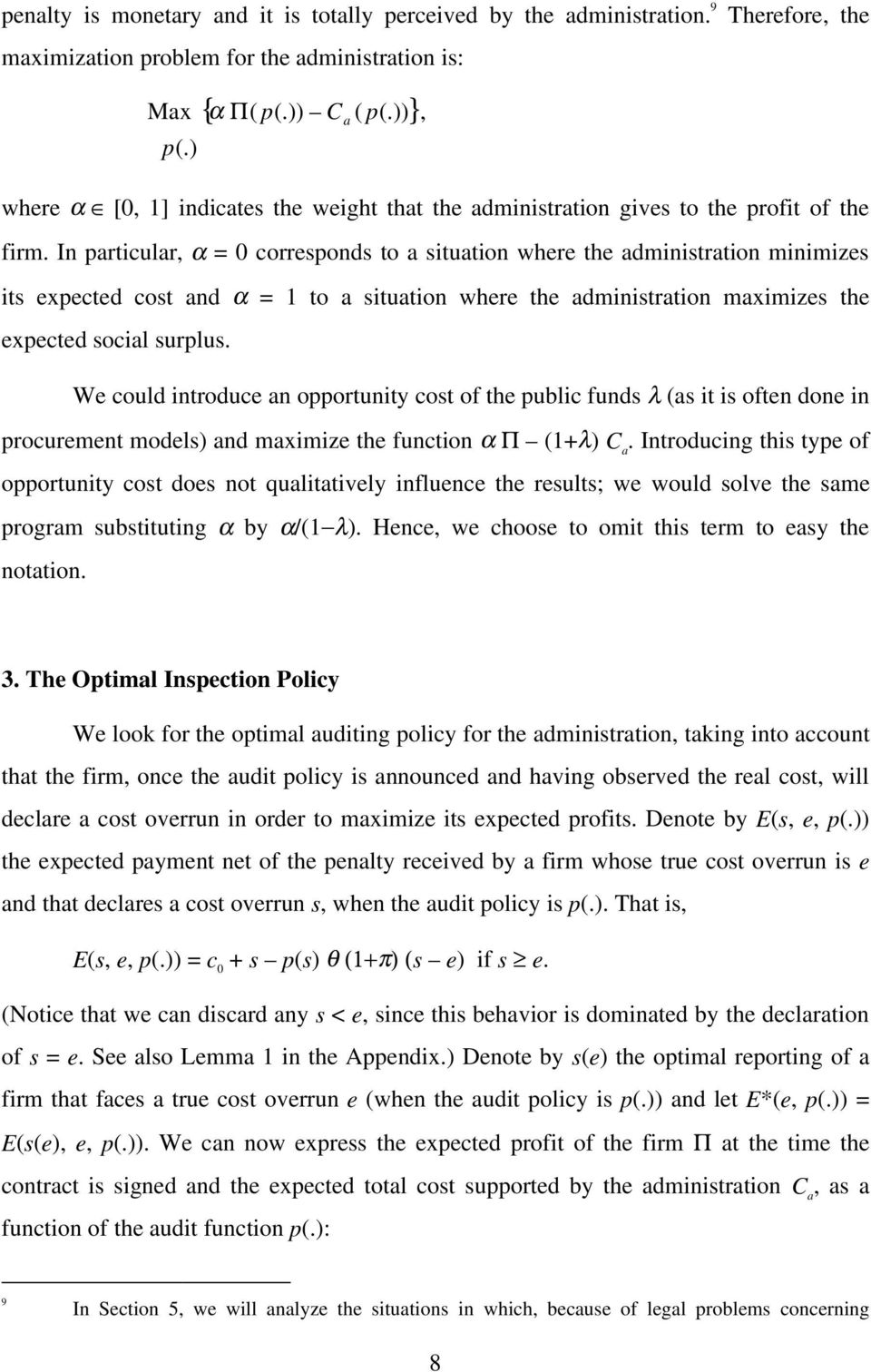
9 Π( p(.)) = a C ( p(.)) = a = b = max{ 0, a }. 0 E *( e, p(.)) dg( e) [ E * ( e, p(.)) + kp( s( e)) ] dg( e), otherwise m where G(.) is the distribution funtion of the true ost overruns, that is, G(e) = F( 0 +e), for all e [0, 0 ]. The harateristis of the optimal inspetion poliy and of the firm s announement strategy depend ruially on the relative position of θ and 1/(1+π), that is, on the auray of the auditing and on the level of the fine. To provide the optimal poliy for the ase in whih θ (1+π) 1, let us denote: 1 k k a = φ if φ( ) > (1 + π )(1 α) θ (1 + π )(1 α) θ 0 The parameter a is defined in the spae of possible osts, while the parameter b takes value in the spae of possible ost overruns, i.e., b [0, 0 ]. Notie, in partiular, that the value of a is independent of the initial ontratual payment 0. The following proposition haraterizes the optimal audit poliy in the ase where θ (1+π) 1. Proposition 1. If θ (1+π) 1, the following audit probability funtion is an optimal solution of the audit problem: p*(s) = 0 if s b, p*(s) = 1/[(1+π)θ] otherwise. Faing this poliy, the optimal firm's ost-overrun laim is the following: s(e) = b if e b, s(e) = e if e > b. monetary penalties or beause of firm s liquidity onstraints, fines are non-monetary. 9
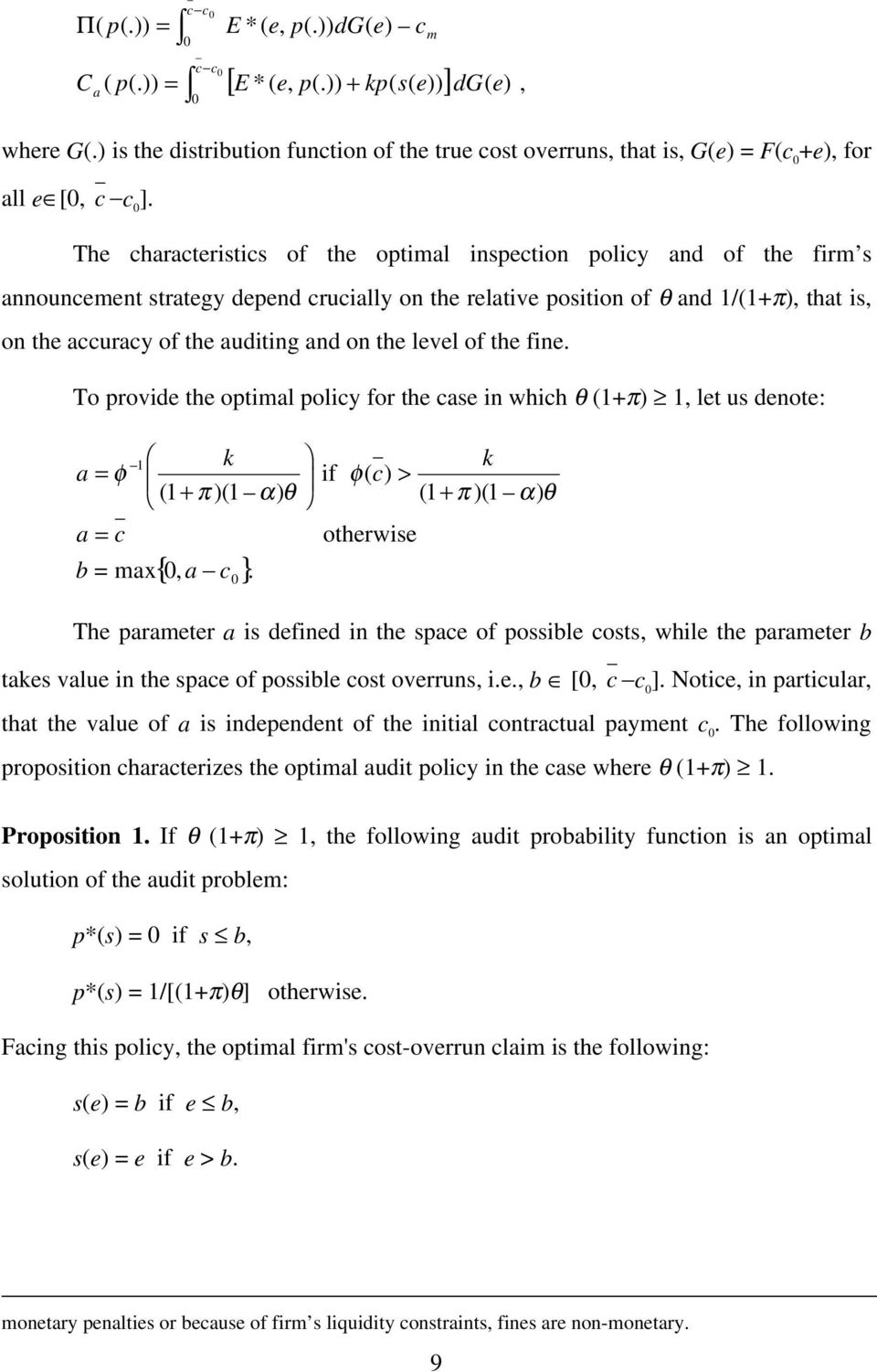
10 Before we omment on this proposition, let us remark that the qualitative harateristis of the optimal auditing poliy do not depend on our assumption that the hazard rate φ() is an inreasing funtion of. If φ() is not inreasing, then the optimal poliy has the same form as the one presented in the proposition. The only differene is that the ut-off value b is more diffiult to haraterize. 10 Also, the qualitative properties of the optimal poliy remain if the administration has a fixed budget to devote to auditing. In this ase, the threshold value is haraterized as the minimum b ompatible with the budget. [Insert Figure 1 about here] Aording to the optimal auditing poliy (see Figure 1), in those situations in whih the ontratual prize 0 is high enough, so that 0 a, the administration audits all the projets laiming ost overruns with the same probability. Faing this poliy, the firm only delares ost overruns when they are real. In the opposite ase, i.e., when 0 < a, the administration admits the ost overrun as long as it is not too high, and else audits with a fixed probability. The firm always delares a ost overrun of at least s = b = a 0. It delares a larger one only if it is real. Under the optimal auditing poliy, the preise value of the ontratual prize 0 is not relevant as long as it is inferior to the ut-off value a, sine the administration will end up paying at least a independently on the final ost. The proposition provides a rationale for the use of an initial payment that the firm keeps even if the final ost happens to be lower that this level. If the administration has all the bargaining power in the ontratual relationship (as we will suppose in the next setion) it is optimal for it to propose a ontrat with an initial payment 0 = a and to implement an audit poliy onsisting in auditing every ost overrun with probability 1/[(1+π)θ]. The optimal auditing poliy desribed in Proposition 1 is random for ost overrun laims higher than the ut-off value b (exept in the limit ase in whih θ (1+π) = 1). Indeed, if a firm laims a ost overrun s > b, then it is audited with some probability lower than 1. This randomness is somehow in ontrast with the bureaurati proedures 10 See also the proof of the proposition in the Appendix for a larifiation of this statement. 10
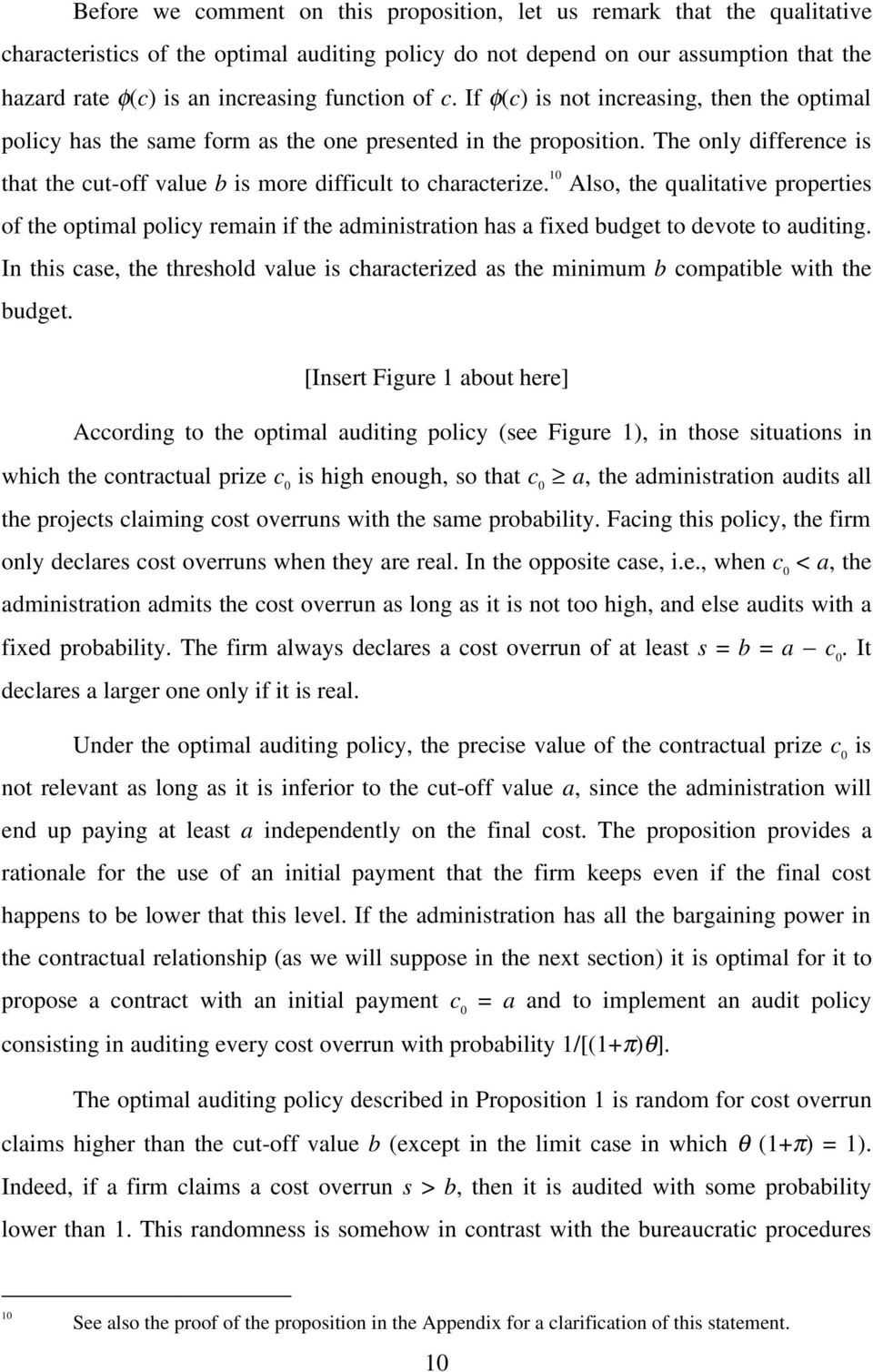
11 that are most often used in pratie. Note, however, that besides the randomness, the rule to be applied in ase of a laim of ost overrun is quite simple, very easy to implement and, hene, well adapted to bureaurati proedures. Another harateristi of the optimal poliy is that the administration never audits a fraudulent firm. 11 Faing this poliy, the firm delares its true ost overrun unless it is lower than b, in whih ase it laims b (see Figure 1). Given that the administration only audits laims higher than b, ex post, only firms delaring the true ost overrun are audited. Hene, under the optimal audit poliy, penalties are never paid. This property of the optimal poliy seems a bit unpleasant. Indeed, the administration only audits firms that it "knows" they will turn out to be honest. The optimal audit poliy is of ourse not optimal ex post. Preisely, the existene of the "bureaurati" rules makes it possible for the poliy not to be ex post optimal, but ex ante optimal. Given the expression of the ut-off value b, we an assess that the administration is more tolerant with ost overrun laims the more expensive the audit tehnology (k) is, the more diffiult it is to find out a fraud (lower θ), the lower the rate of penalty (π) is, and the more weight (α) it onfers to the profits of the firm. In partiular, if α = 1, then b = 0, hene every laim of ost overrun will be overed by the administration without audit. (This last property would be false if we introdued an opportunity ost of publi funds.) All of the effets are in aordane with intuition. Notie also that if f( ) = 0 and α 1, then it is always the ase that b < 0, whatever the ost of the audit k, that is, it is optimal to audit high enough ost overrun laims. On the other hand, when f( ) 0 and α 1, then there exists a bound for the unitary ost of audit suh that the administration never audits (i.e., b = 0 ) if the ost is higher than this bound. Finally, we write down the expeted profit of the firm. It is equal to 0 + b 0 + b 0 + b) F( + b) + df( ) m = F( ) d, whih is stritly positive as long as k ( 0 11 Notie that this is also the ase in Baron and Besanko (1984). In their model, faing the optimal ontrat menu, the firms delare honestly. However, a firm reporting a high ost parameter is audited if "bad luk" makes the final ost to be low. 11
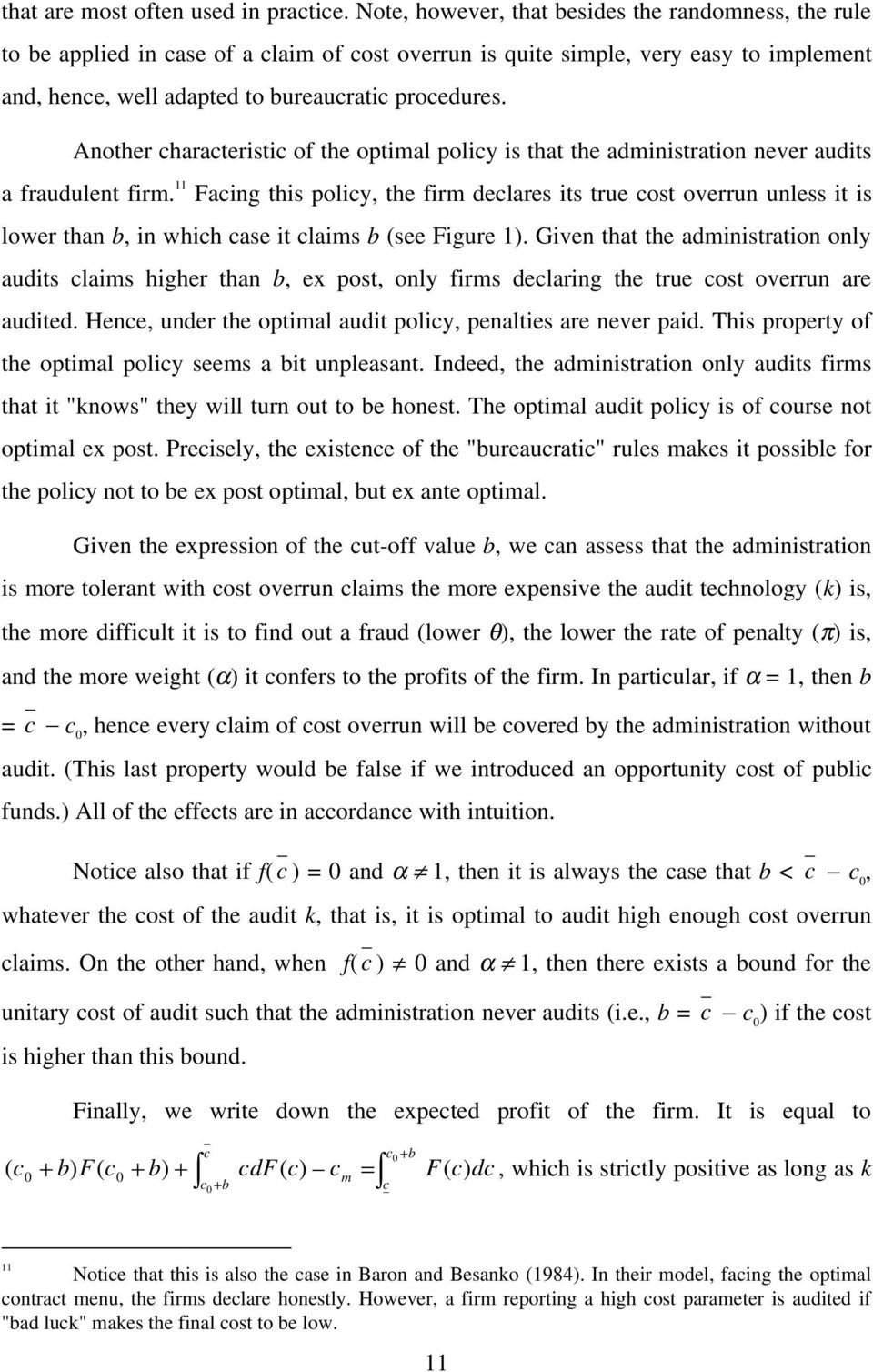
12 > 0. Moreover, the expeted profit has a lower bound equal to a F ( ) d, whatever the initial ontratual payment. We now analyze the ase in whih it is diffiult for the administration to asertain whether the ost overrun laimed by the firm is justified (i.e., θ is low), and/or the fine that an be imposed to the firm is not very high (π is low). The following proposition haraterizes the optimal poliy when θ (1+π) < 1. We will use the following notation: β = 0 (1+π) θ ( a) if a 0 β = 0 if a < The parameter β takes value in the spae of possible ost overruns, i.e., β [0, 0 ]. It will play a similar role as the parameter b in Proposition 1, although there are important differenes between the two ases. Proposition 2. If θ (1+π) < 1, then the following audit probability funtion is an optimal solution of the audit problem: p*(s) = 0 if s β, p*(s) = 1 otherwise. Faing this poliy, the firm's ost-overrun laim is the following: s(e) = β if e a 0, 13 s(e) = 0 if e > a 0. Figure 2 summarizes the results of this proposition. [Insert Figure 2 about here] 12 Any β [0, (1 (1+π)θ) ( 0 )[ is equivalent to β = 0, for a < 0. For all those values, the optimal firm's announement is a ost overrun equal to 0. Hene, the administration is indifferent between any β in the interval. Notie also that, if a 0, then the ut-off value an also be written as β = a 0 + [1 (1+π) θ] ( a), whih is more similar to b in Proposition Notie that a 0 < β. 12

13 The optimal audit poliy in this ase is quite similar to that desribed in Proposition 1. The differene with the previous ase does not onern the form of the audit poliy, but the behavior of the firm. In partiular, in this ase, the probability θ that the audit sueeds in finding evidene of fraud is so small (for the given level of penalty π) that the threat of the audit is never strong enough. There is no audit poliy that makes the firm delare its true ost overrun. Fraud always exists. An interesting harateristi of the poliy is that it is very bureaurati: the probability of an audit is always equal to either 0 or 1. Therefore, it is very easy to verify that the rule has been followed. Moreover, in this ase, the poliy is more appealing ex post than the poliy in the ase where θ (1+π) 1, sine the audit is always direted towards dishonest firms (they are all dishonest!). Sometimes the fraud made by the audited firms is disovered. Therefore, the expeted olleted fine is not zero. Similarly to what happened after Proposition1, if θ (1+π) < 1 the ut-off value a, and hene also β, is non-dereasing in k and α and non-inreasing in θ and π. Finally, notie that we an hek that the expeted profit is now stritly greater than a F ( ) d, whatever the ontrat ost. 4. Optimal quality of the projet In this setion, we look for the optimal deision of the administration onerning the quality of the projet. That is, we are interested in the analysis of the effets of the possibility of fraud and the appliation of the optimal auditing poliy on the quality hosen for the projet. To develop our analysis, we suppose, first, that the administration not only deides on the ontratual payment and the audit poliy, but also on the quality of the projet. This quality is observable and the value (denoted by ) that the onsumers attribute to a level of quality is known. The information of the administration onerning the ost of a projet of quality is represented by a distribution funtion F () ontinuously differentiable on with support [(), ()]. As in the previous setions, 13
14 we assume that, for every > 0, f () F () > 0, for all ](), ()[ and, for simpliity, that φ () F ()/f () is an inreasing funtion of. Conerning the behavior of the distribution funtion with respet to the quality, we assume, first, that the ost of produing = 0 is zero, that is, (0) = (0) = 0. Seond, for all, F () and f () are twie-ontinuously differentiable funtions of on ]0, [. We do not assume ontinuity on 0 and hene, we take into aount the possibility of fixed osts. Finally, the expeted ost m () is an inreasing, onvex, and twie-ontinuously differentiable funtion. The administration hooses the initial ontratual payment to the firm freely. That is, we assume that the administration has all the bargaining power. In order to ontemplate the hoie of the quality of the projet, the worth of the projet for the administration is now inluded in its objetive funtion. Hene, the program solved by the administration is the following: Max { +απ( p(.)) C ( p(.)) }. a ( 0, p(.), ) We denote opt (α, k, θ, π) the solution of this program. We will usually only write the relevant arguments in eah ase, to simplify notation. Sine we are interested in those situations in whih it is reasonable for the administration to arry the work out, we suppose that Max { m ()} > 0. We denote by * the solution of this maximization. Remark that opt (α=1) = * whatever the values of the other parameters. Indeed, if α = 1, the administration does not are about transferring profits to the firm, so it does not audit at all. Moreover, we also have opt (k=0) = * if θ (1+π) 1. As previously, we ould introdue an opportunity ost of publi funds λ. In this ase, we would use the hypothesis Max { (1+λ) m ()} > 0. However, with suh an opportunity ost, it is not true anymore that opt (α=1) = *. The reason is that the administration may find it worthwhile to audit the firm, even if α = 1. But the following results are not substantially modified. We will indiate when the introdution of this term leads to a qualitative differene. 14
![Seond, for all, F () and f () are twie-ontinuously differentiable funtions of on ]0, [. We do not assume ontinuity on 0 and hene, we take into aount the possibility of fixed osts.](/docs-images/53/11435525/images/page_14.jpg "Finally, the expeted ost m () is an inreasing, onvex, and twie-ontinuously differentiable funtion. The administration hooses the initial ontratual payment to the firm freely.")
15 Following the results of the preeding setions, we an alulate the optimal audit poliy p *(.), for a given. The optimal ontratual payment 0 is not relevant as long as it lies in the interval [0, a()], where a() is the optimal ut-off value orresponding to quality. Sine the administration hooses 0, it will deide any 0 in the previous interval, so that b() + 0 = a() (or β() + 0 = () (1+π) θ ( () a()), if θ (1+π) < 1). The optimal quality then solves: Max { +απ( p *(.)) C ( p * (.))}. a Next result allows us to disuss the effet on the optimal quality of a hange in the auditing ost (due, for example, to some gains in effiieny by the administration). We analyze whether the administration will then ask for a projet of higher or lower quality. We an also interpret the analysis as a omparison of the levels of quality of publi works in different fields, when the auditing ost varies among fields. Proposition 3. If opt (.) > 0 in a neighborhood of k and the optimal threshold ost (either b or β) for opt (k) is also interior (i.e., φ( ( opt (k))) > k/[(1+π)(1 α)θ]), then: d opt dk ( k) has the same sign as 1 k ( F ) ( 1+ π )( 1 α ) θ ( k) $φ = opt. When looking for the optimal quality, the administration takes into aount the expenses related to the ompletion of the projet and the expenses due to the nonobservability of its final ost (auditing osts and extra profits for the firm). If the ost of an audit inreases, the administration ares more about the expenses related to the auditing ativity. Therefore, an inrease in the unit ost k should lead to a poliy in whih fewer audits take plae. This is preisely the meaning of Proposition 3. The expression 1 ( F φ ) k/ ( 1+ π)( 1 ) ( [ α θ] ) $ is equal to F (a()), that is, the probability that the administration does not arry out the audit when it follows the optimal auditing strategy. When k inreases, the quality hosen must be suh that F (a()) inreases, that is, the audit takes plae less often. Note that an inrease in F (a()) does not neessarily imply 15

16 an inrease in a() nor a derease in sine the distribution funtion of the true ost hanges with the quality hosen. 1 For a given, the value of ( )( ) F $ φ is small when the density funtion f is ( [ α θ] ) 1 flat. It may seem reasonable that ( F φ ) k/ ( 1+ π)( 1 ) $ is a dereasing funtion of. But it an also be an inreasing funtion. Hene, Proposition 3 points out that an inrease in audit osts leads to a worse situation from a soial point of view, but not neessarily to a lower quality. The following examples larify this message. Example 1. Suppose that the distribution of the absolute differene between the ost and the average ost, i.e., () m (), does not depend on for values of. It is 1 then easy to hek that ( )( ) F $ φ is independent of. Hene, opt (k) is independent of k and it is equal to *, as long as it is positive (and it beomes eventually zero for k large enough, as we will see below). Example 2. Suppose that the distribution of the relative differene between the ost and the average ost, i.e., [() m ()]/ m (), follows an independent distribution of. That means that there exists a funtion F suh that F () = F(/ m ()). In this situation, F 1 $ φ = F $ φ is a dereasing funtion of. 1 the expression ( )( ) ( )( / ( )) Therefore, opt (k) is a dereasing funtion of k, eventually zero for k large enough. Example 3. Suppose that, for a given, the distribution F is uniform. Therefore, the distribution is defined in a non ambiguous way by the expeted ost m () and the length of the support L(). An easy alulation shows then that ( )( ) / ( ) m F 1 φ = $ L, it is then inversely proportional to L(). When k inreases, the optimal quality hanges in the diretion where the support is smaller, this is to say, where the knowledge of the administration is more preise. From the point of view of the administration, auditing osts add to the osts of the publi work. Sometimes, this extra ost is so high that it makes it not worthwhile to arry the projet out, even if the projet would have been profitable under symmetri 16
17 information. The following proposition haraterizes the behaviour of opt (k), for a fixed α. 14 Proposition 4. If Max { α ( ) (1 α) ( )} 0, then opt (k) > 0 for all k 0. > 0 m Otherwise, there exists k lim (α) suh that if k > k lim (α), then opt (k) = 0. When the ost of an audit is very large, the optimal audit poliy is to never audit, whih leads to a payment of () to the firm. The preeding proposition establishes the onditions under whih arrying the work out and paying the highest possible prize is soially preferable to not produing at all. It an be interesting to ompare *, the value of the work when the audit ost is zero, and (α), the value of the work when the audit ost is infinity. If () m () is an inreasing funtion, then (α) *. The interpretation is similar to the preeding proposition. If the preision of the information reeived by the administration lowers with the quality of the projet, then the optimal quality when the audit ost is very high is inferior to the optimal quality when the ost is low. Similarly, a suffiient ondition for (α) * is that () m () is a dereasing funtion. Notie that, when θ (1+π) 1, the result of the maximization problem of the administration does only depend on k, θ, and π through the expression k/[(1+π)θ]. A redution of the audit ost k is therefore equivalent to an inrease of the penalty oeffiient π, or to an inrease of the probability of the audit suess θ. In this ase, we an alternatively interpret propositions 3 and 4 as a study on the variation of the optimal quality in funtion of π or θ. Finally, we an also establish some properties about the optimal quality as a funtion of α. Proposition 5. If Max >0 { ()} 0, then opt (k,α) > 0 for all α [0, 1] and k 0. Otherwise, there exists α lim [0, 1] suh that: 14 We take the onvention that if the administration is indifferent between a projet of zero quality and a projet of positive quality, it will hose the last one. 17
18 (a) if α α lim, then opt (k,α) > 0 for all k ]0, [, and (b) if α < α lim, then there exists k lim (α) suh that opt (k,α) = 0 for all k > k lim (α). Moreover, k lim (α) is inreasing in α. If the administration values the profit of the firm enough, it will let the projet be realized (i.e., opt > 0) whatever the ost of the audit. We notie, however, that this property is not longer true if we introdue an opportunity ost for the publi funds. Indeed, under the hypothesis that (1+λ) m () > 0, the administration ould deide not to start the projet if the audit ost is too high, even when α = Extensions 5.1 Non-finanial Penalty We have supposed up to now that the administration is able to impose a finanial penalty to the firm. However, in many ases, the administration annot impose suh a fine beause of legal matters, or just beause the firm does not have the finanial means to pay suh a fine. After all, the finanial equilibrium of the firm is a main reason behind the reimbursement of the ost overruns. In this ase, the term π (s e) represents a nonfinanial penalty, for example, a lost of reputation for the firm, or a ertain period where the administration does not aept any projets from that firm. In our model, the differene with the ase with monetary fines is that, now, although the firm pays it, the administration does not reeive any penalty. How does the non-finanial nature of the fine influene the optimal audit poliy? As before, the results do depend in a ruial way on the relative position of 1/(1+π) and θ. Proposition 6. If θ (1+π) 1, the optimal audit poliy desribed in Proposition 1 is still optimal when the penalty is non-finanial. Therefore, both the optimal auditing poliy and firms' behavior are independent of the nature of the penalty, as long as θ (1+π) 1. There is no welfare loss in this ase 18
19 whith respet to a situation where the penalty is finanial. Similarly, we an easily verify that the results of Setion 4 also hold with non-finanial penalties. The main reason for the optimal poliy not to depend on the nature of the penalty in the ase where θ (1+π) 1 is that, faing the optimal auditing poliy, the firm atually never pays the fine. However, this is not longer true when θ (1+π) < 1, whih makes the analysis more diffiult. We an not solve for the optimal auditing poliy in this ase. However, we an state the following property: Proposition 7. If θ (1+π) < 1 and the penalty is non-finanial, then the poliy desribed in Proposition 2 is not optimal anymore when β ]0, 0 [. Indeed, in this ase, the administration an improve on this poliy by raising the ut-off value β. In the ase θ (1+π) < 1, there is a welfare loss due to the non-finanial nature of the penalty. In the lass of auditing poliies onsisting in auditing every laim of ost overrun higher than a ertain ut-off value, the administration finds it optimal to be more lenient when the penalty is non-finanial. Given that the administration does not reeive the worth of the fine, although the firm "pays" it, an audit poliy that leads the firm to pay a fine reates more ineffiienies than when the fine was finanial. Therefore, it is optimal to redue the expeted penalties paid, that is, to inrease the ut-off value β Partial Repayment of the Cost Overrun Our results also apply to ost-sharing ontrats, that is, to situations where the administration only pays a share δ of the ost overruns, with δ ]0, 1[, leaving the fration 1 δ to the firm. This hypothesis orresponds, for example, to the Frenh Code of Publi Markets, where δ =.90 for ertain types of ost overruns. Proposition 8 shows that the optimal auditing poliy in this ase is the same as for the ase with full reimbursement. The only quantitative differene with respet to our basi framework onerns the preise expression for the ut-off value a. 19
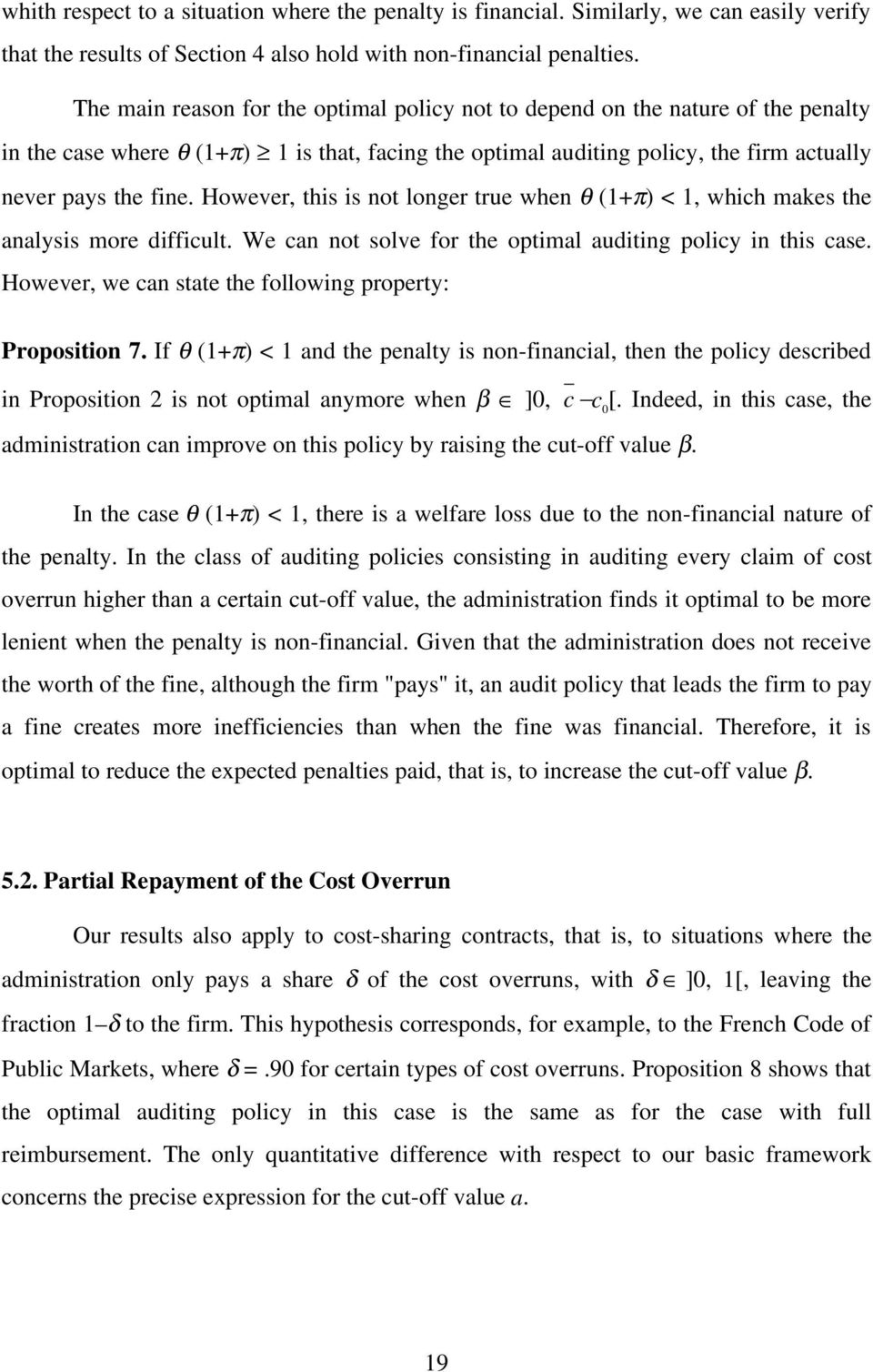
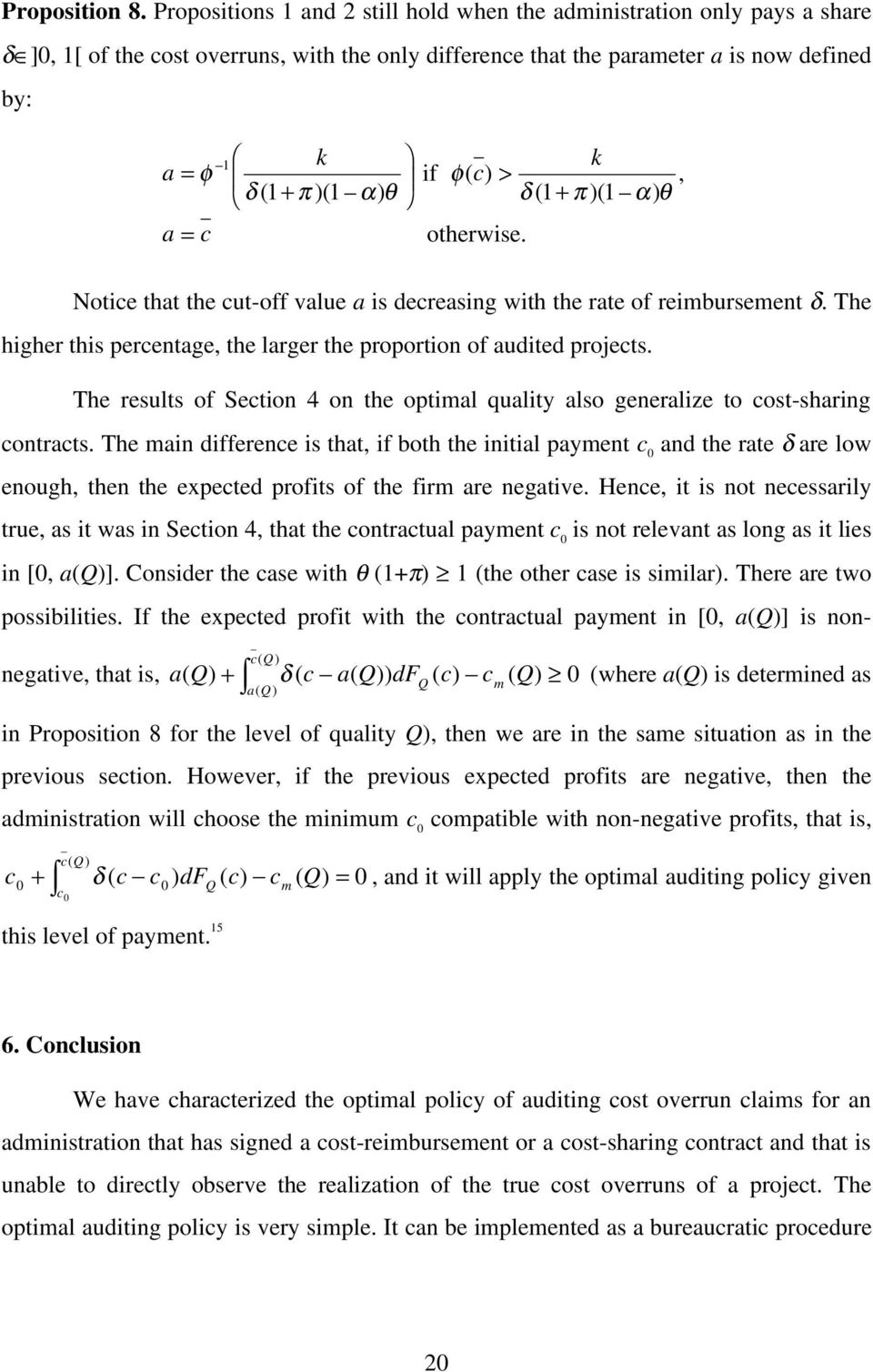
20 ( ) Proposition 8. Propositions 1 and 2 still hold when the administration only pays a share δ ]0, 1[ of the ost overruns, with the only differene that the parameter a is now defined by: 1 k k a = φ if φ( ) >, δ (1 + π )(1 α) θ δ (1 + π )(1 α) θ a = otherwise. Notie that the ut-off value a is dereasing with the rate of reimbursement δ. The higher this perentage, the larger the proportion of audited projets. The results of Setion 4 on the optimal quality also generalize to ost-sharing ontrats. The main differene is that, if both the initial payment 0 and the rate δ are low enough, then the expeted profits of the firm are negative. Hene, it is not neessarily true, as it was in Setion 4, that the ontratual payment 0 is not relevant as long as it lies in [0, a()]. Consider the ase with θ (1+π) 1 (the other ase is similar). There are two possibilities. If the expeted profit with the ontratual payment in [0, a()] is nonnegative, that is, a( ) + δ ( a( )) df ( ) ( ) 0 (where a() is determined as a( ) in Proposition 8 for the level of quality ), then we are in the same situation as in the previous setion. However, if the previous expeted profits are negative, then the administration will hoose the minimum 0 ompatible with non-negative profits, that is, 0 ( ) + δ ( ) df ( ) ( ) = 0, and it will apply the optimal auditing poliy given 0 this level of payment m m 6. Conlusion We have haraterized the optimal poliy of auditing ost overrun laims for an administration that has signed a ost-reimbursement or a ost-sharing ontrat and that is unable to diretly observe the realization of the true ost overruns of a projet. The optimal auditing poliy is very simple. It an be implemented as a bureaurati proedure 20
21 of the same type of the proedures that govern many of the partiulars of the ontratual arrangements between the administration and firms. This fat is important, sine our results depend on the assumption that the administration is able to ommit to an audit strategy that is optimal ex ante, but that is not optimal ex post. The rigidity of the bureaurati proedures an help to implement the optimal poliy. Moreover, we have shown that the possibility of misbehavior has two additional onsequenes. On the one hand, the extra osts due to the auditing ativity redue the set of projets arried out. On the other hand, if the projet is arried out, the administration biases the hosen quality towards levels that make auditing easier. In ontrast with our paper, the modern theory of prourement looks for the optimal ontrat when the government does not know some firm's harateristis and/or it wants to give the firm inentives to derease the ost of the projet. In this literature, ostbased ontrats allow to alleviate the asymmetri information problems. In partiular, Laffont and Tirole (1986) show that ost-sharing-plus-fee ontrats are optimal when both government and firm are risk neutral (and the adverse seletion and moral hazard problems appear in an additive way). Our approah is somewhat different. We have assumed that, at the time the ontrat is signed, government and firm have the same information about the ost funtion. Moreover, they annot influene the realization of the final ost. It is only one the firm starts working that it learns (more than the government) about the true ost of the projet. It an manipulate its report to inrease the payment reeived as ost reimbursement. This framework seems to adapt well to researh, design, or study efforts. (In these projets, for example, NASA uses ost-plusfixed-fee ontrats.) In any ase, we think that both approahes are omplementary. The question of the joint endogenous determination of both the ontrat and the auditing poliy stays open. 15 In this ase, for Proposition 3 to hold, the requirement that b or β be interior also imposes the utoff value a to be higher than the minimum 0 ompatible with non-negative profits. 21
22 Appendix Proof of Proposition We use the following two lemmas, whose proof is not diffiult: Lemma 1. (a) A firm never laims a ost overrun lower than the real one, i.e., s(e) e. (b) If p(s) 1/[(1+π)θ] for s > e, then the firm will laim a ost overrun different from s. () The firm delares truthfully if and only if p(s) 1/[(1+π)θ], for all s ]e, 0 ]. Property (a) of Lemma 1 omes from the fat that there is no reward for a firm that delares a ost overrun lower than the real one. Property (b) holds beause E(s, e, p(.)) 0 + e if and only if p(s) θ (1+π) 1, for s ]e, 0 ]. This property implies, in partiular, that the administration will never hoose an audit probability stritly higher than 1/[(1+π)θ]. Finally, property () easily follows from property (b) and the fat that if p(s) θ (1+π) < 1 for some s ]e, 0 ], then E(s, e, p(.)) > 0 + e. Lemma 2. The funtion p(s(e)) is non-dereasing in e. Moreover: 0 E *( e, p(.)) = (1 + π ) θp( s( v)) dv. e We sketh the proof of Lemma 2. Take e, v [0, 0 ]. Then, E*(e, p(.)) = 0 + s(e) p(s(e)) θ (1+π) (s(e) e) 0 + s(v) p(s(v)) θ (1+π) (s(v) e). Note that the inequality omes from the optimality of s(e) if s(v) e, and it also holds if s(v) < e given that p(s(v)) θ (1+π) 1 by Lemma 1. Combining the previous equations with similar equations for E*(v, p(.)) and s(e), we obtain that, for every e, v [0, 0 ]: p(s(v)) θ (1+π) (e v) E*(e, p(.)) E*(v, p(.)) p(s(e)) θ (1+π) (e v). Finally, the two properties stated in Lemma 2 ome easily from the previous inequalities. Remember that the problem faed by the administration is the following: 16 This proof of the proposition (inluding the two lemmas) is related to proofs in Sánhez and Sobel (1993) and Maho-Stadler and Pérez-Castrillo (1997). The main differene is that, in our paper, the administration must pay at least the prie 0 independently on the real ost of the projet. 22
23 Max 0 (1 α) E * ( e, p( s( e))) dg( e) 0 s.t. s( e) argmax E( s, e, p( s)). s 0 0 kp( s( e)) dg( e) α We an use lemmas 1 and 2 to state the problem under the following equivalent form, after integration by parts: m Max s.t. : 0 0 H ( e) p( s( e)) dg( e) p( s( e)) non - dereasing in e Max s.t. : 0 0 q( e) H ( e) q( e) dg( e) non - dereasing in e 1 p( s( e)) 0, (1 + π )θ 1 q( e) 0, (1 + π )θ where H(e) = (1 α) (1+π) θ γ(e) k, and γ(e) G(e)/G'(e) = F( 0 +e)/ f( 0 +e) = φ( 0 +e), for all e [0, 0 ], is the hazard rate assoiated to G(e). Notie that the funtion q(.) takes values on the true ost overruns, while p(.) takes values on the laims. Sánhez and Sobel (1993) have analyzed the results of this type of maximization problem. They shown that, if H(e) is ontinuous, there always exists a solution of the form: q*(e) = 0 if e b* q*(e) = 1/[(1+π)θ] otherwise. Given the behavior of the firm, the funtion q*(.) translates into the following audit probability funtion: p*(s) = 0 if s b* p*(s) = 1/[(1+π)θ] otherwise. We now haraterize the value of b*. It is lear that the behavior of the firm faing this auditing strategy is to delare a ost overrun equal to b* when the true ost overrun is lower than this ut-off value, and to be honest otherwise. Also, the funtion H(e) is inreasing, given that γ(e) is inreasing (beause φ() is inreasing). Then, there are three possible ases. First, if H(e) is always negative (this ase orresponds to a = ), then b* = 0. Seond, if H(e) is always positive, then b* = 0. Finally, if H(e) is zero at some value in ]0, 0 [, then the optimum is given by (1 α) (1+π) θ γ(b*) k = 0, i.e., b* = a 23
24 0. Notie that if φ() is not inreasing, the harateristis of the poliy are the same, but the preise alulation of b* is more diffiult. Proof of Proposition 2. The first part of the proof is the same as in Proposition 1. We an state the maximization program of the administration in the same form as before, the only differene is that the funtion q(e) must lie in the interval [0, 1]. This does not hange the form of the solution, whih is that q(e) = 1 for e > b*, and q(e) = 0 otherwise, for some b*. Finding the expression for the optimal b* is similar as before, but translating this into a ut-off ost overrun is more omplex. The differene with the previous ase lies in the behavior of the firm. This is so beause an audit probability of 1 does not avoid the fraud, given that (1+π)θ < 1. If the administration sets a ut-off value β, then a firm with ost overrun e 0 will hoose between reporting β and not being audited, or laiming a ost overrun of 0 and being audited for sure (it is easy to hek that the other possibilities are dominated by these two strategies). It will hoose to laim β if and only if 0 + β (1+π) θ ( 0 e), i.e., e 0 [ 0 β ]/[(1+π) θ]. In partiular, the firm will always laim the highest ost overrun possible, 0, if β < [1 (1+π) θ] ( 0 ). We now haraterize the optimal ut-off values. If (1 α) (1+π) θ γ(0) k 0, i.e., if a 0, then b* = a 0. To implement a poliy that makes the firm to be audited if and only if its true ost overrun is above b* = a 0, the ut-off value must be β = 0 (1+π) θ ( a). On the other hand, if a < 0, then b* = 0 (the firm will always be audited). Any poliy with β [0, (1 (1+π)θ) ( 0 )[ will indue a firm's strategy that will make it to be audited. Proof of Proposition 3. Denote J(k, ) + α Π(, p *(.)) C a (k,, p *(.)). Then, the optimal level of quality is the argument that maximizes: Max J(k, ). In an interior 2 2 solution, it is the ase that J / ( k, ( k)) = 0 and J / ( k, ( k)) 0. opt opt Therefore, aording to the impliit funtion theorem, the ratio d opt ( k) / dk has the 2 2 same sign as the ratio J / k( k, ( k)) = J / k ( k, ( k)). opt opt 24
25 We now prove the proposition when θ (1+π) 1. In this ase, we also have that J ( k, ) Max b +E,k,), where: +E,k,) = ( 1 F ( + b )) ( ) k = m ( ) (1 α ) ( 0 + b ) F ( 0 + b ) + ( ) ( ) 0 df m 0+ b (1+ π ) θ 0+ b k = m ( ) (1 α ) F ( ) d ( 1 F ( 0 + b )). ( ) (1+ π ) θ That is, Γ(b, k, ) is the value of the funtion that the administration maximizes when it audits with probability 1/[(1+π)θ] above the ut-off value b, and with zero probability below b. Using the envelop theorem, we have: J + 1 ( k, ) = ( b, k, ) = k k (1 + π ) θ Therefore, 1 1 k [ 1 F ( + b) ] = 1 F φ. 1 k ( F ) ( 1+ π )( 1 α ) θ = ( k) $φ 0 (1 + π ) θ (1 + π )(1 α) θ $ opt has the same sign as 2 J / k ( k, ( k)), and hene it has also the same sign as d opt ( k) / dk. opt The proof for the ase with θ (1+π) < 1 is ompletely similar. The only quantitative differene is that, in this ase, J ( k, ) = 1 F k (1 + π )(1 α) θ 1 k $ φ, but this differene does not modify the proposition. Proof of Proposition 4. The objetive funtion of the administration is dereasing in k. If the value funtion is positive when the ost k tends toward infinity, i.e., Max { α ( ) (1 α) ( )} 0, then the value funtion is positive for all k 0. > 0 m This implies that opt (k) > 0 for all k 0. Otherwise, the value for the administration is negative for k very high and positive for k = 0. The seond part of the proposition then derives easily from the fat that value funtion is dereasing in k. Proof of Proposition 5. The value funtion Max { α ( ) (1 α) ( )} 0 m > is a ontinuous and inreasing funtion of α. Also, we have made the hypothesis that it is 25
26 positive when α = 1. Therefore, if the value funtion is also positive when α = 0, then it is positive everywhere, whih proves the first part of the proposition. If the funtion is negative when α = 0, then there exist a limit threshold for α suh that the value funtion is positive above this threshold and negative below it. As to the property that k lim (α) is inreasing in α, notie that, in k lim (α), the value of the objetive funtion of the administration is zero. Given that the objetive funtion is inreasing in α, and it is dereasing in k, the impliit funtion theorem allows us to make sure that k lim (α) is also inreasing in α. Proof of Proposition 6. Notie, first, that the behavior of the firm only depends on the audit poliy and it is independent on the nature of the penalty. Also, for a given audit poliy, the objetive funtion of the administration in ase of finanial fine is equal to the sum of the objetive funtion in ase of non-finanial fine plus the amount paid as penalty. But, as we have shown, the optimal auditing poliy in ase of finanial fine indues a behavior for the firm suh that it never pays the fine. Therefore, the poliy is also optimal when the penalty is non-finanial. Proof of Proposition 7. We analyze to audit poliies that audit with zero probability ost overruns below a ertain ut-off level β and with probability 1 below it. We look for the optimal audit poliy within this lass, when the fine is non-finanial. We assume that β is interior, and we start by assuming that β is also interior. Charaterizing β is equivalent to haraterizing the threshold a suh that the firm announes a ost overrun equal to β if the true ost overrun is smaller than a (see Proposition 2). We haraterize the optimal threshold a. Under this type of poliy, we have: [ (1 + π ) θ ( ) ] Π = ( β ( a ) + 0 ) F( a ) + a where β ( a )) + = (1 + π ) θ ( a ), C a 0 and df( ) [ θ ( ) ] df( ) + k (1 F( )). = ( β ( a ) + 0 ) F( a ) + a a The first order ondition of the program Max a {απ C a } is: ( 1 α)(1 + π ) θf( a ) + kf ( a ) + πθ ( a ) f ( a ) = 0. m 26
27 k π That is, φ( a ) = + ( a ). (1 + π )(1 α) θ (1 + π )(1 α) k Therefore, φ( a ) > φ( a) =. Hene, a > a. Of ourse, this proof is only (1 + π )(1 α) θ orret if both a and a are interior solutions. If a is interior, a similar argument works. If a =, then a = as well. If a = 0, then it an be the ase that we still have a = 0, or that a > a. Proof of Proposition 8. The proof of this proposition is qualitatively similar to that of propositions 1 and 2. 27
28 Referenes Arvan, L. and A.P.N. Leite, 1990, Cost overruns in long term projets, International Journal of Industrial Organization 8, Baron, D. and D. Besanko, 1984, Regulation, asymmetri information, and auditing, Rand Journal of Eonomis 15 (4), Cummins, J.M., 1977, Inentive ontrating for national defense: a problem of optimal risk sharing, Bell Journal of Eonomis 6, Ganuza-Fernández, J.J., 1996, El omportamiento estratégio en la ontrataión públia, Ph.D. thesis, Universidad Carlos III de Madrid, Spain. Laffont, J.-J. and J. Tirole, 1986, Using ost observation to regulate firms, Journal of Politial Eonomy 94, Lewis, T.R., 1986, Reputation and ontratual performane in long-term projets, Rand Journal of Eonomis 141,157. Martin, S., 1998, Resoures alloation by a ompetition authority, W.P., Center for Industrial Eonomis, University of Copenhagen. MAffee, R.P. and J. MMillan, 1986, Bidding for ontrats: a prinipal agent analysis, Rand Journal of Eonomis 17 (3), Maho-Stadler, I. and D. Pérez-Castrillo, 1997, Optimal auditing with heterogeneous inome soures, International Eonomi Review 38 (4), NASA, 1997, Award fee ontrating guide, Pek, M.S. and F.M. Sherer, 1962, The weapons aquisition proess: an eonomi analysis, Boston: Harvard Univ., Graduate Shool of Business Administration. Sánhez, I. and J. Sobel, 1993, Hierarhial design and enforement of inome tax poliies, Journal of Publi Eonomis 50, Souam, S., 1999, Optimal antitrust poliy under different regimes of fines, International Journal of Industrial Organization, forthoming. 28
29 The administration audits ost overruns larger than b with probability 1/[(1+π)θ] The firm laims its true ost overrun a The administration does not audit any ost overrun lower than b b 0 The firm laims a ost overrun of b > 0 Figure 1.a: Optimal auditing poliy and firm's behavior when (1+π)θ 1 and a > 0. The administration audits positive ost overruns with probability 1/[(1+π)θ] a 0 b = 0 The firm laims its true ost overrun The ost overrun is zero Figure 1.b: Optimal auditing poliy and firm's behavior when (1+π)θ 1 and a 0. 29
30 The administration audits every ost overrun larger than β. The firm laims the highest possible ost overrun The administration does not audit any ost overrun lower than β β 0 a The firm laims a ost overrun of β > 0 Figure 2.a: Optimal auditing poliy and firm's behavior when (1+π)θ < 1 and a > 0. The administration audits every ost overrun laim. The firm always laims the highest possible ost overrun 0 a Figure 2.b: Optimal auditing poliy and firm's behavior when (1+π)θ < 1 and a 0. 30
Chapter 1 Microeconomics of Consumer Theory
 Chapter 1 Miroeonomis of Consumer Theory The two broad ategories of deision-makers in an eonomy are onsumers and firms. Eah individual in eah of these groups makes its deisions in order to ahieve some
Supply chain coordination; A Game Theory approach
 aepted for publiation in the journal "Engineering Appliations of Artifiial Intelligene" 2008 upply hain oordination; A Game Theory approah Jean-Claude Hennet x and Yasemin Arda xx x LI CNR-UMR 668 Université
A Holistic Method for Selecting Web Services in Design of Composite Applications
 A Holisti Method for Seleting Web Servies in Design of Composite Appliations Mārtiņš Bonders, Jānis Grabis Institute of Information Tehnology, Riga Tehnial University, 1 Kalu Street, Riga, LV 1658, Latvia,
Market power and banking failures
 International Journal of Industrial Organization 20 (2002) 1341 1361 www.elsevier.om/ loate/ eonbase a Market power and banking failures Ramon Caminal *, Carmen Matutes a, a,b Institut d Analisi ` Eonomia
Suggested Answers, Problem Set 5 Health Economics
 Suggested Answers, Problem Set 5 Health Eonomis Bill Evans Spring 2013 1. The graph is at the end of the handout. Fluoridated water strengthens teeth and redues inidene of avities. As a result, at all
Lemon Signaling in Cross-Listings Michal Barzuza*
 Lemon Signaling in Cross-Listings Mihal Barzuza* This paper analyzes the deision to ross-list by managers and ontrolling shareholders assuming that they have private information with respet to the amount
Optimal Sales Force Compensation
 Optimal Sales Fore Compensation Matthias Kräkel Anja Shöttner Abstrat We analyze a dynami moral-hazard model to derive optimal sales fore ompensation plans without imposing any ad ho restritions on the
Weighting Methods in Survey Sampling
 Setion on Survey Researh Methods JSM 01 Weighting Methods in Survey Sampling Chiao-hih Chang Ferry Butar Butar Abstrat It is said that a well-designed survey an best prevent nonresponse. However, no matter
Price-based versus quantity-based approaches for stimulating the development of renewable electricity: new insights in an old debate
 Prie-based versus -based approahes for stimulating the development of renewable eletriity: new insights in an old debate uthors: Dominique FINON, Philippe MENNTEU, Marie-Laure LMY, Institut d Eonomie et
An integrated optimization model of a Closed- Loop Supply Chain under uncertainty
 ISSN 1816-6075 (Print), 1818-0523 (Online) Journal of System and Management Sienes Vol. 2 (2012) No. 3, pp. 9-17 An integrated optimization model of a Closed- Loop Supply Chain under unertainty Xiaoxia
State of Maryland Participation Agreement for Pre-Tax and Roth Retirement Savings Accounts
 State of Maryland Partiipation Agreement for Pre-Tax and Roth Retirement Savings Aounts DC-4531 (08/2015) For help, please all 1-800-966-6355 www.marylandd.om 1 Things to Remember Complete all of the setions
Trade Information, Not Spectrum: A Novel TV White Space Information Market Model
 Trade Information, Not Spetrum: A Novel TV White Spae Information Market Model Yuan Luo, Lin Gao, and Jianwei Huang 1 Abstrat In this paper, we propose a novel information market for TV white spae networks,
RESEARCH SEMINAR IN INTERNATIONAL ECONOMICS. Discussion Paper No. 475. The Evolution and Utilization of the GATT/WTO Dispute Settlement Mechanism
 RESEARCH SEMINAR IN INTERNATIONAL ECONOMICS Shool of Publi Poliy The University of Mihigan Ann Arbor, Mihigan 48109-1220 Disussion Paper No. 475 The Evolution and Utilization of the GATT/WTO Dispute Settlement
The Basics of International Trade: A Classroom Experiment
 The Basis of International Trade: A Classroom Experiment Alberto Isgut, Ganesan Ravishanker, and Tanya Rosenblat * Wesleyan University Abstrat We introdue a simple web-based lassroom experiment in whih
The D.C. Long Term Disability Insurance Plan Exclusively for NBAC members Issued by The Prudential Insurance Company of America (Prudential)
 Plan Basis The D.C. Long Term Disability Insurane Plan Exlusively for NBAC members Issued by The Prudential Insurane Company of Ameria (Prudential) What does it over? The D.C. Long Term Disability Insurane
i e AT 21 of 2006 EMPLOYMENT ACT 2006
 i e AT 21 of 2006 EMPLOYMENT ACT 2006 Employment At 2006 Index i e EMPLOYMENT ACT 2006 Index Setion Page PART I DISCRIMINATION AT RECRUITMENT ON TRADE UNION GROUNDS 9 1 Refusal of employment on grounds
Learning Curves and Stochastic Models for Pricing and Provisioning Cloud Computing Services
 T Learning Curves and Stohasti Models for Priing and Provisioning Cloud Computing Servies Amit Gera, Cathy H. Xia Dept. of Integrated Systems Engineering Ohio State University, Columbus, OH 4310 {gera.,
AT 6 OF 2012 GAMBLING DUTY ACT 2012
 i e AT 6 OF 2012 GAMBLING DUTY ACT 2012 Gambling Duty At 2012 Index i e GAMBLING DUTY ACT 2012 Index Setion Page PART 1 INTRODUCTORY 5 1 Short title... 5 2 Commenement... 5 3 General interpretation...
Deadline-based Escalation in Process-Aware Information Systems
 Deadline-based Esalation in Proess-Aware Information Systems Wil M.P. van der Aalst 1,2, Mihael Rosemann 2, Marlon Dumas 2 1 Department of Tehnology Management Eindhoven University of Tehnology, The Netherlands
In many services, the quality or value provided by the service increases with the time the service provider
 MANAGEMENT SCIENCE Vol. 57, No. 1, January 2011, pp. 40 56 issn 0025-1909 eissn 1526-5501 11 5701 0040 informs doi 10.1287/mns.1100.1250 2011 INFORMS Quality Speed Conundrum: Trade-offs in Customer-Intensive
SCHEME FOR FINANCING SCHOOLS
 SCHEME FOR FINANCING SCHOOLS UNDER SECTION 48 OF THE SCHOOL STANDARDS AND FRAMEWORK ACT 1998 DfE Approved - Marh 1999 With amendments Marh 2001, Marh 2002, April 2003, July 2004, Marh 2005, February 2007,
3 Game Theory: Basic Concepts
 3 Game Theory: Basi Conepts Eah disipline of the soial sienes rules omfortably ithin its on hosen domain: : : so long as it stays largely oblivious of the others. Edard O. Wilson (1998):191 3.1 and and
Findings and Recommendations
 Contrating Methods and Administration Findings and Reommendations Finding 9-1 ESD did not utilize a formal written pre-qualifiations proess for seleting experiened design onsultants. ESD hose onsultants
Optimal Health Insurance for Multiple Goods and Time Periods
 Preliminary draft for review only 0R.P. Ellis, S. Jiang, and W.G.Manning MultipleGood_ 00630.dox June 30, 0 Optimal Health Insurane for Multiple Goods and Time Periods Randall P. Ellis a,, Shenyi Jiang
Channel Assignment Strategies for Cellular Phone Systems
 Channel Assignment Strategies for Cellular Phone Systems Wei Liu Yiping Han Hang Yu Zhejiang University Hangzhou, P. R. China Contat: [email protected] 000 Mathematial Contest in Modeling (MCM) Meritorious
i e AT 8 of 1938 THE PERSONAL INJURIES (EMERGENCY PROVISIONS) ACT 1939
 i e AT 8 of 1938 THE PERSONAL INJURIES (EMERGENCY PROVISIONS) ACT 1939 The Personal Injuries (Emergeny Provisions) At 1939 Index i e THE PERSONAL INJURIES (EMERGENCY PROVISIONS) ACT 1939 Index Setion
INCOME TAX WITHHOLDING GUIDE FOR EMPLOYERS
 Virginia Department of Taxation INCOME TAX WITHHOLDING GUIDE FOR EMPLOYERS www.tax.virginia.gov 2614086 Rev. 07/14 * Table of Contents Introdution... 1 Important... 1 Where to Get Assistane... 1 Online
Static Fairness Criteria in Telecommunications
 Teknillinen Korkeakoulu ERIKOISTYÖ Teknillisen fysiikan koulutusohjelma 92002 Mat-208 Sovelletun matematiikan erikoistyöt Stati Fairness Criteria in Teleommuniations Vesa Timonen, e-mail: vesatimonen@hutfi
 Chapter 6 A N ovel Solution Of Linear Congruenes Proeedings NCUR IX. (1995), Vol. II, pp. 708{712 Jerey F. Gold Department of Mathematis, Department of Physis University of Utah Salt Lake City, Utah 84112
university of illinois library AT URBANA-CHAMPAIGN BOOKSTACKS
 university of illinois library AT URBANA-CHAMPAIGN BOOKSTACKS CENTRAL CIRCULATION BOOKSTACKS The person harging this material is responsible for its renewal or its return to the library from whih it was
i e AT 1 of 2012 DEBT RECOVERY AND ENFORCEMENT ACT 2012
 i e AT 1 of 2012 DEBT RECOVERY AND ENFORCEMENT ACT 2012 Debt Reovery and Enforement At 2012 Index i e DEBT RECOVERY AND ENFORCEMENT ACT 2012 Index Setion Page PART 1 INTRODUCTORY 5 1 Short title... 5
Transfer of Functions (Isle of Man Financial Services Authority) TRANSFER OF FUNCTIONS (ISLE OF MAN FINANCIAL SERVICES AUTHORITY) ORDER 2015
 Transfer of Funtions (Isle of Man Finanial Servies Authority) Order 2015 Index TRANSFER OF FUNCTIONS (ISLE OF MAN FINANCIAL SERVICES AUTHORITY) ORDER 2015 Index Artile Page 1 Title... 3 2 Commenement...
OPTIMAL TAXATION AND SOCIAL INSURANCE IN A LIFETIME PERSPECTIVE
 January 26 OPTIMAL TAXATION AND SOCIAL INSURANCE IN A LIFETIME PERSPECTIVE A. Lans Bovenberg, Tilburg University, CEPR and CESifo ) Peter Birh Sørensen, University of Copenhagen, EPRU and CESifo ) Abstrat
Annual Return/Report of Employee Benefit Plan
 Form 5500 Department of the Treasury Internal Revenue Servie Department of Labor Employee Benefits Seurity Administration Pension Benefit Guaranty Corporation Annual Return/Report of Employee Benefit Plan
A Comparison of Service Quality between Private and Public Hospitals in Thailand
 International Journal of Business and Soial Siene Vol. 4 No. 11; September 2013 A Comparison of Servie Quality between Private and Hospitals in Thailand Khanhitpol Yousapronpaiboon, D.B.A. Assistant Professor
Effectiveness of a law to reduce alcohol-impaired driving in Japan
 Effetiveness of a law to redue alohol-impaired driving in Japan T Nagata, 1,2 S Setoguhi, 3 D Hemenway, 4 M J Perry 5 Original artile 1 Takemi Program, Department of International Health, Harvard Shool
Fixed-income Securities Lecture 2: Basic Terminology and Concepts. Present value (fixed interest rate) Present value (fixed interest rate): the arb
 Fixed-inome Seurities Leture 2: Basi Terminology and Conepts Philip H. Dybvig Washington University in Saint Louis Various interest rates Present value (PV) and arbitrage Forward and spot interest rates
Economic and Antitrust Barriers to Entry
 Eonomi and Antitrust Barriers to Entry R. Preston MAfee, Hugo M. Mialon, and Mihael A. Williams 1 Deember 1, 2003 Abstrat We review the extensive literature on barriers to entry in law and eonomis; we
Capacity at Unsignalized Two-Stage Priority Intersections
 Capaity at Unsignalized Two-Stage Priority Intersetions by Werner Brilon and Ning Wu Abstrat The subjet of this paper is the apaity of minor-street traffi movements aross major divided four-lane roadways
Table of Contents. Appendix II Application Checklist. Export Finance Program Working Capital Financing...7
 Export Finane Program Guidelines Table of Contents Setion I General...........................................................1 A. Introdution............................................................1
INCOME TAX WITHHOLDING GUIDE FOR EMPLOYERS
 Virginia Department of Taxation INCOME TAX WITHHOLDING GUIDE FOR EMPLOYERS www.tax.virginia.gov 2614086 Rev. 01/16 Table of Contents Introdution... 1 Important... 1 Where to Get Assistane... 1 Online File
i e AT 28 of 1976 EMPLOYERS LIABILITY (COMPULSORY INSURANCE) ACT 1976
 i e AT 28 of 1976 EMPLOYERS LIABILITY (COMPULSORY INSURANCE) ACT 1976 Employers' Liability (Compulsory Insurane) At 1976 Index i e EMPLOYERS LIABILITY (COMPULSORY INSURANCE) ACT 1976 Index Setion Page
) ( )( ) ( ) ( )( ) ( ) ( ) (1)
 OPEN CHANNEL FLOW Open hannel flow is haraterized by a surfae in ontat with a gas phase, allowing the fluid to take on shapes and undergo behavior that is impossible in a pipe or other filled onduit. Examples
Retirement Option Election Form with Partial Lump Sum Payment
 Offie of the New York State Comptroller New York State and Loal Retirement System Employees Retirement System Polie and Fire Retirement System 110 State Street, Albany, New York 12244-0001 Retirement Option
Tax-loss Selling and the Turn-of-the-Year Effect: New Evidence from Norway 1
 Tax-loss Selling and the Turn-of-the-Year Effet: New Evidene from Norway 1 Qinglei Dai Universidade Nova de Lisboa September 2005 1 Aknowledgement: I would like to thank Kristian Rydqvist at Binghamton
DSP-I DSP-I DSP-I DSP-I
 DSP-I DSP-I DSP-I DSP-I Digital Signal Proessing I (8-79) Fall Semester, 005 IIR FILER DESIG EXAMPLE hese notes summarize the design proedure for IIR filters as disussed in lass on ovember. Introdution:
1.3 Complex Numbers; Quadratic Equations in the Complex Number System*
 04 CHAPTER Equations and Inequalities Explaining Conepts: Disussion and Writing 7. Whih of the following pairs of equations are equivalent? Explain. x 2 9; x 3 (b) x 29; x 3 () x - 2x - 22 x - 2 2 ; x
Open and Extensible Business Process Simulator
 UNIVERSITY OF TARTU FACULTY OF MATHEMATICS AND COMPUTER SCIENCE Institute of Computer Siene Karl Blum Open and Extensible Business Proess Simulator Master Thesis (30 EAP) Supervisors: Luiano Garía-Bañuelos,
NASDAQ Commodity Index Methodology
 NASDAQ Commodity Index Methodology January 2016 1 P a g e 1. Introdution... 5 1.1 Index Types... 5 1.2 Index History... 5 1.3 Index Curreny... 5 1.4 Index Family... 6 1.5 NQCI Index Setors... 6 2. Definitions...
Classical Electromagnetic Doppler Effect Redefined. Copyright 2014 Joseph A. Rybczyk
 Classial Eletromagneti Doppler Effet Redefined Copyright 04 Joseph A. Rybzyk Abstrat The lassial Doppler Effet formula for eletromagneti waves is redefined to agree with the fundamental sientifi priniples
A novel active mass damper for vibration control of bridges
 IABMAS 08, International Conferene on Bridge Maintenane, Safety and Management, 3-7 July 008, Seoul, Korea A novel ative mass damper for vibration ontrol of bridges U. Starossek & J. Sheller Strutural
Sebastián Bravo López
 Transfinite Turing mahines Sebastián Bravo López 1 Introdution With the rise of omputers with high omputational power the idea of developing more powerful models of omputation has appeared. Suppose that
Context-Sensitive Adjustments of Cognitive Control: Conflict-Adaptation Effects Are Modulated by Processing Demands of the Ongoing Task
 Journal of Experimental Psyhology: Learning, Memory, and Cognition 2008, Vol. 34, No. 3, 712 718 Copyright 2008 by the Amerian Psyhologial Assoiation 0278-7393/08/$12.00 DOI: 10.1037/0278-7393.34.3.712
On the design of a credit agreement with peer monitoring
 Journal of Development Eonomis Vol. 60 1999 79 104 www.elsevier.omrloatereonbase On the design of a redit agreement with peer monitoring Beatriz Armendariz de Aghion ) Department of Eonomis, UniÕersity
From the Invisible Handshake to the Invisible Hand? How Import Competition Changes the Employment Relationship
 From the Invisible Handshake to the Invisible Hand? How Import Competition Changes the Employment Relationship Marianne Bertrand, University of Chiago, Center for Eonomi Poliy Researh, and National Bureau
Chapter 5 Single Phase Systems
 Chapter 5 Single Phase Systems Chemial engineering alulations rely heavily on the availability of physial properties of materials. There are three ommon methods used to find these properties. These inlude
Motivations for swap-covered foreign currency borrowing
 Motivations for swap-overed foreign urreny borrowing Anella Munro and Philip Wooldridge 1 1. Introdution Borrowing denominated in foreign urrenies soared during the s. 2 Gross issuane of foreign urreny
5.2 The Master Theorem
 170 CHAPTER 5. RECURSION AND RECURRENCES 5.2 The Master Theorem Master Theorem In the last setion, we saw three different kinds of behavior for reurrenes of the form at (n/2) + n These behaviors depended
Electrician'sMathand BasicElectricalFormulas
 Eletriian'sMathand BasiEletrialFormulas MikeHoltEnterprises,In. 1.888.NEC.CODE www.mikeholt.om Introdution Introdution This PDF is a free resoure from Mike Holt Enterprises, In. It s Unit 1 from the Eletrial
How To Fator
 CHAPTER hapter 4 > Make the Connetion 4 INTRODUCTION Developing seret odes is big business beause of the widespread use of omputers and the Internet. Corporations all over the world sell enryption systems
Customer Efficiency, Channel Usage and Firm Performance in Retail Banking
 Customer Effiieny, Channel Usage and Firm Performane in Retail Banking Mei Xue Operations and Strategi Management Department The Wallae E. Carroll Shool of Management Boston College 350 Fulton Hall, 140
Entrepreneur s Guide. Starting and Growing a Business in Pennsylvania FEBRUARY 2015. newpa.com
 Entrepreneur s Guide Starting and Growing a Business in Pennsylvania FEBRUARY 2015 newpa.om The Entrepreneur s Guide: Starting and Growing a Business in Pennsylvania was prepared by the Pennsylvania Department
TRENDS IN EXECUTIVE EDUCATION: TOWARDS A SYSTEMS APPROACH TO EXECUTIVE DEVELOPMENT PLANNING
 INTERMAN 7 TRENDS IN EXECUTIVE EDUCATION: TOWARDS A SYSTEMS APPROACH TO EXECUTIVE DEVELOPMENT PLANNING by Douglas A. Ready, Albert A. Viere and Alan F. White RECEIVED 2 7 MAY 1393 International Labour
In order to be able to design beams, we need both moments and shears. 1. Moment a) From direct design method or equivalent frame method
 BEAM DESIGN In order to be able to design beams, we need both moments and shears. 1. Moment a) From diret design method or equivalent frame method b) From loads applied diretly to beams inluding beam weight
International Journal of Supply and Operations Management. Mathematical modeling for EOQ inventory system with advance payment and fuzzy Parameters
 nternational Journal of Supply and Operations Management JSOM November 0, Volume, ssue 3, pp. 60-78 SSN-Print: 383-359 SSN-Online: 383-55 www.ijsom.om Mathematial modeling for EOQ inventory system with
FIRE DETECTION USING AUTONOMOUS AERIAL VEHICLES WITH INFRARED AND VISUAL CAMERAS. J. Ramiro Martínez-de Dios, Luis Merino and Aníbal Ollero
 FE DETECTION USING AUTONOMOUS AERIAL VEHICLES WITH INFRARED AND VISUAL CAMERAS. J. Ramiro Martínez-de Dios, Luis Merino and Aníbal Ollero Robotis, Computer Vision and Intelligent Control Group. University
Computer Networks Framing
 Computer Networks Framing Saad Mneimneh Computer Siene Hunter College of CUNY New York Introdution Who framed Roger rabbit? A detetive, a woman, and a rabbit in a network of trouble We will skip the physial
Performance Analysis of IEEE 802.11 in Multi-hop Wireless Networks
 Performane Analysis of IEEE 80.11 in Multi-hop Wireless Networks Lan Tien Nguyen 1, Razvan Beuran,1, Yoihi Shinoda 1, 1 Japan Advaned Institute of Siene and Tehnology, 1-1 Asahidai, Nomi, Ishikawa, 93-19
ru ILllYC UT 3 IMC IrrCRCIYLL3 AND SIMLARITIES BETWEEN CALIFORNIA AND h.tlnols
 ru ILllYC UT 3 IMC IrrCRCIYLL3 AND SIMLARITIES BETWEEN CALIFORNIA AND h.tlnols Foreward This paper outlines some of the signifiant differenes and similarities between the eletri power environments whih
BENEFICIARY CHANGE REQUEST
 Poliy/Certifiate Number(s) BENEFICIARY CHANGE REQUEST *L2402* *L2402* Setion 1: Insured First Name Middle Name Last Name Permanent Address: City, State, Zip Code Please hek if you would like the address
Using Live Chat in your Call Centre
 Using Live Chat in your Call Centre Otober Key Highlights Yesterday's all entres have beome today's ontat entres where agents deal with multiple queries from multiple hannels. Live Chat hat is one now
SLA-based Resource Allocation for Software as a Service Provider (SaaS) in Cloud Computing Environments
 2 th IEEE/ACM International Symposium on Cluster, Cloud and Grid Computing SLA-based Resoure Alloation for Software as a Servie Provider (SaaS) in Cloud Computing Environments Linlin Wu, Saurabh Kumar
Hierarchical Clustering and Sampling Techniques for Network Monitoring
 S. Sindhuja Hierarhial Clustering and Sampling Tehniques for etwork Monitoring S. Sindhuja ME ABSTRACT: etwork monitoring appliations are used to monitor network traffi flows. Clustering tehniques are
From a strategic view to an engineering view in a digital enterprise
 Digital Enterprise Design & Management 2013 February 11-12, 2013 Paris From a strategi view to an engineering view in a digital enterprise The ase of a multi-ountry Telo Hervé Paault Orange Abstrat In
RATING SCALES FOR NEUROLOGISTS
 RATING SCALES FOR NEUROLOGISTS J Hobart iv22 WHY Correspondene to: Dr Jeremy Hobart, Department of Clinial Neurosienes, Peninsula Medial Shool, Derriford Hospital, Plymouth PL6 8DH, UK; Jeremy.Hobart@
WORKFLOW CONTROL-FLOW PATTERNS A Revised View
 WORKFLOW CONTROL-FLOW PATTERNS A Revised View Nik Russell 1, Arthur H.M. ter Hofstede 1, 1 BPM Group, Queensland University of Tehnology GPO Box 2434, Brisbane QLD 4001, Australia {n.russell,a.terhofstede}@qut.edu.au
Neural network-based Load Balancing and Reactive Power Control by Static VAR Compensator
 nternational Journal of Computer and Eletrial Engineering, Vol. 1, No. 1, April 2009 Neural network-based Load Balaning and Reative Power Control by Stati VAR Compensator smail K. Said and Marouf Pirouti
The Advantages of Using Aountable Care Organizations ( ACOs)
 JLEO, V3 S i77 Struturing Inentives within Aountable Care Organizations Brigham Frandsen Brigham Young University James B. Rebitzer* Boston University Shool of Management and ational Bureau of Eonomi Researh
A Three-Hybrid Treatment Method of the Compressor's Characteristic Line in Performance Prediction of Power Systems
 A Three-Hybrid Treatment Method of the Compressor's Charateristi Line in Performane Predition of Power Systems A Three-Hybrid Treatment Method of the Compressor's Charateristi Line in Performane Predition