
How To Set Up A Musical Instrument With A Musical Octave 2.5 (Midea) And A Musical Bridge (Midi)
|
|
|
- Magdalene Hodge
- 5 years ago
- Views:
Transcription
1 PRO SOLO Single channel MIDI-CV converter Operating manual
2 INTRODUCTION Congratulations on your purchase. The PRO SOLO is much more than just a MIDI to CV converter, incorporating a built in LFO as well as portamento functions. Please take some time out to read through all the manual to avoid any operational difficulties. CONNECTIONS To the MIDI In of your other MIDI keyboard MIDI out MIDI Master keyboard/computer Filter, Gate, CV Analogue synth MIDI In MIDI Thru AUX, Gate, CV PRO SOLO 9-15V external power adapter MIDI In Plug your MIDI keyboard or sequencer`s MIDI Out into here. MIDI Thru Plug this into the MIDI In of another piece of your MIDI equipment should it be necessary. CV Plug this into your mono-synth`s input marked CV In, VCO In, KEY VOLT KYBD In, etc. This controls the pitch of your synth. GATE Plug this into your mono-synth`s input marked GATE, V-trig, Trig, S-Trig, etc. This turns the note on and off on your synth. AUX Plug this into your mono-synth`s input marked VCF, fcm, PWM, VCA, Filter, Volume, or any other external control voltage input. This enables you to control effects such as filter cutoff from MIDI controllers (Velocity, mod wheel, etc.). Note; not all mono-synths have additional control inputs. 9-15V DC Plug your power adapter into here. The converter will take an adapter with a range of 9-15V. The voltage supplied determines the maximum gate voltage that can be obtained. We recommend the Kenton power supply which is made especially for the PRO-SOLO but any plug-top supply can be used as long as the output is regulated and is in the range of 9-15 volts. WARNING - Do not use an adaptor with an output voltage higher than 15V, and the SOLO must not share an adaptor with any other device. Failure to observe this will invalidate your warranty, and will probably damage the other device, the PRO-SOLO and/or the power supply.
3 EDITING THE PRO SOLO Switching On When the PRO SOLO is switched on, the words KENTON PRO SOLO scroll across the display. The Display There are 3 digits on the 7-segment display. The 1st digit shows which parameter is ready for editing. The right-hand, 2nd & 3rd digits will then display what the value of the parameter is. There are also 3 red dots which you may see appear. The 1st dot when lit indicates the SELECT button is in reverse operation (see below), the middle dot when lit indicates the current value displayed is a negative number, and the 3rd dot will light when ever the PRO SOLO`s gate is on (key pressed down); SELECT steps backwards negative value Gate on Stepping Through Parameters Each parameter is accessed using the SELECT button. There are 20 parameters in the menu, listed in the next section `Parameters`. Press the SELECT button to get to the parameter in question, then use the INCrement (+) and DECrement (-) buttons to edit the value. If you press and hold the SELECT button for more than 1 second, you can step through the parameters in the opposite direction. A red LED dot will light up to indicate this. If the SELECT button is pressed and held for 1 second again, the direction will return to normal and the red LED dot will disappear. Displaying values above 99 When displaying values from 0 to 99, you will see the digits as you would expect. When displaying values above 99, the following format is used :- a dash " - " at the bottom of the left-hand display = 100+ a dash " - " in the middle of the left-hand display = 110+ a dash " - " at the top of the left-hand display = 120+ No values above 127 are used. Speeding up editing If you press and hold the INC key, then also hold the DEC key, the value will increase faster. If you press and hold the DEC key then also hold the INC key, the value will decrease faster. Storing Set-ups The set-ups can be stored in non-volatile memory. To do this, press & hold the SELECT button (for approx. 6 seconds) till the display reads `st` (store).
4 PARAMETERS Below is a list of parameters available to edit. The letters in square brackets show (where applicable) what will be displayed in the parameter 7-segment LED. Menu number Parameter (default) 0 MIDI receive channel (default :1) Range 1 to 16 - Sets the MIDI receive channel. 1 Portamento time (default :98) Range 0 to Sets the portamento (glide or slide) time. This can also be adjusted in real time over MIDI using controller #5 (portamento time). Please note that 0 does not mean portamento off - to turn portamento off (if it is on) set portamento controller (7) to off. 2 LFO speed (default :80) Range 0 to Sets the speed of the LFO. This can also be adjusted in real time over MIDI using controller #18 (general purpose controller #3) 3 LFO waveshape (default :TR) - Sets the LFO waveshape. All waveshapes modulate CV and/or Aux any value between 0 to a positive value, except triangle, which modulates positive and negative. The waveshapes can be changed in real time using controller #19 (general purpose controller #4) The following may be selected; (the downward arrow ( ) indicates the trigger point when in MIDI sync mode). Triangle [TR] Sawtooth up [SU] Sawtooth down [SD] PulseWidth 10% [10] PulseWidth 20% [20] PulseWidth 30% [30] PulseWidth 40% [40] Square [50] Sample + Hold [SH] (Pseudo random) (actually a new S/H level for each trigger)
5 4 LFO MIDI SYNC (default: off) Range, off [of], 1 to 96 - Allows the LFO waveform to be synchronised to MIDI clock, with a variable divide ratio. The LFO waveform will automatically adjust its length so that it will start at the beginning of a bar, and last for whatever musical time it is set for (see below for divide ratios). A divide ratio can be set, so the LFO only retriggers every so many MIDI clock messages; If set to 1, there will be 1 cycle of the LFO for every 1 MIDI clock. (i.e. 24 cycles per quarter note). If set to 24, there will be 1 cycle of the LFO for every 24 MIDI clocks. (i.e. 1 cycle of the LFO per quarter note). Note; MIDI sends 24 clocks per quarter note. Below is a table of values you can set the divide ratio to to obtain LFO cycles of various musical lengths: Note type; Divide ratio; Semibreve 96 Minim 48 Crotchets 24 Crotchet triplets 16 Quavers 12 Quaver triplets 8 Semiquavers 6 Semiquaver triplets 4 Demisemiquavers 3 Demisemiquaver triplets 2 5 LFO to CV controller number (default: 1) The following can be selected; Off [Of] Pitch bend [Pb] Velocity [VL] Aftertouch [Af] MIDI controllers 0 to LFO to AUX controller (default: 17) - Sets which Controller will control the LFO depth applied to the auxiliary. The following can be selected; Off [Of] Pitch bend [Pb] Velocity [VL] Aftertouch [Af] MIDI controllers 0 to 120
6 7 Portamento controller number (default: 65) - Sets which MIDI controller will turn on/off the portamento function. The following can be selected; On [on] always on Off [of] always off Program change [PC] program 1=on program 2=off MIDI controllers #0 to 120 values above midway=on, below midway=off The standard MIDI controller for portamento on/off is 65 which is the default, but with this command, the PRO SOLO allows you to use another controller or a program change or direct control if you wish. 8 AUX controller number (default: 16) - Sets which MIDI controller will control the auxiliary output. The following can be selected; Trig Pulse [tr] Off [Of] Pitch bend [Pb] Velocity [VL] Aftertouch [Af] MIDI controllers If trig pulse is selected, the aux output will send a short trigger pulse whenever a valid new MIDI note is received this can be used to drive the envelope generator on synths that require a separate trigger for this. (Only usually needed by the Arp 2600 and a few modulars) 9 AUX minimum value (default: 0) Range -27 to Sets the level for the Auxiliary output when the MIDI controller source is at its minimum. A AUX maximum value (default: 100) Range -27 to Sets the level for the Auxiliary output when the MIDI controller source is at its maximum. b AUX reset value (default: 0) Range -27 to Sets the level the Auxiliary output will reset to when the PRO SOLO is powered on and when it receives a controller reset MIDI command. Note that minimum can be set above maximum so that the controller works backwards.
7 C Pitchbend range (default: 2) Range 0 to 12 semitones. - The pitch bend range can be changed in semitone steps. d Transpose (default: 0) Range -24 to Changing this will transpose the mono-synth in semi-tone steps. If your synth does not play C when you play a MIDI C (note#36) use this to make it as near as possible. E Fine tune (default: 0) Range -127 to Fine tunes the mono-synth. F Scale (default: 0) Range -127 to This is used to tune in the octave scaling of your analogue synth. Will only need adjusting if your synth sounds out of tune as you play further up the keyboard (see `Tuning in Your Analogue Synth`). - Check whether CV select has been set correctly (see `i` below). nb: C (MIDI note#36) will not move (assuming transpose is not in operation) so get that in tune first then tune the octave above using this parameter. g Multiple trigger (default: on) Range on [on] / off [of] - If set to on (multiple trigger mode), a new valid note will briefly turn off the gate to retrigger the envelope generators of the mono-synth. If turned off (normal trigger mode), the gate stays on when a new note is played. H Note priority (default: new) The following can be selected; Low note priority [lo] High note priority [hi] New note priority [nn] - Sets the note priority for the converter. If set to "lo" then the lowest valid note played takes precedence. If set to "hi" then the highest valid note played takes precedence. If set to "nn" then the newest valid note played takes precedence. The PRO-SOLO has a note buffer memory so that trill effects can be achieved.
8 i CV / Hz/V select (default: CV) - Generally speaking, this must be set to V/oct [CV] if you are connecting Roland, SCI, Octave, Oberheim or Moog synthesizers. Set it to Hz/V [Hz] if you are using either Yamaha or Korg mono-synths (except the MONOPOLY which is volt per octave). j Gate type select (default: G-) - you can select the following types for the GATE output; Gate V-Trig low (+5v) Gate V-Trig high [g, middle LED bar] [g, upper LED bar] Gate is the most common signal used for telling a synth when to play its note. The high level Gate is suitable for most synths, such as Roland, SCI, ARP, Oberheim. The low level gate may be needed for synths that require a lower gate voltage. S-trig no pull-up [S, lower LED bar] This would be used for most Moogs & Korgs, and some Yamaha synths instead of the Gate output. S-trig low pull-up S-trig high pull-up [S, middle LED bar] [S, upper LED bar] These would be used on some of the Yamaha CS range of synths instead of the Gate output. Note that the high gate or s-trig pullup voltage depends on the mains adaptor being used and is approximately half a volt less than the adaptor output - ie when using a 12 volt adaptor, the gate or s-trig voltage would be around 11.5 volts. You can use an adaptor with an output of up to +15 volts - which will give you a maximum gate voltage of volts. USING SUSTAIN PEDAL WITH THE PRO-SOLO The PRO SOLO will always respond to controller 64 (sustain pedal) with no adjustment necessary. RESETTING THE PRO SOLO TO FACTORY DEFAULTS If you wish to reset your PRO-SOLO you can do so by turning the unit on whilst holding down all three push buttons. This will return the SOLO`s settings to default values. `Fd` (factory defaults) will momentarily be displayed when this has been done.
9 TUNING IN THE PRO SOLO & ANALOGUE SYNTH It may be that your synth is slightly out of tune, so it will be necessary to tune the PRO SOLO to your synth. 1, Firstly, ensure that your analogue synth is in tune when playing from its own keyboard. Do this by adjusting the tuning or pitch knob on your analogue synth whilst playing middle C on both this and your master keyboard (or whatever you use for tuning reference). To do this, you may need to disconnect the analogue synth from the PRO SOLO. 2, Connect the converter to your analogue synth and MIDI system. Check the PRO SOLO is switched to the correct scaling system, Hz/V for Korg and Yamaha, or V/oct for anything else (see Editing Parameters section). Set transpose to zero. Now press bottom C (MIDI note #36) on your digital synth. Both synths should sound, don t worry at this stage if they are not in tune. 3, Using bottom C (MIDI note #36) as a reference (you must use this note for maximum accuracy) tune in the PRO SOLO with your analogue synth by adjusting the parameter FINE TUNE and TRANSPOSE if necessary (see Editing Parameters section) until it is exactly in tune. 4, When your digital & analogue synths are in tune at the bottom, play middle C, two octaves up on your digital synth. (MIDI note #60). Now adjust the SCALE parameter (see Editing Parameters section) until both synths are in tune. The analogue synth should now play correctly across it s complete range from your master keyboard, if this is still not the case go back to step 3 and repeat the process for final tweaking. CHECK LIST FOR SETTING UP THE PRO SOLO 1- Make sure all cable connections have been made. 2- Set MIDI receive channel you wish to use. 3- Make sure you have set the GATE output correctly to either `Gate` or `S-Trig` type triggers. 4- Make sure you have set the CV output correctly to either `V/oct` or `Hz/V.` 5 - You may wish to adjust the AUX, or any other settings to those that work best for your set-up. DISPLAYING THE SOFTWARE VERSION Power on the PRO SOLO whilst holding the INC and DEC buttons pressed and the software revision [43xx] and build number [0xxx] will be displayed. Releasing the buttons will revert to the normal operational mode.
10 MIDI ANALYSER MODE The PRO SOLO also has a MIDI analyser function. This feature allows you to see what types of MIDI messages are being transmitted by your master keyboard/sequencer making the PRO SOLO a useful diagnostic tool. To enter analyser mode, you must power on the PRO SOLO whilst holding the SELECT button. The display will then show `nt`. `nt` means the display will show the MIDI note number of any notes it receives. Using the INC, DEC, and SELECT buttons, different types of MIDI messages received may be displayed; SELECT Short press [rc] Receive channel Long press [PC] Program change DEC Short press [nt] Note number Long press [nv] Velocity INC Short press [Cn] Controller number Long press [Cv] Controller value For whichever of the above selected, the PRO SOLO will display the value it receives for the message selected. Although pitchbend and after-touch are not controllers, when Controller number is selected, `pb` will be displayed if pitchbend is received, & `af` will be displayed if aftertouch is received. If Controller values is selected, and pitchbend or after-touch are received, their values will be displayed. For values over 99 the usual method is employed for displaying large numbers. The MENU 7-segment LED in this mode operates as a received MIDI message indicator. LED s will flash when then following types of messages are received; Note on, Note off, Sysex, Timing clock (MIDI clock), Start, Stop, Continue. Any MIDI message Clock start Sysex Clock continue MIDI clock Note on Note off Clock stop To exit MIDI monitor mode, the PRO SOLO must be powered off then on again.
11 SYNC 24 & CLOCK MODE The PRO SOLO has a sync 24 & clock pulse mode. This feature allows you to sync a drum machine or synthesiser arpeggiator to MIDI clock. To enter sync mode, you must power on the PRO SOLO whilst holding the INC button, the display will read SYC until you release the button and will then say ( which means K ). When in this mode, the signal levels are all either 0 or 5 volts and the outputs will come from the following jacks:- SYNC 24 clock pulses = CV jack STOP/START control = GATE jack CLOCK PULSE = AUX jack Sync 24 control is usually via a 5 pin DIN connector - Kenton can supply an adaptor lead to convert the jack outputs to a DIN connector. Connect this lead so that the white lead goes to the gate socket and the red lead goes to the CV socket. For those of you who want to make your own lead, the tip of the CV jack should connect to pin 3 of the DIN plug, the tip of the GATE jack should connect to pin 1 of the DIN plug and the bodies of both jacks should connect to pin 2 of the DIN plug. Pins 4 & 5 of the DIN plug should remain unconnected. There are three menu options from which you can choose in Sync mode. These are selected in the usual manner by using the SELECT button to move through menu items, and then by using INC & DEC to edit them. Store also functions in the usual manner. K - Clock pulse divide ratio - ( values d2, d4 & 2 to 24, default: 2 ) - sets the ratio of MIDI clocks to output pulses from the clock pulse output. d2 special drum machine mode outputs 24 cpqn used for many drum machines d4 special drum machine mode outputs 48 cpqn for Linn & Oberheim drum machines N.B. Some drum machines use other values e.g. the Roland CR78 uses 12 cpqn (div ratio 2) If set to 2, there will 12 pulses from the clock pulse output for every 24 MIDI clocks = 12 cpqn If set to 24, there will be 1 pulse from the clock pulse output for every 24 MIDI clocks = 1 cpqn (Note there are 24 MIDI clocks per quarter note) Below is a table of values you can set the divide ratio to in order to obtain a clock pulse at various musical time intervals:- Note type Divide ratio CPQN (clocks per quarter note) Crotchets (quarter notes) 24 1 Crotchet triplets 16 Quavers (eighth notes) 12 2 Quaver triplets 8 Semiquavers (sixteenths) 6 4 Semiquaver triplets 4 6 Demisemiquavers 3 8
12 Demisemiquaver triplets 2 12
13 L - Positive / Negative edge clock pulse (values Pv, Nv, default: Positive) - sets whether the clock pulse train starts with a positive going edge or a negative going edge. Most synths / sequencers & drum machines will want the Positive edge pulse, but a few require the Negative edge instead. (e.g. Korg Monopoly) N - Continue = start - (values on, off, default = off) - when set to off, MIDI continue messages are ignored. If set to on, then continue messages are treated as if they were MIDI start messages. To exit Sync Mode, the PRO SOLO must be powered off then on again. PROBLEMS YOU MAY ENCOUNTER WHEN USING MIDI CLOCK When using MIDI clock in conjunction with the PRO-SOLO, please note the following. First, ensure that the PRO-SOLO is actually receiving MIDI clock. This is not as silly as it sounds - there are a number of reasons why it may not be receiving MIDI clock messages in the first place. If you are having problems, go into the MIDI analyser mode described on page 13 and see if the PRO-SOLO is actually receiving the MIDI clock messages. If the PRO-SOLO is not receiving clock messages, here are a few points to watch for:- Some MIDI mergers & patch bays actually remove MIDI clock information from the data stream, or you may have to enable it for the port you are using. Users of CUBASE note that the default for MIDI clock is for it NOT to be sent, you will have to go into the MIDI synchronisation page and select MIDI clock to transmit. Users of UNITOR/EXPORT on an Atari note that the MIDI clock will only come out of port A, (that is the Atari s own MIDI port), unless you can re-assign it.
14 CONTROLLER NUMBERS Controller Number Control Function Decimal Hex 0 00H Bank select MSB 1 01H Modulation wheel/lever 2 02H Breath controller 3 03H Undefined 4 04H Foot controller 5 05H Portamento time 6 06H Data entry MSB 7 07H Main volume 8 08H Balance 9 09H Undefined 10 0AH Pan 11 0BH Expression controller C-0FH Undefined H General purpose controllers (1-4) FH Undefined FH LSB for controllers H Damper pedal (sustain) (Hold 1) 65 41H Portamento 66 42H Sostenuto 67 43H Soft pedal 68 44H Undefined 69 45H Hold FH Undefined H General purpose controllers (5-8) AH Undefined 91 5BH External effects depth 92 5CH Tremolo depth 93 5DH Chorus depth 94 5EH Celeste (detune) depth 95 5FH Phaser depth 96 60H Data increment 97 61H Data decrement 98 62H Non-registered parameter number LSB 99 63H Non-registered parameter number MSB H Registered parameter number LSB H Registered parameter number MSB H Undefined FH Reserved for channel mode messages
15 A BRIEF GUIDE TO MIDI TO CV CONVERSION FOR THE BEGINNER M IDI-CV converters can have up to four different types of outputs used to control analogue synths, usually labelled CV, GATE, S-TRIG and AUX. Below is a description of what they do; Pitch - CV outputs (V/oct, Hz/V) The CV (control voltage) is a voltage that tells the synth what note to play. Most synths use the 1 Volt per Octave (V/oct) pitch scaling system to control the pitch. This means, that each octave is 1V (V=volts) apart (or V per semitone). For example, bottom C (MIDI note #36) corresponds to 0 Volts. The next C will be 1V, 2V, 3V etc.. Synths using this system include Roland SH101, Sequential Circuits Pro 1, ARP Odyssey, Oberheim OB 1. Some other synths, most notably Korg and Yamaha, use a different pitch scaling system. This is an exponential method called Hertz per volt (Hz/V). This means that for the next octave up, the voltage is doubled. So bottom C (note#36) will be 0.25V, the next C will be 0.5V, 1V,2V, 4V etc. If you are not sure which C is MIDI note #36, use MIDI analyser mode to check. If you use a Hz/V synth with a V/oct pitch output (or vice-versa), the synth will play out of tune but will not cause any damage to the synth. Note - The Korg Monopoly is an exception. Although other Korg synths use Hz/V scaling, this synth actually uses V/oct scaling. Gate - (Or S-TRIG) The GATE (sometimes called V-trig [voltage trigger]) signal is a voltage that tells the synth when to play the note. The GATE voltage will usually be a positive voltage when the note is on, and 0V when off. Some other synths, like Moog, Korg, and Yamaha, use S-TRIG (Short Trigger) instead of GATE. This signal still tells the note when to play, but it is a different type of signal (electrically). To tell the note to play, the converter will provide a short circuit at it s S-TRIG output (0V), and to turn off the note the output will be open circuit (literally like opening and closing a switch). A point to watch for; unless you know the synth, it will not always be clear what type of CV and GATE signals are required to play the synth. For instance, the Korg MS20 requires an S-TRIG signal, but the input is labelled TRIG. Another example is the Yamaha CS5. The pitch input is marked CV, but requires a Hz/V signal. The best way to check is either ask someone who knows, or just try all types of output till the synth works correctly. If you do plug your synth to the wrong outputs, it shouldn t do any harm, although always start out with minimum voltages.
16 Here s a general guide to the most common synths and how to hook them up to your converter SYNTH MODEL CV OR HZ/V? S-TRIG OR GATE AUXILIARY CONNECTIONS MINIMOOG CV S-TRIG (5V) FILTER OR LOUDNESS CINCH-JONES CONNECTOR NEEDED MOOG PRODIGY CV S-TRIG (5V) FILTER KIT AVAILABLE FOR FILTER IF NOT FITTED MOOG ROGUE CV GATE (5V) KIT AVAILABLE FOR FILTER MOOG SOURCE CV S-TRIG (5V) KIT AVAILABLE FOR FITLER ROLAND SH-101 CV GATE (5V) CLOCK IN (SYNC) KIT AVAILABLE FOR FILTER/MODULATION ROLAND MC-202 CV GATE (5V) KIT AVAILABLE FOR CV/GATE/FILTER/SLIDE ROLAND TB-303 CV GATE (5V) FILTER (SEE RIGHT) KIT AVAILABLE FOR CV/GATE/FILTER/SLIDE/ACCENT SEQUENTIAL PRO-1 CV GATE (15V) FILTER KORG MS-10/20 HZ/V S-TRIG (5V) ANY OTHER THERE ARE MANY EXTRA INPUTS ON THE MS10/20 KORG 700S/770 HZ/V S-TRIG (5V) FILTER KIT AVAILABLE FOR CV/GATE AND FILTER KORG MONOPOLY CV GATE (15V) VCF/PORTAMENTO ARPEGGIO CAN ALSO BE CONTROLLED YAMAHA CS-10/20/30 HZ/V S-TRIG (5V) FILTER AVAILABLE FOR CS-5 ARP ODYSSEY (&AXXE) CV GATE (15V) KIT AVAILABLE FOR FILTER ARP 2600 CV GATE (15V) FILTER OCTAVE CAT/KITTEN CV GATE (15V) FILTER NOTES This is a general guide, further socket kits are available, and many other synths can be controlled. There simply is not the space to detail all connections to all synths. However if you call us we will be happy to help you out. A further point to watch for. Some synths use stereo jacks for the CV and GATE connections. Moog, for instance, use a stereo jack for CV In/Out, and a stereo jack for S- TRIG In/Out. Whether the tip or the ring is in or out is hard to say as Moogs are very nonstandard. It varies from synth to synth! Octave who made the Cat and Kitten synths use stereo jacks. CV and GATE outputs are on one stereo jack, and the inputs are on another stereo jack. Auxiliary output - More control The AUX output can be used to control functions such as filter cut-off or volume control. This depends on what control inputs your synth has. Most mono-synths have at least a Filter input, e.g. the Pro 1. Some synths, such as the Minimoog, also have VCA inputs (volume). Synths such as the Korg MS20 and ARP 2600 have even more inputs to control effects such as Pulse Width. The PRO SOLO has an output called AUX. By plugging the AUX output into the external control input of the synth, e.g. Filter input, the cut-off frequency can be controlled over MIDI. The AUX output is not controlled by MIDI note numbers. The converter allows you to set which MIDI controller, e.g. Modulation Wheel, (or even velocity, after-touch, or pitch bend), will control the level of the AUX voltage to control the synth`s extra input.
17 Only synths that have the appropriate inputs can be controlled from a MIDI- CV converter. The synth needs some sort of CV and GATE inputs. CV`s may be labelled CV In, OSC In, Keyboard In, VCO In, Key Volt, etc. GATEs (and S-TRIG) may be labelled GATE In, S-TRIG, V-TRIG (voltage trigger, same as gate), Trig In, etc. Any additional inputs may be utilised, like Filter, VCF fcm, VCF, PORTA (portamento), Loudness, VCO, PWM, etc. by using the converter s AUX output. Some synths that cannot be connected to a MIDI-CV converter via CV, GATE, AUX Outputs (as they do not have them); OSCAR Kenton can do an internal MIDI retrofit EDP WASP Possible with a PRO 2000 (with WASP port)/ PRO-4/PRO-KADI 100P Applies to most other preset synths/mono. string machines SPECIFICATIONS Power Input Power MIDI Analogue outputs Weight Dimensions D to A conversion 9-15V DC (regulated supply recommended) 100mA, 2.1mm plug (centre negative) In, Thru CV (V/oct or Hz/V) Gate (Gate or S-trig) Aux 450g 130 x 97 x 40 mm 2 x 16 bit Non-volatile memoryeeprom (no back-up battery required) WARRANTY The PRO SOLO comes with a 12 month (from purchase date) back to base warranty, (i.e. customer must arrange and pay for carriage to and from Kenton Electronics). Brookfarm House, Station Road, South Wimbledon, London, SW19 2LP, UK Tel: +44 (0) Fax: +44 (0) [email protected] www: rev# 4300_086 e. & o. e. 18 TH January 2003
INSTRUCTIONS FOR MIDI INTERFACE JUPITER 6 USING THE MIDI INTERFACE
 KENTON electronics INSTRUCTIONS FOR MIDI INTERFACE JUPITER 6 USING THE MIDI INTERFACE The Kenton MIDI add-on for the Jupiter 6 provides for MIDI control of the following functions :- Pitchbend, Modulation
1. Introduction. doepfer System A - 100 MIDI-CV/SYNC Interface A-190
 doepfer System A - 100 MIDI-CV/SYNC Interface A-190 1. Introduction A To install the A-190 please look at the important information on p. 4! The A-190 is a MIDI-CV/SYNC Interface, with which you can control
Evolution USB Keyboards. 249/361 USB MIDI Controller Keyboard
 Evolution USB Keyboards 249/361 USB MIDI Controller Keyboard 225C/249C/361C USB MIDI Controller Keyboard with additional programmable rotary controllers WWW.EVOLUTION.CO.UK EVOLUTION 249/361/225C/249C/361C
DOEPFER System A-100 USB/Midi-to-CV/Gate A-190-4 1. Introduction
 DOEPFER System A-100 USB/Midi-to-CV/Gate A-190-4 1. Introduction Before installing the A-190-4 please read the importand note on page 5! The A-190-4 is a MIDI- CV/SYNC Interface, capable to control any
INSTRUCTIONS FOR MIDI INTERFACE ROLAND TR-808 DRUM MACHINE
 INSTRUCTIONS FOR MIDI INTERFACE ROLAND TR-808 DRUM MACHINE USING THE MIDI INTERFACE Your TR808 drum is now equipped to send and receive MIDI information. When turned on the machine will function normally,
Footswitch Controller OPERATING INSTRUCTIONS
 MIDI Solutions Footswitch Controller OPERATING INSTRUCTIONS MIDI Solutions Footswitch Controller Operating Instructions M404-100 2012 MIDI Solutions Inc. All rights reserved. MIDI Solutions Inc. PO Box
MIDImplant micro MIDI-2-CV device version 3.8
 MIDImplant micro MIDI-2-CV device version 3.8 USER MANUAL Roman Sowa 2015 www.midimplant.com 1. Overview Thank you for choosing MIDImplant as your new MIDI2CV converter. This short manual will guide you
8 CHANNEL MIDI-TO-CV INTERFACE USER MANUAL. Version 3.1
 8 CHANNEL MIDI-TO-CV INTERFACE USER MANUAL Version 3.1 TABLE OF CONTENTS 1. CONNECTIONS (Rear Panel) 2. SWITCHING THE MCV8 ON 3. Operation 3.1. PRESETS 3.2. OUTPUTS 3.3. CHANNEL 3.4. EVENT 3.5. CONTROLLER
Graham s Guide to Synthesizers (part 1) Analogue Synthesis
 Graham s Guide to Synthesizers (part ) Analogue Synthesis Synthesizers were originally developed to imitate or synthesise the sounds of acoustic instruments electronically. Early synthesizers used analogue
MidiStream. UHF Wireless MIDI System Operating Manual
 MidiStream UHF Wireless MIDI System Operating Manual Introduction Congratulations on your purchase of the MidiStream UHF wireless MIDI system. The MidiStream system is very easy to use, but please take
Keystation Pro 88 Advanced Guide. Contents: 1 Getting Started. 2 Terminology. 3 Performance Operations of the Keystation Pro 88
 Keystation Pro 88 Advanced Guide Contents: 1 Getting Started 2 Terminology 3 Performance Operations of the Keystation Pro 88 Sending Program Changes During Performance Sending Bank Changes During Performance
Pedal Controller OPERATING INSTRUCTIONS
 MIDI Solutions Pedal Controller OPERATING INSTRUCTIONS MIDI Solutions Pedal Controller Operating Instructions M416-100 2016 MIDI Solutions Inc. All rights reserved. MIDI Solutions Inc. PO Box 3010 Vancouver,
microgranny 2.0 manual draft
 microgranny 2.0 manual draft Introduction microgranny 2.0 (further only microgranny) is a monophonic granular sampler with MIDI input and 8-bit audio input. It has 6 big buttons, each of which plays a
Little LFO. Little LFO. User Manual. by Little IO Co.
 1 Little LFO User Manual Little LFO by Little IO Co. 2 Contents Overview Oscillator Status Switch Status Light Oscillator Label Volume and Envelope Volume Envelope Attack (ATT) Decay (DEC) Sustain (SUS)
Legal Notices. Guide Part Number 9329-65008-00 REV A 2/10
 Legal Notices This guide is copyrighted 2010 by Avid Technology, Inc., with all rights reserved. Under copyright laws, this guide may not be duplicated in whole or in part without the written consent of
ÂØÒňΠMusic Workstation July 9, 1997
 XP-50 ÂØÒňΠMusic Workstation July 9, 1997 Supplemental Notes XP-50 Frequently Asked Questions This document is a compilation of questions and answers commonly asked of the Roland Technical Support department.
ROCK BAND 3 WIRELESS KEYBOARD:
 Music Systems, Inc. ROCK BAND 3 WIRELESS KEYBOARD: MIDI User Guide HMXHW1023 REVISION: 01 Date: 07/16/10 Introduction... 3 What is MIDI?... 3 Features... 3 Getting Started... 4 Control Surface Functions
Congratulations on purchasing Molten MIDI B by Molten Voltage
 OWNER S MANUAL Congratulations on purchasing Molten MIDI B by Molten Voltage Molten MIDI B is designed to control the Digitech Bass Whammy. When configured for Whammy & Clock output, Molten MIDI B also
DTX400K DTX430K DTX450K
 ELECTRONIC DRUM KIT DTX400K DTX430K DTX450K MIDI Reference How to Use This Manual This MIDI Reference will prove useful when transferring MIDI data between the drum module that came with your DTX400K,
AALTO QUICKSTART version 1.0
 AALTO QUICKSTART version 1.0 Welcome to Aalto! This quickstart guide assumes that you are familiar with using softsynths in your DAW or other host program of choice. It explains how Aalto's dial objects
Mini Effect Gizmo. User s Manual. RJM Music Technology, Inc.
 Mini Effect Gizmo User s Manual RJM Music Technology, Inc. Mini Effect Gizmo User s Manual Version 1.3 September 26, 2013 RJM Music Technology, Inc. 2525 Pioneer Ave #1 Vista, CA 92081 E-mail: [email protected]
A-145 LFO. 1. Introduction. doepfer System A - 100 LFO A-145
 doepfer System A - 100 FO A-145 1. Introduction A-145 FO Module A-145 (FO) is a low frequency oscillator, which produces cyclical control voltages in a very wide range of frequencies. Five waveforms are
Mini Amp Gizmo. User s Manual. RJM Music Technology, Inc.
 Mini Amp Gizmo User s Manual RJM Music Technology, Inc. Mini Amp Gizmo User s Manual Version 1.1 March 15, 2012 RJM Music Technology, Inc. 2525 Pioneer Ave #1 Vista, CA 92081 E-mail: [email protected]
Concepts for the MIDI Composer, Arranger, and Orchestrator
 CH01-K52021.qxd 7/30/07 7:19 PM Page 1 1 Basic Concepts for the MIDI Composer, Arranger, and Orchestrator 1.1 Introduction to MIDI and audio sequencing If you are reading these pages you probably already
MIDI messages. March 2001 Edition 1.4
 March 2001 Edition 1.4 MIDI messages (For MIDI specialists only!) MIDI is that most rare of beasts, a standard set by a number of different manufacturers that is universally implemented and supported.
DOEPFER MIDI TO SYNC INTERFACE MSY2. User's Guide (English)
 DOEPFER MIDI TO SYNC INTERFACE MSY2 User's Guide (English) www.doepfer.com INTRODUCTION MSY2 is an interface that converts the MIDI realtime events CLOCK, START and STOP into the corresponding signals
5U Oakley Modular Series
 Oakley Sound Systems 5U Oakley Modular Series VC-LFO Low Frequency Oscillator PCB Issue 3 User Manual V3.0.00 Tony Allgood B.Eng PGCE Oakley Sound Systems CARLISLE United Kingdom The suggested panel layout
ANALOG 4 REFERENCE GUIDE
 ANALOG 4 REFERENCE GUIDE A BLUESKYREPUBLIK PUBLICATION A reference guide for using Elektrons Analog Four Synthesizer. A4 Is developed by Swedish company Elektron and is an analogue four voice synthesizer.
MIDECO 64-outputs MIDI note decoder USER MANUAL. Roman Sowa 2012
 MIDECO 64-outputs MIDI note decoder USER MANUAL Roman Sowa 2012 www.midi-hardware.com 1.Overview Thank you for choosing MIDECO as your new MIDI-to-digital converter. This short manual will guide you through
CHAPTER 11: Flip Flops
 CHAPTER 11: Flip Flops In this chapter, you will be building the part of the circuit that controls the command sequencing. The required circuit must operate the counter and the memory chip. When the teach
Y-Not. User s Manual. RJM Music Technology, Inc.
 Y-Not User s Manual RJM Music Technology, Inc. Y-Not User s Manual Version 2.0 July 14, 2014 RJM Music Technology, Inc. 2525 Pioneer Ave #1 Vista, CA 92081 E-mail: [email protected] Web: www.rjmmusic.com
We will be covering the following topics in this document:
 ÂØÒňΠSupplemental Notes External Sequencing with the MC-505 November 15th, 1998 SN95 v1.0 As you know, the MC-505 Groove Box is a great instrument for creating grooves as well as for realtime control
Voltage. Oscillator. Voltage. Oscillator
 fpa 147 Week 6 Synthesis Basics In the early 1960s, inventors & entrepreneurs (Robert Moog, Don Buchla, Harold Bode, etc.) began assembling various modules into a single chassis, coupled with a user interface
Nord Stage 2 OS Version 1.30 Release Notes 1
 Nord Stage 2 OS Version 1.30 Release Notes 1 Nord Stage 2 OS Version 1.30 Release Notes The 1.30 Stage 2 OS update contains several bug fixes and some functionality improvements. Internal Instrument levels
Tempest Manual Addendum
 Tempest Manual Addendum OS Version 1.1 This document details changes and additions to Tempest s operating system that are not in the Tempest Operation Manual. Manual Errata Assignment of an expression
Congratulations on purchasing MIDI Delaytion, the Analog Delay Control Station by Molten Voltage
 OWNER S MANUAL Congratulations on purchasing, the Analog Delay Control Station by Molten Voltage MIDI Delaytion is a programmable Analog Delay Controller, designed to control the MXR Carbon Copy, Malekko
LFO RATE VCO LFO AMT VCF LFO AMT ATTACK DECAY/ RELEASE SUSTAIN
 MIDI FINE TUNE MIX MOD FREQ 320Hz 80Hz 20Hz 5KHz 20KHZ VCO 2 FILTER VCA CUTOFF ENVELOPE VCO 1 LVL VCO 2 LVL RES EG AMOUNT RELEASE LFO RATE VCO LFO AMT VCF LFO AMT ATTACK DECAY/ RELEASE SUSTAIN FILTER AMPLIFIER
Software Sequencing Basics
 October 12, 1998 software sequencing basics Software Sequencing Basics Supplemental Notes Roland gear is often used in conjunction with a variety of software sequencer programs. The purpose of this document
Congratulations on purchasing SIMI by Molten Voltage
 OWNER S MANUAL Congratulations on purchasing by Molten Voltage is a simple-to-use Modular MIDI PedalBoard Display that features 16 Large Bright Red Alphanumeric LEDs. Key Features A bright alphanumeric
TerraTec Electronic GmbH, Herrenpfad 38, D-41334 Nettetal, Germany
 TERRATEC PRODUCER/SINE MB 33 II English Manual Version 1.0, last revised: November 2003 CE Declaration We: TerraTec Electronic GmbH, Herrenpfad 38, D-41334 Nettetal, Germany hereby declare that the product:
Limited WARRANTY: Make Noise implies and accepts no responsibility for harm to person or apparatus caused through operation of this product.
 Function Limited WARRANTY: Make Noise warrants this product to be free of defects in materials or construction for a period of one year from the date of purchase (proof of purchase/invoice required). Malfunction
USER MANUAL. Issue 3 - December 2003. Manual Stock No. 73-700 - 00 Software Version 3.0 Zero 88 Lighting Ltd. 2003
 USER MANUAL USER MANUAL If a portable or temporary three phase mains supply is used to power this desk, we recommend that the power supply is unplugged from the mains supply before connecting or disconnecting
Table Of Contents. Introduction 5. Connections 7. Basic Operations 9. Editing Programs 21. Programming Velocity Sensitivity 25
 Table Of Contents Page 1 Table Of Contents Introduction 5 Welcome!............................................................................. 5 About This Manual......................................................................
Final Report. Hybrid Synth by Synthesize Me. Members: Jamie Madaris Jack Nanney
 Final Report Hybrid Synth by Synthesize Me Members: Jamie Madaris Jack Nanney Project Abstract Our Senior Design project is a Digitally-Controlled Analog Synthesizer. The synthesizer consists of both digital
1. INTRODUCTION...2 4 Unpacking Warranty Card Mounting Cases Optional Accessories and Other KAT Products Product Overview About This Manual
 1. INTRODUCTION...2 4 Unpacking Warranty Card Mounting Cases Optional Accessories and Other KAT Products Product Overview About This Manual 2. CONNECTIONS...5 Power Footswitch Inputs FootControl Inputs
Structure 4. Scheme and signal path description 5. Manual loops switching 5. MIDI channel setting 5. Controlling via MIDI commands 5
 Version 2.0 Table of contents Structure 4 Scheme and signal path description 5 Manual loops switching 5 MIDI channel setting 5 Controlling via MIDI commands 5 DS2 ground lift switch 8 Power supply 8 Possible
Tetra. Operation Manual. Version 1.3 September 2010. Dave Smith Instruments 1210 Cabrillo Hwy N Half Moon Bay, CA 94019-1449 USA
 Operation Manual Tetra Operation Manual Version 1.3 September 2010 Dave Smith Instruments 1210 Cabrillo Hwy N Half Moon Bay, CA 94019-1449 USA 2010 Dave Smith Instruments www.davesmithinstruments.com
CONTROL SWITCHER User s Manual (Preliminary)
 CONTROL SWITCHER User s Manual (Preliminary) www.voodoolab.com Copyright 2010 by Digital Music Corporation. This publication is protected by copyright and all rights are reserved. Voodoo Lab, Control Switcher,
Controllable Space Phaser. User Manual
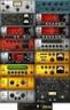 Controllable Space Phaser User Manual Overview Overview Fazortan is a phasing effect unit with two controlling LFOs. 1 Fazortan graphical interface We can distinguish two sections there: Configuration
OPERATOR'S MANUAL ENGLISH ( 1-28 ) WWW.AKAIPRO.COM
 OPERATOR'S MANUAL ENGLISH ( 1-28 ) WWW.AKAIPRO.COM KEY FEATURES 16 pressure and velocity-sensitive MPC pads with four banks each MPC technologies include Note Repeat, Swing, 16 Level, Full Level, and
DAB1001. Wireless Digital Radio Interface. Installation & User Guide
 DAB1001 Wireless Digital Radio Interface Installation & User Guide Contents Contents... 2 Introduction... 3 Contents of Package... 4 Installation... 5 Product Overview... 5 Installation Procedure... 5
0832 Dot Matrix Green Display Information Board User s Guide
 0832 Dot Matrix Green Display Information Board User s Guide DE-DP105_Ver1.0 0832 DOT MATRIX GREEN DISPLAY INFORMATI BOARD USER S GUIDE Table of contents Chapter1.Overview... 1 1.1. Welcome... 1 1.2. Quick
SCD Server. SCD Server Pro
 SCD Server SCD Server Pro SCD Server & SCD Server Pro 9850-000387-01 - Page 1 of 8 SCD Server and SCD Server Pro The SCD Server is a 2U high DMX generator, running the ZerOS Operating System and emulating
Inear Display Oxymore Version 1.0. http://www.ineardisplay.com
 Inear Display Oxymore Version 1.0 http://www.ineardisplay.com Thank you for using Oxymore. This guide will give you an overview of all the functions. HOW TO AUTHORIZE THE PLUGIN Enter the key you have
FC6 FOOT CONTROLLER OWNER S MANUAL
 FC6 FOOT CONTROLLER OWNER S MANUAL Congratulations and thank you for purchasing the KORG FC6 Foot Controller. To get the most out of this advanced instrument (?) for the longest possible time, we recommend
GETTING STARTED GUIDE
 GETTING STARTED GUIDE CONTENTS Introduction... 1 Impulse Features... 2 Box Contents... 2 About this Guide... 2 Minimum System Requirements... 2 Connecting the Impulse... 3 Impulse Basic Operation... 3
City of Dublin Education & Training Board. Programme Module for. Audio Engineering. Leading to. Level 5 FETAC. Audio Engineering 5N1564
 City of Dublin Education & Training Board Programme Module for Audio Engineering Leading to Level 5 FETAC May 202/June 202 Introduction This programme module may be delivered as a standalone module leading
UMI3 Parametric USB MIDI Foot Controller. User s Manual
 UMI3 Parametric USB MIDI Foot Controller User s Manual Table of Contents Table of Contents...2 Document revisions...3 Introduction...3 1. Hardware...4 1.1. USB Connection...4 1.2. Connecting an expression
Specifications Keyboard System Sounds Maximum Polyphony: PCM Memory: Program: Combination:
 Specifications Keyboard KROME-61 61-key: Natural Touch Semi Weighted keyboard *Standard C2 - C7 (transposable in the range [C1...C6]-[C3...C8]) KROME-73 73-key: Natural Touch Semi Weighted keyboard *Standard
Forte GETTING STARTED GUIDE. Specifications. It s the sound.
 Forte GETTING STARTED GUIDE This guide will help you hook up the Forte to your sound system and MIDI system, give you a quick overview, and show you how to start playing music with the Forte. A full manual
MiniBrute Connection software editor 1.0.3
 USER'S MANUAL MiniBrute Connection software editor 1.0.3 1 st edition: June 2012 Information contained in this manual is subject to change without notice and does not represent a commitment on behalf of
USER'S MANUAL. Elation Professional R 4295 Charter Street Los Angeles CA. 90058 www.elationlighting.com
 1 3 5 7 9 11 SCENE SETTER 1 CH Dimmer Console FOG MACHINE REC STEP DIMMER SPEED TIME FADE TIME PRESET A Heating Ready DOWN UP DELETE INSERT EDIT BEAT REV CHASE REV REV ONE % OR -55 ALL REV DARK MODE SELECT
USB MIDI CONTROLLER OWNER S MANUAL
 USB MIDI CONTROLLER OWNER S MANUAL Copyright 2013 - Samson Technologies V1.4 Samson Technologies 45 Gilpin Avenue Hauppauge, New York 11788-8816 Phone: 1-800-3-SAMSON (1-800-372-6766) Fax: 631-784-2201
VL Expert Editor Beta 1.0 Release for VL Ver.2 series Virtual Acoustic Synthesizers [VL1 Ver.2, VL1-m Ver.2, VL7 Ver.2] 1.
![VL Expert Editor Beta 1.0 Release for VL Ver.2 series Virtual Acoustic Synthesizers [VL1 Ver.2, VL1-m Ver.2, VL7 Ver.2] 1.](/thumbs/26/8036189.jpg "VL Expert Editor Beta 1.0 Release for VL Ver.2 series Virtual Acoustic Synthesizers [VL1 Ver.2, VL1-m Ver.2, VL7 Ver.2] 1.") VL Expert Editor Beta 1.0 Release for VL Ver.2 series Virtual Acoustic Synthesizers [VL1 Ver.2, VL1-m Ver.2, VL7 Ver.2] 1. Introduction The VL Expert Editor application is a voice editor and voice file
VL Expert Editor Beta 1.0 Release for VL Ver.2 series Virtual Acoustic Synthesizers [VL1 Ver.2, VL1-m Ver.2, VL7 Ver.2] 1. Introduction The VL Expert Editor application is a voice editor and voice file
PRODUCTIVITY THROUGH INNOVATION 600 CONTROL DIRECT DRIVE TECHNICAL/OPERATION MANUAL
 Rev. D PRODUCTIVITY THROUGH INNOVATION 600 CONTROL DIRECT DRIVE TECHNICAL/OPERATION MANUAL 10 BORIGHT AVENUE, KENILWORTH NEW JERSEY 07033 TELEPHONE: 800-524-0273 FAX: 908-686-9317 TABLE OF CONTENTS Page
Table of Contents Getting Started... 3 The Motors... 4 The Control Board... 5 Setting up the Computer with Mach3... 6 Starting up the Equipment...
 User Manual Table of Contents Getting Started... 3 The Motors... 4 The Control Board... 5 Setting up the Computer with Mach3... 6 Starting up the Equipment... 12 G-Code Example... 13 2 Getting Started
BLOCK OCCUPANCY DETECTOR WITH SEMAPHORE OPERATION BOD1/DAP4-BR
 BLOCK OCCUPANCY DETECTOR WITH SEMAPHORE OPERATION BOD1/DAP4-BR This Block Occupancy Detector recognises the current drawn by moving trains within a block, and can operate a number of built-in programs
MIDI Mobilizer. Advanced Guide
 MIDI Mobilizer MIDI Memo Recorder Advanced Guide An in-depth guide to the features and functionality of the MIDI Mobilizer hardware and MIDI Memo Recorder application for iphone and ipod touch Electrophonic
Soundcraft Signature MTK Recording Guide
 Soundcraft Signature MTK Recording Guide S O U N D C R A F T S I G N AT U R E M T K R E C O R D I N G G U I D E 2 Table of Contents USB Overview... 04 Installing the Drivers (PC Only)... 04 Finding the
MIDI For MultiSystem Operation Guide
 MIDI For MultiSystem Operation Guide For software Revision L European Office: 25 Putney Close Brandon Suffolk IP27 OPA United Kingdom T: +44 (0)1842 814814 F: +44 (0)1842 813802 North American Office:
GAME SYSTEM MANUAL PITTSBURGH MODULAR SYNTHESIZERS
 GAME SYSTEM MANUAL PITTSBURGH MODULAR SYNTHESIZERS Chaotic and CV Sequencing Arcade Packed with six unique multi-mode sequencers and a fully voltage controllable user interface, the Game System is deep!
MIDI Input (MIDI IN) 13. Program Change 13 Control Change 13 System Exclusive (SysEx) type messages 14. MIDI output (MIDI OUT) 15
 Edition 1.0 Table of contents Table of contents 1 Package content 2 Structure 3 Diagram of devices connectable to the MGC-6 4 Signal s path diagram 5 Preset selection 5 Preset programming 5 Buffer, loops
Troubleshooting Tips Lifestyle SA-2 & SA-3 Amplifier. Troubleshooting Tips
 Troubleshooting Tips Lifestyle SA-2 & SA-3 Amplifier Refer to the Lifestyle SA-2 & SA-3 Amplifier service manuals, part number 271720 for schematics, PCB layouts and parts lists. Preventative Repair Measures
Features, Benefits, and Operation
 Features, Benefits, and Operation 2014 Decibel Eleven Contents Introduction... 2 Features... 2 Rear Panel... 3 Connections... 3 Power... 3 MIDI... 3 Pedal Loops... 4 Example Connection Diagrams... 5,6
GRADE THREE THEORY REVISION
 GRADE THREE THEORY REVISION Note Pitches Use flashcards to make sure you know all your notes including leger lines. Whenever you name a note remember to check the clef, keysignature, and for accidentals
H203D 中文 GB Version 1
 H203D 中 GB文 Version 1 Contents Installing batteries... 4 Using the AC adapter (not supplied)... 5 Setting the clock... 6-7 Updating your radio - DAB... 8 Selecting a station - DAB... 9 Secondary services
JESTER OPERATING MANUAL
 JESTER OPERATING MANUAL If a portable or temporary three phase mains supply is used to power this desk, we recommend that the desk mains plug is removed before connecting or disconnecting the supply. Serious
Leaf River Outdoor Products Vibrashine, Inc. P.O. Box 557 Taylorsville, MS 39168 (601) 785-9854 FAX (601) 785-9874 www.vibrashine.
 MULTI-CARD PICTURE VIEWER Model PV-2.5 Leaf River Outdoor Products Vibrashine, Inc. P.O. Box 557 Taylorsville, MS 39168 (601) 785-9854 FAX (601) 785-9874 www.vibrashine.com 2 THANKS and WELCOME What does
Dual-Low Frequency Oscillator
 Oakley Sound Systems 5U Oakley Modular Series Dual-Low Frequency Oscillator D-LFO issue 1 User Manual V1.0.1 Tony Allgood Oakley Sound Systems CARLISLE United Kingdom The suggested panel layout in MOTM
MKE. User's Guide. Universal Midi Keyboard Electronics
 MKE Universal Midi Keyboard Electronics User's Guide 2006 by Doepfer Musikelektronik GmbH Geigerstr. 13 82166 Graefelfing Germany Phone: #49 89 89809510 Fax: #49 89 89809511 Web Site: www.doepfer.de Email:
the minimoog synthesizer operation manual
 the minimoog synthesizer operation manual MOOG MUSIC INC. Academy Street (P.O. Box 131) Williamsville, NY 14221 A GUIDE TO THE OPERATION OF THE MINI MOOG MODEL D contents introduction basic mini moog features
Constructing a precision SWR meter and antenna analyzer. Mike Brink HNF, Design Technologist.
 Constructing a precision SWR meter and antenna analyzer. Mike Brink HNF, Design Technologist. Abstract. I have been asked to put together a detailed article on a SWR meter. In this article I will deal
MIDI Setup with TonePort UX2 and KB37
 MIDI Setup with TonePort UX2 and KB37 Table of Contents FOOTSWITCH CONNECTIONS... 2 TONEPORT KB37 CONTROLLER LAYOUT... 3 TONEPORT KB37 DEFAULT MESSAGES... 4 Default message map for GearBox 3.0... 4 Default
Supplemental Notes May 20, 1995 SN09 V1.0
 Supplemental Notes May 20, 1995 SN09 V1.0 Sequencing with the JV-90 and the VE-Series Voice Expanders The JV- 90 is an 8 part multitimbral synthesizer with 320 Patches, 80 Performances, and 5 Rhythm Sets
USER GUIDE. Publication AP7080. Allen & Heath 1 XONE:1D User Guide
 USER GUIDE Publication AP7080 Allen & Heath 1 XONE:1D User Guide Limited One Year Warranty This product is warranted to be free from defects in materials or workmanship for period of one year from the
Radio BMR100 INSTRUCTION MANUAL. ENGLISH (Original instructions)
 ENGLISH (Original instructions) INSTRUCTION MANUAL Radio BMR00 WARNING: For your personal safety, READ and UNDERSTAND before using. SAVE THESE INSTRUCTIONS FOR FUTURE REFERENCE. Symbols The following show
HT1632C 32 8 &24 16 LED Driver
 328 &216 LED Driver Features Operating voltage: 2.V~5.5V Multiple LED display 32 ROW /8 COM and 2 ROW & 16 COM Integrated display RAM select 32 ROW & 8 COM for 6 display RAM, or select 2 ROW & 16 COM for
Part 2. Copyright 1998 Philips Consumer Communications L.P. All rights reserved. Printed in Mexico. Issue 1AT&T 848229506
 2 User's Manual for Two-Line Digital Answering System Telephone with Speakerphone 1872 Fold open this paper for information about this telephone's installation and operation. Please read Part 1 Important
Midi Fighter Twister. User Guide. Ver 1.01 DJTECHTOOLS.COM
 Midi Fighter Twister User Guide DJTECHTOOLS.COM Ver 1.01 Introduction This user guide is split in two parts, first covering the Midi Fighter Twister hardware, then the second covering the Midi Fighter
Digital Radio/DAB+/FM RDS digital clock radio with dual alarm Operating instruction
 381SE1D-A Digital Radio/DAB+/FM RDS digital clock radio with dual alarm Operating instruction GB Contents Controls... 2-3 Using the clock radio for the first time... 4 Operating your clock radio... 5 Selecting
Keep it Simple Timing
 Keep it Simple Timing Support... 1 Introduction... 2 Turn On and Go... 3 Start Clock for Orienteering... 3 Pre Start Clock for Orienteering... 3 Real Time / Finish Clock... 3 Timer Clock... 4 Configuring
In-Car Digital Radio Adaptor User Guide
 S1000-DAB In-Car Digital Radio Adaptor User Guide Table of Content INTRODUCTION... 1 CONTENTS OF PACKAGE... 2 INSTALLATION...3 OVERVIEW OF CONTROLS AND CONNECTORS... 5 STARTING UP THE SYSTEM... 7 USING
MIDI control allows the Split Personality to be used remotely in rack systems, or integrated into MIDI controlled setups for easy preset recall.
 Introduction Trying to drive multiple amplifiers can typically be a frustrating experience. The Decibel Eleven Split Personality is an active AB/Y switcher that enables musicians to run multiple amplifiers