
Notoriously Hard to Solve. David Biron
|
|
|
- Andra Logan
- 9 years ago
- Views:
Transcription
1 Traveling Salesman 1 Running Head: TRAVELING SALESMAN The Traveling Salesman Problem: Deceptivley Easy to State; Notoriously Hard to Solve David Biron A Senior Thesis submitted in partial fulfillment of the requirements for graduation in the Honors Program Liberty University Fall 2006
2 Traveling Salesman 2 Acceptance of Senior Honors Thesis This Senior Honors Thesis is accepted in partial fulfillment of the requirements for graduation from the Honors Program of Liberty University. Monty Kester, Ph.D. Chairman of Thesis Timothy Van Voorhis, Ph.D. Committee Member Edward Lewis, Ph.D. Committee Member James Nutter, D.A. Honors Program Director Date
3 Traveling Salesman 3 Abstract The purpose of this thesis is to give an overview of the history of the Traveling Salesman Problem and to show how it has been an integral part of the development of the fields of Integer Programming, and Combinatorial Optimization. The thesis starts in the 1800s and progresses through current attempts on solutions of the problem. The thesis is not meant to describe in detail every attempt made, nor to describe an original solution, but to provide a high level overview of every solution attempt, and to guide the reader on what has been done, and what still can be done.
4 Traveling Salesman 4 The Traveling Salesman Problem: Deceptivley Easy to State; Notoriously Hard to Solve Mathematics has captured some of the greatest intellectual minds. Many times a problem is posed to a mathematician, and it consumes his time until he finds a solution. Every once in a while there is a problem that captures the attention of many mathematicians. The Traveling Salesman Problem (TSP) is a problem whose solution has eluded many mathematicians for years. Currently there is no solution to the TSP that has satisfied mathematicians. The TSP has a very rich history. At the same time the TSP was being eagerly investigated a field called Integer Programming (IP) was also developing. Because the TSP can be formulated as an IP problem the history of these two are intertwined. Breakthroughs in IP were applied to the TSP as a way of showing that the breakthrough was valid. Thus a study of the TSP naturally studies the main aspects of IP. Before studying the history of the TSP it is important to state the TSP. The TSP is a Combinatorial Optimization problem, simply stated as: What is the shortest route a traveling salesman can take to visit n cities and return back to his home city, only going through each city once? From now on the word tour will refer to a solution to the TSP or simply one route that the salesman could take. The word solved will be used in reference to the optimal or shortest tour. The largest tour to be solved and proven optimal is 24,978 cities in Sweden by David Applegate - AT&T Labs Research Robert Bixby - ILOG and Rice University, Vašek Chvátal Rutgers University, William Cook - Georgia Tech, and Keld Helsgaun - Roskilde University on April ( The TSP is obviously easy to state, and may seem simple to
5 Traveling Salesman 5 solve. A brute force and sheer ignorance 1 approach to solving the TSP would be to find every possible tour and then see which one was the shortest. In order to do this there would be (n-1)! different tours to study and thus for problems with just 20 cities it would be illogical to solve this way even with a computer. To show this a very simplistic algorithm in pseudocode is presented below: Procedure TSP () For i 1 = 1 to n For i 2 = 1 to n For i 3 = 1 to n For i n = 1 to n If ( i i, i,..., is a valid tour) 1, 2 3 i n If ( i i, i,..., is shorter then the current optimal) 1, 2 3 i n TSP = i i, i,..., i 1, 2 3 n {Returns TSP which is the city progression that is the shortest} Clearly this algorithm is nowhere near optimality. The algorithm is O( n ). Obviously worse then the (n-1)! algorithm. Assume that a computer can process information at 1 operation per nanosecond. So for a 5 city tour it would require 3125 operations taking seconds. Not so bad. A ten city tour would require operations, requiring 10 seconds, workable. A 20 city tour would require operations taking seconds or n 1 I must give credit to the Chair of my Thesis, Dr. Monty Kester for this statement. He has used it many times in class to describe an algorithm that uses absolutely no mathematical finesse and tries to solve a problem in the simplest and easiest, yet sometimes longest way possible.
6 Traveling Salesman years. Naturally we would rather not wait around to see that finish. Thus for a problem as small as 20 cities, the algorithm grows uncontrollably. Like many algorithms a brute force and sheer ignorance approach is not even close to optimal. The problem is then to find an algorithm that reduces the amount of computing time. Thus many mathematicians and computer scientists have tried to compile algorithms that solve the TSP in less time. As we begin our journey into the history of the TSP we struggle to find the exact origin of the problem. Quite possibly the original proposal of the problem goes back to 1856 by Hamilton. In 1857, Hamilton created a game called the Icosian Game which was defined as: the problem of finding a Hamiltonian Circuit along the edges of a dodecahedron, i.e., a path such that every vertex is visited a single time, no edge is visited twice, and the ending point is the same as the starting point (Weisstein, 2003, p. 1). The undertone of the Icosian Game, now known as a Hamiltonian Circuit is that of the Traveling Salesman Problem. Thus the first real mention of the Traveling Salesman Problem, though nowhere near its current formulation can be traced back to Hamilton. In 1832 a German manual was produced for the successful traveling salesman. The pamphlet was called The traveling salesman how he should be and what he has to do, to obtain orders and to be sure of a happy success in his business by an old traveling salesman (Aardal (Ed.) et al., 2005, p. 38). Although the pamphlet has little to do with the problem at hand it does have a section in it that states the problem, but gives no real mathematical formulations for it: Business brings the traveling salesman now here, then there, and no travel routes can be properly indicated that are suitable for all cases occurring; but sometimes,
7 Traveling Salesman 7 by an appropriate choice and arrangement of the tour, so much time can be gained, that we don t think we may avoid giving some rules also on this. Everybody may use that much of it, as he takes it for useful for his goal; so much of it however we think we may assure, that it will not be well feasible to arrange the tours through Germany with more economy in view of the distances and, which the traveler mainly has to consider, of the trip back and forth. The main point always consists of visiting as may places as possible, without having to touch the same place twice. (Schrijver (Au.) et al., 2005, p. 38) Thus the TSP sat in relative silence until the 20 century. While the question did exist, it was not discussed much in mathematical circles until the early 1900s. In 1930 Karl Menger flirted with the problem. Schrijver credits him as the first mathematician to write about the TSP. Schrijver (2005) quotes his paper saying: We denote by messenger problem (since in practice this question should be solved by each postman, anyway also by many travelers) the task to find, for finitely many points whose pairwise distances are know, the shortest route connecting the points. Of course, this problem is solvable by finitely many trials. Rules which would push the number of trials below the number of permutations of the given points are not known. The rule that one first should go from the starting point to the closest point, then to the point closest to this, etc., in general does not yield the shortest route. (p. 41) th In his papers Menger shows that the length of simple curves l( C) = supλ( X ) where λ (X ) is the shortest length of a Hamiltonian path. He later showed that X
8 Traveling Salesman 8 l( C) = supκ( X ), where κ(x ) is the minimum length of a spanning tree on X. Thus X Menger in 1930 seems to be the first mathematician to talk about the TSP. (Schrijver Au. Et al., 2005, p41) It is interesting to see that even in the earliest paper on the TSP, Menger realizes that a greedy algorithm, now know as the nearest neighbor algorithm would not produce the shortest route. Though Menger seems to be the first to write about the TSP Dantzig, Fulkerson, and Johnson (1954) credit Merrill Flood with the one to generate interest of the problem: Merrill Flood (Columbia University) should be credited with stimulating interest in the traveling-salesman problem in many quarters. (p. 393) Flood (1956) was particularly interested in the TSP during 1937 as he was struggling with the problem in connection with a school-bus routing study in New Jersey ( p. 61). Though Flood stimulated interest, it is Hassler Whitney who posed the problem: This problem was posed, in 1934, by Hassler Whitney in a seminar talk at Princeton University. (Flood, 1956, p. 61) Like Flood, Dantzig, Fulkerson and Johnson (1954) also give Whitney credit: Both Flood and A. W. Tucker (Princeton University) recall that they heard about the problem first in a seminar talk by Hassler Whitney at Princeton in 1934 (although Whitney, recently queried, does not seem to recall the problem (p. 393). Thus Whitney gets credit for formulating the modern version of the problem and Flood for promoting the problem. Although there was mathematical interest in the TSP, not until Dantzig, Fulkerson, and Johnson were there any real breakthroughs in the problem: The origin of this problem is somewhat obscure. It appears to have been discussed informally among mathematicians at mathematics meetings for many years. Surprisingly little in the way of results has appeared in the mathematical literature (Dantzig, Fulkerson, & Johnson,
9 Traveling Salesman , p. 393). Flood (1956) claims there are as yet no acceptable computational methods, and surprisingly few mathematical results relative to the problem (p. 61). Croes (1958) acknowledged that The only fairly successful attempt at finding such a method (for symmetrical problems) has been reported by Dantzig et al (p. 792). Dantzig, Fulkerson, and Johnson solved the problem for a 49 city tour through the capital of every state in America, and Washington, D.C. On the claim is made This is the granddaddy of TSP papers. It reports on the solution of a 49-city TSP via linear-programming methods. Many of the ideas used to solve integer programming problems can be traced back to this paper (2007, par. 3). Dantzig et al formulate the problem in a linear fashion with x ij as the variable, with i and j representing the city leaving, and the city arriving respectively. This takes the value 0 if this edge is not included in the tour and 1 if the edge is included in the tour. The first set of constraints Dantzig et al. (1954) give are: n J = 1 x = 2. ( x ; I = 1,2,..., n; I J; x x ) (1) ij ij 0 IJ JI Where the objective would be to find the minimum of: D( x) = I > J d IJ x IJ (2) (p. 396). Dantzig et al. (1954) acknowledged that in order to formulate the TSP as a Linear Program (LP) there would be more constraints and finding these constraints would be an extremely difficult task: To make a linear programming problem out of this one needs, as we have observed, a way to describe tours by more linear restraints than that given by (1).
10 Traveling Salesman 10 This is extremely difficult to do as illustrated by work of I. Heller and H. Kuhn. They point out that such relations always exist. However, there seems to be no simple way to characterize them and for moderate size n the number of such restraints appears to be astronomical (p. 397). The difficulty Dantzig et al. ran into is now commonly referred to as subtours. The easiest way to describe a subtour is a picture. The points represent the cities and the lines the connectors. Obviously this is not a solution, but this does satisfy (1) and thus more constraints must be added. This is the primary difficulty of the traveling salesman. Dantzig et al. (1954) provided four different devices in their paper to simplify the TSP. The first was to use undirected tours. This has now been given the name the symmetric traveling salesman. The symmetric TSP is much easier that then the asymmetric TSP and it is not unrealistic to view the TSP as though it is symmetric. Their second device is to not use all linear constraints, but to add in addition to (1) just enough constraints so that no sub-tours are given. Thirdly is a device that speeds up the iterative process, and fourthly finding a tour that is nearly optimal and then listing all possible tours that have not yet been eliminated by the constraints provided. Dantzig, Fulkerson, Johnson in a later paper describe the process in the paper as this: The linear-programming approach suggestion in reference 1 (this is their original paper) is to start with a tour and a small number of linear equality and inequality constraints that are satisfied by all tours, then use the simplex method to move to
11 Traveling Salesman 11 a new basic solution. If the new solution is not a tour, impose an additional constraint on the problem that cuts out this solution but no tours, and again, in the new convex set thus defined, move to an adjacent solution. As a suitable stage in the process, it is usually advantageous to use the estimation procedure described in reference 1 in conjunction with a combinatorial analysis of undominated tours. (Dantzig, Fulkerson, & Johnson, 1959, p ) Thus Dantzig et al. started the beginning of many methods that would be applied to many integer programming problems. Dantzig et. al. did not have the advantages of modern day computers. Thus much of their work including their solution to the 49 city problem was done by hand. The two biggest contributions that are still seen in modern solutions are to relax the subtour elimination constraints and add them as necessary and to formulate the problem as a LP. Flood in 1955 reported on the TSP. Among his talk he discussed some heuristics. Heuristics are algorithms that do not attempt to give an optimal solution, but try and find a near optimal solution instead focusing on keeping computation time low. Flood proposed what is now considered the Nearest Neighbor solution. While Menger may have mentioned it in his paper Flood (1956) showed how effective it really was: It may be of some interest to compare the length of optimal tour found among the 49 cities by Dantzig et al with that which would be followed by a salesman living in Washington, D.C., who always went next to the closest city not already visited. This turns out to be 904 units against 699 units, or an increase of nearly 30 percent. It seems likely that a considerably better route than that produced by the operator s rule could usually be found quite easily, and it also seems likely that
12 Traveling Salesman 12 rather simple methods could be found to yield a tour much nearer optimal than 30 percent. However, even a few percent gain would be well worth-while in some cases, so the problem does seem to have practical importance as well as mathematical interest. (p. 65) Thus Flood realized that the Nearest Neighbor method is not a good estimate of the TSP but it created a decent first solution. In 1962 a contest brought the TSP national recognition through a contest given by Proctor and Gamble. A flyer of the contest is pictured below. The traveling salesman problem recently achieved national prominence when a soap company used it as the basis of a promotional contest. Prizes up to $10,000
13 Traveling Salesman 13 were offered for identifying the most correct links in a particular 33-city problem. Quite a few people found the best tour A number of people, perhaps a little over-educated, wrote the company that the problem was impossible an interesting misinterpretation of the state of the art. (Little et al., 1963, p. 973) In the 1960 s there were two main breakthroughs, the branch and bound method and dynamic programming. The term branch and bound was coined by Little, Murty, Sweeny, and Karel. They discussed two papers that proposed similar algorithms. One by Rossman, Twery, and Stone where they proposed an idea called combinatorial programming solve a 13-city problem that was solved in 8 man-days. Little et al claim to have solved it using their method in 3 and a half hours by hand. Likewise Eastman in a doctoral thesis gave a similar idea, but with significant variances. Eastman used it to solve a 10 city problem, but gave no computational time. (Little et al., 1963, p. 974) Thus it appears as if Little et al. can be accurately accredited with the formulation of the branch and bound method (b&b). Little et al. (1963) summarize their method: The basic method will be to break up the set of all tours into smaller and smaller subsets and to calculate for each of them a lower bound on the cost (length) of the best tour therein. The bounds guide the partitioning of the subsets and eventually identify an optimal tour when a subset is found that contains a single tour whose cost is less than or equal to the lower bounds for all other subsets, that tour is optimal. (p. 974) The b&b can be describe by divide and conquer. In each iteration of the b&b a lower bound is calculated by finding a tour that includes subtours. Then from that lower bound
14 Traveling Salesman 14 two branches come off of it. One branch forbids the tour to contain the edge i,j. The other branch forces the tour to contain the edge i,j. Each of those is then solved and new lower bounds found. Then one branch is chosen, and the process continues until the lower bound equals a tour that is allowable. Then the solution is deemed optimal. Below is a diagram taken from Little et al. s paper showing the branching and bounding. (1,4) represents a tour that is forced to have (1,4) in it, and ( 1, 4 ) represents a tour that is forced to not have the edge (1,4) in it. Figure 6. Final tree
15 Traveling Salesman 15 Little et al. (1963) formulation of the b&b is very significant. Two things really attributed to its continued popularity. The first is that it successfully reduced problems to make them easier to solve. It was very systematic and could be applied to a variety of problems. It was more an approach to a problem than just merely a solution to one. The second is that it was very easily coded into a computer. Its algorithmic nature allowed it to be turned easily into code. Thus as the computer became poplar, this algorithm was able to be coded into the computer, taking advantage of the computer s computational speed. The b&b method still is a very popular method for solving I.P. problems, and many textbooks on IP include it as an effective way to solve problems. Thus one major breakthrough in the TSP was applied directly to IP. Dynamic Programming (DP) was also formulated in the 1950s by Richard Bellman. How Bellman (1984) came up with name is quite interesting: An interesting question is, Where did the name, dynamic programming, come from? the 1950s were not good years for mathematical research. We had a very interesting gentleman in Washington named Wilson. He was Secretary of Defense, and he actually had a pathological fear and hatred of the word, research. I m not using the term lightly; I m using it precisely. His face would suffuse, he would turn red, and he would get violent if people used the term, research, in his presence. You can imagine how he felt, then, about the term, mathematical. The RAND Corporation was employed by the Air Force, and the Air Force had Wilson as its boss, essentially. Hence, I felt I had to do something to shield Wilson and the Air Force from the fact that I was really doing mathematics inside the RAND Corporations. What title, what name could I choose? In the first place
16 Traveling Salesman 16 I was interested in planning, in decision making, in thinking. But planning, is not a good word for various reasons. I decided therefore to use the word, programming. I wanted to get across the idea that this way dynamic, this was multistage, this was time-varying I thought, let s kill two birds with one stone. Let s take a word that has an absolutely precise meaning, namely dynamic, in the classical physical sense. It also has a very interesting property as an adjective, and that is it s impossible to use the word, dynamic, in a pejorative sense. Try thinking of some combination that will give it a pejorative meaning. It s impossible. Thus, I thought dynamic programming was a good name. It was something not even a Congressman could object to. So I used it as an umbrella for my activities. (p. 159) Thus DP was born in the RAND Corporation by Richard Bellman. As the TSP had gained much popularity by now, many new developments in integer programming and Combinatorial Optimization were then immediately applied to the TSP. Thus is the case with Bellman. Bellman (1961) wrote a short paper that described the TSP in a dynamic programming sense: The purpose of this note is to show that this problem can easily be formulated in dynamic programming terms, and resolved computationally for up to 17 cities (p. 61). Thus Bellman (1961) formulated in DP terms and discussed some advantages to using DP: One advantage of the dynamic programming approach is that one can readily incorporate all types of realistic constraints involving the order in which cities can be visited (p. 63). Bellman (1962) realized that there were problems with using DP to solve the TSP: The only problem to be faced in using the foregoing algorithm to obtain a solution to the traveling salesman problem for an arbitrarily large
17 Traveling Salesman 17 number of cities is the storage problem (p. 62). Bellman (1962) goes to show that computers of the day could solve a 11 city TSP, a 17 city TSP would require the best computer of the day, and that problems involving 21 cities are for a few years at least beyond our reach (p. 62). Thus DP was used to solve the TSP. A third solution applied to the TSP in the 1960s was Gomory Cuts: Miller, Tucker, and Zemlin, whose experiments using an all-integer program of Gomory did not produce results in cases with ten cities although some success was achieved in cases of simply four cities (Bellman, 1962, p. 61). Miller, Tucker, and Zemlin seem to be the first to formulate the TSP in an Integer Programming sense. An Integer Program (IP) is essentially a LP where the variables are required to be integers. Miller et al. actually formulated in what is now known as a Binary IP (BIP). They formulated it as this: Minimize the linear form: 0 i j n Over the set determined by the relations d ij x ij n x ij i= 0 i j = 1 (j = 1,., n) n j= 0 j i x = 1 (i = 1,, n) ij ui u j + pxij p 1 ( 1 i j n) (Miller, Tucker, & Zemlin, 1960, p. 327) After formulating it as an IP Miller et al. used Gomory Cuts (GC) to solve the TSP. Out of GC grew a methodology called the Cutting Planes method in which new constraints are imposed by making valid inequalities so that the problem becomes easier
18 Traveling Salesman 18 to solve, without ever removing the optimal solution. Cutting Planes and GC s are not very effective. Miller et al. found that even for a 10 city problem it was encountering problems. Thus they conclude It seems hopeful that more efficient integer programming procedures now under development will yield a satisfactory algorithmic solution to the traveling salesman problem, when applied to this model. In any case, the model serves to illustrate how problems of this sort may be succinctly formulated in integer programming terms (Miller, Tucker, & Zemlin, 1960, p. 329). It is interesting to read this with the knowledge we now know, because one excellent algorithm combines the b&b and cutting planes to solve the TSP. Thus GC on their own are not very efficient but will be found later that when combined with other IP techniques strengthen those techniques significantly. In the 1960s heuristics started to appear for the TSP. A heuristic is an estimate of the solution that gets close to the optimal solution. Karg and Thompson in 1964 came up with a heuristic that starts with two random cities, and inserts the next city in away to make the tour as small as possible. Thus it gives a solution to the TSP that can be found in linear time but yet not guaranteed to be optimal: In this paper we shall discuss a method, suitable for electronic computers, that has proved capable of quickly obtaining solutions for problems having about 60 cities or less in symmetric and some nonsymmetric problems. Although the code does not guarantee finding the optimum tour, it can be used over and over several times and in various ways to get a probabilistic idea of how good the best answer found is relative to the set of observed answers. (Karg & Thompson, 1964, p. 226)
19 Traveling Salesman 19 Two other heuristic worth noting would be S. Lin with a 3 opt algorithm and S. Reiter and G. Sherman with a Local Search heuristic: ( In the 1970s Saman Hong wrote a Doctoral Thesis in which this is said. Hong's thesis was written under the supervision of M. Bellmore. His work is the most significant (computational) contribution to the linear programming approach to the TSP since the original paper of Dantzig, Fulkerson, and Johnson [1954]. The algorithm presented here goes a long way towards automating Dantzig, Fulkerson, and Johnson's method. Hong uses a dual LP algorithm for solving the linear-programming relaxations; the Ford-Fulkerson max-flow algorithm for finding violated subtour inequalities; a heuristic for finding violated blossom inequalities; and a branch-and-bound scheme that includes the addition of subtour inequalities at the nodes of the branch-and-bound tree (such algorithms are now known as "branch-and-cut" (Padberg and Rinaldi [1991])). In short, Hong had most of the ingredients of the current generation of linear-programming based algorithms for the TSP. His computational tests were carried out on random Euclidean instances having up to 20 cities. On the 60 instances that he tests, 59 were solved without branching and the remaining instance required a single branch. Larger instances were not tested due to difficulties with his LP solver. ( Thus as we get to the 1970s we see the main ingredients for solutions of the TSP. Another interesting solution in the 1970s was by Held and Karp. They related the TSP to minimum spanning trees. The defined what they called a 1 tree and showed that
20 Traveling Salesman 20 the TSP is in fact a 1 tree. A 1 tree consist of a tree on the vertex set {2,3,,n}, together with two distinct edges at vertex 1. Thus, a 1 tree has a single cycle, this cycle contains vertex 1, and vertex 1 always has degree two A 1 tree can be found by constructing a minimum spanning tree on the vertex set {2,, n} and then adjoining two edges of lowest weight at vertex 1 (Held & Karp, 1970, p. 1139). Held and Carp (1970) made three observations that was the basis of their algorithm. We observe that (i) a tour is precisely a 1 tree in which each vertex has degree 2, (ii) a minimum 1 tree is easy to compute, and (iii) the transformation on intercity distances c ij c ij + π + π leaves the traveling-salesman problem invariant but changes the i j minimum 1- tree (p. 1138). Held & Carp used a method in their paper in which Wolsey calls the Lagrangian Dual. Wolsey (1998) says about their paper The successful solution of what were at the time very large TSPs made the approach popular (p. 180). Wolsey shows that the TSP can be relaxed into a 1-tree by a Lagrangian Relaxation. He then goes on in his text to show how to use the process of using the Lagrangian dual to solve the TSP. He uses the example of Held & Carp to show that it is an effective way to solve the TSP and thus is a good procedure. Thus Held and Karp used Minimum Spanning Trees and an early formulation of the Lagrangian dual to solve the TSP easily. Everything before the 1980s laid the groundwork for the algorithms that are available today. With computers becoming more powerful and algorithms being tweaked to become more efficient higher and higher cases of the TSP are able to be solved and proved optimal. In the 1980s a new field was being formed. This was metaheuristics. A metaheuristic is designed to guide a regular heuristic and help it overcome local optimum. A metaheuristic is a general solution method that provides both a general
21 Traveling Salesman 21 structure and strategy guidelines for developing a specific heuristic method to fit a particular kind of problem. Metaheuristics have become one of the most important techniques in the toolkit of OR practitioners (Hillier & Lieberman, 2005, p. 617). In the 1980s this field was not existence, though Fred Glover was credited with the first metaheuristic, the Tabu Search. He published a two part series on the Tabu search in the ORSA Journal on computing. As stated by him Tabu search is a strategy for solving combinatorial optimization problems whose applications range from graph theory and matroid settings to general pure and mixed integer programming problems. It is an adaptive procedure with the ability to make use of many other methods, such as linear programming algorithms and specialized heuristics, which it directs to overcome the limitations of local optimality (Glover, 1989, p. 190). The Tabu Search for the TSP runs off of the Nearest Neighbor (NN) heuristic. The Nearest Neighbor heuristic also referred to as a 2-opt algorithm, looks to swap two cities in order to make the solution smaller. The NN often hits a local optimum before getting to the true optimal solution. The idea of the Tabu search is to keep the NN algorithm running when it hits a local optimum. The basic concept is that every step along the way the Tabu search keeps a list of already made moves and does not allow those moves to be made again. At each step of the way it will either make the best available switch or the switch that makes the least increase if no decreases are available. To keep from cycling back to already found optimums it keeps track of switches it has already made and adds them to a list called a tabu list in which moves on this list are tabu or cannot be made. The process is run until there are no more switches to be made, or a certain amount of iterations has happened. Thus the
22 Traveling Salesman 22 Tabu Search was applied to the TSP to show its effectiveness in finding a solution. It proved to have incredible results. Kirkpatrick, Gelatt, & Vecchi (1983) wrote an article comparing statistical mechanics (the behavior of systems with many degrees of freedom in thermal equilibrium at a finite temperature) and multivariate or combinatorial optimization (finding the minimum of a given function depending on many parameters) (p. 671). It is interesting to note Kirkpatrick et al. s (1983) comment, Of classic optimization problems, the traveling salesman problem has received the most intensive study. To test the power of simulated annealing, we used the algorithm on traveling salesman problems with as many as several thousand cities. (p. 671) Simulated Annealing (SA) is similar to the Tabu Search method. It guides the descent algorithm and helps it to overcome local minimum. SA mimics a natural process: The objective of physical annealing is to produce lowenergy states of a solid in a heat bath. Annealing has two steps: (1) The temperature of the heat bath is raised to just below the boiling point of the material when the particles are disorganized and the energy of the system is high. (2) The temperature is carefully lowered until the particles of the liquid arrange themselves into a more orderly state of minimum energy. It is a natural minimization process (Albright, 2007, p. 38). In the SA algorithm, it generates a neighbor. The algorithm accepts the neighbor under two conditions either the neighbor produces a solution that is smaller then the current best, or with a certain probability. Albright (2007) defines the probability as: P 8accept j< = 9 exp J 1 if f HjL f HiL f HiL f HjL N if f HjL > f HiL c k (p. 39) Thus is the basic of the SA algorithm. Later on in their paper, Kirkpatrick et al. apply it to a very complicated problem on the physical design of computers. So to gain
23 Traveling Salesman 23 credibility for the algorithm Kirkpatrick et al. apply it to the TSP and show SA can get close to optimal if not optimal on TSP instances that are proved optimal. Thus SA gained a lot of credibility. The SA algorithm is popular today also because of its ease to apply it to other problems: Implementing the appropriate Metropolis algorithm to simulate annealing of a combinatorial optimization is straightforward and easily extended to new problems (Kirkpatrick, Gelatt, & Vecchi, 1983, p. 679). In 1995 D. Applegate, R. Bixby, V. Chvátal, and W. Cook published a paper on the TSP. Applegate et al. have been the authority on the TSP since then. They have developed software base off of their paper called Concorde. Concorde is open source software available for free on On this website they describe the purpose of the Concorde: Concorde is a computer code for the symmetric traveling salesman problem (TSP) and some related network optimization problems. The code is written in the ANSI C programming language and it is available for academic research use; for other uses, contact William Cook for licensing options. Concorde's TSP solver has been used to obtain the optimal solutions to 107 of the 110 TSPLIB instances; the largest having 15,112 cities. The Concorde callable library includes over 700 functions permitting users to create specialized codes for TSP-like problems. All Concorde functions are thread-safe for programming in shared-memory parallel environments; the main TSP solver includes code for running over networks of UNIX workstations.
24 Traveling Salesman 24 Concorde now supports the QSopt linear programming solver. Executable versions of concorde with qsopt for Linux and Solaris are now available ( 2007) Thus with Concorde it is feasible to solve very large instances of the TSP. Thus Concorde, or a variation of it has been used to solve the largest TSPs solved. There still are TSPs that are unsolved. One of those is the world problem. The world problem is a TSP formulated for the world in which in contains 1,904,711 cities. It can be found on According to the website, Keld Helsguan currently has the best solution, with the tour length of 7,516,024,785 units. He used a variation of a heuristic that he had created. The best lower bound for the TSP is 7,512,082,035 units created from Concorde code using the CPLEX solver. ( 2007) Below is a picture of Helsguan s tour around the world. Go to the ant, O sluggard; consider her ways, and be wise. (Proverbs 6:6, ESV) In 1999 just that was done and a new metaheuristic emerged. It was called Ant Colony
25 Traveling Salesman 25 Optimization (ACO) and was originally formulated by Dorigo, Di Caro and Gambardella. ( 2006) Due to the current popularity of the TSP ACO was used to find solutions to the TSP to gain credibility: The traveling salesman problem is an extensively studied problem in the literature and for a long time has attracted a considerable amount of research effort. The TSP also plays an important role in ACO research: the first ACO algorithm, called Ant System, as well as many of the ACO algorithms proposed subsequently, was first tested on the TSP. There are several reasons for the choice of the TSP as the problem to explain the working of ACO algorithms: it is an important NP-hard optimization problem that arises in several applications; it is a problem to which ACO algorithms are easily applied; it is easily understandable, so that the algorithm behavior is not obscured by too many technicalities; and it is a standard test bed for new algorithmic ideas a good performance on the TSP is often taken as a proof of their usefulness. Additionally, the history of ACO shows that very often the most efficient ACO algorithms for the TSP were also found to be among the most efficient ones for a wide variety of other problems. (Dorigo & Stèutzle, 2004, p. 65) ACO started by studying ants. They realized that ants have a natural way of optimizing different procedures. One way was that of the shortest path to food. Through careful studying of ants a computerized version of these ants were formed and used to find the shortest path between points. ACO is fairly straightforward to apply to many different instances. Thus with successful application to the TSP, ease of application to other
26 Traveling Salesman 26 problems, and a vast amount of unknowns to be explored ACO is growing in interest among mathematical circles. Like many Metaheuristics it is not know exactly why it works so well, it is just know that it works. Many mathematicians are trying study and explain the reasons why it is so effective. Thus the latest research on the TSP is the ACO algorithm and how to refine it. The TSP has hit a pseudo-stopping point. While there are still unsolved instances of the TSP and the TSP has no polynomial time bound algorithm to solve every instance, Concorde has taken a lot of the interest away from creating that software. Also dissuading mathematicians from attempting is the fact that the TSP is NP-hard and many mathematicians believe that it is impossible to find such an algorithm. While the TSP still has a small interest in solving new instances, such as the world problem, a large amount of the current research is done by mathematicians who are not seeking an answer to the TSP, but validity in a new approach or a new heuristic that they plan on applying to another area. With so many instances of the TSP solved, and with the past and current popularity of the problem, the TSP is a fast and easy way for a mathematician to gain validity of a procedure. New algorithms find and prove a solution optimal faster, or heuristics gain close of not optimal solutions using the already proved optimal solutions as their base for their claim. Thus one looking to advance the TSP should focus on making current algorithms faster, or inventing a new algorithm to shake up the mathematical world. The Traveling Salesman Problem has a rich history in the past 50 years. It is well documented and well researched among mathematicians. Though the true history traces back to the 18 th century much of the work on it did not appear until the 1930 s. Credit
27 Traveling Salesman 27 and thanks must be given to Hassler Whitney for posing the question and Merrill Flood for generating a lot of interest in it. Dantzig, Fulkerson, and Johnson were the first to have any real breakthroughs in the solution. Proctor and Gamble increased public interest in the solution with the addition of an award to those who studied it and this had great influence on those who studied it. Saman Hong is to be credited for coming up with the basis of what all of the modern day solutions have, and can be credited for algorithms such as the Branch and Cut algorithm. D. Applegate, R. Bixby, V. Chvátal, and W. Cook have kept current interest in the TSP and have developed Concorde in which many instances of the TSP can be easily solved from a home computer. They also did the public a service by making it open source, free and easily accessible to anybody with internet access. Interest in the TSP has recently shifted from trying to pioneer new solutions, to making old algorithms better and more efficient and has become a testing ground for many IP, combinatorial optimization, and heuristic algorithms. The field of Metaheuristics can be easily seen from the view of the TSP as every efficient Metaheuristic has been applied to the TSP. Three main Metaheuristics are the Tabu Search created by Fred Glover, Simulated Annealing by Kirkpatrick, Gelatt, & Vecchi, and Ant Colony Optimization by Dorigo, Di Caro and Gambardella. It is interesting to note that these metaheuristics while designed for a specific problem all used the TSP to prove that it was an effective algorithm and used the TSP to show an easy way to implement the algorithm. These algorithms have been applied to a vast amount of different applications because they are designed to be flexible and easy to apply to different situations. The TSP now remains as an unsolved problem, still keeping a few
28 Traveling Salesman 28 mathematicians interest, but now serves the mathematical world in a different light, that light being an easy testing ground to new theorems and improved heuristics
29 Traveling Salesman 29 References Albright, B. (2007). An introduction to simulated annealing. The College Mathematics Journal, 38, Balaprakash, P., & Montes De Oca, M. A. (Eds.). (2006, November 06). Ant Colony Optimization. Retrieved March 24, 2007, from Bellman, R. (1962). Dynamic programming treatment of the traveling salesman problem. Journal of the ACM (JACM), 9, Retrieved March 9, 2007, from Bellman, R. (1984). Eye of the hurricane: An autobiography. Singapore: World Scientific. Crowes, G. A. (1958). A method for solving traveling-salesman problems. Operations Research, 6, 791. Dantzig, G. B., Fulkerson, D. R., & Johnson, S. M. (1959). On a linear-programming, combinatorial approach to the traveling-salesman problem. Operations Research, 7, 58. Retrieved March 8, 2007, from =ehost Dantzig, G., Fulkerson, R., & Johnson, S. (1954). Solution of a large traveling-salesman problem. Journal of the Operations Research Society of America, 2, 393. Dorigo, M., & Stèutzle, T. (2004). Ant colony optimization. Cambridge, MA: MIT Press. Eiselt, H. A., & Sandblom, C. (2000). Integer programming and network models. New York: Springer.
30 Traveling Salesman 30 Flood, M. M. (1956). The traveling-salesman problem. Operations Research, 4, 61. Retrieved March 8, 2007, from =ehost Foulds, L. R. (1984). Combinatorial optimization for undergraduates. New York: Springer-Verlag. Glover, F. (1989). Tabu Search - Part I. ORSA Journal on Computing, 1, Retrieved December 15, 2006, from EBSCOHost database. Held, M., & Karp, R. M. (1970). Traveling salesman problem and minimum spanning trees. Operations Research, 18, Retrieved from =ehost Hillier, F. S., & Lieberman, G. J. (2005). Introduction to operations research (8th ed.). Boston: McGraw-Hill Higher Education. Karg, R. L., & Thompson, G. L. (1964). A heuristic approach to solving traveling salesman problems. Management Science, 10, 225. Retrieved from =ehost Kirkpatrick, S., Gelatt, C. D., & Vecchi, M. P. (1983). Optimization by simulated annealing. Science, 220, Retrieved March 9, 2007, from 2-8
31 Traveling Salesman 31 Little, J. D., Murty, K. G., Sweeney, D. W., & Karel, C. (1963). An algorithm for the traveling salesman problem. Operations Research, 11, 972. Retrieved from =ehost Miller, C. E., Tucker, A. W., & Zemlin, R. A. (1960). Integer programming formulation of traveling salesman problems. Journal of the ACM (JACM), 7, Retrieved March 9, 2007, from Schrijver, A. (2005). On the history of combinatorial optimization. In R. Weismantel, G. L. Nemhauser, & K. Aardal (Eds.), Handbook of discrete optimization (pp. 1-68). Amsterdam: Elsevier. Traveling salesman problem. (2007, January). Retrieved November 11, 2006, from Weisstein, E. W. (2003, December 24). "Icosian Game" from MathWorld--A Wolfram Web Resource. Retrieved March 4, 2007, from Wolsey, L. A. (1998). Integer programming. New York: Wiley.
Solution of a Large-Scale Traveling-Salesman Problem
 Chapter 1 Solution of a Large-Scale Traveling-Salesman Problem George B. Dantzig, Delbert R. Fulkerson, and Selmer M. Johnson Introduction by Vašek Chvátal and William Cook The birth of the cutting-plane
! Solve problem to optimality. ! Solve problem in poly-time. ! Solve arbitrary instances of the problem. #-approximation algorithm.
 Approximation Algorithms 11 Approximation Algorithms Q Suppose I need to solve an NP-hard problem What should I do? A Theory says you're unlikely to find a poly-time algorithm Must sacrifice one of three
! Solve problem to optimality. ! Solve problem in poly-time. ! Solve arbitrary instances of the problem. !-approximation algorithm.
 Approximation Algorithms Chapter Approximation Algorithms Q Suppose I need to solve an NP-hard problem What should I do? A Theory says you're unlikely to find a poly-time algorithm Must sacrifice one of
Chapter 11. 11.1 Load Balancing. Approximation Algorithms. Load Balancing. Load Balancing on 2 Machines. Load Balancing: Greedy Scheduling
 Approximation Algorithms Chapter Approximation Algorithms Q. Suppose I need to solve an NP-hard problem. What should I do? A. Theory says you're unlikely to find a poly-time algorithm. Must sacrifice one
5.1 Bipartite Matching
 CS787: Advanced Algorithms Lecture 5: Applications of Network Flow In the last lecture, we looked at the problem of finding the maximum flow in a graph, and how it can be efficiently solved using the Ford-Fulkerson
Research Paper Business Analytics. Applications for the Vehicle Routing Problem. Jelmer Blok
 Research Paper Business Analytics Applications for the Vehicle Routing Problem Jelmer Blok Applications for the Vehicle Routing Problem Jelmer Blok Research Paper Vrije Universiteit Amsterdam Faculteit
Scheduling Home Health Care with Separating Benders Cuts in Decision Diagrams
 Scheduling Home Health Care with Separating Benders Cuts in Decision Diagrams André Ciré University of Toronto John Hooker Carnegie Mellon University INFORMS 2014 Home Health Care Home health care delivery
The Taxman Game. Robert K. Moniot September 5, 2003
 The Taxman Game Robert K. Moniot September 5, 2003 1 Introduction Want to know how to beat the taxman? Legally, that is? Read on, and we will explore this cute little mathematical game. The taxman game
Outline. NP-completeness. When is a problem easy? When is a problem hard? Today. Euler Circuits
 Outline NP-completeness Examples of Easy vs. Hard problems Euler circuit vs. Hamiltonian circuit Shortest Path vs. Longest Path 2-pairs sum vs. general Subset Sum Reducing one problem to another Clique
Approximation Algorithms
 Approximation Algorithms or: How I Learned to Stop Worrying and Deal with NP-Completeness Ong Jit Sheng, Jonathan (A0073924B) March, 2012 Overview Key Results (I) General techniques: Greedy algorithms
CHAPTER 9. Integer Programming
 CHAPTER 9 Integer Programming An integer linear program (ILP) is, by definition, a linear program with the additional constraint that all variables take integer values: (9.1) max c T x s t Ax b and x integral
Scheduling Shop Scheduling. Tim Nieberg
 Scheduling Shop Scheduling Tim Nieberg Shop models: General Introduction Remark: Consider non preemptive problems with regular objectives Notation Shop Problems: m machines, n jobs 1,..., n operations
INTERNATIONAL JOURNAL OF COMPUTER ENGINEERING & TECHNOLOGY (IJCET)
 INTERNATIONAL JOURNAL OF COMPUTER ENGINEERING & TECHNOLOGY (IJCET) International Journal of Computer Engineering and Technology (IJCET), ISSN 0976 6367(Print), ISSN 0976 6367(Print) ISSN 0976 6375(Online)
Linear Programming for Optimization. Mark A. Schulze, Ph.D. Perceptive Scientific Instruments, Inc.
 1. Introduction Linear Programming for Optimization Mark A. Schulze, Ph.D. Perceptive Scientific Instruments, Inc. 1.1 Definition Linear programming is the name of a branch of applied mathematics that
The Effects of Start Prices on the Performance of the Certainty Equivalent Pricing Policy
 BMI Paper The Effects of Start Prices on the Performance of the Certainty Equivalent Pricing Policy Faculty of Sciences VU University Amsterdam De Boelelaan 1081 1081 HV Amsterdam Netherlands Author: R.D.R.
This puzzle is based on the following anecdote concerning a Hungarian sociologist and his observations of circles of friends among children.
 0.1 Friend Trends This puzzle is based on the following anecdote concerning a Hungarian sociologist and his observations of circles of friends among children. In the 1950s, a Hungarian sociologist S. Szalai
Discrete Optimization Introduction & applications
 Discrete Optimization 2013 1/21 Discrete Optimization Introduction & applications Bertrand Cornélusse ULg - Institut Montefiore 2013 Discrete Optimization 2013 2/21 Outline Introduction Some applications
Guessing Game: NP-Complete?
 Guessing Game: NP-Complete? 1. LONGEST-PATH: Given a graph G = (V, E), does there exists a simple path of length at least k edges? YES 2. SHORTEST-PATH: Given a graph G = (V, E), does there exists a simple
INTEGER PROGRAMMING. Integer Programming. Prototype example. BIP model. BIP models
 Integer Programming INTEGER PROGRAMMING In many problems the decision variables must have integer values. Example: assign people, machines, and vehicles to activities in integer quantities. If this is
Computer Algorithms. NP-Complete Problems. CISC 4080 Yanjun Li
 Computer Algorithms NP-Complete Problems NP-completeness The quest for efficient algorithms is about finding clever ways to bypass the process of exhaustive search, using clues from the input in order
Chapter 13: Binary and Mixed-Integer Programming
 Chapter 3: Binary and Mixed-Integer Programming The general branch and bound approach described in the previous chapter can be customized for special situations. This chapter addresses two special situations:
Graph Theory Origin and Seven Bridges of Königsberg -Rhishikesh
 Graph Theory Origin and Seven Bridges of Königsberg -Rhishikesh Graph Theory: Graph theory can be defined as the study of graphs; Graphs are mathematical structures used to model pair-wise relations between
JUST-IN-TIME SCHEDULING WITH PERIODIC TIME SLOTS. Received December May 12, 2003; revised February 5, 2004
 Scientiae Mathematicae Japonicae Online, Vol. 10, (2004), 431 437 431 JUST-IN-TIME SCHEDULING WITH PERIODIC TIME SLOTS Ondřej Čepeka and Shao Chin Sung b Received December May 12, 2003; revised February
CMPSCI611: Approximating MAX-CUT Lecture 20
 CMPSCI611: Approximating MAX-CUT Lecture 20 For the next two lectures we ll be seeing examples of approximation algorithms for interesting NP-hard problems. Today we consider MAX-CUT, which we proved to
Nan Kong, Andrew J. Schaefer. Department of Industrial Engineering, Univeristy of Pittsburgh, PA 15261, USA
 A Factor 1 2 Approximation Algorithm for Two-Stage Stochastic Matching Problems Nan Kong, Andrew J. Schaefer Department of Industrial Engineering, Univeristy of Pittsburgh, PA 15261, USA Abstract We introduce
Online Adwords Allocation
 Online Adwords Allocation Shoshana Neuburger May 6, 2009 1 Overview Many search engines auction the advertising space alongside search results. When Google interviewed Amin Saberi in 2004, their advertisement
Nurse Rostering. Jonathan Johannsen CS 537. Scheduling Algorithms
 Nurse Rostering Jonathan Johannsen CS 537 Scheduling Algorithms Most hospitals worldwide create schedules for their staff by hand, spending hours trying to optimally assign workers to various wards at
Chapter 6: Graph Theory
 Chapter 6: Graph Theory Graph theory deals with routing and network problems and if it is possible to find a best route, whether that means the least expensive, least amount of time or the least distance.
The Problem of Scheduling Technicians and Interventions in a Telecommunications Company
 The Problem of Scheduling Technicians and Interventions in a Telecommunications Company Sérgio Garcia Panzo Dongala November 2008 Abstract In 2007 the challenge organized by the French Society of Operational
11. APPROXIMATION ALGORITHMS
 11. APPROXIMATION ALGORITHMS load balancing center selection pricing method: vertex cover LP rounding: vertex cover generalized load balancing knapsack problem Lecture slides by Kevin Wayne Copyright 2005
MATHEMATICS Unit Decision 1
 General Certificate of Education January 2008 Advanced Subsidiary Examination MATHEMATICS Unit Decision 1 MD01 Tuesday 15 January 2008 9.00 am to 10.30 am For this paper you must have: an 8-page answer
Branch-and-Price Approach to the Vehicle Routing Problem with Time Windows
 TECHNISCHE UNIVERSITEIT EINDHOVEN Branch-and-Price Approach to the Vehicle Routing Problem with Time Windows Lloyd A. Fasting May 2014 Supervisors: dr. M. Firat dr.ir. M.A.A. Boon J. van Twist MSc. Contents
Practical Guide to the Simplex Method of Linear Programming
 Practical Guide to the Simplex Method of Linear Programming Marcel Oliver Revised: April, 0 The basic steps of the simplex algorithm Step : Write the linear programming problem in standard form Linear
Near Optimal Solutions
 Near Optimal Solutions Many important optimization problems are lacking efficient solutions. NP-Complete problems unlikely to have polynomial time solutions. Good heuristics important for such problems.
Design and Analysis of ACO algorithms for edge matching problems
 Design and Analysis of ACO algorithms for edge matching problems Carl Martin Dissing Söderlind Kgs. Lyngby 2010 DTU Informatics Department of Informatics and Mathematical Modelling Technical University
The Physics and Math of Ping-pong and How It Affects Game Play. By: Connor Thompson & Andrew Johnson
 The Physics and Math of Ping-pong and How It Affects Game Play 1 The Physics and Math of Ping-pong and How It Affects Game Play By: Connor Thompson & Andrew Johnson The Practical Applications of Advanced
A Working Knowledge of Computational Complexity for an Optimizer
 A Working Knowledge of Computational Complexity for an Optimizer ORF 363/COS 323 Instructor: Amir Ali Ahmadi TAs: Y. Chen, G. Hall, J. Ye Fall 2014 1 Why computational complexity? What is computational
Branch and Cut for TSP
 Branch and Cut for TSP jla,[email protected] Informatics and Mathematical Modelling Technical University of Denmark 1 Branch-and-Cut for TSP Branch-and-Cut is a general technique applicable e.g. to solve symmetric
Arrangements And Duality
 Arrangements And Duality 3.1 Introduction 3 Point configurations are tbe most basic structure we study in computational geometry. But what about configurations of more complicated shapes? For example,
Graph Theory Problems and Solutions
 raph Theory Problems and Solutions Tom Davis [email protected] http://www.geometer.org/mathcircles November, 005 Problems. Prove that the sum of the degrees of the vertices of any finite graph is
Ant Colony Optimization (ACO)
 Ant Colony Optimization (ACO) Exploits foraging behavior of ants Path optimization Problems mapping onto foraging are ACO-like TSP, ATSP QAP Travelling Salesman Problem (TSP) Why? Hard, shortest path problem
Foundations of Operations Research
 Foundations of Operations Research Master of Science in Computer Engineering Roberto Cordone [email protected] Tuesday 13.15-15.15 Thursday 10.15-13.15 http://homes.di.unimi.it/~cordone/courses/2013-for/2013-for.html
Linear Programming. Solving LP Models Using MS Excel, 18
 SUPPLEMENT TO CHAPTER SIX Linear Programming SUPPLEMENT OUTLINE Introduction, 2 Linear Programming Models, 2 Model Formulation, 4 Graphical Linear Programming, 5 Outline of Graphical Procedure, 5 Plotting
Dynamic programming. Doctoral course Optimization on graphs - Lecture 4.1. Giovanni Righini. January 17 th, 2013
 Dynamic programming Doctoral course Optimization on graphs - Lecture.1 Giovanni Righini January 1 th, 201 Implicit enumeration Combinatorial optimization problems are in general NP-hard and we usually
Applied Algorithm Design Lecture 5
 Applied Algorithm Design Lecture 5 Pietro Michiardi Eurecom Pietro Michiardi (Eurecom) Applied Algorithm Design Lecture 5 1 / 86 Approximation Algorithms Pietro Michiardi (Eurecom) Applied Algorithm Design
A Binary Model on the Basis of Imperialist Competitive Algorithm in Order to Solve the Problem of Knapsack 1-0
 212 International Conference on System Engineering and Modeling (ICSEM 212) IPCSIT vol. 34 (212) (212) IACSIT Press, Singapore A Binary Model on the Basis of Imperialist Competitive Algorithm in Order
The Graphical Method: An Example
 The Graphical Method: An Example Consider the following linear program: Maximize 4x 1 +3x 2 Subject to: 2x 1 +3x 2 6 (1) 3x 1 +2x 2 3 (2) 2x 2 5 (3) 2x 1 +x 2 4 (4) x 1, x 2 0, where, for ease of reference,
An ACO Approach to Solve a Variant of TSP
 An ACO Approach to Solve a Variant of TSP Bharat V. Chawda, Nitesh M. Sureja Abstract This study is an investigation on the application of Ant Colony Optimization to a variant of TSP. This paper presents
Comments on the Rubik s Cube Puzzle
 Comments on the Rubik s Cube Puzzle Dan Frohardt February 15, 2013 Introduction The Rubik s Cube is a mechanical puzzle that became a very popular toy in the early 1980s, acquiring fad status. Unlike some
School Timetabling in Theory and Practice
 School Timetabling in Theory and Practice Irving van Heuven van Staereling VU University, Amsterdam Faculty of Sciences December 24, 2012 Preface At almost every secondary school and university, some
Offline sorting buffers on Line
 Offline sorting buffers on Line Rohit Khandekar 1 and Vinayaka Pandit 2 1 University of Waterloo, ON, Canada. email: [email protected] 2 IBM India Research Lab, New Delhi. email: [email protected]
Berkeley CS191x: Quantum Mechanics and Quantum Computation Optional Class Project
 Berkeley CS191x: Quantum Mechanics and Quantum Computation Optional Class Project This document describes the optional class project for the Fall 2013 offering of CS191x. The project will not be graded.
1 Solving LPs: The Simplex Algorithm of George Dantzig
 Solving LPs: The Simplex Algorithm of George Dantzig. Simplex Pivoting: Dictionary Format We illustrate a general solution procedure, called the simplex algorithm, by implementing it on a very simple example.
A Study of Local Optima in the Biobjective Travelling Salesman Problem
 A Study of Local Optima in the Biobjective Travelling Salesman Problem Luis Paquete, Marco Chiarandini and Thomas Stützle FG Intellektik, Technische Universität Darmstadt, Alexanderstr. 10, Darmstadt,
2. (a) Explain the strassen s matrix multiplication. (b) Write deletion algorithm, of Binary search tree. [8+8]
![2. (a) Explain the strassen s matrix multiplication. (b) Write deletion algorithm, of Binary search tree. [8+8]](/thumbs/40/21097758.jpg "2. (a) Explain the strassen s matrix multiplication. (b) Write deletion algorithm, of Binary search tree. [8+8]") Code No: R05220502 Set No. 1 1. (a) Describe the performance analysis in detail. (b) Show that f 1 (n)+f 2 (n) = 0(max(g 1 (n), g 2 (n)) where f 1 (n) = 0(g 1 (n)) and f 2 (n) = 0(g 2 (n)). [8+8] 2. (a)
Code No: R05220502 Set No. 1 1. (a) Describe the performance analysis in detail. (b) Show that f 1 (n)+f 2 (n) = 0(max(g 1 (n), g 2 (n)) where f 1 (n) = 0(g 1 (n)) and f 2 (n) = 0(g 2 (n)). [8+8] 2. (a)
Complexity Theory. IE 661: Scheduling Theory Fall 2003 Satyaki Ghosh Dastidar
 Complexity Theory IE 661: Scheduling Theory Fall 2003 Satyaki Ghosh Dastidar Outline Goals Computation of Problems Concepts and Definitions Complexity Classes and Problems Polynomial Time Reductions Examples
Algorithm Design and Analysis
 Algorithm Design and Analysis LECTURE 27 Approximation Algorithms Load Balancing Weighted Vertex Cover Reminder: Fill out SRTEs online Don t forget to click submit Sofya Raskhodnikova 12/6/2011 S. Raskhodnikova;
1. Write the number of the left-hand item next to the item on the right that corresponds to it.
 1. Write the number of the left-hand item next to the item on the right that corresponds to it. 1. Stanford prison experiment 2. Friendster 3. neuron 4. router 5. tipping 6. small worlds 7. job-hunting
Using Ant Colony Optimization for Infrastructure Maintenance Scheduling
 Using Ant Colony Optimization for Infrastructure Maintenance Scheduling K. Lukas, A. Borrmann & E. Rank Chair for Computation in Engineering, Technische Universität München ABSTRACT: For the optimal planning
Modeling and Solving the Capacitated Vehicle Routing Problem on Trees
 in The Vehicle Routing Problem: Latest Advances and New Challenges Modeling and Solving the Capacitated Vehicle Routing Problem on Trees Bala Chandran 1 and S. Raghavan 2 1 Department of Industrial Engineering
Modified Ant Colony Optimization for Solving Traveling Salesman Problem
 International Journal of Engineering & Computer Science IJECS-IJENS Vol:3 No:0 Modified Ant Colony Optimization for Solving Traveling Salesman Problem Abstract-- This paper presents a new algorithm for
A Column-Generation and Branch-and-Cut Approach to the Bandwidth-Packing Problem
 [J. Res. Natl. Inst. Stand. Technol. 111, 161-185 (2006)] A Column-Generation and Branch-and-Cut Approach to the Bandwidth-Packing Problem Volume 111 Number 2 March-April 2006 Christine Villa and Karla
Optimal shift scheduling with a global service level constraint
 Optimal shift scheduling with a global service level constraint Ger Koole & Erik van der Sluis Vrije Universiteit Division of Mathematics and Computer Science De Boelelaan 1081a, 1081 HV Amsterdam The
CRITICAL PATH ANALYSIS AND GANTT CHARTS
 CRITICAL PATH ANALYSIS AND GANTT CHARTS 1. An engineering project is modelled by the activity network shown in the figure above. The activities are represented by the arcs. The number in brackets on each
Recovery of primal solutions from dual subgradient methods for mixed binary linear programming; a branch-and-bound approach
 MASTER S THESIS Recovery of primal solutions from dual subgradient methods for mixed binary linear programming; a branch-and-bound approach PAULINE ALDENVIK MIRJAM SCHIERSCHER Department of Mathematical
Book Review of Rosenhouse, The Monty Hall Problem. Leslie Burkholder 1
 Book Review of Rosenhouse, The Monty Hall Problem Leslie Burkholder 1 The Monty Hall Problem, Jason Rosenhouse, New York, Oxford University Press, 2009, xii, 195 pp, US $24.95, ISBN 978-0-19-5#6789-8 (Source
On a Railway Maintenance Scheduling Problem with Customer Costs and Multi-Depots
 Als Manuskript gedruckt Technische Universität Dresden Herausgeber: Der Rektor On a Railway Maintenance Scheduling Problem with Customer Costs and Multi-Depots F. Heinicke (1), A. Simroth (1), G. Scheithauer
Bicolored Shortest Paths in Graphs with Applications to Network Overlay Design
 Bicolored Shortest Paths in Graphs with Applications to Network Overlay Design Hongsik Choi and Hyeong-Ah Choi Department of Electrical Engineering and Computer Science George Washington University Washington,
Mathematical finance and linear programming (optimization)
 Mathematical finance and linear programming (optimization) Geir Dahl September 15, 2009 1 Introduction The purpose of this short note is to explain how linear programming (LP) (=linear optimization) may
How To Solve A Minimum Set Covering Problem (Mcp)
 Measuring Rationality with the Minimum Cost of Revealed Preference Violations Mark Dean and Daniel Martin Online Appendices - Not for Publication 1 1 Algorithm for Solving the MASP In this online appendix
A Non-Linear Schema Theorem for Genetic Algorithms
 A Non-Linear Schema Theorem for Genetic Algorithms William A Greene Computer Science Department University of New Orleans New Orleans, LA 70148 bill@csunoedu 504-280-6755 Abstract We generalize Holland
Sudoku puzzles and how to solve them
 Sudoku puzzles and how to solve them Andries E. Brouwer 2006-05-31 1 Sudoku Figure 1: Two puzzles the second one is difficult A Sudoku puzzle (of classical type ) consists of a 9-by-9 matrix partitioned
Analysis of Micromouse Maze Solving Algorithms
 1 Analysis of Micromouse Maze Solving Algorithms David M. Willardson ECE 557: Learning from Data, Spring 2001 Abstract This project involves a simulation of a mouse that is to find its way through a maze.
2.3 Convex Constrained Optimization Problems
 42 CHAPTER 2. FUNDAMENTAL CONCEPTS IN CONVEX OPTIMIZATION Theorem 15 Let f : R n R and h : R R. Consider g(x) = h(f(x)) for all x R n. The function g is convex if either of the following two conditions
Seminar. Path planning using Voronoi diagrams and B-Splines. Stefano Martina [email protected]
 Seminar Path planning using Voronoi diagrams and B-Splines Stefano Martina [email protected] 23 may 2016 This work is licensed under a Creative Commons Attribution-ShareAlike 4.0 International
QUEUING THEORY. 1. Introduction
 QUEUING THEORY RYAN BERRY Abstract. This paper defines the building blocks of and derives basic queuing systems. It begins with a review of some probability theory and then defines processes used to analyze
Strategic planning in LTL logistics increasing the capacity utilization of trucks
 Strategic planning in LTL logistics increasing the capacity utilization of trucks J. Fabian Meier 1,2 Institute of Transport Logistics TU Dortmund, Germany Uwe Clausen 3 Fraunhofer Institute for Material
ARTICLE IN PRESS. European Journal of Operational Research xxx (2004) xxx xxx. Discrete Optimization. Nan Kong, Andrew J.
 A factor 1 European Journal of Operational Research xxx (00) xxx xxx Discrete Optimization approximation algorithm for two-stage stochastic matching problems Nan Kong, Andrew J. Schaefer * Department of
The Binomial Distribution
 The Binomial Distribution James H. Steiger November 10, 00 1 Topics for this Module 1. The Binomial Process. The Binomial Random Variable. The Binomial Distribution (a) Computing the Binomial pdf (b) Computing
Symmetrical Pentomino Pairs
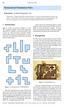 44 Geometry at Play Symmetrical Pentomino Pairs Kate Jones, Kadon Enterprises, Inc. Pentominoes shapes made of five congruent squares provide a natural platform for games and puzzles. In this article,
An ant colony optimization for single-machine weighted tardiness scheduling with sequence-dependent setups
 Proceedings of the 6th WSEAS International Conference on Simulation, Modelling and Optimization, Lisbon, Portugal, September 22-24, 2006 19 An ant colony optimization for single-machine weighted tardiness
Expanding the CASEsim Framework to Facilitate Load Balancing of Social Network Simulations
 Expanding the CASEsim Framework to Facilitate Load Balancing of Social Network Simulations Amara Keller, Martin Kelly, Aaron Todd 4 June 2010 Abstract This research has two components, both involving the
Fast Sequential Summation Algorithms Using Augmented Data Structures
 Fast Sequential Summation Algorithms Using Augmented Data Structures Vadim Stadnik [email protected] Abstract This paper provides an introduction to the design of augmented data structures that offer
vii TABLE OF CONTENTS CHAPTER TITLE PAGE DECLARATION DEDICATION ACKNOWLEDGEMENT ABSTRACT ABSTRAK
 vii TABLE OF CONTENTS CHAPTER TITLE PAGE DECLARATION DEDICATION ACKNOWLEDGEMENT ABSTRACT ABSTRAK TABLE OF CONTENTS LIST OF TABLES LIST OF FIGURES LIST OF ABBREVIATIONS LIST OF SYMBOLS LIST OF APPENDICES
A Software Architecture for a Photonic Network Planning Tool
 A Software Architecture for a Photonic Network Planning Tool Volker Feil, Jan Späth University of Stuttgart, Institute of Communication Networks and Computer Engineering Pfaffenwaldring 47, D-70569 Stuttgart
1.7 Graphs of Functions
 64 Relations and Functions 1.7 Graphs of Functions In Section 1.4 we defined a function as a special type of relation; one in which each x-coordinate was matched with only one y-coordinate. We spent most
Universality in the theory of algorithms and computer science
 Universality in the theory of algorithms and computer science Alexander Shen Computational models The notion of computable function was introduced in 1930ies. Simplifying (a rather interesting and puzzling)
NP-Completeness I. Lecture 19. 19.1 Overview. 19.2 Introduction: Reduction and Expressiveness
 Lecture 19 NP-Completeness I 19.1 Overview In the past few lectures we have looked at increasingly more expressive problems that we were able to solve using efficient algorithms. In this lecture we introduce
EA and ACO Algorithms Applied to Optimizing Location of Controllers in Wireless Networks
 2 EA and ACO Algorithms Applied to Optimizing Location of Controllers in Wireless Networks Dac-Nhuong Le, Hanoi University of Science, Vietnam National University, Vietnam Optimizing location of controllers
Enumerating possible Sudoku grids
 Enumerating possible Sudoku grids Bertram Felgenhauer Department of Computer Science TU Dresden 00 Dresden Germany [email protected] Frazer Jarvis Department of Pure Mathematics University of Sheffield,
EdExcel Decision Mathematics 1
 EdExcel Decision Mathematics 1 Linear Programming Section 1: Formulating and solving graphically Notes and Examples These notes contain subsections on: Formulating LP problems Solving LP problems Minimisation
Offline 1-Minesweeper is NP-complete
 Offline 1-Minesweeper is NP-complete James D. Fix Brandon McPhail May 24 Abstract We use Minesweeper to illustrate NP-completeness proofs, arguments that establish the hardness of solving certain problems.
NP-completeness and the real world. NP completeness. NP-completeness and the real world (2) NP-completeness and the real world
 -completeness and the real world completeness Course Discrete Biological Models (Modelli Biologici Discreti) Zsuzsanna Lipták Imagine you are working for a biotech company. One day your boss calls you
Lecture 3. Linear Programming. 3B1B Optimization Michaelmas 2015 A. Zisserman. Extreme solutions. Simplex method. Interior point method
 Lecture 3 3B1B Optimization Michaelmas 2015 A. Zisserman Linear Programming Extreme solutions Simplex method Interior point method Integer programming and relaxation The Optimization Tree Linear Programming
Formal Languages and Automata Theory - Regular Expressions and Finite Automata -
 Formal Languages and Automata Theory - Regular Expressions and Finite Automata - Samarjit Chakraborty Computer Engineering and Networks Laboratory Swiss Federal Institute of Technology (ETH) Zürich March