
Eaton Heavy-Duty Clutches CLSM0200 May 2012
|
|
|
- Bernard McCormick
- 9 years ago
- Views:
Transcription
1 Service Manual Eaton Heavy-Duty Clutches CLSM0200 May 2012 Solo Advantage Easy Pedal Advantage Value Clutch UltraShift DM UltraShift PLUS ECA Clutch
2

3 Warnings Warnings and Cautions Repair Warnings The major cause of clutch failure is excessive heat. Excessive heat generated between the flywheel, driven discs, intermediate plate and pressure plate can cause the metal to flow and the material to be destroyed. If this occurs, the clutch can burst which can cause property damage, serious bodily injury or death. In order to prevent clutch failure resulting from excessive heat: 1. Do not exceed recommended vehicle loads. 2. The clutch should only be used for the recommended applications. 3. Drivers should be properly trained in starting, shifting and operation of the clutch. 4. Drivers should report erratic clutch operation as soon as possible to permit maintenance personnel to inspect, adjust or lubricate as required. 5. Mechanics must be familiar with proper clutch adjustment, linkage adjustment, lubrication and other maintenance troubleshooting procedures outlined in the Failure Analysis Guide. Use of other than recommended tools, parts, and instructions listed in this manual may place the safety of the service technician or vehicle driver in jeopardy. The removal and installation procedure described for each component may vary for your vehicle. For Solo and Heavy-Duty ECA clutches only, install shipping bolts before removing clutch assembly from the flywheel. IMPORTANT For service information and assistance, call the Roadranger Help Desk at HELP (4357) (Mexico: HELP (4357). You may also find more information about Eaton Clutches at Every effort has been made to ensure the accuracy of the information contained in this manual. However, Eaton Corporation makes no warranty, expressed or implied, based on the information provided. Warnings When disassembling various assemblies, lay all parts on a clean bench in the same sequence as removed to simplify and reduce the possibility of losing parts. Since the cost of a new part is generally a small fraction of the cost of downtime and labor, avoid reusing a questionable part that could lead to additional repairs and expense. i
4 ii Warnings

5 Table of Contents Warnings and Cautions Repair Warnings i Solo Advantage Self-Adjusting Clutches Remove Clutch Install Solo Advantage HD 15.5" Clutch Measure Engine Flywheel Housing and Flywheel Install Clutch to Flywheel Install Transmission Set-up Troubleshooting for Solo Advantage HD 15.5" Clutches Symptom-Driven Diagnostics Too Much Free Pedal or Too Much Clutch Brake Not Enough Free Pedal or No Clutch Brake Resetting Procedures In-Vehicle Reset Procedure In-Vehicle Resetting Procedure Using the Solo Advantage Clutch Reset Tool Verify Clutch Brake Squeeze Out-of-Vehicle Reset Procedure for HD ECA or Solo Advantage Clutches Easy Pedal Advantage Manual Adjust Clutches Install Easy Pedal Advantage & ValueClutch. 17 Install Clutch to Flywheel Install 15.5" Clutch to Flywheel Install Transmission Set-Up UltraShift DM Heavy Duty Clutch Remove Clutch UltraShift DM Clutch Install Clutch to Flywheel Install Transmission Heavy-Duty UltraShift Clutch Recalibration.. 30 ECA Clutch Remove Clutch Opening the ECA Clutch " Heavy-Duty ECA Clutch Installation Install Clutch to Flywheel Install Transmission Lubricate ECA Clutch Adjustment Grease Interval Count Reset ServiceRanger Procedure Operator Triggered Procedure ECA Clutch In-Vehicle Resetting Procedure..45 Opening the ECA Clutch Low Capacity Inertia Brake Wear Life Measurement Transmission Removed Transmission in Chassis Hydraulic Linkage Verify Linkage System Stroke Master Cylinder Installation Transmission Installation Hose Assembly Solo Advantage Lube Hose Assembly With Hydraulic Linkage Installation Process General Clutch Information Function of a Clutch Neutral Idle Rattle Self-Adjusting Clutches Clutch Disc Friction Material Clutch Slippage Clutch Torque Capacity Clutch Wear Cover Assembly Driven Disc Facings Intermediate Plate Positive Separator Pin Position Kwik-Adjust Clutch Brakes Factors that Effect Clutch Performance When to Inspect the Clutch Preventative Maintenance Overview Inspection for Clutch Life Designing a Clutch for a Specific Application.59 Preventive Maintenance Overview Lubrication Recommended Lubrication Lubrication Interval Table of Contents iii
6 iv Table of Contents

7 Solo Advantage Self-Adjusting Clutches Remove Clutch (If clutch is to be reinstalled and transmission is still in vehicle) CAUTION Note the position of the wear indicating tab on the clutch. If the tab is near the REPLACE position, the clutch should be replaced. 1. Locate 4 shipping bolts (7/16" x 14 x 1 3/4" UNC, hex head). Install them in the 4 cover holes hand tight then turn one full turn. Remove Shipping Bolts (4) 7/16" x 14 x 1-3/4" UNC 2. Support the Clutch during the removal of the 8 mounting bolts. 3. Remove the clutch from the flywheel. Note: Mark the proper position of the discs and intermediate plate (for reinstallation). IMPORTANT This step will hold the pressure plate separator pins in proper position so the clutch can be reused and will release after reinstalling. 1

8 Solo Advantage Self-Adjusting Clutches Install Solo Advantage Heavy-Duty 15.5" Clutch Measure Engine Flywheel Housing and Flywheel Engine flywheel housing and flywheel must meet these specifications or it may result in premature clutch failure. Remove and replace old pilot bearing per engine manufacturer instructions. All gauge contact surfaces must be clean and dry. Clean flywheel surfaces of all grease, oil, and rust preventatives. Failure to perform this function can affect the performance of the clutch. Use a dial indicator and check the following: Flywheel Face Runout Pilot Bearing Bore Runout 1 Secure dial indicator base to flywheel housing face. 2 Put gauge finger in contact with flywheel face near the outer edge. 1 Secure dial indicator base to flywheel housing face. 2 Position gauge finger so that it contacts pilot bearing bore. 3 Rotate flywheel one revolution. Maximum runout is 0.008" (0.20 mm). 3 Rotate flywheel one revolution. Maximum runout is 0.005" (0.13 mm). Flywheel Housing I.D. Runout Flywheel Housing Face Runout 1 Secure dial indicator 2 Put gauge finger base to crankshaft. against flywheel housing pilot I.D. 1 Secure dial indicator base to flywheel near the outer edge. 3 Rotate flywheel one revolution. Maximum runout is 0.008" (0.20 mm). 2 3 Put gauge finger in contact with face of flywheel housing. Rotate flywheel one revolution. Maximum runout is 0.008" (0.20 mm). 2

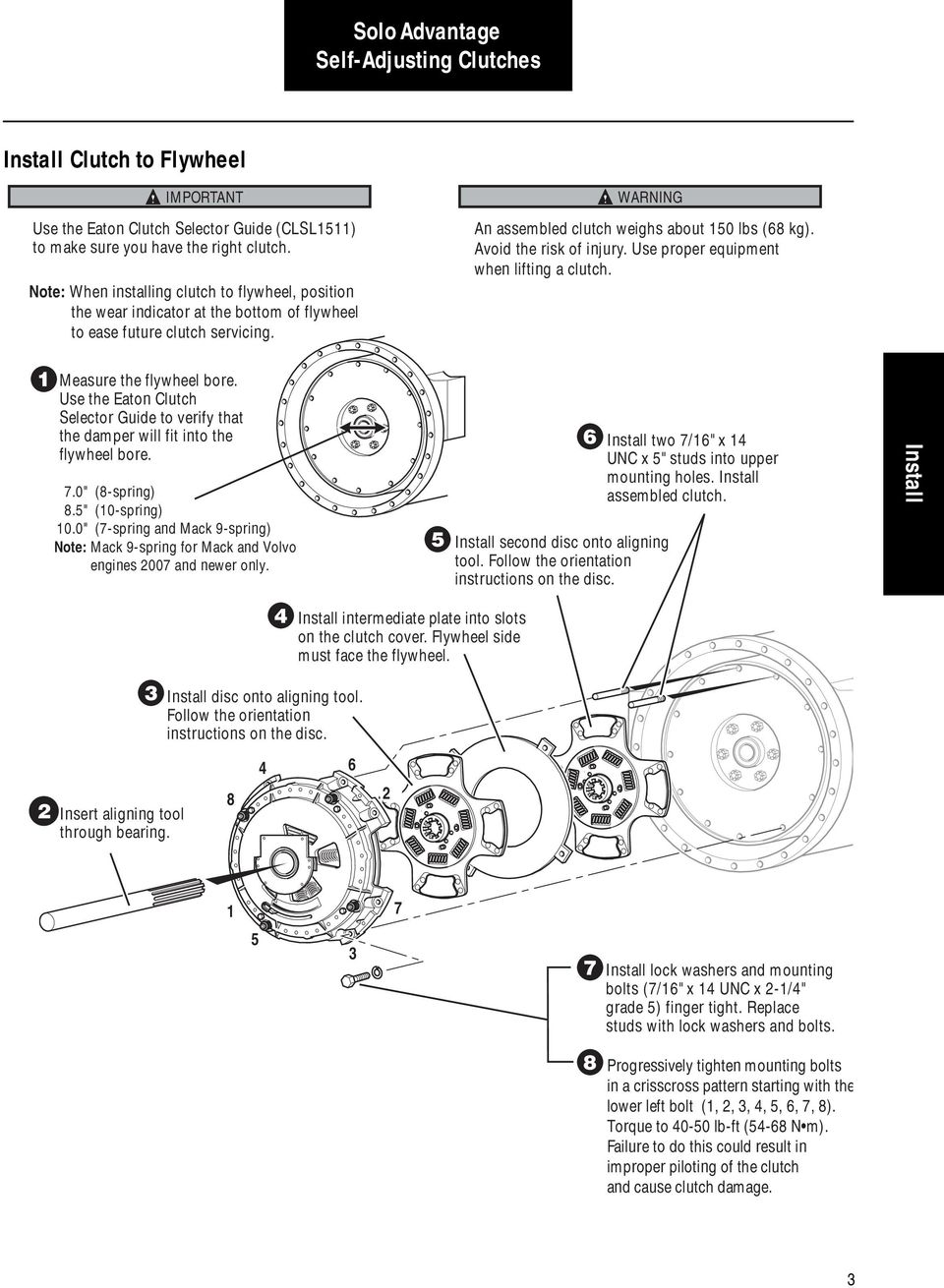
9 Solo Advantage Self-Adjusting Clutches Install Clutch to Flywheel IMPORTANT WARNING Use the Eaton Clutch Selector Guide (CLSL1511) to make sure you have the right clutch. Note: When installing clutch to flywheel, position the wear indicator at the bottom of flywheel to ease future clutch servicing. An assembled clutch weighs about 150 lbs (68 kg). Avoid the risk of injury. Use proper equipment when lifting a clutch. 1 Measure the flywheel bore. Use the Eaton Clutch Selector Guide to verify that the damper will fit into the flywheel bore. 7.0" (8-spring) 8.5" (10-spring) 10.0" (7-spring and Mack 9-spring) Note: Mack 9-spring for Mack and Volvo engines 2007 and newer only. 5 6 Install second disc onto aligning tool. Follow the orientation instructions on the disc. Install two 7/16" x 14 UNC x 5" studs into upper mounting holes. Install assembled clutch. Install 4 Install intermediate plate into slots on the clutch cover. Flywheel side must face the flywheel. 3 Install disc onto aligning tool. Follow the orientation instructions on the disc. 2 Insert aligning tool through bearing Install lock washers and mounting bolts (7/16" x 14 UNC x 2-1/4" grade 5) finger tight. Replace studs with lock washers and bolts. 8 Progressively tighten mounting bolts in a crisscross pattern starting with the lower left bolt (1, 2, 3, 4, 5, 6, 7, 8). Torque to lb-ft (54-68 N m). Failure to do this could result in improper piloting of the clutch and cause clutch damage. 3
10 Solo Advantage Self-Adjusting Clutches 9 Remove four yellow shipping bolts in a crisscross pattern. 10 Remove the aligning tool. Pin 11 Use a six once hammer and a 1/4" flat nose punch to lightly tap the four separator plate pins toward the flywheel. Only part of the pin should be visible. If installing Solo Advantage Clutch, proceed to Step 12. Install HD Solo Advantage Lube Hose Attachment Note: The example shown is of a Lube Hose Attachment for a heavy-duty Hydraulic release system. 12 Install brass fitting into grease port on left side of release bearing housing using Weatherhead socket. Tighten hand tight and continue to turn until the opening of the fitting is facing toward the 6 o clock position. 13 Install lube hose into brass fitting and tighten until hand tight,then turn an additional 2 turns. 14 Lubricate release bearing until grease purges from release bearing housing. Use NLGI grade 2 or 3 Lithium complex grease. Reference Eaton lubrication manual TCMT0021 for specific instructions. Note: A-8173 hand hole cover with grommet is required with HD Solo Advantage clutch used with hydraulic release system. 4

11 Solo Advantage Self-Adjusting Clutches Install Transmission Check Transmission for Wear Replace any worn components. Transmission Bearing Retainer Cap A worn/rough bearing retainer cap may cause the clutch brake to wear prematurely. Cross Shaft and Bushings Excessive wear at these points can cause side loading on the sleeve bushing, bushing failures and yoke bridge contact with the clutch when the pedal is down. Input Shaft Splines Any wear on the splines will prevent the driven discs from sliding freely, causing poor clutch release (clutch drag). Slide discs full length of shaft to check for twisted shaft splines. IMPORTANT Do not add lube (never seize or grease) to the input shaft splines. The discs must be free to move. Install Release Yoke Worn fingers can cause bushing wear and yoke interference when the pedal is down. Input Shaft Wear (roughness) can reduce sleeve bushing life and cause it to come out. Clutch Brake Replace. Measure Input Shaft Length should be 8.657" ( mm) nominal, and not greater than 8.71" ( mm). Ref SAE handbook 4: Replace transmission bearing retainer cap if length is greater than 8.71" ( mm). Input Shaft Spigot Wear will not provide proper interface with the inner race of the pilot bearing. This can result in damage to the clutch or the pilot bearing. CAUTION Do not excessively force the transmission into the clutch assembly or engine housing. This will cause damage to the splines of the rear disc hub that is not warrantable. If the discs do not slide freely in the input shaft, investigate the cause of the problem and make any necessary changes. If the discs do not slide freely, the clutch will not release and the transmission will grind going into gear. Do not let the transmission drop or hang unsupported in the driven discs. This can bend the discs and the clutch will not release causing damage that is not warrantable. Do not use the cross-shaft release lever (or a pipe over it) to pull the transmission into its final position. Pulling the bearing too far during installation can cause an overstroke causing the release bearing to move closer to the transmission (less than 0.490") with this condition. Follow the Out of Vehicle Resetting Procedure on page 1. Note: Adjust the linkage until pushing the pedal down moves the bearing against the clutch brake. Let up on the pedal and measure the distance between the bearing and clutch brake (distance should be 0.490"-0.560"). 5

12 Solo Advantage Self-Adjusting Clutches Fasten Transmission to Flywheel Housing 1 Put transmission in gear. Make sure new clutch brake has been installed. 2 Make sure that the yoke fingers remain in the up position until they are over the release bearing housing. 3 Position transmission so it is square to and aligned with engine. CAUTION Do not pull on release arm to install transmission. This will cause the clutch to over adjust. Do not force transmission against clutch with yoke fingers in the UP position. This will break the cast webbing of the clutch causing damage that is not warrantable. Do not use excessive force. If it does not enter freely, investigate the cause of problem and make any necessary changes. 6 Install hand hold cover A-8173 with grommet positioned toward rear of hand hold opening in the clutch housing. Secure the hand hole cover with two 5/16" x 18 x 1/2" long bolts. 4 Mesh splines by moving transmission forward and rotating the output shaft. IMPORTANT Do not add lube (never seize or grease) to the input shaft splines. The discs must be free to move. 5 Install mounting bolts and torque to OEM specs. If installing Solo Advantage clutch, proceed to Step 6. WARNING Do not let the transmission drop or hang unsupported in the driven discs. This can cause the discs to become distorted and the clutch to not release. 7 Insert plug into hole in the upper left side of the clutch housing where the horizontal lube hose is utilized. (Image not shown) Note: If the lube hose assembly should need servicing it can be replaced without removal of the transmission. 6

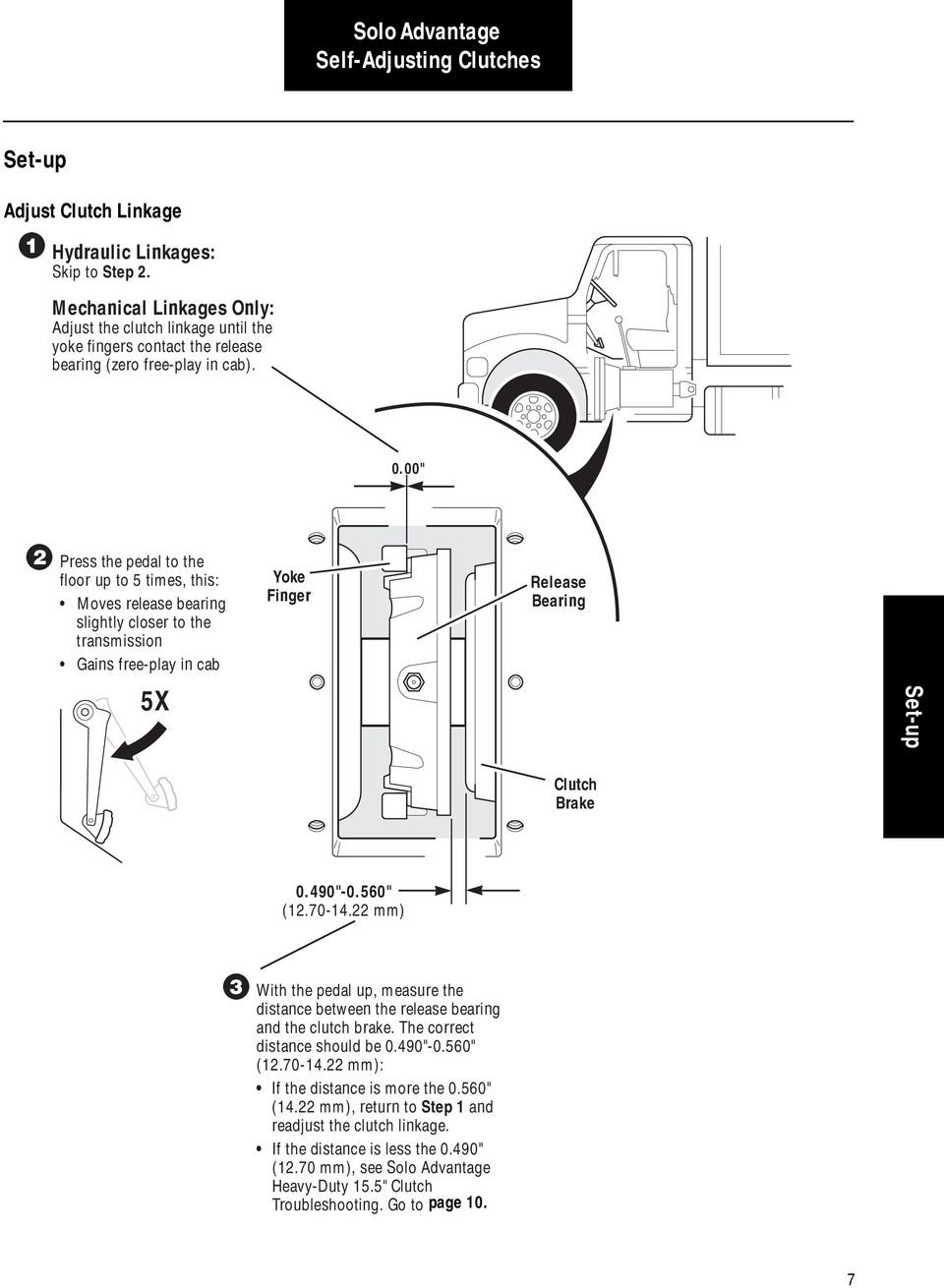
13 Solo Advantage Self-Adjusting Clutches Set-up Adjust Clutch Linkage 1 Hydraulic Linkages: Skip to Step 2. Mechanical Linkages Only: Adjust the clutch linkage until the yoke fingers contact the release bearing (zero free-play in cab). 0.00" 2 Press the pedal to the floor up to 5 times, this: Moves release bearing slightly closer to the transmission Gains free-play in cab Yoke Finger Release Bearing 5X Set-up Clutch Brake 0.490"-0.560" ( mm) 3 With the pedal up, measure the distance between the release bearing and the clutch brake. The correct distance should be 0.490"-0.560" ( mm): If the distance is more the 0.560" (14.22 mm), return to Step 1 and readjust the clutch linkage. If the distance is less the 0.490" (12.70 mm), see Solo Advantage Heavy-Duty 15.5" Clutch Troubleshooting. Go to page 10. 7
14 Solo Advantage Self-Adjusting Clutches Verify Clutch Brake Squeeze WARNING Use a gauge long enough to keep hands away from moving parts. 4 5 Have an assistant insert 0.010" (0.25 mm) feeler gauge between the release bearing and the clutch brake. Press the pedal down to the floor to reclamp the gauge: If the gauge does not clamp, readjust the truck linkage and move yoke fingers closer to the bearing. Slowly let up on the pedal and measure the pedal position at the moment the gauge can be removed: If pedal is more than 1" (25.4 mm) from the floor, readjust the truck linkage to move the yoke fingers further from the release bearing. Return to Step 4. Yoke Finger Release Bearing Clutch Brake Less than 1" (25.4 mm) Verify Free-Play 6 Verify there is free-play in the cab. If not, the truck linkage is not providing enough stroke, consult OEM manual for free-play dimension. For Solo clutches, proceed to Step 8. For Solo Advantage clutches, proceed to Step 9. IMPORTANT DO NOT RESET THE CLUTCH. Do not change free-play by readjusting the clutch linkage. 8

15 Solo Advantage Self-Adjusting Clutches Lubricate Note: All clutches use a Lithium complex grease with a minimum of 325 F (163 C) operating range meeting NLGI grade 2 or 3 specs. For additional lubrication information, see TCMT0021. CAUTION Failure to properly lubricate the bearing/bushing will result in bearing and sleeve failures. Zerk Input Shaft 7 Apply ample grease that is visibly exiting the opening and contacts the transmission shaft. This will lube the clutch brake and bushing when the pedal is pressed. Set-up 28 Apply grease to input shaft and yoke fingers. 9 Apply grease to the cross shaft bushings and linkage pivot points. Input Shaft IMPORTANT Do not add lube (never seize or grease) to the input shaft splines. The disc must be free to move. 9

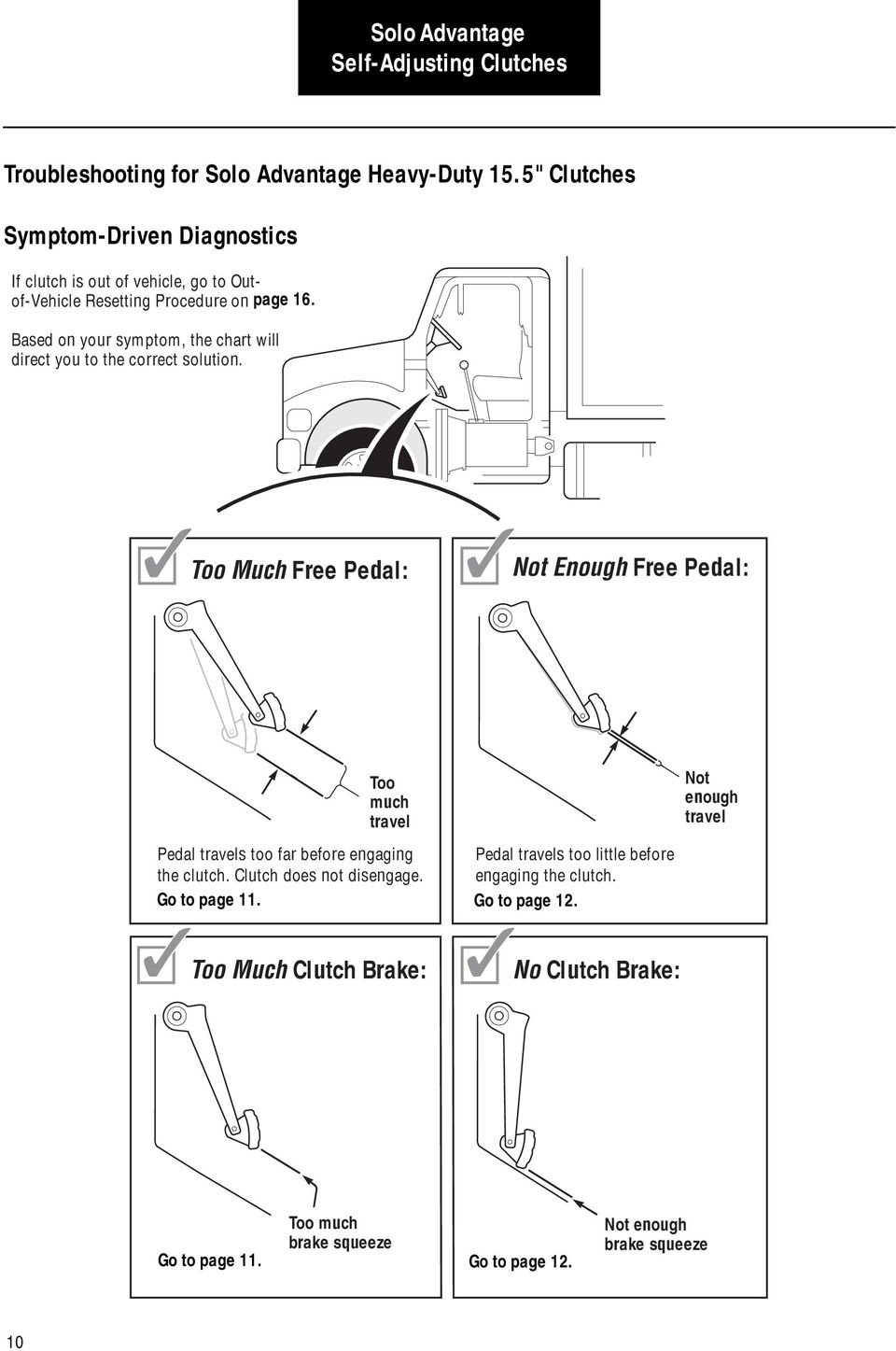
16 Solo Advantage Self-Adjusting Clutches Troubleshooting for Solo Advantage Heavy-Duty 15.5" Clutches Symptom-Driven Diagnostics If clutch is out of vehicle, go to Outof-Vehicle Resetting Procedure on page 16. Based on your symptom, the chart will direct you to the correct solution. Too Much Free Pedal: Not Enough Free Pedal: Too much travel Not enough travel Pedal travels too far before engaging Pedal travels too little before the clutch. Clutch does not disengage. engaging the clutch. Go to page 11. Go to page 12. Too Much Clutch Brake: No Clutch Brake: Too much brake squeeze Go to page 11. Go to page 12. Not enough brake squeeze 10
17 Solo Advantage Self-Adjusting Clutches Too Much Free Pedal or Too Much Clutch Brake Troubleshooting Too much travel Too much brake squeeze Note: Before measuring the distance between the release bearing and clutch brake depress clutch pedal to remove free pedal in the cab. 1 Measure distance between release bearing and clutch brake. Release Bearing 2 Use chart to find solution. Clutch Brake Measurement Status Solution If distance is correct 0.490"-0.560" ( mm) If distance is Less than 0.490" (12.45 mm) Clutch is set up correctly Clutch is not set up correctly Problem exists with truck linkage. Repair according to OEM specifications. Hydraulic Linkage: Go to page 49. If clutch was factory installed and was never removed or if clutch was removed from engine and reinstalled, go to page 13. If new/reman clutch was installed and it never operated properly, check wear tab position. If tab at GOOD position: Disc is installed incorrectly Go to page 3, Step 4 and 5. Damper is too large for the flywheel opening Go to page 3, Step 1. If tab not at GOOD position, the bearing may have been pulled during installation, causing an overadjust. Go to page

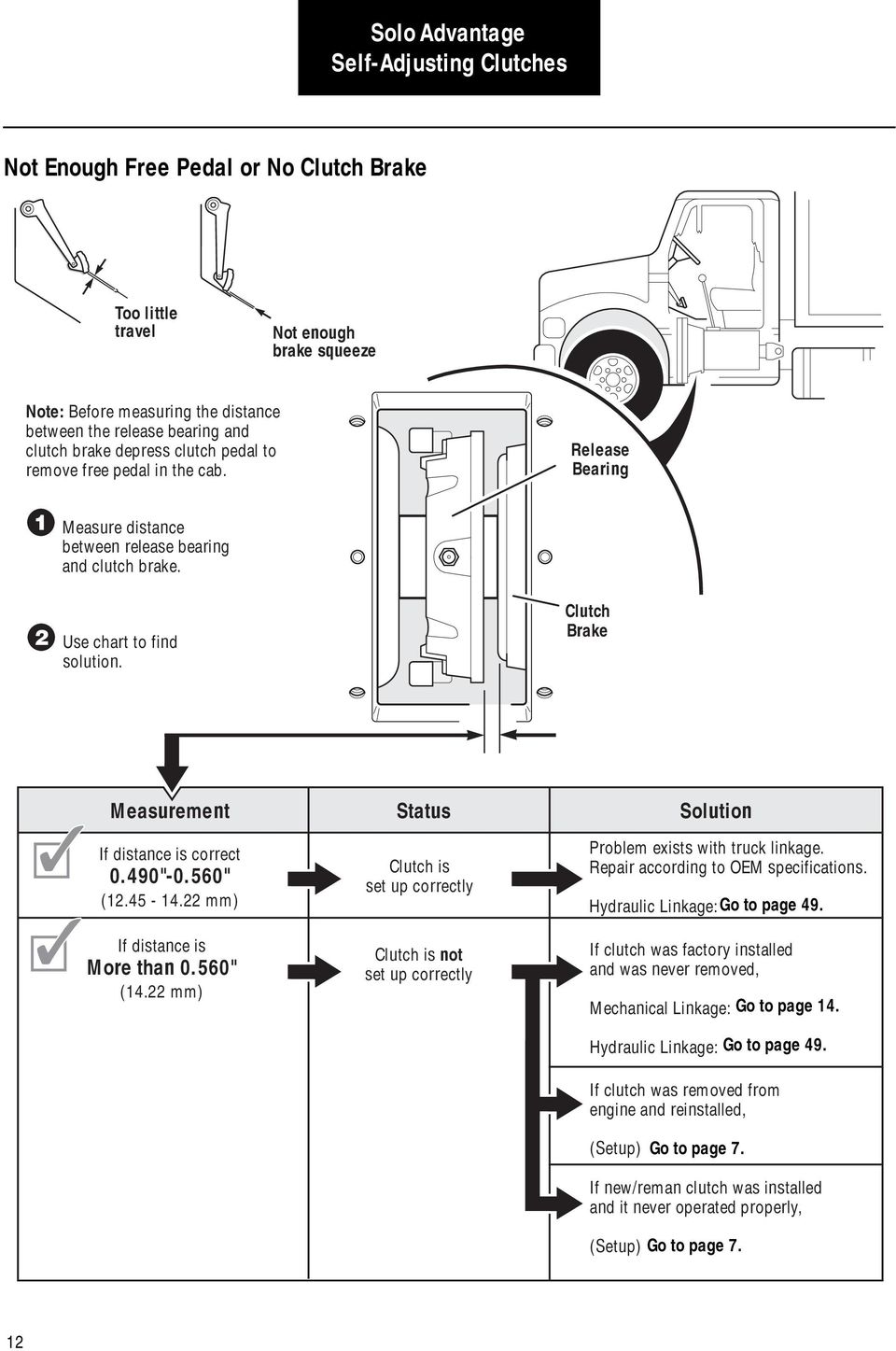
18 Solo Advantage Self-Adjusting Clutches Not Enough Free Pedal or No Clutch Brake Too little travel Not enough brake squeeze Note: Before measuring the distance between the release bearing and clutch brake depress clutch pedal to remove free pedal in the cab. Release Bearing 1 2 Measure distance between release bearing and clutch brake. Use chart to find solution. Clutch Brake Measurement Status Solution If distance is correct 0.490"-0.560" ( mm) If distance is More than 0.560" (14.22 mm) Clutch is set up correctly Clutch is not set up correctly Problem exists with truck linkage. Repair according to OEM specifications. Hydraulic Linkage: Go to page 49. If clutch was factory installed and was never removed, Mechanical Linkage: Go to page 14. Hydraulic Linkage: Go to page 49. If clutch was removed from engine and reinstalled, (Setup) Go to page 7. If new/reman clutch was installed and it never operated properly, (Setup) Go to page 7. 12
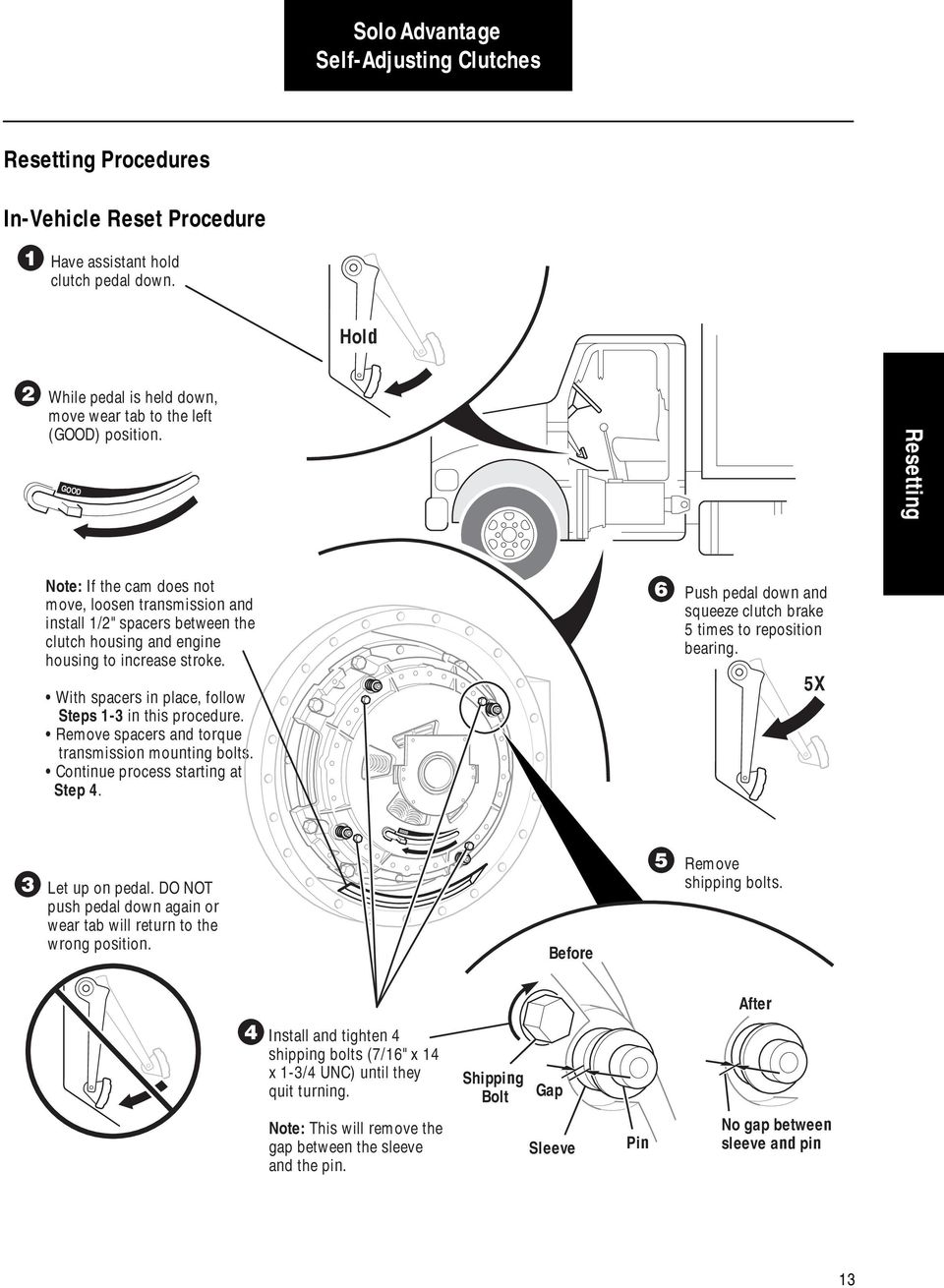
19 Solo Advantage Self-Adjusting Clutches Resetting Procedures In-Vehicle Reset Procedure 1 Have assistant hold clutch pedal down. Hold 2 While pedal is held down, move wear tab to the left (GOOD) position. GOOD Resetting Note: If the cam does not move, loosen transmission and install 1/2" spacers between the clutch housing and engine housing to increase stroke. With spacers in place, follow Steps 1-3 in this procedure. Remove spacers and torque transmission mounting bolts. Continue process starting at Step 4. 6 Push pedal down and squeeze clutch brake 5 times to reposition bearing. 5X 3 Let up on pedal. DO NOT push pedal down again or wear tab will return to the wrong position. Before 5 Remove shipping bolts. After 4 Install and tighten 4 shipping bolts (7/16" x 14 x 1-3/4 UNC) until they quit turning. Shipping Bolt Gap Note: This will remove the gap between the sleeve and the pin. Sleeve Pin No gap between sleeve and pin 13
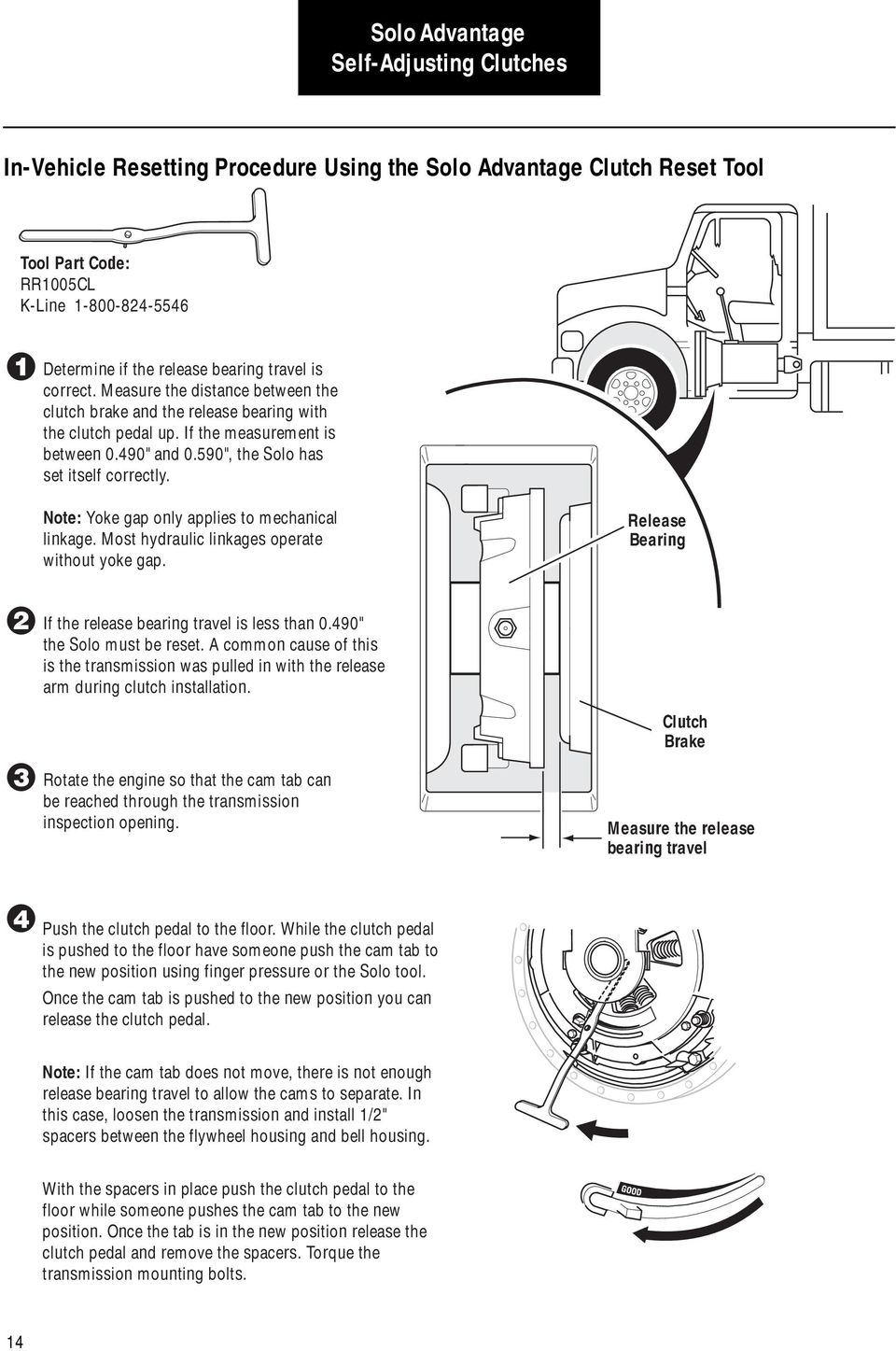
20 Solo Advantage Self-Adjusting Clutches In-Vehicle Resetting Procedure Using the Solo Advantage Clutch Reset Tool Tool Part Code: RR1005CL K-Line Determine if the release bearing travel is correct. Measure the distance between the clutch brake and the release bearing with the clutch pedal up. If the measurement is between 0.490" and 0.590", the Solo has set itself correctly. Note: Yoke gap only applies to mechanical linkage. Most hydraulic linkages operate without yoke gap. Release Bearing 2 If the release bearing travel is less than 0.490" the Solo must be reset. A common cause of this is the transmission was pulled in with the release arm during clutch installation. Clutch Brake 3 Rotate the engine so that the cam tab can be reached through the transmission inspection opening. Measure the release bearing travel 4 Push the clutch pedal to the floor. While the clutch pedal is pushed to the floor have someone push the cam tab to the new position using finger pressure or the Solo tool. Once the cam tab is pushed to the new position you can release the clutch pedal. REPLACE Note: If the cam tab does not move, there is not enough release bearing travel to allow the cams to separate. In this case, loosen the transmission and install 1/2" spacers between the flywheel housing and bell housing. With the spacers in place push the clutch pedal to the floor while someone pushes the cam tab to the new position. Once the tab is in the new position release the clutch pedal and remove the spacers. Torque the transmission mounting bolts. 14
21 Solo Advantage Self-Adjusting Clutches 5 Install (4) shipping bolts and progressively tighten by hand until they bottom out. Rotate the engine to access all 4 bolts: 15 1/2" Solo use 7/16 x 14 UNC x 1 3/4" Stamped 14" Solo use 3/8 x 16 UNC x 1 1/4" Note: This will reset the pressure plate separator pins and allow the clutch to release after installation. 6 Remove the (4) shipping bolts. The release bearing and sleeve will move forward towards the engine when the bolts are removed. The Solo is now in the new position. 7 With the free pedal removed push the clutch pedal down at least 5 times. Make sure the clutch release bearing contacts the clutch brake. While you engage and release the clutch the cab free pedal will increase. This indicates the Solo is adjusting to the environment. Shipping Bolts Shipping Bolt Tamper-Proof Bolt Resetting 8 Measure the distance between the clutch brake and the release bearing. It should be between 0.490" and 0.590". 9 If the release bearing travel is still greater than 0.590" between the clutch brake and the release bearing, repeat Steps 7 and Adjust the clutch linkage to achieve 1/8" clearance between the release yoke and the release bearing. Verify proper clutch brake squeeze. Verify Clutch Brake Squeeze 1 WARNING Use a gauge long enough to keep hands away from moving parts. Have an assistant insert 0.010" (0.25 mm) feeler gauge between the release bearing and the clutch brake. Press the pedal down to the floor to clamp the gauge: If the gauge does not clamp, readjust the truck linkage and move the yoke finger closer to the bearing. Yoke Finger Release Bearing Clutch Brake 2 Slowly let up on the pedal and measure the pedal position at the moment the gauge can be removed: If pedal is more than 1" (25.4 mm) from the floor, readjust the truck linkage to move the yoke fingers further from the release bearing. Repeat Step 1. Less than 1" ( 25.4 mm) 15
22 Solo Advantage Self-Adjusting Clutches Out-of-Vehicle Reset Procedure for Heavy-Duty ECA or Solo Advantage Clutches 1 Remove the 4 shipping bolts if they have been installed. 2 Support the clutch in an arbor press with the bearing facing down. 3 Center the ram and press downward on the retainer until it comes to Note: Make sure there is at a stop. Lock the ram in least 1" of space to allow position. the bearing to move down and to provide access to the shipping bolts. 4 Slide the wear indicator tab to the GOOD position and hold it in place with a magnet 5 Install 4 shipping bolts (7/16" x 14 x 1-3/4" UNC, hex head). Progressively tighten (no air wrenches) the 4 shipping bolts (crisscross pattern) until the face of the pressure plate is 1.75"-1.78" ( mm) below the mounting surface. Shipping Bolts 1.75"-1.78" ( mm) 6 Reinstall the clutch using the original installation instructions. Note: This important step will reset the pressure plate separator pins and allow the clutch to release after reinstallation. 16
23 Easy Pedal Advantage Manual Adjust Clutches Install Easy Pedal Advantage and ValueClutch Measure Engine Flywheel Housing and Flywheel Engine flywheel housing and flywheel must meet these specifications or may result in a premature clutch failure. Remove and replace old pilot bearing per engine manufacturer instructions. All gauge contact surfaces must be clean and dry. Clean flywheel surfaces of all grease, oil, and rust preventatives. Failure to perform this function can affect the performance of the clutch. Use a dial indicator and check the following: Flywheel Face Runout Pilot Bearing Bore Runout 1 Secure dial indicator base to flywheel housing face. 2 Put gauge finger in contact with flywheel face near the outer edge. 1 Secure dial indicator base to flywheel housing face. 2 Position gauge finger so that it contacts pilot bearing bore. 3 Rotate flywheel one revolution. Maximum runout is 0.008" (0.20 mm). 3 Rotate flywheel one revolution. Maximum runout is 0.005" (0.13 mm). Install Flywheel Housing I.D. Runout Flywheel Housing Face Runout 1 Secure dial indicator 2 Put gauge finger base to crankshaft. against flywheel housing pilot I.D. 1 Secure dial indicator base to flywheel near the outer edge. 3 Rotate flywheel one revolution. Maximum runout is 0.008" (0.20 mm). 2 3 Put gauge finger in contact with face of flywheel housing. Rotate flywheel one revolution. Maximum runout is 0.008" (0.20 mm). 17
24 DEPRESS BOLT Easy Pedal Advantage Manual Adjust Clutches Install Clutch to Flywheel Install 15.5" Clutch to Flywheel (Easy Pedal Shown) Use the Eaton Clutch Selector Guide (CLSL1511) to make sure you have the right clutch. Note: When installing clutch to flywheel, position the adjuster at the bottom of flywheel to ease future clutch servicing. 1 IMPORTANT Measure the flywheel bore. Use the Eaton Clutch Selector Guide to verify that the damper will fit into the flywheel bore. 7.0" (8-spring) 8.5" (10-spring) 10.0" (7-spring and Mack 9-spring) Note: Mack 9-spring for Mack and Volvo engines 2007 and newer only. 5 An assembled clutch weighs about 150 lbs (68 kg). Avoid the risk of injury. Use proper equipment when lifting a clutch. Note: Easy Pedal or manual adjust clutch assemblies not recommended for use with hydraulic release systems. 6 WARNING Install second disc onto aligning tool. Follow the orientation instructions on the disc. Install two 7/16" x 14 UNC x 5" studs into upper mounting holes. Install assembled clutch. 2 3 Insert aligning tool through bearing. 4 Install disc onto aligning tool. Follow the orientation instructions on the disc. 8 4 Install intermediate plate into slots on the clutch cover. Flywheel Side must face the flywheel TO TURN Install lock washers and mounting bolts (7/16" x 14 UNC x 2-1/4" grade 5) finger tight. Replace studs with lock washers and bolts. 9 Verify bearing position is 3/8" 5/8" ( mm) from cover. 10 Remove the aligning tool. Be sure shipping blocks are removed. 11 Use a six ounce hammer and a 1/4" flat nose punch to lightly tap the four separator plate pins toward the flywheel (New EP Only). Reman and Value clutches do not have pins. Only part of the pin should be visible. DEPRESS BOLT TO TURN 8 Pin Progressively tighten mounting bolts in a crisscross pattern starting with the lower left bolt (1, 2, 3, 4, 5, 6, 7, 8). Torque to lb-ft (54-68 N m). Failure to do this could result in improper piloting of the clutch and cause clutch damage. 18
25 DEPRESS BOLT Easy Pedal Advantage Manual Adjust Clutches Install 14" Clutch to Flywheel 1 Ensure the correct flywheel depth is 2-15/16". 2 Put front disc into flywheel. Flywheel side must be toward engine. Use new slots to put intermediate plate on pins. Super-duty clutch only: 3 Install three equally spaced anti-rattle springs. Note: Check orientation on anti-rattle springs before installing. 4 Turn intermediate plate left. Use 0.006" feeler gauge to check left pin clearance on all 6 drive pins. Note: Remove two set screws. Straighten pins to increase clearance and reinstall set screws. Do not file slots Slide cover over aligning tool. Insert aligning tool through discs. 8 Install second disc onto flywheel. Follow the orientation instructions on the disc. 7 Install intermediate plate onto drive pins. 6 Install disc into flywheel. Follow the orientation instructions on the disc. 5 Install two 3/8" x 2-1/2" studs into upper mounting holes. Install TO TURN Install lock washers and mounting bolts (3/8" x 1-1/4" grade 5) finger tight. Replace studs with lock washers and bolts. 12 Progressively tighten mounting bolts 13 Remove the aligning in a crisscross pattern starting with the tool. Be sure shipping lower left bolt (1, 2, 3, 4, 5, 6, 7, 8). blocks are removed. Torque to lb-ft (34-47 N m). Failure to do this could result in improper piloting of the clutch and cause clutch damage. 19
26 Easy Pedal Advantage Manual Adjust Clutches Install Transmission Check Transmission For Wear Replace any worn components. Transmission Bearing Retainer Cap A worn/rough bearing retainer cap may cause the clutch brake to wear prematurely. Cross Shaft and Bushings Excessive wear at these points can cause side loading on the sleeve bushing, bushing failures and yoke bridge contact with the clutch when the pedal is down. Input Shaft Splines Any wear on the splines will prevent the driven discs from sliding freely, causing poor clutch release (clutch drag). Slide discs full length of shaft to check for twisted shaft splines. IMPORTANT Do not add lube (never seize or grease) to the input shaft splines. The discs must be free to move. Release Yoke Worn fingers can cause bushing wear and yoke interference when the pedal is down. Input Shaft Spigot Wear will not provide proper interface with the inner race of the pilot bearing. This can result in damage to the clutch or the pilot bearing. Input Shaft Wear (roughness) can reduce sleeve bushing life and cause it to come out. Measure Input Shaft Length should be 8.657" ( mm) nominal, and not greater than 8.71" ( mm). Ref SAE handbook 4: Replace transmission bearing retainer cap if length is greater than 8.71" ( mm). Clutch Brake Replace. CAUTION Do not let the transmission drop or hang unsupported in the driven discs. This can bend the discs and the clutch will not release causing damage that is not warrantable. Do not excessively force the transmission into the clutch assembly or engine housing. This will cause damage to the splines of the rear disc hub that is not warrantable. If the discs do not slide freely on the input shaft, investigate the cause of the problem and make any necessary changes. If the discs do not slide freely, the clutch will not release and the transmission will grind going into gear. 20
27 Easy Pedal Advantage Manual Adjust Clutches Fasten Transmission to Flywheel Housing Transmission installation and clutch set-up procedures are the same for the 14" and 15.5" clutch. 1 Put transmission in gear. Be sure new clutch brake has been installed. 2 Make sure that the yoke fingers remain in the up position until they are over the release bearing housing. 3 Position transmission so it is square to and aligned with engine. 4 Mesh splines by moving transmission forward and rotating the output shaft. Do not use excessive force. Do not let the transmission hang unsupported in the discs. Install 5 Install mounting bolts and torque to OEM specs. Note: If you have a hydraulic linkage, go to page 49. WARNING Do not let the transmission drop or hang unsupported in the driven discs. This can cause the discs to become distorted and the clutch to not release. IMPORTANT Do not add lube to the input shaft splines (Never seize or grease). The discs must be free to slide. CAUTION Do not force transmission against clutch with yoke fingers in the up position. This will break the cast webbing of the clutch causing damage that is not warrantable. Do not use excessive force. If it does not enter freely, investigate the cause of problem and make any necessary changes. 21
28 Easy Pedal Advantage Manual Adjust Clutches Set-Up Adjust Bearing Position 1 Note: Before measuring the distance between the release bearing and clutch brake depress clutch pedal to remove free pedal in the cab. Measure the distance between the release bearing and the clutch brake: If the distance is correct, 0.500" " ( mm), then Verify Clutch Brake Squeeze, go to Step 4. If the distance is not between 500" -.560" ( mm), then Change Bearing Position, go to Step 2. 2 Have an assistant hold down clutch pedal so internal adjustment can be made " " ( mm) Hold Release Bearing Clutch Brake 3 Adjust bearing position: Easy-Pedal & Easy Pedal Advantage Only: While pedal is held down, push adjusting nut and turn: If measurement was more than 0.560" (14.22 mm), turn adjusting nut clockwise. If measurement was less than 0.500" (12.77 mm), turn adjusting nut counterclockwise. Value Clutch Only: While pedal is held down, remove lockstrap and move adjusting lug: If measurement was more than 0.560" (14.22 mm), move adjusting lug to the left (shown). If measurement was less than 0.500" (12.77 mm), move adjusting lug to the right. Adjusting Nut Part Number TO TURN DEPRESS BOLT Lockstrap Adjusting Lug 22
29 Easy Pedal Advantage Manual Adjust Clutches Verify Clutch Brake Squeeze WARNING Use a gauge long enough to keep hands away from moving parts. Set-up 4 Have an assistant insert 0.010" (0.25 mm) feeler gauge between the release bearing and the clutch brake. Press the pedal down to the floor to clamp the gauge: If the gauge does not clamp, readjust the truck linkage and move the yoke finger closer to the bearing. 5 Slowly let up on the pedal and measure the pedal position at the moment the gauge can be removed: If pedal is more than 1" (25.4 mm) from the floor, readjust the truck linkage to move the yoke fingers further from the release bearing. Repeat Step 4. Yoke Finger Release Bearing Clutch Brake Less than 1" (25.4 mm) 23
30 Easy Pedal Advantage Manual Adjust Clutches Verify Free-Play 6 Measure the distance between yoke tips and bearing wear pads simultaneously. This distance should be 1/8" (3.2 mm). If distance is not 1/8" (3.2 mm), go to Step 7. IMPORTANT Do not change bearing position. Note: 1/8" (3.2 mm) distance will create free-play in cab. Free-play in cab may be different on different truck makes, models and years. 1/8" (3.2 mm) Yoke Finger Release Bearing 1/8" (3.2 mm) 7 The truck linkage should allow for a minimum of 0.685" of yoke finger movement; 0.125" for free-play, 0.500" for the bearing and 0.060" for clutch brake squeeze. If it is necessary to increase the free-play, adjust upper pedal stop to raise or lower the pedal in the cab. If this is not possible, check the OEM parts manual to verify the correct clutch arm was installed at the factory. IMPORTANT Do not change free-play by changing the bearing position. Correct bearing position is 0.500"-0.560" ( mm) 24
31 Easy Pedal Advantage Manual Adjust Clutches Lubricate Note: All clutches use a Lithium complex grease with a minimum of 325 F (163 C) operating range meeting NLGI grade 2 or 3 specs. Set-up Note: Apply ample grease that is visibly exiting the opening and contacts the transmission shaft. This will lube the clutch brake and bushing when the pedal is pressed. For additional lubrication information, see TCMT0021. CAUTION Failure to properly lubricate the bearing/bushing will result in bearing and sleeve failures. Yoke Finger Zerk Input Shaft 8 Apply grease to input shaft and yoke fingers. 29 Apply grease to the cross shaft bushings and linkage pivot points. IMPORTANT Do not add lube (never seize or grease) to the input shaft splines. The disc must be free to move. 25
32 UltraShift DM Clutch UltraShift DM Heavy Duty Clutch Remove Clutch WARNING An assembled clutch weighs about 182 lbs (82 kg). Avoid the risk of injury. Use proper equipment when lifting a clutch Prior to removing the transmission, rotate the engine until one of the jack screw locations can be viewed through the clutch housing inspection opening. Using a piece of 5/16" x 18 UNC x 3" threaded rod (jack screw), install two nuts on one end and lock them together. This will allow you to turn the jack screw in and out of the cover assembly. Install the jack screw into one of the four holes located adjacent to the clutch mounting bolts. This forces the pressure plate forward clamping the discs and holding them in place. CAUTION Do not overtighten the jack screw. Tightening more than 9 lb-ft can cause permanent clutch damage. 4 Remove the transmission, supporting its weight to prevent damage to the clutch discs Insert alignment shaft Remove the Unbolt the clutch from the Remove the old and clutch jack. jack screw. flywheel and slide the clutch pilot bearing. away from the flywheel. WARNING An assembled clutch weighs about 182 lbs (82 kg). Avoid the risk of injury. Use proper equipment when lifting a clutch. CAUTION When removing the clutch, the flywheel side disc can fall off of the alignment shaft, permanently damaging the driven disc. 8 26
33 UltraShift DM Clutch Measure Engine Flywheel Housing and Flywheel Engine flywheel housing and flywheel must meet these specifications or may result in a premature clutch failure. Remove and replace old pilot bearing per engine manufacturer instructions. All gauge contact surfaces must be clean and dry. Clean flywheel surfaces of all grease, oil, and rust preventatives. Failure to perform this function can affect the performance of the clutch. Use a dial indicator and check the following: Flywheel Face Runout Pilot Bearing Bore Runout 1 Secure dial indicator base to flywheel housing face. 2 Put gauge finger in contact with flywheel face near the outer edge. 1 Secure dial indicator base to flywheel housing face. 2 Position gauge finger so that it contacts pilot bearing bore. 3 Flywheel Housing I.D. Runout Rotate flywheel one revolution. Maximum runout is 0.008" (0.20 mm). 3 Flywheel Housing Face Runout Rotate flywheel one revolution. Maximum runout is 0.005" (0.13 mm). Remove 1 Secure dial indicator 2 Put gauge finger base to crankshaft. against flywheel housing pilot I.D. 1 Secure dial indicator base to flywheel near the outer edge. 3 Rotate flywheel one revolution. Maximum runout is 0.008" (0.20 mm). 2 3 Put gauge finger in contact with face of flywheel housing. Rotate flywheel one revolution. Maximum runout is 0.008" (0.20 mm). 27
34 UltraShift DM Clutch UltraShift DM ClutchInstall Clutch to Flywheel Note: If installing a new DM, follow the installation directions that are provided in the box. The required alignment tool, part number RR1009CL, can be ordered through K-Line at WARNING An assembled clutch weighs about 182 lbs (82 kg). Avoid the risk of injury. Use proper equipment when lifting a clutch. 1 Install new pilot bearing. 10.0" (7-spring & VCT Plus) 2 Measure the flywheel bore to verify that the damper will fit into the flywheel bore. 3 Insert aligning tool through 4 Install second disc onto aligning 5 Install two 7/16" x 14 UNC x 5" DM Clutch and rear disc. tool. Follow the orientation studs into upper mounting holes. WARNING instructions on the disc. Using clutch jack or other lifting device, install assembled clutch. The intermediate plate is bolted to the cover assembly and the rear driven disc is held in place between the pressure plate and intermediate plate. DO NOT UNBOLT the intermediate plate from the cover assembly Remove the aligning tool. 9 1 Install the jack screw into one of the four holes located adjacent to the clutch mounting bolts. This forces the pressure plate forward clamping the discs and holding them in place. Be sure the hole chosen is at the 6 o'clock position to allow for removal after the transmission is installed. CAUTION Do not overtighten the jack screw. Tightening more than 9 lb-ft can cause permanent clutch damage Using a piece of 5/16" x 18 UNC x 3" threaded rod (jack screw), install two nuts on one end and lock them together. This will allow you to turn the jack screw in and out of the cover assembly. 6 7 Install lock washers and mounting bolts (7/16" x 14 UNC x 2-1/4" grade 5) finger tight. Replace studs with lock washers and bolts. Progressively tighten mounting bolts in a crisscross pattern starting with the lower left bolt (1, 2, 3, 4, 5, 6, 7, 8). Torque to lb-ft (54-68 N m). Failure to do this could result in improper piloting of the clutch and cause clutch damage. 28
35 UltraShift DM Clutch Install Transmission Check Transmission for Wear Replace any worn components. 1 Input Shaft Splines Any wear on the splines will prevent the driven discs from sliding freely, causing poor clutch release (clutch drag). Slide discs full length of shaft to check for twisted shaft splines. IMPORTANT Do not add lube (Never seize or grease) to the input shaft splines. The disc must be free to slide. 2 Input Shaft Spigot Wear will not provide proper interface with the inner race of the pilot bearing. This can result in damage to the clutch or the pilot bearing. Fasten Transmission to Flywheel Housing 1 Position transmission so it is square to and aligned with engine. 2 Mesh splines by moving transmission forward and rotating the input shaft. Do not use excessive force. Do not let the transmission hang unsupported in the discs. Install 3 Install mounting bolts and torque to OEM specs. 4 Remove the jack screw. 5 Reconnect UltraShift wiring harness. WARNING Do not let the transmission drop or hang unsupported in the driven discs. This can cause the discs to become distorted and the clutch to not release. CAUTION Do not use excessive force. If it does not enter freely, investigate the cause of problem and make any necessary changes. 29
36 UltraShift DM Clutch Heavy-Duty UltraShift Clutch Recalibration 1. Turn key on. 2. Verify a solid N is on the gear display. 10. After the 1 is displayed, depress the throttle pedal to the floor and hold for 3-5 seconds (the gear display will change back to a 0 with down arrows indicating the routine has been successfully completed. 3. Start engine. 4. Increase engine RPM above This will unlock the clutch. Failure to do this will set a clutch disengagement code and the code and transmission will not go into gear. Note: Programmable VSS Tamper Resistance options or other artificial engine speed limits which prevent reaching the required 1500 rpm may prevent proper disengagement of the clutch locking device after initial installation. These options may need to be disabled until after the clutch-locking device is disengaged. Note: If ServiceRanger is available, proceed to Step Start with the system powered down, the vehicle stationary, and the engine not running. 6. Key on and allow the system to completely power up but do not start the engine. 7. Select LOW mode on the shift controller (UltraShift system will begin to emit an audible tone). 8. Select an upshift once (UltraShift gear display will display a 0 with down arrows and discontinue the tone indicating Special Functions mode is activated. 11. Key off or select any mode and the UltraShift system returns to normal operation. 12. Save clutch data / recalibrate clutch with ServiceRanger. 9. Once in Special Functions mode, select one additional upshift (UltraShift gear display will display a 1 with up arrows indicating UltraShift Touch Point Resent is selected.) 1 30
37 UltraShift DM Clutch Gen 2 1. Using ServiceRanger, select the Advanced Product Functions button located on the main menu. 2. Select Eaton AutoShift Gen-2 from the product selection screen. Note: This screen will only appear if the vehicle is equipped with more than one supported Roadranger product. 3. Select Clutch Data from the Advanced Product Functions screen. 4. Save the clutch data by selecting the Save Abuse Info to a File button. Note: Use the truck VIN as the file name. The data file will be saved to the ServiceRanger folder in the Clutch Data subfolder (e.g. C:\Serviceranger\Clutch Data). 5. Reset clutch abuse info by selecting the Reset Clutch Abuse Info button. 6. Recalibrate the new clutch by selecting the Calibrate Clutch button. Note: Failure to calibrate a newly installed clutch may result in some initial harsh vehicle launches, as the system is required to manually recalibrate. Gen 3 1. Using ServiceRanger, select Advanced Product Function button. 2. Select UltraShift transmission model (Gen 3) from menu tree in the upper left. 3. Select the VPA/SnapShot Utility and launch the function. 4. Read the APF description and select Next. 5. Enter the vehicle info and select Next. 6. Select VPA from the dropdown Data Source field. 7. Enter an output file name and location using Browse Button or use default filename and location shown. Note: If the default filename and location is used, the VPA data file will be saved to the ServiceRangerData folder in the VPA subfolder on the C:\drive. 8. Select the Start Transfer button to download data from transmission controller and then select Next. 9. The output file can now be viewed, select Finish. 10. Select Clear Clutch Data button to clear data from transmission controller. 11. If successful proceed to next step, if unsuccessful exit function and re-enter. Contact Roadranger Call Center for help. 12. Select the Calibrate Clutch button to calibrate new clutch and the select Finish when complete. Recalibration 31
38 ECA Clutch Remove Clutch CAUTION Note the position of the wear indicating tab on the clutch. If the tab is near the REPLACE position, the clutch should be replaced. 1. If the clutch is to be reinstalled and the transmission is still in vehicle, complete steps 1-7 of the ECA Clutch In-Vehicle Resetting Procedure on page 45 to ensure proper function after reinstallation. Move ECA Clutch to Service Position CAUTION Ensure that hands are not inside the clutch housing while opening or closing the clutch. A Turn ignition switch to on. OFF ON B Plug 9-pin connector into dash port. START 2 C3 Click on ServiceRanger icon to launch program. 32
39 ECA Clutch D E Click on transmission. F Click on ECA Clutch Open and expand the Advanced Product Functions tree. Note: Advanced Product Functions appear. Service. CAUTION G Ensure that hands are not inside the clutch housing while opening or closing the clutch. Choose Clutch Position tab. Remove H Click Move to Service Position button. I Confirm Positive results. 33
40 ECA Clutch 2. Remove the transmission, supporting its weight to prevent damage to the bearing and discs. 3. Locate 4 shipping bolts (7/16 x 14 x 1 3/4 UNC, hex head). Install them in the 4 cover holes hand tight then turn one full turn. IMPORTANT This step will hold the pressure plate separator pins in proper position so the clutch can be reused and will release after reinstalling. Shipping Bolts (4) 7/16" x 14 x 1-3/4" UNC 4. Support the clutch during the removal of the 8 mounting bolts. 5. Remove the clutch from the flywheel. 34
41 ECA Clutch 15.5" Heavy-Duty ECA Clutch Installation Measure Engine Flywheel Housing and Flywheel Engine flywheel housing and flywheel must meet these specifications or may result in a premature clutch failure. Remove and replace old pilot bearing per engine manufacturer instructions. All gauge contact surfaces must be clean and dry. Clean flywheel surfaces of all grease, oil, and rust preventatives. Failure to perform this function can affect the performance of the clutch. Use a dial indicator and check the following: Flywheel Face Runout Pilot Bearing Bore Runout 1 Secure dial indicator base to flywheel housing face. 2 Put gauge finger in contact with flywheel face near the outer edge. 1 Secure dial indicator base to flywheel housing face. 2 Position gauge finger so that it contacts pilot bearing bore. Install 3 Rotate flywheel one revolution. Maximum runout is 0.008" (0.20 mm). 3 Rotate flywheel one revolution. Maximum runout is 0.005" (0.13 mm). Flywheel Housing I.D. Runout Flywheel Housing Face Runout 1 Secure dial indicator 2 Put gauge finger base to crankshaft. against flywheel housing pilot I.D. 1 Secure dial indicator base to flywheel near the outer edge. 3 Rotate flywheel one revolution. Maximum runout is 0.008" (0.20 mm). 2 3 Put gauge finger in contact with face of flywheel housing. Rotate flywheel one revolution. Maximum runout is 0.008" (0.20 mm). 35
42 ECA Clutch Install Clutch to Flywheel Note: The clutch release yoke fingers must be positioned so they clear the release bearing housing when removing and installing the transmission. Preferred method: Move the release yoke to the service position via ServiceRanger's Advanced Product Functions. Secondary method: Remove the ECA prior to removing the transmission and then manipulate the fingers by hand. CAUTION An assembled clutch weighs about 150 lbs (68 kg). Avoid the risk of injury. Use proper equipment when lifting a clutch. WARNING Do not unbolt the intermediate plate from the cover assembly. Do not use vehicle s transmission to install the ECA clutch, as it can result in damage to the clutch or ECA. 1 Insert aligning tool through bearing. Note: The ECA Clutch alignment tool is a 14-tooth shaft and is 1-3/4" longer than the standard shaft. 2 Install second disc onto aligning tool. Follow the orientation instructions on the disc Install two 7/6" x 14 UNC x 5" studs into upper mounting holes. Install assembled clutch Slide the clutch assembly over the guide studs and install six lock washers and mounting bolts (7/16" x 14 UNC x 2 1/4" grade 5) finger tight. Replace studs with remaining two lock washers and bolts. 6 7 Remove four yellow shipping bolts in an even 1/4 turn crisscross pattern. Remove aligning tool. 5 Progressively tighten mounting bolts in a crisscross pattern starting with the lower left bolt. Torque to lb-ft (54 68 Nm). Failure to do this could result in improper piloting of the clutch and cause clutch damage. 8 Position the release bearing so the orientation of the lube fitting is in the 4 o'clock position. Generic graphic 9 Following transmission installation, perform clutch adjustment. See the "ECA Clutch Adjustment" Section on page 40. Note: Always perform a clutch adjustment after a clutch replacement. 36
43 ECA Clutch Install Transmission Check Transmission for Wear Replace any worn components. Input Shaft Wear (roughness) can reduce sleeve bushing life and cause it to become dislodged. Release Yoke Worn rollers can cause bushing wear and yoke interference when the Electronic Clutch Actuator is at the released position. Low Capacity Inertia Brake (LCIB) Eaton requires that you replace the LCIB when replacing the clutch. See Appendix A for LCIB removal and installation instructions. Cross Shaft And Bushings Excessive wear at these points can cause side loading on the sleeve bushing, bushing failures and yoke bridge contact with the clutch in the release/open position. Input Shaft Splines Any wear on the splines will prevent the driven discs from sliding freely, causing poor clutch release (clutch drag). Slide discs full length of shaft to check for twisted shaft splines. Input Shaft Spigot Wear will not provide proper interface with the inner race of the pilot bearing. This can result in damage to the clutch or the pilot bearing. Fasten Transmission to Flywheel Housing Note: If the ECA has been removed, ensure the yoke fingers remain in the up position. Use the opening vacated by the ECA to rotate the yoke in the up position just before the transmission is going to be aligned. Install 1 Put transmission in neutral. Be sure new LCIB has been installed. 2 Make sure that the yoke fingers are rolled and remain in the up position until they are over the release bearing housing. 3 Position transmission so it is square to and aligned with engine. Generic graphic 4 Mesh splines by moving transmission forward and rotating the input shaft. Do not use excessive force. Do not let the transmission hang unsupported in the discs. 5 Before installing the mounting bolts the lube tube will have to be reconnected to the clutch housing. 6 Install mounting bolts and torque to OEM specs. 37
44 ECA Clutch Install Electronic Clutch Actuator (ECA) 1 Apply a 1" band of anti-seize to the barrel of the ECU. 1" Note: Ensure you rotate the release yoke close to the cast dowel in the clutch housing prior to mating with the cross-shaft. This allows the release yoke to clear the release bearing during installation. 2 Install the ECA into the clutch housing bore and align it with the lower cross-shaft. Note: The ECA will have to be rotated to align with the slot in the clutch housing. Note: The 4 cap screws for the ECA are longer than the ECA bracket cap screws. 3 Install the 4 cap screws from the ECA mounting flange and tighten to lb-ft (47-61 Nm). 4 Install the 4 cap screws for the ECA bracket and tighten to lb-ft (47-61 Nm). 5 Apply Eaton lubricant (P/N ) to the 8 and 3-way connector terminals and reconnect the connectors to the ECA. 6 Reconnect the negative 12-volt battery cable. 38
45 ECA Clutch Lubricate 1. Open the inspection cover and verify the cross-shaft and release bearing lube tubes are properly attached and functional. Note: Failed lube lines will prevent grease from reaching the release bearing causing premature clutch release bearing failure. 2. Apply grease through the release bearing lube tube and continue to apply lube to cause enough grease to purge out of the release bearing housing and onto the transmission input shaft. Note: Do not be concerned if excess grease gets onto the LCIB friction surface, it will not affect the brake s stopping ability. 3. Apply grease to the cross-shaft bushing lube tube so that a visual purge can be observed at the crossshaft bushing weep hole. 4. Reset the grease interval count if the optional automated lube schedule has been activated. Note: See the Grease Interval Count Reset section. Note: All clutches use a lithium complex grease with a minimum of 325 F (163 C) operating range meeting NLGI grade 2 or 3 specs. CAUTION Failure to properly lubricate the bearing/bushing will result in bearing and sleeve failures. IMPORTANT Do not add lube (never seize or grease) to the input shaft splines. The disc must be free to slide. Grease should purge onto Input Shaft. Lubrication Note: Zerk fittings are labeled RS (Release Bearing) and CS (Cross Shaft) on the clutch housing case. Cross-shaft Grease Fitting Release Bearing Grease Fitting Inspection Cover Cross-shaft Bushing Weep Hole Cross-shaft Lube Tube Release Bearing Lube Tube 39
46 ECA Clutch ECA Clutch Adjustment This command signals the ECA to actuate the clutch in order to set the adjustment after an ECA Clutch has been reset or replaced. Fault code 26 or 27 indicate that the clutch may have come out of adjustment. Refer to Troubleshooting Guide TRTS0930 for more fault code detail. A clutch adjustment should always be performed after a clutch replacement. 1 Turn ignition OFF switch to on. ON START 2 Plug 9-pin connector into dash port. 2 3 Click on ServiceRanger icon to launch program. 4 5 Click on transmission. 6 Click on ECA Open and expand the Advanced Product Functions tree. Note: Advanced Product Functions appear. Clutch Service. 40
47 ECA Clutch 7 Choose Clutch 8 Position Tab. Click on Request Clutch Adjustment. Note: ECA will actuate the clutch five times to perform adjustment. Set-up 9 Confirm Positive results. 41
48 ECA Clutch Grease Interval Count Reset The Heavy-Duty UltraShift PLUS has an optional prognostic feature that notifies the operator when the Clutch Release Bearing needs greasing. This feature can be enabled or disabled via ServiceRanger. At the appropriate grease interval and shortly after each engine start, GI will momentarily appear in the gear display, along with an audible tone. This will continue to occur at each engine start until clutch service has been completed. Note: GI stands for grease interval and may be misread as G1 on gear display. The operator can choose to follow this Automated Lube Schedule or the published lube guidelines in the Lubrication Manual TCMT0021. When enabled, it is highly important to reset the Grease Interval Count every time the release bearing is greased. The Grease Interval Count can be reset via ServiceRanger or Operator Triggered Special Function. ServiceRanger Procedure CAUTION Ensure that hands are not inside the clutch housing while opening or closing the clutch. A Turn ignition switch to on. OFF ON B Plug 9-pin connector into dash port. START 2 C3 Click on ServiceRanger icon to launch program. 42
49 ECA Clutch 4 6 Click on ECA Open and expand the Advanced Product Functions tree. 5 Click on transmission. Note: Advanced Product Functions appear. Clutch Service. Set-up 7 Choose Grease 8 Click on Clear Grease Interval Reset tab. Interval Counter. 9 Confirm Positive results. 10 Turn ignition switch to off to save reset. 43
50 ECA Clutch Operator Triggered Procedure 1 From the off position, turn 2 Select low mode on 3 ignition to on without the shift device. cranking the engine. Press the manual up-shift button until the gear display shows 3. OFF START ON SHIFT R N D MANUAL LOW 4 3 Press Accelerator to the floor. Gear display will show a down arrow. Hold 2 5 Release the accelerator. Gear display will show a 0. 0 Release 6 Select neutral and turn ignition to off in order to save the reset. OFF R ON N D START MANUAL SHIFT LOW 44
51 ECA Clutch ECA Clutch In-Vehicle Resetting Procedure 1. Measure distance between release bearing and Low Capacity Inertia Brake (LCIB): It is necessary to compress the LCIB to a solid condition prior to measuring the distance between the LCIB and the release bearing. A screw driver can be used to compress the LCIB. Correct Distance = 0.490" " With the LCIB compressed, proceed in measuring the distance between the release bearing and LCIB. If the measurement is not between 0.490" and 0.560" reset clutch. Go to Step 2. Release Beaing LCIB 2. Eaton Service Ranger Diagnostic Software is needed to command the ECA to open the clutch. Note: Keep the ECA Clutch Service Utility open. It will be used again during this process. Set-Up Opening the ECA Clutch CAUTION Ensure that hands are not inside the clutch housing while opening or closing the clutch. A Turn ignition switch to on. OFF ON B Plug 9-pin connector into dash port. START 2 C3 Click on ServiceRanger icon to launch program. 45
52 ECA Clutch D Open and expand the E Click on transmission. F Click on ECA Clutch Advanced Product Service. Note: Advanced Product Functions tree. Functions appear. CAUTION Ensure that hands are not inside the clutch housing while opening or closing the clutch. G Choose Clutch Position tab. H Click Open Clutch button. Note: ServiceRanger will require engine running in order to open clutch. I Confirm Positive results. 46 Note: Keep the ECA Clutch Service utility open. It will be used again during this process.
53 ECA Clutch Turn ignition switch to off. Position Reset Tool: Through the access panel Under the release bearing With threaded bolt in cam slot Use tool to move cam to Good position. Shipping Bolts NEW Note: If the cam does not move, loosen transmission and install 1/2" spacers between clutch housing and engine housing to increase stroke. NEW Set-Up With spacers in place, follow Steps 2 through 6 in this procedure. Remove spacers and torque transmission mounting bolts. Continue process starting at Step 7. 6 Without cranking the engine, close the clutch by switching the ignition to ON. CAUTION Ensure that hands are not inside the clutch housing when opening or closing the clutch. Access Panel 7 8 Install and tighten 4 shipping bolts (7/16" x 14 x 1-3/4 UNC) to remove gap between sleeve and pin. Remove the 4 shipping bolts in a crisscross pattern a 1/4 turn at a time. Before After Pin Gap Sleeve Shipping Bolt 9 In the ECA Clutch Service utility, select the Request Clutch Adjustment command, and follow ServiceRanger instructions. Note: The Request Clutch Adjustment command will automatically initiate the ECA to open and close the clutch, causing a clutch adjustment to take place. No Gap 10 Verify reset. Go to Step 1. 47
54 Low Capacity Inertia Brake Low Capacity Inertia Brake Wear Life Measurement Transmission Removed 1. Compress down the Low Capacity Inertia Brake (LCIB) by hand. 2. Using a shim or a feeler/thickness gauge, measure the gap between the mounting stud nut/washer and the front of the LCIB, caused when the LCIB is compressed. 3. Using calipers, measure the thickness of the feeler gauge: If the gap between mounting stud nut/washer and front of LCIB is 0.140" or less, then there is approximately 50% wear life remaining. If the gap between mounting stud and front of LCIB is 0.220" or greater, then LCIB should be replaced soon. Mounting Stud Nut/Washer Transmission in Chassis 1. Open inspection cover. 2. Through the inspection cover opening, lightly compress down the Low Capacity Inertia Brake (LCIB) using an appropriate tool to avoid damaging the LCIB. 3. With your other hand, use a shim or a feeler gauge to measure the gap between the mounting stud nut/ washer and the front of the LCIB, caused when the LCIB is compressed. 4. Using calipers, measure the thickness of the feeler gauge: If the gap between mounting stud nut/washer and front of LCIB is 0.140" or less, then there is approximately 50% wear life remaining. If the gap between mounting stud and front of LCIB is 0.220" or greater, then LCIB should be replaced soon. 5. After measurements have been taken, close inspection cover. Mounting Stud Nut/Washer 48
55 Hydraulic Linkage Hydraulic Linkage Verify Linkage System Stroke Measure the release bearing position with the pedal up and pedal down to verify bearing travel. The hydraulic linkage should allow for a minimum of 0.600" of yoke finger movement: 0.500"-0.560" for clutch release plus additional movement for clutch brake squeeze. Master Cylinder Installation Master Cylinder Master cylinder may be mounted at any angle ranging from vertical to horizontal, depending on application. Hydraulic Linkage If the system does not provide enough movement of the release bearing, the clutch will not adjust and the bearing will move away from the transmission and lose clutch brake squeeze. If the system is operational, clutch replacement may be necessary. If replacing the clutch, you must adhere to OEM warranty guidelines prior to claim disposition Master cylinder 2 - Reservoir 3 - Pushrod 4 - Bolts (2), M8 x 1.25 mm (torque N m) 5 - To booster or slave Remote Reservoir Constant rise in hose from master cylinder to reservoir. 49
56 Hydraulic Linkage Adjustment Freeplay Depending on the application, freeplay can be achieved by adjusting upper pedal stop or by adjusting master cylinder pushrod. Transmission Installation Non-Synchronized Freeplay 3-8 mm Clutch Brake Squeeze For non-synchronized applications only Clutch servo 2 - To master cylinder 3 - Connect air supply 30 psi source; Bolts (4), M16 x 1.5 mm (torque N m) 4 - Bolts (2), M8 x 1.25 mm (torque N m) 5 - Pushrod 3 2 Slave Cylinder 1 - Clutch brake squeeze mm Slave cylinder 1 50
57 Hydraulic Linkage Synchronized 1 Hose Assembly 1. Connect hose assembly to master cylinder and slave or booster. Depending on hose type, this is either a threaded connect or snap-to-connect. Torque all connectors to N m. Note: Make sure there is a constant rise to the master cylinder. Hydraulic Linkage Snap-to-Connect Pushrod 2 - Slave cylinder 3 - To master cylinder 4 - Bolts (4), M8 x 1.25 mm (torque N m) Threaded Connect Clutch Servo 1 Fill Procedure 1 - Clutch servo Recommended methods are vacuum fill or pressure fill. Refer to OEM procedure. CAUTION Do not press or disengage clutch pedal when removing slave cylinder or clutch servo. 51
58 Hydraulic Linkage Solo Advantage Lube Hose Assembly With Hydraulic Linkage Installation Process 1. Install brass fitting into grease port on left side of release bearing housing using Weatherhead socket. Tighten hand tight and continue to turn until the opening of the fitting is facing toward the 6 o clock position 2. Install lube hose into brass fitting and tighten until hand tight, then turn an additional 2 turns. 3. Lubricate release bearing until grease purges from release bearing housing. Use NLGI #2 or #3 Lithium complex grease. Reference Eaton lubrication manual TCMT0021 for specific instructions. 4. Install hand hole cover A-8173 with grommet biased towards transmission in the clutch housing. Secure the hand hold cover with two 5/16 x 18 x 1/2 inch long bolts. 5. Insert plug into hole in upper left side of the clutch housing where the horizontal lube hose is utilized. Note: If the lube hose assembly should need servicing it can be replaced without removal of transmission. Parts Required: 1 - K-4050 Lube hose assembly kit (includes brass fitting, lube hose, and plug) 2 - A-8173 Hand hold cover with grommet 52
59 Hydraulic Linkage 1. Fitting is assembled to hose hand tight. Attach the brass fitting to the release bearing housing hand tight and turn fitting until opening of fitting is at the 9 o clock position when facing the engine. Install the hose into fitting until hand tight and turn 1/6 turn. Refer to diagram. 2. Transmission installation; remove the nuts from the brass fitting with the grease zerk. Install the transmission and insert the brass fitting through the hole in the left side of the clutch housing. Reinstall the brass nuts and tighten. 3. Lubricate release bearing until grease purges from release bearing housing. Use NLGI #2 or #3 Lithium complex grease. Reference Eaton lubrication manual TCMT0021 for specific instructions. 4. Install hand hole cover to protect the clutch from contamination. Hydraulic Linkage 53
60 General Information General Clutch Information Function of a Clutch Any modern day clutch, whether designed for an automobile or heavy truck, performs several important tasks allowing for safe and convenient operation of the vehicle. In a vehicle powertrain, the clutch is the device that interrupts the flow of power from the engine flywheel to the transmission. To start a gasoline or diesel engine, the flywheel must be able to turn freely without propelling the vehicle. By disengaging the clutch, the drivetrain is effectively disconnected from the rotation of the flywheel allowing the engine to start. Manual transmissions, whether synchronized (synchromesh) or non-synchronized (constant mesh), require an interruption of engine torque to complete a gear change. To make a gear change, the clutch pedal is depressed, breaking torque. This is followed by altering engine speed to more closely match the transmission input shaft (clutch disc) speed. After the proper gear is selected, the clutch pedal is then slowly released. As the clutch disc(s) are compressed, the relative slip speed between the flywheel and the transmission input shaft reaches zero and the clutch is completely engaged and capable of carrying full engine torque. With non-synchronized gearboxes, double clutching (a momentary partial engagement of the clutch made while the transmission is in neutral) is often necessary to allow rotational speeds of gears to become the same and complete the gear change. With the advent of transmission automation, breaking torque and altering flywheel speed is accomplished via electronic throttle control and engine braking. The clutch pedal is used only when starting the engine, launching the vehicle from a stop, and when the vehicle slows to a stop. The last function of the clutch is mitigating torsional vibrations. With any in-line, six-cylinder engine there are three (3) distinct power pulses occurring during each revolution of the flywheel. With each firing of a cylinder, the flywheel speeds up then slows down, very quickly, resulting in a torsional vibration. This vibration can damage drivetrain components in short order if left uncontrolled. The coil springs in a driven disc damper absorb much of the vibration. The resonant (generally the least expensive drivetrain component) is considered the fuse of the system. Failure of a clutch damper section is usually an indication of a serious torsional vibration systems problem or shock loading due to driver abuse. Clutches are assemblies made up of many different components utilizing many different types of materials. This section describes the major components which make up a complete Eaton Clutch installation. The following are the major components used to make up a clutch installation: Cover Assembly (contains pressure plate) Intermediate Plate (only in 2-plate clutches) Driven Disc(s) Clutch Brake Neutral Idle Rattle Neutral idle rattle is a system issue. It occurs when the engine is idling with the transmission in neutral and the clutch pedal in the up position. As the engine idles, the firing pulses cause the flywheel to oscillate as it is rotating. This oscillation is transmitted through the input shaft and into the transmission gearing. This oscillation causes the transmission gears to impact one another resulting in a sometimes objectionable noise. While this noise is an annoyance, it is in no way damaging to the transmission and other components. In the past, free travel dampers have been used to overcome this phenomenon. As systems have changed, in terms of mass, inertia, and fuel injection pressures, free travel has become a less effective means of control. Free travel, simply stated, is the free left or right rotation of the driven disc hub before engaging the clutch damper. This first stage isolates some of the flywheel oscillation energy and prevents or reduces the idle rattle. Pre-damper technology is now available in some mediumand heavy-duty clutch applications and performs the same function as the free travel. By adding a dampened first stage, it is more effective at limiting neutral idle rattle. Generally, the pre-damper springs are very small and softer in rate than the main damper springs. In diagnosing neutral idle rattle complaints, first try to fully depress the clutch pedal. This will disconnect the engine from the transmission. Secondly, try raising the engine idle speed with the clutch pedal up. This may smooth out the engine firing and may reduce, or eliminate, the noise. If you have neutral idle rattle, determine what clutch is installed in the vehicle. It may already have a pre-damper clutch in it. If it is already equipped with a pre-damper clutch, then there is no benefit to changing the clutch. 54
61 General Information Self-Adjusting Clutches The Eaton Solo is the industry s first adjustment-free clutch. With every push of the pedal, Solo s innovative wear-adjusting technology senses for wear and makes any adjustments necessary. Why There is No Need to Adjust Eaton Self- Adjusting Clutches If the Self-Adjusting Clutch is properly installed and the linkage is set-up properly, the Self-Adjusting Clutch should never need internal or external adjusting. The Self-Adjusting Clutch automatically keeps the proper release bearing position and clutch free pedal position with two opposing cams. As the Self-Adjusting Clutch wears, the cams separate from each other keeping the proper release bearing position. This in turn maintains the proper clutch free pedal position. How it Works Eaton Self-Adjusting Clutches wear-adjusting technology comes from two sliding cams. With every push of the pedal, the clutch senses for wear and makes any adjustments necessary. The cams rotate to maintain the proper adjustment throughout the life of the clutch. On top of the upper cam, a clutch wear indicating tab mirrors the cams movement to let you know when it s time to replace the clutch. The result of Solo s constant adjustment is greater longevity and a reduction in maintenance and labor costs. Clutch Disc Dampening Characteristics A key function of a clutch is to mitigate naturally occurring vibrations of the engine flywheel from reaching the transmission and the other components further down the drivetrain. This is accomplished by employing torsional spring dampers to the clutch pack. These springs take the form of coil springs, configured inside the clutch disc, that compress with the application of torque. The torque path through the damper begins at the friction interface at the facings, proceeds to the steel carrier disc and moves into the disc reinforcing plates where the springs are located. The springs are compressed, transmitting force to the spring covers which are rigidly attached to the hub. Torsional rate is defined as the amount of torque required per degree of center hub rotation. There are three basic categories of torsional rates for clutch dampers: rigid, standard, soft. Rigid and Clutch Discs - Rigid discs and clutch discs with no spring package whatsoever, act as a nearly direct link from the engine flywheel to the transmission and offer no protection against torsional vibration. Their use should be limited to older mechanically-fueled engines where clutch replacement cost is paramount over long component life. Rigid clutch discs are never used in new OEM applications. Standard Dampers - Standard dampers include all 10-spring and most 8- spring types. The springs used in these dampers are approximately 1.5" long and do not offer a large amount of deflection before coil lock takes place. While these dampers were completely adequate for most heavy duty applications several years ago, they are generally incapable of reducing the engine flywheel vibrations developed with slow speed electronically fueled engines. The use of standard dampers in heavy duty applications has virtually ceased in OEM applications. The trend is to use more capable soft-rate dampers. Soft-Rate Dampers - Soft-rate dampers, like the heavy-duty 7-spring and VCT Plus, offer much better protection against engine flywheel induced torsional vibrations. Their springs are characteristically longer than springs used in standard rate dampers and offer more deflection before coil lock occurs. This larger spring deflection is equated to lower torsional spring rate. With lower torsional rate, the resonant frequency of the complete drivetrain is lowered; usually to a point of a few hundred RPM below normal engine operating range. With the addition of hysteresis or Coulomb dampening (the energy expelled as the damper is exercised), the magnitude of the vibrations is reduced further, adding to the dampers benefit. Pre-Dampers - Pre-damper is a feature designed for reducing idle rattle noise in various applications, where torsional vibrations are growing more erratic. That is why Eaton is now introducing the latest option for heavy-duty applications, the VCT Plus PD, where PD stands for Pre-Damper. The Pre- Damper consists of seven small springs, surrounding the hub that reduce idle rattle when operating at low torque or engine speed with the transmission in neutral, prior to operation of the primary damper stage. General Information 55
62 General Information Clutch Disc Friction Material Organic facings, often called rag facings, get their name from the high concentration of organic rubber and binder agents that make up their composition. Fiberglass cord (or similar material) is woven into the material matrix and adds burst strength and improves friction and wear properties. Asbestos has not been used in organic friction material since the early 1980's. Organic facings are used without exception in passenger car and light truck applications. This is so because of smooth engagement properties and the relative light torque loads imposed on the clutch. In general, organic friction material lacks in performance in wear rate, coefficient of friction (ability to carry torque), and resistance to fade (abuse tolerance) when compared to cera-metallic friction material. The use of organic friction material in heavy vehicles has significantly declined over the past decade. Wear life and its maximum limit to 1,400 lb-ft. (1892 N m) of torque in 15.5" clutches are the primary reasons. Cera-metallic (Ceramic) friction facings are composite material (copper, sand and other friction modifiers and binder agents). The dry raw materials are mixed in bulk, poured into die cavities, compressed, sintered in an controlled atmosphere, then brazed into a steel backer plate to facilitate rivet attachment to the driven disc. Compared to organic friction material, cera-metallics have improved performance in the areas of wear rate, resistance to fade (abuse tolerance), and coefficient of friction (ability to carry torque). It is for this reason that cera-metallics make up the vast majority of OEM builds. Clutch Slippage Slippage will cause significant heat build-up and rapid wear of the clutch pack. If the clutch pack temperature raises beyond the facing threshold temperature, the facing may disintegrate. Slippage is the result of loss of clamp load due to lack of adjustment, loading the clutch beyond its design torque rating, or the clutch has reached the end of its design life. With the ability to re-rate an electronic controlled diesel engine, it is quite easy to delivery torque to the clutch beyond its design capacity. Before an engine re-rating is performed, confirm that the clutch and other drivetrain components are capable of carrying the increased torque and power. Clutch Torque Capacity It is imperative to understand the factors that influence friction force because this device transmits torque via friction. The fundamental equations that describes friction is: F(f) = un Where F(f) = Force due to friction U = Coefficient of friction N = Load applied to the friction interface T = F(f)r Since torque (T) is equal to force friction F(f) multiplied by the moment arm (R) (distance from application of force to center or rotation) must be known. To exactly calculate the moment arm, the mean radius of a clutch (R), integration must be performed. However, for clutches in the size range offered by Eaton, the calculation can be simplified to: (r) = (ID + OD) / 4 Clutch Wear Clutch wear happens because the clutch discs slip relative to the engine flywheel and the pressure plate surface, and in the case of a two plate clutch, the intermediate plate, during vehicle launch and gear change. As the clutch disc friction material and mating flywheel and pressure plate surfaces wear, the gage thickness of the clutch pack decreases (moving the pressure plate closer to the engine flywheel). This movement of the pressure plate causes the pressure spring(s) to elongate and loose clamping load. If clamping load is allowed to decrease beyond a critical point, the clutch will be unable to carry full engine torque and slip. Cover Assembly The cover assembly, constructed of either stamped steel or cast iron, is bolted to the flywheel. It contains the pressure plate, which is fitted to the cover with pressure springs. It also contains the release bearing and levers, which move the pressure plate back and forth, thereby making or breaking contact with the disc assembly. 56
63 General Information Driven Disc Eaton offers a variety of 14" and 15.5" driven disc designs. The selection of driven discs depends on many factors. Excessive torsional vibration can significantly reduce the life of all drivetrain components. That s why Eaton has engineered soft-rate dampers to reduce critical vibrations in today s electronic, high horsepower engines. Eaton recommends the use of soft-rate dampers (7-spring or VCT Plus) for all vehicles over 1,000 lb-ft. 6-Position Kwik-Adjust Eaton s Easy-Pedal Plus 14" and Easy-Pedal " Clutches feature the Kwik-Adjust component and the easy-toreach external manual adjustment mechanism that allows for quick adjustment of release bearing travel without the use of special tools or the need to remove any bolts. Using a common box end wrench, simply depress the Kwik-Adjust bolt and turn the standard 6-point hex head adjustor as needed. Specifically, Eaton offers driven discs with different numbers of springs in the center section of the damper. 7, 8, 9 and 10- spring configurations are available. The proper selection depends on many factors including the engine, flywheel and transmission of the vehicle. Facings The disc facings are critical to clutch life and performance because they directly receive the torque of the engine each time the clutch is engaged. In general, ceramic facings have greater heat tolerance and torque capacity than organic facings. As such, they engage quicker, reduce slippage and deliver longer life. Organic facings (non-asbestos) are adequate for lower horsepower, on-highway applications. However, Eaton recommends ceramic facings for most applications. Intermediate Plate The intermediate plate or center plate, increases the torque capacity of the clutch by providing additional surface area for facing material and torque capacity. The intermediate plate is driven by the clutch cover or by the flywheel on the 14" Easy- Pedal Plus design. Positive Separator Pin Eaton s Positive Pin Separator improves clutch life and performance by providing cooler operation, smoother engagement and equal plate separation. The pin restricts intermediate plate movement when the clutch is released, giving constant gap on both sides of the plate, therefore, allowing the driven discs to spin freely. Part Number: Clutch Brakes Clutch brakes are designed to extend the life of a vehicle s transmission by eliminating damaging gear clash while reducing the effort required to shift into first or reverse from a standstill. Eaton offers two separate clutch brake options. Torque Limiting Kwik-Konnect Torque Limiting Clutch Brake The Eaton Torque Limiting Clutch Brake has a self-contained torque limiting feature which prevents tang breakage from driver misuse of the clutch brake. Part Number : 1.75" spline Part Number : 2" spline Kwik-Konnect Two-Piece Clutch Brake The two-piece clutch brake provides cooler operation than competitive clutch brakes. It is designed for service applications, and can be quickly installed without removing the transmission. Part Number: General Information 57
64 General Information Factors that Effect Clutch Performance Excessive slipping is the major cause of clutch failure. Extreme operating temperatures can cause the clutch to fail because the heat generated between the flywheel, driven discs, intermediate plate, and pressure plate is high enough to cause the metal to flow and the friction material to be destroyed. An improperly adjusted or slipping clutch will produce sufficient heat to rapidly burn up. There are many factors which have significant impact on clutch life: Application (torque capacity) GCW/Weight Number of starts per day Maintenance/Adjustment 1. Starting the Vehicle in the Proper Gear - The correct gear will allow you to start the vehicle with your foot off the throttle. 2. Gear Shifting Techniques - Many drivers upshift into the next gear or even skip-shift into a higher gear before the vehicle has reached the proper speed. This type of shifting is almost as damaging as starting off in a gear that is too high, since the engine speed and vehicle speeds are too far apart, requiring the clutch to absorb the speed difference as heat. 3. Excessive Vehicle Overload or Overloading the Clutch - Clutches are designed and recommended for specific vehicle applications and loads. These limitations should not be exceeded. Excessive or extreme overloading is not only damaging to the clutch but to the entire vehicle powertrain as well. If the total gear reduction in the powertrain is not sufficient to handle excessive overloads, the clutch will suffer, since it is forced to pick up the load at a higher speed differential. 4. Do Not Ride the Clutch Pedal - Riding the clutch is very destructive to the clutch since a partial clutch engagement permits slippage and excessive heat. Riding the clutch pedal will also put a constant thrust load on the release bearing, which can thin out the lubricant and also cause excessive wear on the pads. Release bearing failures can often be attributed to this type of operation. 5. Do Not Slip the Clutch to Hold the Vehicle on an Incline - This procedure uses the clutch to do the job normally expected of the wheel brakes. A slipping clutch accumulates heat faster than it can be dissipated, resulting in early failures. 6. Do Not Coast with the Clutch Released and Transmission in Gear - This procedure can cause high driven disc RPM through multiplication of ratios from the final drive and transmission. It can result in throwing the facing off the clutch discs. Driven disc speeds of over 10,000 RPM have been encountered in such simple procedures as coasting tractors down an unloading ramp. While an ample safety factor is provided for normal operation, the burst strength of the facing is limited. 7. Do Not Engage the Clutch while Coasting - This procedure can result in tremendous shock loads and possible damage to the clutch, as well as the entire drivetrain. 8. Reporting Erratic Clutch Operation Promptly - Drivers should report erratic clutch operation as soon as possible, to give the maintenance personnel a chance to make the necessary inspection, internal clutch adjustment, linkage adjustment and lubrications, thereby avoiding possible clutch failures and breakdowns while on the road. The importance of free pedal travel (sometimes referred to as a pedal lash) should be brought to the driver s attention as well as the mechanic. This item should be included and commented on daily in the driver s report, since clutch free pedal is the maintenance personnel s guide to the condition of the clutch and the release mechanism. 9. Clutch Adjustments - Manual Adjustment- The importance of proper and timely clutch adjustments and lubrication can not be over stated. Internally adjusting the clutch properly and when needed will keep the clutch components in the proper position and extend the life of the clutch. See the adjustment section for more information. Solo Adjustment-Free If your truck is equipped with an Eaton Self-Adjusting Clutch, then the clutch will always be in proper adjustment. Possible lubrication and inspection are needed. See Inspection and Lubrication. 58
65 General Information When to Inspect the Clutch The clutch should be inspected during the regularly scheduled lubrication intervals as dictated in the Lubrication section or when one of the following occur: Clutch Free Pedal - If the clutch free pedal is onehalf of OEM specifications, not less than one-half inch. During normal clutch use, the release bearing will move toward the fork fingers and reduce in cab free pedal. Clutch Is Slipping - If the clutch is slipping, it may require adjustment. If proper internal (clutch adjuster) and external (clutch linkage) adjustment has been made and the clutch still slips, it is likely worn beyond its useful life and needs replacement. Inspection for Clutch Life If your vehicle is equipped with a Eaton Solo or Solo XL (Extended Lube) Clutch, the clutch is equipped with a clutch wear indicating tab that can be seen through the inspection window. To calculate the expected life of a Solo, apply a paint mark indicating the start point of the clutch wear indicating tab. Record the mileage when this mark was made. After a few months, reinspect the position of the clutch wear indicating tab and record the new mileage. The difference between the two readings can be used to estimate when the clutch will need to be replaced. For Example: Starting Mileage = 10,000 After six (6) months mileage = 75,000 Clutch wear indicating tab movement = 0.625" (16 mm) 75,000-10,000 = 65,000 miles 65,000 miles/.625" = 104,000 miles per inch of tab movement 3.5" remaining tab movement 3.5" remaining tab movement X 104,000 miles per inch of tab movement = 364,000 expected clutch life. Designing a Clutch for a Specific Application There are three parts to designing a clutch for a specific application. If the correct clutch is chosen, the truck will have good engagement, protection for the driveline, long clutch life, and minimal loss of torque. 1. Check the Flywheel Bore (15.5" Clutch) - The flywheel environment must be checked to make sure a clutch can be used with it. The bore is important when deciding what type of driven disc to use. The bore must be large enough to allow for a proper fit of the disc. See chart below. Engine Flywheel Measure bore size # of Springs Bore size 8-Spring 7 1/4" (184.15mm) 10-Spring 8 9/16" (217.48mm) 7-Spring 9 3/4" (247.65mm) 9-Spring* 9 3/4" (247.65mm) *Mack/Volvo Engine 2007 and newer only 2. Torque Capacity - A clutch must be chosen that has a torque capacity that is greater than or equal to the peak torque of the engine. This is very important today when an engine can be easily adjusted electronically to produce greater torque. There are two factors in determining torque capacity. These two factors are friction force and damper capacity. Friction force is a product of the cover assemblies clamp load (also called plate load). This factor was explained in the previous section, and is stated as F(f) = unpr. Determining the friction force is important because if this force is not greater than or equal to the peak torque of the engine, the clutch will slip. Damper capacity is what allows the clutch to provide torsional protection for the entire driveline. If the peak engine torque exceeds this capacity, the driveline will be abused. This abuse will cause faster wear and possible destruction of driveline components. Since damper capacity is a product of the springs used in the damper, changing the number and type of springs changes the stiffness of the entire system. 3. Application - Service replacement clutches should have the same plate loads, damper and friction material. Substituting from the original could shorten the life of the clutch and drivetrain components. General Information 59
66 General Information Preventive Maintenance Overview To ensure long life and proper operation of the release mechanism of the clutch, it is important to properly lubricate the following areas. Lubrication 1. Release Bearing - The cast iron bearing housing will be equipped with either a standard grease fitting or a lube tube extension. If a lube tube is not present, it is necessary to remove the inspection cover to gain access to the grease fitting. Apply grease until it purges from the rear of the housing. Grease on the clutch brake friction surface and the transmission input shaft will extend the life of the clutch brake and bronze bushings inside the release sleeve. 2. Release Bearing Wear Pads - Where the release fork contacts the bearing housing, there are small hardened steel pads. Apply a small amount of grease to the wear pads where the clutch release fork contacts. 3. Clutch Brake - The clutch brake friction material is designed to operate with lubricant. While lubricating the release bearing, grease should purge from the housing and contact the clutch brake. This is beneficial for long clutch brake life. If desired, a small amount of grease could be applied to both sides of the clutch brake. 4. Cross-Shaft Bushings - Lubricate both the left and the right cross-shaft bushings per OEM recommendations. 5. Clutch Control Linkage - Lubricate the clutch linkage bell cranks and pivot pins per OEM recommendations. 6. Pilot Bearing - The pilot bearing inside the flywheel is a sealed for life bearing and requires no lubrication. Use a premium pilot bearing to prevent clutch drag and early bearing failures. (C-3, C-4, C-5 Suffix) Lube Tube Assembly The Eaton Lube Tube Assembly enables the release bearings in Eaton medium and heavy duty clutches to be greased without removing the bell housing inspection cover. The Lube Tube Hose replaces the original zerk fitting on the release bearing and protrudes through the bell housing window. Lube Tube Lengths Length in Inches Part Number 12" CLT012 9" CLT009 8" CLT008 7" CLT007 6" CLT006 Lube Hose Kits/Assemblies for Hydraulic Release System Kit/Assembly Description K-4050 Used with Solo Advantage clutches A-7857 Used with Non-Solo Advantage TM clutches Recommended Lubrication Incorrect grease and improper lube procedures will cause bearing failures, bushing wearout, yoke tip and bearing wear pad wear. For a list of recommended lubricants, see TCMT-0020 or call HELP (4357). Lubrication Interval CAUTION The DM UltraShift clutch does not require any lubrication or adjustment. There is no clutch linkage associated with this product, therefore there is no linkage adjustment or maintenance requirements. For recommended lubrication intervals, see TCMT-0021 or call HELP (4357). 60
67
68 Copyright Eaton Corporation, Eaton hereby grant their customers, vendors, or distributors permission to freely copy, reproduce and/or distribute this document in printed format. It may be copied only in its entirety without any changes or modifications. THIS INFORMATION IS NOT INTENDED FOR SALE OR RESALE, AND THIS NOTICE MUST REMAIN ON ALL COPIES. Note: Features and specifications listed in this document are subject to change without notice and represent the maximum capabilities of the software and products with all options installed. Although every attempt has been made to ensure the accuracy of information contained within, Eaton makes no representation about the completeness, correctness or accuracy and assumes no responsibility for any errors or omissions. Features and functionality may vary depending on selected options. For spec ing or service assistance, call HELP (4357) or visit our web site at: In Mexico, call Eaton Corporation 1111 Superior Ave. Cleveland, OH 44114
Rebuild Instructions for 70001 and 70010 Transmission
 Rebuild Instructions for 70001 and 70010 Transmission Brinn, Incorporated 1615 Tech Drive Bay City, MI 48706 Telephone 989.686.8920 Fax 989.686.6520 www.brinninc.com Notice Read all instructions before
Front brakes (FN- 3), servicing
 j a t Front brakes (FN- 3), servicing 46-1 Front brakes, servicing Note: Install complete repair kit. After replacing brake pads and before moving vehicle, depress brake pedal several times firmly to properly
DiscPlus DX195 and DX225 Air Disc Brakes
 Revised 11-04 Technical Bulletin Revised 1 Technical 11-04 Bulletin DiscPlus DX195 and DX225 Air Disc Brakes Inspection, Installation and Diagnostics Air Disc Brake Inspection Intervals and Procedures
Volkswagen Jetta, Golf, GTI 1999, 2000 Brake System 46 Brakes - Mechanical Components (Page GR-46)
 46 Brakes - Mechanical Components (Page GR-46) Front brakes Brake pads, removing and installing Brake pads, removing and installing FN 3 brake caliper, servicing FS III brake caliper, servicing Rear wheel
STEERING HANDLEBAR/FRONT WHEEL/ FRONT SHOCK ABSORBER
 14 14 STEERING HANDLEBAR/FRONT WHEEL/ SCHEMATIC DRAWING ------------------------------------------------- 14-1 SERVICE INFORMATION------------------------------------------------ 14-2 TROUBLESHOOTING-----------------------------------------------------
ReadyLift (Part# 66-5075) Strut Extension, Installation Instructions Toyota Tundra New Body Style 2WD & 4WD
 SAFETY WARNING: recommends this system be installed by a professional technician. In addition to these instructions, professional knowledge of disassembly/ reassembly procedures and post installation checks
Rear wheel brakes, servicing. Стр. 1 из 45. Note:
 Volkswagen Touareg - Rear wheel brakes, servicing Стр. 1 из 45 46-2 Rear wheel brakes, servicing Rear brakes, FN 44 brake caliper, servicing Note: After replacing brake pads, depress brake pedal firmly
Volkswagen B3 Passat Manual Transmission 02A 34 Manual Transmission - Controls, Assembly (Page GR-34) 02A 5-speed. Gearshift cable/lever installing
 34 Manual Transmission - Controls, Assembly (Page GR-34) 02A 5-speed Gearshift cable/lever installing Gearshift housing repairing Gearshift lever repairing lever/relay lever, installing Gearshift mechanism
SERVICE PARTS LIST PAGE 1 OF 6 BASE ASSEMBLY SPECIFY CATALOG NO. AND SERIAL NO. WHEN ORDERING PARTS 12" DUAL BEVEL COMPOUND MITER SAW B27A
 PAGE 1 OF 6 BASE ASSEMBLY 00 0 EXAMPLE: Component Parts (Small #) Are Included When Ordering The Assembly (Large #). SPECIFY CATALOG NO. AND NO. WHEN ORDERING PARTS 1 02-80-0050 Thrust Bearing (1) 2 05-80-0510
S&G Model 2937 Group 1 Combination Lock
 Installation and Combination Changing Instructions S&G Model 2937 Group 1 Combination Lock NOTE: READ COMPLETE INSTRUCTIONS BEFORE INSTALLATION These instructions should be followed when installing the
CHAPTER 65 TAIL ROTOR DRIVE SYSTEM. Section Title Page
 CHAPTER 65 TAIL ROTOR DRIVE SYSTEM Section Title Page 65-00 Description........................................ 65.1 65-10 Tail Rotor Drive Fan Shaft.............................. 65.1 65-20 Tail Rotor
758 Heavy-duty Ratchet Guy Wire Cutter
 INSTRUCTION MANUAL 758 Heavy-duty Ratchet Guy Wire Cutter Read and understand all of the instructions and safety information in this manual before operating or servicing this tool. Register this product
1.8 CRANKSHAFT OIL SEALS
 SERIES 60 SERVICE MANUAL 1.8 CRANKSHAFT OIL SEALS An oil seal is fitted between each end of the crankshaft and the bores of the flywheel housing and gear case cover to retain the lubricating oil in the
ARVINMERITOR UNITIZED FRONT WHEEL HUB INSPECTION AND MAINTENANCE
 SERVICE BULLETIN (Also applies to Mack Trucks Australia) NUMBER: SB-423-002 DATE: 8/23/02 MODEL: All with FF981 Front Axle ARVINMERITOR UNITIZED FRONT WHEEL HUB INSPECTION AND MAINTENANCE The ArvinMeritor
Char-Lynn Hydraulic Motor. Repair Information. 10 000 Series. October, 1997
 Char-Lynn Hydraulic Motor October, 1997 Repair Information Geroler Motor Two Speed 001 27 Retainer inside bore of valve plate bearingless motors only 4 15 16 3 6 35 Parts Drawing 25 2 2 1 19 17 36 40 47
Webinar Series. Committee. Disc Brake Wheels Off Inspection and Reline. Presents
 1 APTA Bus Webinar Technical Series Maintenance Committee Webinar Series Presents Disc Brake Wheels Off Inspection and Reline January 21, 2015 2 Introduction Welcome to today s webinar in which we will
Char-Lynn Spool Valve Hydraulic Motors. Repair Information. W Series Geroler Motors
 Char-Lynn Spool Valve Hydraulic Motors Repair Information W Series Geroler Motors with Parking Brake 004 Nut Key Ring, Retaining Bearing Ring, Retaining Ring, Retaining Washer (Thick), Pressure Washer,
Slide the new steering column shaft through the steering column from the driver compartment.
 Slide the new steering column shaft through the steering column from the driver compartment. Push the column shaft through the steering column until the machined end is out past the column lower bushing.
TECHNICAL BULLETIN. Meritor WABCO Cab Leveling Valves and Chassis Leveling Valves. How the Cab Leveling and Chassis Leveling Valves Work
 Revised 02-00 TECHNICAL BULLETIN Meritor WABCO Cab Leveling Valves and Chassis Leveling Valves This technical bulletin covers both cab and chassis leveling valves manufactured by Meritor WABCO. While the
Tri-Homo Style Operation and Maintenance Instructions
 Tri-Homo Style Operation and Maintenance Instructions One Research Drive Stratford, CT 06615 (203) 375-0063 www.sonicmixing.com 1 Installation and Start-up Do not perform following adjustments without
KIT PRESSURE PLATE FLYWHEEL DISC ALIGNMENT TOOL 600530 (F01/F03/F05) 600565 (F02/F04)* 600530 (F01/F03/F05) 600565 (F02/F04)*
 FORD TWIN-DISC KITS Thank you for purchasing this ACT product. ACT has a long racing heritage supporting countless racers and series champions in many forms of racing. Now you can let ACT s experience
This is the civilian transfer case with the cooling loop only found in the driven gear half of the front case.
 INTRODUCTION The Transfer case used in the AMG Hummer is a New Venture Gear, model 242. This case has been in use for the H-1/Hummer since the early 1990 s. There have been modifications to the internal
P7100 PUMP INSTALLATION INSTRUCTIONS Diesel Care & Performance Inc
 P7100 PUMP INSTALLATION INSTRUCTIONS Diesel Care & Performance Inc Installation Timing Pin Location CAUTION: Before installing the injection pump, be sure that number 1 cylinder is at the Top Dead Center
Volkswagen Jetta, Golf, GTI 1999, 2000 Brake System 47 Brakes - Hydraulic Components (Page GR-47)
 47 Brakes - Hydraulic Components (Page GR-47) FS III front brake calipers, servicing Front brake caliper piston, removing and installing FN 3 front brake calipers, servicing Front caliper piston, removing
2740 Whitten Rd Bldg 103 Memphis, TN 38133 Telephone 901-380-9290 Email [email protected]
 Fuel Injection Pump Replacement REMOVAL Diesel Care & Performance Inc 1. Disconnect negative battery terminal. 2. Remove throttle linkage. Fuel Injection Pump Bracket 3. Remove injection pump bracket.
MEASURING WHEEL ALIGNMENT
 MEASURING WHEEL ALIGNMENT 2003-04 WHEEL ALIGNMENT Specifications & Procedures - Hummer - H2 Steering and vibration complaints are not always the result of improper alignment. One possible cause is wheel
INSTALLATION INSTRUCTIONS
 Installation Instructions Ford Twin Disc Kits Serial #: Thank you for purchasing this quality ACT product. ACT has a long racing heritage supporting countless racers and series champions in many forms
FJ2. 2 Ton Trolley Floor Jack Assembly & Operating Instructions
 FJ2 2 Ton Trolley Floor Jack Assembly & Operating Instructions READ ALL INSTRUCTIONS AND WARNINGS BEFORE USING THIS PRODUCT. This manual provides important information on proper operation & maintenance.
Drive shaft, servicing
 Volkswagen Passat B6 - Drive shaft, servicing Стр. 1 из 41 40-7 Drive shaft, servicing Drive shafts, overview I - Assembly overview: Drive axle with CV joint VL100 40-7, Drive axle with CV joint VL100,
2011-14 F250 6 RADIUS ARM KIT
 92154000 Thank you for choosing Rough Country for your suspension needs. 2011-14 F250 6 RADIUS ARM KIT Rough Country recommends a certified technician installs this system. In addition to these instructions,
TRANS-05, Torque Tube Removal, Rebuilding, and Installation
 TRANS-05, Torque Tube Removal, Rebuilding, and Installation Tools Metric Wrench Set Metric Socket Set Jack Stands (6 minimum) Floor Jack 8mm Cheesehead socket (also referred to as 12 point internal socket
WARNING TO END USER, INSTALLER AND SELLER OF THIS PART!
 WARNING TO END USER, INSTALLER AND SELLER OF THIS PART! By installing this part you are accepting full responsibility and liability for proper wheel and tire fitment after installation. It is the installer
ARTICLE BEGINNING APPLICATION IDENTIFICATION DESCRIPTION LUBRICATION & ADJUSTMENT TROUBLE SHOOTING. MANUAL TRANSMISSIONS Saab 5-Speed Transaxle
 Article Text ARTICLE BEGINNING MANUAL TRANSMISSIONS Saab 5-Speed Transaxle APPLICATION TRANSMISSION APPLICATION ÄÄÄÄÄÄÄÄÄÄÄÄÄÄÄÄÄÄÄÄÄÄÄÄÄÄÄÄÄÄÄÄÄÄÄÄÄÄÄÄÄÄÄÄÄÄÄÄÄÄÄÄÄÄÄÄÄÄÄÄ Vehicle Application Transmission
SECTION G2: CABLE PROCESSOR MODULE MAINTENANCE
 SECTION G2: CABLE PROCESSOR MODULE MAINTENANCE Cable Processor Module overview WARNING! When tipping the Cable Processor Module back, (after removing the toggle arm pin), use extreme caution not to drop
DYNA RIDER FOOTBOARD KIT
 -J0 REV. 0-0-0 DYNA RIDER FOOTBOARD KIT GENERAL Kit Number 000 Models For model fitment information, see the P&A Retail Catalog or the Parts and Accessories section of www.harley-davidson.com (English
S-Cam Air Brakes. Braking Systems - Air. Operation
 Operation S-Cam Air Brakes Trailer air brakes are operated by the tractor air supply through a series of relay and check valves. When braking is desired, the air is supplied to the axle air chamber which
SIMPLEX UNICAN LOCKS CHANGING THE CODE / COMBINATION 900 Series 1000 Series L1000 Series LP1000 Series EE1000 Series 2000 Series 2015 Series
 SIMPLEX UNICAN LOCKS CHANGING THE CODE / COMBINATION 900 Series 1000 Series L1000 Series LP1000 Series EE1000 Series 2000 Series 2015 Series 2400/2500 Series 3000 Series 3100 Series Simplex 5000 Series
SELF-STEERING AXLE TABLE OF CONTENTS
 SELF-STEERING AXLE TABLE OF CONTENTS Section 1 - Introduction Section 2 - Pre-Installation Check List Section 3 - Ride Height Adjustments Section 4 - Suspension Mount Section 5 - Axle Mount Section 6 -
Spicer Axles & Brakes ABIB-0302
 Information Bulletin Bulletin Type: Parts / Service Information Topic: Dana LMS Hub Assembly Procedure Steer and Drive Axles Spicer Axles & Brakes ABIB-0302 Note: Bulletin ABIB-0302 replaces the original
Front axle components, overview
 just a test. Front axle components, overview 40-1 General Information Load bearing components and parts of the suspension must not be welded or straightened. Vehicles without drive axle must not be moved,
Steering column, steering column tube and steering wheel, servicing
 48-1 Steering column, steering column tube and steering wheel, servicing Airbag functional check and airbag On Board Diagnostic (OBD) program Repair Manual, Body-Exterior, Body- Interior, Repair Group
DIAMOND Gear Company, LTD. an ERIKS Company. Installation, Maintenance, & Operation Manual Declutchable Worm Gear
 DIAMOND Gear Company, LTD. an ERIKS Company Installation, Maintenance, & Operation Manual Declutchable Worm Gear 2016 DECLUTCHABLE WORM GEAR INSTRUCTIONS This is an instructional manual which provides
STEERING SYSTEM - POWER
 STEERING SYSTEM - POWER 1990 Nissan 240SX 1990 STEERING Nissan - Power Rack & Pinion Axxess, Maxima, Pulsar NX, Sentra, Stanza, 240SX, 300ZX DESCRIPTION The power steering system consists of a rack and
SET-UP AND INSTALLATION FOR LEAD SCREW CARTRIDGE ASSEMBLY
 SET-UP AND INSTALLATION FOR LEAD SCREW CARTRIDGE ASSEMBLY 82-13-1 O-Ring (Rear) The Lead Screw Assembly is shipped separately. Note: Install Electrical and Pneumatic Circuitry. Be Sure electrical and pneumatic
Service Manual. Fuller Automated Transmissions. Fuller Automated Transmissions. October 2007 TRSM0050. More time on the road
 Fuller Automated Transmissions More time on the road Service Manual Fuller Automated Transmissions TRSM0050 October 2007 RTAO-11710B-AC RTAO-11710C-AC RTAO-12710B-AC RTAO-12710C-AC RTAO-13710B-AC RTAO-13710C-AC
Installation Instructions GOOSENECK MOUNTING KIT Chevrolet/GMC 1500/2500/3500 All except 4-door Crew-Cab
 GOOSENECK MOUNTING KIT Equipment Required: Fastener Kit: F Wrenches: 3/4, 7/8, 15/16 Drill Bits: 1/4 Other Tools: Drill WARNING: Under no circumstances do we recommend exceeding the towing vehicle manufacturers
OPERATING INSTRUCTIONS FOR
 OPERATING INSTRUCTIONS FOR MEDECO KEY MACHINES FOR MEDECO ORIGINAL, BIAXIAL, MEDECO 3, KEYMARK CLASSIC & KEYMARK X4 PRODUCTS MEDECO HIGH SECURITY LOCKS ASSUMES NO RESPONSIBILITY FOR INJURY OR PROPERTY
DANA 30 MANUAL HUB CONVERSION KIT
 DANA 30 MANUAL HUB CONVERSION KIT 12194 PLEASE READ AND UNDERSTAND ALL INSTRUCTIONS BEFORE YOU BEGIN Your safety and the safety of other motorists is very important. Your Jeep is an off road capable vehicle
Class 5 to 7 Truck and Bus Hydraulic Brake System
 Class 5 to 7 Truck and Bus Hydraulic Brake System Diagnostic Guide 1st Edition * 5+0 Important Service tes The information in this publication was current at the time of printing. The information presented
OWNER S MANUAL Table Tennis Table Patent Pending
 OWNER S MANUAL Table Tennis Table Patent Pending Be sure to write your model number and serial number here for future reference. You can find these numbers printed on the bottom of the table. MODEL # T8179
How Do I Replacing My Rear Brake Pads and Rotors?
 How Do I Replacing My Rear Brake Pads and Rotors? WARNING! Always have the vehicle under inspection on level ground, in park with the emergency brake on. Always wear protective eyewear, gloves and necessary
White Industries Rear Hub Instructions
 White Industries Rear Hub Instructions Tool required: 2mm allen/hex wrench, 19mm socket, 20mm socket, and mallet. 1. Loosen the set screws located in the adjusting collar by using a 2mm allen wrench inserted
Electrically Released Brake ER-825, ER-1225 with Pin Drive Armatues for Montgomery Kone
 P-230 819-0466 Electrically Released Brake ER-825, ER-1225 with Pin Drive Armatues for Montgomery Kone Installation & Operating Instructions Contents Introduction........................... 3 Installation
Oregon Fuel Injection
 Corporate Office: P.O. Box 21121, VE Pump Removal and Installation Cummins Lock Timed Applications Removal Clean the exterior of the injection pump and mounting surfaces. 1. Disconnect the fuel return
TABLE OF CONTENTS. Section 1 - Assembling your new pit bike.
 Orion Pit Bike Sales Owners Manual (All information and content is the property of Orion Pit Bike Sales. Any attempt to copy or resell is a direct violation of our copyright. All violators will be prosecuted)
READ AND UNDERSTAND ALL INSTRUCTIONS AND WARNINGS PRIOR TO INSTALLATION OF SYSTEM AND OPERATION OF VEHICLE.
 491 W. Garfield Ave., Coldwater, MI 49036 Phone: 517-279-2135 Web/live chat: www.bds-suspension.com E-mail: [email protected] Product: GM Leaf Spring READ AND UNDERSTAND ALL INSTRUCTIONS AND
Section 6 Brake Drum Failure Analysis. Brake Drum Wear Conditions. What is Normal Wear? What is Deep or Excessive Wear? WARNING. Deep, Uniform Wear
 Section Brake Drum 6 Failure Analysis WARNING To prevent serious eye injury, always wear safe eye protection when you perform vehicle maintenance or service. Figure 6.1 ASBESTOS AND NON-ASBESTOS FIBERS
INSTRUCTIONS. FLHR/C/S (Road King) FRONT END LOWERING KIT 1WARNING -J03242 REV. 10-19-04. General. Removal (Left and Right Forks) Kit Number 54614-05
 INSTRUCTIONS -J04 REV. 0-9-04 General FLHR/C/S (Road King) FRONT END LOWERING KIT This kit is designed for installation on 00 and later FLHR/C/S Model Motorcycles. Road King models use the conventional
13. REAR WHEEL/BRAKE/SUSPENSION
 13. REAR WHEEL/BRAKE/SUSPENSION 13 3.5~4.5kg-m 8.0~10.0kg-m 0.8~1.2kg-m 3.0~4.0kg-m 2.4~3.0kg-m 3.5~4.5kg-m 6.0~8.0kg-m 13-0 13. REAR WHEEL/BRAKE/SUSPENSION 13 REAR WHEEL/BRAKE/SUSPENSION SERVICE INFORMATION...
Installation Guide 2010 BMW S1000RR Full Exhaust System
 Installation Guide 2010 BMW S1000RR Full Exhaust System!! THIS PRODUCT IS DESIGNED FOR USE IN CLOSED COURSE RACING AND IS NOT INTENDED FOR HIGHWAY USE!! Congratulations on the purchase of your new TaylorMade
Trouble Shooting Tech Tips Operation
 Steering Components TroubleShooting Tech Tips Table of Contents Basic Steering System Operation 2 Sector Shaft Adjustments 4 Drag Link Adjustment 5 Relief Valve/Unloading Valve Adjustment 6 Ross TAS Automatic
INSTRUCTIONS AND PARTS LIST FOR MODEL 70H & 75H HAND-OPERATED HYDRAULIC PRESS
 INSTRUCTIONS AND PARTS LIST FOR MODEL 70H & 75H HAND-OPERATED HYDRAULIC PRESS SETTING UP THE PRESS FOR OPERATION For shipping convenience, the gauge, pump handle, hoist crank, screw nose and base angles
Elo Touch Solutions Wall-mounting Kit for the 5501L IDS Touchmonitors
 Installation Manual Elo Touch Solutions Wall-mounting Kit for the 5501L IDS Touchmonitors SW602206 Rev B Table of Contents Chapter 1: Safety Warning... 3 Chapter 2: Kit Contents... 4 Included in Kit...
2100 AD 015 0009 Mirror Elevator Ball Nut Replacement Procedure
 2100 AD 015 0009 Mirror Elevator Ball Nut Replacement Procedure Derek Guenther 1/28/2015 Rev. Purpose The purpose of this document is to describe the procedure necessary to replace one of the ball nuts
ALLDATA Online - 2006 Dodge Truck RAM 2500 Truck 2WD L6-5.9L DSL Turbo VI... Service and Repair
 Page 1 of 15 Home Account Contact ALLDATA Log Out Help PAUL REDEHOFT Select Vehicle New TSBs Technician's Reference Component Search: OK 2006 Dodge Truck RAM 2500 Truck 2WD L6-5.9L DSL Turbo VIN C Conversion
16 April 2012 1032011-F 1994-2002 Dodge Adjustable Track bar with Relocation Bracket 1
 16 April 2012 1032011-F 1994-2002 Dodge Adjustable Track bar with Relocation Bracket 1 BD Adjustable Track Bar w/bracket Dodge 2500-3500 4WD Models 1994-2002 Dodge 1500 4WD Model 1994-2001 P/N# 1032011-F
Service Manual Rol-Lift
 R 2000 Service Manual Rol-Lift Series: T and E Developed by Generic Parts Service This manual is intended for basic service and maintenance of the Rol-Lift pallet jack. The pallet jacks you are servicing
Rating when used as a weight carrying hitch without spring bars:
 BOLT-TOGETHER WEIGHT DISTRIBUTING HITCH SYSTEM Rating when used as a weight distributing hitch with spring bars: Part Number 48051 4805 48053 48054 Max Tongue Weight 550 Ibs. 750 Ibs. 1000 Ibs. 1400 lbs.
Procedures and Intervals to Inspect the Wheel Ends and Tighten the Spindle Nuts on Meritor TL Series Trailer Axles with Unitized Wheel Ends
 Technical Bulletin Revised 1 Technical 02-11 Bulletin Revised 02-11 Procedures and Intervals to Inspect the Wheel Ends and Tighten the Spindle Nuts on Meritor TL Series Trailer Axles with Unitized Wheel
12. REAR WHEEL/BRAKE/SUSPENSION
 12 12 12-0 SERVICE INFORMATION... 12-1 REAR BRAKE... 12-5 TROUBLESHOOTING... 12-2 REAR SHOCK ABSORBER... 12-8 REAR WHEEL... 12-3 REAR FORK... 12-9 SERVICE INFORMATION GENERAL INSTRUCTIONS When installing
ENG-10, Camshaft (Timing) Belt and Balance Shaft Belt Tension - Checking and Adjusting
 ENG-10, Camshaft (Timing) Belt and Balance Shaft Belt Tension - Checking and Adjusting Tools Jack stands Floor Jack Metric Socket set Metric Wrench set Porsche Timing Belt Tension tool (P9201) Thin 24
Engine, disassembling and assembling
 13-1 Engine, disassembling and assembling Note: Replace the oil cooler and thoroughly clean the oil passages if you find metal shavings or larger quantities of small metal particles in the engine oil,
LU6X-130 Instructions and Parts List (including LU6X Basic) Operating Instructions
 LORTONE LU6X-130 Item # 061-092 LU6X Basic Item # 061-090 LU6X-130 Instructions and Parts List (including LU6X Basic) Operating Instructions Introduction The LU6X is one the most versatile pieces of equipment
AXLE SHAFTS - FRONT. 1998 Pontiac Bonneville MODEL IDENTIFICATION DESCRIPTION & OPERATION TROUBLE SHOOTING REMOVAL & INSTALLATION
 AXLE SHAFTS - FRONT 1998 Pontiac Bonneville 1998-99 DRIVE AXLES FWD Axle Shafts - Cars - "C", "G" & "H" Bodies GM Aurora, Bonneville, Eighty Eight, LeSabre, LSS, Park Avenue, Regency, Riviera MODEL IDENTIFICATION
FOR ANY QUESTIONS, PLEASE CALL US @ 727.347.9915 M-F 8:00a.m.-8:00p.m. EST. REAR BRAKES 1 AEROSPACE COMPONENTS 727.347.9915
 REAR BRAKES 1 AEROSPACE COMPONENTS 727.347.9915 REAR BRAKES Before getting started, remove all stock braking components. Pre-assembly of parts: Clean the bolts and the threads in the hat with acetone.
2007 Hummer H3. 2007 BRAKES Disc Brakes - H3. Fastener Tightening Specifications Specification Application
 2007 BRAKES Disc Brakes - H3 SPECIFICATIONS FASTENER TIGHTENING SPECIFICATIONS Fastener Tightening Specifications Specification Application Metric English Backing Plate Bolts 135 N.m 100 lb ft Brake Hose
Owner s Manual Read and keep this manual. Patents World Wide
 Owner s Manual Read and keep this manual. Patents World Wide S & S Industries, Inc., Sarasota, FL, USA www.trail-gator.com Copyright 2008 All Rights Reserved The following manual is provided to assist
Fisher 1052 Size 20 Diaphragm Rotary Actuator with F and G Mounting Adaptation
 Instruction Manual 1052 Size 20 Actuator (F & G) Fisher 1052 Size 20 Diaphragm Rotary Actuator with F and G Mounting Adaptation Contents Introduction... 1 Scope of manual... 1 Description... 1 Specifications...
Fuel Injection Pump, Rotary (005-014)
 Fuel Injection Pump, Rotary View Related Topic Page 1 of 30 Fuel Injection Pump, Rotary (005-014) Table of Contents Summary General Information Preparatory Steps Remove Front Gear Train Rear Gear Train
HYDRAULIC LIFT TABLE CART 2200-LB.
 HYDRAULIC LIFT TABLE CART 2200-LB. OWNER S MANUAL WARNING: Read carefully and understand all MACHINE ADJUSTMENT AND OPERATION INSTRUCTIONS before operating. Failure to follow the safety rules and other
cbperformance.com Please read this entire brochure prior to installing your CB Performance Products MAGNASPARK II distributor.
 - Easy -wire installation with no external spark box necessary, but can be used with one. - Precision CNC machining and hand assembled construction. This is a premium product. - Accurate super hot spark
INTRODUCTION KINGPIN REPLACEMENT
 KINGPIN REPLACEMENT Author: Randy Baumann All information, illustrations and specifications are based on the best information available at the time of publication. The author cannot guarantee the accuracy
»Product» Safety Warning
 C1200 Installation Instructions 2007-2016 Chevy/GM 1500 2/4wd 2" Strut Spacer Lift Read and understand all instructions and warnings prior to installation of product and operation of vehicle. Zone Offroad
Multi-Pitch Pitching Machine USER MANUAL
 Multi-Pitch Pitching Machine USER MANUAL TABLE OF CONTENTS Thank you for purchasing the Cimarron Multi-Pitch Pitching Machine. The Cimarron Multi-Pitch Pitching Machine is a high performance pitching machine
CAM-03, Camshaft Assembly Oil Seal Replacement
 CAM-03, Camshaft Assembly Oil Seal Replacement Tools Jack stands Floor Jack Metric Socket set Metric Wrench set Porsche Timing Belt Tension tool (P9201) Flywheel Lock (P9206) Balance Shaft Pin Spanner
Parts#MB003-003 Reverse Gear MAMBA (Monoblock for Cable operated) For 5 speed Trans., '87 to '06 Big Twin models (except '06 Dyna)
 Installation Instructions Reverse Gear MAMBA (Monoblock for Cable operated) Read and become familiar with these installation instructions before start. Two Piece for H-D 5 Speed Trans., Cable operated
Dive Rite 200 & 300 Bar Isolator Manifold Service Manual
 Dive Rite 200 & 300 Bar Isolator Manifold Service Manual Principal Photography and Text by Pete Nawrocky Copyright 2003 Lamartek Inc. D/B/A Dive Rite 0 Warning This manual is only to be used as a guide
Thank You For Choosing. INSTALLATION INSTRUCTIONS Portal Gear Hubs Polaris RZR 800. (installation performed on 60 Model) (Right) (Left)
 740B Clifty Drive Madison, Indiana 47250 812-574-7777 INSTALLATION INSTRUCTIONS Portal Gear Hubs Polaris RZR 800 A (installation performed on 60 Model) Item Description Qty A Rotor 4 B Gear Box, L 2 C
INSTALLATION AND OPERATING INSTRUCTIONS For Model GL1 Gate Locks
 Securitron Magnalock Corp. www.securitron.com ASSA ABLOY, the global leader Tel 800.624.5625 [email protected] in door opening solutions INSTALLATION AND OPERATING INSTRUCTIONS For Model GL1 Gate
Eaton 9-Speed Synchronized Transmissions Double H Shift Control Configuration TRDR0070
 Driver Instructions Eaton 9-Speed Synchronized Transmissions Double H Shift Control Configuration TRDR0070 February 2008 FS(O) 6109 FS(O) 6209 FS(O) 6309 FS(O) 8209 FS(O) 8309 FS(O) 10209 FS(O) 10309 Warnings
M113 VEHICLE FAMILY RUBBER TRACK INSTALLATION INSTRUCTIONS SOUCY TRACK SYSTEM 04-M113-1ENS (SPLIT IDLER) Litho d in Canada 1 04-M113-1ENS
 M113 VEHICLE FAMILY RUBBER TRACK INSTALLATION INSTRUCTIONS (SPLIT IDLER) 1 # TABLE OF CONTENTS List of parts and tools................................................3 Installation of complete kit...................................................5
TUTORIAL. REbUILdING. front CALIpER O-RING CONVERSION CORVETTE 1965-82. Part #: HT-1
 Part #: HT-1 1965-82 CORVETTE O-RING CONVERSION front CALIpER REbUILdING TUTORIAL Choosing a Brake Caliper Rebuild Kit Standard Lip Seals vs. O-Ring Seals Lip seal design seals are used on 1965-1982 Corvette
IMPORTANT DOCUMENTATION DO NOT DISCARD!
 PART NO.: 6441-263C SERIES GRT 3 JAW PARALLEL GRIPPERS INFORMATION SHEET IMPORTANT DOCUMENTATION DO NOT DISCARD! Use this information sheet to assist with gripper installation and setup. File with maintenance
PRODUCT MANUAL - M090
 PRODUCT MANUAL - M090 MODEL 203/266 ELECTRIC CAN OPENER 1 SAFETY CAUTION: SEVERED CAN LIDS HAVE CUTTING EDGES. USE OF A PROTECTIVE GLOVE OR TONGS IS ADVISED WHEN HANDLING LIDS. WARNING To avoid risk of
Title: Best Practices Removal and Installation of Wheel Assembly (Tire Mounted to Rim Assembly) From Container Chassis
 INSTITUTE OF INTERNATIONAL CONTAINER LESSORS IICL Chassis Technical Bulletin CTB 021, February 12, 2015 Title: Best Practices Removal and Installation of Wheel Assembly (Tire Mounted to Rim Assembly) From
2008 ACCORD - Front Knuckle/Hub/Wheel Bearing Replacement (page 18-13)
 2008 ACCORD - Front Knuckle/Hub/Wheel Bearing Replacement (page 18-13) Exploded View Special Tools Required Ball joint remover, 28 mm 07MAC-SL0A202 Hub dis/assembly tool 07GAF-SD40100 Bearing driver attachment,
Fisher 1061 Pneumatic Piston Rotary Actuator with Style F & G Mounting Adaptations
 Instruction Manual 1061 F & G Actuator Fisher 1061 Pneumatic Piston Rotary Actuator with Style F & G Mounting Adaptations Contents Introduction... 1 Scope of Manual... 1 Description... 2 Specifications...
INSTALLATION INSTRUCTIONS. 6111 Air Spring Kit 2011+ Ford F250/F-350 Single Wheel 2WD 2011+ Ford F350 Dually 2WD IMPORTANT NOTES
 INSTALLATION INSTRUCTIONS 6111 Air Spring Kit 2011+ Ford F250/F-350 Single Wheel 2WD 2011+ Ford F350 Dually 2WD Thank you for purchasing a quality Hellwig Product. PLEASE READ THIS INSTRUCTION SHEET COMPLETELY
Trillium 40 Axis Spring Tensioner Wire Replacement Instructions
 Trillium 40 Axis Spring Tensioner Wire Replacement Instructions 1 Overview The objective is to replace the broken axis spring tensioner wire. This requires the following tasks: 1. Remove the seismometer
HYDRAULIC TABLE CART 500-LB.
 HYDRAULIC TABLE CART 500-LB. OWNER S MANUAL WARNING: Read carefully and understand all MACHINE ADJUSTMENT AND OPERATION INSTRUCTIONS before operating. Failure to follow the safety rules and other basic