
Introducing the Swedish Kelly-list, a new lexical e-resource for Swedish
|
|
|
- Kevin Floyd
- 9 years ago
- Views:
Transcription
1 Introducing the Swedish Kelly-list, a new lexical e-resource for Swedish Elena Volodina, Sofie Johansson Kokkinakis University of Gothenburg, Sweden Språkbanken, Institutionen för svenska språket, Göteborgs universitet, Box 200, Göteborg [email protected], [email protected] Elena Volodina, Sofie Johansson Kokkinakis Frequency lists and/or lexicons contain information about the words and their statistics. They tend to find their readers among language learners, language teachers, linguists and lexicographers. Making them available in electronic format helps to expand the target group to cover language engineers, computer programmers and other specialists working in such areas as information retrieval, spam filtering, text readability analysis, test generation etc. This article describes a new freely available electronic frequency list of modern Swedish which was created in the EU project KELLY. We provide a short description of the KELLY project; examine the methodological approach and mention some details on the compiling of the corpus from which the list has been derived. Further, we discuss the type of information the list contains; describe the steps for list generation; provide information on the coverage and some other statistics over the items in the list. Finally, some practical information on the license for the Swedish Kelly-list distribution is given; potential application areas are suggested; and future plans for its expansion are mentioned. We hope that with some publicity we can help this list find its users. Keywords: frequency lists, corpus-based approach, lexical e-resource 1.1 On KELLY project 1. Background The Swedish Kelly-list was produced as a result of the project KELLY (KEywords for Language Learning for Young and adults alike), funded by the EUs Lifelong Learning Programme, KA2 Languages subprogramme. It was granted to Stockholm University as project coordinator with eight academic and enterprise partners ( for two years starting in November The aim of the project was to create a language learning tool to be used in nine different languages; Arabic, Chinese, English, Greek, Italian, Norwegian, Polish, Russian, and Swedish. The tool consists of around 9000 keywords of each language described by frequency and language proficiency level. The model used in creating frequency lexicons is influenced by the Common European Framework of Reference (CEFR; Council of Europe, 2001). Another aim of the KELLY project was to fill a gap and a need for language learning resources for learners of the nine partner languages. There are a lot of programs and courses nowadays that are evaluated in terms of levels described in CEFR. The curriculum for CEFR-oriented courses, however, needs further development (Little, 2011). Attempts have been made to identify how many hours each CEFR level can demand in teacher-driven education or approximately how many words per level and sublevel (Deutsche Welle). However, up to date there has never been any description of which vocabulary learners of each CEFR level should master, or how many words each level should consist of, which provides another reason for using the Swedish Kelly-list. 1.2 Existing frequency-based lists for Swedish Frequency dictionaries contain most frequent words in one s language together with information on how often the words are used in the source material. This information often provides guidelines as to which words are most important for language learners, which headwords should be included into dictionaries in the first place, provide material for linguistic and comparative analysis. Different frequency lexicons may contain different information. One of the frequency lexicons over Swedish, Nusvensk frekvensordbok baserad på tidningstext (Eng. Frequency Dictionary of Contemporary Swedish Based on Newspaper Texts ) (Allén, 1970) comes in four volumes, the first one based on graphic words; the second one on lemmas; the third on collocations and the last one on morphemes. A Frequency Dictionary of Spanish. Core Vocabulary for Learners by Mark Davies (2011) contains apart from the headword and its frequency translation into English, example sentences, and an indication of major register variation. Swedish tradition of frequency lexicons is presented by a few dictionaries, e.g. Sture Allén s Tiotusen i top (1972) and Nusvensk frekvensordbok baserad på tidningstext in four volumes (1970); Kent Larsson, Carin Anderson and Valentina Rosén s Frekvensordbok över svenska elevtexter (Eng. Frequency Dictionary of Learner Texts ) (1985); Jens Allwood s "Talspråksfrekvenser" (Eng. Colloqual Language Frequencies ) (Allwood, 1999). All of the above-mentioned sources are available in paper format and have copyright restrictions. Recently a frequency list over the Swedish base vocabulary was compiled by Eva Forsbom (2006). This resource, called Base Vocabulary Pool, is openly available for use and presents a frequency-based word list of 8,215 lemmas constituting central Swedish vocabulary derived from the 1040

2 SUC (Stockholm Umeå Corpus), SUC being a balanced corpus of written Swedish of 1990-s. The above-mentioned lists present a very rich material for comparison, evaluation and potential enrichment of the Swedish Kelly-list. The main distinction that the Swedish Kelly list possesses compared to the above-mentioned frequency lists is that it reflects modern language (as of 2010) and has been collected on an extensive text data from web which (1) ensures a mixture of genres, i.e. texts not biased towards any specific domain and (2) includes several language modes, both written and spoken-like (blogs, forums, chats). 2. The Swedish Kelly-list 2.1 Information on the list The Swedish Kelly-list introduced in this paper is a freely available frequency-based vocabulary list that comprises general-purpose language; it is generated from a large webacquired corpus (SweWAC) of 114 mln. words from the 2010 s. Further, it is adapted to the needs of language learners and contains 8,425 most frequent lemmas that cover 80 of SweWAC (Johansson Kokkinakis, S. & Volodina, E., 2011). The headwords on the Swedish Kelly-list contain the following information, see also Table 1: (1) id/running number (i.e. relative placement in the frequency band); (2) raw frequency (RF); (3) relative frequency, i.e. word-per-million (WPM); (4) CEFR level (A1, A2, B1, B2, C1, C2); (5) source of lemma 1 (indication whether the headword 2 comes from SweWAC, from translation list (T2) or has been manually added); (6) grammar information, in our case limited to articles and infinitive markers, added so that students could differentiate between neuter and non-neuter nouns as well as between modal and content verbs; (7) lemma, sometimes provided together with its spelling/stylistically marked variant; (8) part of speech 3 ; (9) comments/examples for some of the headwords, mostly coming from the candidate lists for inclusion (see subsection 2.5) from the languages where multiple word units have been included into the monolingual lists. 1 Lemma in this article is understood as a base form plus its partof-speech tag. 2 Headwords in the Swedish Kelly list encompass the following items: single-word base forms; a number of multiple word items identified automatically during the POS-tagging phase as well as reflexive verbs that have been assigned the reflexive pronoun during the manual proofreading stage; some abbreviations. 3 Part of speech, POS and word class are used interchangeably as synonyms in this article ID RF WP M 88 2,624, 032 CE FR lev 23, A1 Sour ce Swe- WaC Gr am att Item POS Exam ple vara (vardagl. va) verb e.g. var så god! Table 1. Example of items in the Swedish Kelly-list The entry (row) should be read in the following way: the verb att vara (Eng. to be, to last) has a colloquial variant va; it can be used in a phrase var så god! (Eng. here you go!); it has the rank 88 in the list and thus belongs to the language s top 100 words. It has been used 2,624,032 times in SweWAC (RF) which gives 23, wpm value. The item belongs to the most important vocabulary for language learners and should be learned at A1 CEFR level. 2.2 Corpus compiling The Swedish Kelly-list was created in a five-step process as described in Johansson Kokkinakis & Volodina (2011). The steps are outlined briefly here in subsections The first step consisted in compiling a new corpus. In order to make the frequency lists for the nine partner languages comparable, they had to be derived from modern web corpora of approximately equal size. The minimal size restriction was set to 100 mln. words, since large corpora provide reliable statistics over the word usage. Unfortunately, there was no corpus of Swedish of that size before the project start. To settle that problem, a webcorpus SweWAC (Swedish Web Acquired Corpus) has been collected by the KELLY partner Lexical Computing Ltd using Corpus Factory tool (Kilgarriff, Reddy, Pomikálek, 2010). Compiling a web-based corpus for Swedish was a process consisting of several steps: (1) Collect seed word list, approximately 500 midfrequency words whose frequency range is between 1000 and This was done using texts on Wikipedia first a Wiki-corpus was compiled as a primary corpus for seedword selection, word form frequency was calculated (as opposed to base forms/lemmas), and then 500 midfrequency word forms were selected for further websearch. Length restriction was set on the seed words: they should be at least 5 characters long to sort out coinciding word forms in other languages (e.g. Swedish versus English fast). Words containing digits or other noncharacteristic for the language characters were discarded. (2) Repeatedly select three random seed words to create a query, and send the query to a search engine. (3) Retrieve hit pages and clean the text, e.g. remove navigation bars, ads, duplicates. The web-corpus finally consisted of 114 million words. The raw texts have been handed over to the Swedish Language Bank where they were annotated for parts of 1041

3 speech and lemmas using tools available through the Swedish Language Bank (Kokkinakis and Johansson Kokkinakis, 1997). Among the advantages of web-collected corpora we can name the following: - Since its construction is a highly automated process, short collection time at low costs is ensured. - Texts collected from the web tend to contain more spoken-like interactional language since there are a lot of forums and blogs; therefore, compared to classical corpora, they have a benefit of complementing strictly written mode of language with everyday colloquial language. - Texts represent modern language. - Since the text data is extensive, a reliable information over the word usage can be derived. Among the disadvantages or rather limitations of a web corpus we can name the following: - First of all the absence of control over the kinds of texts that constitute the corpus. Such corpora are therefore unpredictable as to their structure and contents, presenting an unclear mixture of domains and most probably devoid of balance between domains and genres. However, after the analysis of the Kelly-list and SweWAC we came to a conclusion that there are three predominant text types in SweWAC: political texts, web- and computer-related texts, as well as online communication (blogs, chats, forums). - As our experience of SweWAC has shown, besides texts in Swedish there is a minor percentage of texts written in other languages, among them Norwegian, Danish and English. Presumably the reason for that is presence of ambiguous seed words, for example international proper names, e.g. Albert, Alexander, Berlin, Chris, Chicago, Daniel; non-swedish spelling of words, e.g. America (as opposed to the Swedish Amerika), British (as opposed to brittisk), company (Swedish företag), college, corporation etc. A number of seed words coincided in form with English words, even though their length was longer than or equal to five characters, e.g. album, attack, civil. One way out of this may be POS-tagging of the wiki-corpus and filtering seed words of unwanted word classes (e.g. proper names and foreign words) prior to sending queries to the search engines. Another even better alternative is to have a language team prepare a list of seed words (or even better several lists for different genres/domains) and thus ensure the more or less balanced and predictable structure of the corpus. However, these limitations have proven to be minor problems. The method of working on the KELLY-lists was formed in such a way that most of the problems mentioned above were corrected during the validation phase through word list comparisons between languages. This and some other selection strategies are described later in this article. SweWAC is at present available in its original form via commercial concordance tool SketchEngine < as well as in the form of a citation corpus, in which sentences are mixed in random order so that the full texts cannot be retrieved via the freely available concordance tool Korp, developed and distributed by the Swedish Language Bank < 2.3 List generation The second step involved applying information on statistics in the SketchEngine (Kilgarriff et al., 2004), including generation of the first frequency list. There are three frequency measures that have been used in the Swedish Kelly-list: raw frequency (RF), relative frequency (word per million or WPM) and average reduced frequency (ARF). Raw frequency gives an absolute count of the words in the corpus. WPM is the relative count where raw frequency is divided by the total number of running words (tokens) in the corpus and then multiplied by one million. WPM is a measure which makes word frequencies from different sources/corpora comparable. ARF takes into account dispersion of the words in different subcorpora and throughout the whole corpus. If the word/lem-pos is used in only one of the subcorpora, or if the distance between the word occurrences in the whole corpus is not regular, it is not considered to be representative of the basic vocabulary, and its rank is reduced according to the formula explained in Savický and Hlavácová (2002). The measure is used to ensure that only domain-independent general-purpose vocabulary is selected, i.e. words that are frequent in a few texts of a certain domain (e.g. law or medicine) but otherwise not regularly used in all types of texts are disqualified from the general vocabulary status. The first version of the monolingual frequency list (M1) was selected by ARF, and afterwards ordered by WPM. The main guidelines in selecting headwords for the KELLY-lists were developed collectively by the partners in the form of a document Proposal for inclusion of word types in Kelly. According to those guidelines each language team should include lem-pos with normalized spelling, avoid language-family principle, i.e. include derivational forms as legitimate independent items; avoid including idioms or other phraseological units; avoid proper names with a few exceptions. Homonymy, polysemy, multiword expressions (mwe) and abbreviations were left for each language team to decide upon. The following word classes were suggested for inclusion: noun, verb, adjective, adverb, pronoun, determiner, conjunction (and subjunction), exclamation and some numerals, namely: 1-20, 30, 40, 50, 60, 70, 80, 90, 100, 1000, , 1 st, 2 nd, 3 rd (but not 4 th, 5 th,... ), half, quarter, third. The following word classes were suggested for exclusion: participle, proper nouns, foreign words, punctuation. The main principle in selecting candidate parts of speech was relevance for language learners and feasibility for translation mappings between languages. The M1 list was filtered for noise, defined by us as: - entries containing digits, and non-letter characters, such as ><=;\*'/ etc.); 1042

4 - some word classes: punctuation, proper names, numerals (except the ones mentioned above), participles, foreign words. This step produced a lemma-list of items. 2.4 From M1 to M2. Proofreading The third step was lexicographic in character. The top candidates for headwords were selected. The list needed correction of various lemmatizing and tagging errors; for example the noun fånge (Eng. prisoner) was erroneously lemmatized as a non-existent noun fångare from its definite plural form fångarna. We merged words with different style and spelling variants into the same headword entry. In some cases we consulted SAOL online (< spraket/svenska_akademiens_ordlista/saol_pa_natet/ordlist a>) before we made decisions on, for example, which variant should be made headword and which one provided in brackets as an alternative variant. Once the first manual work was completed, the list was automatically proofread by matching headwords against SALDO, an electronic lexicon of Swedish (Borin, Forsberg, 2009), and against SMDB, the Swedish Morphological Database (Berg & Cederholm, 2001; Johansson Kokkinakis, 2001). Finally the list was manually proofread, consistency for item presentation checked, article and infinitive markers assigned. This step left us with 8,484 headwords including 83 manually added items relevant for learners of Swedish. 2.5 Validation through translation After the top headwords were translated into eight partner languages by a translation agency, the validationthrough-translation stage started. The KELLY database (Kelly DB, was created by the LCLpartner for reasons of comparison of translation lists versus original monolingual lists which resulted, among other things, in lists of items recommended for deletion and inclusion. To make an example, all translation lists into Swedish (8 of them) were compared with the Swedish monolingual list M2, and this generated a list of items that appeared in the M2 list but never in the translation lists (deletion candidates); as well as a list of items present in translation lists but not present in the Swedish M2 list (inclusion candidates). On the basis of those lists the Swedish monolingual list was reanalyzed and finalized embedding linguistic evidence from the translation lists paying special attention to learner relevant domain-specific words (Volodina and Johansson Kokkinakis, 2012). The Swedish monolingual list then consisted of 8,425 entries ordered after the WPM frequency. As a side effect, the Kelly DB facilitated generation of a number of other lists, namely universal vocabulary (i.e. items present in all the 9 languages); common vocabulary lists (i.e. vocabulary shared by 8, 7, 6, etc. Languages); words specific to each individual language pair; as well as unique vocabulary (i.e. vocabulary specific to each individual language). The first explorations of Kelly DB is presented in Kilgariff et.al. (submitted); some description is provided in Johansson Kokkinakis et.al. (2011) and Volodina et.al. (2012). 3. Coverage 3.1 General on vocabulary distribution in the Swedish Kelly-list The 8,425 headwords on the Swedish Kelly-list have been equally assigned to CEFR levels according to their frequency range, approx. 1,404 headwords per level. With respect to their sources, the headwords are distributed in the following way: - 85 have been added manually. They constitute 1 of the list, all belonging to CEFR A1 and cover 0,44 of SweWAC. - 2,564 headwords come from T2 (translation lists). They constitute 30,4 of the Kelly-list and cover 1,7 of SweWAC texts. Approximately 2,500 of those items appear in the last two proficiency levels C1 and C2, as shown in table ,776 headwords come from SweWAC. They constitute 68,5 of the Kelly-list and cover 77,98 of the total SweWAC texts. They appear evenly in the first four CEFR levels, and disappear at all from the last CEFR level C2, as shown in table 2. CEFR level Nr of T2 words SweWAC coverage, Nr of SweWAC items Swe- WAC coverage, 1 (A1) , (A2) , (B1) , (B2) , (C1) (C2) Total 2, , Table 2. SweWAC coverage by T2 and SweWAC items. Another interesting piece of statistics is the distribution of parts-of-speech in the Swedish Kelly-list and their coverage. Table 3 presents some parts of speech (the coverage number is given in percent of the total number of tokens in SweWAC): 1043

5 POS Total count ( of Kelly-list) Adjective 1,354 (16.07) 6.43 Adverb 569 (6.75) 7.6 Determiner 10 (0.12) 3.6 Noun 4,607 (54.68) Preposition 108 (1.28) Pronoun 61 (0.72) 11.4 Verb 1,538 (18.26) 16.9 Coverage, SweWAC Table 3. Kelly POS distribution in SweWAC A curious observation can be made that 61 pronouns cover 11.4 of SweWAC; 108 prepositions make up 11.14; whereas 4,607 nouns cover only compared to 1,538 verbs that cover Knowledge of verbs, pronouns and prepositions appears more beneficial than knowledge of nouns in terms of text coverage, or so it would seem from statistics. That ironic conclusion compromises in general statistically-based conclusions unless a sound analysis of the aspects that the statistical calculations are based upon is made. 3.2 Corpora coverage by Kelly-items Words from the Swedish Kelly-list cover 80 of the lexical items of SweWAC. Punctuation marks constitute next 10 of the corpus. Table 4 presents SweWAC coverage of lexical items per CEFR level by Kelly items: CEFR level Coverage, A1 A2 B1 B2 C1 C2 Total, Table 4. SweWAC coverage by Kelly items per CEFR level We have performed coverage tests on three corpora: the core corpus SweWAC, and two control corpora - Parole and SUC. Both Parole and SUC are well-annotated general-purpose corpora of written Swedish. Texts in Parole date from and comprise newspaper texts and imaginative prose. SUC dates from 1990-s, and is a balanced corpus of written language coming from 9 genres. SUC has been semi-automatically tagged, all texts have been afterwards manually proofread. The coverage calculations have shown that words from the Swedish Kelly-list cover 80 of the total of SweWAC, punctuation, infinitive markers and proper names stand for the next 16. It looks very encouraging. However, coverage calculations over the two other control corpora have shown a less encouraging result: Kelly words cover only of Parole corpus and of SUC as can be seen in table 5. Parameter Swe- Parole SUC WAC Punctuation, Infinitive marker, Proper names, Kelly-words, Total coverage Table 5. SweWAC, Parole and SUC coverage. A number of Kelly-items got zero-matches in the control corpora: 653 items didn t appear at all in SUC and 224 had no match in Parole. Such a drop in coverage percentage as well as zero-matches are surprising at first glance. A short check, however, has revealed the reasons for this drop in values that can be summarized as follows: (1) differences in tagging and lemmatization; and (2) difference in text genres constituting the three corpora. (1). Lemmatization and pos-tagging of the two control corpora differ from the SweWAC-based Kelly-list. The headwords in the Kelly-list have undergone manually introduced changes. As a result a number of items were corrected for POS tags or lemma, for example själv (Eng self) changed its tag from adjective to pronoun. Tagging differences can also be seen in POS-mismatches in such highly frequent words as ett, det, sin, annan, etc. that are tagged as pronouns in the Kelly-list as opposed to determiner in SUC. Furthermore, a number of headwords in the Kelly-list have been modified to make them more user-friendly for L2 learners. For example, reflexive verbs (e.g. te_sig) where the reflexive pronoun sig has been added during the proofreading stage. (2). The second difference lies in the type of texts used in different corpora. Since SweWAC is a web corpus of more modern language than SUC or Parole, it shows lexical development of the recent decade. For instance, the following groups of vocabulary are present in SweWAC but absent in SUC and/or Parole (see more in Johansson Kokkinakis et.al and Volodina et.al. 2012): (1) vocabulary reflecting recent hot political events, e.g. piratparti, svininfluensa, alliansregering (Eng. pirate party, swine flu, alliance government); 1044

6 (2) vocabulary related to web- and computer-related domains, e.g. blogga, bloggare, webbläsare, (Eng. to blog, a blogger, web browser); (3) vocabulary colloquial in nature characteristic of online conversation present in SweWAC (blogs, chats, forums), e.g. toppen, jävla, tryne (Eng. great, damn, snout); (4) down-to-earth learner-specific domain vocabulary, such as socka, huva, sparv, aprikos, brorsdotter (Eng. sock, hood, sparrow, apricot, niece); (5) and, finally widely spread loaned words such as shopping, klick, mejl, kidnappning, designer, server. This type of check has confirmed our hypothesis about the text genres that are typical of SweWAC, namely newspaper texts, web- and computer related texts as well as blogs and forums. To sum it up, we can claim that, had it not been for lemmatization and POS-tagging mismatches, the coverage numbers would have been increased for both Parole and SUC. Moreover, the vocabulary absent in SUC and Parole as shown in (2) above is both modern and relevant vocabulary for L2 learners. Thus, assuming that the learner who knows words from the Swedish Kelly-list would have no difficulty coping with punctuation and infinitive markers, his/her vocabulary competence will allow understanding of approximately of the modern Swedish texts. 4 Some final comments The way the Kelly-list is compiled, it is a reliable resource for suggesting lexical syllabus for CEFR-based courses in Swedish as well as for use in evaluating learner appropriate texts for different CEFR levels, for compiling course books, creating vocabulary exercises and tests, compiling dictionaries, and for a number of other language learning purposes and NLP applications. The list can be used by language learners and teachers, test creators, lexicographers, comparative linguists, corpus linguists, computational linguists, and many other user groups. Apart from representing the most frequent core vocabulary of modern Swedish derived from a large web-acquired corpus, the Swedish Kelly-list is based on objective selection, i.e. human judgment was avoided in favor of objective decisions. The word selection has been strictly frequency-based with a few cases of pedagogically grounded modifications, additions and deletions. Even the latter ones followed straightforward principles so that the experiment with the Swedish Kelly-list can be reproduced. The Swedish Kelly-list is a freely available electronic resource and is distributed under the license agreement CC-BY-SA 3.0, LGPL 3.0. It can be downloaded from < You are encouraged to make a reference to this or any other article describing this list if you use the Swedish Kelly-list. We have plans for further expansion and exploitation of the Swedish Kelly-list, among other things creation of a dynamic lexical database with a possibility for selecting lists of domain words, for adding corpus examples and translation equivalents. Linking this resource to other lexicons available through the Swedish Language Bank we can get morphological analysis of the headword items, their monolingual definitions, and a number of other interesting options. Test item generation as well as lexical analysis of text complexity can also be named among future plans of exploitation of this list. 5 References Allén, S. (1970). Nusvensk frekvensordbok på tidningstext.. Almqvist & Wiksell, Sweden. Allén, S. (1972). Tiotusen i top. Almqvist & Wiksell, Sweden. Allwood, J. (1999). Talspråksfrekvenser. In Gothenburg Papers in Theoretical Linguistics S20. Revised and updated version (1999). Gothenburg Papers in Theoretical Linguistics, S21, Göteborg University. Dept of Linguistics. pp Berg, S., Cederholm, Y. (2001). Att hålla på formerna. Om framväxten av Svensk morfologisk databas [On the creation of the Swedish Morphological Database]. In: Gäller stam, suffix och ord. Publication in honor of Martin Gellerstam, October 15, Meijerbergs arkiv för svensk ordforskning 29. pp ISBN: Borin, L., Forsberg, M. (2009). All in the family: A comparison of SALDO and WordNet. Proceedings of the Nodalida 2009 Workshop on WordNets and other Lexical Semantic Resources - between Lexical Semantics, Lexicography, Terminology and Formal Ontologies. Odense. Council of Europe (2001). The Common European Framework of Reference for Languages. Cambridge University Press Davies, M. (2011). A Frequency Dictionary of Spanish. Core Vocabulary for Learners. Taylor & Francis, London, Great Britain. Deutche Welle. Deutschkurs. Retrieved from Access date: June 25th 2011 Forsbom, E. (2006). Deriving a Base Vocabulary Pool from the Stockholm Umeå Corpus. Retrieved from Access date: January 6 th 2011 Johansson Kokkinakis, S. (2001). Disambiguering av homografa ord i Språkbanken med hjälp av Svensk morfologisk databas. [Disambiguating homographs using the Swedish Morphological Database]. In: Gäller stam, suffix och ord. Publication in honor of Martin Gellerstam, October 15, Meijerbergs arkiv för svensk ordforskning 29. pp ISBN: Johansson Kokkinakis, S. and Volodina, E. (2011). Corpus-based approaches for the creation of a frequency 1045

7 based vocabulary list in the EU project KELLY issues on reliability, validity and coverage. elex 2011, Slovenia. Kilgarriff A., Charalabopoulou F., Gavrilidou M., Bondi Johannessen J., Khalil S., Johansson Kokkinakis S., Lew R., Sharoff S., Vadlapudi R, Volodina E. (submitted, LREJ 2012). Corpus-Based Vocabulary lists for Language Learners for Nine Languages. LREJ special issue. Kilgariff A., Reddy S., Pomikálek J., PVS Avinesh (2010). A Corpus Factory for Many Languages. Proceedings of LREC 2010 Kilgariff A., Rychly P., Smrz P., Tugwell D. (2004). The Sketch Engine. Proc EURALEX 2004, Lorient, France. Kokkinakis, D. & Johansson Kokkinakis S. (1997). A Robust and Modularized Lemmatizer/Tagger for Swedish Based on Large Lexical Resources, Inst. F. svenska språket, Göteborgs universitet. Larsson K., Anderson C., Rosén V. (1985). Frekvensordbok över svenska elevtexter. FUMS and UDCL, Uppsala, Sweden Little D. (2011). The common European Framework of Reference for Languages: A research Agenda. Language Teaching, vol. 44.3, p Cambridge University Press. Savický P. and Hlavácová J. (2002). Measures of word commonness. Journal of Quantitative Linguistics, 9: Volodina E. and Johansson Kokkinakis S. (2012). Swedish Kelly: Technical Report. GU-ISS The Swedish Language Bank, Gothenburg University. 1046

Swedish KELLY: Technical report
 GU-ISS-2012-01 Swedish KELLY: Technical report Elena Volodina Sofie Johansson Kokkinakis Forskningsrapporter från institutionen för svenska språket, Göteborgs universitet Research Reports from the Department
The Oxford Learner s Dictionary of Academic English
 ISEJ Advertorial The Oxford Learner s Dictionary of Academic English Oxford University Press The Oxford Learner s Dictionary of Academic English (OLDAE) is a brand new learner s dictionary aimed at students
Simple maths for keywords
 Simple maths for keywords Adam Kilgarriff Lexical Computing Ltd [email protected] Abstract We present a simple method for identifying keywords of one corpus vs. another. There is no one-sizefits-all
Efficient Techniques for Improved Data Classification and POS Tagging by Monitoring Extraction, Pruning and Updating of Unknown Foreign Words
 , pp.290-295 http://dx.doi.org/10.14257/astl.2015.111.55 Efficient Techniques for Improved Data Classification and POS Tagging by Monitoring Extraction, Pruning and Updating of Unknown Foreign Words Irfan
Corpus and Discourse. The Web As Corpus. Theory and Practice MARISTELLA GATTO LONDON NEW DELHI NEW YORK SYDNEY
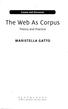 Corpus and Discourse The Web As Corpus Theory and Practice MARISTELLA GATTO B L O O M S B U R Y LONDON NEW DELHI NEW YORK SYDNEY Contents List of Figures xiii List of Tables xvii Preface xix Acknowledgements
SweVoc - A Swedish vocabulary resource for CALL
 SweVoc - A Swedish vocabulary resource for CALL Katarina Heimann Mühlenbock and Sofie Johansson Kokkinakis Dept of Swedish, University of Gothenburg, Gothenburg, Sweden [email protected],
Testing Data-Driven Learning Algorithms for PoS Tagging of Icelandic
 Testing Data-Driven Learning Algorithms for PoS Tagging of Icelandic by Sigrún Helgadóttir Abstract This paper gives the results of an experiment concerned with training three different taggers on tagged
C o p yr i g ht 2015, S A S I nstitute Inc. A l l r i g hts r eser v ed. INTRODUCTION TO SAS TEXT MINER
 INTRODUCTION TO SAS TEXT MINER TODAY S AGENDA INTRODUCTION TO SAS TEXT MINER Define data mining Overview of SAS Enterprise Miner Describe text analytics and define text data mining Text Mining Process
ICAME Journal No. 24. Reviews
 ICAME Journal No. 24 Reviews Collins COBUILD Grammar Patterns 2: Nouns and Adjectives, edited by Gill Francis, Susan Hunston, andelizabeth Manning, withjohn Sinclair as the founding editor-in-chief of
Albert Pye and Ravensmere Schools Grammar Curriculum
 Albert Pye and Ravensmere Schools Grammar Curriculum Introduction The aim of our schools own grammar curriculum is to ensure that all relevant grammar content is introduced within the primary years in
A Survey of Online Tools Used in English-Thai and Thai-English Translation by Thai Students
 69 A Survey of Online Tools Used in English-Thai and Thai-English Translation by Thai Students Sarathorn Munpru, Srinakharinwirot University, Thailand Pornpol Wuttikrikunlaya, Srinakharinwirot University,
UNIVERSITÀ DEGLI STUDI DELL AQUILA CENTRO LINGUISTICO DI ATENEO
 TESTING DI LINGUA INGLESE: PROGRAMMA DI TUTTI I LIVELLI - a.a. 2010/2011 Collaboratori e Esperti Linguistici di Lingua Inglese: Dott.ssa Fatima Bassi e-mail: [email protected] Dott.ssa Liliana
User studies, user behaviour and user involvement evidence and experience from The Danish Dictionary
 User studies, user behaviour and user involvement evidence and experience from The Danish Dictionary Henrik Lorentzen, Lars Trap-Jensen Society for Danish Language and Literature, Copenhagen, Denmark E-mail:
Syntactic Theory on Swedish
 Syntactic Theory on Swedish Mats Uddenfeldt Pernilla Näsfors June 13, 2003 Report for Introductory course in NLP Department of Linguistics Uppsala University Sweden Abstract Using the grammar presented
Subordinating Ideas Using Phrases It All Started with Sputnik
 NATIONAL MATH + SCIENCE INITIATIVE English Subordinating Ideas Using Phrases It All Started with Sputnik Grade 9-10 OBJECTIVES Students will demonstrate understanding of how different types of phrases
The open lexical infrastructure of Språkbanken
 The open lexical infrastructure of Språkbanken Lars Borin, Markus Forsberg, Leif-Jöran Olsson and Jonatan Uppström Språkbanken, University of Gothenburg, Sweden {lars.borin, markus.forsberg, leif-joran.olsson,
Ask your teacher about any which you aren t sure of, especially any differences.
 Punctuation in Academic Writing Academic punctuation presentation/ Defining your terms practice Choose one of the things below and work together to describe its form and uses in as much detail as possible,
ONLINE ENGLISH LANGUAGE RESOURCES
 ONLINE ENGLISH LANGUAGE RESOURCES Developed and updated by C. Samuel for students taking courses at the English and French Language Centre, Faculty of Arts (Links live as at November 2, 2009) Dictionaries
Index. 344 Grammar and Language Workbook, Grade 8
 Index Index 343 Index A A, an (usage), 8, 123 A, an, the (articles), 8, 123 diagraming, 205 Abbreviations, correct use of, 18 19, 273 Abstract nouns, defined, 4, 63 Accept, except, 12, 227 Action verbs,
EFL Learners Synonymous Errors: A Case Study of Glad and Happy
 ISSN 1798-4769 Journal of Language Teaching and Research, Vol. 1, No. 1, pp. 1-7, January 2010 Manufactured in Finland. doi:10.4304/jltr.1.1.1-7 EFL Learners Synonymous Errors: A Case Study of Glad and
Performance Indicators-Language Arts Reading and Writing 3 rd Grade
 Learning Standards 1 st Narrative Performance Indicators 2 nd Informational 3 rd Persuasive 4 th Response to Lit Possible Evidence Fluency, Vocabulary, and Comprehension Reads orally with Applies letter-sound
CINDOR Conceptual Interlingua Document Retrieval: TREC-8 Evaluation.
 CINDOR Conceptual Interlingua Document Retrieval: TREC-8 Evaluation. Miguel Ruiz, Anne Diekema, Páraic Sheridan MNIS-TextWise Labs Dey Centennial Plaza 401 South Salina Street Syracuse, NY 13202 Abstract:
Minnesota K-12 Academic Standards in Language Arts Curriculum and Assessment Alignment Form Rewards Intermediate Grades 4-6
 Minnesota K-12 Academic Standards in Language Arts Curriculum and Assessment Alignment Form Rewards Intermediate Grades 4-6 4 I. READING AND LITERATURE A. Word Recognition, Analysis, and Fluency The student
Teaching English as a Foreign Language (TEFL) Certificate Programs
 Teaching English as a Foreign Language (TEFL) Certificate Programs Our TEFL offerings include one 27-unit professional certificate program and four shorter 12-unit certificates: TEFL Professional Certificate
Flattening Enterprise Knowledge
 Flattening Enterprise Knowledge Do you Control Your Content or Does Your Content Control You? 1 Executive Summary: Enterprise Content Management (ECM) is a common buzz term and every IT manager knows it
Database Design For Corpus Storage: The ET10-63 Data Model
 January 1993 Database Design For Corpus Storage: The ET10-63 Data Model Tony McEnery & Béatrice Daille I. General Presentation Within the ET10-63 project, a French-English bilingual corpus of about 2 million
Section 8 Foreign Languages. Article 1 OVERALL OBJECTIVE
 Section 8 Foreign Languages Article 1 OVERALL OBJECTIVE To develop students communication abilities such as accurately understanding and appropriately conveying information, ideas,, deepening their understanding
Word Completion and Prediction in Hebrew
 Experiments with Language Models for בס"ד Word Completion and Prediction in Hebrew 1 Yaakov HaCohen-Kerner, Asaf Applebaum, Jacob Bitterman Department of Computer Science Jerusalem College of Technology
Free Construction of a Free Swedish Dictionary of Synonyms
 Free Construction of a Free Swedish Dictionary of Synonyms Viggo Kann and Magnus Rosell KTH Nada SE-1 44 Stockholm Sweden {viggo, rosell}@nada.kth.se Abstract Building a large dictionary of synonyms for
Natural Language Database Interface for the Community Based Monitoring System *
 Natural Language Database Interface for the Community Based Monitoring System * Krissanne Kaye Garcia, Ma. Angelica Lumain, Jose Antonio Wong, Jhovee Gerard Yap, Charibeth Cheng De La Salle University
PoS-tagging Italian texts with CORISTagger
 PoS-tagging Italian texts with CORISTagger Fabio Tamburini DSLO, University of Bologna, Italy [email protected] Abstract. This paper presents an evolution of CORISTagger [1], an high-performance
Cambridge Primary English as a Second Language Curriculum Framework
 Cambridge Primary English as a Second Language Curriculum Framework Contents Introduction Stage 1...2 Stage 2...5 Stage 3...8 Stage 4... 11 Stage 5...14 Stage 6... 17 Welcome to the Cambridge Primary English
This image cannot currently be displayed. Course Catalog. Language Arts 600. 2016 Glynlyon, Inc.
 This image cannot currently be displayed. Course Catalog Language Arts 600 2016 Glynlyon, Inc. Table of Contents COURSE OVERVIEW... 1 UNIT 1: ELEMENTS OF GRAMMAR... 3 UNIT 2: GRAMMAR USAGE... 3 UNIT 3:
Correlation: ELLIS. English language Learning and Instruction System. and the TOEFL. Test Of English as a Foreign Language
 Correlation: English language Learning and Instruction System and the TOEFL Test Of English as a Foreign Language Structure (Grammar) A major aspect of the ability to succeed on the TOEFL examination is
Building gold-standard treebanks for Norwegian
 Building gold-standard treebanks for Norwegian Per Erik Solberg National Library of Norway, P.O.Box 2674 Solli, NO-0203 Oslo, Norway [email protected] ABSTRACT Språkbanken at the National Library of Norway
Some Reflections on the Making of the Progressive English Collocations Dictionary
 43 Some Reflections on the Making of the Progressive English Collocations Dictionary TSUKAMOTO Michihisa Faculty of International Communication, Aichi University E-mail: [email protected] 1939
COURSE OBJECTIVES SPAN 100/101 ELEMENTARY SPANISH LISTENING. SPEAKING/FUNCTIONAl KNOWLEDGE
 SPAN 100/101 ELEMENTARY SPANISH COURSE OBJECTIVES This Spanish course pays equal attention to developing all four language skills (listening, speaking, reading, and writing), with a special emphasis on
stress, intonation and pauses and pronounce English sounds correctly. (b) To speak accurately to the listener(s) about one s thoughts and feelings,
 Section 9 Foreign Languages I. OVERALL OBJECTIVE To develop students basic communication abilities such as listening, speaking, reading and writing, deepening their understanding of language and culture
Approaches of Using a Word-Image Ontology and an Annotated Image Corpus as Intermedia for Cross-Language Image Retrieval
 Approaches of Using a Word-Image Ontology and an Annotated Image Corpus as Intermedia for Cross-Language Image Retrieval Yih-Chen Chang and Hsin-Hsi Chen Department of Computer Science and Information
Computer Assisted Language Learning (CALL): Room for CompLing? Scott, Stella, Stacia
 Computer Assisted Language Learning (CALL): Room for CompLing? Scott, Stella, Stacia Outline I What is CALL? (scott) II Popular language learning sites (stella) Livemocha.com (stacia) III IV Specific sites
Collecting Polish German Parallel Corpora in the Internet
 Proceedings of the International Multiconference on ISSN 1896 7094 Computer Science and Information Technology, pp. 285 292 2007 PIPS Collecting Polish German Parallel Corpora in the Internet Monika Rosińska
New syllabus for Swedish for Immigrants (sfi)
 New syllabus for Swedish for Immigrants (sfi) The purpose of the education Language opens windows on the world. Language reflects differences and similarities between people, their personalities, their
SignLEF: Sign Languages within the European Framework of Reference for Languages
 SignLEF: Sign Languages within the European Framework of Reference for Languages Simone Greiner-Ogris, Franz Dotter Centre for Sign Language and Deaf Communication, Alpen Adria Universität Klagenfurt (Austria)
Real-Time Identification of MWE Candidates in Databases from the BNC and the Web
 Real-Time Identification of MWE Candidates in Databases from the BNC and the Web Identifying and Researching Multi-Word Units British Association for Applied Linguistics Corpus Linguistics SIG Oxford Text
English Appendix 2: Vocabulary, grammar and punctuation
 English Appendix 2: Vocabulary, grammar and punctuation The grammar of our first language is learnt naturally and implicitly through interactions with other speakers and from reading. Explicit knowledge
Register Differences between Prefabs in Native and EFL English
 Register Differences between Prefabs in Native and EFL English MARIA WIKTORSSON 1 Introduction In the later stages of EFL (English as a Foreign Language) learning, and foreign language learning in general,
Search Result Diversification Methods to Assist Lexicographers
 Search Result Diversification Methods to Assist Lexicographers Lars Borin Markus Forsberg Karin Friberg Heppin Richard Johansson Annika Kjellandsson Språkbanken, Department of Swedish, University of Gothenburg
Customizing an English-Korean Machine Translation System for Patent Translation *
 Customizing an English-Korean Machine Translation System for Patent Translation * Sung-Kwon Choi, Young-Gil Kim Natural Language Processing Team, Electronics and Telecommunications Research Institute,
Overview of MT techniques. Malek Boualem (FT)
 Overview of MT techniques Malek Boualem (FT) This section presents an standard overview of general aspects related to machine translation with a description of different techniques: bilingual, transfer,
Terminology Extraction from Log Files
 Terminology Extraction from Log Files Hassan Saneifar 1,2, Stéphane Bonniol 2, Anne Laurent 1, Pascal Poncelet 1, and Mathieu Roche 1 1 LIRMM - Université Montpellier 2 - CNRS 161 rue Ada, 34392 Montpellier
GRASP: Grammar- and Syntax-based Pattern-Finder for Collocation and Phrase Learning
 PACLIC 24 Proceedings 357 GRASP: Grammar- and Syntax-based Pattern-Finder for Collocation and Phrase Learning Mei-hua Chen a, Chung-chi Huang a, Shih-ting Huang b, and Jason S. Chang b a Institute of Information
Tibetan-Chinese Bilingual Sentences Alignment Method based on Multiple Features
 , pp.273-280 http://dx.doi.org/10.14257/ijdta.2015.8.4.27 Tibetan-Chinese Bilingual Sentences Alignment Method based on Multiple Features Lirong Qiu School of Information Engineering, MinzuUniversity of
LANGUAGE! 4 th Edition, Levels A C, correlated to the South Carolina College and Career Readiness Standards, Grades 3 5
 Page 1 of 57 Grade 3 Reading Literary Text Principles of Reading (P) Standard 1: Demonstrate understanding of the organization and basic features of print. Standard 2: Demonstrate understanding of spoken
The SYSTRAN Linguistics Platform: A Software Solution to Manage Multilingual Corporate Knowledge
 The SYSTRAN Linguistics Platform: A Software Solution to Manage Multilingual Corporate Knowledge White Paper October 2002 I. Translation and Localization New Challenges Businesses are beginning to encounter
Glossary of literacy terms
 Glossary of literacy terms These terms are used in literacy. You can use them as part of your preparation for the literacy professional skills test. You will not be assessed on definitions of terms during
Discourse Markers in English Writing
 Discourse Markers in English Writing Li FENG Abstract Many devices, such as reference, substitution, ellipsis, and discourse marker, contribute to a discourse s cohesion and coherence. This paper focuses
Comprendium Translator System Overview
 Comprendium System Overview May 2004 Table of Contents 1. INTRODUCTION...3 2. WHAT IS MACHINE TRANSLATION?...3 3. THE COMPRENDIUM MACHINE TRANSLATION TECHNOLOGY...4 3.1 THE BEST MT TECHNOLOGY IN THE MARKET...4
Exploiting Sign Language Corpora in Deaf Studies
 Trinity College Dublin Exploiting Sign Language Corpora in Deaf Studies Lorraine Leeson Trinity College Dublin SLCN Network I Berlin I 4 December 2010 Overview Corpora: going beyond sign linguistics research
2016-2017 Curriculum Catalog
 2016-2017 Curriculum Catalog 2016 Glynlyon, Inc. Table of Contents LANGUAGE ARTS 600 COURSE OVERVIEW... 1 UNIT 1: ELEMENTS OF GRAMMAR... 3 UNIT 2: GRAMMAR USAGE... 3 UNIT 3: READING SKILLS... 4 UNIT 4:
Latin Syllabus S2 - S7
 European Schools Office of the Secretary-General Pedagogical Development Unit Ref.: 2014-01-D-35-en-2 Orig.: FR Latin Syllabus S2 - S7 APPROVED BY THE JOINT TEACHING COMMITTEE ON 13 AND 14 FEBRUARY 2014
Differences in linguistic and discourse features of narrative writing performance. Dr. Bilal Genç 1 Dr. Kağan Büyükkarcı 2 Ali Göksu 3
 Yıl/Year: 2012 Cilt/Volume: 1 Sayı/Issue:2 Sayfalar/Pages: 40-47 Differences in linguistic and discourse features of narrative writing performance Abstract Dr. Bilal Genç 1 Dr. Kağan Büyükkarcı 2 Ali Göksu
Sketch Engine. Sketch Engine. SRDANOVIĆ ERJAVEC Irena, Web 1 Word Sketch Thesaurus Sketch Difference Sketch Engine
 Sketch Engine SRDANOVIĆ ERJAVEC Irena, Sketch Engine Sketch Engine Web 1 Word Sketch Thesaurus Sketch Difference Sketch Engine JpWaC 4 Web Sketch Engine 1. 1980 10 80 Kilgarriff & Rundell 2002 500 1,000
Strand: Reading Literature Topics Standard I can statements Vocabulary Key Ideas and Details
 Strand: Reading Literature Key Ideas and Details Craft and Structure RL.3.1 Ask and answer questions to demonstrate understanding of a text, referring explicitly to the text as the basis for the answers.
Language Arts Literacy Areas of Focus: Grade 6
 Language Arts Literacy : Grade 6 Mission: Learning to read, write, speak, listen, and view critically, strategically and creatively enables students to discover personal and shared meaning throughout their
AK + ASD Writing Grade Level Expectations For Grades 3-6
 Revised ASD June 2004 AK + ASD Writing For Grades 3-6 The first row of each table includes a heading that summarizes the performance standards, and the second row includes the complete performance standards.
EAS Basic Outline. Overview
 EAS Basic Outline Overview This is the course outline for your English Language Basic Course. This course is delivered at pre intermediate level of English, and the course book that you will be using is
Using the BNC to create and develop educational materials and a website for learners of English
 Using the BNC to create and develop educational materials and a website for learners of English Danny Minn a, Hiroshi Sano b, Marie Ino b and Takahiro Nakamura c a Kitakyushu University b Tokyo University
TERMINOGRAPHY and LEXICOGRAPHY What is the difference? Summary. Anja Drame TermNet
 TERMINOGRAPHY and LEXICOGRAPHY What is the difference? Summary Anja Drame TermNet Summary/ Conclusion Variety of language (GPL = general purpose SPL = special purpose) Lexicography GPL SPL (special-purpose
FOREIGN LANGUAGE PROGRAMME PREPARATION FOR THE TOEIC EXAM
 FOREIGN LANGUAGE PROGRAMME PREPARATION FOR THE TOEIC EXAM I. COURSE REQUIREMENTS English level B.1.1 or sufficient performance on level test. II. GENERAL OBJECTIVES OF THE COURSE The objective of this
ESL 005 Advanced Grammar and Paragraph Writing
 ESL 005 Advanced Grammar and Paragraph Writing Professor, Julie Craven M/Th: 7:30-11:15 Phone: (760) 355-5750 Units 5 Email: [email protected] Code: 30023 Office: 2786 Room: 201 Course Description:
Advanced Grammar in Use
 Advanced Grammar in Use A reference and practice book for advanced learners of English Third Edition without answers c a m b r i d g e u n i v e r s i t y p r e s s Cambridge, New York, Melbourne, Madrid,
ANALYSIS OF LEXICO-SYNTACTIC PATTERNS FOR ANTONYM PAIR EXTRACTION FROM A TURKISH CORPUS
 ANALYSIS OF LEXICO-SYNTACTIC PATTERNS FOR ANTONYM PAIR EXTRACTION FROM A TURKISH CORPUS Gürkan Şahin 1, Banu Diri 1 and Tuğba Yıldız 2 1 Faculty of Electrical-Electronic, Department of Computer Engineering
Annotation Guidelines for Dutch-English Word Alignment
 Annotation Guidelines for Dutch-English Word Alignment version 1.0 LT3 Technical Report LT3 10-01 Lieve Macken LT3 Language and Translation Technology Team Faculty of Translation Studies University College
Assessing Writing Performance Level B1
 Assessing Writing Performance Level B1 Writing assessment by examiners in the Cambridge English: Preliminary (PET), Preliminary (PET) for Schools and Business Preliminary exams (BEC) Cambridge English
Class contents and exam requirements Code 20365 20371 (20421) English Language, Second language B1 business
 a.y. 2013/2014-2014/2015 Class contents and exam requirements Code 20365 20371 (20421) English Language, Second language B1 business Program Master of Science Degree course M, MM, AFC, CLAPI, CLEFIN FINANCE,
An Approach to Handle Idioms and Phrasal Verbs in English-Tamil Machine Translation System
 An Approach to Handle Idioms and Phrasal Verbs in English-Tamil Machine Translation System Thiruumeni P G, Anand Kumar M Computational Engineering & Networking, Amrita Vishwa Vidyapeetham, Coimbatore,
POS Tagsets and POS Tagging. Definition. Tokenization. Tagset Design. Automatic POS Tagging Bigram tagging. Maximum Likelihood Estimation 1 / 23
 POS Def. Part of Speech POS POS L645 POS = Assigning word class information to words Dept. of Linguistics, Indiana University Fall 2009 ex: the man bought a book determiner noun verb determiner noun 1
Pupil SPAG Card 1. Terminology for pupils. I Can Date Word
 Pupil SPAG Card 1 1 I know about regular plural noun endings s or es and what they mean (for example, dog, dogs; wish, wishes) 2 I know the regular endings that can be added to verbs (e.g. helping, helped,
This image cannot currently be displayed. Course Catalog. Language Arts 400. 2016 Glynlyon, Inc.
 This image cannot currently be displayed. Course Catalog Language Arts 400 2016 Glynlyon, Inc. Table of Contents COURSE OVERVIEW... 1 UNIT 1: READING AND WRITING... 3 UNIT 2: READING FOR MEANING... 3 UNIT
A Guide to Cambridge English: Preliminary
 Cambridge English: Preliminary, also known as the Preliminary English Test (PET), is part of a comprehensive range of exams developed by Cambridge English Language Assessment. Cambridge English exams have
Writing Common Core KEY WORDS
 Writing Common Core KEY WORDS An educator's guide to words frequently used in the Common Core State Standards, organized by grade level in order to show the progression of writing Common Core vocabulary
Translation Solution for
 Translation Solution for Case Study Contents PROMT Translation Solution for PayPal Case Study 1 Contents 1 Summary 1 Background for Using MT at PayPal 1 PayPal s Initial Requirements for MT Vendor 2 Business
Virginia English Standards of Learning Grade 8
 A Correlation of Prentice Hall Writing Coach 2012 To the Virginia English Standards of Learning A Correlation of, 2012, Introduction This document demonstrates how, 2012, meets the objectives of the. Correlation
Italian Language & Culture Courses for Foreigners. ITALY Language Training
 Italian Language & Culture Courses for Foreigners ITALY 1 Good Practice Executive Summary Founded in the early 1920's with the aim of teaching Italian civilisation and artistic heritage to foreigners,
OPTIMIZING CONTENT FOR TRANSLATION ACROLINX AND VISTATEC
 OPTIMIZING CONTENT FOR TRANSLATION ACROLINX AND VISTATEC We ll look at these questions. Why does translation cost so much? Why is it hard to keep content consistent? Why is it hard for an organization
COLLOCATION TOOLS FOR L2 WRITERS 1
 COLLOCATION TOOLS FOR L2 WRITERS 1 An Evaluation of Collocation Tools for Second Language Writers Ulugbek Nurmukhamedov Northern Arizona University COLLOCATION TOOLS FOR L2 WRITERS 2 Abstract Second language
Towards a RB-SMT Hybrid System for Translating Patent Claims Results and Perspectives
 Towards a RB-SMT Hybrid System for Translating Patent Claims Results and Perspectives Ramona Enache and Adam Slaski Department of Computer Science and Engineering Chalmers University of Technology and
2016-2017 Curriculum Catalog
 2016-2017 Curriculum Catalog 2016 Glynlyon, Inc. Table of Contents LANGUAGE ARTS 400 COURSE OVERVIEW... 1 UNIT 1: JESUS, OUR EXAMPLE... 3 UNIT 2: WORKING WITH INFORMATION... 3 UNIT 3: THE STORY OF OUR
Extraction of Legal Definitions from a Japanese Statutory Corpus Toward Construction of a Legal Term Ontology
 Extraction of Legal Definitions from a Japanese Statutory Corpus Toward Construction of a Legal Term Ontology Makoto Nakamura, Yasuhiro Ogawa, Katsuhiko Toyama Japan Legal Information Institute, Graduate
ELECTRONIC DICTIONARIES AND ESP STUDENTS
 ELECTRONIC DICTIONARIES AND ESP STUDENTS VINȚEAN Adriana Lucian Blaga University of Sibiu, Romania MATIU Ovidiu Lucian Blaga University of Sibiu, Romania Abstract: This article presents the results of
Comparing Ontology-based and Corpusbased Domain Annotations in WordNet.
 Comparing Ontology-based and Corpusbased Domain Annotations in WordNet. A paper by: Bernardo Magnini Carlo Strapparava Giovanni Pezzulo Alfio Glozzo Presented by: rabee ali alshemali Motive. Domain information
AUTHOR GUIDELINES Handbook Articles
 Handbook Articles Table of Contents I. Manuscript Submission 2 II. Article Structure 2 III. Figures, Tables, Audio Files, and Videos 3 IV. Style Preferences 4 V. Formatting 5 VI. Reference Style 5 I. Manuscript
Annotation and Evaluation of Swedish Multiword Named Entities
 Annotation and Evaluation of Swedish Multiword Named Entities DIMITRIOS KOKKINAKIS Department of Swedish, the Swedish Language Bank University of Gothenburg Sweden [email protected] Introduction