
HOW TO DESIGN CONCRETE STRUCTURES Foundations
|
|
|
- Rosemary Francis
- 9 years ago
- Views:
Transcription
1 HOW TO DESIGN CONCRETE STRUCTURES Foundations

2 Instructions for the Members of BIBM, CEMBUREAU, EFCA and ERMCO: It is the responsibility of the Members (national associations) of BIBM, CEMBUREAU, EFCA and ERMCO to translate and/or adapt this publication within their national framework, to publish it under their own name and to disseminate it to their contacts at national level. Copyright: Name of National Member Acknowledgements to the European Concrete Platform EMBARGO: 31 March 2007 The Members of BIBM, CEMBUREAU EFCA and ERMCO are not allowed to publish this brochure before 31 March Copyright: European Concrete Platform (when legal body is established), March All rights reserved. No part of this publication may be reproduced, stored in a retrieval system or transmitted in any form or by any means, electronic, mechanical, photocopying, recording or otherwise, without the prior written permission of the European Concrete Platform: BIBM (International Bureau for Precast Concrete); CEMBUREAU, The European Cement Association; EFCA (European Federation of Concrete Admixtures Associations); ERMCO (European Ready Mixed Concrete Organisation). Published by the European Concrete Platform Editor: Jean-Pierre Jacobs 8 rue Volta 1050 Brussels Layout & Printing by The European Concrete Platform All information in this document is deemed to be accurate by the European Concrete Platform at the time of going into press. It is given in good faith. Information on European Concrete Platform document does not create any liability for BIBM, CEMBUREAU, EFCA and ERMCO. While the goal is to keep this information timely and accurate, the European Concrete Platform cannot guarantee either. If errors are brought to its attention, they will be corrected. The opinions reflected in this document are those of the authors and BIBM, CEMBUREAU, EFCA and ERMCO cannot be held liable for any view expressed therein. All advice or information from the European Concrete Platform is intended for those who will evaluate the significance and limitations of its contents and take responsibility for its use and application. No liability (including for negligence) for any loss resulting from such advice or information is accepted. Readers should note that all European Concrete Platform publications are subject to revision from time to time and therefore ensure that they are in possession of the latest version.

3 How to design concrete structures using Eurocode 2 6. Foundations Introduction This should be redrafted in each country as appropriate Eurocode 7: Geotechnical design Scope All foundations should be designed so that the soil safely resists the actions applied to the structure. The design of any foundation consists of two components; the geotechnical design and the structural design of the foundation itself. However, for some foundations (e.g. flexible rafts) the effect of the interaction between the soil and structure may be critical and must also be considered. Geotechnical design is covered by Eurocode 7 1. There are two parts to Eurocode 7, Part 1: General rules and Part 2: Ground investigation and testing. The essential features of Eurocode 7, Part 1 relating to foundation design are discussed in this guide. It should be emphasised that this publication covers only the design of simple foundations, which are a small part of the scope of Eurocoe 7. Therefore it should not be relied on for general guidance on this Eurocode. Limit states The following ultimate limit states (ULS) should be satisfied for geotechnical design; they each have their own combinations of actions. (For an explanation of Eurocode terminology refer to How to design concrete structures using Eurocode 2: Introduction to Eurocodes 2 ). EQU Loss of equilibrium of the structure. STR Internal failure or excessive deformation of the structure or structural member. GEO Failure due to excessive deformation of the ground. UPL Loss equilibrium due to uplift by water pressure. HYD Failure caused by hydraulic gradients. In addition, the serviceability limit states (SLS) should be satisfied. It will usually be clear that one of the limit states will govern the design and therefore it will not be necessary to carry out checks for all of them, although it is considered good practice to record that they have all been considered. Geotechnical categories Eurocode 7 recommends three geotechnical categories to assist in establishing the geotechnical design requirements for a structure (see Table 1).

4 Methods of design and combinations There has not been a consensus amongst geotechnical engineers over the application of limit state principles to geotechnical design. Therefore, to allow for these differences of opinion, Eurocode 7 provides for three design approaches to be used for the ULS. The decision on which approach to use for a particular country is given in its National Annex. Design approach 1(excluding pile and anchorage design) is illustrated in this guide. In this approach, there are two sets of combinations to use for the STR and GEO ultimate limit states. The values for the partial factors to be applied to the actions for these combinations of partial factors are given in Table 2 and the partial factors for the geotechnical material properties are given in Table 3. Combination 1 will generally govern the structural resistance, and combination 2 will generally govern the sizing of the foundations. The partial factors for soil resistance to sliding and bearing should be taken as 1.0 for both combinations. The partial factors to be applied to the actions at the EQU limit state are given in Table 4; the geotechnical material partial factors being the same as for combination 2 in Table 3. For the SLS, Eurocode 7 does not give any advice on whether the characteristic, frequent or quasipermanent combination should be used. Where the prescriptive method is used for spread foundations (see page 3) then the characteristic value should be adopted.

5 For direct methods of calculation the frequent combination can be used for sizing of foundations and the quasi-permanent combination can be used for settlement calculations. Further information on design combinations can be found in another guide in the series, Introduction to Eurocodes 2. Geotechnical design report A geotechnical design report should be produced for each project, even if it is only a single sheet. The report should contain details of the site, interpretation of the ground investigation report, geotechnical design recommendations and advice on supervision, monitoring and maintenance of the works. It is likely that this report will require input from more than one consultant, depending on whether the project is in geotechnical category 1, 2 or 3. The foundation design recommendations should include bearing resistances and characteristic values for soil parameters. It should also clearly state whether the values are applicable to SLS or ULS and whether they are for combination 1 or combination 2. Spread foundations The geotechnical design of spread foundations (e.g. strip and pad foundations) is covered by section 6 of Eurocode 7, Part 1 and this gives three methods for design: Direct method calculation is carried out for each limit state. Indirect method experience and testing used to determine serviceability limit state parameters that also satisfy all relevant limit states (included in Eurocode 7 mainly to suit French design methods, and is not discussed further here). Prescriptive method in which a presumed bearing resistance is used. For most spread foundations, settlement will be the governing criterion; traditionally allowable bearing pressures have been used to limit settlement. The concept of increasing the factor of safety on bearing resistances to control settlement may still be used with the prescriptive method. The exception is for soft clays where Eurocode 7 requires settlement calculations to be undertaken. When using the direct method, calculations are carried out for each limit state. At the ULS, the bearing resistance of the soil should be checked using partial factors on the soil properties as well as on the actions. At the SLS the settlement of the foundations should be calculated and checked against permissible limits. The prescriptive method may be used where calculation of the soil properties is not possible or necessary and can be used provided that conservative rules of design are used. Methods operating in a country currently to determine presumed (allowable) bearing pressures may continue to be used for category 1 structures and preliminary calculations for category 2 structures (see Table 5). Alternatively, the presumed bearing resistance to allow for settlement can be calculated by the geotechnical designer and included in the geotechnical design report.

6 A flow chart showing the design process for shallow foundations is given in Figure 1. Where there is a moment applied to the foundation, the EQU limit state should also be checked. Assuming the potential overturning of the base is due to the variable action from the wind, the following combination should be used (the variable imposed action is not considered to contribute to the stability of the structure). 0.9 G k Q k,w EQU combination where: G k is the stabilising characteristic permanent action (Use 1.1 G k for a destabilising permanent action) Q k,w is the destabilising characteristic variable wind action Partial factors for the soil parameters used to determine the resistances can be obtained from Table 3 above (combination 2). The pressure distribution under the base should be assessed to ensure that the maximum pressure does not exceed the bearing resistances obtained from the geotechnical design report at both EQU and GEO ultimate limit states (see Figure 2). If the eccentricity is greater than L/6 at SLS, then the pressure distribution used to determine the settlement should be modified because tension cannot occur between the base and the soil. In this case the designer should satisfy himself that there will be no adverse consequences (e.g. excessive rotation of the base). It should also be noted that the ULS pressure distribution diagram will be rectangular and not trapezoidal. Reinforced concrete pads Where the pad foundations require reinforcement the following checks should be carried out to ensure: Sufficient reinforcement to resist bending moments. Punching shear strength. Beam shear strength. The moments and shear forces should be assessed using the STR combination: 1.35 G k Q k STR combination 1 (Exp. (6.10)) However, there may be economies to made from using Expressions (6.10a) or (6.10b) from the Eurocode. The critical bending moments for design of bottom reinforcement are located at the column faces. Both beam shear and punching shear should then be checked at the locations shown in Figure 3. For punching shear the ground reaction within the perimeter may be deducted from the column load (Expression (6.48), Eurocode ). It is not usual for a pad foundation to contain shear reinforcement, therefore it is only necessary to ensure that the concrete shear stress capacity without shear reinforcement (v Rd,c see Table 6) is greater than applied shear stress (v Ed = V Ed /(bd)). If the basic shear stress is exceeded, the designer may increase the depth of the base. Alternatively, the amount of main reinforcement could be increased or, less desirably, shear links could be provided. (See the accompanying guide How to design concrete structures using Eurocode 2: Beams for an explanation of how to design shear reinforcement.)

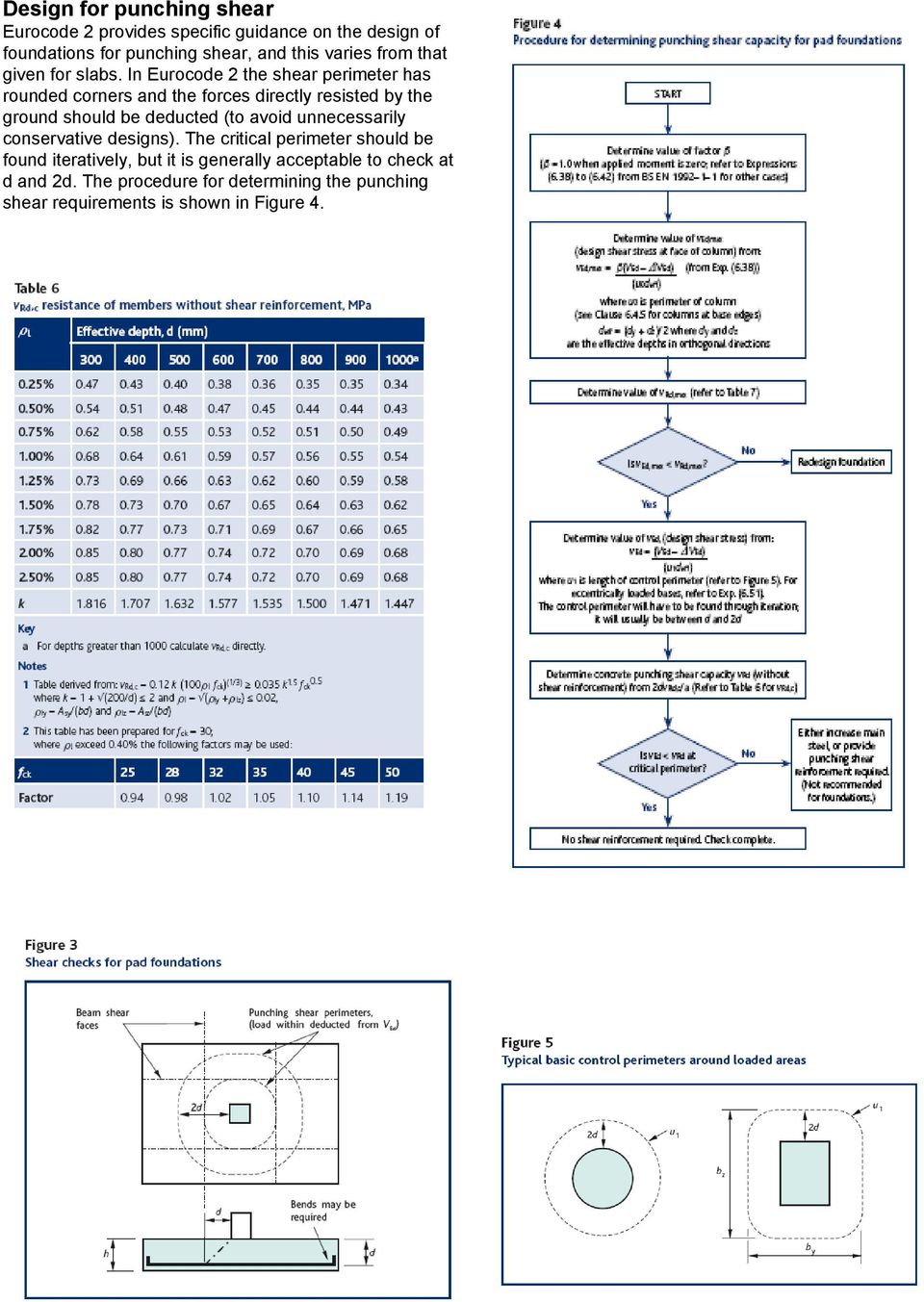
7 Design for punching shear Eurocode 2 provides specific guidance on the design of foundations for punching shear, and this varies from that given for slabs. In Eurocode 2 the shear perimeter has rounded corners and the forces directly resisted by the ground should be deducted (to avoid unnecessarily conservative designs). The critical perimeter should be found iteratively, but it is generally acceptable to check at d and 2d. The procedure for determining the punching shear requirements is shown in Figure 4.
8 Raft foundations The basic design processes for rafts are similar to those for isolated pad foundations or pilecaps. The only difference in approach lies in the selection of an appropriate method for analysing the interaction between the raft and the ground so as to achieve a reasonable representation of their behaviour. For stiffer rafts (i.e. span-to-thickness greater than 10) with a fairly regular layout, simplified approaches such as yield line or the flat slab equivalent frame method may be employed, once an estimation of the variations in bearing pressure has been obtained from a geotechnical specialist. Whatever simplifications are made, individual elastic raft reactions should equate to the applied column loads. Thinner, more flexible rafts or those with a complex layout may require the application of a finite element or grillage analysis. For rafts bearing on granular sub-grades or when contiguous-piled walls or diaphragm perimeter walls are present, the ground may be modelled as a series of Winkler springs. However, for cohesive sub-grades, this approach is unlikely to be valid, and specialist software will be required. Pile foundations guidance on designing for flexure reference should be made to another guide in this series, How to design concrete structures using Eurocode 2: Beams 4. Alternatively, a truss analogy may be used; this is covered in Sections and 6.5 of Eurocode The trust angle θ should be at least 21.8 to the horizontal; note that θ should be measured in the plane of the column and pile. Both beam shear and punching shear should then be checked as shown in Figure 6. For beam shear, the design resistances in Table 6 may be used. If the basic shear stress is exceeded, the designer should increase the depth of the base. Alternatively, the amount of main reinforcement could be increased or, less desirably, shear links could be provided. Care should be taken that main bars are fully anchored. As a minimum, a full anchorage should be provided from the inner face of piles. Large radius bends may be required. When assessing the shear capacity in a pile cap, only the tension steel placed within the stress zone should be considered as contributing to the shear capacity (see Figure 7). For the purpose of this guide it is assumed that the pile design will be carried out by a specialist piling contractor. The actions on the piles must be clearly conveyed to the pile designer, and these should be broken down into the unfactored (i.e. partial factor = 1.0) values for permanent action and each of the applicable variable actions (e.g. imposed and wind actions). The pile designer can then carry out the structural and geotechnical design of the piles. Where moments are applied to the pilecap the EQU combination should also be used to check the piles can resist the overturning forces. These EQU loads must also be clearly conveyed to the pile designer and procedures put in place to ensure the piles are designed for the correct forces. A pilecap may be treated as a beam in bending, where the critical bending moments for the design of the bottom reinforcement are located at the column faces. For further

9 Plain concrete foundations Strip and pad footings may be constructed from plain concrete provided the following rules are adhered to. In compression, the value of α cc, the coefficient taking account of long-term effects applied to design compressive strength (see Cl ), should be taken as 0.8 as opposed to 1.0 for reinforced concrete. The minimum foundation depth, h F, (see Figure 8) may be calculated from: where: σ gd = the design value of the ground bearing pressure f ctd = the design concrete tensile strength from Exp. (3.16) Note The possibility of splitting forces, as advised in Clause of Eurocode 2 1 1, may need to be considered. Eurocode 2 allows plain concrete foundations to contain reinforcement for control of cracking. Rules for spacing and quantity of reinforcement Crack control Refer to How to design concrete structures using Eurocode 2: Getting started 9. Minimum area of principal reinforcement The minimum area of reinforcement is A s,min = 0.26 f ctm b t d/f yk but not less than b t d (see Table 8). Maximum area of reinforcement Except at lap locations, the maximum area of tension or compression reinforcement, should not exceed A s,max = 0.04 A c Minimum spacing of reinforcement The minimum spacing of bars should be the greater of: 1 x Bar diameter, Aggregate size plus 5 mm, or 20 mm. Deep elements For deep elements the advice in Eurocode 2 for the side faces of deep beams may be followed. The distance between bars should not exceed the lesser of twice the beam depth or 300 mm. For pile caps the side face may be unreinforced if there is no risk of tension developing.

10 References 1 EN 1997: Eurocode 7: Geotechnical design. (2 parts). 2 NARAYANAN, R S & BROOKER, O. How to design concrete structures using Eurocode 2: Introduction to Eurocodes. The Concrete Centre, EN , Eurocode 2: Design of concrete structures. General rules and rules for buildings. 4 MOSS, R M & BROOKER, O. How to design concrete structures using Eurocode 2: Beams. The Concrete Centre, BROOKER, O. How to design concrete structures using Eurocode 2: Getting started. The Concrete Centre, Further guidance and advice Guides in this series cover: Introduction to Eurocodes, Getting started, Slabs, Beams, Columns, Foundations, Flat slabs and Deflection calculations. For free downloads, details of other publications and more information on Eurocode 2 visit This guide is taken from The Concrete Centre s publication, How to design concrete structures using Eurocode 2 (Ref. CCIP-006) Acknowledgements This guide was originally published by BCA and The Concrete Centre in the UK. The authors of the original publication were R Webster CEng, FIStructE and O Brooker BEng, CEng, MICE, MIStructE Europeanised versions of Concise EC2 and How To Leaflets Convention used in the text 1. Nationally determined parameters that occur in the text have been highlighted yellow 2. Text is highlighted in pink indicates that some action is required on the part of the country adapting the documents for its use

DESIGN OF SLABS. Department of Structures and Materials Engineering Faculty of Civil and Environmental Engineering University Tun Hussein Onn Malaysia
 DESIGN OF SLABS Department of Structures and Materials Engineering Faculty of Civil and Environmental Engineering University Tun Hussein Onn Malaysia Introduction Types of Slab Slabs are plate elements
Eurocode 2: Design of concrete structures
 Eurocode 2: Design of concrete structures Owen Brooker, The Concrete Centre Introduction The transition to using the Eurocodes is a daunting prospect for engineers, but this needn t be the case. Industry
Page 1 of 18 28.4.2008 Sven Alexander Last revised 1.3.2010. SB-Produksjon STATICAL CALCULATIONS FOR BCC 250
 Page 1 of 18 CONTENT PART 1 BASIC ASSUMPTIONS PAGE 1.1 General 1. Standards 1.3 Loads 1. Qualities PART ANCHORAGE OF THE UNITS.1 Beam unit equilibrium 3. Beam unit anchorage in front..1 Check of capacity..
RC Detailing to Eurocode 2
 RC Detailing to Eurocode 2 Jenny Burridge MA CEng MICE MIStructE Head of Structural Engineering Structural Eurocodes BS EN 1990 (EC0): BS EN 1991 (EC1): Basis of structural design Actions on Structures
EN 1997-1 Eurocode 7. Section 10 Hydraulic Failure Section 11 Overall Stability Section 12 Embankments. Trevor L.L. Orr Trinity College Dublin Ireland
 EN 1997 1: Sections 10, 11 and 12 Your logo Brussels, 18-20 February 2008 Dissemination of information workshop 1 EN 1997-1 Eurocode 7 Section 10 Hydraulic Failure Section 11 Overall Stability Section
Design of pile foundations following Eurocode 7-Section 7
 Brussels, 18-20 February 2008 Dissemination of information workshop 1 Workshop Eurocodes: background and applications Brussels, 18-20 Februray 2008 Design of pile foundations following Eurocode 7-Section
Draft Table of Contents. Building Code Requirements for Structural Concrete and Commentary ACI 318-14
 Draft Table of Contents Building Code Requirements for Structural Concrete and Commentary ACI 318-14 BUILDING CODE REQUIREMENTS FOR STRUCTURAL CONCRETE (ACI 318 14) Chapter 1 General 1.1 Scope of ACI 318
Introduction. Eurocodes. Specification. Cost
 Introduction Eurocodes Specification Cost Structural Eurocodes BS EN 1990 (EC0): BS EN 1991 (EC1): Basis of structural design Actions on Structures BS EN 1992 (EC2): BS EN 1993 (EC3): BS EN 1994 (EC4):
DESIGN OF SLABS. 3) Based on support or boundary condition: Simply supported, Cantilever slab,
 DESIGN OF SLABS Dr. G. P. Chandradhara Professor of Civil Engineering S. J. College of Engineering Mysore 1. GENERAL A slab is a flat two dimensional planar structural element having thickness small compared
Module 5 (Lectures 17 to 19) MAT FOUNDATIONS
 Module 5 (Lectures 17 to 19) MAT FOUNDATIONS Topics 17.1 INTRODUCTION Rectangular Combined Footing: Trapezoidal Combined Footings: Cantilever Footing: Mat foundation: 17.2 COMMON TYPES OF MAT FOUNDATIONS
Design Manual to BS8110
 Design Manual to BS8110 February 2010 195 195 195 280 280 195 195 195 195 195 195 280 280 195 195 195 The specialist team at LinkStudPSR Limited have created this comprehensive Design Manual, to assist
Design MEMO 54a Reinforcement design for RVK 41
 Page of 5 CONTENTS PART BASIC ASSUMTIONS... 2 GENERAL... 2 STANDARDS... 2 QUALITIES... 3 DIMENSIONS... 3 LOADS... 3 PART 2 REINFORCEMENT... 4 EQUILIBRIUM... 4 Page 2 of 5 PART BASIC ASSUMTIONS GENERAL
National Council of Examiners for Engineering and Surveying. Principles and Practice of Engineering Structural Examination
 Structural Effective Beginning with the April 2011 The structural engineering exam is a breadth and exam examination offered in two components on successive days. The 8-hour Vertical Forces (Gravity/Other)
FOUNDATION DESIGN. Instructional Materials Complementing FEMA 451, Design Examples
 FOUNDATION DESIGN Proportioning elements for: Transfer of seismic forces Strength and stiffness Shallow and deep foundations Elastic and plastic analysis Foundation Design 14-1 Load Path and Transfer to
Design MEMO 60 Reinforcement design for TSS 102
 Date: 04.0.0 sss Page of 5 CONTENTS PART BASIC ASSUMTIONS... GENERAL... STANDARDS... QUALITIES... 3 DIMENSIONS... 3 LOADS... 3 PART REINFORCEMENT... 4 EQUILIBRIUM... 4 Date: 04.0.0 sss Page of 5 PART BASIC
1997 Uniform Administrative Code Amendment for Earthen Material and Straw Bale Structures Tucson/Pima County, Arizona
 for Earthen Material and Straw Bale Structures SECTION 70 - GENERAL "APPENDIX CHAPTER 7 - EARTHEN MATERIAL STRUCTURES 70. Purpose. The purpose of this chapter is to establish minimum standards of safety
Concrete Design to Eurocode 2
 Concrete Design to Eurocode 2 Jenny Burridge MA CEng MICE MIStructE Head of Structural Engineering Introduction to the Eurocodes Eurocode Eurocode 1 Eurocode 2 Materials Cover Flexure Shear Deflection
Spon Press PRESTRESSED CONCRETE DESIGN EUROCODES. University of Glasgow. Department of Civil Engineering. Prabhakara Bhatt LONDON AND NEW YORK
 PRESTRESSED CONCRETE DESIGN TO EUROCODES Prabhakara Bhatt Department of Civil Engineering University of Glasgow Spon Press an imprint of Taytor & Francfe LONDON AND NEW YORK CONTENTS Preface xix Basic
EUROCODE 7 & POLISH PRACTICE
 EUROCODE 7 & POLISH PRACTICE Implementation of Eurocode 7 in Poland Beata Gajewska Road and Bridge Research Institute In Poland the designing with limit states and partial factors was introduced in 1974.
Technical Notes 3B - Brick Masonry Section Properties May 1993
 Technical Notes 3B - Brick Masonry Section Properties May 1993 Abstract: This Technical Notes is a design aid for the Building Code Requirements for Masonry Structures (ACI 530/ASCE 5/TMS 402-92) and Specifications
Code of Practice for Structural Use of Concrete 2013
 Code of Practice for Structural Use of Concrete 2013 The Government of the Hong Kong Special Administrative Region Published: February 2013 Prepared by: Buildings Department 12/F-18/F Pioneer Centre 750
Embedded Retaining Wall Design Engineering or Paradox?
 Embedded Retaining Wall Design Engineering or Paradox? A personal viewpoint by A.Y. Chmoulian, associate at Royal Haskoning Introduction Retaining wall design theory is a complicated subject with a long
Detailing of Reinforcment in Concrete Structures
 Chapter 8 Detailing of Reinforcment in Concrete Structures 8.1 Scope Provisions of Sec. 8.1 and 8.2 of Chapter 8 shall apply for detailing of reinforcement in reinforced concrete members, in general. For
SLAB DESIGN. Introduction ACI318 Code provides two design procedures for slab systems:
 Reading Assignment SLAB DESIGN Chapter 9 of Text and, Chapter 13 of ACI318-02 Introduction ACI318 Code provides two design procedures for slab systems: 13.6.1 Direct Design Method (DDM) For slab systems
EDEXCEL NATIONAL CERTIFICATE/DIPLOMA MECHANICAL PRINCIPLES AND APPLICATIONS NQF LEVEL 3 OUTCOME 1 - LOADING SYSTEMS TUTORIAL 3 LOADED COMPONENTS
 EDEXCEL NATIONAL CERTIICATE/DIPLOMA MECHANICAL PRINCIPLES AND APPLICATIONS NQ LEVEL 3 OUTCOME 1 - LOADING SYSTEMS TUTORIAL 3 LOADED COMPONENTS 1. Be able to determine the effects of loading in static engineering
16. Beam-and-Slab Design
 ENDP311 Structural Concrete Design 16. Beam-and-Slab Design Beam-and-Slab System How does the slab work? L- beams and T- beams Holding beam and slab together University of Western Australia School of Civil
Design of reinforced concrete columns. Type of columns. Failure of reinforced concrete columns. Short column. Long column
 Design of reinforced concrete columns Type of columns Failure of reinforced concrete columns Short column Column fails in concrete crushed and bursting. Outward pressure break horizontal ties and bend
Tension Development and Lap Splice Lengths of Reinforcing Bars under ACI 318-02
 ENGINEERING DATA REPORT NUMBER 51 Tension Development and Lap Splice Lengths of Reinforcing Bars under ACI 318-02 A SERVICE OF THE CONCRETE REINFORCING STEEL INSTITUTE Introduction Section 1.2.1 in the
Concrete Design Manual
 The Reinforced Concrete Design Manual In Accordance with ACI 318-11 SP-17(11) Vol 2 ACI SP-17(11) Volume 2 THE REINFORCED CONCRETE DESIGN MANUAL in Accordance with ACI 318-11 Anchoring to concrete Publication:
SEISMIC DESIGN. Various building codes consider the following categories for the analysis and design for earthquake loading:
 SEISMIC DESIGN Various building codes consider the following categories for the analysis and design for earthquake loading: 1. Seismic Performance Category (SPC), varies from A to E, depending on how the
METHOD OF STATEMENT FOR STATIC LOADING TEST
 Compression Test, METHOD OF STATEMENT FOR STATIC LOADING TEST Tension Test and Lateral Test According to the American Standards ASTM D1143 07, ASTM D3689 07, ASTM D3966 07 and Euro Codes EC7 Table of Contents
ick Foundation Analysis and Design
 ick Foundation Analysis and Design Work: ick Foundation Location: Description: Prop: Detail analysis and design of ick patented foundation for Wind Turbine Towers Gestamp Hybrid Towers Date: 31/10/2012
Chapter 5 Bridge Deck Slabs. Bridge Engineering 1
 Chapter 5 Bridge Deck Slabs Bridge Engineering 1 Basic types of bridge decks In-situ reinforced concrete deck- (most common type) Pre-cast concrete deck (minimize the use of local labor) Open steel grid
THE DEVELOPMENT OF DESIGN METHODS FOR REINFORCED AND UNREINFORCED MASONRY BASEMENT WALLS J.J. ROBERTS
 THE DEVELOPMENT OF DESIGN METHODS FOR REINFORCED AND UNREINFORCED MASONRY BASEMENT WALLS J.J. ROBERTS Technical Innovation Consultancy Emeritus Professor of Civil Engineering Kingston University, London.
COMMENTARY EUROCODE 2
 EUROCODE 2 COMMENTARY 1 EUROCODE 2 COMMENTARY COMMENTARY EUROCODE 2 Copyright: European Concrete Platform ASBL, June 2008 All rights reserved. No part of this publication may be reproduced, stored in
Requirements for an Excavation and Lateral Support Plan Building (Administration) Regulation 8(1)(bc)
 Buildings Department Practice Note for Authorized Persons, Registered Structural Engineers and Registered Geotechnical Engineers APP-57 Requirements for an Excavation and Lateral Support Plan Building
Eurocode 4: Design of composite steel and concrete structures
 Eurocode 4: Design of composite steel and concrete structures Dr Stephen Hicks, Manager Structural Systems, Heavy Engineering Research Association, New Zealand Introduction BS EN 1994 (Eurocode 4) is the
Module 7 (Lecture 24 to 28) RETAINING WALLS
 Module 7 (Lecture 24 to 28) RETAINING WALLS Topics 24.1 INTRODUCTION 24.2 GRAVITY AND CANTILEVER WALLS 24.3 PROPORTIONING RETAINING WALLS 24.4 APPLICATION OF LATERAL EARTH PRESSURE THEORIES TO DESIGN 24.5
The design process. Design life. Actions on structures. How to design concrete structures using Eurocode 2 2. Getting started
 How to design concrete structures using Eurocode 2 2. Getting started O Brooker BEng, CEng, MICE, MIStructE The design process This chapter is intended to assist the designer determine all the design information
Report on. Wind Resistance of Signs supported by. Glass Fiber Reinforced Concrete (GFRC) Pillars
 Report on Wind Resistance of Signs supported by Glass Fiber Reinforced Concrete (GFRC) Pillars Prepared for US Sign and Fabrication Corporation January, 2006 SUMMARY This study found the attachment of
Worked Example 2 (Version 1) Design of concrete cantilever retaining walls to resist earthquake loading for residential sites
 Worked Example 2 (Version 1) Design of concrete cantilever retaining walls to resist earthquake loading for residential sites Worked example to accompany MBIE Guidance on the seismic design of retaining
Design and Construction of Cantilevered Reinforced Concrete Structures
 Buildings Department Practice Note for Authorized Persons, Registered Structural Engineers and Registered Geotechnical Engineers APP-68 Design and Construction of Cantilevered Reinforced Concrete Structures
Foundation design to Eurocode 7
 Foundation design to Eurocode 7 Dr Andrew Bond (Geocentrix) Outline of talk Overview of Eurocode 7 New principles for geotechnical design Impact on retaining wall design Impact on pile design Benefits
Load and Resistance Factor Geotechnical Design Code Development in Canada. by Gordon A. Fenton Dalhousie University, Halifax, Canada
 Load and Resistance Factor Geotechnical Design Code Development in Canada by Gordon A. Fenton Dalhousie University, Halifax, Canada 1 Overview 1. Past: Where we ve been allowable stress design partial
DS/EN 13782 DK NA:2014
 National Annex to Temporary structures Tents - Safety Foreword This National Annex (NA) is the first Danish NA to EN 13782. This NA enters into force on 2014-10-15 and shall be applied as from 2015-02-01.
ENGINEERING SCIENCE H1 OUTCOME 1 - TUTORIAL 3 BENDING MOMENTS EDEXCEL HNC/D ENGINEERING SCIENCE LEVEL 4 H1 FORMERLY UNIT 21718P
 ENGINEERING SCIENCE H1 OUTCOME 1 - TUTORIAL 3 BENDING MOMENTS EDEXCEL HNC/D ENGINEERING SCIENCE LEVEL 4 H1 FORMERLY UNIT 21718P This material is duplicated in the Mechanical Principles module H2 and those
Companion Document. EN 1992-1-1: Eurocode 2: Design of Concrete Structures Part 1: General rules and rules for buildings
 Companion Document EN 1992-1-1: Eurocode 2: Design of Concrete Structures Part 1: General rules and rules for buildings Final Research Report: BD 2403 Companion Document EN 1992-1-1: Eurocode 2: Design
HUS-V Screw anchor. HUS-V Screw anchor. Basic loading data (for a single anchor) Mean ultimate resistance
 HUS-V Screw anchor Anchor version HUS-V 8 / 10 Carbon steel concrete screw with hexagonal head Benefits - High productivity less drilling and fewer operations than with conventional anchors - Technical
Settlement of Precast Culverts Under High Fills; The Influence of Construction Sequence and Structural Effects of Longitudinal Strains
 Settlement of Precast Culverts Under High Fills; The Influence of Construction Sequence and Structural Effects of Longitudinal Strains Doug Jenkins 1, Chris Lawson 2 1 Interactive Design Services, 2 Reinforced
A Designers Simple Guide to BS EN 1997
 A Designers Simple Guide to BS EN 1997 January 2007 Department for Communities and Local Government: London On 5th May 2006 the responsibilities of the Office of the Deputy Prime Minister (ODPM) transferred
REINFORCED CONCRETE. Reinforced Concrete Design. A Fundamental Approach - Fifth Edition. Walls are generally used to provide lateral support for:
 HANDOUT REINFORCED CONCRETE Reinforced Concrete Design A Fundamental Approach - Fifth Edition RETAINING WALLS Fifth Edition A. J. Clark School of Engineering Department of Civil and Environmental Engineering
Preliminary steel concrete composite bridge design charts for Eurocodes
 Preliminary steel concrete composite bridge 90 Rachel Jones Senior Engineer Highways & Transportation Atkins David A Smith Regional Head of Bridge Engineering Highways & Transportation Atkins Abstract
DESIGN OF BLAST RESISTANT BUILDINGS IN AN LNG PROCESSING PLANT
 DESIGN OF BLAST RESISTANT BUILDINGS IN AN LNG PROCESSING PLANT Troy Oliver 1, Mark Rea 2 ABSTRACT: This paper provides an overview of the work undertaken in the design of multiple buildings for one of
MECHANICS OF SOLIDS - BEAMS TUTORIAL 2 SHEAR FORCE AND BENDING MOMENTS IN BEAMS
 MECHANICS OF SOLIDS - BEAMS TUTORIAL 2 SHEAR FORCE AND BENDING MOMENTS IN BEAMS This is the second tutorial on bending of beams. You should judge your progress by completing the self assessment exercises.
The following sketches show the plans of the two cases of one-way slabs. The spanning direction in each case is shown by the double headed arrow.
 9.2 One-way Slabs This section covers the following topics. Introduction Analysis and Design 9.2.1 Introduction Slabs are an important structural component where prestressing is applied. With increase
SECTION 5 ANALYSIS OF CONTINUOUS SPANS DEVELOPED BY THE PTI EDC-130 EDUCATION COMMITTEE LEAD AUTHOR: BRYAN ALLRED
 SECTION 5 ANALYSIS OF CONTINUOUS SPANS DEVELOPED BY THE PTI EDC-130 EDUCATION COMMITTEE LEAD AUTHOR: BRYAN ALLRED NOTE: MOMENT DIAGRAM CONVENTION In PT design, it is preferable to draw moment diagrams
Numerical modelling of shear connection between concrete slab and sheeting deck
 7th fib International PhD Symposium in Civil Engineering 2008 September 10-13, Universität Stuttgart, Germany Numerical modelling of shear connection between concrete slab and sheeting deck Noémi Seres
Design of diaphragm and sheet pile walls. D-Sheet Piling. User Manual
 Design of diaphragm and sheet pile walls D-Sheet Piling User Manual D-SHEET PILING Design of diaphragm and sheet pile walls User Manual Version: 14.1.34974 31 July 2014 D-SHEET PILING, User Manual Published
How To Model A Shallow Foundation
 Finite Element Analysis of Elastic Settlement of Spreadfootings Founded in Soil Jae H. Chung, Ph.D. Bid Bridge Software Institute t University of Florida, Gainesville, FL, USA Content 1. Background 2.
PDCA Driven-Pile Terms and Definitions
 PDCA Driven-Pile Terms and Definitions This document is available for free download at piledrivers.org. Preferred terms are descriptively defined. Potentially synonymous (but not preferred) terms are identified
Detailing of Reinforcement in Concrete Structures
 THE CIVIL & STRUCTURAL ENGINEERING PANEL ENGINEERS AUSTRALIA SYDNEY DIVISION 28 August 2012 Detailing of Reinforcement in Concrete Structures R.I. Gilbert Introduction: Detailing is often considered to
Performance-based Evaluation of the Seismic Response of Bridges with Foundations Designed to Uplift
 Performance-based Evaluation of the Seismic Response of Bridges with Foundations Designed to Uplift Marios Panagiotou Assistant Professor, University of California, Berkeley Acknowledgments Pacific Earthquake
MATERIALS AND MECHANICS OF BENDING
 HAPTER Reinforced oncrete Design Fifth Edition MATERIALS AND MEHANIS OF BENDING A. J. lark School of Engineering Department of ivil and Environmental Engineering Part I oncrete Design and Analysis b FALL
LEGACY REPORT ER-5110. www.icc-es.org. ICC Evaluation Service, Inc. Reissued November 1, 2003. Legacy report on the 1997 Uniform Building Code
 LEGACY REPORT Reissued November 1, 2003 ICC Evaluation Service, Inc. www.icc-es.org Business/Regional Office # 5360 Workman Mill Road, Whittier, California 90601 # (562) 699-0543 Regional Office # 900
9.3 Two-way Slabs (Part I)
 9.3 Two-way Slabs (Part I) This section covers the following topics. Introduction Analysis and Design Features in Modeling and Analysis Distribution of Moments to Strips 9.3.1 Introduction The slabs are
Important Points: Timing: Timing Evaluation Methodology Example Immediate First announcement of building damage
 3.3. Evaluation of Building Foundation Damage Basic Terminology: Damage: Destruction, deformation, inclination and settlement of a building foundation caused by an earthquake. Damage grade: Degree of danger
Nonlinear Analysis of Reinforced Concrete Structures in Design and Structural Assessment
 1 Nonlinear Analysis of Reinforced Concrete Structures in Design and Structural Assessment Jan Cervenka Červenka Consulting, Prague, Czech Republic Outline: Červenka Consulting - Computer simulation (virtual
INTRODUCTION TO LIMIT STATES
 4 INTRODUCTION TO LIMIT STATES 1.0 INTRODUCTION A Civil Engineering Designer has to ensure that the structures and facilities he designs are (i) fit for their purpose (ii) safe and (iii) economical and
INTRODUCTION TO BEAMS
 CHAPTER Structural Steel Design LRFD Method INTRODUCTION TO BEAMS Third Edition A. J. Clark School of Engineering Department of Civil and Environmental Engineering Part II Structural Steel Design and Analysis
Structural use of concrete
 BRITISH STANDARD Incorporating Amendments Nos. 1, 2 and 3 Structural use of concrete Part 1: Code of practice for design and construction ICS 91.080.40 This British Standard, having been prepared under
STRUCTURES. 1.1. Excavation and backfill for structures should conform to the topic EXCAVATION AND BACKFILL.
 STRUCTURES 1. General. Critical structures may impact the integrity of a flood control project in several manners such as the excavation for construction of the structure, the type of foundation, backfill
vulcanhammer.net This document downloaded from
 This document downloaded from vulcanhammer.net since 1997, your source for engineering information for the deep foundation and marine construction industries, and the historical site for Vulcan Iron Works
FUTURE SLAB. PENETRATIONS and. DEMOLITION of POST-TENSIONED FLOORS
 FUTURE SLAB PENETRATIONS and DEMOLITION of POST-TENSIONED FLOORS 1.0 INTRODUCTION Post-tensioned floor slabs in Australia and South East Asia are now universally regarded as the most cost effective form
Pro-Lift Steel Pile Foundation Repair
 Pro-Lift Steel Pile Foundation Repair Pro-Lift Steel Pile Foundation Repair System Pro-lift steel piles are designed for the stresses of Texas soils. They can have multiple steel walls, depending on the
SECTION 3 DESIGN OF POST TENSIONED COMPONENTS FOR FLEXURE
 SECTION 3 DESIGN OF POST TENSIONED COMPONENTS FOR FLEXURE DEVELOPED BY THE PTI EDC-130 EDUCATION COMMITTEE LEAD AUTHOR: TREY HAMILTON, UNIVERSITY OF FLORIDA NOTE: MOMENT DIAGRAM CONVENTION In PT design,
Hardened Concrete. Lecture No. 14
 Hardened Concrete Lecture No. 14 Strength of Concrete Strength of concrete is commonly considered its most valuable property, although in many practical cases, other characteristics, such as durability
Lymon C. Reese & Associates LCR&A Consulting Services Tests of Piles Under Axial Load
 Lymon C. Reese & Associates LCR&A Consulting Services Tests of Piles Under Axial Load Nature of Services The company has a long history of performance of tests of piles and pile groups under a variety
Foundations 65 5 FOUNDATIONS. by Richard Chylinski, FAIA and Timothy P. McCormick, P.E. Seismic Retrofit Training
 Foundations 65 5 FOUNDATIONS by Richard Chylinski, FAIA and Timothy P. McCormick, P.E. 66 Foundations Foundations 67 FOUNDATIONS Let's assume that the retrofit has been done correctly from the roofline
MECHANICS OF SOLIDS - BEAMS TUTORIAL 1 STRESSES IN BEAMS DUE TO BENDING. On completion of this tutorial you should be able to do the following.
 MECHANICS OF SOLIDS - BEAMS TUTOIAL 1 STESSES IN BEAMS DUE TO BENDING This is the first tutorial on bending of beams designed for anyone wishing to study it at a fairly advanced level. You should judge
STRUSOFT EXAMPLES PRE-STRESS 6.4
 EXAMPLES PRE-STRESS 6.4 STEP BY STEP EXAMPLES 6.o4.oo5-2o14-o7-o18 Page 1 CONTENTS 1 BASIC CONCEPT 2 1.1 CODES 2 1.2 LAYOUT OF THE PROGRAM 3 1.3 LIMITATIONS IN THE CURRENT VERSION 3 2 EXAMPLES 4 2.1 MODELLING
DEVELOPMENT OF A NEW TEST FOR DETERMINATION OF TENSILE STRENGTH OF CONCRETE BLOCKS
 1 th Canadian Masonry Symposium Vancouver, British Columbia, June -5, 013 DEVELOPMENT OF A NEW TEST FOR DETERMINATION OF TENSILE STRENGTH OF CONCRETE BLOCKS Vladimir G. Haach 1, Graça Vasconcelos and Paulo
GEOTECHNICAL ENGINEERING FORMULAS. A handy reference for use in geotechnical analysis and design
 GEOTECHNICAL ENGINEERING FORMULAS A handy reference for use in geotechnical analysis and design TABLE OF CONTENTS Page 1. SOIL CLASSIFICATION...3 1.1 USCS: Unified Soil Classification System...3 1.1.1
October 2001. ICS 00.000.00 Supersedes ENV 1992-1-1, ENV 1992-1-3, ENV 1992-1-4, ENV 1992-1-5, ENV 1992-1-6 and ENV 1992-3
 EUROPEAN STANDARD NORME EUROPÉENNE EUROPÄISCHE NORM October 2001 ICS 00.000.00 Supersedes ENV 1992-1-1, ENV 1992-1-3, ENV 1992-1-4, ENV 1992-1-5, ENV 1992-1-6 and ENV 1992-3 Descriptors: Buildings, concrete
Design of Steel Structures Prof. S.R.Satish Kumar and Prof. A.R.Santha Kumar. Fig. 7.21 some of the trusses that are used in steel bridges
 7.7 Truss bridges Fig. 7.21 some of the trusses that are used in steel bridges Truss Girders, lattice girders or open web girders are efficient and economical structural systems, since the members experience
Transmission Foundations. helical piles and guy anchors for transmission structures. www.hubbellpowersystems.com
 Transmission Foundations helical piles and guy anchors for transmission structures www.hubbellpowersystems.com Grid locked on your transmission job? Instant Foundation helical piles go places concrete
Optimum proportions for the design of suspension bridge
 Journal of Civil Engineering (IEB), 34 (1) (26) 1-14 Optimum proportions for the design of suspension bridge Tanvir Manzur and Alamgir Habib Department of Civil Engineering Bangladesh University of Engineering
Introduction to Eurocode 2
 Eurocode Hierarchy Introduction to Eurocode 2 SPATA Training 4 October 2012 Charles Goodchild EN 1990 Basis of Design EN 1991 on Structures EN 1992 EN 1993 EN 1994 EN 1995 EN 1996 EN 1999 Steel Composite
New approaches in Eurocode 3 efficient global structural design
 New approaches in Eurocode 3 efficient global structural design Part 1: 3D model based analysis using general beam-column FEM Ferenc Papp* and József Szalai ** * Associate Professor, Department of Structural
Forensic engineering of a bored pile wall
 NGM 2016 Reykjavik Proceedings of the 17 th Nordic Geotechnical Meeting Challenges in Nordic Geotechnic 25 th 28 th of May Forensic engineering of a bored pile wall Willem Robert de Bruin Geovita AS, Norway,
TECHNICAL SPECIFICATION SERIES 8000 PRECAST CONCRETE
 TECHNICAL SPECIFICATION SERIES 8000 PRECAST CONCRETE TECHNICAL SPECIFICATION PART 8000 - PRECAST CONCRETE TABLE OF CONTENTS Item Number Page 8100 PRECAST CONCRETE CONSTRUCTION - GENERAL 8-3 8101 General
ADVANCED SYSTEMS FOR RATIONAL SLAB REINFORCEMENT
 ADVANCED SYSTEMS FOR RATIONAL SLAB REINFORCEMENT CASPER ÅLANDER M. Sc. (Civ. Eng.) Development manager Fundia Reinforcing Abstract This paper deals with rational and fast ways to reinforce concrete slabs.
DESIGNING STRUCTURES IN EXPANSIVE CLAY
 DESIGNING STRUCTURES IN EXPANSIVE CLAY A GUIDE FOR A RCHITECTS AND E NGINEERS Table of Contents 1. Introduction Page 1 2. Common Foundation Systems Page 2 3. Drilled Piers Page 3 a. Skin Friction Piers
Time- Cost Benefit Analysis for Anchor Type Foundation in Transmission Towers
 Time- Cost Benefit Analysis for Anchor Type Foundation in Transmission Towers 1 M.Harikrishnan, 2 R.Balagopal. 1 M-E CEM, Jerusalem College of Engineering, Chennai, Project Student CSIR-SERC. 2 Scientist,CSIR-Structural
EGYPTIAN CODES FOR DESIGN AND CONSTRUCTION OF BUILDINGS
 in the Euro-Mediterranean Area EGYPTIAN CODES FOR DESIGN AND CONSTRUCTION OF BUILDINGS By Prof. Amr Ezzat Salama Chairman of Housing, Building National Center Cairo, Egypt Former Minister of High Education
1.054/1.541 Mechanics and Design of Concrete Structures (3-0-9) Outline 1 Introduction / Design Criteria for Reinforced Concrete Structures
 Prof. Oral Buyukozturk Massachusetts Institute of Technology Outline 1 1.054/1.541 Mechanics and Design of Concrete Structures (3-0-9) Outline 1 Introduction / Design Criteria for Reinforced Concrete Structures
SECTION 3 DESIGN OF POST- TENSIONED COMPONENTS FOR FLEXURE
 SECTION 3 DESIGN OF POST- TENSIONED COMPONENTS FOR FLEXURE DEVELOPED BY THE PTI EDC-130 EDUCATION COMMITTEE LEAD AUTHOR: TREY HAMILTON, UNIVERSITY OF FLORIDA NOTE: MOMENT DIAGRAM CONVENTION In PT design,
ALLOWABLE LOADS ON A SINGLE PILE
 C H A P T E R 5 ALLOWABLE LOADS ON A SINGLE PILE Section I. BASICS 5-1. Considerations. For safe, economical pile foundations in military construction, it is necessary to determine the allowable load capacity
Deflection Calculation of RC Beams: Finite Element Software Versus Design Code Methods
 Deflection Calculation of RC Beams: Finite Element Software Versus Design Code Methods G. Kaklauskas, Vilnius Gediminas Technical University, 1223 Vilnius, Lithuania ([email protected]) V.
Formwork for Concrete
 UNIVERSITY OF WASHINGTON DEPARTMENT OF CONSTRUCTION MANAGEMENT CM 420 TEMPORARY STRUCTURES Winter Quarter 2007 Professor Kamran M. Nemati Formwork for Concrete Horizontal Formwork Design and Formwork Design