
E3 & E3 Plus Solid-State Overload Relay
|
|
|
- Lorraine Hubbard
- 9 years ago
- Views:
Transcription
1 User Manual E3 & E3 Plus Solid-State Overload Relay Catalog Numbers 193/592-EC1, -EC2, -EC3, -EC5

2 Important User Information Solid-state equipment has operational characteristics differing from those of electromechanical equipment. Safety Guidelines for the Application, Installation and Maintenance of Solid State Controls (publication SGI-1.1 available from your local Rockwell Automation sales office or online at describes some important differences between solid-state equipment and hard-wired electromechanical devices. Because of this difference, and also because of the wide variety of uses for solid-state equipment, all persons responsible for applying this equipment must satisfy themselves that each intended application of this equipment is acceptable. In no event will Rockwell Automation, Inc. be responsible or liable for indirect or consequential damages resulting from the use or application of this equipment. The examples and diagrams in this manual are included solely for illustrative purposes. Because of the many variables and requirements associated with any particular installation, Rockwell Automation, Inc. cannot assume responsibility or liability for actual use based on the examples and diagrams. No patent liability is assumed by Rockwell Automation, Inc. with respect to use of information, circuits, equipment, or software described in this manual. Reproduction of the contents of this manual, in whole or in part, without written permission of Rockwell Automation, Inc., is prohibited. Throughout this manual, when necessary, we use notes to make you aware of safety considerations. WARNING: Identifies information about practices or circumstances that can cause an explosion in a hazardous environment, which may lead to personal injury or death, property damage, or economic loss. ATTENTION: Identifies information about practices or circumstances that can lead to personal injury or death, property damage, or economic loss. Attentions help you identify a hazard, avoid a hazard, and recognize the consequence SHOCK HAZARD: Labels may be on or inside the equipment, for example, a drive or motor, to alert people that dangerous voltage may be present. BURN HAZARD: Labels may be on or inside the equipment, for example, a drive or motor, to alert people that surfaces may reach dangerous temperatures. IMPORTANT Identifies information that is critical for successful application and understanding of the product. Allen-Bradley, Rockwell Software, Rockwell Automation, and TechConnect are trademarks of Rockwell Automation, Inc. Trademarks not belonging to Rockwell Automation are property of their respective companies.

3 Table of Contents Manual Objectives Who Should Use This Manual Vocabulary Conventions Reference Manuals Product Overview Introduction Description Catalog Number Explanation Single-/Three-Phase Operation Protection & Warning Functions Parameter Monitoring Current-Based Operational Data Diagnostic Parameters Voltage Parameters Power Parameters Overload Relay Features Trip Relay Inputs & Outputs User Interface DeviceNet Compatibility Flash Memory Installation & Wiring Introduction Receiving Unpacking/Inspecting Storing General Precautions Starter Assembly Installation Approximate Dimensions Separate Panel Adapter Approximate Dimensions Voltage Input Module Specifications Power Terminals Three-Pole Terminal Blocks Terminal Lug Kits Control, DeviceNet, & Voltage Input Module Terminals Terminal Designations Control Terminals DeviceNet Terminals Grounding Short-Circuit Ratings Short-Circuit Ratings High-Fault Short-Circuit Ratings Fuse Coordination Rockwell Automation Publication 193-UM002I-EN-P - December

4 Typical Motor Connections Three-Phase Direct On-Line (DOL) & Single-Phase Full Voltage 34 External Line Current Transformer Application Specifications Installation Requirements External Potential Transformer (PT) Connection Core Balanced Ground Fault Sensor Application Typical Control Circuit Wiring Diagrams External/Remote Reset (FRN & Later) Protective Trip & Warning Functions Introduction Trip Enable Warning Enable Overload Protection Overload Trip FLA Setting CT Ratio Trip Class Trip Curves Auto/Manual Reset Overload Warning Overload Diagnostics Non-Volatile Thermal Memory Phase Loss Protection Phase Loss Trip Ground Fault Protection (E3 Plus) Ground Fault Setting Range Ground Fault Trip Ground Fault Trip Inhibit Ground Fault Warning Ground Fault Filter Stall Protection Stall Time Jam Protection (High Overload) Jam Trip Jam Warning Underload Protection Underload Trip Underload Warning PTC Trip PTC Warning Current Imbalance Protection Current Imbalance Trip Current Imbalance Warning Communication Fault Protection Rockwell Automation Publication 193-UM002I-EN-P - December 2011
5 Comm Fault Trip Comm Fault Warning Communication Idle Protection Comm Idle Trip Comm Idle Warning Remote Trip Voltage Protection Under Voltage (UV) Trip Under Voltage (UV) Warning Over Voltage (OV) Trip Over Voltage (OV) Warning Voltage Unbalance Protection Voltage Unbalance Trip Voltage Unbalance Warning Voltage Rotation Protection Voltage Rotation Trip Voltage Rotation Warning Frequency Protection Under Frequency (UF) Trip Under Frequency Warning Over Frequency (OF) Trip Over Frequency (OF) Warning Voltage Input Module Detection Voltage Hardware Trip Voltage Hardware Warning Real Power (kw) Protection Under Real Power Trip Under Real Power Warning Over Real Power Trip Over Real Power Warning Reactive Power (kvar) Protection Under Reactive Power Consumed Trip Under Reactive Power Consumed Warning Over Reactive Power Consumed Trip Over Reactive Power Consumed Warning Under Reactive Power Generated Trip Under Reactive Power Generated Warning Over Reactive Power Generated Trip Over Reactive Power Generated Warning Apparent Power (kva) Protection Under Apparent Power Trip Under Apparent Power Warning Over Apparent Power Trip Over Apparent Power Warning Power Factor Protection Under Power Factor Lagging Trip Rockwell Automation Publication 193-UM002I-EN-P - December

6 Under Power Factor Lagging Warning Over Power Factor Lagging Trip Over Power Factor Lagging Warning Under Power Factor Leading Trip Under Power Factor Leading Warning Over Power Factor Leading Trip Over Power Factor Leading Warning Protective Trip & Warning Summary Preventive Maintenance Diagnostics (E3 Overload Relays Series C & Later) Monitoring Start Inhibit Start Inhibit Trip Preventive Maintenance Flags Queue Clearing DeviceNet Node Commissioning Introduction Setting the Hardware Switches (Series B & Later) Using RSNetWorx for DeviceNet Commissioning the Protection Functions Programmable Parameters Introduction Programming Program Lock Reset to Default Factory Settings Parameter Listing Overload Setup Advanced Setup Reset/Lock DeviceNet Setup Output Setup DeviceLogix E3 Plus Monitoring Parameters Introduction Phase Current Reporting Current Range Reporting Accuracy Ground Fault Current Reporting Current Range Frequency Range Diagnostic Parameters Monitor Voltage Parameters Introduction Phase Voltage Reporting Rockwell Automation Publication 193-UM002I-EN-P - December 2011

7 Voltage Range Voltage Accuracy Voltage Monitor Voltage Setup Power Parameters Introduction Phase Power Reporting Power Range Power Accuracy Power Monitor Power Setup Trip History and Snapshot Trip and Warning History TripWarn History Trip Snapshot Trip Snapshot Logic Controller Communication Examples Introduction I/O Messaging Explicit Messaging Reading Device Status using the Parameter Object Class (0x0F). 195 Reading Device Status using the Control Supervisor Object Class (0x29) Reading the Trip Class using the Overload Object Class (0x2C). 199 Reading a of Parameters using the E3 Status Object Class (0x0375) Using DeviceLogix Introduction DeviceLogix Programming DeviceLogix Programming Example Troubleshooting Introduction Advisory LEDs Trip/Warn LED Network Status LED OUT A & OUT B LEDs IN 1,2,3 & 4 LEDs Power-Up Sequence DeviceNet Modes of Operation Power-Up Reset Mode Run Mode Recoverable Error Mode Unrecoverable Error Mode Resetting a Trip Trip/Warn LED Troubleshooting Procedures Rockwell Automation Publication 193-UM002I-EN-P - December

8 DeviceNet Troubleshooting Procedures Loss of Node Address Input and Output Troubleshooting Procedures Specifications Electrical Specifications Environmental Specifications Electromagnetic Compatibility Specifications Functionality Specifications Protection DeviceNet Information Electronic Data Sheets (EDS) Product Codes DeviceNet Objects Identity Object Class Code 0x Message Router Class Code 0x DeviceNet Object Class Code 0x Assembly Object Class Code 0x Output Assemblies Input Assemblies Connection Object Class Code 0x Discrete Input Point Object Class Code 0x Discrete Output Point Object Class Code 0x Parameter Object Class Code 0x0F Parameter Object Class Code 0x Discrete Output Object - CLASS CODE 0x001E Control Supervisor Object Class Code 0x Control Supervisor ODVA Fault and Warning Codes Acknowledge Handler Object 0x2B Overload Object Class Code 0x2C DPI Fault Object - CLASS CODE 0x DPI Warning Object - CLASS CODE 0x DeviceNet Interface Object Class Code 0xB MCC Object - CLASS CODE 0x00C Logic Supervisor Object - CLASS CODE 0x030E E3 Status Object - CLASS CODE 0x CE Compliance EC Directive Compliance EMC Directive Low Voltage Directive Two-Speed Applications Introduction External Control Applications Output Control Applications Accessories Accessories Rockwell Automation Publication 193-UM002I-EN-P - December 2011

9 Preface Manual Objectives The purpose of this manual is to provide you with the necessary information to apply the E3 Overload Relay with DeviceNet communications. Described in this manual are methods for installing, configuring, and troubleshooting. IMPORTANT Read this manual in its entirety before installing, operating, servicing, or initializing the E3 Overload Relay. Who Should Use This Manual This manual is intended for qualified personnel responsible for setting up and servicing these devices. You must have previous experience with and a basic understanding of communications technology, configuration procedures, required equipment, and safety precautions. To make efficient use of the E3 Overload Relay, you must be able to program and operate devices with communications and have a basic understanding of the E3 Overload Relay s parameter settings and functions. You should also understand DeviceNet network operations, including how slave devices operate on the network and communicate with a DeviceNet master. Vocabulary In this manual, we refer to the: E3 Overload Relay as it applies to both the E3 and E3 Plus Overload Relays. E3 Plus Overload Relay when features and/or functions apply specifically to it. Conventions Parameter names are shown in italic typeface. E3 refers to the overload relays E3 and E3 Plus. E3 is the standard version. E3 Plus is the enhanced version. Reference Manuals For SLC 500 and 1747-SDN information: DeviceNet Scanner Module Installation Instructions Publication 1747-IN058E-EN-P DeviceNet Scanner Module User Manual Publication 1747-UM655B-EN-P For PLC5 and 1771-SDN information: DeviceNet Scanner Module Installation Instructions Publication DeviceNet Scanner Module Configuration Manual Publication For MicroLogix/CompactLogic and 1769-ADN information: Rockwell Automation Publication 193-UM002I-EN-P - December

10 Preface DeviceNet Module Installation Instructions Publication 1769-IN001B-EN-P DeviceNet Module User Manual Publication 1769-UM001B-EN-P For ControlLogic and 1756-DNB information: DeviceNet Module Installation Instructions Publication 1756-IN566C-EN-P DeviceNet Module User Manual Publication DNET-UM004A-EN-P To install and implement a DeviceNet network: DeviceNet Media Design and Installation Guide Publication DNET-UM072_-EN-P IMPORTANT Read the DeviceNet Media Design and Installation Guide, Publication DNET-UM072_-EN-P, in its entirety before planning and installing a DeviceNet system. If the network is not installed according to this document, unexpected operation and intermittent failures can occur. If this manual is not available, please contact either the local Rockwell Automation Distributor or Sales Office and request a copy. Electronic copies may also be obtained via the Internet or from the Allen-Bradley Home Page at 10 Rockwell Automation Publication 193-UM002I-EN-P - December 2011
11 Chapter 1 Product Overview Introduction This chapter provides a brief overview of the features and functionality of the E3 Overload Relay. Description The E3 Overload Relay is a multi-function solid-state microprocessor-based electronic overload relay for the protection of squirrel-cage induction motors rated from 0.4 5,000 A. Four versions are available: the E3 model, EC1, and E3Plus models EC2, EC3, and EC5. Figure 1 - Front Panel Display (E3 Plus Overload Relay shown) E3 PLUS LED Status Indicators NETWORK STATUS OUT A TRIP WARN OUT B TEST/ RESET Test/Reset Button Node Address Switches (series B and later) IN 1 IN 2 IN 3 IN 4 MSD Voltage Input Module Connection (193/592 EC5 only) D S/N 1AO LSD S1 Ground Fault Sensor Input FRN 4. SER S2 Input Terminals IT1 IT DeviceNet Port Output & PTC Terminals NOTE: On model EC5 devices, terminals IT1 and IT2 are marked 7 and 8, respectively. Rockwell Automation Publication 193-UM002I-EN-P - December

12 Chapter 1 Product Overview Catalog Number Explanation The solid-state overload relay purchased has its own catalog number. The catalog number is explained below EC1 B B 592 Bulletin Number Type EC1 E3 EC2 E3 Plus➊ EC3 E3 Plus➋ EC5 E3 Plus➋ Current Rating (Amps) P A 1 5 B 3 15 C 5 25 D 9 45 E F G H J K L Bulletin 100 Contactor Size B D E F G H Z C09 C23 C30 C43 C60 C85 D95 D180 D210 D420 D630 D860 Panel Mount, CT fed Bulletin 500 Contactor Size T Size 00 C Size 0 2 D Size 3 E Size 4 F Size 5 G Size 6 ➊ ➋ ( A) Provides 1 5 A internal core-balanced ground fault protection ( A) Provides 20 ma 5 A external core balanced ground fault protection. External ground fault sensor required (Cat. nos. 193-CBCT-1 4). Single-/Three-Phase Operation The overload relay is factory programmed for three-phase operation. The installer can easily be changed to single-phase operation by accessing and changing Single/Three Phase, Parameter 27. Refer to page 34 for typical motor connections. Protection & Warning Functions The E3 Overload Relay provides the following protection and warning functions: Function Overload Phase loss (trip only) Stall (trip only) Jam Underload Current imbalance Number of starts (warning only) Operating hours (warning only) Voltage Power Frequency Ground fault Thermistor (PTC) input Model All Models EC5 Only EC2, EC3, & EC5 Only EC2 and EC3 Only Refer to Chapter 3 on page 45 for further explanation of these protection and warning functions. 12 Rockwell Automation Publication 193-UM002I-EN-P - December 2011

13 Product Overview Chapter 1 Parameter Monitoring The E3 Overload Relay allows the user to monitor information on various parameters over the DeviceNet network. Current-Based Operational Data Current-Based Operational Data Unit of Measure Individual phase currents Amperes Average current Amperes Average current % of motor FLC Percentage of thermal capacity utilized % Current imbalance percentage % Ground fault current (EC2, EC3, and EC5 only) Amperes Refer to Chapter 6 for further information. Diagnostic Parameters Device Status Trip Status Warning Status Time to an overload trip (in seconds) Time to reset after an overload trip (in seconds) History of the past five trips and warnings Diagnostic data at the time of a trip Refer to Chapter 6 for further information. Voltage Parameters Voltage range Phase rotation Voltage warning status Voltage unbalance Voltage frequency Refer to Chapter 7 for further information. Power Parameters Power range Reactive power Apparent power Power factor Power consumed Refer to Chapter 8 for further information. Rockwell Automation Publication 193-UM002I-EN-P - December

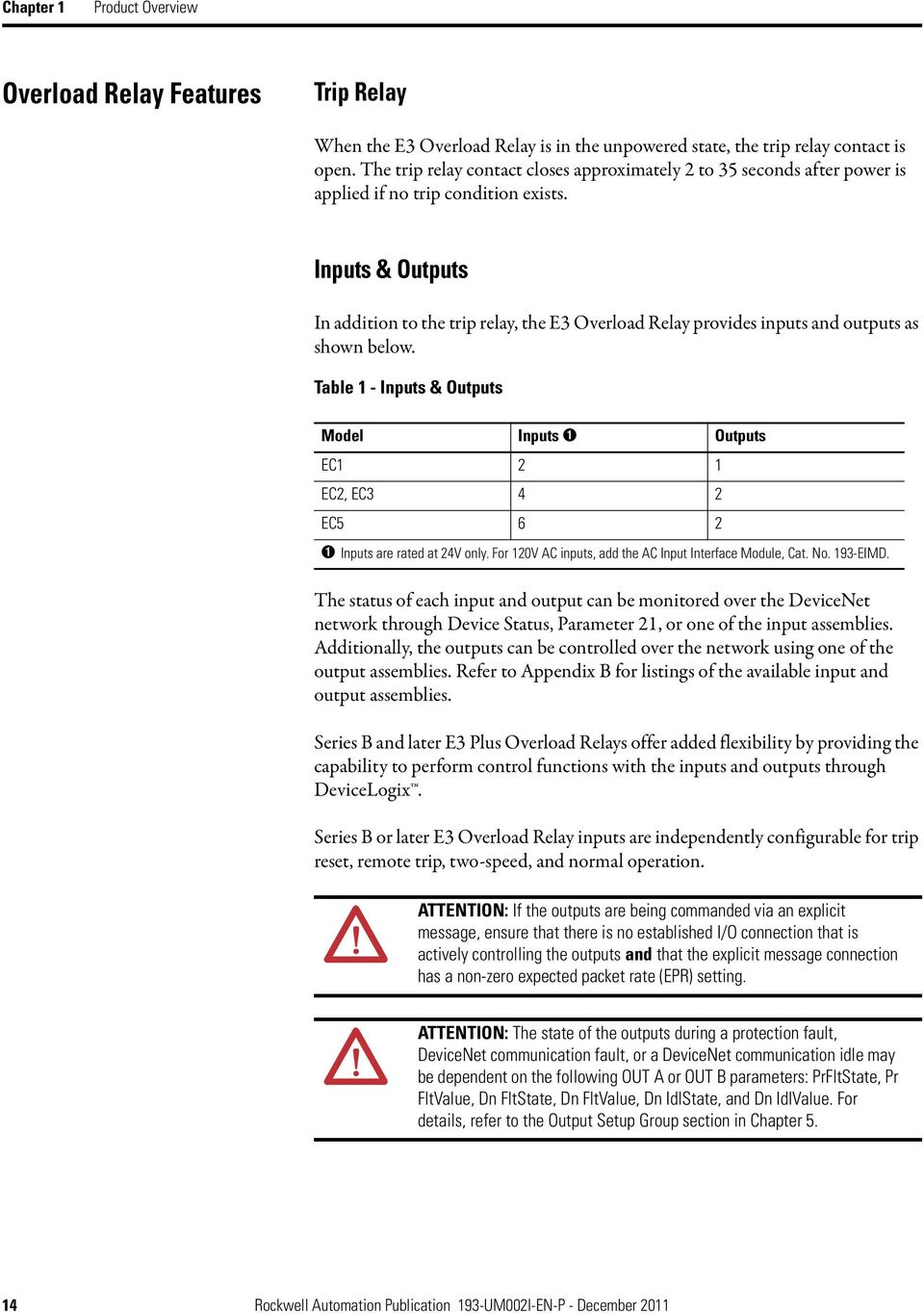
14 Chapter 1 Product Overview Overload Relay Features Trip Relay When the E3 Overload Relay is in the unpowered state, the trip relay contact is open. The trip relay contact closes approximately 2 to 35 seconds after power is applied if no trip condition exists. Inputs & Outputs In addition to the trip relay, the E3 Overload Relay provides inputs and outputs as shown below. Table 1 - Inputs & Outputs Model Inputs ➊ Outputs EC1 2 1 EC2, EC3 4 2 EC5 6 2 ➊ Inputs are rated at 24V only. For 120V AC inputs, add the AC Input Interface Module, Cat. No. 193-EIMD. The status of each input and output can be monitored over the DeviceNet network through Device Status, Parameter 21, or one of the input assemblies. Additionally, the outputs can be controlled over the network using one of the output assemblies. Refer to Appendix B for listings of the available input and output assemblies. Series B and later E3 Plus Overload Relays offer added flexibility by providing the capability to perform control functions with the inputs and outputs through DeviceLogix. Series B or later E3 Overload Relay inputs are independently configurable for trip reset, remote trip, two-speed, and normal operation. ATTENTION: If the outputs are being commanded via an explicit message, ensure that there is no established I/O connection that is actively controlling the outputs and that the explicit message connection has a non-zero expected packet rate (EPR) setting. ATTENTION: The state of the outputs during a protection fault, DeviceNet communication fault, or a DeviceNet communication idle may be dependent on the following OUT A or OUT B parameters: PrFltState, Pr FltValue, Dn FltState, Dn FltValue, Dn IdlState, and Dn IdlValue. For details, refer to the Output Setup section in Chapter Rockwell Automation Publication 193-UM002I-EN-P - December 2011
15 Product Overview Chapter 1 ATTENTION: The E3 Overload Relay s output control firmware latches OUT A and OUT B closed upon receipt of a network close command. The outputs will maintain the commanded closed state until receipt of a network open command. Parameters Out Pr FltState and Out Pr FltValue, found in the E3 Overload Relay s output setup group, allows flexibility concerning the operation of the outputs in the event of a trip. Factory default settings cause the outputs to open upon occurrence of a trip. E3 outputs that were closed prior to a trip will reclose upon trip reset, provided that a network open command is not received first. User Interface Refer to Figure 1 on page 11 for the location of LED status indication, Test/Reset button, and node address switches. LED Status Indication The following LED status indicators are provided on the E3 Overload Relay. See Chapter 12 for detailed information on each status. Network Status Illuminated in green or red, this indicates the network connection status. Trip/Warning Under a warning condition, the LED status flashes a sequence of red and/or amber. Under the trip condition, the LED status flashes a sequence of red. In either condition, the flash pattern followed by a pause identifies the specific trip or warning. The meaning of the flash pattern can be found on the E3 Overload Relay s side label or Table on page. OUT A and OUT B When the output contacts are commanded closed, the LED illuminates amber. IN 1 IN 4 When the user-connected device contact is closed, the LED status illuminates in amber. NOTE: IN 3, IN 4, and OUT B are available only on the E3 Plus Overload Relay. Test/Reset ButtonT Test If Test Enable is activated, the trip relay contact will open if the E3 Overload Relay is in an untripped condition and the Test/Reset button is pressed. For devices with firmware revision number (FRN) and later, the Test/Reset button must be pressed for a minimum of two seconds to activate the test function. Reset If the E3 Overload Relay (a) is in a tripped condition, (b) the cause of Rockwell Automation Publication 193-UM002I-EN-P - December

16 Chapter 1 Product Overview the trip is no longer present, and (c) the test/reset button is pressed, the trip relay contact will close. ATTENTION: The Test function associated with the Test/Reset button is enabled by default. Activating the Test function while a motor is operating will cause the starting contactor to drop out and stop motor operation. Node Address Switches The node address switches, located on the front of the Series B and later E3 Overload Relays, provide a physical means for setting the device node address value. Switch settings greater than 63 allow the node address to be software configured. DeviceNet Compatibility The E3 Overload Relay supports the following DeviceNet functionality: Functionality Polled I/O messaging Change-of-state/cyclic messaging Explicit messaging 4 off-line node recovery messaging Full parameter object support Auto-baud rate identification Configuration consistency value UCMM (Unconnected Message Manager) DeviceLogix component technology Models All models Series B and later devices E3 Plus, Series B and later devices Flash Memory Series B and later E3 Overload Relays incorporate flash memory. This facilitates updating of the product firmware as new revisions are released. IMPORTANT It is not possible to flash upgrade from Series B firmware to Series C firmware. 16 Rockwell Automation Publication 193-UM002I-EN-P - December 2011

17 Chapter 2 Installation & Wiring Introduction This chapter provides instructions for receiving, unpacking, inspecting, and storing the E3 Overload Relay. Installation and wiring instructions for common applications are also included. Receiving It is the responsibility of the user to thoroughly inspect the equipment before accepting the shipment from the freight company. Check the item(s) received against the purchase order. If any items are damaged, it is the responsibility of the user not to accept delivery until the freight agent has noted the damage on the freight bill. Should any concealed damage be found during unpacking, it is again the responsibility of the user to notify the freight agent. The shipping container must be left intact and the freight agent should be requested to make a visual inspection of the equipment. Unpacking/Inspecting Remove all packing material from around the E3 Overload Relay. After unpacking, check the item s nameplate catalog number against the purchase order. Storing The E3 Overload Relay should remain in its shipping container prior to installation. If the equipment is not to be used for a period of time, it must be stored according to the following instructions in order to maintain warranty coverage: Store in a clean, dry location. Store within an ambient temperature range of -40 C +85 C (-40 F +185 F). Store within a relative humidity range of 0 95%, non-condensing. Do not store where the device could be exposed to a corrosive atmosphere. Do not store in a construction area. Rockwell Automation Publication 193-UM002I-EN-P - December

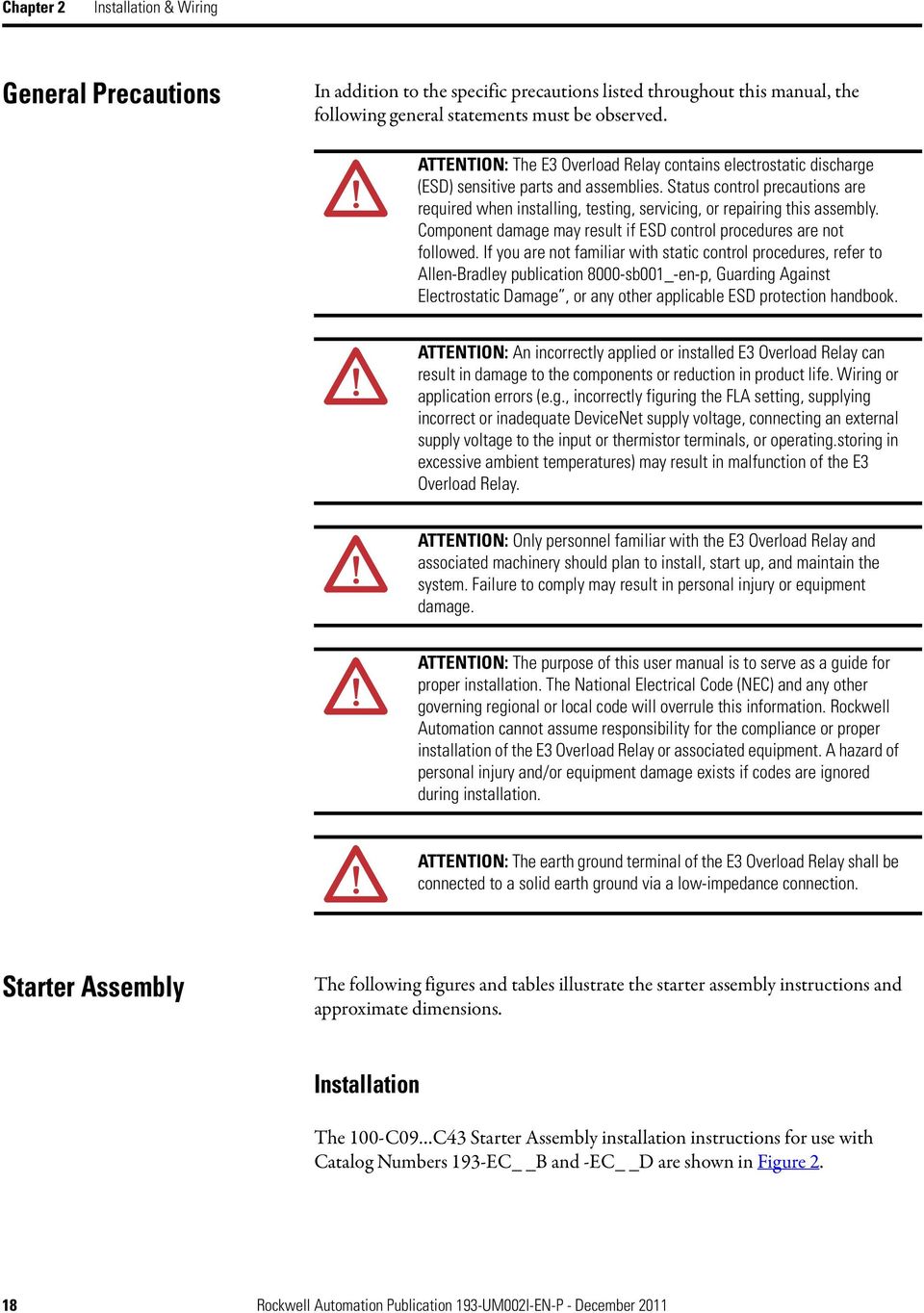
18 Chapter 2 Installation & Wiring General Precautions In addition to the specific precautions listed throughout this manual, the following general statements must be observed. ATTENTION: The E3 Overload Relay contains electrostatic discharge (ESD) sensitive parts and assemblies. Status control precautions are required when installing, testing, servicing, or repairing this assembly. Component damage may result if ESD control procedures are not followed. If you are not familiar with static control procedures, refer to Allen-Bradley publication 8000-sb001_-en-p, Guarding Against Electrostatic Damage, or any other applicable ESD protection handbook. ATTENTION: An incorrectly applied or installed E3 Overload Relay can result in damage to the components or reduction in product life. Wiring or application errors (e.g., incorrectly figuring the FLA setting, supplying incorrect or inadequate DeviceNet supply voltage, connecting an external supply voltage to the input or thermistor terminals, or operating.storing in excessive ambient temperatures) may result in malfunction of the E3 Overload Relay. ATTENTION: Only personnel familiar with the E3 Overload Relay and associated machinery should plan to install, start up, and maintain the system. Failure to comply may result in personal injury or equipment damage. ATTENTION: The purpose of this user manual is to serve as a guide for proper installation. The National Electrical Code (NEC) and any other governing regional or local code will overrule this information. Rockwell Automation cannot assume responsibility for the compliance or proper installation of the E3 Overload Relay or associated equipment. A hazard of personal injury and/or equipment damage exists if codes are ignored during installation. ATTENTION: The earth ground terminal of the E3 Overload Relay shall be connected to a solid earth ground via a low-impedance connection. Starter Assembly The following figures and tables illustrate the starter assembly instructions and approximate dimensions. Installation The 100-C09 C43 Starter Assembly installation instructions for use with Catalog Numbers 193-EC B and -EC D are shown in Figure Rockwell Automation Publication 193-UM002I-EN-P - December 2011
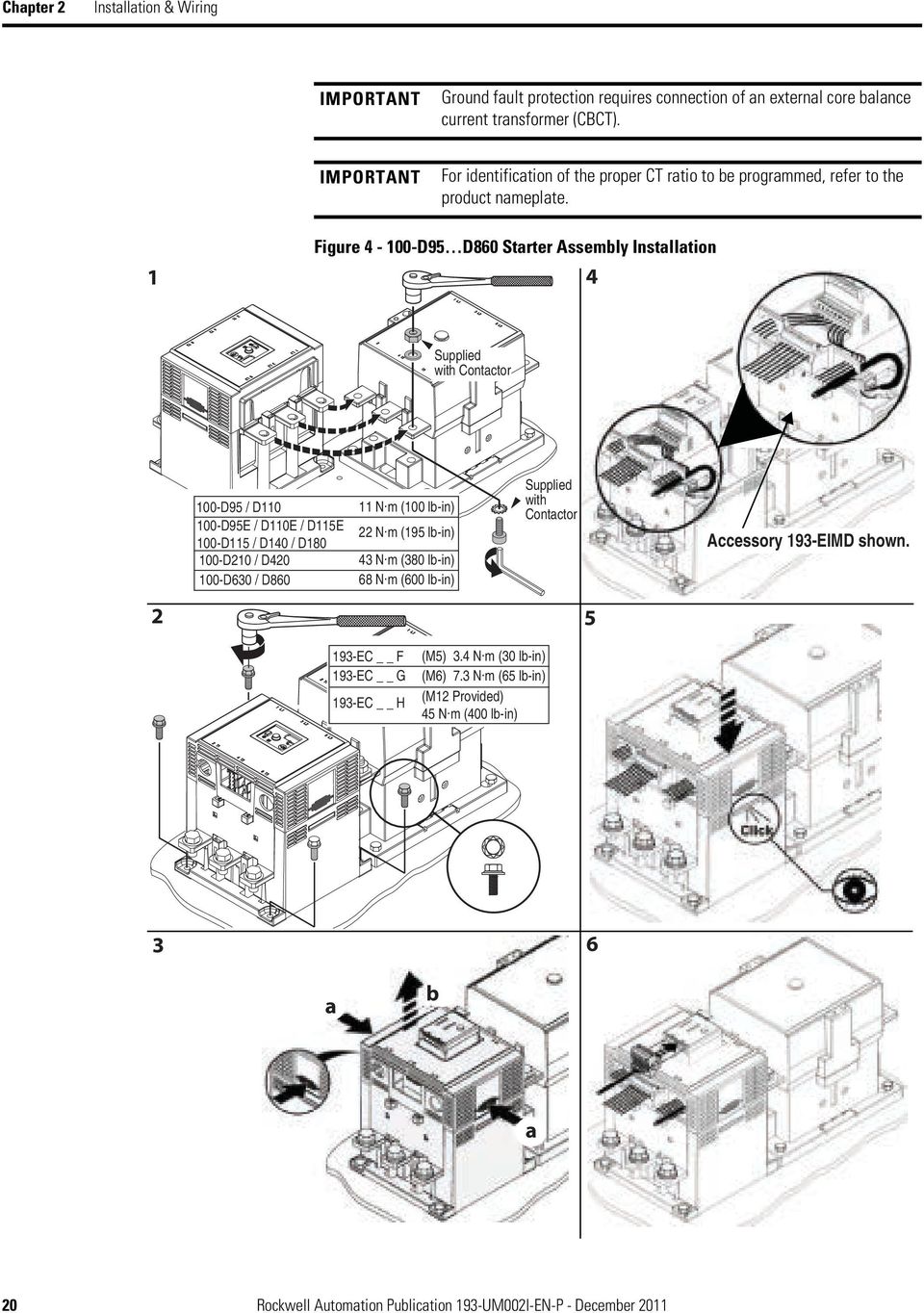
19 Installation & Wiring Chapter 2 Figure C09 C43 Starter Assembly Installation N m 2 lb in 3 1 The 100-C60 C85 Starter Assembly installation instructions for use with Catalog Numbers 193-EC E are shown in Figure 3. Figure C60 C85 Starter Assembly Installation N m 35 lb-in The 100-D95 D860 Starter Assembly installation instructions for use with Catalog Numbers 193-EC F, 193-EC G, and -EC H are shown below. ATTENTION: The voltage ratings of the E3 Overload Relay s output and trip relays must not be exceeded. If the voltage ratings are exceeded, an interposing relay must be used. ATTENTION: Connect the internal metal shield to a solid earth ground via a low impedance connection. Rockwell Automation Publication 193-UM002I-EN-P - December

20 Chapter 2 Installation & Wiring IMPORTANT Ground fault protection requires connection of an external core balance current transformer (CBCT). IMPORTANT For identification of the proper CT ratio to be programmed, refer to the product nameplate. Figure D95 D860 Starter Assembly Installation 1 4 Supplied with Contactor D95 / D D95E / D110E / D115E 100-D115 / D140 / D D210 / D N m (100 lb-in) 22 N m (195 lb-in) 43 N m (380 lb-in) 100-D630 / D N m (600 lb-in) Supplied with Contactor 5 Accessory 193-EIMD shown. 193-EC F 193-EC G 193-EC H (M5) 3.4 N m (30 lb-in) (M6) 7.3 N m (65 lb-in) (M12 Provided) 45 N m (400 lb-in) 3 6 a b a 20 Rockwell Automation Publication 193-UM002I-EN-P - December 2011
21 Installation & Wiring Chapter 2 Approximate Dimensions Approximate dimensions are shown in millimeters (inches). Dimensions are not intended to be used for manufacturing purposes. Figure 5 - Overload Relay 193-EC B, D, & E with Contactor 100-C* A D2 ØD H D1 E1 B B (29/64) F1 C Overload Relay 193-EC B Cat. No. Contactor 100- C09, C-12, C16, C23 Height B 193-EIMD Width A without with B1 45 (1-25/32) (7-13/32) (8-11/64) (5-23/32) Depth C E1 F1 D1 D2 H Ø D 107 (4-7/32) 67.9 (2-43/64) /32) 60 (2-23/64) 35 (1-3/8) 85.1 (3-23/64) 193-EC D C30, C (4-3/32) 193-EC E C60, C72, C85 C43 54 (2-1/8) 72 (2-53/64) (9-19/64) (10-1/16) (6-13/16) (4-29/32) 89.8 (3-17/32) 62.2 (2-7/16) 80.2 (3-9/64) 100 (3-15/16) 45 (1-25/32) 55 (2-11/64) 107 (4-7/32) (4-15/16) 4.2 (11/64) 5.5 (7/32) Rockwell Automation Publication 193-UM002I-EN-P - December
22 Chapter 2 Installation & Wiring Figure 6 - Overload Relay 193-E F, G, & H with Contactor 100-D* A G 11.4 (0.45) F D C L H E1 B1 K B J ØM C L Overload Relay Cat. No. Contactor EC F D95, D (4.72) 193-EC G D210, D250, D300, D420 Height B 193-EIMD Width A without with B (13.24) D140, D (13.38) 155 (6.10) 193-EC H D630, D (10.04) (15.19) 552 (21.73) 418 (16.46) (19.19) 915 (36.02) (12.27) (12.51) (14.2) 508 (20.0) Depth C D E1 F G H J K L ØM (6.89) (7.83) (11.49) 156 (6.14) 180 (7.09) (10.66) (8.51) 255 (10.04) (14.72) 12.5 (0.49) 16 (0.63) 21 (0.83) 52.5 (2.07) 100 (3.94) 130 (5.12) 226 (8.90) 145 (5.71) 180 (7.09) 230 (8.90) 135 (5.31) 140 (5.51) 108 (4.25) 22.3 (0.88) 23.5 (0.93) 109 (4.29) (7.12) (8.06) (11.71) 5.6 (0.22) 13 (0.51) 22 Rockwell Automation Publication 193-UM002I-EN-P - December 2011
23 Installation & Wiring Chapter 2 Figure 7 - Overload Relay 592-EC T, C, & D with NEMA Contactor Size 00 A D ØF Size A ØF H E J H E B B K 11.4 (29/64) Size 3 C 11.4 (29/64) L D 11.4 (29/64) C J E H B K ØF L D A C Cat. No. Overload Relay NEMA Contactor Size 592-EC T (1-25/32) 592-EC C 0, (3-9/16) (3-15/16) 592-EC D (6-1/8) Height B 193-EIMD Width A without with (7-13/32) (9-19/64) (8-11/64) 255 (10-1/16) Depth C D E ØF H J K L 107 (4-7/32) (4-13/32) (4-31/32) 35 (1-3/8) 69.9 (2-3/4) 80 (3-5/32) (5-33/64) 60 (2-23/64) (7-1/16) (8-5/8) (8-43/64) 4.2 (11/64) 5.15 ((13.64) 5.54 (7/32) 7.1 (9/32) 97.9 (3-27/32) (7-15/32) 186 (7-21/64) (10.9) 163 (6-7/16) (7-15/32) (10-3/32) 47.5 (1-7/8) 78.5 (3-3/32) 27.5 (1-5/64) 42.3 (1-21/32) Rockwell Automation Publication 193-UM002I-EN-P - December
24 Chapter 2 Installation & Wiring Separate Panel Adapter Approximate Dimensions Approximate dimensions are shown in millimeters (inches). Dimensions are not intended to be used for manufacturing purposes. Figure ECPM1 Panel Adapter for use with Cat. No. 193-EC B 45 (1-25/32) 7.3 (9/32) (6-17/64) 135 (5-5/16) (3-31/32) Ø 4.4 (11/64) 11.4 (29/64) 30 (1-3/16) 6.1 (1/4) 115 (4-17/32) Figure ECPM2 Panel Adapter for use with Cat. No. 193-EC D & Z 45 (1-25/32) 7.3 (9-32) (6-5/64) 135 (5-5/16) (3-31/32) Ø 4.4 (11/64) 11.4 (29/64) 30 (1-3/16) 6.1 (1/4) 115 (4-17/32) 24 Rockwell Automation Publication 193-UM002I-EN-P - December 2011
25 Installation & Wiring Chapter 2 Figure ECPM3 Panel Adapter for use with Cat. No. 193-EC E 71.7 (2-53/64) 60 (2-23/64) 11.4 (29/64) (5-15/16) (6-7/64) w/ 193-EIMD 130 (5-1/8) 15 (19/32) 77 (3-1/32) 5.0 (13/64) Ø 5.5 (7/32) (5-11/64) Figure 11 - Separate Panel Adapter for use with Cat. No. 193-EC F, G, & H D E F E M G K I H C B J A L N P Overload Cat. No. A B C D E F G H I J K L M N P 193-EC F 4.72 (120.0) 193-EC G 6.09 (154.7) 193-EC H 10.0 (255.0) 7.19 (182.6) 7.40 (188.1) (261.0) 6.09 (154.6) 6.41 (162.8) 8.54 (217.0) 3.94 (100) 5.12 (130) 8.90 (226) 1.54 (39) 1.89 (48) 2.76 (70) 0.45 (11.4) 0.45 (11.4) 0.45 (11.4) 1.03 (26.3) 1.06 (26.8) 3.97 (100.8) 5.32 (135) 5.51 (140.0) 4.24 (107.7) 1.94 (49.4) 2.03 (51.5) 1.37 (134.9) 0.22 (5.6) 0.26 (6.5) 0.53 (13.5) 0.24 (6.0) 0.08 (2.0) 0.47 (12) 0.49 (12.5) 0.87 (22.0) 5.95 (151.2) 6.89 (175) (267.8) 6.89 (175) 7.83 (198.9) (291.7) 7.12 (180.9) 8.06 (204.7) (297.5) Rockwell Automation Publication 193-UM002I-EN-P - December
26 Chapter 2 Installation & Wiring Voltage Input Module The voltage input module, Cat. No. 193-NVEC5VIM, is an add-on accessory for use with the E3 Plus. Approximate dimensions are shown in millimeters (inches). Dimensions are not intended to be used for manufacturing purposes. Figure NVEC5VIM Voltage Input Module (22.5) L1 L (75.5) L (11.6) (70.65) Ø (4.5) (82.0) Specifications Power Terminals Table 2 - Wire Size & Torque Specification Wire Type Conductor Torque Cat. No. 193-EC B & D, 592-EC T, C Stranded/Solid [AWG] Single #14 6 AWG 22 lb-in. Multiple #10 6 AWG 30 lb-in. Flexible-Stranded with Ferrule Metric Single mm Nm Multiple 6 10 mm Nm Coarse-Stranded/Solid Metric Single mm Nm Multiple 6 16 mm Nm 193-EC E, 592-EC D #12 1 AWG 35 lb-in. #6 2 AWG 35 lb-in mm 2 4 Nm 4 25 mm 2 4 Nm 4 50 mm 2 4 Nm 4 35 mm 2 4 Nm 26 Rockwell Automation Publication 193-UM002I-EN-P - December 2011
27 Installation & Wiring Chapter 2 Three-Pole Terminal Blocks Table 3 - Three-Pole Terminal Blocks Cat. No. 100-DTB1890 (A) 6 1/0 AWG, mm 2 (B) 6 AWG 250 MCM, mm lb.-in., Nm 100-DTB420 (2) 4 AWG 600 MCM, mm lb.-in., Nm Terminal Lug Kits Table 4 - Terminal Lug Kits Cat. No. 100-DL 110 Lug 6 2/0 AWG, mm 2 Terminal lb.-in., Nm 13/32 in, 10 mm 150 lb.-in., 17 Nm 180 Lug 6 AWG 250 MCM, mm lb.-in., Nm Terminal 1/2 in., 13 mm 275 lb.-in., 16 Nm 420 Lug 2 AWG 350 MCM 375 lb.-in., 42 Nm Terminal 11/16 in., 17 mm 140 lb.-in., 16 Nm 630 Lug 2/0 AWG 500 MCM, mm lb.-in., 45 N Terminal 3/4 in, 19 mm 600 lb.-in., 68 Nm 860 Lug 2/0 AWG 500 MCM, mm lb.-in., 45 Nm Terminal 3/4 in, 19 mm 600 lb.-in., 68 Nm Control, DeviceNet, & Voltage Input Module Terminals Table 5 - Wire Size & Torque Specification Wire Type Conductor Torque All Cat. No. Types Stranded/Solid [AWG] Single AWG Multiple (stranded only) AWG 5 lb-in Rockwell Automation Publication 193-UM002I-EN-P - December
28 Chapter 2 Installation & Wiring Wire Type Conductor Torque All Cat. No. Types Flexible-Stranded with Ferrule Metric Single mm 2 Multiple mm Nm Coarse-Stranded/Solid Metric Single mm 2 Multiple mm Nm Table 6 - Maximum Wire Length (PTC & input) Minimum Cross Section mm AWG Maximum Length ➊ meters feet ➊ The use of shielded cable is recommended for the PTC thermistor circuit to assist in obtaining compliance with Electromagnetic Compatibility (EMC) requirements. Shielded cable is recommended for the input circuits, where wire lengths exceed 200 meters (656 feet). NOTE: For reliable input signal processing, input wiring should be routed in raceways separate from power cabling. Table 7 - Ground Fault Sensor Terminals (S1 & S2) Wire Type Cross Section Torque Shielded, Twisted Pair mm 2 (#24 12 AWG) 0.55 N m (5 lb.-in.) 28 Rockwell Automation Publication 193-UM002I-EN-P - December 2011
29 Installation & Wiring Chapter 2 Terminal Designations Control Terminals Table 8 - Control Terminal Designation Terminal Reference Description 1 IN IN2 2 General Purpose Sinking Input Number: 3 IN 3 3 ➊➋ 4 IN 4 4 ➊➋ 5 V+ +24V 6 V+ 7 IN 5 5 ➋ General Purpose Sinking Input Number: 8 IN 6 6 ➋ END Earth Ground ➌ 13/14 OUT A Output A 23/24 OUT B Output B ➊➋ 95/96 Trip Relay Trip Relay IT1/IT2 PTC Thermistor (PTC) Input ➊➍ S1/S2 External Ground Fault Sensor Input ➋➎ ➊ Features are available only with the E3 Plus Overload Relay (Cat. No. 193/592-EC2 and 193/592-EC3). ➋ Available only on Cat. Nos. 193/592-EC5. ➌ An earth ground connection to this terminal will assist in obtaining compliance with EMC requirements. ➍ The use of shielded cable is recommended for the positive PTC thermistor circuit to assist in obtaining compliance with EMC requirements. ➎ Available only on Cat. No. 193/592-EC3 and 193/592-EC4. DeviceNet Terminals Table 9 - DeviceNet Terminal Designation Terminal Signal Function Color 1 V- Common Black 2 CAN_L Signal Low Blue 3 Drain Shield Non-Insulated 4 CAN_H Signal High White 5 V+ Po9wer Supply Red Grounding The following grounding recommendations are provided to ensure EMC requirements during installation. Rockwell Automation Publication 193-UM002I-EN-P - December
30 Chapter 2 Installation & Wiring The earth ground terminal of the E3 Overload Relay shall be connected to a solid earth ground via a low-impedance connection. Installations employing an external ground fault sensor shall ground the cable shield at the sensor with no connection made at the E3 Plus Overload Relay. The PTC thermistor cable shield shall be grounded at the E3 Plus Overload Relay with no connection made at the opposite end. Short-Circuit Ratings The E3 Overload Relay is suitable for use on circuits capable of delivering not more than the RMS symmetrical amperes listed in the following tables. Short-Circuit Ratings Table 10 - UL Cat. No. Maximum 193-EC 592-EC Available Fault Current [A] Voltage [V] B T 5, D C E D 10,000 F G 18,000 H 42,000 Z 5,000 Table 11 - IEC Cat. No. Prospective Conditional Short-Circuit 193-EC 592-EC Current I r [A] Current I q [A] Maximum Voltage [V] B T 1, , D C 3,000 E D 5, Rockwell Automation Publication 193-UM002I-EN-P - December 2011
31 Installation & Wiring Chapter 2 High-Fault Short-Circuit Ratings Table 12 - Per UL 508 & CSA 22.2, No. 14 with Bulletin 100-C & 100-D Contactors Cat. No. 193-EC1, -EC2, -EC3, -EC4, -EC5 Contactor 100- Starter FLC [A] Available Fault Current [A] Maximum Voltage [V] _B C , C C C _D C , C C _E C , C C FF, ZZ D , D D GF, ZZ D , GG, ZZ D , D D HG, ZZ D , D D JG, ZZ D , D Class J or CC Fuse [A] Rockwell Automation Publication 193-UM002I-EN-P - December
32 Chapter 2 Installation & Wiring Table 13 - Per UL 508 & CSA 22.2, No. 14 with NEMA Contactors Cat. No. 592-EC1, -EC2, -EC3, -EC5 Maximum Contactor Available Fault Voltage UL Fuse [A] Size Current [A] [V] R J _T , Circuit Breaker/ Limiter _C 0 100, FDB 3025/ LFB3070R FDB 3025/ LFB3070R , FDB 3050/ LFB3035R FDB 3050/ LFB3035R , FDB 3100/ LFB3150R _D 3 100, FDB 3150/ LFB3150R FDB 3125/ LFB3150R FDB 3100/ LFB3150R Fuse Coordination The following tables list Type I and Type II Fuse Coordination when used in conjunction with Bulletin 100-C and 100-D Contactors. ATTENTION: Select the motor branch circuit protection that complies with the NEC and any other governing regional or local codes. 32 Rockwell Automation Publication 193-UM002I-EN-P - December 2011
33 Installation & Wiring Chapter 2 Table 14 - IEC per EN Cat. No EC1, EC2, EC3, EC4, EC5 Contactor 100- Max. Starter FLC [A] Short-Circuit Current Prospective I r [A] Conditional I q [A] Max. Voltage [V] Class J Fuse [A] with Type I _B C09 9 1, , C C C _D C , , C C _E C , , with Type II C C , FF, ZZ D , , D D GF, ZZ D , , GG, ZZ D , , D D HG, ZZ D , , D D JG, ZZ D , , D Table 15 - NEMA Contactors Cat. No. 592-EC Contactor Size Max. Starter FLC [A] Short-Circuit Current Prospective I r [A] Conditional I q [A] Max. Voltage [V] Class J Fuse [A] with Type I _T , , _C 0, 1 18, 27 3, with Type II _D , Rockwell Automation Publication 193-UM002I-EN-P - December
34 Chapter 2 Installation & Wiring Typical Motor Connections Three-Phase Direct On-Line (DOL) & Single-Phase Full Voltage ATTENTION: When working on energized circuits, DO NOT rely on voltage and current information provided by the E3 and E3 Plus Overload Relay for personal safety. Always use a portable voltage or current measurement device to measure the signal locally. IMPORTANT Single/Three Ph, Parameter 27, should be set to single-phase. IMPORTANT Traditional single-phase wiring connecting T2 to L3 will result in a vector imbalance of current flowing through the E3 Plus Overload Relay. This will result in inaccurate ground fault reporting and protection. The following wiring diagram illustrates the E3 Overload Relay typical motor connections in a three-phase DOL and Single-Phase Full Voltage applications. Figure 13 - Wiring Diagram, Three-Phase DOL & Single-Phase Full Voltage Three-Phase Direct-On-Line Single-Phase Full-Voltage S.C.P.D. S.C.P.D. L1 L2 L3 L1 L2 L1 L2 L3 Voltage Input Module (For 193/592-EC5 only) E3/E3Plus 2/T1 4/T2 6/T3 E3/E3 Plus 2/T1 4/T2 6/T3 L1 L2 Voltage Input Module (For 193/592-EC5 only) T1 T2 T3 T1 T2 M M External Line Current Transformer Application 193-EC_ZZ E3 and E3 Plus Overload Relays are designed for use with separately mounted, customer-supplied, line current transformers (CTs) as required in higher-current applications. The FLA setting range is A for these units with a legal setting range per current transformer. CT Ratio, Parameter 78, is provided for setting the current transformer ratio to be installed. Specifications The 193-EC_ZZ Overload Relays are intended for use with CTs having a secondary current rating of 5 A. The installer shall (1) provide one CT for each motor phase and shall (2) connect the CT s secondary leads to the appropriate E3 34 Rockwell Automation Publication 193-UM002I-EN-P - December 2011
35 Installation & Wiring Chapter 2 Overload Relay power terminals as shown in Figure 14 on page 36. The CTs shall have an appropriate ratio rating as detailed in Table 18. Additionally, the CT shall be selected to be capable of providing the required VA to the secondary load, which includes the E3 Overload Relay burden of 0.1 VA at the rated secondary current and the wiring burden. Finally, the CT shall (1) be rated for Protective Relaying to accommodate the high inrush currents associated with motor startup and shall (2) have an accuracy of ±2% over its normal operating range. Typical CT ratings include: ANSI USA CSA (Canada) IEC (Europe) Class C5 BO.1 Class 10L5 5 VA Class SP10 ATTENTION: The improper selection of a current transformer can result in the E3 Overload Relay reporting inaccurate motor operational data and possible motor damage. The selected current transformer must be rated for protective relaying applications. Installation Requirements The 193-EC_ZZ Overload Relays are designed to be installed in193- ECPM2 Panel Mount Adapters and connected to separately mounted current transformers. For 193-ECPM2 Panel Mount Adapter assembly, refer to the instructions included with the panel mount adapter. ATTENTION: Placing the E3 Overload Relay closer than the recommended distance, six times the cable diameter (including insulation), may compromise its current reporting and protection capabilities. The E3 Overload Relay must be mounted a distance equal to or greater than six times the cable diameter (including insulation) from the nearest current-carrying conductor or current transformer. For applications employing multiple conductors per phase, the diameter of each cable should be added and multiplied by six to determine the proper placement distance for the E3 Overload Relay. Rockwell Automation Publication 193-UM002I-EN-P - December
36 Chapter 2 Installation & Wiring Figure 14 - Overload Relay Mounting Placement E3 Overload Relay Primary Current Transformers 6x or 6x Figure 15 - External CT Connection Diagrams IEC NEMA L1 L2 L3 L1 L2 L3 K1 L1/1 L2/3 L3/5 L1/1 L2/3 L3/5 Primary Current Transformers E3 T1/2 T2/4 T3/6 Primary Current Transformers E3 T1/2 T2/4 T3/6 M T1 T2 T3 M External Potential Transformer (PT) Connection The 193/592-EC5 E3 Plus Overload Relay can be used with external stepdown PTs. The PT ratio is programmed into the E3 Plus Overload Relay by entering the primary winding rating into PT Pri, Parameter 289, and the secondary winding rating into PT Sec, Parameter 290. The voltage mode is also programmed into the E3 Plus Overload Relay by selecting the appropriate mode in Volt Mode, Parameter 156. The E3 Overload Relay Plus will support Wye, Delta, and Open Delta voltage modes with potential transformers. 36 Rockwell Automation Publication 193-UM002I-EN-P - December 2011
37 Installation & Wiring Chapter 2 Table 16 - Wiring Diagrams, External PT Connection Wye Connection with PTs Line L1 L2 L3 N/GRND Delta Connection with PTs Line L1 L2 L3 L1 L2 L3 L1 L2 L3 Load Load Open Delta Connection with PTs Line L1 L2 L3 L1 L2 L3 Load Core Balanced Ground Fault Sensor Application The 193-EC3 E3 Plus Overload Relays are intended to provide ground fault protection when used with the external 193-CBCT_ Core Balanced Ground Fault Sensor. The ground fault sensor mounts separately from the E3 Plus Overload Relay and must be placed within three meters of the E3 Plus Overload Relay. The customer-supplied power cable for wiring the ground fault sensor to the E3 Plus Overload Relay must meet the specifications outlined in Table 7 on page 28. Power Cable Installation Requirements All power cables (including the neutral when used) must pass through the sensor window. The equipment ground conductor (the conductor used to carry the non-current-carrying metal parts of equipment, as defined by Article 100 of the NEC) must not pass through the sensor window. The power cables through the sensor window should be straight, tightly bundled, centered in the window, and perpendicular to the sensor for a length equal to or greater than six times the cable diameter (including insulation) from the sensor. All other conductors with available fault currents in excess of 1,000 A should be placed a distance equal to or greater than six times the cable diameter (including insulation) from the sensor. The power cables of the branch circuit to be protected by the E3 Plus Overload Relay must not be grounded on the load side of the ground fault sensor. Rockwell Automation Publication 193-UM002I-EN-P - December
38 Core Balanced Ground Fault Sensor Chapter 2 Installation & Wiring If the power cables are enclosed in a conducting jacket, the jacket must be grounded on the line side of the sensor. The jacket must not pass through the sensor window, but must be cut at the window and joined with a conductor that passes outside the sensor window. The power system may be solidly grounded or grounded through an impedance at its source as long as the impedance allows a magnitude of current to flow that is within the 20 ma 5 A operational range of the E3 Plus Overload Relay. Figure 16 - Core Balanced Ground Fault Sensor Mounting Placement 90 6x Power Cables 6x Figure 17 - Power Cable Configuration Two Cables per Phase L2 L3 1 L1 L2 1 The spacer is a short piece of cable, approximately ten times the cable diameter in length, without connections to any terminal. L1 L3 Figure 18 - Ground Fault Sensor Wiring E3 Plus Overload Relay L1 L2 L3 L1 L2 L Cat. No. 193-CBCT_ Core Balanced Ground Fault Sensor S1 S T1 1T T1 T2 T Motor 38 Rockwell Automation Publication 193-UM002I-EN-P - December 2011
39 Installation & Wiring Chapter 2 Control Wire Requirements IMPORTANT The shield of the twisted pair cable must be connected to earth ground at the ground fault sensor with no connection made at the E3 Plus Overload Relay. The maximum length of the shielded cable is 100 feet (30.48 meters). All control terminals are for copper wire only in sizes #12 24 AWG. Ring lug termination is required for the ground sensor terminals of 193- CBCT2 and larger. The sensor fastener torque is lb-in. The 193-CBCT1 wires should be twisted before termination by applying one twist per inch (per 25.4 millimeters). Table 17 - Control Wire Specifications Cat. No Max. Current [A] Hz Turns Ratio Sensor Window I.D. Max. Recommended Cable 600V Cat. No. 100-C09 IEC Contactor NEMA Contactor Size CBCT / : mm (.75 in.) #8 AWG (10 mm 2 ) ➊ -C CBCT2 90 #2 AWG (350 mm 2 ) ➊ -C CBCT3 180 #250 MCM (120 mm 2 ) ➊ -D CBCT4 420 $350 MCM (185 mm 2 ) ➋ -D ➊ For a three-phase system with one cable per phase. ➋ For a three-phase system with two cables per phase. Approximate Dimensions Approximate dimensions are shown in millimeters (inches). Dimensions are not intended to be used for manufacturing purposes. Rockwell Automation Publication 193-UM002I-EN-P - December
40 Chapter 2 Installation & Wiring Figure CBCT (.50) 45.3 (1.78) 23.1 (.91) Ø 44.5 (1.75) 50.8 (2.00) 63.5 (2.50) Ø 19.1 (.75) 3.2 (.12) 4.0 (.16) Figure CBCT2 & 193-CBCT3 E 44.5 (1.75) 11.8 (.47) A C 3.2 (.13) 5.3 (.21) Ø D F B Cat. No. A B C ØD E F 193-CBCT2 96 (3.78) 193-CBCT (4.82) 89.6 (3.53) (4.56) 48.3 (1.90) 59.7 (2.35) 39.6 (1.56) 63.5 (2.50) 54.6 (2.15) 54.1 (2.13) 69.9 (2.75) 98.0 (3.78) Figure CBCT (2.93) 56.2 (2.21) 11.8 (.47) 82.6 (3.25) (5.78) 74.9 (2.95) 3.2 (.13) 5.5 (.22) (4.85) (3.81) (5.65) 40 Rockwell Automation Publication 193-UM002I-EN-P - December 2011
41 Installation & Wiring Chapter 2 Typical Control Circuit Wiring Diagrams ATTENTION: Do not exceed the ratings of the E3 Overload Relay s output and trip relay. If the coil current or voltage of the contactor exceeds the overload relay s ratings, an interposing relay must be used. ATTENTION: When the power is applied to the E3 Overload Relay, DeviceNet terminals V+ and V-, the N.O. trip relay contact across terminals 95 and 96 will close after approximately 2.35 seconds if no trip condition exists. ATTENTION: Additional control circuit protection may be required. Refer to the applicable electrical codes. ATTENTION: Do not apply external voltage to 1T1, 1T2, or the input terminals IN 1 4. This may cause equipment damage. Full-Voltage Non-Reversing Starter (with Network Control) Figure 22 - NEMA Nomenclature Single-Phase Three-Phase SPCD SPCD L1 L2 E3/E3 Plus 2/T1 4/T2 6/T3 L1 L2 L3 E3/E3 Plus 2/T1 4/T2 6/T3 E3 Out A A1 A2 M E3 Trip Relay T1 T2 M T1 T2 T3 M 1 Contact shown with supply voltage applied. Rockwell Automation Publication 193-UM002I-EN-P - December
42 Chapter 2 Installation & Wiring Figure 23 - CENELEC Nomenclature Single-Phase Three-Phase L1 A1 K1 A A1 K1 A E3 Out A E3 Trip Relay 2 95 T1 T3 T5 T1 T3 T5 96 M M K A1 A2 2 Contact shown with supply voltage applied. N Full-Voltage Reversing Starter (with Network Control) Figure 24 - NEMA Nomenclature E3 Plus Out A REV E3 Plus Trip Relay A1 FOR A E3 Plus Out B FOR A1 REV A2 1 Contact shown with supply voltage applied. Figure 25 - CENELEC Nomenclature L1 E3 Plus Trip Relay E3 Plus Out A E3 Plus Out B K2 K1 N A1 K1 A2 A1 K2 A2 2 Contact shown with supply voltage applied. 42 Rockwell Automation Publication 193-UM002I-EN-P - December 2011
43 Installation & Wiring Chapter 2 Figure 26 - IEC Reversing Starter Application Schematic 24V - CAN L Shield CAN H 24V + DeviceNet red white shield blue black 24V CAN H CAN L 24V - 23 OUT B A1 A2 K1M K2M OUT A A1 A2 96 K2M K1M 230V AC N Q1 6 24V + 5 IN IN3 Q K2M K1M IN2 IN1 1T2 1T K2M F W V U M 3~ L3 L2 L Q K1M Two-Speed Non-Reversing (with Network Control) The following figures show wiring diagrams of two-speed non-reversing starters with Series B and later E3 Plus Overload Relays. Figure 27 - NEMA Nomenclature E3 Plus Out A HIGH E3 Plus Trip Relay 1 A1 A LOW E3 Plus Out B LOW A1 HIGH A2 1 Contact shown with supply voltage applied. Rockwell Automation Publication 193-UM002I-EN-P - December
44 Chapter 2 Installation & Wiring Figure 28 - CENELEC Nomenclature L1 E3 Plus Trip Relay E3 Plus Out B E3 Plus Out A K2 K1 A1 A1 K1 K2 A2 A2 N 2 Contact shown with supply voltage applied. External/Remote Reset (FRN & Later) To reset a trip from an external/remote location, configure one of the E3 Overload Relay s inputs for trip reset operation using one of Parameters Wire the input as shown below. Figure 29 - Reset Wiring Reset IMPORTANT Reset operation is edge sensitive and trip free. That is, holding the push button down (maintaining the reset contact in a closed position) will not prevent the E3 Overload Relay from tripping. 44 Rockwell Automation Publication 193-UM002I-EN-P - December 2011
45 Chapter 3 Protective Trip & Warning Functions Introduction The purpose of this chapter is to provide detailed information regarding the protective trip and warning functions of the E3 Overload Relay. In this chapter, you will find considerable mention given to programming parameters as they relate to these functions. For complete descriptions of the programming parameters, refer to Chapter 5 Programmable Parameters. Trip Enable Trip Enable, Parameter 24, allows the installer to enable or disable the desired protective functions separately. The overload, phase loss, and communication fault trip functions are enabled from the factory. IMPORTANT The E3 Overload Relay requires overload trip protection to be enabled at all times. The E3 Plus Overload Relay requires either overload or PTC trip protection to be enabled at all times. ATTENTION: To avoid unexpected behavior of the outputs, the Trip Enable settings should not be altered during the machine operation. Doing so may result in an unintended actuation of controlled industrial equipment with potential for machine damage or serious injury to personnel. Warning Enable Warning Enable, Parameter 25, allows the installer to enable or disable the desired warning functions separately. All warning functions are disabled from the factory. Overload Protection The E3 Overload Relay provides overload protection through true RMS current measurement of the individual phase currents of the connected motor. Based on the maximum current measured and the programmed FLA Setting and Trip Class, a thermal model that simulates the actual heating of the motor is calculated. The percent thermal capacity utilized, Parameter 9, reports this calculated value and can be read via the DeviceNet network. Overload Trip The E3 Overload Relay will trip with an overload indication if: no trip currently exists, overload protection is enabled, and Rockwell Automation Publication 193-UM002I-EN-P - December
46 Chapter 3 Protective Trip & Warning Functions % Therm Utilized reaches 100%. If the E3 Overload Relay trips on an overload, the following will occur: the TRIP/WARN LED will flash a red two-blink pattern, Bit 1 in Trip Status, Parameter 14, will go to 1, Bit 0 in Device Status, Parameter 21, will go to 1, the Trip Relay contact will open, and the outputs will be placed in their Protection Fault state (if so programmed). IMPORTANT The Protection Fault State of OUT A and OUT B is defined by: OUTA Pr FltState, Parameter 65 OUTA Or FltValue, Parameter 66 OUTB Pr FltState, Parameter 71 OUTB Pr FltValue, Parameter 72 FLA Setting The FLA Setting, Parameter 28, is provided for the installer to enter the motor s full-load current rating. The 2-SpdFLA Set, Parameter 88, is provided in series B and later E3 Plus Overload Relay units for programming the high-speed FLA values in two-speed motor applications. The FLA Setting ranges and default values for the various E3 Overload Relays can be found in Chapter 5 Programmable Parameters. Below are setting guidelines regarding service factor, maximum continuous rated (MCR) motors, and wye-delta (star-delta) motors. USA & Canada Guidelines Motor Service Factor 1.15: For motors with a service factor rating of 1.15 or greater, program the FLA setting to the printed nameplate s fullload current rating. Motor Service Factor < 1.15: For motors with a service factor rating less than 1.15, program the FLA setting to 90% of the printed nameplate s fullload current rating. Wye-Delta (Y-Δ) Applications: Follow the application s service factor instructions, except divide the printed nameplate s full-load current rating by Outside USA & Canada Guidelines Maximum Continuous Rated (MCR) Motors: Program the FLA setting to the printed nameplate s full-load current rating. Star-Delta (Y-Δ) Applications: Follow the MCR instructions, except divide the printed nameplate s full-load current rating by Rockwell Automation Publication 193-UM002I-EN-P - December 2011
47 Protective Trip & Warning Functions Chapter 3 CT Ratio Devices with the FLA setting range of A (Cat. No. 193-EC_ZZ) are intended for use with primary current transformers. CT Ratio, Parameter 78, allows the installer to identify the turns ratio of the transformers(s) in use. Each CT Ratio selection has a corresponding valid FLA setting range, as described in the following table. Table 18 - CT Ratio/FLA Setting Range Correspondence CT Ratio FLA Setting Range (A) CT Ratio FLA Setting Range (A) CT Ratio FLA Setting Range (A) 50: : : : : : : : : : : ATTENTION: Improper configuration of the CT Ratio parameter can result in the E3 Overload Relay reporting inaccurate motor operational data and possible motor damage. IMPORTANT Catalog Numbers 193-EC F, G, and H are assemblies that contain primary current transformers. The device nameplate identifies the propter CT ratio to be programmed and the associated legal FLA setting range. IMPORTANT The E3 Overload Relay s TRIP/WARN LED status indicator will flash an amber configuration warning (13-flash sequence) when the FLA setting is outside of the legal range of the selected CT Ratio setting (e.g., CT Ratio set at 300:5 and the FLA Setting at 50 A). Trip Class Trip Class is defined as the maximum time (in seconds) for an overload trip to occur when the motor s operating current is six times its rated current. The E3 Overload Relay offers an adjustable trip class range of 5 30, which can be programmed in increments of one via Trip Class, Parameter 29. Trip Curves The following figures illustrate the E3 Overload Relay s time-current characteristics for trip classes 5, 10, 20, and 30. Rockwell Automation Publication 193-UM002I-EN-P - December
48 Chapter 3 Protective Trip & Warning Functions Figure 30 - Time-Current Characteristics for Trip Classes 5, 10, 20, & Trip Class Trip Class 10 Cold Trip Hot Trip Time (seconds) Time (seconds) % Current (% FLA) 1000% 1 100% Current (% FLA) 1000% Trip Class Trip Class 30 Time (seconds) Time (seconds) % Current (% FLA) 1000% 1 100% Current (% FLA) 1000% For trip class time-current characteristics other than 5, 10, 20, or 30, scale the Class 10 trip time according to the following table: Table 19 - Time-Current Characteristic Scaling Factors Trip Class Trip Class 10 Multiplier Trip Class Trip Class 10 Multiplier Trip Class Trip Class 10 Multiplier 48 Rockwell Automation Publication 193-UM002I-EN-P - December 2011
49 Protective Trip & Warning Functions Chapter 3 Auto/Manual Reset OL/PTC ResetMode, Parameter 30, allows the user to select the reset mode for the E3 Overload Relay after an overload or thermistor (PTC) trip. If an overload trip occurs and automatic reset mode is selected, the E3 Overload Relay will automatically reset when the value stored in % Therm Utilized, Parameter 9, falls below the value stored in OL Reset Level, Parameter 31. If manual reset mode is selected, the E3 Overload Relay can be manually reset after the % Therm Utilized is less than the OL Reset Level. OL Reset Level, Parameter 31, is adjustable from 1 to 100% TCU. The following table illustrates the typical overload reset time delay when OL Reset Level is set to 75% TCU. Table 20 - Typical Overload Relay Reset Time Delays Trip Class Reset Delay Time in Seconds ➊ ➊ Times shown are based on OL Reset Level, Parameter 31, being set to 75% TCU. For reset time delays corresponding to other OL Reset Level settings, see the following charts. Rockwell Automation Publication 193-UM002I-EN-P - December
50 Chapter 3 Protective Trip & Warning Functions Figure 31 - Overload Reset Times OL Reset Level (% TCU) OL Reset Level (% TCU) Time to Reset in Seconds Time to Reset in Seconds Trip Class 5 Trip Class 10 Trip Class 20 Trip Class 30 ATTENTION: In explosive environment applications, OL/PTC Reset Mode, Parameter 30, must be set to Manual. ATTENTION: In an explosive environment applications, OL Reset Level, Parameter 31, must be set as low as possible or in accordance with the motor thermal time constant. Overload Warning The E3 Overload Relay will indicate an overload warning if: no warning currently exists, overload warning is enabled, and % Therm Utilized is equal to or greater than OL Warn Level. When the overload warning conditions are satisfied, the: TRIP/WARN LED status indicator will flash an amber 2-blink pattern, Warning Status, Parameter 15, will set to 1, and Device Status, Parameter 21, will set to 1. OL Warn Level, Parameter 32, can be used as an alert for impending overload trip and is adjustable from 0 100% TCU. 50 Rockwell Automation Publication 193-UM002I-EN-P - December 2011
51 Protective Trip & Warning Functions Chapter 3 Overload Diagnostics Time to Trip When the measured motor current exceeds the trip rating of the E3 Overload Relay, the Time to Trip, Parameter 12, indicates the estimated time remaining before an overload trip occurs. When the measured current is below the trip rating, the Time to Trip value is reported as 9,999 seconds. Time To Reset After an overload trip, the E3 Overload Relay will report the time remaining until the device can be reset through Time to Reset, Parameter 13. Once the % Therm Utilized value falls to or below the OL Reset Level, the Time to Reset value will indicate zero until the overload trip is reset. After an overload trip is reset, the Time to Reset value is reported as 9,999 seconds. Non-Volatile Thermal Memory The E3 Overload Relay includes a non-volatile circuit to provide thermal memory. The time constant of the circuit corresponds to a Trip Class 30 setting. During normal operation, the thermal memory circuit is continually monitored and updated to accurately reflect the thermal utilization of the connected motor. If power is removed, the thermal memory of the circuit decays at a rate equivalent to the cooling of a Trip Class 30 application. When the power is re-applied, the E3 Overload Relay checks the thermal memory circuit voltage to determine the initial value of % Therm Utilized, Parameter 9. Phase Loss Protection A high current imbalance, or phase failure, can be caused by defective contacts in a contactor or circuit breaker, loose terminals, blown fuses, sliced wires, or faults in the motor. When a phase failure exists, the motor can experience an additional temperature rise or excessive mechanical vibration. This may result in a degradation of the motor insulation or increased stress on the motor bearings. Rapid phase loss detection helps to minimize the potential damage and loss of production. Phase Loss Trip The E3 Overload Relay will trip with a phase loss indication if: no trip currently exists, Phase Loss Protection is enabled, PL Inhibit Time has expired, and Rockwell Automation Publication 193-UM002I-EN-P - December
52 Chapter 3 Protective Trip & Warning Functions Current Imbal is equal to or greater than 100% for a time period greater than the programmed PL Trip Delay. If the E3 Overload Relay trips on a phase loss, the: TRIP/WARN LED status indicator will flash a red 3-blink pattern, bit 2 in Trip Status, Parameter 14 will set to 1, bit 0 of Device Status, Parameter 21, will set to 1, trip relay contact will be open, and outputs will be placed in their Protective Fault state (if so programmed). IMPORTANTThe Protection Fault State of OUT A and OUT B is defined by: OUTA Pr FltState, Parameter 65, OUTA PrFltValue, Parameter 66, OUTB Pr FltState, Parameter 71, and OUTB Pr FltValue, Parameter 72. PL Inhibit Time, Parameter 33, allows the installer to inhibit a phase loss trip from occurring during the motor starting sequence. It is adjustable from seconds. PL Trip Delay, Parameter 34, allows the installer to define the time period for which a phase loss condition must be present before a trip occurs. It is adjustable from seconds. IMPORTANTThe phase loss inhibit timer starts after the maximum phase of load current transitions from 0 A to 30% of the device s minimum FLA Setting. The E3 Overload Relay does not begin monitoring for a phase loss condition until the PL Inhibit Time expires. Ground Fault Protection (E3 Plus) In isolated or high impedance-grounded systems, core-balanced current sensors are typically used to detect low level ground faults caused by insulation breakdowns or entry of foreign objects. Detection of such ground faults can be used to interrupt the system to prevent further damage or to alert the appropriate personnel to perform timely maintenance. The E3 Plus Overload Relay provides core-balanced ground fault detection capability, with the option of enabling Ground Fault Trip, Ground Fault Warning, or both. The ground fault detection method and range depends upon the catalog number of the relay ordered. 52 Rockwell Automation Publication 193-UM002I-EN-P - December 2011
53 Protective Trip & Warning Functions Chapter 3 Figure 32 - Ground Fault Capabilities Catalog Number Series Ground Fault Method Ground Fault Trip/Warning Range 193/592-EC2, & 193-EC2ZZ ( 90A) B & C Internal 1 5 A 1 5 A 193-EC2, except for 193-EC2ZZ (> 90A) B External ➊ 1 5 A 193/592-EC3, & 193-EC5 C External ➋➌ 20mA 5 A ➊ A Catalog Number 825-CBCT Core Balance Ground Fault Sensor must be used. ➋ One of the following Catalog Number 193-CBCT_ Core Balance Ground Fault Sensors must be used: 1 Ø 20 mm window 2 Ø 40 mm window 3 Ø 65 mm window 4 Ø 85 mm window ➌ ma for resistive loads only. For motor load information, consult your local Rockwell Automation sales office or Allen Bradley distributor. ATTENTION: The E3 Plus Overload Relay is not a ground fault circuit interrupt or for personal protection as defined in Article 100 of the NEC. ATTENTION: The E3 Plus Overload Relay is not intended to signal a disconnecting means to open the faulted current. A disconnecting device must be capable of interrupting the maximum available fault current of the system on which it is used. Ground Fault Setting Range Series A and B E3 Plus Overload Relays have one ground fault sensing range, 1 5 A. E3 Plus Overload Relays, 193/592-EC3 and 193/592-EC5 Series C and later, using an193-cbct external core balance ground fault sensor have four sensing ranges which are selectable via the GF Sensing Range, Parameter 106. These ranges are: ma For resistive loads only. For motor load information, consult your local Rockwell Automation sales office or Allen-Bradley distributor ma 200 ma 1.0 A A Ground Fault Trip The E3 Plus Overload Relay will trip with a ground fault indication if: no trip currently exists, ground fault protection is enabled, Rockwell Automation Publication 193-UM002I-EN-P - December
54 Chapter 3 Protective Trip & Warning Functions GF Inhibit Time has expired, and GF Current is equal to or greater than the GF Trip Level for a time period greater than the GF Trip Delay. If the E3 Plus Overload Relay trips on a ground fault, the: TRIP/WARN LED will flash a red 4-blink pattern, bit 3 in Parameter 14, Trip Status, will set to 1, bit 0 of Parameter 21, Device Status, will set to 1, trip relay contact will open, and outputs will be placed in their Protection Fault state (if so programmed). IMPORTANT The Protection Fault State of OUT A and OUT B is defined by: OUTA Pr FltState, Parameter 65 OUTA Pr FltValue, Parameter 66 OUTB Pr FltState, Parameter 71 OUTB Pr FltValue, Parameter 72 GF Inhibit Time, Parameter 35, allows the installer to inhibit a ground fault trip from occurring during the motor starting sequence and is adjustable from seconds. GF Trip Delay, Parameter 36, allows the installer to define the time period a ground fault condition must be present before a trip occurs and is adjustable from seconds. Parameter 37, GF Trip Level, allows the installer to define the ground fault current at which the E3 Plus Overload Relay will trip and is adjustable from: A (Catalog Number 193/592-EC2 ) 20.0 ma 5.0 A (Catalog Number 193/592-EC3 & 193/592-EC5 ) IMPORTANT The ground fault inhibit timer starts after the maximum phase load current transitions from 0 A to 30% of the device s minimum FLA Setting or the GF Current is greater than or equal to 50% of the device s minimum GF Current Setting. The E3 Overload Relay does not begin monitoring for a ground fault condition until the GF Inhibit Time expires. Ground Fault Trip Inhibit Ground faults can quickly rise from low-level arcing levels to short circuit magnitudes. A motor starting contactor may not have the necessary rating to interrupt a high magnitude ground fault. In these circumstances it is desirable for an upstream circuit breaker with the proper rating to interrupt the ground fault. NOTE: The GF Trip Inhibit feature is only available in E3 Plus Overload Relays Series B and later. 54 Rockwell Automation Publication 193-UM002I-EN-P - December 2011
55 Protective Trip & Warning Functions Chapter 3 When enabled, GF Trip Inhibit, Parameter 89, inhibits a ground fault trip from occurring when the ground fault current exceeds the maximum range of the core balance sensor (approximately 10 A). Ground Fault Warning The E3 Plus Overload Relay will indicate a ground fault warning if: no warning currently exists, ground fault warning is enabled, GF Inhibit Time has expired, and GF Current is equal to or greater than the GF Warn Level (Series C and later devices) for a time period greater than the GF Warn Delay. When the ground fault warning conditions are satisfied, the TRIP/WARN LED status indicator will flash an amber 4-blink pattern, bit 3 in Warning Status, Parameter 15, will set to 1, and bit 1 of Device Status, Parameter 21, will go to 1. GF Warn Level, Parameter 38, allows the installer to define the ground fault current at which the E3 Plus Overload Relay will indicate a warning and is adjustable from A. In Series C and later, GF Warn Delay, Parameter 105, allows the installer to define the time period (adjustable from s) for which a ground fault condition must be present before a warning occurs. IMPORTANT In E3 Plus Overload Relay Series A and B, the ground fault warning function does not include a time delay feature. Once the GF Inhibit Time has expired, the ground fault warning indication is instantaneous. Ground Fault Filter An E3 Plus Overload Relay with firmware revision 5.00 and higher has the capability to filter ground fault currents for High Resistance Grounded (HRG) systems from its current-based protection trip and warning functions. These filters include: Thermal Overload, Phase Imbalance, Jam, and Stall. The Ground Fault Filter is useful for smaller-sized motors that trip unexpectedly due to a controlled ground fault current that is significant relative to the current draw of the electric motor. GF Filter Enable, Parameter 131, allows the user to enable this filter. This filter only disables the effects of the ground fault current from the currentbased motor protection trip and warning functions. Current-based diagnostic data will be reported unfiltered when this feature is enabled. Rockwell Automation Publication 193-UM002I-EN-P - December
56 Chapter 3 Protective Trip & Warning Functions Stall Protection When a motor stalls during its starting sequence, the motor heats up very rapidly. After the permissible stalling time, the motor reaches the temperature limit of its insulation. Rapid stall detection during the starting sequence can extend the motor s life, as well as minimize potential damage and loss of production. Stall Time The E3 Overload Relay will trip with a stall indication when: no trip currently exists, stall protection is enabled, and the maximum phase current is greater than the Stall Trip Level for a time period greater than the Stall Enabled Time. If the E3 Overload Relay trips on a stall, the: TRIP/WARN LED status indicator will flash a red 5-blink pattern, bit 4 in Trip Status, Parameter 14, will set to 1, bit 0 in Device Status, Parameter 21, will set to 1 Trip Relay contacts will open, and outputs will be placed in their Protection Fault state (if so programmed). IMPORTANT The Protection Fault State of OUT A and OUT B is defined by: OUTA Pr FltState, Parameter 65 OUTA Pr FltValue, Parameter 66 OUTB Pr FltState, Parameter 71 OUTB Pr FltValue, Parameter 72 Stall Enabled Time, Parameter 39, allows the installer to adjust the time the E3 Overload Relay monitors for a stall condition during the motor starting sequence and is adjustable from seconds. Stall Trip Level, Parameter 40, allows the installer to define the locked rotor current and is adjustable from % of the FLA Setting, Parameter 28. IMPORTANT Stall Protection is only enabled during the motor starting sequence. If the maximum phase of load current falls below the programmed Stall Trip Level before the Stall Enabled Time elapses, the E3 Overload Relay disables Stall Protection until the next motor starting sequence. IMPORTANT The E3 Overload Relay considers a motor to have begun its starting sequence if the maximum phase of motor current transitions from 0 A to approximately 30% of the minimum FLA Setting. 56 Rockwell Automation Publication 193-UM002I-EN-P - December 2011
57 Protective Trip & Warning Functions Chapter 3 Jam Protection (High Overload) Motor current greater than the motor s nameplate rating may indicate a high overload or stall condition, such as an overloaded conveyor or jammed gear. These conditions can result in overheating of the motor and equipment damage. Rapid jam fault detection helps to minimize damage and loss of production. Jam Trip The E3 Overload Relay will trip with a jam indication if: no trip currently exists, Jam Protection is enabled, Jam Inhibit Time has expired, and the maximum phase current is greater than the Jam Trip Level for a time period greater than the Jam Trip Delay. If the E3 Overload Relay trips on a jam, the: no trip currently exists, Jam Protection is enabled, Jam Inhibit Time has expired, maximum phase current is greater than the Jam Trip Level for a time period greater than the Jam Trip Delay. If the E3 Overload Relay trips on a jam, the: TRIP/WARN LED status indicator will flash a red 6-blink pattern, bit 5 in Trip Status, Parameter 14, will set to 1, bit 0 in Device Status, Parameter 21, will set to 1, Trip Relay contact will open, and outputs will be placed in their Protection Fault State (if so programmed). IMPORTANT The Protection Fault State of OUT A and OUT B is defined by: OUTA Pr FltState, Parameter 65 OUTA Pr FltValue, Parameter 66 OUTB Pr FltState, Parameter 71 OUTB Pr FltValue, Parameter 72 Jam Inhibit Time, Parameter 41, allows the installer to inhibit a jam trip from occurring during the motor starting sequence. It is adjustable from seconds. Jam Trip Delay, Parameter 42, allows the installer to define the time period a jam condition must be present before a trip occurs. It is adjustable from seconds. Rockwell Automation Publication 193-UM002I-EN-P - December
58 Chapter 3 Protective Trip & Warning Functions Jam Trip Level, Parameter 43, allows the installer to define the current at which the E3 Overload Relay will trip on a jam. It is user-adjustable from % of the FLA Setting, Parameter 28. IMPORTANT The Jam Inhibitor timer starts after the maximum phase of load current transitions from 0 A to 30% of the device s minimum FLA setting. The E3 Overload Relay does not begin monitoring for a jam condition until the Jam Inhibit Time expires. Jam Warning The E3 Overload Relay will indicate a Jam warning if: no warning currently exists, Jam Warning is enabled, Jam Inhibit Time has expired, and the maximum phase current is equal to or greater than the JamWarn Level. When the Jam Warning conditions are satisfied, the: TRIP/WARN LED will flash an amber 6-blink pattern, bit 5 in Parameter 15, Warning Status, will set to 1, and bit 1 in Parameter 21, Device Status, will set to 1. Jam Warn Level, Parameter 44, allows the installer to define the current at which the E3 Overload Relay will indicate a warning. It is user-adjustable from % for the FLA Setting, Parameter 28. IMPORTANT The Jam Warning function does not include a time delay feature. Once the Jam Inhibit Time has expired, the Jam Warning indication is instantaneous. Underload Protection Motor current less than a specific level may indicate a mechanical malfunction in the installation, such as a torn conveyor belt, damaged fan blade, broken shaft, or worn tool. Such conditions may not harm the motor, but they can lead to loss of production. Rapid underload fault detection helps to minimize damage and loss of production. Underload Trip The E3 Overload Relay will trip with an underload indication if: no trip currently exists, Underload Protection is enabled, UL Inhibit Time has expired, and 58 Rockwell Automation Publication 193-UM002I-EN-P - December 2011
59 Protective Trip & Warning Functions Chapter 3 minimum phase current is less than the UL Trip Level for a time period greater than the UL Trip Delay. If the E3 Overload Relay trips on an underload, the: TRIP/WARN LED will flash a red 7-blink pattern, bit 6 in Parameter 14, Trip Status, will set to 1, bit 0 of Parameter 21, Device Status, will set to 1, Trip Relay contact will open, and outputs will be placed in their Protection Fault State (if so programmed). IMPORTANT The Protection Fault State of OUT A and OUT B is defined by: OUTA Pr FltState, Parameter 65 OUTA Pr FltValue, Parameter 66 OUTB Pr FltState, Parameter 71 OUTB Pr FltValue, Parameter 72 UL Inhibit Time, Parameter 45, allows the installer to inhibit an underload trip from occurring during the motor starting sequence and is adjustable from seconds. UL Trip Delay, Parameter 46, allows the installer to define the time period that an underload condition must be present before a trip occurs. It is adjustable from seconds. UL Trip Level, Parameter 47, allows the installer to define the current at which the E3 Overload Relay will trip on an Underload. It is user-adjustable from % ➊ of the FLA Setting, Parameter 28. ➊ % for devices with firmware revision (FRN) and earlier. IMPORTANT The Underload Inhibit Timer starts after the maximum phase of load current transitions from 0 A to 30% of the device s minimum FLA setting. The E3 Overload Relay does not begin monitoring for an underload condition until the UL Inhibit Time expires. IMPORTANT For any given application, the practical limit of the UL Trip Level, Parameter 47, will be dependent on the FLA Setting and the lower limit of the E3 Overload Relay s current measurement capability. See Table 34 on page 142. Underload Warning The E3 Overload Relay will immediately indicate an Underload warning if: no warning currently exists, Underload Warning is enabled, UL Inhibit Time has expired, and Rockwell Automation Publication 193-UM002I-EN-P - December
60 Chapter 3 Protective Trip & Warning Functions minimum phase current is less than the UL Warn Level. When the Underload Warning conditions are satisfied, the: TRIP/WARN LED will flash an amber 7-blink pattern, bit 6 in Parameter 15, Warning Status, will set to 1, and bit 1 of Parameter 21, Device Status, will set to 1. UL Warn Level, Parameter 48, allows the installer to define the current at which the E3 Overload Relay will indicate a warning. It is user-adjustable from % ➊ of the FLA Setting, Parameter 28. ➊ % for devices with firmware revision (FRN) and earlier. IMPORTANT The Underload Warning function does not include a time delay feature. Once the UL Inhibit Time has expired, the Underload Warning indication is instantaneous. Thermistor/PTC Protection The E3 Plus Overload Relay models -EC2 and -EC3 provide terminals IT1 and IT2 for the connection of positive temperature coefficient (PTC) thermistor sensors. PTC sensors are commonly embedded in motor stator windings to monitor the motor winding temperature. When the motor winding temperature reaches the PTC sensor s temperature rating, the PTC sensor s resistance transitions from a low to high value. Since PTC sensors react to actual temperature, enhanced motor protection can be provided to address such conditions as obstructed cooling and high ambient temperatures. The following table defines the E3 Plus Overload Relay s PTC thermistor input and response ratings. Table 21 - E3 Plus PTC Input Ratings Resistance: Response 3400 Ω ± 150 Ω Reset Short-Circuit Trip 1600 Ω ± 100 Ω 25 Ω ± 10 Ω Maximum Voltage at: PTC Terminals (R PTC = 4k Ω) < 7.5V PTC Terminals (R PTC = open) 30V Maximum Number of Sensors 6 Maximum Cold Resistance of PTC Sensor Chain Response Time 1500 Ω 800 ms The following figure illustrates the required PTC sensor characteristics per IEC Rockwell Automation Publication 193-UM002I-EN-P - December 2011
61 Protective Trip & Warning Functions Chapter 3 Figure 33 - PTC Sensor Characteristics per IEC TNF -20 C 0 C TNF-20K TNF-5K TNF+5K TNF+15K PTC Trip The E3 Plus Overload Relay will trip with a PTC indication if: no trip currently exists, PTC Protection is enabled, and resistance across terminals 1T1 and 1T2 is either greater than the relay s response resistance or less than the short-circuit trip resistance. If the E3 Plus Overload Relay trips on a PTC, the: TRIP/WARN LED will flash a red 8-blink pattern, bit 7 in Trip Status, Parameter 14, will set to 1, bit 0 of Device Status, Parameter 21, will set to 1, Trip Relay contact will open, and outputs will be placed in their Protection Fault State (if so programmed). IMPORTANT The Protection Fault State of OUT A and OUT B is defined by: OUTA Pr FltState, Parameter 65 OUTA Pr FltValue, Parameter 66 OUTB Pr FltState, Parameter 71 OUTB Pr FltValue, Parameter 72 Rockwell Automation Publication 193-UM002I-EN-P - December
62 Chapter 3 Protective Trip & Warning Functions Parameter 30, OL/PTC ResetMode, allows the user to select the reset mode for the E3 Plus Overload Relay after an overload or thermistor (PTC) trip. If a PTC trip occurs and automatic reset mode is selected, the relay will automatically reset when the PTC resistance drops below the reset resistance. If manual reset mode is selected, the E3 Plus Overload Relay must be manually reset after the PTC resistance drops below the relay s reset resistance. PTC Warning The E3 Plus Overload Relay will immediately indicate a PTC warning if: no warning currently exists, PTC Warning is enabled, and resistance across terminals 1T1 and 1T2 is either greater than the E3 Plus Overload Relay s response resistance or less than the short-circuit trip resistance. When the PTC warning conditions are satisfied, the: TRIP/WARN LED will flash an amber 8-blink pattern, bit 7 in Warning Status, Parameter 15, will set to 1, and bit 1 of Device Status, Parameter 21, will set to 1. Current Imbalance Protection A current imbalance can be caused by an unbalance in the voltage supply, unequal motor winding impedance, or long and varying wire lengths. When a current imbalance exists, the motor can experience an additional temperature rise, resulting in degradation of the motor insulation and reduction of life expectancy. Rapid Current Imbalance fault detection helps extend motor life expectancy and minimize potential damage and loss of production. Current Imbalance can be defined by the following equation: %CI = 100% * (I d /I a ) where %CI = Percent Current Imbalance I d = Maximum Deviation from the Average Current I a = Average Current Current Imbalance Trip The E3 Overload Relay will trip with a Current Imbalance indication if: no trip currently exists, 62 Rockwell Automation Publication 193-UM002I-EN-P - December 2011
63 Protective Trip & Warning Functions Chapter 3 Current Imbalance protection is enabled, CI Inhibit Time has expired, and Current Imbal is equal to or greater than the CI Trip Level for a time period greater than the CI Trip Delay. If the relay trips on a Current Imbalance, the: TRIP/WARN LED will flash a red 9-blink pattern, bit 8 in Trip Status, Parameter 14, will set to 1, bit 0 in Device Status, Parameter 21, will go to 1, Trip Relay contacts will open, and outputs will be placed in their Protection Fault State (if so programmed). IMPORTANT The Protection Fault State of OUT A and OUT B is defined by: OUTA Pr FltState, Parameter 65 OUTA Pr FltValue, Parameter 66 OUTB Pr FltState, Parameter 71 OUTB Pr FltValue, Parameter 72 CI Inhibit Time, Parameter 49, allows the installer to inhibit a current imbalance trip from occurring during the motor starting sequence. It is adjustable from seconds. CI Trip Delay, Parameter 50, allows the installer to define the time period for which a current imbalance condition must be present before a trip occurs. It is adjustable from seconds. CI Trip Level, Parameter 51, allows the installer to define the percent current imbalance which will cause the relay to trip on a Current Imbalance. It is adjustable from %. IMPORTANT The Current Imbalance inhibit timer starts after the maximum phase of load current transitions from 0 A to 30% of the device s minimum FLA Setting. The E3 Overload Relay does not begin monitoring for a current imbalance condition until the CI Inhibit Time expires. Current Imbalance Warning The E3 Overload Relay will indicate a Current Imbalance warning if: no warning currently exists, Current Imbalance warning is enabled, CI Inhibit Time has expired, and Current Imbal is equal to or greater than CI Warn Level. When the Current Imbalance warning conditions are satisfied, the: Rockwell Automation Publication 193-UM002I-EN-P - December
64 Chapter 3 Protective Trip & Warning Functions TRIP/WARN LED will flash an amber 9-blink pattern, bit 8 in Warning Status, Parameter 15, will set to 1, and bit 1 in Device Status, Parameter 21, will set to 1. CI Warn Level, Parameter 52, allows the installer to define the percent current imbalance at which the E3 Overload Relay will indicate a warning. It is useradjustable from %. IMPORTANT The Current Imbalance Warning function does not include a time delay feature. Once the CI Inhibit Time has expired, The CI warning indication is instantaneous. Communication Fault Protection A disruption of the communication link between the E3 Overload Relay and a DeviceNet network can result in the loss of application control and/or critical process diagnostic data. Rapid communication fault detection helps minimize potential damage due to uncontrolled or unmonitored applications. Comm Fault Trip The E3 Overload Relay will trip with a Comm Fault indication if: no trip currently exists, Comm Fault protection is enabled, and the E3 Overload Relay experiences a loss of communication. If the relay trips on a Comm Fault, the: Network Status LED will blink red or become solid red TRIP/WARN LED will flash a red 10-blink pattern bit 9 in Trip Status, Parameter 14, will set to 1 bit 0 in Device Status, Parameter 21, will set to 1 Trip Relay contacts will open, and outputs will be placed in their Protection Fault State (if so programmed). IMPORTANT The Protection Fault State of OUT A and OUT B is defined by: OUTA Pr FltState, Parameter 65 OUTA Pr FltValue, Parameter 66 OUTB Pr FltState, Parameter 71 OUTB Pr FltValue, Parameter Rockwell Automation Publication 193-UM002I-EN-P - December 2011
65 Protective Trip & Warning Functions Chapter 3 IMPORTANT The Comm Fault State of OUT A and OUT B is defined by: OUTA Dn FltState, Parameter 67 OUTA Dn FltValue, Parameter 68 OUTB Dn FltState, Parameter 73 OUTB Dn FltValue, Parameter 74 Comm Fault Warning The E3 Overload Relay will indicate a Comm Fault warning if: no warning currently exists, Comm Fault Warning is enabled, and the relay experiences a loss of communication. When the Comm Fault warning conditions are satisfied, the: Network Status LED will blink red or become solid red, TRIP/WARN LED will flash an amber 10-blink pattern, bit 9 in Parameter 15, Warning Status, will set to 1, and bit 1 of Parameter 21, Device Status, will set to 1. If a communication fault occurs and either Comm Fault Trip is not enabled or the Pr FltState parameters are set to Ignore, the: Network Status LED will blink red or become solid red and outputs will be placed in their Comm Fault. Communication Idle Protection When a programmable controller is placed into the program mode, the execution of its ladder program is suspended, and any connected networks go to an idle state. If inadvertent, this can result in the loss of application control and/or critical process diagnostic data. Rapid communication idle detection helps minimize the potential damage due to uncontrolled or unmonitored applications. Comm Idle Trip The E3 Overload Relay will trip with a Comm Idle indication if: no trip currently exists, Comm Idle protection is enabled, and the network controller that the E3 Overload Relay is communicating to is placed to program mode. If the relay trips on a Comm Idle, the: TRIP/WARN LED will flash a red 11-blink pattern, Rockwell Automation Publication 193-UM002I-EN-P - December
66 Chapter 3 Protective Trip & Warning Functions bit 10 in Trip Status, Parameter 14, will set to 1, bit 0 of Device Status, Parameter 21, will set to 1, Trip Relay contact will open, and outputs will be placed in their Protection Fault State (if so programmed). IMPORTANT The Protection Fault State of OUT A and OUT B is defined by: OUTA Pr FltState, Parameter 65 OUTA Pr FltValue, Parameter 66 OUTB Pr FltState, Parameter 71 OUTB Pr FltValue, Parameter 72 IMPORTANT The Comm Fault State of OUT A and OUT B is defined by: OUTA Dn FltState, Parameter 67 OUTA Dn FltValue, Parameter 68 OUTB Dn FltState, Parameter 73 OUTB Dn FltValue, Parameter 74 Comm Idle Warning The E3 Overload Relay will indicate a Comm Idle warning if: no warning currently exists, Comm Idle Warning is enabled, and the network controller that is communicating to the E3 Overload Relay is placed in idle mode. When the Comm Idle warning conditions are satisfied, the: TRIP/WARN LED will flash an amber 11-blink pattern, bit 10 in Warning Status, Parameter 15, will set to 1, and bit 1 in Device Status, Parameter 21, will set to 1. If a communication idle occurs and either Comm Idle Trip is not enabled or the Pr FltState parameters are set to Ignore, the outputs will be placed in their Comm Idle State. Remote Trip The Remote Trip function provided in series B and later devices allows the capability of tripping the E3 Overload Relay from a remote source (e.g., a vibration switch). Proper set-up requires that Remote Trip is enabled in Trip Enable, Parameter 24, and that an input assignment, Parameters 83 86, is configured for Remote Trip. 66 Rockwell Automation Publication 193-UM002I-EN-P - December 2011
67 Protective Trip & Warning Functions Chapter 3 When the remote trip condition sensor contact closes, the: TRIP/WARN LED will flash a red 15-blink pattern, bit 14 in Trip Status, Parameter 14, will set to 1, Trip Relay contact will open, and outputs will be placed in their Protection Fault State (if so programmed). IMPORTANT The Protection Fault State of OUT A and OUT B is defined by: OUTA Pr FltState, Parameter 65 OUTA Pr FltValue, Parameter 66 OUTB Pr FltState, Parameter 71 OUTB Pr FltValue, Parameter 72 Voltage Protection The E3 Plus model EC5 has the capability to protect against poor voltage quality by offering voltage based protection. The user can prevent a contactor from energizing if the voltage is either too high or too low. Under Voltage (UV) Trip The E3 Overload Relay will trip with a UV indication if: no trip currently exists, Under Voltage protection is enabled, UV Inhibit Time has expired, and the Average Voltage L-L is equal to or less than the UV Trip Level for a time period greater than the programmed UV Trip Delay. When the under voltage trip conditions are satisfied, the: TRIP/WARN LED will flash a red 1 long and 2 short blink pattern, bit 1 in UV Trip Status, Parameter 160, will go to 1 bit 0 of Device Status, Parameter 21, will go to 1 Trip Relay contact will be open, and outputs will be placed in their Protection Fault state (if so programmed). UV Inhibit Time, Parameter 215, allows the installer to inhibit an under voltage trip from occurring during the motor starting sequence and is adjustable from seconds. UV Trip Delay, Parameter 216, allows the installer to define the time period an under voltage condition must be present before a trip occurs. It is adjustable from seconds. UV Trip Level, Parameter 217, allows the installer to define the average L-L voltage in which the E3 Plus Overload Relay will trip. It is adjustable from V. Rockwell Automation Publication 193-UM002I-EN-P - December
68 Chapter 3 Protective Trip & Warning Functions Under Voltage (UV) Warning The E3 Overload Relay will immediately indicate an under voltage warning condition if: no warning currently exists, UV Warning is enabled, UV Inhibit Time has expired, and Average Voltage L-L is equal to or less than the UV Warn Level. When the under voltage warning conditions are satisfied, the: TRIP/WARN LED will flash an amber 1 long and 2 short blink pattern, bit 1 in V Warning Status, Parameter 161, will set to 1, and bit 1 of Device Status, Parameter 21, will go to 1. UV Warn Level, Parameter 218, allows the installer to define the average L-L voltage in which the E3 Plus Overload Relay will indicate a warning and is adjustable from V. Over Voltage (OV) Trip The E3 Overload Relay will trip with an over voltage indication if: no trip currently exists, OV Protection is enabled, OV Inhibit Time has expired, and Average Voltage L-L is equal to or greater than OV Trip Level for a time period greater than the programmed OV Trip Delay. When the over voltage trip conditions are satisfied, the: TRIP/WARN LED will flash a red 1 long and 3 short blink pattern, bit 2 in Parameter 160, V Trip Status, will set to 1 bit 0 of Parameter 21, Device Status, will set to 1 Trip Relay contact will be open, and outputs will be placed in their Protection Fault state (if so programmed). OV Inhibit Time, Parameter 219, allows the installer to inhibit an over voltage trip from occurring during the motor starting sequence and is adjustable from seconds. OV Trip Delay, Parameter 220, allows the installer to define the time period an over voltage condition must be present before a trip occurs. It is adjustable from seconds. 68 Rockwell Automation Publication 193-UM002I-EN-P - December 2011
69 Protective Trip & Warning Functions Chapter 3 OV Trip Level, Parameter 221, allows the installer to define the average L-L voltage in which the E3 Plus Overload Relay will trip. It is adjustable from V. Over Voltage (OV) Warning The E3 Overload Relay will immediately indicate an over voltage warning condition if: no warning currently exists, OV Warning is enabled, OV Inhibit Time has expired, and Average Voltage L-L is equal to or greater than the OV Warn Level. When the under voltage warning conditions are satisfied, the: TRIP/WARN LED will flash an amber 1 long and 3 short blink pattern, bit 2 in V Warning Status, Parameter 161, will set to 1, and bit 1 of Device Status, Parameter 21, will set to 1. OV Warn Level, Parameter 222, allows the installer to define the average L-L voltage in which the E3 Plus Overload Relay will indicate a warning and is adjustable from V. Voltage Unbalance Protection An unbalance in the voltage supply will create an unequal motor winding impedance resulting in a current imbalance. This causes the motor to experience an additional temperature rise, resulting in degradation of the motor insulation and reducing its life expectancy. Voltage Unbalance detection helps extend motor life expectancy and minimize potential damage and loss of production. Voltage Unbalance can be defined by the following equation: %VU = 100% * (V d /V a ) where: %VU = Percent Voltage Unbalance V d = Maximum Deviation from the Average Voltage V a = Average Voltage Voltage Unbalance Trip The E3 Overload Relay will trip with a Voltage Unbalance indication if: Rockwell Automation Publication 193-UM002I-EN-P - December
70 Chapter 3 Protective Trip & Warning Functions no trip currently exists, Voltage Unbalance protection is enabled, V UnbalInhibitTime has expired, and Volt Unbalance is equal to or greater than the V UnbalTripLevel for a time period greater than the V UnbalTripDelay. If the relay trips on a Voltage Unbalance, the: TRIP/WARN LED will flash red a 1 long and 4 short blink pattern, bit 3 in V Trip Status, Parameter 160, will set to 1, bit 0 in Device Status, Parameter21, will set to 1, Trip Relay contacts will open, and outputs will be placed in their Protection Fault State (if so programmed). V UnbalInhibitTime, Parameter 229, allows the installer to inhibit a voltage unbalance trip from occurring during the motor starting sequence. It is adjustable from seconds. V UnbalTripDelay, Parameter 230, allows the installer to define the time period for which a voltage unbalance condition must be present before a trip occurs. It is adjustable from seconds. V UnbalTripLevel, Parameter 231, allows the installer to define the percent voltage unbalance which will cause the relay to trip on a voltage unbalance. It is adjustable from 0 100%. Voltage Unbalance Warning The E3 Overload Relay will indicate a Voltage Unbalance warning if: no warning currently exists, Voltage Unbalance warning is enabled, VUnbalInhibitTime has expired, and Volt Unbalance is equal to or greater than V UnbalWarnLevel. When the Voltage Unbalance warning conditions are satisfied, the: TRIP/WARN LED will flash an amber 1 long and 4 short blink pattern, bit 3 in V Warn Status, Parameter 161, will set to 1, and bit 1 in Device Status, Parameter 21, will set to 1. V UnbalWarnLevel, Parameter 232, allows the installer to define the percent voltage unbalance in which the E3 Overload Relay will indicate a warning. It is user-adjustable from 0 100%. 70 Rockwell Automation Publication 193-UM002I-EN-P - December 2011
71 Protective Trip & Warning Functions Chapter 3 Voltage Rotation Protection Wiring of a three phase voltage system can effect the rotational direction of an electric motor. The E3 Plus model EC5 can protect against the improper phase rotation so that an electric motor rotates in the proper direction, ABC or ACB, to prevent equipment from being damaged. Voltage Rotation Trip The E3 Overload Relay will trip with a Voltage Rotation indication if: no trip currently exists, Voltage Rotation protection is enabled, Ph Rot InhibitTime has expired, and V Phase Rot is not equal to the Ph Rot Trip. If the relay trips on a Voltage Rotation, the: TRIP/WARN LED will flash red a 1 long and 5 short blink pattern, bit 4 in V Trip Status, Parameter 160, will set to 1, bit 0 in Device Status, Parameter 21, will set to 1, Trip Relay contacts will open, and outputs will be placed in their Protection Fault State (if so programmed). Ph Rot InhibitTime, Parameter 223, allows the installer to inhibit a voltage rotation trip from occurring during the motor starting sequence. It is adjustable from seconds. Ph Rot Trip, Parameter 224, allows the installer to define the proper phase rotation for the voltage system. It is adjustable from 1 (ABC) to 2 (ACB). Voltage Rotation Warning The E3 Overload Relay will indicate a Voltage Rotation warning if: no warning currently exists, Voltage Rotation warning is enabled, Ph Rot InhibitTime has expired, and V Phase Rot is not equal Ph Rot Trip. When the Voltage Rotation warning conditions are satisfied, the following will occur: TRIP/WARN LED will flash an amber 1 long and 5 short blink pattern, bit 4 in V Warn Status, Parameter 161, will set to 1, and bit 1 in Device Status, Parameter 21, will set to 1. Rockwell Automation Publication 193-UM002I-EN-P - December
72 Chapter 3 Protective Trip & Warning Functions Frequency Protection The E3 Plus model EC5 has the capability to protect against poor voltage quality by offering frequency based protection. The user can prevent a contactor fromenergizing if the voltage frequency is either too high or too low. Under Frequency (UF) Trip The E3 Overload Relay will trip with an under frequency indication if: no trip currently exists, Under Frequency protection is enabled, UF Inhibit Time has expired, and Volt Frequency is equal to or less than UF Trip Level for a time period. greater than the programmed UF Trip Delay. When the under frequency trip conditions are satisfied, the: TRIP/WARN LED will flash a red 1 long and 6 short blink pattern, bit 5 in V Trip Status, Parameter 160, will set to 1, bit 0 of Device Status, Parameter 21, will set to 1, Trip Relay contact will be open, and outputs will be placed in their Protection Fault state (if so programmed). UF Inhibit Time, Parameter 233, allows the installer to inhibit an under frequency trip from occurring during the motor starting sequence and is adjustable from seconds. UF Trip Delay, Parameter 234, allows the installer to define the time period an under frequency condition must be present before a trip occurs. It is adjustable from seconds. UF Trip Level, Parameter 235, allows the installer to define the frequency in which the E3 Plus Overload Relay will trip. It is adjustable from Hz. Under Frequency Warning The E3 Overload Relay will immediately indicate an under frequency warning condition if: no warning currently exists, UFWarning is enabled, UF Inhibit Time has expired, and Volt Frequency is equal to or less than the UF Warn Level. When the under frequency warning conditions are satisfied, the: TRIP/WARN LED will flash an amber 1 long and 6 short blink pattern bit 5 in V Warning Status, Parameter 161, will set to 1, and bit 1 of Device Status, Parameter 21, will set to Rockwell Automation Publication 193-UM002I-EN-P - December 2011
73 Protective Trip & Warning Functions Chapter 3 UF Warn Level, Parameter 236, allows the installer to define the frequency in which the E3 Plus Overload Relay will indicate a warning and is adjustable from Hz. Over Frequency (OF) Trip The E3 Overload Relay will trip with an over frequency indication if: no trip currently exists, OF Protection is enabled, OF Inhibit Time has expired, and Volt Frequency is equal to or less than OF Trip Level for a time period greater than the programmed OF Trip Delay. When the over frequency trip conditions are satisfied, the: TRIP/WARN LED will flash a red 1 long and 7 short blink pattern, bit 6 in V Trip Status, Parameter 160, will set to 1, bit 0 of Device Status, Parameter 21, will set to 1, Trip Relay contact will be open, and outputs will be placed in their Protection Fault state (if so programmed). OF Inhibit Time, Parameter 237, allows the installer to inhibit an over frequency trip from occurring during the motor starting sequence and is adjustable from seconds. OF Trip Delay, Parameter 238, allows the installer to define the time period an over frequency condition must be present before a trip occurs. It is adjustable from seconds. OF Trip Level, Parameter 239, allows the installer to define the frequency in which the E3 Plus Overload Relay will trip. It is adjustable from Hz. Over Frequency (OF) Warning The E3 Overload Relay will immediately indicate an over frequency warning condition if: no warning currently exists, OF Warning is enabled, OF Inhibit Time has expired, and Volt Frequency is equal to or greater than the OF Warn Level. When the over frequency warning conditions are satisfied, the: TRIP/WARN LED will flash an amber 1 long and 7 short blink pattern, bit 6 in V Warning Status, Parameter 161, will set to 1, and Rockwell Automation Publication 193-UM002I-EN-P - December
74 Chapter 3 Protective Trip & Warning Functions bit 1 of Device Status, Parameter 21, will set to 1. OF Warn Level, Parameter 240, allows the installer to define the frequency in which the E3 Plus Overload Relay will indicate a warning and is adjustable from Hz. Voltage Input Module Detection The E3 Plus model EC5 uses a Voltage Input Module to collect the voltage signals of a power system. In the event that communications halt between the voltage input module and the relay module, the E3 Plus model EC5 can issue a trip or a warning to signify this unlikely event. Voltage Hardware Trip The E3 Overload Relay will trip with a Voltage Input Module Not Detected indication if: no trip currently exists, Voltage Hardware Fault protection is enabled, and improper communications with the Voltage Input Module. When the voltage hardware fault trip conditions are satisfied, the: TRIP/WARN LED will flash a red 1 long and 1 short blink pattern, bit 1 in V Trip Status, Parameter 160, will set to 1, bit 0 of Device Status, Parameter 21, will set to 1, Trip Relay contact will be open, and outputs will be placed in their Protection Fault state (if so programmed). Voltage Hardware Warning The E3 Overload Relay will issue a warning with a Voltage Input Module Not Detected indication if: no warning currently exists, Voltage Hardware Fault warning is enabled, and improper communications with the Voltage Input Module. When the voltage hardware fault warning conditions are satisfied, the: TRIP/WARN LED will flash an amber 1 long and 1 short blink pattern, bit 1 in V Warn Status, Parameter 161, will set to 1, and bit 1 of Device Status, Parameter 21, will set to Rockwell Automation Publication 193-UM002I-EN-P - December 2011
75 Protective Trip & Warning Functions Chapter 3 Real Power (kw) Protection The E3 Plus Model EC5 has the capability to protect against real power (kw) for specific applications that require the monitoring of both voltage and current. The user can protect or issue a warning in the event that the real power (kw) consumption of an electric motor is either too high or too low. Under Real Power Trip The E3 Overload Relay will trip with an under real power indication if: no trip currently exists, Under Real Power protection is enabled, UW Inhibit Time has expired, and Total Real Power is equal to or less than UW Trip Level for a time period greater than the programmed UW Trip Delay. When the under real power trip conditions are satisfied, the: TRIP/WARN LED will flash a red 2 long and 1 short blink pattern, bit 0 in PW Trip Status, Parameter 227, will set to 1, bit 0 of Device Status, Parameter 21, will set to 1, Trip Relay contact will be open, and outputs will be placed in their Protection Fault state (if so programmed). UW Inhibit Time, Parameter 241, allows the installer to inhibit an under real power trip from occurring during the motor starting sequence and is adjustable from seconds. UW Trip Delay, Parameter 242, allows the installer to define the time period an under real power condition must be present before a trip occurs. It is adjustable from seconds. UW Trip Level, Parameter 243, allows the installer to define the total real power in which the E3 Plus Overload Relay will trip. It is adjustable from Under Real Power Warning The E3 Overload Relay will immediately indicate an under real power warning condition if: no warning currently exists, Under Real Power Warning is enabled, UW Inhibit Time has expired, and Total Real Power is equal to or less than the UW Warn Level. When the under real power warning conditions are satisfied, the: TRIP/WARN LED will flash an amber 2 long and 1 short blink pattern, Rockwell Automation Publication 193-UM002I-EN-P - December
76 Chapter 3 Protective Trip & Warning Functions bit 0 in PW Warn Status, Parameter 228, will set to 1, and bit 1 of Device Status, Parameter 21, will set to 1. UW Warn Level, Parameter 244, allows the installer to define the total real power in which the E3 Plus Overload Relay will indicate a warning and is adjustable from Over Real Power Trip The E3 Overload Relay will trip with an over real power indication if: no trip currently exists, Over Real Power protection is enabled, OW Inhibit Time has expired, and Total Real Power is equal to or greater than OW Trip Level for a time period greater than the programmed OW Trip Delay. When the over real power trip conditions are satisfied, the: TRIP/WARN LED will flash a red 2 long and 2 short blink pattern, bit 1 in PW Trip Status, Parameter 227, will set to 1, bit 0 of Device Status, Parameter 21, will set to 1, Trip Relay contact will be open, and outputs will be placed in their Protection Fault state (if so programmed). OW Inhibit Time, Parameter 245, allows the installer to inhibit an over real power trip from occurring during the motor starting sequence and is adjustable from seconds. OW Trip Delay, Parameter 246, allows the installer to define the time period an over real power condition must be present before a trip occurs. It is adjustable from seconds. OW Trip Level, Parameter 247, allows the installer to define the total real power in which the E3 Plus Overload Relay will trip. It is adjustable from Over Real Power Warning The E3 Overload Relay will immediately indicate an over real power warning condition if: no warning currently exists, Over Real Power Warning is enabled, OW Inhibit Time has expired, and Total Real Power is equal to or greater than the OW Warn Level. 76 Rockwell Automation Publication 193-UM002I-EN-P - December 2011
77 Protective Trip & Warning Functions Chapter 3 When the over real power warning conditions are satisfied, the: TRIP/WARN LED will flash an amber 2 long and 2 short blink pattern, bit 1 in PW Warn Status, Parameter 228, will set to 1, and bit 1 of Device Status, Parameter 21, will set to 1. OW Warn Level, Parameter 248, allows the installer to define the total real power in which the E3 Plus Overload Relay will indicate a warning and is adjustable from Reactive Power (kvar) Protection The E3 Plus model EC5 has the capability to protect against reactive power (kvar) for specific applications that require the monitoring of the reactive component of voltage and current. The user can protect or issue a warning in the event that the reactive power (kvar) consumption or generation from an electric motor is either too high or too low. This protection can be used with synchronous motors or motors that have an active Power Factor correction capacitor. Under Reactive Power Consumed Trip The E3 Overload Relay will trip with an under reactive power consumed indication if: no trip currently exists, Under Reactive Power Consumed protection is enabled, UVARC Inhibit Time has expired, and Total Reactive Power is equal to or less than UVARC Trip Level for a time period greater than the programmed UVARC Trip Delay. When the under real power trip conditions are satisfied, the: TRIP/WARN LED will flash a red 2 long and 3 short blink pattern, bit 2 in PW Trip Status, Parameter 227, will set to 1, bit 0 of Device Status, Parameter 21, will set to 1, Trip Relay contact will be open, and outputs will be placed in their Protection Fault state (if so programmed). UVARC Inhibit Time, Parameter 249, allows the installer to inhibit an under reactive power consumed trip from occurring during the motor starting sequence and is adjustable from seconds. Rockwell Automation Publication 193-UM002I-EN-P - December
78 Chapter 3 Protective Trip & Warning Functions UVARC Trip Delay, Parameter 250, allows the installer to define the time period an under reactive power consumed condition must be present before a trip occurs. It is adjustable from seconds. UVARC Trip Level, Parameter 251, allows the installer to define the total reactive power consumed in which the E3 Plus Overload Relay will trip. It is adjustable from Under Reactive Power Consumed Warning The E3 Overload Relay will immediately indicate an under reactive power consumed warning condition if: no warning currently exists, Under Reactive Power Consumed Warning is enabled, UVARC Inhibit Time has expired, and Total Reactive Power is equal to or less than the UVARC Warn Level. When the under reactive power consumed warning conditions are satisfied, the: TRIP/WARN LED will flash an amber 2 long and 3 short blink pattern, bit 2 in PW Warn Status, Parameter 228, will set to 1, and bit 1 of Device Status, Parameter 21, will set to 1. UVARC Warn Level, Parameter 252, allows the installer to define the total reactive power consumed in which the E3 Plus Overload Relay will indicate a warning and is adjustable from Over Reactive Power Consumed Trip The E3 Overload Relay will trip with an over reactive consumed power indication if: no trip currently exists, Over Reactive Power Consumed protection is enabled, OVARC Inhibit Time has expired, and Total Reactive Power is equal to or greater than OVARC Trip Level for a time period greater than the programmed OVARC Trip Delay. When the over reactive power consumed trip conditions are satisfied, the: TRIP/WARN LED will flash a red 2 long and 4 short blink pattern, bit 3 in PW Trip Status, Parameter 227, will go to 1, bit 0 of Device Status, Parameter 21, will go to 1, Trip Relay contact will be open, and 78 Rockwell Automation Publication 193-UM002I-EN-P - December 2011
79 Protective Trip & Warning Functions Chapter 3 outputs will be placed in their Protection Fault state (if so programmed). OVARC Inhibit Time, Parameter 253, allows the installer to inhibit an over reactive power consumed trip from occurring during the motor starting sequence and is adjustable from seconds. OVARC Trip Delay, Parameter 254, allows the installer to define the time period an over reactive power consumed condition must be present before a trip occurs. It is adjustable from seconds. OVARC Trip Level, Parameter 255, allows the installer to define the total reactive power consumed in which the E3 Plus Overload Relay will trip. It is adjustable from Over Reactive Power Consumed Warning The E3 Overload Relay will immediately indicate an over real power warning condition if: no warning currently exists, Over Reactive Power Consumed Warning is enabled, OVARC Inhibit Time has expired, and Total Reactive Power is equal to or greater than the OVARC Warn Level. When the over reactive power consumed warning conditions are satisfied, the: TRIP/WARN LED will flash an amber 2 long and 4 short blink pattern, bit 3 in PW Warn Status, Parameter 228, will set to 1, bit 1 of Device Status, Parameter 21, will go set 1 OVARC Warn Level, Parameter 256, allows the installer to define the total reactive power consumed in which the E3 Plus Overload Relay will indicate a warning and is adjustable from Under Reactive Power Generated Trip The E3 Overload Relay will trip with an under reactive power generated indication if: no trip currently exists, Under Reactive Power Generated protection is enabled, UVARG Inhibit Time has expired, and Total Reactive Power is equal to or less than UVARG Trip Level for a time period greater than the programmed UVARG Trip Delay. When the under reactive power trip conditions are satisfied, the: TRIP/WARN LED will flash a red 2 long and 5 short blink pattern, Rockwell Automation Publication 193-UM002I-EN-P - December
80 Chapter 3 Protective Trip & Warning Functions bit 4 in PW Trip Status, Parameter 227, will set to 1, bit 0 of Device Status, Parameter 21, will go to 1, Trip Relay contact will be open, and outputs will be placed in their Protection Fault state (if so programmed). UVARG Inhibit Time, Parameter 257, allows the installer to inhibit an under reactive power generated trip from occurring during the motor starting sequence and is adjustable from seconds. UVARG Trip Delay, Parameter 258, allows the installer to define the time period an under reactive power generated condition must be present before a trip occurs. It is adjustable from seconds. UVARG Trip Level, Parameter 259, allows the installer to define the total reactive power generated in which the E3 Plus Overload Relay will trip. It is adjustable from Under Reactive Power Generated Warning The E3 Overload Relay will immediately indicate an under reactive power generated warning condition if: no warning currently exists, Under Reactive Power generated Warning is enabled, UVARG Inhibit Time has expired, and Total Reactive Power is equal to or less than the UVARG Warn Level. When the under reactive power generated warning conditions are satisfied, the following will occur: TRIP/WARN LED will flash an amber 2 long and 5 short blink pattern, bit 4 in PW Warn Status, Parameter 228, will set to 1, and bit 1 of Device Status, Parameter 21, will set to 1. UVARG Warn Level, Parameter 260, allows the installer to define the total reactive power generated in which the E3 Plus Overload Relay will indicate a warning and is adjustable from Over Reactive Power Generated Trip The E3 Overload Relay will trip with an over reactive power generated indication if: no trip currently exists, Over Reactive Power Generated protection is enabled, OVARG Inhibit Time has expired, and 80 Rockwell Automation Publication 193-UM002I-EN-P - December 2011
81 Protective Trip & Warning Functions Chapter 3 Total Reactive Power is equal to or greater than OVARG Trip Level for a time period greater than the programmed OVARG Trip Delay. When the over reactive power generated trip conditions are satisfied, the: bit 5 in PW Trip Status, Parameter 227, will set to 1, bit 0 of Device Status, Parameter 21, will set to 1, Trip relay contact will be open, and outputs will be placed in their Protection Fault state (if so programmed). OVARG Inhibit Time, Parameter 261, allows the installer to inhibit an over reactive power generated trip from occurring during the motor starting sequence and is adjustable from seconds. OVARG Trip Delay, Parameter 262, allows the installer to define the time period an over reactive power generated condition must be present before a trip occurs. It is adjustable from seconds. OVARG Trip Level, Parameter 263, allows the installer to define the total reactive power generated in which the E3 Plus Overload Relay will trip. It is adjustable from Over Reactive Power Generated Warning The E3 Overload Relay will immediately indicate an over reactive generated power warning condition if: no warning currently exists, Over Reactive Power Generated Warning is enabled, OVARG Inhibit Time has expired, and Total Reactive Power is equal to or greater than the OVARG Warn Level. When the over reactive power generated warning conditions are satisfied, the: TRIP/WARN LED will flash an amber 2 long and 6 short blink pattern, bit 5 in PW Warn Status, Parameter 228, will set to 1, and bit 1 of Device Status, Parameter 21, will set to 1. OVARG Warn Level, Parameter 264, allows the installer to define the total reactive power generated in which the E3 Plus Overload Relay will indicate a warning and is adjustable from Apparent Power (kva) Protection The E3 Plus Model EC5 has the capability to protect against apparent power (kva) for specific applications that require the monitoring of both voltage and current. The user can protect or issue a warning in the event that the apparent power (kva) consumption of an electric motor is either too high or too low. Rockwell Automation Publication 193-UM002I-EN-P - December
82 Chapter 3 Protective Trip & Warning Functions Under Apparent Power Trip The E3 Overload Relay will trip with an under apparent power indication if: no trip currently exists, Under Apparent Power protection is enabled, UVA Inhibit Time has expired, and Total Apparent Power is equal to or less than UVA Trip Level for a time period greater than the programmed UVA Trip Delay. When the under apparent power trip conditions are satisfied, the: TRIP/WARN LED will flash a red 2 long and 7 short blink pattern, bit 6 in Parameter 227, PW Trip Status, will set to 1, bit 0 of Parameter 21, Device Status, will set to 1, Trip Relay contact will be open, and outputs will be placed in their Protection Fault state (if so programmed). UVA Inhibit Time, Parameter 265, allows the installer to inhibit an under apparent power trip from occurring during the motor starting sequence and is adjustable from seconds. UVA Trip Delay, Parameter 266, allows the installer to define the time period an under apparent power condition must be present before a trip occurs. It is adjustable from seconds. UVA Trip Level, Parameter 267, allows the installer to define the total apparent power in which the E3 Plus Overload Relay will trip. It is adjustable from Under Apparent Power Warning The E3 Overload Relay will immediately indicate an under apparent power warning condition if: no warning currently exists, Under Apparent Power Warning is enabled, UVA Inhibit Time has expired, and Total Apparent Power is equal to or less than the UVA Warn Level. When the under apparent power warning conditions are satisfied, the: TRIP/WARN LED will flash an amber 2 long and 7 short blink pattern, bit 6 in PW Warn Status, Parameter 228, will go to 1, and bit 1 of Device Status, Parameter 21, will go to Rockwell Automation Publication 193-UM002I-EN-P - December 2011
83 Protective Trip & Warning Functions Chapter 3 UVA Warn Level, Parameter 268, allows the installer to define the total apparent power in which the E3 Plus Overload Relay will indicate a warning and is adjustable from Over Apparent Power Trip The E3 Overload Relay will trip with an over apparent power indication if: no trip currently exists, Over Apparent Power protection is enabled, OVA Inhibit Time has expired, and Total Apparent Power is equal to or greater than OVA Trip Level for a time period greater than the programmed OVA Trip Delay. When the over apparent power trip conditions are satisfied, the: TRIP/WARN LED will flash a red 2 long and 8 short blink pattern, bit 7 in PW Trip Status, Parameter 227, will go to 1, bit 0 of Device Status, Parameter 21, will go to 1, Trip Relay contact will be open, and outputs will be placed in their Protection Fault state (if so programmed). OVA Inhibit Time, Parameter 269, allows the installer to inhibit an over apparent power trip from occurring during the motor starting sequence and is adjustable from seconds. OVA Trip Delay, Parameter 270, allows the installer to define the time period an over apparent power condition must be present before a trip occurs. It is adjustable from seconds. OVA Trip Level, Parameter 271, allows the installer to define the total apparent power in which the E3 Plus Overload Relay will trip. It is adjustable from Over Apparent Power Warning The E3 Overload Relay will immediately indicate an over apparent power warning condition if: no warning currently exists, Over Apparent Power Warning is enabled, OVA Inhibit Time has expired, and Total Apparent Power is equal to or greater than the OVA Warn Level. When the over apparent power warning conditions are satisfied, the: TRIP/WARN LED will flash an amber 2 long and 8 short blink pattern, Rockwell Automation Publication 193-UM002I-EN-P - December
84 Chapter 3 Protective Trip & Warning Functions bit 7 in PW Warn Status, Parameter 228, will go to 1, and bit 1 of Device Status, Parameter 21, will go to 1. OVA Warn Level, Parameter 272, allows the installer to define the total apparent power in which the E3 Plus Overload Relay will indicate a warning and is adjustable from Power Factor Protection The E3 Plus model EC5 has the capability to protect against power factor (PF) for specific applications that require the monitoring the phase angle difference between voltage and current. The user can protect or issue a warning in the event that the power factor for an electric motor is either too high or too low for both leading and lagging applications. Under Power Factor Lagging Trip The E3 Overload Relay will trip with an under power factor lagging indication if: no trip currently exists, Under Power Factor Lagging protection is enabled, UPFLG Inhibit Time has expired, and Total PF is equal to or less than UPFLG Trip Level for a time period greater than the programmed UPFLG Trip Delay When the under power factor lagging trip conditions are satisfied, the: TRIP/WARN LED will flash a red 2 long and 9 short blink pattern, bit 8 in PW Trip Status, Parameter 227, will set to 1, bit 0 of Device Status, Parameter 21, will set to 1, Trip Relay contact will be open, and outputs will be placed in their Protection Fault state (if so programmed). UPFLG Inhibit Time, Parameter 273, allows the installer to inhibit an under power factor lagging trip from occurring during the motor starting sequence and is adjustable from seconds. UPFLG Trip Delay, Parameter 274, allows the installer to define the time period an under power factor lagging condition must be present before a trip occurs. It is adjustable from seconds. UPFLG Trip Level, Parameter 275, allows the installer to define the total power factor lagging in which the E3 Plus Overload Relay will trip. It is adjustable from Rockwell Automation Publication 193-UM002I-EN-P - December 2011
85 Protective Trip & Warning Functions Chapter 3 Under Power Factor Lagging Warning The E3 Overload Relay will immediately indicate an under power factor lagging warning condition if: no warning currently exists, Under Power Factor Lagging Warning is enabled, UPFLG Inhibit Time has expired, and Total PF is equal to or less than the UPFLG Warn Level. When the under power factor lagging warning conditions are satisfied, the: TRIP/WARN LED will flash an amber 2 long and 9 short blink pattern, bit 8 in PW Warn Status, Parameter 228, will go to 1, and bit 1 of Device Status, Parameter 21, will go to 1. UPFLG Warn Level, Parameter 276, allows the installer to define the total power factor lagging in which the E3 Plus Overload Relay will indicate a warning and is adjustable from Over Power Factor Lagging Trip The E3 Overload Relay will trip with an over power factor lagging indication if: no trip currently exists, Over Power Factor Lagging protection is enabled, OPFLG Inhibit Time has expired, and Total PF is equal to or greater than OPFLG Trip Level for a time period greater than the programmed OPFLG Trip Delay. When the over power factor lagging trip conditions are satisfied, the: TRIP/WARN LED will flash a red 2 long and 10 short blink pattern bit 9 in PW Trip Status, Parameter 227, will set to 1, bit 0 of Device Status, Parameter 21, will set to 1, Trip Relay contact will be open, and outputs will be placed in their Protection Fault state (if so programmed). OPFLG Inhibit Time, Parameter 277, allows the installer to inhibit an over power factor lagging trip from occurring during the motor starting sequence and is adjustable from seconds. OPFLG Trip Delay, Parameter 278, allows the installer to define the time period an over power factor lagging condition must be present before a trip occurs. It is adjustable from seconds. Rockwell Automation Publication 193-UM002I-EN-P - December
86 Chapter 3 Protective Trip & Warning Functions OPFLG Trip Level, Parameter 279, allows the installer to define the total power factor lagging in which the E3 Plus Overload Relay will trip. It is adjustable from Over Power Factor Lagging Warning The E3 Overload Relay will immediately indicate an over power factor lagging warning condition if: no warning currently exists, Over Power Factor Lagging Warning is enabled, OPFLG Inhibit Time has expired, and Total PF is equal to or greater than the OPFLG Warn Level. When the over power factor lagging warning conditions are satisfied, the: TRIP/WARN LED will flash an amber 2 long and 10 short blink pattern, bit 9 in PW Warn Status, Parameter 228, will go to 1, and bit 1 of Device Status, Parameter 21, will go to 1. OPFLG Warn Level, Parameter 280, allows the installer to define the total power factor lagging in which the E3 Plus Overload Relay will indicate a warning and is adjustable from Under Power Factor Leading Trip The E3 Overload Relay will trip with an under power factor leading indication if: No trip currently exists Under Power Factor Leading protection is enabled UPFLD Inhibit Time has expired Total PF is equal to or less than UPFLD Trip Level for a time period greater than the programmed UPFLD Trip Delay When the under power factor leading trip conditions are satisfied, the: TRIP/WARN LED will flash a red 2 long and 11 short blink pattern, bit 10 in PW Trip Status, Parameter 227, will set to 1, bit 0 of Device Status, Parameter 21, will set to 1, Trip Relay contact will be open, and outputs will be placed in their Protection Fault state (if so programmed). 86 Rockwell Automation Publication 193-UM002I-EN-P - December 2011
87 Protective Trip & Warning Functions Chapter 3 UPFLD Inhibit Time, Parameter 281, allows the installer to inhibit an under power factor leading trip from occurring during the motor starting sequence and is adjustable from seconds. UPFLD Trip Delay, Parameter 282, allows the installer to define the time period an under power factor leading condition must be present before a trip occurs. It is adjustable from seconds. UPFLD Trip Level, Parameter 283, allows the installer to define the total power factor leading in which the E3 Plus Overload Relay will trip. It is adjustable from Under Power Factor Leading Warning The E3 Overload Relay will immediately indicate an under power factor leading warning condition if: no warning currently exists, Under Power Factor Leading Warning is enabled, UPFLD Inhibit Time has expired, and Total PF is equal to or less than the UPFLD Warn Level. When the under power factor leading warning conditions are satisfied, the: TRIP/WARN LED will flash an amber 2 long and 11 short blink pattern, bit 10 in PW Warn Status, Parameter 228, will set to 1, and bit 1 of Device Status, Parameter 21, will set to 1. UPFLD Warn Level, Parameter 284, allows the installer to define the total power factor leading in which the E3 Plus Overload Relay will indicate a warning and is adjustable from Over Power Factor Leading Trip The E3 Overload Relay will trip with an over power factor leading indication if: no trip currently exists, Over Power Factor Leading protection is enabled, OPFLD Inhibit Time has expired, and Total PF is equal to or greater than OPFLD Trip Level for a time period greater than the programmed OPFLD Trip Delay. When the over power factor leading trip conditions are satisfied, the: TRIP/WARN LED will flash a red 2 long and 12 short blink pattern, Rockwell Automation Publication 193-UM002I-EN-P - December
88 Chapter 3 Protective Trip & Warning Functions bit 11 in Parameter 227, PW Trip Status, will set to 1, bit 0 of Parameter 21, Device Status, will set to 1, Trip Relay contact will be open, and The outputs will be placed in their Protection Fault state (if so programmed). OPFLD Inhibit Time, Parameter 285, allows the installer to inhibit an over power factor leading trip from occurring during the motor starting sequence and is adjustable from seconds. OPFLD Trip Delay, Parameter 286, allows the installer to define the time period an over power factor leading condition must be present before a trip occurs. It is adjustable from seconds. OPFLD Trip Level, Parameter 287, allows the installer to define the total power factor leading in which the E3 Plus Overload Relay will trip. It is adjustable from Over Power Factor Leading Warning The E3 Overload Relay will immediately indicate an over power factor leading warning condition if: no warning currently exists, Over Power Factor Leading Warning is enabled, OPFLD Inhibit Time has expired, and Total PF is equal to or greater than the OPFLD Warn Level. When the over power factor leading warning conditions are satisfied, the: TRIP/WARN LED will flash an amber 2 long and 12 short blink pattern, bit 11 in PW Warn Status, Parameter 228, will set to 1, and bit 1 of Device Status, Parameter 21, will set to 1. OPFLD Warn Level, Parameter 288, allows the installer to define the total power factor leading in which the E3 Plus Overload Relay will indicate a warning and is adjustable from Protective Trip & Warning Summary The following tables provide a summary of protective trips and protective warnings. 88 Rockwell Automation Publication 193-UM002I-EN-P - December 2011
89 Protective Trip & Warning Functions Chapter 3 Table 22 - Protective Trip Summary Function Factory Default Trip Level Trip Delay Inhibit Time ➊ Range Default Range Default Range Default Overload Trip Class Trip Class ➋ Enabled Phase Loss ➌ s 1.0 s s 0 s Ground Fault (193/592-EC2) Internal 1 5 A 2.5 A s 0.5 s s 10 s Ground Fault (193/592-EC3) External A ➍ 2.5 A s 0.5 s s 10 s Stall % ➎ 600% ➎ s ➎ 10 s ➎ Jam Disabled % 250% s 5.0 s s 10 s Underload % FLA ➏ 50% s 5.0 s s 10 s PTC Current Imbalance % 35% s 5.0 s s 10 s Comm Fault Comm Idle Remote Trip Voltage Input Module Hardware Fault ➐ Enabled Undervoltage L-L ➐ Overvoltage L-L ➐ Voltage Unbalance ➐ Phase Rotation ➐ Under Frequency ➐ Over Frequency ➐ Under Real Power ➐ Over Real Power ➐ Disabled Under Consumed kvar ➐ Over Consumed kvar ➐ Under Generated kvar ➐ Over Generated kvar ➐ Under Power kva ➐ Over Power kva ➐ Under Power Factor Lagging ➐ Over Power Factor Lagging ➐ Under Power Factor Leading ➐ Over Power Factor Leading ➐ s s 1.0 s 1.0 s s 10 s ➊ The inhibit time setting parameters are applicable to both the trip and warning functions. ➋ FLA Setting range and default values are dependent upon the current rating of the product. See the user manual for more information. ➌ Phase loss trip level is factory-set at a current imbalance greater than or equal to 100% and is not user-adjustable. ➍ Must use Ground Fault Sensors (Catalog Number 193-CBCT_). ➎ Stall protection is only applicable during the motor starting sequence. If any phase of current falls below the programmed Stall Trip Level, stall protection is disabled. ➏ % for devices with FRN and earlier. ➐ Available on 193/592-EC5 only. Rockwell Automation Publication 193-UM002I-EN-P - December
90 Chapter 3 Protective Trip & Warning Functions Table 23 - Protective Warning Summary Function Factory Default Warning Level Inhibit Time ➊ Range Default Range Default Overload Disabled 0 100% ➋ 85% Phase Loss Ground Fault (193/592-EC2) Disabled Internal 1 5 A Ground Fault (193/592-EC3) External A ➌ Stall Jam Disabled % 150% Underload % ➍ 70% Thermistor (PTC) 2.0 A s 10 s s 10 s Current Imbalance % 20% s 10 s Comm Fault Comm Idle Voltage Input Module Hardware Fault ➎ Under Voltage L-L ➎ Over Voltage L-L ➎ Enabled Disabled Voltage Unbalance ➎ Phase Rotation ➎ Under Frequency ➎ Over Frequency ➎ 62 Under Real Power ➎ Over Real Power ➎ Under Consumed kvar ➎ Over Consumed kvar ➎ Under Generated kvar ➎ Over Generated kvar ➎ Under Power kva ➎ Over Power kva ➎ Under Power Factor Lagging ➎ Over Power Factor Lagging ➎ -90 Under Power Factor Leading ➎ Over Power Factor Leading ➎ 90 ➊ The inhibit time setting parameters are applicable to both the trip and warning functions. ➋ Overload warning setting is entered as a percentage of the thermal capacity utilized. ➌ Must use Ground Fault Sensors (Catalog Number 193-CBCT_). ➍ % for devices with FRN and earlier. ➎ Available on 193/592-EC5 only s 10 s 90 Rockwell Automation Publication 193-UM002I-EN-P - December 2011
91 Protective Trip & Warning Functions Chapter 3 Preventive Maintenance Diagnostics (E3 Overload Relays Series C & Later) The purpose of this section is to provide detailed information regarding the Preventive Maintenance Diagnostic functions of the E3 Overload Relays Series C and Later. In this section programming and monitoring parameters as they relate to these functions will be discussed. For complete descriptions of the programming parameters, Refer to Programmable Parameters on page 105. Monitoring Elapsed Time, Parameter 95, logs the hours of motor operation the time period that the E3 Overload Relay is sensing motor current present (must be greater than 30% of the minimum Full Load Current (FLA) setting). Starts Counter, Parameter 96, logs the number of starts the number of times motor current transitions from zero to a reported non-zero value (motor current must be greater than 30% of the minimum Full Load Current (FLA) setting). IMPORTANT The E3 Overload Relay will report 0 A or 0% FLA if the current is below 30% of the minimum FLA setting. Start Inhibit This protective function allows the installer to limit the number of starts in a given time period. A start is defined as the E3 Overload Relay sensing a transition in current from zero to a reported non-zero value (motor current must be greater than 30% of the minimum Full Load Current (FLA) setting). The Start Inhibit protective function can be set by: Starts/Hour and/or Starts Interval. Start Inhibit Trip The E3 Overload Relay will trip with a Blocked Start indication upon motor stopping when: no trip currently exists, Start Inhibit is enabled, the number of starts count within the past hour period equals the value set in the Starts/Hour parameter, or the time expired since the most recent start is less than the value set in the Starts Interval parameter. If the E3 Overload Relay trips on a Blocked Start, the: TRIP/WARN LED will flash a red 16-blink pattern, bit 15 in Trip Status, Parameter 14, will set to 1, bit 0 in Device Status, Parameter 21, will set to 1, Trip Relay contact will be open, and Rockwell Automation Publication 193-UM002I-EN-P - December
92 Chapter 3 Protective Trip & Warning Functions outputs will be placed in their Protection Fault state (if so programmed). IMPORTANT The Protection Fault State of OUT A and OUT B is defined by: OUTA Pr FltState, Parameter 65 OUTA Pr FltValue, Parameter 66 OUTB Pr FltState, Parameter 71 OUTB Pr FltValue, Parameter 72 Starts/Hour, Parameter 99, allows the installer to limit the number of starts per hour. It is adjustable from Starts Interval, Parameter 100, allows the installer to limit the time between starts. It is adjustable from seconds. Starts Available, Parameter 97, reports the number of starts currently available based on the Start Inhibit settings and the actual motor starting events. Time to Start, Parameter 98, reports the amount of the time remaining until a new start can be effected. If the Time to Start time has elapsed, it will report zero until the next Blocked Start trip occurs. Preventive Maintenance Flags The E3 Overload Relay offers preventive maintenance flags in the Warning Status parameter based on the number of start cycles or the number of operating hours (motor current must be greater than 30% of the minimum Full Load Current (FLA) setting). These can be used to send the user a warning message that the number of starts or number of operating hours has been reached and that it is time to perform preventive maintenance. The preventive maintenance warning function can be set by PM - # Starts and/or PM Oper. Hours. IMPORTANT The E3 Overload Relay will report 0 A or 0% FLA if the current is below 30% of the minimum FLA setting. PM - # Starts, Parameter 101, allows the installer to set a number of starts. It is adjustable from 0 65,535. The E3 Overload Relay will give a PM - # Starts warning indication when: PM - # Starts warning is enabled and Starts Counter parameter is equal to or greater than the value set in the PM - # Starts parameter. Upon a PM - # Starts warning, the: TRIP/WARN LED will flash an amber 14-blink pattern, bit 13 in Warning Status, Parameter 15, will set to 1, and bit 1 in Device Status, Parameter 21, will set to Rockwell Automation Publication 193-UM002I-EN-P - December 2011
93 Protective Trip & Warning Functions Chapter 3 PM Oper. Hours, Parameter 102, allows the installer to set a number of hours of operation. It is adjustable from 0 65,565 hours. The E3 Overload Relay will give a PM Oper. Hours warning indication when: PM Oper. Hours warning is enabled, and Elapsed Time parameter is equal to or greater than the value set in the PM Oper. Hours parameter. Upon a PM Oper. Hours warning, the: TRIP/WARN LED will flash an amber 15-blink pattern, bit 14 in Warning Status, Parameter 15, will set to 1, and bit 1 in Device Status, Parameter 21, will set to 1. Queue Clearing Using the Clear Queue, Parameter 104, the E3 Overload Relay provides the capability to simultaneously clear/reset the: Trip Logs, Parameters 16 20, Warning Logs, Parameters 90 94, Starts Counter, Parameter 96, and the Elapsed Time Parameter 95. If using the Preventative Maintenance Flags, the user will want to reset the Starts Count and Elapsed Time after preventative maintenance has been performed. Rockwell Automation Publication 193-UM002I-EN-P - December
94 Chapter 3 Protective Trip & Warning Functions 94 Rockwell Automation Publication 193-UM002I-EN-P - December 2011
95 Chapter 4 DeviceNet Node Commissioning IMPORTANT The following recommendations are intended to ensure a trouble-free startup and operation: Use the node commissioning tool in RSNetWorx or the E3 programming and control terminal when modifying the E3 Overload Relay s node address. Do not use the General tab found in the product window in RSNetWorx. The node commissioning tool ensures that the device goes through a hard reset and requires the user to upload the most current parameter information from the device prior to making configuration changes. Ensure that you have the most current configuration information prior to saving a RSNetWorx configuration file. If you intend to employ the automatic device recovery (ADR) function of the DeviceNet scanner, ensure that the device configuration is as you intend it before saving to memory. Be aware that the Restore Device Defaults button in RSNetWorx will reset the E3 Overload Relay s node address setting to 63. For Series B and later devices, the hardware node address switches take precedence over the software node address setting. Introduction E3 Overload Relays are shipped with a default software node address (MAC ID) setting of 63 and the data rate set to Autobaud. Each device on a DeviceNet network must have a unique node address which can be set to a value from 0 to 63. Keep in mind that most DeviceNet systems use address 0 for the master device (Scanner) and node address 63 should be left vacant for introduction of new slave devices. The node address and data rate for Series B and later E3 Overload Relays can be changed using software or by setting the hardware switches that reside on the front of each unit. While both methods yield the same result, it is a good practice to choose one method and deploy it throughout the system. Setting the Hardware Switches (Series B & Later) Use the following steps to commission the card. 1. Set the node address switches. Use the table below to assist you. Rockwell Automation Publication 193-UM002I-EN-P - December
96 Chapter 4 DeviceNet Node Commissioning Table 24 - Node Address Settings Node Address Switches MSD Node Address Setting Determined By: 0 63 the switch values when set in this range. the software setting using the RSNetWorx for DeviceNet configuration tool is the default factory setting. LSD IMPORTANT Resetting an E3 Overload Relay to factory default values will also effect the node address setting for node address switch settings of 64 to For node address switch values in the range of 0 to 63, cycle power to the E3 Overload Relay to initialize the new setting. Using RSNetWorx for DeviceNet Follow these additional steps for node address switch settings in the range of To begin the configuration of an E3 Overload Relay using software, execute the RSNetWorx software and complete the following procedure. You must use RSNetWorx Revision 3.21 Service Pack 2 or later. Recognizing the E3 Overload Relay Online 1. Launch the RSNetWorx software, then select Online from the Network drop-down menu. 2. Select the appropriate DeviceNet PC interface, then click OK. TIP DeviceNet drivers must be configured using RSLinx prior to being available to RSNetWorx. 3. If the RSNetWorx software gives notification to upload or download devices before viewing configuration, click OK to upload or download these devices. 4. RSNetWorx now browses the network and displays all of the nodes it has detected on the network. For some versions of RSNetWorx software, the E3 Overload Relay Series B and Later EDS files may not be included. In this event, the device will be identified as an Unrecognized Device. 96 Rockwell Automation Publication 193-UM002I-EN-P - December 2011
97 DeviceNet Node Commissioning Chapter 4 TIP If the screen appears as shown below, continue with Building and Registering an EDS file. 5. If RSNetWorx software recognizes the device as an E3 Overload Relay, skip ahead to the following section Using the Node Commissioning Tool of RSNetWorx for DeviceNet. TIP Node Commissioning can also be accomplished by using the DeviceNet Configuration Terminal, Cat. No. 193-DNCT. Building and Registering an EDS File The EDS file defines how RSNetWorx for DeviceNet will communicate to the E3 Overload Relay. The EDS file can be created over the DeviceNet network or downloaded from the Internet. NOTE: If you are using DeviceLogix functionality, you must download the EDS file from Perform the following steps to build and register the EDS file. 1. Right-click the Unrecognized Device icon. The Register Device menu appears. 2. Select Yes. The EDS Wizard will appear. 3. Select Next, then Create an ESD File. 4. Select Next. 5. Select Upload EDS. 6. Select Next. The EDS Wizard screen appears:. Rockwell Automation Publication 193-UM002I-EN-P - December
98 Chapter 4 DeviceNet Node Commissioning 7. OPTIONAL STEP: Type a value in the Catalog and File Description Text fields., then select Next. 8. On the Input/Output Screen in the EDS Wizard, select the Polled checkbox, then enter a value of 8 for Input and 1 for output as shown below. 9. Select Next. The RSNetWorx will upload the EDS file from the E3 Overload Relay. 10. Select Next to display the icon options for the node. 11. Select the E3 Overload Relay icon, then click Change Icon. 12. Select OK after selecting the desired icon. 13. Select Next. 14. Select Next when prompted to register this device. 15. Select Finish. 98 Rockwell Automation Publication 193-UM002I-EN-P - December 2011
99 DeviceNet Node Commissioning Chapter 4 After a short time, the RSNetWorx software updates the online screen by replacing Unrecognized Device with the name and icon given by the EDS file that you have just registered. Using the Node Commissioning Tool of RSNetWorx for DeviceNet 1. Select Node Commissioning from the Tools drop-down menu. 2. Select Browse. 3. Select the E3 Overload Relay located at node Select OK. NOTE: The Node Commissioning screen shows Current Device Settings entries completed. It will also provide the current network baud rate in the New E3 Overload Relay Settings area. Do not change the baud rate setting unless you are sure it must be changed. Rockwell Automation Publication 193-UM002I-EN-P - December
100 Chapter 4 DeviceNet Node Commissioning 5. Type the node address that you want in the New Device Settings section. In this example, the new node address is Select Apply. NOTE: When the new node address has been successfully applied, the Current Device Settings section of the window is updated (see the example below). If an error occurs, check to see if the device is properly powered up and connected to the network. 7. Select Exit to close the Node Commissioning window. 8. Select Single Pass Browse from the Network drop-down menu to update the RSNetWorx software and verify that the node address is set correctly. Produced and Consumed Assembly Configuration The Input and Output Assembly format for the E3 Overload Relay is identified by the value in Output Assembly, Parameter 59, and Input Assembly, Parameter 60. These values determine the amount and arrangement of the information communicated to the master scanner. 100 Rockwell Automation Publication 193-UM002I-EN-P - December 2011
101 DeviceNet Node Commissioning Chapter 4 Figure 34 - I/O Assembly Settings Selection of Input and Output Assemblies (a.k., Produced and Consumed Assemblies) define the format of I/O message data that is exchanged between the E3 Overload Relay and other devices on the network. The consumed information is generally used to command the state of the slave device s outputs, and produced information typically contains the state of the inputs and the current fault status of the slave device. The default Consumed and Produced Assemblies are shown in the tables below. For additional formats, refer to Appendix B. Table 25 - Instance 100 Parameter Based Input Assembly Byte Words Value of Parameter Pointed to by Parameter 0 0 #61 Low Byte 1 #61 High Byte 2 1 #62 Low Byte 3 #62 High Byte 4 2 #63 Low Byte 5 #63 High Byte 6 3 #64 Low Byte 7 #64 High Byte Rockwell Automation Publication 193-UM002I-EN-P - December
102 Chapter 4 DeviceNet Node Commissioning Table 26 - Default Output Assemblies Byte Bit 7 Bit 6 Bit 5 Bit 4 Bit 3 Bit 2 Bit 1 Bit 0 Instance 103 E3 0 Remote Trip ➊ Fault Reset Out A Instance 103 E3 Plus 0 Remote Trip ➊ Fault Reset Out B Out A ➊ Series C and later. Choosing the size and format of the I/O data that is exchanged by the E3 Overload Relay is done by selecting Input and Output Assembly instance numbers. Each assembly has a given size (in bytes). This instance number is written to the Input Assembly and Output Assembly parameters. The different instances/formats allow for user programming flexibility and network optimization. IMPORTANT The Output Assembly and Input Assembly parameter values cannot be changed while the E3 Overload Relay is online with a scanner. Any attempts to change the value of this parameter while online with a scanner will result in the error message Object State Conflict. Mapping the Scanner to the Scan List The Automap feature available in all Rockwell Automation scanners automatically maps the information. If the default I/O assemblies are not used, the values must be changed in the scan list. 1. Select Edit I/O Parameters from the Scan List tab of the scanner. The following window appears. 2. Change the default I/O assemblies in the Polled section of the window, then select OK. 102 Rockwell Automation Publication 193-UM002I-EN-P - December 2011
103 DeviceNet Node Commissioning Chapter 4 Commissioning the Protection Functions This section describes the use of RSNetWorx for DeviceNet to configure the function settings of the E3 Overload Relays. The product should now be configured and communicating on the network. The last step is to program the motor FLA Setting, Parameter# 28, and additional setting per the application requirements. This can be accomplished by using software such as RSNetWorx for DeviceNet or another handheld DeviceNet tool. 1. Using the RSNetWorx software, access the Device Parameters tab. The following window appears. 2. Type the desired setting values corresponding to the motor connected to the E3 Overload Relay. 3. Make sure the Single radio button is selected within On-Line, then select Download to Device. Rockwell Automation Publication 193-UM002I-EN-P - December
104 Chapter 4 DeviceNet Node Commissioning 104 Rockwell Automation Publication 193-UM002I-EN-P - December 2011
105 Chapter 5 Programmable Parameters Introduction This chapter describes each programmable parameter and its function. Programming Refer to Chapter 4 for instructions in using RS NetWorx for DeviceNet to modify parameter settings and Input and Output Assemblies. IMPORTANT Parameter setting changes downloaded to the E3 Overload Relay take effect immediately, even during a running status. IMPORTANT Parameter setting changes made in a configuration tool, (e.g., RSNetWorx for DeviceNet) do not take effect in the E3 Overload Relay until the installer applies or downloads the new settings to the device. Program Lock Program Lock, Parameter 53, provides a degree of security from having parameter settings unintentionally altered when programmed to the locked setting. Reset to Default Factory Settings Set to Defaults, Parameter 54, allows the installer to reset all parameter settings (including trip logs) to the factory default values. IMPORTANT Resetting to factory default values also resets the E3 Overload Relay s DeviceNet node address (MAC ID) to the default value of 63. Parameter Listing The E3 Overload Relay can contain up to 13 parameter groups, depending on the model number and firmware revision. In this chapter, the following parameter groups will be discussed: Monitor Overload Setup Reset/Lock s Advanced Setup DeviceNet Setup Output Setup DeviceLogix Setup Rockwell Automation Publication 193-UM002I-EN-P - December
106 Chapter 5 Programmable Parameters Additional information on select parameter groups may be found in the upcoming chapters, as listed below. Monitor, Chapter 6 Voltage Setup, Chapter 7 Power Setup, Chapter 8 Trip History, Chapter 9 Snapshot, Chapter 9 Table 27 - Monitor Parameter Number Description Parameter Number Description 1 L1 Current 17 Trip Log 1 2 L2 Current 18 Trip Log 2 3 L3 Current 19 Trip Log 3 4 Average Current 20 Trip Log 4 5 L1 % FLA 21 Device Status 6 L2 % FLA 22 Firmware 7 L3 % FLA 23 Device Configuration 8 Average % FLA 90 Warning Log 0 ➊ 9 % Therm Utilized 91 Warning Log 1 ➊ 10 GF Current 92 Warning Log 2 ➊ 11 Current Imbalance 93 Warning Log 3 ➊ 12 OL Time to Trip 94 Warning Log 4 ➊ 13 OL Time to Reset 95 Elapsed Time ➊ 14 Trip Status 96 Starts Counter ➊ 15 Warning Status 97 Starts Available ➊ 16 Trip Log 0 98 Time to Start ➊ ➊ Series C (FRN 4.00 and higher) Table 28 - Overload Setup Parameter Number Description Parameter Number Description 27 Single/Three Phase 30 OL /PTC Reset Mode 28 FLA Setting 31 OL Reset Ratio 29 Trip Class 78 CT Ratio 106 Rockwell Automation Publication 193-UM002I-EN-P - December 2011
107 Programmable Parameters Chapter 5 Table 29 - Reset/Lock Parameter Number Description Parameter Number Description 26 Trip Reset 294 Reset kvarh ➋ 53 Program Lock 295 Reset kvah ➋ 54 Set to Defaults 296 Reset Max kw Dmnd ➋ 103 Test Enable ➊ 297 Reset Max kvar Dmnd ➋ 104 Clear Queue ➊ 298 Reset Max kva Dmnd ➋ 293 Reset kwh ➋ ➊ Series C (FRN 4.00 and higher) ➋ Catalog Numbers 193/592-EC5 only Table 30 - Advanced Setup Parameter Number Description Parameter Number Description 24 Trip Enable 46 UL Trip Delay 25 Warning Enable 47 UL Trip Level 27 Single/Three Phase 48 UL Warn Level 28 FLA Setting 49 CL Inhibit Time 29 Trip Class 50 CL Trip Delay 30 OL/PTC Reset Mode 51 CL Trip Level 31 OL Reset Level 52 CL Warn Level 32 OL Warning Level 78 CT Ratio 33 PL Inhibit Time 83 IN 1 Assignment 34 PL Trip Delay 84 IN 2 Assignment 35 GF Inhibit Time 85 IN 3 Assignment 36 GF Trip Delay 86 IN 4 Assignment 37 GF Trip Level 87 2 Speed Net Enable 38 GF Warn Level 88 3-Speed Net Enable 39 Stall Enabled Time 89 GF Trip Inhibit 40 Stall Trip Level 99 Starts/Hour ➊ 41 Jam Inhibit Time 100 Starts Interval ➊ 42 Jam Trip Delay 101 PM - # Starts ➊ 43 Jam Trip Level 102 PM - Operation Hours ➊ 44 Jam Warn Level 105 GF Warn Delay ➊ 45 UL Inhibit Time 106 GF Sensing Range ➊ ➊ Series C (FRN 4.00 and higher) Rockwell Automation Publication 193-UM002I-EN-P - December
108 Chapter 5 Programmable Parameters Table 31 - DeviceNet Setup Parameter Number Description Parameter Number Description 55 AutoBaud Enable 61 Assembly Word 0 Parameter 56 NonVol Baud Rate 62 Assembly Word 1 Parameter 58 COS Mask 63 Assembly Word 2 Parameter 59 Output Assembly 64 Assembly Word 3 Parameter 60 Input Assembly Table 32 - Output Setup Parameter Number Description Parameter Number Description 65 OutA Pr Flt State 71 OutB Pr Flt State 66 OutA Pr Flt Value 72 OutB Pr Flt Value 67 OutA Pr DN State 73 OutB Pr DN State 68 OutA Pr DN Value 74 OutB Pr DN Value 69 OutA Pr IdlState 75 OutB Pr IdlState 70 OutA Pr Idl Value 76 OutB Pr Idl Value Table 33 - DeviceLogix Parameter Number Description Parameter Number Description 79 Comm Override 81 Net Outputs 80 Network Override 82 Net Out COS Mask Table 34 - Trip Warning History ➊ Parameter Number Description Parameter Number Description 132 Trip History Warn History Trip History Warn History Trip History Trip History Mask 135 Trip History Warn History Mask 136 Trip History V Trip History Mask 137 Warn History V Trip Warning History Mask 138 Warn History PW Trip History Mask 139 Warn History PW Warning History Mask ➊ Series C (FRN 5.00 and higher) 108 Rockwell Automation Publication 193-UM002I-EN-P - December 2011
109 Programmable Parameters Chapter 5 Table 35 - Trip Snapshot ➊ Parameter Number Description Parameter Number Description 144 SS L1 Current 150 SS L2-L3Voltage 145 SS L2 Current 151 SS L3-L1 Voltage 146 SS L3 Current 152 SS Total Real Power 147 SS %TCU 153 SS Total kvar 148 SS GF Current 154 SS Total kva 149 SS L1-L2 Voltage 155 SS Total PF ➊ Series C (FRN 5.00 and higher) Table 36 - Voltage Monitor ➊ Parameter Number Description Parameter Number Description 160 V Trip Status 167 L2-N Voltage 161 V Warn Status 168 L3-N Voltage 162 L1-L2 Voltage 169 Ave Voltage L-N 163 L2-L3 Voltage 170 Voltage Unbalance 164 L3-L1 Voltage 171 Voltage Frequency 165 Ave Voltage L-L 172 V Phase Rot 166 L1-N Voltage ➊ 193/592-EC5 only Table 37 - Voltage Setup ➊ Parameter Number Description Parameter Number Description 156 Volt Mode 230 V Unbal Trip Delay 158 V Trip Enable 231 V Unbal Trip Level 159 V Warn Enable 232 V Unbal Warn Level 215 UV Inhibit Time 233 UF Inhibit Time 216 UV Trip Delay 234 UF Trip Delay 217 UV Trip Level 235 UF Trip Level 218 UV Warn Level 236 UF Warn Level 219 OV Inhibit Time 237 OF Inhibit Time 220 OV Trip Delay 238 OF Trip Delay 221 OV Trip Level 239 OF Trip Level 222 OV Warn Level 240 OF TWarn Level 223 Ph Rot Inhibit Time 289 PT Pri 224 Ph Rot Trip 290 PT Sec 229 V Unbal Inhibit Time ➊ 193/592-EC5 only Rockwell Automation Publication 193-UM002I-EN-P - December
110 Chapter 5 Programmable Parameters Table 38 - Power Monitor ➊ Parameter Number Description Parameter Number Description 173 L1 Real Power 195 kvarh Con 10E0 174 L2 Real Power 196 kvarh Con 10E L3 Real Power 197 kvarh Gen 10E6 176 Total Real Power 198 kvarh Gen 10E3 177 L1 Reactive Power 199 kvarh Gen 10E0 178 L2 Reactive Power 200 kvarh Gen 10E L3 Reactive Power 201 kvarh Net 10E6 180 Total Reactive Power 202 kvarh Net 10E3 181 L1 Apparent Power 203 kvarh Net 10E0 182 L2 Apparent Power 204 kvarh Net 10E L3 Apparent Power 205 kvah 10E6 184 Total Apparent Power 206 kvah 10E3 185 L1 PF 207 kvah 10E0 186 L2 PF 208 kvah 10E L3 PF 209 kw Demand 188 Total PF 210 Max kw Demand 189 kwh 10E6 211 VAR Demand 190 kwh 10E3 212 Max VAR Demand 191 kwh 10E0 213 VA Demand 192 kwh 10E Max VA Demand 193 kvarh Con 10E6 227 PW Trip Status 194 kvarh Con 10E3 228 PW Warn Status ➊ 193/592-EC5 only 110 Rockwell Automation Publication 193-UM002I-EN-P - December 2011
111 Programmable Parameters Chapter 5 Table 39 - Power Setup ➊ Parameter Number Description Parameter Number Description 157 Power Scale 265 UVA Inibit Time 225 PW Trip Enable 266 UVA Trip Delay 226 PW Warn Enable 267 UVA Trip Level 241 UW Inhibit Time 268 UVA Warn Level 242 UW Trip Delay 269 OVA Inhibit Time 243 UW Trip Level 270 OVA Trip Delay 244 UW Warn Level 271 OVA Trip Level 245 OW Inhibit Time 272 OVA Warn Level 246 OW Trip Delay 273 UPFLG Inhibit Time 247 OW Trip Level 274 UPFLG Trip Delay 248 OW Warn Level 275 UPFLG Trip Level 249 UVARC Inhibit Time 276 UPFLG Warn Level 250 UVARC Trip Delay 277 OPFLG Inhibit Time 251 UVARC Trip Level 278 OPFLG Trip Delay 252 UVARC Warn Level 279 OPFLG Trip Level 253 OVARC Inhibit Time 280 OPFLG Warn Level 254 OVARC Trip Delay 281 UPFLD Inhibit Time 255 OVARC Trip Level 282 UPFLD Trip Delay 256 OVARC Warn Level 283 UPFLD Trip Level 257 UVARG Inhibit Time 284 UPFLD Warn Level 258 UVARG Trip Delay 285 OPFLD Inhibit Time 259 UVARG Trip Level 286 OPFLD Trip Delay 260 UVARG Warn Level 287 OPFLD Trip Level 261 OVARG Inhibit Time 288 OPFLD Warn Level 262 OVARG Trip Delay 291 Demand Period 263 OVARG Trip Level 292 Number of Periods 264 OVARG Warn Level ➊ 193/592-EC5 only Overload Setup The parameters contained in the Overload Setup are also contained within the Advanced Setup. Refer to Advanced Setup on page 114 for more detail on these parameters. Rockwell Automation Publication 193-UM002I-EN-P - December
112 Chapter 5 Programmable Parameters Table 40 - Single/Three Phase & FLA Setting Parameters Detail SINGLE/THREE PH This parameter allows the installer to configure the E3 for single-phase or threephase mode. When set to single-phase mode, the E3 will report L3 monitoring parameters as 0 and only use L1 and L2 to calculate Average, Imbalance, and total monitoring parameters. FLA SETTING The motor s full load current rating is programmed in this parameter. Refer to Chapter 3 for instructions related to service factor, maximum continuous rated (MCR) motors, and wye-delta (star-delta) applications. This parameter is used to program the lowspeed FLA value of a two-speed motor. Parameter Number 27 BOOL 2C hex Overload Setup Minimum Value 0 = Single Phase Maximum Value 1 = Three Phase Default Value 1 Parameter Number 28 UINT 2C hex C hex C hex Overload Setup Amps Minimum Value See Table 41 Maximum Value See Table 41 Table 41 - FLA Setting Ranges & Default Values (with indicated setting precision) FLA Current Range (A) Min Max Default Value CT Ratio Selection ➊ : : : : : : : : : : :5 ➊ Devices with an FLA setting range of A. 112 Rockwell Automation Publication 193-UM002I-EN-P - December 2011
113 Programmable Parameters Chapter 5 Table 42 - Other Overload Setup Parameters Detail TRIP CLASS The value in this parameter determines the maximum time (in seconds) for an overload trip to occur when the motor operating current is six times its rated current. OL/PTC RESET MODE This parameter defines whether an Overload or PTC Trip can be automatically or manually reset. Note: all other trips must be manually reset. OL RESET LEVEL The value in this parameter establishes what the value stored in Parameter 9, % Therm Utilized, must fall below before an overload trip can be manually or automatically reset. CT RATIO ➊ This parameter defines the turns ratio of the primary current transformers (when used). See Table 41 - on page for the corresponding FLA setting ranges. ➊ FRN and later Parameter Number 29 USINT 2C hex Overload Setup Minimum Value 5 Maximum Value 30 Default Value 10 Parameter Number 30 BOOL 0x Overload Setup Minimum Value 0 = Manual Maximum Value 1 = Auto Default Value 0 Parameter Number 31 USINT 0x Overload Setup % (Thermal Utilization) Minimum Value 0 Maximum Value 100 Default Value 75 Parameter Number 78 USINT 0x Overload Setup Minimum Value 0 = 50:5 1 = 100:5 2 = 150:5 3 = 200:5 4 = 300:5 5 = 500:5 6 = 600:5 7 = 800:5 8 = 1200:5 9 = 2500:5 Maximum Value 10 = 5000:5 Default Value 0 = 50:5 Rockwell Automation Publication 193-UM002I-EN-P - December
114 Chapter 5 Programmable Parameters Advanced Setup Table 43 - The parameters contained in the Advanced Setup are also contained within the Overload Setup. Refer to Overload Setup on page 111 for more detail on these parameters. Table 44 - Trip Enable Parameter Detail TRIP ENABLE This parameter allows the installer to enable or disable trip functions separately. Overload, Phase Loss, and Comm Fault are enabled from the factory. 1 = Enabled 0 = Disabled Table 46 - Warning Enable Parameter Detail WARNING ENABLE Parameter Number 24 WORD 0x Advanced Setup Minimum Value Maximum Value Default Value Table 45 - Trip Enable Bit Function Detail Bit Function Overload Phase Loss Ground Fault (E3 Plus) Stall Jam Underload PTC (E3 Plus) Current Imbalance Comm Fault Comm Idle Remote Trip Start Inhibit Series C & Later This parameter allows the installer to enable or disable warning functions separately. All warning functions are disabled from the factory. 1 = Enabled 0 = Disabled Parameter Number 25 WORD 0x Advanced Setup Minimum Value Maximum Value Default Value Rockwell Automation Publication 193-UM002I-EN-P - December 2011
115 Programmable Parameters Chapter 5 Table 47 - Warning Enable Bit Function Detail Bit Function Overload Ground Fault (E3 Plus) Jam Underload PTC (E3 Plus) Current Imbalance Comm Fault Comm Idle PM #Starts Series C & Later PM Oper. Hours Series C & Later Table 48 - Overload Warning Level Parameter Detail OL WARN LEVEL This parameter sets the overload warning level. Table 49 - Phase Loss Parameters Detail PL INHIBIT TIME This parameter defines the amount of time for which phase loss detection is inhibited during a motor starting sequence. PL TRIP DELAY This parameter allows the installer to program a time duration for which a phase loss condition must exist prior to the device tripping. Parameter Number 32 USINT 2C hex Advanced Setup % Thermal Utilization Minimum Value 0 Maximum Value 100 Default Value 85 Parameter Number 33 USINT 2C hex Advanced Setup Seconds Minimum Value 0 Maximum Value 250 Default Value 0 Parameter Number 34 USINT 2C hex Advanced Setup Seconds Minimum Value 0.1 Maximum Value 25.0 Default Value 1.0 Rockwell Automation Publication 193-UM002I-EN-P - December
116 Chapter 5 Programmable Parameters Table 50 - Ground Fault Parameters Detail GF INHIBIT TIME (E3 Plus) This parameter defines the amount of time for which ground fault detection is inhibited during a motor starting sequence. GF TRIP DELAY (E3 Plus) This parameter allows the installer to program a time duration for which a ground fault condition must exist at the programmed level prior to the device tripping. GF TRIP LEVEL (E3 Plus) This parameter sets the ground fault trip level. GF WARN LEVEL (E3 Plus) This parameter sets the ground fault warning level. GF TRIP INHIBIT (E3 Plus) This parameter allows the installer to inhibit a ground fault trip from occurring when the ground fault current exceeds the maximum range of the core balance sensor (approximately 10 A). NOTE: This feature is only available in Series B and later devices. Parameter Number 35 USINT 2C hex Advanced Setup Seconds Minimum Value 0 Maximum Value 250 Default Value 10 Parameter Number 36 USINT 2C hex Advanced Setup Seconds Minimum Value 0 Maximum Value 25.0 Default Value 0.5 Parameter Number 37 USINT 2C hex Advanced Setup Amps Minimum Value 0.02 Maximum Value 5.0 Default Value 2.5 Parameter Number 38 USINT 0xB4-1-1 (E3) 2C hex (E3 Plus) Advanced Setup Amps Minimum Value 0.02 Maximum Value 5.0 Default Value 2.0 Parameter Number 89 BOOL Advanced Setup -- Minimum Value 0 = Disabled Maximum Value 1 = Enabled Default Value Rockwell Automation Publication 193-UM002I-EN-P - December 2011
117 Programmable Parameters Chapter 5 GF SENSING RANGE (E3 Plus, Series C and later) This parameter selects one of the Ground Fault Sensing Ranges: ma ➊ ma 200 ma 1.0 A A GF WARN DELAY (E3 Plus, Series C and later) This parameter allows the installer to program a time duration for which a ground fault condition must exist at the programmed level prior to the device providing a warning. GF FILTER ENABLE (FRN 5.0 and higher) This parameter allows the installer to filter ground fault currents from current based protection features including Thermal Overload, Jam, Stall, Under Load, and Current Imbalance. Table 51 - Start Parameters Detail Series C & Later STARTS/HOUR Parameter Number 106 USINT 2Chex Advanced Setup 0 = ma 1 = ma 2 = 200 ma 1.0 A 3 = A Minimum Value 0 Maximum Value 3 Default Value 3 Parameter Number 105 USINT 2Chex Advanced Setup Seconds Minimum Value 0 Maximum Value 250 Default Value 0 Parameter Number 131 BOOL 0Fhex Advanced Setup Minimum Value 0 = Disable Maximum Value 1 = Enable Default Value 0 ➊ For use with resistive loads only. For motor loads, consult factory. This parameter allows the installer to limit the number of starts per hour. STARTS INTERVAL This parameter allows the installer to limit the time between starts. Parameter Number 99 USINT 29hex Advanced Setup Minimum Value 0 Maximum Value 120 Default Value 2 Parameter Number 100 UINT 29hex Advanced Setup Seconds Minimum Value 0 Maximum Value 3600 Default Value 600 Rockwell Automation Publication 193-UM002I-EN-P - December
118 Chapter 5 Programmable Parameters Table 52 - Stall Parameters Detail STALL ENABLED TIME This parameter defines the amount of time for which stall detection is enabled during a motor starting sequence. STALL TRIP LEVEL This parameter sets the stall trip level. Table 53 - Jam Parameters Detail JAM INHIBIT TIME This parameter defines the amount of time for which jam detection is inhibited during a motor starting sequence. JAM TRIP DELAY This parameter allows the installer to program a time duration for which a jam condition must exist at the programmed level prior to the device tripping. JAM TRIP LEVEL This parameter sets the jam trip level. Parameter Number 39 USINT 2C hex Advanced Setup Seconds Minimum Value 0 Maximum Value 250 Default Value 10 Parameter Number 40 USINT 2C hex Advanced Setup % FLA Minimum Value 100 Maximum Value 600 Default Value 600 Parameter Number 41 USINT 2C hex Advanced Setup Seconds Minimum Value 0 Maximum Value 250 Default Value 10 Parameter Number 42 USINT 2C hex Advanced Setup Seconds Minimum Value 0.1 Maximum Value 25.0 Default Value 5.0 Parameter Number 43 UINT 2C hex Advanced Setup % FLA Minimum Value 50 Maximum Value 600 Default Value Rockwell Automation Publication 193-UM002I-EN-P - December 2011
119 Programmable Parameters Chapter 5 JAM WARN LEVEL This parameter sets the jam warning level. Parameter Number 44 UINT 2C hex Advanced Setup % FLA Minimum Value 50 Maximum Value 600 Default Value 150 Table 54 - Underload Parameters Detail UL INHIBIT TIME This parameter defines the amount of time for which underload detection is inhibited during a motor starting sequence. UL TRIP DELAY This parameter allows the installer to program a time duration that an underload condition must exist at the programmed level prior to the device tripping. UL TRIP LEVEL This parameter sets the underload trip level. UL WARN LEVEL This parameter sets the underload warning level. ➊ % for devices with FRN and earlier Parameter Number 45 USINT 2C hex Advanced Setup Seconds Minimum Value 0 Maximum Value 250 Default Value 10 Parameter Number 46 USINT 2C hex Advanced Setup Seconds Minimum Value 0.1 Maximum Value 25.0 Default Value 5.0 Parameter Number 47 USINT 2C hex Advanced Setup % FLA Minimum Value 10 ➊ Maximum Value 100 Default Value 50 Parameter Number 48 USINT 2C hex Advanced Setup % FLA Minimum Value 10 ➊ Maximum Value 100 Default Value 70 Rockwell Automation Publication 193-UM002I-EN-P - December
120 Chapter 5 Programmable Parameters Table 55 - Current Imbalance Parameters Detail CI INHIBIT TIME This parameter defines the amount of time current imbalance detection is inhibited during a motor starting sequence. CI TRIP DELAY This parameter allows the installer to program a time duration that a current imbalance condition must exist at the programmed level prior to the device tripping. CI TRIP LEVEL This parameter sets the current imbalance trip level. CI WARN LEVEL This parameter sets the current imbalance warning level. Parameter Number 49 USINT 2C hex Advanced Setup Seconds Minimum Value 0 Maximum Value 250 Default Value 10 Parameter Number 50 USINT 2C hex Advanced Setup Seconds Minimum Value 0.1 Maximum Value 25.0 Default Value 5.0 Parameter Number 51 USINT 2C hex Advanced Setup % Minimum Value 10 Maximum Value 100 Default Value 35 Parameter Number 52 USINT 2C hex Advanced Setup % Minimum Value 10 Maximum Value 100 Default Value Rockwell Automation Publication 193-UM002I-EN-P - December 2011
121 Programmable Parameters Chapter 5 Table 56 - Input Parameters Detail IN1 ASSIGNMENT This parameter allows the user to assign a specific function to the discrete IN1 input. IN2 ASSIGNMENT This parameter allows the user to assign a specific function to the discrete IN2 input. IN3 ASSIGNMENT (E3 Plus) This parameter allows the user to assign a specific function to the discrete IN3 input. IN4 ASSIGNMENT (E3 Plus) This parameter allows the user to assign a specific function to the discrete IN4 input. ➊ Available in FRN 5.00 and higher Parameter Number 83 USINT 29 hex Advanced Setup Minimum Value 0 = Normal 1 = Trip Reset 2 = Remote Trip 3 = 2-Speed Maximum Value 4 = Force Snapshot ➊ Default Value 0 Parameter Number 84 USINT 29 hex Advanced Setup Minimum Value 0 = Normal 1 = Trip Reset 2 = Remote Trip 3 = 2-Speed Maximum Value 4 = Force Snapshot ➊ Default Value 0 Parameter Number 85 USINT 29 hex Advanced Setup Minimum Value 0 = Normal 1 = Trip Reset 2 = Remote Trip 3 = 2-Speed Maximum Value 4 = Force Snapshot ➊ Default Value 0 Parameter Number 86 USINT 29 hex Advanced Setup -- Minimum Value 0 = Normal 1 = Trip Reset 2 = Remote Trip 3 = 2-Speed Maximum Value 4 = Force Snapshot ➊ Default Value 0 Rockwell Automation Publication 193-UM002I-EN-P - December
122 Chapter 5 Programmable Parameters Table 57 - Two-Speed Motor Parameters Detail E3 Plus 2-SPD NET ENABLE This parameter allows the use of Output Assemblies 104 and 105 for two-speed applications. 2-SPEED FLA SET This parameter allows the user to program the high speed FLA value of a two-speed motor. Table 58 - Preventative Maintenance Parameters Detail PM - # Starts (Series C and later) This parameter allows the installer to set a number of starts after which preventative maintenance should be performed. PM - Oper. Hours (Series C and later) This parameter allows the installer to set the hours of operation after which preventative maintenance should be performed. Parameter Number 87 BOOL 2C hex Advanced Setup Minimum Value 0 = Disabled Maximum Value 1 = Enabled Default Value 0 Parameter Number 88 UINT 2C hex C hex C hex Advanced Setup Amps Minimum Value See Table 41 on page 112 Maximum Value See Table 41 on page 112 Default Value See Table 41 on page 112 Parameter Number 101 UINT 29hex Advanced Setup Minimum Value 0 Maximum Value Default Value 0 Parameter Number 102 UINT 29hex Advanced Setup Hours Minimum Value 0 Maximum Value Default Value Rockwell Automation Publication 193-UM002I-EN-P - December 2011
123 Programmable Parameters Chapter 5 Reset/Lock Table 59 - Reset Power Parameters Detail E3 Plus Model EC5 RESET kwh This parameter allows the installer to reset the kwh accumulator to zero. RESET kvarh This parameter allows the installer to reset the kvarh accumulator to zero. RESET kvah This parameter allows the installer to reset the kvah accumulator to zero. RESET MA kw DMND This parameter allows the installer to reset the maximum kw Demand parameter to zero. RESET MA kvar DMND This parameter allows the installer to reset the maximum kvar Demand parameter to zero. Parameter Number 293 BOOL 0Fhex Reset/Lock Minimum Value 0 = No Action Maximum Value 1 = Reset Default Value 0 Parameter Number 294 BOOL 0Fhex Reset/Lock Minimum Value 0 = No Action Maximum Value 1 = Reset Default Value 0 Parameter Number 295 BOOL 0Fhex Reset/Lock Minimum Value 0 = No Action Maximum Value 1 = Reset Default Value 0 Parameter Number 296 BOOL 0Fhex Reset/Lock Minimum Value 0 = No Action Maximum Value 1 = Reset Default Value 0 Parameter Number 297 BOOL 0Fhex Reset/Lock Minimum Value 0 = No Action Maximum Value 1 = Reset Default Value 0 Rockwell Automation Publication 193-UM002I-EN-P - December
124 Chapter 5 Programmable Parameters RESET MA kva DMND This parameter allows the installer to reset the maximum kva Demand parameter to zero. Parameter Number 298 BOOL 0Fhex-12A-01 Reset/Lock Minimum Value 0 = No Action Maximum Value 1 = Reset Default Value 0 Table 60 - Other Reset/Test Lock Parameters Detail TRIP RESET This parameter provides the user with the capability of resetting a trip over the DeviceNet network. After a trip is reset, the parameter automatically returns to a Ready state. PROGRAM LOCK This parameter prohibits the device parameters from being altered when set to Locked. This parameter must be set to Unlocked to allow parameter modification. SET TO DEFAULTS This parameter allows the user to reset the parameter settings to the factory default values. After parameter values have been reset to the factory default settings, the parameter automatically returns to a Ready state. TEST ENABLE (Series C and later) This parameter allows the installer to enable or disable the test function of the Test/Reset button. Parameter Number 26 BOOL 0x Reset/Lock Minimum Value 0 = Ready Maximum Value 1 = Reset Default Value 0 Parameter Number 53 BOOL 0xB Reset/Lock Minimum Value 0 = Unlocked Maximum Value 1 = Locked Default Value 0 Parameter Number 54 BOOL 0xB Reset/Lock Minimum Value 0 = Ready Maximum Value 1 = Set Default Value 0 Parameter Number 103 BOOL 29hex Reset/Lock Minimum Value 0 = Disable Maximum Value 1 = Enable Default Value Rockwell Automation Publication 193-UM002I-EN-P - December 2011
125 Programmable Parameters Chapter 5 CLEAR QUEUE (Series C and later) This parameter allows the user to clear the Trip Logs, Warning Logs, Starts Counter, and the Elapsed Time. Setting the Clear Queue parameter to "1" will clear/reset the Trip Logs, Warning Logs, Starts Counter, and the Elapsed Time parameters at the same time. Parameter Number 104 BOOL 29hex Reset/Lock Minimum Value 0 = Ready Maximum Value 1 = Clear Default Value 0 DeviceNet Setup Table 61 - Assembly Parameters Detail OUTPUT ASSEMBLY This parameter is used to select the desired output assembly. See Appendix B for a listing of available assemblies INPUT ASSEMBLY This parameter is used to select the desired input assembly. See Appendix B for a listing of available assemblies ASSY WORD0 PARAM This parameter assigns the parameter value to be placed in Word 0 of Input Assembly 100. ASSY WORD1 PARAM This parameter assigns the parameter value to be placed in Word 1 of Input Assembly 100. Parameter Number 59 USINT 0xB DeviceNet Setup Minimum Value 0 Maximum Value 105 Default Value 103 (E3) 105 (E3 Plus) Parameter Number 60 USINT 0xB DeviceNet Setup Minimum Value 0 Maximum Value 107 Default Value 100 Parameter Number 61 USINT 0xB4-1-7 DeviceNet Setup Minimum Value 0 Maximum Value 302 ➊ Default Value 21 Parameter Number 62 USINT 0xB4-1-8 DeviceNet Setup Minimum Value 0 Maximum Value 302 ➊ Rockwell Automation Publication 193-UM002I-EN-P - December
126 Chapter 5 Programmable Parameters ASSY WORD2 PARAM This parameter assigns the parameter value to be placed in Word 2 of Input Assembly 100. ASSY WORD3 PARAM This parameter assigns the parameter value to be placed in Word 3 of Input Assembly 100. ➊ Maximum value of 21 for devices with FRN and earlier. Parameter Number 63 USINT 0xB4-1-9 DeviceNet Setup Minimum Value 0 Maximum Value 302 ➊ Default Value 2 Parameter Number 64 USINT 0xB DeviceNet Setup Minimum Value 0 Maximum Value 302 ➊ Default Value 3 Table 62 - Other DeviceNet Setup Parameters Detail AUTO BAUD ENABLE When this parameter is enabled, the device will attempt to determine the network baud rate and set its baud rate to the same, provided network traffic exists. At least one node with an established baud rate must exist on the network for autobaud to occur. NONVOL BAUD RATE This parameter allows the installer to manually set the desired baud rate. AutoBaud Enable, Parameter 55, must be disabled when using this parameter. COS MASK This parameter allows the installer to define the change-of-state conditions that will result in a change-of-state message being produced. 1 = Enabled 0 = Disabled Parameter Number 55 BOOL 0xB DeviceNet Setup Minimum Value 0 = Disabled Maximum Value 1 = Enabled Default Value 1 Parameter Number 56 USINT 0xB4-1-6 DeviceNet Setup Minimum Value 0 = 125k 1 = 250k Maximum Value 2 = 500k Default Value 0 Parameter Number 58 WORD 0xB DeviceNet Setup Minimum Value Maximum Value Default Value Rockwell Automation Publication 193-UM002I-EN-P - December 2011
127 Programmable Parameters Chapter 5 Table 63 - Change of State Mask Bit Function Detail Bit Function Trip Warning Output A Output B (E3 Plus) Input #1 Input #2 Input #3 (E3 Plus) Input #4 (E3 Plus) Motor Current Ground Fault Current (E3 Plus) Output Setup IMPORTANT The parameters in the Output Setup provide great flexibility in terms of output relay(s) operation under the conditions of Protection Faults, Comm Fault, and Comm Idle. It is important, therefore, that the installer fully understands the use of these parameters, their interaction with Trip Enable, Parameter 24, and the order of priority. Order of Priority The Out_Pr FltState parameter settings take priority over the other settings. If Comm Fault and Comm Idle are enabled (set to 1) in Trip Enable, the state that the output(s) assumes is first determined by the settings in the Out_Pr FltState and Out_PrFltValue parameters. If Out_Pr FltState is set to 1 = ignore fault, the state of the output(s) will be determined by the Out_DN FltState and Out_DN FltValue, and Out_DN IdlState and Out_DN IdlValue settings. If Comm Fault and Comm Idle are disabled (set to 0) in Trip Enable, the state that the output(s) assumes will be determined by the Out_DN FltState and Out_DN Flt Value, and Out_DN IdlState and Out_DN IdleValue settings. IMPORTANT The following information addresses the behavior variation between Series A and Series B and later products in relation to the Output Setup parameters. E3 is Normal No Trip Present In normal operation, the E3 Overload Relay firmware latches Out A and Out B commands received through Polled I/O and Explicit messaging. The latched states are applied to the outputs until the next command is received. Rockwell Automation Publication 193-UM002I-EN-P - December
128 Chapter 5 Programmable Parameters E3 is Tripped In the event of a protection trip, the state of an E3 Overload Relay output is determined by the programmed settings of the corresponding Out_ Pr FltState and Out_ Pr FltValue parameters. When Out_ Pr FltState is set to Ignore Fault, output operation continues to respond to message commands. When Out_ Pr FltState is set to Go to FltValue, the output commanded states are determined by the settings of the Out_ Pr FltValue parameters, regardless of the state of the firmware latch. Series A product continues to update the firmware latch as new commands are received while the E3 Overload Relay is in a tripped state. Series B and later product sets the firmware latch to the Out_ Pr FltValue when Out_ Pr FltState is set to Go to FltValue while the E3 Overload Relay is in a tripped state. E3 is Reset from Trip After an E3 Overload Relay is returned to normal following a trip reset, operation of Out A and Out B is determined by the state of the firmware latch. The output state matrix below details this. Table 64 - Output State Matrix for Output Setup Parameters Commanded Output State Prior to Trip PR FltState Setting Out PR FltValue Setting with Active Trip Last Commanded During Trip Output State Following Trip Reset (before any new command) Series A Series B & Later Open 0 = Go to FltValue 0 = Open Open Open Open Open Close Closed Open -none - Open Open 1 = Closed Closed Open Open Closed Close Closed Closed -none - Open Closed 1 = Ignore Fault As Commanded Close 0 = Go to FltValue 0 = Open Open Open Open Open Close Closed Open -none - Closed Open 1 = Closed Closed Open Open Closed Close Closed Closed -none - Closed Closed 1 = Ignore Fault As Commanded 128 Rockwell Automation Publication 193-UM002I-EN-P - December 2011
129 Programmable Parameters Chapter 5 Table 65 - Output A Parameters Detail OUTA PR FLTSTATE This parameter, in conjunction with Parameter 66, defines how Output A will respond when a trip occurs. When set to 1, Output A will continue to operate as commanded via the network. When set to 0, Output A will open or close as determined by the setting of Parameter 66. OUTA PR FLTVALUE This parameter determines the state that Output A assumes when a trip occurs and Parameter 65 is set to 0. OUTA DN FLTSTATE This parameter, in conjunction with Parameter 68, defines how Output A will respond when a DeviceNet network fault occurs. When set to 1, Output A will hold the state prior to trip occurrence. When set to 0, Output A will open or close as determined by the setting of Parameter 68. Output A can be configured to go to a desired state in the event of a DeviceNet network fault independent from enabling CommFault in Parameter 24, Trip Enable. OUTA DN FLTVALUE This parameter determines the state that Output A assumes when a DeviceNet network fault occurs and Parameter 67 is set to 0. OUTA DN IDLSTATE This parameter, in conjunction with Parameter 70, defines how Output A will respond when the DeviceNet network is idle. When set to 1, Output A will hold the state prior to trip occurrence. When set to 0, Output A will open or close as determined by the setting in Parameter 70. The Dn Flt parameters supersede the Dn Idl parameters. Parameter Number 65 BOOL 0x DeviceNet I/O Minimum Value 0 = Go to FltValue (#66) Maximum Value 1 = Ignore Fault Default Value 0 Parameter Number 66 BOOL 0x DeviceNet I/O Minimum Value 0 = Open Maximum Value 1 = Closed Default Value 0 Parameter Number 67 BOOL 0x DeviceNet I/O Minimum Value 0 = Go to FltValue (#68) Maximum Value 1 = Hold Last State Default Value 0 Parameter Number 68 BOOL 0x DeviceNet I/O Minimum Value 0 = Open Maximum Value 1 = Closed Default Value 0 Parameter Number 69 BOOL 0x DeviceNet I/O Minimum Value 0 = Go to IdlValue (#70) Maximum Value 1 = Hold Last State Default Value 0 Rockwell Automation Publication 193-UM002I-EN-P - December
130 Chapter 5 Programmable Parameters OUTA DN IDLVALUE This parameter determines the state that Output A assumes when the network is idle and Parameter 69 is set to 0. Table 66 - Output B Parameters Detail E3 Plus OUTB PR FLTSTATE This parameter, in conjunction with Parameter 72, defines how Output B will respond when a trip occurs. When set to 1, Output B will continue to operate as commanded via the network. When set to 0, Output B will open or close as determined by the setting in Parameter 72. OUTB PR FLTVALUE This parameter determines the state that Output B assumes when a trip occurs and Parameter 71 is set to 0. OUTB DN FLTSTATE This parameter, in conjunction with Parameter 74, defines how Output B will respond when a DeviceNet network fault occurs. When set to 1, Output B will hold the state prior to trip occurrence. When set to 0, Output B will open or close as determined by the setting in Parameter 74. Output B can be configured to go to a desired state in the event of a DeviceNet network fault independent from enabling CommFault in Parameter 24, Trip Enable. OUTB DN FLTVALUE This parameter determines the state that Output B assumes when a comm fault occurs and Parameter 73 is set to 0. Parameter Number 70 BOOL 0x Advanced Setup Minimum Value 0 = Open Maximum Value 1 = Closed Default Value 0 Parameter Number 71 BOOL 0x DeviceNet I/O Minimum Value 0 = Go to FltValue (#72) Maximum Value 1 = Ignore Fault Default Value 0 Parameter Number 72 BOOL 0x DeviceNet I/O Minimum Value 0 = Open Maximum Value 1 = Closed Default Value 0 Parameter Number 73 BOOL 0x DeviceNet I/O Minimum Value 0 = Go to FltValue (#74) Maximum Value 1 = Hold Last State Default Value 0 Parameter Number 74 BOOL 0x DeviceNet I/O Minimum Value 0 = Open Maximum Value 1 = Closed Default Value Rockwell Automation Publication 193-UM002I-EN-P - December 2011
131 Programmable Parameters Chapter 5 OUTB DN IDLSTATE This parameter, in conjunction with Parameter 76, defines how Output B will respond when the DeviceNet network is idle. When set to 1, Output B will hold the state prior to trip occurrence. When set to 0, Output B will open or close as determined by the setting in Parameter 76. The Dn Flt parameters supersede the Dn Idl parameters. OUTB DN IDLVALUE This parameter determines the state that Output B assumes when the network is idle and Parameter 75 is set to 0. Parameter Number 75 BOOL 0x DeviceNet I/O Minimum Value 0 = Go to IdlValue (#76) Maximum Value 1 = Hold Last State Default Value 0 Parameter Number 76 BOOL 0x DeviceNet I/O Minimum Value 0 = Open Maximum Value 1 = Closed Default Value 0 DeviceLogix E3 Plus Table 67 - Override Parameters Detail COMM OVERRIDE This parameter is used to enable DeviceLogix programs to override normal output behavior in the event of a communication status change. These events include all states where the E3 Plus is without an I/O connection (I/O Connection does not exist, has timed out, has been deleted, or is currently idle) NETWORK OVERRIDE This parameter is used to enable DeviceLogix programs to override normal output behavior in the event of a network fault. Network faults include duplicate MAC ID failures and bus off conditions. Parameter Number 79 BOOL 0x1E DeviceLogix Minimum Value 0 = Disabled Maximum Value 1 = Enabled Default Value 0 Parameter Number 80 BOOL 0x1E DeviceLogix Minimum Value 0 = Disabled Maximum Value 1 = Enabled Default Value 0 Rockwell Automation Publication 193-UM002I-EN-P - December
132 Chapter 5 Programmable Parameters Table 68 - Net Outputs Parameter Detail NET OUTPUTS This parameter monitors network outputs controlled through DeviceLogix programs. Parameter Number 81 WORD 0x DeviceLogix Minimum Value Maximum Value Default Value Table 69 - Net Outputs Bit Function Detail Bits Function Net Output 0 Net Output 1 Net Output 2 Net Output 3 Net Output 4 Net Output 5 Net Output 6 Net Output 7 Net Output 8 Net Output 9 Net Output 10 Net Output 11 Net Output 12 Net Output 13 Net Output 14 DLogix Enabled Table 70 - Net Outputs Change-of-State (COS) Mask Parameter Detail NET OUT COS MASK Parameter Number 82 This parameter allows the installer to select the events for which a COS message is WORD produced. 0xB = Enabled DeviceLogix 0 = Disabled Minimum Value Maximum Value Default Value 132 Rockwell Automation Publication 193-UM002I-EN-P - December 2011
133 Programmable Parameters Chapter 5 Table 71 - Net Outputs Change of State Mask Bit Function Detail Bits Function Net Output 0 Net Output 1 Net Output 2 Net Output 3 Net Output 4 Net Output 5 Net Output 6 Net Output 7 Net Output 8 Net Output 9 Net Output 10 Net Output 11 Net Output 12 Net Output 13 Net Output 14 Rockwell Automation Publication 193-UM002I-EN-P - December
134 Chapter 5 Programmable Parameters 134 Rockwell Automation Publication 193-UM002I-EN-P - December 2011
135 Chapter 6 Monitoring Parameters Introduction This chapter provides information for the current monitoring and diagnostic parameters of the E3 Overload Relay. Phase Current Reporting Current Range The E3 Overload Relay utilizes a true RMS algorithm to calculate the RMS value of the current passing through phase L1, L2, and L3. The relay is capable of sensing currents ranging from 0% 720% of the maximum FLA Setting. IMPORTANT The E3 Overload Relay will report 0 A or 0% FLA if the current is below 30% of the minimum FLA Setting. IMPORTANT The E3 Overload Relay is capable of reporting values greater than 720% of the maximum FLA Setting, but the accuracy of the value may be compromised. The following chart illustrates the reporting current precision, the minimum and maximum reporting current values, and the 720% maximum FLA value for each current range. Rockwell Automation Publication 193-UM002I-EN-P - December
136 Chapter 6 Monitoring Parameters Table 1: Current Reporting Summary (with indicated precision) FLA Setting Range [A] CT Ratio Min. Reporting Current [A] ➊ : : : : : : : : : : : Max Reporting Current [A] ➋ ➊ 0 A is reported when the actual current is below the indicated minimum reporting current. ➋ The E3 is capable of reporting higher currents, but reporting accuracy is compromised. Reporting Accuracy Table 2: Current Reporting Accuracy FLA Setting Range Operating Range 100% Min. FLA Setting 720% Max. FLA Setting A ±10% All others ±6% ±10% 50% Min. FLA Setting 100% Min. FLA Setting IMPORTANT The accuracy specified above is only applicable to non-distorted sinusoidal currents. 136 Rockwell Automation Publication 193-UM002I-EN-P - December 2011
137 Monitoring Parameters Chapter 6 Ground Fault Current Reporting Current Range The following chart illustrates the minimum and maximum reporting ground fault current values for a given ground fault current range. Table 3: Ground Fault Current Reporting Summary Ground Fault Current Range Minimum Reporting Current ➊➌ Maximum Reporting Current ➋➌ E3 Plus Cat. No. /Series ma➍ 10 ma 180 ma 193/592-EC3 and -EC5 Series C and later ma 50 ma 900 ma 193/592-EC3 and -EC5 Series C and later 200 ma 1.0 A 100 ma 1.80 A 193/592-EC3 and -EC5 Series C and later A 500 ma 9.00 A 193/592-EC2 and -EC5 Series A and later ➊ ➋ ➌ ➍ The E3 Plus Overload Relay will report 0 A if the ground fault current is below 50% of the minimum ground fault current setting for a given range. The E3 Plus Overload Relay is capable of reporting values greater than the maximum values shown, but the accuracy of the value is compromised. The accuracy specified is only applicable to non-distorted sinusoidal currents ma for resistive loads only. For motor loads, consult your local Rockwell Automation sales office or Allen-Bradley distributor. Frequency Range The E3 Plus Overload Relay is capable of sensing variable frequency ground fault currents ranging from Hz. Exception: Any E3 Plus Overload Relay using an external ground fault sensor is limited to 50/60 Hz detection. Diagnostic Parameters The E3 Overload relay provides a number of motor diagnostic parameters to assist maintenance personnel with information to minimize unplanned down time. The relay also provides a number of preventative maintenance diagnostics to maximize the life of an electric motor. Rockwell Automation Publication 193-UM002I-EN-P - December
138 Chapter 6 Monitoring Parameters Monitor L1 CURRENT This parameter provides the L1 phase current measurement in amperes. L2 CURRENT This parameter provides the L2 phase current measurement in amperes. L3 CURRENT This parameter provides the L3 phase current measurement in amperes. AVERAGE CURRENT This parameter provides the average current measurement in amperes. L1 %FLA This parameter provides the L1 phase current measurement as a percentage of the motor s full load current rating (Parameter 28, FLA Setting). Parameter Number 1 Get INT 2C hex C hex C hex Monitor Amps Minimum Value See Table 1: Maximum Value See Table 1: Default Value None Parameter Number 2 Get INT 2C hex C hex C hex Monitor Amps Minimum Value See Table 1: Maximum Value See Table 1: Default Value None Parameter Number 3 Get INT 2C hex C hex C hex Monitor Amps Minimum Value See Table 1: Maximum Value See Table 1: Default Value None Parameter Number 4 Get INT 2C hex C hex C hex Monitor Amps Minimum Value See Table 1: Maximum Value See Table 1: Default Value None Parameter Number 5 Get UINT 2C hex Monitor % FLA Minimum Value 0 Maximum Value 1000 Default Value None 138 Rockwell Automation Publication 193-UM002I-EN-P - December 2011
139 Monitoring Parameters Chapter 6 L2 %FLA This parameter provides the L2 phase current measurement as a percentage of the motor s full load current rating (Parameter 28, FLA Setting). L3 %FLA This parameter provides the L3 phase current measurement as a percentage of the motor s full load current rating (Parameter 28, FLA Setting). AVERAGE %FLA This parameter provides the average current measurement as a percentage of the motor s full load current rating (Parameter 28, FLA Setting). % THERM UTILIZED This parameter reports the calculated percent thermal capacity utilization of the connected motor. GF CURRENT (E3 Plus) This parameter provides the ground fault current measurement in amperes. Parameter Number 6 Get UINT 2C hex Monitor % FLA Minimum Value 0 Maximum Value 1000 Default Value None Parameter Number 7 Get UINT 2C hex Monitor % FLA Minimum Value 0 Maximum Value 1000 Default Value None Parameter Number 8 Get UINT 2C hex Monitor % FLA Minimum Value 0 Maximum Value 1000 Default Value None Parameter Number 9 Get USINT 2C hex Monitor % Minimum Value 0 Maximum Value 100 Default Value None Parameter Number 10 Get INT 2C hex Monitor Amps Minimum Value 0.00 Maximum Value (approx.) Default Value None Rockwell Automation Publication 193-UM002I-EN-P - December
140 Chapter 6 Monitoring Parameters CURRENT IMBAL This parameter provides the percent current imbalance measurement. %CI = 100 (I d /I a ) where, CI: Current imbalance I d : Maximum deviation from the average current I a : Average current TIME TO TRIP This parameter provides an estimated time for an overload trip to occur when the measured motor current exceeds the trip rating. When the measured current is below the trip rating, the value 9,999 seconds is reported. Parameter Number 11 Get USINT 2C hex Monitor % Minimum Value 0 Maximum Value 200 Default Value None Parameter Number 12 Get UINT 2C hex Monitor Seconds Minimum Value 0 Maximum Value 9999 Default Value 9999 TIME TO RESET This parameter reports the time until an overload trip may be reset either manually or automatically. After an overload trip is reset, the value 9,999 seconds is reported. Parameter Number 13 Get UINT 2C hex Monitor Seconds Minimum Value 0 Maximum Value 9999 Default Value Rockwell Automation Publication 193-UM002I-EN-P - December 2011
141 Monitoring Parameters Chapter 6 TRIP STATUS Parameter Number 14 This parameter provides trip identification. 1 = Trip 0 = No Trip Get WORD 0x Monitor Minimum Value Maximum Value Default Value Bits ➊ Series C and later None Function: Test Trip Overload Phase Loss Ground Fault (E3 Plus) Stall Jam Underload PTC (E3 Plus) Current Imbalance Comm Fault Comm Idle Nonvolatile Memory Fault Hardware Fault Remote Trip Blocked Start/Start Inhibit ➊ Rockwell Automation Publication 193-UM002I-EN-P - December
142 Chapter 6 Monitoring Parameters WARNING STATUS This parameter provides warning identification. Parameter Number 15 Get WORD 0x Monitor Minimum Value Maximum Value Default Value None Bit Function: Overload Ground Fault (E3 Plus) Jam Underload PTC (E3 Plus) Current Imbalance Comm Fault Comm Idle Config Fault PM - # Starts➊ PM Oper. Hours➊ ➊ Series C and later TRIP LOG 0 This parameter records the latest trip. TRIP LOG 1 This parameter records the trip previous to Trip Log 0. Parameter Number 16 Get WORD 0x Monitor Minimum Value See Trip Status table Maximum Value See Trip Status table Default Value None Parameter Number 17 Get WORD 0x Monitor Minimum Value See Trip Status table Maximum Value See Trip Status table Default Value None 142 Rockwell Automation Publication 193-UM002I-EN-P - December 2011
143 Monitoring Parameters Chapter 6 TRIP LOG 2 This parameter records the trip previous to Trip Log 1. TRIP LOG 3 This parameter records the trip previous to Trip Log 2. TRIP LOG 4 This parameter records the trip previous to Trip Log 3. DEVICE STATUS This parameter provides status information of the E3 Overload Relay as outlined in the table below. 1 = On or Present 0 = Off or Not Present Parameter Number 18 Get WORD 0x Monitor Minimum Value See Trip Status table Maximum Value See Trip Status table Default Value None Parameter Number 19 Get WORD 0x Monitor Minimum Value See Trip Status table Maximum Value See Trip Status table Default Value None Parameter Number 20 Get WORD 0x Monitor Minimum Value See Trip Status table Maximum Value See Trip Status table Default Value None Parameter Number 21 Get WORD 0x Monitor Minimum Value Maximum Value Default Value None Bit Function: Trip Warning Output A Output B (E3 Plus) Input #1 Input #2 Input #3(E3 Plus) Input #4(E3 Plus) Motor Current Ground Fault Current (E3 Plus) Rockwell Automation Publication 193-UM002I-EN-P - December
144 Chapter 6 Monitoring Parameters Firmware This parameter allows the installer to read the firmware revision number (FRN) of the E3 Overload Relay. Dev Config This parameter allows the installer to read which features are enabled in the E3 Overload Relay as outlined in the table below: 1 = On or Present 0 = Off or Not Present Parameter Number 22 Get UINT B4hex-01-0C Monitor Minimum Value 0 Maximum Value Default Value Parameter Number 23 Get UINT B4hex Monitor Minimum Value Maximum Value Default Value Bit Function: 4 in/2 out PTC Hardware GF Hardware External GF Heat Trace Voltage Hdw Warn Log 0 (Series C and later) This parameter records the latest warning. Warn Log 1 (Series C and later) This parameter records the warning previous to Warn Log 0. Parameter Number 90 Get WORD 29hex Monitor Minimum Value See Warning Status Table Maximum Value See Warning Status Table Default Value 0 Parameter Number 91 Get WORD 29hex Monitor Minimum Value See Warning Status Table Maximum Value See Warning Status Table Default Value Rockwell Automation Publication 193-UM002I-EN-P - December 2011
145 Monitoring Parameters Chapter 6 Warn Log 2 (Series C and later) This parameter records the warning previous to Warn Log 1. Warn Log 3 (Series C and later) This parameter records the warning previous to Warn Log 2. Warn Log 4 (Series C and later) This parameter records the warning previous to Warn Log 3. Elapsed Time (Series C and later) This parameter records the hours of motor operation - the time period that the E3 is sensing motor current present (motor current must be greater than 30% of the minimum Full Load Current (FLA) setting). Parameter Number 92 Get WORD 29hex Monitor Minimum Value See Warning Status Table Maximum Value See Warning Status Table Default Value 0 Parameter Number 93 Get WORD 29hex Monitor Minimum Value See Warning Status Table Maximum Value See Warning Status Table Default Value 0 Parameter Number 94 Get WORD 29hex Monitor Minimum Value See Warning Status Table Maximum Value See Warning Status Table Default Value 0 Parameter Number 95 Get UINT 29hex Monitor Hours Minimum Value 0 Maximum Value Default Value 0 Starts Counter (Series C and later) This parameter records the number of starts - motor current transitions from zero to non-zero values (motor current must be greater than 30% of the minimum Full Load Current (FLA) setting). Parameter Number 96 Get UINT 29hex Monitor - Minimum Value 0 Maximum Value Default Value 0 Rockwell Automation Publication 193-UM002I-EN-P - December
146 Chapter 6 Monitoring Parameters Starts Available (Series C and later) This parameter reports the number of starts currently available based on the Start Inhibit settings (parameter 99, Starts/Hour). Time to Start (Series C and later) This parameter reports the timed non-zero value when a Start Inhibit trip is in effect (parameter 100, Starts Interval). Parameter Number 97 Get USINT 29hex Monitor - Minimum Value 0 Maximum Value 120 Default Value 0 Parameter Number 98 Get UINT 29hex Monitor Seconds Minimum Value 0 Maximum Value 3600 Default Value Rockwell Automation Publication 193-UM002I-EN-P - December 2011
147 Chapter 7 Voltage Parameters Introduction The E3 Plus model EC5 has the capability to protect against poor voltage quality by offering voltage based protection. The user can prevent a contactor from energizing if the voltage is either too high or too low. This model also provides maintenance personnel with voltage based diagnostic information when investigating an unplanned shut down. This chapter provides information for the voltage monitoring and setup parameters for the E3 Plus Overload Relay model EC5. Phase Voltage Reporting Voltage Range The E3 Plus model EC5 utilizes a true RMS algorithm to calculate the RMS value of the voltage that exists on L1, L2, and L3. The relay is capable of sensing voltages ranging from 0V L-L to 690V L-L for frequencies ranging from 20 Hz to 250 Hz. The relay supports the following voltage systems: Single Phase (2 Wire) Delta (Direct Connection) Wye (Direct Connection or with 3 Potential Transformers) Open Delta (with 2 Potential Transformers) Delta with PT (with 3 Potential Transformers) IMPORTANT The E3 Plus model EC5 will report 0 V if the voltage is below 50V L-L. IMPORTANT The E3 Plus model EC5 is capable of reporting values greater than 690V L-L and for frequencies less than 40 Hz or greater than 80 Hz, but the accuracy of the value may be compromised. IMPORTANT The E3 Plus model EC5 calculates frequency based on the voltage signal on L1. The following chart illustrates the reported voltage parameters based on the chosen voltage mode. Parameters that do not have an "" will report 0. Rockwell Automation Publication 193-UM002I-EN-P - December
148 Chapter 7 Voltage Parameters Table 4: Voltage Reporting Summary Parameter Name Single Phase Delta Wye Open Delta Delta with PT L1-L2 Voltage L2-L3 Voltage L3-L1 Voltage Ave Voltage L-L L1-N Voltage L2-N Voltage L3-N Voltage Ave Voltage L-N Voltage Unbalance Voltage Frequency V Phase Rot Voltage Accuracy Table 5: Voltage Reporting Accuracy Operating Range Parameter Accuracy 50 V L-L 690V L-L Line to Line Voltage 3% 40 Hz 80Hz Line to Neutral Voltage 3% Voltage Frequency 1% Voltage Monitor V Trip Status This parameter provides voltage based trip identification as outlined in the table below: 1 = Trip 0 = No TrIp Parameter Number Get UINT Voltage monitor Minimum Value Maximum Value Default Value Bit Function: Voltage Hardware Fault Under Volt L-L Over Volt L-L Voltage Unbalance Phase Rotation Under Frequency Over Frequency 148 Rockwell Automation Publication 193-UM002I-EN-P - December 2011
149 Voltage Parameters Chapter 7 V Warn Status This parameter provides voltage based warning identification as outlined in the table below: 1 = Warning 0 = No Warning Parameter Number 161 Get UINT 0Fhex-A1-01 Voltage monitor Minimum Value Maximum Value Default Value Bit Function: Voltage Hardware Fault Under Volt L-L Over Volt L-L Voltage Unbalance Phase Rotation Under Frequency Over Frequency L1-L2 Voltage This parameter provides the L1-L2 voltage measurement in Volts. L2-L3 Voltage This parameter provides the L2-L3 voltage measurement in Volts. L3-L1 Voltage This parameter provides the L3-L1 voltage measurement in Volts. Parameter Number 162 Get UINT 0Fhex-A2-01 Voltage Monitor Volt Minimum Value 0 Maximum Value Default Value Parameter Number 163 Get UINT 0Fhex-A3-01 Voltage Monitor Volt Minimum Value 0 Maximum Value Default Value Parameter Number 164 Get UINT 0Fhex-A4-01 Voltage Monitor Volt Minimum Value 0 Maximum Value Default Value Rockwell Automation Publication 193-UM002I-EN-P - December
150 Chapter 7 Voltage Parameters Ave Voltage L-L This parameter provides the average line to line voltage measurement in Volts. L1-N Voltage This parameter provides the L1-N voltage measurement in Volts. L2-N Voltage This parameter provides the L2-L3 voltage measurement in Volts. L3-N Voltage This parameter provides the L3-N voltage measurement in Volts. Ave Voltage L-N This parameter provides the average line to neutral voltage measurement in Volts. Parameter Number 165 Get UINT 0Fhex-A5-01 Voltage Monitor Volt Minimum Value 0 Maximum Value Default Value Parameter Number 166 Get UINT 0Fhex-A6-01 Voltage Monitor Volt Minimum Value 0 Maximum Value Default Value Parameter Number 167 Get UINT 0Fhex-A7-01 Voltage Monitor Volt Minimum Value 0 Maximum Value Default Value Parameter Number 168 Get UINT 0Fhex-A8-01 Voltage Monitor Volt Minimum Value 0 Maximum Value Default Value Parameter Number 169 Get UINT 0Fhex-A9-01 Voltage Monitor Volt Minimum Value 0 Maximum Value Default Value 150 Rockwell Automation Publication 193-UM002I-EN-P - December 2011
151 Voltage Parameters Chapter 7 Volt Unbalance This parameter provides the percent current unbalance measurement. %VU = 100 (Vd/Va) where, VU: Voltage Unbalance Vd: Maximum deviation from the average voltage Va: Average voltage Volt Frequency This parameter provides the frequency based on the incoming voltage signal. V Phase Rot This parameter provides the rotation of the three phase voltage system. Parameter Number 170 Get USINT 0Fhex-AA-01 Voltage Monitor % Minimum Value 0 Maximum Value 255 Default Value Parameter Number 171 Get USINT 0Fhex-AB-01 Voltage Monitor Hz Minimum Value 0 Maximum Value 250 Default Value Parameter Number 172 Get USINT 0Fhex-AC-01 Voltage Monitor 0 = No Rotation 1 = ABC 2 = ACB Minimum Value 0 Maximum Value 2 Default Value Voltage Setup Volt Mode This parameter selects the voltage system that the relay is monitoring. Open Delta and Delta with PT is only valid for the 193-EC5ZZ ( A) V Trip Enable This parameter allows the installer to enable or disable voltage based trip functions separately. 1 = Trip 0 = No TrIp Parameter Number 156 USINT 0Fhex-AC-01 Voltage Setup 0 = Delta 1 = Wye 2 = Open Delta 3 = Delta with PT Minimum Value 0 Maximum Value 3 Default Value 0 Parameter Number 158 UINT 0Fhex-9E-01 Voltage Setup Minimum Value Maximum Value Default Value Rockwell Automation Publication 193-UM002I-EN-P - December
152 Chapter 7 Voltage Parameters Bit Function: Voltage Hardware Fault Under Volt L-L Over Volt L-L Voltage Unbalance Phase Rotation Under Frequency Over Frequency V Warn Enable This parameter allows the installer to enable or disable voltage based warning functions separately. 1 = Warning 0 = No Warning Parameter Number 159 UINT 0Fhex-9F-01 Voltage Setup Minimum Value Maximum Value Default Value Bit Function: Voltage Hardware Fault Under Volt L-L Over Volt L-L Voltage Unbalance Phase Rotation Under Frequency Over Frequency UV Inhibit Time This parameter defines the amount of time for which an under voltage detection is inhibited during a motor starting sequence. Parameter Number 215 USINT 0Fhex-D7-01 Voltage Setup Seconds Minimum Value 0 Maximum Value 250 Default Value 10 UV Trip Delay This parameter allows the installer to program a time duration for which an under voltage condition must exist prior to the device tripping. Parameter Number 216 USINT 0Fhex-D8-01 Voltage Setup Seconds Minimum Value 0.1 Maximum Value 25.0 Default Value Rockwell Automation Publication 193-UM002I-EN-P - December 2011
153 Voltage Parameters Chapter 7 UV Trip Level This parameter sets the under voltage trip level. UV Warn Level This parameter sets the under voltage warning level. OV Inhibit Time This parameter defines the amount of time for which an over voltage detection is inhibited during a motor starting sequence. OV Trip Delay This parameter allows the installer to program a time duration for which an over voltage condition must exist prior to the device tripping. OV Trip Level This parameter sets the over voltage trip level. Parameter Number 217 UINT 0Fhex-D9-01 Voltage Setup Volts Minimum Value 0 Maximum Value Default Value 100 Parameter Number 218 UINT 0Fhex-DA-01 Voltage Setup Volts Minimum Value 0 Maximum Value Default Value 400 Parameter Number 219 USINT 0Fhex-DB-01 Voltage Setup Seconds Minimum Value 0 Maximum Value 250 Default Value 10 Parameter Number 220 USINT 0Fhex-DC-01 Voltage Setup Seconds Minimum Value 0.1 Maximum Value 25.0 Default Value 1.0 Parameter Number 221 UINT 0Fhex-DD-01 Voltage Setup Volts Minimum Value 0 Maximum Value Default Value 500 Rockwell Automation Publication 193-UM002I-EN-P - December
154 Chapter 7 Voltage Parameters OV Warn Level This parameter sets the over voltage warning level. Ph Rot Inhibit Time This parameter defines the amount of time for which an improper phase rotation detection is inhibited during a motor starting sequence. Ph Rot Trip This parameter sets the rotation trip and warning direction. V UnbalInhib Time This parameter defines the amount of time for which voltage unbalance detection is inhibited during a motor starting sequence. V UnbalTripDelay This parameter allows the installer to program a time duration for which a voltage unbalance condition must exist prior to the device tripping. Parameter Number 222 UINT 0Fhex-DE-01 Voltage Setup Volts Minimum Value 0 Maximum Value Default Value 490 Parameter Number 223 USINT 0Fhex-DF-01 Voltage Setup Seconds Minimum Value 0 Maximum Value 250 Default Value 10 Parameter Number 224 USINT 0Fhex-E0-01 Voltage Setup 1 = ABC 2 = ACB Minimum Value 1 Maximum Value 2 Default Value 1 Parameter Number 229 USINT 0Fhex-E5-01 Voltage Setup Seconds Minimum Value 0 Maximum Value 250 Default Value 10 Parameter Number 230 USINT 0Fhex-E6-01 Voltage Setup Seconds Minimum Value 0.1 Maximum Value 25.0 Default Value Rockwell Automation Publication 193-UM002I-EN-P - December 2011
155 Voltage Parameters Chapter 7 V UnbalTripLevel This parameter sets the voltage unbalance trip level. V UnbalWarnLevel This parameter sets the voltage unbalance warning level. UF Inhibit Time This parameter defines the amount of time for which an under frequency detection is inhibited during a motor starting sequence. Parameter Number 231 USINT 0Fhex-E7-01 Voltage Setup % Minimum Value 0 Maximum Value 100 Default Value 75 Parameter Number 232 USINT 0Fhex-E8-01 Voltage Setup Volts Minimum Value 0 Maximum Value 100 Default Value 85 Parameter Number 233 USINT 0Fhex-E9-01 Voltage Setup Seconds Minimum Value 0 Maximum Value 250 Default Value 10 UF Trip Delay This parameter allows the installer to program a time duration for which an under frequency condition must exist prior to the device tripping. Parameter Number 234 USINT 0Fhex-EA-01 Voltage Setup Seconds Minimum Value 0.1 Maximum Value 25.0 Default Value 1.0 UF Trip Level This parameter sets the under frequency trip level. Parameter Number 235 USINT 0Fhex-EB-01 Voltage Setup Hz Minimum Value 0 Maximum Value 250 Default Value 57 Rockwell Automation Publication 193-UM002I-EN-P - December
156 Chapter 7 Voltage Parameters UF Warn Level This parameter sets the under frequency warning level. OF Inhibit Time This parameter defines the amount of time for which an over frequency detection is inhibited during a motor starting sequence. OF Trip Delay This parameter allows the installer to program a time duration for which an over frequency condition must exist prior to the device tripping. OF Trip Level This parameter sets the over frequency trip level. OF Warn Level This parameter sets the over frequency warning level. Parameter Number 236 USINT 0Fhex-EC-01 Voltage Setup Hz Minimum Value 0 Maximum Value 250 Default Value 58 Parameter Number 237 USINT 0Fhex-ED-01 Voltage Setup Seconds Minimum Value 0 Maximum Value 250 Default Value 10 Parameter Number 238 USINT 0Fhex-EE-01 Voltage Setup Seconds Minimum Value 0.1 Maximum Value 25.0 Default Value 1.0 Parameter Number 239 USINT 0Fhex-EF-01 Voltage Setup Hz Minimum Value 0 Maximum Value 250 Default Value 63 Parameter Number 240 USINT 0Fhex-F0-01 Voltage Setup Hz Minimum Value 0 Maximum Value 62 Default Value Rockwell Automation Publication 193-UM002I-EN-P - December 2011
157 Voltage Parameters Chapter 7 PT Pri This parameter sets the primary winding value of the potential transformer being used to step down a voltage signal that is being measured. Only used on the 193-EC5ZZ ( A) Parameter Number 289 UINT 0Fhex Voltage Setup Volts Minimum Value 1 Maximum Value Default Value 480 PT Sec This parameter sets the secondary winding value of the potential transformer being used to step down a voltage signal that is being measured. Only used on the 193-EC5ZZ ( A) Parameter Number 290 UINT 0Fhex Voltage Setup Volts Minimum Value 1 Maximum Value 540 Default Value 480 Rockwell Automation Publication 193-UM002I-EN-P - December
158 Chapter 7 Voltage Parameters 158 Rockwell Automation Publication 193-UM002I-EN-P - December 2011
159 Chapter 8 Power Parameters Introduction The E3 Plus model EC5 offers power based motor protection. This model also provides maintenance personnel with power based diagnostic information when investigating an unplanned shut down or performing energy management. This chapter provides information for the power monitoring and setup parameters for the E3 Plus Overload Relay model EC5. Phase Power Reporting Power Range The E3 Plus model EC5 provides power based diagnostic information that includes real power (kw), reactive power (kvar), apparent power (kva), and power factor (PF). The relay also provides energy based diagnostic information that includes kwh, kvarh, kvah, kw Demand, kvar Demand, and kva Demand. The relay is capable of sensing power and energy ranging from 0V L-L to 690V L-L for frequencies ranging from 20 Hz to 250 Hz. The relay supports the following voltage systems: Single Phase (2 Wire) Delta (Direct Connection) Wye (Direct Connection) Open Delta (with 2 Potential Transformers) Delta with PT (with 3 Potential Transformers) The E3 Plus model EC5 is intended to be used in applications that represent quadrants I and IV of the power circle shown in Explanation of Power Parameter Signs Rockwell Automation Publication 193-UM002I-EN-P - December
160 Chapter 8 Power Parameters Figure 1: Explanation of Power Parameter Signs Pf = 0 +kvar (Consumed) (Power Factor Leading) (+) 90 (Power Factor Lagging) (-) Pf = 100% -kw (Generated) 180 II III I IV 0 Pf = 100% +kw (Consumed) (Power Factor Lagging) (-) (Power Factor Leading) (+) 270 Pf = 0 -kvar (Generated) IMPORTANT The E3 Plus model EC5 will report 0 for all power based parameters if the voltage is below 50V L-L. IMPORTANT The E3 Plus model EC5 is capable of reporting power values when the voltage is greater than 690V L-L and for frequencies less than 40 Hz or greater than 80 Hz; however, the accuracy of the value may be compromised. The following chart illustrates the reported power parameters based on the chosen voltage mode. Parameters that do not have an "" will report 0. Table 6: Power Reporting Summary Parameter Name Single Phase Delta Wye Open Delta ➊ Delta with PT L1 Real Power (kw) L2 Real Power (kw) L3 Real Power (kw) Total Real Power (kw) L1 Reactive Power (kvar) L2 Reactive Power (kvar) L3 Reactive Power (kvar) Total Reactive Power (kvar) L1 Apparent Power (kva) L2 Apparent Power (kva) L3 Apparent Power (kva) Total Apparent Power (kva) L1 Power Factor (PF) L2 Power Factor (PF) L3 Power Factor (PF) Total Power Factor (PF) kwh kvarh Consumed kvarh Generated 160 Rockwell Automation Publication 193-UM002I-EN-P - December 2011
161 Power Parameters Chapter 8 Table 6: Power Reporting Summary Parameter Name Single Phase Delta Wye Open Delta ➊ Delta with PT kvarh Net kvah kw Demand Max kw Demand kvar Demand Max kvar Demand kva Demand Max kva Demand ➊ Open Delta mode only calculates reactive power consumed. Power Accuracy Table 7: Power Reporting Accuracy Operating Range Parameter Accuracy Min FLA Max FLA 50 V L-L 690V L-L 50 Hz & 60Hz Apparent Power 9% Power Monitor L1 Real Power This parameter provides the real power (kw) measured in L1 with measurement in kilowatts. L2 Real Power This parameter provides the real power (kw) measured in L2 with measurement in kilowatts. Parameter Number 173 Get INT 0Fhex-AD-01 Power Monitor kw Minimum Value Maximum Value Default Value Parameter Number 174 Get INT 0Fhex-AE-01 Power Monitor kw Minimum Value Maximum Value Default Value L3 Real Power This parameter provides the real power (kw) measured in L3 with measurement in kilowatts. Parameter Number 175 Get INT 0Fhex-AF-01 Power Monitor kw Minimum Value Maximum Value Default Value Rockwell Automation Publication 193-UM002I-EN-P - December
162 Chapter 8 Power Parameters Total Real Power This parameter provides the total real power (kw) measured in all phases with measurement in kilowatts. L1 Reactive Pwr This parameter provides the reactive power (kvar) measured in L1 with measurement in kilovolt-amperes reactive. L2 Reactive Pwr This parameter provides the reactive power (kvar) measured in L2 with measurement in kilovolt-amperes reactive. L3 Reactive Pwr This parameter provides the reactive power (kvar) measured in L3 with measurement in kilovolt-amperes reactive. Tot Reactive Pwr This parameter provides the total reactive power (kvar) measured in all phases with measurement in kilovolt-amperes reactive. Parameter Number 176 Get INT 0Fhex-B0-01 Power Monitor kw Minimum Value Maximum Value Default Value Parameter Number 177 Get INT 0Fhex-B1-01 Power Monitor kw Minimum Value Maximum Value Default Value Parameter Number 178 Get INT 0Fhex-B2-01 Power Monitor kvar Minimum Value Maximum Value Default Value Parameter Number 179 Get INT 0Fhex-B3-01 Power Monitor kvar Minimum Value Maximum Value Default Value Parameter Number 180 Get INT 0Fhex-B4-01 Power Monitor kvar Minimum Value Maximum Value Default Value 162 Rockwell Automation Publication 193-UM002I-EN-P - December 2011
163 Power Parameters Chapter 8 L1 Apparent Pwr This parameter provides the apparent power (kva) measured in L1 with measurement in kilovolt-amperes. L2 Apparent Pwr This parameter provides the apparent power (kva) measured in L2 with measurement in kilovolt-amperes. L3 Apparent Pwr This parameter provides the apparent power (kva) measured in L3 with measurement in kilovolt-amperes. Tot Apparent Pwr This parameter provides the total apparent power (kva) measured in all phases with measurement in kilovolt-amperes. L1 PF This parameter provides the power factor measured in L1 with measurement in percentage. Parameter Number 181 Get INT 0Fhex-B5-01 Power Monitor kva Minimum Value Maximum Value Default Value Parameter Number 182 Get INT 0Fhex-B6-01 Power Monitor kva Minimum Value Maximum Value Default Value Parameter Number 183 Get INT 0Fhex-B7-01 Power Monitor kva Minimum Value Maximum Value Default Value Parameter Number 184 Get INT 0Fhex-B8-01 Power Monitor kva Minimum Value Maximum Value Default Value Parameter Number 185 Get SINT 0Fhex-B9-01 Power Monitor % Minimum Value -100 Maximum Value 100 Default Value Rockwell Automation Publication 193-UM002I-EN-P - December
164 Chapter 8 Power Parameters L2 PF This parameter provides the power factor measured in L2 with measurement in percentage. L3 PF This parameter provides the power factor measured in L3 with measurement in percentage. Total PF This parameter provides the total power factor averaged from all phases with measurement in percentage. kwh 10E6 This parameter provides a component of total real energy (kwh). Multiply this value by 10 6 and add to the other kwh parameters. Represents,000, kwh 10E3 This parameter provides a component of total real energy (kwh). Multiply this value by 10 3 and add to the other kwh parameters. Represents 000,, Parameter Number 186 Get SINT 0Fhex-BA-01 Power Monitor % Minimum Value -100 Maximum Value 100 Default Value Parameter Number 187 Get SINT 0Fhex-BB-01 Power Monitor % Minimum Value -100 Maximum Value 100 Default Value Parameter Number 188 Get SINT 0Fhex-BC-01 Power Monitor % Minimum Value -100 Maximum Value 100 Default Value Parameter Number 189 Get INT 0Fhex-BD-01 Power Monitor Minimum Value Maximum Value Default Value Parameter Number 190 Get INT 0Fhex-BE-01 Power Monitor Minimum Value -999 Maximum Value 999 Default Value 164 Rockwell Automation Publication 193-UM002I-EN-P - December 2011
165 Power Parameters Chapter 8 kwh 10E0 This parameter provides a component of total real energy (kwh). Multiply this value by 10 0 and add to the other kwh parameters. Represents 000,000,.000 kwh 10E-3 This parameter provides a component of total real energy (kwh). Multiply this value by 10-3 and add to the other kwh parameters. Represents 000,000,000. kvarh Con 10E6 This parameter provides a component of total reactive energy consumed (kvarh). Multiply this value by 10 6 and add to the other kvarh consumed parameters. Represents,000, kvarh Con 10E3 This parameter provides a component of total reactive energy consumed (kvarh). Multiply this value by 10 3 and add to the other kvarh consumed parameters. Represents 000,, kvarh Con 10E0 This parameter provides a component of total reactive energy consumed (kvarh). Multiply this value by 10 0 and add to the other kvarh consumed parameters. Represents 000,000,.000 Parameter Number 191 Get INT 0Fhex-BF-01 Power Monitor Minimum Value -999 Maximum Value 999 Default Value Parameter Number 192 Get INT 0Fhex-C0-01 Power Monitor Minimum Value -999 Maximum Value 999 Default Value Parameter Number 193 Get INT 0Fhex-C1-01 Power Monitor Minimum Value Maximum Value Default Value Parameter Number 194 Get INT 0Fhex-C2-01 Power Monitor Minimum Value -999 Maximum Value 999 Default Value Parameter Number 195 Get INT 0Fhex-C3-01 Power Monitor Minimum Value -999 Maximum Value 999 Default Value Rockwell Automation Publication 193-UM002I-EN-P - December
166 Chapter 8 Power Parameters kvarh Con 10E-3 This parameter provides a component of total reactive energy consumed (kvarh). Multiply this value by 10-3 and add to the other kvarh consumed parameters. Represents 000,000,000. kvarh Gen 10E6 This parameter provides a component of total reactive energy generated (kvarh). Multiply this value by 10 6 and add to the other kvarh generated parameters. Represents,000, kvarh Gen 10E3 This parameter provides a component of total reactive energy generated (kvarh). Multiply this value by 10 3 and add to the other kvarh generated parameters. Represents 000,, kvarh Gen 10E0 This parameter provides a component of total reactive energy generated (kvarh). Multiply this value by 10 0 and add to the other kvarh generated parameters. Represents 000,000,.000 kvarh Gen 10E-3 This parameter provides a component of total reactive energy generated (kvarh). Multiply this value by 10-3 and add to the other kvarh generated parameters. Represents 000,000,000. Parameter Number 196 Get INT 0Fhex-C4-01 Power Monitor Minimum Value -999 Maximum Value 999 Default Value Parameter Number 197 Get INT 0Fhex-C5-01 Power Monitor Minimum Value Maximum Value Default Value Parameter Number 198 Get INT 0Fhex-C6-01 Power Monitor Minimum Value -999 Maximum Value 999 Default Value Parameter Number 199 Get INT 0Fhex-C7-01 Power Monitor Minimum Value -999 Maximum Value 999 Default Value Parameter Number 200 Get INT 0Fhex-C8-01 Power Monitor Minimum Value -999 Maximum Value 999 Default Value 166 Rockwell Automation Publication 193-UM002I-EN-P - December 2011
167 Power Parameters Chapter 8 kvarh Net 10E6 This parameter provides a component of total reactive energy net (kvarh). Multiply this value by 10 6 and add to the other kvarh net parameters. Represents,000, kvarh Net 10E3 This parameter provides a component of total reactive energy net (kvarh). Multiply this value by 10 3 and add to the other kvarh net parameters. Represents 000,, kvarh Net 10E0 This parameter provides a component of total reactive energy net (kvarh). Multiply this value by 10 0 and add to the other kvarh net parameters. Represents 000,000,.000 kvarh Net 10E-3 This parameter provides a component of total reactive energy net (kvarh). Multiply this value by 10-3 and add to the other kvarh net parameters. Represents 000,000,000. kvah Net 10E6 This parameter provides a component of total apparent energy (kvah). Multiply this value by 10 6 and add to the other kvah parameters. Represents,000, Parameter Number 201 Get INT 0Fhex-C9-01 Power Monitor Minimum Value Maximum Value Default Value Parameter Number 202 Get INT 0Fhex-CA-01 Power Monitor Minimum Value -999 Maximum Value 999 Default Value Parameter Number 203 Get INT 0Fhex-CB-01 Power Monitor Minimum Value -999 Maximum Value 999 Default Value Parameter Number 204 Get INT 0Fhex-CC-01 Power Monitor Minimum Value -999 Maximum Value 999 Default Value Parameter Number 205 Get INT 0Fhex-CD-01 Power Monitor Minimum Value Maximum Value Default Value Rockwell Automation Publication 193-UM002I-EN-P - December
168 Chapter 8 Power Parameters kvah Net 10E3 This parameter provides a component of total apparent energy (kvah). Multiply this value by 10 3 and add to the other kvah parameters. Represents 000,, kvah Net 10E0 This parameter provides a component of total apparent energy (kvah). Multiply this value by 10 0 and add to the other kvah parameters. Represents 000,000,.000 kvah Net 10E-3 This parameter provides a component of total apparent energy (kvah). Multiply this value by 10-3 and add to the other kvah parameters. Represents 000,000,000. kw Demand This parameter provides kw Demand which is the average real energy usage over a defined period of time. Max kw Demand This parameter provides maximum kw Demand. Parameter Number 206 Get INT 0Fhex-CE-01 Power Monitor Minimum Value -999 Maximum Value 999 Default Value Parameter Number 207 Get INT 0Fhex-CF-01 Power Monitor Minimum Value -999 Maximum Value 999 Default Value Parameter Number 208 Get INT 0Fhex-D0-01 Power Monitor Minimum Value -999 Maximum Value 999 Default Value Parameter Number 209 Get INT 0Fhex-D1-01 Power Monitor kw Minimum Value Maximum Value Default Value Parameter Number 210 Get INT 0Fhex-D2-01 Power Monitor kw Minimum Value Maximum Value Default Value 168 Rockwell Automation Publication 193-UM002I-EN-P - December 2011
169 Power Parameters Chapter 8 VAR Demand This parameter provides kvar Demand which is the average reactive energy usage over a defined period of time. Max VAR Demand This parameter provides maximum kvar Demand. VA Dmnd This parameter provides kva Demand which is the average apparent energy usage over a defined period of time. Max VA Dmnd This parameter provides maximum kva Demand. Parameter Number 211 Get INT 0Fhex-D3-01 Power Monitor kvar Minimum Value Maximum Value Default Value Parameter Number 212 Get INT 0Fhex-D4-01 Power Monitor kvar Minimum Value Maximum Value Default Value Parameter Number 213 Get INT 0Fhex-D5-01 Power Monitor kva Minimum Value 0 Maximum Value Default Value Parameter Number 214 Get INT 0Fhex-D6-01 Power Monitor kvar Minimum Value 0 Maximum Value Default Value Rockwell Automation Publication 193-UM002I-EN-P - December
170 Chapter 8 Power Parameters PW Trip Status This parameter provides power based trip identification as outlined in the table below: 1 = Trip 0 = No TrIp Parameter Number 227 Get UINT 0Fhex-E3-01 Power Monitor Minimum Value Maximum Value Default Value Bit Function: Under Real Pwr Over Real Pwr Under Con kvar Over Con kvar Under Gen kvar Over Gen kvar Under Power kva Over Power kva Under PF Lagging Over PF Lagging Under PF Leading Over PF Leading Power Overflow PW Warn Status This parameter provides power based warning identification as outlined in the table below: 1 = Warning 0 = No Warning Parameter Number 228 Get UINT 0Fhex-E4-01 Power Monitor Minimum Value Maximum Value Default Value Bit Function: Under Real Pwr Over Real Pwr Under Con kvar Over Con kvar Under Gen kvar Over Gen kvar Under Power kva Over Power kva Under PF Lagging Over PF Lagging Under PF Leading Over PF Leading Power Overflow 170 Rockwell Automation Publication 193-UM002I-EN-P - December 2011
171 Power Parameters Chapter 8 Power Setup PW Trip Enable This parameter allows the installer to enable or disable power based trip functions separately. 1 = Trip 0 = No TrIp Parameter Number 225 UINT 0Fhex-E1-01 Power Setup Minimum Value Maximum Value Default Value Bit Function: Under Real Pwr Over Real Pwr Under Con kvar Over Con kvar Under Gen kvar Over Gen kvar Under Power kva Over Power kva Under PF Lagging Over PF Lagging Under PF Leading Over PF Leading Power Overflow PW Warn Enable This parameter allows the installer to enable or disable power based warning functions separately. 1 = Warning 0 = No Warning Parameter Number 226 UINT 0Fhex-E2-01 Power Setup Minimum Value Maximum Value Default Value Bit Function: Under Real Pwr Over Real Pwr Under Con kvar Over Con kvar Under Gen kvar Over Gen kvar Under Power kva Over Power kva Under PF Lagging Over PF Lagging Under PF Leading Over PF Leading Power Overflow Rockwell Automation Publication 193-UM002I-EN-P - December
172 Chapter 8 Power Parameters UW Inhibit Time This parameter defines the amount of time for which an under real power (kw) detection is inhibited during a motor starting sequence. UW Trip Delay This parameter allows the installer to program a time duration for which an under real power (kw) condition must exist prior to the device tripping. UW Trip Level This parameter sets the under real power (kw) trip level. UV Warn Level This parameter sets the under real power (kw) warning level. OW Inhibit Time This parameter defines the amount of time for which an over real power (kw) detection is inhibited during a motor starting sequence. Parameter Number 241 USINT 0Fhex-F1-01 Power Setup Seconds Minimum Value 0 Maximum Value 250 Default Value 10 Parameter Number 242 USINT 0Fhex-F2-01 Power Setup Seconds Minimum Value 0.1 Maximum Value 25.0 Default Value 1.0 Parameter Number 243 INT 0Fhex-F3-01 Power Setup kw Minimum Value 0 Maximum Value Default Value Parameter Number 244 INT 0Fhex-F4-01 Power Setup kw Minimum Value 0 Maximum Value Default Value Parameter Number 245 USINT 0Fhex-F5-01 Power Setup Seconds Minimum Value 0 Maximum Value 250 Default Value Rockwell Automation Publication 193-UM002I-EN-P - December 2011
173 Power Parameters Chapter 8 OW Trip Delay This parameter allows the installer to program a time duration for which an over real power (kw) condition must exist prior to the device tripping. OW Trip Level This parameter sets the over real power (kw) trip level. OW Warn Level This parameter sets the over real power (kw) warning level. UVARC Inhibit Time This parameter defines the amount of time for which an under reactive power (kvar) consumed detection is inhibited during a motor starting sequence. UVARC Trip Delay This parameter allows the installer to program a time duration for which an under reactive power (kvar) consumed condition must exist prior to the device tripping. Parameter Number 246 USINT 0Fhex-F6-01 Power Setup Seconds Minimum Value 0.1 Maximum Value 25.0 Default Value 1.0 Parameter Number 247 INT 0Fhex-F7-01 Power Setup kw Minimum Value 0 Maximum Value Default Value Parameter Number 248 INT 0Fhex-F8-01 Power Setup kw Minimum Value 0 Maximum Value Default Value Parameter Number 249 USINT 0Fhex-F9-01 Power Setup Seconds Minimum Value 0 Maximum Value 250 Default Value 10 Parameter Number 250 USINT 0Fhex-FA-01 Power Setup Seconds Minimum Value 0.1 Maximum Value 25.0 Default Value 1.0 Rockwell Automation Publication 193-UM002I-EN-P - December
174 Chapter 8 Power Parameters UVARC Trip Level This parameter sets the under reactive power (kvar) consumed trip level. UVARC Warn Level This parameter sets the under reactive power (kvar) consumed warning level. OVARC Inhibit Time This parameter defines the amount of time for which an over reactive power (kvar) consumed detection is inhibited during a motor starting sequence. OVARC Trip Delay This parameter allows the installer to program a time duration for which an over reactive power (kvar) consumed condition must exist prior to the device tripping. OVARC Trip Level This parameter sets the over reactive power (kvar) consumed trip level. Parameter Number 251 INT 0Fhex-FB-01 Power Setup kvar Minimum Value 0 Maximum Value Default Value Parameter Number 252 INT 0Fhex-FC-01 Power Setup kvar Minimum Value 0 Maximum Value Default Value Parameter Number 253 USINT 0Fhex-FD-01 Power Setup Seconds Minimum Value 0 Maximum Value 250 Default Value 10 Parameter Number 254 USINT 0Fhex-FE-01 Power Setup Seconds Minimum Value 0.1 Maximum Value 25.0 Default Value 1.0 Parameter Number 255 INT 0Fhex-FF-01 Power Setup kvar Minimum Value 0 Maximum Value Default Value 174 Rockwell Automation Publication 193-UM002I-EN-P - December 2011
175 Power Parameters Chapter 8 OVARC Warn Level This parameter sets the over reactive power (kvar) consumed warning level. UVARG Inhibit Time This parameter defines the amount of time for which an under reactive power (kvar) generated detection is inhibited during a motor starting sequence. UVARG Trip Delay This parameter allows the installer to program a time duration for which an under reactive power (kvar) generated condition must exist prior to the device tripping. UVARG Trip Level This parameter sets the under reactive power (kvar) generated trip level. UVARG Warn Level This parameter sets the under reactive power (kvar) generated warning level. Parameter Number 256 INT 0Fhex Power Setup kvar Minimum Value 0 Maximum Value Default Value Parameter Number 257 USINT 0Fhex Power Setup Seconds Minimum Value 0 Maximum Value 250 Default Value 10 Parameter Number 258 USINT 0Fhex Power Setup Seconds Minimum Value 0.1 Maximum Value 25.0 Default Value 1.0 Parameter Number 259 INT 0Fhex Power Setup kvar Minimum Value Maximum Value 0 Default Value Parameter Number 260 INT 0Fhex Power Setup kvar Minimum Value Maximum Value 0 Default Value Rockwell Automation Publication 193-UM002I-EN-P - December
176 Chapter 8 Power Parameters OVARG Inhibit Time This parameter defines the amount of time for which an over reactive power (kvar) generated detection is inhibited during a motor starting sequence. OVARG Trip Delay This parameter allows the installer to program a time duration for which an over reactive power (kvar) generated condition must exist prior to the device tripping. OVARG Trip Level This parameter sets the over reactive power (kvar) generated trip level. OVARG Warn Level This parameter sets the over reactive power (kvar) generated warning level. UVA Inhibit Time This parameter defines the amount of time for which an under apparent power (kva) detection is inhibited during a motor starting sequence. Parameter Number 261 USINT 0Fhex Power Setup Seconds Minimum Value 0 Maximum Value 250 Default Value 10 Parameter Number 262 USINT 0Fhex Power Setup Seconds Minimum Value 0.1 Maximum Value 25.0 Default Value 1.0 Parameter Number 263 INT 0Fhex Power Setup kvar Minimum Value Maximum Value 0 Default Value Parameter Number 264 INT 0Fhex Power Setup kvar Minimum Value Maximum Value 0 Default Value Parameter Number 265 USINT 0Fhex Power Setup Seconds Minimum Value 0 Maximum Value 250 Default Value Rockwell Automation Publication 193-UM002I-EN-P - December 2011
177 Power Parameters Chapter 8 UVA Trip Delay This parameter allows the installer to program a time duration for which an under apparent power (kva) condition must exist prior to the device tripping. UVA Trip Level This parameter sets the under apparent power (kva) trip level. UVA Warn Level This parameter sets the under apparent power (kva) warning level. OVA Inhibit Time This parameter defines the amount of time for which an over apparent power (kva) detection is inhibited during a motor starting sequence. OVA Trip Delay This parameter allows the installer to program a time duration for which an over apparent power (kva) condition must exist prior to the device tripping. Parameter Number 266 USINT 0Fhex-10A-01 Power Setup Seconds Minimum Value 0.1 Maximum Value 25.0 Default Value 1.0 Parameter Number 267 INT 0Fhex-10B-01 Power Setup kva Minimum Value 0 Maximum Value Default Value Parameter Number 268 INT 0Fhex-10C-01 Power Setup kva Minimum Value 0 Maximum Value Default Value Parameter Number 269 USINT 0Fhex-10D-01 Power Setup Seconds Minimum Value 0 Maximum Value 250 Default Value 10 Parameter Number 270 USINT 0Fhex-10E-01 Power Setup Seconds Minimum Value 0.1 Maximum Value 25.0 Default Value 1.0 Rockwell Automation Publication 193-UM002I-EN-P - December
178 Chapter 8 Power Parameters OVA Trip Level This parameter sets the over apparent power (kva) trip level. OVA Warn Level This parameter sets the over apparent power (kva) warning level. UPFLG Inhibit Time This parameter defines the amount of time for which an under power factor lagging detection is inhibited during a motor starting sequence. UPFLG Trip Delay This parameter allows the installer to program a time duration for which an under power factor lagging condition must exist prior to the device tripping. UPFLG Trip Level This parameter sets the under power factor lagging trip level. Parameter Number 271 INT 0Fhex-10F-01 Power Setup kva Minimum Value 0 Maximum Value Default Value Parameter Number 272 INT 0Fhex Power Setup kva Minimum Value 0 Maximum Value Default Value Parameter Number 273 USINT 0Fhex Power Setup Seconds Minimum Value 0 Maximum Value 250 Default Value 10 Parameter Number 274 USINT 0Fhex Power Setup Seconds Minimum Value 0.1 Maximum Value 25.0 Default Value 1.0 Parameter Number 275 SINT 0Fhex Power Setup % Minimum Value -100 Maximum Value 0 Default Value Rockwell Automation Publication 193-UM002I-EN-P - December 2011
179 Power Parameters Chapter 8 UPFLG Warn Level This parameter sets the under power factor lagging warning level. OPFLG Inhibit Time This parameter defines the amount of time for which an over power factor lagging detection is inhibited during a motor starting sequence. OPFLG Trip Delay This parameter allows the installer to program a time duration for which an over power factor lagging condition must exist prior to the device tripping. OPFLG Trip Level This parameter sets the over power factor lagging trip level. OPFLG Warn Level This parameter sets the over power factor lagging warning level. Parameter Number 276 SINT 0Fhex Power Setup % Minimum Value -100 Maximum Value 0 Default Value -95 Parameter Number 277 USINT 0Fhex Power Setup Seconds Minimum Value 0 Maximum Value 250 Default Value 10 Parameter Number 278 USINT 0Fhex Power Setup Seconds Minimum Value 0.1 Maximum Value 25.0 Default Value 1.0 Parameter Number 279 SINT 0Fhex Power Setup % Minimum Value -100 Maximum Value 0 Default Value -95 Parameter Number 280 SINT 0Fhex Power Setup % Minimum Value -100 Maximum Value 0 Default Value -90 Rockwell Automation Publication 193-UM002I-EN-P - December
180 Chapter 8 Power Parameters UPFLD Inhibit Time This parameter defines the amount of time for which an under power factor leading detection is inhibited during a motor starting sequence. UPFLD Trip Delay This parameter allows the installer to program a time duration for which an under power factor leading condition must exist prior to the device tripping. UPFLD Trip Level This parameter sets the under power factor leading trip level. UPFLD Warn Level This parameter sets the under power factor leading warning level. OPFLD Inhibit Time This parameter defines the amount of time for which an over power factor leading detection is inhibited during a motor starting sequence. Parameter Number 281 USINT 0Fhex Power Setup Seconds Minimum Value 0 Maximum Value 250 Default Value 10 Parameter Number 282 USINT 0Fhex-11A-01 Power Setup Seconds Minimum Value 0.1 Maximum Value 25.0 Default Value 1.0 Parameter Number 283 SINT 0Fhex-11B-01 Power Setup % Minimum Value 0 Maximum Value 100 Default Value 90 Parameter Number 284 SINT 0Fhex-11C-01 Power Setup % Minimum Value 0 Maximum Value 100 Default Value 95 Parameter Number 285 USINT 0Fhex-11D-01 Power Setup Seconds Minimum Value 0 Maximum Value 250 Default Value Rockwell Automation Publication 193-UM002I-EN-P - December 2011
181 Power Parameters Chapter 8 OPFLD Trip Delay This parameter allows the installer to program a time duration for which an over power factor leading condition must exist prior to the device tripping. OPFLD Trip Level This parameter sets the over power factor leading trip level. OPFLD Warn Level This parameter sets the over power factor leading warning level. Demand Period This parameter sets the time period in minutes for which the demand calculation averages energy usage. Num of Periods This parameter sets the number of periods to average for the demand calculation. Parameter Number 286 USINT 0Fhex-11E-01 Power Setup Seconds Minimum Value 0.1 Maximum Value 25.0 Default Value 1.0 Parameter Number 287 SINT 0Fhex-11F-01 Power Setup % Minimum Value 0 Maximum Value 100 Default Value 95 Parameter Number 288 SINT 0Fhex Power Setup % Minimum Value 0 Maximum Value 100 Default Value 90 Parameter Number 291 USINT 0Fhex Power Setup Minutes Minimum Value 1 Maximum Value 255 Default Value 15 Parameter Number 292 USINT 0Fhex Power Setup Minimum Value 1 Maximum Value 15 Default Value 1 Rockwell Automation Publication 193-UM002I-EN-P - December
182 Chapter 8 Power Parameters 182 Rockwell Automation Publication 193-UM002I-EN-P - December 2011
183 Chapter 9 Trip History and Snapshot Trip and Warning History The E3 Plus Overload Relay with firmware revision 5.01 and higher offers the user programmable Trip History and Warning History diagnostic information. The user can select the specific trip and warning features that get written to the five record Trip History and Warning History. TripWarn History Trip History 0 This parameter reports the latest trip written to the Trip History. Refer to Table 8.1 for the Trip History record identification. Trip History 1 This parameter reports the trip written to the Trip History previous to Trip History 0. Refer to Table 8.1 for the Trip History record identification. Trip History 2 This parameter reports the trip written to the Trip History previous to Trip History 1. Refer to Table 8.1 for the Trip History record identification. Parameter Number 132 Get UINT 0Fhex TripWarn History Minimum Value 0 Maximum Value 48 Default Value Parameter Number 133 Get UINT 0Fhex TripWarn History Minimum Value 0 Maximum Value 48 Default Value Parameter Number 134 Get UINT 0Fhex TripWarn History Minimum Value 0 Maximum Value 48 Default Value Rockwell Automation Publication 193-UM002I-EN-P - December
184 Chapter 9 Trip History and Snapshot Trip History 3 This parameter reports the trip written to the Trip History previous to Trip History 2. Refer to Table 8.1 for the Trip History record identification. Trip History 4 This parameter reports the trip written to the Trip History previous to Trip History 3. Refer to Table 8.1 for the Trip History record identification. Warn History 0 This parameter reports the latest warning written to the Warning History. Refer to Table 8.1 for the Warning History record identification. Warn History 1 This parameter reports the warning written to the Warning History previous to Warn History 0. Refer to Table 8.1 for the Warning History record identification. Warn History 2 This parameter reports the warning written to the Warning History previous to Warn History 1. Refer to Table 8.1 for the Warning History record identification. Parameter Number 135 Get UINT 0Fhex TripWarn History Minimum Value 0 Maximum Value 48 Default Value Parameter Number 136 Get UINT 0Fhex TripWarn History Minimum Value 0 Maximum Value 48 Default Value Parameter Number 137 Get UINT 0Fhex TripWarn History Minimum Value 0 Maximum Value 48 Default Value Parameter Number 138 Get UINT 0Fhex-8A-01 TripWarn History Minimum Value 0 Maximum Value 48 Default Value Parameter Number 139 Get UINT 0Fhex-8B-01 TripWarn History Minimum Value 0 Maximum Value 48 Default Value 184 Rockwell Automation Publication 193-UM002I-EN-P - December 2011
185 Trip History and Snapshot Chapter 9 Warn History 3 This parameter reports the warning written to the Warning History previous to Warn History 2. Refer to Table 8.1 for the Warning History record identification. Warn History 4 This parameter reports the warning written to the Warning History previous to Warn History 3. Refer to Table 8.1 for the Warning History record identification. Parameter Number 140 Get UINT 0Fhex-8C-01 TripWarn History Minimum Value 0 Maximum Value 48 Default Value Parameter Number 141 Get UINT 0Fhex-8D-01 TripWarn History Minimum Value 0 Maximum Value 48 Default Value Rockwell Automation Publication 193-UM002I-EN-P - December
186 Chapter 9 Trip History and Snapshot Table 8: Trip & Warning History Fault Codes Code Type Description 0 No Fault No Fault Conditions Detected 1 Test Trip Test trip caused by holding the Test/Rest button for 2 seconds 2 Overload Motor current overload condition 3 Phase Loss Phase current Loss detected in one of the motor phases 4 Ground Fault Power conductor or motor winding is shorting to ground 5 Stall Motor has not reached full speed by the end of Stall Enable Time 6 Jam Motor current has exceed the programmed jam trip level 7 Underload Motor current has fallen below normal operating levels 8 PTC PTC input indicates that the motor stator windings overheated 9 Current Imbal Phase to phase current imbalance detected 10 Comm Fault DeviceNet communication loss detected 11 Comm Idle DeviceNet idle condition detected 12 NonVol Mem Internal memory failure. Contact the factory. 13 Hardware Fault Hardware configuration fault. Check for shorts on input terminal 15 Remote Trip Remote trip command detected 16 Blocked Start Maximum starts per hour exceeded 17 Voltage Hdw Flt A problem with the external voltage hardware has been detected 18 Under Volt L-L Line to Line Under-Voltage condition detected 19 Over Volt L-L Line to Line Over-Voltage condition detected 20 Voltage Unbal Phase to phase voltage imbalance detected 21 Phase Rotation The unit detects the supply voltage phases are rotated 22 Under Frequency Line voltage frequency is below trip level 23 Over Frequency Line voltage frequency has exceeded trip level 33 Under Real Pwr Total Real Power(kW)is below trip level 34 Over Real Pwr Total Real Power(kW)has exceeded trip level 35 Under Con kvar Under Total Reactive Power Consumed (+kvar) condition detected 36 Over Con kvar Over Total Reactive Power Consumed (+kvar) condition detected 37 Under Gen kvar Under Total Reactive Power Generated (-kvar) condition detected 38 Over Gen kvar Over Total Reactive Power Generated (-kvar) condition detected 39 Under Power kva Total Apparent Power (VA or kva or MVA) is below trip level 40 Over Power kva Total Apparent Power (VA or kva or MVA) exceeded trip level 41 Under PF Lagging Under Total Power Factor Lagging (-PF) condition detected 42 Over PF Lagging Over Total Power Factor Lagging (-PF) condition detected 43 Under PF Leading Under Total Power Factor Leading (+PF) condition detected 44 Over PF Leading Over Total Power Factor Leading (+PF) condition detected 45 Power Overflow kw, kvar or kva has exceeded its maximum display value TripHistory Mask This parameter allows the user to configure which current based protection features are written to the five record Trip History as outlined in the table below: 1 = Recorded 0 = Not Recorded Parameter Number 142 UINT 0Fhex-8E-01 TripWarn History Minimum Value Maximum Value Default Value Rockwell Automation Publication 193-UM002I-EN-P - December 2011
187 Trip History and Snapshot Chapter 9 Bit Function: Test Trip Overload Phase Loss Ground Fault Stall Jam Underload Reserved Current Imbal Comm Fault Comm Idle NonVol Mem Hardware Fault Reserved Remote Trip Bocked Start WarnHistory Mask This parameter allows the user to configure which current based protection features are written to the five record Warning History as outlined in the table below: 1 = Recorded 0 = Not Recorded Parameter Number 143 UINT 0Fhex-8F-01 TripWarn History Minimum Value Maximum Value Default Value Bit Function: Reserved Overload Phase Loss Ground Fault Reserved Jam Underload Reserved Current Imbal Comm Fault Comm Idle Reserved Config Fault PM Starts PM Oper Hours Reserved Rockwell Automation Publication 193-UM002I-EN-P - December
188 Chapter 9 Trip History and Snapshot V TripHist Mask This parameter allows the user to configure which voltage based protection features are written to the five record Trip History as outlined in the table below: 1 = Recorded 0 = Not Recorded Parameter Number 299 UINT 0Fhex-12B-01 TripWarn History Minimum Value Maximum Value Default Value Bit Function: Voltage Hdwr Flt Under Volt L-L Over Volt L-L Voltage Unbal Phase Rotation Under Frequency Over Frequency V WarnHist Mask This parameter allows the user to configure which voltage based protection features are written to the five record Warning History as outlined in the table below: 1 = Recorded 0 = Not Recorded Parameter Number 300 UINT 0Fhex-12C-01 TripWarn History Minimum Value Maximum Value Default Value Bit Function: Voltage Hdwr Flt Under Volt L-L Over Volt L-L Voltage Unbal Phase Rotation Under Frequency Over Frequency PW TripHist Mask This parameter allows the user to configure which power based protection features are written to the five record Trip History as outlined in the table below: 1 = Recorded 0 = Not Recorded Parameter Number 301 UINT 0Fhex-12D-01 TripWarn History Minimum Value Maximum Value Default Value Rockwell Automation Publication 193-UM002I-EN-P - December 2011
189 Trip History and Snapshot Chapter 9 Bit Function: Under Real Pwr Over Real Pwr Under Con kvar Over Con kvar Under Gen kvar Over Gen kvar Under Power kva Over Power kva Under PF Lagging Over PF Lagging Under PF Leading Over PF Leading Power Overflow PW WarnHist Mask This parameter allows the user to configure which power based protection features are written to the five record Warn History as outlined in the table below: 1 = Recorded 0 = Not Recorded Parameter Number 302 UINT 0Fhex-12E-01 TripWarn History Minimum Value Maximum Value Default Value Bit Function: Under Real Pwr Over Real Pwr Under Con kvar Over Con kvar Under Gen kvar Over Gen kvar Under Power kva Over Power kva Under PF Lagging Over PF Lagging Under PF Leading Over PF Leading Power Overflow Trip Snapshot The E3 Overload Relay with firmware revision 5.01 and higher will record up to twelve real time data parameters in non-volatile memory in the event of an E3 Overload Relay trip. This information can be used by maintenance personnel to understand the electrical conditions of the electric motor at the time of the trip. Rockwell Automation Publication 193-UM002I-EN-P - December
190 Chapter 9 Trip History and Snapshot Trip Snapshot SS L1 Current This parameter reports the value of L1 Current at the time of the last relay trip. SS L2 Current This parameter reports the value of L2 Current at the time of the last relay trip. SS L3 Current This parameter reports the value of L3 Current at the time of the last relay trip. SS %TCU This parameter reports the value of percent thermal capacity utilization at the time of the last relay trip. SS GF Current This parameter reports the value of ground fault current at the time of the last relay trip. Parameter Number 144 Get INT 0Fhex Trip Snapshot Amps Minimum Value 0 Maximum Value Default Value Parameter Number 145 Get INT 0Fhex Trip Snapshot Amps Minimum Value 0 Maximum Value Default Value Parameter Number 146 Get INT 0Fhex Trip Snapshot Amps Minimum Value 0 Maximum Value Default Value Parameter Number 147 Get UINT 0Fhex Trip Snapshot % Minimum Value 0 Maximum Value 100 Default Value Parameter Number 148 Get INT 0Fhex Trip Snapshot Amps Minimum Value 0 Maximum Value 1275 Default Value 190 Rockwell Automation Publication 193-UM002I-EN-P - December 2011
191 Trip History and Snapshot Chapter 9 SS L1-L2 Voltage This parameter reports the value of L1-L2 voltage at the time of the last relay trip (only in the E3 Plus model EC5). SS L2-L3 Voltage This parameter reports the value of L2-L3 voltage at the time of the last relay trip (only in the E3 Plus model EC5). SS L3-L1 Voltage This parameter reports the value of L3-L1 voltage at the time of the last relay trip (only in the E3 Plus model EC5). SS Tot Real Pwr This parameter reports the value of total real power (kw) at the time of the last relay trip (only in the E3 Plus model EC5). SS Tot kvar This parameter reports the value of total reactive power (kvar) at the time of the last relay trip (only in the E3 Plus model EC5). Parameter Number 149 Get UINT 0Fhex Trip Snapshot Volts Minimum Value 0 Maximum Value Default Value Parameter Number 150 Get UINT 0Fhex Trip Snapshot Volts Minimum Value 0 Maximum Value Default Value Parameter Number 151 Get UINT 0Fhex Trip Snapshot Volts Minimum Value 0 Maximum Value Default Value Parameter Number 152 Get INT 0Fhex Trip Snapshot kw Minimum Value Maximum Value Default Value Parameter Number 153 Get INT 0Fhex Trip Snapshot kvar Minimum Value Maximum Value Default Value Rockwell Automation Publication 193-UM002I-EN-P - December
192 Chapter 9 Trip History and Snapshot SS Tot kva This parameter reports the value of total apparent power (kva) at the time of the last relay trip (only in the E3 Plus model EC5). SS Tot PF This parameter reports the value of total power factor at the time of the last relay trip (only in the E3 Plus model EC5). Parameter Number 154 Get INT 0Fhex-9A-01 Trip Snapshot kva Minimum Value 0 Maximum Value Default Value Parameter Number 155 Get INT 0Fhex-9B-01 Trip Snapshot % Minimum Value -100 Maximum Value 100 Default Value 192 Rockwell Automation Publication 193-UM002I-EN-P - December 2011
193 Chapter 10 Logic Controller Communication Examples Introduction The E3 Overload Relay communicates its diagnostic information through a DeviceNet network using I/O Messaging or Explicit Messaging. The E3 Overload Relay will control its output relays via a DeviceNet network through the use of I/O Messaging. This chapter will show an example of I/O Messaging and four examples of Explicit Messaging including the Parameter Object, the Control Supervisory Object, the Overload Object, and the E3 Status Object. The examples will use a CompactLogix L32E via a 1769-SDN DeviceNet scanner module named DNET. The applications shown are example-specific. Some changes by the user may be necessary to apply the concepts of these examples to a specific application. Figure 2: Network Example I/O Messaging For this example, a CompactLogix L32E will energize OUT A on an E3 Plus Overload Relay using DeviceNet I/O Messaging. The E3 Plus is configured as Node 6 on the DeviceNet network. Its Output Assembly is configured to use Output Assembly 103, and its Input Assembly is configured to use Input Assembly 100 as shown: The 1769-SDN was configured to scan I/O from various devices, including the E3 Plus, and store this information to the following memory locations within the CompactLogix L32E as shown: Rockwell Automation Publication 193-UM002I-EN-P - December
194 Chapter 10 Logic Controller Communication Examples To have the CompactLogix controller energize OUT A of the E3 Plus Overload Relay using I/O Messaging, set Bit 0 in Word 1:O.Data[0] to a 1. OUT A should be energized. To verify that OUT A of the E3 Plus Overload Relay was energized, the CompactLogix controller will read the device status of the E3 Plus Overload Relay and place that information at Word 1:I.Data[0] with the L32E. Bit 2 identifies the state of OUT A. 194 Rockwell Automation Publication 193-UM002I-EN-P - December 2011
195 Logic Controller Communication Examples Chapter 10 For more information on configuring the scanlist of a DeviceNet Scanner, refer to DeviceNet Node Commissioning on page 95. Explicit Messaging The E3 Overload relay supports Explicit Messaging via DeviceNet. This allows a controller to read and write various parameters from an E3 Overload Relay using the unused bandwidth of the DeviceNet network. In these examples, a CompactLogix L32E controller will read a parameter or group of parameters from the E3 Overload Relay located on Node 6 on a DeviceNet network using the following DeviceNet objects: Parameter Object (0x0F) Control Supervisor Object (0x29) Overload Object (0x2C) E3 Status Object (0x0375) Reading Device Status using the Parameter Object Class (0x0F) In this example a Periodic Task has been configured within the L32E to execute every 1000 ms in which a message instruction will be used to read the Device Status of the E3 Plus Overload Relay using the Parameter Object Class. The supporting ladder logic was added to execute a MSG instruction every time this Periodic Task executes. The Device Status is located in Parameter 21 within the E3 Plus Overload Relay. Setup the MSG instruction in the Configuration tab to read Parameter 21 using the Parameter Object Class by configuring the following fields: Rockwell Automation Publication 193-UM002I-EN-P - December
196 Chapter 10 Logic Controller Communication Examples Message Type: Service Type: Service Code: Class: Instance: Attribute: Destination: CIP Generic Parameter Read 0x0E (hex) 0x0F (hex) 21 (dec) 0x01 (hex) Integer_Files[0] Next, set up the communications path in the Communication tab to read data from the E3 Plus Overload Relay located at Node 6 by configuring the communication Path as DNET, 2, 6 DNET - the name of the 1769-SDN DeviceNet Scanner 2 The port number of the 1769-SDN DeviceNet Scanner 6 The node address of the E3 Plus Overload Relay When finished, the MSG instruction will read the Device Status from the E3 Plus Overload Relay and place the results in Integer_Files[0] as shown: 196 Rockwell Automation Publication 193-UM002I-EN-P - December 2011
197 Logic Controller Communication Examples Chapter 10 Currently OUT A of the E3 Plus Overload Relay is energized as shown in Bit 2 in Integer_Files[0]. Reading Device Status using the Control Supervisor Object Class (0x29) In this example, a Periodic Task has been configured within the L32E to execute every 1000 ms in which a message instruction will be used to read the Device Status of the E3 Plus Overload Relay using the Control Supervisor Object Class. The supporting ladder logic was added to execute a MSG instruction every time this Periodic Task executes. The Device Status is located in Parameter 21 within the E3 Plus Overload Relay. Set up the MSG instruction in the Configuration tab to read Parameter 21 using the Control Supervisor Object Class by configuring the following fields: Rockwell Automation Publication 193-UM002I-EN-P - December
198 Chapter 10 Logic Controller Communication Examples Message Type: Service Type: Service Code: Class: Instance: Attribute: Destination: CIP Generic Get Attribute Single 0x0E (hex) 0x29 (hex) 0x01 (hex) 0x79 (hex) Integer_Files[1] Next, set up the communications path in the Communication tab to read data from the E3 Plus Overload Relay located at Node 6 by configuring the communication Path as DNET, 2, 6 DNET - the name of the 1769-SDN DeviceNet Scanner 2 The port number of the 1769-SDN DeviceNet Scanner 6 The node address of the E3 Plus Overload Relay When finished, the MSG instruction will read the Device Status from the E3 Plus Overload Relay and place the results in Integer_Files[1] as shown: 198 Rockwell Automation Publication 193-UM002I-EN-P - December 2011
199 Logic Controller Communication Examples Chapter 10 Currently OUT A of the E3 Plus Overload Relay is energized as shown in Bit 2 in Integer_Files[1]. Reading the Trip Class using the Overload Object Class (0x2C) In this example a Periodic Task has been configured within the L32E to execute every 1000 ms in which a message instruction will be used to read the Trip Class of the E3 Plus Overload Relay using the Overload Object Class. The supporting ladder logic was added to execute a MSG instruction every time this Periodic Task executes. Set up the MSG instruction in the Configuration tab to read the Trip Class by using the Overload Object Class by configuring the following fields: Message Type: CIP Generic Service Type: Get Attribute Single Service Code: 0x0E (hex) Class: 0x2C (hex) Instance: 0x01 (hex) Attribute: 0x81 (hex) Destination: Integer_Files[2] Rockwell Automation Publication 193-UM002I-EN-P - December
200 Chapter 10 Logic Controller Communication Examples Next, set up the communications path in the Communication tab to read data from the E3 Plus Overload Relay located at Node 6 by configuring the communication Path as DNET, 2, 6 DNET - the name of the 1769-SDN DeviceNet Scanner 2 The port number of the 1769-SDN DeviceNet Scanner 6 The node address of the E3 Plus Overload Relay When finished, the MSG instruction will read the Trip Class from the E3 Plus Overload Relay and place the results in Integer_Files[2] as shown below: Currently the Trip Class of the E3 Plus Overload Relay is configured as Class 10 as shown in Integer_Files[2]. 200 Rockwell Automation Publication 193-UM002I-EN-P - December 2011
201 Logic Controller Communication Examples Chapter 10 Reading a of Parameters using the E3 Status Object Class (0x0375) In this example, a Periodic Task has been configured within the L32E to execute every 1000 ms. In this task, one message instruction will be used to read 25 parameters that include data from the voltage, current, real power, reactive power, apparent power, and power factor groups using the E3 Status Object Class (included in firmware revision number 5.01 and higher). The supporting ladder logic was added to execute a MSG instruction every time this Periodic Task executes. The E3 Status Object allows a user to define which groups of parameters to read from a single message instruction. Set up an array of integers to define the list of attributes (parameter groups) to read back from E3 Overload relay with firmware revision 5.01 and higher. The list of attributes for the E3 Status object is show in Appendix B. For this example, the message instruction will read back the following attributes (parameter groups): Attribute 1 Current Attribute 15 Voltage Attribute 17 Real Power (kw) Attribute 18 Reactive Power (kvar) Attribute 19 Apparent Power (kva) Attribute 20 Power Factor In the integer array named MSG_Read_Request, define the number of attributes to read and list the specific attribute numbers: The data will return in an integer array with the first integer representing the following information: Number of Attributes First Attribute Number Being Returned First Attribute Number Data Status First Attribute Data Rockwell Automation Publication 193-UM002I-EN-P - December
202 Chapter 10 Logic Controller Communication Examples Last Attribute Number Being Returned Last Attribute Number Data Status Last Attribute Data Shown below is the user defined structure that list the integers being returned for this example: 202 Rockwell Automation Publication 193-UM002I-EN-P - December 2011
203 Logic Controller Communication Examples Chapter 10 Set up the MSG instruction in the Configuration tab to read the list of attributes (Parameter s) by configuring the following fields: Message Type: CIP Generic Service Type: Custom Service Code: 0x03 (hex) Class: 0x375 (hex) Instance: 1 (dec) Attribute: 0x00 (hex) Source Element: MSG_Read_Request[0] Source Length: 14 (Bytes) Destination: MSG_Read_Data Next, set up the communications path in the Communication tab to read data from the E3 Plus Overload Relay located at Node 6 by configuring the communication Path as DNET, 2, 6. DNET - the name of the 1769-SDN DeviceNet Scanner 2 The port number of the 1769-SDN DeviceNet Scanner 6 The node address of the E3 Plus Overload Relay Rockwell Automation Publication 193-UM002I-EN-P - December
204 Chapter 10 Logic Controller Communication Examples When finished, the MSG instruction will read the 25 parameters from the E3 Overload Relay and place the results into MSG_Read_Data as shown below: 204 Rockwell Automation Publication 193-UM002I-EN-P - December 2011
205 Chapter 11 Using DeviceLogix Introduction DeviceLogix is a stand-alone Boolean program which resides within the E3 Plus Overload Relay. RS NetWorx for DeviceNet is required to program the device; however, since the program is embedded in the E3 Plus software, no additional module is required to use this technology. It is important to note that the DeviceLogix program will only run if the logic has been enabled, which can be done within the Logic Editor of RSNetWorx for DeviceNet or the DeviceNet Configuration Terminal (Cat. No. 193-DNCT). In addition to executing specific Boolean logic, DeviceLogix can also be used to provide specific output performance under specific communication or network conditions. This can be accomplished by properly configuring Comm Override and Network Override parameters. Comm Override. The configuration of the Comm Override parameter defines whether or not DeviceLogix controls the E3 Plus outputs when either a Comm Fault (lack of I/O connection) or Comm Idle (Master not in Run mode) condition exists. If DeviceLogix is enabled but Comm Override is disabled (default), the operation of the E3 Plus outputs will be controlled by the DeviceNet Fault State, Fault Value, Idle State, and Idle Value parameters if a Comm Fault or Comm Idle condition occurs. If DeviceLogix and Comm Override are both enabled, the E3 Plus outputs are controlled by the DeviceLogix program, regardless of the Comm Fault or Comm Idle state. If DeviceLogix is not enabled, the outputs will be controlled by the DeviceNet Fault/Idle State/Value parameters if a Comm Fault or Comm Idle condition occurs regardless of the Comm Override configuration. If DeviceLogix is transitioned from enable to disable, the outputs will immediately go to the programmed DeviceNet Idle State/Value. Network Override. The configuration of the Network Override parameter defines whether or not DeviceLogix controls the E3 Plus outputs when a network fault, such as a duplicate Mac ID or bus off condition, exists. If DeviceLogix is enabled but Network Override is disabled (default), the operation of the E3 Plus outputs will be controlled by the DeviceNet Fault State and Fault Value parameters if a network fault occurs. If DeviceLogix and Network Override are both enabled, the E3 Plus outputs are controlled by the DeviceLogix program, regardless of the network status. If DeviceLogix is not enabled, the outputs will be controlled by the DeviceNet Fault/Idle State/Value parameters if a Comm Fault condition occurs regardless of the Network Override configuration. If DeviceLogix is transitioned from enable to disable, the outputs will immediately go to the programmed DeviceNet Idle State/Value. Rockwell Automation Publication 193-UM002I-EN-P - December
206 Chapter 11 Using DeviceLogix DeviceLogix Programming DeviceLogix has many applications and the implementation is typically only limited to the imagination of the programmer. Keep in mind that the application of DeviceLogix is only designed to handle simple logic routines. DeviceLogix is programmed using simple Boolean math operators, such as AND, OR, NOT, timers, counters, and latches. Decision making is made by combining these Boolean operations with any of the available I/O. The inputs and outputs used to interface with the logic can come from the network or from the device hardware. Hardware I/O is the physical Inputs and Outputs located on the device such as push buttons and pilot lights that are connected to the E3 Plus Overload Relay. There are many reasons to use the DeviceLogix functionality, but some of the most common are listed below: Increased system reliability Improved diagnostics and reduced troubleshooting Operation independent of PLC or Network status Continue to run process in the event of network interruptions Critical operations can be safely shutdown through local logic DeviceLogix can be programmed using function blocks or ladder logic through RS NetWorx for DeviceNet. After a successful download to the E3 Plus overload relay, DeviceLogix can be enabled using RS NetWorx for DeviceNet or the DeviceNet configuration terminal (Cat. No. 193-DNCT). DeviceLogix Programming Example The following example shows how to program a simple logic routine to control the E3 Plus Overload Relay s outputs based on the condition of input signals. OUT A control is defined by the states of IN1 and IN2 processed through a Boolean OR gate. OUT B control is defined by the states of IN3 and IN4 processed through a separate Boolean OR gate. This example is using RS NetWorx for DeviceNet version and an E3 Plus Series C overload relay. IMPORTANT Before programming logic it is important to decide on the conditions under which the logic run. As defined earlier, the conditions can be defined by setting parameter 79 (Comm Override) and parameter 80 (Network Override) to the value that you want. 206 Rockwell Automation Publication 193-UM002I-EN-P - December 2011
207 Using DeviceLogix Chapter While in RS NetWorx for DeviceNet, double-click on the E3 Plus and select the DeviceLogix Tab. If you are prompted with a dialog box while online with the E3 Plus, then select Upload. Next, select Start Logic Editor, select the Function Block Editor, and press OK. 2. If programming offline, then continue to Step 3. If programming online, place the E3 Plus into Edit mode by selecting Edit from the Tools pull down menu or by selecting the button. Select Yes to enter Edit mode. 3. Using the left mouse button, select the Boolean OR (BOR) function block from the Move/Logical tab and drag it onto the display. Rockwell Automation Publication 193-UM002I-EN-P - December
208 Chapter 11 Using DeviceLogix 4. Using the left mouse button, select the Bit Input block and drag it to the left of the BOR function block. Double-click on the Bit Input block to select Input 1 of the E3 Plus under the Hardware Boolean Input set. 5. Place the cursor on the right of the Bit Input block and press the left mouse button. Draw a line from the Bit Input block to the In1 of the BOR function block and double-click the left mouse button to establish a connection. 6. Repeat steps 4 and 5 to add Input 2 of the E3 Plus to In2 of the BOR function block. 208 Rockwell Automation Publication 193-UM002I-EN-P - December 2011
209 Using DeviceLogix Chapter Using the left mouse button, select the Bit Output block and drag it to the right of the BOR function block. Double-click on the Bit Input block to select Output A of the E3 Plus under the Hardware Boolean Output set. 8. Place the cursor on the left of the Bit Output block and press the left mouse button. Draw a line from the Bit Output block to the Out of the BOR function block and double-click the left mouse button to establish a connection. Rockwell Automation Publication 193-UM002I-EN-P - December
210 Chapter 11 Using DeviceLogix 9. Repeat steps 3 through 8 to add a second BOR function block that monitors Input 3 and 4 to control Output B of the E3 Plus. 10. Disable Edit mode by de-selecting the Edit mode button or through the Tools menu. 11. If programming the function block offline, exit the Function Block editor and go online with the DeviceNetwork. Download the parameters, including the DeviceLogix Function Blocks, to the E3 Plus and proceed to step 12. If programming the function block online, download the Function Blocks to the E3 Plus by selecting the Download button or through the Communications menu. 210 Rockwell Automation Publication 193-UM002I-EN-P - December 2011
211 Using DeviceLogix Chapter 11 A dialog box will appear when the Function Blocks are successfully downloaded to the E3 Plus. Press OK to continue. 12. Next, the DeviceLogix Function Blocks need to be enabled. This can be done through a DeviceNet Configuration Terminal (Catalog Number 193-DNCT) or through RSNetWorx. When using RSNetWorx to enable the DeviceLogix function blocks, select the Logic Enable On button or through the Communications menu. 13. Verify the functionality of the DeviceLogix Function Blocks by enabling Input 1 on the E3 Plus. When Input 1 is enabled, Output A will energize. Rockwell Automation Publication 193-UM002I-EN-P - December
212 Chapter 11 Using DeviceLogix 212 Rockwell Automation Publication 193-UM002I-EN-P - December 2011
213 Chapter 12 Troubleshooting Introduction The purpose of this chapter is to assist in troubleshooting the E3 Overload Relay using its advisory LEDs and diagnostic parameters. ATTENTION: Servicing energized industrial control equipment can be hazardous. Electrical shock, burns, or unintentional actuation of controlled industrial equipment may cause death or serious injury. For safety of maintenance personnel as well as others who may be exposed to electrical hazards associated with the maintenance activities, follow the local safety-related work practices (for example, the NFPA 70E, Part II, Electrical Safety for Employee Workplaces, in the United States) when working on or near energized equipment. Maintenance personnel must be trained in the safety practices, procedures, and requirements that pertain to their respective job assignments. Do not work alone on energized equipment. ATTENTION: Do not attempt to defeat or override fault circuits. The cause of a fault indication must be determined and corrected before attempting operation. Failure to correct a control system or mechanical malfunction may result in personal injury and/or equipment damage due to uncontrolled machine system operation. Advisory LEDs The E3 Overload Relay provides the following advisory LED indicators: NETWORK STATUS OUT A TRIP / WARN OUT B IN 1 IN 3 IN 2 IN 4 Trip/Warn LED The Trip/Warn LED will indicate device status by flashing a red trip code or an amber warning code. The flash pattern followed by a pause identifies the specific trip or warning. Refer to the product s side label or the chart below for trip and warning codes. Refer to the Trip/Warn LED Troubleshooting Procedures section Rockwell Automation Publication 193-UM002I-EN-P - December
214 Chapter 12 Troubleshooting Trip / Warning Description of this chapter for tips associated with troubleshooting trip and warning conditions. Table 9: Trip/Warn Codes Trip Table (Long Red) ➊ Series C and later ❷ E3 Plus Model EC5 Only Trip Code (Short Red) Warning Table (Long Amber) Warning Code (Short Amber) Protection Fault Non-Volatile Fault Test Trip 1 No No Overload 2 2 Yes Yes Phase Loss 3 Yes Yes Ground Fault 4 4 Yes Yes Stall 5 Yes Yes Jam 6 6 Yes Yes Underload 7 7 Yes Yes PTC 8 8 Yes Yes Current Imbalance 9 9 Yes Yes Comm Fault Yes No Comm Idle Yes No NonVol Memory Fault 12 No No Hardware Fault 13 No No ConfigurationFault 13 No No PM - # Starts ➊ 14 No No Remote Trip 15 No No PM Oper. Hours ➊ 15 No No Blocked Start/Start Inhibit ➊ 16 No No Voltage Input Module Hardware Fault ❷ No No Under Voltage L-L ❷ Yes Yes Over Voltage L-L ❷ Yes Yes Voltage Unbalance ❷ Yes Yes Phase Rotation ❷ Yes Yes Under Frequency ❷ Yes Yes Over Frequency ❷ Yes Yes Under Real Power (kw) ❷ Yes Yes Over Real Power (kw) ❷ Yes Yes Under Reactive Power Consumed (+kvar) ❷ Yes Yes Over Reactive Power Consumed (+kvar) ❷ Yes Yes Under Reactive Power Generated (-kvar) ❷ Yes Yes Over Reactive Power Generated (-kvar) ❷ Yes Yes Under Apparent Power (kva) ❷ Yes Yes Over Apparent Power (kva) ❷ Yes Yes Under Power Factor Lagging (-PF) ❷ Yes Yes Over Power Factor Lagging (-PF) ❷ Yes Yes Under Power Factor Leading (+PF) ❷ Yes Yes Over Power Factor Leading (+PF) ❷ Yes Yes Power Value Overflow (kw, kvar or KVA) ❷ Yes Yes IMPORTANT The Trip conditions identified as Protection Faults are the basis for the OUTA Pr FltState, OUTA Pr FltValue, OUTB Pr FltState, and OUTB Pr FltValue parameters. 214 Rockwell Automation Publication 193-UM002I-EN-P - December 2011
215 Troubleshooting Chapter 12 IMPORTANT Cycling power to the E3 Overload Relay will not clear a Non-Volatile Fault. A Non-Volatile Fault must be manually reset. An Overload or PTC Fault can also be automatically reset. Network Status LED This LED provides information on the state of the E3 Overload Relay s DeviceNet network connection. Refer to the DeviceNet Troubleshooting Procedure section for descriptions of the various states this LED can take and the associated recommended corrective action. OUT A & OUT B LEDs The amber OUT A or OUT B LED illuminates when the output is commanded on. However, an illuminated LED does not guarantee that the output is actually on. IN 1,2,3 & 4 LEDs The amber IN1, IN2, IN3, or IN4 LED illuminates when a user-connected contact is closed. Power-Up Sequence After the E3 Overload Relay is installed according to the guidelines specified in Chapter 2, apply power to the overload relay s DeviceNet connector. After applying power, the following sequence should occur: 1. The Trip relay should close 2.35 seconds later and the TRIP/WARN LED will not flash (unless a Non-Volatile Fault previously existed or a fault condition is present). 2. At the same time, the NETWORK STATUS LED should flash green for approximately 2 seconds, then red for 1/4 second. If autobaud is enabled and the E3 Overload Relay is connected to an active network, the green LED will continue to flash once the baud rate has been determined. If the E3 Overload Relay is not connected to an active network, this LED will not continue to flash. 3. Once the E3 Overload Relay has been allocated by a Master, the NETWORK STATUS LED will turn solid green. Rockwell Automation Publication 193-UM002I-EN-P - December
216 Chapter 12 Troubleshooting DeviceNet Modes of Operation The E3 Overload Relay has four DeviceNet modes of operation: Power-up Reset Mode, Run Mode, Recoverable Error Mode, and Unrecoverable Error Mode. Power-Up Reset Mode During Power-Up Reset Mode, the following occurs: 1. The NETWORK STATUS LED should flash green for approximately 2 seconds, then red for 1/4 second. If autobaud is enabled and the E3 Overload Relay is connected to an active network, the green LED will continue to flash once the baud rate has been determined. If the E3 Overload Relay is not connected to an active network, this LED will not continue to flash. IMPORTANT The E3 Overload Relay protection functions are still operational even without an established network connection. 2. Once the baud rate is determined, the E3 Overload Relay performs a duplicate node address check to verify another node is not assigned to the same DeviceNet node address (MAC ID). If a duplicate node is detected on the network, the NETWORK STATUS LED turns solid red, and the E3 Overload Relay enters the Recoverable Error Mode. If the power-up or reset is successful, the overload relay will enter Run Mode. Run Mode In Run Mode, the E3 Overload Relay will operate as a slave device to a master device. The NETWORK STATUS LED will blink green if there are no network connections established with a network master. When one or more connections are in the established state, the NETWORK STATUS LED will turn solid green. When one or more connections are in the timed-out state, the NETWORK STATUS LED will blink red. In the Run Mode, the E3 Overload Relay will: 1. Accept messages from a master on the DeviceNet network 2. Send response messages, COS messages, or CYCLIC messages to a master. If a communication error is detected, the E3 Overload Relay will either enter the Recoverable Error or Unrecoverable Error Mode. 216 Rockwell Automation Publication 193-UM002I-EN-P - December 2011
217 Troubleshooting Chapter 12 Recoverable Error Mode In Recoverable Error Mode, the E3 Overload Relay s NETWORK STATUS LED turns solid red. The overload relays will respond to messages that are specified in offline node recovery message protocol. Error Type Description LED State Recoverable Duplicate node address detected Solid Red Unrecoverable Error Mode In Unrecoverable Error Mode, the E3 Overload Relay s NETWORK STATUS LED turns solid red. The overload relay continues in this state as long as the device is powered. Error Type Description LED State Unrecoverable Power-up initialization failure Solid Red Incorrect baud rate Fatal communication error (bus-off) Resetting a Trip ATTENTION: Resetting a trip will not correct the cause for the trip. Corrective action should be taken before resetting the trip. An E3 Overload Relay trip condition can be reset by taking one of the following actions: 1. Actuating the TRIP/RESET button on the E3 Overload Relay. 2. Setting the Fault Reset bit in the E3 Overload Relay s Output Assembly via the DeviceNet network. 3. Actuating a reset signal 4. Actuating a reset signal to IN1 when Parameter 77, IN1=Trip Reset, in enabled (Series A, FRN 2.xxx). 5. Actuating a reset signal to one of the inputs when programmed to Trip Reset via one of the corresponding assignment parameters (83 86) (FRN 3.xx and later) Rockwell Automation Publication 193-UM002I-EN-P - December
218 Chapter 12 Troubleshooting 6. Setting Parameter 30, OL/PTC ResetMode, to the Automatic selection to allow the unit to automatically reset after overload and thermistor (PTC) trips. 7. Cycling supply power to the E3 Overload Relay to clear Non-Volatile Faults. 8. Setting Parameter 26, Trip Reset, to a value of 1 = trip reset. IMPORTANT An overload trip cannot be reset until the value of Parameter 9,% Therm Utilized, is below the value set in Parameter 31, OL Reset Level. IMPORTANT A PTC trip cannot be reset until the motor has cooled sufficiently for the resistance of the PTC detector to drop below the E3 Plus Overload Relay s PTC Reset Resistance level. Trip/Warn LED Troubleshooting Procedures The following table lists the possible causes for each trip type and the recommended action to take. Table 10: Trip/Warn LED Troubleshooting Procedures Trip Description Possible Cause Corrective Action Test Trip 1. Operation of the Test/Reset button 1. Operate the Test/Reset button to clear the trip. Overload 1. Motor overloaded 2. Improper parameter settings 1. Check and correct source of overload (load, mechanical transmission components, motor bearings). 2. Set parameter values to match the motor and application requirements. Phase Loss 1. Missing supply phase 2. Poor electrical connection Ground Fault Stall Jam PTC 3. Contactor operation 4. Improper parameter setting 1. Power conductor or motor winding is shorting to ground 2. Motor winding insulation is decayed 3. Foreign Object short 4. External ground fault sensor (core balance current transformer) has improper connection 1. Motor has not reached full speed by the end of the Stall Enabld Time (Parameter 39) 2. Improper parameter settings 1. Motor current has exceeded the programmed jam level 2. Improper parameter settings 1. Motor stator windings overheated 2. Thermistor leads short-circuited or broken 1. Check for open line (i.e. blown fuse). 2. Check all power terminations from the branch circuit-protecting device down to the motor for proper tightness. Ensure that the overload connection to the contactor is secure. 3. Inspect contactor for proper operation. 4. Single-phase applications require that Parameter 27, Single/Three Ph, is set to single phase. 1. Check power conductors and motor windings for low resistance to ground. 2. Check motor winding insulation for low resistance to ground. 3. Check for foreign objects. 4. Check cable connections. 1. Check for source of stall (i.e. excessive load, or mechanical transmission component failure). 2. Parameter 39, Stall Enabld Time, is set too low for the application. Check to ensure that Parameter 28, FLA Setting, is set correctly. 1. Check for the source of the jam (i.e., excessive load or mechanical transmission component failure). 2. Parameter 43, Jam Trip Level, is set too low for the application. Check to ensure that Parameter 28, FLA Setting, is set correctly. 1. Check for source of motor overtemperature (i.e. overload, obstructed cooling, high ambient temperature, excessive starts/hour). 2. Inspect thermistor leads for short-circuit or open 218 Rockwell Automation Publication 193-UM002I-EN-P - December 2011
219 Troubleshooting Chapter 12 Table 11: Trip/Warn LED Troubleshooting Procedures, Continued Trip Description Possible Cause Corrective Action Current Imbalance 1. Imbalance in incoming power 2. Motor winding imbalance 3. Motor idling 4. Contactor or circuit breaker operation ➊ Series C and later ❷ E3 Plus Model EC5 Only 1. Check power system (i.e. blown fuse). 2. Repair motor, or if acceptable, raise value of Parameter 51, CI Trip Level. 3. Raise value of Parameter 51, CI Trip Level, to an acceptable level. 4. Inspect contactor and circuit breaker for proper operation. Comm Fault 1. Communication disruption 1. Check the DeviceNet cabling for a wiring disconnection. Comm Idle 1. Programmable controller processor set to the program mode. 1. Reset trip after the programmable controller process is returned to the run mode. NonVol Memory Fault 1. Internal product failure 1. Consult the factory. Hardware Fault (trip) Configuration Fault (warning) 1. Hardware configuration failure 1. Verify that the input terminals (1,2,3,4,5 or 6) are not shorted at the PTC terminals (IT1, IT2). 2. Consult the factory. 1. Parameter 27, Single/Three Ph, is set to single phase and current is being sensed in phase L3 during motor operation. 2. FLA setting is outside the legal range, as determined by the corresponding CT Ratio setting. 1. For three-phase applications, Parameter 27, Single/Three Ph, should be set to three-phase ; for single-phase applications, verify that current iflowing through L1 and L2 only. 2. See Table 41 - and program the FLA setting within the range specified. Remote Trip 1. Contact closure of remote sensor (e.g., vibration switch). 1. Take corrective action to address the issue that caused the sensor to actuate. 2. Check sensor for proper operation. 3. Check wiring. PM - # Starts ➊ (warning) PM Oper. Hours➊ (warning) Blocked Start/Start Inhibit ➊ Voltage Input Module Hardware Fault ❷ Under Voltage L-L ❷ Over Voltage L-L ❷ Voltage Unbalance ❷ 1. Parameter 96, Starts Counter, is equal to or greater than the value set in parameter 101, PM -# Starts. 1. Parameter 95, Elapsed Time, is equal to or greater than the value set in parameter 102, PM Oper. Hours. 1. The number of starts count within the past hour period equals the value set in the parameter 99, Starts/Hour. 2. The time expired since the most recent start is less than the value set in the parameter 100, Starts Interval. 1. The Voltage Input Module is not properly communicating to the E3 Plus relay 1. L-L Voltage has exceeded the programmed under voltage level 2. Improper parameter settings 1. L-L Voltage has exceeded the programmed over voltage level 2. Improper parameter settings 1. Unbalance in incoming voltage 2. Contactor or circuit breaker operation Phase Rotation ❷ 1. The 3-phase voltage rotation changed (e.g., ABC to ACB) Under Frequency ❷ Over Frequency ❷ 1. Voltage frequency has exceeded the programmed under frequency level 2. Improper parameter settings 3. Relay is applied to a variable frequency drive that is running outside its measurement range 1. Voltage frequency has exceeded the programmed over frequency level 2. Improper parameter settings 3. Relay is applied to the output of a variable frequency drive. 1. Set parameter 104, Clear Queue, to reset parameter 96, Starts Counter. 1. Set parameter 104, Clear Queue, to reset parameter 95, Elapsed Time. 1. Check parameter 98, Time to Start, and wait that amount of time, or change the configuration to allow more starts/hour. 2. Check parameter 98, Time to Start, and wait that amount of time, or change the configuration to shorten the interval between starts. 1. Check the ribbon cable that connects Voltage Input Module to the E3 Plus relay. If the cable is damaged, please order 193-NCEC5CNT for a replacement cable. 2. Check the Voltage Input Module for damage. If damaged, please order 193-NVEC5VIM for a replacement Voltage Input Module. 1. Check power system 2. Inspect contactor and circuit breaker for proper operation. 3. Verify that Parameter 217, UV Trip Level, is set properly for the application. 4. Check to ensure that Parameters 289 and 290, PT Primary and PT Secondary, are set properly if applicable. 1. Check power system 2. Inspect contactor and circuit breaker for proper operation. 3. Verify that Parameter 221, OV Trip Level, is set properly for the application. 4. Check to ensure that Parameters 289 and 290, PT Primary and PT Secondary, are set properly if applicable. 1. Check power system 2. Inspect contactor and circuit breaker for proper operation. 3. Verify that Parameter 231, V UnbalTripLevel, is set properly for the application. 1. Check power system 2. Inspect contactor and circuit breaker for proper wiring. 3. Verify that Parameter 224, Ph Rot Trip, is set properly for the application. 1. Check power system 2. Inspect contactor, circuit breaker, or variable frequency drive for proper operation. 3. Verify that Parameter 235, UF Trip Level, is set properly for the application. 1. Check power system 2. Inspect contactor or circuit breaker for proper operation. 3. Verify that Parameter 239, OF Trip Level, is set properly for the application. 4. The E3 Plus model EC5 is not intended to be used on the output of a variable frequency drive. Rockwell Automation Publication 193-UM002I-EN-P - December
220 Chapter 12 Troubleshooting Table 12: Trip/Warn LED Troubleshooting Procedures, Continued Trip Description Possible Cause Corrective Action Under Real Power (kw) ❷ Over Real Power (kw) ❷ Under Reactive Power Consumed (+kvar) ❷ Over Reactive Power Consumed (+kvar) ❷ Under Reactive Power Generated (-kvar) ❷ 1. Real power has exceeded the programmed under real power level. 2. Improper parameter settings. 3. Relay is applied to the output of a variable frequency drive. 1. Real power has exceeded the programmed over real power level. 2. Improper parameter settings. 3. Relay is applied to the output of a variable frequency drive. 1. Reactive power has exceeded the programmed under reactive power consumed level. 2. Improper parameter settings. 3. Relay is applied to the output of a variable frequency drive. 1. Reactive power has exceeded the programmed over reactive power consumed level. 2. Improper parameter settings. 3. Relay is applied to the output of a variable frequency drive. 1. Reactive power has exceeded the programmed under reactive power generated level. 2. Improper parameter settings. 3. Relay is applied to the output of a variable frequency drive. ❷ E3 Plus Model EC5 Only 1. Check power system 2. Verify that current is flowing from the line side (L Terminals) to the load side (L Terminals or contactor mounting stabs) of the relay. 3. Inspect contactor or circuit breaker for proper operation. 4. Verify that Parameter 243, UW Trip Level, is set properly for the application. 5. The E3 Plus model EC5 is not intended to be used on the output of a variable frequency drive. 6. Check to ensure that Parameters 289 and 290, PT Primary and PT Secondary, are set properly if applicable. 1. Check power system 2. Verify that current is flowing from the line side (L Terminals or contactor mounting stabs) to the load side (T terminals) of the relay. 3. Inspect contactor or circuit breaker for proper operation. 4. Verify that Parameter 247, OW Trip Level, is set properly for the application. 5. The E3 Plus model EC5 is not intended to be used on the output of a variable frequency drive. 6. Check to ensure that Parameters 289 and 290, PT Primary and PT Secondary, are set properly if applicable. 1. Check power system 2. Verify that current is flowing from the line side (L Terminals or contactor mounting stabs) to the load side (T terminals) of the relay. 3. Inspect contactor or circuit breaker for proper operation. 4. Verify that Parameter 251, UVARC Trip Level, is set properly for the application. 5. The E3 Plus model EC5 is not intended to be used on the output of a variable frequency drive. 6. Check to ensure that Parameters 289 and 290, PT Primary and PT Secondary, are set properly if applicable. 1. Check power system 2. Verify that current is flowing from the line side (L Terminals or contactor mounting stabs) to the load side (T terminals) of the relay. 3. Inspect contactor or circuit breaker for proper operation. 4. Verify that Parameter 255, OVARC Trip Level, is set properly for the application. 5. The E3 Plus model EC5 is not intended to be used on the output of a variable frequency drive. 6. Check to ensure that Parameters 289 and 290, PT Primary and PT Secondary, are set properly if applicable. 1. Check power system 2. Verify that current is flowing from the line side (L Terminals or contactor mounting stabs) to the load side (T terminals) of the relay. 3. Inspect contactor or circuit breaker for proper operation. 4. Verify that Parameter 259, UVARG Trip Level, is set properly for the application. 5. The E3 Plus model EC5 is not intended to be used on the output of a variable frequency drive. 6. Check to ensure that Parameters 289 and 290, PT Primary and PT Secondary, are set properly if applicable. 220 Rockwell Automation Publication 193-UM002I-EN-P - December 2011
221 Troubleshooting Chapter 12 Table 13: Trip/Warn LED Troubleshooting Procedures, Continued Trip Description Possible Cause Corrective Action Over Reactive Power Generated (-kvar) ❷ Under Apparent Power (kva) ❷ Over Apparent Power (kva) ❷ Under Power Factor Lagging (-PF) ❷ Under Power Factor Leading (+PF) ❷ Over Power Factor Leading (+PF) ❷ Power Value Overflow (kw, kvar or KVA) ❷ 1. Reactive power has exceeded the programmed over reactive power generated level. 2. Improper parameter settings. 3. Relay is applied to the output of a variable frequency drive. 1. Apparent power has exceeded the programmed under apparent power level. 2. Improper parameter settings. 3. Relay is applied to the output of a variable frequency drive. 1. Apparent power has exceeded the programmed over apparent power level. 2. Improper parameter settings. 3. Relay is applied to the output of a variable frequency drive. 1. Power factor has exceeded the programmed under power factor lagging level. 2. Improper parameter settings. 3. Relay is applied to the output of a variable frequency drive. 1. Power factor has exceeded the programmed under power factor leading level. 2. Improper parameter settings. 3. Relay is applied to the output of a variable frequency drive. 1. Power factor has exceeded the programmed over power factor leading level. 2. Improper parameter settings. 3. Relay is applied to the output of a variable frequency drive. 1. Power calculations have exceeded the limits of the E3 Plus model EC5. 2. Improper parameter settings. 3. Relay is applied on a power system that is a too large to properly calculate ❷ E3 Plus Model EC5 Only 1. Check power system 2. Verify that current is flowing from the line side (L Terminals or contactor mounting stabs) to the load side (T terminals) of the relay. 3. Inspect contactor or circuit breaker for proper operation. 4. Verify that Parameter 263, OVARG Trip Level, is set properly for the application. 5. The E3 Plus model EC5 is not intended to be used on the output of a variable frequency drive. 6. Check to ensure that Parameters 289 and 290, PT Primary and PT Secondary, are set properly if applicable. 1. Check power system 2. Inspect contactor or circuit breaker for proper operation. 3. Verify that Parameter 267, UVA Trip Level, is set properly for the application. 4. The E3 Plus model EC5 is not intended to be used on the output of a variable frequency drive. 5. Check to ensure that Parameters 289 and 290, PT Primary and PT Secondary, are set properly if applicable. 1. Check power system 2. Inspect contactor or circuit breaker for proper operation. 3. Verify that Parameter 271, OVA Trip Level, is set properly for the application. 4. The E3 Plus model EC5 is not intended to be used on the output of a variable frequency drive. 5. Check to ensure that Parameters 289 and 290, PT Primary and PT Secondary, are set properly if applicable. 1. Check power system 2. Verify that current is flowing from the line side (L Terminals or contactor mounting stabs) to the load side (T terminals) of the relay. 3. Inspect contactor or circuit breaker for proper operation. 4. Verify that Parameter 275, UPFLG Trip Level, is set properly for the application. 5. The E3 Plus model EC5 is not intended to be used on the output of a variable frequency drive. 6. Check to ensure that Parameters 289 and 290, PT Primary and PT Secondary, are set properly if applicable. 1. Check power system 2. Verify that current is flowing from the line side (L Terminals or contactor mounting stabs) to the load side (T terminals) of the relay. 3. Inspect contactor or circuit breaker for proper operation. 4. Verify that Parameter 283, UPFLD Trip Level, is set properly for the application. 5. The E3 Plus model EC5 is not intended to be used on the output of a variable frequency drive. 6. Check to ensure that Parameters 289 and 290, PT Primary and PT Secondary, are set properly if applicable. 1. Check power system 2. Verify that current is flowing from the line side (L Terminals or contactor mounting stabs) to the load side (T terminals) of the relay. 3. Inspect contactor or circuit breaker for proper operation. 4. Verify that Parameter 287, OPFLD Trip Level, is set properly for the application. 5. The E3 Plus model EC5 is not intended to be used on the output of a variable frequency drive. 6. Check to ensure that Parameters 289 and 290, PT Primary and PT Secondary, are set properly if applicable. 1. Check power system 2. Verify FLA setting, Parameter 28, is within the range specified for the appropriate CT Ratio, Parameter Check to ensure that Parameters 289 and 290, PT Primary and PT Secondary, are set properly if applicable. Rockwell Automation Publication 193-UM002I-EN-P - December
222 Chapter 12 Troubleshooting DeviceNet Troubleshooting Procedures Table 14: DeviceNet Troubleshooting Procedures The following table identifies possible causes and corrective actions when troubleshooting DeviceNet related failures using the NETWORK STATUS LED. Color State Possible Cause Corrective Action None 1. The E3 Overload Relay is not receiving power at the DeviceNet connector. Green Red Off Flashing 1. The E3 or E3 Plus Overload Relay is trying to determine the network baud rate 1. Check DeviceNet power and cable connections and the power connection on the DeviceNet connector. 1. The overload relay can not determine the network baud rate if no network traffic exists. Network traffic can be induced by invoking a Network Who using DeviceNet Manager. Green Flashing 1. Overload Relay is on-line but not allocated to a master. 1. Check DeviceNet master and its scan list for correct scanner configuration. Green Solid 1. Normal operating state, and the E3 Overload Relay is 1. No action required. allocated to a master. Red Flashing 1. I/O connection timed-out 1. Reset DeviceNet master device. Red Solid 1. Diagnostics test failed on power-up/reset. Internal fault exists. 2. Duplicate DeviceNet node address exists (two DeviceNet nodes cannot have the same address). 3. Invalid baud rate (if autobaud is disabled). 1. Cycle power to the unit and network. If the fault still exists, replace unit. 2. Change the value of Parameter 57, NonVol MAC ID, to a valid address and reset the device. 3. This will only occur if Parameter 55, AutoBaudEnable, is set to disabled. Set Parameter 55 to enabled and reset the E3 Overload Relay (or) set Parameter 56, NonVol Baud Rate, to the correct setting and reset the E3 Overload Relay. Loss of Node Address Refer to DeviceNet Node Commissioning on page 95 for further information regarding node commissioning. Input and Output Troubleshooting Procedures ATTENTION: If the outputs are to be commanded via an explicit message, ensure that there can never be an established I/O connection that can actively control them, and that the explicit message connection has a non-zero expected packet rate (EPR) setting. 222 Rockwell Automation Publication 193-UM002I-EN-P - December 2011
223 Troubleshooting Chapter 12 Table 15: Input and Output Troubleshooting Procedures Failure Type Failure Description Corrective Action Input Input 1,2,3 or 4 does not 1. Check the supply voltage on the DeviceNet connector. appear to recognize a contact 2. If the applicable contact closes but the E3 Overload Relay Input does not recognize the closure, check closure the continuity and wiring to the connected contact. 3. Check the IN 1,2,3 and 4 status LEDs. If the appropriate LED does not illuminate, measure the voltage across and current through the applicable input. Verify they are within the ratings of the E3 Overload Relay (See Appendix A). 4. If the appropriate Input LED does illuminate, but the input status is not reported properly over the DeviceNet network, check the programmable controller ladder logic and I/O mapping. Input 1 Trip reset operation 1. Check the programming of Parameter 77, IN1=Trip Reset ➊ Input 5 6 ❷ Trip Relay➌ OUT A or OUT B OUT A or OUT B OUT A or OUT B Input 5 or 6 does not appear to recognize a contact closure The trip relay does not appear to be functioning properly Output A or Output B does not appear to turn on (close) when commanded to do so Output A or Output B does not appear to turn off (open) when commanded to do so. The contactor connected to Output A or Output B appears to chatter 1. Check the supply voltage on the DeviceNet connector. 2. If the applicable contact closes but the E3 Overload Relay Input does not recognize the closure, check the continuity and wiring to the connected contact. 3. Check the state of the inputs by monitoring bits 10 and 11 of Parameter 21, Device Status, using RSNetWorx for DeviceNet or a 193-DNCT (DeviceNet Configuration Terminal). If the appropriate bit is not set, measure the voltage across and current through the applicable input. Verify that they are within the ratings of the E3 Overload Relay (See Appendix A). 4. If the appropriate input status is not reported properly over the DeviceNet network, check the programmable controller ladder logic and I/O mapping. 1. Check the TRIP/WARN and NETWORK STATUS LEDs, or the DEVICE STATUS and TRIP STATUS parameters. If a Protection Fault exists, refer to the Trip and Warning troubleshooting procedure. If a DeviceNet-related fault exists, refer to the DeviceNet troubleshooting procedure. 2. Press the Test/Reset button on the E3 Overload Relay. The trip relay should open and the TRIP/WARN LED should exhibit a single red flash code. Remove the control circuit power and measure the impedance across terminals 95 and 96 to verify the trip relay contacts are open. Press the Test/ Reset button again. The unit should reset and the trip relay contacts should close. Measure across terminals 95 and 96 to ensure the trip relay contacts closed. 3. Remove control circuit supply power and check the control wiring to the E3 Overload Relay Trip Relay (95/96). 1. Check the supply voltage on the DeviceNet connector. 2. Check the OUTA and OUTB status LEDs. If the appropriate LED does not illuminate, check the programmable controller ladder logic and I/O mapping. 3. If the appropriate Output LED is illuminated, remove the control circuit power and check for continuity across the appropriate output terminals (13/14 for OUTA, 23/24 for OUTB). If the continuity test indicates the output is open, replace the E3 Overload Relay. Check the supply voltage against the ratings of the contactor and the relay output before installing a new unit. 4. Remove control circuit power and check the control circuit fuse and the control wiring to the E3 Overload Relay output terminals. 5. Check the control circuit power supply. Verify the voltage is within the contactor and overload relay ratings. 6. Check the TRIP/WARN and NETWORK STATUS LEDs, or the DEVICE STATUS and TRIP STATUS parameters. If a Protection Fault exists, refer to the Trip and Warning troubleshooting procedure. If a DeviceNet-related fault exists, refer to the DeviceNet troubleshooting procedure. 7. Check the OUTA and OUTB Pr FltState, Pr FltValue, Dn FltState, Dn FltValue, Dn IdlState, and Dn IdlValue programmable parameters. The Pr FltState and Pr Flt Value parameters supersede the Dn Flt or Dn Idle parameters. 1. Check the OUTA and OUTB status LED s. If the appropriate LED remains illuminated, check the programmable controller ladder logic and I/O mapping. 2. If the appropriate Output LED is not illuminated, remove the control circuit power and check for continuity across the appropriate output terminals (13/14 for OUTA, 23/24 for OUTB). If the continuity test indicates the output is closed, replace the E3 Overload Relay. Check the supply voltage against the ratings of the contactor and the relay output before installing a new unit. 3. Remove control circuit power and check the control circuit fuse and the control wiring to the E3 Overload Relay output terminals. 4. Check the OUTA and OUTB Pr FltState, Pr FltValue, Dn FltState, Dn FltValue, Dn IdlState, and Dn IdlValue programmable parameters. Then check the TRIP/WARN and NETWORK STATUS LEDs, or the DEVICE STATUS and TRIP STATUS parameters. If a Protection Fault exists, refer to the Trip and Warning troubleshooting procedure. If a DeviceNet-related fault exists, refer to the DeviceNet troubleshooting procedure. 1. Verify the OUT A or OUT B LED remains in the appropriate On or Off state. If the LED is flickering, check the programmable controller s ladder logic program. 2. Check the control circuit supply voltage. Verify it is within the ratings of the contactor coil and the overload relay s outputs. 3. Remove the control circuit power. Verify all control wiring is properly secured. ➊ FRN and later. ❷ E3 Plus Model EC5 Only ➌The E3 Trip Relay contacts will not close until 2.35 seconds after power is applied to the E3 Overload Relay DeviceNet connector. If a Non-Volatile Fault previously existed or a fault condition is present during power-up, the trip relay contacts will not close until the fault condition is removed and the trip is reset. Rockwell Automation Publication 193-UM002I-EN-P - December
224 Chapter 12 Troubleshooting 224 Rockwell Automation Publication 193-UM002I-EN-P - December 2011
225 Appendix A Specifications Electrical Specifications Figure 3: Motor/Load Ratings Terminals 1/L1, 3/L2, 5/L3, 2/T1, 4/T2, 6/T3 Rated Insulation Voltage (U i ) Rated Operating Voltage (U e ) IEC: UL: Rated Impulse Voltage (U imp ) Rated Operating Current (I e ) Rated Frequency 690V AC 690V AC 600V AC 6 kv See Catalog Number Explanation Hz ➊ Short Circuit Ratings See Chapter 2 Number of Poles 3 Application Single-phase or Three-phase ➊ Exception: Any E3 Overload Relay that uses an external ground fault sensor is limited to 50/60 Hz detection. Table 16: Power Supply Ratings Terminals Rated Supply Voltage (U s ) Operating Range Rated Supply Current Maximum Surge Current at Power-Up Maximum Power Consumption E3: E3 Plus: Maximum Power Interruption 11V 25V DC: DeviceNet Connector: V+ (Red), V- (Black) 24V DC V DC See Chart Below 3 A 3.2 W 4.2 W 1 ms 10 ms Figure 13: E3 & E3 Plus Power Supply Current E3 & E3 Plus Supply Current Input Current (ma) 350 E3 Plus E Input Voltage (V) Rockwell Automation Publication 193-UM002I-EN-P - December
226 Appendix A Specifications Table 17: Output and Trip Relay Ratings Terminals OUT A: OUT B (E3 Plus): Trip Relay: Type of Contacts Rated Thermal Current (I the ) Rated Insulation Voltage (U i ) Rated Operating Voltage (U e ) 13/14 23/24 95/96 Form A SPST - NO 5 A 300V AC 240V AC Rated Operating Current (I e ) Minimum Operating Current Rating Designation Utilization Category 3 A (@120V AC), 1.5 A (@240V AC) 0.25 A (@110V DC), 0.1 A (@220V DC) 10 5V DC B300 AC-15 Resistive Load Rating (p.f. = 1.0) 5 A, 250V AC 5 A, 30V DC Inductive Load Rating (p.f. = 0.4) (L/R = 7 ms) Short Circuit Current Rating Recommended Control Circuit Fuse Rated Number of Operations Trip Relay: OUT A and B: W/100-C C43 W/100-C C85 W/NEMA Size 0 2 W/NEMA Size 3 2 A, 250V AC 2 A, 30V DC 1,000 A KTK-R-6 (6 A, 600 V) 100,000 5,000,000 2,500,000 1,000, ,000 Table 18: Input Ratings Terminals IN 1: IN 2: IN 3 (E3 Plus): IN 4 (E3 Plus): Supply Voltage (24V DC): IN 5 (E3 Plus model EC5): IN 6 (E3 Plus model EC5): ,6 7 8 Supply Voltage (provided by E3) 24V DC ± 10% Type of Inputs On-State Voltage On-State Current (turn-on) Steady State Current Off-State Voltage Off-State Current Transition Voltage Transition Current Current Sinking 15V DC 2 ma 8 ma 5V DC 0.5 ma V DC ma 226 Rockwell Automation Publication 193-UM002I-EN-P - December 2011
227 Specifications Appendix A Table 19: Thermistor/PTC Input Ratings (E3 Plus models EC2 and EC3) Terminals 1T1, 1T2 Type of Control Unit Mark A Maximum Number of Sensors 6 Maximum Cold Resistance of PTC Sensor Chain 1500 Ω Trip Resistance 3400 Ω ± 150 Ω Reset Resistance 1600 Ω ± 100 Ω Short-circuit Trip Resistance 25 Ω ± 10 Ω Maximum PTC Terminals (R PTC = 4 kω) 7.5V DC Maximum PTC Terminals (R PTC =open) Response Time 30V DC 800 ms Environmental Specifications Table 20: Environmental Specifications Ambient Temperature Storage Operating (Open) (Enclosed) Humidity Operating Damp Heat Steady State (per IEC ) Damp Heat Cyclic (per IEC ) Cooling Method Vibration (per IEC ) Shock (per IEC ) Maximum Altitude C ( F) C ( F) C ( F) 5 95% Non-condensing 92% r.h., 40 C (104 F), 56 days 93% r.h., 25 C/40 C (77 F/104 F), 21 Cycles Natural Convection 3 G 30 G 2000 m ➊ Pollution Environment Pollution Degree 3 Terminal Marking EN Degree of Protection 193-ECxxx 592-ECxxx IP20 ➊ Current ratings must be derated at altitudes greater than 2000 m Electromagnetic Compatibility Specifications Table A.1 Electromagnetic Compatibility Specifications Electrostatic Discharge Immunity Test Level: Performance Criteria: RF Immunity Test Level: Performance Criteria: Electrical Fast Transient/Burst Immunity Test Level: Performance Criteria: 8kV Air Discharge 6kV Contact Discharge 1 ➊➋ 10V/m 1 ➊➋ 4kV (Power) 2kV (Control & Comm) 1 ➊➋ Rockwell Automation Publication 193-UM002I-EN-P - December
228 Appendix A Specifications Table A.1 Electromagnetic Compatibility Specifications Surge Immunity Test Level: Performance Criteria: Radiated Emissions Conducted Emissions 2kV (L-E) 1kV (L-L) 1 ➊➋ Class A Class A ➊Performance Criteria 1 requires the DUT to experience no degradation or loss of performance. ➋Environment 2. Functionality Specifications Table 21: DeviceNet Communications Baud Rate Auto-Baud Rate Identification 2 Slave Only device type Polled I/O Messaging Change of State Messaging Cyclic Messaging Explicit Messaging Full Parameter Object Support 4 Off-Line Node Recovery Messaging Configuring Consistency Value Unconnected Messaging Manager (UCMM) 125 k, 250 k, 500 k Yes Yes Yes Yes Yes Yes Yes Yes Yes Yes 228 Rockwell Automation Publication 193-UM002I-EN-P - December 2011
229 Specifications Appendix A Protection Table 22: Protection Trip Warning Overload Yes Yes Phase Loss Yes No Ground Fault ➊ Yes Yes Stall Yes No Jam Yes Yes Underload Yes Yes Thermistor (PTC) ➊ Yes Yes Current Imbalance Yes Yes Communication Fault Yes Yes Communication Idle Yes Yes Remote Trip Yes No Blocked Start/Start Inhibit ❷ Yes No Under Voltage L-L ➊ Yes Yes Over Voltage L-L ➊ Yes Yes Voltage Unbalance ➊ Yes Yes Phase Rotation ➌ Yes Yes Under Frequency ➌ Yes Yes Over Frequency ➌ Yes Yes Under Real Power (kw) ➌ Yes Yes Over Real Power (kw) ➌ Yes Yes Under Reactive Power Consumed (+kvar) ➌ Yes Yes Over Reactive Power Consumed (+kvar) ➌ Yes Yes Under Reactive Power Generated (-kvar) ➌ Yes Yes Over Reactive Power Generated (-kvar) ➌ Yes Yes Under Apparent Power (kva) ➌ Yes Yes Over Apparent Power (kva) ➌ Yes Yes Under Power Factor Lagging (-PF) ➌ Yes Yes Over Power Factor Lagging (-PF) ➌ Yes Yes Under Power Factor Leading (+PF) ➌ Yes Yes Over Power Factor Leading (+PF) ➌ Yes Yes Power Value Overflow (kw, kvar or KVA) ➌ Yes Yes ➊ E3 Plus Models EC2, EC3, and EC5 ❷ Series C or Later ➌ E3 Plus Model EC5 Only Table 23: Overload Protection Type of Relay Nature of Relay Ambient Compensated Time-Delay Phase Loss Sensitive Solid-State FLA Setting See Chapter 5 Trip Rating 120% FLA Trip Class 5 30 Reset Mode Overload Reset Level Automatic or Manual 1 100% TCU Rockwell Automation Publication 193-UM002I-EN-P - December
230 Appendix A Specifications Table 24: Ground Fault Protection Type Intended Use Classification (Per UL 1053) Protection Range Trip & Warning Time Delay Protection Inhibit Time Core Balanced Equipment Protection Class I ma ma 200 ma 1.0 A A s s 230 Rockwell Automation Publication 193-UM002I-EN-P - December 2011
231 Appendix B DeviceNet Information Electronic Data Sheets (EDS) EDS files are specially formatted ASCII files that provide all of the information necessary for a configuration tool (e.g., RSNetWorx for DeviceNet) to access and alter the parameters of a device. The EDS file contains all the parameter information of a device to include: number of parameters groupings parameter name minimum, maximum, and default values, minimum, maximum, and default units, data format, and scaling. EDS files for all E3 Overload Relay units are available at The EDS files may also be built automatically by some configuration tools since all of the information necessary for an EDS file may be extracted from the E3 Overload Relay. IMPORTANT DeviceLogix capability is not available when uploading the EDS from an E3 Plus Overload Relay. The EDS file must be obtained from the internet. Product Codes Since the E3 Overload Relay is available in a variety of current ranges, each model supports a parameter set that is slightly different in terms of min, max, and default values for parameters that are related to motor current. Therefore, each model uses an EDS file specific to that model. Configuration tools use product codes to identify which EDS file to use for a given device. The following table summarizes the various product codes. Rockwell Automation Publication 193-UM002I-EN-P - December
232 Appendix B DeviceNet Information Table 72 - EDS File Product Codes Product Code Name String Ground Fault Current Voltage & Monitoring Power # of Inputs/ Outputs 3 E3 (1 5 A) None No No 2/1 No 4 E3 Plus (1 5 A) Internal 4/2 Yes 5 E3 (3 15 A) None 2/1 No 6 E3 Plus (3 15 A) Internal 4/2 Yes 7 E3 (5 25 A) None 2/1 No 8 E3 Plus (5 25 A) Internal 4/2 Yes 9 E3 (9 45 A) None 2/1 No 10 E3 Plus (9 45 A) Internal 4/2 Yes 11 E3 (18 90 A) None 2/1 No 12 E3 Plus (18 90 A) Internal 4/2 Yes 29 E3 (0.4 2 A) None 2/1 No 30 E3 Plus (0.4 2 A) 4/2 31 E3 ( A) 2/1 36 E3 EC3 (1 5 A) 4/2 38 E3 EC3 (3 15 A) 40 E3 EC3 (5 25 A) 42 E3 EC3 (9 45 A) 44 E3 EC3 (18 90 A) 46 E3 EC3 (0.4 2 A) 48 E3 EC3 ( A) 50 E3 EC4 (1 5 A) Yes 52 E3 EC4 (3 15 A) 54 E3 EC4 (5 25 A) External Yes 56 E3 EC4 (9 45 A) 58 E3 EC4 (18 90 A) 60 E3 EC4 (0.4 2 A) 62 E3 EC4 ( A) 64 E3 EC5 (1 5 A) No Yes 6/2 66 E3 EC5 (3 15 A) 68 E3 EC5 (5 25 A) 70 E3 EC5 (9 45 A) 72 E3 EC5 (18 90 A) 74 E3 EC5 (0.4 2 A) 76 E3 EC5 ( A) DeviceLogix DeviceNet Objects The E3 Overload Relay supports the following DeviceNet object classes. 232 Rockwell Automation Publication 193-UM002I-EN-P - December 2011
233 DeviceNet Information Appendix B Table 73 - DeviceNet Object Classes Class 0x0001 0x0002 0x0003 0x0004 0x0005 0x0008 0x0009 0x000F 0x0010 0x001E 0x0029 0x002B 0x002C 0x0097 0x0098 0x00B4 0x00C2 0x030E 0x0375 Object Identity Message Router DeviceNet Assembly Connection Discrete Input Point Discrete Output Point Parameter Object Parameter Object Discrete Output Control Supervisor Acknowledge Handler Overload Object DPI Fault Object DPI Warning Object DN Interface Object MCC Object Logic Supervisor E3 Status Object Identity Object Class Code 0x01 The following class attributes are supported for the Identity Object. Table 74 - Identity Object Class Attributes Attribute ID Name Value 1 Get Revision UINT 1 Two instances of the Identity Object will be supported. The following table shows what each instance will represent and what the revision attribute will report. Table 75 - Revision Attribute Display Instance Description Revision Attribute 1 Operating System Flash The firmware revision of the OS stored in flash memory 2 Boot Code Flash The firmware revision of the boot code stored in flash memory Instance 1 of the Identity Object will contain the following attributes. Rockwell Automation Publication 193-UM002I-EN-P - December
234 Appendix B DeviceNet Information Table 76 - Identity Attribute Instance Attributes Attribute ID Access Rule Name Value 1 Get Vendor ID UINT Programmable via test object 2 Get Device Type UINT 3 3 Get Product Code UINT See Product Code table 4 Get Revision: Major Minor Structure of: USINT USINT 5 Get Status WORD Bit 0 0 = Not owned, 1 = Owned by master The following common services are implemented for the Identity Object. Table 77 - Identity Object Common Services 4 1 Bit 2 0 = Factory Defaulted, 1 = Configured Bit 8 Minor recoverable fault Bit 9 Minor unrecoverable fault Bit 10 Major recoverable fault Bit 11 Major unrecoverable fault 6 Get Serial Number UDINT Unique number for each device 7 Get Product Name: String Length ASCII String Structure of: USINT STRING Product code-specific 8 Get State USINT Returns the value 3 = Operational 9 Get Configuration Consistency Value 10 Heartbeat Interval Service Code Implemented for: Class Instance UINT Unique value depending upon output of the parameter checksum algorithm USINT In seconds. Default = 0 Service Name 0x0E Yes Yes Get_Attribute_Single 0x05 No Yes Reset (DeviceNet only) Message Router Class Code 0x02 No class or instance attributes are supported. The message router object exists only to route explicit messages to other objects. DeviceNet Object Class Code 0x03 The following class attributes are supported for the DeviceNet Object: 234 Rockwell Automation Publication 193-UM002I-EN-P - December 2011
235 DeviceNet Information Appendix B Table 78 - DeviceNet Object Class Attributes Attribute ID Name Value 1 Get Revision UINT 2 A single instance (instance 1) of the DeviceNet Object is supported. The following instance attributes are supported. Table 79 - DeviceNet Object Instance Attributes Attribute ID Name Value 1 MAC ID USINT Baud Rate USINT 0 = 125 kbaud 1 = 250 kbaud 2 = 500 kbaud 5 Get Allocation Information: Allocation s Choice Byte Master s MAC ID ➊ Allocation byte: The following services are implemented for the DeviceNet Object. Table 80 - DeviceNet Object Common Services Service Code Class Structure of: BYTE USINT Bit 0 Explicit Messaging Bit 1 Polled I/O Bit 4 Change of State I/O Bit 5 Cyclic I/O Bit 6 Acknowledge Suppress I/O Implemented for: Instance Service Name 0x0E Yes Yes Get_Attribute_Single 0x10 No Yes Set_Attribute_Single Allocation byte ➊ = address 255 = unallocated 0x4B No Yes Allocate_Master/Slave_Connection_Set 0x4C No Yes Release_Master/Slave_Connection_Set Assembly Object Class Code 0x04 The following class attributes will be supported for the Assembly Object. Table 81 - Assembly Object Class Attributes Attribute ID Name Value 2 Get Max Instance UINT The following static assembly instance attributes will be supported for each assembly instance. Rockwell Automation Publication 193-UM002I-EN-P - December
236 Appendix B DeviceNet Information Table 82 - Static Assembly Instance Attributes Attribute ID Access Rule Name Value 1 Get Number of Members in UINT Member List 2 Get Member List Array of STRUCT Array of CIP paths Member Data UINT Size of Member Data in bits Description Member Path Size UINT Size of Member Path in bytes Member Path Packed EPATH See Appendix A for Member EPATHs for each assembly instance 3 Conditional Data Array of BYTE 4 Get Size UINT Number of bytes in attribute Get Name String STRING The following services will be implemented for the Assembly Object. Table 83 - Assembly Object Services Service Code Class Implemented for: Instance Service Name 0x0E Yes Yes Get_Attribute_Single 0x10 No Yes Set_Attribute_Single Output Assemblies The following assembly object instances are implemented. Note that most of these assembly object instances are part of the motor control hierarchy of the DeviceNet specification. Other vendor specific assembly object instances have been added to allow the monitoring of the auxiliary inputs, etc. Table 84 - Assembly Object Instance 2 Data Format TRIP RESET COMMAND Byte Bit 7 Bit 6 Bit 5 Bit 4 Bit 3 Bit 2 Bit 1 Bit 0 0 Fault Reset The following assemblies are similar to those found in the Motor Starter Profile. The only difference is that OutA and OutB map to Discrete Output Points instead of the Control Supervisor. The instance numbers are 100 plus the number assigned in corresponding assemblies in the Motor Starter Profile. Table 85 - Assembly Object Instance 101 Data Format OUT A CMD Byte Bit 7 Bit 6 Bit 5 Bit 4 Bit 3 Bit 2 Bit 1 Bit 0 0 OutA Table 86 - Assembly Object Instance 103 Data Format BASIC CMD Byte Bit 7 Bit 6 Bit 5 Bit 4 Bit 3 Bit 2 Bit 1 Bit 0 0 Remote Trip Fault Reset OutA 236 Rockwell Automation Publication 193-UM002I-EN-P - December 2011
237 DeviceNet Information Appendix B Table 87 - Assembly Object Instance 104 Data Format OUTPUT COMMAND Byte Bit 7 Bit 6 Bit 5 Bit 4 Bit 3 Bit 2 Bit 1 Bit 0 0 Fault Reset OutB OutA Table 88 - Assembly Object Instance 105 Data Format COMMAND Byte Bit 7 Bit 6 Bit 5 Bit 4 Bit 3 Bit 2 Bit 1 Bit 0 0 Remote Trip Fault Reset OutB OutA Table 89 - Instance 110 Status Parameter Data Link Output Assembly Byte Bit 7 Bit 6 Bit 5 Bit 4 Bit 3 Bit 2 Bit 1 Bit 0 0 Remote Fault Reset Output B Output A Trip 1 Reserved 2 Network Input 7 3 Network Input 15 Network Input 6 Network Input 14 4 Status Parameter A (low) 5 Status Parameter A (high) 6 Status Parameter B (low) 7 Status Parameter B (high) Network Input 5 Network Input 13 Network Input 4 NetworI nput 12 Network Input 3 Network Input 11 Network Input 2 Network Input 10 Network Input 1 Network Input 9 Table 90 - Assembly Object Instance 140 Data Format DEVICELOGI CMD Network Input 0 Network Input 8 Byte Bit 7 Bit 6 Bit 5 Bit 4 Bit 3 Bit 2 Bit 1 Bit 0 0 Remote Fault Reset Output B Output A Trip 1 Network Input 7 2 Network Input 15 Network Input 6 Network Input 14 Network Input 5 Network Input 13 Network Input 4 Network Input 12 Network Input 3 Network Input 11 Network Input 2 Network Input 10 Network Input 1 Network Input 9 Network Input 0 Network Input 8 Input Assemblies Table 91 - Assembly Object Instance 50 Data Format TRIP STATUS Byte Bit 7 Bit 6 Bit 5 Bit 4 Bit 3 Bit 2 Bit 1 Bit 0 0 Faulted Table 92 - Assembly Object Instance 51 Data Format TRIP WARN STATUS Byte Bit 7 Bit 6 Bit 5 Bit 4 Bit 3 Bit 2 Bit 1 Bit 0 0 Warning Faulted Table 93 - Assembly Object Instance 106 Data Format BASIC STATUS Byte Bit 7 Bit 6 Bit 5 Bit 4 Bit 3 Bit 2 Bit 1 Bit 0 0 Input2 Input1 OutA_Stat Warning Faulted Rockwell Automation Publication 193-UM002I-EN-P - December
238 Appendix B DeviceNet Information Table 94 - Assembly Object Instance 107 Data Format STATUS Byte Bit 7 Bit 6 Bit 5 Bit 4 Bit 3 Bit 2 Bit 1 Bit 0 0 Input4 Input3 Input2 Input1 OutB_Stat OutA_Stat Warning Faulted Table 95 - Assembly Object Instance 108 EC5 Motor Starter Input Assembly Byte Bit 7 Bit 6 Bit 5 Bit 4 Bit 3 Bit 2 Bit 1 Bit 0 0 Input4 Input3 Input2 Input1 OutB_Stat OutA_Stat Warning Tripped 1 Input 6 Input 5 Table 96 - Assembly Object Instance 100 Attributes PARAMETER BASED Byte Word Value 0 0 Value of parameter pointed to by param #61 (Low Byte) 1 Value of parameter pointed to by param #61 (High Byte) 2 1 Value of parameter pointed to by param #62 (Low Byte) 3 Value of parameter pointed to by param #62 (High Byte) 4 2 Value of parameter pointed to by param #63 (Low Byte) 5 Value of parameter pointed to by param #63 (High Byte) 6 3 Value of parameter pointed to by param #64 (Low Byte) 7 Value of parameter pointed to by param #64 (High Byte) Table 97 - Assembly Object Instance 111 Status Parameter Data Link Input Assy Byte Bit 7 Bit 6 Bit 5 Bit 4 Bit 3 Bit 2 Bit 1 Bit 0 0 Param A Number (low) 1 Param A Number(high) 2 Param A Data (low) 3 Param A Data (high) 4 Param B Number (low) 5 Param B Number(high) 6 Param B Data (low) 7 Param B Data (high) Table 98 - Assembly Object Instance 141 Data Format DEVICELOGI STAT Byte Bit 7 Bit 6 Bit 5 Bit 4 Bit 3 Bit 2 Bit 1 Bit 0 0 Input4 Input3 Input2 Input1 OutB_Stat OutA_Stat Warning Faulted 1 Network Output 7 2 DLogix Enabled Network Output 6 Network Output 14 Network Output 5 Network Output 13 Network Output 4 Network Output 12 Network Output 3 Network Output 11 Network Output 2 Network Output 10 Network Output 1 Network Output 9 Network Output 0 Network Output Rockwell Automation Publication 193-UM002I-EN-P - December 2011
239 DeviceNet Information Appendix B Table 99 - Assembly Object Instance 142 EC5 DeviceLogix Input Assembly Byte Bit 7 Bit 6 Bit 5 Bit 4 Bit 3 Bit 2 Bit 1 Bit 0 0 Input 4 Input 3 Input 2 Input 1 Out B Stat Out A Stat Warning Tripped 0 Input 6 Input 5 1 Network Output 7 2 DLogix Enabled Network Output 6 Network Output 14 Network Output 5 Network Output 13 Network Output 4 Network Output 12 Network Output 3 Network Output 11 Network Output 2 Network Output 10 Table Assembly Object Instance 184 Data Format PNB STATUS Network Output 1 Network Output 9 Network Output 0 Network Output 8 Byte Bit 7 Bit 6 Bit 5 Bit 4 Bit 3 Bit 2 Bit 1 Bit 0 0 Network Output 7 1 DLogix Enabled Network Output 6 Network Output 14 Network Output 5 Network Output 13 Network Output 4 Network Output 12 Network Output 3 Network Output 11 Network Output 2 Network Output 10 Network Output 1 Network Output 9 Network Output 0 Network Output 8 Connection Object Class Code 0x05 Multiple instances of the Connection Object are supported. Instance 1 is the explicit message connection, instance 2 is the polled I/O connection, instance 4 is the Change of State/Cyclic I/O connection, and instances 5-7 are available for explicit UCMM connections. The following Instance 1 (explicit message connection) attributes are supported. Rockwell Automation Publication 193-UM002I-EN-P - December
240 Appendix B DeviceNet Information Table Connection Object Instance 1 Attributes Attribute ID Access Rule Name The following Instance 2 (polled I/O connection) attributes are supported. Table Connection Object Instance 2 Attributes Data Type Value 1 Get State USINT 0 = Nonexistent 1 = Configuring 3 = Established 4 = Timed out 2 Get Instance Type USINT 0 = Explicit message 3 Get Transport Class Trigger BYTE 0x83 (Class 3 Server) 4 Get Produced Connection ID UINT 10xxxxxx011 xxxxxx = Node address 5 Get Consumed Connection ID UINT 10xxxxxx100 xxxxxx = Node address 6 Get Initial Comm Characteristics BYTE 0x22 7 Get Produced Connection Size UINT 0x61 8 Get Consumed Connection Size UINT 0x61 9 Expected Packet Rate UINT in ms 12 Watchdog Action USINT 1 = Auto delete 3 = Deferred delete 13 Get Produced Connection UINT 0 Path Length 14 Get Produced Connection Path Null (no data) 15 Get Consumed Connection UINT 0 Path Length 16 Get Consumed Connection Path Null (no data) Attribute ID Access Rule Name Data Type Value 1 Get State USINT 0 = Nonexistent 1 = Configuring 3 = Established 4 = Timed out 2 Get Instance Type USINT 1 = I/O Message 3 Get Transport Class Trigger BYTE If alloc choice = polled OR If alloc choice =!polled &&!ack suppressed: 0x82 (Server Class 2) If alloc choice =!polled && ack suppressed: 0x80 (Server Class 0) 4 Get Produced Connection ID 5 Get Consumed Connection ID UINT UINT 01111xxxxxx xxxxxx = Node address 10xxxxxx101 xxxxxx = Node address 240 Rockwell Automation Publication 193-UM002I-EN-P - December 2011
241 DeviceNet Information Appendix B Attribute ID Access Rule Name 6 Get Initial Comm Characteristics 7 Get Produced Connection Size 8 Get Consumed Connection Size 9 Expected Packet Rate BYTE 0x21 UINT 0 8 UINT 0 8 UINT in ms 12 Watchdog Action USINT 0 = Transition to timed out 1 = Auto delete 2 = Auto reset 13 Get Produced Connection Path Length 14 Produced Connection Path 15 Get Consumed Connection Path Length 16 Consumed Connection Path Data Type UINT 8 EPATH (assy. inst.) UINT 8 Value EPATH (assy. inst.) The following Instance 4 (Change of State/Cyclic I/O connection) attributes are supported. Table Connection Object Instance 4 Attributes Attribute ID Name Value 1 Get State USINT 0 = Nonexistent 1 = Configuring 3 = Established 4 = Timed out 2 Get Instance Type USINT 1 = I/O Message 3 Get Transport Class Trigger 4 Get Produced Connection ID 5 Get Consumed Connection ID 6 Get Initial Comm Characteristics 7 Get Produced Connection Size 8 Get Consumed Connection Size BYTE UINT UINT BYTE UINT 0 8 UINT Expected Packet Rate UINT in ms Cyclic: 0x03 Cyclic Ack Suppressed: 0x00 COS: 0x13 COS Ack Suppressed: 0x xxxxxx xxxxxx = Node address 10xxxxxx010 xxxxxx = Node address 0x02 (acknowledged) 0x0F (unacknowledged) Rockwell Automation Publication 193-UM002I-EN-P - December
242 Appendix B DeviceNet Information Attribute ID Name Value 12 Watchdog Action USINT 0 = Transition to timed out 1 = Auto delete 2 = Auto reset 13 Get Produced Connection Path Length 14 Produced Connection Path 15 Get Consumed Connection Path Length 16 Consumed Connection Path UINT 8 EPATH UINT 8 EPATH The following Instances 5 7 ( 3 Explicit Message Connections Allocated through UCMM) are supported. Table Connection Object Instances 5 7 Attributes (assy. inst.) (assy. inst.) Attribute ID Name Value 1 Get State USINT 0 = Nonexistent 1 = Configuring 3 = Established 4 = Timed out 2 Get Instance Type USINT 0 = Explicit Message 3 Get Transport Class Trigger BYTE 0x83 Server, Transport Class 3 4 Get Produced Connection ID UINT Depends on message group and message ID 5 Get Consumed Connection ID UINT Depends on message group and message ID 6 Get Initial Comm Characteristics 7 Get Produced Connection Size 8 Get Consumed Connection Size BYTE 0x33 ( 3) UINT 0 UINT 9 Expected Packet Rate UINT in ms 12 Get Watchdog Action USINT 01 = Auto delete 03 = Deferred delete 13 Get Produced Connection Path Length 14 Get Produced Connection Path 15 Get Consumed Connection Path Length 16 Get Consumed Connection Path UINT 0 UINT 0 Empty Empty 242 Rockwell Automation Publication 193-UM002I-EN-P - December 2011
243 DeviceNet Information Appendix B Discrete Input Point Object Class Code 0x08 The following class attributes are supported for the Discrete Input Object: Table Discrete Input Point Object Class Attributes Attribute ID Name Value 1 Get Revision UINT 2 2 Get Max Instances UINT 2 or 4 Multiple instances of the Discrete Input Object are supported, one instance for each general purpose discrete input on the E3 Overload Relay. All instances will contain the following attributes: Table Discrete Input Point Object Instance Attributes Attribute ID Name Value 3 Get Value BOOL 0=OFF, 1=ON 115 Force Enable BOOL 0=Disable, 1=Enable 116 Force Value BOOL 0=OFF, 1=ON The following common services will be implemented for the Discrete Input Point Object: Table Discrete Input Point Object Common Services Service Code Implemented for: Class Instance Service Name 0x0E Yes Yes Get_Attribute_Single 0x10 No Yes Set_Attribute_Single Discrete Output Point Object Class Code 0x09 The following class attributes are supported for the Discrete Output Point Object: Table Discrete Output Point Object Class Attributes Attribute ID Name Value 1 Get Revision UINT 1 2 Get Max Instances UINT 1 or 2 Multiple instances of the Discrete Output Point Object are supported, one instance for each general purpose discrete output on the E3 Overload Relay. All instances will contain the following attributes: Table Discrete Output Point Object Instance Attributes Attribute ID Name Value 3 Value BOOL 0=OFF, 1=ON 5 Fault Action BOOL 0=Fault Value attribute, 1=Hold Last State 6 Fault Value BOOL 0=OFF, 1=ON Rockwell Automation Publication 193-UM002I-EN-P - December
244 Appendix B DeviceNet Information Table Discrete Output Point Object Instance Attributes Attribute ID Name Value 7 Idle Action BOOL 0=Fault Value attribute, 1=Hold Last State 8 Idle Value BOOL 0=OFF, 1=ON 113 Pr Fault Action BOOL 0=Pr Fault Value attribute, 1=Ignore 114 Pr Fault Value BOOL 0=OFF, 1=ON 115 Force Enable BOOL 0=Disable, 1=Enable 116 Force Value BOOL 0=OFF, 1=ON 117 Input Binding STRUCT: USINT Array of USINT Size of appendix I encoded path Appendix I encoded path NULL path means attribute 3 drives the output. Otherwise, this is a path to a bit in the Bit Table. The following common services are implemented for the Discrete Output Point Object: Table Discrete Output Point Object Common Services Service Code Implemented for: Class Instance Service Name 0x0E Yes Yes Get_Attribute_Single 0x10 No Yes Set_Attribute_Single Parameter Object Class Code 0x0F The following class attributes are supported for the Parameter Object: Table Parameter Object Class Attributes Attribute ID Name Value 1 Get Revision UINT 1 2 Get Max Instances UINT Product Code Dependent 8 Get Parameter Class Descriptor WORD 0x03 10 Get Native Language USINT 1 = English Multiple instances of the Parameter Object are supported. All instances will contain the following attributes: 244 Rockwell Automation Publication 193-UM002I-EN-P - December 2011
245 DeviceNet Information Appendix B Table Parameter Object Instance Attributes Attribute ID Name Value 1 (Only Get is supported for monitoring parameters) Parameter Value See & Data Size Attributes 2 Get Link Path Size USINT 08 3 Get Link Path Segment Type/ Port Segment Address BYTE Path Data Dependent Path to specific device object attribute if applicable Parameter Dependent: ab0cd0 4 Get Descriptor WORD a - Monitoring Parameter b - Read Only Parameter c - Scaled Parameter d - Enumerated String 5 Get USINT Parameter Dependent 6 Get Data Size USINT Parameter Dependent 7 Get Parameter Name SHORT_STRING Parameter Dependent 8 Get String SHORT_STRING Parameter Dependent 10 Get Minimum Value Parameter Dependent 11 Get Maximum Value Parameter Dependent 12 Get Default Value Parameter Dependent 13 Get Scaling Multiplier UINT Get Scaling Divisor UINT Get Scaling Base UINT Get Scaling Offset INT Get Multiplier Link UINT 0 18 Get Divisor Link UINT 0 19 Get Base Link UINT 0 20 Get Offset Link UINT 0 21 Get Decimal Precision USINT Parameter Dependent The following common services will be implemented for the Parameter Object: Table Parameter Object Common Services Service Code Implemented for: Class Instance Service Name 0x0E Yes Yes Get_Attribute_Single 0x10 No Yes Set_Attribute_Single Parameter Object Class Code 0x10 The following class attributes are supported for the Parameter Object: Rockwell Automation Publication 193-UM002I-EN-P - December
246 Appendix B DeviceNet Information Table Parameter Object Class Attributes Attribute ID Name Value 1 Get Revision UINT 1 2 Get Max Instances UINT 7 8 Get Native Language USINT 1 = English Parameter Instance names and member parameter instances for each group are product specific. The following instance attributes will be supported for all parameter group instances: Attribute ID Name Value 1 Get Name String SHORT_STRING 2 Get Number of Members UINT 3 Get 1 st Parameter UINT 4 Get 2 nd Parameter UINT n Get Nth Parameter UINT The following common services will be implemented for the Parameter Object. Service Code Implemented for: Class Instance Service Name 0x0E Yes Yes Get_Attribute_Single Discrete Output Object - CLASS CODE 0x001E A single instance of the Discrete Output Object will be supported. All instances will contain the following attributes. Attribute ID Name Value 1 Get Name String SHORT_STRING 3 Get Number of Instances USINT 1 for E3, 2 for E3 Plus 4 Get Binding Array of UINT List of DOP instances 6 Command BOOL 0=idle; 1=run 104 Network Status Override BOOL 105 Comm Status Override BOOL 0=No Override (go to safe state) 1=Override (run local logic) 0=No override (go to safe state) 1=Override (run local logic) The following common services will be implemented for the Discrete Input Object. 246 Rockwell Automation Publication 193-UM002I-EN-P - December 2011
247 DeviceNet Information Appendix B Service Code Implemented for: Class Instance Service Name 0x0E No Yes Get_Attribute_Single 0x10 No Yes Set_Attribute_Single Control Supervisor Object Class Code 0x29 The following instance attributes are supported for the Control Supervisor Object. Table Control Supervisor Object Instance Attributes Attribute ID Access Rule Name Data Type 10 Get Tripped BOOL 11 Get Warning BOOL 12 Fault Reset BOOL 13 Get Trip Code UINT 14 Get Warning Code UINT 17 Force Trip BOOL 100 Get Elapsed Time UINT Value 0 = No Fault present 1 = Fault Latched 0 = No Warning present 1 = Warning present (not latched) 0->1 = Trip Reset otherwise no action ODVA Trip Code In trip state indicates cause of trip; If not tripped, indicates cause of last trip. ODVA Warning Code - In warning state indicates cause of warning; If no warning, indicates cause of last warning. 0->1 = Trip. Test trip generated. This attribute returns object state conflict when Test Enable bitr is set in Trip Enable. Logs motor-on (Current Present) hours. 101 Get Starts Counter UINT Logs the number of motor starts. 102 Get Starts Available USINT Starts left for the programmed start interval 103 Get Time To Start UINT Time before the next start can be preformed (in seconds) 104 Starts per Hour USINT Number of starts allowed per hour. 105 Starts Interval UINT Minimum time between starts, 106 PM Start Count UINT The Preventative Maintenance Start Count flag is set after this number of starts 107 PM Oper Hours UINT The Preventative Maintenance Operating Hours flag is set after this number of hours 108 Test Enable BOOL Enables/Disables the Test Button. 109 Get Warning Log 0 WORD Enumerated same as attribute Get Warning Log 1 WORD Enumerated same as attribute Get Warning Log 2 WORD Enumerated same as attribute Get Warning Log 3 WORD Enumerated same as attribute Get Warning Log 4 WORD Enumerated same as attribute 115 Rockwell Automation Publication 193-UM002I-EN-P - December
248 Appendix B DeviceNet Information Table Control Supervisor Object Instance Attributes Attribute ID Access Rule Name Data Type 114 Get Trip Status WORD 115 Get Warning Status WORD 116 Get Trip Log 0 WORD 117 Get Trip Log 1 WORD 118 Get Trip Log 2 WORD 119 Get Trip Log 3 WORD 120 Get Trip Log 4 WORD 121 Get Device Status WORD Value Bit 0 = Test Trip Bit 1 = Overload Bit 2 = Phase Loss Bit 3 = Ground Fault ➊❷ Bit 4 = Stall Bit 5 = Jam Bit 6 = Underload Bit 7 = PTC ➊ Bit 8 = Current Imbal Bit 9 = Comm Fault Bit 10 = Comm Idle Bit 11 = NonVol Mem Bit 12 = Hardware Fault Bit 13 = Reserved Bit 14 = Remote Trip Bit 15 = Blocked Start Bit 0 = Reserved Bit 1 = Overload Bit 2 = Phase Loss Bit 3 = Ground Fault ➊❷ Bit 4 = Reserved Bit 5 = Jam Bit 6 = Underload Bit 7 = PTC ** Bit 8 = Current Imbal Bit 9 = Comm Fault Bit 10 = Comm Idle Bit 11 = Reserved Bit 12 = Config Fault Bit 13 = PM Starts Bit 14 = PM Oper Hours Last trip condition. Bit definitions of the value are the same as attribute 114 Last trip condition. Bit definitions of the value are the same as attribute 114 Last trip condition. Bit definitions of the value are the same as attribute 114 Last trip condition. Bit definitions of the value are the same as attribute 114 Last trip condition. Bit definitions of the value are the same as attribute 114 Bit 0 = Trip Bit 1 = Warning Bit 2 = OutputA Bit 3 = OutputB ➊❷ Bit 4 = Input 1 Bit 5 = Input 2 Bit 6 = Input 3 ➊❷ Bit 7 = Input 4 ➊❷ Bit 8 = Motor Current Bit 9 = GF Current ➊ Bit 10 = Input 5 ❷ Bit 11 = Input 6 ❷ Bit 12 = Motor Voltage ❷ 248 Rockwell Automation Publication 193-UM002I-EN-P - December 2011
249 DeviceNet Information Appendix B Table Control Supervisor Object Instance Attributes Attribute ID Access Rule 124 Trip Enable WORD 125 Warning Enable WORD ➊ E3 Plus Models EC2 and EC3 ❷ E3 Plus Model EC5 Name Data Type 126 Trip Reset BOOL 130 Reset Mode BOOL 131 OL Reset Level USINT %FLA 132 Clear Queues BOOL 177 IN1 Assignment USINT 178 IN2 Assignment USINT 179 IN3 Assignment USINT 180 IN4 Assignment USINT Value Bit 0 = Reserved Bit 1 = Overload Bit 2 = Phase Loss Bit 3 = Ground Fault ➊❷ Bit 4 = Stall Bit 5 = Jam Bit 6 = Underload Bit 7 = PTC ➊ Bit 8 = Current Imbal Bit 9 = Comm Fault Bit 10 = Comm Idle Bit 11 = Reserved Bit 12 = Reserved Bit 13 = Reserved Bit 14 = Remote Trip Bit 15 = Start Inhibit Bit 0 = Reserved Bit 1 = Overload Bit 2 = Phase Loss Bit 3 = Ground Fault ➊ Bit 4 = Stall Bit 5 = Jam Bit 6 = Underload Bit 7 = PTC ➊ Bit 8 = Current Imbal Bit 9 = Comm Fault Bit 10 = Comm Idle Bit 11 = Reserved Bit 12 = Device Config Bit 13 = PM Starts Bit 14 = PM Oper Hours 0->1 = Trip Reset otherwise no action 0 = Manual 1 = Automatic 0->1 = Clear fault and warning queues, start counters and operating hour accumulators otherwise no action 0 = Normal 1 = Trip Reset 2 = Remote Trip 3 = 2 Speed 0 = Normal 1 = Trip Reset 2 = Remote Trip 3 = 2 Speed 0 = Normal 1 = Trip Reset 2 = Remote Trip 3 = 2 Speed 0 = Normal 1 = Trip Reset 2 = Remote Trip 3 = 2 Speed The following common services are implemented for the Control Supervisor Object: Rockwell Automation Publication 193-UM002I-EN-P - December
250 Appendix B DeviceNet Information Table Control Supervisor Object Common Services Service Code Implemented for: Class Instance Service Name 0x0E Yes Yes Get_Attribute_Single 0x10 No Yes Set_Attribute_Single Control Supervisor ODVA Fault and Warning Codes Table Control Supervisor ODVA Fault and Warning Codes Warning/Trip Name Code EC1, EC2, EC3 EC5 Test Trip 10 x x Remote Trip 11 x x Thermal Overload 21 x x Phase Loss 22 x x L1 Loss 23 L2 Loss 24 L3 Loss 25 Phase Imbalance 26 x x Ground Fault 27 x x Jam 28 x x Underload 29 x x Under Voltage L-L 51 x Over Voltage L-L 52 x Voltage Unbalance 53 x Phase Rotation 54 x Hardware / Config Flt 60 x x Non-Volatile Memory 62 x x Starts/Hour Exceeded 73 x x Stall 101 x x Comm Fault 102 x x Comm Idle Fault 103 x x PTC Fault 104 x PM Starts 105 x x PM Oper Hours 106 x x L1 Undercurrent 107 L2 Undercurrent 108 L3 Undercurrent 109 L1Overcurrent 110 L2Overcurrent 111 L3Overcurrent Rockwell Automation Publication 193-UM002I-EN-P - December 2011
251 DeviceNet Information Appendix B Table Control Supervisor ODVA Fault and Warning Codes Warning/Trip Name Code EC1, EC2, EC3 EC5 Voltage Hardware 113 x Over Frequency 114 x Under Frequency 115 x Under Real Power kw 116 x Over Real Power kw 117 x Under Condumed kvar 118 x Over Consumed kvar 119 x Under Generated kvar 120 x Over Generated kvar 121 x Under Power kva 122 x Over Power kva 123 x Under PF Lagging 124 x Over PF Lagging 125 x Under PF Leading 126 x Over PF Leading 127 x Power Overflow 128 x Acknowledge Handler Object 0x2B A single instance (instance 1) of the Acknowledge Handler Object is supported. The following instance attributes are supported: Table Acknowledge Handler Object Instance Attributes Attribute ID Name Value 1 Acknowledge Timer UINT in milliseconds 2 Retry Limit USINT 0 or 1 3 Get COS Producing Connection Instance UINT 4 The following common services are implemented for the Acknowledge Handler Object: Table Acknowledge Handler Object Common Services Service Code Implemented for: Class Instance Service Name 0x0E Yes Yes Get_Attribute_Single 0x10 No Yes Set_Attribute_Single Overload Object Class Code 0x2C A single instance (instance 1) of the Overload Object is supported. The following instance attributes are supported: Rockwell Automation Publication 193-UM002I-EN-P - December
252 Appendix B DeviceNet Information Table Overload Object Instance Attributes Attribute ID Access Rule Name Data Type Value 3 TripFLCSet INT See Table 32: TripClass USINT Get AvgCurrent INT See Table 34: Get %PhImbal USINT 0 200% 0 7 Get %Thermal USINT 0 100% 0 8 Get CurrentL1 INT SeeTable 34: Get CurrentL2 INT SeeTable 34: Get CurrentL3 INT See Table 34: Get Ground Current INT A 0.0 The following attributes are all vendor specific. 101 Get L1 Current INT These attributes exist 102 Get L2 Current INT only for current ranges that report 1 or Get L3 Current INT decimal places current 104 Get Average Current INT resolution 105 Get L1%FLA UINT %FLA Get L2%FLA UINT %FLA Get L3%FLA UINT %FLA Get Average %FLA UINT %FLA Get %Therm Utilized USINT 0 100% Get GF Current INT A Get Current Imbal USINT 0 200% Get Time to Trip UINT s Get Time to Reset UINT s Single/Three Ph BOOL 0 = Single 1 = Three Phase FLA Setting UINT This attribute exists only for current ranges that report 1 or 2 decimal places current resolution 129 Trip Class USINT OL Warn Level USINT %TCU PL Inhibit Time USINT seconds PL Trip Delay USINT seconds GF Inhibit Time USINT seconds GF Trip Delay USINT seconds GF Trip Level USINT A GF Warn Level USINT A Stall Enabld Time USINT seconds Stall Trip Level UINT Jam Inhibit Time USINT seconds Jam Trip Delay USINT seconds 5.0 Default Current range dependent 252 Rockwell Automation Publication 193-UM002I-EN-P - December 2011
253 DeviceNet Information Appendix B Table Overload Object Instance Attributes Attribute ID 143 Jam Trip Level UINT %FLA Jam Warn Level UINT %FLA UL Inhibit Time USINT seconds UL Trip Delay USINT seconds UL Trip Level USINT %FLA ➊ UL Warn Level USINT %FLA ➊ CI Inhibit Time USINT seconds CI Trip Delay USINT seconds CI Trip Level USINT %FLA CI Warn Level USINT %FLA ➍ GF Trip Inhibit USINT 0 = Enabled 1 = Disabled ➍ 2-Spd Net Enable USINT 155 ➍ 2-Spd FLA Set UINT 156 ➍ 157 ➍ 2-Spd FLA Set Times 10 2-Spd FLA Set Div 10 UINT UINT 0 = Disabled 1 = Enabled This attribute exists only for current ranetgs that report 1 or 2 decimal places resolution This attribute exists only for current ranetgs that report 2 decimal places resolution This attribute exists only for current ranetgs that report 0 decimal place resolution 178 CT Ratio USINT 50:5 5000:5 50:5 180 GF Warning Delay USINT 0.1 s 181 GF Ssensing Range UINT 0 = ma 1 = ma 2 = ma 3 = ma The following attributes are used to support multiple current ranges. 190➋ 224➌ 191➋ 225➌ 192➋ 226➌ 193➋ 227➌ 194➋ 228➌ Access Rule FLC Set Times 10 UINT FLC Set Div 10 UINT Get Get Get Name Avg Current Times 10 L1 Current Times 10 L2 Current Times 10 Data Type UINT UINT UINT Value This attribute exists only for current ranges that report 2 decimal place resolution This attribute exists only for current ranges that report 0 decimal place resolution This attribute exists only for current ranges that report 2 decimal place resolution This attribute exists only for current ranges that report 2 decimal place resolution This attribute exists only for current ranges that report 2 decimal place resolution Default 0 Current Range Dependent Current Range Dependent Current Range Dependent Current Range Dependent Current Range Dependent Current Range Dependent Current Range Dependent Current Range Dependent Rockwell Automation Publication 193-UM002I-EN-P - December
254 Appendix B DeviceNet Information Table Overload Object Instance Attributes Attribute ID Access Rule Name Data Type Value Default 195➋ 229➌ Get L3 Current Times 10 UINT This attribute exists only for current ranges that report 2 decimal place resolution Current Range Dependent 196➋ 230➌ Get Avg Current Div 10 UINT This attribute exists only for current ranges that report 0 decimal place resolution Current Range Dependent 197➋ 231➌ Get L1 Current Div 10 UINT This attribute exists only for current ranges that report 0 decimal place resolution Current Range Dependent 198➋ 232➌ Get L2 Current Div 10 UINT This attribute exists only for current ranges that report 0 decimal place resolution Current Range Dependent 199➋ 233➌ Get L3 Current Div 10 UINT This attribute exists only for current ranges that report 0 decimal place resolution Current Range Dependent ➊ % for devices with FRN and earlier. ➋ FRN and later. ➌ FRN and earlier. ➍ FRN and later. The following common services are implemented for the Overload Object: Table Overload Object Common Services Service Code Implemented for: Class Instance Service Name 0x0E Yes Yes Get_Attribute_Single 0x10 No Yes Set_Attribute_Single DPI Fault Object - CLASS CODE 0x0097 This object provides access to fault information within the device. The following class attributes will be supported: Table Fault Object Instance Attributes Attribute ID Access Rule Name Value 1 Get Class Revision UINT 1 2 Get Number of Instances UINT 5 3 Fault Cmd Write USINT 4 Get Fault Instance Read UINT 6 Get Number of Recorded Faults UINT 0=NOP; 1=Clear Fault; 2=Clear Flt Queue The instance of the Fault Queue Entry containing information about the Fault that tripped the Device The number of Faults recorded in the Fault Queue Five instances of the DPI Fault Object will be supported. 254 Rockwell Automation Publication 193-UM002I-EN-P - December 2011
255 DeviceNet Information Appendix B Table Attribute ID Access Rule 0 Get 1 Get Name Value Full/All Info Struct of: Fault Code UINT Fault Source Struct of: DPI Port Number USINT 0 Device Object Instance USINT 0x2c Fault Text BYTE[16] See Table Fault Time Stamp Struct of: Timer Value ULDINT Timer Descriptor WORD See Table Help Object Instance USINT Fault Data Basic Info Struct of: Fault Code UINT See Table Fault Source Struct of: DPI Port Number USINT 0 Device Object USINT Instance 0x2C Fault Time Stamp Struct of: Timer Value ULINT Timer Descriptor WORD 3 Get Help Text STRING See Table below The following common services will be implemented for the DPI Fault Object. Service Code Implemented for: Class Instance Service Name 0x0E Yes Yes Get_Attribute_Single 0x10 Yes No Set_Attribute_Single The table below lists EC1, EC2, EC3 and EC5 Fault Codes, Fault Text, and Fault Help Strings. Table EC1, EC2, EC3 and EC5 Fault Codes, Fault Text, and Fault Help Strings Fault Code Fault Text Help Text 0 No Fault No Fault Conditions Detected 1 Test Trip Test trip caused by holding the Test/Rest button for 2 seconds 2 Overload Motor current overload condition 3 Phase Loss Phase current Loss detected in one of the motor phases 4 Ground Fault Power conductor or motor winding is shorting to ground 5 Stall Motor has not reached full speed by the end of Stall Enable Time Rockwell Automation Publication 193-UM002I-EN-P - December
256 Appendix B DeviceNet Information Table EC1, EC2, EC3 and EC5 Fault Codes, Fault Text, and Fault Help Strings Fault Code Fault Text Help Text 6 Jam Motor current has exceed the programmed jam trip level 7 Underload Motor current has fallen below normal operating levels 8 PTC PTC input indicates that the motor stator windings overheated 9 Current Imbal Phase to phase current imbalance detected 10 Comm Fault DeviceNet communication loss detected 11 Comm Idle DeviceNet idle condition detected 12 NonVol Mem Internal memory failure. Contact the factory. 13 Hardware Fault Hardware configuration fault. Check for shorts on input terminal 14 Fault Remote Trip Remote trip command detected 16 Blocked Start Maximum starts per hour exceeded 17 Voltage Hdw Flt A problem with the external voltage hardware has been detected 18 Under Volt L-L Line to Line Under-Voltage condition detected 19 Over Volt L-L Line to Line Over-Voltage condition detected 20 Voltage Unbal Phase to phase voltage imbalance detected 21 Phase Rotation The unit detects the supply voltage phases are rotated 22 Under Frequency Line voltage frequency is below trip level 23 Over Frequency Line voltage frequency has exceeded trip level 24 Fault Fault Fault Fault Fault Fault Fault Fault Fault Under Real Pwr Total Real Power(kW)is below trip level 34 Over Real Pwr Total Real Power(kW)has exceeded trip level 35 Under Con kvar Under Total Reactive Power Consumed (+kvar) condition detected 36 Over Con kvar Over Total Reactive Power Consumed (+kvar) condition detected 37 Under Gen kvar Under Total Reactive Power Generated (-kvar) condition detected 38 Over Gen kvar Over Total Reactive Power Generated (-kvar) condition detected 39 Under Power kva Total Apparent Power (VA or kva or MVA) is below trip level Over Power kva Under PF Lagging Total Apparent Power (VA or kva or MVA) exceeded trip level Under Total Power Factor Lagging (-PF) condition detected 256 Rockwell Automation Publication 193-UM002I-EN-P - December 2011
257 DeviceNet Information Appendix B Table EC1, EC2, EC3 and EC5 Fault Codes, Fault Text, and Fault Help Strings Fault Code Fault Text Help Text Over PF Lagging Under PF Leading Over PF Leading Power Overflow 46 Fault Fault Fault 48 Over Total Power Factor Lagging (-PF) condition detected Under Total Power Factor Leading (+PF) condition detected Over Total Power Factor Leading (+PF) condition detected kw, kvar or kva has exceeded its maximum display value DPI Warning Object - CLASS CODE 0x0098 This object provides access to warning information within the device. The following class attributes will be supported: Table Attribute ID Access Rule Name Value 1 Get Class Revision UINT 1 2 Get Number of Instances UINT 4 3 Fault Cmd Write USINT 4 Get Fault Instance Read UINT 6 Get Number of Recorded Faults UINT 0=NOP; 1=Clear Fault; 2=Clear Flt Queue The instance of the Fault Queue Entry containing information about the Fault that tripped the Device The number of Faults recorded in the Fault Queue Four instances of the DPI Warning Object will be supported. Table DPI Warning Object Instances Attribute ID Access Rule 0 Get Name Value Full/All Info Struct of: Fault Code UINT See Table Fault Source Struct of: DPI Port Number USINT 0 Device Object USINT Instance 0x2c Fault Text BYTE[16] See Table Fault Time Stamp Struct of: Timer Value ULDINT Timer Descriptor WORD Help Object Instance USINT Fault Data Rockwell Automation Publication 193-UM002I-EN-P - December
258 Appendix B DeviceNet Information Table DPI Warning Object Instances Attribute ID 1 Get Basic Info Struct of: Fault Code UINT See Table Fault Source Struct of: DPI Port Number USINT 0 Device Object USINT 0x2C Instance Fault Time Stamp Struct of: Timer Value ULINT Timer Descriptor WORD 3 Get Help Text STRING See Table The following common services will be implemented for the DPI Fault Object. Service Code Access Rule Name Value Implemented for: Class Instance Service Name 0x0E Yes Yes Get_Attribute_Single 0x10 Yes No Set_Attribute_Single The table below lists EC1, EC2, EC3, EC5 Warning Codes, Warning Text, and Warning Help Strings. Table EC1, EC2, EC3, EC5 Warning Codes, Warning Text, and Warning Help Strings Fault Code Fault Text Help Text 0 No Warning No Warning Conditions Detected 1 Warning 1 2 Overload Approaching a motor current overload condition 3 Warning 3 4 Ground Fault Power conductor or motor winding is shorting to ground 5 Warning 5 6 Jam Motor current has exceed the programmed jam warning level 7 Underload Motor current has fallen below normal operating levels 8 PTC PTC input indicates that the motor stator windings overheated 9 Current Imbal Phase to phase current imbalance detected 10 Comm Fault DeviceNet communication loss detected 11 Comm Idle DeviceNet idle condition detected 12 Warning Config Fault Device parameter configuration problem 14 PM Starts Number of Starts Warning Level Exceeded 15 PM Oper Hours Operating Hours Warning Level Exceeded 16 Warning Rockwell Automation Publication 193-UM002I-EN-P - December 2011
259 DeviceNet Information Appendix B Table EC1, EC2, EC3, EC5 Warning Codes, Warning Text, and Warning Help Strings Fault Code Fault Text Help Text 17 Voltage Hdw Flt A problem with the external voltage hardware has been detected 18 Under Volt L-L Line to Line Under-Voltage condition detected 19 Over Volt L-L Line to Line Over-Voltage condition detected 20 Voltage Unbal Phase to phase voltage imbalance detected 21 Phase Rotation The unit detects the supply voltage phases are rotated 22 Under Frequency Line voltage frequency is below the warning level 23 Over Frequency Line voltage frequency has exceeded warning level 24 Warning Warning Warning Warning Warning Warning Warning Warning Warning Under Real Pwr Total Real Power (kw)is below warning level 34 Over Real Pwr Total Real Power (kw)has exceeded warning level 35 Under Fwd kvar Under Total Reactive Power Forward (+kvar) condition detected 36 Over Fwd kvar 37 Under Rev kvar Over Total Reactive Power Forward (+kvar) condition detected Under Total Reactive Power Reverse (-kvar) condition detected 38 Over Rev kvar Over Total Reactive Power Reverse (-kvar) condition detected 39 Under Power kva Total Apparent Power (VA or kva or MVA) is below warning level 40 Over Power kva Total Apparent Power (VA OR Kva or MVA) exceeded warning level 41 Under PF Lagging Under Total Power Factor Lagging (-PF) condition detected 42 Over PF Lagging Over Total Power Factor Lagging (-PF) condition detected 43 Under PF Leading Under Total Power Factor Leading (+PF) condition detected 44 Over PF Leading Over Total Power Factor Leading (+PF) condition detected 45 Power Overflow kw, kvar or kva has exceeded its maximum display value 46 Warning Warning Warning 48 Rockwell Automation Publication 193-UM002I-EN-P - December
260 Appendix B DeviceNet Information DeviceNet Interface Object Class Code 0xB4 This vendor specific object includes no class attributes. A single instance (instance 1) of the DeviceNet Interface Object is supported. The following instance attributes are supported. Table DeviceNet Interface Object Instance Attributes Attribute ID Access Rule Name Data Type Min/Max Default Desc. 1 Get Zero Byte USINT 0 0 Always returns zero 2 Get Zero Word UINT 0 0 Always returns zero 5 Nonvolatile MAC ID USINT Nonvolatile Baud USINT Prod Assy Word 0 USINT 8 Prod Assy Word 1 USINT Min = 0 Max = 1 maximum 9 Prod Assy Word 2 USINT param inst # 2 10 Prod Assy Word 3 USINT 3 12 Get Firmware Rev UINT Defines Word 0 of Assy 100 Defines Word 1 of Assy 100 Defines Word 2 of Assy 100 Defines Word 3 of Assy 100 Firmware rev in EDS parameter format 13 COS Mask WORD 0 0xFFFF 0xFFFF Change of state mask 15 Autobaud Enable BOOL = enabled; 0 = disabled 16 Consumed Assy USINT 17 Produced Assy USINT 18 Param Lock BOOL Output Assembly Instance Input Assembly Instance 0=Unlocked; 1=Locked 19 Set To Defaults BOOL 0 to 1 0 0=No action; 1=Reset 20 Get Device Configuration WORD 0 to 0x3F 0 50 PNB COS Mask WORD 0 to 0x00FF 0 Bit 0 = 4 In/2 out hardware present Bit 1 = PTC hardware present Bit 2 = GF hardware present Bit 3 = External GF present Bit 4 = Heat Trace unit Bit 5 = Voltage hardware present Change of state mask for PNBs Table DeviceNet Interface Object Common Services Service Code Implemented for: Class Instance Service Name 0x0E No Yes Get_Attribute_Single 0x10 No Yes Set_Attribute_Single 260 Rockwell Automation Publication 193-UM002I-EN-P - December 2011
261 DeviceNet Information Appendix B MCC Object - CLASS CODE 0x00C2 A single instance (instance 1) of the MCC Object will be supported: Table MCC Object Instance Attributes Attribute ID Access Rule Name Data Type Range 1 Mcc Number USINT Vertical Section Number USINT Value 5 Strarting Section Letter USINT Space Factors USINT x3F 7 Cabinet Width USINT Mcc Number USINT Get 10 Number of Device Inputs Devices Connected at Inputs USINT Array of USINT EC1=2 EC2=EC3=EC4=4 EC5= The following common services will be implemented for the MCC Object: Table MCC Object Common Services Service Code Implemented for: Class Instance Service Name 0x0E No Yes Get_Attribute_Single 0x10 No Yes Set_Attribute_Single 0x18 No Yes Get_Member 0x19 No Yes Set_Member Logic Supervisor Object - CLASS CODE 0x030E A single instance (instance 1) will be supported. The following instance attributes will be supported. Table Logic Supervisor Object Instance Attributes Attribute ID Access Rule 1 Logic Enable BOOL 2 Get Data Table Name Range Value Array of BYTE 5 Get Last Error UDINT 6 Get FB Classes Implemented STRUCT of: USINT Array of UINT 0=Logic Disabled 1=Logic Enabled The Standard Bit Table Last error code 4 775, 776, 777, x3F Rockwell Automation Publication 193-UM002I-EN-P - December
262 Appendix B DeviceNet Information The following common services will be implemented for the Logic Supervisor Object. Table Logic Supervisor Object Common Services Service Code Implemented for: Class Instance Service Name 0x08 No Yes Reset 0x0E No Yes Get_Attribute_Single 0x10 No Yes Set_Attribute_Single E3 Status Object - CLASS CODE 0x0375 The following instance attributes are for EC1, EC2, EC3, and EC5: Table E3 Status Object Instance Attributes Attribute Name Byte Data 0 1 L1 Current 2 3 L2 Current 1 Phase / Gnd Currents 4 5 L3 Current 6 7 Average Current 8 Ground Current 9 (Reserved in EC1 and C1. Returns 0) 0 1 L1 %FLA 2 3 L2 %FLA 2 Motor Load 4 5 L3 %FLA 6 7 Average %FLA 8 9 Current Imbal 0 1 OL Time to Trip 3 Overload Data 2 3 OL Time to Reset 4 5 %Therm Utilized 4 Current Trip / Warning 0 1 Current Trip Status 2 3 Current Trip Warning 262 Rockwell Automation Publication 193-UM002I-EN-P - December 2011
263 DeviceNet Information Appendix B Table E3 Status Object Instance Attributes Attribute Name Byte Data 0 1 Current Trip Log Current Trip Log 1 5 Current Trip Log 6 Device Data 7 Current Warning Log 8 Motor Statistics 9 Network Outputs 10 Trip History 4 5 Current Trip Log Current Trip Log Current Trip Log Device Status 2 3 Firmware 4 5 Device Configuration 0 1 Current Warn Log Current Warn Log Current Warn Log Current Warn Log Current Warn Log Elapsed Time 2 3 Starts Counter 4 5 Starts Available 6 7 Time to Start 0 1 Network Outputs 0 1 Trip History Trip History Trip History Trip History Trip History 4 Rockwell Automation Publication 193-UM002I-EN-P - December
264 Appendix B DeviceNet Information Table E3 Status Object Instance Attributes Attribute Name Byte Data 11 Warning History Trip Snapshot Note that the EC1, EC2 and EC3 return a snapshot of 10 bytes only. EC5 returns 24 bytes Voltage Trip/Warn (EC5 only) 14 Line Voltages (EC5 only) 0 1 Warn History Warn History Warn History Warn History Warn History SS L1 Current 2 3 SS L2 Current 4 5 SS L3 Current 6 7 SS % TCU 8 9 SS GF Current 10 SS L1-L2 Voltage 11 (EC5 Only) 12 SS L2-L3 Voltage 13 (EC5 Only) 14 SS L3-L1 Voltage 15 (EC5 Only) 16 SS Total Real Power 17 (EC5 Only) 18 SS Total kvar 19 (EC5 Only) 20 SS Total kva 21 (EC5 Only) 22 SS Total PF 23 (EC5 Only) 0 1 Voltage Trip Status 2 3 Voltage Warning Status 0 1 L1-L2 Voltage 2 3 L2-L3 Voltage 4 5 L3-L1 Voltage 6 7 Ave Voltage L-L 264 Rockwell Automation Publication 193-UM002I-EN-P - December 2011
265 DeviceNet Information Appendix B Table E3 Status Object Instance Attributes Attribute Name Byte Data 0 1 L1-N Voltage 15 2 Line - Neutral Voltages 3 L2-N Voltage (EC5 only) 4 5 L3-N Voltage 6 7 Ave Voltage N 0 1 Voltage Unbalance 16 Voltage Phase Data (EC5 2 only) 3 Voltage Frequency 4 5 Voltage Phase Rotation 0 1 L1 Real Power 17 Real Power (EC5 only) 2 3 L2 Real Power 4 5 L3 Real Power 6 7 Total Real Power 0 1 L1 Reactive Power 18 2 Reactive Power (EC5 3 L2 Reactive Power only) 4 5 L3 Reactive Power 6 7 Total Reactive Power 0 1 L1 Apparent Power 19 2 Apparent Power (EC5 3 L2 Apparent Power only) 4 5 L3 Apparent Power 6 7 Total Apparent Power 0 1 L1 Power Factor 20 Power Factor (EC5 only) 2 3 L2 Power Factor 4 5 L3 Power Factor 6 7 Total Power Factor Rockwell Automation Publication 193-UM002I-EN-P - December
266 Appendix B DeviceNet Information Table E3 Status Object Instance Attributes Attribute Name Byte Data 21 Real Energy (EC5 only) Reactive Energy (EC5 only) Total Apparent Energy (EC5 only) Total Real Energy Total Reactive Energy Consumed Total Reactive Energy Generated Total Reactive Energy Net Total Apparent Energy kwh x 10E6 kwh x 10E3 kwh x 10E0 kwh x 10E-3 kvarh x 10E6 kvarh x 10E3 kvarh x 10E0 kvarh x 10E-3 kvarh x 10E6 kvarh x 10E3 kvarh x 10E0 kvarh x 10E-3 kvarh x 10E6 kvarh x 10E3 kvarh x 10E0 kvarh x 10E-3 kvah 10E6 kvah 10E3 kvah x 10E0 kvah 10E Rockwell Automation Publication 193-UM002I-EN-P - December 2011
267 DeviceNet Information Appendix B Table E3 Status Object Instance Attributes Attribute Name Byte Data 24 Energy (EC5 only) 25 Demand (EC5 only) 26 Peak Demand 27 Power Trip/Warn Total Real Energy (MWh) 32-bit Floating Point The following common services will be implemented. Table E3 Status Object Common Services Service Code Implemented for: Class Total Reactive Energy Consumed (VARh) 32- bit Floating Point Total Reactive Energy Generated (VARh) 32- bit Floating Point Total Reactive Energy Net (VARh) 32- bit Floating Point Total Apparent Energy (VAh) 32- bit Floating Point kw Demand VAR Demand VA Demand Max kw Demand Max VAR Demand Max VA Demand Power Trip Status Power Warning Status Instance Service Name 0x03 No Yes Get_Attribute_List 0x0E No Yes Get_Attribute_Single Rockwell Automation Publication 193-UM002I-EN-P - December
268 Appendix B DeviceNet Information 268 Rockwell Automation Publication 193-UM002I-EN-P - December 2011
269 Appendix C CE Compliance The E3 Overload Relay is intended for use in a heavy industrial environment. It is CE marked for conformity to the Low Voltage Directive 73/23/EEC (as amended by 93/68/EEC) and the EMC Directive 89/336/EEC (as amended by 92/31/EEC and 93/68/EEC) when installed as described in this manual. IMPORTANT The conformity of the E3 Overload Relay to these standards does not guarantee that an entire installation will conform. Many other factors can influence the entire installation and only direct measurements can verify total system conformity. It is therefore the responsibility if the installer to ensure system conformity. EC Directive Compliance To obtain a copy of the E3 Overload Relay s Declaration of Conformity (DoC), contact your local Rockwell Automation sales office or Allen-Bradley distributor or go to EMC Directive This product is tested to meet Electromagnetic Compatibility (EMC) Directive 89/336/EC, as amended by 92/31/EEC and 93/68/EEC, by applying the following standards (in whole or in part), and as documented in a technical construction file: EN Low Voltage Switchgear and Control Gear; Part 4 Contactors and Motor Starters, Section 1 Electromechanical Contactors and Motor Starters EN Low Voltage Switchgear and Control Gear; Part 5 Control Circuit Devices and Switching Devices, Section 1 Electromechanical Control Circuit Devices IMPORTANT The grounding requirements specified in this manual must be followed by the installer in order for the product to comply with the EMC directive. ATTENTION: This is a Class A (heavy industrial) product. In a Class B (light industrial or domestic) environment, this product may cause radio interference in which case the installer may be required to take additional measures to mitigate it. Rockwell Automation Publication 193-UM002I-EN-P - December
270 Appendix C CE Compliance Low Voltage Directive This product is tested to meet Low Voltage Directive 73/23/EEC, as amended by 93/68/EEC, by applying the following standards (in whole or in part), and as documented in a technical construction file: EN Low Voltage Switchgear and Control Gear; Part 4 Contactors and Motor Starters, Section 1 Electromechanical Contactors and Motor Starters EN Low Voltage Switchgear and Control Gear; Part 5 Control Circuit Devices and Switching Devices, Section 1 Electromechanical Control Circuit Devices EN Low Voltage Switchgear and Control Gear Standard; Part 8 Control for Built-in Thermal Protection (PTC) for rotating electrical machines 270 Rockwell Automation Publication 193-UM002I-EN-P - December 2011
271 Appendix D Two-Speed Applications Introduction The E3 Plus Overload Relay Series B and later provides 2-Speed FLA Set, Parameter 88, for use in two-speed motor applications. This appendix provides overview and guidance on various methods that can be employed to protect twospeed motors. External Control Applications For applications in which the two-speed starter control is accomplished externally from the E3 Plus outputs, an auxiliary contact associated with the high speed contactor is wired to one of the E3 Plus inputs. The corresponding input assignment Parameter is set to 2-Speed. The overload function s thermal capacity utilized (TCU) calculation is based on the Parameter 88 setting when the two-speed assigned input is asserted. Output Control Applications For applications that use the integral outputs of the E3 Plus, Out A is used to control the low speed contactor and Out B is used to control the high speed contactor. Control can be accomplished through commands transmitted by the network master or internal DeviceLogix function blocks. When 2-Spd Net Enable, Parameter 87, is set to 1 or Enable, the overload function s TCU calculation is based on the 2-Speed FLA Set, Parameter 88, setting when Out B is commanded closed. Rockwell Automation Publication 193-UM002I-EN-P - December
272 Appendix D Two-Speed Applications 272 Rockwell Automation Publication 193-UM002I-EN-P - December 2011
273 Appendix E Accessories Accessories Table Accessories Accessory Description Bulletin Type Used With Adjustment Range Accessory Catalog Number Panel Mount Adapter 193-EC_ B 193-ECPM1 D, Z 193-ECPM2 E 193-ECPM3 AC Input Interface Module 193-EC_ All Ranges 193-EIMD 592-EC_ All Ranges AC Input Interface Module for Electrically Noisy Environments 193-EC_ All Ranges 193-EIMD EC_ All Ranges Programming & Control Terminal 193-EC_ All Ranges 193-DNCT 592-EC_ All Ranges Panel Mount Bezel for Programming & Control Terminal 193_DNCT 193-DNCTBZ1 DeviceNet to EtherNet/IP Communications Bridge Single Port 193-EC_, 592-EC_ All Ranges 193-DNENCAT Dual Port 193-EC_, 592-EC_ All Ranges 193-DNENCATR Ground Fault Sensors (Core Balance Current Transformer) E3 Plus Series A & B 193-EC2_ F, G, H, Z 825-CBCT 592-EC2_ E, F, G E3 Plus Series C & Later 193-EC3_ All Ranges 193-CBCT1 592-EC3_ 193-EC5_ 592-EC5_ 193-CBCT2 193-CBCT3 193-CBCT4 Replacement Parts Relay 193-EC1_ F, G, H 193-NREC1ZZ 592-EC1_ E, F, G 193-EC3_ F, G, H 193-NREC3ZZ 592-EC3_ E, F, G 193-EC5_ F, G, H 193-NREC5ZZ 592-EC5_ E, F, G Voltage Input Module 193-EC All Models 193-NVEC5VIM 592-EC Connectors & Ribbon Cable 193-EC All Models 193-NCEC5CNT 592-EC Rockwell Automation Publication 193-UM002I-EN-P - December
274 Appendix E Accessories 274 Rockwell Automation Publication 193-UM002I-EN-P - December 2011
275
276 Rockwell Automation Support Rockwell Automation provides technical information on the Web to assist you in using its products. At you can find technical manuals, a knowledge base of FAQs, technical and application notes, sample code and links to software service packs, and a MySupport feature that you can customize to make the best use of these tools. For an additional level of technical phone support for installation, configuration, and troubleshooting, we offer TechConnect support programs. For more information, contact your local distributor or Rockwell Automation representative, or visit Installation Assistance If you experience an anomoly within the first 24 hours of installation, review the information that is contained in this manual. You can contact Customer Support for initial help in getting your product up and running. United States or Canada Outside United States or Canada Use the Worldwide Locator at or contact your local Rockwell Automation representative. New Product Satisfaction Return Rockwell Automation tests all of its products to ensure that they are fully operational when shipped from the manufacturing facility. However, if your product is not functioning and needs to be returned, follow these procedures. United States Outside United States Contact your distributor. You must provide a Customer Support case number (call the phone number above to obtain one) to your distributor to complete the return process. Please contact your local Rockwell Automation representative for the return procedure. Documentation Feedback Your comments will help us serve your documentation needs better. If you have any suggestions on how to improve this document, complete this form, publication RA-DU002, available at Rockwell Automation Publication 193-UM002I-EN-P - December Supersedes Publication 193-UM002H-EN-P - June 2011 Copyright 2011 Rockwell Automation, Inc. All rights reserved. Printed in the U.S.A.
CompactLogix Power Supplies Specifications
 Technical Data CompactLogix Power Supplies Specifications 1768 CompactLogix Power Supplies Catalog Numbers 1768-PA3, 1768-PB3 1769 Compact I/O Power Supplies Catalog Numbers 1769-PA2, 1769-PB2, 1769-PA4,
Application Technique. Safety Function: Magnetic Door Switch Monitoring
 Application Technique Safety Function: Magnetic Door Switch Monitoring Products: MC1 Magnetically-coded Door Switch, Guardmaster Dual-input Safety Relay Safety Rating: CAT. 3, PLd to EN ISO 13849-1: 2008
SLC 5/05 Processors Firmware/Operating System ControlFLASH Upgrade
 Installation Instructions SLC 5/05 Processors Firmware/Operating System ControlFLASH Upgrade Catalog Numbers 1747-DU501 Topic Page System Requirements 3 Install ControlFLASH 3 Prior to Running ControlFLASH
Bimetallic Overload Relay Specifications
 Technical Data Bimetallic Overload Relay Specifications Bulletin Number 193K, 193T1 Topic Page Product Overview 2 Standards compliance and Certifications 2 General Specifications 193K 3 Approximate Dimensions
User Manual. DeviceNet Network Configuration
 User Manual DeviceNet Network Configuration Important User Information Solid-state equipment has operational characteristics differing from those of electromechanical equipment. Safety Guidelines for the
Universal Serial Bus (USB) to DH-485 Interface Converter
 Installation Instructions Universal Serial Bus (USB) to DH-485 Interface Converter Catalog Number 1747-UIC Contents Overview..................................................3 Computer and Operating System
Install the DeviceNet Module using the following procedure:
 Installation INSTALLATION INSTRUCTIONS: MCD DEVICENET MODULE Order Code: 175G9002 1. Installation Install the DeviceNet Module using the following procedure: 1. Remove control power and mains supply from
Bulletin 150 Smart Motor Controllers SMC-3 Smart Motor Controller
 Overview/Modes of Operation Bulletin 150 Smart Motor Controller The SMC-3 is a compact, simple to use, solid-state motor controller designed to operate 3-phase motors. It features a built-in overload relay
How To Set Up A Cep7 Second Generation Ethernet/Ip Module
 CEP7 Second Generation EtherNet/IP Side Mount Module Catalog Number CEP7-ETN Important User Information Solid state equipment has operational characteristics differing from those of electromechanical
Industrial Tower Uninterruptible Power Supply Specifications Bulletin Numbers 1609-P
 Technical Data Industrial Tower Uninterruptible Power Supply Specifications Bulletin Numbers 1609-P Topic Page 1609-P Specifications 2 1609-P Approximate Dimensions and Shipping Weights 3 Additional Resources
Electronic overload relay EF65, EF96 and EF146
 Data sheet Electronic overload relay EF65, EF96 and EF146 Electronic overload relays offer reliable protection in case of overload and phase-failure. They are the alternative to thermal overload relays.
USB-to-Data Highway Plus Cable
 Installation Instructions USB-to-Data Highway Plus Cable Catalog Number 1784-U2DHP Topic Page Important User Information 2 Environment and Enclosure 3 Install the Cable 5 Configure the DH+ Node Address
Molded Case Circuit Breaker Specifications Bulletin Number 140U-D
 Technical Data Molded Case Circuit Breaker Specifications Bulletin Number 140U-D Topic Page Product Line Overview 2 Specifications 3 Trip Curves 4 Approximate Dimensions 6 Additional Resources These documents
ControlNet Standard and High-flex Coax Cable
 Installation Instructions ControlNet Standard and High-flex Coax Cable Catalog Number 1786-RG6/A and 1786-RG6F/B About This Document This document contains application information you need to consider
Electronic overload relay EF19 and EF45
 Data sheet Electronic overload relay EF19 and EF45 Electronic overload relays offer reliable protection in case of overload and phase-failure. They are the alternative to thermal overload relays. Motor
MTE SERIES RLW. World REACTORS USER MANUAL PART NO. INSTR 030 REL. 090930. 2009 MTE Corporation
 MTE SERIES RLW World REACTORS USER MANUAL PART NO. INSTR 030 REL. 090930 2009 MTE Corporation IMPORTANT USER INFORMATION NOTICE MTE Series RLW reactors are components designed to improve the reliability
Bulletin 150 SMC Flex Smart Motor Controller Specifications
 Specifications Specifications Standard Features Optional Features Installation Setup Communications Power Wiring Control Wiring Keypad Software Starting and Stopping Modes Protection and Diagnostics Metering
Hard Disk Drive (HDD)
 Installation Instructions Hard Disk Drive (HDD) Catalog Number 6189V-35HDDST80, 6189V-35HDDST160 Topic Page About This Publication 1 Important User Information 2 Electrostatic Discharge (ESD) Precautions
ABB Drives. User s Manual. Pulse Encoder Interface Module RTAC-01
 ABB Drives User s Manual Pulse Encoder Interface Module RTAC-0 Pulse Encoder Interface Module RTAC-0 User s Manual 3AFE 64486853 REV A EN EFFECTIVE:.5.00 00 ABB Oy. All Rights Reserved. Safety instructions
EPM3. Phase Sequence and Motor Rotation Tester. Users Manual
 EPM3 Phase Sequence and Motor Rotation Tester Users Manual 1 L1 L2 L3 2 3 A B C CAT 600V 3-PHASE TESTER 5 TEST M1 M2 BATT M3 EPM3 MOTOR ROTATION TESTER EPM3 MOTOR ROTATION DETERMINED WHILE FACING MOTOR
SECTION 26 09 13 - POWER MONITOR FOR ELECTRICAL, STEAM CONDENSATE, AND WATER PART I - GENERAL
 SECTION 26 09 13 - POWER MONITOR FOR ELECTRICAL, STEAM CONDENSATE, AND WATER PART I - GENERAL 1.1 SUMMARY A. This section describes the requirements for the installation of Power Monitors and associated
L5354 ControlNet Communications Interface
 L5354 ControlNet Communications Interface Technical Manual HA470733 Issue 2 Copyright SSD Drives Inc 2005 All rights strictly reserved. No part of this document may be stored in a retrieval system, or
543-0032-00, 943-0032-00. User s Manual
 543-0032-00, 943-0032-00 User s Manual 1 Comfort Alert Diagnostics Faster Service And Improved Accuracy The Comfort Alert diagnostics module is a breakthrough innovation for troubleshooting heat pump and
Rotary Disconnect Switch Specifications
 Technical Data Rotary Disconnect Switch Specifications Bulletin Number 194R Topic Page Product Line Overview 2 General Specifications Fuse Description 12 Approximate Dimensions 14 Additional Resources
Artisan Technology Group is your source for quality new and certified-used/pre-owned equipment
 Artisan Technology Group is your source for quality new and certified-used/pre-owned equipment FAST SHIPPING AND DELIVERY TENS OF THOUSANDS OF IN-STOCK ITEMS EQUIPMENT DEMOS HUNDREDS OF MANUFACTURERS SUPPORTED
Backup Scanner Module
 Backup Scanner Module Catalog Number 1747-BSN Installation Instructions 2 Backup Scanner Module Important User Information Because of the variety of uses for the products described in this publication,
INSTALLATION INSTRUCTIONS
 LIGHTING CONTROL PANELS 4 AND 8 RELAYS INSTALLATION INSTRUCTIONS INSTALLATION OVERVIEW The installation instructions contained in this document are provided as a guide for proper and reliable installation.
DeviceNet Scanner Module
 Installation Instructions DeviceNet Scanner Module Catalog Number 1771-SDN/C Contents Use this document as a guide to install your 1771-SDN/C Scanner Module. To: understand important user information See
Micro800 Programmable Controllers. Bulletin 2080 Selection Guide
 Micro800 Programmable Controllers Bulletin 2080 Selection Guide Important User Information Solid state equipment has operational characteristics differing from those of electromechanical equipment. Safety
Phone: 800.894.0412 - Fax: 888.723.4773 - Web: www.clrwtr.com - Email: [email protected]
 Product description Wide rated operational voltage 208 600 V AC Wide rated control supply voltage 100 250 V, 50/60 Hz Rated operational current 18 to 370 A Wide ambient temperature range, -25 to +60 ºC
CAT ATC POWER BREAKER & POWER CASE SWITCH AUTOMATIC TRANSFER SWITCH
 CAT ATC POWER BREAKER & POWER CASE SWITCH AUTOMATIC TRANSFER SWITCH Cat transfer switches are designed for a variety of standby power applications. They provide flexibility, reliability and value in a
Three-phase monitoring relay CM-PFE
 Data sheet Three-phase monitoring relay CM-PFE The CM-PFE is a three-phase monitoring relay that monitors the phase parameter phase sequence and phase failure in three-phase mains. 2CDC 251 005 S0012 Characteristics
Logix5000 Controllers Nonvolatile Memory Card
 Programming Manual Logix5000 Controllers Nonvolatile Memory Card Catalog Numbers 1756 ControlLogix, 1756 GuardLogix, 1768 CompactLogix, 1768 Compact GuardLogix, 1769 CompactLogix, 1789 SoftLogix, PowerFlex
Fiber Optic Cable Installation
 Quick Guide Fiber Optic Cable Installation Introduction Fiber optic cables can be easily damaged if they are improperly handled or installed. It is imperative that certain procedures be followed in the
SIMATIC NET. CP 243-2 AS-Interface Master B C. Preface Contents. Technical Description and Installation Instructions Interface to the User Program
 Preface Contents SIMATIC NET CP 243-2 AS-Interface Master Manual Technical Description and Installation Instructions Interface to the User Program 2 in the S7-200 CPU Access to the Data of the AS-i Slaves
Single Phase Soft Starter
 Single Phase Soft Starter Installation & Operating Manual 6/02 Table of Contents Section 1 General Information................................................... 1 1 General Description................................................
Thermistor motor protection
 Thermistor motor protection CM-E Range Thermistor motor protection Thermistor motor protection relays Benefits and advantages Selection table Operating principle and fields of application for thermistor
SMC -3 Specifications
 Technical Data SMC -3 Specifications Bulletin Number 150 Topic Page Product Overview 2 Standards Compliance and Certifications 2 Features 3 Catalog Number Explanation 4 Wiring Diagrams 6 General Specifications
RM17TE 183...528 V AC. Main. Product or component type. Product specific application. Relay monitored parameters 250 V DC 5 A DC
 Characteristics multifunction control relay RM17-TE - range 183..528 V AC Complementary Reset time Maximum switching voltage Minimum switching current Maximum switching current [Us] rated supply voltage
Applied Electronics. Commercial Dimming System UPDATE NOTICE
 REV. A Applied Electronics Commercial Dimming System UPDATE NOTICE This notice is to inform the end user of an additional feature added to this DP12/2400 dimming unit. This unit has been outfitted with
Guard I/O EtherNet/IP Safety Modules
 User Manual Guard I/O EtherNet/IP Safety Modules Catalog Numbers 1791ES-IB8XOBV4, 1791ES-IB16, 1732ES-IB12XOB4, 1732ES-IB12XOBV2 Important User Information Read this document and the documents listed in
Single-phase (220...240 V) voltage monitoring: Undervoltage Overvoltage Window mode (overvoltage + undervoltage) Voltage fault memory selectable
 Features 70.11 70.31 70.41 Electronic voltage monitoring relays for single and three-phase applications Multifunctional types, providing the flexibility of monitoring Undervoltage, Overvoltage, Window
LS1024B / LS2024B/ LS3024B. Solar Charge Controller USER MANUAL
 EPSOLAR LS1024B / LS2024B/ LS3024B Solar Charge Controller USER MANUAL Thank you very much for selecting our product! This manual offers important information and suggestions with respect to installation,
MicroLogix 1100 Embedded Web Server
 User Manual MicroLogix 1100 Embedded Web Server Bulletin 1763 Controllers Important User Information Solid-state equipment has operational characteristics differing from those of electromechanical equipment.
SIMATIC S7-300. Getting Started for First Time Users. Order No.: 6ZB5310-0NC02-0BA0 04/2007 A5E01094750-01
 SIMATIC S7-300 Getting Started for First Time Users Order No.: 6ZB5310-0NC02-0BA0 04/2007 A5E01094750-01 Safety Guidelines This manual contains notices you have to observe in order to ensure your personal
ADM1TE 5/30A DIN rail single phase two wire energy meter
 ADMTE 5/30A DIN rail single phase two wire energy meter. Safety instruction.2 Foreword.3 Performance criteria.4 Specifications.5 Basic errors.6 Description.7 Dimensions.8 Installation.9 Operating.0 Troubleshooting.
Solid Core and Split Core Adjustable Current Status Switches CSS-O, CSS-C; CSP-O, CSP-C
 Solid Core and Split Core Adjustable Current Status Switches CSS-O, CSS-C; CSP-O, CSP-C DESCRIPTION FEATURES PRODUCT DATA Very low operating trip points LED status indication Integral DIN rail mounting
HMI display Installation Guide
 HMI display Installation Guide Product Description Specifications Important Information o Package Contents o Related Documents o Accessories Cautions and Warnings Mounting and Dimensions o BAC-DIS-ENC
Manual motor starter MS116
 Data sheet Manual motor starter MS116 Manual motor starters are electromechanical devices for motor and circuit protection. These devices offer local motor disconnect means, manual ON/ OFF control, and
Voltage monitoring relays CM-ESS.2 For single-phase AC/DC voltages
 Data sheet Voltage monitoring relays CM-ESS.2 For single-phase AC/DC voltages The CM-ESS.2 is an electronic voltage monitoring relay that provides reliable monitoring of voltages as well as detection of
Square D Clipsal DIN-Rail Four-Channel Auxiliary Input Unit
 Square D Clipsal DIN-Rail Four-Channel Auxiliary Input Unit SLCLE5504AUX for Use with Wired C-Bus Networks Instruction Bulletin Retain for future use. Square D Clipsal DIN-Rail Four-Channel Auxiliary Input
USER MANUAL FOR SERIES B. SMC -Flex BULLETIN 150
 USER MANUAL FOR SERIES B SMC -Flex BULLETIN 150 Important User Information Because of the variety of uses for the products described in this publication, those responsible for the application and use of
Stratix 5700 Network Address Translation. Quick Start
 Stratix 5700 Network Address Translation Quick Start Important User Information Solid state equipment has operational characteristics differing from those of electromechanical equipment. Safety Guidelines
Wiser Panel Meter, Model Number WISERCTPM200 Installer s Guide
 Instruction Bulletin EAV85226 08/2014 Wiser Panel Meter, Model Number WISERCTPM200 Installer s Guide Retain for future use. Product Description Kit Contents The Wiser Panel Meter is for use in energy management
DRM75A 230V 20/100A DIN rail single phase two wire energy meter
 DRM75A 230V 20/100A DIN rail single phase two wire energy meter 1.1 Safety instruction 1.2 Foreword 1.3 Performance criteria 1.4 Specifications 1.5 Basic errors 1.6 Description 1.7 Dimensions 1.8 Installation
MCR1900 Media Converter 19-Slot Chassis
 MCR1900 Media Converter 19-Slot Chassis Installation Guide Part #5500304-11 Copyright Statement This document must not be reproduced in any way whatsoever, either printed or electronically, without the
How To Use A Cdm250 Digital Multimeter
 User Manual CDM250 Digital Multimeter 070-6736-03 Copyright Tektronix, Inc. 1987. All rights reserved. Tektronix products are covered by U.S. and foreign patents, issued and pending. Information in this
Installation Instructions. Before Installation. Read these installation instructions carefully before commissioning the pressure transmitter.
 Installation Instructions Differential Air-pressure Transmitter Catalog Numbers 1414-IPZ10FODAA, 1414-IPZ10FNDAA, 1414-IPD10FNRAA, 1414-CPZ10FODAA, 1414-CPZ10FNDAA, 1414-CPD10PNRAA Topic Page Before Installation
RM4TG20 three-phase network control relay RM4-T - range 200..500 V
 Characteristics three-phase network control relay RM4-T - range 200..500 V Complementary [Us] rated supply voltage Output contacts Setting accuracy of time delay Delay at power up Measuring cycle Marking
Quick Connect. quick - simple - efficient. www.g-mw.de
 Quick Connect quick - simple - efficient www.g-mw.de Phone: +49 9103 7129-0 Fax: +49 9103 7129-207 Innovative connection technology to plug three single-phase current transformers to multifunctional power
1756 ControlLogix Chassis Specifications
 Technical Data 1756 ControlLogix Chassis Specifications Catalog Numbers 1756-A4/B, 1756-A4K/B, 1756-A4/C, 1756-A4K/C, 1756-A7/B, 1756-A7K/B, 1756-A7/C, 1756-A7K/C, 1756-A10/B, 1756-A10K/B, 1756-A10/C,
SECTION 26 29 23 VARIABLE FREQUENCY DRIVES
 SECTION 26 29 23 VARIABLE FREQUENCY DRIVES PART 1 GENERAL 1.01 SCOPE A. Furnish and install individual freestanding variable frequency AC drives (VFD) as shown on the Drawings and specified herein. 1.02
BroadBand PowerShield. User Manual
 BroadBand PowerShield User Manual 990-0375G 12/2006 Chapter 1 General Information The PowerShield provides a power source for broadband telephony and other DC applications. Safety This Safety Guide contains
Electronic timer CT-AHD.12 OFF-delayed with 1 c/o (SPDT) contact
 Data sheet Electronic timer CT-AHD.12 OFF-delayed with 1 c/o (SPDT) contact The CT-AHD.12 is an electronic time relay with OFF-delay. It is from the CT-D range. With their MDRC profile and a width of only
VLT Series 3500 Adjustable Frequency Drive Instruction Manual
 Adjustable Frequency Drive Instruction Manual VLT Series 3500 Instruction Manual 175R5237 - Document Version 5.00 This manual applies to all VLT Series 3502-3800 Adjustable Frequency Drives with software
FLUORESCENT UV- RING LIGHT OPERATING INSTRUCTION
 FLUORESCENT UV- RING LIGHT OPERATING INSTRUCTION Caution! UV-radiation of this device is in the range of UV-A (320-400 nm). Direct exposure to eyes shall therefore be avoided. UV protection glasses shall
AF09-30-22-.. / AF09Z-30-22-.. 2-stack 3-pole Contactors AC / DC Operated - with Screw Terminals
 Technical Datasheet 1SBC101403D0201 24/03/11 AF09-30-22-.. / AF09Z-30-22-.. 2-stack 3-pole Contactors AC / DC Operated - with Screw Terminals AF09(Z) contactors are used for controlling power circuits
Freeze Protection Thermostats MODELS SST 2. Installation and Operation Manual
 Freeze Protection Thermostats MODELS SST 2 Part Number 22744 MANUAL We Manage Heat Installation and Operation Manual Environmental Technology, Inc. 1850 N Sheridan Street South Bend, Indiana 46628 (574)
Daker DK 1, 2, 3 kva. Manuel d installation Installation manual. Part. LE05334AC-07/13-01 GF
 Daker DK 1, 2, 3 kva Manuel d installation Installation manual Part. LE05334AC-07/13-01 GF Daker DK 1, 2, 3 kva Index 1 Introduction 24 2 Conditions of use 24 3 LCD Panel 25 4 Installation 28 5 UPS communicator
PowerFlex Dynamic Braking Resistor Calculator
 Application Technique PowerFlex Dynamic Braking Resistor Calculator Catalog Numbers 20A, 20B, 20F, 20G, 22A, 22B Important User Information Solid-state equipment has operational characteristics differing
PART 1 - INTRODUCTION...
 Table of Contents PART 1 - INTRODUCTION... 3 1.1 General... 3 1.2 Sensor Features... 3 1.3 Sensor Specifications (CDE-45P)... 4 Figure 1-1 CDE-45P Sensor Dimensions (standard, convertible style)... 4 PART
Documentation for. KL2602 and KL2622. Two-channel Relay Output Terminals for 230 V AC / 30 V DC. Version: 1.4 Date: 2013-03-20
 Documentation for KL2602 and KL2622 Two-channel Relay Output Terminals for 230 V AC / 30 V DC Version: 1.4 Date: 2013-03-20 Table of contents Table of contents 1 Foreword 1 1.1 Notes on the documentation
Allen-Bradley/Rockwell
 MANUFACTURER DATA SHEET High Speed Counter Manufacturer: Allen-radley/Rockwell Model Number: 1746-HSCE See www.geomartin.com for additional PDF datasheets Martin Part Number: E-014901-03 VendorPartNumber:
PowerFlex 700S and 700H Frame 12 DC Bus Connector Kit
 PowerFlex 700S and 700H Frame 12 DC Bus Connector Kit Installation Instructions This document provides instructions for the installation of a DC bus connector kit for PowerFlex 700S and 700H frame 12 drives
Brake module AX5021. Documentation. Please read this document carefully before installing and commissioning the brake module!
 Documentation Brake module AX5021 Please read this document carefully before installing and commissioning the brake module! Version : 1.2 : 2012.03.05 Date Article-no. : TDmlAX-5021-0000-0200 Page 2/8
Circuit Breakers. Next Generation of Protection Capabilities
 Circuit Breakers Next Generation of Protection Capabilities Circuit Breaker Offering Rockwell Automation offers a full line of Allen-Bradley circuit breakers and motor protection devices to help meet many
E300 Electronic Overload Relay
 Selection Guide E300 Electronic Overload Relay Bulletin Numbers 193, 592 E300 Electronic Overload Relay What s Inside Topic Page Bulletin 193/592-E300 Overview 3 Bulletin 193/592-E300 Product Selection
ArmorStart LT Distributed Motor Controller
 User Manual ArmorStart LT Distributed Motor Controller Catalog Numbers 290E, 291E, 294E Important User Information Because of the variety of uses for the products described in this publication, those responsible
ControlLogix Remote I/O Communication Module
 User Manual ControlLogix Remote I/O Communication Module Catalog Number 1756-RIO Important User Information Solid-state equipment has operational characteristics differing from those of electromechanical
Type: EASY719 DC RC Article No.: 274119. Ordering information Relay outputs Quantity 6 Power supply V DC 24 V DC. Description
 Type: EASY719 DC RC Article.: 274119 Ordering information Relay outputs Quantity 6 Power supply V DC 24 V DC Description 12 digital inputs (4 inputs available as analog inputs) 6 relay outputs LCD display
Zlinx Wireless I/O. Peer-to-Peer and Modbus I/O B&B ELECTRONICS PRODUCT INFORMATION
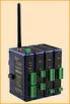 Modular, Customizable Wire Replacement 128 / 256 Bit AES Encryption Software Selectable RF Transmit Power Software Selectable Over-the-air Data Rate Modbus ASCII /RTU Compatible Wide Operating Temperature
PanelView Standard Operator Terminals
 PanelView Standard Operator Terminals User Manual (Catalog Numbers PV300 Micro, PV300, PV550, PV600, PV900, PV1000, PV1400) Important User Information Solid state equipment has operational characteristics
T7560A,B,C Digital Wall Module
 T7560A,B,C Digital Wall Module HONEYWELL EXCEL 5000 OPEN SYSTEM BEFORE INSTALLATION All wiring must comply with local electrical codes and ordinances or as specified on installation wiring diagrams. Digital
E/P Regulator (DeviceNet TM type) ITV1000/2000/3000/2090-DE* Series
 Doc. No. ITV2-OM00095-B P R O D U C T N A M E E/P Regulator (DeviceNet TM type) MODEL/ Series/ Product Number ITV1000/2000/3000/2090-DE* Series Install and operate the product only after reading the Operation
Termination Resistors:
 DeviceNet will not function correctly if design rules are not followed. Even a Network previously thought to be functioning correctly may begin to exhibit abnormal or anomalous operation due to incorrect
EtherNet/IP Adapter. 22-COMM-E FRN 1.xxx. User Manual
 EtherNet/IP Adapter 22-COMM-E FRN 1.xxx User Manual Important User Information Solid state equipment has operational characteristics differing from those of electromechanical equipment. Safety Guidelines
Instructions & Safety Information Models A220-20D and A220-20L Version 2
 Quick 220 Voltage Converting Power Supply Instructions & Safety Information Models A220-20D and A220-20L Version 2 Quick 220 Systems LLC PO Box 47489 Phoenix, Arizona 85068-7489 800-347-0394 602-938-6057
SMC FLEX QUICK START BULLETIN 150
 QUICK START SMC FLEX BULLETIN 0 This guide provides you with the basic information required to start up your SMC Flex controller. When reading this document, look for this symbol Step x to guide you through
Digital input modules
 8 172 TX-I/O Digital input modules TXM1.8D TXM1.16D Two fully compatible versions: TXM1.8D: 8 inputs, each with a three-color LED (green, yellow or red) TXM1.16D: As TXM1.8X, but 16 inputs, each with a
Features. Display. Measurements. Intelligent. Accuracy. Models. Installation DEIF A/S. Multi-instrument 4921210109D
 7000/7000C/7020 Multi-instrument 4921210109D Features Measurements All 3-phase AC measurements True RMS Replaces analogue meters Demand on each phase current Accuracy U, I and F class 0.5 Other values
CQM1-SF200/CS1W-SF200
 Safety Relay Unit ( I/O Unit Type) CQM1-SF200/CS1W-SF200 CSM_CQM1-SF200_CS1W-SF200_DS_E_2_1 A Safety Relay Unit That Functions as a I/O Unit. Less Installation Space and Wiring Required. Safety Relay Unit
Bussmann. All-In-One Module. Bussmann Power Module Switch. How to configure Part Numbers: Step 1: Select Switch Amperage 1
 How to configure Part Numbers: Step : Select Switch Amperage Power Module Switch Rating (Amps) Power Module Switch Catalog No. 30 3 60 6 00 200 2 400 4 Step 2: Select Options Needed 5 Bussmann Power Module
ABB Drives. User s Manual HTL Encoder Interface FEN-31
 ABB Drives User s Manual HTL Encoder Interface FEN-31 HTL Encoder Interface FEN-31 User s Manual 3AUA0000031044 Rev B EN EFFECTIVE: 2010-04-06 2010 ABB Oy. All Rights Reserved. 5 Safety instructions
When any of the following symbols appear, read the associated information carefully. Symbol Meaning Description
 Samba OPLC SM35-J-R20 Installation Guide The Unitronics SM35-J-R20 offers the following onboard I/Os: 12 Digital Inputs, configurable via wiring to include: 1 HSC/Shaft-encoder Input, 2 Analog inputs (only
REB 1 REB 3 REB 5 REB 6 REB 8 REB 10 REB 12 REB 16
 REB 1 REB 3 REB 5 REB 6 REB 8 REB 10 REB 12 REB 16 Manually Operated Electronic Speed Controller Single Phase For all applications using suitably specified single-phase induction motor fans 1 GENERAL The
Number 1 in efficiency
 PowerXL DE1 Variable Speed Starter www.eaton.eu/de1 Number 1 in efficiency The easiest way of variable motor speed NEW Variation DE11 The new device category! The PowerXL DE1 Variable Speed Starter Why
Current valve. for AC 24 V pulse/pause control of electrical loads up to 30 kw
 4 937 DESIO Current valve for AC 24 V pulse/pause control of electrical loads up to 30 kw SEA45.1 Use The current valve is used for the control of electric heating elements in heating, ventilation and
Stratix 5700 Switch Configuration
 Quick Start Stratix 5700 Switch Configuration Important User Information Read this document and the documents listed in the additional resources section about installation, configuration, and operation
DeviceNet Bus Software Help for Programming an Allen Bradley Control System
 FBP FieldBusPlug V7 DeviceNet Bus Software Help for Programming an Allen Bradley Control System DeviceNet Software Help for Programming an Allen Bradley Control System Contents Page General Purpose...
40.3. Control Relays and Timers
 .3 Contents EASY500/700/800 Intelligent Relays........ EASY/MFD Expansion Modules............ MFD Intelligent Relays................... EASY/MFD Communication Modules....... EASY/MFD Power Supplies, Accessories