
Problem Solving. Percentage Composition
|
|
|
- Dominick Chapman
- 9 years ago
- Views:
Transcription
1 Skills Worksheet Problem Solving Percentage Composition Suppose you are working in an industrial laboratory. Your supervisor gives you a bottle containing a white crystalline compound and asks you to determine its identity. Several unlabeled drums of this substance have been discovered in a warehouse, and no one knows what it is. You take it into the laboratory and carry out an analysis, which shows that the compound is composed of the elements sodium, carbon, and oxygen. Immediately, you think of the compound sodium carbonate, Na 2, a very common substance found in most laboratories and used in many industrial processes. Before you report your conclusion to your boss, you decide to check a reference book to see if there are any other compounds that contain only the elements sodium, carbon, and oxygen. You discover that there is another compound, sodium oxalate, which has the formula Na 2 C 2 O 4. When you read about this compound, you find that it is highly poisonous and can cause serious illness and even death. Mistaking sodium carbonate for sodium oxalate could have very serious consequences. What can you do to determine the identity of your sample? Is it the common industrial substance or the dangerous poison? Fortunately, you can determine not only which elements are in the compound, but also how much of each element is present. As you have learned, every compound has a definite composition. Every water molecule is made up of two hydrogen atoms and one oxygen atom, no matter where the water came from. A formula unit of sodium chloride is composed of one sodium atom and one chlorine atom, no matter whether the salt came from a mine or was obtained by evaporating sea water. Likewise, sodium carbonate always has two sodium atoms, one carbon atom, and three oxygen atoms per formula unit, giving it the formula Na 2 ; and a formula unit of sodium oxalate always contains two sodium atoms, two carbon atoms, and four oxygen atoms, giving it the formula Na 2 C 2 O 4. Because each atom has a definite mass, each compound will have a distinct composition by mass. This composition is usually expressed as the percentage composition of the compound the percentage by mass of each element in a compound. To identify a compound, you can compare the percentage composition obtained by laboratory analysis with a calculated percentage composition of each possible compound. Holt ChemFile: Problem-Solving Workbook 7 Percentage Composition

2 General Plan for Determining Percentage Composition of a Compound 1 Molar mass of element Convert using the formula of the compound. 2 Mass of element per mole of compound Convert by multiplying by the inverse of the molar mass of the compound. Then convert to a percentage by multiplying by Mass of element in a sample of compound Convert by expressing percentage as a fraction and then multiplying by the mass of the sample. Percentage element in the compound Repeat 1, 2, and for each remaining element in the compound. 4 Percentage composition of the compound Holt ChemFile: Problem-Solving Workbook 74 Percentage Composition

3 Sample Problem 1 Determine the percentage composition of sodium carbonate, Na 2. Solution ANALYZE What is given in the problem? What are you asked to find? the formula of sodium carbonate the percentage of each element in sodium carbonate (the percentage composition) Items Data Formula of sodium carbonate Na 2 Molar mass of each element* Na g/mol C g/mol O g/mol Molar mass of sodium carbonate g/mol Percentage composition of sodium carbonate?% * determined from the periodic table PLAN What step is needed to determine the mass of each element per mole of compound? Multiply the molar mass of each element by the ratio of the number of moles of that element in a mole of the compound (the subscript of that element in the compound s formula). What steps are needed to determine the portion of each element as a percentage of the mass of the compound? Multiply the mass of each element by the inverse of the molar mass of the compound, and then multiply by 100 to convert to a percentage. Step 1 1 Molar mass of Na multiply by the subscript of Na in Na 2 2 Mass Na per mole Na 2 molar mass Na g Na 1 mol Na ratio of mol Na per mol Na 2 from formula 2 mol Na g Na 1 mol Na2 1 mol Na 2 Holt ChemFile: Problem-Solving Workbook 75 Percentage Composition

4 Step 2 2 Mass Na per mole Na 2 multiply by the inverse of the molar mass of Na 2 and multiply by 100 Percentage Na in Na 2 from Step 1 g Na 1 molar mass Na 2 1 mol Na percentage Na in Na2 1 mol Na g Na2 Now you can combine Step 1 and Step 2 into one calculation. combining Steps 1 and g Na 2 mol Na 1 mol Na 2 CO 100 percentage Na in Na 2 1 mol Na 1 mol Na g Na 2 Finally, determine the percentage of carbon and oxygen in Na 2 by repeating the calculation above with each of those elements. Percentage of each element in Na 2 repeat Steps 1 and 2 for each remaining element 4 Percentage composition COMPUTE percentage sodium g Na 1 mol Na percentage carbon g C 1 mol C percentage oxygen g O 1 mol O 2 mol Na 1 mol Na 2 CO % Na 1 mol Na g Na 2 1 mol C 1 mol Na 2 CO % C 1 mol Na g Na 2 mol O 1 mol Na 2 CO % O 1 mol Na g Na 2 Element sodium carbon oxygen EVALUATE Are the units correct? Yes; the composition is given in percentages. Percentage 4.8% Na 11.% C 45.29% O Holt ChemFile: Problem-Solving Workbook 76 Percentage Composition

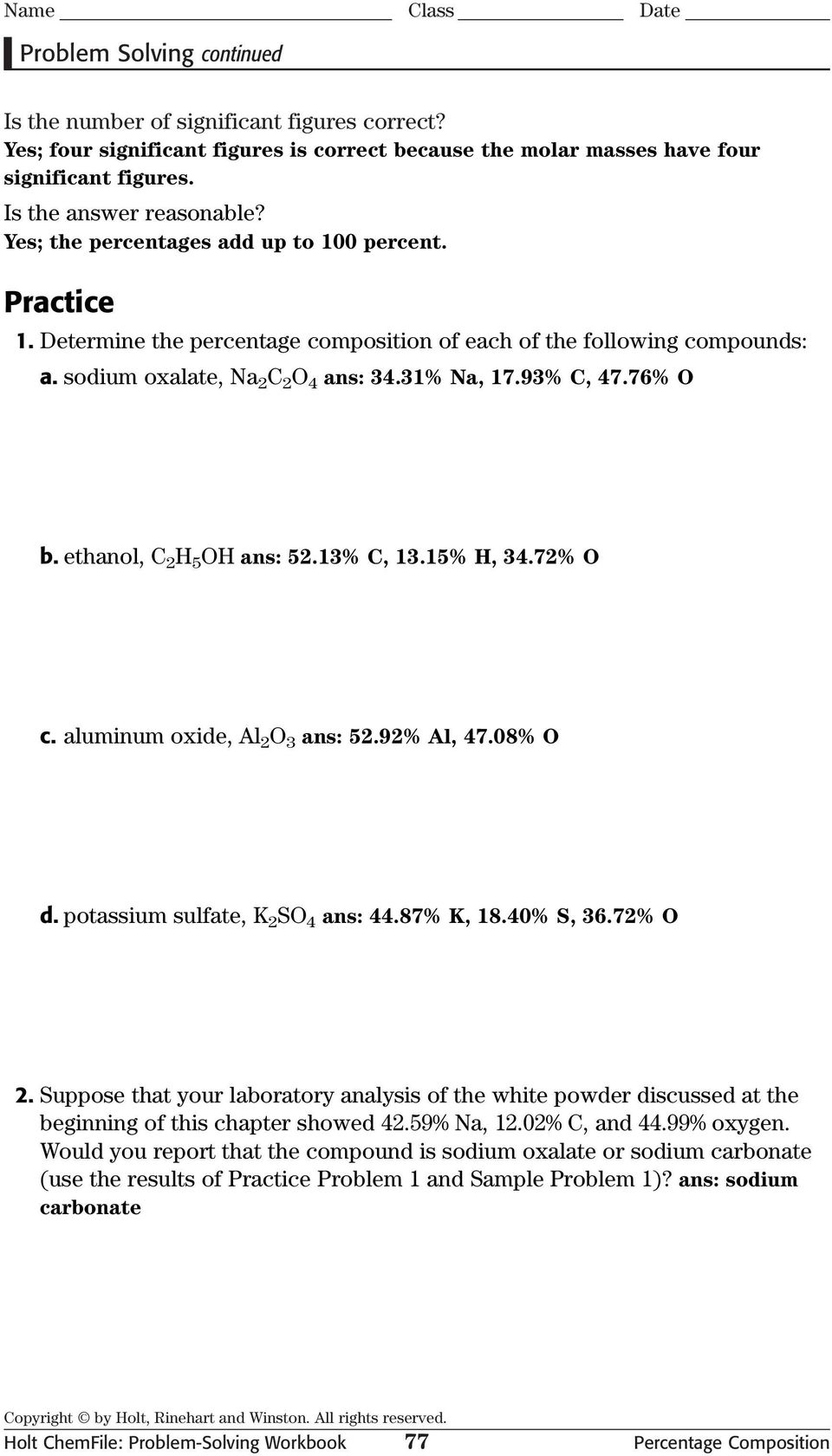
5 Is the number of significant figures correct? Yes; four significant figures is correct because the molar masses have four significant figures. Is the answer reasonable? Yes; the percentages add up to 100 percent. Practice 1. Determine the percentage composition of each of the following compounds: a. sodium oxalate, Na 2 C 2 O 4 ans: 4.1% Na, 17.9% C, 47.76% O b. ethanol, C 2 H 5 OH ans: 52.1% C, 1.15% H, 4.72% O c. aluminum oxide, Al 2 O ans: 52.92% Al, 47.08% O d. potassium sulfate, K 2 SO 4 ans: 44.87% K, 18.40% S, 6.72% O 2. Suppose that your laboratory analysis of the white powder discussed at the beginning of this chapter showed 42.59% Na, 12.02% C, and 44.99% oxygen. Would you report that the compound is sodium oxalate or sodium carbonate (use the results of Practice Problem 1 and Sample Problem 1)? ans: sodium carbonate Holt ChemFile: Problem-Solving Workbook 77 Percentage Composition
6 Sample Problem 2 Calculate the mass of zinc in a 0.00 g sample of zinc nitrate, Zn(NO. Solution ANALYZE What is given in the problem? What are you asked to find? the mass in grams of zinc nitrate the mass in grams of zinc in the sample Items Mass of zinc nitrate Data 0.00 g Formula of zinc nitrate Zn(NO Molar mass of zinc nitrate g/mol Mass of zinc in the sample? g PLAN What steps are needed to determine the mass of Zn in a given mass of Zn(NO? The percentage of Zn in Zn(NO can be calculated and used to find the mass of Zn in the sample. 1 Molar mass of Zn multiply by the mole ratio of Zn to Zn(NO 2 Mass Zn per mole Zn(NO multiply by the inverse of the molar mass of Zn(NO, then multiply by Mass Zn in g in sample express percentage as a fraction and multiply by the mass of the sample Percentage Zn in Zn(NO molar mass Zn ratio of mol Zn per mol Zn(NO from formula 65.9 g Zn 1 mol Zn 1 mol 100 percentage Zn 1 mol Zn 1 mol Zn(NO g Zn(NO percentage Zn expressed as a fraction 1 molar mass Zn(NO g Zn given g Zn(NO g Zn in sample 100 g Zn(NO COMPUTE 65.9 g Zn 1 mol Zn 1 mol Zn(NO ) % Zn 1 mol Zn 1 mol Zn(NO g Zn(NO Holt ChemFile: Problem-Solving Workbook 78 Percentage Composition

7 Note that mass percentage is the same as grams per 100 g, so 4.52% Zn in Zn(NO is the same as 4.52 g Zn in 100 g Zn(NO g Zn 0.00 g Zn(NO 10.6 g Zn 100 g Zn(NO EVALUATE Are the units correct? Yes; units cancel to give the correct units, grams of zinc. Is the number of significant figures correct? Yes; four significant figures is correct because the data given have four significant figures. Is the answer reasonable? Yes; the molar mass of zinc is about one third of the molar mass of Zn(NO, and 10.6 g Zn is about one third of 0.00 g of Zn(NO. Practice 1. Calculate the mass of the given element in each of the following compounds: a. bromine in 50.0 g potassium bromide, KBr ans:.6 g Br b. chromium in 1.00 kg sodium dichromate, Na 2 Cr 2 O 7 ans: 97 g Cr c. nitrogen in 85.0 mg of the amino acid lysine, C 6 H 14 N 2 O 2 ans: 16. mg N d. cobalt in 2.84 g cobalt(ii) acetate, Co(C 2 H O 2 ans: g Co Holt ChemFile: Problem-Solving Workbook 79 Percentage Composition

8 HYDRATES Many compounds, especially ionic compounds, are produced and purified by crystallizing them from water solutions. When this happens, some compounds incorporate water molecules into their crystal structure. These crystalline compounds are called hydrates because they include water molecules. The number of water molecules per formula unit is specific for each type of crystal. When you have to measure a certain quantity of the compound, it is important to know how much the water molecules contribute to the mass. You may have seen blue crystals of copper(ii) sulfate in the laboratory. When this compound is crystallized from water solution, the crystals include five water molecules for each formula unit of CuSO 4. The true name of the substance is copper(ii) sulfate pentahydrate, and its formula is written correctly as CuSO 4 5H 2 O. Notice that the five water molecules are written separately. They are preceded by a dot, which means they are attached to the copper sulfate molecule. On a molar basis, a mole of CuSO 4 5H 2 O contains 5 mol of water per mole of CuSO 4 5H 2 O. The water molecules contribute to the total mass of CuSO 4 5H 2 O. When you determine the percentage water in a hydrate, the water molecules are treated separately, as if they were another element. Sample Problem Determine the percentage water in copper(ii) sulfate pentahydrate, CuSO 4 5H 2 O. Solution ANALYZE What is given in the problem? What are you asked to find? the formula of copper(ii) sulfate pentahydrate the percentage water in the hydrate Items Data Formula of copper(ii) sulfate pentahydrate Molar mass of H 2 O Molar mass of copper(ii) sulfate pentahydrate* CuSO 4 5H 2 O g/mol g/mol Percentage H 2 O in CuSO 4 5H 2 O?% * molar mass of CuSO 4 mass of 5 mol H 2 O Holt ChemFile: Problem-Solving Workbook 80 Percentage Composition

9 PLAN What steps are needed to determine the percentage of water in CuSO 4 5H 2 O? Find the mass of water per mole of hydrate, multiply by the inverse molar mass of the hydrate, and multiply that by 100 to convert to a percentage g H 2 O 1 mol H 2 O COMPUTE g H 2 O 1 mol H 2 O 1 Molar mass of H 2 O multiply by the mole ratio of H 2 O to CuSO 4 5H 2 O molar mass H 2 O ratio of moles H 2 O per mole CuSO 4 5H 2O from formula 5 mol H 2 O 1 mol CuSO 4 5H 2 O 5 mol H 2 O 1 mol CuSO 4 5H 2 O 2 Mass H 2 O per mole CuSO 4 5H 2 O Percentage H 2 O in CuSO 4 5H 2 O 1 mol CuSO g CuSO 4 5H O 2 5H O 2 1 mol CuSO 4 5H 2 O g CuSO 4 5H 2 O % H 2 O EVALUATE Are the units correct? Yes; the percentage of water in copper(ii) sulfate pentahydrate was needed. Is the number of significant figures correct? Yes; four significant figures is correct because molar masses were given to at least four significant figures. Is the answer reasonable? Yes; five water molecules have a mass of about 90 g, and 90 g is a little more than 1/ of 250 g; the calculated percentage is a little more than 1/. 1 molar mass CuSO 4 5H 2 O multiply by the inverse of the molar mass of CuSO 4 5H 2O; then multiply by percentage H 2 O Holt ChemFile: Problem-Solving Workbook 81 Percentage Composition

10 Practice 1. Calculate the percentage of water in each of the following hydrates: a. sodium carbonate decahydrate, Na 2 10H 2 O ans: 62.97% H 2 O in Na 2 10H 2 O b. nickel(ii) iodide hexahydrate, NiI 2 6H 2 O ans: 25.71% H 2 O in NiI 2 6H 2 O c. ammonium hexacyanoferrate(iii) trihydrate (commonly called ammonium ferricyanide), (NH 4 Fe(CN) 6 H 2 O ans: % H 2 O in (NH 4 Fe(CN) 6 H 2 O d. aluminum bromide hexahydrate ans: 28.85% H 2 O in AlBr 6H 2 O Holt ChemFile: Problem-Solving Workbook 82 Percentage Composition

11 Additional Problems 1. Write formulas for the following compounds and determine the percentage composition of each: a. nitric acid b. ammonia c. mercury(ii) sulfate d. antimony(v) fluoride 2. Calculate the percentage composition of the following compounds: a. lithium bromide, LiBr b. anthracene, C 14 H 10 c. ammonium nitrate, NH 4 NO d. nitrous acid, HNO 2 e. silver sulfide, Ag 2 S f. iron(ii) thiocyanate, Fe(SCN g. lithium acetate h. nickel(ii) formate. Calculate the percentage of the given element in each of the following compounds: a. nitrogen in urea, NH 2 CONH 2 b. sulfur in sulfuryl chloride, SO 2 Cl 2 c. thallium in thallium(iii) oxide, Tl 2 O d. oxygen in potassium chlorate, KClO e. bromine in calcium bromide, CaBr 2 f. tin in tin(iv) oxide, SnO 2 4. Calculate the mass of the given element in each of the following quantities: a. oxygen in 4.00 g of manganese dioxide, MnO 2 b. aluminum in 50.0 metric tons of aluminum oxide, Al 2 O c. silver in 25 g silver cyanide, AgCN d. gold in g of gold(iii) selenide, Au 2 Se e. selenium in 68 g sodium selenite, Na 2 SeO f. chlorine in g of 1,1-dichloropropane, CHCl 2 CH 2 CH 5. Calculate the percentage of water in each of the following hydrates: a. strontium chloride hexahydrate, SrCl 2 6H 2 O b. zinc sulfate heptahydrate, ZnSO 4 7H 2 O c. calcium fluorophosphate dihydrate, CaFPO 2H 2 O d. beryllium nitrate trihydrate, Be(NO H 2 O Holt ChemFile: Problem-Solving Workbook 8 Percentage Composition

12 6. Calculate the percentage of the given element in each of the following hydrates. You must first determine the formulas of the hydrates. a. nickel in nickel(ii) acetate tetrahydrate b. chromium in sodium chromate tetrahydrate c. cerium in cerium(iv) sulfate tetrahydrate 7. Cinnabar is a mineral that is mined in order to produce mercury. Cinnabar is mercury(ii) sulfide, HgS. What mass of mercury can be obtained from 50.0 kg of cinnabar? 8. The minerals malachite, Cu 2 (OH, and chalcopyrite, CuFeS 2, can be mined to obtain copper metal. How much copper could be obtained from kg of each? Which of the two has the greater copper content? 9. Calculate the percentage of the given element in each of the following hydrates: a. vanadium in vanadium oxysulfate dihydrate, VOSO 4 2H 2 O b. tin in potassium stannate trihydrate, K 2 SnO H 2 O c. chlorine in calcium chlorate dihydrate, CaClO 2H 2 O 10. Heating copper sulfate pentahydrate will evaporate the water from the crystals, leaving anhydrous copper sulfate, a white powder. Anhydrous means without water. What mass of anhydrous CuSO 4 would be produced by heating g of CuSO 4 5H 2 O? 11. Silver metal may be precipitated from a solution of silver nitrate by placing a copper strip into the solution. What mass of AgNO would you dissolve in water in order to get 1.00 g of silver? 12. A sample of Ag 2 S has a mass of 62.4 g. What mass of each element could be obtained by decomposing this sample? 1. A quantity of epsom salts, magnesium sulfate heptahydrate, MgSO 4 7H 2 O, is heated until all the water is driven off. The sample loses 11.8 g in the process. What was the mass of the original sample? 14. The process of manufacturing sulfuric acid begins with the burning of sulfur. What mass of sulfur would have to be burned in order to produce 1.00 kg of H 2 SO 4? Assume that all of the sulfur ends up in the sulfuric acid. Holt ChemFile: Problem-Solving Workbook 84 Percentage Composition

Problem Solving. Mole Concept
 Skills Worksheet Problem Solving Mole Concept Suppose you want to carry out a reaction that requires combining one atom of iron with one atom of sulfur. How much iron should you use? How much sulfur? When
Chemical Proportions in Compounds
 Chapter 6 Chemical Proportions in Compounds Solutions for Practice Problems Student Textbook page 201 1. Problem A sample of a compound is analyzed and found to contain 0.90 g of calcium and 1.60 g of
Moles, Molecules, and Grams Worksheet Answer Key
 Moles, Molecules, and Grams Worksheet Answer Key 1) How many are there in 24 grams of FeF 3? 1.28 x 10 23 2) How many are there in 450 grams of Na 2 SO 4? 1.91 x 10 24 3) How many grams are there in 2.3
Study Guide For Chapter 7
 Name: Class: Date: ID: A Study Guide For Chapter 7 Multiple Choice Identify the choice that best completes the statement or answers the question. 1. The number of atoms in a mole of any pure substance
Balancing Chemical Equations Worksheet
 Balancing Chemical Equations Worksheet Student Instructions 1. Identify the reactants and products and write a word equation. 2. Write the correct chemical formula for each of the reactants and the products.
SCH 4C1 Unit 2 Problem Set Questions taken from Frank Mustoe et all, "Chemistry 11", McGraw-Hill Ryerson, 2001
 SCH 4C1 Unit 2 Problem Set Questions taken from Frank Mustoe et all, "Chemistry 11", McGraw-Hill Ryerson, 2001 1. A small pin contains 0.0178 mol of iron. How many atoms of iron are in the pin? 2. A sample
Problem Solving. Empirical Formulas
 Skills Worksheet Problem Solving Empirical Formulas Suppose you analyze an unknown compound that is a white powder and find that it is composed of 36.5% sodium, 38.1% oxygen, and 25.4% sulfur. You can
Chapter 3 Mass Relationships in Chemical Reactions
 Chapter 3 Mass Relationships in Chemical Reactions Student: 1. An atom of bromine has a mass about four times greater than that of an atom of neon. Which choice makes the correct comparison of the relative
Nomenclature of Ionic Compounds
 Nomenclature of Ionic Compounds Ionic compounds are composed of ions. An ion is an atom or molecule with an electrical charge. Monatomic ions are formed from single atoms that have gained or lost electrons.
MOLES AND MOLE CALCULATIONS
 35 MOLES ND MOLE CLCULTIONS INTRODUCTION The purpose of this section is to present some methods for calculating both how much of each reactant is used in a chemical reaction, and how much of each product
HOMEWORK 4A. Definitions. Oxidation-Reduction Reactions. Questions
 HOMEWORK 4A Oxidation-Reduction Reactions 1. Indicate whether a reaction will occur or not in each of following. Wtiring a balcnced equation is not necessary. (a) Magnesium metal is added to hydrochloric
Problem Solving. Mole Concept
 Skills Worksheet Problem Solving Mole Concept Suppose you want to carry out a reaction that requires combining one atom of iron with one atom of sulfur. How much iron should you use? How much sulfur? When
Tutorial 2 FORMULAS, PERCENTAGE COMPOSITION, AND THE MOLE
 T-6 Tutorial 2 FORMULAS, PERCENTAGE COMPOSITION, AND THE MOLE FORMULAS: A chemical formula shows the elemental composition of a substance: the chemical symbols show what elements are present and the numerical
Chemistry Post-Enrolment Worksheet
 Name: Chemistry Post-Enrolment Worksheet The purpose of this worksheet is to get you to recap some of the fundamental concepts that you studied at GCSE and introduce some of the concepts that will be part
b. N 2 H 4 c. aluminum oxalate d. acetic acid e. arsenic PART 2: MOLAR MASS 2. Determine the molar mass for each of the following. a. ZnI 2 b.
 CHEMISTRY DISCOVER UNIT 5 LOTS OF PRACTICE ON USING THE MOLE!!! PART 1: ATOMIC MASS, FORMULA MASS, OR MOLECULAR MASS 1. Determine the atomic mass, formula mass, or molecular mass for each of the following
Decomposition. Composition
 Decomposition 1. Solid ammonium carbonate is heated. 2. Solid calcium carbonate is heated. 3. Solid calcium sulfite is heated in a vacuum. Composition 1. Barium oxide is added to distilled water. 2. Phosphorus
Solution. Practice Exercise. Concept Exercise
 Example Exercise 9.1 Atomic Mass and Avogadro s Number Refer to the atomic masses in the periodic table inside the front cover of this textbook. State the mass of Avogadro s number of atoms for each of
Molar Mass Worksheet Answer Key
 Molar Mass Worksheet Answer Key Calculate the molar masses of the following chemicals: 1) Cl 2 71 g/mol 2) KOH 56.1 g/mol 3) BeCl 2 80 g/mol 4) FeCl 3 162.3 g/mol 5) BF 3 67.8 g/mol 6) CCl 2 F 2 121 g/mol
Unit 3 Notepack Chapter 7 Chemical Quantities Qualifier for Test
 Unit 3 Notepack Chapter 7 Chemical Quantities Qualifier for Test NAME Section 7.1 The Mole: A Measurement of Matter A. What is a mole? 1. Chemistry is a quantitative science. What does this term mean?
Calculating Molar Mass of a Compound
 Instructions for Conversion Problems For every conversion problem Write the number in the problem down with unit and a multiplication sign Decide which conversion factor you should use, Avagadro s or molar
10 The Mole. Section 10.1 Measuring Matter
 Name Date Class The Mole Section.1 Measuring Matter In your textbook, read about counting particles. In Column B, rank the quantities from Column A from smallest to largest. Column A Column B 0.5 mol 1.
Chapter 3 Stoichiometry
 Chapter 3 Stoichiometry 3-1 Chapter 3 Stoichiometry In This Chapter As you have learned in previous chapters, much of chemistry involves using macroscopic measurements to deduce what happens between atoms
W1 WORKSHOP ON STOICHIOMETRY
 INTRODUCTION W1 WORKSHOP ON STOICHIOMETRY These notes and exercises are designed to introduce you to the basic concepts required to understand a chemical formula or equation. Relative atomic masses of
WRITING CHEMICAL FORMULA
 WRITING CHEMICAL FORMULA For ionic compounds, the chemical formula must be worked out. You will no longer have the list of ions in the exam (like at GCSE). Instead you must learn some and work out others.
Number of moles of solute = Concentration (mol. L ) x Volume of solution (litres) or n = C x V
 44 CALCULATIONS INVOLVING SOLUTIONS INTRODUCTION AND DEFINITIONS Many chemical reactions take place in aqueous (water) solution. Quantities of such solutions are measured as volumes, while the amounts
Monatomic Ions. A. Monatomic Ions In order to determine the charge of monatomic ions, you can use the periodic table as a guide:
 Monatomic Ions Ions are atoms that have either lost or gained electrons. While atoms are neutral, ions are charged particles. A loss of electrons results in a positive ion or cation (pronounced cat-eye-on
MOLECULAR MASS AND FORMULA MASS
 1 MOLECULAR MASS AND FORMULA MASS Molecular mass = sum of the atomic weights of all atoms in the molecule. Formula mass = sum of the atomic weights of all atoms in the formula unit. 2 MOLECULAR MASS AND
Sample Exercise 2.1 Illustrating the Size of an Atom
 Sample Exercise 2.1 Illustrating the Size of an Atom The diameter of a US penny is 19 mm. The diameter of a silver atom, by comparison, is only 2.88 Å. How many silver atoms could be arranged side by side
CHEMICAL REACTIONS AND REACTING MASSES AND VOLUMES
 CHEMICAL REACTIONS AND REACTING MASSES AND VOLUMES The meaning of stoichiometric coefficients: 2 H 2 (g) + O 2 (g) 2 H 2 O(l) number of reacting particles 2 molecules of hydrogen react with 1 molecule
Unit 10A Stoichiometry Notes
 Unit 10A Stoichiometry Notes Stoichiometry is a big word for a process that chemist s use to calculate amounts in reactions. It makes use of the coefficient ratio set up by balanced reaction equations
Chapter 8 How to Do Chemical Calculations
 Chapter 8 How to Do Chemical Calculations Chemistry is both a qualitative and a quantitative science. In the laboratory, it is important to be able to measure quantities of chemical substances and, as
Stoichiometry Review
 Stoichiometry Review There are 20 problems in this review set. Answers, including problem set-up, can be found in the second half of this document. 1. N 2 (g) + 3H 2 (g) --------> 2NH 3 (g) a. nitrogen
CHAPTER 5: MOLECULES AND COMPOUNDS
 CHAPTER 5: MOLECULES AND COMPOUNDS Problems: 1-6, 9-13, 16, 20, 31-40, 43-64, 65 (a,b,c,e), 66(a-d,f), 69(a-d,f), 70(a-e), 71-78, 81-82, 87-96 A compound will display the same properties (e.g. melting
neutrons are present?
 AP Chem Summer Assignment Worksheet #1 Atomic Structure 1. a) For the ion 39 K +, state how many electrons, how many protons, and how many 19 neutrons are present? b) Which of these particles has the smallest
Solution. Practice Exercise. Concept Exercise
 Example Exercise 8.1 Evidence for a Reaction Which of the following is experimental evidence for a chemical reaction? (a) Pouring vinegar on baking soda gives foamy bubbles. (b) Mixing two solutions produces
Calculating Atoms, Ions, or Molecules Using Moles
 TEKS REVIEW 8B Calculating Atoms, Ions, or Molecules Using Moles TEKS 8B READINESS Use the mole concept to calculate the number of atoms, ions, or molecules in a sample TEKS_TXT of material. Vocabulary
Chapter 1: Moles and equations. Learning outcomes. you should be able to:
 Chapter 1: Moles and equations 1 Learning outcomes you should be able to: define and use the terms: relative atomic mass, isotopic mass and formula mass based on the 12 C scale perform calculations, including
Periodic Table, Valency and Formula
 Periodic Table, Valency and Formula Origins of the Periodic Table Mendelѐѐv in 1869 proposed that a relationship existed between the chemical properties of elements and their atomic masses. He noticed
Moles. Moles. Moles. Moles. Balancing Eqns. Balancing. Balancing Eqns. Symbols Yields or Produces. Like a recipe:
 Like a recipe: Balancing Eqns Reactants Products 2H 2 (g) + O 2 (g) 2H 2 O(l) coefficients subscripts Balancing Eqns Balancing Symbols (s) (l) (aq) (g) or Yields or Produces solid liquid (pure liquid)
APPENDIX B: EXERCISES
 BUILDING CHEMISTRY LABORATORY SESSIONS APPENDIX B: EXERCISES Molecular mass, the mole, and mass percent Relative atomic and molecular mass Relative atomic mass (A r ) is a constant that expresses the ratio
Experiment 5. Chemical Reactions A + X AX AX A + X A + BX AX + B AZ + BX AX + BZ
 Experiment 5 Chemical Reactions OBJECTIVES 1. To observe the various criteria that are used to indicate that a chemical reaction has occurred. 2. To convert word equations into balanced inorganic chemical
Chapter 3: Stoichiometry
 Chapter 3: Stoichiometry Key Skills: Balance chemical equations Predict the products of simple combination, decomposition, and combustion reactions. Calculate formula weights Convert grams to moles and
Electrochemistry - ANSWERS
 Electrochemistry - ANSWERS 1. Using a table of standard electrode potentials, predict if the following reactions will occur spontaneously as written. a) Al 3+ + Ni Ni 2+ + Al Al 3+ + 3e - Al E = -1.68
Naming Compounds Handout Key
 Naming Compounds Handout Key p. 2 Name each of the following monatomic cations: Li + = lithium ion Ag + = silver ion Cd +2 = cadmium ion Cu +2 = copper (II) ion Al +3 = aluminum ion Mg +2 = magnesium ion
CHAPTER 9. 9.1 Naming Ions. Chemical Names and Formulas. Naming Transition Metals. Ions of Transition Metals. Ions of Transition Metals
 CHAPTER 9 Chemical Names and Formulas 9.1 Naming Ions Monatomic Ions: a single atom with a positive or negative charge Cation (rules): listed first Anion (rules): ide ending Transition Metals have a varying
Unit 9 Stoichiometry Notes (The Mole Continues)
 Unit 9 Stoichiometry Notes (The Mole Continues) is a big word for a process that chemist s use to calculate amounts in reactions. It makes use of the coefficient ratio set up by balanced reaction equations
Stoichiometry. What is the atomic mass for carbon? For zinc?
 Stoichiometry Atomic Mass (atomic weight) Atoms are so small, it is difficult to discuss how much they weigh in grams We use atomic mass units an atomic mass unit (AMU) is one twelfth the mass of the catbon-12
Description of the Mole Concept:
 Description of the Mole Concept: Suppose you were sent into the store to buy 36 eggs. When you picked them up you would get 3 boxes, each containing 12 eggs. You just used a mathematical device, called
Problem Solving. Stoichiometry of Gases
 Skills Worksheet Problem Solving Stoichiometry of Gases Now that you have worked with relationships among moles, mass, and volumes of gases, you can easily put these to work in stoichiometry calculations.
Name: Class: Date: 2 4 (aq)
 Name: Class: Date: Unit 4 Practice Test Multiple Choice Identify the choice that best completes the statement or answers the question. 1) The balanced molecular equation for complete neutralization of
Unit 6. Chapter 10: The MOLE! Date In Class Homework. % Composition & Calculating Empirical Formulas
 Date In Class Homework 10/22 Thur Counting By Mass Lab 10/23 Fri (mole day!!!) THE MOLE! in room 137 10/26 Mon (LSM) More on the Mole Watch empirical and molecular formula video. 10/27 Tue % Composition
TOPIC 7. CHEMICAL CALCULATIONS I - atomic and formula weights.
 TOPIC 7. CHEMICAL CALCULATIONS I - atomic and formula weights. Atomic structure revisited. In Topic 2, atoms were described as ranging from the simplest atom, H, containing a single proton and usually
Sample Exercise 3.1 Interpreting and Balancing Chemical Equations
 Sample Exercise 3.1 Interpreting and Balancing Chemical Equations The following diagram represents a chemical reaction in which the red spheres are oxygen atoms and the blue spheres are nitrogen atoms.
CHEMICAL NAMES AND FORMULAS
 9 CHEMICAL NAMES AND FORMULAS SECTION 9.1 NAMING IONS (pages 253 258) This section explains the use of the periodic table to determine the charge of an ion. It also defines polyatomic ion and gives the
Nomenclature and Formulas of Ionic Compounds. Section I: Writing the Name from the Formula
 Purpose: Theory: Nomenclature and Formulas of Ionic Compounds 1. To become familiar with the rules of chemical nomenclature, based on the classification of compounds. 2. To write the proper name of the
Stoichiometry. Unit Outline
 3 Stoichiometry Unit Outline 3.1 The Mole and Molar Mass 3.2 Stoichiometry and Compound Formulas 3.3 Stoichiometry and Chemical Reactions 3.4 Stoichiometry and Limiting Reactants 3.5 Chemical Analysis
Concept 1. The meaning and usefulness of the mole. The mole (or mol) represents a certain number of objects.
 Chapter 3. Stoichiometry: Mole-Mass Relationships in Chemical Reactions Concept 1. The meaning and usefulness of the mole The mole (or mol) represents a certain number of objects. SI def.: the amount of
ATOMS. Multiple Choice Questions
 Chapter 3 ATOMS AND MOLECULES Multiple Choice Questions 1. Which of the following correctly represents 360 g of water? (i) 2 moles of H 2 0 (ii) 20 moles of water (iii) 6.022 10 23 molecules of water (iv)
Chapter 4. Chemical Composition. Chapter 4 Topics H 2 S. 4.1 Mole Quantities. The Mole Scale. Molar Mass The Mass of 1 Mole
 Chapter 4 Chemical Composition Chapter 4 Topics 1. Mole Quantities 2. Moles, Masses, and Particles 3. Determining Empirical Formulas 4. Chemical Composition of Solutions Copyright The McGraw-Hill Companies,
Chem 1100 Chapter Three Study Guide Answers Outline I. Molar Mass and Moles A. Calculations of Molar Masses
 Chem 1100 Chapter Three Study Guide Answers Outline I. Molar Mass and Moles A. Calculations of Molar Masses B. Calculations of moles C. Calculations of number of atoms from moles/molar masses 1. Avagadro
1. When the following equation is balanced, the coefficient of Al is. Al (s) + H 2 O (l)? Al(OH) 3 (s) + H 2 (g)
 1. When the following equation is balanced, the coefficient of Al is. Al (s) + H 2 O (l)? Al(OH) (s) + H 2 (g) A) 1 B) 2 C) 4 D) 5 E) Al (s) + H 2 O (l)? Al(OH) (s) + H 2 (g) Al (s) + H 2 O (l)? Al(OH)
1332 CHAPTER 18 Sample Questions
 1332 CHAPTER 18 Sample Questions Couple E 0 Couple E 0 Br 2 (l) + 2e 2Br (aq) +1.06 V AuCl 4 + 3e Au + 4Cl +1.00 V Ag + + e Ag +0.80 V Hg 2+ 2 + 2e 2 Hg +0.79 V Fe 3+ (aq) + e Fe 2+ (aq) +0.77 V Cu 2+
Problem Solving. Percentage Yield
 Skills Worksheet Problem Solving Percentage Yield Although we can write perfectly balanced equations to represent perfect reactions, the reactions themselves are often not perfect. A reaction does not
David A. Katz Chemist, Educator, Science Communicator, and Consultant Department of Chemistry, Pima Community College
 WRITING CHEMICAL EQUATIONS 2004, 2002, 1989 by David A. Katz. All rights reserved. Permission for classroom used provided original copyright is included. David A. Katz Chemist, Educator, Science Communicator,
The Mole Concept and Atoms
 Copyright The McGraw-Hill Companies, Inc. Permission required for reproduction or display. Chapter 4 24 September 2013 Calculations and the Chemical Equation The Mole Concept and Atoms Atoms are exceedingly
11-1 Stoichiometry. Represents
 11-1 Stoichiometry What is stoichiometry? Calculations that relate the quantities of substances. It is the study of quantitative (measurable amounts) relationships in chemical reactions and equations.
MOLECULAR WEIGHT CALCULATIONS
 MOLECULAR WEIGHT CALCULATIONS Calculating Formula Weight; Significant Figures Page 2 Percentage Composition of a Compound 18 Exponential Notation; Avogadro s Number; Moles 28 Calculating Empirical Formulas
The Mole. Chapter 2. Solutions for Practice Problems
 Chapter 2 The Mole Note to teacher: You will notice that there are two different formats for the Sample Problems in the student textbook. Where appropriate, the Sample Problem contains the full set of
Exercise 3.5 - Naming Binary Covalent Compounds:
 Chapter Exercise Key 1 Chapter Exercise Key Exercise.1 Classifying Compounds: Classify each of the following substances as either a molecular compound or an ionic compound. a. formaldehyde, CH 2 O (used
CHEMICAL FORMULAS AND FORMULA WEIGHT CALCULATIONS
 CHEMICAL FORMULAS AND FORMULA WEIGHT CALCULATIONS 1. THE MEANING OF A CHEMICAL FORMULA A chemical formula is a shorthand method of representing the elements in a compound. The formula shows the formulas
IB Chemistry. DP Chemistry Review
 DP Chemistry Review Topic 1: Quantitative chemistry 1.1 The mole concept and Avogadro s constant Assessment statement Apply the mole concept to substances. Determine the number of particles and the amount
= 16.00 amu. = 39.10 amu
 Using Chemical Formulas Objective 1: Calculate the formula mass or molar mass of any given compound. The Formula Mass of any molecule, formula unit, or ion is the sum of the average atomic masses of all
= 11.0 g (assuming 100 washers is exact).
 CHAPTER 8 1. 100 washers 0.110 g 1 washer 100. g 1 washer 0.110 g = 11.0 g (assuming 100 washers is exact). = 909 washers 2. The empirical formula is CFH from the structure given. The empirical formula
Mole Calculations Multiple Choice Review PSI Chemistry
 Mole Calculations Multiple Choice Review PSI Chemistry Name The Mole and Avogadro's Number 1)What is the SI unit for measurement of number of particles in a substance? A) kilogram B) ampere C) candela
Chemical Composition Review Mole Calculations Percent Composition. Copyright Cengage Learning. All rights reserved. 8 1
 Chemical Composition Review Mole Calculations Percent Composition Copyright Cengage Learning. All rights reserved. 8 1 QUESTION Suppose you work in a hardware store and a customer wants to purchase 500
Writing and Balancing Chemical Equations
 Name Writing and Balancing Chemical Equations Period When a substance undergoes a chemical reaction, chemical bonds are broken and new bonds are formed. This results in one or more new substances, often
Stoichiometry. 1. The total number of moles represented by 20 grams of calcium carbonate is (1) 1; (2) 2; (3) 0.1; (4) 0.2.
 Stoichiometry 1 The total number of moles represented by 20 grams of calcium carbonate is (1) 1; (2) 2; (3) 01; (4) 02 2 A 44 gram sample of a hydrate was heated until the water of hydration was driven
Chemical Calculations: The Mole Concept and Chemical Formulas. AW Atomic weight (mass of the atom of an element) was determined by relative weights.
 1 Introduction to Chemistry Atomic Weights (Definitions) Chemical Calculations: The Mole Concept and Chemical Formulas AW Atomic weight (mass of the atom of an element) was determined by relative weights.
Elements and Compounds. Chemical Bonds compounds are made of atoms held together by chemical bonds bonds are forces of attraction between atoms
 Elements and Compounds elements combine together to make an almost limitless number of compounds the properties of the compound are totally different from the constituent elements Tro, Chemistry: A Molecular
AP Chemistry Reaction Questions
 AP Chemistry Reaction Questions Directions: Give the formulas to show the reactants and the products for the following chemical reactions. Each of the reactions occurs in aqueous solution unless otherwise
PART I: MULTIPLE CHOICE (30 multiple choice questions. Each multiple choice question is worth 2 points)
 CHEMISTRY 123-07 Midterm #1 Answer key October 14, 2010 Statistics: Average: 74 p (74%); Highest: 97 p (95%); Lowest: 33 p (33%) Number of students performing at or above average: 67 (57%) Number of students
Topic 4 National Chemistry Summary Notes. Formulae, Equations, Balancing Equations and The Mole
 Topic 4 National Chemistry Summary Notes Formulae, Equations, Balancing Equations and The Mole LI 1 The chemical formula of a covalent molecular compound tells us the number of atoms of each element present
Chemical Equations & Stoichiometry
 Chemical Equations & Stoichiometry Chapter Goals Balance equations for simple chemical reactions. Perform stoichiometry calculations using balanced chemical equations. Understand the meaning of the term
Naming Ionic Compounds
 Naming Ionic Compounds I. Naming Ions A. Cations (+ions) 1. Element name followed by "ion" (when in Group IA, IIA, Al 3+, Ga 3+, Zn 2+, Cd 2+, Ag +, Ni 2+ ). Na + sodium ion, K + potassium ion, Al 3+ aluminum
CHAPTER 3 Calculations with Chemical Formulas and Equations. atoms in a FORMULA UNIT
 CHAPTER 3 Calculations with Chemical Formulas and Equations MOLECULAR WEIGHT (M. W.) Sum of the Atomic Weights of all atoms in a MOLECULE of a substance. FORMULA WEIGHT (F. W.) Sum of the atomic Weights
Santa Monica College Chemistry 11
 Types of Reactions Objectives The objectives of this laboratory are as follows: To perform and observe the results of a variety of chemical reactions. To become familiar with the observable signs of chemical
2) How many significant figures are in the measurement, 0.0005890 g? A) 4 B) 8 C) 6 D) 7 E) 5
 Chem. 1A Exam 1 Practice Problems: This is not a "practice test", these are sample questions that will verify your readiness to take the exam. If you can complete these problems without help from your
Nomenclature Packet. 1. Name the following ionic compounds: a. Al 2 O 3 Aluminum oxide. b. Cs 2 O Cesium oxide. c. Rb 3 N Rubidium nitride
 Nomenclature Packet Worksheet I: Binary Ionic Compounds (representative metals) metals from groups 1A, 2A, and 3A (1, 2, and 13) have constant charges as ions and do NOT get Roman Numerals in their names
Aqueous Solutions. Water is the dissolving medium, or solvent. Some Properties of Water. A Solute. Types of Chemical Reactions.
 Aqueous Solutions and Solution Stoichiometry Water is the dissolving medium, or solvent. Some Properties of Water Water is bent or V-shaped. The O-H bonds are covalent. Water is a polar molecule. Hydration
A dozen. Molar Mass. Mass of atoms
 A dozen Molar Mass Science 10 is a number of objects. A dozen eggs, a dozen cars, and a dozen people are all 12 objects. But a dozen cars has a much greater mass than a dozen eggs because the mass of each
Name Date Class CHEMICAL QUANTITIES. SECTION 10.1 THE MOLE: A MEASUREMENT OF MATTER (pages 287 296)
 10 CHEMICAL QUANTITIES SECTION 10.1 THE MOLE: A MEASUREMENT OF MATTER (pages 287 296) This section defines the mole and explains how the mole is used to measure matter. It also teaches you how to calculate
Stoichiometry. 1. The total number of moles represented by 20 grams of calcium carbonate is (1) 1; (2) 2; (3) 0.1; (4) 0.2.
 Stoichiometry 1 The total number of moles represented by 20 grams of calcium carbonate is (1) 1; (2) 2; (3) 01; (4) 02 2 A 44 gram sample of a hydrate was heated until the water of hydration was driven
Name Date Class CHEMICAL QUANTITIES. SECTION 10.1 THE MOLE: A MEASUREMENT OF MATTER (pages 287 296)
 Name Date Class 10 CHEMICAL QUANTITIES SECTION 10.1 THE MOLE: A MEASUREMENT OF MATTER (pages 287 296) This section defines the mole and explains how the mole is used to measure matter. It also teaches
Chemistry Themed. Types of Reactions
 Chemistry Themed Types of Reactions 1 2 Chemistry in the Community-2015-2016 Types of Reactions Date In-Class Assignment Homework T 10/20 TEST on Reactivity of Metals and Redox None W 10/21 Late Start
Chemistry CA 2 Practice
 hemistry 2 Practice Some questions (c) 2015 by Region 10 Educational Service enter. Some questions (c) 2015 by Progress Testing. Page 2 1 Which of the following is the mass in grams of 4.25 10³ mol of
Moles. Balanced chemical equations Molar ratios Mass Composition Empirical and Molecular Mass Predicting Quantities Equations
 Moles Balanced chemical equations Molar ratios Mass Composition Empirical and Molecular Mass Predicting Quantities Equations Micro World atoms & molecules Macro World grams Atomic mass is the mass of an
Chapter 6 Notes Science 10 Name:
 6.1 Types of Chemical Reactions a) Synthesis (A + B AB) Synthesis reactions are also known as reactions. When this occurs two or more reactants (usually elements) join to form a. A + B AB, where A and
U3-LM2B-WS Molar Mass and Conversions
 U3-LM2B-WS Molar Mass and Conversions Name: KEY 1. The molar mass of chlorine is: 2 x 35.45 g/mol Cl = 70.90 g/mol Cl 2 (Remember that chlorine exists as a diatomic molecule in nature) 2. The molar mass
Solution a homogeneous mixture = A solvent + solute(s) Aqueous solution water is the solvent
 Solution a homogeneous mixture = A solvent + solute(s) Aqueous solution water is the solvent Water a polar solvent: dissolves most ionic compounds as well as many molecular compounds Aqueous solution:
Chapter 12: Oxidation and Reduction.
 207 Oxidation- reduction (redox) reactions Chapter 12: Oxidation and Reduction. At different times, oxidation and reduction (redox) have had different, but complimentary, definitions. Compare the following