
RECOMMENDED CITATION: Pew Research Center, July, 2016, 2016 Campaign: Strong Interest, Widespread Dissatisfaction
|
|
|
- Paula Jasmin McDowell
- 9 years ago
- Views:
Transcription
1 NUMBERS, FACTS AND TRENDS SHAPING THE WORLD FOR RELEASE JULY 07, 2016 FOR MEDIA OR OTHER INQUIRIES: Carroll Doherty, Director of Political Research Jocelyn Kiley, Associate Director, Research Bridget Johnson, Communications Associate RECOMMENDED CITATION: Pew Research Center, July, 2016, 2016 Campaign: Strong Interest, Widespread Dissatisfaction

2 About Pew Research Center Pew Research Center is a nonpartisan fact tank that informs the public about the issues, attitudes and trends shaping America and the world. It does not take policy positions. It conducts public opinion polling, demographic research, content analysis and other data-driven social science research. The Center studies U.S. politics and policy; journalism and media; internet, science and technology; religion and public life; Hispanic trends; global attitudes and trends; and U.S. social and demographic trends. All of the Center s reports are available at. Pew Research Center is a subsidiary of The Pew Charitable Trusts, its primary funder. Pew Research Center 2016
3 Table of Contents Overview Campaign engagement and interest Voter general election preferences Views of the campaign and the candidates Top voting issues in 2016 election Candidate traits and perceptions Hispanic voters and the 2016 election Views of Barack Obama, the political parties, Congress and the nation s economy Acknowledgements Methodology Appendix: Topline questionnaire... 67
4

5 As Republicans and Democrats prepare for their party conventions later this month, a new national survey paints a bleak picture of voters impressions of the presidential campaign and the choices they face in November. Overall satisfaction with the choice of candidates is at its lowest point in two decades. Currently, fewer than half of registered voters in both parties 43% of Democrats and 40% of Republicans say they are satisfied with their choices for president. Roughly four-in-ten voters (41%) say it is difficult to choose between Donald Trump and Hillary Clinton because neither would make a good president as high as at any point since And just 11% say the choice is difficult because either would make a good chief executive, the lowest percentage during this period. The presidential campaign is widely viewed as excessively negative and not focused on important issues. Just 27% of Americans say the campaign is focused on important policy debates, which is seven points lower than in December, before the primaries began. Yet dissatisfaction with the campaign and the candidates has done nothing to dampen voter interest in the 2016 election. Fully 80% of registered voters say they have given quite a lot of thought to the election, the highest share at this point in any campaign since Four years ago,

6 2 67% of voters said they had given a lot of thought to the election, and at this point in 2008 the previous election in which both parties had contested nominations 72% did so. In part, this is a reflection of the widespread belief that a great deal is at stake in the upcoming election. In every campaign since 2004, majorities of voters have said it really matters who wins presidential contests, but currently 74% express this view, up 11 percentage points from the same point in the campaigns four and eight years ago. Greater election interest than during previous campaigns; more say it really matters who wins % of registered voters who say Thought about election Quite a lot Only a little When it comes to making progress on important issues facing the country... It really matters who wins election Things will be pretty much the same no matter who wins Moreover, most voters simply find the campaign interesting. Currently, 77% say the campaign has been interesting, while just 17% Notes: Based on registered voters. Don t know responses not shown. Q23 & THOUGHT. Source: Survey conducted June 15-26, describe it as dull. The share calling the campaign interesting is nearly double the percentage saying this four years ago (39%) and the highest during any campaign dating back 20 years.

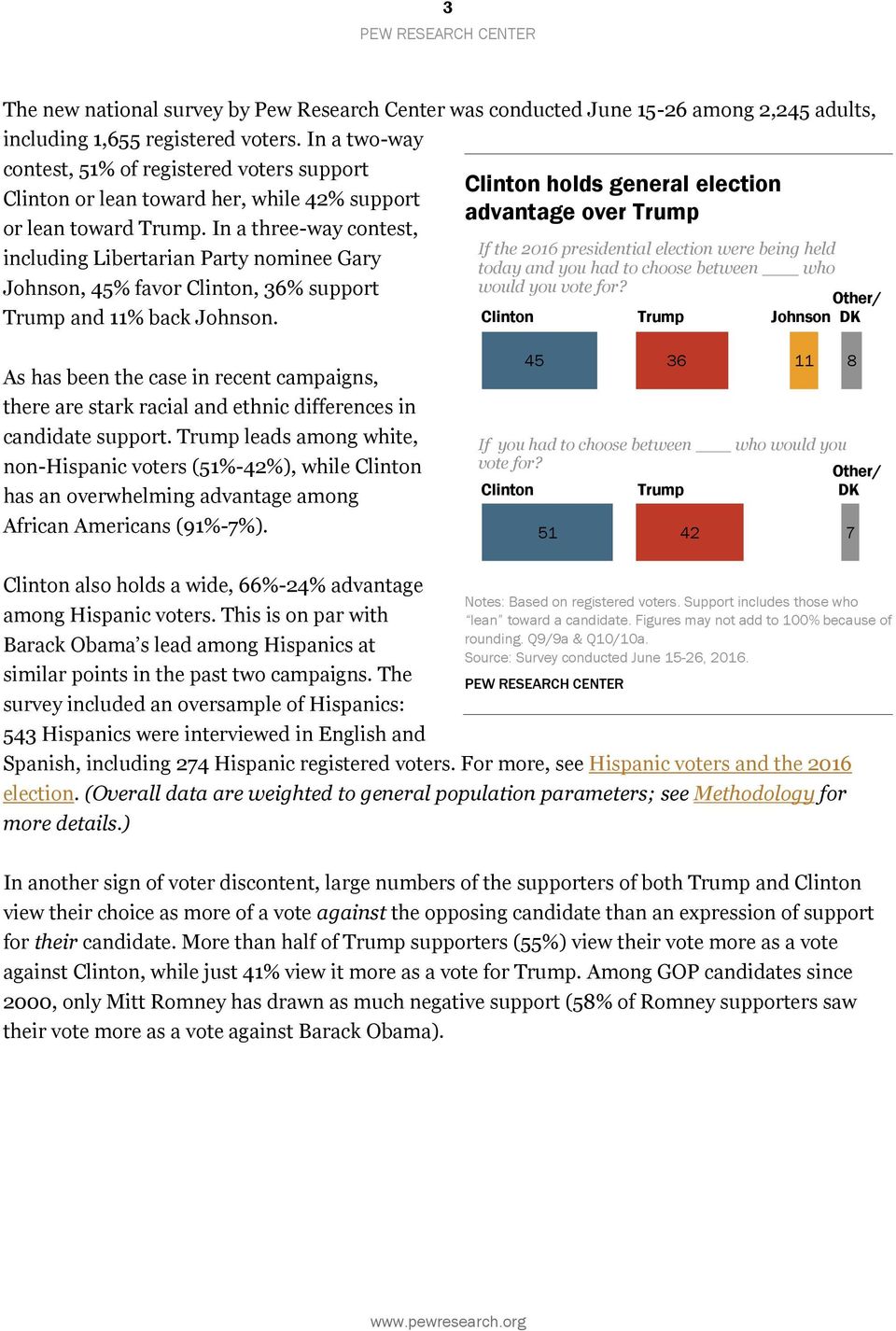
7 3 The new national survey by Pew Research Center was conducted June among 2,245 adults, including 1,655 registered voters. In a two-way contest, 51% of registered voters support Clinton or lean toward her, while 42% support or lean toward Trump. In a three-way contest, including Libertarian Party nominee Gary Johnson, 45% favor Clinton, 36% support Trump and 11% back Johnson. Clinton holds general election advantage over Trump If the 2016 presidential election were being held today and you had to choose between who would you vote for? Other/ Clinton Trump Johnson DK As has been the case in recent campaigns, there are stark racial and ethnic differences in candidate support. Trump leads among white, non-hispanic voters (51%-42%), while Clinton has an overwhelming advantage among African Americans (91%-7%) If you had to choose between who would you vote for? Other/ Clinton Trump DK 7 Clinton also holds a wide, 66%-24% advantage among Hispanic voters. This is on par with Barack Obama s lead among Hispanics at similar points in the past two campaigns. The survey included an oversample of Hispanics: 543 Hispanics were interviewed in English and Spanish, including 274 Hispanic registered voters. For more, see Hispanic voters and the 2016 election. (Overall data are weighted to general population parameters; see Methodology for more details.) Notes: Based on registered voters. Support includes those who lean toward a candidate. Figures may not add to 100% because of rounding. Q9/9a & Q10/10a. Source: Survey conducted June 15-26, In another sign of voter discontent, large numbers of the supporters of both Trump and Clinton view their choice as more of a vote against the opposing candidate than an expression of support for their candidate. More than half of Trump supporters (55%) view their vote more as a vote against Clinton, while just 41% view it more as a vote for Trump. Among GOP candidates since 2000, only Mitt Romney has drawn as much negative support (58% of Romney supporters saw their vote more as a vote against Barack Obama).
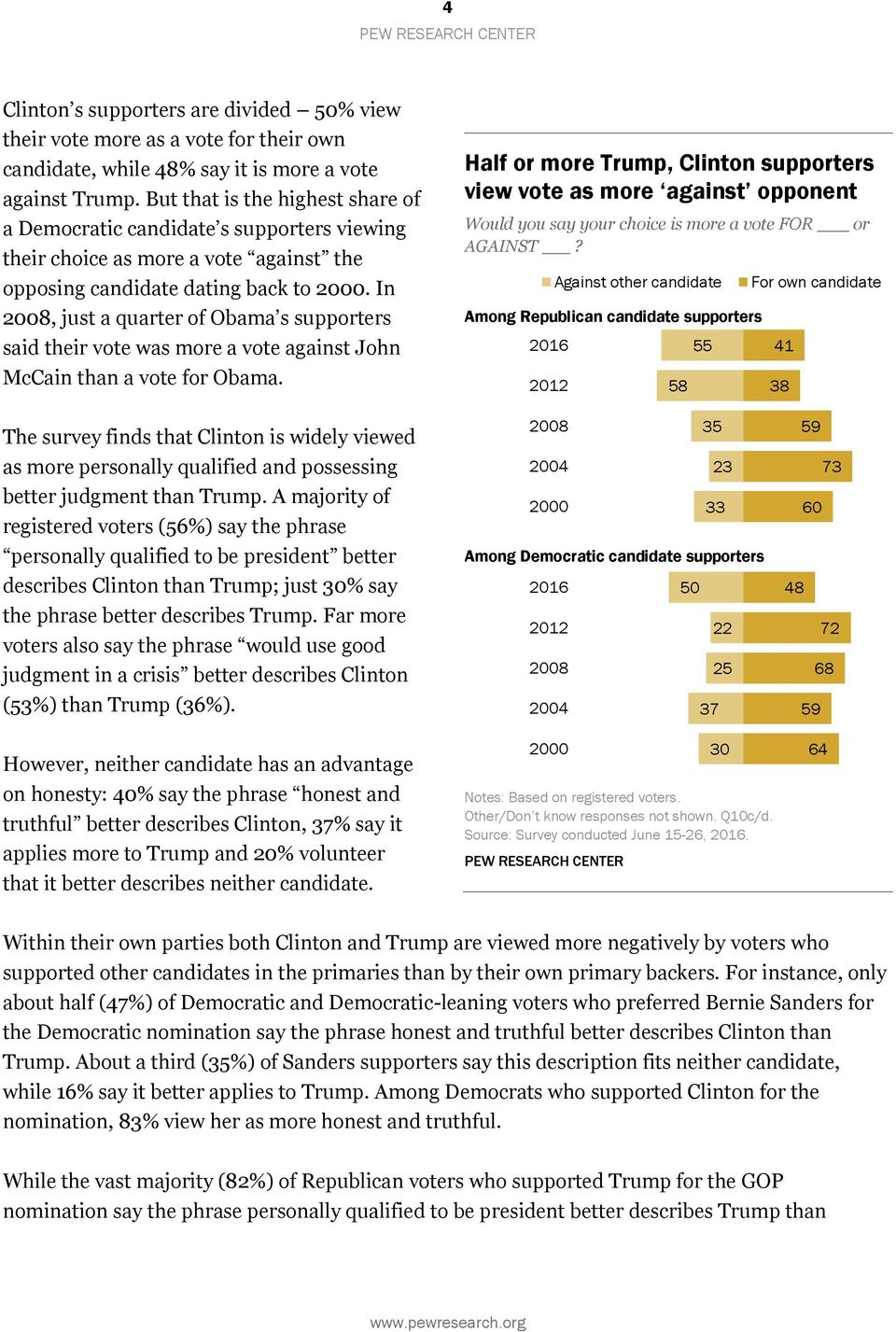
8 4 Clinton s supporters are divided 50% view their vote more as a vote for their own candidate, while 48% say it is more a vote against Trump. But that is the highest share of a Democratic candidate s supporters viewing their choice as more a vote against the opposing candidate dating back to In 2008, just a quarter of Obama s supporters said their vote was more a vote against John McCain than a vote for Obama. Half or more Trump, Clinton supporters view vote as more against opponent Would you say your choice is more a vote FOR AGAINST? Against other candidate Among Republican candidate supporters For own candidate or The survey finds that Clinton is widely viewed as more personally qualified and possessing better judgment than Trump. A majority of registered voters (56%) say the phrase personally qualified to be president better describes Clinton than Trump; just 30% say the phrase better describes Trump. Far more voters also say the phrase would use good judgment in a crisis better describes Clinton (53%) than Trump (36%). However, neither candidate has an advantage on honesty: 40% say the phrase honest and truthful better describes Clinton, 37% say it applies more to Trump and 20% volunteer that it better describes neither candidate Among Democratic candidate supporters Notes: Based on registered voters. Other/Don t know responses not shown. Q10c/d. Source: Survey conducted June 15-26, Within their own parties both Clinton and Trump are viewed more negatively by voters who supported other candidates in the primaries than by their own primary backers. For instance, only about half (47%) of Democratic and Democratic-leaning voters who preferred Bernie Sanders for the Democratic nomination say the phrase honest and truthful better describes Clinton than Trump. About a third (35%) of Sanders supporters say this description fits neither candidate, while 16% say it better applies to Trump. Among Democrats who supported Clinton for the nomination, 83% view her as more honest and truthful. While the vast majority (82%) of Republican voters who supported Trump for the GOP nomination say the phrase personally qualified to be president better describes Trump than
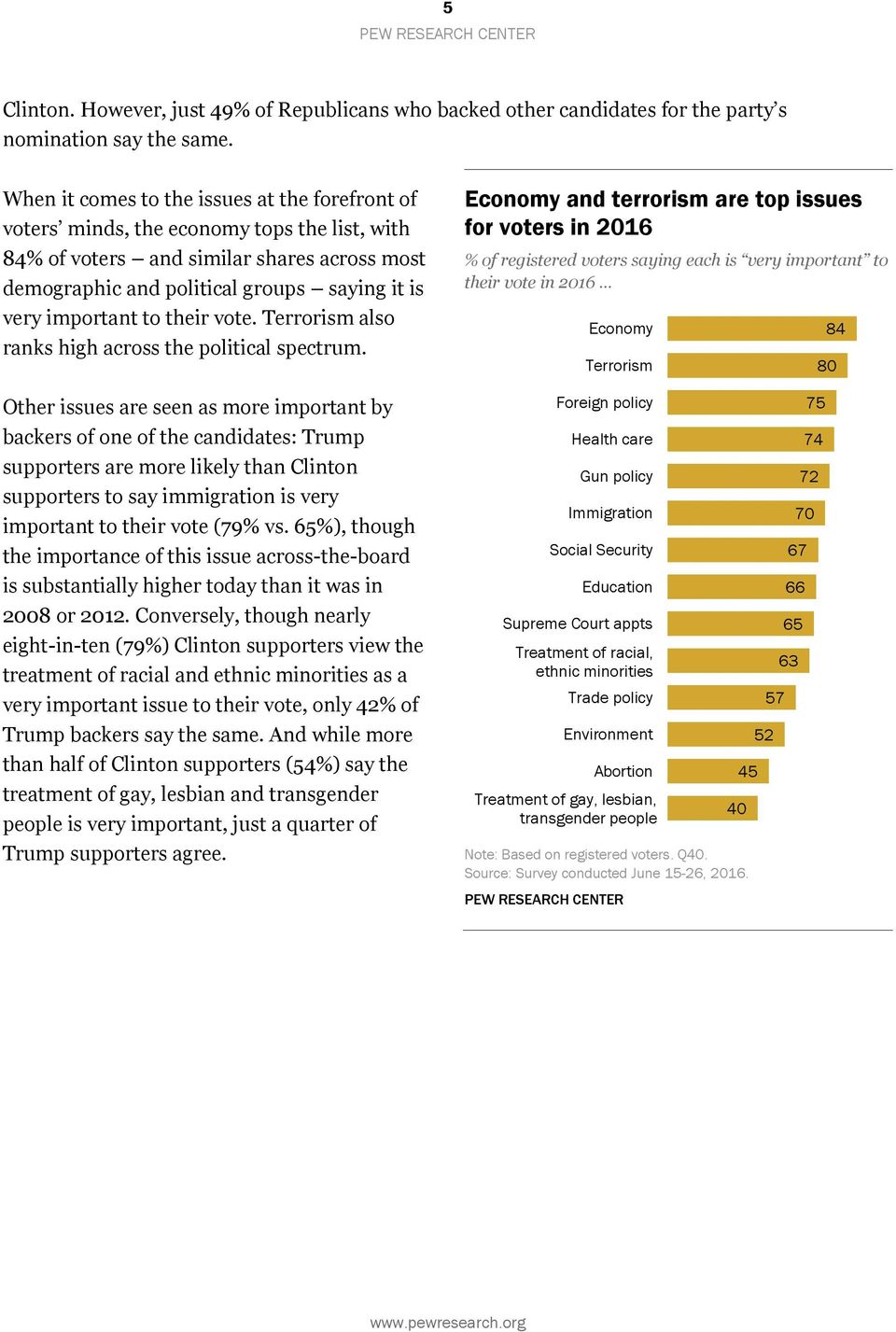
9 5 Clinton. However, just 49% of Republicans who backed other candidates for the party s nomination say the same. When it comes to the issues at the forefront of voters minds, the economy tops the list, with 84% of voters and similar shares across most demographic and political groups saying it is very important to their vote. Terrorism also ranks high across the political spectrum. Other issues are seen as more important by backers of one of the candidates: Trump supporters are more likely than Clinton supporters to say immigration is very important to their vote (79% vs. 65%), though the importance of this issue across-the-board is substantially higher today than it was in 2008 or Conversely, though nearly eight-in-ten (79%) Clinton supporters view the treatment of racial and ethnic minorities as a very important issue to their vote, only 42% of Trump backers say the same. And while more than half of Clinton supporters (54%) say the treatment of gay, lesbian and transgender people is very important, just a quarter of Trump supporters agree. Economy and terrorism are top issues for voters in 2016 % of registered voters saying each is very important to their vote in 2016 Economy Terrorism Foreign policy Health care Gun policy Immigration Social Security Education Supreme Court appts Treatment of racial, ethnic minorities Trade policy Environment Abortion Treatment of gay, lesbian, transgender people 40 Note: Based on registered voters. Q40. Source: Survey conducted June 15-26,
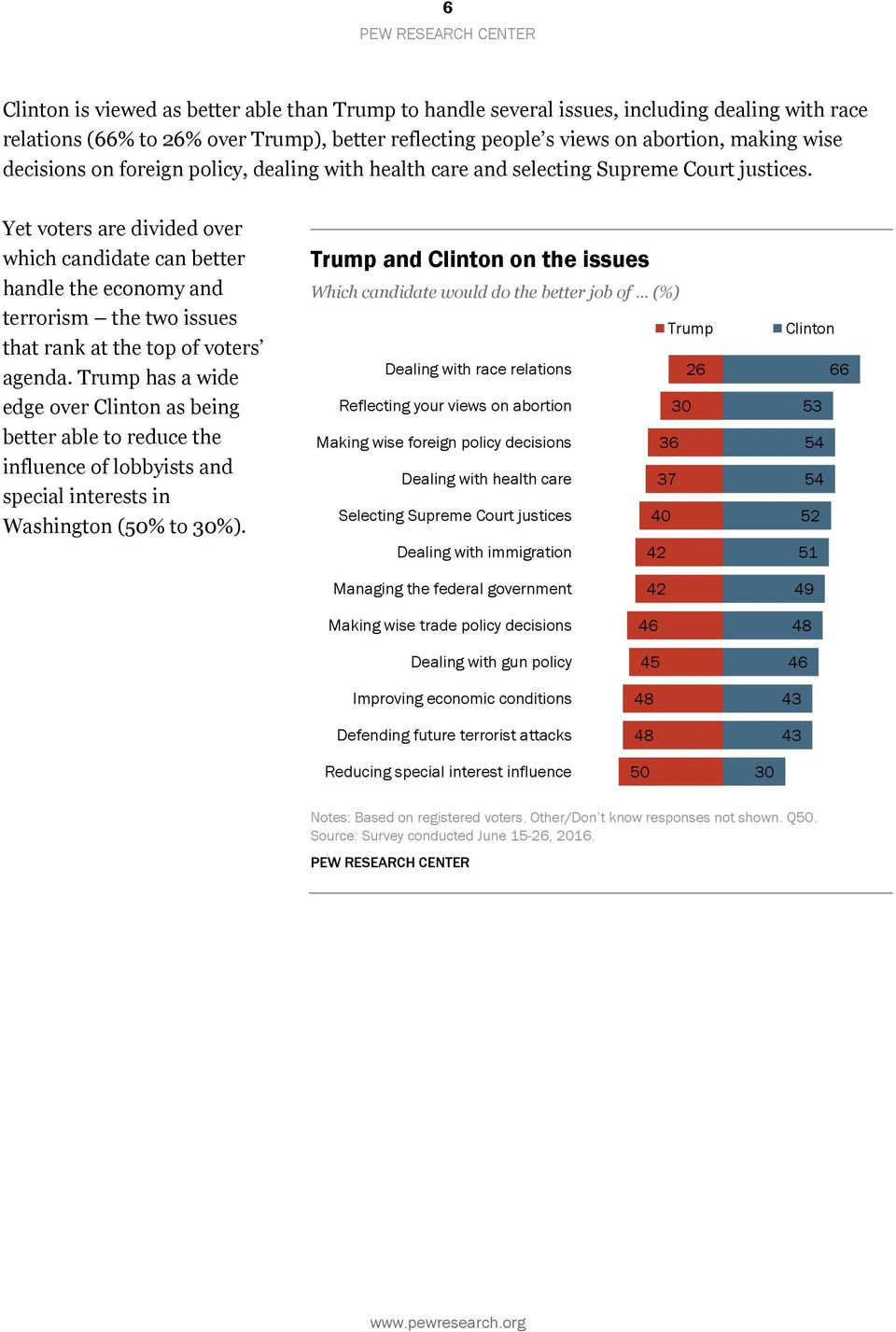
10 6 Clinton is viewed as better able than Trump to handle several issues, including dealing with race relations (66% to 26% over Trump), better reflecting people s views on abortion, making wise decisions on foreign policy, dealing with health care and selecting Supreme Court justices. Yet voters are divided over which candidate can better handle the economy and terrorism the two issues that rank at the top of voters agenda. Trump has a wide edge over Clinton as being better able to reduce the influence of lobbyists and special interests in Washington (50% to 30%). Trump and Clinton on the issues Which candidate would do the better job of (%) Trump Dealing with race relations 26 Reflecting your views on abortion 30 Making wise foreign policy decisions 36 Dealing with health care 37 Selecting Supreme Court justices 40 Dealing with immigration 42 Clinton Managing the federal government Making wise trade policy decisions Dealing with gun policy Improving economic conditions Defending future terrorist attacks Reducing special interest influence Notes: Based on registered voters. Other/Don t know responses not shown. Q50. Source: Survey conducted June 15-26, 2016.
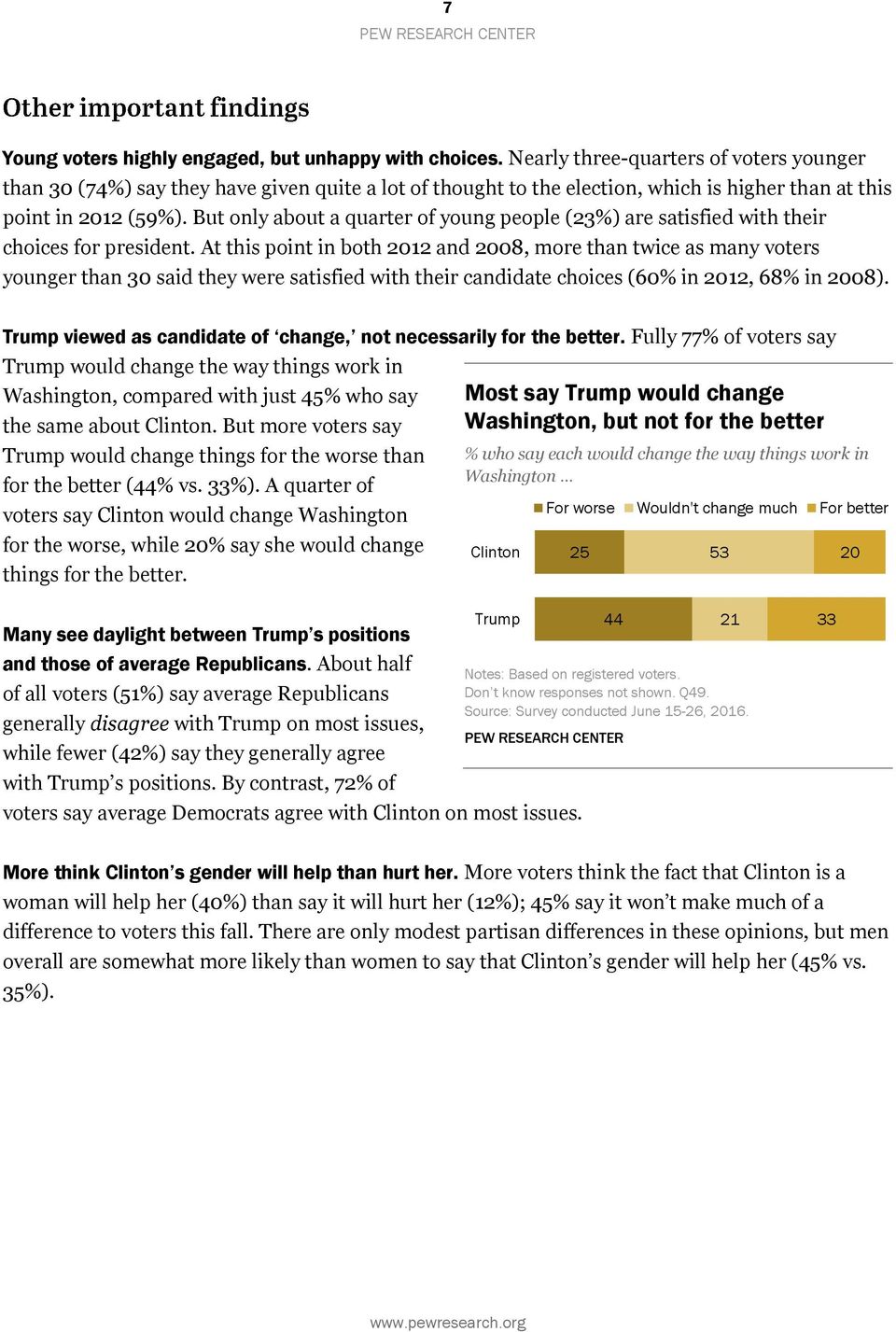
11 7 Young voters highly engaged, but unhappy with choices. Nearly three-quarters of voters younger than 30 (74%) say they have given quite a lot of thought to the election, which is higher than at this point in 2012 (59%). But only about a quarter of young people (23%) are satisfied with their choices for president. At this point in both 2012 and 2008, more than twice as many voters younger than 30 said they were satisfied with their candidate choices (60% in 2012, 68% in 2008). Trump viewed as candidate of change, not necessarily for the better. Fully 77% of voters say Trump would change the way things work in Washington, compared with just 45% who say the same about Clinton. But more voters say Trump would change things for the worse than for the better (44% vs. 33%). A quarter of voters say Clinton would change Washington for the worse, while 20% say she would change things for the better. Most say Trump would change Washington, but not for the better % who say each would change the way things work in Washington Clinton For worse Wouldn't change much For better Many see daylight between Trump s positions and those of average Republicans. About half of all voters (51%) say average Republicans generally disagree with Trump on most issues, while fewer (42%) say they generally agree with Trump s positions. By contrast, 72% of Trump voters say average Democrats agree with Clinton on most issues Notes: Based on registered voters. Don t know responses not shown. Q49. Source: Survey conducted June 15-26, More think Clinton s gender will help than hurt her. More voters think the fact that Clinton is a woman will help her (40%) than say it will hurt her (12%); 45% say it won t make much of a difference to voters this fall. There are only modest partisan differences in these opinions, but men overall are somewhat more likely than women to say that Clinton s gender will help her (45% vs. 35%).
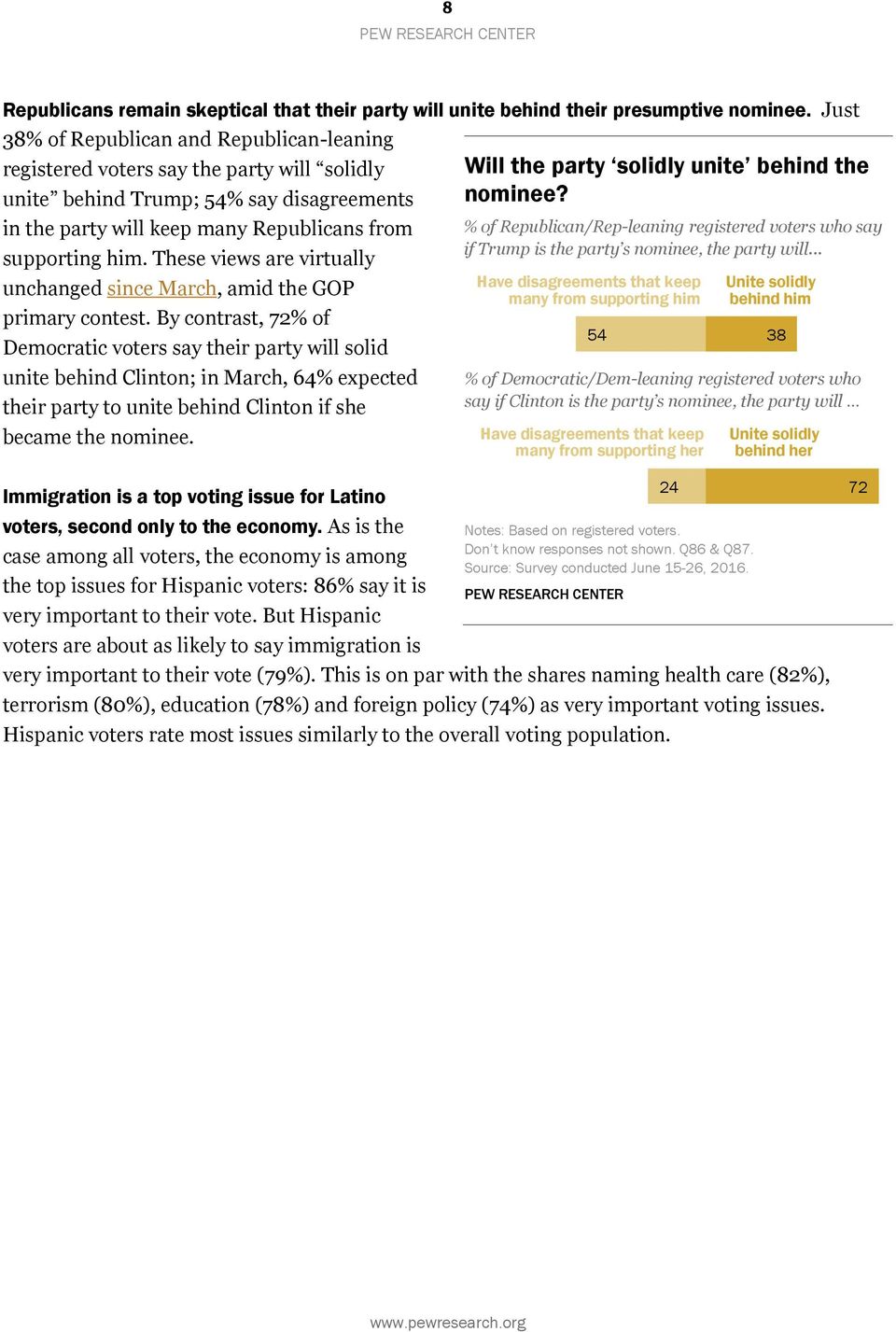
12 8 Republicans remain skeptical that their party will unite behind their presumptive nominee. Just 38% of Republican and Republican-leaning registered voters say the party will solidly unite behind Trump; 54% say disagreements in the party will keep many Republicans from supporting him. These views are virtually unchanged since March, amid the GOP primary contest. By contrast, 72% of Democratic voters say their party will solid unite behind Clinton; in March, 64% expected their party to unite behind Clinton if she became the nominee. Immigration is a top voting issue for Latino voters, second only to the economy. As is the case among all voters, the economy is among the top issues for Hispanic voters: 86% say it is very important to their vote. But Hispanic voters are about as likely to say immigration is Will the party solidly unite behind the nominee? very important to their vote (79%). This is on par with the shares naming health care (82%), terrorism (80%), education (78%) and foreign policy (74%) as very important voting issues. Hispanic voters rate most issues similarly to the overall voting population. % of Republican/Rep-leaning registered voters who say if Trump is the party s nominee, the party will... Have disagreements that keep many from supporting him Unite solidly behind him % of Democratic/Dem-leaning registered voters who say if Clinton is the party s nominee, the party will Have disagreements that keep many from supporting her Notes: Based on registered voters. Don t know responses not shown. Q86 & Q87. Source: Survey conducted June 15-26, Unite solidly behind her
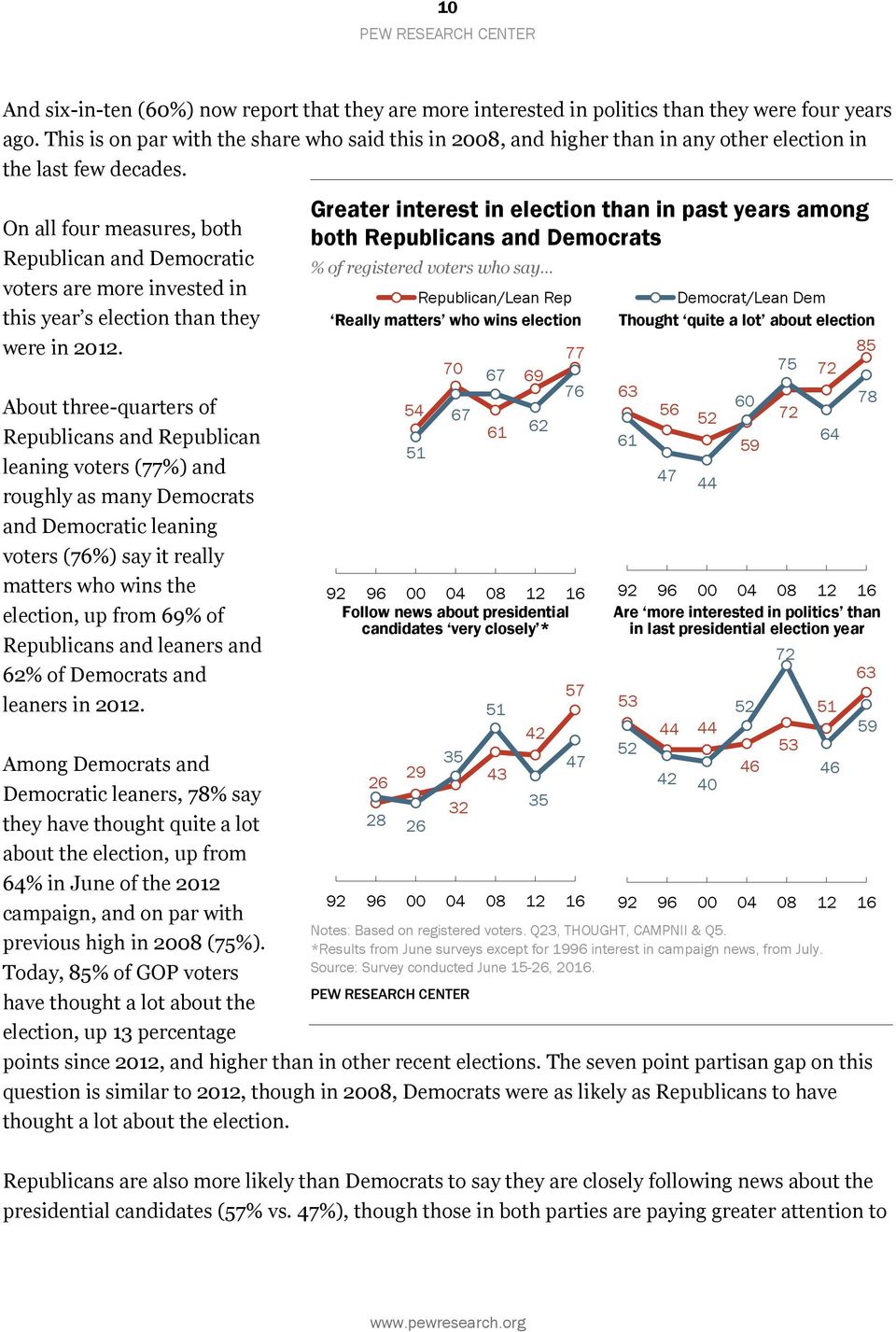
13 9 1. Campaign engagement and interest The 2016 campaign has attracted a high level of interest from voters. Several key measures of voter attention and engagement are currently as high or higher than at any point over the last two decades. Today, roughly three-in-four registered voters (74%) say that it really matters who wins the presidential election, substantially higher than the share who said this at similar points in any of the prior four presidential contests: In 2008 and 2012, smaller majorities (63% each) said that the outcome really mattered, while 67% did so in And eight-in-ten voters (80%) say they have thought quite a lot about the election. The percentage thinking a lot about the election is the highest in the past quarter-century (the It really matters who wins election Things will be pretty much the same no matter who wins Very/fairly closely Not too/at all closely Quite a lot Only a little previous high was 72% in 2008). Four years ago, 67% said they had thought quite a lot about the election. High levels of interest in the election % of registered voters who say When it comes to making progress on important issues facing the country... Follow news about presidential candidates * Thought about election Interest in politics compared to last presidential election year Notes: Based on registered voters. Q23, THOUGHT, CAMPNII & Q5. Other/Don t know responses not shown. * Results from June surveys except for 1992 & 1996 interest in campaign news, from July. Source: Survey conducted June 15-26, More interested Less interested The proportion who are paying attention to news about the presidential candidates very or fairly closely is also higher than in recent elections: 85% of voters say they are following election news very or fairly closely, up from 72% in 2012 and above the previous high of 81% in 2008.

14 10 And six-in-ten (60%) now report that they are more interested in politics than they were four years ago. This is on par with the share who said this in 2008, and higher than in any other election in the last few decades. On all four measures, both Republican and Democratic voters are more invested in this year s election than they were in About three-quarters of Republicans and Republican leaning voters (77%) and roughly as many Democrats and Democratic leaning voters (76%) say it really matters who wins the election, up from 69% of Republicans and leaners and 62% of Democrats and leaners in Among Democrats and Democratic leaners, 78% say they have thought quite a lot about the election, up from 64% in June of the 2012 campaign, and on par with previous high in 2008 (75%). Today, 85% of GOP voters have thought a lot about the election, up 13 percentage Follow news about presidential candidates very closely * Are more interested in politics than in last presidential election year points since 2012, and higher than in other recent elections. The seven point partisan gap on this question is similar to 2012, though in 2008, Democrats were as likely as Republicans to have thought a lot about the election. Greater interest in election than in past years among both Republicans and Democrats % of registered voters who say Republican/Lean Rep Really matters who wins election Democrat/Lean Dem Thought quite a lot about election Notes: Based on registered voters. Q23, THOUGHT, CAMPNII & Q5. *Results from June surveys except for 1996 interest in campaign news, from July. Source: Survey conducted June 15-26, Republicans are also more likely than Democrats to say they are closely following news about the presidential candidates (57% vs. 47%), though those in both parties are paying greater attention to
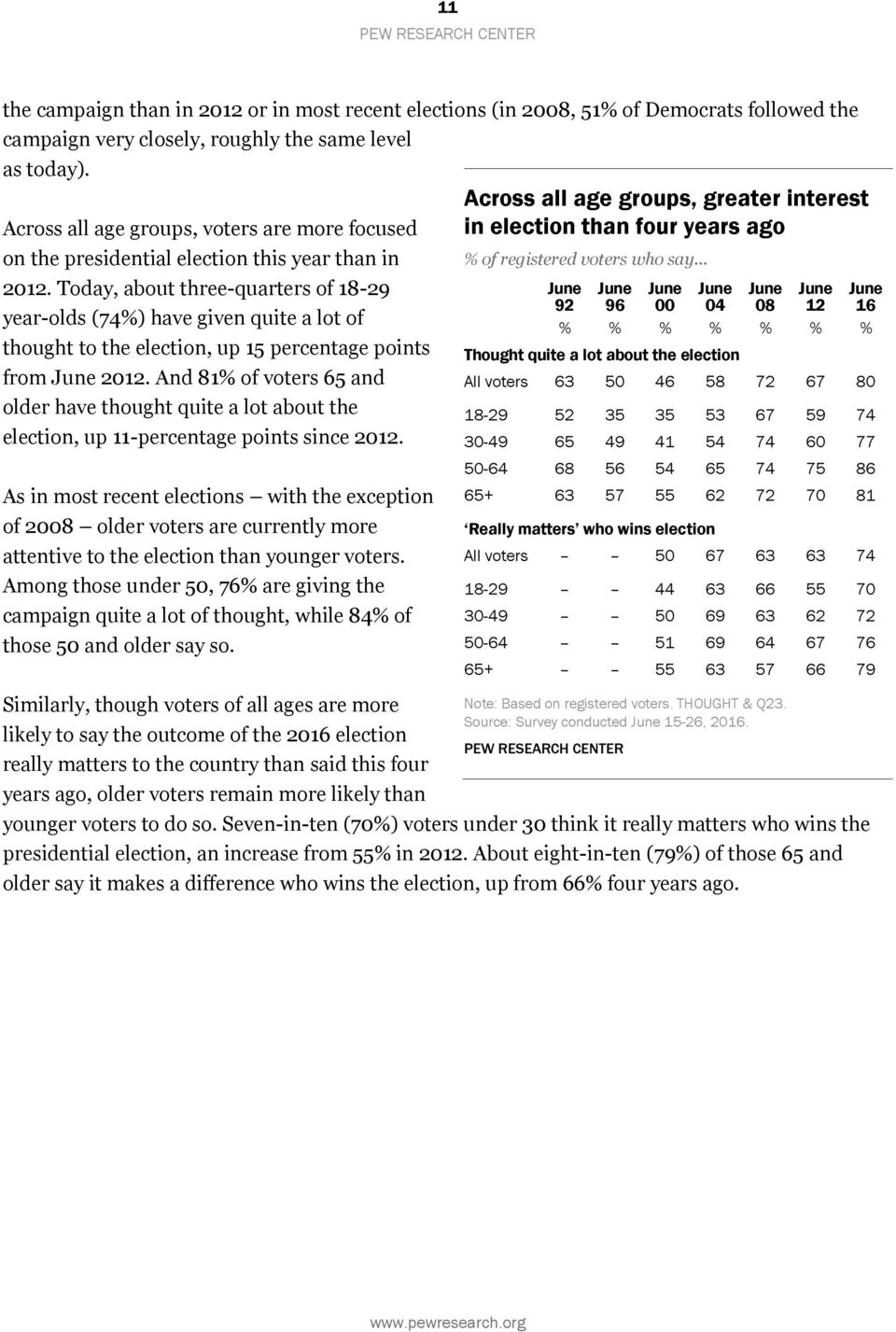
15 11 the campaign than in 2012 or in most recent elections (in 2008, 51% of Democrats followed the campaign very closely, roughly the same level as today). Across all age groups, voters are more focused on the presidential election this year than in Today, about three-quarters of year-olds (74%) have given quite a lot of thought to the election, up 15 percentage points from June And 81% of voters 65 and older have thought quite a lot about the election, up 11-percentage points since As in most recent elections with the exception of 2008 older voters are currently more attentive to the election than younger voters. Among those under 50, 76% are giving the campaign quite a lot of thought, while 84% of those 50 and older say so. Similarly, though voters of all ages are more likely to say the outcome of the 2016 election really matters to the country than said this four years ago, older voters remain more likely than Across all age groups, greater interest in election than four years ago % of registered voters who say... June June June June June June June % % % % % % % Thought quite a lot about the election All voters Really matters who wins election All voters Note: Based on registered voters. THOUGHT & Q23. Source: Survey conducted June 15-26, younger voters to do so. Seven-in-ten (70%) voters under 30 think it really matters who wins the presidential election, an increase from 55% in About eight-in-ten (79%) of those 65 and older say it makes a difference who wins the election, up from 66% four years ago.
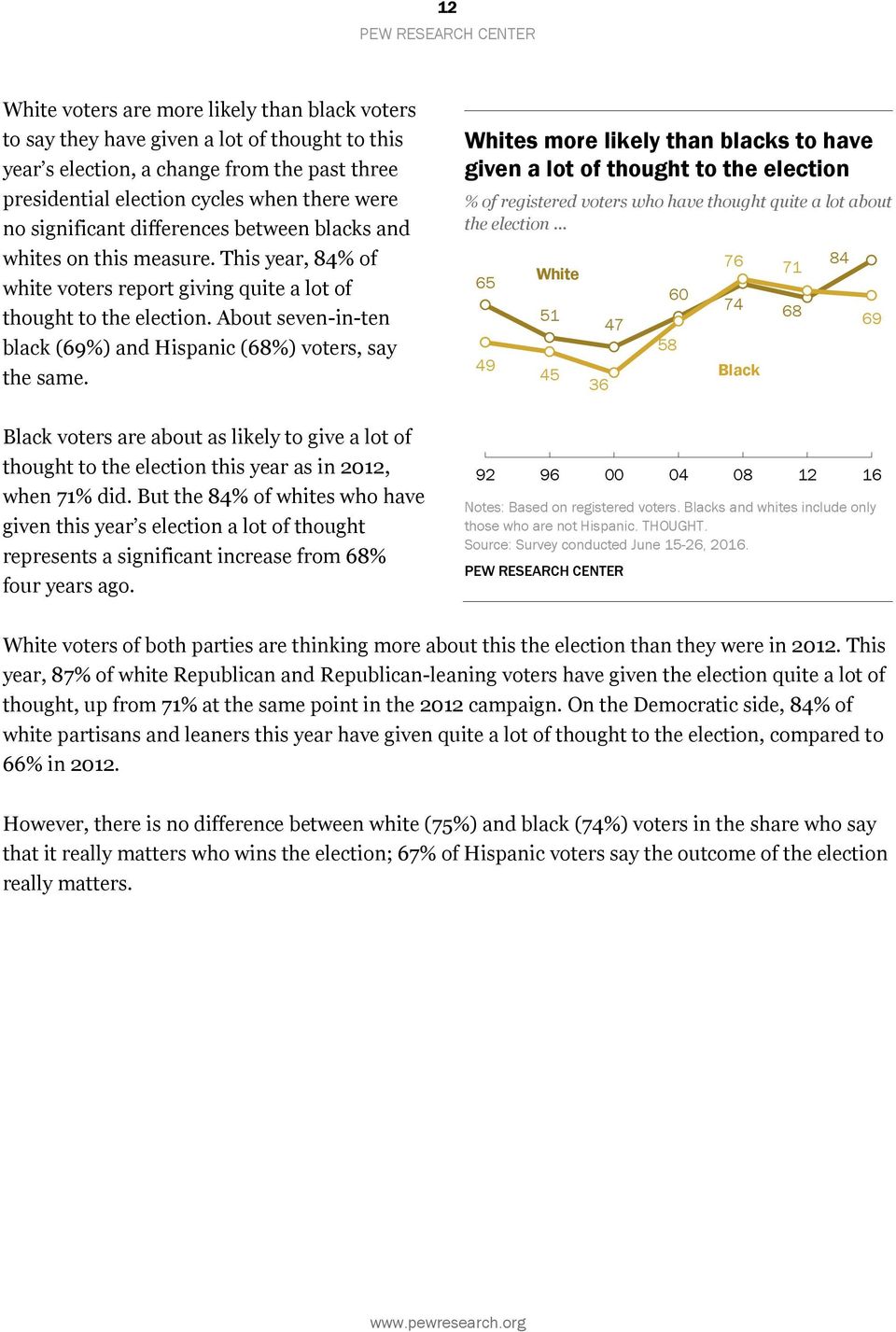
16 12 White voters are more likely than black voters to say they have given a lot of thought to this year s election, a change from the past three presidential election cycles when there were no significant differences between blacks and whites on this measure. This year, 84% of white voters report giving quite a lot of thought to the election. About seven-in-ten black (69%) and Hispanic (68%) voters, say the same. Whites more likely than blacks to have given a lot of thought to the election % of registered voters who have thought quite a lot about the election White Black Black voters are about as likely to give a lot of thought to the election this year as in 2012, when 71% did. But the 84% of whites who have given this year s election a lot of thought represents a significant increase from 68% four years ago Notes: Based on registered voters. Blacks and whites include only those who are not Hispanic. THOUGHT. Source: Survey conducted June 15-26, White voters of both parties are thinking more about this the election than they were in This year, 87% of white Republican and Republican-leaning voters have given the election quite a lot of thought, up from 71% at the same point in the 2012 campaign. On the Democratic side, 84% of white partisans and leaners this year have given quite a lot of thought to the election, compared to 66% in However, there is no difference between white (75%) and black (74%) voters in the share who say that it really matters who wins the election; 67% of Hispanic voters say the outcome of the election really matters.
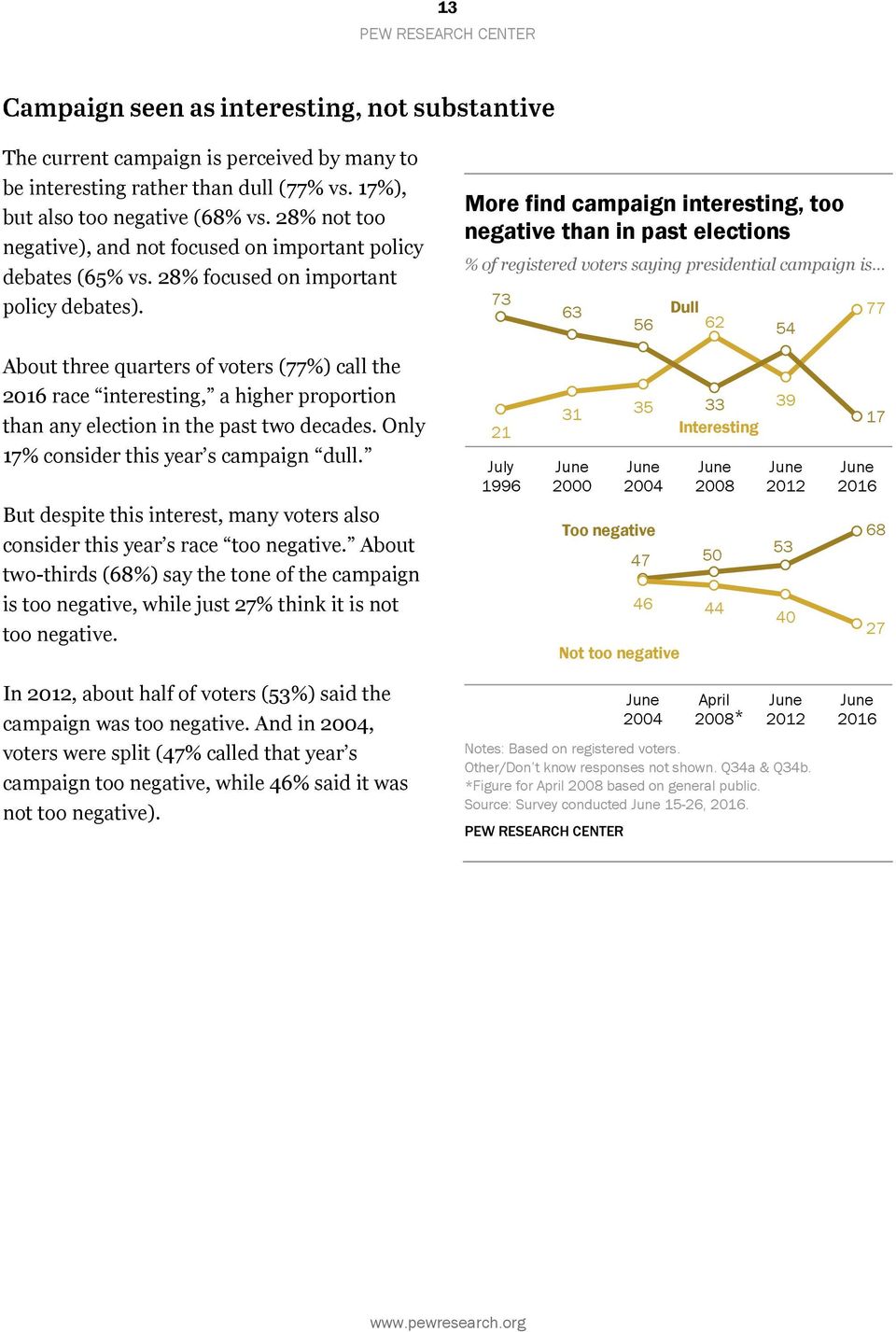
17 13 The current campaign is perceived by many to be interesting rather than dull (77% vs. 17%), but also too negative (68% vs. 28% not too negative), and not focused on important policy debates (65% vs. 28% focused on important policy debates). More find campaign interesting, too negative than in past elections % of registered voters saying presidential campaign is Dull About three quarters of voters (77%) call the 2016 race interesting, a higher proportion than any election in the past two decades. Only 17% consider this year s campaign dull. But despite this interest, many voters also consider this year s race too negative. About two-thirds (68%) say the tone of the campaign is too negative, while just 27% think it is not too negative. 21 July June June 2004 Too negative 33 Interesting June Not too negative 39 June June In 2012, about half of voters (53%) said the campaign was too negative. And in 2004, voters were split (47% called that year s campaign too negative, while 46% said it was not too negative). June 2004 April 2008* June 2012 Notes: Based on registered voters. Other/Don t know responses not shown. Q34a & Q34b. *Figure for April 2008 based on general public. Source: Survey conducted June 15-26, June 2016
18 14 About two-thirds of voters (65%) say that this year s presidential campaign is not focused on important policy debates; just 27% think the campaign is focused on important debates. Last December a slightly smaller majority (57%) said the campaign was not substantively focused, while about a third (35%) said it was. Most say campaign does not focus on important issues % of registered voters saying presidential campaign is Not focused on important Focused on impt. policy debates policy debates All voters Republicans and Republican leaners are somewhat more likely than their Democratic counterparts to think the campaign has been focused on important issues. A third of GOP voters (33%) say the campaign has been focused on important policy issues; only about a quarter (24%) of Democrats and Democratic leaners say the same. Republican voters who supported Donald Trump in the GOP primary are far more likely than those who supported other GOP candidates or Democratic primary supporters of either Hillary Clinton or Bernie Sanders to say the campaign so far has been focused on important policy debates. Roughly Rep/Lean Rep Dem/Lean Dem Among Rep/Lean Rep, primary preference Trump Other Clinton Sanders Among Dem/Lean Dem, primary preference half of Trump s primary backers (48%) say it has been a substantive campaign, compared with just 22% of those who supported other Republicans for the nomination Notes: Based on registered voters. Other/Don t know responses not shown. Q34e. Source: Survey conducted June 15-26, Among Democrats and Democratic leaners, just 21% of voters who supported Bernie Sanders in the primary and 27% of those who backed Clinton say the campaign is focused on important policy debates.

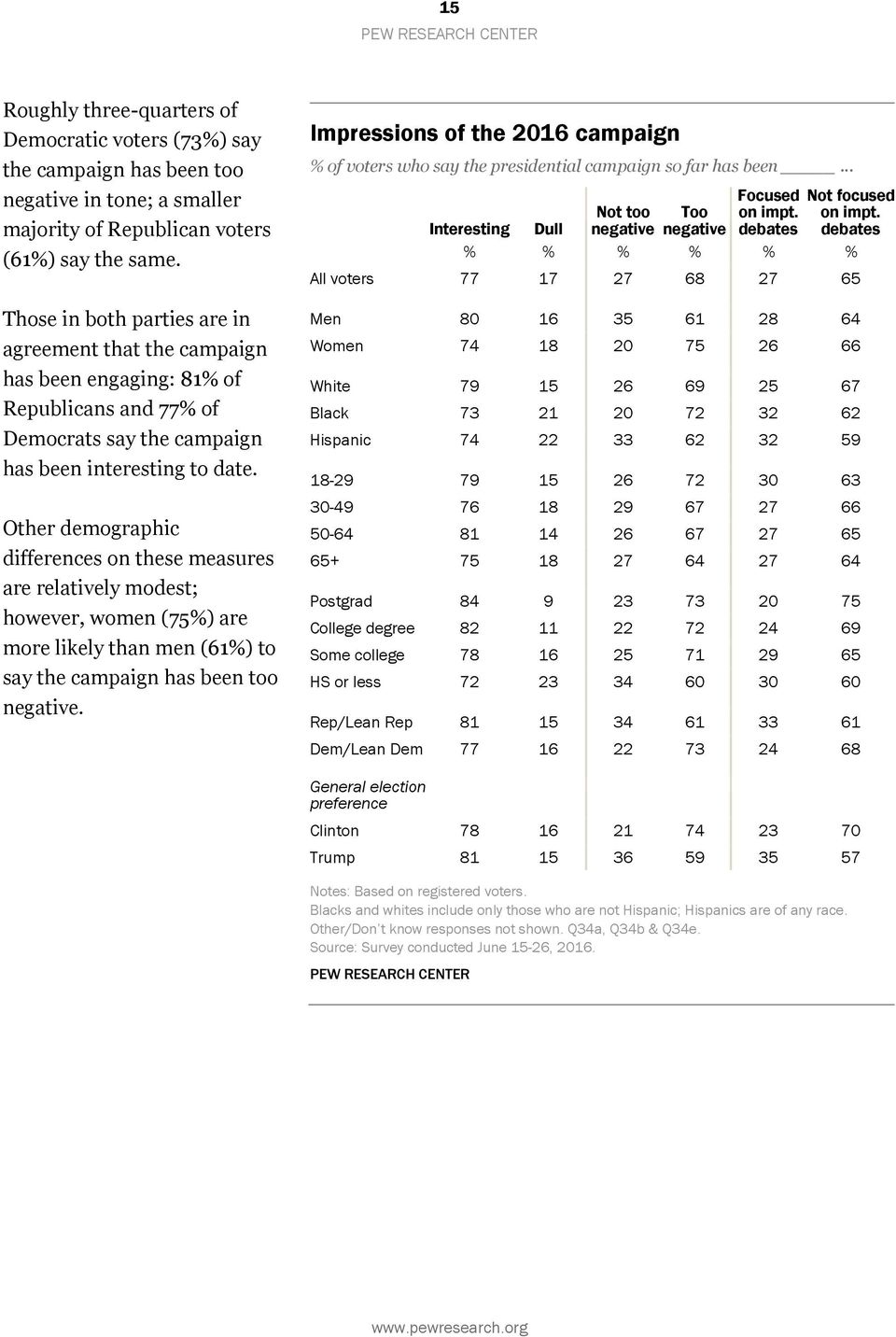
19 15 Roughly three-quarters of Democratic voters (73%) say the campaign has been too negative in tone; a smaller majority of Republican voters (61%) say the same. Those in both parties are in agreement that the campaign has been engaging: 81% of Republicans and 77% of Democrats say the campaign has been interesting to date. Other demographic differences on these measures are relatively modest; however, women (75%) are more likely than men (61%) to say the campaign has been too negative. Impressions of the 2016 campaign % of voters who say the presidential campaign so far has been... Focused Not focused Not too Too on impt. on impt. Interesting Dull negative negative debates debates % % % % % % All voters Men Women White Black Hispanic Postgrad College degree Some college HS or less Rep/Lean Rep Dem/Lean Dem General election preference Clinton Trump Notes: Based on registered voters. Blacks and whites include only those who are not Hispanic; Hispanics are of any race. Other/Don t know responses not shown. Q34a, Q34b & Q34e. Source: Survey conducted June 15-26, 2016.
20 16

21 17 2. Voter general election preferences Ahead of the party conventions and four months before the general election Hillary Clinton holds a significant edge over Donald Trump in voter preferences. Among registered voters, 45% say they would vote for Hillary Clinton if the election were held today, compared with 36% who say they would vote for Donald Trump and 11% who say they would vote for the libertarian candidate Gary Johnson. Clinton holds general election advantage over Trump If the 2016 presidential election were being held today and you had to choose between who would you vote for? Other/ Clinton Trump Johnson DK When asked to choose only between the two major party candidates, 51% would choose Clinton and 42% would choose Trump (an identical margin to the one when Gary Johnson is included in the question). If you had to choose between who would you vote for? Other/ Clinton Trump DK At this point in the campaign, many Clinton and Trump supporters describe their choice as a vote against the opposing candidate. In addition, for the first time since the 2000 election, fewer than half of both candidates supporters say they back their candidate strongly. Nonetheless, in an increasingly polarized environment, very few supporters of either candidate say there is a chance they might change their mind and vote for the other candidate this fall. Notes: Based on registered voters. Support includes those who lean toward a candidate. Figures may not add to 100% because of rounding. Q9/9a & Q10/10a. Source: Survey conducted June 15-26, 2016.
22 18 Among those who choose Trump over Clinton in the head-to-head question on voter preferences, 55% say their choice is more a vote against Clinton than for Trump. A smaller share (41%) says their vote is more for Trump than against Clinton. In 2008 and 2000 (the two most recent presidential elections with no incumbent candidate), no more than about a third of those planning to support the Republican candidate said their choice was more a vote against the Democrat than for the Republican. Many Trump and Clinton supporters say vote is against other candidate Would you say your choice is more a vote FOR AGAINST? 2016 Against other candidate Among Republican candidate supporters 55 For own candidate 41 or Negative voting is also widespread on the Democratic side. Among those planning to support Clinton in the general election, half (50%) say they think of their choice as more of a vote against Trump than for Clinton. About as many (48%) say their vote is more for Clinton than against Trump. The share of Democratic general election supporters who say they think of their vote more as a vote against the Republican candidate is higher than it was at this point in each of the past four presidential elections Among Democratic candidate supporters Notes: Based on registered voters. Other/Don t know responses not shown. Q10c/d. Source: Survey conducted June 15-26, 2016.
23 19 In addition, fewer than half of both Clinton and Trump supporters say they support their candidate strongly. Among registered voters who prefer Trump in the head-tohead vote choice question, 45% say they support him strongly. Among those who prefer Clinton, strong support is the same (45%). Fewer than half of Trump and Clinton voters strongly support their candidate % who say they support their candidate choice strongly Democratic candidate voters 71 Republican candidate voters Somewhat fewer Republican supporters backed the GOP candidate strongly in the summer of 2012 (38%) and 2008 (34%), when Mitt Romney and John McCain were the Republican presidential nominees. However, strong support on the GOP side is far lower than it was during George W. Bush s 2004 reelection campaign (71%). Strong support for Trump among his backers is about the same as it was among Bush s supporters during the summer of his first presidential campaign in 2000 (46%). Note: Based on registered voters. Q10b. Source: Survey conducted June 15-26, Strong support among Democratic candidate supporters is much lower among Hillary Clinton backers today (45%) than it was among Obama backers in 2012 (60%) and 2008 (58%) as well as Kerry voters in the summer of 2004 (59%). The current level of strong support among those who prefer Clinton in the general election is comparable to that of Gore backers in the summer of 2000 (40%). Among Clinton supporters, blacks (59%) express some of the highest levels of strong support for her. Among Trump supporters, those with no more than a high school diploma are especially likely to say they back Trump strongly (56%).
24 20 While supporters of both Trump and Clinton express relatively low levels of strong support for their candidate, very few say they are considering voting for the other candidate. Very few Trump or Clinton backers see a chance of supporting other candidate Among Republican candidate supporters, chance of voting for the Democratic candidate (%) Overall, just 8% of those who prefer Trump in Definitely decided not to Chance might the general election say there is a chance they might vote for Clinton in November, far more (91%) say they have definitely decided not to vote for her Similarly, only 6% of those who support Clinton say there is a chance they might vote for Trump in the fall, compared with 93% who say they definitely will not. At this point in the campaign, the share of Republican candidate-supporters who say they will not consider voting for the Democrat is much higher than it was at similar points in 2008 (72%) and 2000 (72%), the last two general elections without an incumbent candidate Definitely decided not to Among Democratic candidate supporters, chance of voting for the Republican candidate (%) Chance might On the Democratic side, the 93% of Clinton supporters who say they definitely will not vote for Trump is significantly higher than the share of Democratic candidate-supporters who said this in each of the past four presidential elections. For example, in the summer of 2000, 69% of those who supported Al Gore said there was no chance they would vote for George W. Bush in the fall, compared with 26% who said there was a chance they might Notes: Based on registered voters. Don t know responses not shown. Q11 & Q12. Source: Survey conducted June 15-26,
25 21 At this point in the campaign, there are familiar divides in preferences across demographic groups, with Trump and Clinton each drawing support from groups that have favored their respective parties in recent presidential elections. Hillary Clinton holds a wide 60%-30% advantage over Trump among young voters (ages 18-29). Among women, Clinton leads Trump 59% to 35%. Blacks (91%-7%) overwhelmingly support Clinton over Trump. Demographic differences in support for Trump and Clinton If you had to choose between for? (%) Total Men Women White Black Hispanic who would you vote Clinton Trump Trump fares relatively better among men, older voters and white voters. Trump leads Clinton 51% to 42% among whites. Among men, 49% back Trump, compared with 43% who support Clinton. Voters ages 50 and older are roughly divided in their support, but Trump performs more strongly among this group than among younger voters Postgrad College grad Some college HS or less Rep/Lean Rep Dem/Lean Dem Ahead of the conventions, Clinton receives slightly more support from Democratic and Democratic leaning voters (91%) than Trump gets from Republican and Republican leaning voters (85%). Among white voters, there is a clear divide in support by level of educational attainment. Among whites... College+ Non-college White voters with a college degree support Clinton over Trump by a 52%-40% margin. Views are the reverse among white voters without a college degree: 57% support Trump, compared with 36% who support Clinton Notes: Based on registered voters. Whites and blacks include only those who are not Hispanic; Hispanics are of any race. Other/Don t know responses not shown. Q10/10a. Source: Survey conducted June 15-26, 2016.
26 22 For the most part, differences in voter preferences across demographic groups are comparable to those seen at this point in the 2012 and 2008 presidential campaigns. Hillary Clinton s 24-point edge over Trump among women is somewhat higher than the 15-point advantage Obama held over Mitt Romney in June 2012 and the 14-point advantage Obama held over John McCain in the summer of Clinton is also running significantly better among those with college degree at this stage of the campaign than Obama was in 2012 and 2008.
27 23 Vote preferences in June of 2008, 2012 and 2016 If you had to choose between who would you vote for? June 2008 June 2012 June 2016 Obama McCain Other/ DK Margin Obama Romney Other/ Other/ DK Margin Clinton Trump DK Margin % % % % % % % % % Total D D D+9 Men D R R+6 Women D D D+24 White R R R+9 Black D D D+84 Hispanic D D D D D D D D even D R R R+3 Men D R D+7 Women D D D+32 Men R R R+18 Women D D D+18 Men D D D+11 Women D D D+44 Married men R R R+19 Unmarried men D D D+9 Married women D even D+12 Unmarried women D D D+37 Postgrad* D D D+27 College grad D D D+16 Some college D D D+1 HS or less D D D+7 Family income $100, R R D+8 $75,000-$99, D D even $30,000-$74, D R D+2 <$30, D D D+29 Notes: Based on registered voters. Whites and blacks include only those who are not Hispanic; Hispanics are of any race. In 2008 and 2012 there was insufficient sample size to report on Hispanics. In 2008, postgrad include those with some postgraduate experience but no degree; includes only those with a postgraduate degree. Q10/10a. Source: Survey conducted June 15-26, 2016.
28 24 Republican and Democratic voters who did not support their party s presumptive nominee in the primaries are somewhat less likely than those who did to say they plan to support their party s candidate in the general election. Among Republican and Republican-leaning registered voters who preferred a candidate other than Trump in the primaries, 77% say they plan to support him in the general election, while 14% say they will vote for Clinton and 9% volunteer another candidate s name or say they aren t sure who they will support. Support for Clinton is slightly higher among Democrats and Democratic leaners who backed Sanders in the primary contests: 85% say they plan to vote for Clinton in the general election, compared with 9% who say they will vote for Trump and 6% who volunteer that they will voter for another candidate or don t know. Primary differences persisting into the summer of an election year are nothing new. In June 2008, after a closely contested Democratic primary between Hillary Clinton and Barack Obama, 69% of Democrats who preferred Clinton said they would vote for Obama in the general election, while 16% said they would support John McCain and 12% volunteered that they would support another candidate or did not know who they would vote for. Primary differences remain visible on both sides 2016 general election preference Other/ Clinton Trump DK Among Rep/Lean Rep, 2016 primary preference % % % Trump =100 Other candidate =100 Among Dem/Lean Dem, 2016 primary preference Clinton =100 Sanders = general election preference Other/ Obama Romney DK Among Rep/Lean Rep, 2012 primary preference % % % Romney 2 98 *=100 Other candidate = general election preference Other/ DK Obama McCain Among Rep/Lean Rep, 2008 primary preference % % % McCain =100 Other candidate =100 Among Dem/Lean Dem, 2008 primary preference Obama =100 Clinton =100 Notes: Based on registered voters. Figures may not add to 100% because of rounding. Q10/10a & Q71, Q72. Source: Survey conducted June 15-26, 2016.
29 25 Hillary Clinton holds an identical nine-point edge over Trump in a head-to-head general election question (51%-42%) as well as in a general election question that names libertarian candidate Gary Johnson (45%-36%; 11% support Johnson). Patterns of support for Trump and Clinton across demographic groups are similar in both versions of the general election preference question. Johnson s strongest performance is among younger voters: 22% of year olds say they would vote for him when his name is offered. By comparison, just 6% of voters 50 and older would back Johnson.
30 26 Libertarian candidate Johnson s impact on general election preferences If you had to choose between who would you vote for? Two candidates (Vol.) Other/ Three candidates (Vol.) Other/ Clinton Trump DK Margin Clinton Trump Johnson DK Margin % % % % % % % Total D D+9 Men R R+6 Women D D+23 White R R+7 D Black D D+81 Hispanic D D+38 White men R R+22 White women D D D D D D D D R R+3 Men D D+6 Men R R+16 Women D D+31 Women D D+16 Postgrad D D+24 College grad D D+15 Some college D D+1 HS or less D D+7 Family income $100, D D+11 $75,000-$99, even R+4 $30,000-$74, D D+1 <$30, D D+28 Notes: Based on registered voters. Whites and blacks include only those who are not Hispanic; Hispanics are of any race. Q9/9a & Q10/10a. Source: Survey conducted June 15-26, 2016.
31 27 3. Views of the campaign and the candidates For the first time in more than two decades, a majority of voters express dissatisfaction with their choices for president this fall: Just 40% say they are very or fairly satisfied, while 58% say they are not too or not at all satisfied. By comparison, the balance of opinion at this point four years ago was roughly the reverse: 56% were satisfied with their choices, while 41% were not. Satisfaction with the choices was even higher in June of the 2000, 2004 and 2008 elections, with six-in-ten or more voters then saying they were satisfied with their choices for president. Today, Republican and Democratic voters express similarly low levels of satisfaction with the field of candidates: 40% of Republicans and Republican leaners, and 43% of Democrats and Democratic leaners, say they are very or fairly satisfied with the selections. In 2008 and 2012, Democrats registered higher levels of satisfaction than Republicans, while Republicans were more satisfied with the field than Democrats in Most voters not satisfied with the choices for president % of voters who are with the presidential candidates % of voters who are very/fairly satisfied with candidates Note: Based on registered voters. Q20. Source: Survey conducted June 15-26, Very/Fairly satisfied Democrat/Lean Democrat Republican/Lean Republican Not too/at all satisfied
32 28 Though those in most age groups are less satisfied with the candidates this year than they have been in the last few elections, this is particularly the case among younger voters. Just 23% of voters under 30 now say they are very or fairly satisfied with the field, down from 60% in 2012, and nearly seven-in-ten (68%) in Voters 50 and older now express greater satisfaction than younger voters: 48% are satisfied with their choices today. In 2012, older and younger voters were about equally likely to express satisfaction with the candidates (56% of those 50 and older vs. 60% of those under 30). The lower levels of satisfaction among younger voters today are evident within both parties: Just 29% of Republicans and Republican leaners under 35 say they are satisfied with the candidates, compared with 51% of GOP voters 65 and older. The pattern is nearly identical among Democrats: 54% of older voters are satisfied with their choices, All compared with just 26% of Democratic voters under 35. Record low levels of satisfaction with the candidate field among young voters % of voters very/fairly satisfied with the candidates for president % % % % % % % Oldest - youngest difference Note: Based on registered voters. Q20. Source: Survey conducted June 15-26, In both parties, younger voters less satisfied than older voters with their choices for president % of voters very/fairly satisfied with the candidates for president Among Rep/Lean Rep Note: Based on registered voters. Q20. Source: Survey conducted June 15-26, Among Dem/Lean Dem All
33 29 In another indicator of dissatisfaction with the field of candidates, asked if it is difficult to choose between Hillary Clinton and Donald Trump because either one would make a good president, just 11% express agreement, a smaller share than at any point in the last 16 years. At the same time, the percentage agreeing with a similar statement that it is a difficult choice because neither one would make a good president (41%) is as high as at any point over this period. The feeling that neither candidate would make a good president is more pronounced among Republicans than Democrats: 46% of Republicans and Republican leaners agree that it is difficult to choose between Clinton and Trump because neither would make a good president; 33% of Democratic voters say the same. Four-in-ten say it s tough to choose between Trump and Clinton because neither would be good president % of voters who say it is difficult to choose between the candidates because Either one would make a good president Disagree Agree Neither one would make a good president Disagree Agree Republican views that neither presidential candidate would make a good president are higher than in any election over the last sixteen years. Among Democratic voters, more now say neither candidate would make a good president than did so in 2008 or 2012, but as many expressed this view in the 2000 and 2004 elections % of voters who agree that it is difficult to choose between the candidates because Republican/Lean Rep Either one Either would make a good president Democrat/Lean Dem Neither one would make a good president Note: Based on registered voters. Q24F1 & Q25F2. Source: Survey conducted June 15-26, 2016.
34 30 Republicans remain skeptical that their party will unite behind Trump: About four-in-ten (38%) think that their party will unite behind their nominee, while 54% say internal disagreements in the GOP will keep many from supporting him. These views are relatively unchanged since March, and far fewer say the party will unite behind Trump than said this of either John McCain in 2008 or Mitt Romney in Half of Republicans say GOP will not solidly unite behind Trump % of Republican/Rep-leaning registered voters who say if Trump is the party s nominee, the party will... Have disagreements that keep many from supporting him Unite solidly behind him Democrats express much more confidence that their party will unite behind Clinton: 72% say this, while just 24% say disagreements within the party will keep many from supporting her. The share saying the party will solidly unite behind Clinton has grown over the last few months, from 64% in March to 72% today. % of Democratic/Dem-leaning registered voters who say if Clinton is the party s nominee, the party will Have disagreements that keep many from supporting her Notes: Based on registered voters. Don t know responses not shown. Q86 & Q87. Source: Survey conducted June 15-26, Unite solidly behind her In both parties, voters who supported candidates that did not become the party s nominee are less sure that the party will unite. Still, while 58% of Sanders supporters think that the party will unite behind Clinton (compared with 82% of Clinton s backers), just 28% of voters who supported candidates other than Trump believe that the party will unite behind him (compared with 52% of his primary supporters). About a quarter of Republicans who supported other GOP candidates say party will unite behind Trump % of registered voters who think that their party will solidly unite behind... All Rep/ Lean Rep Primary preference... Trump Other Trump All Dem/ Lean Dem Primary preference... Clinton Sanders Clinton Notes: Based on registered voters. Q86 &Q87. Source: Survey conducted June 15-26, 2016.
35 31 4. Top voting issues in 2016 election The economy and terrorism are the top two issues for voters this fall. Overall, 84% of registered voters say that the issue of the economy will be very important to them in making their decision about who to vote for in the 2016 presidential election; slightly fewer (80%) say the issue of terrorism will be very important to their vote. In 2008, far more said the economy would be very important to their vote (87%) than the issue of terrorism (68%). Economy and terrorism are top issues for voters in 2016 % of registered voters saying each is very important to their vote in 2016 Economy 84 Other issues that rank highly on voters 2016 importance list include foreign policy (75% very important), health care (74%), gun policy (72%) and immigration (70%). With an open seat on the Supreme Court, 65% say appointments to the nation s highest court will be a very important factor in their decision this fall. About as many (63%) say the issue of how racial and ethnic minorities are treated will be very important to their vote. Fewer than half of voters see abortion (45%) or the treatment of gay, lesbian and transgender people (40%) as very important to their vote. Terrorism Foreign policy Health care Gun policy Immigration Social Security Education Supreme Court appts Treatment of racial, ethnic minorities Trade policy Environment Abortion Treatment of gay, lesbian, transgender people Note: Based on registered voters. Q40. Source: Survey conducted June 15-26, 2016.
36 32 Among Trump supporters, 90% call the economy very important to their vote and 89% say the same about the issue of terrorism. Other issues given high priority by Trump supporters include immigration (79%) and foreign policy (79%). Large majorities of Clinton supporters also see the economy (80%) and terrorism (74%) as very important issues to their vote. Another top issue for Clinton supporters is how racial and ethnic minorities are treated: 79% of Clinton supporters say this is very important to their vote compared with just 42% of Trump backers who say the same. Clinton backers are somewhat less likely than Trump supporters to say immigration will be very important to their 2016 decision (65% vs 79%). Comparable shares of Clinton (74%) and Trump (71%) supporters say the issue of gun policy will be very important to their vote. In 2012 and 2004, far fewer supporters of either the Republican or Democratic candidate said the issue of gun control was very important to their vote. While the environment ranks relatively low among all voters as a 2016 issue, Clinton supporters are much more likely to say it is very important to their vote (69%) than are Trump supporters (32%). Views of 2016 issue importance among Clinton and Trump supporters % of registered voters saying each is very important to their vote in 2016 Clinton supporters Economy Terrorism Immigration Foreign policy Health care Supreme Court appointments Gun policy Social Security Trade policy Education Treatment of racial, ethnic minorities Abortion Environment Treatment of gay, lesbian, transgender people Trump supporters 80% 90% Note: Based on registered voters. Q40. Source: Survey conducted June 15-26, % Similarly, more Clinton (54%) than Trump (25%) backers say the issue of how gay, lesbian and transgender people are treated will be very important to their 2016 decision.
37 33 Across age groups, there are varying perspectives on the importance of issues in voting decisions. Older Americans are much more likely than younger adults to say the issue of Supreme Court appointments and Social Security will be very important to their 2016 decision. About three-quarters of those and 65 or older (74% each) say court appointments will be very important, compared with 60% of those and just 45% of those under 30. On the issue of Social Security, 78% of those 65 and older and 75% 0f those say this will be very important to their 2016 decision, compared with 58% of those and 57% of those Large majorities of those 65 or older (86%) and (85%) say terrorism is a very important issue to their vote; somewhat smaller majorities of those ages (77%) and (68%) say the same issue importance by age groups % of registered voters saying each is very important to their vote in % % % % Youngold diff Supreme Court appointments Social Security Terrorism Health care Foreign policy Trade policy Immigration Education Gun policy Economy Abortion Environment Treatment of racial and ethnic minorities Treatment of gay, lesbian and transgender people Note: Based on registered voters. Q40. Source: Survey conducted June 15-26, Younger adults place greater importance than older adults on two issues: The treatment of racial and ethnic minorities and the treatment of gay, lesbian and transgender people. About threequarters of those under 30 (74%) say the treatment of minorities is a very important issue to their vote, compared with 56% of those 65 and older. The issue of how gay, lesbian and transgender people are treated is a lower-tier issue across groups, but those under 30 (50%) are more likely than those over 65 (32%) to say it will be a very important issue in deciding how to vote this fall.
38 34 While a number of top issues, such as the economy, have been rated consistently high over the course of last several election cycles, immigration is an issue that has grown in importance. In the current survey, 70% of registered voters say immigration is very important to their vote for president in 2016, up from 41% in September 2012 and 54% in May More see immigration as very important to 16 vote % of registered voters who say immigration is very important to their vote 70 The increase in importance given to immigration has occurred among both Republicans and Democrats though Republicans have consistently been somewhat more likely than Democrats to call it a very important issue to their vote Overall, 77% of Republican and Republican-leaning voters and 65% of Democratic and Democratic-leaning voters say immigration is very important to their 2016 decision. Four years ago, 47% of Republicans and 37% of Democrats said this. In 2008 (when the issue was more salient to voters than in 2012), 64% of Republicans and 46% of Democrats said immigration was a very important issue in their vote choice Republican/Lean Republican Democrat/Lean Democrat Notes: Based on registered voters. Trends from comparable points in previous election cycles. Q40d. Source: Survey conducted June 15-26, 2016.
39 35 Conservative Republicans and liberal Democrats are both more likely than other members of their respective parties to call the issues of Supreme Court appointments and abortion very important to their 2016 decision. About three-quarters of conservative Republicans and Republican leaners (77%) say the issue of Supreme Court appointments will be very important to their vote, compared with fewer (56%) moderate and liberal Republicans and leaners. Conservative Reps, liberal Dems say court selections very important to vote % of registered voters saying each is very important to their vote in Supreme Court appointments Similarly, among Democrats and Democratic leaners, more liberals (69%) than moderates Conservative Republican Mod/Lib Republican Cons/Mod Democrat Liberal Democrat and conservatives (57%) see court appointments as very important to their 2016 Abortion vote. The same pattern is seen on the issue of abortion: 47% of conservative Republicans say abortion is a very important issue to their vote in 2016, compared with 31% of moderate and liberal Republicans. About half of liberal Democrats (52%) say abortion will be very important to their 2016 decision; 42% of conservative and moderate Democrats say the same. Conservative Republican Mod/Lib Republican Cons/Mod Democrat Liberal Democrat Note: Based on registered voters. Republicans include Republican-leaning independents; Democrats include Democratic-leaning independents. Q40f & Q40kF1. Source: Survey conducted June 15-26, 2016.
40 36 When it comes to which candidate would do the better job handling key issues, voters give the edge to Clinton over Trump in several areas, including making wise foreign policy decisions and dealing with immigration. But while Clinton is seen as having the edge over Trump on a greater number of the issues included in the survey, Trump holds a narrow advantage over Clinton when it comes to improving economic conditions and defending the country from future terrorist attacks two issues voters place near the top of their importance list. Trump and Clinton on the issues Which candidate would do the better job of (%) Trump Dealing with race relations 26 Reflecting your views on abortion 30 Making wise foreign policy decisions 36 Dealing with health care 37 Selecting Supreme Court justices 40 Dealing with immigration 42 Managing the federal government 42 Making wise trade policy decisions 46 Clinton Voters overwhelming say Clinton would do a better job dealing with race relations than Trump (66% vs. 26%) the widest issue advantage for either candidate. Clinton also holds a wide advantage over Trump when it comes to the candidate who could Dealing with gun policy Improving economic conditions Defending future terrorist attacks Reducing special interest influence better reflect voters views on abortion (53%-30%) and deal with health care (54%-37%). By almost 20 points, more voters say Clinton would be better at making wise foreign policy decisions than Trump (54%-36%). On the issue of immigration an area where Trump has made a series of controversial comments 51% of voters say Clinton would do the better job compared with fewer (42%) who say Trump would do better. Notes: Based on registered voters. Other/Don t know responses not shown. Q50. Source: Survey conducted June 15-26, With a current vacancy on the Supreme Court, 52% say Clinton would do better selecting Supreme Court justices, compared with 40% who think Trump would have the better approach.
41 37 On trade policy, an issue that featured prominently in both parties primary campaigns, neither candidate enjoys a significant advantage: 48% of voters say Clinton would do better making wise decisions on trade compared with 46% who say Trump. Similarly, no candidate has a significant edge on gun policy an issue that has received renewed attention in the wake of the nightclub shooting in Orlando, FL: 46% of voters prefer Clinton s approach on guns, while 45% prefer Trump s approach. By a 48%-43% margin, Trump holds a slight edge over Clinton as the candidate voters say would do the better job improving economic conditions. On terrorism, Trump has a similar advantage: 48% say he would do the better job preventing future attacks; 43% say Clinton would do the better job. Trump holds a wide edge over Clinton as the candidate seen as better able to reduce the influence of lobbyists and special interest groups in Washington: 50% think Trump would do the better job, while just 30% say Clinton would; 16% of voters volunteer that neither would do the better job reducing special interest influence in Washington.
42 38 In part, Trump s overall deficit on select issues reflects some skepticism from Republican and Republican leaning registered voters particularly those who preferred another candidate in the GOP primary. Overall, 53% of Republicans and Republican leaners say Trump would do the better job dealing with race relations, while 36% say Clinton would do the better job and 11% volunteer that neither would or that they don t know. Among Republicans who say they supported a candidate other than Donald Trump in the GOP primary, more say Clinton (51%) than Trump (34%) would do the better job on race relations. Majorities of Republicans and leaners say Trump would do the better job than Clinton dealing with immigration (80%) and foreign policy (70%); Republicans who did not support Trump in the primary are 28 points less likely than those who did to say he would do the better job on immigration and 33 points less likely than GOP Trump primary backers to say he would do a better job than Clinton making wise foreign policy decisions. Some GOP voters have doubts about how Trump would handle race relations Which candidate would do the better job Dealing with race relations Among Rep/Lean Rep registered voters -- Primary preference -- Other All Trump candidate % % % Donald Trump Hillary Clinton Neither (Vol.) Don t know Making wise foreign policy decisions Donald Trump Hillary Clinton Neither (Vol.) Don t know 3 * 4 Dealing with immigration Donald Trump Hillary Clinton Neither (Vol.) Don t know Notes: Based on registered voters. Figures may not add to 100% because of rounding. Q50. Source: Survey conducted June 15-26, 2016.
43 39 Among Democrats, confidence in Clinton is lowest when it comes to reducing the influence of lobbyists and special interest groups in Washington. Overall, 52% of Democratic and Democratic leaning registered voters think Clinton would do the better job on this issue, while 24% say Donald Trump would do the better job and 20% volunteer that neither would. About four-in-ten Democrats who supported Clinton in the Democratic primary are not sure she would be the best candidate to reduce the influence of lobbyists and special interests: 57% say she would do the better job on this issue, while 22% say Trump would do better and 16% volunteer that neither would. Views among Democrats who supported Bernie Sanders in the primary are little different: 46% think Clinton would do the better job, while 27% think Trump would and 23% volunteer that neither would. Some Democrats doubt Clinton s ability to reduce special interest influence Which candidate would do the better job Reducing special interest influence Among Dem/Lean Dem registered voters -- Primary preference -- All Clinton Sanders % % % Donald Trump Hillary Clinton Neither (Vol.) Don t know The gaps between Democrats who supported Clinton in the primary and those who supported Sanders are wider when it comes to which candidate would do better defending the country from future terrorist attacks and improving economic conditions. On the economy, 86% of Democrats who preferred Clinton in the primaries say she would do a better job than Trump compared with a smaller majority (68%) of Democrats who supported Sanders. Similarly, nearly nine-in-ten (87%) Democrats who backed Clinton in the primaries say she would do the better job defending the country from future terrorist attacks; 60% of those who supported Sanders say the same. Defending future terrorist attacks Donald Trump Hillary Clinton Neither (Vol.) Don t know Improving economic conditions Donald Trump Hillary Clinton Neither (Vol.) Don t know Note: Based on registered voters. Figures may not add to 100% because of rounding. Q50. Source: Survey conducted June 15-26, 2016.
44 40
45 41 5. Candidate traits and perceptions On a series of personal traits, voters say Clinton, rather than Trump, is better described by the phrases personally qualified to be president and would use good judgment in a crisis, but neither candidate holds an edge when it comes to the dimension of honest and truthful. Overall, 56% of voters say Clinton is better described by the phrase personally qualified to be president, compared with just 30% who say this better describes Trump. Clinton also enjoys a wide edge over Trump on which candidate would use good judgement in a crisis (53%-36%). Clinton seen as having advantage on qualifications, judgment; neither candidate holds edge on honesty Which candidate is better described by the phrase (%) Personally qualified to be president Would use good judgement in crisis Honest and truthful Trump Clinton Neither (Vol.) About as many say Trump is better described by the phrase honest and truthful (40%) as say this better describes Clinton (37%); 20% Notes: Based on registered voters. Other/Don t know responses not shown. Q48. Source: Survey conducted June 15-26, of voters volunteer that this phrase describes neither candidate.
46 42 As with views on the candidates ability to handle issues, there are differences in perceptions of candidate traits within both parties by primary preferences. Among Republicans and Republican leaners who did not support Trump in the GOP primaries, 49% say Trump is better described as personally qualified, while 29% say Clinton is and 19% volunteer that the phrase describes neither candidate. By contrast, 82% of Republicans who supported Trump in the primary say he is the candidate better described as personally qualified. Republicans who did not support Trump in the GOP primary are also less likely than those who did to view him as the candidate better described as honest and truthful (64% vs. 92%) and able to use good judgment in a crisis (59% vs. 88%). Among Democrats and Democratic leaners, 83% of those who supported Clinton in the primaries say she, rather than Trump, is better described as honest and truthful; just 47% of Democrats who supported Sanders say the same. Democratic voters who supported Sanders are also less likely than Clinton primary backers to say she is the general election candidate who is personally qualified to be president and would use good judgement in a crisis; nonetheless three-quarters or more say Clinton is better described by each of these phrases than Trump. Primary differences visible within both parties in views of candidates traits Which candidate is better described by the phrase Honest and truthful Primary preference among Dem/ Lean Dem RVs Primary preference among Rep/ Lean Rep RVs Clinton Sanders Trump Other % % % % Donald Trump Hillary Clinton Neither (Vol.) Other/Don t know Would use good judgment in crisis Donald Trump Hillary Clinton Neither (Vol.) Other/Don t know Personally qualified Donald Trump Hillary Clinton Neither (Vol.) Other/Don t know 1 * Notes: Based on registered voters. Figures may not add to 100% because of rounding. Q48. Source: Survey conducted June 15-26, 2016.
47 43 Voters are more familiar with Clinton s positions on issues than they are with Trump s: 53% say they know a lot about where Clinton stands on important issues facing the country, while 43% say they know a lot about Trump s positions. Though most voters say they know at least some about where both of the candidates stand, 25% of voters say they know not much or nothing about Trump s stances. Only 14% say this about Clinton s views. Half of Republican voters (50%), along with 57% of Democratic voters say they know a lot about where Clinton stands. There is a more pronounced partisan gap in views of Trump s positions: About half of GOP voters (53%) say they know a lot about his positions; just 36% of Democratic voters say this. Within both parties, those who supported the presumptive nominees are far more likely to say they know a lot about their positions than those who supported other candidates in the primaries. Roughly two-thirds of Clinton s (66%) and Trump s (68%) primary backers say they know a lot about their nominee s positions. By contrast, just 45% of Sanders supporters say they know a lot about Clinton s positions. And a similar share (43%) of Republicans who supported a candidate other than Trump in the primaries say they know a lot about where Trump stands. Clinton s positions on important issues more widely known than Trump s How much would you say you know about where stands on the important issues facing the country? Not much/ A lot Some Nothing DK Hillary Clinton % % % % All voters =100 Rep/Lean Rep =100 Dem/Lean Dem =100 Among Dem/Lean Dem primary preference... Clinton =100 Sanders =100 Donald Trump All voters =100 Rep/Lean Rep =100 Dem/Lean Dem =100 Among Rep/Lean Rep primary preference Trump =100 Other =100 Notes: Based on registered voters. Figures may not add to 100% because of rounding. Q30. Source: Survey conducted June 15-26, 2016.
48 44 About half of voters (48%) say Hillary Clinton understand the needs of people like them very or fairly well, 19% say not too well and 32% say not at all well. Voters are more critical of Donald Trump s understanding of their needs. Just 36% say Donald Trump understands their needs very or fairly well; 18% say he understands them not too well and more than four-in-ten (44%) say he understands their needs not well at all. How well do the candidates understand the needs of people like you? % of registered voters who say each understands needs of people like them... Very/Fairly well Not too well Not at all well All voters Rep/Lean Rep 17 Hillary Clinton Roughly three-quarters of Democratic voters Dem/Lean Dem (77%) say Clinton understands their needs well, compared with 69% of GOP voters who Donald Trump say Trump understands the needs of people All voters like them well. Rep/Lean Rep Very few partisans say the opposing party s candidate understands the needs of people like them. Just 8% of Democratic voters say Trump understands their needs; 17% of Republican voters say Clinton understands them. Dem/Lean Dem 8 19 Notes: Based on registered voters. Don t know responses not shown. Q33. Source: Survey conducted June 15-26,
49 45 There are substantial differences in voters assessments of how well the presumptive nominees reflect the views of those in their respective parties. Overall, 42% of voters say that average Republicans generally agree with Trump on most issues, while 51% say average Republicans generally do not agree with him. Differing assessments over average Republicans agreement with Trump % of registered voters who say... Average Republicans generally with Trump on most issues Disagree Agree All voters In contrast, by more than three-to-one (72% vs. 20%), most voters say average Democrats Rep/Lean Rep generally agree with Clinton on the issues. Dem/Lean Dem Partisans differ in their views of how closely Trump s views map to the views of ordinary Republicans. Roughly six-in-ten (62%) Republican and Republican-leaning voters feel that average Republicans tend to agree with Trump; 30% say they do not. Democrats, on balance, think average Republicans tend to disagree with the GOP s presumptive nominee: 27% say average Republicans are generally in agreement with him; 67% say they are generally in disagreement. Among Rep/Lean Rep primary preference... Trump Other All voters Rep/Lean Rep Dem/Lean Dem Average Democrats generally with Clinton on most issues Disagree Agree About three-quarters of those who supported Trump for the nomination (76%) say Republicans as a whole are generally in agreement with Trump. GOP voters who backed candidates other than Trump in the primaries are more divided on this question. Nevertheless, more say average Republicans agree, rather than disagree, with Trump (53% vs. 38%). Among Dem/Lean Dem primary preference... Clinton Sanders 22 Notes: Based on registered voters. Don t know responses not shown. Q41 & Q42. Source: Survey conducted June 15-26, Across the political spectrum, large majorities say Democrats are generally in agreement with Clinton. Fully 81% of Democratic and Democratic-leaning voters say this, along with 66% of GOP
50 46 voters. And though Sanders primary backers are somewhat more likely than Clinton s primary supporters to think average Democrats agree with Clinton on most issues, a clear majority of those in both groups (74% vs. 87%, respectively) say the Democratic rank-and-file generally agrees with Clinton on most issues.
51 47 Voters are much more likely to say that Donald Trump would change the way things work in Washington than Hillary Clinton, but many think the change Trump would bring to Washington would be for the worse. Overall, more voters think that Trump would change the way things work in Washington for the worse (44%) than for the better (33%); just 21% say they don t think he would change things much either way. Most say Trump would change Washington, but not for the better Do you think Donald Trump would change the way things work in Washington (%) All voters Clinton Trump For worse Wouldn't change much For better General election preference Voters are much less likely to say that Clinton would bring change to Washington. Just more than half (53%) say Clinton wouldn t change the way things work in Washington much at all. A quarter think she would change the way Washington works for the worse, while slightly fewer (20%) think she would change things for the better. Among Rep/lean Rep, preference in primaries... Trump Other Do you think Hillary Clinton would change the way things work in Washington For worse Wouldn't change much For better Among voters who support Trump in the All voters general election, fully 74% say they think he 2016 preference... would change the way Washington works for Clinton the better, while 19% say he wouldn t change Trump things much. By contrast, a majority of Hillary Clinton supporters (58%) say they don t think she would change the way things work in Washington much, while 38% say they think she would change things for the better. Among Dem/lean Dem voters, preference in primaries... Clinton Sanders Notes: Based on registered voters. Don t know responses not shown. Q49. Source: Survey conducted June 15-26, Q49a-b.
52 48 At the July Democratic national convention, Hillary Clinton is set to become the first woman nominated for president by one of the two major political parties. At this stage of the campaign, 45% of voters think that the fact that she is a woman won t make a difference to voters this fall; those who say it will be a factor are much more likely to think it will help her (40%) than hurt her (12%). More voters think Clinton s gender will help than hurt in 2016 election Do you think fact Hillary Clinton is a woman will help her, hurt her or won t make difference to voters this fall? Help her Hurt her Won t make a difference DK % % % % All voters =100 There are modest differences in these perceptions between men and women voters. Overall, 47% of women and 43% of men say Clinton s gender won t make a difference to voters this fall; men are somewhat more likely than women (45% vs. 35%) to say Clinton s gender will help her. And though few men or women think her gender will hurt her, this view is more prevalent among women than men (15% vs. 9%). Men =100 Women =100 Dem/Lean Dem =100 Rep/Lean Rep =100 Notes: Based on registered voters. Figures may not add to 100% because of rounding. Q35. Source: Survey conducted June 15-26, Q35.
53 49 6. Hispanic voters and the 2016 election Hillary Clinton currently has a 66%-24% advantage over Donald Trump among Hispanic registered voters. In a three-way test, including Libertarian Party nominee Gary Johnson, 58% of Latino voters support Clinton, 20% support Trump and 13% back Johnson. At a somewhat later point in the campaign four years ago, Barack Obama s lead over Mitt Romney among Hispanics was comparable to Clinton s lead over Trump today (69%-21%). And in the summer of 2008, Obama led John McCain 66%-23% among Hispanic voters. Clinton holds wide advantage over Trump among Latino voters If the 2016 presidential election were being held today and you had to choose between who would you vote for? (%) All voters Hillary Clinton 51 Donald Trump 42 According to national exit polls conducted after the 2012 election, Obama garnered 71% of the Hispanic vote (27% voted for Romney). Obama s national vote share among Latinos was the highest for a Democratic candidate since 1996, according to an analysis of the exit polls by Pew Research Center. All Hispanic voters 66 Notes: Based on registered voters. Other/Don t know responses not shown. Q10/10a. Source: Survey conducted June 15-26, Clinton s lead among Latino voters extends across many demographic subgroups. Among millennials (18 to 35 year olds) who make up 44% of all Hispanic eligible voters Clinton leads 71%-19%. Her advantage is roughly as large (65%-26%) among older Hispanics (those 36 and older). Clinton s lead is somewhat larger among Hispanic women than it is among Hispanic men. Among Hispanic women, 71% say they support Clinton while 19% say they support Trump. By contrast, among Hispanic men, 61% support Clinton and 30% support Trump.
54 50 Clinton holds an 80%-11% lead among Hispanic voters who are bilingual or Spanish-dominant (those who are more proficient in Spanish than English); these voters make up about 57% of all Latino registered voters. However, among the smaller group of Hispanic voters (43%) who are English-dominant those who are more proficient in English than Spanish just 48% back Clinton (41% would vote for Trump). In the past, Latinos have been consistently underrepresented in the electorate, compared with their share of eligible voters or the overall population. In the current survey, only about half of all Latinos (49%) say they are absolutely certain they are registered to vote. That compares with 69% of blacks and 80% of whites. Among Hispanics, those who are English dominant less unified in support for Clinton If the 2016 presidential election were being held today and you had to choose between who would you vote for? (% among Hispanic registered voters) All Hispanic voters Men Women Hillary Clinton Donald Trump There are several reasons why the share of Latinos who are registered to vote is lower than it is among blacks or whites. Many Latino immigrants may be in the U.S. legally but have not yet obtained U.S. citizenship. Many others are in the country as undocumented immigrants. Both groups are not eligible to vote, yet they make up about 30% of all Latino adults. Clinton holds an overwhelming (87%-7%) advantage over Trump among Latino adults who say they are not certain they are registered to vote. Millennial (18 to 35) Age 36 and older Language dominance English Bilingual/Spanish Notes: Based on Hispanic registered voters. Other/Don't know responses not shown. Language dominance based on self-described assessments of speaking/reading ability. Spanish-dominant: More proficient in Spanish than English. Bilingual: Proficient in both English and Spanish. English-dominant: More proficient in English than Spanish. Source: Survey conducted June 15-26, Q10/10a
55 51 The top voting issues for Hispanic voters are similar to those among all registered voters. An overwhelming share of Hispanic voters (86%) say the economy will be very important to their vote; among all voters, 84% cite the economy as very important. Terrorism is cited by 80% of Hispanic voters and an identical share of all registered voters. Top issues for Hispanic voters: economy, health care, terrorism, immigration, education % of Hispanic registered voters saying each is very important to their vote in 2016 The economy 86 However, there are some notable differences in the priorities of Hispanic voters. Roughly two-thirds of Hispanic voters (68%) consider the environment a very important issue. Only about half of all voters (52%) view the environment as very important. Nearly eight-in-ten (78%) Hispanic voters say education will be very important to their vote for president. That compares with 66% of all registered voters. Hispanics also are more likely than all voters to rate the treatment of gay, lesbian and transgender adults (50% vs. 40%), immigration (79% vs. 70%) and health care (82% vs. 74%) as very important. Health care Terrorism Immigration Education Foreign policy Treatment of racial, minorities ethnic minorities Social Security Gun policy The environment Supreme Supreme Court appointments Trade policy Treatment of gay, lesbian, LGBT transgender people Abortion Pew Research Center s National Survey of Latinos has found that while immigration is widely viewed as an important priority among Hispanics, the economy, education and health care often are seen as important or more important. Note: Based on Hispanic registered voters. Q40. Source: Survey conducted June 15-26, 2016.
56 52 When asked which candidate is better on specific issues, for Hispanic voters, Clinton is seen as better than Trump on all 12 issues tested in the survey. Fully 81% of Hispanic voters say Clinton could do better in dealing with race relations, compared with just 14% who prefer Trump. Clinton also holds a 54-percentage-point lead over Trump on health care and a 48-point advantage on immigration. Clinton s advantages among Hispanic voters are narrower on the three issues on which she trails Trump among all voters: Reducing the influence of special interest groups, improving economic conditions and defending the country from terrorist attacks. Hispanics favor Clinton over Trump on a wide range of issues Which candidate would do a better job of... (%) All registered voters Hispanic registered voters Trump Clinton Diff Trump Clinton Diff % % % % Dealing with race relations Clinton Reflecting your views on abortion Making wise decisions about foreign policy Dealing with health care Selecting Supreme Court justices Dealing with immigration Managing the federal government Making wise decisions about U.S. trade policies Dealing with gun policy Defending country from future terrorist attacks Improving economic conditions Reducing influence of special interest groups Clinton Clinton Clinton Clinton Clinton Clinton Clinton Clinton Trump Trump Trump Notes: Based on registered voters. Other/Don t know responses not shown.q50. Source: Survey conducted June 15-26, Clinton +67 Clinton +44 Clinton +41 Clinton +54 Clinton +39 Clinton +48 Clinton +38 Clinton +38 Clinton +21 Clinton +17 Clinton +18 Clinton +12
57 53 The size of the Hispanic electorate is expected to number 27.3 million eligible voters (adult U.S. citizens) in 2016, projected to make up 12% of all eligible voters, a share equal to that of blacks among eligible voters. But voter turnout among Hispanics has long lagged that of other groups. At this point in the campaign, Hispanic voters lag all registered voters on several measures of engagement. Two-third of Hispanic voters (67%) say they have been following news about the election very or fairly closely. That compares with 85% of all voters. And while 80% of all voters say they have been giving quite a lot of thought to the election, a smaller majority of Latino voters (68%) say the same. However, most Hispanic voters (63%) say they are more interested in politics than they were in Among all voters, a similar percentage (60%) expresses increased interest in politics. Among both Latinos and the public overall, there are wide gaps in political engagement between voters and non-voters. But in some cases Latinos who are not registered are even less engaged than are non-voters generally. For instance, just 37% Most Latino voters say they are more interested in politics than in 2012 Thought given to election of Hispanics who are not registered to vote say they have been following election news at least fairly closely. That compares with 56% of all adults who are not registered to vote. General public Hispanics Non- Non- RVs RVS RVs RVS % % % % Quite a lot Some/little/none In making progress on major issues Really matters who wins the election Things will be the same regardless of who wins More or less interested in politics than in 2012? More interested Less interested Same Following news about the 2016 election Very/fairly closely Not too/not at all closely Notes: Based on registered voters. Other/Don t know responses not shown.q5, THOUGHT, CAMPNII & Q23. Source: Survey conducted June 15-26, 2016.
58 54
59 55 7. Views of Barack Obama, the political parties, Congress and the nation s economy Among the public overall, 50% approve of the way Barack Obama is handling his job as president, while 44% disapprove. Obama s job approval is little changed from April (48%) and March (51%), when his job rating reached positive territory for the first time in nearly three years. Obama continues to draw strong ratings among African Americans (83% approve) and Hispanics (65%). Among whites, however, 39% approve of Obama s job performance, while 55% disapprove. There is a sizable gender gap in Obama s job ratings among whites. Just 33% of white men approve of Obama s job performance, while 61% disapprove. White women are more evenly divided (45% approve, 49% disapprove). Obama s job rating % who of the way Obama is handling his job Approve Disapprove Note: Don t know responses not shown. Q1. Source: Survey conducted June 15-26, Views of the way Obama is handling his job as president are divided along party lines: while 84% of Democrats approve of Obama s performance in office (11% disapprove), just one-in-ten Republicans say they approve. By contrast, fully 86% of Republicans disapprove of Obama s job. Independents are split on Obama approval: 46% approve, while 46% disapprove. However, threequarters of those who lean toward a party express views in line with partisans: 75% of Democratic leaners approve, and 75% of Republican leaners disapprove. (For more on views of Barack and Michele Obama, see our recent report on Partisanship and Political Animosity in )
60 56 Opinions of the Republican and Democratic parties have shown little change over the past year. Impressions of the GOP remain near historic lows: Just 35% have a favorable view of the Republican Party, while 60% view it unfavorably. Opinions of the Democratic Party are divided (49% favorable, 46% unfavorable). Views of the parties are little changed % who have a favorable view of each party 62 Democratic Party As was the case in April, Republicans have less favorable opinions of their own party than Democrats have of theirs. Currently, 69% of Republicans view the GOP favorably; by contrast, 85% of Democrats view the 40 Republican Party Democratic Party favorably. The Democratic Party has held a significant advantage in favorability over the Republican Party over the last six years. The gap narrowed in late 2014, shortly after Republicans won control of both the House and Senate, but a clear Democratic favorability advantage reemerged by the summer of Source: Survey conducted June 15-26, Q45.
61 57 Currently, 31% of the public views Congress favorably, while about twice as many (63%) have an unfavorable opinion. While views of Congress have been quite negative for several years, the current favorable rating is a bit higher than last September (27%). Majorities of independents (66%), Republicans (63%) and Democrats (62%) have unfavorable opinions of Congress. Most continue to view Congress unfavorably % who have a view of Congress 67 Favorable Unfavorable Note: Don t know responses not shown. Q45c. Source: Survey conducted June 15-26, 2016.
62 58 The public continues to have mixed ratings of the nation s economy. Currently, 44% say conditions are only fair while a roughly equal share views them as excellent or good (27%) or poor (28%). Little change in views of current economic conditions Economic conditions in the country today are (%) Excellent/Good Only fair Poor These views have changed little over the last year, but there has been long-term improvement in economic attitudes. In June 2012, at about the same point in the previous presidential campaign, just 10% expressed positive views of the nation s economy, while 42% described economic conditions as poor Looking ahead, a majority of Americans (54%) say conditions next year will be about the same as they are now. About three-in-ten (29%) say things will improve over the course of the next year and 13% believe they will get worse. Optimism about economic conditions in the coming year is up slightly from March when 22% said economic conditions would be better a year from now and 17% said they would be worse A year from now, economic conditions will be (%) Better Same Worse Note: Don t know responses not shown. Q55 & Q56. Source: Survey conducted June 15-26, 2016.
63 59 Republicans and Democrats continue to express differing views on the state of the economy. Democrats and Democratic-leaning independents are more than twice as likely as Republicans and Republican leaners to rate national economic conditions as excellent or good (40% vs. 15%). Wide partisan gap in views of economic conditions, smaller gap in expectations Economic conditions in the country today are excellent/good (%) Partisan differences are more muted on expectations about where the economy is heading. Similar shares of Democrats and Democratic leaners (32%) and Republicans and Republican leaners (27%) expect things to improve over the next year. Few expect conditions to get worse and pluralities of both (51% of Republicans, 58% of Democrats) say the economy will be little changed. Republican/Lean Rep Democrat/Lean Dem A year from now economic conditions will be better (%) Source: Survey conducted June 15-26, Q55 & Q56.
64 60 Most Americans (53%) say their family s income is falling behind the cost of living. About a third (36%) say they are staying about even while just 8% say their incomes are rising fast than the cost of living. Majorities of those with family incomes below $30,000 a year (71%), and those with incomes between $30,000 and $75,000 (56%), say their incomes are falling behind the cost of living. Only about a third (31%) of those with incomes of at least $100,000 feel like they are falling behind. Many feel they are falling behind cost of living Family income relative to the cost of living (%) Falling behind Staying even Going up faster DK Total Postgrad College degree Some college HS or less $100,000 or more $75,000-$99,999 $30,000-$74,999 $30,000 or less Note: Figures may not add to 100% because of rounding. Q16. Source: Survey conducted June 15-26, 2016.
65 61 Among registered voters, there are wide differences in views of the economy among supporters of Trump and Clinton. A majority of Trump supporters (61%) say their incomes are not keeping pace with the cost of living compared with 47% of Clinton supporters. Even among Trump supporters with relatively high family incomes at least $75,000 or more annually nearly half (48%) say their incomes are not keeping up with the cost of living. Among Clinton supporters with the same family incomes, just 27% say they are falling behind. Large differences in how Trump and Clinton backers view own finances Among registered voters, family income relative to the cost of living (%) Falling behind Staying even Going up faster DK All registered voters Trump supporters Clinton supporters Among Trump supporters, family income is... $75,000 or more $30,000-74,999 $30,000 or less Among Clinton supporters, family income is... $75,000 or more $30,000-74, $30,000 or less Notes: Based on registered voters. Figures may not add to 100% because of rounding. Q60. Source: Survey conducted June 15-26, 2016.
66 62 Views of job availability As with views of the economy, the public s perceptions of job availability have changed little in recent months, but are much more positive than they were a few years ago. Nearly half of the public (49%) says jobs are difficult to find in their community, while slightly fewer (43%) say there are plenty of jobs available. % saying in their community 85 Jobs are difficult to find Views of job availability differ by age. Younger adults express more positive views of job availability than do older adults. Half of those younger than 30 say jobs are plentiful while only three-in-ten of those aged 65 and older say the same. 10 Plenty of jobs are available Note: Don t know responses not shown. Q59. Source: Survey conducted June 15-26, Family income is also related to perceptions of the job market. Nearly six-in-ten of those who earn more than $100,000 (58%) express positive views of job availability in their communities, while only 34% say jobs are difficult to find. The inverse is true among those who earn $30,000 or less. A third (33%) say jobs are plentiful while 58% say jobs are difficult to find in their community. Young adults more positive on the job market in their community % saying in their community Plenty of jobs available Jobs difficult to find Other/DK Total $100,000 or more $75,000-$99, $30,000-$74, $30,000 or less Notes: Figures may not add to 100% because of rounding. Q59. Source: Survey conducted June 15-26, 2016.
67 63 Acknowledgements This report is a collaborative effort based on the input and analysis of the following individuals: Research team Carroll Doherty, Director, Political Research Jocelyn Kiley, Associate Director, Political Research Alec Tyson, Senior Researcher Ruth Igielnik, Research Associate Bradley Jones, Research Associate Baxter Oliphant, Research Associate Rob Suls, Research Associate Meredith Dost, Research Assistant Hannah Fingerhut, Research Assistant Shiva Maniam, Research Assistant Samantha Smith, Research Assistant Richa Chaturvedi, Research Intern Zac Krislov, Research Intern Communications and editorial Bridget Johnson, Communications Associate Graphic design and web publishing Bill Webster, Information Graphics Designer
68 64
69 65 Methodology The analysis in this report is based on telephone interviews conducted June 15-26, 2016 among a national sample of 2,245 adults, 18 years of age or older, living in all 50 U.S. states and the District of Columbia (559 respondents were interviewed on a landline telephone, and 1,686 were interviewed on a cell phone, including 1,067 who had no landline telephone). The survey was conducted under the direction of Abt SRBI. Interviews were conducted in English and Spanish. For detailed information about our survey methodology, see A combination of landline and cell phone random digit dial samples were used; samples were provided by Survey Sampling International. The first sample was a random-digit dialing (RDD) landline sample; a total of 500 interviews were completed using this RDD landline sample. The second sample was a RDD cell sample; a total of 1,500 interviews were completed using this RDD cell sample. Respondents in the landline sample were selected by randomly asking for the youngest adult male or female who is now at home. Interviews in the cell sample were conducted with the person who answered the phone, if that person was an adult 18 years of age or older. Additional samples from both the landline and cellular RDD frames were drawn to achieve an oversample of Hispanics. The selection of these oversamples was similar to the other RDD samples, with the exception that respondents were screened to determine if they were of Hispanic, Latino or Spanish origin; if not, then the interview was terminated. Hispanic respondents in the landline sample were selected by randomly asking for the youngest Hispanic adult male or female now at home. A total of 543 Hispanic respondents were interviewed, 245 in the oversample (59 were interviewed on a landline telephone, and 186 were interviewed on a cell phone), and 298 in the main RDD sample (45 were interviewed on a landline telephone and 253 were interviewed on a cellphone). The combined landline and cell phone samples are weighted using an iterative technique that matches gender, age, education, race, Hispanic origin and nativity and region to parameters from the 2014 Census Bureau's American Community Survey and population density to parameters from the Decennial Census. The weighting procedure accounts for the additional interviews with Hispanic respondents. The sample also is weighted to match current patterns of telephone status (landline only, cell phone only, or both landline and cell phone), based on extrapolations from the 2015 National Health Interview Survey. The weighting procedure also accounts for the fact that respondents with both landline and cell phones have a greater probability of being included in the
70 66 combined sample and adjusts for household size among respondents interviewed on a landline phone (Hispanic household size among the Hispanic oversample landline respondents). The margins of error reported and statistical tests of significance are adjusted to account for the survey s design effect, a measure of how much efficiency is lost from the weighting procedures. The following table shows the unweighted sample sizes and the error attributable to sampling that would be expected at the 95% level of confidence for different groups in the survey: Survey conducted June 15-26, 2016 Weighted proportion Unweighted Group of public sample size Plus or minus Total sample 100% 2, percentage points Republican/Lean Rep 40% percentage points Democrat/Lean Dem 49% 1, percentage points Registered voters 72% 1, percentage points Among registered voters Weighted proportion of registered voters Republican/Lean Rep 44% percentage points Democrat/Lean Dem 49% percentage points Donald Trump supporters 42% percentage points Hillary Clinton supporters 51% percentage points White 69% 1, percentage points Black 11% percentage points Hispanic 11% percentage points Sample sizes and sampling errors for other subgroups are available upon request. In addition to sampling error, one should bear in mind that question wording and practical difficulties in conducting surveys can introduce error or bias into the findings of opinion polls. Pew Research Center undertakes all polling activity, including calls to mobile telephone numbers, in compliance with the Telephone Consumer Protection Act and other applicable laws. Pew Research Center is a nonprofit, tax-exempt 501(c)(3) organization and a subsidiary of The Pew Charitable Trusts, its primary funder. Pew Research Center, 2016
71 67 Appendix: Topline questionnaire JUNE 2016 VOTER ATTITUDES SURVEY FINAL TOPLINE June 15-26, 2016 N=2,245 RANDOMIZE Q.1 AND Q.2 ASK ALL: Q.1 Do you approve or disapprove of the way Barack Obama is handling his job as President? [IF DK ENTER AS DK. IF DEPENDS PROBE ONCE WITH: Overall do you approve or disapprove of the way Barack Obama is handling his job as President? IF STILL DEPENDS ENTER AS DK] Dis- (VOL.) Approve approve DK/Ref Jun 15-26, Apr 12-19, Mar 17-26, Jan 7-14, Dec 8-13, Sep 22-27, Jul 14-20, May 12-18, Mar 25-29, Feb 18-22, Jan 7-11, Dec 3-7, 2014 (U) Nov 6-9, Oct 15-20, Sep 2-9, Aug 20-24, 2014 (U) Jul 8-14, Apr 23-27, 2014 (U) Feb 27-Mar 16, Feb 14-23, Jan 15-19, 2014 (U) Dec 3-8, 2013 (U) Oct 30-Nov 6, Oct 9-13, Sep 4-8, 2013 (U) Jul 17-21, Jun 12-16, May 1-5, Mar 13-17, Feb 13-18, 2013 (U) Jan 9-13, Dec 5-9, Jun 28-Jul 9, Jun 7-17, May 9-Jun 3, Apr 4-15, Mar 7-11, Feb 8-12, Jan 11-16, Dis- (VOL.) Approve approve DK/Ref Dec 7-11, Nov 9-14, Sep 22-Oct 4, Aug 17-21, Jul 20-24, Jun 15-19, May 25-30, May 5-8, May 2, 2011 (WP) Mar 30-Apr 3, Feb 22-Mar 1, Feb 2-7, Jan 5-9, Dec 1-5, Nov 4-7, Oct 13-18, Aug 25-Sep 6, Jul 21-Aug 5, Jun 8-28, Jun 16-20, May 6-9, Apr 21-26, Apr 8-11, Mar 10-14, Feb 3-9, Jan 6-10, Dec 9-13, Oct 28-Nov 8, Sep 30-Oct 4, Sep 10-15, Aug 20-27, Aug 11-17, Jul 22-26, Jun 10-14, Apr 14-21, Mar 31-Apr 6, Mar 9-12, Feb 4-8, See past presidents approval trends: George W. Bush, Bill Clinton
72 68 RANDOMIZE Q.1 AND Q.2 ASK ALL: Q.2 All in all, are you satisfied or dissatisfied with the way things are going in this country today? Satis- Dis- (VOL.) Satis- Dis- (VOL.) fied satisfied DK/Ref Jun 15-26, Apr 12-19, Mar 17-26, Jan 7-14, Dec 8-13, Aug 27-Oct 4, Sep 22-27, Jul 14-20, May 12-18, Mar 25-29, Feb 18-22, Jan 7-11, Dec 3-7, 2014 (U) Nov 6-9, Oct 15-20, Sep 2-9, Aug 20-24, Jul 8-14, Apr 23-27, Feb 12-26, Jan 15-19, Oct 30-Nov 6, Oct 9-13, Jul 17-21, May 1-5, Feb 13-18, 2013 (U) Jan 9-13, Dec 17-19, Dec 5-9, Oct 18-21, Jun 28-Jul 9, Jun 7-17, May 9-Jun 3, Apr 4-15, Feb 8-12, Jan 11-16, Sep 22-Oct 4, Aug 17-21, Jul 20-24, Jun 15-19, May 5-8, May 2, Mar 8-14, Feb 2-7, Jan 5-9, Dec 1-5, Nov 4-7, Sep 23-26, Aug 25-Sep 6, Jun 24-27, May 13-16, Apr 21-26, Apr 1-5, Mar 11-21, Mar 10-14, Feb 3-9, fied satisfied DK/Ref Jan 6-10, Oct 28-Nov 8, Sep 30-Oct 4, Sep 10-15, Aug 20-27, Aug 11-17, Jul 22-26, Jun 10-14, Apr 28-May 12, Apr 14-21, Jan 7-11, December, Early October, Mid-September, August, July, June, Late May, March, Early February, Late December, October, February, Mid-January, Early January, December, Mid-November, Early October, July, May, 2006* March, January, Late November, Early October, July, Late May, 2005* February, January, December, Mid-October, July, May, Late February, 2004* Early January, December, October, August, April 8, January, November, September, Late August, In September 10-15, 2009 and other surveys noted with an asterisk, the question was worded Overall, are you satisfied or dissatisfied with the way things are going in our country today?
73 69 Q.2 CONTINUED Satis- Dis- (VOL.) fied satisfied DK/Ref May, March, Late September, Early September, June, March, February, January, October, 2000 (RVs) September, June, April, August, January, November, Early September, Late August, Early August, February, January, September, Satis- Dis- (VOL.) fied satisfied DK/Ref August, January, July, March, October, June, April, July, March, October, September, May, January, January, November, Gallup: Late Feb, August, May, January, September, 1988 (RVs) NO QUESTIONS 3-4 ASK ALL: CAMPNII How closely have you been following news about candidates for the 2016 presidential election... very closely, fairly closely, not too closely, or not at all closely? BASED ON REGISTERED VOTERS [N=1,655]: Very Fairly Not too Not at all (VOL.) closely closely closely closely DK/Ref 2016 Election Jun 15-26, Election Jun 7-17, * 2008 Election June, Election June, Election June, Election July, Election July, * 2 For June 7-17, 2012, and earlier surveys (except for July 1992), question was asked as part of a list.
74 70 ASK ALL: THOUGHT How much thought have you given to the coming presidential election Quite a lot or only a little? BASED ON REGISTERED VOTERS [N=1,655]: Quite (VOL.) Only a (VOL.) (VOL.) a lot Some little None DK/Ref 2016 Election Jun 15-26, * Apr 12-19, Mar 17-26, * 2012 Election Oct 31-Nov 3, Oct 24-28, Oct 4-7, Sep 12-16, Jul 16-26, Jun 28-Jul 9, * Jun 7-17, May 9-Jun 3, Apr 4-15, Mar 7-11, Election November, Late October, Mid-October, * Early October, Late September, Mid-September, August, July, June, Late May, April, March, Late February, Election November, Mid-October, Early October, September, August, July, June, May, Late March, Mid-March, * 2000 Election November, Late October, * Mid-October, Early October, September, July, * June, * May, April, * 1996 Election November, * October,
75 71 THOUGHT CONTINUED Quite (VOL.) Only a (VOL.) (VOL.) a lot Some little None DK/Ref Late September, Early September, July, * June, Election Early October, September, August, * June, Election Gallup: November, Gallup: October, Gallup: September, Gallup: August, ASK ALL: Q.5 Are you more interested or less interested in politics this year than you were in 2012 the last presidential election year? (VOL.) (VOL.) More Less Same DK/Ref 2016 Election Jun 15-26, Election Jun 7-17, Election Mid-September, June, Election June, Election June, Election July, June, Election June, March, NO QUESTIONS 6-8 ASK ALL: REG Which of these statements best describes you? [READ IN ORDER] [INSTRUCTION: BE SURE TO CLARIFY WHETHER RESPONDENT IS ABSOLUTELY CERTAIN THEY ARE REGISTERED OR ONLY PROBABLY REGISTERED; IF RESPONDENT VOLUNTEERS THAT THEY ARE IN NORTH DAKOTA AND DON T HAVE TO REGISTER, PUNCH 1] June Are you ABSOLUTELY CERTAIN that you are registered to vote at your current address 6 Are you PROBABLY registered, but there is a chance your registration has lapsed 21 Are you NOT registered to vote at your current address 1 Don't know/refused (VOL.)
76 72 ASK ALL: Q.9 Now, suppose the 2016 presidential election were being held TODAY. If you had to choose between [READ AND RANDOMIZE OPTIONS 1 AND 2 WITH OPTION 3 ALWAYS LAST] who would you vote for? ASK IF OTHER OR DK IN Q.9 (Q.9=4,9): Q.9a As of TODAY, do you LEAN more to [READ IN SAME ORDER AS Q.9]? BASED ON REGISTERED VOTERS [N=1,655]: June Hillary Clinton, the Democrat/Lean Clinton 36 Donald Trump, the Republican/Lean Trump 11 Gary Johnson, the libertarian/lean Johnson 4 Other candidate (VOL.) 3 Don t know/refused (VOL.)
77 73 ASK ALL: Q.10 Now, suppose the 2016 presidential election were being held TODAY. If you had to choose between [READ AND RANDOMIZE OPTIONS 1 AND 2 WITH OPTION 3 ALWAYS LAST] who would you vote for? ASK IF OTHER OR DK IN Q.10 (Q.10=3,9): Q.10a As of TODAY, do you LEAN more to [READ IN SAME ORDER AS Q.10]? 3 ASK REGISTERED VOTERS WHO CHOOSE CLINTON OR TRUMP IN Q.10 (REG=1 AND Q.10=1,2): Q.10b Do you support [INSERT LAST NAME OF CANDIDATE CHOSEN IN Q.10] strongly or only moderately? BASED ON REGISTERED VOTERS [N=1,655]: (VOL.) Only Only Other/ Trump Strongly mod DK Clinton Strongly mod DK DK/Ref Jun 15-26, TRENDS FOR COMPARISON: (VOL.) Only Only Other/ 2012 Romney Strongly mod DK Obama Strongly mod DK Johnson Stein DK/Ref Oct 31-Nov 3, * * Oct 24-28, * * Oct 4-7, * * n/a n/a 8 Sep 12-16, * * n/a n/a 7 Jul 16-26, n/a n/a 7 Jun 28-Jul 9, * n/a n/a 6 Jun 7-17, * n/a n/a 5 May 9-Jun 3, n/a n/a 9 Apr 4-15, n/a n/a 6 Mar 7-11, n/a n/a 4 Feb 8-12, n/a n/a 4 Jan 11-16, n/a n/a 6 Nov 9-14, n/a n/a 4 Sep 22-Oct 4, n/a n/a 4 Only Only Other/ 2008 McCain Strongly mod DK Obama Strongly mod DK Nader Barr DK/Ref November, * Late October, Mid-October, * n/a n/a 10 Early October, * n/a n/a 10 Late September, * n/a n/a 9 Mid-September, * n/a n/a 10 August, * * n/a n/a 11 July, n/a n/a 11 June, * n/a n/a 12 Late May, n/a n/a 9 April, n/a n/a 6 March, n/a n/a 8 Late February, n/a n/a Overall candidate support includes those who said they leaned toward a candidate in Q.10a. Leaners are included among those who support a candidate only moderately. After July 2012, August 2008, June 2004, July 2000, July 1996, June 1992, and June 1988 the question specified vice presidential candidates.
78 74 Q.10 TRENDS FOR COMPARISON CONTINUED Only Only Other/ 2004 Bush Strongly mod DK Kerry Strongly mod DK Nader DK/Ref November, * Mid-October, * Early October, * 2 9 September, August, * * 2 6 July, June, May, Late March, Mid-March, Two-way trial heats: June, n/a 6 May, n/a 5 Late March, n/a 7 Mid-March, n/a 5 Late February, n/a 8 Early February, n/a 6 Early January, n/a 7 October, n/a 8 Only Only Other/ 2000 Bush Strongly mod DK Gore Strongly mod DK Nader Buchanan DK/Ref November, * Late October, * * Mid-October, * * Early October, * * 5 * 8 September, July, Late June, Mid-June, January, n/a 4 6 September, n/a 10 6 Two-way trial heats: July, n/a n/a 6 Mid-June, * n/a n/a 9 May, n/a n/a 9 March, n/a n/a 8 February, * n/a n/a 9 December, n/a n/a 5 October, n/a n/a 7 September, n/a n/a 7 July, n/a n/a 5 March, n/a n/a 5 January, n/a n/a 6 Early September, n/a n/a 7
79 75 Q.10 TRENDS FOR COMPARISON CONTINUED Only Only Other/ 1996 Dole Strongly mod DK Clinton Strongly mod DK Perot DK/Ref November, * October, * 8 7 Late September, * 7 7 Early September, * July, March, September, July, Two-way trial heats: July, * n/a 5 June, n/a 5 April, March, February, January, July, Only Only Other/ 1992 Bush Sr. Strongly mod DK Clinton Strongly mod DK Perot DK/Ref Late October, Early October, June, Two-way trial heats: September, n/a 9 August, n/a 6 June, n/a 13 May, n/a 11 Late March, n/a 7 Only Only Other/ 1988 Bush Sr. Strongly mod DK Dukakis Strongly mod DK DK/Ref October, September, May,
80 76 ASK ALL: Q.10 Now, suppose the 2016 presidential election were being held TODAY. If you had to choose between [READ AND RANDOMIZE OPTIONS 1 AND 2 WITH OPTION 3 ALWAYS LAST] who would you vote for? ASK IF OTHER OR DK IN Q.10 (Q.10=3,9): Q.10a As of TODAY, do you LEAN more to [READ IN SAME ORDER AS Q.10]? 5 ASK REGISTERED VOTERS WHO CHOOSE TRUMP (REG=1 AND Q.10=2 OR Q.10a=2): Q.10c Would you say that your choice is more a vote FOR Donald Trump or more a vote AGAINST Hillary Clinton? ASK REGISTERED VOTERS WHO CHOOSE CLINTON (REG=1 AND Q.10=1 OR Q.10a=1): Q.10d Would you say that your choice is more a vote FOR Hillary Clinton or more a vote AGAINST Donald Trump? BASED ON REGISTERED VOTERS [N=1,655]: Pro- Anti- Pro- Anti- Other/ Trump Trump Clinton DK Clinton Clinton Trump DK DK/Ref 6 Jun 15-26, TRENDS FOR COMPARISON: Pro- Anti- Pro- Anti- Other/ 2012 Romney Romney Obama DK Obama Obama Romney DK DK/Ref 7 Oct 31-Nov 3, Oct 24-28, Oct 4-7, * 8 Sep 12-16, Jul 16-26, Jun 28-Jul 9, Jun 7-17, May 9-Jun 3, Apr 4-15, Mar 7-11, Feb 8-12, Jan 11-16, Nov 9-14, Sep 22-Oct 4, Pro- Anti- Pro- Anti- Other/ 2008 McCain McCain Obama DK Obama Obama McCain DK Nader 9 Barr DK/Ref November, Late October, Mid-October, n/a n/a 10 Early October, n/a n/a 10 Late September, n/a n/a 9 Mid-September, n/a n/a 10 August, n/a n/a 11 July, n/a n/a 11 June, n/a n/a 12 Late May, n/a n/a 9 April, n/a n/a 6 March, n/a n/a 8 Late February, n/a n/a 7 5 Overall candidate support includes those who said they leaned toward a candidate in Q.10a. Leaners are included among those who support a candidate only moderately. 6 Includes Johnson and Stein in October 24-28, 2012 survey. See Q5/Q5a/Q5b earlier for vote choice for these candidates. 7 Includes Johnson and Stein in October 24-28, 2012 survey. See Q5/Q5a/Q5b earlier for vote choice for these candidates. 8 Pro- and Anti- percentages for October 2011 may not sum to candidate s overall percentage, because they were asked only of half-sample. 9 The question regarding whether a vote was more for one s candidate of choice or more against his opponents was not asked of Nader or Barr supporters in 2008, Nader supporters in 2004, or Nader or Buchanan supporters in 2000.
81 77 Q.10 TRENDS FOR COMPARISON CONTINUED Pro- Anti- Pro- Anti- Fourth Other/ 2004 Bush Bush Kerry DK Kerry Kerry Bush DK Nader party DK/Ref November, n/a 8 Mid-October, n/a 9 Early October, n/a 9 September, n/a 7 August, n/a 6 July, n/a 7 June, n/a 6 May, n/a 5 Late March, n/a 7 Mid-March, n/a 5 Two-way trial heats: June, n/a n/a 6 May, n/a n/a 5 Late March, n/a n/a 7 Mid-March, n/a n/a 5 Late February, n/a n/a 8 Early February, n/a n/a 6 Early January, n/a n/a 7 October, n/a n/a 8 Pro- Anti- Pro- Anti- Other/ 2000 Bush Bush Gore DK Gore Gore Bush DK Nader Buchanan DK/Ref November, Late October, Mid-October, Early October, * 8 September, July, Late June, Mid-June, January, n/a 4 6 September, n/a 10 6 Two-way trial heats: July, n/a n/a 6 Mid-June, n/a n/a 9 May, n/a n/a 9 March, n/a n/a 8 February, n/a n/a 9 December, n/a n/a 5 October, n/a n/a 7 September, n/a n/a 7 July, n/a n/a 5 March, n/a n/a 5 January, n/a n/a 6 September, n/a n/a 7
82 78 Q.10 TRENDS FOR COMPARISON CONTINUED Pro- Anti- Pro- Anti- Pro- Anti- Other/ 1996 Dole Dole other DK Clinton Clinton other DK Perot Perot other DK DK/Ref November, * 8 October, * 7 Late September, Early September, July, March, September, July, Two-way trial heats: July, n/a 5 June, n/a 5 April, n/a 6 March, n/a 6 February, n/a 4 January, n/a 6 July, n/a 5 Pro- Anti- Pro- Anti- Pro- Anti- Other/ 1992 Bush Sr. Bush other DK Clinton Clinton other DK Perot Perot other DK DK/Ref Late October, Early October, * 9 June, Two-way trial heats: September, n/a 9 August, n/a 6 June, n/a 13 May, n/a 11 Late March, n/a 7 Pro- Anti- Du- Pro- Anti- Third Fourth Other/ 1988 Bush Sr. Bush Dukakis DK kakis Dukakis Bush DK party party DK/Ref October, n/a n/a 8 September, n/a n/a 6 May, n/a n/a 7
83 79 RANDOMIZE ORDER OF Q.11 AND Q.12 ASK REGISTERED VOTERS WHO DID NOT CHOOSE TRUMP IN Q.10/10a (REG=1 AND (Q.10=1 OR Q.10a=1,3,9)): Q.11 Do you think there is a chance that you might vote for Donald Trump in November, or have you definitely decided not to vote for him? BASED ON REGISTERED VOTERS [N=1,655]: Chance might Decided not (VOL.) vote for to vote for DK/Ref Trump Jun 15-26, =58% TRENDS FOR COMPARISON: Romney Oct 31-Nov 3, =58% Oct 24-28, =55% Oct 4-7, =54% Sep 12-16, =58% Jun 28-Jul 9, =57% Jun 7-17, =54% Apr 4-15, =55% McCain November, =61% Late October, =64% Mid-October, =62% Early October, =60% Late September, =58% Mid-September, =56% August, =57% July, =58% June, =60% Bush November, =55% Mid-October, =55% Early October, =52% September, =51% August, =55% July, =56% June, =52% May, =55% Late March, =54% Mid-March, =57% Late February, =56% Early February, =53% November, =59% Late October, =55% Mid-October, =57% Early October, =57% September, =59% Mid-June, =54% Dole November, =68% October, =66% Late September, =65% Early September, =66% July, =58% 10 In June 2004, May 2004, Late March 2004, Mid-March 2004, Mid-June 2000 and July 1996 the head-to-head match-up was asked both as a three-way and a two-way trial heat. In those surveys, this question followed the two-way trial heat.
84 80 Q.11 TRENDS FOR COMPARISON CONTINUED Chance might Decided not (VOL.) vote for to vote for DK/Ref Bush Sr. Late October, =66% Early October, =65% September, =62% August, =64% May, =53% RANDOMIZE ORDER OF Q.11 AND Q.12 ASK REGISTERED VOTERS WHO DID NOT CHOOSE CLINTON IN Q.10/10a (REG=1 AND (Q.10=2 OR Q.10a=2,3,9)): Q.12 Do you think there is a chance that you might vote for Hillary Clinton in November, or have you definitely decided not to vote for her? BASED ON REGISTERED VOTERS [N=1,655]: Chance might Decided not (VOL.) vote for to vote for DK/Ref Clinton Jun 15-26, =49% TRENDS FOR COMPARISON: Obama Oct 31-Nov 3, =51% Oct 24-28, =53% Oct 4-7, =54% Sep 12-16, =49% Jun 28-Jul 9, =50% Jun 7-17, =50% Apr 4-15, =51% November, =50% Late October, =48% Mid-October, =48% Early October, =50% Late September, =51% Mid-September, =54% August, =54% July, =53% June, =52% Kerry November, =54% Mid-October, =55% Early October, =59% September, =57% August, =53% July, =54% June, =54% May, =50% Late March, =53% Mid-March, =48% Late February, =52% Early February, =53% Gore November, =55% Late October, =57% Mid-October, =55% 11 In June 2004, May 2004, Late March 2004, Mid-March 2004, Mid-June 2000 and July 1996 the head-to-head match-up was asked both as a three-way and a two-way trial heat. In those surveys, this question followed the two-way trial heat.
85 81 Q.12 TRENDS FOR COMPARISON CONTINUED Chance might Decided not (VOL.) vote for to vote for DK/Ref Early October, =56% September, =53% June, =54% Clinton November, =49% October, =49% Late September, =49% Early September, =48% July, =48% Late October, =56% Early October, =52% September, =46% August, =43% May, =55%
86 82 ASK ALL REGISTERED VOTERS (REG=1): OFTVOTE How often would you say you vote...[read IN ORDER]? BASED ON REGISTERED VOTERS [N=1,655]: Part of the time (VOL.) Never vote Always Nearly always Seldom (VOL.) Other Jun 15-26, * Mar 17-26, * Aug 27-Oct 4, * * Oct 15-20, * * Sep 2-9, * * Jul 8-14, * * Jan 23-Mar 16, * * Oct 31-Nov 3, * Oct 24-28, * Oct 4-7, Sep 12-16, * Jun 7-17, * * Apr 4-15, * * Jan 4-8, * Feb 22-Mar 14, * * Oct 27-30, * Oct 13-18, * Aug 25-Sep 6, * * June 16-20, Mar 31-Apr 6, November, * Late October, * Mid-October, * Early October, Late September, * Mid-September, * August, * July, January, * * November, * Late October, * Early October, September, * * May, * 1 December, December, * 1 November, * Mid-October, * Early October, September, August, * 1 July, * * June, May, April, Late March, * 1 Mid-March, * * February, * * * January, * August, * * (VOL.) DK/Ref
87 83 OFTVOTE CONTINUED Part of the time (VOL.) Never vote Always Nearly always Seldom (VOL.) Other June, * 0 Early November, Early October, * 1 1 Early September, * * August, * * May, * 1 Early November, * Late October, Mid-October, * 3 * Early October, * September, * * July, * June, * May, * April, * March, February, * January, * * October, * * Late September, * * Late October, * * Early October, * Early September, * Late August, * 0 * June, May, * November, * * October, * * June, * * November, * October, * Late September, * Early September, * * July, * June, * Late April, Early April, * * February, * October, * * April, * * * November, * 1 0 Late October, * * * July, * * * May, * Early October, * 1 * September, * June, * * May, * * Early May, * * March, * * * (VOL.) DK/Ref
88 84 OFTVOTE CONTINUED Part of the time (VOL.) Never vote Always Nearly always Seldom (VOL.) Other February, * -- 2 January 1992 (GP) * November, * * * May, * * January, 1989 (GP) * Gallup: November, * October, * * May, * January, * * September, * 1 * May, * NO QUESTIONS (VOL.) DK/Ref ASK ALL: Q.20 What's your opinion of the presidential candidates for this year? Would you say that you are very satisfied, fairly satisfied, not too satisfied, or not at all satisfied with the choices? BASED ON REGISTERED VOTERS [N=1,655]: Very Fairly Not too Not at all (VOL.) satisfied satisfied satisfied satisfied DK/Ref 2016 Jun 15-26, September 20-23, June 7-17, Mid-September, June, Mid-October, June, June, March, July, Late October, Late September, June, October, August June NO QUESTIONS Trends for January 1992 and January 1989 are based on general public. In September 2008, June 2008, June 2004, June 2000, and March 2000 the question was worded As it s shaping up so far, what's your opinion of the presidential candidates this year? Would you say that you are very satisfied, fairly satisfied, not too satisfied, or not at all satisfied with the choices?
89 85 ASK ALL: Q.23 As far as making progress on the important issues facing the country is concerned, does it really matter who wins the 2016 presidential election, or will things be pretty much the same regardless of who is elected president? BASED ON REGISTERED VOTERS [N=1,655]: Really matters Things will pretty (VOL.) who wins the election much be the same DK/Ref Jun 15-26, Sep 12-16, Jun 7-17, Oct Mid-Sep June Jun Mid-Mar Jun Aug ASK FORM 1 ONLY: Q.24F1 Some people feel it is difficult to choose between [RANDOMIZE: Hillary Clinton and Donald Trump] because EITHER ONE would make a good president. Do you agree, or disagree? BASED ON FORM 1 REGISTERED VOTERS [N=805]: Jun Obama/Romney Obama/McCain Kerry/Bush Gore/Bush 2016 Jun 7-17, 2012 June 2008 June 2004 June Agree Disagree Don't know/refused (VOL.) ASK FORM 2 ONLY: Q.25F2 Some people feel it is difficult to choose between [RANDOMIZE: Hillary Clinton and Donald Trump] because NEITHER ONE would make a good president. Do you agree, or disagree? BASED ON FORM 2 REGISTERED VOTERS [N=850]: Jun Obama/Romney Obama/McCain Kerry/Bush Gore/Bush 2016 Jun 7-17, 2012 June 2008 June 2004 June Agree Disagree Don't know/refused (VOL.) NO QUESTIONS August 1976 question asked by Opinion Research Corporation, based on general public.
90 86 ASK ALL REGISTERED VOTERS (REG=1): Q.30 How much would you say you know about where [INSERT ITEM; RANDOMIZE] stands on the issues that are important to the country? A lot, some, not much or nothing at all? How about [NEXT ITEM]? BASED ON REGISTERED VOTERS [N=1,655]: Not Nothing (VOL.) A lot Some much at all DK/Ref a. Hillary Clinton Jun 15-26, TREND FOR COMPARISON: Barack Obama May, b. Donald Trump Jun 15-26, TREND FOR COMPARISON: John McCain May, NO QUESTIONS ASK ALL REGISTERED VOTERS (REG=1): Q.33 Just in general, how well do you think [INSERT ITEM; RANDOMIZE] understands the needs of people like you? Very well, fairly well, not too well, or not at all well? How about [NEXT ITEM]? BASED ON REGISTERED VOTERS [N=1,655]: Very Fairly Not too Not at all (VOL.) well well well well DK/Ref a. Hillary Clinton Jun 15-26, TREND FOR COMPARISON: Barack Obama Mar 7-11, b. Donald Trump Jun 15-26, TREND FOR COMPARISON: Mitt Romney Mar 7-11,
91 87 ASK ALL: Q.34 Overall, how would you describe the presidential election campaign so far is it [READ ITEM a. FIRST, THEN RANDOMIZE ITEMS b. THRU c.] a. Interesting Dull (VOL.) Neither (VOL.) DK/Ref Jun 15-26, Dec 8-13, TRENDS FOR COMPARISON: 2012 Presidential Election Oct 18-21, Sep 7-9, Jun 21-24, Mar 22-25, Jan 12-15, Oct 20-23, Presidential Election Oct 10-13, Sep 12-15, June, Apr 18-21, Feb 15-18, November, October, April, Presidential Election Mid-October, 2004 (RV) Early September, 2004 (RV) June, Presidential Election June, Presidential Election July, b. Too negative Not too negative (VOL.) Neither (VOL.) DK/Ref Jun 15-26, Dec 8-13, TRENDS FOR COMPARISON: 2012 Presidential Election Oct 18-21, Sep 7-9, Jun 21-24, Mar 22-25, Jan 12-15, Oct 20-23, Presidential Election Oct 10-13, Sep 12-15, Apr 18-21, Feb 15-18, Presidential Election Mid-October, 2004 (RV) Early September, 2004 (RV) June, Mid-March,
92 88 Q.34 CONTINUED c. Focused on important policy debates Not focused on important policy debates (VOL.) Neither Jun 15-26, Dec 8-13, (VOL.) DK/Ref ASK ALL: Q.35 Do you think the fact that Hillary Clinton is a woman will help her, hurt her, or won t it make a difference to voters this fall? TRENDS FOR COMPARISON: Jun Feb 27-Mar 2 January Will help her Will hurt her Won t make a difference Don t know/refused (VOL.) 3 5 NO QUESTIONS In Feb 27-Mar 2, 2014 survey, question was worded: If Hillary Clinton decides to run for president in 2016, do you think the fact that she is a woman would help her, hurt her, or wouldn t it make a difference? 16 In January 2008, question was worded: If Hillary Clinton is the Democratic Party nominee for president, do you think the fact that she is a woman will help her, hurt her, or won t it make a difference to voters?
93 89 ASK ALL: Thinking about some issues Q.40 In making your decision about who to vote for in the 2016 presidential election, will the issue of [INSERT ITEM; RANDOMIZE; OBSERVE FORM SPLITS] be very important, somewhat important, not too important, or not at all important? How about [NEXT ITEM]? [IF NECESSARY: How important will the issue of [ITEM] be to you in making your decision about who to vote for in the 2016 presidential election?] [INTERVIEWER: PLEASE RE-READ RESPONSE OPTIONS AS NECESSARY TO REMIND RESPONDENTS OF OPTIONS. IF RESPONDENT VOICES THEIR SUPPORT OR OPPOSITION TO AN ISSUE, CLARIFY: this question is not about your position on each issue, just how important each issue will be to your vote. ] BASED ON REGISTERED VOTERS [N=1,655]: Very Somewhat Not too Not at all (VOL.) important important important important DK/Ref a. The economy Jun 15-26, * Sep 22-27, * Sep 2-9, * Sep 12-16, * Apr 4-15, Jul 21-Aug 5, * * Mid-October, * * August, * * Late May, October, June, Mid-October, * August, * b. Health care Jun 15-26, * Sep 22-27, * Sep 2-9, Sep 12-16, Apr 4-15, * Jul 21-Aug 5, * Mid-October, August, * Late May, * October, June, * Mid-October, * August, * c. Foreign policy Jun 15-26, Sep 22-27, Sep 2-9, Sep 12-16, Apr 4-15, In all 2014 and 2010 trends, the question read As you think about the elections for Congress this November, how important are each of the following issues to you. Is the issue of [INSERT ITEM] very important, somewhat important, not too important, or not at all important? How about [NEXT ITEM]? [IF NECESSARY: As you think about the elections for Congress this November, is the issue of [ITEM] very, somewhat, not too, or not at all important to you?]
94 90 Q.40 CONTINUED Very Somewhat Not too Not at all (VOL.) important important important important DK/Ref d. Immigration Jun 15-26, Sep 22-27, * Sep 2-9, Sep 12-16, Apr 4-15, Jul 21-Aug 5, Mid-October, August, Late May, October, June, e. Terrorism Jun 15-26, Sep 22-27, Sep 2-9, Sep 12-16, Apr 4-15, Jul 21-Aug 5, Mid-October, August, Late May, October, June, Mid-October, August, f. Supreme Court Appointments Jun 15-26, NO ITEMS g-h ASK FORM 1 ONLY (BASED ON REGISTERED VOTERS) [N=805]: i.f1. Social Security Jun 15-26, * Late May, October, * Mid-October, * j.f1. The environment Jun 15-26, * Sep 22-27, Sep 2-9, Jul 21-Aug 5, Mid-October, August, Late May, * October, June, * Mid-October, August, *
95 91 Q.40 CONTINUED Very Somewhat Not too Not at all (VOL.) important important important important DK/Ref k.f1 Abortion Jun 15-26, Sep 22-27, Sep 2-9, Sep 12-16, Apr 4-15, Jul 21-Aug 5, Mid-October, August, Late May, October, June, Mid-October, August, l.f1 How gay, lesbian and transgender people are treated Jun 15-26, NO ITEM m ASK FORM 2 ONLY (BASED ON REGISTERED VOTERS) [N=850]: n.f2. Trade policy Jun 15-26, August, Late May, o.f2. p.f2 q.f2 Gun policy Jun 15-26, TREND FOR COMPARISON: Gun control Apr 4-15, Mid-October Education Jun 15-26, * Sep 12-16, * Apr 4-15, * Mid-October, * August, Late May, October, Mid-October, * August, * How racial and ethnic minorities are treated Jun 15-26,
96 92 RANDOMIZE Q.41 AND Q.42 ASK ALL REGISTERED VOTERS (REG=1): Q.41 Do you think average Republicans in the country generally agree with Donald Trump on most issues, or do you think they generally disagree with him on most issues? BASED ON REGISTERED VOTERS [N=1,655]: Jun Average Republicans generally agree with Donald Trump on most issues 51 Average Republicans generally disagree with Donald Trump on most issues 8 Don t know/refused (VOL.) RANDOMIZE Q.41 AND Q.42 ASK ALL REGISTERED VOTERS (REG=1): Q.42 Do you think average Democrats in the country generally agree with Hillary Clinton on most issues, or do you think they generally disagree with her on most issues? BASED ON REGISTERED VOTERS [N=1,655]: Jun Average Democrats generally agree with Hillary Clinton on most issues 20 Average Democrats generally disagree with Hillary Clinton on most issues 8 Don t know/refused (VOL.)
97 93 NO QUESTIONS ASK ALL: Next, Q.45 Is your overall opinion of [INSERT ITEM, RANDOMIZE ITEMS] very favorable, mostly favorable, mostly UNfavorable, or very unfavorable? How about [NEXT ITEM]? [IF NECESSARY: would you say your overall opinion of [ITEM] is very favorable, mostly favorable, mostly UNfavorable, or very unfavorable?] [INTERVIEWERS: PROBE TO DISTINGUISH BETWEEN NEVER HEARD OF AND CAN T RATE. ] (VOL.) (VOL.) Favorable Unfavorable ---- Never Can t rate/ Total Very Mostly Total Very Mostly heard of Ref a. The Republican Party Jun 15-26, * 5 Apr 12-19, * 5 Aug 27-Oct 4, * 5 Jul 14-20, * 7 Jan 7-11, * 6 Dec 3-7, 2014 (U) * 6 Oct 14-20, * 8 Jan 23-Mar 16, * 7 Dec 3-8, 2013 (U) Oct 9-13, * 4 Jul 17-21, * 9 Jun 12-16, * 5 Jan 9-13, Dec 5-9, * 5 Sep 12-16, * 8 Jun 28-Jul 9, * 8 Mar 7-11, * 8 Jan 11-16, * 7 Sep 22-Oct 4, * 9 Aug 17-21, * 7 Feb 22-Mar 1, Feb 2-7, * 9 Aug 25-Sep 6, * 8 July 1-5, * 12 April 1-5, * 9 Mar 18-21, * 12 Feb 3-9, Aug 20-27, * 10 Aug 11-17, * 10 Mar 31-Apr 6, Jan 7-11, * 5 Late October, * 10 Mid-September, * 7 August, Late May, * 8 July, Early January, Late October, * 9 July, April, * 10 February, * 6 Late October, * 9 July, * 9 June, December, June, Early February, * 6
98 94 Q.45 CONTINUED (VOL.) (VOL.) Favorable Unfavorable ---- Never Can t rate/ Total Very Mostly Total Very Mostly heard of Ref June, April, * 6 December, * 8 July, * 10 January, * 9 September, 2000 (RVs) August, * 4 February, January, Early December, * 7 Early October, 1998 (RVs) Early September, * 7 March, * 7 August, * 6 June, January, * 5 October, * 4 December, * 6 July, * 4 May, July, * 6 b. The Democratic Party Jun 15-26, * 5 Apr 12-19, * 4 Aug 27-Oct 4, * 5 Jul 14-20, Jan 7-11, * 6 Dec 3-7, 2014 (U) * 5 Oct 15-20, * 7 Jan 23-Mar 16, * 7 Dec 3-8, 2013 (U) * 5 Oct 9-13, Jul 17-21, * 9 Jun 12-16, Jan 9-13, * 7 Dec 5-9, Sep 12-16, * 7 Jun 28-Jul 9, * 8 Mar 7-11, * 7 Jan 11-16, * 7 Sep 22-Oct 4, * 9 Aug 17-21, * 7 Feb 22-Mar 1, * 6 Feb 2-7, * 6 Aug 25-Sep 6, * 7 July 1-5, * 11 April 1-5, * 9 Mar 18-21, * 11 Feb 3-9, * 8 Aug 20-27, * 10 Aug 11-17, * 10 Mar 31-Apr 6, * 7 Jan 7-11, * 6 Late October, * 10 Mid-September, * 6 August, * 6
99 95 Q.45 CONTINUED (VOL.) (VOL.) Favorable Unfavorable ---- Never Can t rate/ Total Very Mostly Total Very Mostly heard of Ref Late May, * 6 July, Early January, * 11 Late October, * 11 July, April, * 11 February, Late October, * 10 July, * 9 June, * 9 December, * 6 June, Early February, * 5 June, April, * 7 December, * 9 July, * 8 January, September, 2000 (RVs) * 5 August, * 4 February, January, Early December, Early October, 1998 (RVs) * 6 Early September, * 7 March, * 6 August, June, * 6 January, * 5 October, December, * 6 July, * 4 May, July, * 6 c. Congress Jun 15-26, * 5 Sep 22-27, Jul 14-20, * 5 Mar 25-29, * 5 Dec 3-7, 2014 (U) * 7 Jul 8-14, * 4 Feb 12-Feb 26, * 5 Dec 3-8, 2013 (U) * 6 Oct 9-13, Jul 17-21, * 9 Jan 9-13, * 9 Dec 5-9, Jun 28-Jul 9, * 8 Jan 11-16, * 8 Aug 17-21, Feb 22-Mar 1, July 1-5, * 11 April 1-5, * 9 Mar 18-21, * 12 Feb 3-9, Aug 20-27, * 11
100 96 Q.45 CONTINUED (VOL.) (VOL.) Favorable Unfavorable ---- Never Can t rate/ Total Very Mostly Total Very Mostly heard of Ref Mar 31-Apr 6, * 7 Jan 7-11, * 8 Late May, July, Early January, Late October, * 13 February, Late October, * 10 July, * 11 June, * 11 June, * 11 July, * 11 March, January, September, 2000 (RVs) * 7 August, * 3 June, * 5 February, January, Early December, Early October, 1998 (RVs) Early September, October, August, June, May, * 9 February, * 8 January, * 4 June, * 5 April, January, * 4 October, August, * 7 June, * 5 February, July, * 4 May, November, March, May, May, January, May, * 6 January, July, * 7 d. The Supreme Court Jun 15-26, Sep 22-27, Jul 14-20, * 9 Mar 25-29, Jul 8-14, Apr 23-27, * 9 Jul 17-21, Mar 13-17, Dec 5-9, Jun 28-Jul 9,
101 97 Q.45 CONTINUED (VOL.) (VOL.) Favorable Unfavorable ---- Never Can t rate/ Total Very Mostly Total Very Mostly heard of Ref Apr 4-15, * 18 July 1-5, Feb 3-9, * 15 Mar 31-Apr 6, April, * 10 July, January, July, February, * 12 Late October, * 11 July, * 11 June, * 13 July, * 10 March, * 8 January, October, * 5 May, July, * 4 May, November, May, January, * 8 May, * 7 Roper: March NO QUESTIONS ASK ALL REGISTERED VOTERS (REG=1): Q.48 And as I read a list of phrases, tell me if you think each phrase better describes [RANDOMIZE ORDER OF CANDIDATES: Donald Trump or Hillary Clinton]. [INSERT ITEM; RANDOMIZE] does this better describe [READ IN SAME ORDER: Trump or Clinton]? What about [INSERT ITEM]? [REPEAT IF NECESSARY: Would you say this better describes [READ IN SAME ORDER: Trump or Clinton]? BASED ON REGISTERED VOTERS [N=1,655]: (VOL.) (VOL.) Both DK/ Trump Clinton Neither equally Ref a. Honest and truthful 2016 Election Jun 15-26, TRENDS FOR COMPARISON: 2012 Election Romney Obama Oct 4-7, Sep 12-16, Jun 7-17, Election McCain Obama August, June, Election Bush Kerry Mid-October, Early October, Mid-September 22-26, September, August, Election May,
102 98 Q.48 CONTINUED (VOL.) (VOL.) Both DK/ Bush Kerry Neither equally Ref Late March, Mid-March, Late October, Mid-October, Early October, September, June, (VOL.) (VOL.) Both DK/ Trump Clinton Neither equally Ref b. Would use good judgment in a crisis 2016 Election Jun 15-26, TRENDS FOR COMPARISON: 2012 Election Romney Obama Jun 7-17, Election McCain Obama Late September, August, June, Election Bush Kerry Mid-October, Early October, Mid-September 22-26, September, August, May, Late March, Mid-March, Election Bush Gore Late-October, Mid-October, Early October, September, June, (VOL.) (VOL.) Both DK/ Trump Clinton Neither equally Ref c. Personally qualified to be president 2016 Election Jun 15-26, TRENDS FOR COMPARISON: 2008 Election McCain Obama Late September, August, June, Election Bush Gore Late October, Mid-October, Early October, June,
103 99 ASK ALL REGISTERED VOTERS (REG=1) Q.49 Do you think [INSERT ITEM; RANDOMIZE] would change the way things work in Washington [RANDOMIZE: for the better/for the worse] or don t you think [he/she] would change things much either way. BASED ON REGISTERED VOTERS [N=1,655]: Wouldn t change Change for Change for things much (VOL.) the better the worse either way DK/Ref a. Hillary Clinton Jun 15-26, b. Donald Trump Jun 15-26,
104 100 ASK ALL: Q.50 Regardless of who you support, which one of the presidential candidates [RANDOMIZE ORDER OF CANDIDATES: Donald Trump or Hillary Clinton] do you think would do the better job of [INSERT FIRST ITEM; RANDOMIZE]? And who do you think would do the better job of [INSERT NEXT ITEM]? [IF RESPONDENT MENTIONS ANYONE OTHER THAN TRUMP OR CLINTON PROBE ONCE: If you had to choose between (READ IN SAME ORDER: Trump or Clinton)]? Donald Hillary (VOL.) (VOL.) Trump Clinton Neither DK/Ref a. Improving economic conditions 2016 Election Jun 15-26, TRENDS FOR COMPARISON: 2012 Election Romney Obama Jun 28-Jul 9, Jun 7-17, Election McCain Obama Mid-October, Late September, Mid-September, July, June, Late May, April, Election Bush Kerry Mid-October, Early October, September, August, May, Late March, Mid-March, Election Bush Gore Mid-October, Early October, September, June, March, Election Dole Clinton September, July, Election Bush Clinton Perot Neither DK/Ref October, Donald Hillary (VOL.) (VOL.) Trump Clinton Neither DK/Ref b. Dealing with gun policy Jun 15-26, TREND FOR COMPARISON Representing your views on gun control 2000 Election Bush Gore Early Oct, Sept, Jun, Mar,
105 101 Q.50 CONTINUED Donald Hillary (VOL.) (VOL.) Trump Clinton Neither DK/Ref c. Defending the country from future terrorist attacks 2016 Election Jun 15-26, TRENDS FOR COMPARISON: 2012 Election Romney Obama Jun 28-Jul 9, Election McCain Obama Mid-October, Late September, Mid-September, July, June, April, Election Bush Kerry Mid-October, Early October, September, August, May, Late March, Mid-March, Donald Hillary (VOL.) (VOL.) Trump Clinton Neither DK/Ref d. Dealing with immigration 2016 Election Jun 15-26, TRENDS FOR COMPARISON: 2012 Election Romney Obama Jun 28-Jul 9, Election McCain Obama Mid-October, Mid-September, Late May, ASK FORM 1 ONLY [N=1,120]: Donald Hillary (VOL.) (VOL.) Trump Clinton Neither DK/Ref e.f1 Selecting justices to serve on the Supreme Court 2016 Election Jun 15-26, TRENDS FOR COMPARISON: 2012 Election Romney Obama Jun 28-Jul 9, Election McCain Obama Mid-October, Election Bush Gore Early October,
106 102 Q.50 CONTINUED Donald Hillary (VOL.) (VOL.) Trump Clinton Neither DK/Ref f.f1 Reducing the influence of lobbyists and special interest groups in Washington 2016 Election Jun 15-26, TREND FOR COMPARISON: 2008 Election Bush Gore Mid-October, Mid-September, June, g.f1 h.f1 Donald Hillary (VOL.) (VOL.) Trump Clinton Neither DK/Ref Making wise decisions about foreign policy 2016 Election Jun 15-26, TRENDS FOR COMPARISON: 2012 Election Romney Obama Jun 28-Jul 9, Election McCain Obama Mid-October, Late September, Mid-September, July, Election Bush Kerry September, August, May, Late March, Mid-March, Election Bush Gore March, Election Dole Clinton Early September, July, Election Bush Clinton Perot Neither DK/Ref October, Donald Hillary (VOL.) (VOL.) Trump Clinton Neither DK/Ref Dealing with race relations Jun 15-26, ASK FORM 2 ONLY [N=1,125]: Donald Hillary (VOL.) (VOL.) Trump Clinton Neither DK/Ref i.f2 Managing the federal government Jun 15-26, j.f2. Donald Hillary (VOL.) (VOL.) Trump Clinton Neither DK/Ref Dealing with health care 2016 Election Jun 15-26, TRENDS FOR COMPARISON: 2012 Election Romney Obama Oct 4-7, Sep 12-16,
107 103 Q.50 CONTINUED Romney Obama Jun 28-Jul 9, Jun 7-17, Improving the health care system 2008 Election McCain Obama Mid-October, Mid-September, Late May, Election Bush Kerry Early October, September 22-26, Early September, August, May, Late March, Mid-March, Election Bush Gore Neither DK/Ref Late October, Mid-October, Early October, September, June, March, k.f2. l.f2. Donald Hillary (VOL.) (VOL.) Trump Clinton Neither DK/Ref Making wise decisions about U.S. trade policies 2016 Election Jun 15-26, TRENDS FOR COMPARISON: 2008 Election McCain Obama Mid-October, Donald Hillary (VOL.) (VOL.) Trump Clinton Neither DK/Ref Reflecting your views on abortion 2016 Election Jun 15-26, TRENDS FOR COMPARISON: 2012 Election Romney Obama Oct 24-28, Sep 12-16, NO QUESTIONS RANDOMIZE Q.55/Q.56 BLOCK WITH Q.57/Q.58 BLOCK ASK ALL: Thinking about the nation s economy Q.55 How would you rate economic conditions in this country today as excellent, good, only fair, or poor? Only (VOL.) Excellent Good fair Poor DK/Ref Jun 15-26, Mar 17-26, Dec 8-13,
108 104 Q.55 CONTINUED Only (VOL.) Excellent Good fair Poor DK/Ref Sep 16-Oct 4, * May 12-18, * Feb 18-22, * Jan 7-11, * Oct 15-20, Aug 20-24, Jul 8-14, * Apr 23-27, 2014 (U) Jan 15-19, 2014 (U) Dec 3-8, 2013 (U) Oct 9-13, * Sep 4-8, * Jul 17-21, Jun 12-16, * Mar 13-17, Jan 9-13, Dec 5-9, Oct 24-28, Sep 12-16, Jun 7-17, Mar 7-11, Feb 8-12, Jan 11-16, Dec 7-11, 2011 * Aug 17-21, Jun 15-19, 2011 * Mar 30-Apr 3, Feb 2-7, Dec 1-5, Oct 13-18, Aug 25-Sep 6, Jun 3-6, Apr 21-26, 2010 * Mar 10-14, Feb 3-9, Dec 9-13, Oct 28-Nov 8, 2009 * Sep 30-Oct 4, Aug 11-17, 2009 * Jun 10-14, Mar 9-12, 2009 * Feb 4-8, 2009 * December, 2008 * November, Late October, 2008 * Early October, Late September, 2008 * July, April, * March, Early February, January, November, September, June, February, December, Early November, 2006 (RVs)
109 105 Q.55 CONTINUED Only (VOL.) Excellent Good fair Poor DK/Ref Late October, September, March, January, Early October, Mid-September, Mid-May, January, December, Early November, 2004 (RVs) Mid-September, August, Late April, Late February, RANDOMIZE Q.55/Q.56 BLOCK WITH Q.57/Q.58 BLOCK ASK ALL: Q.56 A year from now, do you expect that economic conditions in the country as a whole will be better than they are at present, or worse, or just about the same as now? (VOL.) Better Worse Same DK/Ref Jun 15-26, Mar 17-26, Dec 8-13, Sep 16-Oct 4, May 12-18, Feb 18-22, Jan 7-11, Oct 15-20, Aug 20-24, Jul 8-14, Apr 23-27, 2014 (U) Jan 15-19, 2014 (U) Oct 9-13, Sep 4-8, Jun 12-16, Mar 13-17, Jan 9-13, Dec 5-9, Sep 12-16, Jun 7-17, Mar 7-11, Feb 8-12, Jan 11-16, Dec 7-11, Aug 17-21, Jun 15-19, Oct 13-18, Apr 21-26, Feb 3-9, Dec 9-13, Oct 28-Nov 8, Sep 30-Oct 4, Aug 11-17, Jun 10-14, Earlier trends available from Gallup.
110 106 Q.56 CONTINUED (VOL.) Better Worse Same DK/Ref Mar 9-12, Feb 4-8, December, Early October, July, March, January, September, June, February, December, September, January, Early October, Mid-September, Mid-May, January, August, Late February, September, May, Late March, January, January, Newsweek: January, June, Early October, 1998 (RVs) Early September, May, February, September, 1988 (RVs) May, January, Newsweek: January, 1984 (RVs) RANDOMIZE Q.55/Q.56 BLOCK WITH Q.57/Q.58 BLOCK ASK ALL: Thinking about your personal finances... Q.57 How would you rate your own personal financial situation? Would you say you are in excellent shape, good shape, only fair shape or poor shape financially? Only (VOL.) Excellent Good fair Poor DK/Ref Jun 15-26, Dec 8-13, May 12-18, Jan 7-11, Aug 20-24, Apr 23-27, 2014 (U) Jan 15-19, 2014 (U) Dec 3-8, 2013 (U) Jun 12-16, Mar 13-17, Dec 5-9, Oct 24-28, Sep 12-16, Jun 7-17, Jan 11-16,
111 107 Q.57 CONTINUED Only (VOL.) Excellent Good fair Poor DK/Ref Dec 7-11, Jun 15-19, Mar 30-Apr 3, Feb 2-7, Dec 1-5, Oct 13-18, Aug 25-Sep 6, Jun 3-6, Mar 10-14, Dec 9-13, Oct 28-Nov 8, Sep 30-Oct 4, Aug 11-17, Jun 10-14, Feb 4-8, December, Early October, July, April, March, Early February, January, November, September, February, December, Late October, March, January, Mid-May, January, August, September, Late March, January, Early October, June, Late September, June, June, August, May, September, 1996 (RVs) February, March, December, U.S. News: January, U.S. News: October, U.S. News: August, U.S. News: May, U.S. News: January,
112 108 RANDOMIZE Q.55/Q.56 BLOCK WITH Q.57/Q.58 BLOCK ASK ALL: Q.58 Over the course of the next year, do you think the financial situation of you and your family will improve a lot, improve some, get a little worse or get a lot worse? (VOL.) Improve Improve Get a Get a lot Stay the (VOL.) a lot some little worse worse same DK/Ref Jun 15-26, Dec 8-13, May 12-18, Jan 7-11, Aug 20-24, Apr 23-27, 2014 (U) Jan 15-19, 2014 (U) Jun 12-16, Mar 13-17, Dec 5-9, Sep 12-16, Jun 7-17, Jan 11-16, Dec 7-11, Jun 15-19, Mar 30-Apr 3, Dec 1-5, Oct 13-18, Mar 10-14, Dec 9-13, Oct 28-Nov 8, Sep 30-Oct 4, Aug 11-17, Jun 10-14, Feb 4-8, December, Early October, July, March, January, September, February, December, January, Mid-May, January, August, September, Late March, January, Early October, June, January, Late September, June, January, January, May, February, March, U.S. News: October, U.S. News: August, U.S. News: May, U.S. News: January,
113 109 ASK ALL: Q.59 Thinking now about job opportunities where you live, would you say there are plenty of jobs available in your community or are jobs difficult to find? (VOL.) Plenty of Jobs are Lots of some jobs, (VOL.) jobs available difficult to find few of others DK/Ref Jun 15-26, Mar 17-26, Dec 8-13, May 12-18, Jan 7-11, Aug 20-24, Jul 8-14, Apr 23-27, 2014 (U) Jun 12-16, Dec 5-9, Jan 11-16, Jun 15-19, Dec 1-5, Mar 10-14, Sep 30-Oct 4, Feb 4-8, December, Early October, July, April, Early February, November, September, June, February, December, March, January, Early October, May, January, Mid-September, August, Late April, Late February, Mid-January, October, June, June, U.S. News: August, U.S. News: May, U.S. News: January,
114 110 ASK ALL: Q.60 Do you think your family s income is going up faster than the cost of living, staying about even with the cost of living, or falling behind the cost of living? Going up Staying Falling (VOL.) faster about even behind DK/Ref Jun 15-26, Dec 8-13, Jan 7-11, Aug 20-24, Jan 15-19, 2014 (U) October, July, Early February, September, January, NBC/WSJ: June, NO QUESTIONS RANDOMIZE Q.71/Q.72 ASK ALL REGISTERED VOTERS (REG=1): Q.71 In the Republican primaries, who did you want to see nominated Donald Trump or one of the other candidates who ran? BASED ON REPUBLICAN/REPUBLICAN-LEANING REGISTERED VOTERS [N=734]: Jun 15-26, Donald Trump 56 Preferred another candidate 2 Neither/None (VOL.) 1 Don t know/refused (VOL.) RANDOMIZE Q.71/Q.72 ASK ALL REGISTERED VOTERS (REG=1): Q.72 In the Democratic primaries, who did you want to see nominated Hillary Clinton or Bernie Sanders? BASED ON DEMOCRATS/DEMOCRATIC-LEANING REGISTERED VOTERS [N=801]: Jun 15-26, Hillary Clinton 41 Bernie Sanders 2 Neither/None (VOL.) 1 Don t know/refused (VOL.) NO QUESTIONS QUESTIONS HELD FOR FUTURE RELEASE
115 111 ASK ALL: PARTY In politics TODAY, do you consider yourself a Republican, Democrat, or independent? ASK IF INDEP/NO PREF/OTHER/DK/REF (PARTY=3,4,5,9): PARTYLN As of today do you lean more to the Republican Party or more to the Democratic Party? (VOL.) (VOL.) No Other (VOL.) Lean Lean Republican Democrat Independent preference party DK/Ref Rep Dem Jun 15-26, Apr 12-19, Mar 17-26, * Jan 7-14, Dec 8-13, * Aug 27-Oct 4, * Sep 22-27, * Jul 14-20, * May 12-18, Yearly Totals Post-Sept Pre-Sept
116 112 ASK DEMOCRATS AND DEMOCRATIC LEANING VOTERS (PARTY=2 OR PARTYLN=2) AND (REG=1): Q.86 Do you think the Democratic Party will unite solidly behind Hillary Clinton or do you think disagreements within the party will keep many Democrats from supporting Clinton? BASED ON DEMOCRATS/DEMOCRATIC-LEANING REGISTERED VOTERS [N=801] Jun Mar Solidly unite Keep many from supporting 30 4 Don t know/refused (VOL.) 6 TRENDS FOR COMPARISON: Solidly Keep many (VOL.) unite from supporting DK/Ref Obama May, Obama March, H. Clinton March, Kerry July, B. Clinton July, In March 2016, the question read: If Hillary Clinton is the Democratic nominee, do you think the Democratic Party will unite solidly behind her or do you think disagreements within the party will keep many Democrats from supporting Clinton? In May 2008, the question read: If Barack Obama is the Democratic candidate, do you think the Democratic Party will solidly unite behind him or do you think that differences and disagreements within the party will keep many Democrats from supporting Obama. In March 2008, the question began: If Barack Obama wins the Democratic nomination but otherwise has the same language as May These questions were asked about John Kerry and Bill Clinton after the Democratic nominations had been settled.
117 113 ASK REPUBLICANS AND REPUBLICAN LEANING VOTERS (PARTY=1 OR PARTYLN=1) AND (REG=1): Q.87 Do you think the Republican Party will unite solidly behind Donald Trump or do you think disagreements within the party will keep many Republicans from supporting Trump? BASED ON REPUBLICAN/REPUBLICAN-LEANING REGISTERED VOTERS [N=734] Jun Mar Solidly unite Keep many from supporting 56 8 Don t know/refused (VOL.) 6 TRENDS FOR COMPARISON: Solidly Keep many (VOL.) unite from supporting DK/Ref Romney Apr 4-15, Romney Feb 8-12, McCain May, McCain March, McCain Late February, Dole July, Key to Pew Research trends noted in the topline: (U) (C) (GA) (WP) Pew Research Center/USA Today polls Pew Research Global Attitudes/Carnegie Endowment for International Peace Pew Research Center Global Attitudes Project Pew Research Center/Washington Post polls In March 2016, the question read: If Donald Trump is the Republican nominee, do you think the Republican Party will unite solidly behind him or do you think disagreements within the party will keep many Republicans from supporting Trump? From February-May 2008 the question read: Do you think the Republican Party will unite solidly behind John McCain or do you think that differences and disagreements within the party will keep many Republicans from supporting McCain. This question was asked about Bob Dole after the Republican nomination had been settled.
RECOMMENDED CITATION: Pew Research Center, April, 2016, Public Uncertain, Divided over America s Place in the World
 NUMBERS, FACTS AND TRENDS SHAPING THE WORLD FOR RELEASE MAY 5, 2016 FOR MEDIA OR OTHER INQUIRIES: Carroll Doherty, Director of Political Research Jocelyn Kiley, Associate Director, Research Bridget Jameson,
RECOMMENDED CITATION: Pew Research Center, January, 2016, Republican Primary Voters: More Conservative than GOP General Election Voters
 NUMBERS, FACTS AND TRENDS SHAPING THE WORLD FOR RELEASE JANUARY 28, 2016 FOR MEDIA OR OTHER INQUIRIES: Carroll Doherty, Director of Political Research Jocelyn Kiley, Associate Director, Research Bridget
VIRGINIA: TRUMP, CLINTON LEAD PRIMARIES
 Please attribute this information to: Monmouth University Poll West Long Branch, NJ 07764 www.monmouth.edu/polling Follow on Twitter: @MonmouthPoll Released: Thursday, 25, Contact: PATRICK MURRAY 732-979-6769
RECOMMENDED CITATION: Pew Research Center, June 2015, Support for Same-Sex Marriage at Record High, but Key Segments Remain Opposed
 NUMBERS, FACTS AND TRENDS SHAPING THE WORLD FOR RELEASE JUNE 8, 2015 FOR FURTHER INFORMATION ON THIS REPORT: Carroll Doherty, Director of Political Research Jocelyn Kiley, Associate Director, Research
The Presidential Election, Same-Sex Marriage, and the Economy May 11-13, 2012
 CBS NEWS/NEW YORK TIMES POLL For release: Monday, May 14th, 2012 6:30 pm (ET) The Presidential Election, Same-Sex Marriage, and the Economy May 11-13, 2012 The race for president remains close, but Republican
TEXAS: CRUZ, CLINTON LEAD PRIMARIES
 Please attribute this information to: Monmouth University Poll West Long Branch, NJ 07764 www.monmouth.edu/polling Follow on Twitter: @MonmouthPoll Released: Thursday, 25, Contact: PATRICK MURRAY 732-979-6769
OHIO: KASICH, TRUMP IN GOP SQUEAKER; CLINTON LEADS IN DEM RACE
 Please attribute this information to: Monmouth University Poll West Long Branch, NJ 07764 www.monmouth.edu/polling Follow on Twitter: @MonmouthPoll Released: Monday, 14, Contact: PATRICK MURRAY 732-979-6769
ALABAMA and OKLAHOMA: TRUMP LEADS IN BOTH CLINTON LEADS IN AL, SANDERS IN OK
 Please attribute this information to: Monmouth University Poll West Long Branch, NJ 07764 www.monmouth.edu/polling Follow on Twitter: @MonmouthPoll Released: Monday, February 29, 2016 Contact: PATRICK
Challenges for Trump vs. Clinton: Favorability, Attributes and More
 ABC NEWS/WASHINGTON POST POLL: Clinton vs. Trump EMBARGOED FOR RELEASE AFTER 7 a.m. Wednesday, March 9, 2016 Challenges for Trump vs. Clinton: Favorability, Attributes and More A rougher road to his party
Florida Poll Results Trump 47%, Clinton 42% (Others 3%, 8% undecided) Rubio re-elect: 38-39% (22% undecided)
 Florida Poll Results Trump 47%, Clinton 42% (Others 3%, 8% undecided) Rubio re-elect: 38-39% (22% undecided) POLLING METHODOLOGY Our philosophy about which population to use depends on the election, but
Before the Conventions: Insights into Trump and Clinton Voters July 8-12, 2016
 CBS NEWS/NEW YORK TIMES POLL For release: Thursday, July 14, 2016 6:30 pm EDT Before the Conventions: Insights into Trump and Clinton Voters July 8-12, 2016 Trump supporters have negative views of the
Impact of the Romney Campaign Americans Learned Little About the Mormon Faith, But Some Attitudes Have Softened
 1 Americans Learned Little About the Mormon Faith, But Some Attitudes Have Softened Impact of the Romney Campaign Americans Learned Little About the Mormon Faith, But Some Attitudes Have Softened America
MARYLAND: CLINTON LEADS SANDERS BY 25
 Please attribute this information to: Monmouth University Poll West Long Branch, NJ 07764 www.monmouth.edu/polling Follow on Twitter: @MonmouthPoll Released: Thursday, 21, Contact: PATRICK MURRAY 732-979-6769
In the Tea Party Movement, Possibilities and Challenges
 ABC NEWS/WASHINGTON POST POLL: THE TEA PARTY EMBARGOED FOR RELEASE AFTER 12:01 a.m. Wednesday, May 5, 2010 In the Tea Party Movement, Possibilities and Challenges Conservative Republicans dominate the
MICHIGAN: TRUMP, CLINTON IN FRONT
 Please attribute this information to: Monmouth University Poll West Long Branch, NJ 07764 www.monmouth.edu/polling Follow on Twitter: @MonmouthPoll Released: Monday, 7, Contact: PATRICK MURRAY 732-979-6769
Clinton Surges on Trump Missteps; Two-Thirds See Him as Biased
 ABC NEWS/WASHINGTON POST POLL: 2016 Election EMBARGOED FOR RELEASE AFTER 9 a.m. Sunday, June 26, 2016 Clinton Surges on Trump Missteps; Two-Thirds See Him as Biased Hillary Clinton surged to a broad advantage
Trump leads GOP field, with Rubio and Cruz next; Clinton leads Sanders among Virginia Democrats
 Feb. 16, 2016 Trump leads GOP field, with Rubio and Cruz next; Clinton leads Sanders among Virginia Democrats Summary of Key Findings 1. Almost two-thirds of Virginia voters have an unfavorable view of
The Senate Race between Incumbent Republican Senator Kelly Ayotte and Democratic Challenger Maggie Hassan continues to show a tight race.
 May 30, 2016 Presumptive Republican Presidential Nominee Donald Trump is locked in a tight race with presumptive Democratic Presidential Nominee Hillary Clinton in New Hampshire. The Senate Race between
THE FIELD POLL. By Mark DiCamillo, Director, The Field Poll
 THE FIELD POLL THE INDEPENDENT AND NON-PARTISAN SURVEY OF PUBLIC OPINION ESTABLISHED IN 1947 AS THE CALIFORNIA POLL BY MERVIN FIELD Field Research Corporation 601 California Street, Suite 210 San Francisco,
Battleground 2016: new game. June 30, 2016
 Battleground 2016: new game June 30, 2016 Methodology Battleground Survey of 2700 Likely 2016 Voters in 9 competitive presidential battleground states. This survey took place June 11-20. Respondents who
Republicans Get behind Trump, but Not All of His Policies
 Republicans Get behind Trump, but Not All of His Policies Dina Smeltz, Senior Fellow, Public Opinion and Foreign Policy Karl Friedhoff, Fellow, Public Opinion and Foreign Policy Craig Kafura, Research
NATIONAL: TRUMP WIDENS NATIONAL LEAD
 Please attribute this information to: Monmouth University Poll West Long Branch, NJ 07764 www.monmouth.edu/polling Follow on Twitter: @MonmouthPoll Released: Monday, December 14, 2015 Contact: PATRICK
The Youth Vote in 2012 CIRCLE Staff May 10, 2013
 The Youth Vote in 2012 CIRCLE Staff May 10, 2013 In the 2012 elections, young voters (under age 30) chose Barack Obama over Mitt Romney by 60%- 37%, a 23-point margin, according to the National Exit Polls.
FLORIDA: TRUMP WIDENS LEAD OVER RUBIO
 Please attribute this information to: Monmouth University Poll West Long Branch, NJ 07764 www.monmouth.edu/polling Follow on Twitter: @MonmouthPoll Released: Monday, March 14, Contact: PATRICK MURRAY 732-979-6769
Clinton Leads Sanders by 29%
 P R E S S R E L E A S E FOR IMMEDIATE RELEASE: February 8, Contact: Steve Mitchell 248-891-2414 Clinton Leads Sanders by 29% (Clinton 57% - Sanders 28%) EAST LANSING, Michigan --- Former Secretary of State
THE FIELD POLL. By Mark DiCamillo, Director, The Field Poll
 THE FIELD POLL THE INDEPENDENT AND NON-PARTISAN SURVEY OF PUBLIC OPINION ESTABLISHED IN 1947 AS THE CALIFORNIA POLL BY MERVIN FIELD Field Research Corporation 601 California Street, Suite 210 San Francisco,
RECOMMENDED CITATION: Pew Research Center, April 2014, America s Changing Drug Policy Landscape
 NUMBERS, FACTS AND TRENDS SHAPING THE WORLD FOR RELEASE APRIL 2, 2014 FOR FURTHER INFORMATION ON THIS REPORT: Carroll Doherty, Director, Political Research Juliana Menasce Horowitz, Senior Researcher Rob
Topline Report: Ohio Election Poll Baldwin Wallace University CRI HOLD FOR RELEASE 6:00 a.m., February 24, 2016
 Topline Report: Ohio Election Poll Baldwin Wallace University CRI HOLD FOR RELEASE 6:00 a.m., February 24, 2016 The Baldwin Wallace CRI study was conducted during the period of February 11-20, 2016 among
RECOMMENDED CITATION: Pew Research Center, November, 2015, Beyond Distrust: How Americans View Their Government
 NUMBERS, FACTS AND TRENDS SHAPING THE WORLD FOR RELEASE NOVEMBER 23, 2015 FOR FURTHER INFORMATION ON THIS REPORT: Carroll Doherty, Director of Political Research Jocelyn Kiley, Associate Director, Research
2014 Midterm Elections: Voter Dissatisfaction with the President and Washington October 23-27, 2014
 CBS NEWS POLL For release: Wednesday, October 29, 2014 6:30 pm EDT 2014 Midterm Elections: Voter Dissatisfaction with the President and Washington October 23-27, 2014 51% of voters expect the Republicans
behavior research center s
 behavior research center s behavior research center s NEWS RELEASE [RMP 2012-III-01] Contact: Earl de Berge Research Director 602-258-4554 602-268-6563 OBAMA PULLS EVEN WITH ROMNEY IN ARIZONA; FLAKE AND
American Attitudes Toward Arabs and Muslims
 American Attitudes Toward Arabs and Muslims July 29, 2014 Executive Summary Since we first began our polling on American attitudes toward Arabs and Muslims in 2010, there has been continued erosion in
EMBARGOED FOR RELEASE: Wednesday, May 4 at 6:00 a.m.
 Interviews with 1,001 adult Americans conducted by telephone by ORC International on April 28 May 1, 2016. The margin of sampling error for results based on the total sample is plus or minus 3 percentage
After Boston, Little Change in Views of Islam and Violence
 MAY 7, 2013 45% Say Muslim Americans Face A Lot of Discrimination After Boston, Little Change in Views of Islam and Violence FOR FURTHER INFORMATION CONTACT THE PEW RESEARCH CENTER FOR THE PEOPLE & THE
SIENA RESEARCH INSTITUTE SIENA COLLEGE, LOUDONVILLE, NY
 SIENA RESEARCH INSTITUTE SIENA COLLEGE, LOUDONVILLE, NY www.siena.edu/sri For Immediate Release: Monday, July 14, 2008 Contact: Steven Greenberg at 518-469-9858 PDF version; crosstabs; website: www.siena.edu/sri/sny0708
Partisan Polarization Surges in Bush, Obama Years
 JUNE 4, 2012 Trends in American Values: 1987-2012 Partisan Polarization Surges in Bush, Obama Years FOR FURTHER INFORMATION CONTACT: Andrew Kohut President, Pew Research Center Carroll Doherty and Michael
THE FIELD POLL. By Mark DiCamillo, Director, The Field Poll
 THE FIELD POLL THE INDEPENDENT AND NON-PARTISAN SURVEY OF PUBLIC OPINION ESTABLISHED IN 1947 AS THE CALIFORNIA POLL BY MERVIN FIELD Field Research Corporation 601 California Street, Suite 210 San Francisco,
Few See Adequate Limits on NSA Surveillance Program
 JULY 26, 2013 But More Approve than Disapprove Few See Adequate Limits on NSA Surveillance Program FOR FURTHER INFORMATION CONTACT THE PEW RESEARCH CENTER FOR THE PEOPLE & THE PRESS Michael Dimock Director
Trump Leads Rubio in Florida- Even Head to Head
 FOR IMMEDIATE RELEASE February 25, 2016 INTERVIEWS: Tom Jensen 919-744-6312 IF YOU HAVE BASIC METHODOLOGICAL QUESTIONS, PLEASE E-MAIL [email protected], OR CONSULT THE FINAL PARAGRAPH
Marquette Law School Poll June 9-12, 2016. Vote results among Likely Voters
 Marquette Law School Poll June 9-12, 2016 (ages are rounded to whole numbers for reporting of results. Values ending in.5 here may round up or down if they are slightly above.5 or slightly below. Frequencies
(212) 843-8026 FOR RELEASE: MAY
 Peter A. Brown, Assistant Director, (203) 535-6203 Tim Malloy, Assistant Director (203) 645-8043 Rubenstein Associates, Inc., Public Relations Pat Smith (212) 843-8026 FOR RELEASE: MAY 10, 2016 CLINTON-TRUMP
IOWA: CRUZ TAKES CAUCUS LEAD
 Please attribute this information to: Monmouth University Poll West Long Branch, NJ 07764 www.monmouth.edu/polling Follow on Twitter: @MonmouthPoll Released: Monday, 7, Contact: PATRICK MURRAY 732-979-6769
Latino Voters in the 2012 Election
 November 7, 2012 71%; 27% Mark Hugo Lopez, Associate Director Paul Taylor, Director FOR FURTHER INFORMATION CONTACT: 1615 L St, N.W., Suite 700 Washington, D.C. 20036 Tel (202) 419-3600 Fax (202) 419-3608
Appendix B: Topline Questionnaire
 1 Appendix B: Topline Questionnaire PEW RESEARCH CENTER FEBRUARY 2014 POLITICAL SURVEY FINAL TOPLINE February 14-23, 2014 N=1,821 Q.1 Do you approve or disapprove of the way Barack Obama is handling his
1 PEW RESEARCH CENTER
 1 MARCH 2016 POLITICAL SURVEY FINAL TOPLINE MARCH 17-27, 2016 N=2,254 RANDOMIZE Q.1 AND Q.2 Q.1 Do you approve or disapprove of the way Barack Obama is handling his job as President? [IF DK ENTER AS DK.
America s Voice/LD 2016 3-State Battleground Survey, April 2016
 1a. [SPLIT A] On the whole, what are the most important issues facing the [Hispanic/Latino] community that you think Congress and the President should address? Open ended, Pre-code to list, MAY SELECT
FOR RELEASE: MONDAY, SEPTEMBER 10 AT 4 PM
 Interviews with 1,022 adult Americans conducted by telephone by ORC International on September 7-9, 2012. The margin of sampling error for results based on the total sample is plus or minus 3 percentage
FLORIDA LATINO VOTERS AND THE 2016 ELECTION
 FLORIDA LATINO VOTERS AND THE 2016 ELECTION Sylvia Manzano, PhD Principal Latino Decisions April 20, 2016 Overview Latino vote will approach 13 million in 2016. Florida s 2.5 million eligible Latino voters
BY Aaron Smith NUMBERS, FACTS AND TRENDS SHAPING THE WORLD FOR RELEASE MARCH 10, 2016 FOR MEDIA OR OTHER INQUIRIES:
 NUMBERS, FACTS AND TRENDS SHAPING THE WORLD FOR RELEASE MARCH 10, 2016 BY Aaron Smith FOR MEDIA OR OTHER INQUIRIES: Aaron Smith, Associate Director, Research Dana Page, Senior Communications Manager 202.419.4372
The Republican Nomination Race: Romney, Cain Move to the Top September 28-October 2, 2011
 CBS NEWS POLL For release: Tuesday, October 4, 2011 6:30 pm (EDT) The Republican Nomination Race: Romney, Cain Move to the Top September 28-October 2, 2011 Mitt Romney and Herman Cain are now the leading
UMass Lowell/7News Daily Tracking Poll of New Hampshire Voters Release 5 of 8
 Center for Public Opinion Dr. Joshua J. Dyck and Dr. Francis Talty, co-directors http://www.uml.edu/polls @UML_CPO UMass Lowell/7News Daily Tracking Poll of New Hampshire Voters Release 5 of 8 Survey produced
Trump Continues Big Michigan Lead (Trump 39% - Rubio 19% - Cruz 14% - Kasich 12%)
 FOR IMMEDIATE RELEASE: March 2, 2016 P R E S S R E L E A S E Contact: Steve Mitchell 248-891-2414 Trump Continues Big Michigan Lead (Trump 39% - Rubio 19% - Cruz 14% - Kasich 12%) EAST LANSING, Michigan
America s Voice/LD 2016 3-State Battleground Survey, April 2016
 1a. [SPLIT A] On the whole, what are the most important issues facing the [Hispanic/Latino] community that you think Congress and the President should address? Open ended, Pre-code to list, MAY SELECT
BY Maeve Duggan NUMBERS, FACTS AND TRENDS SHAPING THE WORLD FOR RELEASE AUGUST 19, 2015 FOR FURTHER INFORMATION ON THIS REPORT:
 NUMBERS, FACTS AND TRENDS SHAPING THE WORLD FOR RELEASE AUGUST 19, 2015 BY Maeve Duggan FOR FURTHER INFORMATION ON THIS REPORT: Maeve Duggan, Research Associate Dana Page, Senior Communications Manager
Table of Contents. Executive Summary 1
 Table of Contents Executive Summary 1 Part I: What the Survey Found 4 Introduction: American Identity & Values 10 Year after September 11 th 4 Racial, Ethnic, & Religious Minorities in the U.S. 5 Strong
Post-Debate Overnight Poll Finds Trump Still Leading Pack; Carly Fiorina Winner of Debates
 NBC News Online Survey: Public Opinion on Republican Debates Embargoed for release Sunday, August 9, 2015 at 6:30 PM Post-Debate Overnight Poll Finds Trump Still Leading Pack; Carly Fiorina Winner of Debates
NATIONAL: AN ANGRY AMERICA
 Please attribute this information to: Monmouth University Poll West Long Branch, NJ 07764 www.monmouth.edu/polling Follow on Twitter: @MonmouthPoll Released: Monday, January 25, 2016 Contact: PATRICK MURRAY
THE PRESIDENT, CONGRESS AND DISSATISFACTION WITH GOVERNMENT February 5-10 th, 2010
 CBS NEWS/NEW YORK TIMES POLL For release: Thursday, February 11th, 2010 6:30 PM (EST) THE PRESIDENT, CONGRESS AND DISSATISFACTION WITH GOVERNMENT February 5-10 th, 2010 The latest CBS News/New York Times
NATIONAL: SENATE SHOULD CONSIDER SCOTUS PICK
 Please attribute this information to: Monmouth University Poll West Long Branch, NJ 07764 www.monmouth.edu/polling Follow on Twitter: @MonmouthPoll Released: Monday, March 21, 2016 Contact: PATRICK MURRAY
NEW HAMPSHIRE: TRUMP LEADS, BUSH SECOND
 Please attribute this information to: Monmouth University Poll West Long Branch, NJ 07764 www.monmouth.edu/polling Follow on Twitter: @MonmouthPoll Released: Tuesday, July 28, 2015 Contact: PATRICK MURRAY
Wisconsin Survey Spring 2012
 The St. Norbert College Wisconsin Public Radio Wisconsin Survey Spring 2012 Survey Information: Random Selection, Landline and Cell Telephone Survey Number of Adult Wisconsin Residents: 406 LIKELY VOTERS
THE FIELD POLL. By Mark DiCamillo, Director, The Field Poll
 THE FIELD POLL THE INDEPENDENT AND NON-PARTISAN SURVEY OF PUBLIC OPINION ESTABLISHED IN 1947 AS THE CALIFORNIA POLL BY MERVIN FIELD Field Research Corporation 601 California Street, Suite 210 San Francisco,
The American-Western European Values Gap
 FOR IMMEDIATE RELEASE: THURSDAY, NOVEMBER 17, 2011, 10AM EST American Exceptionalism Subsides The American-Western European Values Gap Pew Global Attitudes Project: Andrew Kohut, President, Pew Research
Voting and Political Demography in 1996
 California Opinion Index A review of Voting and Political Demography in 1996 February 1997 Findings in Brief Approximately 10.3 million Californians voted in the November 1996 Presidential elections, down
The Roots of Trumpismo: Populism and Pushback
 ABC NEWS/WASHINGTON POST POLL: Trumpismo EMBARGOED FOR RELEASE AFTER 9 a.m. Sunday, March 13, 2016 The Roots of Trumpismo: Populism and Pushback A reality-tv-star billionaire businessman tears up the rules
NATIONAL: HOUSE SPEAKERSHIP SHADOWS GOP 2016
 Please attribute this information to: Monmouth University Poll West Long Branch, NJ 07764 www.monmouth.edu/polling Follow on Twitter: @MonmouthPoll Released: Tuesday, 20, Contact: PATRICK MURRAY 732-979-6769
NBC News/WSJ/Marist Poll January 2016 New Hampshire Questionnaire. Screener <Marist Poll Introduction> Are you 18 years of age or older?
 NBC News/WSJ/Marist Poll New Hampshire Questionnaire Screener Are you 18 years of age or older? Do you consider your permanent home address to be in New Hampshire? HH SELECTION
In battleground Virginia, Clinton beating all Republicans in 2016 presidential matchups; GOP voters divided, with Bush up, Christie down
 February 12, 2015 In battleground Virginia, Clinton beating all Republicans in 2016 presidential matchups; GOP voters divided, with Bush up, Christie down Summary of Key Findings 1. Virginia voters like
EMBARGOED FOR RELEASE: Wednesday, December 23 at 4:00 p.m.
 Interviews with 1,018 adult Americans conducted by telephone by ORC International on December 17-21, 2015. The margin of sampling error for results based on the total sample is plus or minus 3 percentage
More than nine-in-ten Hispanics identify with a specific religion. That, along with several other measures
 Chapter 2 Religious Practices and Beliefs More than nine-in-ten Hispanics identify with a specific religion. That, along with several other measures of belief and behavior, means that Hispanics as a group
Trump Still Strong Kasich/Cruz Rise (Trump 42% - Kasich 19.6% - Cruz 19.3% - Rubio 9%)
 FOR IMMEDIATE RELEASE: March 6, 2016 P R E S S R E L E A S E Contact: Steve Mitchell 248-891-2414 Trump Still Strong Kasich/Cruz Rise (Trump 42% - Kasich 19.6% - Cruz 19.3% - Rubio 9%) EAST LANSING, Michigan
Release #2343 Release Date: Saturday, July 10, 2010
 THE FIELD POLL THE INDEPENDENT AND NON-PARTISAN SURVEY OF PUBLIC OPINION ESTABLISHED IN 1947 AS THE CALIFORNIA POLL BY MERVIN FIELD Field Research Corporation 601 California Street, Suite 900 San Francisco,
TRUMP SURGES TO 2-1 LEAD AMONG REPUBLICANS NATIONWIDE, QUINNIPIAC UNIVERSITY NATIONAL POLL FINDS; CLINTON, SANDERS LOCKED IN A TIE AMONG DEMOCRATS
 Tim Malloy, Assistant Director, Quinnipiac University Poll (203) 645-8043 Rubenstein Associates, Inc. Public Relations Contact: Pat Smith (212) 843-8026 FOR RELEASE: FEBRUARY 17, 2016 TRUMP SURGES TO 2-1
Growing Support for Gay Marriage: Changed Minds and Changing Demographics
 MARCH 20, 2013 Growing Support for Gay Marriage: Changed Minds and Changing Demographics FOR FURTHER INFORMATION CONTACT THE PEW RESEARCH CENTER FOR THE PEOPLE & THE PRESS Michael Dimock Director Carroll
How the Survey was Conducted Nature of the Sample: NBC News/Marist New Hampshire Poll of 1,037 Adults
 How the Survey was Conducted Nature of the Sample: NBC News/Marist New Hampshire Poll of 1,037 Adults This survey of 1,037 adults was conducted July 14 th through July 21 st, 2015 by The Marist Poll sponsored
THE FIELD POLL. By Mark DiCamillo, Director, The Field Poll
 THE FIELD POLL THE INDEPENDENT AND NON-PARTISAN SURVEY OF PUBLIC OPINION ESTABLISHED IN 1947 AS THE CALIFORNIA POLL BY MERVIN FIELD Field Research Corporation 601 California Street, Suite 210 San Francisco,
Trump Still on Top - Cruz Rises in Michigan (Trump 42% - Cruz 19% - Rubio 15% - Kasich 14%)
 FOR IMMEDIATE RELEASE: March 3, 2016 P R E S S R E L E A S E Contact: Steve Mitchell 248-891-2414 Trump Still on Top - Cruz Rises in Michigan (Trump 42% - Cruz 19% - Rubio 15% - Kasich 14%) EAST LANSING,
BUMP FOR TRUMP AS CARSON FADES IN REPUBLICAN RACE, QUINNIPIAC UNIVERSITY NATIONAL POLL FINDS; CLINTON, SANDERS SURGE IN MATCHUPS WITH GOP LEADERS
 Tim Malloy, Assistant Director, Quinnipiac University Poll (203) 645-8043 Rubenstein Associates, Inc. Public Relations Contact: Pat Smith (212) 843-8026 FOR RELEASE: DECEMBER 2, 2015 BUMP FOR TRUMP AS
NATIONAL: TRUMP WIDENS LEAD
 Please attribute this information to: Monmouth University Poll West Long Branch, NJ 07764 www.monmouth.edu/polling Follow on Twitter: @MonmouthPoll Released: Monday, August 3, Contact: PATRICK MURRAY 732-979-6769