
On economic causes of civil war
|
|
|
- Warren Garrison
- 9 years ago
- Views:
Transcription
1 i Oxford University Press 1998 Oxford Economic Papers 50 (1998), On economic causes of civil war By Paul Collier* and Anke Hoefflert * Centre for the Study of African Economies, St Antony's College, Oxford University, and World Bank f Centre for the Study of African Economies, 21 Winchester Road, Oxford OX2 6NA and Balliol College, Oxford University; anke.hoeffler@balliol. oxford.ac.uk We investigate whether civil wars have economic causes. The model is based on utility theory, rebels will conduct a civil war if the perceived benefits outweigh the costs of rebellion. Using probit and tobit models the propositions are tested empirically. Four variables, initial income, ethno-linguistic fractionalisation, the amount of natural resources, and initial population size are significant and strong determinants of the duration and the probability of civil wars. One important finding is that the relationship between civil wars and ethnic diversity is non-monotonic; highly fractionalised societies have no greater risk of experiencing a civil war than homogenous ones. 1. Introduction This paper investigates whether civil wars have economic causes. Explanations of particular civil wars often invoke such causes. For example, the war in Rwanda has been attributed to pressure on land, while that in Angola has been interpreted as a contest for natural resources. The subject has not, to our knowledge previously been investigated. A related study by Bennett and Stam (1996) investigates the duration of international wars in terms of political and military variables. We utilise a comprehensive data set of civil wars (Singer and Small, 1982, 1994) and attempt to explain why they occurred in terms of underlying economic variables. Section 2 discusses the variables used in the analysis, basing them on a simple analytic framework. Section 3 presents the results, and Section 4 concludes. 2. Analytic framework We first set out an analytic framework for the occurrence of civil war, drawing upon Grossman (1995) and Azam (1995). War occurs if the incentive for rebellion is sufficiently large relative to the costs. Both authors propose that in part these will be determined by distributional considerations: a government which rewards its supporters by exploiting a section of the population will increase the incentive for rebellion. However, there is insufficient data to introduce distributional considerations into the empirical analysis, as we discuss below. We therefore focus on those analytic causes of civil war other than distribution.

2 564 ON ECONOMIC CAUSES OF CIVIL WAR The objective of rebellion is either to capture the state or to secede from it. In general, the incentive for rebellion is the product of the probability of victory and its consequences. We first consider the determinants of the probability of rebel victory. Abstracting from distributional considerations, the probability of victory depends upon the capacity of the government to defend itself. As Grossman argues, typically, the military technology options available to rebels are fairly narrow, whereas the government faces a wide range of possible technological responses of increasing cost. For example, rebels seldom have the option of aerial combat. The government has the airfields from which to mount such combat and its capacity to use them depends upon its financial resources. In the limit, for a given population the military capability of rebellion is unrelated to the domestic economy (for example, being financed externally), whereas the military capability of the government depends upon its military expenditure. Since both military expenditure and tax rates are endogenous to the risk of rebellion, it is necessary to use some exogenous indicator of the capacity for military expenditure, such as the taxable base. Hence, the probability of rebel victory, p, would be diminishing in the per capita taxable base of the economy, T. Following Grossman, the incentive for rebellion conditional upon victory, is determined by the capacity of a future rebel government to reward its supporters. If the objective of the rebellion is to capture the state, then (again abstracting from distributional considerations), this capacity will be dependent upon the potential revenue of the government and hence of the taxable base, T. Hence, the incentive for rebellion is an increasing function of p(t) T. Since T both reduces the probability of victory and increases the gain in the event of victory, its net effect on the risk of war is a priori ambiguous. If the objective of the rebellion is secession then the taxable base of the pre-secession state is not the determinant of the gains conditional upon victory and distributional considerations are intrinsic. For example, secession might be motivated because the region is atypically well-endowed with resources, or because the preferences of the region are under represented in the government. Although there is insufficient data to introduce geographic inequality as an explanatory variable, one variable which is likely to capture the desire for secession is the size of the population (P). The effect of population size on the desire for secession is most apparent when considered at the extremes. Were the global population contained within a single nation, linguistic and cultural disparities would be likely to generate continuous violent conflicts. By contrast, were there as many nations as socio-cultural groups, the desire for secession would presumably be much diminished. Although any particular rebel group may be motivated only by one of the potential benefits, state capture and secession, in practice rebellions may consist of groups with each objective. For example, the civil war in Ethiopia included as allies the Tigrean People's Liberation Front, which upon victory took over the state, and the Eritrean People's Liberation Front, which upon victory seceded from the

3 PAUL COLLIER AND ANKE HOEPFLER 565 state. Both potential gains may therefore motivate the same rebellion. The gains from rebellion are thus an increasing function of both p(t) T and P. We now turn to the costs of rebellion. First, the actual conduct of civil war is costly to the rebels. This is due partly to the opportunity cost of rebel labour and partly to the disruption to economic activity caused by warfare. Both of these costs can be expected to increase with per capita income: a high income population has more to lose than a low income population during rebellion. These costs of rebellion increase with the duration of the conflict. The expected duration of the conflict also affects the gains from rebellion through the discount factor as modelled by Grossman. Hence, the probability of war is diminishing in both the expected duration of conflict (D) and the per capita income of the population (Y). We model the expected duration of warfare not as a choice variable for the rebels, but rather as being determined by the military capability of the government (proxied by the taxable capacity of the economy). Thus, a certain expected minimum duration of warfare will be necessary to achieve rebel objectives with the anticipated probability. The above framework treats the rebels as a single agent. Hirshleifer (1987), while modelling rebellion in this way, acknowledges that it is a deficiency since warmaking is the decision of a collective, so that the passage from individual interests to collective decisions should be incorporated. We therefore introduce the costs of coordination into the model. These can be regarded as a transactions cost. We discuss proxies for these transactions costs below. Formally, the rebel decision on whether to embark on civil war can be set out as W = 1 if U w > 0, else W = 0 where W = 1 is war and W = 0 is peace, and U w is the rebel utility function. Rebel utility can be specified as G(TP )dt _r'- (f(y ) + C dt J,=D (1+r)' J 1=o (1 + r) 1 V ' where p = the probability of rebel victory, T = the taxable capacity of the economy, G = gain conditional upon victory, P = the size of the population, D = expected duration of warfare, Y = per capita income, C = coordination costs, and r = the discount rate. Linearising and treating the process as stochastic, a civil war will occur if ap(t)t+bp-cd-d-y-ec>t] (2) The maximum expected duration of a civil war conditional upon its occurrence follows from the same formulation D<(a-p(T)-T + b-p-d-y-e-c-t))/c (3) Hence, if rebels have perfect foresight, so that the expected duration coincides with the actual duration, the observed duration of civil wars will be an increasing function of p(t) T and P, and a decreasing function of Y and C, just as the probability of the occurrence of war. The resulting formulation makes both the probability of war and its duration outcomes of a single decision process in which

4 566 ON ECONOMIC CAUSES OF CIVIL WAR they are each a function of p(t) T, P, Y, and C. Each potential rebel group faces the choice between remaining peaceful and fighting a war with a particular probability of success and a particular expected duration which is necessary to achieve the outcome with the expected probability. Since rebel groups in different countries face different benefits from victory, they will be prepared to accept wars of differing expected durations. Thus, although no single rebel group chooses the duration of war, across all potential rebellions there will be a relationship between the benefits of victory and the necessary duration of warfare which rebels find an acceptable price for victory. This enables us to test the model using both dichotomous data on whether civil wars occur and continuous data on their duration. Since civil wars are infrequent, their econometric analysis solely on the basis of dichotomous information suffers from the low number of observations and so the introduction of a continuous variable should strengthen the results. If rebels have rational expectations but not perfect foresight then the observed duration of war is a biased predictor of the expected duration. Errors of optimism on the part of rebels will tend to induce war by mistake, and errors of pessimism will tend to produce peace by mistake. Hence, where the expectation is erroneously of a very long war the observation will be war of length zero. Thus, in the extreme case in which rebels always made massive, though unbiased, errors in their forecasts of the duration of warfare, the actual duration would be negatively correlated with the expected duration. If, empirically, the four explanatory variables T, P, Y, and C have the same effects on duration and occurrence this is reasonable evidence that the two are caused by the same underlying process and that errors in expectations of duration are not massive. If the explanatory variables differ as between duration and occurrence the results could variously be interpreted as a rejection of the underlying theory or as indicating large errors in rebel expectations. We now turn to the construction of proxies for the hypothesised variables. First consider gains to rebellion, made up of the probability of rebel victory and the gains conditional upon victory. We have suggested that the probability of victory is decreasing in government military expenditure per capita, which is in turn a function of the per capita taxable capacity of the economy. We proxy taxable capacity by per capita income and the natural resource endowment, since the latter is more readily taxable than other components of income. We use the Perm World Tables estimates of per capita income in These correct for international differences in the cost of living. We measure the natural resource endowment by the share of primary exports in GDP, this being the proxy for natural resources used by Sachs and Warner (1995). Taxable capacity, thus proxied, also enters as the incentive for rebellion, conditional upon the probability of victory, so that its net effect on the probability of war need not be monotonic. We have proposed that a proxy for the benefits of secession is the size of the population. Now consider the costs of rebellion, namely the loss of income sustained during the conflict and the costs of coordination. The loss of income caused by the

5 PAUL COLLIER AND ANKE HOEFFLER 567 conflict, which is essentially the opportunity cost of labour, is proxied by per capita income, measured as above. The costs of coordination are likely to be important because the normal transactions costs associated with collective action are increased in the case of rebellion by the need for secrecy, and the consequent premium upon trust. We proxy the transactions costs of coordinated action partly by cultural distinctness and partly by size. Cultural distinctness is measured by an index of ethno-linguistic fractionalisation. This variable measures the probability that any two citizens will be drawn from a different ethno-linguistic group. The variable is re-scaled so that complete homogeneity scores zero and maximum fragmentation scores 100. It was first utilised by Mauro (1995) to explain the rate of growth. We hypothesise that coordination costs would be at their lowest when the population is polarised between an ethnic group identified with the government and a second, similarly sized ethnic group, identified with the rebels. Rebel coordination would be more difficult both in societies in which the entire population was from the same group, so that there was no obvious distinction between government and rebel supporters, and in societies which were so highly fractionalised that rebellion required coordination across multiple distinct groups. Mapped into the index of ethno-linguistic fractionalisation, this would imply that coordination costs were at their minimum (and hence the risk of civil war at its maximum) in the middle range of the index. The second proxy for the costs of coordination is the size of the population. A rebellion covering a given proportion of the population (and thus, ceteris paribus, standing the same change of success), will require communication between a larger number of people in a country with a larger population. To summarise, we propose a formulation in which both the probability of civil war and its duration are a function of the gains from rebellion, made up of the probability of rebel victory and the gains from victory (state capture or secession), and the costs of rebellion, made up of the opportunity costs of conflict and the cost of coordination. We have proposed four proxies for these variables, namely per capita income, the natural resource endowment, population size, and the extent of ethno-linguistic fractionalisation. The first three proxies represent more than one variable so that only their net effect can be measured, and this need not be monotonic. 3. Results The dependent variables are the occurrence and the duration of civil war. We use the Singer and Small (1982, 1994) data set on civil wars from Singer and Small (1982) provide an operational definition of civil war. The authors define wars in terms of violence, not in terms of the goals of the protagonists or the results of the war. A civil war in Singer's and Small's (1982) typology is based on four dimensions. First, one of the primary actors in any conflict identified as a civil war must be the national government in power at the time hostilities begin. Secondly, the concept of war requires that both sides have the ability to inflict death upon each other. As a rule of thumb Singer and Small (1982) define that in a civil war the

6 56S ON ECONOMIC CAUSES OF CIVIL WAR stronger forces must sustain at least 5% of the number of fatalities suffered by the weaker forces. This rule enables them to distinguish genuine war situations from massacres, pogroms, and purges. Thirdly, significant military action must take place. Only civil wars that resulted in at least 1,000 battle related deaths per year are included in the data set. This figure includes civilian as well as military deaths. Fourthly, the war must be internal to the country. On the Singer and Small definition of internality this produces some important exclusions. Wars which they regard as being between a country and dependent territories, such as those in Angola, Mozambique, and Eritrea prior to formal independence, are classified by Singer and Small not as civil wars but as a sub-category of international wars termed 'extra-systemic'. However, since they are in many respects more akin to civil wars, being fought entirely within national boundaries, for our purposes we have included them in our sample. While the series built by Singer and Small gives the potential for an analysis over a period of more than a century, and enables us to measure the period since the previous civil war without significant truncation, data on the other variables is only available for more recent periods. Data on per capita income and population size for the full sample is available from 1960 and for natural resources from Ethno-linguistic fractionalisation is measured as of the early 1960s. This yields a sample of 98 countries of which 27 had civil wars of varying durations during the period. We use probit and tobit regressions to investigate whether the above variables explain the occurence and duration of civil war during the period The results are presented in Table 1. The tobit utilises more information than the probit and so is the better form for assessing whether variables are significant. However, in order to interpret the effect of a variable it is more natural to focus not upon the duration of war but on the probablity of its occurrence. All variables are significant in the tobit. In the probit, which uses less information, the index of ethno-linguistic fractionalisation loses significance but is still sufficiently close to significance for their coefficients to be useful in interpreting the effect of the variable on the risk of war.' Higher per capita income reduces the duration of civil war and the probability of its occurrence. These effects are very powerful. At the mean of other variables the probability of civil war is 0.63 if the country has half mean income but only 0.15 if the country has double mean income. Similarly, the predicted duration of civil war is much shorter if income is higher. Civil war is overwhelmingly a phenomenon of low income countries. The effect of natural resources is non-monotonic. The possession of natural resources initially increases the duration and the risk of civil war but then reduces it The maximum occurred at 27% for the risk of war and at 24% for its duration. The average share for the 98 countries was 15% and the maximum was 67%. In In the probit ELF is only significant at 17% and the square of ELF is significant at 11%.

7 PAUL COLLIER AND ANKE HOEFFLER 569 Table 1 Determinants of the occurrence and duration of civil war Probit of occurrence Tobit of duration variable coefficient t-ratio coefficient t-ratio income primary primary ELF ELF 2 population sigma Predicted 0 1 log likelihood: Actual Notes: Income = PPP adjusted per capita income in 1960 primary = share of primary commodity exports to GDP in 1965 ELF = index of ethno-linguistic fractionalisation in I960, ranges from population = population in 1960 in 10,000 effect, possessing natural resources made things worse, unless there were plenty of them. The effect is again quite strong. At the means of other variables, a country with the worst amount of natural resources has a probability of war of 0.56 as against one without natural resources of only Both per capita income and natural resources proxy the taxable base, whereas per capita income also proxies the opportunity cost of rebellion. Thus, income could potentially predominantly proxy either variable. However, the effect of the taxable base should be non-monotonic, whereas that of the opportunity cost of rebellion should be monotonic. Were income predominantly proxying the taxable base, then it would enter as a quadratic, as do natural resources. In fact the square of income is not significant, so that the results are consistent with income being predominantly a proxy for the opportunity cost effect. Countries with larger populations have higher risks of war and these wars last longer. We interpret this as the greater attraction of secession. A country with double mean population has an increased probability of war of 0.56 at the means of other variables, and an increased duration of war of 12 months compared with one with mean population. While potentially the effect of population size is ambiguous, since it also proxies coordination costs, evidently, the increased desire for secession predominates. The effect of ethno-linguistic fractionalisation is also non-monotonic. We interpret this as proxying the costs of coordination. The probability of civil war reaches its peak when the index takes the value 38 (on the range 0-100) in the probit, and at value 43 in the tobit. At the peak value of 38 a country with otherwise mean

8 570 ON ECONOMIC CAUSES OF CIVIL WAR characteristics has a risk of war of By contrast, both completely homogeneous societies (such as South Korea) and highly fractionalised ones (such as Indonesia with a value of 76) with otherwise mean characteristics have a risk of only Hence, it is not ethno-linguistic fractionalisation which is damaging to societies but that degree of fractionalisation which most facilitates rebel coordination. Between them, these four variables make a substantial difference to the chances of civil war. Consider two societies, one ideally endowed in terms of the four variables and the other catastrophically endowed. The ideal society would have the maximum income found in our sample ($9,895), a natural resource resource endowment of 0.67, the maximum ethno-linguistic fractionalisation (93), and the smallest population (17.6). It would have a risk of civil war of The catastrophic society would have the lowest income found in the sample ($257), a relatively high natural resource endowment (24%), a near-average degree of ethnolinguistic fractionalisation (38), and the largest population (43,485). It would have a risk of civil war of We have tested for robustness of the results by experimenting with several other variables, namely, population growth, population density, years since independence, and income inequality. None of these is significant in both the tobit and the probit and their inclusion leaves the core variables significant with largely unaltered coefficients. Hence, the variables in the core regression were robust to changes in the specification. In conclusion we apply the results to the specific problem of civil war in Africa. In 1960 Africa on average was characterised by conditions which made it prone to civil war. It was a very low income continent. It had a share of primary exports to GDP of 17%, higher than the world average but insufficient to reach the range in which natural resources purchase government security. The most favourable aspects of Africa's inheritance as of 1960 was that it had high coordination costs of civil war, both because of its very high ethno-linguistic fractionalisation (a mean of 67) and because societies were usually not polarised by recent previous wars: there had been only two civil wars in the previous decade. Thus, that Africa has had Table 2 Africa compared with other developing countries sample Sub-Saharan Africa other developing countries number of civil wars average duration in months income in 1960 in const 1985 USS primary population in 10,000 ELF N , , , ,

9 PAUL COLLIER AND ANKE HOEFFLER 571 many civil wars since 1960, is, on our analysis, due not to its ethno-linguistic factionalisation, but to its poverty. 4. Conclusion We have investigated the generic causes of civil wars, building upon a simple theoretical framework based upon Hirshleifer (1987), Grossman (1995), and Azam (1995). The incentive for rebellion was increasing in the probability of victory, and in the gains conditional upon victory, and decreasing in the expected duration of warfare and the costs of rebel coordination. For any potential rebellion there is therefore a critical expected duration of warfare (which may be negative) at which rebellion becomes rational. Both the probability of civil war and its duration can therefore potentially be explained on a common set of variables. We used data on the occurence and duration of civil wars for probit and tobit regressions. We have found that four variables are significant and strong determinants of both the duration and the probablity of civil wars. The higher is per capita income on an internationally comparable measure, the lower is the risk of civil war. We interpret this as being due to the effect of higher income on the opportunity cost of rebellion. The effect of natural resource endowments is nonmonotonic. Initially, increased natural resources increase the risk of war. We interpret this as being due to the taxable base of the economy constituting an attraction for rebels wishing to capture the state. However, at a high level, natural resources start to reduce the risk of war. We interpret this as being due to the enhanced financial capacity of the government, and hence its ability to defend itself through military expenditure, gradually coming to dominate. The larger is the population the greater is the risk of war. We interpret this as being due to the increased attraction of secession. We postulated that the extent of the coordination problem faced by potential rebels would influence the risk of war. We proxied coordination costs by ethnolinguistic fractionalisation, and by population size. Perhaps our most interesting result concerns ethno-linguistic fractionalisation, measured by an index on the range 0 to 100. Both economists and political scientists have postulated that such fractionalisation is unambiguously conflict-enhancing. Easterly and Levine (1997) have established that greater fractionalisation reduces growth, but have interpreted this as being due to the greater risk of conflict in fractionalised societies. Analogously, ethnic division is the most common political explanation for civil war. We have found that these interpretations are incorrect. While ethno-linguistic fractionalisation is significant, more fractionalised societies are not more prone to civil war. The relationship is a quadratic which peaks when the index is 38. The index would take the value of 100 when each individual was in a different ethnolinguistic group. It would take the value 38 when, for example, there were two similarly-sized ethno-linguistic groups. Highly fractionalised societies are no more prone to war than highly homogeneous ones. The danger of civil war arises when the society is polarised into two groups. The effect is again powerful. Polarised

10 572 ON ECONOMIC CAUSES OF CIVIL WAR societies have around a 50% higher probability of civil war than either homogeneous or highly fractionalised societies. Thus, a country with two similarly sized ethno-linguistic groups could reduce the risk of civil war either by partition or equally well by union with other countries. We interpreted the greater safety of highly fractionalised societies as being due to the high coordination costs of rebellion when the potential rebels are themselves fractionalised. We investigated several other variables but found the above formulation to be robust. It is striking that between them these four make a very large difference to the risk of civil war. A hypothetical country endowed with the most favourable of each of these five characteristics found in our sample would have had a risk of war during the period of one in a million. A hypothetical country with the least favourable of each would have a risk of 99%. Acknowledgements We would like to thank three referees for comments on a previous draft. References Azam, J.-P. (1995). 'How to pay for the Peace? A theoretical framework with references to African countries', Public Choice, 83, Bennett, S.D. and Stam III, AX. (1996). 'The Duration of Interstate Wars, ', American Political Science Review, 90, Easterly, W. and Levine, R. (1997). 'Africa's Growth Tragedy: Policies and Ethnic Divisions, Quarterly Journal of Economics, 112, Grossman, H.I. (1995) 'Insurrections', in K. Hartley and T. Sandier (eds), Handbook of Defence Economics, Vol. I, Elsevier Science B.V., Amsterdam. Hirshleifer, J. (1987). 'Conflict and Settlement', in J. Eatwell, M. Milgate, and P. Newman (eds) New Palgrave, A Dictionary of Economics, Macmillan Press, London. Mauro, P. (1995). 'Corruption and Growth', The Quarterly Journal of Economics, 110, Sachs, J.D. and Warner, A. (1995). 'Economic Reform and the Process of Global Integration', Brooking: Papers on Economic Activity, Iss. 1, Singer, J.D. and Small, M. (1994). Correlates of War Project: International and Civil War Data, (Computer file), Inter-University Consortium for Political and Social Research, Ann Arbor, MI. Small, M. and Singer, J.D. (1982). Resort to Arms: International and Civil War, , Sage, Beverly Hills, CA. Summers, R. and Heston A. (1991). The Penn World Table (Mark 5): An Expanded Set of International Comparisons, ', The Quarterly Journal of Economics, 99,

11 Data Appendix 1. Sample Sample includes the following countries: PAUL COLLIER AND ANKE HOEFFLER 573 Algeria*, Argentina, Australia, Austria, Barbados, Benin, Bolivia, Brazil, Burkina Faso, Burundi*, Cameroon, Canada, Central African Republic, Chad*, Chile, Congo, Costa Rica, Denmark, Dominican Republic*, Ecuador, Egypt, El Salvador*, Ethiopia*, Finland, France, Gabon, Gambia, Germany, Ghana, Greece, Guatemala*, Guyana, Haiti, Honduras, Hong Kong, Iceland, India*, Indonesia*, Iraq*, Ireland, Israel, Italy, Ivory Coast, Jamaica, Japan, Kenya, Korea, Liberia*, Madagascar, Malawi, Malaysia, Mali, Malta, Mauretania*, Mauritius, Mexico, Morocco*, Mozambique*, Myanmar*, Nepal, Netherlands, New Zealand, Nicaragua*, Niger, Nigeria*, Norway, Pakistan*, Panama, Papua New Guinea, Paraguay, Peru*, Philippines*, Saudi Arabia, Senegal, Sierra Leone, Singapore, Somalia*, South Africa, Spain, Sri Lanka*, Sudan*, Sweden, Switzerland, Syria, Tanzania, Thailand, Togo, Trinidad and Tobago, Tunisia, Turkey*, UK, USA, Uganda*, Uruguay, Venezuela, Zaire*, Zambia, Zimbabwe*. An asterisk indicates that the country experienced a civil war during Variables Income: real GDP for 1960 from Penn World Table Mark 5.6 (RGDPCH) (Summers and Heston, 1991). Share of Primary Exports in GDP (Primary): share of primary exports in GDP in 1965 was obtained from the World Bank 'World Data' CD-ROM. The export of primary products (TX VAL RAWP CD) is the sum of the categories 'non fuels' covering SITC categories, 0, 1, 2, 4, and 68 and 'fuels' covering category 3. The data, as well as GDP (NYGDP MKTP CD), is measured in current US dollars. Population: population data for 1960 was obtained from the World Bank 'World Data' CD- ROM (SP POP TOTL). Ethnolinguistic Fractionalisation Index (ELF): Index as used by Mauro (1995). This variable measures the probability that any two citizens will be drawn from a different ethno-linguistic group. The variable is re-scaled so that complete homogeneity scores zero and maximum fragmentation scores 100.

Bangladesh Visa fees for foreign nationals
 Bangladesh Visa fees for foreign nationals No. All fees in US $ 1. Afghanistan 5.00 5.00 10.00 2. Albania 2.00 2.00 3.00 3. Algeria 1.00 1.00 2.00 4. Angola 11.00 11.00 22.00 5. Argentina 21.00 21.00 42.00
FDI performance and potential rankings. Astrit Sulstarova Division on Investment and Enterprise UNCTAD
 FDI performance and potential rankings Astrit Sulstarova Division on Investment and Enterprise UNCTAD FDI perfomance index The Inward FDI Performance Index ranks countries by the FDI they receive relative
How To Calculate The Lorenz Curve
 FACT SHEET 1. Overview 1.1 Developed by an Italian statistician Corrado in the 1910s, is commonly used to indicate income inequality in a society. is a number which has a value between zero and one. As
Proforma Cost for international UN Volunteers for UN Partner Agencies for 2016. International UN Volunteers (12 months)
 Proforma Cost for international UN Volunteers for UN Partner Agencies for 2016 Country Of Assignment International UN Volunteers (12 months) International UN Youth Volunteers (12 months) University Volunteers
Countries Ranked by Per Capita Income A. IBRD Only 1 Category iv (over $7,185)
 Page 1 of 5 Note: This OP 3.10, Annex C replaces the version dated September 2013. The revised terms are effective for all loans that are approved on or after July 1, 2014. Countries Ranked by Per Capita
UNHCR, United Nations High Commissioner for Refugees
 Belgium 22 Jul 1953 r 08 Apr 1969 a Belize 27 Jun 1990 a 27 Jun 1990 a Benin 04 Apr 1962 s 06 Jul 1970 a Bolivia 09 Feb 1982 a 09 Feb 1982 a Bosnia and Herzegovina 01 Sep 1993 s 01 Sep 1993 s Botswana
GLOBAL. 2014 Country Well-Being Rankings. D Social (% thriving) E Financial (% thriving) F Community (% thriving) G Physical (% thriving)
 0 0 GLOBAL 0 Country Rankings 0 0 0 0 0 0 0 0 0 0 0 0 0 0 0 0 0 : >0.0% 0.% 0.0% 0.% 0.0% 0.% 0.0% 0.0% A Country s global rank B in three or more elements of well-being C (% thriving) D (% thriving) E
Fiscal Rules and Fiscal Responsibility Frameworks for Growth in Emerging and Low-Income Countries
 Fiscal Affairs Department Effects of Good Government, by Ambrogio Lorenzetti, Siena, Italy, 1338-39 Fiscal Rules and Fiscal Responsibility Frameworks for Growth in Emerging and Low-Income Countries Martine
States Parties to the 1951 Convention relating to the Status of Refugees and the 1967 Protocol
 States Parties to the 1951 Convention relating to the Status of Refugees and the 1967 Protocol Date of entry into force: 22 April 1954 (Convention) 4 October 1967 (Protocol) As of 1 October 2008 Total
Appendix 1: Full Country Rankings
 Appendix 1: Full Country Rankings Below please find the complete rankings of all 75 markets considered in the analysis. Rankings are broken into overall rankings and subsector rankings. Overall Renewable
Contact Centers Worldwide
 A Contact Centers Worldwide Country Tel.no. Supported lang. Contact Center Albania Algeria 852 665 00 +46 10 71 66160 Angola 89900 +34 91 339 2121 (Port) and Portuguese +34 913394044 +34 913394023 (Por)
Expression of Interest in Research Grant Applications
 INTERNATIONAL CENTRE FOR GENETIC ENGINEERING AND BIOTECHNOLOGY THE ACADEMY OF SCIENCES FOR THE DEVELOPING WORLD UNITED NATIONS EDUCATIONAL, SCIENTIFIC AND CULTURAL ORGANIZATION ICGEB-TWAS-UNESCO/IBSP Joint
Shell Global Helpline - Telephone Numbers
 Shell Global Helpline - Telephone Numbers The Shell Global Helpline allows reports to be submitted by either a web-based form at https://shell.alertline.eu or by utilising one of a number of telephone
From Wikipedia, the free encyclopedia http://en.wikipedia.org/wiki/gini_coefficient
 Gini coefficient From Wikipedia, the free encyclopedia http://en.wikipedia.org/wiki/gini_coefficient Graphical representation of the Gini coefficient The Gini coefficient is a measure of inequality of
The World Market for Medical, Surgical, or Laboratory Sterilizers: A 2013 Global Trade Perspective
 Brochure More information from http://www.researchandmarkets.com/reports/2389480/ The World Market for Medical, Surgical, or Laboratory Sterilizers: A 2013 Global Trade Perspective Description: This report
OFFICIAL NAMES OF THE UNITED NATIONS MEMBERSHIP
 OFFICIAL NAMES OF THE UNITED NATIONS MEMBERSHIP Islamic Republic of Afghanistan Republic of Albania People s Democratic Republic of Algeria Principality of Andorra Republic of Angola Antigua and Barbuda
INSTRUCTIONS FOR COMPLETING THE USAID/TDA DEFENSE BASE ACT (DBA) APPLICATION
 INSTRUCTIONS FOR COMPLETING THE USAID/TDA DEFENSE BASE ACT (DBA) APPLICATION Full Name of Insured or Company and Complete Mailing Address: This is whoever has the contract with USAID. Generally, it is
Mineral Industry Surveys
 4 Mineral Industry Surveys For information contact: Robert L. Virta, Asbestos Commodity Specialist U.S. Geological Survey 989 National Center Reston, VA 20192 Telephone: 703-648-7726, Fax: (703) 648-7757
מדינת ישראל. Tourist Visa Table
 Updated 22/06/2016 מדינת ישראל Tourist Visa Table Tourist visa exemption is applied to national and official passports only, and not to other travel documents. Exe = exempted Req = required Press the first
International Fuel Prices 2012/2013
 International Fuel Prices 212/213 8 th Edition Published by International Fuel Prices 212/213 8 th Edition Disclaimer Findings, interpretation and conclusions expressed in this document are based on the
Consolidated International Banking Statistics in Japan
 Total (Transfer Consolidated cross-border claims in all currencies and local claims in non-local currencies Up to and including one year Maturities Over one year up to two years Over two years Public Sector
Migration and Remittances: Top Countries
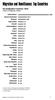 Migration and Remittances: Top Countries Top Immigration Countries a, 010 number of immigrants, millions United States b Russian Federation b Germany b Saudi Arabia b Canada b United Kingdom b Spain b
HEALTHIEST COUNTRIES 1 to 40
 BLOOMBERG RANKINGS THE WORLD'S HEALTHIEST COUNTRIES HEALTHIEST COUNTRIES 1 to 40 1 Singapore 89.45% 92.52% 3.07% 2 Italy 89.07 94.61 5.54 3 Australia 88.33 93.19 4.86 4 Switzerland 88.29 93.47 5.17 5 Japan
INTERNATIONAL AIR SERVICES TRANSIT AGREEMENT SIGNED AT CHICAGO ON 7 DECEMBER 1944
 State INTERNATIONAL AIR SERVICES TRANSIT AGREEMENT SIGNED AT CHICAGO ON 7 DECEMBER 1944 Entry into force: The Agreement entered into force on 30 January 1945. Status: 130 Parties. This list is based on
Taxation Determination
 Page status: legally binding Page 1 of 8 Taxation Determination Fringe benefits tax: reasonable amounts under section 31G of the Fringe Benefits Tax Assessment Act 1986 for food and drink expenses incurred
List of tables. I. World Trade Developments
 List of tables I. World Trade Developments 1. Overview Table I.1 Growth in the volume of world merchandise exports and production, 2010-2014 39 Table I.2 Growth in the volume of world merchandise trade
Eligibility List 2015
 The Global Fund adopted an allocation-based approach for funding programs against HIV/AIDS, TB and malaria in 2013. The Global Fund policy states that countries can receive allocation only if their components
Dial 00-800-0010, when prompted to enter calling number, enter 800-544-6666 American Samoa 1-800-544-6666 Number can be dialed directly Angola 0199
 National Financial Services International Calling Instructions Albania 00-800-0010 Dial 00-800-0010, when prompted to enter American Samoa 1-800-544-6666 Number can be dialed directly Angola 0199 Dial
Population below the poverty line Rural % Population below $1 a day % Urban % Urban % Survey year. National %
 2.7 International the the Afghanistan.................... Albania 2002 29.6 19.8 25.4...... 2002 a
Senate Committee: Education and Employment. QUESTION ON NOTICE Budget Estimates 2015-2016
 Senate Committee: Education and Employment QUESTION ON NOTICE Budget Estimates 2015-2016 Outcome: Higher Education Research and International Department of Education and Training Question No. SQ15-000549
Brandeis University. International Student & Scholar Statistics
 1 Brandeis University International Student & Scholar Statistics 2014 2 TABLE OF CONTENTS OVERVIEW OF INTERNATIONAL STUDENT & SCHOLAR POPULATION 3 DETAILED INFORMATION ON INTERNATIONAL STUDENT POPULATION
Outsource International Ltd
 Providing global technology solutions for: Carriers Systems Integrators Resellers Outsource Manufacturers International Ltd Government agencies Financial sector Global Technology Solutions Providing global
Withholding Tax Rates 2016*
 Withholding Tax Rates 2016* International Tax Updated March 2016 Jurisdiction Dividends Interest Royalties Notes Albania 15% 15% 15% Algeria 15% 10% 24% Andorra 0% 0% 5% Angola 10% 15% 10% Anguilla 0%
KYOTO PROTOCOL STATUS OF RATIFICATION
 KYOTO PROTOCOL STATUS OF RATIFICATION Notes: R = Ratification At = Acceptance Ap = Approval Ac = Accession 1. ALBANIA ----- 01/04/05 (Ac) 30/06/05 2. ALGERIA ---- 16/02/05 (Ac) 17/05/05 3. ANTIGUA AND
LIST OF PAYMENT FOR VISA AND SECURITY BOND PAYMENT FOR VISA ( RM )
 LIST OF AND COUNTRY FOR Afghanistan 20 2000 Albania 20 2000 Algeria 20 2000 Angola 20 1500 Antigua and Bermuda - 2000 Argentina 20 2700 Armenia 20 2000 Australia - 1500 Austria ( Vienna ) 20 1500 Azerbaijan*
Poorest Countries of the World: Projections upto 2018
 Poorest Countries of the World: Projections upto 2018 By Dunya News http://www.dunyanews.tv Author: Anis uddin Shiekh ([email protected]) December 2013 Copyright Dunya News 1 Introduction Poverty
Fall 2015 International Student Enrollment
 Fall 2015 International Student Enrollment Prepared by The Office of International Affairs Nova Southeastern University Nova Southeastern University International Student Statistics Fall 2015 International
Chapter 4A: World Opinion on Terrorism
 1 Pew Global Attitudes Project, Spring 2007 Now I m going to read you a list of things that may be problems in our country. As I read each one, please tell me if you think it is a very big problem, a moderately
The big pay turnaround: Eurozone recovering, emerging markets falter in 2015
 The big pay turnaround: Eurozone recovering, emerging markets falter in 2015 Global salary rises up compared to last year But workers in key emerging markets will experience real wage cuts Increase in
Action required The Committee is requested to take note of the position of 2010 11 income and expenditure as of 30 September 2010.
 INTERNATIONAL LABOUR OFFICE Governing Body 309th Session, Geneva, November 2010 Programme, Financial and Administrative Committee GB.309/PFA/1 PFA FOR INFORMATION FIRST ITEM ON THE AGENDA Programme and
Appendix A. Crisis Indicators and Infrastructure Lending
 Appendix A. Crisis Indicators and Infrastructure Lending APPENDIX A Table A.1. Crisis Indicators (Case Study Countries) Country % as Share of GDP Share of in Bank Crisis Severity Score (principal factor
Guidelines for DBA Coverage for Direct and Host Country Contracts
 Guidelines for DBA Coverage for Direct and Host Country Contracts An Additional Help document for ADS Chapter 302 New Reference: 06/14/2007 Responsible Office: OAA/P File Name: 302sap_061407_cd48 BACKGROUND:
Cisco Global Cloud Index Supplement: Cloud Readiness Regional Details
 White Paper Cisco Global Cloud Index Supplement: Cloud Readiness Regional Details What You Will Learn The Cisco Global Cloud Index is an ongoing effort to forecast the growth of global data center and
January 2016 Cybersecurity Snapshot Global Results www.isaca.org/2016-cybersecurity-snapshot Number of respondents (n) = 2,920
 January 2016 Cybersecurity Snapshot Global Results www.isaca.org/2016-cybersecurity-snapshot Number of respondents (n) = 2,920 Media Inquiries: Kristen Kessinger, ISACA, +1.847.660.5512, [email protected]
Global AML Resource Map Over 2000 AML professionals
 www.pwc.co.uk Global AML Resource Map Over 2000 AML professionals January 2016 Global AML Resources: Europe France Italy Jersey / Guernsey 8 Ireland 1 Portugal 7 Luxembourg 5 United Kingdom 1 50 11 Spain
What Can I Do With the Data?
 Profile of GMAT Testing: Report Five-Year Summary, TY2011 TY2015 November 2015 Globally, nearly 1.3 million Graduate Management Admission Test (GMAT ) exams have been taken over the past five years by
Argentina s Economy: A death foretold again, or a surprise rescue? Claudio M. Loser Centennial- Latin America March 2014
 Argentina s Economy: A death foretold again, or a surprise rescue? Claudio M. Loser Centennial- Latin America March 214 Argentine performance tended to be ahead the world and even the Emerging Economies
INDEX FOR RISK MANAGEMENT RESULTS 2015
 INDEX FOR RISK MANAGEMENT RESULTS 2015 INFORM 2015 INFORM MEASURES THE RISK OF HUMANITARIAN CRISES AND DISASTERS IN 191 COUNTRIES COUNTRY RISK 3 YR TREND Afghanistan 7.88 æ Albania 2.61 à Algeria 4.64
CONVENTION FOR THE UNIFICATION OF CERTAIN RULES FOR INTERNATIONAL CARRIAGE BY AIR DONE AT MONTREAL ON 28 MAY 1999
 State CONVENTION FOR THE UNIFICATION OF CERTAIN RULES FOR INTERNATIONAL CARRIAGE BY AIR DONE AT MONTREAL ON 28 MAY 1999 Entry into force: The Convention entered into force on 4 November 2003*. Status:
LIST OF RESOLUTIONS ADOPTED BY THE GENERAL ASSEMBLY AT ITS SIXTY-EIGHTH SESSION ON THE RECOMMENDATION OF THE THIRD COMMITTEE
 LIST OF AT THE LEVEL OF THE THIRD COMMITTEE ITEM 27: SOCIAL DEVELOPMENT ITEM 27 (a) Implementation of the outcome of the World Summit for Social Development and of the twenty-fourth special session of
Digital TV Research. http://www.marketresearch.com/digital-tv- Research-v3873/ Publisher Sample
 Digital TV Research http://www.marketresearch.com/digital-tv- Research-v3873/ Publisher Sample Phone: 800.298.5699 (US) or +1.240.747.3093 or +1.240.747.3093 (Int'l) Hours: Monday - Thursday: 5:30am -
(b) the details of those who have been given asylum of other country, country-wise during the last three years
 Annexure Table indicating country-wise data on asylum seekers (LS Starred Q No. 232 for answer on 5.8.2015 on Political Asylum ) S.No. Name of Country (a) the total number of Indians who have sought political
Global Education Office University of New Mexico MSC06 3850, Mesa Vista Hall, Rm. 2120 Tel. 505 277 4032, Fax 505 277 1867, geo@unm.
 Global Education Office University of New Mexico MSC06 3850, Mesa Vista Hall, Rm. 220 Tel. 505 277 4032, Fax 505 277 867, [email protected] Report on International Students, Scholars and Study Abroad Programs
SPRINT CALL HOME PREPAID CALLING CARD
 Domestic Dial-1 Calling Dollar Increments Price Per Unit $10 and $20 $0.59 The same per minute rates apply when the card is refreshed. International Calling The cost per call is based on a $0.59 cost per
I. World trade developments
 I. World trade developments The value of world merchandise exports increased by 20 per cent in 2011 while exports of commercial services grew by 11 per cent. Key developments in 2011: a snapshot Trade
NITROGEN CHARGING KIT type PCM 11.2 E 04-11
 NITROGEN CHARGING KIT type PCM 11.2 E 04-11 11.2.1 TECHNICAL DATA MAX OPERATING PRESSURE (PS): 400 BAR PRESSURE TEST (PT): 1.43 PS SCALE OF PRESSURE GAUGE: 4-10 - 16-25 - 60-100 - 250 (std.) - 400 bar
EMEA BENEFITS BENCHMARKING OFFERING
 EMEA BENEFITS BENCHMARKING OFFERING COVERED COUNTRIES SWEDEN FINLAND NORWAY ESTONIA R U S S I A DENMARK LITHUANIA LATVIA IRELAND PORTUGAL U. K. NETHERLANDS POLAND BELARUS GERMANY BELGIUM CZECH REP. UKRAINE
Does Foreign Direct Investment Promote Economic Growth? Evidence from a Threshold Regression Analysis. Abstract
 Does Foreign Direct Investment Promote Economic Growth? Evidence from a Threshold Regression Analysis Wu Jyun-Yi Department of Economics, National Central University Hsu Chih-Chiang Department of Economics,
1.1 LIST OF DAILY MAXIMUM AMOUNT PER COUNTRY WHICH IS DEEMED TO BEEN EXPENDED
 1 SUBSISTENCE ALLOWANCE FOREIGN TRAVEL 1.1 LIST OF DAILY MAXIMUM AMOUNT PER COUNTRY WHICH IS DEEMED TO BEEN EXPENDED Albania Euro 97 Algeria Euro 112 Angola US $ 322 Antigua and Barbuda US $ 220 Argentina
COMMISSION IMPLEMENTING DECISION. of 24.5.2016
 EUROPEAN COMMISSION Brussels, 24.5.2016 C(2016) 3040 final COMMISSION IMPLEMENTING DECISION of 24.5.2016 amending Commission Implementing Decision C(2015) 8936 of 15.12.2015 on the financing of humanitarian
CONTENTS THE UNITED NATIONS' HIGH COMMISSIONER FOR REFUGEES (UNHCR)
 CONTENTS HIGH COMMISSIONER FOR REFUGEES (UNHCR) 1. INTRODUCTION...2 2. UNHCR HANDBOOK...2 3. CONTACT WITH UNHCR...2 4. UNHCR DATABASE...3 5. UNHCR HEADQUARTERS...3 ANNEX A. LIST OF STATES PARTY TO THE
Entrance Visas in Brazil (Updated on November, 24, 2015)
 Ministry of External Relations Immigration Division Padip Holders of diplomatic passports Pasof Holders of official or service passports Entrance Visas in Brazil (Updated on November, 24, 2015) Caption
Technical & Trade School Lines World Report
 Brochure More information from http://www.researchandmarkets.com/reports/1836899/ Technical & Trade School Lines World Report Description: TECHNICAL & TRADE SCHOOL LINES WORLD REPORT The Technical & Trade
Excerpt Sudan Fixed Telecommunications: Low Penetration Rates Get a Boost from Broadband Internet and VoIP Services
 Excerpt Sudan Fixed Telecommunications: Low Penetration Rates Get a Boost from Broadband Internet and VoIP Services This report is part of Pyramid Research s series of Africa & Middle East Country Intelligence
Schedule of Accreditation issued by United Kingdom Accreditation Service 21-47 High Street, Feltham, Middlesex, TW13 4UN, UK
 Schedule of United Kingdom Service 21-47 High Street, Feltham, Middlesex, TW13 4UN, UK ISO/IEC 17021:2011 to provide environmental management systems certification Kitemark Court Davy Avenue Knowlhill
Citizens of the following nationalities are exempted from holding a visa when crossing the external borders of the SCHENGEN area:
 WEB SUMMIT BULLETIN VISA The VISA requirement to cross the external borders of the SCHENGEN area it is one of the most important procedural steps for all those participants in the next Web Summit that
Logix5000 Clock Update Tool V2.00.36. 12/13/2005 Copyright 2005 Rockwell Automation Inc., All Rights Reserved. 1
 Logix5000 Clock Update Tool V2.00.36. 1 Overview Logix5000 Clock Update Tool 1. 1. What is is it? it? 2. 2. How will it it help me? 3. 3. How do do I I use it? it? 4. 4. When can I I get get it? it? 2
Introducing Clinical Trials Insurance Services Ltd
 Introducing Clinical Trials Insurance Services Ltd Important Staff Richard Kelly Managing Director Richard joined CTIS in 2006 having previously managed the Pharmaceutical wholesale division at Heath Lambert
ISO is the world s largest developer of voluntary international
 The ISO Survey 2005 ISO and The ISO Survey ISO is the world s largest developer of voluntary international standards for business, government and society. Its portfolio at the beginning of June 2006 comprised
The Global Gender Gap Index 2012
 The Global Gender Gap Index 2012 RICARDO HAUSMANN, Harvard University LAURA D. TYSON, University of California, Berkeley YASMINA BEKHOUCHE, World Economic Forum SAADIA ZAHIDI, World Economic Forum The
Standard Virgin Mobile Rates
 Standard Virgin Mobile National Out of Bundle * National Landlines National Mobiles National Texts Data per MB Calls to UPC Customer Care (1908) Voicemail 10c per text 1c per MB International ** UK Landlines
Non-Resident Withholding Tax Rates for Treaty Countries 1
 Non-Resident Withholding Tax Rates for Treaty Countries 1 firms Non-Resident Withholding Tax Rates for Treaty Countries 1 Country 2 Interest 3 Dividends 4 Royalties 5 Annuities 6 Pensions/ Algeria 15%
Joint Initiative. International Partnerships for Sustainable Societies (IPaSS) Description
 Joint Initiative International Partnerships for Sustainable Societies (IPaSS) Description The International Partnerships for Sustainable Societies (IPaSS) are jointly funded by the International Development
Composition of Premium in Life and Non-life Insurance Segments
 2012 2nd International Conference on Computer and Software Modeling (ICCSM 2012) IPCSIT vol. 54 (2012) (2012) IACSIT Press, Singapore DOI: 10.7763/IPCSIT.2012.V54.16 Composition of Premium in Life and
Total merchandise trade
 Total merchandise trade October 214 213 213-13 212 213 Total exports f.o.b. 18 3 64 1 1 8 2 Total imports c.i.f. 18 49 1 1 7 1 an Union (28) 6 76 41 4 33 - extra-eu (28) exports 2 31 16 13 13 7 7 China
Faster voice/data integration for global mergers and acquisitions
 Global agility in technology solutions. sm Faster voice/data integration for global mergers and acquisitions >The InTech Group, Inc. Worldwide in-country technical resources for newly merged companies
Cities THE GLOBAL CREATIVITY INDEX 2015
 Cities THE GLOBAL CREATIVITY INDEX 2015 The Cities Project at the Martin Prosperity Institute focuses on the role of cities as the key economic and social organizing unit of global capitalism. It explores
HANDBOOK ON INDUSTRIAL PROPERTY INFORMATION AND DOCUMENTATION
 Ref.: Archives page: 1 NOTICE: This file contains information that was previously published in the WIPO Handbook on Industrial Property Information and Documentation, but that has become outdated. TERMS
THE ADVANTAGES OF A UK INTERNATIONAL HOLDING COMPANY
 THE ADVANTAGES OF A UK INTERNATIONAL HOLDING COMPANY Ideal Characteristics for the Location of an International Holding Company Laurence Binge +44 (0)1372 471117 [email protected] www.woolford.co.uk
Directory & Mailing List Publisher Lines World Report
 Brochure More information from http://www.researchandmarkets.com/reports/1836438/ Directory & Mailing List Publisher Lines World Report Description: DIRECTORY & MAILING LIST PUBLISHER LINES WORLD REPORT
Global Dialing Comment. Telephone Type. AT&T Direct Number. Access Type. Dial-In Number. Country. Albania Toll-Free 00-800-0010 888-426-6840
 Below is a list of Global Access Numbers, in order by country. If a Country has an AT&T Direct Number, the audio conference requires two-stage dialing. First, dial the AT&T Direct Number. Second, dial
Monthly Report on Asylum Applications in The Netherlands and Europe
 Asylum Trends Monthly Report on Asylum Applications in The Netherlands and Europe November 2013 2014 November 2014 Colophon Title Subtitle Author Asylum Trends Monthly Report on Asylum Applications in
Entrance Visas in Brazil (Updated on July 08, 2014)
 Ministry of External Relations Immigration Division Padip Holders of diplomatic passports Pasof Holders of official or service passports Entrance Visas in Brazil (Updated on July 08, 2014) Caption Vitem
New Technologies and services - Cable Television
 New Technologies and services - Cable Television WORLD: AFRICA provide service Angola Benin Botswana Burkina Faso Burundi applications. Cameroon The relevant licence must be obtained. Cape Verde Central
THE ICSID CASELOAD STATISTICS (ISSUE 2015-1)
 THE ICSID CASELOAD STATISTICS (ISSUE 05-) The ICSID Caseload Statistics (Issue 05-) This issue of the ICSID Caseload Statistics updates the profile of the ICSID caseload, historically and for the calendar
Adobe Creative Cloud Availability
 Adobe Availability Countries/Regions for teams for teams United States Afghanistan Albania Algeria Andorra Angola Anguilla Antigua & Barbuda Argentina Armenia Aruba Australia Austria Azerbaijan Bahamas
Sigue Money Transfer - Daily Exchange Rate
 SPAIN AFGHANISTAN (USD) 1.022688 USD Money Transfer SPAIN ALBANIA (EUR) 1.000000 EUR Money Transfer SPAIN ARGENTINA (USD) 1.052050 USD Money Transfer SPAIN ARGENTINA MORE MONEY (ARG) 15.675545 ARS Money
steam & condensate management solutions STAPS Wireless steam trap monitoring
 steam & condensate management solutions STAPS Wireless steam trap monitoring S T A P S W i r e l e s s STAPS Total acoustic performance solutions The STAPS wireless steam trap monitor from Spirax Sarco
PAY MONTHLY ADDITIONAL SERVICES TERMS AND CONDITIONS
 4GEE PHONE PLANS ADDITIONAL SERVICES (ALL STANDARD 12 & 24 MONTH PLANS INCLUDING SIM ONLY PLANS) The following add-ons are available on your plan. We reserve the right to change the add-ons available to
THE ICSID CASELOAD STATISTICS (ISSUE 2016 1)
 THE ICSID CASELOAD STATISTICS (ISSUE 06 ) The ICSID Caseload Statistics (Issue 06 ) This issue of the ICSID Caseload Statistics updates the profile of the ICSID caseload, historically and for the calendar
TRANSFERS FROM AN OVERSEAS PENSION SCHEME
 PENSIONS PROFILE DECEMBER 2011 TRANSFERS FROM AN OVERSEAS PENSION SCHEME = Summary A simplified guide to the process: 1. Individual requests transfer from their overseas pension scheme to their UK registered
MAGNITUDE OF COUNTERFEITING AND PIRACY OF TANGIBLE PRODUCTS: AN UPDATE. November 2009
 MAGNITUDE OF COUNTERFEITING AND PIRACY OF TANGIBLE PRODUCTS: AN UPDATE November 2009 The growing importance of intellectual property (IP) in knowledge-based economies has generated concerns about the potential
ADVOC. the international network of independent law firms
 ADVOC the international network of independent law firms About ADVOC ADVOC is an international network of independent law firms, sharing international expertise in jurisdictions across the globe Our member
International Financial Reporting Standards
 International Financial Reporting Standards Of Growing Importance for U.S. Companies Assurance Services there is no longer a choice Three factors may influence your need to consider IFRS. First, many organizations
Region Country AT&T Direct Access Code(s) HelpLine Number. Telstra: 1 800 881 011 Optus: 1 800 551 155
 Mondelēz International HelpLine Numbers March 22, 2013 There are many ways to report a concern or suspected misconduct, including discussing it with your supervisor, your supervisor s supervisor, another
Susanne Karstedt School of Criminology and Criminal Justice, Griffith University, Australia.
 Susanne Karstedt School of Criminology and Criminal Justice, Griffith University, Australia. Global Hotspots of Violence: Intervention and Prevention in the Top most Violent Countries Global Violence Reduction
NORTHERN TRUST GLOBAL TRADE CUT OFF DEADLINES
 Argentina T+3 Only Govt Tsy Bills (Letes) have a settlement cycle of T+1, other fixed income securities have a T+3 settlement cycle. T+0 OTC Market (MAE) SD 1200 9amSD-2 9am SD T+3 T+0 SD 1500 9am SD 9am
2015 Global Feed Survey
 2015 Global Feed Survey 2015 ALLTECH GLOBAL FEED EXECUTIVE SUMMARY 2015 marks the fourth consecutive year that Alltech has conducted this global feed survey. This undertaking has required a significant