
The Global Gender Gap Index 2012
|
|
|
- Sarah Farmer
- 9 years ago
- Views:
Transcription
1 The Global Gender Gap Index 2012 RICARDO HAUSMANN, Harvard University LAURA D. TYSON, University of California, Berkeley YASMINA BEKHOUCHE, World Economic Forum SAADIA ZAHIDI, World Economic Forum The Global Gender Gap Index, 1 introduced by the World Economic Forum in 2006, is a framework for capturing the magnitude and scope of gender-based disparities and tracking their progress. The Index benchmarks national gender gaps on economic, political, education and health criteria, and provides country rankings that allow for effective comparisons across regions and income groups, and over time. The rankings are designed to create greater awareness among a global audience of the challenges posed by gender gaps and the opportunities created by reducing them. The methodology and quantitative analysis behind the rankings are intended to serve as a basis for designing effective measures for reducing gender gaps. The first part of Part 1 reviews the underlying concepts employed in creating the Global Gender Gap Index and outlines the methods used to calculate it. The second part presents the 2012 rankings, global patterns and regional performances and calls attention to notable country cases. Next, we provide an overview of the links between gender gaps and the economic performance of countries. In the fourth part, we include information on the trends revealed by the Index in the six years that we have been producing it. The Country Profiles contained in Part 2 of this Report give a more detailed picture of the relative strengths and weaknesses of each country s performance compared with that of other nations. The first page of each profile contains detailed information on the country s performance in The second page shows the trends between 2006 and 2012 on the overall Index and four Subindexes, as well as over 30 gender-related variables that reflect some of the legal and social factors that affect gender disparity in each country. MEASURING THE GLOBAL GENDER GAP Three underlying concepts There are three basic concepts underlying the Global Gender Gap Index. First, it focuses on measuring gaps rather than levels. Second, it captures gaps in outcome variables rather than gaps in means or input variables. Third, it ranks countries according to gender equality rather than women s empowerment. These three concepts are briefly outlined below. For a description of how these concepts are captured by the construction techniques used in the creation of the Index, please see the section below, Construction of the Index. Gaps vs. levels The Index is designed to measure gender-based gaps in access to resources and opportunities in individual countries rather than the actual levels of the available resources and opportunities in those countries. We do this in order to make the Global Gender Gap Index independent from the countries levels of development. In other words, the Index is constructed to rank countries on their gender gaps not on their development level. For example, rich countries, generally speaking, are able to offer more education and health opportunities to all members of society, which is often reflected in measures of education levels (although this is quite independent of the gender-related issues faced by each country at its own level of income). The Global Gender Gap Index, however, rewards countries for smaller gaps in access to these resources, regardless of the overall level of resources. Thus, the Index penalizes or rewards countries based on the size of the gap between male and female enrolment rates, but not for the overall levels of education in the country. Outcomes vs. means The second basic concept underlying the Global Gender Gap Index is that it evaluates countries based on outcomes rather than inputs. Our aim is to provide a snapshot of where men and women stand with regard to some fundamental outcome variables related to basic rights such as health, education, economic participation and political empowerment. Variables related to country-specific policies, culture or customs factors that we consider to be input or means variables are not included in the Index, The Global Gender Gap Index, co-authored by Fiona Greig, Ricardo Hausmann, Laura D. Tyson and Saadia Zahidi, was first introduced in the World Economic Forum s Global Gender Gap Report The authors are deeply grateful to Silvia Magnoni and Marc Cuenod for their excellent support in the production of this year s Part 1. The Global Gender Gap Report

2 but they are displayed in the Country Profiles. For example, the Index includes a variable comparing the gap between men and women in high-skilled jobs such as legislators, senior officials and managers (an outcome variable) but does not include data on length of maternity leave (a policy variable). Gender equality vs. women s empowerment The third distinguishing feature of the Global Gender Gap Index is that it ranks countries according to their proximity to gender equality rather than to women s empowerment. Our aim is to focus on whether the gap between women and men in the chosen variables has declined, rather than whether women are winning the battle of the sexes. Hence, the Index rewards countries that reach the point where outcomes for women equal those for men, but it neither rewards nor penalizes cases in which women are outperforming men in particular variables. The four pillars The Global Gender Gap Index examines the gap between men and women in four fundamental categories (subindexes): economic participation and opportunity, educational attainment, health and survival and political empowerment. Table 1 displays all four of these subindexes and the 14 different variables that compose them, along with the sources of data used for each. Economic participation and opportunity This subindex is captured through three concepts: the participation gap, the remuneration gap and the advancement gap. The participation gap is captured using the difference in labour force participation rates. The remuneration gap is captured through a hard data indicator (ratio of estimated female-to-male earned income) and a qualitative variable calculated through the World Economic Forum s Executive Opinion Survey (wage equality for similar work). Finally, the gap between the advancement of women and men is captured through two hard data statistics (the ratio of women to men among legislators, senior officials and managers, and the ratio of women to men among technical and professional workers). Educational attainment In this subindex, the gap between women s and men s current access to education is captured through ratios of women to men in primary-, secondary- and tertiary-level education. A longer-term view of the country s ability to educate women and men in equal numbers is captured through the ratio of the female literacy rate to the male literacy rate. Health and survival This subindex provides an overview of the differences between women s and men s health. To do this, we use two variables. The first variable is the sex ratio at birth, which aims specifically to capture the phenomenon of missing women prevalent in many countries with a strong son preference. Second, we use the gap between women s and men s healthy life expectancy, calculated by the World Health Organization. This measure provides an estimate of the number of years that women and men can expect to live in good health by taking into account the years lost to violence, disease, malnutrition or other relevant factors. Political empowerment This subindex measures the gap between men and women at the highest level of political decision-making through the ratio of women to men in minister-level positions and the ratio of women to men in parliamentary positions. In addition, we include the ratio of women to men in terms of years in executive office (prime minister or president) for the last 50 years. A clear drawback in this category is the absence of any variables capturing differences between the participation of women and men at local levels of government. Should such data become available at a global level in future years, they will be considered for inclusion in the Global Gender Gap Index. Construction of the Index The Global Gender Gap Index is constructed using a fourstep process, outlined below. Convert to ratios Initially, all data are converted to female/male ratios. For example, a country with 20% of women in ministerial positions is assigned a ratio of 20 women /80 men, thus a variable of This is to ensure that the Index is capturing gaps between women and men s attainment levels, rather than the levels themselves. Truncate data at equality benchmark As a second step, these ratios are truncated at the equality benchmark. For all variables, except the two health variables, this equality benchmark is considered to be 1, meaning equal numbers of women and men. In the case of the sex ratio at birth variable, the equality benchmark is set to be 0.944, 2 and the healthy life expectancy benchmark is set to be Truncating the data at the equality benchmarks for each variable assigns the same score to a country that has reached parity between women and men and one where women have surpassed men. The type of scale chosen determines whether the Index is rewarding women s empowerment or gender equality. 4 To capture gender equality, two possible scales were considered. One was a negative-positive scale capturing the size and direction of the gender gap. This scale penalizes either men s advantage over women or women s advantage over men, and gives the highest points to absolute equality. The second choice was a one-sided 4 The Global Gender Gap Report 2012
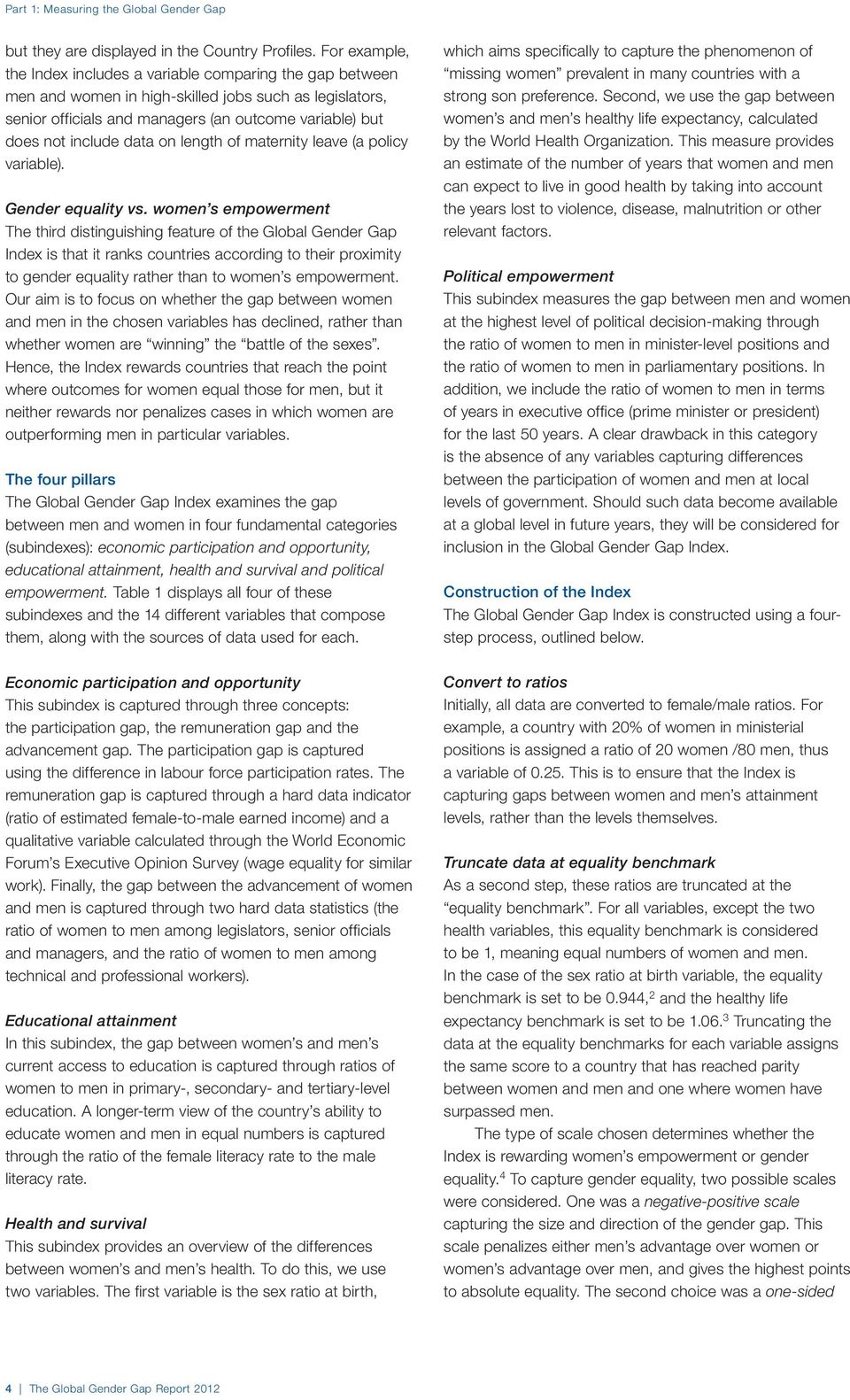
3 Table 1: Structure of the Global Gender Gap Index Subindex Variable Source Economic Participation and Opportunity Ratio: female labour force pariticipation over male value Wage equality between women and men for similar work (converted to female-over-male ratio) Ratio: estimated female earned income over male value International Labour Organisation, Key Indicators of the Labour force Market (KILM), 2009 World Economic Forum, Executive Opinion Survey, 2012 World Economic Forum, calculations based on the United Nations Development Programme methodology (refer to Human Development Report 2009) Ratio: female legislators, senior officials and managers over male value Ratio: female professional and technical workers over male value International Labour Organisation, LABORSTA Internet, online database, 2008 or latest data available; United Nations Development Programme, Human Development Report 2009, the most recent year available between 1999 and 2007 International Labour Organisation, LABORSTA Internet, online database, 2008 or latest data available; United Nations Development Programme, Human Development Report 2009, the most recent year available between 1999 and 2007 Educational Attainment Ratio: female literacy rate over male value UNESCO Institute for Statistics, Education Indicators, 2011 or latest data available; World Bank s World Development Indicators & Global Development Finance online Database, 2010 or latest available data; United Nations Development Programme, Human Development Report 2009, the most recent year available between 1997 and 2007 Ratio: female net primary level enrolment over male value Ratio: female net secondary level enrolment over male value UNESCO Institute for Statistics, Education Indicators, 2011 or latest data available; World Bank s World Development Indicators & Global Development Finance online database, 2011 or latest available data UNESCO Institute for Statistics, Education Indicators, 2011 or latest data available; World Bank s World Development Indicators & Global Development Finance online database, 2011 or latest available data Ratio: female gross tertiary level enrolment over male value UNESCO Institute for Statistics, Education Indicators, 2011 or latest data available; World Bank s World Development Indicators & Global development Finance online database, 2011 or latest available data Health and Survival Sex ratio at birth (converted to female-over-male ratio) Central Intelligence Agency, The CIA World Factbook, data updated weekly, 2012 Ratio: female healthy life expectancy over male value World Health Organisation, Global Health Observatory database, data from 2007 Political Empowerment Ratio: females with seats in parliament over male value Inter-Parliamentary Union, Women in Politics: 2012, reflecting eletions/ appointments up to 1 January 2012 Ratio: females at ministerial level over male value Ratio: number of years of a female head of state or government (last 50 years) over male value Inter-Parliamentary Union, Women in Politics: 2012, reflecting appointments up to 1 January 2012 World Economic Forum calculations, 30 June 2012 Note: If there are multiple sources, the first source listed is the primary source, followed by the secondary source if data were not available from the primary source. If data were not available from the primary or secondary sources, the third source listed was used. scale that measures how close women are to reaching parity with men but does not reward or penalize countries for having a gender gap in the other direction. Thus, it does not reward countries for having exceeded the parity benchmark. We find the one-sided scale more appropriate for our purposes. Calculate subindex scores The third step in the process involves calculating the weighted average of the variables within each subindex to create the subindex scores. Averaging the different variables would implicitly give more weight to the measure that exhibits the largest variability or standard deviation. We therefore first normalize the variables by equalizing their standard deviations. For example, within the educational attainment subindex, standard deviations for each of the four variables are calculated. Then we determine what a 1% point change would translate to in terms of standard deviations by dividing 0.01 by the standard deviation for each variable. These four values are then used as weights to calculate the weighted average of the four variables. This way of weighting variables allows us to make sure The Global Gender Gap Report

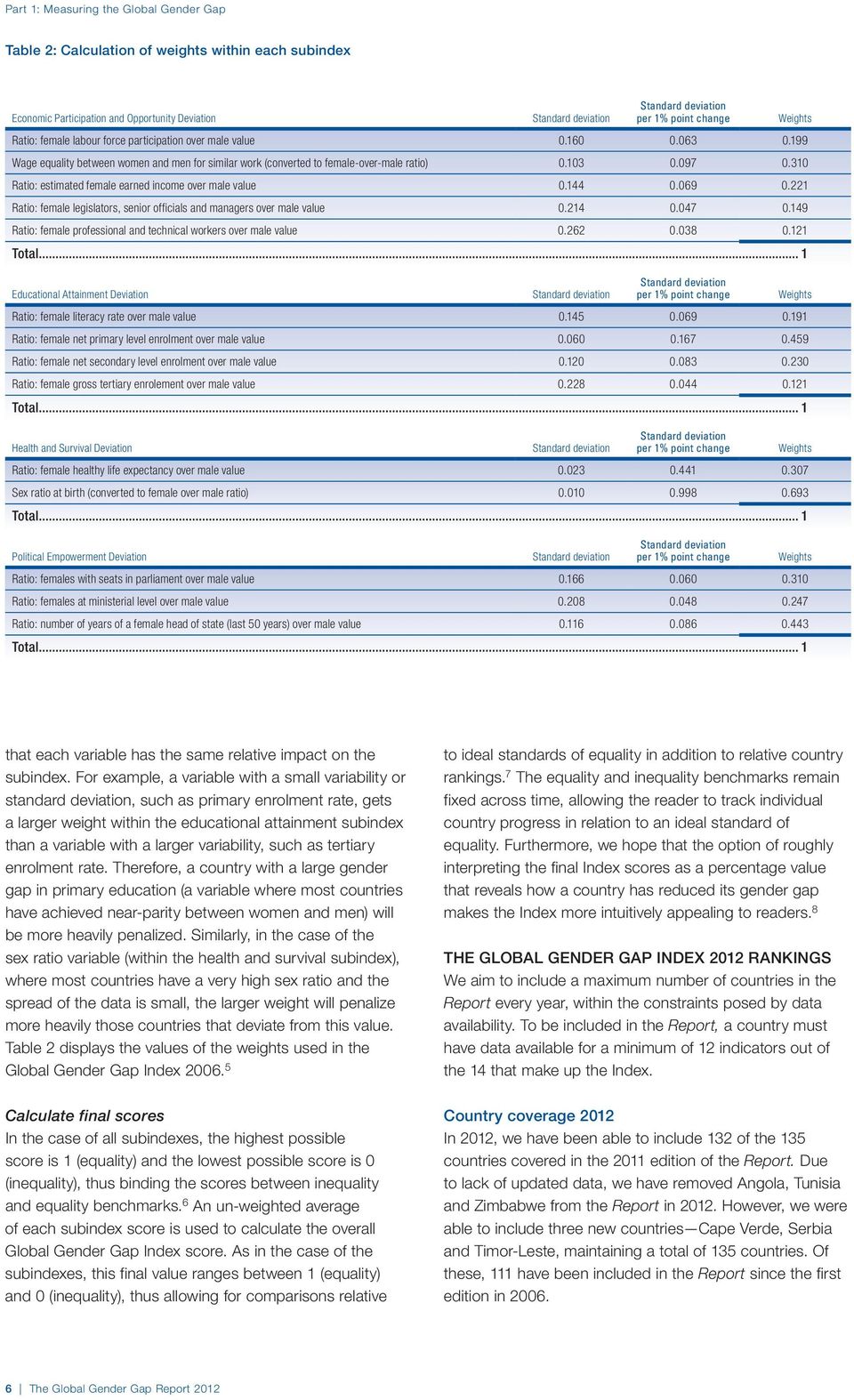
4 Table 2: Calculation of weights within each subindex Economic Participation and Opportunity Deviation Standard deviation Standard deviation per 1% point change Ratio: female labour force participation over male value Wage equality between women and men for similar work (converted to female-over-male ratio) Ratio: estimated female earned income over male value Ratio: female legislators, senior officials and managers over male value Ratio: female professional and technical workers over male value Total... 1 Educational Attainment Deviation Standard deviation Standard deviation per 1% point change Ratio: female literacy rate over male value Ratio: female net primary level enrolment over male value Ratio: female net secondary level enrolment over male value Ratio: female gross tertiary enrolement over male value Total... 1 Health and Survival Deviation Standard deviation Standard deviation per 1% point change Ratio: female healthy life expectancy over male value Sex ratio at birth (converted to female over male ratio) Total... 1 Political Empowerment Deviation Standard deviation Standard deviation per 1% point change Ratio: females with seats in parliament over male value Ratio: females at ministerial level over male value Ratio: number of years of a female head of state (last 50 years) over male value Total... 1 Weights Weights Weights Weights that each variable has the same relative impact on the subindex. For example, a variable with a small variability or standard deviation, such as primary enrolment rate, gets a larger weight within the educational attainment subindex than a variable with a larger variability, such as tertiary enrolment rate. Therefore, a country with a large gender gap in primary education (a variable where most countries have achieved near-parity between women and men) will be more heavily penalized. Similarly, in the case of the sex ratio variable (within the health and survival subindex), where most countries have a very high sex ratio and the spread of the data is small, the larger weight will penalize more heavily those countries that deviate from this value. Table 2 displays the values of the weights used in the Global Gender Gap Index Calculate final scores In the case of all subindexes, the highest possible score is 1 (equality) and the lowest possible score is 0 (inequality), thus binding the scores between inequality and equality benchmarks. 6 An un-weighted average of each subindex score is used to calculate the overall Global Gender Gap Index score. As in the case of the subindexes, this final value ranges between 1 (equality) and 0 (inequality), thus allowing for comparisons relative to ideal standards of equality in addition to relative country rankings. 7 The equality and inequality benchmarks remain fixed across time, allowing the reader to track individual country progress in relation to an ideal standard of equality. Furthermore, we hope that the option of roughly interpreting the final Index scores as a percentage value that reveals how a country has reduced its gender gap makes the Index more intuitively appealing to readers. 8 THE GLOBAL GENDER GAP INDEX 2012 RANKINGS We aim to include a maximum number of countries in the Report every year, within the constraints posed by data availability. To be included in the Report, a country must have data available for a minimum of 12 indicators out of the 14 that make up the Index. Country coverage 2012 In 2012, we have been able to include 132 of the 135 countries covered in the 2011 edition of the Report. Due to lack of updated data, we have removed Angola, Tunisia and Zimbabwe from the Report in However, we were able to include three new countries Cape Verde, Serbia and Timor-Leste, maintaining a total of 135 countries. Of these, 111 have been included in the Report since the first edition in The Global Gender Gap Report 2012
5 Figure 1: Global patterns, 2012 Health Economy Education Politics Sample average (0.00 = inequality, 1.00 = equality) Source: Global Gender Gap Index 2012; scores are weighted by population. Nearly 200 countries were considered for inclusion this year. Out of the 135 ultimately covered in this Report, 13 countries had one data point missing: Bahamas (Wage equality for similar work [survey]) Belize (Wage equality for similar work [survey]) Botswana (Women in ministerial positions) Brunei Darussalam (Women in parliament) Ghana (Professional and technical workers); Jamaica (Professional and technical workers) Maldives (Wage equality for similar work [survey]); Russian Federation (Enrolment in secondary education) Serbia (Labour force participation); Singapore (Enrolment in tertiary education) Sri Lanka (Women in ministerial positions) Syria (Wage equality for similar work [survey]) and Vietnam (Enrolment in primary education). Another 24 countries had two variables missing: Albania (Legislators, senior officials and managers; Professional and technical workers), Benin (Legislators, senior officials and managers; Professional and technical workers), Burkina Faso (Legislators, senior officials and managers; Professional and technical workers), Burundi (Legislators, senior officials and managers; Professional and technical workers), Cameroon (Legislators, senior officials and managers; Professional and technical workers), Cape Verde (Legislators, senior officials and managers; Professional and technical workers), Chad (Legislators, senior officials and managers; Professional and technical workers), Côte d Ivoire (Legislators, senior officials and managers; Professional and technical workers), Cuba (Legislators, senior officials and managers; Professional and technical workers), Fiji (Wage equality for similar work [survey] and Women in parliament), Gambia (Legislators, senior officials and managers; Professional and technical workers), Guatemala (Legislators, senior officials and managers; Professional and technical workers), India (Legislators, senior officials and managers; Professional and technical workers), Jordan (Legislators, senior officials and managers; Professional and technical workers), Kenya (Legislators, senior officials and managers; Professional and technical workers), Luxembourg (Legislators, senior officials and managers; Professional and technical workers), Malawi (Legislators, senior officials and managers; Professional and technical workers), Mali (Legislators, senior officials and managers; Professional and technical workers), Mauritania (Legislators, senior officials and managers; Professional and technical workers), Mozambique (Legislators, senior officials and managers; Professional and technical workers), Nigeria (Legislators, senior officials and managers; Professional and technical workers), Senegal (Legislators, senior officials and managers; Professional and technical workers), Tajikistan (Legislators, senior officials and managers; Professional and technical workers) and Timor-Leste (Legislators, senior officials and managers; Professional and technical workers). Global patterns Figure 1 shows a global snapshot of the gender gap in the four subindexes. It shows that the 135 countries covered in the Report, representing over 90% of the world s population, have closed almost 96% of the gap in health outcomes between women and men and almost 93% of the gap in educational attainment. However, the gap between women and men on economic participation The Global Gender Gap Report
![Out of the 135 ultimately covered in this Report, 13 countries had one data point missing: Bahamas (Wage equality for similar work [survey]) Belize (Wage equality for similar work [survey]) Botswana](/docs-images/46/21265576/images/page_5.jpg "(Women in ministerial positions) Brunei Darussalam (Women in parliament) Ghana (Professional and technical workers); Jamaica (Professional and technical workers) Maldives (Wage equality for similar")
6 Table 3a: The Global Gender Gap Index 2012 rankings: comparisons with 2011, 2010, 2009, 2008, 2007 and 2006 Country 2012 rank 2012 score 2012 rank among 2011 countries 2011 rank 2011 score 2010 rank Iceland Finland Norway Sweden Ireland New Zealand Denmark Philippines Nicaragua Switzerland Netherlands Belgium Germany Lesotho Latvia South Africa Luxembourg United Kingdom Cuba Austria Canada United States Mozambique Burundi Australia Spain Barbados Uganda Costa Rica Bolivia Kazakhstan Argentina Ecuador Lithuania Cape Verde* Malawi Bahamas Slovenia Sri Lanka Panama Namibia Guyana Trinidad and Tobago Mongolia Moldova Tanzania Portugal Venezuela Croatia Serbia* Jamaica Bulgaria Poland Kyrgyz Republic Singapore Israel France Madagascar Russian Federation Estonia Macedonia, FYR Brazil Colombia Ukraine Thailand Vietnam Romania Timor-Leste* score 2009 rank 2009 score 2008 rank 2008 score 2007 rank 2007 score 2006 rank 2006 score 8 The Global Gender Gap Report 2012
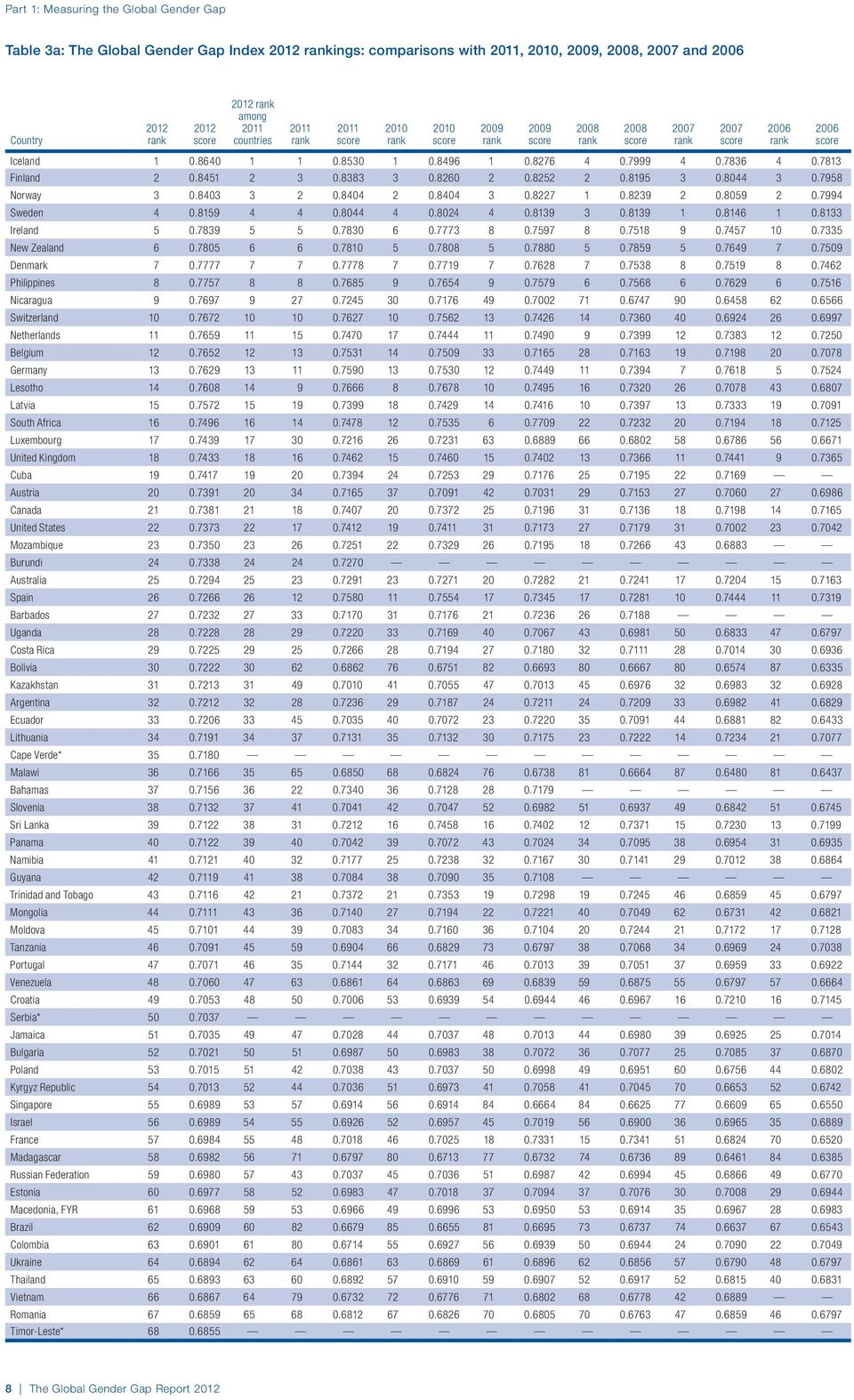
7 Table 3a: The Global Gender Gap Index 2012 rankings: comparisons with 2011, 2010, 2009, 2008, 2007 and 2006 (cont d.) Country 2012 rank 2012 score 2012 rank among 2011 countries 2011 rank 2011 score 2010 rank China Slovak Republic Ghana Kenya Czech Republic Honduras Brunei Darussalam Uruguay Botswana Peru Cyprus Italy Hungary Greece Paraguay Mexico Georgia Bangladesh Chile Malta Dominican Republic Senegal Albania Armenia Gambia, The El Salvador Maldives Tajikistan Indonesia Mauritius Azerbaijan Malaysia Japan Belize Cambodia Burkina Faso India Suriname United Arab Emirates Korea, Rep Kuwait Nigeria Bahrain Cameroon Fiji Zambia Qatar Guatemala Benin Ethiopia Mauritania Algeria Jordan Lebanon Nepal Turkey Oman Egypt Iran, Islamic Rep Mali Morocco Côte d'ivoire Saudi Arabia Syria Chad Pakistan Yemen score 2009 rank 2009 score 2008 rank 2008 score 2007 rank 2007 score 2006 rank 2006 score * New countries 2012 The Global Gender Gap Report

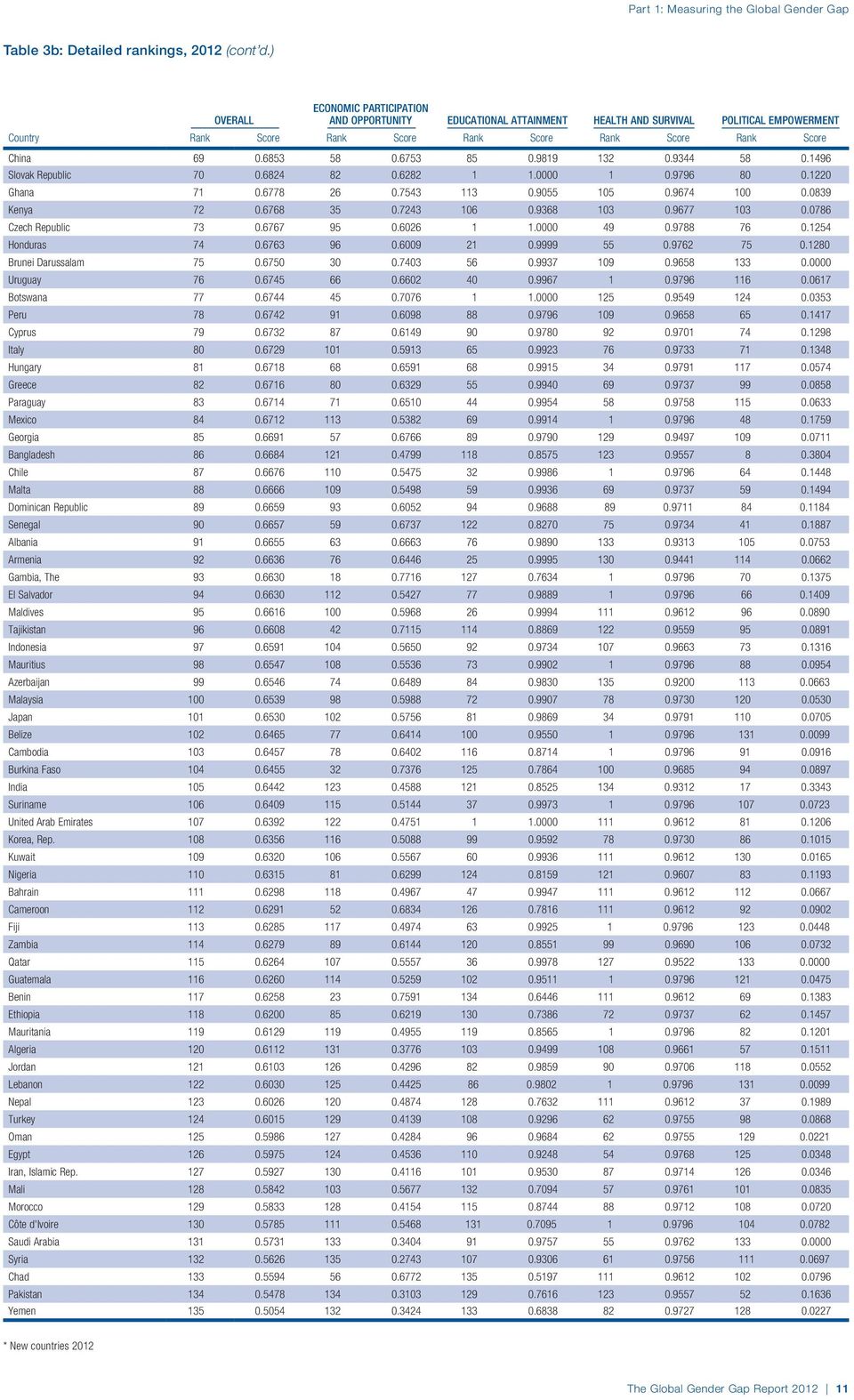
8 Table 3b: Detailed rankings, 2012 OVERALL ECONOMIC PARTICIPATION AND OPPORTUNITY EDUCATIONAL ATTAINMENT HEALTH AND SURVIVAL POLITICAL EMPOWERMENT Country Rank Score Rank Score Rank Score Rank Score Rank Score Iceland Finland Norway Sweden Ireland New Zealand Denmark Philippines Nicaragua Switzerland Netherlands Belgium Germany Lesotho Latvia South Africa Luxembourg United Kingdom Cuba Austria Canada United States Mozambique Burundi Australia Spain Barbados Uganda Costa Rica Bolivia Kazakhstan Argentina Ecuador Lithuania Cape Verde* Malawi Bahamas Slovenia Sri Lanka Panama Namibia Guyana Trinidad and Tobago Mongolia Moldova Tanzania Portugal Venezuela Croatia Serbia* Jamaica Bulgaria Poland Kyrgyz Republic Singapore Israel France Madagascar Russian Federation Estonia Macedonia, FYR Brazil Colombia Ukraine Thailand Vietnam Romania Timor-Leste* The Global Gender Gap Report 2012

9 Table 3b: Detailed rankings, 2012 (cont d.) OVERALL ECONOMIC PARTICIPATION AND OPPORTUNITY EDUCATIONAL ATTAINMENT HEALTH AND SURVIVAL POLITICAL EMPOWERMENT Country Rank Score Rank Score Rank Score Rank Score Rank Score China Slovak Republic Ghana Kenya Czech Republic Honduras Brunei Darussalam Uruguay Botswana Peru Cyprus Italy Hungary Greece Paraguay Mexico Georgia Bangladesh Chile Malta Dominican Republic Senegal Albania Armenia Gambia, The El Salvador Maldives Tajikistan Indonesia Mauritius Azerbaijan Malaysia Japan Belize Cambodia Burkina Faso India Suriname United Arab Emirates Korea, Rep Kuwait Nigeria Bahrain Cameroon Fiji Zambia Qatar Guatemala Benin Ethiopia Mauritania Algeria Jordan Lebanon Nepal Turkey Oman Egypt Iran, Islamic Rep Mali Morocco Côte d'ivoire Saudi Arabia Syria Chad Pakistan Yemen * New countries 2012 The Global Gender Gap Report
10 Table 3c: The Global Gender Gap Index 2012 rankings: changes in scores (detailed) Country Change in score ( ) Change in score ( ) Change in score ( ) Change in score ( ) Change in score ( ) Change in score ( ) Change in score ( ) Iceland Finland Norway Sweden Ireland New Zealand Denmark Philippines Nicaragua Switzerland Netherlands Belgium Germany Lesotho Latvia South Africa Luxembourg United Kingdom Cuba Austria Canada United States Mozambique Burundi Australia Spain Barbados w Uganda Costa Rica Bolivia Kazakhstan Argentina Ecuador Lithuania Cape Verde* Malawi Bahamas Slovenia Sri Lanka Panama Namibia Guyana Trinidad and Tobago Mongolia Moldova Tanzania Portugal Venezuela Croatia Serbia* Jamaica Bulgaria Poland Kyrgyz Republic Singapore Israel France Madagascar Russian Federation Estonia Macedonia, FYR Brazil Colombia Ukraine Thailand Vietnam Romania Timor Leste* China Slovak Republic The Global Gender Gap Report 2012
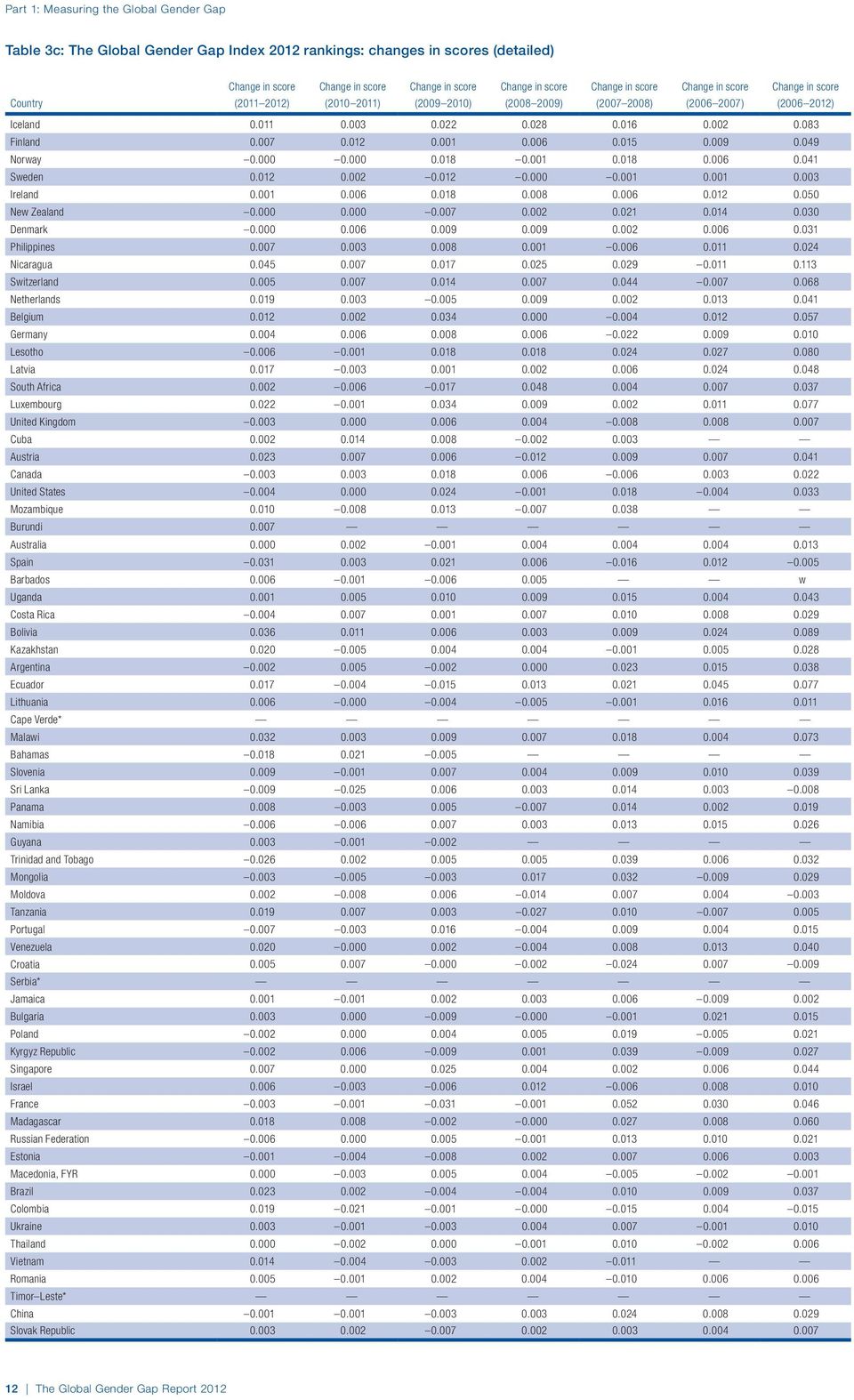
11 Table 3c: The Global Gender Gap Index 2012 rankings: changes in scores (detailed) (cont d.) Country Change in score ( ) Change in score ( ) Change in score ( ) Change in score ( ) Change in score ( ) Change in score ( ) Change in score ( ) Ghana Kenya Czech Republic Honduras Brunei Darussalam Uruguay Botswana Peru Cyprus Italy Hungary Greece Paraguay Mexico Georgia Bangladesh Chile Malta Dominican Republic Senegal Albania Armenia Gambia, The El Salvador Maldives Tajikistan Indonesia Mauritius Azerbaijan Malaysia Japan Belize Cambodia Burkina Faso India Suriname United Arab Emirates Korea, Rep Kuwait Nigeria Bahrain Cameroon Fiji Zambia Qatar Guatemala Benin Ethiopia Mauritania Algeria Jordan Lebanon Nepal Turkey Oman Egypt Iran, Islamic Rep Mali Morocco Côte d Ivoire Saudi Arabia Syria Chad Pakistan Yemen Angola Belarus Tunisia Uzbekistan Zimbabwe * New countries 2012 The Global Gender Gap Report
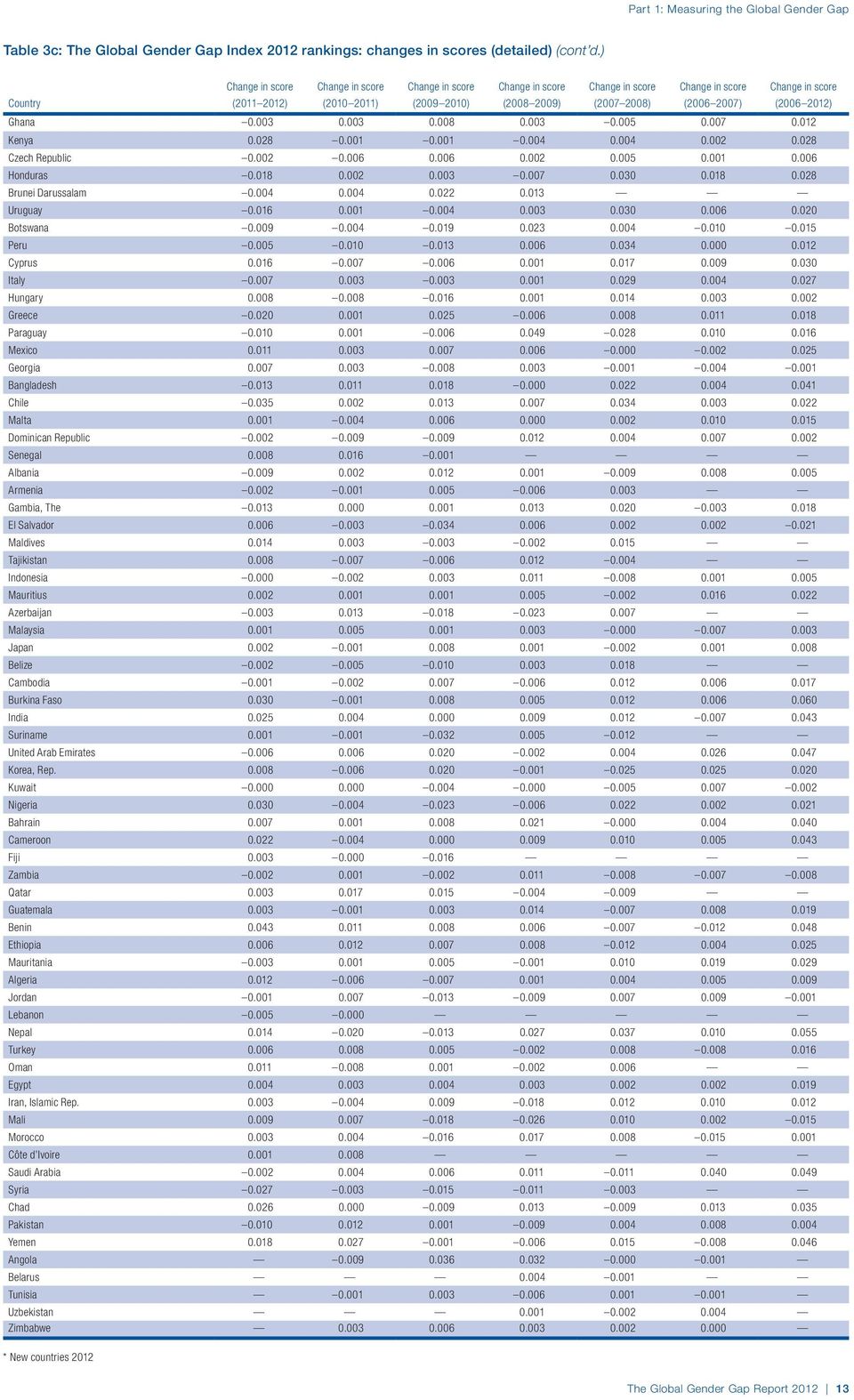
12 Table 3c: The Global Gender Gap Index 2012 rankings: changes in scores (summary) Number of countries Widening gaps Narrowing gaps Improving (%) 61% 55% 59% 67% 68% 79% 88% Deteriorating (%) 39% 45% 41% 33% 32% 21% 12% TOTAL Table 4: Rankings by income group, 2012 LOW INCOME Overall Overall Country score rank LOWER-MIDDLE INCOME Overall Overall Country score rank UPPER-MIDDLE INCOME Overall Overall Country score rank HIGH INCOME Overall Overall Country score rank Mozambique Burundi Uganda Malawi Tanzania Kyrgyz Republic Madagascar Kenya Bangladesh Gambia, The Tajikistan Cambodia Burkina Faso Benin Ethiopia Mauritania Nepal Mali Chad Philippines Nicaragua Lesotho Bolivia Cape Verde* Sri Lanka Guyana Mongolia Moldova Ukraine Vietnam Timor-Leste* Ghana Honduras Paraguay Georgia Senegal Albania Armenia El Salvador Indonesia Belize India Nigeria Cameroon Fiji Zambia Guatemala Egypt Morocco Côte d Ivoire Syria Pakistan Yemen Latvia South Africa Cuba Costa Rica Kazakhstan Argentina Ecuador Lithuania Panama Namibia Venezuela Serbia* Jamaica Bulgaria Russian Federation Macedonia, FYR Brazil Colombia Thailand Romania China Uruguay Botswana Peru Mexico Chile Dominican Republic Maldives Mauritius Azerbaijan Malaysia Suriname Algeria Jordan Lebanon Turkey Iran, Islamic Rep Iceland Finland Norway Sweden Ireland New Zealand Denmark Switzerland Netherlands Belgium Germany Luxembourg United Kingdom Austria Canada United States Australia Spain Barbados Bahamas Slovenia Trinidad and Tobago Portugal Croatia Poland Singapore Israel France Estonia Slovak Republic Czech Republic Brunei Darussalam Cyprus Italy Hungary Greece Malta Japan United Arab Emirates Korea, Rep Kuwait Bahrain Qatar Oman Saudi Arabia * New countries 2012 Note: Income classifications are taken from the World Bank, which classifies economies into four income categories based on GNI per capita: high income, upper-middle income, lower-middle income and low income. 14 The Global Gender Gap Report 2012
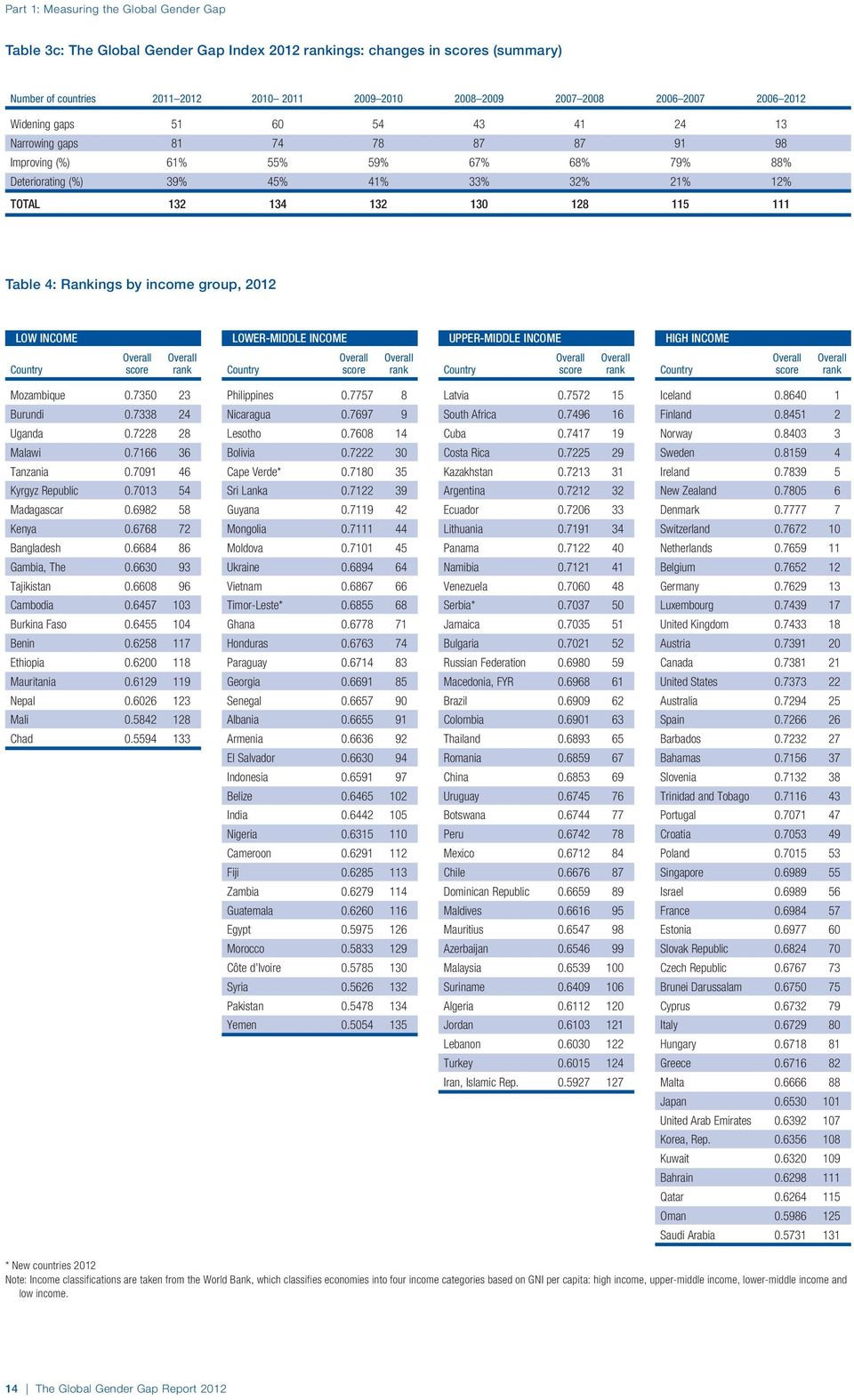
13 Table 5: Rankings by subindex, 2012 ECONOMIC PARTICIPATION AND OPPORTUNITY Country Score Rank Country Score Rank EDUCATIONAL ATTAINMENT Country Score Rank Country Score Rank Mongolia Bahamas Burundi Norway Malawi Lesotho Luxembourg United States Mozambique Sweden Barbados Canada Singapore Finland New Zealand Denmark Philippines Gambia, The Kazakhstan Latvia Moldova Australia Benin Netherlands Lithuania Ghana Iceland Switzerland Ireland Brunei Darussalam Germany Burkina Faso United Kingdom Ukraine Kenya Belgium Uganda Jamaica Russian Federation Estonia Slovenia Tajikistan Namibia Vietnam Botswana Kyrgyz Republic Trinidad and Tobago Panama Thailand Bulgaria Madagascar Cameroon Israel Romania Portugal Chad Georgia China Senegal Tanzania Croatia France Albania Cuba Macedonia, FYR Uruguay Serbia* Hungary South Africa Austria Paraguay Poland Brazil Azerbaijan Spain Armenia Belize Cambodia Bolivia Greece Nigeria Slovakia Venezuela Cape Verde* Ethiopia Colombia Cyprus Nicaragua Zambia Timor-Leste* Peru Argentina Dominican Republic Guyana Czech Republic Honduras Ecuador Malaysia Costa Rica Maldives Italy Japan Mali Indonesia Sri Lanka Kuwait Qatar Mauritius Malta Chile Côte d Ivoire El Salvador Mexico Guatemala Suriname Korea, Rep Fiji Bahrain Mauritania Nepal Bangladesh United Arab Emirates India Egypt Lebanon Jordan Oman Morocco Turkey Iran, Islamic Rep Algeria Yemen Saudi Arabia Pakistan Syria Australia Bahamas Barbados Botswana Brazil Costa Rica Czech Republic Denmark Finland France Iceland Latvia Lesotho Netherlands New Zealand Norway Philippines Slovakia United Arab Emirates United States Honduras Ukraine Nicaragua Cuba Armenia Maldives United Kingdom Guyana Venezuela Ireland Namibia Chile Slovenia Poland Russian Federation Qatar Suriname Spain Sweden Uruguay Argentina Moldova Luxembourg Paraguay Lithuania Croatia Bahrain Sri Lanka Austria Mongolia Colombia Romania Trinidad and Tobago Ecuador Greece Brunei Darussalam Portugal Estonia Malta Kuwait Serbia* Panama Fiji Bulgaria Italy Kazakhstan Belgium Hungary Mexico Canada Switzerland Malaysia Mauritius Kyrgyz Republic Macedonia, FYR Albania El Salvador Thailand Jamaica Israel Japan Jordan Germany Azerbaijan China Lebanon South Africa Peru Georgia Cyprus Saudi Arabia Indonesia Madagascar Dominican Republic Vietnam Oman Cape Verde* Bolivia Korea, Rep Belize Iran, Islamic Rep Guatemala Algeria Singapore Tanzania Kenya Syria Turkey Timor-Leste* Egypt Malawi Uganda Ghana Tajikistan Morocco Cambodia Burundi Bangladesh Mauritania Zambia India Senegal Mozambique Nigeria Burkina Faso Cameroon Gambia, The Nepal Pakistan Ethiopia Côte d Ivoire Mali Yemen Benin Chad The Global Gender Gap Report
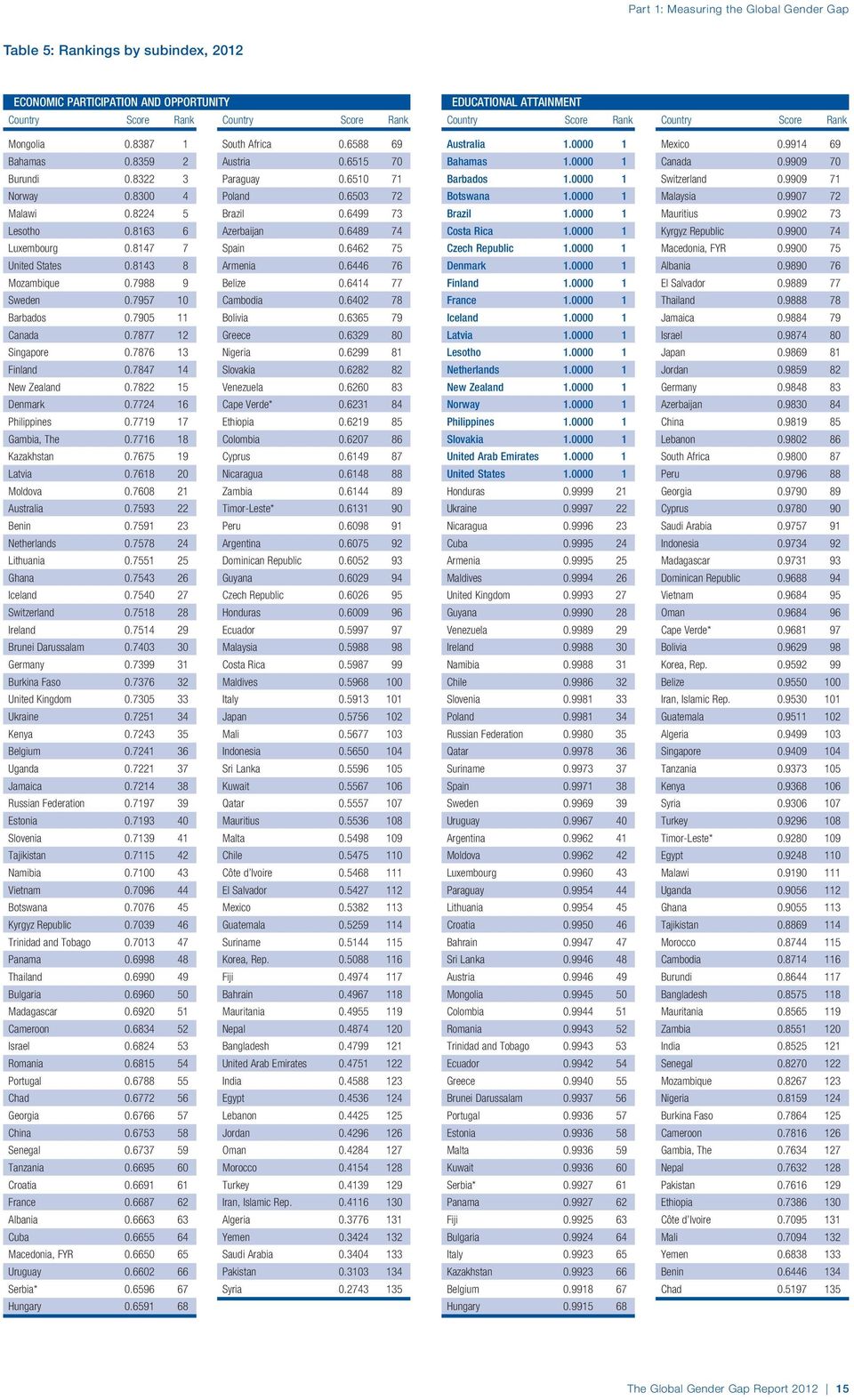
14 Table 5: Rankings by subindex, 2012 (cont d.) HEALTH AND SURVIVAL Country Score Rank Country Score Rank POLITICAL EMPOWERMENT Country Score Rank Country Score Rank Argentina Bahamas Barbados Belize Brazil Cambodia Cape Verde* Chile Côte d Ivoire El Salvador Fiji Finland France Gambia, The Guatemala Jamaica Kazakhstan Latvia Lebanon Lesotho Mauritania Mauritius Mexico Mongolia Philippines Slovakia Sri Lanka Suriname Thailand Uganda Uruguay Venezuela United States Bulgaria Colombia Croatia Estonia Hungary Japan Lithuania Moldova Poland Romania Russian Federation Spain Ukraine Guyana Timor-Leste* Czech Republic Austria Belgium Canada Germany Egypt Honduras Saudi Arabia Mali Ecuador Nicaragua Paraguay Syria Oman Turkey Panama Costa Rica Cuba Denmark Switzerland Greece Ireland Malta Ethiopia Australia Sweden Senegal Italy Madagascar Korea, Rep Kyrgyz Republic Malaysia Slovenia Yemen Portugal Bolivia Luxembourg Singapore Iran, Islamic Rep Morocco Dominican Republic Jordan Serbia* Cyprus United Kingdom Israel Netherlands New Zealand Norway Iceland Zambia Burkina Faso Burundi Malawi Kenya South Africa Ghana Namibia Indonesia Algeria Brunei Darussalam Peru Bahrain Benin Cameroon Chad Kuwait Maldives Mozambique Nepal Tanzania United Arab Emirates Nigeria Tajikistan Bangladesh Pakistan Botswana Macedonia, FYR Qatar Trinidad and Tobago Georgia Armenia Vietnam China Albania India Azerbaijan Iceland Finland Norway Sweden Nicaragua Ireland South Africa Bangladesh New Zealand Belgium Denmark Mozambique Switzerland Philippines Germany Netherlands India Austria Cuba Bolivia Costa Rica Sri Lanka Ecuador Argentina Cape Verde* Latvia Spain Uganda United Kingdom Burundi Tanzania Guyana Lesotho Timor-Leste* Venezuela Trinidad and Tobago Nepal Canada Luxembourg Serbia* Senegal Australia Portugal Panama Macedonia, FYR Poland Croatia Mexico Namibia Slovenia Colombia Pakistan Malawi Israel United States Madagascar Algeria China Malta Lithuania Kazakhstan Ethiopia France Chile Peru El Salvador Bulgaria Kyrgyz Republic Benin Gambia, The Italy Brazil Indonesia Cyprus Honduras Czech Republic Jamaica Vietnam Barbados Slovakia United Arab Emirates Mauritania Nigeria Dominican Republic Moldova Korea, Rep Estonia Mauritius Singapore Russian Federation Cambodia Cameroon Thailand Burkina Faso Tajikistan Maldives Romania Turkey Greece Ghana Mali Chad Kenya Côte d Ivoire Albania Zambia Suriname Morocco Georgia Japan Syria Bahrain Azerbaijan Armenia Paraguay Uruguay Hungary Jordan Ukraine Malaysia Guatemala Bahamas Fiji Botswana Egypt Iran, Islamic Rep Mongolia Yemen Oman Kuwait Belize Lebanon Brunei Darussalam Qatar Saudi Arabia * New countries The Global Gender Gap Report 2012

15 Figure 2: Regional performance on the Global Gender Gap Index Global Gender Gap Index score ( ) Middle East and North Africa Asia and the Pacific Sub-Saharan Africa Latin America and the Caribbean Europe and Central Asia North America Source: Global Gender Gap Index 2012; details of regional classifications in Appendix B. Scores are weighted by population; population data from the World Bank s World Development Indicators (WDI) online database 2011, accessed July and political empowerment remains wide: only 60% of the economic outcomes gap and only 20% of the political outcomes gap have been closed. The detailed rankings from this year s Index are shown in Tables 3 through 5. Table 3a displays the 2012 rankings and provides comparisons with rankings in 2011, 2010, 2009, 2008, 2007 and Table 3b displays the complete 2012 rankings, including the four subindex scores and ranks. Table 3c provides the year-to-year score changes over the last seven years. Out of the 111 countries that have been involved every year since 2006, 98 (88%) have improved their performance over the last four years, while 13 (12%) have shown widening gaps. Table 4 shows the rankings of countries by income group (Table B2 in Appendix B displays the income group categories used). In 2012, in the high-income group, the Nordic countries lead the way while Saudi Arabia (131) is the lowest performing country in this category. In the upper-middle income group, Latvia (15) ranks highest while Iran (127) occupies the lowest position. In the lower-middleincome group, the Philippines (8) comes out on top while Yemen (135) holds last position. In the lower-income group, Mozambique (23) is the strongest performer while Chad (133) is in last place. Table 5 shows the rankings of countries by subindex. In 2012, 20 countries have fully closed the gap in educational attainment while Chad, the lowest-ranking country on this subindex, has closed only about 52 percent of its gender gap. Thirty-two countries have closed the gap in health and survival. China, Albania, India and Azerbaijan are the lowest-ranking countries on this subindex. Nine countries have closed the gap on both the health and education subindexes. No country has closed the economic participation gap or the political empowerment gap. On the economic participation and opportunity subindex, the highest-ranking country (Mongolia) has closed over 84% of its gender gap while the lowest ranking country (Syria) has closed only 27% of its economic gender gap. There is similar variation in the political empowerment subindex. The highest-ranking country (Iceland) has closed almost 73% of its gender gap whereas the lowest-ranking country (Saudi Arabia) has closed none of the political empowerment gap according to this measure. Regional trends Figure 2 displays the regional performance on the overall Index score, while Figures 3 through 6 display regional performances on each of the four subindexes. 9 All scores are weighted by population to produce the regional averages. Table B1 in Appendix B displays the regional categories used. 10 In the overall Index scores shown in Figure 2, North America holds the top spot, while the Middle East and North Africa region occupies the last place, having closed almost 59% of its gender gap. Table 6 displays the rankings within each regional category. The Global Gender Gap Report
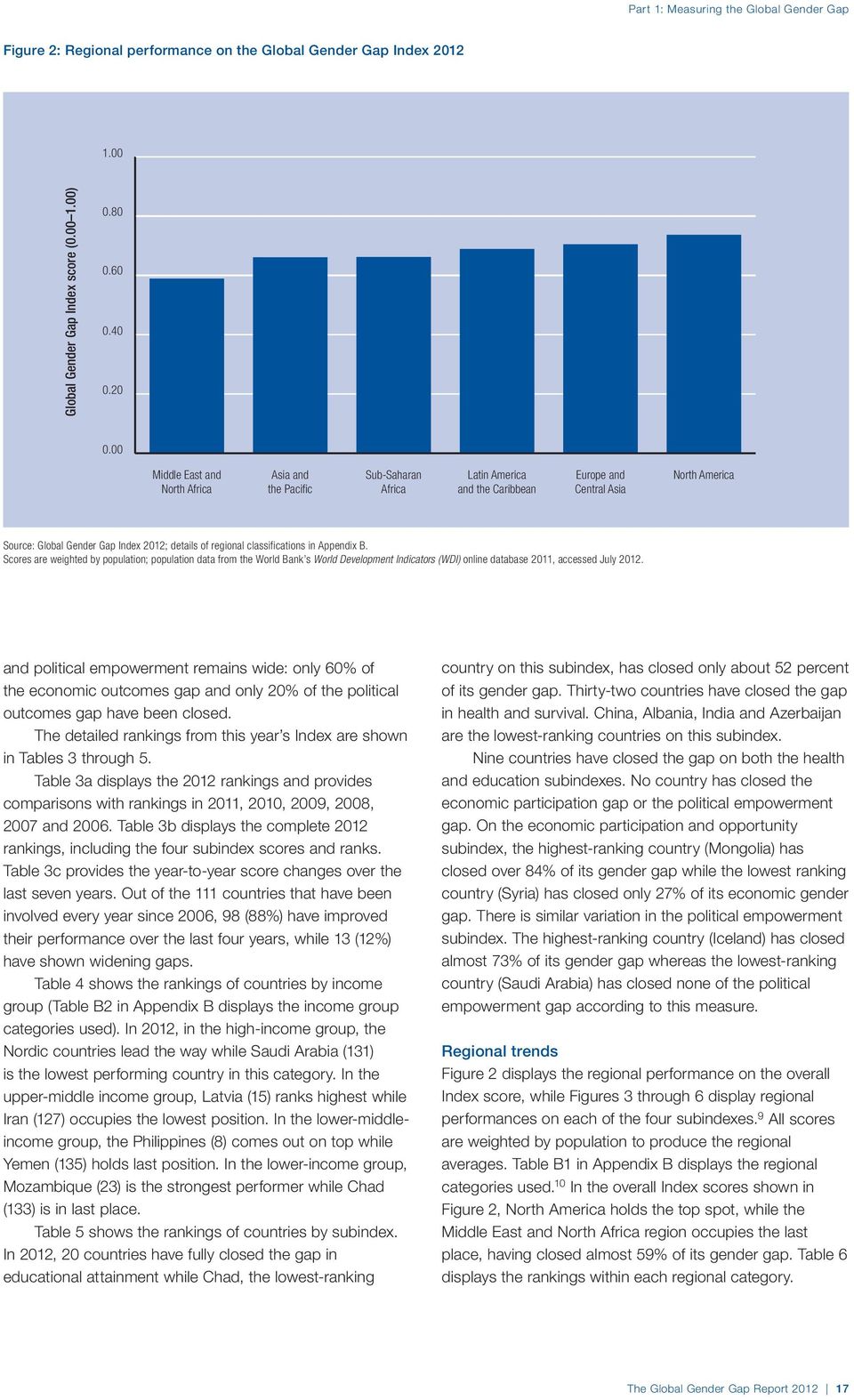
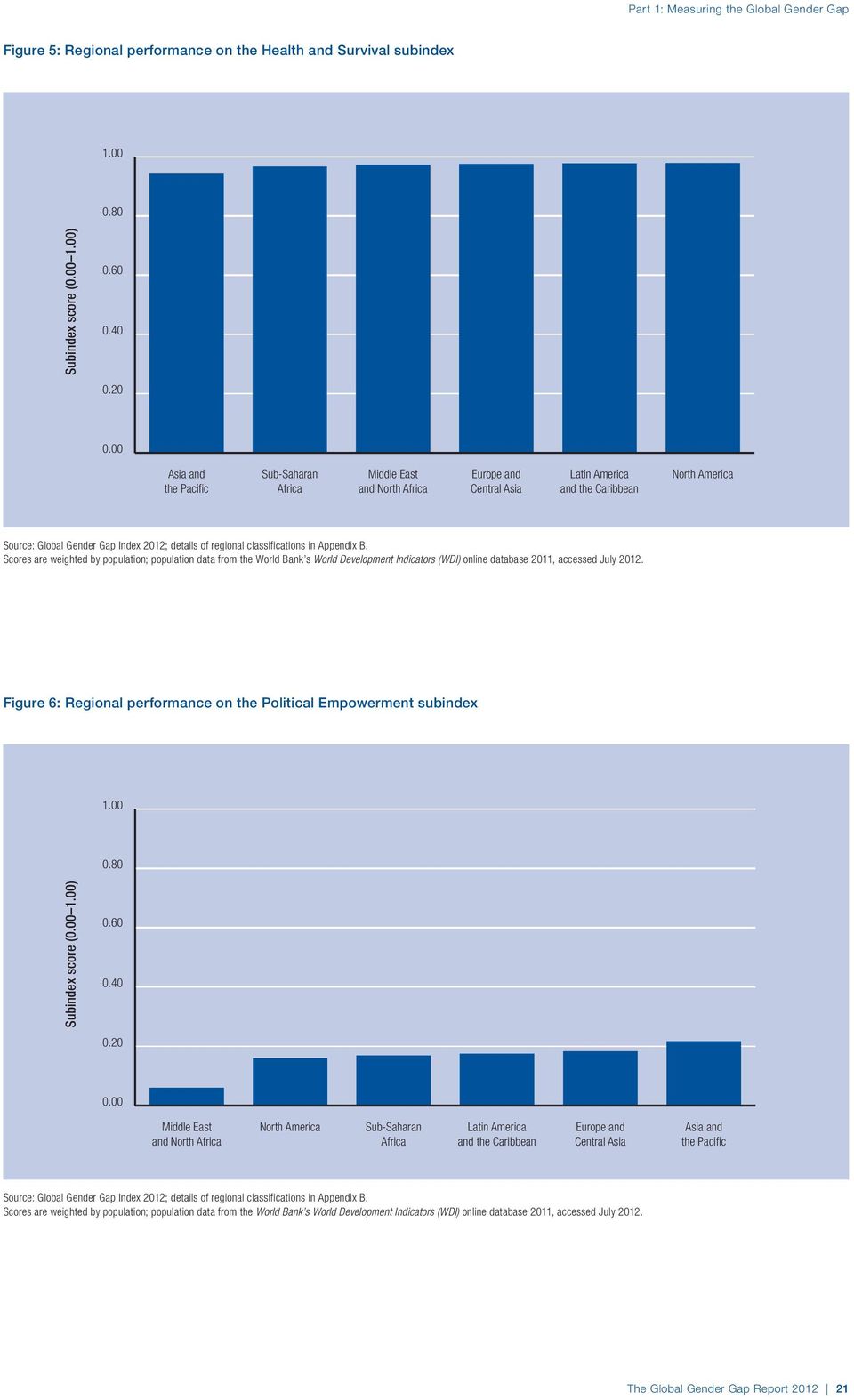
16 Table 6: Rankings by region, 2012 ASIA AND THE PACIFIC Country Score Rank New Zealand Philippines Australia Sri Lanka Mongolia Singapore Thailand Vietnam Timor-Leste* China Brunei Darussalam Bangladesh Maldives Indonesia Malaysia Japan Cambodia India Korea, Rep Fiji Nepal Iran, Islamic Rep Pakistan LATIN AMERICA AND THE CARIBBEAN Country Score Rank Nicaragua Cuba Barbados Costa Rica Bolivia Argentina Ecuador Bahamas Panama Guyana Trinidad and Tobago Venezula Jamaica Brazil Colombia Honduras Uruguay Peru Paraguay Mexico Chile Dominican Republic El Salvador Belize Suriname Guatemala MIDDLE EAST AND NORTH AFRICA Country Score Rank Israel United Arab Emirates Kuwait Bahrain Qatar Mauritania Algeria Jordan Lebanon Oman Egypt Morocco Saudi Arabia Syria Yemen (Cont d.) In the economic participation and opportunity scores shown in Figure 3, North America holds the top spot while the Middle East and North Africa region is in the last place. In the educational attainment scores shown in Figure 4, North America once again tops the rankings while Sub- Saharan Africa holds last place. In the health and survival scores shown in Figure 5, North America holds the top spot, while Asia and the Pacific occupies the last place as the worst region for women s health and survival relative to that of men. In the political empowerment scores shown in Figure 6, while all regions are well below parity, Asia and the Pacific leads the way, while the Middle East and North Africa region is in last place. Table 6 displays the rankings within each regional category. Top 10 Four Nordic countries that have consistently held the highest positions in previous editions of the Global Gender Gap Index continue to hold these privileged positions. Iceland (1) still holds the top spot, closely followed by Finland (2), Norway (3) and Sweden (4). Finland and Norway exchange spots in the rankings this year. Although no country has yet achieved gender equality, all of the Nordic countries, with the exception of Denmark, have closed over 80% of the gender gap and thus serve as models and useful benchmarks for international 18 The Global Gender Gap Report 2012

17 Table 6: Rankings by region, 2012 (cont d.) NORTH AMERICA Country Score Rank Canada United States SUB-SAHARAN AFRICA Country Score Rank Lesotho South Africa Mozambique Burundi Uganda Cape Verde* Malawi Namibia Tanzania Madagascar Ghana Kenya Botswana Senegal Gambia, The Mauritius Burkina Faso Nigeria Cameroon Zambia Benin Ethiopia Mali Côte d Ivoire Chad EUROPE AND CENTRAL ASIA Country Score Rank Iceland Finland Norway Sweden Ireland Denmark Switzerland Netherlands Belgium Germany Latvia Luxembourg United Kingdom Austria Spain Kazakhstan Lithuania Slovenia Moldova Portugal Croatia Serbia* Bulgaria Poland Kyrgyz Republic France Russian Federation Estonia Macedonia, FYR Ukraine Romania Slovak Republic Czech Republic Cyprus Italy Hungary Greece Georgia Malta Albania Armenia Tajikistan Azerbaijan Turkey comparisons. While many global indexes tend to be tied to income levels, thus providing an advantage to the highincome Nordic economies, the Global Gender Gap Index is disassociated from the income and resource level of an economy and instead seeks to measure how equitably the available income, resources and opportunities are distributed between women and men. Despite this feature of the Index, these countries emerge as top performers and true leaders on gender equality. All Nordic countries reached % literacy for both sexes several decades ago and display gender parity at both primary- and secondary-level education. At the tertiary level, in addition to very high levels of enrolment for both women and men, the gender gap has been reversed and women now make up the majority of the high-skilled workforce. In Norway, Sweden and Iceland there are over 1.5 women for every man enrolled in tertiary education, and in Finland and Denmark women also make up the majority of those in tertiary education. The Nordic countries also exhibit very high healthy life expectancies for both women and men, with women living, on average, three to four healthy years longer than men. While many developed economies have succeeded in closing the gender gap in education, few have succeeded in maximizing the returns from this investment. The Nordic countries are leaders in this area all five countries feature in the top 30 of the economic participation and opportunity subindex. This occurs because of a combination of factors: The Global Gender Gap Report
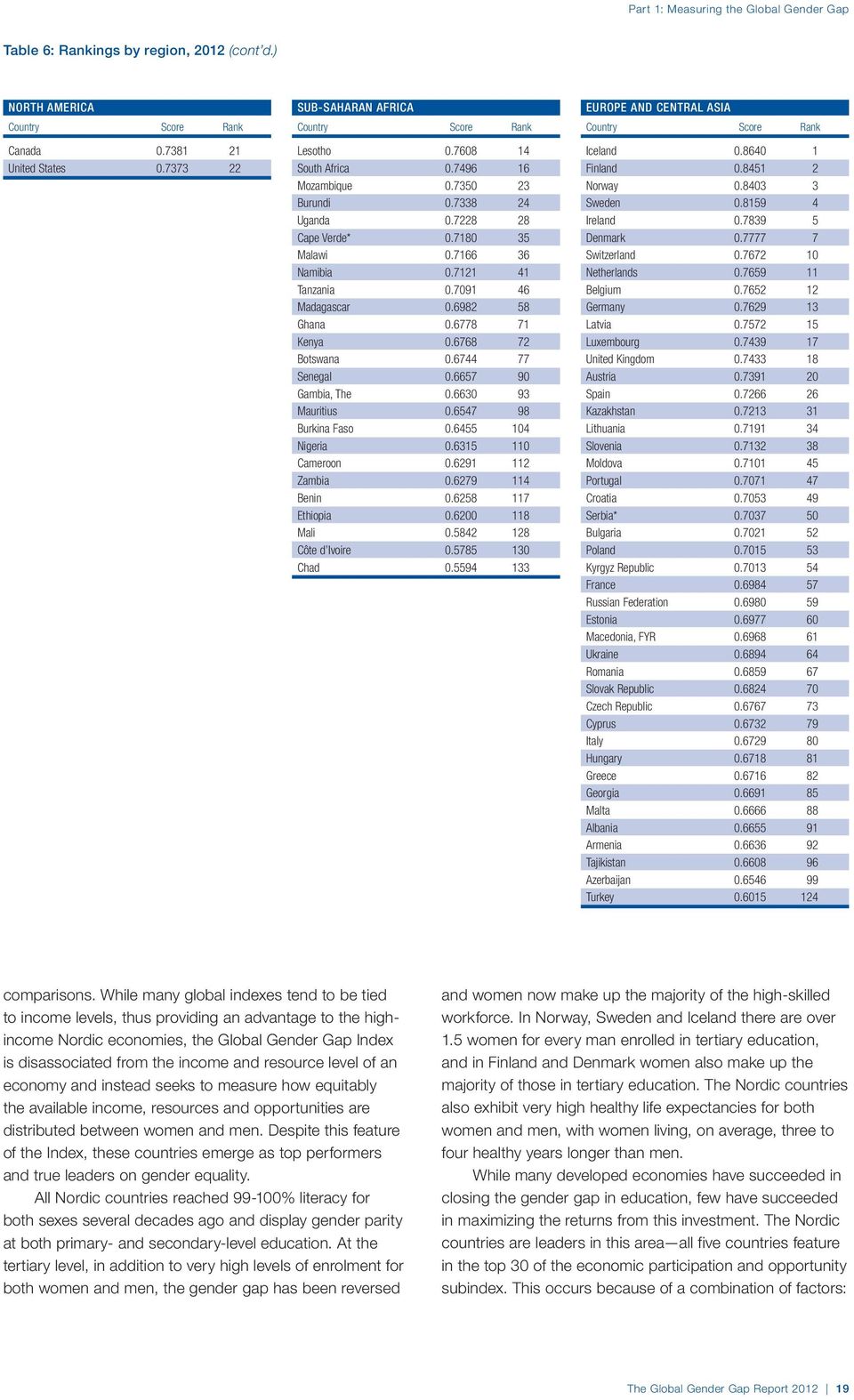
18 Figure 3: Regional performance on the Economic Participation and Opportunity subindex Subindex score ( ) Middle East and North Africa Asia and the Pacific Latin America and the Caribbean Sub-Saharan Africa Europe and Central Asia North America Source: Global Gender Gap Index 2012; details of regional classifications in Appendix B. Scores are weighted by population; population data from the World Bank s World Development Indicators (WDI) online database 2011, accessed July Figure 4: Regional performance on the Educational Attainment subindex Subindex score ( ) Sub-Saharan Africa Middle East and North Africa Asia and the Pacific Europe and Central Asia Latin America and the Caribbean North America Source: Global Gender Gap Index 2012; details of regional classifications in Appendix B. Scores are weighted by population; population data from the World Bank s World Development Indicators (WDI) online database 2011, accessed July The Global Gender Gap Report 2012
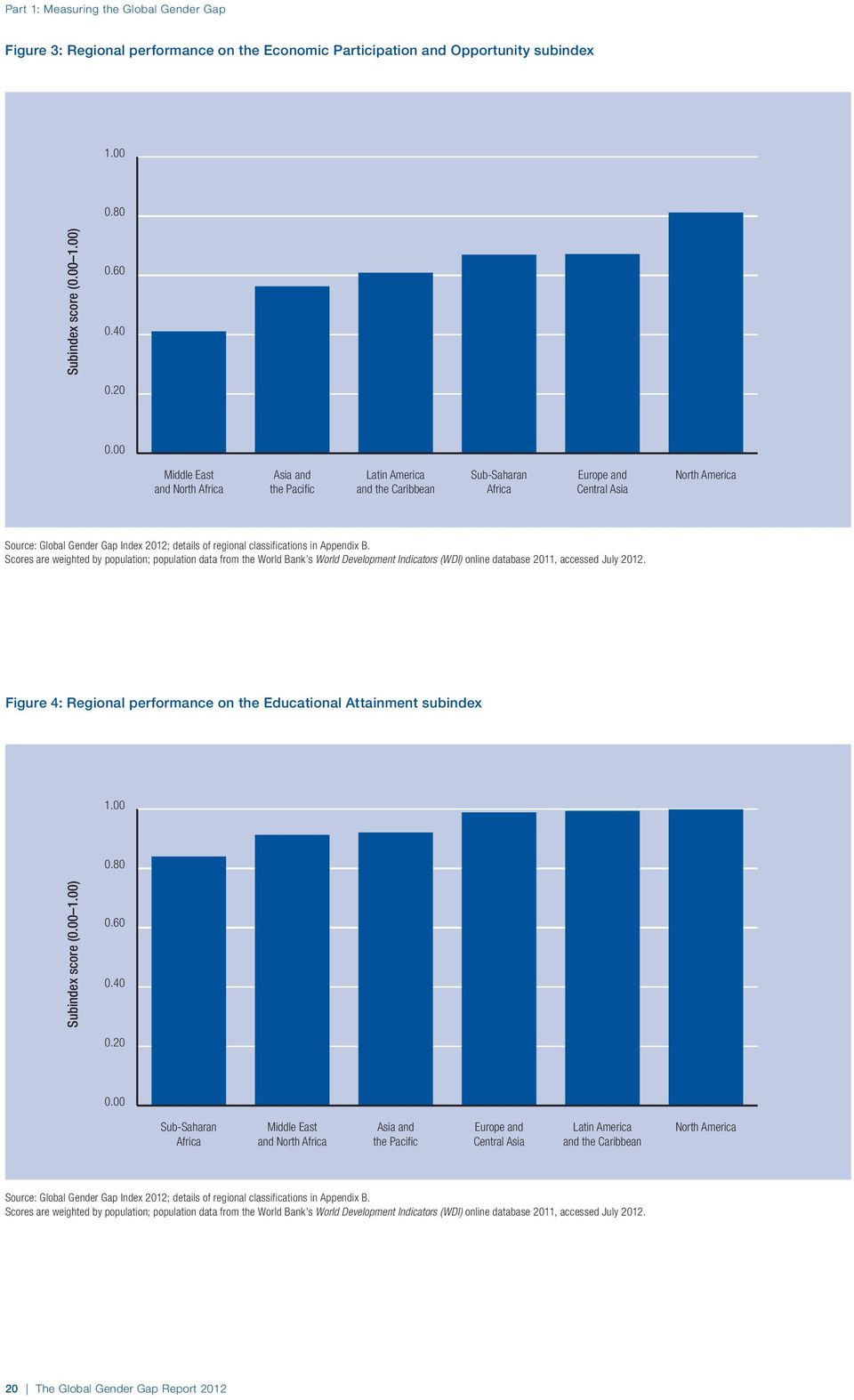
19 Figure 5: Regional performance on the Health and Survival subindex Subindex score ( ) Asia and the Pacific Sub-Saharan Africa Middle East and North Africa Europe and Central Asia Latin America and the Caribbean North America Source: Global Gender Gap Index 2012; details of regional classifications in Appendix B. Scores are weighted by population; population data from the World Bank s World Development Indicators (WDI) online database 2011, accessed July Figure 6: Regional performance on the Political Empowerment subindex Subindex score ( ) Middle East and North Africa North America Sub-Saharan Africa Latin America and the Caribbean Europe and Central Asia Asia and the Pacific Source: Global Gender Gap Index 2012; details of regional classifications in Appendix B. Scores are weighted by population; population data from the World Bank s World Development Indicators (WDI) online database 2011, accessed July The Global Gender Gap Report
20 the labour force participation rates for women are among the highest in the world; salary gaps between women and men are among the lowest in the world, although not nonexistent; and women have abundant opportunities to rise to positions of leadership. These patterns vary across the Nordic countries, but, on the whole, these economies have made it possible for parents to combine work and family, resulting in high female employment participation rates, more shared participation in childcare, more equitable distribution of labour at home, better work-life balance for both women and men and in some cases a boost to declining fertility rates. Policies in these countries include mandatory paternal leave in combination with maternity leave, generous federally mandated parental leave benefits provided by a combination of social insurance funds and employers, tax incentives and post-maternity re-entry programmes. Together these policies have also led to relatively higher and rising birth rates occurring simultaneously with high female workforce participation in the Nordic countries, compared to other OECD economies such as Germany, Japan, Italy and Spain where both birth rates and participation are lower. The Nordic experience points to fewer problems with ageing in the future, as well as higher labour activity and a more robust economy. Finally there has also been success with a top-down approach to promoting women s leadership. In Norway, since 2008, publicly listed companies have been required to have 40% of each sex on their boards. Other countries are adopting similar measures. The Nordic countries were also early starters in providing women with the right to vote (Sweden in 1919, Norway in 1913, Iceland and Denmark in 1915, Finland in 1906). In Denmark, Sweden and Norway, political parties introduced voluntary gender quotas in the 1970s, resulting in high numbers of female political representatives over the years. In Denmark, in fact, this quota has since been abandoned as no further stimulus is required. Today, Sweden has among the highest percentages of women in parliament in the world (44.7%) while the other Nordic countries are almost as successful. These countries have a similarly strong record on the percentage of women in ministerial level positions. Next in the top ten, Ireland (5), New Zealand (6), Denmark (7) and the Philippines (8) maintain their positions from last year. The Philippines remains the highest-ranking country from Asia in the Index. It ranks 1st on both education and health and is also among the top 20 on economic participation and political empowerment. The Philippines is the only country in Asia this year to have closed the gender gap in both education and health. Nicaragua (9) replaces Lesotho in the top ten this year. Nicaragua s gains in the rankings are driven by changes in political empowerment particularly an increase in the percentage of women in parliament (from 21% to 40%) and an increase of the percentage of women holding ministerial positions (38% to 46%). Switzerland (10) remains among the top 10 for the third consecutive year and continues to show gains in educational attainment, economic participation and political empowerment. Europe and Central Asia Europe and Central Asia has closed 70% of the gender gap and is second only to North America on the overall Global Gender Gap Index 2012 scores. The region ranks third in the health and survival (98% of gender gap closed) and educational attainment (99% of gender gap closed) subindexes. Europe and Central Asia ranks second on the economic participation and opportunity subindex, behind North America, and second on the political empowerment subindex behind Asian and the Pacific. In the overall Index, seven European countries rank among the top 10 and 14 countries rank among the top 20. Four out of the nine countries that have closed both their educational attainment and health and survival gender gaps are from this region. Seven out of the top 20 performing countries on the economic participation and opportunity subindex and 11 out of the top 20 performing countries on the political empowerment subindex are also from the region. Fourteen of the top 20 countries on the professional and technical workers indicator are from the region; specifically, from Eastern Europe and Central Asia. Twelve out of the top 20 countries in healthy life expectancy are from the region; primarily from Eastern Europe and Central Asia. Six countries from the region are among the 10 lowest performing countries on the sex ratio indicator; all six are in Eastern Europe or Central Asia. Iceland (1) ranks first on the overall ranking for the fourth consecutive time this year. Iceland is followed by Finland (2), Norway (3) and Sweden (4). Finland is one of the four countries from the region that has closed both its educational attainment and health and survival gender gaps. Ireland (5) keeps the same place as last year and Denmark (7) ranks seventh for the fifth consecutive year. Switzerland (10) remains in the top 10 for the third consecutive year. Netherlands (11) gains four places, mainly due to improvements in the estimated earned income ratio and women in ministerial positions. Belgium (12) moves up one position this year due to a significant increase in the percentage of women in ministerial positions (33% in 2011 to 42% in 2012). Germany (13) loses two places this year as a result of new data becoming available for tertiary education. Latvia (15) gains four places in the rankings primarily due to an improvement in estimated earned income but also in the percentage of women holding ministerial positions. Additionally, Latvia is one of the four countries from the region that has closed both its educational attainment and health and survival gender gaps, and is the best performing country from the region on the legislators, senior officials and managers indicator, ranking 11th place. 22 The Global Gender Gap Report 2012

21 Latvia is followed by Luxembourg (17), the United Kingdom (18) and Austria (20). Luxembourg shows a significant improvement in its ranking, gaining 13 places. Luxembourg s leap in the rankings is the consequence of a decrease in the wage gap and an increase of the percentage of women in parliament. Data for legislators, senior officials and managers has been discarded due to lack of updated information. Luxembourg s performance over the last seven years puts it among the top climbers of the 111 countries that have been included in the Report since The United Kingdom slips two spots relative to its performance last year. This is mainly the result of a decrease in the percentage of women in ministerial positions, which decreased from 23% to 17%. Austria moves up fourteen places this year due to increases in the economic participation and opportunity and educational attainment and political empowerment subindexes. Next in the rankings are Spain (26), Kazakhstan (31), Lithuania (34) and Slovenia (38). Spain loses fourteen spots this year. The most significant drop for the country is in the percentage of women in ministerial positions. Kazakhstan experiences the largest leap in the region s ranking, moving up eighteen places. This is the consequence of a decrease in the wage gap and increase in the percentage of women in parliament and ministerial positions (5% in 2011 to 16% in 2012). Kazakhstan also holds the top position on the sex ratio at birth indicator. Both Lithuania and Slovenia move up three places in the rankings. Lithuania s gain is due to improvements in the economic participation and opportunity and educational attainment and political empowerment subindexes. Slovenia experiences a small decrease in the economic participation and opportunity and health and survival subindexes as well as in the percentage of women in ministerial positions. However, these losses are offset by a significant improvement in the percentage of women in parliament (from 14% in 2011 to 31% in 2012). The next spots in the region are occupied by Moldova (45), Portugal (47) and Croatia (49). Moldova loses six positions relative to its ranking last year. Moldova s drop is mainly driven by losses in the economic participation and opportunity subindex. Portugal displays a drop of twelve places caused mainly by a decrease in the ratio of primary and tertiary education as well as in the percentage of women in ministerial positions (31% in 2011 to 18% in 2012). Croatia gains one place to reach the 49th position with a minor improvement in the representation of women in ministerial positions. Serbia (50) enters the Index for the first time this year, in fiftieth position. Bulgaria (52) slips one place this year. Poland (53) loses eleven places due to a drop in wage equality, decreases across the education subindex and in the percentage of women holding ministerial positions categories. The Kyrgyz Republic (54) falls ten places this year to take 54th position, primarily due to a drop in the economic participation and opportunity and educational attainment and health and survival subindexes. The Kyrgyz Republic is followed by France (57), the Russian Federation (59), Estonia (60) and Macedonia, FYR (61). France loses nine places relative to last year s ranking, primarily due to a decrease in the percentage of women in ministerial positions. France is one of the four countries from the region that has closed both its educational attainment and health and survival gender gaps but it also ranks last overall on the perceived wage equality survey indicator. The Russian Federation slips down to 59th position this year due to losses in the economic participation and opportunity and political empowerment subindexes. The Russian Federation is the best performing country on the healthy life expectancy indicator. Both Estonia and Macedonia, FYR move down eight places this year. Estonia s ratios in both wage equality and primary and secondary education decrease. Despite this drop, Estonia is the best performing country on the professional and technical workers indicator. Macedonia, FYR s improvement in the percentage of women in ministerial positions is balanced out by decreases in perceived wage equality, estimated earned income, sex ratio and tertiary enrolment ratios categories. Macedonia FYR is one of the four countries from the region that performs below average on the health and survival subindex. Ukraine (64) follows next, holding the same position this year as last, despite a slight overall improvement in score. Ukraine is one of the 20 lowest performing countries on the political empowerment subindex. Romania is next in 67th position, closely followed by the Slovak Republic (70), Czech Republic (73) and Cyprus (79). Romania gains one position due to improvements in the political empowerment subindex. The Slovak Republic and the Czech Republic move up two spots this year. The Slovak Republic s gain is mainly driven by improvements on the three indicators of the political empowerment subindex. Additionally, the Slovak Republic is one of the four countries from the region that has closed both its educational attainment and health and survival gender gaps. For the Czech Republic, the improvement is largely explained by increases in the perceived wage equality and in the estimated earned income. Cyprus improves in the overall rankings, rising from 93rd to 79th in 2012 due to an increase in the number of women in ministerial positions (9% in 2011 to 27% in 2012). The next spots in the region are occupied by Italy (80), Hungary (81), Greece (82), Georgia (85) and Malta (88). Italy slips six places in the rankings this year. The largest losses for the country are in perceived wage equality, secondary and tertiary education, sex ratio at birth and in the number of women in ministerial positions. Hungary gains four places due to improvements in the estimated earned income and percentage of women in ministerial positions (0% in 2011 to 10% in 2012). Hungary is one The Global Gender Gap Report
22 of the 20 lowest performing countries on the political empowerment subindex. Greece experiences the biggest drop in the region, ranking this year in 82nd position. This is primarily the result of a change in the percentage of women holding ministerial positions (31% in 2011 to 6% in 2012). Georgia gains one place this year. Although its educational attainment subindex score has decreased, this is balanced out by improvements in the economic participation and opportunity, health and survival and political empowerment subindexes. Additionally, Georgia is one of the four countries from the region that performs below the global average on the health and survival subindex. Malta moves down five spots this year, primarily as a result of lower primary, secondary and tertiary education enrolment ratios but also due to decreases in the sex ratio at birth and percentage of women in ministerial positions. Albania (91) and Armenia (92) follow. Albania slips down thirteen spots from the combined effect of lower scores in perceived wage equality, estimated earned income, secondary education and the percentage of women parliamentarians. Furthermore, Albania is one of the four countries from the region that performs below the global average on the health and survival subindex. Armenia falls eight places, ranking 91st position this year. This fall is the consequence of a significant decrease in the estimated earned income ratio. Armenia is one of the four countries from the region that performs below average on the health and survival subindex. Next are Tajikistan (96) and Azerbaijan (99). Although Tajikistan s ranking does not change this year, it shows a slight increase in its overall score. Tajikistan ranks 129th on the enrolment in tertiary education indicator. Azerbaijan slips eight spots due to decreases in secondary and tertiary education and in the sex ratio at birth, and is the lowest performing country from the region on the legislators, senior officials and managers indicator. Turkey (124) occupies the last place in the regional rankings, losing two places this year despite a slight increase in score. The country performs above average on the health and survival subindex but lags behind on the other three subindexes. Turkey is the lowest performing country from the region on the economic participation and opportunity subindex. North America The North America region has closed 74% of the gender gap and is first among the different regions on the overall Global Gender Gap Index 2012 scores. The region ranks first on the economic participation and opportunity subindex (81% of gender gap closed), the educational attainment subindex (100% of gender gap closed) and the health and survival subindex (98% of gender gap closed). On the political empowerment subindex, the region ranks fifth, ahead of only the Middle East and North Africa (16% of the gender gap closed). Both Canada and the United States slip out of the top 20 this year. Canada (21) falls three places this year to take the 21st position in the overall ranking. This is the result of a small decrease in the secondary education ratio and in the percentage of women in ministerial positions. Canada is among the top 20 best performing countries on the economic participation and opportunity subindex. Canada ranks 20th on the labour force participation indicator and 21st on the professional and technical workers indicator. The United States (22) loses five places this year. The United States economic participation and opportunity subindex score improves due to increases in the perceived wage equality ratio and the estimated earned income ratio but this is offset by a decrease in the percentage of women in ministerial level positions (33% in 2011 to 27% in 2012). The United States shows no gap in education attainment with very high levels of literacy and women s enrolment in primary, secondary and tertiary education. In particular, women s gross tertiary level enrolment at 111% far outstrips that of men at 79%. The United States places 8th in the world in terms of economic participation and opportunity, a drop of two places compared to last year, although it continues to perform well on the legislators, senior officials and managers indicator, ranking 10th on this category. The United States performs below the global average on the political empowerment subindex, with 17% women parliamentarians. Latin America and the Caribbean The Latin America and Caribbean region has closed 69% of its overall gender gap. The region performs well on the educational attainment and health and survival subindexes, holding for both subindexes the 2nd position just after North America. Thirteen countries have fully closed their gender gaps in the health and survival subindex and four have fully closed gaps in educational attainment. With regard to the latter subindex, no country from the region performs below the global average. On the Economic Participation and Opportunity subindex, the region lies in the fourth place, just ahead of Asia and the Pacific and the Middle East and North Africa, but performs well on certain indicators such as legislators, senior officials and managers, where ten out of the 20 best performers globally are from Latin America and the Caribbean. Finally, the region ranks ahead of Sub-Saharan Africa, North America and the Middle East and North Africa on the political empowerment subindex, having closed 18% of its gender gap. Nicaragua (9) leads the way in Latin America and the Caribbean and is the only country from the region to hold a place in the top 10 of the global rankings. Cuba (19) gains one place this year, with a high proportion of women among professional and technical workers (60%). It is also the country with the highest percentage of women parliamentarians (45.2%) among the 135 countries covered. Cuba is followed by Barbados (27), Costa Rica 24 The Global Gender Gap Report 2012
23 (29) and Bolivia (30). Barbados moves up in the rankings, gaining six places mainly due to an increase in women holding ministerial positions. Barbados is one of the three countries from the region that have closed the gender gap in both the education attainment and health and survival. Barbados is the best performer on literacy rates and holds the region s highest position in the wage equality survey. Costa Rica loses four places this year, whereas Bolivia gains 32 positions the greatest climb in the region. This move is mainly due to a significant increase in the percentage of women in ministerial positions (from 20% to 45%). Argentina (32), Ecuador (33), the Bahamas (37) and Panama (40) occupy the next positions in this region rankings. Argentina slips downs four places, due in part to the decrease in the political empowerment subindex, despite an additional year with a female head of state. Ecuador gains twelve spots from last year. This is the result of an improvement across all subindexes with the exception of Health and Survival. The Bahamas has dropped fifteen places this year. This is partly due to new data on estimated earned income that had previously not been factored into the index calculations for the Bahamas. The Bahamas holds the third position overall on the literacy rate and tertiary education indicators and is one of the three countries from the region that have closed the gender gap in both the educational attainment and health and survival subindexes. Panama maintains its position relative to last year although its overall score slightly improves. Next in the rankings are Guyana (42) and Trinidad and Tobago (43). Guyana slips down four spots relative to its performance last year due to a small decrease in the percentage of women in ministerial positions. Trinidad and Tobago declines in the overall rankings (from 21st to 43rd position). This is the result of a decrease in the healthy life expectancy ratio and in the percentage of women holding ministerial positions. Trinidad and Tobago is the region s lowest performing country on the health and survival subindex. Trinidad and Tobago is followed by Venezuela (48) and Jamaica (51). Venezuela gains fifteen positions due to an improvement in the percentage of women in ministerial positions (26% to 39%). Jamaica slips down four spots due to a decrease in the economic participation and opportunity subindex. Jamaica is overall the best performer on the legislators, senior officials and managers indicator and the second best on the literacy rate indicator. Brazil (62) follows next in the rankings just before Colombia (63), with an increase in the overall ranking (from 82nd to 62nd position). This is the result of improvements in primary education and in the percentage of women in ministerial positions (from 7% to 27%). The tenure of President Dilma Rousseff further boosts Brazil s overall score. Brazil is one of the three countries from the region that have closed the gender gap in both the education attainment and health and survival subindexes. Colombia gains seventeen places this year due to a significant increase in the estimated earned income ratio as well as the percentage of women in ministerial positions. The next spots in the region are occupied by Honduras (74), Uruguay (76), Peru (78), Paraguay (83) and Mexico (84). Honduras falls in the rankings by twenty places. This drop is caused mainly by a decrease in the number of women in ministerial positions, which fell from 36% to 18%. Honduras is the lowest performing country from the region on the labour force participation indicator. Uruguay shows a decline in the overall rankings, dropping from 58th place in 2011 to 76th place in 2012, mainly due to a decrease in the political subindex. Peru slips five places this year compared to last year because of a decrease in the wage equality ratio and in the percentage of women holding ministerial positions. Paraguay loses sixteen positions relative to last year, mainly due to a significant decrease in women holding ministerial positions (21% in 2011 to 7% in 2012). Mexico moves up in the overall ranking, gaining five places. This gain is caused mainly by the increase in the percentage of women in ministerial positions, which rises from 11% to 21% this year, and a small improvement in the perceived wage equality. Mexico is followed by Chile (87), Dominican Republic (89) and El Salvador (94). Chile experiences the biggest drop in the overall ranking of the region (from 46th to 87th position) due to a substantial decrease in the percentage of women holding ministerial positions. Chile is also part of the five lowest performing countries on the perceived wage equality indicator. The Dominican Republic slips down eight places this year due to the decrease in the ratios of primary and secondary education. El Salvador maintains its position relative to last year although its overall score slightly increases this year. The final positions in the region are occupied by Belize (102), Suriname (106) and Guatemala (116). Belize displays a small decline in the overall ranking, dropping from 100th to 102nd place in Belize holds the lowest rank in the region on the primary education indicator. Suriname and Guatemala fall in the rankings by two and four places, respectively. Suriname is the lowest performing country from the region on the economic participation and opportunity subindex. Guatemala remains the lowestranking country in the Latin America and Caribbean region. The Middle East and North Africa The Middle East and North Africa region has closed just over 59% of the overall gender gap. The region ranks lowest on economic participation and opportunity and political empowerment (eight of the ten lowest performing countries on the labour force participation and estimated earned income indicators are from the region, as are the four countries that have no women parliamentarians). The region performs second lowest on the educational attainment subindex, while on health and survival, the Middle East and North Africa region is in third place The Global Gender Gap Report
24 (behind Europe and Central Asia, Latin America and the Caribbean and North America). The highest-ranking economies of the region have made vast investments in increasing women s education levels in the last decades. In Qatar, the United Arab Emirates, Kuwait, Bahrain, Algeria, Oman, Israel, Lebanon, Jordan and Saudi Arabia, the tertiary education enrolment rates for women are higher than those of men. However, these countries have had varying degrees of success at integrating women into the economy in order to reap the benefits of this investment. Israel (56) continues to hold the top spot in the Middle East and North Africa region, supported by a higher-thanaverage performance on the economic participation and opportunity and political empowerment subindexes. Israel slips one despite a slight increase in score due to the relative gains made by other countries in the rankings. The United Arab Emirates (107) continues to hold the top position among the Arab countries and is the only country from the region that has closed the educational attainment gap. However, the UAE falls four places in the overall ranking this year due to a decrease in the estimated earned income and women in parliament indicators. Kuwait (109) and Bahrain (111) follow in the rankings, favoured by higher-than-average performances on the educational attainment and health and survival subindexes. Kuwait loses four places this year. This is due to a significant decrease in women in parliament (from 8% in 2011 to 0% in 2012). Kuwait is part of the top 10 performing countries on the tertiary education enrolment indicator. Bahrain loses one place because of a worsening perception of wage equality between women and men for similar work. Qatar (115) occupies the next position in the overall ranking, slipping down four places this year. Qatar is one of the two countries with a zero score on the political empowerment subindex and the only country from the region that ranks below the global average on the Health and Survival subindex. However, Qatar is among the top three performing countries in enrolment in secondary education and the top country in tertiary education enrolment amongst the 135 countries covered. Next in the rankings are Mauritania (119), Algeria (120), Jordan (121) and Lebanon (122). Mauritania falls five places, mainly due to a decrease in the primary, secondary and tertiary enrolment ratios as well as a decrease in the percentage of women holding ministerial positions. Mauritania is amongst the top 10 countries for the enrolment in primary education indicator. Algeria gains one place, most notably through an increase in the percentage of women in parliamentary positions (from 8% to 32%). Jordan loses four places following a decrease in the scores of the economic, education and political subindexes. Lebanon also moves down four spots, due to a decrease in perceived wage equality and percentage of women in ministerial positions (from 7% to 0%). Lebanon is followed by Oman (125), Egypt (126) and Morocco (129). Oman gains two places due to an improvement in the perceived wage equality but in particular as a result of an increase in secondary and tertiary enrolment ratios. Egypt falls three places this year as a result of a worsening perception of wage equality between women and men for similar work and decrease in enrolment in secondary education. Morocco s ranking does not change this year despite a small overall gain in the score. Saudi Arabia (131), Syria (132) and Yemen (135) are the lowest-ranking Middle East and North African countries in the Index. Saudi Arabia maintains its position relative to last year, although its overall score slightly falls because of a small decrease in the perceived wage equality and estimated earned income. Saudi Arabia is also one of the two countries with a political empowerment subindex score of zero. Syria slips down eight spots relative to its performance last year because of decreases in the estimated earned income. As there is an average lag of two years in the data, the scores represent a situation before the current outbreak of violence. Syria is the lowest performing country on the economic participation and opportunity subindex. 11 Finally, Yemen continues to occupy the last place in the region as well as in the overall ranking of 135 countries, and is the region s lowest performing country on the education attainment subindex. However, Yemen has experienced an absolute increase in its overall score and has closed more than 50% of its gender gap this year, putting Yemen among the top ten climbers of the 111 countries that have been included in the Report since Asia and the Pacific With 66% of the gender gap closed, the Asia and the Pacific region occupies the fifth place out of six regions on the overall score. The region occupies the same place on the economic participation and opportunity subindex and the fourth on the educational attainment subindex. On the Health and Survival subindex, Asia and the Pacific region occupies the last place (three of the five lowest performing countries on the sex ratio at birth indicator are from the region), whereas on the political empowerment subindex Asia and the Pacific occupies the first place. New Zealand (6) and the Philippines (8) continue to lead the way in Asia and the Pacific and are the only two countries from the region to hold places in the top 10 of the global rankings. Both countries rankings do not change this year. New Zealand is present in the top 15 performing countries on the economic participation and opportunity and educational attainment subindexes and is in the top 10 performing countries in the political empowerment subindex. The Philippines is the only country from the region that has closed the educational attainment and health and survival gender gaps. The Philippines also performs in the top 10 of the following indicators: 26 The Global Gender Gap Report 2012
25 legislators, senior officials and managers, literacy rate, enrolment in secondary education and years with female head of state. Australia (25) loses two positions relative to last year due to a small decrease in women at ministerial positions, though it continues to hold a strong position in the rankings due to high levels of education, economic participation and political empowerment. Sri Lanka (39), Mongolia (44) and Singapore (55) follow next. Sri Lanka falls eight spots relative to its performance last year as a result of a decrease in the political empowerment subindex. Sri Lanka is part of the top ten performing countries on the enrolment in tertiary education and years with female head of state. Sri Lanka is also one of the five countries from the region that have closed the health and survival subindex. Mongolia experienced a decline in the overall rankings (from 36th to 44th position). This drop is caused mainly by a decrease in the perceived wage equality between women and men for similar work and in the estimated earned income ratio. Mongolia ranks 6th on the legislators, senior officials and managers indicator and 7th on the literacy rate indicator. Mongolia is also the best performing country on the economic participation and opportunity subindex but one of the lowest performing countries on the political empowerment subindex. Singapore gains two places this year, most notably through an increase in the estimated earned income ratio. Singapore is part of the 20 best performing countries in the economic participation and opportunity subindex but also one of the nine countries without a female minister. Singapore is followed by Thailand (65), Vietnam (66), Timor-Leste (68) and China (69). Thailand loses five places in the ranking, due to decreases in the perceived wage equality and estimated earned income ratios. Thailand is one of five countries from the region that has closed the health and survival subindex. Vietnam gains thirteen places this year, most notably through an increase in the enrolment in tertiary education and in the percentage of female ministers. Unlike the previous year, primary education data is not available this year. Vietnam s improvement in the 2012 rankings is the most significant improvement in the region. Despite this important gain, Vietnam shows a disproportionate sex ratio at birth. Timor- Leste enters the Index for the first time this year. China slips from the 61st to 69th position due to a decrease in the perceived wage equality between women and men for similar work. China is the fourth-lowest ranking country on the health and survival subindex (132), the result of a disproportionate sex ratio at birth, although there have been minor improvements over the last year. The next spots in the region are occupied by Brunei Darussalam (75), Bangladesh (86), the Maldives (95) and Indonesia (97). Brunei Darussalam gains one place relative to its rank in 2011 but continues to be one of the nine countries that have no female ministers. Bangladesh falls seventeen places this year, due to a decrease in the wage equality survey, the estimated earned income and a significant decrease in the ratio of the enrolment rate in primary education. Bangladesh ranks 8th on the political empowerment subindex. The Maldives shows an improvement in the overall rankings, rising from 101st in 2011 to 95th in The Maldives leap in the rankings is boosted by an increase in the primary education ratio and in the percentage of women holding ministerial positions (from 7% in 2011 to 21% in 2012). Indonesia slips down seven places in the ranking due to a decrease of women in ministerial positions. Malaysia (100), Japan (101), Cambodia (103) and India (105) are found in the lower half of the rankings within the region. Both Malaysia and Japan fall in the rankings by three places. Malaysia s decrease is due to the decrease of the sex ratio whereas for Japan it is due to a small decrease in the percentage of women parliamentarians and the decrease of the sex ratio at birth. Malaysia is the second best performing country on the wage equality data. Japan is part of the region s ten lowest performing countries on the legislators, senior officials and managers indicator, which shows that women still make up a fairly low percentage of the senior and highly skilled positions. Cambodia slips relative to its performance last year due to the decrease in women in ministerial positions (10% in 2011 to 5% in 2012). Cambodia is one of the five countries from the region that has closed the gap on the health and survival subindex. India gains eight places as a result of improvements in the education attainment and political empowerment subindexes. India is the lowest ranked of the BRIC economies featured in the Index; it performs above average on the political empowerment of women but lags behind in the other three categories. The persistent health, education and economic participation gaps will be detrimental to India s growth. The disproportionate sex ratio at birth has not changed over the past year. India is followed by Korea Rep. (108) and Fiji (113) Korea Rep. loses a place in the ranking due to a decrease in the sex ratio at birth. Fiji falls four places this year and is one of the five countries from the region that has closed the gap on the health and survival subindex. In both countries, women still make up a fairly low percentage of the senior and highly skilled positions. Nepal (123), Iran, Islamic Rep. (127) and Pakistan (134) occupy the last places in the regional rankings. Nepal moves up in the rankings from the 126th to 123rd position, mainly because of higher perceived wage equality ratio, estimated earned income and women in ministerial positions. Nepal is among the highest climbers of the 111 countries that have been included in the Report since 2006 but also among the ten lowest performing countries on enrolment in tertiary education. Iran, Islamic Rep. slips in the rankings to the 127th position due to a worsening of the estimated earned income ratio. Finally, Pakistan moves down in the rankings from the 133rd to 134th position due to a worsening in the perceived wage equality. Pakistan performs below the The Global Gender Gap Report
26 global average on all four subindexes and now occupies the last spot in the Asia and Pacific region. Sub-Saharan Africa The Sub-Saharan Africa region has closed 66% of its gender gap and performs well on the economic participation and opportunity subindex, ranking just behind Europe and Central Asia and North America. Out of the top 15 overall performers on the labour force participation gender gap indicator, nine countries are from the region. However, regarding the educational attainment subindex, Sub-Saharan Africa is the region with the largest gender gap. On the health and survival subindex, the region lies 5th just before Asia and the Pacific. This is due to poor enrolment rates and low levels of life expectancy. Out of the bottom 10 countries on the literacy rate and on the enrolment rate in tertiary education indicators, seven and six respectively are from sub-saharan Africa. The region ranks ahead of Latin America and the Caribbean and the Middle East and North Africa on the political empowerment subindex having closed 17% of its gender gap. Lesotho (14) continues to hold the top spot in the Sub-Saharan region, despite having lost five places in the ranking due to small deteriorations in the category of wage equality for similar work and estimated earned income. Lesotho scores are above the global average on all subindicators and is the only country from the region that has closed the gender gap in both the education attainment and health and survival subindexes. Lesotho is the third-best performer on the legislators, senior officials and managers indicator and the top performer on the literacy rate and enrolment in secondary education. Lesotho remains among the highest climbers within the 111 countries that have been included in the Report since Next in the region s rankings is South Africa (16) which loses two places compared to last year and is the only other sub-saharan Africa country in the top 20. South Africa maintains the top spot in the region on political empowerment, holding the seventh position on this subindex and the fourth on the women in parliament indicator. Mozambique follows next (23), gaining three places in the ranking due to improvements in the education subindex. Mozambique ranks ninth on the economic participation and opportunity subindex due to high scores on the labour force participation and estimated earned income indicators. Mozambique is also the region s best performer regarding the years with female head of state indicator. Burundi (24) and Uganda (28) follow next. Although Burundi s overall score has improved, it maintains the same position in the ranking. Burundi ranks 1st overall on labour force participation. Uganda moves up one spot due to improvement in the estimated earned income. This gain offsets the loss in secondary education. Uganda is included in the top ten performers on the wage equality survey. The next spot in the ranking is occupied by Cape Verde (35), which is included in the Index for the first time. Cape Verde is among the top twenty countries overall on the enrolment in secondary education and women in ministerial positions indicators. Cape Verde is followed by Malawi (36), Namibia (41) and Tanzania (46). Malawi gains 29 places this year. This is mainly due to the fact that there are no data for the legislators, senior officials and managers indicator this year. Malawi is among the highest climbers of the 111 countries that have been included in the Report since 2006 and ranks fifth on the economic participation and opportunity subindex. Namibia slips from the 32nd to the 41st position this year, primarily due to losses in the economic participation and opportunity subindex. Tanzania moves up thirteen spots, driven by gains in the economic and education subindexes. The next spots in the regions are occupied by Madagascar (58), Ghana (71), Kenya (72) and Botswana (77). Madagascar gains thirteen places. This gain can be attributed to an increase in wage equality, an increase in the percentage of women in parliament and in ministerial positions. Madagascar holds the fifth position overall on the labour force participation indicator. Ghana falls one place in the ranking this year. It holds the eighth overall position on the wage equality indicator, whereas it held the 26th position on that indicator last year. Kenya gains 27 places partially due to the fact that there is no data for the legislators, senior officials and manager indicator. Botswana falls eleven places. This is mainly a result of two factors: legislators, senior officials and managers and professional and technical workers indicators are not present this year for Botswana and that ratios for enrolment in primary, secondary and tertiary education have improved from last year. Senegal (90), The Gambia (93) and Mauritius (98) occupy the next places in the ranking. Senegal is the second highest-ranking country on the enrolment in primary education indicator. The Gambia moves down sixteen places this year due to a significant decrease in the enrolment in secondary education ratio. Mauritius slips down three spots relative to its performance last year partially due to a decrease in women in ministerial positions. Burkina Faso (104) gains eleven places this year, primarily due to an improvement in the education attainment subindex. No data for legislators, senior officials and managers and professional and technical workers have been included this year due to lack of recent statistics. Burkina Faso is among the ten lowest performing countries on literacy rates and enrolment in tertiary education. Burkina Faso is followed by Nigeria (110), Cameroon (112) and Zambia (114). Nigeria has seen an improvement in the overall rankings, rising from the 120th in 2011 to the 110th place in Nigeria s leap in the rankings is boosted by an increase in the estimated earned income ratio and an increase in the number of women in ministerial positions, which rose from 10% to 28%. Cameroon moves 28 The Global Gender Gap Report 2012
27 up in the rankings from the 119th to 112nd place, mainly driven by improvements in the estimated earned income. This important increase offsets the deterioration in the ratio of secondary education enrolment. Zambia loses eight places compared to last year. Next in the rankings are Benin (117) and Ethiopia (118). Benin gains eleven places in the rankings this year, partly as there is no data for legislators, senior officials and managers and partly the result of an improvement in the percentage of women holding ministerial positions (from 13% to 31%). Ethiopia loses two places this year. Mali (128), Côte d Ivoire (130) and Chad (133) remain the lowest-ranking Sub-Saharan Africa countries in the Index. All three countries are part of the five lowest performing group of countries on the education attainment subindex. Mali gains four places and Côte d Ivoire s ranking does not change this year. Finally, Chad is again this year the lowest-ranking country in the sub-saharan Africa region. GENDER GAPS, ECONOMIC PERFORMANCE AND POLICY IMPLICATIONS The most important determinant of a country s competitiveness is its human talent the skills, education and productivity of its workforce and women account for one-half of the potential talent base throughout the world. Closing gender gaps is thus not only a matter of human rights and equity; it is also one of efficiency. Figure 7 shows a plot of the Global Gender Gap Index 2012 scores against the Global Competitiveness Index scores. Figure 8 plots the Global Gender Gap Index 2012 scores against GDP per capita. Figure 9 shows the relationship between the Global Gender Gap Index and the Human Development Index. The graphs confirm a correlation between gender equality and the level of competitiveness, GDP per capita and human development. The correlation among competitiveness, income and development and gender gaps is evident despite the fact that the Global Gender Gap Index (unlike other gender indexes) explicitly eliminates any direct impact of the absolute levels of any of the variables (e.g. life expectancy, educational attainment, labour force participation) used in the Index. While correlation does not prove causality, it is consistent with the theory and mounting evidence that empowering women means a more efficient use of a nation s human talent endowment and that reducing gender inequality enhances productivity and economic growth. Over time, therefore, a nation s competitiveness depends, among other things, on whether and how it educates and utilizes its female talent. In Figure 10, we plot the educational attainment subindex against the economic participation and opportunity subindex. The data in the Global Gender Gap Index reveals four broad groups of countries: (1) countries that are generally closing education gaps and show high levels of women s economic participation, (2) countries that are generally closing education gaps but show low levels of women s economic participation, (3) countries that have large education gaps as well as large gaps in women s economic participation and (4) countries that have large education gaps but display small gaps in women s economic participation. In the first broad group are countries that have made investments in women s health and education and generally see the returns on this investment in terms of women s economic and political participation. These countries include the Nordic countries, the United States and the Philippines. These countries have not, however, fully closed economic and participation gaps in particular, the gaps in senior positions, wages and leadership levels still persist. According to research, the reduction in the male-female employment gap has been an important driver of European economic growth in the last decade and closing this gap would have massive economic implications for developed economies, boosting US GDP by as much as 9% and euro zone GDP by as much as 13%. 12 There are several potential drivers behind this. Innovation requires new, unique ideas and the best ideas flourish in a diverse environment. There is evidence to show that companies benefit by successfully integrating the female half of the available talent pool across their internal leadership structures, 13 that women may have a propensity for making more inclusive, informed decisions and for engaging in less risky behaviour and that gender-equal teams may be more successful. In addition, in many countries women now account for more than half of the college and university graduates. As they begin to take up half of entry-level positions in several industries, as evident in the data from several OECD countries, it is a loss for companies if these highly skilled women are forced to choose between work and family at later stages of their career. 14 Business leaders and policy-makers must therefore ensure that, in addition to removing barriers to women s entry to the workforce, they put in place practices and policies that will provide equal opportunities for rising to positions of leadership within companies. In the second broad group are countries that have made the key investments in women s education but have generally not removed barriers to women s participation in the workforce and are thus not seeing returns on their investments in the development of one half of their human capital. This group includes Japan, Qatar, Mexico and Saudi Arabia. These countries have an untapped but educated talent pool and would have much to gain through women s greater participation in the workforce. A study has shown that closing the gap between male and female employment would boost Japanese GDP by as much as 16%. A report by the United Nations Economic and Social Commission for Asia and the Pacific Countries found that restricting job opportunities for women is costing the region between US$ 42 and US$ 46 billion a year. 15 Research by the World Bank demonstrates that similar restrictions have The Global Gender Gap Report
28 Figure 7: Relationship between the Global Competitiveness Index and the Global Gender Gap Index 2012 Global Competitiveness Index score (1 7 scale) Yemen Saudi Arabia Mexico India Morocco Egypt Pakistan Chad Japan Brazil Singapore United States Sweden Luxembourg China South Africa Philippines Russian Federation Lesotho Burundi Norway Iceland Global Gender Gap Index 2012 score ( scale) Source: Global Gender Gap Index 2012 and Global Competitiveness Index Note: The Global Gender Gap Index and the Global Competitiveness Index scales have been truncated to enhance readability. Figure 8: Relationship between GDP per capita and the Global Gender Gap Index 2012 scores 90,000 GDP per GDP capita per (constant capita (constant 2005 international 2005 international $) $) 80,000 70,000 60,000 50,000 40,000 30,000 Qatar United States Saudi Arabia 20,000 Mexico Russian Federation Egypt 10,000 Pakistan South Africa Yemen Philippines 0 Chad India Japan China Brazil Luxembourg Lesotho Sweden Norway Iceland Global Gender Gap Index 2012 score ( scale) Source: Global Gender Gap Index 2012 and the World Bank s World Development Indicators (WDI) online database 2011, accessed June Note: The Global Gender Gap Index has been truncated to enhance readability. 30 The Global Gender Gap Report 2012
29 Figure 9: Relationship between the Human Development Index 2010 and the Global Gender Gap Index Japan Mexico United States Sweden Norway Human Development Index 2011 values Saudi Arabia Pakistan Yemen Chad Qatar Egypt India Brazil China Luxembourg Russian Federation Philippines South Africa Lesotho Iceland Global Gender Gap Index 2012 score ( scale) Source: Global Gender Gap Index 2012 and UNDP, International Human Development Indicators, Online Database 2010 (accessed October 2012). Note: Global Gender Gap Index and Human Development Index scales have been truncated to enhance readability. Figure 10: Relationship between education and economic subindex scores Economic participation and opportunity subindex scores ( ) Chad Benin Mali The Gambia Ethiopia Burkina Faso Cameroon Côte d Ivoire Mozambique Côte d Ivoire Yemen Saudi Arabia Pakistan Syria 1.00 Burundi South Africa Egypt Norway Luxembourg Sweden China Japan Mexico Lesotho United States Philippines Iceland Brazil Qatar Russian Federation Educational attainment subindex scores ( scale) Source: Global Gender Gap Index 2012 Note: Economic Participation and Opportunity and Educational Attainment subindex scores have been truncated to enhance readability. The Global Gender Gap Report
30 Figure 11: Relationship between old-age dependency ratio projections for 2030 and the economic participation and opportunity subindex Median score (0.66) Old-age dependency ratio (projections for 2030) Yemen Pakistan Saudi Arabia Egypt India Mexico Qatar Japan South Africa China Brazil Chad Iceland Russian Federation Sweden Norway United States Lesotho Economic participation and opportunity score ( scale) Source: Global Gender Gap Index 2012 and United Nations, Department of Economic and Social Affairs, Population Division, World Population Prospects: The 2010 revision, New York, 2011, accessed October Note: Old-age dependency ratio is population aged 65+ per 100 population aged also imposed massive costs throughout the Middle East, where decades of substantial investment have dramatically reduced the gender gap in education but the gender gap in economic opportunity remains the widest in the world. 16 Furthermore, there is new research showing that the combined impact of growing gender equality, the emerging middle class and women s spending priorities will lead to rising household savings rates and shifting spending patterns. Industry in these countries particularly in sectors such as food, healthcare, education, childcare, apparel, consumer durables and financial services will need to be prepared for these changes. 17 In the third and fourth groups, the most basic investments in girls and women s education still need to be made, and fundamental rights including legal frameworks around inheritance, reproductive rights and violence are often inadequate. Research demonstrates that investment in girls education has significant multiplier effects: it reduces high fertility rates, lowers infant and child mortality rates, lowers maternal mortality rates, increases women s labour force participation rates and earnings and fosters educational investment in children. 18 These outcomes not only improve the quality of life, they also foster faster economic growth and development. A substantial body of literature has shown that investing in girls education is one of the highest-return investments a developing economy can make. The third group contains countries such as Yemen, Pakistan and Nepal, which have both large education gender gaps as well as economic ones. The fourth group contains countries such as Mozambique, Burundi, Gambia and Benin, which have large education gender gaps but small economic ones primarily due to high levels of participation by women in low-skilled work. For these countries, closing education gaps will remain an important factor over time. However, compared with the third group, women in these countries have greater access to income and decision-making. Research has shown that women are more likely to invest a larger proportion of their household income than men in the education and health of their children. There is also some evidence from India to suggest that women in local government roles make decisions with better outcomes for communities than men when charged with budget decisions; 19 they also appear to be more competent representatives than men, obtaining more resources for their constituencies despite having significantly lower education and relevant labor market experience. 20 Many of the 135 economies covered by the Index are faced with rapidly ageing populations. Figure 11 plots the old-age dependency ratio projections for 2030 against the economic participation and opportunity subindex scores of 2011, revealing those countries among the set with high old-age dependency ratios that have low economic participation gaps and those that have high economic participation gaps. In countries where it is relatively easy for women to combine work with having children, female employment and female fertility both tend to be higher. Policies that allow women to combine work and family may 32 The Global Gender Gap Report 2012
31 thus play a role in addressing the future problems posed by ageing populations. 21 The magnitude and particulars of gender gaps in countries around the world are the combined result of various socioeconomic and cultural variables. The closure or continuation of these gaps is intrinsically connected to the framework of national policies in place. New research is required to understand which policies are most effective in closing gender gaps and whether these are transferrable to other replicable and scalable. This year, we have provided supplementary information on policy variables in the Country Profiles. In addition, over the last year, we have conducted a policies survey with ministries responsible for women in the 135 countries covered in this Report. The preliminary results from 74 countries are presented in Appendix E. TRACKING THE GENDER GAP OVER TIME The Global Gender Gap Index was first published in 2006 with a view to creating a comprehensive gender parity index that is able to track gaps over time relative to an equality benchmark, thus providing information on a country s progress relative to itself as well as to other countries. Based on the seven years of data available for the 111 countries that have been part of the Report since its inception, we find that the majority of countries covered have made progress on closing gender gaps. Figure A1 in Appendix A displays changes over time within the four subindexes. In 2006, 14% of the global political empowerment gap had been closed; in 2012, almost 20% of this gap has been closed. In 2006, 56% of the economic participation gap had been closed; in 2012, almost 60% of this gap has been closed. In 2006, almost 92% of the educational attainment gap had been closed; in 2012, almost 93% of this gap has been closed. On health and survival, however, there has been a small deterioration between 2006 and 2012, from 97% to 96%. Figure A2 displays changes over time on the Index score across different regions. All regions have shown improvements over the last seven years except Europe and Central Asia. Table A1 in Appendix A displays the full list of 111 countries covered between 2006 and 2012 and ordered according to the percentage change in their score, relative to their score in Figure A3 displays these countries in a scatter plot divided into four quadrants: countries that were performing above the median score in 2006 and have shown progress between 2006 and 2012, countries that were performing above the median score in 2006 and have regressed between 2006 and 2012, those that were performing below the median score in 2006 and have shown progress between 2006 and 2012 and those that were performing below the median score in 2006 and have regressed between 2006 and Overall, 88% of countries made progress between 2006 and 2012 while 12% have either deteriorated or remain unchanged. However, the pace of change is slow. Only nine countries have improved by 10% or more while 75 have improved less than 5% during this time period. We were able to calculate the Global Gender Gap Index backwards to the year 2000 for a limited set of countries in order to take a longer-term look at trends. Table A2 in Appendix A displays the Global Gender Gap Index for 39 countries where the relevant data were available. In all countries there was a net improvement in scores across the 12 years, with the exception of the Slovak Republic. Switzerland, Belgium, Finland, Ireland and Costa Rica show the largest absolute increases in score, amounting to relative changes of more than 15% when compared with their performance in the year In the Country Profiles section, readers can explore trends over the last seven years on both the overall Index scores and ranks and the four subindex scores and ranks. It is important to note that there are gaps in international databases and not all countries have information available for all variables across all seven years, nor are all data updated on an annual basis for each country by the international organizations that serve as our primary sources of data. CONCLUSION The Global Gender Gap Report 2012 provides a comprehensive overview of current performance and progress over the last six years. On average, over 96% of the gap in health outcomes, 93% of the gap in educational attainment, 60% of the gap in economic participation and 20% of the gap in political empowerment has been closed. No country in the world has achieved gender equality. The four highest ranked countries Iceland, Finland, Norway and Sweden have closed between 80 and 86% of their gender gaps, while the lowest ranked country Yemen has closed a little over half of its gender gap. The Global Gender Gap Index was developed in 2006 partially to address the need for a consistent and comprehensive measure for gender equality that can track a country s progress over time. This edition of The Global Gender Gap Report reveals the trends observed in the data over the past seven years and seeks to call attention to the need for more rapid progress in closing gender gaps. Out of the 111 countries covered in , 88% have improved their performance, while 12% have widening gaps. In some countries, progress is occurring in a relatively short time, regardless of whether they are starting out near the top or the bottom of the rankings, and independent of their income. Countries such as Iceland, Bolivia, Switzerland, Saudi Arabia, Lesotho, Yemen and others have made much progress relative to their own situation in Relatively few countries have regressed relative to their own scores. While some of these are relatively high-ranking countries such as Sweden and Sri Lanka, there has also been significant deterioration in The Global Gender Gap Report
32 countries such as Mali, Jordan, Kuwait and Zambia, which were already at the lower end of the rankings. The Index points to potential role models by revealing those countries that within their region or their income group are leaders in having divided resources more equitably between women and men than other countries have, regardless of the overall level of resources available. The detailed Country Profiles allow users to understand not only how close each country lies relative to the equality benchmark in each of the four critical areas, but also provides a snapshot of the legal and social framework within which these outcomes are produced. The Index continues to track the strong correlation between a country s gender gap and its national competitiveness, income and development. A country s competitiveness depends on its human talent the skills, education and productivity of its workforce. Because women account for one-half of a country s potential talent base, a nation s competitiveness in the long term depends significantly on whether and how it educates and utilizes its women. Four broad groups of countries are evident in the Index: (1) countries that are generally closing education gaps and show high levels of women s economic participation, (2) countries that are generally closing education gaps but show low levels of women s economic participation, (3) countries that have large education gaps as well as large gaps in women s economic participation and (4) countries that have large education gaps but display small gaps in women s economic participation. This Report highlights the message to policymakers that, in order to maximize competitiveness and development potential, each country should strive for gender equality that is, should give women the same rights, responsibilities and opportunities as men. The Index does not seek to set priorities for countries but rather to provide a comprehensive set of data and a clear method for tracking gaps on critical indicators so that countries may set priorities within their own economic, political and cultural contexts. We are hopeful that the information contained in the Global Gender Gap Report series will also serve as a basis for further research that will facilitate a clearer understanding of the policies that are successful and those that are not, particularly as increasing numbers of policy-makers, employers and civil society seek out best practices and role models to incorporate gender equality into their practices and policies. NOTES 1 See Greig et al. The Gender Gap Index This ratio is based on what is considered to be a normal sex ratio at birth: 1.06 males for every female born. See Klasen and Wink, Missing Women: Revisiting the Debate. 3 This ratio is based on the standards used in the UN s Gender-Related Development Index, which uses 87.5 years as the maximum age for women and 82.5 years as the maximum for men. 4 A first attempt to calculate the gender gap was made by the World Economic Forum in 2005; see Lopez-Claros and Zahidi, Women s Empowerment: Measuring the Global Gender Gap. The 2005 Index, which was attempting to capture women s empowerment, used a feminist scale that rewarded women s supremacy over men (highest score is assigned to the country with the biggest gap in favour of women). 5 The weights derived for the 2006 Index were used again this year and will be used in future years to allow for comparisons over time. 6 This is not strictly accurate in the case of the health variable, where the highest possible value a country can achieve is However, for purposes of simplicity we will refer to this value as 1 throughout the chapter and in all tables, figures and Country Profiles. 7 Because of the special equality benchmark value of for the health and survival subindex, it is not strictly accurate that the equality benchmark for the overall index score is 1. This value is in fact ( ) / 4 = However, for purposes of simplicity, we will refer to the overall equality benchmark as 1 throughout this chapter. 8 Since the variables in the subindexes are weighted by the standard deviations, the final scores for the subindexes and the overall Index are not a pure measure of the gap vis-à-vis the equality benchmark and therefore cannot be strictly interpreted as percentage values measuring the closure of the gender gap. However, for ease of interpretation and intuitive appeal, we will be using the percentage concept as a rough interpretation of the final scores. 9 A population-weighted average of all scores within each region was taken to produce these charts. 10 Please note that we have modified our regional classifications from those used in previous editions of the Report. 11 Due to the current situation in Syria the Executive Opinion Survey was not carried out this year and the results thus do not include this variable in See Daly, Gender Inequality, Growth and Global Ageing. 13 Catalyst, The Bottom Line. 14 See Ibarra and Zahidi, The Corporate Gender Gap Report ESCAP, Economic and Social Survey of Asia and the Pacific. 16 See World Bank, Gender and Development in the Middle East and North Africa. 17 Goldman Sachs Global Markets Institute. The Power of the Purse. 18 On the impact of female education on labour force participation and the educational attainment of the next generation, see Hausmann and Székely, Inequality and the Family in Latin America. On educational investment in children, see Summers, The Most Influential Investment, See Beaman et al., Powerful Women. 20 Munshi and Rosensweig, The Efficacy of Parochial Politics. 21 Daly, Gender Inequality, Growth and Global Ageing. REFERENCES Bartlett, L A, Mawji, S, Whitehead, S, Crouse, C, Dalil, S, Ionete, D, Salama, P and the Afghan Mortality Study Team. Where Giving Birth is a Forecast of Death: Maternal Mortality in Four Districts of Afghanistan, In The Lancet, 2005, 365 (9462): Beaman, L, Chattopadhyay, R, Duflo, E, Pande, R, and Topaloya, P. Powerful Women: Does Exposure Reduce Bias? mit.edu/files/3122. Catalyst. The Bottom Line: Connecting Corporate Performance and Gender Diversity the-bottom-line-connecting-corporate-performance-and-genderdiversity. Centre for Work Life Policy. CIA (Central Intelligence Agency). The CIA World Factbook, The Global Gender Gap Report 2012
33 Coale, A J. Excess Female Mortality and the Balance of the Sexes in the Population: An Estimate of the Number of Missing Females. In Population and Development Review, 1991, 17 (3): Daly, K. Gender Inequality, Growth and Global Ageing. Goldman Sachs Global Economics Paper No. 154, April Dervarics, C. Closing the Gap in Male-Female Schooling. Population Reference Bureau, ClosingtheGapinMaleFemaleSchooling.aspx [accessed October 2009]. Duflo, E. Gender Equality in Development. BREAD Policy Paper No. 001, December ESCAP (Economic and Social Commission for Asia and the Pacific). Economic and Social Survey of Asia and the Pacific 2007: Surging Ahead in Uncertain Times. New York: United Nations, Falkingham, J. The Impact of Maternal Health on Poverty. In id21 Health, id21 Research Highlight, 2 August id21zinter.exe?a=0&i=insightshealth11art3&u=4ae Gertler, P, Martinez, S, Levine, D and Bretozzi, S. Lost Presence and Presents: How Parental Death Affects Children. Princeton University, Goldman Sachs Global Markets Institute. The Power of the Purse: Gender Equality and Middle-Class Spending. 5 August Greig, F, Hausmann, R, Tyson, L D and Zahidi, S. The Gender Gap Index 2006: A New Framework for Measuring Equality. In The Global Gender Gap Report Geneva: World Economic Forum, Hausmann, R and Székely, M. Inequality and the Family in Latin America. In Population Matters: Demographic Change, Economic Growth, and Poverty in the Developing World, edited by N. Birdsall, A C Kelley, and S Sinding. New York: Oxford University Press, Ibarra, H and Zahidi, S. The Corporate Gender Gap Report Geneva: World Economic Forum, ILO (International Labour Organization), International programme on the elimination of child labour, World Day Give Girls a Chance: End Child Labour, Available at Campaignandadvocacy/WDACL/WorldDay2009/lang--en/index.htm [accessed October 2009]..LABORSTA Internet, online database, Inter-Parliamentary Union. National Women in Parliaments, July Jütting, J P, Morrisson, C Dayton-Johnson, J and Drechsler, D. Measuring Gender (In)equality: Introducing the Gender, Institutions and Development Data Base (GID). Working Paper No OECD Development Centre, March, dataoecd/17/49/ pdf. Kilpatrick, S J, Crabtree, K E, Kemp, A and Geller, S. Preventability of Maternal Deaths: Comparison between Zambian and American Referral Hospitals. In Obstetrics & Gynecology, 2002, 100: Klasen, S and Wink, C. Missing Women: Revisiting the Debate. In Feminist Economics, 2003, 9 (2 3): Lopez-Claros, A and Zahidi, S. Women s Empowerment: Measuring the Global Gender Gap. Geneva: World Economic Forum, Mathers, C D, Iburg, K M Salomon, J A Tandon, A Chatterji, S Ustün, B and Murray, C J L. Global Patterns of Healthy Life Expectancy in the Year In BioMed Central Public Health, 2004, 4: biomedcentral.com/ /4/66. Matthews, Z. Improving the Health of Mothers and Babies. In id21 insights, health #11, University of Sussex. insights-h11/art00.html/. Munshi, K and Rosensweig, R. The Efficacy of Parochial Politics: Caste, Commitment, and Competence in Indian Local Governments. Center Discussion Paper No Economic Growth Center, Yale University, September Nardo, M, Saisana, M, Saltelli, A, Tarantola, and Hoffmann, A and Giovannini, E. Handbook on Constructing Composite Indicators: Methodology and User Guide, OECD Statistics Working Papers, 2005/3, OECD Publishing. doi: / Nike Foundation. The Girl Effect: Not Just about Girls: Engaging Men and Boys Is Key to Girls Ability to Achieve their Full Potential, [accessed October 2009]. PLAN. Girls in the Global Economy: Adding It All Up, Sen, A. Development as Freedom. Oxford: Oxford University Press, Sen, A. Missing Women. In British Medical Journal, 1992, 7 March, 304 (6827): Sen, G, George, A, and Ostlin, P (eds). Engendering International Health: The Challenge of Equity. Boston: MIT Press, Summers, L. The Most Influential Investment. In Scientific American, 1992, August: 132. Switlick, N, Geeta, K and Lule E. Acceleration Progress Towards Achieving the MDG to Improve Maternal Health: A Collection of Promising Approaches. April, Washington, DC: World Bank. UNAIDS and WHO. AIDS Epidemic Update Joint Annual Report. December, Geneva: Joint United Nations Programme on HIV/ AIDS (UNAIDS) and WHO. report_pdf.asp. UNDP (United Nations Development Programme). Human Development Report Human Development Report Oxford: Oxford University Press, Technical Note: Computing the Indices. In Human Development Report Oxford: Oxford University Press, org/reports/global/2000/en/. UNESCO (United Nations Educational, Scientific and Cultural Organization). Gender and Education for All: The Leap to Equality. Summary Report, Paris: UNESCO. UNFPA (United Nations Population Fund). Safe Motherhood: Facts about Safe Motherhood, [accessed October 2009]..State of World Population 2004: Maternal Health. org/swp/2004/english/ch7/page2.htm. UNICEF (United Nations Children s Fund). The State of the World s Children 2009: Maternal and Newborn Health. New York: UNICEF, December pdf..the State of the World s Children sowc04/sowc04_girls_left_out.html [accessed October 2009]. United Nations Foundation. Why Invest in Adolescent Girls. unfoundation.org/global-issues/women-and-population/investingadolescent-girls.html.united Nations Secretariat, Population Division of the Department of Economic and Social Affairs. World Population Prospects: The 2008 Revision. [accessed October 2009]. Varkey, S, Gupta, S S. How Gender (In)Sensitive Are the Gender-Related Indices? In Bulletin of the World Health Organization, 2005, 83 (12): Wessel, H, Reitmaier, P, Dupret, A, Rocha, E, Cnattingius, S, Bergströmm, S. Deaths among Women of Reproductive Age in Cape Verde: Causes and Avoidability. In Acta Obstetricia et Gynecologica Scandinavica, 1999, 78 (3): ; 2009: 2. WHO (World Health Organization). World Health Report: Working Together for Health. April 2006, Geneva: WHO; p.xxiv in Merlin: All Mothers Matter. [accessed October 2009]..The World Health Report Geneva: WHO..Global Health Observatory database, data from The World Health Report 2001, Statistical Annex: Explanatory Notes Geneva: WHO. World Bank. World databank: World Development Indicators & Global Development Finance, online database 2008, accessed July The Global Gender Gap Report
34 .Gender and Development in the Middle East and North Africa: Women in the Public Sphere Washington, DC: World Bank..Engendering Development through Gender Equality in Rights, Resources and Voice. World Bank Policy Research Report No Washington, DC: World Bank..Girl s Education. Washington, DC: World Bank. worldbank.org/wbsite/external/topics/exteducation/0,,con tentmdk: ~menupk:617572~pagepk:148956~pipk: ~thesitepk:282386,00.html [accessed October 2009].ww.unicef.org/ sowc04/sowc04_girls_left_out.html [accessed October 2009]. World Economic Forum. The Global Competitiveness Report Geneva: World Economic Forum. 36 The Global Gender Gap Report 2012
FDI performance and potential rankings. Astrit Sulstarova Division on Investment and Enterprise UNCTAD
 FDI performance and potential rankings Astrit Sulstarova Division on Investment and Enterprise UNCTAD FDI perfomance index The Inward FDI Performance Index ranks countries by the FDI they receive relative
The Global Gender Gap Report
 Insight Report The Global Gender Gap Report 2011 Ricardo Hausmann, Harvard University Laura D. Tyson, University of California, Berkeley Saadia Zahidi, World Economic Forum World Economic Forum Geneva,
Bangladesh Visa fees for foreign nationals
 Bangladesh Visa fees for foreign nationals No. All fees in US $ 1. Afghanistan 5.00 5.00 10.00 2. Albania 2.00 2.00 3.00 3. Algeria 1.00 1.00 2.00 4. Angola 11.00 11.00 22.00 5. Argentina 21.00 21.00 42.00
The Global Gender Gap Report
 Insight Report The Global Gender Gap Report 2012 Ricardo Hausmann, Harvard University Laura D. Tyson, University of California, Berkeley Saadia Zahidi, World Economic Forum Insight Report The Global Gender
How To Calculate The Lorenz Curve
 FACT SHEET 1. Overview 1.1 Developed by an Italian statistician Corrado in the 1910s, is commonly used to indicate income inequality in a society. is a number which has a value between zero and one. As
Proforma Cost for international UN Volunteers for UN Partner Agencies for 2016. International UN Volunteers (12 months)
 Proforma Cost for international UN Volunteers for UN Partner Agencies for 2016 Country Of Assignment International UN Volunteers (12 months) International UN Youth Volunteers (12 months) University Volunteers
OFFICIAL NAMES OF THE UNITED NATIONS MEMBERSHIP
 OFFICIAL NAMES OF THE UNITED NATIONS MEMBERSHIP Islamic Republic of Afghanistan Republic of Albania People s Democratic Republic of Algeria Principality of Andorra Republic of Angola Antigua and Barbuda
Migration and Remittances: Top Countries
 Migration and Remittances: Top Countries Top Immigration Countries a, 010 number of immigrants, millions United States b Russian Federation b Germany b Saudi Arabia b Canada b United Kingdom b Spain b
Cisco Global Cloud Index Supplement: Cloud Readiness Regional Details
 White Paper Cisco Global Cloud Index Supplement: Cloud Readiness Regional Details What You Will Learn The Cisco Global Cloud Index is an ongoing effort to forecast the growth of global data center and
Consolidated International Banking Statistics in Japan
 Total (Transfer Consolidated cross-border claims in all currencies and local claims in non-local currencies Up to and including one year Maturities Over one year up to two years Over two years Public Sector
UNHCR, United Nations High Commissioner for Refugees
 Belgium 22 Jul 1953 r 08 Apr 1969 a Belize 27 Jun 1990 a 27 Jun 1990 a Benin 04 Apr 1962 s 06 Jul 1970 a Bolivia 09 Feb 1982 a 09 Feb 1982 a Bosnia and Herzegovina 01 Sep 1993 s 01 Sep 1993 s Botswana
States Parties to the 1951 Convention relating to the Status of Refugees and the 1967 Protocol
 States Parties to the 1951 Convention relating to the Status of Refugees and the 1967 Protocol Date of entry into force: 22 April 1954 (Convention) 4 October 1967 (Protocol) As of 1 October 2008 Total
Fiscal Rules and Fiscal Responsibility Frameworks for Growth in Emerging and Low-Income Countries
 Fiscal Affairs Department Effects of Good Government, by Ambrogio Lorenzetti, Siena, Italy, 1338-39 Fiscal Rules and Fiscal Responsibility Frameworks for Growth in Emerging and Low-Income Countries Martine
Countries Ranked by Per Capita Income A. IBRD Only 1 Category iv (over $7,185)
 Page 1 of 5 Note: This OP 3.10, Annex C replaces the version dated September 2013. The revised terms are effective for all loans that are approved on or after July 1, 2014. Countries Ranked by Per Capita
The World Market for Medical, Surgical, or Laboratory Sterilizers: A 2013 Global Trade Perspective
 Brochure More information from http://www.researchandmarkets.com/reports/2389480/ The World Market for Medical, Surgical, or Laboratory Sterilizers: A 2013 Global Trade Perspective Description: This report
Contact Centers Worldwide
 A Contact Centers Worldwide Country Tel.no. Supported lang. Contact Center Albania Algeria 852 665 00 +46 10 71 66160 Angola 89900 +34 91 339 2121 (Port) and Portuguese +34 913394044 +34 913394023 (Por)
מדינת ישראל. Tourist Visa Table
 Updated 22/06/2016 מדינת ישראל Tourist Visa Table Tourist visa exemption is applied to national and official passports only, and not to other travel documents. Exe = exempted Req = required Press the first
Insight Report. The Global Gender Gap Report
 Insight Report The Global Gender Gap Report 2014 Insight Report The Global Gender Gap Report 2014 The Global Gender Gap Report 2014 is published by the World Economic Forum. AT THE WORLD ECONOMIC FORUM
Senate Committee: Education and Employment. QUESTION ON NOTICE Budget Estimates 2015-2016
 Senate Committee: Education and Employment QUESTION ON NOTICE Budget Estimates 2015-2016 Outcome: Higher Education Research and International Department of Education and Training Question No. SQ15-000549
Mineral Industry Surveys
 4 Mineral Industry Surveys For information contact: Robert L. Virta, Asbestos Commodity Specialist U.S. Geological Survey 989 National Center Reston, VA 20192 Telephone: 703-648-7726, Fax: (703) 648-7757
HEALTHIEST COUNTRIES 1 to 40
 BLOOMBERG RANKINGS THE WORLD'S HEALTHIEST COUNTRIES HEALTHIEST COUNTRIES 1 to 40 1 Singapore 89.45% 92.52% 3.07% 2 Italy 89.07 94.61 5.54 3 Australia 88.33 93.19 4.86 4 Switzerland 88.29 93.47 5.17 5 Japan
INSTRUCTIONS FOR COMPLETING THE USAID/TDA DEFENSE BASE ACT (DBA) APPLICATION
 INSTRUCTIONS FOR COMPLETING THE USAID/TDA DEFENSE BASE ACT (DBA) APPLICATION Full Name of Insured or Company and Complete Mailing Address: This is whoever has the contract with USAID. Generally, it is
Fall 2015 International Student Enrollment
 Fall 2015 International Student Enrollment Prepared by The Office of International Affairs Nova Southeastern University Nova Southeastern University International Student Statistics Fall 2015 International
Poorest Countries of the World: Projections upto 2018
 Poorest Countries of the World: Projections upto 2018 By Dunya News http://www.dunyanews.tv Author: Anis uddin Shiekh ([email protected]) December 2013 Copyright Dunya News 1 Introduction Poverty
INTERNATIONAL AIR SERVICES TRANSIT AGREEMENT SIGNED AT CHICAGO ON 7 DECEMBER 1944
 State INTERNATIONAL AIR SERVICES TRANSIT AGREEMENT SIGNED AT CHICAGO ON 7 DECEMBER 1944 Entry into force: The Agreement entered into force on 30 January 1945. Status: 130 Parties. This list is based on
ISO is the world s largest developer of voluntary international
 The ISO Survey 2005 ISO and The ISO Survey ISO is the world s largest developer of voluntary international standards for business, government and society. Its portfolio at the beginning of June 2006 comprised
Guidelines for DBA Coverage for Direct and Host Country Contracts
 Guidelines for DBA Coverage for Direct and Host Country Contracts An Additional Help document for ADS Chapter 302 New Reference: 06/14/2007 Responsible Office: OAA/P File Name: 302sap_061407_cd48 BACKGROUND:
GLOBAL. 2014 Country Well-Being Rankings. D Social (% thriving) E Financial (% thriving) F Community (% thriving) G Physical (% thriving)
 0 0 GLOBAL 0 Country Rankings 0 0 0 0 0 0 0 0 0 0 0 0 0 0 0 0 0 : >0.0% 0.% 0.0% 0.% 0.0% 0.% 0.0% 0.0% A Country s global rank B in three or more elements of well-being C (% thriving) D (% thriving) E
KYOTO PROTOCOL STATUS OF RATIFICATION
 KYOTO PROTOCOL STATUS OF RATIFICATION Notes: R = Ratification At = Acceptance Ap = Approval Ac = Accession 1. ALBANIA ----- 01/04/05 (Ac) 30/06/05 2. ALGERIA ---- 16/02/05 (Ac) 17/05/05 3. ANTIGUA AND
Action required The Committee is requested to take note of the position of 2010 11 income and expenditure as of 30 September 2010.
 INTERNATIONAL LABOUR OFFICE Governing Body 309th Session, Geneva, November 2010 Programme, Financial and Administrative Committee GB.309/PFA/1 PFA FOR INFORMATION FIRST ITEM ON THE AGENDA Programme and
Global Dialing Comment. Telephone Type. AT&T Direct Number. Access Type. Dial-In Number. Country. Albania Toll-Free 00-800-0010 888-426-6840
 Below is a list of Global Access Numbers, in order by country. If a Country has an AT&T Direct Number, the audio conference requires two-stage dialing. First, dial the AT&T Direct Number. Second, dial
Appendix 1: Full Country Rankings
 Appendix 1: Full Country Rankings Below please find the complete rankings of all 75 markets considered in the analysis. Rankings are broken into overall rankings and subsector rankings. Overall Renewable
Taxation Determination
 Page status: legally binding Page 1 of 8 Taxation Determination Fringe benefits tax: reasonable amounts under section 31G of the Fringe Benefits Tax Assessment Act 1986 for food and drink expenses incurred
CONVENTION FOR THE UNIFICATION OF CERTAIN RULES FOR INTERNATIONAL CARRIAGE BY AIR DONE AT MONTREAL ON 28 MAY 1999
 State CONVENTION FOR THE UNIFICATION OF CERTAIN RULES FOR INTERNATIONAL CARRIAGE BY AIR DONE AT MONTREAL ON 28 MAY 1999 Entry into force: The Convention entered into force on 4 November 2003*. Status:
Brandeis University. International Student & Scholar Statistics
 1 Brandeis University International Student & Scholar Statistics 2014 2 TABLE OF CONTENTS OVERVIEW OF INTERNATIONAL STUDENT & SCHOLAR POPULATION 3 DETAILED INFORMATION ON INTERNATIONAL STUDENT POPULATION
Withholding Tax Rates 2016*
 Withholding Tax Rates 2016* International Tax Updated March 2016 Jurisdiction Dividends Interest Royalties Notes Albania 15% 15% 15% Algeria 15% 10% 24% Andorra 0% 0% 5% Angola 10% 15% 10% Anguilla 0%
LIST OF RESOLUTIONS ADOPTED BY THE GENERAL ASSEMBLY AT ITS SIXTY-EIGHTH SESSION ON THE RECOMMENDATION OF THE THIRD COMMITTEE
 LIST OF AT THE LEVEL OF THE THIRD COMMITTEE ITEM 27: SOCIAL DEVELOPMENT ITEM 27 (a) Implementation of the outcome of the World Summit for Social Development and of the twenty-fourth special session of
2015 Global Feed Survey
 2015 Global Feed Survey 2015 ALLTECH GLOBAL FEED EXECUTIVE SUMMARY 2015 marks the fourth consecutive year that Alltech has conducted this global feed survey. This undertaking has required a significant
What Can I Do With the Data?
 Profile of GMAT Testing: Report Five-Year Summary, TY2011 TY2015 November 2015 Globally, nearly 1.3 million Graduate Management Admission Test (GMAT ) exams have been taken over the past five years by
Outsource International Ltd
 Providing global technology solutions for: Carriers Systems Integrators Resellers Outsource Manufacturers International Ltd Government agencies Financial sector Global Technology Solutions Providing global
From Wikipedia, the free encyclopedia http://en.wikipedia.org/wiki/gini_coefficient
 Gini coefficient From Wikipedia, the free encyclopedia http://en.wikipedia.org/wiki/gini_coefficient Graphical representation of the Gini coefficient The Gini coefficient is a measure of inequality of
Dial 00-800-0010, when prompted to enter calling number, enter 800-544-6666 American Samoa 1-800-544-6666 Number can be dialed directly Angola 0199
 National Financial Services International Calling Instructions Albania 00-800-0010 Dial 00-800-0010, when prompted to enter American Samoa 1-800-544-6666 Number can be dialed directly Angola 0199 Dial
MAGNITUDE OF COUNTERFEITING AND PIRACY OF TANGIBLE PRODUCTS: AN UPDATE. November 2009
 MAGNITUDE OF COUNTERFEITING AND PIRACY OF TANGIBLE PRODUCTS: AN UPDATE November 2009 The growing importance of intellectual property (IP) in knowledge-based economies has generated concerns about the potential
Expression of Interest in Research Grant Applications
 INTERNATIONAL CENTRE FOR GENETIC ENGINEERING AND BIOTECHNOLOGY THE ACADEMY OF SCIENCES FOR THE DEVELOPING WORLD UNITED NATIONS EDUCATIONAL, SCIENTIFIC AND CULTURAL ORGANIZATION ICGEB-TWAS-UNESCO/IBSP Joint
Entrance Visas in Brazil (Updated on November, 24, 2015)
 Ministry of External Relations Immigration Division Padip Holders of diplomatic passports Pasof Holders of official or service passports Entrance Visas in Brazil (Updated on November, 24, 2015) Caption
LIST OF PAYMENT FOR VISA AND SECURITY BOND PAYMENT FOR VISA ( RM )
 LIST OF AND COUNTRY FOR Afghanistan 20 2000 Albania 20 2000 Algeria 20 2000 Angola 20 1500 Antigua and Bermuda - 2000 Argentina 20 2700 Armenia 20 2000 Australia - 1500 Austria ( Vienna ) 20 1500 Azerbaijan*
Standard Virgin Mobile Rates
 Standard Virgin Mobile National Out of Bundle * National Landlines National Mobiles National Texts Data per MB Calls to UPC Customer Care (1908) Voicemail 10c per text 1c per MB International ** UK Landlines
(b) the details of those who have been given asylum of other country, country-wise during the last three years
 Annexure Table indicating country-wise data on asylum seekers (LS Starred Q No. 232 for answer on 5.8.2015 on Political Asylum ) S.No. Name of Country (a) the total number of Indians who have sought political
Shell Global Helpline - Telephone Numbers
 Shell Global Helpline - Telephone Numbers The Shell Global Helpline allows reports to be submitted by either a web-based form at https://shell.alertline.eu or by utilising one of a number of telephone
Global Education Office University of New Mexico MSC06 3850, Mesa Vista Hall, Rm. 2120 Tel. 505 277 4032, Fax 505 277 1867, geo@unm.
 Global Education Office University of New Mexico MSC06 3850, Mesa Vista Hall, Rm. 220 Tel. 505 277 4032, Fax 505 277 867, [email protected] Report on International Students, Scholars and Study Abroad Programs
While each of the six Education for All
 2 1 Education for All Global Monitoring Report ANNEX The Education for All Development Index While each of the six Education for All goals adopted in 2 matters in its own right, the commitment undertaken
INDEX FOR RISK MANAGEMENT RESULTS 2015
 INDEX FOR RISK MANAGEMENT RESULTS 2015 INFORM 2015 INFORM MEASURES THE RISK OF HUMANITARIAN CRISES AND DISASTERS IN 191 COUNTRIES COUNTRY RISK 3 YR TREND Afghanistan 7.88 æ Albania 2.61 à Algeria 4.64
Technical & Trade School Lines World Report
 Brochure More information from http://www.researchandmarkets.com/reports/1836899/ Technical & Trade School Lines World Report Description: TECHNICAL & TRADE SCHOOL LINES WORLD REPORT The Technical & Trade
Eligibility List 2015
 The Global Fund adopted an allocation-based approach for funding programs against HIV/AIDS, TB and malaria in 2013. The Global Fund policy states that countries can receive allocation only if their components
1.1 LIST OF DAILY MAXIMUM AMOUNT PER COUNTRY WHICH IS DEEMED TO BEEN EXPENDED
 1 SUBSISTENCE ALLOWANCE FOREIGN TRAVEL 1.1 LIST OF DAILY MAXIMUM AMOUNT PER COUNTRY WHICH IS DEEMED TO BEEN EXPENDED Albania Euro 97 Algeria Euro 112 Angola US $ 322 Antigua and Barbuda US $ 220 Argentina
CONVENTION FOR THE SUPPRESSION OF UNLAWFUL SEIZURE OF AIRCRAFT SIGNED AT THE HAGUE ON 16 DECEMBER 1970
 CONVENTION FOR THE SUPPRESSION OF UNLAWFUL SEIZURE OF AIRCRAFT SIGNED AT THE HAGUE ON 16 DECEMBER 1970 Entry into force: The Convention entered into force on 14 October 1971. Status: 185 Parties. This
CONVENTION ON INTERNATIONAL CIVIL AVIATION SIGNED AT CHICAGO ON 7 DECEMBER 1944
 State CONVENTION ON INTERNATIONAL CIVIL AVIATION SIGNED AT CHICAGO ON 7 DECEMBER 1944 Entry into force: The Convention entered into force on 4 April 1947. Status: 191 parties. This list is based on information
A Report Card on Gender Equality in Turkey By ATAA Summer Interns Niki Iskarpatyoti and Yarden Hodes
 A Report Card on Gender Equality in Turkey By ATAA Summer Interns Niki Iskarpatyoti and Yarden Hodes In the last decade Turkey s per capita income more than doubled and the country has ed among the top
Population below the poverty line Rural % Population below $1 a day % Urban % Urban % Survey year. National %
 2.7 International the the Afghanistan.................... Albania 2002 29.6 19.8 25.4...... 2002 a
Adobe Creative Cloud Availability
 Adobe Availability Countries/Regions for teams for teams United States Afghanistan Albania Algeria Andorra Angola Anguilla Antigua & Barbuda Argentina Armenia Aruba Australia Austria Azerbaijan Bahamas
EMEA BENEFITS BENCHMARKING OFFERING
 EMEA BENEFITS BENCHMARKING OFFERING COVERED COUNTRIES SWEDEN FINLAND NORWAY ESTONIA R U S S I A DENMARK LITHUANIA LATVIA IRELAND PORTUGAL U. K. NETHERLANDS POLAND BELARUS GERMANY BELGIUM CZECH REP. UKRAINE
International Fuel Prices 2012/2013
 International Fuel Prices 212/213 8 th Edition Published by International Fuel Prices 212/213 8 th Edition Disclaimer Findings, interpretation and conclusions expressed in this document are based on the
List of tables. I. World Trade Developments
 List of tables I. World Trade Developments 1. Overview Table I.1 Growth in the volume of world merchandise exports and production, 2010-2014 39 Table I.2 Growth in the volume of world merchandise trade
Ninth United Nations Survey of Crime Trends and Operations of Criminal Justice Systems POLICE
 Indicators as defined by the (- ) POLICE 2. Crimes recorded in criminal (police) statistics, by type of crime including attempts to commit crimes 2.2 Total recorded intentional homicide, completed (c)
Global AML Resource Map Over 2000 AML professionals
 www.pwc.co.uk Global AML Resource Map Over 2000 AML professionals January 2016 Global AML Resources: Europe France Italy Jersey / Guernsey 8 Ireland 1 Portugal 7 Luxembourg 5 United Kingdom 1 50 11 Spain
Entrance Visas in Brazil (Updated on July 08, 2014)
 Ministry of External Relations Immigration Division Padip Holders of diplomatic passports Pasof Holders of official or service passports Entrance Visas in Brazil (Updated on July 08, 2014) Caption Vitem
PAY MONTHLY ADDITIONAL SERVICES TERMS AND CONDITIONS
 4GEE PHONE PLANS ADDITIONAL SERVICES (ALL STANDARD 12 & 24 MONTH PLANS INCLUDING SIM ONLY PLANS) The following add-ons are available on your plan. We reserve the right to change the add-ons available to
New Technologies and services - Cable Television
 New Technologies and services - Cable Television WORLD: AFRICA provide service Angola Benin Botswana Burkina Faso Burundi applications. Cameroon The relevant licence must be obtained. Cape Verde Central
Directory & Mailing List Publisher Lines World Report
 Brochure More information from http://www.researchandmarkets.com/reports/1836438/ Directory & Mailing List Publisher Lines World Report Description: DIRECTORY & MAILING LIST PUBLISHER LINES WORLD REPORT
January 2016 Cybersecurity Snapshot Global Results www.isaca.org/2016-cybersecurity-snapshot Number of respondents (n) = 2,920
 January 2016 Cybersecurity Snapshot Global Results www.isaca.org/2016-cybersecurity-snapshot Number of respondents (n) = 2,920 Media Inquiries: Kristen Kessinger, ISACA, +1.847.660.5512, [email protected]
Global Online Business Intelligence Masterfile
 Size of Universe Cost Source Min Order Quantity 5,000 Update Frequency 6,074,363 Names USD 150.00 /M Addresses (Business Addresses Only) USD 175.00 /M Addresses (Named Executives) USD 150.00 /M Addresses
Digital TV Research. http://www.marketresearch.com/digital-tv- Research-v3873/ Publisher Sample
 Digital TV Research http://www.marketresearch.com/digital-tv- Research-v3873/ Publisher Sample Phone: 800.298.5699 (US) or +1.240.747.3093 or +1.240.747.3093 (Int'l) Hours: Monday - Thursday: 5:30am -
Cities THE GLOBAL CREATIVITY INDEX 2015
 Cities THE GLOBAL CREATIVITY INDEX 2015 The Cities Project at the Martin Prosperity Institute focuses on the role of cities as the key economic and social organizing unit of global capitalism. It explores
The big pay turnaround: Eurozone recovering, emerging markets falter in 2015
 The big pay turnaround: Eurozone recovering, emerging markets falter in 2015 Global salary rises up compared to last year But workers in key emerging markets will experience real wage cuts Increase in
Schedule of Accreditation issued by United Kingdom Accreditation Service 21-47 High Street, Feltham, Middlesex, TW13 4UN, UK
 Schedule of United Kingdom Service 21-47 High Street, Feltham, Middlesex, TW13 4UN, UK ISO/IEC 17021:2011 to provide environmental management systems certification Kitemark Court Davy Avenue Knowlhill
SPRINT CALL HOME PREPAID CALLING CARD
 Domestic Dial-1 Calling Dollar Increments Price Per Unit $10 and $20 $0.59 The same per minute rates apply when the card is refreshed. International Calling The cost per call is based on a $0.59 cost per
Praise for Directory of Global Professional Accounting and Business Certifications
 Brochure More information from http://www.researchandmarkets.com/reports/2214904/ Directory of Global Professional Accounting and Business Certifications Description: Praise for Directory of Global Professional
Appendix A. Crisis Indicators and Infrastructure Lending
 Appendix A. Crisis Indicators and Infrastructure Lending APPENDIX A Table A.1. Crisis Indicators (Case Study Countries) Country % as Share of GDP Share of in Bank Crisis Severity Score (principal factor
LOCAL: INTRALATA RATES: COLLECT: PER CALL SERVICE CHARGE: $.75; PER MINUTE CHARGE: $.07 DEBIT: PER CALL SERVICE CHARGE: $.60; PER MINUTE CHARGE: $.
 RATE INFORMATION SHEET LOCAL: (COLLECT: PER CALL SERVICE CHARGE: $.75; CALL RATE $.25 unlimited (~otal $1.00) DEBIT: $.80 INTRALATA RATES: COLLECT: PER CALL SERVICE CHARGE: $.75; PER MINUTE CHARGE: $.07
CONTENTS THE UNITED NATIONS' HIGH COMMISSIONER FOR REFUGEES (UNHCR)
 CONTENTS HIGH COMMISSIONER FOR REFUGEES (UNHCR) 1. INTRODUCTION...2 2. UNHCR HANDBOOK...2 3. CONTACT WITH UNHCR...2 4. UNHCR DATABASE...3 5. UNHCR HEADQUARTERS...3 ANNEX A. LIST OF STATES PARTY TO THE
List of Agreements on Mutual Visa Exemption. Between the People s Republic of China and Foreign Countries
 List of Agreements on Mutual Visa Exemption Between the People s Republic of China and Foreign Countries (In alphabetical order of foreign countries) Last Update: May 9, 2015 No. Foreign Country Passport
World Consumer Income and Expenditure Patterns
 World Consumer Income and Expenditure Patterns 2014 14th edi tion Euromonitor International Ltd. 60-61 Britton Street, EC1M 5UX TableTypeID: 30010; ITtableID: 22914 Income Algeria Income Algeria Income
Introducing Clinical Trials Insurance Services Ltd
 Introducing Clinical Trials Insurance Services Ltd Important Staff Richard Kelly Managing Director Richard joined CTIS in 2006 having previously managed the Pharmaceutical wholesale division at Heath Lambert
89% 96% 94% 100% 54% Williams 93% financial aid at Williams. completion statistics $44,753 76% class of 2013 average four-year debt: $12,749
 financial aid at Average - $, financial aid is comprehensive, covering books, health insurance, study abroad costs, travel, and personal expenses % % % % cost met by average % of with demonstrated need
Executive Opinion Survey: Capturing the Voice of the Business Community
 CHAPTER.1 Executive Opinion Survey: Capturing the Voice of the Business Community CIARA BROWE, World Economic Forum RICHARD BRYDE, Institute for Strategy and Competitiveness, Harvard Business School MERCEDES
AFR EUR MENA NAC SACA SEA WP
 250000 200000 Millions (USD) 150000 100000 50000 0 AFR EUR MENA NAC SACA SEA WP India China USA Russian Federation Brazil Germany Pakistan Japan Indonesia Mexico Bangladesh Egypt France Italy Turkey Thailand
International Financial Reporting Standards
 International Financial Reporting Standards Of Growing Importance for U.S. Companies Assurance Services there is no longer a choice Three factors may influence your need to consider IFRS. First, many organizations
EMERGENCIES 911 ABROAD
 EMERGENCIES 911 ABROAD If you re in an emergency situation abroad, you ll need to know how to contact the police, an ambulance, or even the fire department. Not every county uses 911 as its emergency contact
VISA REQUIREMENTS FOR ALL COUNTRIES
 COUNTRY VISA REQUIRED REMARKS Afghanistan Islamic State of Afghanistan Albania Republic of Albania Business/Vacation Yes Visa not required for visits of up to thirty (30) days. Algeria Democratic and Popular
Faster voice/data integration for global mergers and acquisitions
 Global agility in technology solutions. sm Faster voice/data integration for global mergers and acquisitions >The InTech Group, Inc. Worldwide in-country technical resources for newly merged companies
Know the Facts. Aon Hewitt Country Profiles can help: Support a decision to establish or not establish operations in a specific country.
 Aon Hewitt Country Profiles Your eguide to employment requirements and practices Profiles for nearly 90 countries worldwide Risk. Reinsurance. Human Resources. Know the Facts Whether you are a newcomer
I. World trade developments
 I. World trade developments The value of world merchandise exports increased by 20 per cent in 2011 while exports of commercial services grew by 11 per cent. Key developments in 2011: a snapshot Trade
Total merchandise trade
 Total merchandise trade October 214 213 213-13 212 213 Total exports f.o.b. 18 3 64 1 1 8 2 Total imports c.i.f. 18 49 1 1 7 1 an Union (28) 6 76 41 4 33 - extra-eu (28) exports 2 31 16 13 13 7 7 China
THE ADVANTAGES OF A UK INTERNATIONAL HOLDING COMPANY
 THE ADVANTAGES OF A UK INTERNATIONAL HOLDING COMPANY Ideal Characteristics for the Location of an International Holding Company Laurence Binge +44 (0)1372 471117 [email protected] www.woolford.co.uk
Citizens of the following nationalities are exempted from holding a visa when crossing the external borders of the SCHENGEN area:
 WEB SUMMIT BULLETIN VISA The VISA requirement to cross the external borders of the SCHENGEN area it is one of the most important procedural steps for all those participants in the next Web Summit that
Per Minute Rate Unlimited North America
 AT&T U-verse Calling Calling Rates Rates do not include taxes, fees, surcharges. Call destinations and rates are subject to change. An additional per minute rate for international calls terminating on
CORRELATES OF CORRUPTION
 CORRELATES OF CORRUPTION BO ROTHSTEIN SÖREN HOLMBERG WORKING PAPER SERIES 2011:12 QOG THE QUALITY OF GOVERNMENT INSTITUTE Department of Political Science University of Gothenburg Box 711, SE 405 30 GÖTEBORG
VoIP Phone Calling Rates
 Afghanistan Default $0.52 Albania Default $0.24 Albania Mobile $0.71 Algeria Default $0.17 Algeria Mobile $0.86 Andorra Default $0.09 Andorra Mobile $0.48 Angola Default $0.21 Angola Mobile $0.24 Anguilla
Raveh Ravid & Co. CPA. November 2015
 Raveh Ravid & Co. CPA November 2015 About Us Established in 1986 by Abir Raveh, CPA & Itzhak Ravid, CPA 6 Partners, 80 employees Located in Tel Aviv, Israel wide range of professional services highly experienced