
Analog and Digital Filters Anthony Garvert November 13, 2015
|
|
|
- William Carter
- 9 years ago
- Views:
Transcription
1 Analog and Digital Filters Anthony Garvert November 13, 2015 Abstract In circuit analysis and performance, a signal transmits some form of information, such as a voltage or current. However, over a range of frequencies, not all of this signal is desirable. In audio circuits, for instance, factors such as ambient noise can affect what one would want to actually measure, record, and output. Thus, these extraneous portions of the signal should be cut out. This is done using a type of circuit known as a filter, which will pass and potentially amplify a certain desirable frequency signal, while simply attenuating the signal in other frequency regions. Keywords To properly learn about filter design, several key concepts must be covered. The first and most important concept is known as the gain of the circuit. This is simply the ratio of the output voltage or current to the input voltage or current. This gain depends on frequency, due to the frequencyvariant nature of capacitors and inductors. The next important concept to discuss bode plots. A bode plot will plot the magnitude and phase of the circuit gain, H(s), against the frequency of the circuit, on a logarithmic frequency scale. Figure 1. An example of the magnitude (above) and phase (below) of a bode plot. 1

2 Next, it is crucial to discuss the various types of filters that can be implemented. The first is a lowpass filter, which will allow lower-frequency signals to pass, and attenuate the high-frequency signals. The high-pass filter will perform the opposite function, instead allowing the higherfrequency signals to pass and attenuating the lower frequencies. Finally, the band-pass filter will pass a specific band of frequencies, while attenuating all signals lower and higher than that frequency band. In each of these types of circuits, there exists a specific frequency known as the cutoff frequency, which is the point at which the circuit gain drops 3dB from the pass band gain. This cutoff frequency represents the point where the filter transitions from passing a frequency to attenuating it. The last crucial concept to cover is the difference between analog and digital filters. Analog filters are created from circuit elements including resistors, inductors, capacitors, and operational amplifiers. Digital filters are created by converting a continuous signal into a discrete signal, and then altering it using simple mathematics (addition, subtraction, multiplication, division) and the memory storage capabilities of a microcontroller. This signal will be converted back into a continuous signal and output. Introduction The signal that will be filtered in this instance is an audio sample of a diamond being polished, which will be picked up by a directional microphone. The process of polishing a diamond will tend to emit sounds at certain frequencies indicating the smoothness of the diamond surface. However, there are several kinds of noise that might interfere with the measurement of the noise strictly emitted between the diamond and polishing wheel. Such noises include the ambient noise of the environment, as well as the noise created by the machine without a diamond touching its surface. However, it is still important to monitor the noise created by the machine for balance purposes. Thus, filters will be used to separate out the different kind of noise and attenuate the unwanted parts of the signal. Objective The main objective is to create an effective band-pass filter to focus on the noise emitted by the diamond and machine. An analog high-pass filter will be used to filter out the ambient noise (any noise less than 5 khz) created by the environment around the diamond polishing machine. The higher end of the frequency measurement will be determined by the sensitivity of the microphone, thus creating the entire band of 5-20 khz. After this ambient noise is filtered out, the signal will be digitally filtered to differentiate the remaining types of noise. This digital filter will separate the signal into machine noise (5-12 khz) and the diamond noise (12-20 khz). The following steps will detail the process of designing the corresponding filters. Process The first aspect to the filter design incorporates an analog filter to clip off the ambient sounds lower than 5 khz. This analog filter can be chosen using a design from TI (Figure 3). This circuit is a Sallen-Key design with a Butterworth-type response. This design allows one to easily choose the resistor and capacitor values to achieve the desired cutoff frequency at 5 khz. This is the frequency shown on the x-axis in Figure 2. 2


3 Figure 2. The bode plot of the low-pass filter, eliminating all the ambient noise and machine noise below 5 khz. Figure 3. The circuit schematic of the high-pass analog filter, with values to be determined. The first step is to pick values for C1 and C2 which are equal to each other. Next, the value of R1 can be chosen using the cutoff frequency and value of C1, with the equation below: Next, the value of R2 can be chosen using the value of C1 and the cutoff frequency: Finally, Cout will be chosen as a value 100 to 1000 times C1. This capacitor will help stabilize the signal and avoid noise and rippling, especially in the pass band. It is important to consider that the values of R1, R2, C1, and C2 should be standard values. They will contain tolerances that will vary the values slightly, which is why the signal will be filtered again using a digital filter. When this signal is filtered into two distinct regions, 5-12 khz and khz, it will be done so digitally. The digital filter is implemented by using a third order lattice wave filter. This filter alters the values of the discrete signal it receives from the analog-to-digital converter (Figure 4). 3

4 Figure 4. The flowchart describing the process of filtering a signal digitally. The microprocessor only uses simple mathematics, as well as values for an input using a program written in the SLAA331 datasheet provided by TI. This datasheet references a program which will take in the parameters for a particular type of filter, and then output the values of three variables alpha in order to implement the desired filter. The prompts for this program are shown below, as well as the input for this particular example: Type: LP Design: Butter Structure: Normal Pass Band Edge Frequency: 12,000 Stop Band Edge Frequency: 13,000 Sampling Frequency: 32,000 Pass Band Ripple: 0.5 Stop Band Attenuation: 18 Design Margin: 0.5 Number of Bits for Binary: 16 Type: HP Design: Butter Structure: Normal Pass Band Edge Frequency: 12,000 Stop Band Edge Frequency: 11,000 Sampling Frequency: 32,000 Pass Band Ripple: 0.5 Stop Band Attenuation: 18 Design Margin: 0.5 Number of Bits for Binary: 16 In this case, this will filter the signal digitally after the analog filter has attenuated everything lower than 5 khz. The low pass filter will pass the frequencies ranging from 5-12 khz, which will be generated by the machine and spinning wheel. The high-pass filter will attenuate the machine noises from 5-12 khz, and will pass instead the khz frequencies. However, the upper end of this band is determined by the sensitivity of the microphone, as many microphones today have a sensitivity of 16 khz or less. The program above will output alpha values based on what it calculates the order of the circuit to be. The order is determined by how many inputs are used in the simple mathematics. For a third order circuit, it will take two previous inputs that are stored in the memory, and use the current input as the third. These alpha values are plugged into the code shown below, and the high-pass and low-pass filters are created after altering the values. The variables can be stored in a microcontroller such as an Arduino or MSP430. alpha0 = ; alpha1 = ; alpha2 = ; inp1 = voltageraw; inp2 = delay0; p1 = inp1 - inp2; outp2 = (alpha0 * p1) + inp2; 4


5 delay0 = outp2; outp1 = outp2 - p1; topout = outp1; inp1 = delay1; inp2 = delay2; p1 = inp1 - inp2; outp2 = (alpha2 * p1) + inp2; delay2 = outp2; outp1 = outp2 - p1; inp1 = voltageraw; inp2 = outp1; p1 = inp2 - inp1; outp2 = (alpha1 * p1) - inp2; delay1 = outp2; outp1 = outp2 - p1; botout = outp1; lpfout = ((topout + botout)/2); hpfout = ((topout - botout)/2); Results/Conclusion The final product of this design will be a band-pass filter separated into two portions for each of the two noises that will be analyzed. The frequencies will be sampled at a certain rate and output to be analyzed. It is important to consider the noise created by the filters that might distort the signal. Equally significant is the sampling rate, which must be at least twice the bandwidth of the signal. The final factor that must be considered is the rate of attenuation, which might alter the cutoff frequency. The Butterworth filter effectively combats this issue, but there are filters that exist which have an even steeper attenuation rate but will cause more ripple in the pass band of the signal. 5 khz 12 khz 20 khz Figure 6. The final design of the bandpass filter, with the sound less than 5 khz being ambient noise and the sound greater than 20 khz being inaudible. 5

6 References 1. Analog Devices, Inc, Analog Filters, Linear Circuit Design Handbook. Ch. 8. Newnes, Bierl, Lutz, MSP430 Mixed Signal Microcontroller, SLAS735J, Texas Instruments, Venkat, Kripasagar, Wave Digital Filtering Using the MSP430, SLAA331, Texas Instruments, Carter, Bruce, Filter Design in Thirty Seconds, SLOA093, Texas Instruments,

Analog Filters. A common instrumentation filter application is the attenuation of high frequencies to avoid frequency aliasing in the sampled data.
 Analog Filters Filters can be used to attenuate unwanted signals such as interference or noise or to isolate desired signals from unwanted. They use the frequency response of a measuring system to alter
How to Design 10 khz filter. (Using Butterworth filter design) Application notes. By Vadim Kim
 How to Design 10 khz filter. (Using Butterworth filter design) Application notes. By Vadim Kim This application note describes how to build a 5 th order low pass, high pass Butterworth filter for 10 khz
Laboratory #5: RF Filter Design
 EEE 194 RF Laboratory Exercise 5 1 Laboratory #5: RF Filter Design I. OBJECTIVES A. Design a third order low-pass Chebyshev filter with a cutoff frequency of 330 MHz and 3 db ripple with equal terminations
Sophomore Physics Laboratory (PH005/105)
 CALIFORNIA INSTITUTE OF TECHNOLOGY PHYSICS MATHEMATICS AND ASTRONOMY DIVISION Sophomore Physics Laboratory (PH5/15) Analog Electronics Active Filters Copyright c Virgínio de Oliveira Sannibale, 23 (Revision
Analog signals are those which are naturally occurring. Any analog signal can be converted to a digital signal.
 3.3 Analog to Digital Conversion (ADC) Analog signals are those which are naturally occurring. Any analog signal can be converted to a digital signal. 1 3.3 Analog to Digital Conversion (ADC) WCB/McGraw-Hill
Designing Gain and Offset in Thirty Seconds
 Application Report SLOA097 February 2002 Designing Gain and Offset in Thirty Seconds Bruce Carter High Performance Linear ABSTRACT This document discusses how to design an operational amplifier (op amp)
LAB 12: ACTIVE FILTERS
 A. INTRODUCTION LAB 12: ACTIVE FILTERS After last week s encounter with op- amps we will use them to build active filters. B. ABOUT FILTERS An electric filter is a frequency-selecting circuit designed
Application Report SLOA024B
 Application Report July 999 Revised September 2002 Mixed Signal Products SLOA024B IMPORTANT NOTICE Texas Instruments Incorporated and its subsidiaries (TI) reserve the right to make corrections, modifications,
CHAPTER 6 Frequency Response, Bode Plots, and Resonance
 ELECTRICAL CHAPTER 6 Frequency Response, Bode Plots, and Resonance 1. State the fundamental concepts of Fourier analysis. 2. Determine the output of a filter for a given input consisting of sinusoidal
More Filter Design on a Budget
 Application Report SLOA096 December 2001 More Filter Design on a Budget Bruce Carter High Performance Linear Products ABSTRACT This document describes filter design from the standpoint of cost. Filter
NAPIER University School of Engineering. Electronic Systems Module : SE32102 Analogue Filters Design And Simulation. 4 th order Butterworth response
 NAPIER University School of Engineering Electronic Systems Module : SE32102 Analogue Filters Design And Simulation. 4 th order Butterworth response In R1 R2 C2 C1 + Opamp A - R1 R2 C2 C1 + Opamp B - Out
Filter Design in Thirty Seconds
 Application Report SLOA093 December 2001 Filter Design in Thirty Seconds Bruce Carter High Performance Analog ABSTRACT Need a filter fast? No theory, very little math just working filter designs, and in
LM833,LMF100,MF10. Application Note 779 A Basic Introduction to Filters - Active, Passive,and. Switched Capacitor. Literature Number: SNOA224A
 LM833,LMF100,MF10 Application Note 779 A Basic Introduction to Filters - Active, Passive,and Switched Capacitor Literature Number: SNOA224A A Basic Introduction to Filters Active, Passive, and Switched-Capacitor
What you will do. Build a 3-band equalizer. Connect to a music source (mp3 player) Low pass filter High pass filter Band pass filter
 Audio Filters What you will do Build a 3-band equalizer Low pass filter High pass filter Band pass filter Connect to a music source (mp3 player) Adjust the strength of low, high, and middle frequencies
Lab #9: AC Steady State Analysis
 Theory & Introduction Lab #9: AC Steady State Analysis Goals for Lab #9 The main goal for lab 9 is to make the students familar with AC steady state analysis, db scale and the NI ELVIS frequency analyzer.
Chapter 16. Active Filter Design Techniques. Excerpted from Op Amps for Everyone. Literature Number SLOA088. Literature Number: SLOD006A
 hapter 16 Active Filter Design Techniques Literature Number SLOA088 Excerpted from Op Amps for Everyone Literature Number: SLOD006A hapter 16 Active Filter Design Techniques Thomas Kugelstadt 16.1 Introduction
A Differential Op-Amp Circuit Collection
 Application Report SLOA0A April 00 A Differential OpAmp Circuit Collection Bruce Carter High Performance Linear Products ABSTRACT All opamps are differential input devices. Designers are accustomed to
Using the Texas Instruments Filter Design Database
 Application Report SLOA062 July, 2001 Bruce Carter Using the Texas Instruments Filter Design Database High Performance Linear Products ABSTRACT Texas Instruments applications personnel have decades of
CTCSS REJECT HIGH PASS FILTERS IN FM RADIO COMMUNICATIONS AN EVALUATION. Virgil Leenerts WØINK 8 June 2008
 CTCSS REJECT HIGH PASS FILTERS IN FM RADIO COMMUNICATIONS AN EVALUATION Virgil Leenerts WØINK 8 June 28 The response of the audio voice band high pass filter is evaluated in conjunction with the rejection
A Differential Op-Amp Circuit Collection
 Application Report SLOA0 July 00 Bruce Carter A Differential OpAmp Circuit Collection High Performance Linear Products ABSTRACT All opamps are differential input devices. Designers are accustomed to working
An Adjustable Audio Filter System for the Receiver - Part 1
 1 of 7 An Adjustable Audio Filter System for the Receiver - Part 1 The audio response is shaped as required using Switched Capacitor Filters Lloyd Butler VK5BR Front panel view of the original receiver
Chapter 4: Passive Analog Signal Processing
 hapter 4: Passive Analog Signal Processing In this chapter we introduce filters and signal transmission theory. Filters are essential components of most analog circuits and are used to remove unwanted
Pressure Transducer to ADC Application
 Application Report SLOA05 October 2000 Pressure Transducer to ADC Application John Bishop ABSTRACT Advanced Analog Products/OpAmp Applications A range of bridgetype transducers can measure numerous process
PIEZO FILTERS INTRODUCTION
 For more than two decades, ceramic filter technology has been instrumental in the proliferation of solid state electronics. A view of the future reveals that even greater expectations will be placed on
Introduction to Digital Audio
 Introduction to Digital Audio Before the development of high-speed, low-cost digital computers and analog-to-digital conversion circuits, all recording and manipulation of sound was done using analog techniques.
A Basic Introduction to Filters Active Passive and Switched-Capacitor
 A Basic Introduction to Filters Active Passive and Switched-Capacitor 1 0 INTRODUCTION Filters of some sort are essential to the operation of most electronic circuits It is therefore in the interest of
Filter Comparison. Match #1: Analog vs. Digital Filters
 CHAPTER 21 Filter Comparison Decisions, decisions, decisions! With all these filters to choose from, how do you know which to use? This chapter is a head-to-head competition between filters; we'll select
6 Output With 1 kω in Series Between the Output and Analyzer... 7 7 Output With RC Low-Pass Filter (1 kω and 4.7 nf) in Series Between the Output
 Application Report SLAA313 December 26 Out-of-Band Noise Measurement Issues for Audio Codecs Greg Hupp... Data Acquisition Products ABSTRACT This report discusses the phenomenon of out-of-band noise, and
11: AUDIO AMPLIFIER I. INTRODUCTION
 11: AUDIO AMPLIFIER I. INTRODUCTION The properties of an amplifying circuit using an op-amp depend primarily on the characteristics of the feedback network rather than on those of the op-amp itself. A
AN1991. Audio decibel level detector with meter driver
 Rev. 2.1 20 March 2015 Application note Document information Info Keywords Abstract Content SA604A, LM358, RSSI, cellular radio The SA604A can provide a logarithmic response proportional to the input signal
Making Accurate Voltage Noise and Current Noise Measurements on Operational Amplifiers Down to 0.1Hz
 Author: Don LaFontaine Making Accurate Voltage Noise and Current Noise Measurements on Operational Amplifiers Down to 0.1Hz Abstract Making accurate voltage and current noise measurements on op amps in
Time series analysis Matlab tutorial. Joachim Gross
 Time series analysis Matlab tutorial Joachim Gross Outline Terminology Sampling theorem Plotting Baseline correction Detrending Smoothing Filtering Decimation Remarks Focus on practical aspects, exercises,
Bipolar Transistor Amplifiers
 Physics 3330 Experiment #7 Fall 2005 Bipolar Transistor Amplifiers Purpose The aim of this experiment is to construct a bipolar transistor amplifier with a voltage gain of minus 25. The amplifier must
Voltage. Oscillator. Voltage. Oscillator
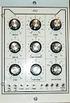 fpa 147 Week 6 Synthesis Basics In the early 1960s, inventors & entrepreneurs (Robert Moog, Don Buchla, Harold Bode, etc.) began assembling various modules into a single chassis, coupled with a user interface
The front end of the receiver performs the frequency translation, channel selection and amplification of the signal.
 Many receivers must be capable of handling a very wide range of signal powers at the input while still producing the correct output. This must be done in the presence of noise and interference which occasionally
1. Oscilloscope is basically a graph-displaying device-it draws a graph of an electrical signal.
 CHAPTER 3: OSCILLOSCOPE AND SIGNAL GENERATOR 3.1 Introduction to oscilloscope 1. Oscilloscope is basically a graph-displaying device-it draws a graph of an electrical signal. 2. The graph show signal change
TDA2040. 20W Hi-Fi AUDIO POWER AMPLIFIER
 20W Hi-Fi AUDIO POWER AMPLIFIER DESCRIPTION The TDA2040 is a monolithic integrated circuit in Pentawatt package, intended for use as an audio class AB amplifier. Typically it provides 22W output power
Design of op amp sine wave oscillators
 Design of op amp sine wave oscillators By on Mancini Senior Application Specialist, Operational Amplifiers riteria for oscillation The canonical form of a feedback system is shown in Figure, and Equation
LEVERAGING FPGA AND CPLD DIGITAL LOGIC TO IMPLEMENT ANALOG TO DIGITAL CONVERTERS
 LEVERAGING FPGA AND CPLD DIGITAL LOGIC TO IMPLEMENT ANALOG TO DIGITAL CONVERTERS March 2010 Lattice Semiconductor 5555 Northeast Moore Ct. Hillsboro, Oregon 97124 USA Telephone: (503) 268-8000 www.latticesemi.com
CHAPTER 8 ANALOG FILTERS
 ANALOG FILTERS CHAPTER 8 ANALOG FILTERS SECTION 8.: INTRODUCTION 8. SECTION 8.2: THE TRANSFER FUNCTION 8.5 THE SPLANE 8.5 F O and Q 8.7 HIGHPASS FILTER 8.8 BANDPASS FILTER 8.9 BANDREJECT (NOTCH) FILTER
Lecture 24. Inductance and Switching Power Supplies (how your solar charger voltage converter works)
 Lecture 24 Inductance and Switching Power Supplies (how your solar charger voltage converter works) Copyright 2014 by Mark Horowitz 1 Roadmap: How Does This Work? 2 Processor Board 3 More Detailed Roadmap
How To Close The Loop On A Fully Differential Op Amp
 Application Report SLOA099 - May 2002 Fully Differential Op Amps Made Easy Bruce Carter High Performance Linear ABSTRACT Fully differential op amps may be unfamiliar to some designers. This application
Application Report. 1 Introduction. 2 Resolution of an A-D Converter. 2.1 Signal-to-Noise Ratio (SNR) Harman Grewal... ABSTRACT
 Application Report SLAA323 JULY 2006 Oversampling the ADC12 for Higher Resolution Harman Grewal... ABSTRACT This application report describes the theory of oversampling to achieve resolutions greater than
Analog Sound From A Digital Delay
 Analog Sound From A Digital Delay The PT-80 Digital Delay By Scott Swartz Copyright 2002, All Rights Reserved Introduction This article will describe a digital delay pedal that is designed to capture the
Frequency Response of Filters
 School of Engineering Department of Electrical and Computer Engineering 332:224 Principles of Electrical Engineering II Laboratory Experiment 2 Frequency Response of Filters 1 Introduction Objectives To
2.161 Signal Processing: Continuous and Discrete Fall 2008
 MT OpenCourseWare http://ocw.mit.edu.6 Signal Processing: Continuous and Discrete Fall 00 For information about citing these materials or our Terms of Use, visit: http://ocw.mit.edu/terms. MASSACHUSETTS
Laboratory 4: Feedback and Compensation
 Laboratory 4: Feedback and Compensation To be performed during Week 9 (Oct. 20-24) and Week 10 (Oct. 27-31) Due Week 11 (Nov. 3-7) 1 Pre-Lab This Pre-Lab should be completed before attending your regular
SUMMARY. Additional Digital/Software filters are included in Chart and filter the data after it has been sampled and recorded by the PowerLab.
 This technique note was compiled by ADInstruments Pty Ltd. It includes figures and tables from S.S. Young (2001): Computerized data acquisition and analysis for the life sciences. For further information
Analog to Digital Conversion of Sound with the MSP430F2013
 Analog to Digital Conversion of Sound with the MSP430F2013 Christopher Johnson 4/2/2010 Abstract Several modern-day applications require that analog signals be converted to digital signals in order to
See Horenstein 4.3 and 4.4
 EE 462: Laboratory # 4 DC Power Supply Circuits Using Diodes by Drs. A.V. Radun and K.D. Donohue (2/14/07) Department of Electrical and Computer Engineering University of Kentucky Lexington, KY 40506 Updated
Analog Representations of Sound
 Analog Representations of Sound Magnified phonograph grooves, viewed from above: The shape of the grooves encodes the continuously varying audio signal. Analog to Digital Recording Chain ADC Microphone
Analog Signal Conditioning
 Analog Signal Conditioning Analog and Digital Electronics Electronics Digital Electronics Analog Electronics 2 Analog Electronics Analog Electronics Operational Amplifiers Transistors TRIAC 741 LF351 TL084
DRIVING LOOOONG CABLES
 DRIVING LOOOONG CABLES INTRODUCTION Microphone or line level cables may appear to be foolproof compared to loudspeaker cables. However, they are not. In particular you can easily encounter high frequency
AN48. Application Note DESIGNNOTESFORA2-POLEFILTERWITH DIFFERENTIAL INPUT. by Steven Green. 1. Introduction AIN- AIN+ C2
 Application Note DESIGNNOTESFORA2-POLEFILTERWITH DIFFERENTIAL INPUT by Steven Green C5 AIN- R3 C2 AIN C2 R3 C5 Figure 1. 2-Pole Low-Pass Filter with Differential Input 1. Introduction Many of today s Digital-to-Analog
DIGITAL-TO-ANALOGUE AND ANALOGUE-TO-DIGITAL CONVERSION
 DIGITAL-TO-ANALOGUE AND ANALOGUE-TO-DIGITAL CONVERSION Introduction The outputs from sensors and communications receivers are analogue signals that have continuously varying amplitudes. In many systems
LM 358 Op Amp. If you have small signals and need a more useful reading we could amplify it using the op amp, this is commonly used in sensors.
 LM 358 Op Amp S k i l l L e v e l : I n t e r m e d i a t e OVERVIEW The LM 358 is a duel single supply operational amplifier. As it is a single supply it eliminates the need for a duel power supply, thus
SECTION 5-5: FREQUENCY TRANSFORMATIONS
 ANALOG FILTERS FREQUENCY TRANSFORMATIONS SECTION 55: FREQUENCY TRANSFORMATIONS Until now, only filters using the lowpass configuration have been examined. In this section, transforming the lowpass prototype
Chapter 12: The Operational Amplifier
 Chapter 12: The Operational Amplifier 12.1: Introduction to Operational Amplifier (Op-Amp) Operational amplifiers (op-amps) are very high gain dc coupled amplifiers with differential inputs; they are used
FAST Fourier Transform (FFT) and Digital Filtering Using LabVIEW
 FAST Fourier Transform (FFT) and Digital Filtering Using LabVIEW Wei Lin Department of Biomedical Engineering Stony Brook University Instructor s Portion Summary This experiment requires the student to
Introduction to Digital Filters
 CHAPTER 14 Introduction to Digital Filters Digital filters are used for two general purposes: (1) separation of signals that have been combined, and (2) restoration of signals that have been distorted
The Phase Modulator In NBFM Voice Communication Systems
 The Phase Modulator In NBFM Voice Communication Systems Virgil Leenerts 8 March 5 The phase modulator has been a point of discussion as to why it is used and not a frequency modulator in what are called
Touch Screen Technology. Taking apart a tablet
 Touch Screen Technology Topics covered: 1) Resistance, Capacitance, Charge, Voltage, and Current 2) Introduction to simple circuits Taking apart a tablet For example, an ipad2 Touchscreen Motherboard Lots
RECOMMENDATION ITU-R BS.644-1 *,** Audio quality parameters for the performance of a high-quality sound-programme transmission chain
 Rec. ITU-R BS.644-1 1 RECOMMENDATION ITU-R BS.644-1 *,** Audio quality parameters for the performance of a high-quality sound-programme transmission chain (1986-1990) The ITU Radiocommunication Assembly,
Using the Impedance Method
 Using the Impedance Method The impedance method allows us to completely eliminate the differential equation approach for the determination of the response of circuits. In fact the impedance method even
A Low-Cost, Single Coupling Capacitor Configuration for Stereo Headphone Amplifiers
 Application Report SLOA043 - December 1999 A Low-Cost, Single Coupling Capacitor Configuration for Stereo Headphone Amplifiers Shawn Workman AAP Precision Analog ABSTRACT This application report compares
Operational Amplifier - IC 741
 Operational Amplifier - IC 741 Tabish December 2005 Aim: To study the working of an 741 operational amplifier by conducting the following experiments: (a) Input bias current measurement (b) Input offset
AM Receiver. Prelab. baseband
 AM Receiver Prelab In this experiment you will use what you learned in your previous lab sessions to make an AM receiver circuit. You will construct an envelope detector AM receiver. P1) Introduction One
Positive Feedback and Oscillators
 Physics 3330 Experiment #6 Fall 1999 Positive Feedback and Oscillators Purpose In this experiment we will study how spontaneous oscillations may be caused by positive feedback. You will construct an active
Analog-to-Digital Voice Encoding
 Analog-to-Digital Voice Encoding Basic Voice Encoding: Converting Analog to Digital This topic describes the process of converting analog signals to digital signals. Digitizing Analog Signals 1. Sample
University of Rochester Department of Electrical and Computer Engineering ECE113 Lab. #7 Higher-order filter & amplifier designs March, 2012
 University of Rochester Department of Electrical and Computer Engineering ECE113 Lab. #7 Higherorder filter & amplifier designs March, 2012 Writeups, due one week after the lab is performed, should provide
A Single-Supply Op-Amp Circuit Collection
 Application Report SLOA058 November 2000 A SingleSupply OpAmp Circuit Collection Bruce Carter OpAmp Applications, High Performance Linear Products One of the biggest problems for designers of opamp circuitry
Application Note Noise Frequently Asked Questions
 : What is? is a random signal inherent in all physical components. It directly limits the detection and processing of all information. The common form of noise is white Gaussian due to the many random
Lock - in Amplifier and Applications
 Lock - in Amplifier and Applications What is a Lock in Amplifier? In a nut shell, what a lock-in amplifier does is measure the amplitude V o of a sinusoidal voltage, V in (t) = V o cos(ω o t) where ω o
PHYSICS 360 - LAB #2 Passive Low-pass and High-pass Filter Circuits and Integrator and Differentiator Circuits
 PHYSICS 360 - LAB #2 Passie Low-pass and High-pass Filter Circuits and Integrator and Differentiator Circuits Objectie: Study the behaior of low-pass and high-pass filters. Study the differentiator and
Digital Electronics Detailed Outline
 Digital Electronics Detailed Outline Unit 1: Fundamentals of Analog and Digital Electronics (32 Total Days) Lesson 1.1: Foundations and the Board Game Counter (9 days) 1. Safety is an important concept
AN-837 APPLICATION NOTE
 APPLICATION NOTE One Technology Way P.O. Box 916 Norwood, MA 262-916, U.S.A. Tel: 781.329.47 Fax: 781.461.3113 www.analog.com DDS-Based Clock Jitter Performance vs. DAC Reconstruction Filter Performance
Frequency response: Resonance, Bandwidth, Q factor
 Frequency response: esonance, Bandwidth, Q factor esonance. Let s continue the exploration of the frequency response of circuits by investigating the series circuit shown on Figure. C + V - Figure The
MAS.836 HOW TO BIAS AN OP-AMP
 MAS.836 HOW TO BIAS AN OP-AMP Op-Amp Circuits: Bias, in an electronic circuit, describes the steady state operating characteristics with no signal being applied. In an op-amp circuit, the operating characteristic
TDA2040. 20W Hi-Fi AUDIO POWER AMPLIFIER
 20W Hi-Fi AUDIO POWER AMPLIFIER DESCRIPTION The TDA2040 is a monolithic integrated circuit in Pentawatt package, intended for use as an audio class AB amplifier. Typically it provides 22W output power
Sigma- Delta Modulator Simulation and Analysis using MatLab
 Computer and Information Science; Vol. 5, No. 5; 2012 ISSN 1913-8989 E-ISSN 1913-8997 Published by Canadian Center of Science and Education Sigma- Delta Modulator Simulation and Analysis using MatLab Thuneibat
Understanding Dynamic Range in Acceleration Measurement Systems. February 2013 By: Bruce Lent
 in Acceleration Measurement Systems February 2013 By: Bruce Lent Topics to discuss Definition of dynamic range The effective range Making full use of the high level Using filters to improve dynamic range
The Effective Number of Bits (ENOB) of my R&S Digital Oscilloscope Technical Paper
 The Effective Number of Bits (ENOB) of my R&S Digital Oscilloscope Technical Paper Products: R&S RTO1012 R&S RTO1014 R&S RTO1022 R&S RTO1024 This technical paper provides an introduction to the signal
Frequency response. Chapter 1. 1.1 Introduction
 Chapter Frequency response. Introduction The frequency response of a system is a frequency dependent function which expresses how a sinusoidal signal of a given frequency on the system input is transferred
Optimizing IP3 and ACPR Measurements
 Optimizing IP3 and ACPR Measurements Table of Contents 1. Overview... 2 2. Theory of Intermodulation Distortion... 2 3. Optimizing IP3 Measurements... 4 4. Theory of Adjacent Channel Power Ratio... 9 5.
An audio circuit collection, Part 1
 An audio circuit collection, Part By Bruce Carter Advanced Analog Products, Op Amp Applications Introduction This is the first of two articles on audio circuits. New operational amplifiers from Texas Instruments
Experiment # (4) AM Demodulator
 Islamic University of Gaza Faculty of Engineering Electrical Department Experiment # (4) AM Demodulator Communications Engineering I (Lab.) Prepared by: Eng. Omar A. Qarmout Eng. Mohammed K. Abu Foul Experiment
Transistor Characteristics and Single Transistor Amplifier Sept. 8, 1997
 Physics 623 Transistor Characteristics and Single Transistor Amplifier Sept. 8, 1997 1 Purpose To measure and understand the common emitter transistor characteristic curves. To use the base current gain
Class D Audio Amplifier
 Class D Audio Amplifier The design of a live audio Class D audio amplifier with greater than 90% efficiency and less than 1% distortion. A Major Qualifying Project Submitted to the Faculty of the WORCESTER
Lab Exercise 1: Acoustic Waves
 Lab Exercise 1: Acoustic Waves Contents 1-1 PRE-LAB ASSIGNMENT................. 2 1-3.1 Spreading Factor: Spherical Waves........ 2 1-3.2 Interference In 3-D................. 3 1-4 EQUIPMENT........................
isim ACTIVE FILTER DESIGNER NEW, VERY CAPABLE, MULTI-STAGE ACTIVE FILTER DESIGN TOOL
 isim ACTIVE FILTER DESIGNER NEW, VERY CAPABLE, MULTI-STAGE ACTIVE FILTER DESIGN TOOL Michael Steffes Sr. Applications Manager 12/15/2010 SIMPLY SMARTER Introduction to the New Active Filter Designer Scope
1995 Mixed-Signal Products SLAA013
 Application Report 995 Mixed-Signal Products SLAA03 IMPORTANT NOTICE Texas Instruments and its subsidiaries (TI) reserve the right to make changes to their products or to discontinue any product or service
Technical Note #3. Error Amplifier Design and Applications. Introduction
 Technical Note #3 Error Amplifier Design and Applications Introduction All regulating power supplies require some sort of closed-loop control to force the output to match the desired value. Both digital
Line Reactors and AC Drives
 Line Reactors and AC Drives Rockwell Automation Mequon Wisconsin Quite often, line and load reactors are installed on AC drives without a solid understanding of why or what the positive and negative consequences
Use and Application of Output Limiting Amplifiers (HFA1115, HFA1130, HFA1135)
 Use and Application of Output Limiting Amplifiers (HFA111, HFA110, HFA11) Application Note November 1996 AN96 Introduction Amplifiers with internal voltage clamps, also known as limiting amplifiers, have
Digital to Analog Converter. Raghu Tumati
 Digital to Analog Converter Raghu Tumati May 11, 2006 Contents 1) Introduction............................... 3 2) DAC types................................... 4 3) DAC Presented.............................
chapter Introduction to Digital Signal Processing and Digital Filtering 1.1 Introduction 1.2 Historical Perspective
 Introduction to Digital Signal Processing and Digital Filtering chapter 1 Introduction to Digital Signal Processing and Digital Filtering 1.1 Introduction Digital signal processing (DSP) refers to anything
CIRCUITS LABORATORY EXPERIMENT 3. AC Circuit Analysis
 CIRCUITS LABORATORY EXPERIMENT 3 AC Circuit Analysis 3.1 Introduction The steady-state behavior of circuits energized by sinusoidal sources is an important area of study for several reasons. First, the
Output Ripple and Noise Measurement Methods for Ericsson Power Modules
 Output Ripple and Noise Measurement Methods for Ericsson Power Modules Design Note 022 Ericsson Power Modules Ripple and Noise Abstract There is no industry-wide standard for measuring output ripple and
Current vs. Voltage Feedback Amplifiers
 Current vs. ltage Feedback Amplifiers One question continuously troubles the analog design engineer: Which amplifier topology is better for my application, current feedback or voltage feedback? In most
Transistor Amplifiers
 Physics 3330 Experiment #7 Fall 1999 Transistor Amplifiers Purpose The aim of this experiment is to develop a bipolar transistor amplifier with a voltage gain of minus 25. The amplifier must accept input