
JOB SAFETY ANALYSIS FOR THE MARINE AND OFFSHORE INDUSTRIES
|
|
|
- Laureen Payne
- 9 years ago
- Views:
Transcription
1 Guidance Notes on Job Safety Analysis for the Marine and Offshore Industries GUIDANCE NOTES ON JOB SAFETY ANALYSIS FOR THE MARINE AND OFFSHORE INDUSTRIES APRIL 2013 American Bureau of Shipping Incorporated by Act of Legislature of the State of New York 1862 Copyright 2013 American Bureau of Shipping ABS Plaza Northchase Drive Houston, TX USA

2 Foreword Foreword Job safety analysis (JSA) is a risk assessment technique used to eliminate or reduce the occurrence of undesirable incidents during work tasks. The intent of these Guidance Notes is to lay out a job safety analysis (JSA) process that aims to achieve a reduction in personnel injuries by establishing more effective work procedures, addressing the specific challenges faced by the marine and offshore industries. These Guidance Notes should assist companies wishing to implement a JSA program from the start, or optimize an existing program, by providing ideas and best practices that can be adopted by any marine or offshore company to strengthen their safety management system. These Guidance Notes become effective on the first day of the month of publication. Users are advised to check periodically on the ABS website to verify that this version of these Guidance Notes is the most current. We welcome your feedback. Comments or suggestions can be sent electronically by to [email protected]. ii ABS GUIDANCE NOTES ON JOB SAFETY ANALYSIS FOR THE MARINE AND OFFSHORE INDUSTRIES. 2013

3 Table of Contents GUIDANCE NOTES ON JOB SAFETY ANALYSIS FOR THE MARINE AND OFFSHORE INDUSTRIES CONTENTS SECTION 1 Introduction General Standards and Regulations Requiring JSA What is JSA? Approaches to JSA Terminology... 3 SECTION 2 Job Safety Analysis Process JSA Process Informal Job Safety Analysis When to Perform an Informal JSA How to do an Informal JSA? Formal JSA When to do a Formal JSA? How to do a Formal JSA? Formal JSA Step 1: Define the Job Formal JSA Step 2: List the Job Steps Formal JSA Step 3: Identify the Hazards Associated with Each Job Step Formal JSA Step 4. Identify Existing Control Measures for Each Hazard Formal JSA Step 5: Hazard Ranking Formal JSA Step 5.1: Identify Additional Risk Controls Formal JSA Step 5.2: Re-rank with Additional Risk Controls Formal JSA Step 6: Validation of Controls Sign Off Simplified Formal JSA for Frequent and Moderately Hazardous Tasks TABLE 1 Informal JSA Characteristics... 5 TABLE 2 Formal JSA Characteristics... 7 TABLE 3 Tasks Typically Requiring a Formal JSA... 8 TABLE 4 Checklist of Hazard Types and Potential Causes (Non-Exhaustive) ABS GUIDANCE NOTES ON JOB SAFETY ANALYSIS FOR THE MARINE AND OFFSHORE INDUSTRIES iii

4 FIGURE 1 Informal JSA Checksheet... 6 FIGURE 2 Formal JSA Process SECTION 3 Getting the Most Out of a Job Safety Analysis Program Environmental, Security and Emergency Considerations in a JSA Environmental Considerations Security Considerations Emergency Preparedness A Word About Proximity in Time and in Location Library of JSAs Generic JSAs Using a Library of Generic JSAs Using a Library of Completed JSAs Limitations of Library of JSAs Synergism between JSA and Permit-to-Work Synergism between JSAs and Standard Operating Procedures JSA as a Tool to Develop SOPs Stop Work Authority and Ultimate Work Authority FIGURE 1 Generic JSA Example SECTION 4 Job Safety Analysis Program Implementation Program Implementation Roles and Responsibilities Shore Management Involvement Shipboard/Offshore Personnel Involvement and Responsibility Contractors Organizational Preparation Culture Management Support JSA Program Manual JSA Form Risk Tolerance Training TABLE 1 Sample Tolerability Criteria Based on Hazard Severity FIGURE 1 Sample Risk Matrix with Risk Tolerability Criteria SECTION 5 JSA Program Monitoring JSA Program Monitoring Performance Indicators Documentation and Recordkeeping Continual Improvement Select Resources iv ABS GUIDANCE NOTES ON JOB SAFETY ANALYSIS FOR THE MARINE AND OFFSHORE INDUSTRIES. 2013

5 APPENDIX 1 Sample JSA Forms Sample Basic JSA Form Sample Comprehensive JSA Form APPENDIX 2 Hazard and Controls Checklist Hazard and Controls Checklist TABLE 1 Hazard List TABLE 2 Chemical Hazards with Possible Controls TABLE 3 Biological Hazards with Possible Controls TABLE 4 Energy Hazards with Possible Controls TABLE 5 Physical Hazards with Possible Controls TABLE 6 Work Environment Hazards with Possible Controls TABLE 7 External Hazards with Possible Controls ABS GUIDANCE NOTES ON JOB SAFETY ANALYSIS FOR THE MARINE AND OFFSHORE INDUSTRIES v

6 This Page Intentionally Left Blank

7 Section 1: Introduction SECTION 1 Introduction 1 General Risk assessment, the proactive and systematic assessment of risks, is a standard element of most offshore and maritime companies safety management systems. Risk assessment is a powerful and flexible tool to identify and control potential undesirable events that can have safety, environmental, quality, or financial repercussions. The focus of these Guidance Notes is risk assessment applied to work tasks, commonly referred to as Job Safety Analysis (JSA). The marine and offshore industries have implemented job safety analysis at varying levels of maturity and sophistication. These Guidance Notes provide considerations for any company desiring to strengthen their safety management system through the use of a job safety analysis. The best practices and concepts contained within this document can be applied by any marine or offshore company wishing to initiate or improve their JSA program. 1.1 Standards and Regulations Requiring JSA A properly implemented JSA program constitutes an important risk management tool for compliance with several regulations, standards, and industry best practices, such as the ISM Code, the Occupational Health and Safety Assessment Standard OHSAS 18001, the Maritime Labour Convention, the Tanker Management Self-Assessment (TMSA), and the Safety and Environmental Management Systems (SEMS) regulations for the offshore industry in the United States. The International Safety Management (ISM) Code, 2010 edition, indicates that one of the safety management objectives of the Company shall be to assess all identified risks to its ships, personnel and the environment and establish appropriate safeguards. A JSA can assist in the shipboard risk identification process and the ensuing establishment of safeguards to appropriately control those shipboard risks. The Occupational Health and Safety and Assessment Series standard, OHSAS 18001:2007, in Section 4.3 (Planning), requires companies to develop and implement a procedure(s) for the ongoing hazard identification, risk assessment, and determination of necessary controls as the basis of the whole OH&S system. The International Labour Organization (ILO) has developed the Maritime Labour Convention, 2006 that has wide-spread applicability in the maritime industry. Part A of the Convention, Regulation 4.2 Health and safety protection and incident prevention, mandates risk evaluations for occupational health and safety risks. Risks due to noise, vibration, disease, exposure to asbestos, fire, and dangerous cargoes and materials, are to be identified and risk reduction controls provided. The Oil Companies International Marine Forum (OCIMF) developed the Tanker Management Self- Assessment (TMSA), a Best Practice Guide for Vessel Operators (2008), as a tool to encourage vessel operators to assess and continuously improve their safety management systems by incorporating the provided best practice guidance. Risk assessments are incorporated in several elements of TMSA, but the most encompassing requirements are in Element 9 Safety Management, which suggests Companies should have a program for systematic identification of hazards. The United States regulation for Safety and Environmental Management Systems (SEMS) for the offshore sector, as specified in 30 Code of Federal Regulations 250, Subchapter S, requires among other things, the development and implementation of a JSA program to analyze tasks performed as part of most offshore activities, such as drilling, production, processing, construction, well services (workover, completion, servicing), and pipelines. ABS GUIDANCE NOTES ON JOB SAFETY ANALYSIS FOR THE MARINE AND OFFSHORE INDUSTRIES

8 Section 1 General 1.3 What is JSA? A Job Safety Analysis is a task-oriented risk assessment used to review the hazards associated with a particular work task, and to verify that adequate safeguards are in place to control those hazards. The main goal of the analysis is to prevent harm to the individual(s) carrying out the task. JSAs are known by a variety of terms, including Job Hazard Analysis (JHA), Job Risk Assessment (JRA), Task Risk Assessment (TRA), Safe Job Analysis (SJA). JSA is the analytical process of: Identifying the basic job steps of the task, For every job step, reviewing associated potential safety and health hazards, and Planning for effective controls or safeguarding mechanism to control (i.e., eliminate or mitigate) the effects the hazards may pose. JSAs are primarily used for controlling risks to the safety and health of the workers. However, a JSA can be used as a tool to identify how the task can pose hazards to the environment or to the asset. Subsection 3/1 discusses this topic further. In addition to identifying the inherent hazards of a task, a well-conducted JSA can uncover other subtle issues that pose risks to the individual, such as discrepancies between the way the procedures recommend a task to be carried out and the actual situation; problems with risk controls that supposedly act to reduce the risk but when brought to light during the JSA are found to be deficient, missing, inoperable, or bypassed; or the hazards associated with personnel change during the tasks. The identification of these problems and the implementation of corrective actions before the task is performed can prevent undesirable incidents during the execution of the work task. 1.5 Approaches to JSA A company promoting a risk-conscious safety culture will ideally want to go through a JSA exercise before performing any onboard/offshore activities. However, JSA exercises involve time and effort to develop and document. A program that requires a documented JSA for every task onboard/offshore may be seen by some as overly onerous, and the worker acceptance, rigor, and efficiency of the JSA program can diminish. On the other hand, if certain tasks are excluded from the JSA program, the workers may skip assessing the hazards associated with the task and the means by which they can be eliminated or reduced to an acceptable level. To illustrate this, consider a simple task routinely performed onboard ships. A crewmember has been assigned the task of transferring large boxes of stores, approximately three-foot cubes, from the main deck to the shelves in the Dry Stores Room. The Dry Stores room is below the main deck and stairs must be used. Hazards associated with descending the stairs include: Personal harm (e.g., bumps, bruises, back injury) from slipping and falling from the stairs Boxes slipping out of the person s hands and striking another person below Dropping the box and breaking containers of chemicals inside that when mixed produce toxic, lethal, or otherwise harmful vapors Hazards associated with carrying the box in the passageways on the way to the Dry Stores Room include: Bumping into other personnel who cannot be seen over the top of the carried box Bumping into doorways and scraping fingers while going through Tripping over unseen objects in the passageway and dropping the box damaging contents Hazards associated with placing the boxes on the shelves in the Dry Stores Room include: Scraping hands on the shelves Back injury from trying to lift boxes to a higher level 2 ABS GUIDANCE NOTES ON JOB SAFETY ANALYSIS FOR THE MARINE AND OFFSHORE INDUSTRIES. 2013

9 Section 1 General A JSA would identify these hazards and identify, for example, the need for a second or third person to assist in the transport of the boxes, or to use a handy-billy and approved strap to lower the boxes to the next level, or to erect a small platform in the Dry Stores Room so that the boxes would not have to be as lifted as high as when placing on the shelves. The inclusion of additional personnel could, during the JSA discussion, identify additional hazards and control measures. However, requiring a comprehensive and documented JSA for a task such as the one described would be too onerous on the workers. Hazards associated with all tasks should be identified and controlled. However, some tasks require a more detailed JSA than others. Instead of suggesting a JSA program where certain tasks are left without the benefit of the JSA, or a program where all tasks are required to undergo a formal and comprehensive JSA, a tiered approach is recommended with two or more levels of JSA. Typically, two JSA levels could be defined: i) An informal JSA (mental or verbal) ii) A formal JSA (comprehensive and documented) The JSAs can be carried out to varying degrees of detail, depending on the situation at hand. A tiered JSA program necessitates criteria to decide what type of JSA is needed for each particular task depending on factors such as the type of task, its complexity, its regularity, etc. These Guidance Notes describe these two types of JSA along with guidance on when to use one versus the other, but ultimately, each company will develop their program and criteria according to their needs and goals. 3 Terminology Several terms used throughout these Guidance Notes are defined below. Consequence is the measure of the impact of an event occurrence in terms of people affected, property damaged, outage time, dollars lost, or any other chosen parameter. For purposes of a JSA, the focus is on impacts to safety and health, but impacts on environment and property can also be considered and mitigated. Controls are the measures taken to prevent hazards from causing undesirable events. Controls can be physical (e.g., safety shutdowns, redundant controls, added conservatism in design), procedural (e.g., operating procedures, routine inspection requirements), and can also address human factors (employee selection, training, supervision). Event is an occurrence that has an associated outcome. There are typically a number of potential outcomes from any one initial event that may range in severity from trivial to catastrophic, depending on other conditions and subsequent events. The terms Event and Incident are used interchangeably. Hazards are conditions that exist that may potentially lead to an undesirable event. Incident. Same as Event. Both concepts may include near misses (unsafe conditions) and injuries. Job Safety Analysis (JSA) is an analytical process that focuses on a means to identify and control hazards inherent in job tasks before they can result in an accident. JSA also refers to the formal document that is developed as a result of the analysis process. Likelihood indicates the potential that a hazard could be realized. Risk is defined as the product of the frequency with which an event is anticipated to occur and the consequence of the event s outcome. Risk Assessment is the process of understanding (1) what undesirable things can happen, (2) how likely they are to happen, (3) how severe the effects can be and (4) evaluating what is the risk of each undesirable event. ABS GUIDANCE NOTES ON JOB SAFETY ANALYSIS FOR THE MARINE AND OFFSHORE INDUSTRIES

10 Section 2: Job Safety Analysis Process SECTION 2 Job Safety Analysis Process 1 JSA Process A JSA focuses on identifying the tasks necessary to perform a specific job; the potential safety and health, and in some cases, environmental, hazards associated with each task; and the possible risk control measures needed to eliminate or reduce these hazards. The JSA process can be divided into a number of steps, the complexity of which can vary depending on the job being analyzed. As mentioned before, it can be used informally through a verbal discussion before performing a simple, routine job, or formally following a prescribed set of steps and a well-defined JSA form for more complex, non-routine, or new jobs. The JSA process presented in these Guidance Notes is a flexible approach that can accommodate any level of detail. A so called informal JSA process is described, as well as a formal JSA process for more complex jobs. Even within the formal JSA, the process can be applied at different levels of detail, depending on the complexity of the job. It can take minutes to several hours to complete. These Guidance Notes describe a range of options in terms of level of detail and complexity of each JSA process step. Each company can modify and adapt this JSA process to the appropriate level of detail for the different type of jobs applicable to them. Regardless of the type of JSA to be performed, there are three basic parts that need to be completed: Understand the task to be performed Identify potential hazards for the task Identify risk control measures for each hazard The following sections provide guidance on how to complete these basic parts, with varying levels of detail appropriate for each type of JSA approach. 3 Informal Job Safety Analysis Informal JSAs are mental or verbal individual risk assessments carried out by the worker(s) before starting any job. They are the most basic, quickest and simplest of task risk assessment, which help promote a risk management culture through continual self-evaluation. They aid in the identification and control of immediate hazards as personnel conduct their day-to-day work, and assist personnel in maintaining situational awareness of their environment at all times. The informal JSA described here is similar in nature to other planning tools that share the same intent: help workers perform even the most mundane of tasks without getting hurt. These personal planning tools include techniques such as Stop and Think, Take 5, Stepback 5 5, Good to Go, Every Minute Risk Assessment, or Toolbox Talk. 3.1 When to Perform an Informal JSA The informal JSAs are generally used for routine and simple tasks involving only one or two individuals and little equipment. The following tasks are examples for which an informal JSA is appropriate: Routine materials and stores handling (e.g., moving dry stores from the storeroom to the galley, stocking storeroom shelves with received stores, etc.) Routine maintenance tasks (e.g., painting and chipping in open air, changing air conditioning filters, etc.) Routine housekeeping activities (e.g., mopping decks, cleaning up tank cleaning equipment, etc.). Routine and repetitive operations (e.g., tripping pipe in or out of the hole, connecting cargo hoses, applying securing devices to cargo or stores at deck level, etc.). Personnel should be made aware that any time there is uncertainty regarding the risks, or a suspicion of high risks associated with the performance of a task, a formal JSA should be conducted. 4 ABS GUIDANCE NOTES ON JOB SAFETY ANALYSIS FOR THE MARINE AND OFFSHORE INDUSTRIES. 2013

11 Section 2 Job Safety Analysis Process 3.3 How to do an Informal JSA? A typical informal JSA involves taking a moment before starting the job to consider the following factors, trying to identify their inherent hazards, or what can go wrong with each one of them: i) Task ii) iii) iv) Work area/environment Equipment People v) Controls The identification of hazards leads to methods to manage the risks associated with the hazard. The JSA should be repeated throughout the duration of the task to account for changing conditions or circumstances and prompt the worker to step back and think through emerging issues. Personnel doing the work are responsible for carrying out the informal JSA and supervisors are responsible for encouraging and communicating the process. Section 2, Table 1 provides a summary of the characteristics of an informal JSA. TABLE 1 Informal JSA Characteristics Characteristics JSA Leader Number of people on JSA team Supervisor during JSA development Documentation and recordkeeping Approvals Risk estimation Level of detail on breakdown of job steps Location for Conducting the JSA Timing for Conducting the JSA Informal JSA Individual working on the task. Typically 1-3. All conducting the task should participate in the JSA Not necessary None None Mental. Worker feels confident that risks are acceptable. Mental or verbal outline of the task. Shipboard/facility and close to the task location Immediately before the task Only identified hazards can be managed and controlled. A checksheet for informal JSAs is shown in Section 2, Figure 1, with sample questions to help prime the hazard identification process. As a supporting tool, this informal JSA checksheet, or a similar one customized for a company, can be laminated and provided to all workers to carry around or have handy at all times. ABS GUIDANCE NOTES ON JOB SAFETY ANALYSIS FOR THE MARINE AND OFFSHORE INDUSTRIES

12 Section 2 Job Safety Analysis Process FIGURE 1 Informal JSA Checksheet 6 ABS GUIDANCE NOTES ON JOB SAFETY ANALYSIS FOR THE MARINE AND OFFSHORE INDUSTRIES. 2013

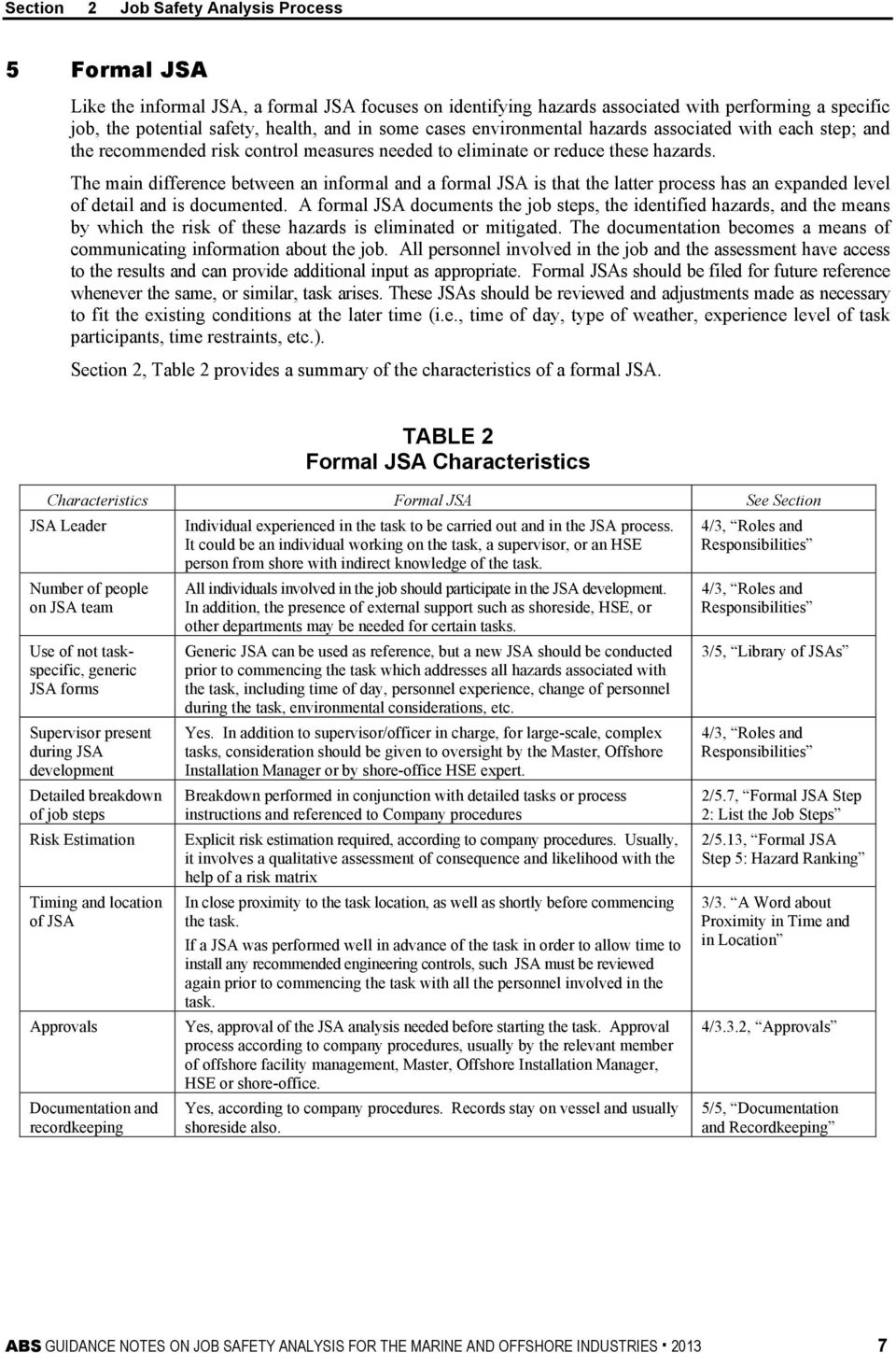
13 Section 2 Job Safety Analysis Process 5 Formal JSA Like the informal JSA, a formal JSA focuses on identifying hazards associated with performing a specific job, the potential safety, health, and in some cases environmental hazards associated with each step; and the recommended risk control measures needed to eliminate or reduce these hazards. The main difference between an informal and a formal JSA is that the latter process has an expanded level of detail and is documented. A formal JSA documents the job steps, the identified hazards, and the means by which the risk of these hazards is eliminated or mitigated. The documentation becomes a means of communicating information about the job. All personnel involved in the job and the assessment have access to the results and can provide additional input as appropriate. Formal JSAs should be filed for future reference whenever the same, or similar, task arises. These JSAs should be reviewed and adjustments made as necessary to fit the existing conditions at the later time (i.e., time of day, type of weather, experience level of task participants, time restraints, etc.). Section 2, Table 2 provides a summary of the characteristics of a formal JSA. TABLE 2 Formal JSA Characteristics Characteristics Formal JSA See Section JSA Leader Individual experienced in the task to be carried out and in the JSA process. It could be an individual working on the task, a supervisor, or an HSE person from shore with indirect knowledge of the task. 4/3, Roles and Responsibilities Number of people on JSA team Use of not taskspecific, generic JSA forms Supervisor present during JSA development Detailed breakdown of job steps Risk Estimation Timing and location of JSA Approvals Documentation and recordkeeping All individuals involved in the job should participate in the JSA development. In addition, the presence of external support such as shoreside, HSE, or other departments may be needed for certain tasks. Generic JSA can be used as reference, but a new JSA should be conducted prior to commencing the task which addresses all hazards associated with the task, including time of day, personnel experience, change of personnel during the task, environmental considerations, etc. Yes. In addition to supervisor/officer in charge, for large-scale, complex tasks, consideration should be given to oversight by the Master, Offshore Installation Manager or by shore-office HSE expert. Breakdown performed in conjunction with detailed tasks or process instructions and referenced to Company procedures Explicit risk estimation required, according to company procedures. Usually, it involves a qualitative assessment of consequence and likelihood with the help of a risk matrix In close proximity to the task location, as well as shortly before commencing the task. If a JSA was performed well in advance of the task in order to allow time to install any recommended engineering controls, such JSA must be reviewed again prior to commencing the task with all the personnel involved in the task. Yes, approval of the JSA analysis needed before starting the task. Approval process according to company procedures, usually by the relevant member of offshore facility management, Master, Offshore Installation Manager, HSE or shore-office. Yes, according to company procedures. Records stay on vessel and usually shoreside also. 4/3, Roles and Responsibilities 3/5, Library of JSAs 4/3, Roles and Responsibilities 2/5.7, Formal JSA Step 2: List the Job Steps 2/5.13, Formal JSA Step 5: Hazard Ranking 3/3. A Word about Proximity in Time and in Location 4/3.3.2, Approvals 5/5, Documentation and Recordkeeping ABS GUIDANCE NOTES ON JOB SAFETY ANALYSIS FOR THE MARINE AND OFFSHORE INDUSTRIES
14 Section 2 Job Safety Analysis Process 5.1 When to do a Formal JSA? A formal JSA shall be carried out for new major tasks or groups of tasks, or when the informal JSA has been found not to suffice/ or when required by Company procedure. A task involving one or more of the factors below should normally trigger a formal JSA: i) Non-routine tasks ii) iii) iv) Tasks with known potential for harming crew, equipment or environment, including near-misses, or tasks that have been associated with recurring HSE events Complex/difficult tasks Tasks requiring the interaction of many people or systems v) Routine tasks performed under unusual or unfavorable situations vi) vii) viii) Tasks involving a change from the norm, or something/someone new or different Work on critical equipment Tasks that generate employee complaints Section 2, Table 3 shows examples of typical tasks that are candidates for carrying out a formal JSA. TABLE 3 Tasks Typically Requiring a Formal JSA Criteria for Formal JSA Examples i) Non-routine tasks Asbestos abatement Moving equipment around the deck at sea Submerging or recovering equipment in the sea Traveling in convoys in war zones ii) Tasks with known potential for Work over the side or at heights harming the crew, equipment or Man-riding operations (carried aloft) environment. Complex and specialized lifts Work on electrical systems or live electrical work Pressure testing Work around energy sources Rigging and slinging Bulk transfer of liquids Crane and cargo boom operations, particularly heavy lifts Crane and forklift operations Hot work Working in confined spaces Working with dangerous substances such as explosives, toxic chemicals, or radioactive materials Tasks associated with recurring safety near-misses, incidents or events iii) Complex and difficult tasks Well workover (offshore industry) Well completion (offshore industry) Running casing (offshore industry) Complex and specialized lift Retrofitting of machinery Commissioning of newly installed equipment or systems 8 ABS GUIDANCE NOTES ON JOB SAFETY ANALYSIS FOR THE MARINE AND OFFSHORE INDUSTRIES. 2013

15 Section 2 Job Safety Analysis Process Criteria for Formal JSA iv) Task requiring interaction between many people or systems v) Routine tasks performed under unusual or unfavorable situations vi) Task involving a change from the norm, or something/someone new or different TABLE 3 (continued) Tasks Typically Requiring a Formal JSA Examples Simultaneous and potentially conflicting operations (SIMOPS) Tasks requiring crew and outside vendors working together or with different departments on board. Stores transfer at the dock or at sea Fueling operations Offshore lightering Ship assist and ship mooring Personnel transfers at sea Tank-cleaning operations Routine and repetitive tasks where risk of complacency may be a factor (e.g., tripping 10,000 feet of drill pipe in or out of the hole, change of the watch or for supper relief, etc.) Work during adverse weather conditions Ice operations Work in areas of high temperatures New job/task Tasks with new procedures Newly modified jobs, operations or processes Tasks associated with newly modified or new equipment Tasks performed by new or inexperienced workers vii) Work on critical equipment Tasks associated with disabling of critical equipment or disabled/suppressed safety or environmental systems viii) Employee complaints Tasks that generate employee complaints as they may be the result of underlying problems such as ergonomic issues, procedures that are not feasible to carry out in real life, etc. 5.3 How to do a Formal JSA? The formal JSA process is conducted in a series of sequential parts, all of which are to be documented. In its most comprehensive form, as shown in Section 2, Figure 2, the formal JSA will include all of the following parts: 1) Define the job specifically. 2) List steps of the job. 3) Identify hazards for each job step. 4) Identify existing risk control measures for each hazard. 5) Rank the hazards. 5.1) If ranking indicates that hazard is not adequately controlled, identify additional risk controls. 5.2) Re-rank the hazards. 6) Verify implementation of the controls. Some of parts of the JSA process may be simplified or skipped for a simplified version of the formal JSA, which will be discussed in more detail in Subsection 2/7, Simplified Formal JSA. ABS GUIDANCE NOTES ON JOB SAFETY ANALYSIS FOR THE MARINE AND OFFSHORE INDUSTRIES

16 Section 2 Job Safety Analysis Process FIGURE 2 Formal JSA Process 10 ABS GUIDANCE NOTES ON JOB SAFETY ANALYSIS FOR THE MARINE AND OFFSHORE INDUSTRIES. 2013

17 Section 2 Job Safety Analysis Process 5.5 Formal JSA Step 1: Define the Job The first part of all JSAs is to define and describe the job to be performed. It should answer the what, why, who, where, and the when of the job. It provides a clear understanding of the following aspects: Specific job to be performed and the scope (i.e., Welding is not a specific job; but Cropping and renewing a handrail on top of the starboard kingpost is) Reason for the job Personnel that will be involved and their competence and experience Types of tools and equipment that will be used in the job Physical location of the job, work area, environment Time period for the job Clear communication and understanding of the task with all concerned, is in itself an important action to reduce the likelihood of incident occurrence. JSA Example: Defining the Job The fall cable on one of the lifeboats is chafed and needs to be replaced. Launching, retrieving and maintaining a lifeboat can be a high-risk activity leading to injury and death, particularly while at sea. As a high risk activity, a formal JSA should be conducted. The first step of the JSA process is to clearly define the job by answering the what, where, why, who, and when. What: Replace fall cable on davit-fall lifeboat No.1 Where: Muster area No. 1 Why: Fall cable shows visible signs of wire fraying When: Morning shift Who: Second Mate, Rob Mate, and Deck Department crew members J.J. Crew and Bosun Salty. Supervised by Chief Mate, under the authority of the Master with a permit to work Tools and equipment: Two preventer wire strap pendants of the correct length and four safety shackles within the safety working capacity of each to hold each end of the lifeboat in place during the fall replacement; A box of rags for clean-up, including degreasing liquid (Material Safety Data Sheet for the degreaser); PPE (leather gloves, safety goggles, steel-toed shoes/boots, Company coveralls or pants/shirt; hard hats with chin straps; fall-arrest gear when working at height); Wrenches necessary to disconnect the cable from the drum; Channellocks or other type of pliers for working with safety shackle cotter pins, Empty spool to coil the old fall to be removed, Power to the davit winch to turn the fall off the davit and take-up drum; Crane and rigging straps to hoist the new fall drum to the working area and to remove the old fall to the ship s disposal area; Walkie-talkies for communicating with each other and the bridge as necessary 5.7 Formal JSA Step 2: List the Job Steps This part of the JSA process addresses in greater detail how the job will be executed. It breaks down the job into its smaller sequential parts or steps. As most jobs have multiple steps, each step of the job should be discreetly identified and listed in correct sequence. Each step should be described in terms of what is to be done, but avoiding excessive detail. Care should be taken not to combine several steps into one step, (e.g., remove old pipe and install new pipe in the fire line). Generalizing the steps in this manner may lead to inability to identify hazards that would be more easily recognizable in separate steps. Note the use of the word and as it provides a clue that steps are being combined. Action verbs are well-suited for identifying steps (e.g., open, install, retrieve, etc.). If a job has a large number of steps (ten or more), consider splitting the job into multiple tasks, each with its own JSA. ABS GUIDANCE NOTES ON JOB SAFETY ANALYSIS FOR THE MARINE AND OFFSHORE INDUSTRIES

18 Section 2 Job Safety Analysis Process JSA Example: List Job Steps Job: Replacing fall cable on davit-fall lifeboat no. 1 Step 1: Secure lifeboat with pendants Step 2: Remove chafed fall cable Step 3: Install new fall cable Step 4: Test installation Step 5: Place lifeboat in readiness status 5.9 Formal JSA Step 3: Identify the Hazards Associated with Each Job Step Hazards for each job step need to be identified to determine if there are any potential risks which require control. Personnel should give consideration to the following information and resources in their quest for potential hazards: Crew skill Location/work area/enviornment Equipment/tools materials Process/materials used Past incidents/near misses Checklists of hazard Section 2, Table 4 below provides a sample checklist of hazards that the JSA team should consider, as applicable, during hazard identification. Appendix 2 expands on this hazard checklist by giving examples of specific tasks, their anticipated hazards and potential consequences, and their possible controls. TABLE 4 Checklist of Hazard Types and Potential Causes (Non-Exhaustive) Chemical Hazards Toxicity Entry into void spaces with trapped gases Chemicals under pressure (i.e., aerosols) Overfilling of tanks Splashing from open chemicals Inadvertent release of toxic chemicals Corrosivity Exposure to corrosive acids while handling batteries Poor housekeeping Leak of corrosives from damaged containers Reactivity Inadvertent mixing of reactive chemicals Filling a storage tank with incompatible chemicals Flammability/ Combustibility Leak of flammable cargo from tanks, pipes Chemicals under pressure (i.e., aerosols) Inadvertent release of flammable cargo Grease fire while cooking in the galley Biological Hazards Blood-borne Accidental sharps-related puncture/injury Exposure to body fluids Contaminated laundry soiled with blood Food-borne Uncooked food Poor housekeeping Lack of hygiene Water-borne Unclean or contaminated water Inadvertent drinking of non-potable water Showers and faucets Testing/treatment of marine sanitation device Airborne Contact with infected person Circulation through the HVAC system Carrier-borne diseases Mosquito bites Rodent bites Surface contamination Lack of hygiene Contaminated tools and work surfaces 12 ABS GUIDANCE NOTES ON JOB SAFETY ANALYSIS FOR THE MARINE AND OFFSHORE INDUSTRIES. 2013
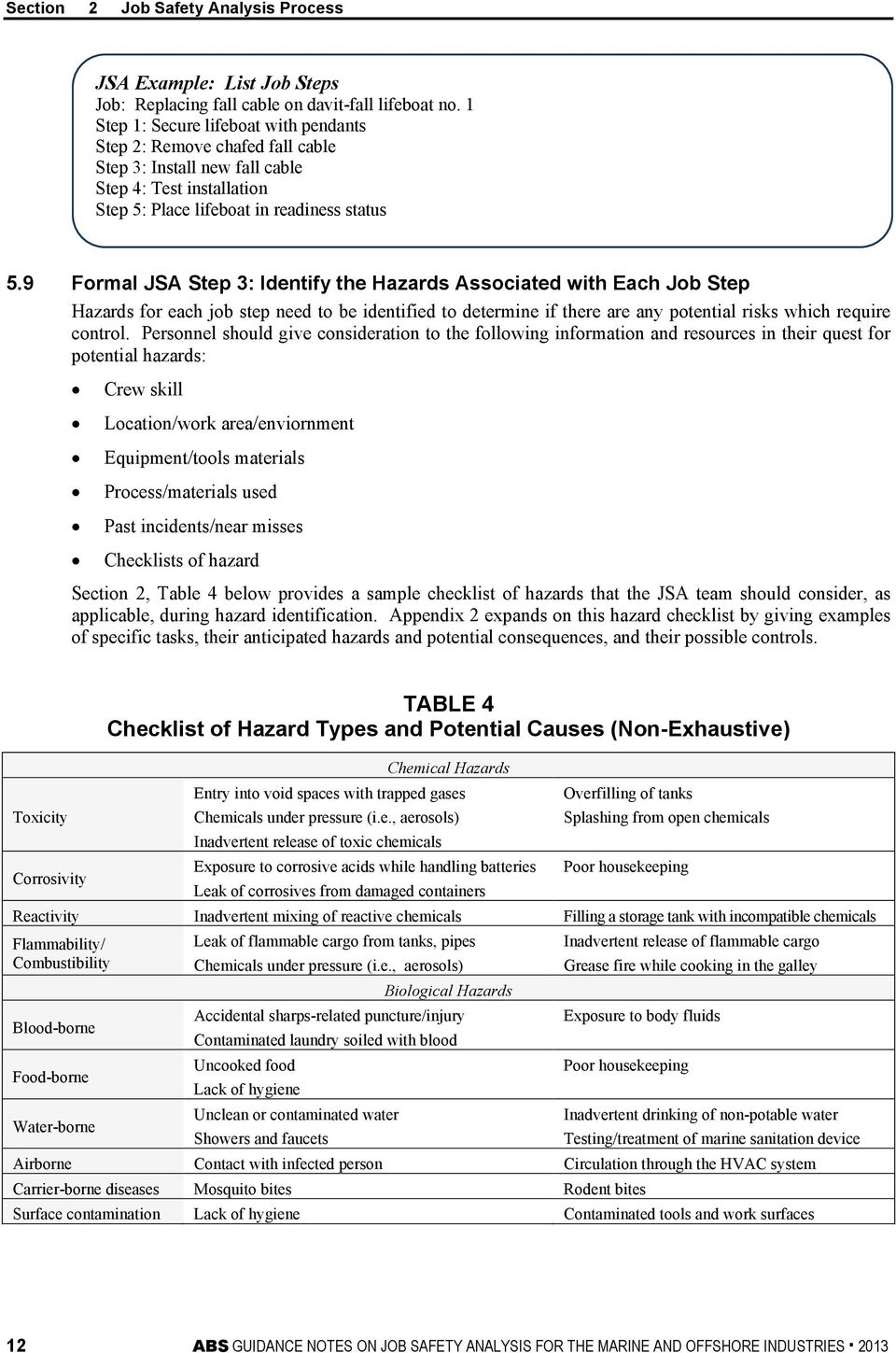
19 Section 2 Job Safety Analysis Process TABLE 4 (continued) Checklist of Hazard Types and Potential Causes (Non-Exhaustive) Pressure Electrical Static Electricity Inadvertent startup of equipment Fire/Explosion UV, IRA, visible light radiation Electromagnetic fields (non-ionizing radiation) Ionizing (gamma) radiation Moving, Falling or Overhead material/ equipment Slips and trips Falls Pinch points, crushing and cuts Excessive strain/posture Energy Rupture of bottled gases under pressure Leaks from high-pressure equipment Line rupture as a result of water hammer Current/Voltage Unexpected energization of system Damaged insulation/tools Damaged wiring on hand tools Overloaded outlets Splash filling a vessel with hydrocarbons Fueling operations Painting Bulk movement of grain Safety devices removed for maintenance Volatile hydrocarbons or chemicals in heated spaces causing them to gas more rapidly Hazardous cargo breaking free Hydrocarbons under pressure (i.e., aerosols) Spontaneous combustion from oily rag or cargo Sun Exposure Arc welding Curing of paints High-voltage power lines Radar Non-destructive examination of marine components Physical Hazards Low bulkhead Dropped objects from overhead work Others working aloft Slippery surfaces Working on deck during inclement weather Deck openings Uneven surfaces Open holes Work overhead rigging, scaffolding, container lashing Line/wire operations lifting, throwing, splicing, etc. Working near rigging or equipment Lifting heavy objects during operations such as line/ wire handling Use of power tools Tank collapse as a result of vacuum Impact from objects to pressure vessel Entry into a high-pressure testing area Removal of electrical safety interlocks Exposed energized electrical parts Faulty electrical equipment Overheating of electrical equipment Contact with bare conductors Transfer of liquids Conductive tools Clothing Low humidity conditions Isolation not provided Void spaces with trapped gasses Leaking adjacent tanks with flammable chemicals Stowage of chemical cargo/hazardous substances/ munitions in vehicles Welding UV light from machinery (e.g., water purification, disinfecting equipment) Plasma cutting Proximity to welding equipment Contact with welding cables X-Rays Swinging loads Pipes run at low level Violent ship motion leading to uncontained cargo Line/wire handling Ice on deck Debris on deck/poor housekeeping Spills of chemicals and oil Changing lights using a ladder Unguarded deck openings and edges Personnel moving around machinery Inadvertent startup of machinery Working at awkward angles (line/ wire handling, pulling, pushing, turning, twisting, etc.) Repetitive movements or sustained posture ABS GUIDANCE NOTES ON JOB SAFETY ANALYSIS FOR THE MARINE AND OFFSHORE INDUSTRIES

20 Section 2 Job Safety Analysis Process TABLE 4 (continued) Checklist of Hazard Types and Potential Causes (Non-Exhaustive) Noise Vibration Lighting Extreme Heat Extreme Cold Dangerous Atmosphere/ Asphyxiation Heavy Seas Heavy Winds Rain/Storm/Lightning Snow Storm/Ice Work Environment High pressure fluids Machinery operation Propeller action Installation motion due to various sea states Wave slamming High-speed rotating machinery Inadequate lighting (insufficient, poorly distributed) Glare (too much light) Hot weather Working near heat-generating machines Poorly maintained ventilation systems Excessive exposure to cold weather Working in refrigerated spaces Chemicals in the atmosphere Oxygen deficiency External Inclement weather Inclement weather Inclement weather Inclement weather Use of power tools Construction Working on oil rig drilling floor Equipment imbalance Machinery striking metal Use of power hand tools Flickering lights Hours of darkness Steam and water leaks Deteriorated/missing insulation on piping, valves Contact with cold surfaces Fogs, smoke and mists Confined space entry What-If Analysis Incidents commonly result from deviations from work practices or from deviations in the expected operation of equipment (failures). This is the reason why some comprehensive JSAs include a What-If analysis of what could go wrong in each particular job step, as a technique for hazard identification. A What-If analysis will consider failures and deviations that are reasonably possible, and omit the highly unlikely ones. To illustrate this approach, consider the example of a routine emergency response drill of facility/ ship abandonment using the lifeboat. The JSA indicates a step for hoisting the lifeboat with the maneuvering crew onboard the boat. The hoisting winch is to be operated by a control panel located forward of the davit. As part of the What-if analysis, the JSA team can wonder what-if the hoisting mechanism does not stop in time?. The result can be pulling the fall wire past its breaking point during hoisting. This can subsequently lead to breaking the fall line, dropping the manned lifeboat onto the deck or into the water, with potential injury or loss of life. Risk control actions resulting from this What-If analysis can be: To switch to using the manual winch handle once the lifeboat is near the stowed position to complete the stowing operation. If the job requires a reliance on a limit switch to stop hoisting would be to do a functional test of the limit switch prior to hoisting. Suggest a permanent change in company procedure so that lifeboats drills be carried out without crew onboard. 14 ABS GUIDANCE NOTES ON JOB SAFETY ANALYSIS FOR THE MARINE AND OFFSHORE INDUSTRIES. 2013

21 Section 2 Job Safety Analysis Process JSA Example: Identify Hazards Associated with Each Step The replacement of the aft-fall cable on a davit-fall lifeboat has potential for major injury and death. It is important for the worker to recognize that things could go wrong with the equipment being relied upon for its safety. Causes of injury or death associated with maintaining a lifeboat include the following: Inadvertent release or failure of release lever Operator error or failure of gripes, bowsing tackle, or tricing pendants Failure of falls/sheaves/blocks and chains Fouling gripes Winch failure Davit failure Steps 1. Secure lifeboat with pendants Go up scaffolding Secure lifeboat with safety pendants Hazards Struck by. Potential for boat to fall out of the davit. Fall from heights and Drowning. Potential for the worker to fall onto the deck or into the water. Caught in/under/between. Potential for pinching hazards. If an emergency occurs while fall cable work is being done, potential for being caught in/under/between. 2. Remove chafed fall cable Hazards Disconnect old wire from falls-block. On deck, spool old fall cable onto spool Transfer old cable spool to storage locker Slips and Trips and fall from heights. Slippery surfaces due to contact with grease used for coating wire. Cuts/Puncture/ Scrapes. Frayed fall cable and slivers. Potential hand injuries while handling wire ropes. Overexertion/strains and Struck by. Back strains and foot injuries from carrying/dropping weight. 3. Install new fall cable Hazards Transport spool to muster location Overexertion/strains and Struck by Connect new fall cable to winch Spool new cable onto winch drum Slips and Trip. Grease on deck. Grease fall cable, if required Rewire the davit Falls from heights, Drowning 4. Test installation Hazards Check all fall cable connections Disconnect safety pendants Partially lower boat to test cable Caught in, under or between Struck by Falls from heights 5. Place lifeboat into readiness status Hazards Hoist the lifeboat into readiness status, Caught in, under or between. Winch does not stop after lifeboat verifying safety pendants are removed. reaching stowing position, potentially exceeding the fall cable Clean up area and tools before leaving breaking strength. Notify of readiness of equipment Slips and trips if area is not cleared 5.11 Formal JSA Step 4. Identify Existing Control Measures for Each Hazard Controls are methods, actions, or equipment used to eliminate or control the hazard. The objective of this step is to identify existing adequate risk mitigation controls for each identified hazard. Existing controls refer to normal and available controls generically associated with the task by procedure, company policy, common practice, etc. For example, an existing control associated with work in heights is likely to be a body harness. There are four types of controls that can be implemented to reduce risks, listed in the preferred order of implementation: ABS GUIDANCE NOTES ON JOB SAFETY ANALYSIS FOR THE MARINE AND OFFSHORE INDUSTRIES
22 Section 2 Job Safety Analysis Process i) Elimination or Substitution (e.g., careful evaluation may indicate that the task is not necessary or can be performed in a different way, or a toxic solvent can be replaced by a non-toxic one) ii) iii) iv) Engineering (e.g., hardware, alarms) Administrative (e.g., procedures, signs) Personal protective equipment (e.g., respirator, safety glasses) The JSA procedure should take a multi-layered approach to safeguarding. Where high-risk actions situations are identified, there should be proportionate safeguards from each category as applicable to decrease the likelihood of the hazard occurrence. In some cases, the risk associated with an individual step in the task is one that is considered acceptable. For example, the risk of electrocution from a properly insulated, properly grounded electric drill is generally considered small and no further action may be necessary. However, discussion and documentation is still necessary for the sake of process integrity, organization, and transparency. Further information on each type of hazard control, listed by its order of preference, is discussed as under 2/5.15, Formal JSA Step 5.1: Identify Additional Risk Controls Formal JSA Step 5: Hazard Ranking An enhanced step in the JSA process is the evaluation of the level of risk associated with the identified hazards so that due attention is given to the high risk hazards. Risk is a function of the likelihood of occurrence of a hazard and the severity of the consequence that may result. For the purposes of a JSA, the risk evaluation is a qualitative estimation based on personal experience and judgment. Even though a JSA process can be carried out without a qualitative estimation of the risk, this risk categorization provides tangible benefits to the JSA process. The risk evaluation draws a correlation between the likelihood and the resultant consequence of the hazard as it affects the health and safety of personnel, and also, property, equipment, or the environment. Risk control measures reduce the likelihood of the hazard occurring. Some mitigating controls can reduce the severity of the hazard (i.e., fire protection and firefighting equipment), but in the large majority of cases, the severity of the hazard is not reduced by the risk control measure, For example, consider a person working on a mast 20 feet above the deck. The hazard of falling from this height could result in a fatality (high consequence). Without fall protection, such as a harness, the likelihood of the fall could be assessed as medium or high. With fall protection, the likelihood could be reduced to low. However, in either case, if fall occurred and the fall protection (harness) failed, the consequence would still be the same: a fatality. For each hazard identified, the JSA team should determine the worst-case, credible outcome that can result from the hazard. For example, if the identified risk is falling from heights, the consequence could be as severe as death and as minor as a temporary soreness. By assuming the worst most credible consequence, personnel can prepare for and control this worst potential outcome. Following this rule of thumb, the consequence from a fall from heights should have a ranking of severe, based on the known fact the worst potential consequence from a fall from heights is a fatality. Even if controls are in place (e.g., harness, etc.), they may not reduce the consequences if the fall occurs. Most controls reduce the likelihood (i.e., with a harness, the likelihood of a fall is reduced to very low levels, but if the harness malfunctions, the consequence would still be as severe). Therefore, the likelihood of occurrence of the given outcome shall be determined by taking into account the existing risk mitigation controls. There are multiple ways in which controls can fail, such as failure to work on demand, faulty design, faulty installation, faulty operation, etc. From the given example, the likelihood of the worker s death as a result of the fall needs to be estimated taking into account the controls that the JSA team is proposing to use. If the JSA has identified the use of a harness and fall protection PPE, all in working order, then the likelihood of such a deadly event has been minimized, and is low. A scenario in which the consequence of falling from heights is deemed high but the likelihood has been minimized to the lowest possible range would typically be classified as a tolerable risk event. In this case, the JSA could proceed to Step 6, Validation of Controls. For more on risk tolerability criteria, see 4/7.3, Risk Tolerance. 16 ABS GUIDANCE NOTES ON JOB SAFETY ANALYSIS FOR THE MARINE AND OFFSHORE INDUSTRIES. 2013
23 Section 2 Job Safety Analysis Process 5.15 Formal JSA Step 5.1: Identify Additional Risk Controls The identification of additional risk controls is necessary for any risks that are not controlled to a tolerable level with existing controls. For example, if the worker considers that the scenario of falling from heights, with the end result of a fatality has a medium likelihood of occurrence, then the scenario likely falls in the intolerable risk range (high consequence, medium likelihood). The worker would know, by referring to the company risk tolerability criteria that additional controls are needed to reduce the risk to a tolerable level. For example, if for some reason, the existing controls (a harness) did not lower the likelihood of the fall to an acceptable level, the JSA team may recommend additional controls, such as erecting scaffolding to perform that particular job Types of Risk Control As indicated before, the four types of controls that can be implemented to reduce risks, listed in the preferred order of implementation, are: 1) Elimination or substitution 2) Engineering 3) Administrative 4) Personal protective equipment When the existing controls have not lowered the risk to a tolerable level, the JSA team should look at providing stronger and more reliable risk reduction strategies, as per the controls hierarchy above. The best risk reduction strategy is to control the hazard at its source, (i.e., the elimination of the hazard should be considered first). If hazard elimination is not an option, engineering controls are the next most effective, followed by administrative controls, and lastly, personal protective equipment. Keep in mind, however, that a control that might be considered less effective than others may still be the most practical and appropriate control for mitigating the hazard. Additional information on each type of hazard control, listed by its order of preference, is discussed as follows. 1) Elimination or Substitution. The elimination of the task, or the hazard associated with the task should always be the first consideration. However, this consideration seldom crosses the mind of the workers. The workers may think it is not in their power to suggest the removal or substitution of a hazardous process, equipment, material, or other hazards in the workplace to eliminate or substantially minimize the risk in the workplace. It could also be that the worker has grown complacent or used to the situation and does not see the need for change. It is important to train the worker on this critical and inherently safer way of thinking: Is this task really necessary? Can the task be carried out less frequently? Can the task be accomplished in some other manner that poses less risk? Does a hazardous chemical have to be used? Are there safer nonhazardous alternatives? Can the physical conditions that pose the hazard be changed (i.e., tools, equipment, location, layout)? The example that follows illustrates how the substitution of a compound with another of equal functionality and effectiveness can remove a hazard. ABS GUIDANCE NOTES ON JOB SAFETY ANALYSIS FOR THE MARINE AND OFFSHORE INDUSTRIES
24 Section 2 Job Safety Analysis Process Example of Elimination/Substitution as a Risk Control There are two categories of anti-seize compounds that may be used on bolts and other connecting devices: nickel-based and copper-based. Both compounds are effective for the purpose for which they are used. However, nickel-based anti-seize compounds pose a carcinogenic risk and are considered hazardous waste by some States. Copper-based anti-seize compounds have not been identified as carcinogenic nor are they considered hazardous waste. Careful consideration should be given to determining if the copper-based compound can be used to replace the nickel-based compound in the application and eliminate the health hazard and subsequent hazardous waste removal. 2) Engineering Controls. Engineering controls are mechanical or physical features incorporated to the equipment, systems, the job, or area around the job to remove or control the hazard, either by initial design specifications or by applying methods of substitution, minimization, isolation, or ventilation. They are not easily implemented just prior to performing the task, as they usually involve resources and significant time for completion. For these reasons, a company often develops JSAs shoreside for selected shipboard/offshore jobs, thus offering more access to resources and the lead time required for any proposed engineered controls to be in place prior to conducting the task. The JSA should give first consideration to designing the equipment, the ship/facility, or the processes to remove the hazard completely (see 2/ Elimination or Substitution ). Alternatively, hazards can be isolated. For example, placing a diesel generator in an enclosed space and keeping the doors closed minimizes the noise hazard for persons working in the area. Other isolating techniques are engineered into equipment, such as machine guards, blast shields, plastic sheeting, welding curtains, etc. Hazards may be removed or redirected with engineering controls such as using exhaust ventilation to remove potential hazardous vapors from accumulating in an enclosed space. Controls such as alarms and mechanical or instrumented interlocks can be viable alternatives to lower risks. A special type of engineering control is emergency controls, such as the fire, safety, and lifesaving appliances which should be in place to mitigate hazards created during emergencies. This type of control is usually present if a what-if analysis is carried out as part of the JSA. 3) Administrative Controls. After engineering controls, administrative controls offer the next best level of effectiveness in managing identified hazards. These controls rely more actively on human action and behavior, and thus are more susceptible to errors in judgment, interpretation, and commitment. Examples of administrative controls include the following: Written operating procedures Checklists Safe work practices, such as lock-out and tag-out Permit-to-work systems Safety meetings Buddy system Alarms, if they need a response from the operator Signs, temporary barriers, warnings Training of personnel Exposure time limits Exposure time limits can be implemented such that persons are limited to the amount of time they are in the proximity of a hazard (e.g., noise, chemical vapors, radiation, heat, cold, vibration). 18 ABS GUIDANCE NOTES ON JOB SAFETY ANALYSIS FOR THE MARINE AND OFFSHORE INDUSTRIES. 2013
25 Section 2 Job Safety Analysis Process Alarms include high and low level alarms, oxygen content monitors, lower explosive limit detectors, etc. Alarms may also be considered as an engineering control, but since their success is dependent on people taking actions in response to the alarms, they are usually thought of as administrative controls. Signs and warnings should be in the working language of the personnel and/or in universal pictorial format for such hazards as high noise areas, passage of overhead loads, dust mask use, etc. One of the most powerful administrative controls is the appropriate training of the personnel to carry out the required jobs. Effective training should reduce the likelihood of errors in judgment, interpretation, and execution. Personnel should be trained to safely operate equipment, to be made aware of the hazards associated with performing various jobs, and to know how to detect and safely respond to problems that may arise during the execution of the job. For this reason, in many JSA forms there is a specific entry to list training requirements needed from the persons carrying out the job. For example, for a sandblasting job, the training requirements listed should be at the very minimum sand-blasting training and training in the correct use of the PPE. This entry works as a cross-check that those carrying out the job are indeed qualified. An administrative control/step to consider for any job safety analysis is the inclusion of a planned time-out for safety. The purpose of this time-out is to avoid complacency associated with the task. The placement of the time-out in the job safety analysis in the job steps logically falls immediately prior to the step that exposes a person to harm. For example, just before touching an electrical motor which has been locked-out, the persons involved in the task should take a momentary pause to verify that all hazard mitigations have been implemented and that it is safe to proceed with the job. A planned time-out step could be included in any task that is repetitive over a sustained period of time, such as tripping pipe or mucking out scale during tank cleaning operations. For example, for every ten uses of a winch to pull buckets of scale out of the tank, the planned time-out allows for a brief reassessment of equipment and personnel before proceeding. 4) Personal Protective Equipment. Personal protective equipment (PPE) creates a barrier between the person wearing the PPE and the hazard associated with the job. PPE such as ear muffs, protective clothing, safety glasses, respirators, gloves, welding aprons, and hardhats are acceptable methods of controlling hazards. However, PPE as the only way to control a hazard should only be accepted in limited circumstances when the most effective types of controls are not feasible and the risk of not carrying the job outweighs the risk of carrying it out with limited controls, such as during an emergency. PPE often is worn during the whole job, so if it has to be identified for every sub-task or every hazard, it can become tedious. It is accepted practice to list the PPE that will be needed in the job in a single location in the form usually at the top or at the end of the JSA form, for easy reference Formal JSA Step 5.2: Re-rank with Additional Risk Controls A best practice in a JSA program is to reassess the residual risk once additional risk reduction controls have been determined. This process provides a positive indication that the risk controls proposed to lower the residual risk are indeed effective to move the scenario out of the High risk category or that even with the risk reduction controls, the risk cannot be reduced to a tolerable range. 4/7.3, Risk Tolerance, gives more information on risk tolerability criteria Formal JSA Step 6: Validation of Controls A JSA should be comprehensive in identifying hazards associated with the tasks and identifying satisfactory risk-reducing controls. However, incidents still may happen if the controls do not work as anticipated. Complacent reliance on controls is a common problem that needs to be aggressively addressed by taking measures to verify that the controls will be available and work as anticipated ABS GUIDANCE NOTES ON JOB SAFETY ANALYSIS FOR THE MARINE AND OFFSHORE INDUSTRIES
26 Section 2 Job Safety Analysis Process Failure to validate controls is a common weakness of JSAs. The workers conducting the JSA list the controls that are in place and/or controls they intend to use to protect against the hazards. However, when those controls are actually put to use, they turn out to be degraded, unavailable, inappropriate, etc., thus, limiting their effectiveness as hazard protection. There are cases in which the problem with the control is undetected by the workers, who then proceed with a false sense of security that has the effect of increasing the risk of the job. The worker may not know that a particular safety interlock has been bypassed, or that a key communication between parties did not take place. To avoid this situation, a best practice for a JSA procedure is to include a mechanism for establishing responsibility for validating the controls. The JSA procedure should require that the controls proposed to mitigate the identified hazards are validated to check that they are: Functional, effective, and in good condition Available (i.e., controls are not bypassed or placed beyond employee control) Reasonable for the task being conducted Safe to use (i.e., the control should not introduce additional hazards into the job) Environmentally responsible When training the staff on performing the JSA process, special attention should be given to how the workers can identify the ways in which the controls need to be verified and tested prior to commencing the task. A planned step for Validation of Controls in the JSA calls attention to this important check so it is not overlooked. The JSA form should require the signature of a responsible person as verification for each control measure. An example of a completed JSA follows 2/5.21 Sign-off Sign Off All personnel involved in the task should discuss each step, the hazards associated with each step, and the mitigation measures that have been agreed upon among the task members during the Job Safety Analysis process. Each person should fully understand the task, the risks, and their roles. The Job Safety Analysis form should then be signed by all task members, including the immediate supervisor, as acknowledgement of this understanding. For greater clarity, task personnel should sign the Job Safety Analysis where responsibility for carrying out specific mitigation measures is assigned. For example, one person could be assigned the job of erecting a barrier around an open hole; that person would sign by this measure on the form, taking ownership of the precaution. Job Safety Analyses associated with permits to work should also be reviewed by the Master or Person-in- Charge of the vessel/offshore unit. The permit should not be signed until the Master is satisfied that the Job Safety Analysis is satisfactory for the task and that there are no other conflicts (i.e., simultaneous operations) that could impact the task New Personnel on the Task Some jobs may take longer than the scheduled work period for one or more task members. When conditions change from the original task, the job must be temporarily stopped and the Job Safety Analysis must be reviewed again to verify that the job can proceed safely. Any change in a task member requires that the job be reviewed with the new person before proceeding, especially with temporary reliefs for supper or other situations, and the new person should sign the Job Safety Analysis as acknowledgement of understanding and role. If the entire task crew is replaced by a second crew, the entire process should be conducted again. The Job Safety Analysis for this continued task should be reviewed and signed by all new persons. Any permit in place with the previous task members should be closed out and a new permit obtained. Whereas the assignment of responsibilities for the first crew was to ensure that precautions were put in place, the assignment role for the second crew could be to validate that the precautions have remained in place (e.g., the barrier is erected and functioning properly). 20 ABS GUIDANCE NOTES ON JOB SAFETY ANALYSIS FOR THE MARINE AND OFFSHORE INDUSTRIES. 2013
27 Section 2 Job Safety Analysis Process JSA Example: Identify Risk, Consequences, Controls, Responsibilities. Job: Replace aft-fall cable on davit-fall lifeboat no. 1 Steps Hazards Controls Risk after 1. Secure lifeboat Eng Admin PPE Go up lifeboat access Safety pendants Notify Master / control ladders to secure the Potential for boat to fall out of using four-part room of lifeboat out of lifeboat fore and aft the davit. Struck by. safety shackles service; take out permit with safety pendants to work. Potential for the worker to fall onto the deck or into the water. Fall from heights and Drowning Potential for pinching hazards. If an emergency occurs while fall cable work is being done, potential for being caught in/under/between. Rescue plan in place: use 4:1 haul system to pull man onto deck. Fall protection and life vest worn at all times. controls Med Med Resp Bosun Salty (pendants) Rob Mate (notify and permit) Bosun Salty Watch hand placement. Gloves Med JJ Crew 2. Remove cable Hazards Eng Admin PPE Disconnect old wire from falls-block. On deck, spool old fall cable onto spool Transfer old cable spool to storage locker Slippery surfaces due to contact with grease used for coating wire. Slips and Trips and fall from heights Frayed fall cable and fishhooks. Potential hand injuries while handling wire ropes. Cuts/ Punctures/ Scrapes Back strains and foot injuries from carrying/dropping weight. Overexertion/strains and Struck by Insert pipe in center of take-up spool and suspend with chain falls Provide rags to clean deck Rescue plan. Use legs for lifting. Use hand cart. Watch hand placement. Fall protection and life vest Leather Gloves Steel-toes shoes 3. Install new cable Hazards Eng Admin PPE Transport spool to muster location Connect new fall Overexertion/strains and Struck by Insert pipe in center of new-wire spool and suspend Use legs for lifting. Use hand cart. Watch hand placement. Leather Gloves cable to winch Grease on deck. Slips and Trips with chain falls Med Low Low Low Low JJ Crew (rags), Bosun Salty (Vest & Fall) All Salty and Crew (pipe & chain fall) Crew (cart) All for shoes Salty and Crew (pipe & chain fall) Crew (cart) All for gloves JJ Crew Spool new cable onto Falls from heights, Drowning Have rags handy for Fall protection Med winch drum grease clean ups. and life vest Grease fall cable Rescue plan. Salty (vest & fall) Rewire the davit All (plan) 4. Test installation Hazards Eng Admin PPE Check all fall cable Caught in, under or between Notify Master of test Gloves Med Rob Mate connections (notify) All Disconnect safety pendants Partially lower boat to test cable Struck by Falls from heights, Drowning Tag lines on pendants for lowering Fall protection and life vest Low Med (gloves) Crew (tag lines) Salty (vest) 5. Ready status Hazards Eng Admin PPE Hoist the lifeboat into readiness status Clean up area and tools before leaving Notify of readiness of equipment Winch does not stop after lifeboat reaching stowing position, potentially exceeding the fall cable breaking load. Caught in, under or between Slips and trips if area is not cleared Limit switch cut power to winch motor before davit reaches its stops. Manual hoisting by using the winch handle adjacent to the winch motor. Test limit switch functionality prior to hoisting. Disposal of rags. Removal of tools. Notify Master lifeboat at full readiness; close permit Med Low John Engineer (test limit switch) Salty and crew (manual hoisting) Crew (tools) Mate (check area is safe after job) Rob Mate ABS GUIDANCE NOTES ON JOB SAFETY ANALYSIS FOR THE MARINE AND OFFSHORE INDUSTRIES
28 Section 2 Job Safety Analysis Process 7 Simplified Formal JSA for Frequent and Moderately Hazardous Tasks The JSA process should be a flexible approach that can accommodate any level of detail. Companies may consider it beneficial to have a range of options in their procedures for carrying out formal, documented JSA so that the process can be applied at different levels of detail, depending on the situation. The full formal JSA process is to be used for critical and complex situations, while a simplified version of the JSA process, taking less time, effort, and personnel, would be a good choice for tasks that require a formal JSA but occur frequently. Examples of activities that can be candidates for a simplified formal JSA include: Connecting cargo hoses Inspecting, maintaining, or replacing blocks on cargo booms (booms are secured in their cradle, not elevated) Overhauling lube oil purifier pumps in the engine room Transferring stores, spare parts, and other small, but awkward boxes from one deck to another Typical components of a formal JSA that could be simplified for moderately hazardous tasks that occur frequently: Increased use of generic JSAs, with workers adjustments to take the current situation into consideration If the area supervisor is not directly involved in the task, omission of the requirement for the presence of the supervisor during JSA development Higher level of breakdown of job steps Simplified method for performing risk estimation (see 4/7.3.2, Tolerability Criteria Based on Hazard Severity ) or omission of this step altogether Lower level of approval for the JSA, and thus, the task Type and location of records that should be kept A company can choose to streamline the JSA process for their most frequent operations by simplifying factors which make sense for the particular operations. In other cases, a company may decide that the simplest approach is to train staff for a single type of JSA, with a single set of instructions that preclude an abridged process. 22 ABS GUIDANCE NOTES ON JOB SAFETY ANALYSIS FOR THE MARINE AND OFFSHORE INDUSTRIES. 2013
29 Section 3: Getting the Most Out of a Job Safety Analysis Program SECTION 3 Getting the Most Out of a Job Safety Analysis Program 1 Environmental, Security and Emergency Considerations in a JSA JSAs are primarily used for controlling risks to the safety and health of the workers. However, other undesirable impacts beyond those on the individual could be considered as well. Equipment damage can render a vessel inoperable or hinder operations. Detention by port State control for a pollution event can create expensive legal entanglements. A JSA can identify and help prevent some of these issues. 1.1 Environmental Considerations Environmental concerns are of paramount importance in the marine and offshore industry. Waste and release activities introduce financial and reputation risks in addition to health and safety risks. A JSA can also address environmental concerns centered on waste stream controls or preventing uncontrolled releases of oil and other chemicals into the atmosphere, into the water, or onto the ground beyond what is allowed by an operating permit or by regulation. A JSA can be a useful tool for companies that have implemented environmental management systems and must identify and control their environmental aspects (risks). Examples of environmental concerns that can be addressed during a JSA include disposal of batteries, sewage, used oil and filters, lubricants, fluorescent lights, air contaminants (from an incinerator or stack), paints and thinners, oily rags, food waste, general trash, scrap metal, empty gas cylinders, tank and cargo cleaning residues, etc. Additional environmental risk is introduced when operating in proximity to the coast or in protected marine areas where international and coastal State regulations require more control. A simple but effective way to prompt for environmental considerations is for such an entry to exist in the standard JSA form. A best practice is to address standard environmental controls prior, during, and after each task, and to provide mitigation controls. 1.3 Security Considerations Security problems such as pirate attacks are a significant problem in the maritime industry in certain geographical areas of the globe, but to a lesser degree in the offshore industry. Shipping companies perform comprehensive security vulnerability assessments to comply with the International Ship and Port Facility Security (ISPS) Code. The JSA process is not a method designed for identifying high-level security concerns, but can be used for identifying if the task may have an impact on security; appropriate controls can therefore be implemented. Formal JSAs can identify security concerns as a result of the task (e.g., the need to dismantle equipment used for security purposes such as gates, sprayers, securing devices, etc., in order to do the job). With these types of security hazards identified, workers can manage these security risks with the assistance of the Ship Security Officer and other personnel with security duties. The JSA form can be designed to prompt security considerations during the job safety analysis process. 1.5 Emergency Preparedness A JSA should consider advance preparations for emergency situations that could occur during the course of performing the tasks. Emergency preparedness discussions highlight potential situations and procedures for personnel involved in the tasks, identification of necessary controls to respond to such an emergency, and establishment of communications with other relevant parties not directly involved in the tasks that can provide help in case of an emergency. For example, rescue plans should be discussed, understood, and equipment readied in the event a person working at height collapses from fatigue, is hurt, or that the hoisting equipment for man-riding fails. More significant than the discussion is to practice the rescue at a safe height prior to beginning the task so that the viability of the plan and equipment can be assessed and modified as appropriate. Emergency preparedness for a task is usually present when the What-If Analysis approach is embedded in the hazard identification step of the JSA. 2/5.9.1, What-If Analysis provides more information on this approach. ABS GUIDANCE NOTES ON JOB SAFETY ANALYSIS FOR THE MARINE AND OFFSHORE INDUSTRIES
30 Section 3 Getting the Most Out of a Job Safety Analysis Program If the task involves handling of chemicals, it is important to consider what to do in case of a spill. If specialized equipment is needed for cleaning the spill, or special portable firefighting equipment or PPE in case of a flammable release, such equipment should be immediately available in close proximity to the worksite. 3 A Word About Proximity in Time and in Location Time and proximity to the location where the job will be performed is important to assessing all risks involved. JSAs should be conducted by accounting for the current conditions under which the job will be performed. If a job is performed in evening hours, the JSA should be done in evening hours to better identify the potential hazards. A Job Safety Analysis should be conducted immediately prior to carrying out a task. This timing facilitates the assessment of the environmental conditions, the condition of equipment and tools to be used, and the competence and ability of the persons who will be involved in the task. It also ensures that all the information discussed is fresh in the worker s minds. 5 Library of JSAs Companies may decide to keep a library of pre-developed JSAs for reference by the crew in the development of future JSAs. These pre-developed JSAs can be distinguished in two categories, based on how detailed and customized they are for the task. In this document, the terms Generic JSA and Completed JSA will refer to these two categories within a JSA library. Generic JSAs refer to JSAs performed for common tasks such as welding on deck, covering basic steps and basic hazards expected. They are general enough to be applied to any ship or facility. Generic JSAs may be completed by the crew or someone shore-side. Completed JSAs refer to a JSA that was actually conducted and completed for a job, and is both ship/facility and task-specific. 5.1 Generic JSAs Some marine and offshore companies favor an approach in which generic JSAs are developed in advance for selected onboard/offshore tasks. In generic JSAs, the general steps and typical hazards have been identified and recommended hazard mitigation documented. Section 3, Figure 1 illustrates a generic JSA developed for a chipping and grinding operation. Generic JSAs are not necessarily designed as ship- or facility-specific, but may be made available to all the ships and facilities. Generic JSAs provide general steps, hazards, and mitigation controls which should only be used as reference points by supervising officers in charge and crew prior to carrying out the task. The best generic JSAs are developed by observing the worker(s) actually conducting the job, not just describing how the job is performed. More than one shift/crew or ship/facility should be observed doing the work. Generic JSAs can be developed shoreside by shipboard/offshore personnel familiar with the selected task but this method is not recommended as it can miss issues associated with the particular equipment and tools, the location, the personnel, accessibility, surrounding equipment, etc. Two important advantages in the use of generic JSAs are as follows: Consistency in identifying the subtasks, hazards, and controls for each generic task Shoreside personnel gain a better appreciation of the potential risks and controls needed for the task as they are more actively involved in the development of the generic JSA. This enhanced understanding by the shoreside personnel may result in providing the ship/facility with additional resources and engineering controls to further mitigate or eliminate identified hazards. Generic JSAs should never be used directly as the final JSA for the task. There are many hazards that are unaccounted in generic JSAs that must be addressed at the worksite, (e.g., the current weather, the time of day, the experience of the task personnel, the condition of the tools used in the job, the location of the worksite, whether there are proximate conflicting operations, whether there are time pressures, etc.). 24 ABS GUIDANCE NOTES ON JOB SAFETY ANALYSIS FOR THE MARINE AND OFFSHORE INDUSTRIES. 2013
31 Section 3 Getting the Most Out of a Job Safety Analysis Program Personal JSA Library Another variation sometimes observed in a JSA library is the use of personal JSAs, which are created by a single individual or crew/hitch for their sole use while onboard. Replacement crews then develop their own personal JSAs while they are onboard. Allowing the use of personal JSAs tends to create an A-team/B-team library of JSAs. The end result of personal JSAs is that there may be multiple versions of risk assessments for the same task. This approach is ineffective and not recommended. Potentially, a personal JSA could identify a significant hazard and mitigation measure that other personal JSAs do not; someone could be injured. The recommended best practice is to require each ship/facility to have a library of common JSAs which are shared by all crews. JSAs used by one crew can incorporate lessons learned into the JSA for use of replacement crews. Everyone benefits. FIGURE 1 Generic JSA Example Chipping and Grinding Job Name: Standing Orders / Restrictions / Special Issues: Required Fall Eye/Face Hearing Hard PPE: Protection Protection Protection hat List additional PPE: Hazard Specific hazards Potential Consequences Extreme temperature Ergonomics/ overexertion Exposure to chemicals Electrical Vibration and noise ENVIRONMENTAL Concerns: Sun exposure from chipping and grinding on deck. Painting in hot enclosures a) dehydration b) heat stroke c) heat exhaustion d) fatigue e) sunburn Supervisor Approval Signature: Goggles Respirator Gloves Coveralls Safety shoes Controls and Barriers sun protection water/electrolyte mix additional ventilations/fans, frequent breaks Tool grips Hand injury Timed breaks, ergonomic hand tools Airborne particles from chipping Fumes, inhalation Contact with skin/eyes Electrical tool Energized circuits in work area SECURITY concerns: Working with high vibration tool Respiratory aggravation Injuries to skin and eyes Injury due to electric shock Fatigue Hearing loss Controls and barriers: Controls and barriers: Additional ventilations/fans Safety goggles, gloves, barrier cream Pre check equipment to verify condition Permit to work and energy isolation Insulate equipment handle Hearing protection Consider alternative tools with less vibration Severity Frequent capture of chipped materials so they are not blown overboard or into the eyes of passers-by Disposal of chipped materials Disposal location clearly identified. Hazardous waste removal by certified vendor Likelihood Type V/III PFD Residual Risk After Controls Controls verified by: Controls verified by: ABS GUIDANCE NOTES ON JOB SAFETY ANALYSIS FOR THE MARINE AND OFFSHORE INDUSTRIES
32 Section 3 Getting the Most Out of a Job Safety Analysis Program 5.3 Using a Library of Generic JSAs The JSA procedure should give clear guidelines on how to use JSAs from the company s generic library. The procedure should require the onboard/offshore staff to develop their customized JSAs utilizing the generic JSAs as templates to be tailored to reflect the operational requirement of their vessel and specific conditions. Modifications to a generic JSA include, but are not limited to: Addressing abnormal operating circumstances Addressing nearby simultaneous activities that may impact the task Verification that the work team has proper skill levels and tools Considering changes in procedures Considering changes in equipment Addressing effects of favorable environmental conditions Naming persons responsible for verifying each risk control measure 5.5 Using a Library of Completed JSAs Completed JSAs that are task-specific in nature may be saved in a JSA library. These JSAs may be used in subsequent tasks that are repetitive in nature (e.g., tank cleaning, maintenance tasks, chipping and painting, etc.). A benefit of using these task-specific JSAs is that a thorough analysis of the task steps, hazards, and mitigation measures has already been completed and recorded. However, no JSA, no matter how well constructed, takes the place of a risk assessment that should be done at the beginning of every job. That is, every job requires risk assessment. Although a thorough task-specific JSA is useful, there are other variable risks that are usually not included in the JSA. These variables, as stated above, include the experience of the persons performing the task, weather, sea state, time of day, geographic location, time pressure, proximity to conflicting operations, location on board, tools and equipment that are different, and many other possibilities. To help emphasize this concept, consider a ship- and task-specific JSA developed for tank cleaning. The steps, hazards, and mitigation measures could be clearly defined. However, there are significant differences in the variable hazards involved in washing such areas as cargo tank 6 port, cargo tank 1 center, after cofferdam, forepeak, fuel tanks, etc. Washing a cofferdam might only need ambient-temperature seawater to clean while a fuel tank might require hot water. Differences in the temperature of the water and the hydrocarbon content between these two spaces are indicative of the variability of risks even with very similar tasks. 5.7 Limitations of Library of JSAs Pre-filled JSAs have the danger of being used blindly by the personnel without truly performing a risk assessment for the current conditions. For example, consider the job of welding aloft. The company has a generic Welding JSA in their generic JSA library. The generic JSA is for the typical welding on deck situation, and thus does not address significant hazards associated with the actual welding job. Additional hazards may have been introduced into this specific job that require further mitigation. However, the crew may operate under the complacent perception that the JSA was developed by experts that have already identified all the possible hazards, thus failing to identify additional hazards specific to the current situation. Another potential downside of the use of completed JSAs is that task personnel may not assume ownership of the JSA process. These limitations should be recognized by any company using generic and completed JSAs so the solutions can be addressed via personnel training and monitoring of the JSA program. 26 ABS GUIDANCE NOTES ON JOB SAFETY ANALYSIS FOR THE MARINE AND OFFSHORE INDUSTRIES. 2013
33 Section 3 Getting the Most Out of a Job Safety Analysis Program 7 Synergism between JSA and Permit-to-Work A Permit-to-Work (PTW) system is a formal, documented safety protocol that individuals complete when conducting high-risk jobs. Most segments of the marine and offshore industries require or support the implementation of Permit-to-Work systems as a risk control tool for high-risk activities such as: Confined space entry Hot work of any kind Work on critical safety equipment Working over the side Live electrical work Complex and specialized lifts Working with explosives/radiation Pressure testing Work in hazardous areas Simultaneous operations History has significant examples of accidents whose primary causes have been identified as failure of the PTW system. The PTW system when used in conjunction with the JSA process should be taken seriously and never merely as a paperwork exercise. A PTW is not a replacement for a JSA. A standard PTW system and a standard JSA system are not interchangeable, but more, complementary processes. The policy of requiring a JSA to be performed for jobs requiring a PTW is a safety best practice aimed at achieving further risk-reduction. Many companies require that a PTW may not be authorized unless accompanied by a task-specific JSA for the job. These high-risk jobs therefore receive a greater level of scrutiny from the Master/Offshore Installation Manager prior to allowing the work to proceed. A JSA brings an extra level of risk awareness and reduction that can easily be overlooked with a PTW alone. A comprehensive and effective JSA identifies and controls the risks that are specific to the current location and current conditions, such as proximity to other vessels or facilities, weather, or simultaneous operations, which a PTW alone may not have considered. 9 Synergism between JSAs and Standard Operating Procedures Standard operating procedures (SOPs) are a set of written instructions, reviewed and approved by authorized personnel, that document how a routine or repetitive activity is to be performed. They are essential for carrying out activities consistently and correctly. SOPs may consist of detailed guidance, step-by-step instructions, job aids, or short checklists. A SOP should not be considered as an argument to not conduct a JSA. Procedures may not provide sufficient detail for the specific task. Some hazards may be overlooked or ignored in the planning process. A procedure cannot consider all possible conditions, such as effects of sea state, weather conditions, temperature, noise, lighting, whereas a properly carried out JSA will consider those factors. The JSA process complements the functions of SOPs and vice versa. The use of both SOPs and JSA provides the safest means of performing a task. Personnel should consult the Company s documented SOPs whenever available in order to obtain the greatest amount of input into conducting the task in the safest possible manner. The SOP may be sufficient for routine tasks that are well understood by the personnel responsible for carrying out the tasks. For example, a well-designed checklist (form) for performing ship voyage planning would identify that hazards along the route need to be identified and adjustments made to avoid them. Conducting a formal JSA in addition to use of this voyage planning checklist is probably not necessary and might be considered excessive administrative burden (i.e., a paperwork exercise ). There are cases, however, when using both a formal JSA process and the associated procedure provides better control of the hazards. For example, procedures regarding mooring operations at docks are typically general in nature; identifying how to tie up at every dock in a procedure is just not practical. Regardless of whether a work task is governed by a SOP or not, a formal JSA should be carried out if the task fits any of the criteria mentioned in 2/5.1, When to do a Formal JSA (i.e., non-routine, severe consequence, complex, critical equipment, etc.). ABS GUIDANCE NOTES ON JOB SAFETY ANALYSIS FOR THE MARINE AND OFFSHORE INDUSTRIES
34 Section 3 Getting the Most Out of a Job Safety Analysis Program On the other hand, a well-constructed JSA form can take the place of a procedure and be utilized on its own, provided certain conditions are met, such as Relatively simple tasks Personnel have a higher level of experience and training on the tasks Personnel have a higher level of experience and training on developing JSAs New and inexperienced crews should not be left to rely on JSAs without the support of SOPs, except for activities that are deemed to have low consequences. For example, inexperienced personnel may not recognize the hazard of asphyxiation when entering a cofferdam that has not been properly ventilated. Awareness of hazards is something that is obtained through training and experience. 9.1 JSA as a Tool to Develop SOPs The addition of new equipment, changes in operating conditions, implementation of new regulations, recommendations from an incident investigation, compliance with a management directive, are just some of the reasons to develop a new SOP or update an existing one. The JSA is a powerful tool to use in the development and updating of procedures. Benefits of using a JSA to develop a SOP include the following: Steps in the process (task) are more comprehensive Steps are correctly ordered Dangers, cautions, warnings, and related guidance are identified based on knowledge of experienced persons, risk and hazard assessments, and task analysis data. Personnel involved in performing the tasks should be actively involved in the development of procedures. The JSA can be used as the primary tool which identifies the steps, the hazards, and the mitigation processes that can be incorporated into the procedure. The JSA should be developed prior to the task and updated while actually performing the job. JSAs developed by more than one shift/crew or ship/facility should be considered as input to procedure development. Other departments that might be affected by the implementation of the procedure should be consulted for comments. JSAs for procedures can be developed shoreside by shipboard/offshore personnel familiar with the selected task, but this method is not recommended. 11 Stop Work Authority and Ultimate Work Authority History is full of examples of incidents that occurred because personnel involved in or witnessing a potentially dangerous situation did not think they were empowered to stop the job or thought there would be negative repercussions if they did so. A Stop Work Authority (SWA) procedure is designed to empower all supervisors, managers, employees, contractors, etc., to stop work when an actual unsafe condition or act creates a danger to an individual, property or the environment, or there is a perception that these conditions exist. A SWA procedure is a strong incident-prevention mechanism for any marine and offshore company. To complete the process for a Stop Work Authority, it may be necessary to also specify the Ultimate Work Authority, that is, identify the only person who could make the decision to resume operations after another employee invoked the SWA. The Ultimate Work Authority is recommended for environments such as the offshore industry, where the large number of activities and workers can make it difficult to know who is ultimately accountable for the decisions made. Documenting the Ultimate Work Authority in the Company s Management System is a best practice. The SWA procedure is an important part of a Company s Management System to support a safer workplace. However, in order for the program to be more successful, visible management commitment and expectation of implementation is vital. Management must demonstrate that stopping work for safety reasons will not result in adverse repercussions to any employee. Rather, management should be less tolerant of personnel who do not use the SWA process. For example, the Captain is making a round and notices two crewmembers chipping paint. One of the two crewmembers is not wearing safety goggles. Historically, the Captain would reprimand the crewmember not wearing the goggles. However, a stronger message to promote a safety culture and the implementation of the SWA is to reprimand the other crewmember for not stopping the job and requiring his fellow crewmember to don the safety goggles. 28 ABS GUIDANCE NOTES ON JOB SAFETY ANALYSIS FOR THE MARINE AND OFFSHORE INDUSTRIES. 2013
35 Section 3 Getting the Most Out of a Job Safety Analysis Program The look-ahead nature of the JSA might identify hazards during a planned activity that cannot be mitigated to an acceptable level. The company risk tolerance criteria or the Stop Work Authority should be exercised on these circumstances. Jobs should not proceed (or commence) until the situation has been rectified to the satisfaction of the individual responsible for the task or the Ultimate Work Authority. The review of the Stop Work Authority policy with the crew and contractors should be included in a JSA, during initial orientation, and during safety meetings. ABS GUIDANCE NOTES ON JOB SAFETY ANALYSIS FOR THE MARINE AND OFFSHORE INDUSTRIES
36 Section 4: Job Safety Analysis Program Implementation SECTION 4 Job Safety Analysis Program Implementation 1 Program Implementation A company s successful implementation of a JSA program starts with a commitment from the company management to implement the process and enforce its use. This commitment must be identified so that all levels of management and workers understand their responsibility to go forward with the program. A JSA only becomes a valued tool when the culture supports the completion of the process, driven by management s visible commitment. A procedural structure for JSA should be incorporated within the company s Management System, identifying goals, objectives, the JSA process steps, documentation, recordkeeping, training requirements for the JSA program, plus audits and reviews of the program for implementation, suitability, and effectiveness. An effective JSA program requires preparation beyond defining and documenting a policy to outline the program. The following factors are paramount to successful implementation of the program: i) Clear roles and responsibilities ii) iii) iv) Appropriate organizational preparation Written JSA program manual that includes JSA forms, and risk acceptance criteria Training of affected personnel 3 Roles and Responsibilities 3.1 Shore Management Involvement A key factor for the successful implementation of the JSA process is Management commitment and enforcement. Management must actively participate in encouraging personnel at all levels within the organization to understand their responsibilities and obligations regarding evaluating and eliminating or reducing risks in the workplace. Management commitment includes: Providing JSA training and awareness programs Internal audits of JSA process Self-evaluations of the JSA process by ship personnel (informally on a continual basis; formally in the annual Master s management system review) Programs for the ongoing monitoring of risk and safety management practices Review of the effectiveness of the JSA process when correlated to incidents (informally on a continual basis by Operations and Safety Managers; formally at the corporate level annual Management Review) Occasional participation, support and oversight of JSAs as needed, if the shoreside manager has indirect knowledge of the task, such as the case of shoreside HSE personnel, Operations managers, etc. Commitment also includes reviewing lagging indicators such as injury, fatality, and incident statistical data to identify deficiencies in the JSA program and other safety management programs. This process serves to continually improve the management system and contribute to an incident-free workplace. 30 ABS GUIDANCE NOTES ON JOB SAFETY ANALYSIS FOR THE MARINE AND OFFSHORE INDUSTRIES. 2013
37 Section 4 Job Safety Analysis Program Implementation One of Management s greatest challenges in successfully implementing the JSA process is to establish and maintain a culture of personnel fully committed to hazard identification and control. Simply put, all personnel should look before leaping (i.e., think carefully about the upcoming task and the types of hazards that may be encountered and do what is necessary to avoid harm to personnel, property, and the environment). Management should develop a standardized process for JSA, for which these Guidance Notes provide advice. The process should be general enough to address all job situations, but detailed enough to provide a consistent approach to the effective identification of hazards and confirmation of controls. The Company should evaluate current practices and processes and communicate to personnel how to integrate a JSA initiative into the current management system. A newly implemented JSA program requires the following considerations for success: Support structure ashore to implement the process Support structure on the ship or offshore installation to implement the process Company-wide training (manager level onshore, manager level offshore, masters and officers, crew). Management must inform personnel of how the JSA program will affect operations, benefits to personnel, who will be involved and trained, and expectations of the commitment that will be needed to fully implement the JSA program. This information can be communicated through bulletins, Intranet, memos, new procedures, and training programs. A common weakness in the JSA process is the perception that the documented JSA is all that is needed to be completed to eliminate or mitigate the risks. Personnel may think that the JSA process is only a paperwork exercise that is necessary in case something happens. Amidst this mindset, once the JSA is completed, it is placed in the supervisor s back pocket and the job commences without further consultation with the planned risk mitigation measures discussed in the JSA. The paper will not protect personnel from the hazard, only the implementation of the plan and mitigation steps that have been developed by the group. The JSA process suggested in these Guidance Notes offers built-in mechanisms to preclude this problem, such as the assignment of responsibility for the verification of controls. Consistent commitment from shoreside and shipboard/ offshore Management to enforce the program through audits, coaching, and daily operational oversight of task activities will help overcome most issues associated with program implementation. 3.3 Shipboard/Offshore Personnel Involvement and Responsibility The Master/OIM and the officers play a key role in gaining commitment from other shipboard/offshore personnel to conduct JSAs in a thorough and purposeful manner. The crew s response to risk tolerance is directly related to the risk tolerance displayed by the supervising officers Who should participate in the JSA The importance of the JSA process is the conversation held between the task participants regarding the steps, hazards, and mitigation involved. Within the group, at least one person should have knowledge of general shipboard/facility safety practices and the ability to establish situational awareness among the other task participants. The supervising officer and all crew performing the task should participate in the JSA. The most benefit can be achieved when the process is carried out as a group rather than by a single person. Each person uses their experience to identify the steps, the associated hazards, and mitigation techniques. Personnel with less experience gain firsthand familiarity with the task and the experienced personnel become aware of who might need more coaching and monitoring to ensure that the task is safely accomplished. As in any group exercise, a leader or facilitator is necessary to focus the group in the process. This role of a facilitator should be assumed by someone with previous experience/training on the JSA process, as well as knowledge of the task being performed. It could be an individual working on the task, the supervising officer in charge of the job, or an HSE person from shore with indirect knowledge of the task. ABS GUIDANCE NOTES ON JOB SAFETY ANALYSIS FOR THE MARINE AND OFFSHORE INDUSTRIES
38 Section 4 Job Safety Analysis Program Implementation Approvals A JSA must be reviewed and approved by the Authorizing Officer, as designated by the JSA program. The authorizing officer is usually a senior officer with responsibility in the area where the task is being carried out. In the shipping industry, where very small crews are the norm, the JSA authorizing officer and the supervisor in charge of the job are usually one and the same. At the very least, the most senior/experienced person involved in a task should be considered the Authorizing Officer. When a JSA is associated with a permit-to-work (PTW) process, then the Master/OIM would serve as the Authorizing Officer. The offshore drilling industry involves much larger crews. As a result, the reporting hierarchy is more complex and ineffective communication may become a hazard. The JSA may be carried out by personnel, contractors and immediate supervisors of the crew conducting the work, who may be the same as the senior supervisor responsible for the area. Therefore, the Senior Supervisor is often different from the immediate supervisor in charge of the work. The immediate supervisor of the crew conducting the work must conduct the JSA and confirm that all personnel participating in the job sign the JSA. As a best practice, the OIM should approve and sign the JSA before the work can commence. In a ship, JSAs that are developed for complex tasks may need review and approval from the Master. Shoreside approval may be required for some tasks (e.g., removal and disposal of equipment and associated piping and electrical cables). Shoreside personnel may require that the JSA is submitted to them for oversight prior to commencement of the task. 3.5 Contractors In the offshore sector, reliance on specialized contracted operators presents unique challenges. An offshore leaseholder (i.e., the Operator) would typically hire mobile offshore drilling units (MODUs), owned and operated by drilling contractors to conduct drilling, well construction, well servicing, etc. These activities can present significant health, safety, and environmental impacts. For example, some processes entail the use of radioactive materials and explosives. These materials are generally handled by other third-party contractors for the Operator, all personnel of which are berthed on board the MODU. The drilling contractor supplies the MODU and personnel to carry out the well program and operational processes such as transfer of personnel and supplies to workboats, MODU equipment and system maintenance, catering and medical services, etc. Specialized activities using radioactivity and explosives are conducted with personnel who are not permanently assigned to the MODU and require significant communication and coordination activities. The permit-to-work and the job safety analysis processes become critical. All parties involved are likely to have some degree of liability if an incident occurs during these activities. The Operator and Drilling Contractor should require a JSA program for these critical activities, clearly specifying which program will be used in a bridging document. The contractors may have their own JSA program to manage daily tasks, but the Operator must be satisfied that this JSA process is functioning adequately and in line with the Operator s safety and environmental management system. Contractors in the shipping industry include longshoremen, port relief deck and engine officers, suppliers, Class surveyors and auditors, dock workers, equipment and system repairmen, etc. These contractors are generally completely unaware of some of the hazards that are well-known by the ship s crew and officers Therefore, pre-job meetings that discuss the steps, hazards, and mitigation measures are still as important as if only the ship s crew was involved in the job. For example, a radar repairman has been hired to replace the scanner on the 10 cm radar at the top of the foremast during a port stay for cargo operations. The crew and the ship s equipment are to be used. This complex job mandates the need for a JSA which includes the radar repairman. Working at height and the potential for falling would probably require the use of a permitto-work and an accompanying JSA. There may also be other cargo activities occurring at the same time that might conflict with the scanner-removal job. Repair and shipyards introduce significantly greater hazards for any kind of vessel or MODU, (e.g., holes in the deck, continual transfer of loads overhead, hot work, electrical jobs, pressure testing, commissioning activities, etc.). These contractors and the vessel s crews must work very closely together on many simultaneous projects. The Master or the Offshore Installation Manager, with the support of the Marine Superintendent/ Project Manager, should enforce the permit-to-work and job safety analysis processes during the repair period, particularly if the crew must work directly with the repair personnel. 32 ABS GUIDANCE NOTES ON JOB SAFETY ANALYSIS FOR THE MARINE AND OFFSHORE INDUSTRIES. 2013
39 Section 4 Job Safety Analysis Program Implementation 5 Organizational Preparation Organizational preparation is integral to successful implementation of a job safety analysis program. Management should lead the commitment toward execution of JSAs. This should be exemplified in the policy and vision of the organization. Management should also allocate the required resources to achieve successful implementation of the program. This commitment should be demonstrated throughout all levels of management, and across various business segments within the organization. 5.1 Culture The JSA program implementation plan should take into consideration the existing culture of the organization and should assist in creating an environment that encourages commitment to the program. Proactive approaches such as job safety analysis can be counterintuitive to companies with low safety culture maturity whose primary goal is to get the job done as quickly and with as little investment in resources as possible. In order to implement a successful JSA culture, the organization may first be required to undergo change. It is not uncommon that tenured employees comfortable with their core responsibilities are less apt to welcome change. Over time, complacency can overshadow the importance of safety, and unless the importance of safety in the organization is emphasized, opportunities for eliminating unsafe behaviours are not realized. Thus, precluding negative perceptions toward a new initiative like JSA is important for successful implementation. Employees must be educated to understand the benefits of assessing the risks before a task. The value of a JSA program for protecting personnel safety, the integrity of the facility, and the environment must be recognized by employees if implementation is to be successful. The JSA program should not be viewed as a paperwork exercise that negatively impacts an employee s ability to efficiently meet work obligations and tasks. Engaging employees early in the design and development stages of the program will promote buy-in and help to control negative perceptions. 5.3 Management Support Management commitment is necessary in developing a work environment conducive to the successful implementation of the JSA program. From the crew s perspective, company concern is inferred when the Master, Chief Engineer, or shore-based manager discusses with employees on a regular basis the risks of job tasks and importance of doing JSAs. When standard business metrics include JSAs and when managers participate in change reviews, the company s commitment is evident. Failure to achieve this important objective may cause the JSA program to appear as a trend that will not be continuously scrutinized by management. Often for employees, the actual test regarding the permanency of and commitment to the JSA program occurs when they see management reactions to the JSA process when challenged by competing operational goals. If the requirements of JSAs are suspended even temporarily for the benefit of business and economic advantage, the practice of JSAs in the minds of the employees is trivialized. Thus, continual engagement and commitment (e.g., asking questions on program performance, rewarding successful program metrics, taking action to improve the efficiency and quality of the program, etc.) make it clear that the JSA program is viewed by management as a standard for conducting business. 7 JSA Program Manual It is important to document the processes and procedures of the JSA program to establish the rules for the program, educate personnel on the process, and provide consistency in the implementation. This written program should outline the basics of the process, include a company-sactioned JSA form(s), and guidance on how to fill it out. It should also give guidelines to clarify what level of risk can be tolerated and what risks are simply intolerable. 7.1 JSA Form The development of a standard company-wide JSA form is essential to allow the necessary information to be gathered and recorded efficiently and effectively. Information typically requested in a JSA form includes, but is not limited to, the following: ABS GUIDANCE NOTES ON JOB SAFETY ANALYSIS FOR THE MARINE AND OFFSHORE INDUSTRIES
40 Section 4 Job Safety Analysis Program Implementation JSA/Task Reference Number Date Names and department of personnel involved in the JSA and in the task Description of task and location Steps of the task Hazards associated with each tasks Risk control options Criteria to decide if risk control options are appropriate Approvals Place for environmental and security issues associated with the task Verification of the controls List of PPE required Siganture See Appendix 2 for a sample JSA form. 7.3 Risk Tolerance Risk tolerance is the criteria developed by the Company s management to clarify what level of risk can be tolerated and what risks cannot. The Company should consider setting risk tolerance standards in line with the Company s health, safety, and environmental objectives and make them part of the JSA process. When the worker must balance the possible negative consequences of the task against the benefits, the company risk tolerance criteria can aid the worker on this decision-making. If the risk evaluation indicates a severe consequence and a frequent likelihood, the workers should know that such risk is intolerable, and they must not proceed with the task until further mitigation can be provided to lower the risk to within the tolerable region. A higher level of supervision should be consulted if the workers are unable to reduce the likelihood of a hazard occurring through the means at their disposal. Tolerability criteria would also show when the benefit of the activity exceeds the managed risk and that the risk is worth taking. In summary, the effectiveness and reliability of the risk control measures should be proportionate to the risk ranking Risk Matrix The risk tolerability of a company can be embedded in the risk matrix by setting the risk tolerance threshold value above which mitigation is mandatory. In the sample matrix given in Section 4, Figure 1, there are three regions of risk: Low, Medium, and High. The actions of the workers should be based on where the hazard falls in the matrix. In the example of falling from heights with resulting fatality, the scenario falls in the Medium risk category (severe and unlikely). The criteria for Medium risk requires the workers to consider whether additional risk controls could be implemented, but allows them to proceed more carefully if no further risk controls are deemed necessary. 34 ABS GUIDANCE NOTES ON JOB SAFETY ANALYSIS FOR THE MARINE AND OFFSHORE INDUSTRIES. 2013
41 Section 4 Job Safety Analysis Program Implementation FIGURE 1 Sample Risk Matrix with Risk Tolerability Criteria Consequence Minor Serious Severe Frequent Medium High High Likelihood Seldom Low Medium High Unlikely Low Low Medium Risk Low Medium High Risk Tolerability Criteria Existing controls satisfactory. Work can proceed. Consider available additional controls to further reduce the risk. Work can proceed once the additional controls, if any, are in place. Risk reduction controls are mandatory. Work cannot start until the risk has been reduced Tolerability Criteria Based on Hazard Severity The typical worker has a full understanding of the potential consequences (severity) of a hazard, and when the potential consequences are deemed severe, every attempt is made to control the risk. One simplifying approach to ranking the hazards is to forgo the likelihood-side of the risk equation, and evaluate only the potential consequences to use them as the criteria for implementing risk reduction. The benefits of estimating only the consequence side of the risk equations is that the worker is not hampered during the JSA process by likelihood estimations that are subjective at best. The obvious disadvantage is that a severity-based criterion is not a true risk-based decision tool. The full appreciation of the risk of the hazard may go undetected since the likelihood of occurrence is not explicitly analyzed. Section 4, Table 1 shows a sample tolerability criteria based on the consequences, with associated guidelines for the worker. TABLE 1 Sample Tolerability Criteria Based on Hazard Severity Consequence Minor Examples: First aid, minor injury Serious Severe injury. Possibly lost-time Severe Fatality or permanently disabling injury Tolerability Criteria Consider available controls to further reduce the risk. At least one type of risk control option (engineering, administrative, or PPE) must be present. Consider available controls to further reduce the risk. For example, at least one, but preferably two types of risk control options (engineering, administrative, and PPE) should be present. Risk controls must be adequately tested and verified prior to commencing the work (e.g., functional tests, verification by supervisor, etc.). Enough independent controls to prevent or mitigate the consequence. For example, at least two types of risk control options (engineering, administrative, and PPE) must be present. Risk controls must be adequately tested and verified prior to commencing the work (e.g., functional tests, verification by supervisor, etc.). ABS GUIDANCE NOTES ON JOB SAFETY ANALYSIS FOR THE MARINE AND OFFSHORE INDUSTRIES
42 Section 4 Job Safety Analysis Program Implementation 9 Training Training is an essential part of any safety management system. Successful implementation of the management system relies upon management commitment, support structure, culture, and training methods. JSA training should have a defined scope and timeframe, be practical to the level of trainee, and delivered on a level understandable to the trainee. The Company should determine the amount of time and accessibility available for those personnel that have been designated to attend the training. The Company should consider three levels of training. Shoreside management should receive conceptualized training and awareness. Personnel and contractors onboard/offshore should receive practical, detailed training in JSA philosophy, risk identification methods, JSA development, and JSA implementation. Issues that should be addressed in training include: Determining what tasks are required to have a JSA How to complete the JSA form Breaking down a task into its component steps Assessing the hazards Risk control methods (engineering, adminsitrative, PPE) Approval process Documentation, communication, recordkeeping related to JSA Handover of task and JSAs at shift/crew change Lessons learned from JSAs Shipboard/offshore managers should receive a combination of the conceptual and practical training plus training in administering and monitoring the JSA process. Monitoring techniques might include how to cross-reference permits with JSAs to check that they are being carried out when required, spot-checking the information on permits for correctness and implementation, and how to promote the JSA process on the ship. Best practice also suggests that refresher training should be implemented to promote continued improvement of the utilization of the program. Training that is well crafted and delivered to meet the needs of an employee results in engagement rather than resistance. 36 ABS GUIDANCE NOTES ON JOB SAFETY ANALYSIS FOR THE MARINE AND OFFSHORE INDUSTRIES. 2013
43 Section 5: JSA Program Monitoring SECTION 5 JSA Program Monitoring 1 JSA Program Monitoring JSA program enforcement in the marine and offshore industry presents a set of unique challenges. Ship captains, for example, are under significant pressure to meet schedules irrespective of weather and sea conditions. The temptation to bypass or take compromising shortcuts in the JSA process may be strong. There is also more autonomy in the functioning of a ship or offshore facility and greater isolation from shore-based management. Personnel may not use the JSA process to perform onboard tasks that require its use. Reasons for not conducting JSAs could include lack of commitment from the Master/Offshore Installation Manager, lack of training, lack of oversight and commitment by shore-side management, complacency, etc. The program is implemented for legitimate and important reasons, and therefore should be utilized correctly unless extreme situations prohibit it. During an emergency situation, for example, completion of a JSA form is not as important as managing the hazards associated with the emergency until such time that the situation returns to a manageable state. At that time, personnel should return to the use of the JSA process as part of normal operations or for clean-up activities when the urgency of the situation has endeded. Compliance with the JSA program can be improved by: Communication of the importance of the JSA process and support from the top and line management Effective adminstration, monitoring, and tracking of the process, and Continual improvements to optimize the process To optimize operation of a JSA program, it is important to audit and monitor the system. A JSA program requires clear direction and sufficient resources to run smoothly. One of the resources necessary should be the designation of a JSA champion, tyically someone in the organization with an HSE background, and intimately familiar with the JSA process and philosophy. The JSA champion will check for compatibility and alignment with other management processes and procedures, plus verify compliance with the JSA program through regular audits and reviews. Evaluation and assessment of the JSA program by the JSA champion can identify improvements required to optimize the effectiveness of the JSA process. The JSA champion should spot check job activities to verify that the JSAs are being conducted, that they are being conducted adequately, that personnel understand the mechanics and philosophy of the process, and that risk control actions are verified and used as indicated in the JSA. Another function of the JSA champion may be to provide assistance in identifying hazards associated with a task. The champion may be in charge of developing generic JSAs for the company s JSA library. Thus, it is important that the JSA champion is competent in hazard identification and risk assessment. The champion should review JSA records for quality and circulate lessons learned and remedial measures implemented to fix problems throughout the company. 3 Performance Indicators Program performance indicators and efficiency metrics can aid in system improvements by easily identifying areas of poor JSA performance. These metrics will help determine if sufficient resources are allocated within the program, provide data to monitor the program s ability to prevent incidents, and measure continual improvement over time. Parameters that can be measured to indicate performance and efficiency of a JSA program include the following: ABS GUIDANCE NOTES ON JOB SAFETY ANALYSIS FOR THE MARINE AND OFFSHORE INDUSTRIES
44 Section 5 JSA Program Monitoring Number or percentage of activities performed without a formal JSA, even though one is required by company policy Number of jobs delayed until the high risks identified during the JSA process can be satisfactorily controlled Number of JSAs completed, and comparison among similar facilities/vessels Average number of man-hours spent on the JSA process Decrease in number of incidents that occur while performing tasks that were subjected to a formal JSA Decrease in number of incidents that occur while performing tasks that were subjected to informal JSA Root-cause analysis that cites problems with the JSA program Percentage of personnel that believe the JSA program is effective Number of incidents directly associated with inadequately conducting JSAs 5 Documentation and Recordkeeping The JSA process can be equally effective whether a paper or electronic system is used. Paper-based JSAs are flexible. The paper JSA can be brought to the actual job location and the assessment can take place locally. The JSA can be easily passed to different participants to look at, fill out, and sign. A weakness of an all-paper system is that shoreside management will not be able to readily monitor the JSA process. Monitoring of the program may be limited to vessel visits or during internal audits. Paper-based systems tend to accumulate records that can put pressure on the filing system unless records retention times are specified. One benefit of an electronic JSA system is accessibility to shore-based and shipboard/facility personnel. Management can readily determine if the JSA process is being used or not. In addition, the adequacy of the JSAs can be reviewed. Electronic records are easily maintained and easily traceable. There is less risk of loss or damage. A weakness of an all-electronic system is that there can be a lack of ability to take the JSA to the job site, particularly if the job is in a hazardous location and the electronic system is not intrinsically safe. The pre-prepared JSA should be printed out and final analysis of the task should take place at the job site. After the task is completed, personnel would enter the task-specific JSA into the system. The combination of an electronic and paper system should be avoided unless the paper is being scanned for recordkeeping and office-monitoring purposes. Combination systems where shipboard/facility personnel have to copy over forms into electronic format may cause personnel to build up a cultural rejection of the process due to redundant work. Records of all valid and current JSAs should be maintained at relevant locations, both on the ship and shore-based. As an example, the record retention requirement for the offshore sector in the United States is to keep JSAs 30 days on-site and up to two years at a location of the operator s discretion. 7 Continual Improvement An important element of the JSA program is its continual improvement. Documented procedures should address how the program can be effectively modified to incorporate improvements. Methods of data gathering should be outlined so that all affected by the JSA program have the opportunity and the means by which to offer feedback for improvement. One improvement could be to start with a simple paper-based JSA system and refine the recordkeeping and distribution systems. Further areas for improvement could be optimizaton of the form, adding checklists based on information gathered in completed forms, further refinement of hazard identification and hazard ranking, further refinement of company risk tolerability criteria, improvement in criteria/judgement on which activities are to be covered by a formal JSA, improvement in distribution to relevant personnel, improvement in the assessment/review processes with more structured review approaches, assessment of electronic distribution and archiving of documents, development and tracking of key performance indicators (KPIs), issuance of lessons learned, and expansion of the process to other areas of the business or other locations/ships. 38 ABS GUIDANCE NOTES ON JOB SAFETY ANALYSIS FOR THE MARINE AND OFFSHORE INDUSTRIES. 2013
45 Section 5 JSA Program Monitoring The integration of the JSA with the rest of the management system can have a major positive effect on the safety performance, as indicated in the examples below. JSA for updating procedures. The JSA can be effectively used to review steps of an activity and for identification of hazards and controls, particularly for new activities. The JSA process can be instrumental in developing safer ways to conduct the activity with better controls and work practices. JSA in incident investigation. JSA documentation is valuable if an incident occurs while performing a job. By reviewing of the steps of the activity, the hazards, and the control measures identified in the JSA, the incident investigation team can use this information to assess root cause. The JSA document provides a record of how the job was planned, including the workers who were involved. The result would be corrective actions such as improved controls and work practices, additional training needs, procedural revisions, and disemmination of the lessons learned. If the company uses JSAs from a JSA library for the particular task, it should be updated to ensure the hazard is captured and adequately corrected in the JSA library. JSA and lessons learned. After the root causes of an incident have been identified, the corrective actions/lessons learned need to be disseminated throughout the organization. If the incident occurred while performing a particular job task (or a similarly relevant task), having a flag of these lessons learned on the maintenance/jsa form for the task highlights the hazard and needed controls. JSA Program as leading indicator. Statistics on the usage and implementation of the JSA program are valuable leading indicators of a company s safety performance. In addition, review of completed JSAs can provide valuable insight on hazards throughout the organization and contribute to continuous improvement of the safety performance. For example, reviews of completed JSAs can indicate what the highest ranked hazards fleetwide are and result in a permanent and effective solution to mitigate these hazards. JSA and the Maintenance Planning Software. The use of an integrated asset mangemement software solution can enhance the capabilities of a JSA program. For example, the maintenance planning software can provide an automatic feature to flag those jobs that require a formal JSA. The maintenance program can have a link to an associated JSA for that specific maintenance activity. For non-planned jobs, a brief electronic YES/NO questionnaire could be available within the maintenance software. The questionnaire would appear for every non-planned maintenance or repair job entry to help the maintenance crew determine what type of JSA is required. For example, a positive answer to any of the questions below would trigger a formal JSA for the task. YES NO Factors to Consider About the Task Performed infrequently? A routine task being performed under unusual or unfavorable situations? Has potential for harming the crew, equipment or environment? Complex and difficult? Requires interaction between several people or systems? Involves a change from the norm, or something/someone new or different? Involves work on critical equipment? Requires the use of a permit to work? One or more task participants are inexperienced with the job? ABS GUIDANCE NOTES ON JOB SAFETY ANALYSIS FOR THE MARINE AND OFFSHORE INDUSTRIES
46 Section 5 JSA Program Monitoring 9 Select Resources Occupational Safety and Health Agency (OSHA) Publication #3071, Job Hazard Analysis. MCA Code of Safe Working Practices for Merchant Seamen Canadian Centre for Occupational Health and Safety (CCOHS). Job Safety Analysis Made Simple Tanker Management Self-Assessment (TMSA), a Best Practice Guide for Vessel Operators, OCIMF API RP 75, Recommended Practice for Development of a Safety and Environmental Management Program for Offshore Operations and Facilities, American Petroleum Institute United States 30 CFR Part 250, Oil and Gas and Sulphur Operations in the Outer Continental Shelf Safety and Environmental Management Systems (SEMS) Ship Operations Cooperative Program. Project on Maritime Job Safety Analysis. ABS Nautical Systems software. NS-5 Enterprise ABS GUIDANCE NOTES ON JOB SAFETY ANALYSIS FOR THE MARINE AND OFFSHORE INDUSTRIES. 2013
47 Appendix 1: Sample JSA Forms APPENDIX 1 Sample JSA Forms ABS GUIDANCE NOTES ON JOB SAFETY ANALYSIS FOR THE MARINE AND OFFSHORE INDUSTRIES
48 42 ABS GUIDANCE NOTES ON JOB SAFETY ANALYSIS FOR THE MARINE AND OFFSHORE INDUSTRIES Job Name: Sample Basic JSA Form Job Location: Date: JSA #: For Permitted Work, indicate PTW#: Supervisor: Summary of Job: Participants: List Associated SOPs or SEMS procedures: Standing Orders / Restrictions / Special Issues: Steps Step 1. a) b) Potential Hazards Controls and Barriers a) b) b.1 b.2 Step 2 a) a) a.1 a.2 Step 3 a) a) Fall Arrest Harness Face/Eye Protection Hearing Protection List Additional PPE required I have participated in this JSA and understand the information contained herein. Signature: Signature: Signature: Signature: Supervisor Approval Signature: For Permitted work, need Master Signature: Responsible for Control Verification (Name and Signature) Hard Hat Respirator Gloves Protective Clothing Safety Shoes Goggles Type V/III PFD Appendix 1 Sample JSA Forms
49 ABS GUIDANCE NOTES ON JOB SAFETY ANALYSIS FOR THE MARINE AND OFFSHORE INDUSTRIES Job Name: Sample Comprehensive JSA Form Job Location: Date: JSA #: For Permitted Work, indicate PTW#: Supervisor: Summary of Job: Participants: List Associated SOPs or SEMS procedures: Standing Orders/Restrictions/Special Issues: Risk Tolerability Matrix Potential Likelihood Frequent (more than 1 in 1,000 chance of occurrence) Seldom (between 1 in 1,000 and 1 in 100,000 chance of occurrence) Unlikely (less than 1 in 100,000 chance of occurrence) Risk Tolerability Criteria >> Sequence of Tasks Task 1. a) b) Potential Hazards Severity Supervisor Approval Signature: Minor Serious Severe Insignificant to first aid injury Serious injury and loss time Fatalities Slight leak, spill contained Significant spill Major uncontained spill Medium High High Low Medium High Low Low Medium Existing controls satisfactory. Task can proceed. Potential Safety & Envir.Consequences a) b) Controls and Barriers a) b) b.1 b.2 Task 2 a) a) b) a.1 a.2 Task 3 a) a) a) Other ENVIRONMENTAL/ SECURITY concerns: Fall Arrest Harness Face/Eye Protection Hearing Protection Controls and barriers: List Additional PPE required I have participated in this JSA and understand the information contained herein. Signature: Signature: Signature: Signature: Consider available additional controls to further reduce risk. Task can proceed under careful monitoring Task cannot proceed under normal circumstances. Risk must be reduced Severity Likelih d Risk Responsible for Control Verification (Name and Signature) Verified by: Hard Hat Respirator Gloves Protective Clothing Safety Shoes Goggles Type V/III PFD Appendix 1 Sample JSA Forms
50 Appendix 2: Hazard and Controls Checklist APPENDIX 2 Hazard and Controls Checklist 1 Hazard and Controls Checklist A list of hazards associated with typical job tasks can be used in JSA forms or JSA software tools to aid in the hazard identification phase of the JSA analysis. Such a list prompts considerations of the most common types of hazards, allowing for consistent naming of the hazards among the organization, as well as facilitating training on the JSA process. Appendix 2, Table 1 below presents such a list grouped into six broad categories. 1.Chemical Hazards Toxicity Corrosivity Reactivity Flammability/Combustibility TABLE 1 Hazard List 4. Physical Hazards Moving, falling, or overhead material/equipment Slips and trips Falls Pinch points, crushing, and cuts Excessive strain/posture 2. Biological Hazards 5. Work Environment Blood-borne diseases Food-borne diseases Water-borne diseases Airborne diseases Carrier-borne diseases Surface contamination Noise Vibration Lighting Extreme Heat Extreme Cold 3. Energy 6. External Pressure Electrical Static Electricity Inadvertent startup of equipment Fire/Explosion UV, IRA, visible light radiation Electromagnetic fields (non-ionizing radiation) Ionizing (gamma) radiation Dangerous Atmosphere/Asphyxiation Heavy Seas Heavy Winds Rain/Storm/Lightning Snow Storm/Ice Appendix 2, Tables 2 to 7 expand the above list of typical hazards to include the following: Possible causes/situations that can create/realize the hazard potential consequences/end-results if the hazard is realized, possible controls that can be used to prevent or mitigate the hazard The controls have been broken down into engineering, administrative, and PPE categories. It is good practice to have controls in different categories, especially for high consequence hazards. If a JSA identifies hazard controls that rely heavily on PPE, the least effective at risk reduction measure, then the controls should be revised in an effort to diversify to other control categories. 44 ABS GUIDANCE NOTES ON JOB SAFETY ANALYSIS FOR THE MARINE AND OFFSHORE INDUSTRIES. 2013
51 Appendix 2 Hazard and Controls Checklist It is encouraged to use these tables as an aid for hazard identification and control planning during a JSA. These tables could be made available to the workers in print, or electronically if a JSA software tool is implemented. It should be noted that the hazards, possible causes and controls listed in these tables are representative of the typical hazards found onboard a ship or offshore installation, and they should not be taken as an exhaustive list of hazards and causes. While checklists can be good tools to remind the workers of potential hazards, workers should be encouraged to brainstorm for other potential hazards that may not be included in the checklist due to the uniqueness of certain operations/activities. ABS GUIDANCE NOTES ON JOB SAFETY ANALYSIS FOR THE MARINE AND OFFSHORE INDUSTRIES
52 46 ABS GUIDANCE NOTES ON JOB SAFETY ANALYSIS FOR THE MARINE AND OFFSHORE INDUSTRIES Chemical Hazards Toxicity Possible Causes Chemicals in a heated space causing them to gas more rapidly Chemicals under pressure, (i.e., aerosols) Misdirected spray of aerosols Entry into void spaces with trapped gases Inadvertent release of toxic chemicals Overfilling of tanks Splashing from open chemicals TABLE 2 Chemical Hazards with Possible Controls Potential Consequences Injuries Chemical spills Chemical exposure/burns Headache Nausea Dizziness Eye injury Asphyxiation Systemic poisoning Chemical replacement methods exchanging a significantly toxic chemical with one that is less toxic Adequate ventilation to minimize the buildup of fumes in the atmosphere Relief valves with gas capture capability Chemical barriers preventing toxins from spreading out of work area Cushioning pads or devices to reduce the likelihood of breakage in the event the containers are dropped Possible Controls Engineering Administrative PPE Periodic training for those completing rounds of Respiratory protection hold checks Physical coverings Cargo monitoring Eye protections Review of emergency procedures and rescue response in case of release Assess chemicals with MSDS prior to use Labeling of transferred chemicals Use of warning signage (i.e., toxic, contents under pressure) Accurate tank soundings with calibrated equipment Procedures to avoid overfilling (i.e., topping-off procedures) Work upwind Permit-to-work systems for activities such as vessel entry, waste disposal, isolation Check for leaks and take measures when one is located Secure bottles of toxic chemicals in bottle racks Lashing procedures for handling open chemicals Appendix 2 Hazard and Controls Checklist
53 ABS GUIDANCE NOTES ON JOB SAFETY ANALYSIS FOR THE MARINE AND OFFSHORE INDUSTRIES Chemical Hazards Corrosivity Reactivity Possible Causes Exposure to corrosive acids while handling batteries Leak of corrosives from damaged containers Poor housekeeping Inadvertent mixing of reactive chemicals Filling a storage tank with an incompatible chemical TABLE 2 (continued) Chemical Hazards with Possible Controls Potential Consequences Injuries Skin irritation Damage to respiratory tract from inhalation Damage to eye on contact Chemical exposure/burns Spills from corroded vessels, pipes Damage to metals on contact Injuries Chemical exposure/burns Spills Fire/explosion Asphyxiation Possible Controls Engineering Administrative PPE Adequate ventilation to minimize the buildup of corrosive vapors, fumes in the atmosphere Facilities shall be provided for flushing and neutralizing spilled corrosive material. Eye/face wash and shower nearby (e.g., can be reached within 10 seconds) Adequate ventilation to minimize the buildup of fumes in the atmosphere Containers adequate for the material in use Maintain only essential amount of corrosive material (i.e., reduced inventory) Follow chemical manufacturer s recommendations for corrosive storage temperature Use of corrosion-resistant drum pumps when transferring from large to smaller containers Check for leaks and take measures if one is discovered Use corrosion-resistant containers Inspect integrity of containers holding corrosive materials Proper labeling of containers MSDSs to define proper PPE when working with the chemical or for clean up after spills Review emergency response and rescue procedures in case of release Safe decontamination of empty containers which previously had corrosive materials Inspect integrity of containers holding reactive materials Clear labeling and identification of reactive materials Rotate inventories for materials which degrade or react over time Review chemical compatibility and use (e.g., refer to MSDS) Review emergency procedures and rescue response in case of release Substitute materials with less reactivity potential Proper lashing procedures Monitoring of tanks, decks and areas affected Permit-to-work Proper storage and separation of chemicals Training in chemical handling Chemical-resistant gloves Acid apron Indirect or non-vented safety goggles. Respiratory protection Eyewear and face protection Use of SCBAs during corrosive spill cleanup Use of gloves and special decontamination suits Chemical-resistant gloves Acid apron Indirect or non-vented safety goggles. Respiratory protection Eyewear and face protection Appendix 2 Hazard and Controls Checklist
54 48 ABS GUIDANCE NOTES ON JOB SAFETY ANALYSIS FOR THE MARINE AND OFFSHORE INDUSTRIES Chemical Hazards Flammability/ Combustibility Possible Causes Leak of flammable cargo from tanks, pipes Grease fire while cooking in the galley Chemicals under pressure (i.e., aerosols) Inadvertent release of flammable cargo during storage Overfilling of storage tanks with flammable material TABLE 2 (continued) Chemical Hazards with Possible Controls Potential Consequences Injuries Burns Spills Fire/Explosion Asphyxiation Intrinsically safe/explosion-proof radios and other portable devices equipment Area classification to eliminate ignition sources/heat sources Non-sparking tools Secured bottles/bottles rack Paint lockers Proper storage facilities for flammable materials Properly maintained gas detection systems Ability to remotely isolate equipment if release/fire occurs Automatic fire suppression systems Possible Controls Engineering Administrative PPE Adequate ventilation to minimize the buildup of Eye and face protection fumes in the atmosphere Respiratory protection Check for leaks and take measures if one is discovered Avoid overfilling containers/tanks (i.e., topping-off procedures) Periodic and accurate tank soundings with calibrated equipment Work upwind Avoid contact with fluids Oil Transfer Procedures Consistent monitoring of tanks, decks, and areas Procedures for fire watches and signs warning of flammability Use adequate transfer hoses, properly marked, etc. Periodic training on chemical flammability and combustibility dangers for those conducting cargo rounds Assessment and reduction of potential static electricity charges Cargo and oil transfer procedures Proper lashing procedures Review emergency/rescue procedures in case of flammable material release and fire Installation of pressure-relief circulating valves while discharging or if pressure buildup in cargo tanks Engineer cargo piping size so that wall thickness can withstand cargo pressures and corrosion (e.g., schedule 120 pipe) Testing of piping (usually with water) to check for integrity as part of the planned maintenance program Safe disposal of flammable liquid soiled materials such as oily rags Gloves, aprons, and other barriers when handling these materials Appendix 2 Hazard and Controls Checklist
55 ABS GUIDANCE NOTES ON JOB SAFETY ANALYSIS FOR THE MARINE AND OFFSHORE INDUSTRIES Biological Hazards Bloodborne Foodborne Waterborne Possible Causes Accidental sharps-related puncture/injury Contaminated laundry soiled with blood Exposure to body fluids Uncooked food Lack of hygiene Poor housekeeping Unclean or contaminated water Showers and faucets Lack of personal hygiene Inadvertent drinking of nonpotable water Testing/treatment of the marine sanitation device (MSD) TABLE 3 Biological Hazards with Possible Controls Potential Consequences Severe illness Fatality Gastrointestinal illness Severe illness Fatality Possible Controls Engineering Administrative PPE Blood-borne pathogens kit Trained medical personnel on board/offshore Gloves, including cutting gloves Galley facilities segregated to prevent cross-contamination between cooked and uncooked food Galley facilities for appropriate food storage Installation of calibrated temperature reading devices Ventilation systems Use of bio-safety hoods with ventilation systems Appropriate water treatment methods Well-maintained drinking water distribution system Drinking water filtration system On-call medical personnel to instruct over the phone or internet Periodic health examinations for fit-for-duty Immunization program to provide vaccinations for personnel Good housekeeping practices and laundry handling Immunization program to provide vaccinations for personnel Proper washing requirements and monitoring Program for decontamination of contaminated objects Program for disposal of blood-borne pathogens Training of galley service staff on food safety Periodic cleaning of kitchen surfaces with disinfectant Proper washing requirements and monitoring Awareness program on biological hazards Procedure on maintaining proper food temperature Testing procedure for biological hazards Clear labeling of all raw water systems as nonpotable Trained medical personnel on board/offshore Cleanliness onboard, particularly in the galley Periodic health examinations for fit-for-duty Immunization program to provide vaccinations for personnel Proper washing requirements and monitoring Proper housekeeping Permit-to-work for the MSD Training on CPR/First aid Eye protectors Respiratory protection Face-shields Antiseptic hand cleaners or towelettes Face Shield Gowns Gloves Antibacterial hand cleaners or towelettes Water-resistant clothing and boots Appendix 2 Hazard and Controls Checklist
56 50 ABS GUIDANCE NOTES ON JOB SAFETY ANALYSIS FOR THE MARINE AND OFFSHORE INDUSTRIES Biological Hazards Airborne Carrierborne diseases Surface contamination Possible Causes Contact with infected person Circulation through the HVAC system Mosquito bites Rodent bites Lack of hygiene Poor housekeeping Contaminated tools and work surfaces TABLE 3 (continued) Biological Hazards with Possible Controls Potential Consequences Severe illness Fatality Severe illness Illness Fatality Possible Controls Engineering Administrative PPE Incorporation of filters in Isolation of infected persons Respiratory protection HVAC systems Testing procedure for biological hazards Antibacterial hand Airborne pathogen kit Trained medical personnel on board/offshore cleaner Use of bio-safety hoods with Periodic health examinations for fit-for-duty ventilation systems Immunization program to provide vaccinations for personnel Proper washing requirements and monitoring Proper housekeeping Repellants Training crew for awareness of vector-borne Protective clothing Drainage systems diseases Emergency vector control procedures Prevent stagnation of water in areas Proper housekeeping Periodic health examinations for fit-for-duty Immunization program to provide vaccinations for personnel Use of protective coverings of Implementation of a contamination control program Protective clothing appropriate type Proper washing requirements and monitoring Gloves Good housekeeping practices Procedure for decontamination of tools and equipment Antibacterial hand cleaners or towelettes Appendix 2 Hazard and Controls Checklist
57 ABS GUIDANCE NOTES ON JOB SAFETY ANALYSIS FOR THE MARINE AND OFFSHORE INDUSTRIES Energy Hazards Pressure Possible Causes Rupture of bottled gases under pressure Contact with high-pressure steam, water Contact with high-pressure hoses and lines Leaks from high-pressure equipment Line rupture as a result of water hammer Tank collapse as a result of vacuum Heating of pressure vessel from external fire Impact from objects to pressure vessel Entry into a high-pressure testing area Potential Consequences Injuries Burns Lacerations Eye damage Flying debris Suffocation/Asphyxiation Heat Stress Ear damage from noise Explosion TABLE 4 Energy Hazards with Possible Controls Possible Controls Engineering Administrative PPE Use of only pressure certified equipment Pressure Relief Valves Whip checks to secure hoses and lines Automatic set pressure cut-off devices Air pressure gauges on highpressure tanks Use of a bottle holder Increase pipe size to reduce steam turbulence Noise diffuser Change to low-noise equipment (such as low-noise PRV) Adequate number and placement of system low-point drains Adequate number of system bypass/equalizing lines Adequate condensate drainage point Proper storage of pressurized bottles away from potential impacts and secured in the proper position Training and review of procedures for working with bottled gases under pressure Separation of empty cylinder bottles from active or spare bottles Physical separation of types of cylinders that are used in burning processes (e.g., oxygen/acetylene) Lock-out/tag-out procedures Pressure equipment testing prior to task Warning signs when conducting high-pressure tests Marking the working pressure on the front Permit-to-work systems for high-pressure activities Safety glasses or goggles Dust mask Respiratory protection suited to debris and chemical Ear protection Gloves Appendix 2 Hazard and Controls Checklist
58 52 ABS GUIDANCE NOTES ON JOB SAFETY ANALYSIS FOR THE MARINE AND OFFSHORE INDUSTRIES Energy Hazards Electrical Static Electricity Possible Causes Current/Voltage Unexpected energization of system Damaged insulation/tools Damaged wiring on hand tools Overloaded outlets Incorrectly used power strips Removal of electrical safety interlocks Exposed energized electrical parts Faulty electrical equipment Overheating of electrical equipment Contact with bare conductors Splash filling a vessel with hydrocarbons Fueling operations Painting Movement of grain Vessel docking Transfer of liquids Conductive tools Clothing Low humidity conditions Potential Consequences Electric shock Electrical burns (electrical current flowing through tissues and bone) Thermal contact burns (from touching hot surfaces of overheated energized equipment) Arc or flash burns Fire Arc explosions (in atmosphere with flammable gas/vapors or combustible dusts) Fatality Shock Explosions (static electricity can ignite flammable gas/vapors or combustible dusts) TABLE 4 (continued) Energy Hazards with Possible Controls Bonded hoses for transfer of flammable liquids Bonding cable attached to vessel prior to docking Possible Controls Engineering Administrative PPE Guards to prevent contact with Ensure power is de-energized before removing Rubber bottomed shoes the electrical source equipment Rubber insulated gloves Equipment grounding Ensure equipment is plugged into outlets that are Do not allow wearing Service or system grounding safe for use of jewelry Ground-fault circuit interrupters Check integrity of electrical cables/switches/etc. on tools. Fuses and circuit breakers Stand on non-conductive mat Arc-fault devices De-energize electric equipment before inspection Insulation or repair Keep electric tools properly maintained Exercise caution when working near energized lines Lock Out/Tag Out procedures Ensure area is free of flammable gases to minimize arc explosions Gas monitoring in area to minimize arc explosions Install rubber insulated mats Safe Work Practices to establish an electrically safe work condition Implementation of an Energized Electrical Work Permit system Grounding Do not splash fill containers with flammable Anti-static protective materials (as the splashing can create static clothing electricity) Begin cargo loading by gravitation until bottom tank structures are covered which reduces the agitation Review with personnel causes and dangers of static electricity built-up Anti-static footwear Hand-held insulating tools Appendix 2 Hazard and Controls Checklist
59 ABS GUIDANCE NOTES ON JOB SAFETY ANALYSIS FOR THE MARINE AND OFFSHORE INDUSTRIES Energy Hazards Inadvertent startup of equipment Possible Causes Safety devices removed for maintenance Isolation not provided Injury Potential Consequences TABLE 4 (continued) Energy Hazards with Possible Controls Possible Controls Engineering Administrative PPE Safety devices De-energize equipment prior to conducting work Protective clothing Isolation devices on it Lock-out/Tag-out procedures Only qualified electricians trained in safe lockout procedures can maintain electrical equipment. Only licensed engineers/deck officers/or senior level mechanics can supervise mechanical isolation and repairs Do not remove or alter safety devices Use of a planned time-out immediately prior to any action that has any potential of causing harm Appendix 2 Hazard and Controls Checklist
60 54 ABS GUIDANCE NOTES ON JOB SAFETY ANALYSIS FOR THE MARINE AND OFFSHORE INDUSTRIES Energy Hazards Fire/ Explosion Possible Causes Volatile hydrocarbons or chemicals in heated spaces causing them to gas more rapidly Hazardous cargo breaking free Hydrocarbons under pressure (i.e., aerosols) Void spaces with trapped gasses Leaking adjacent tanks with flammable chemicals Stowage of chemical cargo/ hazardous substances/munitions in vehicles Spontaneous combustion from oily rag or cargo Welding Potential Consequences Fire Explosion Injuries Asphyxiation Burns Fatalities TABLE 4 (continued) Energy Hazards with Possible Controls Properly maintained gas detection system Intrinsically-safe/explosion-proof radios, devices and other portable equipment Non-sparking tools Ability to isolate gas in case of gas release Adequate ventilation to minimize the buildup of fumes in the atmosphere Pressure relief valves to avoid cargo breaking free Proper fire fighting gear/ equipment placed in locations where rags, or cargo have the potential to combust Possible Controls Engineering Administrative PPE Checks for integrity and adequacy of transfer hoses Protective clothing Use adequate transfer hoses, properly marked, Respiratory protection inspected, etc. Goggles/safety glasses Identification of surrounding tank dangers (accumulation of gases from surrounding tanks) Portable hydrocarbon gas/oxygen monitors, calibrated Review of emergency procedures in case of gas release (rescue equipment in place) Check for leaks and take measures if one is discovered Procedures to avoid overfilling containers/tanks (topping-off procedures) Periodic and accurate tank soundings, calibrated Cargo and oil transfer procedures Consistent monitoring of tanks, decks, and relevant areas Procedures for fire watches and signs warning of flammability Periodic training on chemical flammability and combustibility dangers for those conducting cargo rounds Assessment and reduction of potential charges or static electricity Proper lashing procedures Welding apron/pant legs not tucked into safety boots Ensure breathability of rags or material that may have chemicals on them Waste management procedures Appendix 2 Hazard and Controls Checklist
61 ABS GUIDANCE NOTES ON JOB SAFETY ANALYSIS FOR THE MARINE AND OFFSHORE INDUSTRIES Energy Hazards UV, IR and visible light radiation (nonionizing radiation) Electromagnetic fields (nonionizing radiation) X-Ray, Gamma Radiation (Ionizing radiation) Possible Causes Sun Exposure Arc welding Curing of paints UV light from machinery (e.g., water purification, disinfecting equipment) Plasma cutting High-voltage power lines Radar Proximity to welding equipment Contact with welding cables Nondestructive Examination of marine components Potential Consequences Reddening of skin Sun burns Skin cancer Skin ageing Eye damage Cataracts Illness Cancer Cell damage Cancer TABLE 4 (continued) Energy Hazards with Possible Controls Possible Controls Engineering Administrative PPE Properly housed UV equipment De-energize equipment with UV exposure before UV eye protection Opaque barriers beginning work Body covering to Filters for blocking UV radiation Defined planned maintenance routines incorporating prevent over-exposure original equipment manufacturer s instructions to sun Training of personnel on recognition of exposure Sunscreen and prevention measures Separation of power source Welding with alternating current Electromagnetic field meters Increased distance from source Lead shields Rate alarm Film badge Schedule outdoor work outside peak UV radiation period Avoid contact with welding cables Safe Work Practices Ensure welding cable and return cables are together Performed only by certified radiographer Job rotation to reduce exposure Training for performing tests involving ionizing radiation Face shields Fabric cap for scalp protection Opaque welder s helmet Protective clothing and shields Protective clothing and shields Appendix 2 Hazard and Controls Checklist
62 56 ABS GUIDANCE NOTES ON JOB SAFETY ANALYSIS FOR THE MARINE AND OFFSHORE INDUSTRIES Physical Hazards Moving or Falling or Overhead material/ equipment Possible Causes Low bulkhead Dropped objects from overhead work Others working aloft Swinging loads Mobile equipment Pipes run at low level Violent ship motion leading to uncontained cargo TABLE 5 Physical Hazards with Possible Controls Potential Consequences Injury (eye, head, etc.) Shearing Striking Entanglement Cut, puncture, scrapes Property damage to equipment, pipes, structure Leak from equipment Dedicated pad-eyes and other devices for securing in designated locations Bars across open shelves Adequate barricades where overhead work is taking place Installation of safety preventer cables on equipment and structure that could come loose from vibration, corrosion, or other means Separation of people and mobile equipment Possible Controls Engineering Administrative PPE Utilize canopy or netting Proper securing of objects at sea Hard hat Brightly marking low hanging Check the area for loose objects aloft Use of a tagline piping or protruding bulkhead Monitor objects aloft when they are in motion Steel-toed boots Lashing lines Conduct dropped object inspections on a regular basis Rounds to verify deck is clear and secure Emphasis at safety meetings and/or prior to expected rough seas and weather If possible, perform the job at ground level so the risk of anything falling can be eliminated. Secure tools while working with them overhead Use of a catch scaffold or safety net under the work area. Suitable bins are provided for small, loose objects such as off-cuts, welding rod stubs, nuts, bolts. All hand tools are secure or restrained from falling by the use of a lanyard or wrist strap. All portable power and hand tools properly maintained and checked to ensure they will not come apart during use (e.g., hammer head flying off handle) All rigging/scaffolding installed according to applicable standards by competent personnel Use of a dropped object logbook that clearly identifies tools, equipment, parts, and any other item taken aloft, with a corresponding identification of what is later brought down Use of specialized push-pull equipment for spotting transferred loads or for retrieving taglines that are under the load Chin strap on safety hat Appendix 2 Hazard and Controls Checklist
63 ABS GUIDANCE NOTES ON JOB SAFETY ANALYSIS FOR THE MARINE AND OFFSHORE INDUSTRIES Physical Hazards Slips and trips Falls Possible Causes Slippery surfaces Working on deck during inclement weather Deck openings Uneven surfaces Line/wire handling Ice on deck Debris on deck Poor housekeeping Spills of chemicals and oil Tripping over equipment, hoses, and structures Poor lighting Open holes Unguarded deck openings and edges Working overhead for rigging, scaffolding, container lashing Changing lights using a ladder Injury Injury Fatality TABLE 5 (continued) Physical Hazards with Possible Controls Potential Consequences Possible Controls Engineering Administrative PPE Non-skid surfaces on deck and Clean up liquid/water spills in work area as soon Non-skid footwear ladders/stairs as possible Properly installed and maintained handrails Adequate lighting Marking/make notice of holes in deck Handrails and perimeter barriers installed and properly functioning Brightly painted deck plate edges Gratings over openings Scaffolding braces and brackets Hoisting system for rescue Anchor point for fall arrester Inspect the surfaces to recognize tripping hazards, eliminate or put safety markings around it. Situational awareness/behavioral-based safety program Suspend non-critical unsheltered activities during inclement weather Line log/tow wire reports Good housekeeping of deck equipment, line, wires and tools (not laying freely on deck) Spill kits placed in various locations about the vessel/installation Avoid carrying boxes/loads without help when area of vision is hampered by the item carried A spotter/second-assistant always in the vicinity Alert bridge and put emergency rescue team on alert for potential man-overboard situations Procedures for working aloft/working at heights Follow rules for not working from top two steps of a step ladder Tie off ladders top and bottom Use the 1:4 rule for spotting ladders (bottom of ladder 1 foot from the wall for every 4 feet of rise) Place life ring in close proximity to the stand-by person and work site Stand-by personnel monitoring people walking by and any persons working below Non-skid shoes Life jacket Work vest Inflatable collar Life line Harness (with adequate anchor) Fall protection Appendix 2 Hazard and Controls Checklist
64 58 ABS GUIDANCE NOTES ON JOB SAFETY ANALYSIS FOR THE MARINE AND OFFSHORE INDUSTRIES Physical Hazards Pinch points, crushing and cuts Possible Causes Line/wire operations (lifting, parting, throwing, splicing, etc.) Working near rigging or equipment Personnel moving around machinery Inadvertent startup of machinery TABLE 5 (continued) Physical Hazards with Possible Controls Potential Consequences Catch points for clothes, hair Injury Lost limbs Fatality Machine guards on equipment close to points of access, egress and general work area Safety barriers installed and maintained near equipment with pinch point areas. Catch points closed off where possible (railings welded at all points, hooks are not hanging, etc. Coverings for lashing points Possible Controls Engineering Administrative PPE Pinch point areas identified and warning signs Eye protection posted to alert personnel of pinch point areas. Plan in advance how and where you are going to move the load Protect yourself from pinch from heavy loads points by identifying them in advance Supervisory observations to be conducted frequently in order to monitor work habits of personnel. Personnel should not work and walk near pinch point areas unless absolutely necessary Following inspection and maintenance guidelines Equipment should be inspected for proper operation prior to commencing task No loose clothing or loops hanging off of it. Do not allow long hair; however, use hair nets or other devices to control Eliminate use of jewelry Hearing protection required if noise above allowable level Appendix 2 Hazard and Controls Checklist
65 ABS GUIDANCE NOTES ON JOB SAFETY ANALYSIS FOR THE MARINE AND OFFSHORE INDUSTRIES Physical Hazards Excessive strain/ posture Possible Causes Lifting heavy objects during operations such as line/wire handling Standing on steel decks for prolonged periods of time Working at awkward angles (line/wire handling, pulling, pushing, turning, twisting, etc.) Use of power tools Repetitive movements or sustained posture Tool slippage TABLE 5 (continued) Physical Hazards with Possible Controls Potential Consequences Back strain Muscle strains Skin laceration Carpel tunnel syndrome Tendonitis Foot injury from dropped object Eye injury Nerve damage Cheater bars" or other assisting tools Install overhead trolleys for transferring loads Install pad-eyes on either side of doorframes in which heavy objects must be passed Use chain falls or other mechanical devices Standing mats that help alleviate strain of standing on steel If possible, choose plastic handles for tools as opposed to wood Proper padding of tools Choose proper tools for the job meeting modern ergonomic standards Possible Controls Engineering Administrative PPE Mechanical aids Stack commonly-used boxes below eye level. Back belt/brace lifting Ergonomic design Peer assistance Steel-toed boots Use line winches Review proper lifting techniques Gloves Grabbers Use hand trucks and other devices for transferring loads from one place to another wherever possible Shifting positions or alternating duties to decrease time in the same position Simple exercises to avoid stiffness Provide stool or seat at standing location Establish a system of relief from other personnel / take breaks Appendix 2 Hazard and Controls Checklist
66 60 ABS GUIDANCE NOTES ON JOB SAFETY ANALYSIS FOR THE MARINE AND OFFSHORE INDUSTRIES Work Environment Noise Vibration Possible Causes High pressure fluids Machinery operation Propeller action Working around loud machines such as generators, engines Machinery striking metal Use of tools Ship movement Construction Working on oil rig drilling floor Emplacement of offshore structures Installation motion due to various sea states Wave slamming High-speed rotating machinery Equipment imbalance Machinery operation Machinery striking metal Use of power hand tools TABLE 6 Work Environment Hazards with Possible Controls Potential Consequences Ear drum damage Noise induced hearing loss Fatigue Compromised ability to hear during the task Motion sickness Body instability Back pain Vascular disorders Fatigue Hose or piping failure causing release of hazardous materials or fire Hand-arm vibration syndrome Acoustical planning of the accommodation layout Floating floors Enclosure or isolation of noise source (use of mufflers, baffles, insulation, etc.) Equipment mounted as to reduce noise Low-noise tools and machinery Properly maintained and lubricated machinery and equipment Use of rotating vs. reciprocating equipment, if possible Fitting silencers to air exhausts Equipment mounted as to decrease vibration Pulsation-control design Insulation around equipment Insulation around crew quarters Proper containment below liquid cargo transfer connection points Replace high vibration tools with those of smoother operation Use of vibration dampeners Proper maintenance of tools and equipment Possible Controls Engineering Administrative PPE Sound insulation Hours of work restrictions Sound wall Increase distance between worker and source of noise Secure up connections for liquid cargo transfer Limit continuous periods of time using portable hand tools with high vibration Review ergonomics within operational processes Job rotation Rest periods Training crew for proper tool use Hearing protection such as ear plugs, ear muffs Communication headsets Use of anti-vibration gloves Energy absorbing footwear and inserts Energy absorbing matting Appendix 2 Hazard and Controls Checklist
67 ABS GUIDANCE NOTES ON JOB SAFETY ANALYSIS FOR THE MARINE AND OFFSHORE INDUSTRIES Work Environment Lighting Extreme Heat Extreme Cold Possible Causes Insufficient lighting Glare (too much light) Poorly distributed light Flickering lights Hours of darkness Hot weather Working near heat-generating machines Poorly maintained ventilation systems Steam and water leaks Deteriorated or missing insulation on piping, valves Excessive exposure to cold weather Working in refrigerated spaces Contact with cold surfaces TABLE 6 (continued) Work Environment Hazards with Possible Controls Potential Consequences Eye strain Eye discomfort including burning, tearing, redness, etc. Headaches Potential for being struck by objects Slips, trips and falls Affects quality of work Heat cramps Heat exhaustion Heat stroke Skin cancer from prolonged sun exposure Temporary vision impairment from glare Burns from touching hot surfaces Frostbite Skin/eye irritation Hypothermia Proper lighting in working and escape route areas Portable lighting Proper selection/provision of emergency lighting Proper lighting maintenance, replacement and disposal Possible Controls Engineering Administrative PPE Tasks conducted by crew members who are Hard hat familiar with the location and equipment. Thermal insulation of equipment Proper maintenance of ventilation systems Use of spot cooling Remote monitoring/control of equipment in areas of high heat stress Thermal insulation of equipment Installation of trapped inside alarms in refrigeration areas Non-locking securing mechanisms on refrigerated areas while persons are working inside Adequate design and maintenance of heating and ventilation systems Emergency generators to maintain heating systems Procedures to ensure proper lighting is rigged (intrinsically safe if required) Warning signs for hot equipment, piping Take slower actions Accessibility to drinking water/fluids with electrolytes Light, frequent meals Sun protection (if outdoors) Avoid contact with metallic items that have been exposed to extreme cold Frequent breaks to warm up body Training crew to prevent and treat potential cold weather related maladies such as hypothermia and frostbite Establish safe-work procedures to prevent coldstress related injuries Schedule outdoor work during warmest periods of the day Steel-toed, non-slip boots/shoes Eye protection Light, loose fitting, light-colored clothing Eye glasses or goggles with UV protection and anti-glare Use of protective clothing and heat resistant gloves when there is potential for hot surfaces Waterproof/thermal/ layered clothing Waterproof/thermal footwear Ear muffs Insulated gloves Coveralls Long undergarments Tinted safety glasses (if outdoors) Appendix 2 Hazard and Controls Checklist
68 62 ABS GUIDANCE NOTES ON JOB SAFETY ANALYSIS FOR THE MARINE AND OFFSHORE INDUSTRIES Work Environment Dangerous Atmosphere/ Asphyxiation Possible Causes Chemicals in the atmosphere Increased amounts of oxygen Oxygen deficiency Welding fumes Fogs, smoke and mists Confined space entry TABLE 6 (continued) Work Environment Hazards with Possible Controls Potential Consequences Increased pulse and breathing rate Reduced coordination Abnormal fatigue Poor judgment Inability to move Loss of consciousness Respiratory damage Chemical burns Slips, trips and falls Possible Controls Engineering Administrative PPE Adequate ventilation Use of gas meter; oxygen, CO 2, etc. Respiratory protection Proper Confined Space Entry protocols Non-skid footwear Warning/sign for toxic gas dangers Appendix 2 Hazard and Controls Checklist
69 ABS GUIDANCE NOTES ON JOB SAFETY ANALYSIS FOR THE MARINE AND OFFSHORE INDUSTRIES Physical Hazards Heavy Seas Heavy Winds Rain, Storm and Lightning Snow Storm/Ice Possible Causes Heavy winds Tides and currents Storm Inclement weather storms Inclement weather Inclement weather TABLE 7 External Hazards with Possible Controls Potential Consequences Slips, trips and falls Falls overboard Items tumbling about/ dropped objects Slips, trips and falls Wind burn Items tumbling about/ dropped objects Slips, trips and falls Falls overboard Hypothermia Equipment struck by lightning/fire Personnel struck by lightning/burns and injury Slips, trips and falls Falls overboard Frost bite Hypothermia Possible Controls Engineering Administrative PPE Properly secured items Reduce ship speed Procedures for working in extreme weather Adjust course to minimize vessel motion in the seas Properly installed and maintained handrails Properly installed and maintained handrails Properly installed and maintained guard rails, handrails Canopy for shelter from rains during deck operations Properly installed and maintained handrails Properly secured items Procedures for working in extreme weather Minimize/suspend all outdoor activities Weather routing Procedures for working in extreme weather If work is not critical, suspend work during inclement weather De-icing of deck Procedures for working in extreme weather Wear fall protection and work vest when on deck Harness and overboard protective gear Proper foot gear to provide traction Protective clothing for wind Proper foot gear to provide traction Chin-strap on hard hat Wear fall protection and work vest when on deck Harness and overboard protective gear Proper foot gear to provide traction Waterproof clothing Thermal clothing Wear fall protection and work vest when on deck Waterproof/thermal/ layered clothing Waterproof/thermal footwear Ear muffs Insulated gloves Coveralls Long undergarments Tinted safety glasses (if outdoors) Appendix 2 Hazard and Controls Checklist
Guidance Notes on Job Safety Analysis for the Marine and Offshore Industries
 Guidance Notes on Job Safety Analysis for the Marine and Offshore Industries Outline What is Job Safety Analysis (JSA)? Why is JSA important to the marine and offshore industries? What is in the ABS GN
TECHNICAL INFORMATION
 Page: 1/6 This checklist recognizes the major accident hazards found by experience of previous HAZID studies. It is not intended to be totally exhaustive and feedback from users should be incorporated
MD 52 WASTE MANAGEMENT AUTHORITY CORPORATE HEALTH AND SAFETY PROGRAM
 UNSAFE ACTS AND CONDITIONS All accidents are the result of an unsafe act, an unsafe condition or a combination of both. Unsafe acts account for approximately 80% of all incidents/accidents, while unsafe
Risk management a practical approach
 Risk management a practical approach Introduction Preventing work related accidents and injuries is the primary concern for all those involved in health and safety. Work related accidents and injuries
Hazard/Risk Identification and Control Procedure
 Hazard/Risk Identification and Control Procedure Introduction Hazard identification and the steps taken to minimize the risks associated with identified hazards are a critical component of working safely.
Safety Training Needs Assessment
 Safety Needs Assessment Form Instructions: Please review each question and either check YES or NO. If a question is checked YES you will be required to complete the training topic before initial assignment
WORKSAFE VICTORIA A HEALTH AND SAFETY SELF-ASSESSMENT CHECKLIST FOR SMALL BUSINESS
 Aug 2013 WORKSAFE VICTORIA A HEALTH AND SAFETY SELF-ASSESSMENT CHECKLIST FOR SMALL BUSINESS As a small business operator, you need to be aware of your health and safety responsibilities, and identify risks
TEMPORARY EMPLOYEES SAFETY PROCEDURES
 TEMPORARY EMPLOYEES SAFETY PROCEDURES Temporary Agencies will ensure that any temporary employee sent to work at Modern will have received and understand the General Safety Rules. GENERAL SAFETY RULES
Compressed Gas Cylinder Program
 Department of Environmental Health & Safety Procedures Compressed Gas Cylinder Program March 2010 Compressed Gas Cylinder Program Page 1 of 8 Table of Contents I. Introduction II. III. IV. Policy Scope
Hazard Identification, Risk Assessment & Control Program
 Hazard Identification, Risk Assessment & Control Program 1. INTRODUCTION Hazard Identification, Risk Assessment and Control The Nova Scotia Occupational Health and Safety Act, Capital Health Policies and
Conducting a Job Hazard Assessment. Environmental, Health and Safety 275-3241
 Conducting a Job Hazard Assessment Environmental, Health and Safety 275-3241 EH&S Programs: Fire Safety Blood Borne Pathogens Hazard Communication Personal Protective Equipment Emergency Preparedness General
Safe Operating Procedure
 Safe Operating Procedure (Revised 11/11) JOB SAFETY ASSESSMENTS (For assistance, please contact EHS at (402) 472-4925, or visit our web site at http://ehs.unl.edu.) This SOP is intended for supervisors
PITTSBURG TANK AND TOWER CO., INC.
 PITTSBURG TANK AND TOWER CO., INC. HEALTH, SAFETY & ENVIROMENTAL PROGRAM INDEX 1.SAFETY POLICY & MANAGEMENT RESPONSIBILITIES - Safety Policy - Administrative Duties * Top Management * Safety Director *
Installation Instructions for Alarm Module Kit A043F059
 Instruction Sheet 07-2013 Installation Instructions for Alarm Module Kit A043F059 1 Introduction The information contained within is based on information available at the time of going to print. In line
GEORGIA INSTITUTE OF TECHNOLOGY ENVIRONMENTAL HEALTH AND SAFETY PERSONAL PROTECTIVE EQUIPMENT
 PURPOSE To protect the health and welfare of GEORGIA TECH employees in areas where there may be a risk of injury or exposure to hazardous substances or conditions employees who work in areas where physical
ALVERNIA UNIVERSITY OSHA REGULATION: 29 CFR 1910.252 WELDING, CUTTING, AND BRAZING ( HOT WORK ) SECTION: 3600
 OSHA REGULATION: 9 CFR 90.5 WELDING, CUTTING, AND BRAZING ( HOT WORK ) A. POLICY. This procedure follows requirements set forth in 9 CFR 90.5.. This policy applies to all Hot Work operations being done
OCCUPATIONAL HEALTH AND SAFETY RISK ASSESSMENT PROGRAM FOR AGRICULTURE
 OCCUPATIONAL HEALTH AND SAFETY RISK ASSESSMENT PROGRAM FOR AGRICULTURE Definitions of Commonly Used Terms in Risk Management Hazard: anything, including a work practice or procedure, that causes, or has
An inventory of hazardous materials used in your workplace will prove useful.
 Introduction Fire Protection is an organized approach designed to prevent fires. In the event of a fire, a fire protection program will help prevent or minimize personal injuries, losses, and harm to the
Designing an Effective Risk Matrix
 Designing an Effective Risk Matrix HENRY OZOG INTRODUCTION Risk assessment is an effective means of identifying process safety risks and determining the most cost-effective means to reduce risk. Many organizations
Section 2 Hazard Assessment and Risk Control Table of Contents
 Section 2 Hazard Assessment and Risk Control Table of Contents 2.1 INTRODUCTION... 2 Class A Hazard... 3 Class B Hazard... 3 Class C Hazard... 3 Class D Hazard... 3 2.2 HAZARD ASSESSMENT... 4 2.2.1 Hazard
Take Five for Safety. Use to identify AND control hazards before you start work. Take Five prove it safe before you start work
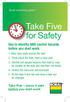 Build something great Take Five for Safety Use to identify AND control hazards before you start work. 1. Stop, look, walk around the task 2. Think about the task, have a clear plan 3. Identify and assess
CONFINED SPACE HAZARD ANALYSIS. In order to determine if the space is a confined space, please answer Yes or No to the following questions:
 Appendix A Name of Confined Space: Space Location: CONFINED SPACE HAZARD ANALYSIS In order to determine if the space is a confined space, please answer Yes or No to the following questions: A. IS IT A
SAFE WORK PROCEDURE SWP 015 WORKING AT HEIGHT SEPTEMBER 2013 DOC. NO. D13/248399
 Operation Brief Description of Activity Limitations MORELAND CITY COUNCIL Operations Centre 7-9 Walter Street Hadfield Vic 3046 Tel: 8311 4300 Working at height Approved by the Walter Street OHS committee
3088 Lockout-Tagout Training Program Course Outline
 3088 Lockout-Tagout Training Program Course Outline The following outline summarizes the major points of information presented in the course. The outline can be used to review the course before conducting
Master Workplace Inspection Checklist for General Shop Safety. MASTER WORKPLACE INSPECTION CHECKLIST General Shop Safety
 Integrated Risk Management Master Workplace Inspection Checklist for General Shop Safety Document Type: Form Control Number: UIRM- FM_012_50 File Code: UIRM-001 Last Reviewed: March 2014 Department/Unit:
Course Title: Safety Issues in Electronics Engineering Technology Number of Credits: 3 B.A. B.S. B.A.S A.A. A.S. Degree Type
 GENERAL INFORMATION Name: Diane King Phone #: 77021 Course Prefix/Number: ETI3704 Course Title: Safety Issues in Electronics Engineering Technology Number of Credits: 3 B.A. B.S. B.A.S A.A. A.S. Degree
Independent Contractor Policy
 Independent Contractor Policy This Policy has been implemented to prevent accidents and personal injuries. It is not intended to be entirely inclusive. It is the responsibility of the Independent Contractor
This guide is prepared by the Occupational Safety and Health Branch, Labour Department. This edition March 2010
 This guide is prepared by the Occupational Safety and Health Branch, Labour Department This edition March 2010 This guide is issued free of charge and can be obtained from offices of the Occupational Safety
Risk and Hazard Management
 Risk and Hazard Management Models Z34/22 Safe 227 Maximum 10.4 Maximum 12.4 Z40/23 Working 227 Platform 12.2 Working 14.2 Z45/25 Load (kg) 227 Drive 13.7 Height (m) 15.7 Z51/30 227 Height (m) 15.5 17.5
RISK MANAGEMENT IN THE NATIONAL SYSTEM A PRACTICAL GUIDE
 RISK MANAGEMENT IN THE NATIONAL SYSTEM A PRACTICAL GUIDE RISK MANAGEMENT IN THE NATIONAL SYSTEM A PRACTICAL GUIDE Contents Introduction 2 Terms associated with risk management 3 The risk management process
HEALTH AND SAFETY REDUCING ACCIDENTS IN KITCHENS
 HEALTH AND SAFETY REDUCING ACCIDENTS IN KITCHENS HEALTH & SAFETY UNIT SPRING 2006 CONTENTS 1. WHAT CAUSES ACCIDENTS?...2 2. WHO GETS INJURED?...2 3. SLIPS...2 4. TRIPS...3 5. SCALDS AND BURNS...3 6. MACHINERY
J. J. KELLER S 5-MINUTE WORKPLACE SAFETY TALKS
 Acrylonitrile Air Contaminants How Much Is Too Much? Air Contaminants Standard Alcohol- and Drug-Free Workplace Anhydrous Ammonia Refrigeration Units Asbestos Automated External Defibrillators (AEDs) Behavior-Based
University of Tennessee Safety Guidelines
 University of Tennessee Safety Guidelines Guideline Subject: Compressed Gases and Cryogenics Safety Guidelines Approval Date: 10/1/15 (Rev. 1) Next Scheduled Review: 10/1/19 Date Effective: 1/01/09 Contact
ELECTRICAL SAFETY RISK ASSESSMENT
 ELECTRICAL SAFETY RISK ASSESSMENT The intent of this procedure is to perform a risk assessment, which includes a review of the electrical hazards, the associated foreseeable tasks, and the protective measures
Example risk assessment for a motor vehicle mechanical repair workshop
 Example risk assessment for a motor vehicle mechanical repair workshop Setting the scene The garage manager did the risk assessment. The business employed 12 mechanics, including two apprentices who carried
Confined Space Procedures
 Confined Space Procedures Table of Contents Purpose... 2 Primary Objectives... 2 Operational Objectives... 2 Legislation... 2 Definitions... 2 Responsibilities... 4 1. Vice-President (Administration) 2.
Good practice. Enclosed lifeboat launching. It s your ship and equipment look after them and they will look after you GOOD PRACTICE
 Enclosed lifeboat launching NUMBER 72 Counterweight rigged correctly, externally All crew aware of operation through drills and lecture Monthly checks as per SMS The brake wire should fall free from the
On-Site Risk Management Audit Checklist for Program Level 3 Process
 On-Site Risk Management Audit Checklist for Program Level 3 Process Auditor name: Date: I. Facility Information: Facility name: Facility location: County: Contact name: RMP Facility I.D. Phone Number:
Work Permits. A Health and Safety Guideline for Your Workplace. When is a Work Permit Needed? What is a Work Permit? Why use a Work Permit?
 A Health and Safety Guideline for Your Workplace What is a Work Permit? A work permit is a written form used to authorize jobs that expose workers to serious hazards. It identifies the work to be done,
identify hazards, analyze or evaluate the risk associated with that hazard, and determine appropriate ways to eliminate or control the hazard.
 What is a risk assessment? Risk assessment is the process where you: identify hazards, analyze or evaluate the risk associated with that hazard, and determine appropriate ways to eliminate or control the
Uncontrolled if Printed
 Hazard Table Hazard Types Any Hazard Kinetic / Mechanical Gravitational Thermal and/or Explosive Electrical Pressurised Chemicals / Substances Radiation Biological Manual Handling / Postural Noise and/or
WHS Contractor Management Procedure
 Procedure Approved: 09/07/2013 Next Review: 09/07/2015 1. Overview The District council of Mount Remarkable Council is committed to engaging quality Contractors who have a sound understanding and commitment
HAZARD & RISK MANAGEMENT PROCEDURE
 Introduction ATTAR is committed to providing a safe and healthy work environment for all employees. ATTAR also recognises its legal and moral obligation to provide and uphold so far as is practicable,
MATERIAL HANDLING PROGRAM (Section 10)
 MATERIAL HANDLING PROGRAM (Section 10) OVERVIEW (WMI Facility) (1) Only certified personnel will operate powered industrial lifts. (2) Training will be provided to those who require to be certified or
PPE hazard assessment
 Oregon OSHA s quick guide to the PPE hazard assessment What you should know and not a word more! A Division of the Department of Consumer and Business Services About this guide Oregon OSHA quick guides
FALLING OBJECTS EXCESSIVE NOISE CHAINSAW & CHIPPER WORK AT HEIGHTS MANUAL HANDLING
 JOB NO: PROJECT: DATE: SWMS NO: SWMS 001.1 PREPARED BY: Ian Hartley REVISED BY: Nick Bragg & Cameron McNeil ACTIVITY: TREE REMOVAL & PRUNING SIGNED BY: REVISION DATE: December 2015 MINIMUM PERSONAL PROTECTIVE
OCCUPATIONAL SAFETY & HEALTH ADMINISTRATION OSHA COURSE DESCRIPTIONS
 OCCUPATIONAL SAFETY & HEALTH ADMINISTRATION OSHA COURSE DESCRIPTIONS WWW.osha.gov/dte/edcenters/course_description.html Course Descriptions OSHA #500 - Trainer Course in OSHA Standards for Construction
PALM BEACH STATE COLLEGE PERSONAL PROTECTIVE EQUIPMENT (PPE) JOB HAZARD ASSESSMENT
 PALM BEACH STATE COLLEGE PERSONAL PROTECTIVE EQUIPMENT (PPE) JOB HAZARD ASSESSMENT Department: Facilities Campus: All Task: Check/Service/Maintain/Repair/Install HVAC Equipment and Systems Job Title(s)
POTENTIAL HEALTH & SAFETY HAZARDS
 Number: OH&S 18.27.1 Revision Date: 2014.01.28 Crane Safety Procedures 1. PURPOSE 1.1. These procedures provide the University requirements for the operation and management of overhead travelling cranes
Chevron Mining Inc. Managing Safe Work at Chevron Mining
 Chevron Mining Inc. Managing Safe Work at Chevron Mining Table of Contents Introduction... 1 Tenets of Operation... 2 Stop Work Authority... 3 Types of Work Definitions... 4 SWP / JSA / SOP Definitions...
PERSONAL PROTECTIVE EQUIPMENT FOR CALIFORNIA STATE UNIVERSITY, LOS ANGELES
 PERSONAL PROTECTIVE EQUIPMENT FOR CALIFORNIA STATE UNIVERSITY, LOS ANGELES OCTOBER 2007 PROGRAM APPROVAL AND AUTHORIZATION James M. Rosser, President Date TABLE OF CONTENTS TITLE Section PURPOSE...1.0
Hazard Identification, Risk Assessment and Control (HIRAC) for Work at Height Risk, Health and Safety
 Hazard Identification, Assessment and Control (HIRAC) for Work at Height, Health and Safety A. Introduction Hazard identification and safety risk assessments should be conducted prior to carrying out any
TABLE OF CONTENTS 4. CONTRACTOR SHE MANAGEMENT PROGRAM R1400.00 --MANAGEMENT STATEMENT
 4. CONTRACTOR SHE MANAGEMENT PROGRAM R1400.00 TABLE OF CONTENTS --MANAGEMENT STATEMENT ADMINISTRATIVE 1. SHE AND ACCIDENT PREVENTION 1-A Discipline 2. NEW HIRE ORIENTATION (Outline) 2-A New Hire Orientation
Injury Prevention for the Construction Industry
 Injury Prevention for the Workers in the construction industry encounter a variety of hazards, some of which can lead to serious injuries and fatalities. This fact sheet: Increases awareness of the primary
Welcome to the safe@work Automotive Module.
 Welcome to the safe@work Automotive Module. Have you read the General Module, completed the test and gained your safe@work General certificate? The Automotive Module should be done AFTER the General Module
Completion Test Answer Key. 1. Why are young people more likely to be injured on the job than other groups of workers?
 1. Why are young people more likely to be injured on the job than other groups of workers? They receive little or no safety training or supervision. They are reluctant to ask questions for fear of appearing
HAZARD IDENTIFICATION AND RISK ASSESSMENT PROCEDURES FOR DEEP SOUTH CRANE & RIGGING
 HAZARD IDENTIFICATION AND RISK ASSESSMENT PROCEDURES FOR DEEP SOUTH CRANE & RIGGING PURPOSE Due to the risks inherent in lifting and transporting large, heavy, and/or cumbersome objects, it is critically
SAFETY AND HEALTH PROGRAM
 PROGRAM NUMBER NO. PAGES 05-005 10 REVISION ISSUE DATE Revision 2 11/1/2005 SAFETY AND HEALTH PROGRAM Confined Space Entry 1.0 INTRODUCTION Confined Space Entry is a serious workplace hazard, capable of
Hazard Identification, Risk Assessment and Control Procedure
 Hazard Identification, Risk Assessment and Control Procedure 1. Purpose To ensure that there is a formal process for hazard identification, risk assessment and control to effectively manage workplace and
Enviro Safety Products Resource Center. OSHA Checklist for General Industry
 Enviro Safety Products Resource Center OSHA Checklist for General Industry The Occupational Safety and Health Administration (OSHA) require many standards to be met by businesses and industries. OSHA sets
READ FIRST. Confined Space Entry Procedure. San José State University Environmental Health and Safety. Confined Space Entry Procedure
 READ FIRST 1. The purpose of a is to save lives by controlling the inherent hazards of a confined space prior to entry. a. If possible, avoid entering a confined space. Every consideration should be given
Introduction to Industrial Hygiene for the Safety Professional
 Introduction to Industrial Hygiene for the Safety Professional Jeffery K. Dennis, MS, CSP, CHMM, CET, CSSM, WSO-CSE Welcome Today we will introduce and discuss the elements of effective Industrial Hygiene
Life Saving Rules SAFETY BY CHOICE, NOT BY CHANCE
 Life Saving Rules SAFETY BY CHOICE, NOT BY CHANCE Foreword from Kevin Reinhart The 12 Life Saving Rules are a part of Nexen s continued commitment to create a safe work environment for our employees. The
Spill Kits and Incidental Spill Response
 Spill Kits and Incidental Spill Response June 2012 This training is intended to be educational and should not be construed as legal guidance. It is provided as a courtesy to our customers and others who
Examination questions:
 Name candicate: Examination questions: Event code : Test exam Basic Elements of Safety Please read the following instructions carefully! This examination is comprised of 40 multiple-choice questions. Each
Safety Meeting Topic: Chemical Spills and Emergency Action Plans for General Industry
 Company Name: Safety Meeting ID: 16 Date: Grainger Safety Services Inc. 2012 Safety Meeting Topic: Chemical Spills and Emergency Action Plans for General Industry UPDATED: This safety meeting has been
TANKER - SHORE SAFETY CHECK-LIST
 TANKE - SHOE SAFETY CHECK-LIST Part A - Bulk Liquid General - Physical Checks Bulk Liquid - General Tanker Terminal Code emarks 1 There is safe access between the tanker and shore. L1 The fendering arrangements
Millersville University - Office Of Environmental Health & Safety Scope & Application
 Confined Space Entry Millersville University - Office Of Environmental Health & Safety Scope & Application The Confined Space Entry (CSE) program applies to the safe working practices for entering and
Control of Hazardous Energy (Lockout / Tagout)
 WAUKESHA COUNTY TECHNICAL COLLEGE Control of Hazardous Energy (Lockout / Tagout) Release Date: March 26, 2012 Revision Date: March 26, 2012 Revision Level: 1 TABLE OF CONTENTS Purpose... 1 Scope... 1 Responsibilities...
Drilling Rig Hazard Recognition Training for Supervisors and Employees
 Drilling Rig Hazard Recognition Training for Supervisors and Employees This 3-day packed course takes on every aspect of drilling and related hazards. However, it does not follow any other course layout.
Machine Guarding and Operator Safety. Leader Guide and Quiz
 4646 Machine Guarding and Operator Safety Leader Guide and Quiz Leader s Guide MACHINE GUARDING & OPERATOR SAFETY INTRODUCTION: A brief description of the program and the subject that it addresses. This
68 Metal Industry Guidelines for Safe Work
 3 68 Metal Industry Guidelines for Safe Work section 3 high-risk 3 activities Metal Industry Guidelines for Safe Work 69 section 3 high risk activities 3.1 working at heights Falls from heights have been
EXPLOSIVE ATMOSPHERES - CLASSIFICATION OF HAZARDOUS AREAS (ZONING) AND SELECTION OF EQUIPMENT
 EXPLOSIVE ATMOSPHERES - CLASSIFICATION OF HAZARDOUS AREAS (ZONING) AND SELECTION OF EQUIPMENT OVERVIEW ASSESSING THE RISK RELATIONSHIP BETWEEN FIRES AND EXPLOSIONS CLASSIFYING HAZARDOUS AREAS INTO ZONES
You ve. life. ahead. you... So, safe. the of. job!
 You ve So, got your play whole it safe life on ahead the of job! you... So, play it safe on the job! Getting a job anytime soon? Money isn t the only thing to think about. If you re under 18 and thinking
Notes. Material 1. Tools the employee is expected to operate
 OSHA Standard29 CFR 1910.211-.247, Subpart O, Machinery and Machine Guarding, and Subpart P, Hand and Portable-Powered Tools and other Hand- Held Equipment. Hand Tool Safety Preparation 1. Read Applicable
Alaska. Occupational Safety and Health Standards. quick guide to. hazard communication for general industry. What you should know and not a word more!
 Alaska Occupational Safety and Health Standards quick guide to hazard communication for general industry What you should know and not a word more! Table of Contents Overview of AKOSH Services 1 What is
LOCKOUT GUIDELINE. To ensure that a piece of equipment cannot be turned on, pressurized or switched on accidently while an employee is working on it.
 Background LOCKOUT GUIDELINE Both Aspasa in its ISHE (Initiating Safety Health & Education) program and Sarma in its SHREQ (Safety, Health, Road Transport, Environment & Quality) program have seen that
HEALTH, SAFETY AND ENVIRONMENT HANDBOOK HSE
 HEALTH, SAFETY AND ENVIRONMENT HANDBOOK HSE CNOOC Limited 1 Message from CEO Dear Colleagues, CNOOC Limited is the largest producer of offshore oil & gas in China and is one of the largest oil & gas exploration
SAFETY TRAINING CLASSES & SERVICES LIST
 SAFETY TRAINING CLASSES & SERVICES LIST CUSTOM CLASS ROOM TRAINING AVAILABLE, BACKED WITH ON-SITE SUPPORT SAFETY, TRAINING COURSES OFFERED BY OUR CERTIFIED ELITE RISK CONTROL TEAM: EM 385-1-1 (Military)
Hazard Identification, Risk Assessment And Control Procedure
 Hazard Identification, Risk Assessment And Control Procedure 1. Purpose 1.1 To ensure that there is a formal process for hazard identification, risk assessment and control to effectively manage hazards
Good practice steel coils. Cargo stowage. It s your ship and equipment look after them and they will look after you GOOD PRACTICE
 steel coils Cargo stowage NUMBER 92 Cargo well-braced and secured Dunnage protection from condensation Controlling the risk of cargo shifting It is the duty cargo officer s responsibility to ensure cargo
Confined Space Entry Procedure Worksheet
 1. Location Exact name and location of space to be entered. Confined Space Entry Procedure Worksheet 2. Hazard Identification & Determination - (circle all that apply) a. Tasks to be performed. Welding/Cutting
Basic Safety Examination instructions
 Name of candidate: This VCA mock examination is only intended for training purposes and is aimed at familiarising candidates with the examination methods. The questions are checked every year for accuracy
J.J. Keller Safety Materials
 J.J. Keller Safety Materials Using safety talks will allow your employees to analyze Real Life Stories and share what they feel the individuals did right and wrong, and what should happen next. Safety
HAZARDOUS MATERIALS MANAGEMENT ISSUE 2
 CONTENTS PAGE 1 AIM 2 2 APPLICATION 2 3 DEFINITIONS 2 4 REASON FOR INCLUSION 2 5 REQUIREMENTS 3 6 PLANT AND EQUIPMENT REQUIREMENTS 3 7 SYSTEM AND PROCEDURAL REQUIREMENTS 5 8 PEOPLE REQUIREMENTS 7 APPENDIX
Technical Advisory for Safe Operation of Lifting Equipment. Programme-Based Engagement
 Technical Advisory for Safe Operation of Lifting Equipment Programme-Based Engagement Contents 1. Introduction and Background 03 2. Case Studies of Accidents Involving Lifting Equipment 05 3. Common Systemic
Fact Sheet: Slips, trips and falls
 Fact Sheet: Slips, trips and falls Slips, Trips & Falls Slips, Trips and Falls are one of the highest causes of workplace injuries. They include those, which occur on the same level as a result of uneven
EVENT RISK ASSESSMENT EXAMPLE / 04
 EVENT RISK ASSESSMENT EXAMPLE / 04 No matter the nature or size of your event, your event will have risks. It is your responsibility as the event organiser, to identify and manage these risks. Event organisers
REPUBLIC OF LIBERIA BUREAU OF MARITIME AFFAIRS
 REPUBLIC OF LIBERIA BUREAU OF MARITIME AFFAIRS Marine Notice SAF-004 Rev. 04/05 TO: ALL SHIPOWNERS, OPERATORS, MASTERS AND OFFICERS OF MERCHANT SHIPS, AGENTS AND RECOGNIZED ORGANIZATIONS SUBJECT: Lifeboat
Safety and Health Office WORKPLACE SAFETY CHECKLIST
 Location: Date: Inspected by: Safety and Health Office WORKPLACE SAFETY CHECKLIST WORK ENVIRONMENT Ventilation Removal of fumes and dust Temperature and humidity control Noise levels Vibration Lighting
Accidents/Incidents are Preventable
 Section 4 Fundamentals of Accident/Incident Prevention Accidents/Incidents are Preventable Many people believe that accidents are the inevitable result of unchangeable circumstances, fate, or a matter
7. PRINCIPAL STEPS 8. POTENTIAL HAZARDS 9. RECOMMENDED CONTROLS
 ACTIVITY HAZARD ANALYSIS (AHA) 1. Contract Number: 2. Contractor Name: 3. Date prepared: 4. Title/Activity Performed: FIXED SCAFFOLDING 5. Location: 6. Estimated Date of Completion: 7. PRINCIPAL STEPS
Sample Risk Management Policy and Procedure
 Sample Risk Management Policy and Procedure 1. Purpose and Scope This policy establishes the process for the management of risks faced by [organisation]. The aim of risk management is to maximise opportunities
Compressed Gas Cylinder Safety
 Compressed Gas Cylinder Safety I. Background. Due to the nature of gas cylinders, special storage and handling precautions are necessary. The hazards associated with compressed gases include oxygen displacement,
Six steps to Occupational Health and Safety
 Six steps to Occupational Health and Safety This booklet gives basic guidelines for workplace health and safety systems to help industry in NSW comply with the "duty of care" principle outlined in the
Risk Management & Assessment at UQ
 Risk Management & Assessment at UQ Course Overview: This training module has been developed for workers at the University of Queensland, and forms part of the OH&S training program at UQ. The aim of this
Housekeeping and Material Storage
 29CFR 1926.20(b)-Accident Reduction, 29CFR 1926.21- Safety Training & Education 29CFR 1926.20(a)-Unsafe Working Conditions Housekeeping and Material Storage Preparation 1. Read Applicable Background information
Prevention through Design: Eliminating Confined Spaces and Minimizing Hazards
 Prevention through Design: Eliminating Confined Spaces and Minimizing Hazards American Industrial Hygiene Association Developed by the AIHA Confined Spaces Committee Approved by the AIHA Board of Directors
If you have any questions about how to safely undertake a task or project, ask your supervisor before you begin.
 Laboratory Health and Safety Manual Section 1: Introduction and Objectives This manual provides a set of minimum standards and practices for the safe and healthy operation of a laboratory. Following the