
OCCUPATIONAL HEALTH AND SAFETY RISK ASSESSMENT PROGRAM FOR AGRICULTURE
|
|
|
- Anis Watkins
- 10 years ago
- Views:
Transcription
1 OCCUPATIONAL HEALTH AND SAFETY RISK ASSESSMENT PROGRAM FOR AGRICULTURE
2 Definitions of Commonly Used Terms in Risk Management Hazard: anything, including a work practice or procedure, that causes, or has the potential to cause, injury, harm or illness. Incident: any unplanned event resulting in, or having the potential for, injury, illness, ill health, damage or other loss Near miss: an incident that does not produce an injury or disease. Risk assessment: the process of determining the potential of a hazard to cause injury or illness and the potential severity of that injury or illness Risk Control: the process of controlling risks associated with hazards by using the hierarchy of control. Risk Management: the overall process of identifying hazards, assessing the risk of those hazards, eliminating or controlling hazards and monitoring and reviewing risk assessments and control measures. Workplace Hazards and Due Diligence What is the standard of due diligence? Due diligence simply means taking all reasonable care to protect the wellbeing of employees or co-workers. To meet that standard of due diligence you must take precautions that are reasonable in the circumstances so that you carry out your health and safety responsibilities. An ongoing Occupational Health and Safety Program that controls specific hazards in your workplace forms the basis of due diligence. If you, as an employer have all the elements of the OHS Program for agricultural employers in effect and working you will generally be acting with due diligence. A written program won t amount to due diligence unless you have implemented it. You will also have to take special steps to control specific hazards such as confined spaces, lockout etc. in order to show that you are exercising due diligence in particular circumstances. The greater the risk, the greater the need for specific policies, practices and other measures to control hazards. Documentation will show that you took steps to control or eliminate specific hazards. It can also show that you have provided workers with adequate instruction, training, supervision, and discipline to work safely. Why is Risk Assessment Important? Risk management is recognized as an integral part of a good management practice. It is an important step in protecting your workers and your business, as well as complying with the law. It is an interactive process consisting of steps which, when undertaken in sequence, enable continuous improvement in decision making. They help to: Create awareness of hazards and risks Identify who may be at risk (employees, visitors, contractors, the public) and the level of risk Comply with BC s Occupational Health and Safety Regulations (OHSR) Demonstrate due diligence - 2 -
3 Determine what controls are required, or if the existing control measures are adequate. Prevent loss to the operation due to: injury, illness, lost production, equipment / property damage When are Risk Assessments Required? Risk assessments are required at all stages of a work process including: Prior to establishing and using a workplace When planning and designing work procedures Before selecting purchasing, installing and using equipment Before changes are made to the workplace systems Whenever there is new information about the work procedure. FARSHA has examined the full text of the Workers Compensation Act and Occupational Health and Safety Regulation, (OHSR) and identified the requirements that call for risk assessment. Here is a list of those that are most likely to be found in agricultural workplaces, along with the section number from the OHSR: If the need to rescue or evacuate workers may arise (4.13) If risk factors for musculo-skeletal injury are present (4.47) If risk factors for workplace violence are present (4.28) If emergency eyewash or showers may be needed (5.88) If there s a risk of leak or fire in chemicals (5.99) If there are risks posed in pesticide handling (6.95) If workers face the risk of heat stress or cold stress, as the result of working in extreme temperature conditions (7.55) If there are confined spaces that might require worker entry (9.2) If there are high noise levels that, averaged over a workday, could result in hearing damage (7.4) If there s a risk of injury from unexpected movement of equipment or machinery during maintenance (10.3) If there s a risk of injury from falling from heights or onto unusual hazards (11.2) If work is being done near high-voltage lines or equipment (19.25) If any of these are present in this particular workplace, the employer must do a risk assessment. The following tables will assist to determine whether a risk assessment is required for the potential hazard identified in each box. Simply follow the instructions in each box - 3 -

4 - 4 -

5 - 5 -

6 Types of Risk Assessments Comprehensive: Specific Hazards Identified in BC s Occupational Health and Safety Regulations (OHSR) In many instances risk assessments are required to be carried out, in accordance with BC s Occupational Health and Safety Regulations to determine if those particular hazards are present (those instances have already been listed above). If those hazards are present they may require a more specific and comprehensive form of risk assessment, and in some cases they may have to be performed by a qualified person. For these types of risk assessments FARSHA can provide advice or assistance. Standard: Non-specific Hazards (not specifically identified in the OHSR) Where there is potential for a hazard to cause injury or illness a standard risk assessment will be carried out. Undertaking a Risk Assessments: PROCESS: Identify the hazards Recognize Evaluate the level of risk Evaluate Control the hazard and eliminate or reduce the risk Control or Manage Recognize: What is/are the hazards? A hazard can be identified by observation, inspection, testing, communication and consultation with staff or by reviewing injury statistics, incident investigations, and recording the hazards identified. Review the OHSR requirements for risk assessment list on page 2-6 -
7 Evaluate: During the evaluation process we need to assess the risk that the hazard presents. Each hazard should be studied to determine its level of risk, when doing so there is several factors that play an important role and need to be prioritized, and that will require action. For each risk: Determine the likelihood of an incident occurring Very Likely Likely Unlikely Very unlikely Could happen frequently Could happen occasionally Could happen but rarely Could happen, but probably never will Consider for example: The number of times a situation occurs The number of people exposed and the duration of exposure The skills/experience of persons exposed The position of the hazard relative to people and other hazards Special characteristics of workers that may affect the likelihood of an incident The quantities of materials or point of exposure Environmental conditions The condition of equipment The effectiveness of existing control measures Determine the consequences of an incident occurring Extreme Major Moderate Minor Death, permanent disablement Serious bodily injury Casualty treatment First aid, no lost time work Consider, for example: The potential for chain reaction (where a hazard can evolve and compound into more dangerous situation) Substance concentration Material volume Speed of projectiles or moving parts Height of worker or lanyard Worker position relative to the hazard - 7 -
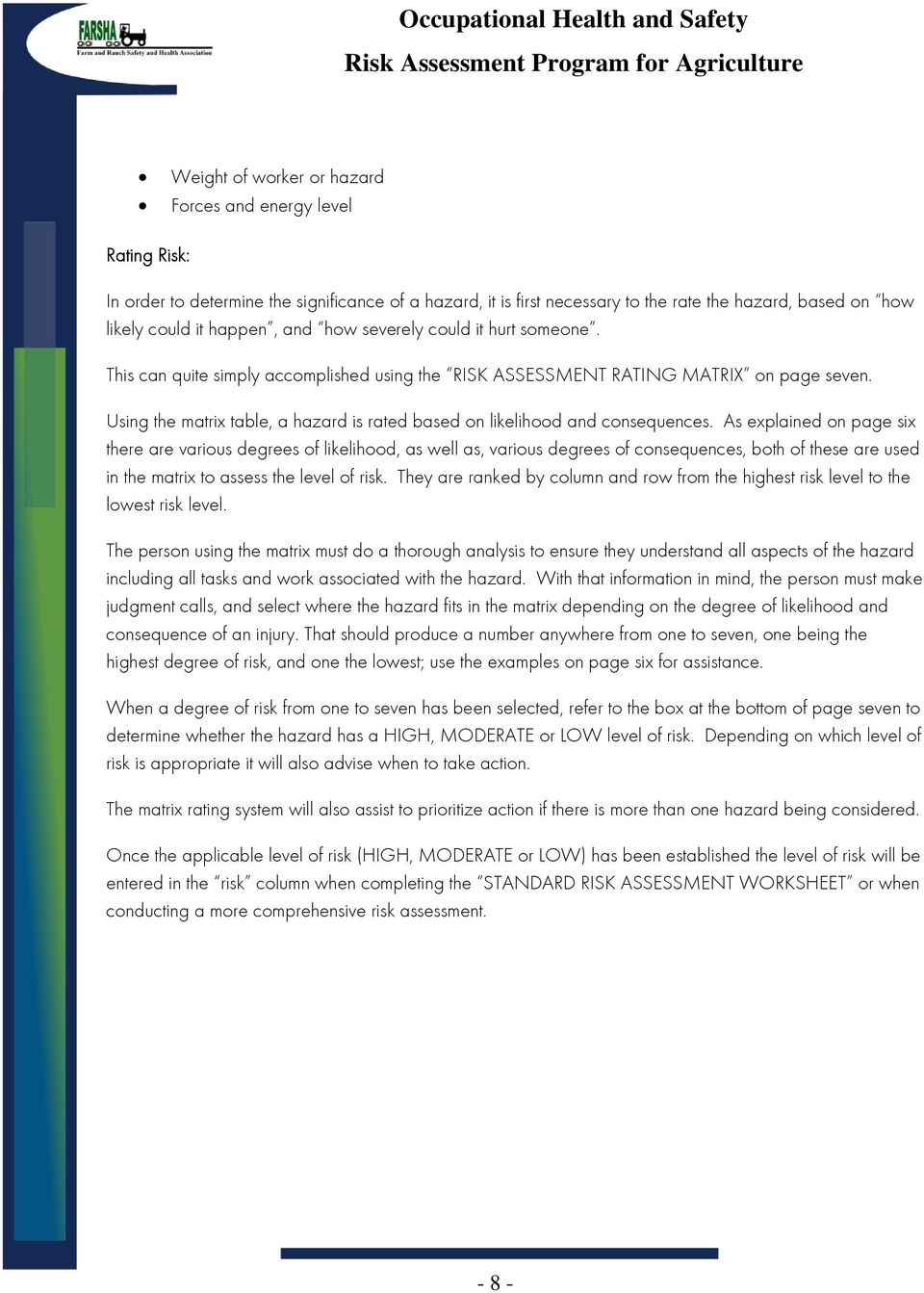
8 Weight of worker or hazard Forces and energy level Rating Risk: In order to determine the significance of a hazard, it is first necessary to the rate the hazard, based on how likely could it happen, and how severely could it hurt someone. This can quite simply accomplished using the RISK ASSESSMENT RATING MATRIX on page seven. Using the matrix table, a hazard is rated based on likelihood and consequences. As explained on page six there are various degrees of likelihood, as well as, various degrees of consequences, both of these are used in the matrix to assess the level of risk. They are ranked by column and row from the highest risk level to the lowest risk level. The person using the matrix must do a thorough analysis to ensure they understand all aspects of the hazard including all tasks and work associated with the hazard. With that information in mind, the person must make judgment calls, and select where the hazard fits in the matrix depending on the degree of likelihood and consequence of an injury. That should produce a number anywhere from one to seven, one being the highest degree of risk, and one the lowest; use the examples on page six for assistance. When a degree of risk from one to seven has been selected, refer to the box at the bottom of page seven to determine whether the hazard has a HIGH, MODERATE or LOW level of risk. Depending on which level of risk is appropriate it will also advise when to take action. The matrix rating system will also assist to prioritize action if there is more than one hazard being considered. Once the applicable level of risk (HIGH, MODERATE or LOW) has been established the level of risk will be entered in the risk column when completing the STANDARD RISK ASSESSMENT WORKSHEET or when conducting a more comprehensive risk assessment
9 - 9 -

10 Manage/Control : The Hierarchy of Control will assist in determining the most appropriate course of action to control the risk identified. The Hierarchy of Control ranks risk control strategies from the most effective to the least effective. Not all strategies will be practicable and a combination of strategies may be needed to achieve the best protection, for example ventilation and gloves. Engineered Control Where a hazard cannot be simply eliminated from the workplace, it is often still possible to reduce the risks by designing safeguards to be built in to the equipment. This involves controlling the hazard right at the source, by adding safety features to machinery, by redesigning a system or task, or by building a containment or enclosure to isolate the hazard from people. A familiar example is the great reduction in noise with enclosed tractor cabs this is an example of an engineered solution to a long-standing hazard. Control measures that are built in by design are very reliable, and their success does not depend on individual judgment, training, or decision-making. Administrative Control Where engineered controls are not possible (for instance, when still using older, less-safe equipment, or when work is done in buildings that cannot easily be remodeled), the next best alternative is an administrative or procedural control. These involve the use of policies or procedures to reduce the exposure to the hazard. Administrative controls include job rotation, reduction of exposure time, and worker training and education. An employer may decide to adopt a company policy that requires everyone to follow a certain procedure, as a way of reducing the risk of injury. However, administrative controls may not be a very effective means of controlling hazards. Administrative controls depend on too many factors that cannot be predicted. People may not understand the seriousness of a hazard or they may underestimate a risk. They may not remember all the steps of a procedure. They may feel pressure to cut corners. You must be especially vigilant with administrative controls to ensure that workers exposure to the hazard is effectively controlled. Personal Protective Equipment The decision to use personal protective clothing or gear is a last resort, when it s not possible to control a hazard or reduce a risk in any other way. Actually, it s an admission that the hazard still remains, and that the risk cannot be reduced at its source. To be effective, workers who use personal protective equipment (PPE) must understand the hazards, and must accept the importance of using protective equipment consistently and correctly. As well, special efforts must be made to ensure that personal protective equipment is chosen, used, and maintained correctly

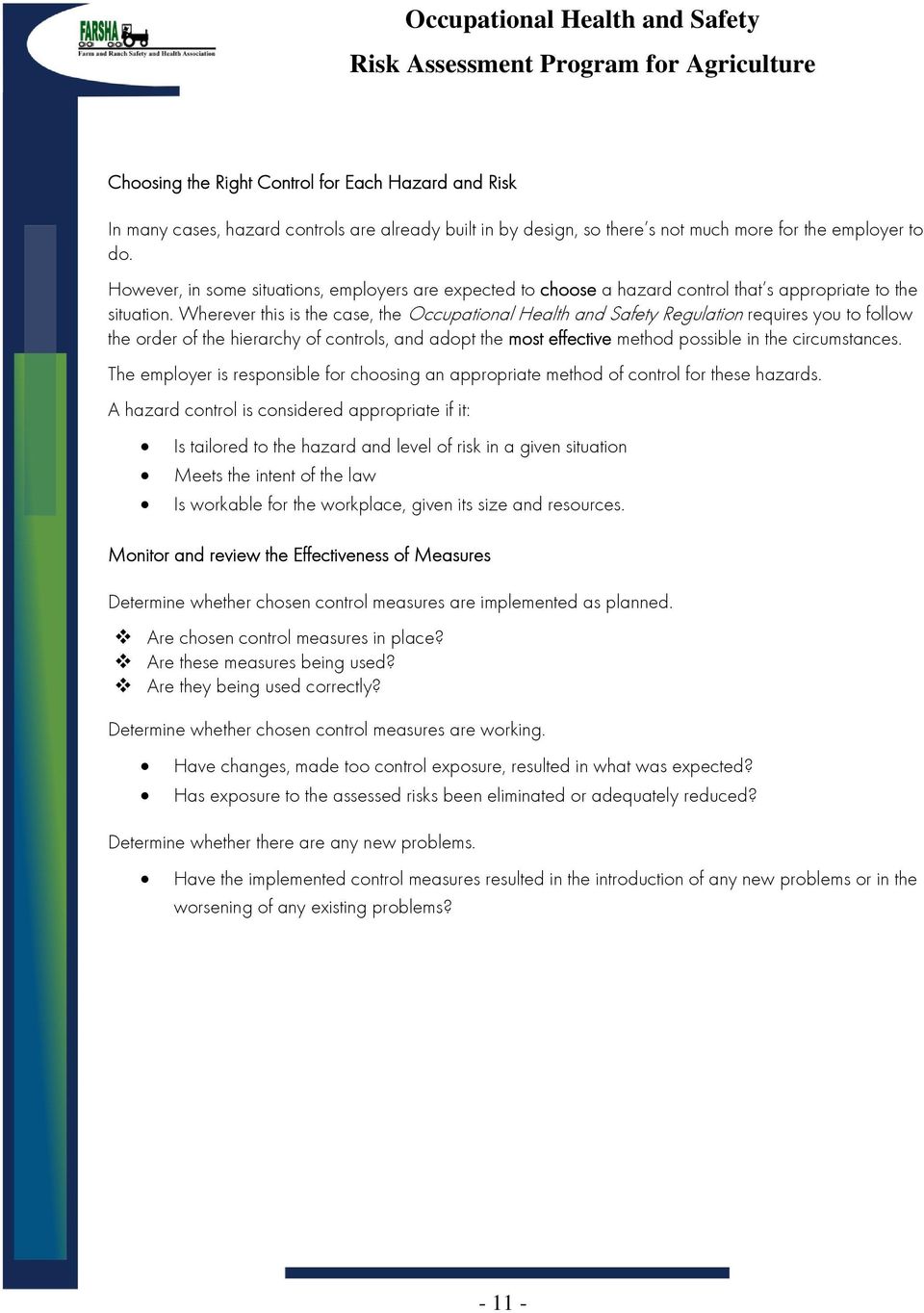
11 Choosing the Right Control for Each Hazard and Risk In many cases, hazard controls are already built in by design, so there s not much more for the employer to do. However, in some situations, employers are expected to choose a hazard control that s appropriate to the situation. Wherever this is the case, the Occupational Health and Safety Regulation requires you to follow the order of the hierarchy of controls, and adopt the most effective method possible in the circumstances. The employer is responsible for choosing an appropriate method of control for these hazards. A hazard control is considered appropriate if it: Is tailored to the hazard and level of risk in a given situation Meets the intent of the law Is workable for the workplace, given its size and resources. Monitor and review the Effectiveness of Measures Determine whether chosen control measures are implemented as planned. Are chosen control measures in place? Are these measures being used? Are they being used correctly? Determine whether chosen control measures are working. Have changes, made too control exposure, resulted in what was expected? Has exposure to the assessed risks been eliminated or adequately reduced? Determine whether there are any new problems. Have the implemented control measures resulted in the introduction of any new problems or in the worsening of any existing problems?
12 Conducting a Standard Risk Assessment : For standard risk assessments there is no need to overcomplicate the process. In many workplaces the hazards are well known and the necessary controls are easy to apply. In the case of a small operation, the manager / supervisor may be confident and understand what s involved and can do the risk assessment themselves, or they may request FARSHA s assistance. Larger operations may require a FARSHA consultant to help, particularly for comprehensive risk assessments. Assessments should be done by a team of individuals who have a good working knowledge of the workplace. In all cases workers who are associated with the hazards should be involved in the process. They will have useful information about how the work is done, which in turn, will make the risk assessment more thorough and effective. On page eleven there is a blank Standard Risk Assessment Worksheet (SRAW). This tool will provide a mechanism to recognize evaluate and control hazards in a systematic way. A standard risk assessment should be undertaken on all tasks that have the potential to cause injury or illness. The task must be analyzed from start to finish and documented on the SRAW. All of the hazards associated with the task should be individually identified in the hazards column. Using the Risk Assessment Rating Matrix on page 8, and the information provided to employ it, a level of risk (low, moderate or high) is entered in the risk column adjacent each hazard. Finally, using the information on pages nine and ten, an appropriate method of control, based on the risk level, must be decided on, for each hazard, using the Hierarchy of Control. As discussed on page eight the control will require either immediate attention, as soon as possible attention, or may not need immediate attention. This information must be included in the control column. An example has been provided on page 12. After conducting several risk assessments, and the principals of conducting them are well understood, all that the assessor should require is the Risk Assessment Rating Matrix" and Standard Risk Assessment Worksheets

13 OCCUPATIONAL HEALTH AND SAFETY RISK ASSESSMENT PROGRAM FOR AGRICULTURE

14 OCCUPATIONAL HEALTH AND SAFETY RISK ASSESSMENT PROGRAM FOR AGRICULTURE

Six steps to Occupational Health and Safety
 Six steps to Occupational Health and Safety This booklet gives basic guidelines for workplace health and safety systems to help industry in NSW comply with the "duty of care" principle outlined in the
Hazard Identification, Risk Assessment And Control Procedure
 Hazard Identification, Risk Assessment And Control Procedure 1. Purpose 1.1 To ensure that there is a formal process for hazard identification, risk assessment and control to effectively manage hazards
Hazard Identification, Risk Assessment and Control Procedure
 Hazard Identification, Risk Assessment and Control Procedure 1. Purpose To ensure that there is a formal process for hazard identification, risk assessment and control to effectively manage workplace and
Hazard/Risk Identification and Control Procedure
 Hazard/Risk Identification and Control Procedure Introduction Hazard identification and the steps taken to minimize the risks associated with identified hazards are a critical component of working safely.
Risk Management & Assessment at UQ
 Risk Management & Assessment at UQ Course Overview: This training module has been developed for workers at the University of Queensland, and forms part of the OH&S training program at UQ. The aim of this
identify hazards, analyze or evaluate the risk associated with that hazard, and determine appropriate ways to eliminate or control the hazard.
 What is a risk assessment? Risk assessment is the process where you: identify hazards, analyze or evaluate the risk associated with that hazard, and determine appropriate ways to eliminate or control the
Title: OHS Risk Management Procedure
 Issue Date: July 2011 Review Date: July 2013 Page Number: 1 of 9 1. Purpose: To outline the methodology by which Department of Education and Early Childhood Development (DEECD) identifies, assesses, controls
DIT HEALTH AND SAFETY OFFICE
 DIT HEALTH AND SAFETY OFFICE PROCEDURE TITLE Risk Assessment Procedure REVISION NO.: 5 NUMBER OF PAGES: 8 REFERENCE: Parent Health and Safety Statement Risk Assessment Template (DITRAT) Safety Inspection
Hazard Management Tool
 Developed by the Health and Safety Ontario members: Infrastructure Health and Safety Association Public Services Health & Safety Association Workplace Safety North Workplace Safety & Prevention Services
Hazard Management Tool
 Hazard Management Tool Developed by the Workplace Safety and Insurance Board in collaboration with the Health and Safety Ontario members: Infrastructure Health and Safety Association Public Services Health
Elements of an Occupational Health and Safety Program
 Occupational Health and Safety Division Elements of an Occupational Health and Safety Program Table of Contents Introduction 3 What workplaces must have a program? 5 What criteria must the program meet?
POLICY ON OCCUPATIONAL HEALTH AND SAFETY RISK MANAGEMENT
 THE NORTHCOTT SOCIETY POLICY ON OCCUPATIONAL HEALTH AND SAFETY RISK MANAGEMENT VOLUME: 2 Policy on Management and Organisational Issues SECTION: B Occupational Health & Safety & Workers Compensation SUB-SECTION:
Sample Risk Management Policy and Procedure
 Sample Risk Management Policy and Procedure 1. Purpose and Scope This policy establishes the process for the management of risks faced by [organisation]. The aim of risk management is to maximise opportunities
Walk around and identify the area to be assessed and look at what could reasonably be expected to cause harm.
 Risk Assessment Introduction The assessment of risk is central to the management of health and safety. The purpose of this is to assist in identifying those measures which are needed to remove or otherwise
Hazard Identification, Risk Assessment and Control Management
 The Paraplegic and Quadriplegic Association of SA Inc Hazard Identification, Risk Assessment and Control Management STATEMENT The Paraplegic and Quadriplegic Association of South Australia Incorporated
AFTRS Health and Safety Risk Management Policy
 AFTRS Health and Safety Risk Management Policy Responsible Officer Contact Officer Authorisation Director, Corporate and Student Services Head of Human Resources Chief Executive Officer Effective Date
Step 4. Monitor / Review Control Measures
 Overview Step 1. Identify Hazards Step 2. Assess the Risks Assess the Likelihood & Consequences Classify the Risk Step 3. Control the Risks The hierarchy of risk control can be used as a guide Step 4.
WHS Induction Series. 36 Toolbox Talks. Contents
 36 Toolbox Talks 3-5 minute toolbox talks for induction or refresher safety training. Having regular training programs that educate your workers about workplace issues has never been easier than now with
Risk management a practical approach
 Risk management a practical approach Introduction Preventing work related accidents and injuries is the primary concern for all those involved in health and safety. Work related accidents and injuries
Risk assessment code of practice
 Risk assessment code of practice Document control information Published document name: Risk assessment code of practice Date issued: 01 May 2011 Version: 2.0 Previous review dates: Next Review Date: Related
WORKING IN CONFINED SPACES GUIDELINES
 WORKING IN CONFINED SPACES GUIDELINES Contents 1 Introduction... 2 2 Scope... 2 3 Definitions... 2 4 Responsibilities... 3 4.1 Permit Authoriser... 3 4.2 Permit Receiver... 3 4.3 Responsible UOW Officer...
OCCUPATIONAL SAFETY AND HEALTH RECORDS
 Occupational Safety Records Occupational Safety OCCUPATIONAL SAFETY AND HEALTH RECORDS Numbers listed below refer to the applicable part from the WorkSafeBC Occupational Health and Safety Regulation and/or
A Short Guide to The Safety, Health and Welfare at Work Act, 2005
 A Short Guide to The Safety, Health and Welfare at Work Act, 2005 3 A Short Guide to the Safety, Health and Welfare at Work Act, 2005 Published in August 2005 by the Health and Safety Authority, 10 Hogan
Getting the occupational safety basics organised
 Getting the occupational safety basics organised 10 important measures Introduction Occupational health and safety are the foundation of wellbeing at work. The employer is responsible for providing safe
Risk Assessment Tool (example only)
 HAZARD IDENTIFICATION & RISK ASSESSMENT TOOL Hazard identification You have an obligation to identify, assess and control any foreseeable hazards that may result as a consequence of your actions. If it
6 STEPS TO RISK MANAGEMENT
 6 STEPS TO RISK MANAGEMENT Disclaimer This Guide provides general information about the obligations of persons conducting a business or undertaking and/or persons in control of premises and workers under
Risk Management Program March 2015
 AS/NZS 4801 OHSAS 18001 OHS20309 SAI Global Risk Management Program March 2015 Introduction Monash University s Victorian campuses are all governed by the Victorian OHS Act 2004 and its subordinate regulations
OSHA Training Guidelines (An Unofficial Summary)
 OSHA Training Guidelines (An Unofficial Summary) Many standards promulgated by the Occupational Safety and Health Administration (OSHA) explicitly require the employer to train employees in the safety
Lone Working Guidance
 Document control information Published document name: loneworking-gn.pdf Date issued: October 2013 Version: 8.0 Previous review dates: Next review date: Related documents: Governing policy: Guidance to
Guidance on Risk Assessment and Control
 Guidance on Risk Assessment and Control Page 1 of 18 CONTENTS Section Page Executive Summary 2. FLOWCHART 4. 1. Introduction and Scope 5. Hierarchy of risk control 5. Definitions 5. 2. Related Documents
Occupational Health & Safety Practitioner. Reading PRINCIPLES OF ACCIDENT PREVENTION
 Occupational Health & Safety Practitioner Reading PRINCIPLES OF ACCIDENT PREVENTION January 2009 Contents OVERVIEW...1 SECTION 1: INTRODUCTION...1 SECTION 2: TECHNIQUES FOR ACCIDENT PREVENTION...4 SECTION
Participate in OHS processes
 Student Information Course Name Course code Contact details Partial completion of one of these qualification Description of this unit against the qualification Descriptor What is covered in the course
Workplace Safety and Health (Risk Management) Regulations
 A Guide to the Workplace Safety and Health (Risk Management) Regulations 1 Contents Introduction 2 Workplace Safety and Health (Risk Management) Regulations - Why is there a need for the Workplace Safety
MD 52 WASTE MANAGEMENT AUTHORITY CORPORATE HEALTH AND SAFETY PROGRAM
 UNSAFE ACTS AND CONDITIONS All accidents are the result of an unsafe act, an unsafe condition or a combination of both. Unsafe acts account for approximately 80% of all incidents/accidents, while unsafe
HAZARD & RISK MANAGEMENT PROCEDURE
 Introduction ATTAR is committed to providing a safe and healthy work environment for all employees. ATTAR also recognises its legal and moral obligation to provide and uphold so far as is practicable,
Information. on Workplace Health and Safety. Information. for Workers
 Information on Workplace Health and Safety Information for Workers This guide is designed to provide basic information about workplace health and safety as required by the Occupational Health and Safety
PART 3: RIGHTS AND RESPONSIBILITIES
 PART 3: RIGHTS AND RESPONSIBILITIES When program required OCCUPATIONAL HEALTH AND SAFETY PROGRAMS 3.1 (1) An occupational health and safety program as outlined in section 3.3 must be initiated and maintained
Getting Started with Workplace Health and Safety
 Getting Started with Workplace Health and Safety An Introduction to Workplace Health and Safety Policies, Procedures and Evaluation Victorian WorkCover Authority Revised June 2001 First published February
CSUCI Injury and Illness Prevention Program
 1.0 References Title 8, California Code of Regulations, 3203 (8 CCR 3203) 2.0 Administering Agency State of California, Division of Occupational Safety & Health (Cal-OSHA) 3.0 Statement It is the intent
Work Health and Safety. Seven Steps for Small Business
 Work Health and Safety Seven Steps for Small Business Work health and safety (WHS) is a key management responsibility for every small business. South Australia s WHS laws took effect on 1 January 2013.
4.05e WHS Guidelines for Incident Investigation Procedures Page 1 of 7
 Page 1 of 7 1 Purpose It is a legal requirement under the NSW Work Health and Safety Act 2011 and NSW Work Health and Safety Regulation 2011 to identify hazards, assess the risk of those hazards, implement
Hazard Identification, Risk Assessment & Control Program
 Hazard Identification, Risk Assessment & Control Program 1. INTRODUCTION Hazard Identification, Risk Assessment and Control The Nova Scotia Occupational Health and Safety Act, Capital Health Policies and
INJURY AND ILLNESS PREVENTION PROGRAM. For SOLANO COMMUNITY COLLEGE DISTRICT
 INJURY AND ILLNESS PREVENTION PROGRAM For SOLANO COMMUNITY COLLEGE DISTRICT Adopted: August 1992 Updated: January 2004 Updated: January 2006 Updated: January 2009 TABLE OF CONTENTS INTRODUCTION... 1 GOALS...
HealthandSafetyOntario.ca. What is a work permit? Why use a work permit? Types of work permits. When is a work permit needed?
 work permits What is a work permit? A work permit is a written form used to authorize jobs that expose workers to serious hazards. It identifies the work to be done, the hazards involved, and the necessary
EVENT RISK ASSESSMENT EXAMPLE / 04
 EVENT RISK ASSESSMENT EXAMPLE / 04 No matter the nature or size of your event, your event will have risks. It is your responsibility as the event organiser, to identify and manage these risks. Event organisers
OCCUPATIONAL HEALTH AND SAFETY Global Policy
 OCCUPATIONAL HEALTH AND SAFETY Global Policy Each of us should behave in a manner that promotes a positive safety culture Our commitment Diageo is firmly committed to ensuring the occupational health,
Employee Safety and Health Training Plan
 Employee Safety and Health Training Plan Environmental Health, Safety, and Risk Management Department Box 6113, SFA Station Nacogdoches, Texas 75962-6113 Revised: January 2011 Purpose and Scope This plan
WORKPLACE SAFETY KIT A STEP BY STEP GUIDE TO SAFETY FOR BUSINESS GUIDE 2001. WorkCover NSW Health and Safety Guide. WorkCover. Watching out for you.
 WORKPLACE SAFETY KIT A STEP BY STEP GUIDE TO SAFETY FOR BUSINESS GUIDE 2001 WorkCover NSW Health and Safety Guide WorkCover. Watching out for you. Table of Contents Table of Content: How to Use the Workplace
Risk Assessment. Module 1. Health & Safety. Essentials. 16-23 November 2013. Registered charity number 207890
 Risk Assessment Module 1 Risk assessment in the laboratory After studying this module you will be able to understand the need to conduct risk assessments, how this applies to all laboratory activities,
Office of Advocacy. Occupational Safety and Health Administration's (OSHA) Draft Proposed Safety and Health Program Rule 29 CFR 1900.
 Office of Advocacy Occupational Safety and Health Administration's (OSHA) Draft Proposed Safety and Health Program Rule CONTENTS (a) Scope (b) Basic obligation (c) Management leadership and employee participation
Corporate Health and Safety Policy Issue 9
 Corporate Health and Safety Policy Issue 9 July 2011 1 Contents Foreword by the Chief Executive 3 1. General health and safety policy statement 4 a Our responsibilities 5 b Health and safety management
How To Ensure Safety On A Caravan Site
 EAST CAMBRIDGESHIRE DISTRICT COUNCIL A Site Operators Guide to Health and Safety Introduction The Health and Safety at Work Etc. Act 1974 places a duty on all persons having control of a caravan site to
Risk Assessment: An introduction
 Preamble The purpose of a risk assessment is to systematically identify all of the risks associated with a task, activity or process, and put appropriate controls in place to eliminate or reduce the risks
OAKPARK SECURITY SYSTEMS LIMITED. Health & Safety Policy. Requests or suggestions for amendment to this procedure
 OAKPARK SECURITY SYSTEMS LIMITED Requests or suggestions for amendment to this procedure should be submitted to the owner of the process PROCESS OWNER: MANAGEMENT TEAM Current version: PREVIOUS VERSION
Contractor Safety Management
 1.0 Introduction Memorial University will ensure that a diligent contractor management process is established. This procedure establishes requirements for contract administration and oversight of contractor
INTRODUCTION... 3. 1.0 Purpose... 4. 2.0 Policy... 4. Exception for Short-Term Workplace Visits... 4. Relevant Legislation and Regulations...
 March 2006 INTRODUCTION... 3 1.0 Purpose... 4 2.0 Policy... 4 Exception for Short-Term Workplace Visits... 4 Relevant Legislation and Regulations... 5 Definitions... 5 Contractor Safety Coordination Overview...
GHD EPCM Standard operating procedure Working at height May 2013 v1
 GHD EPCM Standard operating procedure Working at height May 2013 v1 Table of contents 1. Purpose 2. Scope 3. Duty of care 4. Lifesaving rules; An overview 5. Roles and responsibilities 4.1 Operating centre
HS307 Hazard & Incident Reporting Procedure
 Policy Hierarchy link Responsible Officer Contact Officer HS307 Hazard & Incident Reporting Procedure Work Health and Safety Act 2011 Work Health and Safety Regulation 2011 Work Health and Safety Policy
Introduction to Industrial Hygiene for the Safety Professional
 Introduction to Industrial Hygiene for the Safety Professional Jeffery K. Dennis, MS, CSP, CHMM, CET, CSSM, WSO-CSE Welcome Today we will introduce and discuss the elements of effective Industrial Hygiene
The Company Safety and Health Plan. The Company Safety and Health Plan. Contents. Employer / Instructor Notes:
 Contents Quiz Employer / Instructor Notes: 1. Review and the Quiz (prior to conducting training) 2. Ask employees to read your Company Safety and Health Plan (Employee Workbook) 3. Hold open discussion
Incident Investigations Handbook
 Incident Investigations Handbook The following agencies may respond to an incident (insert phone numbers of your location) Police Fire/rescue Ambulance Coroner WorkSafeBC BC Safety Authority ICBC BC Hydro
Car Parking. A Health and Safety Perspective. David Bone
 Car Parking A Health and Safety Perspective David Bone Contents 1: Introduction 2: Legislation 3: Management Systems 4: Common Workplace Hazards Introduction HEALTH AND SAFETY Is a condition free from
Occupational Health & Safety Policy Box Hill Institute Group
 Purpose Occupational Health & Safety Policy Box Hill Institute Group To ensure that Occupational Health and Safety (OHS) is incorporated into all workplace and learning activities so that the prevention
OHSMS Implementation Guide
 OHSMS Implementation Guide Developed by the Employee Health Unit, Department of Education and Early Childhood Development and Marsh Pty Ltd. Published by the Employee Health Unit, Department of Education
OPERATIONAL RISK MANAGEMENT B130786 STUDENT HANDOUT
 UNITED STATES MARINE CORPS THE BASIC SCHOOL MARINE CORPS TRAINING COMMAND CAMP BARRETT, VIRGINIA 22134-5019 OPERATIONAL RISK MANAGEMENT B130786 STUDENT HANDOUT Basic Officer Course (ORM) Introduction Importance
MANITOBA LABOUR AND IMMIGRATION WORKPLACE SAFETY AND HEALTH. Code of Practice. For Workers Working Alone or in Isolation
 MANITOBA LABOUR AND IMMIGRATION WORKPLACE SAFETY AND HEALTH Code of Practice For Workers Working Alone or in Isolation Code of Practice for Workers Working Alone or in Isolation November, 2006 TABLE OF
Elements of an Effective Health and Safety Program. Health and Safety Program Management Guidelines
 Elements of an Effective Health and Safety Program Health and Safety Program Management Guidelines Effective Health and Safety Programs It has been found that effective management of worker health and
tips How smallchangescan saveyou big, &
 warehousesafety tips How smallchangescan saveyou big preventaccidentsreduceinjuries, & increaseproductivity.. Table of Contents Welcome Statement...4 Safety Policy Statement...5 Guiding Principles...6
Uncontrolled if Printed
 Hazard Table Hazard Types Any Hazard Kinetic / Mechanical Gravitational Thermal and/or Explosive Electrical Pressurised Chemicals / Substances Radiation Biological Manual Handling / Postural Noise and/or
Incident Investigation Guidelines
 Incident Investigation Guidelines Commencement Date: 02 December 2011 Category: Campus Life, Information Management 1. PURPOSE This Incident Investigation Guideline is a guide to completing an incident
Excavation & Trenching Procedure
 Excavation & Trenching 1. Overview The will ensure, as far as is reasonably practicable, that the conduct of work relating to excavation and trenching will not be harmful to the health and safety of employees
Basic Information / Risk Assessment General Part I II. http://hwi.osha.europa.eu
 Risk Assessment Tool Basic Information / Risk Assessment General Part I II http://hwi.osha.europa.eu 2 R I S K A S S E S S M E N T T O O L I B A S I C I N F O R M A T I O N & R I S K A S S E S S M E N
SAFETY and HEALTH MANAGEMENT STANDARDS
 SAFETY and HEALTH STANDARDS The Verve Energy Occupational Safety and Health Management Standards have been designed to: Meet the Recognised Industry Practices & Standards and AS/NZS 4801 Table of Contents
No. Name of Legislation Applicable Issues and Requirements Demonstration of Compliance 1. Health and Safety at Work Act 1974
 The Police Treatment Centres Health and Safety Legal Compliance Register No. Name of Legislation Applicable Issues and Requirements Demonstration of Compliance 1. Health and Safety at Work Act 1974 2.
Project & Task Work Health and Safety Risk Management Procedure
 Project & Task Work Health and Safety Risk Management Procedure Related Policy Work Health and Safety Policy Responsible Officer Executive Director Human Resources Approved by Executive Director Human
ACCIDENT/INCIDENT REPORTING AND INVESTIGATION
 ACT PUBLIC SECTOR ACCIDENT/INCIDENT REPORTING AND INVESTIGATION 1. PURPOSE ACT Government Directorates and entities are required to report and investigate all workplace accidents and incidents and ensure
PERSONNEL WORK PLACE SAFETY PROGRAM
 5440 PERSONNEL WORK PLACE SAFETY PROGRAM Accidents are undesirable, unplanned occurrences which can be prevented and which often result in bodily harm, loss of school time, property damage, expensive legal
Health and Safety Management in Healthcare
 Health and Safety Management in Healthcare Information Sheet Nov 2010 This information sheet gives guidance on the key elements of health and safety management in healthcare. It is intended for small employers
my SAFETY BASICS Get started today! nsca.org.au 1800 655 510 FREE for corporate members
 my SAFETY BASICS NSCA Safety Basics Program helps you reach safety compliance with: Customised review of your safety needs Dedicated support from expert safety advisors Helping you reach safety compliance
A 5 STEP GUIDE. for employers, workers and their representatives on conducting workplace risk assessments. International Labour.
 A 5 STEP GUIDE for employers, workers and their representatives on conducting workplace risk assessments International Labour Office Geneva A 5 STEP GUIDE for employers, workers and their representatives
OCCUPATIONAL HEALTH AND SAFETY IN HOSPITALITY
 OCCUPATIONAL HEALTH AND SAFETY IN HOSPITALITY Employee Induction Checklist March 2003 CONTENTS HOSPITALITY INDUSTRY OHS EMPLOYEE INDUCTION CHECKLIST... 2 INTRODUCTION... 2 WHAT IS THE OHS INDUCTION CHECKLIST?...
Risk Assessment Guidance for Schools
 Risk Assessment Guidance for Schools RISK ASSESSMENTS FOR SCHOOLS (revised June 2013) 1. Introduction It is a legal requirement for all employers to carry out risk assessments. Risk assessments are simply
THE UNIVERSITY OF SHEFFIELD WORK AT HEIGHT POLICY
 THE UNIVERSITY OF SHEFFIELD WORK AT HEIGHT POLICY CONTENTS Page No 1 INTRODUCTION 2 2 LEGISLATION 2 3 HIERARCHY OF CONTROL 2 4 WORK AT HEIGHT POLICY 3 5 ROLES AND RESPONSIBILITIES 3 6 RISK ASSESSMENTS
Work Health & Safety Policy Document Number: WH&S 023 003 Ver 1
 Work Health & Safety Policy Document Number: WH&S 023 003 Ver 1 Approved by: Senior Leadership Team Page 1 of 7 POLICY OWNER: Human Resources PURPOSE: To ensure, so far as is reasonably practicable, that
BASIC HEALTH AND SAFETY POLICY
 BASIC HEALTH AND SAFETY POLICY 1 In the following pages is an example of a basic health and safety policy. The text in the square brackets [ ] provide instructions on how to complete any gaps in the policy.
Five steps to risk assessment
 This leaflet aims to help you assess health and safety risks in the workplace A risk assessment is an important step in protecting your workers and your business, as well as complying with the law. It
HealthandSafetyOntario.ca. Introduction. Responsibilities. Health and Safety Policy
 starting your Health and safety program Introduction Workplace injuries and illnesses can be prevented. The key to achieving safe production is to identify and control all workplace health and safety hazards.
Additional information: -OSHA Instruction CPL 2.103, Field Inspection Reference Manual, Chapter IV, Section A -29 CFR 1910, Subpart I, Appendix B
 1 Additional information: -OSHA Instruction CPL 2.103, Field Inspection Reference Manual, Chapter IV, Section A -29 CFR 1910, Subpart I, Appendix B -1910.1000(e) 2 1910.132(h) 72 FR 64341, Nov. 15, 2007
Work Permits. A Health and Safety Guideline for Your Workplace. When is a Work Permit Needed? What is a Work Permit? Why use a Work Permit?
 A Health and Safety Guideline for Your Workplace What is a Work Permit? A work permit is a written form used to authorize jobs that expose workers to serious hazards. It identifies the work to be done,
GENERAL GUIDE FOR MANAGING CASH-IN-TRANSIT SECURITY RISKS
 1 This General Guide provides information on how to manage cash-in-transit security risks. It is supported by an Information Sheet for small business. What is cash-in-transit? Cash-in-transit activities
British Columbia Institute of Technology. BCIT Safety Manual ASBESTOS MANAGEMENT
 BCIT Safety Manual Contents 1. Purpose... 3 2. Definitions... 3 2.1 Asbestos... 3 2.2 Asbestos Containing Material (ACM)... 3 2.3 Friable Material... 3 2.4 Low Risk Work Activity... 3 2.5 Moderate Risk
OH&S Management Systems Audit Checklist (NAT, E3)
 3.1.2 3.1.1 Introduction OH&S Management Systems Audit Checklist (NAT, E3) This audit checklist is based on Element 3 (Implementation) of the National Self-Insurers OHS Audit Tool. For a full copy of the
EXECUTIVE SAFETY LEADERSHIP
 EXECUTIVE SAFETY LEADERSHIP EXECUTIVE SUMMARY This guide offers clear explanations of health and safety concepts that are important to executives and board members, and provides practical solutions that
CCG CO11 Moving and Handling Policy
 Corporate CCG CO11 Moving and Handling Policy Version Number Date Issued Review Date V2 06/11/2015 01/10/2017 Prepared By: Consultation Process: Formally Approved: 05/11/2015 Governance Manager, North
Implementing Occupational Health & Safety in Schools and District Worksites
 Implementing Occupational Health & Safety in Schools and District Worksites Overview... 2.1 Getting Started (Establishing Due Diligence)... 2.1 How to Use This Manual... 2.1 Responsibility of the Principal
Work Health and Safety (WHS) Policy
 Basketball Queensland s Commitment Basketball Queensland (BQ) is committed to achieving organisational best practice in Work Health, and Safety (WHS). BQ has an organisational goal of Zero Harm and Loss
Elements of an Effective Safety and Health Program
 Elements of an Effective Safety and Health Program Voluntary Safety and Health Program Management Guidelines Wholesale and Retail Trade Sector Healthy Workplaces 1 Effective Safety and Health Programs