
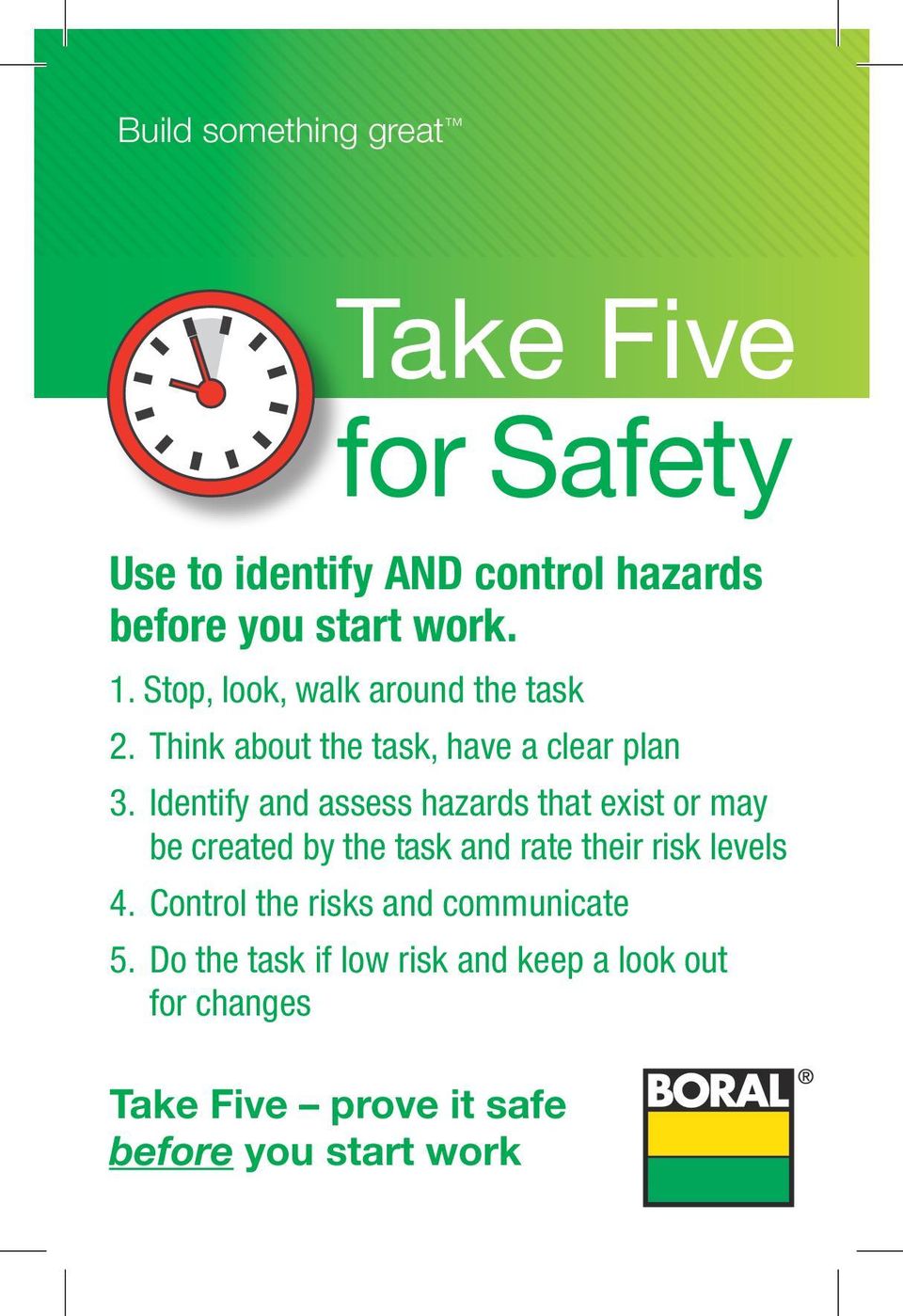
Take Five for Safety. Use to identify AND control hazards before you start work. Take Five prove it safe before you start work
|
|
|
- Hillary Freeman
- 10 years ago
- Views:
Transcription
1 Build something great Take Five for Safety Use to identify AND control hazards before you start work. 1. Stop, look, walk around the task 2. Think about the task, have a clear plan 3. Identify and assess hazards that exist or may be created by the task and rate their risk levels 4. Control the risks and communicate 5. Do the task if low risk and keep a look out for changes Take Five prove it safe before you start work
2 TABLE 1: Qualitative Measurement of the Max. Credible Outcome of an Event Value Description Impact 1 Incidental 2 Minor 3 Moderate Health: Illness or effect with limited or no impact on ability to function and treatment is not necessary. Safety: Injury such as First Aid, usually dealt with in house. Environment: discernable impact or measurable impairment on habitat, species or natural environment (air, water, land). Regulatory: risk of punitive actions, and any intervention limited to an observation. Community/Reputation: Isolated complaint from a local individual. Health: Mild illness or health effect which requires some treatment and/or has some functional impairment but is usually easily medically manageable Safety: One or more injuries which require treatment by a medical professional or as a hospital outpatient, but are not serious (e.g. no time lost) Environment: Localised and measurable short term impact on habitat, species or natural environment Regulatory: Risk of punitive action unlikely, and any intervention limited to field report (or similar). Community/Reputation: Clustering of complaints, and risk of local media interest. Health: Illness or significant adverse health effect needing; a high level of medical treatment or management. Safety: One or more injuries which are serious enough to result in lost time, non permanent disabling injuries, or overnight hospitalisation as an inpatient. Environment: Localised and measurable medium term impact on habitat, species or natural environment. Regulatory: Formal intervention, typically issuing af an Improvement notice at a site, and unlikely to escalate if complied with. Fine up to AUD 100K (or equivalent) without criminal proceedings. Community/Reputation: Coordinated community concern at a local level, and limited local media coverage. 4 Major 5 Severe Health: Illness or chronic exposure resulting in significant life impacting effects. Safety: Minor permanent disabling injury e.g. loss of finger(s) or extended temporary impairment and/or hospitalisation. Environment: Extensive and measurable medium term impact on habitat, species, or natural environment. Regulatory: Formal, high level intervention (e.g. prohibition notice) at a site, and risk of further interventions at other sites. Significant fine or penalty likely for Corporate (greater than AUD 100K or equivalent). Community/Reputation: Community alarm at regional level, and adverse and longer running local/regional media coverage. Health: Serious illness or chronic exposure resulting in fatality or significant life shortening effects. Safety: Death or significant permanently disabling injury e.g. blindness, loss of hand(s), quadriplegia. Environment: Destruction of important populations of habitat, species, or natural environment. Regulatory: Significant prosecution action, including risk to Company Officers. Community/Reputation: Widespread community unrest and/or adverse national/international media coverage.

3 TABLE 2: Qualitative Measurement of How Likely or Probable the Consequence Will Occur Level Consequence Outcome Description 1 Rare The consequence is not expected in Boral / Has never been heard of in the Industry. 2 Unlikely The consequence is possible in Boral / Has occurred in the Industry. 3 Possible The consequence is possible at a Boral workplace at some time in the foreseeable future (next 10 years) / Has happened at Boral in past 10 years / Occurs annually within the Industry. 4 Likely The event is expected at a site/local level in the foreseeable future (next few years) / Occurs within Boral more than once per year. 5 Almost Certain The event is expected to occur several times a year at a site/local level. TABLE 4: Hierachy of Control Control Description/Example 1 Elimination Is there a need to use the plant, process or substance that created the risk? 2 Substitution Can the hazardous item be substituted with another item that has less risk? 3 Isolation Can the hazard be isolated from the person (e.g. machine guards)? 4 Engineering Can the risk be minimised by redesigning the plant, substance or process (e.g. mechanical lifting aids, exhaust ventilation)? 5 Administrative E.g. job rotation, SOP, training and signs. 6 Personal Protective Equipment (PPE) TABLE 5: Priority for Action Risk Level E - Extreme Risk H - High Risk M - Medium L - Low Risk The least-desirable method which shall only be used in combination with other controls or if other controls are not suitable. PPE shall have it fitted correctly and be trained in its use and maintenance. Action Intolerable. Stop and seek specialist advice. Immediate interim risk reduction required. Tolerability to be endorsed by management. Additional long term risk reduction required. Tolerable, provided risk is ALARP (As Low As Reasonably Practicable). Tolerable and continual improvement required.

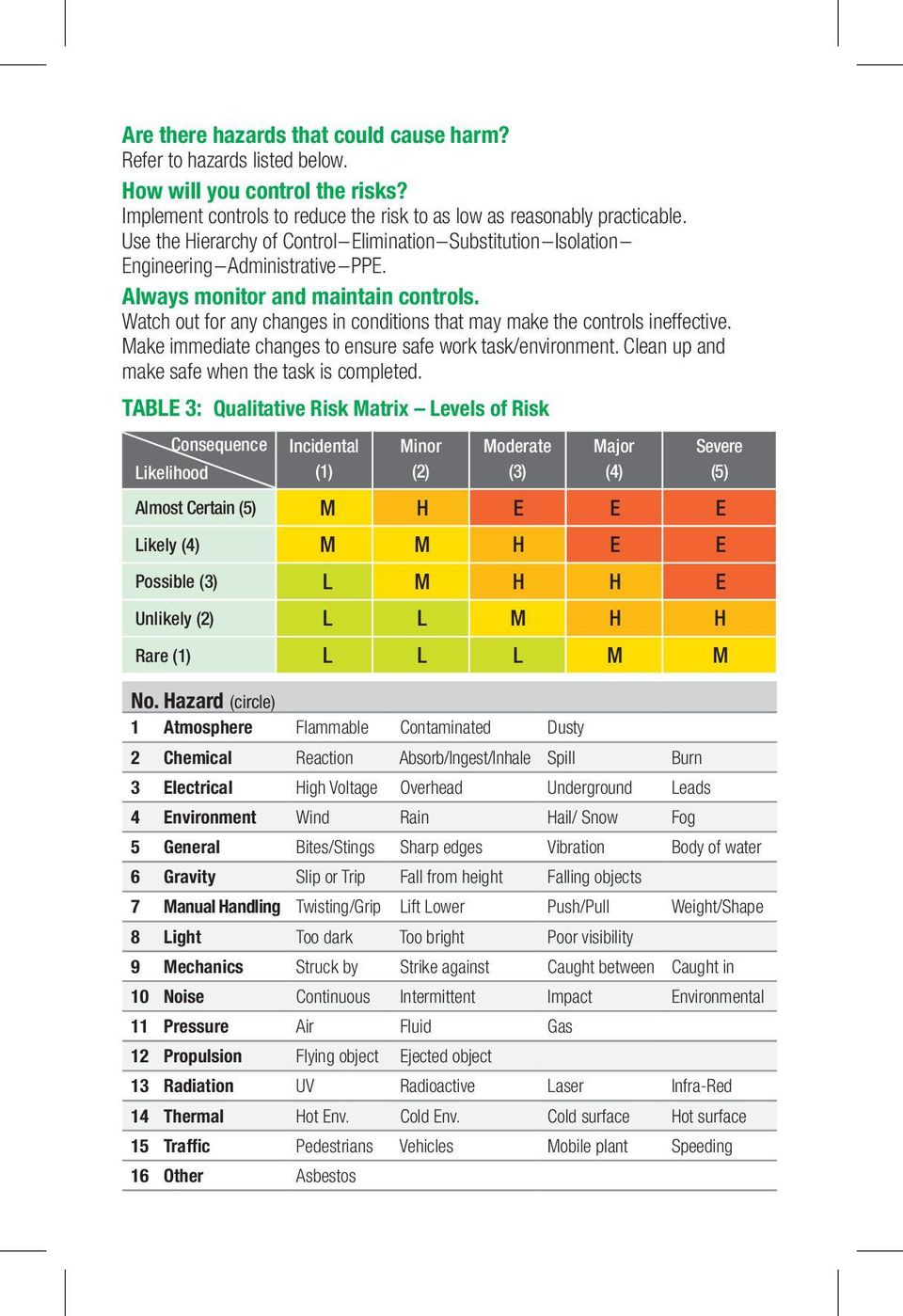
4 Are there hazards that could cause harm? Refer to hazards listed below. How will you control the risks? Implement controls to reduce the risk to as low as reasonably practicable. Use the Hierarchy of Control Elimination Substitution Isolation Engineering Administrative PPE. Always monitor and maintain controls. Watch out for any changes in conditions that may make the controls ineffective. Make immediate changes to ensure safe work task/environment. Clean up and make safe when the task is completed. TABLE 3: Qualitative Risk Matrix Levels of Risk Consequence Likelihood Incidental (1). Hazard (circle) 1 Atmosphere Flammable Contaminated Dusty 2 Chemical Reaction Absorb/Ingest/Inhale Spill Burn 3 Electrical High Voltage Overhead Underground Leads 4 Environment Wind Rain Hail/ Snow Fog 5 General Bites/Stings Sharp edges Vibration Body of water 6 Gravity Slip or Trip Fall from height Falling objects 7 Manual Handling Twisting/Grip Lift Lower Push/Pull Weight/Shape 8 Light Too dark Too bright Poor visibility 9 Mechanics Struck by Strike against Caught between Caught in 10 ise Continuous Intermittent Impact Environmental 11 Pressure Air Fluid Gas 12 Propulsion Flying object Ejected object 13 Radiation UV Radioactive Laser Infra-Red 14 Thermal Hot Env. Cold Env. Cold surface Hot surface 15 Traffic Pedestrians Vehicles Mobile plant Speeding 16 Other Asbestos Minor (2) Moderate (3) Major (4) Almost Certain (5) M H E E E Likely (4) M M H E E Possible (3) L M H H E Severe (5) Unlikely (2) L L M H H Rare (1) L L L M M
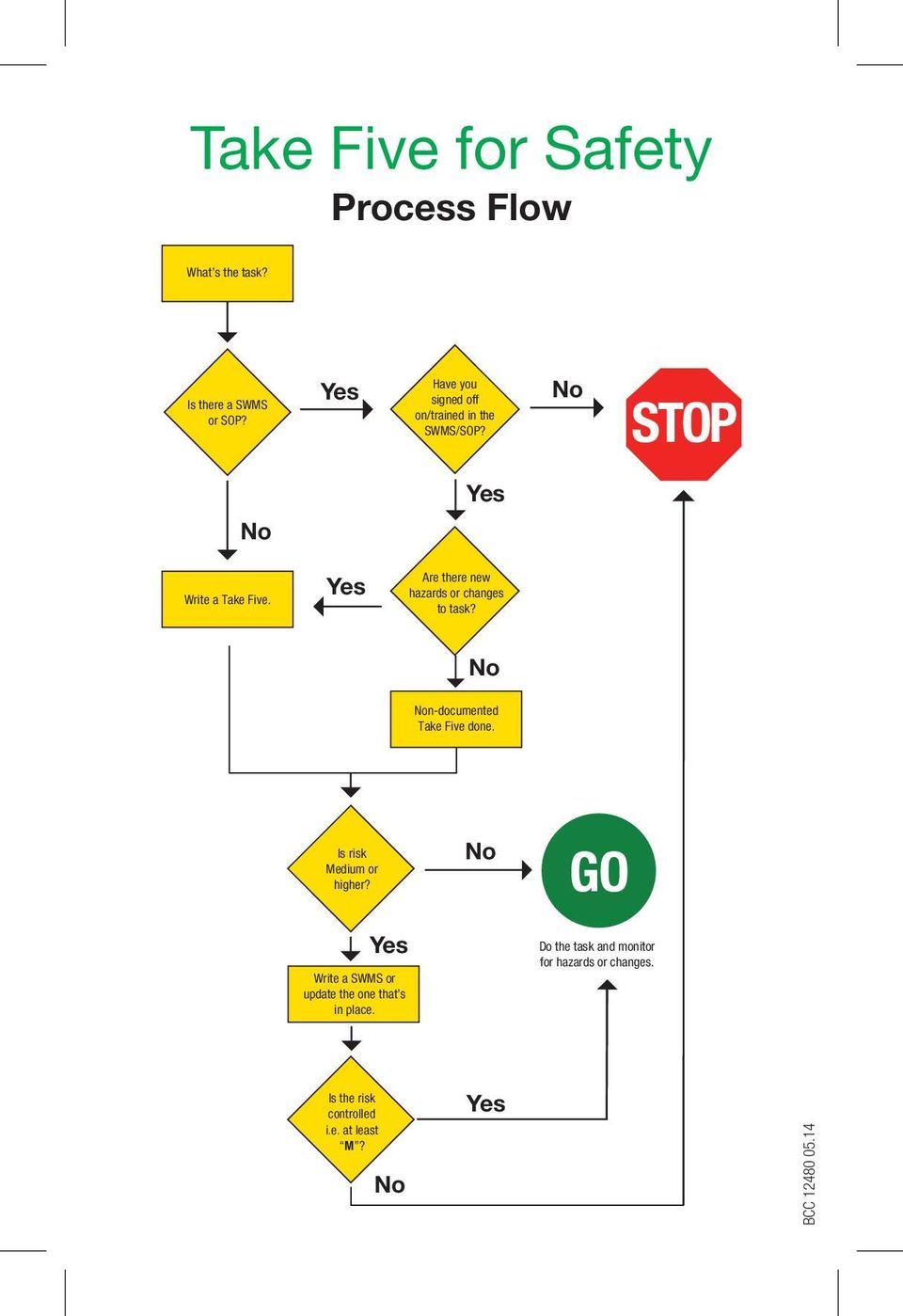
5 Take Five for Safety Process Flow What s the task? Is there a SWMS or SOP? Have you signed off on/trained in the SWMS/SOP? STOP Write a Take Five. Are there new hazards or changes to task? n-documented Take Five done. Is risk Medium or higher? GO Write a SWMS or update the one that s in place. Do the task and monitor for hazards or changes. Is the risk controlled i.e. at least M? BCC
Uncontrolled if Printed
 Hazard Table Hazard Types Any Hazard Kinetic / Mechanical Gravitational Thermal and/or Explosive Electrical Pressurised Chemicals / Substances Radiation Biological Manual Handling / Postural Noise and/or
Risk Assessment Tool (example only)
 HAZARD IDENTIFICATION & RISK ASSESSMENT TOOL Hazard identification You have an obligation to identify, assess and control any foreseeable hazards that may result as a consequence of your actions. If it
A Short Guide to The Safety, Health and Welfare at Work Act, 2005
 A Short Guide to The Safety, Health and Welfare at Work Act, 2005 3 A Short Guide to the Safety, Health and Welfare at Work Act, 2005 Published in August 2005 by the Health and Safety Authority, 10 Hogan
Hazard Identification, Risk Assessment And Control Procedure
 Hazard Identification, Risk Assessment And Control Procedure 1. Purpose 1.1 To ensure that there is a formal process for hazard identification, risk assessment and control to effectively manage hazards
Walk around and identify the area to be assessed and look at what could reasonably be expected to cause harm.
 Risk Assessment Introduction The assessment of risk is central to the management of health and safety. The purpose of this is to assist in identifying those measures which are needed to remove or otherwise
Step 4. Monitor / Review Control Measures
 Overview Step 1. Identify Hazards Step 2. Assess the Risks Assess the Likelihood & Consequences Classify the Risk Step 3. Control the Risks The hierarchy of risk control can be used as a guide Step 4.
Guidance on Risk Assessment and Control
 Guidance on Risk Assessment and Control Page 1 of 18 CONTENTS Section Page Executive Summary 2. FLOWCHART 4. 1. Introduction and Scope 5. Hierarchy of risk control 5. Definitions 5. 2. Related Documents
Hazard Identification, Risk Assessment and Control Procedure
 Hazard Identification, Risk Assessment and Control Procedure 1. Purpose To ensure that there is a formal process for hazard identification, risk assessment and control to effectively manage workplace and
RISK MANAGEMENT AND THE THE RISK ASSESSMENT METHOD STFC TRAINING MANUAL
 RISK MANAGEMENT AND THE THE RISK ASSESSMENT METHOD STFC TRAINING MANUAL Rev 1.4, Issued May 22, 2012 Author: G J Baker Issue No: 1.4 Issue Date: 22/05/2012 Page 2 of 16 CONTENTS INTRODUCTION... 3 FLOW
Risk assessment (appendix 2 of the Event Registration Form)
 Risk assessment (appendix 2 of the Event Registration Form) Event Name Date In the preparation of this risk assessment you must involve the following; internal and external event coordinators, stakeholders,
Basic Information / Risk Assessment General Part I II. http://hwi.osha.europa.eu
 Risk Assessment Tool Basic Information / Risk Assessment General Part I II http://hwi.osha.europa.eu 2 R I S K A S S E S S M E N T T O O L I B A S I C I N F O R M A T I O N & R I S K A S S E S S M E N
Hazard/Risk Identification and Control Procedure
 Hazard/Risk Identification and Control Procedure Introduction Hazard identification and the steps taken to minimize the risks associated with identified hazards are a critical component of working safely.
RISK MANAGEMENT POLICY
 DOCUMENT TYPE: DOCUMENT STATUS: POLICY OWNER POSITION: INTERNAL COMMITTEE ENDORSEMENT: APPROVED BY: Council policy Approved Manager Organisational Development Risk Management Committee Council DATE ADOPTED:
IOSH Working Safely MODULE 2: DEFINING HAZARD AND RISK. (Material correct Autumn 2013)
 IOSH Working Safely MODULE 2: DEFINING HAZARD AND RISK Sample material (Material correct Autumn 2013) RRC 27-37 St George s Road London SW19 4DS United Kingdom T +44 (0)20 8944 3100 F +44 (0)20 8944 7099
Six steps to Occupational Health and Safety
 Six steps to Occupational Health and Safety This booklet gives basic guidelines for workplace health and safety systems to help industry in NSW comply with the "duty of care" principle outlined in the
HAZARD & RISK MANAGEMENT PROCEDURE
 Introduction ATTAR is committed to providing a safe and healthy work environment for all employees. ATTAR also recognises its legal and moral obligation to provide and uphold so far as is practicable,
Workplace Safety and Health (Risk Management) Regulations
 A Guide to the Workplace Safety and Health (Risk Management) Regulations 1 Contents Introduction 2 Workplace Safety and Health (Risk Management) Regulations - Why is there a need for the Workplace Safety
Risk management a practical approach
 Risk management a practical approach Introduction Preventing work related accidents and injuries is the primary concern for all those involved in health and safety. Work related accidents and injuries
Title: OHS Risk Management Procedure
 Issue Date: July 2011 Review Date: July 2013 Page Number: 1 of 9 1. Purpose: To outline the methodology by which Department of Education and Early Childhood Development (DEECD) identifies, assesses, controls
6 STEPS TO RISK MANAGEMENT
 6 STEPS TO RISK MANAGEMENT Disclaimer This Guide provides general information about the obligations of persons conducting a business or undertaking and/or persons in control of premises and workers under
Conducting a Job Hazard Assessment. Environmental, Health and Safety 275-3241
 Conducting a Job Hazard Assessment Environmental, Health and Safety 275-3241 EH&S Programs: Fire Safety Blood Borne Pathogens Hazard Communication Personal Protective Equipment Emergency Preparedness General
Risk Assessment: An introduction
 Preamble The purpose of a risk assessment is to systematically identify all of the risks associated with a task, activity or process, and put appropriate controls in place to eliminate or reduce the risks
Occupational Health & Safety Practitioner. Reading PRINCIPLES OF ACCIDENT PREVENTION
 Occupational Health & Safety Practitioner Reading PRINCIPLES OF ACCIDENT PREVENTION January 2009 Contents OVERVIEW...1 SECTION 1: INTRODUCTION...1 SECTION 2: TECHNIQUES FOR ACCIDENT PREVENTION...4 SECTION
WHS Induction Series. 36 Toolbox Talks. Contents
 36 Toolbox Talks 3-5 minute toolbox talks for induction or refresher safety training. Having regular training programs that educate your workers about workplace issues has never been easier than now with
Injury Prevention for the Construction Industry
 Injury Prevention for the Workers in the construction industry encounter a variety of hazards, some of which can lead to serious injuries and fatalities. This fact sheet: Increases awareness of the primary
Risk Management & Assessment at UQ
 Risk Management & Assessment at UQ Course Overview: This training module has been developed for workers at the University of Queensland, and forms part of the OH&S training program at UQ. The aim of this
PLYMOUTH COLLEGE Risk Assessment: Policy Guidance
 PLYMOUTH COLLEGE Assessment PLYMOUTH COLLEGE Assessment: Policy Guidance 1 Scope This guidance is applicable to all those with responsibility for undertaking risk assessments for activities which are under
identify hazards, analyze or evaluate the risk associated with that hazard, and determine appropriate ways to eliminate or control the hazard.
 What is a risk assessment? Risk assessment is the process where you: identify hazards, analyze or evaluate the risk associated with that hazard, and determine appropriate ways to eliminate or control the
Mechanical Engineering
 RISK ASSESSMENT Mechanical Engineering January 2011 Mark Hoare Health and Safety Manager The University of Birmingham Course Content Introduction to health and safety How heath and safety is managed at
Hazard Identification and Preliminary Assessment (HIPA) Form
 HSF 01(b) Hazard Identification and Preliminary Assessment (HIPA) Form Evaluation This preliminary assessment creates a record of the known hazards and risks associated with a specific process / procedure
How to manage health and safety in small businesses
 How to manage health and safety in small businesses Do I need to read this? Are you a self-employed person? Do you own a business and employ staff or contractors? Do you want some influence over your ACC
Hazard Identification, Risk Assessment and Control Management
 The Paraplegic and Quadriplegic Association of SA Inc Hazard Identification, Risk Assessment and Control Management STATEMENT The Paraplegic and Quadriplegic Association of South Australia Incorporated
How To Prevent Accidents At Work
 2 Preventing vehicle accidents Construction work is considered to be one of the most hazardous industrial activities in the EU. The rate of injury in the construction industry is higher than in other industries.
How to Manage Hazards
 How to Manage Hazards FOR ROAD TRANSPORT If you are thinking about improving the health and safety of your workplace, hazard management is a good place to start. Why should you do this thing called hazard
ACCIDENT/INCIDENT REPORTING AND INVESTIGATION
 ACT PUBLIC SECTOR ACCIDENT/INCIDENT REPORTING AND INVESTIGATION 1. PURPOSE ACT Government Directorates and entities are required to report and investigate all workplace accidents and incidents and ensure
Safe Operating Procedure
 Safe Operating Procedure (Revised 11/11) JOB SAFETY ASSESSMENTS (For assistance, please contact EHS at (402) 472-4925, or visit our web site at http://ehs.unl.edu.) This SOP is intended for supervisors
SAFE WORK PROCEDURE SWP 015 WORKING AT HEIGHT SEPTEMBER 2013 DOC. NO. D13/248399
 Operation Brief Description of Activity Limitations MORELAND CITY COUNCIL Operations Centre 7-9 Walter Street Hadfield Vic 3046 Tel: 8311 4300 Working at height Approved by the Walter Street OHS committee
Sample Risk Management Policy and Procedure
 Sample Risk Management Policy and Procedure 1. Purpose and Scope This policy establishes the process for the management of risks faced by [organisation]. The aim of risk management is to maximise opportunities
5. Training All supervisors and other relevant staff will be trained in regard to this SOP.
 1. Purpose The purpose of this SOP is to provide a process for the management of workplace hazards and risks to minimise the potential for injury, adverse health effects, loss or damage due to workplace
WHS Contractor Management Procedure
 Procedure Approved: 09/07/2013 Next Review: 09/07/2015 1. Overview The District council of Mount Remarkable Council is committed to engaging quality Contractors who have a sound understanding and commitment
WORKING IN CONFINED SPACES GUIDELINES
 WORKING IN CONFINED SPACES GUIDELINES Contents 1 Introduction... 2 2 Scope... 2 3 Definitions... 2 4 Responsibilities... 3 4.1 Permit Authoriser... 3 4.2 Permit Receiver... 3 4.3 Responsible UOW Officer...
Risk Management Program March 2015
 AS/NZS 4801 OHSAS 18001 OHS20309 SAI Global Risk Management Program March 2015 Introduction Monash University s Victorian campuses are all governed by the Victorian OHS Act 2004 and its subordinate regulations
Policy: Accident & Injury Reporting Category: Operations. Authorized by: Joan Arruda, CEO
 Category: Operations Authorized by: Pages: 11 Date effective: Dec. 15, 2010 To be revised: Dec. 15, 2013 Revised: May 9, 2011 Joan Arruda, CEO POLICY This Policy and Procedure is intended to bring consistency
Workplace Injuries: Controls & Recordkeeping
 Workplace Injuries: Controls & Recordkeeping Health and Safety Management Professional Certificate in Human Resources Injuries, Controls & Recordkeeping Defining a workplace Injury Workplace Illnesses
APPENDIX 4. Risk Tables
 APPENDIX 4 Tables Preliminary Qualitative Criteria The qualitative risk assessment criteria have been developed to identify key risks to the environment, society, heritage and business reputation. The
EVENT RISK ASSESSMENT EXAMPLE / 04
 EVENT RISK ASSESSMENT EXAMPLE / 04 No matter the nature or size of your event, your event will have risks. It is your responsibility as the event organiser, to identify and manage these risks. Event organisers
TECHNICAL INFORMATION
 Page: 1/6 This checklist recognizes the major accident hazards found by experience of previous HAZID studies. It is not intended to be totally exhaustive and feedback from users should be incorporated
Risk and Hazard Management
 Risk and Hazard Management Models Z34/22 Safe 227 Maximum 10.4 Maximum 12.4 Z40/23 Working 227 Platform 12.2 Working 14.2 Z45/25 Load (kg) 227 Drive 13.7 Height (m) 15.7 Z51/30 227 Height (m) 15.5 17.5
OCCUPATIONAL HEALTH AND SAFETY RISK ASSESSMENT PROGRAM FOR AGRICULTURE
 OCCUPATIONAL HEALTH AND SAFETY RISK ASSESSMENT PROGRAM FOR AGRICULTURE Definitions of Commonly Used Terms in Risk Management Hazard: anything, including a work practice or procedure, that causes, or has
Risk Management. Policy
 Policy Risk Management Endorsed: 26 February 2014 Brief description The GPC Risk Management Policy and its supporting standards and procedures provide a framework to ensure that risks arising from our
Hazard Management Tool
 Hazard Management Tool Developed by the Workplace Safety and Insurance Board in collaboration with the Health and Safety Ontario members: Infrastructure Health and Safety Association Public Services Health
Elements of an Occupational Health and Safety Program
 Occupational Health and Safety Division Elements of an Occupational Health and Safety Program Table of Contents Introduction 3 What workplaces must have a program? 5 What criteria must the program meet?
Car Parking. A Health and Safety Perspective. David Bone
 Car Parking A Health and Safety Perspective David Bone Contents 1: Introduction 2: Legislation 3: Management Systems 4: Common Workplace Hazards Introduction HEALTH AND SAFETY Is a condition free from
RISK MANAGEMENT IN THE NATIONAL SYSTEM A PRACTICAL GUIDE
 RISK MANAGEMENT IN THE NATIONAL SYSTEM A PRACTICAL GUIDE RISK MANAGEMENT IN THE NATIONAL SYSTEM A PRACTICAL GUIDE Contents Introduction 2 Terms associated with risk management 3 The risk management process
GENERAL GUIDE FOR MANAGING CASH-IN-TRANSIT SECURITY RISKS
 1 This General Guide provides information on how to manage cash-in-transit security risks. It is supported by an Information Sheet for small business. What is cash-in-transit? Cash-in-transit activities
POLICY ON OCCUPATIONAL HEALTH AND SAFETY RISK MANAGEMENT
 THE NORTHCOTT SOCIETY POLICY ON OCCUPATIONAL HEALTH AND SAFETY RISK MANAGEMENT VOLUME: 2 Policy on Management and Organisational Issues SECTION: B Occupational Health & Safety & Workers Compensation SUB-SECTION:
SITE CONTRACTOR PROCEDURES
 SITE CONTRACTOR PROCEDURES Asset Collection Type B Assets are considered High risk ; the site activities must be in accordance with Graysonline contractor procedures and are to be collected by appointment
ELECTRICAL SAFETY RISK ASSESSMENT
 ELECTRICAL SAFETY RISK ASSESSMENT The intent of this procedure is to perform a risk assessment, which includes a review of the electrical hazards, the associated foreseeable tasks, and the protective measures
Five steps to risk assessment
 This leaflet aims to help you assess health and safety risks in the workplace A risk assessment is an important step in protecting your workers and your business, as well as complying with the law. It
Level 1 Award in Health and Safety in a Construction Environment
 Level 1 Award in Health and Safety in a Construction Environment Student notes (sample) www.britsafe.org Membership Training Qualifications Audit and Consultancy Audit and Policy Consultancy and Opinion
Slip, Trip & Fall Prevention Handbook
 Slip, Trip & Fall Prevention Handbook This prevention handbook provides you with a basic understanding of what causes a slip, trip or fall and gives you some ideas on what you can do to stop these incidents
Generic risk assessment form. This document forms part of Loughborough University s health and safety policy Version 3 February 2014
 Generic risk assessment form Date: (1) Assessed by: (2) Checked / Validated* by: (3) Location: (4) Assessment ref no (5) Review date: (6) Task / premises: (7) Activity (8) Significant hazard (9) Who might
COMPENDIUM OF TYPICAL HAZARDS ASSOCIATED WITH CNC MILLING AND THEIR CONTROL MEASURES IN THE CONSTRUCTION INDUSTRY CNC MILLING
 COMPENDIUM OF TYPICAL HAZARDS ASSOCIATED WITH CNC MILLING AND THEIR CONTROL MEASURES IN THE CONSTRUCTION INDUSTRY CNC MILLING No. Hazards Possible Control Measures Useful Links/Tips 1.1 Loose mounting
Risk Assessment Policy DIVISION OF HSE REVISION 6.1.15
 Risk Assessment Policy DIVISION OF HSE REVISION 6.1.15 Risk Assessment Policy Division of Safety & Environment Policy Number: 100.014 Employees Required: All Employees Training Date: Prior to 1 st Assignment
GEORGIA INSTITUTE OF TECHNOLOGY ENVIRONMENTAL HEALTH AND SAFETY PERSONAL PROTECTIVE EQUIPMENT
 PURPOSE To protect the health and welfare of GEORGIA TECH employees in areas where there may be a risk of injury or exposure to hazardous substances or conditions employees who work in areas where physical
Business & Legal Reports (BLR) Training. Workplace Safety Online Courses. Accident Investigations. Aerial Lift Safety
 Business & Legal Reports (BLR) Training Workplace Safety Online Courses COURSE TITLE Accident Investigations Aerial Lift Safety Americans with Disabilities Act - What Supervisors Need to Know Arc Flash
Five steps to risk assessment
 This leaflet aims to help you assess health and safety risks in the workplace A risk assessment is an important step in protecting your workers and your business, as well as complying with the law. It
Risk Management: Coordinated activities to direct and control an organisation with regard to risk.
 POLICY CG01 RISK MANAGEMENT Document Control Statement This Policy is maintained by the Governance and Organisational Strategy. Any printed copy may not be up to date and you are advised to check the electronic
Incident / Accident Report Form
 Incident / Accident Report Form This form is to be completed in the event of any incident whether injury has occurred or not. WORKERS SUBMIT FORM TO YOUR MANAGER VISITORS/CONTRACTORS/STUDENTS SUBMIT FORM
Hazard Identification, Risk Assessment & Control Program
 Hazard Identification, Risk Assessment & Control Program 1. INTRODUCTION Hazard Identification, Risk Assessment and Control The Nova Scotia Occupational Health and Safety Act, Capital Health Policies and
LAC 67-2 rev3 - Annex B
 LAC 67-2 rev3 - Annex B Risk Rating System 1. This guidance provides a simple four Category (A high risk; B1 and B2 - medium risk and C low risk) premises risk rating system based on a business s health
Rethinking Serious Injury and Fatality Prevention
 Rethinking Serious Injury and Fatality Prevention James Grant Vice President BST Larry Simmons, CMSP, CSP Senior Director, Safety & Health PotashCorp PotashCorp.com How Could This Happen? Four months ago
Workplace Safety & Health
 published by WORKPLACE SAFETY AND HEALTH COUNCIL Workplace Safety & Health 2008 (January - June) CONTENTS HIGHLIGHTS Highlights Overview Fatal Workplace Injuries 6 Permanent Disablements 8 Temporary Disablements
DIT HEALTH AND SAFETY OFFICE
 DIT HEALTH AND SAFETY OFFICE PROCEDURE TITLE Risk Assessment Procedure REVISION NO.: 5 NUMBER OF PAGES: 8 REFERENCE: Parent Health and Safety Statement Risk Assessment Template (DITRAT) Safety Inspection
Rutherford County Workplace Injuries and Safety
 Rutherford County Workplace Injuries and Safety In safety, we concern ourselves not just with the tasks but how we accomplish the task. Objectives Course Outline: Become familiar with workplace injuries
Accident Causes and Preventions. Safety Control Division Occupational Safety and Health Center
 Accident Causes and Preventions Safety Control Division Occupational Safety and Health Center Global OSH Data: ILO Report Every year, 337 million workers fall victims of occupational accidents and diseases
No. Name of Legislation Applicable Issues and Requirements Demonstration of Compliance 1. Health and Safety at Work Act 1974
 The Police Treatment Centres Health and Safety Legal Compliance Register No. Name of Legislation Applicable Issues and Requirements Demonstration of Compliance 1. Health and Safety at Work Act 1974 2.
Lone Working Guidance
 Document control information Published document name: loneworking-gn.pdf Date issued: October 2013 Version: 8.0 Previous review dates: Next review date: Related documents: Governing policy: Guidance to
WORKING AT HEIGHT GUIDELINES. Version II
 WORKING AT HEIGHT GUIDELINES Version II 21 st September 2011 WORKING AT HEIGHT GUIDELINES EXECUTIVE SUMMARY Working at height is where an individual is carrying out work in any place in the course of obtaining
Example risk assessment for a motor vehicle mechanical repair workshop
 Example risk assessment for a motor vehicle mechanical repair workshop Setting the scene The garage manager did the risk assessment. The business employed 12 mechanics, including two apprentices who carried
Risk Assessment Tool and Guidance (Including guidance on application)
 Risk Assessment Tool and Guidance (Including guidance on application) Document reference number Revision number OQR012 Document developed by 5 Document approved by Revision date October 2011 Responsibility
DRAFT FOR CONSULTATION
 DRAFT FOR CONSULTATION Health and Safety at Work (General Risk and Workplace Management) Regulations 2015 Governor-General Order in Council At Wellington this day of 2015 Present: in Council Pursuant to
Entry Level Award in Workplace Hazard Awareness
 Entry Level Award in Workplace Hazard Awareness Student resource sheets www.britsafe.org Membership Training Qualifications Audit and Consultancy Audit and Policy Consultancy and Opinion Policy Awards
WORKPLACE SAFETY. Table 1: Industries with highest fatalities rates and types of highest fatal* / non fatal^ injuries
 INTERISK ASIA PTE LTD. July 2011 WORKPLACE SAFETY Do you know that the workplace safety is part of everyone s responsibility? And so how many of us are assessing workplace safety naturally like it is part
INCIDENT/ACCIDENT/INJURY REPORTING AND INVESTIGATION
 BOARD PROCEDURE Approval Date 2014 Review Date 2019 Contact Person/Department Human Resources Administrator Replacing All previous procedures Page 1 of 11 Identification HR - 4208 INCIDENT/ACCIDENT/INJURY
Laboratory Work Risk Assessment
 1. Introduction Laboratory Work Risk Assessment The legislation governing Hazardous Substances and Dangerous Goods requires that all operations and experiments involving hazardous materials must have documentation
WHS Contractor Management Procedure
 Wudinna District Council 1. Overview Wudinna District Council as part of its commitment under its Policy recognises its obligation to: Ensure, so far as is reasonably practicable, the health and safety
Electrical Safety in the Workplace
 Electrical Safety in the Workplace NFPA 70 E Presented by Sabine Mueller What Made Sabine Choose Such a DRY Topic? Ulterior Motive Metso Mueller Engineering has been visiting many scrap yards two or more
Workplace Transport Safety Reversing Vehicles Information Sheet What are the dangers associated with reversing vehicles? Why is reversing a problem?
 Workplace Transport Safety Reversing Vehicles Information Sheet This information sheet aims to raise awareness of the dangers caused by reversing vehicles in the workplace. It provides basic information,
Completed by: Technical Staff & Academic Staff. Adel Mitry, Michael Morris, Meloni Muir, Sharon Herkes, Isabel Arnaiz. Current version 01
 Completed by: Technical Staff & Academic Staff WHS Risk assessment and control form Adel Mitry, Michael Morris, Meloni Muir, Sharon Herkes, Isabel Arnaiz For additional information refer to Risk Assessment
E3902 Seeing Accidents Before They Happen Leader s Guide
 E3902 Seeing Accidents Before They Happen Leader s Guide ERI PRODUCTIONS INC. SEEING ACCIDENTS BEFORE THEY HAPPEN This easy-to-use Leader s Guide is provided to assist in conducting a successful presentation.
Procedure for Working in or around Excavations
 RMS WHS Procedure: PN 066P12 (for Policy No. PN066) Procedure for Working in or around 1 of 15 Contents 1 Purpose... 3 2 Scope... 3 3 General requirements... 4 4 Definitions... 4 5 Responsibilities...
Accident, Injury & Illness Program Training
 CITY OF PHILADELPHIA RISK MANAGEMENT DIVISION Safety Directive #A-8 Revision #1 Title: Accident, Injury & Illness Program Training Purpose Training is one of the most important elements of any safety &
Activity risk assessment Assessment title: New Generic Office environment
 Activity risk assessment Assessment title: New Generic Office environment Assessment N o Location: CASS (Generic Assessments) 159838 Local Rules & Procedures for completing Risk Assessments I Confirm I
Safety Systems Review Facilities Management Guidance and specification Version 1 2014
 Safety Systems Review Facilities Management Guidance and specification Version 1 2014 Membership Training Qualifications Audit and Consultancy Policy and Opinion Awards Contents Page Safety Systems Review
Static, Hazard & Risk Assessment of Mobile Plant
 Static, Hazard & Risk Assessment of Mobile Plant Company Name ELITE ROADS Make / Model BOBCAT S130 Meter Reading: 511 Skidsteer Loader Plant Registration or ID. Assessed by GREG CORNELL 03 9763 5449 Assessed