
HID Real-Time PCR Analysis Software
|
|
|
- Emily Copeland
- 9 years ago
- Views:
Transcription
1 USER GUIDE HID Real-Time PCR Analysis Software Version 1.2 for use with: 7500 Real-Time PCR Instruments Quantifiler DNA Quantification Kits Publication Number MAN Revision C.0 For Research, Forensic, Paternity and Cell Line Authentication. Not for use in Diagnostic and Therapeutic applications.

2 The information in this guide is subject to change without notice. DISCLAIMER TO THE EXTENT ALLOWED BY LAW, LIFE TECHNOLOGIES AND/OR ITS AFFILIATE(S) WILL NOT BE LIABLE FOR SPECIAL, INCIDENTAL, INDIRECT, PUNITIVE, MULTIPLE, OR CONSEQUENTIAL DAMAGES IN CONNECTION WITH OR ARISING FROM THIS DOCUMENT, INCLUDING YOUR USE OF IT. Limited Use Label License No. 540: Sequencing or Fragment Analysis Intellectual Property for Human Identity Testing Software: Notice to Purchaser: No right to resell this software product, any upgrades, modified versions, updates, additions, copies, or any of its components is conveyed expressly, by implication, or by estoppel. This software product may be used to perform internal research and development for the sole benefit of the purchaser; provided, however, that Life Technologies Corporation ("LTC") does not convey any right or license, whether expressly, by implication, by estoppels, or otherwise, under any LTC patents that claim DNA sequencing or fragment analysis methods, to the purchaser by the purchase of this software product to use such DNA sequencing or fragment analysis methods. This software product is not for use in commercial applications of any kind, including, without limitation, quality control and commercial services such as reporting the results of purchaser's activities for a fee or other form of consideration, except as follows. A limited license to use the DNA sequencing or fragment analysis methods covered by such patents can be obtained for certain research and development activities (a) through the purchase of certain LTC reagents that convey rights for commercial use (e.g., LTC kits for performing human identity testing and LTC kits for performing in vitro diagnostics testing) when such reagents are used on an authorized LTC instrument, or (b) directly from LTC. In addition, LTC grants the purchaser a limited right to use this software product in conjunction with: (1) a second product purchased from LTC or that conveys rights for commercial use (e.g., LTC kits for performing human identity testing and LTC kits for performing in vitro diagnostics testing) and (2) an authorized LTC instrument that conveys rights for commercial use to perform services on a fee per test or contract basis. For information on obtaining additional rights, please contact [email protected] or Out Licensing, Life Technologies, 5791 Van Allen Way, Carlsbad, California TRADEMARKS All trademarks are the property of Thermo Fisher Scientific and its subsidiaries unless otherwise specified. TaqMan is a registered trademark of Roche Molecular Systems, Inc, TaqMan used under permission and license. Microsoft, Windows, PowerPoint, and Excel are registered trademarks of Microsoft Corporation. Adobe, Acrobat, and Reader are registered trademarks of Adobe Systems, Inc. Pentium and Intel are registered trademarks and Core is a trademark of Intel Corporation Thermo Fisher Scientific Inc.. All rights reserved.

3 Contents About This Guide Purpose Revision history CHAPTER 1 Get Started Software overview Features in v Install or upgrade to v Calibrate the Instrument CHAPTER 2 Customize the Software Modify a default experiment template Create an experiment template Link your template to a Home screen button Set display defaults CHAPTER 3 Select the Experiment and Set Up a Plate HID Real-Time PCR Analysis Software workflow Start the software and select an experiment Navigate the software Specify experiment properties Define samples and view targets Assign the targets, samples, and standards to wells Save plate layout as *.eds or template Link your template to a Home screen button CHAPTER 4 Run the Plate View the run method Set notifications Start or stop the run Monitor the run Save the results HID Real-Time PCR Analysis Software v1.2 Getting Started Guide 3

4 Contents CHAPTER 5 Select Analysis Settings and Thresholds Open analysis settings View/Edit C T settings Enter HID settings Enter Flag settings CHAPTER 6 Enhance Data Analysis View the analysis results Interpret QC flag information Omit wells from analysis Omit targets in an experiment well Examine the Degradation Index Change the appearance of, print, and save plots CHAPTER 7 Export and Report Results Overview Export data Print a report CHAPTER 8 Generate Dilution and Reaction Worksheets for STR Setup Overview Add kits to an experiment Select unknown samples for amplification Edit dilution settings for individual samples View the dilution scheme Export dilution and reaction worksheets Save new STR Kit information from an experiment into STR Kit Library CHAPTER 9 HID Real-Time PCR Analysis Software Validation Introduction Materials and methods Experiments and results Conclusions APPENDIX A Configure STR Library and Default Dilution Settings Configure the STR Kit Library HID Real-Time PCR Analysis Software v1.2 Getting Started Guide

5 Contents Documentation and Support How to use your documentation Obtaining related documentation Obtaining information from the Help system Obtaining support Limited product warranty Index HID Real-Time PCR Analysis Software v1.2 Getting Started Guide 5

6 Contents 6 HID Real-Time PCR Analysis Software v1.2 Getting Started Guide

7 About This Guide Purpose The 7500 Real-Time PCR System and HID Real-Time PCR Analysis Software detects and quantifies human and/or male DNA in samples. This guide is intended to help you quickly learn how to use the HID Real-Time PCR Analysis Software to perform analysis of samples prepared with the: Quantifiler HP DNA Quantification Kit Quantifiler Trio DNA Quantification Kit Quantifiler Human DNA Quantification Kit Quantifiler Duo DNA Quantification Kit Quantifiler Y Human Male DNA Quantification Kit This guide assumes that: You are familiar with the Microsoft Windows operating system, the Internet, and Internet browsers. You know how to handle DNA samples and prepare them for PCR. Use this guide after your plate is prepared and loaded in the 7500 Real-Time PCR System. For instructions on preparing a plate, refer to the user guide for the Quantifiler Kit you are using. Revision history Revision Description Date A.0 New document for version 1.2 features (support for Quantifiler Trio and HP DNA Quantification Kits; Degradation Index). Incorporates all information from the HID Real-Time PCR Analysis Software v1.1 User Guide (Pub. no ) B.0 Added Chapter 9, HID Real-Time PCR Analysis Software Validation on page 65. January 2014 March 2014 HID Real-Time PCR Analysis Software v1.2 Getting Started Guide 7

8 About This Guide Revision history Revision Description Date C.0 Correct quencher listed for Quantifier Duo and Quantifier Male or Human kits. Add reference to evaluating the quality indices determined by the HID Real-Time PCR Software to determine if highly degraded samples can be better analyzed with the Ion Personal Genome Machine (PGM ) System, refer to the Quantifiler HP and Trio DNA Quantification Kits User Guide. July HID Real-Time PCR Analysis Software v1.2 Getting Started Guide

9 CHAPTER 1 1 Get Started This chapter covers: Software overview Features in v Install or upgrade to v Calibrate the Instrument Software overview HID Real-Time PCR Analysis Software is designed specifically to assist human identification laboratories performing DNA quantitation, by simplifying assay setup and streamlining data review and dilution and reaction setup for downstream STR analysis. For example, the software automatically selects the appropriate Quantifiler Kit target, reporter, quencher, and thermal profile. After a run, the HID Real-Time PCR Analysis Software provides an analysis of each well. The software exports: All results STR kit setup instructions Sample dilutions calculations HID Real-Time PCR Analysis Software is for use with the 7500 Real-Time PCR Instrument only. Applicable HID kits You can use the HID Real-Time PCR Analysis Software with the following kits: Quantifiler HP DNA Quantification Kit Quantifiler Trio DNA Quantification Kit Quantifiler Human DNA Quantification Kit Quantifiler Duo DNA Quantification Kit Quantifiler Human Male DNA Quantification Kit Custom experiment option You can also use the HID Real-Time PCR Analysis Software for more complex experiments by selecting the Custom Assay option on the Home screen. If you use the Custom Assay option, refer to the Applied Biosystems 7500/7500 Fast Real-Time PCR System Getting Started Guide for Standard Curve Experiments for instructions. HID Real-Time PCR Analysis Software v1.2 Getting Started Guide 9

10 1 Chapter 1 Get Started Features in v1.2 Features in v1.2 HID Real-Time PCR Analysis Software v1.2 includes all of the v1.1 functionality and includes the following new features: Support for Microsoft Windows 7 operating system Experiment templates for new Quantifiler DNA Kits: Quantifiler HP and Trio Kits Updated STR library preloaded with additional STR kits: AmpFlSTR Identifiler Plus PCR Amplification Kit (28 and 29 cycles) AmpFlSTR NGM PCR Amplification Kit (29 and 30 cycles) AmpFlSTR NGM SElect PCR Amplification Kit (29 and 30 cycles) GlobalFiler PCR Amplification Kit Degradation Index for use in conjunction with IPC C T to evaluate potential DNA degradation and/or presence of PCR inhibitors that could affect STR analysis Simplified default display for the Well Table view Install or upgrade to v1.2 Refer to the 7500/7500 Fast Real-Time PCR System Site Preparation Guide (Pub. no ) for system layout, electrical, power, safety, and other site requirements. Computer and instrument requirements Component Computer Software Recommended Requirements Processor (minimum speed: 2.7 GHz): Core 2 Duo CPU E GHz *2 or Intel Core i7-2620m CPU 2.7 GHz *2 1 GB RAM 1 One hard drive with at least 10 GB available 20/48X IDE CD-ROM drive USB v1.2 Ethernet network interface adapter (10BASE-T) 2 Operating system: Microsoft Windows XP 32 bit, Service Pack 3 or later Microsoft Windows 7 64 bit/32 bit, Service Pack 1 or later Microsoft PowerPoint software (for direct export of PowerPoint slides) Microsoft Excel software (for direct export of data to spreadsheet) IMPORTANT! Do not run antivirus applications while HID Real-Time PCR Analysis Software v1.2 is running. 10 HID Real-Time PCR Analysis Software v1.2 Getting Started Guide

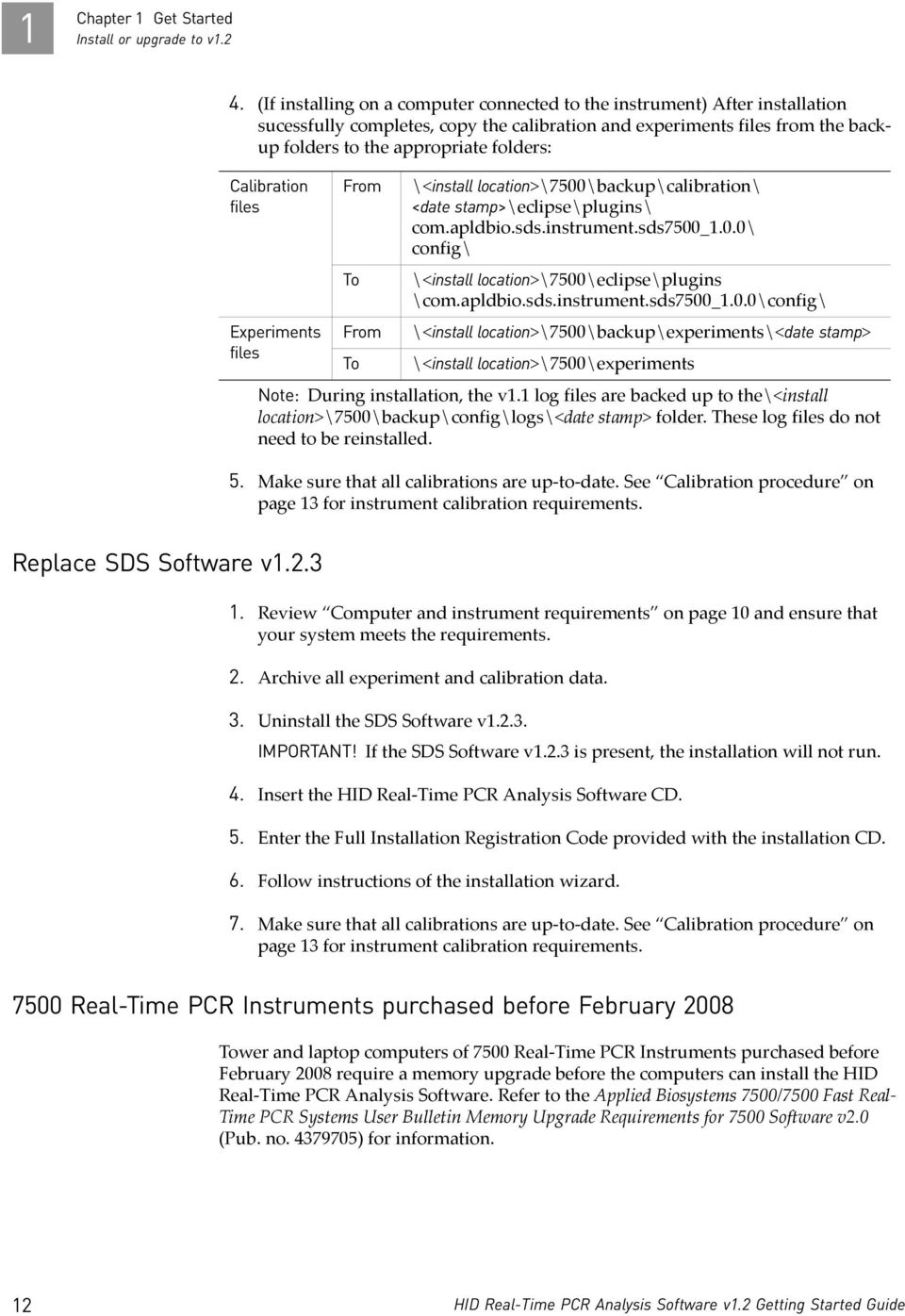
11 Chapter 1 Get Started Install or upgrade to v1.2 1 Component Recommended Requirements Monitor pixel resolution for full screen display 3 16-inch True Color (32 bit) UL listed Instrument Instrument firmware G2.10 (installed on all instruments purchased after 2008) If your instrument was purchased before 2008, check the version of firmware installed by going to x:/applied Biosystems/7500 system/firmware. The example below shows firmware G2.09. Contact Life Technologies if your firmware version is not G The software may experience communication errors if run on computers with less than 1 GB. 2 Required only if you plan to connect the computer to a local area network (LAN). 3 If screen resolution is not set to 1280 X 1024, the Analysis Summary screen may not be properly displayed. Install with new instrument If the HID Real-Time PCR Analysis Software is installed with a new 7500 Real-Time PCR System, both the instrument and the software must be installed by an Life Technologies technical representative. If you have the instrument but no 7500 Software installed, you can install v1.2 directly. Insert the HID Real-Time PCR Analysis Software CD and follow the Installation Wizard instructions. Upgrade from v1.1 to v1.2 IMPORTANT! Do not uninstall v1.1 before following this procedure. If v1.1 is not present, the upgrade will not run. IMPORTANT! You must have Administrator privileges to perform this upgrade. 1. Insert the HID Real-Time PCR Analysis Software v1.2 CD. The v1.2 upgrade installer automatically backs up the v1.1 calibration, experiments, and log files, then uninstalls v1.1. After the v1.2 software installation is complete, you can restore the backed-up files to the appropriate folders as described in step Follow the Installation Wizard instructions. Note: If installing on a computer connected to the instrument, make sure that you enter the same instrument serial number that was entered when v1.1 was installed. 3. Enter the Upgrade Registration Code provided with the installation CD. Do not enter any spaces between the numbers in the registration code. HID Real-Time PCR Analysis Software v1.2 Getting Started Guide 11

12 1 Chapter 1 Get Started Install or upgrade to v (If installing on a computer connected to the instrument) After installation sucessfully completes, copy the calibration and experiments files from the backup folders to the appropriate folders: Calibration files Experiments files From To From To \<install location>\7500\backup\calibration\ <date stamp>\eclipse\plugins\ com.apldbio.sds.instrument.sds7500_1.0.0\ config\ \<install location>\7500\eclipse\plugins \com.apldbio.sds.instrument.sds7500_1.0.0\config\ \<install location>\7500\backup\experiments\<date stamp> \<install location>\7500\experiments Note: During installation, the v1.1 log files are backed up to the\<install location>\7500\backup\config\logs\<date stamp> folder. These log files do not need to be reinstalled. 5. Make sure that all calibrations are up-to-date. See Calibration procedure on page 13 for instrument calibration requirements. Replace SDS Software v Review Computer and instrument requirements on page 10 and ensure that your system meets the requirements. 2. Archive all experiment and calibration data. 3. Uninstall the SDS Software v IMPORTANT! If the SDS Software v1.2.3 is present, the installation will not run. 4. Insert the HID Real-Time PCR Analysis Software CD. 5. Enter the Full Installation Registration Code provided with the installation CD. 6. Follow instructions of the installation wizard. 7. Make sure that all calibrations are up-to-date. See Calibration procedure on page 13 for instrument calibration requirements Real-Time PCR Instruments purchased before February 2008 Tower and laptop computers of 7500 Real-Time PCR Instruments purchased before February 2008 require a memory upgrade before the computers can install the HID Real-Time PCR Analysis Software. Refer to the Applied Biosystems 7500/7500 Fast Real- Time PCR Systems User Bulletin Memory Upgrade Requirements for 7500 Software v2.0 (Pub. no ) for information. 12 HID Real-Time PCR Analysis Software v1.2 Getting Started Guide
13 Chapter 1 Get Started Calibrate the Instrument 1 Calibrate the Instrument If you... Installed HID Real-Time PCR Analysis Software v1.2 with a new instrument Upgraded from HID Real-Time PCR Analysis Software v1.1 Replaced SDS Software v1.2.3 Perform... Perform all calibrations and run the RNase P plate After restoring v1.1 calibration files (see Upgrade from v1.1 to v1.2 on page 11), perform Custom Dye calibration to calibrate ABY, JUN and Mustang Purple (MP) dyes. Perform all calibrations and run the RNase P plate Required materials Table 1 lists the materials needed to perform the instrument calibration. Table 1 User-supplied materials If you... Material Cat. no. Replaced SDS Software v Real Time PCR Systems Spectral Calibration Kit I TaqMan RNase P Instrument Verification Plate Upgraded from HID v1.1 or 96-Well Spectral Calibration Plate with ABY Dye Well Spectral Calibration Plate with JUN Dye Replaced SDS v Well Spectral Calibration Plate with Mustang Purple Dye Calibration procedure Below is an outline of the calibration procedure. Refer to Applied Biosystems 7500/ 7500 Fast Real-Time PCR Systems System Maintenance (Pub. no ) for complete instructions. Perform: Regions of Interest (ROI) calibration Background Calibration Optical Calibration Dye Calibration: Perform Dye Calibration of the new ABY, JUN and Mustang Purple (MP) dyes. Follow the custom dye procedure. Perform Dye Calibration of all system dyes for new instrument installations, or if replacing SDS v Use 60 C as the default temperature for all dye calibration RNase P Instrument Verification Plate run HID Real-Time PCR Analysis Software v1.2 Getting Started Guide 13

14 1 Chapter 1 Get Started Calibrate the Instrument New dye spectra Figure 1 through Figure 3 show the calibration spectra for ABY, JUN and Mustang Purple (MP) dyes. Figure 1 ABY dye spectra Figure 2 JUN dye spectra 14 HID Real-Time PCR Analysis Software v1.2 Getting Started Guide

15 Chapter 1 Get Started Calibrate the Instrument 1 Figure 3 Mustang Purple (MP) dye spectra HID Real-Time PCR Analysis Software v1.2 Getting Started Guide 15

16 1 Chapter 1 Get Started Calibrate the Instrument 16 HID Real-Time PCR Analysis Software v1.2 Getting Started Guide

17 CHAPTER 2 2 Customize the Software This chapter covers: Modify a default experiment template Create an experiment template Link your template to a Home screen button Set display defaults Modify a default experiment template You can make changes to the experiment templates provided with the software after making a backup copy of the original templates. Save a copy of the original template Before you modify a template, save a copy of the original template: 1. Navigate to C:\Applied Biosystems\7500\config\templates. 2. Select Edit Copy to copy the folder C:\Applied Biosystems\7500\config\templates. 3. Navigate to a safe location on your computer. 4. Select Edit Paste to insert a copy of the templates folder in the location you select. Modify the original template 1. Click the button on the Home screen for the experiment type of interest. 2. Modify the template as needed, including: Moving standards and NTCs to different wells Adding samples and/or extraction blanks Setting plate layout Setting the display defaults for the Amplification plot, plate view, and well table Modifying analysis settings (HID, CT, and Flags) 3. Click the down arrow next to Save in the toolbar, then in the drop-down list, then select Save as, then select the name of the original template. HID Real-Time PCR Analysis Software v1.2 Getting Started Guide 17

18 2 Chapter 2 Customize the Software Create an experiment template Create an experiment template 1. Set up an experiment with the desired settings, including: Moving standards and NTCs to different wells Adding samples and/or extraction blanks Setting plate layout Setting the display defaults for the Amplification plot, plate view, and well table Modifying analysis settings (HID, CT, and Flags) 2. Click the down arrow next to Save in the toolbar, then select Save as Template. To use your template instead of a default template, click Open at the top of the Home screen, then select your template instead of clicking a button for an experiment type. Link your template to a Home screen button You can link your template to the any of the Quantifiler assay icons on the Home screen for: The software will automatically use the template as the default experiment when you click the corresponding button. You will still be able to use a different template by opening a different experiment. 1. Before you link your template file to a button on the Home screen, save a copy of the original template: a. Navigate to C:\Applied Biosystems\7500\config\templates. b. Select Edit Copy to copy the folder C:\Applied Biosystems\7500\config\templates. c. Navigate to a safe location on your computer. d. Select Edit Paste to insert a copy of the templates folder in the location you select. 2. Link your template to a button on the Home screen: a. In the toolbar, from the file that you want to link, click the down arrow next to Save. b. In the drop-down menu, select Save as Template. c. Navigate to C:\Applied Biosystems\7500\config\templates. 18 HID Real-Time PCR Analysis Software v1.2 Getting Started Guide

19 Chapter 2 Customize the Software Set display defaults 2 d. Select the file corresponding to the assay button that you want to replace. IMPORTANT! Be sure to give the file exactly the same name as the file corresponding to the button that you want to replace. e. Click Save. Set display defaults Select information to display in the Plate View 1. Click Show in Wells to open the drop-down list. 2. Click the checkbox next to an item of data to select ( ) the item for display or to deselect it ( ). 3. Click Set as Default (this button is dimmed before you change a setting, or if you are logged in as Guest). Specify the information to display in the Well Table 1. Click Show in Table to open the drop-down list. 2. Click the checkbox next to an item of data to select ( ) the item for display or to deselect it ( ). 3. Click Set as Default (this button is dimmed before you change a setting, or if you are logged in as Guest). Customize the amplification plot 1. Make changes as described in Change the appearance of, print, and save plots on page Click the checkbox next to an item of data to select ( ) the item for display or to deselect it ( ). 3. Click Save Current Settings as Default (this button is dimmed before you change a setting, or if you are logged in as Guest). HID Real-Time PCR Analysis Software v1.2 Getting Started Guide 19

20 2 Chapter 2 Customize the Software Set display defaults 20 HID Real-Time PCR Analysis Software v1.2 Getting Started Guide

21 CHAPTER 3 3 Select the Experiment and Set Up a Plate This chapter covers: HID Real-Time PCR Analysis Software workflow Start the software and select an experiment Navigate the software Specify experiment properties Define samples and view targets Assign the targets, samples, and standards to wells Save plate layout as *.eds or template Link your template to a Home screen button This chapter assumes that you have prepared a plate according to the instructions in the user guide for the Quantifiler Kit you are using. HID Real-Time PCR Analysis Software v1.2 Getting Started Guide 21
22 3 Chapter 3 Select the Experiment and Set Up a Plate HID Real-Time PCR Analysis Software workflow HID Real-Time PCR Analysis Software workflow Set up a Quantifiler chemistry kit plate and load in the instrument. HID Real-Time PCR Analysis Software Select the experiment and set up a plate: 1. Start the software. 2. Start a new experiment. 3. Specify experiment properties. 4. Define samples and assign targets, samples, and standards to wells. 5. Save the experiment. Run the plate. Select analysis settings and thresholds: HID settings (includes HID flags) Flag settings Review results: 1. View analysis summary. 2. View quantitation results. Export and print results. Generate dilution and reaction worksheets for STR set up: 1. Configure STR Library and default dilution settings. 2. Add kits to an experiment. 3. Select the unknown samples for amplification. 4. Edit dilution settings for individual samples as needed. 5. Export dilution and reaction worksheets. Perform PCR amplification. 22 HID Real-Time PCR Analysis Software v1.2 Getting Started Guide
23 Chapter 3 Select the Experiment and Set Up a Plate Start the software and select an experiment 3 Start the software and select an experiment 1. On your desktop, double-click or select Start All Programs Applied Biosystems HID Real-Time PCR Analysis Software to open the Login Screen. The screen should open within 1 minute. 2. In the User Name field, enter your user name or select it from the drop-down list. You can log in as a guest, but only users logged in with a user name can: Edit the names of folders for experiment information import, information export, or data. Enable or disable the requirement to enter a user name to start the software. Set a plate layout as the default layout (See Link your template to a Home screen button on page 33). Configure how data is displayed (see Chapter 2, Customize the Software ). 3. Click OK to open the Home screen with icons for HID and Custom Assays as shown. Quantifiler assays Custom assays HID Real-Time PCR Analysis Software v1.2 Getting Started Guide 23
24 3 Chapter 3 Select the Experiment and Set Up a Plate Navigate the software 4. Choose an HID experiment: Click one of the HID template icons: Quantifiler HP Quantifiler Trio Quantifiler Duo Quantifiler Male Quantifiler Human Quantifiler Male & Human (hybrid plate) or In the toolbar, click the down arrow next to New Experiment to open the drop-down list and select the appropriate experiment. For custom experiments To perform a non-hid experiment, or a modified experiment, click: Custom Assay on the right side of the Home screen. or Assays in the toolbar, then select Custom Assays in the drop-down list. For information on running custom experiments, refer to the 7500/7500 Fast Real-Time PCR System Getting Started Guide for Standard Curve Experiments. Navigate the software Each HID Real-Time PCR Analysis Software experiment screen displays instructions for a step in the experiment. Use the Experiment Menu at the left of any screen to navigate the software. Click >> (Expand) to expand the Experiment Menu. Click << (Collapse) to collapse the Experiment Menu. Click Setup, Run, or Analysis, to display screens used in the corresponding process. You can access HID Real-Time PCR Analysis Software screens in any sequence. To return to the Home screen at any time, click left of any screen. (Home) at the bottom 24 HID Real-Time PCR Analysis Software v1.2 Getting Started Guide
25 Chapter 3 Select the Experiment and Set Up a Plate Specify experiment properties 3 Specify experiment properties 1. In the Experiment Menu, select Setup Experiment Properties. 2. In the How do you want to identify this experiment? section, enter the name of the plate or experiment information in the Experiment Name field. Entries in the other fields are optional. Note: The name you enter in the Experiment Name field appears on the data report and on *.xls spreadsheets of data that you export. If you do not enter a name, Untitled appears on the report and in the exported spreadsheet. The following parameters are automatically set: Instrument: 7500 (96 wells) Experiment: Quantitation-HID Standard Curve Reagents: TaqMan Reagents Ramp Speed: Standard (~1 hour to complete a run for Quantifiler HP and Quantifiler Trio kits, and ~2 hours for all other Quantifiler kits) HID Real-Time PCR Analysis Software v1.2 Getting Started Guide 25
26 3 Chapter 3 Select the Experiment and Set Up a Plate Define samples and view targets Define samples and view targets Note: Targets are automatically listed and named. Standards dilutions and an NTC sample are listed by default for each Quantifiler Kit. For information about the standard included in the Quantifiler Kit, refer to your Quantifiler Kit user guide (see How to use your documentation on page 73). Define samples 1. In the Experiment Menu, click Setup Plate Setup. Select the Define Targets and Samples tab. 2. In the Define Samples area on the right side of the pane, specify sample names. To define a new sample: Click Add New Sample. A new line appears in the Sample Name field, or In the toolbar, select Sample Library to open the sample library screen, then click New. The default name for the new sample is Sample X (where X=1 or the highest listed Sample # + 1). You can enter a new name for the sample. To save the name of the sample for future experiments, click Save Sample. To use a sample from your sample library: a. In the Define Samples pane, select Add Saved Sample. b. Select the sample(s) to use. Note: You can also add a sample to a single well in the Plate Setup screen. See Assign a new sample to a well on page HID Real-Time PCR Analysis Software v1.2 Getting Started Guide
27 Chapter 3 Select the Experiment and Set Up a Plate Define samples and view targets 3 3. Select the sample type: Standard, NTC, or Unknown. Unknown is the default sample type for new samples. When you assign the sample type, the software automatically assigns the appropriate task to each target. 4. Repeat steps 2 and 3 for each sample. IMPORTANT! List each sample individually. For replicates (identical samples), add the sample name only once. To assign the replicate to a well in the plate, in step 4 on page 29, select the well, then select the check box next to the sample name. View targets 1. In the Experiment Menu, select Setup Plate Setup. 2. Select the Define Targets and Samples tab. 3. In the Defined Targets area on the left side of the pane, view the targets list to verify that you selected the correct experiment in step 4 on page 24. Kit Reporter dyes Quencher Quantifiler Trio Small autosomal: VIC dye NFQ-MGB Male (Y): FAM dye Large autosomal: ABY dye IPC: JUN dye NFQ-MGB QSY7 QSY7 Quantifiler HP Small autosomal: VIC dye NFQ-MGB Large autosomal: ABY dye IPC: JUN dye QSY7 QSY7 Quantifiler Duo Human: VIC dye NFQ-MGB Quantifiler Male or Human Male: FAM dye IPC: NED dye Human: FAM dye Male: FAM dye IPC: VIC dye NFQ-MGB NFQ-MGB NFQ-MGB NFQ-MGB NFQ-MGB Change color designation To change the color that represents a target in the data analysis: 1. Click (down arrow) in the Color column. 2. Select a color in the drop-down list. HID Real-Time PCR Analysis Software v1.2 Getting Started Guide 27
28 3 Chapter 3 Select the Experiment and Set Up a Plate Assign the targets, samples, and standards to wells Assign the targets, samples, and standards to wells Go to the Assign Targets and Samples tab. In the Define Targets and Samples tab, click Assign Targets and Samples beneath the Define Samples area. or In the Experiment Menu, select Setup Plate Setup, then select the Assign Targets and Samples tab. Assign Using Plate Layout Assign samples, standards, and NTCs to wells To assign samples, standards, and NTCs using the View Plate Layout tab: 1. Select the View Plate Layout tab in the pane on the right of the screen. To select wells with specific characteristics: a. Click the left Select Wells With button above the layout diagram. b. Select Sample, Target, or Task in the drop-down list. c. Click the right Select Wells With button. d. Select a specific sample, target, or task. 28 HID Real-Time PCR Analysis Software v1.2 Getting Started Guide
29 Chapter 3 Select the Experiment and Set Up a Plate Assign the targets, samples, and standards to wells 3 2. Specify the information to display in the wells: a. Click Show in Wells to open the drop-down list. Items that are marked with a check ( ) are selected for display. b. Click an item to select or deselect it for display. 3. (Optional) To save your selections as default settings, click Set as Default at the top right of the View Plate Layout toolbar. 4. Assign standards, NTCs, and unknown samples to well(s). a. To select: Well Click the well Row of wells Click a letter on the side of the layout Column of wells Click a number at the top of a column More than one well, row, or column Drag the pointer over the wells, letters, or columns to select b. In the Assign Sample(s) to the Selected Wells section to the left of the plate layout, select the check box in the Assign column corresponding to the unknown, standard, or NTC sample in the well(s). The target for each sample is set by default. Note: <Sample 1> is automatically assigned to all wells that are not assigned as standard(s) or NTC(s). 5. (Optional) To change the quantity of standards, enter the quantity in ng/µl in the Quantity field in the Assign Targets to the Selected Wells area. The quantity of standard samples is set by default. 6. Repeat steps 4 and 5 until you assign samples, standards, and NTCs to all wells that you use in the experiment. You can delete empty wells after data analysis. Note: If you delete the samples/standards/ntcs in a well and then restore them, you must reenter the well information. The task for each target/sample combination is set automatically. 7. Clear all wells that do not contain samples or targets: a. Select the well(s) to clear. b. Right-click the well(s). c. Select Clear from the drop-down list. HID Real-Time PCR Analysis Software v1.2 Getting Started Guide 29
30 3 Chapter 3 Select the Experiment and Set Up a Plate Assign the targets, samples, and standards to wells Assign a new sample to a well To add a new sample to a well: 1. Double-click the well to open the Add New Sample dialog box. 2. Click Add New Sample. 3. Target and task are set by default according to sample type. To change the sample type, click the down arrow in the Sample column header and select the appropriate sample type from the drop-down list. 4. To change the sample quantity setting for standard samples, perform step 5 on page 29. Move samples, standards, and NTCs 1. Select the wells for the samples, standards or NTCs you want to move. 2. Deselect ( ) the items in the Assign Sample(s) to the Selected Wells pane, or right-click the wells and select Clear. 3. One at a time, select the new wells for an item you are moving, then select ( ) the items in the Assign Sample(s) to the Selected Wells pane. Assign Using Well Table 30 HID Real-Time PCR Analysis Software v1.2 Getting Started Guide
31 Chapter 3 Select the Experiment and Set Up a Plate Assign the targets, samples, and standards to wells 3 To assign samples, standards, and NTCs using the View Well Table tab: 1. Select the View Well Table tab. Each row in the table represents one well. To group the rows by a characteristic, click the column header. For example, click Task to group rows by task. To select wells with specific characteristics: a. Click the left Select Wells With button above the layout diagram. b. Select Sample, Target, or Task in the drop-down list. c. Click the right Select Wells With button. d. Select a specific sample, target, or task. 2. Specify the information to display in the table: a. Click Show in table to open the drop-down list. Items that are checked in the check box ( ) are selected for display. b. Click an item to select or deselect it for display. 3. (Optional) To save your selections as default settings, click Set as Default at the top right of the View Plate Layout toolbar. 4. Assign samples, standards, and NTCs to well(s): a. Select the well(s). To select: Well Click under one of the column headings in the row next to the well location (for example, to select well A6, click in row A6 under Sample). More than one well Drag the pointer over the wells that you want to select, or Ctrl+Click the wells that you want to select. b. In the Assign Sample(s) to the Selected Wells section, select the check box in the Assign column corresponding to the unknown, standards, or NTC sample in the well(s). The target for each sample is set by default. Note: <Sample 1> is automatically assigned to all wells that are not assigned as standard(s) or NTC(s). 5. (Optional) To change the quantity of standards, enter the quantity (in ng/µl) in the Quantity field in the Assign Targets to the Selected Wells area. The quantity of samples is set by default. 6. Repeat steps 1 and 5 until you assign samples, standards, and NTCs to all wells that you use in the experiment. You can delete empty wells after data analysis. Note: If you delete the samples, standards, or NTCs in a well and then restore them, you must reenter the well information. The task for each target/sample combination is set automatically. HID Real-Time PCR Analysis Software v1.2 Getting Started Guide 31
32 3 Chapter 3 Select the Experiment and Set Up a Plate Save plate layout as *.eds or template 7. Clear all wells not assigned: a. Click the left Select Wells With button at the top of the table. b. Select Sample from the drop-down list. c. In the well table, select the sample name(s) of the well(s) to clear. d. In the Assign samples to the selected wells area, deselect the checkbox in the Assign column beside the sample name. Save plate layout as *.eds or template IMPORTANT! Do not save the experiment to the network folder until the plate run is completed. 1. To save your plate layout, in the toolbar, click the down arrow next to Save, then in the drop-down list, select: Save to save the plate layout as an Experiment Document Single (*.eds) file Save as to save the plate layout as a *.eds file with a different name or Save as Template to save the experiment file as a template for future experiments 2. If you want to save the file with a different name, enter the new name in the File Name field. 3. Click Save. 4. Before you start the run, verify that the plate is loaded in the instrument, as described in the user guide for the Quantifiler Kit you are using. 32 HID Real-Time PCR Analysis Software v1.2 Getting Started Guide
33 Chapter 3 Select the Experiment and Set Up a Plate Link your template to a Home screen button 3 Link your template to a Home screen button You can link your template to the any of the Quantifiler assay icons on the Home screen for: The software will automatically use the template as the default experiment when you click the corresponding button. You will still be able to use a different template by opening a different experiment. 1. Before you link your template file to a button on the Home screen, save a copy of the original template: a. Navigate to C:\Applied Biosystems\7500\config\templates. b. Select Edit Copy to copy the folder C:\Applied Biosystems\7500\config\templates. c. Navigate to a safe location on your computer. d. Select Edit Paste to insert a copy of the templates folder in the location you select. 2. Link your template to a button on the Home screen: a. In the toolbar, from the file that you want to link, click the down arrow next to Save. b. In the drop-down menu, select Save as Template. c. Navigate to C:\Applied Biosystems\7500\config\templates. d. Select the file corresponding to the assay button that you want to replace. IMPORTANT! Be sure to give the file exactly the same name as the file corresponding to the button that you want to replace. e. Click Save. HID Real-Time PCR Analysis Software v1.2 Getting Started Guide 33
34 3 Chapter 3 Select the Experiment and Set Up a Plate Link your template to a Home screen button 34 HID Real-Time PCR Analysis Software v1.2 Getting Started Guide
35 CHAPTER 4 4 Run the Plate This chapter covers: View the run method Set notifications Start or stop the run Monitor the run Save the results View the run method 1. In the Experiment Menu, select Setup Run Method to open the Run Method screen. 2. Select the Graphical View tab to open the thermal profile for the assay. Thermal profile for Duo Kit HID Real-Time PCR Analysis Software v1.2 Getting Started Guide 35
36 4 Chapter 4 Run the Plate View the run method Thermal profile for Male Kit, Human Kit, and Human and Male Kit 3. Verify that the value in the reaction volume field is: 25 µl for Quantifiler Human, Human Male, and Duo Kits 20 µl for Quantifiler HP and Trio Kits For more information on run parameters, refer to the user guide for the Quantifiler Kit you are using. 36 HID Real-Time PCR Analysis Software v1.2 Getting Started Guide
37 Chapter 4 Run the Plate Set notifications 4 Set notifications You can set the software to send notification of selected events to addresses that you specify. 1. In the Experiment Menu, select Run Notification Settings to open the screen. 2. To send notifications: In the Run Status area, select the Enable Notifications check box. or In the Notifications Settings area, select Yes for Enable Notifications. If you do not want the system to send notifications, select No. IMPORTANT! Notifications cannot be sent unless the computer that performs the run is on an network. 3. For Select the events to generate notifications, select the check boxes for events that you want to generate s. You can select: Instrument Error Notifies addressees that the run stopped before completion of the run Run Started Notifies addressees that the run began Run Completed Notifies addressees that the run is finished 4. In the Enter addresses for notifications field, enter the address(es) (including you) to which notifications are sent. Use the format shown on the screen. Enter a comma between addresses. 5. Define the outgoing server. If you need information about the server, contact your network system administrator. a. In the Outgoing Server (SMTP) field, enter the name of the outgoing server. For example: smtp.mycompany.com b. Select Yes next to Server requires an encrypted connection? if the outgoing server requires an encrypted connection. If no encrypted connection is required, select No. HID Real-Time PCR Analysis Software v1.2 Getting Started Guide 37
38 4 Chapter 4 Run the Plate Start or stop the run c. If the outgoing server requires authentication to receive the from the instrument, select Yes next to Server requires authentication? Enter the authentication user name and password in the dialog box. Start or stop the run IMPORTANT! If the computer that performs the run is on a network, avoid excess use of the network during a run. Note: You can set analysis parameters before or after you run a plate. To set parameters before you run a plate, see Chapter 5, Select Analysis Settings and Thresholds. Start To start a run: In the Experiment Menu, select Setup, select any screen, then click Start Run at the top right corner. or In the Experiment Menu, select Run, select any screen, then carefully click Start Run at the top left corner. Note: If you double-click the Start Run button, it may not become a Stop Run button, but the run proceeds normally. Stop When you start a run, the green Start Run button becomes a red Stop Run button. Click the Stop Run button to stop the run immediately. Monitor the run During a run, you can access the amplification plot, temperature plot, and run method. In the Experiment Menu, select Run, then click: Amplification Plot To view amplification plots of reactions Temperature Plot To view temperature plots of reactions Run Method To view and edit the run method during the run 38 HID Real-Time PCR Analysis Software v1.2 Getting Started Guide
39 Chapter 4 Run the Plate Save the results 4 Save the results After a run is complete, HID Real-Time PCR Analysis Software automatically performs analysis and saves the initial results file. If you modify the plate (for example, if you remove a well from analysis and reanalyze the results), the software does not automatically save the changes. After reanalysis, the HID Real-Time PCR Analysis Software prompts you to save the results. After the run, see Chapter 6, Enhance Data Analysis, to view and manage the results. HID Real-Time PCR Analysis Software v1.2 Getting Started Guide 39
40 4 Chapter 4 Run the Plate Save the results 40 HID Real-Time PCR Analysis Software v1.2 Getting Started Guide
41 CHAPTER 5 5 Select Analysis Settings and Thresholds This chapter covers: Open analysis settings View/Edit C T settings Enter HID settings Enter Flag settings IMPORTANT! All default settings shown in this guide and in the software screens are for illustration only. For your experiments, set the parameters and thresholds according to your laboratory protocol. Before analyzing data from a completed run, you can edit values for the analysis parameters: C T threshold, baseline start cycle, and end cycle HID flag thresholds QC flag thresholds The Analysis Settings screen also contains the area where you set the parameters for the Dilution Calculation tool to use in calculating a dilution scheme for downstream amplification. Note: See Edit dilution settings for individual samples on page 63 for more information about settings in the Dilution Scheme area. Open analysis settings 1. In the Experiment Menu, select Analysis, then select any one of the following data displays: Amplification Plot Standard Curve Raw Data Plot QC Summary Multicomponent Plot HID Real-Time PCR Analysis Software v1.2 Getting Started Guide 41
42 5 Chapter 5 Select Analysis Settings and Thresholds View/Edit C T settings 2. Click the Analysis Settings button in the top right corner of the screen to display the Analysis Settings dialog box. View/Edit C T settings Select the C T Settings tab to view the settings for C T. The recommended C T settings for each Quantifiler kit are included in the experiment templates provided with the software and in the user guide for the associated Quantifiler kit. The recommended settings are those which were used in the validation experiments performed for each kit by Thermo Fisher Scientific. The default system settings are: Manual C T Threshold = 0.2 Manual Baseline Start Cycle = 3 Manual Baseline End Cycle = 15 To change these settings, click Edit Default Settings, then enter the new values. To analyze the data with new settings, click Apply Analysis Settings at the bottom of the Analysis Settings dialog box. 42 HID Real-Time PCR Analysis Software v1.2 Getting Started Guide
43 Chapter 5 Select Analysis Settings and Thresholds Enter HID settings 5 Enter HID settings 1. Select the HID Settings tab to view the Dilution Scheme, HID Flags, and HID Flag settings. See Edit dilution settings for individual samples on page 63 for more information about settings in the Dilution Scheme area. 2. In the Use column in the HID Flags table, select the check box for each flag that you want to include in the analysis. You can use a flag to identify quality issues and help to interpret results for wells. Flags can indicate samples that may require further attention. You can exclude wells from data analysis. See Omit wells from analysis on page 53 for instructions on excluding wells from analysis. 3. Enter threshold settings for the flag(s) that you select: a. In the HID Flags table, select the flag of interest. b. In the HID Flag Settings area, enter in the corresponding fields the value(s) that you want to use. Repeat steps 2 and 3 until you enter settings (or view the default settings), for all the flags that you select. Note: To save your HID flag settings for future use, save the experiment as a template before you start the run (see Start or stop the run on page 38.) 4. To analyze the data with new settings, click Apply Analysis Settings at the bottom of the Analysis Settings dialog box. HID Real-Time PCR Analysis Software v1.2 Getting Started Guide 43
44 5 Chapter 5 Select Analysis Settings and Thresholds Enter HID settings HIGHQT The HIGHQT flag indicates that the quantity, or mean quantity of sample replicates, is above a threshold that you set. IPCCT The IPCCT flag indicates one of the following: Well contents Unknown sample Standard or NTC Cause The IPC (Internal PCR Control) C T value is greater than the average of the IPC C T values for all the standards plus the threshold that you set. The IPC (Internal PCR Control) C T value is above or below the maximum or minimum, respectively, that you set. Comment We strongly recommend that you base the threshold setting on validation data produced by your laboratory. We have observed the following: For information on interpreting the IPCCT flag for Quantifiler Kit experiments, refer to the user guide for the kit you are using. In Quantifiler Kit experiments, IPC target amplification should be within an expected range. Low or no IPC amplification can indicate the presence of PCR inhibitors, incorrect experiment setup, or reagent or instrument failure. LOWQT The LOWQT flag indicates that the quantity, or mean quantity of sample replicates, is below a threshold that you set. NTCCT This flag refers to the C T value of the NTC (non-template control). No amplification of human and/or male target(s) should occur in NTC wells. MTFR flag and M:F ratio display The MTFR (Male to Female Ratio) is expressed as 1:X. A well is flagged if X is greater than the threshold that you set. For example, if you set the MTFR flag threshold at 1:10, then a sample containing 5 ng/µl of male DNA and more than 55 ng/µl of human DNA generates an MTFR flag. The flag for this condition is a yellow triangle ( ) in the Plate Layout or Well Table tab, and a red octagon ( ) in the Analysis Summary (see Chapter 6, Enhance Data Analysis ). Samples that generate the MTFR flag are labeled Thresholds Not Met in the Analysis Summary area of the QC Summary tab. The MTFR flag indicates samples that might require Yfiler Kit amplification due to low quantities of male DNA relative to female DNA. Autosomal amplification of these samples may result in partial to no profile for the secondary (male) contributor. 44 HID Real-Time PCR Analysis Software v1.2 Getting Started Guide
45 Chapter 5 Select Analysis Settings and Thresholds Enter HID settings 5 In contrast, the M:F ratio display does not have an associated flag. The M:F ratio is also expressed as 1:X and is displayed in the M:F ratio column of the well table only if X is greater than or equal to the threshold that you set for the M:F ratio display. The M:F ratio display threshold is expressed as 1:X where X must be less than or equal to the X value for the MTFR flag. For example, if you set the M:F ratio display to 1:1, then the MTFR flag must be set to 1:>1. Samples with ratios greater than the MTFR flag display the MTFR flag and display the calculated M:F ratio. The M:F Ratio Display function alerts you to male and female mixtures before STR analysis. Table 2 Results of example M:F and MTFR settings Male DNA Female DNA Male:Female ratio M:F Ratio display (1:X) X = HID setting MTFR flag (1:X) X = M:F ratio display? MTFR flag? 1 ng/μl 1 ng/μl 1:1 1 1 Yes No 1 ng/μl 2 ng/μl 1:2 1 1 Yes Yes 1 ng/μl 1 ng/μl 1:1 1 2 Yes No SLOPE Indicates the PCR amplification efficiency for the experiment. The amplification efficiency is calculated using the slope of the regression line in the standard curve. The standard wells are flagged if the slope is not between the minimum and maximum values that you set. The standard curve is derived from a serial dilution set of standards containing a range of known quantities. Results from amplifications of these standards are used to generate a curve. A slope of 3.3 indicates 100% amplification efficiency. Refer to the Quantifiler Human DNA Quantification Kit and Quantifiler Y Human Male DNA Quantification Kit User s Manual and the Quantifiler Duo DNA Quantification Kit User s Manual for more information on the standard curve and slope. R2 This flag indicates the regression coefficient calculated from the regression line of the standard curve. The R2 value indicates the closeness of fit between the standard curve regression line and individual C T data points from the standard reactions. A value of 1.00 indicates a perfect fit between the regression line and the data points. HID Real-Time PCR Analysis Software v1.2 Getting Started Guide 45
46 5 Chapter 5 Select Analysis Settings and Thresholds Enter Flag settings YINT The Y-intercept value of the standard curve indicates the expected C T value for a sample with a quantity of 1 (for example, 1 ng/µl). The YINT flag can assist in evaluating standard performance and serial dilution preparation. Your laboratory can perform validation studies to determine a range for the Y-intercept and you can set the HID Flag values for each Quantifiler kit and the HID Flag values for each target (human and male) in the Quantifiler Duo assay. A YINT flag may indicate incorrectly prepared standard concentrations, degraded standard, or other preparation errors. Enter Flag settings 1. Select the Flag Settings tab to view and define instrument, sample, and data collection flags. Flags not used in the analysis are gray. Table 3 on page 47 explains the flags. 2. In the Use column, select each flag that you want to include in the analysis. 3. Select the condition (< > =) in the Condition column drop-down lists and enter the corresponding values in the Value column to specify the conditions that generate a flag. 4. To omit the wells that have a flag from the analysis, select the corresponding Reject Well check boxes. 5. To analyze the data with new settings, click Apply Analysis Settings. 46 HID Real-Time PCR Analysis Software v1.2 Getting Started Guide
47 Chapter 5 Select Analysis Settings and Thresholds Enter Flag settings 5 Table 3 QC flags Flag Description AMPNC BADROX BLFAIL CTFAIL EXPFAIL OFFSCALE HIGHSD NOAMP NOISE SPIKE NOSIGNAL OUTLIERRG THOLDFAIL Amplification in non-template control Bad passive reference signal Baseline algorithm failed C T algorithm failed Exponential algorithm failed Fluorescence is offscale High standard deviation in replicate group No amplification Noise higher than others in plate Noise spikes No signal in well Outlier in replicate group Thresholding algorithm failed HID Real-Time PCR Analysis Software v1.2 Getting Started Guide 47
48 5 Chapter 5 Select Analysis Settings and Thresholds Enter Flag settings 48 HID Real-Time PCR Analysis Software v1.2 Getting Started Guide
49 CHAPTER 6 6 Enhance Data Analysis This chapter covers: View the analysis results Interpret QC flag information Omit wells from analysis Omit targets in an experiment well Examine the Degradation Index Change the appearance of, print, and save plots HID Real-Time PCR Analysis Software v1.2 Getting Started Guide 49
50 6 Chapter 6 Enhance Data Analysis View the analysis results View the analysis results Flagged wells To view the results of the data analysis: 1. In the Experiment Menu, select Analysis QC Summary to open the QC Summary screen. Note: If screen resolution is not set to 1280 X 1024, the Analysis Summary may not be properly displayed. 2. In the QC Summary area, select the Analysis Summary tab to display areas that list the HID-specific flags that you selected to include in the data analysis and indicate the number of wells that meet/do not meet the threshold that you set. The table below shows the meaning of the symbols. Location Symbol Meaning Standard Curve bar Green square ( ) A value for Slope, R2, or Y- Intercept meets the threshold Red octagon ( ) A value for Slope, R2, or Y- Intercept does not meet the threshold All Thresholds Met column of: Standard bar NTC bar Unknown bar Hyperlinked numbers The number of wells that meet the thresholds for a flag value 50 HID Real-Time PCR Analysis Software v1.2 Getting Started Guide
51 Chapter 6 Enhance Data Analysis View the analysis results 6 Location Symbol Meaning All Thresholds Not Met column of: Standard bar NTC bar Unknown bar Hyperlinked numbers The number of wells that do not meet the thresholds for a flag value Standard curve Standard NTC (non-template control) Unknown Instrument-related flags The Standard Curve bar contains the SLOPE, R2, and Y-Intercept flags. Click the column heading for a red octagon ( ) to highlight in the plate layout the wells represented in the standard curve. This graphical view simplifies the identification of wells that require further analysis using your laboratory protocol. The Standard bar reports the IPCCT flags for all the wells on the plate that you designated as sample type Standard. Click the number in the Thresholds Not Met column to view the well(s) that do not meet the IPCCT threshold in the plate layout or well table format. You can use the amplification, multi-component, or the raw data plot(s) to troubleshoot the data for these wells. You can examine the wells that meet the threshold by clicking the number in the All Threshold Met column. The NTC bar reports the IPCCT and NTCCT flags for all the wells on the plate that you designated as sample type NTC (non-template control). Click the number in the Thresholds Not Met column to view the well(s) that do not meet the IPCCT or NTCCT threshold in the plate layout or well table format. You can use the amplification, multicomponent, or raw data plot(s) to troubleshoot the data for these wells. You can examine the wells that meet the threshold by clicking the number in the All Threshold Met column. The Unknown bar reports the IPCCT, HIGHQT, LOWQT, and MTFR flags for all the wells on the plate that you designated as sample type Unknown (note that the MTFR flag is not available in Human, HP, or Human Male kit experiments). The HIGHQT, LOWQT, and MTFR (male to female ratio) flags indicate that the quantity of DNA or ratios of male to female DNA in unknown samples might require additional attention. Numbers below the flag indicate the number of wells that do not meet the threshold. Click the number in the Thresholds Not Met column to view the well(s) that do not meet a threshold in plate layout or well table format. You can use the amplification, multi-component, or raw data plot(s) to troubleshoot the data for these wells. You can examine the wells that meet the threshold by clicking the number in the All Threshold Met column. In addition to the flags listed above, a message might be displayed to indicate that one or more of the instrument-related flags is generated by a potential problem with the instrument. The message prompts you to select the QC Flags Details tab to view the flags. HID Real-Time PCR Analysis Software v1.2 Getting Started Guide 51
52 6 Chapter 6 Enhance Data Analysis Interpret QC flag information Well(s) automatically omitted In certain rare instances, such as assignment of targets to empty wells, HID Real-Time PCR Analysis Software may automatically omit certain wells of a Quantifiler Kit run. The software automatically omits wells that may prevent the completion of data analysis, so that analysis can continue for the rest of the wells in the plate. These wells are indicated by a red exclamation point above the Analysis Summary tables. You can examine the automatically omitted wells by clicking the number next to the exclamation point. Interpret QC flag information QC Flags Detail 1. In the QC Summary screen, select the QC Flags Detail tab to view all QC flags (both general and HID). 2. Click a flag to select all affected wells in the plate layout, and to open a brief description of the flag and wells in a box below the list. Also in the QC Flags Details description box is a hyperlink to online Help for troubleshooting the flag and the criteria used for analysis (see Chapter 5, Select Analysis Settings and Thresholds, for more information about these flags). For more information about how to view and edit the information about samples, see Change the appearance of a plot on page HID Real-Time PCR Analysis Software v1.2 Getting Started Guide
53 Chapter 6 Enhance Data Analysis Omit wells from analysis 6 Omit wells from analysis You can omit wells from analysis. To view data from individual wells on the Amplification analysis plot, in the Experiment Menu, select one of the following screens: Amplification Amplification vs. cycle and amplification vs. well Standard curve C T vs. quantity of standards, flagged samples, and unflagged samples Multicomponent plot Fluorescence vs. cycle of all reaction components Raw data plot Amplitude vs. filter Multiple plots view Amplification, Standard curve, Multicomponent, and Raw data plots in one pane 1. In the Experiment Menu, select Analysis. Click any Analysis screen. If no data are displayed, click Analyze. 2. Omit wells using the well table or plate layout: To use the well table, select the View Well Table tab, then select the Omit check boxes corresponding to the wells to exclude from the analysis. or To use the plate layout, select the View Plate Layout tab. Right-click the well(s) to omit, then select Omit. 3. Click Analyze to reanalyze the experiment data with the omitted well(s) excluded from the analysis. 4. Review the data that are analyzed without the omitted well(s). HID Real-Time PCR Analysis Software v1.2 Getting Started Guide 53
54 6 Chapter 6 Enhance Data Analysis Omit targets in an experiment well Omit targets in an experiment well For Duo, HP, and Trio experiments, you can omit one of the standard targets in a well from analysis (shown for a Duo experiment in the example below). 1. Right-click a well with a standard target that you want to omit. Note: You can omit only one target from one well at a time. 2. Select Omit from the drop-down list, then select: Well to omit all targets from the well. The (well omitted) icon appears in the well. Individual Target (for example, Duo Human) to omit a specific target from the well, select the name of the target. The individual target omitted icon (for example, for Duo Human omitted) appears in the well. 3. Click Analyze to reanalyze the experiment data with the omitted target(s) excluded from the analysis. Examine the Degradation Index Degradation Index refers to the data observed when a sample may be degraded: a decrease in measured amount for large DNA fragments compared to small DNA fragments. While DNA degradation is not the only theoretically possible mechanism for a decrease in amount, it is the predominant mechanism in the absence of inhibitors. The Degradation Index is for use as a general indicator of whether large DNA fragments may perform more poorly in STR reactions. Evaluate Degradation Index in conjunction with the IPC C T. The Degradation Index is automatically calculated by the HID Real-Time PCR Software using the following formula: Small autosomal target DNA conc. (ng/μl) Large autosomal target DNA conc. (ng/μl) The Degradation Index value is displayed in the Well Table view in any of the analysis screens (you may have to scroll to the right to display it.) For more information on Degradation Index or evaluating the quality indices determined by the HID Real-Time PCR Software to determine if highly degraded samples can be better analyzed with the Ion Personal Genome Machine (PGM ) System, refer to the Quantifiler HP and Trio DNA Quantification Kits User Guide. 54 HID Real-Time PCR Analysis Software v1.2 Getting Started Guide
55 Chapter 6 Enhance Data Analysis Change the appearance of, print, and save plots 6 Change the appearance of, print, and save plots Change the appearance of a plot 1. In the Experiment Menu, select Analysis, then click the name of a plot of interest. 2. In the plot screen, locate the icon bar above the plot. 3. Click (Hide) to hide the plot legend. 4. To change the appearance of a plot, click (Edit Plot Properties) to open the Plot Properties dialog box. Three tabs are displayed. 5. Select the appropriate tab to enter the values you want to use to plot the data. 6. Click OK to apply the changes. Specify wells to report You can specify which wells to include in the amplifications plots and results table of reports: 1. In the Experiment Menu, select any Analysis screen. 2. Select the well(s) to include, using either the View Plate Layout tab (see step 4 on page 29) or the View Well Table tab (see step 4 on page 31). Print or save a plot Click (Print) to print the plot. Click (Save) to save the plot as a *.jpg file. Printed plots and *.jpg files include the slope, Y-intercept, and R2. HID Real-Time PCR Analysis Software v1.2 Getting Started Guide 55
56 6 Chapter 6 Enhance Data Analysis Change the appearance of, print, and save plots 56 HID Real-Time PCR Analysis Software v1.2 Getting Started Guide
57 CHAPTER 7 7 Export and Report Results This chapter covers: Export data Print a report Overview After the HID Real-Time PCR Analysis Software completes analysis and after you review the data, you can generate a customized report in *.pdf files, then save or print the report. You can also export and save data in these formats: Excel (*.xls) Powerpoint (*.ppt) Text (*.txt) Export data 1. In the Experiment Menu, select Analysis. Click any Analysis screen, then click either View Plate Layout or View Well Table. HID Real-Time PCR Analysis Software v1.2 Getting Started Guide 57
58 7 Chapter 7 Export and Report Results Export data 2. Highlight the wells to export. 3. In the toolbar, click (Export) to open the Export Data screen, then select the Export Properties tab. 4. Select the type of data to export: Sample Setup Setup information such as well, sample name, and sample color. Raw Data Raw fluorescence data for each filter, for each cycle. Multicomponent Data Fluorescence data for each dye, for each cycle. Amplification Data Data that was collected during the cycling or amplification stage. STR Dilution Setup Sample dilution worksheet to prepare samples for amplification. For more information, see Chapter 8, Generate Dilution and Reaction Worksheets for STR Setup. Results Results of the analysis. STR Reaction Setup STR reaction setup worksheet to prepare samples for amplification. For more information, see Chapter 8, Generate Dilution and Reaction Worksheets for STR Setup. 5. Select Separate Files or One File in the drop-down list. 6. Enter the export file properties. For: File name Enter the name of the report. File Type Select the type of file to which you want to send the data. Refer to the online Help for information on creating *.ppt slides. Export File Location Enter the filepath to the location where you want to store the report. 7. To customize the data: a. Select the Customize Export tab. b. Select the information that you want to export. Note: Sample setup should be exported as a.txt file only. c. To sort data in the export by column, click the column header (for example, click Well to sort the data by well). 8. Click Start Export to export the data to the file(s) that you selected. 58 HID Real-Time PCR Analysis Software v1.2 Getting Started Guide
59 Chapter 7 Export and Report Results Print a report 7 Print a report 1. Click Plate Setup Assign Targets and Samples, then click either View Plate Layout or View Well Table. 2. Highlight the wells to include in the report. 3. In the toolbar, click (Print Report) to display the Print Report screen. 4. Select the check box corresponding to each data topic that you want to include in the report. Note: Exported standard curves do not include unknown data points. 5. Click Print Preview or Print Report at the bottom of the screen. IMPORTANT! To save the report to a file, you must click Print Preview before you print the report. 6. Select Save to save the report, or select Print to print the report. Note: If you do not enter a name in the Experiment Name field of the Experiment Properties screen, the experiment name on the report is Untitled. HID Real-Time PCR Analysis Software v1.2 Getting Started Guide 59
60 7 Chapter 7 Export and Report Results Print a report 60 HID Real-Time PCR Analysis Software v1.2 Getting Started Guide
61 CHAPTER 8 8 Generate Dilution and Reaction Worksheets for STR Setup This chapter covers: Add kits to an experiment Select unknown samples for amplification Edit dilution settings for individual samples View the dilution scheme Export dilution and reaction worksheets Save new STR Kit information from an experiment into STR Kit Library Overview After a run is complete, you can use the HID Real-Time PCR Analysis Software to generate dilution and reaction worksheets for STR set up. The software generate dilution and reaction setup worksheets to perform calculations for the kit(s) you select from the STR Kit Library, and the kit information and default dilution settings you specify. See Appendix A, Configure STR Library and Default Dilution Settings to: Enter, edit, or delete kit information in the STR Kit Library Set default dilution settings for the calculations Add kits to an experiment Before exporting worksheets, add kits to an experiment: 1. Open the experiment of interest. 2. In the Experiment Menu, select STR Kit Setup. 3. In the STR Kit Setup area, click Add Kit to Experiment to open the Kit Dilutions Library. HID Real-Time PCR Analysis Software v1.2 Getting Started Guide 61
62 8 Chapter 8 Generate Dilution and Reaction Worksheets for STR Setup Select unknown samples for amplification 4. Select the kit(s) to use in the experiment. To edit kit information, see Configure the STR Kit Library on page Repeat steps 2 through 4 until you select all the kits to use in the experiment. 6. To delete a kit from the experiment (not from the Kit Library), select the kit to delete, then click Delete Kit from Experiment. Select unknown samples for amplification After adding kits to an experiment, select the unknown samples for amplification and associate samples with kits: 1. In the Experiment Menu, select any analysis screen, then select the View Well Table tab. 2. Select the check box corresponding to the unknown sample to use and the STR kit with which to use the sample. If a sample is not for amplification (for example a standard), it is not available for selection. To select all of the samples for a kit, select the check box beside the kit name at the top of the column. Note: The software automatically assigns the same kit for replicates. 3. Select the Dilution Setup tab to view the dilution scheme and the STR kit(s) that you selected for each sample. 4. Repeat steps 2 and 3 for each unknown sample and kit(s). Note: You cannot select an STR kit for standard or NTC sample types. Dilution calculations apply only to the unknown sample (Human or Male) target in the well(s), not to standards or NTCs. 62 HID Real-Time PCR Analysis Software v1.2 Getting Started Guide
63 Chapter 8 Generate Dilution and Reaction Worksheets for STR Setup Edit dilution settings for individual samples 8 Edit dilution settings for individual samples If needed, edit the default dilution settings for samples: 1. Select the View Well Table tab. 2. Select the sample of interest. 3. In the toolbar at the top of the well table, click Edit Dilutions to open the Edit Target Dilution Details screen. Note: If you quantify replicates, this screen displays the sample concentration or the mean sample concentration. 4. View or edit: Min. Pipetting Vol. The minimum quantity to pipette. Max. Sample Vol. The maximum volume of available sample. Dilution Factor For example, enter 10 for 10-fold dilutions. Target Conc. The amount of target DNA that you want to use divided by the total sample volume per STR reaction. # Replicates The number of identical reactions. Note: The software displays target sample concentration based on maximum sample volume, number of replicates, sample volume per STR reaction, and pipetting overage that you set if the desired target concentration cannot be reached. HID Real-Time PCR Analysis Software v1.2 Getting Started Guide 63
64 8 Chapter 8 Generate Dilution and Reaction Worksheets for STR Setup View the dilution scheme View the dilution scheme View the dilution scheme to ensure settings are appropriate for the experiment: 1. In the Experiment Menu, select Analysis. 2. Click any plot to open a plot screen. 3. Select the Dilution Setup tab to open the Dilution Setup screen. 4. Review the dilution setup settings for downstream reactions. Export dilution and reaction worksheets Export the STR Dilution Setup worksheet and the STR Reaction Setup worksheet as described in Export data on page 57. Save new STR Kit information from an experiment into STR Kit Library You can save a kit from an experiment into the library (for example, if you import an experiment from a system with a different library setup). Note: If the STR kit name you are saving from the experiment is already listed in the library, rename or delete the kit from the library before saving the kit information from the experiment. 1. Open the experiment. 2. In the STR Kit Setup screen, select the kit to save. 3. Click Save Kit to Library. 64 HID Real-Time PCR Analysis Software v1.2 Getting Started Guide
65 CHAPTER 9 9 HID Real-Time PCR Analysis Software Validation This chapter covers: Introduction Materials and methods Experiments and results Conclusions Introduction The HID Real-Time PCR Analysis Software is designed specifically for the Applied Biosystems 7500 Real-Time PCR System and for the Quantifiler DNA Quantification Kits. The software enables streamlined quantification run setup, data analysis, and STR reaction setup by providing Quantifiler -specific templates and quality flags as well as STR sample normalization (dilution) and reaction setup tools. HID Real-Time PCR Analysis Software v1.2 contains the same functionality as HID Real-Time PCR Analysis Software v1.1, as well as new functionality to support the setup and analysis of data from the Quantifiler Trio and HP DNA Quantification Kits, and is compatible with the Microsoft Windows 7 operating system. See Features in v1.2 on page 10 for more information. This chapter describes the results of experiments performed by Thermo Fisher Scientific to validate the HID Real-Time PCR Analysis Software v1.2. Data was collected using versions 1.1 and 1.2 of the HID Real-Time PCR Analysis Software, the 7500 Real-Time PCR System, and the following Quantifiler kits: Run using v1.2: Quantifiler Trio, HP, Duo, and Human kits Run using v1.1: Quantifiler Duo and Human kits The data collected and analyzed by versions 1.1 and 1.2 of the HID Real-Time PCR Analysis Software were compared to verify the following: The HID Real-Time PCR Analysis Software v1.2 performs as designed to analyze data generated on the 7500 Real-Time PCR System The new features added do not adversely affect the software functionality carried over from the HID Real-Time PCR Analysis Software v 1.1 For validation experiments and results for the Quantifiler Trio and Quantifiler HP kits, please refer to Quantifiler HP and Trio DNA Quantification Kits User Guide (Pub. no ). HID Real-Time PCR Analysis Software v1.2 Getting Started Guide 65
66 9 Chapter 9 HID Real-Time PCR Analysis Software Validation Materials and methods Materials and methods Software Operating systems Samples Instruments Data collection and analysis HID Real-Time PCR Analysis Software v1.1 (for data compatibility and concordance) HID Real-Time PCR Analysis Software v1.2 Microsoft Windows XP 32 bit Microsoft Windows 7 32 bit Microsoft Windows 7 64 bit Quantifiler Standard DNA, DNA Standard 007, 9947A, and 2 genomic DNA samples (male and female) Two Applied Biosystems 7500 Real-Time PCR Systems with thermal cycler firmware G2.10. Run Method and Analysis Settings were configured as outlined in the respective Quantifiler kit user manuals. The design and execution of all workflows (including instrument calibration, run setup, data analysis, run methods, HID quality flags, dilution calculations import/export and reporting) were identical for both versions of the software. Calibration and.eds data files previously generated in HID Real-Time PCR Analysis Software v1.1 were imported and reanalyzed in HID Real-Time PCR Analysis Software v1.2. The results from v1.1 and v1.2 were then compared to determine whether there were any differences in data output. Experiments and results Experiment Description Configuration, samples, and/or files used Result Install/uninstall/ upgrade testing Test each installation pathway (v1.2 fresh installation and v1.2 upgrade installation from v1.1) to confirm that the installation process correctly installs, uninstalls (including Calibration, Experiment and Log file backup), and upgrades the software as required. Test the upgrade installation pathway to verify that calibration files previously generated with HID Real-Time PCR Analysis Software v1.1 can be correctly imported and applied to data analyzed in HID Real-Time PCR Analysis Software v1.2. v1.2 fresh installation (tested using Quantifiler Trio, HP, Duo, and Human kits) v1.1 upgrade to v1.2 (tested using Quantifiler Trio, Duo, and Human kits) Pass 66 HID Real-Time PCR Analysis Software v1.2 Getting Started Guide
67 Chapter 9 HID Real-Time PCR Analysis Software Validation Experiments and results 9 Experiment Description Configuration, samples, and/or files used Result User interface testing Set up and run Quantifiler Trio, HP, Duo, and Human kits to verify the continued functionality of the user interface, including: menu items, windows, and file handling associated with instrument calibration, run setup, run methods, and run monitoring, instrument control, data analysis, plot/table views, STR reaction setup, STR dilution setup, file importing/exporting, and report generation. To verify user interface functionality the following data were run and analyzed: Quantifiler Duo kit (8 runs with a total of 672 samples and 3.eds files containing a total of 18 samples) Quantifiler Human kit (2 runs with a total of 192 samples) Quantifiler Trio kit (11.eds files containing a total of 131 samples) Quantifiler HP kit (6.eds files containing a total of 62 samples) Pass Functionality/ feature testing Set up and run Quantifiler Trio, HP, Duo, and Human kits, and use.eds files generated with HID Real-Time PCR Analysis Software v1.1, to verify that new software features and those carried over from v1.1 function properly and generate accurate results. The software functionality testing included: Instrument calibration Run setup [includes the following: Use all new Quantifiler templates, create run methods, assign samples to a plate and define targets, and import plate records (.txt)] Run monitoring Data analysis [includes the following: Enter, edit, and view HID flag settings, confirm flag results are correctly displayed, and omit targets and confirm reanalyzed data is accurate] STR reaction and dilution setup File import/export Report generation Verify accuracy and reliability of the following results: C T, quantity, HID-specific quality flags, M:F mixture ratios, Degradation Index, and STR reaction and dilution setup values. To verify that existing and new features are functioning properly, the following data was run and analyzed: Quantifiler Duo kit (11 runs with a total of 672 samples and 3.eds files containing a total of 18 samples) Quantifiler Human kit (2 runs with a total of 192 samples) Quantifiler Trio kit (11.eds files with a total of 131 samples) Quantifiler HP kit (6.eds files containing a total of 62 samples) The following data were used to verify the accuracy of the M:F ratio, dilution and STR setup and Degradation Index calculations: M:F calculations: Quantifiler Duo and Trio kits (25 samples) Dilution calculations: Quantifiler Duo, Trio, and HP kits (211 samples) Degradation Index calculations: Quantifiler Trio and HP kits (193 samples) Pass HID Real-Time PCR Analysis Software v1.2 Getting Started Guide 67
68 9 Chapter 9 HID Real-Time PCR Analysis Software Validation Conclusions Experiment Description Configuration, samples, and/or files used Result Data concordance and compatibility testing with HID Real-Time PCR Analysis Software v1.1 Verify templates and plates from HID Real- Time PCR Analysis Software v1.1 can be imported and experimental properties are retained and can be used for run setup, instrument control, and data collection in HID Real-Time PCR Analysis Software v1.2. Confirm data concordance between v1.2 and v1.1 using legacy Quantifiler kit data generated in HID Real-Time PCR Analysis Software v1.1. Data were generated using v1.1 and imported and re-analyzed in v1.2 to verify experimental properties are retained and data is concordant: Quantifiler Duo, Human, Male, and Male & Human templates and 14.eds files were examined. Data used to verify the concordance of the M:F ratio and dilution/str setup calculations: M:F ratio calculation: 4 v1.1.eds files with a total of 142 samples Dilution calculation and STR setup worksheet: 10 v1.1.eds files with a total of 60 samples Pass Conclusions Based on the validation of the HID Real-Time PCR Analysis Software v1.2 and the developmental validation experiments performed for Quantifiler Trio and HP Kits [Refer to Quantifiler HP and Trio DNA Quantification Kits User Guide (Pub. no )]: All updates to v1.2 were successfully and correctly implemented without deleterious effects on functionality carried over to v1.2 from v1.1 (including accurately and reproducibly calculating the Degradation Index value for samples processed with Quantifiler Trio and HP kits). The HID Real-Time PCR Analysis Software v1.2 properly calibrated and controlled the 7500 Real-Time PCR Systems, and reliably and reproducibly set up and collected quantification data using the Quantifiler kits. The software provided accurate results when used to process Quantifiler kits for the analysis of genomic DNA samples. The user interface and HID workflows in v1.2 software behaved as expected when using both Windows XP and Windows 7 operating systems. 100% data concordance was observed for runs generated using HID Real-Time PCR Analysis Software v1.1 and re-analyzed using v1.2 (including C T values, standard curves, quantities, quality flags, as well as M:F mixture ratio and STR reaction and dilution setup calculations). Laboratories should determine the appropriate level of testing that may be required before implementation, based on the nature of the modifications made to the software, how the software pertains to their laboratory workflow, their internal software validation guidelines, and those of the appropriate governing agencies. 68 HID Real-Time PCR Analysis Software v1.2 Getting Started Guide
69 APPENDIX A A Configure STR Library and Default Dilution Settings Configure the STR Kit Library Most AmpFlSTR Kits are listed in the STR Kit Library by default. To add or modify amplification kit information: 1. In the toolbar, select Tools AmpFlSTR Kit Library to open the Kit Dilutions Library screen. 2. To: Add a kit click New. The Create New STR Kit dialog box opens. Configure a kit select the kit, then click Edit. The Create New STR Kit dialog box opens. Remove a kit select the kit, then select Delete. HID Real-Time PCR Analysis Software v1.2 Getting Started Guide 69
70 A Appendix A Configure STR Library and Default Dilution Settings Configure the STR Kit Library 3. Enter settings: STR Kit Name The name of the kit that you are adding to the list. Note: Kit names must be unique. To use the same kit with different sample types or different input amounts of DNA, add the kit with a different name, such as Identifiler_1.5 ng. Target Conc. The amount of DNA that you want to use divided by the total sample volume per reaction. Examples: Total DNA (ng) Volume/reaction (μl) Target Conc. (ng/μl) STR Reaction PCR Master Mix Enter appropriate volumes (µl) Sample Enter appropriate volumes (µl) The volume of the Master Mix volume and the volume of the sample must equal the total volume of the STR reaction: Additional # of Reactions and/or Amplification Controls Enter the number of additional STR reactions per amplifications to allow for pipetting overage. IMPORTANT! Because not all kits allow for pipetting overage, you might need to enter more Additional Reactions to compensate for volume losses that occur during pipetting. Refer to your kit user manual (see page 74) for information about pipetting overage. PCR Master Mix List each component of the STR Reaction Master Mix. Refer to your kit user's manual for more information. 4. Click OK. Sample (μl) + PCR Master Mix (μl) = Reaction Volume (μl) 5. Repeat steps 2 through 4 for all needed kits. 6. Verify that the kits to be used in the downstream STR reactions are listed, with correct information. Note: You can also save a kit from an experiment into the library (for example, if you import an experiment from a system with a different library setup). See Save new STR Kit information from an experiment into STR Kit Library on page HID Real-Time PCR Analysis Software v1.2 Getting Started Guide
71 Appendix A Configure STR Library and Default Dilution Settings Configure the STR Kit Library A Set default dilution settings In Analysis Settings, you can specify default dilutions settings to apply to all samples (You can edit individual sample dilution settings after you associate an STR kit with an experiment). 1. In the Experiment Menu, select any analysis screen, then click Analysis Settings. 2. Select the HID Settings tab. 3. In the Dilution Method area, select: One Step Dilution To use a single dilution in all instances. or System Select To use a dilution scheme that depends on your preferences, with a maximum of two dilutions. The software displays target sample concentration based on maximum sample volume, number of replicates, sample volume per STR reaction, and pipetting overage that you set if the desired target concentration cannot be reached. 4. In the Dilution Scheme area, enter dilution scheme parameters according to your preferences or laboratory protocol. Enter the: Pipetting overage The percent to add to compensate for error in pipetting. If the sample concentration is less than the target concentration and the sample volume is limited, set the pipetting overage to zero to maximize the amount of DNA in the STR reaction. Minimum Pipetting Volume The minimum volume that you want to pipette. Maximum Sample Volume The maximum quantity of sample that you want to use. Dilution Factor The maximum first dilution that you want to perform with the available DNA. For example, for 10-fold first dilutions, enter 10. HID Real-Time PCR Analysis Software v1.2 Getting Started Guide 71
72 A Appendix A Configure STR Library and Default Dilution Settings Configure the STR Kit Library 72 HID Real-Time PCR Analysis Software v1.2 Getting Started Guide
73 Documentation and Support How to use your documentation Portable document format (PDF) versions of this guide and the documents listed in this section are available at Note: To open the user documentation available from the Life Technologies web site, use the Adobe Acrobat Reader software available from HID Real-Time PCR Analysis Software users Refer to the following documents for more information about using HID Real-Time PCR Analysis Software. Title Purpose Pub. no. Quantifiler HP and Trio DNA Quantification Kit User Guide Quantifiler Duo DNA Quantification Kit User Guide Quantifiler Human DNA Quantification Kit and Quantifiler Y Human Male DNA Quantification Kit User Guide 7500/7500 Fast Real-Time PCR Systems Maintenance Guide 7500/7500 Fast Real-Time PCR System Getting Started Guide for Absolute Quantification Experiments 7500/7500 Fast Real-Time PCR System Getting Started Guide for Standard Curve Experiments Provides further information on DNA quantification of samples containing human and male DNA using multiple-copy target loci for improved detection sensitivity. Provides further information on DNA quantification of samples containing mixed human and male DNA Provides further information on DNA quantification of samples containing human/ male DNA Provides information on instrument maintenance Provides further information on system operation and data analysis Provides further information on system operation and data analysis HID Real-Time PCR Analysis Software v1.2 Getting Started Guide 73
74 Documentation and Support Obtaining related documentation Documents for custom experiments Refer to the following documents for information on performing custom experiments instead of using HID Real-Time PCR Analysis Software: 7500/7500 Fast Real-Time PCR System Getting Started Guide for: Part Number Genotyping Experiments Presence/Absence Experiments Relative Standard Curve and Comparative CT Experiments Standard Curve Experiments Applied Biosystems 7300/7500/7500 Fast Real-Time PCR System Absolute Quantification Getting Started Guide Obtaining related documentation For more information on analysis methodology, refer to the 7500/7500 Fast Real-Time PCR System Getting Started Guide for Standard Curve Experiments. For more information on PCR amplification kits, go to Obtaining information from the Help system The HID Real-Time PCR Analysis Software has a Help system that describes how to use each feature of the user interface. Access the Help system by doing one of the following: Click in the toolbar of the HID Real-Time PCR Analysis Software window. Select Help Contents and Index. Press F1. You can use the Help system to find topics of interest by: Reviewing the table of contents Searching for a specific topic Searching an alphabetized index 74 HID Real-Time PCR Analysis Software v1.2 Getting Started Guide
75 Documentation and Support Obtaining support Obtaining support For HID support: In North America - send an to [email protected] or call option 1. Outside North America - contact your local support office. For the latest services and support information for all locations, go to: At the Life Technologies web site, you can: Access worldwide telephone and fax numbers to contact Life Technologies Technical Support and Sales facilities. Search through frequently asked questions (FAQs). Submit a question directly to Technical Support. Order Life Technologies user documents, SDSs, certificates of analysis, and other related documents. Download PDF documents. Obtain information about customer training. Download software updates and patches. Limited product warranty Life Technologies Corporation and/or its affiliate(s) warrant their products as set forth in the Life Technologies' General Terms and Conditions of Sale found on Life Technologies website at If you have any questions, please contact Life Technologies at HID Real-Time PCR Analysis Software v1.2 Getting Started Guide 75
76 Documentation and Support Limited product warranty 76 HID Real-Time PCR Analysis Software v1.2 Getting Started Guide
77 Index Numerics 7500 Real-Time PCR System calibrating 13 firmware requirement 11 memory upgrade required for instruments purchased before A Amplification Plot screen (analysis) 53 Amplification screen (analysis) 53 Amplification screen (run) 38 AMPNC flag 47 analysis flagged wells 50 flags 43 NTC 51 omit wells 53 QC 50 standard curve 53 standards 51 unknown 51 analysis settings CT 42 flags 43 HID 43 Analysis Settings screen 42 analysis summary 50 Applied Biosystems support 75 B BADROX flag 47 BLFAIL flag 47 C Calibration procedure 13 required materials 13 spectra examples 14 upgrading from software v color, change 27 computer requirements 10 concentration DNA 70 STR kit dilutions 63 configure analysis settings 41 CT analysis settings 42 CTFAIL flag 47 custom experiment documents for 74 selecting 24 customize the software 17 D define samples 26 targets 27 Degradation Index 54 delete wells 53 dilutions library, sample 70 samples, individual 63 STR 63 DNA amount 70 documentation 73 dyes, reporter 27 E enable notifications 37 exclude wells from analysis 53 Experiment Properties screen 25 experiment template.see template, experiment experiment workflow 22 experiments, custom 9 EXPFAIL flag 47 export *.pdf 57 *.ppt 57 *.txt 57 *.xls 57 HID Real-Time PCR Analysis Software v1.2 Getting Started Guide 77
78 Index F flag settings 46 flagged wells 50 flags AMPNC 47 analysis 50 BADROX 47 BLFAIL 47 CTFAIL 47 EXPFAIL 47 HIGHQT 44 HIGHSD 47 instrument-related 51 IPCCT 44 MTFR, MF ratio 44 NOAMP 47 NOISE 47 NOSIGNAL 47 NTCCT 44 OFFSCALE 47 OUTLIERRG 47 R2 45 SLOPE 45 SPIKE 47 THOLDFAIL 47 YINT 45 flags, QC, detail 52 G graphs. modify, print, save 55 H Help system, accessing 74 HID flags 43 HID settings 43 HIGHQT flag 44 HIGHSD flag 47 Home screen 23 Human, Quantifiler experiment 24 hybrid, Quantifiler experiment 24 I instrument.see 7500 Real-Time PCR System instrument-related flags 51 IPCCT flag 44 K kits for HID assays 9 M male, Quantifiler experiment 24 materials, not included with Quantifiler Kits 13 method, run 35 MF ratio 44 monitor run 38 MTFR flag 44 MTFR flag vs. MF ratio 44 Multicomponent Plot screen 53 Multiple Plots screen 53 N NOAMP flag 47 NOISE flag 47 NOSIGNAL flag 47 Notification Settings screen 37 notifications, SMTP 37 NTC, analysis 51 NTCCT flag 44 O OFFSCALE flag 47 omit wells from analysis 53 online Help. See Help system outgoing server 37 OUTLIERRG flag 47 P parameters, run 35 plate layout save 32 save as template 18, 32 Plate Setup screen 27 plots. modify, print and save 55 print plot 55 report 59 specific wells HID Real-Time PCR Analysis Software v1.2 Getting Started Guide
79 Index Q QC analysis Degradation Index 54 flags detail 52 instrument-related flags 51 NTC 51 standard curve 51 standards 51 QC Summary screen 50 quantity, DNA 70 R R2 flag 45 ratio, MF 44 Raw Data screen 53 report export 57 print 59 reporter dyes 27 resolution, screen, required 11 run method 35 monitor 38 start 38 stop 38 Run Method screen (run) 38 Run Method screen (setup) 35 S sample assign to wells 28 define 26 save plots 55 sample name 26 screen resolution, required 11 screens Amplification (analysis) 53 Amplification (run) 38 Amplification Plot (analysis) 53 Analysis Settings 42 Experiment Properties 25 Home 23 Multicomponent Plot 53 Multiple Plots 53 Notification Settings 37 Plate Setup 27 QC Summary 50 Raw Data 53 Run Method (run) 38 Run Method (setup) 35 Standard Curve 53 STR Kit Setup 61 Temperature Plot (run) 38 SDSs 75 server, outgoing 37 settings dilution 63 flag 43, 46 HID 43 notification 37 SLOPE, detail 45 SMTP 37 SPIKE flag 47 standard curve analysis 51 Standard Curve screen 53 standards analysis 51 assign to wells 28 start run 38 stop run 38 STR 63 kit library 69 reaction volumes 70 STR Kit Setup screen 61 T targets assign to wells 28 concentration 70 define 27 Temperature Plot screen (run) 38 template, experiment create 18, 32 link to home screen 18, 33 modify default 17 save plate layout 18 thermal profile 35 THOLDFAIL flag 47 thresholds, setting 41 training, information on 75 U unknown, analysis 51 HID Real-Time PCR Analysis Software v1.2 Getting Started Guide 79
80 Index W wells, assign standards, targets, samples 28 workflow 22 Y YINT flag HID Real-Time PCR Analysis Software v1.2 Getting Started Guide
81
82 Headquarters 5791 Van Allen Way Carlsbad, CA USA Phone Toll Free in USA For support visit lifetechnologies.com/support or lifetechnologies.com 14 August 2015
ProteinAssist Software Data analysis software for TaqMan Protein Assays. Getting Started Guide
 ProteinAssist Software Data analysis software for TaqMan Protein Assays Getting Started Guide For Research Use Only. Not intended for any animal or human therapeutic or diagnostic use. Information in this
Applied Biosystems 7500/7500 Fast Real-Time PCR Systems. SUBJECT: Memory Upgrade Requirements for 7500 Software v2.0
 User Bulletin Applied Biosystems 7500/7500 Fast Real-Time PCR Systems February 2008 SUBJECT: Memory Upgrade Requirements for 7500 Software v2.0 In This User Bulletin Summary This user bulletin covers:
Security, Audit, and e-signature Administrator Console v1.2.x
 Security, Audit, and e-signature Administrator Console v1.2.x USER GUIDE SAE Admin Console for use with: QuantStudio Design and Analysis desktop Software Publication Number MAN0010410 Revision A.0 For
User Guide for the 21 CFR Part 11 Module in SDS Software v1.4
 Applied Biosystems 7500/7500 Fast Real-Time PCR System User Guide for the 21 CFR Part 11 Module in SDS Software v1.4 Introduction Installation Logging in to the SDS Software Configuring the 21CFR11 Module
Quantifiler HP and Trio DNA Quantification Kits User Guide
 USER GUIDE Quantifiler HP and Trio DNA Quantification Kits User Guide For use with: Quantifiler HP DNA Quantification Kit (Cat. no. 4482911) Quantifiler Trio DNA Quantification Kit (Cat. no. 4482910) Publication
Quantifiler Human DNA Quantification Kit Quantifiler Y Human Male DNA Quantification Kit
 Product Bulletin Human Identification Quantifiler Human DNA Quantification Kit Quantifiler Y Human Male DNA Quantification Kit The Quantifiler kits produce reliable and reproducible results, helping to
How To Set Up A Thermal Cycler With Veritilink Remote Management Software
 Installation Guide VeritiLink Remote Management Software Version 1.0 Installation Guide Getting Started VeritiLink Remote Management Software Version 1.0 Setting Up the Veriti Thermal Cyclers Setting
OpenArray Sample Tracker Software
 QUICK REFERENCE OpenArray Sample Tracker Software For QuantStudio 12K Flex OpenArray Sample Block and the OpenArray Real-Time PCR System Publication Part Number 4460657 Rev. C Revision Date May 2012 Contents
QuantStudio 3D AnalysisSuite Software: Relative Quantification
 HELP QuantStudio 3D AnalysisSuite Software: Relative Quantification for use with QuantStudio 3D Digital PCR System and QuantStudio 3D AnalysisSuite Server System Publication Number MAN0009636 Revision
QuantStudio 3D AnalysisSuite Software
 USER GUIDE QuantStudio 3D AnalysisSuite Software for use with QuantStudio 3D Digital PCR System Publication Number MAN0008161 Revision 1.0 For Research Use Only. Not for use in diagnostic procedures. For
CopyCaller Software. User Guide
 CopyCaller Software User Guide CopyCaller Software User Guide Information in this document is subject to change without notice. For Research Use Only. Not for use in diagnostic procedures. APPLIED BIOSYSTEMS
Getting Started with MozyPro Online Backup Online Software from Time Warner Cable Business Class
 Getting Started with MozyPro Online Backup Online Software from Time Warner Cable Business Class A Guide for Users MozyPro is an online backup service with an easy to use interface so you can start backing
OPERATION MANUAL. MV-410RGB Layout Editor. Version 2.1- higher
 OPERATION MANUAL MV-410RGB Layout Editor Version 2.1- higher Table of Contents 1. Setup... 1 1-1. Overview... 1 1-2. System Requirements... 1 1-3. Operation Flow... 1 1-4. Installing MV-410RGB Layout
Scan to PC Desktop Professional 10 Install Instructions
 Scan to PC Desktop Professional 10 Install Instructions Personalize your Xerox network scanning and your PDF workflow Xerox Corporation Scan to PC Desktop Professional 10 Install Instructions 1 General
formerly Help Desk Authority 9.1.3 Upgrade Guide
 formerly Help Desk Authority 9.1.3 Upgrade Guide 2 Contacting Quest Software Email: Mail: Web site: [email protected] Quest Software, Inc. World Headquarters 5 Polaris Way Aliso Viejo, CA 92656 USA www.quest.com
Generating ABI PRISM 7700 Standard Curve Plots in a Spreadsheet Program
 Generating ABI PRISM 7700 Standard Curve Plots in a Spreadsheet Program Overview The goal of this tutorial is to demonstrate the procedure through which analyzed data generated within an ABI PRISM 7700
Empower AutoArchive Software
 Empower AutoArchive Software Installation and Configuration Guide 34 Maple Street Milford, MA 01757 71500044207, Revision A NOTICE The information in this document is subject to change without notice and
Presentations and PowerPoint
 V-1.1 PART V Presentations and PowerPoint V-1.2 Computer Fundamentals V-1.3 LESSON 1 Creating a Presentation After completing this lesson, you will be able to: Start Microsoft PowerPoint. Explore the PowerPoint
Crystal Reports Installation Guide
 Crystal Reports Installation Guide Version XI Infor Global Solutions, Inc. Copyright 2006 Infor IP Holdings C.V. and/or its affiliates or licensors. All rights reserved. The Infor word and design marks
BabyWare Imperial PC Software
 Overview (see page 1) Things You Should Know (see page 1) Getting Started (see page 2) Licenses and Registration (see page 6) Usernames Passwords and Login (see page 7) BabyWare Imperial PC Software Overview
BIGPOND ONLINE STORAGE USER GUIDE Issue 1.1.0-18 August 2005
 BIGPOND ONLINE STORAGE USER GUIDE Issue 1.1.0-18 August 2005 PLEASE NOTE: The contents of this publication, and any associated documentation provided to you, must not be disclosed to any third party without
Quick Start Using DASYLab with your Measurement Computing USB device
 Quick Start Using DASYLab with your Measurement Computing USB device Thank you for purchasing a USB data acquisition device from Measurement Computing Corporation (MCC). This Quick Start document contains
VERITAS Backup Exec 9.1 for Windows Servers Quick Installation Guide
 VERITAS Backup Exec 9.1 for Windows Servers Quick Installation Guide N109548 Disclaimer The information contained in this publication is subject to change without notice. VERITAS Software Corporation makes
HDAccess Administrators User Manual. Help Desk Authority 9.0
 HDAccess Administrators User Manual Help Desk Authority 9.0 2011ScriptLogic Corporation ALL RIGHTS RESERVED. ScriptLogic, the ScriptLogic logo and Point,Click,Done! are trademarks and registered trademarks
SUBJECT: New Features in Version 5.3
 User Bulletin Sequencing Analysis Software v5.3 July 2007 SUBJECT: New Features in Version 5.3 This user bulletin includes the following topics: New Features in v5.3.....................................
Getting Started with Vision 6
 Getting Started with Vision 6 Version 6.9 Notice Copyright 1981-2009 Netop Business Solutions A/S. All Rights Reserved. Portions used under license from third parties. Please send any comments to: Netop
Additional Requirements for ARES-G2 / RSA-G2. One Ethernet 10 Base T/100 Base TX network card required for communication with the instrument.
 TA Instruments TRIOS Software Installation Instructions Installation Requirements Your TRIOS Instrument Control software includes all the components necessary to install or update the TRIOS software, as
VeriSign PKI Client Government Edition v 1.5. VeriSign PKI Client Government. VeriSign PKI Client VeriSign, Inc. Government.
 END USER S GUIDE VeriSign PKI Client Government Edition v 1.5 End User s Guide VeriSign PKI Client Government Version 1.5 Administrator s Guide VeriSign PKI Client VeriSign, Inc. Government Copyright 2010
formerly Help Desk Authority 9.1.3 HDAccess Administrator Guide
 formerly Help Desk Authority 9.1.3 HDAccess Administrator Guide 2 Contacting Quest Software Email: Mail: Web site: [email protected] Quest Software, Inc. World Headquarters 5 Polaris Way Aliso Viejo, CA 92656
QuantStudio 3D AnalysisSuite Server System
 QUICK REFERENCE QuantStudio 3D AnalysisSuite Server System Installation, Maintenance, and Administration Catalog Number 4489085 and 4486244 Pub. No. 4486248 Rev. B IMPORTANT! This document does not provide
VMware Horizon FLEX User Guide
 Horizon FLEX 1.5 This document supports the version of each product listed and supports all subsequent versions until the document is replaced by a new edition. To check for more recent editions of this
Table of Contents. 1. Overview... 3. 1.1 Materials Required. 3 1.2 System Requirements. 3 1.3 User Mode 3. 2. Installation Instructions..
 Table of Contents 1. Overview..... 3 1.1 Materials Required. 3 1.2 System Requirements. 3 1.3 User Mode 3 2. Installation Instructions.. 4 2.1 Installing the On Call Diabetes Management Software. 4 2.2
Utilities. 2003... ComCash
 Utilities ComCash Utilities All rights reserved. No parts of this work may be reproduced in any form or by any means - graphic, electronic, or mechanical, including photocopying, recording, taping, or
A.01.02 1. 1.1 1.2 1.3 1.4 1.5 2. 2.1 2.1.1 PC
 README Agilent 2200 TapeStation Software Contents 1. Introduction 1.1 New features with A.02.01 1.2 New features with A.01.05 1.3 New features with A.01.04 1.4 New features with A.01.03 1.5 New features
User s Manual. Management Software for ATS
 ATS Monitor User s Manual Management Software for ATS Table of Contents 1. ATS Monitor Overview... 2 2. ATS Monitor Install and Uninstall... 2 2.1. System Requirement... 2 2.2. Software Install... 2 2.3.
Upgrading from Call Center Reporting to Reporting for Contact Center. BCM Contact Center
 Upgrading from Call Center Reporting to Reporting for Contact Center BCM Contact Center Document Number: NN40010-400 Document Status: Standard Document Version: 02.00 Date: June 2006 Copyright Nortel Networks
UNGASS CRIS 2008
 version 1.0 UNGASS DATA ENTRY SOFTWARE: GLOBAL REPORTING 2008 TROUBLESHOOTING GUIDE Prepared by UNAIDS Evidence, Monitoring, and Policy Department UNAIDS 20, Avenue Appia 1211 Geneva 27 Switzerland Tel.
VERITAS Backup Exec TM 10.0 for Windows Servers
 VERITAS Backup Exec TM 10.0 for Windows Servers Quick Installation Guide N134418 July 2004 Disclaimer The information contained in this publication is subject to change without notice. VERITAS Software
Applied Biosystems 3500/3500xL Genetic Analyzer
 QUICK REFERENCE Applied Biosystems 3500/3500xL Genetic Analyzer with 3500 Series Data Collection Software 3 Catalog Number 4405186, 4405187 Pub. No. 100026299 Rev. A Note: For safety and biohazard guidelines,
Microsoft Dynamics GP. Engineering Data Management Integration Administrator s Guide
 Microsoft Dynamics GP Engineering Data Management Integration Administrator s Guide Copyright Copyright 2007 Microsoft Corporation. All rights reserved. Complying with all applicable copyright laws is
User Bulletin. 8200 Cellular Detection System Analysis Software v4.0. Introduction. 21 CFR Part 11 Software Console - Administrators Guide
 . User Bulletin 8200 Cellular Detection System Analysis Software v4.0 August 14, 2007 SUBJECT: 21 CFR Part 11 Software Console - Administrators Guide In This User Bulletin This user bulletin covers: Introduction.......................................................
Nexio Connectus with Nexio G-Scribe
 Nexio Connectus with Nexio G-Scribe 2.1.2 3/20/2014 Edition: A 2.1.2 Publication Information 2014 Imagine Communications. Proprietary and Confidential. Imagine Communications considers this document and
How To Create An Easybelle History Database On A Microsoft Powerbook 2.5.2 (Windows)
 Introduction EASYLABEL 6 has several new features for saving the history of label formats. This history can include information about when label formats were edited and printed. In order to save this history,
Topaz Installation Sheet
 Topaz Installation Sheet P/N 460924001E ISS 08FEB12 Content Introduction... 3 Recommended minimum requirements... 3 Setup for Internet Explorer:... 4 Topaz installation... 10 Technical support... 14 Copyright
HP LaserJet MFP Analog Fax Accessory 300 Send Fax Driver Guide
 HP LaserJet MFP Analog Fax Accessory 300 Send Fax Driver Guide Copyright and License 2008 Copyright Hewlett-Packard Development Company, L.P. Reproduction, adaptation, or translation without prior written
PowerLogic ION Enterprise 6.0
 70002-0298-00 06/2009 PowerLogic ION Enterprise 6.0 Power management software User guide Notices This section describes the symbols used in this guide. Danger This alerts you to things that may cause
Wave IP 2.0 SP1. Wave ViewPoint User Guide
 Wave IP 2.0 SP1 Wave ViewPoint User Guide 2011 by Vertical Communications, Inc. All rights reserved. Vertical Communications and the Vertical Communications logo and combinations thereof and Vertical ViewPoint
Symantec Backup Exec TM 11d for Windows Servers. Quick Installation Guide
 Symantec Backup Exec TM 11d for Windows Servers Quick Installation Guide September 2006 Symantec Legal Notice Copyright 2006 Symantec Corporation. All rights reserved. Symantec, Backup Exec, and the Symantec
Baylor Secure Messaging. For Non-Baylor Users
 Baylor Secure Messaging For Non-Baylor Users TABLE OF CONTENTS SECTION ONE: GETTING STARTED...4 Receiving a Secure Message for the First Time...4 Password Configuration...5 Logging into Baylor Secure Messaging...7
GUARD1 PLUS SE Administrator's Manual
 GUARD1 PLUS SE Administrator's Manual Version 4.4 30700 Bainbridge Road Solon, Ohio 44139 Phone 216-595-0890 Fax 216-595-0991 [email protected] www.guard1.com i 2010 TimeKeeping Systems, Inc. GUARD1 PLUS
How To Create A Powerpoint Intelligence Report In A Pivot Table In A Powerpoints.Com
 Sage 500 ERP Intelligence Reporting Getting Started Guide 27.11.2012 Table of Contents 1.0 Getting started 3 2.0 Managing your reports 10 3.0 Defining report properties 18 4.0 Creating a simple PivotTable
Load Bulletin ADP, Inc. Dealer Services 1950 Hassell Road Hoffman Estates, IL 60169-6308
 Load Bulletin ADP, Inc. Dealer Services 1950 Hassell Road Hoffman Estates, IL 60169-6308 Make sure the media label contains this number: NP-ASP-AE1.0 ADP Network Phone ASP Assistant Enterprise Loading
Getting Started Guide
 Primer Express Software Version 3.0 Getting Started Guide Before You Begin Designing Primers and Probes for Quantification Assays Designing Primers and Probes for Allelic Discrimination Assays Ordering
Step One. Step Two. Step Three USING EXPORTED DATA IN MICROSOFT ACCESS (LAST REVISED: 12/10/2013)
 USING EXPORTED DATA IN MICROSOFT ACCESS (LAST REVISED: 12/10/2013) This guide was created to allow agencies to set up the e-data Tech Support project s Microsoft Access template. The steps below have been
User Bulletin. GeneMapper Software Version 4.0. Installation Options. In This User Bulletin. Overview
 User Bulletin Software Version 4.0 February 2006 SUBJECT: Installation Options In This User Bulletin Overview This user bulletin covers:............................... 2 Installation Options for the........
Chief Architect X6. Download & Installation Instructions. Chief Architect, Inc. 6500 N. Mineral Dr. Coeur d Alene, Idaho 83815 www.chiefarchitect.
 Chief Architect X6 Download & Installation Instructions Chief Architect, Inc. 6500 N. Mineral Dr. Coeur d Alene, Idaho 83815 www.chiefarchitect.com Contents Chapter 1: Installation What s Included with
Instruction manual. testo easyheat Configuration and Analysis software
 Instruction manual testo easyheat Configuration and Analysis software en 2 General Information General Information This documentation includes important information about the features and application of
Fiery E100 Color Server. Welcome
 Fiery E100 Color Server Welcome 2011 Electronics For Imaging, Inc. The information in this publication is covered under Legal Notices for this product. 45098226 27 June 2011 WELCOME 3 WELCOME This Welcome
Network FAX Driver. Operation Guide
 Network FAX Driver Operation Guide About this Operation Guide This Operation Guide explains the settings for the Network FAX driver as well as the procedures that are required in order to use the Network
Dell Statistica 13.0. Statistica Enterprise Installation Instructions
 Dell Statistica 13.0 2015 Dell Inc. ALL RIGHTS RESERVED. This guide contains proprietary information protected by copyright. The software described in this guide is furnished under a software license or
IT Quick Reference Guides Using Windows 7
 IT Quick Reference Guides Using Windows 7 Windows Guides This sheet covers many of the basic commands for using the Windows 7 operating system. WELCOME TO WINDOWS 7 After you log into your machine, the
Enterprise Server. Application Sentinel for SQL Server Installation and Configuration Guide. Application Sentinel 2.0 and Higher
 Enterprise Server Application Sentinel for SQL Server Installation and Configuration Guide Application Sentinel 2.0 and Higher August 2004 Printed in USA 3832 1097 000 . Enterprise Server Application Sentinel
Imaging License Server User Guide
 IMAGING LICENSE SERVER USER GUIDE Imaging License Server User Guide PerkinElmer Viscount Centre II, University of Warwick Science Park, Millburn Hill Road, Coventry, CV4 7HS T +44 (0) 24 7669 2229 F +44
FileMaker Pro and Microsoft Office Integration
 FileMaker Pro and Microsoft Office Integration page Table of Contents Executive Summary...3 Introduction...3 Top Reasons to Read This Guide...3 Before You Get Started...4 Downloading the FileMaker Trial
Installation and Operation Manual Portable Device Manager, Windows version
 Installation and Operation Manual version version About this document This document is intended as a guide for installation, maintenance and troubleshooting of Portable Device Manager (PDM) and is relevant
Clickfree Software User Guide
 Clickfree Software User Guide Last Revised: Nov 2, 2011 Clickfree_backup_software_user_guide_v1.0 Clickfree and the Clickfree logo are trademarks or registered trademarks of Storage Appliance Corporation.
INSTALLATION GUIDE. AXIS Camera Station
 INSTALLATION GUIDE AXIS Camera Station About this Guide This guide is intended for administrators and users of the AXIS Camera Station, and is applicable for software release 3.50 and later. It covers
Project Management WalkThrough
 PRACTICE CS Project Management WalkThrough version 2009.x.x TL 21455 10/25/09 Copyright Information Text copyright 2004-2009 by Thomson Reuters/Tax & Accounting. All rights reserved. Video display images
QUANTIFY INSTALLATION GUIDE
 QUANTIFY INSTALLATION GUIDE Thank you for putting your trust in Avontus! This guide reviews the process of installing Quantify software. For Quantify system requirement information, please refer to the
ChromQuest 5.0 Chromatography Data System
 ChromQuest 5.0 Chromatography Data System Administrator Guide CHROM-97251 Revision A March 2008 2008 Thermo Fisher Scientific Inc. All rights reserved. Surveyor is a registered trademark of Thermo Fisher
Deposit Direct. Getting Started Guide
 Deposit Direct Getting Started Guide Table of Contents Before You Start... 3 Installing the Deposit Direct application for use with Microsoft Windows Vista... 4 Running Programs in Microsoft Windows Vista...
Snapshot Reports for 800xA User Guide
 Snapshot Reports for 800xA User Guide System Version 5.1 Power and productivity for a better world TM Snapshot Reports for 800xA User Guide System Version 5.1 NOTICE This document contains information
Operating Instructions
 Operating Instructions (For Setting up the Printer Driver and the Panasonic Document Management System) Digital Imaging Systems Model No. DP-800P / 800E / 806P Installation Table of Contents Installation
Point of Sale 2015 Enterprise. Installation Guide
 Point of Sale 2015 Enterprise Installation Guide Contents About this guide 3 System Requirements - Microsoft SQL Server 2008 R2 Express 3 System Requirements - POS Enterprise 2015 (Administrator) 3 System
2015 Securexam User Guide
 2015 Securexam User Guide Chartered Professional Accountants of Canada, CPA Canada, CPA are trademarks and/or certification marks of the Chartered Professional Accountants of Canada. 2015, Chartered Professional
Imaging Computing Server User Guide
 Imaging Computing Server User Guide PerkinElmer, Viscount Centre II, University of Warwick Science Park, Millburn Hill Road, Coventry, CV4 7HS T +44 (0) 24 7669 2229 F +44 (0) 24 7669 0091 E [email protected]
3 Setting up Databases on a Microsoft SQL 7.0 Server
 3 Setting up Databases on a Microsoft SQL 7.0 Server Overview of the Installation Process To set up GoldMine properly, you must follow a sequence of steps to install GoldMine s program files, and the other
NTI Backup Now EZ v2 User s Guide
 NTI Backup Now EZ v2 User s Guide GMAA00423010 11/12 2 Copyright statement This guide is copyrighted by Toshiba Corporation with all rights reserved. Under the copyright laws, this guide cannot be reproduced
AXIS Camera Station Quick Installation Guide
 AXIS Camera Station Quick Installation Guide Copyright Axis Communications AB April 2005 Rev. 3.5 Part Number 23997 1 Table of Contents Regulatory Information.................................. 3 AXIS Camera
ArcGIS 9. Installation Guide: Workgroup for Microsoft SQL Server Express
 ArcGIS 9 Installation Guide: Workgroup for Microsoft SQL Server Express Copyright 2006 ESRI All Rights Reserved. Printed in the United States of America. The information contained in this document is the
STATISTICA VERSION 10 STATISTICA ENTERPRISE SERVER INSTALLATION INSTRUCTIONS
 Notes: STATISTICA VERSION 10 STATISTICA ENTERPRISE SERVER INSTALLATION INSTRUCTIONS 1. The installation of the STATISTICA Enterprise Server entails two parts: a) a server installation, and b) workstation
SC-T35/SC-T45/SC-T46/SC-T47 ViewSonic Device Manager User Guide
 SC-T35/SC-T45/SC-T46/SC-T47 ViewSonic Device Manager User Guide Copyright and Trademark Statements 2014 ViewSonic Computer Corp. All rights reserved. This document contains proprietary information that
NDA-30141 ISSUE 1 STOCK # 200893. CallCenterWorX-Enterprise IMX MAT Quick Reference Guide MAY, 2000. NEC America, Inc.
 NDA-30141 ISSUE 1 STOCK # 200893 CallCenterWorX-Enterprise IMX MAT Quick Reference Guide MAY, 2000 NEC America, Inc. LIABILITY DISCLAIMER NEC America, Inc. reserves the right to change the specifications,
INSTALL AND CONFIGURATION GUIDE. Atlas 5.1 for Microsoft Dynamics AX
 INSTALL AND CONFIGURATION GUIDE Atlas 5.1 for Microsoft Dynamics AX COPYRIGHT NOTICE Copyright 2012, Globe Software Pty Ltd, All rights reserved. Trademarks Dynamics AX, IntelliMorph, and X++ have been
Setting Up a Unisphere Management Station for the VNX Series P/N 300-011-796 Revision A01 January 5, 2010
 Setting Up a Unisphere Management Station for the VNX Series P/N 300-011-796 Revision A01 January 5, 2010 This document describes the different types of Unisphere management stations and tells how to install
FedEx Ship Manager TM
 FedEx Ship Manager TM Quick Reference Guide Your Meter Number: Technical Support: 1.877.339.2774 FedEx Ship Manager Installation Instructions FedEx Ship Manager is a desktop shipping solution that automates
All Rights Reserved. Copyright 2006
 All Rights Reserved Copyright 2006 The use, disclosure, modification, transfer, or transmittal of this work for any purpose, in any form, or by any means, without the written permission of the copyright
GeneMapper ID-X Software Version 1.0
 Administrator s Guide GeneMapper ID-X Software Version 1.0 Note: To improve the clarity of graphics in this PDF file, use the zoom tool to increase magnification to 150% or greater. Administrator s Guide
Power Log PC Application Software
 Power Log PC Application Software Users Manual May 2007 Rev. 1, 5/08 2007-2008 Fluke Corporation. All rights reserved. Specifications are subject to change without notice. All product names are trademarks
Introduction to the TI Connect 4.0 software...1. Using TI DeviceExplorer...7. Compatibility with graphing calculators...9
 Contents Introduction to the TI Connect 4.0 software...1 The TI Connect window... 1 Software tools on the Home screen... 2 Opening and closing the TI Connect software... 4 Using Send To TI Device... 4
Microsoft Office Live Meeting Events User s Guide
 Microsoft Office Live Meeting Events User s Guide Information in this document, including URL and other Internet Web site references, is subject to change without notice. Unless otherwise noted, the companies,
MadCap Software. Upgrading Guide. Pulse
 MadCap Software Upgrading Guide Pulse Copyright 2014 MadCap Software. All rights reserved. Information in this document is subject to change without notice. The software described in this document is furnished
 FaxTalk FaxCenter Pro Because your faxes are important! Version 8 Send. Receive. Manage. FaxTalk FaxCenter Pro Version 8 Because your faxes are important! Copyright 1992-2010 Thought Communications, Inc.
3M Stats and Status Software for 3M Detection System Model 8900/9900. Administrator s Guide
 3M Stats and Status Software for 3M Detection System Model 8900/9900 Administrator s Guide Copyright 2009, 3M. All rights reserved. 3M Stats and Status Software for 3M Detection System Model 8900/9900
Mobility Services Platform 3.1.1 Software Installation Guide
 Mobility Services Platform 3.1.1 Software Installation Guide Mobility Services Platform 3.1.1 Software Installation Guide 72E-100159-04 Revision D January 2008 2007 by Motorola, Inc. All rights reserved.
TANDBERG MANAGEMENT SUITE 10.0
 TANDBERG MANAGEMENT SUITE 10.0 Installation Manual Getting Started D12786 Rev.16 This document is not to be reproduced in whole or in part without permission in writing from: Contents INTRODUCTION 3 REQUIREMENTS
Setting up for Adobe Connect meetings
 Setting up for Adobe Connect meetings When preparing to lead a live lecture or meeting, you probably ensure that your meeting room and materials are ready before your participants arrive. You run through
Microsoft Dynamics GP. Audit Trails
 Microsoft Dynamics GP Audit Trails Copyright Copyright 2007 Microsoft Corporation. All rights reserved. Complying with all applicable copyright laws is the responsibility of the user. Without limiting
formerly Help Desk Authority 9.1.2 Quick Start Guide
 formerly Help Desk Authority 9.1.2 Quick Start Guide 2 Contacting Quest Software Email: Mail: Web site: [email protected] Quest Software, Inc. World Headquarters 5 Polaris Way Aliso Viejo, CA 92656 USA www.quest.com
Your Assistant Collaboration Module
 MITEL Your Assistant Collaboration Module User Guide Notice This guide is released by Mitel Networks Corporation and provides information necessary to use the Mitel Your Assistant Collaboration Module.