
Vmax Medium voltage vacuum circuit-breaker ANSI: kv; A; ka
|
|
|
- Kerry Tate
- 9 years ago
- Views:
Transcription
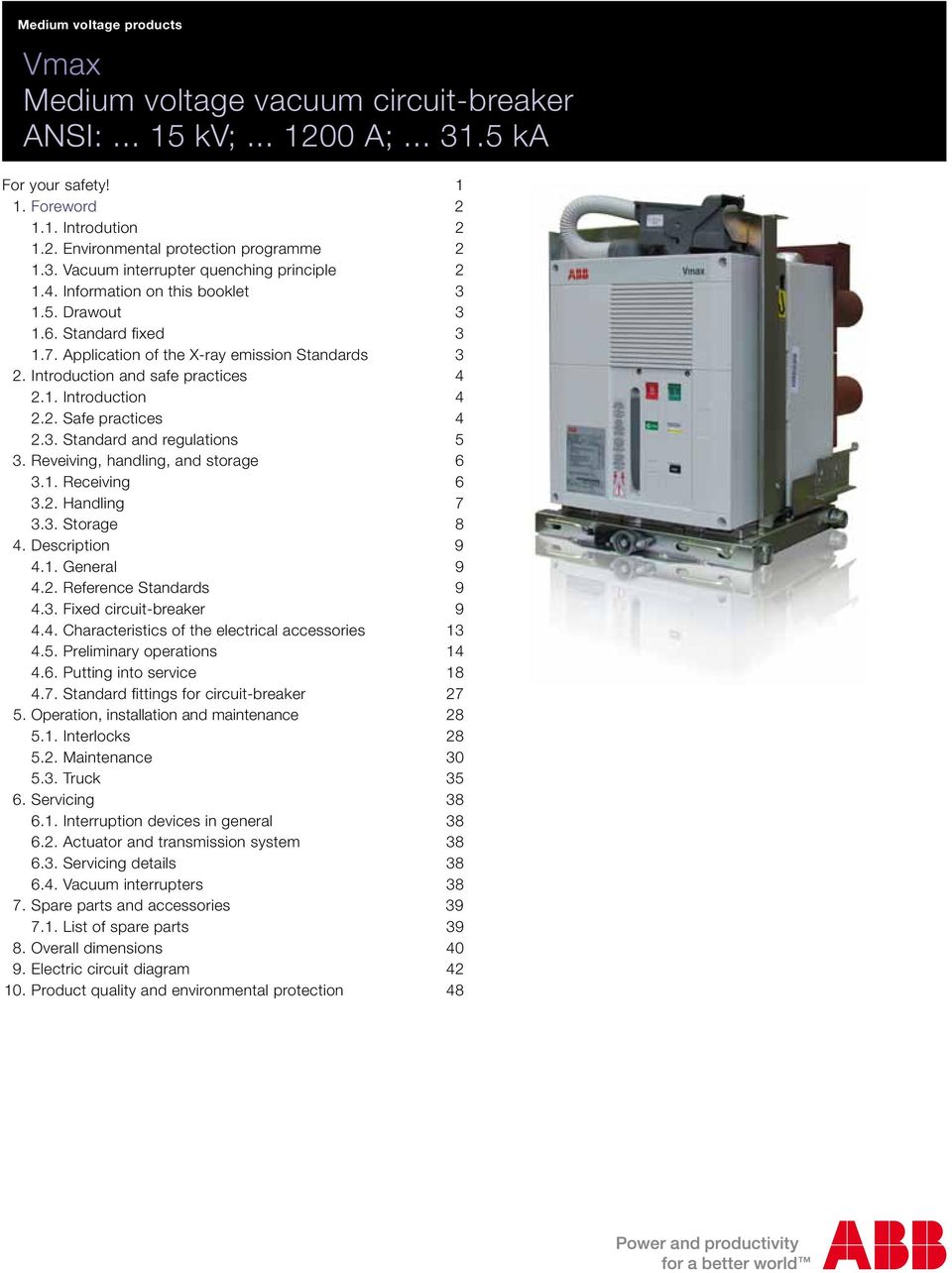
1 Medium voltage products Vmax Medium voltage vacuum circuit-breaker ANSI: kv; A; ka For your safety! 1 1. Foreword Introdution Environmental protection programme Vacuum interrupter quenching principle Information on this booklet Drawout Standard fixed Application of the X-ray emission Standards 3 2. Introduction and safe practices Introduction Safe practices Standard and regulations 5 3. Reveiving, handling, and storage Receiving Handling Storage 8 4. Description General Reference Standards Fixed circuit-breaker Characteristics of the electrical accessories Preliminary operations Putting into service Standard fittings for circuit-breaker Operation, installation and maintenance Interlocks Maintenance Truck Servicing Interruption devices in general Actuator and transmission system Servicing details Vacuum interrupters Spare parts and accessories List of spare parts Overall dimensions Electric circuit diagram Product quality and environmental protection 48
2

3 For your safety! Make sure that the installation room (spaces, divisions and ambient) is suitable for the electrical apparatus. Check that all the installation, putting into service and maintenance operations are carried out by qualified personnel with suitable knowledge of the apparatus. Make sure that the standard and legal prescriptions are complied with during installation, putting into service and maintenance, so that installations according to the rules of good working practice and safety in the work place are constructed. Strictly follow the information given in this instruction manual. Check that the rated performance of the apparatus is not exceeded during service. Check that the personnel operating the apparatus have this instruction manual to hand as well as the necessary information for correct intervention. Pay special attention to the notes indicated in the manual by the following symbol: Responsible behaviour safeguards your own and others safety! For any requests, please contact the ABB Assistance Service. 1

4 1.Foreword 1.1. Introdution This publication contains the information needed to install medium voltage Vmax/W and Vmax circuit-breakers and put them into service. For correct use of the product, please read it carefully. Like all the apparatus we manufacture, the Vmax/W and Vmax circuit-breakers are designed for different installation configurations. However, they do allow further technical and construction modifications (at the customer s request) to adapt to special installation requirements. For this reason, the information given below may sometimes not contain instructions concerning special configurations. Apart from this manual, it is therefore always necessary to consult the latest technical documentation (circuit and wiring diagrams, assembly and installation drawings, any protection coordination studies, etc.), especially regarding any variants requested in relation to the standardised configurations. For example, the racking and interlock sections do not apply to the fixed mount breaker styles. All information in this booklet was current at the time of printing. Unless otherwise noted, all references in this booklet are determined by viewing the circuitbreaker from the front. Only use original spare parts for maintenance operations. For further information, please also see the technical catalogue of the circuit-breaker Environmental protection programme The Vmax/W and Vmax circuit-breakers are manufactured in accordance with the ISO Standards (Guidelines for environmental management). The production processes are carried out in compliance with the Standards for environmental protection in terms of reduction in energy consumption as well as in raw materials and production of waste materials. All this is thanks to the medium voltage apparatus manufacturing facility environmental management system Vacuum interrupter quenching principle Due to the extremely low static interrupter chamber pressure of 10-4 to 10-8 mbar, only a relatively small contact gap is required to achieve a high dielectric strength. The vacuum arc is extinguished on one of the first natural current zeros. Due to the small contact gap, high conductivity of the metal vapour plasma, and short arcing time, the associated arc energy is extremely low, which has advantageous effects on the life of the contacts and thus on that of the vacuum interrupters. CAUTION All the installation, putting into service, running and maintenance operations must be carried out by skilled personnel with in-depth knowledge of the apparatus. 2

5 1.4. Information on this booklet This booklet provides information for the Vmax/W and Vmax circuit-breakers as described below. Not all sections of the bulletin apply to all types of Vmax/W and Vmax circuit-breakers. All information in this booklet was current at the time of printing. Unless otherwise noted, all references in this booklet are determined by viewing the circuit-breaker from the front. Style Frame width Voltage rating Continuous current rating Interruption ratings (symmetrical RMS) Vmax/w 492 mm / 19.3 inches 15 kv 1200 A ka Drawout Configurations available Vmax 416 mm / 16.3 inches 15 kv 1200 A ka Standard fixed 1.5. Drawout A Drawout circuit-breaker is a breaker that may be removed from a cell without unbolting connections or mounting supports. It is intended for use in ABB PowerCube modules. It contains primary and secondary disconnects and provides two operating positions: Disconnect and Connect Standard fixed A fixed circuit-breaker is a breaker that is bolted in its enclosure and wired to the load frame. A fixed circuit-breaker can be mounted directly on supporting frames or on a supporting truck to be provided by the customer. The circuit-breaker, with supporting truck, must be suitably fixed to the floor of its own compartment by the customer. The floor surface in correspondence with the truck wheels must be carefully levelled. A minimum degree of protection (IP2X) must be guaranteed from the front towards live parts. The standard fixed version of Vmax must be installed by the customer in a minimal enclosure so as to guarantee a minimum degree of protection as for C and C37.55 test requirements Application of the X-ray emission Standards One of the physical properties of vacuum insulation is the possibility of X-ray emission when the interrupter contacts are open. The specific tests carried out at the PTB laboratories (Physikalisch-Technische Bundesanstalt, in Brunswick - Germany) show that local emission at a distance of 10 cm from the interrupter or pole surface, does not exceed 1 msv/h. It follows that: at the rated service voltage the use of vacuum interrupters is absolutely safe; application of the withstand voltage at industrial frequency, according to the IEC , VDE 0670 and IEEE C37.04 Standards, is safe; application of a voltage higher than the withstand voltage at industrial frequency or of a direct current test voltage in direct current, specified in the IEC, VDE and ANSI/IEEE Standards, cannot be used; limitation of the above-mentioned local phenomena, with interrupters with open contacts, depends on keeping the specified distance between the contacts. This condition is intrinsically guaranteed by correct operation of the operating mechanism and by adjustments of the transmission system. 3

6 2.Introduction and safe practices 2.1. Introduction The purpose of this manual is to provide instructions for unpacking, storage, installation, operation, and maintenance for Vmax/W and Vmax vacuum circuit-breakers. This manual should be carefully read and used as a guide during installation, initial operation, and maintenance. The specific ratings of each model circuit-breaker are listed on the individual nameplates. The Vmax/W and Vmax circuitbreakers are protective devices. As such, they are maximum rated devices. In no event should they be applied outside of their nameplate ratings. WARNING The circuit-breakers described in this book are designed and tested to operate within their nameplate rating. Operation outside of these ratings may cause equipment to fail, resulting in property damage, bodily injury and/ or death. All safety codes, safety standards and/or regulations as they may be applied to this type of equipment must be adhered to strictly Safe practices Vmax/W and Vmax circuit-breakers are equipped with high energy / high speed mechanisms. The design includes several interlocks and safety features which help ensure safe and proper operating sequences. To ensure safety of personnel associated with installation, operation, and maintenance of these circuit-breakers, the following recommendations must be followed. Only qualified persons, as defined in the National Electric Safety Code, who are familiar with the installation and maintenance of medium voltage circuits and equipment should be permitted to work on these circuit-breakers Read these instructions carefully before attempting any installation, operation, or maintenance of these power circuitbreakers. Do not work on an energized circuit-breaker. Do not work on a circuit-breaker unless all components are disconnected by means of a visible break and securely grounded. Do not work on a circuit-breaker with power supplied to the secondary control circuit. Do not defeat safety interlocks. This may result in bodily injury, death and/or equipment damage. Do not work on a closed circuit-breaker. Do not work on a circuit-breaker with charged energy (springs charged). Do not use a circuit-breaker by itself as the sole means of isolating a high voltage circuit. Do not leave a circuit-breaker in an intermediate position in a cell. Always place the circuit-breaker in the disconnect or connect position. NOTICE Failure to observe the requirements of osha standard can cause death or severe burns and disfigurement. That standard specifically prohibits the wearing of polyester, acetate, nylon, or rayon clothing by employees working with exposure to electric arcs or flames. 4

7 2.3. Standard and regulations Fabrication The Vmax, Vmax/w circuit-breakers conform to the following Standards: DIN VDE 0670, part 104, and IEC DIN VDE 0847, part 4, and IEC IEEE C Installation and operation For assembly and operation, please refer to the relative regulations, and in particular to: ANSI / NFPA70 NEC Service conditions Normal service conditions Follow the recommendations in the IEC and Standards. In more detail: IEEE C37.09 IEEE C37.54 C Ambient temperature Maximum + 40 C Average maximum over 24 hours + 35 C Minimum for indoor installation - 30 C Humidity The average value of the relative humidity, measured for a period longer than 24 hours, must not exceed 95% The average value of the pressure of the water vapour without condensation, measured for a period longer than 24 hours, must not exceed 2.2 kpa. The average value of the relative humidity, measured for a period longer than 1 month, must not exceed 90%. The average value of the pressure of the water vapour, measured for a period longer than 1 month, must not exceed 1.8 kpa. Altitude < 1000 (3300 ft.) m above sea level. For application above 1000m (3300 ft.) C is applicable Climate To avoid the risk of corrosion or other damage in areas: with a high level of humidity, and/or with rapid and large temperature variations, take appropriate steps (for example, by using suitable electric heaters) to prevent condensation phenomena. For special installation requirements or other operating conditions, please contact ABB. 5

8 3. Reveiving, handling, and storage Vmax/W and Vmax circuit-breakers are subject to complete factory production tests and inspection prior to packaging and shipment. The shipping package is designed to provide reasonable protection during shipment and to provide convenient handling. Accessories such as opening handles and racking handles are shipped separately from the circuit-breaker. The circuit-breaker is shipped in special packing, in the open position. Each piece of apparatus is protected by a plastic cover to prevent any infiltration of water during the loading and unloading stages and to keep the dust off during storage. CAUTION A CIRCUIT-BREAKER Vmax/W ANSI C37.04 SN 1VC1 BA XX PR. YEAR 2010 M MASS 84 kg Ur VOLTAGE 15 kv Up LIGHTNING IMPULSE WITHSTAND VOLTAGE 95 kv fr FREQUENCY 60 Hz Ir NORMAL CURRENT 1200 A Ik SHORT TIME WITHSTAND CURRENT 31.5 ka tk DURATION OF SHORT CIRCUIT 2 s Ise SHORT CIRCUIT BREAKING CURRENT 31.5 ka MAKING CAPACITY (PEAK VALUE) 82 ka AT THE VOLTAGE OF 15 kv D.C. COMPONENT < = 44 % RATED CLOSING TIME ms RATED INTERRUPTING TIME < = 50 ms OPERATING SEQUENCE O-0,3S-CO-3MI N-CO INSTRUCTION MANUAL 1VCD E. lectrical DIAGRAM 1VCD (E1010) \~ I FIG.01 FIG.02 FIG.07 FIG.OS FIG.33 ~ ~\, 2 Before carrying out any operation, always make sure that the springs are discharged and that the apparatus is in the open position Receiving On receipt, check the state of the apparatus, integrity of the packing and correspondence with the nameplate data (see fig. 1) with what is specified in the order confirmation and in the accompanying shipping notes. Also make sure that all the materials described in the shipping notes are included in the supply. Should any damage or irregularity be noted in the supply on unpacking, notify ABB (directly or through the agent or supplier) as soon as possible and in any case within five days of receipt. The apparatus is only supplied with the accessories specified at the time of ordering and validated in the order confirmation sent by ABB. The accompanying documents inserted in the shipping packing are: instruction manual (this document) test certification identification label copy of the shipping documents electric wiring diagram. Other documents which are sent prior to shipment of the apparatus are: order confirmation original shipping advice notes any drawings or documents referring to special configurations/conditions. B 5 Caption A Circuit-breaker rating plate. B Operating mechanism rating plate. 1 Type of apparatus. 2 Symbols of compliance with Standards. 3 Serial number. 4 Circuit-breaker characteristics. 5 Characteristics of the operating mechanism auxiliaries. Fig. 1 lllllllliilllllllilllllllillllllllllllllllllililllllllilllllllillllllllll EL1 OPERATING MECHANISM -MC 125 V -MS 125 V -M V -RL2 125 V Made by ABB, Italy Immediately upon receipt of the circuit-breaker(s), examine the carton(s) to determine if any damage or loss was sustained during transit. If damage or indication of rough handling is evident, file a damage claim at once with the carrier and promptly notify the nearest district office. ABB is not responsible for damage to goods which occur after delivery. However, ABB will lend assistance if notified of claims. Use care in unpacking the circuit-breaker to avoid damaging any circuit-breaker parts. Unpack circuit-breakers as soon as possible after receipt. If unpacking is delayed, difficulty may be experienced in making a claim for damages not evident upon receipt. Check the contents of each carton against the packing list before discarding any packing material. If any discrepancy is discovered, promptly notify the nearest district office. Information specifying the purchase order number, carton number, and part numbers of damaged or missing parts should accompany the claim. 6

9 3.2.Handling Vmax/W and Vmax circuit-breaker shipping containers are designed to be handled by fork lift (not supplied) Fig. 2. To lift and handle the circuit-breaker, proceed as follows (fig. 2): use a special lifting tool (1) (not supplied) fitted with ropes with safety hooks (2); insert the hooks (2) in the special holes in the circuit-breaker frame and lift; on completion of the operation (and in any case before putting into service) unhook the lifting tool. During handling, take great care not to stress the insulating parts and the terminals of the circuit-breaker. Once removed from the shipping container, the circuit-breaker wheels are designed to move the circuit-breaker across a smooth, paved surface. Care must be taken not to damage the secondary plug (item 3, Figure 2a) when transporting, rolling, or handling the Vmax/W circuit-breakers Fig. 2a DO NOT pull the circuit-breaker by the front handles with the circuit-breaker in any position other than full Disconnect to avoid injuries at the hands. Fig. 2 DO NOT move the circuit-breaker by pushing on the pole box or primary leads of the embedded poles. Damage and misalignment of the poles and contact arms assemblies will occur if force is applied to them. 7

10 3.3. Storage When a period of storage is foreseen, our workshops can (on request) provide suitable packing for the specified storage conditions. On receipt the apparatus must be carefully unpacked and checked as described in Checking on receipt. If immediate installation is not possible, the packing must be replaced, using the original material supplied. Insert special hygroscopic substances inside the packing, using at least one standard packet per piece of apparatus. Should the original packing not be available and immediate installation is not possible, store in a covered, well-ventilated, dry, dust-free, non-corrosive ambient, away from any flammable materials and at a temperature between 30 C and + 45 C. CAUTION The shipping containers provided are not designed for stacking. Circuit breakers should be installed in their permanent location as soon as possible. If the circuit-breakers are not placed in service for some time, it is advisable to provide adequate means of environmental protection. This may be done by keeping the circuit-breaker in its original shipping container and storing it in a warm, dry, and uncontaminated atmosphere. The circuitbreakers should be stored to minimize condensation. Moisture can cause deterioration of metal parts and high voltage insulation. Prior to storage of the circuit-breaker, verification should be made that it is free from shipping damage and is in satisfactory operating condition. 8

11 4. Description 4.1. General The Vmax series of circuit-breakers are pieces of apparatus under vacuum for indoor installation; for the electrical performances, please refer to the corresponding technical catalogue code 1VCP For special installation requirements, please contact ABB. The following versions are available: fixed withdrawable for ABB PowerCube modules Reference Standards The Vmax circuit-breakers conform to the IEC , ANSI C37.04 C37.54 C37.09 C37.55 Standards and those of major industrialized countries Fixed circuit-breaker The fixed circuit-breaker (fig. 3-4) is the basic version complete with structure and front protection screen. The fixing holes are made in the lower part of the structure. For the electrical connections of the circuit-breaker auxiliary circuits, the proper terminal box is available. The earthing hole is placed in the rear part of the circuit-breaker Fig. 3 9 Fig Lever for manual closing spring charging 2 Signalling device for circuit-breaker open/closed 3 Rating plate 4 Opening pushbutton 5 Closing pushbutton 6 Undervoltage release mechanical override (on request) 7 Signalling device for closing springs charged/discharged 8 Operation counter 9 Terminals 10 Earthing hole 11 Passage for the auxiliary circuit cord 12 Auxiliary contacts Fig. 5 Fig. 6 9

12 General characteristics of fixed circuit-breakers Vmax Standard fittings for fixed circuit-breakers The basic versions of the fixed circuit-breakers are three-pole and fitted with: EL type manual operating mechanism mechanical signalling device for closing springs charged/ discharged mechanical signalling device for circuit-breaker open/closed closing pushbutton opening pushbutton operation counter set of ten circuit-breaker open/closed auxiliary contacts Note: application of the shunt opening release and/or additional shunt opening release foresees the use of one or two auxiliary make contacts (normally open), thereby reducing the number of auxiliary contacts available. lever for manual closing spring charging auxiliary circuit support terminal board Circuit-breaker Vmax 15 Fixed version IEC Standards CEI EN (file 7642) C C C C37.55 UL Recognized Component Mark Rated voltage Ur [kv] 15 Rated insulation voltage Us [kv] 15 Withstand voltage at 50 Hz Ud (1 min) [kv] 36 (at 60 Hz) Impulse withstand voltage Up [kv] 95 Rated frequency fr [Hz] 60 Rated normal current (40 C) Ir [A] 1200 Rated breaking capacity 25 (3 cycles) Isc [ka] (rated symmetrical short-circuit current) 31.5 (3 cycles) Rated-short time withstand current (2s) Ik [ka] Making capacity Ip [ka] Operation sequence [O CO CO] [O CO CO] Opening time [ms] Arc duration [ms] Total interruption time [ms] <50 Closing time [ms] I I H [mm/in] 534/21.02 Maximum W [mm/in] 416/16.38 H overall dimensions D [mm/in] 456/17.95 W D Pole centre I [mm/in] 133/5.24 Weight [kg/lb] 77/ Standardized table of dimensions 1VCD Operating temperature [ C] Tropicalization IEC: , Electromagnetic compatibility IEC

13 Withdrawable circuit-breaker The withdrawable circuit-breakers (see fig. 7) are available for ABB PowerCube modules. They consist of a truck on which the supporting structure of the circuit-breaker is fixed. The cord with the connector (14) (plug) for connection of the operating mechanism electrical accessories comes out of the connection (15). The strikers for operating the contacts (racked-in/isolated) placed in the switchgear are fixed in the top part of the circuitbreaker. The slides (9) for operating the segregation shutters of the medium voltage contacts of the enclosure or of the switchgear are fixed on the sides of the circuit-breaker. On the front part of the circuit-breaker truck, the crosspiece is mounted with the handles (17) for hooking up the circuit-breaker for the racking-in/out operations by means of the special operating lever (16). The circuit-breaker is completed with the isolating contacts (8). The withdrawable circuit-breaker is fitted with special locks on the front crosspiece, which allow hooking up into the corresponding couplings of the switchgear. The locks can only be activated by the handles with the truck fully resting against the crosspiece. The operating lever (16) must be fully inserted (also see par ). A lock prevents the truck from advancing into the enclosure or fixed part when the earthing switch is closed. Another lock prevents racking-in and racking-out with the circuit-breaker closed. With the truck in an intermediate position between isolated and racked-in, a further lock prevents circuitbreaker closing (either mechanical or electrical). A locking magnet is also mounted, on request, on the truck which, when de-energised, prevents the truck racking-in operation. On request, an interlock is also available which prevents circuitbreaker racking-in with the door open, and door opening with the circuit-breaker closed Lever for manually charging the closing springs 2 Signalling device for circuit-breaker open/closed 3 Rating plate 4 Opening pushbutton 5 Closing pushbutton 6 Signalling device for closing springs charged/discharged 7 Operation counter 8 Isolating contacts 9 Slide for operating the switchgear shutters 10 Truck 11 Tab for hooking into the fixed part 12 Undervoltage release mechanical override (on request) 13 Strikers for activating the contacts placed in the enclosure 14 Connector (plug) 15 Cabling connection 16 Operating lever of circuit-breaker racking-in/out. 17 Handles for activating the locks (11) 18 Truck locator channel Fig. 7 11

14 General characteristics of withdrawable circuit-breakers (15 kv) for PowerCube PB1 modules 600 mm wide Standard fittings for withdrawable circuit-breakers for PowerCube PB1 modules 600 mm wide The basic versions of the withdrawable circuit-breakers are three-pole and fitted with: EL type manual operating mechanism Mechanical signaling device for closing springs charged/ discharged Mechanical signaling device for circuit-breaker open/closed Closing and opening pushbutton Operation counter Set of ten auxiliary circuit-breaker open/closed contacts Lever for manually charging the closing springs Isolating contacts Circuit-breaker Vmax/W 15 Use in switchgear/enclosure Standards IEC CEI EN (file 7642) C C C C37.55 UL Listed Rated voltage Ur [kv] 15 Rated insulation voltage Us [kv] 15 PowerCube (on request) Withstand voltage at 50 Hz Ud (1 min) [kv] 36 (at 60 Hz) Impulse withstand voltage Up [kv] 95 Rated frequency fr [Hz] 60 Rated normal current (40 C) Ir [A] 1200 Rated breaking capacity 25 (3 cycles) Isc [ka] (rated symmetrical short-circuit current) 31.5 (3 cycles) Rated-short time withstand current (2s) Ik [ka] Making capacity Ip [ka] Operation sequence [O - 0.3" - CO - 15" - CO] [O - 0.3" - CO - 3' - CO] Opening time [ms] Arc duration [ms] Total interruption time [ms] <50 Closing time [ms] I I H [mm/in] 665/26.18 Maximum W [mm/in] 503/19.80 H overall dimensions D [mm/in] 662/26.06 W D Pole centre I [mm/in] 150/5.91 Weight [kg/lb] 98/ Standardized table of dimensions 1VCD Operating temperature [ C] Tropicalization IEC: , Electromagnetic compatibility IEC

15 Cord with connector (plug only) for auxiliary circuits, with striker pin on request, which does not allow connection of the plug in the socket if the rated current of the circuit-breaker is different from the rated current of the panel Racking-in/out lever (the quantity must be defined according to the number of pieces of apparatus ordered) Locking electromagnet in the truck. On request. This prevents racking-in of the circuit-breaker in the panel with auxiliary circuits not connected (plug not inserted in the socket) Characteristics of the electrical accessories Shunt opening release (-MO1) Additional shunt opening release (-MO2) Shunt closing release (-MC) Undervoltage release (-MU) Locking magnet on the operating mechanism (-RL1) Un -MO1-MO2-MC Operating -MU limits -RL1 -MO1-MO2 Opening -MC time -MU Power on inrush (Ps) Inrush duration Continuous power (Pc) Insulation voltage V DC-AC (50-60 Hz) % Un % Un % Un ms ms ms < 150 W 150 ms 3 W 2000 V 50/60 Hz (for 1 min) V DC-AC (50-60 Hz) Electronic time delay device for undervoltage release (mounted outside the circuit-breaker) Un: V Un: V~ 50/60 Hz Adjustable opening time (release + time delay device): s Auxiliary contacts of the circuit-breaker (-BB1; -BB2; -BB3) General characteristics Insulation voltage according to VDE 0110 standard. Group C 660 V AC 800 V DC Rated voltage 24 V V Test voltage 2.2 kv Rated overcurrent 10 A Number of contacts 5 Contact run 6 mm... 7 mm Activation force 26 N Resistance 3 mω Storage temperature 20 C C Operating temperature 20 C C Contact overtemperature 20 K Number of cycles 30,000 Unlimited breaking capacity if used with 10 A fuse in series Note: Application of the shunt opening release and/or additional shunt opening release foresees the use of one or two auxiliary make contacts (normally open), thereby reducing the number of auxiliary contacts available. Electrical characteristics Un Rated current Breaking capacity 220 V AC Cosϕ = 0,7 2.5 A 25 A 380 V AC Cosϕ = 0,7 1.5 A 15 A 500 V AC Cosϕ = 0,7 1.5 A 15 A 660 V AC Cosϕ = 0,7 1.2 A 12 A Time constant 1 ms 10 A 12 A 24 V DC 15 ms 10 A 12 A 50 ms 8 A 10 A 200 ms 6 A 7.7 A 1 ms 8 A 10 A 60 V DC 15 ms 6 A 8 A 50 ms 5 A 6 A 200 ms 4 A 5.4 A 1 ms 6 A 8 A 110 V DC 15 ms 4 A 5 A 50 ms 2 A 4.6 A 200 ms 1 A 2.2 A 1 ms 1.5 A 2 A 220 V DC 15 ms 1 A 1.4 A 50 ms 0.75 A 1.2 A 200 ms 0.5 A 1 A Motor operator (-MS) Un: V Un: V~ 50/60 Hz Operating limits: % Un Inrush power (Ps): DC 600 W; AC = 600 VA Rated power (Pn): DC = 200 W; AC = 200 VA Inrush time 0,2 s Charging time: 6-7 s Insulation voltage: 2000 V 50 Hz (for 1 min) Locking magnet on the truck (-RL2) Un: V Un: V~ 50/60 Hz Operating limits: % Un Inrush power (Ps): DC 250 W; AC = 250 VA Continuous power (Pc): DC = 5 W; AC = 5 VA Inrush time: 150 ms 13

16 4.5. Preliminary operations Clean the insulating parts with clean dry cloths. Check that the top and bottom terminals are clean and free of any deformation caused by shocks received during transport or storage Installation of fixed circuit-breakers Vmax circuit-breaker can be fixed directly on the supporting plate or on a truck provided by the customer. The customer must guarantee a minimum degree of protection (IP2X) from the front towards live parts.the fixed version of Vmax circuitbreaker must be installed by the customer so as to guarantee a minimum degree of protection as for C and C37.55 test requirements Insertion and removal withdrawable circuit-breaker This section describes the process for inserting the breaker into the disconnect position of the switchgear and the removal of the circuit-breaker from the disconnect position. Racking of the circuit-breaker to and from the test and disconnect position is covered in the following section. Insertion (Refer to Fig. 7 and 13) (From Withdrawn Position to Disconnect Position) 1. Align breaker and ramp, dolly or lift truck with circuit-breaker compartment 2. Pull handles (17) to center (this withdraws Cell Interlock Tabs (11) allowing breaker to be inserted) 3. Push breaker into breaker compartment with handles. 4. Align Cell Interlock Tabs with Circuit Breaker Compartment Slots (A) 5. Push Handles out to fully engage Cell Interlock Tabs into Circuit Breaker Compartment Slots 6. Visually check that Cell Interlock Tabs are engaged in Circuit- Breaker Compartment Slots (if Cell Interlock Tabs are not fully extended, racking is prevented) Breaker is now in the Disconnect Position Removal (Refer to Fig. 7 and 14) (From Disconnect Position to Withdrawn Position) 1. Visually check to see the Truck (11) is against the Locator Channel 2. Pull Handles to center (this withdraws Cell Interlock Tabs; allowing breaker to be removed. 4. Pull the breaker from Circuit-Breaker Compartment with the Handles onto the required transportation device. In this way it is certain that no electrical impulse can activate the shunt closing release with the circuit-breaker in an intermediate position. The customer must also provide a lock to prevent circuitbreaker traverse when it is in the closed position Installation of withdrawable circuit-breakers in ABB PowerCube modules The withdrawable circuit-breakers are use in PowerCube modules see Fig For racking-in/racking-out of the switchgear: connect the secondary plug (14) (fig. 7) with secondary disconnector (B) (fig.14), fully insert the crank handle (1) (fig. 11 in the appropriate seat) (2) (fig.11) and work it clockwise for racking-in, and anti-clockwise for racking-out, until the end-of-run positions are reached. Circuit-breaker racking- in/-out must be carried out gradually to avoid shocks which may deform the mechanical interlocks and the end-of-runs. The torque normally required to carry out racking- in and racking-out is <25 Nm. This value must not be exceeded. If operations are prevented or difficult, do not force them and check that the operating sequence is correct. Note To complete the racking-in/out operation, 20 turns of the crank handle are required. When the circuit-breaker has reached the connect/ disconnect position it can be considered as racked into the switchgear and, at the same time, earthed by means of the truck wheels. CAUTION The racking-in/-out operations must always be carried out with the circuit-breaker open Withdrawable circuit-breakers with truck made by third parties The Vmax circuit-breakers installed on trucks made by the customer must be fitted with one or two additional auxiliary contacts (operated by the mechanical lock and by the circuitbreaker release device) which are entrusted with the function of interrupting the shunt closing release circuit (-MC). 14

17 Connection of the auxiliary circuits Note: the minimum cross-section of the wires used for the auxiliary circuits must not be less than the one used for the internal cabling AWG16. Furthermore, they must be insulated for 3 kv test. Please note that auxiliary circuits must be energized with 2 kv (maximum test voltage) as per standards indications. Connection of the auxiliary circuit for Vmax Fixed circuit-breaker Connection of the circuit-breaker auxiliary circuits must be made by means of the proper terminal box mounted inside the circuit-breaker and the wires must pass through the connector (1) (Fig. 8). Outside the connector, the cables must pass through a suitable metal protective covering (pipe, wiring duct, etc.) and be earthed. To prevent the cabling wires outside the circuit-breaker (provided by the customer) from accidentally coming into contact with moving partsand therefore damaging the insulation, the wires should be positioned and fixed as shown in the figure Withdrawable circuit-breakers The auxiliary circuits of withdrawable circuit-breakers are fully cabled in the factory as far as the connector (2 - fig. 9). For the external connections, refer to the electric wiring diagram of the switchgear. 2 1 Before removing the operating mechanism cover (1) (Fig. 9) to access the terminal box, check that the circuitbreaker is open and the closing springs discharged. 1 Fig. 9 Fig. 8 15

18 Power circuit connections of fixed circuit-breakers Vmax General recommendations Select the cross-section of the conductors according to the service current and the short circuit current of the installation. Prepare special supporting insulators, near the terminals of the fixed circuit-breaker or of the enclosure, sized according to the electrodynamics forces deriving from the short-circuit current of the installation. Assembly of the connections Check that the contact surfaces of the connections are flat, and are free of any burrs, traces of oxidation or deformation caused by drilling or impacts received. According to the conductor material and the surface treatment used, carry out the operations indicated in table T1 on the contact surface of the conductor. Assembly procedure Put the connections in contact with the circuit-breaker terminals taking care to avoid mechanical stresses (traction / compression) on, for example, the conducting busbars on the terminals. Interpose a spring washer and a flat washer between the head of the bolt and the connection. It is advisable to use bolts according to DIN class 8.8 Standards, also referring to what is indicated in table T2. In the case of cable connections, strictly follow the manufacturer s instructions to make the terminals. Earthing For the fixed version circuit-breaker, carry out earthing by means of the special screws marked with the relative symbol (see fig. 10). Clean and degrease the area around the screw to a diameter of about 30 mm and, on completion of assembly, cover the joint again with Vaseline grease. Use a conductor (busbar or cord) with a cross section conforming to the Standards in force. Assembly procedure Put the connections in contact with the circuit-breaker terminals taking care to avoid mechanical stresses (traction / compression) on, for example, the conducting busbars on the terminals. T1 Bare copper Clean with a fine file or emery cloth. Tighten fully and cover the contact surfaces with 5RX Moly type grease. Copper or silver-plated aluminium Clean with a rough dry cloth. Only in the case of obstinate traces of oxidation, clean with a very fine grain emery cloth taking care not to remove the surface layer. If necessary, restore the surface treatment. Bare aluminium Clean with a metal brush or emery cloth. Cover the contact surfaces again immediately with neutral grease. Insert the copper-aluminium bimetal with surfaces shined (copper side in contact with the terminal; aluminium side in contact with the connection) between the aluminium connection and the copper terminal. T2 Bolt Recommended tightening torque (1) Without lubricant With lubricant (2) M Nm 4.5 Nm M8 26 Nm 10 Nm (1) The nominal tightening torque is based on a friction coefficient of the thread of 0.14 (distributed value the thread is subjected to which, in some cases, is not negligible). The nominal tightening torque with lubricant is according to the DIN Standards. (2) Oil or grease. The thread and contact surfaces of the lubricated heads. Take into account the deviations from the general Standards table (for example, for contact systems or terminals) as foreseen in the specific technical documentation. The thread and contact surfaces of the heads of bolts must be slightly oiled or greased, so as to obtain correct nominal tightening torque. 16

19 Operating and signalling parts - Undervoltage release mechanical override (on request) Override activated Undervoltage release disabled. The circuit-breaker can be closed even if the undervoltage release is not supplied Override disabled Undervoltage release activated. The circuit-breaker can only be closed if the undervoltage release is supplied with power Key lock (if provided) (*) 2 Lever for manually charging the closing springs 3 Coupling lever for racking-out operation (only for withdrawable circuit-breakers) 4 Opening pushbutton 5 Closing pushbutton 6 Signalling device for circuit-breaker open/closed 7 Signalling device for closing springs charged/discharged 8 Operation counter 9 Handles for operating the truck locks (only for withdrawable circuit-breakers) 10 Operating lever for circuit-breaker racking-in/out 11 Undervoltage release mechanical override (on request). (*) Warning! To activate the key lock: open the circuit-breaker, keep the opening pushbutton depressed, then turn the key and remove it from the housing. Fig

20 4.6. Putting into service General procedures CAUTION All the operations regarding putting into service must be carried out by ABB personnel or by suitably qualified customer personnel with in depth knowledge of the apparatus and of the installation. Should the operations be prevented, do not force the mechanical interlocks and check that the operating sequence is correct. The operating forces which can be applied for racking-in withdrawable circuit-breakers are indicated in paragraph installation of withdrawable circuit-breakers. check tightness of the power connections at the circuitbreaker terminals; check that the value of the power supply voltage of the auxiliary circuits is within limits stated by IEEE C37.06; remount any covers removed during the testing operations; check that no foreign bodies, such as bits of packing, have got into the moving parts; check that there is a sufficient exchange of air in the installation place to avoid over temperatures; supply the auxiliary circuits with power; check the functionality and efficiency of the mechanical and electrical locks; carry out a few circuit-breaker opening and closing operations by means of the pushbuttons on the front of the circuitbreaker; also carry out the checks indicated in table T3; do not attempt to insert the circuit-breaker into any compartment prior to inspection; compare the circuit-breaker name plate rating with the switchgear rating; do not attempt to insert a closed circuit-breaker; always inspect the circuit-breaker compartment to insure that it is free of obstructions, tools, or other equipment. T3 Item inspected Procedure Positive check 1 Insulation resistance. Medium voltage circuit With a 2500 V megger, measure the insulation resistance between the phases and the exposed conductive part of the circuit. The insulation resistance should be at least 50 Mohm and in any case constant over time Auxiliary circuits With a 500 V megger (if the apparatus installed allows this), measure the insulation resistance between the auxiliary circuits and the exposed conductive part. Auxiliary circuits. Check that the connections to the control circuit are correct: proceed at the relative power supply. Manual operating mechanism. Carry out a few closing and opening operations (see cap. 6). N.B. Supply the undervoltage release and the locking magnet on the operating mechanism at the relative rated voltage (if provided). Motor operator (if provided). Supply the spring charging geared motor at the relative rated voltage. Carry out a few closing and opening operations. N.B. Supply the undervoltage release and the locking magnet on the operating mechanism at the relative rated voltage (if provided). The insulation resistance should be a few Mohm and in any case constant over time. Operations and signals are normal. The operations and the relative signals take place normally. The springs are charged normally. The signals are normal. With the springs charged, the geared motor stops. The geared motor recharges the springs after each closing operation. 5 Undervoltage release (if provided). Supply the undervoltage release at the relative rated voltage and carry out the circuit-breaker closing operation. The circuit-breaker closes normally. The signals are normal. Cut off power to the release. The circuit-breaker opens. The signalling changes over. 6 Shunt opening release and additional shunt opening release (if provided). Close the circuit-breaker and supply the shunt opening release at the relative rated voltage. The circuit-breaker opens normally. The signals are normal. 18

21 T3 Item inspected Procedure Positive check 7 Shunt closing release (if provided). Open the circuit-breaker and supply the shunt closing release at the relative rated voltage. The circuit-breaker closes normally. The signals are normal. 8 Key lock (if provided). Open the circuit-breaker, keep the opening pushbutton depressed, then turn the key and remove it from the housing. Attempt the circuit-breaker closing operation. Put the key back in and turn it 90. Carry out the closing operation. Neither manual nor electrical closing takes place. Both electrical and manual closing take place normally; in this position the key cannot be removed. 9 Auxiliary contacts in the operating mechanism. Insert the auxiliary contacts in suitable signalling circuits. Carry out a few closing and opening operations. Signals take place normally. 10 Undervoltage override (if provided). With the circuit-breaker open, springs charged, override not connected and undervoltage release not supplied with power, attempt circuit-breaker closing. Closing is not possible. 11 Locking electromagnet (-RL1) (if provided). With the circuit-breaker open, springs charged and locking electromagnet not supplied, attempt circuit-breaker closing both manually and electrically. Closing is not possible. Carry out a few closing and opening operations. N.B. Supply the undervoltage release and the locking magnet on the operating mechanism at the relative rated voltage (if provided). The geared motor recharges the springs after each closing operation. 12 Locking electromagnet on the truck circuit-breaker (-RL2) (if provided). With the circuit-breaker open, in the isolated for test position and the locking electromagnet not supplied, attempt circuitbreaker racking-in. Racking-in is not possible. Supply the locking electromagnet and carry out the racking-in operation. Racking-in takes place correctly. 13 Auxiliary transmitted contacts for signalling circuit-breaker racked-in, isolated (UniGear or UniSafe switchgear). With the circuit-breaker racked into the enclosure, carry out a few traverse operations from the isolated for test position to the connected position. Take the circuit-breaker to the racked-out position. The signals due to the relative operations take place normally. DANGER Do not attempt to remove the circuit-breaker from the compartment without the required ramp dolly on link truk. The circuitbreaker could fall down and do injuries to the body. Refer to the specific switchgear installation and maintenance manual for details. 19
22 Safety indications Vmax circuit-breakers guarantee a minimum IP2X degree of protection when installed in the following conditions: fixed circuit-breaker, installed behind a protective metallic net withdrawable circuit-breaker, installed in switchgear. Under these conditions the operator is totally guaranteed against accidental contact with moving parts. Should mechanical operations be carried out on the circuitbreaker outside the switchgear, be very careful of the moving parts. If the operations are prevented, do not force the mechanical interlocks and check that the operating sequence is correct. Racking the circuit-breaker in and out of the switchgear must be done gradually to avoid shocks which may deform the mechanical interlocks Preliminary operations Clean the insulating parts with clean dry cloths. Check that the top and bottom terminals are clean and free of any deformation caused by shocks received during transport or storage. Insertion: (Refer to Fig. 7 and Fig. 13) (from withdrawn position) 1. Align the circuit-breaker and ramp, dolly or lift truck with the compartment. 2. Pull the handles (17) to center (this withdraws Cell Interlock Tabs (11) allowing the circuit-breaker to be inserted). 3. Push the circuit-breaker into the compartment with the handles. 4. Align the circuit-breaker interlock tabs with the compartment slots (A). 5. Push the handles out to fully engage the cell interlock tabs into the compartment slots. 6. Visually check that cell interlock tabs are engaged in the compartment slots (if cell interlock tabs are not fully extended, racking is prevented). 7. The circuit-breaker is now in the Disconnect position. Removal: to Withdrawn Position (Refer to Fig. 7) 1. Visually verify that the truck (10) is against the truck locator channel (18). 2. Pull the handles (17) to the centre. 3. Pull the circuit-breaker from the compartment with the handles onto the required transportation device. 4. The circuit-breaker is now in the withdrawn position Racking Vmax/W: (Figure 7) Vmax/W circuit-breakers are designed with two positive racking positions: Disconnect, Connect. In the Disconnect position the shutters are closed. Manual opening is allowed. Electrical operation of the circuit-breaker is allowed with control power supplied through the secondary contacts with the shutters closed. As the circuit-breaker approaches the Connect position, an increase in racking force is required to lift the shutters and to engage the primary contacts. In the Connect position, the primary disconnects are fully engaged and the shutters are open. Electrical operation of the circuit-breaker through the secondary contacts remains enabled. Close door racking is mandatory between all positions 1. Engage the racking handle (item 1 Figure 11) with the racking screw collar (item c Figure 14). a. CLOCKWISE (cw) rotation inserts the circuit-breaker towards the primary contacts. b. COUNTER-CLOCKWISE (ccw) rotation withdraws the circuit-breaker away from the primary contacts. Circuit-breaker rack-ing-in/-out must be carried out gradually to avoid shocks which may deform the mechanical interlocks and the end-of-runs.the torque normally required to carry out rack-ing-in and racking-out is <25 Nm.This value must not be exceeded. If operations are prevented or difficult, do not force them and check that the operating sequence is correct Disconnect through connect 1. Perform a visual inspection of the circuit-breaker: a. Verify Close/Open Indicator shows OPEN. If not, open the circuit-breaker (connect operation is prevented while circuit-breaker is closed) 2. Racking-in operation: a. Verify switchgear door is CLOSED b. Begin racking by rotating the racking handle to the CLOCKWISE direction. c. Twenty (20) revolutions (200mm) will move the circuitbreaker between the Test and Connect positions. The Connect position is indicated by a positive lock, preventing further racking shaft rotation. Electric and mechanical closing operation of the circuitbreaker are prevented between Test and Connect positions. 20
23 Connect through disconnect 1. Perform a visual inspection of the circuit-breaker: a. Verify Close/Open Indicator shows OPEN. b. Verify switchgear door is CLOSED. 2. Racking-out operations: a. Begin racking by rotating the racking handle in the COUNTER-CLOCKWISE direction. b. Twenty (20) revolutions (200mm) will move the circuitbreaker between the Connect and Disconnect positions. Electric and mechanical closing operation of the circuit-breaker are prevented between Test and Connect positions Connect through disconnect Emergency rack Out: (Figure 12) 1. In the case of a locking magnet RL2 fault, in an emergency the truck can be racked out manually following the instructions below: 2. Open the door as emergency operation see IB Powercube # /001 sec.6.3 a. Open the circuit-breaker b. Verify Close/Open Indicator shows OPEN c. cut off the power supply to the auxiliary circuit d. open the enclosure door following Powercube Installation and maintenance instructions /001 sec.6.3 e. remove the circuit-breaker metallic front protection shield. f. using the manual lever, carry out an emergency racking-out operation, keeping the moving anchor (A Fig.12) of the locking magnet RL2 pressed left by means of a screwdriver during the initial stage of racking-out (B - Fig. 12). B Racking-in 1 2 Max. 25 Nm Racking-out A Fig. 11 Fig. 12 Table 2. Summary Racking Data DISCONNECT CONNECT Distance from Disconnected 0 mm / 0 revolutions / 0 inches 200 mm / 20 revolutions / 7.89 inches Manual opening Yes Not recommended unless necessary Electrical Operation Yes, while power cord is connect Yes, while power cord is connect Control Power Available Yes, while power cord is connect Yes Shutter CLOSED OPEN Primary Contacts Engaged No Yes Requirements to rack breaker from position Breaker Open / Power cord connect Breaker Open / Power cord connect Notes A A Notes A: Closed door is mandatory between all positions 21
24 Secondary disconnects (B) Shutters Wheel rails Compartment slots (A) Fig. 13 C Racking screw collar Fig
25 Circuit-breaker closing and opening operations Circuit-breaker operation can be either manual or electrical (fig. 15). a) Manual spring charging operation To manually charge the closing springs, it is necessary to repeatedly activate the charging lever (2) (maximum rotation angle of the lever: about 90 ) until the yellow signalling device (7) appears which indicates completion of charging. The maximum forces which can normally be applied to the lever are < 200 N for the EL2 operating mechanism and < 250 N for the EL2S operating mechanism. For the type of operating mechanism, please refer to the rating plate (Fig. 1). b) Electrical spring charging operation On request, the circuit-breaker can be fitted with the following accessories for electrical operation: geared motor for automatic closing spring charging shunt closing release shunt opening release The geared motor automatically recharges the springs after each closing operation until the yellow signaling device (7) appears. If the power is cut off during charging, the geared motor stops. Automatically the motor spring charging starts recharging the springs when the power returns. In any case, it is always possible to complete the recharging operation manually. c) Circuit-breaker closing Th operation can only be carried out with the closing springs completely charged. For manual closing, press the pushbutton (5). When there is a shunt closing release, the operation can also be carried out remotely by means of a special control circuit. Closing having taken place is indicated by the signaling device (6). d) Circuit-breaker opening For manual opening, press the pushbutton (4). When there is a shunt opening release, the operation can also be carried out remotely by means of a special control circuit. Opening having taken place is indicated by the signaling device (6) Fig
26 Operating mechanism description When the motor is activated or manual charging lever is is moved: 1 The operating mechanism shaft turns (1 - fig. 16) 2 The cams on the shaft move the closing lever assembly action 2 fig The closing lever assembly charges the closing springs. Once the closing spring is charged completely: 4 A part of the closing springs force works on the closing hook through the closing lever assembly and the pin 1 - fig.17 of the cams/toggle assembly 5 The closing hook, remains locked by the closing shaft 2 - fig The opening hook 3 - fig. 17 reaches its position and receives the central hook of the cams/toggle assembly 7 The signalling device for the status of the closing springs charged/discharged goes in charge position Fig. 16 Fig
27 When you push the closing pushbutton: 8 The closing shaft 1 - fig.18 turns and releases the closing hook 9 The closing springs unloads their energy on the closing lever assembly 10 The closing lever assembly push the long levers of the cams/ toggle assembly, by a pin 3 - fig The long levers move by pin 4 - fig.18 the main shaft counter clockwise 5 - fig The signalling indicator device for open/closed CB status goes in close position; the CB is closed 13 The long levers reach the settled position 14 The contact springs inside the poles and the opening spring inside the frame are charged 15 A part of the contact springs and opening spring load works on the long levers but the long levers remain in their position by the central hook of the cams/toggle assembly 16 The central hook works on the opening hook 5 fig The opening hook remains locked by the opening shaft Fig. 18 Fig
28 Once the CB is closed: The motor gear (if present) turns automatically the operating mechanism shaft (20) and the conditions of the points and 3. are satisfied. When you push the opening pushbutton: 18 The opening shaft 1 - fig. 21 turns and releases the opening hook 19 The opening hook releases the central hook of the cams/ toggle assembly 20 The long levers of the cams/toggle assembly are free now and by the force of the contact springs and the opening spring they can move 21 The main shaft turns clockwise 22 The signalling device for open/closed CB goes in open position 23 The CB is in open position Fig. 20 Fig
29 4.7. Standard fittings for circuit-breaker Standard fittings for withdrawable circuit-breaker series The basic versions of the withdrawable circuit-breakers are three-pole and fitted with: 1 EL type manual operating mechanism 2 mechanical signalling device for closing springs charged/ discharged 3 mechanical signalling device for circuit-breaker open/closed 4 closing pushbutton 5 opening pushbutton 6 operation counter 7 set of ten circuit-breaker open/closed auxiliary contacts 8 lever for manually charging the closing springs 9 isolating contacts 10 cord with connector (plug only) for auxiliary circuits, with striker pin which does not allow the plug to be inserted into the socket if the rated current of the circuit-breaker is different from the rated current of the panel 11 racking-in/out lever 16-fig.7(the quantity must be defined according to the number of pieces of apparatus ordered) 12 locking electromagnet in the truck 7 - fig. 27 (-RL2). This prevents the circuit-breaker being racked into the panel with the auxiliary circuits disconnected (plug not inserted in the socket) Standard fittings for fixed circuit-breaker series The basic versions of the fixed circuit-breakers are three-pole and fitted with: 1 EL type manual operating mechanism 2 mechanical signalling device for closing springs charged/ discharged 3 mechanical signalling device for circuit-breaker open/closed 4 closing pushbutton 5 opening pushbutton 6 operation counter 7 set of ten circuit-breaker open/closed auxiliary contacts 8 lever for manually charging the closing springs 10 7 Fig Fig. 22 Fig
30 5. Operation, installation and maintenance 5.1. Interlocks Interference blocking A mechanical plug interference blocking in the circuit-breaker compartment prevents under rated circuit-breakers from being inserted into higher rated compartments. The code plate rating includes continuous current, interrupting current, close and latch capability, and maximum voltage. Interlocks / protection against malfunction (for withdrawable circuit-breakers for ABB switchgear) The Vmax/W circuit-breaker contains a number of interlocks. DANGER Modification to interlocks can result in serious bodily injury or death. Do not override, by-pass or adjust interlocks. These interlocks are provided to prevent incorrect operations and/or malfunctions. The interlocks are the following: the withdrawable truck can only be moved from the test/ isolated position to the service position (and vice versa) if the circuit-breaker is open (this means that first of all the circuitbreaker must be opened). the circuit-breaker can be closed if the withdrawable truck is exactly in the defined disconnected position or in the connected position (electric interlock). the circuit-breaker can be opened manually in the service or test position when it is not powered. the switchgear is provided with devices which only allow connection and disconnection of the plug connector (3) (fig.2a) in the test/ isolation position Interlocks in the case where ABB withdrawable trucks are used 1) The Vmax/W circuit-breaker can only be closed when the withdrawable truck is in the test or service position. 2) A mechanical interlock positioned on the withdrawable truck prevents a closed circuit-breaker from being moved from the test position to the service position. 3) Vmax/W circuit-breaker can only be racked-in/ isolated if the locking electromagnet in the truck is supplied (as well as being open) if available in the truck. Positive position for removal The handle release pin prevents withdrawing the circuit-breaker from the compartment by blocking withdrawal of the locking tabs. The handle release pin blocks the handles unless the circuit-breaker is in the Disconnect position. 28
31 Interlock in the case where non-abb withdrawable trucks are used Vmax circuit-breaker is implemented with mechanical connection for interlocks purpose. 1) to prevent movement of a closed circuit-breaker The rotating locking device (1) (fig. 25) on the circuit-breaker can be used for this purpose: if the Vmax circuit-breaker is closed, the rotating locking device is down close to the base plate (2) (fig. 25). This prevents movement of the withdrawable truck and therefore movement of the circuit-breaker. 2) to prevent closing of an intermediate circuit-breaker position. The slide locking device (3) (fig. 25a) on the circuit-breaker can be used for this purpose: if the Vmax circuit-breaker, fitted on non-abb truck, is in intermediate position, the slide locking device must be pulleed down as shown (4) (fig. 25a). This prevents movement closing circuit-breaker in intermediate position. Note: any additional interlocks must not exert any force on the circuit-breaker drive. 2 1 Fig Fig. 25a 29
32 5.2. Maintenance Vmax circuit-breakers are designed for a minimum amount of maintenance. Circuit-breakers in a clean, non-corrosive environment require only annual inspection. Dusty or corrosive environments require inspection more often at the discretion of the user. Following each interrupted fault inspection is required. DO NOT work on an energized circuit-breaker. DO NOT work on a circuit-breaker unless all of the components are disconnected by means of a visible break and securely grounded. DO NOT work on a circuit-breaker with power supplied to the secondary control circuit. DO NOT defeat safety interlocks. This may result in bodily injury, death and/or equipment damage. DO NOT work on a closed circuit-breaker. DO NOT work on a circuit-breaker with charged energy. (springs) DO NOT use a circuit-breaker by itself as the sole means of isolating a high voltage circuit. DO NOT leave a circuit-breaker in an intermediate position in a cell. Always have the circuit-breaker in the Disconnect or Connect position General Vacuum circuit-breakers are characterised by simple, sturdy construction and long life. The drive is maintenance-free for its whole operating life and only requires functional inspections. The vacuum interrupters are maintenance-free for their whole operating life. Vacuum interruption does not produce harmful effects even when there are frequent trips at the rated and short-circuit current. The servicing interventions and their aim depend on the environmental conditions, on the sequence of operations and on the trips under short-circuit. Note For maintenance work, respect the following Standards: the relative specifications indicated in the Standards and Specifications chapter; regulations for safety in the workplace indicated in the Putting into service and operations chapter; regulations and specifications of the country where the apparatus is installed. The maintenance operations can only be carried out by trained personnel who respect all the safety regulations. Furthermore, is recommended that ABB service personnel should be called in, at least to check the service performances, and for any repair work. During maintenance work, turn the power supply off and put the apparatus under safe conditions. CAUTION Before carrying out any operations, always make sure that the circuitbreaker is open, the springs are discharged and it is not supplied (medium voltage circuit and auxiliary circuits). 30
33 Mechanism The mechanism requires visual inspection of hardware, lubrication and operation during routine inspection. Remove the front cover by unfastening its screws and correct any loose or missing hardware. Always lubricate the working surface of the moving parts. Verify lubrication on the connections of the actuator and lever arm. Remove any grease on the circuit-breaker frame. Use only grease Isoflex Topas NB52 (ABB No GCE P100 1Pt. can). If the grease becomes caked and dirty, remove with a clean cloth and reapply lubrication. Maintenance operations are aimed at ensuring trouble-free operation of the apparatus for the longest possible time. In accordance with what is specified in the C C C C37.55 Standards and NETA Standards, the following operations must be carried out. Inspection: Determination of the actual conditions Servicing: Measures to be taken to maintain the specification conditions Repairs: Measures to be taken to restore the specification conditions. DANGER Operating life All vacuum circuit-breakers are characterised by simple, sturdy construction and long useful life. Frequent operation of the service and shortcircuit currents does not negatively affect the degree of vacuum of the interrupters. Typical useful life expectancy of a Vmax vacuum circuit-breaker is determined by the following factors: vacuum interrupter, maintenancefree up to 10,000 mechanical operating cycles. drive with magnetic actuator, maintenance free under normal service conditions - up to 10,000 operating cycles for all the circuit-breakers with breaking capacity up to 31.5 ka and rated current up to 1200 A indication of ON/OFF position up to 10,000 operating cycles withdrawable truck: up to 500 handling operations can be carried out in the case of normal activation and with regular inspections. The data on the useful life are in principle applied to all the components which are not directly affected by the operator. The useful life of the manually activated components (movement of the withdrawable truck, etc.) can vary according to the type of handling. The time intervals and amount of maintenance are determined by environmental agents, by the frequency of operation and by the number of trip operations under short-circuit. High speed mechanical parts, serious injury may occur. Keep hands and tools clear of the mechanism during opening and closing operations and anytime the opening springs. Opening springs are always charged when the circuitbreaker is closed. 31
34 Inspections and functional tests Interruption devices in general Carry out regular inspections to check that the interruption devices are in good condition. Inspection at fixed intervals can be waived when the apparatus is permanently monitored by qualified personnel. Above all, the checks must include a visual inspection to check for any contamination, traces of corrosion and electrical discharge phenomena. Carry out more frequent inspections when there are unusual operating conditions (including adverse climatic conditions) and in the case of environmental pollution (e.g. heavy contamination or an atmosphere with aggressive agents). Visual examination of the isolating contacts. Turning the system of contacts alternately is recommended, in order to keep the internal surface of the contact areas clean. The contact areas must be cleaned if there are signs of overheating (discoloured surface) (also see the paragraph on Repairs ). If any anomalous conditions are found, appropriate servicing measures must be taken (see the paragraph on Servicing). Functional test Make the circuit-breaker safe by discharging the closing springs (close and open the circuitbreaker by means of the closing and opening pushbuttons). With the circuit-breaker in the test position, carry out a few opening and closing operations by means of the shunt opening and closing releases. The nuts and screws are tightened in the factory and correct tightening is marked with a coloured sign. Further tightening operations during the operating life of the circuit-breaker are not foreseen. However, if it should be necessary to tighten the nuts or screws again following any trips, the values indicated in fig. 26 must be respected. Stored energy operating mechanism Carry out the functional test of the operating mechanism every 5,000 operations or every 4 years. Before doing the test, open the circuit-breaker and carry out the following operations: for withdrawable circuit-breakers, take the circuit-breaker to the test position for fixed circuit-breakers: cut off the voltage to the medium voltage circuit. Note Insulate the working area and make it safe, following the safety regulations specified in the ANSI C37.04 C37.54 C37.09 C37.55 VDE Standards. Checking screw tightening 20 Nm 20 Nm Fig
35 Vacuum interrupter housing No check is required apart from what has already been specified in par. Operations before putting into service Servicing Interruption devices in general If cleaning is found to be necessary during the inspections, as specified in par. Operations before putting into service, use the following procedure: insulate the working area and make it safe by following the safety regulations specified in the ANSI/NFPA70/NEC Standards. general cleaning of the surfaces: - dry and eliminate any light deposits of dirt using a soft dry cloth; - more resistant deposits of dirt can be removed using a slightly alkaline household cleanser or Rivolta BWR 210 type detergent. cleaning the insulating surfaces and conductive components: - light dirt: with Rivolta BWR 210 detergent; - resistant dirt: with cold 716 type detergent. After cleaning, rinse thoroughly with clean water and dry carefully Note Only use halogen-free detergents and never trichloroethane, trichloroethylene or carbon tetrachloride! Actuator and transmission system A functional test of the drive must be carried out: when the number the number of operating cycles indicated has been exceeded, (after 10,000 operation) or during maintenance operations. Before carrying out the functional test, open the circuit-breaker and take it to the test position (withdrawable circuit- breaker) or insulate the working area and make it safe in conformity with the safety rules and according to the regulations in force (fixed circuit-breakers) discharge the closing or opening springs Visually inspect the lubrication conditions of the tulip isolating contacts, of the sliding surfaces, ect. Check correct electrical and mechanical operation of the various devices, with particular attention to the interlocks. The screws and nuts are tightened in the factory and correct tightening is marked with a collared sign. No further tightening operations are foreseen during the operating life of the circuitbreaker. Functional test: Connect the power supply voltage. Carry out several no-load operations. This test particularly applies to circuit-breakers which are rarely activated under normal conditions. Note These operations can only be carried out by ABB personnel or suitably qualified and specially trained personnel. 33
36 Servicing details If provided, turn off the spring charging motor power supply and manually discharge the operating mechanism springs by closing and opening the circuit-breaker. Replace parts subject to high climatic or mechanical stresses (contact an ABB service centre). Note These operations can only be carried out by ABB personnel or suitably qualified and specially trained personnel Vacuum interrupters The vacuum interrupters are maintenance-free up to the maximum number of electrical operations. The operating life of the vacuum interrupter is defined by the sum of the ultimate currents corresponding to the specific type of interrupter: when the sum of the ultimate currents is reached, the complete VI must be replaced, for electrical life ask to ABB Repairs Replacement of spare parts and accessories must only be carried out by ABB personnel or suitably qualified and specially trained personnel. Always work with the circuit-breaker open and locked so that it cannot be closed again, with the work area insulated and made safe. The drive springs must be discharged. All power supply sources must be disconnected and made safe against any reclosing during removal and installation work. CAUTION Note Dismantling and replacement of the interrupter assembly can only be carried out by ABB personnel or by qualified and specially trained personnel, especially for the necessary adjustments. To carry out the interrupter test use the VIDAR vacuum tester, of the Electric GmbH, Bad Homberg v.d.h. company Programme. To check vacuum tightness of the interrupter, the following test values must be set on the VIDAR tester: Rated voltage of the circuit- breaker DC test voltage 15 kv 40 kv The test must always be carried out with the circuit-breaker open with the contacts at the nominal distance. Procedure for testing the degree of vacuum of the interrupter: cut off the voltage in the working area and make it safe in accordance with the safety regulations specified in the ANSI/ NFPA 70/NEC Standards; open the circuit-breaker; earth a terminal of each circuit-breaker phase; connect the earth terminal of the VIDAR tester to the circuitbreaker structure; connect the high voltage terminal of the VIDAR tester to the terminal not connected to earth of the interrupter (L1 phase) and carry out the test. Repeat the test for phases L2 and L3. Should maintenance be carried out by the customer's personnel, responsibility for the interventions remains with the customer. The replacement of parts not included in the "List of spare parts/ accessories" must only be carried out by ABB personnel. In particular: - complete pole with bushings/ connections - actuator - transmission system. Note The tester connection cables can produce an indication due to the capacitive effect. In this case the cables must not be removed. 34
37 5.3. Truck (Refer to Fig. 27) The truck requires visual inspection of hardware, lubrication, and operation during routine maintenance. With the circuit-breaker outside the cell, verify all visible hardware tightness, including handles (1) and wheels (2). Wheels should rotate freely by hand movement. Replace or tighten any missing or loose hardware. With the circuit-breaker outside the cell, rotate the racking screw as though racking the circuit-breaker to the Connect position. This process will expose surfaces inside the truck that need to be inspected and lubricated. Lubricate the exposed parts; specifically the entire Racking Screw (4. Inspect the circuit-breaker locking tabs (3) for any damage. Return truck to the Disconnect position. As a precaution, do not operate the circuit-breaker outside the cell unless the truck is in the full Disconnect position. Truck (shown with circuit-breaker removed) Handles 2 Weels 3 Locking tab 4 Racking screw 5 Secondary plug 6 Racking screw collar 7 -RL2 8 Truck locator channel Fig
38 Control wiring During routine maintenance for control wiring, a visual inspection of the hardware should be performed and a lowfrequency withstand voltage testing performed, and 3 manual operations should be conducted. Disconnect control power before verifying secondary hardware and before low-frequency withstand voltage testing. Remove the front cover with a screwdriver. Correct any loose or missing mounting hardware. Verify the ground wire connection to the frame and all connectors' alignment and snugness on the electrical components. Visually inspect the secondary plug and correct any pins that may have become displaced. To verify the integrity of the secondary insulation, perform the following low-frequency withstand voltage test: 1. Disconnect control power. 2. Connect all pins from the secondary to a test wire. 3. Connect test wire to the high potential lead of the test machine. 4. Ground the circuit-breaker frame. 5. Start machine with output potential at 0 (zero) VAC RMS. 6. Increase the potential to the required insulation test voltage (1125 VAC RMS). 7. Hold for one minute. 8. Reduce potential to 0 (zero) VAC and turn off machine. A successful withstand testing indicates satisfactory insulation strength of the secondary circuit. Failing insulation will not sustain the voltage across the secondary. Replace the circuitbreaker control wiring if the insulation fails during low-frequency withstand voltage testing. Replace the front cover before operation. Verify the operation with 2-5 electrical operations in the Test position or with a remote power supply Primary circuit assembly (Pole) During routine maintenance for the primary circuit, a visual inspection of the hardware and a low-frequency withstand voltage testing, and lubrication of the primary contacts should occur as outlined hereinafter. All insulation material should be clean and free of cracks and replace damaged parts. Dirt or dust may create a dielectric path to ground on the insulation. Remove dust and dirt with a clean, lint-free cloth. Apply distilled water to the cloth to remove any difficult dirt. DO NOT return the circuit-breaker into service until the insulation surfaces are completely dry to prevent external flash-over from the live part to live part or to ground. Lubrication on the primary contacts should be inspected during routine maintenance. Use only grease Isoflex Topas NB52 (ABB No. GCE P100, 1 Pt. can). To verify the integrity of the primary insulation, perform the following low-frequency withstand voltage test: 1. Close the circuit-breaker (no control power supplied) Connect the high potential lead to one pole. Ground the remaining poles and the circuit-breaker frame. 2. Start machine with output potential at 0 (zero) VAC. 3. Increase the potential to the required voltage (see Table 3; note that new condition test is a factory test only and is not valid for field condition tests.) 4. Hold for one minute. 5. Decrease potential to 0 (zero) VAC and turn off machine. 6. Repeat for the remaining poles. A successful withstand indicates satisfactory insulation strength of the primary circuit. Rated max voltage CAUTION Applying abnormally high voltage across a pair of open contacts in a vacuum may produce X-radiation. The radiation may increase with the increase in voltage and/or decrease in contact spacing. It is recommended that all operating personnel stand at least one meter away and in front of the circuit beaker during testing. Dielectric Test Value, 1 Minute Dry AC rms New condition reference c37.06 Dielectric Test Value, 1 Minute Dry AC rms Field condition reference c kV 36 kv 27 kv Table 3: Primary low-frequency withstand test voltage 36
39 To verify the integrity of the vacuum interrupters perform the following low-frequency withstand voltage test: 1. Open the circuit-breaker (no control power supplied to the circuit-breaker). a. Connect the high potential lead to one terminal. b. Ground the remaining 5 terminals and circuit-breaker frame. Workers must stand back at least 1.5 metres. 2. Start machine with output potential at 0 (zero) VAC. 3. Increase the potential to the required voltage (see Table 3). 4. Hold for one minute. 5. Decrease potential to 0 (zero) and turn off machine. 6. Repeat for the remaining 5 terminals. A successful withstand indicates satisfactory vacuum integrity. Replace interrupters that fail to sustain the voltage across the open contacts. Testing MUST be done with an AC source only. DC testing is not considered a valid test for vacuum integrity. Testing with meggers or other similar devices is not considered valid under any circumstances. DANCER Application of the X-ray Emission standards One of the physical properties of vacuum insulation is the possibility of X-ray emission when the interrupter contacts are open. The specific tests carried out at the PTB laboratories (Physikalisch-Technische Bundesanstalt, in Brunswick - Germany) show that local emission at a distance of 10 cm from the interrupter or pole surface, does not exceed 1 msv/h. It follows that: at the rated service voltage the use of vacuum interrupters is absolutely safe; application of the withstand voltage at power frequency, according to the IEEE C37.4 Standards, is safe; application of a voltage higher than the withstand voltage at power frequency or of a direct current test voltage, specified in the IEEE C37.4 Standards, cannot be used; limitation of the above-mentioned local phenomena, with interrupters with open contacts, depends on keeping the specific distance between the contacts. This condition is intrinsically guaranteed by correct operation of the drive and by adjustments of the transmission system. The internal shield of a vacuum interrupter can acquire an electric charge which can be retained even after the voltage is removed. Discharge the mid-band ring with a grounding stick before working on any part of the circuitbreaker. 37
40 6. Servicing 6.1. Interruption devices in general If the devices had to be cleaned during the inspections, according to what is specified in par , use the following procedure: insulate the working area and make it safe, respecting the safety regulations specified in the IEC/DIN VDE Standards; general cleaning of surface: dry and eliminate any light deposits of dirt using a soft dry cloth; more resistant deposits of dirt can be removed using a slightly alkaline domestic cleanser; cleaning insulating surface and conductive parts: light dirt: with Rivolta BWR 210 detergent; resistant dirt: with cold 716 type detergent. After cleaning, rinse thoroughly with clean water and dry carefully. Note Only use halogen-free detergents and never trichloroethane, trichloroethylene or carbon tetrachloride! 6.2. Actuator and transmission system Servicing must be carried out after 10,000 operations both for the actuator (snap-on box) and for the shock absorber. Note Dismantling and replacement of the operating mechanism (snap-on box) can only be carried out by ABB personnel or by qualified and specially trained personnel, especially for the necessary adjustments Servicing details If provided, turn off the spring charging motor power supply and manually discharge the operating mechanism springs by closing and opening the circuit-breaker. Replace parts subject to high climatic or mechanical stresses (contact an ABB service centre) Vacuum interrupters The vacuum interrupters are maintenance-free up to the maximum number of electrical operations. The operating life of the vacuum interrupter is defined by the sum of the ultimate currents corresponding to the specific type of interrupter: when the sum of the ultimate currents is reached, the complete VI must be replaced, for electrical life ask to ABB. Note Dismantling and replacement of the interrupter assembly can only be carried out by ABB personnel or by qualified and specially trained personnel, especially for the necessary adjustments. To carry out the interrupter test use the VIDAR vacuum tester, of the Electric GmbH, Bad Homberg v.d.h. company Programme. To check vacuum tightness of the interrupter, the following test values must be set on the VIDAR tester: Rated circuit-breaker voltage DC test voltage of the circuitbreaker kv The test must always be carried out with the circuit-breaker open with the contacts at the nominal distance. Procedure for testing the degree of vacuum of the interrupter: cut off the voltage in the working area and make it safe in accordance with the safety regulations specified in the IEC/ DIN VDE Standards; open the circuit-breaker; earth a terminal of each circuit-breaker phase; connect the earth terminal of the VIDAR tester to the circuitbreaker structure; connect the high voltage terminal of the VIDAR tester to the terminal not connected to earth of the interrupter (L1 phase) and carry out the test. Repeat the test for phases L2 and L3. Note The tester connection cables can produce an indication due to the capacitive effect. In this case the cables must not be removed. Note These operations can only be carried out by ABB personnel or suitably qualified and specially trained personnel. 38
41 7. Spare parts and accessories WARNING All assembly operations of spare parts/ accessories must be carried out following the instructions enclosed with the spare parts, by ABB personnel or by suitably qualified customer personnel with in-depth knowledge of the apparatus (ANSI/IEEE C C C C37.55 standards, NETA standards, NEC NPFA70 Standards) and all the Standards aimed at carrying out these interventions in safe conditions. Should the maintenance be carried out by the customer s personnel, responsibility for the interventions remains with the customer. Before carrying out any operation, always make sure that the circuitbreaker is open, the springs discharged and not supplied (medium voltage circuit and auxiliary circuits) List of spare parts Shunt opening release Additional shunt opening release Undervoltage release Time delay device for undervoltage release Mechanical override for undervoltage release Shunt closing release Spring charging geared motor with electrical signalling of springs charged Contact signalling geared motor protection circuit-breaker open/closed Contact signalling closing springs charged/discharged Circuit-breaker auxiliary contacts Locking electromagnet on the operating mechanism Position contact of the withdrawable truck Contacts signalling racked-in/isolated Key lock in open position Isolation interlock with the door Protection for opening pushbutton Protection for closing pushbutton Locking electromagnet on the withdrawable truck Set of six tulip contacts To order circuit-breaker spare parts/accessories, refer to the ordering sales codes indicated in the technical catalogue and always state the following: type of circuit-breaker rated voltage of the circuit-breaker rated normal current of the circuit-breaker breaking capacity of the circuit-breaker serial number of the circuit-breaker rated voltage of any electrical spare parts. For availability and to order spare parts, please contact our Service office. 39
42 8. Overall dimensions Vmax - Fixed circuit-breaker ANSI: 15 kv A ka 1VCD003279_V , , , , , , , , ,5 4, , , , , ,1 240 ±1 9,45 ±0, ±1 8,7 ±0,04 8 0,31 8 0, , , , ,39 11,9 0, , , , , , ,6 48 1, , , , , ,56 4x 8,5 [0,33] 80 3, , , , ,54 Dimensions are in mm and in inches. 40
43 Vmax/W - Withdrawable circuit-breakers for PowerCube ANSI: 15 kv A ka 1VCD003280_V , ,19 42,5 1,67 15,5 0,61 123,5 4, , ,61 56,5 2, ,22 619,5 24,39 662,2 26,07 629,5 24, , , ,05 625,5 24, , , , , , , ,54 = 28 1, , , , , ,8 = , , , , , , , , , ,95 21,5 0,85 19,5 0, , , , ,88 Dimensions are in mm and in inches. 41
44 9. Electric circuit diagram Circuit-diagram of Vmax circuit-breaker in withdrawable version for PowerCube with EL operating mechanism. For other circuit-breakers, please consult us. The diagram indicates the following conditions: circuit-breaker off and connected circuits de-energized closing springs discharged Graphical symbols for electrical diagrams (617 IEC Standards) Thermal effect Frame Capacitor (general symbol) Passing make contact closing momentarily when its operating device is released Electromagnetic effect Conductors in screened cable (two conductors shown) Motor (general symbol) Position switch (limit switch) make contact Delay Connection of conductors Rectifier in full wave connection (bridge) Position switch (limit switch) brake contact Pushbutton control Terminal or clamp Make contact Circuit-breaker with automatic release Key control Socket and plug (female and male) Break contact Operating device (general symbol) Earth (general symbol) Resistor (general symbol) Change-over break before make contact Lamp (general symbol) 42
45 43
46 44
47 45
48 Caption = Reference number of diagram figure. * = See note indicated by the letter. -QB = Circuit-breaker accessories. -BM = Device for the supervision of shunt opening release and shunt closing release coil continuity (see note D). -MS = Motor for the closing springs charging (see note C). -BB = Circuit-breaker auxiliary contacts. -BS1 = Limit switches of the spring-charging motor. -BS2 = Limit switches signalling closing spring charged or discharged. -BD = Position contact of the enclosure door. -BT1 = Contacts signalling circuit-breaker in the connected position (see note E). -BT2 = Contacts signalling circuit-breaker in the removed position (see note E). -BT3 = Circuit-breaker position contact. It is open during the travel of the breaker (see note H). -SC = Pushbutton or contact for the circuit-breaker closing. -SO = Pushbutton or contact for the circuit-breaker opening. -XB = Connector for the circuit-breaker circuits. -XB2..9 = Connectors of accessories. -XB1 = Switchboard terminal board (mounted externally to the circuit-breaker). -RL1 = Locking magnet. If de-energized it prevents the circuit-breaker closing mechanically ( it is possible to limit it consumption by connecting in series a delaying pushbutton enabling the operation). -RL2 = Locking magnet. If de-energized it prevents the circuit-breaker racking-in and racking-out mechanically (it is possible to limit its consumption by connecting in series a delaying pushbutton enabling the operation). -MC = Shunt closing release (see note D). -MO1 = First shunt opening release (see note D). -MO2 = Second shunt opening release (see note D) -MO3 = Opening solenoid for release external to the circuitbreaker. -MU = Undervoltage release (see note B). 46
49 Description of figures Fig. 1 = Spring charging-motor circuit (see note C). Fig. 2 = Shunt closing release (antipumping is achieved mechanically). Fig. 3 = Locking magnet. If de-energized it prevents the circuit-breaker closing mechanically (this fig. must be given when is request -RL1 and fig. 31 or 32 is selected). (It is possible to limit its consumption by connecting in series a delaying pushbutton enabling the operation). Fig. 4 = Locking magnet. If de-energized it prevents the circuit-breaker closing mechanically (this fig. must be given when is request -RL1 and fig. 33 or 34 is selected ). (It is possible to limit its consumption by connecting in series a delaying pushbutton enabling the operation). Fig. 5 = Instantaneous undervoltage release (see note B). Fig. 7 = First shunt opening release circuit with possibility of permanent supervision of coil continuity (see note D). Fig. 8 = Locking magnet. If de-energized it prevents the circuit-breaker racking-in and racking-out mechanically (it is possible to limit its consumption by connecting in series a delaying pushbutton enabling the operation). Fig. 9 = Second shunt opening release circuit with possibility of permanent supervision of coil continuity (see note D). Fig. 10 = Opening solenoid for release external to the circuitbreaker. Fig. 26 = Contact signalling closing spring charged and discharged (see note H). Fig =Circuit-breaker available auxiliary contacts. Fig. 51 = Contacts signalling circuit-breaker in the connected and isolated positions located on the circuit-breaker (when is request fig. 31 or 32 is obbligatory). Fig. 52 = Contacts signalling circuit-breaker in the connected and isolated positions located on the circuit-breaker (when is request fig. 33 or 34 is on request). Fig. 60 = Contact signalling undervoltage release deactivate. Notes A) The circuit-breaker is delivered complete with the accessories listed in the ABB order acknowledgement only. To draw up the order examine the catalogue. B) The undervoltage release is available in the version suitable for circuit-breaker supply side feeding or for feeding from an independent source. Circuit-breaker may be closed only if the undervoltage release is energized (lock on closing is achieved mechanically). In case of the same voltage supply for closing and undervoltage releases and if it is required the circuit-breaker automatic closing when the auxiliary voltage supply restores, it is necessary to delay the energization of the closing release by 50 ms after the undervoltage release acceptance. C) Check the power supply available on the auxiliary circuit to verify if it is adequate to start several closing spring-charging motors simultaneously. To prevent excessive consumption the closing springs must be charged manually before energizing the auxiliary circuit. D) The circuit for the supervision of shunt opening release coil continuity shall be used for this function only. E) Contacts signalling circuit-breaker in the connected and isolated positions (-BT1 and -BT2) given in fig. 51 or 52 are located on the circuit-breaker (moving part) and are available at request. F) Fig. 3 is given when are requested fig. 31 or 32, fig. 4 when are requested fig. 33 or 34 (in this case -BT3 is obligatory). G) When fig. 10 is requested contact -BB given in fig is not available. When fig. 30 is requested contact -BB given in fig is not available. When fig. 9 is requested, contact -BB given in fig is not available. H) Both limit switches signalling must be working at the same supply voltage. Incompatibility The combinations of circuits given in the figures below are not possible on the same circuit-breaker:
50 10. Product quality and environmental protection The apparatus are produced in compliance with the requirements of international standards for the quality management system and environmental management system. In these fields, the excellent level is proved by quality certificates according to ISO 9001 and by the EMS according to ISO End of life of product The ABB company is committed to complying with the relevant legal and other requirements for environment protection according to the ISO standard. The duty of company is to facilitate subsequent recycling or disposal at the end of product life. During disposal of the product, it is always necessary to act in accordance with local legal requirements in force. Methods of disposal Disposal can either be carried out thermally in an incineration plant or by storing on a waste site. RAW MATERIAL Metal material (Fe, Cu, Al, Ag, Zn, W, others) Thermoplasts Epoxy resin Rubber Oil as dielectric (transformer oil) SF6 gas Discharging from equipment and further recycling or disposal Packing material Packing material RECOMMENDED METHOD OF DISPOSAL Separation and recycling Recycling or disposal Separation of metal material and the disposal of rest Disposal Draining from equipment and further recycling or disposal Discharging from equipment and further recycling or disposal Recycling or disposal Recycling or disposal 48
51
52 Your sales contact: More product information: The data and illustrations are not binding. We reserve the right to make changes without notice in the course of technical development of the product. Copyright 2011 ABB. All rights reserved. 1VCD Rev. B, en Instruction booklet (gs)
MEDIUM VOLTAGE CE-BF SWITCHBOARDS. UP TO 40.5 kv. CE - BF - C - en - REV.00 2012.4
 CE - BF - C - en - REV.00 2012.4 APPLICATION CE-BF Switchbords up to 40.5 kv are designed for use in public and industrial distribution system up to 40,5KV for the operation and protection of lines, transformers,
3.1.1 Full Type Tests & Routine Tests according to Clause 8 2 & 8 3. 4.0 Instructions For Installation, Operation & Maintenance
 SPECIFICATION FOR LOW VOLTAGE SWITCHBOARD SEN I N D E X Description 10 STANDARD TECHNICAL REQUIREMENTS 11 Standards 12 General Operating Conditions 13 General Description Of Switchboard 131 Structure 132
Specification Guide. for RVAC. Direct Replacement. AC Medium Voltage. Circuit Breakers
 Specification Guide for RVAC Direct Replacement AC Medium Voltage Circuit Breakers Table of Contents 1.0 General Work Scope...3 2.0 Standards...3 3.0 Supplier Qualifications...4 4.0 Circuit Breaker Element
2a. IEM Indoor Metal Clad Medium Voltage Switchgear 15KV 16346-1. 2a. Section 16346 INDOOR METAL CLAD MEDIUM VOLTAGE SWTICHGEAR (Std.
 2a. IEM Indoor Metal Clad Medium Voltage Switchgear 15KV 16346-1 2a. Section 16346 INDOOR METAL CLAD MEDIUM VOLTAGE SWTICHGEAR (Std. Relays) Part 1 General 1.1 CONDITIONS AND REQUIREMENTS: A. Refer to
UniGear ZS1. Medium voltage, arc proof, air insulated switchgear for primary distribution
 UniGear ZS1 Medium voltage, arc proof, air insulated switchgear for primary distribution UniGear ZS1: an innovative solution for all installation requirements ABB UniGear is medium voltage metal-clad,
Unified requirements for systems with voltages above 1 kv up to 15 kv
 (1991) (Rev.1 May 2001) (Rev.2 July 2003) (Rev.3 Feb 2015) Unified requirements for systems with voltages above 1 kv up to 15 kv 1. General 1.1 Field of application The following requirements apply to
Medium voltage indoor circuit breakers ANSI/IEC solutions
 Medium voltage indoor circuit breakers ANSI/ solutions Table of contents Introduction... 3 Vmax/A... 4 ADVAC... 6 AMVAC... 8 Vmax... 10 VD4... 12 VM1... 16 HD4... 19 V-Contact VSC... 22 2 Medium voltage
ARCO Electric Products Installation and Maintenance Manual Low Voltage Automatic Power Factor Correction Capacitor Systems 2013
 ARCO Electric Products Installation and Maintenance Manual Low Voltage Automatic Power Factor Correction Capacitor Systems 2013 READ CAREFULLY These instructions are intended to cover good practices in
Emax UL Listed ABB SACE. Installation, service and maintenance instructions for low voltage air power circuit breakers
 Installation and service instructions Installation, service and maintenance instructions for low voltage air power circuit breakers Listed ABB SACE Dis. App. Uff. Resp. Uff. Utilizz. Title Installation,
R.C.C.B. s two-pole LEXIC
 87045 LIMOGES Cedex Telephone : (+33) 05 55 06 87 87 Fax : (+ 33) 05 55 06 88 88 R.C.C.B. s two-pole LEXIC 089 06/09/10/11/12/15/16/17/18/ 27/28/29/30/35, CONTENTS PAGES 1. Electrical and mechanical characteristics...
Submit shop drawings for equipment provided under this section Shop drawings shall indicate:
 Section 16435 - SWITCHBOARDS Introduction Part 1 - General Reference The work under this section is subject to requirements of the Contract Documents including the General Conditions, Supplementary Conditions,
NATUS NES / NES-H Draw-out Type Medium Voltage Switchgear Systems. Safe energy distribution that meets the highest industrial requirements
 NATUS NES / NES-H Draw-out Type Medium Voltage Switchgear Systems Safe energy distribution that meets the highest industrial requirements NATUS switchgear systems your advantages minimal use of insulant
Voltage Rated operating voltage [kv] 12 24 Rated power frequency withstand voltage [kv] 28 50 Rated lightning impulse withstand voltage [kv] 75 125
![Voltage Rated operating voltage [kv] 12 24 Rated power frequency withstand voltage [kv] 28 50 Rated lightning impulse withstand voltage [kv] 75 125](/thumbs/29/13595373.jpg "Voltage Rated operating voltage [kv] 12 24 Rated power frequency withstand voltage [kv] 28 50 Rated lightning impulse withstand voltage [kv] 75 125") Standards and Regulations IEC 62271-200 ; VDE 0671-200 ; BS EN 62271-200 Technical Data MC3-12 MC3-24 Voltage Rated operating voltage [kv] 12 24 Rated power frequency withstand voltage [kv] 28 50 Rated
Standards and Regulations IEC 62271-200 ; VDE 0671-200 ; BS EN 62271-200 Technical Data MC3-12 MC3-24 Voltage Rated operating voltage [kv] 12 24 Rated power frequency withstand voltage [kv] 28 50 Rated
PPS-PPQ-BT-PIAS RESIN INSULATORS FOR OIL INSULATED ELECTRICAL MACHINES
 PPS-PPQ-BT-PIAS RESIN INSULATORS FOR OIL INSULATED ELECTRICAL MACHINES BUSHING WITH PLUG CONNECTION WITH OUTER CONE PPS CHARACTERISTICS The PPS bushing can be used as a fixed section for the entry of medium
MTE SERIES RLW. World REACTORS USER MANUAL PART NO. INSTR 030 REL. 090930. 2009 MTE Corporation
 MTE SERIES RLW World REACTORS USER MANUAL PART NO. INSTR 030 REL. 090930 2009 MTE Corporation IMPORTANT USER INFORMATION NOTICE MTE Series RLW reactors are components designed to improve the reliability
Vacuum Circuit Breaker Type VAD-3
 Instruction Bulletin Bulletin 6055-11 Vacuum Circuit Breaker Type VAD-3 4.76 kv, 29 ka (250 MVA) 4.76 kv, 41 ka (350 MVA) 8.25 kv, 33 ka (500 MVA) 15.0 kv, 18 ka (500 MVA) 15.0 kv, 28 ka (750 MVA) 15,0
AutoLink Three-Phase Sectionalizer Specifications. Scope. General. Applicable Standards. Operating principle
 Scope This specification stipulates the minimum requirements for mechanically linked three-phase electronic sectionalizers, for use on outdoor medium voltage overhead lines of 15, 27, and 38 kv. Electronic
Installation, Operation and Maintenance Instructions. Uniflex ABB PTMV
 Installation, Operation and Maintenance Instructions Uniflex ABB PTMV SAFETY FIRST! For safe and correct usage note the following recommendations: Only install switchgear and switchboards in enclosed rooms
RM17TE 183...528 V AC. Main. Product or component type. Product specific application. Relay monitored parameters 250 V DC 5 A DC
 Characteristics multifunction control relay RM17-TE - range 183..528 V AC Complementary Reset time Maximum switching voltage Minimum switching current Maximum switching current [Us] rated supply voltage
Magnetic and Hydraulic-Magnetic Circuit Breaker 8340-G2...
 Magnetic and Hydraulic-Magnetic Circuit Breaker 840-G2... Description Single, two and three pole magnetic circuit breakers with trip-free mechanism and push/pull on/off manual actuation. A choice of fast
Installation. Smart-UPS VT MGE Galaxy 3500. Maintenance Bypass Panel. 10-40 kva 400 V
 Installation Smart-UPS VT MGE Galaxy 3500 Maintenance Bypass Panel 10-40 kva 400 V Contents Safety.................................................. 1 Save these instructions...................................
SIRCOVER. Manual changeover switches from 125 to 3200 A. Changeover switches. Function. Advantages. The solution for.
 The solution for Changeover switches svr_099_b_1_cat > Manufacturing industry. > Power distribution. 3200 Strong points svr_059_a_1_cat > complete range. > Easy connections. > Stable positions. > mproved
The Intelligent AX1 Switchgear for Medium Voltage
 The Intelligent AX1 Switchgear for Medium Voltage Leif Lundin, Manager of Research and Development, Division Medium Voltage and Compact Substations, ABB Distribution, Sweden Abstract The newly launched
Product and functional description
 Product and functional description The KNX / DALI gateway N 141/02 is a 4 MU wide, DINrail mounted KNX device with one DALI interface to which up to 64 DALI actuators (e.g. DALI ballasts) can be connected
Our brand POWER DYNAMIC PASSION COMMITMENT CREATIVITY. A strong brand for strong products: 8PU Premium. MV Energy
 Our brand A strong brand for strong products: The ENERGOLINE brand represents our product portfolio of INDUSTRIAL SWITCHGEAR SYSTEMS. Our products are characterized by a high degree of safety, flexibility
ALTERNATIVE METHODS FOR INTERNAL ARC TESTS ON 12 KV AND 24 KV METAL-ENCLOSED SWITCHGEARS WITH COMPACT RMU
 ALTERNATIVE METHODS FOR INTERNAL ARC TESTS ON 12 KV AND 24 KV METAL-ENCLOSED SWITCHGEARS WITH COMPACT RMU George CURCANU, Constantin ILINCA, Ilie SBORA ICMET Craiova, Romania, Calea Bucuresti 144, phone:
Explosion proof enclosures
 1 of 7 Explosion proof enclosures DE8 C 2 of 7 The Ex d enclosures are rugged and designed for harsh environment like: Oil and gas industry Chemical industry Pharmaceutical industry Agribusiness Without
I nstallation. M100Q Series Proportional Actuator with R81Q Controller Board for Thermistor Sensor Applications. Tools Needed.
 FANs 268.1, 1628.3 Installation Bulletin M100Q Issue Date 1099 M100Q Series Proportional Actuator with R81Q Controller Board for Thermistor Sensor Applications I nstallation Parts Included M110QGA-1 and
FLUORESCENT UV- RING LIGHT OPERATING INSTRUCTION
 FLUORESCENT UV- RING LIGHT OPERATING INSTRUCTION Caution! UV-radiation of this device is in the range of UV-A (320-400 nm). Direct exposure to eyes shall therefore be avoided. UV protection glasses shall
MCR1900 Media Converter 19-Slot Chassis
 MCR1900 Media Converter 19-Slot Chassis Installation Guide Part #5500304-11 Copyright Statement This document must not be reproduced in any way whatsoever, either printed or electronically, without the
DRM75A 230V 20/100A DIN rail single phase two wire energy meter
 DRM75A 230V 20/100A DIN rail single phase two wire energy meter 1.1 Safety instruction 1.2 Foreword 1.3 Performance criteria 1.4 Specifications 1.5 Basic errors 1.6 Description 1.7 Dimensions 1.8 Installation
SUGGESTED SPECIFICATION for Series 185 Service Entrance Rated Automatic Transfer Switches
 SUGGESTED SPECIFICATION for Series 185 Service Entrance Rated Automatic Transfer Switches PART 1 GENERAL 1.01 Scope Optional Standby Power Generator Systems A. Furnish and install automatic transfer switches
Operating Instructions
 Important information: These instructions contain safety information, read and follow them carefully. Dialight will not accept any responsibility for injury, damage or loss which may occur due to incorrect
5SV Residual Current Protective Devices
 s Siemens AG 2013 SENTRON 5SV Residual Current Protective Devices New portfolio for reliable personnel, material and fire protection Safe protection against residual currents Residual current protective
FAQs-Main switchboard design criteria
 FAQs-Main switchboard design criteria Q: What is the Australian standard for main switchboards? Current Australian standard is AS/NZS 3439.1: 2002 originating from IEC 60439. The new series of standard
PS6500 Storage Arrays Rack Mount Instructions
 PS6500 Storage Arrays Rack Mount Instructions Part Number: R724M Rev. A01 Copyright 2010 Dell, Inc. All rights reserved. Dell is a trademark of Dell, Inc. EqualLogic is a registered trademark. All trademarks
Sample - No Commercial Use
 COMPLETE REVISION October 2010 Electrical PIP ELSSG01 Design and Fabrication of Low-Voltage Metal-Enclosed AC Power Circuit Breaker Switchgear PURPOSE AND USE OF PROCESS INDUSTRY PRACTICES In an effort
ADM1TE 5/30A DIN rail single phase two wire energy meter
 ADMTE 5/30A DIN rail single phase two wire energy meter. Safety instruction.2 Foreword.3 Performance criteria.4 Specifications.5 Basic errors.6 Description.7 Dimensions.8 Installation.9 Operating.0 Troubleshooting.
Mounting Instructions. Torque Transducer. A0329 3.2 en
 Mounting Instructions Torque Transducer T5 T5 Contents 3 Page Safety instructions.............................................. 4 1 Measuring characteristics..................................... 7 2 Mounting.....................................................
Pressure monitoring equipment for oil-sf 6. bushings, type GOEK
 Pressure monitoring equipment for oil-sf 6 bushings, type GOEK Installation and maintenance guide 5693 827-6 en, Rev. 3, 2002-01-30 This document must not be copied without our written permission, and
CAUTION OPC-LM1-IL. Option Card for Encoder of Line Driver Output. Instruction Manual
 Instruction Manual OPC-LM1-IL Option Card for Encoder of Line Driver Output CAUTION Deliver this instruction manual without fail to those who actually operate the equipment. Read this operation manual
High-Voltage Circuit-Breakers 3AP1/2 72.5 kv up to 550 kv. Power Transmission and Distribution
 High-Voltage Circuit-Breakers AP/ 7.5 kv up to 550 kv Power Transmission and Distribution The AP/ High-Voltage Circuit-Breakers Now Applicable for 550 kv Decades of our experience in high-voltage switching
3AH5 Vacuum Circuit-Breakers. Answers for energy. Medium-Voltage Equipment Selection and Ordering Data. Catalog HG 11.05 2010
 Medium-Voltage Equipment Selection and Ordering Data Catalog HG 11.05 2010 Answers for energy. R-HG11-172.tif 2 Siemens HG 11.05 2010 Contents Contents Page 3AH5 Vacuum Circuit-Breakers Medium-Voltage
MEDIUM VOLTAGE SWITCHGEAR CATALOGUE. Code: P2490_xx
 MEDIUM VOLTAGE SWITCHGEAR for secondary distribution CATALOGUE Code: P2490_xx CONTENTS 1 About us 2 Medium Voltage Business Unit Portfolio 3 Overview 8 Medium Voltage Switchgear Types. Equipment used.
ELECTRICAL INSULATION TESTING OF HV EQUIPMENT UP TO 33kV
 1. SCOPE This document details PowerSystems requirements for electrical testing of HV Equipment up to and including 33kV. 2. ISSUE RECORD This is a Reference document. The current version of Controlled
Express5800/120Ed. Rack Mount Kit Installation Procedures PN: 455-01607-001
 Express5800/120Ed Rack Mount Kit Installation Procedures PN: 455-01607-001 Proprietary Notice and Liability Disclaimer The information disclosed in this document, including all designs and related materials,
Medium voltage VCP-W MR2 (integral racking)
 Supersedes March 2013 Contents Description Page Notices and warnings...................... 2 Introduction.............................. 3 Breaker pan configurations.................. 3 Inspection/maintenance.....................
Masterpact NW Circuit breakers and switch-disconnectors from 800 to 6300 A
 Low voltage electrical distribution Masterpact NW Circuit breakers and switch-disconnectors from 800 to 6300 A User manual 09/2009 User manual for circuit breakers and switch-disconnectors Masterpact
SWITCHGEAR Section 16. SECTION INCLUDES This Section includes service and distribution switchboards rated 600 V and less.
 PART 1 - GENERAL SECTION INCLUDES This Section includes service and distribution switchboards rated 600 V and less. RELATED SECTIONS Division 16 Section "Basic Electrical Materials and Methods" for general
Medium Voltage Distribution FLUVAC. Vacuum Circuit Breaker Up to 24 kv 630 A 21 ka. Operation Maintenance Instructions. www.schneider-electric.
 Medium Voltage Distribution FLUVAC Vacuum Circuit Breaker Up to 24 kv 630 A 21 ka Operation Maintenance Instructions www.schneider-electric.com Contents Introduction... 3 Our Service Unit: our specialists,
Instruction Bulletin. MCS025 Sync-Check Module Installation Sheet
 Instruction Bulletin 63230-216-244B1 LaVergne, TN, USA MCS025 Sync-Check Module Installation Sheet Retain for future use. DANGER HAZARD OF ELECTRIC SHOCK, EXPLOSION, OR ARC FLASH Only qualified electrical
CONNECTOR AMPLIFIER FOR PROPORTIONAL VALVES (4-20 ma Input Version)
 TECHNICAL DATASHEET #TD1102AX CONNECTOR AMPLIFIER FOR PROPORTIONAL VALVES (4-20 ma Input Version) Part Number: Connector Amplifier CAPV-H-4-20MA-x complete with cable CAPV-4C-yM Where: x = current output
Low Voltage Products. Switches Automatic Transfer Switches
 Low Voltage Products Switches Automatic Transfer Switches Growing importance of a secure power supply Standby power is an integral part of many industrial and domestic electrical systems. High energy prices,
Medium Voltage Switchgear
 Uniswitch Medium Voltage Switchgear 12 kv, 17.5 kv, 24 kv 630 A and 1250 A Operation and TABLE OF CONTENTS 1 Summary...1 1.1 General...1 1.2 Standards and specifications...2 1.3 Service conditions...3
Advantages of Fixed Circuit Breaker Switchgear
 Advantages of Fixed Circuit Breaker Switchgear by Lionel Mackay, EDF Energy, and Mike Adams, Schneider Electric Ltd Introduction The purpose of this paper is to review the advantages of fixed circuit breaker
BUILT-IN DISHWASHER INSTALLATION INSTRUCTIONS
 BUILT-IN DISHWASHER INSTALLATION INSTRUCTIONS PLEASE READ COMPLETE INSTRUCTIONS BEFORE YOU BEGIN LEAVE INSTALLATION INSTRUCTIONS AND USER'S GUIDE WITH OWNER ALL ELECTRIC WIRING AND PLUMBING MUST BE DONE
Masterclad Medium Voltage Passive Arc-Resistant Switchgear
 Masterclad Medium Voltage Passive Arc-Resistant Switchgear Square D Masterclad medium voltage passive arc-resistant (AR) switchgear is designed with utilities and industrial customers in mind who demand
1000-LB. TRAILER JACK OWNER S MANUAL
 1000-LB. TRAILER JACK OWNER S MANUAL WARNING: Read carefully and understand all INSTRUCTIONS before operating. Failure to follow the safety rules and other basic safety precautions may result in serious
ELEKTROTEHNI KO PODJETJE Leskoπkova cesta 12, 1000 Ljubljana, SLOVENIA
 MRO Modularne Razdelilne Omare d.o.o. ELEKTROTEHNI KO PODJETJE Leskoπkova cesta 2, 000 Ljubljana, LOVENIA MC GENERAL When to use? MC - modular switchgear cabinets are type-tested, factory built switchgears,
Instructions for Installation, Operation and Maintenance of 24kV Type W-VAC Vacuum Circuit Breaker
 Instructions for Installation, Operation and Maintenance of 24kV Type W-VAC Vacuum Circuit Breaker Effective 2/98 ! WARNING! WARNING IMPROPERLY INSTALLING OR MAINTAINING THESE PRODUCTS CAN RESULT IN DEATH,
Cross-beam scanning system to detect slim objects. 100 mm 3.937 in
 891 Object Area Sensor General terms and conditions... F-17 Related Information Glossary of terms... P.1359~ Sensor selection guide...p.831~ General precautions... P.1405 PHOTO PHOTO Conforming to EMC
Model 1756 Test Lead Kit
 Keithley Instruments 28775 Aurora Road Cleveland, Ohio 44139 1-888-KEITHLEY http://www.keithley.com Model 1756 Test Lead Kit Gerneral Purpose Test Lead Information Description These test leads allow you
Current valve. for AC 24 V pulse/pause control of electrical loads up to 30 kw
 4 937 DESIO Current valve for AC 24 V pulse/pause control of electrical loads up to 30 kw SEA45.1 Use The current valve is used for the control of electric heating elements in heating, ventilation and
Molded Case Circuit Breaker Specifications Bulletin Number 140U-D
 Technical Data Molded Case Circuit Breaker Specifications Bulletin Number 140U-D Topic Page Product Line Overview 2 Specifications 3 Trip Curves 4 Approximate Dimensions 6 Additional Resources These documents
LUCCI AIRFUSION QUEST II CEILING FAN
 LUCCI AIRFUSION QUEST II CEILING FAN WITH IR REMOTE INSTALLATION OPERATION MAINTENANCE WARRANTY INFORMATION CAUTION READ INSTRUCTIONS CAREFULLY FOR SAFE INSTALLATION AND FAN OPERATION. V1.0 QUEST II IR
CAT ATC POWER BREAKER & POWER CASE SWITCH AUTOMATIC TRANSFER SWITCH
 CAT ATC POWER BREAKER & POWER CASE SWITCH AUTOMATIC TRANSFER SWITCH Cat transfer switches are designed for a variety of standby power applications. They provide flexibility, reliability and value in a
HP UPS R1500 Generation 3
 HP UPS R1500 Generation 3 Installation Instructions Part Number 650952-001 NOTE: The rating label on the device provides the class (A or B) of the equipment. Class B devices have a Federal Communications
Installation and service instructions. Installation, service and maintenance instructions for low voltage air circuit-breakers. Emax 1SDH000460R0002
 Installation and service instructions Installation, service and maintenance instructions for low voltage air circuit-breakers Dwg. App. Model L2234 Resp. Off. Take over Off. ABB SACE Title Apparatus Doc.
Digital input modules
 8 172 TX-I/O Digital input modules TXM1.8D TXM1.16D Two fully compatible versions: TXM1.8D: 8 inputs, each with a three-color LED (green, yellow or red) TXM1.16D: As TXM1.8X, but 16 inputs, each with a
Installation. Smart-UPS VT and MGE Galaxy 3500. Maintenance Bypass Panel with Power Distribution (wall-mount) 10-30 kva 208 V
 Installation Smart-UPS VT and MGE Galaxy 3500 Maintenance Bypass Panel with Power Distribution (wall-mount) 10-30 kva 208 V Contents Safety... 1 SAVE THESE INSTRUCTIONS...............................
INSTALLATION AND OPERATING INSTRUCTIONS For Model GL1 Gate Locks
 Securitron Magnalock Corp. www.securitron.com ASSA ABLOY, the global leader Tel 800.624.5625 [email protected] in door opening solutions INSTALLATION AND OPERATING INSTRUCTIONS For Model GL1 Gate
IEC 60439 >>> IEC 61439 GUIDE GLOBAL SPECIALIST IN ELECTRICAL AND DIGITAL BUILDING INFRASTRUCTURES
 xl 3 configurable assemblies IEC 60439 >>> IEC 61439 GUIDE GLOBAL SPECIALIST IN ELECTRICAL AND DIGITAL BUILDING INFRASTRUCTURES XL 3 configurable assemblies guide to migration from IEC 60439 to IEC 61439
Plug and Socket Devices CES 63 A Series 8579
 www.stahl.de > Switch socket / plug 63 A > Large switch handle with clear switch position indication padlockable in 0- and I-position > Low insertion and withdrawal forces through individually encapsulated
Power Supply Unit, Primary Switched, Narrow Design MINI-PS-12-24DC/24DC/1
 Power Supply Unit, Primary Switched, Narrow Design MINI POWER provides: Extra narrow design with widths of 22.5 mm, 45 mm, and 67.5 mm (0.886, 1.772, and 2.657 in.) Global use due to a wide-range input
Adjustment functions for both span and shift have been incorporated
 SENSORS FOR SERIES LED Type Wafer Alignment Sensor FX-0-F FT-F9 FD-F7 EX-F70/F60 M SH-7 FD-L4 M-DW The use of a safe LED light beam now allows for high precision detection with a resolution of 0!m (.8
Medium Voltage Products. ZN1 12 kv arc-proof air-insulated switchgear for primary distribution
 Medium Voltage Products ZN1 12 kv arc-proof air-insulated switchgear for primary distribution ZN1 an innovative switchgear for power distribution requirements ABB ZN1 primary distribution switchgear is
Unit 24: Applications of Pneumatics and Hydraulics
 Unit 24: Applications of Pneumatics and Hydraulics Unit code: J/601/1496 QCF level: 4 Credit value: 15 OUTCOME 2 TUTORIAL 4 DIRECTIONAL CONTROL VALVES The material needed for outcome 2 is very extensive
DF-DT (G) MEDIUM VOLTAGE SWITCHGEAR THE MODULAR CONCEPT. User Manual. SGC - SwitchGear Company nv - Moorstraat 24 - B-9850 Nevele - Belgium
 DF-DT (G) MEDIUM VOLTAGE SWITCHGEAR THE MODULAR CONCEPT User Manual SGC - SwitchGear Company nv - Moorstraat 24 - B-9850 Nevele - Belgium +32 (0)9/321.91.12 - Fax +32 (0)9/321.91.13 - e-mail: [email protected]
Duct Humidity Transmitter
 SDC-H Duct Humidity Transmitter Features Replaceable sensor element Humidity measurement for air ducts Minimum and maximum value memory 0 0V, 0 0mA or 0V, 4 0mA measuring signals selectable with jumpers
INSTALLATION MANUAL ELECTRIC RANGE. Please read these instructions thoroughly before installing and operating the range.
 ENGLISH ESPAÑOL INSTALLATION MANUAL ELECTRIC RANGE Please read these instructions thoroughly before installing and operating the range. LRE3025ST LRE3085ST LRE3083ST LRE3083SB LRE3083SW LRE3021ST LDE3037ST
METAL-CLAD AND METAL-ENCLOSED SWITCHGEAR 3.6KV~40.5KV. tgood.com. Energy. Fast.
 METAL-CLAD AND METAL-ENCLOSED SWITCHGEAR 3.6KV~40.5KV tgood.com Energy. Fast. TGOOD produces over 5000 switchgear units annually for projects around the globe PRODUCT OVERVIEW Integral substation component
ATS Overhead Table Shelf System INSTRUCTION MANUAL
 ATS Overhead Table Shelf System INSTRUCTION MANUAL ATS Overhead Table Shelf System Instruction Manual Warranty Newport Corporation warrants this product to be free of defects in material and workmanship
Type: DILM115(RAC240) Article No.: 239548 Sales text Contactor,55kW/400V,AC operated. Ordering information
 Type: DILM115(RAC240) Article No.: 239548 Sales text Contactor,55kW/400V,AC operated Ordering information Connection technique Description Description Rated operational current Screw terminals 3 pole AC
Elektromotoren und Gerätebau Barleben GmbH
 Elektromotoren und Gerätebau Barleben GmbH OPERATING INSTRUCTIONS Transformer Protection Relay NM Series (Buchholz principle) Elektromotoren und Gerätebau Barleben GmbH Table of contents Page 1. Safety
Electronic overload relay EF19 and EF45
 Data sheet Electronic overload relay EF19 and EF45 Electronic overload relays offer reliable protection in case of overload and phase-failure. They are the alternative to thermal overload relays. Motor
NÜVE SANAYİ MALZEMELERİ İMALAT VE TİCARET A.Ş. OT 020 BENCH TOP STEAM STERILIZER USER S MANUAL
 NÜVE SANAYİ MALZEMELERİ İMALAT VE TİCARET A.Ş. OT 020 BENCH TOP STEAM STERILIZER USER S MANUAL NÜVE SANAYİ MALZEMELERİ İMALAT VE TİCARET A.Ş. Esenboğa Yolu 22 km Akyurt - ANKARA / TURKEY Tel : (00 90 312)
EnduraLAM 150 User Manual
 EnduraLAM 150 User Manual SIGNWarehouse, Inc. 2614 Texoma Drive Denison, Texas 75020 800-699-5512 Website: www.signwarehouse.com Email: [email protected] Copyright 2014 SIGNWarehouse, Inc.
PowerFlex 700S and 700H Frame 12 DC Bus Connector Kit
 PowerFlex 700S and 700H Frame 12 DC Bus Connector Kit Installation Instructions This document provides instructions for the installation of a DC bus connector kit for PowerFlex 700S and 700H frame 12 drives
Low voltage Direct Current Network. Compact NSX DC PV. Circuit breakers and switch disconnectors for solar application.
 Low voltage Direct Current Network Compact NSX DC PV Circuit breakers and switch disconnectors for solar application Catalogue 2012 Compact NSX DC PV A complete DC offer for solar application from 80
ABB Drives. User s Manual. Pulse Encoder Interface Module RTAC-01
 ABB Drives User s Manual Pulse Encoder Interface Module RTAC-0 Pulse Encoder Interface Module RTAC-0 User s Manual 3AFE 64486853 REV A EN EFFECTIVE:.5.00 00 ABB Oy. All Rights Reserved. Safety instructions
Drayton Digistat +2RF/+3RF
 /+3RF Programmable Room Thermostat Wireless Model: RF700/22090 Model: RF701/22092 Power Supply: Battery - Thermostat Mains - Digistat SCR Invensys Controls Europe Customer Service Tel: 0845 130 5522 Customer
Redundancy Module QUINT-DIODE/40
 Redundancy Module QUT DIODE provides: 00% decoupling of power supplies connected in parallel Can be installed in potentially explosive areas Load currents up to 60 A supported Easy assembly by snapping
Series 8146/5-V37 and Series 8150/5-V37
 www.stahl.de > Clear assignment safe technology easy installation > Intelligent structure only one rotary actuator for frequency-controlled drives ) 20 ms leading auxiliary contact for safe motor disconnection
CompactLogix Power Supplies Specifications
 Technical Data CompactLogix Power Supplies Specifications 1768 CompactLogix Power Supplies Catalog Numbers 1768-PA3, 1768-PB3 1769 Compact I/O Power Supplies Catalog Numbers 1769-PA2, 1769-PB2, 1769-PA4,
Installation Manual. BYD Wall-mounted AC Charging Box
 Installation Manual BYD Wall-mounted AC Charging Box BYD Wall-mounted AC Charging Box Installation Manual Version/Revision: A/0 Dedicated Service Commitment from BYD Auto Dear valuable customers: We are
5800 Temperature Sensor Cable Assembly
 5800 Temperature Sensor Cable Assembly Removal and Replacement Instruction Sheet #60-4702-070 Revision D, January 14, 2013 Overview The 5800 has two refrigeration temperature sensors, one attached to the
PowlVac Vacuum Integrity Tester
 Instructions IB-60025B PowlVac Vacuum Integrity Tester POWELL ELECTRICAL MANUFACTURING COMPANY 8550 MOSLEY DRIVE HOUSTON, TEXAS 77075 USA PHONE (713) 944-6900 FAX (713) 947-4453 www.powellelectric.com
Thermal-Magnetic Circuit Breaker 3120-...-M1-..
 Thermal-Magnetic Circuit Breaker -...-M-.. Description Single or two pole rocker switch/thermal-magnetic circuit breaker with trip-free mechanism (S-type TM CBE to EN 34). The addition of a magnetic tripping