
DigitalPersona. Password Manager. Version 5.x. Application Guide
|
|
|
- Barrie Robbins
- 9 years ago
- Views:
Transcription
1 DigitalPersona Password Manager Version 5.x Application Guide

2 DigitalPersona, Inc. All Rights Reserved. All intellectual property rights in the DigitalPersona software, firmware, hardware and documentation included with or described in this guide are owned by DigitalPersona or its suppliers and are protected by United States copyright laws, other applicable copyright laws, and international treaty provisions. DigitalPersona and its suppliers retain all rights not expressly granted. U.are.U and DigitalPersona are trademarks of DigitalPersona, Inc. registered in the United States and other countries. Windows, Windows Server 2003/2008, Windows Vista and Windows 7 are registered trademarks of Microsoft Corporation. All other trademarks are the property of their respective owners. This DigitalPersona Application Guide and the software it describes are furnished under license as set forth in the License Agreement screen that is shown during the installation process. Except as permitted by such license, no part of this document may be reproduced, stored, transmitted and translated, in any form and by any means, without the prior written consent of DigitalPersona. The contents of this manual are furnished for informational use only and are subject to change without notice. Any mention of third-party companies and products is for reference or demonstration purposes only and constitutes neither an endorsement nor a recommendation. DigitalPersona assumes no responsibility with regard to the performance or use of these third-party products. DigitalPersona makes every effort to ensure the accuracy of its documentation and assumes no responsibility or liability for any errors or inaccuracies that may appear in it. Feedback Although the information in this guide has been thoroughly reviewed and tested, we welcome your feedback on any errors, omissions, or suggestions for future improvements. Please contact us at [email protected]. or DigitalPersona, Inc. 720 Bay Road Suite 100 Redwood City, CA USA Document Published: 5/6/ PM (v5.5.1), PM Admin Tool (6.0.01)
3 Table of Contents 1 Product Overview 5 Introduction Personal logons vs Managed logons Central Management Installation Configuration Licensing User interfaces Centralized management 8 Policies and settings Reporting Password Manager events End user experience 11 Managed logons and personal logons Adding logons Creating logons Remembering logons Import and export Importing logons Editing logons Organizing logons into categories Managing your logons Using the Logons Menu Using managed logons Logging On Changing passwords DIfferences in supported browsers Backing up your data Restoring your data Password Manager Admin Tool 24 Overview System requirements Installation Setting up the DigitalPersona Password Manager Admin Tool Managed logons Creating managed logons Logon Fields attributes Values Logon and Password Screen properties Password Manager - Application Guide

4 Table of Contents Creating logons manually Deploying managed logons Logon Fields actions Setting Up a Change Password screen Password Policy Setting up a Change Password Screen manually Regular Expression syntax Managing logons Editing logons Deleting logons Deploying logons The Field Catalog Adding fields to the Field catalog Example: Use of Field Catalog for password Finding fields in logons Tools page Finding logons Finding Duplicate Logons Password Manager Actions Appendix 64 Overview Notation system Examples of Custom Rules Glossary 68 7 Index 72 Password Manager - Application Guide

5 Product Overview 1 This chapter contains the following topics. Topics Page Introduction 5 Installation 6 Configuration 6 Licensing 7 User interfaces 7 Introduction DigitalPersona Password Manager and the DigitalPersona Password Manager Admin Tool enable users to easily and more securely log on to Windows, websites, applications and network resources through the use of personal logons and managed logons. Password Manager logons facilitate the use of stronger passwords, since the passwords don t have to be remembered or written down. Password Manager allows users to log on to resources with any designated authentication credentials or combination of credentials. It is included as a core feature of the DigitalPersona Pro and Altus solutions. The Password Manager Admin Tool (see Password Manager Admin Tool on page 24), is a separate DigitalPersona component used by administrators for creating managed logons (described below). Personal logons vs Managed logons Password Manager by default provides a means for end-users to create and manage personal logons for automated logon to Windows, websites and applications. Managed logons, on the other hand, are created, deployed and managed by an administrator using the optional DigitalPersona Password Manager Admin Tool. Managed logons provide all of the same benefits to the end user, but provide greater flexibility and control to the administrator. See the Password Manager Admin Tool chapter for details on the DigitalPersona Password Manager Admin Tool. Password Manager - Application Guide 5

6 Chapter 1 - Product Overview Central Management Centralized management of DigitalPersona Password Manager features is available through Active Directory. IT Administrators may also choose to allow local administrators to manage features if required by their organization, and configure different levels of administration for specified groups. Major central management features include: Enabling and disabling Password Manager Specifying whether users may view passwords for managed logons Allowing users to add/edit/delete their account data for managed logons Designating the location where managed logons are stored. For additional information on central management features, see Centralized management on page 8. Installation The DigitalPersona Password Manager application is a core feature of various DigitalPersona solutions, and there is no separate installation required. There are no additional system requirements beyond those specified for individual clients as described in the DigitalPersona Administration Guide for a given solution. The Password Manager Admin Tool is an optional administrative tool which requires separate installation. For further details on the Password Manager Admin Tool, see Password Manager Admin Tool on page 24. Configuration Password Manager features are enabled by default, however there is a computer policy setting that can be used by an administrator to remove the Password Manager features and UI from the client dashboard. This setting is defined below. Additional settings available are described in the Centralized Management chapter. Initial configuration of the Password Manager application is through an Active Directory Administrative Template. The name of the template is DigitalPersona Password Manager Administrative Template, and the filename is DPPasswordManager. The template should be applied to GPOs (Group Policy Objects) where it can be distributed to computers running the Password Manager application. Password Manager - Application Guide 6
7 Chapter 1 - Product Overview Prevent Password Manager from running You can prevent Password Manager from being displayed in the client dashboard using the following setting, located at: Computer Configuration\Policies\Administrative Templates\DigitalPersona <Pro Altus> Client\ Managed Applications\Disable Applications. If enabled, the Password Manager application is not available to the user. If disabled or not configured, the Password Manager application is available. Licensing Licenses for the Password Manager application are included in, and automatically deployed, during the activation of licenses for DigitalPersona Pro or Altus on the server. User interfaces Password Manager functionality is provided at two levels: Centralized Management and End-user. Chapter Description Page Centralized management Through Active Directory and GPOs 8 End user experience In a compatible DigitalPersona client s user console 11 Password Manager - Application Guide 7

8 Centralized management 2 This chapter includes the following topics. Topics Page Policies and settings 8 Reporting 10 Password Manager events 10 DigitalPersona Password Manager is centrally managed through either the DigitalPersona Pro for Enterprise or DigitalPersona Altus solution. Both solutions provide Active Directory GPO settings that may be used to manage various aspects of Password Manager. Central management of DigitalPersona Password Manager is initially exposed through a single setting described below. Password Manager features, as described in the End-user experience chapter, are enabled by default in all compatible clients. To disable, or otherwise configure Password Manager, see the policies and settings described in the following topics. Policies and settings Computer policies Prevent Password Manager from running You can prevent Password Manager from use and from being displayed in the client dashboard/console by using the following setting, located at: Computer Configuration\Policies\Administrative Templates\DigitalPersona <solution> Client\ Managed Applications\Disable Applications. If enabled, the Password Manager application is not available. If disabled or not configured, the Password Manager application is available. User policies Allow creation of personal logons You can allow or prevent users from creating and using personal logons for websites and programs through this setting, located at: Password Manager - Application Guide 8

9 Chapter 2 - Centralized management User Configuration\Policies\Administrative Templates\DigitalPersona <solution> Client\ Managed Applications\Password Manager. If enabled or not configured, personal logons are available. If disabled, personal logons are not available. Managed logons Configure settings for managed logons that govern access to account data and the deployment of logons to users. If enabled, the options listed below can be configured. If disabled or not configured managed logons will not be available to users. Allow users to view managed logon passwords: If this option is selected, users are allowed to view their managed logon passwords after verifying their identity. If unselected, users are not allowed to view managed logon passwords. Allow users to edit account data: If this option is selected, users can edit their account data. If unselected, users cannot edit account data. Allow users to add account data: If this option is selected, users can add to their account data. If unselected, users cannot add new account data. Allow users to delete account data: If this option is selected, users can delete their account data. If unselected, users cannot delete account data. Path(s) to the managed logons folder(s): When the setting is enabled, managed logons located in the specified folder are copied to all Pro or Altus computers that have this setting applied. Multiple folders may be specified by separating the paths with a pipe character ( ). If no valid path is specified, managed logons will not be available to users. Password Manager - Application Guide 9

10 Chapter 2 - Centralized management Reporting DigitalPersona Password Manager writes Activity Events to the local Windows Event Viewer Event Log, under the Pro or Altus\Password Manager node, whenever a designated activity occurs on the client. For a listing of Password Manager events, see the table below. For additional information on the initial setup and configuration of DigitalPersona Pro or Altus Reports, see the Reports chapter in the DigitalPersona product Administrator Guide. Password Manager events Task Category: 1536 These events are generated when personal or managed logons are used or logon account data is modified. Event ID Level (Workstation) Personal ---- Managed CRC check failure in % Dt A Logon created 1549 Dt A Logon modified 1550 Dt A Logon deleted 1551 Dt A Password change has been canceled by user 1552 Dt Dt Fillin was performed 1553 Dt A Account data could not be modified 1554 E E Account data was successfully modified Dt A Account data was successfully entered Dt A Account data was successfully deleted Dt A Level: E = Error, A - Audit, Dt = Details, Fd = Fine details Password Manager - Application Guide 10
11 End user experience 3 This chapter includes the following topics. Topics Page Managed logons and personal logons 12 Adding logons 12 Importing logons 15 Organizing logons into categories 19 Managing your logons 20 Using the Logons Menu 20 Using managed logons 20 Logging on to Windows, websites, and applications is easier and more secure when you use Password Manager. You can use it to create stronger passwords that you don't have to write down or remember, and then log on easily and quickly with Pro or Altus enrolled credentials such as a fingerprint, smart/proximity/ contactless card, or your Windows password. Additional auxiliary credentials can also be used in multifactor authentication. Password Manager - Application Guide 11

12 Chapter 3 - End user experience Screen images are from the DigitalPersona Altus solution, however the features described are the same in the DigitalPersona Pro for Enterprise solution unless otherwise indicated. Password Manager allows you to: Personal logons - Add, edit, or delete personal logons and logon account data. Managed logons - Add, edit or delete logon account data for managed logons provided by your administrator. This feature may optionally be disabled by the administrator. Use personal or managed logons to launch your default browser and log on to any website or program. Organize your logons into categories. See at a glance whether any of your passwords are a security risk. Once a logon has been created for a website or program, the Password Manager icon displays whenever that screen is launched. Click the icon to display a context menu containing commonly used commands. Managed logons and personal logons Managed logons are created, managed and deployed by an administrator using the Password Manager Admin Tool in the Administrative Console of supported clients. In most cases, the first time a managed logon is used, you will be asked for your personal account logon data for a resource. Whether account data is requested, and what type of data is required is determined when the managed logon is created, and also governed by settings described in the Centralized management chapter beginning on page 8. If account data is required, it is only entered once. On subsequent use of the logon, account data will be filled in automatically. Additionally, many options are provided for customizing the use of managed logons for your environment. See the Password Manager Admin Tool chapter beginning on page 24 for a description of the Password Manager Admin Tool. Personal logons are created by an individual for their own use. Account data is entered during the creation of the logon, and filled in automatically during subsequent use of the logon. This chapter primarily addresses the use of personal logons, although much of the information also applies to the use of managed logons. Adding logons There are three ways you can easily add a logon for a website or a program to Password Manager. With a website or program logon screen displayed in your browser, scan an enrolled fingerprint or present an enrolled card to display the Create Logon dialog. Log in to a website or program and Password Manager will offer to remember your account information. Import your previously saved login information from Internet Explorer, Chrome or Firefox. Password Manager - Application Guide 12
13 Chapter 3 - End user experience From then on, Password Manager automatically enters the information for you. You can use these logons after browsing to the website or program, or click a logon from the Logons menu to have Password Manager open the website or program and log you on. Creating logons To add a logon from the Create Logon dialog 1 With a website or program logon screen displayed in your browser, scan an enrolled fingerprint or present an enrolled card to display the Create Logon dialog. 2 Enter your logon data. To populate the Username field with a preformatted Windows credential, click the arrow to the right of the field and select one of the displayed options. Windows User Name Windows User Principal Name Windows Domain\User Name Windows Domain To populate the Password field with a preformatted credential, click the arrow to the right of the field and select one of the displayed options. Note that colored line under the Password field. This indicates password strength from red, through yellow to green for optimum strength. Windows User Password Use previous password... -Sometimes, you may modify a password in Password Manager, but this password is rejected by the application. In this case, the software allows you to use a previous password (i.e. a password previously entered for this logon page) instead of the most recent one. If you select Use previous Password, after authentication you will be prompted to choose an old password from the Chosoe Password list. The list includes up to seven passwords and can be cleared (deleted) permanently by clicking the Clear list button. Password Manager - Application Guide 13

14 Chapter 3 - End user experience To view the password for this logon, click Show password. To have the logon fields filled in, but not submitted, clear the Submit account data check box. 3 If Password Manager does not display the required logon fields, click More fields. Then select the check box for each field that is required for logon, or you can clear the check box for any fields that are not required for logon. 4 If Password Manager cannot detect all of the required logon fields, a message is displayed asking if you want to continue. Click Yes to enter manual mode. Manual mode A dialog is displayed with your logon fields filled in. Click the icon for each field and drag it to the appropriate logon field, and then click the button to sign into the Web site. Once you use the manual mode of entering the logon data for a site, you must continue to use this method to log on to the same website in the future. The manual mode of entering logon data is available only with Internet Explorer 8. Each time that you access the now trained website, program or network resource, the Password Manager icon shown below is displayed on the screen (Internet Explorer) or to the right of the first recognized entry field (Firefox and Chrome), indicating that you can use any of your enrolled credentials to log on. An administrator can also create managed logons for resources, including Change Password screens (see Password Manager Admin Tool on page 24). Password Manager Icon for Internet Explorer Password Manager Icon for Internet Explorer as displayed on a recognized Change Password screen Password Manager Icon for Firefox and Chrome Password Manager Icon for Firefox and Chrome as displayed on a recognized Change Password screen Password Manager - Application Guide 14

15 Chapter 3 - End user experience Remembering logons Simply log in to a website or program as usual and Password Manager will offer to remember your account information. Click Remember and your logon information is saved. Next time you can log in with any enrolled credential. If you do not want to see the Password Manager reminder each time you visit this site, select Never for this site. Import and export From the Password Manager Import and export page, you can Import logon data from your web browser (see next topic) Backup your Password Manager data (see page 23) Recover backed up Password Manager data (see page 23) Importing logons Password Manager provides the ability to import saved logon and password information from popular browsers, i.e. Internet Explorer, Firefox and Chrome. Importing login information is accomplished on the Import and Export page, accessed from the Import and export link at the bottom of the main Password Manager page. Importing passwords is done on a browser-by-browser basis and the browser may have been set up to require a master password in order to retrieve stored password credentials. Password Manager - Application Guide 15
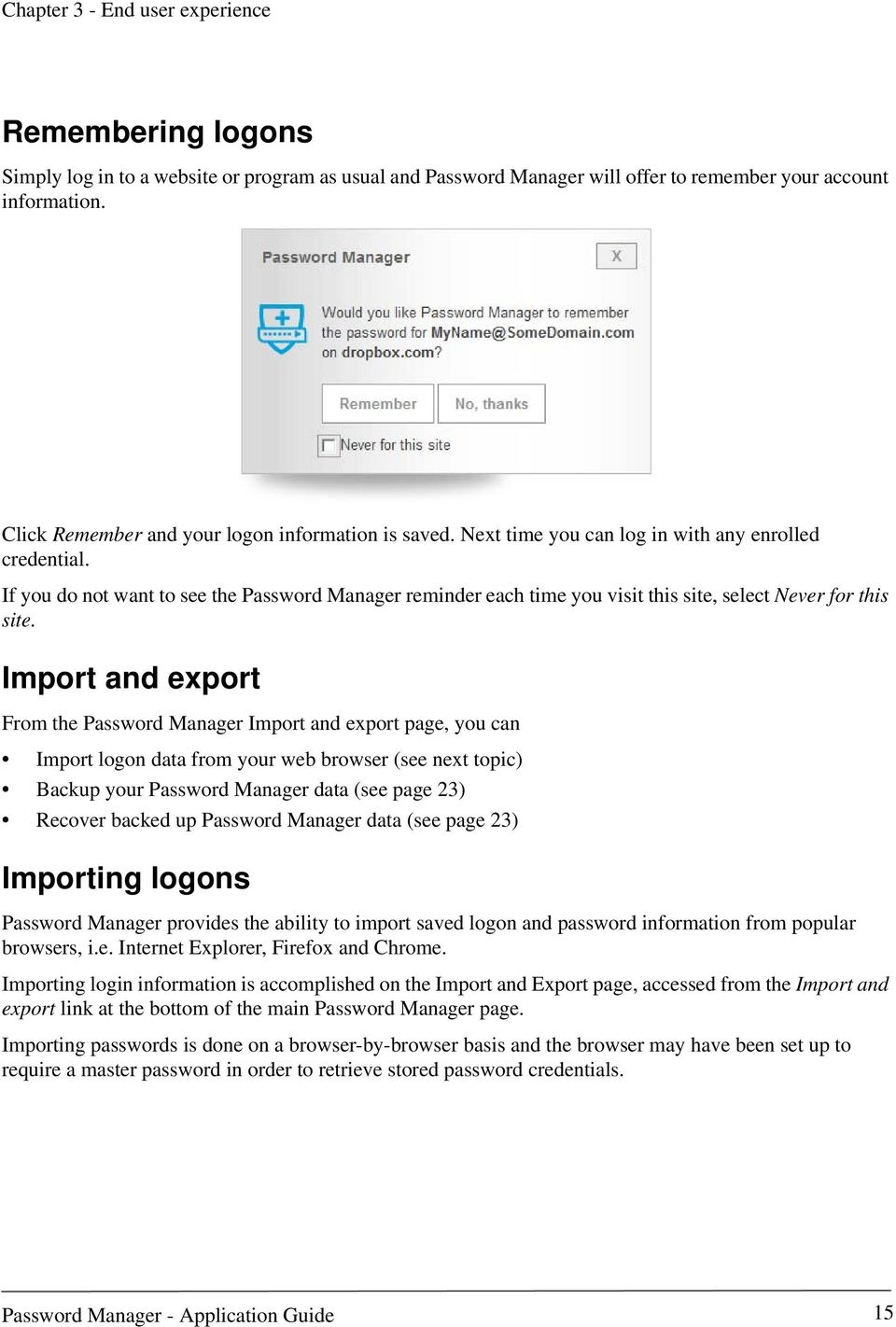
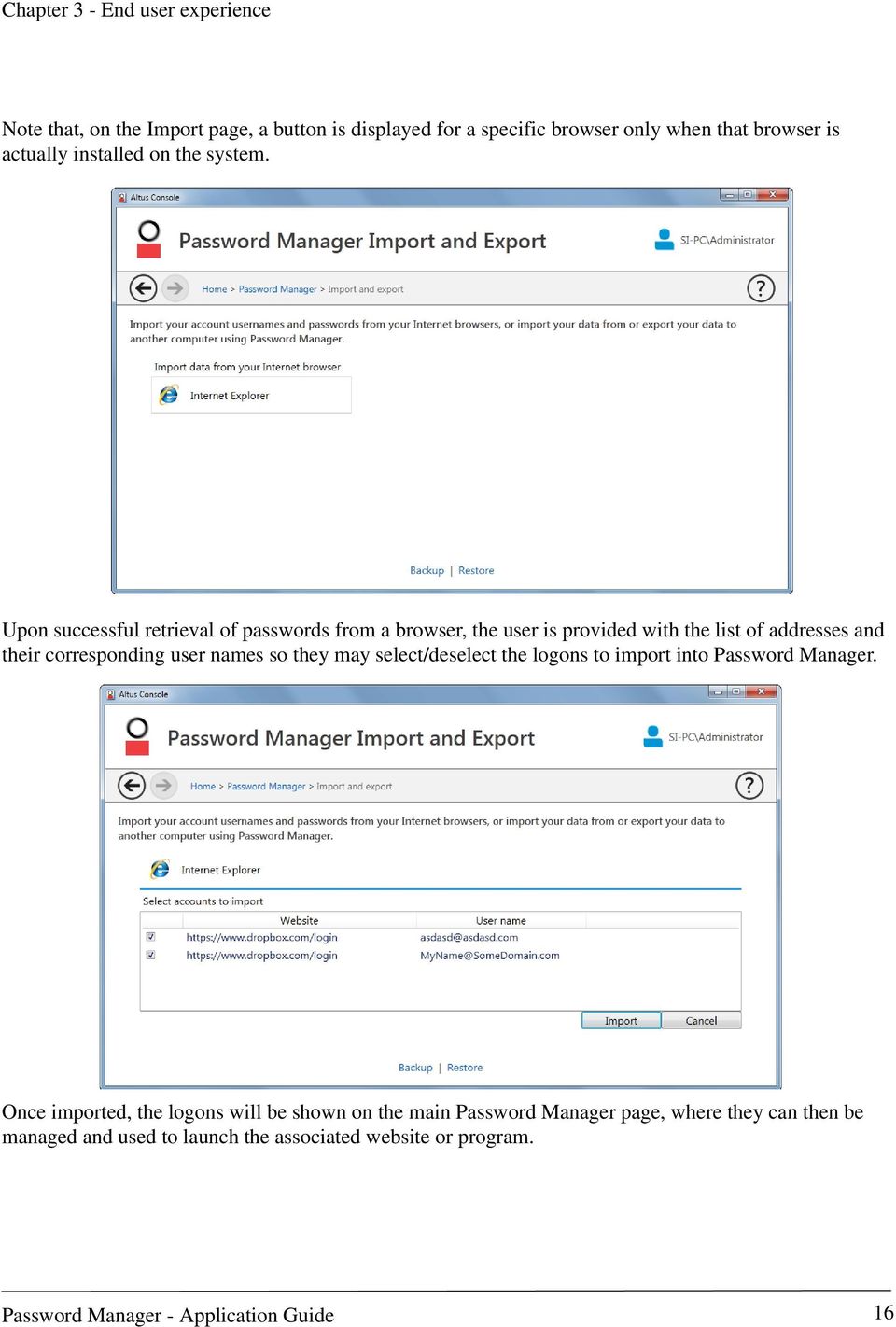
16 Chapter 3 - End user experience Note that, on the Import page, a button is displayed for a specific browser only when that browser is actually installed on the system. Upon successful retrieval of passwords from a browser, the user is provided with the list of addresses and their corresponding user names so they may select/deselect the logons to import into Password Manager. Once imported, the logons will be shown on the main Password Manager page, where they can then be managed and used to launch the associated website or program. Password Manager - Application Guide 16
17 Chapter 3 - End user experience Editing logons You can edit a logon from the Password Manager page, or from the Edit Logon dialog, whichever is more convenient at the time. Editing from the Password Manager page To edit a previously created logon from within the main Password Manager page 1 Click the logon entry to display the editing options and select Edit. 2 The logon entry will be expanded to show previously saved logon information and additional options. 3 The account data includes the following editable fields: Account name The name used on the main Password Manager page to identify this account. Category - The name used for categorizing accounts on the main Password Manager page. Password Manager - Application Guide 17

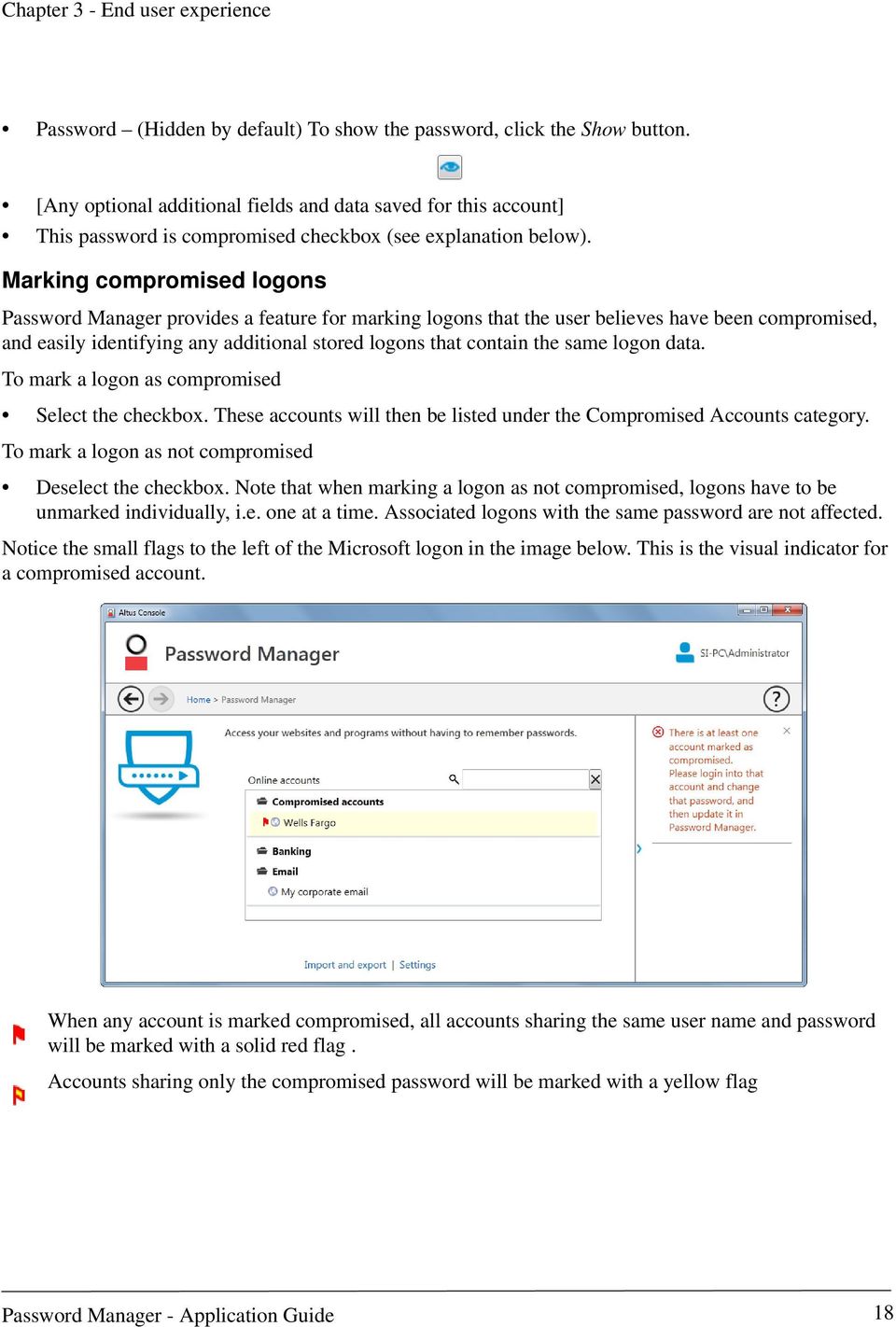
18 Chapter 3 - End user experience Password (Hidden by default) To show the password, click the Show button. [Any optional additional fields and data saved for this account] This password is compromised checkbox (see explanation below). Marking compromised logons Password Manager provides a feature for marking logons that the user believes have been compromised, and easily identifying any additional stored logons that contain the same logon data. To mark a logon as compromised Select the checkbox. These accounts will then be listed under the Compromised Accounts category. To mark a logon as not compromised Deselect the checkbox. Note that when marking a logon as not compromised, logons have to be unmarked individually, i.e. one at a time. Associated logons with the same password are not affected. Notice the small flags to the left of the Microsoft logon in the image below. This is the visual indicator for a compromised account. When any account is marked compromised, all accounts sharing the same user name and password will be marked with a solid red flag. Accounts sharing only the compromised password will be marked with a yellow flag Password Manager - Application Guide 18
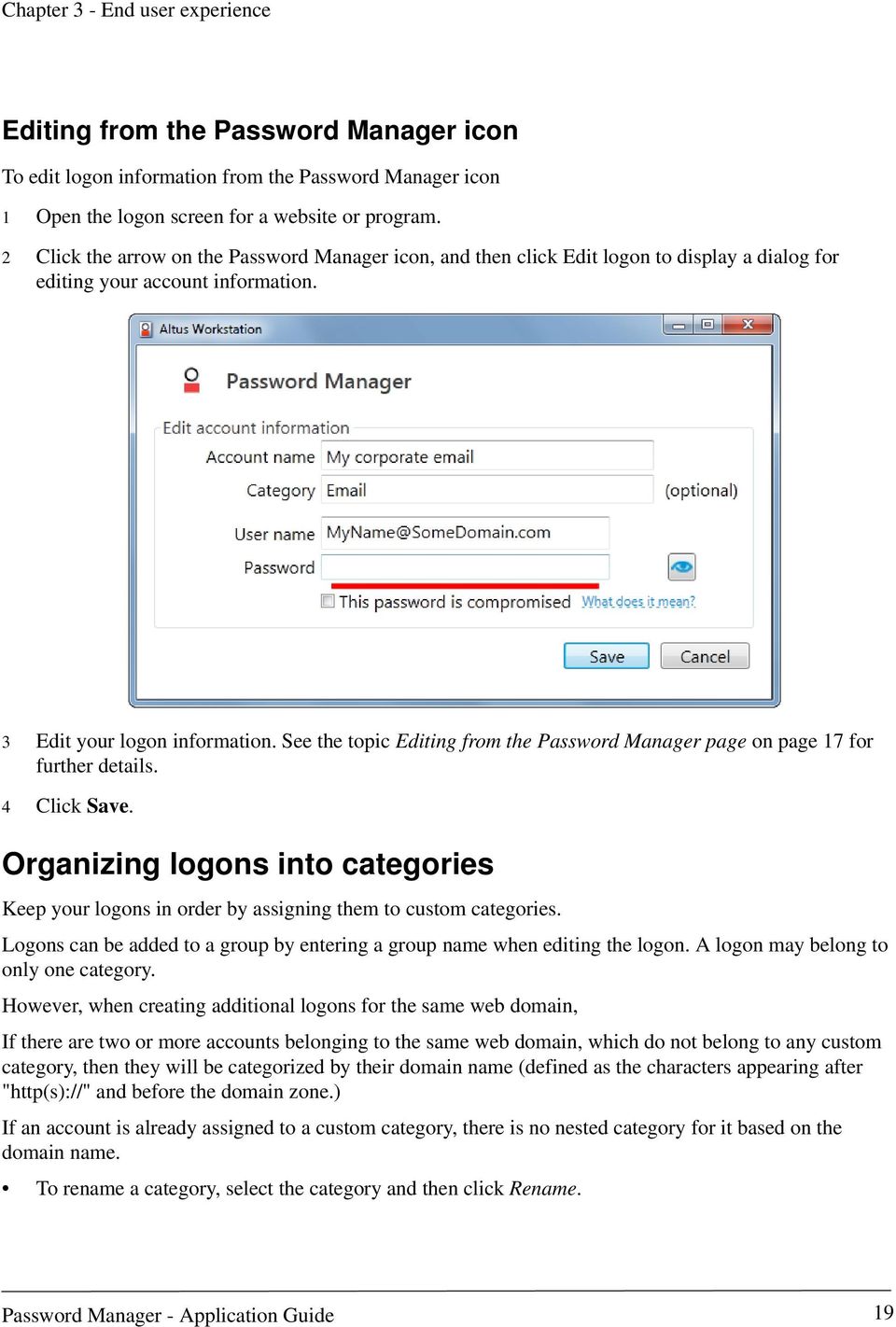
19 Chapter 3 - End user experience Editing from the Password Manager icon To edit logon information from the Password Manager icon 1 Open the logon screen for a website or program. 2 Click the arrow on the Password Manager icon, and then click Edit logon to display a dialog for editing your account information. 3 Edit your logon information. See the topic Editing from the Password Manager page on page 17 for further details. 4 Click Save. Organizing logons into categories Keep your logons in order by assigning them to custom categories. Logons can be added to a group by entering a group name when editing the logon. A logon may belong to only one category. However, when creating additional logons for the same web domain, If there are two or more accounts belonging to the same web domain, which do not belong to any custom category, then they will be categorized by their domain name (defined as the characters appearing after "http(s)://" and before the domain zone.) If an account is already assigned to a custom category, there is no nested category for it based on the domain name. To rename a category, select the category and then click Rename. Password Manager - Application Guide 19
20 Chapter 3 - End user experience To delete the category and return all accounts within that category to an uncategorized state, click Delete category. Managing your logons Password Manager makes it easy to manage your logon information for user names, passwords, and multiple logon accounts, from one central location. Your logons are listed on the Password Manager page in the Pro or Altus User Console. Each logon includes an entry for the website, program or other resource, and an indented entry for each set of account data created for the resource. To manage your logons: From the user console, click Password Manager Edit a logon - Click a logon, then click Edit to change the logon data. Delete a logon - Click a logon, then click Delete. Using the Logons Menu Password Manager provides a fast, easy way to launch the websites and programs for which you have created personal logons. Double-click a program or website logon from the Logons Menu to open the logon screen and automatically fill in your logon data. Managed logons may also be created by your administrator, and may display on the Logons menu. When you create a logon, it is automatically added to your Password Manager Logons Menu. To display the Logons Menu, do one of the following: Press the Password Manager hot key combination. Ctrl+Win+H is the factory setting. You can change Hot Key combination from the Pro or Altus User Console, by clicking Password Manager and then clicking Settings. Scan your fingerprint (on computers with a built-in or connected fingerprint reader). Using managed logons If you are deploying managed logons to your users, this topic contains information that you will want to make sure is passed on to them. The same information is also included in the end-user help file included with compatible clients. Password Manager - Application Guide 20
21 Chapter 3 - End user experience Logging On After creating managed logons and deploying them to users, users will be able to launch a logon screen and verify their identity with their specified credentials. Logon screens that have a logon created for them display the Password Manager icon on the screen. Password Manager Icon for Internet Explorer Password Manager Icon for Firefox and Chrome Depending on the attributes defined by the logon administrator, the logon process may vary. A user can be automatically logged on, with all fields populated and submitted, simply by verifying their identity. The user may need to supply information for required fields the first time they use the logon, but be automatically logged on subsequently. If a user has multiple sets of account data, they will be prompted to select the account they wish to log on to in the Select Account Data dialog box. Changing passwords After creating logons and deploying them to users, managed password screens display the Password Manager icon on the screen. After verifying their identity, the user is asked to provide an old password, a new password and to confirm the new password. Depending on the logon attributes, the change password process may vary. The user can be allowed to choose a new password with or without constraints on the password content. A new random password can be automatically generated, in which case the user must log on with alternate credentials. DIfferences in supported browsers Internet Explorer All features described in this Application Guide are supported in those versions of Microsoft Internet Explorer that are listed in the System Requirements. Password Manager - Application Guide 21
22 Chapter 3 - End user experience Firefox When used with supported versions of the FireFox browser, all Password Manager features are available except for Manual Mode (see page 14), and the following Logon properties used in creating managed logons: Lock out logon fields and Monitor screen changes (see page 36). Chrome When used with supported versions of the Chrome browser, all Password Manager features are available except for Manual Mode (see page 14), and the Lock out Logon Fields property used in creating managed logons (see page 36). When logging in to a website with a managed logon that was created with the Start Authentication Immediately property set, after logging out or canceling the authentication dialog and being returned to the login page, the authentication dialog is not redisplayed. Password Manager - Application Guide 22
23 Chapter 3 - End user experience Backing up your data It is recommended that you back up your workstation data on a regular basis. How often you back it up depends on how often the data changes. For instance, if you add new logons on a daily basis, you should probably back up your data daily. Backups can also be used to migrate from one computer to another, also called importing and exporting. NOTE: Only the data is backed up by this feature. A DigitalPersona Pro or Altus compatible client must be installed on any computer that is to receive backed up data before the data can be restored from the backup file. To back up your data: 1 From the Password Manager page, select Import and export, then Backup. 2 Select Next. 3 Enter a full path name and filename for the backup file. Click Browse to specify a different location. 4 Enter and confirm a password that will be used to protect the file. 5 Then click Save. Restoring your data To restore your data: 1 From the Password Manager page, select Import and export, then Backup. 2 Click Restore data. 3 Specify the previously created backup file. You can enter the full path and filename in the field provided, or click Browse and navigate to the file. 4 Enter the password used to protect the file. Then select Next. 5 Choose the modules whose data you want to restore. In most cases, this would be all of the modules listed. 6 Click Restore. Password Manager - Application Guide 23
24 Password Manager Admin Tool 4 This chapter covers the following topics: Topics Page Overview 24 System requirements 25 Setting up the DigitalPersona Password Manager Admin Tool 26 Managed logons 29 Setting Up a Change Password screen 45 Regular Expression syntax 56 Managing logons 58 The Field Catalog 60 Tools page 62 The Password Manager Admin Tool enables administrators to provide controlled access to websites, programs and network resources by adding a variety of authentication mechanisms (such as password, smart/proximity/contactless card or fingerprint) to their logon and change password screens. The DigitalPersona Password Manager Admin Tool is an add-on module to the Administrative Console, which may be part of your product package, or can be separately purchased through DigitalPersona or your authorized reseller. Overview Setting up a managed logon screen is as simple as an administrator specifying attributes (such as the user name, password, the submit button and other required fields) in a logon for the website or program. The DigitalPersona Password Manager Admin Tool also provides many configurable options for defining and reusing information for logon and change password screens. The change password process can also be automated and controlled, by specifying constraints such as the minimum and maximum password length, letters or numbers only, and other format restrictions. These managed logons can then be automatically deployed to computers where the Password Manager application is installed and which are being managed by a DigitalPersona Pro or Altus Server. After managed logons are deployed, they are made available to managed computers after their next restart, or after a specified time interval as configured by the administrator. Password Manager - Application Guide 24
25 The Password Manager icon displays on screens for which managed logons have been created. The user is guided through the process of logging on or changing their password. Each time that a user accesses the trained website, program or network resource, the Password Manager icon shown below is displayed in the upper left corner of the screen (Internet Explorer and Firefox) or to the right of the first recognized entry field (Firefox and Chrome), indicating that you can use any of your enrolled credentials to log on. Password Manager Icon for Internet Explorer Password Manager Icon for Internet Explorer as displayed on Change Password screens Password Manager Icon for Firefox and Chrome Password Manager Icon for Firefox and Chrome as displayed on Change Password screens Depending on the settings applied by the administrator, the user may be prompted for account data, such as user name, password, and other information during the first logon. During subsequent logons, the account data is provided by Password Manager after the user's identity is confirmed by supplying the credentials required by the Session Authentication Policy in effect. System requirements Installation of the DigitalPersona Password Manager Admin Tool requires the previous installation of DigitalPersona Altus Workstation or DigitalPersona Pro Workstation for Enterprise. Although Microsoft Internet Explorer is not required prior to installation, it is required in order to create managed logons with the tool. Password Manager - Application Guide 25
26 Installation To install the DigitalPersona Password Manager Admin Tool 1 Locate and launch the setup.exe located in the software package you were provided. 2 Follow the onscreen instructions. 3 Once installation is complete, set up the tool by following the instructions in the next topic. Setting up the DigitalPersona Password Manager Admin Tool Before using the DigitalPersona Password Manager Admin Tool, you will need to set it up. DigitalPersona managed logons are created and maintained through the DigitalPersona Password Manager Admin Tool and generally stored in a shared network folder. Folders may be created and managed from the Logons tab in the Password Manager Admin Tool, or created and shared In Windows Explorer and linked to from within the Password Manager Admin Tool. Create a shared network folder Create a shared folder on the network drive to store the DigitalPersona Password Manager Admin Tool managed logons and assign appropriate permissions to the users. The folder should be created on a shared network drive accessible to the DigitalPersona Pro or Altus Server in order to make the logons available for deployment. However, the folder may be created on a local drive for initial testing and later copied to a shared drive. 1 Create a folder on the server/computer where you will store the managed logons. To create a folder or manage the logons contained in a folder, click Choose a folder. 2 Share the folder that you just created to allow users to access it. 3 Right click on the folder and click on Properties in the context menu. 4 Click on the Sharing tab. 5 Verify the permissions by clicking on the Permissions button. Password Manager - Application Guide 26
27 Set up the GPO policy 1 The Workstation Administrative Template file, i.e. DPAltusClient or DPProClient (admx/adm), must be added to the Active Directory Computer Configuration folder in the Administrative Templates folder of the Group Policy Management Editor. For further details on administrative templates, see the chapter Install the Administrative Templates in the DigitalPersona product Administrator Guide. 2 Open the GPO where the DigitalPersona template was added. 3 Go to User Configuration\Administrative Templates\DigitalPersona <product> Client\Password Manager. 4 Double click on Managed logons (in the right pane). The default setting is "Not Configured". Click on Enabled to enable this policy, and then type in the path to the shared folder that you previously created. Password Manager - Application Guide 27
28 5 The new setting will be applied to all DigitalPersona Pro or Altus clients during the usual refresh interval or the next time they restart Windows. Password Manager - Application Guide 28
29 Managed logons Managed logons are used to store attributes such as; the user name, password, the submit button, other required fields and screen information for Logon and Change Password screens. These managed logons are stored in a shared folder specified in a GPO setting in Active Directory. From there they can be deployed to specific groups of end-users managed by the server. Users of the companion product, Password Manager, on computers managed by DigitalPersona Pro or Altus, will then automatically have access to the managed logons. Managed logons are downloaded to client computers as soon as they are set up to be managed, and at intervals specified by the administrator. Note that credentials entered by the end-user for a website or program do not roam on the network, and are only available on the computer where they were entered. The Password Manager Admin Tool includes intuitive wizards that will guide you through the few steps necessary to automatically create a managed logon and an optional change password screen for most websites and programs. For more complex screens, there is also a manual mode that provides more sophisticated options for matching the logon or change password process to non-standard screens. Creating managed logons Password Manager Admin Tool managed logons are used to store attributes such as; the user name, password, the submit button, other required fields and screen information for Logon and Change Password screens. To create a managed logon for a logon screen: 1 From within the Administrative Console, launch the Password Manager Admin Tool. Password Manager - Application Guide 29
30 2 On the Logons tab, select Choose a folder. Click one of the recently used locations, or specify a path and click Browse for folder to add a folder to the list. Then click Choose. 3 Click Add Logon. The Password Manager Admin Tool Logon Screen wizard launches. 4 Launch the logon screen for the password-protected website or program. 5 On the first page of the wizard, confirm that the logon screen has been detected and verify the title of the logon screen. Click Next. For websites or programs that are difficult for the wizard to detect automatically, such as terminal emulator programs, you can create a logon manually by selecting Set up a managed logon manually. This provides additional control for specifying the fields and keystrokes required for logon. Further details on manual creation can be found at Creating logons manually on page The Logon Fields page displays all the fields on the logon screen, using the nearest label to identify each field. Select which fields are required for logon, set their desired attributes (see page 33) and values (see page 34) and then click Next. Password Manager - Application Guide 30
31 7 On the Submit Option page, choose the button that submits the logon data. You can edit the button labels by clicking the label and typing a new name. If you want the user to manually submit the logon data, select Do Not Submit. 8 Click Next to display the Logon Screen Properties page, where you can view and modify the various properties (see page 36) for the Logon Screen. 9 Click Next, and then click Finish to create the logon and close the wizard. 10 In the Administrative Console s Logons tab, click Apply to save your changes to the server. You do not have to click Apply after making each change, but be aware that you do need to click Apply before any new logons or changes to logons will be saved to the server. Password Manager - Application Guide 31
32 To deploy managed logons: 1 Check the boxes next to logons to change their status from In Test to In Use. Only logons with an "In Use" status will be visible to your end-users. 2 Click Apply. 3 After a managed logon is deployed to a computer, the Password Manager icon on the end-user s screen signifies that they can fill in the requested account data by verifying their identity with the required credentials. Notes: Managed logons, created by Password Manager Pro take precedence over any personal logons created for the same screen by end-users of the Password Manager application. The corresponding personal logon will no longer be able to be used to log on, but can be opened by clicking Edit in order to retrieve their account information. If more than one administrator is using Password Manager Pro at the same time, they should make sure not to make changes to logons at the same time; as only the last applied changes will be deployed. See Also: Creating logons manually on page 40. Password Manager - Application Guide 32
33 Logon Fields attributes Logon Fields attributes are used in the Logon Screen Wizard during the creation of managed logons and Change Password screens. Column headings specify the attributes for each field on a Logon Screen or Change Password screen. Field Use Label Type Catalog Description Check the Use checkbox for each field used for log on. Some fields discovered by the wizard may not be relevant to log on, such as a search field on a website logon page. Leave these unchecked. If the label for a field is not intuitively related to the corresponding field on the logon screen, type a new label. The labels are displayed when users are prompted to type a value for a logon field. The type of field, either text or password, is displayed in the Type text box. This value is not editable. Password hides the password on the logon screen so it cannot be viewed. Text displays readable text. For added convenience, you can create specifications for frequently used fields using the Field Catalog tab. The Field Catalog is a collection of frequently-used fields and their specifications. If the field is in the Field Catalog, you can click and then choose it from the dropdown list. The specified data will be filled in automatically. To add a field to the Field Catalog, see page 60. Password Manager - Application Guide 33
34 Field Value Description Type a value for the logon field or use the Value dropdown menu (see next section) to indicate a value specified by the user or provided by the program. A typed value is stored in the logon in clear (unencrypted) text and is shared by all of those using the logon. Values Logon Field and Password Field values are used on the Logon Fields page of the Logon Screen Wizard during the creation of managed logons and Change Password screens. A Value dropdown menu provides a list of options for specifying values to be supplied by the user or automatically by Password Manager. The available options vary depending on the type of field selected. Option Ask-Reuse Ask-Confirm Ask Always Windows User Name Windows User Principal Name Description Prompts the user to enter a value for a logon field the first time they use the logon. This value is automatically submitted for them on each subsequent logon without prompting the user again. Prompts the user to enter a value for a logon field the first time they use it. However, on subsequent logons, the value is automatically entered and they are then prompted to confirm this value or change it. Prompts the user to enter a value for a logon field each time they use the logon. Password Manager provides the Windows user name. Password Manager provides the user name and domain values in UPN format. Example: [user name]@[domain]. Password Manager - Application Guide 34
35 Option Windows Domain\ User Name Windows Domain Windows Address Windows User Password Write Only Description Password Manager provides the domain of the user followed by a backslash and the user name. Example: [domain]\[user name]. Password Manager provides the user domain name only. Password Manager provides the registered address for the Windows user account currently logged on. Password Manager provides the password used for Windows logon. Always prompts a user for the value. Password Manager - Application Guide 35
36 Logon and Password Screen properties In the Logon Screen and Change Password wizards, both Logon Screens and Change Passwords screens have an identical associated Properties page where you can edit the properties for the screen. Category Property Description General Managed Logon Name The name of the logon. Description User Hint Can be used to enter optional information about the managed login that is only viewable on the Password Manager Admin Tool Logons tab. By default, this column is hidden. To display the column, right click anywhere in the column headings area and select Description. Type a message to be displayed when the managed logon is used. For example, a custom prompt to type values for the logon fields. To add more detailed user assistance, type a URL that a user can click to be directed to a web page. Password Manager - Application Guide 36
37 Category Property Description Show Balloon (Logon screens only) Once this managed logon is created and deployed, a balloon tip will automatically display (up to three times) when the user accesses the logon screen. Use this setting to select how many times the balloon is displayed. Screen Detection Window Caption Title of the screen as detected by the wizard; used to match the managed logon to the specified screen. If portions of the window caption will change, you can use wildcards (*) at the beginning, middle or end of the caption. Only one wildcard can be used per caption. The portion of the string that does not change will be used to recognize the screen. For example: *Some Application Login Some Company*Login My Bank Login* Monitor screen changes When enabled, Password Manager continually monitors the titlebar, URL and content of the specified web page for changes that may affect the logon. When disabled, only the titlebar and the URL are monitored. For example, if a page were using frames, and a link in one frame changes another frame in the page in such a way that it changes to a logon page, with this setting on, the change is recognized and appropriate action taken. With the setting disabled, the change would not be recognized. Use of this setting is resource intensive, and it is disabled by default. Password Manager - Application Guide 37
38 Category Property Description Authentication URL Extended Match Start Authentication Immediately Used by to recognize a website screen. The URL information in the logon is matched to the URL in the screen. If multiple websites have the same title or if portions of the URL change, which can be the case for websites that redirect traffic for load balancing, then specify the portion of the URL to match. The dropdown menu allows you to specify the type of matching to perform on the URL. The options are: Do Not Match - This is the default. URL matching will not be performed. String Match - Matches the exact string displayed. Wildcard Match - Matches a displayed string utilizing an asterisk (*) to represent the portion of the URL that may change. Regular Expression - Matches a displayed string constructed as a regular expression (See Regular Expression syntax on page 56). Case Sensitive - Ignore case when matching. Restore Defaults - Return to the default URL settings. Displayed only when creating a logon for a program, not a website. Click the button next to the Extended Match field and select any labels that should be used for matching when recognizing the screen. Click the checkbox next to the labels to use. After making selections and clicking OK, you can select the type of matching to perform by selecting it from the dropdown list. The options are the same as those listed above for the URL. If set to Yes, the user is prompted for their credential immediately after the logon screen displays. The default setting is No. Password Manager - Application Guide 38
39 Category Property Description Lock out logon fields If set to Yes, the user is prevented from typing data in the logon fields. The default setting is No. Password Manager icon Location ID Identifies the location selected in the Location field (below) so that it can be shared with other logon screens. Location From the dropdown menu, select the initial location where the Password Manager icon will appear on the logon screen. The default is the top left corner of the screen. Password Manager - Application Guide 39
40 Creating logons manually If Password Manager Pro does not detect fields automatically in websites and programs, you can create a managed logon for a logon screen by manually specifying the fields. Creating logons manually can include using additional controls besides specifying fields and field contents, such as adding keystrokes, forcing delays between actions, and specifying the positions of fields. To create a logon manually for a logon screen: 1 From within the Administrative Console, launch the Password Manager Admin Tool. 2 On the Logons tab, select Choose a folder. Click one of the recently used locations, or specify a path and click Browse for folder to add a folder to the list. Then click Choose. 3 Click Add Logon. The Password Manager Admin Tool Logon wizard starts. 4 Launch the logon screen for the password-protected website or program. Password Manager - Application Guide 40
41 5 On the first page of the wizard, confirm that the logon screen has been detected and verify the title of the logon screen. 6 Select Set up a managed logon manually and then click Next. 7 On the Logon Fields page, click Add and select an action (see page 43) from the dropdown menu. 8 Add additional actions as required. If necessary, use the arrow buttons to modify the order in which the actions are performed. Password Manager - Application Guide 41
42 9 Click Next to display the Logon Screen Properties page, where you can view and modify the various properties (see page 36)) for the logon screen. 10 Click Next, and then click Finish to create the logon and close the wizard. 11 In the Administrative Console s Logon tab, click Apply to save your changes to the server. You do not have to click Apply after creating each logon or making every change, but you do need to click Apply before any new logons or changes to logons will be saved to the server. See Also: Creating managed logons on page 29. Deploying managed logons To deploy managed logons: 1 Check the boxes next to logons to change their status from In Test to In Use. Only logons with an "In Use" status will be visible to users. 2 Click Apply. Password Manager - Application Guide 42
43 After a managed logon is deployed to a computer, the Password Manager icon on the screen tells the user that they can fill in the requested account data by verifying their identity with the required credentials. Logon Fields actions Logon Fields actions are used when creating logons manually in the Password Manager Pro Logon Screen Wizard and the Password Manager Pro Change Password Screen Wizard. An Actions dropdown menu provides a list of actions that are used to build a script for those logon and change password screens that cannot be automatically configured by Password Manager Pro. Action Keystroke Description This sequence of keys will be placed in the keyboard buffer. Keystroke properties are: Key - Select the main key to be entered. Repeat - Specify the number of times the key sequence is entered. Shift, Control, Alt - Optionally, select one of these keys in combination with the main key. You may specify the exact use of a Generic, Left or Right key as well. Password Manager - Application Guide 43
44 Action Field Delay Position Description Label - Type a label name for the corresponding field on the logon screen. The labels are displayed when users are prompted to type a value for a logon field. Type - Select the type of field, either text or password. Choosing password hides the password on the logon screen; choosing text displays readable text. Reference - Optionally, select a field previously defined on the Field Catalog tab. Value - Type a value for the logon field or use the dropdown menu to indicate a value specified by the user or provided by the program. If you type a value for the logon field, it is stored in the logon in clear (unencrypted) text and is shared by all users using the logon. Specify how many seconds to wait before the next action in the list is performed. Specify a location where the system will perform a mouse click. Position is measured from the top left corner of the client window area. Client X - Type a number of pixels for the X axis position for the action. Client Y - Type a number of pixels for the Y axis position for the action. Instead of typing X and Y coordinates, you can drag the target icon to the actual logon screen field to specify the position. When you release the target icon at the location you want to specify, the Client X and Y positions will be captured. Password Manager - Application Guide 44
45 Setting Up a Change Password screen By managing a change password screen, you can specify the fields required by the application for changing passwords, implement password policies and automate the entire process for the end user. To set up a Change Password Screen automatically: 1 Launch the password-protected website or program for which you want to set up a Change Password Screen. Move to that site s or program s Change Password screen. 2 In Password Manager Pro, select the logon for that website or program. 3 Right-click to display that logon s context menu, then click Add Change Password Screen. Password Manager - Application Guide 45
46 4 The Password Manager Admin Tool Change Password Screen wizard starts. On the first page of the wizard, confirm that the correct screen has been detected. Click Next. 5 The wizard displays the Change Password Screen Fields page. Password Manager - Application Guide 46
47 6 Select all fields on the page that are relevant to the change password process, and click Next. Option Heading Use Label Catalog Value Description Check the Use check box for each field used for password change. If some of the fields displayed by the wizard are not relevant for password change (i.e., a search field on a website change password page), leave those fields unchecked. If the label for a field is not intuitively related to the corresponding field on the change password screen, enter a new label name in this field. The labels are displayed when users are prompted to type a value for the field. By default, specifies values for fields based on those used in the associated Logon screen. For example, the password used at logon is re-used during the Change Password process. Use the Catalog dropdown menu to change these values as needed. Specifies the value for this field. For Old Password, the value should be Ask-Reuse. For New Password and Repeat New Password fields, the value should be Write Only. 7 On the Password Policy page, optionally, hover over the password field to display the Browse button (...) and click the button to display a dialog where you can specify changes to the password policy. The password policy defined in the wizard should generally be the same as that used on the website or in the program. (See Password Policy on page 50.) The default is none. Password Manager - Application Guide 47
48 8 Click Next. The Submit Selection page displays all detected buttons and a Do Not Submit option. Select the button that is used by the screen to submit the password data. Or select Do Not Submit to fill in the data but not submit it. 9 Click Next to display the Change Password Screen Properties page (See 36 for a description of the properties). Modify any of the listed properties to customize the appearance and behavior of the Change Password screen. Password Manager - Application Guide 48
49 10 On the Setup Complete page, click Finish to close the wizard. 11 In the console, click Apply to save your changes to the server. You do not need to click Apply after creating making every change, but you do need to click Apply to save any changes that you have made. Managed change password screens are deployed at the same time as the managed logons that they are associated with. After they are deployed, they will display the Password Manager icon, indicating that the user should verify their identity to begin the change password process. See Also: Creating logons manually on page 40. Password Manager - Application Guide 49
50 Password Policy The Password Policy dialog specifies requirements for passwords that are either generated by Password Manager or entered by a user at a Change Password screen. Here, you can also verify proposed passwords against specified password complexity requirements.. Option Enable password policy Description When enabled: If the password is entered by the user, it will be verified by Password Manager and must conform to the password complexity requirements defined in this dialog. If the password is generated by the system, it will be generated according to the specified complexity requirements. Password Manager - Application Guide 50
51 Option Predefined rule Custom rule Description The password must conform to the predfined rule selected from the dropdown menu. These include: Letters and numbers - Alphanumeric characters only. Numbers only - Digits only, i.e Letters only - Alphabetic characters only. Letters and numbers with special characters - must contain at least one number or letter and at least one of these special characters:! #$%& ()*+,./:;<=>?@[\]^_`{ }~ Letters and numbers, with at least one number Enter a pattern for verifying or generating a password using the following notation: A = UPPERCASE LETTERS, i.e. A through Z a = lowercase letters, i.e. a through z d = digits, i.e. 0 through 9 s = special characters, i.e.! #$%& ()*+,./:;<=>?@[\]^_`{ }~ ( ) = Use the enclosed indicators in random order. For example: (asd) would require or generate a password with a lower case letter, a special character and a digit in any order, i.e. b$3, #1f or 0z! But the use of asd without the parentheses would always have a lowercase character first, a special character second and then a number. [ ] = Define a custom character set i.e. [abcdef] would limit the user to only those letters in the specified position. For example: A custom rule of [abcd]ds would generate only passwords with a, b, c or d in the first position, a digit in the second position and a special character in the third position. {n,m} Define a range of acceptable occurences of the previosuly indicated character set. For example: d{2,4}a{2,}s{3} indicates 2 to 4 digits followed by 2 or more lower case letters and 3 special characters. Note that when there is a comma but no upper range defined, as in {2,}, then the upper limit is only constrained by the maximum length of the password as specified in the field described below. When only one value is specified - without the comma, as in {3}, then the lower and upper range are the same, i.e. in this case, exactly 3 special characters. For further details and examples, see the Appendix, beginning on page 64. Password Manager - Application Guide 51
52 Option No character should occur more than once Length Test Complexity History Generation Description No character should appear more than once in the password. This applies to both predefined and custom rules. Select the minimum and maximum length for the password. This applies to both predefined and custom rules. This area includes two fields and buttons which can be used to verify that a specific password meets the defined complexity requirements or to generate a new password that will meet the requirements, Verify - Enter a password in the text field to the left of the Verify button and it will be verified against the defined complexity rule. Generate - Enter a password in the text field to the left of the Generate button and the system will generate a password that conforms to the defined complexity requirements. This dropdown menu provides additional password constraints relating to the history of the password. None. No other constraints are applied to the password contents. Different than the Windows password. The new password must be different than the current Windows password. Unique within Password Manager managed logons. The new password must be different from any other password associated with this managed logon for a specified user account. Different than the current password. The new password must be different than the current password for this website or program This constraint applies to both predefined and custom rules. Note that the History constraints are not applied when verifying ir generating passwords within this dialog, but only on an actual Change Password screen. By User - Password Manager Pro does NOT provide password information to a Change Password screen and the user has the option to log on by entering their password or another allowed credential. If a password is used, it is verified against the defined complexity rules By System - Password Manager Pro generates the password automatically. An alternate credential must be used to log on. Password Manager - Application Guide 52
53 Setting up a Change Password Screen manually If the Password Manager Admin Tool does not detect fields automatically in a Change Password screens, you can manually specify the fields and actions required. Creating a Change Password screen manually allows you to include additional controls such as adding keystrokes, forcing delays between actions, and specifying positions of fields. To set up a Change Password screen manually: 1 Launch the password-protected website or program for which you want to set up a Change Password Screen. Move to that site s or program s Change Password screen. 2 In the Password Manager Admin Tool, select the logon for that website or program. 3 Right-click to display that logon s context menu, then click Add Change Password Screen. The Password Manager Admin Tool Change Password Screen wizard starts. Password Manager - Application Guide 53
54 4 On the first page of the wizard, confirm that the correct screen has been detected. Select Set up a managed logon manually. Click Next. 5 On the Logon Fields page, click Add and select an action from the dropdown menu. For example, you might study a Change Password screen and discover that it takes three presses of the tab key to get to the first input field (Change Password). Password Manager - Application Guide 54
55 You could choose Keystroke, select the Tab key, and specify "Repeat 9 times" to get the user where they need to be; or you could choose to use the Position action to place the cursor in the right location to change the password. When adding password fields manually, if the password will be automatically generated by the system, configure the three usual password fields as shown below. Old password: Type = Password, Reference = Password [Login], Value = Ask - Reuse New and Confirm password:type = Password, Reference = Password [Login], Value = Write Only 6 Add additional actions as required. If necessary, use the arrow buttons to modify the order in which the actions are performed. 7 On the Password Policy page, optionally, click (...) to specify changes to the password policy. The password policy defined in the wizard should generally be the same as that used on the website or in the program. (See Password Policy on page 50.) The default is None. 8 Click Next to display the Change Password Screen Properties page. Modify any of the listed properties to customize behavior of the Change Password screen. 9 On the Setup Complete page, click Finish to close the wizard. 10 Click Apply to save your changes to the server. You do not need to click Apply after making every change, but you do need to click Apply to save any changes that you have made. Managed change password screens are deployed at the same time as the managed logons that they are associated with. After they are deployed, they will display the Password Manager icon, indicating that the user should verify their identity to begin the change password process. Password Manager - Application Guide 55
56 Regular Expression syntax Both Logon Screens and Change Passwords Screens can use regular expressions in the URL field of the Properties page to define the part of a URL that should be matched when determining if the page has changed. A regular expression is a text string used to create a logon for matching certain characters, or a series of characters, within another text string. In a regular expression, most characters are treated as literals, i.e. they match only themselves ("a" matches "a", "(bc" matches "(bc", etc). The exceptions are called metacharacters (MC in the table below). MC Description. Matches any single character [ ] Matches a single character that is contained within the brackets. For example, [abc] matches "a", "b", or "c". [a-z] matches any lowercase letter. These can be mixed: [abcqz] matches a, b, c, q, r, s, t, u, v, w, x, y, z, and so does [a-cq-z]. The '-' character should be literal only if it is the last or the first character within the brackets: [abc-] or [-abc]. To match an '[' or ']' character, the easiest way is to make sure the closing bracket is first in the enclosing square brackets: [][ab] matches ']', '[', 'a' or 'b'. [^ ] Matches a single character that is not contained within the brackets. For example, [^abc] matches any character other than "a", "b", or "c". [^a-z] matches any single character that is not a lowercase letter. As above, these can be mixed. ^ Matches the start of the line (or any line, when applied in multiline mode) $ Matches the end of the line (or any line, when applied in multiline mode) ( ) Defines a "marked subexpression". What the enclosed expression matched can be recalled later. See the next entry, \n. Note that a "marked subexpression" is also a "block." \n Where n is a digit from 1 to 9; matches what the nth marked subexpression matched. This construct is theoretically irregular and has not been adopted in the extended regular expression syntax. * A single character expression followed by "*" matches zero or more copies of the expression. For example, "[xyz]*" matches "", "x", "y", "zx", "zyx", and so on. Password Manager - Application Guide 56
57 MC Description \n* {x,y} Where n is a digit from 1 to 9, matches zero or more iterations of what the nth marked subexpression matched. For example, "\(a.\)c\1*" matches "abcab" and "abcabab" but not "abcac". An expression enclosed in "\(" and "\)" followed by "*" is deemed to be invalid. In some cases (e.g. /usr/bin/xpg4/grep of SunOS 5.8), it matches zero or more iterations of the string that the enclosed expression matches. In other cases (e.g. /usr/bin/grep of SunOS 5.8), it matches what the enclosed expression matches, followed by a literal "*". Match the last "block" at least x and not more than y times. For example, "a\{3,5\}" matches "aaa", "aaaa" or "aaaaa". + The + operator will match the preceding atom (a single character, a marked subexpression, or a character class) one or more times, for example the expression a+b will match any of the following: ab aaaaaaaab But will not match: b The operator will match either of its arguments, so for example: abc def will match either "abc" or "def". Parenthesis can be used to group alternations, for example: ab(d ef) will match either of "abd" or "abef".? The? operator will match the preceding atom (a single character, a marked subexpression, or a character class) zero or one times, for example the expression ca?b will match any of the following: cb cab But will not match: caab Password Manager - Application Guide 57
58 Managing logons The Password Manager Admin Tool makes managing logons easy. Most management features can be accessed through either of two means available on the Logons tab: Right-click on a logon to display the shortcut menu for that logon Select a logon and click Manage to display available commands for that logon. After making any changes to your managed logons, remember that they need to be deployed before they can be seen and used by the end-user (see Deploying managed logons on page 42). The following logon management features are described in this section. Feature Editing logons 58 Deleting logons 59 Deploying logons 59 The Field Catalog 60 Finding logons 62 Finding duplicate logons 62 Finding fields in logons 61 Page Editing logons To edit a logon: 1 Select a logon to edit and click Manage. 2 Click Edit and select either Logon Screen or Change Password Screen. 3 In the corresponding wizard, make any desired changes to the logon. For details on specific wizard pages, see one of the following topics: Reference Logon Fields attributes 33 Values 34 Logon and Password Screen properties Page 36 Logon Fields actions 43 Password Manager - Application Guide 58
59 Reference Password Policy 50 Page 4 When editing is complete, click Finish to exit the wizard. 5 Click Apply to save your changes to the server. You do not need to click Apply after making each change, but be aware that you do need to click Apply before any changes to logons will be saved. Deleting logons To delete a logon: 1 Choose a group to edit its managed logons. 2 Right-click on the logon that you want to delete and click Delete. 3 Click All Screens to delete the logon and any associated Change Password screens, or click Change Password Screen to delete only the Change Password screen. 4 Click Apply to save your changes to the server. You do not need to click Apply after making every change, but you do need to click Apply to save any changes that you have made. Deploying logons To deploy managed logons: 1 Check the boxes next to logons to change their status from In Test to In Use. Only logons with an "In Use" status will be visible to users. 2 Click Apply. After a managed logon is deployed to a computer, the Password Manager icon on the screen tells the user that they can fill in the requested account data by verifying their identity with the required credentials. Password Manager - Application Guide 59
60 The Field Catalog You can use the Field Catalog to store logon field values and attributes that can be reused in creating managed logons for logon screens that share common fields. By storing frequently used logon fields in the catalog, you can add commonly used fields to additional logons without setting values or attributes each time. Later changes made to fields in the catalog will then also be propagated to all logons that use the field. Adding fields to the Field catalog To add a field to the Field Catalog: 1 On the Field Catalog tab, click Add to create a new field in the table. 2 In the Field column, type a name for the field you are adding to the catalog. 3 Specify the type of the field by selecting Password or Text in the Type dropdown list. 4 Specify the value of the field (see page 34) from the Value dropdown menu. 5 Add any comments related to this field in the Description text box. Example: Use of Field Catalog for password To use a field from the Field Catalog for a password: 1 Add a field to the catalog, and select Password as the type (see previous topic). Password Manager - Application Guide 60
61 2 Create a managed logon manually (see page 40). 3 On the Logon Fields page of the wizard, from the Add dropdown menu, select Field. 4 In the Action Properties area, enter a label for the field. 5 From the Type dropdown menu, select Password. 6 From the Reference dropdown menu, select the name of the field that you added in step 1 above. 7 Continue creation of the logon as described in step 9 of Creating logons manually on page 42. Finding fields in logons You can search for managed logons that contain fields selected from the Field Catalog. To search for logons that contain selected fields: 1 On the Field Catalog tab, select the fields to search for and click Find Logons to display the search results. 2 Optionally, click Save Results to save the results to an HTML file. The results are saved as an HTML table that includes the caption, logon name, created date, modified date and file name. Password Manager - Application Guide 61
62 Tools page Use the Tools page to search for logons, or check for duplicate logons. Finding logons To search for logons: 1 On the Tools page, enter a logon name, caption or URL to search for. Use? or * wild cards to indicate individual or multiple characters. 2 Click Find to display the search results. 3 Optionally, click Save Results to save the results to an HTML file. Finding Duplicate Logons Duplicate logons are multiple copies of logons for a single logon or change password screen. To search for duplicate logons: 1 On the Tools page, click Check Duplicates. 2 Optionally, click Save Results to save the results to an HTML file. 3 Right-click on any of the resulting logon names to display a shortcut menu with options to edit or delete the duplicate managed logon. Password Manager - Application Guide 62
63 Password Manager Actions Password Manager Actions are operations that may be performed when an assigned Password Manager Hot Key(s) are pressed, or a specified credential or credential combination is presented. Password Manager Actions may be assigned to Hot Keys, a credential or a credential combination through the Quick Actions GPO setting on the DigitalPersona Pro or Altus Server. The Password Manager Action that will be performed depends on the context. One of he following operations will be performed, in the listed order of preference. 1. When the active window is a website, program or other resource associated with a previously created personal or managed logon - trained fields will be filled in with user account data. 2. If the active window does not have a previously created personal or managed logon - The Create Logon dialog is displayed allowing creation of a personal logon for the resource. This action also requires that the Allow creation of personal logons GPO setting must be enabled or not configured. Password Manager - Application Guide 63
64 Appendix 5 Overview This appendix includes two tables. The first table fully defines the notation system, character sets and rules used in defining pattern-based Custom rules for verification or generation of passwords by Password Manager for Change Password screens. The second table provides examples of how this notation system can be used to create sophisticated and complex requirements for passwords verified by or generated by Password Manager. Password Manager - Application Guide 64
65 Chapter 5 - Appendix Notation system Notation Description a Shorthand for set of characters from a to z. A Shorthand for set of characters from A to Z. d Shorthand for set of digits from 0 to 9. s Shorthand for "!\"#$%&'()*+,-./:;<=>?@[\\]^_`{ }~" [] Character set. Character set specifies a set of characters. One character of this set will occupy a single position in the password. You may specify ASCII and Unicode characters inside set. There are no delimiters between the characters inside the set. For Unicode characters, the following notation should be used: \uxxxx where X is a hexadecimal number, i.e. 0-9, A-F. For example \u0041-\u0061 defines range from A-Z. Character set may include a separate character or a range of characters. To specify a range of characters, use the hyphen-minus character (-). Lower boundary character should be less than the upper boundary character. For example: range a-z is legal, but range z-a is illegal. The following characters -\] (hyphen-minus, backslash, and closing square bracket) should be escaped with a backslash character if they are part of the character set. For example \\ double backslash will be part of character set vs. single backslash that defines the next character to be treated differently. Shorthand notations cannot be used inside of the character set. For example: the following statement [a] defines a character set with a single character, not a set of a-z; definition [\a] will define a character set with a single character, since there is no special meaning for an escaped a. {N} Repetition. Repetition of the previous shorthand character, group, or character set. This rule is allowed inside both verify (By user) and generate (By system) password policies. N represents how many times the previous rule should be repeated. N should be a number greater than zero. Password Manager - Application Guide 65
66 Chapter 5 - Appendix Notation {N, M} Description Repetition Range. Repetition range of the previous shorthand character, group, or character set. This rule is allowed only for Generate password policy and cannot be used for Verify password policy. N represents the lower boundary and M represents the upper boundary of the repetition range. M should be equal to or greater than N and cannot be zero. M can be omitted. In this case, the upper boundary will be determined based on final password length. For example, a{4,}d{5,}, with a defined password length of between 8 and 12 characters, will generate password with length determined by the following formulas: FinalPasswordLength = 8 + Random(12-8); A = FinalPasswordLength - (4 + 5); M1 = Random(A); M2 = Random(A - M1); where M1 is upper boundary for the first range, and M2 is upper boundary for the second range. N can be equal to zero only if M is defined. In this case, the previous character may become an optional character with repetition from zero to M times. Here are some examples: {2,1} illegal combination {1,2} 1 to 2 times. {1,} 1 to M times (see formula above for calculation of M). {0,} 0 to M times (see formula above for calculation of M). {0,5} 0 to 5 times ( ) Group. Group rule combines all items inside group as a single item. The order of items inside group is irrelevant unless disable permutation rule is applied to this group. Password Manager - Application Guide 66
67 Chapter 5 - Appendix Examples of Custom Rules Pattern sequence Aa{4,6}s{2}d{1,3} Generates a password with the character an uppercase letter, followed by 4 to 6 lowercase letters, two special characters and from 1 to 3 digits. Sample values Ocnkv>)71 Rzoms/@4 Tuykex~?27 Npgnvj>!9 ds([a-dm-za-dm-z]{8}) Generates a password with a number in the first position and a special character in the second position, followed by eight characters which may consist of any combination of lowercase letters from a to d and m to z or their uppercase equivalents. [~!@#$%^&*+=]{2}a{2}A{2}d{2} ([~!@#$%^&*+=]{2}a{2}A{2}d{2}) The first pattern generates a password with the first two positions containing symbols from a specifically defined set, with the next two positions containing lowercase characters, the following two positions containing uppercase characters and the last two positions containing numbers in the range 0 to 9. In the second example, the entire pattern is enclosed in paranthesis and therefore the order of the characters in the generated password will be randomized. 3>sVzZXdoS 0>AyQMYozt 2&MqUNXaYS 7%rOATzuaR First Second pattern 6e%y3M@J BpI02%h^ DL=93%qx Password Manager - Application Guide 67
68 Glossary 6 In order to fully understand and implement the features of DigitalPersona Password Manager, you will need to be familiar with the terms covered in this chapter. authentication The process of verifying your identity, i.e. that you are the person you claim to be, through the use of your specified credentials such as your Windows password, your fingerprint, smart card or face recognition. back up Use the backup feature to save a copy of important program information to a location outside the program. It can then be used for restoring the information at a later date to the same computer or another one. connected device A hardware device that is connected to a port on the computer. credentials Credentials are a set of information used to gain access to your computer, Windows account or to a password protected website or program. Credentials may include a combination of a user name, password, fingerprint, fingerprint PIN, Smart/Proximity/Contactless cards or Bluetooth devices. console A central location where you can access and manage the features and settings in DigitalPersona Pro or Altus Workstation or Kiosk. enroll The process of capturing and storing information about your fingerprints, which are then used to authenticate you in order to access Windows, websites, and programs. fingerprint As used in this documentation, a digital extraction of a fingerprint image. Your actual fingerprint image is never stored by DigitalPersona products. Password Manager - Application Guide 68
69 Chapter 6 - Glossary kiosk A kiosk is a computer, or group of computers, that can be used by designated persons sharing a single Windows user account and its associated programs. Each user of the kiosk can quickly and easily log on to Windows, programs and websites using the minimum credentials (such as fingerprints) specified by the organization. logon Account data for a website, program or password change screen that allows a user to logon by using specific credentials as specified by the Pro or Altus administrator. There are two types of logons, personal logons and managed logons. See separate glossary entries. managed computer Any computer running a compatible DigitalPersona Pro or Altus client, that has been set up to be managed by a Pro or Altus Server. managed logon A logon (see above) created using the Password Manager Admin Tool, which can then be deployed to all managed computers. The term logon is generally used, except when specifically referring to logons created by an administrator with Password Manager Admin Tool (managed logons) as contrasted with those created by an end-user (personal logons). When both managed and personal logons exist for the same program or website, the personal logon is disabled and only the managed logon may be used for access to the specified program or website. See also: personal logon. Password Manager A security application included with DigitalPersona Pro or Altus clients that allows users to create their own personal logons for programs and websites, in addition to using managed logons created through the Password Manager Admin Tool. These logons may be used to launch the program or website and automatically fill in required account data after verifying their identity with any of a variety of authentication mechanisms such as a user name, password, fingerprint, fingerprint PIN, proximity, contactless or smart cards as specified by the DigitalPersona Pro or Altus administrator. Password Manager Admin Tool An optional management application that enables the creation, administration and management of logons for password-protected software programs and websites. Users simply verify their identity by supplying required credentials to securely provide data for logon fields, such as user name and password, on any website or program logon screen. Password Manager - Application Guide 69
70 Chapter 6 - Glossary Administrators use the Password Manager Admin Tool to create managed logons specifying information for the logon screens, and can use application policy settings in the GPO to deploy the managed logons to end users. (Requires Internet Explorer 6 or above.) personal logon A logon created by an end-user with the Password Manager application. The term logon is generally used, except when contrasting logons created by an end-user (personal logons) with those created by an administrator with the Password Manager Admin Tool (managed logons). See also: managed logons. restore A process that copies program information from a previously saved backup file into this program. secret A DigitalPersona Pro or Altus Secret is application specific user data that is stored securely by the DigitalPersona Pro or Altus Server, or locally by the local authentication server on the workstation. The secret is released to the application upon successful identification of the user, and used to log on to programs and websites for which logon templates have been created. smart card A hardware device that can be used for authentication. Windows Logon Windows Logon provides the ability for you to log on to your Windows account by using any of a variety of authentication mechanisms (such as passwords, smart cards or fingerprints). Password Manager - Application Guide 70
71 Chapter 6 - Glossary Windows user account Profile for an individual who is authorized to log on to a network or to an individual computer. Password Manager - Application Guide 71
72 Index A adding a change password screen 45 adding a change password screen manually 53 adding fields to the Field catalog 60 Allow creation of personal logons 8 Allow users to add account data 9 Allow users to delete account data 9 Allow users to edit account data 9 Allow users to view managed logon passwords 9 Altus client 69 attributes 33 authentication, defined 68 B back up 68 C change password screen 45 changing passwords 21 connected device 68 Credentials, defined 68 D delay 44 deploy managed logons 32, 42, 49, 55, 59 E enroll 68 F field catalog 60 finding duplicate logons 62 finding fields in logons 61 finding logons 62 fingerprint 68 L logging on 21 logon 69 logon field values 34 logon fields 36 logon fields attributes 33 M managed computer 69 Managed logons 9 managed logons 29, 69 manual mode 14 P password field values 34 Password Manager 69 Password Manager Admin Tool 69 password policies 50 Path(s) to the managed logons folder(s) 9 personal logon 69, 70 Prevent Password Manager from running 7, 8 properties 36 R regular expression syntax 56 restore 70 S Secret 70 setting up a change password screen 45 setting up a change password screen manually 53 setting up a logon screen 29 smart card 70 T target icon 44 Tools page 62 U using logon screens 21 V values 34 W Windows Address 35 Password Manager - Application Guide
DigitalPersona Pro. Password Manager. Version 5.x. Application Guide
 DigitalPersona Pro Password Manager Version 5.x Application Guide 1996-2012 DigitalPersona, Inc. All Rights Reserved. All intellectual property rights in the DigitalPersona software, firmware, hardware
DigitalPersona. Password Manager Pro. Version 5.0. Administrator Guide
 DigitalPersona Password Manager Pro Version 5.0 Administrator Guide 2010 DigitalPersona, Inc. All Rights Reserved. All intellectual property rights in the DigitalPersona software, firmware, hardware and
DigitalPersona, Inc. Altus AUTH SDK. Version 1.1. Developer Guide
 DigitalPersona, Inc. Altus AUTH SDK Version 1.1 Developer Guide DigitalPersona, Inc. 2012-2014 DigitalPersona, Inc. All Rights Reserved. All intellectual property rights in the DigitalPersona software,
DigitalPersona Pro Enterprise
 DigitalPersona Pro Enterprise Version 5.3 Frequently Asked Questions 2012 DigitalPersona, Inc. All Rights Reserved. All intellectual property rights in the DigitalPersona software, firmware, hardware and
FOR WINDOWS FILE SERVERS
 Quest ChangeAuditor FOR WINDOWS FILE SERVERS 5.1 User Guide Copyright Quest Software, Inc. 2010. All rights reserved. This guide contains proprietary information protected by copyright. The software described
Windows Server Update Services 3.0 SP2 Step By Step Guide
 Windows Server Update Services 3.0 SP2 Step By Step Guide Microsoft Corporation Author: Anita Taylor Editor: Theresa Haynie Abstract This guide provides detailed instructions for installing Windows Server
DigitalPersona Privacy Manager Pro
 DigitalPersona Privacy Manager Pro DigitalPersona Privacy Manager Pro is a centrally-managed secure communication solution for businesses. It allows sensitive documents and communications to remain private,
Sophos Disk Encryption License migration guide. Product version: 5.61 Document date: June 2012
 Sophos Disk Encryption License migration guide Product version: 5.61 Document date: June 2012 Contents 1 About this guide...3 2 Add encryption to an existing Sophos security solution...5 3 SDE/SGE 4.x
User Manual for Web. Help Desk Authority 9.0
 User Manual for Web Help Desk Authority 9.0 2011ScriptLogic Corporation ALL RIGHTS RESERVED. ScriptLogic, the ScriptLogic logo and Point,Click,Done! are trademarks and registered trademarks of ScriptLogic
Sophos Enterprise Console Help. Product version: 5.1 Document date: June 2012
 Sophos Enterprise Console Help Product version: 5.1 Document date: June 2012 Contents 1 About Enterprise Console...3 2 Guide to the Enterprise Console interface...4 3 Getting started with Sophos Enterprise
DigitalPersona Pro Server for Active Directory v4.x Quick Start Installation Guide
 DigitalPersona Pro Server for Active Directory v4.x Quick Start Installation Guide 1 of 7 DigitalPersona Pro Server for Active Directory v4.x Quick Start Installation Guide Process Overview Step Description
System Administration Training Guide. S100 Installation and Site Management
 System Administration Training Guide S100 Installation and Site Management Table of contents System Requirements for Acumatica ERP 4.2... 5 Learning Objects:... 5 Web Browser... 5 Server Software... 5
NetWrix Password Manager. Quick Start Guide
 NetWrix Password Manager Quick Start Guide Contents Overview... 3 Setup... 3 Deploying the Core Components... 3 System Requirements... 3 Installation... 4 Windows Server 2008 Notes... 4 Upgrade Path...
PORTAL ADMINISTRATION
 1 Portal Administration User s Guide PORTAL ADMINISTRATION GUIDE Page 1 2 Portal Administration User s Guide Table of Contents Introduction...5 Core Portal Framework Concepts...5 Key Items...5 Layouts...5
Sendspace Wizard Desktop Tool Step-By-Step Guide
 Sendspace Wizard Desktop Tool Step-By-Step Guide Copyright 2007 by sendspace.com This publication is designed to provide accurate and authoritative information for users of sendspace, the easy big file
NETWRIX EVENT LOG MANAGER
 NETWRIX EVENT LOG MANAGER ADMINISTRATOR S GUIDE Product Version: 4.0 July/2012. Legal Notice The information in this publication is furnished for information use only, and does not constitute a commitment
Ross Video Limited. DashBoard Server and User Rights Management User Manual
 Ross Video Limited DashBoard Server and User Rights Management User Manual DashBoard Server and User Rights Management User Manual Ross Part Number: 8351DR-004A-01 Release Date: March 22, 2011. Printed
HP ProtectTools User Guide
 HP ProtectTools User Guide Copyright 2009 Hewlett-Packard Development Company, L.P. Bluetooth is a trademark owned by its proprietor and used by Hewlett-Packard Company under license. Java is a US trademark
Internet Explorer 7. Getting Started The Internet Explorer Window. Tabs NEW! Working with the Tab Row. Microsoft QUICK Source
 Microsoft QUICK Source Internet Explorer 7 Getting Started The Internet Explorer Window u v w x y { Using the Command Bar The Command Bar contains shortcut buttons for Internet Explorer tools. To expand
Deploying the Workspace Application for Microsoft SharePoint Online
 Microsoft Dynamics GP Deploying the Workspace Application for Microsoft SharePoint Online Microsoft Dynamics GP Workspace is a method to enable Microsoft Excel-based dashboards for SharePoint Online. This
Lenovo Online Data Backup User Guide Version 1.8.14
 Lenovo Online Data Backup User Guide Version 1.8.14 Contents Chapter 1: Installing Lenovo Online Data Backup...5 Downloading the Lenovo Online Data Backup Client...5 Installing the Lenovo Online Data
Password Manager Windows Desktop Client
 Password Manager Windows Desktop Client EmpowerID provides an extension that allows organizations to plug into Password Manager to customize the Windows logon experience beyond that supplied by the standard
Quest ChangeAuditor 5.1 FOR ACTIVE DIRECTORY. User Guide
 Quest ChangeAuditor FOR ACTIVE DIRECTORY 5.1 User Guide Copyright Quest Software, Inc. 2010. All rights reserved. This guide contains proprietary information protected by copyright. The software described
WhatsUp Gold v16.2 Installation and Configuration Guide
 WhatsUp Gold v16.2 Installation and Configuration Guide Contents Installing and Configuring Ipswitch WhatsUp Gold v16.2 using WhatsUp Setup Installing WhatsUp Gold using WhatsUp Setup... 1 Security guidelines
SC-T35/SC-T45/SC-T46/SC-T47 ViewSonic Device Manager User Guide
 SC-T35/SC-T45/SC-T46/SC-T47 ViewSonic Device Manager User Guide Copyright and Trademark Statements 2014 ViewSonic Computer Corp. All rights reserved. This document contains proprietary information that
ATX Document Manager. User Guide
 ATX Document Manager User Guide ATX DOCUMENT MANAGER User Guide 2010 CCH Small Firm Services. All rights reserved. 6 Mathis Drive NW Rome, GA 30165 No part of this manuscript may be copied, photocopied,
SAS Business Data Network 3.1
 SAS Business Data Network 3.1 User s Guide SAS Documentation The correct bibliographic citation for this manual is as follows: SAS Institute Inc. 2014. SAS Business Data Network 3.1: User's Guide. Cary,
Avalanche Site Edition
 Avalanche Site Edition Version 4.8 avse ug 48 20090325 Revised 03/20/2009 ii Copyright 2008 by Wavelink Corporation All rights reserved. Wavelink Corporation 6985 South Union Park Avenue, Suite 335 Midvale,
IBM Information Server
 IBM Information Server Version 8 Release 1 IBM Information Server Administration Guide SC18-9929-01 IBM Information Server Version 8 Release 1 IBM Information Server Administration Guide SC18-9929-01
ChangeAuditor 6.0. Web Client User Guide
 ChangeAuditor 6.0 Web Client User Guide 2013 Quest Software, Inc. ALL RIGHTS RESERVED This guide contains proprietary information protected by copyright. The software described in this guide is furnished
TRUST Online u s e r g u i d e v e r s i o n 8. 4 O c t o b e r 2 0 1 3
 TRUSTOnline u s e r g u i d e version 8.4 October 2013 TABLE of CONTENTS Access Trust Online... 1 Login to Trust Online... 1 Enhanced Authentication Login... 3 Select an Account... 5 Locate an Account...
System 800xA Tools. System Version 5.1. Power and productivity for a better world TM
 System 800xA Tools System Version 5.1 Power and productivity for a better world TM System 800xA Tools System Version 5.1 NOTICE This document contains information about one or more ABB products and may
Citrix Systems, Inc.
 Citrix Password Manager Quick Deployment Guide Install and Use Password Manager on Presentation Server in Under Two Hours Citrix Systems, Inc. Notice The information in this publication is subject to change
Using SQL Reporting Services with Amicus
 Using SQL Reporting Services with Amicus Applies to: Amicus Attorney Premium Edition 2011 SP1 Amicus Premium Billing 2011 Contents About SQL Server Reporting Services...2 What you need 2 Setting up SQL
Table of Contents INTRODUCTION... 2 HOME PAGE... 3. Announcements... 7 Personalize & Change Password... 8 Reminders... 9 SERVICE CATALOG...
 Table of Contents INTRODUCTION... 2 HOME PAGE... 3 Announcements... 7 Personalize & Change Password... 8 Reminders... 9 SERVICE CATALOG... 11 Raising a Service Request... 12 Edit the Service Request...
GPS Tracking Software Training and User Manual
 GPS Tracking Software Training and User Manual Table of Contents Introduction... 4 Login Page... 4 Dashboard... 4 Create Group... 5 Edit Group... 6 Group Editor... 6 Add New Vehicle... 7 Configure Tracking...
DocAve 6 Service Pack 1 Job Monitor
 DocAve 6 Service Pack 1 Job Monitor Reference Guide Revision C Issued September 2012 1 Table of Contents About Job Monitor... 4 Submitting Documentation Feedback to AvePoint... 4 Before You Begin... 5
Using Webmail. Technical Manual: User Guide. Document Updated: 1/07. The Webmail Window. Displaying and Hiding the Full Header.
 Using Webmail Technical Manual: User Guide The Webmail Window To save an attachment: 1. Click once on the attachment name. Or, if there are multiple attachments, click the Save icon to save all attachments
HIRSCH Velocity Web Console Guide
 HIRSCH Velocity Web Console Guide MAN012-1112 HIRSCH Velocity Web Console Guide MAN012-1112, November 2012 Version 1.1 Copyright 2012 Identive Group. All rights reserved. ScramblePad and ScrambleProx are
AVG Business SSO Partner Getting Started Guide
 AVG Business SSO Partner Getting Started Guide Table of Contents Overview... 2 Getting Started... 3 Web and OS requirements... 3 Supported web and device browsers... 3 Initial Login... 4 Navigation in
Security Explorer 9.5. User Guide
 2014 Dell Inc. ALL RIGHTS RESERVED. This guide contains proprietary information protected by copyright. The software described in this guide is furnished under a software license or nondisclosure agreement.
Sophos Mobile Control Startup guide. Product version: 3
 Sophos Mobile Control Startup guide Product version: 3 Document date: January 2013 Contents 1 About this guide...3 2 What are the key steps?...5 3 Log in as a super administrator...6 4 Activate Sophos
BIGPOND ONLINE STORAGE USER GUIDE Issue 1.1.0-18 August 2005
 BIGPOND ONLINE STORAGE USER GUIDE Issue 1.1.0-18 August 2005 PLEASE NOTE: The contents of this publication, and any associated documentation provided to you, must not be disclosed to any third party without
Customer admin guide. UC Management Centre
 Customer admin guide UC Management Centre June 2013 Contents 1. Introduction 1.1 Logging into the UC Management Centre 1.2 Language Options 1.3 Navigating Around the UC Management Centre 4 4 5 5 2. Customers
RoomWizard Synchronization Software Manual Installation Instructions
 2 RoomWizard Synchronization Software Manual Installation Instructions Table of Contents Exchange Server Configuration... 4 RoomWizard Synchronization Software Installation and Configuration... 5 System
CLOUD SECURITY FOR ENDPOINTS POWERED BY GRAVITYZONE
 CLOUD SECURITY FOR ENDPOINTS POWERED BY GRAVITYZONE Quick Start Guide for Partners Cloud Security for Endpoints powered by GravityZone Quick Start Guide for Partners Publication date 2013.10.28 Copyright
Sophos Mobile Control Startup guide. Product version: 3.5
 Sophos Mobile Control Startup guide Product version: 3.5 Document date: July 2013 Contents 1 About this guide...3 2 What are the key steps?...5 3 Log in as a super administrator...6 4 Activate Sophos Mobile
How To Test Your Web Site On Wapt On A Pc Or Mac Or Mac (Or Mac) On A Mac Or Ipad Or Ipa (Or Ipa) On Pc Or Ipam (Or Pc Or Pc) On An Ip
 Load testing with WAPT: Quick Start Guide This document describes step by step how to create a simple typical test for a web application, execute it and interpret the results. A brief insight is provided
Forms Printer User Guide
 Forms Printer User Guide Version 10.51 for Dynamics GP 10 Forms Printer Build Version: 10.51.102 System Requirements Microsoft Dynamics GP 10 SP2 or greater Microsoft SQL Server 2005 or Higher Reporting
Exclaimer Mail Archiver User Manual
 User Manual www.exclaimer.com Contents GETTING STARTED... 8 Mail Archiver Overview... 9 Exchange Journaling... 9 Archive Stores... 9 Archiving Policies... 10 Search... 10 Managing Archived Messages...
GP REPORTS VIEWER USER GUIDE
 GP Reports Viewer Dynamics GP Reporting Made Easy GP REPORTS VIEWER USER GUIDE For Dynamics GP Version 2015 (Build 5) Dynamics GP Version 2013 (Build 14) Dynamics GP Version 2010 (Build 65) Last updated
Symantec Enterprise Vault
 Symantec Enterprise Vault Guide for Microsoft Outlook 2003/2007 Users 10.0 Light Outlook Add-In Symantec Enterprise Vault: Guide for Microsoft Outlook 2003/2007 Users The software described in this book
SECURE MOBILE ACCESS MODULE USER GUIDE EFT 2013
 SECURE MOBILE ACCESS MODULE USER GUIDE EFT 2013 GlobalSCAPE, Inc. (GSB) Address: 4500 Lockhill-Selma Road, Suite 150 San Antonio, TX (USA) 78249 Sales: (210) 308-8267 Sales (Toll Free): (800) 290-5054
Crystal Reports Installation Guide
 Crystal Reports Installation Guide Version XI Infor Global Solutions, Inc. Copyright 2006 Infor IP Holdings C.V. and/or its affiliates or licensors. All rights reserved. The Infor word and design marks
PUBLIC Password Manager for SAP Single Sign-On Implementation Guide
 SAP Single Sign-On 2.0 SP1 Document Version: 1.0 2015-10-02 PUBLIC Password Manager for SAP Single Sign-On Implementation Guide Content 1 Password Manager....4 2 Password Manager Installation Guide....5
Quadro Configuration Console User's Guide. Table of Contents. Table of Contents
 Epygi Technologies Table of Contents Table of Contents About This User s Guide... 3 Introducing the Quadro Configuration Console... 4 Technical Specification... 6 Requirements... 6 System Requirements...
Host Access Management and Security Server
 Host Access Management and Security Server Evaluation Guide Host Access Management and Security Server Evaluation Guide 12.2 Copyrights and Notices Copyright 2015 Attachmate Corporation. All rights reserved.
Asset Track Getting Started Guide. An Introduction to Asset Track
 Asset Track Getting Started Guide An Introduction to Asset Track Contents Introducing Asset Track... 3 Overview... 3 A Quick Start... 6 Quick Start Option 1... 6 Getting to Configuration... 7 Changing
SOS SO S O n O lin n e lin e Bac Ba kup cku ck p u USER MANUAL
 SOS Online Backup USER MANUAL HOW TO INSTALL THE SOFTWARE 1. Download the software from the website: http://www.sosonlinebackup.com/download_the_software.htm 2. Click Run to install when promoted, or alternatively,
Contents Overview... 5 Configuring Project Management Bridge after Installation... 9 The Project Management Bridge Menu... 14
 Portfolio Management Bridge for Microsoft Office Project Server User's Guide June 2015 Contents Overview... 5 Basic Principles and Concepts... 5 Managing Workflow... 7 Top-Down Management... 7 Project-Based
Webmail Instruction Guide
 Webmail Instruction Guide This document is setup to guide your through the use of the many features of our Webmail system. You may either visit www.safeaccess.com or webmail.safeaccess.com to login with
SELF SERVICE RESET PASSWORD MANAGEMENT GPO DISTRIBUTION GUIDE
 SELF SERVICE RESET PASSWORD MANAGEMENT GPO DISTRIBUTION GUIDE Copyright 1998-2015 Tools4ever B.V. All rights reserved. No part of the contents of this user guide may be reproduced or transmitted in any
User Guide. DocAve Lotus Notes Migrator for Microsoft Exchange 1.1. Using the DocAve Notes Migrator for Exchange to Perform a Basic Migration
 User Guide DocAve Lotus Notes Migrator for Microsoft Exchange 1.1 Using the DocAve Notes Migrator for Exchange to Perform a Basic Migration This document is intended for anyone wishing to familiarize themselves
WatchDox Administrator's Guide. Application Version 3.7.5
 Application Version 3.7.5 Confidentiality This document contains confidential material that is proprietary WatchDox. The information and ideas herein may not be disclosed to any unauthorized individuals
File Share Navigator Online 1
 File Share Navigator Online 1 User Guide Service Pack 3 Issued November 2015 Table of Contents What s New in this Guide... 4 About File Share Navigator Online... 5 Components of File Share Navigator Online...
TIBCO Spotfire Automation Services Installation and Configuration
 TIBCO Spotfire Automation Services Installation and Configuration Software Release 7.0 February 2015 Updated March 2015 Two-Second Advantage 2 Important Information SOME TIBCO SOFTWARE EMBEDS OR BUNDLES
Database Administration Guide
 Database Administration Guide 092211 2011 Blackbaud, Inc. This publication, or any part thereof, may not be reproduced or transmitted in any form or by any means, electronic, or mechanical, including photocopying,
How To Use Senior Systems Cloud Services
 Senior Systems Cloud Services In this guide... Senior Systems Cloud Services 1 Cloud Services User Guide 2 Working In Your Cloud Environment 3 Cloud Profile Management Tool 6 How To Save Files 8 How To
VMware Mirage Web Manager Guide
 Mirage 5.1 This document supports the version of each product listed and supports all subsequent versions until the document is replaced by a new edition. To check for more recent editions of this document,
User Guide to the Content Analysis Tool
 User Guide to the Content Analysis Tool User Guide To The Content Analysis Tool 1 Contents Introduction... 3 Setting Up a New Job... 3 The Dashboard... 7 Job Queue... 8 Completed Jobs List... 8 Job Details
Auditing UML Models. This booklet explains the Auditing feature of Enterprise Architect. Copyright 1998-2010 Sparx Systems Pty Ltd
 Auditing UML Models Enterprise Architect is an intuitive, flexible and powerful UML analysis and design tool for building robust and maintainable software. This booklet explains the Auditing feature of
EMC Documentum Webtop
 EMC Documentum Webtop Version 6.5 User Guide P/N 300 007 239 A01 EMC Corporation Corporate Headquarters: Hopkinton, MA 01748 9103 1 508 435 1000 www.emc.com Copyright 1994 2008 EMC Corporation. All rights
HP ProtectTools for Small Business Security Software, Version 5.10. User Guide
 HP ProtectTools for Small Business Security Software, Version 5.10 User Guide Copyright 2010 Hewlett-Packard Development Company, L.P. The information contained herein is subject to change without notice.
Configuring IBM Cognos Controller 8 to use Single Sign- On
 Guideline Configuring IBM Cognos Controller 8 to use Single Sign- On Product(s): IBM Cognos Controller 8.2 Area of Interest: Security Configuring IBM Cognos Controller 8 to use Single Sign-On 2 Copyright
Creating and Issuing the Workstation Authentication Certificate Template on the Certification Authority
 In this post we will see the steps for deploying the client certificate for windows computers. This post is a part of Deploy PKI Certificates for SCCM 2012 R2 Step by Step Guide. In the previous post we
Installing and Configuring vcloud Connector
 Installing and Configuring vcloud Connector vcloud Connector 2.0.0 This document supports the version of each product listed and supports all subsequent versions until the document is replaced by a new
NovaBACKUP xsp Version 12.2 Upgrade Guide
 NovaBACKUP xsp Version 12.2 Upgrade Guide NovaStor / August 2011 Rev 20110815 2011 NovaStor, all rights reserved. All trademarks are the property of their respective owners. Features and specifications
STATISTICA VERSION 10 STATISTICA ENTERPRISE SERVER INSTALLATION INSTRUCTIONS
 Notes: STATISTICA VERSION 10 STATISTICA ENTERPRISE SERVER INSTALLATION INSTRUCTIONS 1. The installation of the STATISTICA Enterprise Server entails two parts: a) a server installation, and b) workstation
Business Portal for Microsoft Dynamics GP 2010. Field Service Suite
 Business Portal for Microsoft Dynamics GP 2010 Field Service Suite Copyright Copyright 2010 Microsoft. All rights reserved. Limitation of liability This document is provided as-is. Information and views
Transitioning from TurningPoint 5 to TurningPoint Cloud - LMS 1
 Transitioning from TurningPoint 5 to TurningPoint Cloud - LMS 1 A Turning Account is a unique identifier that is used to tie together all software accounts and response devices. A Turning Account is required
Using an Edline Gradebook. EGP Teacher Guide
 Using an Edline Gradebook EGP Teacher Guide Table of Contents Introduction...3 Setup...3 Get the Gradebook Web Plugin... 3 Using Your Web Gradebook... 4 Using the Web Gradebook on a Shared Computer...
ThinManager and Active Directory
 ThinManager and Active Directory Use the F1 button on any page of a ThinManager wizard to launch Help for that page. Visit http://www.thinmanager.com/kb/index.php/special:allpages for a list of Knowledge
DocuSign Connect for Salesforce Guide
 Information Guide 1 DocuSign Connect for Salesforce Guide 1 Copyright 2003-2013 DocuSign, Inc. All rights reserved. For information about DocuSign trademarks, copyrights and patents refer to the DocuSign
ControlPoint. Advanced Installation Guide. Publication Date: January 12, 2016. Metalogix International GmbH., 2008-2016 All Rights Reserved.
 ControlPoint Publication Date: January 12, 2016 All Rights Reserved. This software is protected by copyright law and international treaties. Unauthorized reproduction or distribution of this software,
Sophos Mobile Control as a Service Startup guide. Product version: 3.5
 Sophos Mobile Control as a Service Startup guide Product version: 3.5 Document date: August 2013 Contents 1 About this guide...3 2 What are the key steps?...4 3 First login...5 4 Change your administrator
Portions of this product were created using LEADTOOLS 1991-2009 LEAD Technologies, Inc. ALL RIGHTS RESERVED.
 Installation Guide Lenel OnGuard 2009 Installation Guide, product version 6.3. This guide is item number DOC-110, revision 1.038, May 2009 Copyright 1992-2009 Lenel Systems International, Inc. Information
Getting Started with MozyPro Online Backup Online Software from Time Warner Cable Business Class
 Getting Started with MozyPro Online Backup Online Software from Time Warner Cable Business Class A Guide for Users MozyPro is an online backup service with an easy to use interface so you can start backing
WhatsUp Gold v16.1 Installation and Configuration Guide
 WhatsUp Gold v16.1 Installation and Configuration Guide Contents Installing and Configuring Ipswitch WhatsUp Gold v16.1 using WhatsUp Setup Installing WhatsUp Gold using WhatsUp Setup... 1 Security guidelines
Advanced Event Viewer Manual
 Advanced Event Viewer Manual Document version: 2.2944.01 Download Advanced Event Viewer at: http://www.advancedeventviewer.com Page 1 Introduction Advanced Event Viewer is an award winning application
User Guide. Version R91. English
 AuthAnvil User Guide Version R91 English August 25, 2015 Agreement The purchase and use of all Software and Services is subject to the Agreement as defined in Kaseya s Click-Accept EULATOS as updated from
UP L18 Enhanced MDM and Updated Email Protection Hands-On Lab
 UP L18 Enhanced MDM and Updated Email Protection Hands-On Lab Description The Symantec App Center platform continues to expand it s offering with new enhanced support for native agent based device management
Intelli-M Access Quick Start Guide
 Intelli-M Access Quick Start Guide Before You Begin The Intelli-M Access software can be used in conjunction with the eidc. Use Intelli-M Access to manage, view, and report activity through an eidc controlled
Outlook Web Access (OWA) User Guide
 Outlook Web Access (OWA) User Guide September 2010 TABLE OF CONTENTS TABLE OF CONTENTS... 2 1.0 INTRODUCTION... 4 1.1 OUTLOOK WEB ACCESS SECURITY CONSIDERATIONS... 4 2.0 GETTING STARTED... 5 2.1 LOGGING
MICROSOFT STEP BY STEP INTERACTIVE VERSION 3.0 ADMINISTRATION GUIDE
 MICROSOFT STEP BY STEP INTERACTIVE VERSION 3.0 ADMINISTRATION GUIDE Part 1: Network Installation Guide Introduction Part 1 of this document provides instructions for installing Microsoft Interactive Training
User Profile Manager 2.6
 User Profile Manager 2.6 User Guide ForensiT Limited, Innovation Centre Medway, Maidstone Road, Chatham, Kent, ME5 9FD England. Tel: US 1-877-224-1721 (Toll Free) Intl. +44 (0) 845 838 7122 Fax: +44 (0)
NETWRIX USER ACTIVITY VIDEO REPORTER
 NETWRIX USER ACTIVITY VIDEO REPORTER ADMINISTRATOR S GUIDE Product Version: 1.0 January 2013. Legal Notice The information in this publication is furnished for information use only, and does not constitute
Smart Web. User Guide. Amcom Software, Inc.
 Smart Web User Guide Amcom Software, Inc. Copyright Version 4.0 Copyright 2003-2005 Amcom Software, Inc. All Rights Reserved. Information in this document is subject to change without notice. The software
Charter Business Desktop Security Administrator's Guide
 Charter Business Desktop Security Administrator's Guide Table of Contents Chapter 1: Introduction... 4 Chapter 2: Getting Started... 5 Creating a new user... 6 Recovering and changing your password...
2) Sharing Projects Made easy by IntelliGantt s Share Wizard, there are three share options to fit the needs of your project.
 Introduction TeamDirection IntelliGantt solutions allows you and the rest of your project team to collaborate on your projects together. How you would like work together is up to you. The project manager