
Getting Started with Q3D Extractor A 2D Grounded Coplanar Waveguide Model
|
|
|
- Anissa Jefferson
- 9 years ago
- Views:
Transcription
1 Getting Started with Q3D Extractor A 2D Grounded Coplanar Waveguide Model ANSYS, Inc. 275 Technology Drive Canonsburg, PA USA Tel: (+1) Fax: (+1) General Information: [email protected] Technical Support: [email protected] November 2011 Inventory

2 The information contained in this document is subject to change without notice. ANSYS makes no warranty of any kind with regard to this material, including, but not limited to, the implied warranties of merchantability and fitness for a particular purpose. ANSYS shall not be liable for errors contained herein or for incidental or consequential damages in connection with the furnishing, performance, or use of this material. ANSYS, Inc, is a UL registered ISO 9001:2008 company. Unauthorized use, distribution, or duplication is prohibited SAS IP, Inc. All rights reserved. ANSYS and Q3D Extractor are registered trademarks or trademarks of SAS IP, Inc. All other trademarks are the property of their respective owners. New editions of this manual incorporate all material updated since the previous edition. The manual printing date, which indicates the manual s current edition, changes when a new edition is printed. Minor corrections and updates that are incorporated at reprint do not cause the date to change. Update packages may be issued between editions and contain additional and/or replacement pages to be merged into the manual by the user. Pages that are rearranged due to changes on a previous page are not considered to be revised. Edition Date Software Version 1 February April October 2010 November

3 Conventions Used in this Guide Please take a moment to review how instructions and other useful information are presented in this guide. Alternate methods or tips are listed in the left margin in blue italic text. Procedures are presented as numbered lists. A single bullet indicates that the procedure has only one step. Bold type is used for the following: - Keyboard entries that should be typed in their entirety exactly as shown. For example, copy file1 means to type the word copy, to type a space, and then to type file1. - On-screen prompts and messages, names of options and text boxes, and menu commands. - Labeled keys on the computer keyboard. For example, Press Enter means to press the key labeled Enter. Menu commands are often separated by the > symbol. For example, Click Draw>Cylinder. Italic type is used for the following: - Emphasis. - The titles of publications. - Keyboard entries when a name or a variable must be typed in place of the words in italics. For example, copy file name means to type the word copy, to type a space, and then to type a file name. The plus sign (+) is used between keyboard keys to indicate that you should press the keys at the same time. For example, Press Shift+F1 means to press the Shift key and the F1 key at the same time. 2

4 Getting Help ANSYS Technical Support Getting Started with 2D Extractor To contact ANSYS technical support staff in your geographical area, please log on to the ANSYS corporate website, www1.ansys.com. You can also contact your ANSYS account manager in order to obtain this information. All ANSYS software files are ASCII text and can be sent conveniently by . When reporting difficulties, it is extremely helpful to include very specific information about what steps were taken or what stages the simulation reached, including software files as applicable. This allows more rapid and effective debugging. 3

5 4

6 The information contained in this document is subject to change without notice. ANSYS makes no warranty of any kind with regard to this material, including, but not limited to, the implied warranties of merchantability and fitness for a particular purpose. ANSYS shall not be liable for errors contained herein or for incidental or consequential damages in connection with the furnishing, performance, or use of this material. ANSYS, Inc, is a UL registered ISO 9001:2008 company. Unauthorized use, distribution, or duplication is prohibited SAS IP, Inc. All rights reserved. ANSYS and Q3D Extractor are registered trademarks or trademarks of SAS IP, Inc. All other trademarks are the property of their respective owners. New editions of this manual incorporate all material updated since the previous edition. The manual printing date, which indicates the manual s current edition, changes when a new edition is printed. Minor corrections and updates that are incorporated at reprint do not cause the date to change. Update packages may be issued between editions and contain additional and/or replacement pages to be merged into the manual by the user. Pages that are rearranged due to changes on a previous page are not considered to be revised. Edition Date Software Version 1 February April October 2010 November

7 Conventions Used in this Guide Please take a moment to review how instructions and other useful information are presented in this guide. Alternate methods or tips are listed in the left margin in blue italic text. Procedures are presented as numbered lists. A single bullet indicates that the procedure has only one step. Bold type is used for the following: - Keyboard entries that should be typed in their entirety exactly as shown. For example, copy file1 means to type the word copy, to type a space, and then to type file1. - On-screen prompts and messages, names of options and text boxes, and menu commands. - Labeled keys on the computer keyboard. For example, Press Enter means to press the key labeled Enter. Menu commands are often separated by the > symbol. For example, Click Draw>Cylinder. Italic type is used for the following: - Emphasis. - The titles of publications. - Keyboard entries when a name or a variable must be typed in place of the words in italics. For example, copy file name means to type the word copy, to type a space, and then to type a file name. The plus sign (+) is used between keyboard keys to indicate that you should press the keys at the same time. For example, Press Shift+F1 means to press the Shift key and the F1 key at the same time. 2

8 Getting Help ANSYS Technical Support Getting Started with 2D Extractor To contact ANSYS technical support staff in your geographical area, please log on to the ANSYS corporate website, www1.ansys.com. You can also contact your ANSYS account manager in order to obtain this information. All ANSYS software files are ASCII text and can be sent conveniently by . When reporting difficulties, it is extremely helpful to include very specific information about what steps were taken or what stages the simulation reached, including software files as applicable. This allows more rapid and effective debugging. 3

9 4

10 Table of Contents 1. Introduction The Model Creating the Model Open Q3D Extractor and Save a New Project. 2-2 Set the Drawing Units Draw the Substrate Draw the Ground Create the Top Grounds Create the Trace Assign Conductors Setting Up an Analysis Add a Solution Setup Add a Frequency Sweep Perform a Matrix Reduction Validate the Setup Contents-1

11 4. Running the Analysis Solve the Problem Generate the Reporter Plots Create Another Plot Generate a Field Plot Generate Another Field Plot Export a Circuit Model Add a Parametric Sweep Disable the Frequency Sweep Run the Parametric Analysis Close the Project and Exit Q3D Extractor Index Contents-2

12 1 Introduction This Getting Started Guide leads you step-by-step through creating, solving, and analyzing the results of a parameterized 2D model. By following the steps in this guide, you will learn how to perform the following tasks in 2D Extractor: Draw a geometric model. Modify a model s design parameters. Assign conductors. Reduce Matrices. Specify solution settings for a design. Validate a design s setup. Run a 2D Extractor simulation. Create a plot of results. Estimated time to complete this guide: 60 minutes. Introduction 1-1

13 The Model The model consists of a central rectangle and three thin rectangular copper conductors on top, and one long conductor on the bottom. The model is shown below. top_gnd1 Trace top_gnd2 Substrate Ground You will perform a reduce matrix operation, run a frequency sweep, parametric sweep, and plot the results. 1-2 Introduction

14 2 Creating the Model In this chapter you will complete the following tasks: Save a new project. Set the drawing units for the design. Draw the model. Assign conductors. Estimated time to complete this chapter: 20 minutes. Creating the Model 2-1

15 If Q3D Extractor was already open and a default project is not listed in the project tree, add a new project: Click File>New. Open Q3D Extractor and Save a New Project A project is a collection of one or more designs that is saved in a single file. A new project is automatically created when Q3D Extractor is launched. Open Q3D Extractor and save the default project under a new name. 1 Double-click the Q3D Extractor icon on your desktop to launch Q3D Extractor. A new project is listed in the project tree in the Project Manager window and is named Project1 by default. Project definitions, such as material assignments, are stored under the project name. 2 Click File>Save As. The Save As dialog box appears. 3 Locate and double-click the folder in which you want to save the project, such as C:\Ansoft\2D\Projects. 4 Type cpw_gnd_gsg in the File name box, and then click Save. The project is saved as cpw_gnd_gsg.q3dx in the folder you selected. 5 Click Project>Insert 2D Extractor Design to add a design. A new design called 2DExtractorDesign1 is added to the project tree. Set the Drawing Units Set the units of measurement for drawing the geometric model. 1 Click Modeler>Units. The Set Model Units dialog box appears. 2 Verify that mm is selected in the Select units pull-down list, and click OK. 2-2 Creating the Model

16 Draw the Substrate 1 Click Draw>Rectangle. 2 Specify the corner of the rectangle as (-0.5, 0): a. Press Tab to move to the X box in the status bar. b. Type -0.5 in the X box, and then press Tab to move to the Y box. c. Type 0.0 in the Y box, and then press Enter. 3 Specify the dimensions of the rectangle: Type (1, 0.2) in the dx and dy boxes, and press Enter. A new object called Rectangle1 is created. In the Properties window, click the Attribute tab. 4 Rename Rectangle1 to substrate: a. Click on the Attribute tab to see all the properties associated with the box. b. Type Substrate in the Value box in the Name row, and press Enter. 5 Click the Command tab. Define a variable for the y distance: Type diel_thick in the Ysize box, and press Enter. The Add Variable dialog box appears. 6 Click OK. Creating the Model 2-3

17 YSize is now defined by the variable diel_thick, as shown in the Properties window. 7 Right click substrate and select Assign Material. The Select Definition dialog box appears. 8 Add silicon_lossy to the material list. a. Click Add Material to open the View/Edit Material dialog box. b. Enter silicon_lossy in the Material Name text box. c. Click Set Frequency Dependency to open the Frequency Dependent Material Setup Option dialog box and choose Djordjevic-Sarkar Model Input, and click OK. Djordjevic- Sarkar is the recommended frequency dependent material model as it ensures causality for subsequent time-domain simulations. 2-4 Creating the Model

18 The Djordjevic-Sarkar Model Input dialog box appears. d. Enter 11 in the Relative Permittivity box, and 0.02 for Loss Tangent. 9 Click OK repeatedly to close all the open dialog boxes. Creating the Model 2-5

19 Draw the Ground Now you will draw another rectangle at the base of Substrate. 1 Click Draw>Rectangle. 2 Specify the corner of the rectangle as (-0.5, 0): a. Press Tab to move to the X box in the status bar. b. Type -0.5 in the X box, and then press Tab to move to the Y box. c. Type 0 in the Y box, and then press Enter. 3 Specify the dimensions of the rectangle: Type (1,-0.01) in the dx and dy boxes, and press Enter. A new object called Rectangle1 is created. In the Properties window, click the Attribute tab. 4 Rename Rectangle1 to Ground: a. Click on the Attribute tab to see all the properties associated with the box. b. Type Ground in the Value box in the Name row, and press Enter. 5 If needed, view the entire model: Click View>Fit All>Active Views. 2-6 Creating the Model

20 Create the Top Grounds Now you will draw 2 ground planes: 1 Click Draw>Rectangle. 2 Specify the dimensions: Position -0.5mm, 0.2mm XSize YSize Rename Rectangle1 to top_gnd1: a. Click on the Attribute tab to see all the properties associated with the box. b. Type top_gnd1 in the Value box in the Name row, and press Enter. 4 Select top_gnd1. 5 In the Properties window, click the Command tab. 6 Enter diel_thick for the y-coordinate (0.2) in the Position text box. The starting Y point needs to be parameterized so that top_gnd1 stays connected to the Substrate as its thickness changes. 7 Select top_gnd1 and choose Edit>Duplicate>Mirror. 8 Click the origin, and then click any point on the x-axis top_gnd1 is duplicated on the opposite side of the y-axis, and is placed in the Drawing area and is called top_gnd1_1. 9 Select top_gnd1_1 and rename it to top_gnd2. 10 Click OK. Creating the Model 2-7

21 Create the Trace Now you will draw a trace: 1 Click Draw>Rectangle. 2 Specify the dimensions: Position 3 Rename Rectangle1 to trace: -0.05mm, 0.2mm XSize 0.1 YSize 0.01 a. Click on the Attribute tab to see all the properties associated with the box. b. Type trace in the Value box in the Name row, and press Enter. You now have a new object called trace. The project is shown below. 2-8 Creating the Model
22 4 Select trace. 5 In the Properties window, click the Command tab. 6 Enter diel_thick for the y-coordinate (0.2) in the Position text box. The starting Y point needs to be parameterized so that trace stays connected to the Substrate as its thickness changes. Creating the Model 2-9

23 Assign Conductors 1 Define trace as a signal line: a. Select trace and click 2D Extractor>Conductor>Assign>Signal Line. The Signal Line dialog box appears. b. Leave the default value in all the fields, and click OK. 2 Define Ground as Reference Ground: a. Select Ground and click 2D Extractor>Conductor>Assign>Reference Ground. The Reference Ground dialog box appears. b. Leave the default value in all the fields, and click OK. 3 Define top_gnd1 and top_gnd2 as Non Ideal Ground: a. Select top_gnd1 and press CTRL and select top_gnd2, and and click 2D Extractor>Conductor>Assign>Non Ideal Ground to define the combined conductor as Non Ideal Ground. The Non Ideal Ground dialog box appears. b. Click the Create Single Conductor radio button from the Choose an option for multiple selected objects section. This joins the two coplanar grounds in parallel. c. Leave the default value in all the other fields, and click OK. You have completed the conductor assignment Creating the Model
24 3 Setting Up an Analysis In this chapter you will complete the following tasks: Add a solution setup. Add a frequency sweep. Perform matrix reduction. Validate the setup. Estimated time to complete this chapter: 20 minutes. Setting Up an Analysis 3-1
25 Add a Solution Setup 1 Click 2D Extractor>Analysis Setup>Add Solution Setup. The Solve Setup dialog box appears with the General tab selected. 2 Verify that the Solution Frequency is set to 3 GHz. 3 Verify that the Admittance (Capacitance/Conductance) box is selected. 4 Verify that the Impedance (Resistance/Inductance) box is selected. 5 Enter 20 in the Maximum Number of Passes text box. 6 Click the CG Advanced tab. 7 Type 2 in the Minimum Converged Passes box. 8 Click the Use Loss Convergence check box. 9 Click the RL Advanced tab, and repeat steps 7 to Click OK. Using loss convergence provides a more accurate solution by converging based on Power Loss and Energy error. The setup is listed in the project tree under Analysis as Setup Setting Up an Analysis
26 Add a Frequency Sweep 1 Click 2D Extractor>Analysis Setup>Add Frequency Sweep. The Select dialog box appears. Select Setup1 and click OK. The Edit Sweep dialog box appears. 2 Type 0.1 in the Start box. 3 Type 3 in the Stop box. 4 Type 0.1 in the Step Size box. 5 Verify that GHz is selected as the units for all the frequencies. 6 Click OK. The frequency sweep is listed in the project tree, under Setup1 as Sweep1. Setting Up an Analysis 3-3
27 Perform a Matrix Reduction 1 Click 2D Extractor>Reduce Matrix>Add Ground. The Reduce Operation dialog box appears. 2 Select top_gnd1 from the Select from conductors list table, and click Apply. 3 Click OK. This ties the objects top_gnd1, top_gnd2 and Ground in parallel and treats them as the reference ground. 3-4 Setting Up an Analysis
28 Validate the Setup You must verify that all the steps have been properly completed before you launch the field solvers. 1 Click 2D Extractor>Validation Check. 2D Extractor checks the project setup, and the Validation Check dialog box appears. 2 Verify that you receive a green check mark for every operation. If something is wrong, you will receive a red X mark or a yellow warning. You must fix any error conditions before you proceed with a solution. Setting Up an Analysis 3-5
29 3-6 Setting Up an Analysis
30 4 Running the Analysis In this chapter you will complete the following tasks: Solve the Problem. View convergence and matrix data. Generate the Reporter Plots. Generate a Field Plots. Add a Parametric Sweep. Run the Parametric Analysis. Estimated time to complete this chapter: 20 minutes. Running the Analysis 4-1
31 Solve the Problem If you have no errors from the validation check, you are ready to launch the field solvers. You can run the analysis that you set up earlier. 1 Right-click Setup1, and click Analyze from the shortcut menu. The Progress dialog box appears and displays the analysis. 2 View details about the ongoing solution: Right-click Setup1, and click Convergence from the shortcut menu. The Solutions dialog box appears. This window shows how the mesh grows from one adaptive solution pass to the next and how much the solution changes (delta%) between passes. 3 View convergence data for the impedance solution: select RL instead CG. 4-2 Running the Analysis
32 4 Click the Matrix tab, and then select the RM1 instead of Original from the Matrix pull-down list. Running the Analysis 4-3
33 The matrix data is displayed. 5 Click the Profile tab to see run-time profile information, such as the amount of CPU time or memory used in the solution. 6 Click the Tline Data tab to see data such as characteristic impedance and cross-talk coefficients. 7 Click the Mode Data to see propagation data - like velocity and attenuation. 8 Click Close. 4-4 Running the Analysis
34 Generate the Reporter Plots After running the simulation, you can view various plots. We will first view the resistance vs. frequency plot. 1 Click 2D Extractor>Results>Create Matrix Report>Rectangular Plot. The Report dialog box appears. 2 Verify that Setup1:Sweep1 is selected in the Solution pull-down list. 3 Select RM1 instead of Original from the Matrix pull-down list. 4 Select R Matrix from the Category list. 5 Select R(trace,trace) from the Quantity list. 6 Leave the default values for all the other fields, and click New Report. Running the Analysis 4-5
35 A plot of R(trace, trace) vs. frequency is generated. 7 Click Close to close the Report dialog box. You can change the X axis to a log scale. 8 Double-click on the X axis. The Properties dialog box appears. a. Click the Scaling tab. b. In the Value text box in the Axis Scaling row, click on Linear. A pop-up pull-down list appears. c. Select log. The Report gets modified. 9 Click OK to close the Properties dialog box. 4-6 Running the Analysis
36 Create Another Plot Now you will generate a plot of conductance vs. the frequency. 1 Click 2D Extractor>Results>Create Matrix Report>Rectangular Plot. The Report dialog box appears. 2 Verify that Setup1:Sweep1 is selected in the Solution pull-down list. 3 Select RM1 instead of Original from the Matrix pull-down list. 4 Select G Matrix from the Category list. 5 Select G(trace,trace) from the Quantity list. 6 Leave the default values for all the other fields, and click New Report. A plot of G(trace, trace) vs. frequency is generated. Running the Analysis 4-7
37 Generate a Field Plot Field plots represent basic or derived quantities on surfaces of objects. You will plot Vector E for CG. 1 Click Substrate in the 3D Modeler window. 2 Click 2D Extractor>Fields>CG Fields>E>VectorE. The Create Field Plot dialog box appears. 3 Leave the default values unchanged, and click Done. The fields plot appears. You can double-click on the legend to make modifications. For example, to modify the arrow size in the vector plot: click on the Marker/Arrow tab and then drag the Size slider under Arrow Options. 4-8 Running the Analysis
38 Generate Another Field Plot Now you will plot the current density for RL solution. 1 Click Ground, top_gnd1, top_gnd2 and Trace in the 3D Modeler window. 2 Click 2D Extractor>Fields>RL Fields>J>JrL. The Create Field Plot dialog box appears. 3 Leave the default values unchanged, and click Done. The fields plot appears. You can see that a large amount of current is returning through the coplanar grounds. You can change the amount of current (RL) or voltage (CG) that is applied to a particular conductor, by clicking 2D Extractor>Fields>Edit Sources. The Edit Sources dialog box appears. You can modify the values in the CG and RL tabs. Running the Analysis 4-9

39 Export a Circuit Model Now that you have the solution, you will export a SPICE model to simulate the effects of the trace on a signal that passes through it. 1 Right-click Setup1 in the project tree, and click Export Circuit from the shortcut menu. The Export Circuit dialog box appears. 2 Select Setup1:Sweep1 in the Solution pull-down list. 3 Specify the circuit type for export: a. Click the... button beside the File name box. The Choose Files dialog box appears. b. Select Nexxim/HSPICE W Element (*.sp) from the Files of Type pull-down list. c. Leave the default values unchanged, and click Open. Since we chose to export based on the sweep solution, a tabular W element table model (RLGC data at each frequency point) will be created. 4 Click Export Circuit. By default, the file is exported as cpw_gnd_gsg.sp. A message window confirms the location and filename. 5 Click OK. Currently, the model has only a single variation available for the nominal value diel_thick equals 0.2mm. Next, you will set up a parametric analysis to sweep the variable over a range of values. Then, you can export different equivalent circuit models corresponding to the different values of these variables Running the Analysis
40 Add a Parametric Sweep Getting Started with 2D Extractor A parametric setup is made up of one or more variable sweep definitions. A variable sweep definition is a set of variable values within a range that Optimetrics drives 2D to solve when the parametric setup is analyzed. You can add one or more sweep definitions to a parametric setup. 1 Click 2D Extractor>Optimetrics Analysis>Add Parametric. The Setup Sweep Analysis dialog box appears. a. Under the Sweep Definitions tab, click Add. The Add/Edit Sweep dialog box appears. b. Click diel_thick in the Variable pull-down list. c. Verify that Linear Step is selected. d. Specify the following values: Parameter Value Start Stop Step Size 0.2mm 0.5mm 0.05 mm e. Click Add. f. Click OK to exit the Add/Edit Sweep dialog box and return to the Setup Sweep Analysis dialog box. 2 Click the Table tab to see all the values of diel_thick that will be simulated. 3 Click OK. The model is simulated with various values in the specified range, including the start and stop values. The sweep is listed in the project tree under Optimetrics as ParametricSetup1. Now you will add an output calculation of the resistance matrix. 4 Right-click ParametricSetup1, and then click Properties from the shortcut menu. The Setup Sweep Analysis dialog box re-appears. Running the Analysis 4-11
41 5 Click the Calculations tab, and then click Setup Calculations. The Add/Edit Calculations dialog box appears. a. Verify that Matrix is selected in the Report Type pull-down list. b. Verify that Setup1:Last Adaptive is selected in the Solution pull-down list. c. Select RM1 instead of Original from the Matrix pull-down list. d. Click R Matrix in the Category table. e. Select R(trace,trace) from the Quantity list. f. Click Add Calculation. g. Click Done to exit the Add/Edit Calculations dialog box and return to the Setup Sweep Analysis dialog box. 6 Click OK. Disable the Frequency Sweep For this project, you want to see only the nominal (3GHz) resistance at each parametric variation, therefore, you can disable the frequency sweep before beginning the parametric solution. This will also significantly decrease the parametric solution time. Right-click Sweep1, and then click Disable Sweep from the shortcut menu Running the Analysis
42 Run the Parametric Analysis Now you can run the parametric analysis that was set up in the last step. 1 Right-click ParametricSetup1, and click Analyze from the shortcut menu. The Progress dialog box appears and displays the analysis. 2 Right-click again on ParametricSetup1, and click View Analysis Result from the shortcut menu. The Post Analysis Display dialog box appears, showing a table listing the values of diel_thick that have actually been solved. Running the Analysis 4-13
43 3 Click the Profile tab to see how long it takes to solve each variation. The parametric result shows how the resistance gets larger as the ground plane moves farther away from the trace. When the ground plane is farther away, more current returns in the nearby coplanar grounds (top_gnd1 and top_gnd2), which have a smaller effective cross-section Running the Analysis
44 Close the Project and Exit Q3D Extractor Congratulations! You have successfully completed the Getting Started with 2D Extractor guide! You may close the project and exit the software. 1. Click File>Save. 2. Click File>Close. 3. Click File>Exit. Running the Analysis 4-15
45 4-16 Running the Analysis
46 Index A add a frequency sweep 3-3 add parametric setup 4-11 add solution setup 3-2 add variable 2-3 assign conductors 2-10 C close project 4-15 conventions used in guide 1-2 copyright notice 1-1 D disable the frequency sweep 4-12 drawing units setting 2-2 E exit Q3D Extractor 4-15 export a circuit model 4-10 F field plots 4-8 frequency sweep add 3-3 disable 4-12 G generate field plots 4-8 generate reporter plots 4-5 H help Ansoft technical support 1-3 O open Q3D Extractor 2-2 P perform a matrix reduction 3-4 project creating 2-2 saving 2-2 Index - 1
47 Project Manager 2-2 R reduce matrix 3-4 reporter plots 4-5 run parametric analysis 4-2, 4-13 S save a project 2-2 solve the problem 3-2 T trademark notice 1-1 U units setting 2-2 V validate problem 3-5 validation check 3-5 view convergence data 4-2 view matrix data 4-2 Index - 2
Project 1: Rectangular Waveguide (HFSS)
 Project 1: Rectangular Waveguide (HFSS) b ε r a a = 0.9 (2.286cm) b = 0.4 (1.016cm) ε r = 1.0 Objective Getting Started with HFSS (a tutorial) Using HFSS, simulate an air-filled WR-90 waveguide shown above.
5. Tutorial. Starting FlashCut CNC
 FlashCut CNC Section 5 Tutorial 259 5. Tutorial Starting FlashCut CNC To start FlashCut CNC, click on the Start button, select Programs, select FlashCut CNC 4, then select the FlashCut CNC 4 icon. A dialog
SQL Server 2005: Report Builder
 SQL Server 2005: Report Builder Table of Contents SQL Server 2005: Report Builder...3 Lab Setup...4 Exercise 1 Report Model Projects...5 Exercise 2 Create a Report using Report Builder...9 SQL Server 2005:
McAfee Endpoint Encryption Reporting Tool
 McAfee Endpoint Encryption Reporting Tool User Guide Version 5.2.13 McAfee, Inc. McAfee, Inc. 3965 Freedom Circle, Santa Clara, CA 95054, USA Tel: (+1) 888.847.8766 For more information regarding local
Internet Explorer 7. Getting Started The Internet Explorer Window. Tabs NEW! Working with the Tab Row. Microsoft QUICK Source
 Microsoft QUICK Source Internet Explorer 7 Getting Started The Internet Explorer Window u v w x y { Using the Command Bar The Command Bar contains shortcut buttons for Internet Explorer tools. To expand
Business Portal for Microsoft Dynamics GP 2010. User s Guide Release 5.1
 Business Portal for Microsoft Dynamics GP 2010 User s Guide Release 5.1 Copyright Copyright 2011 Microsoft. All rights reserved. Limitation of liability This document is provided as-is. Information and
Business Portal for Microsoft Dynamics GP. Key Performance Indicators Release 10.0
 Business Portal for Microsoft Dynamics GP Key Performance Indicators Release 10.0 Copyright Copyright 2007 Microsoft Corporation. All rights reserved. Complying with all applicable copyright laws is the
Chapter 1. Creating Sketches in. the Sketch Mode-I. Evaluation chapter. Logon to www.cadcim.com for more details. Learning Objectives
 Chapter 1 Creating Sketches in Learning Objectives the Sketch Mode-I After completing this chapter you will be able to: Use various tools to create a geometry. Dimension a sketch. Apply constraints to
FOR WINDOWS FILE SERVERS
 Quest ChangeAuditor FOR WINDOWS FILE SERVERS 5.1 User Guide Copyright Quest Software, Inc. 2010. All rights reserved. This guide contains proprietary information protected by copyright. The software described
CONCEPT-II. Overview of demo examples
 CONCEPT-II CONCEPT-II is a frequency domain method of moment (MoM) code, under development at the Institute of Electromagnetic Theory at the Technische Universität Hamburg-Harburg (www.tet.tuhh.de). Overview
Instructions for Use. CyAn ADP. High-speed Analyzer. Summit 4.3. 0000050G June 2008. Beckman Coulter, Inc. 4300 N. Harbor Blvd. Fullerton, CA 92835
 Instructions for Use CyAn ADP High-speed Analyzer Summit 4.3 0000050G June 2008 Beckman Coulter, Inc. 4300 N. Harbor Blvd. Fullerton, CA 92835 Overview Summit software is a Windows based application that
Presentations and PowerPoint
 V-1.1 PART V Presentations and PowerPoint V-1.2 Computer Fundamentals V-1.3 LESSON 1 Creating a Presentation After completing this lesson, you will be able to: Start Microsoft PowerPoint. Explore the PowerPoint
Chapter 9. Editing Features. Learning Objectives
 Chapter 9 Editing Features Learning Objectives After completing this chapter, you will be able to: Edit features. Edit sketches of the sketch based features. Edit the sketch plane of the sketch based features.
Microsoft Word 2010. Quick Reference Guide. Union Institute & University
 Microsoft Word 2010 Quick Reference Guide Union Institute & University Contents Using Word Help (F1)... 4 Window Contents:... 4 File tab... 4 Quick Access Toolbar... 5 Backstage View... 5 The Ribbon...
USB-5100 Series. USB Data Loggers for Windows and Mac. Software Help
 USB-5100 Series USB Data Loggers for Windows and Mac Software Help Document Revision 6 December 2015 Copyright 2015 Your new Measurement Computing product comes with a fantastic extra Management committed
CATIA Basic Concepts TABLE OF CONTENTS
 TABLE OF CONTENTS Introduction...1 Manual Format...2 Log on/off procedures for Windows...3 To log on...3 To logoff...7 Assembly Design Screen...8 Part Design Screen...9 Pull-down Menus...10 Start...10
Understand the Sketcher workbench of CATIA V5.
 Chapter 1 Drawing Sketches in Learning Objectives the Sketcher Workbench-I After completing this chapter you will be able to: Understand the Sketcher workbench of CATIA V5. Start a new file in the Part
Introduction to the TI-Nspire CX
 Introduction to the TI-Nspire CX Activity Overview: In this activity, you will become familiar with the layout of the TI-Nspire CX. Step 1: Locate the Touchpad. The Touchpad is used to navigate the cursor
WHAT S NEW IN WORD 2010 & HOW TO CUSTOMIZE IT
 WHAT S NEW IN WORD 2010 & HOW TO CUSTOMIZE IT The Ribbon... 2 Default Tabs... 2 Contextual Tabs... 2 Minimizing and Restoring the Ribbon... 3 Customizing the Ribbon... 3 A New Graphic Interface... 5 Live
Pro/ENGINEER Wildfire 4.0 Basic Design
 Introduction Datum features are non-solid features used during the construction of other features. The most common datum features include planes, axes, coordinate systems, and curves. Datum features do
USER MANUAL APPLICATION MONITOR. Version 1.5 - March 2015
 USER MANUAL APPLICATION MONITOR Version 1.5 - March 2015 USER MANUAL IP2Archive 1.5 Application Monitor Disclaimer This manual and the information contained herein are the sole property of EVS Broadcast
Remote Management System
 RMS Copyright and Distribution Notice November 2009 Copyright 2009 ARTROMICK International, Inc. ALL RIGHTS RESERVED. Published 2009. Printed in the United States of America WARNING: ANY UNAUTHORIZED
Folder Management in Outlook for Macintosh
 Folder Management in Outlook Introduction Learn to create and manage folders in your mailbox on the Exchange server, in Personal Folders saved on your computer s hard disk or to a local network server,
Creating a Distribution List from an Excel Spreadsheet
 Creating a Distribution List from an Excel Spreadsheet Create the list of information in Excel Create an excel spreadsheet. The following sample file has the person s first name, last name and email address
Parametric Technology Corporation. Pro/ENGINEER Wildfire 4.0 Tolerance Analysis Extension Powered by CETOL Technology Reference Guide
 Parametric Technology Corporation Pro/ENGINEER Wildfire 4.0 Tolerance Analysis Extension Powered by CETOL Technology Reference Guide Copyright 2007 Parametric Technology Corporation. All Rights Reserved.
Acrobat X Pro Accessible Forms and Interactive Documents
 Contents 2 PDF Form Fields 2 Acrobat Form Wizard 5 Enter Forms Editing Mode Directly 5 Create Form Fields Manually 6 Forms Editing Mode 8 Form Field Properties 11 Editing or Modifying an Existing Form
Model Run Analysis. Technical Documentation Version 6.7. Center for Advanced Decision Support for Water and Environmental Systems
 Technical Documentation Version 6.7 Model Run Analysis CADSWES S Center for Advanced Decision Support for Water and Environmental Systems These documents are copyrighted by the Regents of the University
Working with SQL Server Integration Services
 SQL Server Integration Services (SSIS) is a set of tools that let you transfer data to and from SQL Server 2005. In this lab, you ll work with the SQL Server Business Intelligence Development Studio to
RemoteWare Software Manager
 RemoteWare Software Manager Client User s Guide Version 2.0 RemoteWare Software Manager Client User s Guide Version 2.0 This document was prepared to assist licensed users of RemoteWare by XcelleNet, Inc.;
Intel Rapid Start Technology (FFS) Guide
 Intel Rapid Start Technology (FFS) Guide Technical white paper Table of contents Intel Rapid Start Technology (FFS) Guide... 2 Product Definition... 2 Requirements... 2 Enabling Intel Rapid Start Technology...
Excel Companion. (Profit Embedded PHD) User's Guide
 Excel Companion (Profit Embedded PHD) User's Guide Excel Companion (Profit Embedded PHD) User's Guide Copyright, Notices, and Trademarks Copyright, Notices, and Trademarks Honeywell Inc. 1998 2001. All
TUTORIAL 4 Building a Navigation Bar with Fireworks
 TUTORIAL 4 Building a Navigation Bar with Fireworks This tutorial shows you how to build a Macromedia Fireworks MX 2004 navigation bar that you can use on multiple pages of your website. A navigation bar
For Active Directory Installation Guide
 For Active Directory Installation Guide Version 2.5.2 April 2010 Copyright 2010 Legal Notices makes no representations or warranties with respect to the contents or use of this documentation, and specifically
Malwarebytes Anti-Malware 1.42
 Downloading Installing And First-Time Use Updating and Scanning Malwarebytes Anti-Malware 1.42 DOWNLOADING Download the latest version of Malwarebytes Anti-Malware (currently 1.42) from http://www.download.com.
Excel 2007 Basic knowledge
 Ribbon menu The Ribbon menu system with tabs for various Excel commands. This Ribbon system replaces the traditional menus used with Excel 2003. Above the Ribbon in the upper-left corner is the Microsoft
NDA-30141 ISSUE 1 STOCK # 200893. CallCenterWorX-Enterprise IMX MAT Quick Reference Guide MAY, 2000. NEC America, Inc.
 NDA-30141 ISSUE 1 STOCK # 200893 CallCenterWorX-Enterprise IMX MAT Quick Reference Guide MAY, 2000 NEC America, Inc. LIABILITY DISCLAIMER NEC America, Inc. reserves the right to change the specifications,
Custom Reporting System User Guide
 Citibank Custom Reporting System User Guide April 2012 Version 8.1.1 Transaction Services Citibank Custom Reporting System User Guide Table of Contents Table of Contents User Guide Overview...2 Subscribe
BLUECIELO MERIDIAN ASSET MANAGEMENT MODULE 2014
 BLUECIELO MERIDIAN ASSET MANAGEMENT MODULE 2014 User's Guide Manual BlueCielo ECM Solutions bluecieloecm.com December 09 2014 LEGAL NOTICE 2014 BlueCielo ECM Solutions B. V. Polarisavenue 1 2132 JH Hoofddorp
OPERATION MANUAL. MV-410RGB Layout Editor. Version 2.1- higher
 OPERATION MANUAL MV-410RGB Layout Editor Version 2.1- higher Table of Contents 1. Setup... 1 1-1. Overview... 1 1-2. System Requirements... 1 1-3. Operation Flow... 1 1-4. Installing MV-410RGB Layout
NETWORK PRINT MONITOR User Guide
 NETWORK PRINT MONITOR User Guide Legal Notes Unauthorized reproduction of all or part of this guide is prohibited. The information in this guide is subject to change without notice. We cannot be held liable
BIGPOND ONLINE STORAGE USER GUIDE Issue 1.1.0-18 August 2005
 BIGPOND ONLINE STORAGE USER GUIDE Issue 1.1.0-18 August 2005 PLEASE NOTE: The contents of this publication, and any associated documentation provided to you, must not be disclosed to any third party without
The following is an overview of lessons included in the tutorial.
 Chapter 2 Tutorial Tutorial Introduction This tutorial is designed to introduce you to some of Surfer's basic features. After you have completed the tutorial, you should be able to begin creating your
Quest ChangeAuditor 5.1 FOR ACTIVE DIRECTORY. User Guide
 Quest ChangeAuditor FOR ACTIVE DIRECTORY 5.1 User Guide Copyright Quest Software, Inc. 2010. All rights reserved. This guide contains proprietary information protected by copyright. The software described
SURROUNDVIEW Installation and Setup User s Guide
 SURROUNDVIEW Installation and Setup User s Guide P/N: 137-40593-10 04Jan26: PRELIMINARY 08 Copyright 2004, ATI Technologies Inc. All rights reserved. ATI and all ATI product and product feature names are
Power Log PC Application Software
 Power Log PC Application Software Users Manual May 2007 Rev. 1, 5/08 2007-2008 Fluke Corporation. All rights reserved. Specifications are subject to change without notice. All product names are trademarks
Nokia Internet Modem User Guide
 Nokia Internet Modem User Guide 9216562 Issue 1 EN 2009 Nokia. All rights reserved. Nokia, Nokia Connecting People and Nokia Original Accessories logo are trademarks or registered trademarks of Nokia Corporation.
Personal Call Manager User Guide. BCM Business Communications Manager
 Personal Call Manager User Guide BCM Business Communications Manager Document Status: Standard Document Version: 04.01 Document Number: NN40010-104 Date: August 2008 Copyright Nortel Networks 2005 2008
1. Installing The Monitoring Software
 SD7000 Digital Microphone Monitor Software manual Table of Contents 1. Installing The Monitor Software 1.1 Setting Up Receivers For Monitoring 1.2 Running The Application 1.3 Shutdown 2. The Detail Monitoring
Using SSH Secure Shell Client for FTP
 Using SSH Secure Shell Client for FTP The SSH Secure Shell for Workstations Windows client application features this secure file transfer protocol that s easy to use. Access the SSH Secure FTP by double-clicking
Business Portal for Microsoft Dynamics GP 2010. Key Performance Indicators
 Business Portal for Microsoft Dynamics GP 2010 Key Performance Indicators April 2, 2012 Copyright Copyright 2012 Microsoft. All rights reserved. Limitation of liability This document is provided as-is.
TheFinancialEdge. Journal Entry Guide
 TheFinancialEdge Journal Entry Guide 101811 2011 Blackbaud, Inc. This publication, or any part thereof, may not be reproduced or transmitted in any form or by any means, electronic, or mechanical, including
Creating Custom Crystal Reports Tutorial
 Creating Custom Crystal Reports Tutorial 020812 2012 Blackbaud, Inc. This publication, or any part thereof, may not be reproduced or transmitted in any form or by any means, electronic, or mechanical,
Passport Installation. Windows 8 + Internet Explorer 10
 Passport Installation Windows 8 + Internet Explorer 10 OS Version Windows 8 System Type 32bit and 64bit Browser Name & version Internet Explorer 10 Before you begin Make sure you have Anti Virus software
Sendspace Wizard Desktop Tool Step-By-Step Guide
 Sendspace Wizard Desktop Tool Step-By-Step Guide Copyright 2007 by sendspace.com This publication is designed to provide accurate and authoritative information for users of sendspace, the easy big file
E7495. Notebook PC. User Guide for Windows 8
 E7495 Notebook PC User Guide for Windows 8 e7495_win8_user_guide.indd 1 8/13/12 2:47:52 PM Copyright Information No part of this manual, including the products and software described in it, may be reproduced,
Archiving in Microsoft Outlook. This document looks at archiving and saving space in the Microsoft Outlook email program. INFORMATION SYSTEMS SERVICES
 INFORMATION SYSTEMS SERVICES Archiving in Microsoft Outlook This document looks at archiving and saving space in the Microsoft Outlook email program. AUTHOR: ISS DATE: December 2005 EDITION: 2.0 TUT 104
Learn About Analysis, Interactive Reports, and Dashboards
 Learn About Analysis, Interactive Reports, and Dashboards This document supports Pentaho Business Analytics Suite 5.0 GA and Pentaho Data Integration 5.0 GA, documentation revision February 3, 2014, copyright
Empower AutoArchive Software
 Empower AutoArchive Software Installation and Configuration Guide 34 Maple Street Milford, MA 01757 71500044207, Revision A NOTICE The information in this document is subject to change without notice and
Using Your Online Help System
 Using Your Online Help System GS-2993A Universal Imaging Corporation 502 Brandywine Parkway, West Chester, PA 19380 USA Tel: (610) 344-9410 Fax: (610) 344-9515 Copyright, Notices, and Trademarks 1998,
Getting Started with Vision 6
 Getting Started with Vision 6 Version 6.9 Notice Copyright 1981-2009 Netop Business Solutions A/S. All Rights Reserved. Portions used under license from third parties. Please send any comments to: Netop
Changing Your Cameleon Server IP
 1.1 Overview Technical Note Cameleon requires that you have a static IP address defined for the server PC the Cameleon server application runs on. Even if the server PC has a static IP address, you may
Symantec Enterprise Vault
 Symantec Enterprise Vault Guide for Microsoft Outlook 2003/2007 Users 10.0 Light Outlook Add-In Symantec Enterprise Vault: Guide for Microsoft Outlook 2003/2007 Users The software described in this book
Virtual Office Remote Installation Guide
 Virtual Office Remote Installation Guide Table of Contents VIRTUAL OFFICE REMOTE INSTALLATION GUIDE... 3 UNIVERSAL PRINTER CONFIGURATION INSTRUCTIONS... 12 CHANGING DEFAULT PRINTERS ON LOCAL SYSTEM...
Business Portal for Microsoft Dynamics GP 2010. Field Service Suite
 Business Portal for Microsoft Dynamics GP 2010 Field Service Suite Copyright Copyright 2010 Microsoft. All rights reserved. Limitation of liability This document is provided as-is. Information and views
Chapter 6. Formatting Text with Character Tags
 Chapter 6 Formatting Text with Character Tags 143 144 FrameMaker 7: The Complete Reference In many desktop publishing applications, you use a single style sheet for both paragraph and character formatting.
Business Portal for Microsoft Dynamics GP. Requisition Management User s Guide Release 10.0
 Business Portal for Microsoft Dynamics GP Requisition Management User s Guide Release 10.0 Copyright Copyright 2007 Microsoft Corporation. All rights reserved. Complying with all applicable copyright laws
Welcome to CorelDRAW, a comprehensive vector-based drawing and graphic-design program for the graphics professional.
 Working with layout Welcome to CorelDRAW, a comprehensive vector-based drawing and graphic-design program for the graphics professional. In this tutorial, you will create a poster for an imaginary coffee
Windows Basics. Developed by: D. Cook
 Windows Basics Developed by: D. Cook User Interface Hardware and Software Monitor Keyboard Mouse User friendly vs. MS-DOS GUI (graphical user interface) Launching Windows 2000 (XP) CTRL-ALT-DEL Desktop
Scientific Graphing in Excel 2010
 Scientific Graphing in Excel 2010 When you start Excel, you will see the screen below. Various parts of the display are labelled in red, with arrows, to define the terms used in the remainder of this overview.
Piston Ring. Problem:
 Problem: A cast-iron piston ring has a mean diameter of 81 mm, a radial height of h 6 mm, and a thickness b 4 mm. The ring is assembled using an expansion tool which separates the split ends a distance
http://school-maths.com Gerrit Stols
 For more info and downloads go to: http://school-maths.com Gerrit Stols Acknowledgements GeoGebra is dynamic mathematics open source (free) software for learning and teaching mathematics in schools. It
Introduction to Simulink
 Introduction to Simulink MEEN 364 Simulink is a software package for modeling, simulating, and analyzing dynamical systems. It supports linear and nonlinear systems, modeled in continuous time, sampled
Package Checklist. Overview. Features. USB Data Link Cable User s Manual. USB Data Link Cable User s Manual 1
 USB Data Link Cable User s Manual Congratulations on your purchase of the USB Data Link Cable adapter. This unique cable allows you to easily connect two computers with USB port and instantly transfer
2013 Getting Started Guide
 2013 Getting Started Guide The contents of this guide and accompanying exercises were originally created by Nemetschek Vectorworks, Inc. Vectorworks Fundamentals Getting Started Guide Created using: Vectorworks
Behavioral Health System
 RESOURCE AND PATIENT MANAGEMENT SYSTEM Behavioral Health System (AMH) Version 4.0 Patch 6 Office of Information Technology Division of Information Technology Table of Contents 1.0 Objective #1: Introduction
In this session, we will explain some of the basics of word processing. 1. Start Microsoft Word 11. Edit the Document cut & move
 WORD PROCESSING In this session, we will explain some of the basics of word processing. The following are the outlines: 1. Start Microsoft Word 11. Edit the Document cut & move 2. Describe the Word Screen
Guidelines for using Microsoft System Center Virtual Machine Manager with HP StorageWorks Storage Mirroring
 HP StorageWorks Guidelines for using Microsoft System Center Virtual Machine Manager with HP StorageWorks Storage Mirroring Application Note doc-number Part number: T2558-96337 First edition: June 2009
9 Working With DICOM. Configuring the DICOM Option
 9 Working With DICOM DICOM (Digital Imaging and Communications in Medicine) is a format created by NEMA (National Electrical Manufacturers Association) to aid in the distribution and viewing of medical
HOW TO BURN A CD/DVD IN WINDOWS XP. Data Projects
 Page 1 HOW TO BURN A CD/DVD IN WINDOWS XP There are two ways to burn files to a CD or DVD using Windows XP: 1. Using Sonic RecordNow! Plus or 2. Using the Windows Explorer CD Burning with Sonic Recordnow!
Ross Video Limited. DashBoard Server and User Rights Management User Manual
 Ross Video Limited DashBoard Server and User Rights Management User Manual DashBoard Server and User Rights Management User Manual Ross Part Number: 8351DR-004A-01 Release Date: March 22, 2011. Printed
Scribe Online Integration Services (IS) Tutorial
 Scribe Online Integration Services (IS) Tutorial 7/6/2015 Important Notice No part of this publication may be reproduced, stored in a retrieval system, or transmitted in any form or by any means, photocopying,
DECS DER APPLE WIRELESS HELPER DOCUMENT
 DECS DER APPLE WIRELESS HELPER DOCUMENT A GUIDE TO THE DEPLOYMENT OF APPLE MAC NOTEBOOK COMPUTERS IN DECS WIRELESS NETWORKS apple Chris Downing, Senior Systems Engineer apple Viano Jaksa, Area Manager
Plotting: Customizing the Graph
 Plotting: Customizing the Graph Data Plots: General Tips Making a Data Plot Active Within a graph layer, only one data plot can be active. A data plot must be set active before you can use the Data Selector
SolidWorks Tutorial 3 MAGNETIC BLOCK
 SolidWorks Tutorial 3 MAGNETIC BLOCK Magnetic Block In this exercise you will make a magnetic block. To do so, you will create a few parts, which you will assemble. You will learn the following new applications
Acrobat PDF Forms - Part 2
 Acrobat PDF Forms - Part 2 PDF Form Fields In this lesson, you will be given a file named Information Request Form that can be used in either Word 2003 or Word 2007. This lesson will guide you through
Jump-Start Tutorial For ProcessModel
 Jump-Start Tutorial For ProcessModel www.blueorange.org.uk ProcessModel Jump-Start Tutorial This tutorial provides step-by-step instructions for creating a process model, running the simulation, and viewing
CodeWarrior Development Studio for Freescale S12(X) Microcontrollers Quick Start
 CodeWarrior Development Studio for Freescale S12(X) Microcontrollers Quick Start SYSTEM REQUIREMENTS Hardware Operating System Disk Space PC with 1 GHz Intel Pentum -compatible processor 512 MB of RAM
Introduction to Autodesk Inventor for F1 in Schools
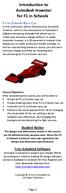 Introduction to Autodesk Inventor for F1 in Schools F1 in Schools Race Car In this course you will be introduced to Autodesk Inventor, which is the centerpiece of Autodesk s digital prototyping strategy
ArchestrA Log Viewer User s Guide Invensys Systems, Inc.
 ArchestrA Log Viewer User s Guide Invensys Systems, Inc. Revision A Last Revision: 7/3/07 Copyright 2007 Invensys Systems, Inc. All Rights Reserved. All rights reserved. No part of this documentation shall
ADC SWATCH (v3.0) Switch Monitoring Software) User Manual)
 ADC SWATCH (v3.0) Switch Monitoring Software) User Manual) Content Page INTRODUCTION... 1 Revision History... 1 Trademark Information... 1 1 OVERVIEW... 2 1.1 System Requirements... 2 2 INSTALLATION...
AXIS Camera Station Quick Installation Guide
 AXIS Camera Station Quick Installation Guide Copyright Axis Communications AB April 2005 Rev. 3.5 Part Number 23997 1 Table of Contents Regulatory Information.................................. 3 AXIS Camera
Enterprise Asset Management System
 Enterprise Asset Management System in the Agile Enterprise Asset Management System AgileAssets Inc. Agile Enterprise Asset Management System EAM, Version 1.2, 10/16/09. 2008 AgileAssets Inc. Copyrighted
14.1. bs^ir^qfkd=obcib`qflk= Ñçê=emI=rkfuI=~åÇ=léÉåsjp=eçëíë
 14.1 bs^ir^qfkd=obcib`qflk= Ñçê=emI=rkfuI=~åÇ=léÉåsjp=eçëíë bî~äì~íáåö=oéñäéåíáçå=ñçê=emi=rkfui=~åç=lééåsjp=eçëíë This guide walks you quickly through key Reflection features. It covers: Getting Connected
WebSphere Business Monitor V6.2 Business space dashboards
 Copyright IBM Corporation 2009 All rights reserved IBM WEBSPHERE BUSINESS MONITOR 6.2 LAB EXERCISE WebSphere Business Monitor V6.2 What this exercise is about... 2 Lab requirements... 2 What you should
HOW TO ORGANIZE PICTURES
 Get started When you upload your pictures to Shutterfly, you can do much more than view them. Our workspace offers tools that let you quickly and easily organize your photos as well. We re going to show
Microsoft Dynamics GP. Business Analyzer
 Microsoft Dynamics GP Business Analyzer April 5, 2013 Copyright Copyright 2013 Microsoft. All rights reserved. Limitation of liability This document is provided as-is. Information and views expressed in
MANUFACTURER RamSoft Incorporated 243 College St, Suite 100 Toronto, ON M5T 1R5 CANADA
 All Information provided in this document and in the accompanying software is subject to change without notice and does not represent a commitment on the part of RamSoft. RamSoft assumes no responsibility
TestManager Administration Guide
 TestManager Administration Guide RedRat Ltd July 2015 For TestManager Version 4.57-1 - Contents 1. Introduction... 3 2. TestManager Setup Overview... 3 3. TestManager Roles... 4 4. Connection to the TestManager