
An Introduction to CNC Plasma Cutting
|
|
|
- Toby Silvester Lucas
- 9 years ago
- Views:
Transcription
1 Basic Manufacturing Skills Curriculum An Introduction to CNC Plasma Cutting Section 1 Background Information I. Introduction to this Manual...Page 1 II. A Brief History of Manufacturing...Page 2 III. A Brief History on CNC Machining...Page 14 IV. The Design to Production Process...Page 16 V. CAD, CAM, CIM and CNC...Page 17 VI. Advantages of CNC Machining...Page 18 VII. Understanding The Coordinate System...Page 19 VIII. Absolute and Incremental Coordinated...Page 21 IX. Understanding ISO Codes...Page 23 X. Working with Programs and File Formats...Page 25 Section 1 Test...Page 27 Section 2 Introduction to Plasma Cutting I. Plasma Cutting Basics...Page 29 II. Torch Consumables...Page 37 VI. Selecting Stock...Page 41 VII. Controlling Cut Quality...Page 42 VIII. Ventilation And Water Tables...Page 46 IX. Safety...Page 47 Section 2 Test...Page 52 Section 3 Using the Techno CNC Plasma Cutter I. Activity 1 - Cutting a Simple Part...Page 54 II. Activity 2 - Exploring the CNC Interface...Page 66 Section 3 Test...Page 81 Section 4 Introduction to CNC Programming I. Activity 3 - Using the Line Editor...Page 82 II. Activity 4 - Cutting the NC Code Part...Page 86 Section 4 Test...Page 90 Section 5 Using a CAM Package to Create the NC Code I. Exploring The CAM Package...Page 92 II. Activity 5 - Simple Toolpath - Lead-In/Out...Page 94 III. Activity 6 - Controlling Cut Order and Direction...Page 112 IV. Activity 7 - Changing Material Thickness...Page 131 Section 5 Test...Page 138 Section 6 Other Machining Concepts I. Activity 8 - Working with Text...Page 140 II. Activity 9 - Importing Vector Art - Making the Coat Rack...Page 162 III. Activity 10 - Nesting Parts - Making the Hooks...Page 181 Section 6 Test...Page 194 Getting Started Working on Your Own...Page 195 Terminology...Page 197
2 Working with Programs and File Formats It is important to understand that there are several programs used in the production process. As many as three different programs may be used to produce a single part. All three types are discussed below. The CAD Program In some cases a CAD program may be used to create the geometry. Examples of CAD programs include AutoCAD, VersaCAD, CADKey and any other computer aided drafting programs. These programs are used to create the geometry. The geometry is then imported into the CAM program so toolpaths can be applied. In many cases the geometry is created in the CAM package and a CAD program is not even used. Always remember that a CAD program, like AutoCAD, is only used for creating the geometry. CAD programs can not be used to create toolpaths, generate machine code or control the machine tool. The CAM Program The CAM program is used to create toolpaths, emulate the proposed machining and generate the machine code. Examples of CAM programs include Mastercam, Visual Mill and Virtual Gibbs. Often the geometry for a part can be created in the CAM program and a CAD program will not even be necessary. CAM programs do not control the machine tool. The Production Interface The production interface is the software that is used to actually control the machine tool. This program is generally supplied by the tool manufacturer. In this manual, the Techno CNC Interface that is supplied with the CNC plasma cutter is used to control the machine. This is the program used to drive the torch manually, set the tool origin or offset and run the machine code to product the part. On many CNC machines, the production interface is built into controller that is part of the machine. The production interface is not used to create geometry or toolpaths. Many production interfaces also have the ability to run a simulation of the proposed machining. All of these programs generate and use different types of files that are specific to the program. It is important to learn to work with the different file types used in the design to production process. The best way to manage the files is to pay attention to the file type and location. Always make sure you save your files in a location that you can find later and always pay attention to the file s extension so you can determine which type of file it is. It is recommended that you create a folder to keep your files in and always change the location to this folder when saving. The file extension, the part after the. in the name, will help you identify the file type. There can be as many as three different files associated with a single part. The three file types are explained below.
3 6. What is the name of the coordinate location with the value of X0, Y0, Z0? Matching 7. is the software used to draft a proposed part. 8. is a type of machine control based on numerical information. A. CNC 9. is the complete integration of the automated manufacturing process. B. CIM 10. is the software used to apply toolpaths and generate machine code. C. CAD D. CAM 11. coordinate values are expressed in relation to the origin. 12. coordinate values are expressed in relation to the last known position. 13. What does the ISO in ISO Codes stand for? 14. What type of software is used to generate the machine code? A - CAD Software B - CAM Software C - Production Interface D - None of the Above 15. What type of file contains the actual machine code used to control a CNC machine? A - The CAD File B - The CAM File C - The NC File D - None of the Above
4 Section 2 - Introduction to Plasma Cutting Plasma Cutting Basics What is a Plasma? A plasma is a state of matter like a solid, liquid or gas. Adding heat to material causes the molecules in it to vibrate or move more quickly. When a solid is heated, the molecules start to vibrate more vigorously. Eventually the solid turns to a liquid and the molecules actually move around and collide with each other. As more energy or heat is added the motion becomes faster and more vigorous still and eventually the molecules move so quickly and collide so energetically (violently) that they separate and form a gas. If still more energy is added to the gas the molecules travel faster and thus collide with each other more violently and the gas changes to a plasma. An atom consists of a positively charged core and is surrounded by negatively charged electrons. The molecules in a gas can be either individual atoms or collections of such atoms that are very closely connected. When a plasma is formed, the collisions between the molecules eventually get so violent that, at first, the molecules will break up into the individual atoms and eventually some of the atoms will separate from, or lose, some of their electrons from their outer shell. When a critical number of atoms lose electrons the gas changes to a plasma. When kinetic energy in a gas is increased, some of the electrons are freed from the atoms outer shell and a plasma is formed When an atom releases electrons it becomes an ion. When enough energy is added to a gas that there is a balance between the number of atoms releasing electrons and those naturally recombining with free electrons, the gas is said to be ionized. This ionized gas is a plasma. In a plasma, there is an important fraction of ionized atoms at any given time, so there are always ions and electrons that are separate and free. The energy input into the gas has to be ongoing otherwise the gas will eventually cool enough that the electrons will mate back with the ionized atoms. When this happens, the plasma returns to a gas state.
5 Torch Consumables There is a set of parts at the front of the torch body that controls the plasma cutting process and these parts wear out with use. This set of parts is called the torch s consumables. If you are going to be successful with plasma cutting, it will be necessary for you to use your torch manual to determine the correct consumables, pierce height, pierce delay, cut height and amperage for the metal you are cutting. Most torch manuals contain easy to use tables to determine this information. What these settings are and how they are used will be explained in later sections of this manual. Using the correct consumables and the condition of those consumables is a key factor in determining cut quality. This section explains what the consumables are, what they do and how to best maintain consumables for long life. The set of consumables illustrated in this section is for a Hypertherm Powermax 45 mechanized cutting torch. Your consumables may look different if you have a different torch, but most cutting systems will have similar parts. There are many virtual training tours on line at the various torch manufactures web sites that explain the consumables and how to maximum consumable life. You are encouraged to visit your torch manufactures web site to see what you can learn about your torch s consumables Never install or remove your torch s consumables with power to the torch controller. The torch body holds the torch consumables. The torch body of a mechanized torch is shown below. It is crucial to make sure the consumables are installed in the torch in the correct order. The order of installation for the consumables is shown below. Make sure if the torch consumables are removed, that they are re-installed in the correct order Shield Retaining Cap Nozzle Electrode Swirl Ring Torch Body Most mechanized plasma torches use an Ohmic sensing retaining cap that allows the controller to sense when the torch sheild touches the material being cut. The Ohmic sensing cap usually has a metal tad that allows the connection of the sensing wire. The Ohmicsensing retaining cap from the Hypertherm Powermax 45 is illustrated to the right. Ohmic-sensing Retaining Cap
6 Cut Strategy Cut Direction must be considered when programming the plasma cutter. Like a router, the direction of travel the plasma torch takes will affect the cut quality. This is because the holes in the swirl ring produce a swirl in the plasma jet. The finish side of the plasma cut is the right side of the cut when facing the direction of travel. See the images below. In the top image the red circle is the part we want to keep and the blue part of the material is scrap. In this situation we would travel in a clockwise/conventional direction. In the bottom image we want the blue rectangle to have a circular hole in the middle. The circle that is cut out will be the scrap. In this case we travel in a counter clockwise/ climb direction. The right side of the cut is the side with the best quality. Cut Order must be considered when programming the plasma cutter. In the image to the right, if the desired part is the blue rectangle with a hole in the middle, the hole must be cut first. If the square is cut first, it will fall from the stock before the circle can be cut. Cut order is controlled in the CAM software. Lead Ins/Lead Outs is a strategy used to get the torch to start and stop the cut off of the finished part. When the torch first pierces the material excessive dross can be produced. To prevent this dross from appearing on the part, a lead in and lead out path should be used in the toolpath. The excessive dross will still appear at the pierce point and at the end of the cut but it will be off of the part being produced. The picture to the right shows the tool path for a rectangle. The lead in and lead out should be on the corner of the part to eliminate dross or piercing marks on the final product. Lead in/outs are programmed in the CAM package. Half an inch is usually enough for a lead in/out but that distance may need to be bigger for thicker materials.
7 Tip-Ups Tip-ups happen when a part cut from the stock partially fall through the slats and is left protruding from the surface. See the image to the right. The protruding part can cause an obstruction to the torch or machines movement. If a tip-up occurs, pause the machine, safely correct the situation (the part is hot) and resume the machining. Loss of Position If it is evident that the machine has lost its reference to the origin, stop the machining. Watch for anything that doesn t look like what you expect the machine to cut. A good example is illustrated to the right. If the torch is suppose to cut a circle and the cut is distorted or the start and stop points do not match, the machine has lost its position or the stock has shifted. If it appears that the machine has lost its position, stop the machining with the Emergency Stop. Erratic Behavior If the machine takes off and moves to a place that is not even within the cutting is to occur, stop the machining. Consider the image to the right. If the torch was zeroed on the piece of stock and the torch moved far outside the intended machining area, this would indicate erratic behavior. This is very rare and is usually caused by not zeroing the torch s axes at the origin. If the machine moves to some point that is outside the intended machining area, stop the machining with the Emergency Stop. Flame-Out A flame-out is when the torch plasma is extinguished while cutting the contour of a part. This is not to be confused with the normal action of the torch turning on and off as it moves from one contour to the next within a part program. A flame-out is most often caused by the torch drifting too far from the material or cutting over a previous cut kerf. If a flame-out occurs during a cut, use the Emergency Stop to stop the machine or use the Pause button to pause the machining. Watch for these and any other dangerous situation to develop and use the Emergency Stop to pause or stop the machining any time trouble is spotted.
8 Section 2 Test 1. True or False - A plasma is a state of matter like a gas or liquid. 2. True or False - All plasma cutting systems use air for the cutting gas. 3. What is the name for a gas that has enough energy added for it to become ionized? 4. Which of the following are examples of plasmas? A - Lightning B - A neon sign C - A fluorescent light D - All of the Above List three strategies for extending torch consumable life? Label the torch consumables below? 8. Retaining Cap 10. Torch Body
9 The general steps for cutting an NC file on the CNC plasma cutter are listed below. Review the steps below before you start the steps in this lesson on the next page and be sure to refer back to this section in you need a refresher as you complete the rest of this manual. Pre-Machining Checklist: Make sure you have all of the appropriate safety gear. (eye protection, hearing protection, adequate ventilation, gloves, apron, fire extinguisher) Confirm that you are authorized by your instructor or supervisor to operate the CNC plasma cutter. Make sure that the machine has been setup and tested and is fully operational. Make sure the torch has the correct comsumables installed for the torch s AMP setting and the material to be cut. Make sure the CNC controller, the torch controller and air compressor are plugged in and turned on. Make sure the torch controller has the specified air pressure available. Cutting an NC file with the CNC Plasma Cutter 1 Check torch consumables and air pressure 2 Launch the Techno CNC Interface. 3 Position the stock 4 Set the torch voltage and cut height. 5 Open the desired NC file. 6 Preview the NC file. 7 Set the torch feed rate. 8 Move the machine to the origin on the stock. 9 Zero all of the axes. 10 Touch off the z position 11 Preprocess the file. 12 Put on welding shield or goggles. 13 Click Start. Welding Jacket or Apron Welding Gloves Minimum Shade 8 Eye Protection Chisel Chipping Hammer
10 There are three variables that determine torch performance. They are cut height, cut speed and voltage. These three variables are not independent, if the speed or height change, the voltage will change. In fact, if any of these three variables changes, the others will also change. This relationship is what allows the Torch Height Control to work. As the part is cut, the metal may warp and rise up off the table as it gets hot. When the metal warps up, it gets closer to the torch. This will result in a decrease in voltage. See the image below. When the system senses this decrease in voltage, it can raise the torch up to compensate for the warping metal. Automatic Torch Height Control When a cut is started, the torch is held at the cut height. (left) If the metal heats up and warps up, the distance from the torch tip to the metal decreases. (right) This will result in a decrease in voltage. When the system senses this decrease in voltage, it will lift the torch up to compensate for the difference in voltage. The purpose of the test cut is to determine the actual voltage at a set, consistent height and speed. During a test cut, the system samples the actual voltage, over a short distance, while the torch is held at the defined height and speed. In this case, we used a.06 cut height and a cut speed of 170 IPM. The system reported back an average sampling of approximately 102 volts at that height and speed. We originally entered 117 for the Plasma Volts setting, the value from the table. When a part is cut, the Plasma Volts setting is used by the system as the reference voltage for torch height control. By changing the Plasma Volts settings to the sampled 102 volts, the system is given the optimal reference voltage for controlling torch height for that material at that speed and height. This will help maximize the cut quality. The test cut procedure is helpful for adjusting the voltage setting. This test only needs to be performed when material or consumable type changes. If the quality of the cut is acceptable or the appropriate plasma settings are already known, the test doesn t need to be performed at all. Many torch operators will build a table of settings for the materials and consumables they use most, and simply enter the values when they change materials of consumables. This is a good idea and it will save a great deal of time experimenting in the future. If good cut quality is achieved, simply take note of the voltage, cut height, pierce height, pierce delay, consumable type, and material type and start to build a table for your own use.
11 Discussion It is a good idea to keep a log of plasma settings for different types of material and consumables. How can this save the operator time in the future. What step in this lesson might be eliminated? This lesson contains a explanation of how the system automatically controls torch height. Review and discuss this concept. A clear understanding of the relationship between cut height, cut speed and voltage will allow you to achieve the maximum cut quality. The three variables that control torch performance are cut height, cut speed and voltage. Since a cut height of.06 is what is generally used, the speed and voltage are values that are likely to be changed to achieve maximum torch performance. Remember, the test cut doesn t need to be performed before every part. It only needs to be done if material or consumables changes and the appropriate settings are not known. The process you just used to cut this part is the process for cutting all parts. Review and discuss the steps below to reinforce your understanding of the process. 1 Check torch consumables and air pressure 2 Launch the Techno CNC Interface. 3 Position the stock 4 Set the torch voltage and cut height. 5 Open the desired NC file. 6 Preview the NC file. 7 Set the torch feed rate. 8 Move the machine to the origin on the stock. 9 Zero all of the axes. 10 Touch off the z position 11 Preprocess the file. 12 Put on welding shield or goggles. 13 Click Start. As you start to machine your own parts, you can refer to this list if you need help remembering the process.
12 Plasma Settings 57. Assign the appropriate plasma settings is a key part of becoming a proficient operator of any plasm cutting system. In the Techno CNC Interface, this is done through the Plasma Torch Controller. Click the Plasma Settings button to open the Plasma Torch Controller. 58. The Plasma Torch Controller is pictured below. The window is divided into two sections, Basic Settings are on the top and Advanced Settings are on the bottom. The Basic settings are the settings that are likely to change based on the material being cut. The Advanced Settings are unlikely to change once they are set. Basic Settings - Change with Material Advanced Settings - Unlikely to Change Save Changes to Plasma Settings Access Plasma Cutting Terminology Exit the Plasma Torch Controller Without Saving changes 59. Click the Terminology button. This opens the Plasma Terminology window. This window can be accessed for help understanding the terms in the Plasma Torch Controller. See the image below. When you have view the Plasma Terminology window, click Close to close the window.
13 Section 4 - Introduction to CNC Programming Activity 3 - Using the Line Editor The objective of this lesson is to look at how the line editor can be used to enter numeric code to control the machine tool. As previously stated, in industry today, most of the numeric code that runs machine tools is generated by CAM software. In this lesson we will examine the basis for this code. The remaining lessons in the manual will use Mastercam to generate the NC code, but it is important to see where the code comes from, and how it guides the tool using numeric coordinates. The student will enter and discuss the code necessary to produce the part to the right. 1. Double click on the Techno CNC Interface on the Desktop. This opens the Techno CNC Interface. We will use the Line Editor to type in the machine code to produce the simple part above. 2. Click the Edit button. This brings up the Line Editor. The Line Editor can be used to create code or adjust the code generated by CAM software. The editor is illustrated below. 3. Click in the Edit window and type the following code into the editor: 01 (YOUR NAME) 02 (YOUR SCHOOL) 03 (CURRENT DATE) 04 (6 X 6 12 GAUGE STOCK) 05 G90 06 G00 07 X1.5 Y3 08 M03 09 G03 X1.5 Y3 I1.5 J0 F M05 4. Lets look at what each line of code does. For a complete listing of the G and M codes used by the Techno, see the Techno software manual which can be accessed through the Help button on the main screen of the Techno CNC Interface. The File Menu Edit Menu NC Code first two characters in each line are the line number. If we were going to enter a complex file, we would have started with line 0001 to provide room for a larger program. The first four lines, line 01-04, are program information. The ( ) tell the machine that they contain program information and any relevant information can be added between the ( ). It is a good idea to include the name of the person writing the program, the date and any cutter information. Other information can be added as needed. 5. Line 05, G90 sets the coordinate values to absolute. All values are in relation to the origin. 6. Line 06, G00 tells the machine to move to the next point at the rapid travel rate. 7 Line 07, X1.5 Y3, moves the torch to the start point of the circle.
14 Torch Setup 3. Turn on the torch controller 4. Turn on the air compressor and confirm that the correct air pressure is being supplied to the torch controller. The correct air pressure can be determined by looking in the torch s manual. The torch used to write this manual specifies 90 PSI. Many torches have an indicator that signals correct air pressure. If your plasma cutter is equipped with a different torch, become fa mi lure with the torch s air pressure requirements and any air pressure indicators. If you are not sure of your torch s requirements or operation, ask your instructor or supervisor. 5. Make sure the torch s magnetic mount is square. 6. Make sure the correct consumables are installed in the torch. The correct consumables are determined by the torch specifications and the material to be cut. In this lesson, the material to be cut is 12 gauge mild steel. The torch s manual specifies a set of 45 amp shielded consumables. 7. Double click the Techno CNC Interface shortcut on the Desktop. This will launch the control software for the Techno CNC Plasma cutter. Be sure you are familiar with the location of the emergency stop button before continuing. Once the machine is started, it can be pause, started and stopped with the emergency stop control. 8. Make sure the Spindle is set to Auto. This will allow the Plasma Torch to turn on and off automatically. 9. Position a piece of 12 gauge plate on the material support slats. The piece must be at least 6 X 6. Make sure the material is square with the machine. See the image below. The lower left corner is the start point. This point is the origin. Place a piece of 12 gauge stock that is at least 6 X 6 on the material support slats. Make sure the ground clamp is connected. 10. Make sure the ground clamp is connected to one of the slats supporting your material. If your material is a large sheet, you can clamp directly to the material, outside of the intended machining area.
15 66. Enter 400 % for the percentage of tool diameter in both boxes to produce a.25 long lead in and lead in arc. The length will automatically change to.25 when 400 is entered as the percent. The tool used in this toolpath is a 1/16 Kerf. Entering 400 percent multiplies this value by 4 to equal a 1/4 lead-in and lead in arc. 67. If all of the settings in the Lead In/Out window match those in the image on the previous page, click OK to accept the settings. 68. Make sure the Compensation type is set to Computer and the Compensation direction is Left. This will put the cut on the outside of the part. 69. All other settings on the Contour Parameters tab can be left at the default. The settings on the Contour Parameters tab should match those in the image on the top of the previous page. If any of the settings do not match those in the image below, make any necessary changes. 70. Click OK in the Contour window. 71. The light blue lines on your part represent the torches s proposed path. See the image below. Backplot Backplot the Machining 72. The next step is to backplot the proposed machining. This is to run a graphic simulation of the path the torch will follow. 73. Click the Backplot button in the Toolpaths Manager. See the image to the right. 74. This will bring up the Backplot interface. See the image below. Accept/End Command Play Step Back Step Forward Close Backplot Quick Verify Stop Previous Next Run Speed Progress
16 107. When you are done with the machine, close the Techno CNC Interface and turn off the machine. An image of the finished parts can be seen at the right. Finishing The book end bases need to be welded together at The use of a welding magnet is recommended. Weld the parts as shown in the images below and grind and finish all welds. Place the vertical part on top of the horizontal part, this will ensure a smooth bottom that will not scratch any surface. An ornamental A and Z will be produced in the next two activities. Place the vertical piece on top of the horizontal piece. This will ensure a smooth bottom. Weld and finish both sides of these two joints. Use a magnet to hold the parts at Discussion It is important to keep track of file name, location and format. This activity produces two files. One file is the Mastercam file containing the geometry and toolpaths. This file is named BBASEXX. MCX and is should be stored in the Parts Folder on the Desktop. The second file is the numeric code file. This file is named BASENCXX.NC and it is also in the Parts Folder. The NC file is the result of the posting done in Mastercam, and it is the file that controls the plasma cutter. Understanding the difference between the two files is a basic skill required for all successful CNC machinists. The best way to become proficient working with files is to pay attention to the name location and format of every file you save.
17 9. The image to the right if from the manual for the Hypertherm Powermax 45. The table shown is for 45 AMP shielded consumables, the values are recommended for mild steel and the values are expressed in English units. These are recommended starting values, the cut quality can be fine tuned from these values. Keep in mind, often the values in these tables assume perfect consumables and ideal conditions. The cut speeds can tend to be a little high. If you are using a torch other then the Powermax 45, study the table showing the correct settings for your torch. 10. Make sure you have all of the necessary safety gear before you continue. 11. The Techno CNC Plasma Cutter has a convenient Test Cut feature that lets the operator fine tune the voltage for their current conditions. The next few steps will lead you through performing the test cut. 12. Position the torch on the edge of a small piece of 1/4 scrap. You will need a piece at least 5 wide. Make sure the ground clamp is connected to one of the material support slats holding the material. See the image to the right. 13. The next step is to set the jog speed to the recommended cut speed. The table shows 60 IPM for this material. As previously stated, the cut speeds assume ideal conditions. A good starting point for getting the speed correct is to use a value of 80% of the value in the table. For this cut, 48 IPM will be used for the cut speed. 14. Double click on the speed number above the Jog Speed Slider bar. This will open the Jog Speed window. See the image below. Enter 48 for the Jog Speed and click OK. This sets the jog speed to the speed to be used for the test cut. Position the torch over the edge of a 1/4 piece of scrap with at least 3 of clear travel to the right
18 86. Enter 300% for the percentage of tool diameter in both boxes to produce a.1875 long lead in and lead in arc. The length will automatically change to.1875 when 300 is entered as the percent. 87. If all of the settings in the Lead In/Out window match those in the image on the previous page, click OK to accept the settings. 88. Make sure the Compensation type is set to Off and the Compensation direction is Left. 89. All other settings on the Contour Parameters tab can be left at the default. The settings on the Parameters tab should match those in the image on the previous page. If any of the settings do not match those in the image below, make any necessary changes. 90. Click OK in the Contour window. 91. The light blue lines on your part represent the torches s proposed path. See the image below. Backplot the Machining 92. The next step is to backplot the proposed machining. This is to run a graphic simulation of the path the torch will follow. 93. Click the Select All button in the Toolpath Manager. Selected toolpaths have a green check mark on the folder. Make sure both of the toolpaths are selected so both will be included in the backplot. 94. Click the Backplot button in the Toolpaths Manager. 95. This will bring up the Backplot interface. 96. Make sure Quick verify is the selected mode. 97. Click the Play button. 98. This will run a simulation of the torch s proposed path. 99. Your simulation should look like the one in the image below. The simulation should show the torch cutting images first, then the outer edge. The fish are cut counter clockwise and the outer edge is cut clockwise.
19 131. When you are done with the machine, close the Techno CNC Interface and turn off the machine. An image of the finished parts can be seen below. Finishing Remove all of the dross and grind any rough or sharp edges. The hooks for the coat rack will be made in the next lesson. Discussion Review and discuss the list of things to consider when adding vector art to your designs at the beginning of this lesson. Why must source, placement, detail, size, cut order, cut direction and consumables all be considered when planning a design that incorporated vector art? The best way to become proficient in working with vector data is experimentation. You don t have to cut every part you design. Just create some designs to get a feel for working with importing vector files.
20 88. Click Start to cut the part. Do not leave the machine unattended. Watch the cutting with the appropriate eye protection and press the emergency stop if trouble develops. 89. When the part is finished, you can use the Z+ key to raise the cutter up to minimize splashing from the water table. Do not touch the part! It is hot and will burn you. Wait for the part to cool or handle with appropriate tools. 90. When you are done with the machine, close the Techno CNC Interface and turn off the machine. An image of the finished parts can be seen below. Finishing Remove all of the dross and grind any rough or sharp edges. The hooks need to be welded to the coat rack cut produced in the previous lesson. Space 5 or 6 hooks across the length of the coat rack and weld them in place. About 3/4 of the hook rests on the bottom edge of the coat rack. Images of the finished project is pictured below. Sand, prime and paint as desired. Approximately 3/4 overlap Five or six hooks
Machine-side reference guide
 Machine-side reference guide 803640 Plasma Plasma: the fourth state of matter The first three states of matter are solid, liquid and gas. For the most commonly known substance water these states are ice,
5. Tutorial. Starting FlashCut CNC
 FlashCut CNC Section 5 Tutorial 259 5. Tutorial Starting FlashCut CNC To start FlashCut CNC, click on the Start button, select Programs, select FlashCut CNC 4, then select the FlashCut CNC 4 icon. A dialog
Mastercam Instructions. KTH School of Architecture Digital Fabrication Lab - CNC Router Version 2.1 2014-02-06
 Mastercam Instructions KTH School of Architecture Digital Fabrication Lab - CNC Router Version 2.1 2014-02-06 CONTENTS: 1. Setup in Rhino and Mastercam 2. Creating A Drilling Operation 3. Creating A Contour
TEST PROJECT TEACHER GUIDELINES
 TEST PROJECT TEACHER GUIDELINES Mastercam Intro to CAD/CAM Objectives You will create the geometry for Pen Base & Acylic Plaque, and then generate a toolpath to machine the part on a CNC machine. This
CNCTRAIN OVERVIEW CNC Simulation Systems 1995 2008
 CNCTRAIN OVERVIEW CNC Simulation Systems 1995 2008 p2 Table of Contents Getting Started 4 Select a control system 5 Setting the Best Screen Layout 6 Loading Cnc Files 7 Simulation Modes 9 Running the Simulation
MET 306 Activity 6. Using Pro/MFG Milling Operations Creo 2.0. Machining a Mast Step
 Using Pro/MFG Milling Operations Creo 2.0 Machining a Mast Step If the Trim option is grayed out when trimming the mill volume, Save (making sure the.asm file is going to the correct subdirectory), Exit
CNC Turning Training CNC MILLING / ROUTING TRAINING GUIDE. www.denford.co.uk Page 1
 CNC Turning Training www.denford.co.uk Page 1 Table of contents Introduction... 3 Start the VR Turning Software... 3 Configure the software for the machine... 4 Load your CNC file... 5 Configure the tooling...
Volume PRECISION PLASMA LLC. CNC Plasma Gantry Manufacturer. Plasma Gantry Selection Guide
 Volume 1 PRECISION PLASMA LLC CNC Plasma Gantry Manufacturer Plasma Gantry Selection Guide Plasma Gantry Selection Guide Precision Plasma LLC [email protected] Chapter 1 Mechanical Components
Zenbot CNC User s guide www.zenbotcnc.com
 Zenbot CNC User s guide www.zenbotcnc.com Note: If at any point you are unsure what to do or would like assistance, don t hesitate to email [email protected], or call 559-901-8329. Customer satisfaction
Course outline. Know Your Machine From A Programmer s Viewpoint 11 If you ve had experience with conventional (non-cnc) machine tools 11
 Course outline Know Your Machine From A Programmer s Viewpoint 11 If you ve had experience with conventional (non-cnc) machine tools 11 Machine Configurations 13 Vertical machining centers 13 C-frame style
Basic 2D Design Be sure you have the latest information!
 Basic 2D Design mastercam x getting started tutorials Basic 2D Design December 2011 Be sure you have the latest information! Information might have been changed or added since this document was published.
Table of Contents Getting Started... 3 The Motors... 4 The Control Board... 5 Setting up the Computer with Mach3... 6 Starting up the Equipment...
 User Manual Table of Contents Getting Started... 3 The Motors... 4 The Control Board... 5 Setting up the Computer with Mach3... 6 Starting up the Equipment... 12 G-Code Example... 13 2 Getting Started
Proficiency Test For Machining Center
 Proficiency Test For Machining Center Name: Date: Section One: General CNC Questions 1) The spindle speed for a particular tool in a program is incorrect and you wish to reduce it. The kind of CNC word
TEACHING TOMORROW S INDUSTRY LEADERS TODAY. Manufacturing Small Parts on Machining Centers
 TEACHING TOMORROW S INDUSTRY LEADERS TODAY Tech Tip # 14 July 2007 Written by: Phil Rasey, Stiles Education s Machining Center Specialist Audience: Introductory Machine \ Process: CNC Machining Centers
SprutCAM is a CAM system for NC program generation for machining using multi-axis milling, turning, turn/mill, Wire EDM numerically controlled
 SprutCAM is a CAM system for NC program generation for machining using multi-axis milling, turning, turn/mill, Wire EDM numerically controlled machines and machining centers. The system enables the creation
Radius Compensation G40, G41, & G42 (cutter radius compensation for machining centers, tool nose radius compensation for turning centers)
 Radius Compensation G40, G41, & G42 (cutter radius compensation for machining centers, tool nose radius compensation for turning centers) These features are commonly well covered in most basic CNC courses.
A Beginner s Guide to MIG Welding
 A Beginner s Guide to MIG Welding MIG Welding Names MIG welding, or MIG, is an acronym for Metal Inert Gas welding. MIG is a commonly used and accepted slang term that was appropriate when the process
LESSON 7: IMPORTING AND VECTORIZING A BITMAP IMAGE
 LESSON 7: IMPORTING AND VECTORIZING A BITMAP IMAGE In this lesson we ll learn how to import a bitmap logo, transform it into a vector and perform some editing on the vector to clean it up. The concepts
Basic 2D Machining. mastercam x getting started tutorials. December 2011. Be sure you have the latest information!
 Basic 2D Machining mastercam x getting started tutorials Basic 2D Machining December 2011 Be sure you have the latest information! Information might have been changed or added since this document was
Computer-Aided Numerical Control (CNC) Programming and Operation; Lathe Introduction, Advanced Mills
 1 of 6 9/9/2014 3:59 PM I. Catalog Information Credit- Degree applicable Effective Quarter: Fall 2014 MCNC 75B Computer-Aided Numerical Control (CNC) Programming and Operation; Lathe Introduction, Advanced
Summary Of GCODE Commands By Category (HTT0196)
 Summary Of GCODE Commands By Category (HTT0196) SET UP COMMANDS CODE COMMAND FORMAT PURPOSE PAGE # F Feed Speed Fn Designates feed rate, or rate 05 of movement, of the axes. G4 Dwell Time G4/d Specifies
PLASMA CUTTING MACHINES PL SERIES
 PLASMA CUTTING MACHINES PL SERIES PLASMA CUTTING MACHINES Plasma machines offers the best mixed gases quality, efficiency, lower cutting cost and wide range for cutting of mild steel, stainless steel and
G10 Data Setting Command
 G10 Data Setting Command Though it s barely mentioned in most basic CNC courses, the G10 command is an extremely important basic CNC feature It allows you to input data from within CNC programs This data
Training Document for Integrated Automation Solutions Totally Integrated Automation (TIA) Module S01 Fundamentals of CNC Programming with SinuTrain
 Training Document for Integrated Automation Solutions Totally Integrated Automation (TIA) Module S01 Fundamentals of CNC Programming with SinuTrain T I A Training Document Page 1 of 53 Module S01 This
Merging Labels, Letters, and Envelopes Word 2013
 Merging Labels, Letters, and Envelopes Word 2013 Merging... 1 Types of Merges... 1 The Merging Process... 2 Labels - A Page of the Same... 2 Labels - A Blank Page... 3 Creating Custom Labels... 3 Merged
Durmazlar has aimed continous development since 1956
 Head Quarter & Ataevler Durmazlar has aimed continous development since 1956 Owes one of the world s most contemporary production plants in the production technology business.3 different plants oriented
Laser cutter setup instructions:
 Laser cutter setup instructions: 1. Cut your material to 18 x 24 or smaller. 2. Turn on the laser cutter by flipping the wall switch on the right behind Station B. You will hear the cooling fan and air
A Beginners Guide to Flux Cored Arc Welding
 A Beginners Guide to Flux Cored Arc Welding When it comes to Flux cored arc welding or FCAW many people think it is a different welding process when in reality it is not! Even though there are books, classes
SE05: Getting Started with Cognex DataMan Bar Code Readers - Hands On Lab Werner Solution Expo April 8 & 9
 SE05: Getting Started with Cognex DataMan Bar Code Readers - Hands On Lab Werner Solution Expo April 8 & 9 Learning Goals: At the end of this lab, the student should have basic familiarity with the DataMan
The Basics of a Rotary Table with Cross Slide mounted on a Mill Table, Version 2
 The Basics of a Rotary Table with Cross Slide mounted on a Mill Table, Version 2 by Gerry Goldberg as told to Rick Sparber 08/21/2008 Copyleft protects this article. On 08/16/2008 the Valley Metal Club
Mastercam X6 Basic 3D Design
 Basic 3D Design mastercam x getting started tutorials Mastercam X6 Basic 3D Design December 2011 Be sure you have the latest information! Information might have been changed or added since this document
A Beginner s Guide to TIG Welding
 A Beginner s Guide to TIG Welding TIG Welding Names TIG Welding, or TIG, is an acronym for Tungsten Inert Gas welding. TIG is a commonly used and accepted slag term. The proper terminology is Gas Tungsten
Ion Propulsion Engine Simulation
 Ion Propulsion Ion Propulsion Engine Simulation STUDENT ACTIVITY AND REPORT SHEET This activity must be completed at a computer with Internet access. Part 1: Procedure 1. Go to http://dawn.jpl.nasa.gov/mission/ion_engine_interactive/index.html
It's large enough to handle most welding job shop projects, yet small enough to make it a worth while home-workshop tool
 It's large enough to handle most welding job shop projects, yet small enough to make it a worth while home-workshop tool H Craft Print Project No. 272 ERE'S a metal bender that will enable you to bend
STL GENERATION INTRODUCTION TO STL. Written by Greta D Angelo
 STL GENERATION Written by Greta D Angelo In this section: An introduction on.stl files How to make good.stl files How to make.stl on different softwares (Solidworks, PTC Creo, Rhinoceros 5, Autodesk Inventor)
Mach4 CNC Controller Mill Programming Guide Version 1.0
 Mach4 CNC Controller Mill Programming Guide Version 1.0 1 Copyright 2014 Newfangled Solutions, Artsoft USA, All Rights Reserved The following are registered trademarks of Microsoft Corporation: Microsoft,
Project Instruction Booklet. CNC Milling Machine Project
 CNC Milling Machine Project Instruction Booklet 1 P a g e Project Overview In this project students will learn how to use the following tools and shop materials to finish this project: personal protective
Easy Machining Center Setup
 White Paper Document No. MWA-072-EN_01_1404 April 2014 Easy Machining Center Setup Using FANUC s Direct Input of Workpiece Origin Setting Measured and Tool Length Measurement features to easily establish
Generative Drafting. Page 1 1997 2001 DASSAULT SYSTEMES. IBM Product Lifecycle Management Solutions / Dassault Systemes
 Generative Drafting Page 1 Tutorial Objectives Description This Tutorial is an introduction to Generative Drafting. Message To show how CATIA V5 allows the user to automatically generate associative drafting
Bluetooth Installation
 Overview Why Bluetooth? There were good reasons to use Bluetooth for this application. First, we've had customer requests for a way to locate the computer farther from the firearm, on the other side of
Examination. Performance Test. Candidate Information Booklet
 Examination Performance Test Candidate Information Booklet Name Test Site Test Date (Please Print) (City/State) CRAW-T Examiner CRAW-T NUmber (Please Print) 1 Table of Contents 1.0 Introduction and Purpose
3300M CNC Control Editing, Part Programming and Running simple program
 3300M CNC Control diting, Part Programming and Running simple program Writen by Robin Baker F2 dit to enter editor. F1 F2 F3 F4 F5 F6 F7 F8 F9 Teach Draw Drill Pocket Mill Tool Calc Sub Misc xit Dimension
Surface Machining. NATIONAL INSTITUTE FOR AVIATION RESEARCH Wichita State University. Revision 5.13 Copyright 2004. All rights reserved.
 Surface Machining NATIONAL INSTITUTE FOR AVIATION RESEARCH Wichita State University Revision 5.13 Copyright 2004. All rights reserved. www.cadcamlab.org None of this material may be reproduced, used or
CNC Applications. Tool Radius Compensation for Machining Centers
 CNC Applications Tool Radius Compensation for Machining Centers Why Cutter Diameter Compensation? When machining finished surfaces with the side of a milling cutter (generally called profiling), the accuracy
Presentation on CNC MACHINES. By: Hafiz Muhammad Rizwan
 Presentation on CNC MACHINES By: Hafiz Muhammad Rizwan WELCOME CNC Machines What is a CNC Machine? CNC : Computer Numerical Control Conventionally, an operator decides and adjusts various machines parameters
GUTTER MACHINE CONTROLS STANDARD
 GUTTER MACHINE CONTROLS STANDARD Note: determine what type of control package is installed on the machine. --more-- All operators should familiarize themselves with the appropriate controls prior to any
Convert 2D to 3D in AutoPOL Bend Simulator
 Convert 2D to 3D in AutoPOL Bend Simulator This document gives an introduction of how to convert 2D DXF/DWG files into 3D models in AutoPOL Bend simulator. The AutoPOL 3D concept A 3D model with correct
User Manual V5.0.0 1
 User Manual V5.0.0 1 Introduction... 4 Safety... 4 Initial setup... 4 Setup Wizard... 4 Linear units... 5 Angular units... 5 Feed rate... 5 Plasma cutting... 5 Rotary cutting... 5 Multiple drawings...
Introduction to Autodesk Inventor for F1 in Schools
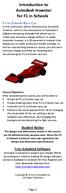 Introduction to Autodesk Inventor for F1 in Schools F1 in Schools Race Car In this course you will be introduced to Autodesk Inventor, which is the centerpiece of Autodesk s digital prototyping strategy
LIGHTSTICK KINETICS. INTRODUCTION: General background on rate, activation energy, absolute temperature, and graphing.
 LIGHTSTICK KINETICS From Advancing Science, Gettysburg College INTRODUCTION: General background on rate, activation energy, absolute temperature, and graphing. THE RATE LAW: The rate of a chemical reaction
TIG WELDING TIPS by Tom Bell
 (This is a two-part document, with general tig welding first followed by one aluminum-specific.) TIG WELDING TIPS by Tom Bell 1. The bigger the rod, the easier it is to feed. Use larger diameter rods (3/32
Using the Waterjet. Step One: Export your CAD drawing as a Release 12 DXF file. Step Two: Import your DXF file in FlowPATH
 Using the Waterjet Digital Media Tutorial Written By: John Eberhart The waterjet shoots water out of a nozzle at 3 times the speed of sound. This combined with abrasive (garnet) allows the waterjet to
Windows XP Pro: Basics 1
 NORTHWEST MISSOURI STATE UNIVERSITY ONLINE USER S GUIDE 2004 Windows XP Pro: Basics 1 Getting on the Northwest Network Getting on the Northwest network is easy with a university-provided PC, which has
Complete. PCB Design Using. NI Multisim, NI Ultiboard, LPKF CircuitCAM and BoardMaster. pg. 1. Wei Siang Pee
 Complete Wei Siang Pee PCB Design Using NI Multisim, NI Ultiboard, LPKF CircuitCAM and BoardMaster pg. 1 Introduction Multisim equips educators, students, and professionals with the tools to analyze circuit
Laser Cutter User Manual
 Laser Cutter User Manual frequently asked questions... the laser is cutting weird! it s cutting a thick line or not cutting through at all! Table Of Contents Section 1: Materials Guide 1.1 Can I Cut this?
product. Please read this instruction before setup your VenomXTM.
 Tuact Corp. Ltd. TM Venom X mouse controller combo Setup Software Instruction Thank you for purchasing our VenomXTM product. Please read this instruction before setup your VenomXTM. Introduction Venom
ME 1355 CAD/CAM LABORATORY CNC MILLING PROGRAM. Study of G Codes and M Codes to Write Manual Part Programming for Fanuc Control Systems
 ME 1355 CAD/CAM LABORATORY CNC MILLING PROGRAM Ex.No.1 Study of G Codes and M Codes to Write Manual Part Programming for Fanuc Control Systems PREPARATORY FUNCTION ( G CODES ) The preparatory functions
This document provides installation instructions and details of the new functional features found in the CNC Shark Post Processors v1.5.
 CNC Shark Post Processors v1.5 The latest CNC Shark Post Processors provide 3 new functional features: Ready to use tolerance modes in the form of two different post processors. Contains the information
Lesson Four 3D Modeling
 Lesson Four 3D Modeling In this lesson you will learn how to: Easily Rotate the UCS to model in different planes Model lines in a method similar to drawing isometrics Create 3D Router Lines Automatically
Odyssey of the Mind Technology Fair. Simple Electronics
 Simple Electronics 1. Terms volts, amps, ohms, watts, positive, negative, AC, DC 2. Matching voltages a. Series vs. parallel 3. Battery capacity 4. Simple electronic circuit light bulb 5. Chose the right
JCUT CNC Router 3030A/6090/8090/1212/60150/1218/1224/1325/1530/A/B
 JCUT CNC Router 3030A/6090/8090/1212/60150/1218/1224/1325/1530/A/B User s Operation Manual Jinan Jcut CNC Equipment Co., Ltd. Content Content... 1 Ⅰ. Introduction of wiring of CNC router.......2.2 Ⅱ.Install
Using a Pendulum to Measure Gravity s Acceleration Elizabeth B. Chesick
 SCIENCE EXPERIMENTS ON FILE Revised Edition 6.33-1 Using a Pendulum to Measure Gravity s Acceleration Elizabeth B. Chesick Topic Motion of a pendulum; gravity Time 1 2 hour! Safety Please click on the
WORD DEFINITION WORD (NATIONAL LANGUAGE)
 WELDING GLOSSARY The Glossary has been created as part of the Migration for Development in the Western Balkans (MIDWEB) project, which received financial assistance from the European Commission IPA 2009
SDC. Schroff Development Corporation WWW.SDCACAD.COM PUBLICATIONS. MultiMedia CD by Jack Zecher
 MultiMedia CD by Jack Zecher An audioi/visual presentation of the tutorial exercises SDC PUBLICATIONS Schroff Development Corporation WWW.SDCACAD.COM AutoCAD 2002 Tutorial 2-1 Lesson 2 Geometric Construction
Torchmate CAD User s Guide
 Torchmate CAD User s Guide Revised May 2011 Table of Contents: Overview of the Manual Installation and Setup Important Configuration Changes Overview of Menus Navigation and Selection Methods Basic CAD
Parallel Circuits Charles Lang
 SCIENCE EXPERIMENTS ON FILE Revised Edition 6.20-1 Parallel Circuits Charles Lang Topic Parallel circuits Time 1 1 2 hours! Safety Adult supervision is required. Please click on the safety icon to view
Chapter 6 Machining Center Carbide Insert Fundamentals
 This sample chapter is for review purposes only. Copyright The Goodheart-Willcox Co., Inc. All rights reserved. N10G20G99G40 N20G96S800M3 N30G50S4000 N40T0100M8 N50G00X3.35Z1.25T0101 N60G01X3.25F.002 N70G04X0.5
Experiment 2: Conservation of Momentum
 Experiment 2: Conservation of Momentum Learning Goals After you finish this lab, you will be able to: 1. Use Logger Pro to analyze video and calculate position, velocity, and acceleration. 2. Use the equations
What software do I need to run a CNC mill?
 The premier source of tooling, parts, and accessories for bench top machinists. What software do I need to run a CNC mill? Creating a part on a CNC mill is a three phase process. The part is drawn in a
CNC MILLING. University for Applied Arts, Vienna Studio Prof. Lynn Compiled by Nathalie Rinne With special thanks to David Erdman
 CNC MILLING GL Form Manufacturing Lab, photo: Stefan Hörner University for Applied Arts, Vienna Studio Prof. Lynn Compiled by Nathalie Rinne With special thanks to David Erdman Rules & Safety guidlines:
CNC 8055 / CNC 8055i SELF-TEACHING MANUAL ( TC OPTION) (REF 0607) (Ref 0607)
 CNC 8055 / CNC 8055i (REF 0607) SELF-TEACHING MANUAL ( TC OPTION) (Ref 0607) All rights reserved. No part of this documentation may be copied, transcribed, stored in a data backup system or translated
After that you can log in and start creating games or playing existing games.
 Magos Lite http://magos.pori.tut.fi/ Magos Lite (ML) can be played directly from a browser. It is optimized for Chrome but will work on other major browsers, except Internet Explorer (not supported). ML
North Carolina FFA Association Agricultural Mechanics Career Development Event
 North Carolina FFA Association Three (3) of the following Agricultural Mechanics Performance Skills will be selected for the state competition. North Carolina FFA Association Agricultural Mechanics Performance
Wellspring FAX Service 1 September 2015
 Training Notes 1 September 2015 Wellspring Software, Inc., offers a Fax Service that can be used with PrintBoss from any computer that has internet access. Faxes are sent from PrintBoss through the internet
Intermediate PowerPoint
 Intermediate PowerPoint Charts and Templates By: Jim Waddell Last modified: January 2002 Topics to be covered: Creating Charts 2 Creating the chart. 2 Line Charts and Scatter Plots 4 Making a Line Chart.
Introduction to CATIA V5
 Introduction to CATIA V5 Release 16 (A Hands-On Tutorial Approach) Kirstie Plantenberg University of Detroit Mercy SDC PUBLICATIONS Schroff Development Corporation www.schroff.com www.schroff-europe.com
The TransCut 300 plasma cutting system - Plasmacutting with liquid working medium
 The TransCut 300 plasma cutting system - Plasmacutting with liquid working medium Speaker Sector Company Street Town Excellent portability with the TransCut 300 plasma cutting system Compact, portable
SolidWorks Tutorial 3 MAGNETIC BLOCK
 SolidWorks Tutorial 3 MAGNETIC BLOCK Magnetic Block In this exercise you will make a magnetic block. To do so, you will create a few parts, which you will assemble. You will learn the following new applications
The creation of tooling using the selective laser sintering process. Scott Schermer S.C. Johnson
 The creation of tooling using the selective laser sintering process Scott Schermer S.C. Johnson 1 TOOLING utilizing traditional rapid prototyping machines to produce metal inserts. 2 LaserForm ST-100?
SolidWorks: Mirror, Revolve, and. Introduction to Robotics
 SolidWorks: Mirror, Revolve, and Circular Pattern Introduction to Robotics Let s Review At this point we have learned the following: Extrude Boss/Base Extruded Cut Adding Relations and Dimensions Linear
Tech Shop Safety Level 2 - FN000425. Tech Shop / Tool Safety Operations. (Fermilab machines not covered in course FN000258)
 Tech Shop Safety Level 2 - FN000425 Tech Shop / Tool Safety Operations (Fermilab machines not covered in course FN000258) Table of Contents Tech Shop / Tool Safety Operations 3 General Rules of Safety
Milling & Machining Centers
 Training Objective After watching the program and reviewing this printed material, the viewer will gain knowledge and understanding of basic milling theories and procedures. In addition, the viewer will
If you know exactly how you want your business forms to look and don t mind
 appendix e Advanced Form Customization If you know exactly how you want your business forms to look and don t mind detail work, you can configure QuickBooks forms however you want. With QuickBooks Layout
Name Partners Date. Energy Diagrams I
 Name Partners Date Visual Quantum Mechanics The Next Generation Energy Diagrams I Goal Changes in energy are a good way to describe an object s motion. Here you will construct energy diagrams for a toy
The purposes of this experiment are to test Faraday's Law qualitatively and to test Lenz's Law.
 260 17-1 I. THEORY EXPERIMENT 17 QUALITATIVE STUDY OF INDUCED EMF Along the extended central axis of a bar magnet, the magnetic field vector B r, on the side nearer the North pole, points away from this
HC4300 Portable Flame/Plasma Cutting Machine Control System User Manual
 HC4300 Portable Flame/Plasma Cutting Machine Control System User Manual Operation Skills Adtech (Shenzhen) CNC Technology Co., LTD Address: F/5, 36th Building, MaJiaLong Industrial Park, Nanshan District,
Conservation of Momentum Greg Kifer
 SCIENCE EXPERIMENTS ON FILE Revised Edition 6.7-1 Conservation of Momentum Greg Kifer Topic Conservation of momentum Time 1 hour! Safety Please click on the safety icon to view the safety precautions.
VisTablet Manual. For 12 VT Original and Mini Mouse
 VisTablet Manual For 12 VT Original and Mini Mouse I n d e x 1. Before using your VisTablet ------------------------------------------------------------------------------- Page#3 2. How to install Pen
Microsoft Windows Overview Desktop Parts
 Microsoft Windows Overview Desktop Parts Icon Shortcut Icon Window Title Bar Menu Bar Program name Scroll Bar File Wallpaper Folder Start Button Quick Launch Task Bar or Start Bar Time/Date function 1
TABLE OF CONTENTS. INTRODUCTION... 5 Advance Concrete... 5 Where to find information?... 6 INSTALLATION... 7 STARTING ADVANCE CONCRETE...
 Starting Guide TABLE OF CONTENTS INTRODUCTION... 5 Advance Concrete... 5 Where to find information?... 6 INSTALLATION... 7 STARTING ADVANCE CONCRETE... 7 ADVANCE CONCRETE USER INTERFACE... 7 Other important
Cura for Type A Machines Quick Start Guide
 Cura for Type A Machines Quick Start Guide 1 Table of Contents About Cura for Type A Machines Downloading Cura for Type A Machines Installing Cura for Type A Machines Mac Windows Linux About the Configuration
Bank Account 1 September 2015
 Chapter 8 Training Notes Bank Account 1 September 2015 BANK ACCOUNTS Bank Accounts, or Bank Records, are typically setup in PrintBoss after the application is installed and provide options to work with
Heat Energy FORMS OF ENERGY LESSON PLAN 2.7. Public School System Teaching Standards Covered
 FORMS OF ENERGY LESSON PLAN 2.7 Heat Energy This lesson is designed for 3rd 5th grade students in a variety of school settings (public, private, STEM schools, and home schools) in the seven states served
TOF FUNDAMENTALS TUTORIAL
 TOF FUNDAMENTALS TUTORIAL Presented By: JORDAN TOF PRODUCTS, INC. 990 Golden Gate Terrace Grass Valley, CA 95945 530-272-4580 / 530-272-2955 [fax] www.rmjordan.com [web] [email protected] [e-mail] This
Learning Module 4 - Thermal Fluid Analysis Note: LM4 is still in progress. This version contains only 3 tutorials.
 Learning Module 4 - Thermal Fluid Analysis Note: LM4 is still in progress. This version contains only 3 tutorials. Attachment C1. SolidWorks-Specific FEM Tutorial 1... 2 Attachment C2. SolidWorks-Specific
COLLISION REPAIR TECHNOLOGY CONTEST DESCRIPTION
 COLLISION REPAIR TECHNOLOGY CONTEST DESCRIPTION PURPOSE To evaluate each contestant s preparation for employment and to recognize outstanding students for excellence and professionalism in the field of
Auto Clicker Tutorial
 Auto Clicker Tutorial This Document Outlines Various Features of the Auto Clicker. The Screenshot of the Software is displayed as below and other Screenshots displayed in this Software Tutorial can help
TUTORIAL 4 Building a Navigation Bar with Fireworks
 TUTORIAL 4 Building a Navigation Bar with Fireworks This tutorial shows you how to build a Macromedia Fireworks MX 2004 navigation bar that you can use on multiple pages of your website. A navigation bar
Introduction to Autodesk Inventor for F1 in Schools
 F1 in Schools race car Introduction to Autodesk Inventor for F1 in Schools In this course you will be introduced to Autodesk Inventor, which is the centerpiece of Autodesk s Digital Prototyping strategy