
The Sequence of Causes of the Cold War
|
|
|
- Myles Gibbs
- 9 years ago
- Views:
Transcription
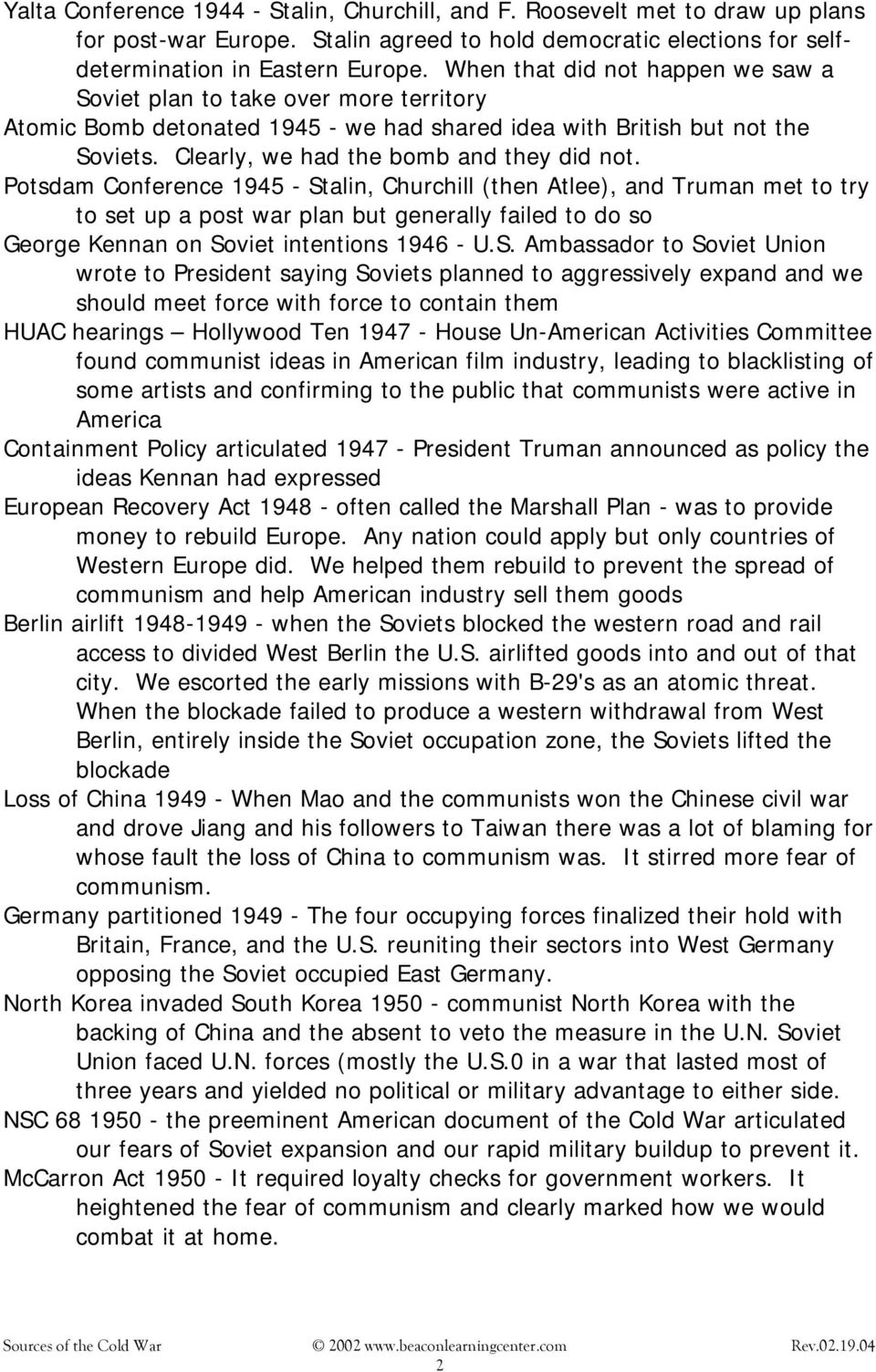
1 The Sequence of Causes of the Cold War Outside the U.S. In the U.S Revolutions in Russia Russian Civil War Second Front against Hitler Casablanca Conference 1943 Teheran Conference 1943 Yalta Conference 1944 Treaty of Versailles 1919 Red Scare of Atomic Bomb detonated 1945 Potsdam Conference 1945 George Kennan on Soviet intentions 1946 HUAC hearings Hollywood Ten 1947 Containment Policy articulated1947 European Recovery Act 1948 Berlin airlift Loss of China 1949 Germany partitioned 1949 North Korea invaded South Korea 1950 NSC McCarron Act Revolutions in Russia - frightened Americans who feared communist revolutions might spread Russian Civil War - the U.S. sent some troops and materials to support the White Army fighting the Red Army, but our (the Czarist) side lost anyway Treaty of Versailles Russia was not invited to participate because they were 1. communist and 2. had withdrawn from the war Red Scare of unrelated events were lumped together to generate an anti-communist stir causing considerable fear of communism in the U.S Second Front against Hitler - The Soviet Union had asked the British and Americans to open a second front in Western Europe to help relieve the Soviets of the sole responsibility of fighting the Germans. We agreed but kept postponing the date. The Soviets concluded we were stalling while waiting for the German and Soviet armies to destroy each other. Casablanca Conference Churchill and F. Roosevelt met to decide to fight Germany first, demand an unconditional surrender of Germany and delay opening a second front Teheran Conference Stalin, Churchill, and F. Roosevelt met to discuss the war and we again postponed the opening of the second front 1

2 Yalta Conference Stalin, Churchill, and F. Roosevelt met to draw up plans for post-war Europe. Stalin agreed to hold democratic elections for selfdetermination in Eastern Europe. When that did not happen we saw a Soviet plan to take over more territory Atomic Bomb detonated we had shared idea with British but not the Soviets. Clearly, we had the bomb and they did not. Potsdam Conference Stalin, Churchill (then Atlee), and Truman met to try to set up a post war plan but generally failed to do so George Kennan on Soviet intentions U.S. Ambassador to Soviet Union wrote to President saying Soviets planned to aggressively expand and we should meet force with force to contain them HUAC hearings Hollywood Ten House Un-American Activities Committee found communist ideas in American film industry, leading to blacklisting of some artists and confirming to the public that communists were active in America Containment Policy articulated President Truman announced as policy the ideas Kennan had expressed European Recovery Act often called the Marshall Plan - was to provide money to rebuild Europe. Any nation could apply but only countries of Western Europe did. We helped them rebuild to prevent the spread of communism and help American industry sell them goods Berlin airlift when the Soviets blocked the western road and rail access to divided West Berlin the U.S. airlifted goods into and out of that city. We escorted the early missions with B-29's as an atomic threat. When the blockade failed to produce a western withdrawal from West Berlin, entirely inside the Soviet occupation zone, the Soviets lifted the blockade Loss of China When Mao and the communists won the Chinese civil war and drove Jiang and his followers to Taiwan there was a lot of blaming for whose fault the loss of China to communism was. It stirred more fear of communism. Germany partitioned The four occupying forces finalized their hold with Britain, France, and the U.S. reuniting their sectors into West Germany opposing the Soviet occupied East Germany. North Korea invaded South Korea communist North Korea with the backing of China and the absent to veto the measure in the U.N. Soviet Union faced U.N. forces (mostly the U.S.0 in a war that lasted most of three years and yielded no political or military advantage to either side. NSC the preeminent American document of the Cold War articulated our fears of Soviet expansion and our rapid military buildup to prevent it. McCarron Act It required loyalty checks for government workers. It heightened the fear of communism and clearly marked how we would combat it at home. 2
3 Causes of the Cold War Outline NAME 1. Find the events that caused tensions between the communists in Russia/Soviet Union and the United States at the times given. 2. Briefly summarize the event in the space provided. Revolutions in Russia in 1917 Russian Civil War from Treaty of Versailles 1919 Red Scare of Soviet requests for a Second Front against Hitler from Casablanca Conference 1943 Teheran Conference 1943 Yalta Conference 1944 Atomic Bomb detonated 1945 Potsdam Conference 1945 George Kennan on Soviet intentions 1946 HUAC hearings Hollywood Ten

4 Containment Policy articulated1947 European Recovery Act 1948 Berlin airlift Loss of China 1949 Germany partitioned 1949 North Korea invaded South Korea 1950 NSC McCarron Act
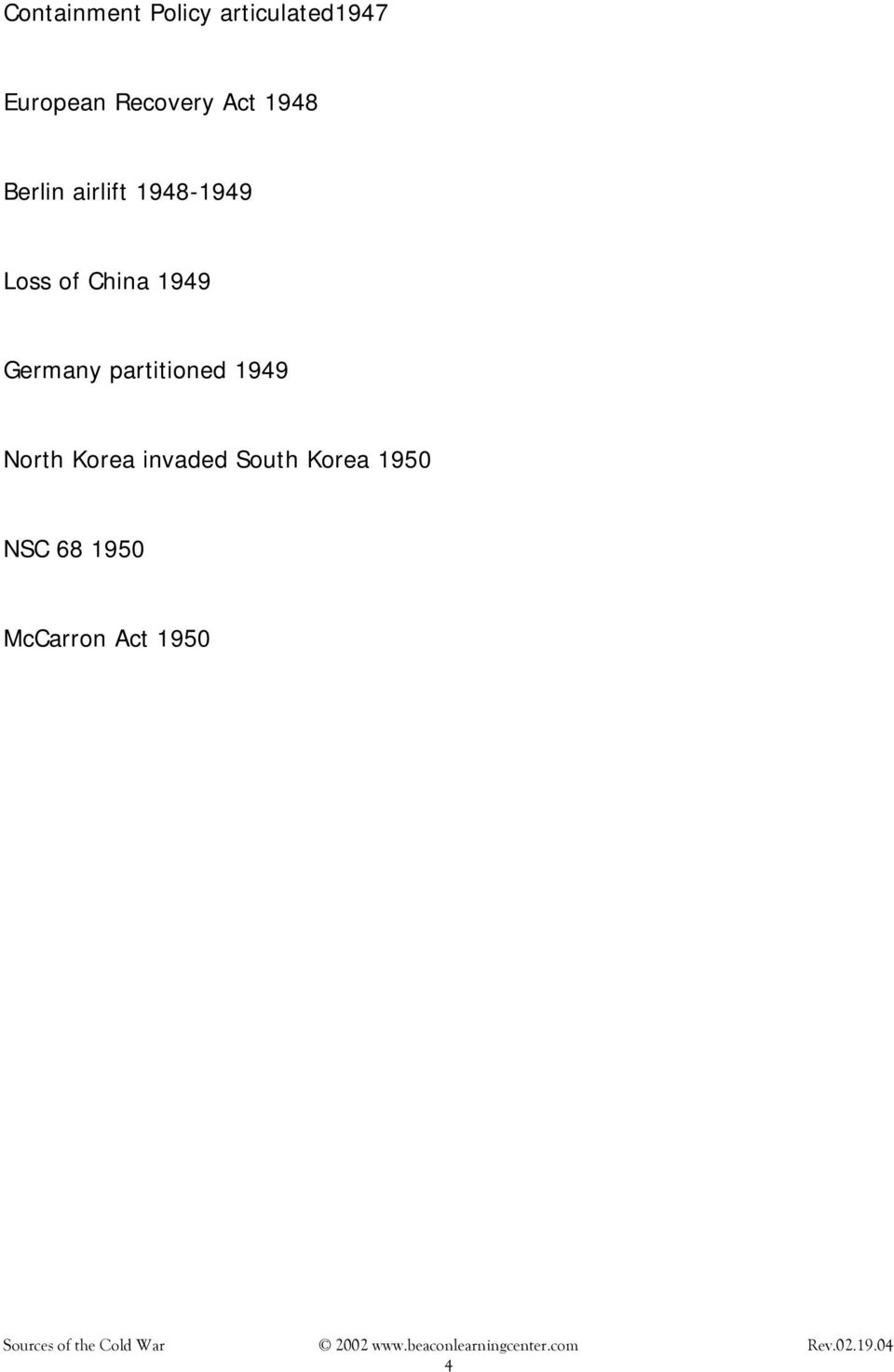
5 Directions for a Time Line of the Causes of the Cold War 1. Use the 8½X11 paper provided by the teacher. 2. Turn the paper sideways. 3. Measure in 1¼ inch from the left margin. 4. Begin in about the middle of the page, centered vertically. 5. Draw a line 8¼ inches long. 6. Place a small mark every ¼ inch. 7. Begin at the first small mark on the extreme left side and label these marks as years starting with 1917 and going through Enter the 20 events from the outline, by title only, with 1-inch vertical lines on the Time Line. 9. When events take more than one year, connect the two points with a bold line on the horizontal line. 10. Label the events, alternating labels above the horizontal line and below the horizontal line. 11. When you are finished, check to be sure you have marked and labeled all twenty events in chronological order from 1917 on the left to 1950 on the right. 12. Put a title on the Time Line. 13. Put your name in the upper right corner of the paper. 14. Attach the Causes of the Cold War Outline corrected sheet to the time line. Turn in your time line. 5
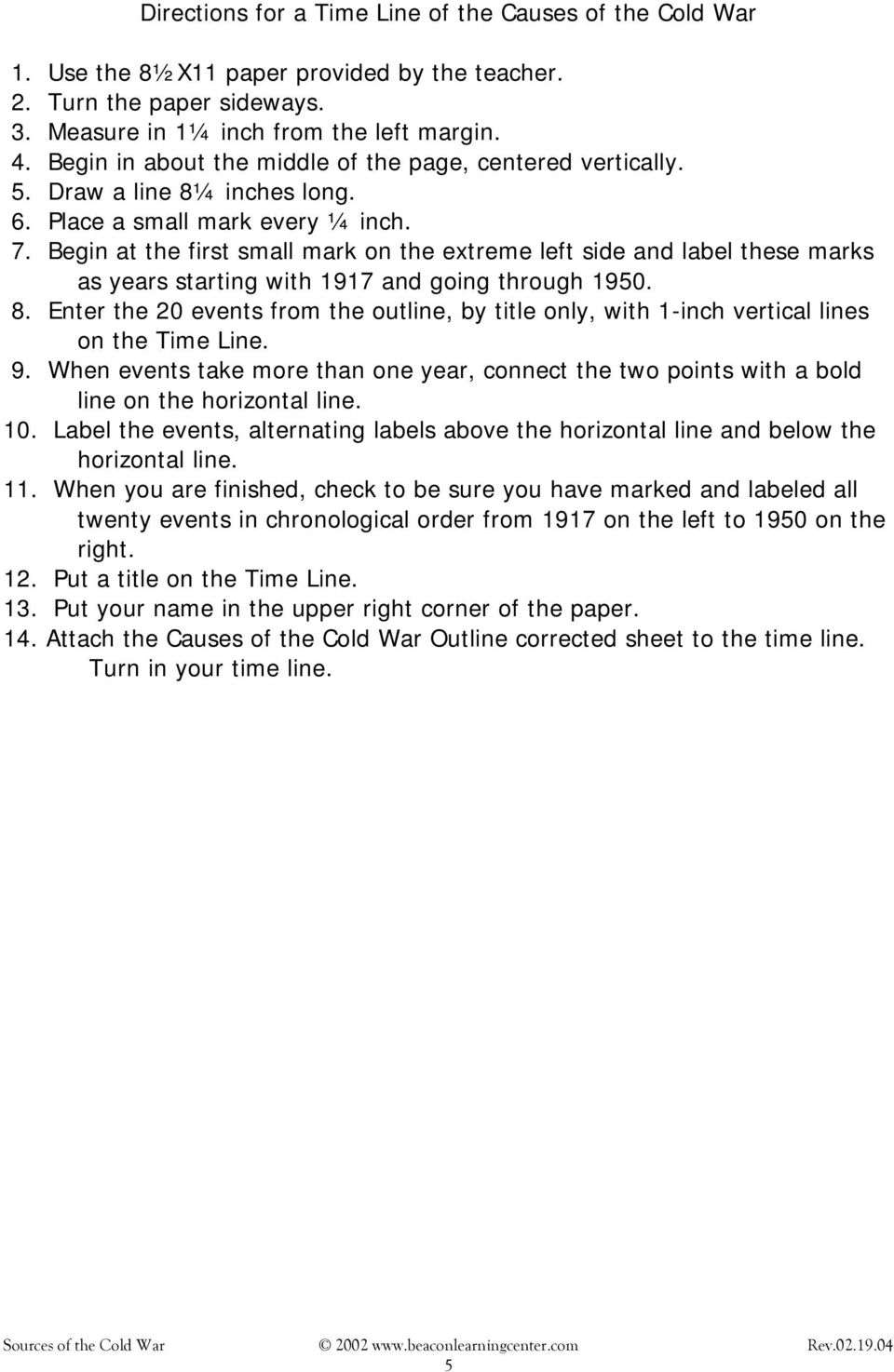
6 NAME Form 1 Put the following events into the proper chronological order, from first to last. Write 1 beside the first event on down to number 20 for the last event. Revolutions in Russia Russian Civil War Treaty of Versailles Red Scare Second Front against Hitler Casablanca Conference Teheran Conference Yalta Conference Atomic Bomb detonated Potsdam Conference George Kennan on Soviet intentions HUAC hearings Hollywood Ten Containment Policy articulated European Recovery Act Berlin airlift Loss of China Germany partitioned North Korea invaded South Korea NSC 68 McCarron Act 6
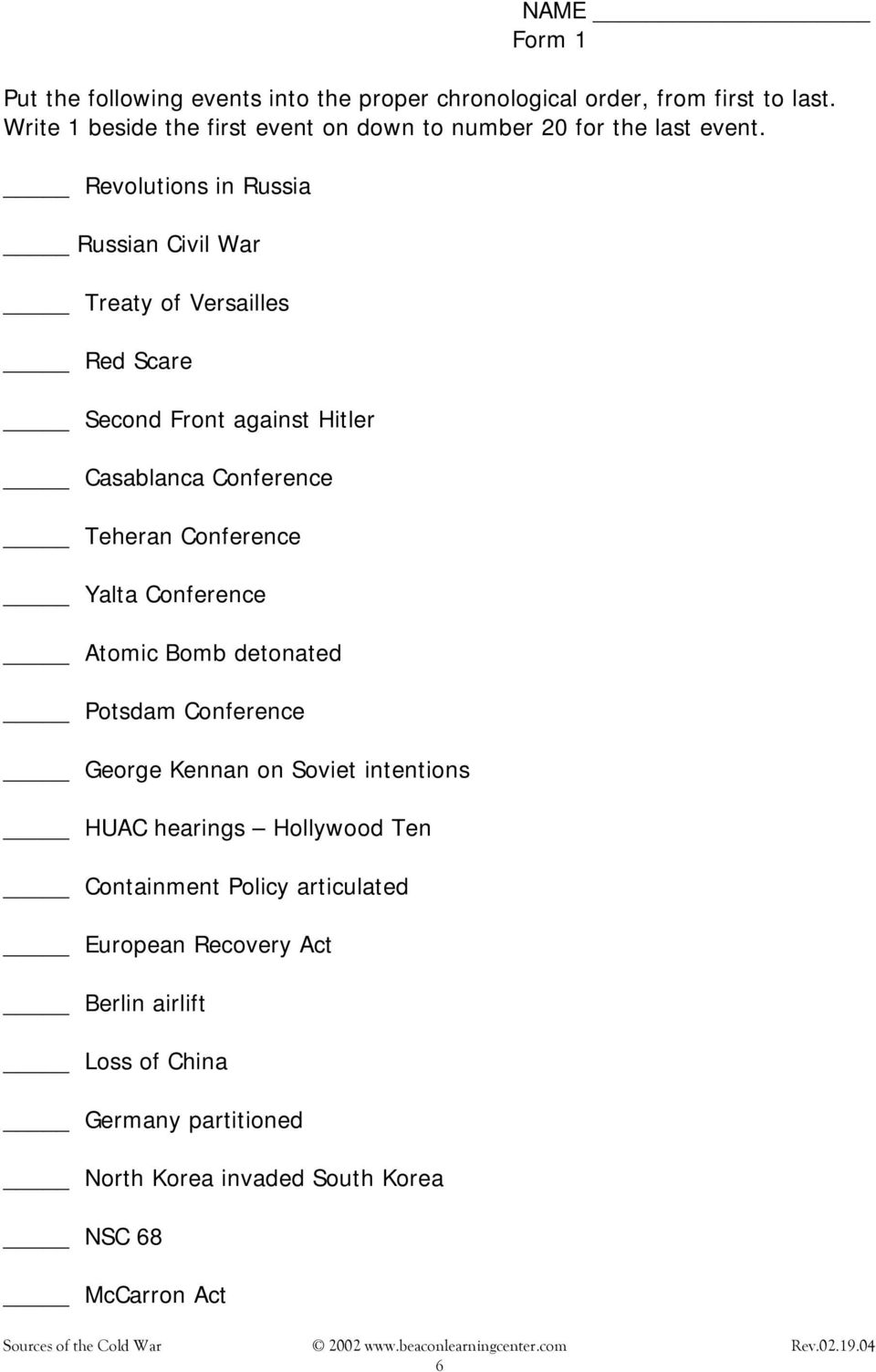
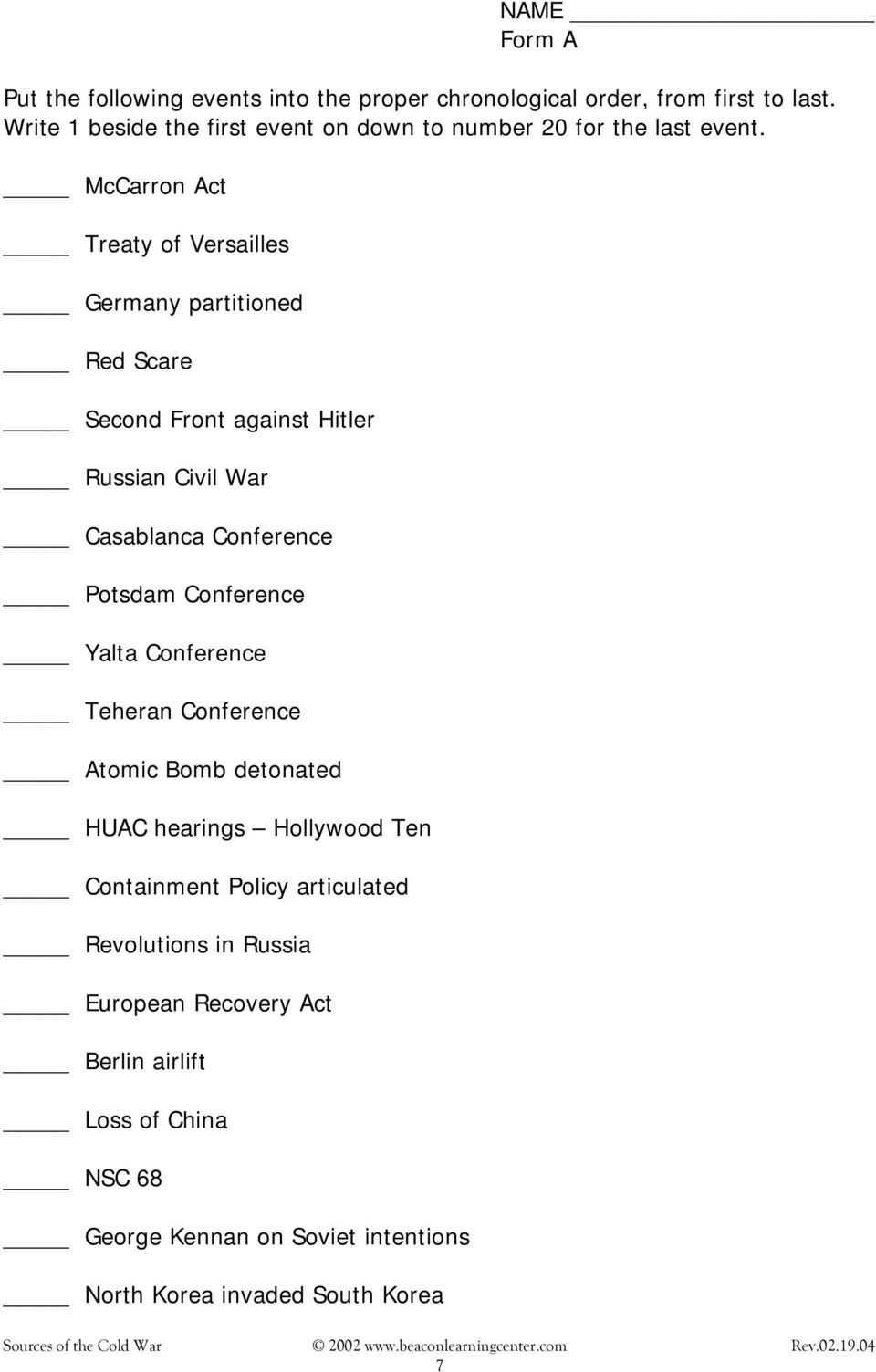
7 NAME Form A Put the following events into the proper chronological order, from first to last. Write 1 beside the first event on down to number 20 for the last event. McCarron Act Treaty of Versailles Germany partitioned Red Scare Second Front against Hitler Russian Civil War Casablanca Conference Potsdam Conference Yalta Conference Teheran Conference Atomic Bomb detonated HUAC hearings Hollywood Ten Containment Policy articulated Revolutions in Russia European Recovery Act Berlin airlift Loss of China NSC 68 George Kennan on Soviet intentions North Korea invaded South Korea 7
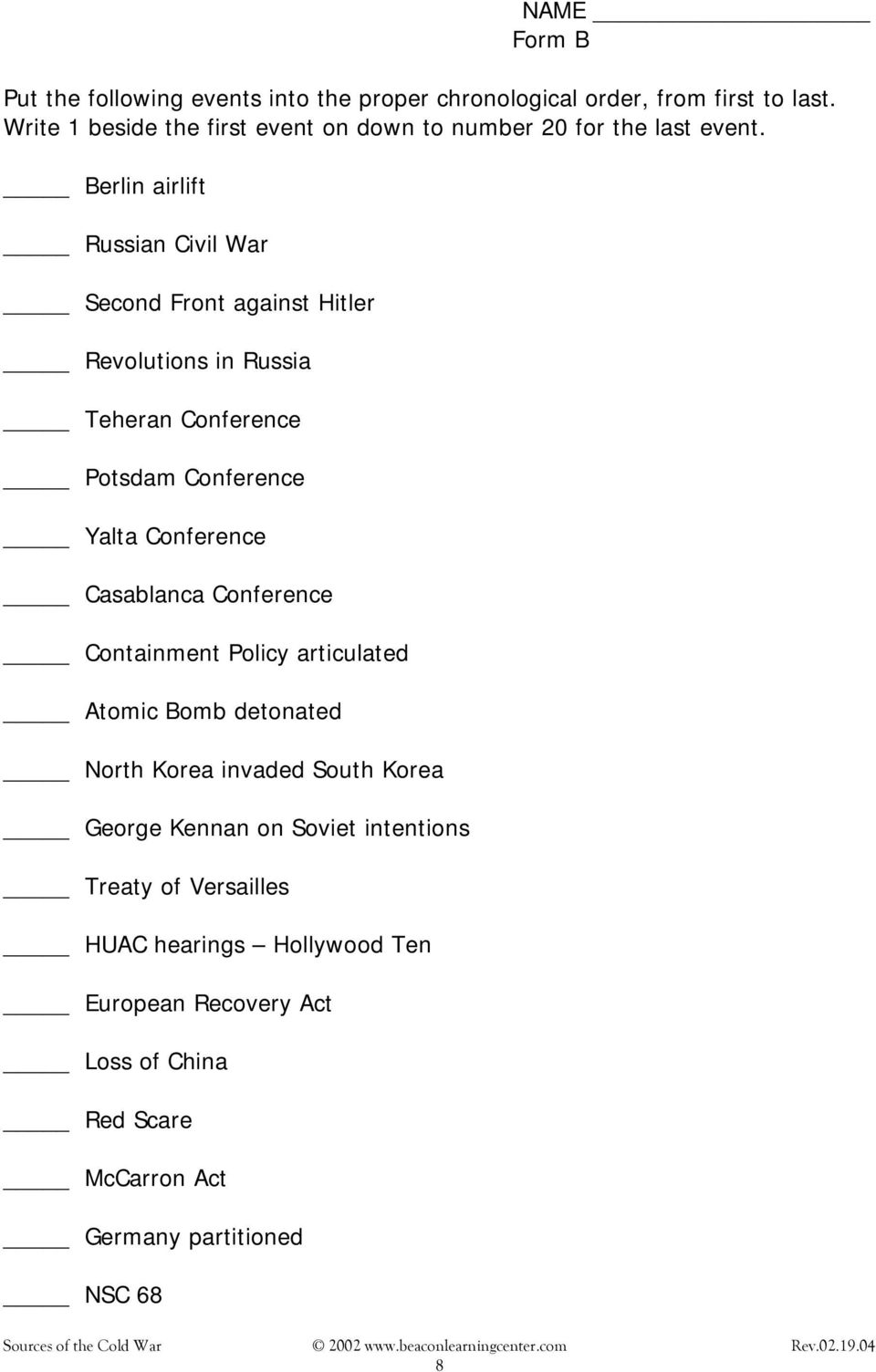
8 NAME Form B Put the following events into the proper chronological order, from first to last. Write 1 beside the first event on down to number 20 for the last event. Berlin airlift Russian Civil War Second Front against Hitler Revolutions in Russia Teheran Conference Potsdam Conference Yalta Conference Casablanca Conference Containment Policy articulated Atomic Bomb detonated North Korea invaded South Korea George Kennan on Soviet intentions Treaty of Versailles HUAC hearings Hollywood Ten European Recovery Act Loss of China Red Scare McCarron Act Germany partitioned NSC 68 8
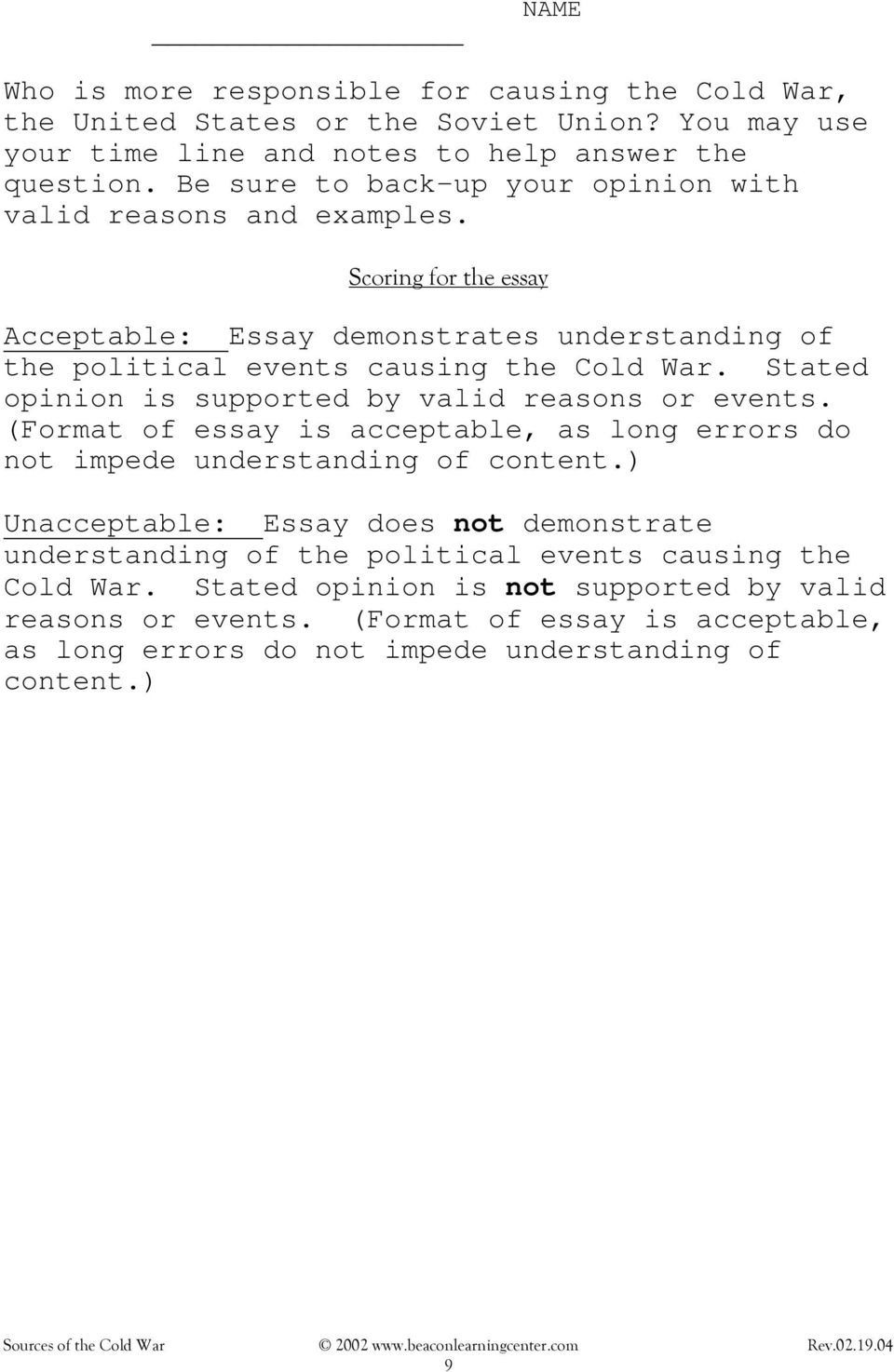
9 NAME Who is more responsible for causing the Cold War, the United States or the Soviet Union? You may use your time line and notes to help answer the question. Be sure to back-up your opinion with valid reasons and examples. Scoring for the essay Acceptable: Essay demonstrates understanding of the political events causing the Cold War. Stated opinion is supported by valid reasons or events. (Format of essay is acceptable, as long errors do not impede understanding of content.) Unacceptable: Essay does not demonstrate understanding of the political events causing the Cold War. Stated opinion is not supported by valid reasons or events. (Format of essay is acceptable, as long errors do not impede understanding of content.) 9
Although the dominant military confrontations of the 20 th century were centered on the
 To what extent were the policies of the United States responsible for the outbreak and development of the Cold War between 1945 and 1949? Although the dominant military confrontations of the 20 th century
Created by Paul Hallett
 The National Cold War Exhibition and this resource pack will assist in the learning of GCSE Modern World History. As you enter the National Cold War Exhibition read the three information boards on the
Origins of the Cold War
 Origins of the Cold War Main Idea The detonation of the atomic bomb and the end of World War II led to disagreements among the Big Three wartime Allies and a shift in American attitudes toward the Soviet
Access to History Online OCR European and World History Period Studies The Cold War in Europe from 1945 to the 1990s Standard AS question
 OCR AS GCE European and World History Period Studies F 962 Unit 1 The Cold War in Europe from 1945 to the 1990s ESSAY Examiner s Specific Advice Candidates need to evaluate the relative policies of the
Cold War Spreads to Asia
 Cold War Spreads to Asia China China becomes Communist 1920s Mao Zedong leads communist forces against Chiang Kai Shek leader of China s Nationalist government During WWII set aside civil war to resist
To What Extent is The Cold War a Result of Two Conflicting Ideologies?
 Rahaf Alwattar Daniela Morales Kiley Smith Madison So To What Extent is The Cold War a Result of Two Conflicting Ideologies? The Cold War was an unceasing state of political and military tensions between
Foreign Affairs and National Security
 Foreign Affairs and National Security Objectives: TLW understand and explain the following questions as it relates to the Foreign affairs of the American Government What is foreign policy? What is the
German initiated battle in western europe that attempted to push back the allied advance that was un. Sample letter requesting financial assistance
 German initiated battle in western europe that attempted to push back the allied advance that was un. Sample letter requesting financial assistance from employer. German initiated battle in western europe
WORLD WAR 2 Political and economic conditions in Europe and throughout the world after World War 1 led directly to World War 2:
 Political and economic conditions in Europe and throughout the world after World War 1 led directly to World War 2: 1. The Treaty of Versailles, ending World War 1, was particularly harsh on Germany and
Cold War Lesson Plan. Central Historical Question: Who was primarily responsible for the Cold War the United States or the Soviet Union?
 Cold War Lesson Plan Central Historical Question: Who was primarily responsible for the Cold War the United States or the Soviet Union? Materials: Cold War PowerPoint Copies of Cold War Timeline Copies
DBQ 13: Start of the Cold War
 Name Date DBQ 13: Start of the Cold War (Adapted from Document-Based Assessment for Global History, Walch Education) Historical Context: Between 1945 and 1950, the wartime alliance between the United States
Cold War Lesson Plan. Central Historical Question: Who was primarily responsible for the Cold War: The United States or the Soviet Union?
 Lesson Plan Central Historical Question: Who was primarily responsible for the : The United States or the Soviet Union? Materials: PowerPoint Copies of Timeline Copies of Documents A-D Copies of Guiding
Chapter 6 The Yalta Conference
 Page 29 Chapter 6 The Yalta Conference While Germany and the Allies were engaged in the Battle of the Bulge, US President Franklin Roosevelt and British Prime Minister Winston Churchill prepared to meet
World History Course Summary Department: Social Studies. Semester 1
 World History Course Summary Department: Social Studies All World History courses (Honors or otherwise) utilize the same targets and indicators for student performance. However, students enrolled in Honors
The Cold War: A Conflict of Ideologies
 The Cold War: A Conflict of Ideologies Political Realignment after World War II Fractures of Allied Forces Development of Two Camps; Partition Definition of Cold War Causes of the Cold War (Who s to Blame?)
UNIT #7 Hot & Cold: World War II & Its Aftermath
 The following instructional plan is part of a GaDOE collection of Unit Frameworks, Performance Tasks, examples of Student Work, and Teacher Commentary for Fifth Grade Social Studies. UNIT #7 Hot & Cold:
Begins. Chapter U.S. EVENTS WORLD EVENTS U.S. PRESIDENTS. 758 Chapter 22 The Cold War Begins
 Chapter The Cold War Begins 1945 1960 SECTION 1 The Origins of the Cold War SECTION 2 The Early Cold War Years SECTION 3 The Cold War and American Society SECTION 4 Eisenhower s Cold War Policies The world
SUPERPOWER RELATIONS AND THE COLD WAR HODDER GCSE HISTORY FOR EDEXCEL. Steve Waugh John Wright. Authors. Dynamic Learning.
 HODDER GCSE HISTORY FOR EDEXCEL SUPERPOWER RELATIONS AND THE COLD WAR 1941 91 Achieve your full potential with this enjoyable and engaging Student s Book, created for the 2016 Edexcel GCSE History specification
Timeline of the Cold War
 Timeline of the Cold War 1945 Defeat of Germany and Japan February 4-11: May 8: July: August 6: August 8: August 9: August 14 : August 15: 1946 February 9: March 5 : March 10: July 1: July 25: Yalta Conference
Table of Contents Part One: Social Studies Curriculum Chapter I: Social Studies Essay Questions and Prewriting Activities
 Table of Contents Part One: Social Studies Curriculum Chapter I: Social Studies Essay Questions and Prewriting Activities 1. How the United States Became a World Power 1 2. Immigration 5 3. The Role of
Chapter 22: World War I. Four most powerful European nations in the early 1900s were Great Britain, France, Germany, Russia.
 Chapter 22: World War I The Beginnings of World War I World War I was fought from 1914-1918. United States entered World War I in 1917. The Origins of Europe s Great War Nationalism Four most powerful
Introduction. Material A
 MATERIAL: The Berlin Airlift, 24th June 1948 12th May 1949 (27th August 1949 1 ) Introduction Material A The second day I was in Berlin, Herr Berg took me to Templehof Airport to see the American planes
Note Taking Study Guide FROM APPEASEMENT TO WAR
 SECTION 1 FROM APPEASEMENT TO WAR Focus Question: What events unfolded between Chamberlain s declaration of peace in our time and the outbreak of a world war? A. As you read Aggression Goes Unchecked and
1. What is the Baruch Plan? 2. What was the Bolshoi Speech (1946)? 3. When was the Berlin Wall started? 4. When is the first ICBM? 5.
 1. What is the Baruch Plan? 2. What was the Bolshoi Speech (1946)? 3. When was the Berlin Wall started? 4. When is the first ICBM? 5. First Nuclear (fission) bomb? Source: http://www.usachcs.army.mil/history/brief/coldwarcompos.jpg
The Nuclear Weapons Debate
 Scottish CND - Education Pack The Nuclear Weapons Debate Scottish CND s educational resource Nuclear Weapons: Yes or No is aimed at late primary to early secondary school pupils. It has 4 units: The Nuclear
History (Specification B)
 General Certificate of Secondary Education Specimen for June 2015 examinations History (Specification B) Unit 1 91451 International Relations: Conflict and Peace in the Twentieth Century Specimen for June
History (Specification B) (Short Course)
 General Certificate of Secondary Education June 2015 History (Specification B) (Short Course) 91454 Unit 4: International Relations: Conflict and Peace in the 20th Century Monday 1 June 2015 9.00 am to
Name Period Date. The Cold War. Document-Based Question
 Name Period Date Task: The Cold War Document-Based Question How effective was the United States government in its attempt to halt the spread of communism in Europe and Asia between the years 1945 and 1975?
International Relations. Simulation: The Treaty of Versailles This activity accompanies slide 15 of The Treaty of Versailles (part 1).
 Name: Simulation: The Treaty of Versailles This activity accompanies slide 15 of The Treaty of Versailles (part 1).ppt Instructions You are going to take part in a simulation of the Versailles negotiations.
Lesson # Overview Title /Standards. Big Question for lesson (from teaching thesis) Specific lesson Objectives (transfer from above).
 Lesson # Overview Title /Standards Big Question for lesson (from teaching thesis) Specific lesson Objectives (transfer from above). Content focused/action verbs Assessment of Objective(s) (you do not need
Chapter 26: The Cold War, 1945-1952
 Chapter 26: The Cold War, 1945-1952 Overview At the conclusion of World War II the United States and the Soviet Union, once allies, were enemies locked in an ideological conflict based in part on their
WORLD WARS (1914 to 1918 and 1939 to 1945) First World War (1914 to 1918) I. One mark questions (Answer in one sentence each)
 WORLD WARS (1914 to 1918 and 1939 to 1945) First World War (1914 to 1918) I. One mark questions (Answer in one sentence each) 1. When did the First World War begin? First World War began on 28 th July
SAMPLE COURSE OUTLINE
 SAMPLE COURSE OUTLINE MODERN HISTORY ATAR YEAR 12 Unit 4 Elective 1: The changing European world since 1945 Copyright School Curriculum and Standards Authority, 2015 This document apart from any third
Cuban Missile Crisis Lesson Plan. Central Historical Question: Why did the Russians pull their missiles out of Cuba?
 Lesson Plan Central Historical Question: Why did the Russians pull their missiles out of Cuba? Materials: United Streaming Video Segment: The Hour of Maximum Danger (from Freedom: A History of the US:
COLD WAR-MEANING, CAUESE, HISTORY AND IMPACT
 COLD WAR-MEANING, CAUESE, HISTORY AND IMPACT INTRODUCTION After Second World War the period of International Relations from 1945 to 1990 is known as the period of Cold war. In fact, after the war, the
The Cold War, Bipolarity Structure and the Power Vacuum in the East and South East Asia after 1945
 Journal of Global Peace and Conflict June 2014, Vol. 2, No. 1, pp. 121-128 ISSN: 2333-584X (Print), 2333-5858 (Online) Copyright The Author(s). 2014. All Rights Reserved. Published by American Research
A. Poland, Bulgaria, Soviet Union B. France, Spain, Manchuria C. Italy, United States, Japan D. Germany, Italy, Japan
 Social Studies Quiz World War II & the Cold War Name Date Read each of the following questions/statements carefully and circle the letter representing the best answer choice. 1. Which was an effect of
AP EUROPEAN HISTORY 2009 SCORING GUIDELINES
 AP EUROPEAN HISTORY 2009 SCORING GUIDELINES Question 2 Analyze the long-term and short-term factors responsible for the disintegration of communist rule in TWO of the following states: Czechoslovakia East
The Causes of the Cold War Isobel Egan, Dickson College, 2011
 The Causes of the Cold War Isobel Egan, Dickson College, 2011 This essay was written as part of the International Relations: 1945 to the Present unit at Dickson College, Semester 2, 2011. It is an answer
1914-1918: WORLD WAR I CFE 3201V
 1914-1918: WORLD WAR I CFE 3201V OPEN CAPTIONED NATIONAL GEOGRAPHIC SOCIETY 1992 Grade Levels: 10-13+ 25 minutes 1 Instructional Graphic Enclosed DESCRIPTION The forces of nationalism, imperialism, and
Vocabulaire LES DIFFÉRENTES PARTIES D'UNE IMAGE LES DIFFÉRENTES SORTES D'IMAGES. in the middle au milieu. a photograph une photographie
 POUR L'ORAL 1) Présenter rapidement le doc : cartoon, auteur, date/contexte rapide, idée principale 2) Décrire les éléments du cartoon et ensuite interpréter, expliquer les allusions, symboles 3) Synthèse
History (Specification B)
 General Certificate of Secondary Education Specimen for June 2015 examinations History (Specification B) Unit 2 Twentieth Century Depth Studies Specimen for June 2015 examinations 91452 For this paper
ABOUT THE FILM. www.filmeducation.org www.livesofothersmovie.co.uk. Film Education 2007 and Copyright 2007 Lionsgate Films. All Rights Reserved
 ABOUT THE FILM The Lives of Others, directed by Florian Henckel von Donnersmark, focuses on the cultural scene in East Berlin during the German Democratic Republic (GDR) in the middle of the 1980s. It
AP EUROPEAN HISTORY 2006 SCORING GUIDELINES. Question 7
 AP EUROPEAN HISTORY 2006 SCORING GUIDELINES Question 7 Considering the period 1933 to 1945, analyze the economic, diplomatic, and military reasons for Germany s defeat in the Second World War. 9 6: Stronger
klm Final Mark Scheme General Certificate of Education June 2011 A2 History 2041 HIS3N Unit 3N Aspects of International Relations, 1945 2004
 Version 1.0: 0611 klm General Certificate of Education June 2011 A2 History 2041 HIS3N Unit 3N Aspects of International Relations, 1945 2004 Final Mark Scheme Mark schemes are prepared by the Principal
UNIVERSITY OF DENVER ADVANCED YALTA CONFERENCE. By Sara Cardenas and Ian Croak
 UNIVERSITY OF DENVER ADVANCED YALTA CONFERENCE By Sara Cardenas and Ian Croak Introduction In the closing months of the Second World War the soon to be victorious Allies and their respective heads of state
Social Studies. Directions: Complete the following questions using the link listed below.
 Social Studies Name: Directions: Complete the following questions using the link listed below. Questions 1-8: http://www.biography.com/people/adolf-hitler-9340144 (Pages 1-2) Questions 9-17: http://www.history.com/topics/world-war-ii/adolf-hitler
Note Taking Study Guide ORIGINS OF THE VIETNAM WAR
 SECTION 1 ORIGINS OF THE VIETNAM WAR Focus Question: Why did the United States become involved in Vietnam? As you read, describe the Vietnam policies of Presidents Truman, Eisenhower, Kennedy, and Johnson.
Literature Novel Animal Farm English I Summer Reading Guide
 Literature Novel Animal Farm English I Summer Reading Guide Join the journey to Animal Farm by following the directions to assist you in overcoming any obstacles in your path on your way to an A to begin
5th social studies core skills (5thsocstud_coreskills)
 Name: Date: 1. On July 4, 1852 a writer was asked to speak at an Independence Day celebration in Rochester, New York. Below is a part of his speech. Fellow citizens Pardon me, and allow me to ask, why
SOCIAL STUDIES TEST for e-lessons day 2
 SOCIAL STUDIES TEST for e-lessons day 2 Name Directions: Use your own piece of paper as your answer document. Do not print off the test. You will need to only turn in your answer document. 29. The Cold
Note Taking Study Guide THE GREAT WAR BEGINS
 SECTION 1 THE GREAT WAR BEGINS Focus Question: Why and how did World War I begin in 1914? As you read this section in your textbook, complete the following chart to summarize the events that led to the
World War II: Causes and Consequences: Teacher s Guide
 World War II: Causes and Consequences: Teacher s Guide Grade Level: 6-8 Curriculum Focus: U.S. History Lesson Duration: Two to three class periods Program Description Examine Hitler s occupation of Europe
The Influence of the Treaty of Versailles on World War II. The Treaty of Versailles, drafted and passed after World War I, was a document
 The Influence of the Treaty of Versailles on World War II The Treaty of Versailles, drafted and passed after World War I, was a document that addressed the state of the international community in response
Synopses, Characteristics, and Tree Diagrams
 Appendix 2 he Reading Passages: Synopses, Characteristics, and Tree Diagrams Economic Expansion This passage traces industrial growth in the United States from the Civil War until the early 1900s, by which
Military Advisors in Vietnam: 1963
 Military Advisors in Vietnam: 1963 Topic: Vietnam Grade Level: 9-12 Subject Area: US History after World War II Time Required: 1 class period Goals/Rationale In the winter of 1963, the eyes of most Americans
History (Specification B)
 General Certificate of Secondary Education June 2015 History (Specification B) 91452 Unit 2: Twentieth Century Depth Studies Wednesday 10 June 2015 9.00 am to 10.45 am For this paper you must have: an
The story of Gail Halvorsen, the Candy Bomber
 The story of Gail Halvorsen, the Candy Bomber Uncle Wiggly Wings was a pilot. His real name was Colonel Gail Halvorsen. He liked to fly airplanes. He flew a Douglas C-54 airplane. He was also called the
2. Each of the above reasons helped to cause the creation of alliances throughout Europe. How? How do new alliances encourage tension?
 APEH Topic 10 Webquest Points Possible: 200 pts World War I Webquest Part I - M.A.I.N. Causes Name 1. Identify militarism, Imperialism, and Nationalism. Then, explain how each force creates tension in
FDR Birth Announcement. Franklin Delano Roosevelt was born on January 30, 1882 to James Roosevelt and Sara Delano Roosevelt at their home in Hyde
 FDR Birth Announcement. Franklin Delano Roosevelt was born on January 30, 1882 to James Roosevelt and Sara Delano Roosevelt at their home in Hyde Park, New York. This whimsical birth announcement was found
Specimen 2018 Morning Time allowed: 1 hour 45 minutes
 SPECIMEN MATERIAL GCSE HISTORY Paper 1 Understanding the modern world 1D America, 1920 1973: Opportunity and inequality with wider world depth studies Specimen 2018 Morning Time allowed: 1 hour 45 minutes
Palestinian Unilateral Declaration of Independence (UDI): A Teacher s Guide
 Palestinian Unilateral Declaration of Independence (UDI): A Teacher s Guide By Moshe Abelesz, The Lookstein Center I. Background Information, 1937-1949 In the Middle East there are two peoples struggling
President Eisenhower believed developing new
 Section 4 Eisenhower s Cold War Policies Guide to Reading Big Ideas Science and Technology Nuclear technology enabled Eisenhower to change U.S. military policy, while new missile technology marked the
origins of such a disastrous global conflict. Understanding the causes of such a drastic event will
 Assess the importance of each of the following as causes of the Second World War: treaties; economic factors; ideology. World War II is one of the most studied events in history in terms of understanding
Document Based Questions (DBQs) AP European History Magister Ricard
 As we wind down the year, we are going to be reviewing while also finalizing our preparation for the AP Exam on May 6 th. One of the last skills you will need to have is writing essays from DBQs or Document
Five Roles of Political Parties
 It s a Party but not the kind with ice cream and cake (usually). Political parties are groups of people who share similar beliefs about how the government should be run and how the issues facing our country
WWII by the Numbers Charting and Graphing D-Day and WWII Data
 WWII by the Numbers Charting and Graphing D-Day and WWII Data A Lesson from the Education Department The National WWII Museum 945 Magazine Street New Orleans, LA 70130 (504) 528-1944 www.nationalww2museum.org/learn/education
Ukraine Document Based Question (DBQ) Central Question: What is happening in Ukraine?
 Ukraine Document Based Question (DBQ) Central Question: What is happening in Ukraine? Map of the Soviet Union and Eastern Europe during the Cold War: Located in Eastern Europe, Ukraine became a part of
Arab-Israeli Conflict Map Analysis Activity
 Arab-Israeli Conflict Map Analysis Activity Look at the maps of Israel and Palestine from 1517 to 2003. What can we learn about history from looking at these maps? What questions do you have as a result
Level 1/2 Certificate HISTORY
 Level 1/2 Certificate HISTORY Unit 1 20th Century Depth Studies Specimen for 2016 only Time allowed: 1 hour 30 minutes Materials For this paper you must have: an AQA 12-page answer book. Instructions Use
Final. Mark Scheme. General Certificate of Education June 2013. A2 History 2041 HIS3N Unit 3N. Aspects of International Relations, 1945 2004
 Version 1.0: 0613 General Certificate of Education June 2013 A2 History 2041 HIS3N Unit 3N Aspects of International Relations, 1945 2004 Final Mark Scheme Mark schemes are prepared by the Principal Examiner
Nationalism and U.S. Expansion
 Chapter 21: American Expansion and International Politics: 1870-1914 Nationalism and U.S. Expansion Diplomatic relations is a relationship between government officials of different nations with frequent
The Xenophile Historian
 The Xenophile Historian Map Gallery Map 1: The spread of civilization in thousand-year steps. The purple areas became civilized by 3000 B.C. Civilization spread to the green areas by 2000 B.C., yellow
SUGGESTED UNIT OUTLINES FOR SOCIAL STUDIES GLES
 NINTH-TENTH GRADES SUGGESTED UNIT OUTLINES In ninth and tenth grade, students apply their deeper understanding of social studies concepts on a global scale. The recommended context in the ninth and tenth
How did Berlin symbolize the global struggle between the free world and the communist world during the Cold War?
 Using your own background knowledge and the following documents, please evaluate the following statement: How did Berlin symbolize the global struggle between the free world and the communist world during
History. Bachelor of Arts Major in History. Objectives. Degree Offered. Major Offered. Minor Offered. International Studies.
 History 123 History Thomas W. Taylor, PhD, Chair Objectives Defying classification as either humanity or social science, history functions as both. It focuses on the values, as well as the ideas, personalities,
Name: Date: Hour: Allies (Russia in this instance) over the Germans. Allies (British and American forces defeated German forces in Northern Africa)
 Name: Date: Hour: World War II Use your textbook and other sources to complete the chart below regarding the significant events that took place during World War II. Answer the questions that follow in
Created by Paul Hallett
 The Cuban Missile Crisis was a confrontation during the Cold War between the Soviet Union and the United States regarding the deployment of nuclear missiles in Cuba. The missiles had been placed to protect
Nixon s Foreign Policy
 1 Nixon s Foreign Policy 2 TEKS 1, 24, 24(G), 26 3 Listen 4 5 Listen 6 Listen 7 8 Listen After a period of confrontation, we are entering an era of negotiation. Let all nations know that during this administration
Becoming a World Power. The Imperialist Vision. Imperialism (cont) 1872-1912. Americans wanted to develop overseas markets
 Becoming a World Power 1872-1912 The Imperialist Vision Imperialism economic and political domination of a strong nation over a weaker one Became popular with countries in Europe Imperialism (cont) Protectorates
Chapter 23 Georgia and World War II
 Name: Class: Date: Chapter 23 Georgia and World War II Multiple Choice Identify the choice that best completes the statement or answers the question. 1. Which accurately describes how the Lend Lease program
Here is the list of history courses with cross listings and how they fit in each of the sections of the History Major.
 Here is the list of history courses with cross listings and how they fit in each of the sections of the History Major. Note: if you take a History course that is cross listed and you take it under the
Why China s Rise Will Not Be Peaceful
 Can China Rise Peacefully John Mearsheimer September 17, 2004 Why China s Rise Will Not Be Peaceful The question at hand is simple and profound: can China rise peacefully? My answer is no. If China continues
TEACHER S KEY SESSION 1. THE WORLD BEFORE THE GREAT WAR. PRETASK. 3. Pre- listening.
 TEACHER S KEY SESSION 1. THE WORLD BEFORE THE GREAT WAR. PRETASK 3. Pre- listening. 1. Before 1914, the nations of Europe were involved in a race to obtain overseas colonies all over the world, mainly
Edexcel GCSE History A: The Making of the Modern World
 Edexcel GCSE History A: The Making of the Modern World Contents Welcome to Modern World History 4 How to use this book 5 Unit 1 Peace and War: International Relations 1900 1991 Section 1: Why did war break
NCA &TSU Master of Art in History Degree Requirements HISTORY. Olen Cole, Jr., Chairperson 324 Gibbs Hall (336) 334-7831 coleo@ncat.
 NCA &TSU Master of Art in History Degree Requirements HISTORY Olen Cole, Jr., Chairperson 324 Gibbs Hall (336) 334-7831 [email protected] OBJECTIVES The Master of Science program builds upon the knowledge
International Relations / International Studies / European Studies
 International Relations / International Studies / European Studies Degree Courses BA International Relations and Politics 166 BA International Relations and Modern History 167 BA International Studies
Specimen 2018 Morning Time allowed: 1 hour 45 minutes
 SPECIMEN MATERIAL GCSE HISTORY Paper 1 Understanding the modern world 1C Russia, 1894 1945: Tsardom and communism with wider world depth studies Specimen 2018 Morning Time allowed: 1 hour 45 minutes Materials
Defining a New Security Architecture for Europe that Brings Russia in from the Cold. John Mearsheimer, PhD
 NEW SECURITY ARCHITECTURE (Photo by Dmitry Kostyukov, Agence France-Presse) Russian convoys poured into Georgia during the 2008 conflict, part of the force that dealt a devastating blow to Georgia s ambition
Name. September 11, 2001: A Turning Point
 Name Directions: For the following questions(s), use this passage adapted from Mark Kishlansky s, Patrick Geary s, and Patricia O Brien s text, Civilization in the West. September 11, 2001: A Turning Point
MT. DIABLO UNIFIED SCHOOL DISTRICT COURSE OF STUDY
 COURSE TITLE: AP EUROPEAN HISTORY COURSE NUMBER: 3510 DEPARTMENT: History and Social Science GRADE LEVEL(S): 10-12 CREDITS PER SEMESTER: 5 credits LENGTH OF COURSE: One Year REQUIRED OR ELECTIVE: Elective-designed
Guide for the Introducing World War II PowerPoint Presentation
 Guide for the Introducing World War II PowerPoint Presentation The PowerPoint presentation serves three purposes. 1. Students are given the opportunity to use their listening skills, which were reviewed
Issues of the Cold War
 Issues of the Cold War The Cold War was a state of political and military tension after World War II between powers in the Western Bloc (the United States, its NATO allies and others such as Japan) and
Section III: Jefferson, United States Minister to France
 2002 Shaping the World: Conversation on Democracy A Conversation with Thomas Jefferson and Marquis de Lafayette Section III: Jefferson, United States Minister to France "Behold you, then, my dear friend,
Chapter 9: The Policies of Alexander Hamilton and Thomas Jefferson
 Chapter 9: The Policies of Alexander Hamilton and Thomas Jefferson Department of State, Department of Treasury, Department of War, Attorney General, Postmaster General : 5 government departments established