
SUGGESTED UNIT OUTLINES FOR SOCIAL STUDIES GLES
|
|
|
- Augusta Green
- 9 years ago
- Views:
Transcription
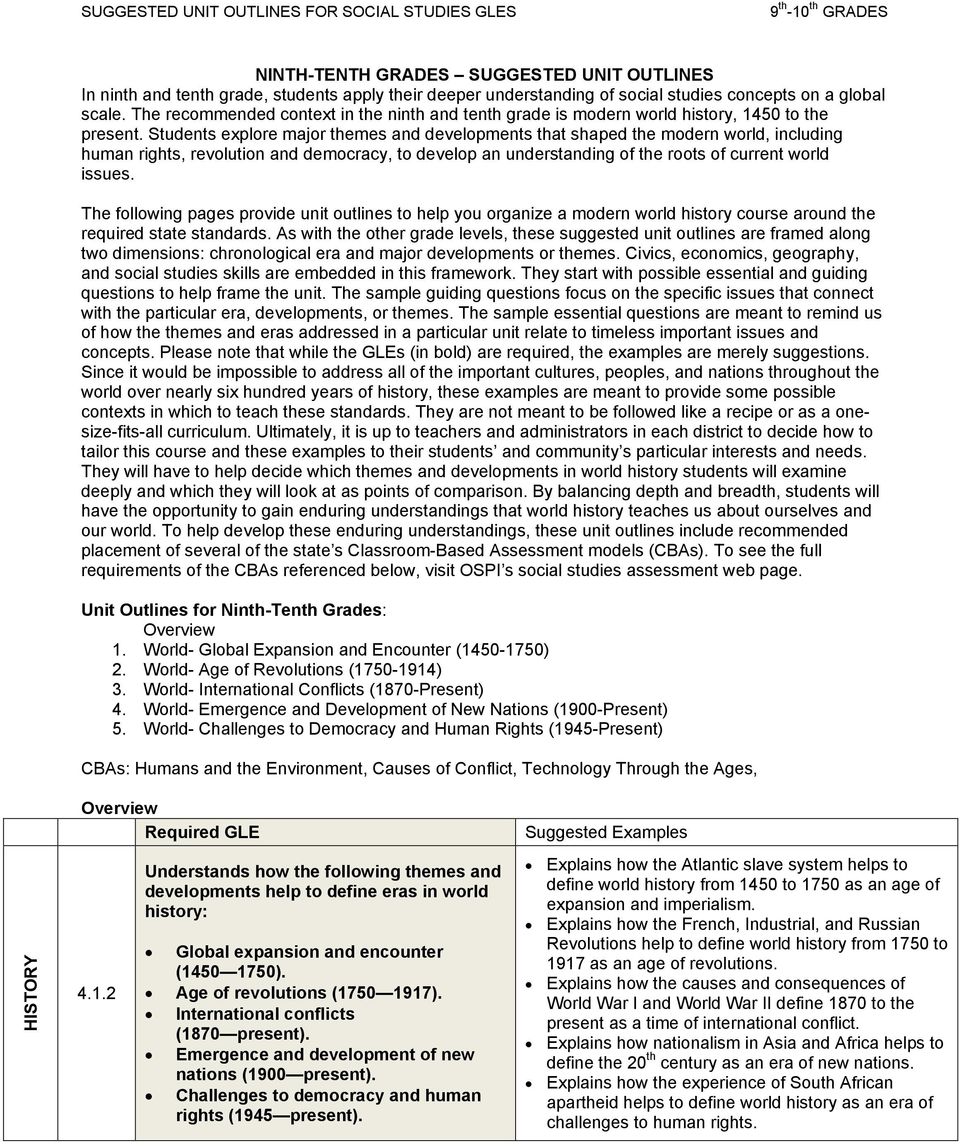
1 NINTH-TENTH GRADES SUGGESTED UNIT OUTLINES In ninth and tenth grade, students apply their deeper understanding of social studies concepts on a global scale. The recommended context in the ninth and tenth grade is modern world history, 1450 to the Students explore major themes and developments that shaped the modern world, including human rights, revolution and democracy, to develop an understanding of the roots of current world issues. The following pages provide unit outlines to help you organize a modern world history course around the required state standards. As with the other grade levels, these suggested unit outlines are framed along two dimensions: chronological era and major developments or themes. Civics, economics, geography, and social studies skills are embedded in this framework. They start with possible essential and guiding questions to help frame the unit. The sample guiding questions focus on the specific issues that connect with the particular era, developments, or themes. The sample essential questions are meant to remind us of how the themes and eras addressed in a particular unit relate to timeless important issues and concepts. Please note that while the GLEs (in bold) are required, the examples are merely suggestions. Since it would be impossible to address all of the important cultures, peoples, and nations throughout the world over nearly six hundred years of history, these examples are meant to provide some possible contexts in which to teach these standards. They are not meant to be followed like a recipe or as a onesize-fits-all curriculum. Ultimately, it is up to teachers and administrators in each district to decide how to tailor this course and these examples to their students and community s particular interests and needs. They will have to help decide which themes and developments in world history students will examine deeply and which they will look at as points of comparison. By balancing depth and breadth, students will have the opportunity to gain enduring understandings that world history teaches us about ourselves and our world. To help develop these enduring understandings, these unit outlines include recommended placement of several of the state s Classroom-Based Assessment models (CBAs). To see the full requirements of the CBAs referenced below, visit OSPI s social studies assessment web page. Unit Outlines for Ninth-Tenth Grades: Overview 1. World- Global Expansion and Encounter ( ) 2. World- Age of Revolutions ( ) 3. World- International Conflicts (1870-Present) 4. World- Emergence and Development of New Nations (1900-Present) 5. World- Challenges to Democracy and Human Rights (1945-Present) CBAs: Humans and the Environment, Causes of Conflict, Technology Through the Ages, Overview Global expansion and encounter ( ). Age of revolutions ( ). International conflicts (1870 present). Emergence and development of new nations (1900 present). Challenges to democracy and human rights (1945 present). Explains how the Atlantic slave system helps to define world history from 1450 to 1750 as an age of expansion and imperialism. Explains how the French, Industrial, and Russian Revolutions help to define world history from 1750 to 1917 as an age of revolutions. Explains how the causes and consequences of World War I and World War II define 1870 to the present as a time of international conflict. Explains how nationalism in Asia and Africa helps to define the 20 th century as an era of new nations. Explains how the experience of South African apartheid helps to define world history as an era of challenges to human rights.
2 Unit Outline 1: World- Global Expansion and Encounter ( ) How are societies transformed in an era of global trade? What are the political, economic, geographic, and social implications of cultural expansion? What impact did European domination have on various regions and the world? How did trade accelerate global political and economic expansion from 1450 to 1750? Part Global expansion and encounter ( ). Analyzes change and continuity within a historical time period. Explains how the Atlantic slave system helps to define world history from 1450 to 1750 as an age of expansion and imperialism. Examines how Spain under Ferdinand and Isabella changed with the influx of trade while still preserving the monarchy. Examines how the impact of guns caused some countries to form and others to maintain their power Identifies major world regions and understands their cultural roots. Describes Latin America based on its colonial history. GEOGRAPHY Understands the causes and effects of voluntary and involuntary migration in the world in the past or geography of expansion and encounter has shaped global politics and economics in the past or Explains the factors leading to the slave trade and its effects on societies in Africa and the Americas. Explains how political boundaries drawn by colonial powers continue to serve as sources of conflict. Explains how the natural resources of North, Central, and South America affected the colonial aims of the British and Spanish. Compares how places with similar geographic characteristics, such as Mozambique and South Africa, have been differently influenced by colonial powers.

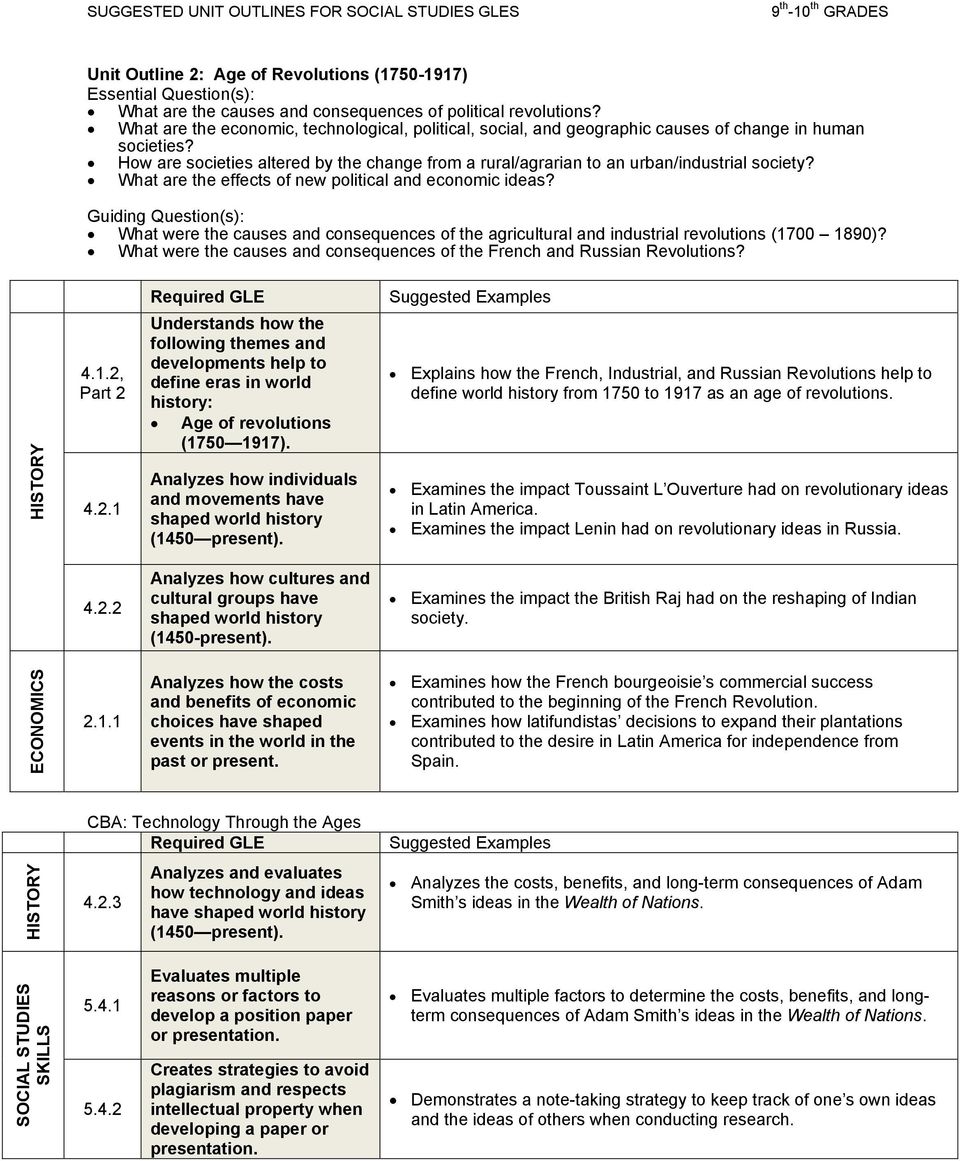
3 Unit Outline 2: Age of Revolutions ( ) What are the causes and consequences of political revolutions? What are the economic, technological, political, social, and geographic causes of change in human societies? How are societies altered by the change from a rural/agrarian to an urban/industrial society? What are the effects of new political and economic ideas? What were the causes and consequences of the agricultural and industrial revolutions ( )? What were the causes and consequences of the French and Russian Revolutions? Age of revolutions ( ). Part Analyzes how individuals and movements have shaped world history (1450 present). Explains how the French, Industrial, and Russian Revolutions help to define world history from 1750 to 1917 as an age of revolutions. Examines the impact Toussaint L Ouverture had on revolutionary ideas in Latin America. Examines the impact Lenin had on revolutionary ideas in Russia Analyzes how cultures and cultural groups have shaped world history (1450-present). Examines the impact the British Raj had on the reshaping of Indian society. ECONOMICS Analyzes how the costs and benefits of economic choices have shaped events in the world in the past or Examines how the French bourgeoisie s commercial success contributed to the beginning of the French Revolution. Examines how latifundistas decisions to expand their plantations contributed to the desire in Latin America for independence from Spain. CBA: Technology Through the Ages Analyzes and evaluates how technology and ideas have shaped world history (1450 present). Analyzes the costs, benefits, and long-term consequences of Adam Smith s ideas in the Wealth of Nations. SOCIAL STUDIES SKILLS Evaluates multiple reasons or factors to develop a position paper or presentation. Creates strategies to avoid plagiarism and respects intellectual property when developing a paper or presentation. Evaluates multiple factors to determine the costs, benefits, and longterm consequences of Adam Smith s ideas in the Wealth of Nations. Demonstrates a note-taking strategy to keep track of one s own ideas and the ideas of others when conducting research.
4 Unit Outline 3: World-International Conflicts (1870-Present) What economic, political, social, and geographic factors lead nations to fight with each other? What factors lead to peace between nations? What are the economic and political implications and outcomes of war? What is the role of international agreements and organizations in international relationships? What causes peoples to resort to genocide? What were the causes and consequences of World War I and II? Part 3 International conflicts (1870 present). Explains how the causes and consequences of World War I and World War II define 1870 to the present as a time of international conflict. CBA: Causes of Conflict Analyzes the multiple causal factors of conflicts in world history (1450 present). Analyzes and interprets historical materials from a variety of perspectives in world history (1450 present). Examines the causes of World War I from political, economic, military, social, and religious perspectives to develop a position on the primary cause of the war. Examines Palestinians and Israelis perspectives on the causes of conflict in the Middle East to develop a position on the primary cause of the conflict. Distinguishes between conflicting views of the causes of the Holocaust. Distinguishes between conflicting views of the causes of Rwandan genocide. SOCIAL STUDIES SKILLS Analyzes consequences of positions on an issue or event. Evaluates the precision of a position on an issue or event. Examines the consequences of positions taken in the Treaty of Versailles. Examines the consequences of the positions in favor of the establishment of the state of Israel in Critiques the specificity of details that support a position on the consequences of the Treaty of Versailles. Critiques the specificity of details that support a position on the consequences of the establishment of the state of Israel in CIVICS Evaluates the impact of various forms of government on people in the past or Analyzes the relationships and tensions between national interests and international issues in the world in the past or Weighs the impact of the Qing Dynasty government on the people of China as compared with life under communist rule. Weighs the impact of the British occupation of Hong Kong compared with life under China s one-country, two systems control. Examines the relationship between the United States and Mexico in addressing labor issues.

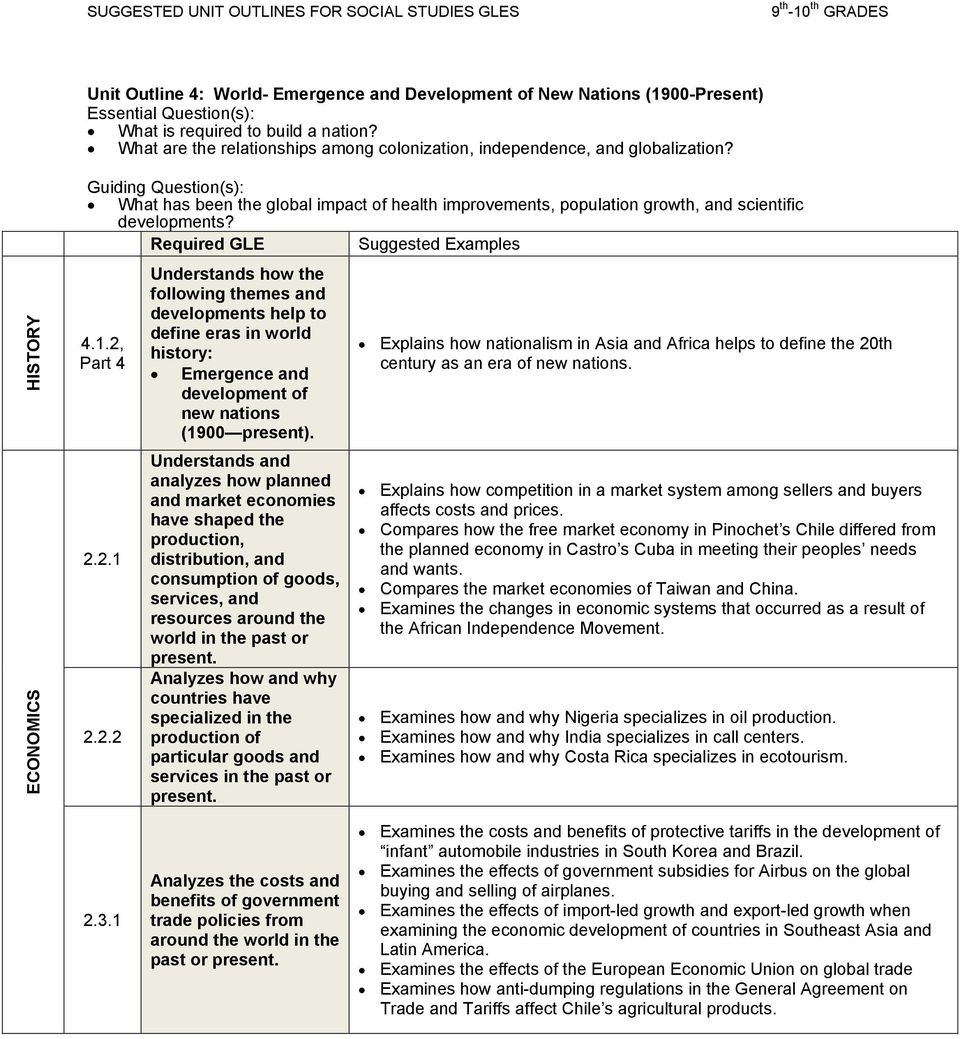
5 Unit Outline 4: World- Emergence and Development of New Nations (1900-Present) What is required to build a nation? What are the relationships among colonization, independence, and globalization? ECONOMICS What has been the global impact of health improvements, population growth, and scientific developments? Part Emergence and development of new nations (1900 present). Understands and analyzes how planned and market economies have shaped the production, distribution, and consumption of goods, services, and resources around the world in the past or Analyzes how and why countries have specialized in the production of particular goods and services in the past or Explains how nationalism in Asia and Africa helps to define the 20th century as an era of new nations. Explains how competition in a market system among sellers and buyers affects costs and prices. Compares how the free market economy in Pinochet s Chile differed from the planned economy in Castro s Cuba in meeting their peoples needs and wants. Compares the market economies of Taiwan and China. Examines the changes in economic systems that occurred as a result of the African Independence Movement. Examines how and why Nigeria specializes in oil production. Examines how and why India specializes in call centers. Examines how and why Costa Rica specializes in ecotourism Analyzes the costs and benefits of government trade policies from around the world in the past or Examines the costs and benefits of protective tariffs in the development of infant automobile industries in South Korea and Brazil. Examines the effects of government subsidies for Airbus on the global buying and selling of airplanes. Examines the effects of import-led growth and export-led growth when examining the economic development of countries in Southeast Asia and Latin America. Examines the effects of the European Economic Union on global trade Examines how anti-dumping regulations in the General Agreement on Trade and Tariffs affect Chile s agricultural products.
6 2.4.1 Analyzes and evaluates how people across the world have addressed issues involved with the distribution of resources and sustainability in the past or Examines and critiques how the Soviet Union s distribution of resources affected the standard of living. Examines and critiques how Canada has distributed resources to its people. Examines and critiques how China s use of resources has addressed sustainability. Examines and critiques the sustainability of Sri Lanka s use of resources. SOCIAL STUDIES SKILLS Creates and uses research questions that are tied to an essential question to focus inquiry on an idea, issue, or event. Evaluates the validity, reliability, and credibility of sources when researching an issue or event. Evaluates one s own viewpoint and the viewpoints of others in the context of a discussion. Develops research questions tied to an essential question to focus inquiry on the costs, benefits, and long-term significance of nationalism. Critiques the validity, reliability, and credibility of research on the rise and break-up of Soviet Union to determine the implications and consequences of nuclear proliferation. Critiques the validity, reliability, and credibility of research on the successes and failures of new nations in Sub-Saharan Africa. Engages in a panel discussion to evaluate one s own and others viewpoints about the costs, benefits, and long-term significance of nationalism for Sub-Saharan Africa.

7 Unit Outline 5: World-Challenges to Democracy and Human Rights (1945-Present) What role should nations and international organizations play in promoting human rights around the world? How have developing nations confronted economic, political, and social challenges since 1945? CBA: Humans and the Environment Explains how the experience of South African apartheid helps to define Part 5 Challenges to world history as an era of challenges to human rights. democracy and human rights (1945 present). GEOGRAPHY Analyzes and evaluates human interaction with the environment across the world in the past or Understands and analyzes examples of ethnocentrism. Critiques political solutions to the damming and pollution of the Danube River to improve water quality downstream. Examines ways to address global climate change that promote environmental sustainability and economic growth in the developing world. Examines the different ways people have built houses on flood plains of the Mekong and Mississippi Rivers. Examines whether there is ethnocentrism in attitudes about the use of multiple languages in communities across the world. Examines whether there are elements of ethnocentrism in French perceptions of Muslim girls wearing hijabs in school Analyzes how an understanding of world history can help us prevent problems today. Examines the United Nations ability to fight the spread of AIDS worldwide based on the success of international public health campaigns in the past. Examines how study of the Holocaust has lead to efforts to prevent genocide across the world.

SOCIAL STUDIES UNIT OUTLINES - SIXTH GRADE
 SOCIAL STUDIES UNIT OUTLINES - SIXTH GRADE In sixth grade, students are ready to deepen their understanding of the Earth and its peoples through the study of history, geography, politics, culture, and
SOCIAL STUDIES UNIT OUTLINES FIFTH GRADE
 SOCIAL STUDIES UNIT OUTLINES FIFTH GRADE In fifth grade, students use their understanding of social studies concepts and cause-and-effect relationships to study the development of the United States up
SOCIAL STUDIES UNIT OUTLINES FOURTH GRADE
 SOCIAL STUDIES UNIT OUTLINES FOURTH GRADE In fourth grade, students use their understanding of social studies concepts and skills to explore Washington State in the past and present. Students learn about
SUGGESTED UNIT OUTLINES FOR SOCIAL STUDIES GLES
 SEVENTH GRADE UNIT OUTLINES In seventh grade, students become more proficient with the core concepts in social studies. There are two recommended contexts in which students can demonstrate this proficiency
ELEVENTH GRADE UNIT OUTLINES
 ELEVENTH GRADE UNIT OUTLINES In eleventh grade, students have the intellectual and social capacity to develop serious historical knowledge and perspective, geographic literacy, economic understanding,
Standards Addressed by The Choices Program
 Standards Addressed by The Choices Program National Standards for the Social Studies National Standards for Social Studies are available online at cnets.iste.org/currstands. Strand I: Culture and Cultural
Unit 01 - Study Questions 1. In what ways did geography and climate affect the development of human society? 2. What were the economic and social
 Unit 01 - Study Questions 1. In what ways did geography and climate affect the development of human society? 2. What were the economic and social results of the agricultural revolution? 3. What are the
Advanced Placement (AP ) Social Studies Courses
 Advanced Placement (AP ) Social Studies Courses The AP social studies courses are intended to provide a rigorous college level introduction to the social sciences for high school students. While no official
North Carolina Essential Standards Seventh Grade Social Studies
 North Carolina s Focus: Time Period: World Geography, History and Culture: Patterns of Continuity and Change The Great Global Convergence (1400-1800) to the Present - Represents the last five Eras of the
Send all inquiries to: Glencoe/McGraw-Hill 8787 Orion Place Columbus, Ohio 43240-4027 ISBN 0-07-824996-1. Printed in the United States of America
 Copyright by The McGraw-Hill Companies, Inc. All rights reserved. Permission is granted to reproduce the material contained herein on the condition that such material be reproduced only for classroom use;
History. Programme of study for key stage 3 and attainment target (This is an extract from The National Curriculum 2007)
 History Programme of study for key stage 3 and attainment target (This is an extract from The National Curriculum 2007) Crown copyright 2007 Qualifications and Curriculum Authority 2007 Curriculum aims
History programmes of study: key stage 3
 History programmes of study: key stage 3 National curriculum in England Purpose of study A high-quality history education will help pupils gain a coherent knowledge and understanding of Britain s past
World History 2007-2008
 Brief Description of Course World History 2007-2008 The AP program was started in 1955 by the College Board to construct standard achievement exams that would allow highly motivated high school students
World History Course Summary Department: Social Studies. Semester 1
 World History Course Summary Department: Social Studies All World History courses (Honors or otherwise) utilize the same targets and indicators for student performance. However, students enrolled in Honors
Fourth Grade Social Studies Content Standards and Objectives
 Fourth Grade Social Studies Content Standards and Objectives Standard 1: Citizenship characterize and good citizenship by building social networks of reciprocity and trustworthiness (Civic Dispositions).
HISTORY. History A.A. for Transfer Degree
 Area: Behavioral & Social Sciences Dean: Carlos Reyes Phone: (916) 484-8283 Counseling: (916) 484-8572 Degree: A.A. for Transfer - History The study of history equips the student with cultural literacy
World History: Essential Questions
 World History: Essential Questions Content Standard 1.0: Culture encompasses similarities and differences among people including their beliefs, knowledge, changes, values, and traditions. Students will
Here is the list of history courses with cross listings and how they fit in each of the sections of the History Major.
 Here is the list of history courses with cross listings and how they fit in each of the sections of the History Major. Note: if you take a History course that is cross listed and you take it under the
history (his) History
 history (his) Mark R. Correll, Chair Mark T. Edwards David Rawson Charles E. White The fundamental purpose of the department of history, politics, and geography is to aid the student in gaining an understanding
Tennessee Curriculum Standards for High School World History Correlations to Wright Group/McGraw-Hill s World History
 Tennessee Curriculum Standards for High School World History Correlations to Wright Group/McGraw-Hill s World History Course Description: In World History High School, students study the history of humankind
Sixth Grade Social Studies Georgia Performance Standards. Grade Six. LATIN AMERICA and CANADA
 Grade Six LATIN AMERICA, the CARIBBEAN and CANADA, EUROPE, and AUSTRALIA Sixth grade is the first year of a two year World Area Studies course. Sixth grade students study Latin America, Canada, Europe,
Prentice Hall World Geography: Building a Global Perspective 2003 Correlated to: Arkansas Social Studies Curriculum Frameworks (Grades 9-12)
 Arkansas Social Studies Curriculum Frameworks (Grades 9-12) Strand 1: Time, Continuity, and Change Content Standard 1: Students will demonstrate an understanding of the chronology and concepts of history
North Carolina Essential Standards Third grade Social Studies
 North Carolina s Third grade Social Studies In third grade, students draw upon knowledge learned in previous grades to develop more sophisticated understandings of how communities may be linked to form
Pacemaker World Geography and Cultures. correlated to. Florida Sunshine State Standards Social Studies Grades 6-8
 Pacemaker World Geography and Cultures correlated to Florida Sunshine State Standards Social Studies Grades 6-8 Pacemaker World Geography and Cultures Pearson Learning Group correlated to Sunshine State
Test Creation Assignment: The Industrial Revolution
 Test Creation Assignment: The Industrial Revolution Course Overview: This test on the Industrial Revolution is designed for a freshman World History and Geography II course. The course covers the time
How To Study Political Science At Pcj.Edu
 Political Science Courses-1 American Politics POL 110/American Government Examines the strengths and weaknesses, problems and promise of representative democracy in the United States. Surveys the relationships
Ch.1. Name: Class: Date: Matching
 Name: Class: Date: Ch.1 Matching Match each item with the correct statement below. a. technology e. democracy b. diffusion f. extended family c. exports g. interdependence d. climate 1. goods sent to markets
Addendum: American History II:
 Addendum: American History II: On June 23, 2011, the North Carolina General Assembly passed The Founding Principles Act (SL 2011-273). This act calls for local boards of education to require, as a condition
Degree Type Bachelor of Arts (BA) Degree Title History
 Degree Type Bachelor of Arts (BA) Degree Title History As an integral part of a liberal arts education, history courses introduce students to different historical eras, diverse cultures, famous and ordinary
NCA &TSU Master of Art in History Degree Requirements HISTORY. Olen Cole, Jr., Chairperson 324 Gibbs Hall (336) 334-7831 coleo@ncat.
 NCA &TSU Master of Art in History Degree Requirements HISTORY Olen Cole, Jr., Chairperson 324 Gibbs Hall (336) 334-7831 [email protected] OBJECTIVES The Master of Science program builds upon the knowledge
History. GCSE subject content
 History GCSE subject content April 2014 Contents The content for history GCSEs 3 Introduction 3 Subject aims and learning outcomes 3 Subject content 4 Scope of study 4 Historical knowledge, understanding
Essential Question: What was the impact of European imperialism in Africa and India?
 Essential Question: What was the impact of European imperialism in Africa and India? Unit X Quiz 2 1. When did the Suez Canal open? 2. Why was it initially difficult for European powers to control their
Junior Certificate History. Draft syllabus for consultation
 Junior Certificate History Draft syllabus for consultation April 2008 Contents Introduction.... 1 Aims of the syllabus......................... 2 Objectives of the syllabus... 2 Syllabus overview... 3
NCSS Standards 1. d. compare ways in which people from different cultures think about and deal with their physical environment and social conditions;
 NCSS Standards 1 National Council for the Social Studies (NCSS) Curriculum Standards for Social Studies Standard I. Culture study of culture and cultural diversity, so that the learner can a. explore and
OIL AND US FOREIGN POLICY. David S. Painter Department of History Edmund A. Walsh School of Foreign Service Georgetown University
 OIL AND US FOREIGN POLICY David S. Painter Department of History Edmund A. Walsh School of Foreign Service Georgetown University HISTORY AS A WAY OF LEARNING Importance of Studying the Past: Context for
Addendum: American History I: The Founding Principles
 Addendum: American History I: The Founding Principles On June 23, 2011, the North Carolina General Assembly passed The Founding (SL 2011-273). This act calls for local boards of education to require, as
History. Bachelor of Arts Major in History. Objectives. Degree Offered. Major Offered. Minor Offered. International Studies.
 History 123 History Thomas W. Taylor, PhD, Chair Objectives Defying classification as either humanity or social science, history functions as both. It focuses on the values, as well as the ideas, personalities,
Luray High School/Lord Fairfax Community College HIST 112: History of World Civilizations Instructor: Debra Markanich
 Luray High School/Lord Fairfax Community College HIST 112: History of World Civilizations Instructor: Debra Markanich Course Syllabus Spring 2010 Course Information History 112: History of World Civilizations
Economic Policy and State Intervention (Richards and Waterbury CHs #2,3,7,8,9) 1. Recovery Since 1800 2. Growth Policies 3. Why the Middle East Chose
 Economic Policy and State Intervention (Richards and Waterbury CHs #2,3,7,8,9) 1. Recovery Since 1800 2. Growth Policies 3. Why the Middle East Chose Import Substitution 4. MENA vs. Asia 5. Reform Disparity
Development Studies and Global Political Economy Master List. Introductory courses:
 Development Studies and Global Political Economy Master List Introductory courses: o Intro to Urban Studies (L18 101) o Intro to Microeconomics (L11 1011) o Intro to Macroeconomics (L11 1021) o Intro to
Geography at GISSV: An Introduction to the Curriculum
 Geography at GISSV: An Introduction to the Curriculum Classes Geography is taught for two hours per week in Grades 5-9. The only exception is in Grade 8, where class is taught for one hour per week for
Kansas Board of Regents Precollege Curriculum Courses Approved for University Admissions
 Kansas Board of Regents Precollege Curriculum Courses Approved for University Admissions Original Publication April 6, 2011 Revision Dates June 13, 2011 May 23, 2012 Kansas Board of Regents Precollege
Ch 11-3 Worksheet 1The Berlin Conference 1884
 Ch 11-3 Worksheet 1The Berlin Conference 1884 THE BERLIN CONFERENCE Because of its size, surface features, climate, resources, and strategic importance, Africa became a prime candidate for conquest by
List A: Economics course options (all students must take at least 1 course from this list)
 MASTERS PROGRAM IN INTERNATIONAL AND AREA STUDIES SUGGESTED COURSES Note that the below are suggested courses. For other possible courses, please check with the Graduate Assistant and the Chair of the
Hemisphere, analyzing and comparing the ways in which political, economic, social, cultural,
 HST 101 - Introduction to World Civilizations Designed to support general education goals and develop historical perspectives, this course emphasizes the comparison of selected African, American, Asian,
The History Major Beginning Fall 2010
 The History Major Beginning Fall 2010 SUMMARY: Core Curriculum: 43 hours History Major: 42 hours total, consisting of: Required History Courses: 12 hours History Electives: 30 hours Minor: 18 hours General
Institute for Global Studies
 Institute for Global Studies Student Handbook Transitional Handbook: August October 2006 Institute for Global Studies 214 Social Sciences 267 19 th Ave South, Minneapolis, MN 55455 Main Office: 612-624-9007
DEPARTMENT OF HISTORY. Add new courses:
 DEPARTMENT OF HISTORY Add new courses: HIST 299 Thinking Historically Fundamentals of the historian s craft. Variable content. Required for all majors except history honors students. Examines the origins
POLITICAL SCIENCE. International Affairs Interdisciplinary Program Curriculum and Program Requirements DEPARTMENT
 POLITICAL SCIENCE DEPARTMENT International Affairs Interdisciplinary Program Curriculum and Program Requirements Political Science University of Nevada, Reno www.unr.edu/cla/polisci page 1 PREFACE This
M.A. (Composite History)
 M.A. (Composite History) Semester I History of Europe, Renaissance to 1789 1. Renaissance 2. Reformation and Counter Reformation I 1. The Thirty Years war 2. Age of Louis XIV II 1. Conflict between King
The International Business Etiquette Internet Sourcebook
 The International Business Etiquette Internet Sourcebook Agriculture and Agri-Food Canada B.C. Regional Office 420 4321 Still Creek Drive Burnaby, B.C. V5C 6S7 Telephone: 604-666-6344 Fax: 604-666-7235
AP UNITED STATES HISTORY SUMMER ASSIGNMENT 2014 - Ms. Rosenberg. This assignment is due on the first day of classes: Thursday, September 4, 2014.
 This assignment is due on the first day of classes: Thursday, September 4, 2014. PART 1: WHAT IS HISTORIOGRAPHY AP UNITED STATES HISTORY SUMMER ASSIGNMENT 2014 - Ms. Rosenberg If you have any questions
Kindergarten-Grade 8
 A Correlation of Pearson myworld Social Studies To Pearson Learning Kindergarten-Grade 8 Introduction This document demonstrates where for Social Studies, Grades K-8, are covered in myworld Social Studies
1914-1918: WORLD WAR I CFE 3201V
 1914-1918: WORLD WAR I CFE 3201V OPEN CAPTIONED NATIONAL GEOGRAPHIC SOCIETY 1992 Grade Levels: 10-13+ 25 minutes 1 Instructional Graphic Enclosed DESCRIPTION The forces of nationalism, imperialism, and
History. Introductory Courses in History. Brautigam, Lian, Luttmer, Murphy, Thornton, M. Vosmeier, S. Vosmeier.
 History Brautigam, Lian, Luttmer, Murphy, Thornton, M. Vosmeier, S. Vosmeier. Major: History courses Nine, including 371 and 471 (culminating experience), but not including 100 level courses. Recommended:
Fairfield Public Schools Social Studies Curriculum Civics: International Relations Grades 11-12
 Fairfield Public Schools Social Studies Curriculum Civics: International Relations Grades 11-12 12/14/2015 1 Civics and International Relations: Description This course is designed to explore the important
Chapter 4A: World Opinion on Terrorism
 1 Pew Global Attitudes Project, Spring 2007 Now I m going to read you a list of things that may be problems in our country. As I read each one, please tell me if you think it is a very big problem, a moderately
Honors World History
 TAMALPAIS UNION HIGH SCHOOL DISTRICT Larkspur, California Course of Study Honors World History I. INTRODUCTION Honors World History is a rigorous version of World History, designed to follow the same content
Expansion of trade and empire 1750 1900
 10389-01P5-34-GECKO 22/5/02 10:56 am Page 5 1 Expansion of trade and empire 1750 1900 In 1900 Britain had an empire that covered a quarter of the world s land surface. An empire is when one country, in
HIST 102 World History Since 1500 SAMPLE SYLLABUS MWF 10:00-10:50 am Professor Amanda López, Ph.D.
 HIST 102 World History Since 1500 SAMPLE SYLLABUS MWF 10:00-10:50 am Professor Amanda López, Ph.D. Course Description: In this survey of the human experience from the dawn of maritime exploration to the
Mirror for Humanity by Kottack Quiz #10 C. Milner-Rose
 Mirror for Humanity by Kottack Quiz #10 C. Milner-Rose Chapter 10: The World System and Colonialism Multiple Choice Questions 1. What fueled the European Age of Discovery? A. A desire to save the souls
CHAPTER 11: The Problem of Global Inequality
 CHAPTER 11: The Problem of Global Inequality MULTIPLE CHOICE 1. The claim that poverty is unethical is essentially a. Normative c. political b. theoretical d. scientific 2. Self-interest is an important
Education for All An Achievable Vision
 Education for All An Achievable Vision Education for All Education is a fundamental human right. It provides children, youth and adults with the power to reflect, make choices and enjoy a better life.
MT. DIABLO UNIFIED SCHOOL DISTRICT COURSE OF STUDY
 COURSE TITLE: AP EUROPEAN HISTORY COURSE NUMBER: 3510 DEPARTMENT: History and Social Science GRADE LEVEL(S): 10-12 CREDITS PER SEMESTER: 5 credits LENGTH OF COURSE: One Year REQUIRED OR ELECTIVE: Elective-designed
DIABLO VALLEY COLLEGE CATALOG 2015-2016
 HISTORY HIST Obed Vazquez, Dean Social Sciences Division Faculty Office Building, Room 136 Possible career opportunities The study of history contributes to cultural literacy, developing critical thinking
STATE AND FEDERAL GOVERNMENT GRADE 9
 STATE AND FEDERAL GOVERNMENT GRADE 9 Since the United States is a representative democracy, the primary reason for government education is the maintenance of our constitutional democracy. Our democracy
HAS BRAZIL REALLY TAKEN OFF? BRAZIL LONG-RUN ECONOMIC GROWTH AND CONVERGENCE
 HAS BRAZIL REALLY TAKEN OFF? BRAZIL LONG-RUN ECONOMIC GROWTH AND CONVERGENCE COUNTRY PROFILE: A COUNTRY IN TRANSFORMATION POLICY RECOMENDATIONS COUNTRY PROFILE Brazilian Equivalent Population in The World
HST 101 - Introduction to World Civilizations. HST 102 - Introduction to European Civilizations. HST 103 - Introduction to American Civilizations
 HST 101 - Introduction to World Civilizations Designed to support general education goals and develop historical perspectives, this course emphasizes the comparison of selected African, American, Asian,
Prentice Hall World Geography: Building a Global Perspective 2007
 Prentice Hall World Geography: Building a Global Perspective 2007 Grades 9-12 C O R R E L A T E D T O Louisiana Grade-Level Expectations for World Geography Grades 9-12 Geography The World in Spatial Terms
FLORIDA BECOMES A U.S. TERITORY By Laura Harder and Toni Migliore
 FLORIDA BECOMES A U.S. TERITORY By Laura Harder and Toni Migliore Summary: After the British returned Florida to Spain, Florida came under Spanish rule for a second time. During this second period, which
2014 SUMMER COURSE DESCRIPTIONS
 2014 SUMMER COURSE DESCRIPTIONS Please note: The course descriptions, requirements, and book lists are tentative and therefore subject to revision. Please contact the individual instructors for further
Foreign Taxes Paid and Foreign Source Income INTECH Global Income Managed Volatility Fund
 Income INTECH Global Income Managed Volatility Fund Australia 0.0066 0.0375 Austria 0.0045 0.0014 Belgium 0.0461 0.0138 Bermuda 0.0000 0.0059 Canada 0.0919 0.0275 Cayman Islands 0.0000 0.0044 China 0.0000
AP WORLD HISTORY 2006 SCORING GUIDELINES. Question 3 Comparative
 AP WORLD HISTORY 2006 SCORING GUIDELINES Question 3 Comparative BASIC CORE (competence) (Historical skills and knowledge required to show competence.) Note 1: For thesis, direct comparison, and comparative
1. Patterns and effects of interaction among societies and regions: trade, war, diplomacy, and international organizations.
 AP World History Course Syllabus Packard, Scott Boca Ciega H.S. This AP World History course will enable you to develop a greater understanding of the global processes, contacts and interactions within
NCSS Themes. Executive Summary
 NCSS Themes Executive Summary Thomas Jefferson, among others, emphasized that the vitality of a democracy depends upon the education and participation of its citizens. While such active civic participation
SCHOOL OF GLOBAL STUDIES DEPARTMENT OF INTERNATIONAL RELATIONS. Taught Masters programmes
 SCHOOL OF GLOBAL STUDIES DEPARTMENT OF INTERNATIONAL RELATIONS Taught Masters programmes What s special about studying in the Department of International Relations at Sussex? With a history that spans
North Carolina Essential Standards Social Studies - World History Course
 North Carolina s Social Studies - World History Course The World History course will address six (6) periods in the study of World History, with a key focus of study from the mid 15 th century to present.
THEMES/Learning Objectives
 PERIOD 2: 1607 1754 The content for APUSH is divided into 9 periods. The outline below contains the required course content for Period 2. The Thematic Learning Objectives (historical themes) are included
Plan 1: The Politics of Revolution. Subject Areas: World History, Political Science, Current Events, and Social Studies
 Plan 1: The Politics of Revolution Introduction: In this lesson, students will focus on learning about the political issues that ultimately led to the French Revolution. They will also learn about the
Ninth Grade History & Social Science World History I
 SEPTEMBER WHI.1 Historical Research and Geographical Analysis *(ongoing throughout year) identify, analyze, and interpret primary and secondary sources use maps, globes, artifacts, pictures identify major
Academic Standards for Economics
 Academic Standards for June 1, 2009 FINAL Secondary Standards Pennsylvania Department of Education These standards are offered as a voluntary resource for Pennsylvania s schools and await action by the
COURSE SYLLABUS. Contact information: [email protected], 3rd period conference
 AP European History INSTRUCTOR: Michael Withers 2015-2016 SCHOOL YEAR COURSE SYLLABUS COURSE INFORMATION This is an accelerated elective course covering the history of Europe from the Renaissance to the
Chapter 22: World War I. Four most powerful European nations in the early 1900s were Great Britain, France, Germany, Russia.
 Chapter 22: World War I The Beginnings of World War I World War I was fought from 1914-1918. United States entered World War I in 1917. The Origins of Europe s Great War Nationalism Four most powerful
The Sequence of Causes of the Cold War
 The Sequence of Causes of the Cold War Outside the U.S. In the U.S. 1917 Revolutions in Russia 1917-1919 Russian Civil War 1941-1944 Second Front against Hitler Casablanca Conference 1943 Teheran Conference
Category Definitions. Korea Morningstar Methodology Paper October 2015. Ver1.0
 Category Definitions Korea Morningstar Methodology Paper October 2015 Ver1.0 Equity Africa & Middle East Equity Africa & Middle East Equity funds invest primarily in African & Middle Eastern companies.
Canada and Africa: A Contrast
 Canada and Africa: A Contrast In this lesson, students will examine statistics pertaining to nations in Sub-Saharan Africa to which Canada contributes foreign aid. The students will be expected to summarize
English Language Standards. Social Studies Standards
 ADOPTED JUNE 2010 OHIO S NEW LEARNING STANDARDS: English Language Standards Ohio s New Learning Standards: Social Studies Standards MAY 2014 OHIO S NEW LEARNING STANDARDS I Social Studies 2 Table of Contents
Brookfield High School Curriculum Map Modern World History Kovach
 Subject: History Course: Modern World History Grade Level: Grade 9 Teacher: Kovach Month Content OH Standards Content Statements Assessment Essential Questions Books & Materials Learning All Year Units
Comparing Levels of Development
 2 Comparing Levels of Development Countries are unequally endowed with natural capital. For example, some benefit from fertile agricultural soils, while others have to put a lot of effort into artificial
Fall 2009 Page 1 of 11. HST 105 World History II: 1500 to World War I. 508-854-4481 By appointment
 Fall 2009 Page 1 of 11 3 credits This course examines the convergence of the world s peoples, cultures, and civilizations on a global scale beginning around the 16th century. It emphasizes themes such
Software Tax Characterization Helpdesk Quarterly June 2008
 & McKenzie Software Tax Characterization Helpdesk Quarterly June 2008 Characterizing foreign software revenues is a complex challenge for large and small software firms alike. Variations in the rules around
World and U.S. History: Content Knowledge
 The Praxis TM Study Companion World and U.S. History: Content Knowledge 0941/5941 www.ets.org/praxis Welcome to The Praxis Study Companion Welcome to The Praxis Study Companion Prepare to Show What You
Prentice Hall World Studies 2005, 8 Book Series Correlated to: Millard Public School District (Nebraska) Social Studies Standards (Grades 6-7)
 Millard Public School District (Nebraska) Social Studies Standards (Grades 6-7) Note: This is a sample correlation based on four available titles of the new 2005 series in development. Titles include:,
Geography- Physical and Political Locations
 CRCT Social Studies Review- 6th Grade Geography- Physical and Political Locations Physical Features: 1. Ural Mtns. The mountain range that separates Europe from Asia. It is located in Russia 2. Pyrenees
Washington State History Syllabus. Desired Results
 Washington State History Syllabus School Year: 2012-13 Certificated Teacher: Click here to enter text. Desired Results Course Title (example: Geometry A and B): Click here to enter text. Credit: X one
Appendix 1: Full Country Rankings
 Appendix 1: Full Country Rankings Below please find the complete rankings of all 75 markets considered in the analysis. Rankings are broken into overall rankings and subsector rankings. Overall Renewable
SOCIAL STUDIES Geography/United States History Grade 8 The Oregon Country
 Lesson Components: Benchmarks SOCIAL STUDIES Geography/United States History Grade 8 The Oregon Country G-1A-M2 G-1B-M1 G-1B-M2 G-1C-M7 G-1D-M1 G-1D-M2 C-1B-M4 C-1C-M1 E-1B-M7 H-1A-M1 H-1A-M2 H-1A-M3 interpreting
Table of Contents Part One: Social Studies Curriculum Chapter I: Social Studies Essay Questions and Prewriting Activities
 Table of Contents Part One: Social Studies Curriculum Chapter I: Social Studies Essay Questions and Prewriting Activities 1. How the United States Became a World Power 1 2. Immigration 5 3. The Role of