
Note Taking Study Guide FROM APPEASEMENT TO WAR
|
|
|
- Ira Gilbert
- 9 years ago
- Views:
Transcription
1 SECTION 1 FROM APPEASEMENT TO WAR Focus Question: What events unfolded between Chamberlain s declaration of peace in our time and the outbreak of a world war? A. As you read Aggression Goes Unchecked and Spain Collapses into Civil War, complete the chart below to record the sequence of events that led to the outbreak of World War II. Japan Acts of Aggression Italy Germany Spain B. As you read German Aggression Continues and Europe Plunges Toward War, complete the timetable below to recognize the sequence of German aggression. March 1938 German Aggression September 1938 March 1939 September

2 SECTION 1 Section Summary FROM APPEASEMENT TO WAR READING CHECK Who were the members of the Axis powers? VOCABULARY STRATEGY What does the word sanctions mean in the underlined sentence? Look at the words, phrases, and sentences surrounding the word. Use the context clues you find to help you figure out the meaning of sanctions. READING SKILL Recognize Sequence What happened in Spain before Francisco Franco started a civil war there? Throughout the 1930s, dictators took aggressive action. Yet, they met only verbal protests and pleas for peace from Western powers. For example, when the League of Nations condemned Japan s invasion of Manchuria in 1931, Japan simply withdrew from the League. A few years later, Japanese armies invaded China, starting the Second Sino-Japanese War. Meanwhile, Mussolini invaded Ethiopia in The League of Nations voted sanctions against Italy, but the League had no power to enforce its punishment of Mussolini. Hitler, too, defied the Western democracies by building up the German military and sending troops into the demilitarized Rhineland. This went against the Treaty of Versailles. The Western democracies denounced Hitler but adopted a policy of appeasement. Appeasement developed for a number of reasons, including widespread pacifism. The United States responded with a series of Neutrality Acts. The goal was to avoid involvement in a war, rather than to prevent one. While the Western democracies sought to avoid war, Germany, Italy, and Japan formed an alliance. It became known as the Axis powers. In Spain, a new, more liberal government passed reforms that upset conservatives. General Francisco Franco, who was opposed to the new government, started a civil war. Hitler and Mussolini supported Franco, their fellow fascist. The Soviet Union sent troops to support the anti-fascists, or Loyalists. The governments of Britain, France, and the United States remained neutral, although individuals from these countries fought with the Loyalists. By 1939, Franco had triumphed. German aggression continued. In 1938, Hitler forced the Anschluss, or union with Austria. Next, Hitler set his sights on the Sudentenland. This was a part of Czechoslovakia where three million Germans lived. At the Munich Conference, which was held to discuss the situation, British and French leaders chose appeasement and allowed Hitler to annex the territory. In March 1939, Hitler took over the rest of Czechoslovakia. Months later, Hitler and Stalin signed the Nazi-Soviet Pact. They agreed not to fight if the other went to war. This paved the way for Germany s invasion of Poland in September of 1939, which set off World War II. Review Questions How did the United States respond to the aggressive action of dictators in the 1930s? What was the result of the Munich Conference? 264

3 SECTION 2 THE AXIS ADVANCES Focus Question: Which regions were attacked and occupied by the Axis powers, and what was life like under their occupation? A. As you read The Axis Attacks, Germany Invades the Soviet Union, and Japan Attacks the United States, use the chart below to record the sequence of events. September 1939: Germany invades Poland. B. As you read Life Under Nazi and Japanese Occupation, use the concept web to identify supporting details about the occupations. Nazi occupation Japanese occupation 265

4 SECTION 2 Section Summary THE AXIS ADVANCES READING CHECK What was the name of the German government in southern France? VOCABULARY STRATEGY Find the word nullified in the underlined sentence. In math class you might have learned that there is nothing, or zero, in the null set. Use this clue about related words to help you figure out the meaning of nullified. READING SKILL Sequence Events When did the United States declare neutrality? In September 1939, Nazi forces launched a blitzkrieg against Poland. First the Luftwaffe, the German air force, bombed. Then, tanks and troops pushed their way in. At the same time, Stalin invaded from the east, grabbing land. Within a month, Poland ceased to exist. Then, in early 1940, Hitler conquered Norway, Denmark, the Netherlands, and Belgium. By May, German forces had bypassed France s Maginot Line. British forces that had been sent to help the French were trapped. In a desperate scheme, the British rescued their troops from Dunkirk. However, in June, the French were forced to surrender. Germany occupied northern France and set up a puppet state, the Vichy government, in the south. The British, led by Winston Churchill, remained defiant against Hitler. In response, Hitler launched bombing raids over British cities that lasted from September 1940 until June 194 Despite this blitz, Hitler was not able to take Britain. Meanwhile, Hitler sent one of his best commanders, General Erwin Rommel, to North Africa. Rommel had a string of successes there. In the Balkans, German and Italian forces added Greece and Yugoslavia to the growing Axis territory. At the same time, the Japanese were occupying lands in Asia and the Pacific. In June 1941, Hitler nullified the Nazi-Soviet Pact by invading the Soviet Union. Stalin was unprepared, and the Soviet army suffered great losses. The Germans advanced toward Moscow and Leningrad. During a lengthy siege of Leningrad, more than a million Russians died. The severe Russian winter finally slowed the German army. As they marched across Europe, the Nazis sent millions to concentration camps to work as slave laborers. Even worse, Hitler established death camps to kill those he judged racially inferior. Among many others, some six million Jews were killed in what became known as the Holocaust. The United States declared neutrality at the beginning of the war. Yet many Americans sympathized with those who fought the Axis powers. Congress passed the Lend-Lease Act of 1941, allowing the United States to sell or lend war goods to foes of the Axis. On December 7, 1941, the Japanese bombed the U.S. fleet at Pearl Harbor. Four days later, Congress declared war on Japan. Review Questions What countries were conquered by Germany in 1939 and 1940? What was the purpose of the Lend-Lease Act? 266

5 SECTION 3 THE ALLIES TURN THE TIDE Focus Question: How did the Allies begin to push back the Axis powers? As you read this section in your textbook, complete the chart below to record the sequence of events that turned the tide of the war in favor of the Allies Allies increase production. Allies Turn the Tide 1943 Jan. Germans surrender at Stalingrad

6 SECTION 3 Section Summary THE ALLIES TURN THE TIDE READING CHECK Who were the Big Three? VOCABULARY STRATEGY Find the word incessant in the underlined sentence. Notice that the phrase around-the-clock follows incessant. They have similar meanings. Use this context clue to help you figure out the meaning of incessant. READING SKILL Recognize Sequence List the sequence of events in that gave the Allies control of North Africa. To defeat the Axis powers in World War II, the Allies devoted all their resources to the war effort. Governments took a greater role in the economy. For example, governments ordered factories to make tanks instead of cars. Consumer goods were rationed, and wages and prices were regulated. A positive result was that the increase in production ended the Great Depression. However, governments also limited citizens rights, censored the press, and resorted to propaganda. At the same time, women, symbolized by Rosie the Riveter, replaced men in factories. Women also played a more direct role in some military operations. The years 1942 and 1943 marked the turning point of the war. In the Pacific, Allied forces won the battles of the Coral Sea and Midway. In both battles, attacks were launched from enormous aircraft carriers. In North Africa, British and American forces, led by General Dwight Eisenhower, soon trapped Rommel s army, and he surrendered in May 194 With North Africa under their control, the Allies crossed the Mediterranean and landed in Sicily. Allied victories in Italy led to the overthrow of Mussolini, but fighting continued in Italy for another 18 months. On the Eastern front, a key turning point was the Battle of Stalingrad. After a German advance on the city and brutal house-to-house fighting, the Soviet army encircled the German troops. Without food or ammunition, the Germans surrendered. On June 6, 1944, the Allies launched the D-Day invasion of France. Allied troops faced many obstacles, but the Germans finally retreated. As the Allies advanced, Germany reeled from incessant, around-the-clock bombing. A German counterattack, the Battle of the Bulge, resulted in terrible losses on both sides. However, with Germany s defeat seeming inevitable, the Big Three Roosevelt, Churchill, and Stalin met to plan for the end of the war. Key features of this Yalta Conference were the Soviet agreement to enter the war against Japan and the division of Germany into four zones of occupation. However, growing mistrust at Yalta foreshadowed a split among the Allies. Review Questions Name three ways in which Allied governments took a greater role in the economy during World War II. During the battles of the Coral Sea and Midway, from where were attacks launched? 268

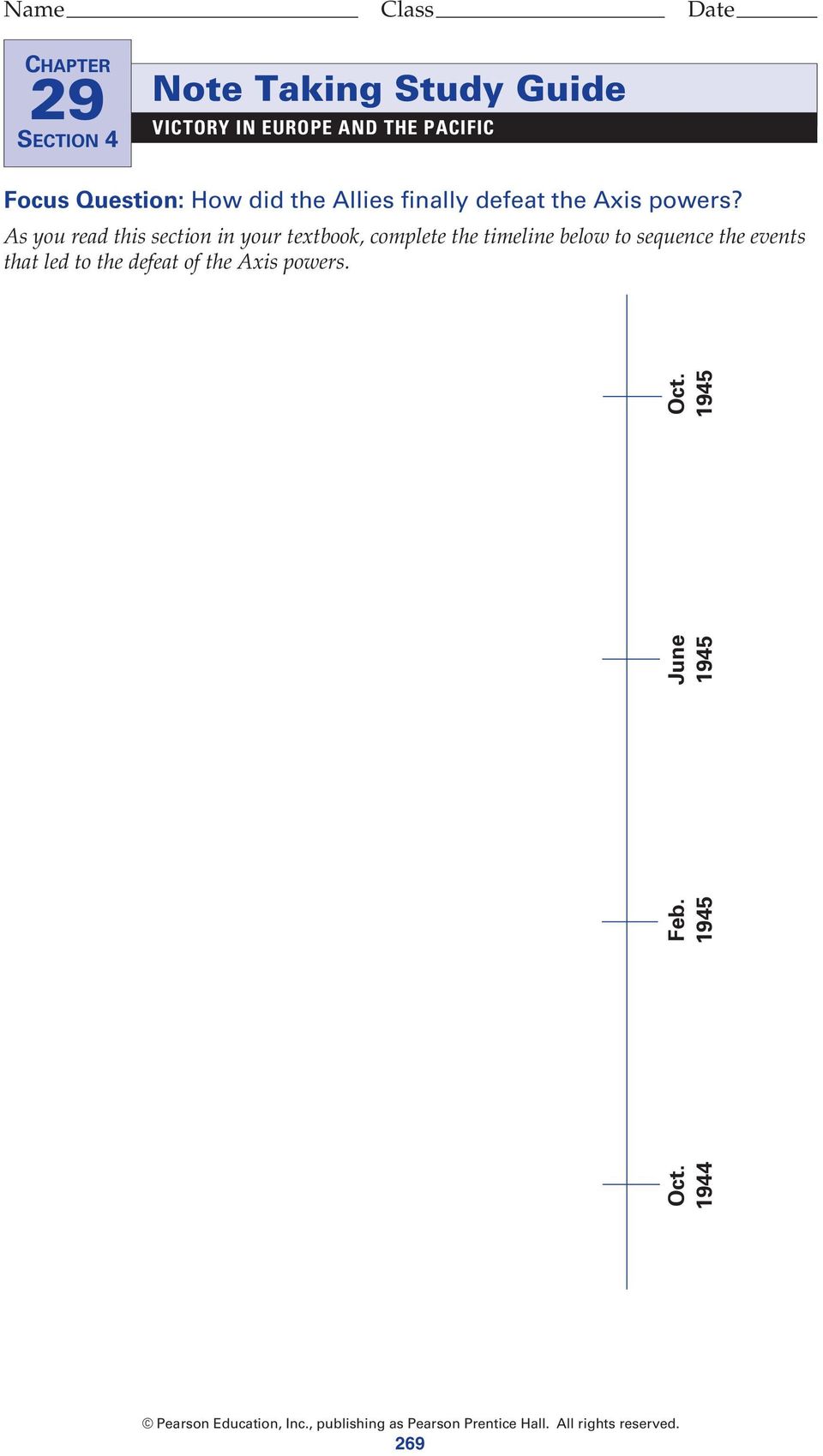
7 SECTION 4 VICTORY IN EUROPE AND THE PACIFIC Focus Question: How did the Allies finally defeat the Axis powers? As you read this section in your textbook, complete the timeline below to sequence the events that led to the defeat of the Axis powers. Oct Feb June 1945 Oct
8 SECTION 4 Section Summary VICTORY IN EUROPE AND THE PACIFIC READING CHECK What was the island-hopping campaign? VOCABULARY STRATEGY What does the word objective mean in the underlined sentence? Say the sentence aloud and omit objective. Think about other words that might complete the sentence. Use this strategy to help you figure out the meaning of objective. READING SKILL Recognize Sequence Create a timeline of the events that took place in Japan from August 6 to August 10, In Europe, World War II officially ended on May 8, 1945, or V-E Day. The Allies were able to defeat the Axis powers for many reasons. Because of their location, the Axis powers had to fight on several fronts at the same time. Hitler also made some poor military decisions. For example, he underestimated the Soviet Union s ability to fight. The huge productive capacity of the United States was another factor. At the same time, Allied bombing hindered German production and caused oil to become scarce. This nearly grounded the Luftwaffe. Although Germany was defeated, the Allies still had to defeat the Japanese in the Pacific. By May 1942, the Japanese had gained control of the Philippines, killing thousands during the Bataan Death March. However, after the battles of Midway and the Coral Sea, the United States took the offensive. General Douglas MacArthur began an island-hopping campaign to recapture islands from the Japanese. The captured islands served as steppingstones to the next objective Japan. The Americans gradually moved north and were able to blockade Japan. Bombers pounded Japanese cities and industries. At the same time, the British pushed Japanese forces back into the jungles of Burma and Malaya. In early 1945, bloody battles on Iwo Jima and Okinawa showed that the Japanese would fight to the death rather than surrender. Some young Japanese became kamikaze pilots who flew their planes purposefully into U.S. ships. While Allied military leaders planned to invade, scientists offered another way to end the war. They had conducted research, code-named the Manhattan Project, that led to the building of an atomic bomb for the United States. The new U.S. president, Harry Truman, decided that dropping the bomb would save American lives. The Allies first issued a warning to the Japanese to surrender or face utter and complete destruction, but the warning was ignored. On August 6, 1945, a U.S. plane dropped an atomic bomb on the city of Hiroshima, instantly killing more than 70,000 people. Many more died from radiation sickness. When the Japanese did not surrender, another bomb was dropped on Nagasaki on August 9. The next day, Japan finally surrendered, ending World War II. Review Questions What were two reasons why the Allies were able to defeat the Axis powers? Why did Truman decide to drop the atomic bomb on Japan? 270

9 SECTION 5 THE END OF WORLD WAR II Focus Question: What issues arose in the aftermath of World War II and how did new tensions develop? As you read this section in your textbook, sequence the events following World War II by completing the outline below. I. The War s Aftermath A. Devastation As many as 50 million are dead. B. C. II. A. B. C. III. A. B. (Outline continues on the next page.) 271
10 SECTION 5 THE END OF WORLD WAR II (Continued from page 271) IV. A. B. C. D. E. F
11 SECTION 5 Section Summary THE END OF WORLD WAR II While the Allies enjoyed their victory, the huge costs of World War II began to emerge. As many as 50 million people had been killed. The Allies also learned the full extent of the horrors of the Holocaust. War crimes trials, such as those at Nuremberg in Germany, held leaders accountable for their wartime actions. To ensure tolerance and peace, the Western Allies set up democratic governments in Japan and Germany. In 1945, delegates from 50 nations convened to form the United Nations. Under the UN Charter, each member nation has one vote in the General Assembly. A smaller Security Council has greater power. It has five permanent members: the United States, the Soviet Union (today Russia), Britain, France, and China. Each has the right to veto any council decision. UN agencies have tackled many world problems, from disease to helping refugees. However, conflicting ideologies soon led to a Cold War. This refers to the state of tension and hostility between the United States and the Soviet Union from 1946 to Soviet leader Stalin wanted to spread communism into Eastern Europe. He also wanted to create a buffer zone of friendly countries as a defense against Germany. By 1948, pro-soviet communist governments were in place throughout Eastern Europe. When Stalin began to threaten Greece and Turkey, the United States outlined a policy called the Truman Doctrine. This policy meant that the United States would resist the spread of communism throughout the world. To strengthen democracies in Europe, the United States offered a massive aid package, called the Marshall Plan. Western attempts to rebuild Germany triggered a crisis over the city of Berlin. The Soviets controlled East Germany, which surrounded Berlin. To force the Western Allies out of Berlin, the Soviets blockaded West Berlin, but a yearlong airlift forced them to end the blockade. However, tensions continued to mount. In 1949, the United States and nine other nations formed a new military alliance called the North Atlantic Treaty Organization (NATO). The Soviets responded by forming the Warsaw Pact, which included the Soviet Union and seven Eastern European nations. READING CHECK What was the Cold War? VOCABULARY STRATEGY What does the word convened mean in the underlined sentence? The word convene comes from the Latin convenire. In Latin, con- means together and venire means to come. Use this word-origins clue to help you figure out the meaning of convened. READING SKILL Recognize Sequence List the sequence of events that led to the Berlin airlift. Review Questions What was the purpose of the post-world War II war crimes trials? Why did the United States offer aid under the Marshall Plan to European countries? 273

Name: Date: Hour: Allies (Russia in this instance) over the Germans. Allies (British and American forces defeated German forces in Northern Africa)
 Name: Date: Hour: World War II Use your textbook and other sources to complete the chart below regarding the significant events that took place during World War II. Answer the questions that follow in
WORLD WAR 2 Political and economic conditions in Europe and throughout the world after World War 1 led directly to World War 2:
 Political and economic conditions in Europe and throughout the world after World War 1 led directly to World War 2: 1. The Treaty of Versailles, ending World War 1, was particularly harsh on Germany and
Although the dominant military confrontations of the 20 th century were centered on the
 To what extent were the policies of the United States responsible for the outbreak and development of the Cold War between 1945 and 1949? Although the dominant military confrontations of the 20 th century
High School WWII Quiz Bowl Qualifier*
 The National WWII Museum s High School WWII Quiz Bowl Qualifier* (*Fair warning: actual Quiz Bowl questions will be even more challenging) Name: Directions: circle the correct answers below. Round One:
WORLD WARS (1914 to 1918 and 1939 to 1945) First World War (1914 to 1918) I. One mark questions (Answer in one sentence each)
 WORLD WARS (1914 to 1918 and 1939 to 1945) First World War (1914 to 1918) I. One mark questions (Answer in one sentence each) 1. When did the First World War begin? First World War began on 28 th July
A. Poland, Bulgaria, Soviet Union B. France, Spain, Manchuria C. Italy, United States, Japan D. Germany, Italy, Japan
 Social Studies Quiz World War II & the Cold War Name Date Read each of the following questions/statements carefully and circle the letter representing the best answer choice. 1. Which was an effect of
AP EUROPEAN HISTORY 2006 SCORING GUIDELINES. Question 7
 AP EUROPEAN HISTORY 2006 SCORING GUIDELINES Question 7 Considering the period 1933 to 1945, analyze the economic, diplomatic, and military reasons for Germany s defeat in the Second World War. 9 6: Stronger
The Sequence of Causes of the Cold War
 The Sequence of Causes of the Cold War Outside the U.S. In the U.S. 1917 Revolutions in Russia 1917-1919 Russian Civil War 1941-1944 Second Front against Hitler Casablanca Conference 1943 Teheran Conference
Foreign Affairs and National Security
 Foreign Affairs and National Security Objectives: TLW understand and explain the following questions as it relates to the Foreign affairs of the American Government What is foreign policy? What is the
Ch. 36 Fighting World War II/EQ: What military strategies did the United States and its allies pursue to defeat the Axis powers in World War II?
 Ch. 36 Fighting World War II/EQ: What military strategies did the United States and its allies pursue to defeat the Axis powers in World War II? 36.1 Introduction After the attack on Pearl Harbor, the
After Japan attacked Pearl Harbor, they thought America would avoid further conflict with them
 CHAPTER 17 THE UNITED STATES IN WORLD WAR II SECTION 1: MOBILIZING FOR DEFENSE After Japan attacked Pearl Harbor, they thought America would avoid further conflict with them The Japan Times newspaper said
MacArthur Memorial Education Programs
 MacArthur Memorial Education Programs World War II Primary Resources Flag Raising on Iwo Jima, February 23, 1945 Background President Woodrow Wilson described World War I as the war to end all wars. In
DBQ 13: Start of the Cold War
 Name Date DBQ 13: Start of the Cold War (Adapted from Document-Based Assessment for Global History, Walch Education) Historical Context: Between 1945 and 1950, the wartime alliance between the United States
German initiated battle in western europe that attempted to push back the allied advance that was un. Sample letter requesting financial assistance
 German initiated battle in western europe that attempted to push back the allied advance that was un. Sample letter requesting financial assistance from employer. German initiated battle in western europe
Chapter 22: World War I. Four most powerful European nations in the early 1900s were Great Britain, France, Germany, Russia.
 Chapter 22: World War I The Beginnings of World War I World War I was fought from 1914-1918. United States entered World War I in 1917. The Origins of Europe s Great War Nationalism Four most powerful
From Versailles to Pearl Harbor. U.S. Isolationism: 1919-1941
 1939-1945 From Versailles to Pearl Harbor U.S. Isolationism: 1919-1941 I. America during the 1920 s A. Many Americans were disillusioned by WWI and wanted to return to normalcy. B. The Business of America
Chapter 6 The Yalta Conference
 Page 29 Chapter 6 The Yalta Conference While Germany and the Allies were engaged in the Battle of the Bulge, US President Franklin Roosevelt and British Prime Minister Winston Churchill prepared to meet
World History Course Summary Department: Social Studies. Semester 1
 World History Course Summary Department: Social Studies All World History courses (Honors or otherwise) utilize the same targets and indicators for student performance. However, students enrolled in Honors
UNIT #7 Hot & Cold: World War II & Its Aftermath
 The following instructional plan is part of a GaDOE collection of Unit Frameworks, Performance Tasks, examples of Student Work, and Teacher Commentary for Fifth Grade Social Studies. UNIT #7 Hot & Cold:
History (Specification B)
 General Certificate of Secondary Education Specimen for June 2015 examinations History (Specification B) Unit 1 91451 International Relations: Conflict and Peace in the Twentieth Century Specimen for June
6. Which of the following was the location of a Nazi extermination camp? a. Berlin b. Warsaw c. Auschwitz d. Dresden
 Name Date CHAPTER 32 CHAPTER TEST World War II Form A Part 1: Main Ideas Choose the correct answer. (4 points each) 1. What prompted Great Britain and France to declare war on Germany? a. Soviet invasion
World War II. President Roosevelt, 1937
 World War II It seems to be unfortunately true that the epidemic of world lawlessness is spreading. When an epidemic of physical disease starts to spread, the community approves and joins in a quarantine
Adolf Hitler. The man that did the unthinkable
 Adolf Hitler The man that did the unthinkable Hitler s Childhood Born on April 20 th 1889 His hometown is the Austrian town of Braunau His Mother was a housemaid while his father was an Austrian Custom
Guide for the Introducing World War II PowerPoint Presentation
 Guide for the Introducing World War II PowerPoint Presentation The PowerPoint presentation serves three purposes. 1. Students are given the opportunity to use their listening skills, which were reviewed
Origins of the Cold War
 Origins of the Cold War Main Idea The detonation of the atomic bomb and the end of World War II led to disagreements among the Big Three wartime Allies and a shift in American attitudes toward the Soviet
I. ABSTRACT II. Seventh Grade, Driven back to war, World War II 2002 Colorado Unit Writing Project 1
 Driven Back to War, World War II Grade Level or Special Area: Seventh Grade History Written by: Matt Swanson, Elbert County Charter School, Elizabeth, CO Length of Unit: Seven lessons - 18-20 fifty-minute
Cold War Lesson Plan. Central Historical Question: Who was primarily responsible for the Cold War the United States or the Soviet Union?
 Cold War Lesson Plan Central Historical Question: Who was primarily responsible for the Cold War the United States or the Soviet Union? Materials: Cold War PowerPoint Copies of Cold War Timeline Copies
in World War II? How did the following lead to US involvement Attack on Pearl Harbor Italian dictatorships & Aggression Mussolini
 World War II How did the following lead to US involvement in World War II? Italian dictatorships & Aggression Mussolini German dictatorships & aggression Japanese dictatorships & aggression Emperor Hirohito/
History (Specification B) (Short Course)
 General Certificate of Secondary Education June 2015 History (Specification B) (Short Course) 91454 Unit 4: International Relations: Conflict and Peace in the 20th Century Monday 1 June 2015 9.00 am to
U.S. HISTORY 11 TH GRADE LESSON AMERICAN INVOLVEMENT IN WORLD WAR II: THE PACIFIC THEATER 1941-1945
 U.S. HISTORY 11 TH GRADE LESSON AMERICAN INVOLVEMENT IN WORLD WAR II: Objectives: TEKS Social Studies US1A, US1C, US6A, US6B, US6C, US22B, US24A, US24B, US24C, US24D, US24E, US25A, US25D 1. The student
What Do We Mean by Democracy and Freedom? (Speech scheduled for a Boston America First rally on December 12, 1941 that was never delivered)
 What Do We Mean by Democracy and Freedom? (Speech scheduled for a Boston America First rally on December 12, 1941 that was never delivered) In the slogans and propaganda that have been hurled back and
The Polish Experience During World War II
 The Polish Experience During World War II Meg Heubeck- UVA Center for Politics Polish Perspectives How does fear affect one s acceptance of authority? Poland and its neighbors during WWII Emily Grannis-
Cold War Lesson Plan. Central Historical Question: Who was primarily responsible for the Cold War: The United States or the Soviet Union?
 Lesson Plan Central Historical Question: Who was primarily responsible for the : The United States or the Soviet Union? Materials: PowerPoint Copies of Timeline Copies of Documents A-D Copies of Guiding
The Nuclear Weapons Debate
 Scottish CND - Education Pack The Nuclear Weapons Debate Scottish CND s educational resource Nuclear Weapons: Yes or No is aimed at late primary to early secondary school pupils. It has 4 units: The Nuclear
5th social studies core skills (5thsocstud_coreskills)
 Name: Date: 1. On July 4, 1852 a writer was asked to speak at an Independence Day celebration in Rochester, New York. Below is a part of his speech. Fellow citizens Pardon me, and allow me to ask, why
UNDERSTANDING NATO THE ORIGINS OF THE ALLIANCE
 UNDERSTANDING NATO THE ORIGINS OF THE ALLIANCE In the aftermath of the Second World War, East and West Europe found themselves separated by the ideological and political divisions of the Cold War. Eastern
Timeline of The Second World War
 Timeline of The Second World War September 18, 1931 Japan invades Manchuria. October 2, 1935 May 1936 Fascist Italy invades, conquers, and annexes Ethiopia. October 25 November 1, 1936 Nazi Germany and
Social Studies. Directions: Complete the following questions using the link listed below.
 Social Studies Name: Directions: Complete the following questions using the link listed below. Questions 1-8: http://www.biography.com/people/adolf-hitler-9340144 (Pages 1-2) Questions 9-17: http://www.history.com/topics/world-war-ii/adolf-hitler
Cold War Spreads to Asia
 Cold War Spreads to Asia China China becomes Communist 1920s Mao Zedong leads communist forces against Chiang Kai Shek leader of China s Nationalist government During WWII set aside civil war to resist
Name Period Date. The Cold War. Document-Based Question
 Name Period Date Task: The Cold War Document-Based Question How effective was the United States government in its attempt to halt the spread of communism in Europe and Asia between the years 1945 and 1975?
Created by Paul Hallett
 The National Cold War Exhibition and this resource pack will assist in the learning of GCSE Modern World History. As you enter the National Cold War Exhibition read the three information boards on the
Note Taking Study Guide ORIGINS OF THE VIETNAM WAR
 SECTION 1 ORIGINS OF THE VIETNAM WAR Focus Question: Why did the United States become involved in Vietnam? As you read, describe the Vietnam policies of Presidents Truman, Eisenhower, Kennedy, and Johnson.
UNIVERSITY OF DENVER ADVANCED YALTA CONFERENCE. By Sara Cardenas and Ian Croak
 UNIVERSITY OF DENVER ADVANCED YALTA CONFERENCE By Sara Cardenas and Ian Croak Introduction In the closing months of the Second World War the soon to be victorious Allies and their respective heads of state
TEACHER S KEY SESSION 1. THE WORLD BEFORE THE GREAT WAR. PRETASK. 3. Pre- listening.
 TEACHER S KEY SESSION 1. THE WORLD BEFORE THE GREAT WAR. PRETASK 3. Pre- listening. 1. Before 1914, the nations of Europe were involved in a race to obtain overseas colonies all over the world, mainly
History Revision - International Relations in the 20 th Century
 History Revision - International Relations in the 20 th Century Before the outbreak of World War I {1914-1918}, the six most powerful countries dominated Europe. These were Britain, France, Austria-Hungary,
Reasons for U.S. Involvement in War
 Reasons for U.S. Involvement in War The United States has waged several wars throughout its history. These wars have in some ways differed drastically. For example, during the Revolutionary War, cannons
Chapter 23 Georgia and World War II
 Name: Class: Date: Chapter 23 Georgia and World War II Multiple Choice Identify the choice that best completes the statement or answers the question. 1. Which accurately describes how the Lend Lease program
1914-1918: WORLD WAR I CFE 3201V
 1914-1918: WORLD WAR I CFE 3201V OPEN CAPTIONED NATIONAL GEOGRAPHIC SOCIETY 1992 Grade Levels: 10-13+ 25 minutes 1 Instructional Graphic Enclosed DESCRIPTION The forces of nationalism, imperialism, and
origins of such a disastrous global conflict. Understanding the causes of such a drastic event will
 Assess the importance of each of the following as causes of the Second World War: treaties; economic factors; ideology. World War II is one of the most studied events in history in terms of understanding
Table of Contents Part One: Social Studies Curriculum Chapter I: Social Studies Essay Questions and Prewriting Activities
 Table of Contents Part One: Social Studies Curriculum Chapter I: Social Studies Essay Questions and Prewriting Activities 1. How the United States Became a World Power 1 2. Immigration 5 3. The Role of
To What Extent is The Cold War a Result of Two Conflicting Ideologies?
 Rahaf Alwattar Daniela Morales Kiley Smith Madison So To What Extent is The Cold War a Result of Two Conflicting Ideologies? The Cold War was an unceasing state of political and military tensions between
GCSE History B Short course
 GCSE History B Short course 91454 International Relations: Conflict and Peace in the Twentieth Century Specimen Mark Scheme for June 2015 examinations 9145 Version: 1.0 Mark schemes are prepared by the
World War II Unit Plan
 World War II Unit Plan WWII Unit Plan Alex Sears WESTERN UNION RECEIVED FEBRUARY 22 ND, 1942 Mr. Sears 10 th Grade U.S. History Students, Hello! Mr. Sears has asked me to inform you of the important material
The Treaty of Versailles
 Payback For WWI The Treaty of Versailles The Treaty of Versailles After WWI, the League of Nations made Germany sign the Treaty of Versailles. Germany didn t have any choice whether to sign it or not.
The Causes of the French and Indian War
 The Causes of the French and Indian War The End of the French Threat 1. relations between England & the colonies had been positive until the 1760s 2. England & France were the two main rivals for leadership
Military Advisors in Vietnam: 1963
 Military Advisors in Vietnam: 1963 Topic: Vietnam Grade Level: 9-12 Subject Area: US History after World War II Time Required: 1 class period Goals/Rationale In the winter of 1963, the eyes of most Americans
Men from the British Empire in the First World War
 In 1914, Britain ruled over one quarter of the world s surface area and 434 million people. This was known as the British Empire. When war broke out, Britain was desperate for men to fight. Unlike France,
GCSE History B. 91451 International Relations: Conflict and Peace in the Twentieth Century Specimen Mark Scheme for June 2015 examinations
 GCSE History B 91451 International Relations: Conflict and Peace in the Twentieth Century Specimen Mark Scheme for June 2015 examinations 9145 Version: 1.0 Mark schemes are prepared by the Lead Assessment
Arab-Israeli Conflict Map Analysis Activity
 Arab-Israeli Conflict Map Analysis Activity Look at the maps of Israel and Palestine from 1517 to 2003. What can we learn about history from looking at these maps? What questions do you have as a result
The National WWII Museum D-Day Virtual Field Trip videoconference TEACHER GUIDE
 Before your Virtual Field Trip The National WWII Museum D-Day Virtual Field Trip videoconference TEACHER GUIDE 1. To better prepare your students for their National WWII Museum virtual field trip, please
International Relations. Simulation: The Treaty of Versailles This activity accompanies slide 15 of The Treaty of Versailles (part 1).
 Name: Simulation: The Treaty of Versailles This activity accompanies slide 15 of The Treaty of Versailles (part 1).ppt Instructions You are going to take part in a simulation of the Versailles negotiations.
FDR Birth Announcement. Franklin Delano Roosevelt was born on January 30, 1882 to James Roosevelt and Sara Delano Roosevelt at their home in Hyde
 FDR Birth Announcement. Franklin Delano Roosevelt was born on January 30, 1882 to James Roosevelt and Sara Delano Roosevelt at their home in Hyde Park, New York. This whimsical birth announcement was found
The Second World War at Home and Abroad, 1941 1945
 CHAPTER 27 The Second World War at Home and Abroad, 1941 1945 LEARNING OBJECTIVES After you have studied Chapter 27 in your textbook and worked through this study guide chapter, you should be able to:
HONORS U. S. HISTORY II World War I - DBQ DUE December 13, 2013
 HONORS U. S. HISTORY II World War I - DBQ DUE December 13, 2013 TASK: Assess AT LEAST TWO of the causes for the United States entry into the conflict of World War I. How did the United States contribute
COLD WAR-MEANING, CAUESE, HISTORY AND IMPACT
 COLD WAR-MEANING, CAUESE, HISTORY AND IMPACT INTRODUCTION After Second World War the period of International Relations from 1945 to 1990 is known as the period of Cold war. In fact, after the war, the
Here is the list of history courses with cross listings and how they fit in each of the sections of the History Major.
 Here is the list of history courses with cross listings and how they fit in each of the sections of the History Major. Note: if you take a History course that is cross listed and you take it under the
Factors: German air superiority (Luftwaffen), British naval superiority
 Occupied Norway (1940 45) Norway in 1940: Population 3 million (Today: 4.5) Chief of State: King Haakon VII Head of Government: Prime Minister Johan Nygaardsvold Cabinet: State Council appointed by monarch,
Palestinian Unilateral Declaration of Independence (UDI): A Teacher s Guide
 Palestinian Unilateral Declaration of Independence (UDI): A Teacher s Guide By Moshe Abelesz, The Lookstein Center I. Background Information, 1937-1949 In the Middle East there are two peoples struggling
1. Which of the following is NOT an argument in support of imperialism or expansionism?
 U.S I Quarterly Assessment Practice Test Circle the best answer to each question. 1. Which of the following is NOT an argument in support of imperialism or expansionism? A. The United States should become
THE GREAT WAR and the Shaping of the 20th Century
 THE GREAT WAR and the Shaping of the 20th Century Lesson Plan Seven: The Failed Peace Overview With the November, 1918, signing of the Armistice ending hostilities in World War I, an even greater task
SAMPLE COURSE OUTLINE
 SAMPLE COURSE OUTLINE MODERN HISTORY ATAR YEAR 12 Unit 4 Elective 1: The changing European world since 1945 Copyright School Curriculum and Standards Authority, 2015 This document apart from any third
Lesson # Overview Title /Standards. Big Question for lesson (from teaching thesis) Specific lesson Objectives (transfer from above).
 Lesson # Overview Title /Standards Big Question for lesson (from teaching thesis) Specific lesson Objectives (transfer from above). Content focused/action verbs Assessment of Objective(s) (you do not need
Access to History Online OCR European and World History Period Studies The Cold War in Europe from 1945 to the 1990s Standard AS question
 OCR AS GCE European and World History Period Studies F 962 Unit 1 The Cold War in Europe from 1945 to the 1990s ESSAY Examiner s Specific Advice Candidates need to evaluate the relative policies of the
World War II: Causes and Consequences: Teacher s Guide
 World War II: Causes and Consequences: Teacher s Guide Grade Level: 6-8 Curriculum Focus: U.S. History Lesson Duration: Two to three class periods Program Description Examine Hitler s occupation of Europe
SUPERPOWER RELATIONS AND THE COLD WAR HODDER GCSE HISTORY FOR EDEXCEL. Steve Waugh John Wright. Authors. Dynamic Learning.
 HODDER GCSE HISTORY FOR EDEXCEL SUPERPOWER RELATIONS AND THE COLD WAR 1941 91 Achieve your full potential with this enjoyable and engaging Student s Book, created for the 2016 Edexcel GCSE History specification
Cuban Missile Crisis Lesson Plan. Central Historical Question: Why did the Russians pull their missiles out of Cuba?
 Lesson Plan Central Historical Question: Why did the Russians pull their missiles out of Cuba? Materials: United Streaming Video Segment: The Hour of Maximum Danger (from Freedom: A History of the US:
SAMPLE. World War II. depth study
 depth study World War II In this depth study, students will investigate wartime experiences through a study of World War II. This includes coverage of the causes, events, outcome and broad impact of the
INTRODUCTION TO THE HOLOCAUST
 INTRODUCTION TO THE HOLOCAUST Jews from Subcarpathian Rus undergo a selection on the ramp at Auschwitz-Birkenau. (Credit: US Holocaust Memorial Museum, courtesy of Yad Vashem) The Holocaust was the systematic,
Japanese Segregation in San Francisco Lesson Plan
 Lesson Plan Central Historical Questions: Why did Teddy Roosevelt oppose the segregation of San Francisco s public schools? Materials: Copies Japanese Segregation Documents A-E Copies Japanese Segregation
cold war Short Answer
 cold war Short Answer 1. Recognize Ideologies The banner carried by these East German demonstrators in the autumn of 1989 reads, Improve Politics--only with new Government. Explain the meaning of this
Why did the US want to claim small islands in the Pacific Ocean such as Midway Island and Wake Island?
 US History & Government Imperialism Why did the US create an empire in the late 19 th Century? Social: Economic: Political: Religious: Military: China Why did the US want to claim small islands in the
Timeline of the Cold War
 Timeline of the Cold War 1945 Defeat of Germany and Japan February 4-11: May 8: July: August 6: August 8: August 9: August 14 : August 15: 1946 February 9: March 5 : March 10: July 1: July 25: Yalta Conference
History (Specification B)
 General Certificate of Secondary Education June 2015 History (Specification B) 91452 Unit 2: Twentieth Century Depth Studies Wednesday 10 June 2015 9.00 am to 10.45 am For this paper you must have: an
Note Taking Study Guide THE BYZANTINE EMPIRE
 SECTION 1 Note Taking Study Guide THE BYZANTINE EMPIRE Focus Question: What made the Byzantine empire rich and successful for so long, and why did it finally crumble? As you read this section in your textbook,
Document Based Questions (DBQs) AP European History Magister Ricard
 As we wind down the year, we are going to be reviewing while also finalizing our preparation for the AP Exam on May 6 th. One of the last skills you will need to have is writing essays from DBQs or Document
Atomic Bomb Lesson Plan. Central Historical Question: How should we remember the dropping of the atomic bomb?
 Lesson Plan Central Historical Question: How should we remember the dropping of the atomic bomb? Materials: Copies of Two Historical Narratives Sheet Copies of Documents A-E Copies of Japanese Experience
Course Syllabus. The instructor also may make additional readings and documents available from the course Sakai site.
 History 01:512:242 World War II Fall 2014 Course Syllabus Section 01 Instructor: Richard Grippaldi, Ph.D. Mondays & Thursdays 10:55am 12:15pm Office: Van Dyck 001 (College Ave) Hickman Hall 127 (Cook /
WORLD WAR II, 1941 1945
 CHAPTER TWENTY-FIVE WORLD WAR II, 1941 1945 CHAPTER OVERVIEW This chapter covers the American involvement in World War II and its effects on the United States. America began trying to ensure isolation
Note Taking Study Guide THE GREAT WAR BEGINS
 SECTION 1 THE GREAT WAR BEGINS Focus Question: Why and how did World War I begin in 1914? As you read this section in your textbook, complete the following chart to summarize the events that led to the
Franklin D. Roosevelt and the Shadow of War, 1933 1941
 CHAPTER 34 Franklin D. Roosevelt and the Shadow of War, 1933 1941 PART I: REVIEWING THE CHAPTER A. Checklist of Learning Objectives After mastering this chapter, you should be able to: 1. Describe Franklin
Religious Studies (Short Course) Revision Religion, War and Peace
 Religious Studies (Short Course) Revision Religion, War and Peace How to use this presentation The first part of this presentation (blue headings) will give you brief information, religious viewpoints
2. Each of the above reasons helped to cause the creation of alliances throughout Europe. How? How do new alliances encourage tension?
 APEH Topic 10 Webquest Points Possible: 200 pts World War I Webquest Part I - M.A.I.N. Causes Name 1. Identify militarism, Imperialism, and Nationalism. Then, explain how each force creates tension in
WWII: The Lost Color Archives - Volumes I and II
 WWII: The Lost Color Archives - Volumes I and II Introduction Beginning as a European confrontation and escalating into all-out international conflict, World War II is now known as the most destructive
SELECTED WORLD EVENTS
 1879 March 14 born in Ulm, Germany, in Bavaria 1880-1894 school in Munich 1881 sister Maja born EINSTEIN S LIFE 1889 begins reading physics, math, and philosophy on his own 1894 joins family in Italy 1895
Foreign Affairs in the Young Nation 1
 Foreign Affairs in the Young Nation To what extent should the United States have become involved in world affairs in the early 1800s? P R E V I E W Examine the map your teacher has projected, or look at
ORIGINAL: ENGLISH 11th May, 1967 DOCUMENT DPC/D(67)23. DEFENCE PLANNING COMMITTEE Decisions of Defence Planning Committee in Ministerial Session
 ORIGINAL: ENGLISH 11th May, 1967 DOCUMENT DEFENCE PLANNING COMMITTEE Decisions of Defence Planning Committee in Ministerial Session Note by the Chairman I attach for your information a list of the decisions
Student Lesson. Iwo Jima! Where Are You? Geography Lesson
 Student Lesson Geography Lesson LESSON TITLE: Iwo Jima! Where are you? GRADE LEVEL: 7 12 EALRS: Social Studies: History 1.2 analyze the historical development of events, people, places, and patterns of