
ANCHORING, MOORING, AND TOWING
|
|
|
- Russell Dawson
- 9 years ago
- Views:
Transcription
1 CHAPTER 7 ANCHORING, MOORING, AND TOWING LEARNING OBJECTIVES Upon completing this chapter, you should be able to do the following: 1. Describe and identify anchors and their related appendages. 2. Describe the standard methods for anchoring and mooring ships. 3. Describe the procedures for rigging and unrigging for towing a ship and for being towed. State the basic rules for adjusting lines during the tow. 4. Identify and describe the principal types of salvage. INTRODUCTION In chapter 4 we discussed the procedures involved in tying a ship up to a pier. In this chapter, we discuss how to anchor a ship and moor it to a buoy. We also briefly cover towing and salvage. ANCHORS Although several types of anchors are in use aboard Navy ships, mine countermeasures ships use a lightweight-type (LWT) anchor called the Danforth (figure 7-1). Federal Supply Catalog lists standard sizes from 3/4 to 4 3/4 inches. Wire diameter is measured at the end and a little above the center line of the link. The length of a standard link is 6 times its diameter; its width is 3.6 times its diameter. All links are studded; that is, a solid piece is forged in the center of the link. Studs prevent the chain from kinking and the links from pounding on adjacent links. IDENTIFYING ANCHORS Each anchor of over 100 pounds ordered by the Naval Sea Systems Command is assigned a serial number, which is cast or cut into the anchor before it is delivered. Serial numbers are found on the shank of lightweight anchors. These numbers must be recorded in the ship s anchor log. If you receive a new anchor, be certain to record the proper numbers. Do not confuse these numbers with other figures, such as the weight of the anchor. CHAIN AND ITS APPENDAGES All Navy ship anchors are connected to some length of anchor chain. Modem Navy anchor chain is made of die-lock chain with studs. The size of the link is determined by its diameter, called wire diameter. The Figure 7-1. Lightweight-type (LWT) anchor. 7-1

2 Heavy-duty and high-strength die-lock chains are physically similar to some of the smaller sizes of standard die-lock chain but have higher breaking strengths. Size for size, the links fit the same wildcat (windlass drum). Chain Nomenclature A chain is made of many parts besides links, and a variety of equipment is used to maintain the chain. The following paragraphs describe a chain and its associated hardware: STANDARD SHOTS. The lengths of chain that are connected together to make up the ship s anchor chain are called shots. A standard shot is 15 fathoms (90 feet) long. Each shot of chain usually bears a serial number, either stamped or cut at the time of manufacture, on the inner side of its end links. If an end link is lost or removed from a shot, this identification number should be either cut or stamped on the inside of the new end link of the altered shot. DETACHABLE LINKS. Shots of anchor chain are joined by a detachable link, shown in figure 7-2. The Navy type of detachable link consists of a C-shaped link with two coupling plates, which form one side and the stud of the link. A taper pin holds the parts together and is locked in place at its large end by a lead plug. Detachable link parts are not interchangeable, so matching numbers are stamped on the C-link and on each coupling plate to ensure identification and proper assembly. You will save time and trouble trying to match these parts if you disassemble only one link at a time and clean, slush, and reassemble it before disassembling another. When you reassemble a detachable link, make sure the taper pin is seated securely. You can do this by driving the pin in with a punch and hammer before you insert the lead plug over the pin s large end. Detachable link toolbox sets contain tools and parts, including spare taper pins and lock plugs, for assembling and disassembling links and detachable end links. Figure 7-2. Detachable link. 7-2

3 minimizes kinking and twisting of the anchor chain. Figure 7-3. Chain swivel. BENDING SHACKLE. A bending shackle is used to attach the anchor to the chain. CHAIN SWIVEL. A chain swivel (fig. 7-3) is furnished as part of the outboard swivel shot. It OUTBOARD SWIVEL SHOTS. Standard outboard swivel shots (fig. 7-4), also termed bending shots, consist of detachable links, regular chain links, a swivel, an end link, and a bending shackle. They are fitted on most vessels to attach the anchor chain to the anchor. They also make it possible to stop off the anchor and break the chain between the windlass and the anchor. The taper pins in the detachable links in the outboard swivel shot are additionally secured with a U-shaped, stainless steel, wirelocking clip (sometimes called a hairpin). This hairpin, inserted in holes drilled through the coupling plates, engages a keyway or groove on the taper pin. (See figure 7-2.) RIDING, HOUSING, AND TOWING CHAIN STOPPERS. Chain stoppers are used to hold the anchor taut in the hawsepipes, to ride at anchor, or to hold the anchors when the anchor chain is disconnected for any reason. Riding and Figure 7-4. Outboard swivel shot. 7-3

4 Figure 7-5. Chain stopper. housing chain stoppers (fig. 7-5) consist of a turnbuckle inserted in a short section of chain with a slip or pelican hook attached to one end of the chain and a shackle at the other end. The housing stopper is nearest the hawsepipe, the riding stopper is farther aft. These stoppers are secured by the shackles to permanent pad eyes on the vessel s deck. When in use, a stopper is attached to the anchor chain by straddling a link with the tongue and strongback of the pelican hook. Special housing chain stoppers, such as the devil s claw or the paw1 type of stoppers, normally are used with horizontal windlasses and where space limitations do not permit use of Navy standard stoppers. Although stoppers alone are more than adequate for holding the anchor, they should be backed up with the wildcat brake. Upon anchoring, you should first set the wildcat brake band, then set the stoppers tight, making sure you equalize the tension on them, so that one is not loaded more than the other. The wildcat should be left disconnected from the windlass. A Navy standard chain stopper is shown in figure 7-5. Towing chain stoppers are similar to riding and housing chain stoppers, except that towing chain stoppers have locking plates added. (See fig. 7-6.) These locking plates prevent the towing chain stopper from unscrewing when subjected to the shock loading Figure 7-7. Mooring shackles. Figure 7-8. Mooring swivel. of the towing hawser. Towing chain stoppers should be used whenever the ship is being towed. MOORING SHACKLES. Mooring shackles are forged steel shackles (fig. 7-7) that are used to attach anchor chains to mooring buoys. All mooring shackles, regardless of size, have a standard mortise (opening) of 7 inches. Mooring shackles should not be used for any other purposes. MOORING SWIVELS. Forged steel swivels, with two links attached at each end (fig. 7-8, are used to moor with two anchors. They are inserted in the chain outboard of the hawse and keep the chain from twisting as the ship swings. Mooring swivels should be attached in the chain Figure 7-6. Anchor chain stopper modified for towing. 7-4

5 Figure 7-9. Cable jack. with the eye-end outboard, or down, to prevent them from hooking on the outer lip of the hawse when they are heaved back aboard. However, most ships today have large rounded lips on the hawsepipes, making it unlikely that a reversed swivel will catch. CHAIN CABLE JACKS. A cable jack (fig. 7-9), consisting of a lever mounted on an axle and two wheels, is used to handle anchor chain in sizes 2 3/4 inches and above. It is used to pick the chain up to pass a chain stopper. A pinch-point crowbar type anchor bar is issued for smaller sizes of chain. CLEAR HAWSE PENDANT. A clear hawse pendant is a wire rope pendant, 5 to 15 fathoms long, with a thimble at one end and a pelican hook attached to a length of open-link chain fitted in a thimble at the other end. It is used in clearing a hawse fouled by the anchor chain. (See fig ) DIP ROPE. A dip rope is a fiber rope pendant, fitted at one end with a thimble and a dip shackle large enough to engage a link of the anchor chain at the other end. This pendant is used to moor or clear a hawse. Information on dip shackles and proportional dimensions for the different sizes of chain are given in NSTM, chapter 581. Anchor Chain Markings The detachable links of anchor chain are painted red, white, or blue as follows: red, to indicate 15 fathoms; white, 30 fathoms; blue, 45 fathoms; red, 60 fathoms; white, 75 fathoms; and so on. At the 15-fathom mark, one link on each side of the detachable link is painted white, and one turn of wire is wrapped securely around each stud. At the 30-fathom mark, two links on each side of the detachable link are painted white, and two turns of wire are wrapped around each of the last white studs. At the 45-fathom mark, three links on each side of the detachable link are painted white, and three turns of wire are wrapped around each of the last white studs. At the 60-fathom mark, four links on each side of the detachable link are painted white, and four turns of wire are wrapped around each of the last white studs, and so on, for each shot. Figure Clear hawse pendant. 7-5

6 Each link of the entire next-to-last shot is painted yellow. The last shot is entirely red. These last two shots are the warning and the danger shots. Their purpose is to show you the approach of the chain s bitter end. Securing the Bitter End The bitter end of the anchor chain is secured to a pad eye in the chain locker by a safety anchor shackle. The pad eye, welded to a specially reinforced bulkhead, is rated at 1.75 times the breaking strength of the shackle. The strength of the shackle must approximate the weight of 20 shots of anchor chain hanging from the hawsepipe. CARE OF GROUND TACKLE Anchors, chains, and appendages must be kept in good condition by the ship s force. This process involves the actions described below. The chain should be overhauled whenever necessary, with precautions taken to see that the various shots are properly marked and in good order. As the chain comes in, when a ship is getting under way, each link should be examined for cracks and other defects. Two competent observers, preferably petty officers, should be detailed to examine the chain. Disassembly of detachable links in the outboard swivel shot with hairpins requires removal and probable destruction of the lockwire. Replacement wire of the same type should be on hand before the lockwire is removed. Replacement hairpins can be fabricated on board ship from corrosion-resistant steel. (See NSTM, chapter 581, or the applicable MRC.) Anchor chain and its appendages should be carefully examined for cracks, excessive wear, distortion, or other defects. Parts that require coating should be painted with anchor chain gloss black paint. (See NSTM, chapter 581.) Shackle bolts, locking pins, and swivels should be examined carefully and put in order. The turnbuckles in chain stoppers require frequent attention to keep them clean, free from rust, and well lubricated with new lubricant. At least once each 18 months all anchor chain (including shackles, shackle pins, and detachable links) should be examined, overhauled, and placed in a good state of preservation. To distribute the wear uniformly throughout the length of the chain, the shots should be shifted to new positions as necessary during this inspection. If, during overhaul of the chain, significant defects are discovered, they should be brought to the attention of the Naval Sea Systems Command. If immediate replacement of a defective shot is not practical, it should be shifted to the bitter end of the chain. Recovery of Ground Tackle When a chain has been slipped or parted, every possible means must be used to recover both the anchor and the chain. When recovery by the ship s force is impossible, the lost anchor and chain should be buoyed and bearings taken of the location of the loss. ANCHORING AND MOORING Letting go a single anchor is perhaps the simplest way of securing a ship to the bottom, and when the holding ground is good, the ship should ride easily in bad weather, provided an ample scope of chain is used. One disadvantage of using one anchor is that in a strong current, or in a gale, the ship may sheer, or rotate about the anchor, considerably. Also, when a ship is anchored, it swings to the combined efforts of the wind and current. Therefore, it is necessary to have an unobstructed area equal to the length of the ship plus the scope (length) of chain used. If, for some reason, the anchorage does not afford such an area, the ship must be moored. A ship is moored when the port and starboard anchors are down at a considerable distance apart and with enough chain on each anchor that the ship is held with its bow approximately midway between them. A ship moored requires an unobstructed area the size of a circle with a radius only slightly larger than the length of the ship. Mooring to a buoy is another way of securing a ship. The buoys are usually anchored with a three-point moor. This requires the ship to use only its anchor chain forward and, if it is mooring bow and stem between two buoys, to also use a mooring line aft. The radius of swing is limited to the ship s length and the scope of anchor chain veered or the area between the two buoys. Now that we have discussed anchoring and mooring in general, we will cover the equipment used and the personnel involved in letting go a single anchor. Mooring with more than one anchor is covered in other training manuals for Boatswain s Mate and in shiphandling books and courses. 7-6

7 ANCHORING The ship s First Lieutenant is in charge on the forecastle while the ship is anchoring and weighing anchor. Aboard most ships, the First Lieutenant s assistants are the ship s Boatswain and Chief Boatswain. In their absence, the senior PO of the division responsible for the ground tackle is the First Lieutenant s assistant. An EN (Engineman) is present to operate the anchor windlass, and an EM (Electrician s Mate) must be in the anchor windlass room to take care of any electrical failure. The First Lieutenant has a telephone talker, whose duty is to relay orders and information between the forecastle and the bridge. The PO in charge of the anchor detail musters the detail and ensures that all necessary gear is available. Several Seamen, whose duties are discussed later, are also required. Necessary equipment is as follows: Detachable link toolbox set Chain stopper wrench Chain cable jack or anchor bar Maul Telephones Anchor buoy and line On ships with two wildcats, both anchors are made ready for letting go. While this is being done, the telephone talker receives from the bridge such information as the anchor to be used, depth of water, type of bottom, scope of chain to be used, and any other information pertinent to the operation. The exact procedures for making the anchor ready for letting go may vary, but the following tasks must be performed: The First Lieutenant or the petty officer in charge must give a safety briefing. All personnel involved in the anchoring evolution must be in the proper uniform; that is, with trouser legs tucked in and wearing safety goggles and hard hats with chin straps. Only necessary personnel may be allowed on the forecastle. The Seaman tending the lead line, in addition to wearing a hard hat, must wear a safety harness and life jacket. All personnel should be quizzed about their jobs, and they must be exact in their answers. The windlass is tested; the anchor in the hawse is freed. The anchor will be walked out if the ship is anchoring in deep water or if the bottom is rocky; otherwise, the brake is set and the wildcat is disengaged. All but one stopper is taken off, and the anchor buoy is shackled to the chafing chain or pendant. The chain locker is checked for any loose gear that may become wedged in the chain pipes or come flying out, endangering the personnel on deck. While the anchor detail gets the ground tackle ready, the Quartermasters on the bridge take bearings, and the navigator plots the bearings on a chart and advises the conning officer of the ship s position. Distances to the anchorage are relayed to the forecastle. In letting go by the stopper, the weight of the anchor must be on the stopper. The brake will be released on the command STAND BY. In letting go by the brake, the weight of the anchor will be on the brake and the stopper with the windlass disengaged. The stopper will be taken off at the command STAND BY. At the command STAND BY, the personnel on the forecastle are alert and ready, awaiting the next command. When letting go by the stopper, two Seaman take stations at the stopper. When the command LET GO is given, one Seaman pulls the pin from the stopper tongue. The other Seaman, with a maul, knocks the bail off the tongue of the pelican hook and steps clear, and the chain will pass through the hawse with a roar. If the anchor buoy was not stopped off with sail twine, the Seaman tending it must let it go exactly at the command LET GO. On the bridge, the anchor ball is hoisted. The flag is hauled down from the truck, and the jack and ensign are hoisted smartly fore and aft. You will notice that the ship is moving (usually backing) when the anchor is dropped. This keeps the anchor chain from piling on itself, damaging the chain, or piling on or fouling the anchor. When the anchor is dropped and hits bottom, the brake should be set to help prevent piling. Reports are made to the bridge informing them on the initial status of the anchor, how much chain is out, what position it tends, and what strain it has on it. The bridge is also informed of whether the anchor buoy is watching. (This means that the buoy has surfaced and marks the location of the anchor.) As the ship gains sternway, the anchor chain is veered out by the brake about a shot at a time to control the speed of the chain. This is continued until sufficient chain is out to ensure that the pull on the anchor is horizontal on the bottom. The brake is now applied, and the anchor is set by the ship s backing down and riding on the chain. Once the anchor is set and 7-7

8 holding, the brake is taken off, and the chain is veered to the desired scope. As each chain marking passes the wildcat, the report (Number) fathoms on deck is made to the conning officer. The direction the chain is tending is indicated by pointing the arm and/or reporting Chain tending (number) o clock. Depending on the preference of the commanding officer, the way reports are given may vary from ship to ship. These reports enable the conning officer to maneuver the ship properly. When the desired scope of chain is out, the order PASS THE STOPPERS is given. The brake is set, and the stoppers are applied and evened up. The brake is taken off; then the chain is slacked between the windlass and the stopper. The brake is set, and the wildcat is left disengaged. Before the anchor detail is secured, all gear must be picked up and stowed. Scope of Chain Under normal conditions, a ship usually anchors to a scope of chain between five and seven times the depth of the water. This is important to prevent losing the anchor or the anchor and part of the chain in heavy weather. When a ship at anchor is subjected to heavy weather, a strain much stronger than normal is placed on the chain. More and more of the chain s length lifts off thebottom as the strain increases. When the scope is not long enough, the chain lifts all the way to the shank, and the anchor breaks out and drags before the chain parts. With too long a scope, however, the breaking strain of the chain is reached and the chain parts before its entire length lifts off the bottom. Weighing Anchor When the ship is weighing anchor, the same gear and personnel should be available on the forecastle as for anchoring. In addition, there must be a grapnel for retrieving the anchor buoy, and a saltwater hose must be rigged to wash the mud from the chain and the anchor. The following procedures are carried out in making ready for weighing anchor. After the windlass is energized, the anchor windlass is tested. Then the brake is set, and the riding stopper is cast off and cleared from the chain. The anchor is now engaged, held by the brake and backed up by the housing stopper. When everything is ready, the report Ready to heave in is made to the bridge. The ship will be riding on its anchor chain, as shown in view A of figure If the wind or current is strong, Figure A ship from anchored to under way. 7-8

9 the conning officer may put on enough turns (screw turns) to take the strain off the ground tackle. On the command HEAVE AROUND, the brake is taken off and the chain is heaved in enough to take the strain off the stopper. The stopper is cast off, and heaving around is resumed. Reports are made to the bridge periodically on the direction that the chain is tending, the amount of chain out, and what kind of strain is on the chain. If the command were HEAVE AROUND TO SHORT STAY, the chain would be heaved in just short of breaking out the anchor, as seen in view B of figure The bridge is notified when the chain is at short stay. When the command HEAVE AROUND AND UP is given, the chain will be heaved in. When the flukes of the anchor have broken out and the crown still rests on the bottom, the bridge is notified Anchor breaking ground, and then Anchor is up and down, as seen in view C of figure When the anchor is free from the bottom, the bridge is notified Anchors aweigh, as seen in view D of figure The jack, ensign, and anchor ball will be hauled down, and the underway ensign hauled smartly to the truck. When the anchor comes into view and its condition can be noted, the report Anchor in sight is made. With this report, the bridge is told if the anchor is clear, fouled, or shod (meaning caked with mud and bottom). The anchor is reported as housed when the shank is in the hawsepipe and the flukes are against the ship s side. The anchor buoy is recovered as soon as possible, and the report is made to the bridge when the anchor buoy is on board. The anchor is again made ready for letting go and kept that way until the anchor detail is told to secure it after the ship is outside the harbor or channel. To secure the anchor for sea, the brake is set; then the stoppers are passed and evened up (meaning that they take equal strain). The brake is taken off; then the chain is slacked between the wildcat and the stopper. The brake is set and the wildcat is disengaged. To prevent water from entering the chain locker, the buckler plates are secured over the chain pipes (on some ships, canvas chain pipe covers go over the plates). MOORING TO A BUOY When the ship is about 1,000 yards from the mooring buoy, a boat containing a buoy party of three or four personnel, in addition to the boat s crew, is lowered to the water. All hands in the boat must wear life jackets and must be qualified second class swimmers. The ship is maneuvered so it will come to a stop with the bow directly over the buoy. The boat comes alongside the buoy and two members of the buoy party get on the buoy. Then the crew members intheboat take from the ship the ends of the dip rope, a messenger, and a mooring/buoy wire with a mooring shackle that is large enough to engage the ring on the buoy. The shackle pin is secured to the shackle with a lanyard to prevent its loss. The wire is shackled to the ring, and the dip rope is passed through the ring and tied to the messenger. Then the crew gets back into the boat, and the boat clears the buoy. Meanwhile, these mooring preparations are made on the forecastle: The anchor is disconnected, and the mooring shackle is secured to the anchor chain. The dip rope is fastened to the chain a short distance above the shackle. The other end of the dip rope is pulled back aboard by means of the messenger and is taken to the capstan In the meantime, the mooring/buoy wire is heaved taut. The mooring/buoy wire serves to hold the bow of the ship in position. The mooring shackle is pulled into position by walking out the chain and heaving around on the dip rope. The buoy party again gets on the buoy and secures the shackle to the ring. Then the mooring/buoy rope is slacked off, unshackled, and the moor is complete. Trolley Method The trolley method of mooring to a buoy is a simple and rapid means of easing the bitter end of the chain (controlled by an easing-out line) down to the mooring buoy by letting it slide on the wire shackled to the buoy. (See fig ) Figure Trolley method. 7-9

10 One or more large shackles over the buoy wire serve as trolleys. The chain is connected to the trolley by a short wire strap passed around the stud of a link near the bitter end. Enough chain must hang free to allow it to be shackled easily to the mooring ring. Connecting it to the fourth or fifth link usually provides the proper amount of free-hanging chain. Other preparations on deck are much the same as for the ordinary method of mooring to a buoy, except that sufficient chain for the maneuver is roused up and allowed to hang in a bight over the side during the approach, and it is not necessary to use a dip rope. The easing-out line, in addition to controlling the travel of the chain during the mooring operation, prevents the bitter end of the chain from dropping into the water during the approach. When the ship is mooring by the trolley method, the buoy party in the boat takes only the end of the wire to the buoy. The wire is either shackled directly to the ring of the buoy, or a short wire strap is passed through the ring and the eye of the wire, and the ends of the strap are shackled together. The buoy party is always provided with a strap when the size of the ring on the buoy is unknown. If possible, the buoy wire is connected to a ring other, than the one to which the chain will be shackled. The ship is maneuvered to bring the bullnose abreast of the buoy and about 10 yards away. Once the buoy wire is secured, it is heaved taut and kept that way. The chain is allowed to slide down the wire by slacking off the easing-out line, and the mooring shackle is secured to the ring of the buoy by the buoy party. The wire is then slacked and cast off, completing the moor. On ships with unusually large and heavy chain, two or more trolleys should be used, and it is a good idea to pass a line from the deck, through the ring of the buoy, and to secure it to the mooring shackle or the first link. Then, by using this line and the easing-out line, the personnel on deck are able to assist the working party on the buoy to get the mooring shackle into position. Bow and Stern Buoy Moor The bow and stem buoy moor is used by all navies. It is used throughout the world where the harbors are small and congested or in areas where ships are out of service. In this type of moor, the ship s bow is moored to the forward buoy in either manner described above. At the same time, a stem line or cable is run to the stem buoy. The ship approaches at an angle of about 20 to the geographical line-of-bearing of the two buoys. While lines are being passed to the bow buoy party, similar lines are passed from the ship by boat to the stem buoy party. After the lines are made fast to the buoys, adjustments are made from on deck to spot the ship equidistantly, bow and stern, from the respective buoys. Most ships use an anchor chain forward and a nylon towing hawser or a wire rope aft. Slipping a Mooring For this maneuver, a strong line or flexible wire is run through the buoy ring and back on deck for use as a slip rope. A strain is taken on it, and the chain is unshackled. Should the ship be riding to a bight of the chain, an easing-out line is used to ease the chain through the ring while the chain is being hauled in. The ship now rides to the slip rope, and unmooring is completed by letting the end of the slip rope go and reeving it through the buoy ring. TOWING All naval vessels are required to be able to tow and be towed. Equipment varies with the types of ships, and procedures vary with the circumstances. Equipment used, as well as procedures for towing and being towed, is listed in the ship s towing bill. RIGGING FOR TOWING OR BEING TOWED To describe every towing rig would be impractical, so we have limited our description of rigging for emergency towing to the standard synthetic gear and some parts of the wire rigs. NAVSEA provides the latest guidance concerning authorized synthetic towing hawsers and end fittings. The preferred towline is a nylon rope of nonrotating construction that is either plaited or double-braided. These lines must have a minimum breaking strength within 10 percent of the breaking strength of the emergency tow hawser shown in the ship s plans. NAVSEA does not recommend the use of swivels with any of these towlines. The towing gear consists of reinforced structure points (referred to here as hard points), a chafing chain, a towing hawser, and connectors. On the towed ship, the chafing chain and hard points are usually made up from the ship s anchor chain and chain stoppers fair-led through the bow chock. A typical arrangement is shown in figure On the towing ship, the hard point is provided by a towing pad which is usually located on the centerline, although it is sometimes found on the quarter because of equipment interference. A section of chafing chain is connected to the pad by a pelican hook, 7-10

11 Figure Typical bow chafing chain arrangement for being towed. which is used for dropping the tow in case of emergency. The other end of the chafing chain is fairled through a closed chock on the stern. A typical arrangement is shown in figure Since it is logical to assume that the reason a ship has to be towed is because it has lost power, the rigging arrangement aboard the ship to be towed must be laid out so no power assistance is required. Therefore, practice operations should be performed with the towed ship using no power equipment. Towed-Ship Rigging Procedure The towed ship rigs for being towed by breaking the anchor chain inboard of the swivel shot. The anchor not in use is secured in the hawsepipe by a chain stopper and a preventer made of wire. The wildcat brake is set up. When the chain pipe has a compressor, it is used to keep the chain from falling back into the chain locker; when there is no compressor installed, a bar through the chain and across the chain pipe can substitute for the compressor. The chain is then moved over in alignment with the bow chock It will be hauled through the bow chock later by the towing hawser as a strain is taken on the hawser by the towing ship. The connector fittings are standard rigging and detachable links of the size of chain being used. The towing hawser is either wire, whose size and length satisfy the ship s plans, or synthetic hawser 600 feet long. Attached to the hawser is a messenger made up of 100 fathoms of 3-inch line and 50 fathoms of 1 1/2-inch line. (For a lo-inch circumference or larger hawser, use the 4-inch in place of the 3-inch.) Two 100-fathom lengths of 6-thread or 9-thread line are attached to the 1 1/2 line and run outboard on both sides of the ship. Then the 6-thread line is attached to the shot line, reducing the weight on the shot line while the messenger is passed to the receiving ship. The hawser and messenger are faked out and stopped off to a strongback, with turns of 21-thread line running over a chop block to provide constant control while the hawser is paid out. These stops are cut on command as the hawser pays out. A retrieval line is connected to the anchor chain end of the towing operation to retrieve the towing hawser. The same procedure is followed on the towing ship, except that the pelican hook is rigged to the hard point, and the chafing chain to the pelican hook, fair-led out the stem chock. You will notice that we have referred to the ship to be towed as being the provider of the rig. Which ship ultimately provides the initial hawser is a command decision, and circumstances will be different in each case. Figure Typical stern chafing chain arrangement for towing. 7-11

12 When both ships hawsers are used to increase the length of the tow to 1,200 feet (fig. 7-15, one ship will haul in the other s hawser and connect the two hawsers together with a pear-shaped detachable link, then pay out the hawser as the other ship goes ahead, taking up the slack as it goes, until all the hawser is out. When only one ship s hawser is, the ship receiving the other s hawser connects it to either the anchor chain, broken forward, or the chafing chain, rigged aft. The messenger is secured to the towing hawser as shown in figure 7-16, view A; or if a wire hawser is to be used, it may be modified as in view B. If desired, a third method may be used; that is, a strap is eye-spliced, as an extension to the messenger, and a shackle used to make the connection between the messenger and strap, which is secured to the hawser as in view A. Approaching the Tow The position the towing ship takes in relation to the tow during the approach depends on which vessel drifts faster. When the towing ship drifts faster than the tow, the towing ship takes position forward and to windward When the tow drifts faster, the towing ship takes position ahead and to leeward. The idea is that one ship drifts past the other, allowing more time for passing and hooking up the towline. The towing ship always ensures there is plenty of room to maneuver. If a normal close approach cannot be made, because of sea conditions, the towline messenger may have to be buoyed with life jackets and floated down to the tow. Often, however, the approach is close enough to use heaving lines, so there should be three or four heaving lines on deck, as well as a line-throwing gun and bolos. Figure Towing hawser arrangement. 7-12

13 Figure Method of securing messenger to towline. Passing the Rig The end of the towline messenger is passed as soon as possible to the towing ship. During the approach, personnel on the towing ship are stationed at intervals along the deck to receive the towline messenger. Once the messenger is received, the end is led through the stem chock and run forward. You may take the messenger to a capstan, but this method is much slower than heaving it in by hand until a heavy strain is taken. The final hauling of the towing hawser is usually done by the capstan. Once the end of the towing hawser is aboard, the seizing that secures the coupling to the messenger is cut, and the towed ship s hawser is connected to your hawser. A stopper is bent onto the hawser; the messenger is removed; and the towlines are hooked up but not yet deployed. The towing ship puts on turns sufficient for steerageway and continues at this steady speed until the towline is completely taut. This slow speed deploys the towline off the towing ship, in a slow orderly fashion, until all the faked out line is off the deck and the chafing chain has been hauled through the stem chock. The added tension hauls the remaining towline off the towed ship until its anchor chain comes taut. At this point, the bar is removed from the chain over the chain pipe and the brake on the wildcat is slackened. The chain is permitted to be hauled out until it clears the bow chock by 6 or more feet. The brake is applied and two towing chain stoppers are passed onto the chain. While a ship is towing, an emergency release capability is required. The chain is veered out to the first detachable link and the stoppers are passed forward of the detachable link. This will provide access to the link in case the tow must be released. Getting in Step When a ship is towing with synthetic line, no catenary (line droop) is required. It is not uncommon to have the hawser completely out of the water; in fact, it is desirable because it lowers the towing resistance and prevents the line from being damaged by bottom fouling or objects in the water. When heavy seas are encountered, the rule is slow down. At this point, it is important to keep the ships in step to lessen the surge loads. To do this, cast off the stoppers, and adjust the scope to get the vessels in step. The tow must ride so that it reaches the top of a crest at the same time the towing ship does. If not, the towing ship might reach the crest while the tow is in a trough, whipping the towline out of the water and subjecting it to unnecessary and 7-13

14 dangerous strains. (See fig ) When the scope is adjusted properly, the chain is secured in the same way as before. Dropping the Tow When the ships are dead in the water and the order is given, the tow engages its wildcat, casts off the stopper, and heaves in on the chain. When the end of the towline is aboard, the messenger is bent on the towline. Turns are taken around the capstan with the messenger, and the chain is walked out until the strain is on the messenger. Then the towline is unshackled and eased out. Personnel on the towed ship run in the towline by capstan or hand. Care must be taken on the towing ship that the catenary does not become too heavy for the crew on the towed ship to handle. When a recovery line is rigged on the towing ship, the end of it is led through the towing chock from outboard to inboard and hauled in by hand (or, if necessary, by power) until the chafing chain and the inboard end of the towline are aboard. Then the towline is hauled the rest of the way in. SALVAGE The term salvage covers everything from refloating stranded vessels to wreck removal. World War II provided a prime example of the value of salvage operations. The U.S. Navy salvage organization during this period salvaged and reclaimed ships and equipment worth over 2 billion dollars. PRINCIPAL TYPES OF SALVAGE It is, of course, impossible to place all wrecks into a neat category. Nearly all will fall within one of four principal types of salvage. The types of salvage are: RESCUE SALVAGE. Rescue salvage provides emergency salvage services to vessels and aircraft in distress at sea. The most important service is towing damaged ships to a safe harbor. Fire fighting, pumping, and minor patching also are services a salvage ship can render in an emergency. Major problems are storms and gales, fire, collision, machinery failure, shifting Figure Examples of out-of-step and in-step during towing. 7-14

15 cargo, loss of rudder or propeller, and battle damage. HARBOR SALVAGE. Harbor salvage consists of salvaging ships, removing wreckage, and general salvage work in harbors. Collision is the chief cause of damage to ships in a harbor. After a collision, either one or both ships may be sunk or beached. One of the ships may sink in the main channel, blocking the channel completely; or it may sink alongside the best pier, preventing cargo unloading. You can be sure of one thing, the Navy will be called upon to provide a salvage ship or salvage team. (In wartime, salvage teams are activated.) Weather is another major enemy to ships in a harbor. Often a storm strikes without warning, catching harbor craft and barges with single lines out and ships anchored with insufficient chain. The results are beached barges, sunken harbor craft, and stranded ships. Another feature of harbor salvage is harbor clearance away from the combat area. A great deal of this type of salvage was performed during World War II. OFFSHORE SALVAGE. Offshore salvage is concerned with refloating vessels stranded or sunk in exposed locations along a coast. Strandings occur as the result of many factors, such as weather, errors in navigation, poor seamanship, improper ship handling, and engineering problems. COMBAT SALVAGE. Combat salvage consists of services rendered to an amphibious assault force and is not limited to salvage alone. These services are performed by a combat salvage group composed of one or more salvage teams and salvage vessels of all types. This group is manned and equipped to rescue personnel, retrieve stranded craft from the beach, make emergency repairs ashore or afloat, fight fires, give emergency supplies, aid in damage control afloat, tow disabled craft, perform underwater surveys, and do general repair work. 7-15

16

CHAPTER 4 DECK SEAMANSHIP
 CHAPTER 4 DECK SEAMANSHIP In general, rigging is a large part of deck seamanship. The ship's standing rigging consists of lines, wires, turnbuckles, and other gear supporting and attached to the stacks,
1000-LB. TRAILER JACK OWNER S MANUAL
 1000-LB. TRAILER JACK OWNER S MANUAL WARNING: Read carefully and understand all INSTRUCTIONS before operating. Failure to follow the safety rules and other basic safety precautions may result in serious
How To Ensure Safety Of Lifting Equipment
 1 of 12 2 of 12 CONTENTS 1.0 OBJECTIVES... 3 2.0 SCOPE... 3 3.0 DEFINITION OF TERMS... 3 3.2.1 Loose Lifting Tackle... 3 3.2.2 Examination... 4 3.2.3 Inspection... 4 4.0 RESPONSIBILITIES & AUTHORITIES...
NONSUCH SPARS Recommended Owner s Maintenance Schedule
 NONSUCH SPARS Recommended Owner s Maintenance Schedule The first Nonsuch masts were designed and produced in 1978 and these prototype spars are standing and functioning today after seven seasons of hard
EMPLOYEE FALL PROTECTION
 EMPLOYEE FALL PROTECTION You can fall from any height and be seriously injured or killed. In the construction industry, as well as any other industry, when falls from heights happen, they are usually very
Owner s Manual Gantry Cranes
 Owner s Manual Gantry Cranes Fixed Height Gantry Crane MODEL NUMBER: SERIAL NUMBER: CAPACITY IN TONS: Telescoping Gantry Crane Bushman AvonTec 262-790-4200, 800338-7810, Fax 262-790-4200 www.bushmanavontec.com
THE FLYING SCOT A BASIC GUIDE TUNING AND SAIL TRIM By Harry Carpenter
 THE FLYING SCOT A BASIC GUIDE TO TUNING AND SAIL TRIM By Harry Carpenter Tuning the Flying Scot Rig Boat set up In setting the mast rake on a Flying Scot, most Scot sailors run a tape measure up the mast
Drive shaft, servicing
 Volkswagen Passat B6 - Drive shaft, servicing Стр. 1 из 41 40-7 Drive shaft, servicing Drive shafts, overview I - Assembly overview: Drive axle with CV joint VL100 40-7, Drive axle with CV joint VL100,
DiscPlus DX195 and DX225 Air Disc Brakes
 Revised 11-04 Technical Bulletin Revised 1 Technical 11-04 Bulletin DiscPlus DX195 and DX225 Air Disc Brakes Inspection, Installation and Diagnostics Air Disc Brake Inspection Intervals and Procedures
WARNING! Failure to follow these inspection procedures can cause personal injury and property damage.
 GARDNER-DENVER TECHNICAL MANUAL CPTEN-136 07/03 Hoist Inspection and Maintenance Guide Inspection Record For: Hoist Model.: Hoist Serial.: WARNING! Failure to follow these inspection procedures can cause
Rating when used as a weight carrying hitch without spring bars:
 BOLT-TOGETHER WEIGHT DISTRIBUTING HITCH SYSTEM Rating when used as a weight distributing hitch with spring bars: Part Number 48051 4805 48053 48054 Max Tongue Weight 550 Ibs. 750 Ibs. 1000 Ibs. 1400 lbs.
MOORING, TOWING OR HAULING EQUIPMENT ON ALL VESSELS - SAFE INSTALLATION AND SAFE OPERATION
 MARINE GUIDANCE NOTE MGN 308 (M+F) MOORING, TOWING OR HAULING EQUIPMENT ON ALL VESSELS - SAFE INSTALLATION AND SAFE OPERATION Notice to all Builders, Repairers, Owners, Operators, Masters, Skippers, Officers
Front axle components, overview
 just a test. Front axle components, overview 40-1 General Information Load bearing components and parts of the suspension must not be welded or straightened. Vehicles without drive axle must not be moved,
STEADYfast Stabilizer Installation Notes Fifth Wheel and Travel Trailers 11/23/13
 STEADYfast Stabilizer Installation Notes Fifth Wheel and Travel Trailers 11/23/13 (See Supplemental Instructions for trailers with heavy duty round footplates and/or Power Leveling Systems) PHONE SUPPORT
STORAGE, INSTALLATION AND MAINTENANCE PROCEDURES
 GATE VALVE O.S. & Y 1.0 Periodic Inspections 1.1 The valve stem packing should be inspected at least monthly. If the stem packing shows signs of leakage, simply tighten the adjusting nuts to compress the
Safety Manual For Overhead Crane Operators
 Safety Manual For Overhead Crane Operators Contents Forward ---------------------------------------------------------------1 Qualifications---------------------------------------------------------1 Certification
HYDRAULIC LIFT TABLE CART 2200-LB.
 HYDRAULIC LIFT TABLE CART 2200-LB. OWNER S MANUAL WARNING: Read carefully and understand all MACHINE ADJUSTMENT AND OPERATION INSTRUCTIONS before operating. Failure to follow the safety rules and other
Webinar Series. Committee. Disc Brake Wheels Off Inspection and Reline. Presents
 1 APTA Bus Webinar Technical Series Maintenance Committee Webinar Series Presents Disc Brake Wheels Off Inspection and Reline January 21, 2015 2 Introduction Welcome to today s webinar in which we will
SAFE HANDLING OF PRECAST CONCRETE PRODUCTS
 SAFE HANDLING OF PRECAST CONCRETE PRODUCTS Safety Handling of Precast Concrete Products The lifting of any precast product requires the use of special equipment and substantial planning and knowledge.
Nor thbr id ge Sailing C lub Rescuing Centreboard Dinghies
 FOREWORD The following draws heavily on an article written by Don McKenzie of the Northbridge Sailing Club 20 years ago. It has been augmented and updated with the assistance of experienced rescue crew
Accident Report. Injury Pacific Way. 26 November 2005 Class A
 Accident Report Injury Pacific Way 26 November 2005 Class A SUMMARY Pacific Way Injury A crewmember suffered an injury to his wrist when the handle connected to the manually powered windlass that he was
jbs nfb INSTALLATION INSTRUCTIONS AND OWNERS MANUAL Mechanical Steering for Inboard, Outboard, and Sterndrive Powered Vessels
 MEMBER INSTALLATION INSTRUCTIONS AND OWNERS MANUAL Part # IS-SH5094, Rev 3, 04/204 www.seastarsolutions.com SH5294 DUAL SH5094 SINGLE jbs nfb Mechanical Steering for Inboard, Outboard, and Sterndrive Powered
Fall Protection System: A system put in place to protect workers from falling. (i.e. installation of guardrails, fall arrest, fall restraint, etc.
 SWP (6) FALL PROTECTION PROGRAM The following information on Fall Protection has been based around the BC OHS Regulations, standards, policies and guidelines. Prior to starting work outside of BC, the
PLASTIMO JIB REEFING SYSTEMS S-SERIES 406-S 608-S 810-S
 PLASTIMO JIB REEFING SYSTEMS S-SERIES 406-S 608-S 810-S GB ASSEMBLY INSTRUCTIONS FOR S-SERIES 406-S 608-S 810-S I N D E X Technical specifications of 406-S, 608-S, 810-S 3 Description of specific parts
CHAPTER 2 BLOCK AND TACKLE CHAPTER LEARNING OBJECTIVES
 CHAPTER 2 BLOCK AND TACKLE CHAPTER LEARNING OBJECTIVES Upon completion of this chapter, you should be able to do the following: Describe the advantage of block and tackle afloat and ashore Blocks pulleys
SELF-STEERING AXLE TABLE OF CONTENTS
 SELF-STEERING AXLE TABLE OF CONTENTS Section 1 - Introduction Section 2 - Pre-Installation Check List Section 3 - Ride Height Adjustments Section 4 - Suspension Mount Section 5 - Axle Mount Section 6 -
Contents. 1. Foreword 1. 2. Common accidents in lifting operations 2. 3. Legislative requirements and code of practice of lifting operations 2
 Contents 1. Foreword 1 2. Common accidents in lifting operations 2 3. Legislative requirements and code of practice of lifting operations 2 4. People 3 5. Machinery 5 5.1 Cranes 6 5.1.1 Mobile crane 7
LP News. Understanding mooring incidents UK P&I CLUB
 UK P&I CLUB LP News JANUARY 2009 Understanding mooring incidents Major accidents involving mooring equipment in the last 20 years have injured many seafarers and have cost the UK Club over US$34 million
INSTALLATION MANUAL «SD» RANGE
 INSTALLATION MANUAL «SD» RANGE The FACNOR model SD is the easiest Reefing System in the world to install. You will see, it is designed for a quick and simple installation. It can be fitted without precise
2100 AD 015 0009 Mirror Elevator Ball Nut Replacement Procedure
 2100 AD 015 0009 Mirror Elevator Ball Nut Replacement Procedure Derek Guenther 1/28/2015 Rev. Purpose The purpose of this document is to describe the procedure necessary to replace one of the ball nuts
2008 ACCORD - Front Knuckle/Hub/Wheel Bearing Replacement (page 18-13)
 2008 ACCORD - Front Knuckle/Hub/Wheel Bearing Replacement (page 18-13) Exploded View Special Tools Required Ball joint remover, 28 mm 07MAC-SL0A202 Hub dis/assembly tool 07GAF-SD40100 Bearing driver attachment,
P22 Cal..22L.R. Operating Instructions. Semi-Automatic pistol USA. anl_us~1.qxd 13.08.2002 07:52 Seite 1. extractor
 anl_us~1.qxd 13.08.2002 07:52 Seite 1 manual safety extractor stabilizer frontsight slide Loaded chamber indicator rear sight hammer barrel trigger lock muzzle trigger mounting rail manual safety slide
DOUBLE DRUM TRACTION WINCH SYSTEMS FOR OCEANOGRAPHIC RESEARCH 1.0 TRACTION WINCH SYSTEM ADVANTAGES 11-2
 Chapter 11 DOUBLE DRUM TRACTION WINCH SYSTEMS FOR OCEANOGRAPHIC RESEARCH James Stasny 1.0 TRACTION WINCH SYSTEM ADVANTAGES 11-2 2.0 THEORY OF OPERATION 11-3 3.0 ADVANTAGES IN TRACTION WINCH SYSTEM DESIGN/
Unit: mm(in) Item Standard value Service limit Axle shaft run out - 0.2(0.008)
 Rear Wheel/Brake/Suspension 13. Rear Wheel/Brake/Suspension Service Information 13-1 Troubleshooting 13-2 Rear Wheel 13-3 Rear Cushion 13-4 Rear Swing Arm 13-7 Service Information General Safety If the
300 SERIES 331, 332, 333, 344, 356 AND 367 MODELS
 Section: MOYNO 500 PUMPS Page: 1 of 8 Date: March 1, 1998 SERVICE MANUAL MOYNO 500 PUMPS 300 SERIES 331, 332, 333, 344, 356 AND 367 MODELS Mechanical Seal Models Packing Gland Models MODELS DESIGN FEATURES
Wire Rope Extender Lanyard
 Reliance Industries, LLC User Instructions for Wire Rope Extender Lanyard Model # 714004 Reliance Industries, LLC PO Box 140008 Denver, CO 80214 Ph. (800) 488-5751 Ph. (303) 424-8650 Fax (303) 424-8670
OD 1401 9 PRECISION MEASURING INSTRUMENTS
 SUBCOURSE EDITION OD 1401 9 PRECISION MEASURING INSTRUMENTS PRECISION MEASURING INSTRUMENTS SUBCOURSE OD1401 EDITION 9 Unites States Army Combined Arms Support Command Fort Lee, VA 23801-1809 5 CREDIT
RIGGING HARDWARE ASME B30.26. Addresses detachable lifting hardware for lifting purposes
 RIGGING HARDWARE ASME B30.26 Addresses detachable lifting hardware for lifting purposes Adjustable Hardware (Turnbuckles, Eye nuts, Swivel Hoist Rings and Eyebolts Compression Hardware (Wire Rope Clips
SIMRAD SD10 Sailboat Drive
 INSTALLATION MANUAL SIMRAD SD10 Sailboat Drive 20222683/A English Simrad SD10 Sailboat Drive About this document Rev. A First issue 2007 Navico AS. All rights reserved. No part of this work covered by
GENERAL OCEAN TOW RECOMMENDATIONS FOR JACKUP DRILLING UNITS International Association of Drilling Contractors (I.A.D.C.) February 13, 1991
 GENERAL OCEAN TOW RECOMMENDATIONS FOR JACKUP DRILLING UNITS International Association of Drilling Contractors (I.A.D.C.) February 13, 1991 Manning 1. Manning should comply with U.S. Coast Guard regulations
Owner s Manual Read and keep this manual. Patents World Wide
 Owner s Manual Read and keep this manual. Patents World Wide S & S Industries, Inc., Sarasota, FL, USA www.trail-gator.com Copyright 2008 All Rights Reserved The following manual is provided to assist
SERVICE GUIDE For WARN PULLZALL 120v AC &100v AC P/N 685000 & 685001
 SERVICE GUIDE For WARN PULLZALL 120v AC &100v AC P/N 685000 & 685001 REPAIR / REPLACEMENT INSTRUCTIONS TROUBLE SHOOTING GUIDE 986765A2.doc Page 1 of 50 WARNING This guide identifies potential hazards and
EXCAVATOR SAFETY TRAINING
 EXCAVATOR SAFETY TRAINING INSPECTION CHECKLIST INSPECTION AREA INSPECTION RESULTS Sat. Unsat. N/A Comments Carrier & Car Body Rotation system Tracks Rollers Frame, welds, bolts Drive system Upper Structure
FJ2. 2 Ton Trolley Floor Jack Assembly & Operating Instructions
 FJ2 2 Ton Trolley Floor Jack Assembly & Operating Instructions READ ALL INSTRUCTIONS AND WARNINGS BEFORE USING THIS PRODUCT. This manual provides important information on proper operation & maintenance.
How To Secure To A Boat
 Mooring Equipment A Conservancy maintained mooring consists of a heavy black iron chain riser, which is attached to a sinker or ground chain. The swivel allows the boat to swing freely at the mooring without
Owner s Manual & Safety Instructions
 Owner s Manual & Safety Instructions Save This Manual Keep this manual for the safety warnings and precautions, assembly, operating, inspection, maintenance and cleaning procedures. Write the product s
DANGER DANGER. General Information. Safety Is Your Responsibility. Ordering Parts. Contact Information
 Safety Safety Is Your Responsibility DANGER To avoid personal injury or death, carefully read and understand all instructions pertaining to the Anthony Liftgates product. Do not attempt to install, operate,
Table of Contents WARNING SYMBOLS AND DEFINITIONS
 Table of Contents SAFETY INSTALLATION OPERATION MAINTENANCE Safety... 2 Specifications... 4 Installation... 5 Operation... 8 WARNING SYMBOLS AND DEFINITIONS Maintenance... 9 Parts List and Assembly Diagram...
What should you check for when inspecting a crane before maintenance?
 Crane Maintenance What should you check for when inspecting a crane before maintenance? Lower hoist to unload rope sheaves. Unwind all wire rope from the hoist drum to expose all parts of a rope, making
READ AND UNDERSTAND ALL INSTRUCTIONS AND WARNINGS PRIOR TO INSTALLATION OF SYSTEM AND OPERATION OF VEHICLE.
 491 W. Garfield Ave., Coldwater, MI 49036 Phone: 517-279-2135 Web/live chat: www.bds-suspension.com E-mail: [email protected] Product: GM Leaf Spring READ AND UNDERSTAND ALL INSTRUCTIONS AND
7. PRINCIPAL STEPS 8. POTENTIAL HAZARDS 9. RECOMMENDED CONTROLS
 ACTIVITY HAZARD ANALYSIS (AHA) 1. Contract Number: 2. Contractor Name: 3. Date prepared: 4. Title/Activity Performed: FIXED SCAFFOLDING 5. Location: 6. Estimated Date of Completion: 7. PRINCIPAL STEPS
HOME GYM. Model. Retain This Manual for Reference OWNER'S MANUAL. www.hyper-extension.com
 NOTE: Please read all instructions carefully before using this product Table of Contents Safety Notice www.hyper-extension.com HOME GYM 50036 Hardware Identifier Assembly Instruction Parts List Warranty
Machine Moving. By Norm Berls
 Machine Moving By Norm Berls Machine Moving Sources Metalworking: Sink or Swim by Tom Lipton Google Images Vendor Web Pages YouTube Own experiences Formerly professional riggers and movers moved most heavy
10 deg 4 4.3 4.6 4.9 5.2 5.5 6 6.3 6.7 7.1 7.4 7.7 8 8.3 8.6. 12 deg 4.8 5.2 5.6 6 6.4 6.8 7.2 7.6 8 8.4 8.8 9.2 9.6 10 10.4
 max-prop utomatic Feathering Propeller Installation Instructions TR L LSSI 1) INTROUTION: Thank you for having chosen a Max-Prop automatic feathering propeller for your vessel. This instruction booklet
User Instruction Manual Vertical Lifelines and Vertical Lifeline Subsystems
 Instructions for the following series products: User Instruction Manual Vertical Lifelines and Vertical Lifeline Subsystems Vertical Lifelines Vertical Lifeline Subsystems (See back pages for specific
D-Ring. Fixed Arm. 1.2 LIMITATIONS: The following application limitations must be recognized and considered before using this product:
 Instructions for the following series products: Parapet Wall Anchor (model number: 8523178) User Instruction Manual for Parapet Wall Anchor This manual is intended to meet the Manufacturer s Instructions
The Campbell operation facilities in York, PA, and Cortland, NY, conform to Quality Standard ISO 9001.
 Campbell Blocks Table of Contents Begun as a forging company in 1834, Campbell/Brewer-Titchener first manufactured horse harnesses, then carriage hardware, then horseless carriage hardware. From hardware
E, EA & EL Series Balancer Service Manual
 AERO-MOTIVE COMPANY A Woodhead Industries, Inc. Subsidiary E, EA & EL Series Balancer Service Manual IMPORTANT SAFETY INSTRUCTIONS Please read this manual carefully and follow its instructions. Improper
POTENTIAL HEALTH & SAFETY HAZARDS
 Number: OH&S 18.27.1 Revision Date: 2014.01.28 Crane Safety Procedures 1. PURPOSE 1.1. These procedures provide the University requirements for the operation and management of overhead travelling cranes
It's large enough to handle most welding job shop projects, yet small enough to make it a worth while home-workshop tool
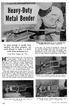 It's large enough to handle most welding job shop projects, yet small enough to make it a worth while home-workshop tool H Craft Print Project No. 272 ERE'S a metal bender that will enable you to bend
TUTORIAL. REbUILdING. REAR CALIpER O-RING CONVERSION CORVETTE 1965-82. Part #: HT-2
 Part #: HT-2 1965-82 CORVETTE O-RING CONVERSION REAR CALIpER REbUILdING TUTORIAL Choosing a Brake Caliper Rebuild Kit Standard Lip Seals vs. O-Ring Seals Lip seal design seals are used on 1965-1982 Corvette
TUTORIAL. REbUILdING. front CALIpER O-RING CONVERSION CORVETTE 1965-82. Part #: HT-1
 Part #: HT-1 1965-82 CORVETTE O-RING CONVERSION front CALIpER REbUILdING TUTORIAL Choosing a Brake Caliper Rebuild Kit Standard Lip Seals vs. O-Ring Seals Lip seal design seals are used on 1965-1982 Corvette
Front brakes (FN- 3), servicing
 j a t Front brakes (FN- 3), servicing 46-1 Front brakes, servicing Note: Install complete repair kit. After replacing brake pads and before moving vehicle, depress brake pedal several times firmly to properly
STANDARD PRACTICE INSTRUCTION
 STANDARD PRACTICE INSTRUCTION DATE: SUBJECT: Crane Safety Program REGULATORY STANDARD: OSHA 29 CFR 1910.179 Overhead and Gantry Cranes OSHA 29 CFR 1926.550 Cranes and Derricks OSHA 29 CFR 1903.1 (The General
Guidelines for the Survey of Offshore Mooring Chain Cable in Use
 (1995) (Rev.1 Oct 2010) Guidelines for the Survey of Offshore Mooring Chain Cable in Use 1. Application and Purpose The information herein is intended to provide guidance to Surveyors for inspection of
OSHA 1910.66 Remove impacted systems and components. Inspect systems prior to use.
 Q: When do I remove my harness from service? A: ANSI (American National Standards Institute) A10.32-2004 states the service life of fall protection equipment manufactured of synthetic fiber shall be 5
JANUS INTERNATIONAL CORPORATION INSTALLATION INSTRUCTIONS Pantheon Mini Operator
 JANUS INTERNATIONAL CORPORATION INSTALLATION INSTRUCTIONS Pantheon Mini Operator The Janus Pantheon mini operator does not typically require the provision of any additional site requirements other than
Oceanscience Cable Chimp II Cableway ROV System User Guide and Warranty
 Oceanscience Cable Chimp II Cableway ROV System User Guide and Warranty Page 1 Table of Contents Introduction Page 3 Overview Page 3 Setup and Operation Page 5 Remote Control Page 6 Power Management Page
Auto-belay Cable Replacement Process
 Auto-belay Cable Replacement Process Version 2.00 WARNING: The air pressure in the auto-belay system is what causes the cable to be retracted when releasing the cable or climbing the wall with the cable
HYDRAULIC TABLE CART 500-LB.
 HYDRAULIC TABLE CART 500-LB. OWNER S MANUAL WARNING: Read carefully and understand all MACHINE ADJUSTMENT AND OPERATION INSTRUCTIONS before operating. Failure to follow the safety rules and other basic
DeZURIK 3-20" BAW AWWA BUTTERFLY VALVES WITH TRANSFER MOLDED SEAT
 3-20" BAW AWWA BUTTERFLY VALVES WITH TRANSFER MOLDED SEAT Instruction D10386 August 2013 Instructions These instructions provide installation, operation and maintenance information for BAW Butterfly Valves.
758 Heavy-duty Ratchet Guy Wire Cutter
 INSTRUCTION MANUAL 758 Heavy-duty Ratchet Guy Wire Cutter Read and understand all of the instructions and safety information in this manual before operating or servicing this tool. Register this product
Guidelines for Securing by Welding of Chain Cable Studs in Service Guidance for Anchoring Equipment in Service
 (July 2003) (Rev.1 July 2014) Guidelines for Securing by Welding of Chain Cable Studs in Service Guidance for Anchoring Equipment in Service 1. General 1.1 This document gives the guidelines for maximum
Super Slider ADJUSTABLE FROM 3.5-12 Model #HD26229
 Super Slider ADJUSTABLE FROM 3.5-12 Model #HD26229 IMPORTANT!!! ALL PERSONS USING THIS EQUIPMENT MUST READ AND UNDERSTAND ALL INSTRUCTIONS. FAILURE TO DO SO MAY RESULT IN SERIOUS INJURY OR DEATH. USERS
This is the civilian transfer case with the cooling loop only found in the driven gear half of the front case.
 INTRODUCTION The Transfer case used in the AMG Hummer is a New Venture Gear, model 242. This case has been in use for the H-1/Hummer since the early 1990 s. There have been modifications to the internal
Fall Protection Susan Harwood Grant Training Program 2013 Fall Arrest. OSHA Susan Harwood Training - AGC
 Fall Protection Susan Harwood Grant Training Program 2013 Fall Arrest Learning Objectives Identify the components of a proper personal fall arrest system (PFAS) Understand how to calculate total fall distance
AXLE SHAFTS - FRONT. 1998 Pontiac Bonneville MODEL IDENTIFICATION DESCRIPTION & OPERATION TROUBLE SHOOTING REMOVAL & INSTALLATION
 AXLE SHAFTS - FRONT 1998 Pontiac Bonneville 1998-99 DRIVE AXLES FWD Axle Shafts - Cars - "C", "G" & "H" Bodies GM Aurora, Bonneville, Eighty Eight, LeSabre, LSS, Park Avenue, Regency, Riviera MODEL IDENTIFICATION
Series 90 Portable Capstan Hoist. Owners Manual ! CAUTION
 Series 90 Portable Capstan Hoist Owners Manual! CAUTION The equipment covered in this document should be installed, used, and serviced only by competent personnel familiar with and following good work
»Product» Safety Warning
 C1200 Installation Instructions 2007-2016 Chevy/GM 1500 2/4wd 2" Strut Spacer Lift Read and understand all instructions and warnings prior to installation of product and operation of vehicle. Zone Offroad
Service Manual Rol-Lift
 R 2000 Service Manual Rol-Lift Series: T and E Developed by Generic Parts Service This manual is intended for basic service and maintenance of the Rol-Lift pallet jack. The pallet jacks you are servicing
Mechanical Installation
 Page -1-1. INTRODUCTION AND PURPOSE 1.1. This specification covers the installation, testing and precommissioning of mechanical equipment. Work is to be performed in conjunction with the manufacturer s
Important: Please read these instructions carefully and completely before starting the installation. TITAN Fuel Tanks
 TITAN pt. no.: 03 0000 0120 Important: Please read these instructions carefully and completely before starting the installation. TITAN Fuel Tanks INSTALLATION INSTRUCTIONS G e n e r a t i o n V Extended
1. Lay out 2 pieces of 7/8" tubing and mark for bending as shown. Remember that the bend is in the shaded area as shown below in Figure 1.
 MINI BIKE PLANS Page 1 INTRODUCTION Before starting to build your Mini-Bike, be sure that you have all the parts shown on the material list. You will note that tubing has been used in the construction.
Micrio WS1 Replacement Wind Speed Sensor and WC1 Replacement Wind Compass Sensor for Raymarine ST50 and ST60 Wind Instruments. Rev 4.
 Micrio WS1 Replacement Wind Speed Sensor and WC1 Replacement Wind Compass Sensor for Raymarine ST50 and ST60 Wind Instruments. Rev 4.1 The Micrio WS1 Wind Speed Sensor and WC1 Compass Sensor are direct
I BEAM TRACK INSTALLATION
 PDQ 0/700 FESTOON SYSTEM INSTALLATION AND MAINTENANCE INSTRUCTIONS INTRODUCTION The PDQ Festoon System was designed to run on one of three sizes of I-beams: S x., S8 x 8. and S x.. System trolleys must
fall arrest. Contact your distributor or Guardian about policies regarding replacement of Guardian components involved in a fall.
 Guardian Fall Protection Kent, WA 800-466-6385 www.guardianfall.com GENERAL SYSTEM SELECTION CRITERIA: Selection of fall protection shall be made by a Competent Person. All fall protection equipment shall
tirfor lifting and pulling machines operating and maintenance instructions
 tirfor lifting and pulling machines operating and maintenance instructions models equipment in accordance with CE directives Tirfor Limited Old Lane, Halfway, Sheffield S9 5GZ. Tel: (0) 28 2266 Fax: (0)
Navico-Northstar 2kW JRC Radar Package, Scanner Cable Removal and Replacement
 Navico-Northstar 2kW JRC Radar Package, Scanner Cable Removal and Replacement This work instruction describes the methods and means for which to remove and reinstall optional scanner cable configurations
(0008854) A981653 REV B. 4125 system setup and deployment quick start guide
 (0008854) A981653 REV B 4125 system setup and deployment quick start guide OPERATION IN AIR Do not operate the system while the tow fish in air for extended periods. The system may be enabled to transmit
Range Road RR Series Semi-Automatic Firewood Processor. Crated Unit Assembly Manual
 Range Road RR Series Semi-Automatic Firewood Processor Crated Unit Assembly Manual 1 1) Undo 8-18mm x 19mm Nuts and bolts, 2 on each leg of top frame 2) Lift top of Metal crate off and move out of work
Section 6 Brake Drum Failure Analysis. Brake Drum Wear Conditions. What is Normal Wear? What is Deep or Excessive Wear? WARNING. Deep, Uniform Wear
 Section Brake Drum 6 Failure Analysis WARNING To prevent serious eye injury, always wear safe eye protection when you perform vehicle maintenance or service. Figure 6.1 ASBESTOS AND NON-ASBESTOS FIBERS
BRAKE DRUM AND ROTOR SERVICE INFORMATION
 SERVICE INFORMATION To achieve maximum drum life and optimum performance, proper brake maintenance and brake balance are essential. Consult your truck or trailer manufacturer s maintenance manual for proper
Do-It-Yourself- Hydraulic Press Make Your Own, by Marshel Rossow
 Do-It-Yourself- Hydraulic Press Make Your Own, by Marshel Rossow This press can be built from readily available metal. Materials and dimensions need not be exactly what is shown here. Much of the material
TYPE E Main Valve Sizes 3 /8 through 12
 SD 3001F PRINTED IN U.S.A. SD 3001F/0707 A B TYPE E MAIN VALVE C D E TYPE E Main Valve Sizes 3 /8 through 12 The Spence Type E Main Valve is of normally closed, single seat design featuring packless construction,
Basic Spring Motor Roller Shades
 Comprehensive Roller Shade Installation Guide Basic Spring Motor Roller Shades ATTENTION!!! READ CAREFULLY! This shade has a reliable long-lasting Spring Motor. The Spring Motor must have proper tension
Fall Protection Guidelines
 OCT 2015 1 of 6 Fall Protection Guidelines 1.0 PURPOSE To establish the requirements and procedures to protect employees and other persons conducting work from hazards associated with falling from one
6 LOADING AND UNLOADING A FLATBED
 6 LOADING AND UNLOADING A FLATBED TRAILER Improper trailer loading causes many accidents and deaths. To safely load a trailer, you must consider: Overall load weight; Load weight distribution; Proper tongue
STEERING HANDLEBAR/FRONT WHEEL/ FRONT SHOCK ABSORBER
 14 14 STEERING HANDLEBAR/FRONT WHEEL/ SCHEMATIC DRAWING ------------------------------------------------- 14-1 SERVICE INFORMATION------------------------------------------------ 14-2 TROUBLESHOOTING-----------------------------------------------------
Manual for GlobePharma Mini-Press II Rotary Tablet Press
 1 of 13 Preparing the Rotary Press 1. Make sure the rotary press is unplugged. 2. Open the bottom cabinet of the rotary press and take out the grey tool kit, and the beige box of punches and dies. 3. Take
Chapter 10 - Scaffolding Systems
 Chapter 10 - Scaffolding Systems Contents Chapter 10 - Scaffolding Systems... 10-1 Check and Oil the Pump Jacks... 10-4 Set Pump Jack Brackets... Error! Bookmark not defined. Set Pump Jack Poles... 10-5