
Civics. Social Studies Curriculum Framework. Revised 2006
|
|
|
- Neal Oliver
- 9 years ago
- Views:
Transcription
1 Civics Social Studies Curriculum Framework Revised 2006
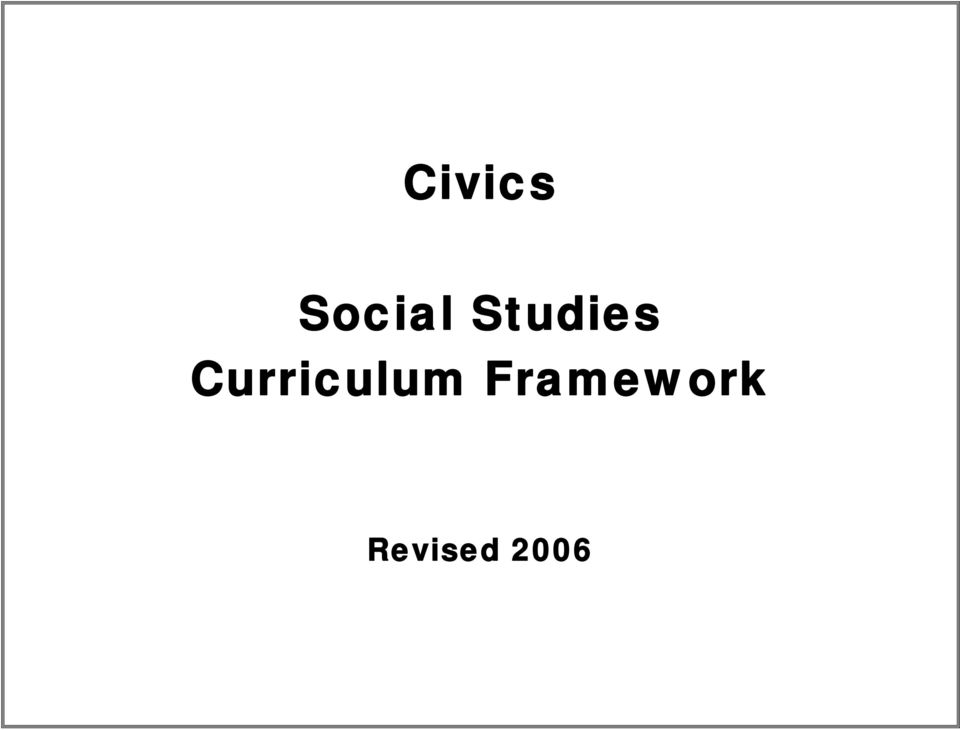
2 Course Title: Civics Course/Unit Credit: 1 Course Number: Teacher Licensure: Secondary Social Studies Civics Civics provides a study of the structure and functions of the United States government, the government of Arkansas, and political institutions. Civics also examines constitutional principles, the concepts of rights and responsibilities, the role of political parties and interest groups, and the importance of civic participation in the democratic process. This course stresses application, problem-solving, higher-order thinking skills, and the use of classroom performance-based/open-ended assessments with rubrics. One year of Civics or Civics/Government is required by the Standards for Accreditation for Smart Core graduates. Strand Standards Citizenship 1. Students shall examine citizenship. 2. Students shall examine the rights, responsibilities, privileges, and duties of citizens. Government 3. Students shall analyze the purposes of government. 4. Students shall compare the different types of government. United States Constitution Structure of Government Laws Political Parties and Elections 5. Students shall explain the importance of historical documents, events, and people that led to the development of the United States Constitution. 6. Students shall analyze the organization and structure of the United States government as defined by the United States Constitution. 7. Students shall analyze the fundamental rights of individuals. 8. Students shall analyze the organization, authority, and function of the federal and state government. 9. Students shall evaluate federal, state, and local laws. 10. Students shall examine Arkansas laws pertaining to students. 11. Students shall analyze the development of political parties. 12. Students shall identify media influence on politics. 13. Students shall evaluate the election process in the federal, state, and local governments. 1 Civics
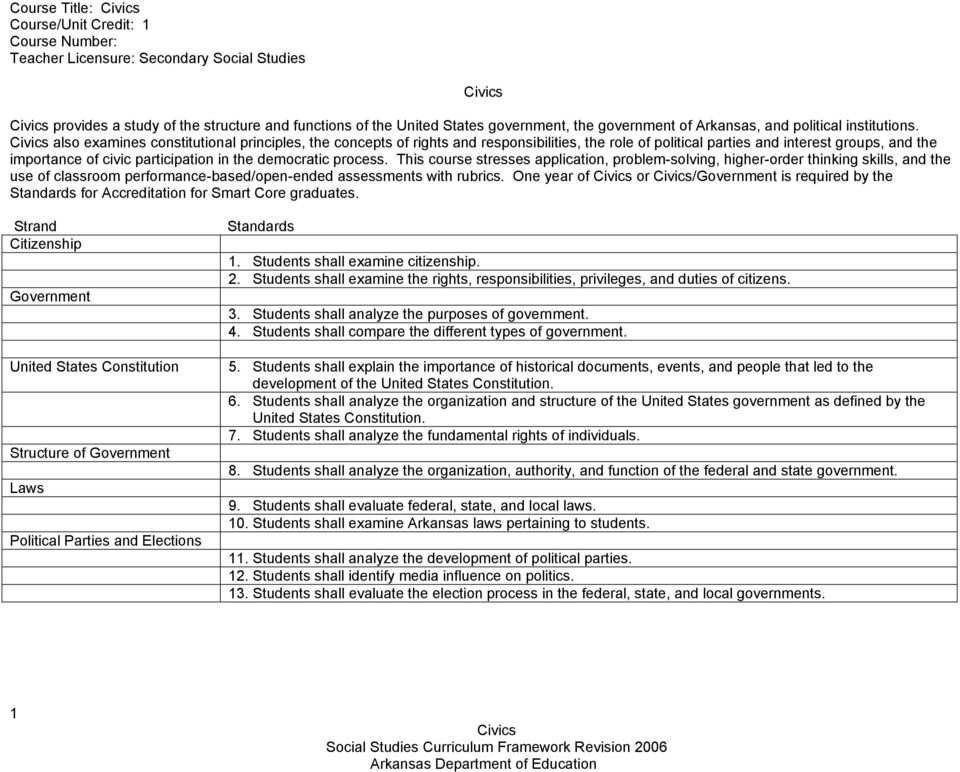
3 Strand: Citizenship Content Standard 1: Students shall examine citizenship. C.1.C.1 C.1.C.2 C.1.C.3 C.1.C.4 C.1.C.5 Discuss the relevance of the study of civics Explain the role of citizenship Explain what constitutes a citizen Discuss the process of becoming a citizen: native born (e.g., jus soli, jus sanguinus) naturalization Explain and apply citizenship concepts to everyday life: equality of all citizens under the law worth and dignity of individuals in a democratic society majority rule/minority rights individual freedoms individual rights versus public interest patriotism volunteerism civil service 2 Civics: Citizenship Key: C.1.C.1 = Citizenship. Standard 1. Civics. 1st Student Learning Expectation

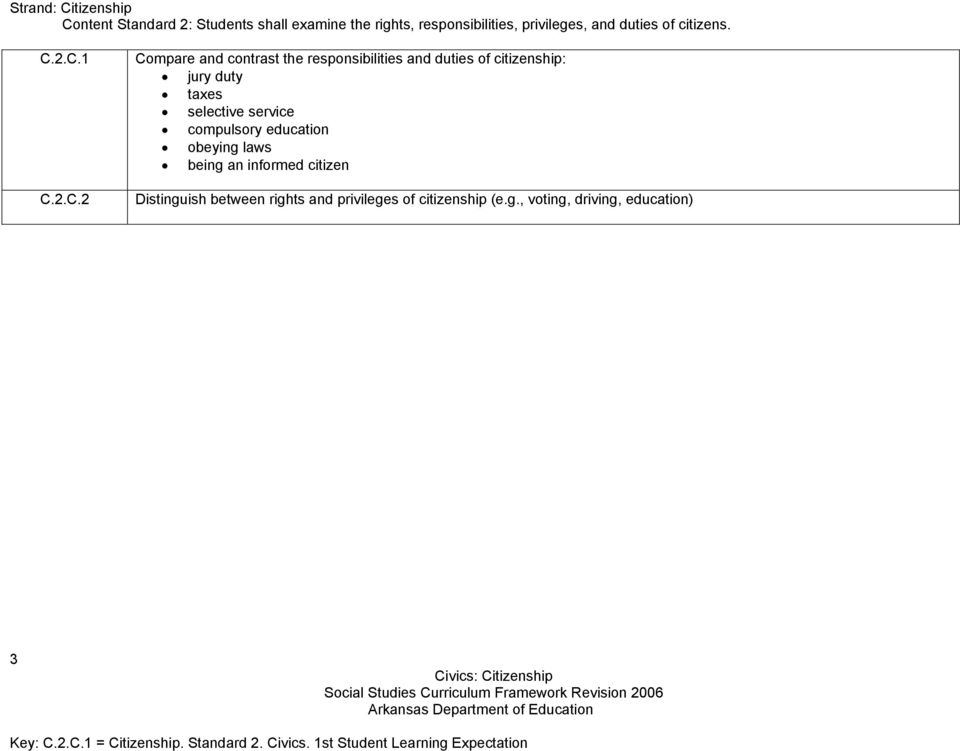
4 Strand: Citizenship Content Standard 2: Students shall examine the rights, responsibilities, privileges, and duties of citizens. C.2.C.1 C.2.C.2 Compare and contrast the responsibilities and duties of citizenship: jury duty taxes selective service compulsory education obeying laws being an informed citizen Distinguish between rights and privileges of citizenship (e.g., voting, driving, education) 3 Civics: Citizenship Key: C.2.C.1 = Citizenship. Standard 2. Civics. 1st Student Learning Expectation
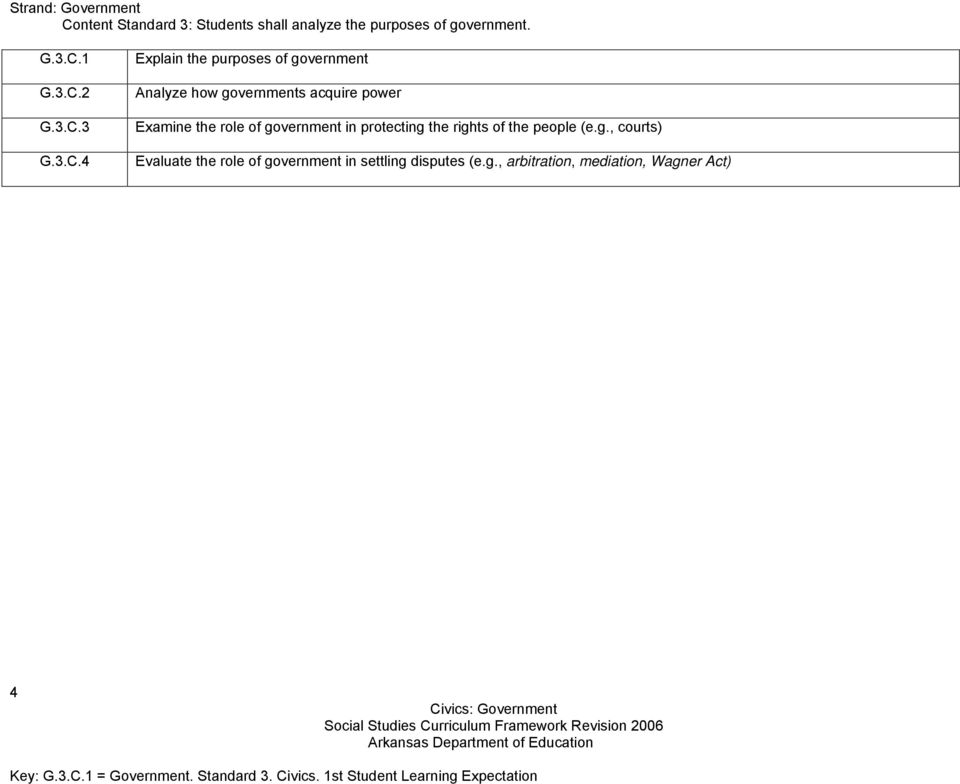
5 Strand: Government Content Standard 3: Students shall analyze the purposes of government. G.3.C.1 G.3.C.2 G.3.C.3 G.3.C.4 Explain the purposes of government Analyze how governments acquire power Examine the role of government in protecting the rights of the people (e.g., courts) Evaluate the role of government in settling disputes (e.g., arbitration, mediation, Wagner Act) 4 Civics: Government Key: G.3.C.1 = Government. Standard 3. Civics. 1st Student Learning Expectation
6 Strand: Government Content Standard 4: Students shall compare the different types of government. G.4.C.1 Compare and contrast the different types of governmental ideology: dictatorship (e.g., totalitarian, military junta, despot) absolute monarchy direct democracy indirect democracy parliamentary democracy 5 Civics: Government Key: G.4.C.1 = Government. Standard 4. Civics. 1st Student Learning Expectation

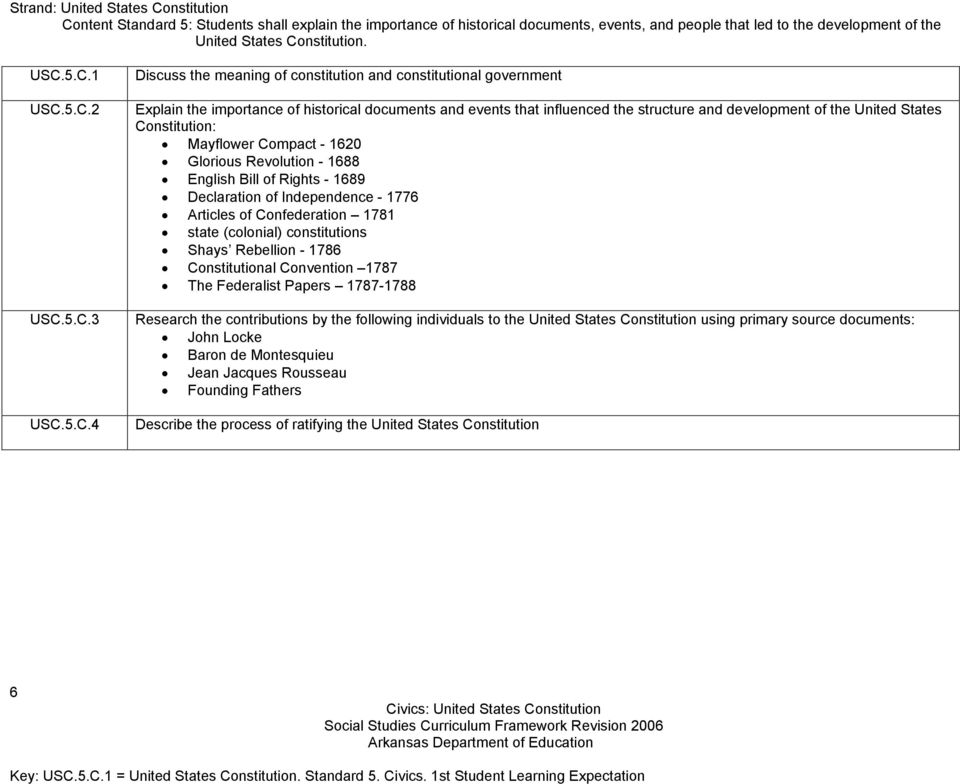
7 Strand: United States Constitution Content Standard 5: Students shall explain the importance of historical documents, events, and people that led to the development of the United States Constitution. USC.5.C.1 USC.5.C.2 USC.5.C.3 USC.5.C.4 Discuss the meaning of constitution and constitutional government Explain the importance of historical documents and events that influenced the structure and development of the United States Constitution: Mayflower Compact Glorious Revolution English Bill of Rights Declaration of Independence Articles of Confederation 1781 state (colonial) constitutions Shays Rebellion Constitutional Convention 1787 The Federalist Papers Research the contributions by the following individuals to the United States Constitution using primary source documents: John Locke Baron de Montesquieu Jean Jacques Rousseau Founding Fathers Describe the process of ratifying the United States Constitution 6 Civics: United States Constitution Key: USC.5.C.1 = United States Constitution. Standard 5. Civics. 1st Student Learning Expectation
8 Strand: United States Constitution Content Standard 6: Students shall analyze the organization and structure of the United States government as defined by the United States Constitution. USC.6.C.1 USC.6.C.2 USC.6.C.3 USC.6.C.4 USC.6.C.5 Describe the reason for the organization of government in the United States Constitution (e.g., commerce, defense, judicial, executive, fiscal) Compare delegated, concurrent, and reserved powers Explain the limitations on the powers of government: Writ of Habeas Corpus Bill of Attainder Ex Post Facto Describe the procedures required to amend the United States Constitution Analyze the consequences of constitutional amendments on citizenship (e.g., voting rights, due process of law, societal changes) 7 Civics: United States Constitution Key: USC.6.C.1 = United States Constitution. Standard 6. Civics. 1st Student Learning Expectation

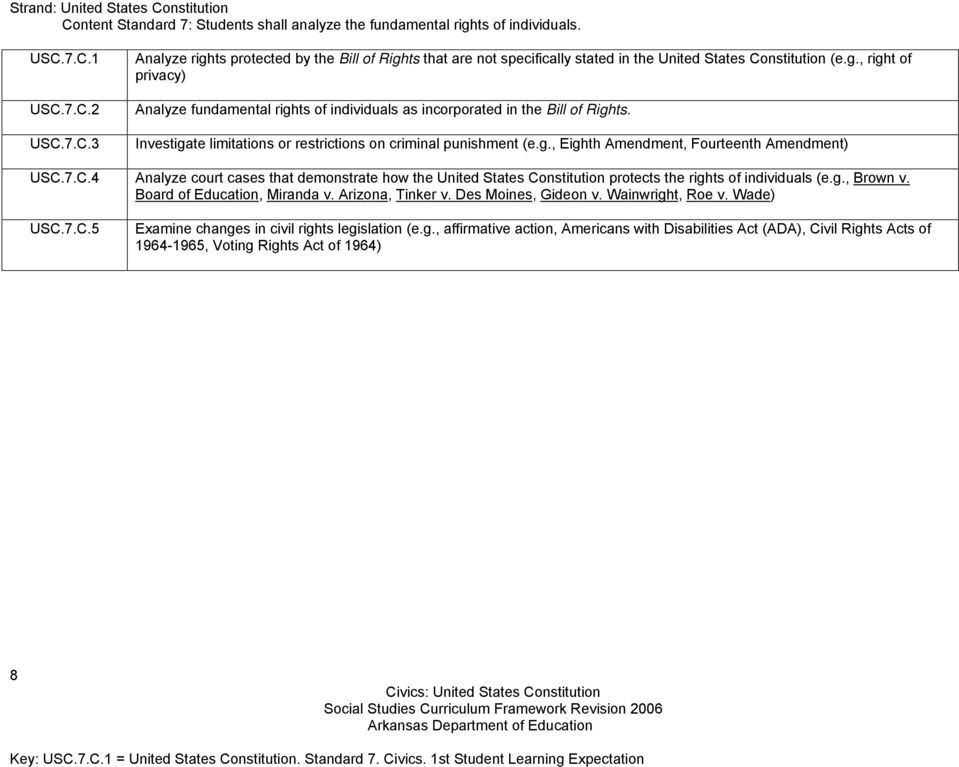
9 Strand: United States Constitution Content Standard 7: Students shall analyze the fundamental rights of individuals. USC.7.C.1 USC.7.C.2 USC.7.C.3 Analyze rights protected by the Bill of Rights that are not specifically stated in the United States Constitution (e.g., right of privacy) Analyze fundamental rights of individuals as incorporated in the Bill of Rights. Investigate limitations or restrictions on criminal punishment (e.g., Eighth Amendment, Fourteenth Amendment) USC.7.C.4 Analyze court cases that demonstrate how the United States Constitution protects the rights of individuals (e.g., Brown v. Board of Education, Miranda v. Arizona, Tinker v. Des Moines, Gideon v. Wainwright, Roe v. Wade) USC.7.C.5 Examine changes in civil rights legislation (e.g., affirmative action, Americans with Disabilities Act (ADA), Civil Rights Acts of , Voting Rights Act of 1964) 8 Civics: United States Constitution Key: USC.7.C.1 = United States Constitution. Standard 7. Civics. 1st Student Learning Expectation
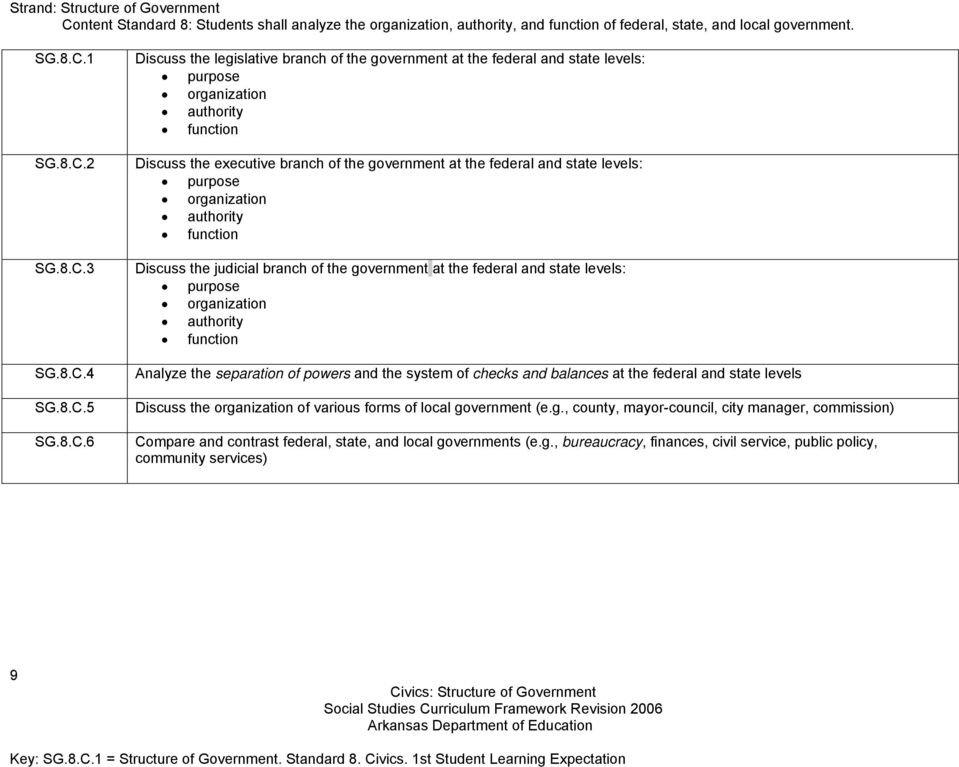
10 Strand: Structure of Government Content Standard 8: Students shall analyze the organization, authority, and function of federal, state, and local government. SG.8.C.1 SG.8.C.2 SG.8.C.3 SG.8.C.4 SG.8.C.5 SG.8.C.6 Discuss the legislative branch of the government at the federal and state levels: purpose organization authority function Discuss the executive branch of the government at the federal and state levels: purpose organization authority function Discuss the judicial branch of the government at the federal and state levels: purpose organization authority function Analyze the separation of powers and the system of checks and balances at the federal and state levels Discuss the organization of various forms of local government (e.g., county, mayor-council, city manager, commission) Compare and contrast federal, state, and local governments (e.g., bureaucracy, finances, civil service, public policy, community services) 9 Civics: Structure of Government Key: SG.8.C.1 = Structure of Government. Standard 8. Civics. 1st Student Learning Expectation
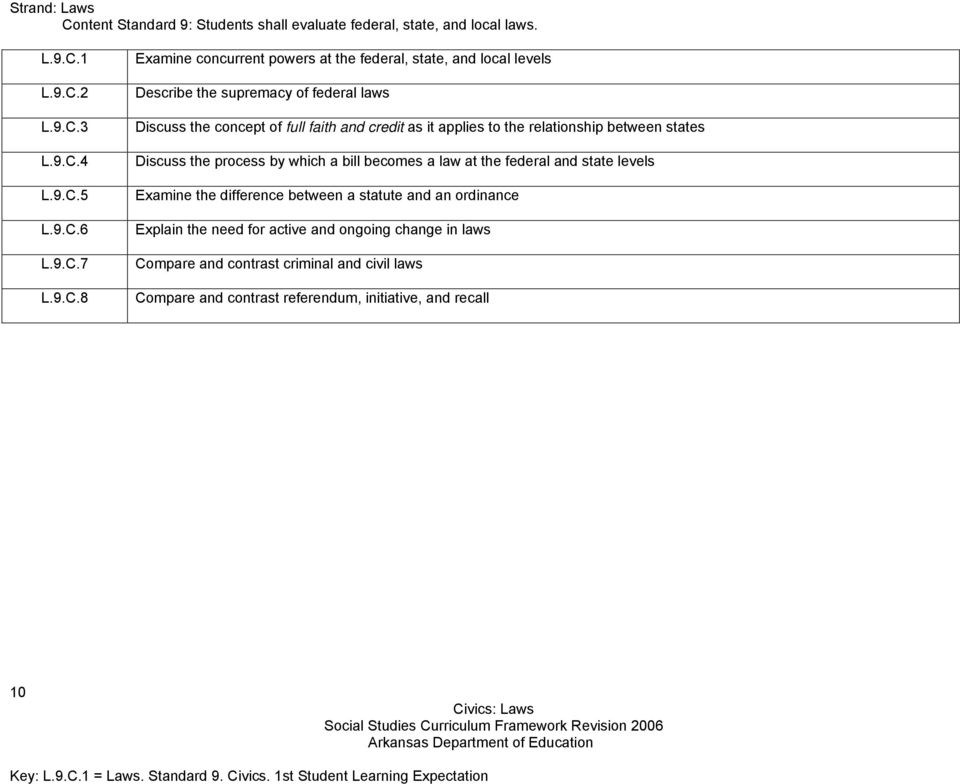
11 Strand: Laws Content Standard 9: Students shall evaluate federal, state, and local laws. L.9.C.1 L.9.C.2 L.9.C.3 L.9.C.4 L.9.C.5 L.9.C.6 L.9.C.7 L.9.C.8 Examine concurrent powers at the federal, state, and local levels Describe the supremacy of federal laws Discuss the concept of full faith and credit as it applies to the relationship between states Discuss the process by which a bill becomes a law at the federal and state levels Examine the difference between a statute and an ordinance Explain the need for active and ongoing change in laws Compare and contrast criminal and civil laws Compare and contrast referendum, initiative, and recall 10 Civics: Laws Key: L.9.C.1 = Laws. Standard 9. Civics. 1st Student Learning Expectation
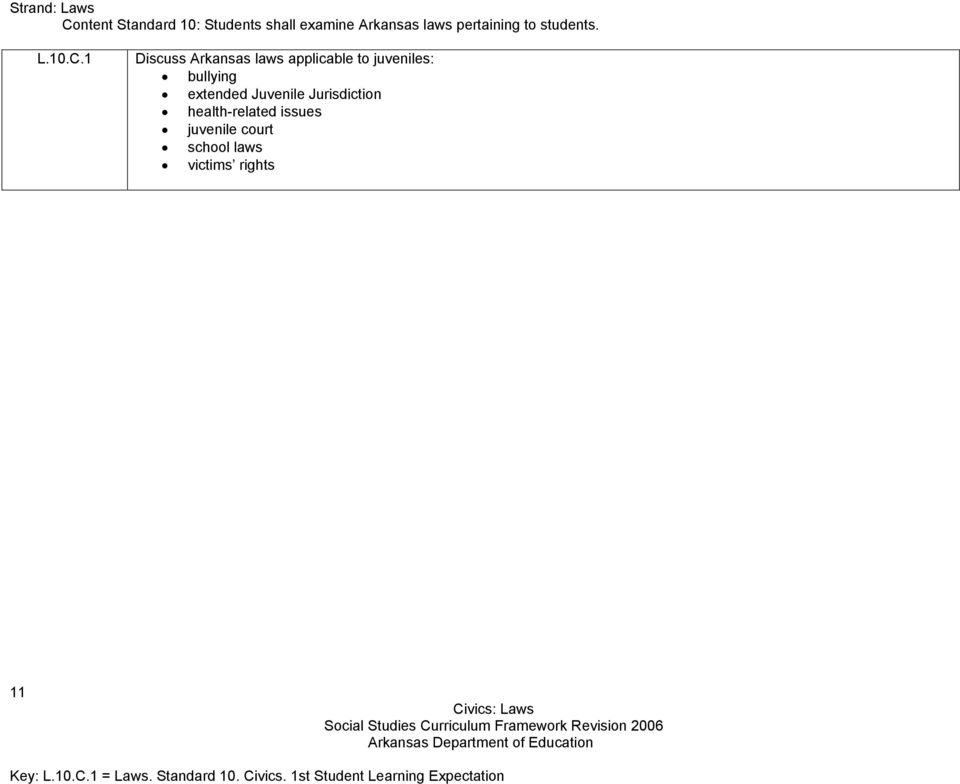
12 Strand: Laws Content Standard 10: Students shall examine Arkansas laws pertaining to students. L.10.C.1 Discuss Arkansas laws applicable to juveniles: bullying extended Juvenile Jurisdiction health-related issues juvenile court school laws victims rights 11 Civics: Laws Key: L.10.C.1 = Laws. Standard 10. Civics. 1st Student Learning Expectation
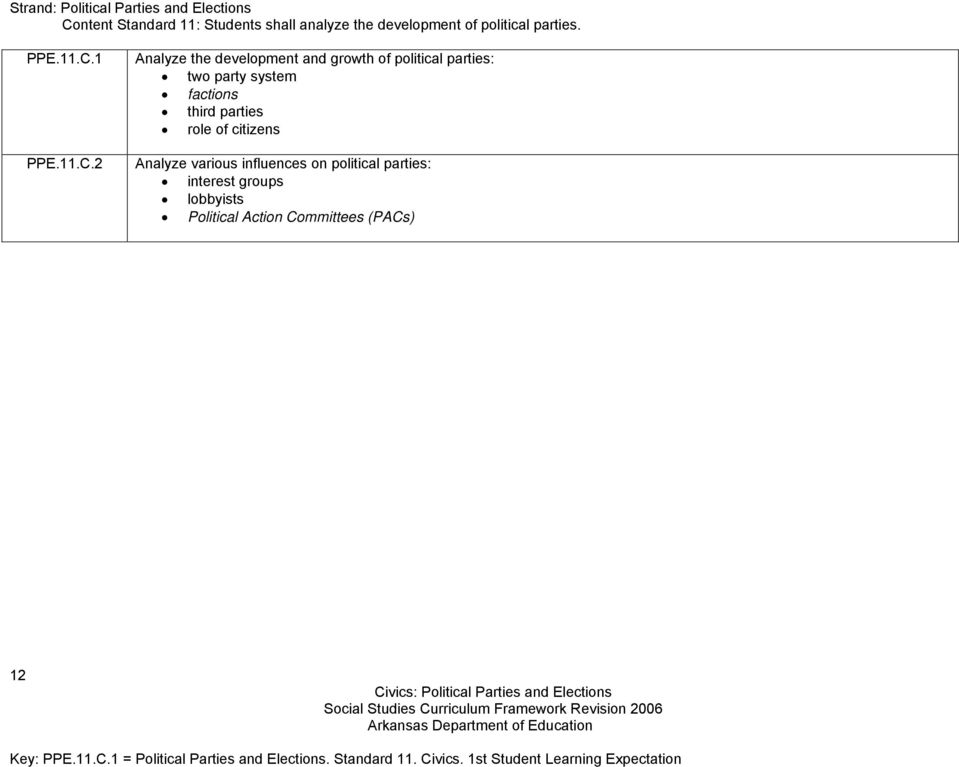
13 Strand: Political Parties and Elections Content Standard 11: Students shall analyze the development of political parties. PPE.11.C.1 PPE.11.C.2 Analyze the development and growth of political parties: two party system factions third parties role of citizens Analyze various influences on political parties: interest groups lobbyists Political Action Committees (PACs) 12 Civics: Political Parties and Elections Key: PPE.11.C.1 = Political Parties and Elections. Standard 11. Civics. 1st Student Learning Expectation
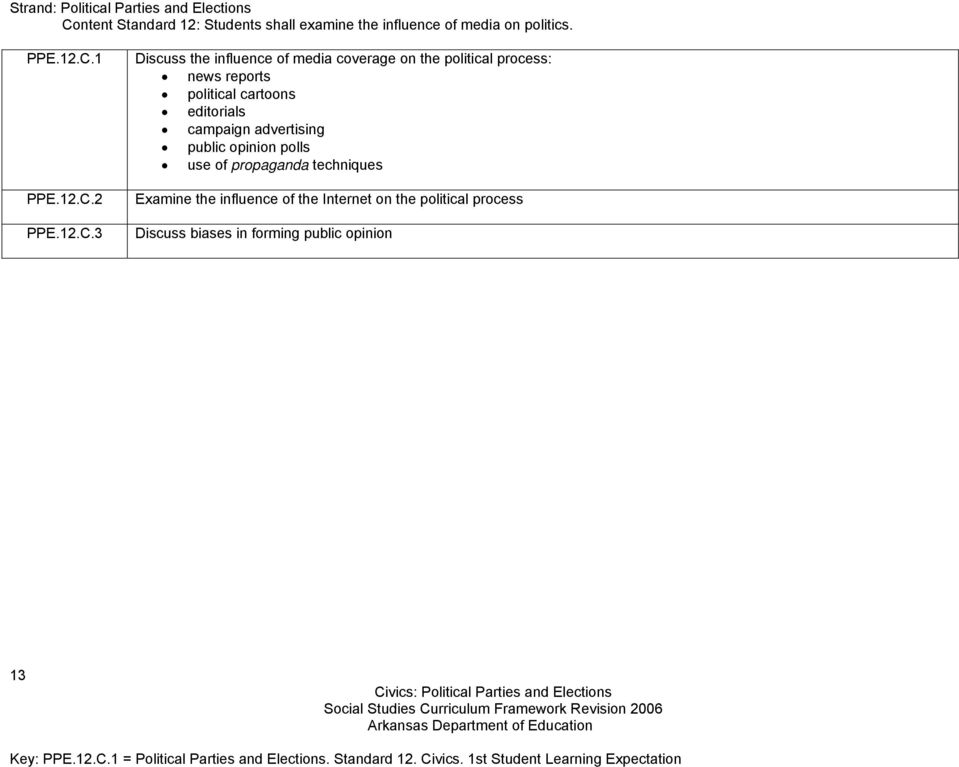
14 Strand: Political Parties and Elections Content Standard 12: Students shall examine the influence of media on politics. PPE.12.C.1 PPE.12.C.2 PPE.12.C.3 Discuss the influence of media coverage on the political process: news reports political cartoons editorials campaign advertising public opinion polls use of propaganda techniques Examine the influence of the Internet on the political process Discuss biases in forming public opinion 13 Civics: Political Parties and Elections Key: PPE.12.C.1 = Political Parties and Elections. Standard 12. Civics. 1st Student Learning Expectation
15 Strand: Political Parties and Elections Content Standard 13: Students shall evaluate the election process in the federal, state, and local governments. PPE.13.C.1 PPE.13.C.2 PPE.13.C.3 Describe the election process in the federal, state, and local governments: campaign finance campaign strategies voter registration factors affecting election turn-out voter interest nominating process (e.g., nominating convention, direct primary, caucus) Discuss the complexities of vote tabulation and certifying elections Explain the role of the electoral college in the election process 14 Civics: Political Parties and Elections Key: PPE.13.C.1 = Political Parties and Elections. Standard 13. Civics. 1st Student Learning Expectation

16 15 Appendix

17 Glossary for Civics Absolute monarchy Monarch has complete authority over government Arbitration Submitting a controversy to an impartial person (the arbitrator) to render a decision, which may or may not be binding Bill of Rights The first ten amendments to the United States Constitution concerning basic individual liberties Bureaucracy A government or other organization with many different departments and complex rules and procedures Caucus Closed meeting of party members to select candidates Checks and balances A system in which each branch of government is able to limit the power of the other branches Civics The study of citizenship and government Direct Democracy A government in which citizens hold the power to rule and make the laws Direct primary Candidates for political office are nominated by voters Due Process Constitutional requirement government may not arbitrarily or unfairly deprive a person of rights or property Ex Post Facto A law which punishes people for an act before the law was passed Extended Juvenile Jurisdiction Arkansas law which allows juveniles to be punished beyond age of 21 Factions Any subgroups within a larger organization Full Faith and Credit Clause-Article IV Recognize validity of other states law Indirect democracy A means of governance by the people through elected representatives Jus sanguinus (Law of blood) Same citizenship as parents Jus soli (Law of Soli) Citizen of nation at birth Mediation An attempt by an impartial third party to help resolve a dispute Military Junta Coup d ẻtat, seizure of an existing government by a small group Political Action Committee- PAC Committee which makes political contributions on behalf of a special interest group Parliamentary democracy A government in which voters elect representatives to a law-making body which chooses a prime minister to head the government Propaganda The manipulation of people s beliefs, values, and behavior by using symbols (such as flags, music, or oratory) and other psychological tools Separation of powers Dividing government powers between the executive, legislative, and judicial branches Tort A private or civil wrong or injury that exists by virtue of society s expectations Totalitarian A governing system in which a ruling elite holds all power and controls all aspects of society Wagner Act Creates National Labor Relations Boards 16 Civics: Glossary

DRAFT SOCIAL STUDIES Georgia Standards of Excellence (GSE) American Government/Civics
 DRAFT SOCIAL STUDIES American Government/Civics American Government/Civics The government course provides students with a background in the philosophy, functions, and structure of the United States government.
1. Knowledge of the principles expressed in documents shaping constitutional democracy in the United States
 Social Studies Grades 9-12 Ohio Missouri United States GOVERNMENT 2006 STANDARDS Principles of Constitutional Democracy 1. Knowledge of the principles expressed in documents shaping constitutional democracy
Government in America People, Politics, and Policy 16th Edition, AP Edition 2014
 A Correlation of 16th Edition, AP Edition 2014 Advanced Placement U.S. Government and Politics AP is a trademark registered and/or owned by the College Board, which was not involved in the production of,
Academic Standards for Civics and Government
 Academic Standards for June 1, 2009 FINAL Elementary Standards Grades 3-8 Pennsylvania Department of Education These standards are offered as a voluntary resource for Pennsylvania s schools and await action
1.2.4 Compare and contrast direct and representative democracy. (See USHG F1.1; F1.2)
 Content Expectation High School Civics Content Expectations I Can statement 1.1 Nature of Civic Life, Politics, and Government Explain the meaning of civic life, politics, and government through the investigation
Standards Map - Basic Comprehensive Program Grade Twelve - History-Social Science Principles of American Democracy
 Pearson Prentice Hall Program Title: Civics: Government and Economics in Action 2007 Components: SE (Student Edition), TE (Teacher's Edition) Grade Level(s): 12 Intended Audience: High School s Map - Basic
Civics & Economics Crosswalk
 This document is designed to help North Carolina educators teach the Common Core and s (Standard Course of Study). NCDPI staff Civics & Economics Crosswalk This crosswalk document compares the 2010 K-12
Addendum: Civics and Economics
 Addendum: Civics and Economics This addendum reflects the alignment of the Civics and Economics Essential Standards to the content enumerated in The Founding Principles Act (SL 2011-273) that was passed
Appendix A: American History: The Founding Principles, Civics and Economics
 Appendix A: American History: The Founding Principles, Civics and Economics This appendix contains additions made to the North Carolina s for Civics and Economics pursuant to the North Carolina General
American Government/Civics
 American Government/Civics The government course provides students with a background in the philosophy, functions, and structure of the United States government. Students examine the philosophical foundations
2010 Alabama Course of Study Social Studies United States Government & Common Core Standards for Literacy in History/Social Studies
 Two Correlations Prentice Hall Magruder s American Government Alabama Edition 2015 To the 2010 Alabama Course of Study Social Studies United States Government & Common Core Standards for Literacy in History/Social
3. To provide a forum for informed political debate and discussion.
 AMERICAN GOVERNMENT AND LAW CURRICULUM DESCRIPTION OF COURSE This course is designed to provide an in-depth look at the American Political System, along with an overview of the American legal system. Students
AP Government Free Response Questions 1988 2006
 AP Government Free Response Questions 1988 2006 1988 The Bureaucracy, Political Parties 1. To what extent does the United States federal bureaucracy stand above politics and administer impartially the
Teacher lecture (background material and lecture outline provided) and class participation activity.
 Courts in the Community Colorado Judicial Branch Office of the State Court Administrator Updated January 2010 Lesson: Objective: Activities: Outcomes: Implications and Impact of Court Decisions Students
CORRELATION FLORIDA DEPARTMENT OF EDUCATION NEXT GENERATIION SUNSHINE STATE STANDARDS
 CORRELATON FLORDA DEPARTENT OF EDUCATON NEXT GENERATON SUNSHNE STATE STANDARDS SUBSSON TTLE: PUBLSHER: GRADE(S): Kindergarten NGSSS STANDARD Benchmark Number BENCHARK DESCRPTON PAGE(S) OR LOCATON(S) WHERE
WorldView Software. Civics. Alabama Correlation Document
 WorldView Software Civics Alabama Correlation Document 76 North Broadway, Suite 2002, Hicksville, NY 11801 516-681-1773 [email protected] Alabama Seventh Grade Civics WorldView Software Civics:
Academic Standards for Civics and Government Pennsylvania Department of Education
 Academic Standards for Civics and Government Pennsylvania Department of Education 22 Pa. Code, Chapter 4, Appendix C (#006-275) Final Form-Annex A July 18, 2002 XIII. TABLE OF CONTENTS Introduction.. XIV.
5. Which normally describes the political party system in the United States? 1. A political party supports this during an election: A.
 1. A political party supports this during an election: A. Public Policy B. Platform C. Compromise D. Third Party 2. Third parties usually impact government by: A. Electing large numbers of politicians
AP United States Government & Politics Syllabus
 AP United States Government & Politics Syllabus Syllabus The AP Government course will be taught as a second semester course with about twenty-four students. Students will enroll during the second semester
Academic Standards for Civics and Government
 Academic Standards for Civics and Government June 1, 2009 FINAL Secondary Standards Pennsylvania Department of Education These standards are offered as a voluntary resource for Pennsylvania s schools and
AP U.S. Government and Politics Syllabus
 AP U.S. Government and Politics Syllabus Course Description: AP Government and Politics is an introduction course designed to provide students with a thorough understanding of the principles of government
CORRELATION SUNSHINE STATE STANDARDS. 1 SE = Student Edition TE = Teacher Edition TR = Teacher Resources TECH = Technology
 CORRELATION SUNSHINE STATE STANDARDS SUBJECT: Social Studies SUBMISSION TITLE: Prentice Hall Civics: Government and Economics In Action 2005 PUBLISHER: Pearson Prentice Hall GRADE: Grade 6-8 M/J Civics/
AP United States Government and Politics Miss Samuel Email: [email protected]
 Course Overview/Description AP United States Government and Politics Miss Samuel Email: [email protected] AP government and Politics is a semester long course that examines the formal and informal
FRQ PACKET. In this packet are all of the FRQs that the College Board has asked during the May AP Government & Politics Exam.
 AP United States Government and Politics FRQ PACKET In this packet are all of the FRQs that the College Board has asked during the May AP Government & Politics Exam. There is also a table of contents on
Forms of Government TEST
 1. Governments can be classified by 3 standards, name the 3 standards. A. Who can participate in the governing process, the geographic distribution of governmental power, and the relationship between the
State of Nature v. Government
 State of Nature v. Government Overview In this lesson, students will discuss what they think life would be like in a state of nature and examine reasons why there is a need for government. They will explore
AP Comparative Government and Politics: Sample Syllabus 4 Syllabus 886984v1
 AP and Politics: Sample Syllabus 4 Syllabus 886984v1 Scoring Components SC1 The course on an introduction to Comparative Politics. SC2 The course in Sovereignty, Authority, and Power. 4, 5 SC3 The course
United States Government Unit 3 Suggested Dates
 Title Political Parties and Voting, Elections, Civics, Media Big Idea/Enduring Understanding Voluntary individual participation is essential for the U.S. constitutional republic to thrive.. Political parties
New Zealand Bill of Rights Act 1990
 Reprint as at 1 July 2013 New Zealand Bill of Rights Act 1990 Public Act 1990 No 109 Date of assent 28 August 1990 Commencement see section 1(2) Contents Page Title 2 1 Short Title and commencement 3 Part
Description: Objectives & Purpose:
 Description: Hosted in the restored 1902 historic House Chamber, Issues in the House of Representatives is our most popular program for school groups. Students will be seated in reproduction 1902 desks
The right to participate in public affairs, voting rights and the right of equal access to public service. (Article 25)
 General Comment No. 25: The right to participate in public affairs, voting rights and the right of equal access to public service (Art. 25) :. 12/07/96. CCPR/C/21/Rev.1/Add.7, General Comment No. 25. (General
Patrimoine canadien. Canadian. Heritage. The. Canadian. Charter of Rights and Freedoms
 Canadian Heritage Patrimoine canadien The Canadian Charter of Rights and Freedoms The Canadian Charter of Rights and Freedoms Whereas Canada is founded upon principles that recognize the supremacy of God
Monarchy. Rule by One Powers are inherited Ex: Queen/King, Emperor Absolute - Constitutional - Confederal. Unitary
 1. Tree Map of Forms of Govt: Democracy Monarchy Oligarchy/Theocracy rule by the people Direct - Representative - Rule by One Powers are inherited Ex: Queen/King, Emperor Absolute - Constitutional - Rule
ADVANCED PLACEMENT UNITED STATES GOVERNMENT AND POLITICS
 ADVANCED PLACEMENT UNITED STATES GOVERNMENT AND POLITICS TEXTBOOK: Government in America: People and Policy. (12 th Edition) Edwards, Wattenberg, and Lineberry SUPPLEMENTAL TEXT: American Government Readings
Full list of mistakes and omissions of the English Version of the Hungarian draft- Constitution
 Full list of mistakes and omissions of the English Version of the Hungarian draft- Constitution This document contains the full list of mistakes and omissions of the draft-constitution English version.
Page 1. 3. What is federalism?
 North arolina Testing Program 1. How did the Stamp ct, the Tea ct, and the Intolerable cts encourage merican colonists to consider revolution against ritish rule? EO ivics and Economics Sample Items 3.
CONSTITUTIONFACTS.COM
 1. The length of term of members of the House of Representatives is: b. 6 years c. 4 years d. 5 years 2. The Constitutional Convention met in: a. New York b. Philadelphia c. Washington, D.C. d. Boston
Hobbes, Locke, Montesquieu, and Rousseau on Government
 CONSTITUTIONAL RIGHTS FOUNDATION Bill of Rights in Action 20:2 Hobbes, Locke, Montesquieu, and Rousseau on Government Starting in the 1600s, European philosophers began debating the question of who should
AP US Government and Politics Course Syllabus 2007
 General Course Description Advanced Placement U.S. Government and Politics will give students an analytical perspective on government and politics in the United States. This course includes both the study
GRADE 7 SOCIAL STUDIES. History
 GRADE 7 SOCIAL STUDIES History Standard 1 Historical Thinking Skills Students use information and concepts to interpret, analyze, and draw conclusions about United States history from 1763 1877. 7.1.1
SUN PRAIRIE AREA SCHOOL DISTRICT COURSE SYLLABUS. Curriculum Area: Social Studies Course Length: Semester
 SUN PRAIRIE AREA SCHOOL DISTRICT COURSE SYLLABUS Course Title: Legal Studies Curriculum Area: Social Studies Course Length: Semester Credit Status: Elective Date submitted: 2/07 District Adopted Texts/Materials/Resources:
State and Local Government
 State and Local Government a. Explain the basic structure of the Georgia state constitution. b. Explain the concepts of separation of powers and checks and balances. c. Describe the rights and responsibilities
1965 Alabama Literacy Test
 1965 Alabama Literacy Test 1. Which of the following is a right guaranteed by the Bill of Rights? Public Education Employment Trial by Jury Voting 2. The federal census of population is taken every five
Pacemaker World Geography and Cultures. correlated to. Florida Sunshine State Standards Social Studies Grades 6-8
 Pacemaker World Geography and Cultures correlated to Florida Sunshine State Standards Social Studies Grades 6-8 Pacemaker World Geography and Cultures Pearson Learning Group correlated to Sunshine State
The Role of Government
 The Role of Government Imagine for a moment living under a government that possessed unlimited and undefined powers, such as Communist China or Nazi Germany. What rights do you have now that you think
APPLICATION QUESTIONNAIRE FOR THE VAWA PILOT PROJECT ON TRIBAL CRIMINAL JURISDICTION
 APPENDIX APPLICATION QUESTIONNAIRE FOR THE VAWA PILOT PROJECT ON TRIBAL CRIMINAL JURISDICTION Instructions Completing this Application Questionnaire is a necessary step for any Indian tribe that wishes
Constitution Study Guide
 Constitution Study Guide of the United States and the State of Illinois Published by the Illinois Community College Board Table of Contents Part One: The Declaration of Independence 1 Declaring Independence
Forming a More Perfect Union
 27 Lesson Two Forming a More Perfect Union Introduction By 1786, it was apparent that the weaknesses inherent in the Articles of Confederation had to be addressed. A Constitutional Convention was convened
Guide for Florida Voters
 Judges rule on the basis of law, not public opinion, and they should be totally indifferent to pressures of the times. Warren E. Burger, chief justice, U.S. Supreme Court, 1969-1986 Guide for Florida Voters
Government/Political Science
 The Praxis Study Companion Government/Political Science 5931 www.ets.org/praxis Welcome to the Praxis Study Companion Welcome to the Praxis Study Companion Prepare to Show What You Know You have been working
Course Syllabus AP Government Syllabus
 Course Syllabus AP Government Syllabus Course Description: AP United States Government and Politics is a one-semester, college level course offered to students who wish to be academically challenged and
AP US Government and Politics! Mr. Trotter - Room 404!
 AP US Government and Politics Mr. Trotter - Room 404 Course Overview: AP US Government and Politics introduces students to key political ideas, institutions, policies, interactions, roles, and behaviors
Texas Essential Knowledge and Skills 3. Interpreting Primary Sources: Vote! Instructions 4
 Introduction Dear Educator, Thank you for choosing Teaching with Primary Sources: Vote! These easy to incorporate activities will inspire inquiry-based learning that will teach your students how to analyze
GRADE 3: WORKING TOGETHER
 GRADE 3: WORKING TOGETHER Considerations for Curriculum Development Third Grade Contextual Theme: Society My community and communities around the world. Assumptions and Goals of Curriculum Development
4. There are three qualifications from becoming a member of the House of Representatives
 Article I Legislative Branch 1. The job of the legislative branch is to Make laws Name Period Federal Constitution Study Guide 2. The legislative branch is divided into two parts or two houses which are
THE ARIZONA EXECUTIVE BRANCH
 THE ARIZONA EXECUTIVE BRANCH The executive branch is made up of six elected offices: the Governor; Secretary of State; Attorney General; State Treasurer; Superintendent of Public Instruction; and State
Signposts of Democracy (adapted from Signposts of Democracy, Streetlaw, Inc.
 Signposts of Democracy (adapted from Signposts of Democracy, Streetlaw, Inc. http://www.streetlaw.org/democlesson.html) Introduction: Freedom House, an international organization that monitors political
Annex 1 Primary sources for international standards
 Annex 1 Primary sources for international standards 1. The United Nations The 1948 Universal Declaration of Human Rights Article 20 1. Everyone has the right to freedom of peaceful assembly and association.
How To Learn To Be A Political Scientist
 Political Science 1 Government of the United States and California ONLINE Section #4183, 4184 & 4185 Fall 2015 Instructor: Eduardo Munoz Office: SOCS 109 Email: [email protected] Office Hours: MW 10-11:15am
The Judiciary Quiz. A) I and IV B) II and III C) I and II D) I, II, and III E) I, II, III, and IV
 The Judiciary Quiz 1) Why did the Framers include life tenure for federal judges? A) To attract candidates for the positions B) To make it more difficult for the president and Congress to agree on good
1. Title: The Organizational Structure and Powers of the Federal Government as Defined in Articles I, II, and III of the U.S. Constitution Grade 5
 Teacher s Name: Employee Number: School: SS.5.C.3.1 Describe the organizational structure (legislative, executive, judicial branches) and powers of the federal government as defined in Articles I, II,
North Carolina Essential Standards Third grade Social Studies
 North Carolina s Third grade Social Studies In third grade, students draw upon knowledge learned in previous grades to develop more sophisticated understandings of how communities may be linked to form
Tennessee State Capitol High School Government Lesson Plans
 Tennessee State Capitol High School Government Lesson Plans 1 For more information on other programs at the museum contact: Public Programs Department (615) 741-0830 (800) 407-4324 or online at: www.tnmuseum.org
Article I: Bosnia and Herzegovina
 CONSTITUTION OF BOSNIA AND HERZEGOVINA PREAMBLE Based on respect for human dignity, liberty, and equality, Dedicated to peace, justice, tolerance, and reconciliation, Convinced that democratic governmental
Philadelphia Board of Ethics Advice of Counsel GC-2011-509
 BOARD OF ETHICS PACKARD BUILDING 1441 Sansom Street 2nd Floor Philadelphia, PA 19102-3026 (215) 686 9450 FAX 686 9453 Evan Meyer General Counsel Philadelphia Board of Ethics Advice of Counsel GC-2011-509
THE LAW ON NATIONAL COUNCILS OF NATIONAL MINORITIES I. GENERAL PROVISIONS. Article 1
 THE LAW ON NATIONAL COUNCILS OF NATIONAL MINORITIES I. GENERAL PROVISIONS Article 1 This law governs the competences of the national minority councils (hereinafter referred to as the national councils)
PROPOSED AMENDMENT TO ADD SECTION 5.1 TO ARTICLE XIII OF THE ILLINOIS CONSTITUTION
 PROPOSED AMENDMENT TO ADD SECTION 5.1 TO ARTICLE XIII OF THE ILLINOIS CONSTITUTION That will be submitted to the voters November 6, 2012. This pamphlet includes the proposed amendment; explanation of the
How to do a City Referendum
 How to do a City Referendum A Guide to Placing a City Referendum on the Ballot PREPARED BY: THE CITY OF SANTA CRUZ CITY CLERK S DIVISION Bren Lehr, City Clerk Administrator / Elections Official 809 Center
Chapter 3: Federalism
 Chapter 3: Federalism 1. The main issue associated with the case of Alfonso Lopez and the Gun Free School Zones Act was (A) Lopez s guilt or innocence. (B) whether it was desirable to prohibit guns in
We, the Student Body, of the University of South Florida, in order to provide effective
 Constitution of the Student Body of the University of South Florida at Tampa We, the Student Body, of the University of South Florida, in order to provide effective student representation before all vested
Constitutional Amendments 1-10 make up what is known as The Bill of Rights. Amendments 11-27 are listed below.
 The Constitution: Amendments 11-27 Constitutional Amendments 1-10 make up what is known as The Bill of Rights. Amendments 11-27 are listed below. AMENDMENT XI Passed by Congress March 4, 1794. Ratified
Florida Senate - 2016 SB 872
 By Senator Bean 1 2 3 4 5 6 7 8 9 10 11 12 13 14 15 16 17 18 19 20 21 22 23 24 25 26 27 28 29 A bill to be entitled An act relating to federal immigration enforcement; providing a short title; creating
THE CONSTITUTION IN PLAIN ENGLISH
 THE CONSTITUTION IN PLAIN ENGLISH The Constitution consists of a preamble, 7 articles, and 27 amendments. The preamble explains why it was written. The seven articles lay out the three branches of government
GENERAL INFORMATION ABOUT RUNNING FOR PUBLIC OFFICE
 GENERAL INFORMATION ABOUT RUNNING FOR PUBLIC OFFICE Please note that the information contained in this document is subject to change without notice in the event of the passage of amendatory legislation.
TAMALPAIS UNION HIGH SCHOOL DISTRICT Larkspur, California COURSE OF STUDY STREET LAW: AN INTRODUCTION TO THE U.S. LEGAL SYSTEM
 TAMALPAIS UNION HIGH SCHOOL DISTRICT Larkspur, California COURSE OF STUDY STREET LAW: AN INTRODUCTION TO THE U.S. LEGAL SYSTEM 1. INTRODUCTION Street Law is a course designed to provide knowledge and problem-solving
Course Syllabus AP US Government and Politics
 Course Syllabus AP US Government and Politics Course Description According to the College Board, AP US Government and Politics is designed to give students an analytical perspective on government and politics
Garfield Public Schools Social Studies Curriculum Criminal Justice
 Garfield Public Schools Social Studies Curriculum Criminal Justice Revision Committee: David Gray Eric Giamongo Giovanni Luciano Meghan DeCarlo Donald Campeau Daniel Rigoglioso Doug Fede George Ibach Emilia
ASSESSMENT DATA BANK
 ASSESSMENT DATA BANK Assessing Constitutional Knowledge Traditionally, states and schools have measured student knowledge of the U.S. Constitution using a written test on objective facts and principles.
CONSTITUTION OF THE REPUBLIC OF SENEGAL Adopted on 7 January 2001
 CONSTITUTION OF THE REPUBLIC OF SENEGAL Adopted on 7 January 2001 The sovereign people of Senegal, PREAMBLE Deeply attached to their fundamental cultural values which constitute the cement of national
POLITICAL BELIEFS AND POLITICAL BEHAVIORS
 POLITICAL BELIEFS AND POLITICAL BEHAVIORS AMERICAN DEMOCRATIC VALUES Although the United States is a diverse society, it is united under a common political culture, or common set of beliefs and attitudes
THE EXECUTIVE AND LEGISLATIVE BRANCHES OF GOVERNMENT
 THE EXECUTIVE AND LEGISLATIVE BRANCHES OF GOVERNMENT The political institutions of the United Kingdom are divided into the legislative, the executive and the judiciary. The last of these will be developed
Revolution and Independence d Life in colonial America Seven Years (French and Indian) War, 1756-6363 British demand for higher taxes to pay war debt
 The Constitution I. Revolution and Independence d II. Articles of Confederation III. Constitutional Convention IV. Constitutional Basics V. Ratification VI. Constitutional Change Revolution and Independence
Luna Community College. Criminal Justice Certificate Curriculum Profile 2012 2015
 Luna Community College Criminal Justice Certificate Curriculum Profile 2012 2015 Content Page Program Goals 2 Approvals 3 Degree / Certificate Requirements 4 Course Descriptions and Outcomes 5-12 Assessment
Crete-Monee Middle School U.S. Constitution Test Study Guide Answers 2010-2011
 Crete-Monee Middle School U.S. Constitution Test Study Guide Answers 2010-2011 1. What is the more common name for the first ten amendments to the constitution? Bill of Rights 2. The introduction to the
I will check my email except during the times listed below due to family obligations:
 AP US Government & Politics Summer Assignment 2015 My email address: [email protected] I will check my email except during the times listed below due to family obligations: June 1-7, June
Texas Government (GOVT 2306) Credit: 3 semester credit hours (3 hours lecture)
 Texas Government (GOVT 2306) Credit: 3 semester credit hours (3 hours lecture) Prerequisite/Co-requisite: TSI complete in the area of reading. Origin and development of the Texas constitution, structure
GOVT 2305 American National Government: Federal Constitution & Topics
 Instructor s Contact Information: Professor: Cooper Campus:NE Room: 214 Phone: 713.598.7396 Email: [email protected] Office Hours: Available GOVT 2305 American National Government: Federal Constitution
The Circuit Court. Judges and Clerks. Jurisdiction
 The Circuit Court The circuit court is the trial court of general jurisdiction in Virginia, and the court has authority to try a full range of both civil and criminal cases. Civil cases involve disputes
DAPTO HIGH SCHOOL. YEAR 11 LEGAL STUDIES Preliminary Mid-Course Examination 2009
 DAPTO HIGH SCHOOL YEAR 11 LEGAL STUDIES Preliminary Mid-Course Examination 2009 General Instructions: Reading time 5 minutes Working time 1 ½ hours Write using blue or black pen Write your Student Number/Name
CORE 573. Community Rehabilitation and Disability Studies. Disability and the Law. Calendar Description. Content/Objectives. Outcomes/Competencies
 Community Rehabilitation and Disability Studies CORE 573 Half (3-0) Disability and the Law Calendar Description Foundations of Canadian legal principles and practice as they affect community rehabilitation.
The Important of a Good Constitution and Bylaws By David C. Gibbs Jr., Attorney
 The Important of a Good Constitution and Bylaws By David C. Gibbs Jr., Attorney Every church needs to have a document that sets forth how the organization will operate. Most frequently, this document is
Criminal Justice Curriculum Maps. Unit 1: Introduction to Government and Law Unit 2: Crime Unit 3: Due Process
 Criminal Justice Curriculum Maps Unit 1: Introduction to Government and Law Unit 2: Crime Unit 3: Due Process Grade: 11 and 12 Subject: Criminal Justice Big Idea/Rationale Unit 1: Introduction to Government
Chapter 1. Framework and Function of County Government. Grimes County Courthouse
 Chapter 1 Framework and Function of County Government Grimes County Courthouse Chapter One: Framework and Function of County Government Developmental Assets: Life Skills: TEKS: Objectives: 7. Community