
ASSESSMENT DATA BANK
|
|
|
- Rodger Wiggins
- 9 years ago
- Views:
Transcription
1 ASSESSMENT DATA BANK Assessing Constitutional Knowledge Traditionally, states and schools have measured student knowledge of the U.S. Constitution using a written test on objective facts and principles. These assessments sometimes referred to as objective tests remain an efficient way to gather basic data about student acquisition of knowledge. This form of testing is less effective, however, at measuring students ability to apply knowledge to different circumstances and in different situations. Some students have difficulty with objective tests. Even after students pass the test, teachers may wonder how much they really know about the Constitution and the government that is based on it and whether students knowledge has life. Teachers who have experienced any or all of these situations may find it more informative and fair to use alternative or authentic assessments that are more closely linked to real world experiences. Because the tasks are varied, students with different strengths have the opportunity to succeed. To help teachers measure both student understanding and student application of knowledge, The More Perfect Union Assessment Data Bank features both traditional and alternative assessment instruments. Constitution Test The written Constitution test includes some multiple-choice, short answer, and matching items. These questions have been written with the goal that they require not only student recall but also student understanding of information. In addition, because more insights about the depth of student understanding and growth in critical thinking can be gained through essay items, we have included several essay items. Teachers can pick and choose from among the test items or use them all as desired. An answer key is provided for the objective items, along with scoring checklists for the essay questions. Alternative Assessment Instruments The instructional methods in A More Perfect Union make effective assessment tools. Featured in the Assessment Data Bank are three assessment tasks using instructional methods from the curriculum: 1. Each one/teach one on founding documents and principles. Each student creates a set of cards reflecting what they believe are the most important ideas or facts about a particular topic. On each card, students write one sentence explaining the idea/fact and one sentence explaining why it is important, giving a historic or contemporary example. 2. Constructing a graphic organizer on the branches of government. Each student creates a graphic organizer that shows the powers of the branches of government, the ways in which the branches check each other, and the importance of separation of powers.
2 3. Public service announcements on rights and participation. Students create a series of public service announcements or ads on rights of U.S. citizens. In creating the public service announcements, students must identify important ideas and explain their importance to others, using contemporary examples. For each of these assessments, we provide a scoring guide. Citizen Portfolio and Report Card A portfolio a collection of student work selected carefully to illustrate that the student has attained a specified set of outcomes can be a valuable assessment tool. By requiring students to reflect on what they have learned, portfolios help students recognize their own growth over time and take ownership of their learning. A portfolio project focused on the goals covered in A More Perfect Union is provided. The project could easily be adapted to suit the particular goals of an individual teacher s course or to specifically address state or district standards. Extended-Response Items Many educators are placing a great deal of emphasis on preparing students to be successful with extended-responses items. While such items primarily assess reading and writing skills, we have developed a series of extended-response items in which the reading is related to civic learning and the questions require students to use their civic knowledge and thinking skills in developing answers. A rubric based on Illinois s Grade 8 scoring rubric for extended-response items is provided for each of the extended-response items.
3 CONSTITUTION TEST Pick the one best answer for each question, The Preamble to the Constitution a. Explains the purpose and functions of government. b. Gives the reasons for becoming independent from Britain. c. Is used in deciding many Supreme Court cases. d. Was written by Thomas Jefferson. 2. Federalism is a. The separation of powers between the three branches of government legislative, executive, and judicial. b. The role of the executive branch in working with other countries. c. The division of power between the national government and smaller units of government, such as the states. d. The belief that the national government should be a direct democracy, in which the citizens vote on all issues. 3. The purpose of congressional hearings on proposed laws or big issues facing our nation is a. To speed up the process of enacting new legislation. b. To hear the views of citizens on important issues. c. To meet constitutional requirements set out in Article I. d. To prevent states from acting on these issues. 4. The Framers of the Constitution believed the legislative branch would be the most powerful. What actions did they take to limit that power? a. They created two houses of Congress with members selected in different ways and serving different terms. b. They gave the president the power to veto bills passed by Congress. c. They gave the two houses of Congress somewhat different powers. d. All of the above. 5. Which power does the president NOT have? a. To declare war when our country is attacked. b. To carry out the laws of the United States. c. To entry treaties with other countries, with the advise and consent of the Senate. d. To recommend legislation he/she thinks is important.
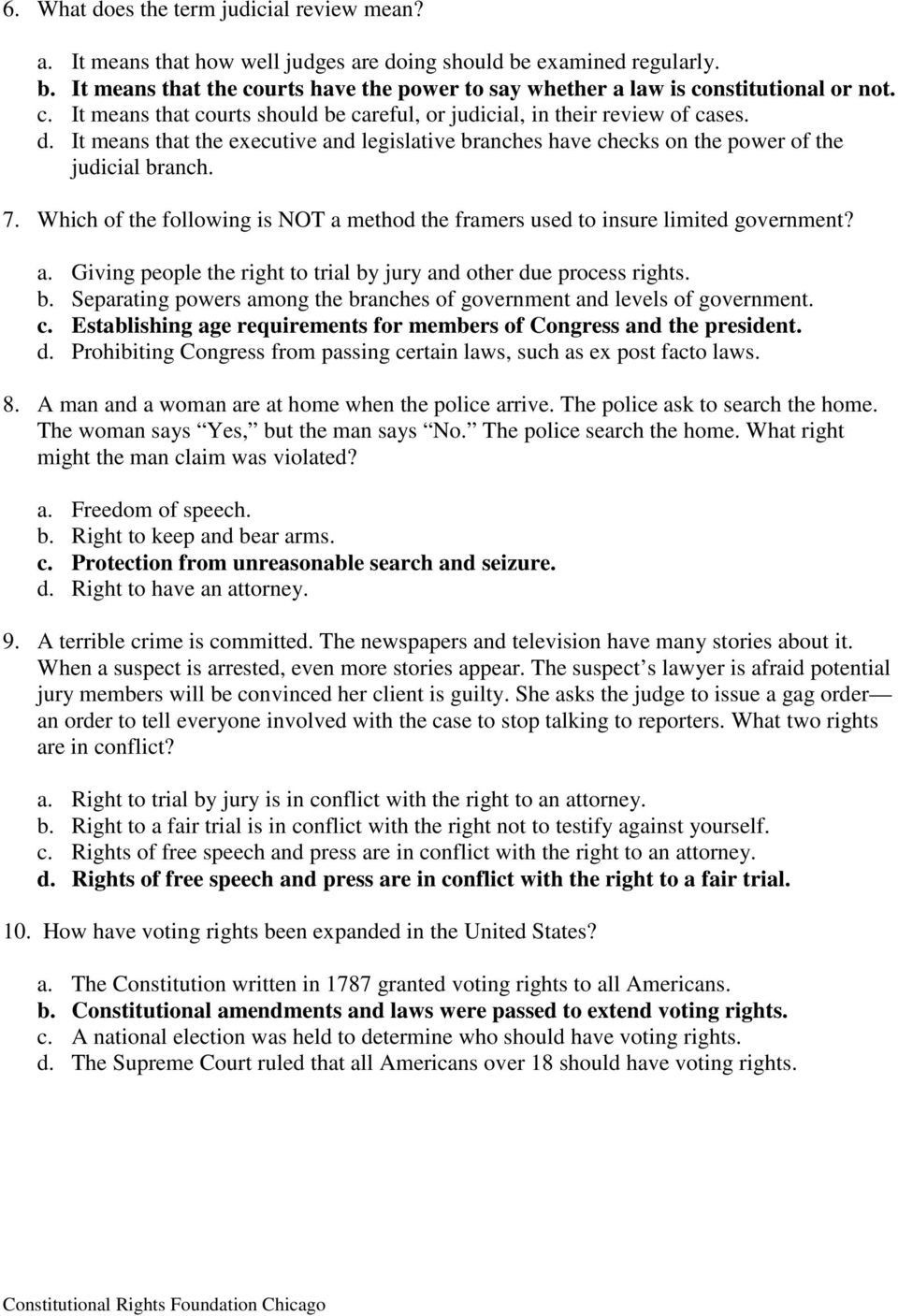
4 6. What does the term judicial review mean? a. It means that how well judges are doing should be examined regularly. b. It means that the courts have the power to say whether a law is constitutional or not. c. It means that courts should be careful, or judicial, in their review of cases. d. It means that the executive and legislative branches have checks on the power of the judicial branch. 7. Which of the following is NOT a method the framers used to insure limited government? a. Giving people the right to trial by jury and other due process rights. b. Separating powers among the branches of government and levels of government. c. Establishing age requirements for members of Congress and the president. d. Prohibiting Congress from passing certain laws, such as ex post facto laws. 8. A man and a woman are at home when the police arrive. The police ask to search the home. The woman says Yes, but the man says No. The police search the home. What right might the man claim was violated? a. Freedom of speech. b. Right to keep and bear arms. c. Protection from unreasonable search and seizure. d. Right to have an attorney. 9. A terrible crime is committed. The newspapers and television have many stories about it. When a suspect is arrested, even more stories appear. The suspect s lawyer is afraid potential jury members will be convinced her client is guilty. She asks the judge to issue a gag order an order to tell everyone involved with the case to stop talking to reporters. What two rights are in conflict? a. Right to trial by jury is in conflict with the right to an attorney. b. Right to a fair trial is in conflict with the right not to testify against yourself. c. Rights of free speech and press are in conflict with the right to an attorney. d. Rights of free speech and press are in conflict with the right to a fair trial. 10. How have voting rights been expanded in the United States? a. The Constitution written in 1787 granted voting rights to all Americans. b. Constitutional amendments and laws were passed to extend voting rights. c. A national election was held to determine who should have voting rights. d. The Supreme Court ruled that all Americans over 18 should have voting rights.
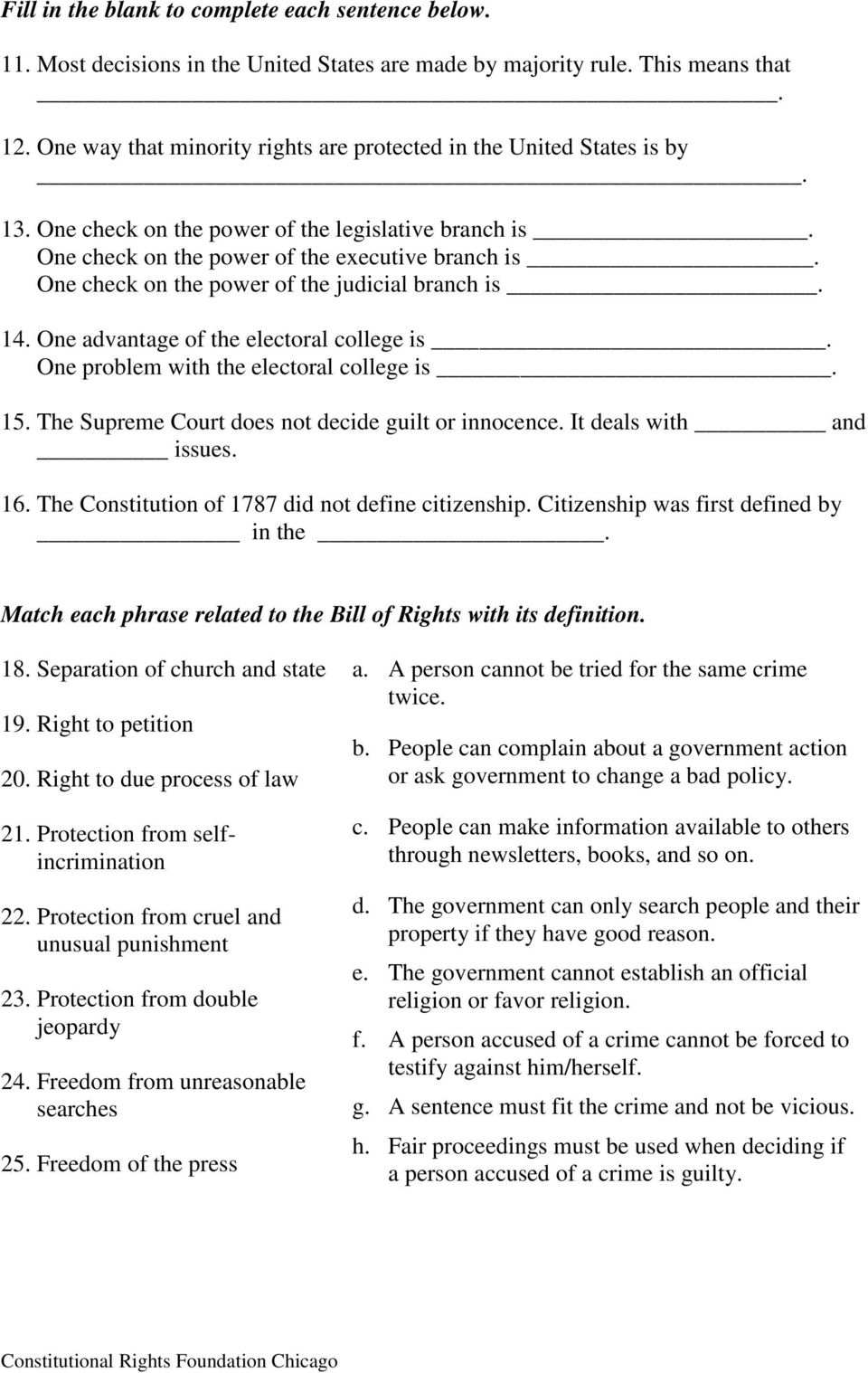
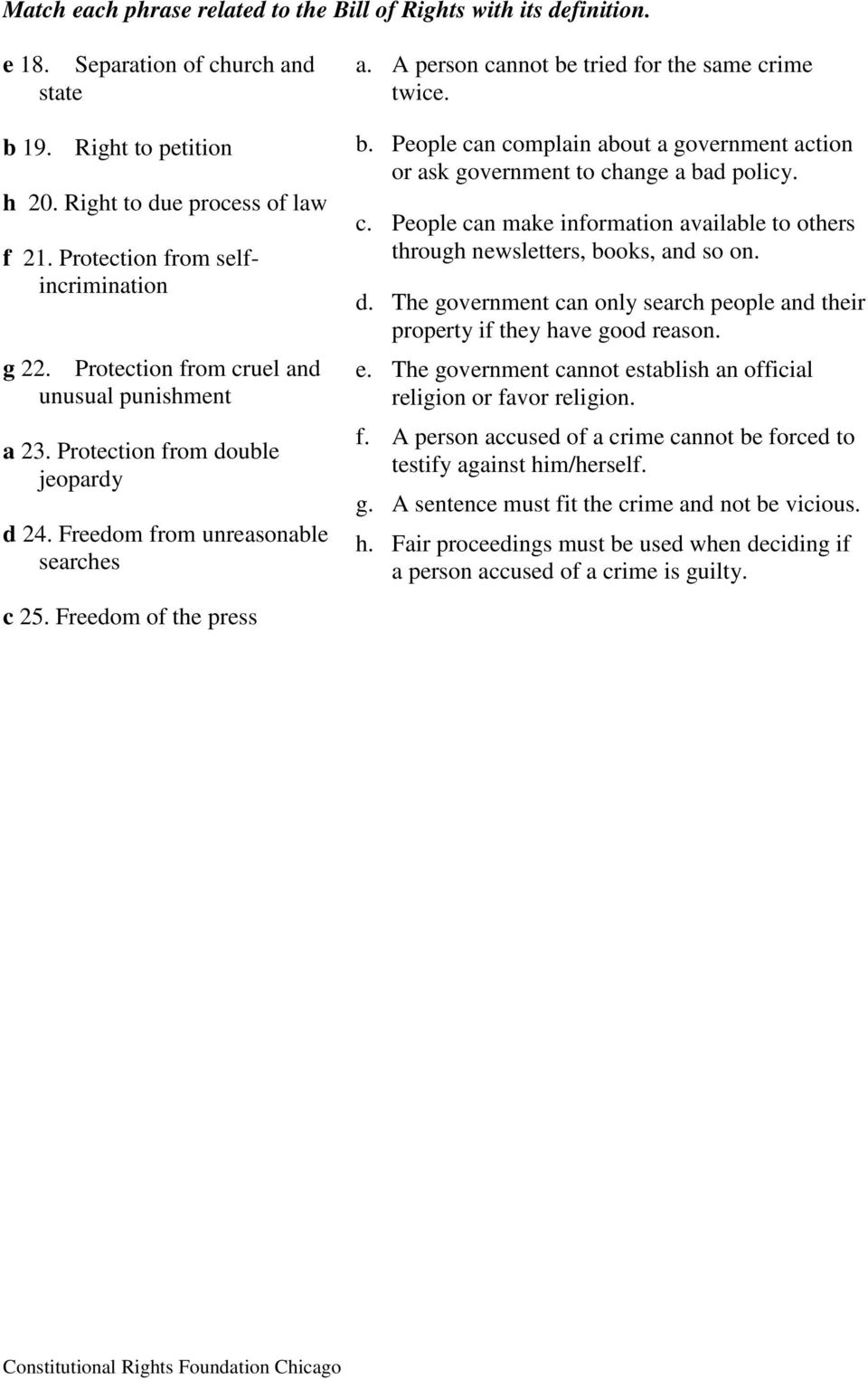
5 Fill in the blank to complete each sentence below. 11. Most decisions in the United States are made by majority rule. This means that. 12. One way that minority rights are protected in the United States is by. 13. One check on the power of the legislative branch is. One check on the power of the executive branch is. One check on the power of the judicial branch is. 14. One advantage of the electoral college is. One problem with the electoral college is. 15. The Supreme Court does not decide guilt or innocence. It deals with and issues. 16. The Constitution of 1787 did not define citizenship. Citizenship was first defined by in the. Match each phrase related to the Bill of Rights with its definition. 18. Separation of church and state 19. Right to petition 20. Right to due process of law 21. Protection from selfincrimination 22. Protection from cruel and unusual punishment 23. Protection from double jeopardy 24. Freedom from unreasonable searches 25. Freedom of the press a. A person cannot be tried for the same crime twice. b. People can complain about a government action or ask government to change a bad policy. c. People can make information available to others through newsletters, books, and so on. d. The government can only search people and their property if they have good reason. e. The government cannot establish an official religion or favor religion. f. A person accused of a crime cannot be forced to testify against him/herself. g. A sentence must fit the crime and not be vicious. h. Fair proceedings must be used when deciding if a person accused of a crime is guilty.
6 26. Read this excerpt from the Declaration of Independence: We hold these Truths to be self-evident, that all Men are created equal, that they are endowed by their Creator with certain unalienable Rights, that among these are Life, Liberty, and the Pursuit of Happiness That to secure these Rights, Governments are instituted among Men, deriving their just Powers from the Consent of the Governed... Choose one idea about government from this excerpt. How did the Framers address this idea in the Constitution? Why is this idea important? Choose a historic or current example to illustrate your argument about the importance of the idea you selected. Scoring Checklist Accurately identifies one idea about government in the excerpt from the Declaration of Independence. (2 points) Describes how that idea is put into practice in the Constitution. (2 points) Explains why the idea is important to our democracy. (2 points) Effectively uses a historic or current example to illustrate the importance of the idea. (2 points) Uses correct grammar, spelling, and punctuation in a well-organized answer that is easy to understand. (2 points) 27. Select a controversial issue you have studied in class. Some examples might be a flagburning amendment, the electoral college, immigration and citizenship, students free speech rights, or how to protect minority rights. Write a paragraph describing your position on the issue. Use your knowledge of how the legislative branch works to plan a strategy for influencing Congress. List the steps in your strategy. Write a letter or a speech that would be used as part of your strategy to advance your position on the issue. Scoring Checklist Clearly identifies a controversial issue. (2 points) Shows knowledge of how the legislative branch obtains input from citizens in writing laws about current issues. (2 points) Takes a position on the issue that reflects understanding of the issue and the arguments on both sides. (2 points) Effectively presents arguments for his/her position on the issue. (2 points) Uses correct grammar, spelling, and punctuation in a well-organized speech or letter that is easy to understand. (2 points)

7 28. Do you think the President is too powerful or not powerful enough? Use your knowledge of the Constitution to answer that question. Cite one historic and one current example to support your argument. Scoring Checklist Cites powers of the presidency listed in the Constitution. (2 points) Takes a position on whether the President is too powerful or not powerful enough. (2 points) Gives a historic example related to the power of the presidency. (2 points) Gives a current example related to the power of the presidency. (2 points) Uses correct grammar, spelling, and punctuation in a response that is easy to understand. (2 points) 29. Imagine that you have been arrested and accused of a crime. You are innocent. Explain how at least three rights guaranteed by the Bill of Rights would be important to you in ensuring that you would experience due process. Scoring Checklist Correctly identifies three rights of the accused guaranteed by the Bill of Rights. (3 points) Demonstrates understanding of the term due process. (2 points) Explains why each of the three rights identified is important to an innocent person accused of a crime. (3 points) Uses correct grammar, spelling, and punctuation in a response that is easy to understand.

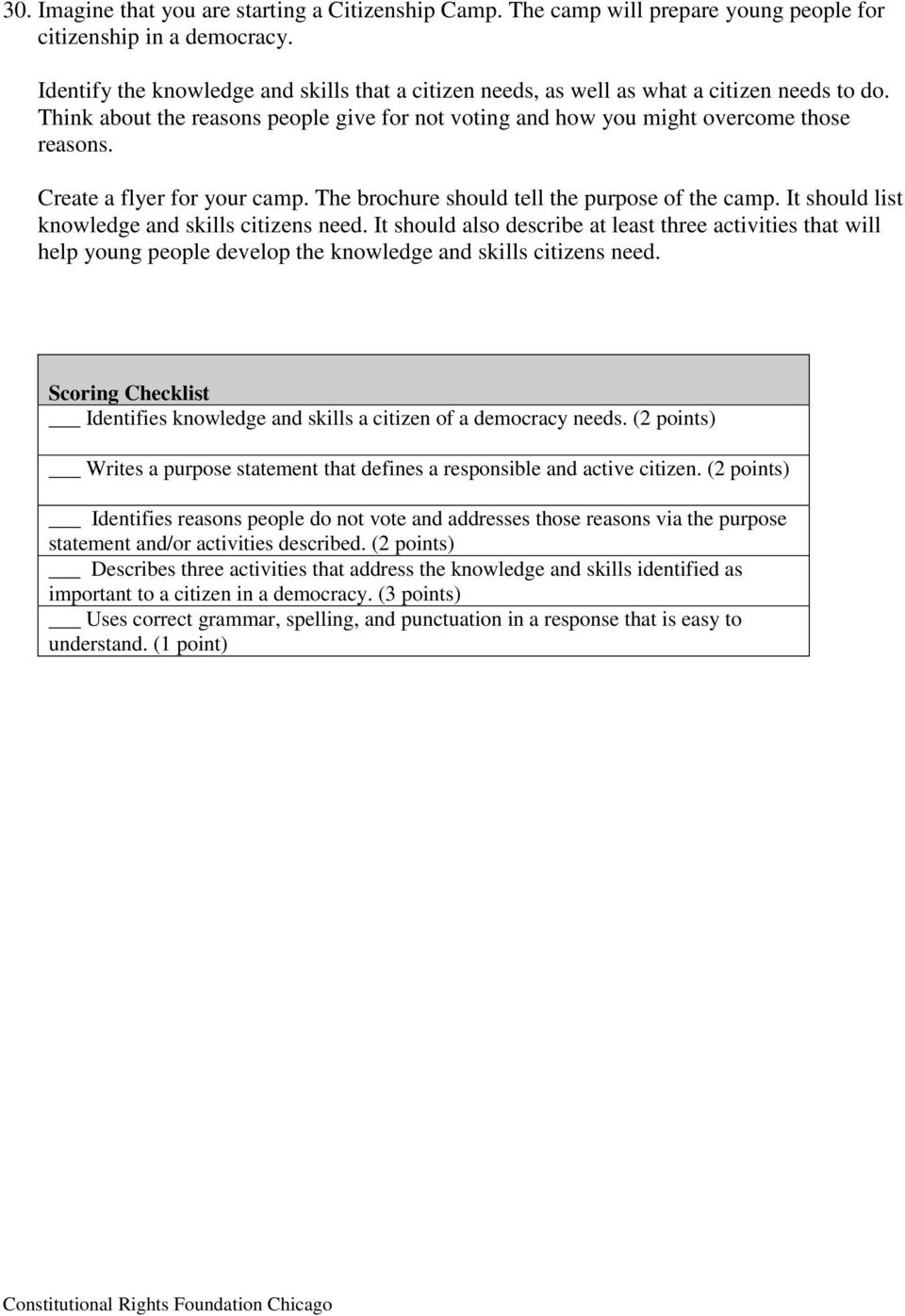
8 30. Imagine that you are starting a Citizenship Camp. The camp will prepare young people for citizenship in a democracy. Identify the knowledge and skills that a citizen needs, as well as what a citizen needs to do. Think about the reasons people give for not voting and how you might overcome those reasons. Create a flyer for your camp. The brochure should tell the purpose of the camp. It should list knowledge and skills citizens need. It should also describe at least three activities that will help young people develop the knowledge and skills citizens need. Scoring Checklist Identifies knowledge and skills a citizen of a democracy needs. (2 points) Writes a purpose statement that defines a responsible and active citizen. (2 points) Identifies reasons people do not vote and addresses those reasons via the purpose statement and/or activities described. (2 points) Describes three activities that address the knowledge and skills identified as important to a citizen in a democracy. (3 points) Uses correct grammar, spelling, and punctuation in a response that is easy to understand. (1 point)
9 CONSTITUTION TEST: ANSWER KEY Pick the one best answer for each question, The Preamble to the Constitution a. Explains the purpose and functions of government. b. Gives the reasons for becoming independent from Britain. c. Is used in deciding many Supreme Court cases. d. Was written by Thomas Jefferson. 2. Federalism is a. The separation of powers between the three branches of government legislative, executive, and judicial. b. The role of the executive branch in working with other countries. c. The division of power between the national government and smaller units of government, such as the states. d. The belief that the national government should be a direct democracy, in which the citizens vote on all issues. 3. The purpose of congressional hearings on proposed laws or big issues facing our nation is a. To speed up the process of enacting new legislation. b. To hear the views of citizens on important issues. c. To meet constitutional requirements set out in Article I. d. To prevent states from acting on these issues. 4. The Framers of the Constitution believed the legislative branch would be the most powerful. What actions did they take to limit that power? a. They created two houses of Congress with members selected in different ways and serving different terms. b. They gave the president the power to veto bills passed by Congress. c. They gave the two houses of Congress somewhat different powers. d. All of the above. 5. Which power does the president NOT have? a. To declare war when our country is attacked. b. To carry out the laws of the United States. c. To entry treaties with other countries, with the advise and consent of the Senate. d. To recommend legislation he/she thinks is important.

10 6. What does the term judicial review mean? a. It means that how well judges are doing should be examined regularly. b. It means that the courts have the power to say whether a law is constitutional or not. c. It means that courts should be careful, or judicial, in their review of cases. d. It means that the executive and legislative branches have checks on the power of the judicial branch. 7. Which of the following is NOT a method the framers used to insure limited government? a. Giving people the right to trial by jury and other due process rights. b. Separating powers among the branches of government and levels of government. c. Establishing age requirements for members of Congress and the president. d. Prohibiting Congress from passing certain laws, such as ex post facto laws. 8. A man and a woman are at home when the police arrive. The police ask to search the home. The woman says Yes, but the man says No. The police search the home. What right might the man claim was violated? a. Freedom of speech. b. Right to keep and bear arms. c. Protection from unreasonable search and seizure. d. Right to have an attorney. 9. A terrible crime is committed. The newspapers and television have many stories about it. When a suspect is arrested, even more stories appear. The suspect s lawyer is afraid potential jury members will be convinced her client is guilty. She asks the judge to issue a gag order an order to tell everyone involved with the case to stop talking to reporters. What two rights are in conflict? a. Right to trial by jury is in conflict with the right to an attorney. b. Right to a fair trial is in conflict with the right not to testify against yourself. c. Rights of free speech and press are in conflict with the right to an attorney. d. Rights of free speech and press are in conflict with the right to a fair trial. 10. How have voting rights been expanded in the United States? a. The Constitution written in 1787 granted voting rights to all Americans. b. Constitutional amendments and laws were passed to extend voting rights. c. A national election was held to determine who should have voting rights. d. The Supreme Court ruled that all Americans over 18 should have voting rights.
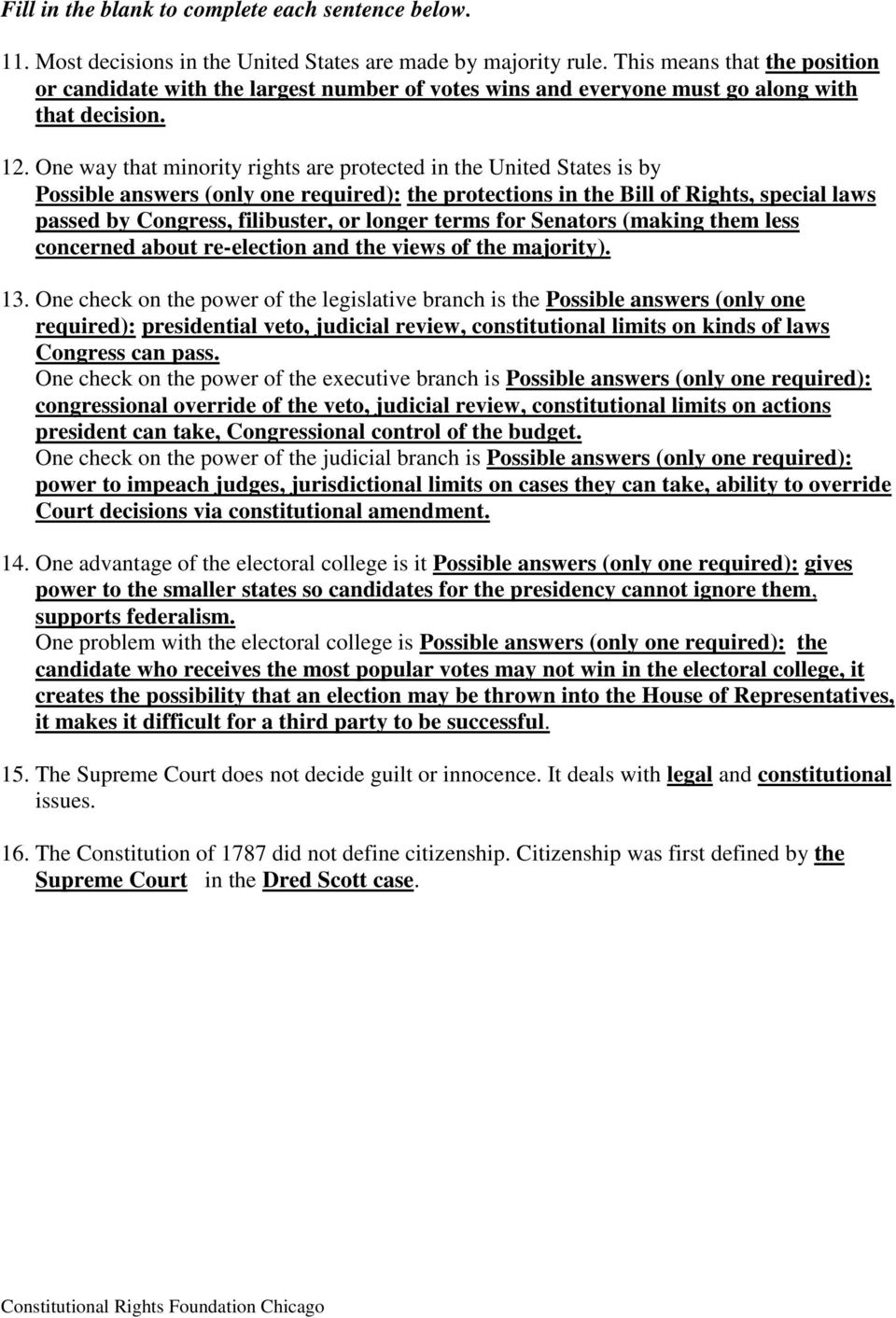
11 Fill in the blank to complete each sentence below. 11. Most decisions in the United States are made by majority rule. This means that the position or candidate with the largest number of votes wins and everyone must go along with that decision. 12. One way that minority rights are protected in the United States is by Possible answers (only one required): the protections in the Bill of Rights, special laws passed by Congress, filibuster, or longer terms for Senators (making them less concerned about re-election and the views of the majority). 13. One check on the power of the legislative branch is the Possible answers (only one required): presidential veto, judicial review, constitutional limits on kinds of laws Congress can pass. One check on the power of the executive branch is Possible answers (only one required): congressional override of the veto, judicial review, constitutional limits on actions president can take, Congressional control of the budget. One check on the power of the judicial branch is Possible answers (only one required): power to impeach judges, jurisdictional limits on cases they can take, ability to override Court decisions via constitutional amendment. 14. One advantage of the electoral college is it Possible answers (only one required): gives power to the smaller states so candidates for the presidency cannot ignore them, supports federalism. One problem with the electoral college is Possible answers (only one required): the candidate who receives the most popular votes may not win in the electoral college, it creates the possibility that an election may be thrown into the House of Representatives, it makes it difficult for a third party to be successful. 15. The Supreme Court does not decide guilt or innocence. It deals with legal and constitutional issues. 16. The Constitution of 1787 did not define citizenship. Citizenship was first defined by the Supreme Court in the Dred Scott case.
12 Match each phrase related to the Bill of Rights with its definition. e 18. Separation of church and state b 19. Right to petition h 20. Right to due process of law f 21. Protection from selfincrimination g 22. Protection from cruel and unusual punishment a 23. Protection from double jeopardy d 24. Freedom from unreasonable searches c 25. Freedom of the press a. A person cannot be tried for the same crime twice. b. People can complain about a government action or ask government to change a bad policy. c. People can make information available to others through newsletters, books, and so on. d. The government can only search people and their property if they have good reason. e. The government cannot establish an official religion or favor religion. f. A person accused of a crime cannot be forced to testify against him/herself. g. A sentence must fit the crime and not be vicious. h. Fair proceedings must be used when deciding if a person accused of a crime is guilty.
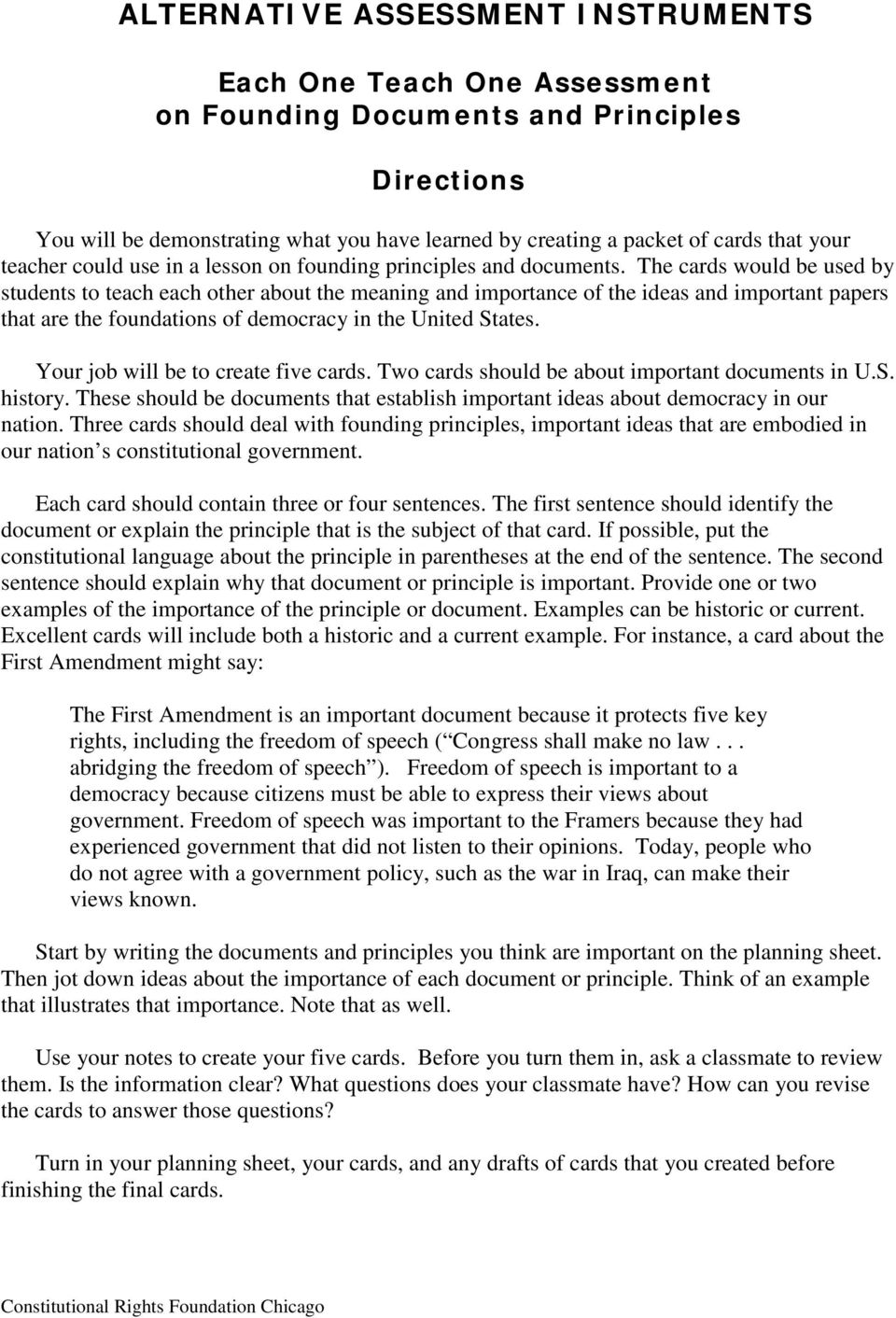
13 ALTERNATIVE ASSESSMENT INSTRUMENTS Each One Teach One Assessment on Founding Documents and Principles Directions You will be demonstrating what you have learned by creating a packet of cards that your teacher could use in a lesson on founding principles and documents. The cards would be used by students to teach each other about the meaning and importance of the ideas and important papers that are the foundations of democracy in the United States. Your job will be to create five cards. Two cards should be about important documents in U.S. history. These should be documents that establish important ideas about democracy in our nation. Three cards should deal with founding principles, important ideas that are embodied in our nation s constitutional government. Each card should contain three or four sentences. The first sentence should identify the document or explain the principle that is the subject of that card. If possible, put the constitutional language about the principle in parentheses at the end of the sentence. The second sentence should explain why that document or principle is important. Provide one or two examples of the importance of the principle or document. Examples can be historic or current. Excellent cards will include both a historic and a current example. For instance, a card about the First Amendment might say: The First Amendment is an important document because it protects five key rights, including the freedom of speech ( Congress shall make no law... abridging the freedom of speech ). Freedom of speech is important to a democracy because citizens must be able to express their views about government. Freedom of speech was important to the Framers because they had experienced government that did not listen to their opinions. Today, people who do not agree with a government policy, such as the war in Iraq, can make their views known. Start by writing the documents and principles you think are important on the planning sheet. Then jot down ideas about the importance of each document or principle. Think of an example that illustrates that importance. Note that as well. Use your notes to create your five cards. Before you turn them in, ask a classmate to review them. Is the information clear? What questions does your classmate have? How can you revise the cards to answer those questions? Turn in your planning sheet, your cards, and any drafts of cards that you created before finishing the final cards.
14 Name Each One Teach One Assessment Planning Sheet 1. Founding document: Why it is important: Example illustrating its importance: 2. Founding document: Why it is important: Example illustrating its importance: 3. Founding principle: Why it is important: Example illustrating its importance:

15 4. Founding principle: Why it is important: Example illustrating its importance: 5. Founding principle: Why it is important: Example illustrating its importance:
16 Cards

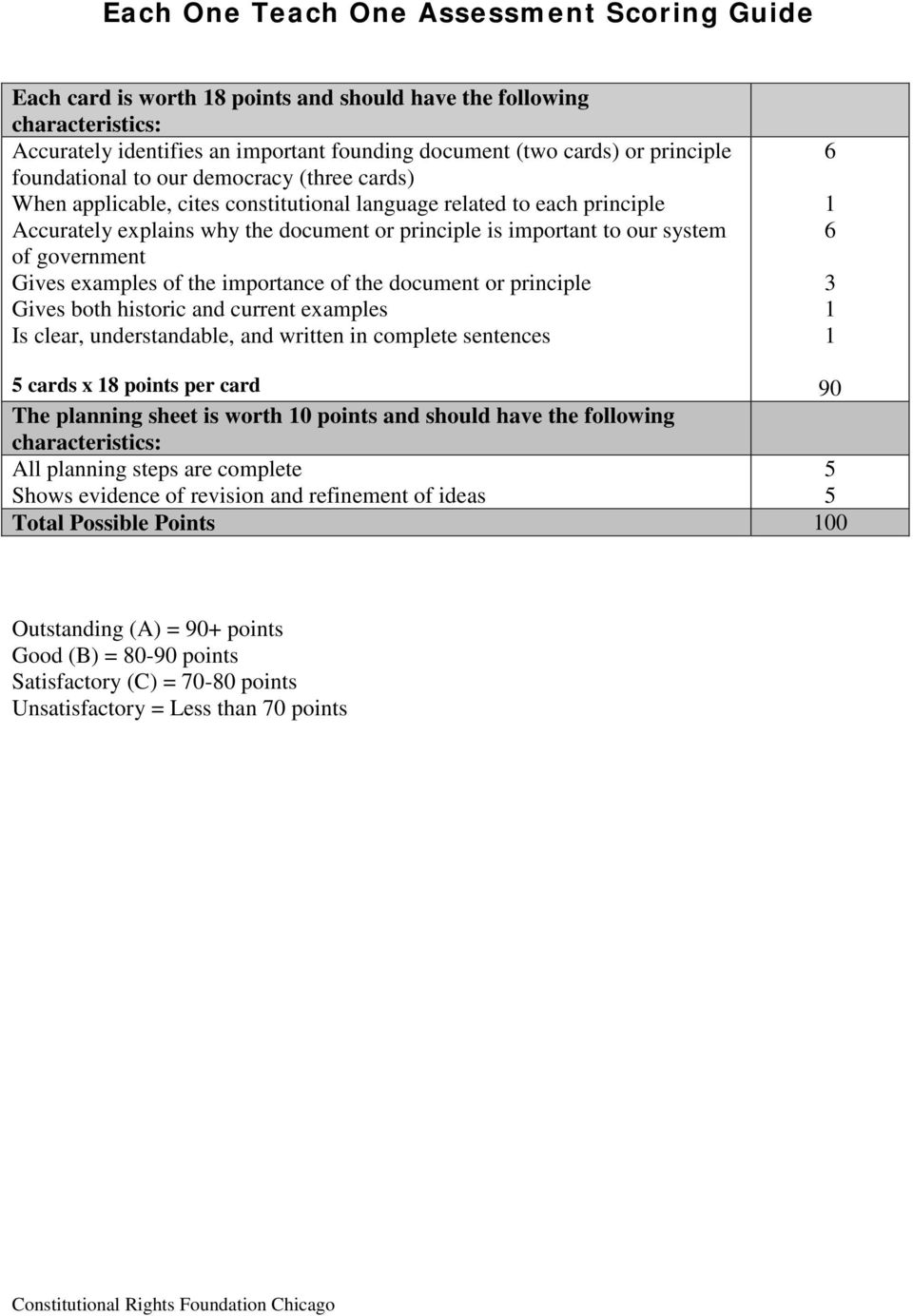
17 Each One Teach One Assessment Scoring Guide Each card is worth 18 points and should have the following characteristics: Accurately identifies an important founding document (two cards) or principle foundational to our democracy (three cards) When applicable, cites constitutional language related to each principle Accurately explains why the document or principle is important to our system of government Gives examples of the importance of the document or principle Gives both historic and current examples Is clear, understandable, and written in complete sentences cards x 18 points per card 90 The planning sheet is worth 10 points and should have the following characteristics: All planning steps are complete 5 Shows evidence of revision and refinement of ideas 5 Total Possible Points 100 Outstanding (A) = 90+ points Good (B) = points Satisfactory (C) = points Unsatisfactory = Less than 70 points
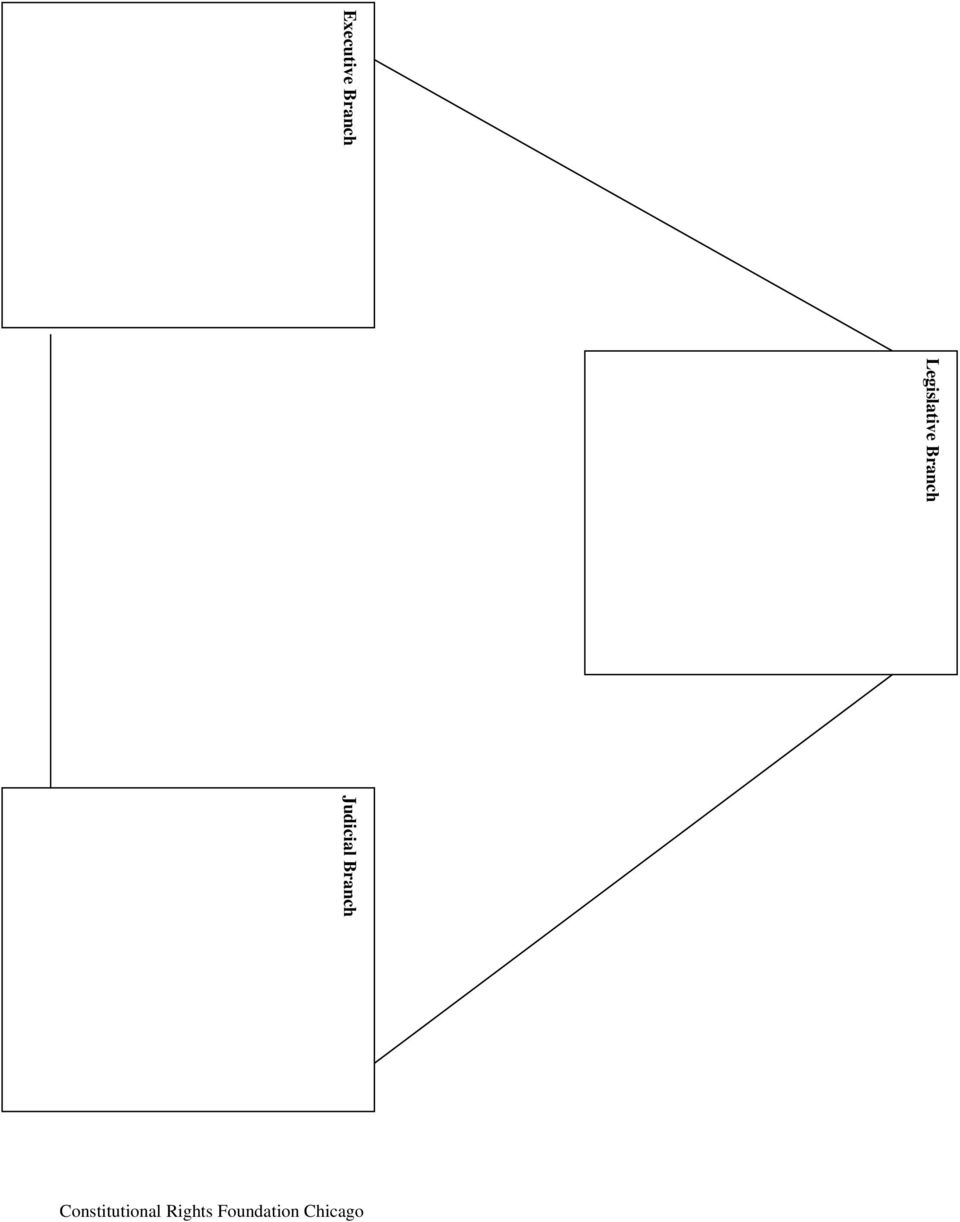
18 Graphic Organizer Assessment on the Branches of Government Directions On the next page is the framework for a graphic organizer in which you can show what you have learned about the branches of government. You will do three things to show what you have learned: 1. In each box, list at least three constitutional powers of that branch. You should also list one constitutional limit on that branch s power. 2. On the lines connecting the boxes, write at least one example of how the two branches check each other s power. 3. In the space in the center, summarize how power is separated among the three branches and give a reason why separation of powers is important. Provide an example that illustrates your reason.

19 Executive Branch Legislative Branch Judicial Branch
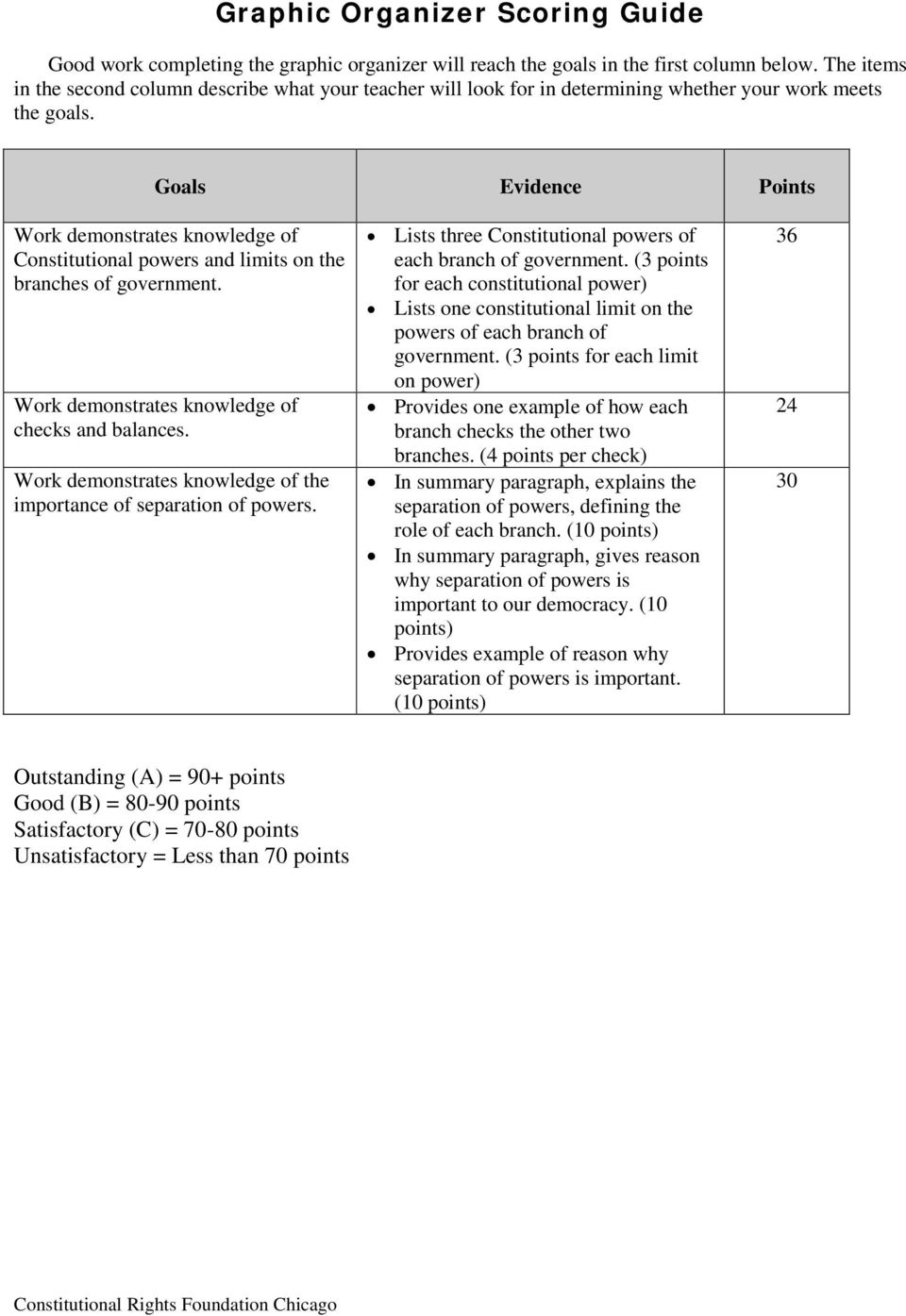
20 Graphic Organizer Scoring Guide Good work completing the graphic organizer will reach the goals in the first column below. The items in the second column describe what your teacher will look for in determining whether your work meets the goals. Goals Evidence Points Work demonstrates knowledge of Constitutional powers and limits on the branches of government. Work demonstrates knowledge of checks and balances. Work demonstrates knowledge of the importance of separation of powers. Lists three Constitutional powers of each branch of government. (3 points for each constitutional power) Lists one constitutional limit on the powers of each branch of government. (3 points for each limit on power) Provides one example of how each branch checks the other two branches. (4 points per check) In summary paragraph, explains the separation of powers, defining the role of each branch. (10 points) In summary paragraph, gives reason why separation of powers is important to our democracy. (10 points) Provides example of reason why separation of powers is important. (10 points) Outstanding (A) = 90+ points Good (B) = points Satisfactory (C) = points Unsatisfactory = Less than 70 points
21 Public Service Announcement Assessment on the Rights of U.S. Citizens Directions To show what you have learned about the rights of U.S. citizens, you will be creating a series of three Public Service Announcements (PSAs). The purpose of a PSA is to educate the public. Thus, your PSAs should be designed to teach others about the Bill of Rights and voting rights.. Your planning sheet will be assessed along with your PSAs. Following these steps will help you create a good series of PSAs: 1. Decide what three rights or categories of rights (e.g., voting rights) you think the public most needs to understand. Write the rights you have selected below; note where each right is protected in the Constitution. 2. Look at your list of rights. For each, write two reasons why it is important. Think about why that right was important to the Framers. Also think about why it is still important today how does it affect our lives in the 21 st century? Jot down examples of the impact of each right on our lives today. 3. Decide which ideas you want to convey in your PSAs. Think about how you will convey those ideas you have written above. Remember that a PSA can take several forms. Choose the form you think will work best for educating others about the ideas you have noted above: Television ads Radio ads Full-page ads in the newspaper Billboards 4. Make sketches or storyboards for your PSAs. Have a classmate review your plans to see whether he/she understands the ideas you are trying to convey. Check your sketch or storyboard against the scoring guide for the PSAs to make sure that you are addressing your teacher s requirements. 5. Create your PSAs.
22 PSA Assessment Scoring Guide A good series of PSAs will reach the goals in the first column below. The items in the second column describe what your teacher will look for in determining whether or not your PSAs meet the goals. Goals Evidence Points PSAs and planning sheet demonstrate understanding of rights and where they are protected in the Constitution. PSAs and planning sheet demonstrate understanding of the importance of the identified rights. PSAs communicate information effectively. Planning sheet reflects thoughtful planning. Accurately identifies three important rights or categories of rights. (7 points per right) Accurately identifies where in the Constitution each right is protected. (3 points per right) Accurately explains why each right was important to the Framers. (6 points per right) Accurately explains why each right is still important to Americans today. (7 points per right) Gives examples that show the impact of these rights today. (4 points) Uses vivid language, examples, and visuals to draw the public to the PSAs and keep them interested. (5 points) Uses correct grammar, punctuation, and spelling. (4 points) Fully completes all planning steps. (5 points) Shows evidence of revision and refinement of ideas. (5 points) Outstanding (A) = 90+ points Good (B) = points Satisfactory (C) = points Unsatisfactory = Less than 70 points
23 CITIZEN PORTFOLIO AND REPORT CARD* This year, you will be making a portfolio of the work you do as you learn about our Constitution and government. You will organize your work to show that you are learning what you need to know and be able to do in order to take on the important Office of Citizen. For each piece of work you want to include in your portfolio, select one of the six goals listed below. Pick the goal that you think matches your work. Copy the goal at the top of a sheet of paper. Then write several sentences in which you explain how your work shows that you are making progress toward reaching that goal. Staple the sheet of paper to your assignment. Here are the goals: A. Understand the big ideas that provide the foundation for U.S. government. B. Explain the structure and contents of the U.S. Constitution. C. Understand the functions and structures of the three branches of the U.S. government and how they relate to each other. D. Describe the rights of individuals in the United States as well as the limits on rights. E. Know the role of the citizen in a democracy. F. Take and defend a position on a current issue. Example: PSA on the Declaration of Independence (your original assignment) Goal A: Understand the big ideas that provide the foundation for U.S. government. My group s PSA on the Declaration of Independence focused on the idea that the people can change or overthrow the government if it is not protecting their unalienable rights. This is a key idea of U.S. government. Our PSA showed that the Constitution provided four ways people can change the government. They can petition the government, can vote, and, through their elected officials, can impeach a corrupt public official and can amend the Constitution. We used the election of 2008 as an example of the people voting for a change. *Adapted from an assessment created by Jackie Johnson, Associate Director, Center for Education in Law and Democracy, Denver, CO. Jackie developed and used the assessment when she was an eighth-grade teacher at Campus Middle School in Englewood, Colorado.
24 At the end of the year, you will create a report card showing that you are qualified to take on the Office of Citizen. Reviewing your portfolio will help you decide what to highlight. Your report card should list knowledge and skills that a citizen needs. For each item, your report card should list one piece of evidence that you have that knowledge or skill. In the comments section of the report card, summarize how your experiences this year qualify you for the Office of Citizen. Sample format for Citizen Report Card Citizen Report Card Knowledge: A. Evidence: B. Evidence: C. Evidence: Skills A. Evidence B. Evidence C. Evidence Comments:
25 Rubric for Citizen Portfolio and Report Card Goals Evidence Points Portfolio links student work to goals. Report card summarizes student qualifications for the office of citizen. Work reflects thoughtful planning and execution. Provides at least two pieces of work that show progress toward achieving each goal. Explains how the work relates to the goal. When applicable, cites Constitutional language and principles related to the goals. Identifies knowledge and skills important to citizenship. Provides evidence of attainment of listed knowledge and skills. Links experiences to requirements of citizenship. Fully completes all aspects of assignment. Presents a neat and well-written product. Shows evidence of reflection on the importance of learning how to be a citizen
26 EXTENDED-RESPONSE ITEMS Unit 1: The Federalist Papers Just days after the new Constitution was signed in 1787, New York newspapers began to attack it. They said the new Constitution took away the rights Americans had won in the Revolution. Alexander Hamilton Takes Action New Yorker Alexander Hamilton had helped write the Constitution. He was the only New York delegate to the constitutional convention who signed the document. Hamilton feared New York might not ratify the Constitution. He decided to write essays arguing with the critics. Hamilton wanted a strong central government. In October 1787, he published his first essay defending the Constitution. He signed it using the Roman name Publius. (Political writers of the time often used pen names.) Hamilton soon asked two other men, James Madison and John Jay, to write articles. They also used the name Publius. James Madison is sometimes called the Father of the Constitution. He played a major role at the Constitutional Convention. As a delegate from Virginia, he kept notes of the talks and wrote much of the Constitution. John Jay had not helped write the Constitution. He was serving as a diplomat when Hamilton asked him to help. Hamilton, Madison, and Jay wrote 85 essays for the New York papers. The essays drew much praise. Many people outside of New York wanted to read the essays. One New York newspaper printed the essays as a book called The Federalist. They were also called the Federalist Papers. The Federalist Papers helped convince New Yorkers that the Constitution was a good model for a new government. Today, the Federalist Papers help us understand what the writers of the Constitution had in mind when they drafted that amazing document 200 years ago. What The Federalist Said The Federalist Papers addressed issues about the Constitution. In Federalist #23, Hamilton listed the main goals of government. One was common defense. This meant keeping law and order at home and protecting the nation from external attacks. Another goal was to control trade between states and with other nations. A third was dealing with foreign countries. In Federalist #51, Madison said, If men were angels, no government would be necessary. He then explained why government needs checks on it. He said that for a government controlled by men over men, the great difficulty lies in this: You must first let government control the Adapted from Project History: U.S. History for Middle School (Los Angeles: Constitutional Rights Foundation, 2003.
27 people and then make it control itself. In other words, government had to have power, but not too much power. The Federalist Papers explained how the Constitution set up such a government. Much of the Federalist Papers explained three basic ideas behind the Constitution: separation of powers, federalism, and republican government. Separation of Powers The Constitution puts many checks on government. One is called the separation of powers. Congress, the president, and the courts have separate powers. Congress makes laws. The President carries them out. The courts interpret the laws and apply them to particular cases. In Federalist #47, Madison told why the powers of government should be separated. He said: Putting all powers... in the same hands, whether of one, a few or many is tyranny. In other words, giving one person or group all the power will stop people from being free. Federalism Another check on government is federalism, the division of power between different levels of government. The Constitution lists the powers of the national government. It reserves all other powers for the states. As Madison explained in Federalist #46, the federal system lets state governments, which are closer to the people, meet the personal interests of the people. The states also serve to check the power of the federal government. A Republic The Federalist Papers emphasized that the Constitution created a republic. A republic is a representative democracy. People elect those who govern them. A republic relies on the consent of the governed. In Federalist #39, Madison defined a republic as a government that gets its powers from the people and is run by persons holding their offices... for a limited period, or during good behavior. Many thinkers believed a republic could not work in a large country. They thought it could only work in states or cities where people knew the community and could work for the common good. In a large country, they argued, the government is far from the people, and special interests, or factions, would take over. Madison in Federalist #10 responded that large republics actually prevented factions from taking over. Madison said that in a large republic, you take in a greater variety of... interests; you make it less probable that a majority... will have a common motive to invade the rights of other citizens. In other words, in a large republic, special interests balance one another. The Federalist Papers stressed that the Constitution was setting up a government that would preserve freedom. The new government would be strong enough to protect the nation. But it would not be too strong and take away people s freedom. Its powers would be limited and checked through federalism and the separation of powers. It would be a republic, based on the consent of the governed.
28 Questions 1. Why was James Madison called the Father of the Constitution? a. Because he, along with Hamilton and Jay, wrote many of the Federalist Papers. b. Because he presided over the constitutional convention. c. Because he wrote much of the Constitution and kept records of the convention. d. Because he was one of the oldest delegates to the convention. 2. According to the reading, which was NOT one of the ideas about government on which the Federalist Papers focused? a. Separation of powers. b. The electoral college. c. Federalism. d. Republican form of government. 3. What are the key aspects of a republic, as described in Federalist #39? a. In a republic, the people hold the power and elect officials to represent them. The officials serve for a limited time or during good behavior, depending on their job. b. All of the people living in a republic have the right to vote on issues that come before the nation. c. Special interest groups, acting on behalf of the citizens, hold much of the power in a republic. d. Power is split between differing levels of government, with the Constitution clearly telling which powers belong to each level. 4. Why do you think Madison compared men to angels in Federalist #51? a. To make the point that people who run for public office are a lot like angels because they put others needs before their own. b. To make the point that, unlike angels, people have flaws and those flaws must be acknowledged when designing a government. c. To encourage citizens in our new republic to act more like angels so that governing them would be easier. d. To illustrate that the people who wrote the Constitution were religious men and considered religious ideas in writing the Constitution. 5. Basic Prompt: The opponents of the new Constitution feared that it would create a national government that was too strong and would take away the people s rights. Use the reading above to answer the following questions: How did the writers of the Federalist Papers address the fears of the Constitution s opponents? How effective were their arguments? 5b. Scaffolded Prompt: The opponents of the new Constitution feared that it would create a national government that was too strong and would take away the people s rights. Use the
29 reading above to answer the following questions: How did the writers of the Federalist Papers address the fears of the Constitution s opponents? How effective were their arguments? From the reading, identify the key ideas stressed by Hamilton, Madison, and Jay. Use references to the text to support what you write. Make connections to the Constitution and what you have learned about protections of individual rights. Extend the ideas in the reading by thinking of concrete examples of the key ideas mentioned in the reading. Do these examples support the authors of the Federalist Papers or their opponents?
30 Unit 1: The Federalist Papers Extended-Response Key 1. Why was James Madison called the Father of the Constitution? a. Because he, along with Hamilton and Jay, wrote many of the Federalist Papers. b. Because he presided over the constitutional convention. c. Because he wrote much of the Constitution and kept records of the convention. d. Because he was one of the oldest delegates to the convention. 2. According to the reading, which was NOT one of the ideas about government on which the Federalist Papers focused? a. Separation of powers. b. The electoral college. c. Federalism. d. Republican form of government. 3. What are the key aspects of a republic, as described in Federalist #39? a. In a republic, the people hold the power and elect officials to represent them. The officials serve for a limited time or during good behavior, depending on their job. b. All of the people living in a republic have the right to vote on issues that come before the nation. c. Special interest groups, acting on behalf of the citizens, hold much of the power in a republic. d. Power is split between differing levels of government, with the Constitution clearly telling which powers belong to each level. 4. Why do you think Madison compared men to angels in Federalist #51? a. To make the point that people who run for public office are a lot like angels because they put others needs before their own. b. To make the point that, unlike angels, people have flaws and those flaws must be acknowledged when designing a government. c. To encourage citizens in our new republic to act more like angels so that governing them would be easier. d. To illustrate that the people who wrote the Constitution were religious men and considered religious ideas in writing the Constitution. 5. The opponents of the new Constitution feared that it would create a national government that was too strong and would take away the people s rights. Use the reading above to answer the following questions: How did the writers of the Federalist Papers address the fears of the Constitution s opponents? How effective were their arguments? The reading and writing aspects of student answers to this item can be evaluated using your district or state s standard rubric for extended-responses items. To evaluate the civic learning, look for the following:
31 Exemplary Performance Student identifies the three key ideas from the text (separation of powers, federalism, and republicanism) and links them to opponents of the Constitution s fear of a strong national government that would violate people s rights. For each key idea from the text, the student cites specific provisions of the Constitution that relate to that key idea (separation of powers various provisions in Articles I, II, and III; federalism Article I, Section, Article V, and Amendment X; republicanism the Preamble, provision for election of public officials in Articles I and II). The student describes how the Bill of Rights was added to the Constitution as a way to address objections of opponents. The student gives two or more concrete examples of key ideas from the text and explains whether they support the authors of the Federalist or their opponents. For instance, the student might mention national and state efforts to solve the problem of immigration as an example of federalism supporting the authors of the Federalist Papers. Satisfactory Performance Student identifies the three key ideas from the text (separation of powers, federalism, and republicanism) and links two of them to fear of a strong national government. For two key ideas from the text, the student cites specific provisions of the Constitution that relate to that key idea (separation of powers various provisions in Articles I, II, and III; federalism Article I, Section, Article V, and Amendment X; republicanism the Preamble, provision for election of public officials in Articles I and II). The student provides at least one concrete example of a key idea from the text and explains whether it supports the authors of the Federalist or their opponents. Basic Performance Student identifies at least two of the key ideas from the text and links one or two to fear of a strong national government. For one key idea from the text, the student cites specific provisions of the Constitution that relate to that key idea (separation of powers various provisions in Articles I, II, and III; federalism Article I, Section, Article V, and Amendment X; republicanism the Preamble, provision for election of public officials in Articles I and II). The student provides at least one concrete example of a key idea from the text. Unsatisfactory Performance Student identifies one or none of the key ideas from the text and fails to link it to fear of a strong national government. Student cites no specific provisions of the Constitution that relate to key ideas from the text. The student provides no concrete examples of key ideas from the text.
32 Unit 2: The Legislative Branch The legislative branch of government has the authority to make laws for the nation. It was established in Article I of the Constitution with the creation of Congress. Agencies such as the Government Printing Office, Library of Congress, Congressional Budget Office, and the Government Accountability Office, which provide support services for the Congress, are also part of the legislative branch. Congress is bicameral, that is, it is made up of two chambers, the Senate and the House of Representatives. This system was created by the Founding Fathers after much debate. Delegates to the Constitutional Convention from larger and more populated states wanted congressional representation to be based upon population. Fearing domination, delegates from smaller states wanted equal representation. The Great Compromise resulted in the creation of two houses, with representation based on population in one and with equal representation in the other. Now members of Congress are elected by a direct vote of the people of the state they represent. It has not always been this way for the Senate. Prior to 1913 and the 17 th Amendment to the Constitution, Senators were chosen by their state legislatures. The Senate was viewed as representative of state governments, not of the people. It was the responsibility of Senators to ensure that their state was treated equally in legislation. The primary duty of Congress is to write, debate, and pass bills, which are then passed on to the president for approval. The Constitution grants Congress all legislative powers in the national government. Article I, Section 8, of the Constitution lists a wide range of congressional powers, including: Coining money. Maintaining a military. Declaring war on other countries. Regulating interstate and foreign commerce. Congress also controls federal taxing and spending policies one of the most important sources of power in the government. The Constitution also gives Congress the authority to make all laws which shall be necessary and proper, an implied source of power sometimes called the Elastic Clause. One of the most important implied powers is Congress s authority to investigate and oversee the executive branch and its agencies, such as the Department of Defense and the Department of Justice. Congress also holds hearings on matters of general public concern. Sometimes members of Congress conduct these hearings to identify problems that create a need for new laws. In other cases Congress holds hearings to raise public awareness about an issue. There are, however, some congressional powers that are rarely used such as the ability to impeach an official and amending the Constitution. From The Legislative Branch, Ben s Guide to U.S. Government (Washington, DC: U.S. Government Printing Office),
33 In addition to the power described above, Congress shares powers with the president in matters such as framing U.S. foreign policy and control over the military. For example, while the president negotiates treaties, they are only put into effect once the Senate approves them. Also, while Congress can declare war and approve funds for the military, the president is the commander-in-chief of the military. A new Congress begins in January every two years following congressional elections, in which voters choose all representatives and a third of the senators. The entire House membership faces re-election every two years, but the Senate is a continuing body because there is never an entirely new Senate. Since the First Congress, which met from 1789 to 1791, all Congresses have been numbered in order. For the most part, the House and Senate each meet in their respective chamber in the U.S. Capitol in Washington, D.C. However, on rare occasions, they will meet together for a joint session of Congress in the House chamber. For example, a joint session will be called to count electoral votes for presidential elections Questions 1. Why did the smaller states want equal representation in the Congress? a. Because they believed in equality as a principle. b. Because they did not want the large states to have too much power. c. Because they wanted to pattern Congress after the British Parliament. d. Because there were more large states than small states. 2. Which is NOT a power of Congress? a. Passing laws. b. Declaring war. c. Enforcing laws. d. Regulating trade. 3. Which is NOT an example of Congress ability to check the power of another branch? a. Impeachment of judges b. Oversight of the executive agencies c. The Senate s power to ratify treaties d. The Elastic Clause 4. Basic Prompt: The founders thought the legislative branch would be the most powerful. Do you agree? Why or why not? 4a. Scaffolded Prompt: The founders thought the legislative branch would be the most powerful. Do you agree? Why or why not? Find the key ideas in the reading about the powers of the legislative branch. Also make references to the text about checks on the legislative branch. Make connections to other things you have learned about the legislative branch, including the people s relationship to that branch. Extend your response by thinking about current events that may shed light on the question. Use evidence from the reading and your own knowledge to formulate and support your position on the question.
34 Unit 2: The Legislative Branch Extended-Response Answer Key 1. Why did the smaller states want equal representation in the Congress? a. Because they believed in equality as a principle. b. Because they did not want the large states to have too much power. c. Because they wanted to pattern Congress after the British Parliament. d. Because there were more large states than small states. 2. Which is NOT a power of Congress? a. Passing laws. b. Declaring war. c. Enforcing laws. d. Regulating trade. 3. Which is NOT an example of Congress ability to check the power of another branch? a. Impeachment of judges b. Oversight of the executive agencies c. The Senate s power to ratify treaties d. The Elastic Clause 4. The founders thought the legislative branch would be the most powerful. Do you agree? Why or why not? The reading and writing aspects of student answers to this item can be evaluated using your district or state s standard rubric for extended-responses items. To evaluate the civic learning, look for the following: Exemplary Performance Student identifies at least three powers of Congress mentioned in the text (power to write debate, and pass laws; coining money; maintaining a military; declaring war; regulating interstate and foreign commerce; controlling taxing and spending policies; investigate and oversee the executive branch; power to impeach; power to propose amendments to the Constitution; shared power in framing U.S. foreign policy and control over the military) and explains the importance of those powers. Student identifies three limits on Congress mentioned in the text (presidential veto; shared power with the executive in certain areas; frequent elections) and explains the importance of those limits. Student cites at least one additional power and limit of Congress not mentioned in the text (e.g., power: approving presidential appointments to the federal courts; limit: the courts can declare laws unconstitutional). Student cites at least one current event illustrating the power of Congress or limits on that power. Student takes a position on the question and supports it with evidence.
35 Satisfactory Performance Student identifies two or three powers of Congress mentioned in the text. Student identifies two limits on Congress mentioned in the text. Student cites at least one additional power or limit of Congress not mentioned in the text. Student cites at least one current event illustrating the power of Congress or limits on that power. Student takes a position on the question and supports it with evidence. Basic Performance Student identifies one or two powers of Congress mentioned in the text. Student identifies one limit on Congress mentioned in the text. Student cites at least one current event illustrating the power of Congress or limits on that power. Student takes a position on the question. Unsatisfactory Performance Student identifies one or no powers of Congress mentioned in the text. Student identifies one or no limits on Congress mentioned in the text. Student cites no current event illustrating the power of Congress or limits on that power. Student does not take a clear position on the question.
36 Unit 3: What Makes a Good President? Are stubbornness and disagreeableness traits you want in a neighbor or a friend? Probably not. But researchers say that these two traits are associated with great presidents. Psychologist Steven J. Rubenzer and two colleagues studied the personality traits of all 41 U.S. presidents from Washington through the first George Bush. Their personalities were analyzed and compared with historians views of presidential greatness. More than 100 presidential experts assessed the lives of presidents they studied. The experts were instructed to look only at the five-year period before the person became president to avoid the influence that life in the White House might have had on their behavior. Results of the research indicate that great presidents, besides being stubborn and disagreeable, Are more outgoing. Are open to experience. Are assertive. Strive to achieve. Seek excitement. Are more open to fantasy, feelings, ideas, and values. Historically, great presidents were low on straightforwardness, vulnerability, and order. Working hard to achieve was found to be one of traits with the highest connection to greatness. Competence was also a big predictor of presidential success. Presidents who succeed set ambitious goals for themselves and move heaven and earth to meet them, said the researchers. They say Teddy Roosevelt was such a man. Ulysses S. Grant and Warren G. Harding were not. And don't look for great presidents to have neat desks. It seems that being a bit disorganized, like Lincoln, is somewhat of an asset for attaining historical greatness, explained the authors. The researchers gave special attention to the personalities of George Washington and Abraham Lincoln. Both men have been in the top three of every historian s poll of presidential greatness. Besides being very tall and imposing men, George and Abe seemingly had little in common. Washington scored very high on doing his duty. But he scored lower than typical Americans today on openness, being outgoing, and agreeableness. He also scored quite low on vulnerability. A low score on vulnerability means the person has great ability to deal with stress and hard times. He also scored low on openness to values. This means he was traditional in his morals and relied on leadership from church and religious figures in these matters. Additionally, Washington scored high on working to achieve, competence, self-discipline, and deliberation. Lincoln scored high on openness, but his highest score was on depression. The researchers say this finding is consistent with reports that Lincoln occasionally suffered periods of deep Press release from the American Psychological Association (August 2000),
37 despair. Lincoln scored low on straightforwardness. He was willing to bend the truth, said the authors. This finding may be surprising because he was known as Honest Abe. The authors say that nearly all presidents could be classified into one or more of eight presidential types. Some belonged to more than one group. These groups are: The Dominators (Nixon, Andrew Johnson, Lyndon Johnson, Jackson, Polk, Teddy Roosevelt, and Arthur) The Introverts (John Adams, John Quincy Adams, Nixon, Hoover, Coolidge, Buchanan, Wilson, and Benjamin Harrison) The Good Guys (Hayes, Taylor, Eisenhower, Tyler, Fillmore, Cleveland, Ford, and Washington) The Innocents (Taft, Harding, and Grant) The Actors (Ronald Reagan, Warren Harding, William Henry Harrison, Bill Clinton, and Franklin Pierce) The Maintainers (McKinley, Bush, Ford, and Truman) The Philosophers (Garfield, Lincoln, Jefferson, Madison, Carter, and Hayes) The Extroverts (FDR, Kennedy, Clinton, Theodore Roosevelt, Reagan, William Harrison, Harding, Jackson, and LBJ) The research shows that most modern presidents are clearly outgoing (extroverts). That s probably not surprising. However, the data show that the early presidents scored below average on this factor. Does that mean that presidents are becoming more outgoing? Or has the entire population become more extroverted? The researchers say their data can t answer that question. However, given the increasing role of the media in presidential elections, the more plausible explanation is that the change is limited to the presidents and not the general population. Questions 1. Which of the following did the researchers find was related to greatness? a. Orderliness and a neat desk in the Oval Office. b. Working hard to achieve one s goals. c. Straightforwardness being open and truthful. d. Vulnerability easily hurt. 2. Why, according to the researchers, is being low in vulnerability good for a president? a. Because a president who isn t vulnerable doesn t care about people and can make policy without thinking about the people. b. Because a president who is vulnerable may have better insight into the people he or she works with. c. Because a president who isn t vulnerable can put up with a lot of stress and adversity. d. Because a president who is vulnerable will appear weak and not be popular with the voters.
38 3. One of the presidential types was Extroverts. For which of the following presidential roles would being extroverted be most helpful? a. Commander in Chief b. Head of State c. Appointers of Ambassadors, Supreme Court Justices, and Other Officials d. Signer/Vetoer of Bills 4. Basic Prompt: In your opinion, what makes a good president? 4a. Scaffolded Prompt: In your opinion, what makes a good president? Identify the key ideas about what makes a good president from the reading. Make references to the text, and connect the text information to the jobs of the president as defined in the Constitution. How do the traits in the article relate to the jobs of the president? What other characteristics would you look for in a president? Why? Extend your answer by using presidents that you think did a good job as examples to support your answer.
39 Unit 3: What Makes a Good President? Extended Response Answer Key 1. Which of the following did the researchers find was related to greatness? a. Orderliness and a neat desk in the Oval Office. b. Working hard to achieve one s goals. c. Straightforwardness being open and truthful. d. Vulnerability easily hurt. 2. Why, according to the researchers, is being low in vulnerability good for a president? a. Because a president who isn t vulnerable doesn t care about people and can make policy without thinking about the people. b. Because a president who is vulnerable may have better insight into the people he or she works with. c. Because a president who isn t vulnerable can put up with a lot of stress and adversity. d. Because a president who is vulnerable will appear weak and not be popular with the voters. 3. One of the presidential types was Extroverts. For which of the following presidential roles would being extroverted be most helpful? a. Commander in Chief b. Head of State c. Appointers of Ambassadors, Supreme Court Justices, and Other Officials d. Signer/Vetoer of Bills 4. In your opinion, what makes a good president? The reading and writing aspects of student answers to this item can be evaluated using your district or state s standard rubric for extended-responses items. To evaluate the civic learning, look for the following: Exemplary Performance Student cites at least four traits of great presidents discussed in the reading. Student links each trait identified from the study with presidential roles/responsibilities and cites Article II as the source of those duties. Student discusses other characteristics he/she looks for in a strong president. Student uses multiple examples of presidents that he/she thinks were good presidents to support his/her description of what makes a good president. Satisfactory Performance Student cites two or three traits of great presidents discussed in the reading. Student links some of the traits identified in the study with presidential roles/responsibilities and cites Article II as the source of those duties.
40 Student identifies other characteristics he/she looks for in a strong president. Student uses one or two examples of presidents that he/she thinks were good presidents to support his/her description of what makes a good president. Basic Performance Student cites one trait of great presidents discussed in the reading. Student links the trait identified in the study with presidential roles/responsibilities. Student identifies at least one other characteristics he/she looks for in a strong president. Student uses one or no examples of presidents that he/she thinks were good presidents to support his/her description of what makes a good president. Unsatisfactory Performance Student does not cite traits of great presidents discussed in the reading or misidentifies the traits associated with greatness. Student does not discuss constitutionally defined presidential roles/responsibilities. Student identifies no other characteristics he/she looks for in a strong president. Student uses no examples of presidents that he/she thinks were good presidents to support his/her description of what makes a good president.
41 Unit 4: The Role of the Judicial Branch The American constitutional system rests on the rule of law. Without the rule of law, the rights of an individual could be denied. The government or other citizens could trample the individual s rights. The rule of law protects individual rights, sets limits on actions that might interfere with those rights, settles conflicts that could cause harm, and punishes wrongdoing. The rule of law has always played a central role in our system. The Constitution consists of laws designed to define and limit governmental power. The judicial branch has the power to make sure that laws passed by Congress do not violate the Constitution. The executive branch must comply with and enforce the laws passed by Congress. The rule of law in the United States embodies two great principles of justice: equal protection and due process. Equal protection provides everyone with the same opportunity and fair treatment. Race, religion, ethnicity, national origin, gender, sexual orientation, or physical capacity should not matter. All people should have the right to compete equally for society s benefits. Due process requires that police and courts follow fair procedures. Due process in law enforcement, for example, requires police to have grounds to make arrests. Police must warn people about their rights when arrested. They cannot use excessive force. Courts must give people accused of crimes notice of the charges and hearing dates. People have the right to an attorney and the right to confront witnesses. Without due process rights, it would be much easier for government to violate individual rights. U.S. citizens rely on the judicial and legal system to punish wrongdoers, resolve conflicts, and interpret the law. Some critics believe that Americans file too many lawsuits. Other methods, such as negotiation, mediation, or legislation, should be used to resolve conflicts. These critics argue that America s legal system is costly in time and money. Others defend the system. They argue that it offers the best chance of a fair result in resolving disputes and setting standards for future conduct. The costs of the system are necessary, they argue, because law and legal procedures can be complex. Both time and expertise are needed to deal with that complexity. Breakdown in the Rule of Law Sometimes judicial protections have been denied to certain citizens. In early America, women had few legal protections. As slaves, black Americans were denied access to courts. In some regions of the country, African Americans had few legal protections well into the 20 th century. During World War II, thousands of Americans of Japanese descent were forced into internment camps. Throughout our history, the high cost of legal services has put judicial protections outside the reach of many poor people. Fortunately, many of these injustices have been addressed. Today, women have the same legal rights as men. Because of the civil rights movement, African Americans enjoy greater legal rights than ever before. Problems of discrimination persist, however. Congress recognized the Adapted from The Challenge of Governance (Los Angeles: Constitutional Rights Foundation, 2001), pp
42 injustice of internment. It passed laws apologizing and granting reparations to Japanese- Americans who had been forced into camps. Judicial Review and Independence Central to the American legal system is judicial review. Judicial review means that courts can review the actions of the executive, legislature, and lower courts to determine whether they are lawful and constitutional. Judicial review is a limit on the power of government. Without judicial review, government power could be used to violate minority rights and constitutional principles. The system needs an institution that can stop such violations. The courts serve that function. To be effective, judges must not be subject to political pressure from majority interests. The framers of the Constitution insisted on an independent judiciary. They did not want the judicial branch to be swayed by public opinion. For this reason, federal judges are appointed for life terms. Having to face elections could influence judges to make decisions that would please the majority rather than serve the Constitution or minority rights. Questions 1. Rule of law is important because a. It provides jobs for lawyers, judges, and prison guards. b. It protects people s rights and helps ensure an orderly society. c. It makes a Constitution unnecessary in a democracy. d. It allows courts to declare laws passed by Congress unconstitutional. 2. Equal protection means a. All people should be treated the same under the law. b. The armed forces should protect all parts of the country equally. c. Police and courts must follow fair procedures. d. People of different religions and gender should be treated differently. 3. Which is NOT an example of due process? a. Police must inform people of their rights when they are arrested. b. People have the right to an attorney when they are accused of a crime. c. People have the right to vote for judges. d.. Courts must inform people of the charges against them. 4. Judicial review is an example of a. Checks and balances. b. The power of the voter. c. A presidential power. d. First Amendment rights.
43 5. What does the phrase independent judiciary mean? a. Judges are not members of any political party. b. Judges are not elected and do not have to worry about public opinion. c. The judicial branch is not checked by the other branches. d. The courts are not subject to the rule of law in our democracy. 6. Basic Prompt: What is the role of the judicial branch? Does the judicial branch affect the lives of everyday people? Explain your answer. 6a. Scaffolded Prompt. What is the role of the judicial branch? Does the judicial branch affect the lives of everyday people? Explain your answer. Identify key ideas about the role of the judicial branch from the reading above. From the reading, make a list of things the judicial branch does. Make references to the text in discussing these roles. Also, make connections to what the Constitution says about the role of the judiciary and the case of Marbury v. Madison, in which the Court defined its own power. Extend your answer by explaining the relationship of the judicial branch to the rule of law and the protection of individual rights, especially the rights of minorities. Think about the Supreme Court cases you have studied. How do they show the relationship between the judicial branch and the lives of everyday people?
44 Unit 4: The Role of the Judiciary Extended Response Key 1. Rule of law is important because a. It provides jobs for lawyers, judges, and prison guards. b. It protects people s rights and helps ensure an orderly society. c. It makes a Constitution unnecessary in a democracy. d. It allows courts to declare laws passed by Congress unconstitutional. 2. Equal protection means a. All people should be treated the same under the law. b. The armed forces should protect all parts of the country equally. c. Police and courts must follow fair procedures. d. People of different religions and gender should be treated differently. 3. Which is NOT an example of due process? a. Police must inform people of their rights when they are arrested. b. People have the right to an attorney when they are accused of a crime. c. People have the right to vote for judges. d.. Courts must inform people of the charges against them. 4. Judicial review is an example of a. Checks and balances. b. The power of the voter. c. A presidential power. d. First Amendment rights. 5. What does the phrase independent judiciary mean? a. Judges are not members of any political party. b. Judges are not elected and do not have to worry about public opinion. c. The judicial branch is not checked by the other branches. d. The courts are not subject to the rule of law in our democracy. 6. What is the role of the judicial branch? Does the judicial branch affect the lives of everyday people? Explain your answer. The reading and writing aspects of student answers to this item can be evaluated using your district or state s standard rubric for extended-responses items. To evaluate the civic learning, look for the following:
45 Exemplary Performance Student accurately describes the role of the judicial branch to interpret and apply the law in legal conflicts and cites Article III of the Constitution as the source of judicial power. Student explains judicial review and cites Marbury v. Madison as the case in which judicial review was established. Student explains that the courts operate within the rule of law and also help to maintain the rule of law. Student explains how judicial review can be used to ensure that the principles of equal protection and due process are extended to all people, including minorities. Student cites at least three court cases in which the Supreme Court s decisions had an impact on the lives of everyday people (e.g., Tinker v. Des Moines, Hazelwood v. Kuhlmeier, Wisconsin v. Yoder, Mapp v. Ohio, Gideon v. Wainright). Satisfactory Performance Student accurately describes the role of the judicial branch to interpret and apply the law in legal conflicts and cites Article III of the Constitution as the source of judicial power. Student explains judicial review and cites Marbury v. Madison as the case in which judicial review was established. Student explains that the courts operate within the rule of law and also help to maintain the rule of law. Student explains how judicial review can be used to limit the government s power to infringe on individual rights, including those of minorities. Student cites at least one or two court cases in which the Supreme Court s decisions had an impact on the lives of everyday people (e.g., Tinker v. Des Moines, Hazelwood v. Kuhlmeier, Wisconsin v. Yoder, Mapp v. Ohio, Gideon v. Wainright). Basic Performance Student accurately describes the role of the judicial branch to interpret and apply the law in legal conflicts. Student briefly explains judicial review. Student states that a relationship exists between the courts and the rule of law and minority rights but does not explain the relationship. Student cites no court cases in which the Supreme Court s decisions had an impact on the lives of everyday people. Unsatisfactory Performance Student inaccurately describes the role of the judicial branch. Student inaccurately explains judicial review. Student fails to explain the relationship between the courts and the rule of law and minority rights. Student cites no court cases in which the Supreme Court s decisions had an impact on the lives of everyday people.
46 Unit 5: Morse v. Frederick: The Bong Hits 4 Jesus Case Background On January 24, 2002, the high school students of Juneau-Douglas High School were released early to observe the running of the Olympic torch during its 50-state tour. Eighteen-year-old high school senior Joseph Frederick decided to create a banner to get some attention (positive attention from the media and negative attention from his principal Deborah Morse) at the event. Standing across the street from the school, Frederick and nine classmates unfurled a 14-foot banner with the slogan, Bong Hits 4 Jesus for all to see. Principal Morse thought the banner violated the school s rule banning messages that encouraged drug use. The banner was immediately confiscated, and Frederick was later suspended for 10 days. Frederick s case was dismissed by a federal district judge. On appeal, Frederick won the case in the U.S. Court of Appeals for the Ninth Circuit. The school principal, Deborah Morse, was held solely liable for the violation of Frederick s First Amendment free speech rights. A team of lawyers took the case pro-bono, in defense of the school board, and appealed to the U.S. Supreme Court. Frederick was represented by the American Civil Liberties Union. Arguments for Joseph Frederick Frederick claims he is protected by the First Amendment. He has the right to the freedom of speech. He says he was not advocating drug use nor was he saying anything disparaging about religion. He says the phrase on his banner was a nonsense phrase he saw on a snowboard. Frederick also claims the final five days of his suspension was added by Morse because he paraphrased Thomas Jefferson s quote, speech limited is speech lost in his defense to her and refused to name others who had held the banner. The school was released early the day of the incident to watch as the Olympic torch passed through their town. The event was not on school grounds. Frederick had not yet attended school that day. Frederick was 18 at the time, and at least one person who was also holding the banner was a non-student. The Alaska State Supreme Court has stated that an adult has the legal right to possess small amounts of marijuana; therefore, debate about the issue of marijuana is entirely legitimate. More-disruptive behavior occurred at the event, such as snowball throwing and the throwing of plastic soda bottles. Frederick was singled out due to the text of his banner, which the school officials admitted was not disruptive. Arguments for Deborah Morse and the Juneau School District A principal and school board have the right to maintain order at school and at schoolsponsored events. This event was not on school property, but was a school-sponsored and Based on the work of Chris Kruger, Willa Cather Elementary School, Chicago.
47 supervised event, at which the school band played and cheerleaders performed. Counsel for the school board Kenneth Starr called it a field trip. Frederick s message was disruptive because it advocated drug use, which is in itself unhealthy, dangerous, and against school policy and the school s mission. A school has the responsibility for their student s welfare and safety. This message, if protected speech, would make that job more difficult. A student s right to free speech is not protected when promoting illegal substances. This was not Frederick s first act defying school rules. He refused a vice-principal s order to leave the student commons area while reading. As a result, the police were called. He also was sent to the principal because he had, in the past, refused to stand for the Pledge of Allegiance. The promotion of drug use is in direct violation of any school s educational mission, and the court has ruled in the past that there are definite limits to the First Amendment right of free speech in the school setting. Supreme Court Cases that Can Be Used as Precedent Tinker v. Des Moines (1969): The Supreme Court ruled that schools cannot censor nonviolent student speech if it does not cause a substantial disruption of school activities or violate the rights of others. This case famously said that students do not lose their right to free speech at the schoolhouse door. Bethel School District v. Fraser (1986): The Supreme Court ruled that school officials can prohibit student speech if it contains vulgar, sexual, indecent content or innuendo. Hazelwood v. Kuhlmeier (1988): The Supreme Court ruled that schools had the right to censor school-sponsored student publications in support of a legitimate educational purpose. In effect, the school official acts as a final editor on the school-sponsored publication. Vernonia School District 47J v. Acton (1995): The Supreme Court ruled that Fourth Amendment rights could be restricted in a school setting. Specifically it held that students could be required to submit to searches in the form of mandated drug tests for those participating in extracurricular activities. Questions 1. What part of the Constitution is most relevant to the case of Morse v. Frederick? a. Article I b. Article III c. The First Amendment d. The Fourth Amendment
48 2. Which of the following was NOT an argument in support of Principal Morse and the school board? a. The school has the responsibility to maintain order at school-sponsored events and this event was school-sponsored. b. Advocating drug use flies in the face of the school s mission and is banned by school policy. c. Students free speech rights can be limited when that speech interferes with the school s mission. d. The First Amendment protects free speech rights. Specific content should not be singled out for punishment. 3. Which of the following statements is the BEST summary of the findings in the four precedent cases described in the reading? a. Students rights do not end at the schoolhouse door. b. Students are not entitled to the same rights as adults because they are not voting citizens. c. The Supreme Court has held that schools can limit students rights as long as students and their parents do not object. d. Students First and Fourth Amendments rights at school can be limited if their use interferes with the school s mission. 4. Basic Prompt: In your opinion, how should the Supreme Court decide this case in favor of Morse or Frederick? Explain your answer. 4b Scaffolded Prompt: In your opinion, how should the Supreme Court decide this case in favor of Morse or Frederick? Identify the key idea in the case of Morse v. Frederick. Use references to the text to support what you write. Make connections to the Constitution and other Supreme Court cases you have learned about. Extend the ideas in the reading by describing how you think the case should be decided.
49 Unit 5: Morse v. Frederick Extended-Response Key 1. What part of the Constitution is most relevant to the case of Morse v. Frederick? a. Article I b. Article III c. The First Amendment d. The Fourth Amendment 2. Which of the following was NOT an argument in support of Principal Morse and the school board? a. The school has the responsibility to maintain order at school-sponsored events and this event was school-sponsored. b. Advocating drug use flies in the face of the school s mission and is banned by school policy. c. Students free speech rights can be limited when that speech interferes with the school s mission. d. The First Amendment protects free speech rights. Specific content should not be singled out for punishment. 3. Which of the following statements is the BEST summary of the findings in the four precedent cases described in the reading? a. Students rights do not end at the schoolhouse door. b. Students are not entitled to the same rights as adults because they are not voting citizens. c. The Supreme Court has held that schools can limit students rights as long as students and their parents do not object. d. Students First and Fourth Amendments rights at school can be limited if their use interferes with the school s mission. 4. In your opinion, how should the Supreme Court decide this case in favor of Morse or Frederick? Explain your answer. The reading and writing aspects of student answers to this item can be evaluated using your district or state s standard rubric for extended-responses items. To evaluate the civic learning, look for the following: Exemplary Performance Student correctly identifies the facts of the case. Student summarizes the arguments on both sides. Student correctly identifies precedent cases supporting each side. Student correctly identifies the First Amendment as the part of the Constitution most relevant to this case and explains its relevance. Student takes a position on how the case will be decided and supports the position taken.
50 Satisfactory Performance Student correctly identifies the facts of the case. Student summarizes the arguments on one side. Student correctly identifies precedent cases supporting one side. Student correctly identifies the First Amendment as the part of the Constitution most relevant to this case. Student takes a position on how the case will be decided and supports the position taken. Basic Performance Student correctly identifies some facts of the case. Student reproduces some arguments on one side of the case. Student correctly identifies some precedent cases supporting one side. Student correctly identifies the First Amendment as the part of the Constitution most relevant to this case. Student takes a position on how the case will be decided. Unsatisfactory Performance Students misidentifies most facts of the case. Student misidentifies or does not discuss arguments or precedent cases. Student misidentifies the part of the Constitution most relevant to the case. Student fails to take a position on how the case will be decided.
51 Unit 6: The Meaning of Citizenship Read the following excerpts in which several Americans reflect on what it means to be an American citizen. Excerpt from Caroline Kennedy s introduction to her book A Patriot s Handbook (2003) In the process [of choosing the pieces for the book] I rediscovered how many gifts we are given as Americans. Among the most precious are the freedoms we cherish yet sometimes take for granted, the diversity of heritage and experience that strengthens us, a society that celebrates tolerance and community, and a belief in the power of words to change the world. This country was founded on ideas freedom, equality, the pursuit of happiness and the fact that we have the oldest written Constitution in the world is proof of the enduring power of those principles. Those words and ideas have drawn millions to this country in search of the American dream. In order for our democracy to thrive, each of us must give something back. We must make a commitment not just to vote, but to be engaged, to understand the sources of our rights and freedoms and the struggles of those who fought and died to preserve them. Our nation celebrates the individual, and just as it provides for us, so it expects of us. America has given us her best. Now it is our turn. Excerpt from President Ronald Reagan s First Inaugural Address, 1981 On the eve of our struggle for independence a man who might have been one of the greatest among the Founding Fathers, Dr. Joseph Warren, president of the Massachusetts Congress, said to his fellow Americans, Our country is in danger, but not to be despaired of... On you depend the fortunes of America. You are to decide the important questions upon which rests the happiness and the liberty of millions yet unborn. Act worthy of yourselves. Well, I believe we, the Americans of today, are ready to act worthy of ourselves, ready to do what must be done to ensure happiness and liberty for ourselves, our children, and our children's children. And as we renew ourselves here in our own land, we will be seen as having greater strength throughout the world. We will again be the exemplar of freedom and a beacon of hope for those who do not now have freedom. Excerpt from President Bill Clinton s speech to the Democratic National Convention, at every turning point in our history, we, the people, have chosen unity over division, heeding our founders' call to America's eternal mission to form a more perfect union, to widen the circle of opportunity deep in the reach of freedom and strengthen the bonds of our community. It happened every time, because we made the right choices. In the early days of the republic, America was divided and at a crossroads, much as it is today, deeply divided over whether or not to build a real nation with a national economy and a national legal system. We chose to build a more perfect union. In the Civil War, America was at another crossroads, deeply divided over whether to save the union and end slavery. We chose a more perfect union....
52 We have an obligation both to work hard and to help our fellow citizens, an obligation both to fight terror and to build a world with more cooperation and less terror. Excerpt from President George W. Bush s 2007 commencement speech at St. Vincent College... it s vital for our country that our young people step forward and serve a cause larger than yourselves. When you serve your fellow citizens, you find benefits you'll never imagine. You discover that a caring person is sometimes all it takes for someone to turn their lives around. You see for yourself that kindness and respect make an enormous difference in a person s life. You learn to take the initiative, instead of waiting for a government to step in. You become more aware of others, a better man or woman to your friends and families, a better citizen of your country. You start to put your own difficulties in perspective. And soon you learn a great truth: that you always get more out of service than you give. Your generation s willingness to serve will define the character of our nation and us older folks have good reason to be confident. Americans now in college are more likely to volunteer or become engaged in civic life than previous generations.... The challenge for you is to keep this up as you begin your new careers, and your new families, and your new lives. So today I ask you to make service more than a line on your resume. Find a need that is not being met. Do your part to fill it make a difference to our country. Questions 1. To what document did President Bill Clinton refer in his speech? a. The Declaration of Independence b. The Preamble c. The Fourteenth Amendment d. The Gettysburg Address 2. Which of the following is closest to President Ronald Reagan s meaning when he said Americans should be worthy of ourselves. a. That Americans should make enough money to support themselves. b. That Americans should all serve at least two years in the military. c. That Americans should work to preserve the freedoms they enjoy. d. That people in other countries are better citizens than Americans. 3. Which of the following is closest to Caroline Kennedy s meaning when she said that America has given us her best? a. That America has given its citizens financial stability. b. That America has given its citizens important rights and freedoms. c. That America has given its citizens opportunities to serve. d. That America has given its citizens many reasons to celebrate.
53 4. Which of the following responsibilities of citizenship seems to be most important to President George W. Bush? a. Voting in every election. b. Running for public office. c. Serving on a jury. d. Volunteering to help others. 5. Basic Prompt: What does it mean to be an American citizen? Discuss both rights or privileges and duties or responsibilities in your answer. 5b Scaffolded Prompt: What does it mean to be an American citizen? Use the quotations above, your own ideas, and other reading you have done to construct your answer. Identify the key ideas in each of the quotations. On what points do the authors agree? Do you agree with those points? Do you note any differences? For example, are there ideas mentioned by only one or two of the writers? In thinking about any differences, with whom do you most agree? Use references to the quotes to support what you write. Make connections to other reading you have done and lessons that have caused you to think about citizenship. Extend the ideas by giving concrete examples of the rights/privileges and duties/responsibilities.
54 Unit 6: The Meaning of Citizenship Extended-Response Answer Key 1. To what document did President Bill Clinton refer in his speech? a. The Declaration of Independence b. The Preamble c. The Fourteenth Amendment d. The Gettysburg Address 2. Which of the following is closest to President Ronald Reagan s meaning when he said Americans should be worthy of ourselves. a. That Americans should make enough money to support themselves. b. That Americans should all serve at least two years in the military. c. That Americans should work to preserve the freedoms they enjoy. d. That people in other countries are better citizens than Americans. 3. Which of the following is closest to Caroline Kennedy s meaning when she said that America has given us her best? a. That America has given its citizens financial stability. b. That America has given its citizens important rights and freedoms. c. That America has given its citizens opportunities to serve. d. That America has given its citizens many reasons to celebrate. 4. Which of the following responsibilities of citizenship seems to be most important to President George W. Bush? a. Voting in every election. b. Running for public office. c. Serving on a jury. d. Volunteering to help others. 5. What does it mean to be an American citizen? Discuss both rights or privileges and duties or responsibilities in your answer. The reading and writing aspects of student answers to this item can be evaluated using your district or state s standard rubric for extended-responses items. To evaluate the civic learning, look for the following: Exemplary Performance Student identifies two or more similarities among the viewpoints expressed in the quotes (e.g., Americans enjoy many freedoms protected by the Constitution, American citizens have an obligation to contribute to their country). Student identifies two or more ideas expressed by only one or two of the authors (e.g., Kennedy: diversity and tolerance are among the gifts given to Americans, Americans should vote but should also do more, American ideals draw immigrants to the country; Reagan: if
55 we work to ensure happiness and liberty for Americans, people in other countries will see the United States as a stronger country and a beacon of hope; Clinton: at turning points in history, Americans have chosen unity over division; we have an obligation to work hard, help others, fight terror, and build a better world; Bush: individuals need to take responsibility for helping others rather than relying on government; people who give service benefit themselves and become better people and citizens). Student identifies with which ideas expressed in the quotes he or she agrees. Student describes both the rights/privileges and duties/responsibilities of citizenship and gives two examples of each. Student draws on two or more other readings (e.g., Preamble, Declaration of Independence, I Have a Dream speech, commencement speeches by President Bush and Senator Obama) and one or more experiences (e.g., citizenship carousel, What It Means to Be American paper bag activity) in answering the question. Satisfactory Performance Student identifies one or two similarities among the viewpoints expressed in the quotes. Student identifies one or two ideas expressed by only one or two of the authors. Student identifies with which ideas expressed in the quotes he or she agrees. Student describes both the rights/privileges and duties/responsibilities of citizenship and gives an example of each. Student draws on at least one other reading or and one experience in answering the question. Basic Performance Student identifies one similarity among the viewpoints expressed in the quotes. Student identifies one idea expressed by only one or two of the authors. Student describes one aspect of citizenship (rights/privileges or duties/responsibilities) but not both or describes both aspects but does not give examples. Student draws on at least one other reading or experience in answering the question. Unsatisfactory Performance Student does not identify similarities among the viewpoints expressed in the quotes. Student does not identify any ideas expressed by only one or two of the authors. Students description of citizenship is limited to one or two ideas with no support. Student does not draw on other readings or experiences.
Crete-Monee Middle School U.S. Constitution Test Study Guide Answers 2010-2011
 Crete-Monee Middle School U.S. Constitution Test Study Guide Answers 2010-2011 1. What is the more common name for the first ten amendments to the constitution? Bill of Rights 2. The introduction to the
4. There are three qualifications from becoming a member of the House of Representatives
 Article I Legislative Branch 1. The job of the legislative branch is to Make laws Name Period Federal Constitution Study Guide 2. The legislative branch is divided into two parts or two houses which are
The Constitution: A More Perfect Union
 The Constitution: A More Perfect Union 9.1 Introduction When the delegates left Independence Hall in September 1787, they each carried a copy of the Constitution. Their task now was to convince their states
1. Title: The Organizational Structure and Powers of the Federal Government as Defined in Articles I, II, and III of the U.S. Constitution Grade 5
 Teacher s Name: Employee Number: School: SS.5.C.3.1 Describe the organizational structure (legislative, executive, judicial branches) and powers of the federal government as defined in Articles I, II,
CONSTITUTIONFACTS.COM
 1. The length of term of members of the House of Representatives is: b. 6 years c. 4 years d. 5 years 2. The Constitutional Convention met in: a. New York b. Philadelphia c. Washington, D.C. d. Boston
DRAFT SOCIAL STUDIES Georgia Standards of Excellence (GSE) American Government/Civics
 DRAFT SOCIAL STUDIES American Government/Civics American Government/Civics The government course provides students with a background in the philosophy, functions, and structure of the United States government.
Constitution Study Guide
 Constitution Study Guide of the United States and the State of Illinois Published by the Illinois Community College Board Table of Contents Part One: The Declaration of Independence 1 Declaring Independence
Four Key Constitutional Principles
 University of Virginia Center for Politics Four Key Constitutional Principles Purpose: Through this lesson, students will understand the four key principles of the Constitution: separation of powers, checks
State of Nature v. Government
 State of Nature v. Government Overview In this lesson, students will discuss what they think life would be like in a state of nature and examine reasons why there is a need for government. They will explore
Academic Standards for Civics and Government
 Academic Standards for June 1, 2009 FINAL Elementary Standards Grades 3-8 Pennsylvania Department of Education These standards are offered as a voluntary resource for Pennsylvania s schools and await action
Fundamental Principles of American Democracy
 Fundamental Principles of American Democracy Standard: 12.1 Students explain the fundamental principles and moral values of American democracy as expressed in the U.S. Constitution and other essential
The Structure and Function of the Legislative Branch Notes. Section 1: The Senate and the House of Representatives
 Attachment A The Structure and Function of the Legislative Branch Notes Section 1: The Senate and the House of Representatives The Role of Congress Congress is the lawmaking or legislative body of our
17. WHO BECOMES PRESIDENT OF THE UNITED STATES IF THE PRESIDENT SHOULD DIE? 22. HOW MANY CHANGES OR AMENDMENTS ARE THERE TO THE CONSTITUTION?
 DEPARTMENT OF JUSTICE Immigration & Naturalization Service 100 Typical Questions 1. WHAT ARE THE COLORS OF OUR FLAG? 2. HOW MANY STARS ARE THERE IN OUR FLAG? 3. WHAT COLOR ARE THE STARS ON OUR FLAG? 4.
5. Which normally describes the political party system in the United States? 1. A political party supports this during an election: A.
 1. A political party supports this during an election: A. Public Policy B. Platform C. Compromise D. Third Party 2. Third parties usually impact government by: A. Electing large numbers of politicians
Monarchy. Rule by One Powers are inherited Ex: Queen/King, Emperor Absolute - Constitutional - Confederal. Unitary
 1. Tree Map of Forms of Govt: Democracy Monarchy Oligarchy/Theocracy rule by the people Direct - Representative - Rule by One Powers are inherited Ex: Queen/King, Emperor Absolute - Constitutional - Rule
Background on the First Amendment
 Background on the First Amendment Congress shall make no law respecting an establishment of religion, or prohibiting the free exercise thereof; or abridging the freedom of speech, or of the press, or the
Forming a More Perfect Union
 27 Lesson Two Forming a More Perfect Union Introduction By 1786, it was apparent that the weaknesses inherent in the Articles of Confederation had to be addressed. A Constitutional Convention was convened
U. S. Constitution [8th grade]
![U. S. Constitution [8th grade]](/thumbs/40/20655561.jpg "U. S. Constitution [8th grade]") Trinity University Digital Commons @ Trinity Understanding by Design: Complete Collection Understanding by Design 6-15-2006 U. S. Constitution [8th grade] Ben Altman Trinity University Follow this and
Trinity University Digital Commons @ Trinity Understanding by Design: Complete Collection Understanding by Design 6-15-2006 U. S. Constitution [8th grade] Ben Altman Trinity University Follow this and
Hobbes, Locke, Montesquieu, and Rousseau on Government
 CONSTITUTIONAL RIGHTS FOUNDATION Bill of Rights in Action 20:2 Hobbes, Locke, Montesquieu, and Rousseau on Government Starting in the 1600s, European philosophers began debating the question of who should
1965 Alabama Literacy Test
 1965 Alabama Literacy Test 1. Which of the following is a right guaranteed by the Bill of Rights? Public Education Employment Trial by Jury Voting 2. The federal census of population is taken every five
The Structure of the National Government
 The Structure of the National Government The first national framework of the United States government, the Articles of Confederation, took effect in 1781 and established only one branch of government.
Presidential Nominations
 SECTION 4 Presidential Nominations Delegates cheer on a speaker at the 2008 Democratic National Convention. Guiding Question Does the nominating system allow Americans to choose the best candidates for
LEARNING OBJECTIVES U.S. GOVERNMENT STRUCTURE
 By course completion, learners will be able to: LEARNING OBJECTIVES U.S. GOVERNMENT STRUCTURE Describe the organization of U.S. government as established by the Constitution. Identify the Bill of Rights
Academic Standards for Civics and Government
 Academic Standards for Civics and Government June 1, 2009 FINAL Secondary Standards Pennsylvania Department of Education These standards are offered as a voluntary resource for Pennsylvania s schools and
Purpose, origin, and content of the Bill of Rights and other important Amendments to the Constitution
 LESSON OVERVIEW BILL OF RIGHTS: YOU MEAN I VE GOT RIGHTS? GOAL TIME NUTSHELL CONCEPTS Students will be introduced to the rights guaranteed by the Bill of Rights and other important constitutional amendments.
Declaration of Independence Lesson Plan. Central Historical Question: Why did the Founders write the Declaration of Independence?
 Lesson Plan Central Historical Question: Why did the Founders write the? Materials: Copies of Two Historians Interpretations Copies of Declaration Preamble worksheet Copies of Declaration of Independece
The Amendments American History Lesson
 The Amendments American History Lesson Subjects American History Government Grades 6-8 Brief Description Students will be introduced to the 27 Amendments to the Constitution. Then, the students will sort
Vocabulary Builder Activity. netw rks. A. Content Vocabulary. The Bill of Rights
 A. Content Vocabulary Directions: Fill in the Crossword Puzzle with content vocabulary words from Chapter 4. 1 2 3 4 5 6 7 8 9 10 11 12 13 14 15 16 17 19 20 18 1 A. Content Vocabulary, Cont. Across 5.
The Role of Government
 The Role of Government Imagine for a moment living under a government that possessed unlimited and undefined powers, such as Communist China or Nazi Germany. What rights do you have now that you think
FRQ PACKET. In this packet are all of the FRQs that the College Board has asked during the May AP Government & Politics Exam.
 AP United States Government and Politics FRQ PACKET In this packet are all of the FRQs that the College Board has asked during the May AP Government & Politics Exam. There is also a table of contents on
Three Branches of Government Webquest
 Name Three Branches of Government Webquest This Webquest has 4 parts: Part 1: Executive Branch Part 2: Legislative Branch Part 3: Judicial Branch Part 4: Branches of Power Game For Parts 1, 2, and 3, you
Constitutions. It is a brief sketch of the structure of government. It limits government by setting boundaries.
 Constitutions What is a constitution? A constitution is the fundamental law of a state by which a system of government is created and from which it derives its power and authority. The fundamental law
AP Government Free Response Questions 1988 2006
 AP Government Free Response Questions 1988 2006 1988 The Bureaucracy, Political Parties 1. To what extent does the United States federal bureaucracy stand above politics and administer impartially the
Colonial Influences STEP BY STEP. OPTIONAL: A PowerPoint presentation is available to walk students through the activities in this lesson.
 Teacher s Guide Colonial Influences Time Needed: One to two class periods Learning Objectives. Students will be able to: Materials Needed: Student worksheets, overhead or computer projector, scissors,
Signposts of Democracy (adapted from Signposts of Democracy, Streetlaw, Inc.
 Signposts of Democracy (adapted from Signposts of Democracy, Streetlaw, Inc. http://www.streetlaw.org/democlesson.html) Introduction: Freedom House, an international organization that monitors political
Jefferson s letter objected to the omission of a Bill of Rights providing. clearly for freedom of religion, freedom of the press, protection against
 The Bill of Rights The Constitution of the United States was written by the delegates to the Constitutional Convention during the summer of 1787. Nine of the 13 states would have to ratify it before it
GRADE 7 SOCIAL STUDIES. History
 GRADE 7 SOCIAL STUDIES History Standard 1 Historical Thinking Skills Students use information and concepts to interpret, analyze, and draw conclusions about United States history from 1763 1877. 7.1.1
The Principle of Federalism: How Has The Commerce Clause Mattered?
 The Principle of Federalism: How Has The Commerce Clause Mattered? Overview The principle of federalism and the battle between the power of the federal government and state governments has been debated
Three Branches of Government. Lesson 2
 Three Branches of Government The Executive Branch The President of the United States is the leader of the executive branch. The President s duties are to: Enforce federal laws and recommend new ones Serve
Delaware Recommended Curriculum Teaching Civics with Primary Sources Grant Project
 Delaware Recommended Curriculum Teaching Civics with Primary Sources Grant Project This lesson has been created as an exemplary model for teachers in (re)design of course curricula. An exemplary model
Compare & Contrast Essay
 Compare & Contrast Essay Outcome (lesson objective) Students will explore the similarities and differences between two texts, then write a compare and contrast essay. Student/Class Goal Students are often
ADVANCED PLACEMENT UNITED STATES GOVERNMENT AND POLITICS
 ADVANCED PLACEMENT UNITED STATES GOVERNMENT AND POLITICS TEXTBOOK: Government in America: People and Policy. (12 th Edition) Edwards, Wattenberg, and Lineberry SUPPLEMENTAL TEXT: American Government Readings
Founding Fathers Selected Quotations Key
 Benjamin Franklin 1) History affords us many instances of the ruin of states, by the prosecution of measures ill suited to the temper and genius of their people. The ordaining of laws in favor of one part
EXAMPLE CIS CITIZENSHIP INTERVIEW/TEST
 EXAMPLE CIS CITIZENSHIP INTERVIEW/TEST This exercise shows how a typical CIS interview/test might be conducted. The purpose of this sample is to give citizenship applicants an idea of the general steps
The President s Job Description
 SECTION 1 The President s Job Description President Ronald Reagan talks to U.S. troops in South Korea in 1983. Guiding Question What are the roles and qualifications of the office of the President? Use
The Judiciary Quiz. A) I and IV B) II and III C) I and II D) I, II, and III E) I, II, III, and IV
 The Judiciary Quiz 1) Why did the Framers include life tenure for federal judges? A) To attract candidates for the positions B) To make it more difficult for the president and Congress to agree on good
Who Governs? CHAPTER 22 REVIEWING THE CHAPTER CHAPTER FOCUS STUDY OUTLINE
 CHAPTER 22 Who Governs? REVIEWING THE CHAPTER CHAPTER FOCUS This chapter provides an overview of American politics and central themes of the text, namely, Who Governs? To What Ends? A broad perspective
Decision Making: Hamilton s Economic Policies Part 1: The Debt PROBLEM
 Decision Making: Hamilton s Economic Policies Part 1: The Debt PROBLEM The year is 1790, and George Washington has been President under the new national government, The Constitution, for about a year.
Teacher lecture (background material and lecture outline provided) and class participation activity.
 Courts in the Community Colorado Judicial Branch Office of the State Court Administrator Updated January 2010 Lesson: Objective: Activities: Outcomes: Implications and Impact of Court Decisions Students
AP United States Government & Politics Syllabus
 AP United States Government & Politics Syllabus Syllabus The AP Government course will be taught as a second semester course with about twenty-four students. Students will enroll during the second semester
SUN PRAIRIE AREA SCHOOL DISTRICT COURSE SYLLABUS. Curriculum Area: Social Studies Course Length: Semester
 SUN PRAIRIE AREA SCHOOL DISTRICT COURSE SYLLABUS Course Title: Legal Studies Curriculum Area: Social Studies Course Length: Semester Credit Status: Elective Date submitted: 2/07 District Adopted Texts/Materials/Resources:
THE CONSTITUTION IN PLAIN ENGLISH
 THE CONSTITUTION IN PLAIN ENGLISH The Constitution consists of a preamble, 7 articles, and 27 amendments. The preamble explains why it was written. The seven articles lay out the three branches of government
United States Government Unit 3 Suggested Dates
 Title Political Parties and Voting, Elections, Civics, Media Big Idea/Enduring Understanding Voluntary individual participation is essential for the U.S. constitutional republic to thrive.. Political parties
Revolution and Independence d Life in colonial America Seven Years (French and Indian) War, 1756-6363 British demand for higher taxes to pay war debt
 The Constitution I. Revolution and Independence d II. Articles of Confederation III. Constitutional Convention IV. Constitutional Basics V. Ratification VI. Constitutional Change Revolution and Independence
Course Principles of GPA. Unit III Implementation of the Three Branches of Government
 Course Principles of GPA Unit III Implementation of the Three Branches of Government Essential Question What are the structure and functions of the executive branch of the government, including the constitutional
1. Knowledge of the principles expressed in documents shaping constitutional democracy in the United States
 Social Studies Grades 9-12 Ohio Missouri United States GOVERNMENT 2006 STANDARDS Principles of Constitutional Democracy 1. Knowledge of the principles expressed in documents shaping constitutional democracy
The Citizenship Test
 Chapter Five The Citizenship Test If you have faith as small as a mustard seed, you can say to the mountain, Move from here to there and it will move. Nothing will be impossible for you. Matthew 17:20
Five Roles of Political Parties
 It s a Party but not the kind with ice cream and cake (usually). Political parties are groups of people who share similar beliefs about how the government should be run and how the issues facing our country
State and Local Government
 State and Local Government a. Explain the basic structure of the Georgia state constitution. b. Explain the concepts of separation of powers and checks and balances. c. Describe the rights and responsibilities
Social Studies Lesson Plan Evaluating the importance of civic responsibilities in American democracy.
 Teacher s Name: Employee Number: School: Social Studies Lesson Plan Evaluating the importance of civic responsibilities in American democracy. 1. Title: The Importance of Civic Responsibilities in American
TEACHING DEMOCRACY. Cal Humanities & The California History-Social Science Project
 Tee TEACHING DEMOCRACY Jennifer Brouhard Glenview Elementary School May 16, 2012 What was the purpose of the Preamble? Cal Humanities & The California History-Social Science Project Copyright 2012, Regents
To Ratify or Not To Ratify: Federalists v Anti-Federalists Debates
 To Ratify or Not To Ratify: Federalists v Anti-Federalists Debates Background Each year a substantial portion of our eighth grade curriculum is geared towards the creation of the U.S. Constitution and
The Great Debate. Handouts: (1) Famous Supreme Court Cases, (2) Persuasive Essay Outline, (3) Persuasive Essay Score Sheet 1 per student
 The Great Debate OVERVIEW This lesson introduces students to the judicial branch and the Constitution, and engages students in creating a debate. First, the teacher has students review one of four landmark
Chapter 9: The Policies of Alexander Hamilton and Thomas Jefferson
 Chapter 9: The Policies of Alexander Hamilton and Thomas Jefferson Department of State, Department of Treasury, Department of War, Attorney General, Postmaster General : 5 government departments established
The accumulation of all powers, legislative, executive and judicia[l] in the. same hands, whether of one, a few, or many, and whether hereditary, self
![The accumulation of all powers, legislative, executive and judicia[l] in the. same hands, whether of one, a few, or many, and whether hereditary, self](/thumbs/40/21283970.jpg "The accumulation of all powers, legislative, executive and judicia[l] in the. same hands, whether of one, a few, or many, and whether hereditary, self") Separation of Powers with Checks and Balances The accumulation of all powers, legislative, executive and judicia[l] in the same hands, whether of one, a few, or many, and whether hereditary, self appointed,
Separation of Powers with Checks and Balances The accumulation of all powers, legislative, executive and judicia[l] in the same hands, whether of one, a few, or many, and whether hereditary, self appointed,
About Constitution Day
 7/8 About Constitution Day In 1952, President Harry S. Truman signed a bill that moved I Am an American Day from the third Sunday in May to September 17 so that this holiday would coincide with the signing
New Zealand Bill of Rights Act 1990
 Reprint as at 1 July 2013 New Zealand Bill of Rights Act 1990 Public Act 1990 No 109 Date of assent 28 August 1990 Commencement see section 1(2) Contents Page Title 2 1 Short Title and commencement 3 Part
Illinois State Constitution Study Guide
 Illinois State Constitution Study Guide Our State Constitution: Some Background Information In 1787, the United States Constitution set up a federal system of government giving some powers to the national
Federal, Confederal, and Unitary systems of government
 Federal, Confederal, and Unitary systems of government Standard 12.9.3: Discuss the advantages and disadvantages of federal, confederal, and unitary systems of government. The United States government
UNIVERSAL ADULT FRANCHISE AND THE METHODS OF REPRESENTATION
 17 UNIVERSAL ADULT FRANCHISE AND THE METHODS OF REPRESENTATION I n an earlier lesson, you have studied that the opening words of the Preamble to the Indian Constitution are: We, the people of India. What
CITIZENSHIP IN THE NATION
 This Workbook has been developed to help aid in organizing notes and references while working on the Citizenship in the Nation Merit Badge Requirements. Visit www.scoutmasterbucky.com for more information
BILL OF RIGHTS. Lesson Plan GRADES 6-8
 BILL OF RIGHTS Lesson Plan GRADES 6-8 BILL OF RIGHTS GRADES 6-8 About this Lesson This lesson, which includes a pre-lesson and several postlesson ideas, is intended to be used in conjunction with the National
TEACHING AMERICAN HISTORY PROJECT Are you a Federalist or a Democratic-Republican (and how large should the federal government be)? From Kevin Mariano
 TEACHING AMERICAN HISTORY PROJECT Are you a Federalist or a Democratic-Republican (and how large should the federal government be)? From Kevin Mariano Grade 10, 11, 12 Length of class period One hour for
The Road to the White House
 The President s Desk: Campaign Button Module The Road to the White House Topic: Presidential campaigns and elections Grades: 4-6 Time Required: 1-2 class periods Goals/Rationale: By exploring the primary
Tennessee State Capitol High School Government Lesson Plans
 Tennessee State Capitol High School Government Lesson Plans 1 For more information on other programs at the museum contact: Public Programs Department (615) 741-0830 (800) 407-4324 or online at: www.tnmuseum.org
Types of Democracy. Types of Democracy
 Types of Democracy The democratic form of government is an institutional configuration that allows for popular participation through the electoral process. According to political scientist Robert Dahl,
Newspaper Activities for Students
 Newspaper Activities for Students Newspaper Activities for Students Page 2 Higher Learning By the year 2010, millions of the jobs available in the United States will require more than a high school diploma.
American Government/Civics
 American Government/Civics The government course provides students with a background in the philosophy, functions, and structure of the United States government. Students examine the philosophical foundations
4.7: Checks on Presidential Power AP U. S. Government
 4.7: Checks on Presidential Power AP U. S. Government Formal Checks Found in U. S. Constitution Presidential or Executive Power Appoint Cabinet Officers, Federal Judges, and Ambassadors But, had to be
Rise of the Revolution Grade Nine
 Ohio Standards Connection: Citizenship Rights and Responsibilities Benchmark A Analyze ways people achieve governmental change, including political action, social protest, and revolution. Indicator 1 Analyze
Effects of the Enlightenment Grade Nine
 History Ohio Standards Connection: Benchmark A Explain connections between the ideas of the Enlightenment and changes in the relationships between citizens and their governments. Indicator 1 Explain how
Social Studies Lesson Plan- SS.4.C.3.1 Identify the three branches (Legislative, Judicial, Executive) of government in Florida and the powers of each
 Teacher s Name: Employee Number: School: Social Studies Lesson Plan- SS.4.C.3.1 Identify the three branches (Legislative, Florida and the powers of each 1. Title: Florida s Three Branches of Government-
KEY CONCEPTS BACKGROUND
 REDISTRICTING TEXAS: A PRIMER Michael J. Gaudini Master of Public Affairs Candidate LBJ School of Public Affairs KEY CONCEPTS Redistricting. Political districts are redrawn after the decennial census in
Summarizing and Paraphrasing
 CHAPTER 4 Summarizing and Paraphrasing Summarizing and paraphrasing are skills that require students to reprocess information and express it in their own words. These skills enhance student comprehension
Grades Middle & high school
 Roles & Powers of the President Overview This lesson introduces the office of President by discussing the qualifications necessary for serving in the office, as well as the roles and powers of the President
AP U.S. Government and Politics Syllabus
 AP U.S. Government and Politics Syllabus Course Description: AP Government and Politics is an introduction course designed to provide students with a thorough understanding of the principles of government
AP US Government & Politics Review Packet
 AP US Government & Politics Review Packet This packet is designed to assist you in preparing for your AP Final Exam; in no way should this packet be used as your only preparation method. You should use
Grade 4: Module 3B: Unit 3: Lesson 2 Reading Opinion Pieces, Part II: How Authors Support Their Opinions with Reasons and Evidence
 Grade 4: Module 3B: Unit 3: Lesson 2 How Authors Support Their Opinions with Reasons and Evidence This work is licensed under a Creative Commons Attribution-NonCommercial-ShareAlike 3.0 Unported License.
GHSWT Prompts. Writing Topic, Number 01
 Writing Topic, Number 01 There=s an old saying, AThere ought to be a law...@ Some people might also say, AThere ought to be a better law.@ Think of a law that does not exist but should. Or, think of an
The GED Ready Practice Test Social Studies Extended Response Prompts and Source Texts
 2014 GED Test Resources The GED Ready Practice Test Social Studies Extended Response Prompts and Source Texts The enclosed source texts are drawn directly from the Extended Response (ER) tasks on the GED
Grade 5: Module 3A: Unit 2: Lesson 13 Developing an Opinion Based on the Textual Evidence:
 Grade 5: Module 3A: Unit 2: Lesson 13 Developing an Opinion Based on the Textual Evidence: Jackie Robinson s Role in the Civil Rights Movement This work is licensed under a Creative Commons Attribution-NonCommercial-ShareAlike
The Convictions of Thomas Jefferson DBQ To what extent did Jefferson live up to his ideals and beliefs?
 Name: Date: Period: The Convictions of Thomas Jefferson DBQ To what extent did Jefferson live up to his ideals and beliefs? Historical Background: Thomas Jefferson was elected to be the 3 rd President
3. To provide a forum for informed political debate and discussion.
 AMERICAN GOVERNMENT AND LAW CURRICULUM DESCRIPTION OF COURSE This course is designed to provide an in-depth look at the American Political System, along with an overview of the American legal system. Students
Writing an essay. This seems obvious - but it is surprising how many people don't really do this.
 Writing an essay Look back If this is not your first essay, take a look at your previous one. Did your tutor make any suggestions that you need to bear in mind for this essay? Did you learn anything else
UNITED STATES OF AMERICA
 UNITED STATES OF AMERICA Date of Elections: November 5, 1974 Purpose of Elections Elections were held for all the members of the House of Representatives and one-third (34) of the members of the Senate
Texas Essential Knowledge and Skills 3. Interpreting Primary Sources: Vote! Instructions 4
 Introduction Dear Educator, Thank you for choosing Teaching with Primary Sources: Vote! These easy to incorporate activities will inspire inquiry-based learning that will teach your students how to analyze
THE MAKING OF THE CONSTITUTION LESSON PLANS
 THE MAKING OF THE CONSTITUTION LESSON PLANS Introduction: These lessons are based on the CALLA approach. See the end of the lessons for more information and resources on teaching with the CALLA approach.
Chapter 3: Federalism. Reading Comprehension Quiz. Multiple Choice Questions
 Chapter 3: Federalism Reading Comprehension Quiz Multiple Choice Questions 1) Under the Constitution, both the national and state governments A) are totally autonomous. B) do not share any powers. C) are