
Criminal Justice Curriculum Maps. Unit 1: Introduction to Government and Law Unit 2: Crime Unit 3: Due Process
|
|
|
- Esmond Phillip Willis
- 10 years ago
- Views:
Transcription
1 Criminal Justice Curriculum Maps Unit 1: Introduction to Government and Law Unit 2: Crime Unit 3: Due Process

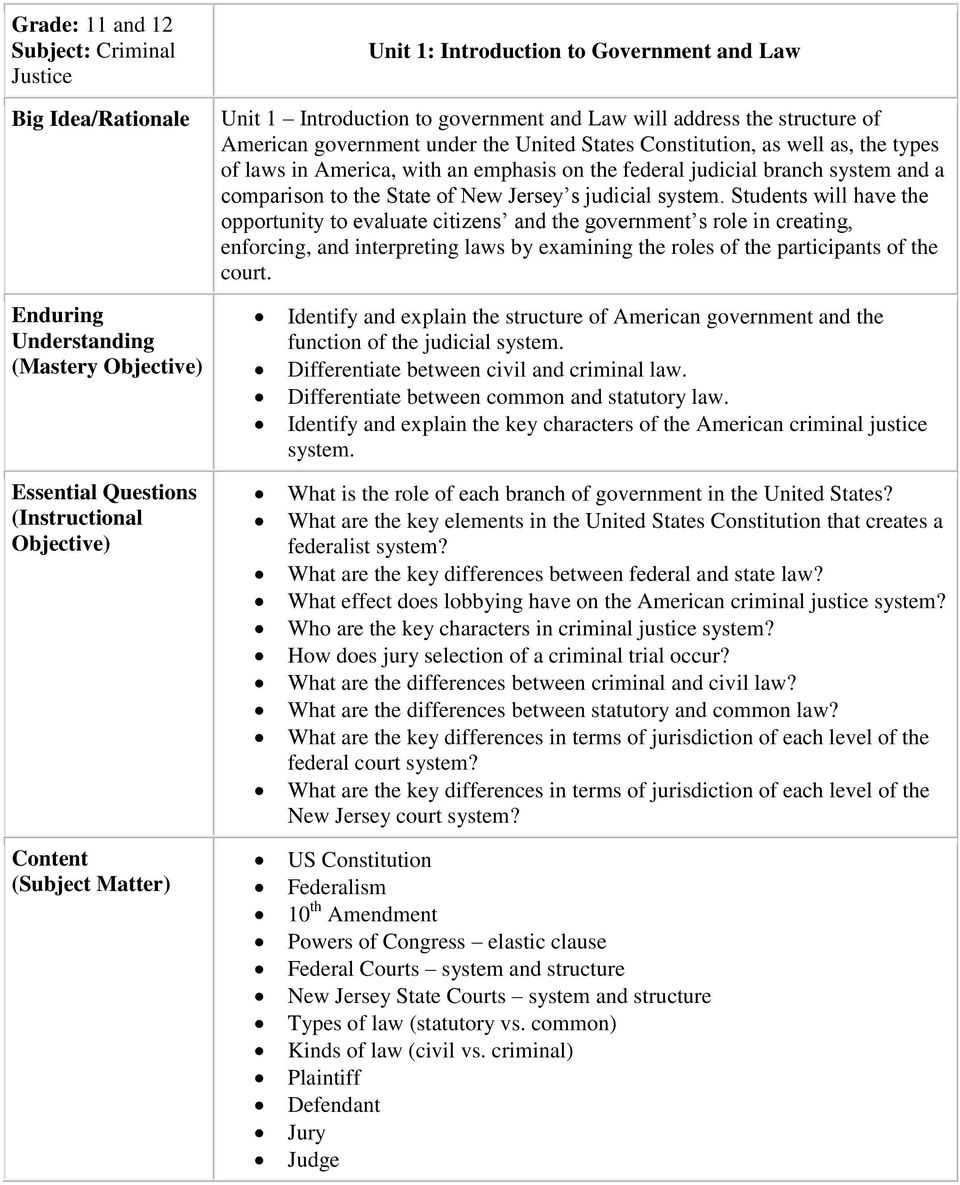
2 Grade: 11 and 12 Subject: Criminal Justice Big Idea/Rationale Unit 1: Introduction to Government and Law Unit 1 Introduction to government and Law will address the structure of American government under the United States Constitution, as well as, the types of laws in America, with an emphasis on the federal judicial branch system and a comparison to the State of New Jersey s judicial system. Students will have the opportunity to evaluate citizens and the government s role in creating, enforcing, and interpreting laws by examining the roles of the participants of the court. Enduring Understanding (Mastery Objective) Essential Questions (Instructional Objective) Content (Subject Matter) Identify and explain the structure of American government and the function of the judicial system. Differentiate between civil and criminal law. Differentiate between common and statutory law. Identify and explain the key characters of the American criminal justice system. What is the role of each branch of government in the United States? What are the key elements in the United States Constitution that creates a federalist system? What are the key differences between federal and state law? What effect does lobbying have on the American criminal justice system? Who are the key characters in criminal justice system? How does jury selection of a criminal trial occur? What are the differences between criminal and civil law? What are the differences between statutory and common law? What are the key differences in terms of jurisdiction of each level of the federal court system? What are the key differences in terms of jurisdiction of each level of the New Jersey court system? US Constitution Federalism 10 th Amendment Powers of Congress elastic clause Federal Courts system and structure New Jersey State Courts system and structure Types of law (statutory vs. common) Kinds of law (civil vs. criminal) Plaintiff Defendant Jury Judge
3 Prosecutor District attorney 4 th Amendment State law vs. federal law Skills/ Benchmarks (CCSS Standards) 2009 NJCCCS--21st-Century Life and Careers 9.4 Career and Technical Education All students who complete a career and technical education program will acquire academic and technical skills for careers in emerging and established professions that lead to technical skill proficiency, credentials, certificates, licenses, and/or degrees. L. Law, Public Safety, Corrections, & Security Career Cluster (4) Law Enforcement Services o L.(4).1 Demonstrate knowledge of the U.S. legal system and legal responsibilities related to law enforcement services. o L.(4).17 Describe how to ensure compliance with established procedures to avoid the violation of constitutional rights. o L.(4).20 Describe how to present testimony in legal proceedings in accordance with courtroom procedures, and demonstrate this skill by participating in mock trials. o L.(4).40 Examine and summarize the rights of victims and witnesses as well as procedures for protecting them. Materials and Resources Notes (5) Legal Services o L.(5).1 Analyze and summarize the roles of the three branches of the U.S. Government (i.e., the judicial, legislative, and executive branches) in order to demonstrate an understanding of how government influences legal services. o L.(5).5 Demonstrate specific academic writing strategies used by professionals in legal services environments. o L.(5).6 Use legal terminology accurately to effectively communicate within the legal services community. o L.(5).12 Demonstrate the technical knowledge and skills required of legal services professionals in order to prepare for the full range of careers in the pathway. Street Law: A Course in Practical Law. Fifth Edition, Lee P. Arbetman, Edward T. McMahon & Edward L. O Brien, eds. West Publishing Company, 1994.
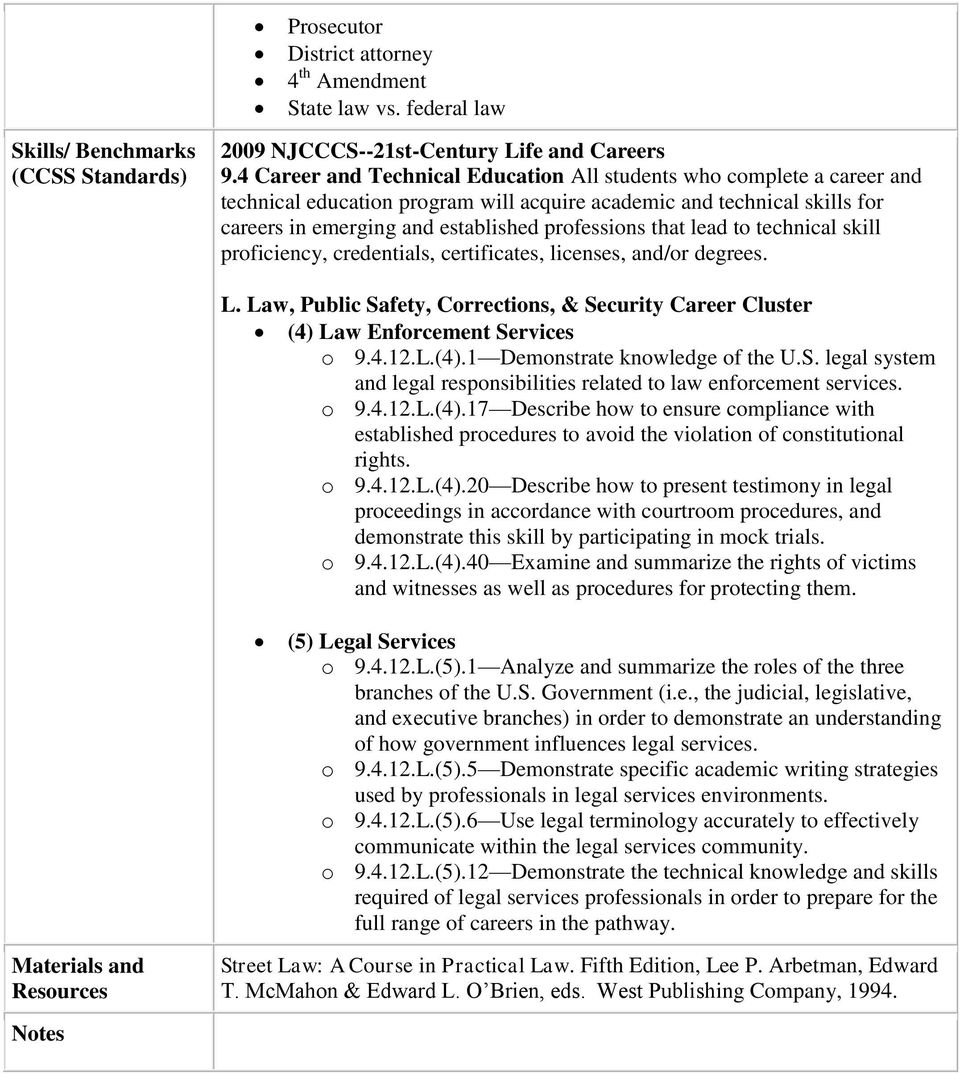
4 Grade: 11 and 12 Subject: Criminal Justice Big Idea/Rationale Unit 2: Crime Unit 2 Crime will address elements, causes, and classes of crime in the United States and New Jersey. An emphasis is placed on specific crimes, as well as, defenses to crime, plea-bargains, three strike laws, and minimum sentencing. Students will understand the role crime plays in the American criminal justice system. Discussing current events and their relationship to the criminal justice is a study throughout the course. Enduring Understanding (Mastery Objective) Essential Questions (Instructional Objective) Content (Subject Matter) Analyze and identify elements of crime and its role in the criminal justice system. Analyze and identify the classes of federal crime, state crime, and New Jersey crime. Distinguish between affirmative and non-affirmative defenses to criminal charges. Identify specific crimes in the United States and their elements. Analyze the plea-bargain process and its effect on the criminal justice system. Identify three strike laws and its effect on the criminal justice system. Identify minimum sentencing and its role in the criminal justice system What is an element of a crime? How are elements of crime outlined in statues? Explain the classes of crime in New Jersey. Explain the classes of federal crimes. What is the difference between affirmative and non-affirmative defenses to a criminal charge? What is larceny? What are the degrees of murder? What is the difference between assault and battery in criminal law? What is white collar crime? What are embezzlement and forgery? What are federal and state gun statues? What is the difference between a crime and a crime of omission? What theories of crime are there? How do three strike laws and minimum sentence mandates effect the criminal justice system? What is cyber-crime? What are examples of cyber-crimes? Crime Elements of crime (intent, mens rea, intent, motive, malice) Classes of crimes NJ (indictable v. non-indictable) other states
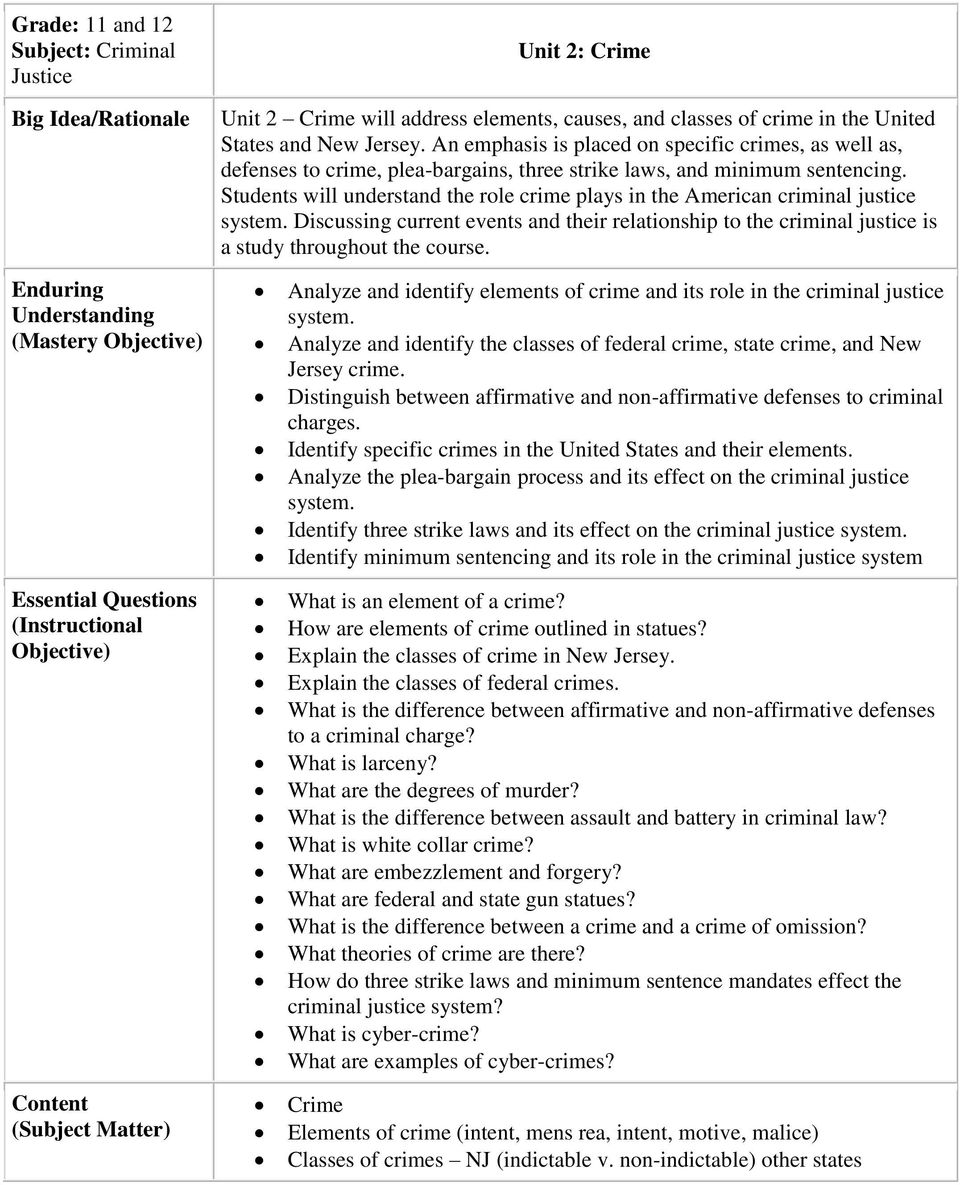
5 (summary, misdemeanor, felony) Causes of crime Crimes of omission Murder statues o Murder case law (killing out of necessity) o Attempted Negligence Assault Battery Theft Conspiracy Ponzi Scheme White Collar Crime Securities Fraud Guns and the law Rape Embezzlement Larceny Forgery Cyber crime Burglary vs. robbery Cyber crime Intoxication Defenses to criminal charges o Necessity o Self-defense o Duress o Insanity o Affirmative defenses NJ Assault statutory law NJ Battery statutory law NJ cybercrime statutory and case law NJ murder statutory law NJ Sexual Assault statutory law NJ White Collar Crime statutory law Skills/ Benchmarks (CCSS Standards) 2009 NJCCCS--21st-Century Life and Careers 9.4 Career and Technical Education All students who complete a career and technical education program will acquire academic and technical skills for careers in emerging and established professions that lead to technical skill proficiency, credentials, certificates, licenses, and/or degrees. L. Law, Public Safety, Corrections, & Security Career Cluster (4) Law Enforcement Services

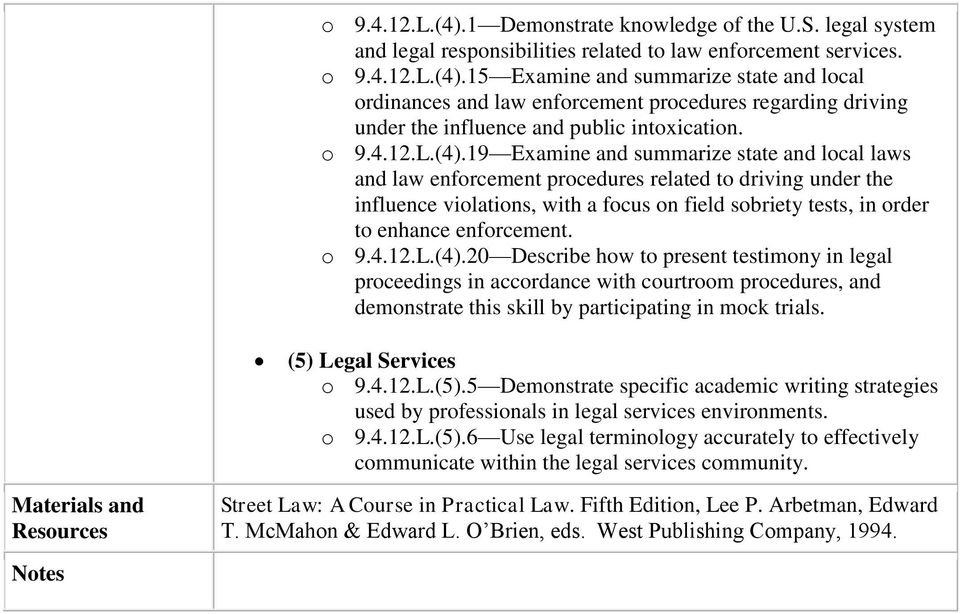
6 o L.(4).1 Demonstrate knowledge of the U.S. legal system and legal responsibilities related to law enforcement services. o L.(4).15 Examine and summarize state and local ordinances and law enforcement procedures regarding driving under the influence and public intoxication. o L.(4).19 Examine and summarize state and local laws and law enforcement procedures related to driving under the influence violations, with a focus on field sobriety tests, in order to enhance enforcement. o L.(4).20 Describe how to present testimony in legal proceedings in accordance with courtroom procedures, and demonstrate this skill by participating in mock trials. (5) Legal Services o L.(5).5 Demonstrate specific academic writing strategies used by professionals in legal services environments. o L.(5).6 Use legal terminology accurately to effectively communicate within the legal services community. Materials and Resources Street Law: A Course in Practical Law. Fifth Edition, Lee P. Arbetman, Edward T. McMahon & Edward L. O Brien, eds. West Publishing Company, Notes
7 Grade: 11 and 12 Subject: Criminal Justices Big Idea/Rationale Enduring Understanding (Mastery Objective) Unit 3: Due Process Unit 3 Due Process will address the criminal justice process with an emphasis on individual rights in criminal law. Students will be able to identify each step of the criminal justice process from the occurrence of the crime to sentencing. Discussing and relating current events to content will be practiced throughout the unit. Identify the steps of the criminal justice process in the New Jersey judiciary and the federal judiciary. Identify and analyze and due process rights guaranteed through the 5 th, 6 th, and 14 th Amendments. Identify and analyze and Miranda Rights. Identify due process rights created through common law. Explain the process of establishing bail. Distinguish between reasonable suspicion and probable cause. Distinguish between detainment and custody. Identify and explain the process of a plea bargain. Identify and explain the process of indictment in New Jersey. Define and use practice applications of the exclusionary rule. Essential Questions (Instructional Objective) What is due process? What due process rights are guaranteed through the 5 th Amendment? What due process rights are guaranteed through the 6 th Amendment? What due process rights are guaranteed through the 14 th Amendment? What precedent was created in Arizona v. Miranda? What occurs when an officer does not read Miranda Rights? What precedent was created in Terry v. Ohio? What is the purpose of a plea bargain? What is the process of establishing the bail in America? What role does a bail bondsmen play in the criminal justice process? What is the difference between detainment and custody? What occurs if evidence is illegally obtained by law enforcement and/or a prosecutor? When can an officer arrest a suspect? What action/s can an officer take with reasonable suspicion? What action/s can an officer take with probable cause? When and how do Miranda Rights take effect? What is the difference between reasonable suspicion and probable cause? How does one press charges against another person? What is the purpose of an arraignment? What precedent was established in Mapp v. Ohio? What is the purpose of the exclusionary rule?
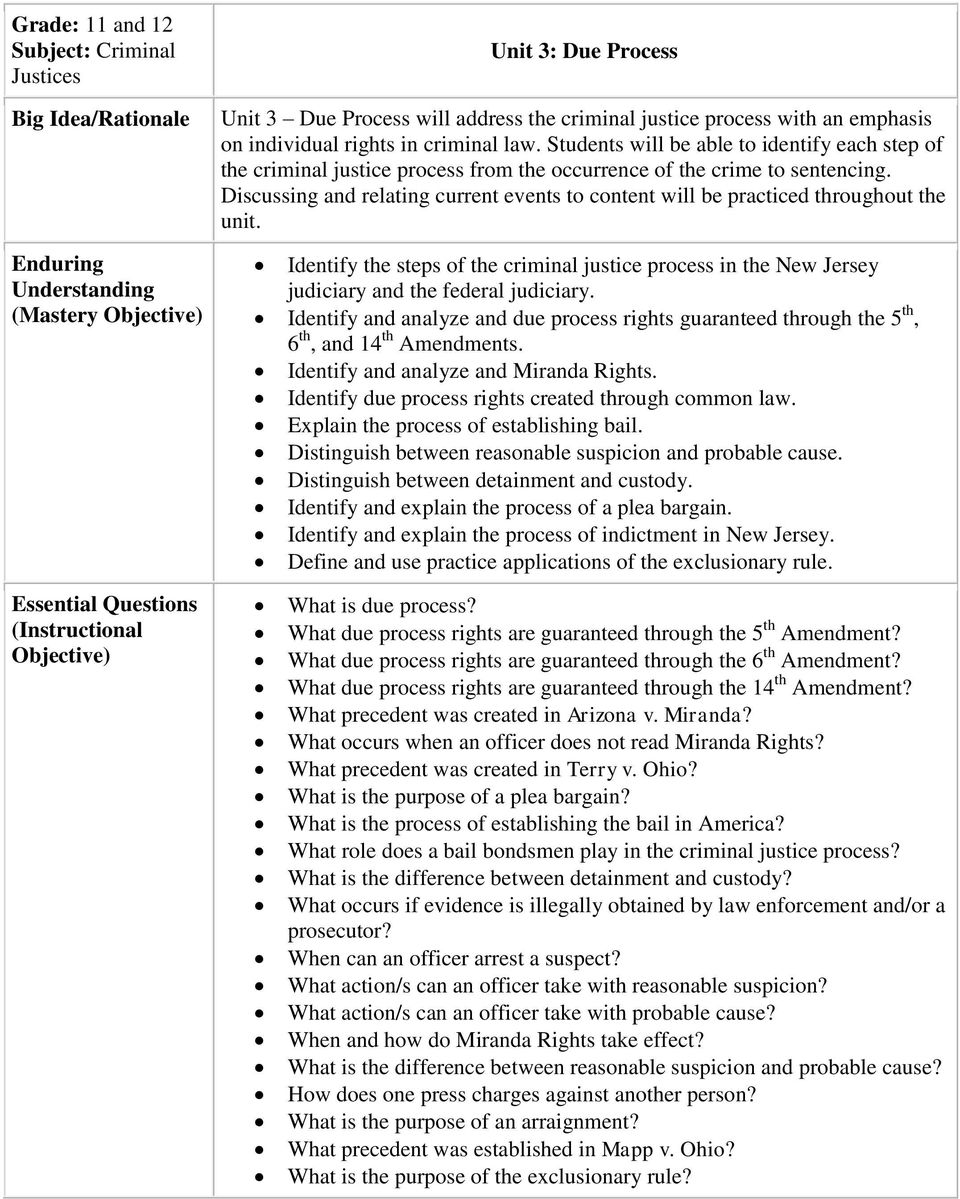
8 Content (Subject Matter) What precedent was established Kyllo v. USA? What is the process of obtaining a warrant? What rights does the 8 th Amendment guarantee in terms of bail? What sentencing options does a judge have? How does a judge determine sentencing? What is the stop and frisk policy? What controversy has developed pertaining to the stop and frisk policy? Due process rights 5 th Amendment 6 th Amendment 8 th Amendment 14 th Amendment Arrest Probable cause Arrest warrant Reasonable suspicion Detainment Bail Bail bondsmen Indictment (grand jury and judge) Arraignment Trial (bench and jury) Sentencing Conviction Conditional treatments Parole Probation Terry v. Ohio Terry stop Mapp v. Ohio Exclusionary rule Arizona v. Miranda Miranda rights Criminal complaint Plea bargain stop and frisk Skills/ Benchmarks (CCSS Standards) 21st-Century Life and Careers 9.4 Career and Technical Education All students who complete a career and technical education program will acquire academic and technical skills for careers in emerging and established professions that lead to technical skill proficiency, credentials, certificates, licenses, and/or degrees.
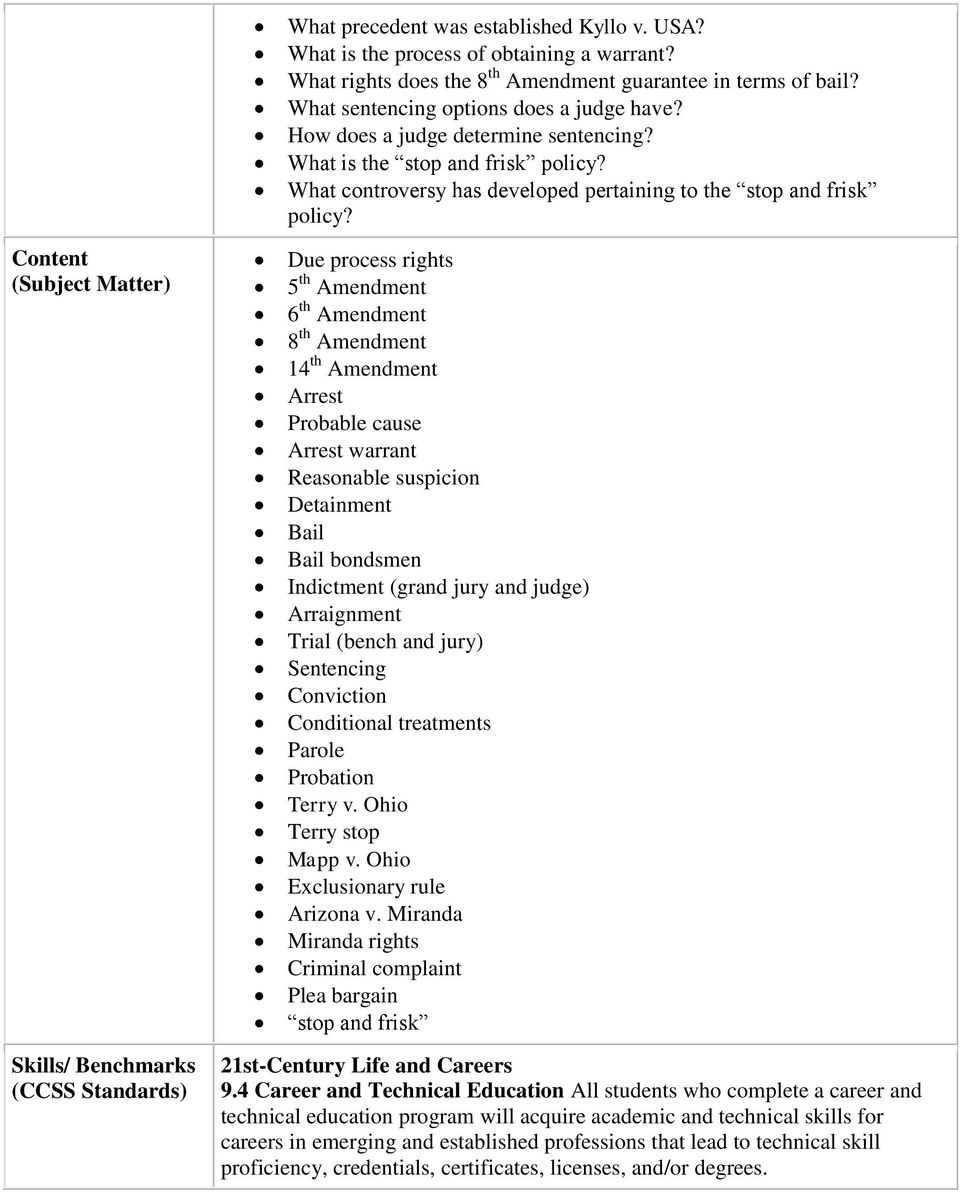
9 L. Law, Public Safety, Corrections, & Security Career Cluster (4) Law Enforcement Services o L.(4).1 Demonstrate knowledge of the U.S. legal system and legal responsibilities related to law enforcement services. o L.(4).1 Demonstrate knowledge of the U.S. legal system and legal responsibilities related to law enforcement services. o L.(4).11 Examine and summarize Fourth Amendment concerns in the areas of search and seizure and probable cause. o L.(4).12 Examine and summarize the rights of an individual being interrogated under the Fifth and Sixth Amendments in order to ensure trial, jury, and due process rights for individuals in the law enforcement environments. o L.(4).13 Examine and summarize the impact of the Fourteenth Amendment as it relates to due process and equal protection, with a focus on both current events and historical accounts in order to ensure that law enforcement professionals respect the constitutional rights of individuals they encounter. o L.(4).14 Examine and summarize limits on and types of interrogation procedures, with a focus on Miranda rights and the Fifth Amendment, in order to protect the rights of both U.S. and non-u.s. citizens in the course of providing law enforcement services. o L.(4).15 Examine and summarize state and local ordinances and law enforcement procedures regarding driving under the influence and public intoxication. o L.(4).16 Examine and summarize procedures and protocols involved in basic civil law enforcement procedures in order to serve writs, warrants, and summonses. o L.(4).17 Describe how to ensure compliance with established procedures to avoid the violation of constitutional rights. o L.(4).18 Describe how to ensure compliance with established procedures to avoid the violation of constitutional protections regarding search and seizure, with a focus on the Terry stop (stop and frisk) and attaining warrants. o L.(4).19 Examine and summarize state and local laws and law enforcement procedures related to driving under the influence violations, with a focus on field sobriety tests, in order to enhance enforcement. o L.(4).20 Describe how to present testimony in legal proceedings in accordance with courtroom procedures, and demonstrate this skill by participating in mock trials. o L.(4).26 Examine and summarize strategies to properly protect, document and process crime scenes and all related evidence. o L.(4).27 Describe how to conduct interviews and

10 interrogations using appropriate law enforcement procedures in order to ensure the protection of individual rights and effective information gathering. o L.(4).40 Examine and summarize the rights of victims and witnesses as well as procedures for protecting them. o L.(4).41 Describe how to conduct building searches. o L.(4).42 Describe the paper collection of evidence to prevent corruption of crime scenes. (5) Legal Services o L.(5).5 Demonstrate specific academic writing strategies used by professionals in legal services environments. o L.(5).6 Use legal terminology accurately to effectively communicate within the legal services community. o L.(5).9 Evaluate and model appropriate reactions to situations involving Fourth Amendment rights in order to demonstrate an understanding of the impact this amendment has on individuals providing legal services and their actions. o L.(5).10 Evaluate and summarize the rights of an individual being interrogated under the Fifth and Sixth Amendments in order to ensure trial, jury, and due process rights for individuals in legal services environments. o L.(5).11 Analyze and summarize the impact of the Fourteenth Amendment as it relates to due process and equal protection in order to ensure that legal service professionals respect the constitutional rights of individuals they encounter. o L.(5).12 Demonstrate the technical knowledge and skills required of legal services professionals in order to prepare for the full range of careers in the pathway. Materials and Resources Street Law: A Course in Practical Law. Fifth Edition, Lee P. Arbetman, Edward T. McMahon & Edward L. O Brien, eds. West Publishing Company, Notes

Criminal Law. Month Content Skills August. Define the term jurisprudence. Introduction to law. What is law? Explain several reasons for having laws.
 Criminal Law Month Content Skills August Introduction to law Define the term jurisprudence. What is law? Explain several reasons for having laws. Discuss the relationship between laws and values. Give
Chapter 15 Criminal Law and Procedures
 Chapter 15 Criminal Law and Procedures Chapter Outline 1. Introduction 2. What Is a Crime? 3. Elements of Criminal Liability 4. Types of Crimes 5. Cyber Crime 6. Constitutional Safeguards 7. Criminal Procedures
role in that system. Class discussion and debate will be encouraged. Semester Instructional Unit I
 Name of Course: Criminal Law Grade 11-12 Level(s): Brief Description (Course Catalog): This course will deal with the basic legal terms, concepts, and principles of criminal law and procedures. Students
CONSTITUTIONAL RIGHTS
 RIGHTS OF THE CRIMINALLY ACCUSED GENERAL LEGAL RIGHTS CHAPTER 10 INTRODUCTION Constitutional rights relating to American criminal law are the same for all adult persons, whether they have a disability
YOSEMITE REGIONAL OCCUPATIONAL PROGRAM CRIMINAL JUSTICE
 CBEDS Code: 5847 YOSEMITE REGIONAL OUPATIONAL PROGRAM IMINAL JUSTICE JOB TITLES DOT NO. Correction Officer 372.667-018 Criminalist 029.261-026 Guard, Security 372.667-034 Police Officer 375.263-014 Probation/Parole
Glossary of Court-related Terms
 Glossary of Court-related Terms Acquittal Adjudication Appeal Arraignment Arrest Bail Bailiff Beyond a reasonable doubt Burden of proof Capital offense Certification Charge Circumstantial evidence Citation
grand larceny robbery vandalism arson victimless crimes white-collar crimes community policing probable cause arrest warrant own
 Unit 8 (2 weeks) SECTIONS Don t do the crime if you do not want to serve the time! 1. Causes of crimes (2 Days) 2. Crime classification (2 Days) 3. Criminal defenses (2 Days) 4. Criminal justice procedures
SUN PRAIRIE AREA SCHOOL DISTRICT COURSE SYLLABUS. Curriculum Area: Social Studies Course Length: Semester
 SUN PRAIRIE AREA SCHOOL DISTRICT COURSE SYLLABUS Course Title: Legal Studies Curriculum Area: Social Studies Course Length: Semester Credit Status: Elective Date submitted: 2/07 District Adopted Texts/Materials/Resources:
GETTING TO KNOW THE CRIMINAL JUSTICE SYSTEM
 Patricia A. DeAngelis District Attorney GETTING TO KNOW THE CRIMINAL JUSTICE SYSTEM AN OFFENSE IS COMMITTED There are three types of offenses that can be committed in New York State: VIOLATION MISDEMEANOR
CHAPTER. What is Criminal Justice? Criminal Justice: Criminal Justice: Criminal Justice: What is the Definition of Crime?
 CHAPTER What is Criminal Justice? What is the Definition of Crime? Crime: What is Justice? Justice: Social Justice: Civil Justice: The Theme of this Book Individual Rights vs. Public Order The Theme of
110 Explain locard's principle of transference of trace materials at a crime scene. Unit/Standard Number
 1 Secondary Task List 100 CRIME SCENE MANAGEMENT 101 Collect hair, blood and bullet fragments for evidence. 102 Collect, preserve and catalog physical evidence while maintaining a chain of custody. 103
Criminal Justice System Commonly Used Terms & Definitions
 Criminal Justice System Commonly Used Terms & Definitions A B C D E F G H I J K L M N O P Q R S T U V W X Y Z Accused: Acquittal: Adjudication: Admissible Evidence: Affidavit: Alford Doctrine: Appeal:
HOW A TYPICAL CRIMINAL CASE IS PROSECUTED IN ALASKA
 HOW A TYPICAL CRIMINAL CASE IS PROSECUTED IN ALASKA The Office of Victims Rights receives many inquiries from victims about how a criminal case in Alaska is investigated by police and then prosecuted by
Chapter 3. Justice Process at the County Level. Brooks County Courthouse
 Chapter 3 Justice Process at the County Level Brooks County Courthouse Chapter Three: Judice Process at the County Level Developmental Assets: Life Skills: TEKS: Objectives: 10. Safety 30. Responsibility
6 The Development of the Criminal Justice System. 7 Organization and Operation of Law Enforcement Systems
 Introduction to Criminal Justice Week # Subject Matter 1 Orientation Current Events 2/3 Overview of the System Bulletin Board Project 4 Evolution of the Present System 5 Explanation of Contemporary Crime
The Court Process. Understanding the criminal justice process
 Understanding the criminal justice process Introduction Missouri law establishes certain guarantees to crime victims, including participation in the criminal justice system. Victims can empower themselves
Glossary of Terms Acquittal Affidavit Allegation Appeal Arraignment Arrest Warrant Assistant District Attorney General Attachment Bail Bailiff Bench
 Glossary of Terms The Glossary of Terms defines some of the most common legal terms in easy-tounderstand language. Terms are listed in alphabetical order. A B C D E F G H I J K L M N O P Q R S T U V W
INTRODUCTION FORENSIC SCIENCE AND THE LAW CHAPTER 1 OBJECTIVES
 INTRODUCTION TO FORENSIC SCIENCE AND THE LAW CHAPTER 1 OBJECTIVES Describe the organization of crime labs in the US and the services they provide Describe the Federal rules of evidence Frye standard and
The Legal System in the United States
 The Legal System in the United States At the conclusion of this chapter, students will be able to: 1. Understand how the legal system works; 2. Explain why laws are necessary; 3. Discuss how cases proceed
UNDERSTANDING THE CRIMINAL JUSTICE SYSTEM Anne Benson
 UNDERSTANDING THE CRIMINAL JUSTICE SYSTEM Anne Benson What is the Criminal Justice System? The criminal justice system is the system we have in the United States for addressing situations where it is believed
COMMONWEALTH OF MASSACHUSETTS THE TRIAL COURT STANDING ORDER NO. 2-86 (AMENDED)
 COMMONWEALTH OF MASSACHUSETTS THE TRIAL COURT SUFFOLK, ss. SUPERIOR COURT DEPARTMENT STANDING ORDER NO. 2-86 (AMENDED) Applicable to All Counties to cases initiated by indictment on or after September
MINDY FLETCHER SOLOMON (954) 792-8362
 PROFESSIONAL SKILLS MINDY FLETCHER SOLOMON (954) 792-8362 I am currently a chief assistant in the Public Defenders office supervising the juvenile division, major crimes division, and homicide division.
STUDENT STUDY GUIDE CHAPTER TWO
 Multiple Choice Questions STUDENT STUDY GUIDE CHAPTER TWO 1. A court s application of prior judicial rulings to similar cases is the use of a. Substantive law b. Precedent c. Civil law d. Evidence 2. What
C O H E N, T O D D, K I T E & S T A N F O R D, L L C
 C O H E N, T O D D, K I T E & S T A N F O R D, L L C John L. O Shea Member Direct: (513) 333-5227 Mobile: (513) 300-4012 Email: [email protected] visit superlawyers.com Top 50 Cincinnati Super Lawyer 2012,
Chapter SECTION OPENER / CLOSER: INSERT BOOK COVER ART. Section 3.1 What Is a Crime?
 Chapter 3 SECTION OPENER / CLOSER: INSERT BOOK COVER ART Section 3.1 Chapter 3 What Criminal Is a Crime? Law Section 3.1 Section 3.2 Particular Crimes Why It s Important Learning the essence of criminal
Decades of Successful Sex Crimes Defense Contact the Innocence Legal Team Now
 Criminal Court Felonies The U.S. has the highest rate of felony conviction and imprisonment of any industrialized nation. A felony crime is more serious than a misdemeanor, but the same offense can be
Curriculum Map CONTEMPORARY LAW ELECTIVE Saugus High School Saugus, MA 01906
 Curriculum Map CONTEMPORARY LAW ELECTIVE Saugus High School Saugus, MA 01906 March 2000 SAUGUS HIGH SCHOOL SOCIAL STUDIES DEPARTMENT MISSION STATEMENT* The Saugus High School Social Studies Department
Office of Professional & Continuing Education 301 OD Smith Hall Auburn, AL 36849 http://www.auburn.edu/mycaa Contact: Shavon Williams 334-844-3108
 Student Full Name: Office of Professional & Continuing Education 301 OD Smith Hall Auburn, AL 36849 http://www.auburn.edu/mycaa Contact: Shavon Williams 334-844-3108 Auburn University is an equal opportunity
Maricopa County Attorney s Office Adult Criminal Case Process
 The following is a brief description of the process to prosecute an adult accused of committing a felony offense. Most misdemeanor offenses are handled by municipal prosecutors; cases involving minors
C O H E N, T O D D, K I T E & S T A N F O R D, L L C
 C O H E N, T O D D, K I T E & S T A N F O R D, L L C John L. O Shea Member Direct: (513) 333-5227 Mobile: (513) 300-4012 Email: [email protected] visit superlawyers.com Top 50 Cincinnati Super Lawyer 2012,
Information for Crime Victims and Witnesses
 Office of the Attorney General Information for Crime Victims and Witnesses MARCH 2009 LAWRENCE WASDEN Attorney General Criminal Law Division Special Prosecutions Unit Telephone: (208) 332-3096 Fax: (208)
A Citizen s Guide to the Criminal Justice System: From Arraignment to Appeal
 A Citizen s Guide to the Criminal Justice System: From Arraignment to Appeal Presented by the Office of the Richmond County District Attorney Acting District Attorney Daniel L. Master, Jr. 130 Stuyvesant
Criminal Justice in New York County
 criminal justice in new york county new york county district attorney s office Criminal Justice in New York County Learning About the Process cyrus r. vance, jr. district attorney the police and the arrest
Courtroom Terminology
 Courtroom Terminology A Accused: formally charged but not yet tried for committing a crime; the person who has been charged may also be called the defendant. Acquittal: a judgment of court, based on the
MODEL CRIMINAL DEFENSE MENTORING PROGRAM Utah State Bar New Lawyer Training Program
 MODEL CRIMINAL DEFENSE MENTORING PROGRAM Utah State Bar New Lawyer Training Program The following is submitted as a Model Mentoring Plan for the criminal defense practice field. It was prepared by an experienced
Examples of CrimeS. Rationales for Criminal Punishments Deterrence Retribution Restraint Rehabilitation. Chapter 7 Crime
 Chapter 7 Crime 1 Examples of CrimeS Rape Murder Robbery Drug dealing Medicare fraud Money laundering Embezzlement Wire fraud 2 Rationales for Criminal Punishments Deterrence Retribution Restraint Rehabilitation
Criminal Justice 101 (Part II) Grand Jury, Trial, & Sentencing. The Charging Decision. Grand Jury 5/22/2014. Misdemeanors v.
 Criminal Justice 101 (Part II) Grand Jury, Trial, & Sentencing Presented at: Office of the Attorney General 2014 Texas Crime Victim s Services Conference Transformations: Building Community Networks Grand
A Victim s Guide to Understanding the Criminal Justice System
 A Victim s Guide to Understanding the Criminal Justice System The Bartholomew County Prosecutor s Office Victim Assistance Program Prosecutor: William Nash 234 Washington Street Columbus, IN 47201 Telephone:
A Federal Criminal Case Timeline
 A Federal Criminal Case Timeline The following timeline is a very broad overview of the progress of a federal felony case. Many variables can change the speed or course of the case, including settlement
Recommended Preparation: Successful completion of ENGL105 or equivalent assessment placement.
 Lassen Community College Course Outline AJ-20 Criminal Law 3.0 Units I. Catalog Description This course offers an overview of the origin and development of law, including English Common Law. It provides
Introduction. 1 P age
 Introduction The New York City criminal justice system is made up of many different agencies and organizations. These include the independent judiciary, the five elected District Attorneys and the Special
STUDENT STUDY GUIDE CHAPTER NINE
 Multiple Choice Questions STUDENT STUDY GUIDE CHAPTER NINE 1. Which of the following is a type of case that is often heard by lower level courts? a. Breach of contract b. Federal appeals c. Maritime claims
CRIMINAL LAW AND TRAFFIC VIOLATIONS
 THE PEOPLE S LAW SCHOOL What everyone needs to know CRIMINAL LAW AND TRAFFIC VIOLATIONS Tuesday, December 13, 2005 Peter A. Gerstenzang, Esq. Gerstenzang O Hern Hickey & Gerstenzang Albany, New York Presented
RARITAN VALLEY COMMUNITY COLLEGE ACADEMIC COURSE OUTLINE ROLE OF THE PARALEGAL LEGL-101
 1 RARITAN VALLEY COMMUNITY COLLEGE ACADEMIC COURSE OUTLINE ROLE OF THE PARALEGAL LEGL-101 I. Basic Course Information A. Course Title and Number: Role of the Paralegal LEGL-101 B. New or Modified Course:
CAUSE NO. THE STATE OF TEXAS IN THE 49th DISTRICT COURT ZAPATA COUNTY, TEXAS
 CAUSE NO. STATE S EXHIBIT #1 THE STATE OF TEXAS IN THE 49th DISTRICT COURT VS. OF ZAPATA COUNTY, TEXAS PLEA OF GUILTY, ADMONISHMENTS, VOLUNTARY STATEMENTS, WAIVERS, STIPULATION & JUDICIAL CONFESSION (Defendant
PROSECUTION DIVISION THE MISSION
 PROSECUTION DIVISION THE MISSION Chief Prosecutor Phillip J. Tydingco The Office of the Attorney General, through its Prosecution Division, plays a vital role in Guam s criminal justice system as part
General District Courts
 General District Courts To Understand Your Visit to Court You Should Know: It is the courts wish that you know your rights and duties. We want every person who comes here to receive fair treatment in accordance
DESCRIPTION OF THE FEDERAL CRIMINAL JUSTICE SYSTEM FOR DEFENDANTS
 DESCRIPTION OF THE FEDERAL CRIMINAL JUSTICE SYSTEM FOR DEFENDANTS DESCRIPTION OF THE FEDERAL CRIMINAL JUSTICE SYSTEM FOR DEFENDANTS This pamphlet has been provided to help you better understand the federal
NORWIN SCHOOL DISTRICT CURRICULUM MAP
 NORWIN SCHOOL DISTRICT CURRICULUM MAP Course Name: Business Law I Course Number: BUS180 Length of Course: Semester Grading Period CONTENT SKILLS First/Third Nine Weeks Unit of Study: Foundations of the
OBJECTIVES CRIMINAL PROCESS- PROSECUTING ATTORNEY S OFFICE NAVIGATING THE CRIMINAL AND CIVIL PROCESS IN CHILD ABUSE AND NEGLECT CASES
 NAVIGATING THE CRIMINAL AND CIVIL PROCESS IN CHILD ABUSE AND NEGLECT CASES LORI FLUEGEL ASSISTANT PROSECUTING ATTORNEY JACKSON COUNTY OBJECTIVES UNDERSTANDING OF THE CRIMINAL AND CIVIL PROCESS OF CHILD
SECTION 14 CRIMINAL JUSTICE SYSTEM
 SECTION 14 CRIMINAL JUSTICE SYSTEM THE COLORADO COURT SYSTEM DENVER COUNTY COURTS MUNICIPAL COURTS - Cases are handled by the City Attorney s Office. TYPES OF CRIMES: Violations of City Ordinances Assaults
Using Administrative Records to Report Federal Criminal Case Processing Statistics
 Using Administrative Records to Report Federal Criminal Case Processing Statistics John Scalia, Jr. Statistician Bureau of Justice Statistics U.S. Department of Justice Federal criminal case processing
Cuyahoga County Common Pleas Court Local Rules 33.0 ASSIGNMENT AND COMPENSATION OF COUNSEL TO DEFEND
 33.0 ASSIGNMENT AND OF COUNSEL TO DEFEND PART I. (A) No attorney will be assigned to defend any indigent person in a criminal case unless his or her name appears on one of the approved trial counsel lists
CRIMINAL JUSTICE GLOSSARY
 CRIMINAL JUSTICE GLOSSARY ACQUITTAL: a judgment of a court, based either on the verdict of a jury or a judicial officer, that the defendant is not guilty of the offense(s) for which he or she was tried.
GLOSSARY OF TERMS - CRIMINAL
 GLOSSARY OF TERMS - CRIMINAL Acquittal: A finding that the defendant is not guilty of the charges brought by the government. This finding may be reached by the trial judge in a case tried before a judge
System Overview ~~~~~ Presented by: Darcie McElwee
 System Overview ~~~~~ Presented by: Darcie McElwee SYSTEM OVERVIEW OBJECTIVES Upon conclusion of this module the participant will be able to: Describe the overall structure, case flow process, and roles
BRYCE A. FETTER ORLANDO JUVENILE CHARGES ATTORNEY
 BRYCE A. FETTER ORLANDO JUVENILE CHARGES ATTORNEY People make mistakes, especially young people. Juvenile lawyer Bryce Fetter believes children should get a second chance through rehabilitation rather
CRMJ 1010 Introduction to Criminal Justice
 MSCC Syllabus Template for Conventional (On-Ground) Courses 1 The mission of Motlow State Community College is to enrich and empower its students and the community it serves. CRMJ 1010 Introduction to
Idaho Manual on the Rights of Victims of Crime
 Office of the Attorney General Idaho Manual on the Rights of Victims of Crime JULY 2004 LAWRENCE WASDEN Attorney General 700 West State Street Boise, ID 83720-0010 www.ag.idaho.gov State of Idaho Office
C RIMINAL LAW O V E RVIEW OF T H E T E XAS C RIMINAL J USTICE P ROCESS
 T E X A S Y O U N G L A W Y E R S A S S O C I A T I O N A N D S T A T E B A R O F T E X A S C RIMINAL LAW 1 0 1 : O V E RVIEW OF T H E T E XAS C RIMINAL J USTICE P ROCESS A C RIMINAL LAW 1 0 1 Prepared
How To Become A District Attorney In Texas
 PROFESSIONAL EXPERIENCE 2013-Present 79th Judicial District Attorney s Office Jim Wells and Brooks Counties, Texas District Attorney. Duties include the administration of 16 full-time employees including
Criminal Justice System Glossary of Terms
 Criminal Justice System Glossary of Terms Terms included in this glossary of terms are adapted from the Victims Rights Education Toolkit. The justice system uses specific terms to represent processes,
CHAPTER 3. COLORADO CRIMINAL LAW by H. Patrick Furman Clinical Professor of Law
 CHAPTER 3 COLORADO CRIMINAL LAW by H. Patrick Furman Clinical Professor of Law INTRODUCTION Criminal law regulates behavior that the people, through their legislators, decide cannot be tolerated. Criminal
HIRE A SPECIALIST ALWAYS FIGHTING FOR THE ACCUSED
 HIRE A SPECIALIST I am an experienced Board Certified criminal lawyer in Pasco Florida. Less than one percent of attorneys in Florida are Board Certified. Only Board Certified criminal lawyers are permitted
Tarrant County College Police Department
 Tarrant County College Police Department VICTIM ASSISTANCE An Assistance Program for Victims and Family Survivors of Violent Crimes Tarrant County College The Tarrant County College District Police Department
The NH Court System excerpts taken from http://www.courts.state.nh.us/press/030608guide.pdf
 The NH Court System excerpts taken from http://www.courts.state.nh.us/press/030608guide.pdf NH court system: The modern trial and appellate court system in New Hampshire took shape in 1901, when the legislature
GLOSSARY OF SELECTED LEGAL TERMS
 GLOSSARY OF SELECTED LEGAL TERMS Sources: US Courts : http://www.uscourts.gov/library/glossary.html New York State Unified Court System: http://www.nycourts.gov/lawlibraries/glossary.shtml Acquittal A
Walking Through a Trial
 Lesson Overview Overview: This lesson will teach students how the legal system works and how a case progresses through the state courts. Objectives: Students will be able to Define key terms related to
IMMIGRATION CONSEQUENCES OF CRIMINAL CONVICTION
 NATIONAL LAWYERS GUILD Massachusetts Chapter, Inc. 14 Beacon St., Suite 407, Boston, MA 02108 tel. 617-227-7335 * fax: 617-227-5495 * [email protected] * www.nlgmass.org May, 2002 IMMIGRATION CONSEQUENCES
Victims of Crime Act
 Victims of Crime Act PURPOSE Recognizing the state's concern for victims of crime, it is the purpose of the Victims of Crime Act [31-26-1 NMSA 1978] to assure that: A. the full impact of a crime is brought
The Family Court Process for Children Charged with Criminal and Status Offenses in South Carolina
 The Family Court Process for Children Charged with Criminal and Status Offenses in South Carolina The Children s Law Offi ce is a training, project, and resource center in child protection and juvenile
Purpose of the Victim/Witness Unit
 Purpose of the Victim/Witness Unit The Victim/Witness Assistance Division of the Lake County State s Attorney s Office was formed to serve the needs of people like you. The division is meant to ensure
An Introduction to the Federal Public Defender=s Office and the Federal Court System
 Some Things You Should Know An Introduction to the Federal Public Defender=s Office and the Federal Court System Office of the Federal Public Defender Southern District of West Virginia 300 Virginia Street
CJ-310 ADMINISTRATION OF JUSTICE
 INTRODUCTION ADMINISTRATION OF JUSTICE Welcome to,. This course is designed to provide a range of information about the criminal justice system and to teach criminal justice students fundamental concepts
INTRODUCTION DO YOU NEED A LAWYER?
 INTRODUCTION The purpose of this handbook is to provide answers to some very basic questions that inmates or inmates families might have regarding the processes of the criminal justice system. In no way
Course Court Systems and Practices. Unit X Pre-trial
 Course Court Systems and Practices Unit X Pre-trial Essential Question What happens to a case between the time a person is arrested and the time they have their trial? TEKS 130.296(c) (1)(G) (4)(B)(E)
You Have the Right. What You & Your Family Should Know In Case You Are Arrested in Illinois
 You Have the Right What You & Your Family Should Know In Case You Are Arrested in Illinois Table of Contents Foreword................................. 2 What to Do if Arrested...........................
Information about the Criminal Justice System**
 1 Victim s Guide to the Nebraska Criminal Justice System Information about the Criminal Justice System** ** Please note that the information contained in this booklet is only in relationship to felony
Adult Plea Negotiation Guidelines
 From the office of the Rice County Attorney: Adult Plea Negotiation Guidelines Revision June, 2004 1. These guidelines apply to any adult felony defendant case prosecuted by this office, which is not disposed
Stages in a Capital Case from http://deathpenaltyinfo.msu.edu/
 Stages in a Capital Case from http://deathpenaltyinfo.msu.edu/ Note that not every case goes through all of the steps outlined here. Some states have different procedures. I. Pre-Trial Crimes that would
RULES OF SUPREME COURT OF VIRGINIA PART THREE A CRIMINAL PRACTICE AND PROCEDURE APPENDIX
 RULES OF SUPREME COURT OF VIRGINIA PART THREE A CRIMINAL PRACTICE AND PROCEDURE APPENDIX Form 6. Suggested Questions to Be Put by the Court to an Accused Who Has Pleaded Guilty (Rule 3A:8). Before accepting
CRIMINAL LAW AND VICTIMS RIGHTS
 Chapter Five CRIMINAL LAW AND VICTIMS RIGHTS In a criminal case, a prosecuting attorney (working for the city, state, or federal government) decides if charges should be brought against the perpetrator.
Case: 1:12-cv-04340 Document #: 1 Filed: 06/04/12 Page 1 of 12 PageID #:1 UNITED STATES DISTRICT COURT NORTHERN DISTRICT OF ILLINOIS, EASTERN DIVISION
 Case: 1:12-cv-04340 Document #: 1 Filed: 06/04/12 Page 1 of 12 PageID #:1 UNITED STATES DISTRICT COURT NORTHERN DISTRICT OF ILLINOIS, EASTERN DIVISION BENJAMIN PEREZ and BOBBY ) MILTON, ) ) Plaintiffs,
Posting Bail. First Court Appearance
 With extensive background representing all types of clients in a variety of criminal defense cases, Tyler, Texas lawyer James W. Volberding has the experience and knowledge to represent individuals in
TAMALPAIS UNION HIGH SCHOOL DISTRICT Larkspur, California COURSE OF STUDY STREET LAW: AN INTRODUCTION TO THE U.S. LEGAL SYSTEM
 TAMALPAIS UNION HIGH SCHOOL DISTRICT Larkspur, California COURSE OF STUDY STREET LAW: AN INTRODUCTION TO THE U.S. LEGAL SYSTEM 1. INTRODUCTION Street Law is a course designed to provide knowledge and problem-solving
CRIMINAL COURT IN MINNESOTA: Understanding the Process so You can Sleep at Night
 RYAN PACYGA CRIMINAL DEFENSE 333 South 7 th Street, Suite 2850 Minneapolis, MN 55402 612-339-5844 www.arrestedmn.com More information on the YouTube channel Ryan Pacyga CRIMINAL COURT IN MINNESOTA: Understanding
Morgan County Prosecuting Attorney Debra MH McLaughlin
 Morgan County Prosecuting Attorney Debra MH McLaughlin Directions: From Fairfax Street Entrance, Enter Main Door, turn Right through door, up the narrow staircase. Office is at top of steps. (Old Circuit
Criminal Justice Upper Division Restricted Electives Undergraduate Courses
 Criminal Justice Upper Division Restricted Electives Undergraduate Courses CCJ 3058 Origins of Criminal Justice 3(3, 0) PR: CCJ3024 or C.I. Study of criminal justice system evolution. Focus on developments
2015 IL App (1st) 133050-U. No. 1-13-3050 IN THE APPELLATE COURT OF ILLINOIS FIRST JUDICIAL DISTRICT
 2015 IL App (1st) 133050-U FIFTH DIVISION September 30, 2015 No. 1-13-3050 NOTICE: This order was filed under Supreme Court Rule 23 and may not be cited as precedent by any party except in the limited
External Advisory Group Meeting June 2, 2015
 External Advisory Group Meeting June 2, 2015 1. There seems to be an extended wait from disposition to sentence where defendants are in jail awaiting the completion of the pre-sentence report. How many
Chapter 1 OVERVIEW OF CORRECTIONS
 Chapter 1 OVERVIEW OF CORRECTIONS AND CRIMINAL JUSTICE Criminal Justice as Social/Governmental Institution Social Institutions established groupings people beliefs practices three main characteristics
Course Law Enforcement I. Unit III United States Legal Systems
 Course Law Enforcement I Unit III United States Legal Systems Essential Question What is the difference between civil and criminal law? TEKS 130.293(c) (5)(E) Prior Student Learning State and Federal Court
GENESEE COUNTY DISTRICT ATTORNEY S OFFICE
 GENESEE COUNTY S OFFICE ORGANIZATIONAL CHART ADMINISTRATION PRE-ARREST INVESTIGATION In conjunction with Police Agencies MISDEMEANOR PROSECUTIONS in Town and Village Justice Courts FELONY PROSECUTIONS
INFORMATION / FACT SHEET CRIME TO TRIAL PROCESS CRIMINAL COURT HEARINGS EXPLAINED
 INFORMATION / FACT SHEET CRIME TO TRIAL PROCESS CRIMINAL COURT HEARINGS EXPLAINED *(Please be advised that this is a general guide only and is by no means an exhaustive summary of all criminal court hearings.
The Federal Criminal Process
 Federal Public Defender W.D. Michigan The Federal Criminal Process INTRODUCTION The following summary of the federal criminal process is intended to provide you with a general overview of how your case
SUMMARY OF RULES AND STATUTES REGARDING BAIL FOR INDICTABLE OFFENSES
 SUMMARY OF RULES AND STATUTES REGARDING BAIL FOR INDICTABLE OFFENSES Rule or Statute Rule3:3-1. Determination on whether to issue a Summons or Warrant Description The Rule provides that a summons shall