
What A. B. Marx Takes for Granted in his Description of Sonata Form
|
|
|
- Melanie Hoover
- 9 years ago
- Views:
Transcription
1 patrick wood uribe What A. B. Marx Takes for Granted in his Description of Sonata Form Adolf Bernhard Marx is perhaps best known as one of the first theorists to give a detailed account of sonata form; but for Marx, sonata form is the most complex member of a group of forms Marx terms the Rondo Forms. In this paper, I argue that Marx s familiar and highly influential view of sonata form is inseparable from his less well-known discussion of the rondo forms. An examination of Marx s examples reveals that throughout the Rondo form discussion, he focuses on instances that depart from the very schemes he proposes. However, since he discusses such examples in the Rondo form section of his treatise, Marx offers only cursory remarks in the later portion dealing with sonata form. My paper examines in greater detail what Marx took for granted, and in what ways his sophisticated approach to sonata form depends on a more precise knowledge of the rondo forms. When we think of sonata form, we are probably imagining the scheme laid out by A. B. Marx in his Lehre von der musikalischen Komposition. 1 This four-volume composition treatise was based on his lectures at the University of Berlin, where he taught from 1830 until his death in Sonata form, as first codified by Marx, is famously problematic since he provides no example of a complete movement that embodies it, and on closer inspection Marx s application of his own theories seems arbitrary and unrigorous. I believe that these apparent weaknesses are not the result of short-sightedness, but rather are the mark of an ambitious and sophisticated approach to musical form that depends on being read in context. Since Marx s discussion of sonata form begins on page 200 of Volume 3, in a certain sense what he takes for granted is that we have read and understood Volumes 1 and 2 and the first 200 pages of Volume 3. Clearly, that is beyond the scope of this essay. Rather, I will place Marx s sonata form in the context of the material before it in Volume 3, and then consider two specific puzzling elements in Marx s discussion of sonata form: first, his neglect of the development section; and second, the nature of his focus on the exposition. These two elements serve to bring Marx s endeavor more sharply into focus. The section of Marx s treatise that precedes sonata form is devoted to five types of rondo form. However, these are not considered separately from sonata form: rather, sonata form is the most elaborate culmination of the rondos. In Marx s own words, the sonata form completes what the fourth and fifth rondo forms have begun. 2 In order to make sense of this, we must look at the types of rondo form in succession. Before looking at the rondos, some of Marx s terms need to be defined. Throughout his treatise he refers to two categories of musical utterance. First is the Satz, which is a closed musical statement, as in an eight-bar period, or larger units such as a sonata s first or second themes. It can also denote an entire movement. Since the way the word Satz functions at different levels of structure is a result of the word itself there is no suitable equivalent in English, and I will leave Marx s terms untranslated. Marx s second 1 A. B. Marx, Die Lehre von der musikalischen Komposition, praktisch-theoretisch. Leipzig: Breitkopf & Härtel, A. B. Marx, Musical Form in the Age of Beethoven: Selected Writings on Theory and Method, ed. and trans. Scott Burnham, Cambridge: Cambridge University Press, 1997, dutch journal of music theory, volume 16, number 1 (2011)

2 dutch journal of music theory category is the opposite of the Satz, which he calls the Gang, which is motion-oriented and transitional, defined by the absence of the kind of closure possessed by the Satz. A Gang could continue endlessly, unless brought to an end by an interruption. The diagrams Marx uses to summarize the rondo forms use both Satz and Gang. In the first rondo, the Hauptsatz (HS), or Main Satz, is followed by a motion-oriented Gang (G) leading back to the Hauptsatz: HS-G-HS. In the second rondo, the Gang solidifies into something more substantial and structured, forming a subsidiary Satz, which Marx calls the Seitensatz (SS). This is often followed by a transition (Gang) leading back to the Hauptsatz: HS-SS-(G)-HS. Next, the third rondo form adds a second Seitensatz after the first return of the Hauptsatz: HS-SS1-G-HS-SS2-G-HS. The fourth rondo seems simply to add a return to the first Seitensatz at the end of the form: HS-SS1-G-HS-SS2-G-HS- SS1. But this is actually a more significant change than the diagram can show, and in that change is the beginning of what sonata form completes. The first Seitensatz here is not simply reappearing at the end of the form, but does so in the tonic key. According to Marx s reasoning, it does this because it is beginning to form a unit with the Hauptsatz, and cannot appear without it; as a result, if it must appear at the end it needs to do so in the tonic key. The fourth and fifth rondo forms are what we would generally call sonata-rondos. The tonal relocation of the Seitensatz corresponds to one of sonata form s most significant features, namely that the second theme appears in the tonic key in the recapitulation. So far, so good. But the security of these schematics begins to break down when Marx applies them to existing music. Parts of a rondo might be shortened or even omitted. Marx insists on designating the first movement of Beethoven s Op. 54 Sonata as a rondo despite its clear tempo marking as a Minuet. Marx also undermines his own definitions by describing passages as Gang-like Satz or Satz-like Gang, and since this specific quality determines the difference between first and second rondos, Marx himself accepts that one might never decide unequivocally as to which of these forms a work presents. Gradually, the notion that these are really viable categories seems to slip away, especially when we read this paragraph: The main parts (Hauptsatz and Seitensätze) can connect to one another either without, or with mediating Sätze and Gänge; the close can be formed with or without an appendix; the content of all these subsidiary parts taken either out of the former, or out of the latter, or even be newly formed; finally each of the subsidiary parts can have its own particular motive, or also not. 3 Marx s simplest explanation for this state of affairs is that Form is not a stencil to be applied repeatedly, and that each piece as an individual work of art has its own form: as he says, each work is fashioned not according to some general rule of form or template, but rather according to its own particular being. 4 This does very little to clarify how his formal outlines actually relate to the examples he chooses, and we seem to be at an impasse. But perhaps these relationships will become clearer if we begin with a new question: if we accept, for now, that every example is equivocal or exceptional, what is the effect, the overall result, of their presence and Marx s discussion of them? First of all, while the use of visual diagrams might seem to imply an analogy of form with space, Marx s conception is entirely temporal. Whether reading, composing, or listening, form here is an experience in time, and consequently travels only in one direction. We may remember material or recognize its return, but the form never goes backwards, and the musical future is open-ended. In the examples he composes, Marx 3 Marx, Die Lehre, Vol. III (1845), 137. (Translations from Volumes I and III are my own.) 4 Marx, Musical Form in the Age of Beethoven,

3 what a. b. marx takes for granted in his description of sonata form writes several choices, discards the unsuitable ones and keeps one from which to continue. The end of each section of form is a kind of musical fork in the road, and the examples he writes and chooses are not simply meant to embody a template, but are deliberately constructed so as to illuminate the composer s choice among the available options. Take, for example, Marx s discussion of the Gang that brings us back to the Hauptsatz for the first time in the third rondo form. He writes: Should we want to progress to the Third Form and have a second Seitensatz follow, then we will encounter a change in the return from the (first) Seitensatz to the Hauptsatz. We can deal more lightly with this return, because it does not lead to the last main part... No broad or substantially-executed pedal point is needed. 5 In other words, the final Hauptsatz statement, being final, is introduced with a passage (marked in bold in Table 1) that places greater emphasis on the dominant by means of a pedal. Table 1 Return to the HS in the Second and Third Rondo Forms. Second Rondo: HS SS G HS Third Rondo: HS SS1 G HS SS2 G HS Consequently, the first Gang in the third rondo has less dominant emphasis, and is, to use Marx s phrase, dealt with more lightly. The nature of this passage is not determined by the abstract form the composer has chosen. Rather, it is the other way round: if it is a final return to the Hauptsatz, the emphasis of the dominant pedal closes the movement more completely in the tonic. If the Gang lacks this special emphasis, we know that we must expect a second Seitensatz and a later completion of the movement. This approach to the analysis of form, in which every choice either causes or rules out specific consequences, suggests numerous possibilities. But what is important for our current purpose is that Marx s constant questioning of form as a work progresses provides a strategy for listening, a method for actively engaging with a work that marks a significant change from the model of listening as passive reception. Form, determined at every turn from a range of possiblities during a work s progress, is the means of organizing and structuring the experience of music, and listening itself becomes a kind of analysis. This idea of form as a means of following and understanding a work will be especially important in the context of sonata form. When speaking of sonata form, Marx states that the first and last parts, broadly speaking, are familiar from the fifth rondo form. 6 If we now compare sonata form with the fifth rondo form, we can see the kinship Marx is inferring, since the first and third sections are identical, including the fifth rondo form s biggest difference from the fourth, a Closing Satz or Schlusssatz which Marx abbreviates to Sz (Table 2). The chief difference of sonata form is that it does not embark on new material in its second part, and is therefore more unified than the fifth rondo. In this scheme, the moment after the first Closing Satz is crucial and decisive: on the one hand, the rondo embarks on entirely new material in the second Seitensatz (SS2); on the other, the sonata takes up 5 A. B. Marx, Die Lehre, Vol. III (1845), Marx, Musical Form in the Age of Beethoven,

4 dutch journal of music theory Table 2 Fifth Rondo Form (above) and Sonata Form (below). Fifth Rondo: HS SS1 G Sz SS2 G HS SS1 G Sz Sonata: HS SS G Sz HS SS G Sz material from the preceding part, but avoids the key areas already visited. This Second Part, fashioned from elements of the First, belongs uniquely to sonata form, and Marx refers to it as the most important object of this stage of our study. 7 But this too begins to break down in practice. In spite of the supposed importance of the Second Part, Marx s discussion of it in existing works occupies only four pages out of a hundred on sonata form. Indeed, Marx is almost dismissive when introducing this section: we can now get by with less comprehensive and exhaustive instances; both the essential events... as well as the applied laws... are already familiar to us. 8 At the same time, he gives by far the greatest attention to sonata form s First Part, the exposition, despite the fact that it is identical in outline to the First part of the preceding rondo form. In other words, Marx devotes all his analytical energy to the one section that should be no different, and barely touches on what he claims is the most significant change. These inconsistencies multiply when we look more closely, since the examples he discusses at length to illustrate the First Part bear no real resemblance to his own diagram. For example, his description of the opening of Beethoven s Sonata Op. 31, No. 3 begins with a Satz (Example 1). This is followed by a Gang (Example 2). After the initial Satz is repeated in different octaves in bars 10-16, a new Satz enters, fashioned from the opening motive, and this is also repeated (Example 3).Marx sums up this section as follows: After an initial Satz a second Satz formed, both variable upon repetition; after a new Satz-like Gang the first idea returned completely transformed. 9 Example 1 Beethoven, Sonata Op. 31, No. 3, bars 1-6, Satz. Example 2 Beethoven, Sonata Op. 31, No. 3, bars 7-8, Gang. 7 Ibid., Ibid., Ibid.,

5 what a. b. marx takes for granted in his description of sonata form Example 3 Beethoven, Sonata Op. 31, No. 3, new Satz. This takes us as far as the Seitensatz. This example already departs radically from the outline Marx proposed for a sonata form exposition: in place of the simple Hauptsatz of the basic schematic, this sonata presents a Satz, a Gang, the Satz again, a new Satz repeated and a Satz -like Gang; all this before we even reach the Seitensatz. Thus the Hauptsatz is not a straightforward period, but is rather made up of a combination of related Sätze and Gänge. This progression from one Satz to another, either repeating it or deriving new material from it, is what Marx calls Satzform, something he presents as characteristic of sonata form, and one of its great strengths. In fact, Marx embarks on discussing the Hauptsatz of sonata form in general by saying that The sonata much prefers to grant the Satz-form to its main idea. Whereas the rondos repeat the same Hauptsatz essentially unchanged, as Marx says, sonata form will not let the main Satz stand still, as happens in the rondo, but rather moves it, to other keys, to other Sätze and Gänge. 10 This is easily understood in principle, and we can see it in action in Op. 31, No. 3. But Satz-form seems to be a category so flexible as to be impossible to apply with any rigor. As the Satz can be large or small, expanded or shortened, Satz-like or Gang-like, it seems it might encompass almost anything; if such a Satz-form applies to sonatas, one might as well say novels prefer to be written in sentence form. The flexibility and vagueness of Satzform seems to undo all the things it was supposed to accomplish, and into the bargain, also undermines the similarities Marx claims there are between rondo and sonata forms. Again, we are at an impasse. Part of the problem is that Marx does not say what he really means by Satz, sometimes using this word to describe both closed musical periods and entire movements in the same paragraph. We know that it is associated with musical closure or completion, but to go further we need to look more closely. Marx describes the opening of the Waldstein Sonata Op. 53 as follows (Example 4): The Satz appears first; it could count as an antecedent phrase, if only it were followed by a consequent instead of its own repetition a second lower (on B-flat). This then leads to F (first major, then minor), and the whole is concluded, as an antecedent phrase. 11 Example 4 Beethoven, Sonata Op. 53, Waldstein, bars 1-4, Satz. 10 Ibid., Marx, Musical Form in the Age of Beethoven,

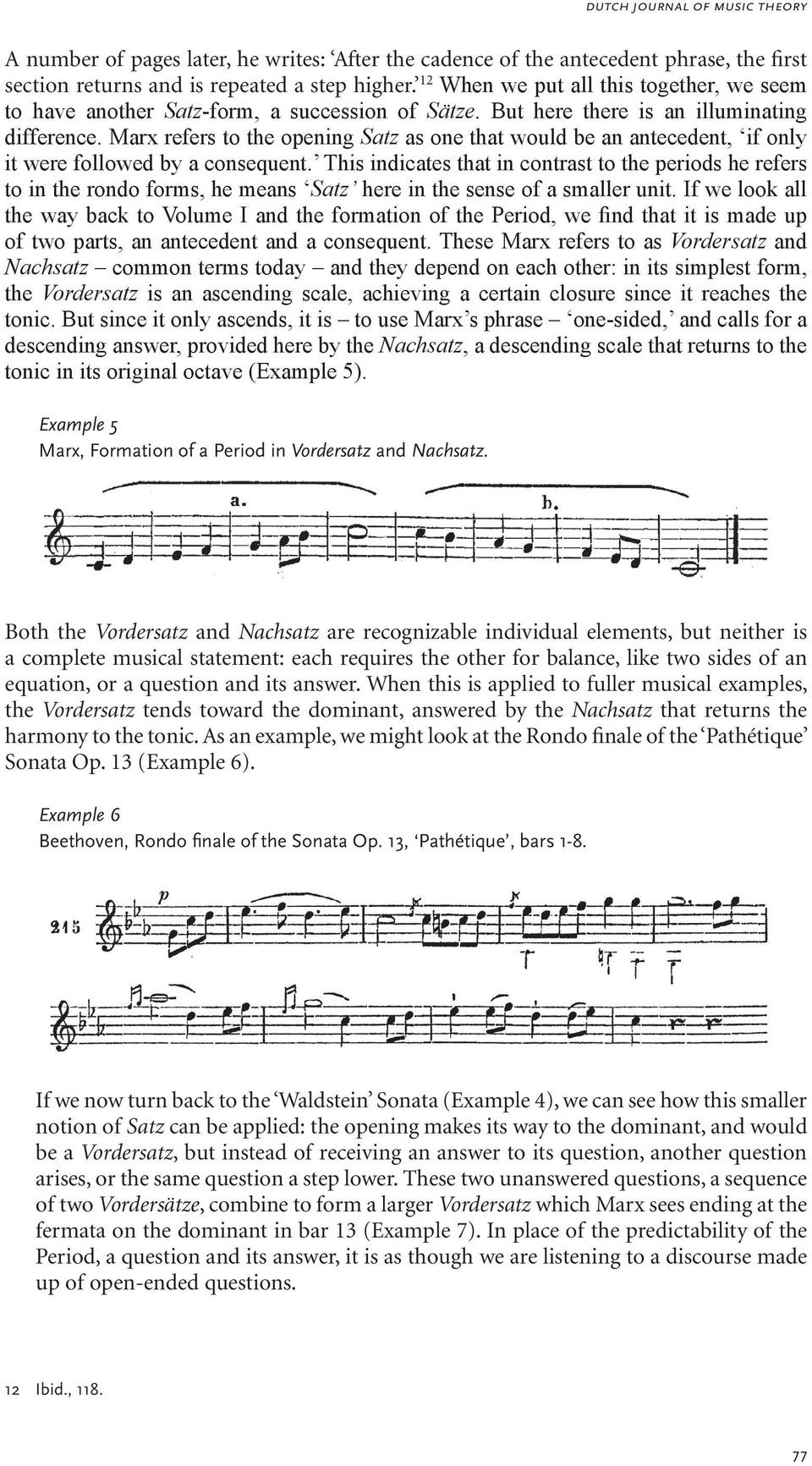
6 dutch journal of music theory A number of pages later, he writes: After the cadence of the antecedent phrase, the first section returns and is repeated a step higher. 12 When we put all this together, we seem to have another Satz-form, a succession of Sätze. But here there is an illuminating difference. Marx refers to the opening Satz as one that would be an antecedent, if only it were followed by a consequent. This indicates that in contrast to the periods he refers to in the rondo forms, he means Satz here in the sense of a smaller unit. If we look all the way back to Volume I and the formation of the Period, we find that it is made up of two parts, an antecedent and a consequent. These Marx refers to as Vordersatz and Nachsatz common terms today and they depend on each other: in its simplest form, the Vordersatz is an ascending scale, achieving a certain closure since it reaches the tonic. But since it only ascends, it is to use Marx s phrase one-sided, and calls for a descending answer, provided here by the Nachsatz, a descending scale that returns to the tonic in its original octave (Example 5). Example 5 Marx, Formation of a Period in Vordersatz and Nachsatz. Both the Vordersatz and Nachsatz are recognizable individual elements, but neither is a complete musical statement: each requires the other for balance, like two sides of an equation, or a question and its answer. When this is applied to fuller musical examples, the Vordersatz tends toward the dominant, answered by the Nachsatz that returns the harmony to the tonic. As an example, we might look at the Rondo finale of the Pathétique Sonata Op. 13 (Example 6). Example 6 Beethoven, Rondo finale of the Sonata Op. 13, Pathétique, bars 1-8. If we now turn back to the Waldstein Sonata (Example 4), we can see how this smaller notion of Satz can be applied: the opening makes its way to the dominant, and would be a Vordersatz, but instead of receiving an answer to its question, another question arises, or the same question a step lower. These two unanswered questions, a sequence of two Vordersätze, combine to form a larger Vordersatz which Marx sees ending at the fermata on the dominant in bar 13 (Example 7). In place of the predictability of the Period, a question and its answer, it is as though we are listening to a discourse made up of open-ended questions. 12 Ibid.,
7 what a. b. marx takes for granted in his description of sonata form Example 7 Beethoven, Sonata Op. 53, Waldstein, bars Another well-known example in which an opening statement is repeated on a neighboring scale step is the Appassionata Sonata Op. 57 (opening in Example 8). Compared to the Waldstein, Marx describes it as similarly formed but even further worked out. 13 However, he goes no further than this observation, concluding that the investigation of this Satz [meaning movement, or possibly Hauptsatz] may be left, without further ado, to those who would study further. 14 Example 8 Beethoven, Sonata Op. 57, Appassionata, bars 1-8. The sequence of Vordersätze, or unanswered questions, clearly resembles the gestures of the Waldstein : we reach the dominant in bar 3 and begin a new Vordersatz up a step, and both reach fermatas on dominant harmonies after this new Vordersatz. Looking at these examples, it might be more appropriate to suggest that Marx is not describing the form of these works, but rather is examining the rhetoric of their musical gestures. And the rhetoric of these Sonatas that begin in Satzform is not one of departure and return, but a succession of departures. If we liken the simple Period to the serve and return of tennis, Satzform is more like golf, where each stroke takes you further from your point of origin. 13 Ibid., Ibid. 78

8 dutch journal of music theory To make this rhetoric clearer, I will contrast the opening statements of two Sonatas, both already familiar to us: one which Marx designates as a rondo, and another, a sonata form which he described as unusually rich in its content. In Example 9 is the beginning of Op. 54, a so-called first rondo. Example 9 Beethoven, Sonata Op. 54, bars 1-4. In the fourth bar we have not come to the dominant, but the tonic; the first two gestures are answered in the third and fourth bars. The work progresses by repeating this four-bar statement, and we are back at the tonic in bar 8. In fact, it seems to be a struggle to leave the tonic, as each phrase ends there. In contrast, the beginning of Op. 31, No. 3 we saw in Example 1 is far more open-ended. The fermata in bar 6 is not on the dominant, but intensifies the dominant, as it is a six-four chord contributing to Marx s sense of its richness. When we do get an answer to this, it barely lands on the tonic before running off into an upper octave and repeating there. Marx s focus is thus less on form itself than on forms of continuity. The two examples just visited are both continuous, but the rondo is more sectional, the sonata more fluid. But Marx is making a larger point: the sonata is a different sort of rhetoric, but one for which the rondos are good preparation. In listening to rondos, Marx teaches his students or readers to follow and organize the forms as they unfold. When we come to sonata form, each unanswered question is to be followed, taken in, comprehended; and as a result, the rhetoric of sonata form begins to resemble the stages of a logical argument. One might even say that a rondo makes statements in the form of closed Periods while the sonata s succession of Sätze proposes a line of reasoning. This contrast is also present on a larger scale between the rondo and sonata when it comes to Marx s Second Part. We might see the presence of the second Seitensatz as simply extraneous thematic material; but given Marx s sense of musical continuity it represents more than that. In comparison with sonata form s organization as an argument, the rondo s second Seitensatz is something not relevant, a tangent, a passage that strays from the movement s topic. Next to this extraordinary distinction between rondos and sonatas, to cite details of how specific sonatas continue to explore their material would simply amount to tedious description. Marx has already demonstrated how to explore thematic possibilities in his sections on the exposition, and this explains his brevity when it comes to discussing the development. As he says, both the essential events... as well as the applied laws... are already familiar to us. We might perhaps put this more strongly and say that what Marx is referring to is not just familiar, but constitutes the necessary conditions for his analysis: the constant questioning of rondo forms provides the tools for following the form s continuity, and this in turn paves the way for understanding the sonata s more evolved rhetoric in Satzform. This opens many possibilities for us, and I will conclude by mentioning two. First, although we all know Marx s sonata form template, the details of his discussion of this whole family of forms is much more sophisticated, and in many ways is not so different from our own efforts to understand the multifariousness of sonata form. In Marx we can see something of Charles Rosen s comment that sonata form is more like a way of 79

9 what a. b. marx takes for granted in his description of sonata form writing, as well as Donald Francis Tovey s grouping of rondos among the Sonata Forms. Although we are accustomed to thinking of sonata form as discursive, Marx s priorities in discussing these rondo and sonata forms allow a second possibility: that these forms may also be part of a larger context in which all forms are discourses, each embodying different rhetorical strategies, an idea that allows us to bring a good deal more nuance to our readings even of simple ternary or rondo forms. 80

22. Mozart Piano Sonata in B flat, K. 333: movement I
 22. Mozart Piano Sonata in B flat, K. 333: movement I (for Unit 3: Developing Musical Understanding) Background Information and Performance Circumstances Biography Mozart was born in Austria on the 27
Writing an essay. This seems obvious - but it is surprising how many people don't really do this.
 Writing an essay Look back If this is not your first essay, take a look at your previous one. Did your tutor make any suggestions that you need to bear in mind for this essay? Did you learn anything else
Planning and Writing Essays
 Planning and Writing Essays Many of your coursework assignments will take the form of an essay. This leaflet will give you an overview of the basic stages of planning and writing an academic essay but
GCSE Music Unit 4 (42704) Guidance
 GCSE Music Unit 4 (42704) Guidance (There are recordings to accompany this document.) The Task Students will be required to compose one piece of music which explores two or more of the five areas of study.
WRITING EFFECTIVE REPORTS AND ESSAYS
 WRITING EFFECTIVE REPORTS AND ESSAYS A. What are Reports? Writing Effective Reports Reports are documents which both give a reader information and ask the reader to do something with that information.
Purposes and Processes of Reading Comprehension
 2 PIRLS Reading Purposes and Processes of Reading Comprehension PIRLS examines the processes of comprehension and the purposes for reading, however, they do not function in isolation from each other or
Recurrence and Expectation in the First Movement of Brahms s Third Symphony
 Recurrence and Expectation in the First Movement of Brahms s Third Symphony According to formal abstractions describing sonata form since Haydn, the exposition and recapitulation present the listener with
Primary and Secondary Qualities Charles Kaijo
 Primary and Secondary Qualities Charles Kaijo From examining John Locke s distinction between primary and secondary qualities in an object and Bishop George Berkeley s refutation to Locke s argument, it
Bard Conservatory Seminar Theory Component. Extended Functional Harmonies
 Bard Conservatory Seminar Theory Component Extended Functional Harmonies What we have been referring to as diatonic chords are those which are constructed from triads or seventh chords built on one of
Jack s Dyslexia Index indicates he has dyslexic difficulties that are mild in extent.
 Dyslexia Portfolio Report for Jack Jones Assessed by Sue Thompson on 05/08/2009 Report for parents When a child is identified as dyslexic, additional support will be needed from both school and home to
Reading and Taking Notes on Scholarly Journal Articles
 Reading and Taking Notes on Scholarly Journal Articles Set aside enough time in your schedule to read material thoroughly and repeatedly, until you understand what the author is studying, arguing, or discussing.
Writing Emphasis by Grade Level Based on State Standards. K 5.1 Draw pictures and write words for specific reasons.
 Writing Emphasis by Grade Level Based on State Standards Grade K K 5.1 Draw pictures and write words for specific reasons. Grade 1 1.5.1 Write brief narratives describing an experience. Grade 2 2.5.2 Write
President Abraham Lincoln s Speech The Gettysburg Address, 1863
 President Abraham Lincoln s Speech The Gettysburg Address, 1863 Four score 1 and seven years ago our fathers brought forth on this continent, a new nation, conceived in Liberty, and dedicated to the proposition
Introduction: Reading and writing; talking and thinking
 Introduction: Reading and writing; talking and thinking We begin, not with reading, writing or reasoning, but with talk, which is a more complicated business than most people realize. Of course, being
Thai Language Self Assessment
 The following are can do statements in four skills: Listening, Speaking, Reading and Writing. Put a in front of each description that applies to your current Thai proficiency (.i.e. what you can do with
Writing = A Dialogue. Part I. They Say
 Writing = A Dialogue You come late. When you arrive, others have long preceded you, and they are engaged in a heated discussion, a discussion too heated for them to pause and tell you exactly what it is
WIAT III Essay Composition: Quick Score for Theme Development and Text Organization
 WIAT III Essay Composition: Quick Score for Theme Development and Text Organization The following steps can be used to score most essays quickly and reliably. To ensure accurate scores, however, you must
Writing Thesis Defense Papers
 Writing Thesis Defense Papers The point of these papers is for you to explain and defend a thesis of your own critically analyzing the reasoning offered in support of a claim made by one of the philosophers
French Language and Culture. Curriculum Framework 2011 2012
 AP French Language and Culture Curriculum Framework 2011 2012 Contents (click on a topic to jump to that page) Introduction... 3 Structure of the Curriculum Framework...4 Learning Objectives and Achievement
Common Core Writing Rubrics, Grade 3
 Common Core Writing Rubrics, Grade 3 The following writing rubrics for the Common Core were developed by the Elk Grove Unified School District in Elk Grove, California. There are rubrics for each major
Directions for Compare and Contrast
 for Compare and Contrast To compare is the process of identifying similarities, and to contrast is the process of identifying differences. Please complete the following tasks: 1. Identify at least four
Developing an Academic Essay
 2 9 In Chapter 1: Writing an academic essay, you were introduced to the concepts of essay prompt, thesis statement and outline. In this chapter, using these concepts and looking at examples, you will obtain
Organizing an essay the basics 2. Cause and effect essay (shorter version) 3. Compare/contrast essay (shorter version) 4
 Organizing an essay the basics 2 Cause and effect essay (shorter version) 3 Compare/contrast essay (shorter version) 4 Exemplification (one version) 5 Argumentation (shorter version) 6-7 Support Go from
Chapter 4: Tools of Modern Systems Analysis
 Just Enough Structured Analysis Chapter 4: Tools of Modern Systems Analysis Nature has... some sort of arithmetical-geometrical coordinate system, because nature has all kinds of models. What we experience
Music Theory IV. Final Exam. All Chapters H&VL. Prof. Andy Brick. I pledge my honor that I have abided by the Stevens Honor System.
 Music Theory IV Final Exam All Chapters H&VL Prof. Andy Brick I pledge my honor that I have abided by the Stevens Honor System. 04/08/08 Due Week of, May 04 2008 Due Week of April 13: Exposition & Development
Locke s psychological theory of personal identity
 Locke s psychological theory of personal identity phil 20208 Jeff Speaks October 3, 2006 1 Identity, diversity, and kinds............................. 1 2 Personal identity...................................
Directions for Narrative, Expository, and Descriptive Essays
 for Narrative, Expository, and Descriptive Essays The Parts of an Essay An essay has the same elements as a well-written paragraph. A paragraph has a topic sentence; an essay has a thesis statement. A
Adding a diatonic seventh to a diminished leading-tone triad in minor will result in the following sonority:
 Lesson PPP: Fully-Diminished Seventh Chords Introduction: In Lesson 6 we looked at the diminished leading-tone triad: vii o. There, we discussed why the tritone between the root and fifth of the chord
Bi- Tonal Quartal Harmony in Theory and Practice 1 Bruce P. Mahin, Professor of Music Radford University
 Bi- Tonal Quartal Harmony in Theory and Practice 1 Bruce P. Mahin, Professor of Music Radford University In a significant departure from previous theories of quartal harmony, Bi- tonal Quartal Harmony
Section 11. Giving and Receiving Feedback
 Section 11 Giving and Receiving Feedback Introduction This section is about describing what is meant by feedback and will focus on situations where you will be given, and where you will give, feedback.
Depth-of-Knowledge Levels for Four Content Areas Norman L. Webb March 28, 2002. Reading (based on Wixson, 1999)
 Depth-of-Knowledge Levels for Four Content Areas Norman L. Webb March 28, 2002 Language Arts Levels of Depth of Knowledge Interpreting and assigning depth-of-knowledge levels to both objectives within
Arguments and Dialogues
 ONE Arguments and Dialogues The three goals of critical argumentation are to identify, analyze, and evaluate arguments. The term argument is used in a special sense, referring to the giving of reasons
Focus on Essay Writing
 Focus on Essay Writing Essay writing is a process and a product. You need to focus on the process in order to achieve a high quality product. What is an essay? The word essay originally meant to test or
Rubrics for Assessing Student Writing, Listening, and Speaking High School
 Rubrics for Assessing Student Writing, Listening, and Speaking High School Copyright by the McGraw-Hill Companies, Inc. All rights reserved. Permission is granted to reproduce the material contained herein
Writing Essays. SAS 25 W11 Karen Kostan, Margaret Swisher
 Writing Essays A GOOD ESSAY CONTAINS: 1. An introductory paragraph 2. A clear thesis statement 3. A body consisting of supporting paragraphs 4. A concluding paragraph Step 1: Review Assignment Read the
Writing the Persuasive Essay
 Writing the Persuasive Essay What is a persuasive/argument essay? In persuasive writing, a writer takes a position FOR or AGAINST an issue and writes to convince the reader to believe or do something Persuasive
Likewise, we have contradictions: formulas that can only be false, e.g. (p p).
 CHAPTER 4. STATEMENT LOGIC 59 The rightmost column of this truth table contains instances of T and instances of F. Notice that there are no degrees of contingency. If both values are possible, the formula
DIFFICULTIES AND SOME PROBLEMS IN TRANSLATING LEGAL DOCUMENTS
 DIFFICULTIES AND SOME PROBLEMS IN TRANSLATING LEGAL DOCUMENTS Ivanka Sakareva Translation of legal documents bears its own inherent difficulties. First we should note that this type of translation is burdened
1.7 Graphs of Functions
 64 Relations and Functions 1.7 Graphs of Functions In Section 1.4 we defined a function as a special type of relation; one in which each x-coordinate was matched with only one y-coordinate. We spent most
The Alignment of Common Core and ACT s College and Career Readiness System. June 2010
 The Alignment of Common Core and ACT s College and Career Readiness System June 2010 ACT is an independent, not-for-profit organization that provides assessment, research, information, and program management
Alignment of the National Standards for Learning Languages with the Common Core State Standards
 Alignment of the National with the Common Core State Standards Performance Expectations The Common Core State Standards for English Language Arts (ELA) and Literacy in History/Social Studies, Science,
to Become a Better Reader and Thinker
 1 How to Become a Better Reader and Thinker The chances are that you are not as good a reader as you should be to do well in college. If so, it s not surprising. You live in a culture where people watch
WRITING A CRITICAL ARTICLE REVIEW
 WRITING A CRITICAL ARTICLE REVIEW A critical article review briefly describes the content of an article and, more importantly, provides an in-depth analysis and evaluation of its ideas and purpose. The
1/9. Locke 1: Critique of Innate Ideas
 1/9 Locke 1: Critique of Innate Ideas This week we are going to begin looking at a new area by turning our attention to the work of John Locke, who is probably the most famous English philosopher of all
How does the problem of relativity relate to Thomas Kuhn s concept of paradigm?
 How does the problem of relativity relate to Thomas Kuhn s concept of paradigm? Eli Bjørhusdal After having published The Structure of Scientific Revolutions in 1962, Kuhn was much criticised for the use
Virginia English Standards of Learning Grade 8
 A Correlation of Prentice Hall Writing Coach 2012 To the Virginia English Standards of Learning A Correlation of, 2012, Introduction This document demonstrates how, 2012, meets the objectives of the. Correlation
Recounts retell past events. They aim to inform or entertain the reader.
 What is recount Recounts retell past events. They aim to inform or entertain the reader. English Features of recount writing: Recounts normally start by setting the scene, e.g., what?, where?, when?, how?
Writer moves somewhat beyond merely paraphrasing someone else s point of view or
 RUBRIC FOR EVALUATING STUDENT PHILOSOPHY ESSAYS (APPLIED ETHICS/PHILOSOPHY OF ART AND CULTURE CONCENTRATIONS) Explanation of the rubric: The rubric incorporates aspects of an already existing model for
Critical Analysis So what does that REALLY mean?
 Critical Analysis So what does that REALLY mean? 1 The words critically analyse can cause panic in students when they first turn over their examination paper or are handed their assignment questions. Why?
Read this syllabus very carefully. If there are any reasons why you cannot comply with what I am requiring, then talk with me about this at once.
 LOGIC AND CRITICAL THINKING PHIL 2020 Maymester Term, 2010 Daily, 9:30-12:15 Peabody Hall, room 105 Text: LOGIC AND RATIONAL THOUGHT by Frank R. Harrison, III Professor: Frank R. Harrison, III Office:
Stop Being Lost In Translation
 ESSAI Volume 2 Article 24 Spring 2004 Stop Being Lost In Translation Aaron Olson College of DuPage Follow this and additional works at: http://dc.cod.edu/essai Recommended Citation Olson, Aaron (2004)
You will by now not be surprised that a version of the teleological argument can be found in the writings of Thomas Aquinas.
 The design argument The different versions of the cosmological argument we discussed over the last few weeks were arguments for the existence of God based on extremely abstract and general features of
GUIDELINES FOR PROPOSALS: QUALITATIVE RESEARCH Human Development and Family Studies
 Drafted by Lynet Uttal using the Quantitative Research Proposal Guidelines and in consultation with GPC (5/99) GUIDELINES FOR PROPOSALS: QUALITATIVE RESEARCH Human Development and Family Studies Overview:
Discourse Markers in English Writing
 Discourse Markers in English Writing Li FENG Abstract Many devices, such as reference, substitution, ellipsis, and discourse marker, contribute to a discourse s cohesion and coherence. This paper focuses
Writing Reports BJECTIVES ONTENTS. By the end of this section you should be able to :
 Writing Reports By the end of this section you should be able to : O BJECTIVES Understand the purposes of a report Plan a report Understand the structure of a report Collect information for your report
AP ENGLISH LANGUAGE AND COMPOSITION 2007 SCORING GUIDELINES
 AP ENGLISH LANGUAGE AND COMPOSITION 2007 SCORING GUIDELINES Question 2 The score should reflect a judgment of the essay s quality as a whole. Remember that students had only 40 minutes to read and write;
Outline. Written Communication Conveying Scientific Information Effectively. Objective of (Scientific) Writing
 Written Communication Conveying Scientific Information Effectively Marie Davidian [email protected] http://www.stat.ncsu.edu/ davidian. Outline Objectives of (scientific) writing Important issues
THIS IS NOT A FREE EBOOK.
 $11.95 USD Copyright 2007 by Pantomime Music Publications P.O. Box 31177, Halifax, Nova Scotia, Canada B3K 5Y1 All rights reserved. Printed in Canada. This book is protected by Copyright. Permission must
Chapter 3 Classroom management
 This chapter provides the basics of classroom management for you as you teach your first few lessons. Issues such as seating, gestures and ways of using the board effectively are covered so that you are
Brought to you by the NVCC-Annandale Reading and Writing Center
 Brought to you by the NVCC-Annandale Reading and Writing Center WORKSHOP OBJECTIVES: To understand the steps involved in writing inclass essays To be able to decode the question so that you answer the
CHAPTER 3. Methods of Proofs. 1. Logical Arguments and Formal Proofs
 CHAPTER 3 Methods of Proofs 1. Logical Arguments and Formal Proofs 1.1. Basic Terminology. An axiom is a statement that is given to be true. A rule of inference is a logical rule that is used to deduce
MUSC1 Set work study notes Haydn Symphony No 104 in D major
 MUSC1 Set work study notes Haydn Symphony No 104 in D major These study notes are intended to help teachers and students prepare for the new set work. It is not an examination board definitive, nor exhaustive,
164 music theory spectrum 30 (2008)
 164 music theory spectrum 30 (2008) Lewin, Intervals, and Transformations: a Comment on Hook dmitri tymoczko Keywords: David Lewin, Julian Hook, interval, pitch class, group theory, distance This paper
1.6 The Order of Operations
 1.6 The Order of Operations Contents: Operations Grouping Symbols The Order of Operations Exponents and Negative Numbers Negative Square Roots Square Root of a Negative Number Order of Operations and Negative
Lesson DDD: Figured Bass. Introduction:
 Lesson DDD: Figured Bass Introduction: In this lesson you will learn about the various uses of figured bass. Figured bass comes from a Baroque compositional practice in which composers used a numerical
ELS. Effective Learning Service. Report Writing. For appointments contact: [email protected] or [email protected] web: www.qmu.ac.
 ELS Effective Learning Service Report Writing For appointments contact: [email protected] or [email protected] web: www.qmu.ac.uk/els PLEASE NOTE The type of report described in this leaflet is a
AP ENGLISH LANGUAGE AND COMPOSITION 2013 SCORING GUIDELINES
 AP ENGLISH LANGUAGE AND COMPOSITION 2013 SCORING GUIDELINES Question 2 The score should reflect the essay s quality as a whole. Remember that students had only 40 minutes to read and write; the paper,
BBC Learning English Talk about English Business Language To Go Part 1 - Interviews
 BBC Learning English Business Language To Go Part 1 - Interviews This programme was first broadcast in 2001. This is not a word for word transcript of the programme This series is all about chunks of language
SIXTH GRADE UNIT 1. Reading: Literature
 Reading: Literature Writing: Narrative RL.6.1 RL.6.2 RL.6.3 RL.6.4 RL.6.5 RL.6.6 RL.6.7 W.6.3 SIXTH GRADE UNIT 1 Key Ideas and Details Cite textual evidence to support analysis of what the text says explicitly
Revising and Editing Your Essay 1
 Revising and Editing Your Essay 1 Revising and editing are two distinct processes. Revising is intentionally looking at ways of improving your essay. Editing is correcting the mechanics of your essay like
Grade 6 English Language Arts Performance Level Descriptors
 Limited Grade 6 English Language Arts Performance Level Descriptors A student performing at the Limited Level demonstrates a minimal command of Ohio s Learning Standards for Grade 6 English Language Arts.
PART 1 CROSSING EMA. I will pause between the two parts for questions, but if I am not clear enough at any stage please feel free to interrupt.
 PART 1 CROSSING EMA Good evening everybody, I d like to start by introducing myself. My name is Andrew Gebhardt and I am part of Finex LLP, a small Investment Manager which amongst other endeavours also
Formal, Analytical Essay Writing. Review: Literary Analysis Format; Plagiarism (page # s refer to Writers Inc.)
 Formal, Analytical Essay Writing Review: Literary Analysis Format; Plagiarism (page # s refer to Writers Inc.) What is an Literary Analysis Essay? (pg 245-252) An essay is essentially an argument, based
9699 SOCIOLOGY. Mark schemes should be read in conjunction with the question paper and the Principal Examiner Report for Teachers.
 CAMBRIDGE INTERNATIONAL EXAMINATIONS GCE Advanced Level MARK SCHEME for the May/June 2014 series 9699 SOCIOLOGY 9699/32 Paper 3 (Social Inequality and Opportunity), maximum raw mark 75 This mark scheme
Writing an Introductory Paragraph for an Expository Essay
 Handout 27 (1 of 1) Writing an Introductory Paragraph for an Expository Essay Prompt Read the following: If you re like many Americans, you have just spent a few days in close quarters with your parents,
GRE Practice Questions
 GRE Practice Questions Quantitative Comparison Practice Questions GRE Practice Quantitative Questions Quantitative Comparisons For all Quantitative Comparison questions, answer (A) if Column A is greater,
MATH10212 Linear Algebra. Systems of Linear Equations. Definition. An n-dimensional vector is a row or a column of n numbers (or letters): a 1.
 MATH10212 Linear Algebra Textbook: D. Poole, Linear Algebra: A Modern Introduction. Thompson, 2006. ISBN 0-534-40596-7. Systems of Linear Equations Definition. An n-dimensional vector is a row or a column
CERTIFICATION EXAMINATIONS FOR OKLAHOMA EDUCATORS (CEOE )
 CERTIFICATION EXAMINATIONS FOR OKLAHOMA EDUCATORS (CEOE ) FIELD 74: OKLAHOMA GENERAL EDUCATION TEST (OGET ) Subarea Range of Competencies I. Critical Thinking Skills: Reading and Communications 01 05 II.
Common Core State Standards Speaking and Listening
 Comprehension and Collaboration. Prepare for and participate effectively in a range of conversations and collaborations with diverse partners, building on others ideas and expressing their own clearly
HOW TO WRITE A CRITICAL ARGUMENTATIVE ESSAY. John Hubert School of Health Sciences Dalhousie University
 HOW TO WRITE A CRITICAL ARGUMENTATIVE ESSAY John Hubert School of Health Sciences Dalhousie University This handout is a compilation of material from a wide variety of sources on the topic of writing a
Integrating the Common Core Standards into the Music Curriculum
 Place Photo Here, Otherwise Delete Box Integrating the Common Core Standards into the Music Curriculum Tom L. Foust January 24 th, 2013 Illinois Music Educators Conference Peoria, Illinois What is the
Corporate Valuation and Financial Strategy. Writing a Case Study
 FIN 673 Professor Robert B.H. Hauswald Corporate Valuation and Financial Strategy Kogod School of Business, AU Writing a Case Study The final group project consists of developing and writing a case study
Critical analysis. Be more critical! More analysis needed! That s what my tutors say about my essays. I m not really sure what they mean.
 Critical analysis Be more critical! More analysis needed! That s what my tutors say about my essays. I m not really sure what they mean. I thought I had written a really good assignment this time. I did
6.4 Normal Distribution
 Contents 6.4 Normal Distribution....................... 381 6.4.1 Characteristics of the Normal Distribution....... 381 6.4.2 The Standardized Normal Distribution......... 385 6.4.3 Meaning of Areas under
WRITING EFFECTIVE ESSAY EXAMS
 1 2 WRITING EFFECTIVE ESSAY EXAMS An essay exam offers you the opportunity to show your instructor what you know. This booklet presents before-, during-, and after-exam strategies that will help you demonstrate
Practice Test University of Massachusetts Graduate Diagnostic Examination in Music Theory
 name: date: Practice Test University of Massachusetts Graduate Diagnostic Examination in Music Theory Make no marks on this page below this line area Rudiments [1 point each] 1 2 3 4 5 6 7 8 9 10 results
Qualitative Critique: Missed Nursing Care. Kalisch, B. (2006). Missed Nursing Care A Qualitative Study. J Nurs Care Qual, 21(4), 306-313.
 Qualitative Critique: Missed Nursing Care 1 Qualitative Critique: Missed Nursing Care Kalisch, B. (2006). Missed Nursing Care A Qualitative Study. J Nurs Care Qual, 21(4), 306-313. Gina Gessner RN BSN
Democracy: Starting with Solon
 Democracy: Starting with Solon In the present day, the term democracy is well known. In any democracy, the common people have power. However, each democratic government has a unique way of implementing
Thought for the Day Master Lesson
 Welcome and Introductions Lesson 2 LESSON 2 Thought for the Day Master Lesson Thought for the Day Education is not the filling of a pail, but the lighting of a fire. William Butler Yeats Overview: The
Jean Piaget: Cognitive Theorist 1. Theorists from centuries ago have provided support and research about the growth of
 Jean Piaget: Cognitive Theorist 1 Theorists from centuries ago have provided support and research about the growth of children in many different developmental areas. Theorists have played and still play
Writing learning objectives
 Writing learning objectives This material was excerpted and adapted from the following web site: http://www.utexas.edu/academic/diia/assessment/iar/students/plan/objectives/ What is a learning objective?
Charting the Text. What is it? When should I use it? How do I use it? Why should I use it?
 Charting the ext AVID eacher Reference What is it? here are two ways to chart a text. One way to chart a text is to analyze the macro-structure (or larger structure) of the text. A reader might want to
Crafting an Argument. Students need to know how to state facts and express their opinions. Organized, Well-Supported, Convincing
 Crafting an Argument Organized, Well-Supported, Convincing Students need to know how to state facts and express their opinions effectively so that they can positively contribute to classroom conversations
1. Define and Know (D) 2. Recognize (R) 3. Apply automatically (A) Objectives What Students Need to Know. Standards (ACT Scoring Range) Resources
 T 1. Define and Know (D) 2. Recognize (R) 3. Apply automatically (A) ACT English Grade 10 Rhetorical Skills Organization (15%) Make decisions about order, coherence, and unity Logical connections between
Student Performance Q&A:
 Student Performance Q&A: 2011 AP English Language and Composition Free-Response Questions The following comments on the 2011 free-response questions for AP English Language and Composition were written
Active Listening. Learning Objectives. By the end of this module, the learner will have
 1 Active Listening Learning Objectives By the end of this module, the learner will have An understanding of what is meant by active listening Gained insight into your natural listening strengths and areas
Expository Reading and Writing By Grade Level
 Expository and Writing By Grade Level Kindergarten TEKS identify the topic of an informational text heard identify the topic and details in expository text heard or read, referring to the words and/or
The Slate Is Not Empty: Descartes and Locke on Innate Ideas
 The Slate Is Not Empty: Descartes and Locke on Innate Ideas René Descartes and John Locke, two of the principal philosophers who shaped modern philosophy, disagree on several topics; one of them concerns