
Writing an Introductory Paragraph for an Expository Essay
|
|
|
- Eric Hodges
- 9 years ago
- Views:
Transcription
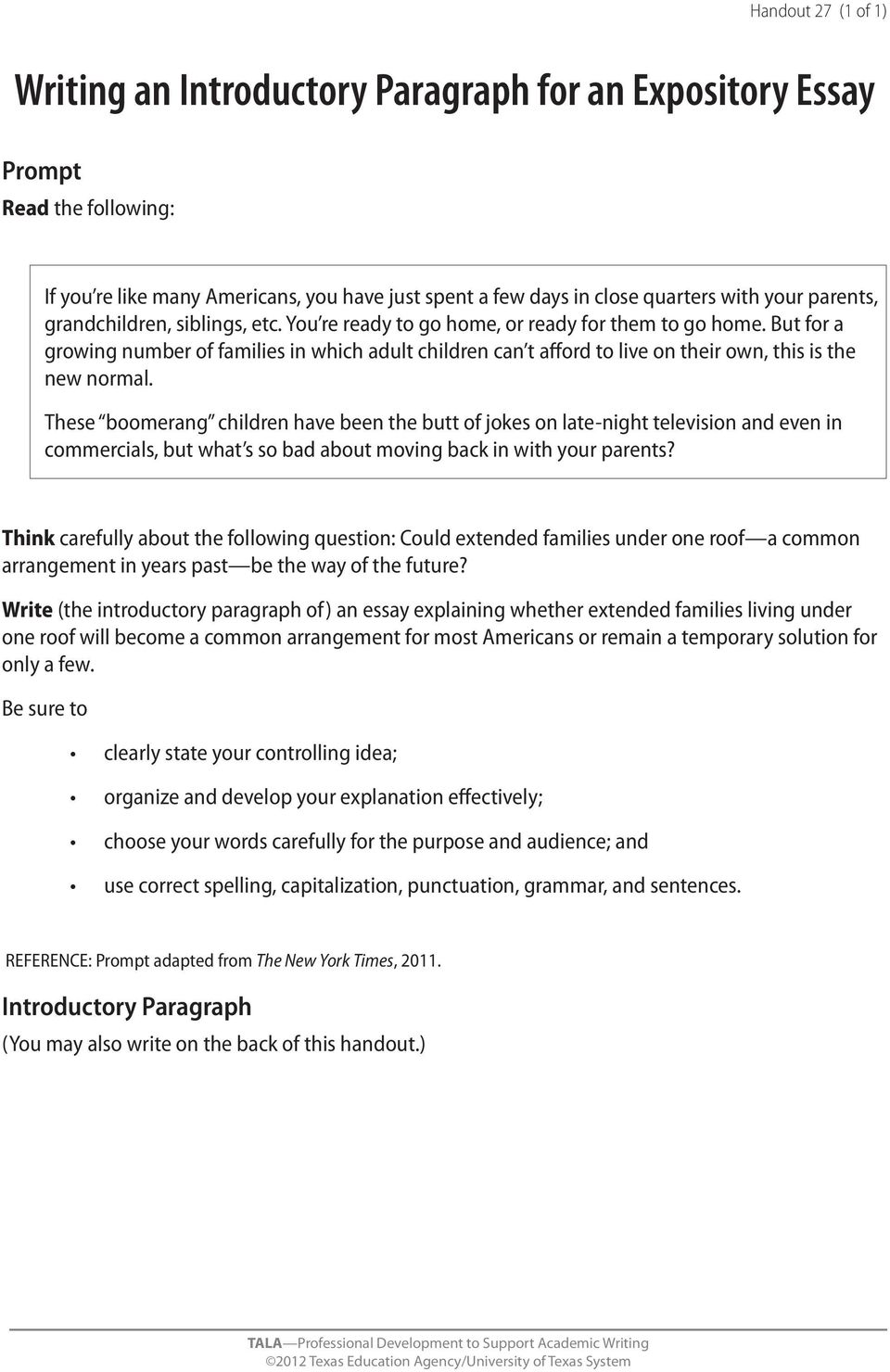
1 Handout 27 (1 of 1) Writing an Introductory Paragraph for an Expository Essay Prompt Read the following: If you re like many Americans, you have just spent a few days in close quarters with your parents, grandchildren, siblings, etc. You re ready to go home, or ready for them to go home. But for a growing number of families in which adult children can t afford to live on their own, this is the new normal. These boomerang children have been the butt of jokes on late-night television and even in commercials, but what s so bad about moving back in with your parents? Think carefully about the following question: Could extended families under one roof a common arrangement in years past be the way of the future? Write (the introductory paragraph of) an essay explaining whether extended families living under one roof will become a common arrangement for most Americans or remain a temporary solution for only a few. Be sure to clearly state your controlling idea; organize and develop your explanation effectively; choose your words carefully for the purpose and audience; and use correct spelling, capitalization, punctuation, grammar, and sentences. REFERECE: Prompt adapted from The New York Times, Introductory Paragraph (You may also write on the back of this handout.)
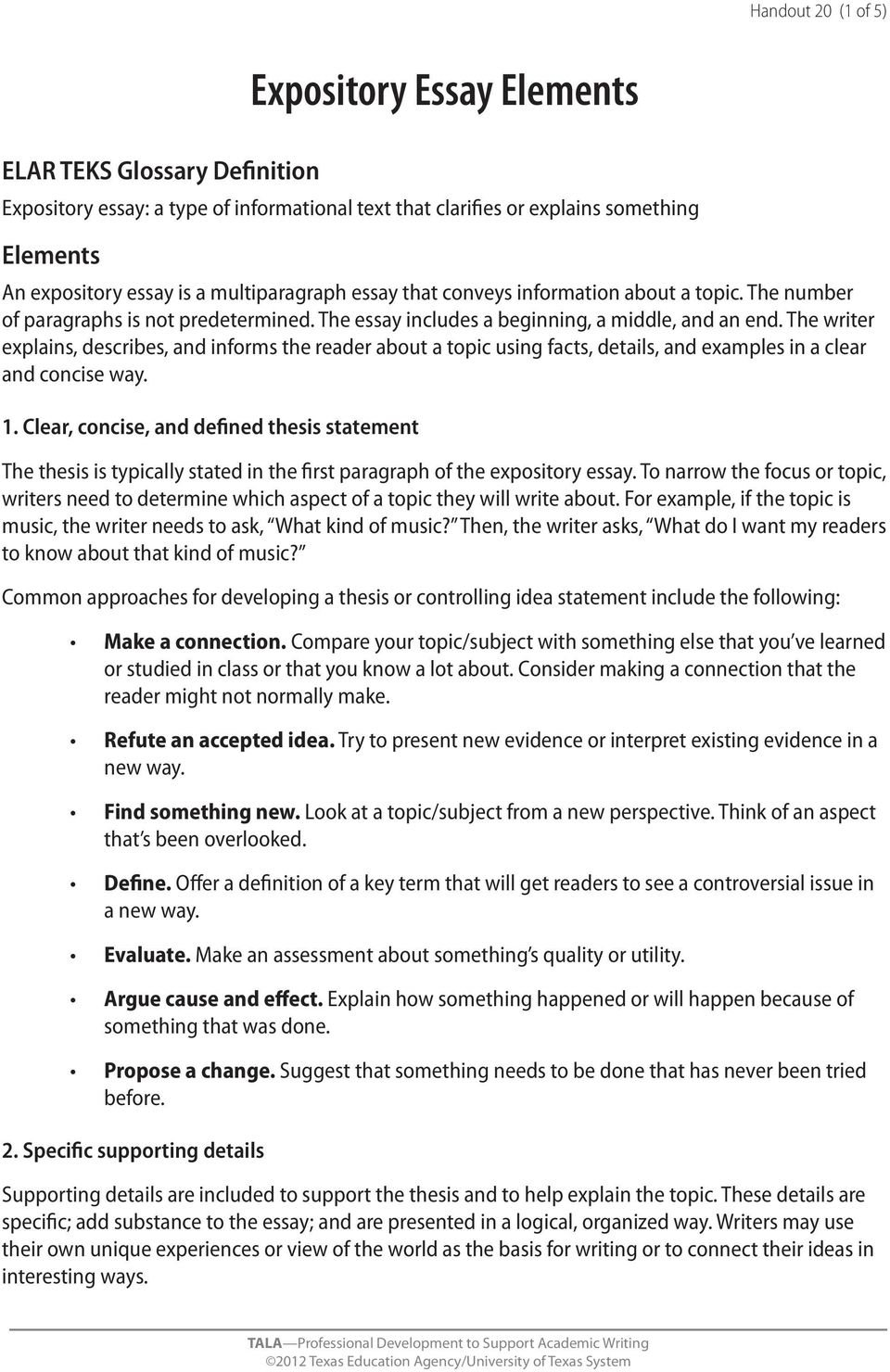
2 Handout 20 (1 of 5) Expository Essay Elements ELAR TEKS Glossary Definition Expository essay: a type of informational text that clarifies or explains something Elements An expository essay is a multiparagraph essay that conveys information about a topic. The number of paragraphs is not predetermined. The essay includes a beginning, a middle, and an end. The writer explains, describes, and informs the reader about a topic using facts, details, and examples in a clear and concise way. 1. Clear, concise, and defined thesis statement The thesis is typically stated in the first paragraph of the expository essay. To narrow the focus or topic, writers need to determine which aspect of a topic they will write about. For example, if the topic is music, the writer needs to ask, What kind of music? Then, the writer asks, What do I want my readers to know about that kind of music? Common approaches for developing a thesis or controlling idea statement include the following: Make a connection. Compare your topic/subject with something else that you ve learned or studied in class or that you know a lot about. Consider making a connection that the reader might not normally make. Refute an accepted idea. Try to present new evidence or interpret existing evidence in a new way. Find something new. Look at a topic/subject from a new perspective. Think of an aspect that s been overlooked. Define. Offer a definition of a key term that will get readers to see a controversial issue in a new way. Evaluate. Make an assessment about something s quality or utility. Argue cause and effect. Explain how something happened or will happen because of something that was done. Propose a change. Suggest that something needs to be done that has never been tried before. 2. Specific supporting details Supporting details are included to support the thesis and to help explain the topic. These details are specific; add substance to the essay; and are presented in a logical, organized way. Writers may use their own unique experiences or view of the world as the basis for writing or to connect their ideas in interesting ways.
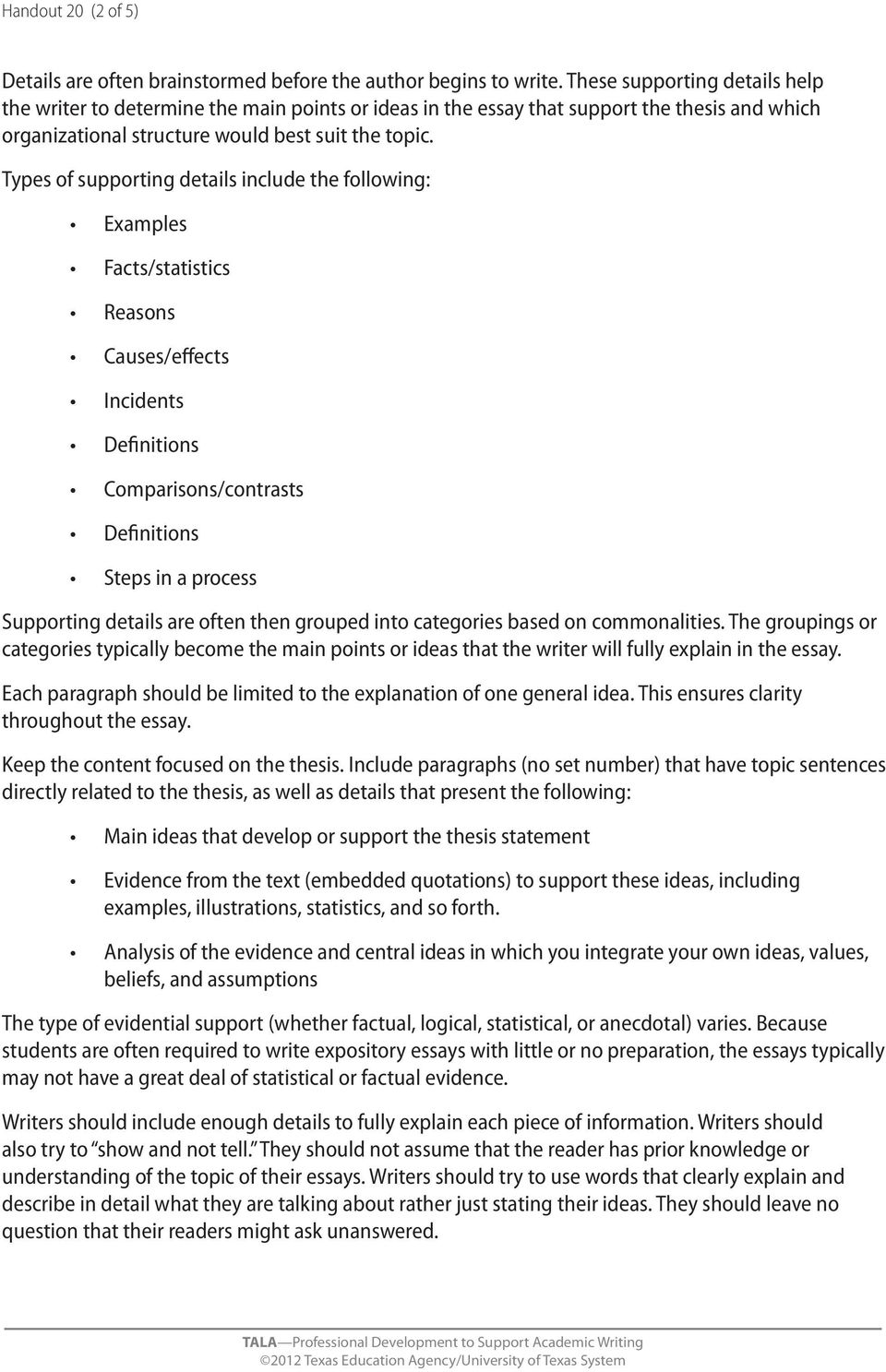
3 Handout 20 (2 of 5) Details are often brainstormed before the author begins to write. These supporting details help the writer to determine the main points or ideas in the essay that support the thesis and which organizational structure would best suit the topic. Types of supporting details include the following: Examples Facts/statistics Reasons Causes/effects Incidents Definitions Comparisons/contrasts Definitions Steps in a process Supporting details are often then grouped into categories based on commonalities. The groupings or categories typically become the main points or ideas that the writer will fully explain in the essay. Each paragraph should be limited to the explanation of one general idea. This ensures clarity throughout the essay. Keep the content focused on the thesis. Include paragraphs (no set number) that have topic sentences directly related to the thesis, as well as details that present the following: Main ideas that develop or support the thesis statement Evidence from the text (embedded quotations) to support these ideas, including examples, illustrations, statistics, and so forth. Analysis of the evidence and central ideas in which you integrate your own ideas, values, beliefs, and assumptions The type of evidential support (whether factual, logical, statistical, or anecdotal) varies. Because students are often required to write expository essays with little or no preparation, the essays typically may not have a great deal of statistical or factual evidence. Writers should include enough details to fully explain each piece of information. Writers should also try to show and not tell. They should not assume that the reader has prior knowledge or understanding of the topic of their essays. Writers should try to use words that clearly explain and describe in detail what they are talking about rather just stating their ideas. They should leave no question that their readers might ask unanswered.
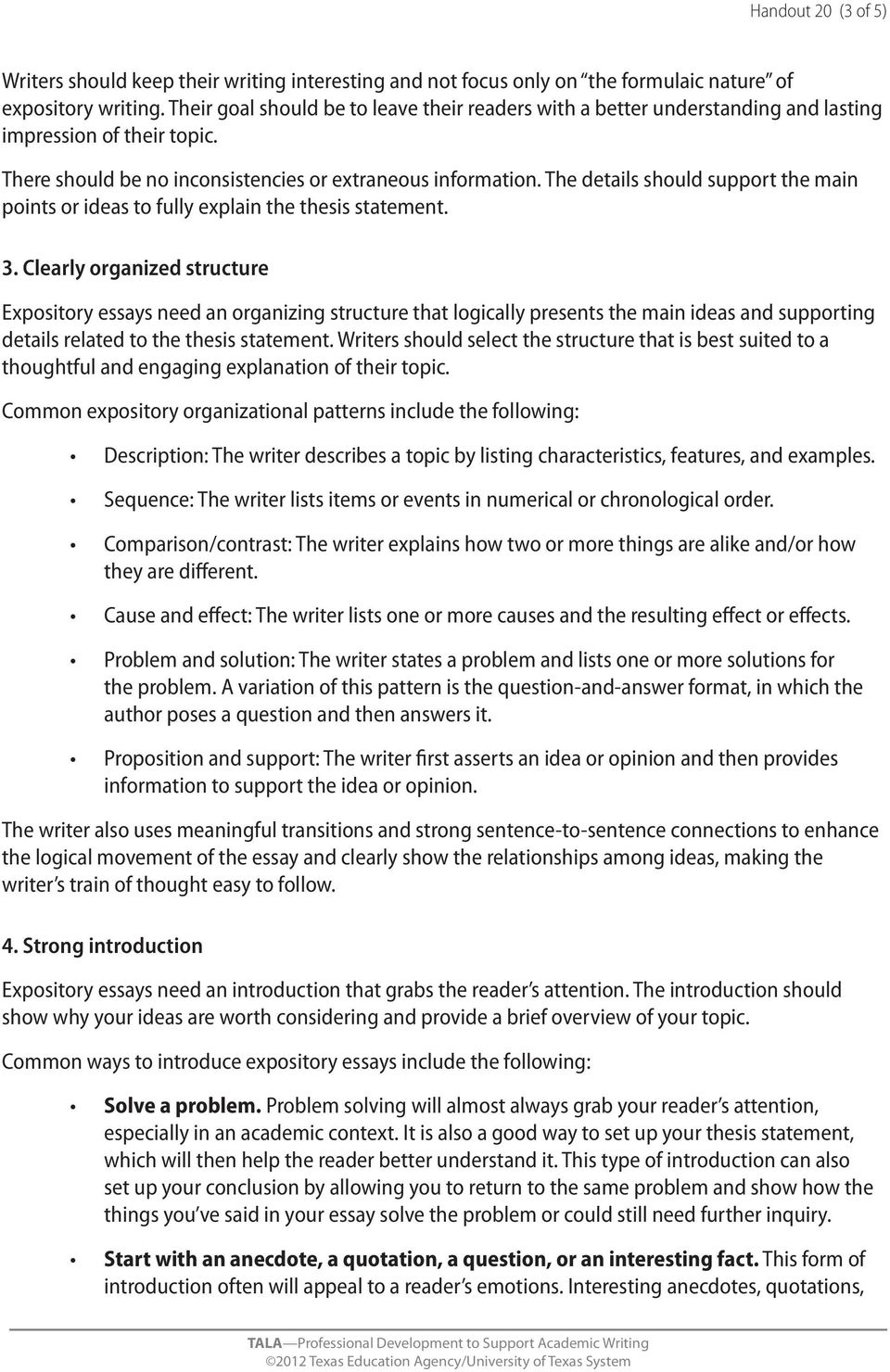
4 Handout 20 (3 of 5) Writers should keep their writing interesting and not focus only on the formulaic nature of expository writing. Their goal should be to leave their readers with a better understanding and lasting impression of their topic. There should be no inconsistencies or extraneous information. The details should support the main points or ideas to fully explain the thesis statement. 3. Clearly organized structure Expository essays need an organizing structure that logically presents the main ideas and supporting details related to the thesis statement. Writers should select the structure that is best suited to a thoughtful and engaging explanation of their topic. Common expository organizational patterns include the following: Description: The writer describes a topic by listing characteristics, features, and examples. Sequence: The writer lists items or events in numerical or chronological order. Comparison/contrast: The writer explains how two or more things are alike and/or how they are different. Cause and effect: The writer lists one or more causes and the resulting effect or effects. Problem and solution: The writer states a problem and lists one or more solutions for the problem. A variation of this pattern is the question-and-answer format, in which the author poses a question and then answers it. Proposition and support: The writer first asserts an idea or opinion and then provides information to support the idea or opinion. The writer also uses meaningful transitions and strong sentence-to-sentence connections to enhance the logical movement of the essay and clearly show the relationships among ideas, making the writer s train of thought easy to follow. 4. Strong introduction Expository essays need an introduction that grabs the reader s attention. The introduction should show why your ideas are worth considering and provide a brief overview of your topic. Common ways to introduce expository essays include the following: Solve a problem. Problem solving will almost always grab your reader s attention, especially in an academic context. It is also a good way to set up your thesis statement, which will then help the reader better understand it. This type of introduction can also set up your conclusion by allowing you to return to the same problem and show how the things you ve said in your essay solve the problem or could still need further inquiry. Start with an anecdote, a quotation, a question, or an interesting fact. This form of introduction often will appeal to a reader s emotions. Interesting anecdotes, quotations,
5 Handout 20 (4 of 5) questions, and facts can quickly interest readers and make them want to read more. Try to think of an interesting/shocking/weird fact about your topic. Acknowledge what others have said on the subject. For some topics, the amount of literature available can be overwhelming. If you are writing on a popular topic, it s best to acknowledge in your introduction that much has been written on the subject. Your introduction needs to convey why your essay is important and how it is different from all the other literature that already exists on the subject. Point out an irony or a paradox. Paradoxes are logic puzzles, seemingly contradictory statements. They re great to use in introductions as a way to get the reader s attention. Use an analogy. If your topic is a bit obscure or abstract, try connecting it to something more familiar to your reader. Jump into the content. This strategy is good for audiences who don t like to read anything they don t have to. Sometimes it can be more dramatic to just start with your thesis. 5. Strong conclusion The conclusion should not simply restate the thesis, but rather readdress it based on the evidence provided. Because this is the part of the essay that will leave the most immediate impression on the reader, it should be effective and logical. Do not introduce any new information into the conclusion; rather, synthesize and resolve the information already presented in the body of the essay. Writers use many types of conclusions. Below is a list of ideas for how you can bring closure to your essay. You can incorporate more than one of these types into a conclusion. Common types of conclusions: Summary: Sums up all of your main points. This is the most basic and popular type of conclusion, but be careful not to repeat your thesis. Link to beginning: A nice companion for an introduction that features anecdotes, quotes, problem solving, and so forth. Tying the ending to your beginning gives readers a satisfying sense of closure. You might refer back to a certain image or phrase in your introduction. Keep in mind that this method works better in some essays than in others. In other words, if you try too hard to connect your conclusion to your introduction, it may come off as contrived and artificial. Larger context: Good for obscure and abstract topics where the details may have caused the readers to lose sight of the main point. This type of conclusion reminds your readers of the big picture, which means that you re answering the following questions: Why does my topic matter? What are the consequences of what I m suggesting or proposing? Call to action: Common approach for proposal essays that ask your readers to respond to your position/argument with a specific action.

6 Handout 20 (5 of 5) 6. Purposeful and precise word choice The writer s word choice in an expository essay should be accurate, concise, clear, and concrete. Effective word choice reflects a keen awareness of the expository purpose and maintains a tone appropriate to the purpose and audience. Writers often focus on word choice to improve their first drafts. Examples of how word choice can improve writing include the following: Replacing overused words with stronger, more powerful ones Action verbs Adjectives Adverbs Inserting phrases and sensory details that describe, explain, or provide additional detail and connections 7. Varied sentence structure Sentences are the building blocks of writing. The ways sentences are constructed affect the fluency or the flow of the writing. Expository essays are enhanced when the writer uses purposeful sentences that are varied in both length and structure. Examples of how writers can vary sentences to improve their writing include the following: Using a variety of sentence patterns: simple, compound, and complex Combining short sentences with prepositional phrases, appositive phrases, or participial phrases Combining short sentences by linking items of equal importance with a coordinating conjunction Combining short sentences containing ideas that are of unequal importance with a subordinating conjunction Varying sentence beginnings by starting sentences in different ways With an adverb With a phrase (i.e., prepositional, participial, or infinitive) With an introductory clause Breaking up long, rambling sentences (often run-on sentences) into two or three shorter sentences
Grade 4 Writing Curriculum Map
 Curriculum Map BOE Approval November 2013 CURRICULUM MAP WRITING GRADE 4 SEPTEMBER OCTOBER NOVEMBER DECEMBER JANUARY Creating a Buzz About : It s All About Me! Tell Me A Story Realistic Fiction Tell Me
10th Grade Language. Goal ISAT% Objective Description (with content limits) Vocabulary Words
 Standard 3: Writing Process 3.1: Prewrite 58-69% 10.LA.3.1.2 Generate a main idea or thesis appropriate to a type of writing. (753.02.b) Items may include a specified purpose, audience, and writing outline.
Writing Essays. SAS 25 W11 Karen Kostan, Margaret Swisher
 Writing Essays A GOOD ESSAY CONTAINS: 1. An introductory paragraph 2. A clear thesis statement 3. A body consisting of supporting paragraphs 4. A concluding paragraph Step 1: Review Assignment Read the
Virginia English Standards of Learning Grade 8
 A Correlation of Prentice Hall Writing Coach 2012 To the Virginia English Standards of Learning A Correlation of, 2012, Introduction This document demonstrates how, 2012, meets the objectives of the. Correlation
Six Traits Writing Strategies
 Six Traits Writing Strategies Jim Collins Improving Writing with Six Traits and Writing Strategies: One Problem at a Time Review of the Six Traits The Six Traits are the qualities that teachers, writers,
Paragraphs Narrative, Descriptive, Expository, and Persuasive. If written as a story, the essay should include all the parts of a story.
 Paragraphs Narrative, Descriptive, Expository, and Persuasive Narrative When writing a narrative essay, one might think of it as telling a story. These essays are often anecdotal, experiential, and personal
Language Arts Literacy Areas of Focus: Grade 6
 Language Arts Literacy : Grade 6 Mission: Learning to read, write, speak, listen, and view critically, strategically and creatively enables students to discover personal and shared meaning throughout their
English II Writing. Persuasive Scoring Guide April 2013
 English II Writing Persuasive Scoring Guide April 2013 Copyright 2013, Texas Education Agency. All rights reserved. Reproduction of all or portions of this work is prohibited without express written permission
Language Arts Literacy Areas of Focus: Grade 5
 Language Arts Literacy : Grade 5 Mission: Learning to read, write, speak, listen, and view critically, strategically and creatively enables students to discover personal and shared meaning throughout their
xxx Lesson 11 1. Comprehend the writing process 2. Respond positively to the writing process
 xxx Lesson 11 The Writing Process Overview: This lesson will focus on the writing process and how it relates to communication. Learners will be taught what the writing process is, its parts, and how they
HOW TO WRITE A CRITICAL ARGUMENTATIVE ESSAY. John Hubert School of Health Sciences Dalhousie University
 HOW TO WRITE A CRITICAL ARGUMENTATIVE ESSAY John Hubert School of Health Sciences Dalhousie University This handout is a compilation of material from a wide variety of sources on the topic of writing a
Evaluating the Elements of a Piece of Practical Writing The author of this friendly letter..
 Practical Writing Intermediate Level Scoring Rubric for a Friendly Letter (to be used upon completion of Lesson 4) Evaluating the Elements of a Piece of Practical Writing The author of this friendly letter..
Students will know Vocabulary: claims evidence reasons relevant accurate phrases/clauses credible source (inc. oral) formal style clarify
 Sixth Grade Writing : Text Types and Purposes Essential Questions: 1. How do writers select the genre of writing for a specific purpose and audience? 2. How do essential components of the writing process
Narrative Writing Conference Planner
 Narrative Writing Conference Planner Name Class Before our conference on your narrative piece, read the list of questions and directions after the trait(s) that I ve highlighted on this sheet. We ll review
English I. Expository Scoring Guide. April 2014
 English I Expository Scoring Guide April 2014 Copyright 2014, Texas Education Agency. All rights reserved. Reproduction of all or portions of this work is prohibited without express written permission
Grade 4. Expository Writing Rubric
 Grade 4 Expository Writing Rubric Score Point 1 The essay represents a very limited writing performance. The organizing structure of the essay is inappropriate to the purpose or the specific demands of
AK + ASD Writing Grade Level Expectations For Grades 3-6
 Revised ASD June 2004 AK + ASD Writing For Grades 3-6 The first row of each table includes a heading that summarizes the performance standards, and the second row includes the complete performance standards.
The Old Man and The Sea
 The Old Man and The Sea By Ernest Hemingway Name: The Old Man and the Sea Reading and Writing Schedule Day Number Reading Writing One 9-19 2-5 Two 20-33 6-7 Three 34-43 8-9 Four 44-53 10-11 Five 54-63
Writing Common Core KEY WORDS
 Writing Common Core KEY WORDS An educator's guide to words frequently used in the Common Core State Standards, organized by grade level in order to show the progression of writing Common Core vocabulary
the treasure of lemon brown by walter dean myers
 the treasure of lemon brown by walter dean myers item analysis for all grade 7 standards: vocabulary, reading, writing, conventions item analysis for all grade 8 standards: vocabulary, reading, writing,
Rubrics for Assessing Student Writing, Listening, and Speaking High School
 Rubrics for Assessing Student Writing, Listening, and Speaking High School Copyright by the McGraw-Hill Companies, Inc. All rights reserved. Permission is granted to reproduce the material contained herein
Expository Essay. 8 th Grade Writing
 Expository Essay 8 th Grade Writing Purpose (definition) to inform about or explain a topic Expository essays explain, interpret, or describe something based on prior knowledge, background experiences,
Organizing an essay the basics 2. Cause and effect essay (shorter version) 3. Compare/contrast essay (shorter version) 4
 Organizing an essay the basics 2 Cause and effect essay (shorter version) 3 Compare/contrast essay (shorter version) 4 Exemplification (one version) 5 Argumentation (shorter version) 6-7 Support Go from
Lesson: Editing Guidelines and Response Writing: Essay Exam (Part 1)
 Put That In Writing - Level Two 113 UNIT 9 Lesson: Editing Guidelines and Response Writing: Essay Exam (Part 1) 9.1 Learning Objectives A. To know the guidelines for editing an essay. B. To edit and improve
ENGL-101 ENGLISH COMPOSITION I. Online
 Coffeyville Community College ENGL-101 COURSE SYLLABUS FOR ENGLISH COMPOSITION I Online Troy McCloughan Instructor COURSE NUMBER: ENGL-101 COURSE TITLE: English Composition I CREDIT HOURS: 3 INSTRUCTOR:
Brought to you by the NVCC-Annandale Reading and Writing Center
 Brought to you by the NVCC-Annandale Reading and Writing Center WORKSHOP OBJECTIVES: To understand the steps involved in writing inclass essays To be able to decode the question so that you answer the
Outline. Written Communication Conveying Scientific Information Effectively. Objective of (Scientific) Writing
 Written Communication Conveying Scientific Information Effectively Marie Davidian [email protected] http://www.stat.ncsu.edu/ davidian. Outline Objectives of (scientific) writing Important issues
1. Define and Know (D) 2. Recognize (R) 3. Apply automatically (A) Objectives What Students Need to Know. Standards (ACT Scoring Range) Resources
 T 1. Define and Know (D) 2. Recognize (R) 3. Apply automatically (A) ACT English Grade 10 Rhetorical Skills Organization (15%) Make decisions about order, coherence, and unity Logical connections between
Writing Emphasis by Grade Level Based on State Standards. K 5.1 Draw pictures and write words for specific reasons.
 Writing Emphasis by Grade Level Based on State Standards Grade K K 5.1 Draw pictures and write words for specific reasons. Grade 1 1.5.1 Write brief narratives describing an experience. Grade 2 2.5.2 Write
Written Language Curriculum Planning Manual 3LIT3390
 Written Language Curriculum Planning Manual 3LIT3390 TABLE OF CONTENTS Language Usage Curriculum... 1 Language Usage I... 2 Language Usage II... 4 Language Usage III... 6 Language Usage IV... 8 Language
I VE GOT A GREAT IDEA!
 I VE GOT A GREAT IDEA! pre-visit activity - 90-minutes OBJECTIVES Students will work in a small group to view and evaluate a news story. Students will write a critique. As a class, students will compile
Paragraph Construction. What is a paragraph?
 Paragraph Construction What is a paragraph? What is a paragraph? After sentences, paragraphs are the next order of organization for written English communication. 1 A paragraph is a collection of sentences
Units of Study 9th Grade
 Units of Study 9th Grade First Semester Theme: The Journey Second Semester Theme: Choices The Big Ideas in English Language Arts that drive instruction: Independent thinkers construct meaning through language.
Writing Guide for Five Paragraph Essays. Grace-St. Luke s Episcopal School
 1 Writing Guide for Five Paragraph Essays Grace-St. Luke s Episcopal School 2 Five Paragraph Essays Every five paragraph essay has one thing in common five paragraphs. What a revelation! Even writing them
Index. 344 Grammar and Language Workbook, Grade 8
 Index Index 343 Index A A, an (usage), 8, 123 A, an, the (articles), 8, 123 diagraming, 205 Abbreviations, correct use of, 18 19, 273 Abstract nouns, defined, 4, 63 Accept, except, 12, 227 Action verbs,
LANGUAGE! 4 th Edition, Levels A C, correlated to the South Carolina College and Career Readiness Standards, Grades 3 5
 Page 1 of 57 Grade 3 Reading Literary Text Principles of Reading (P) Standard 1: Demonstrate understanding of the organization and basic features of print. Standard 2: Demonstrate understanding of spoken
The Great Debate. Handouts: (1) Famous Supreme Court Cases, (2) Persuasive Essay Outline, (3) Persuasive Essay Score Sheet 1 per student
 The Great Debate OVERVIEW This lesson introduces students to the judicial branch and the Constitution, and engages students in creating a debate. First, the teacher has students review one of four landmark
Minnesota K-12 Academic Standards in Language Arts Curriculum and Assessment Alignment Form Rewards Intermediate Grades 4-6
 Minnesota K-12 Academic Standards in Language Arts Curriculum and Assessment Alignment Form Rewards Intermediate Grades 4-6 4 I. READING AND LITERATURE A. Word Recognition, Analysis, and Fluency The student
English II Writing. Persuasive Writing Rubric
 English II Writing Persuasive Writing Rubric Score Point 1 The essay represents a very limited writing performance. The organizing structure of the essay is inappropriate to the purpose or the specific
STAAR Sample Short Answer Questions
 STAAR Sample Short Answer Questions ENGLISH I, II, and III Single Selection: Literary In this excerpt from Anne of Green Gables, do you think the stage directions enhance your understanding of the scene?
Common Core Writing Rubrics, Grade 3
 Common Core Writing Rubrics, Grade 3 The following writing rubrics for the Common Core were developed by the Elk Grove Unified School District in Elk Grove, California. There are rubrics for each major
No Evidence. 8.9 f X
 Section I. Correlation with the 2010 English Standards of Learning and Curriculum Framework- Grade 8 Writing Summary Adequate Rating Limited No Evidence Section I. Correlation with the 2010 English Standards
How To Write An Essay
 Essay Writing Mapping for Success for middle and high school students Written by Nicole Welding and Donna Herold 1 Dear Educator: The stakes have risen for students to demonstrate competence in writing.
Revising and Editing Your Essay 1
 Revising and Editing Your Essay 1 Revising and editing are two distinct processes. Revising is intentionally looking at ways of improving your essay. Editing is correcting the mechanics of your essay like
ENGL-101 ENGLISH COMPOSITION I
 Coffeyville Community College ENGL-101 COURSE SYLLABUS FOR ENGLISH COMPOSITION I Ryan Butcher Instructor COURSE NUMBER: ENGL-101 COURSE TITLE: English Composition I CREDIT HOURS: 3 INSTRUCTOR: Mr. Ryan
Academic Standards for Reading, Writing, Speaking, and Listening June 1, 2009 FINAL Elementary Standards Grades 3-8
 Academic Standards for Reading, Writing, Speaking, and Listening June 1, 2009 FINAL Elementary Standards Grades 3-8 Pennsylvania Department of Education These standards are offered as a voluntary resource
Explain Yourself: An Expository Writing Unit for High School
 Trinity University Digital Commons @ Trinity Understanding by Design: Complete Collection Understanding by Design 2013 Explain Yourself: An Expository Writing Unit for High School Adele Barnett Trinity
Elements of Writing Instruction I
 Elements of Writing Instruction I Purpose of this session: 1. To demystify the goals for any writing program by clearly defining goals for children at all levels. 2. To encourage parents that they can
Appendix 14: Sample Writing Frames
 Appendix 14: Sample Writing Frames A: Frames to help students summarize a story or retell an event: Students sometimes need assistance with organizing a summary of something they have read or providing
Students will know Vocabulary: purpose details reasons phrases conclusion point of view persuasive evaluate
 Fourth Grade Writing : Text Types and Purposes Essential Questions: 1. How do writers select the genre of writing for a specific purpose and audience? 2. How do essential components of the writing process
by Nicole Page, Holly Scott, and Charlotte Davis
 Overview Overview The Doppler Effect The Doppler Effect by Nicole, Holly Scott, and Charlotte Davis Students will describe the Doppler Effect and use it to explain an everyday occurrence involving sound
Essay Writing 101 Unit Two: The How-to or Process Essay
 Essay Writing 101 Unit Two: The How-to or Process Essay This month you will complete your first assignment: a how-to or process essay. Note the name change (from the course outline). As I prepared this
AP English Language Research Project Assignment Created by Sandy Jameson, Nazareth Area High School, 2013
 Assignment Created by Sandy Jameson, Nazareth Area High School, 2013 You will be creating an AP Exam style Synthesis Question. The Synthesis Question gives you several sources, and asks you to combine
Published on www.standards.dcsf.gov.uk/nationalstrategies
 Published on www.standards.dcsf.gov.uk/nationalstrategies 16-Dec-2010 Year 3 Narrative Unit 3 Adventure and mystery Adventure and mystery (4 weeks) This is the third in a block of four narrative units
TEKS: 8.14A, 8.14B, 8.14C, 8.14D, 8.14E, 8.18A, 8.18B, 8.18C
 Course: 8 th Grade Grading Period: 3 rd Six Weeks Model Lesson for Middle School ELAR Unit: PerspectivesPersuasion and Information in Reading and Writing Arc: PersuasionWriting 20102011 Lesson Title: Persuasive
Expository Reading and Writing By Grade Level
 Expository and Writing By Grade Level Kindergarten TEKS identify the topic of an informational text heard identify the topic and details in expository text heard or read, referring to the words and/or
Conventions for Writing a Literary Analysis Paper
 Conventions for Writing a Literary Analysis Paper BCCC Tutoring Center This handout can be used in conjunction with the Tutoring Center s resource, How to Write a Literary Analysis Paper. Your Writing
WRITING EFFECTIVE REPORTS AND ESSAYS
 WRITING EFFECTIVE REPORTS AND ESSAYS A. What are Reports? Writing Effective Reports Reports are documents which both give a reader information and ask the reader to do something with that information.
Writing an essay. This seems obvious - but it is surprising how many people don't really do this.
 Writing an essay Look back If this is not your first essay, take a look at your previous one. Did your tutor make any suggestions that you need to bear in mind for this essay? Did you learn anything else
Planning and Writing Essays
 Planning and Writing Essays Many of your coursework assignments will take the form of an essay. This leaflet will give you an overview of the basic stages of planning and writing an academic essay but
PTE Academic Preparation Course Outline
 PTE Academic Preparation Course Outline August 2011 V2 Pearson Education Ltd 2011. No part of this publication may be reproduced without the prior permission of Pearson Education Ltd. Introduction The
Strand: Reading Literature Topics Standard I can statements Vocabulary Key Ideas and Details
 Strand: Reading Literature Key Ideas and Details Craft and Structure RL.3.1 Ask and answer questions to demonstrate understanding of a text, referring explicitly to the text as the basis for the answers.
WRITING A CRITICAL ARTICLE REVIEW
 WRITING A CRITICAL ARTICLE REVIEW A critical article review briefly describes the content of an article and, more importantly, provides an in-depth analysis and evaluation of its ideas and purpose. The
The College Standard
 The College Standard Writing College Papers: Identifying Standards and Critical Thinking Challenges Building Blocks Grammar Vocabulary Questions The Goals of Academic Writing Thesis Argument Research Plagiarism
English II. Persuasive Scoring Guide. March 2015
 English II Persuasive Scoring Guide March 2015 Copyright 2015, Texas Education Agency. All rights reserved. Reproduction of all or portions of this work is prohibited without express written permission
E/LA Common Core Standards for Writing Grade 5
 Text Type and Purposes Anchor Standards 1. Write arguments to support claims in an analysis of substantive topics or texts, using valid reasoning and relevant and sufficient evidence. 2. Write informative/explanatory
Contextual Understanding, Conceptual Understanding, Structural Understanding, and Tools and Resources
 Prentice Hall Writing and Grammar: Communication In Action 2004, Gold Level Ohio Academic Content Standards, Grade-Level Indicators, English Language Arts (Grade 9) Grade Nine Phonemic Awareness, Word
The Application Essay
 The Application Essay The application essay or personal statement is a standard component of most graduate and professional school applications. The requirements for such essays vary from program to program,
AP Language and Composition Argument
 AP Language and Composition Argument Horace Adversity 1 Overview The AP Language & Composition exam s argument essay is a free response question that asks students to respond to a moral or ethical debate
Montgomery County Public Schools English 9B Exam Review
 Montgomery County Public Schools English 9B Exam Review June 2013 FORMAT Five Readings an excerpt from a Shakespeare play (not Romeo and Juliet) two poems a narrative a nonfiction article related to the
Grade: 9 (1) Students will build a framework for high school level academic writing by understanding the what of language, including:
 Introduction: The following document is a draft of standards-designed, comprehensive Pacing Guide for high school English Grade 9. This document will evolve as feedback is accumulated. The Pacing Guide
some ideas on essays and essay writing
 Disability and Dyslexia Service: Study Skills for Students some ideas on essays and essay writing why this document might be helpful for students: Before beginning work on an essay, it is vital to know
Date Re-Assessed. Indicator. CCSS.ELA-Literacy.RF.5.3 Know and apply grade-level phonics and word analysis skills in decoding words.
 CCSS English/Language Arts Standards Reading: Foundational Skills Fifth Grade Retaught Reviewed Assessed Phonics and Word Recognition CCSS.ELA-Literacy.RF.5.3 Know and apply grade-level phonics and word
Writing and Presenting a Persuasive Paper Grade Nine
 Ohio Standards Connection Writing Applications Benchmark E Write a persuasive piece that states a clear position, includes relevant information and offers compelling in the form of facts and details. Indicator
3rd Grade - ELA Writing
 3rd Grade - ELA Text Types and Purposes College & Career Readiness 1. Opinion Write arguments to support claims in an analysis of substantive topics or texts, using valid reasoning and relevant and sufficient
Indiana Department of Education
 GRADE 1 READING Guiding Principle: Students read a wide range of fiction, nonfiction, classic, and contemporary works, to build an understanding of texts, of themselves, and of the cultures of the United
Business School Writing an Essay
 Business School Writing an Essay What is an essay? An essay is usually written in response to a question or series of questions. The writer's purpose is to convince the reader that his or her way of analysing,
thank you, m'am by langston hughes
 thank you, m'am by langston hughes item analyses for all standards: vocabulary, reading, writing, conventions grade grade 8 grades 9 & 0 iv vi vii reading standard.0 --word analysis, fluency, and systematic
SIXTH GRADE UNIT 1. Reading: Literature
 Reading: Literature Writing: Narrative RL.6.1 RL.6.2 RL.6.3 RL.6.4 RL.6.5 RL.6.6 RL.6.7 W.6.3 SIXTH GRADE UNIT 1 Key Ideas and Details Cite textual evidence to support analysis of what the text says explicitly
How to write an Outline for a Paper
 How to write an Outline for a Paper What is an outline? An outline can be defined as an organizational plan to help you draft a paper. Writing an outline before beginning a paper is the most effective
Recounts retell past events. They aim to inform or entertain the reader.
 What is recount Recounts retell past events. They aim to inform or entertain the reader. English Features of recount writing: Recounts normally start by setting the scene, e.g., what?, where?, when?, how?
Kid Friendly Rubrics for WFTB
 Kid Friendly Rubrics for WFTB Grade 1 Observational Writing Pts. Possible 1. 3 complete sentences 8 4. Periods, exclamation marks and question marks 2 5. Spacing between words 2 6. Descriptive language
Depth-of-Knowledge Levels for Four Content Areas Norman L. Webb March 28, 2002. Reading (based on Wixson, 1999)
 Depth-of-Knowledge Levels for Four Content Areas Norman L. Webb March 28, 2002 Language Arts Levels of Depth of Knowledge Interpreting and assigning depth-of-knowledge levels to both objectives within
The Art of Persuasive Writing
 The Art of Persuasive Writing Forms of Persuasive Writing Advertisements Editorials Speeches Propaganda Reviews Blogs Persuasive Essays Forms of Persuasive Writing Advertisements try to convince you to
McDougal Littell Bridges to Literature Level III. Alaska Reading and Writing Performance Standards Grade 8
 McDougal Littell Bridges to Literature Level III correlated to the Alaska Reading and Writing Performance Standards Grade 8 Reading Performance Standards (Grade Level Expectations) Grade 8 R3.1 Apply knowledge
THESIS SENTENCE TEMPLATES
 THESIS SENTENCE TEMPLATES A thesis sentence is a sentence in the introduction that tells the reader what the topic or argument of the essay is. Experienced writers have little difficulty writing thesis
Maryland Common Core State Curriculum Framework Standards for Writing Standards in Science and Technical Subjects. Grades 9-12
 Cluster: Text Types and Purposes CCR Anchor Standard #1 Write arguments to support claims in an analysis of substantive topics or texts, using valid reasoning and relevant and sufficient evidence. WHST.11-12.1
The English Department Guide. To doing well in your. English GCSE Exams
 The English Department Guide To doing well in your English GCSE Exams 1 WJEC English/English Language The date of your exams Tuesday 10 th January Unit 1 (Reading) 9am Unit 2 (Writing) 10am 2 Unit 1 Reading
GRADE 11 English Language Arts Standards Pacing Guide. 1 st Nine Weeks
 1 st Nine Weeks A. Verify meanings of words by the author s use of definition, restatement, example, comparison, contrast and cause and effect. B. Distinguish the relationship of word meanings between
Persuasive Writing. Section 2. What Is Persuasive Writing?
 CHAPTER 7 Teaching Genres Using BEW Persuasive writing is fun for students because they get to use their best arguments to convince their audience to change their minds while also informing them. These
A Writer s Workshop: Working in the Middle from Jennifer Alex, NNWP Consultant
 Structure of a Workshop: A Writer s Workshop: Working in the Middle from Jennifer Alex, NNWP Consultant For the last four years, writing and reading workshops have been the foundation of my classroom practice.
Student Performance Q&A:
 Student Performance Q&A: 2011 AP English Language and Composition Free-Response Questions The following comments on the 2011 free-response questions for AP English Language and Composition were written
What is your name? Do you think it reveals something about your identity and where you come from? If so, what does it reveal?
 Red Dog Identity Regardless of who we are, or where we come from, we all have our own identity. Your name, the school you go to, the suburb you live in, the country in which you were raised in are just
PUNCTUATION PATTERNS
 The Nesbitt-Johnston Writing Center Hamilton College Clinton, NY 13323 PUNCTUATION PATTERNS Effective punctuation starts with the writer making informed choices, not with blindly following a set of rules.
Guide to Writing and Speaking
 The University of New South Wales School of Electrical Engineering and Telecommunications Guide to Writing and Speaking Prepared by The Learning Centre, UNSW 2009 Copyright Conditions This is a publicly
TEACHER NOTES. For information about how to buy the guide, visit www.pearsonpte.com/prepare
 TEACHER NOTES The Official Guide contains: information about the format of PTE Academic authentic test questions to practise answering sample responses and explanations test taking strategies over 200
AP ENGLISH LANGUAGE AND COMPOSITION 2013 SCORING GUIDELINES
 AP ENGLISH LANGUAGE AND COMPOSITION 2013 SCORING GUIDELINES Question 2 The score should reflect the essay s quality as a whole. Remember that students had only 40 minutes to read and write; the paper,
Components of a Reading Workshop Mini-Lesson
 Components of a Reading Workshop Mini-Lesson Mini-Lesson: The Connection How will you begin the Reading Workshop mini-lesson with a connection in which you tell students what you ll be teaching them &