
Profile of M/SMEs in Egypt Update Report
|
|
|
- Buddy Jacobs
- 9 years ago
- Views:
Transcription
1 MINISTRY OF FINANCE Profile of M/SMEs in Egypt Update Report Submitted By Environmental Quality International October 25 i

2 Table of Contents INTRODUCTION...1 BACKGROUND, APPROACH AND METHODOLOGY...1 A. Background...1 B. Scope of the Report...2 C. Methodology...2 D. Research Limitations...5 FINDINGS & ANALYSIS The Number of M/SMEs Operating in Egypt The Rate of Increase in the Number of M/SMEs Over the Past 1 Years The Geographic Distribution of M/SMEs in Egypt Distribution of M/SMEs by Governorate Distribution of Egyptian Labor Force by Working Status...39 Urban Governorates Wage Rates for Those Employed in M/SMEs The Contribution of M/SMEs to the Economy...42 A- Employment...42 B- Number of Jobs Created Between 1992 and 22:...49 C- Exports...5 APPENDICES...56 Appendix One M/SME Definitions used by Other Organizations in Egypt...57 Appendix Two...59 The Percentage of Large Enterprises in LIST OF REFERENCES...6 i

3 INTRODUCTION It is becoming increasingly apparent to governments and policy makers that the role of micro, small and medium enterprises (M/SMEs) is crucial to the development and growth of any given economy. Once considered to be remnants of traditional sectors, M/SMEs, and their development, have now become the focus of initiatives aimed at creating growth and employment in developing countries. In this context, and as part of the efforts played by the Small, Medium and Micro Enterprise Policy Development Project (SMEPoL) in collaboration with the Government of Egypt (GOE) to develop, as well as to enhance the working environment in which M/SMEs operate, and create enabling policies for SMEs to grow, this report is an update to the document entitled Profile of M/SMEs in Egypt developed and published by SMEPoL in March 23. This profile presents comprehensive data on M/SMEs in Egypt, and is divided into two main parts. The first part includes background information, the scope of the report, the methodology used to collect data, and finally, the research limitations. The second part presents the data collected on M/SMEs, and provides an analyses investigating and highlighting the nature, role and potential of this sector as a tool for leveraging Egypt s private sector development. BACKGROUND, APPROACH AND METHODOLOGY A. Background The Small, Medium and Micro Enterprise Policy Development Project (SMEPoL) began operations in June 2 with an agreement of collaboration between the Canadian International Development Agency (CIDA) and the International Development Research Centre (IDRC) - the Canadian Executing Agency and partner for the project. For four consecutive years the project supported the Ministry of Economy later the Ministry of Foreign Trade (MOFT) 1 in the development of policies, legislation, and regulations supporting M/SME development in Egypt. As of July 24, SMEPoL focused its efforts on supporting the Ministry of Finance (MoF) in short term policy development, as well as a concerted long term plan to enhance the environment to increase M/SMEs' potential to grow. Within this effort, the project has been engaged in a number of capacity building activities including training, research, public awareness and networking - all designed to support the achievement of the MoF s M/SME policy goals. In this context, and as part of the project s efforts to raise awareness of and provide information on the M/SME sector, the document entitled Profile of M/SMEs in Egypt was published in March 23. The profile s aim is to serve as an essential tool to assist policymakers, scholars and practitioners by answering key questions on the role and impact of the M/SME sector in Egypt. No unified definition of M/SMEs has been adopted nationally in Egypt (Appendix One Definitions of MSMEs). This report relies on the number of employees to define the size of the enterprise as micro, small, or medium 2. Table 1 presents the definitions of M/SMEs for different sectors according to the number of employees. 1 The Ministry of Foreign Trade (MoFT) is now the Ministry of Foreign Trade and Industry (MoFTI) 2 SMEPoL contracted and funded a study entitled The Definition of Micro, Small and Medium Enterprises, published in January 24. This study identified a set of criteria defining and classifying M/SMEs, by number of employees, size of fixed assets, and annual sales (appendix one) 1
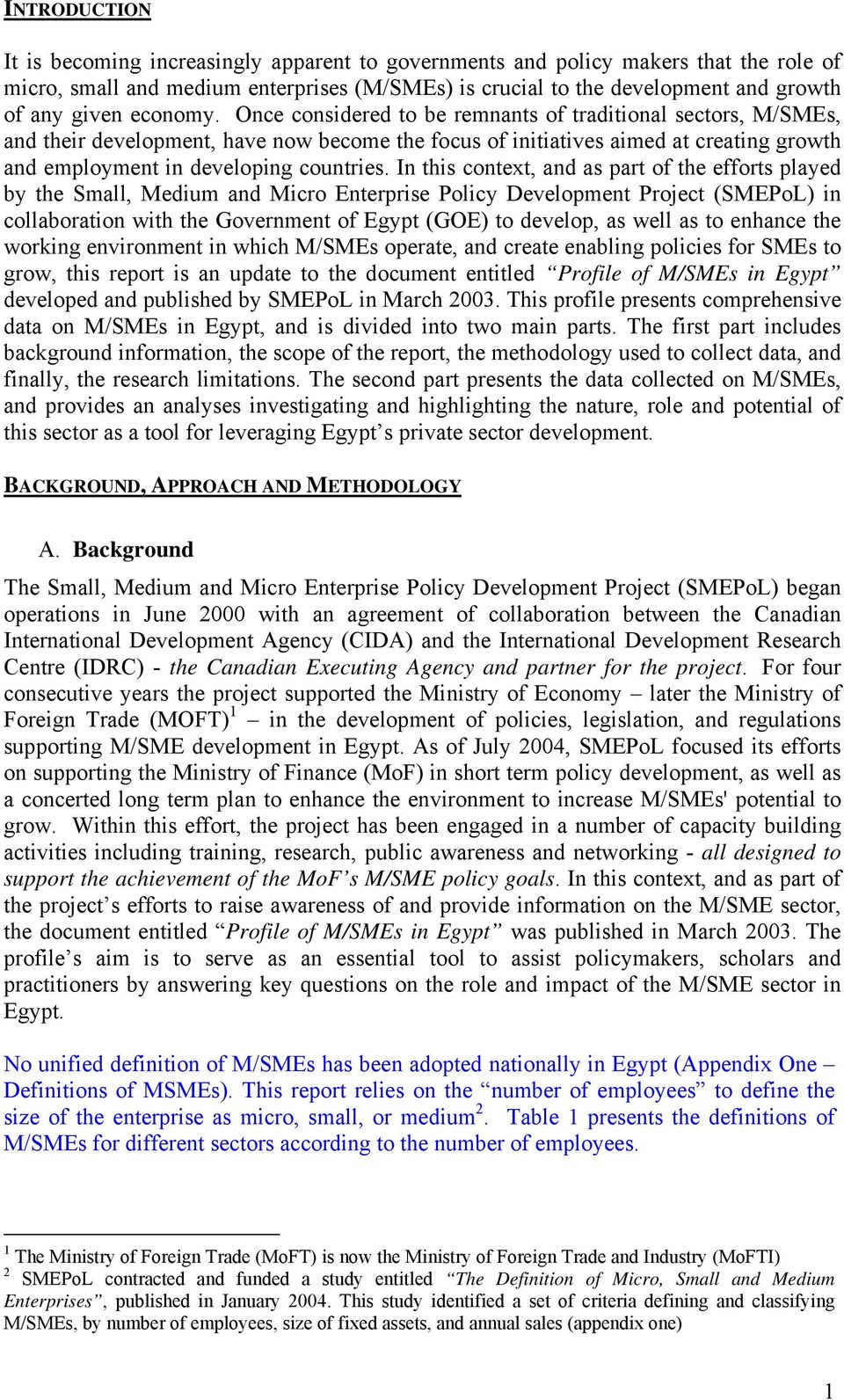
4 Table 1: MSME Definition according to number of employees Number of Employees Micro Small Medium Large Trade Service Manufacturing Construction B. Scope of the Report The main aim of this report is to provide quantifiable and illustrative data on the number of M/SMEs operating in Egypt, their rate of increase during the past 1 years, as well as their geographic distribution. The report will also illustrate the rates of wages for those employed in M/SMEs, as well as the contribution of small-scale enterprises to the economy with regards to: Employment; Job creation during the past ten years; Percentage of Egyptian exports (and main sectors of exporting M/SMEs) Also, as part of SMEPoL s main cross cutting themes, the report will place special emphasis on reflecting gender specificity and child labor (by highlighting the participation of laborers below 14 years of age) whenever feasible. C. Methodology The methodology followed for collecting, consolidating and presenting the data in this report relied heavily on an extensive desktop review of related M/SME data, including the sources listed below. The Establishment Census for the Years 1986 and 1996, published by the Central Agency for Public Mobilization and Statistics (CAPMAS): Data on the size of M/SMEs segregated by the number of workers in each establishment were collected and documented for each of the 26 governorates for 1986 and Sub-sector activities were then grouped into trade, service, manufacturing and construction. Using the number of workers, data was placed in the corresponding micro, small or medium fields (following the definition developed by SMEPoL, presented in table 1, above). The Industrial Census for the Years 1998 and 21, published by CAPMAS: This census has been used as the main reference for the identification and consolidation of data relevant to identifying M/SME exporting industries, the fastest growing M/SMEs, and other related trends. Other Sources: Various sources were used interchangeably to collect other relevant data. Notably, many of the employment figures have relied on The Egypt Labor Market Survey (ELMS) conducted in 1998 by the Economic Research Forum (ERF) in collaboration with CAPMAS, on a sample of 5, households. This survey was specifically designed to make it comparable to data from the Labor Force Sample Survey (LFSS) conducted by CAPMAS in This ELMS has been used despite the existence 2
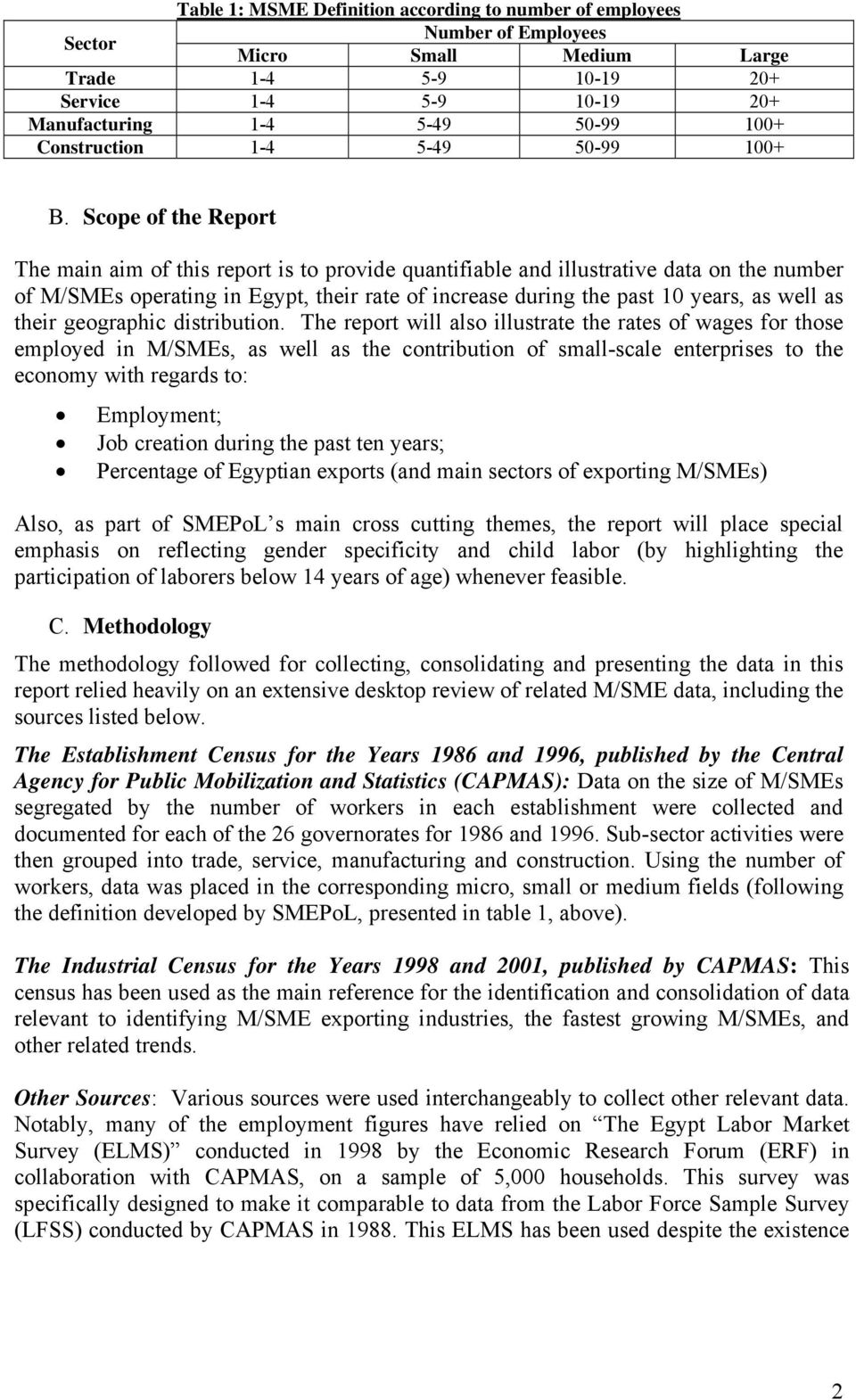
5 of an LFSS which was conducted in 1998, since this LFSS suffered from serious comparability problems with previous rounds of the survey. 3 Gross Domestic Product (GDP) published by The Central Bank of Egypt (CBE): The research team relied on the GDP published by the CBE, and also relied on the formulas used in basic national accounts. Ideally, the formula for obtaining the Value Added is calculated as follows: Value Added =Value of Output Value of Intermediate Inputs. However, for the purpose of simplicity, based on the data currently available the research team used the following formula: Contribution of M/SMEs to GDP = (The Total Revenue Expenses)/GDP (2-21) Definition of Economic s: Activities were classified to calculate M/SME figures for each of the economic sectors as follows: Construction Activities Activity CAPMAS Code Location preparation 45.1 Establishment of buildings whole or part, or engineering activities 45.2 Installations related to buildings 45.3 Finishing of buildings 45.4 Manufacturing Activities Activity CAPMAS Code Coal mining 1 Petroleum and gas extraction 11.1 Mining iron raw material (Felzat) 13 Other activities related to mining and usage of mines 14 Transformation industries Electricity, gas and water supply D E 3 Assad, Ragui. The Egyptian Labor Market in an Era of Reform The American University in Cairo Press, Cairo: 22. 3
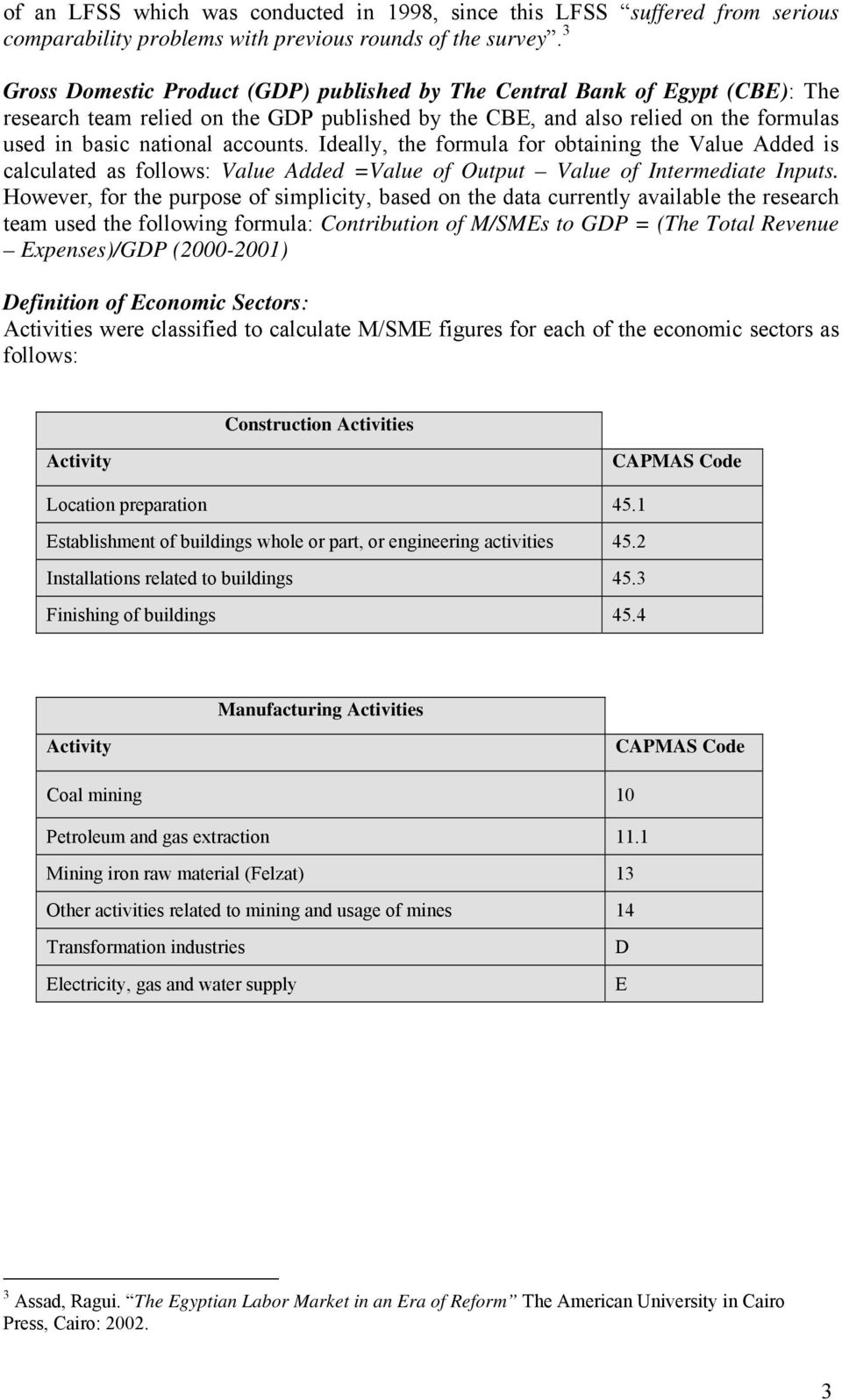
6 Trade Activities Activity CAPMAS Code Agricultural crops and gardening for market purposes 1.1 Animal husbandry 1.2 Forest usage and tree cutting for wood 2. Fishing B Wholesale and retail trade of automobiles with engines 5.1 Wholesale and retail trade of automobile spare parts 5.3 Wholesale and retail trade of motorcycles 5.4 Retail trade of automobile fuel 5.5 Wholesale and commission based trade, except for automobiles 51 Unspecialized retail trade 52.1 Retail trade of food and beverages in specialized stores 52.2 Other retail trade of new commodities in specialized stores 52.3 Retail trade of used commodities in specialized stores 52.4 Retail trade outside stores 52.5 Service Activities Activity CAPMAS Code Agricultural services related to animal husbandry 1.4 Services related to petroleum and gas extraction 11.2 Rental of construction and destruction equipment (with operator) 45.5 Repair and maintenance of automobiles with engines 5.2 Personal commodity and household product repair 52.6 Hotels and restaurants Transportation, storage and communication Financial intermediation Estate activities, rentals, and business services Education Health and social work Community services and social and personal services H I J K L M N 4

7 D. Research Limitations While collecting the required data for updating the Profile of M/SMEs in Egypt, the research team encountered several limitations. These are highlighted below. The Lack of Accurate Data: One of the most pressing limitations faced by the research team was the lack of available data on M/SMEs in Egypt. In many instances, even when the data is available, it is outdated. In addition, despite a number of wide scale M/SME surveys conducted by donor-funded projects, data remains inaccessible to both specialized research institutions and the public. Regarding the size of enterprises, the latest data issued on the number of establishments in Egypt was collected and published in Data preceding this is only available for For export data figures, the sources available (that may be M/SME specific) only relate to the manufacturing sector, and not to trade or services. As for the Economic Census of 2/21, the establishment figures included were not classified by the number of workers, which made it impossible to present the data classified according to the size of the M/SMEs, in accordance with the SMEPoL definition issued in January, Lack of Unified M/SME Definition: Another factor that represented a limitation on the usage of available data was the lack of M/SME specificity among the economic statistics available in Egypt. For instance, while data on Egyptian exports is available for all economic activities, it is not segregated by size of enterprise. Even when the data is specified by size, different definitions are used by various institutions, which make comparability preferences almost unattainable. To overcome the aforementioned limitation in all the available data, the research team relied whenever obtainable on the number of employees in each establishment to segregate between micro, small and medium sized enterprises. However, even by following this approach, data was not differentiated between the varied economic sectors (i.e. trade and service, manufacturing and construction) in all instances. 4 The data in the economic census presents enterprises classified into those establishments with nine workers or less, and those with 1 workers or more. Owing to such data limitations, some of the figures included in this report represent all private enterprises, and sometimes all enterprises (both private and public). 5

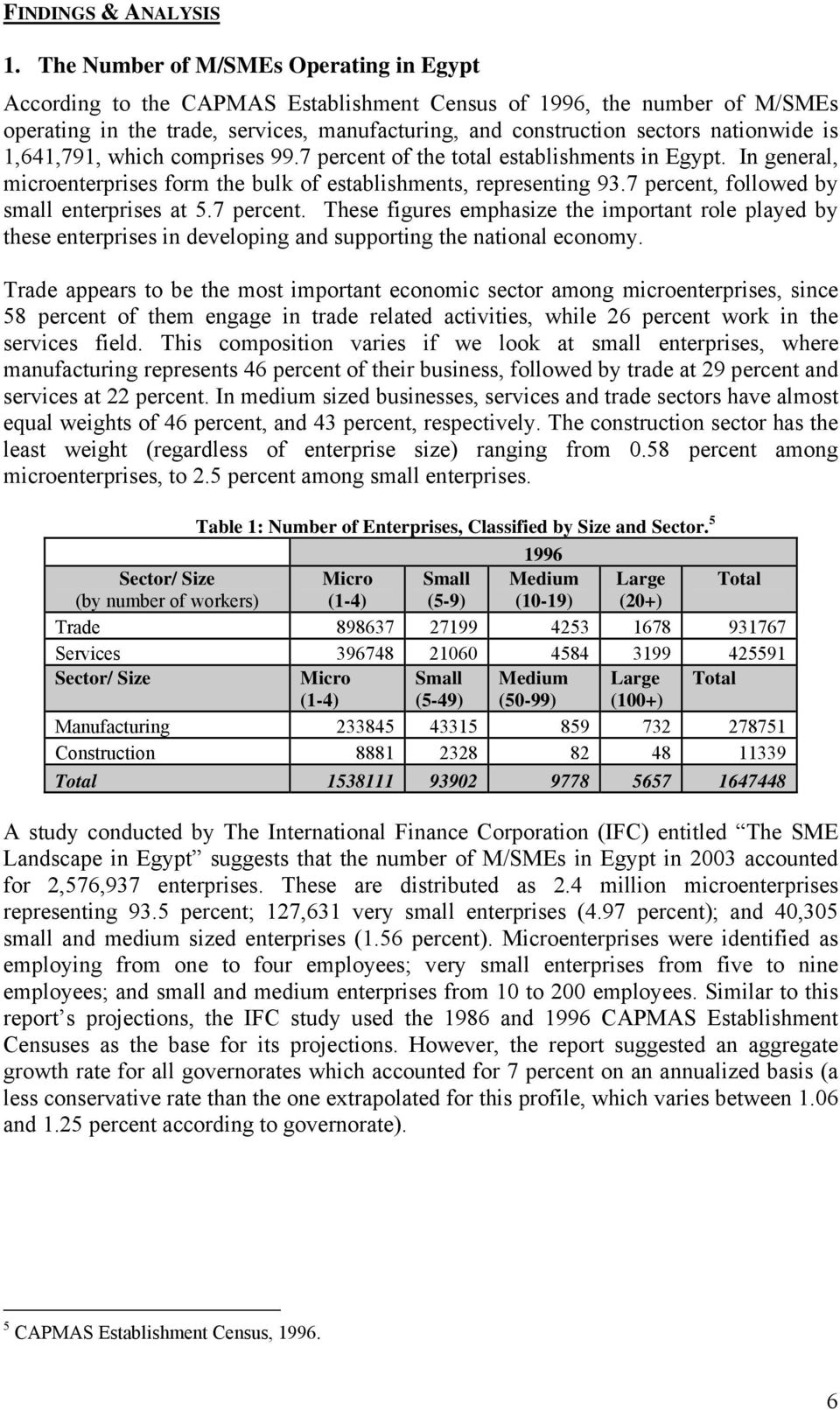
8 FINDINGS & ANALYSIS 1. The Number of M/SMEs Operating in Egypt According to the CAPMAS Establishment Census of 1996, the number of M/SMEs operating in the trade, services, manufacturing, and construction sectors nationwide is 1,641,791, which comprises 99.7 percent of the total establishments in Egypt. In general, microenterprises form the bulk of establishments, representing 93.7 percent, followed by small enterprises at 5.7 percent. These figures emphasize the important role played by these enterprises in developing and supporting the national economy. Trade appears to be the most important economic sector among microenterprises, since 58 percent of them engage in trade related activities, while 26 percent work in the services field. This composition varies if we look at small enterprises, where manufacturing represents 46 percent of their business, followed by trade at 29 percent and services at 22 percent. In medium sized businesses, services and trade sectors have almost equal weights of 46 percent, and 43 percent, respectively. The construction sector has the least weight (regardless of enterprise size) ranging from.58 percent among microenterprises, to 2.5 percent among small enterprises. Table 1: Number of Enterprises, Classified by Size and / Size Micro Small Medium Large Total (by number of workers) (1-4) (5-9) (1-19) (2+) Trade Services / Size Micro Small Medium Large Total (1-4) (5-49) (5-99) (1+) Manufacturing Construction Total A study conducted by The International Finance Corporation (IFC) entitled The SME Landscape in Egypt suggests that the number of M/SMEs in Egypt in 23 accounted for 2,576,937 enterprises. These are distributed as 2.4 million microenterprises representing 93.5 percent; 127,631 very small enterprises (4.97 percent); and 4,35 small and medium sized enterprises (1.56 percent). Microenterprises were identified as employing from one to four employees; very small enterprises from five to nine employees; and small and medium enterprises from 1 to 2 employees. Similar to this report s projections, the IFC study used the 1986 and 1996 CAPMAS Establishment Censuses as the base for its projections. However, the report suggested an aggregate growth rate for all governorates which accounted for 7 percent on an annualized basis (a less conservative rate than the one extrapolated for this profile, which varies between 1.6 and 1.25 percent according to governorate). 5 CAPMAS Establishment Census,
9 2. The Rate of Increase in the Number of M/SMEs Over the Past 1 Years. 6 A recent survey prepared by the Economic Research Forum (ERF) entitled Profile of Micro and Small enterprises in Egypt 7 conducted in 8 governorates (Cairo, Giza, Alexandria, Damietta, El Gharbeya, Fayoum, Assiut and Suhag) observed that around 13 percent of small economic units in these governorates closed out in 23, which represents 3, units out of the 22,996 units listed. On a different note, 2,1 units entered the market in the same period of time. The graphs below depict the actual growth rates of the total number of establishments for the governorates during the period of 1994 to Governorates are presented in graphs classified according to four main categories Urban (Cairo, Alex, Port Said, and Suez), Lower Egypt (El Beheira, Dakahleya, Sharkeya, Menoufeya, Kafr El Sheikh, Qalyoubeya, Gharbeya, Damietta and Ismailia), Upper Egypt (Giza, Fayoum, Beni Suef, Minia, Suhag, Assiut, Qena, Luxor City, and Aswan), and Frontier Governorates (Marsa Matrouh, the New Valley, North Sinai, South Sinai, and the Red Sea). Figure 1 below indicates that among the urban governorates, Cairo has the largest number of enterprises. Figure 1: Actual Number of Establishments in Urban Egypt (1994 to 1996). Actual number of establishements Actual Number of Establishements in Urban Egypt Years Cairo Alexandria Suez Portsaid Figure 2 below demonstrates that Dakahleya leads lower Egyptian governorates in terms of number of establishments while Qalyoubeya, and Ismailia have the lowest number of establishments among the group. 6 The only available figures for establishments are not available by size or number of workers. However, the percentage of large sized enterprises does not exceed 1% in all the governorates, except in the Red Sea, and South Sinai (See Appendix One). 7 The Economic Research Forum, Profile of Micro and Small Enterprises in Egypt- A case study within the project on "Promoting Competitiveness in the Micro and Small Enterprises in the MENA Region_. MSEs Potentials and Success Determinants in Egypt 23-24, April 25 7

10 Figure 1: Actual Number of Establishments in Lower Egypt (1994 to 1996). Actual Number of Establishments in Lower Egypt Actual Number of Establishements Years Damietta Ismailia Gharbeya Kafr El Sheikh Menoufeya Qalyoubeya Sharkeya Dakahleya El Beheira Data contained in figure 3 show that Giza leads Upper Egypt governorates in terms of the number of enterprises. Figure 2: Actual Number of Establishments in Upper Egypt (1994 to 1996). Actual Number of Establishments in Upper Egypt Actual number of establishements Years Assiut Aswan Luxor City Benisuef Qena Elminia Giza Fayoum Suhag In general, as observed in figures 4, Matrouh has the highest number of enterprises among the frontier governorates The increasing number of enterprises in the frontier governorates may be attributed to the importance of the Red Sea, North Sinai, and South Sinai as 'touristic' 8

11 governorates, while the growth of the New Valley could be attributed to the presence of a number of projects that have focused on land reform and mining..8 Figure 4: Actual Number of Establishments in Frontier Governorates (1994 to 1996). 1 Actual Number of Establishments in Frontier Governorates Actual number of establishements Years Red Sea Matrouh North Sinai South Sinai New Valley 3. The Geographic Distribution of M/SMEs in Egypt According to the ERF s Profile of Small and Micro Enterprises in Egypt 9, Lower Egypt is home to the majority of MSEs in Egypt. The study highlights that with reference to the concentration of the population across the country, Metropolitan Areas referred to as Urban Egypt in this report - witness the highest concentration of small economic units (SEUs). It follows that in the sample selected by the ERF; most of the economic units were in an urban setting. The same study pinpointed the distribution of MSEs in rural and urban settings according to the year of establishment - starting from 195 and continuing past 2. The report concluded that most MSEs were established in the 199s, and mainly in rural areas. 8 Wasf Misr- El Wadi El Gedeid, The Economic Research Forum, Profile of Micro and Small Enterprises in Egypt - A case study within the project on Promoting Competitiveness in the Micro and Small Enterprises in the MENA Region_. MSEs Potentials and Success Determinants in Egypt 23-24, April 25 9

12 Table 3: MSE Distribution According to Region. 1 Year of Urban Rural Total Establishment Number Percent Number Percent Number Percent Before % % to % 6.3 % to % % to % % to % % to % % % % Total Number 341 1% % 498 1% Table 4: MSE Distribution According to 21. Year of Industry Trade Service Total Establishment Number Percent Number Percent Number Percent Number Percent Before % 18.6 % 5.5 % 31.7 % 195 to % % % % 196 to % % % % 197 to % % % % 198 to % % % % 199 to % % % % % % % % Total Number 773 1% % 965 1% 497 1% The ERF report also indicates that the number of such establishments have been on the rise in rural areas, a fact which the ERF attributes to migration trends, which have been declining over the past few years. Interestingly, the ERF indicated in their study that female-owned enterprises have been increasing throughout the same lifespan. In response to the significant increase in the number of such establishments in the 199 s, female owned enterprises reached their peak during this period once more with the highest concentration in rural settings. The report added that earlier during the 196 s, the industrial sector was more pronounced as compared to trade and services. Other interesting findings of the ERF survey include information about the transition of MSEs during the first and second listing. It was concluded that the least transition occurred in the trade sector, followed by services and industries. Within the selected sample, a significant number of those who changed activities, shifted to trade. Tables and bar charts have been prepared below for each Egyptian governorate (in addition to Luxor City). These tables present the number of establishments categorized by size 11 and economic sector for the years Ibid. 11 The size is classified according to the SMEPoL definition which was issued in January24. (For trade and services, microenterprises are from 1-4 employees, small enterprises are from 5-9 employees, medium enterprises are from 1-19 and large enterprises are 2 employees and above; while for manufacturing and construction, microenterprises are from 1-4 employees, small enterprises are from 5-49, medium enterprises are from 5-99 and large enterprises contain 1 employees and above. 12 Source: Establishment Census for all governorates, CAPMAS,

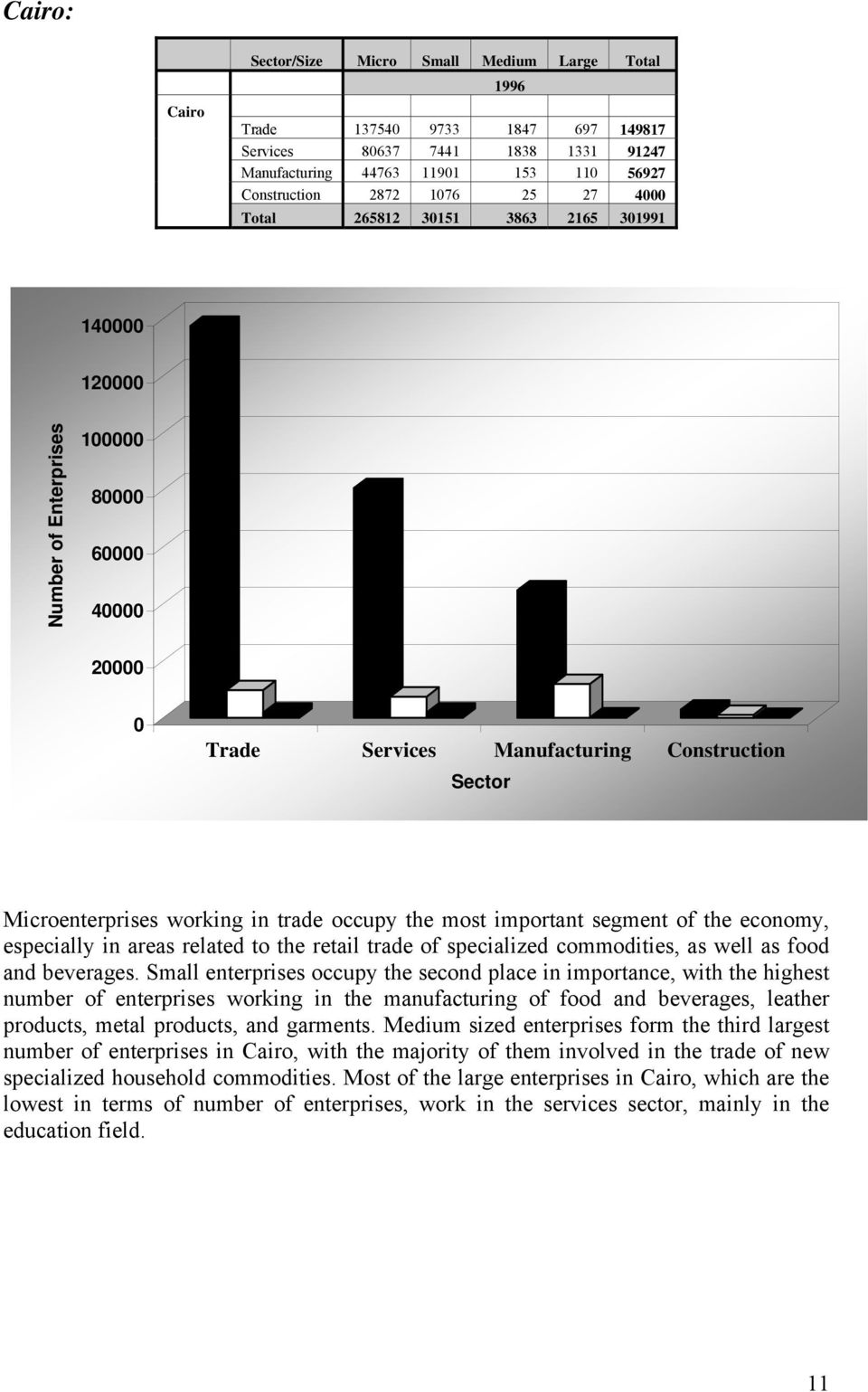
13 Cairo: Cairo /Size Micro Small Medium Large Total 1996 Trade Services Manufacturing Construction Total Number of Enterprises Trade Services Manufacturing Construction Microenterprises working in trade occupy the most important segment of the economy, especially in areas related to the retail trade of specialized commodities, as well as food and beverages. Small enterprises occupy the second place in importance, with the highest number of enterprises working in the manufacturing of food and beverages, leather products, metal products, and garments. Medium sized enterprises form the third largest number of enterprises in Cairo, with the majority of them involved in the trade of new specialized household commodities. Most of the large enterprises in Cairo, which are the lowest in terms of number of enterprises, work in the services sector, mainly in the education field. 11
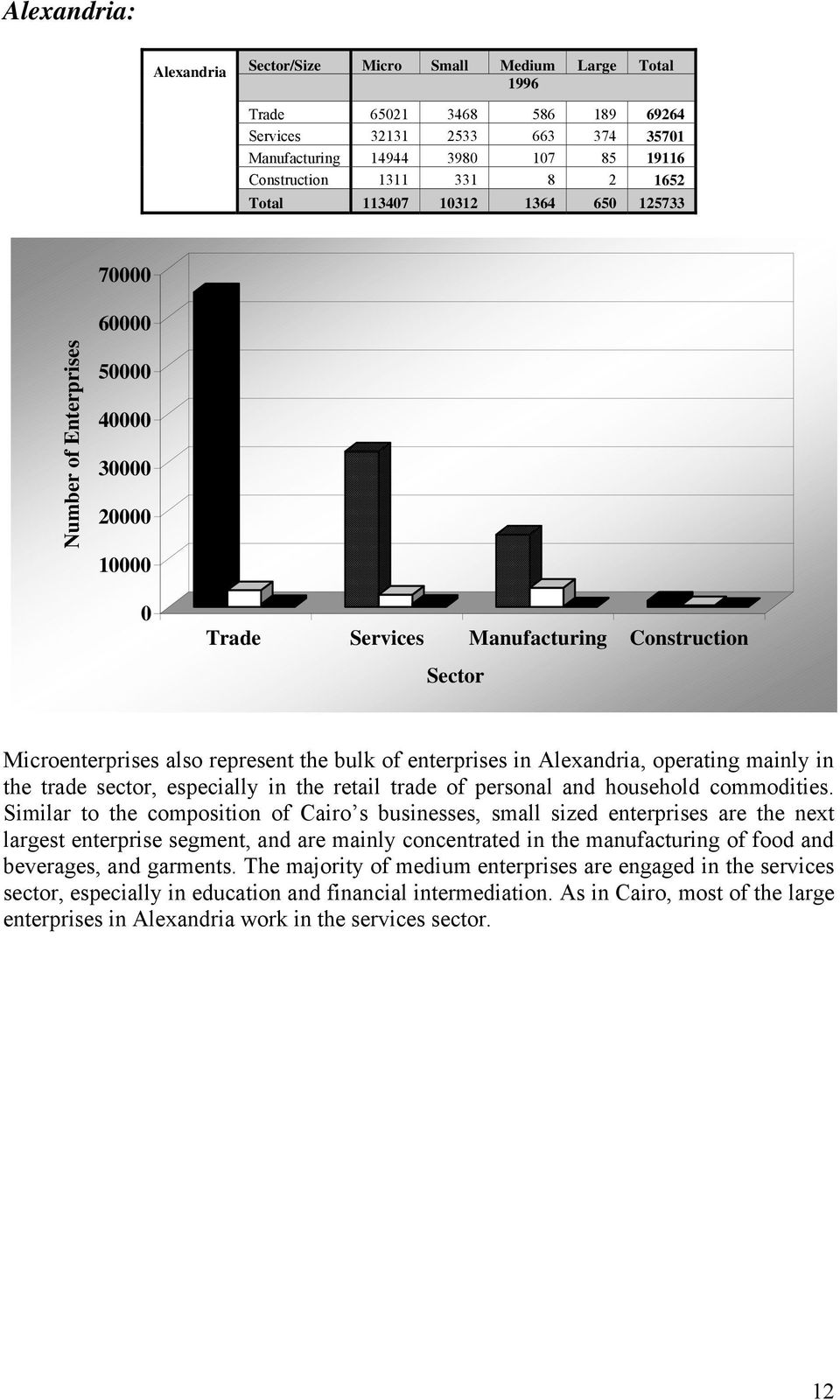
14 Alexandria: Alexandria /Size Micro Small Medium Large Total 1996 Trade Services Manufacturing Construction Total Number of Enterprises Trade Services Manufacturing Construction Microenterprises also represent the bulk of enterprises in Alexandria, operating mainly in the trade sector, especially in the retail trade of personal and household commodities. Similar to the composition of Cairo s businesses, small sized enterprises are the next largest enterprise segment, and are mainly concentrated in the manufacturing of food and beverages, and garments. The majority of medium enterprises are engaged in the services sector, especially in education and financial intermediation. As in Cairo, most of the large enterprises in Alexandria work in the services sector. 12
15 Port Said: Port Said /Size Micro Small Medium Large Total 1996 Trade Services Manufacturing Construction Total Number of Enterprises Trade Services Manufacturing Construction Micro Small Medium Microenterprises represent the largest portion of enterprises, with most of them engaging in the trade of personal and household commodities. Unlike Cairo and Alexandria, small and medium enterprises resemble those in Port Said, mainly operating in the trade sector. Large enterprises are mainly engaged in the services sector. 13

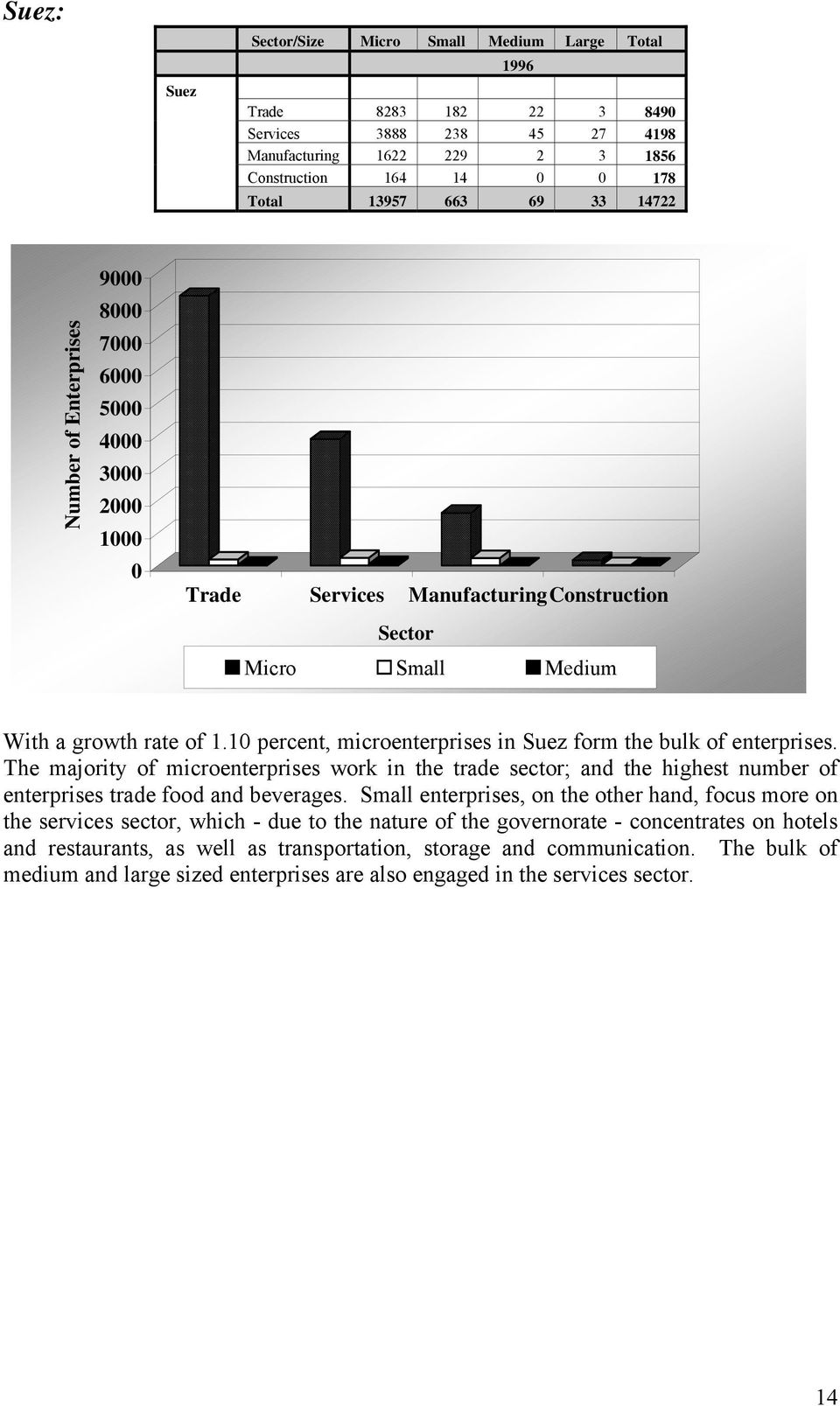
16 Suez: Suez /Size Micro Small Medium Large Total 1996 Trade Services Manufacturing Construction Total Number of Enterprises Trade Services ManufacturingConstruction Micro Small Medium With a growth rate of 1.1 percent, microenterprises in Suez form the bulk of enterprises. The majority of microenterprises work in the trade sector; and the highest number of enterprises trade food and beverages. Small enterprises, on the other hand, focus more on the services sector, which - due to the nature of the governorate - concentrates on hotels and restaurants, as well as transportation, storage and communication. The bulk of medium and large sized enterprises are also engaged in the services sector. 14
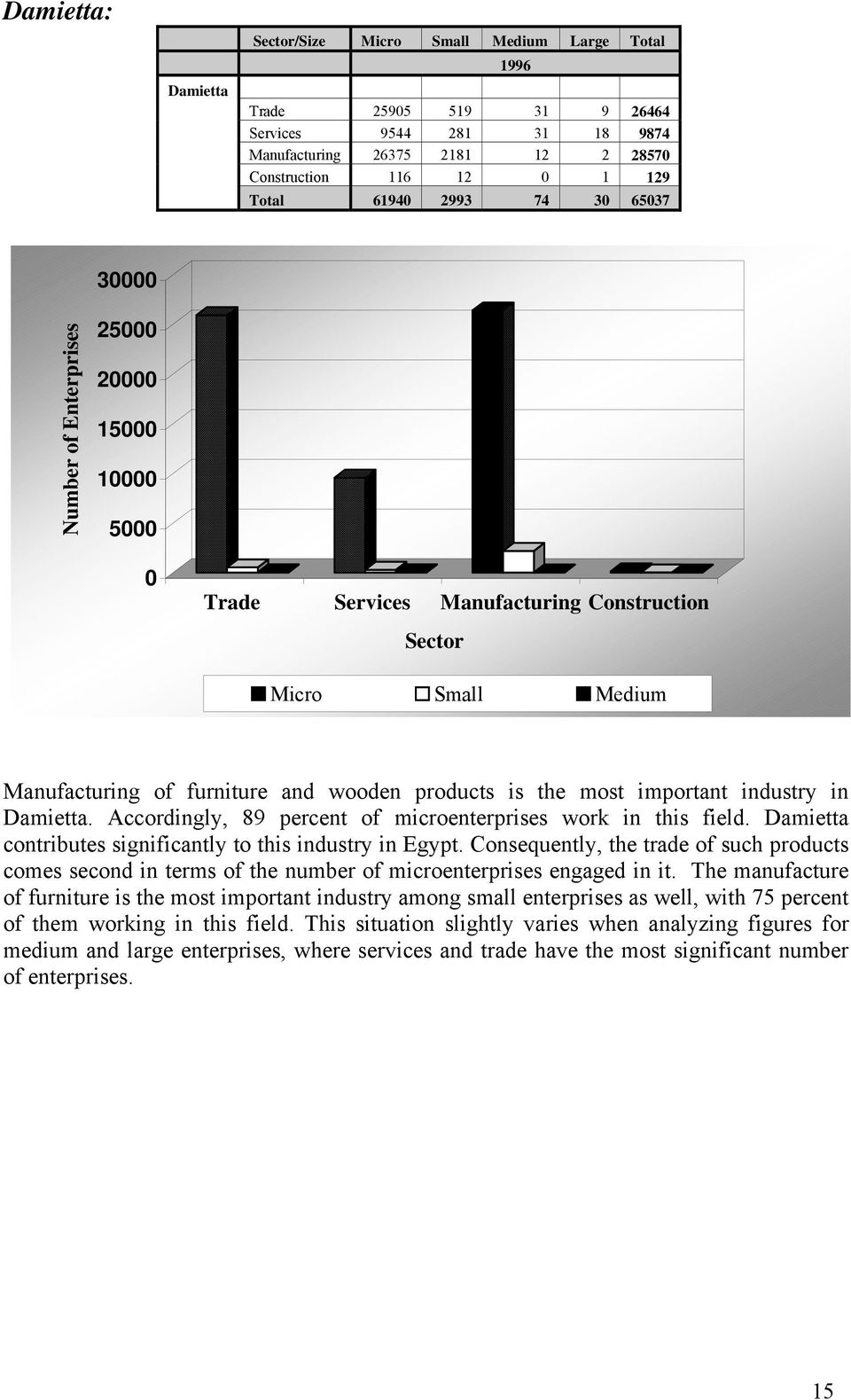
17 Damietta: Damietta /Size Micro Small Medium Large Total 1996 Trade Services Manufacturing Construction Total Number of Enterprises Trade Services Manufacturing Construction Micro Small Medium Manufacturing of furniture and wooden products is the most important industry in Damietta. Accordingly, 89 percent of microenterprises work in this field. Damietta contributes significantly to this industry in Egypt. Consequently, the trade of such products comes second in terms of the number of microenterprises engaged in it. The manufacture of furniture is the most important industry among small enterprises as well, with 75 percent of them working in this field. This situation slightly varies when analyzing figures for medium and large enterprises, where services and trade have the most significant number of enterprises. 15
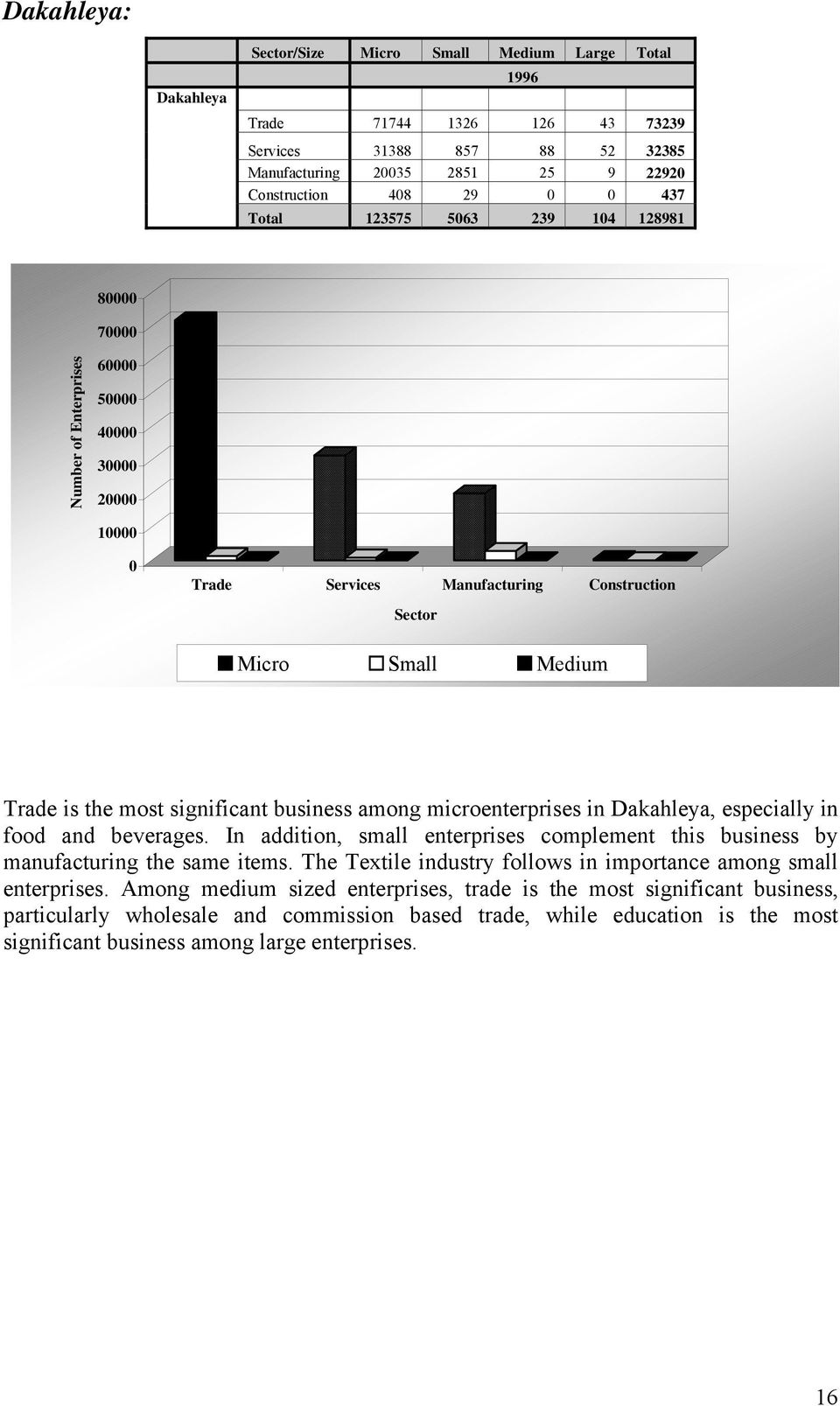
18 Dakahleya: Dakahleya /Size Micro Small Medium Large Total 1996 Trade Services Manufacturing Construction Total Number of Enterprises Trade Services Manufacturing Construction Micro Small Medium Trade is the most significant business among microenterprises in Dakahleya, especially in food and beverages. In addition, small enterprises complement this business by manufacturing the same items. The Textile industry follows in importance among small enterprises. Among medium sized enterprises, trade is the most significant business, particularly wholesale and commission based trade, while education is the most significant business among large enterprises. 16
19 Sharkeya: /Size Micro Small Medium Large Total 1996 Sharkeya Trade Services Manufacturing Construction Total Number of Enterprises Trade Services Manufacturing Construction Micro Small Medium In Sharkeya, 57 percent of microenterprises are involved in trade; with the majority engaging in the trade of personal and household commodities. Manufacturing is the most significant business among small enterprises, primarily in the food and beverages field. The largest proportion of medium and large enterprises are engaged in the manufacturing sector, focusing on the manufacture of textiles, food and beverages, machines, rubber, and chemical products. 17

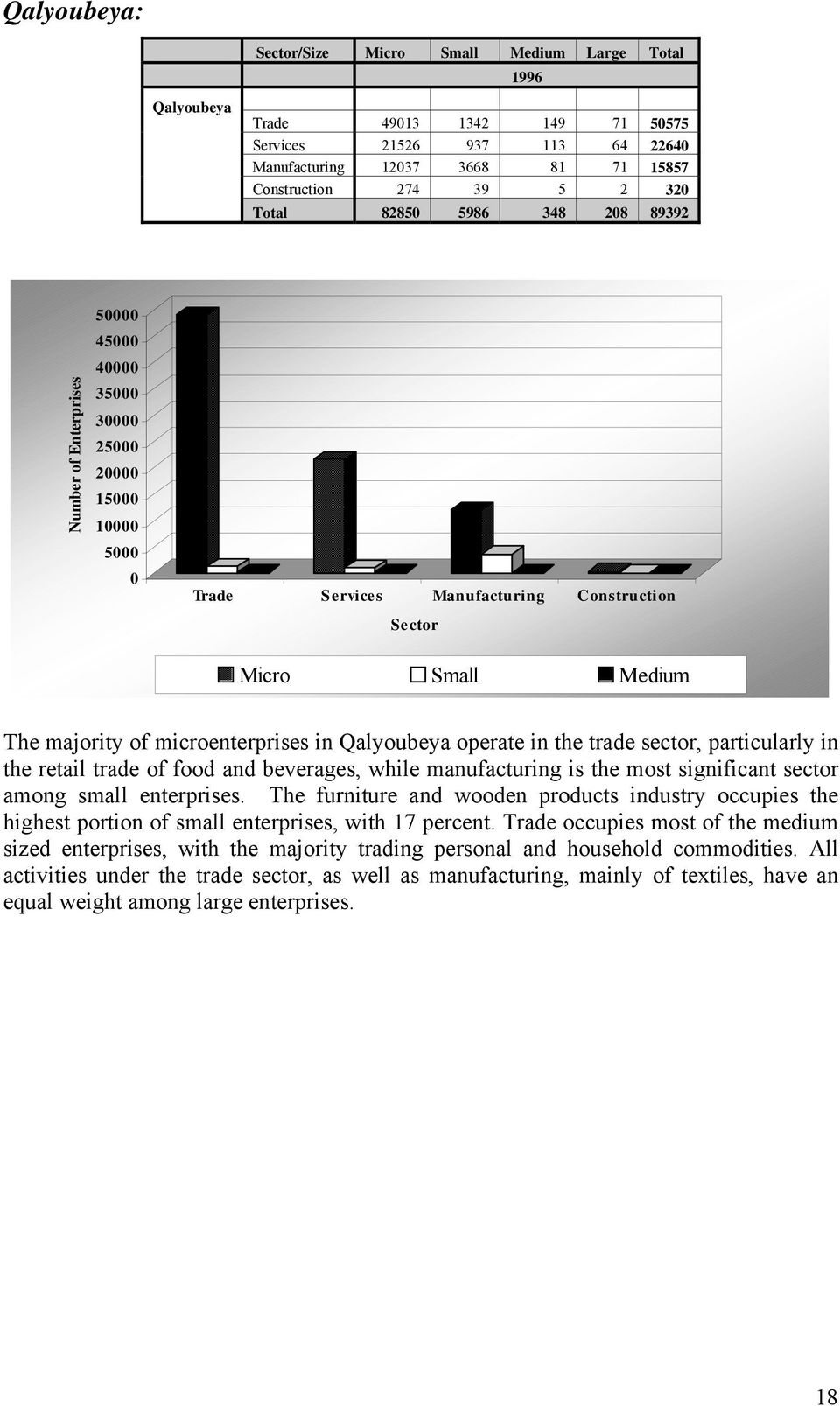
20 Qalyoubeya: /Size Micro Small Medium Large Total 1996 Qalyoubeya Trade Services Manufacturing Construction Total Number of Enterprises Trade Services Manufacturing Construction Micro Small Medium The majority of microenterprises in Qalyoubeya operate in the trade sector, particularly in the retail trade of food and beverages, while manufacturing is the most significant sector among small enterprises. The furniture and wooden products industry occupies the highest portion of small enterprises, with 17 percent. Trade occupies most of the medium sized enterprises, with the majority trading personal and household commodities. All activities under the trade sector, as well as manufacturing, mainly of textiles, have an equal weight among large enterprises. 18
21 Kafr El Sheikh: Kafr El Sheikh /Size Micro Small Medium Large Total 1996 Trade Services Manufacturing Construction Total Number of Enterprises Trade Services Manufacturing Construction Micro Small Medium Trade is the most important sector among microenterprises in Kafr El Sheikh. Microenterprises mainly engage in the retail and wholesale trade of food and beverages. Similar to Damietta, Dakahleya, Sharkeya, and Qalyoubeya, Kafr El Sheikh s small enterprises primarily engage in manufacturing. Medium enterprises are mainly concentrated in the services sector under health and social work as well as education. Half of the large enterprises engage in a variety of trade activities. 19
22 El Gharbeya: El Gharbeya /Size Micro Small Medium Large Total 1996 Trade Services Manufacturing Construction Total Number of Enterprises Trade Services Manufacturing Construction Micro Small Medium In El Gharbeya, trade also is the most significant sector among microenterprises with more than 44 percent of the trade activities confined to retail and wholesale of food and beverages. Manufacturing is the most important sector among small enterprises with 26 percent of small enterprises engaging in manufacturing of textiles and garments. Most of the medium enterprises engage in trade, while the highest number of large enterprises works in the services sector. 2
23 Menoufeya: /Size Micro Small Medium Large Total 1996 Menoufeya Trade Services Manufacturing Construction Total Number of Enterprises Trade Services Manufacturing Construction Micro Small Medium In Menoufeya, the food and beverage business was also found to be significant here, with the majority of microenterprises involved in the trade of food and beverages. The majority of small sized enterprises are involved in the manufacture food and beverages. Medium enterprises are mainly engaged in trade activities, whereby they focus on the trade of specialized commodities in specialized stores. The distribution of large enterprises among the three economic sectors of trade, services and manufacturing is almost equal, with the highest number of enterprises engaged in manufacturing, 4 percent of which manufacture textiles and garments. 21
24 El Beheira: /Size Micro Small Medium Large Total 1996 El Beheira Trade Services Manufacturing Construction Total Number of Enterprises Trade Services Manufacturing Construction Micro Small Medium As is the case of El Menoufeya, the largest number of microenterprises in El Beheira engage in trade, especially that related to food and beverages. Small enterprises are concentrated in the manufacturing of food and beverages. Medium and large enterprises are generally engaged in the trade of specialized commodities. 22
25 Ismailia: /Size Micro Small Medium Large Total 1996 Ismailia Trade Services Manufacturing Construction Total Number of Enterprises Trade Services Manufacturing Construction Micro Small Medium Trade of food and beverages is the most significant business among microenterprises in Ismailia. Also 46 percent of small enterprises are engaged in the manufacturing mainly focusing on food and beverages too. Medium enterprises are mainly engaged in retail trade of specialized commodities. As for large enterprises, their majority is occupied in the services sector especially in education. 23
26 Giza: /Size Micro Small Medium Large Total 1996 Giza Trade Services Manufacturing Construction Total Number of Enterprises Trade Services Manufacturing Construction Micro Small Medium In Giza, 58 percent of microenterprises are involved in trade activities, with the bulk of them trading food and beverages. Also resembling a large number of other governorates, small businesses are primarily involved in the manufacture of food and beverages. Due to the urban and touristic nature of most of the areas in Giza, medium enterprises are concentrated in the services sector especially in the hotels & restaurants, followed by estate activities, rentals and business services. Similarly, large enterprises are concentrated in the services sector mainly estate activities, rentals and business activities, and hotels and restaurants respectively. 24
27 Beni Suef: Beni Suef /Size Micro Small Medium Large Total 1996 Trade Services Manufacturing Construction Total Number of Enterprises Trade Services Manufacturing Construction Micro Small Medium The highest percentage of microenterprises in Beni Suef are involved in the trade of food and beverages. As regards small enterprises, 57 percent of them are concentrated in the manufacture of food and beverages, followed by 2.3 percent involved in the manufacture of non-metal products related to mining. Medium enterprises are primarily engaged in the trade of specialized commodities. The majority of large enterprises are in the services sector, mainly in hotels and restaurants, as well as in education. 25
28 Fayoum: Fayoum /Size Micro Small Medium Large Total 1996 Trade Services Manufacturing Construction Total Number of Enterprises Trade Services Manufacturing Construction Micro Small Medium In Fayoum, microenterprises mainly engage in the trade of food and beverages, followed by specialized commodities. Manufacturing is the most important sector among small enterprises, with most of the enterprises focused in food and beverages. As for medium enterprises, they mainly work in trade related to specialized commodities. Large enterprises engage in the services sector, especially in education. 26
29 El Minia: El Minia /Size Micro Small Medium Large Total 1996 Trade Services Manufacturing Construction Total Number of Enterprises Trade Services Manufacturing Construction Micro Small Medium Following the same pattern found in the majority of governorates, El Minia s microenterprises are primarily involved in the trade of food and beverages, while small enterprises are concentrated in their manufacture. The bulk of medium sized enterprises are engaged in the services sector, especially in the hotels and restaurants field. Large enterprises also engage in services, however they are concentrated in the education field. 27
30 Assiut: Assiut /Size Micro Small Medium Large Total 1996 Trade Services Manufacturing Construction Total Number of Enterprises Trade Services Manufacturing Construction Micro Small Medium The pattern is not much different in Assiut than it is in the majority of other governorates. Microenterprises mainly engage in the trade of food and beverages, while small enterprises focus on the manufacturing of these same products. The highest number of medium enterprises in Assiut (5 percent) work in the services sector, mainly in health, health related activities, and social work; as well as the hotel and restaurant business. 28
31 Suhag: Suhag /Size Micro Small Medium Large Total 1996 Trade Services Manufacturing Construction Total Number of Enterprises Trade Services Manufacturing Construction Micro Small Medium The majority of microenterprises in Suhag are involved in trade activities, primarily in food and beverages. Trade, especially the retail trade of personal and household products, is also the most significant activity among small enterprises. Among medium enterprises, services, mainly in the hotel and restaurant business, is the most significant sector, while the trade of specialized commodities follows with a very minimal gap. Among large enterprises, services are still the most significant area of operation, especially in the field of education. 29
32 Qena: /Size Micro Small Medium Large Total 1996 Qena Trade Services Manufacturing Construction Total Number of Enterprises Trade Services Manufacturing Construction Micro Small Medium The majority of micro-enterprises in Qena are involved in the trade sector, while manufacturing is the main sector for small enterprises, with most of the businesses concentrated in food and beverages. Following food and beverages with a significant gap, manufacturing of non-metal products from mining occupies the second largest number of small enterprises. Medium sized enterprises primarily engage in the trade of specialized commodities. Large enterprises are absent in the manufacturing sector, while their bulk is engaged in the services sector, focused on the education business. 3
33 Luxor City: Luxor City /Size Micro Small Medium Large Total 1996 Trade Services Manufacturing Construction Total Number of Enterprises Trade Services Manufacturing Construction Micro Small Medium Although Luxor City belongs to Qena governorate, it nevertheless has a unique identity, and was, therefore, separately presented by the censuses and studies referred to in this report. Among micro-enterprises, the trade of food and beverages is the most significant activity. Services are the most significant sector for small enterprises, where most of them are concentrated in the hotel and restaurant business, as well as transportation and travel agencies. While they are non-existent in manufacturing, the significant bulk of medium enterprises are engaged in the services sector, mainly in hotels and restaurants. The same applies for large enterprises where the majority also engages in the business of hotels and restaurants. 31
34 Aswan: /Size Micro Small Medium Large Total 1996 Aswan Trade Services Manufacturing Construction Total Number of Enterprises Trade Services Manufacturing Construction Micro Small Medium In Aswan, the trade of food and beverages as well as specialized commodities engages the largest number of micro-enterprises. Manufacturing, (especially of food and beverages) and services, together form the bulk of businesses among small enterprises. Due to the touristic nature of Aswan, most of the services in which small enterprises engage are concentrated in transportation and travel agencies. 32
35 The Red Sea: /Size Micro Small Medium Large Total 1996 Red Sea Trade Services Manufacturing Construction Total Number of Enterprises Trade Services Manufacturing Construction Micro Small Medium Manufacturing was observed to have a significantly lower share among all sizes of enterprises in the Red Sea. The largest portion of micro-enterprises is involved in trade activities, mainly concentrated in specialized commodities. Due to the touristic nature of the Red Sea, the hotel and restaurant business is the most significant among small, medium, and large enterprises. 33
36 The New Valley: New Valley /Size Micro Small Medium Large Total 1996 Trade Services Manufacturing Construction Total Number of Enterprises Trade Services Manufacturing Construction Micro Small Medium In the New Valley governorate, the trade and manufacturing of metal products other than machinery occupies an equally significant portion among micro-enterprises. An equally significant portion of small enterprises engage in services, most significantly in hotels and restaurants, and construction. 34
37 Matrouh: /Size Micro Small Medium Large Total 1996 Matrouh Trade Services Manufacturing Construction Total Number of Enterprises Trade Services Manufacturing Construction Micro Small Medium In Matrouh, approximately 62 percent of small enterprises engage in trade activities related to food and beverages as well as specialized commodities. Recognizing the coastal nature of the governorate, services - mainly related to hotels and restaurants - are the most significant business activity among small, medium and large enterprises. 35
38 North Sinai: /Size Micro Small Medium Large Total 1996 North Sinai Trade Services Manufacturing Construction Total Number of Enterprises Trade Services Manufacturing Construction Micro Small Medium Trade, especially in food and beverages, is the most significant sector among microenterprises in North Sinai. Manufacturing engages the bulk of medium enterprises, where most of them are involved in the manufacture of food and beverages. The majority of medium and large enterprises are involved in the services sector, particularly in hotels and restaurants. 36
39 South Sinai: /Size Micro Small Medium Large Total 1996 South Sinai Trade Services Manufacturing Construction Total Number of Enterprises Trade Services Manufacturing Construction Micro Small Medium In South Sinai, most of the micro-enterprises operate in the trade sector, mainly in specialized commodities; while small, medium, and large enterprises are concentrated in the services sector, where the majority engages in the hotel and restaurant business. 37
40 4. Distribution of M/SMEs by Governorate Table 2: Distribution of M/SMEs 13 by Governorate. CAPMAS Establishment Census for Governorates, Micro Small Medium Large Total Cairo Alexandria Port Said Suez Damietta Dakahleya Sharkeya Qalyoubeya Kafr El Sheikh El Gharbeya Menoufeya El Beheira Ismailia Giza Beni Suef Fayoum Minia Assiut Suhag Qena Luxor City Aswan Red Sea New Valley Matrouh North Sinai South Sinai Total As shown in table 5 above, micro-enterprises constitute the of majority enterprises with 93 percent of micro, small and medium businesses hiring 1 to 4 employees. Small enterprises represent 6 percent of M/SMEs, while medium enterprises represent only 1 percent of M/SMEs. Large enterprises represent only.343 percent of the total enterprises in Egypt. 13 The size is classified according to the SMEPoL definition which was issued in January 24. (For trade and services, microenterprises are from 1 to 4 employees, small enterprises are from 5 to 9 employees, medium enterprises are from 1 to 19 and large enterprises are 2 employees and above; while for manufacturing and construction, microenterprises are from 1 to 4 employees, small enterprises are from 5 to 49, medium enterprises are from 5 to 99 and large enterprises contain 1 employees and above. 38
41 5. Distribution of Egyptian Labor Force by Working Status The total number of unemployed people 14 1,538, to reach 2,153,7 by in Egypt has increased since 1999 from Figure 5: The Number of Unemployed People (s) Year Table 6 shows the variation in number of unemployed people in the different clusters of governorates in Egypt 17. Table (6): The Total Number of Unemployed People (s) by Cluster of Governorate Year Urban Governorates Lower Governorates Upper Governorates Frontier Governorates Total The unemployment rate as a percentage of the labor force 16 (Figure 6) has been the highest in the Lower Egypt governorates since 1999 except in 21 followed by the Upper Egypt ones. 14 The people who are at least 15 years old 15 UNDP Egypt s Human Development Database 39
42 Figure (6): Unemployment Rate as a Percentage of Labor Force (15+) by Cluster of Governorates Percentage Year Urban Governorates Lower Governorates Upper Governorates Frontier Governorates Table 3: Distribution of Total Workers by Age Group, Segregated by Economic. CAPMAS Economic Census, 2-21 Economic Less than Less than 6 6 and Above Male Female Total Male Female Total Male Female Total Trade Services Manufacturing Construction Total Table 8: Total Employment Numbers for Non-agricultural Wage Workers in 22, Percentages from ELMS. 17 9,8, Formal l 18 Informal 19 % Number % Number Total 65.3% % Male 74.56% % Female 25.44% % Total 1% % UNDP Egypt s Human Development Database 17 Mona Amer, Ragui Assad, Safaa El Kogali, Alia EL Mahdi, May Mokhtar, Mona Said, Jackeline Wahba, Nadia Zibani. The Egyptian Labor Market in an Era of Reform. An Econmic Research Forum Edition. The American University in Cairo Press: Formal refers to all enterprises governed under law 159 for Informal refers to all individual enterprises which are not governed by any law. 4
43 Figure 7: Employment Distribution in the Non-agricultural Wage Formal and Informal. Fem ale 25% Employment Distribution in the Non- Agriculture Wage formal Employment Distribution in the Non- Agriculture Wage Informal Fem ale 14% Male 75% Male 86% 6. Wage Rates for Those Employed in M/SMEs. The following two tables illustrate the wage rates of formal and informal workers in M/SMEs, grouped according to number of workers, and segregated by their total daily wages. As shown in the following graphs, the largest concentration lies in the 5 to 1 L.E per day income segment for both the formal and informal sector accounting for almost 4.2 million workers whereas 2,63,153 are in the formal sector and 1,492,863 are in the informal sector. Female workers represent a large proportion of this income group working in the informal sector, and account for approximately 2,329,28 workers. Tables 9 (a) and (b): Wage Rates of Formal and Informal M/SME Workers, Classified by Number of Workers, Total Daily Wages, and Gender. 2 Formal Informal Total Daily Wage (LE) Male % Female % Total % Male % Female % Total % -<5 26.5% 63.3% 33.2% 15.3% 21.1% 16.8% 5-<1 43.8% 29.4% 41.1% 42.5% 48.% 43.9% 1-<2 24.3% 3.7% 2.5% 31.2% 24.1% 29.4% 2-<5 5.4% 3.6% 5.1% 9.9% 6.5% 9.1% 5-<1.9%.2%.7% 1- <.1%.1%.1% Total 1.% 1.% 99.9% 99.9% 1.% 1.% 2 Ibid. 41
44 Formal Informal Daily wage Male Female Total Male Female Total -< < < < < > Total Figure 8: Daily Wage Rate of Formal and Informal M/SMEs. Daliy Wage Rate of Formal and Informal Male Workers 25. Daily Wage Rate of Formal and Informal Female Workers Number of male workers Number of female workers <5 5-<1 1- <2 Daily w age rate 2- <5 5-1-> <1 Formal male workers Informal male workers. -<5 5-<1 Daily wage 1-<2 2-<5 5-<1 1-> Formal female w orkers Informal female workers 7. The Contribution of M/SMEs to the Economy A- Employment According to the profile of Micro and Small enterprises in Egypt prepared by ERF in 25, the number of workers per enterprise in small economic units increased from 2.3 workers/enterprise in 23 to reach 2.6 workers/enterprise in 24, indicating an almost 13 percent increase in one year. This increase has been attributed to a number of factors, including the open environment of competitiveness that requires growth in the size of MSEs. According to this study, this increase was quite clear in Upper Egypt and the Metropolitan Areas. Lower Egypt, however did not experience such growth, it is in fact more static than other regions in Egypt. Number of Formal workers Table 1 and figure 9 illustrate the number of formal workers, grouped according to number of workers, and segregated by gender. The concentration of workers in the formal sector lies in the category of 5 and more workers and accounts for 3,846,39 workers. This is due to the fact that the groups of enterprises employing from 1 to 4, 5 to 9, 1 to 29, and 3 to 49 workers representing the M/SME sector usually work within the 42
45 informal sector. Within the M/SME sector, most formal workers are concentrated in the 1 to 29 workers segment. Females in formal sector employment represent only 25.4 percent, as compared to male workers who represent percent. Table 1: Distribution of Formal Labor Segregated by Size of Enterprise. 21 Formal Male Female Total Size of the Enterprises.. (by number of workers) % Number Number % Number to 4 2% % % to 9 5.6% % % to % % % to % % % % % % Not specified 4.9% % % Total 1% % Figure 9: Distribution of Formal Workers + 5 6% Distribution of Formal Workers % % Not -4Spcified 5-9 2% 5% 6% Number of Informal Workers: Table 11 and figure 1 present the informal sector size, grouped by the number of workers in each enterprise, and segregated by gender. As shown in table 11, the largest concentration of employment is for enterprises that employ from 1 to 4 workers, (microenterprises) accounting for 2,4,36 workers, which represents almost 6 percent of the private non-agricultural informal sector s workforce. This provides further evidence that the informality of workers among M/SMEs is greater compared to large enterprises. The second largest employment concentration is among small enterprises, representing almost 2 percent (for the 5 to 9 workers segment) and 3.7 percent (for the 5 to 49 workers segment). 21 Mona Amer, Ragui Assad, Safaa El Kogali, Alia EL Mahdi, May Mokhtar, Mona Said, Jackeline Wahba, Nadia Zibani. The Egyptian Labor Market in an Era of Reform. An Economic Research Forum Edition. The American University in Cairo Press:
46 Table 11: Distribution of Informal Labor Segregated by Size of Enterprise. 22 Informal Size of Enterprise (by number of workers) to 4 5 to 9 1 to 29 3 to Not specified Total M% Num. F% Num. Total% Num % % % % % % % % % % % % % % % % % % Figure 1: Distribution of Informal Workers Distribution of Informal Workers -4 59% Not Spcified 4% + 5 6% % % 5-9 2% 22 Ibid. 44
47 Distribution of Small Enterprises According to Formality, Gender, Economic Activity, Number of Workers and Capital: The following table and figure illustrate that the concentration of activity in both the formal and informal sectors lies in the trade sector, representing 55 percent of enterprises in the formal sector, and in the informal sector. In the formal sector, male entrepreneurs tend to work in trade and manufacturing. In the informal sector, female entrepreneurs are higher in percentage representing percent in the trade sector against males who represent percent. Among formal and informal M/SMEs, mining, electricity and construction have witnessed the lowest contribution (nil contribution in the informal sector), an indication of the low capital capacities of the M/SME sector to tap into these activities. Interestingly, female entrepreneurs working in the manufacturing industry are much more concentrated in the informal sector representing only 15.8 percent and 2.97 percent in the formal sector. Economic Activity Table 12: Distribution of Enterprises by Formal and Informal Activity. 23 Formal Informal Male % Female % Total % Male % Female % Total % Mining.23%.%.2%.3%.%.3% Manufacturing 2.2% 2.97% 18.5% 19.84% 15.8% 19.4% Electricity.23% 2.46%.51%.57%.%.45% Construction 2.3%.% 1.78% 5.92%.% 4.76% Trade 59.6% 22.85% 55.1% 35.56% 49.59% 38.32% Transport 2.8% 2.97% 2.82% 5.93%.34% 4.83% Finance 3.93% 5.48% 4.12% 2.12%.65% 1.83% Services 1.98% 63.27% 17.5% 3.3% 33.62% 3.74% Total 1.% 1.% 99.54% 1.% 1.% 1.% Figure 11: Distribution of Enterprises by Formal and Informal Activity 55% Distribution of Small Enterprises by Formal Activity Mining 3% Manufacturing Electricity 38% Distribution of Small Enterprises by Informal Activity Mining 5% 2% Manufacturing Electricity 2% 1% 18% % 4% 17% Construction Trade Transport Finance Services 5% % 19% % 31% Construction Trade Transport Finance Services 23 The figures presented in this table, are aggregate figures including micro, small, medium, and large businesses. Source: Mona Amer, Ragui Assad, Safaa El Kogali, Alia EL Mahdi, May Mokhtar, Mona Said, Jackeline Wahba, Nadia Zibani. The Egyptian Labor Market in an Era of Reform. An Economic Research Forum Edition. The American University in Cairo Press:
48 Table 13: Distribution of Listed MSEs by Governorate and Gender of Owner/Manager. 24 Sex of Owner /Manager Governorate Cairo Giza Alexandria Damietta El Gharbeya Fayoum Assiut Suhag Total Male Female % 6% % 6% % 5% % 6% % 1% % 7% % 6% % 6% % 6% Total According to the ERF s Profile of Small and Micro Enterprises in Egypt 25, 94 percent of the managers/owners of the 22,996 MSEs listed in 12 randomly selected villages/towns across 8 governorates were males. El Gharbeya governorate had the highest female share of entrepreneurship at ownership figures that reached 1 percent. While Alexandria, at 5 percent, had the lowest female entrepreneurship rate, lower than that of other Upper and Lower Egyptian governorates such as Fayoum and Suhag, at 7 and 6 percent respectively. The same report highlights that most informal economic units are in rural areas, with Upper Egypt hosting most of these enterprises, followed by Lower Egypt and Metropolitan Areas. The survey also indicated that the higher the number of workers, the more likely the formality of the enterprise. Another factor affecting the type of enterprise is the value of invested capital: the higher it is the more likely the formality. The report also noted that gender was not a decisive factor within the context of enterprise formality. According to the findings of the same study, enterprises which employed 1 worker constituted the largest share of all enterprises, which was true regardless of the gender of 24 Ibid 25 The Economic Research Forum, Profile of Micro and Small Enterprises in Egypt- A case study within the project on Promoting Competitiveness in the Micro and Small Enterprises in the MENA Region_. MSEs Potentials and Success Determinants in Egypt 23-24, April
49 the owner of the enterprise. Around 58.4 percent of all female owned enterprises and 4.3 percent of all male owned enterprises employed only 1 worker. Enterprises employing 1 to 4 workers, constituted 94.7 percent of all enterprises, 97.3 percent of all female owned enterprises and 94.3 percent of all male owned enterprises. Only 2.9 percent of all enterprises employed 5 to 9 workers. The ERF report also indicated that the average size of female owned enterprises was smaller (at 1.73 workers) than that of their male counterparts (at 2.33 workers). A similar difference between female and male owned enterprises was found with regard to the value of invested capital, with the average value of assets amounting to LE 12,8 for enterprises owned by females as compared to LE 44, for enterprises owned by males. Table 14: Size of Enterprise by Gender of Entrepreneur and Number of Workers. 26 Size of Enterprise Male Female Total 1 worker workers workers workers to 9 workers to 49 workers Total number The 1998 Egyptian Labour Market Survey found that 18.5 percent of all small entrepreneurs were female. This figure is significantly higher than what is indicated in the ERF report 27, which finds that only 12.4 percent of entrepreneurs are female. It is important to note that the female owners/manager were over sampled (double-weighted) in the ERF survey in order to maintain a sufficient number of female respondents. In this respect, it is noted in the report that the figure of 12.4 percent indicating the share of female entrepreneurs in reality is closer to 6 percent. The noted difference between the two surveys can be attributed to a number of following factors, including the difference in the size of the two surveys, the difference in time when the two surveys were conducted, and the difference in the methodology used in the two surveys. With regard to the time difference of 5 years between the two surveys, it can be said that Egypt has witnessed several economic changes during this time period. A recession that caused wide scale bankruptcies among large companies, and a large number of unstable micro and small enterprises disappeared. Moreover, there is tendency for new enterprises to be larger in size both with regard to number of workers and value of invested capital. The ERF report also indicated that most of the economic units in their selected sample (65 percent) were involved in trading activities, followed by services (19 percent) and industry (16 percent). With regard to the gender of the entrepreneurs working in the different economic fields, it is interesting to note that the largest share of female entrepreneurs is found in the trade sector, followed by services and industry. As regards the value of invested capital for enterprises in the industry, trade and services sectors, the ERF study shows that enterprises with an invested capital of L.E. 1, to 26 Ibid. 27 Ibid. 47
50 5, constitute the largest share of enterprises for these three sectors. The report highlights that 42.1 percent of enterprises in the service sector, 35.6 percent of enterprises in industry and 34.5 percent of enterprises in trade are enterprises with an invested capital of L.E. 1,-5,. Table 15: Enterprises by Economic Activity and Gender of Entrepreneur. 28 Male Female Total Industry Trade Services Total number Industry activities are found to be larger than service and trade activities in terms of value of invested capital percent of enterprises working in industry are enterprises with an invested capital of 2, LE or more, whereas such enterprises constitute only 18.3 percent of all enterprises in trade, and 16.4 percent of enterprises in services. Looking at enterprises with an invested capital of less than 1 LE, the ERF report shows that these are most commonly found in trade, making up 18.3 percent of all enterprises working in trade activities. A similar figure of 17 percent is found for service activities, whereas only 8.3 percent of enterprises working in industry are enterprises with an invested capital of less than L.E.1,. 29 Table 16: Enterprises by Gender of Entrepreneur and Invested Capital. 3 Size of enterprise Male Female Total < to < to < or more Total number The ERF report also depicts the number of workers in new and existing economic units. Table 17, below, shows that the total sum of workers in existing units of urban and rural areas is greater than that of the new units by almost 9 percent. Interestingly, male/female differences are very large, where male labor in existing and new units is higher than that of females by 8,342 workers. With reference to economic activities in the existing units, the trade sector holds the highest number of workers, whereas in new units the service sector has the largest number of workers, at 2,149 workers. 28 Ibid. 29 Ibid. 3 Ibid. 48
51 Table 17: The Total and Average Number of Workers in New and Existing Enterprises. 31 Exiting Units New Units Average Average No of Sum of No of Sum of Description Workers Workers Workers Workers Urban Rural Total Metropolitan Lower Egypt Upper Egypt Total Male Female Total Manufacturing Trade Services Total B- Number of Jobs Created Between 1992 and 22: In 1986, around 11 million job opportunities were created, and increased to around 16 million in 22. As shown in Box 2, the average yearly number of job opportunities created between 1986 and 22 is around 3 thousand jobs. Box 1: Aggregate Employment From 1986 to Years Employment ,385, ,182,9 Number of created jobs 4,797,164 The average yearly number of jobs created 299,823 Future Estimates for Job Creation: According the ERF report published in 25, formal manufacturing enterprises in urban areas, owned by males, (particularly those in metropolitan centers, with 3 to 19 workers and a capital of L.E. 2, or more) were the most likely to decrease their number of workers. These enterprises are also the most likely to decrease their future output in the coming two years. Formal manufacturing enterprises owned by males employing 6 to 19 workers and located in urban areas, particularly in metropolitan centers, are the ones with the highest probably to decrease their value of assets as well as their revenues. Figure 13: Future Prospects for Output & Revenues for Two Years Ibid. 32 The figures presented in this table are aggregate figures including micro, small, medium, and large businesses. 49
52 Future Prospects for Output and Revenues for Two Years 12 Percentage Output 23 Output 24 Revenues 23 Revenues 24 Do not know Grow th Stable Contraction C- Exports The table below illustrates the total value of exported products by the private sector (including regular, irregular and investment enterprises 34 ) in the manufacturing industry in 21, segregated by the number of employees. Table 2: Total Exports. Source: CAPMAS: Industrial Census of (Values in 1 LE) Micro < 1 Small 1-49 Medium 5 99 Total M/SME<99 Large 1 + SMEs and Large Enterprises Food & Beverages Industry , ,622 Tobacco Industry , ,398 Textiles Industry , ,917 Garments Industry , ,224 Leather Products , ,135 Wood Products , ,987 Paper Products , ,87 Publishing & Printing , ,33 Coke & Misc. Petroleum and Coal Products ,53 Chemical Products , ,45,424 Rubber & Plastic Products , ,158 Refractories or Other non-metallic mineral products , ,915 Manufactures of Base Metal Industry ,515 Metal Products , ,875 Manufacturing Equipments & Machines not Mentioned in other Place , , The Economic Research Forum, Profile of Micro and Small Enterprises in Egypt- A case study within the project on Promoting Competitiveness in the Micro and Small Enterprises in the MENA Region_. MSEs Potentials and Success Determinants in Egypt 23-24, April According to the CAPMAS definition, regular enterprises are those that are regulated under Law 159 for Investment enterprises are those that are regulated under Law 8 for Irregular enterprises are those that do not work under any of the above-mentioned laws. 35 Note that this table, as well as tables 11 and 12, classifies M/SMEs in a manner that contradicts with the M/SME definition issued by the SMEPoL for the manufacturing sector (except for medium enterprises), which classifies microenterprises as 1 to 4 workers, small enterprises 5 to 49 workers, medium enterprises as 5 to 99 workers, and large enterprises as 1 workers and above. 5
53 Manufacturing of office equipments and Calculators Manufacturing of Electrical Equipment & Machinery not mentioned in other place Manufacturing Radio, Television & Communication Equipments , , , ,18 Manufacturing of Medical equipments and high measurements Utensils ,95 Manufacturing of Vehicles , ,394 Manufacturing of Other Transportation Equipments - - Furniture Industry , ,258 Recycling - - Unclassified Total Manufacturing "b" , ,95,659 As illustrated table 2 above, the M/SMEs share of the total value of exported products represents only 7.49 percent, accounting for L.E. 367,688,, while large enterprises' exports account for L.E. 5 billion, and represent 92.5 percent of total exports. It can also be noticed that within the M/SMEs exports, the larger the institution is in terms of size, the larger is its percentage in exports. In this regard, microenterprises only represent 1.81 percent of the M/SME sector s exports, while small and medium enterprises represent 38.7 percent and percent respectively. Also within the M/SME sector, exports from the chemical products industry represent the highest value of exports, accounting for 38.5 percent of the total sector s exports. Manufacturing of vehicles follows at 11.4 percent, textiles at 7.8 percent, paper products at 5.8 percent, manufacturing of electrical equipment and machinery at 5.8 percent, garments industry at 5.3 percent, and the food and beverages industry at 4.6 percent. The two tables below illustrate the total value of private sector s exports in the manufacturing industry in 1998 and the trend in value of export in order to get an overview of the changes that occurred during this period of time. Table 21: Total Exports. Source: CAPMAS, Industrial Census of (Value in L.E. 1s) Micro < 1 Small 1 49 Medium 5-99 Total M/SME < 99 Large 1 + SMEs and Large Enterprises Food & Beverages Industry , ,679 Tobacco Industry 624 6, ,446 Textiles Industry , ,971 Garments Industry , ,97 Leather Products , ,9 Wood Products ,428 Paper Products , ,244 Publishing & Printing , ,938 Coke & Misc. Petroleum and Coal Products Chemical Products , ,45 Rubber & Plastic Products , ,657 51
54 Refractories or Other non-metallic mineral products Manufactures of Base Metal Industry , , , ,951 Metal Products , ,298 Manufacturing Equipments & Machines not Mentioned in other Place Manufacturing of office equipments and Calculators Manufacturing of Electrical Equipments & Machinery not mentioned in other place Manufacturing Radio, Television & Communication Equipment Manufacturing of Medical equipments and high measurements Utensils , , , , , ,1 3,1 Manufacturing of Vehicles ,78 Manufacturing of Other Transportation Equipments Furniture Industry ,782 Recycling Unclassified ,257 Total Manufacturing "b" , ,164,157 Table 22: Percentage Change in Value of Export Production CAPMAS: Industrial Census of 1998 and 21 Small 1-49 Medium 5-99 Large 1 + Total Food & Beverages Industry Tobacco Industry Textiles Industry Garments Industry Leather Products Wood Products Paper Products Publishing & Printing Coke & Misc. Petroleum and Coal Products.... Chemical Products Rubber & Plastic Products Refractories or Other non-metallic mineral products Manufactures of Base Metal Industry Metal Products Manufacturing Equipments & Machines not Mentioned in other Place
55 Manufacturing of office equipments and Calculators.... Manufacturing of Electrical Equipments & Machinery not mentioned in other place Manufacturing Radio, Television & Communication Equipment Manufacturing of Medical equipments and high measurements Utensils Manufacturing of Vehicles Manufacturing of Other Transportation Equipments Furniture Industry Recycling.... Unclassified Total Manufacturing "b" Trends Among Small Enterprises: Small manufacturing enterprises have witnessed an aggregate slowdown of 6 percent during the period from 1998 to 21. However, among SEUs, the export of chemical products has seen the highest growth, comprising an increase of 68 percent; followed by the garments industry with an increase of 2 percent; the manufacturing of equipment, and machinery at 155 percent; and the manufacture of rubber and plastic products at 4 percent. Among those enterprises experiencing a slow down in their growth are those involved in publishing and printing, base metal and manufacture of transportation equipment, with a slowdown rate of 1 percent. The tobacco industry has also seen a 94.3 percent slowdown rate during the same period of time. Also witnessing a cut back in value of exports were the food and beverages industry (-8.4 percent), metal products (-7 percent), textiles (-48 percent) and leather products (-19.8 percent). 53
56 Figure 14: Growing Small Exporting Industries, Based on Trends From 1998 to 21. Growing Exporting Industries Chemical Products Small 1-49 Garments Industry Manufacturing Equipment & Machines not Mentioned in other Place Rubber & Plastic Products Figure 15: Slowing Down Small Exporting Industries, Based on Trends From 1998 to 21. Slowing down Exporting Industries Leather Products Textiles Metal Products Food & Beverages Industry Tobacco Publishing & Printing Base Metal Industry Transportation Equipment Trends among Medium Enterprises: Despite the tremendous growth experienced by some medium manufacturing enterprises, the sector s exports have only grown by an aggregate rate of 11.7 percent from 1998 to 21. The tobacco industry has witnessed a surprising increase of 3,482 percent in the value of exports. Also coke and other petroleum and coal products have experienced another surprising increase of 2,112.2 percent over the same period of time. The manufacturing of medical equipment and high measurements utensils follows at 457 percent; non-metallic mineral products at 35 percent; and finally the manufacturing of electrical equipment and machinery, and the transportation manufacturing industries, at growth rates of percent and 11.7 percent respectively. Other slowing down industries in terms of value of exports are those involved in the manufacturing of vehicles, leather products, and metal products, with a slow down rate of 1 percent from the period of 1998 to 21 among medium enterprises. These are followed by enterprises involved in the manufacturing of equipment and machines (-93 percent), chemical products (-85.1 percent), paper products (-78.7 percent), rubber and plastic products (-65.3 percent) and finally recycling, and radio, television and communication equipment, with slowdown rates of percent and 15 percent respectively. 54
57 Figure 16: Growing Medium Exporting Industries, Based on Trends from 1998 to 21 Growing Exporting Industries Tobacco Coke & Misc. Petroleum and Coal Products (*) Manufacturing of Medical equipments and high measurements Utensils Refractories or Other nonmetallic mineral products Manufacturing of Electrical Equipments & Machinery not mentioned in other place Transportation Equipment Figure 17: Slowing Down Medium Exporting Industries, Based on Trends form 1998 to 21. Slowing down Exporting Industries Radio, Television & Commu... Recycling Rubber & Plastic Products Paper Products Chemical Products Manufacturing of Equipment & Manufacturing of Vehichles Leather Products Metal Products 55
58 APPENDICES 56
59 Appendix One 1- M/SME Definitions used by Other Organizations in Egypt AUTHORITY Ministry of Industry Ministry of Planning Ministry of Rural Development Institute for National Planning Central Agency for Public Mobilization and Statistics Industrial Development Bank: Credit Guarantees Corporation (CGC) USAID: For National Bank For Development (NBD) 1 1 workers 5 EGP Fixed Assets MSME-DEFINITION - 5, in fixed assets including land and buildings. Definition does not use economic criteria workers 5 1 workers. Uses value of fixed assets, adjusted periodically. EGP 4, - EGP 7 million of Assets (excluding land and buildings); 1 to 5 resp. 6 workers - 15 workers - 25, Fixed Assets For Business Associations Micro: (1-5) Employees Small: (6-15) employees Developed by the German Financial Cooperation with Egypt: Pre-Feasibility Study for a KfW Micro Finance Program Phase I. December The Definition of Micro, Small and Medium Enterprises published by SMEPoL, January 24: SIZE OF ENTERPRISE Micro (Manufacturing) Micro (Services & Trade) Small (Manufacturing) Small (Services & Trade) Medium (Manufacturing) Medium (Services & Trade) DEFINING CRITERIA 1 4 employees -25, LE in capital 1, LE in annual sales 1 4 employees 25, LE in capital 1, LE in annual sales 5 49 employees 25, 5,, LE in capital 1, 1,, LE in annual sales 5 9 employees 25, 5, LE in capital 1, 1,, LE in annual sales 5 99 employees 5,, 1,, in capital 1,, 2,, in annual sales 1 19 employees 5, 2,, LE in capital 57
60 1,, 4,, LE in annual sales 3- The Small Enterprise Development Law - approved by the Egyptian parliament on May 29, 24 - set a definition for micro (referred to as very small enterprises) and small enterprises in Egypt. Box 1, below, depicts the definition provided by the new law: Box 2: Articles 1 and 2 of the New SME Law. 36 The New SME Law: The Law on Development of Small Enterprises Section I: Definitions Article I: In the context of application of the provisions hereof, by a small enterprise shall be meant every company or sole proprietorship practicing an economic activity, whether productive, service-rendering or commercial in which the paid-up capital shall not be less than fifty thousand pounds and shall not exceed one million pounds and in which the number of employees shall not be more than fifty employees. Article II: In the context of application of the provisions hereof, by a very small enterprise shall be meant every company or sole partnership practicing an economic activity, whether productive, service-rendering or commercial whose paid-up capital shall be less than fifty thousand pounds. 36 Quoted from the Social Fund for Development (SFD) website, section on The Law on Development of Small Enterprises". 58
61 Appendix Two The Percentage of Large Enterprises in Governorate Percentage of Large enterprises (%) Cairo.72 Alexandria.52 Port said.33 Suez.22 Damietta.5 Dakahleya.8 Sharkeya.34 Kalyoubeya.23 KafrEl Sheikh.1 El Gharbeya.15 El Menoufeya.17 El Beheira.8 Ismailia.25 Giza.76 Beni Suef.7 Fayoum.9 Minia.1 Assiut.1 Suhag.8 Qena.2 Luxor.33 Aswan.14 Red Sea 1.46 New Valley.22 Matrouh.24 North Sinai.2 South Sinai CAPMAS, Establishment for Governorates,
62 LIST OF REFERENCES Alia El-Mahdi. GPN Global Labor Market Database: Egypt. Posted to GPN on 1 October 23. Global Policy Network. Establishment Census 1986 for Cairo, Alexandria, Damietta, Suez, Ismailia, Port Said, Assiut, Aswan, Luxor City, Beni Suef, Red Sea, Qena, Gharbeya, El Minia, Giza, Matrouh, Kafr El sheikh, North Sinai, Menoufeya, Fayoum, South Sinai, Qalyoubeya, Suhag Sharkeya, Dakahleya, El Beheira, New Valley. Central Agency for Public Mobilization and Statistics. Establishment Census Total National Count. Central Agency for Public Mobilization and Statistics. Establishment Census 1996 for Alexandria, Damietta, Suez, Ismailia, Port Said, Assiut, Aswan, Luxor City, Beni Suef, Red Sea, Qena, Gharbeya, El Minia, Giza, Matrouh, Kafr El sheikh, North Sinai, Menoufeya, Fayoum, South Sinai, Qalyoubeya, Suhag Sharkeya, Dakahleya, El Beheira, New Valley. Central Agency for Public Mobilization and Statistics. Establishment Census Total National Count. Central Agency for Public Mobilization and Statistics. Mona Amer, Ragui Assad, Safaa El Kogali, Alia EL Mahdi, May Mokhtar, Mona Said, Jackeline Wahba, Nadia Zibani. The Egyptian Labor Market in an Era of Reform. An Econmic Research Forum Edition. The American University in Cairo Press: 22. Ms. Regina Bauerochse Barbosa, GTZ, Ms. Nemat Guenena, Environmental Quality International, Ms. Amal el Tobgi, AIT Consulting, Ms. Ulla T rnroos, GTZ: Pre- Feasibility Study for a KfW Micro Finance Program Phase I. German Financial Cooperation with Egypt: December 22. The Economic Research Forum, Profile of Micro and Small Enterprises in Egypt- A case study within the project on Promoting Competitiveness in the Micro and Small Enterprises in the MENA Region. MSEs Potentials and Success Determinants in Egypt 23-24, April 25 SMEPoL. accessed in June 25. Social Fund for Development. Accessed in June 25. Statistics on the Yearly Industrial Production in 1998: Irregular Private National Data. Central Agency for Public Mobilization and Statistics: December 23. Statistics on the Yearly Industrial Production in 1998: Private National Data. Central Agency for Public Mobilization and Statistics: December 23. Statistics on the Yearly Industrial Production in 21: Investment Private. Central Agency for Public Mobilization and Statistics: December 23. Statistics on the Yearly Industrial Production in 21: Irregular Private. Central Agency for Public Mobilization and Statistics: December 23. 6
63 Statistics on the Yearly Industrial Production in 21: Regular Private. Central Agency for Public Mobilization and Statistics: December 23. UNDP Egypt s Human Development Database. Accessed in February
education. In contrast, workers engaged in fishing worked an average of 61.7 hours per
 THAILAND 40,000 Fig. 1: Employment by Major Economic Activity ('000s), 2002-2008 Agriculture, Forestry, Agriculture, Forestry & 35,000 30,000 25,000 20,000 15,000 10,000 5,000 0 2002 2004 2006 2008 Mining
The Future of the Internet Economy in Egypt. A Statistical Profile
 The Future of the Internet Economy in Egypt A Statistical Profile The Future of the Internet Economy in Egypt A Statistical Profile Contents The Internet has grown quickly... 4...connecting an ever-growing
growing sources of employment in the country. In
 SRI LANKA 8,000 7,000 6,000 5,000 Fig. 1: Employment by Major Economic Activity ('000s), 2002-2008 Agriculture, Hunting, Forestry, Mining and Wholesale and Retail Trade Hotels and Restaurants Agriculture,
Trinidad and Tobago. Table 1: GDP Value Added by Industry (Million Dollars, Constant Prices) & % Share in Total Value Added
 TRINIDAD AND TOBAGO 600 Fig. 1: Employment by Major Economic Activity ('000s), 2000-2008 Agriculture, Hunting, Forestry and Fishing Community, Social & Personal 500 400 300 200 100 100,000 90,000 80,000
Entrepreneurship is attractive to many youth in the abstract. Key Messages. Data and methodology
 Development programs in Egypt often encourage entrepreneurship as a means of combating the high level of youth unemployment. However, while over half of Egyptian youth say that they would prefer having
Gross Domestic Product Province of Buenos Aires
 Gross Domestic Product Province of Buenos Aires This report describes the preliminary results for 2011. November 15, 2012 Ministry of Economy Under-secretariat of Economic Coordination Provincial Office
WORLD BANK CHINA RESEARCH PAPER NO. 8
 WORLD BANK CHINA RESEARCH PAPER NO. 8 RAW MATERIAL PRICES, WAGES, AND PROFITABILITY IN CHINA S INDUSTRY HOW WAS PROFITABILITY MAINTAINED WHEN INPUT PRICES AND WAGES INCREASED SO FAST? Song-Yi Kim * / and
Children in Egypt 2014 A STATISTICAL DIGEST
 Children in Egypt 2014 A STATISTICAL DIGEST CHAPTER 1 DEMOGRAPHY Children in Egypt 2014 is a statistical digest produced by UNICEF Egypt to present updated and quality data on major dimensions of child
Entrepreneurship in Egypt
 It s fine to celebrate success but it is more important to heed the lessons of failure. Bill Gates Entrepreneurship in Egypt Opportunities, Challenges and Recommendations Egypt Network for Integrated Development
Afghanistan Statistical Yearbook 2011-12 126
 Afghanistan Statistical Yearbook 2011-12 126 Afghanistan Statistical Yearbook 2011-12 127 Afghanistan Statistical Yearbook 2011-12 128 Afghanistan Statistical Yearbook 2011-12 129 Million Afs Sector 1390
Supporting Kerala s Additional Skill Acquisition Program in Post-Basic Education (RRP IND 47334) DEMAND ANALYSIS
 FEMALES MALES TOTAL Supporting Kerala s Additional Skill Acquisition Program in Post-Basic Education (RRP IND 47334) DEMAND ANALYSIS 1. This background note begins with a brief description of the educational
Mobile QoS Annual Report
 Mobile QoS Annual Report Year 2014 Wireless Services Quality Monitoring Department Operation Sector Table of contents 1.0 Introduction... Page no. 2 QoS methodology... 3 2.1 QoS Key Performance Indicators.....
An analysis of the drivers behind the fall in direct investment earnings and their impact on the UK's current account deficit
 Article An analysis of the drivers behind the fall in direct investment earnings and their impact on the UK's current account deficit The UK current account deficit continued to widen in 2015, marking
Annual Employment Survey 2015
 Annual Employment Survey 2015 Table of Contents Table of Contents 1 Executive Summary 4 Overall Employment 4 Regional Employment 5 Sectoral Employment 6 Introduction 8 Chapter 1: Employment Trends 2006
21 - MINING. 42 0.87% 221 Utilities 42 0.87% 6,152 0.68 23 - CONSTRUCTION
 Total of State, Local Government and Private Sector 11 - AGRICULTURE, FORESTRY, FISHING & HUNTING 21 - MINING 4,824 71 1.47% 111 Crop Production 24 0.50% 2,754 0.87 112 Animal Production 35 0.73% 5,402
OCCUPATIONS & WAGES REPORT
 THE COMMONWEALTH OF THE BAHAMAS OCCUPATIONS & WAGES REPORT 2011 Department of Statistics Ministry of Finance P.O. Box N-3904 Nassau Bahamas Copyright THE DEPARTMENT OF STATISTICS BAHAMAS 2011 Short extracts
North Bay Industry Sector Rankings (By County) October 2015 Jim Cassio
 North Bay Rankings (By County) October 2015 Jim Cassio North Bay Rankings (By County) Source: EMSI (Economic Modeling Specialists, Intl.) Contents Lake County... 3 Jobs... 3 Job Growth (Projected)...
Mobile QoS Annual Report
 Mobile QoS Annual Report Year 212 Wireless Services Quality Monitoring Department Operation Sector Table of contents Page no. 1. Introduction... 2 2. QoS methodology... 3 2.1 QoS Key Performance Indicators.
The Economic Impacts of Reducing. Natural Gas and Electricity Use in Ontario
 The Economic Impacts of Reducing Natural Gas and Electricity Use in Ontario Prepared for Blue Green Canada July 2013 Table of Contents Executive Summary... i Key Findings... i Introduction...1 Secondary
VERMONT UNEMPLOYMENT INSURANCE WAGES, BENEFITS, CONTRIBUTIONS AND EMPLOYMENT BY INDUSTRY CALENDAR YEAR 2014
 WAGES, BENEFITS, CONTRIBUTIONS AND EMPLOYMENT BY INDUSTRY Vermont Department of Labor VERMONT UNEMPLOYMENT INSURANCE PROGRAM WAGES, BENEFITS, CONTRIBUTIONS AND EMPLOYMENT BY INDUSTRY Visit us at our web
Regional Economic Impact Analysis
 Section III: Applying Knowledge Regional Economic Impact Analysis Summary In this activity, teachers present a lecture related to assessing regional economic impacts and students use this knowledge to
DISTRIBUTIVE TRADE STATISTICS IN INDIA
 DISTRIBUTIVE TRADE STATISTICS IN INDIA Definition The term distributive trade refers to wholesale trade and retail trade which can be defined as an act of purchase of goods and their disposal by way of
Mobile QoS Annual Report
 Mobile QoS Annual Report Year 213 Wireless Services Quality Monitoring Department Operation Sector Table of contents Page no. 1. Introduction... 2 2. QoS methodology... 3 2.1 QoS Key Performance Indicators..
DRAFT. All NAICS. 3-Digit NAICS BP C 3 P 76 X 0 BP C 0 P 0 X 2 OC C 29 P 44 X 35 OC C 0 P 0 X 2 MH C 96 MH C 8 P 37 X 62 P 1107 X 587
 All NAICS 3-Digit NAICS BP C 3 P 76 X 0 OC C 29 P 44 X 35 MH C 96 P 1107 X 587 BP C 0 P 0 X 2 OC C 0 P 0 X 2 MH C 8 P 37 X 62 ML C 66 P 958 X 772 ML C 4 P 34 X 69 A. Resource Uses. 11 Agriculture, Forestry,
There are 6 base years in China GDP estimation history. The base year of 1952-1956
 Improvement in Real GDP Estimation by Production Approach Zhang Dongyou 1. Summarize As GDP estimation at current price, production approach for China GDP estimation at constant price which based on National
Regional Competitive Industry Analysis
 Regional Competitive Industry Analysis Crook, Deschutes, and Jefferson Counties May 2014 Jefferson Deschutes Crook Michael Meyers, Economist (503) 229-6179 [email protected] Global Strategies
Private Sector Employment Indicator, Quarter 1 2015 (February 2015 to April 2015)
 STATISTICAL RELEASE Date: 14 July 2015 Status: Experimental Official Statistics Coverage: England; Regions Private Sector Employment Indicator, Quarter 1 2015 (February 2015 to April 2015) 1. Introduction
Country Profile on Economic Census
 Country Profile on Economic Census 1. Name of Country: Cuba 2. Name of Agency Responsible for Economic Census: National Statistics Office The National Statistics Office (NSO) is the leading institution
LIST OF ECONOMIC ACTIVITIES
 HUNGARIAN POPULATION CENSUS 2001 LIST OF ECONOMIC ACTIVITIES (CODING MANUAL) AGRICULTURE, HUNTING, FORESTRY 01 Agriculture, hunting 011 Growing of crops; market gardening; horticulture 012 Farming of animals
DISTRIBUTIVE TRADE AND SERVICE INDUSTRIES STATISTICS
 DISTRIBUTIVE TRADE AND SERVICE INDUSTRIES STATISTICS 1. Introduction Distributive trade and service industries [DTSI] account for a substantial proportion of economic activities in every country, whether
1 The total values reported in the tables and
 1 Recruiting is increasingly social and Adecco wants to know how it works. An international survey, that involved over 17.272 candidates and 1.502 Human Resources managers between March 18 and June 2,
Business in Ireland. Published by the Stationery Office, Dublin, Ireland. Available from:
 An Phríomh-Oifig Staidrimh Central Statistics Office Business in Ireland 2012 Published by the Stationery Office, Dublin, Ireland. Available from: Central Statistics Office, Information Section, Skehard
PRINCIPAL BUSINESS ACTIVITIES OF THE COMPANY
 PRINCIPAL BUSINESS ACTIVITIES OF THE COMPANY S. No. Field Name Instructions II Number of business Enter the number of business undertaken by the company. II Main code Based on the number of business undertaken,
OUTLINE OF THE INDICES OF INDUSTRIAL PRODUCTION
 OUTLINE OF THE INDICES OF INDUSTRIAL PRODUCTION 1. Base year The base year of the indices in this report is 2005, meaning that all indices are represented as the ratios to the average of 2005 (=100.0)
Statistics Knowledge Sharing Workshop on Measurements for the Informal Economy
 NEPAL Statistics Knowledge Sharing Workshop on Measurements for the Informal Economy 14 15 May, 2013 New Delhi, India Outline of the Presentation 1. Background Information in measuring the informal sector.
1.0 Chapter Introduction
 1.0 Chapter Introduction In this chapter, you will learn to use price index numbers to make the price adjustments necessary to analyze price and cost information collected over time. Price Index Numbers.
INDEX. Sr.No. Content Page. 1 State Domestic Product - An overview 1. 1.1 Introduction 1. 1.2 The State Economy 2
 STATE DOMESTIC PRODUCT GUJARAT STATE 2009-10 (With Base Year 2004-05) DIRECTORATE OF ECONOMICS AND STATISTICS GOVERNMENT OF GUJARAT GANDHINAGAR PREFACE Directorate of Economics & Statistics, Gujarat State
Industry Clusters in New York s Economy: A Statewide and Regional Analysis
 Industry Clusters in New York s Economy: A Statewide and Regional Analysis October 2012 New York State Department of Labor Division of Research and Statistics Bureau of Labor Market Information Peter M.
INDIA CONSTRUCTION INTRODUCTION IMPORTANCE OF INFRASTRUCTURE CONSTRUCTION IN INDIA
 IMPORTANCE OF INFRASTRUCTURE CONSTRUCTION IN INDIA INTRODUCTION 1 5 M A R C H 2 0 0 9 Infrastructure development and maintenance is a major input to economic development and sustained growth in an economy.
Eurobodalla. Area Profile. Key Industry: Tourism & accommodation, Retail, Health & Community Services, Education
 Eurobodalla Area Profile Population: 37,714 persons (2010 est. resident population) Growth Rate: 3.1% (2006-2010) 0.8% ave. annual growth Key Industry: Tourism & accommodation, Retail, Health & Community
SURVEY OF EMPLOYMENT AND EARNINGS IN LARGE ESTABLISHMENTS. March 2011 (Preliminary results)
 SURVEY OF EMPLOYMENT AND EARNINGS IN LARGE ESTABLISHMENTS March 2011 (Preliminary results) 1. Introduction Statistics Mauritius carries out, every year in March, the Survey of Employment and Earnings in
GROWTH AND STRUCTURE OF EMPLOYMENT IN INDIA Long-Term and Post-Reform Performance and the Emerging Challenge
 GROWTH AND STRUCTURE OF EMPLOYMENT IN INDIA Long-Term and Post-Reform Performance and the Emerging Challenge T.S. Papola Partha Pratim Sahu March 2012 Institute for Studies in Industrial Development New
Business Major Industries Summary
 Business Major Industries Summary Geography: Youngstown The number of businesses in the Business/Households data includes more small business entities, therefore the count of businesses under that tab
A Comparative Study between Organised and Unorganised Manufacturing Sectors in India
 The Journal of Industrial Statistics (2012), 1 (2), 222-240 222 A Comparative Study between Organised and Unorganised Sectors in India Ruchika Gupta 1, Department of Higher Education, New Delhi, India
WASSCE / WAEC ECONOMICS SYLLABUS
 WASSCE / WAEC ECONOMICS SYLLABUS WWW.LARNEDU.COM Visit www.larnedu.com for WASSCE / WAEC syllabus on different subjects and more great stuff to help you ace the WASSCE in flying colours. PREAMBLE This
Survey Data Analysis with China and US Geo-Explorers. Shuming Bao China Data Center University of Michigan
 Survey Data Analysis with China and US Geo-Explorers Shuming Bao China Data Center University of Michigan Topics 1. Exploring local amenity data (environmental data) with China Geo-Explorer 2. Integrating
Measuring Women Status And Gender Statistics in Cambodia Through the Surveys and Census
 Global Forum on Gender Statistics 27 29 March 2012, Dead Sea, Jordan Measuring Women Status And Gender Statistics in Cambodia Through the Surveys and Census By Mrs. Hang Lina, Deputy Director General National
Trends in Australia s Exports 1
 April 2 Trends in Australia s Exports 1 The reduction of trade barriers, and cheaper transportation and communication costs have contributed to Australia becoming more open and more closely integrated
State Profile: North Carolina
 State Perspectives State Profile Series North Carolina Indicators: Aging & Work March, 2008 By: Michelle Wong with Tay McNamara, Sandee Shulkin, Chelsea Lettieri and Vanessa Careiro Sponsored by: Quick
Economic and Social Indicators. Information and Communication Technologies (ICT) statistics - 2014
 Economic and Social Indicators Information and Communication Technologies (ICT) statistics - 2014 1. Introduction This is the ninth issue of the Economic and Social Indicators on Information and Communication
NEW YORK DBL BENEFITS FROM THE HARTFORD.
 GROUP BENEFITS Rate guide: Effective February 1, 2012 NEW YORK DBL BENEFITS FROM THE HARTFORD. More disability benefit choices for NY employers with 10 to 99 employees. THE HARTFORD EXPANDS NY DISABILITY
Aboriginal People and the Labour Market: Estimates from the Labour Force Survey, 2008-2010
 Catalogue no. 71-588-X, no. 3 ISSN 1919-1200 ISBN 978-1-100-19433-2..Research paper... The Aboriginal Labour Force Analysis Series Aboriginal People and the Labour Market: Estimates from the Labour Force
Growth of the Service Sector
 9 Growth of the Service Sector What are the economic reasons behind industrialization and postindustrialization? Everything that grows also changes its structure. Just as a growing tree constantly changes
Industry Clusters in New York s Economy: A Statewide and Regional Analysis
 Industry Clusters in New York s Economy: A Statewide and Regional Analysis December 2011 New York State Department of Labor Division of Research and Statistics Bureau of Labor Market Information Colleen
Unemployment: Causes and its Economics Outcomes during Recent Years in Afghanistan
 Unemployment: Causes and its Economics Outcomes during Recent Years in Afghanistan Summary, Conclusion and Recommendations The objective of the paper is to study the current situation of labor market in
Children in Egypt 2014 A STATISTICAL DIGEST
 Children in Egypt 2014 A STATISTICAL DIGEST CHAPTER 8 EDUCATION Children in Egypt 2014 is a statistical digest produced by UNICEF Egypt to present updated and quality data on major dimensions of child
Ireland and the EU 1973-2003 Economic and Social Change
 Ireland and the EU 1973-2003 Economic and Social Change Table 1 Population, 1971-2002 viii Table 2 Population of the provinces ix Table 3 Births, deaths and life expectancy ix Table 4 Numbers in education
Egypt & Climate Change
 Egypt & Climate Change Eng. Ahmed El Gohary Advisor to the Egyptian Minister of Investment OECD - Paris April - 2010 1 Egypt Area : about 1.2 million km 2 Capital : Cairo Total population: about 84.5 millions
Distribution of Population by Religions
 Drop-in-Article on Census - No.4 Distribution of Population by Religions Religious profile of the populace is an important socio-cultural and demographic feature noticeable from the first Census in 1872
Inteligencia-Economica-exportaciones-por-naics
 PrimaryNaics Main_Export_Dest 42 - Wholesale Trades 60 546 - Management, Scientific, and Technical Consulting Services 3-33 - 32 549 - Other Professional, Scientific, and Technical Services 4224 - Grocery
Retail Sector Labour Market Review September 2013
 Retail Sector Labour Market Review September 2013 Contents Introduction... 3 Economic contribution and performance... 6 What constitutes the retail sector?... 6 Size and number of businesses... 6 Table
CENTRAL STATISTICAL OFFICE
 REPUBLIC OF ZAMBIA CENTRAL STATISTICAL OFFICE GROSS DOMESTIC PRODUCT 2010 BENCHMARK ESTIMATES SUMMARY REPORT GROSS DOMESTIC PRODUCT 2010 BENCHMARK ESTIMATES SUMMARY REPORT Published by Central Statistical
Presented by D. R. Khanal Chairman Institute for Policy Research and Development (IPRAD)
 Work in Progress Construction of GTAP Compatible Input Output (I/O) Table and Social Accounting Matrix (SAM) with Limited Data Base : Nepalese Experience Presented by D. R. Khanal Chairman Institute for
Economic Impact of Trade & Consumer Shows
 Economic Impact of Trade & Consumer Shows R ESEARCH C ONDUCTED BY M ARION J OPPE, P H.D. HS CHRIS C HOI, P H.D. D ONGKOO YUN, P H.D. ON BEHALF OF TOURISM TORONTO IN PARTNERSHIP WITH INTERNATIONAL CENTRE,
List of Egyptian Public, Private Universities and Egyptian Research Institutes
 List of Egyptian Public, Private Universities and Egyptian Research Institutes 1. Egyptian Public Universities Ain Shams University www.asu.shams.edu.eg Address: Ain Shams University, Abbassia 11566, Cairo
West Bank and Gaza: Labor Market Trends, Growth and Unemployment 1
 West Bank and Gaza: Labor Market Trends, Growth and Unemployment 1 Labor market developments in the West Bank and Gaza (WBG) since the 1994 Oslo accords have reflected relatively sluggish growth performance.
SWITCH TO THE NEW CLASSIFICATION OF ECONOMIC ACTIVITIES (NACE REV2)
 SWITCH TO THE NEW CLASSIFICATION OF ECONOMIC ACTIVITIES ( REV) 1 Introduction of new classification of activities (nace rev) 1.1. General Classifications of activities and products are revised periodically.
Business and Agricultural Loans
 Business and Agricultural Loans Business Loan Proposals Fund based business requirements. Non fund based business requirement. Classification of Loans based on Loan Pricing Sub-PLR (Prime Lending Rate)
TRADE UNION MEMBERSHIP 2014. Statistical Bulletin JUNE 2015
 TRADE UNION MEMBERSHIP 2014 Statistical Bulletin JUNE 2015 Contents Contents... 2 Introduction... 3 Key findings... 5 1. Long Term Trends... 6 2.Private and Public Sectors. 12 3. Personal and job characteristics...
Map of proposed GRI Business Activity Groups to Thomson Reuters Business Classification (TRBC)
 Additional information about the project can be found at https://www.globalreporting.org/reporting/sector-guidance/topics-research/pages/default.aspx Map of proposed GRI Business Activity Groups to Thomson
Measuring the Digital Society in Egypt: Internet at a Glance Statistical Profile 2015
 Measuring the Digital Society in Egypt: Internet at a Glance Statistical Profile 215 Contents 1. Internet Services Provision 3 5. Adopting e-solutions via the Internet 5.1 e-commerce 21 5.2 e-government
Business Finance: Will I Make a Profit?
 By: Michael Brown Business Finance: Will I Make a Profit? FOCUS: Overview: Students analyze the financial information from two business plans to learn how revenues can be increased or costs decreased in
Policy on Scoping Quality/Environmental Management Systems Certification Bodies
 Policy on Scoping Quality/Environmental Management Systems Certification Bodies Purpose: The purpose of this policy is to ensure that the International Accreditation Service (IAS) applicants and accredited
New York State Employment Trends
 New York State Employment Trends August 2015 Thomas P. DiNapoli New York State Comptroller Prepared by the Office of Budget and Policy Analysis Additional copies of this report may be obtained from: Office
Saskatchewan Small Business Profile 2015
 Saskatchewan Small Business Profile 2015 October 2015 Ministry of the Economy Performance and Strategic Initiatives Division economy.gov.sk.ca Table of Contents INTRODUCTION... 1 KEY FACTS... 3 1. SMALL
EMPLOYABILITY TRENDS
 Fabrizio Carmignani Associate Professor, BCom Programme Director (Nathan) Economics, Griffith Business School EMPLOYABILITY TRENDS Plan of campaign Some background on employment projections Australia medium
Business-Facts: 3 Digit NAICS Summary 2014
 Business-Facts: 3 Digit Summary 4 County (see appendix for geographies), Agriculture, Forestry, Fishing and Hunting 64 4.6 Crop Production 8.8 Animal Production and Aquaculture. 3 Forestry and Logging
Digital Heart of Europe: low pressure or hypertension? State of the Digital Economy in Central and Eastern Europe
 Digital Heart of Europe: low pressure or hypertension? State of the Digital Economy in Central and Eastern Europe Author: Jan Klesla Editors: Maria Staszkiewicz and Milan Zubíček ICT VALUE ADDED share
EVOLUTION OF NATIONAL STATISTICAL SYSTEM OF CAMBODIA
 COUNTRY PAPER - CAMBODIA for the A Seminar commemorating the 60th Anniversary of the United Nations Statistical Commission United Nations, New York, 23 February 2007 EVOLUTION OF NATIONAL STATISTICAL SYSTEM
Retirement Readiness in New York City: Trends in Plan Sponsorship, Participation and Income Security
 Retirement Readiness in New York City: Trends in Plan Sponsorship, Participation and Income Security Figures and Tables by the Schwartz Center for Economic Policy Analysis (SCEPA) Joelle Saad Lessler,
Summary of Survey Methods
 2 Summary of Survey Methods 1. Objective of the survey This survey is conducted as part of the basic statistical surveys under the Statistics Act, in accordance with the Regulations on Surveys for the
Economic Impact Study
 Economic Impact Study U.S.- Based Scrap Recycling Industry 2015 Prepared for the Institute for Scrap Recycling Industries, Inc. Executive Summary Scrap recycling is a major U.S.-based industry dedicated
II. Measuring and Analyzing GDP
 A Macroeconomic Perspective on the Real Sector: Growth, Economic Fluctuations and Inflation Workshop for Staff of Ministry of National Planning and Economic Development Nay Pyi Taw, Myanmar June 2 3, 2014
MICRO, SMALL AND MEDIUM ENTERPRISES ( MSME ) INDIAN SCENARIO
 MICRO, SMALL AND MEDIUM ENTERPRISES ( MSME ) INDIAN SCENARIO Jawhar Sircar Additional Secretary & Development Commissioner Ministry of Micro, Small & Medium Enterprises Government of India 1 India: a large
Monetary policy and the economic outlook Governor Svein Gjedrem SR-banken, Stavanger 19 March 2004
 Monetary policy and the economic outlook Governor Svein Gjedrem SR-banken, Stavanger 9 March SG SR-banken Stavanger, 9 March Monetary policy regulation. Monetary policy shall be aimed at stability in the
Business-Facts: 3 Digit NAICS Summary 2015
 Business-Facts: Digit Summary 5 5 Demographics Radius : 9 CHAPEL ST, NEW HAVEN, CT 65-8,. -.5 Miles, Agriculture, Forestry, Fishing and Hunting Crop Production Animal Production and Aquaculture Forestry
1997 NAICS Agriculture, Forestry, Fishing and Hunting Mining Utilities
 11 1997 NAICS Adult Entertainment Business Agriculture, Forestry, Fishing and Hunting 111 Crop Production 1114 Greenhouse, Nursery & Floriculture Production L M H MHR CSC NC LNC OPD DD PUD Mixed A-1 L1
The Evolving External Orientation of Manufacturing: A Profile of Four Countries
 The Evolving External Orientation of Manufacturing: A Profile of Four Countries José Campa and Linda S. Goldberg Changes in exchange rates, shifts in trade policy, and other international developments
2015 Annual Alberta Labour Market Review. Employment. Unemployment. Economic Regions. Migration. Indigenous People. Industries
 2015 Annual Alberta Labour Market Review Employment. Unemployment. Economic Regions Migration. Indigenous People. Industries Occupations. Education. Demographics Employment Despite the economic downturn,
Schedule of Accreditation issued by United Kingdom Accreditation Service 2 Pine Trees, Chertsey Lane, Staines-upon-Thames, TW18 3HR, UK
 2 Pine Trees, Chertsey Lane, Staines-upon-Thames, TW18 3HR, UK ISO/IEC 17021:2011 to provide environmental management systems certification to Unit 6, Gordano Court Gordano Gate Business Park Serbert Close
China s experiences in domestic agricultural support. Tian Weiming China Agricultural University
 China s experiences in domestic agricultural support Tian Weiming China Agricultural University Contents Background The policy system Major measures and their implementation Empirical assessment of the