
Zelio Logic 2. Smart Relay. User s Guide. April Illustration
|
|
|
- Beverly Wilson
- 9 years ago
- Views:
Transcription
1 Zelio Logic 2 Smart Relay User s Guide April 2004 Illustration

2

3 Safety Preliminary Advice and General Safety Precautions on Installing Smart Relays Remember that only qualified personnel are authorized to implement the smart relay. Read the instruction sheet and the User Manual to check procedures before starting installation, wiring, operation, maintenance or inspection of the smart relay. This User Manual and the product instruction sheet should be kept by the end user. Install the smart relay module following the instructions in the instruction bulletin and in the User Manual. Incorrect installation can result in failure or malfunction of the smart relay. Power down the device before starting installation, removal, wiring, maintenance or inspection of the smart relay system. Check to ensure no voltage is present. Make the necessary ground and short circuit connections. Ensure that operating conditions are as described in the User Manual. If you are uncertain about specifications, contact Schneider Electric. Fluctuations or variations in the supply voltage should not exceed the tolerance thresholds stated in the technical specifications, as they may cause operating failures and lead to potentially dangerous situations. Take all necessary measures to ensure that an application interrupted by a break in the supply voltage can continue correctly and also ensure that no dangerous states, no matter how brief, may occur. Take all necessary measures to avoid unwanted relay triggering. Automation and control devices must be installed so that they are protected against any risk of involuntary actuation. It is essential to ensure that all control system connections meet applicable safety standards.

4 Safety Take care to meet the standards that apply to emergency stop systems in order to avoid potentially dangerous situations. Ensure that releasing the emergency stop system does not cause the automated system to suddenly restart. Install the smart relay module only in environments described in the User Manual. Do not use the smart relay in locations where it is subjected to high temperature, high humidity, condensation, corrosive gases or excessive shocks. The environment for use of the smart relay module is "Pollution degree 2." This refers to a degree of pollution in the microenvironment that determines the effect of pollution on the insulation. Pollution degree 2 defines "Only non-conductive pollution occurs except that occasionally a temporary conductivity caused by condensation is to be expected." Do not use the smart relay modules in environments inferior to those specified in IEC Use wires of the correct size according to voltage and current requirements. Tighten terminal screws to the specified tightening torque. Use an IEC approved fuse, conforming to voltage and current requirements, on the smart relay module power line and on the smart relay output circuits. This is a requirement when equipment incorporating the smart relay is destined for Europe. Use an EU-approved circuit breaker. This is a requirement when equipment incorporating the smart relay is destined for Europe.

5 Safety DANGER HAZARD OF ELECTRIC SHOCK, BURN OR EXPLOSION Turn off all power before starting installation, removal, wiring, maintenance or inspection of the smart relay system. Failure to follow this instruction will result in death, serious injury or equipment damage. WARNING EXPLOSION HAZARD According to CSA C22.2 No 213: This equipment is suitable for use in Class 1, Division 2, Groups A, B, C, D or non-hazardous locations only. Substitution of components may impair suitability for this specified environment. Confirm that the power supply voltage and its tolerances are compatible with those of the smart relay. Do not disconnect equipment unless power has been switched off or the area is known to be non-hazardous. This product contains a battery; do not discard the module in fire. HAZARD OF ELECTRIC SHOCK OR FIRE The smart relay is designed for installation in an enclosure only. Do not install the smart relay module outside an enclosure. Prevent metal fragments and pieces of wire from dropping into the smart relay housing. Ingress of foreign bodies may cause fire hazard, damage or malfunction. UNINTENDED EQUIPMENT OPERATION Turn off power to the smart relay before starting installation, removal, wiring, maintenance or inspection of the smart relay. Emergency stop and interlocking circuits must be configured in the smart relay software program. If relays or transistors in smart relay output modules should fail, outputs may remain on or off. For output signals that could cause serious accidents, provide a monitor circuit external to the smart relay. Install the modules within the operating environment conditions specified in the instruction bulletin. Never attempt to dismantle, repair or modify smart relay modules. Select within specified voltage and current limits an IEC approved fuse, to help protect the power line and output circuits. Failure to follow these instructions can result in death, serious injury or equipment damage.
6

7 Contents Page You would like to know how your new smart relay works and discover its main characteristics. 1 - Discovering the Smart Relay 6 You would like to know all of the smart relay s options. 2 - Description of Menus 18 You would like to know all of the smart relay s configuration options. 3 - Configuration Menu 38 You would like to know all of the elements in the Ladder diagram that are recognized and used by the smart relay. You would like to learn to enter a complete Ladder diagram using the smart relay. You require detailed information on, for example, implementing a Ladder diagram using the smart relay. You would like to know what smart relay control capabilities are offered during operation and how power breaks are handled. You would like to improve your understanding of the smart relay using a complete example. 4 - Automation Functions 5 - Entering Ladder Diagrams 6 - Implementing a Basic Application 7 - Debugging 8 - Application Example You have an operating problem and you would like to find the solution. 9 - Troubleshooting 138 You would like to backup, transfer or duplicate your application To Load an Application Stored in the Backup Memory onto the Module 142 You are looking for tools to assist with application design: entry forms. Appendix 147 You are looking for a specific word. Index 151 Smart Relay
8 Chapter 1 - Contents Powering up and Discovering the Smart Relay This Chapter covers the following subjects: 1. Presentation 7 2. Characteristics and Connections 9 3. Command Keys Examples Differences due to the Programming Language Used: LD / FBD 17 6 Smart Relay - Chapter 1

9 1. Presentation Smart relays are designed to simplify the electrical wiring of intelligent solutions. A smart relay is very simple to implement. Its flexibility and its high performance allows users to save significant amounts of time and money. This User s Guide is intended for people who do not have an in-depth knowledge of automation systems and who would like to be able to implement smart relays I1 I2 I3 I4 IB IC ID IE 24 VDC Inputs I1...I4 IB... IE 24 VDC Analog or 24 VDC Telemecanique B C D E S T O P L D T H U 2 5 S E P 1 6 : SR2 B122BD 6 Menu / Ok 7 10 Outputs Q1... Q4: Relay 8A Q1 1 2 Q2 1 2 Q3 1 2 Q4 9 1 Chapter 1 - Powering up and Discovering the Smart Relay 7
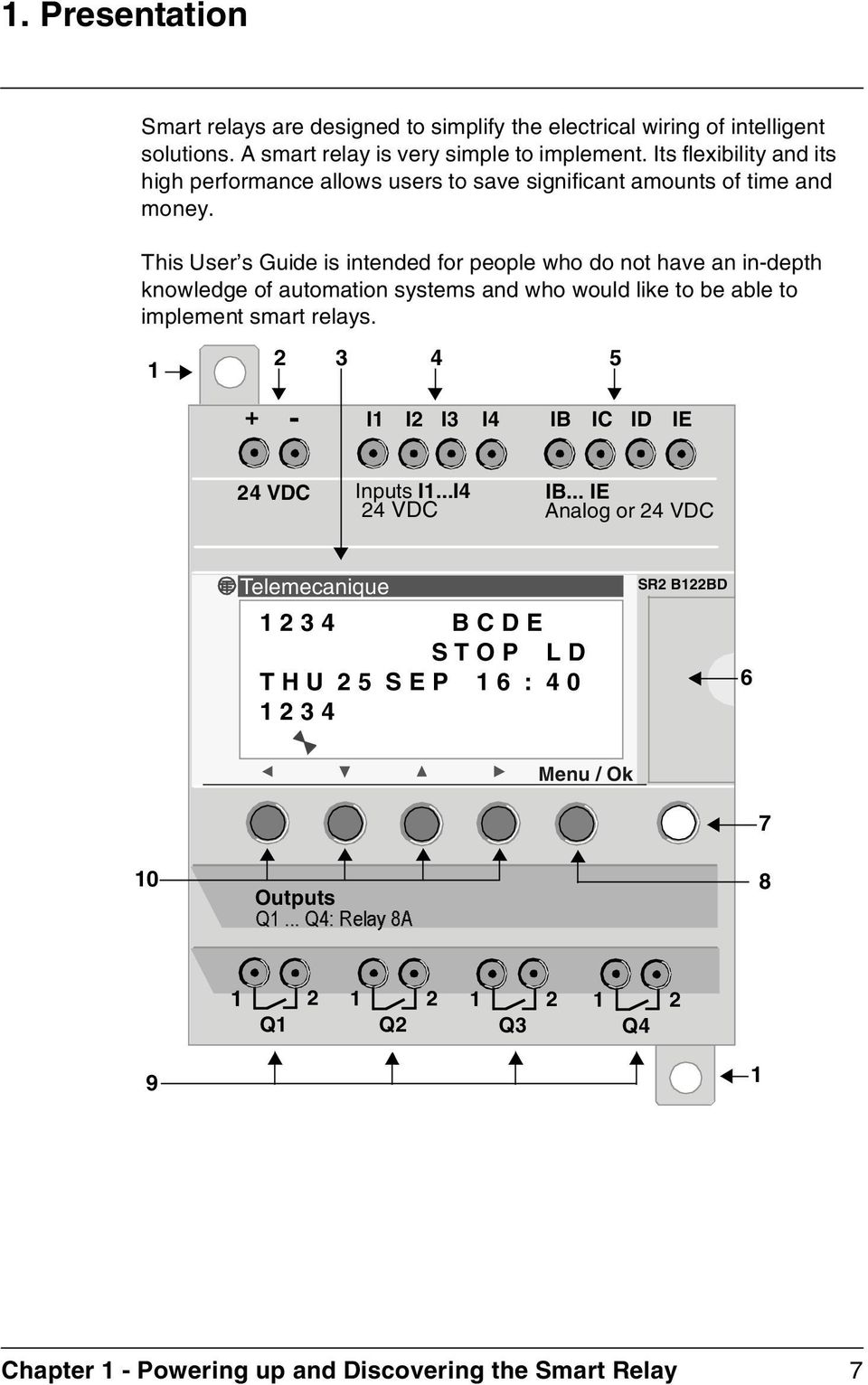
10 1. Presentation Description of the front panel of the relay Reference Description 1 Retractable mounting feet. 2 Screw terminal block for the power supply. 3 LCD, 4 lines, 18 characters 4 Screw terminal block for inputs Screw terminal block for 0-10 Volt analog inputs usable in discrete 5 mode on some models 6 Connector for backup memory or PC connection cable 7 Shift key 8 Selection and validation key 9 Relay output screw terminal block 10 Arrow keys or after first configuring them, Z pushbuttons Description of the LCD Telemecanique B C D E S T O P L D T H U 2 5 S E P 1 6 : Zelio 2 Menu / OK Reference Description 1 Input status display (B...E represent the analog inputs*) Display of the operating mode (RUN/STOP) and programming 2 mode (LD/FBD) 3 Display of the date (day and time for products with clock) 4 Output status display Contextual menus / pushbuttons / icons indicating the operating 5 modes * Each analog input is also usable in discrete I/O mode 8 Chapter 1 - Powering up and Discovering the Smart Relay

11 2. Characteristics and Connections Connecting DC smart relays NEVER Rectified not filtered Regulated 220 V /= ABL7R 24 V= PREFERABLE Rectified and filtered U max POSSIBLE U min SR2... BD Umax < 30 V Umin > 19.2 V SR2... JD Umax < 14.4 V Umin > 10.4 V Chapter 1 - Powering up and Discovering the Smart Relay 9

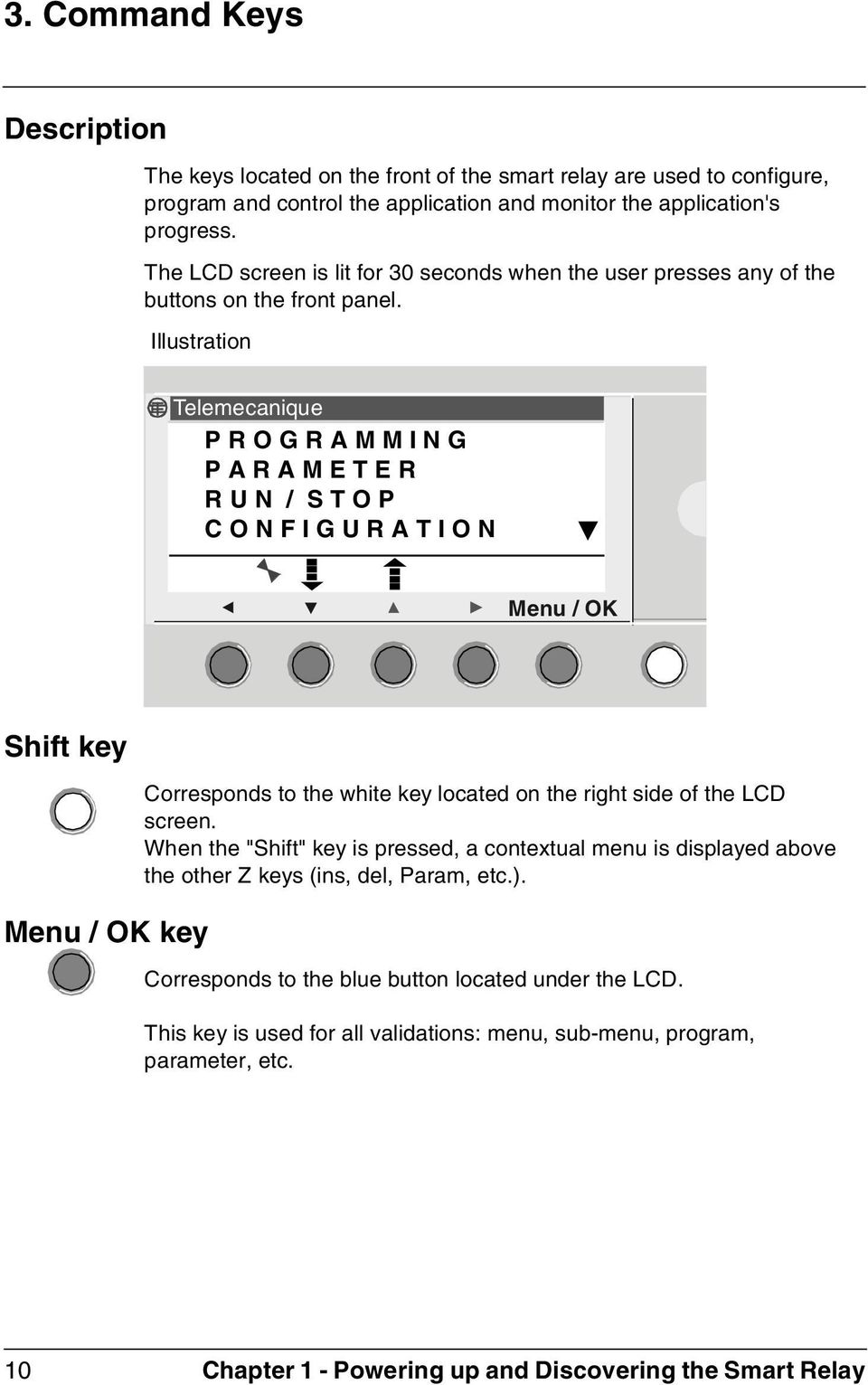
12 3. Command Keys Description The keys located on the front of the smart relay are used to configure, program and control the application and monitor the application's progress. The LCD screen is lit for 30 seconds when the user presses any of the buttons on the front panel. Illustration Telemecanique P R O G R A M M I N G P A R A M E T E R R U N / S T O P C O N F I G U R A T I O N Zelio 2 Menu / OK Shift key Menu / OK key Corresponds to the white key located on the right side of the LCD screen. When the "Shift" key is pressed, a contextual menu is displayed above the other Z keys (ins, del, Param, etc.). Corresponds to the blue button located under the LCD. This key is used for all validations: menu, sub-menu, program, parameter, etc. 10 Chapter 1 - Powering up and Discovering the Smart Relay
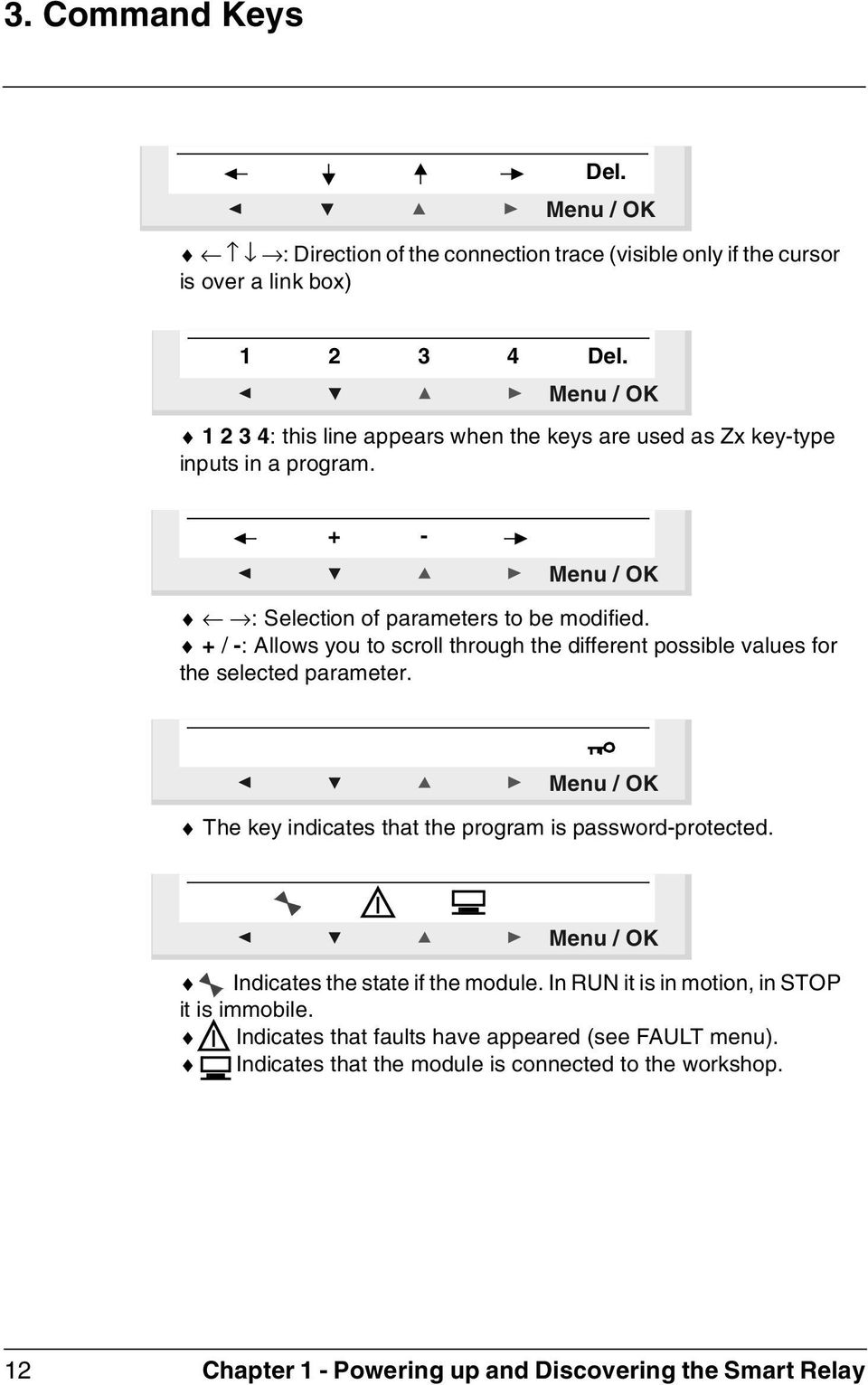
13 3. Command Keys Navigation keys or Z keys Contextual Menus The Z keys are the gray keys in a line from left (Z1) to right (Z4) and located under the LCD. The arrows indicating the movement direction associated with navigation are marked above the keys. The navigation keys are used to move up, down, left and right. The position on the screen appears as a flashing area: Square for a position that corresponds to a contact (only in programming mode), Circle for a coil (only in programming mode). Note: When the buttons can be used for actions other than navigation, a line from the contextual menu is displayed (Example: 1, 2, 3 and 4 as Zx key entries). When the cursor is placed on a modifiable parameter, if the Shift key is pressed, a contextual menu appears. Illustration ins. - + Param Del. Menu / OK Use of the contextual menu functions: + / -: used to scroll through the various possible values of the selected field (types of inputs, outputs, automation functions, numbers, numerical values, etc ), Ins.: Inserts a line when the cursor is over a parameter or inserts an automatic function when the cursor is over a blank space Del.: Clears the specified element or the line, if it is empty Param.: Displays the parameters screen specific to the automatic function (visible only if the automatic function has a parameter) Chapter 1 - Powering up and Discovering the Smart Relay 11

14 3. Command Keys Del. Menu / OK : Direction of the connection trace (visible only if the cursor is over a link box) Del. Menu / OK : this line appears when the keys are used as Zx key-type inputs in a program. + - Menu / OK : Selection of parameters to be modified. + / -: Allows you to scroll through the different possible values for the selected parameter. Menu / OK The key indicates that the program is password-protected. Menu / OK Indicates the state if the module. In RUN it is in motion, in STOP it is immobile. Indicates that faults have appeared (see FAULT menu). Indicates that the module is connected to the workshop. 12 Chapter 1 - Powering up and Discovering the Smart Relay
15 4. Examples Description/Action Select and validate the language. or + Menu / OK (the selection is highlighted by the blinking of the text) Return to the INPUT-OUTPUT screen. Display C L E A R P R O G T R A N S F E R V E R S I O N L A N G U A G E The Menu / OK button is used to confirm the choice of the new language. The display returns to the MAIN menu (STOP mode) B C D E S T O P L D F R I 2 5 N O V 1 6 : The Menu / OK button is used to confirm the choice of the new language. Chapter 1 - Powering up and Discovering the Smart Relay 13

16 4. Examples This sub-section details how to use the smart relay s keys. This does not apply to Blind modules. Example 1: Language selection (same procedure regardless of product) Description/Action Powering-up Display B C D E S T O P L D F R I 2 5 N O V 1 6 : On powering-up, the INPUT-OUTPUT screen is displayed. (See Chapiter 2 - Description of menus/ INPUT-OUTPUT screen) By default, the selected language is English. Enter the MAIN menu, and go to the language configuration menu: LANGUAGE Menu / OK C L E A R P R O G T R A N S F E R V E R S I O N L A N G U A G E + 7 times Enter the language configuration menu. Menu / OK E N G L I S H F R A N C A I S D E U T S C H I T A L I A N O The activated option is indicated by a black diamond. 14 Chapter 1 - Powering up and Discovering the Smart Relay

17 4. Examples Example 2: Changing the date and time when first powered up or after a long lasting power break. Description/Action Display From the INPUT-OUTPUT screen, enter the MAIN menu, then go to the CONFIGURATION menu Menu / OK P R O G R A M M I N G P A R A M E T E R R U N / S T O P C O N F I G U R A T I O N + 3 times Enter the CONFIGURATION menu, and go to the CHANGE D/T sub-menu Menu / OK + 3 times P A S S W O R D F I L T E R Z x K E Y S C H A N G E D / T Enter the date and time configuration menu Menu / OK C H A N G E D / T T H U 0 7 J U L : s C A L 0 2 secs / WK Chapter 1 - Powering up and Discovering the Smart Relay 15

18 4. Examples Description/Action Select the parameter to modify using the navigation keys (the selection is highlighted by the blinking of the parameter): or Display C L E A R P R O G T R A N S F E R V E R S I O N L A N G U A G E Modify the parameter using the navigation keys: - + or The Menu / OK button is used to confirm the modifications. The display returns to the MAIN menu (STOP mode). then confirm with Menu / OK Menu / OK Return to the INPUT-OUTPUT screen B C D E S T O P L D F R I 2 5 N O V 1 6 : The Menu / OK button is used to confirm the choice of the new language. 16 Chapter 1 - Powering up and Discovering the Smart Relay

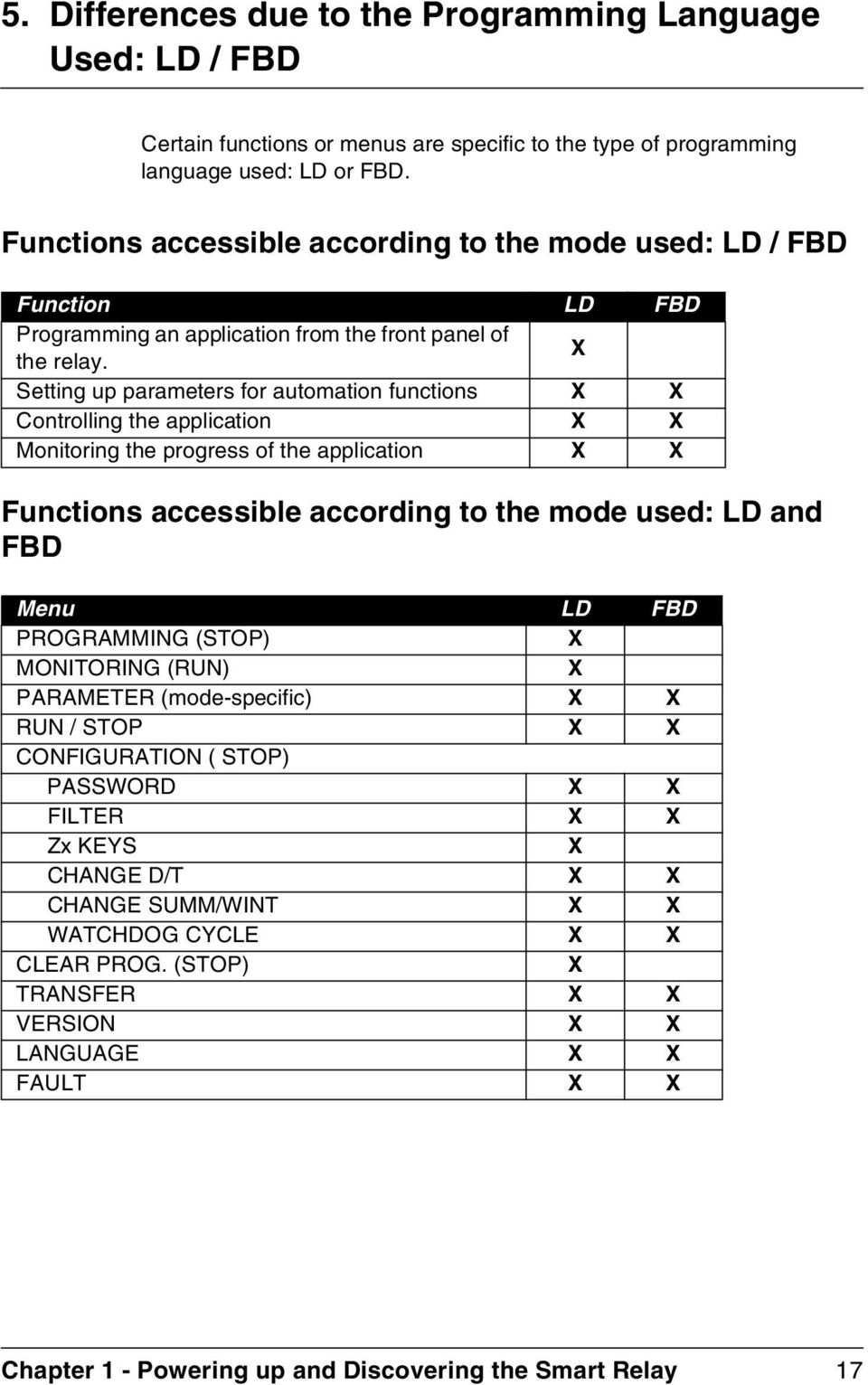
19 5. Differences due to the Programming Language Used: LD / FBD Certain functions or menus are specific to the type of programming language used: LD or FBD. Functions accessible according to the mode used: LD / FBD Function LD FBD Programming an application from the front panel of the relay. X Setting up parameters for automation functions X X Controlling the application X X Monitoring the progress of the application X X Functions accessible according to the mode used: LD and FBD Menu LD FBD PROGRAMMING (STOP) X MONITORING (RUN) X PARAMETER (mode-specific) X X RUN / STOP X X CONFIGURATION ( STOP) PASSWORD X X FILTER X X Zx KEYS X CHANGE D/T X X CHANGE SUMM/WINT X X WATCHDOG CYCLE X X CLEAR PROG. (STOP) X TRANSFER X X VERSION X X LANGUAGE X X FAULT X X Chapter 1 - Powering up and Discovering the Smart Relay 17
20 Chapter 2 - Contents Description of Menus 1. Menus Presentation INPUTS-OUTPUTS Screen TEXT and DISPLAY screen PROGRAMMING Menu PARAMETER Menu MONITORING Menu RUN/STOP Menu CONFIGURATION Menu CLEAR PROGRAM Menu TRANSFER Menu LANGUAGE Menu VERSION Menu FAULT Menu Description of Menus, Chapter 2

21 1. Menus Presentation Description These functions are grouped in a main menu. Telemecanique P R O G R A M M I N G P A R A M E T E R R U N / S T O P C O N F I G U R A T I O N Zelio 2 Menu / OK The line blinks to show where you are positioned. An upwards triangle shows that there are more options available if you scroll up, while a downwards triangle shows that there are more options available if you scroll down. Managing Menus The INPUTS-OUTPUTS screen is displayed by default whether the mode is in LD or FBD. Pressing the Menu/OK key switches the display from the INPUTS- OUTPUTS screen to the MAIN menu. The menu on the first row which is selected by default (flashing). The arrow keys can be used to place the cursor over the other menus. Press the blue Menu/OK key to display the screen corresponding to the selected menu or move onto the first sub-menu. OK Note: The different menu functions vary according to the programming language used: LD or FBD. When a specificity exists, it is specified. Chapter 2 - Description of Menus 19
22 2. INPUTS-OUTPUTS Screen Description This is the highest level interface, if no display function is active: TEXT (LD) or DISPLAY (FBD). This screen is displayed by default whatever the programming type: LD or FBD and the mode: STOP or RUN. Illustration: Telemecanique S T O P L D M O N 2 2 S E P 1 5 : Zelio 2 Menu / OK The INPUTS-OUTPUTS screen can be used to view: Input status: 1 to 9, A to P (1), Operating mode: RUN/STOP (2), Type in use: LD/FBD (3), Date and time for products with a clock (4), Output status: 1 to 9, A to G (5). Z push buttons: 1 to 4 (6). In Simulation mode or Monitoring mode when the program is in RUN, the active states of the Inputs/Outputs are indicated in reverse video. Pressing the Shift and Menu/OK keys in order and simultaneously switches the screen display from INPUTS-OUTPUTS to TEXT (LD) or DISPLAY (FBD). Access to the main menu Pressing the Menu/OK key switches the display from the INPUTS- OUTPUTS screen to the main menu. 20 Chapter 2 - Description of Menus
23 3. TEXT and DISPLAY screen Description The display functions are used to display text or a numerical value (current value, preset value, etc.) on the LCD instead of the INPUTS- OUTPUTS screen: In LD mode: a TEXT function is active, In FBD mode: a DISPLAY function is active. Telemecanique V a l u e c o u n t e r 1 C 1 C = D a t e 2 8 / 1 1 / Zelio 2 Menu / OK If several display functions are active simultaneously, we see the following: In LD mode: only the last block to be activated is displayed, In FBD mode: the superposition of all of the FBD DISPLAY screens is displayed. Note: The display functions can only be programmed using the programming workshop (refer to the Zelio Soft 2 on-line help manual for further information). Pressing the Shift and Menu/OK keys in order and simultaneously switches the screen display from TEXT (LD) or DISPLAY (FBD) to INPUTS-OUTPUTS. Chapter 2 - Description of Menus 21
24 3. TEXT and DISPLAY screen Authorized modifications All parameters for which the Authorized modification option is enabled can be modified from the front panel of the module. Description of the modification procedure for displayed values: Step Description 1 Press the Shift key (white key) to display the contextual menu. Result: Param is displayed at the bottom of the screen. 2 Press the key (without releasing the Shift key) to display the contextual menu. Result: The parameter which can be modified flashes and the following contextual menu is displayed: - + Menu / OK 3 Select the parameter to be modified using the arrow keys and from the contextual menu (the value which are available for modification flash). 4 Modify the value of the parameter with the + ( ) and - ( ) keys from the contextual menu. 5 Confirm the modifications by pressing the Menu/OK key. Result: the display returns to the INPUTS-OUTPUTS screen or the TEXT / DISPLAY screen. 22 Chapter 2 - Description of Menus
25 4. PROGRAMMING Menu Note: This menu is specific to LD (STOP mode). This function lets the user enter the Ladder diagrams that will work on the smart relay. This program is only written using a Ladder diagram LD. Information on how to program a Ladder diagram is given in the chapter: Chapter 5 - Entering Ladder Diagrams. Telemecanique Zelio 2 I1 RT1 I2 I1 M3 T1 SM1 TT1 Menu / OK Once the modifications are enabled, the display returns to the MAIN menu. Note: This function may be password protected. Chapter 2 - Description of Menus 23
26 5. PARAMETER Menu Description This menu allows the user to enter and modify the application parameters directly on the screen using the relay keys. This function can be accessed in the two modes: LD and FBD, but the contents will be specific to the mode used. If there are parameters to display (and where these are not locked), they are listed in the window; otherwise a NO PARAMETERS message appears. LD Mode Functions with parameters in LD mode: Auxiliary relays (latching), Discrete Outputs (latching), Clocks, Analog comparators, Timers, Counters, Fast counters. Only those functions used in the program and with parameters are listed in the PARAMETERS menu. All of the functions that have parameters are listed in the PARAMETER menu. Parameter modification procedure: Steps Description 1 Place the cursor over the PARAMETERS menu in the main menu (PARAMETERS flashing) and confirm by pressing the Menu/OK button. Result: the parameters window opens to the first parameter. 2 Select the function to modify. To access the required function, scroll through all the functions (navigation keys and ) until you reach the right one. 3 Select the parameter to modify. Use the and keys to move to the parameter to be modified. 24 Chapter 2 - Description of Menus
27 5. PARAMETER Menu FBD Mode Functions with parameters in LD mode: Numerical Constant-Type Inputs, Clocks, Gain, Timers: TIMER A/C, TIMER B/H, TIMER Li, Counter: PRESET COUNT, Fast counters, CAM block, Accessing parameters for the FBD blocks requires that the user know and enter the block number. This number appears on the wiring sheet in the upper right corner of the block. If there are parameters to display (and where these are not locked), they are listed in the window; otherwise a NO PARAMETERS message appears. Parameter modification procedure: Steps Description 1 Place the cursor over the PARAMETERS menu in the main menu (PARAMETERS flashing) and confirm by pressing the Menu/OK button. Result: the parameters window opens to the first parameter. 2 Select the function to modify. To access the required function, scroll through the function block numbers (navigation keys and ) until you reach the right one. 3 Select the parameter to modify. The and keys can be used to place the cursor over the parameter to modify. 4 Modify the parameter using the + and - keys ( and ) of the contextual menu. 5 Validate the modifications by pressing Menu/OK, which opens the validation window. 6 Confirm again twice by pressing Menu/OK to save. Result: the display returns to the INPUTS-OUTPUTS screen in RUN mode and to the MAIN menu in STOP mode. Chapter 2 - Description of Menus 25
28 5. PARAMETER Menu Steps Description 4 Modify the parameter using the + and - keys ( and ) of the contextual menu. 5 Validate the modifications by pressing Menu/OK, which opens the validation window. 6 Confirm again twice by pressing Menu/OK to save. Result: the display returns to the INPUTS-OUTPUTS screen in RUN mode and to the MAIN menu in STOP mode. Parameters (in RUN mode) It is therefore possible to modify dynamic parameters in RUN mode as long as they are not locked. The modifications can be made: From the PARAMETER menu, From the MONITORING menu: move to the function to be modified using the arrow keys ( ) and open the parameters window from the contextual menu (Shift key). 26 Chapter 2 - Description of Menus
29 6. MONITORING Menu Description Note: Accessible in LD / RUN mode only. MONITORING mode is used to dynamically display the state of smart relay input/output. In this mode the wiring diagram appears as it does in the PROGRAMMING menu (module in STOP mode), but appear in reverse video when inputs or outputs are activated (white on black background). Illustration: This mode allows the user to dynamically modify the value of the parameters of the automation functions if they are unlocked. Modifying parameters To modify the parameters, simply: Steps Description 1 Use the arrow keys to move to the element you would like to modify: step 1 of the procedure element entry. 2 Press the Shift and Param keys at the same time to open the parameters window. 3 Use the arrow keys to move to the modifiable parameter fields:. 4 Change the parameter value using the + and - keys. 5 Validate the modifications by pressing Menu/OK, which opens the validation window. Validate Menu/OK again to save the modifications. 6 Confirm again with Menu/OK. Result: return to the parameter screen. 7 Confirm again with Menu/OK. Result: the display is set to the INPUTS-OUTPUTS screen. Chapter 2 - Description of Menus 27
30 7. RUN/STOP Menu Description This function lets the user start or stop the program contained in the smart relay: STOP: the program is stopped, the outputs are deactivated, the current values (counters, timers, etc.) are reset to zero (if the latching option is not activated). RUN: The program is executed. Note: When STOP switches to RUN, the program is initialized. Illustration: Telemecanique R U N P R O G. Y E S N O Zelio 2 Menu / OK When opened, the interface offers the user the choice that is complementary to the current state : YES is always flashing. If the program is in mode: STOP: RUN PROG. is proposed, RUN: STOP PROG. is proposed. The navigation keys are used to change the selection. When the mode has been validated with the Menu/OK key, the display moves to the INPUT-OUTPUT screen. 28 Chapter 2 - Description of Menus
31 8. CONFIGURATION Menu Description The configuration menu is made up of the following options: PASSWORD FILTER: Zx KEYS CHANGE D/T CHANGE SUMM/WINT WATCHDOG CYCLE Note: If the program is password-protected, (key displayed in the contextual menu), the user must enter the password before any action can take place in the sub-menus. The various configuration menu options are detailed in the chapter: Chapter 3 - Configuration Menu. Chapter 2 - Description of Menus 29
32 9. CLEAR PROGRAM Menu Description Note: Only accessible in LD mode. This function allows the entire program to be cleared. Note: If the program is protected (key displayed), the user must enter a password before being able to clear the program. Clearing the program When it is opened, the NO choice is selected by default. Procedure: Steps Description 1 Select YES using the and navigation keys. 2 Validate the clear command by pressing Menu/OK. Result: the display returns to the MAIN menu. 30 Chapter 2 - Description of Menus
33 10. TRANSFER Menu Description This function is used to: Load the application contained in the module into the backup memory, Load a program into the module from the backup memory. The program can then be loaded onto another module from this backup memory. Illustration Telemecanique Zelio 2 T R A N S F E R Z E L I O > M E M O R Y M E M O R Y > Z E L I O Menu / OK Note: The backup memory is available as an option. Note: If the program is protected (key displayed), the user must enter a password before being able to back up the program. Note: If an application is already present in the backup memory, it will be overwritten by the new transfer (no test is performed to check the memory is free). Chapter 2 - Description of Menus 31
34 10. TRANSFER Menu Transfer module Backup memory Transfer procedure: Steps Description 1 Select the transfer type: ZELIO>MEMORY using the arrow keys. 2 Confirm the transfer command with the Menu/OK key. (Enter the password if the program is password-protected). 3 Wait until the transfer is complete. The following is displayed: > > > MEMORY then TRANSFER. OK when the transfer is complete. 4 Confirm a second time by pressing Menu/OK to exit the menu. Result: the display returns to the INPUTS-OUTPUTS screen in RUN mode and to the MAIN menu in STOP mode. Backup Memory Transfer Module Possible Errors Transfer procedure: Steps Description 1 Select the transfer type: MEMORY>ZELIO using the arrow keys. 2 Confirm the transfer command with the Menu/OK key. 3 Wait until the transfer is complete. The following is displayed: > > > MODULE then TRANSFER. OK when the transfer is complete. 4 Confirm a second time by pressing Menu/OK to exit the menu. Result: the display returns to the INPUTS-OUTPUTS screen in RUN mode and to the MAIN menu in STOP mode. No backup memory Error message: TRANSFER ERROR: NO MEMORY Configuration of program to be transferred incompatible with hardware configuration Error message: TRANSFER ERROR: CONFIG INCOMPAT (hardware or software reference numbers) Refer to the FAULT menu to consult the error number and clear it. 32 Chapter 2 - Description of Menus
35 11. Language Menu Description This function lets the user choose the language used by the smart relay. All messages can be displayed in six languages: English French German Italian Spanish Portuguese Illustration Telemecanique E N G L I S H F R A N C A I S D E U T S C H I T A L I A N O Zelio 2 Menu / OK Language selection The current language is shown by the selection symbol (black lozenge symbol). Language selection procedure: Steps Description 1 Select the language using the navigation keys: (the selection flashes). 2 Confirm with Menu / OK. Result: the display returns to the INPUTS-OUTPUTS screen in RUN mode and to the MAIN menu in STOP mode. Chapter 2 - Description of Menus 33
36 12. VERSION Menu Description This function lets the user precisely identify the version of all of the system components: Hardware type Firmware FBD functions LD functions Illustration Telemecanique Zelio 2 M O D U L E S R 3 B B D H A R D W A R E F I R M W A R E F U N C. L D Menu / OK This information is available for the module, as well as for the extensions connected. An arrow symbol located at the bottom right indicates that there are extension(s) connected to the module. Illustration Telemecanique E X T X T B D H A R D W A R E F I R M W A R E Zelio Menu / OK To quit, press the Menu/OK button, the display returns to the INPUTS- OUTPUTS screen in RUN mode and to the MAIN menu in STOP mode. 34 Chapter 2 - Description of Menus
37 13. FAULT Menu Description This function allows the number of faults or warnings detected by the relay's firmware (watchdog overflow, cycle time too high, etc.) to be displayed. Illustration Telemecanique F A U L T : C L E A R Y E S N O Zelio 2 Menu / OK Reset to Zero of the Fault Counter This menu is used to clear the errors, as indicated by the message: DELETE. Procedure: Steps Description 1 Select YES / NO using the and navigation keys. 2 Confirm the clear command by pressing the Menu/OK key. Result: the display returns to the INPUTS-OUTPUTS screen in RUN mode and to the MAIN menu in STOP mode. Description of errors Number Type of error 00 No faults 01 Fault in writing to EEPROM This fault defines transfer problems between the memory cartridge and the controller. If the fault occurs frequently, contact the after-sales service. 02 Fault in writing to the clock If the fault occurs frequently, contact the after-sales service. Chapter 2 - Description of Menus 35
38 13. FAULT Menu Number Type of error 04 Overload on transistor outputs (warning) Once a transistor output reaches a temperature of 170 C, the group of 4 outputs to which it belongs is deactivated. To make this group of outputs operational, the cause of the over current (short-circuit, etc.) must first be deleted, and then the fault cleared from the FAULT menu. 50 Module firmware is damaged Reload the firmware on the module and the user application. If this problem persists, contact the after-sales service. 51 Watchdog overflow Warning or error according to the selection made in the configuration menu (module display) or in the configuration window (Zelio Soft 2 programming workshop). The cycle time in the module is too short compared with the application program execution time programmed in the controller. If the application requires a strict sampling of the module inputs/outputs, lengthen the cycle time in the module. To do this, configure the information either in the CONFIGURATION menu (module display) or in the configuration window (Zelio Soft 2 programming workshop). If the application does not require the cycle time, in CONFIGURATION select: No Action for the WATCHDOG. 52 The controller has executed an unknown operation If the fault is permanent, reload the firmware on the module and the user application. If this problem persists, contact the after-sales service. 53 Link between module and bus extension faulty Check operation of the extension (connection, power supply, fault). 54 Link between module and input/output extension faulty Check operation of the extension (connection, power supply, fault). 58 A fault is present in the firmware (software specific to the controller) or on a part of the controller hardware. If the fault is permanent, reload the firmware on the module and the user program. If this problem persists, contact the after-sales service. 36 Chapter 2 - Description of Menus
39 13. FAULT Menu Number Type of error 59 At the beginning of RUN on the module application: the application cannot switch to RUN as it is incompatible with the module physically connected to the supply. If this problem occurs, contact the after-sales service. 60 At the beginning of RUN on the module application: program incompatible with the bus extension physically connected to the supply. If this problem occurs, contact the after-sales service. 61 At the beginning of RUN on the module application: program incompatible with the Input/Output extension physically connected to the supply. If this problem occurs, contact the after-sales service. 62 Version (or release number) incompatibility when loading a program from the backup memory If this problem occurs, contact the after-sales service. 63 Hardware configuration incompatibility when loading a program from the backup memory If this problem occurs, contact the after-sales service. Chapter 2 - Description of Menus 37
40 Chapter 3 - Contents Configuration Menu 1. PASSWORD Menu FILTER Menu Zx KEYS Menu CHANGE D/T Menu CHANGE SUMM/WINT Menu WATCHDOG CYCLE Menu Smart Relay - Chapter 3
41 1. PASSWORD Menu Description If the program is password-protected, (key displayed), the user must enter the password for certain operations. The password protects access to the following menus: PROGRAMMING (LD STOP mode), MONITORING (LD RUN mode), PARAMETER, CONFIGURATION (STOP mode), CLEAR PROGRAM. (LD STOP mode), MODULE > MEM TRANSFER (STOP mode). Note: It is possible to quit the screen without entering the password by using a combination of the Shift key (white key) and the Menu/Ok key (blue key). Note: To return to the main menu from the CONFIGURATION menu, use the navigation key. Entering the Password Initially, the key is not displayed and each digit is replaced by a?. Telemecanique P A S S W O R D E N T E R Zelio Menu / OK The message ENTER appears in the window. Note: From this point, the key icon is displayed. Chapter 3 - Configuration Menu 39
42 1. PASSWORD Menu Entering procedure: Steps Description 1 Press, the? symbols are replaced by 0s (the 0 furthest to the left blinks). 2 Select the digit to enter using the arrow keys:. 3 Select the value of the digit with the + and - keys in the contextual menu. 4 Validate the password with the Menu/OK key, which opens the validation window. 5 Confirm again with the Menu / OK key. Result: the display returns to the MAIN menu. Deleting the password To cancel the password, follow the same procedure used to enter it. Telemecanique P A S S W O R D C L E A R 1 / Zelio Menu / OK Initially, the key is displayed, meaning: module is password protected. The message CLEAR and the number of attempts 1 / 5 appear in the window. The following cases can occur: Password is correct: the password is then inhibited, and the module returns to the PASSWORD menu, Password is incorrect: the CLEAR counter is incremented. 40 Chapter 3 - Configuration Menu
43 1. PASSWORD Menu Telemecanique P A S S W O R D C L E A R 2 / Zelio Menu / OK If an incorrect password is entered 5 times consecutively, the security function is locked for 30 minutes. During this period, if the power supply to the module is cut off, the downcount will start again on power up. Telemecanique Zelio 2 P A S S W O R D C L E A R E R R O R 5 / 5 > > > 3 0 M I N U T E S - + Menu / OK Modifying the password To change the password, simply cancel the former one and enter a new one. Chapter 3 - Configuration Menu 41
44 2. FILTER Menu Description This function allows faster detection of changes in states on all Discrete inputs. Two choices are available: Fast, Slow. Response time : Filtering Switching Response time Slow ON OFF 5 ms OFF ON 3 ms Fast ON OFF 0.5 ms OFF ON 0.3 ms This choice can only be made when the smart relay is set to STOP. Note: By default, smart relays are configured to run in SLOW mode. Note: This function is available on smart relays with a direct voltage power supply. Note: To return to the main menu from the CONFIGURATION menu, use the navigation key. Filter type selection The current type is shown by the selection symbol (black lozenge). Language selection procedure: Steps Description 1 Select the filter type: (the selection flashes). 2 Confirm with Menu / OK. Result: the display returns to the MAIN menu. 42 Chapter 3 - Configuration Menu
45 3. ZX KEYS Menu Description Zx keys in RUN mode Note: Only accessible in LD mode. The Zx=KEYS option lets the user enable or disable the use of arrow keys as pushbuttons. Depending on the state of this option, the following functions are obtained: Inactive: the keys are only available for setting up parameters, configuring and programming the smart relay. Active: it is also possible to use them in a Ladder diagram. In this configuration, they operate as pushbuttons: Zx keys, without requiring a terminal block input contact. Note: To return to the main menu from the CONFIGURATION menu, use the navigation key. By default, the Z keys are used as navigation keys. In RUN mode, when the INPUTS-OUTPUTS screen, TEXT screen or DISPLAY screen is active, the number of the Z keys used in the program are displayed in the contextual menu line. To activate the key, simply select the required key. Note: The number of the keys used in the program are displayed. Telemecanique S T O P L D M O N 2 2 S E P 1 5 : Zelio 2 Menu / OK Chapter 3 - Configuration Menu 43
46 3. ZX KEYS Menu Once enabled, the display returns to the MAIN menu. Note: The function is inactive in PARAMETERS, MONITORING mode and in all of the function block parameter screens and configuration screens. 44 Chapter 3 - Configuration Menu
47 4. CHANGE D/T Menu Description This function is used to configure the date and time for the modules with a clock. Illustration Telemecanique C H A N G E D / T T H U 0 7 J U L : s C A L 0 2 secs / WK - + The modifiable parameters are: Zelio 2 Menu / OK The day / week / month / year, The time, Minutes, the values being saved by pressing the Menu/Ok key; if you wish to specify the time more, you should complete the entry of modifications with minutes and seconds. Seconds, CAL: relay internal clock calibration in seconds per week. The quartz crystal that controls the relay's real-time clock has a monthly drift that varies according to the relay's environmental conditions. The maximum value for this drift is approximately one minute per month. To estimate this drift, proceed by observing the drift on the module clock with respect to a standard reference clock for a few weeks or more. Chapter 3 - Configuration Menu 45
48 4. CHANGE D/T Menu Example: If the user would like to reduce this drift, s/he can for example, make a correction of - 15 seconds per week to compensate for a drift of + 60 seconds. This compensation is executed on Sunday at one O'clock in the morning. Note: This correction serves no purpose if the module is subject to long power interruptions or major variations in temperature. Note: To return to the main menu from the CONFIGURATION menu, use the navigation key. Configuring the clock Procedure: Steps Description 1 Select the parameter to modify using the and navigation keys. Result: the selected parameter flashes. (When you enter this mode, the day value is selected) 2 Modify the value of the parameter. The + and - keys of the contextual menu can be used to change the current value. 3 Validate the modifications by pressing Menu/OK. Result: the display returns to the MAIN menu. Note: Zelio Logic contains a software module that determines the day of the week when the user selects the day of the month in the year. 46 Chapter 3 - Configuration Menu
49 5. CHANGE SUMM/WINT Menu Description This function is used to automatically change the time range: summer/winter, for the relays with a clock. Illustration Telemecanique C H A N G E S U M / W I N E U R O P E S U M M : 0 3 D : 5 W I N T E R M : 1 0 D : Zelio 2 Menu / OK The following operating modes are possible: NON: no change, Automatic: the change takes place automatically, the dates are preset according to the geographic zone: (EUROPE: Europe, GB: Great Britain, USA), OTHER ZONE: (MANUAL) the change is automatic, but you must specify the month: M and the Sunday: S (1, 2, 3, 4 or 5 ) on which the summer/winter change takes place. Note: To return to the main menu from the CONFIGURATION menu, use the navigation key. Configuring the time change Steps Description 1 Select the parameter to modify using the and navigation keys. Result: the selected parameter flashes. 2 Modify the value of the parameter. The + and - keys of the contextual menu are used to change the current value. 3 Confirm the modifications by pressing the Menu/OK key. Result: the display returns to the MAIN menu. Chapter 3 - Configuration Menu 47
50 6. WATCHDOG CYCLE Menu Description The program execution time depends on the type and number of inputsoutputs and the number of extensions. The value of the default execution cycle is 10 milliseconds. Illustration Telemecanique C Y C L E N = 0 1 Zelio 2 W A T C H D O G I N A C T I V E - + Menu / OK If the duration of the execution cycle of the program and the embedded software functions exceeds the cycle value selected by the programmer (N times 10ms), the WATCHDOG can be used to operate a specific action. Note: To return to the main menu from the CONFIGURATION menu, use the navigation key. Actions The possible actions for the watchdog are: INACTIF: normal operating mode, ALARME: a warning state is positioned and the warning number corresponding to Cycle time overflow is accessible in the FAULT menu, ERREUR: the program stops (STOP mode) and the error number corresponding to: Cycle time overrun is accessible in the FAULT menu. Parameter The N adjustment parameter can have a value between 1 and 9; this parameter corresponds to: : WATCHDOG duration= N x 10 milliseconds The N times adjustment is made according to the shortest input sampling period. 48 Chapter 3 - Configuration Menu
51 6. WATCHDOG CYCLE Menu Configuring the watchdog Procedure: Steps Description 1 Configure the CYCLE parameter using the + and - keys of the contextual menu. 2 Validate the line using one of the keys:. Result: the CYCLE parameter is validated and the WATCHDOG parameter is activated: it blinks. 3 Configure the WATCHDOG parameter using the + and - keys of the contextual menu. 4 Validate the modifications by pressing Menu/OK. Result: the display returns to the MAIN menu. Chapter 3 - Configuration Menu 49
52 Chapter 4 - Contents Ladder Diagrams 1. Introduction Discrete Inputs Discrete Outputs Auxiliary Relays Arrow Keys Clock Function Block Counter Function Block Counter Comparator Function Block Fast Counter Function Block Timer Function Block Analog Comparator Function Block Summer/Winter Time Change Function Block LCD Screen Back-Light Function Block Text Function Block Modbus Inputs-Outputs Smart Relay - Chapter 4
53 1. Introduction An application can only be created from the front panel of the module in LD programming mode. This Section details all possible elements in a Ladder diagram in LD mode that are recognized and used by the smart relays. To better understand the functions performed by each element, where necessary a directly usable example is included. The smart relays accept 120-line diagrams. Note: Each line comprises a maximum of five contacts and must always include a coil. When the application requires more than five contacts to activate an action, the auxiliary relays can be used. Ladder diagram example: Telemecanique Zelio 2 I1 RT1 I2 I1 M3 T1 SM1 TT1 Menu / OK Chapter 4 - Automation Functions 51
54 2. Discrete Inputs A discrete input can only be used as a contact. Representation INo. ino. Function Normally open Normally closed No. on terminals 1 to R (II, IM, IO excluded) according to the module Description The physical input to the smart relay. This contact gives the state of the sensor (switch, detector, etc.) connected to the corresponding input. Example 1: I1 Q1 When input I1 contact is closed, output Q1 is activated. Example 2: i1 Q1 When input I1 contact is open, output Q1 is activated. Note: When analog inputs Ib and Ic are entered as contacts, they automatically operate as discrete inputs. 52 Chapter 4 - Automation Functions
55 3. Discrete Outputs Used as a coil A discrete output can be used either as a coil or a contact. Usage mode QNo. QNo. S QN No. on the block 1 to G dependin g on smart relay Description The coil is energized if the contacts that it is connected to are closed; otherwise it is not energized. Pulse supply, the coil is energized by a change of state. This is the same as an alternating control relay. Coil " Set ", also called a latch or triggered coil. This coil is energized as soon as the contacts that are connected to it are closed. It remains triggered even if the contacts are no longer closed. R QNo. Coil " Reset ", also called an unlatch or release coil. This coil is disabled when the contacts that are connected to it are closed. It remains idle even if the contacts are no longer closed. Used as a contact Representation QNo. qno. Function Normally open Normally closed No. on the block 1 to G depending on smart relay Description The physical output from the smart relay. An output can be used as a contact to determine its state at a given time. Example 1: Q1 Q2 When output Q1 is activated, output Q2 is also activated. Example 2: q1 Q2 When output Q1 is disabled, output Q2 is activated. Output Q2 will always take the reverse state to output Q1. Chapter 4 - Automation Functions 53
56 3. Discrete Outputs Note: The and, SET and RESET functions must be used once and once only for each coil in a control diagram. If a SET coil is used, we recommend you perform a RESET action for this coil. The use of a SET coil on its own is only justified for triggering an alarm signal that can only be reset by an INIT+RESET program command. Example - Using a remote (alternating) control relay I1 Q1 This is a very handy function that allows you to switch a light on or off using a pushbutton. If a pushbutton is connected to input I1 and a light to output Q1, then each time the button is pressed, the light will come on if it was off or it will go off if it was on. To set up a two-way switch, simply connect the inputs in parallel and connect a pushbutton to each input. Example - Using Set (Latch) and Reset (Unlatch) coils To control the power supply to a device using a pushbutton to cut off the power supply to the same device. The following solution is applied Electrical diagram Smart relay solution Note: Pushbutton PB2 is connected to the smart relay, to input I2 and pushbutton PB3 to input I3. The device to control, in this case a light bulb called L1 is connected to output Q2. Pressing pushbutton PB2 will light the bulb. Pressing pushbutton PB3 will extinguish the bulb. The RESET order takes priority over the SET order. 54 Chapter 4 - Automation Functions
57 3. Discrete Outputs Latching By default, after a cut in supply, the state of the outputs is that which corresponds to initialization of the program. To restore the state of the outputs saved at the time of the power cut, activate the latching of the outputs in the parameters window by validating the parameter. Chapter 4 - Automation Functions 55
58 4. Auxiliary relays The auxiliary relays, M in the notation used, operate just like the output coils Q. The only difference is that they do not have any connection terminals. There are 31 auxiliary relays (numbered in hexadecimal notation from 1 to 9 and from A to Y, though not using letters I, M and O). They are used to save or forward a state. The saved state will then be used as the assigned contact. Example - Using an auxiliary relay Using two auxiliary relays to save the position of a number of inputs. These relays are then used to control a coil. Initialization This type of Ladder diagram is often used to control the various states of a device. State of the contacts on initializing the program: Normally-open mode (direct state) is inactive, Normally-closed mode (reverse state) is active. Latching By default, after a cut in supply, the relay is that which corresponds to initialization of the program. To restore the state of the relay saved at the time of the power cut, activate the latching of the relay in the parameters window by validating the parameter. 56 Chapter 4 - Automation Functions
59 5. Arrow Keys The arrow keys work just like the physical inputs I. The only difference is that they do not have any connection terminals. They are used as pushbuttons. They can only be used as contacts: Representation Function No. on the relay Description ZNo. zno. Normally open Normally closed 1 to 4 Representation of the arrow keys on the smart relay. This contact gives the state of the corresponding key. Z1 to Z4 from left to right Note: So that the arrow keys may be used in this way, first check that they are activated in the Zx=KEYS function in the CONFIGURATION menu. The number of the keys is then displayed in the contextual menu at the bottom of the screen Menu / OK If not, when the smart relay is in RUN mode, these keys are only used to move within the menus. Example of using the "up arrow" key This example shows how to set up a remote (alternating) control relay that will work using key Z1 and output Q1. Z1 Q1 Output Q1 changes state each time you press Chapter 4 - Automation Functions 57
60 6. Clock Function Block Used as a contact The Clock function block is used to validate time slots during which actions can be performed. It acts just like a programmable weekly timer and has four operating ranges (A, B, C, D) used to control its output. Function block parameter setting can be accessed When entering a Ladder diagram line, From the PARAMETER menu if the block has not been padlocked. The clock activation is weekly, and simply needs to be configured: Days of the week, Activation time range, by setting the start time: ON and the end time: OFF. Representation Function No. Description No. No. Normally open Normally closed 1 to 8 The contact is closed when the Clock is in an enabled period. The contact is closed when the Clock is not in an enabled period. 58 Chapter 4 - Automation Functions
61 6. Clock function block Clock function block parameters Configuration parameter screen: D / W (day / week) Telemecanique Zelio 2 H 1 D / W 0 _ C H : M O N 0 1 : 1 0 H : M O F F 2 3 : Menu / OK 4 5 Parameter Clock module number 1 Description Eight blocks can be used, numbered from 1 to 8. Type of date configuration 2 D/W: Days of the Week, Validity day (D/W type) 3 Validity day: 0: Monday, 1: Tuesday,... 6: Sunday. Days that are not selected are indicated by a _ character. Chapter 4 - Automation Functions 59
62 6. Clock function block Start time (D/W type) End time (D/W type) Parameter 4 5 Description This is the operation start time, in Hour: Minute format (00.00 to 23.59). This is the operation end time, in Hour: Minute format (00.00 to 23.59). Parameter lock Locked Unlocked 6 This parameter is used to lock the parameters of the Clock function block. Once locked, the preset value is no longer displayed in the PARAMETER menu. Operating ranges 7 4 operating ranges are available: A, B, C, D. 60 Chapter 4 - Automation Functions
63 6. Clock function block Example - Time management using a Clock function block To control a device from Monday to Saturday during two time slots: from to and from to The device is connected to the output Q2 of the smart relay, using Clock block number 1. The Ladder diagram control line is as follows: 1 Q2 When 1 is entered, the user must specify the operating ranges. Note: The following keys are used: Menu/OK to select or validate a parameter, Z2 and Z3 to change the value of the selected parameter, Z1 and Z4 to move from one parameter to another. Screen Comments H 1 D / W _ C H : M O N 0 9 : 0 0 H : M O F F 1 3 : Menu / OK First slot A: Monday to Saturday from to Now you must enter the second slot. H 1 D / W _ C H : M O N 1 5 : 0 0 H : M O F F 1 9 : 0 0 Second slot B: Monday to Saturday from to Menu / OK Note: The example described in Chapter 7 describes another way of using time slots. It is possible to mix the two in order to resolve complex cases. Chapter 4 - Automation Functions 61
64 7. Counter Function Block The Counter function block is used to up or down count pulses. The Counter function can be reset to zero or to the preset value (depending on the chosen parameter) during use. It can be used as a contact to find out if: The preset value has been reached (upcounting), The value 0 has been reached (downcounting). Used as a contact Function block parameter setting can be accessed When entering a Ladder diagram line, From the PARAMETER menu if the block has not been padlocked. When used as a contact, the counter indicates that the preset value and the current value are equal: The current value of the counter has reached the preset value (TO mode), The current value of the counter is equal to 0 (FROM mode). Representation Function No. Description CNo. cno. Normally open Normally closed 1 to G The contact is closed when the counter reaches the preset value. The contact is closed until the counter has reached the preset value. 62 Chapter 4 - Automation Functions
65 7. Counter Function Block Used as a coil Element Description/Use Example CC RC Counting pulse input This element represents the block's counter input. Each time the coil is triggered, the counter increments or decrements by 1, depending on the chosen counting direction. Reset initial counter state input This input resets the counter function to its initial state. The current counting value is reset to zero if the counting type is TO, The current value is reset to the preset value if the counting type is FROM. Application example : upcounting on the input to the Counter No.1 function block. I1 CC1 Application example : Resets Counter No.1 when the Up Arrow key is pressed on the arrow keypad : Z1 RC1 DC Counting direction input This element represents the counter input that determines the direction of counting. If this coil is triggered, the function block downcounts, if not the function block counts. By default (this input is not wired) the function block counts. Application example : up or downcounting, depending on the status of a smart relay input. I2 DC1 Chapter 4 - Automation Functions 63
66 7. Counter Function Block Parameterization Element Description/Use Example T Type of counting. This parameter can be used to select the operating mode of the counter: TO: upcount towards the preset value. FROM: downcount from the preset value. P Preset value. This value is between 0 and 32767, and represents: The value to reach in mode: upcount towards the preset value (TO mode). The initial value in mode: downcount from the preset value (FROM mode). C or c This parameter is used to lock the Counter function block s preset value. Once locked, the preset value is no longer displayed in the PARAMETER menu. Used as a contact, this Counter function block element indicates that the preset value and the current value are equal. Locked Unlocked Application example : Lighting an indicator light connected to smart relay output Q1 when the preset value is reached. Otherwise the indicator light is out. C1 Q1 This latching function can be used to save the state of the current timer values in the event of a power outage. Not activated Activated 64 Chapter 4 - Automation Functions
67 7. Counter Function Block Telemecanique Zelio 2 C C 1 R C 1 C 1 t D C T : T O P = Control input 2 Reset input 3 Counter output - when the preset is reached 4 Parameter lock 5 Counting direction 6 Type of counting (TO: upcounting/from:downcounting) 7 Value to reach - also called the preset value 8 Latching Example - Using a Counter function block Menu / OK Screen Description Counting and Resetting : The counter is incremented each time input I1 is activated. The counter is reset each time input I2 is activated. Counting and Resetting : The counter is decremented each time input I1 is activated. The counter is reset each time input I2 is activated. Chapter 4 - Automation Functions 65
68 7. Counter Function Block Screen Description Upcounting, downcounting and Resetting : The counter is incremented each time input I1 is activated. The counter is decremented each time input I3 is activated. The counter is reset each time input I2 is activated. Current Counter Value This is the value at any given instant resulting from the successive up/ down counting actions that have occurred since the last time the counter was reset to its initial state. This value is between [ ]. Once these values have been reached, the current value remains at 0 (after downcounting) or (after upcounting). Initialization State of the contacts and the current value on initialization: Normally-open mode (direct state) is inactive, Normally-closed mode (reverse state) is active, The current value is zero. Latching By default, after a cut in supply, the counter is in the state that corresponds to initialization of the program. To restore the state of the counter saved at the time of the power cut, activate the latching of the counter in the parameters window by validating the parameter. 66 Chapter 4 - Automation Functions
69 7. Counter Function Block Upcounting Function: TO The following diagram shows the operation of the counter in TO mode: upcounting to the preset value. Current counter value High saturation Preset value Low saturation 0 Initialization: R Counting direction: D Output: C Downcounting Function: FROM The following diagram shows the operation of the counter in FROM mode: downcounting from the preset value. Current counter value High saturation Preset value 0 Initialization: R Low saturation Counting direction: D Output: C Chapter 4 - Automation Functions 67
70 8. Counter comparator function block Description Used as a contact This function is used to compare the current counting values of one or two counters with a value. Note: The counter comparator can only be programmed using the programming workshop (refer to the Zelio Soft 2 on-line help manual for further information). Representation Function No. Description VNo. vno. Normally open Normally closed 1 The contact is closed when the comparison formula is checked. Comparison parameters The comparison formula is as follows: Offset x + Value1 <Comparison operator> Offset Y + Value2 The different parameters are as follows: Offset X and Offset Y: these are constants between: and 32767, Value1 and value2: represent the counters to compare. The selection is made using the scroll menu. The comparison operators you can choose from the Parameters window are: Zelio Description Symbol Description > Greater than. Different to. Greater than or equal to. Less than or equal to. = Equal to. < Less than. The lock front panel option is used to lock the function: when locked, the preset value no longer appears as a modifiable parameter. 68 Chapter 4 - Automation Functions
71 9. Fast counter function block Description Used as a contact The Fast Counter function enables you to count pulses up to a frequency of 1 khz. Use as a K1 contact, to find out if: The preset value has been reached (upcounting), The value 0 has been reached (downcounting). The fast counter inputs are implicitly connected to the I1 and I2 module inputs: A pulse (rising edge) on the I1 input increments the counter, A pulse (rising edge) on the I2 input decrements the counter. These should not be used on the wiring sheet. The Fast counter function can be reset to zero by using RK1or to the preset value (depending on the chosen parameter) during use, with the reset input. The counter only operates if the TK1 enable function input is active. Repetitive mode can be used with a time-delay value. Note:If the current value of the counter exceeds the upper limit: , it goes to If the current value of the counter exceeds the lower limit: , it goes to When used as a K contact, the counter indicates that the preset value and the current value are equal (counting threshold reached): The current value of the counter has reached the preset value (TO mode), The current value of the counter is equal to 0 (FROM mode). Chapter 4 - Automation Functions 69
72 9. Fast counter function block Representation Function No. Description K1 k1 Used as a coil Normally open Normally closed 1 The contact is closed when the counter reaches the preset value. The contact is closed until the counter has reached the preset value. Element Description/Use Example TK1 RK1 Enable Function input This element enables the counter. Reset initial counter state input This input resets the counter function to its initial state. The current counting value is reset to zero if the counting type is TO, The current value is reset to the preset value if the counting type is FROM. Application example : The activation of input I1 enables counting. I3 TK1 Application example : Counter reset on pressing the Up arrow key on the arrow keypad : Z1 RK1 Parameter setting Element Description/Use Cycle type Type of cycle counting: Single, Repetitive: in this case parameter I (pulse duration) is displayed. 70 Chapter 4 - Automation Functions
73 9. Fast counter function block Element I Description/Use Duration of pulse This value must be between 1 and (x 100ms). This parameter is only displayed if the cycle is repetitive. P T Preset value. This value is between 0 and 32767, and represents: The value to reach in mode: upcount towards the preset value (TO mode). The initial value in mode: downcount from the preset value (FROM mode). Type of counting. This parameter can be used to select the operating mode of the counter: TO: upcount towards the preset value. FROM: downcount from the preset value. Locked Unlocked This parameter is used to lock the Counter function block s preset value. Once locked, the preset value is no longer displayed in the PARAMETER menu. Not activated Activated This latching function can be used to save the state of the current timer values in the event of a power outage. Chapter 4 - Automation Functions 71
74 9. Fast counter function block Illustration: parameter screen for a fast counter in Zelio entry / Front panel mode Telemecanique K 1 REPETITIVE I = P = D C T : F R O M Zelio Menu / OK 4 1 Type of cycle 2 Duration of pulse 3 Parameter lock 4 Type of counting 5 Preset value 6 Latching Current fast counter value This is the value at any given instant resulting from the successive up/ down counting actions that have occurred since the last time the counter was reset to its initial state. If the current value of the counter exceeds the upper limit: , it goes to If the current value of the counter exceeds the lower limit: , it goes to Initialization State of the contacts and the current value on initialization: Normally-open mode (direct state) is inactive, Normally-closed mode (reverse state) is active, The current value is zero. 72 Chapter 4 - Automation Functions
75 9. Fast counter function block Latching By default, after a cut in supply, the counter is in the state that corresponds to initialization of the program. To restore the state of the counter saved at the time of the power cut, activate the latching of the counter in the parameters window by validating the parameter. Up-Counting Function in Single Cycle Mode The following diagram shows the operation of the counter with initialization at 0: Preset value Current counter value Initialization Output Down-Counting Function in Single Cycle Mode The following diagram shows the operation of the down-counter with initialization at the preset value : Current counter value Preset value Initialization Output Chapter 4 - Automation Functions 73
76 9. Fast counter function block Up-Counting Function in Repetitive Cycle Mode The following diagram shows the operation of the counter with forcing to 0 of the current value on initialization, or when the count value has reached the preset value: Current counter value Preset value Initialization Output timing timing Time timing The output switches to the Inactive state when the predefined pulse duration value has run out. If the switch condition is Active before the switch to the Inactive state, the output pulse is prolonged by the DURATION OF THE PULSE (Timing). 74 Chapter 4 - Automation Functions
77 9. Fast counter function block Down-Counting Function in Repetitive Cycle Mode The following diagram shows the operation of the down-counter with forcing to the preset value of the current value on initialization, or when the count value has reached 0: Current counter value Preset value Initialization Output timing timing Time timing timing The output switches to the Inactive state when the predefined pulse duration value has run out. If the switch condition is Active before the switch to the Inactive state, the output pulse is prolonged by the DURATION OF THE PULSE (Timing). Chapter 4 - Automation Functions 75
78 10. Timer Function Block Used as a contact The Timer function block is used to delay, prolong and control actions during a set period of time. It has a reset input, a command input and an output used to indicate timer time-out. Function block parameter setting can be accessed : When entering a Ladder diagram line, From the PARAMETER menu if the block has not been padlocked. Durations can be set using one or two preset values, according to the type of timer. There are 11 types of timer (see details in the settings section). Representation Function No. Description TNo. tno. Normally open Normally closed 1 to G The operation of this output contact depends on Timer parameter settings. The possible parameter settings are described in the remainder of this paragraph. 76 Chapter 4 - Automation Functions
79 10. Timer Function Block Used as a coil Element TT RT Description/Use Used as a coil in a Ladder diagram, this element represents the Timer function block control input. Its operation depends on the type used. (See the following table for further details). Used as a coil in a Ladder diagram, this element represents the reset input. Triggering the coil will reset the current Timer value: The T contact is disabled and the block is ready for a new timer cycle. Parameter setting Element Type t=00.00 or A=00.00 B=00.00 Description/Use There are ten types of Timer. Each type triggers a specific kind of operation used to handle all possible cases in an application. A: operation with control held down, a: operation with pulse start/stop, C: idle, A/C: combination of A and C timers, B: pulse control activation switch: pulse calibrated on rising edge of the control input, W: pulse control deactivation switch: pulse calibrated on the control input falling edge, D: Symmetrical flashing, d: flasher with pulse start/stop control: synchronous, L: flasher with control held down: asynchronous, I: Flasher with pulse start/stop control: asynchronous, T: Total activity. Value to reach. This value is also called the preset value. The effect of this value varies depending on the type used. Refer to the table on the next page for further details. For A/C and LI type timers, the parameter is replaced by the following parameters: A: A/C latch delay. B: A/C timer off-delay. Chapter 4 - Automation Functions 77
80 10. Timer Function Block s T or t Preset value time unit. There are five possible cases: 1/100th of a second: s (Maximum: 99.99) 1/10th of a second: s (Maximum: 999.9) Minutes: seconds: 00:00 M:S (Maximum: 99 :59) Hours: minutes: 00 : 00 H:M (Maximum: 99 :59) Hours 0000 H (Maximum: 9999) Only for type T (Total activity) This parameter is used to lock the Timer function block preset value. Once locked, the preset value is no longer displayed in the PARAMETER menu. Used as a contact, this function block element represents the Timer output. Its operation depends on the type selected. (See the table on the next page). This function can be used to save the state of the current timer values in the event of a power outage T T 1 R T 1 T 1 t t = B M: S Menu / OK 5 1 Timer control input 2 Timer reset input 3 Timer output (or when the Preset time is reached) 4 Parameter lock 5 Preset time; for A/C and LI type timers, this parameter is replaced by parameters A: latch delay and B: unlatch delay. 6 Preset time unit 7 Latching 8 Type of timer 78 Chapter 4 - Automation Functions
81 10. Timer Function Block Type of Timer A: Operation with control held down TT RT T t a: Operation with pulse start/stop TT RT T C: Idle t TT RT T A/C: Combination of A and C timers t TT RT T A B Chapter 4 - Automation Functions 79
82 10. Timer Function Block B: Pulse control activation switch: pulse calibrated on rising edge of the control input TT RT T W: Pulse control deactivation t TT RT T t D: Flasher with control held down: symmetrical TT RT T t t d: Flasher with pulse start/stop control: symmetrical TT RT T t t 80 Chapter 4 - Automation Functions
83 10. Timer Function Block Li: Flasher with control held down: asymmetrical TT RT T A B li: Asymmetrical Flasher Unit; Press to Start/Stop TT RT T A B T: Total activity with Reset : t t1 t2 t3 TT RT T Total operation time: t1 + t2 + t3 = t For the total activity counter type, the preset value can be reached: In one step: t, In several steps: t1 + t tn. Initialization State of the contacts and the current value on initialization: Normally-open mode (direct state) is inactive, Normally-closed mode (reverse state) is active, The current value(s) are reset to zero. Chapter 4 - Automation Functions 81
84 10. Timer Function Block Example - Using a Timer function block Implementing a stairway lighting timer: The pushbuttons on each floor are connected to smart relay input I1. The Timer No.1 function block set for a two minute and thirty second duration controls output Q4. Output Q4 is connected to the lighting system. The Ladder diagram control lines are as follows: I1 TT1 T1 Q4 When entering TT1 the Timer function block parameters must be set. Note: The following keys are used: Sel./OK to select or validate a parameter, Z2 and Z3 to change the value of the selected parameter, Z1 and Z4 to move from one parameter to another. Screen Comments T T 1 R T 1 T 1 t t = A S Menu / OK This is the first screen. First select the type of Timer function block. (1 time arrow key then 3 times arrow key ) T T 1 R T 1 T 1 t t = B S Menu / OK Once the type of Timer function block is selected: type B, pulse calibrated. Now select the time base. (2 times then 2 times ) 82 Chapter 4 - Automation Functions
85 10. Timer Function Block Screen Comments T T 1 R T 1 T 1 t t = B M : S Menu / OK Once the time base is selected M : S, enter the required duration. (2 times then ) T T 1 R T 1 T 1 t t = B M : S Menu / OK Once the duration has been selected, parameter setting is complete. Press Menu/OK to return to Diagram Line entry (after validation). Note: To start the timer, do not forget to set the smart relay to RUN. Chapter 4 - Automation Functions 83
86 10. Timer Function Block Behavior after a power break If a power break occurs while a timer function block is running, any time already elapsed is lost. When the supply voltage returns, the time function block is initialized for a new operating cycle. If the application requires it, the time already elapsed can be saved before the power break occurs. To restore the state of the counter saved at the time of the power cut, activate the latching of the timer in the parameters window by validating the parameter. Stopping the smart relay will initialize the timer function blocks. 84 Chapter 4 - Automation Functions
87 11. Analog Comparator Function Block Analog Comparator function blocks are used to compare a measured analog value with an internal reference value and also to compare two measured analog values. The result obtained from this comparison is used in the form of a contact. Analog automation functions can be used with smart relays equipped with a clock and supplied by DC. The existence of these mixed Discrete / Analog inputs is characterized by the presence of Discrete inputs numbered from IB to IG (maximum configuration). Analog Comparator function A is used to: Perform a comparison between a measured analog value and an internal reference value. Compare two measured analog values. Compare two measured analog values with hysteresis value. The result obtained from this comparison is used in the form of a contact. Note: The text block can only be programmed using the programming workshop (refer to the Zelio Soft 2 on-line help manual for further information). Used as a contact Representation Function No. Description ANo. ano. Normally open Normally closed 1 to G The contact shows the position of a measured analog value in relation to a reference value or it represents a comparison between two measured analog values. It s value depends on the type of analog function block chosen and configured. Note: An analog function block is only used as a contact. Chapter 4 - Automation Functions 85
88 11. Analog Function Block Parameter setting Comparator parameter screen, hysteresis-type in Zelio entry / Front panel mode: Telemecanique Zelio 2 A 1 A N A L O G 7 x 1 - H x 2 x 2 + H R = 4. 0 x 1 = R = 4. 0 H = 9. 0 v x 2 = I e = 0. 0 Simple comparison: Telemecanique A 1 A N A L O G 5 x 1 x 2 x 1 = I d = 1. 0 x 2 = I e = Menu / OK Zelio 2 Menu / OK 1 Type of comparison 2 Comparison formula 3 Parameter lock 4 and 5 Parameters of the comparison formula. + 4 If this block is locked, the reference voltage or the hysteresis value (depending on the chosen type) no longer appears in the PARAMETER menu. When the function block is unlocked, the admissible values are between 0 and 9.9 Volts. Function block parameter setting can be accessed : When entering a Ladder diagram line, From the PARAMETER menu if the block has not been padlocked. 86 Chapter 4 - Automation Functions
89 11. Analog Function Block Types of comparators The simple comparison formula is as follows: Value1 <Comparison operator> Value2 For a comparison with hysteresis: Value1 - H Value2 Value1 + H In the following table x1 and x2 represent the analog inputs (or a Reference) to compare. The possible values are: Reference, Ib, Ic, Id, Ie, If and Ig with x1 different to x2. Block Type of comparator Description 1 x1 > x2 The contact is closed when the condition: x1 > x2 is checked 2 x1 x2 The contact is closed when the condition: x1 x2 is checked 3 x1 = x2 The contact is closed when the condition: x1 = x2 is checked 4 x1 x2 The contact is closed when the condition: x1 x2 is checked 5 x1 x2 The contact is closed when the condition: x1 x2 is checked 6 x1 < x2 The contact is closed when the condition: x1 < x2 is checked. 7 x1-h x2 x1+h The contact is closed when the condition: x1-h x2 x1+h is checked.(h represents the hysteresis parameter) R: Reference and H: The Hysteresis parameter may have values between 0.0 and 9.9. Chapter 4 - Automation Functions 87
90 11. Analog Function Block Initialization State of the contacts on initializing the program: Normally-open mode (direct state) is inactive, Normally-closed mode (reverse state) is active. Example - Using an analog function block To control a heating element using smart relay output Q1 when the temperature level is below 20 C. A temperature sensor is used, providing a 0-10 volt signal for a -10 to + 40 C temperature range. A temperature of 20 C corresponds to a voltage level of 6 volts on the sensor. Screen A1 Q1 Comments Analog function block contact A1 is used to control output Q1. A 1 A N A L O G 5 x 1 x 2 R = 6. 0 x 1 = I b x 2 = R - + Menu / OK Analog function block contact A1 is configured as follows: Ib =< Reference Reference voltage = 6.0 volts 88 Chapter 4 - Automation Functions
91 12. Summer/winter time change function block Description The output of this function is at STOP throughout winter time, and switches to RUN throughout summer time. By default, there is no summer/winter time change. This function can be activated in the menu CONFIGURATION/ CHANGE SUMMER/WINTER. Note: This function is only available in relays containing a real-time clock. If this option is validated, the changeover dates must be defined: Either using one of the predefined geographic zones, Or by manually configuring the date (month/sunday). Used as a contact Representation Function No. Description WNo. wno. Normally open Normally closed 1 The contact is closed throughout summer time. Parameters The following operating modes are possible: No: no change, Change is automatic, the dates are predefined according to the geographic zone (EUROPE: Europe, GB: Great Britain, USA), OTHER ZONE: the change is automatic, but you must specify the month: M and the Sunday: S (1, 2, 3, 4 or 5 ) of the changeover. Chapter 4 - Automation Functions 89
92 13. LCD screen back-light function block Description Used as a coil The screen back-light output is used to control the lighting of the LCD per program. In STOP and RUN modes, the LCD screen is lit for 30 seconds when the user presses any of the buttons on the front panel. Representation Function No. Description LNo. Normally open 1 The LCD is lit as long as the associated contact is active. 90 Chapter 4 - Automation Functions
93 14. Text function block Description The TEXT automation function is used to display text or a numerical value (current value or preset value) on the LCD instead of the INPUTS- OUTPUTS screen. A TEXT block can display a maximum of 4 lines, corresponding to a combination of: Text (one per line of LCD) of up to 18 characters, Numerical values (refer to the Zelio Soft 2 Text Block on-line help manual). Up to 16 text blocks can be used (X1 to XG) simultaneously in one program, but only the last block to be activated is displayed. Pressing the Shift and Menu/OK keys in order and simultaneously switches the display from the TEXT screen to the INPUTS-OUTPUTS screen. Pressing the two keys again simultaneously returns the display to the TEXT screen. Note: The text block can only be programmed using the programming workshop (refer to the Zelio Soft 2 on-line help manual for further information). Used as a coil Representation Function No. Description TXNo. Normally open 1 Display activated when the associated contact becomes active. RXNo. Normally open 1 Display deactivated when the associated contact becomes active. The information is displayed on the module if the contact connected to the TX text coil is active. It disappears if the corresponding RX is activated (return to INPUTS-OUTPUTS screen). Chapter 4 - Automation Functions 91
94 14. Text function block Example - Using a Text function block I1 I2 TX1 RX1 Activation of input I1 displays the text on the LCD. Activating input I2 makes the text disappear. 92 Chapter 4 - Automation Functions
95 15. Modbus Inputs-Outputs Description Parameters A Modbus SR3 MBU01BD extension module may be added onto a basic Zelio 2 SR3 BxxxBD type module. In LD mode, the application cannot access the four 16-bit data exchange words. Data transfer between master is implicit and completely transparent. Note: The Modbus Zelio 2 module only operates in Modbus slave mode. Parameter setting can only be performed using the programming workshop (refer to the Zelio Soft 2 on-line help manual for further information). Words to be sent to master The words to be sent to the master are automatically written by duplicating the discrete I/Os as follows: Modbus Address(Hexa) IG IF IE ID IC IB IA I9 I8 I7 I6 I5 I4 I3 I2 I IR IQ IP IN IL IK IJ IH QA Q9 Q8 Q7 Q6 Q5 Q4 Q3 Q2 Q QG QF QE QD QC QB 0003 Most significant byte Least significant byte I1 to IG: discrete input states for the SR3 BxxxBD base. IH to IR: discrete input states for the SR3 XTxxxBD extension. Q1 to QA: discrete output states for the SR3 BxxxBD base. QB to QG: discrete output states for the SR3 XTxxxBD extension. Chapter 4 - Automation Functions 93
96 15. Modbus Inputs-Outputs Words sent by the master. Words sent by the master are not processed by the Zelio 2 module (in LD mode). The (Hexa) addresses for these four 16-bit words are as follows: 0010 / 0011 / 0012 / Chapter 4 - Automation Functions
97 Chapter 4 - Automation Functions 95
98 Chapter 5 - Contents Entering Ladder Diagrams 1. Rules for Entering Ladder Diagrams Element Entry Method Link Entry Method Automation Function Parameter Entry Method Deleting and Inserting Ladder Diagram Lines Smart Relay - Chapter 5
99 1. Rules for Entering Ladder Diagrams Description A smart relay lets you enter 120 line Ladder diagrams. The smart relay s display screen can be used to display these lines, four at a time, in the following way: Description 1 Column reserved for contacts (conditions). 2 Column reserved for contacts (conditions) and links. 3 Column reserved for coils (actions). 4 Column reserved for links. Each line comprises five fields each with two characters reserved for contacts (conditions). The middle four columns can also be used to host links. The last three character column is reserved for coils (actions). Links must be entered between the contact and coil columns. A Ladder diagram is entered into the smart relay using the front panel keys. (see the description of control keys in chapter 1 section 3). Chapter 5 - Entering Ladder Diagrams 97
100 1. Rules for Entering Ladder Diagrams Rules Incorrect Correct Each coil must only be entered once in the right hand column Contacts and coils can be entered as many times as necessary in the five left hand columns Links must always run from left to right If S (Set) (Latch) coils are used in a Ladder diagram If no R (Reset) (Unlatch) coils are used, the corresponding coil will always be set to 1. An R (Reset) (Unlatch) coil must be used for reset purposes. Note: Smart relays run programs from top to bottom and from left to right. 98 Chapter 5 - Entering Ladder Diagrams
101 2. Element Entry Method Entering an element It is only possible to position an element (contact or coil) when the blinking cursor is displayed on screen. Contacts are entered in the five left hand columns and coils can only be entered in the last column. Entering a contact 1- Place the blinking cursor in the required position using keys Z1 to Z4:. 2- Press Shift (white key): The contextual menu is displayed. ins. - + Del. Menu / OK 3- Insert the contact using the Z2 (-) or Z3 (+) keys. 4- Choose the required contact type (i, Q, q, M, m, T, t,...) using keys Z2(-) and Z3 (+). 5- Release Shift. 6- Use the Z4 key to call-up the number. 7- Press Shift: The contextual menu is displayed. 8- Select the number (12,...,9, A,...) using the Z2 (-) and Z3 (+) keys. 9- Release Shift. Entering a coil 1- Place the blinking in the required position (last column) using keys Z1 to Z4:. 2- Press Shift: The contextual menu is displayed. 3- Insert the coil using the Z2 (-) or Z3 (+) keys. 4- Choose the required coil type using keys Z2(-) and Z3 (+). 5- Release Shift. 6- Use the Z4 key to call-up the number. 7- Press Shift (white key): The contextual menu is displayed. 8- Select the number using the Z2 (-) and Z3 (+) keys. 9- Release Shift (white key). 10-Use the Z1 key to move to the coil function. 11-Press Shift: The contextual menu is displayed. 12-Select the function using the Z2 (-) and Z3 (+) keys. 13-Use keys Z1 to Z4: to move to a new programming line. Validating some function block coils will bring-up a function block parameter setting screen. Chapter 5 - Entering Ladder Diagrams 99
102 2. Element Entry Method Changing an element To change an element in an existing Ladder diagram, simply move to the element to be changed and follow the same procedure as when entering a new element. Deleting an element 1- Place the blinking cursor over the required element. 2- Press Shift: The contextual menu is displayed. ins. - + Del. Menu / OK 3- Use the Menu / OK (Del.) key to delete the element. 4- Release Shift. Note: Generally, the deleted element must be replaced by a link. 100 Chapter 5 - Entering Ladder Diagrams
103 3. Link Entry Method Entering links between elements Links can only be entered when the blinking cursor is displayed. 1- Place the blinking cursor in the required position using keys Z1 to Z4:. 2- Press Shift: The contact is created and the contextual menu is displayed. 3- Draw the link by moving the cursor to the desired location using the keys Z1 to Z4:. 4- Release Shift. Repeat this action as many times as necessary to link the elements together as required. Deleting links between elements 1- Move the or the cursor onto the link to delete using the keys Z1 to Z4:. 2- Press Shift: The contextual menu is displayed. 3- Use the Menu / OK (Del.) key to delete the element. 4- Release Shift. Replacing a link with a contact Del. Menu / OK To replace a link with a contact, simply place the cursor at the required location and enter the contact as described in the section entitled: Entering an Element. Chapter 5 - Entering Ladder Diagrams 101
104 4. Automation Function Parameter Entry Method When entering a Ladder diagram, you have to enter the automation function parameters. These parameter screens allow you to enter: Functions with parameters: Auxiliary relays (latching), Discrete Outputs (latching), Clocks, Analog comparators, Timers, Counters, Fast counters. Function block parameter setting can be accessed : When entering a Ladder diagram line, From the PARAMETER menu if the block has not been padlocked. Regardless which parameter setting screen is displayed, the parameter entry principle is the same: 1- Place the blinking cursor on the parameter you wish to modify using keys Z1 to Z4:. 2- Press Shift: The contact is created and the contextual menu is displayed. Press Z4 to access the configuration menu. ins. - + Param Del. The Param is only available if the automatic function has a parameter. 3- Release Shift : The contextual menu is displayed. Menu / OK + - Menu / OK 102 Chapter 5 - Entering Ladder Diagrams
105 4. Automation Function Parameter Entry Method 4-Select the parameter to modify using the Z1 and Z4 keys (the selection is highlighted by the blinking of the parameter). 5-Modify the parameter value using the Z2 and Z3 keys. 6-Confirm and save changes by pressing Menu / OK. The display returns to the ladder diagram entry window. Chapter 5 - Entering Ladder Diagrams 103
106 5. Deleting and Inserting Ladder Diagram Lines Deleting a Ladder diagram line Ladder diagram lines are deleted line by line. The principle is as follows: 1- Position the cursor over an empty area of the line (no link or element) using the keys Z1 to Z4:. If you need to, delete an element to obtain this empty area. 2- Press Shift: The contextual menu is displayed. ins. - + Del. then use the Menu / OK (Del.) key to delete the line. 3-A delete validation menu is displayed. Select the appropriate choice using the Z2 and Z3 keys. 4- Validate the choice by pressing Menu / OK The line is deleted. Menu / OK Note: It is possible to delete all of the Ladder diagram lines stored in a smart relay. To do this, go to the "CLEAR PROG." option of the main menu and validate the deletion of all the lines of the Ladder diagram. Inserting a Ladder diagram line 1- Position the cursor on the line immediately below the line to create using the keys Z2 and Z3. 2- Press Shift: The contextual menu is displayed. ins. - + Del. 3- Use the Z1(ins) key to insert the line. 4- Release Shift. Menu / OK 104 Chapter 5 - Entering Ladder Diagrams
107 Chapter 5 - Entering Ladder Diagrams 105
108 Chapter 6 - Contents Implementing a Basic Application 1. Ladder Diagram Presentation Using the Reverse Function Notation Used by the Smart Relay Application: Implementing a Two-way Switch Smart Relay - Chapter 6
109 1. Ladder Diagram Presentation In this section, we will use a simple example to understand how a Ladder diagram works: a two-way switch. Normal electrical diagram Ladder diagram The two position switches identified as VV1 and VV2 control light L1. I1 and I2 are two contacts representing inputs 1 and 2 on the smart relay. Q1 is a coil that corresponds to output 1 from the smart relay. L Fuse VAC 50 / 60 Hz S1 N L N I1 I2 S2 I3 I4 I5 I6 I7 I VDC Inputs I1... I8 xx VDC Telemecanique SRxxxxBD Fuse 2 MENU / Ok Outputs Q1... Q4: Relay 8A 1 2 Q1 1 2 Q2 1 2 Q3 1 2 Q4 L1 Chapter 6 - Implementing a Basic Application 107
110 1. Ladder Diagram Presentation Using a smart relay means that ordinary switches (with open or closed positions) can be used in place of two position switches. The switches are identified as S1 and S2 in the wiring diagram above. S1 and S2 are connected to inputs I1 and I2 on the smart relay. The operating principle is as follows: Each time inputs I1 and I2 change state, this causes a change in state on output Q1 which controls light L1. The Ladder diagram uses basic features like placing contacts in parallel and in series along with the reverse function identified as i1 and i2 (the reverse function is described on the next page). Note: The implementation of a two-way switch is optimum when remote control relay coils are used (See Chapter 4 Section 3: Discrete Outputs). 108 Chapter 6 - Implementing a Basic Application
111 2. Using the Reverse Function Practical example The reverse function and its i notation in the smart relay is used to obtain the reverse state of input I wired on the smart relay. To illustrate how this function works, let us use a simple electrical diagram: Electrical diagram Connection to the smart relay L Fuse VAC 50 / 60 Hz PB1 N L N I1 I2 I3 I4 I5 I6 I7 I VDC Inputs I1... I8 xx VDC Telemecanique SRxxxxBD Fuse 2 MENU / Ok Outputs Q1... Q4: Relay 8A 1 2 Q1 1 2 Q2 1 2 Q3 1 2 Q4 L1 Chapter 6 - Implementing a Basic Application 109
112 2. Using the Reverse Function Depending on the Ladder diagram, two solutions are possible: Ladder diagram 1 Light out when idle Ladder diagram 2 Light lit when idle I1 Q1 i1 Q1 I1 corresponds to the true image of PB1, pressing PB1 activates input I1 so that the Q1 output is activated and light L1 lights. i1 corresponds to the reverse image of PB1, pressing PB1 activates input I1 and therefore contact i1 is disabled, output Q1 is disabled and light L1 goes out. 110 Chapter 6 - Implementing a Basic Application
113 2. Using the Reverse Function General case The table below illustrates the operation of a pushbutton connected to the smart relay. Pushbutton PB1 is connected to input I1 and light L1 is connected to output Q1 on the smart relay. Electrical diagram Idle Zelio symbol Electrical diagram Operating Zelio symbol I1 = 0 I1 = 1 i1 = 1 i1 = 0 I1 = 1 I1 = 0 i1 = 0 i1 = 1 Note: The reverse function applies to all of the contacts in a Ladder diagram, whether they represent outputs, auxiliary relays or function blocks. Chapter 6 - Implementing a Basic Application 111
114 3. Notation Used by the Smart Relay The smart relay has a four line display used to show Ladder diagrams. Note: The Zelio Soft 2 application lets you represent Ladder diagrams in three different formats. Ladder diagram symbol Ladder diagram symbol Zelio smart relay symbol "C" or "O" or I1 or i1 I1 or i1 A2 A1 Q1 A2 A1 S Q1 Set coil (SET) A2 A1 R Q1 Reset coil (RESET) 112 Chapter 6 - Implementing a Basic Application
115 3. Notation Used by the Smart Relay Other elements are also available using a smart relay: Timer function block: used to delay, prolong and control and action for a set length of time. Counter function block: used to count the pulses received on an input. Clock function block: used to trigger or release actions on precise days or at precise times. Analog comparator function block: used to compare an analog value with a reference value or with another analog value after allowing for a hysteresis factor. Auxiliary relays: these are used to save or relay the status of the smart relay. Z keys:after confirming this function, Z keys can be used as pushbuttons. Note: For more information on all of the Ladder diagram elements available when using a smart relay, refer to Chapter 4, LD Automation Functions, for a detailed description. Chapter 6 - Implementing a Basic Application 113
116 4. Application: Implementing a Two-way Switch Entering the Ladder diagram By following the indications in the table below, the user can enter the two-way switch Ladder diagram. From the main screen (the one shown on power-up), follow the instructions in the " Action" column and press the specified button. The " Screen " column shows what the user will see on the smart relay display screen. The " Comments " column provides some additional information on entry and display actions. Action Screen Comments Menu / OK PROGRAMMING PARAMETER RUN / STOP CONFIGURATION LINE 2 LINE 3 LINE 4 Position the cursor on PROGRAMMING; it will blink when selected After briefly displaying : LINE 1 (for approx. two seconds), a blinking cursor is displayed. ins - + Del. The contextual menu is displayed + I1 The blinking cursor is positioned on the I. The smart relay prompts you to select the type of contact. 114 Chapter 6 - Implementing a Basic Application
117 4. Application: Implementing a Two-way Switch Action Screen Comments The 1 blinks. The user has implicitly I1 selected a contact assigned to an input (I), the smart relay now prompts the user to select the input number. The blinks, indicating a link point for linking I1 connections. I1 The blinks. You have just validated the contact entry to assign to input I1. The is moved ready to enter the second contact. + I1 I1 The right hand I blinks. The smart relay prompts you to select the type of contact. + I1 i1 The i blinks. You have just selected the reverse contact assigned to an input. I1 i1 The 1 on the right blinks. Now enter the input number. + I1 i2 The 2 blinks. Chapter 6 - Implementing a Basic Application 115
118 4. Application: Implementing a Two-way Switch Action Screen Comments 11 times I1 i2 I1 i2... then I1 i2 The cursor blinks on then in succession: link point contact point Until positioned at the end of the line ready to enter the coil. + I1 i2 M1 The. blinks I1 i2 M1 The M blinks. + 2 times I1 i2 Q1 The Q blinks. 2 times I1 i2 Q1 The cursor appears + 3 times I1 i2 Q1 The link is created 116 Chapter 6 - Implementing a Basic Application
119 4. Application: Implementing a Two-way Switch Action Screen Comments + as many times as necessary until positioned at start of line I1 i2 Q1 The is at the start of the following line. + I1 i2 Q1 I1 The I located on the second line blinks. + I1 i2 Q1 i1 I1 i2 Q1 i1 The i located on the second line blinks. The 1 located on the second line blinks. + I1 i2 Q1 i1 The blinks. + I1 i2 Q1 i1 I1 The I located on the second line blinks. Chapter 6 - Implementing a Basic Application 117
120 4. Application: Implementing a Two-way Switch Action Screen Comments I1 i2 Q1 i1 I1 The second 1 in the second line blinks. + I1 i2 Q1 i1 I2 The 2 located on the second line blinks. I1 i2 Q1 i1 I2 The blinks. This shows that it is possible to connect a link at this point. + I1 i2 Q1 i1 I2-- The has changed into a which operates the link between the two lines. Menu / OK CONFIRM CHANGES? Y E S N O Now validate the changes. YES blinks. Menu / OK 2 times PROGRAMMING PARAMETER RUN / STOP CONFIGURATION PROGRAMMING PARAMETER RUN / STOP CONFIGURATION The main menu reappears. I/O is selected (blinks) RUN/STOP is selected (blinks) 118 Chapter 6 - Implementing a Basic Application
121 4. Application: Implementing a Two-way Switch Action Screen Comments Menu / OK RUN PROG? Y E S N O Now start the program. Menu / OK B C D E S T O P L D T H U 2 5 S E P 1 6 : The main menu reappears. Chapter 6 - Implementing a Basic Application 119
122 4. Application: Implementing a Two-way Switch This simple application example teaches the user how to enter a Ladder diagram. The following points should be remembered : When a or a blinks, use the Shift button to add an element (contact, coil or graphic link element). When an element blinks (I, Q, No.,, etc.), it is possible to use the Shift + Z2 and Z3 arrows on the arrow key pad to select the required element. It is also possible to use the Z1 to Z4 arrows on the arrow key pad to move around the ladder diagram. 120 Chapter 6 - Implementing a Basic Application
123 Chapter 6 - Implementing a Basic Application 121
124 Chapter 7 - Contents Debugging 1. Introduction Dynamic Mode Ladder Diagrams Dynamic Mode Function Block Parameters Dynamic Mode Menus Smart Relay Reaction to a Power Break Smart Relay - Chapter 7
125 1. Introduction Once an application has been entered in Ladder diagram form, debugging tests still remain to be run. The first step is to set the smart relay to RUN. To do this, select the "RUN/STOP" option from the main menu and validate the RUN mode selection made. From this moment on, the smart relay handles the physical inputs and outputs according to the instructions entered in the Ladder diagram Telemecanique Zelio R U N L D M O N 2 2 S E P 1 5 : Menu / OK 1 Input status display 2 Displays the run mode (RUN/STOP) and the mode in use 3 Displays the date and time for products with clock 4 Output status display 5 Contextual menu / pushbuttons / icons indicating the operating modes When inputs or outputs are activated, they appear in reverse video (using white on a black background). This concept is referred to as the dynamic operation of smart relay functions. The terms RUN and dynamic have a similar meaning in the remainder of this publication. Description of icons in the contextual menu Menu / OK Module status: In RUN it is in motion, in STOP it is immobile 2 Indicates that faults have appeared (see FAULT menu) 3 Indicates that the module is connected to the workshop 4 The key indicates that the program is password-protected Chapter 7 - Debugging 123
126 2. Dynamic Mode Ladder Diagrams Displaying Ladder diagrams Note: Accessible in LD / RUN mode only. The smart relay can dynamically display the performance of a Ladder diagram. To do so, simply call up the "MONITORING" menu and select the lines to display using the cursor keys. Each closed contact or energized coil is displayed in reverse video mode (using white on a black background). To change smart relay performance, the user can change or display some of the function block parameters. Changing Ladder diagrams It is ABSOLUTELY IMPOSSIBLE to change Ladder diagram lines in RUN mode. It is however possible to change function block parameters in MONITORING mode. Using Z keys as pushbuttons On the INPUTS-OUTPUTS screen, if the function is enabled, the key number is displayed in the contextual menu at the bottom of the screen when the shift key is pressed. To activate the key, simply select the required key. 124 Chapter 7 - Debugging
127 2. Dynamic Mode Ladder Diagrams Note: The number of the keys used in the program are displayed. Illustration Telemecanique Zelio S T O P L D M O N 2 2 S E P 1 5 : Menu / OK Note: The function is inactive in PARAMETERS, MONITORING mode and in all of the function block parameter screens and configuration screens. Chapter 7 - Debugging 125
128 3. Dynamic Mode Function Block Parameters Presentation In RUN mode a function block preset value can be changed dynamically if it is not locked. Functions with parameters in LD mode: Auxiliary relays (latching), Discrete Outputs (latching), Clocks, Analog comparators, Timers, Counters, Fast counters. Functions with parameters in LD mode: Numerical Constant-Type Inputs, Clock, Gain, Timers: TIMER A/C, TIMER B/H, TIMER Li, Counter: PRESET COUNT / UP DOWN COUNT, H-SPEED COUNT fast counter, PRESET H-METER hour counter, CAM block, Accessing / Modifying parameters Parameters can be accessed from the following screens: MONITORING: on the Ladder diagram, Steps Description 1 Use the arrow keys to move to the element you would like to modify. 2 Press the Shift and Param keys at the same time to open the parameters window. 3 Use the arrow keys to move to the modifiable parameter fields:. 4 Modify the parameter value using the + and - keys, while keeping the Shift key pressed down. 5 Validate the modifications by pressing Menu/OK, which opens the validation window. Validate Menu/OK again to save the modifications. 126 Chapter 7 - Debugging
129 3. Dynamic Mode Function Block Parameters PARAMETER: if the function block is not padlocked. (See Chapter 2-Description of Menus / 4.Parameters Menu) Chapter 7 - Debugging 127
130 4. Dynamic Mode Menus Some menus are accessible in RUN mode, while others are not. Here is a summary table. Menu LD FBD PROGRAMMING MONITORING X PARAMETER X X RUN / STOP X X CONFIGURATION PASSWORD FILTER Zx KEYS CHANGE D/T CHANGE SUMM/WINT WATCHDOG CYCLE CLEAR PROG. TRANSFER VERSION X X LANGUAGE X X FAULT X X 128 Chapter 7 - Debugging
131 5. Smart Relay Reaction to a Power Break A power break may cause the smart relay to restart and lose any data not saved. Smart relays have the ability to save the current time for at least 10 years. In addition, it is also possible to back up the variables configured with the Latching option and defined in the parameters window. This function can be used to save the state of the current values in the event of a power outage for: LD Mode Auxiliary relays (latching), Discrete Outputs (latching), Timers, Counters, Fast counter. FBD Mode AC, BH, Li timer, Cam programmer function CAM BLOCK, PRESET COUNT, UP DOWN COUNT counter, PRESET H-METER hour counter, Data archiving function ARCHIVE, Fast counter. Chapter 7 - Debugging 129
132 5. Smart Relay Reaction to a Power Break Safety mode If the result of losing the time setting is to lock coil control, then simply use a clock contact without a stop order in series with the action coils. Screen Comments The contact line for coil Q1 will be active even if the time and date setting is lost. The contact line for coil Q2 will only be active after setting the clock. Parameter setting screen for clock function block Chapter 7 - Debugging
133 Chapter 7 - Debugging 131
134 Chapter 8 - Contents Application Example 1. Specifications Specification Analysis Implementing the Solution Smart Relay - Chapter 8
135 1. Specifications The specification seeks to enhance and centralize the control system in the underground car park of an office building. The vehicle entrance and exit to and from the car park are controlled by a typical automatic barrier that handles the standard functions such as opening and closing time delays to allow vehicles to pass, processing payment tickets, a built-in security interphone, external barrier locking in the closed position... In addition, the new specification calls for adding a function to count the number of vehicles parked in the car park and control a light up display informing users that all of the parking spaces are taken and stopping new entries by locking the barrier in the closed position. Drivers then know to look for a parking space elsewhere. It must also be possible to override this function when it is necessary to allow the emergency services to intervene (fire department, emergency medical service...). The specification also calls for inhibiting access to the car park outside of working hours and to allow the security personnel to override this function for exceptional events. The normal working hours are: Monday to Friday from 08:30 to 17:30, Saturday from 09:30 to 12:00 and closed all day on Sunday. For safety reasons, it is also necessary to exhaust toxic emissions such as carbon dioxide using a fan when the concentration levels measured exceed permissible levels (using a dedicated sensor that provides an output value between 0 and 10V). There is also a requirement to control lighting triggered by a vehicle arriving and through pushbutton switches placed near all of the pedestrian access points. For power saving reasons, the lighting will be switched off after a delay of 10 minutes, the length of time normally observed to be adequate for a user to park, leave their vehicle and take the elevator or return to their vehicle and leave the car park. To complement this system, manual intervention should allow updating the number of vehicles in the car park by incrementing or decrementing the number of vehicles as determined by the smart relay. Chapter 8 - Application Example 133
136 2. Specification Analysis Smart relay label Input I1 Input I2 Counter C1 Output Q1 Output Q2 Function key Z4 Function key Z2 Function key Z1 Function key Z3 Clock function block No. 1 Inputs I3 and I4 Output Q3 Timer function block No. 1 Analog input IB Analog function block A1, the authorized threshold value corresponds to 8.5 Volts. Output Q4 Timer function block No. 2 Description Vehicle entry detection. Vehicle exit detection. Counts the number of vehicles in the car park (93 maximum). Indicates when the car park is full. Locks the entry barrier (inhibits entry barrier opening) when the car park is full or outside of opening hours. Manually releases the entrance barrier. Resumes automatic entry control. Manually increments the number of vehicles in the car park. Manually decrements the number of vehicles in the car park. Manages car park access hours. Pushbuttons at pedestrian access points used to light car park lighting. One for the elevator and one for the stairway (no pedestrian access is allowed via the vehicle entrance). Control lighting. Lighting timer (10 minutes). Carbon dioxide level sensor. Compares the carbon dioxide level measured with the allowable threshold. Controls the polluted air extraction fan control. Fan timer (15 minutes). Note: To implement this solution, a smart relay with analog inputs, Clock function blocks and at least four discrete inputs and outputs. 134 Chapter 8 - Application Example
137 3. Implementing the Solution Implementing the Ladder diagram Description Counting vehicles in, subtracting vehicles out and manually updating the number of vehicles actually in the car park. 2 Starting the lighting timer. 3 Starting the fan timer. 4 Handling the manual release function. 5 Controlling outputs: car park full indicator, blocking the entrance, lighting the car park and running the extraction fan. When upcounting and downcounting, the counter locks up when the car park becomes full (no spurious detection or counting actions take place if vehicles are allowed to enter in manual release mode). IMPORTANT: For a given counter, the CC and DC coils should only appear once in a Ladder diagram. In addition, output Q2 is triggered when entry into the car park is not allowed. This leads to the use of an auxiliary relay to manually lock or unlock the access barrier using the arrow keys. Chapter 8 - Application Example 135
138 3. Implementing the Solution Configuring the Function Blocks Function block Counter function block C1 C C 1 R C 1 C 1 t D C T : T O P = Menu / OK Comments The preset value is 93 (the maximum number of vehicles allowed in this car park). Where necessary, this value can be changed during operation. Clock function block 1 H 1 D / W C H : M O N 0 8 : 3 0 H : M O F F 1 7 : Menu / OK H 1 D / W _ 5 _ D H : M O N 0 9 : 3 0 H : M O F F 1 2 : 0 0 Opening hours: Monday to Friday from 08:30 to 17:30, Saturday from 09:30 to 12:00 closed all day on Sunday. Two ranges are used. - + Menu / OK 136 Chapter 8 - Application Example
139 3. Implementing the Solution Function block Comments Timer function block T1 T T 1 R T 1 T 1 t t = B M : S Menu / OK Car park lighting timer: 10 minutes. Analog function block A1 A 1 s A N A L O G 2 I b R R = 8. 5 x 1 = I b = 0. 0 x 2 = R = 8. 5 Compares the measured carbon dioxide level with the threshold value: 8.5 V. - + Menu / OK Timer function block T2 T T 2 R T 1 T 1 t t = B M : S Menu / OK Fan operating duration if the carbon dioxide threshold is exceeded: 15 minutes. Chapter 8 - Application Example 137
140 Chapter 9 - Contents Troubleshooting 1. Smart Relay Messages Frequently Asked Questions Smart Relay - Chapter 9
141 1. Smart Relay Messages Explanation of the messages returned by the smart relay. These messages generally indicate incompatible actions requested by the user. Message Cause Corrective action NO PARAMETER User requested access to a PARAMETER option but no parameters are available. (the diagram does not contain any elements with parameters) TRANSF.ERR. Refer to the documentation A transfer was in progress for the smart relay PC and the link with the PC went programming application down unexpectedly. called ZelioSoft. TRANSFER ERROR: NO MEMORY TRANSFER ERROR: CONFIG INCOMPAT TRANSFER ERROR: VERSION INCOMPAT Outputs are displayed blinking on the main screen A transfer to the EEPROM was requested and the EEPROM is not present or incorrectly located. The user requested the transfer of a program that does not match the characteristics of the target smart relay. E.g. (different clocks, analog inputs, software version level). This error occurs if one of the smart relay versions does not correspond to requirements: firmware, LD or FBD functions One or more static outputs have shorted or overloaded. Check the presence and correct location of the EEPROM. Check the origin of the program to transfer and choose a program that is compatible with the appropriate smart relay. Check the firmware version used. Troubleshoot, then stop the smart relay to end the blinking before selecting RUN mode again (automatic reset) Chapter 9 - Troubleshooting 139
142 2. Frequently Asked Questions To assist the user in understanding the smart relay, the table below details frequently asked questions. Question I cannot access some parameters. I still cannot access some parameters I cannot RUN my smart relay despite validating the RUN/ STOP option in the main menu using the Menu/ OK key. I would like to change my Ladder diagram lines but the Menu/ OK key no longer works. When I try to change my Ladder diagram lines, the smart relay shows me a screen with line numbers (LINE No.) only. Have I lost all my work? Answer Some parameters are not accessible, refer to the documentation to determine whether these elements can be changed. Example of an element that cannot be changed : Counter function block counting direction. This element is only accessible by wiring in a Ladder diagram line. To access the parameters, use the and arrow keys to select them. The and keys are used to change their value. Then press Menu/OK to accept modifications. CAUTION: check that the error symbol (!) is not displayed in the contextual menu line. Correct the error to be able to RUN the relay. Ensure that the smart relay is indeed stopped. Changes in RUN mode are not allowed. Not necessarily, this situation may occur if blank lines or 4 successive lines have been inserted at the start of the Ladder diagram. 140 Chapter 9 - Troubleshooting
143 2. Frequently Asked Questions Question I have a Ladder diagram that uses a Z key ( ) as a pushbutton. I would like to test it but when I display the Ladder diagram in RUN, the Z key is no longer operational. What can I do? I generated a Ladder diagram on a module with a clock function. Can I use a backup memory to transfer it to a smart relay without a clock? When entering a Ladder diagram, the Clock function blocks do not appear when choosing the contacts. Is this normal? When entering a Ladder diagram, the Analog function blocks do not appear when choosing the contacts. Is this normal? No this is impossible. No this is impossible. Answer It is highly probable that the smart relay does not have a clock and that therefore the Clock function blocks cannot be accessed. Check the product reference numbers. It is highly probable that the smart relay does not have analog inputs and that therefore Analog function blocks cannot be accessed. Check the product reference numbers. Chapter 9 - Troubleshooting 141
144 Chapter 10 - Contents Transferring Ladder Diagrams 1. How to Transfer an Application How to Transfer an Application Transferring the application to the module - Chapter 10
145 1. How to Transfer an Application Description This function is used to: Load the application contained in the module into the backup memory, Load an application stored in the backup memory onto the module. The program can then be loaded onto another module from this backup memory. Telemecanique T R A N S F E R Z E L I O > M E M O R Y M E M O R Y > Z E L I O Zelio 2 Menu / OK Note: The backup memory is available as an option. Note: If the program is protected (key displayed), the user must enter a password before being able to back up the program. Note: If an application is already present in the backup memory, it will be overwritten by the new transfer (no test is performed to check the memory is free). Chapter 10 - Transferring the application to the module 143
146 1. How to Transfer an Application Smart Relay -> Backup Memory Transfer Transfer procedure: Steps Description 1 Select the transfer type: ZELIO>MEMORY using the arrow keys. 2 Confirm the transfer command with the Menu/OK key. (Enter the password if the program is password-protected). 3 Wait until the transfer is complete. The following is displayed: > > > MEMORY then TRANSFER. OK when it is complete. 4 Confirm a second time by pressing Menu/OK to exit the menu. Result: the display returns to the INPUTS-OUTPUTS screen in RUN mode and to the MAIN menu in STOP mode. Backup Memory Transfer Module Transfer procedure: Steps Description 1 Select the transfer type: MEMORY>ZELIO using the arrow keys. 2 Confirm the transfer command with the Menu/OK key. 3 Wait until the transfer is complete. The following is displayed: > > > MODULE then TRANSFER. OK when the transfer is complete. 4 Confirm a second time by pressing Menu/OK to exit the menu. Result: the display returns to the INPUTS-OUTPUTS screen in RUN mode and to the MAIN menu in STOP mode. 144 Chapter 10 - Transferring the application to the module
147 2. How to Transfer an Application Note: The comments fields and any notes entered in the ZelioSoft programming application are not transferred to the smart relay and will therefore be lost when a logic module is transferred to a PC. Possible Errors No backup memory Error message: TRANSFER ERROR: NO MEMORY Configuration of program to be transferred incompatible with hardware configuration Error message: TRANSFER ERROR: CONFIG INCOMPAT (hardware or software reference numbers) Refer to the FAULT menu to consult the error number and clear it. Chapter 10 - Transferring the application to the module 145
148 146 Chapter 10 - Transferring the application to the module
149 11. Forms LADDER DIAGRAM Application: Date: version: Comments: Title page: Smart Relay, appendix 147
150 11. Forms Clock Function Block A B C D A B C D A B C D A B C D ON: ON: ON: ON: OFF: OFF: OFF: OFF: Counter Function Block C C C C DC DC DC DC Timer Function Block T T T T Type Type Type Type 148 Smart Relay - appendix
151 11. Forms Analog Function Block A A A A Analog Analog Analog Analog Arrow Keys Z1 Z2 Z3 Z4 Smart Relay, appendix 149
152 150 Smart Relay - appendix
153 Index A Analog contact 85 Auxiliary Relays 56 B Behavior 56 C Clock contact 58 entry 61 number 58 operation 58, 68 Coil entry 99 output 53 remote control relay 53, 54 RESET 53 SET 53 Coils timer 63, 76 Connection PC 8 Contact analog 86 clock 58 counter 62, 69, 76 entry 99 input 52 output 53, 58, 62, 63, 68, 69, 70, 76, 77, 85, 89 timer 68, 90, 91 Counter incrementation 63, 70 number 62, 70 preset 64, 71 reset 63, 70 D Date modification 15 Debugging 123 E Electrical diagram notation 112 Example specifications 133 Index 151
154 F Function block clock 58 counter 62 timer 76 I Ini. 14 Inputs contact 52 discrete 52 display 8 K Key pushbutton 8 Z 57, 124 L Ladder diagram deletion 104 display in RUN 124 entry 114 No. of lines 51 notation 112 operation 107 practical example 135 Language choice 14 Link entry 101 M Main Menu description 19 Menu in RUN 128 Messages 139 N NO PARAMET. 139 O Outputs coil 53 contact 53 discrete 53 number Index
155 P Parameters analog 88 clock function block 59 entry 102 Preset timer 77 Q Questions 140 R Remote Control Relay 53 T Time modification 15 Time base timer 78 Timer control 77 number 68, 76, 89, 90, 91 preset 77 reset 77 type 65, 77 TRANSF.ERR 139 Transfer PC 143 Troubleshooting 139 Two-way switch entry 114 Index 153
156 The products, equipment and services presented in this document are subject to change at any time in their presentation, operating or usage characteristics. Their description cannot be considered contractually binding. Copyright Telemecanique All rights reserved. This document may not be reproduced or copied, in whole or in part, in any form or by any means, whether photographic, magnetic or other, including any transcription in whole or in part that is readable on an electronic device. SR1 MAN01EN /2004
Zelio Logic 2 Smart Relay User Manual SR2MAN01 11/2007
 Zelio Logic 2 Smart Relay User Manual SR2MAN01 11/2007 Table of Contents Safety Information....................................7 About the Book.......................................9 Part I Initial Power
How to read this guide
 How to read this guide The following shows the symbols used in this Quick start guide with descriptions and examples. Symbol Description Example P oint Reference Caution [ ] This symbol explains information
EZ DUPE DVD/CD Duplicator
 EZ DUPE DVD/CD Duplicator User s Manual Version 3.0 0 TABLE OF CONTENTS Introduction 2 Setup 11 LCD Front Panel Overview 2 o Auto Start Time 11 Menu Overview 3-5 o Display Mode 12 Functions 6 o Button
Firmware version: 1.10 Issue: 7 AUTODIALER GD30.2. Instruction Manual
 Firmware version: 1.10 Issue: 7 AUTODIALER GD30.2 Instruction Manual Firmware version: 2.0.1 Issue: 0.6 Version of the GPRS transmitters configurator: 1.3.6.3 Date of issue: 07.03.2012 TABLE OF CONTENTS
Application Unit, MDRC AB/S 1.1, GH Q631 0030 R0111
 , GH Q631 0030 R0111 SK 0010 B 98 The application unit is a DIN rail mounted device for insertion in the distribution board. The connection to the EIB is established via a bus connecting terminal at the
Memcom Emergency Telephone
 Memcom Emergency Telephone Installation Guide Ref No. 450 900 (GB) Version 2 + + Simple wiring for quick installation + + Integrated LCD display shows you what you have programmed + + All code based programming
Time Recorder. User Manual. PDF created with FinePrint pdffactory trial version www.pdffactory.com
 Time Recorder User Manual 1 (1) Specifications: 1. Power supply 100, 110, 200, 220, 230 V AC (as designated), 50/60 Hz, single phase. 2. Power consumption Normal 2W (MAX 30W) 3. Standard time signal Quartz
Technical Manual. FAN COIL CONTROLLER COOLING or HEATING ANALOG or PWM Art. 119914 631001A
 COOLING or HEATING ANALOG or PWM Art. 119914 631001A TOTAL AUTOMATION GENERAL TRADING CO. LLC SUITE NO.506, LE SOLARIUM OFFICE TOWER, SILICON OASIS, DUBAI. UAE. Tel. +971 4 392 6860, Fax. +971 4 392 6850
Microprocessor Home Security System
 numbers of sensor s activations in the zone and after which activations the zone will be discarded (ignored). On every system s arming the counter is cleared in self. 6.3.11. 2 - Triger Timer - enter a
Programming A PLC. Standard Instructions
 Programming A PLC STEP 7-Micro/WIN32 is the program software used with the S7-2 PLC to create the PLC operating program. STEP 7 consists of a number of instructions that must be arranged in a logical order
Programming Logic controllers
 Programming Logic controllers Programmable Logic Controller (PLC) is a microprocessor based system that uses programmable memory to store instructions and implement functions such as logic, sequencing,
INTELLIGENT CONTROL MODULE SA-2000-II HARDWARE MANUAL. Access Technologies International, Inc.
 SA-2000-II HARDWARE MANUAL Access Technologies International, Inc. 1 Table of Contents 1. Introduction 3 2. Features 3 3. Specification 4 4. Identifying Supplied Parts 4 5. Panel Description 5 6. Connection
G-100/200 Operation & Installation
 G-100/200 Operation & Installation 2 Contents 7 Installation 15 Getting Started 16 GPS Mode Setup 18 Wheel Sensor Mode Setup 20 Fuel Calibration 23 Basic Operation 24 Telemetery Screen 27 Entering a Distance
SATA Blu-ray/DVD/CD Duplicator Controller
 SATA Blu-ray/DVD/CD Duplicator Controller TM User Manual Version 1.70 TABLE OF CONTENTS Introduction 1 Setup 13 Image Manager 16 Specifications 1 o Power on Time 13 o Select Image 16 LCD Front Panel Overview
Vroom Hardware manual ver. 1.00 Code 114VROOHWE00. Vroom CANBUS USER INTERFACE WITH LCD GRAPHIC DISPLAY AND WITH TEMPERATURE AND HUMIDITY SENSOR
 Vroom CANBUS USER INTERFACE WITH LCD GRAPHIC DISPLAY AND WITH TEMPERATURE AND HUMIDITY SENSOR ENGLISH HARDWARE MANUAL ver. 1.00 CODE 114VROOHWE00 page 1 of 22 Important Important Read these instructions
B/S/H/ Error codes and service programmes PH
 1 ERROR CODES AND APPLIANCE MESSAGES... 3 1.1 Complete overview of all error codes (in order)... 3 Automatic switch-off... 3 Display is dark and any individual LEDs are lit... 3 E 005... 3 E 011... 3 E
PRODUCTIVITY THROUGH INNOVATION 600 CONTROL DIRECT DRIVE TECHNICAL/OPERATION MANUAL
 Rev. D PRODUCTIVITY THROUGH INNOVATION 600 CONTROL DIRECT DRIVE TECHNICAL/OPERATION MANUAL 10 BORIGHT AVENUE, KENILWORTH NEW JERSEY 07033 TELEPHONE: 800-524-0273 FAX: 908-686-9317 TABLE OF CONTENTS Page
System pro M DT1-IK DT1-IK/24V DT1-IK/DCF DT2-IK 2CSM204275R0611 2CSM204285R0611 2CSM204295R0611 2CSM204325R0611
 DT1-IK 2CSM204275R0611 DT1-IK/24V 2CSM204285R0611 DT1-IK/DCF 2CSM204295R0611 DT2-IK 2CSM204325R0611 System pro M GB -1- WEEKLY DIGITAL TIME SWITCH + PROGRAMMING KEY I -11- INTERRUTTORE ORARIO DIGITALE
SUBJECT: How to wire a motor starter Number: AN-MC-004 Date Issued: 2/08/2005 Revision: Original
 SUBJECT: How to wire a motor starter Number: AN-MC-004 Date Issued: 2/08/2005 Revision: Original A motor starter is a combination of devices to allow an induction motor to start, run and stop according
User's Guide. Integrating Sound Level Datalogger. Model 407780. Introduction
 User's Guide 99 Washington Street Melrose, MA 02176 Phone 781-665-1400 Toll Free 1-800-517-8431 Visit us at www.testequipmentdepot.com Back to the Extech 407780 Product Page Integrating Sound Level Datalogger
GENERATOR START CONTROL MODULE - MINI (2 Wire to 3 Wire)
 FEATURES & APPLICATIONS Inexpensive 2 wire to 3 wire start controller for electric start high speed gas generators. Optimized for use with Outback Invertors. Supports three types of 3 wire generator control
UM-X Field display for continous level sensors
 Technical Documentation Field display for continous level sensors 10/2007 Edition: 1 Item No.: 207120 FAFNIR GmbH Bahrenfelder Str. 19 D-22765 Hamburg Telephone: +49 (0)40-39 82 07-0 Fax: +49 (0)40-3 90
3BASIC RELAY INSTRUCTIONS
 M O D U L E T H R E E 3BASIC RELAY INSTRUCTIONS Key Points So far, you have learned about the components of the MicroLogix 1000 PLC, including the CPU, the memory system, the power supply, and the input/output
Smart relays Zelio Logic Step into an intuitive world!
 Smart relays Zelio Logic Step into an intuitive world! Simply Smart! Leveraging ingenuity and intelligence for ease of use Simply select your Zelio Logic! Designed for the management of simple automation
AUTOMATIC TRANSFER SWITCH CONTROL UNIT OPERATOR S MANUAL
 ATS-220 AUTOMATIC TRANSFER SWITCH CONTROL UNIT OPERATOR S MANUAL For Use in 208 to 240 Volts Single and 3 Phase ATS Systems With 110Volt AC or DC Control Motors and selenoids 4501 NW 27 ave Miami FL 33142
LEN s.r.l. Via S. Andrea di Rovereto 33 c.s. 16043 CHIAVARI (GE) Tel. +39 0185 318444 - Fax +39 0185 472835 mailto: [email protected] url: http//www.len.
 MA511 General Index 1 INTRODUCTION... 3 1.1 HARDWARE FEATURES:... 4 2 INTERFACE... 5 2.1 KEYBOARD... 6 2.2 POWER ON... 7 2.3 POWER OFF... 7 2.4 DETECTOR CONNECTION... 7 2.5 DETECTOR SUBSTITUTION...7 3
Drayton Digistat +2RF/+3RF
 /+3RF Programmable Room Thermostat Wireless Model: RF700/22090 Model: RF701/22092 Power Supply: Battery - Thermostat Mains - Digistat SCR Invensys Controls Europe Customer Service Tel: 0845 130 5522 Customer
CAPTAIN 6. USER GUIDE System ver. 6.0. 6 Zones Intruder Alarm System. PIMA Electronic Systems Ltd. www.pima-alarms.com
 CAPTAIN 6 6 Zones Intruder Alarm System USER GUIDE System ver. 6.0 PIMA Electronic Systems Ltd. www.pima-alarms.com P/N 4410049, G2 XX en, Jan. 2010 2 CAPTAIN 6 User Guide SAFETY INSTRUCTIONS Your CAPTAIN-i
Conventional Fire Detection and Extinguishant Control System Specification
 Conventional Fire Detection and Extinguishant Control System Specification Page 1 of 9 Scope Furnish a complete 24VDC Conventional, electrically supervised, combined fire detection and extinguishant release
MAGICAR M871A. Car alarm with two-way remote User s guide
 MAGICAR M871A Car alarm with two-way remote User s guide EN MAGICAR M871A Car alarm with two-way remote User s guide TABLE OF CONTENTS Table of contents...2 1. Important notice...4 2. Introduction...4
D-MAX WEB GUIDE CONTROLLER WITH OPERATOR INTERFACE PANEL QUICK START SETUP MANUAL
 1/1 D-MAX.D1 1A Manual S1 D-MAX OPERATOR INTERFACE (Application Home Screen Is Shown) D-MAX CONTROLLER 04/14/2008 2008 Fife Corporation. All rights reserved. Figure Sheet 2-249 This page is intentionally
AUTODIALLER / QUICKDIALLER - SA132
 AUTODIALLER / QUICKDIALLER - SA132 INSTRUCTION LEAFLET ENGLISH www.thermomax-group.com CONTENTS 1 SETUP AT A GLANCE... 2 2 FOREWORD....... 3 3 INSTALLATION...... 4 4 KEYPAD AND INDICATORS...... 5 SETTING
Troubleshooting and Diagnostics
 Troubleshooting and Diagnostics The troubleshooting and diagnostics guide provides instructions to assist in tracking down the source of many basic controller installation problems. If there is a problem
EXPERIMENT 2 TRAFFIC LIGHT CONTROL SYSTEM FOR AN INTERSECTION USING S7-300 PLC
 YEDITEPE UNIVERSITY ENGINEERING & ARCHITECTURE FACULTY INDUSTRIAL ELECTRONICS LABORATORY EE 432 INDUSTRIAL ELECTRONICS EXPERIMENT 2 TRAFFIC LIGHT CONTROL SYSTEM FOR AN INTERSECTION USING S7-300 PLC Introduction:
BARDIC. 4 & 8 Zone Fire Panels Zircon range. Data, installation, operation and maintenance. by Honeywell
 Data, installation, operation and maintenance 4 & 8 Zone Fire Panels Zircon range BARDIC by Honeywell LED flashing LED Continuous FAULT DISABLE/TEST Power General Fault Sounder Fault/ Disable System Fault
SCORPION. micron security products
 SCORPION 4120 6020 & 8020 USER INSTRUCTIONS Thank you for purchasing a Quality Micron Security Alarm Controller. Micron product is manufactured to exacting quality standards. We understand the importance
INSTALLATION & SERVICE MANUAL. Display Panel
 INSTALLATION & SERVICE MANUAL Display Panel The PowerLine EMS TM is a specialized power distribution and energy management system intended to be used in recreational vehicles. The Control Module is housed
Taurus Super-S3 LCM. Dual-Bay RAID Storage Enclosure for two 3.5-inch Serial ATA Hard Drives. User Manual March 31, 2014 v1.2 www.akitio.
 Dual-Bay RAID Storage Enclosure for two 3.5-inch Serial ATA Hard Drives User Manual March 31, 2014 v1.2 www.akitio.com EN Table of Contents Table of Contents 1 Introduction... 1 1.1 Technical Specifications...
SNMP Web Management. User s Manual For SNMP Web Card/Box
 SNMP Web Management User s Manual For SNMP Web Card/Box Management Software for Off-Grid Inverter Version: 1.2 Table of Contents 1. Overview... 1 1.1 Introduction... 1 1.2 Features... 1 1.3 Overlook...
PowerLogic Sub Meter Display (SMD and SMDOPN)
 Instruction Bulletin Z203742-0B PowerLogic Sub Display (SMD and SMDOPN) CONTENTS Introduction... 2 Parts of the Sub Display... 3 Dimensional Drawing... 4 Installation... 5 Mounting the SMD... 5 Mounting
LS1024B / LS2024B/ LS3024B. Solar Charge Controller USER MANUAL
 EPSOLAR LS1024B / LS2024B/ LS3024B Solar Charge Controller USER MANUAL Thank you very much for selecting our product! This manual offers important information and suggestions with respect to installation,
Allen-Bradley/Rockwell
 MANUFACTURER DATA SHEET High Speed Counter Manufacturer: Allen-radley/Rockwell Model Number: 1746-HSCE See www.geomartin.com for additional PDF datasheets Martin Part Number: E-014901-03 VendorPartNumber:
MODEL 5010 DUAL CHANNEL SMOKE/FIRE DETECTION MODULE
 DESCRIPTION MODEL 5010 DUAL CHANNEL SMOKE/FIRE DETECTION MODULE DESCRIPTION The SST Model 5010 Two Channel Smoke/Fire Detection Module provides two independent detection input channels for the NOVA-5000
The Challenger Version 8 User Guide
 Issue III : October 1997 The Challenger Version 8 User Guide CONTENTS Introduction... 3 Glossary... 4 The Challenger Console.. Liquid Crystal Display... 6 Keypad... 7 Indicator Lights... 8 User Identification...PIN...
User Manual THR840DUK Digital Thermostat
 User Manual THR840DUK Digital Thermostat 50051982-001 Rev. A WARNING: This product must be correctly installed and configured to work properly (see pages 12-24). If you are not experienced in wiring electrical
INSTALLATION INSTRUCTIONS
 LIGHTING CONTROL PANELS 4 AND 8 RELAYS INSTALLATION INSTRUCTIONS INSTALLATION OVERVIEW The installation instructions contained in this document are provided as a guide for proper and reliable installation.
MAKING MODERN LIVING POSSIBLE. living connect. Installation and User Guide. Danfoss heating
 MAKING MORN LIVING POSSIBLE Danfoss heating living connect Installation and User Guide Contents 1.0 System overview... 3 2.0 Overview of display and control buttons... 3 3.0 Installation - step by step...
New GSM Alarm System. User s Manual. Profile For a better understanding of this product, please read this user manual thoroughly before using it.
 New GSM Alarm System User s Manual Profile For a better understanding of this product, please read this user manual thoroughly before using it. Chapter 1. Features Chapter 2. Alarm Host Introduction Chapter
Product Information Sheet UH36 Hi Pot Tester
 Product Information Sheet UH36 ETL Prüftechnik GmbH Telefon: +49 711 83 99 39-0 E-Mail: [email protected] Carl-Peters-Straße 23 D-70825 Korntal-Münchingen Telefax: +49 711 83 99 39-9 Internet: www.etl-prueftechnik.de
510 / 511 Cardiorespiratory Monitor Preventative Maintenance Test Procedure
 CAS MEDICAL SYSTEMS, INC. 510 / 511 Cardiorespiratory Monitor Preventative Maintenance Test Procedure using the 2301Multi-Function Tester 44 East Industrial Road Branford, CT 06405 USA [email protected]
Applied Electronics. Commercial Dimming System UPDATE NOTICE
 REV. A Applied Electronics Commercial Dimming System UPDATE NOTICE This notice is to inform the end user of an additional feature added to this DP12/2400 dimming unit. This unit has been outfitted with
RISH EM 3490 DS Dual Source Energy Meter RISH EM 3490 DS. Application : Product Features:
 Application : RISH Master 3490 DS measures important electrical parameters of Utility (in normal mode) & Generators (in Power back up) in three phase and single phase Network & replaces the multiple analog
Weather Direct Displays show Lost Forecast (blank boxes in the picture icons)
 Weather Direct Displays show Lost Forecast (blank boxes in the picture icons) Many routine events can cause a Lost Forecast situation. Examples include: Power outage Change batteries Internet down in your
PLC Control Unit for a CSM-C Steam Compact Clean Steam Generator
 3.635.5275.251 IM-P486-19 CH Issue 2 PLC Control Unit for a CSM-C Steam Compact Clean Steam Generator Installation, Start-up and Operation Manual 1. Safety information 2. General product information 3.
RI-215A Operator s Manual. Part Number: 71-0045RK Revision 0 Released: 10/3/05
 RI-215A Operator s Manual Part Number: 71-0045RK Revision 0 Released: 10/3/05 Warranty RKI Instruments, Inc., warrants gas alarm equipment sold by us to be free from defects in materials and workmanship,
Twido Simulator - Online Help Scope What's in this Part? Twido Simulator Overview What's in this Chapter? How to Use Twido Simulator
 Page 1 of 10 Scope This is the Online Help for the Twido Simulator. The Twido Simulator is a feature of TwidoSuite which allows you to test, run and a debug a program by simulating a connection between
Micro Programmable Logic Controller
 FC9Y-B644-04 FC4A SERIES Micro Programmable Logic Controller FC4A-AS62M AS-Interface Master Module User s Manual SAFETY PRECAUTIONS Read this user s manual to make sure of correct operation before starting
Sigma Control PC INSIDE. 97 psi 187 F R on load
 Sigma Control PC INSIDE 97 psi 187 F R on load Innovation Sigma Control with a PC inside At Kaeser, we pride ourselves on being the world s leading innovator in air system technology. Over twenty-five
PK-01. Standalone door control module. SATEL sp. z o.o. ul. Schuberta 79 80-172 Gdańsk POLAND tel. + 48 58 320 94 00
 Standalone door control module PK-01 Firmware version 1.00 pk-01_en 06/12 SATEL sp. z o.o. ul. Schuberta 79 80-172 Gdańsk POLAND tel. + 48 58 320 94 00 [email protected] www.satel.eu WARNINGS Read carefully
INSTALLATION MANUAL XM3 Reader
 INSTALLATION MANUAL XM3 Reader Conditions Transactions, deliveries et cetera will be according to the general terms of delivery as deposited at the Chamber of Commerce at Meppel, The Netherlands. Registration
Installation and User Guide
 Installation and User Guide 458-UNI8 8-Channel Universal Dimmer Module Introduction The 458/UNI8 is an 8-channel universal, digital transistor, dimmer module. Each channel s mode can be selected for either
Disturbance Recoder SPCR 8C27. Product Guide
 Issued: April 1999 Status: Updated Version: C/26.04.2006 Data subject to change without notice Features Versatile digital disturbance recorder module for recording various phenomena in the electric power
Electric Landing Gear controllers and sequencer LGC12 / LGC 13C
 Electric Landing Gear controllers and sequencer LGC12 / LGC 13C Users Guide. Torrent d en Puig, 31. 08358, Arenys de Munt, Barcelona,Catalonia,Spain E-mail: [email protected]. Fax: +34 933 969 743 web: www.xicoy.com
GSM Alarm System User Manual
 GSM Alarm System User Manual For a better understanding of this product, please read this user manual thoroughly before using it. Quick Guider After getting this alarm system, you need to do the following
UM0272 User manual. Central Unit for Alarm System (CUAS) Evaluation Board. Introduction
 User manual Central Unit for Alarm System (CUAS) Evaluation Board Introduction The Central Unit for Alarm System (CUAS) Evaluation Board provides a complete reference system addressing the low- to middle-end
FireSeeker Fire Alarm Control Panel Model FS-250 Programming Manual
 FireSeeker Fire Alarm Control Panel Model FS-250 Programming Manual P/N 315-049403-1 Siemens Building Technologies Fire Safety Table Of Contents Introduction...1 The Access levels...1 User Level...1 Maintenance
FA-300 Series. LCD Fire Alarm Control Panel. User Guide. LT-954 Rev. 0.1 February 2013. FA-300 SERIES Fire Alarm Control Panel
 ABC DEF GHI JKL MNO PQR STU YZ WXY FA-300 Series LCD Fire Alarm Control Panel Advanced Life Safety Solutions System Normal 10:36AM WED 2003-10-01 SYSTEM RESET A.C. ON ALARM SUPV TRBL CPU FAIL SIGNAL SILENCE
Amcrest 960H DVR Quick Start Guide
 Amcrest 960H DVR Quick Start Guide Welcome Thank you for purchasing our Amcrest 960H DVR! This quick start guide will help you become familiar with our DVR in a very short time. Before installation and
PAC1 Door Access Controller
 PAC1 Door Access Controller Series 2 IMPORTANT DIFFERENCES FROM SERIES 1 1. A PACDL data logger revision 4.0 or higher attached to the DLOG terminal is able to program all features (i.e. times, relay type,
HUNTER-PRO 32 Ver. 3.8 Intruder Alarm System RXN-9/416 User Guide
 HUNTER-PRO 32 Ver. 3.8 Intruder Alarm System RXN-9/416 User Guide PIMA Electronic Systems Ltd. 5 Hatzoref Street, Holon 58856, Israel +972-3-5587722 +972-3-5500442 [email protected] http://www.pima-alarms.com
Operating instructions Switching amplifier for fibre optics. OBF5xx 704876 / 00 08 / 2010
 Operating instructions Switching amplifier for fibre optics OBF5xx 70876 / 00 08 / 00 Contents Preliminary note. Symbols used Functions and features. Applications Installation. Attaching the fibre optics
Safety Precautions WARNINGS
 Safety Precautions This guide contains a variety of safety markings related to the safe and correct operation of the USB Data Transfer Cable. Be sure to read this guide and any related manuals carefully
Inwall 4 Input / 4 Output Module
 Inwall 4 Input / 4 Output Module IO44C02KNX Product Handbook Product: Inwall 4 Input / 4 Output Module Order Code: IO44C02KNX 1/27 INDEX 1. General Introduction... 3 2. Technical data... 3 2.1 Wiring Diagram...
..OR How To Protect your 3-Phase Equipment Investment with 3-Phase Monitors from Time Mark...
 ..OR How To Protect your 3-Phase Equipment Investment with 3-Phase Monitors from Time Mark... TIME MARK CORPORATION 11440 EAST PINE STREET TULSA, OK 74116 USA tel 918 438-1220 fax 918 437-7584 www.time-mark.com
Introduction to LogixPro - Lab
 Programmable Logic and Automation Controllers Industrial Control Systems I Introduction to LogixPro - Lab Purpose This is a self-paced lab that will introduce the student to the LogixPro PLC Simulator
PG DRIVES TECHNOLOGY R-NET PROGRAMMER R-NET PROGRAMMING SOFTWARE - DEALER ELECTRONIC MANUAL SK78809/2 SK78809/2 1
 R-NET PROGRAMMING SOFTWARE - DEALER ELECTRONIC MANUAL SK78809/2 SK78809/2 1 PG Drives Technology 2009 All rights reserved. This manual is furnished under copyright and may only be used in accordance with
Instruction Manual Copy Adapter "CPAD-C1A" "CP Fuji Electric Systems Co., Ltd. INR-SI47-0886a-EU Rev 052010
 Instruction n Manual Copy Adapter "CPAD-C1A" Thank you for purchasing our Copy Adapter CPAD-C1A. This product is designed to copy function codes and their data, which are stored in the FRENIC-Mini series
Table of Contents. System Requirement of MP3 Player:... 4. Connection and Downloading... 7. Downloading DRM10 Files... 8.
 Table of Contents Instructions... 1 Precautions... 2 System requirements... 4 System Requirement of MP3 Player:... 4 Introduction... 5 Features... 5 Charging the Battery... 6 Connection and Downloading...
HDCVI Series DVR Quick Start Guide
 HDCVI Series DVR Quick Start Guide Version 1.1.0 Welcome Thank you for purchasing our HDCVI DVR! This quick start guide will help you become familiar with our HDCVI DVR in a very short time. Before installation
e-ask electronic Access Security Keyless-entry
 e-ask electronic Access Security Keyless-entry e-fob Keyless-entry entry System Full-Function Function Installation Manual FCC ID: TV2EFOB1 (UM20 ~ 22793-02) Table of Contents Introduction... 1 e-fob Operation
User Guide. RX-406 LED Keypad For CAPTAIN-I Ver.5.5 & up
 RX-406 LED Keypad For CAPTAIN-I Ver.5.5 & up User Guide PIMA Electronic Systems Ltd. 5 Hatzoref Street, Holon 58856, Israel +972-3-6506444 +972-3-5500442 [email protected] http://www.pima-alarms.com
Duct Humidity Transmitter
 SDC-H Duct Humidity Transmitter Features Replaceable sensor element Humidity measurement for air ducts Minimum and maximum value memory 0 0V, 0 0mA or 0V, 4 0mA measuring signals selectable with jumpers
DLP-PU/E Instruction Manual
 Instruction Manual BEFORE USING THE POWER SUPPLY UNIT Pay attention to all warnings and cautions before using the unit. Incorrect usage could lead to an electrical shock, damage to the unit or a fire hazard.
MILLENIUM INSTALLATION MANUAL NTR 735 A. Simple Automation Control Module (MAS)
 MILLENIUM Table of contents 1. INTRODUCTION 1 2. HARDWARE DESCRIPTION 2 3. INSTALLATION 5 4. CONNECTION 6 5. USER SAFETY AND PROTECTION OF EQUIPMENT 8 1. Introduction The MILLENIUM series has been designed
TIG INVERTER INSTRUCTION MANUAL
 TIG INVERTER INSTRUCTION MANUAL Contents Warning General Description Block Diagram Main Parameters Circuit Diagram Installation and Operation Caution Maintenance Spare Parts List Troubleshooting 3 4 4
Programmable Thermostat MODEL 3312026.XXX With Dehumidify 3312024.XXX With Out Dehumidify
 Comfort Control Center 2 Thermostat Operating Instructions Programmable Thermostat MODEL 3312026.XXX With Dehumidify 3312024.XXX With Out Dehumidify TABLE OF CONTENTS About your new thermostat Features...2
HARDWIRED CONTROL PANELS
 USER GUIDE 9651 HARDWIRED CONTROL PANELS Contents 1. Introduction...3 The Alarm System...3 The Keypad...3 About This Guide...5 2. Everyday Operation...6 How Do I Know if the System is Working?...6 Setting
Operating instructions for built-in electronic timers with Day and Week programms. Series 884
 Operating instructions for built-in electronic timers with Day and Week programms Series 884 Attention: This operating manual is destined for our OEM customers and is intended as a basis for the instruction
Type: EASY719 DC RC Article No.: 274119. Ordering information Relay outputs Quantity 6 Power supply V DC 24 V DC. Description
 Type: EASY719 DC RC Article.: 274119 Ordering information Relay outputs Quantity 6 Power supply V DC 24 V DC Description 12 digital inputs (4 inputs available as analog inputs) 6 relay outputs LCD display
User Manual. Humidity-Temperature Chart Recorder. Model RH520
 User Manual Humidity-Temperature Chart Recorder Model RH520 Introduction Congratulations on your purchase of the Extech RH520 Temperature + Humidity Chart Recorder. The RH520 measures and displays Temperature,
Application Technique. Safety Function: Magnetic Door Switch Monitoring
 Application Technique Safety Function: Magnetic Door Switch Monitoring Products: MC1 Magnetically-coded Door Switch, Guardmaster Dual-input Safety Relay Safety Rating: CAT. 3, PLd to EN ISO 13849-1: 2008
Factory Automation SIMATIC LOGO!..0BA6. Colin Limbert. Factory Automation Department. Product Manager LOGO! and S7-200
 SIMATIC LOGO!..0BA6 Colin Limbert Department Product Manager LOGO! and S7-200 LOGO!..0BA6 Innovated hardware Overview Innovated inputs LOGO! TD text display 3 new plug-in cards LOGO!..0BA6 Overview LOGO!..0BA6
MTS Power Products MIAMI FL 33142 ATS-22AG. Automatic Transfer Switch And Control PLC Operator s Manual
 MTS Power Products MIAMI FL 33142 ATS-22AG Automatic Transfer Switch And Control PLC Operator s Manual Dedicated Single Phase Transfer Switch With Touch Screen Controls Normal Power Connections Emergency
Product Description Full Voltage Starting Electric Fire Pump Controllers FTA1000
 Product Description Full Voltage Starting Electric Fire Pump Controllers FTA1000 Description Firetrol FTA1000 Full Voltage Fire Pump Controllers are intended for use with electric motor driven fi re pumps
Master Time Clock MTC-200 MTC-400 MTC-600. Users Manual
 Master Time Clock MTC-200 MTC-400 MTC-600 Users Manual Toll Free (888)713-0373 Phone (972)987-4408 FAX (877)720-9291 www.midwest-time.com [email protected] TABLE OF CONTENTS TOPIC PAGE GENERAL DESCRIPTION
Instruction Bulletin. MCS025 Sync-Check Module Installation Sheet
 Instruction Bulletin 63230-216-244B1 LaVergne, TN, USA MCS025 Sync-Check Module Installation Sheet Retain for future use. DANGER HAZARD OF ELECTRIC SHOCK, EXPLOSION, OR ARC FLASH Only qualified electrical
Programmable Room Thermostat 7 Day (5-2 Day) Models: 22083 / 22087 Power Supply: Battery / Mains
 Drayton Programmable Room Thermostat 7 Day (5-2 Day) Models: 22083 / 22087 Power Supply: Battery / Mains Invensys Controls Europe Technical Helpline: +44 (0) 845 130 7722 www.draytoncontrols.co.uk Installation
3.5 Dual Bay USB 3.0 RAID HDD Enclosure
 3.5 Dual Bay USB 3.0 RAID HDD Enclosure User Manual August 11, 2011 v1.1 MFG Part # MT2U3-MP BARCODE Introduction 1 Introduction 1.1 System Requirements 1.1.1 PC Requirements Minimum Intel Pentium III
Solution 862 Operators Manual. Issue 1.00
 Solution 862 Operators Manual Issue 1.00 Solution 862 Operators Manual Copyright 1998 by Electronics Design and Manufacturing Pty Limited, SYDNEY, AUSTRALIA Document Part Number MA406O Document Issue
INSTALLATION GUIDE. Card Reader & Controller with KIM Swipe Reader for Solitaire 850 / 950 / 850L Learnlok PK2930
 INSTALLATION GUIDE Card Reader & Controller with KIM Swipe Reader for Solitaire 850 / 950 / 850L Learnlok PK2930 Card Reader and Controller Model 3.5 with KIM Swipe Reader Table of Contents 1. Features..................................