
Level Measurement. Detlef Brumbi Krohne Messtechnik GmbH (11.1)
|
|
|
- Buddy Collins
- 9 years ago
- Views:
Transcription
1 Level Measurement Detlef Brumbi Krohne Messtechnik GmbH 11.1 Measurements Using the Effects of Density Displacer Float Pressure Gages Balance Method 11.2 Time-of-Flight Measurements Basic Principle Ultrasonic Microwaves Laser/Light Commonly Used Evaluation Methods 11.3 Level Measurements by Detecting Physical Properties Electrical Properties Radiation Attenuation Thermal and Mechanical 11.4 Instruments Level is defined as the filling height of a liquid or bulk material, for example, in a tank or reservoir. Generally, the position of the surface is measured relative to a reference plane, usually the tank bottom. If the product s surface is not flat (e.g., with foam, waves, turbulences, or with coarse-grained bulk material) level usually is defined as the average height of a bounded area. Various classic and modern methods exist to measure product level in process and storage tanks in the chemical, petrochemical, pharmaceutical, water, and food industries, in mobile tanks on vehicles and ships, but also in natural reservoirs like seas, dams, lakes, and oceans. Typical tank heights are approximately between 0.5 m and 40 m. Two different tasks can be distinguished: (1) continuous level measurements (level indication, LI), and (2) level switches (LS) (e.g., to detect an alarm limit to prevent overfilling). Figure 11.1 shows the principal operational modes of level measurement. Every continuous system can also be used as a programmable switch. Many level devices are mounted on top of the tank and measure primarily the distance d between their mounting position and the product s surface. The level L is then calculated, defining the tank height h as constant, as shown in Figure 11.1 and expressed as: L= h d (11.1) The following examples describe primarily the measurement of liquids, but most of the methods can also be applied to solids (bulk material). The emphasis of this chapter will be general information about the measurement principles. The focus of the descriptions is on the methods most commonly practiced; other principles are mentioned less comprehensively. Readers interested in more detailed discussions may refer to [1 5].

2 FIGURE 11.1 Representation of a tank with a liquid or solid material (hatched area), the product to be measured. The level sensor can be mounted (a) contacting product at the bottom, (b) as a contactless instrument on top, (c) as an intrusive sensor, or (d) at the sides as a level switch Measurements Using the Effects of Density All methods described in this chapter have in common that the product in the tank has an effect due to its density ρ, (1) producing buoyancy to a solid submerged into the liquid, or (2) executing a force due to its weight. Displacer Displacers measure the buoyancy of a solid body that is partially submerged in the liquid. The change in weight is measured. Figure 11.2 illustrates the parameters used for these calculations. The cross section A of the body is assumed to be constant over its length b. The weight of force F G due to gravity g and mass m is: F = g m= g Abρ G D (11.2) The buoyant force F B accounts for the partial length L d that is submerged with the remainder of the body in the atmosphere: ( ) F = g AL ρ + g A b L ρ B d L d A (11.3)

3 FIGURE 11.2 Quantities of a solid body immersed into a liquid. The forces F can be calculated from Equations 2, 3, and 4. ρ = density; b = length of the body; L d = dipped length. Combining Equations 11.2 and 11.3 gives the resulting force to be measured by an appropriate method (see Chapter 23 of this handbook): FR = FG FB (11.4) The result for level L d, related to the lower edge of the displacer is: L d FR b( ρd ρa) ga = ρ ρ L A (11.5) The density of the body should be higher than the density of the liquid; otherwise, the measurement operating range is limited (until the displacer floats on the liquid). In another version, a servo-gage moves the displacer up and down to detect the interface between the atmosphere and a liquid, or between two different liquids, by measuring the change in buoyancy. Figure 11.3 shows a special configuration, in which a small ball with volume V is mounted to a thin wire driven by a stepping motor and put into resonant vibration. The resulting force F can be measured from the resonating frequency f of the wire between points A and B: F =ρ W A W 4 f 2 l 2 (11.6) where l = length of the wire between the points A and B ρ w = density of the wire A w = cross-sectional area of the wire

4 FIGURE 11.3 Level, interface and density sensor using the effects of buoyancy. A stepping motor drives the small ball attached to the thin wire to different heights in the liquid or to the interfaces. The resulting force F as a difference between weight force and buoyant force is measured from the resonant frequency of the wire-ball system. The lever arm excites the wire into oscillation and a sensor coil coupled to the lever arm measures its frequency. The signal converter controls the stepping motor and calculates the measured values [6]. And the surrounding density ρ L can be calculated: ( ) = D L L D F = gv ρ ρ ρ ρ F gv (11.7) Float Floats are similar to displacers, but are swimming on the liquid s surface due to the buoyancy. Hence, the density of the float must be lower than the density of the liquid. Figure 11.4(a) shows the principle

5 FIGURE 11.4 Principle of operation for float level meters. (a) A counter weight balances the float that swims on the liquid s surface. Its position represents the level. (b) The float contains a magnet that contacts a reed switch inside a guide tube. Using a bistable relay, this system is used as a level switch. One can also insert multiple relays into the tube to achieve different switching points for quasicontinuous operation. of operation. The position of the float is (1) observed visually, or (2) transferred to an external display or to an angle transmitter. In general, the float is coupled to the transmitter magnetically. Figure 11.4(b) shows a level switch, using a reed relay magnetically coupled with the float. Also, a magnetostrictive linear sensor may determine the position of the float. For more information about this, refer to Chapter 6, Section 9 of this handbook. If the float is very flat, it is called a sensing plate. This plate is mechanically guided, e.g., by a servo control, on the surface until uplift is detected. For solids, specially shaped perpendicular floats are helpful. Pressure Gages A hydrostatic pressure p, caused by the weight of the product, is present at the bottom of a tank, in addition to the atmospheric pressure p 0 : p p p= p + g L L= 0 ρl g ρ 0 L (11.8) Pressure gages at the bottom of the tank measure this pressure. In process tanks with varying atmospheric pressure, a differential pressure measurement is achieved by measuring the difference between the pressure at the bottom and that at the top of the tank, above the liquid. Figure 11.5(a) shows such a configuration with a differential pressure sensor. For techniques of pressure measurement, refer to Chapter 26, Section 1 of this handbook. Because measurement by hydrostatic pressure is proportional to the density, level errors result if density changes; see Equation Primary pressure gaging is a mass measurement. Figure 11.5(b) shows a vertical arrangement with three sensors; the measurements of p 1 and p 2 are used to compensate for the influence of density ρ L, and to calculate the level:

6 FIGURE 11.5 Level gaging by hydrostatic pressure measurement. The bottom pressure p is proportional to level. (a) The atmospheric pressure p 0 can be taken into consideration by a differential measurement. The low side of the differential pressure sensor is connected via a thin pipe to the top of the tank. (b) A differential measurement within the liquid is called hydrostatic tank gaging, HTG and can be used to for compensate errors due to density variations of the liquid. The signals from all three sensors are evaluated by a computer. (c) With a so-called bubble tube, the sensor can be mounted on the top of the tank: an inert gas is injected into the tube such that bubbles of gas escape from the end of the tube. The flow rate of the gas is constant so the head pressure in the system can be measured at the inlet of the pipe. p p ρ L = gl p p L = p p l (11.9) A system of this configuration is often called hydrostatic tank gaging (HTG). Figure 11.5(c) shows a further arrangement, called bubble tube, in which the bottom pressure is transmitted to the top of the tank. This is often used for level gaging if the sensor cannot be mounted at the bottom of the tank. It requires a tank with pressure equalization due to the steady insertion of inert gas. Balance Method Here simply the weight F of the complete tank is measured, dependent on the level L: F = F 0 + galρ L (11.10) where F 0 is the weight of the empty tank and A the cross-sectional area, which is assumed to be constant throughout the tank height. In order to measure the weight force correctly, it is necessary to isolate the complete tank mechanically. For precise measurements, the buoyancy in air must be taken into consideration: ( L A) = F = F + gal ρ ρ L 0 F F 0 ( L A) ga ρ ρ (11.11)

7 For techniques of weight measurement, refer to Chapter 20 of this handbook. This method has severe disadvantages when the tank is not inside a building. Outside, wind forces and the weight of snow and rain can cause errors Time-of-Flight Measurements An indirect measurement of level is evaluating the time-of-flight of a wave propagating through the atmosphere above the liquid or solid. This is primarily a distance measurement; the level can then be calculated accordingly. The increasing demand of industry for nonintrusive continuous level gaging systems has been instrumental in accelerating the development of technologies using time-of-flight measurements [7]. Basic Principle Although different types of physical waves (acoustic or electromagnetic) are applied, the principle of all these methods is the same: a modulated signal is emitted as a wave toward the product, reflected at its surface and received by a sensor, which in many cases is the same, (e.g., the ultrasonic piezoelectric transducer or the radar antenna). Figure 11.6 demonstrates the principle of operation. The measuring system evaluates the time-of-flight t of the signal: d t = 2 v (11.12) where v is the propagation velocity of the waves. One can generate an unmodulated pulse, a modulated burst as in Figure 11.6(b), or special forms. Table 11.1 lists the main properties of the three preferred types of waves, used for time-of-flight level gaging. The very short time spans of only a few nanoseconds for radar and laser measurement techniques require the use of time expansion by sampling (see Chapter 85 of this handbook) or special evaluation methods (see below). Ultrasonic Ultrasonic waves are longitudinal acoustic waves with frequencies above 20 khz. Ultrasonic waves need a propagation medium, which for level measurements is the atmosphere above the product being measured. Sound propagates with a velocity of about 340 m s 1 in air; but this value is highly dependent on temperature and composition of the gas, and also on its pressure (see Chapter 6, Section 7 of this handbook). In vacuum, ultrasonic waves cannot propagate. In practice, the reflection ratio is nearly 100% at the product s surface (e.g., at transitions gas/liquid or gas/solid). Piezoelectric transducers (see Chapter 26, Section 3 of this handbook) are utilized as emitter and detector for ultrasonic waves, a membrane coupling it to the atmosphere. The sensor is installed as in Figure 11.1(b), the signal form is as in Figure 11.6(b). Level gaging is, in principle, also possible with audible sound 16 Hz to 20 khz or infrasonic waves less than 16 Hz. Another procedure is to propagate the waves within the liquid by a sensor mounted at the bottom of the tank. The velocity of sound in the liquid must be known, considering the dependence on temperature and type of liquid. This method is similar to an echo sounder on ships for measuring the water depth. For more information about time-of-flight ultrasound evaluation techniques, refer to Chapter 6, Section 7 of this handbook. Microwaves Microwaves are generally understood to be electromagnetic waves with frequencies above 2 GHz and wavelengths of less than 15 cm. For technical purposes, microwave frequencies are used up to max. 120 GHz; in practice, the range around 10 GHz (X-band) is preferred.

8 FIGURE 11.6 (a)representation of time-of-flight measurements. The emitter couples a wave (ultrasonic or electromagnetic) into the atmosphere that propagates the wave toward the liquid. Its surface reflects the wave and a sensor receives it. (b) Due to the propagation velocity v, a time delay is measured between emission and receipt of the signal. This example is characterized by a modulated burst. The time scale is arbitrary. TABLE 11.1 Properties of the wave types for time-of-flight measuring. Principle Wave Velocity Avg. Carrier Frequency Wavelength Avg. Burst Time Ultrasonic 340 m s 1 50 khz 7 mm 1 ms Radar 300,000 km s 1 10 GHz 3 cm 1 ns Laser 300,000 km s THz 1 μm 1 ns

9 FIGURE 11.7 Practical antenna forms used for radar level instruments: (a) conical horn antenna, (b) dielectric rod antenna, and (c) parabolic mirror with a small antenna as primary radiator and an auxiliary reflector giving a very small beam angle (so-called Cassegrain model). The usually applied time-of-flight measurements with microwaves are RADAR-based [8, 9]. The term RADAR is generally understood to mean a method by means of which short electromagnetic waves are used to detect distant objects and determine their location and movement. It is an acronym from RAdio Detection And Ranging. Figure 11.7 shows preferred antenna forms. They are usually combined with a compact sensor, as in Figure For level measuring systems, a small radiation angle is desirable in order to avoid interfering reflections from the tank wall or tank internals as much as possible. The larger the aperture area, the smaller the radiation angle and the higher the antenna gain. The power balance is given by the general radar equation: P R PG RG = 2 D T T R (11.13) where P R = received power P T = transmitted power G T = transmitting antenna gain R = reflection factor of target G R = receiving antenna gain D 2 = propagation loss to and from the surface, due to power density decrease and atmospheric influences The reflection factor R of the product s surface is dependent on the dielectric permittivity ε r of the liquid or bulk material: R = 2 ε r 1 2 ε + r 1 (11.14)
![reflector giving a very small beam angle (so-called Cassegrain model). The usually applied time-of-flight measurements with microwaves are RADAR-based [8, 9].](/docs-images/47/21024658/images/page_9.jpg "The term RADAR is generally understood to mean a method by means of which short electromagnetic waves are used to detect distant objects and determine their location and movement.")
10 FIGURE 11.8 Design of a compact industrial level radar system. The converter above the flange includes the complete microwave circuitry, signal processing stages, microprocessor control, display, power supply, and output signal [6]. In level measurement situations, the reflecting area is so large that it intersects the beam cross section completely; therefore, D 2 is approximately proportional with distance d 2. Thus also, the received power decreases proportionately with d 2, as derived in [8]: P 1 R 2 d (11.15)
![display, power supply, and output signal [6].](/docs-images/47/21024658/images/page_10.jpg "In level measurement situations, the reflecting area is so large that it intersects the beam cross section completely; therefore,")
11 FIGURE 11.9 Principle of operation of a wire-conducting high-frequency level measurement system. (a) An electrical pulse is generated (time t 0 ) and a two-wire line guides the electromagnetic wave. At every position where the surrounding permittivity ε changes, a part of the wave is sharply reflected (time t 1 ) back to the sensor. The wave propagates along the entire line and is reflected a second time (t 2 ) at the interface between the two liquids, and a third time at the end of the line. (b) The signal delay times (2t 1,2t 2, and 2t 3 ) represent the positions of the interfaces with respect to the end of the line, which can be used as a reference. The signal polarity is inverted due to the reflection from lower to higher permittivity. The time scale is arbitrary. This is not the case if the waves propagate within an electromagnetic waveguide, like a vertical tube dipping into the liquid, called a stilling well. Here, the propagation is nearly without losses. An alternative method using electromagnetic waves is to propagate them in a cable. Figure 11.9(a) illustrates the operation with a cable dipped into the liquid or bulk material. Where the dielectric permittivity of the surrounding medium changes, part of the wave is reflected. This method can be applied to interface measurements too. Figure 11.9 shows the signals in an application with a two-phase product. This method is called time domain reflectometry (TDR). Laser/Light Lasers and light-emitting diodes produce electromagnetic waves of very short wavelength (less than 2 μm), which can also be used for time-of-flight measurements, similar to the described microwave methods. Preferred laser signals are (1) short pulses of less than 1 ns duration, or (2) lasers with amplitudemodulated intensity with frequencies of some megahertz. For more details about laser operation and interferometry methods, refer to Chapter 6, Section 5 of this handbook.

12 FIGURE Operation characteristics of FMCW radar. The frequency of the transmitter changes linearly by time in an interval (sweep). The received signal has the same form, but is time-delayed. At every point of the sweep, the differential frequency is constant and proportional to the time delay. Time and frequency scales are arbitrary. Laser systems are very precise and can achieve accuracies better than 1 mm. Because the laser beam is very narrow, such level measurement systems can be installed without influence of tank internals. Some practical disadvantages of laser level measurement are: (1) it functions as does your eye to see the product s surface and therefore fails if dust, smoke, etc. are present; (2) it is sensitive to dirt on the optical sensors; and (3) the equipment is expensive. Commonly Used Evaluation Methods Due to the great benefits of contactless time-of-flight measurement, some typical methods have been evaluated for level gaging within the last few years, mainly in radar techniques [8]. Frequency-Modulated Continuous Wave Radar Because the flight times in typical level applications are very short (a resolution of 1 mm requires a 7 ps time resolution), it is difficult to evaluate information directly in the time domain. By modulation of the microwave signals, the time delay is transformed into the frequency domain, obtaining low-frequency signals. For general information about modulation, see Chapter 81 of this handbook. Therefore, Frequency Modulated Continuous Wave (FMCW) radar has been established as the dominant technique. FMCW radar utilizes a linearly frequency-modulated microwave signal; the transmission frequency rises linearly in a time interval T. The frequency difference in this interval is called the frequency sweep F. Figure shows the principle of FMCW radar. Due to the time delay during signal propagation, the transmitted frequency changes such that the difference between the momentary transmitted frequency and the received frequency, a low-frequency signal is obtained. The frequency f of that signal (typically up to a few kilohertz) is proportional to the reflector distance d (see Figure 11.6); in this method, therefore, the delay t is transformed into a frequency f : F f T t F 2d = = d = T c fct 2 F (11.16) In Equation 11.16, c is the speed of light and F/T is the sweep velocity; see Figure Figure shows a basic circuit block diagram of an FMCW radar system. Because the resultant signal frequencies are low, further signal processing is technically simple and very accurate. Normally,

13 FIGURE Basic circuit block diagram of an FMCW radar system: a microprocessor controls a voltagecontrolled oscillator (VCO), such that the desired frequency sweep is obtained. This signal is amplified and fed into the transmitting antenna. The instantaneous frequency must be measured in order to ensure good sweep linearity. This is accomplished by counting the frequency after it has been mixed with the known frequency of a dielectric resonance oscillator (DRO). A directional coupler decouples the received signal, which is mixed with the transmission signal and processed by the microprocessor. evaluation is by means of digital signal processing. For more information about signal processing techniques using spectrum analysis, refer to Chapter 83 of this handbook. Time-of-Flight Through Product Alternatively, the propagation time of the waves through a weakly absorbing liquid or bulk material of low permittivity ε r can be measured, as well as the propagation through the air. In cases where the reflection from the interface between air and the upper surface of the product is poor, part of the signal travels through the liquid and is reflected a second time at the tank bottom or at an interface between two liquids (e.g., oil on water). Figure demonstrates this technique. The evaluation is done in the following four steps: 1. Where microwaves in the tank atmosphere of height d are propagated at the speed of light c, microwaves in the medium (relative permittivity = ε r, height L) are propagated at a slower velocity v. 2. Hence, the reflection r 2 from the tank bottom appears to be shifted downward, and the apparent tank height h v is greater than the true height h. 3. The transit time in the medium is t 1 = L/v, where for the same distance in an empty tank would be t 0 = L/c. The ratio of apparent thickness layer (h v d) to true filling height (h d) therefore corresponds to the ratio of the wave propagation rates: hv d c = = ε h d v r (11.17) 4. When ε r, h, and h v are known, distance d and, from that, filling height L can be calculated exactly: L= h d= h v h ε 1 r (11.18) By this method, a direct level measurement not a distance measurement is attained. It can even be applied when signal r 1 from the surface of the medium is no longer measurable. The evaluation of

Various Technics of Liquids and Solids Level Measurements. (Part 3)
 (Part 3) In part one of this series of articles, level measurement using a floating system was discusses and the instruments were recommended for each application. In the second part of these articles,
Flow Sensors. - mass flow rate - volume flow rate - velocity. - stream line parabolic velocity profile - turbulent vortices. Methods of measurement
 Flow Sensors Flow - mass flow rate - volume flow rate - velocity Types of flow - stream line parabolic velocity profile - turbulent vortices Methods of measurement - direct: positive displacement (batch
Synthetic Sensing: Proximity / Distance Sensors
 Synthetic Sensing: Proximity / Distance Sensors MediaRobotics Lab, February 2010 Proximity detection is dependent on the object of interest. One size does not fit all For non-contact distance measurement,
A Practical Overview of Level Measurement Technologies
 A Practical Overview of Level Measurement Technologies Martin Bahner Director of Marketing Drexelbrook Engineering Co. 205 Keith Valley Rd. Horsham, PA 19044 Abstract: There are multiple technologies available
BM SERIES WAVE COMPACT 6.3 GHZ CW SERIES PULSE RADAR LEVEL INSTRUMENTS (6.3 GHz)
 CW SERIES PULSE RADAR LEVEL INSTRUMENTS (6.3 GHz) DESCRIPTION The Radar Level Meters of BM COMPACT WAVE 6.3 GHz series are excellent devices for no contact level measurement. The microwave impulses, emitted
Laminar and Turbulent flow. Flow Sensors. Reynolds Number. Thermal flow Sensor. Flow and Flow rate. R = Mass Flow controllers
 Flow and Flow rate. Laminar and Turbulent flow Laminar flow: smooth, orderly and regular Mechanical sensors have inertia, which can integrate out small variations due to turbulence Turbulent flow: chaotic
Ultrasonic Wave Propagation Review
 Ultrasonic Wave Propagation Review Presented by: Sami El-Ali 1 1. Introduction Ultrasonic refers to any study or application of sound waves that are higher frequency than the human audible range. Ultrasonic
E190Q Lecture 5 Autonomous Robot Navigation
 E190Q Lecture 5 Autonomous Robot Navigation Instructor: Chris Clark Semester: Spring 2014 1 Figures courtesy of Siegwart & Nourbakhsh Control Structures Planning Based Control Prior Knowledge Operator
Selected Radio Frequency Exposure Limits
 ENVIRONMENT, SAFETY & HEALTH DIVISION Chapter 50: Non-ionizing Radiation Selected Radio Frequency Exposure Limits Product ID: 94 Revision ID: 1736 Date published: 30 June 2015 Date effective: 30 June 2015
Capacitive Proximity Sensors Theory of Operation
 Capacitive Proximity Sensors Theory of Operation Capacitive proximity sensors are similar to inductive proximity sensors. The main difference between the two types is that capacitive proximity sensors
Robot Perception Continued
 Robot Perception Continued 1 Visual Perception Visual Odometry Reconstruction Recognition CS 685 11 Range Sensing strategies Active range sensors Ultrasound Laser range sensor Slides adopted from Siegwart
GLOBAL COLLEGE OF ENGINEERING &TECHNOLOGY: YSR DIST. Unit VII Fiber Optics Engineering Physics
 Introduction Fiber optics deals with the light propagation through thin glass fibers. Fiber optics plays an important role in the field of communication to transmit voice, television and digital data signals
AS COMPETITION PAPER 2008
 AS COMPETITION PAPER 28 Name School Town & County Total Mark/5 Time Allowed: One hour Attempt as many questions as you can. Write your answers on this question paper. Marks allocated for each question
MSAN-001 X-Band Microwave Motion Sensor Module Application Note
 1. Introduction HB Series of microwave motion sensor module are X-Band Mono-static DRO Doppler transceiver front-end module. These modules are designed for movement detection, like intruder alarms, occupancy
When the fluid velocity is zero, called the hydrostatic condition, the pressure variation is due only to the weight of the fluid.
 Fluid Statics When the fluid velocity is zero, called the hydrostatic condition, the pressure variation is due only to the weight of the fluid. Consider a small wedge of fluid at rest of size Δx, Δz, Δs
Waves Sound and Light
 Waves Sound and Light r2 c:\files\courses\1710\spr12\wavetrans.doc Ron Robertson The Nature of Waves Waves are a type of energy transmission that results from a periodic disturbance (vibration). They are
Antennas & Propagation. CS 6710 Spring 2010 Rajmohan Rajaraman
 Antennas & Propagation CS 6710 Spring 2010 Rajmohan Rajaraman Introduction An antenna is an electrical conductor or system of conductors o Transmission - radiates electromagnetic energy into space o Reception
BIOMEDICAL ULTRASOUND
 BIOMEDICAL ULTRASOUND Goals: To become familiar with: Ultrasound wave Wave propagation and Scattering Mechanisms of Tissue Damage Biomedical Ultrasound Transducers Biomedical Ultrasound Imaging Ultrasonic
PUMPED Nd:YAG LASER. Last Revision: August 21, 2007
 PUMPED Nd:YAG LASER Last Revision: August 21, 2007 QUESTION TO BE INVESTIGATED: How can an efficient atomic transition laser be constructed and characterized? INTRODUCTION: This lab exercise will allow
v = fλ PROGRESSIVE WAVES 1 Candidates should be able to :
 PROGRESSIVE WAVES 1 Candidates should be able to : Describe and distinguish between progressive longitudinal and transverse waves. With the exception of electromagnetic waves, which do not need a material
Electromagnetic (EM) waves. Electric and Magnetic Fields. L 30 Electricity and Magnetism [7] James Clerk Maxwell (1831-1879)
![Electromagnetic (EM) waves. Electric and Magnetic Fields. L 30 Electricity and Magnetism [7] James Clerk Maxwell (1831-1879)](/thumbs/40/20813653.jpg "Electromagnetic (EM) waves. Electric and Magnetic Fields. L 30 Electricity and Magnetism [7] James Clerk Maxwell (1831-1879)") L 30 Electricity and Magnetism [7] ELECTROMAGNETIC WAVES Faraday laid the groundwork with his discovery of electromagnetic induction Maxwell added the last piece of the puzzle Heinrich Hertz made the experimental
L 30 Electricity and Magnetism [7] ELECTROMAGNETIC WAVES Faraday laid the groundwork with his discovery of electromagnetic induction Maxwell added the last piece of the puzzle Heinrich Hertz made the experimental
Physical Science Study Guide Unit 7 Wave properties and behaviors, electromagnetic spectrum, Doppler Effect
 Objectives: PS-7.1 Physical Science Study Guide Unit 7 Wave properties and behaviors, electromagnetic spectrum, Doppler Effect Illustrate ways that the energy of waves is transferred by interaction with
2. THE TEORRETICAL OF GROUND PENETRATING RADAR:
 Sixteenth International Water Technology Conference, IWTC 16 2012, Istanbul, Turkey 1 THE USE OF GROUND PENETRATING RADAR WITH A FREQUENCY 1GHZ TO DETECT WATER LEAKS FROM PIPELINES Alaa Ezzat Hasan Ministry
4 SENSORS. Example. A force of 1 N is exerted on a PZT5A disc of diameter 10 mm and thickness 1 mm. The resulting mechanical stress is:
 4 SENSORS The modern technical world demands the availability of sensors to measure and convert a variety of physical quantities into electrical signals. These signals can then be fed into data processing
Interferometers. OBJECTIVES To examine the operation of several kinds of interferometers. d sin = n (1)
 Interferometers The true worth of an experimenter consists in his pursuing not only what he seeks in his experiment, but also what he did not seek. Claude Bernard (1813-1878) OBJECTIVES To examine the
Copyright 2008 Pearson Education, Inc., publishing as Pearson Addison-Wesley.
 Chapter 20. Traveling Waves You may not realize it, but you are surrounded by waves. The waviness of a water wave is readily apparent, from the ripples on a pond to ocean waves large enough to surf. It
Experiment 5. Lasers and laser mode structure
 Northeastern University, PHYS5318 Spring 2014, 1 1. Introduction Experiment 5. Lasers and laser mode structure The laser is a very important optical tool that has found widespread use in science and industry,
Fluid structure interaction of a vibrating circular plate in a bounded fluid volume: simulation and experiment
 Fluid Structure Interaction VI 3 Fluid structure interaction of a vibrating circular plate in a bounded fluid volume: simulation and experiment J. Hengstler & J. Dual Department of Mechanical and Process
APPLICATION NOTE ULTRASONIC CERAMIC TRANSDUCERS
 APPLICATION NOTE ULTRASONIC CERAMIC TRANSDUCERS Selection and use of Ultrasonic Ceramic Transducers The purpose of this application note is to aid the user in the selection and application of the Ultrasonic
4.4 WAVE CHARACTERISTICS 4.5 WAVE PROPERTIES HW/Study Packet
 4.4 WAVE CHARACTERISTICS 4.5 WAVE PROPERTIES HW/Study Packet Required: READ Hamper pp 115-134 SL/HL Supplemental: Cutnell and Johnson, pp 473-477, 507-513 Tsokos, pp 216-242 REMEMBER TO. Work through all
INTERFERENCE OF SOUND WAVES
 1/2016 Sound 1/8 INTERFERENCE OF SOUND WAVES PURPOSE: To measure the wavelength, frequency, and propagation speed of ultrasonic sound waves and to observe interference phenomena with ultrasonic sound waves.
1. The Slotted Line. ECE 584 Microwave Engineering Laboratory Experiments. Introduction:
 ECE 584 Microwave Engineering Laboratory Experiments 1. The Slotted Line Introduction: In this experiment we will use a waveguide slotted line to study the basic behavior of standing waves and to measure
physics 1/12/2016 Chapter 20 Lecture Chapter 20 Traveling Waves
 Chapter 20 Lecture physics FOR SCIENTISTS AND ENGINEERS a strategic approach THIRD EDITION randall d. knight Chapter 20 Traveling Waves Chapter Goal: To learn the basic properties of traveling waves. Slide
Acoustics: the study of sound waves
 Acoustics: the study of sound waves Sound is the phenomenon we experience when our ears are excited by vibrations in the gas that surrounds us. As an object vibrates, it sets the surrounding air in motion,
APPLICATION NOTE AP050830
 APPLICATION NOTE AP050830 Selection and use of Ultrasonic Ceramic Transducers Pro-Wave Electronics Corp. E-mail: [email protected] URL: http://www.prowave.com.tw The purpose of this application note
Yerkes Summer Institute 2002
 Before we begin our investigations into radio waves you should review the following material on your trip up to Yerkes. For some of you this will be a refresher, but others may want to spend more time
Antenna Glossary Before we talk about specific antennas, there are a few common terms that must be defined and explained:
 Antenna Basics Introduction Antennas are a very important component of communication systems. By definition, an antenna is a device used to transform an RF signal, traveling on a conductor, into an electromagnetic
Doppler. Doppler. Doppler shift. Doppler Frequency. Doppler shift. Doppler shift. Chapter 19
 Doppler Doppler Chapter 19 A moving train with a trumpet player holding the same tone for a very long time travels from your left to your right. The tone changes relative the motion of you (receiver) and
COLLATED QUESTIONS: ELECTROMAGNETIC RADIATION
 COLLATED QUESTIONS: ELECTROMAGNETIC RADIATION 2011(2): WAVES Doppler radar can determine the speed and direction of a moving car. Pulses of extremely high frequency radio waves are sent out in a narrow
LTCC Short Range Radar Sensor for Automotive Applications at 24 GHz
 LTCC Short Range Radar Sensor for Automotive Applications at 24 GHz P. Uhlig, C. Günner, S. Holzwarth, J. Kassner, R. Kulke, A. Lauer, M. Rittweger IMST GmbH, D-47475 Kamp-Lintfort, Germany, www.ltcc.de
Overview. What is EMR? Electromagnetic Radiation (EMR) LA502 Special Studies Remote Sensing
 LA502 Special Studies Remote Sensing Electromagnetic Radiation (EMR) Dr. Ragab Khalil Department of Landscape Architecture Faculty of Environmental Design King AbdulAziz University Room 103 Overview What
FXA 2008. UNIT G485 Module 4 5.4.3 Ultrasound. Candidates should be able to :
 1 Candidates should be able to : ULTRASOUND Describe the properties of ultrasound. ULTRASOUND is any sound wave having a frequency greater than the upper frequency limit of human hearing (20 khz). Describe
Two primary advantages of radars: all-weather and day /night imaging
 Lecture 0 Principles of active remote sensing: Radars. Objectives: 1. Radar basics. Main types of radars.. Basic antenna parameters. Required reading: G: 8.1, p.401-40 dditional/advanced reading: Online
Optical Fibres. Introduction. Safety precautions. For your safety. For the safety of the apparatus
 Please do not remove this manual from from the lab. It is available at www.cm.ph.bham.ac.uk/y2lab Optics Introduction Optical fibres are widely used for transmitting data at high speeds. In this experiment,
Stilling Well Recommendations
 White Paper June 24, 2009 Stilling Well Recommendations This document describes general requirements for stilling wells used for radar tank gauging applications. Automation solutions for oil & gas, defense
Consideration of a high-capacity foil cable:
 Consideration of a high-capacity foil cable: Newly discovered ancient knowledge. The old RF-developers already knew the benefits of longplanar lines and have been used (electronic) Eonen (times) thin flat
VEGAPULS PULSE RADAR FOR LEVEL MEASUREMENT VEGAPULS 60 SERIES
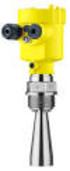 VEGAPULS PULSE RADAR FOR LEVEL MEASUREMENT VEGAPULS 60 SERIES Why Use RADAR? Are you tired of re-calibrating the 0-point on pressure transmitters or dp cells? Operating by using electromagnetic microwave
Principle of Thermal Imaging
 Section 8 All materials, which are above 0 degrees Kelvin (-273 degrees C), emit infrared energy. The infrared energy emitted from the measured object is converted into an electrical signal by the imaging
Development of New Inkjet Head Applying MEMS Technology and Thin Film Actuator
 Development of New Inkjet Head Applying MEMS Technology and Thin Film Actuator Kenji MAWATARI, Koich SAMESHIMA, Mitsuyoshi MIYAI, Shinya MATSUDA Abstract We developed a new inkjet head by applying MEMS
A wave lab inside a coaxial cable
 INSTITUTE OF PHYSICS PUBLISHING Eur. J. Phys. 25 (2004) 581 591 EUROPEAN JOURNAL OF PHYSICS PII: S0143-0807(04)76273-X A wave lab inside a coaxial cable JoãoMSerra,MiguelCBrito,JMaiaAlves and A M Vallera
Tamura Closed Loop Hall Effect Current Sensors
 Tamura Closed Loop Hall Effect Current Sensors AC, DC, & Complex Currents Galvanic Isolation Fast Response Wide Frequency Bandwidth Quality & Reliability RoHs Compliance Closed Loop Hall Effect Sensors
- thus, the total number of atoms per second that absorb a photon is
 Stimulated Emission of Radiation - stimulated emission is referring to the emission of radiation (a photon) from one quantum system at its transition frequency induced by the presence of other photons
E. K. A. ADVANCED PHYSICS LABORATORY PHYSICS 3081, 4051 NUCLEAR MAGNETIC RESONANCE
 E. K. A. ADVANCED PHYSICS LABORATORY PHYSICS 3081, 4051 NUCLEAR MAGNETIC RESONANCE References for Nuclear Magnetic Resonance 1. Slichter, Principles of Magnetic Resonance, Harper and Row, 1963. chapter
Acousto-optic modulator
 1 of 3 Acousto-optic modulator F An acousto-optic modulator (AOM), also called a Bragg cell, uses the acousto-optic effect to diffract and shift the frequency of light using sound waves (usually at radio-frequency).
Steven R. McManus Environmental Product Support Teledyne Isco
 Steven R. McManus Environmental Product Support Teledyne Isco Flow Measurement Applications and Technologies. Methods of flow measurement Technologies of flow measurement Flow Rate Applications Channel
DRS-6/1 Doppler Radar Sensor
 DRS-6/1 Doppler Radar Sensor B+S Software und Messtechnik GmbH Lochhamer Schlag 17 D-82166 Graefelfing Germany October 1999 User's Manual DRS-6 SENSOR for speed measurements 1. DRS-6 Functional Description
CHAPTER 4. Electromagnetic Spectrum
 ELEC4504 Avionics Systems 9 CHAPTER 4. Electromagnetic Spectrum 4.1. Electromagnetic (EM) Waves In free space (or the atmosphere) the electric field is perpendicular to the magnetic field and both are
IFC 070 Technical Datasheet
 IFC 070 Technical Datasheet Electromagnetic signal converter Battery driven with low energy consumption Quick and easy to install and operate External data logger and GSM module for remote data transfer
Training programme on flow measurements
 WMO / OMM Autorite du Bassin du Niger Niger-HYCOS and Volta-HYCOS Projects Training programme on flow measurements 2 nd part : Flow measurement techniques Flow measurements and calculations Definitions
Understanding the Flo-Dar Flow Measuring System
 Understanding the Flo-Dar Flow Measuring System Independent tests verify non-contact flowmeter is highly accurate under both open channel and surcharge conditions TM Flo-Dar is the only non-contact open
AP1 Waves. (A) frequency (B) wavelength (C) speed (D) intensity. Answer: (A) and (D) frequency and intensity.
 1. A fire truck is moving at a fairly high speed, with its siren emitting sound at a specific pitch. As the fire truck recedes from you which of the following characteristics of the sound wave from the
Sensors Collecting Manufacturing Process Data
 Sensors & Actuators Sensors Collecting Manufacturing Process Data Data must be collected from the manufacturing process Data (commands and instructions) must be communicated to the process Data are of
Data Transmission. Data Communications Model. CSE 3461 / 5461: Computer Networking & Internet Technologies. Presentation B
 CSE 3461 / 5461: Computer Networking & Internet Technologies Data Transmission Presentation B Kannan Srinivasan 08/30/2012 Data Communications Model Figure 1.2 Studying Assignment: 3.1-3.4, 4.1 Presentation
Fibre Bragg Grating Sensors An Introduction to Bragg gratings and interrogation techniques
 Fibre Bragg Grating Sensors An ntroduction to Bragg gratings and interrogation techniques Dr Crispin Doyle Senior Applications Engineer, Smart Fibres Ltd. 2003 1) The Fibre Bragg Grating (FBG) There are
Sensor and Simulation Notes. Note 479. October 2003. A Dual-Polarity Impulse Radiating Antenna
 Sensor and Simulation Notes Note 479 October 2003 A Dual-Polarity Impulse Radiating Antenna Leland H. Bowen and Everett G. Farr Farr Research, Inc. Dean I. Lawry Air Force Research Laboratory, Directed
TECHNICAL PAPER. Magnetostrictive Level Sensors. Liquid Level Sensors. Theory of Operation. David Nyce and Adrian Totten
 l MTS Systems Corporation Sensors Division 3001 Sheldon Drive Cary, NC 27513 Phone 919-677-0100, Fax 919-677-0200 TECHNICAL PAPER Part Number: 08-02 M1166 Revision A Magnetostrictive Level Sensors David
INTRODUCTION FIGURE 1 1. Cosmic Rays. Gamma Rays. X-Rays. Ultraviolet Violet Blue Green Yellow Orange Red Infrared. Ultraviolet.
 INTRODUCTION Fibre optics behave quite different to metal cables. The concept of information transmission is the same though. We need to take a "carrier" signal, identify a signal parameter we can modulate,
Grant Agreement No. 228296 SFERA. Solar Facilities for the European Research Area SEVENTH FRAMEWORK PROGRAMME. Capacities Specific Programme
 Grant Agreement No. 228296 SFERA Solar Facilities for the European Research Area SEVENTH FRAMEWORK PROGRAMME Capacities Specific Programme Research Infrastructures Integrating Activity - Combination of
PIPELINE INSPECTION UTILIZING ULTRASOUND TECHNOLOGY: ON THE ISSUE OF RESOLUTION By, M. Beller, NDT Systems & Services AG, Stutensee, Germany
 ABSTRACT: PIPELINE INSPECTION UTILIZING ULTRASOUND TECHNOLOGY: ON THE ISSUE OF RESOLUTION By, M. Beller, NDT Systems & Services AG, Stutensee, Germany Today, in-line inspection tools are used routinely
XI / PHYSICS FLUIDS IN MOTION 11/PA
 Viscosity It is the property of a liquid due to which it flows in the form of layers and each layer opposes the motion of its adjacent layer. Cause of viscosity Consider two neighboring liquid layers A
Waves-Wave Characteristics
 1. What is the wavelength of a 256-hertz sound wave in air at STP? 1. 1.17 10 6 m 2. 1.29 m 3. 0.773 m 4. 8.53 10-7 m 2. The graph below represents the relationship between wavelength and frequency of
A receiver TDC chip set for accurate pulsed time-of-flight laser ranging
 A receiver TDC chip set for accurate pulsed time-of-flight laser ranging Juha Kostamovaara, Sami Kurtti, Jussi-Pekka Jansson University of Oulu, Department of Electrical Engineering, Electronics Laboratory,
A Practical Guide to Free Energy Devices
 A Practical Guide to Free Energy Devices Part PatD9: Last updated: 28th January 2006 Author: Patrick J. Kelly Please note that this is a re-worded excerpt from this patent. If the content interests you,
DESIGN AND EVALUATION OF PROBE WITH THREE DEGREE- OF-FREEDOM FOR NON-DESTRUCTIVE TEST USING THREE- DIMENSIONAL FINITE ELEMENT METHOD
 DESIGN AND EVALUATION OF PROBE WITH THREE DEGREE- OF-FREEDOM FOR NON-DESTRUCTIVE TEST USING THREE- DIMENSIONAL FINITE ELEMENT METHOD Masafumi Aoyanagi Graduate School of Systems and Information Engineering,
Selecting Receiving Antennas for Radio Tracking
 Selecting Receiving Antennas for Radio Tracking Larry B Kuechle, Advanced Telemetry Systems, Inc. Isanti, Minnesota 55040 [email protected] The receiving antenna is an integral part of any radio location
Ultrasound Distance Measurement
 Final Project Report E3390 Electronic Circuits Design Lab Ultrasound Distance Measurement Yiting Feng Izel Niyage Asif Quyyum Submitted in partial fulfillment of the requirements for the Bachelor of Science
Experiment 1: SOUND. The equation used to describe a simple sinusoidal function that propagates in space is given by Y = A o sin(k(x v t))
 Experiment 1: SOUND Introduction Sound is classified under the topic of mechanical waves. A mechanical wave is a term which refers to a displacement of elements in a medium from their equilibrium state,
Signal directionality Lower frequency signals are omnidirectional Higher frequency signals can be focused in a directional beam
 Transmission Media Transmission medium Physical path between transmitter and receiver May be guided (wired) or unguided (wireless) Communication achieved by using em waves Characteristics and quality of
How to measure absolute pressure using piezoresistive sensing elements
 In sensor technology several different methods are used to measure pressure. It is usually differentiated between the measurement of relative, differential, and absolute pressure. The following article
Overview. also give you an idea of ANSYS capabilities. In this chapter, we will define Finite Element Analysis and. Topics covered: B.
 2. FEA and ANSYS FEA and ANSYS Overview In this chapter, we will define Finite Element Analysis and also give you an idea of ANSYS capabilities. Topics covered: A. What is FEA? B. About ANSYS FEA and ANSYS
Features. Applications. Description. Blockdiagram. K-LC1a RADAR TRANSCEIVER. Datasheet
 Features 24 GHz K-band miniature transceiver 180MHz sweep FM input (n.a. for K-LC1a_V2) Dual 4 patch antenna Single balanced mixer with 50MHz bandwidth Beam aperture 80 /34 15dBm EIRP output power 25x25mm
Module 13 : Measurements on Fiber Optic Systems
 Module 13 : Measurements on Fiber Optic Systems Lecture : Measurements on Fiber Optic Systems Objectives In this lecture you will learn the following Measurements on Fiber Optic Systems Attenuation (Loss)
Precision Miniature Load Cell. Models 8431, 8432 with Overload Protection
 w Technical Product Information Precision Miniature Load Cell with Overload Protection 1. Introduction The load cells in the model 8431 and 8432 series are primarily designed for the measurement of force
1) The time for one cycle of a periodic process is called the A) wavelength. B) period. C) frequency. D) amplitude.
 practice wave test.. Name Use the text to make use of any equations you might need (e.g., to determine the velocity of waves in a given material) MULTIPLE CHOICE. Choose the one alternative that best completes
High Voltage Power Supplies for Analytical Instrumentation
 ABSTRACT High Voltage Power Supplies for Analytical Instrumentation by Cliff Scapellati Power supply requirements for Analytical Instrumentation are as varied as the applications themselves. Power supply
Pillbox Antenna for 5.6 GHz Band Dragoslav Dobričić, YU1AW [email protected]
 Pillbox Antenna for 5.6 GHz Band Dragoslav Dobričić, YU1AW [email protected] Introduction The pillbox or cheese antenna is made of two parallel plates which are connected to the narrow strip of parabolic
8.1 Radio Emission from Solar System objects
 8.1 Radio Emission from Solar System objects 8.1.1 Moon and Terrestrial planets At visible wavelengths all the emission seen from these objects is due to light reflected from the sun. However at radio
Practice final for Basic Physics spring 2005 answers on the last page Name: Date:
 Practice final for Basic Physics spring 2005 answers on the last page Name: Date: 1. A 12 ohm resistor and a 24 ohm resistor are connected in series in a circuit with a 6.0 volt battery. Assuming negligible
PAGE 2. Figure 1: Difference between PWL ins and SPL 1m
 PAGE 1 Pipe noise J.H. Granneman and R.P.M. Jansen, Peutz Consulting Engineers, The Netherlands, emphasise the need for an adequate pipe noise control procedure, with reference to the design phase, insulation
Replacing Displacers with Guided Wave Radar
 ROSEMOUNT GUIDED WAVE RADAR Replacing Displacers with Guided Wave Radar KEY POINTS Mounting flanges vary by displacer supplier Probe must extend the of the displacer chamber Single rigid probes are the
Single Channel Loop Detector
 Single Channel Loop Detector Model - LD100 Series The LD100 is a single channel inductive loop detector designed for parking and access control applications. The detector is connected to an inductive loop
DREXELBROOK. USonic-R Series. Ultrasonic Level Measurement System. User Friendly
 DREXELBROOK A Leader In Level Measurement Solutions USonic-R Series Ultrasonic Level Measurement System User Friendly Set the measurement range directly in inches, feet, millimeters, centimeters, or meters
An equivalent circuit of a loop antenna.
 3.2.1. Circuit Modeling: Loop Impedance A loop antenna can be represented by a lumped circuit when its dimension is small with respect to a wavelength. In this representation, the circuit parameters (generally
Digital Systems Ribbon Cables I CMPE 650. Ribbon Cables A ribbon cable is any cable having multiple conductors bound together in a flat, wide strip.
 Ribbon Cables A ribbon cable is any cable having multiple conductors bound together in a flat, wide strip. Each dielectric configuration has different high-frequency characteristics. All configurations
Scanning Acoustic Microscopy Training
 Scanning Acoustic Microscopy Training This presentation and images are copyrighted by Sonix, Inc. They may not be copied, reproduced, modified, published, uploaded, posted, transmitted, or distributed
p atmospheric Statics : Pressure Hydrostatic Pressure: linear change in pressure with depth Measure depth, h, from free surface Pressure Head p gh
 IVE1400: n Introduction to Fluid Mechanics Statics : Pressure : Statics r P Sleigh: [email protected] r J Noakes:[email protected] January 008 Module web site: www.efm.leeds.ac.uk/ive/fluidslevel1
Introduction. Description of Measurement Techniques
 Introduction The capability to measure the dielectric properties of various materials has been developed in the Electromagnetic Properties Measurement Laboratory (EPML) of the Electromagnetics Research
AN1200.04. Application Note: FCC Regulations for ISM Band Devices: 902-928 MHz. FCC Regulations for ISM Band Devices: 902-928 MHz
 AN1200.04 Application Note: FCC Regulations for ISM Band Devices: Copyright Semtech 2006 1 of 15 www.semtech.com 1 Table of Contents 1 Table of Contents...2 1.1 Index of Figures...2 1.2 Index of Tables...2
Precision Analog Designs Demand Good PCB Layouts. John Wu
 Precision Analog Designs Demand Good PCB Layouts John Wu Outline Enemies of Precision: Hidden components Noise Crosstalk Analog-to-Analog Digital-to-Analog EMI/RFI Poor Grounds Thermal Instability Leakage
Physics 9e/Cutnell. correlated to the. College Board AP Physics 1 Course Objectives
 Physics 9e/Cutnell correlated to the College Board AP Physics 1 Course Objectives Big Idea 1: Objects and systems have properties such as mass and charge. Systems may have internal structure. Enduring